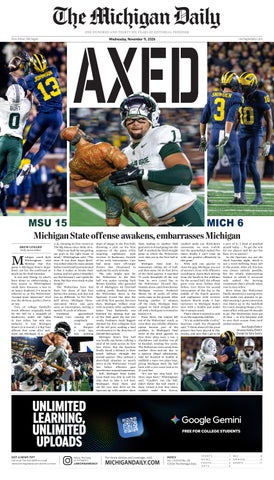
AXED ONE HUNDRED AND THIRTY SIX YEARS OF EDITORIAL FREEDOM
Wednesday, November 11, 2026
Ann Arbor, Michigan
MSU 15
michigandaily.com
MICH 6
Michigan State offense awakens, embarrasses Michigan
DREW LENARD Daily Sports Editor
M
ichigan coach Kyle Whittingham said Monday that this game is Michigan State’s Super Bowl, not his. He confirmed as much on the field Saturday. It was only fitting. In what’s been about as embarrassing a first season as Whittingham could have foreseen, a loss to an injury-depleted, 2-6 team he referred to as the Wolverines’ “second most important” rival was the obvious, perfect cherry on top. Two of college football’s worst offenses originally both fit the bill in a standoff of mediocrity under the lights in Ann Arbor, but only one endured. It was Michigan State’s (3-6 overall, 1-5 Big Ten) offense that came alive and wore out Michigan (5-4,
2-4), claiming its first victory at The Big House since 2020, 15-6. “That’s my fault for not getting our guys in the right frame of mind,” Whittingham said. “The term ‘It was their Super Bowl,’ was talked about by many people before I said it and I just reiterated it that it makes or breaks their season, and so I guess I shouldn’t say that because I can’t speak for them. But they were ready to play tonight.” The Wolverines have had their fair share of bad first halves this season, and this one was no different. In five firsthalf drives, Michigan threeand-outed thrice and gave away an interception, netting a measly 78 yards of offense. Freshman quarterback Tommy Carr, coming off a completely clean game at Rutgers a week ago, was nothing
GOT A NEWS TIP? Call us at 734-763-2459 or e-mail news@michigandaily.com and let us know.
short of sloppy in the first half, throwing a pick on his first sequence of the game while targeting sophomore wide receiver JJ Buchanan. Outside of his early interception, Carr had many more off-target throws that threatened to replicate his early mistake. The only bright spot for the Wolverines in the first half was senior running back Bryson Kuzdzal, who garnered 35 of Michigan’s 40 first-half rushing yards. Kuzdzal drove the Wolverines down to the Spartans’ 8-yard line near the end of the first quarter, but even then, Michigan walked away with no points. After sophomore kicker Trey Butkowski was benched for missing four out of five field goals the last two weeks, freshman Jacob Baggett doinked his first collegiate kick off the left post, sending a loud reverberation in the direction of 110,000 fed-up fans. Michigan State’s first half was hardly any better, tallying a total of 44 yards across its first four drives. But the Spartans finally found a balance in their attack halfway through the second quarter. They utilized a short-field situation to march down to the Wolverines’ 3-yard line before offensive pass interference stunted momentum. Still, Michigan State kicker Liam Boyd was able to nail his chip shot to take a 3-0 lead. Michigan’s third three and out the very next drive set the Spartans up with another short
Follow The Daily on Instagram,
@MICHIGANDAILY
field, leading to another field goal and a 6-0 lead going into the half. It marked the third straight game in which the Wolverines were shut out in the first half at home. Michigan State kept its momentum rolling out of half, and then some. On its first drive of the third quarter, it marched 79 yards downfield all the way from its own 1-yard line to the Wolverines’ 20-yard line. Outside of one catch from former Michigan receiver Frederick Moore for 10 yards, all other yards came on the ground. After burning another 11 minutes off the clock, Michigan State capped its third straight drive off with a field goal to extend its lead to 9-0. From there, the contest fell out of the Wolverines’ reach, as even their one reliable offensive option became part of the problem. In Michigan’s final drive of the third quarter, its first three plays were a run, a checkdown and another run all to Kuzdzal, totaling five yards. The Wolverines were saved from another three-and-out due to a Spartan illegal substitution, only for Kuzdzal to fumble at midfield a mere two plays later, giving Michigan State the ball back with a two-score lead at its 33-yard line. “It’s not one step back. It’s three steps back,” Whittingham said. “Couldn’t run the ball, didn’t throw the ball worth a darn, turned it over four times, couldn’t make first downs,
For more stories and coverage, visit
MICHIGANDAILY.COM
couldn’t make any third-down conversion, we were 2-of-10. Got the quarterback sacked five times. Really, I can’t come up with one positive offensively in this game.” With only one quarter to close the gap, Michigan was out of answers. Even with offensive coordinator Jason Beck moving from the booth to the sidelines for the second half, the offense grew even more listless than before. Carr threw his second interception of the day in the middle of the fourth quarter, and sophomore wide receiver Andrew Marsh made it four turnovers to Michigan State’s zero with a fumble just under the 5-minute mark. That’s when it started to sink in on the opposing sideline. “It’s an unbelievable rivalry,” Spartans coach Pat Fitzgerald said. “I think about all the great players that have played in this rivalry, and now that I get to be
INDEX Vol. CXXXVII No. 28 ©2026 The Michigan Daily
a part of it, I kind of pinched myself today. … To get the win for our players and for our fan base, it’s so special.” As the Spartans ran out the clock Saturday night, shock is not a word befitting those left in the stands. After all, this loss was always entirely possible, but the wholly embarrassing fashion in which it occurred only stoked the burning resentment that’s already taken root in Ann Arbor. Even when the Wolverines finally mustered a scoring drive with under two minutes to go, their ensuing 2-point conversion was blown up in the backfield for a sack, keeping things a twoscore affair with just 90 seconds to go. The Wolverines were out of time — to win Saturday, and to save their season from total embarrassment.
SPORTS................1 NEWS...............2 PHOTO.................5 ARTS...............6
Ava Farah/DAILY Ananya Kedia/DAILY Design by Sara Sastry
MIC......................8 OPINION . . . . . . . . . . . . . . . . .9 SPORTS ...................11
News
2 — Wednesday, November 11, 2026
ANN ARBOR
The Michigan Daily — michigandaily.com
Christopher Taylor concludes 12-year tenure as Ann Arbor mayor
Taylor’s friends, family members and fellow public officials thanked him for his longtime service NIKO WILSON
ZACHARY AJLUNI and EDITH PENDELL
Daily Staff Reporter
Outgoing Mayor Christopher Taylor took his seat in the mayor’s chair in Larcom City Hall for the last time at Thursday’s City Council meeting, concluding his 12-year tenure as Ann Arbor mayor. At the meeting, the council reflected on his tenure, discussing Taylor’s leadership on the city’s climate action and housing construction. The meeting also marked the end of the terms of Councilmembers Chris Watson, D-Ward 2; Ayesha Ghazi Edwin, D-Ward 3; and Dharma Akmon, D-Ward 4, as the city prepares to welcome Mayorelect Yousef Rabhi along with three new councilmembers — Ryan Bartholomew, Sandy Aldrich and Aidan Sova — in December. Taylor was first elected mayor in 2014 after representing Ward 3 on City Council for six years. During the meeting’s public comment session, Taylor’s friends, family members and fellow public officials praised him for his commitment to improving Ann Arbor. U.S. Rep. Debbie Dingell, D-Ann Arbor, presented Taylor with a plaque of a Congressional resolution thanking him for his service. “No matter where you are on issues, we need to thank people for public service,” Dingell said. “The mayor has been serving the people of Ann Arbor since 2008, first on city council — almost for 20 years — and for the last 12 years. He loves his city, and people don’t know how hard public service is these days.” Ann Arbor resident Chuck Warpehoski, who served on the City Council from 2012 to 2018, praised Taylor for leading with respect to his own values. “People have strong feelings — sometimes they’re not treating you with kindness and respect or councilmembers with kindness and respect, but you always show them kindness, respect, a thank you, a courtesy,” Warpehoski said. “I’ve also seen a strong commitment from you to let your internal sense of what is right
Co-Editors in Chief eic@michigandaily.com
CICI COPENHAVER
Business Manager business@michigandaily.com
NEWS TIPS
tipline@michigandaily.com
LETTERS TO THE EDITOR tothedaily@michigandaily.com
EDITORIAL PAGE
opinion@michigandaily.com
Vivian Tai/DAILY Ann Arbor Mayor Christopher Taylor speaks during a City Council meeting Thursday evening.
guide your policy decisions over political calculations.” Ruby Taylor, Christopher Taylor’s daughter, called into the meeting to express gratitude for her father’s commitment to both the city and his family. “I am genuinely so proud of what I’ve seen him do and how much he’s given himself to the city and his constituents over those years, but without ever sacrificing being a deeply loving and present parent,” Ruby Taylor said. Rabhi, a Democratic Socialist and Washtenaw County Commissioner, defeated Christopher Taylor in the Aug. 4 primary and was officially elected the city’s next mayor Nov. 3. Rabhi will begin his term on Dec. 1 alongside the new councilmembers. They are expected to participate in their first meeting on Dec. 7. Councilmember Travis Radina, D-Ward 3 is the mayor pro tempore, who fulfills the mayor’s duties in their absence. He will serve as mayor until the Dec. 7. meeting, when Rabhi will take over and the council will vote for the next mayor pro tem. Councilmember Jen Eyer, D-Ward 4, expressed gratitude for Christopher Taylor’s role in advancing housing and
“Everyone was talking about Mahmoud Khalil, who he is, what he wants. But they were not hearing from me as a person.”
Political activist Mahmoud Khalil joined University of Michigan faculty, students and community members at the Rackham Amphitheater Thursday evening to discuss his debut memoir, “No Land to Stand On: Notes from Detention.” The event was hosted in collaboration with the Central Student Government, the Graduate Employees’ Organization, LSA Student Government, Syrian Students Association, La Casa and the University’s chapter of the American Civil Liberties Union. Khalil, a former Columbia University graduate student, was born in a Palestinian refugee camp in Syria. He fled the country at age 18 and obtained a green card, giving him legal status to live and work in the United States. Khalil gained national attention during his tenure as a graduate student in 2024 at the height of pro-Palestine protests and encampments at the university. Khalil became one of the most visible faces of the protests, serving as a negotiator between student activists and the administration. On the night of March 8, 2025, Khalil was walking into the lobby of his universityowned Columbia University apartment building with his wife, Noor Abdalla, when he was detained by U.S. Immigration and Customs Enforcement. Despite his lawful permanent residency and lack of a criminal record, Marco Rubio, U.S. secretary of state, declared Khalil should be deported. After
arts@michigandaily.com
photo@michigandaily.com
Mahmoud Khalil brings ‘No Land to Stand On’ book tour to Ann Arbor
Daily Staff Reporter
ARTS SECTION
PHOTOGRAPHY SECTION
STUDENT GOVERNMENT
LYLA BROOKS
Stanford Lipsey Student Publications Building 420 Maynard St. Ann Arbor, MI 48109-1327 734-418-4115 www.michigandaily.com
his arrest, Khalil was sent to an immigration detention center in rural Louisiana, more than 1,000 miles from his home. Khalil continues to challenge his deportation order by petitioning the U.S. Supreme Court. During his talk, Khalil said he wrote the memoir while facing deportation because he wanted people to hear his perspective. “A lot of the scenes were very raw because I was living it while I was writing that book,” Khalil said. “Everyone was talking about Mahmoud Khalil, who he is, what he wants. But they were not hearing from me as a person, and that’s where I decided I want people to hear from me.” Khalil said he felt privileged in comparison to others he met in the detention center. “When I heard the stories about the men around me, it was just so heartbreaking,” Khalil said. “I met someone. I saw him crying, and when I asked him, ‘Why are you crying?’ he told me, ‘I miss my 2-year-old who would usually sleep on my shoulder,’ and he showed me all his tax documents. He had a roofing company here, and he would show me how he would pay $150,000 every year in taxes as if this is his way out. He never committed a crime, and he did not have any lawyers.” Khalil said that, while he was scared about President Donald Trump’s involvement in his potential deportation, he saw it as a sign that pro-Palestine activists had fought beyond what universities and local law enforcement could contain.
CONTINUED AT MICHIGANDAILY.COM
sustainability efforts, including the A2Zero carbon neutrality plan, the Sustainable Energy Utility, the climate action millage and the affordable housing millage. “These initiatives required vision, they required political courage, and they required the skill and ability to bring people together around hugely ambitious goals,” Eyer said. Councilmember Jon Mallek, D-Ward 2, praised Taylor’s optimism and steady leadership while also expressing admiration for departing Councilmembers Akmon and Ghazi Edwin. “You have a remarkable ability to walk into even some of the toughest situations with a smile and energy I wish I could match,” Mallek said. “I also want to thank councilmembers Akmon and Ghazi Edwin. When the two of you speak, my most frequent thought is, ‘Dang, I wish I’d thought of saying that.’” Mallek also commended Councilmember Watson, with whom he served alongside to represent Ward 2, for his commitment to the role. “I got to see the amount of time, care and thought you put into even the most routine email responses,” Mallek said. “Time
and time again, I watched you go above and beyond to meet the needs of Ward 2 residents. That dedication to the role and to Ward 2 gave me the best possible example of what it means to be a city councilmember when I first joined.” Ghazi Edwin thanked Christopher Taylor for always maintaining a respectful approach, even when facing harsh backlash from residents. “Thank you just for always demonstrating civility, even when people are screaming at the top of their lungs at you, always ending every comment with a ‘thank you,’” Ghazi Edwin said. “It really just shows so much. Just the character that you have — and that’s why you were perfect for this job.” Christopher Taylor concluded the meeting by expressing gratitude to his colleagues and each Ann Arbor resident who entrusted him to serve their city. “Ann Arbor believes in a community that works for everyone, today and tomorrow, and we have the ambition and the ability to get it done,” Taylor said. “You have entrusted me to be part of that project, and that has been the honor of a lifetime.”
ADMINISTRATION
Michigan Medicine appoints first chief data and AI operations officer Naveen Maram will oversee AI in patient care and determine how new tools are implemented NATALIA PATAQ
Daily News Contributor
Michigan Medicine appointed Naveen Maram as its first chief data and artificial intelligence officer in a move that reflects the expansion of AI in healthcare systems nationwide. Before starting at the University Oct. 12, Maram performed a similar role at Ardent Health, a Tennessee-based hospital operator running both public and forprofit healthcare systems across six states. At Ardent Health, Maram led the collection, use and management of data and oversaw the firm’s changing AI initiatives. In an interview with The Michigan Daily, Maram said he was drawn to the University of Michigan to continue working with researchers to deliver quality patient-focused care. “The focus on the patient, the focus on making sure that we are delivering the most appropriate care there, that is unchanged,” Maram said. “Where it gets much more inspiring for me is in Michigan it’s not just delivering evidence-based care, but the fact that we get to work with teams that are actually building that evidence, which is going to become the new standard of care.” Maram said his role will include overseeing AI in patient care and the departments supporting it, especially through identifying and addressing gaps in information. “The problems are going to be at the data level,” Maram said. “Is our data even AI ready? Sometimes you’re making judgment calls on data that’s not ready. We are
trying to make sure that, ‘Hey, this is incomplete data? How do we address it?’” Maram will also help determine how new AI tools are implemented at Michigan Medicine. He said he will bring the clinical, operations and information security teams together to set standards for AI tools and revise them if they fall short. “First off, we have the right standards,” Maram said. “Second, do we have the right people at the table when those standards are being designed? Where do we need to create new standards, and when the standards are coming in, how do we make sure that it’s happening with the right people? Because just having standards is not enough; it has to have a team.” Maram said methods for reducing and identifying bias in AI are still developing, but he intends to prioritize establishing safeguards against them. “What are the correction mechanisms we have for managing our own biases?” Maram said. “It’s evolving. It’s learning. The fact that we are mindful that a bias could be at play here to me is a great first step. And so the techniques of how we reduce bias, how we mitigate bias, how we understand and interpret bias — those are evolving.” Michigan Medicine recently renamed its internal AI governance council — the Clinical Intelligence Committee — to the Michigan Medicine AI Governance and Integration Council, a change that reflects the council’s broadening scope.
CONTINUED AT MICHIGANDAILY.COM
SPORTS SECTION
NEWSROOM
sports@michigandaily.com
news@michigandaily.com
ADVERTISING
CORRECTIONS
wmg-contact@umich.edu
corrections@michigandaily.com
Editorial Staff ANNABELLE YE
Joshua Mitnick ’92, ’95 Managing Editor
bellaye@umich.edu
GEORGIA MCKAY
Digital Managing Editor
gmckay@umich.edu
AANYA PANYADAHUNDI and CHRISTINA ZHANG
Managing News Editors news@michigandaily.com Senior News Editors: Alexa Cheaney, Dominic Apap, Gia Verma, Quinn Mittlestat, Sarah Palushi, Sarah Spencer
ELENA NICHOLSON and GABE EFROS
Editorial Page Editors tothedaily@michigandaily.com Deputy Editorial Page Editor: Mateo Alvarez Senior Opinion Editors: Avery Allen, Maggie Berling, Madeleine Burke, Stephanie Bouserhal, Isabel Seniawsk
LYRA SHARMA and GRAHAM BARKER
Managing Sports Editors sports@michigandaily.com Deputy Sports Editor: Sophie Matthews Senior Sports Editors: Amanda Bergman, Niyatee Jain, Drew Lenard, Nate Schreck, Grace Wright, Hadley Zann
CAMPBELL JOHNS and CORA ROLFES
Managing Arts Editors arts@michigandaily.com Senior Arts Editors: Hudsen Mazurek, Abigail Weinberg, Tara Wasik, Ana Torresarpi, Meagan Ismail, Siena Beres
MAISIE DERLEGA and SELENA ZOU
Managing Design Editors design@michigandaily.com Senior Layout Editors: Frances Leibovich, Kathryn Palsrok Senior Illustrators: Gabriella Spagnuolo, Emmeline Meldrum, Ella Flores Brosnan
BRIDGETTE BOL and HOLLY BURKHART
Managing Photo Editors photo@michigandaily.com Senior Photo Editors: Ananya Kedia, Arushi Sanghi, Isai Hernandez-Flores, Ava Farah
AYA FAYAD
Managing Statement Editor statement@michigandaily.com Deputy Editors: Oummu Kabba, Lola Post, Riya Kommineni
ALINA MURATA and JOSUE MATA
Managing Copy Editors copydesk@michigandaily.com Senior Copy Editors: Maximus Craig, Meagan Ismail, Claudette Johnson, Oummu Kabba, Ayah Maskoun, Caroline Niccolini, Emma Oftedal, Joshua Park, Zoey Ueland, Justin Xhelilaj
EMMA PENG and JULIA MEI
Managing Online Editors webteam@michigandaily.com Data Editors: Darby Jones, Zora Tucker Engineering Manager: Alyssa Locke, Grace Liu Product Managers: Annice Chang, Sanvika Inturi Senior Software Engineer: Becky Pan
EVAN KRUMMEL and JOVANNA GALLEGOS
Managing Video Editors video@michigandaily.com Senior Video Editors: Samridhi Sharma, Grace Wright, Skylar Facione
AMARA M. SMALL and IHAA MOHAN
Michigan in Color Managing Editors michiganincolor@michigandaily.com Senior MiC Editors: Allana Smith, Amany Sayed
HANNAH BODNAR and AVA HOOGTERP
Managing Podcast Editors podeditors@michigandaily.com Senior Podcast Editors: Rogen McLean, Zora Burroughs, Karina Shahinian, Olivia Dickerson
DA YOUNG KIM and UWAEISH AHMAD
Managing Audience Engagement Editors socialmedia@michigandaily.com Senior Audience Engagement Editors: Amanda Bergman, Caleb Starr, Isabella Burke, Libby Le Febre, Michelle Fang, Sophia Polega, Heewon Moon
MAHEE KAVDIA and PUJITA RUPANI Culture, Training, and Inclusion Co-Chairs
accessandinclusion@michigandaily.com
LUCY LANGERVELD and TIFFANY MCKALKO
Managing Focal Point Editors lucykate@umich.edu, tmckalko@umich.edu Senior Focal Point Editors: Amaya Choudhury, Claudette Johnson
JAMES KNAKE and MILAN THURMAN
Managing Games Editors crosswords@umich.edu Senior Games Editors: Eleanor Sullivan, Kiran Parekh, Sam Martin, Tobin Saxton
Business Staff CAROLINE ZOLTAK
GABRIELLE GONDLY
KATE PARAMBO
MORGAN ORTH
Marketing Manager
Creative Director
Sales Manager
Strategy Manager
The Michigan Daily (ISSN 0745-967) is publishing weekly on Wednesdays for the Fall 2026 semester by students at the University of Michigan. One copy is available free of charge to all readers. Additional copies may be picked up at the Daily’s office for $2. If you would like a current copy of the paper mailed to you, please visit store.pub.umich.edu/michigan-daily-buy-this-edition to place your order.
The Michigan Daily — michigandaily.com
Wednesday, November 11, 2026 — 3
News
4 — Wednesday, November 11, 2026
PUBLIC SAFET Y
2026 DPSS report shows decreased sexual assault offenses, increased alcohol violation referrals Reported rape cases on the Ann Arbor campus decreased by about 60.9% between 2024 to 2025
The Michigan Daily — michigandaily.com
ADMINISTRATION
New U-M AI guiding principles encourage ethics, sustained improvement
The AI in Education Working Group released the document Oct. 21, incorporating community feedback SHAENA FOLEY
Daily News Contributor
Cars fill the parking lot outside the DPSS building on Kipke Drive.
ALEXANDRA SIM Daily Staff Reporter
Content warning: This article contains mentions of sexual assault and violence. The University of Michigan’s Division of Public Safety and Security released its 2026 Annual Security and Fire Safety Report on Sept. 30. In accordance with the Jeanne Clery Act, it outlines campus crime statistics and Ann Arbor’s fire safety statistics from 2023 to 2025. For the first time, the annual report included crime and fire safety statistics from all three U-M campuses — Ann Arbor, Dearborn and Flint. DPSS also added hazing statistics to the report following new reporting requirements under the federal Stop Campus Hazing Act. In an email to The Michigan Daily, Tomika DePriest, director of strategic communications at DPSS, wrote the goal of the change is to make information more accessible to students across the U-M system. “That gives students, employees, families, and the public a single place to review three years of campus-specific crime and fire-safety statistics, policies, procedures, reporting information, and available resources,” DePriest wrote. “It also provides a more consistent university-wide approach to transparency and Clery reporting while preserving the distinctions among the three campuses.” This past year, reported rape cases on the Ann Arbor campus
decreased from 23 in 2024 to nine in 2025, about a 60.9% decline. Fondling reports decreased by 25% — from 44 to 33 — and stalking incidents declined by about 20.9%, from 43 to 34. Domestic violence reports decreased by about 29.6% — from 27 to 19 — and dating violence reports declined by about 40.9% from 22 to 13. Meanwhile, liquor violation disciplinary referrals increased by about 24.3%, from 309 in 2024 to 384 in 2025. The majority of the referrals took place in University residence halls — 371 in 2025 and 302 in 2024. DePriest wrote that several initiatives by the University may have contributed to the decrease in reported sexual offenses. “DPSS believes a number of ongoing efforts may be contributing, including expanded prevention and education, increased Office of Equity, Civil Rights, and Title IX staffing and response resources, Special Victims Unit support and outreach, additional training within Michigan Medicine and continued improvements in university reporting and support systems,” DePriest wrote. However, DePriest wrote that a decline in reported incidents does not necessarily mean fewer incidents actually occurred. “We want to be careful not to claim that any one program or initiative caused the decline,” DePriest wrote. “The decreases are positive, but they do not change the importance of education and outreach. DPSS and our university partners remain focused on prevention, encouraging
Alum Caleb Rosenblum/DAILY
reporting, supporting survivors, and ensuring students know where to turn for help.” Student organizations have also played a role in prioritizing sexual assault prevention. LSA junior Reva Patchava, personnel chair for the University’s Chi Omega chapter, helps enforce chapter rules and National Panhellenic Conference standards and oversee risk management efforts related to member welfare, safety and confidentiality. Patchava said proactivity is the best way to prevent sexual assault. “I think the most important step isn’t to rely on solutions, but rather how we can be proactive and prevent these situations from even occurring in the first place,” Patchava said. While liquor violation disciplinary referrals increased on the Ann Arbor campus this year compared to last year, this increase does not include alcoholrelated arrests, which have been zero for the past three years. In an interview with The Daily, LSA freshman Adam Repp, who lives in Mary Markley Residence Hall, said he believes DPSS enforcement in residence halls can be an effective way to prevent students’ public alcohol use. “I have noticed alcohol enforcement policies in residence halls,” Repp said. “I do think that it is somewhat effective in making sure that people are not openly carrying alcohol in hallways and discourages people from drinking in the halls.”
CONTINUED AT MICHIGANDAILY.COM
PUBLIC SAFET Y
UMich signed $127,500 contract with Flock in 2025, has not installed cameras
It’s unclear why DPPS did not install the 15 cameras, or if money changed hands EDITH PENDELL Co-Editor in Chief
The University of Michigan Police Department signed a $127,500 contract with Flock Safety — a company which makes and maintains automated license plate reader technology — but never installed any cameras, according to records from a Freedom of Information Act request. Flock cameras, like other automated license plate readers, use cameras to scan passing vehicles and cross-reference them against databases of stolen vehicles, warrants and other watchlists. The cameras also log a vehicle’s make, model, color and distinguishing features, building a searchable record of movement over time. An agency that uses Flock cameras can plug into a larger network and access pooled data from cameras from other departments and users. On Feb. 3, 2025, Jennifer Carr, a U-M procurement agent, signed the contract on behalf of the UMPD, with Mark Smith, Flock’s general council, signing on behalf of the company. This contract was not publicized at the time.
Surveillance on campus The University made its most visible surveillance changes after it signed the Flock contract. Over the following months, the University expanded camera coverage and loosened the rules governing it. During summer 2025, the Division of Public Safety and Security installed security cameras at the entrances of most campus buildings and in the Law Quad and Diag. Some saw the increase in security cameras as a response to pro-Palestine protests during the 2024-2025 school year, which were met with force by UMPD. Law professor Michael Steinberg said he is concerned that cameras create a dangerous precedent. “The major issue is that we’ve moved from investigating suspects to collecting information about everyone,” Steinberg said. “It’s my worry that the University of Michigan is fully committed to turning our campus into a surveillance state.” That fall, the University formally launched the Security Technology Enhancement Project, a massive effort to modernize and upgrade the
physical safety and emergency communications infrastructure across all three U-M campuses. Soon after, the University updated its institutional policies to remove explicit restrictions on surveillance camera use and eliminate requirements for a student and faculty security oversight committee — a committee The Michigan Daily found was likely not meeting as required. This comes amid a wider debate unfolding across the country over surveillance technology, fueled by reports of misuse and mounting privacy concerns. In response, Michigan lawmakers from both parties have called for tighter regulation of Flock cameras. What the contract says The University agreed to pay $63,750 a year, or $127,500 over a 24-month initial term, for 15 Falcon® Flex cameras. The cameras are described as “law enforcement grade tactical deployment” cameras with “Vehicle Fingerprint™” artificial intelligence analysis technology, FlockOS Essentials software and 15 battery packs. It is unclear if this payment was ever made.
CONTINUED AT MICHIGANDAILY.COM
Amid the rise of artificial intelligence in classrooms at the University of Michigan, the University released the final draft of its AI Guiding Principles — a document containing six principles providing guidance on the use of AI in academic situations — Oct. 21. The six principles consist of championing responsible, human centric AI; advancing the institutional mission; supporting critical thinking development while building AI literacy; leading with purpose and engaging in continuous improvement; centering ethics, integrity, and transparency; and ensuring privacy of data and of the University community. The AI in Education Working Group initially investigated the use of AI at the University and shared their findings April 30 to shape how AI is utilized within the institution. The first draft of the University’s principles was published Sept. 3, and students and faculty members were invited to provide feedback. In an interview with The Michigan Daily, Mika LaVaqueManty, professor of political science and chair of the working group, said the group recommended against a singular policy, arguing it would not take into account the various needs of departments across campus. “We had heard from students, faculty and staff that they felt lost in the sea of AI on what the University’s position was,” LaVaque-Manty said. “We very strongly felt after our study — after we studied this issue — that a university-wide policy would be a very bad idea, partly because it would be just too general and not specific and vague.”
In an interview with The Daily, Business graduate student Rounak Banik, co-president and founder of the AI and Emerging Tech Club, said the club worked with the Ross School of Business to develop its feedback on the AI guidelines. Banik said he was pleased to see a lot of the principles the group promoted in the final copy of the guiding principles. “A lot of the things that we spoke about, I’m very happy that … it has figured in the guiding AI principles that was published by the University — mainly to do with having a human-centric approach,” Banik said. The document is not a policy — instead, it is considered a “guiding foundation.” LaVaque-Manty said faculty and instructors still have ultimate say over the conduct of AI in their classroom. “We recommend it — and I believe that the University also agrees — that ultimately, each faculty member should have a say on the implementation of AI in their classroom,” LaVaque-Manty said. “At the same time … we think that the best level for decisionmaking would be something like an academic department or any unit that controls curriculum.” In an interview with The Daily, Business sophomore Julia Lotz, president of the AI Business Group, said she believes it is vital for faculty members to become just as literate in AI as the students while the new technology advances. “It’s just as important — arguably more important — for the teachers and the faculty to understand what’s going on with AI,” Lotz said. “It’s super, super encouraging and amazing to see the (instructors) that really embrace AI. I, in the past year, have been forced to use it in my assignments, which in high school
I would have thought never would happen in college.” Banik said he believes the University is equipped to lead AI advancements, although he thinks the institution should prioritize developing AI from a human-centered perspective — the first principle released in the University’s guide. “It is important that the conversation be centered around humans, and the conversation be centered around empowerment,” Banik said. “I feel like the University of Michigan is in a very good place to actually take the mantle over there to champion human-centric AI that preserves our critical thinking, that preserves our creativity, that preserves our humanity.” The University of Michigan was the first university to provide a custom suite of generative AI tools, including U-M GPT, U-M Maizy and U-M GPT ToolKit. LaVaque-Manty said this provides an opportunity for students to explore the world of AI. “I think college is about exploration — I would encourage students to try any of the tools that they are interested in, whether they like AI, whether they’re critical or whether they’re enthusiastic,” LaVaqueManty said. Lotz said she hopes the University will continually update its principles for AI as the technology advances. “I would say my one hope is that they’re consistently updated,” Lotz said. “A year from now — not even a year from now, with the rate we’re at, with everything going on, it could be next week — something comes out, a new model comes out that has a whole other realm of implications that you then need to take into review.”
CAMPUS LIFE
Queer artists celebrate identities through fiber art and ceramic pots at new Stamps Gallery showcase “It’s really heartwarming just to see the people that show up and the connections that people make because of their art.”
KATELYN CAMBEIRO & EMMANUELLA NEFF Daily News Contributors
More than 60 University of Michigan students, faculty and community members came together at the Stamps Gallery Friday evening for the Queer Art Showcase. The crowd gathered around the artwork, taking in the colors and messages behind each piece. The showcase was hosted by the Spectrum Center and Stamps Gallery. It featured paintings, collages, digital illustrations, photographs, ceramics and stop-motion animation. The event invited student artists of all genders and sexualities to submit work celebrating Queer and transgender experiences. During the event, artists stood by their work, and attendees had the opportunity to walk around and learn about the visual symbolism and personal expression behind the pieces. Music, Theatre & Dance junior Clay Reiche created a fiber collage using artworks created over the years to form a woman’s profile in different shades of pink. In an interview with The Michigan Daily, Reiche said their identity is at the center of everything they create. “I work with my identity at the forefront, so I’m always kind of exploring gender and queerness through my work, and I was super excited to find out we were doing a whole show,” Reiche said. “It’s kind of like the magic that’s in life that you wouldn’t notice if you weren’t creating something.” Music, Theatre and Dance sophomore María García-
Murguía created a ceramic pot as a gift for her daughter, who recently transitioned. In an interview with The Daily, García-Murguía said the pot features symbols of trans identity, including clownfish — which can change from male to female — and butterflies and mushrooms — which represent transformation. García-Murguía also added personal aspects to her work, such as indigo — her daughter’s favorite color — and her daughter’s first pair of earrings. García-Murguía said the showcase has reflected her journey of learning more about the Queer community and supporting her daughter through her transition. “I’m learning about Queerness,” García-Murguía said. “I’m learning about pronouns. I’m learning about what to do, what not to do, all that stuff.” Dental student John Scharf created a collection of crocheted dolls, including monsters,
mystical animals and other creative characters. One specific doll was a tooth-themed knight named Gingivitis. Scharf told The Daily he designed the character to both represent what it was like to be in the Queer community. “In the Queer community, there’s a lot of struggle to define oneself, what you’re presenting yourself as to other people — what you look like, what other people think you look like — through the work of creating a human form over and over again by repetition, creating new, interesting ways to present oneself,” Scharf said. Reiche said the Queer Art Showcase gave the Queer community an opportunity to come together through art. “It means that I’m part of a greater community, and I belong here,” Reiche said. “It’s really heartwarming just to see the people that show up and the connections that people make because of their art and because of their shared identity.”
Qays Merrick/DAILY Artist John Scharf speaks with guests about his work at the Queer Art Showcase at Stamps Gallery Friday evening.
The Michigan Daily — michigandaily.com
Photo
Wednesday, November 11, 2026 — 5
GAME BY FRAMES Michigan Women’s Hockey beats Eastern Michigan University Oct. 8
MICHIGAN 4 EMU 3
Arts
6 — Wednesday, November 11, 2026
The Michigan Daily — michigandaily.com
Techno B-Side SIENA BERES
Senior Arts Editor
As a college student, I spend a horrifying amount of my day on my computer — and you probably do, too! Even before my life was run by Canvas and Google Calendar, most of my worldly exposure came through a screen. Most of the art that’s impacted my life the most has been mediated by blue light. I read e-books, I watch movies on my iPhone and I play games on my laptop. The infinite expanse of the internet confined
TECHNO B-Side
to the portability of my devices has made me indebted to and dependent on my machines. And historically, depicting technology in art has been a way for us to cope with its presence in our lives. For The Techno B-Side, I asked writers to think deep about computers, technology and machines — how they shape the ways we consume art and how they appear in art. And while it’s easy to talk about how technology has been bad for art, I challenged them to think about how computers have inspired us to create more unique art than ever.
Foster Douglass/DAILY
Design by Eda Kirca
From snail mail to synthesizers: How The Postal Service made ‘Give Up’ TOBIN SAXTON Daily Arts Writer
Maheen Rashid/DAILY
Disney XD: A time capsule of techno-optimism ABIGAIL WEINBERG Senior Arts Editor
The 2010s were a weird era for Disney Channel. Coming off unprecedented success from its turn-of-the-century originals such as “That’s So Raven,” “Lizzy McGuire” and “Hannah Montana,” the network was facing an unexpected change in consumer behavior: the rise of social media. In anticipation of this new world of virtuality, Disney faded out these shows for new, more contemporary titles that resonated with the next era of online tweens. But they didn’t stop there. In 2009, the company soon introduced a new, standalone channel: Disney XD. The message from the network was clear: As the world was becoming more and more futuristic, so were they, bringing on an era of Disney that was, quite literally, extremely digital. Disney XD began with reruns of the most futuristic content they could think of: animated superheroes, sci-fi and robots. “X-Men,” “The Avengers: United They Stand” and “Super Robot Monkey Team Hyperforce Go!” were some of the first titles aired on the network. But as the 2010s went on, the station seemed to realize that they could make new, “XD” content of their own. Live-action shows, with both familiar and new teen-star actors, starred in “Lab Rats” and “Mighty Med.” Soon, Disney XD wasn’t just a home for cartoon series; it was a mini Disney Channel of its own, with shows that were like their predecessors, but with smart computers, highspeed transportation and, perhaps most notably, a real excitement for the future.
The notable Disney Channel content of my youth primarily consisted of central network names, such as “Jessie,” “Good Luck Charlie” and “Austin and Ally.” But among the scramble of wild nannies, giant families and failed superstars, “Lab Rats” stood out as a beacon of the future. While Bree, Adam and Chase lived out their superhuman dreams — managing their bionic chips; living in their talking smart-house system “Eddy;” experimenting with time machines, lasers and jet-wings — I imagined that this was the world I would eventually come into. When Leo, the only human sibling, finally received bionic abilities, I too felt like I was celebrating his promotion. After all, these superhumans weren’t just going to school and doing their chores; they were engaging in hightech missions and saving innocent civilians each episode. They were kind, humorous and unexpectedly relatable. Despite their bionic composition, they were just about as human as robots could be. “Lab Rats” was part of an era of shows that were just as optimistic as they were innovative. In these trial years of the digital age, while companies were still experimenting with social media platforms and the rise of streaming, Disney had permission to be as tech-forward as they wanted. Social media was not as demoralizing to kids and artificial intelligence was not threatening the job market. So if a few superhumans came across their kids’ screens, parents didn’t have any reason to think twice about it. And as one of those kids, it felt pretty good to look into the future with a hopeful gaze. So where has this optimism for technology gone? The “Lab
Rats” finale premiered in 2016, neighbored closely by that of “Mighty Med,” and even Disney Channel’s most tech-forward hits, such as “KC Undercover” and “Best Friends Whenever.” Ever since, the network has shied away from futuristic concepts, shrinking back to its roots in friendship dramas, and moving away from new liveaction shows altogether. This makes sense, given the real threats presented by technology that most of us are confronted with daily. It feels tactless to dream about a world of invention when we are actively working to combat the ones that already exist. However, I can’t help but grieve this era of Disney — the one that served up a world of innovation and inspiration, not one that was on fire. Looking back at these shows, there might be something from this era worth holding on to. While the concept of bionic chips and superhuman abilities aren’t the daunting development we need right now, the hope of creating technology that is driven by a strong moral background is. Creating jetpacks and invisibility cloaks still feels unattainable, but dreams of high-speed trains and high-functioning prosthetics have already materialized in exciting new ways. These kinds of developments, ones that can actually create better lives for real people, are something worth celebrating with the same enthusiasm we once did. The high-tech atmospheres of these Disney XD shows may never feel as exciting as they did in 2015. Regardless, I’m glad to have grown up with them. These shows imbued me with a hope for the future and appreciation for the present I haven’t quite lost, and don’t think I ever will.
There’s something magical about making art alone: clunking out a guitar solo with no sense of direction, creating a collage illuminated by the blue-light glow of Pinterest or writing a poem that you’ll never show anyone. No matter the medium, we usually feel the most assured about these private creations because they are the most authentic representations of ourselves. Nobody is peering over your shoulder. There is no anxious anticipation of a reaction. Yet, when two artists choose to collaborate on a project, that isolation is typically disrupted. So, what happens when two artists join forces but retain their solitude? The Postal Service’s 2003 album Give Up is a perfect example of this endeavor to create art that pushes the boundaries of genre, technology and the expression of one’s innermost feelings, while maintaining physical distance. In the early 2000s, electronic music producer Jimmy Tamborello, whose stage name is Dntel, was looking for a vocalist for his then-upcoming album Life is Full of Possibilities when he got in contact with Ben Gibbard of Death Cab for Cutie. With Gibbard living in Seattle and Tamborello in Los Angeles, the two naturally exchanged CD-Rs in the mail, with Tamborello creating instrumentals and sending them to Gibbard, who would add melodies, lyrics and other instruments to them. They barely knew each other, but they worked so well together that, when Tamborello’s friend at Sub Pop Records got word of their cooperation, he encouraged them to work toward a full LP. Over the course of a year, they enlisted the help of Jenny Lewis from Rilo Kiley to provide additional vocals and created a batch of 10 songs that would eventually become The Postal Service’s — a name originating from their method of
Foster Douglass/DAILY
collaboration — one and only album: Give Up. At the time, Gibbard and Death Cab were attempting to cement themselves as a key indie-rock band of the early aughts, while Tamborello was trying to find his eccentric electronic voice. On paper, the two had completely different musical trajectories, and their sonic palettes couldn’t have differed more: Gibbard’s tender lyrics crooning over tight, light-hearted guitar riffs and Tamborello’s amorphous, skittering soundscapes were complete juxtapositions of each other. But when they came together, something clicked. Gibbard’s keen emotional eye converged perfectly with Tamborello’s meticulous
these electronic sketches urged him to both experiment with his drumming and guitar-playing and reinvent his lyricism. Once he grasped onto a song topic — whether it was accepting the end of a relationship, the assassination of former President John F. Kennedy, climate change or his fear of flying — he’d record his side and send it back. Neither Tamborello nor Gibbard knew what to expect. Instead of poking at one’s creation before adding to it, they valued letting the art wholly guide them. This fostered Tamborello’s instrumental insights and motivated Gibbard to search the murky depths of his heart. With both traveling to the extreme unknowns of their musicianship, the result was monumental.
Audrey Rosenberg/ DAILY
experimentation; it’s likely that their separation played an important role, as all barriers were down — each artist could create and share work that was not afraid to be itself. In the early 2000s, music technology was limited, and neither artist had the funds for fancy gadgets. Tamborello put his Kurzweil K2000RS synthesizer to tireless work: manipulating sounds and effects, using random drum plugins and even sampling classical records. All the while, he wasn’t thinking of what Gibbard would add — he was entirely focused on making instrumentals that told his own stories. When Gibbard would receive a CD-R in the mail, it would be a complete surprise, and he’d take to the streets of Seattle and listen as he roamed around.
Gibbard had been largely preoccupied with acoustic instruments, so hearing
Take the beaming, poppotent “Such Great Heights”; the dystopian swirl of “Recycled Air”; the surrealism of “This Place Is a Prison”; or the apocalyptic glee of “We Will Become Silhouettes.” Each song is its own pocket of musical and emotional exploration. Scintillating synths and soothing vibrations ground the instrumentals, while innocent blips and gentle vocal percussion ring out with the occasional electric guitar sneaking in. When everything seems to be flowing smoothly, the music consistently does the unexpected. Songs take off on percussive gallops right at the end, a glitchy hodgepodge breaks out after a swell of strings and the music falls off and picks up in grooves that never feel stable. Soaring above it all is Gibbard’s ever-sentimental lyricism that is as austere as it is absurd. His descriptions are crystal clear, but delivered in a way that turns his angsty, early-2000s indie sound into something incredibly poignant. Throughout the album, his metaphors harbor a balance between outlandish and intentional. He blends the unadorned rawness of love with nonsensical pleas.
CONTINUED AT MICHIGANDAILY.COM
Arts The horror of being a girl online and lily’s world XD
The Michigan Daily — michigandaily.com
REAGAN KELLER Daily Arts Writer
As a chronically online teenager, the internet always had a way of giving voice to my deeprooted insecurities and turning them from invisible to perceptible. In my embarrassing backlog of high school photos, emotionally charged text messages and Notes app confessions, my teenage worries are alarmingly well-documented. At that age, technology was my primary avenue for self-expression. Striking, honest and authentically girly, indie horror game lily’s world XD is a poignant exploration of what it means for a teenage girl to live online. Lily is a charmingly awkward, lonely high schooler fumbling her way through adolescence. In the throes of teenage drama, she suffers from body image issues and a controlling mother until, one day, she goes missing. As the player, you are responsible for finding out why. The key to discovering her fate? Analyzing her laptop’s digital archive. Technology configures the game’s backdrop: Searching through an abandoned laptop from 2004, the player must examine Lily’s internet history to uncover her whereabouts. Clicking around the laptop’s cutesy interface is integral to finding clues (and plenty of clever jump scares). The game leans heavily on early-2000s nostalgia, transporting players to a lost digital era. But the internet is more than
Lily’s avenue for voicing her insecurities; it’s our gateway into her psyche. With old chat logs, a dress-up game, quizzes, playlists and MySpacelike blogs, players must learn about Lily’s life to see what truly happened to her. On Lily’s laptop, her digital diary links to a dressup website, in which a stylized, cutely drawn cartoon girl begs the player to “please make (her) beautiful.” Accompanied by a terrifying creepypasta smile and wholescreen glitch, this drawing, which is a clear mirror image of Lily, wants nothing more than to “look pretty” — to become conventionally desirable. Seamlessly, this minigame takes early-2000s nostalgia and distorts it, creating an unsettling jump scare from an innocent mark of online girlhood. The game refuses to shy away from the horror of being trapped in a teenage mind and, instead, we must confront it to proceed. Despite constant pressure to change who she is, Lily’s online
Wednesday, November 11, 2026 — 7
candor makes her feel alive. Her blog, adorably patterned with cats, aliens and watermelons,
It’s sweet and honestly a little gut-wrenching to see her naive perspective articulated so plainly.
Alongside hope, her blog evidences the crushing expectations she faces as a teenage girl. While body image issues contribute to Lily’s low self-esteem, it’s not just her appearance that’s under scrutiny, but her actions. Lily hasn’t started drinking, partying or entering romantic relationships yet, and she therefore contemplates whether something is wrong with her, “i sometimes do wonder if im missing out on being a ‘real’ teenager.” Social pressure doesn’t have to define Lily, and still, it plagues her online presence. Lily is more than just words on a screen: You can find her in real-life images from the laptop’s photo album and
Audrey Rosenberg/DAILY
reveals her dream to become a bestselling author, “i can create worlds that live even when i die. So like, basically immortality ;).”
She’s not wrong — her words will survive her — and yet, there’s something so ironically tragic about her blind hope for a positive future.
audio recordings that demonstrate her lifelong connection with her best friend. A large section of the game plays out through a chat log with this
You can thank the internet for the most important label in modern music MAE SAVAGE Daily Arts Writer
Where would music be without the computer? If you asked me, I’d say that we would probably still be stuck in the age of “good ol’ fashioned rock and roll,” endlessly iterating on whatever The Beatles had going on however many years ago. Luckily, some kind soul came along and invented digital audio workstations, so we don’t have to deal with whatever that might have sounded like. Most of today’s modern music is made thanks to technology in some shape or form, even if it is initially recorded on an analog format. The ease of access offered by DAWs effectively changed how music is recorded and produced as we knew it, allowing any burgeoning musicians to experiment to their heart’s
content through a computer. As this technology grew alongside modern music, it’s inevitable that some musicians would come along and warp the traditional sounds they had grown up alongside. PC Music was comprised of some of those musicians. Initially founded as a label by electronic producer A.G. Cook while studying at Goldsmiths, University of London in 2013, the label quickly grew to include other British electronic artists, such as pop girl Hannah Diamond among producers Danny L. Harle and Finn Keane (who you may remember more as EasyFun). Journalists of the time described the music as containing “slick surfaces, a playful spirit, and a kaleidoscopic near-futurism,” and it’s easy to hear why. For a pop landscape that then consisted of songs that were so far removed
from the sounds of PC Music, a track like Cook’s “Beautiful” was unlike anything anyone had ever heard before. You might be surprised to hear that legendary producer SOPHIE was not officially signed to the label, but only heavily affiliated through frequent collaborations with Cook and others on the label’s roster. Through a deal for a one-off single made by PC Music with XL Recordings, she was the mastermind responsible for the then-anonymous “Hey QT,” the sole song released by QT, later revealed to be the first collaboration between SOPHIE and Cook. While she never released any material under the label, her musical influence on PC Music exemplifies just what made the label’s world so special — “LEMONADE” is a bassy and distorted take on pop, with highpitched vocals fighting to morph into a traditional pop song. “Immaterial” could be considered as proto-hyperpop, as the song bounces up and down to glossy drums that sound like pure euphoria. Evidently, the ethos of PC Music had much to do with pop music at its most basic form, and then taking that and melding it into
something seemingly mechanical while still containing bubbly vocals with a traditional versechorus-verse. While the label has since ceased operations for new releases and now functions as an archival label, the DNA of the label can be heard in so much modern pop music. The most obvious example is Charli xcx and her rise to global stardom after years of working with Cook and SOPHIE. When Charli pivoted away from the pop rock style she was initially making, she turned to SOPHIE to help produce what would come next for herself. The pairing resulted in her significant change in sound as heard on her now-iconic 2016 EP Vroom Vroom, laying the groundwork for what not only Charli’s music would evolve to sound like, but pop itself. Following the release of Charli’s brat, the electropop origins of PC Music began to leak into the mainstream thanks to the production work of Cook and Keane, creating a full circle moment for those behind PC Music — from creating their own distorted take on traditional pop music, only for it to become the new standard. Some artists tried to imitate what made brat such a watershed moment, but it seems that only those who were actually involved with the PC Music scene in some capacity were the
ones who defined what forwardthinking pop music sounds like post-brat. Kim Petras finally got her flowers after releasing her album Detour, nine years after her feature on Charli’s Cook-produced “Unlock It” and seven years after her work with SOPHIE. Petras’ producer Margo XS is also credited with shaping the sound of Zara Larsson’s renaissance, giving way to the next generation of innovative pop producers. As those influenced by PC Music begin to make their mark, the legacy the label left behind will be felt by pop music for years to come. The next generation of electronic artists has begun to emerge in the footsteps of PC Music; as electropop princess underscores got her big break opening for Charli xcx, Petras released her final work with SOPHIE and, all the while, Cook continues to work with newer stars like Addison Rae — the legacy of PC Music will live on in the DNA of pop music. Maheen Rashid/ DAILY
friend, as you swap clues and piece together the story of her disappearance. Truthfully, it’s easy to interact with Lily’s laptop and feel as though, in some way, she’s alive and just trapped between abandoned files on an old computer. The game’s true horror, then, doesn’t come from jump scares, but from how pressured this strikingly real girl feels to conform. Most interestingly, lily’s world XD is not confined to itself — it interacts with your real-life computer, and you must interact with your own technology to complete it. In order to uncover clues, you have to send a real email to a fictional character and call an actual phone number for information. The game isn’t afraid to dip into your online presence, either: It sends a message from a person on your Steam friends list, claiming that someone is offering your friend hundreds of dollars to leak your address. It even turns on your camera unprompted, snaps a photo and calls you by the name on your Steam account. From its cutesy interface to the invasion of your privacy, lily’s world XD is meant to be a technologically immersive experience. Though technology has certainly evolved since Lily’s time, the pressures of being a teenage girl haven’t. More than anything, Lily’s character demonstrates the true horror of teenage girlhood — and what happens when insecurities are given room to fester online.
MiC
8 — Wednesday, November 11, 2026
The Michigan Daily — michigandaily.com
FU ABCD ALYNA DOHADWALA MiC Columnist
In the fourth grade, I was a voracious reader. Competitive, too. In an effort to maximize the number of books I read, I would often walk around with my head in a book — much to the dismay of those around me, whom I would continually bump into. Of the numerous books I read that year, one in particular lingers in my mind to this day: “Save Me a Seat” by Gita Varadarajan and Sarah Weeks. This book draws a very specific contrast between two of its characters, Ravi and Dillon. Ravi, the protagonist of the book, was born in India; Dillon, the main antagonist, is American-born and of Indian descent. They fall into clear roles: victim versus villain. Throughout the novel, Ravi is portrayed as virtuous and innocent, suffering from
the pains of adjusting to a new environment. Dillon, however, is a one-dimensional villain who is never given a redemption arc. This contrast in and of itself may not be uncharacteristic of a middle-grade novel. However, it speaks to a deeper dichotomy I’ve seen in my life: that of the first-generation vs. secondgeneration immigrant. When I read the book at the tender age of 9, I subtly absorbed the message that second-gen kids were “bad,” like Dillon; on the other hand, first-gen kids were “good,” like Ravi. I concluded that I, then, was inherently tainted by being a second-gen kid. The book also gave me a term to describe kids like Dillon: “ABCD,” or “American-Born Confused Desi.” It was a label that I fit. I was certainly American-born, Desi and confused: I couldn’t speak Hindi, I found my Indian clothes itchy, I barely went to the
Ivy Hernandez/MiC
‘Why don’t you drive?’ temple and I didn’t even have an Indian name. But this wasn’t really my fault. My parents were the ones who prioritized my “Americanness” as they raised me. They named me Alyna because they thought it prudent for me to have an “ethnically ambiguous” name. They would only converse in English with me because they believed that learning Hindi would hinder me academically and cause me to have a “foreign” accent. They would dress me in “American clothes” and make an effort to incorporate everything American into our family traditions, from Thanksgiving turkey to Fourth of July barbecues. Somehow, though, I wasn’t quite all-American. Despite my parents’ best efforts, I had a noticeably different accent and spoke with “odd” terms — something my peers and teachers never failed to point out. I distinctly remember my first-grade teacher “correcting” me when I said phrases like “cheese toast” or “one thousand and one”, telling me that it was “grilled cheese” and “one thousand one”. It was “the American way.” The combination of my parents’ beliefs and the pressures I faced at school and in other environments pushed me to shirk my Indian identity. It was assimilate or be left behind.
CONTINUED AT MICHIGANDAILY.COM
KENDAL REID MiC Columnist
You sit in the backseat on the way to school. A very typical experience, except it’s your little sister behind the wheel. She’s no longer sitting beside you, like when you were younger. It’s slowly becoming more normal, but will it ever truly be? Like clockwork, the arguments start up again. Every morning, it’s a struggle between your sister and your dad. She needs him to stop yelling, freaking her out, making her stressed. And him? Well, he needs her to pay attention, focus on the road. Look ahead, watch your surroundings, make your decision and commit. Though he’s not talking to you, it’s like you’re the only one who can hear him. You take it all in but the lessons are not for you, so
to prove yourself. This moment is a snapshot of who you are. Mess it up and it’s all people will see, remember. Even if you manage to make it past that moment, it’s in the back of everyone’s mind. That moment when you messed it all up. When it mattered. When people see their freedom tied to the reality of being able to drive and own a car, you are truly baffled. How does a mind go blank in such a way when all you see when you think of cars are the monthly payments and the maintenance and the responsibility of having life and death in your hands? Daaniyah Mirza/MiC You remember the stop sign you he repeats himself, over and over completely missed while driving and over again. Nestling his voice back from a friend’s house. The and fears into your head. How slam of the brake from your could you not hear his incessant driving instructor as he berates buzz whenever you even consider you for not looking. You have to use taking up the wheel again? your eyes and make sure it’s clear! You try to imagine yourself, Someone else might’ve forgotten behind the wheel but whenever this. Laughed off each mistake as you do, all you feel is the oppressive just that, a mistake — but not you. weight of decisions. All the ways Each moment plants a seed for a you could possibly mess up. dreaded what if to take root. Until Everyone else seems to describe it’s so out of control, you can focus driving as an escape. A way to on nothing else. Not the road, the get out of their mind and forget other cars, the light or the signs. about reality for just a moment. Nothing in the present is more Something about the driver’s seat attention-grabbing than this sets your mind into high gear. It’s possible future. as if you’re on the starting line at Perhaps this is the true horror. an Olympic track meet. The sun A culmination of being unable to is blazing on you as everything control every aspect of your life. you’ve been working toward Perhaps it is the result of 18 years culminates to just a few televised of pressure slowly building on seconds. Millions of people are your back. watching you and the only thing CONTINUED AT on your mind is the intense desire MICHIGANDAILY.COM
How is the virtual interview training developed by U-M’s Level Up Lab helping youth with disabilities? A. It eliminated the need to use employment counselors B. It increased participants’ employment rate from 18% to 51% C. It provided internships for every participant
Find the answer: myumi.ch/leveluplab
S
P
CLASS RINGS
RINGS
EC
IAL EVE
N
T
JEWELRY UP TO
$125 OFF WHEN YOU ORDER IN PERSON
MEET WITH JOSTEN’S TO PURCHASE YOUR CLASS RING! JOSTEN’S REPS WILL BE AT 420 MAYNARD ST NOVEMBER 16TH -20TH DECEMBER 2ND - 4TH & 7TH - 8TH FROM 10 AM TO 6 PM
ORDER NOW AT JOSTENS.COM
Opinion
The Michigan Daily — michigandaily.com
Wednesday, November 11, 2026 — 9
Wellness has become a cult Edited and managed by students at the University of Michigan since 1890. Stanford Lipsey Student Publications Building 420 Maynard St. Ann Arbor, MI 48109 tothedaily@michigandaily.com
EDITH PENDELL & ZACHARY AJLUNI Co-Editors in Chief
GABE EFROS & ELENA NICHOLSON Editorial Page Editors
GEORGIA MCKAY & ANNABELLE YE Managing Editors
EDITORIAL BOARD MEMBERS Zachary Ajluni Avery Allen Mateo Alvarez Maggie Berling Stephanie Bouserhal
Hayden Buckfire Madeline Burke Willem DeGood Gabe Efros Seth Gabrielson
Jovanna Gallegos Emma Margaron Elena Nicholson Isabel Seniawski Sarah Zhang
Unsigned editorials reflect the official position of The Daily’s Editorial Board. All other signed articles and illustrations represent solely the views of their authors.
Your life should not be in the government’s hands RAMZI DUMKE Opinion Columnist
W
hen Pete Hegseth, the United States secretary of defense, called for the execution of death row inmate Nidal Hasan — the former U.S. Army officer convicted in the 2009 Fort Hood shooting — he likely expected the immediate public backlash. There was something strange about Hegseth’s request to carry out Hasan’s sentence. He insisted, contrary to legal precedent, that this execution be carried out on an internet livestream. What should have been a solemn event intended to bring closure to victims’ families was to be hijacked into a public broadcast event, on par with the Super Bowl halftime show or TLC’s “My Strange Addiction.” The consequent outpour of outrage forced the White House to back down as President Donald Trump canceled what would have been a morbid reentrance into reality TV. But the administration’s real goal — a shift of the country’s Overton window — had already been accomplished. When we discuss capital punishment, the conversation usually concentrates on its suitability as a punishment for the most depraved criminals. Some argue that it’s inhumane. Others say that it’s among the most timetested punishments, harkening back to the “eye for an eye” code of ancient Mesopotamia. These arguments ignore the bigger picture. Beyond its proven ineffectiveness as a method of punishment, capital punishment sends an important message to the public: The government can deem you unfit for life. First, it’s important to dispel the myth that capital punishment prevents people from committing violent crimes. This belief relies on the assumption that, if you make the punishment for a crime severe enough, it will deter people from unwanted behavior. Unfortunately, there is no omnipotent database informing us how many would-be murderers stopped at the last moment after considering the potentially mortal consequences of their actions. Thinking about murder this way — a calculated, businesslike decision that individuals scribble pro versus con lists for — is inherently flawed. A person who is considering killing another person is usually not a rational decision-maker for the simple fact that killing another human being is not a rational action. Indeed, statistics have never proven a deterrent relationship between capital punishment and murder. In the U.S., where each state has the right to determine its own death penalty policies, murder rates are not
lower in jurisdictions practicing capital punishment. In fact, it’s the opposite: States with capital punishment experience higher rates of murder than their “soft on crime,” life-sentencing counterparts. Further, carrying out capital punishment itself is not an easy task. Lethal injection, the current U.S. standard for executions, is not a well-polished method. Contrary to the image we hold of an easy, peaceful drift into nothingness, it is a process often fraught with challenges. Prisons face steep obstacles in obtaining and administering lethal injection drugs. Pharmaceutical companies, businesses intended to save lives, often refuse to sell their products to correctional institutions. In lieu of quality drugs, authorities are forced to find inferior substitutes that are less effective in paralyzing and quickly killing an inmate. It is also difficult to find qualified nurses willing to violate the Florence Nightingale Pledge, an analog to a doctor’s Hippocratic Oath. As a result, unqualified executioners can fail to properly find arteries and instead inject drugs into soft tissue, leaving inmates writhing in pain. In addition to Christa Pike, who survived lethal injection in September, there have been 11 other failed executions in the last five years. The death penalty is supposed to be an effective deterrent — invoking images of harsh, cold-blooded justice. Cases like these shatter the illusion, portraying authorities as clumsy and incompetent. Looking beyond its application as punishment, a glaring question remains: Who should wield this power? The argument shouldn’t be focused on the ethics or efficacy of capital punishment, but rather on who we trust to faithfully judge an individual’s right to life. Those in power have a natural incentive to keep hold of their power. In doing so, they seek the punishment and elimination of political dissidents. Often, the democratic ideal of “rule of law” transitions to an authoritative “rule by law.” When those with legislative or executive power gain influence over the justice system, they can effectively outlaw undesired speech or behavior, regardless of any constitutional protections. And if justice systems have no legal limit on a punishment’s severity, those in power can bend the law to silence their opponents — permanently. In countries with less established democratic institutions, this quickly devolves into violence. Before war broke out, the Iranian military had already been in the midst of some of the most intense and bloody protests seen in decades, killing
Emmeline Meldrum/DAILY
at least 7,000 Iranians they deemed opponents of the state. The Russian government has repeatedly assassinated President Vladimir Putin’s political opponents over his 25 years leading the country. The Night of the Long Knives, a 1934 mass execution of hundreds of leaders of the German government, allowed the Nazi Party to fully consolidate their power. In all these examples, the state justified capital punishment by positioning themselves as a patriotic force for law and order: Iran against mob rule, Russia against propagandists and Germany against alleged insurgents. Years of escalating violence and normalization gave these regimes the political capital to carry out their brutal repressions. They were allowed to act — to kill — because their legal and political systems had been shaped to accommodate state violence. In contrast, Trump has been largely unsuccessful in punishing his opponents. Most cases have failed to convict their targets — federal investigators, Democratic lawmakers and activists — because they lack evidence of actual criminal activity. So far, courts have reaffirmed that opposition to the government is not a crime. But in cases where wrongdoing did occur, federal punishments have been exceptionally harsh. For example, following a Texas shooting of a police officer outside a U.S. Immigration and Customs Enforcement detention center, eight protesters were arrested and charged with an array of crimes: attempted murder, accessory to terrorism and conspiracy to use explosives. In addition to the shooter, who received a 100-year prison sentence, the other protesters also received effective life sentences. For their crimes — being present at the shooting and minor acts of vandalism — they were sentenced to 30-, 50- and 70-year terms in prison. The willingness of the Trump administration to levy such extreme sentences exemplifies that it is the kind of government that should not be trusted to wield capital punishment. But, although domestic political violence by the state has grown — graphically witnessed in cases like those of Alex Pretti and Renee Good — the evidence for the president’s willingness to use death and violence as a tool for his ideological goals has been clear in his foreign policy. The administration’s 2025 campaign against Venezuelan fishermen in international waters raised alarm when it was reported that Hegseth ordered operatives to “kill them all” following an initial successful strike. He ordered the military to kill the injured survivors of their attack, a clear violation of the Geneva Convention’s protections for injured combatants. Even referring to these men as combatants may be misleading, as the party accusing them of criminal activity was the Trump administration. When given the responsibility of being both judge and executioner, the federal government levied unsubstantiated accusations and took the lives of 95 people in just a few months.
CONTINUED AT MICHIGANDAILY.COM
ISABEL SENIAWSKI Senior Opinion Editor
W
hen I think of wellness, I think of wellness influencers. They exclusively eat clean, declaring war on seed oils, processed foods and added sugars. Their skincare regimen typically includes a red light therapy mask and a serum that they claim transformed their skin to glass. They use the terms inflammation, cortisol face and detox as buzzwords. Their daily routine consists of a 5 a.m. cold plunge, a 6 a.m. reformer Pilates class and an 8 a.m. lymphatic drainage massage. The influences swear by these habits — convincing viewers that if they do their workout split, buy specific detox gummies or eat exactly as they do, viewers will look like them. Because these not quite attainable ideals are being spread by influencers, people are attempting, and failing to recreate such results. This explains why the wellness obsession in America has reached new, dystopian extremes. People are injecting themselves with unregulated, black market peptides to get tanner, skinnier and more muscular. All these supposed enhancements come at a steep cost, contributing to the $6.8 trillion wellness industry. Furthermore, the average American spends almost $6,300 on wellness a year. In these ways, wellness culture has strayed away from what it should be. Instead of addressing the incompatibility between the American lifestyle and wellbeing, the wellness industry turns well-being into an individual’s responsibility, encouraging people to slap an expensive BandAid on it. The problem with wellness culture isn’t wanting to be healthier or fitter; it’s that wellness has been diminished to physical appearances and consumerism. While the typical American doesn’t shop at Erewhon, take immunity shots or do a 5 a.m. workout before their 9-to-5 job, social media makes all of these habits seem normal. People
Katelyn Kim/DAILY
take what they see on social media at face value and compare their lives to these broadcasted representations. This leaves everyday Americans feeling inadequate; the wellness industry has turned this feeling into a profitable business model, sending consumers on a never-ending mission of self-improvement and optimization. No matter what you’re doing or how you’re doing it, there is a new product, workout class or elimination diet that promises to deliver results faster and more effectively. Another issue is that instead of focusing on holistic well-being, wellness culture is hyper-focused on changing our bodies to fit influencer’s beauty standards. Wellness rhetoric mirrors 2000s diet rhetoric, just replacing the word “skinny” with “toned” or “lean.” The words may change, but the body ideals remain the same. Similarly, diet culture’s emphasis on discipline and labeling foods as good or bad also persists. Despite a lack of qualifications, wellness influencers propose elimination diets that are often unsubstantiated. Some wellness influencers tell viewers to cut out gluten to fix breakouts, despite a lack of scientific evidence that gluten and acne are connected. Others propose avoiding sugar, carbs, gluten and dairy, among other foods, to do a “gut detox.” This messaging is eerily reminiscent of the diet culture society has tried to move away from. In addition to advocating for elimination diets and morally labeling foods, a very common
part of wellness social media content are “what I eat in a day” videos, which commonly lead to restrictive eating habits among teenagers. These videos lead viewers to compare themselves and their diets to influencers, leading to real, documented effects on its viewers. Instagram users following health food accounts are more likely to show symptoms of orthorexia. These behaviors do not improve overall holistic health, instead harming both mental and physical well-being. Moreover, wellness culture treats wellness and health as an individual responsibility. The wellness industry broadcasts that an individual’s habits, behaviors and purchases singlehandedly determine their health and well-being. While a balanced diet, sufficient sleep, social connectedness and regular exercise are all important, this viewpoint fails to account for the role of larger social, economic and environmental determinants in health and well-being. These determinants include food, housing, quality living conditions, healthcare and financial stability. Instead, health and wellbeing are primarily shaped by access to resources, physical environment, healthcare, education and economic stability. By ignoring the structural conditions that affect health and well-being, blame is shifted off of societal infrastructure and onto individuals.
CONTINUED AT MICHIGANDAILY.COM
The Michigan Daily Crossword
Sunday, November 8, 2026 — Puzzle by Talia Black ACROSS 1. Really amazed
1
2
3
4
5
6
7
8
9
10
6. Cornfield concern
14
15
16
10. Only NFL team to win championships while representing three different cities
17
18
19
20
14. Pinky promised, say
23
24
25
21
15. Electronic DJ Steve
28 32
33
17. Heckles
38
39
18. Common name for a downtown street
41
29
30
34
48
49
50
56
57
58
62
63
64
30. High school event with a king 65 and queen
66
67
34. They aren't amateurs 38. What's all the rage 39. Modern follower of "dead" or "bad" 40. Fountain found in Rome 41. They might perk up 42. "Pull over here!" 44. Workers on the hill? 45. Pooh's blue buddy 46. Remnant found on a dig 50. Lawyer's hurdle 51. Occasion for an NYC ball drop 52. 2014 sci-fi film directed by Christopher Nolan ... or a hint to 20-, 32- and 42-Across? 56. Jazzy singing style 57. New Zealand resident or bird 58. Loaded chip appetizer 62. Disney+ partner in a streaming bundle 63. St. ___ (skincare brand) 64. Reason to cry in the kitchen 65. Restaurant review site 66. Flip, as a coin 67. Glide on ice or wheels
53
61
51
26. "If ___ say so myself"
32. Fashion style characterized by sneakers and oversized hoodies
60
45
52
28. Homecoming attendees
37
43
23. Baby seal or otter 27. Freebie found at Costco
36
40
42
47
35
31
44 46
13
27
16. Course prefix for Marsal students
20. Kept a safe distance away from
12
22
26
19. Lead-in to dynamic or nautical
11
54
DOWN 1. NYT competitor 2. "To what do I ___ the pleasure?" 3. Misfortune 4. Makes a typo
55 59
34. Bottom of the food chain 35. Scouting mission, briefly 36. Egg-producing gland 37. Yes or no follower
40. Fraudulent health technology company founded by Elizabeth Holmes 6. One of many brief appearances in "Happy Gilmore 2" 42. Many a TV sketch featuring Kenan Thompson 7. Katy Perry song with the lyric "I got the eye of the tiger" 43. Color worn by the Charlotte Hornets 8. Sooner state native 5. Meant to be
9. Oldest occupied castle in Europe, 44. You may want to come up for it which has been home to 40 46. Shady monarchs 47. Just as planned 10. "Outside the ___ of possibility" 48. Bathroom unit 11. Take ___ breath 49. Frame job 12. Banksy's "Girl with Balloon," for 50. "Ignorance is ___" one 53. Early DVR option 13. Make it home? 54. Mamas in a meadow 21. Revise, as a paper 55. Place in order from best to worst 22. Recording device, for short 59. National security grp. 23. Copy partner 60. Like some chocolate 24. The U in UV 61. Last word before the ball drops on 25. Less contaminated 51-Across 29. Certain clothing department 30. Chilean cash 31. Scratchy vocal quality 33. NFL defensive star J.J. or T.J.
Opinion
10 — Wednesday, November 11, 2026
The Michigan Daily — michigandaily.com
The digital age of distrust MIA NUZZO
Opinion Columnist
I
t is undeniable that the world we’re living in kind of sucks. Housing has become increasingly expensive, the job market is bad, massive corporations are exerting more and more influence over the economy and public trust in the government is at some of the lowest in history. To many, the world feels increasingly soulless and even borderline dystopian. In this time of widespread uncertainty, it is hardly surprising that individuals have begun to think that something more sinister is at play. Conspiracy theories are hardly a new phenomenon — they have long been used to explain anything from major historical events to random, unexplained occurrences. Yet, in
the digital age, they have become more accessible than ever. Since online content transcends geographical boundaries, conspiracy theories have been able to reach audiences around the world at unprecedented speeds. As the influence of conspiracy theories continues to grow, the line between healthy skepticism and far-fetched speculation blurs, making it difficult to differentiate between legitimate questioning and unfounded speculation. Social media is the primary vehicle for turning conspiracy theories mainstream. Platforms like Instagram, TikTok and X allow content that is polarizing or provocative to run rampant because they earn the most engagement. As a result, some individuals have gravitated toward these viewpoints for the sense of intellectual superiority that comes with having an
unconventional perspective. In an era of micro-trends and visual homogenization, intellect is becoming one of the few remaining ways to distinguish oneself. However, this pursuit of intellectual distinction can go too far, causing people to overanalyze everyone and everything. While questioning authority is healthy to a certain extent, suspicion has turned into a means of self-validation, ultimately encouraging individuals to equate cynicism with intelligence. Conspiracy theories have arisen to “explain” a range of serious events, with true crime being a particularly common subject. An example is the recent case of Lindsay Clancy, whose criminal trial made national news and was widely discussed on social media. Clancy was charged with killing her three children, but her legal team
argues that she should not be held criminally responsible for their deaths as Clancy acted in a state of postpartum psychosis. During the height of the trial, online speculators theorized that it was actually her husband who killed their children. Even after Clancy herself rejected these theories, speculation continued to circulate online. Some remained committed to this stance regardless of the facts. Another far-fetched belief disseminating across the internet is the myth of widespread voter fraud. Just like the Clancy case, this has been disproven. Conservative politicians have propelled this narrative forward — President Donald Trump has repeatedly claimed that the 2020 presidential election was “rigged,” and similar electionrelated conspiracy theories have already gained traction ahead of the 2026 midterms.
Sophia Palmeri/DAILY
However, investigations have proven that there was no widespread voter fraud in the 2020 presidential election. Although isolated incidents of voter fraud do occur, it has been proven time and time again that systematic voter fraud occurs on such a small
scale to the point that it is negligible. For most, the appeal of these theories seems to lie in the fact that it reinforces the narrative that they want to believe or that serves their political interests. CONTINUED AT MICHIGANDAILY.COM
Unfortunate timing LAURA CENCER – Opinion Cartoonist
For knowledge that shapes leaders, Look to Michigan. At the University of Michigan, we’re turning learning into impact—from classrooms and labs to clinics and studios. Across education, research, and health care, we’re preparing the next generation to defy boundaries and improve lives. For access. For opportunity. For all of us. Look to Michigan.
umich.edu/look
The Michigan Daily — michigandaily.com
FOOTBALL
Sports
Wednesday, November 11, 2026 — 11
Michigan fires offensive coordinator Jason Beck
DREW LENARD Daily Sports Editor
Less than 24 hours after the Michigan football team’s dismal offensive showing in a loss to Michigan State, offensive coordinator Jason Beck’s long leash has at last run out. ESPN’s Pete Thamel announced Sunday afternoon that the Wolverines fired Beck after just nine games with the program. Through those nine games, Michigan ranks an appalling 132nd in total offense, 125th in passing offense, 109th in rushing offense and 129th in red zone offense. ESPN also reported Beck could be owed up to $10.1 million in salary and retention bonuses by the University. Offensive line coach Jim Harding has been announced as the interim offensive coordinator for the remainder of the season. Harding has worked alongside Wolverines coach Kyle Whittingham for 12 years, serving as the Utes’ offensive line coach from 2014-25 before coming to Ann Arbor to assume the same position. Harding served as co-offensive coordinator at Utah for two seasons from 2015-16.
Ava Farah/DAILY
Beck, who worked alongside Whittingham at Utah for one season, has had the heat on him for weeks now, as many pundits and fans outside the program accused
him of trying to force an offensive scheme on a roster it didn’t fit. Beck’s signature rhino personnel has brought a fraction of the results it did in his season at Utah
MEN’S BASKETBALL
No. 4 Connecticut pulls ahead of No. 16 Michigan, 85-77, on the back of guard duel GABE MILLER
Daily Sports Writer
Michigan coach Mike Boynton Jr. has long declared moving on from the previous national championship game. But against No. 4 Connecticut (2-0), the 16th-ranked Wolverines (1-1) couldn’t hide from the spite their previous accomplishment inspired in its opponent. Going down early to the Huskies’ electric snipers, Michigan battled back fiercely through its own shooting — but eventually fell short, 85-77. With junior center Moustapha Thiam back in form, he immediately palmed a lob off the tipoff, and dropped it in the bucket for the first score. UConn vied to work from the perimeter early, going up, 13-9. Guard Braylon Mullins initially spearheaded the arc assault. He nailed two 3-pointers in the first five minutes — contributing to his 43% accuracy from the arc — steadily pushing the Huskies lead forward. A little less than halfway through the first half, Mullins and guard Silas Demary Jr. had 20 of UConn’s 25 points. Battling back fiercely for Michigan were guards senior Elliot Cadeau and graduate Roddy Gayle Jr. Supplemented by Gayle’s cutting prowess, Cadeau attacked from all levels to keep the Huskies in striking distance.
FOOTBALL
GRAHAM BARKER Managing Sports Editor
Kyle Whittingham made his opinions clear about his offense’s performance in Saturday night’s loss to Michigan State. “It’s not one step back, it’s three steps back,” Whittingham said Saturday. “Couldn’t run the ball, didn’t throw the ball worth a darn, turned it over four times, couldn’t make first downs, couldn’t make any third-down conversion, we were 2-of-10. Got the quarterback sacked five times. Really, I can’t come up with one positive offensively in this game.” If Saturday night was three steps back, the Michigan football coach took one step forward by firing offensive coordinator Jason Beck Sunday afternoon. Beck’s track record after nine games in the role was abysmal. Under his reign, the Wolverines rank outside of the top 100 in most meaningful offensive statistics. They’ve been shut out in the first half of their last three home games, neither of two starting quarterbacks have been productive and last season’s above-average run game has collapsed into an ineffective
“It’s a high-level basketball game,” Wolverines coach Mike Boynton Jr. said. “I think (there were) two teams that have high expectations of themselves. … That level of respect (for them) brings the best level of preparation.” Mullins and Demary continued to be spark plugs in all facets to combat Cadeau, with Mullins beating Thiam on the glass early on, and Demary coming down with his own board against graduate forward J.P. Estrella. In all terms, the two kept UConn churning. Silence from the Wolverines’ top snipers allowed the Huskies’ twosome to stay ignited. Going into the half, UConn had pulled substantially ahead, up 43-30. While Michigan slipped away partially at the end of the first half, it fully struggled going into the second. The Huskies continued rolling from the arc, primarily, yet they worked to draw stripe visits as well, to go in front 52-34 five minutes into the second half. But the Wolverines worked off Estrella’s gravity to cut up the deficit, and sophomore guard Trey McKenney finally clawed his way to the stat sheet with two threes in two minutes. While UConn’s guards were the first to get hot, McKenney brought thunder to Michigan in the second half. He went on to keep the threes rolling, drawing the teams to only a nine-point difference at its closest. While McKenney failed to knock down any shots in the first half, his
second half blitz kept both teams fighting tooth and nail. As lethal as McKenney came to be throughout the game, his efforts ultimately paled to that of the duo his guard corps faced. Mullins and Demary continued to stay sharp. They continued to knock shots down from all levels, backed up by their suffocating frontcourt. The Wolverines struggled to create offensive opportunities, with Thiam and Estrella only having one and three offensive boards, respectively, with five minutes left in the game. Despite a guard duel keeping things close reachable, Michigan across the board failed to actualize any momentum to overtake the Huskies. Its bigs stayed on their back heel, and the court stayed too congested for any meaningful shots to develop, and runs to consequently spring off the back of them. The Wolverines were ultimately outshot and outmatched, falling short, 85-77. “There’s a human-nature element of Silas Demary’s performance tonight,” Boynton said. ” … respect to him for coming out, performing and giving his team a great chance to have success. And same to Braylon, too.” A national championship is a difficult game to match in terms of emotion. Battling through March, both teams in the title game wanted nothing more than to win. And with the sting of defeat fresh on UConn’s mind, they and their potent guards proved to want it more Friday.
and the prior one at New Mexico, both of which finished second in the nation in run offense. In inheriting the offensive coordinator job in January, Beck
also inherited ample returning talent, including former fivestar sophomore quarterback Bryce Underwood, a near-1000yard rusher in junior Jordan
Marshall and six starters on the offensive line. But instead of building on their preestablished base, the Wolverines have steadily declined in every offensive category. Still, Whittingham stood by Beck for weeks, repeatedly citing his proven track record at previous stops as a reason to keep faith in him. Whittingham tried many other solutions before pulling the plug on Beck, including benching Underwood for freshman quarterback Tommy Carr. Carr gave the offense a boost temporarily, but threw for 138 yards, two interceptions and zero touchdowns against the Spartans. It all finally came to a head in the embarrassing rivalry loss at home to Michigan State Saturday, in which a terrible offense had its worst game of the season against its worst conference opponent. Halfway through the game, Beck even came down from his usual spot in the booth to the sidelines in a last-ditch effort to save his team from defeat. Looking back now, the move has become a last-ditch effort to save his job, too.
ICE HOCKEY
Sophie Matthews: Michigan had to fall hard in order to compete for titles
Silence. Shock. Maybe a bit of everything ran through the No. 2 Michigan hockey team’s mind after SOPHIE Saturday’s 5-2 MATTHEWS loss. What was meant to be a weekend for the Wolverines to ease into Big Ten play against a 2-4 Ohio State turned into a severely humbling moment, putting Michigan at the mercy of its long-standing rival. The Wolverines responded with a 5-4 overtime win Sunday night, but their very narrow evasion of a sweep served as a wake-up call: Michigan isn’t perfect, not by a long shot. And that slap in the face will force the Wolverines to dig deep and strengthen their weak points, especially if they plan to play in the last NCAA contest of the season. “Our expectation every year is to win a national championship,” Michigan coach Brandon Naurato said Sept. 24. In order to seize a national title, a team has to know how to win. But the suitor also needs an extra motivator; it needs to know how to lose. For the Wolverines, their time for the latter has come. In its first seven contests, Michigan emerged victorious every time, taking out then-No. 1 Denver
and No. 5 Western Michigan in the process. While impressive, the hot start only fluffed up the Wolverines’ dominant status, and progress remained stagnant. Saturday changed that. A convincing loss and tight victory would’ve been more acceptable if occurring against a top-10 opponent — like those Michigan had taken down already. But to suffer it against the unranked Buckeyes sparked discontent within the program and the standards it holds itself to. The Wolverines failed to dominate in places it should’ve been easiest. Saturday demonstrated to teams across the NCAA that the mighty Michigan wasn’t untouchable, and Ohio State merely uncovered that first. The discovery came at the perfect time for the Wolverines, though. The Wolverines should want Saturday’s loss to be difficult to digest, because only from pain can there be growth. Their first bye week began Monday, giving them ample time to resolve these issues and bounce back stronger. “It’s just us versus us every day, and try and win every day, and just get better every day,” Naurato said. It’s no secret that the Big Ten is one of the most — if not the most — difficult conferences in college hockey. Four of its seven teams sit in the USCHO top-20, with three of those holding the top three spots. Each weekend of conference play is a challenge,
and anyone can win on any given night. The Wolverines are no exception to this rule. Last year, Michigan lost eight games total. Just two of those came from non-Big Ten opponents, despite partaking in 14 nonconference matchups. But of the six Big Ten losses, all but one were to top-10 opponents. It can be fair to assume those are easier losses to swallow than an unranked rivalry contest. This year’s team hadn’t known the real pain of a tough loss due to last season’s success, and that’s why they came up short. But this year’s change is generating positive trends for the team. Saturday showed talent alone couldn’t save Michigan from a tough play, because believe it or not, a forward lineup of nearly all NHL draft picks can be quiet in scoring. Lazy penalties and silly mistakes hurt the Wolverines beyond the repair of their talent. Saturday went to show that even an unranked Ohio State can sink Michigan when allowing these weaknesses to shine. Now, the Wolverines have a clean slate. No more pressure to preserve their perfect record. No more No. 1 target on their back for now. And no lack of lessons to build on. Michigan is granted an abundance of knowledge it missed before. And that can do wonders for the Wolverines.
CONTINUED AT MICHIGANDAILY.COM
SportsMonday: Beck firing is only one step forward after ‘three steps back’ for Michigan one, even without much personnel change since then. It’s surprising the firing took this long to happen. And although it’s the right decision, it’s also a blatantly obvious one — and far from a guaranteed fix to the host of issues currently plaguing Michigan. Firing Beck might lead to shelving certain inefficient plays or concepts that he was partial to or introducing new ones Beck didn’t favor. It also could very well improve morale, especially if senior tight end Zack Marshall’s leaked Instagram direct messages were any indication of the team’s feelings toward Beck as a whole. But Beck is only one cog in the machine. The rest of the Wolverines’ remaining offensive staff is the same, and most of them are Whittingham disciples from Utah, just like Beck. Whether Beck was just holding them and the players back or if the rot is more widespread remains an open question. It’s a question Michigan can offer an answer to in its remaining three games, though. On Sunday morning, contests against No. 23 Oregon, No. 8 UCLA and No. 12 Ohio State felt mostly meaningless. Now, they’ve become an important test for the Wolverines and the
Whittingham experiment. Offensive line coach Jim Harding is taking over offensive coordinator duties in the interim and has his work cut out for him. Whether the offense makes any marked improvement the rest of the way — hell, even just into the top 90 nationally — could go a long way in showing what kind of future a Whittingham-led Michigan might have. And Whittingham has work to do in the offseason. Retaining key players like sophomore wide receivers JJ Buchanan and Andrew Marsh, likely looking for a quarterback in the portal and, most importantly, finding the next offensive coordinator via the “national search” announced by the program Sunday will all be huge priorities to set the Wolverines up for future success. But even beyond what happens on the field, there are more questions about the enthusiasm and intensity Whittingham brings to the job that simply replacing Beck won’t fix. One aspect of that is rivalry games like Saturday’s. From his introductory press conference Dec. 28, 2025, where Whittingham answered the question of whether he dislikes Ohio State with “I do
now, I guess,” to the minimizing comments ahead of the Michigan State game that he expressed regret for postgame Saturday, the level of intensity and seriousness Whittingham approaches the Wolverines’ biggest rivals with has been looming over his tenure since day one. Whittingham is also far from animated on the sidelines or in press conferences. He’s lowenergy and slow to make changes, despite the mild dissatisfaction he expresses to the media. Not that the boisterousness or angry blow-ups synonymous with college football coaching are prerequisites, but Whittingham’s lack thereof does correspond to the Wolverines’ shortage of intensity on the field. On multiple occasions Saturday, for example, a Spartans player ran into a would-be tackler only to be joined from behind in a mosh of players from both teams, pushed forward onto a pile with pure strength and desire for the extra yards that ignite any football team, sideline and fanbase. That’s the kind of man-ball, extra effort intensity that has been a core tenant of Michigan’s program for years, until now.
Harper King/DAILY
That scrutiny on Whittingham will only increase in the coming weeks with the Buckeyes’ matchup looming close. In that regard, Whittingham didn’t help himself out much Saturday. “ … That’s my job as a coach to rally them back up and get them ready to compete for these last three games,” Whittingham said. “And I don’t know, is there any more trophies in these last three games? I don’t think there’s any more trophies.”
On Sunday, Whittingham and Michigan did the best thing they could. But if Saturday was “three steps back,” the Wolverines are still at least a dozen behind where they need to be. Now far removed from preseason expectations — let alone the Wolverines’ lofty program standards — Whittingham has plenty to prove and plenty of ground to make up on his own, even after taking one big step in the right direction.
SportsWednesday
PERFECT
12 — Wednesday, November 11, 2026
The Michigan Daily — michigandaily.com
MICHIGAN 77 UCONN 66
Storm No. 5 Michigan capitalizes on its chances, brings down No. 2 Connecticut for historic win JAXSON KAPLAN-RUDOLPH Daily Sports Writer
W
hen Geno Auriemma found out Sarah Strong had committed her third personal foul, the No. 5 Michigan women’s basketball team found itself with a golden opportunity. Just seven minutes into the first quarter, the Connecticut coach pulled his star guard from the game after she picked up two fouls in quick succession. But Auriemma admitted postgame Strong was already sitting on one earlier — and was now just a couple of defensive mistakes away from an ejection. With the reigning National Player of the Year forced to sit through the rest of the first half, the Wolverines took advantage. Even though it didn’t play the cleanest during those 17 minutes,
Michigan (1-0) capitalized on UConn (1-1) foul trouble to establish a six-point halftime lead. The Wolverines held onto it long enough to sink the Huskies for a landmark season-opening victory, 77-66. The two top-five squads dragged each other into a dogfight early, packing the paint and forcing each other to settle for tough jump shots. The Wolverines and the Huskies combined for 10 total fouls in the first quarter, and although junior guard Olivia Olson wasn’t her usual efficient self, she found ways to spread the ball around and make things happen offensively. “In practice, (Michigan coach Kim Barnes Arico) is throwing seven people on us in the press, and we have to break it with no dribbles,” Olson said. “She makes it harder in practice than it is in the game, and I think that really helped us today, just staying composed.”
By halftime, that hard-fought first half yielded a six-point lead for Michigan. The Wolverines still needed to preserve it, however — and UConn came out of the break with some reinforcements. Strong reestablished her presence a few moments into the second half with a 3-pointer right out of the gate. Michigan also struggled to contain guard Jovana Popovic, who drained another three two possessions later to cut the Wolverines’ lead to 36-35. In just 90 seconds with their AllAmerican back on the court, the Huskies had already clawed within inches of the lead. “(Sarah Strong) is a great player,” Olson said. “I mean, she’s their best player. She needs to play, and so I think they made the decision that they needed to make.” The game remained tight and chaotic as Strong and Olson traded blows whenever they were
given space to operate. Midway through the third, Strong pulled up in transition and knocked down another three from the top of the key, and the Huskies led for the first time in the second half, 48-46. The Wolverines still weren’t shooting the lights out of the ball, and UConn often face-guarded or double-teamed junior guard Syla Swords to prevent Michigan from heating up from beyond the arc. But Swords’ teammates capitalized on the extra attention — none more so than junior guard Te’Yala Delfosse. Often finding herself wide open in the corner, Delfosse cashed in on catch-and-shoot threes and made smart plays on offense even when her shots weren’t falling. The Huskies couldn’t seem to find answers no matter where they focused their efforts. Delfosse finished the game as the Wolverines’ leading scorer
and rebounder with 22 and nine, respectively. “The fact that we were only down six, playing 15 minutes without Sarah, that was a bright light,” Auriemma said. “When Sarah (came) back, we did a great job hanging in, and right away in the third quarter, we turned the game around. But we just couldn’t sustain it. We couldn’t get the stops that we had to get. We lost our defensive integrity. We couldn’t guard anybody. I haven’t seen that in a long time.” As foul trouble forced UConn to play more conservative defense, the Wolverines began to settle into an offensive rhythm. Olson came up with a crucial steal to tie the game at 57 with eight minutes remaining, and on the next two possessions, she kicked the ball out to Delfosse as the Huskies defense converged on her in the paint. Delfosse converted both 3-pointers
to restore Michigan’s six-point halftime lead. Looking for one more chance, the Huskies offense fed Strong in the post with six minutes remaining. Olson contested Strong’s layup attempt, secured the rebound and took the ball coast-tocoast for a game-icing 3-point play. From there, the wheels fell off for UConn. The Huskies still trailed by six with two minutes to go, but senior forward Ashley Sofilkanich added the exclamation point with another 3-point play in transition, and the Wolverines led, 72-64. With just 20 seconds remaining on the game clock, Strong committed her fifth and fouled out. Michigan pulled its starters, and Olson joined Strong on the bench as the Wolverines earned their highest-ranked win in program history.
Ananya Kedia/DAILY Design by Annabelle Ye
After Hours
edition
Design by Frances Leibovich
Audrey Rosenberg/DAILY
2 — The Statement // Wednesday, November 11, 2026
Wolverines and other wild things OUMMU KABBA
Statement Deputy Editor
wol·ver·ine: “a carnivorous usually solitary mammal (Gulo gulo) of the weasel family of northern forests.” gulo gulo: Latin for gluttonous. *** See the ravenous wolverine as it prowls down the street. As morning ascends, the wolverines go to class, do homework, socialize, complete a shift at work and attend extracurriculars, all before the sun goes down. Follow us on this exploration of the wolverine’s day-to-day. The wolverine takes pride in its outward appearance. Observe the wolverine as it poses in front of the mirror, grooming itself. The wolverine is constantly readjusting its person, as if not belonging within its skin. The wolverine looks virtually identical before and after these rituals, yet the rituals must be done all the same. The most impressive evolutionary development of the wolverine is its ability to multitask. A male wolverine is listening to a lecture recording at triple speed, learning the course content through osmosis, while he spits messages back and forth with ChatGPT. A female wolverine proudly organizes her Google Calendar — the bright web interface becoming less white and more colorful as every block is filled — only dimming the screen when she voraciously responds to incoming texts. The wolverine struts about campus wearing big sunglasses that swallow up half their furry face, practicing how to see through people. But look out for the subtle drift of the wolverine’s head toward passing glass storefronts; see how the animal is compelled to briefly stare itself down. The wolverine must constantly check its reflection as if reminding itself that it is there. Watch that wolverine over there: As she pulls open the door to Mason Hall, out pops a wolverine staring down at his phone. He rams into her shoulder and doesn’t even look up from the screen as he juts past. She cranes around, scowling at the back of his head before turning back to the glass door. She catches sight of herself. Or, I suppose, I catch sight of myself. It takes me a second to recognize my face. My angry, contorted face. How off-putting it is. I quickly unfurrow my brow. I stare for a beat longer before heading into the building, reminding myself of the role I must play. In observing the gluttonous, carnivorous wolverine, I observe myself. We are all guilty. We are all innocent here. *** I spend a lot of time observing the breed of students this school attracts: highly
efficient, methodical and competitive. We like to pat ourselves on the back for building such beautiful, self-sufficient lives while on campus. But this beauty is not a creation of nature — it was designed. We live in dorms that feel more like apartment complexes. We quickly rise the ranks in our on-campus jobs, becoming managers and directors in a matter of a few semesters. We attend coffee chats with students only a few years older than us, if that, where both parties grasp at a manufactured professionalism. We work for school newspapers
and get to pretend that, post-grad, we’ll find a place
within the impenetrable writing industry where our words may hold weight. Every college tries to give its students a taste of structured independence inside an artificial world. In choosing to come to college, we must play the part that we signed on for. We are children cosplaying as adults cosplaying as people who have their shit together. We must willingly suspend our disbelief to fall for the illusion. But as of late, I’ve struggled to abide by my role as a student, the dissonance growing since I turned 20 in mid-October. I feel like I am straddling between two worlds, and I don’t want to take a step in either direction. I can drive, I pay rent, I fulfill my responsibilities. Yet, I also stand on the curb and wait for my dad to pick me up during
school breaks. I listen to him remind me for months that I need to schedule my own doctor’s appointments. Then I listen to him explain for the hundredth time how to do it. I am a sorry excuse for a child. I am a halfbaked adult. I am two kids in a trench coat trying to form one competent human. On the heels of Halloween, the performances happening on campus feel even more comic. During the day, we act as responsible students. At night, people dress up as grotesque, mythic creatures — or, at least, the sexy versions of them. Wolverines become wild things. And even though I don’t participate in the party scene, I am still often out at
night, freely exploring the city while becoming my own kind of wild thing, too. Each Halloween I’ve spent on campus has reminded me of Maurice Sendak’s 1963 children’s book, “Where the Wild Things Are.” The book’s adolescent protagonist, Max, after being scolded by his mother, travels to the land of the wild things and becomes their king. Max no longer has to be a child and gets to behave like one of these terrible, uncontrolled creatures. This kind of surrender to our animalistic impulses is very appetizing to the hungry wolverine. On such a huge campus, students are constantly striving to achieve some future success, and it feels imperative to keep up the performance of responsible adulthood all day. But wolverines are nocturnal by nature. And when the structure of campus falls away,
classes are out, faculty have gone home — the true creature comes out. We become Max, a child romping through an adult world. Everything is so much more honest at night: We finally let go of the self-importance, constant self-grooming, seriousness and insecurities that fuel and inhibit everything we do. We experience the adult world through the eyes of the child. Nighttime is where the wild things are. *** “and he sailed off through night and day and in and out of weeks and almost over a year to where the wild things are.” On Oct. 16, 2009, the eponymous film adaptation of “Where the Wild Things Are” was released in theaters. To commemorate the release, NPR aired an interview it first taped with Sendak in 1986. I spent this past Halloween searching for meaning in the late Sendak’s words. When listening to this interview, I discovered that the book’s wild things were modeled after none other than the common, everyday adult. “It was inconceivable to me as a child that I would be an adult,” Sendak told NPR. To a young Sendak, adults were “awful” and “dreadful” creatures. Yet, he believed being a child was all the worse: “Being a child was being a child, was being a creature without power, without pocket money, without escape routes of any kind.” Through Max, Sendak explores this complicated state of childhood — both being under the control of adults and controlling adults. “The fun of that book,” Sendak said, “is a perilous tightrope between him being a little boy and very vulnerable to these huge creatures and the absurdity of his having control over them by staring into their yellow eyes. It’s what every child would like, to have control over such things.” This strange relationship between child and wild thing is the axis on which Sendak’s entire book spins. “My entertainment was to examine (adults) closely, you know, the huge nose, and the hair curling out of the nose and the weird mole on the side of the head … then you’d talk about it with your brother or sister later, and they became the wild things,” Sendak said. Sendak’s reflections illustrate the conflict students face when crossing between childhood and adulthood. While in college, we are both in control of and controlled by the university system. We fund the University, populate its buildings and classrooms, have endless services at our beck and call and allow for the employment of tens of thousands of people. Yet, we
Wednesday, November 11, 2026 // The Statement — 3
have little say in the University’s academic calendar, strict degree requirements and what is being done with our investments. Rather than being viewed as child and adult, students are often perceived as neither. We live in an undefinable state. In this statelessness, students grasp for any modes of being, whether it be performing adulthood or indulging in nighttime wildness. Sendak described adulthood as something that “happened when your back was turned.” It’s just another thing for us to fear on top of: What happens if I get a bad grade, say the wrong thing, don’t get the internship or don’t make the most of my time here? We are petrified by these intangible dangers with equally intangible consequences. But at night, we know what dangers are awaiting us. We know of reckless cars, violent strangers, wild animals. We know exactly what to fear. And somehow, it makes me less afraid. *** I travel in and out of all the nights I’ve spent on campus. Seasons, months, weeks, objects, moments and memories blur, one into the next. One night, I am sitting in the rattling cage of a city bus. I am being followed by the moon. It sits low on the horizon, full and erect. I fear it’ll fall out of the sky. I am exploring a random strip mall in Washtenaw. CVS. Meijer. Barnes & Noble. An IHOP, once. I touch everything and buy nothing. I explore deserted streets and step in every pile of leaves I pass. I walk along the sidewalk’s elevated curbside; I am a circus performer, an acrobat. I find myself impulsively standing in the middle of an intersection — one that in the daytime would be clogged with cars and pedestrians, but at night is finally still. Another night, I am on the fourth floor of Shapiro Undergraduate Library. The building has cleared out except for a few students. Each of us takes a table for ourselves: We are floating on an island of papers and pens and charging cords. Some dance openly to the music blasting through their headphones. Some pull their arms inside their big hoodies and stretch the cloth over their knees, swaddling themselves. When I feel sleep coming for me, I head for the staircase and sprint around the different floors. I get to my room after an endless day. I am too tired to stand, to even take off my backpack. I lie starfished on the floor and don’t think about pointless things like germs, how my hair is getting dirty, I’ll need to shower in the morning, I hope
I don’t get acne from this. Instead, I stare up at the ceiling and forcefully rub my eyes with fingers that have touched everything. I watch the fireworks of colors swirling from behind my eyelids. On a different night, a winter night, I can’t sleep, so I walk to the Nichols Arboretum. I bundle myself up in my coat, scarf and the gloves I took from my mom. A flock of black birds hovers over the awning of my building. I walk outside, and the birds take flight. I hear flaps of wings, loud splatters and white poo splashed about the cement. I dart across the street, ducking for cover when I can, laughing at the absurdity of it all. I am a secret agent; I am an undercover spy. I find a bench in the Arb and decide that I will watch the sunrise. I stubbornly try to stay up. I hold my eyelids open with my fingers. Then, suddenly, I find myself awaking from a nap after the sun has already begun its ascent. On the walk back from the Arb, I see a big, black bird body lying dead in the snow. A crow or a raven, a nameless creature. A childish part of me wants to believe that the bird isn’t dead; it is just sleeping. My first impulse is to touch it, caress its silky feathers and apologize, though I don’t know for what. I imagine that the bird had just fallen out of the sky. A creature that played its role until it couldn’t any longer. This poor wild thing. Still, I don’t touch the bird. A voice in my head tells me I can get sick, contract some disease from this dirty corpse. It is morning time now. I make the adult choice and walk away. On a new night, I make the mistake of passing through the North Quad Residence Hall courtyard during Thirsty Thursday. Freshmen prepare themselves to party wildly. Two girls film themselves dancing for TikTok, though they seem to be doing different choreography. A pack of girls travels by, wearing identical black mini skirts and tall black boots. A boy shows off his outfit for Instagram. A girl comes out of North Quad in sweats to pick up a DoorDash order for a restaurant that couldn’t have been more than a 10-minute walk away. I turn a corner and see an unhoused man sleeping on a bench. His shoes are off, and his hat sits low on his face to block the bright street lights. I look away and step out of the dystopian scene. I am unsettled. I try to walk out of the strange feelings lingering in the courtyard behind me, but I can’t; it has become my shadow, it follows me. I am guilty, I don’t know for what. There is something I am not seeing, but all I can see is the darkness I lavish myself in. The strange feelings shadow me in and out of weeks, for many nights to come. And one night, while working on this article, I thought again about “Where the Wild Things Are.” I remembered that at the end of the book, Max tires of being a wild thing. Max goes home and finds that his mother has warm supper waiting for him. Max’s wildness is temporary; and on campus, ours is, too. At that moment, the illusion broke, and I finally saw: For college students, the wildness of nighttime is still
just another performance for us. At night, we perform all the fun, wild sides of adulthood without most of reality’s true consequences. We dress up for parties, explore unknown parts of town and stay out late with no real sense of danger. And, like Max, we know we get to go home when it is all over; we get to wake up in the morning and become responsible humans yet again. Our wildness is polished. It’s honest and unreal all at the same time. I love the raw freedom of being out late at night and fail to understand why this worries my parents so much. But it’s because they understand all the dangerous realities that adulthood comes with. I yearn to fall once again for the performance of the night. I want to be blind to my privilege and see nothing more than beautiful honesty. But this is a child’s voice. In the light, this honesty begins to look more like naivety. College students are able to live statelessly with the protection of a university behind us, a privilege given to those who can afford it. What happens post-grad when we stop performing and actually become wild things? *** “Where the Wild Things Are” is a notoriously banned book. After its release, librarians and child psychologists across the nation removed the book from youth spaces for fear that it was too dark and frightening for young minds. But as I’ve sat with the text and the realities of adulthood and wildness, I’ve come to believe that the book wasn’t banned because it scared children. It was banned because it scared adults. The book forced adults to come face-to-face with a reflection of themselves in a child’s glassy eyes. Their wild faces were made contorted and unrecognizable. Who would like such a reminder of what adulthood requires of
you? By shielding it from their children, it was like they were shielding it from themselves. But in returning to Sendak’s NPR interview, I found he offered a more optimistic take on what adulthood can be. “One of the things I love about the monsters in the book is that they’re really goofy,” Sendak said. “I mean, to me they’re not really frightening.” Sendak saw beauty in adulthood — so why can’t I? Adulthood and wildness are two sides of the life we will all live post-grad. And while I realize how lucky I am to have the opportunity to practice both adulthood and wildness, for some reason, I still struggle to find the beauty in it during the day. Why do I even call one a “performance” and one “honest” when I can acknowledge that both experiences involve a bit of playing pretend? What if I am the only one who feels like I have to keep up with a performance on campus? During the day, I feel I have to be serious and on top of things; I don’t have time to stop and take in the joys of my life. What if other people don’t see such a separation between day and night, between playing adulthood and feeling wildly free? I spend a lot of time observing the wolverines on campus, but, in truth, I only focus on what I want to see, I project a cutthroat savagery onto all students I encounter during the day. I ignore the boisterous laughter shared between friends walking to class. I ignore the groups playing frisbee on the Diag. I ignore the students staring in awe at an ordinary squirrel. I ignore the oozing love these wolverines have for the opportunity to stop time while in college. Instead, I see the world through my big sunglasses and shield myself from that truth. I want to rump and holler and bare my teeth and wrest my claws through the air. I want to be an honest, wild thing in the day, too.
4 — The Statement // Wednesday, November 11, 2026
Three nights in Shanghai
ISABELLE DENG
Statement Contributor
“When I open my eyes to look at this city, it is in an alternating season. Some old chapters will end, and other new chapters will start.” Wang Anyi, “The Song of Everlasting Sorrow.” For years, I romanticized the city. Growing up in the suburbs of Metro Detroit was not a bad fate by any means, but the city promised things that I didn’t see in the suburbs: spontaneity, excitement and freedom. You could be whoever you wanted, and no one would judge you for it. Coupled with the fact that I had little sense of my identity at the time, I longed for the big city. I believed that my identity would come into focus there. I have since gradually, although somewhat unintentionally, worked toward this goal: first by going åto school in Ann Arbor — which isn’t exactly a city, but isn’t exactly a suburb — then by spending the summer in Washington, D.C. and now, finally, by studying abroad in Shanghai, which is about as city as city gets. A sprawling metropolis that fuses East and West, Shanghai runs on quick-footed Meituan food delivery drivers, office workers glued to their phones, expatriates who keep the city’s many Western bars in business, Korean study-abroad students drawn to learning Chinese for its familiarity to their native tongue and the large elderly population that calls their local park a second home. However, the city can feel listless at times, even when it seems like everyone is driven by a purpose. It’s easy to get lost in the bright lights, fast cars and glittering skyscrapers. So, out of curiosity to see the city through someone else’s point of view and a desire to better understand the city before I leave in a month, I had three of my friends in my studyabroad program take me to their favorite places in Shanghai. The only caveat was that they had to do it at night. The city comes alive at night, or so they say. Ultimately, I hoped that by understanding what those spots and the city mean to them, I could figure out what the city means to me. These are my findings. 天山公园 —Tianshan Park Shanghai, like pretty much any other Chinese city, is a city of parks. Large and sprawling, these parks are most alive very early in the morning and late at night. In the morning, the demographic is almost entirely elderly and retired people. They’ve come to maintain the long Chinese lifespan by practicing tai chi, square dancing and engaging in a variety of other physical pursuits — usually ones that are done in a group. At night, the audience diversifies. Parents will bring their kids to play on the playground, teenagers will come to let off steam over a game of basketball and young couples will walk, hand-in-hand, on the park’s path. This friend is a runner, so she frequents Tianshan Park on morning runs. Far from home and her friends, running served as a source of stability abroad from the start,
grounding her in something recognizable, something that she already loves. As exciting as finding new things to love can be, continuity in the things that we love is equally as important. I will note that we came here in the afternoon (we weren’t able to do so in the evening because some family members were in town and she, justifiably, wanted to spend time with them). Despite coming earlier, the park still had a decent number of people, mostly elderly. They were perched on various benches chatting. We walked her typical running route and discussed her fantasies of becoming a “soccer mom” since coming to Shanghai. In her view, the “soccer mom” is the epitome of American stability, with days being structured around driving the kids to and from soccer practice before coming home to a not-so-modest two-story abode in the suburbs. She acknowledged that this fantasy would likely fade away once she returned to school — college has a way of making it seem like working and having a good job post-grad are two of the most important things in the world. But, indisputably, the idea has been on her mind here. I have known her for a long time, actually: We suffered through weekend Chinese School together for several years back in Michigan, attended the same high school and now go to the same university. Admittedly, I have not known her well over this time and we were not very close. Regardless, the irony that she brought me to a place that reminds her of home when she is, in effect, a piece of home is not lost on me. Running, like the other things that we love, gives us something to hold on to when we weather the trials and tribulations of starting life anew. The park showed me that even in a city this big, it could be this simple. 安福路 — Anfu Road The second place that I visited was Anfu Road, a part of Shanghai’s former French Concession, a remnant of the city’s colonial past. It’s a tree-lined street popular among young people whose ideal day consists of window-shopping with a sweet drink in hand — something that rings true for both this second friend and me. Anfu Road is equipped with viral RedNote — the Chinese equivalent of TikTok that isn’t TikTok, since they also have TikTok here — cafes, vintage shops, Western restaurants and boutique clothing stores. At 10 p.m., many of the stores that people usually flock to Anfu Road for were closed,
but there were a few restaurants and, of course, several bars open. The street feels very different when there aren’t many others around, and the only people present are having late-night conversations in small, intimate bar settings in nearby alleyways. I only heard these people speaking in Chinese, so I assumed they were locals, but I couldn’t help but wonder what they were out doing relatively late on a Wednesday night. I suppose this is another difference between the suburbs and the city: There are more opportunities to nurture community here. Other than that, the area was pretty desolate, and I was surprised to find that most of the lights for the storefronts were off. We chose to walk around a bit. I haven’t talked to many people like this friend. Her questions are very consistently pointed, like she is an investigator trying to understand the basis of a person. She is also beautifully kind and empathetic, so conversations with her are simultaneously mind-opening and heartwarming. The first time I ever had a long conversation with her was at our campus
Wednesday, November 11, 2026 // The Statement — 5
bookstore in Shanghai, weeks ago. I had walked inside, seen her and walked away, since we had already met briefly and I was hoping to meet someone new who was in my program. After not finding anyone else, I returned, rightfully a little bit ashamed. It was a good decision. She has taught me the art of good conversation, of careful questions. Now, under the cover of darkness, our walk unfolded in the same way. We talked about our weekend trips and Anthony Bourdain. We popped into a few places that looked cool before finding out that most of them were closed. We eventually wound up in the restaurant we started at when we began our walk. She had been here once before, with a friend from home. Admittedly, I don’t have a clear takeaway from this place as I have for the others. If anything, I was simply reminded, over truffle fries, gelato and good conversation, that I had picked right that day when I had chosen to sit next to her at the bookstore. 上海书城 — Shanghai Book City My last stop was a nearby bookstore that my third friend had discovered one day after his internship supervisor had given him an early
release. He had come in looking for Yu Hua’s “To Live,” a famous Chinese novel set against the backdrop of the Chinese Communist
Revolution. In addition to snagging a copy, he had spent two hours perusing the bookstore’s four floors, flitting in between shelves of Chinese classics, Western novels that had been translated into Chinese, finance textbooks and elementary school workbooks. We came in around 6:30 p.m. China and the U.S. are similar in that there certainly can be a performative quality to loving bookstores, but since I knew him to be anything but, I trusted that this place had been chosen out of an unadulterated love for literature instead of a love for Instagram aesthetics. This became more obvious upon arriving. They used cool, fluorescent lighting instead of the warm, low-lit lighting that the bookstore lovers of Instagram often gravitate toward. Little effort had been put into decor and artfully arranging knick-knacks. Every imaginable variety of book took center stage here. Leading me throughout the bookstore, I began to understand why my friend loved this place so much. Of course, he loves reading, but walking through the place also helped him identify gaps in his knowledge — both in a general context and in a Chinaspecific context. I’ve always known him as a curious person. We met on a field trip the first Saturday of the program, during which I picked his brain about the differences between Malaysia, his home country, and the U.S., where he goes to school. Walking around the bookstore exposed him to topics that he’d never given a second thought to. It also gave him a good sense of what it is that the Chinese care about. China is often touted as anti-West, but as my friend pointed out, the bookstore stocked plenty of Western novels. He appreciated the bookstore both for the exposure it gave him to different subjects, but also to other ways of thinking about China that Western media discourages. I was a big reader growing up, so my favorite place back then was my local library. My favorite moment in the world was when I slipped between two bookshelves. I found solace knowing that there was so much I didn’t know, so much to learn. As I’ve gotten older, I’ve forgotten that feeling — of the humility that comes from standing in the face of so much talent and knowledge — and by perusing the bookstore with my friend, I was able to remember, even if only for the night. *** In high school — when my romanticization of the city was at its most potent — one of my favorite things about the city was the fact that the lives of those who lived in it could each be so individually different. Since there was
always something to do — a pop-up, a book talk, a museum opening — it was easy to find one’s niche and find others who also enjoyed it. Following my friends around for this article, I have found that to be true. There is no end to what one can do in the city; my friends and I have been saying this, but locals also share this sentiment. The city’s natives, office workers and wide-eyed tourists mold Shanghai into the amalgamation of history, culture and urbanization that it’s known for. Shanghai is China’s most populous city and the fifthlargest city in the world. Shanghai is a kingdom of convenience. Meituan drivers swarm the city’s winding network of roads at every hour of the day, delivering lunch and dinner at a lightning-fast speed at a very cheap price. Almost everyone is inseparable from their phones because anything that one could possibly desire — karaoke, dinner reservations, cheap cabs — can be found and ordered within the touch of a button. China has centralized life on the phone to a degree that I haven’t seen elsewhere. Everything is easy and frictionless, but for the American, it is almost too easy, too frictionless. Sometimes it feels like it comes at the cost of community because it is so easy to not have to interact with others to get what you want. After dark, however, convenience is forgone for something slower. Once the sun has gone down, Shanghai becomes an epicenter of community. Restaurants come alive, staying open late into the night. Friends gather over drinks and dinner, all the while smoking away a pack of cigarettes. These have been my favorite places in Shanghai: places that are breeding grounds for good conversations, whether it be a cafe, restaurant or bookstore. I search for a sense of community wherever I go. I am finally starting to realize that the city doesn’t completely change a person — or at least not most people. Change is a gradual thing, and two months is not long enough for one’s habits and lifestyle to do a complete 180. I got the sense that the places that my friends chose were the kind of places they would choose as their favorites back home. I have asked several people in my program if they felt as if they had developed a good understanding of Shanghai as a city. The answer has consistently been no, and the reasoning has consistently been that they haven’t been here for long enough. I certainly share that sentiment, but I know who I was while I was here. I hit snooze on my alarm one too many times, postponing Chinese homework for the comfort of sleep. I learned, through trial and error, how to know what was the right city bus to get on. I grew to learn the names of the different clubs in INS Land, Shanghai’s infamous seven-story club. I figured out what I liked and didn’t like in group and solo trips. I knew myself here. That is reason enough to be able to say that I knew Shanghai, even if it was only for a brief period of time.
6 — The Statement // Wednesday, November 11, 2026
Are you still watching?: On learning how to turn off the TV MEGAN AHRENS Statement Contributor
The summer before my sophomore year of college, I created a spreadsheet of essential items for the college house I would be sharing with my five future housemates. Under the heading marked “living room,” I typed “television,” followed by a bunch of question marks. Did we really even need a TV? I asked myself. When I lived in the dorms, I’d watch movies and TV on my dimly lit laptop screen from bed or with my friend as we lay on the ground sharing a bag of kettle corn. With no strong opinion, I decided I’d leave this decision to my future housemates. My housemates were adamant that we bring a TV to our house. Now, in my senior year, TV shows are one of the primary things that bring us together, whether we’re sitting down to paint pumpkins and watch the latest episode of “The Traitors” or watching a broadcast of the Lions game. One of my personal favorite pastimes is eavesdropping on episodes of whatever they’re watching so I can ask annoying questions that I’d know if I’d watched the whole show. For my roommates, TV is a way to unwind at the end of the day. They’ve watched the majority of “Game of Thrones,” “Big Little Lies,” “Severance” and multiple seasons of “The Secret Lives of Mormon Wives,” to name a few. Usually, sometime around midnight, when the sun has long set and the promise of classes tomorrow becomes more real, we stop streaming episodes and retreat to our rooms for the night. The sleep doesn’t come right away. Crawling into bed, each of us now isolated in our own bedrooms, we clutch our cellphones — our tiny televisions — thirsting for easy entertainment in its newest form: short-form video content. Television has undergone massive change since its invention in the 1920s — not just in its appearance and function, but at the core of how we watch it. During television’s golden age — the ’50s and ’60s — families gathered around the TV to watch together. Notably, in the ’60s and ’70s television broadcast programming actually “turned off” at the end of the day. The channels played the National Anthem, and the screen would cut to a rainbow static, which is about as interesting to watch as paint dry. With nothing else on, viewers were left with no other option but to turn the TV off and carry on with their evenings — or go to sleep. This TV sign-off was phased out sometime in the 1980s, partially because nighttime broadcasting became profitable and because technology was changing. The sign-off was replaced with constant broadcasting, reruns and late-night TV. Then came the 24-hour news cycle, streaming, the decline of cable television and the moment we’re at now.
When I thought about writing for the After Hours Edition, I thought about the evening hours of the past, which were so drastically different from what we experience now. I became fascinated by this image — the nightly ritual of families across America turning off their TVs in a strange sort of unison after the sign-off. Modern-day streaming has transformed the way we consume television and media, so the ritual of the TV sign-off seems so distant from the image that I imagine now: A phantom Netflix screen that asks “Are you still watching?” before automatically playing the next episode, or when the series ends, algorithmically suggesting something “you might like.” It makes me wonder: How did we arrive at our modern culture of bingewatching and endless entertainment? Was it something that happened right away when Netflix launched its streaming service in 2007, or was it more gradual? Similar to how television channels no longer sign off at night, neither does the media available to us on our cellphones. Media has the opportunity to fill every moment. I walk to class, listening to my audiobook, passing students listening to music from their own AirPods. On the bus, students doomscroll and mindlessly like videos. At the end of the day, we carry the television with us back to our beds, staring at the screen until our eyelids are heavy with sleep. Since 2008, college students’ quality of sleep has been gradually declining. The American Academy of Sleep Medicine reports that adults who use screens right before bed have a 33% higher rate of poor sleep quality. Revenge bedtime procrastination, a behavior of staying up later than necessary in an effort to gain part of your day back, is more likely to affect students. Though revenge bedtime procrastination can involve a variety of activities, for me, it often involves scrolling or watching TV. What’s more, in 2017, Reed Hastings, cofounder and former CEO of Netflix, made headlines for asserting that the company’s greatest competition wasn’t other streaming services, but sleep. What does this say about the direction we are headed, if the people who create these platforms know they are capitalizing on our rest time and continue to do it anyway? It’s harder than it’s ever been in human history to focus, put down the phone or fall asleep. As much as I hate to admit it, since I’ve argued for disentangling our involvement with tech in my writing about CD players over streaming platforms and phone-free concerts, my college experience has unquestionably been impacted by my screen dependency — the fact of having entertainment everywhere. Even as I edit this article, I take breaks to pick up my buzzing phone. I reply to a text in my family group chat. I check the news. In these ways, my hours are continually disrupted, and
my attention span is shorter than it used to be. *** On a gray Monday morning, in an attempt to make sense of the evolving entertainment landscape, I spoke with Hollis Griffin, associate professor of communications and Media in LSA, over Zoom. Jumping right in, I asked him how he thought streaming has changed the way we watch television. Before we got too philosophical, Griffin spotlighted how the switch from cable television and the rise in streaming is a change in the entertainment industry’s business model. “Television used to be funded by the selling of advertising time,” Griffin said. “Now, television is funded by a mix of things, but primarily through the curation of the library that you subscribe to.” Streaming services like Netflix use algorithms to calculate which shows individual viewers might like. These complex algorithms make predictions based on what you’ve previously watched, saved and searched for — even what time of day you typically watch can become a factor in the predictions. When subscribing to a streaming service, you pay for this curation. According to a 2025 study by the Pew Research Center, about 83% of U.S. adults consume entertainment from streaming services. This number is much higher than the percentage of adults who subscribe to cable television, which is 36%. But beyond the funding, that business model also has an impact on what we watch. Griffin described contemporary television culture as dispersed, noting that I was probably watching very different shows than he was, even setting our demographic differences aside. Because of the sheer volume of content available to us, and because the business model now encourages ongoing consumption available whenever we want, we are fragmented into subcultures. Even in the context of my own house, I could imagine these fragmented subcultures. On a given weeknight, my roommates and I leave the living room to engage with our own media universes. I’m watching recipe videos, while one of my roommates watches reels about the new Hunger Games movie and another peruses sports recaps. Media that we can constantly engage with allows us to burrow deeper and deeper into rabbit holes that separate us from each other. Griffin also made it clear that people are definitely still watching TV. “It’s not so much the television’s audience has shrunk as much as it’s a large number of people watching a large number of things,” Griffin said. “Television went from being mass to micro in a lot of ways, and there are smaller and smaller groups cohering around more and more content.” As an observer of media culture in college, I can see examples of what Griffin describes
within my own generation. Many members of Generation Z grew up watching “SpongeBob SquarePants,” making it somewhat of a shared cultural touchstone, a source for internet memes and references. But as television consumption continues to change, we have less and less aspects of culture in common. For example, my college-aged sister may have a weekly ritual of “Dancing with the Stars,” but I have absolutely no idea why a celebrity is making headlines for their tango. My roommates obsess over the contestants in “The Traitors,” but I feel too behind to catch up. When there was one TV per house, people had to enjoy the same shows. If I didn’t want to watch “The Traitors,” too bad. There was no option to go upstairs and stream “New Girl” (my guilty pleasure) on a personal computer. But now, if I want to isolate myself, I can. Taking all of this into consideration, I wondered if the cellphone as an object might be replacing television as a cultural fixture. When I asked Griffin about cellphones and media, he reframed the line I was drawing between television and social media. “This is a delivery technology for content,” he said, holding up the cellphone that was just out of reach and offscreen. “Much like the box is a delivery technology for content, and so I think that television is still important, and social media is important. But understand these things as bound up in one another.” When I ended my conversation with Griffin, I was thinking about media in a different way. Even though the television doesn’t turn off anymore, it’s up to us to reclaim our sleeping hours and reintroduce the friction represented by the old signoff. I don’t want my college experiences to be clouded by moments when I was scrolling instead of being present. I can watch TV — the big one — and then turn off my tech. The next time my roommates and I finish an episode and the TV starts to minimize the credits and jumps to a new episode or series, I’ll remember that vintage image — a family watching together and turning it off via a button on the satellite television. Instead of retreating from what they’re watching because I’d rather scroll or watch “New Girl,” I’ll participate in the community. And then, maybe, just maybe, when the clock strikes 1 a.m. and we look up, blearyeyed, to see another episode has ended, we’ll acknowledge that we aren’t still watching. We don’t want the next episode, or next season, or more Instagram reels on our phones. Maybe, just maybe, we’ll turn off the TV, leave our phones plugged in downstairs and get some sleep.
Wednesday, November 11, 2026 // The Statement — 7
When the rest of the world goes home MICHELLE LIAO Statement Columnist
It’s 11:30 p.m. My ponytail is drooping, the apron around my waist is coming undone for the fifth time and my smile is coming dangerously close to dropping off my face. I stand behind the counter of the coffee shop and wonder, yet again, how I ended up here. Behind me, the one other person scheduled to close is frantically running around behind the bar, pulling espresso shots and simultaneously wiping down every counter and fridge. Ahead of me, a group of three customers pull boxed teas and kitschy mugs from off our shelves, debating which items to purchase. Their University of Michigan Dining Dollars expire tomorrow, and they still have about $200 to spend. Nowhere else is open. Approximately a five-minute walk from here, my roommate is tucking herself into bed, skincare done and homework finished for the night. My other roommate is curled up on the couch, heated blanket turned on to the max and laptop propped up next to a plate of food. Yet here I am, groggy under fluorescent lights, wondering how it will be humanly possible to finish closing and leave promptly when the cafe closes at midnight. The world outside is quiet; people are settling down for the night, preparing themselves to begin anew tomorrow. For me, the night stretches on. Once again, as the rest of the world trickles home, I remain here at work. *** I work a lot of late nights. Somehow, as I’ve made my way through college, I’ve gravitated toward jobs that require me to be present at hours when people are normally home and getting ready for a quiet evening. At Sweetwaters Coffee & Tea, where I work approximately 18 hours a week, I’ve become the designated closing Team Lead. My days are filled with classes and various club meetings, and my availability tends to naturally fall within the 6 p.m. to 12 a.m. range, which is when I am typically scheduled. That means that for roughly three nights a week, I am situated behind the bar, steaming milk for lattes or prepping a spinach feta pretzel melt. During the end of my sophomore year and beginning of junior year of college, I also worked as a Senior News Editor for The Michigan Daily, situated in the newsroom for about two nightsides a week. Publication occurred every night, and we wouldn’t leave until every article was either published or put on hold for later release. This meant, often, that as every other member of the newsroom gradually trickled out for the night, the news editors would stay. I would get increasingly exhausted as the hours ticked by, and by the time I finally clicked publish
on the final article for the night, it would commonly be 1 a.m. or 2 a.m. Unless you experience it for yourself, it’s difficult to truly explain the level of delusion that sets in a couple of hours after the sun slips under the horizon. The exhaustion of the day is like a weight draped across your shoulders, gaining substance as the darkness settles. Until my second year of college, I had always taken rest for granted. I sometimes began my nighttime routine at 10 p.m., taking a languid shower, drying my hair and slipping into bed by 11 p.m. I would lie there and decompress, safely ensconced within my sheets, drifting into slumber before the clock struck midnight. Then, I started both of my jobs at once, and my amount of free time plummeted. It is a privilege to be able to close your eyes at the end of the day and have a nighttime routine that doesn’t consist of a rushed shower or tired debrief with my roommates. If I’m being honest, there’s also a sense of resentment attached to working in general, which becomes especially pronounced at night. I’ve experienced the slow panic that creeps over you when you realize that it’s midnight, you still have two articles to edit and you have class at 9 a.m. the next day. I’ve counted down the hours of sleep left to be had with a sinking feeling and a sense of impending doom. There are only so many hours in the week, and I often find myself doling out too many of them for my various jobs, leaving behind an unsustainable few for my studies. I genuinely do love my jobs, which might be considered rare — but the line between being a student and an employee is notoriously difficult to walk. My classmates will walk in at 10 p.m., order a coffee and declare how much schoolwork they still have to do for the night. I can
only watch with a gnawing sort of jealousy. I wonder sometimes if these late-night hours are stealing something tangible from me, something I’ll miss 40 or 50 years down the road. Are the 120 minutes I could’ve spent resting — the liminal two hours from 11 p.m. to 1 a.m. during which I just desperately want to go home — eating away at my health, leaving behind a hole I’ll find difficult to patch when I’m older? Research suggests that people who stay up late tend to have higher levels of bad cholesterol and an increased risk of metabolic disorders. When I drag myself through another shift, forcing myself to face another long night, there’s a very real chance I could be carving away crucial parts of my health. I could be borrowing from the future, incurring debts I can’t afford to cash in on. If I’m being completely honest, I can feel the toll these long nights are taking on my body. I often wake up in the morning with a fog shrouding my brain, making my thoughts tick a half-second slower in my morning classes. In the afternoon, I could close my eyes and immediately fall asleep. Sometimes I do — I’ll set an alarm for 10 minutes, just to get a brief moment of respite before continuing on with my day. When I finally get the chance to rest, I sleep for 12 hours straight — for weeks. It’s by no means healthy. Yet, there is something to be said about being at work during those late-night hours. The artificial lights, sleep deprivation and quiet night air combine to generate a certain air of levity impossible to recreate at a more reasonable hour. There’s delusion sprinkled into every interaction. I can’t tell you how many times I’ve crumpled to the floor laughing over the most innocuous comment or random shenanigans. I’ve
watched my friend put on an apron and pick up a broom, temporarily joining the cafe’s workforce just for the sake of it. I’ve listened to my fellow editors tell the most insane stories, and I’ve told a fair share of my own. While the rest of the world is settling in for the night, I get to witness people at their most raw — get a glimpse of the human condition, unfettered by the social norms we so carefully package ourselves in during the day. Walls slip. We no longer have the bandwidth to hold up a false version of ourselves, and as a result, these hours are often when our deepest connections are made. I’ve bonded with my coworkers on nothing more than latenight delusion and our inability to no longer filter our most innermost thoughts. And when the cafe doors are finally locked, and the news articles are finally released to the world, I get to go home. Every time, I walk into the still night, exhausted but so, so alive. For a little while, modern life seems so far away. The activities of the day — and the stress that comes with them — seem so distant that they can’t be real. This world cannot possibly be the same as the one I was just in — the one jam-packed with homework, groceries and coffee orders. The sleep deprivation and its negative impacts on my health temporarily take the back seat. The world is how it should be. I feel so lucky to just be a part of it, to just be a girl walking home from her job, admiring the kiss of crisp air on her skin and the soft echo of her footsteps in the empty street. So much of our life is consumed by the day: We attend classes, go to work and see our friends. When we think about our lives, the nocturnal hours become a mere afterthought. But doing so is a disservice: I’ve always found sanctity in the after-work decompressions at 1 a.m., when we’ve stripped down our existence to the marrow. To me, this is what life is truly about — not the superficial trappings of society we surround ourselves with during the day, but rather the experience of simply existing as part of this insane, beautiful, incomprehensible system. The night brings me back to what really matters. Working late is exhausting. I’ve felt frustration, rage, sadness, lethargy, joy, excitement, serenity, every other emotion possibly conceived. I’ve dragged myself through the motions and wished nothing more than to go home and crawl into bed. But I wouldn’t trade my experiences in these shifts for the world. I would never abandon the late-night conversations, the delirious food runs or the exhilaration of being alone when most of the world is asleep. I would never give up the genuine connections I’ve formed with others based on nothing more than the joy of being human. And if it takes a $200 order and a few long nights to keep these experiences, well, it still might just be worth it.
8 — The Statement // Wednesday, November 11, 2026
This is what I am doing on a Friday night GABE EFROS
Statement Columnist
One part of being in college that seems to be ubiquitous is change. This idea, of course, is not revolutionary. College students — at the University of Michigan or otherwise — are all young adults experiencing things for the first time while living independently. Of course, we are going to change constantly. Throughout my time in college, I have certainly changed a lot. In many ways, I have changed for the better; in many ways, I have changed for the worse. And in many ways, I have changed so much and so consistently during the past three and a half years that the only constant in my life has been myself changing. Underneath all of this change, however, we cannot escape who we truly are. And there is one specific time of certain days when I do not see the change in myself. Instead, I get transported back in time to so many previous versions of myself at so many different points in my life where I, somehow, become a singularity. There is no change. There is no difference. I am the most myself I ever am. I am, of course, talking about an event that almost everyone has gone through: the spiral. *** Oct. 30, 11:38 a.m.: I am in the middle of my work shift at the Hatcher Graduate Library. I have just asked my friends if they wanted to go to lunch in half an hour, and they did not respond. I have to go to class in an hour and a half. At this point in the day, I am feeling relatively normal and composed. I have divided my day into phases and have a running list of tasks I need to complete. I am at work, then I will eat lunch and then I will go to class and be done for the day. After that, I will work on job applications. But I can still sense my spiral coming, and with it, the looming anxiety in my gut that will cease to go away for the entire day. I don’t know why exactly, but I do know what type of anxiety I am feeling. It’s one that I have felt many times before: fear of isolation. During my first year and a half at the University, I spent a lot of time focused on what I now classify as “the wrong things.” Indeed, I spent way too much time worrying that my grades were not pristine enough, that I wasn’t involved in as many extracurricular activities as I could have been and that I was generally not outcompeting the rest of my peers careerwise. To make a long story short, I realized that I was not cut out for that lifestyle, and I missed out on the opportunity to form longlasting friendships. I spent a lot of that time isolated from my peers who did not miss out on that opportunity. When I have been shelving books for three straight hours, and it is nearly noon on a Friday, and I haven’t talked to anyone and don’t have plans to do so at this time, I feel the same isolation that often sent the freshman and sophomore versions of myself spiraling.
Oct. 30, 2:26 p.m.: I just got back from class. I am tired and not sure what to do. At this point, my day is essentially over. I have nothing else that I need to do. So, I go for a long walk in the Nichols Arboretum. What should be a relaxing jaunt through one of my favorite spaces on campus once again turns into a way to deepen my spiral, as it reminds me of my isolation instead of removing me from it. From there, my anxious feelings compound and add a whole new layer. When I was much, much younger, I was, if you can believe this, much more anxious than I am now. I thought a global war that would devastate every known society was always around the corner. I had an irrational fear of tornadoes and thought a particularly pernicious twister would one day whisk me away. I would not ride Ferris wheels because they went much too high for my fear of heights. As I walked through the Arb, in the midst of a spiral, this young, anxious version of myself came out once again. I bite my nails, as I have every day since I was young. I look at the barren trees not with appreciation, but with angst that I have missed the full extent of their beauty instead of appreciating them. I breathe faster and begin to consider that I may never have the opportunity to walk in the Arb on this specific day ever again. Instead of taking in the beauty of the Arb through the exquisite fall leaves, my mind begins to wander. I start to notice the temperature and realize how warm I am. I feel a pit in my stomach. Was the Earth getting that much warmer that much quicker? So much so that I can literally feel it? Will this be the last fall season I will get to experience? These are ridiculous questions, of course. But I can’t help asking them to myself at this moment. That’s what the young version of myself would have wanted. He considered the worst to make himself feel better, and he would want that for me now. Oct. 30, 3:56 p.m.: I have just gotten home, and it is official: I am spiraling. I am not doing anything different than I normally do; that’s
precisely the point. I am literally relaxing in my bed after a long week, as I often do. The difference is that now I am questioning myself and dealing with the fact that everything I have done has led me to feel like I am doing something wrong. I am content being at home, but at the same time, I feel like I should be doing something else, but I know that in either scenario, I would still be feeling like I am in the wrong place and time and moment. Going to the Arb, decidedly, did not help me. At this moment, I am reminded of a conversation I had with a friend just last year, on a day not much different from today. It was a Friday, and I’d just finished everything on my schedule and had no plans. I then ran into my friend, who told me that he was going on a walk. He then said, “This is what I imagine you do on a Friday.” And it was. He was not wrong. At the time, this was indicative of my isolation. I had formed few relationships to speak of, and I was generally alone and unhappy. Today, I can say that none of those things are true anymore. I don’t consider myself lonely, and I have lots of real friendships, including with that friend I ran into. I have forced myself into situations that have thrust change upon me. I probably could be doing something different right now; I could ask a friend to go somewhere and do something, and it wouldn’t feel awkward or out of place. A few years ago, I would hesitate and defer to insecurity. And now, it is the day before Halloween, and I was invited to go to some friend’s house party. Today, I seek these events out rather than letting them seek me out — a strategy I tried in the past which decidedly did not work. So, while I intended to go, at this moment, I am reverting. But now, on this day, during this current spiral, I am transported back into that moment of intense isolation when I ran into my friend. I thought I could escape the feeling, as I know my insecurities aren’t what I make them out to be, but it is coming back twice as hard. It wasn’t because I am experiencing the same situation, but because I thought, as a much different person now, that I wouldn’t experience it again.
But this feeling, if nothing else, is familiar. I felt it when I was isolated during my freshman and sophomore years, and I felt it when I would unnecessarily worry about things when I was a young, ball-of-anxiety child. In a sense, this spiral felt almost normal. Oct. 30, 8:30 p.m.: I haven’t done anything and am now watching a movie. I have lots of things to do, whether it be to write this very article or to complete a homework assignment. And yet, I am not doing any of them. My anxiety is building momentum at this point, like a very large object that has steadily been gaining speed over a long duration, to the point where it will take an almost immovable force to stop it. I am transported back to a place that has become very unfamiliar: high school. In high school, I was probably a better and more dedicated student than I am now. I would really, really give it my all on every assignment and test. But my flaw, almost to a fatal extent, was that I was a procrastinator to an extreme degree. For example, I wrote all of my essays to apply to college the day before they were due. I don’t really recognize the high school version of myself anymore. Instead of the confidently unsure state I am in now — recognizing that I neither know everything there is to know nor know who I am as a human being — I was unconfidently sure of myself. I knew who I was, but I was neither proud of that nor open to change it. But, sitting on the couch in the present day, watching a movie while not doing any of my work, I am transported back into the days of my early adolescence. Oct. 30, 11:01 p.m.: Now is the time I finally confront my spiral. I have sat down to write this article. Rather, I am lying down, in my bed, in my room, with the lights off as I stare into my laptop screen. I can hear people outside laughing and singing and dancing. It is the day before Halloween, and a friend had just texted me and asked if I would be at their party. Whether I want to actually go or not seems irrelevant; I am simply incapable of going. I am already in a state of feeling like I am doing something wrong, and I have rationalized the invitation as someone taking pity on me. I feel the pit in my stomach grow and grow until it feels like my spiral has started to eat me alive. I even begin to become anxious about my writing. After all, I am a senior. How many more articles will I be able to write? And what will I do when I can’t write any more? This, of course, is just a springboard to more anxieties. Even though I felt isolated today, I still know that, on the whole, I recently relearned how to form friendships and connections with people. Yet, just as soon as I feel secure in that sense of my life, I will graduate, and it will be over. I can’t help but feel like that’s not fair, and it’s also not fair that I can stop myself from thinking about these things so late at night, and nothing is fair.
CONTINUED AT MICHIGANDAILY.COM