ONE HUNDRED AND THIRTY SIX YEARS OF EDITORIAL FREEDOM Ann Arbor, Michigan
michigandaily.com
Thursday, November 5, 2026
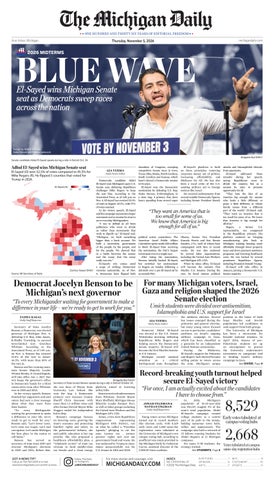
BLUE WAVE 2026 MIDTERMS
El-Sayed wins Michigan Senate seat as Democrats sweep races across the nation
Design by Maisie Derlega, Katie Palsrok and Frances Leibovich Bridgette Bol/DAILY
Senate candidate Abdul El-Sayed speaks during a rally in Detroit Oct. 24.
Adbul El-Sayed wins Michigan Senate seat
El-Sayed (D) won 52.5% of votes compared to 45.5% for Mike Rogers (R). He flipped 5 counties that voted for Trump in 2024.
Zachary Geyer/DAILY Source: MI Secretary of State
GIA VERMA
Daily News Editor
Democratic candidate Abdul El-Sayed won Michigan’s open U.S. Senate seat, defeating Republican challenger Mike Rogers to keep the seat blue. According to the Associated Press, as of 1:50 p.m on Nov. 4, El-Sayed has received 52.5% of votes to Rogers’ 45.5%, with 97% of votes counted. In his victory speech, El-Sayed said his campaign represents a larger movement and as senator he aims to serve everyday Michiganders. “I ran to defend us all from politicians who want to divide us rather than movements that work to dignify us,” El-Sayed said. “Michigan, we built something bigger than a bank account. We built a movement, government of the people, by the people, and for the people. We showed that in a battle between the money and the many, that the many really can win.” El-Sayed’s win comes amid a surge of striking Democratic victories nationwide. As of Nov. 4, Democrats have flipped both
chambers of Congress, sweeping competitive Senate races in Iowa, Texas, Ohio, Maine, North Carolina, South Carolina and Kansas, which hasn’t elected a Democratic senator in 94 years. El-Sayed won the Democratic nomination by defeating U.S. Rep. Haley Stevens, D-Birmingham, in a close Aug. 4 primary that drew heavy spending from several super
El-Sayed’s platform is built on three principles: removing corporate money out of politics, increasing affordability and Medicare for All. He has also been a vocal critic of the U.S. sending military aid to foreign nations like Israel. He received endorsements from several notable Democratic figures, including former President Barack
“They want an America that is too small for some of us. We know that America is big enough for all of us.” political action committees. The American Israel Public Affairs Committee spent nearly $30 million to block El-Sayed from receiving the nomination, the PAC’s largest investment ever in a single race. After losing the nomination, Stevens initially backed El-Sayed, but switched her endorsement to Rogers on Sunday following a skirmish over a pro-El-Sayed ad by an outside PAC.
Obama, former Vice President Kamala Harris and Sen. Bernie Sanders, I-Vt., each of whom have campaigned with him in recent weeks. He was also endorsed by several labor organizations, including the United Auto Workers and Michigan AFL-CIO. When he takes office, El-Sayed will become the nation’s first Muslim U.S. Senator. During the race, he faced intense political
attacks and Islamophobic rhetoric from opponents. El-Sayed addressed these remarks during her speech, saying Republicans want to divide the country, but as a senator he aims to promote opportunity for all. “They hate the idea of an America big enough for anyone who looks a little different, or prays a little different, or whose family comes from a different part of the world,” El-Sayed said. “They want an America that is too small for some of us. We know that America is big enough for all of us.” Rogers, a former U.S. representative, ran unopposed in the Republican primary. His platform centered on bringing manufacturing jobs back to Michigan; making housing more affordable through lower property taxes and down payment assistance programs; and lowering healthcare costs. He was backed by several prominent Republican figures, including President Donald Trump. El-Sayed will take office in January, joining a Democratic U.S. Senate majority.
Democrat Jocelyn Benson to be For many Michigan voters, Israel, Gaza and religion shaped the 2026 Michigan’s next governor
“To every Michigander waiting for government to make a difference in your life – we’re ready to get to work for you.” ZAHRA KAGAL Daily Staff Reporter
Senate election
Umich students were divided over antisemitism, Islamophobia and U.S. support for Israel GIA VERMA
Daily News Editor
Secretary of State Jocelyn Benson, a Democrat, was elected governor of Michigan Nov. 4, defeating U.S. Rep. John James, R-Shelby Township, to succeed term-limited Gov. Gretchen Whitmer. According to the Associated Press, as of 1:49 a.m. on Nov. 4, Benson has secured 53.8% of the vote to James’ 44.5%, with more than 80% of the vote in. Benson and her running mate, state Senate Majority Leader Winnie Brinks, D-Grand Rapids, will take office Jan. 1, 2027. Her win keeps the governor’s office in Democratic hands for a third consecutive term after Whitmer won in 2018 and 2022. In her victory speech, Benson thanked her supporters and said voters had sent a clear message about what they want from their leaders. “To every Michigander waiting for government to make a difference in your life, we’re ready to get to work for you,” Benson said. “Let’s lower costs. Let’s raise our wages. Let’s end corruption. Let’s make Michigan the best place in the nation to call home.” Benson has served as secretary of state since 2019 and oversaw Michigan’s elections in 2020 and 2024. Before that,
Democrat Abdul El-Sayed was elected to the U.S. Senate Wednesday morning, defeating Republican Mike Rogers and helping secure the Democratic Senate majority. El-Sayed will become the first Muslim Senator in U.S. history. Michigan earned national attention as a critical battleground state throughout
Bridgette Bol/DAILY Secretary of State Jocelyn Benson speaks during a rally in Detroit October 24.
she was dean of Wayne State University Law School. She won the Aug. 4 Democratic primary over Genesee County Sheriff Chris Swanson with more than 1.2 million votes and after former Detroit Mayor Mike Duggan ended his independent bid in May. Benson’s campaign focuses on lowering costs, growing the state’s economy and protecting families’ rights and safety. In the gubernatorial debates, she said public education is her top priority. She also proposed a healthcare affordability plan, a “wholesale review” of state tax revenue to fund middle-class tax breaks and a clean energy
GOT A NEWS TIP? Call us at 734-763-2459 or e-mail news@michigandaily.com and let us know.
platform aimed at lowering utility bills. Benson received endorsements from Whitmer, Detroit Mayor Mary Sheffield, Michigan House Minority Leader Ranjeev Puri, as well as labor groups including the United Auto Workers and the Michigan AFL-CIO. James, a two-term Republican congressman representing Michigan’s 10th District, ran on what he called a “Freedom Agenda,” pledging to cut the state income tax , protect parents’ rights and root out government fraud and waste. He was endorsed by Trump in June. James unsuccessfully ran for U.S. Senate in 2018 and 2020.
Follow The Daily on Instagram,
@MICHIGANDAILY
the midterm election. Several key issues emerged during the primaries and general election, but many young voters focused on one in particular: candidates’ positions on Israel’s ongoing military campaign in Gaza, which has been classified as a genocide by an independent United Nations commission. During the Midterms, El-Sayed’s support for Palestine and Rogers’ lack thereof became selling points to voters across the state. Michigan’s unique
position as the home of both large Muslim and Jewish populations led candidates to seek support from both groups. The University of Michigan has been a microcosm for broader national tensions. In April 2024, dozens of proPalestinian students set up an encampment to protest the University endowment’s investment in companies tied to funding Israel’s military campaign in Gaza. See DIVIDE, Page 4
Record-breaking youth turnout helped secure El-Sayed victory “For once, I am actually excited about the candidates I have to choose from.” JONAH FELDMAN & NATHAN ENGMAN Daily Staff Reporters
Young voters across Michigan turned out in record numbers this election cycle, with 8,529 early votes and 2,668 same-day registration votes tabulated at the University of Michigan’s two campus voting hub, according to unofficial vote totals provided to the Michigan Daily by Catherine Carver, assistant director of the UMICH Votes coalition.
For more stories and coverage, visit
MICHIGANDAILY.COM
In 2025, Michigan’s population of 18-24-year-olds was 941,157, roughly 9% of the state’s total population. Abdul El-Sayed’s campaign treated college students as a central part of its path to the Senate, holding numerous town halls, rallies and appearances. The campaign also built a network of 25 fellows running Students for Abdul chapters at 12 Michigan campuses. For many U-M students, the strategy worked. See STUDENTS, Page 5
INDEX Vol. CXXXVII No. 27 ©2026 The Michigan Daily
8,529
Early votes tabulated at campus voting hubs
2,668
Votes tabulated at campus same-day registation hubs
ELECTIONS . . . . . . . . . . . . . . . . .1 OPINION.....................6 ARTS........................7
MIC ........................9 S TAT E M E N T. . . . . . . . . . . . . . 1 0 SPORTS .....................11
Midterms 2026 Makled, Brown elected to UMich Board of Regents, Democrats keep majority
2 — Thursday, November 5, 2026
The Michigan Daily — michigandaily.com
The two defeated Republican nominees Michael Schostak and Lena Epstein ALEXA CHEANEY Daily News Editor
Democrats won both available seats on University of Michigan’s Board of Regents early Wednesday morning, maintaining the party’s majority on the board. Progressive Amir Makled secured a seat alongside incumbent Paul Brown, defeating Republican nominees Michael Schostak and Lena Epstein. According to the Associated Press, as of 12:35 p.m. on Nov. 4, Makled and Brown had received 26% and 27% of the votes, respectively, with 95% of votes counted. Makled is a first-time candidate, civil rights attorney and U-M Dearborn alum. On the campaign trail, he focused his platform around affordability
Bridgette Bol/DAILY
while disavowing President Donald Trump’s administration and the University’s planned data center with Los Alamos National Laboratory in Ypsilanti Township.
Garlin Gilchrist wins Michigan Secretary of State
Gilchrist will succeed Governor-elect Jocelyn Benson ALYSSA TISCH
Daily Staff Reporter
Garlin Gilchrist, the Democratic candidate for Michigan Secretary of State, has won the Nov. 3 general election, defeating Republican candidate Anthony Forlini. According to the Associated Press, as of 1:20 p.m. on Nov. 4, Gilchrist has secured 53.7% votes with more than 97% of votes counted. Gilchrist has served alongside Governor Gretchen Whitmer as Michigan’s lieutenant governor since January 2019, when he became the state’s first African American lieutenant governor. A University of Michigan alum, Gilchrist served as chair of the National Lieutenant Governors
Association and has led task forces on jail and pretrial incarceration, juvenile justice and COVID-19 racial disparities. Gilchrist also founded the University of Michigan Center for Social Media Responsibility. Gilchrist ran on eliminating dark money from politics, modernizing licensing and registration, standing against big tech and holding auto companies accountable. Gilchrist had received endorsements from notable groups including United Auto Workers, Reproductive Freedom for All, National Education Association and the Michigan League of Conservation Voters.
CONTINUED AT MICHIGANDAILY.COM
Brown, who was first elected to the Board in 2018, also campaigned on affordability. As Regent, he has supported labor unions’ presence on campus and opposed the data center.
File Photo/DAILY
Both candidates will begin eight-year terms on Jan. 1, 2027. The regents act as the governing body for all U-M campuses and oversee fiscal responsibilities, such as setting
tuition and managing the University’s investments. The regents are also responsible for some administrative personnel decisions, including hiring and firing the president.
Eli Savit elected Michigan Attorney General
Savit will succeed current Attorney General Dana Nessel JONAH FELDMAN Daily Staff Reporter
Democrat Eli Savit has won the race for Michigan attorney general, defeating his Republican opponent, Eaton County Prosecutor Doug Lloyd. According to the Associated Press, as of 12:50 p.m on Nov. 4, Savit has secured 52.5% of the vote to Lloyd’s 44.7%, with 97% of votes counted. Savit, a graduate of the University of Michigan Law School, currently serves as Washtenaw County prosecutor. He has held a variety of legal positions throughout his career, including senior legal counsel for the city of Detroit, where he oversaw the city’s lawsuits against the opioid industry. He was also a clerk for Supreme Court Justice Ruth Bader Ginsburg after law school. As Washtenaw County prosecutor, Savit ended the use
of cash bail, stopped prosecuting low-level drug offenses such as marijuana and psychedelics possession and created diversion programs for nonviolent offenders. He led his campaign on prosecuting serious crimes, protecting voting rights and holding environmental polluters accountable. Savit will succeed current Attorney General Dana Nessel as the state’s top law enforcement officer. Savit won the Democratic Party’s endorsement at the party’s April convention, defeating Oakland County Prosecutor Karen McDonald. He received endorsements from several labor organizations, including the Michigan AFL-CIO, the Michigan Education Association, AFT Michigan and LiUNA Michigan. Lloyd has served as Eaton County prosecutor since 2013 and previously served as president of the Prosecuting Attorneys Association of Michigan. He campaigned on
prosecuting fairly, protecting constitutional rights and pushing back on what he called “political lawfare.” Lloyd was endorsed by 62 county prosecutors, 31 county sheriffs and the Police Officers Association of Michigan. In his victory speech, Savit emphasized the importance of this midterm election cycle, and highlighted his goal of serving all Michiganders. “I am going to work for you as your next attorney general because the attorney general is the people’s lawyer,” Savit said. “This is a historic night here in Michigan – we have just gone through probably the ugliest, most divisive, and dirtiest campaign season that we have ever seen in this country. At the end of the day, what won? It was love; it was a message that communities can stand together.” Savit will take office in January 2027.
Michigan overwhelmingly approves Prop 2
81.1% of voters approved the measure to limit corporate influence in politics REBECCA BORLACE Daily Staff Reporter
Michigan voters have passed Proposal 2, aiming to reduce the corporate spending in elections. The Associated Press called the race at 9.38 p.m on Nov. 3. As of 12:09 p.m. on Nov. 4, 81.1% of voters approved the
measure, while 18.9% voted against it. Michiganders for Money Out of Politics initiated the proposal and gathered more than 560,000 signatures to place it on the ballot. As a result of Prop 2 passing, electricity and gas utility companies and contractors receiving more than $250,000 from the government
Michigan Proposal 2 passes in a landslide
— as well as organizations or individuals with substantial connections to those utilities — are now prohibited from directly or indirectly contributing to political campaigns that could benefit themselves. Additionally, Prop 2 expands the scope of current regulations on political communication spending. The definition of
No 18.9%
Zachary Geyer/DAILY Source: MI Secretary of State
“electioneering communication” was expanded to include broadcasting, newspaper and other forms of general public communication that refer to a clearly identifiable candidate within 100 days prior to a general election, or 30 days prior to a primary or special election. Prop 2 also expands the definition of “expenditure” to include public communications that promote, support, attack or oppose a candidate or ballot option, even if the communication doesn’t expressly advocate for or against any specific outcome. Michiganders for Money Out of Politics — the group that gathered signatures for and submitted the proposal —
believes Prop 2 will address the issue ad loophole, which allows for often-unidentified wealthy corporations or individuals to spend an unlimited amount of money on campaign ads. The group also believes the proposal will reduce the influence of utility company lobbying in the state legislature and hold elected officials more accountable. Those opposed to the initiative, including Protect MI Free Speech, said they intend to battle Prop 2 in the courts, arguing it violates free speech rights. Comparable campaign finance restrictions passed in states such as Maine are currently facing similar legal challenges.
Ann Arbor voters narrowly reject Prop E
The measure would have created an elected board to support a transition to a city-run electric utility NIKO WILSON
Daily Staff Reporter
Proposal E has failed, according to unofficial results provided by Washtenaw County. The Ann Arbor ballot measure would have authorized the creation of an elected utility board to lead a transition replacing DTE Energy’s electrical utility with a city-run power grid. According to the county’s data, 48.17% voted for
the proposal, while 51.83% voted against it. The Ann Arbor Responsible Energy Coalition — an opposition group that received $1.8 million from DTE Energy — unsuccessfully tried to block A2P2’s proposal through the courts in August, alleging invalid petition signatures. Most of the current City Council, including Ann Arbor’s outgoing Mayor Christopher Taylor, opposed Proposal E and instead promoted the Sustainable Energy Utility as a better path
Ann Arbor Proposal E narrowly fails
toward the city’s renewable energy goals. Earlier this month, the council voted 10-1 to direct City Attorney Atleen Kaur to challenge the legality of the measure. They cited concerns over the proposal’s financial cost and potential conflicts with the City Charter, which gives the city — rather than citizen-initiated ballot proposals — the power to establish utility boards. Beginning in 2020, grassroots group Ann Arbor for Public
No 51.8%
Zachary Geyer/DAILY Source: Washtenaw County Clerk
Power led the effort to put a ballot question before voters to determine whether DTE Energy’s electrical utility should be replaced by a city-run power grid. The group argued a municipal utility would help the city transition to 100% renewable electricity more quickly while making service more reliable and affordable. Newly elected mayor Yousef Rabhi endorsed Prop E alongside other progressive leaders, including state Sen. Jeff Irwin, D-Ann Arbor, and U.S. Rep. Rashida Tlaib, D-Detroit. At an election night watch party, A2P2 Executive Director Brian Geiringer said the narrow defeat still showed a desire from Ann Arbor voters to eventually move away from DTE. “The current model is broken — it’s not something to fix, it is something to change,” Geiringer said. “If the service is essential,
like electricity is, if it needs to be a monopoly, then it should belong to the people. And one day before too long, it will.” In a statement to The Michigan Daily, A2REC spokesperson Rudy Harper wrote that voters opposed Proposal E due to the potential high cost of purchasing DTE’s power grid with taxpayer dollars. “The people of Ann Arbor saw this proposal for exactly what it was: a mandate that would have made life in Ann Arbor even more expensive by eventually forcing working families to carry the burden of a billion dollar debt,” Harper wrote. “We’re grateful for the broad coalition of Ann Arbor leaders, from city council members to environmentalists and labor unions, who made their voices heard and collectively declared that Proposal E was too costly and too risky for Ann Arbor.”
Key Michigan Election Results Senate: Abdul El-Sayed US House of Representatives District 6: Debbie Dingell Governor: Jocelyn Benson Secretary of State: Garlin Gilchrist Attorney General: Eli Savit Michigan State Senate District 14: Sue Shink Michigan State Senate District 15: Felicia Brabec Michigan State Senate District 23: Jason Morgan Michigan State Senate District 33: Morgan Forman Michigan State Senate District 47: Carrie Rheingans Michigan State Senate District 48: Jennifer Colin Supreme Court: Megan Cavanagh, Noah Hood Court of Appeals: Mark Boonstra, Daniel Korobkin State Board of Education: Judith Pritchett, Tiffany Tilley University of Michigan Board of Regents: Amir Makled, Paul Brown State Prop 1 : Fail State Prop 2: Pass Ann Arbor Mayor : Yousef Rabhi Ann Arbor City Council: Sandy Aldrich, Ryan Bartholomew, Jenn Cornell, Cynthia Harrison, Aidan Sova Ann Arbor School Board: Becca Hogan, Rima Mohammad, Aaron Puno, Brandon Smith Ann Arbor District Library Board of Trustees: Cassie Haynes , Rachel Goldberg, Gaurav Kulkarni Ann Arbor Prop A-D: Pass Ann Arbor Prop E: Fail
The Michigan Daily — michigandaily.com
Thursday, November 5, 2026 — 3
Your Campus, Your City.
You came to Ann Arbor for U-M. Now explore A2 beyond campus. Find your go-to coffee shop, latenight bite, catch a concert, or hit the trails. Your next favorite place is one spontaneous adventure away.
DISCOVER MORE AT ANNARBOR.ORG
Midterms 2026
4 — Thursday, November 5, 2026
The Michigan Daily — michigandaily.com
DIVIDE
From Page 1 At one point, four protesters were arrested during a sit-in protest, and the FBI has since arrested and charged several pro-Palestine protestors at the University for alleged vandalism and threats. The University was also one of 59 institutions warned by the Department of Education in 2025 to protect Jewish students on campus following increasing antisemitism nationwide. Last year, a student kicked in the door of the Jewish Resource Center on campus. For many young voters, the conflict remained a priority regardless of religious affiliation. In an email to The Michigan Daily, LSA junior Allison Kuzera, co-president of the Human Rights Party — the student party in executive leadership of the University of Michigan’s Central Student Government — said U.S. involvement in funding the conflict deeply impacted her vote. “Israel’s genocide in Palestine significantly shaped my vote in the Senate race,” Kuzera wrote. “Since the United States’ legislature has been consistently funding the genocide since 2023, and intervening decades before then, I wanted to vote for a candidate who promised not to fund it.” These issues gained political salience during the state’s Aug. 4 primary: While Rogers ran unopposed, El-Sayed faced a tight primary against U.S. Rep. Haley Stevens. Stevens, a staunch supporter of Israel, drew large Jewish support. She was endorsed in November 2025 by the Democratic Majority for Israel political action committee, and the American Israel Public Affairs Committee spent nearly $30 million dollars backing her — its largest investment in a single race. Simultaneously, AIPAC argued that El-Sayed would be dangerous to Jewish Michiganders and said in a fundraising email he was a direct threat to the U.S.-Israel relationship. Stevens’ support for Israel faced criticism, which resulted in her being booed at the Michigan Democratic Party’s 2026 State Endorsement Convention. Many
Stanford Lipsey Student Publications Building 420 Maynard St. Ann Arbor, MI 48109-1327 734-418-4115 www.michigandaily.com
ZACHARY AJLUNI and EDITH PENDELL Co-Editors in Chief eic@michigandaily.com
CICI COPENHAVER
Business Manager business@michigandaily.com
NEWS TIPS
tipline@michigandaily.com
LETTERS TO THE EDITOR tothedaily@michigandaily.com
EDITORIAL PAGE
opinion@michigandaily.com
Meleck Eldahshoury/DAILY A pro-Israel protester enters the Univsity pro-Palestine encampment on the Diag April 23, 2024.
pro-Palestine groups backed El-Sayed, including Jewish Voice for Peace Action. In an interview with The Daily, Richard Czuba, founder of Glengariff Group — an independent polling research group — said while Jewish voters are largely Democratic, many did not vote for El-Sayed because they feared he would threaten their safety. “They’re not just opposed to him because of his positions on Israel,” Czuba said. “They are opposed to him because of how they believe he is talking about antisemitism. It is not just positions on Israel. It is, overall, how he — in their view — makes them feel in terms of safety as a Jewish citizen.” Czuba also emphasized that AIPAC spending was just one of many reasons Stevens may have lost the primary, saying Democrats generally oppose corporate influence in politics — something El-Sayed has built a platform against. “They are very concerned about outside influences flooding our politics, and in this case, it just happened to be AIPAC money,” Czuba said. Following the primary, Rogers’ campaign announced a coalition of
Democrats backing him. Though it is not yet clear how Michigan’s Jewish community voted, an exit poll of early voters by Forward found that nearly one in four Jewish voters who voted for Sen. Elissa Slotkin in the 2024 general election switched their vote to Rogers in this year’s midterm. Additionally, groups such as Nonnegotiable Michigan formed, which advocated for El-Sayed to do more to protect Jewish safety and express more concrete support for Jewish statehood in Israel. Closer to the election, the group encouraged voters not to vote for El-Sayed and instead to write in Emma Lazarus, saying there are different paths to Democratic Senate control. The Associated Press has not reported write-in totals for Lazarus. While AIPAC played a smaller role during the general election, U.S. support for Israel remained a prevalent issue during debates. Moreover, advertisements and rhetoric from both sides have drawn controversy in the lead-up to election day. Rogers has continued to attack El-Sayed’s faith and promote what many have deemed Islamophobic rhetoric. During both Senate debates in October, Rogers
repeatedly accused El-Sayed of having donors from the Muslim Brotherhood, a designated terrorist group. No evidence shows a connection between El-Sayed and the group. In the first Senate debate, Rogers directly accused El-Sayed of taking money from these groups. “If you think about why my opponent is so wrong on all of this, his biggest funders are from a group that supports the Muslim Brotherhood,” Rogers said. Rogers’ campaign has continued to push out media ads against El-Sayed. On Oct. 1, the campaign released an ad with Rackham student Iman Dashti, who accused El-Sayed of taking money from terrorist groups — including the Muslim Brotherhood and al-Qaida — and threatening national security. Dashti was also involved with an alleged attempt to pay Republicans to travel and heckle El-Sayed during one of his town halls. Senate Leadership Fund, a Republican super PAC, also released an ad directly calling El-Sayed “dangerous.” The Daily found no proof of any relation between El-Sayed and these groups.
CONTINUED AT MICHIGANDAILY.COM
Incumbent Debbie Dingell wins seventh U.S. House term Michigan will send nine Democrats to the U.S. House
NATHAN ENGMAN Daily News Reporter
Incumbent U.S. Rep. Debbie Dingell, D-Ann Arbor, won reelection Nov. 3, defeating Republican challenger Heather Smiley in Michigan’s 6th Congressional District for the second time. According to the Associated Press, as of 1:44 p.m. on Nov. 4, Dingell has secured 67.4% of the vote to Smiley’s 30.4%, with 97% of votes counted. Heading into the election, Republicans held 7 of Michigan’s 13 U.S. House seats. Following a Democratic sweep on Election Day, the GOP lost three seats as challengers flipped Michigan’s 4th, 7th and 10th Congressional Districts. Dingell campaigned on lowering the cost of living, expanding healthcare coverage, supporting manufacturing and reforming federal immigration enforcement. Dingell has served as a U.S. representative since 2015. She succeeded her late husband John Dingell, who served as a U.S. representative from 1955 to 2015 — the longest
tenure for a member of Congress in U.S. history. During her tenure, Dingell has been a vocal critic of President Donald Trump, speaking out against the Trump Administration’s tariffs on Canada and Mexico and voting to impeach Trump twice. Dingell received endorsements from several labor and political organizations, including Michigan AFL-CIO, National Nurses United and The Detroit News. In her victory speech at the Michigan Democratic watch party, Dingell thanked the volunteers who supported her campaign and said this race represents Michigan values. “To all the volunteers who have believed in the values of civil rights, equality, fighting for health care for every American when they’re sick (and) reducing the cost of food for our congressional delegation — let us send a Michigan message about who Michigan is,” Dingell said. “We stand up to hate whenever and wherever we see it.”
CONTINUED AT MICHIGANDAILY.COM
Democrats gain three House seats in Michigan Challengers flipped Michigan’s 4th, 7th and 10th Congressional Districts
Daily Staff Reporters
As the 8 p.m. deadline approached, lines stretched through the University of Michigan Museum of Art as students waited to vote in the last remaining hours of Election Day. This year, lines at UMMA spanned hours at some points during the afternoon and evening, longer than those during the presidential election in 2024, but significantly shorter than the midterms in 2022, when
SPORTS SECTION
NEWSROOM
sports@michigandaily.com
news@michigandaily.com
ADVERTISING
CORRECTIONS
wmg-contact@umich.edu
corrections@michigandaily.com
Editorial Staff ANNABELLE YE
Joshua Mitnick ’92, ’95 Managing Editor
bellaye@umich.edu
GEORGIA MCKAY
Digital Managing Editor
gmckay@umich.edu
AANYA PANYADAHUNDI and CHRISTINA ZHANG
Managing News Editors news@michigandaily.com Senior News Editors: Alexa Cheaney, Dominic Apap, Gia Verma, Quinn Mittlestat, Sarah Palushi, Sarah Spencer
ELENA NICHOLSON and GABE EFROS
Editorial Page Editors tothedaily@michigandaily.com Deputy Editorial Page Editor: Mateo Alvarez Senior Opinion Editors: Avery Allen, Maggie Berling, Madeleine Burke, Stephanie Bouserhal, Isabel Seniawsk
LYRA SHARMA and GRAHAM BARKER
Managing Sports Editors sports@michigandaily.com Deputy Sports Editor: Sophie Matthews Senior Sports Editors: Amanda Bergman, Niyatee Jain, Drew Lenard, Nate Schreck, Grace Wright, Hadley Zann
CAMPBELL JOHNS and CORA ROLFES
Managing Arts Editors arts@michigandaily.com Senior Arts Editors: Hudsen Mazurek, Abigail Weinberg, Tara Wasik, Ana Torresarpi, Meagan Ismail, Siena Beres
MAISIE DERLEGA and SELENA ZOU
Managing Design Editors design@michigandaily.com Senior Layout Editors: Frances Leibovich, Kathryn Palsrok Senior Illustrators: Gabriella Spagnuolo, Emmeline Meldrum, Ella Flores Brosnan
BRIDGETTE BOL and HOLLY BURKHART
Managing Photo Editors photo@michigandaily.com Senior Photo Editors: Ananya Kedia, Arushi Sanghi, Isai Hernandez-Flores, Ava Farah
Managing Statement Editor statement@michigandaily.com Deputy Editors: Oummu Kabba, Lola Post, Riya Kommineni
ALINA MURATA and JOSUE MATA
Managing Copy Editors copydesk@michigandaily.com Senior Copy Editors: Maximus Craig, Meagan Ismail, Claudette Johnson, Oummu Kabba, Ayah Maskoun, Caroline Niccolini, Emma Oftedal, Joshua Park, Zoey Ueland, Justin Xhelilaj
EMMA PENG and JULIA MEI
Managing Online Editors webteam@michigandaily.com Data Editors: Darby Jones, Zora Tucker Engineering Manager: Alyssa Locke, Grace Liu Product Managers: Annice Chang, Sanvika Inturi Senior Software Engineer: Becky Pan
EVAN KRUMMEL and JOVANNA GALLEGOS
Managing Video Editors video@michigandaily.com Senior Video Editors: Samridhi Sharma, Grace Wright
AMARA M. SMALL and IHAA MOHAN
Michigan in Color Managing Editors michiganincolor@michigandaily.com Senior MiC Editors: Allana Smith, Amany Sayed
HANNAH BODNAR and AVA HOOGTERP Zachary Geyer/DAILY Source: MI Secretary of State. Michigan congressional districts are shaded by 2026 House results compared to 2024 results.
Lines spanned hours at some points during the afternoon and evening Michigan had the highest youth voter turnout in the country. Michigan remains at the forefront of the midterm elections for its critical Senate race between Abdul El Sayed and Mike Rogers, drawing many students out to vote. In an interview with The Michigan Daily, LSA freshman Ashley Flores said she waited in line for two hours, despite discomfort, to ensure she was able to vote. “It was very hot, very long,” Flores said. “When I first saw the line, I was a little put off by voting because it was so long — it was stretching out to the back of UMMA — but I thugged it out and stuck with it.”
arts@michigandaily.com
photo@michigandaily.com
AYA FAYAD
Students wait in long lines at UMMA to cast ballots as election day draws to a close SARAYU BONGALE, MYA WEISS & ZOOEY RAUX
ARTS SECTION
PHOTOGRAPHY SECTION
Voting early in the day is out of reach for many students with busy schedules, causing longer lines in the afternoon. In an interview with The Daily, Information sophomore Krubel Gebeyaw said he was advised to vote at Ann Arbor City Hall, where the line would be shorter. “I would have came earlier in the day, but I was too busy with classes and other stuff,” Gebeyaw said. “The wait time is kind of long, so one of the workers in there told me the city hall wait time was a lot shorter, so I’m just gonna walk over there.” Flores, a first-time voter, said she had a strong desire to vote. However, she said she could see
people who have different priorities being deterred by the lines. “My political values are important, and since I am now 18 — this is my first time voting,” Flores said. “With how long the line is, a lot of people have different priorities. Obviously, our priorities (lie) with voting, but some people might prioritize going to class or going to practice more than waiting in line. So, that might turn away voters in that sense.” Gebeyaw reaffirmed the same sentiment, as students who have heavier academic responsibilities or feel less politically engaged may be discouraged from voting.
CONTINUED AT MICHIGANDAILY.COM
Managing Podcast Editors podeditors@michigandaily.com Senior Podcast Editors: Rogen McLean, Zora Burroughs, Karina Shahinian, Olivia Dickerson
DA YOUNG KIM and UWAEISH AHMAD
Managing Audience Engagement Editors socialmedia@michigandaily.com Senior Audience Engagement Editors: Amanda Bergman, Caleb Starr, Isabella Burke, Libby Le Febre, Michelle Fang, Sophia Polega, Heewon Moon
MAHEE KAVDIA and PUJITA RUPANI Culture, Training, and Inclusion Co-Chairs
accessandinclusion@michigandaily.com
LUCY LANGERVELD and TIFFANY MCKALKO
Managing Focal Point Editors lucykate@umich.edu, tmckalko@umich.edu Senior Focal Point Editors: Amaya Choudhury, Claudette Johnson
JAMES KNAKE and MILAN THURMAN
Managing Games Editors crosswords@umich.edu Senior Games Editors: Eleanor Sullivan, Kiran Parekh, Sam Martin, Tobin Saxton
Business Staff CAROLINE ZOLTAK
GABRIELLE GONDLY
KATE PARAMBO
MORGAN ORTH
Marketing Manager
Creative Director
Sales Manager
Strategy Manager
The Michigan Daily (ISSN 0745-967) is publishing weekly on Wednesdays for the Fall 2026 semester by students at the University of Michigan. One copy is available free of charge to all readers. Additional copies may be picked up at the Daily’s office for $2. If you would like a current copy of the paper mailed to you, please visit store.pub.umich.edu/michigan-daily-buy-this-edition to place your order.
Midterms 2026
The Michigan Daily — michigandaily.com
PHOTO
Thursday, November 5, 2026 — 5
MIDTERMS 2026 IN ANN ARBOR
Design by Janaki Nallamothu & Sara Sastry
Students wait for the bus outside the Union Tuesday afternoon.
Joe Sanders/DAILY
Bridgette Bol/DAILY Bridgette Bol/DAILY Bridgette Bol/DAILY Abdul El-Sayed makes his final campaign appearance Students gather as Abdul El-Sayed, Democratic candidate Students vote in the 2026 midterm elections at the UMMA Campus Voting Hub Tuesday afternoon. The Hub recorded a record number of same-day registration votes. outside the Union Tuesday afternoon. for U.S. Senate, speaks in front of the Union Tuesday.
The University has an incredible amount of power within Washtenaw County, and I’ve seen both sides of that, being a student at the University and growing up in Ypsilanti.”
I think that it’s important that everybody votes because what you think might not be affecting you is affecting you, even though you can’t see it blatantly in front of your eyes.”
LSA Sophomore ELA KHASNABIS UPTON
Nursing Sophomore JOZY BOADI Bridgette Bol/DAILY
I think a lot of my out-of-state friends feel similarly about the imminent threat that Abdul presents, and him being the senator gives him the capability to have an impact on foreign policy.”
For once, I am actually excited about the candidates I have to choose from.”
LSA Junior MATAN SILVERBERG
LSA Sophomore JACOB GAGOSIAN
Bridgette Bol/DAILY
STUDENTS From Page 1
In an interview with The Michigan Daily, LSA freshman Quincy Behm said students have a responsibility to make their voices heard, especially given President Donald Trump’s recent low approval ratings. “People are very aware of how bad Donald Trump has been in his presidency, and I think it has really made people aware of how necessary it is to vote,” Behm said. “It’s very important for students to vote because we’re a very smart group of individuals that have a lot of opinions and a lot of things to say. I think that it is our civic duty to use that education to make this country better.” The University’s undergraduate student population sits at 35,358, with more than 18,000 of them
Bridgette Bol/DAILY
in-state and about 16,000 being out-of-state. Michigan also allows same-day voter registration, leading to both Democratic Senate nominee Abdul El-Sayed and Republican nominee Mike Rogers’ campaigns calling on out-of-state students to re-register to vote with their University address in this election. In an interview with The Daily, LSA junior Matan Silverberg said he felt his voice was better heard as a Michigan voter, despite being an out-of-state student. “I think a lot of my out-ofstate friends feel similarly about the imminent threat that Abdul presents, and him being the senator gives him the capability to have an impact on foreign policy,” Silverberg said. “My friends and I are motivated to register in Michigan to be able to have an impact on who represents us at school and
Bridgette Bol/DAILY
ultimately protect the interests of Jews in America.” The University of Michigan Museum of Art and Duderstadt Center campus voting hubs — which both served as early voting and Election Day voting locations — saw record-breaking same-day registration numbers on Election Day. Turnout more than doubled the 1,292 same-day registration at the two sites in the 2024 general election. There were reports of wait times stretching over two hours during the later part of the day. Washtenaw County saw 71.96% of registered voters casting ballots, a 15.5% increase from the 2022 midterms. In an interview with The Daily, Nursing sophomore Jozy Boadi said El-Sayed’s campaign promises speak to her as a prospective healthcare provider. “I’m really worried about healthcare and the politics around
healthcare,” Boadi said. “I think that it’s important that everybody votes because what you think might not be affecting you is affecting you, even though you can’t see it blatantly in front of your eyes.” Michigan’s senatorial and gubernatorial races have received millions of dollars in donations, ongoing national media attention and prompted on-the-ground student campaigning. In an interview with The Daily, LSA sophomore Ela Khasnabis Upton said the political status quo she has observed encouraged her to get involved in both local and national elections. “I am a student organizer for Ann Arbor for Public Power, and we currently have (Proposal E) on the ballot,” Khasnabis said. “It is incredibly important to engage critically in the community that you’re living in, and there is a lot of history of politics in Ann
Arbor. The University has an incredible amount of power within Washtenaw County, and I’ve seen both sides of that, being a student at the University and growing up in Ypsilanti.” A recent report showed many students could not name a single member of the University’s Board of Regents. In an interview with The Daily, LSA sophomore Jacob Gagosian, who was campaigning for Democratic regent candidate Amir Makled, said although downballot races do not receive as much attention, they are just as important as state elections. “(The regents) make most of the financial decisions regarding academics, and they have not been working for the students who attend this university and pay this tuition to university,” Gagosian said. “For once, I am actually excited about the candidates I have to choose from.”
On campus, several student organizations have been working to convey the merits of their candidates to their fellow students. College Democrats at the University of Michigan and Students for Abdul in particular have hosted joint events, bringing together students and candidates. In an interview with The Daily, LSA freshman Ava Zagata said the clubs and general political atmosphere on campus have fostered her passion for politics. “Talking with my classmates who are very passionate about the subject, and being able to have those in-depth conversations has made me more passionate about this,” Zagata said. “Specifically in my first semester in Ann Arbor, I feel like I can talk more freely and openly about my political views than I could at my high school.”
Opinion
6 — Thursday, November 5, 2026
The Michigan Daily — michigandaily.com
Edited and managed by students at the University of Michigan since 1890. Stanford Lipsey Student Publications Building 420 Maynard St. Ann Arbor, MI 48109 tothedaily@michigandaily.com
EDITH PENDELL & ZACHARY AJLUNI Co-Editors in Chief
GABE EFROS & ELENA NICHOLSON Editorial Page Editors
GEORGIA MCKAY & ANNABELLE YE Managing Editors
EDITORIAL BOARD MEMBERS Zachary Ajluni Avery Allen Mateo Alvarez Maggie Berling Stephanie Bouserhal
Hayden Buckfire Madeline Burke Willem DeGood Gabe Efros Seth Gabrielson
Jovanna Gallegos Emma Margaron Elena Nicholson Isabel Seniawski Sarah Zhang
Unsigned editorials reflect the official position of The Daily’s Editorial Board. All other signed articles and illustrations represent solely the views of their authors.
From The Daily: What El-Sayed’s victory means for Michigan THE MICHIGAN DAILY EDITORIAL BOARD
I
n the early morning of Nov. 4, the Democratic party was projected to retake control of not only the U.S. House of Representatives, but also the Senate. Just 18 months ago, this outcome was seen as a long shot. Democrats secured wins in eight states that President Donald Trump won in 2024, flipping the Senate blue. Even reliably Republican states went blue: Texas, South Carolina and Kansas were quickly called for the Democratic candidates. As the only blue wall state in contention, the race set the tone for the rest of the country. This open senate seat was Republicans’ best opportunity to expand their majority after a narrow loss in Michigan during the 2024 election. Similarly, defending the seat would be a necessary step for Democrats to potentially win a majority. For Republicans to do the same, winning Michigan was imperative.
When Senator-elect Abdul El-Sayed secured the Democratic nomination in August, the rest of the country took notice. The election was more than just a single state’s senate race; money from across the nation came pouring into Michigan, with more than $400 million spent on this one seat alone. The race also raised the same question the Democratic primary asked: Can a progressive Democrat win in a swing state? The answer is yes. El-Sayed defeated former U.S. Rep. Mike Rogers by more than three hundred thousand votes. Make no mistake, the implications of this victory are enormous. To be clear, this Editorial Board endorsed El-Sayed twice. We believe in his vision to get money out of politics, pass Medicare for All and put money in Michiganders’ pockets. We believe that he uniquely advocates for students’ desires to end foreign wars and take stances on difficult issues that Democrats have had a
tendency to shy away from. In short, we believed in him. And, in many ways, our belief paid off. Students were a key part of El-Sayed’s victory, not only in voter margin and turnout, but in outreach. Students played a critical role in volunteering and spreading El-Sayed’s message to the broader Democratic base while convincing undecided voters to cast their ballot for him. But beyond all of that, it shows that we — young, progressiveminded individuals who are upset with the status quo of the country — have a real say in our future and do not have to turn to a nihilistic disinterest in politics. At the same time, elections don’t signal stability: After all, Trump won Michigan twice. While El-Sayed’s victory is monumental, this win does not enable him to single-handedly fix all hot-topic political issues. The cost of living was the primary driver behind many voters’ decisions at the ballot box, but El-Sayed can’t bring
those costs down by himself. Many other issues — like artificial intelligence, data centers and healthcare — will still need to be addressed, and
it is El-Sayed’s job to rally his fellow senators to tackle these concerns. While this may be challenging, constituents must hold him accountable, pushing
Bridgette Bol/DAILY
El-Sayed to stay focused on his key campaign promises. For now, we celebrate knowing our vision for America has a seat in the U.S. Senate.
Mireille Banza/DAILY
How UMich retaliated against a professor for writing about the Ypsilanti Township data center ELENA NICHOLSON Editorial Page Editor
I
n early summer, Joy Rohde — a University of Michigan researcher and associate professor of history and public policy — had a Q&A piece on her forthcoming book, “People of the Machine,” set to appear in an e-newsletter distributed by the University’s Office of the Vice President for Research. On Sep. 8, the department pulled the piece from the newsletter before it was sent out. This seemingly mundane act was actually a bizarre means of retaliation against Rohde, who had published a completely unrelated policy brief on the University’s data center project that it is pursuing in collaboration with Los Alamos National Laboratory. Over the past year, the data center has been severely controversial. University officials have ignored Ypsilanti residents and steamrolled township officials who have pushed back on the development. Consistent lack of communication with the government and failure to quell fears at a series of public meetings about the project has set a precedent of condescension
toward concerned community members. The University is completely disregarding the perspective of its neighboring city — which has a notably lower opportunity index in every category. In light of community outrage about the project, Rohde’s brief asked reasonable questions: How might this LANL partnership tarnish the University’s research reputation? Can the University be more transparent in the process? Those questions — like most others concerning the data center — will likely go unanswered. The brief Rohde wrote on the data center was not opinionated, but it inquired about topics that made researchers involved with the development uncomfortable; this ultimately led administration at OVPR to cut Rohde’s promotional Q&A piece — a decision that can only be described as punitive and political. In an interview with The Michigan Daily, Rohde explained why this small action is important for the research community in the context of broader repression of free speech on campus. “I think it is important that we’re documenting examples
of this larger pattern of dissent being silenced,” Rohde said. “I mean, this is not even political speech… This is research.” In May, Rohde finished a book about the intersection of policy and technological advancement of artificial intelligence during the Cold War. The book, which is set for release next May, was the focus of the Q&A that Rohde was supposed to have published in the newsletter in September. Rohde says that OVPR paid for a photo shoot and helped with preparation of the piece throughout the summer. Then in August, after her book was completed, Rohde began looking into policy questions about the University’s data center in Ypsilanti Township, exploring historical examples of similar research projects during World War II. At the end of the month, she published a policy brief about the development with the Ford School of Public Policy. Shortly after, she was informed that OVPR had pulled the Q&A about her book — which had no mention of the data center in Ypsilanti Township — from their newsletter. On Sept. 8, just about a week after the policy brief’s publication, Rohde met with representatives from OVPR, including Don Jordan,
senior director of research communications, to understand why her Q&A was cut from the newsletter. According to Rohde, Jordan immediately and candidly told her it was removed because she published the policy brief about the Ypsilanti Township data center. According to Rohde, Jordan cited conversations with Patricia Hurn, vice president for research, as a factor in the decision to remove the Q&A from the newsletter. In an interview with The Michigan Daily, Rohde described her response to OVPR’s decision. “I said, ‘This feels like retaliation for writing that piece,’” Rohde said. “I also said, ‘This feels like an infringement on academic freedom.’” Rohde explained that Jordan justified the decision by saying that researchers involved with the data center were concerned about being doxxed because of their involvement in the Ypsilanti Township data center, and the University wasn’t doing enough to protect them. The logic doesn’t hold up: OVPR purportedly punished Rohde by cutting her Q&A — about her book on AI during the Cold War — due to unrelated researchers’ concerns over the University’s handling of criticism of the data center.
In an email to The Daily, Jordan provided a seemingly contradictory explanation for OVPR’s decision. “As part of our editorial planning process in September, we made the decision to postpone — not cancel — a planned feature about a book authored by Associate Professor Joy Rohde, in light of a separate publication she had recently authored concerning a university initiative,” the email read. “This was an editorial decision about the timing of a promotional feature, not a decision to censor or restrict Associate Professor Rohde’s scholarship or academic expression.” Jordan recounts two different explanations: He cites the publication of the policy brief as a reason for delaying the promotional Q&A about Rohde’s book, but then simultaneously passes it off as a minor tweak to their editorial schedule. Nearly two months later, Rohde still has not heard from Jordan or anyone else about plans to publish the Q&A in the newsletter at a later date. This can only be described as a political move. Rohde published something researchers involved with the data center didn’t like, so OVPR leadership removed a piece promoting her book. The
only connection between the two pieces was that Rohde’s name appeared on both of them. It is an overtly ridiculous action to take. The piece about Rohde’s book was not cancelled for the safety of members of the community; rather, it seems to be a form of retaliation against a professor who was asking questions and making observations that OVPR didn’t like. This example may be relatively minor, but it symbolizes a breach of academic freedom in the University’s research sector. The reality is clear: If faculty want to stay in the good graces of OVPR and the administration, they will fall in line when it comes to the data center. If not, they risk losing career opportunities. Students, faculty, staff and the research community must deeply reflect on the implications this has and examine where else similar violations may be occurring. Campus has largely ignored the impacts the data center might have on Ypsilanti Township and its own research reputation. The stakes for the township are obvious. But in Ann Arbor, silence about this project must end to avoid further infringements on academic freedom.
Hillel’s political decision is a self-inflicted wound and a loss for UMich ZACHARIAH FARAH Opinion Contributor
O
ne of the jewels of the University of Michigan’s campus has long been Michigan Hillel. When I was a student in the 2000s and then again in the early 2010s, Friday night Shabbat dinners brought both Jewish and non-Jewish students together, regardless of politics. I invited my friends, including non-Jewish campus leaders, to events and discussions Hillel hosted. Hillel showcased a pluralistic Jewish community to our diverse campus.
Unfortunately, for reasons that have not yet been publicly explained in a credible way, Michigan Hillel has made a political decision to exclude student groups that do not adhere to a right-wing interpretation of Zionism. This change will isolate Hillel and Jewish students on campus. It is also a tremendous loss for the University because it weakens one of the great institutions on campus and will reduce its impact. As The Michigan Daily reported on Sept. 9, Michigan Hillel forced the liberal but mainstream Zionist group, the University of Michigan’s J Street chapter, to disaffiliate.
Cindy Hughey, Hillel’s interim executive director, stated in an email to The Daily that Hillel did not want to affiliate with advocacy groups. Up must be down these days on Hill Street. Hillel has remained affiliated with Wolverine for Israel, whose page on Hillel’s website describes it as “the proIsrael community supporting Zionists … at the University of Michigan” that “aim(s) to educate, support, empower, and strengthen Zionists on campus.” Wolverine for Israel has close ties to the American Israel Public Affairs Committee, which is highly engaged in U.S.
politics. In other words, what Hughey meant is that Hillel only wants to be affiliated with advocacy groups that adhere to an approved strain of Zionism. Rather than eschewing advocacy, Hillel is advocating for a specific point of view at the expense of dialogue and inclusion. Hillel is turning inward at a time when it could better serve Jewish students by figuring out how to appeal to and make inroads on campus. Its impact will be reduced because, as enlightened leaders know, censorship is no way to win an argument or have an impact, especially on a university campus. Hillel’s ability
to engage in constructive dialogue on campus will be diminished. I am too far removed from student life to know exactly what happened, but as a University alum and longtime Hillel donor, I believe the campus community deserves answers to the following questions: Was this decision donor-driven? Was this decision made by the interim director? Was this decision, or whatever pressure led to it, a reason why there’s an interim director and the previous director left? What is the board’s position and involvement in this decision? One of the saddest ironies
is that this decision became public only days after Michael Brooks, the legendary former Michigan Hillel executive director, died on Aug. 31. During his more than 30 years as director until his retirement in 2011, he made it his mission for Hillel to welcome diverse perspectives, including on Israel. He understood this campus and knew that censoring criticism of Israel, including from liberal Zionists, would backfire and weaken Hillel’s standing on Michigan’s diverse campus. This decision betrays his legacy, thousands of Jewish Wolverines and the values of this great public university.
Arts
The Michigan Daily — michigandaily.com
Thursday, November 5, 2026 — 7
An honest attempt to defend ‘Verity’ SOPHIA ATENDIDO Daily Arts Contributor
Nobody is walking into “Verity,” the latest installment of Colleen Hoover adaptations, expecting the next film festival favorite. After all, Hoover is infamous for her romance writing that gave her BookTok virality, along with dedicated fans and die-hard haters. As a stranger to her writing and unfamiliar with the contention behind “It Ends with Us,” I was, at the least, morbidly curious to see how this psychosexual thriller would translate into cinema. “Verity” follows undiscovered author Lowen Ashleigh (Dakota Johnson) as she becomes the ghostwriter for Verity Crawford (Anne Hathaway), a bestselling author left catatonic and paralyzed after a car crash. While staying at the Crawford family home to work in her office, Lowen stumbles across a hard drive with Verity’s tell-all confessional, detailing an alarming possessiveness over her husband Jeremy (Josh Hartnett) which resulted in the jealousydriven death of her daughter. Lowen lives in Verity’s shadow, writing her stories and falling for her husband. The story is interspersed with memories from
Verity’s perspective, and both Lowen and the audience must decide what truths to believe and figure out if there’s more to the bedridden author than what meets the eye. Regardless of its intriguing premise, the film is a bland, coagulated blob of thriller plot points and sex scenes. In other words, it is bad. But, of course it’s bad — it doesn’t want to be “good.” It even seems gratuitous to write a review for such a film. However, films like “Verity” are also one of the most divisive topics I see in online arts criticism: Is the growing popularity of BookTokesque media a sign of heightening anti-intellectualism, or is shitting on them just overly pretentious? After all, regardless of which side you’re on, we all have to draw some sort of line to define what we consider successful art. In “Verity,” there were plenty of plot points the writers could have expanded on and connected to real-world challenges, such as the competitive effects of internalized misogyny, the reality of postpartum struggles and the burnout of being a caregiver. They chose not to. Nevertheless, I don’t think that should count against this film, or any of its kind. Chick-flicks, romantasy books, reality TV and melodramas — out
of all the relatively superficial media circulating in the world, our gender-biased brains tend to excessively shame the kind targeted toward women’s interests. They’re labeled trashy or lowbrow, and the people who enjoy them are often belittled for it. Yet, I think there’s value in the guilty-pleasure entertainment that’s so easily made fun of. The plots are simple, tropey and indulgent. For instance, “Verity” starts with a morbid twist on the classic meet-cute: A car crash leaves Lowen’s blood-splattered shirt unsuitable for a business meeting, and Jeremy swoops in
to save the day with the donation of his very own crisp button-up, a charming smile and that instant romantic spark. It’s not at all believable. But, by being simple, tropey and indulgent, these stories reflect the desires of the audience they’re marketed toward. What problems do we want to watch get solved with unreasonable ease? What protagonists do we glorify and aspire to be? When we want to shut our brains off from the stress of our real world, where do we jump to? These types of films aren’t made to help solve the world’s problems — they’re meant to be a
Official image of ‘Verity’ courtesy of Amazon MGM Studios.
place we can run from them. It’s entertainment that’s made just to entertain, and there’s nothing wrong with that. But regrettably, that brings me to the most offensive crime that “Verity” commits: Despite setting low expectations through a raunchy and unrealistic plotline, it still manages to be incredibly, impressively boring. It is more likely to leave you eager to return to reality than it is to help you escape from it. For most of the film, it feels like nothing really happens and there is no reason behind any of the things that do happen. Verity immediately declares she is dark and disturbed at the start of her monologue, which means that all the following scenes revealing that she is dark and disturbed are rendered superfluous rather than shocking. The emptiness of the film is further emphasized by a complete dissonance between the film’s score and its actual scenes, building crescendos and repetitive scare chords that are paired with monotonous shots of Verity failing to be ominous as she moves her head a few degrees to the left or stands in corridors. The film attempts to redeem itself by tacking on a plot twist with a whisper of foreshadowing, but it’s too little and too late to compensate for the hour and a half
you’ll spend waiting for something interesting to happen before it. Although the film is marketed as a thriller with spicy romance, the characters have zero personality and zero chemistry with each other. Lowen’s character whispers every sentence sensually, sticking various objects in her mouth while thinking, showering and vaping (a lot). Her chemistry with Jeremy spawns out of nowhere, which is wholly uninteresting to watch. Although Jeremy and Verity’s chemistry is somewhat redeemable, it is nearly impossible to become invested in the love triangle because Verity is so cartoonishly villainous that you can’t root for her, and Lowen is so unbelievably dry that you don’t want to root for her. If you are one of Colleen Hoover’s die-hard mega fans, I am sorry to say that despite my best attempts, I cannot defend this one. I won’t speak on the novel, but I will on the film adaptation. “Verity” is too slow-paced to be entertaining and too cliche to warrant being slow-paced. Its flagrant lack of narrative coherence distracts from what could have been a simple but enjoyable story. If you choose to see this one in theaters, both Anne Hathaway and I warn you: “Only darkness ahead.”
Troye Sivan pursues his pleasure on ‘She’s the Best’ CHRIS WHITE
Daily Arts Contributor
For the majority of his musical career, Troye Sivan has existed just about two feet to the left of the spotlight. Even his high-profile collaborations with artists like Ariana Grande and Charli xcx barely clawed their ways onto the charts and have done little to bring him out of the periphery of pop music. Well, that was until his 2023 album, Something to Give Each Other. While it still lacked blockbuster success, there was an unmistakable shift in his visibility,
with singles “Rush” and “One of Your Girls” gaining immense virality during the summer of 2023. Since Sivan’s last record, the pop charts have become a vast wasteland of derivative nostalgia bait, nepo baby vanity pieces and mawkish dude-bro pop-country. A member of pop music’s B-list, Sivan possesses a different set of commercial standards that give him artistic wiggle room. Rather than making Hail Mary attempts to strong-arm his way onto top 10 charts, Sivan takes some calculated risks instead, particularly with his production. Even the decisions that don’t land
— like the nearly two minutes of unbroken monologuing about polyamory and incels on “She’s the Best” or the non sequitur Madonna interpolation on “Party” — still definitively state that chart success isn’t necessarily the goal here. There isn’t a number one single to snag, a tour gross record to break or even necessarily a Grammy to win. Unburdened by the endless focus group testing and narrow expectations that render his peers’ output increasingly vacuous, Sivan uses his artistic freedom to create his most ambitious album yet. His first album since 2023, She’s the Best witnesses Sivan
take a sonic direction markedly different from the synth-backed dance pop that defined Something to Give Each Other. Sivan displays a fundamental understanding that pop music functions best as a distillation of other genres, “Frankensteining” together their various elements and finishing with a glossy pop top coat. A song like “Canada Dry” takes notes from Madonna’s “Erotica,” with tongue-in-cheek lyrics so obvious they can barely be considered innuendo and dark, looping synthesizers. “I Do This for You” evokes Saint Etienne with slamming, piano-like synths
Sunday, November 1,—2026 by Alisha Gandhi Sunday, November 1, 2026 Puzzle—byPuzzle Alisha Gandhi 1
6. Flower stalk
14
10. State Farm spokesperson
17
6. Flower stalk
2
13
42
5
3
46
75
8
9
15
14
6
710
15
16
118
12 9 13
10
workouts
58. Discounted beverage at Good
17
18
18
25. Super strong "Encanto" sister
26. ___ buddies (close pals)
CONTINUED AT MICHIGANDAILY.COM
16
11 12 13 EMERSON HOYLE Daily Arts Contributor
Dough Objects, located off 19 University Avenue, opened South 21 22 23 Aug. 26, 2026. The owner, Min Kyu Kim, also owns other Ann Arbor 20 21 22 23 15. Oscar Award-winning movie cowboys 24 25 businesses like Ondo and Kimchi about character who is the 15.only Oscar Award-winning hearing member of her movie Box. In addition to baked goods 26 27 28 3025 31 32 24 29 family made from scratch, the bakery about character who is the 34 35 16. Colorful eye part member of33her provides a range of drinks and a only hearing 26 27 28 29 30 31 32 “high-fidelity listening space.” 17. Fancy floating festivity family 36 37 38 Dough Objects is sandwiched 19. Milkshake thickener 33 34 35 16. Colorful eye part between Misfits Coffee Club and 39 40 41 20. One of Michigan's flag M-36 on the same high-traffic 17.animals Fancy floating festivity 36 37 44 38 as the School of Social Work 42 43 block 21. with "space" 19.Prefix Milkshake thickener and Joe’s Pizza. 46 22. Panda's food 39 45 40 41 Like Ondo, Dough Objects 20. One of Michigan's flag 24. Big Apple's bravest, in brief follows a popular business model 47 48 49 50 51 52 53 animals reminiscent of large cafe chains 25. Tax imposition 42 43 44 21.Primate Prefixwith with "space" like 85ºC Bakery or Tous Les 54 55 56 57 26. a distinctive Jours, a French-Asian bakery face and rear 45 46 22. Panda's food 58 59 60 chain that uses a self-serve tray29. Pursue 24. Big Apple's bravest, in brief and-tong model. This flow of 33. Spoken exams 61 63 47 48 4962 50 51 52 53 ordering allows customers to 25.Cedar Tax Point's imposition 34. state sort through their options prior 35. do 56 of "Schitt's Creek" 26.Can Primate with a distinctive DOWN 54 to57reaching the register, cutting 34. 55 Catherine 1. Popular nursery rhyme "3-Down, 36. Luxurious down time between the employee face andpillowcase rear 37. Eyes angrily ___, baby" material 58 59 60 sorting through and then serving 41. "Choosin' Texas," "the cure" and 29. Pursue 2. Ronaldo may shout "Siii!!" after 37. One famous for saying the the baked goods. "Dai Dai" are some in 2026 one shaded letters Dough Objects offers a reprieve 33. Spoken exams 61 62 63 43. Greek X 3. Between a ___ and a hard place 38. This falls in fall from its neighbors M-36 and 34. Cedar Point's state 44. Worms, to a fisherman Misfits. M-36 follows a traditional 4. Biblical verb ending 39. Endings for gluc-, fruct- and 46. Pursue college coffee shop vibe, consisting 35.galactCan do 5. Los ___DOWN Unidos 34. Catherine of "Schitt's Creek" 47. ___ Ruth of booths for work and a generic 40. Singer Del Rey 6. 37-Across characteristic 1. Popular nursery rhyme "3-Down, 36. Luxurious pillowcase coffee menu. Misfits offers the 37. Eyes angrily 48. Creme-filled cookie 41. First item at a buffet 7. Bull, in Spain ___, baby" material antithesis with an alternative 49. Prophetic sign 42. Government healthcare 41. "Choosin' Texas," "the cure" and timezone in Mass. eclectic interior and cheeky signs Ronaldo may shout50."Siii!!" after 37.program One famous for saying the8. Summer2. Slowly trickle "Dai Dai" arethat somemention in 2026drugs. Between 9. "On second one thought ... " shaded letters 44. Parent of a millennial, maybe 51. ___ Fett, Star Wars bounty hunter the two, Dough Objects offers a 10. NBC late night show host 43. Greek X 45. racing 3. Between a ___ and 52. a hard place 38.Drag This fallsorg. in fall Floating marker reprieve from both with a beige 11. United ___ Emirates 44. Worms, to a interior fisherman 46. ___ Crunch 53. Many Silicon Valley execs, for featuring fake plants and Biblical verb ending 39. Endings for gluc-, fruct- 12. andThe K in4. km short wood-colored furniture. 47. Do a little dance 46. Pursue galact13. This, in Spanish 5. Los ___ Unidos 56. Dryly humorous The analog music feels 50. ___ Tzu, tiny dog 47. ___ Ruth 18. Quakers of the Ivy League 40. Singer Del Rey like a lively pause from the 57. Bit of body ink, in brief 6. 37-Across characteristic 51. UK TV network 23. Palindromic girl's name 48. Creme-filleddullness cookie of digital music. 41.French First weapon item at a buffet 54. 7. Woody Bull, in Spainand Despite the laborious process 24. Bob Dylan, Guthrie 49. Prophetic sign 55. idiom, especially 42.Fitness Government healthcare Joni Mitchell, to name atimezone few of reloading the record and CD 8. Summer in Mass. relevant during vigorous player, Dough Objects remains program 25. Super strong "Encanto" sister 50. Slowly trickle workouts 9. "On second thought ... " dedicated to taking its time. Its 26. ___ buddies (close pals) 44. Parent ofbeverage a millennial, 58. Discounted at Good maybe 51. ___ Fett, Starseating Wars bounty hunter is similarly welcoming NBC late night show host of bed Time Charley's Monday Mug 27. Get out10. in appearance, but loud in its 45.Club Drag racing org. 52. Floating marker 28. Made into hayEmirates 11.bundles, Unitedas___ discomfort. The height of the 59. Greek war god 46. ___ Crunch 53. Many Siliconchair Valley 29. River through France and execs, table arefor similar, forcing 12. The K in km 60. Socially unacceptable thing short 30. Letter-shaped bridge support their user to lean over to type, 47. Do a little dance 13. This, in Spanish 61. Ages and ages write or eat. Perhaps that is its 31. Make gleeful 56. Dryly humorous 50. ___ Tzu, tiny dog 62. "Sorry, you're just not my ___" 32. Make an purpose — to prevent students 18. Quakers of the Ivy League allusion 57. Bit of body ink, brief frominoverstaying. However, the 51.Sticks UK TV network 63. around 23. Palindromic girl's name baked goods are more welcoming. 54. French weapon Of these I tried two: the 24. Bob Dylan, Woody Guthrie and mortadella focaccia sandwich and 55. Fitness idiom, especially Joni Mitchell, to name a few an egg, ham and cheese croissant. relevant during vigorous
10. State Farm spokesperson
14. Footwear typically worn by 20 14.cowboys Footwear typically worn by
elements are entirely eclipsed by the stellar production. There is little focus on proving Sivan to be a particularly gifted writer or vocalist; however, there is a lot of care put into crafting the album’s atmosphere. The fuzzy shoegaze guitars, the moments of looping breakbeat percussion, the lush orchestral strings and even the decidedly unnecessary French monologue performed by LilyRose Depp on “Lost Time” all provide the album with a richness that has been largely absent from the mainstream pop world.
Dough Objects: New dough on the block
The Michigan Daily Crossword
The Michigan Daily Crossword ACROSS ACROSS 1.1.Concur Concur
and a prominent ’90s trip hop sample. “Troye Meets World” heavily embraces elements of U.K. garage, featuring percussion that aligns with the early work of Craig David. This album’s music is unabashedly dance-oriented, but there are fragments of other genres working to keep it from the never-ending feedback loop of extremely obvious contemporary pop references. Sivan’s vocals and writing are all but complete non-factors on this record. Save for “Embarrassingly,” which stands out as an incredibly earnest ode to longing that borders on prostration, these
19
Zoe Wang/DAILY
At $11, the focaccia sandwich was the highlight of the spread. With its limited availability — so exclusive that it doesn’t even have a photo on the website — it appeared unassuming behind the glass display case. When focaccia is precut, the edges are prone to drying out. This doesn’t make it stale, but it is noticeable enough to detract from the experience of the delicate dough. This effect was mitigated in the one served by Dough Objects. A light, honey-like sweetness helped to balance out the salty mortadella. This gentle balance of flavors was thoughtfully put together. The multiple layers of mortadella could have weighed down and created a soggy dough; but instead, all the components played off one another, leading to a delectable experience. The croissant, on the other hand, was less satisfying. It offers a complex premise: ham and egg sandwiched in between a croissant, smothered with melted cheese and a hearty sprinkle of herbs over top; however, the dream differed from this undercooked reality. The croissant bordered on inedible with an undercooked egg at its center. When cut in half, a yolk would ideally “run” in some way — or at least be soft on the interior. Yet, the opposite effect occurred. Separating the two halves, the yolk and much of the white was uncooked, meaning the clear part of the egg threatened the integrity of the croissant’s honeycomb, creating a sticky doughy interior. The structure
of the exterior remained, with the edges still crisp and flaky with melted cheese covering the top. Despite this, the croissant was, for the most part, consumed and enjoyed. However, Dough Objects’ novelties, such as their box-shaped croissants and buns, are executed more intentionally. They also offer traditional contemporary drink choices using Hyperion Coffee Co., and sourcing from rocky’s matcha and TrueTea. Their drink prices are comparable to its competitors: A matcha latte costs about $6 independent of milk substitutions. Appropriately, their clientele were busy students caught in a mixed state of studying, gossiping and coffee chatting. Dough Objects emphasizes an environment for socializing rather than studying. It’s best for students who prefer a loud and physically uncomfortable seating environment, and worst for students who require quiet or limited background noise — though noise levels from customers are subject to peak hours. Beyond its beverages, Dough Objects offers a range of baked goods unavailable at nearby shops. Highlights include salt breads, flavored buns and pastry cubes. Their selection and ordering model provides a quick place to grab a pastry. Though the environment may not be the most conducive to studying, its location and food options offer a place to stop between classes for a pastry and drink, coffee chat or gathering place.
Arts
8 — Thursday, November 5, 2026
The Michigan Daily — michigandaily.com
Booker Prize 2026: May we have some substance in ‘May We Feed the King’ SOFIA THORNLEY & AMANY SAYED Daily Arts Writers
Kings and curators may not have much in common, but both must eat in order to survive. They are also both main characters in Rebecca Perry’s debut novel, “May We Feed the King,” which is shortlisted for the 2026 Booker Prize. Through stylized, artistic writing, Perry has entered the world of literary fiction with a bang. However, the vague nature of the plot, thematic flaws and lack of character development make the novel unlikely to take the prize home in November.
“May We Feed the King” is split into three main sections, which alternate between two timelines. The story begins with an unnamed curator who is hired to set up a castle for an exhibit commemorating the 750th anniversary. Of what? No one seems to know or care. The curator takes us through her meticulous process as she learns about the castle’s history and becomes fixated on a particular king who once ruled. In the second section, readers are immersed in the life of that same king, who is thrust onto the throne by the unexpected death of his brother. In the present, the curator finally finishes her castle display and
Cover art for ‘May We Feed the King’ owned by Transit Books.
no
raits class of ‘26, book your senio porraits today
headshots capw&e do: gown portraits yearboo k pics
contact us!
@laurenstudios.com
presents her work to the first tour group. Not a single character across three sections and two time periods is given a name. Characters are referred to by their occupation, age or relation to other, also unnamed, characters. Moreover, all the dialogue in the book is rendered in italics rather than quotation marks. Together, along with the limited relevant plot provided by the narrator, these elements make for an impersonal and removed read. It is difficult to care about either the “King” or the first person “I” that is the curator when neither of them want to reveal anything about themselves to the reader. One would think it would at least be easy to keep a tight plot with such a short read. Unfortunately, Perry’s pareddown world-building and character development does not extend into the novels structure. The curator’s story is seemingly simple: She has one clearly defined goal of finishing her job at the palace. But the narrative’s additional layers come across more as window dressing than points of substance. Gradually, it becomes obvious that the curator is mourning a loved one or spouse, but Perry insists on maintaining an ostentatious show of mystery. Various oblique references to the curator’s grief mention only a “changing of
circumstances” or an “empty chair.” Similarly, the introduction of the palace’s archivist as a love interest is heavy-handed; such a detached novel leaves no room for forced romances, but readers are given many descriptions of brushing shoulders. Beyond this clumsy treatment, it’s unclear how this storyline serves the plot. While her interest in the archivist proves the curator is beginning to emerge from her grief, it also dilutes the intensity of her individual growth. There is a comparative sense of confusion when the king’s cousin’s wife cryptically visits him. There is no explanation for why she is there without her husband, and the entire suspected affair subplot diverts attention from the King’s internal struggles and the broader themes of history and power within the book. The King often reminisces on his life before he ruled and the freedom he had when he didn’t hold as much responsibility. He is in a constant battle with his advisers, who push him toward war or invasion when he doesn’t believe they are necessary. These plot points invite ref lection on politics and the weight of authority but are pushed to the side once the cousin’s wife shows up and shifts the focus toward her.
Perhaps most critically, the novel’s thematic philosophy is inherently contradictory. Though “May We Feed the King” is interested in questions of historiography, the book itself does not display much interest in history as a field of academic study capable of generating new knowledge. Instead, the novel is more interested in depicting aesthetics of olden times than establishing the potentially historical context of the plot. The curator is not a nihilist; she firmly believes in her work and the power of investigating the past. This ideology is paired with the acceptance that we can never fully understand a historical figure as a person, just as both the narrator and the king remain distant from readers. This earnest message is in tension with Perry’s lack of interest in fleshing out the historical setting; even the general time period of the king’s reign goes unmentioned. With such impersonal characters inhabiting such a barebones environment, readers are left with … not much. Instead, the novel is laden with countless images of opulence and food. Perry’s background is in poetry, and this becomes obvious: She appears to find atmospheric paragraphs much more worth her time than historical grounding.
These flaws don’t mean that “May We Feed the King” is entirely bad. The concise chapters make for an entertaining page-turner, and the revival of a longgone monarchy is colored romantically through Perry’s rich prose. The sometimesrepetitive food imagery also aptly serves the novel’s metaphorical purposes. Though textbooks memorialize historical figures as largerthan-life, even kings inhabited physical forms that needed daily sustenance like any other person. The curator’s work constructing scenes with food props both pays tribute to their individualism and underscores that even the most devoted attempts at historical recreation are never fully the truth. The interesting concept of “May We Feed the King” falters through sparing execution. While the novel has plenty of strengths, the impersonal writing makes it hard to believe it will secure the 2026 Booker Prize. By the book’s end, the characters appear more like people related by a removed secondary source than people brought to life through the pages. If Perry’s aim is to personalize the distant historical figures we learn about in class, she only gives readers more incentive to crack open a textbook for any substance to chew on.
Booker Prize 2026: ‘Black Bag’ has one too many variables CLARA KANTER & CORA ROLFES
Daily Arts Contributor & Managing Arts Editor
Professor Charles Goetzinger, professor of social psychology, conducted the “black bag experiment” at Oregon State University in 1967: An anonymous student was covered head-to-toe in a black bag and placed in his lecture three times a week for two months, testing how the students reacted to the black bag’s presence over time. When British poet Luke Kennard read about this experiment, he knew he had to write a novel about it. The result is “Black Bag” — and a shortlist nomination for the 2026 Booker Prize. “Black Bag” begins when an unnamed struggling actor responds to a Craigslist ad, taking up the black bag mantle and persona at a local university in England for an aging psychology professor. He quickly embraces the project; he develops mantras, plans his routes and even goes naked within the bag, traversing the campus and communicating with no one, aside from the occasional stamp of a foot. The most immediately apparent issue with “Black Bag” is that it’s concerned with too many big questions. The bulk of the novel is Black Bag’s day-to-day life on campus, attending classes in his silent persona and slowly becoming reliant on the anonymity of the bag. But the novel distracts itself with conversations regarding the male loneliness epidemic, the future of art in the face of artificial intelligence and the trappings of the modern manosphere. Kennard attempts to answer a lot from behind his faceless main character, but the further you read, the more the book begins to feel disconnected from the central plot. Despite its structural flaws, the novel succeeds in creating interesting narration. Black Bag has a dry, witty internal monologue that doesn’t disappear, even when he gives up the outermost parts of his identity. It’s
Cover art for ‘Black Bag’ owned by Penguin Random House.
endearing to watch him become more comfortable within the bag, finding purpose and passion through his anonymity. It’s also a little unsettling when he begins to develop a reliance on the persona. What does it mean that our culture is easier to navigate through a leather sack? Unfortunately, the book is not interested in examining the answer to these questions, and its plot becomes further and further removed from Black Bag himself as the book goes on. One strange digression is Black Bag’s relationship to Justine, a professor who develops an unsettling sexual relationship with the protagonist. While the idea of being in a relationship while confined to a bag is interesting in theory, the plot line is left unresolved. Justine’s character is underdeveloped and oversexualized, leaving hardly any meaningful commentary on how her and Black Bag’s relationship speaks to male loneliness — the book’s purported central theme. The one exception to the sketchiness of the male loneliness discussion is Claudio, Black Bag’s temporary roommate and lifelong friend. Claudio is overwhelmingly supportive of the actor’s almost nonexistent career, and the pair are unflinchingly good friends to each other — but this relationship is not dynamic. The consistent care they have for each other almost seems to disprove the book’s claims about the crisis of male loneliness. There are no real
What guides the U-M Center for Global Health Equity’s approach to research? A. Solutions are developed before consulting with communities B. Communities and partners actively help shape solutions C. Interventions are applied the same way in every country
Find the answer: myumi.ch/cghe
complications to their friendship, and only in the final pages, when Claudio is unceremoniously abducted by the Black Bag cult — yes, it’s weird — does real momentum finally come from Black Bag’s desire to rescue him. The manosphere criticism and loneliness epidemic feel entirely separate from the characters, a baffling choice when so much plot is dedicated to featuring them. The book is ultimately overly interested in the practical concept of the black bag: taping a credit card to the inside of the bag and bending over the card reader or the mechanics of having sex in it. The leaps Kennard takes to investigate these notions, and artificially interrogate male loneliness, sacrifice the potential of the book and its initial premise. After 50 pages, readers might miss Black Bag, wanting to read more about what was going on in his head instead of witnessing his form being extrapolated for the purpose of miscellaneous metaphors. The truly compelling premise — taking a psychological experiment testing how students react to someone wearing a black bag and spinning it to be about the bag wearer — is abandoned in pursuit of larger, existential questions that “Black Bag” could not answer. Kennard’s novel bites off more than it can chew, and ultimately leaves us with a scattered, slightly disturbing experiment with too many variables.
MiC
The Michigan Daily — michigandaily.com
Thursday, November 5, 2026 — 9
‘But at least I’m not the sucker’ LAUREN SPIVEY MiC Columnist
Michigan in Color is The Michigan Daily’s section by and for People of Color. In this space, we invite our contributors to be vulnerable and authentic about our experiences and the important issues in our world today. Our work represents our identities in a way that is both unapologetic and creative. We are a community that reclaims our stories on our own terms.
Students Organize for Syria hosts ‘Psychiatry in Syria’ KINANA ABDALLA MiC Columnist
Students Organize for Syria hosted the “Psychiatry in Syria” panel on Oct. 22 in the Central Campus Classroom Building in collaboration with the The Muslim Coalition and Wolverine Shifa. Featuring Wayne State University’s Dr. Arash Javanbakt, Dr. Loubna Alkhayat and Dr. Marya McCarroll, the panel addressed the psychological impact of conflict and displacement on Syrian communities. While discussions surrounding war often focus on physical destruction and casualties, the psychological consequences can continue long after individuals are removed from immediate danger. Experiences of violence, family separation, displacement and uncertainty can affect mental health and complicate the process of rebuilding one’s life. During the panel discussion, the speakers were asked about the most common psychological effects of prolonged exposure to war, violence and displacement. Alkhayat, an assistant professor of counselor education at Wayne State University, emphasized how the effects of trauma can extend beyond the individual experiencing it. “When it comes to trauma, it doesn’t stay in one individual; it moves through the household,” Alkhayat said. “Some suffer from (post-traumatic stress disorder): The symptoms don’t only affect them; it affects everyone in the household.”
According to the World Health Organization, approximately 22% of people who have experienced war or conflict within the past decade live with a mental health disorder. The organization also identifies grief and acute stress among the psychological challenges associated with humanitarian emergencies. In addition to the psychological effects of trauma, the panelists discussed how cultural attitudes toward mental health can influence whether individuals feel comfortable seeking support. Alkhayat highlighted how stigma and fear of judgment can prevent open conversation about mental health within many Syrian communities. “It is a foreign language. You’re either crazy or normal — there’s no in between,” Alkhayat said. “A big part of it is the way we talk about mental health. There is a fear of being judged by the community.” Addressing these barriers requires more than simply encouraging individuals to seek
help. Javanbakht, a psychiatrist and director of the Stress, Trauma and Anxiety Research Clinic at Wayne State University, stressed the importance of understanding cultural backgrounds and creating environments where people feel comfortable discussing their experiences. “There is a lot of trauma when it comes to mental health. At the end of the day, when you can connect with the human at a human level, it makes it easier,” Javanbakht said. “You have to make it culturally relevant in order for people to feel comfortable enough to talk and open up.” The discussion also explored how individuals can support loved ones who may be struggling with their mental health. While people often feel compelled to immediately offer advice or solutions, the panelists explained that this approach may not always provide the support someone needs.
When I was in elementary school, my mother put National Public Radio on as she was driving me and my older brother to school. There was a segment playing about airlines overbooking flights in hopes that some passengers would cancel — and what happens when no one does. During this segment, an interviewee commented somewhat offhandedly, that airlines might have more luck getting people to cancel their flight at the airport gate in exchange for travel points or a refund if, instead of making an announcement over the loud speaker, airline staff approached people individually. “Nobody wants to be (the) sucker.” This claim has stuck with me for years. The idea melded
in my head with a book I read, “The Souls of White Jokes,” which suggested the intention behind racist humor is to create an in-group — the people who find the joke funny — and an out-group — the people whom the joke is about. This behavior is used by the in-group as a form of bonding. Combined, these ideas bring reason to a baffling phenomenon: Sometimes, if one gathers enough of any marginalized group together, a passionate topic of conversation is the maligning of another marginalized group. Oftentimes, members of a marginalized group hold prejudice against others. When surrounded only by individuals belonging to the same in-group as them, people often feel safe sharing their bigoted views. Recently, an all-women’s gym in London, “The Girls Spot,” has faced backlash after owner
CONTINUED AT MICHIGANDAILY.COM
Kinana Abdalla/MiC
Natalee Barnett announced that she would not be allowing transgender women to join the gym, despite having already received crowdfunding from people who believed the gym would be inclusive toward trans women. Barnett, while advertising the gym online to raise money for opening fees, falsely claimed that anyone who identified as a woman would be welcome to join the gym. Barnett claimed she wanted to open the gym to provide women a safer place to exercise, but proceeded to deny trans women the safety she extended to cisgender women. In denying trans women access to her gym, Barnett implied, at least inadvertently, that trans women either are not women, do not face the same discrimination at gyms as cisgender women or do not deserve protection from discrimination. Barnett created an out-group in trans women, refusing to allow them the community and protection that an all women’s gym seeks to offer. I have encountered similar situations in my own life, which, as someone who claims citizenship of multiple marginalized groups, has always been, at best, perplexing, and sometimes downright awkward. I recall being in an LGBTQ+ space and hearing people justify their continued support of an influencer who recently had messages leak that revealed she used the N-word while insulting someone. Their defense was that this influencer was “good Queer representation,” insinuating that this negates their racism. Oftentimes, what I hear in defense of this kind of behavior is that the animosity is reactionary: People find comfort in racism, homophobia, transphobia or other forms of prejudice because they feel they were first transgressed upon by the group to whom they now do harm, whether that is personally, societally or ideologically. For example, in Houston, my hometown, there is an underfunded, historically Black neighborhood called Third Ward.
CONTINUED AT MICHIGANDAILY.COM
For the public good, Look to Michigan. Learn how the University of Michigan is turning research into real-world answers and putting knowledge to work for better health, better policy, and the public good across our state. For answers. For action. For all of us. Look to Michigan.
umich.edu/look
10 — Thursday, November 5, 2026
STATEMENT
Do I always have to Go Blue? JULIA ARBOLEDA
Statement Correspondent
When I was over at my uncle’s apartment a few days ago for dinner, he asked me if I enjoyed watching sports at the University of Michigan. I had a spoonful of chili in my mouth and had to consciously fight the knee-jerk reaction to awkwardly discuss just how much I loved the Big House. With most people I’ve met who ask about the almost 110,000-person sea of maize and blue, I play into the hype and tell them how much I relish going to all the football games. It’s how I’m supposed to. In reality, football has always been a couch sport to me. Starting in the third grade, you could find me plopped in front of the television on any given Sunday watching whatever game was
on, rooting for both the Patriots and Steelers (it’s a long story). Maybe I’d grab something to eat at halftime, or invite my dad to come downstairs and watch with me, or obsessively check how my Fantasy Football team was doing online. I was always very determined to win, or, at least, avoid whatever humiliation ritual the loser got. When I arrived at the University, one of the first things I did was buy Michigan football tickets. Who wouldn’t? As someone who genuinely loved watching the sport, it felt like a total no-brainer. And I have to say, the Big House is truly impressive. Walking through Section 30 of the Big House for my first game of the 2024 season and looking around to see specks of people on the other side can’t be undersold or downplayed. Over the course of the games, I mastered the dance moves and
Been there, bought that ANIYAH YODER Statement Correspondent
Jana Ohnoutka/DAILY
cheers, something I had no clue about since I was from out of state. It took me about three years to admit that I don’t love going to Michigan football games. I was recently on a walk with a friend
of mine who said she had a “hot take,” the same one I just wrote — that she doesn’t totally love going to the games. CONTINUED AT MICHIGANDAILY.COM
How to survive a bear in the wilderness and on campus EUGENIO CAMINO-CANTU Statement Columnist
The last thing I wanted to hear at night while out in the wilderness was branches breaking and heavy stomps coming from outside of my tent. I did not want to investigate the sound. A freezing wind chill further convinced me to stay wrapped up in my mummy sleeping bag while I held onto some faith that I would be able to find the bear spray from my bag behind me. I whispered to my friend, with whom I was sharing a tent, asking if he thought there was a bear outside, and he responded with “probably” before quickly resuming his snoring. I was astounded at his level of comfort, knowing that only a thin layer of plastic was between us and a 500-pound wild animal preparing for hibernation.
I failed to reach his level of comfort. The creature continued to ravage the woods around us until its stomping trailed off. I am not sure which type of animal it actually was since I didn’t see it, but the old boy scout in me is always prepared for — and expecting — the worst. Needless to say, I am happy to announce that the bear spray was not needed. This occurred during the University of Michigan’s recent fall study break — but I didn’t study at all. Instead, I took advantage of the time off to travel up north to Pictured Rocks National Lakeshore in the Upper Peninsula with a group from the University of Michigan Backpacking Club. Since I grew up in Michigan and think of myself as an avid hiker, I am embarrassed to say that I don’t recall ever traveling up to the Upper Peninsula prior to this trip. Whenever I am in a new setting and have to mention a hobby of
The Michigan Daily — michigandaily.com
mine for an icebreaker, I tend to anxiously announce that I like to hike. Part of me is always scared that I may be seen as a poser, although no one has actually ever accused me of it. I used to say that I played the saxophone or that I like to run, but I am no longer part of a musical group and hold a mile time that is too high compared to the other “true runners” I know. For this reason, I now use the hiking icebreaker and chose to do a Pictured Rocks hike for the break to relieve some of the impostor syndrome I have been feeling, caused by failing to complete the best hikes in my home state — ones more readily accessible to and completed by more groups outside of the traditional hiking community. To fit in even more in the hiker community, I have been collecting more proper backpacking gear over the years that is marketed as lightweight and durable. “Real” hikers don’t carry as many things
and even creatively indulge in cutting down weight by cutting their toothbrushes in half and using a Ziploc bag as a wallet. This time, my hiking pack included the following: a sleeping bag and pad, a small propane tank with a foldable stove, a set of warm sleeping clothes — in addition to the single merino wool outfit I wore for all four days of the trip — alongside other small camping trinkets, food and minimal toiletries. Hanging on the outside of my bag was a water bottle equipped with a filter straw and an REI outer shell — I have yet to succumb to the Arc’teryx craze — and a canister of bear spray hooked on with a shiny carabiner. I thought I was supposed to pack this way. All the other hikers do it like this. But none of this gear fully helped quench my thirst or kept me comfortably warm. CONTINUED AT MICHIGANDAILY.COM
I visited the State Street Salvation Army on a Monday afternoon intending to talk to shoppers about their thrifting habits, which also happened to be a pretty great excuse to do some shopping of my own. After all, I couldn’t very well interview people about thrifting without looking through the racks myself. Between my own browsing, I spoke with an array of shoppers, each drawn to the store for different reasons. Some came looking for specific items, like a Halloween costume or household object, while others were more interested in finding unique pieces of clothing or avoiding fast fashion. Some were seasoned thrifters, whereas others just tagged along with friends. But whether they came with a shopping list or simply wanted to browse, no two shoppers seemed to approach the store in quite the same way. I’ve spent years buying the bulk of my wardrobe secondhand, and if there’s one thing I’ve learned, it’s that thrifting changes the way you approach shopping. You can’t always find the exact faded, wide-leg denim you want in your size, so you learn which other cuts work. You recognize fabrics by touch, figuring out which sections deserve a chance and getting creative with pieces you might otherwise overlook. You also learn — sometimes the hard way — that novelty alone isn’t a good enough reason to buy something. But don’t let me fool you; I’ve made plenty of questionable purchases along the way. Still, trial and error has taught me more than how to find cheap clothes; it’s taught me how to shop smart. After years of searching, experimenting and spending money I probably should have saved, I’ve gotten better at knowing what I like, what I’ll really wear and when to put things back on the rack.
Now, allow me to impart some of that secondhand shopping wisdom onto you. 1. Have a vision. Walking into a thrift store without a plan makes it easy to get distracted by things you wouldn’t normally consider buying. I’ve found Pinterest useful for keeping track of the clothes I consistently gravitate toward. Lately, that’s meant brown suede, deep blue denim, lace trim and mid-length skirts. I don’t expect to find the exact pieces in my pinned outfits; I just want a reminder of what I actually like before the store distracts me with something interesting, slightly unsettling and covered in dust. Get specific about the details. Maybe you like slouchy jeans, sun-bleached cotton tees or camisoles layered beneath chunky sweaters. Perhaps you’re drawn to buttery leather or the way a full skirt moves when you walk. You don’t need a complete capsule wardrobe plan. You just need some idea of what you’re looking for, so every vaguely intriguing object doesn’t become your next potential purchase. 2. Dress up for the fitting room. I usually wear my favorite everyday jeans and a simple top I can layer things over. This lets me see how a boxy bomber jacket, pleated midi skirt or cable-knit cardigan works with clothes I already own and reach for regularly, instead of an imaginary outfit that requires far more purchases. It’s easy to fall in love with a piece when you’re imagining the person you could be in it. Trying it on with your own clothes feels less romantic but considerably more useful. If I can’t figure out how to style something with what I own, I have to ask whether I’m buying the garment or the fantasy.
CONTINUED AT MICHIGANDAILY.COM
The Michigan Daily — michigandaily.com
Sports
Thursday, November 5, 2026 — 11
ICE HOCKEY
No. 1 Michigan avoids sweep, takes down Ohio State, 5-4, in overtime
SOPHIE MATTHEWS Deputy Sports Editor
COLUMBUS — No one likes to lose. Especially those ranked No. 1 in the country. The Michigan hockey team may have fallen short in a 5-2 loss Saturday, but Sunday was different. The Wolverines (8-1 overall, 1-1 Big Ten) took down Ohio State (3-5, 1-1) in overtime, making the necessary changes to evade the series sweep. “Effort, like the bench energy,” Michigan coach Brandon Naurato on what changed from Saturday to Sunday. “Played a little more in the o-zone and fed the forecheck. I thought being able to score four goals. (Freshman goaltender Jack Ivankovic) was good. (Junior forward Michael Hage) is probably the best story of responding in general. It was just okay yesterday, but awesome today.” Saturday’s loss against an unranked Buckeyes team sparked great frustration among the Wolverines, and they found solace in knowing they had another chance to respond. But early on, they were letting that chance slip right through their fingers. Freshman forward Jack Nesbitt was penalized for unsportsmanlike conduct five minutes into the game, putting him in the box. Before Michigan could kill off the penalty, the Buckeyes slipped the puck past the goal line, forcing the Wolverines to trail, 1-0. Michigan had its own chances to respond in the first period, but
Vivian Tai/DAILY
Ohio State proved too amped up on the adrenaline from Saturday. The Buckeyes made it a difficult period for the Wolverines, sending them into the first intermission scoreless. However deflating Ohio State’s opening goal was, Michigan’s flame of hope wasn’t entirely extinguished. The Wolverines were gifted another shot at the power play four minutes into the second period, this time sticking to the basics. On a one-two play they’ve executed often before,
sophomore forward Malcolm Spence found the back of the net to level the scoring, 1-1. “Our culture is what drives our bus,” Spence said. “That culture on the bench really proves how we can come down on those leads and come back because we all believe in each other.” And the unit wasn’t done yet. When summoned back onto the ice with five minutes before the break, Michigan brought a new energy saturated in confidence. From the moment the two
minutes started, the Wolverines walked circles around the Buckeyes, sending a flurry of shots toward the net. A breakthrough was imminent. As each Michigan player set themselves up for a chance, freshman forward J.P. Hurlbert caught the attention of Hage. One quick pass to find Hurlbert in the center gave him an open view of the net — one he wasn’t going to miss. Michigan entered the third with the 2-1 advantage over Ohio State thanks
to Hurlbert’s effort, a position it had yet to see this weekend. The Buckeyes know where they stand, though. Yesterday proved the Wolverines weren’t untouchable, and Ohio State again fought back on the power play to tie it up, 2-2. That’s when Hage decided to take matters into his own hands. Michigan made a push from the back, where Hage was sitting at the blue line ready calling for the puck. Once it was handed off to him, Hage took on three Buckeyes
defensemen with ease, launching the puck into the goal for a 3-2 lead with 10 minutes to play. All the Wolverines needed to do was hold their place until the clock ran out. But a shorthanded goal and unlucky turnover quickly pushed the Buckeyes back into the lead, 4-3. Deja vu flashed in front of Michigan’s eyes, and it didn’t like what it saw. In response, Spence found the back of the net just like his first, taking advantage of an extra attacker to even up the score, 4-4, and force an extra period of play. As the Wolverines’ three men took the ice, much more was at stake than a simple victory. Michigan hadn’t been swept since its back-to-back losses against Penn State in the 2025 Big Ten tournament, and it didn’t want that to change — especially not at the hands of its rival. So when the Wolverines sent their guys crashing into Ohio State’s net, a pure desire to win fueled their efforts. And one shot from the right post is all it took to stop the clock. “It felt really good,” sophomore forward Adam Valentini said of his overtime goal. “(Hage) made a really nice play, and (sophomore defenseman Drew Schock) kept it alive in the o-zone, and it felt good.” Just a little more time was all Michigan needed to take home a 5-4 victory and evade the sweep, thanks to a game-winning goal from Valentini. It wasn’t pretty, and the Wolverines surely want many plays back. But they can leave Columbus with their heads a bit higher than they were Saturday.
MEN’S BASKETBALL
Gabe Miller: Michigan can still be great, but not by being last year’s team
When NBA commissioner Adam Silver announced Oklahoma City’s pick in the first round of the 2026 NBA Draft, it GABE MILLER felt as though an era had ended for the Michigan men’s basketball team. The Thunder selected former center Aday Mara with the 12th pick, the final member of the Wolverines’ “Big Three” to walk across the stage. While their time in Ann Arbor was shortlived, Mara, along with former forwards Morez Johnson Jr. and Yaxel Lendeborg, led the most overpowering frontcourt in Michigan history, steamrolling the path toward slicing down the nets at the National Championship. From start to finish, there was no game where at least one didn’t log a minimum of 10 points, each playing all 40 games. That roster is gone now, but the rest of the sport won’t forget the reigning national champion so easily. “We’ve got to understand that we’re going to hear this messaging about defending a
MEN’S BASKETBALL
LYRA SHARMA
Managing Sports Editor
Sometime this week, the No. 16 Michigan men’s basketball team will be eating lobster. Now this isn’t just any lobster — it’s the nation’s best, sourced straight from Maine. When Allie Estrella, the mother of graduate forward J.P. Estrella, touched down in Michigan Sunday, she was equipped with a bag of homemade lobster sandwiches at her son’s very earnest request. “He was like, ‘Bring the lobster, Mom!’ ” Allie told The Michigan Daily. “ … Just to bring a piece of Maine to Michigan. All those boys that haven’t had lobster or whatnot can try it and taste what J.P. likes.” It may just seem like a simple lobster sandwich, but for J.P., the meaning is deeper. Hailing from Scarborough, Maine, it allows him to share a little piece of himself with his teammates and put a smile on their faces. For anyone who’s ever spent time around J.P. Estrella, this wouldn’t come as a surprise. He’s always sporting a massive grin on his face and is his teammates’ loudest cheerleader both on the
national championship all year long,” Wolverines coach Mike Boynton Jr. said Oct. 8 at Big Ten Media Days. “ … Our opponents are probably going to be talking to their teams as they prepare, about playing the defending national championship team.” The current 16th-ranked Wolverines squad has the ire of everyone it faces, yet most players can’t claim the reason for that stigma. The entire frontcourt was overhauled, as graduate forward J.P. Estrella and junior center Moustapha Thiam punch in at the four and five now, respectively, with graduate forward Jalen Reed filling in where needed. On paper, they have a similar inventory to the Wolverines last year. But they ultimately just aren’t as complete. And that’s okay. The most stark difference is on defense. It’s been a sore spot through the preseason, with a nail-biting victory against Oregon State and a walloping by No. 10 Houston coming off the backs of the frontcourt’s defensive miscues. Thiam is the only one facilitating defense at the moment, and Michigan often gives up scoring runs when he’s sidelined. While last year featured several players able to back
each other up, the Wolverines don’t have that depth-laden luxury anymore. This problem won’t be fixed by emulating that three-big rotation, either, as it wasn’t just size that gave Michigan its ability to stifle. Its bigs brought an unmatched breadth of athleticism and skill to the table. Simply put, last year’s bigs were called “unicorns” for a reason. “We thought about (a three-big rotation),” Boynton said Oct. 22 at Michigan Media Day. “ … It’s not a part of the plan right now.” Boynton is right not to try that formula again. The Wolverines already won the lottery once that way. Lacking the same sheer volume of talent in the frontcourt this season, it’s the backcourt’s turn to step up. Senior guard Elliot Cadeau is the most prominent player Michigan has, returning from his electrifying stint in March, where he was crowned Final Four Most Outstanding Player to boot. He’s already put defenses on watch this season, hanging 27 points on the Beavers. And when he’s not a shot-making spark plug, he’s staying true to his pass-first ethos, always looking to create the best shot.
In Boynton’s eyes, a lot of that apex will come from 3-pointers. “We shoot a lot of threes,” Boynton said. “We’ll probably shoot more threes even than we have the last couple years.” Aday Mara hit his first three on Feb. 8 against Ohio State, and he never needed to hit one earlier. His team was more effective when he was working off ball screens and in the paint. But through this year’s preseason, Thiam has already hit two, and graduate forward J.P. Estrella has three under his belt. They might not be as ferocious in the paint as their predecessors, but they’re not falling too far behind offensively when shooting is hot. While Michigan’s bigs are serviceable from the arc, its guards are also bona fide snipers. Sophomore guard Trey McKenney is shooting 35% from the perimeter, and players like freshman forward Quinn Costello have shown flashes of lethality. The Wolverines have the artillery to lean on the three, so they should, instead of replicating last year’s bruiser mentality. There isn’t a player rostered that couldn’t produce a three if it came down to it, and that’s the mindset Michigan needs to
approach this season with. It shouldn’t feel uncomfortable straying from what worked for it last year, because this is not last year’s team. It’s easy to fall back on what’s worked, but the Wolverines aren’t in a position to emulate what it took three NBA lottery picks to do. Despite vigorous claims from Boynton of its aptitude for threes, Michigan’s shot diet also isn’t limited in any way. McKenney has been automatic from midrange, and Thiam is an adept shot creator as well, tallying at least two assists in every preseason game. Thiam himself might be the most interesting piece on the Wolverines’ board. His athleticism at 7-foot-3 certainly provides the potential to surpass Michigan’s previous bigs — as iterated through his defensive talents before — but he’s also in a very unique position whenever on the court. “He’s a combination in some ways of all of (previous bigs), a mixture,” Boynton said Oct. 8. “He’s a rim protector in the mode of Aday, but he moves laterally a little bit better. He runs faster. He’s got like (Danny Wolf’s) playmaking capability in terms of being able to push it on the break.”
Unlike last year, there is really only one consistent paint presence as of right now. Thiam shows flashes of the Wolverines’ illustrious history of big men, but he’s the only one doing so. There is no three-headed monster for opposing teams to deal with, it’s just Thiam maintaining the high level of play Michigan used to have. He doesn’t have enough depth behind him to justify the frontcourt being a heliocentric unit. Cadeau, McKenney and various guards have all demonstrated what they can do with the ball in their hands. And the Wolverines’ bigs can get their playmakers that ball, with Thiam consistently grabbing boards through the preseason and Estrella being ranked eighth nationally with a 17.3 offensive rebounding rate. So let them work. This season, there are probably no lottery picks up front to run Michigan. Its fresh wave of big men are still very capable basketball players, but not to the same effect, same volume or same manner as those crowding the paint last year. Rather than view this as a shortcoming, the front needs to supplement the backcourt this year, not the other way around.
How J.P. Estrella’s energy keeps coming back to him court and on the sidelines. To him, his role has always centered around the people. “I feel like I’m a people connector,” J.P. told The Daily. “Honestly, I feel like that’s a big piece and role on my team. Making sure everyone has a smile on their face is something that I’ve always just made sure of throughout my whole life. Make sure everyone’s cracking jokes, having fun. … When I have a good time, and everyone’s having a good time, there’s nothing that beats that, honestly.” That instinct has quietly shaped every turn of J.P.’s career. From the AAU coach who cut him loose, to his teammates in Knoxville and even the community he’s finding now with the Wolverines, the relationships he builds have kept paying back. But for J.P., that was never the point. He just wanted everyone to smile — the rest is just a bonus. *** When XL Thunder coach Abiola Davids first met J.P., he had no clue what to make of him. “I actually remember when I first met him, thinking, ‘This is the biggest, goofiest freshman that I have ever met,’ and at the time, I never thought a serious
career in basketball would ever be in his future,” Davids told The Daily. “I thought he might be a stand-up comedian or something along those lines, an entertainer of some sort, because that’s kind of how he was.” The first part of his read wasn’t far off. J.P. has always been loud and goofy, ever since he was a kid. He loved playing sports of all kinds, but not necessarily for the competition. It was largely an opportunity to connect and play with a team and make friends. And it was where his role as a people connector began to develop. “He connected the quiet kids who didn’t know how to interact and get into it,” Allie said. “He connected the louder kids that were too loud and shut out other people. … It wasn’t something he was taught or anything. It’s just who J.P. is.” Basketball came later. Allie played Division I basketball for Boston College, but never wanted to make J.P. feel like it was something he was obligated to play, especially as her own college injuries left her wary. Yet, it was watching his mom play that led a young J.P. to beg to get on the court. When he was
Harper King/DAILY
just 5 years old, Allie brought him to her alma mater, where he watched a game alongside her and watched her compete in an alumni game as well. Seeing how much fun she was having, J.P. knew then and there that basketball was for him. And as long as he was happy playing, Allie was happy to let him.
But while J.P. comfortably understood what his personality could bring to a team, he didn’t yet understand what his game could. Like every young kid, the dream was to play Division I and to play in the NBA — yet, he never thought it was realistic. That’s where Davids comes in. Watching him on the court, Davids
knew that his initial assessment of J.P. was flawed. He could play, and he had the potential to compete at the highest level. And a couple of years into J.P.’s time with the Thunder, Davids also knew that J.P. would need more than what he had to offer to get him there.
CONTINUED AT MICHIGANDAILY.COM
BORN TO 12 — Thursday, November 5, 2026
The Michigan Daily — michigandaily.com
RUNN RU SPORTSTHURSDAY
Michigan offense steps up, takes down Rutgers, 28-21 NATE SCHRECK Daily Sports Editor
P
ISCATAWAY — Defense wins championships, and it usually wins Michigan football games. But in a surprising change of pace, the offense was the one to shoulder the load Saturday. Jumping out to an early lead, the Wolverines’ (5-3 overall, 2-3 Big Ten) offense found its footing for the first time all season. While Rutgers punched back through explosive plays, the Michigan football team answered each time, eventually winning 28-21. “Everyone knows all year we’ve been leaning on (the defense),” freshman quarterback Tommy Carr said. “It felt good today for once to help them out a little bit.” Holding the Scarlet Knights to a three-and-out on their first possession, the Wolverines
got to work on their opening series. Michigan hadn’t scored on their opening series since Week 1, but after a 44-yard catch-and-run from freshman wide receiver Salesi Moa, it was knocking on the door. On thirdand-goal, freshman quarterback Tommy Carr lofted a jump ball up to sophomore receiver JJ Buchanan, who reeled it in for the game’s first score. On Rutgers’ ensuing possession, a pass interference and a 12-yard rush set the Scarlet Knights up to chip in a field goal. Undeterred, the Wolverines answered right back. Catalyzed by a 30-yard completion to Buchanan, the Wolverines punched in their second touchdown in as many drives. Junior running back Jordan Marshall found the end zone from two yards out, putting Michigan up 14-3 in the second quarter. Averaging just 3.6 yards per carry, Michigan’s rushing attack
was far from prolific. But, the running backs delivered in highleverage situations — a positive development from what it put on tape earlier this season. “They were very consistent and very productive (with) 266 yards in the first half,” the Wolverines coach Kyle Whittingham said of the offense. “… That’s good production and far better than anything we’ve had this year.” The offensive explosion wasn’t limited to Michigan, though: With neither its starting quarterback nor star wide receiver, Rutgers still threw the ball around the yard. Despite the Wolverines’ defense averaging just over 150 passing yards allowed per game, Scarlet Knights quarterback AJ Surace had 123 yards in the first half alone. 80 of those yards came from a touchdown to wide receiver Jourdin Houston after he snuck behind the defense, tightening the score to 14-10.
As Rutgers added another field goal before halftime, it narrowed its deficit to just 14-13. For most of the season, Michigan’s defense has kept an often-anemic offense in games. But throughout much of Saturday’s game, the offense was called upon to answer the call and preserve the lead. Receiving the ball first after halftime, the Wolverines opened the second half the same way they did the first. With an almost perfect balance of runs and passes, Michigan marched down the field before Carr capped off the drive with a 15-yard touchdown scramble. Carr’s touchdown run put the Wolverines over the 20-point mark for just the third time all season. While the offense kept rolling, Michigan’s defense started to dig its heels in. Forcing back-to-back threeand-outs and holding the Scarlet
Knights to just 22 total yards of offense in the third quarter, it seemed like each unit was playing complementary football. However, after Marshall was stopped on third down, Rutgers got the ball back and responded with a 54-yard gash through the middle of the Wolverines’ defense. Two plays later, the Scarlet Knights tied it up, 21-21. Giving up explosive plays hasn’t been a problem this year for Michigan’s defense — but then again, it hasn’t given up much of anything. In fairness, it was missing some key playmakers, but it didn’t look like the same defense that has been touted as one of the best in the country. Still, just like it had all day, the offense answered the call. Keeping the ball on the ground for most of the series, the Wolverines went 75 yards into the end zone to go up 28-21. The drive wasn’t always pretty, but Carr extended plays with his
legs and found the end zone on a nine-yard scramble. “One of his strengths is he’s unflappable,” Whittingham said of Carr. “He never panics. He’s very calm and collected and in control of the situation, and that’s a great quality to have (in) a quarterback. He’s a guy that really the moment’s not too big for him.” It was only fitting that, with a little more than three minutes on the clock, Michigan’s backfield pounded the rock and the offense iced the game itself. Allowing more points than it had all season against a depleted Rutgers offense, the Wolverines’ defense had its first lapse all season. But when it needed to step up, the offense chipped in 425 yards of total offense and — for the first time all season — won Michigan the game. Design by Frances Leibovich Harper King/DAILY Varun Tandon/DAILY