ONE HUNDRED AND THIRTY SIX YEARS OF EDITORIAL FREEDOM
Wednesday, September 30, 2026
Ann Arbor, Michigan
michigandaily.com
ADMINISTRATION
UMich Board of Regent candidates debate ahead of November election
The Faculty Senate forum highlighted the University’s relationship with the federal government ALEXA CHEANEY & SARAH PALUSHI Daily News Editors
TURNS 136
Design by Frances Leibovich
GOVERNMENT
Abdul El-Sayed campaigns to students in Michigan Theater town hall “The disease is a system that allows billionaires and corporations and special interests to buy and sell politicians.” EMMA LOMBARD Daily Staff Reporter
More than 100 University of Michigan students and community members gathered at the Michigan Theater Wednesday afternoon for the “Students vs. Billionaires” town hall featuring Democratic U.S. Senate candidate Abdul El-Sayed. The event was hosted by More Perfect University, the college-centered subset of More Perfect Union — a progressive journalism nonprofit. El-Sayed opened the town hall by highlighting the current U.S. political issues his campaign is focused on — affordability and U.S. involvement in foreign conflicts. El-Sayed said corrupt money in politics allows for corporate interests to rank above ordinary people’s needs in government decisionmaking. “The disease is a system that allows billionaires and corporations and special interests to buy and sell politicians in ways that leave them bringing the system against them,” El-Sayed said. “It’s why we have to pay so much more for all we ever buy, get paid so much less for the work we do and watch our tax dollars get misappropriated to drop bombs on other people and their kids.” El-Sayed then criticized Republican U.S. Senate candidate Mike Rogers for repeatedly voting against lowering the costs of prescription drugs and relocating to Florida where he collected money from paid speeches and purchased a $1.5 million house in Cape Coral. El-Sayed said Rogers also advised corporations he had formerly overseen when he was chair of the U.S. House Permanent Select Committee on Intelligence. “(Rogers) voted five times to block Medicare from being able to negotiate prescription drugs,” El-Sayed said. “Now he’s decided to come back from Florida — which is, by the way, where he moved to raise his net worth from $380,000 to $14.6 million — advising the very same corporations that he was
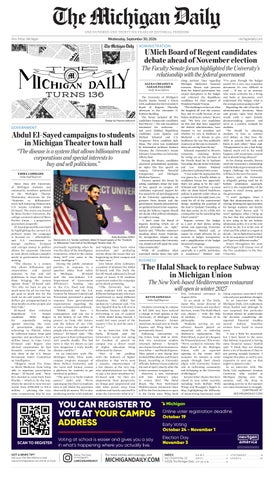
Holly Burkhart/DAILY Democratic U.S. Senate candidate Abdul El-Sayed speaks at the “Students vs. Billionaires” town hall at the Michigan Theater Sept. 23.
previously regulating when he was the chair of the Intelligence Committee, which is the closest thing he’ll ever come to the word ‘intelligent.’” During the public comment portion, in response to a question about food safety in Michigan, El-Sayed said the now-defunct U.S. Department of Government Efficiency’s funding cuts to the U.S. Food and Drug Administration and the U.S. Centers for Disease Control and Prevention prevented a proper response from governmental organizations regarding the recent cyclosporiasis outbreak. “DOGE did have a consequence, and you see it in the failure of our FDA to protect us from shit lettuce and the failure of our CDC to even count the number of people who are affected by shit lettuce,” El-Sayed said. “The good news is that cyclosporiasis isn’t usually deadly. The bad news is that it’s shown us just how dangerous a truly deadly disease could be.” In an interview with The Michigan Daily, Elise Joshi, campus program manager of More Perfect University, said the town hall format creates a platform for students to get involved in politics. “The goal is to build student power,” Joshi said. “We’re opening up the floor to students here to ask Abdul the questions that really do matter. We’re also producing stories with students
and helping them learn video journalism and producing stories about the issues that are happening on their campus and in their area.” LSA Senior Alina Lohmeier, a member of Students for Abdul El-Sayed, told The Daily the fact El-Sayed addressed a broad range of issues U-M students experience makes his campaign particularly promising. “(The University has) so many students with so many different backgrounds who have experienced so many different situations that Abdul has spoken on,” Lohmeier said. “I’m very hopeful that he will win in November because right now, everything is out of control. … With Abdul being elected, I would feel more proud of the country I live in and the state I live in.” In an interview with The Daily, El-Sayed said the University’s recent low rating for freedom of speech on campus was a direct result of higher education being influenced by donors. “Part of the problem with the industry of higher education is that we’ve seen a massive empowerment of a few donors at the very top, who administrations are likely to pay a lot more attention to,” El-Sayed said. “As they are empowered, their perspective on things gets empowered and that takes power away from students and faculty and staff to make the University what it is.”
The University of Michigan’s Faculty Senate hosted a forum with candidates for the University’s Board of Regents Thursday afternoon in the Alexander G. Ruthven Building. The forum included all five candidates: Democratic candidates Paul Brown — the sole incumbent nominated for reelection — and Amir Makled, Republican candidates Lena Epstein and Michael Schostak and U.S. Taxpayers’ Party candidate Kyle Maas. The event was moderated by information professor Kentaro Toyama, the University’s Senate Advisory Committee on University Affairs chair. During the forum, candidates answered presubmitted questions on topics like free speech on campus, University financial transparency and Michigan Medicine finances. Toyama opened the forum by asking candidates about the state of free speech on campus. All candidates expressed support for free speech for all and disapproved of the University capitulating to pressure from donors and the government. Epstein advocated for an apolitical Board in her response, saying she believes regents should not decide what political ideologies are right or wrong. “I don’t want the Board of Regents deciding which set of political principles are right,” Epstein said. “Whether someone’s speaking about Israel, Palestine, AI, immigration, religion or any controversial issues, this University can, should and will apply the same rules consistently.” While all candidates often expressed similar ideas, they split
along partisan lines regarding Michigan Medicine’s financial stressors. Brown said pressure from the federal government has caused disruptions in the budget and criticized the Republican candidates for their support of President Donald Trump. “The challenges we face are what the hospitals all over the country face, and it’s really because of our broken healthcare system,” Brown said. “We have two candidates on this dais that have supported the federal administration, have donated to our president and whether it’s cuts in Medicare or Medicaid — or threats to give healthcare the way they politically want us to or the cuts in research — those are coming from the top.” Schostak responded to Brown’s comments, criticizing Brown for voting yes on the purchase of the Textile Road lot in Ypsilanti Township, the site of the University and Los Alamos National Laboratory’s planned data center. “I was under the impression this was gonna be a friendly debate or candidates forum, but apparently that’s not going to be the case,” Schostak said. “And Paul — to come after me about federal healthcare policies is patently unfair when, as a regent for the last eight years, you voted for all of the controversial things, including the purchase of the land in Ypsilanti Township, or that data center. So it’s a little rich coming after me for something that I don’t control.” Regents oversee the budget as a part of their duties, setting tuition and approving University expenditures. Makled said, as regent, he would advocate for an increase in budget transparency and a simplification of the budget document’s language. “The need for transparency, especially at a public institution, is mandatory,” Makled said.
“I’ve gone through the budget myself. It’s a very, very expensive document; it’s very difficult to read. … If me, as an attorney who reads contracts for a living and looks at documents, can’t understand this budget, what is the average person going to do?” Regarding the role of faculty in administrative decisions, Maas said greater input from faculty would yield a more holistic decision-making process and serve as a positive example for students. “We should be educating students in how to conduct civil debate, so they have the skills to actually both talk and listen to each other,” Maas said. “Disagreement is not a bad thing. Indeed, much evil in the world happens with unanimous consent due to dissent being silenced.” In his closing remarks, Brown cited the University’s relationship with the federal government as the largest challenge the University will face in the next five years. Brown said the University is allegedly getting sued for its holistic admissions approach, and it is the responsibility of the regents to stand strong against the government. “ I won’t apologize when I fight this administration, who is cutting, limiting the opportunities for foreign students and faculty to come here,” Brown said. “I won’t apologize when I bring up the fact that this administration is now suing us for our holistic admissions policy. It is at the core of what we do; it is at the core of what you’ll be asked as a regent to decide — do we fight those actions, or do we acquiesce to that? I think you’ll get two different results.” Voters throughout the state of Michigan will choose two of the five candidates in the Nov. 3 election.
BUSINESS
The Halal Shack to replace Subway in Michigan Union The New York-based Mediterranean restaurant will open in winter 2027
KEVIN GONZAGA Daily Staff Reporter
Students returning to campus in fall 2026 may have noticed a change in food options at the University of Michigan Union basement. Subway’s former storefront, located next to Panda Express and Wing Snob, was permanently closed. Following renovations to the Union from 2018 to 2020, only two restaurant vendors returned: Subway — formerly one of nine franchise locations in Ann Arbor — and Panda Express. They joined a new lineup that included Blue Market and Panera Bread. According to University officials, Subway’s lease ended at the end of April, shortly after the winter semester wrapped up. However, a new restaurant will take Subway’s place in winter 2027: The Halal Shack. The New York-based Mediterranean restaurant chain will be the first business to open in the Union since Wing Snob
first welcomed customers in August 2024. In an email to The Daily, Susan Pile, senior director of University Unions and Auxiliary Services, wrote The Halal Shack was chosen — with the help of students — because of its philosophy. “Students serving on our advisory boards played an important role in selecting (Subway’s) replacement, The Halal Shack, as part of a Request for Proposal process,” Pile wrote. “We’re excited to welcome The Halal Shack to the Michigan Union, with an expected opening in the winter 2027 semester. Its mission to unite people through food closely aligns with University Unions’ role in cultivating community and belonging at the University of Michigan.” Several other chains that have closed in Ann Arbor recently, including both Buffalo Wild Wings and Bruegger’s Bagels in May, highlighting the difficulty of maintaining businesses amid
rising expenses associated with rent and post-pandemic changes. In an interview with The Michigan Daily, LSA sophomore Omar Rashid said although he was surprised this particular location closed, he understands the decision considering the reported financial troubles several Subway franchise owners have faced in recent years. “I was a little bit surprised, but I have heard in the news that Subway in general is having some financial issues,” Rashid said. “I think they are closing down a lot of locations if they’re not getting enough business. I imagine this place as well is very expensive to rent out, so that might’ve played a role.” In an interview with The Daily, LSA sophomore Jonatan Contreras, who worked at Michigan Dining over the summer, said the drop in spending activity in the summer can cause businesses to struggle.
CONTINUED AT MICHIGANDAILY.COM
YOU CAN REGISTER TO V Michigan voter registration deadline VOTE AT YOUR CAMPUS Online October 19 ADDRESS Early Voting October 24 - November 1
SCAN TO REGISTER GOT A NEWS TIP? Call us at 734-763-2459 or e-mail news@michigandaily.com and let us know.
Voting at school is easier and gives you a say in what's happening where you actually live. Follow The Daily on Instagram,
@MICHIGANDAILY
For more stories and coverage, visit
MICHIGANDAILY.COM
Election Day November 3 Paid for by NextGen Climate Action
INDEX N E W S . . . . . . . . . . . . . . . . . . . 1 S TAT E M E N T . . . . . . . . . . . . . . . . 8 Vol. CXXXVII No. 22 ARTS .......................4 SPORTS...................10 ©2026 The Michigan Daily O P I N I O N . . . . . . . . . . . . . . . 6
News
2 — Wednesday, September 30, 2026
RESEARCH
The Michigan Daily — michigandaily.com
UMich launches world’s first histotripsy center
The $10 million center will research a non-invasive cancer treatment method that uses sound waves QUINN MITTLESTAT Daily News Editor
The College of Engineering’s $10 million Histotripsy Center is the world’s first facility of its nature, where sound — instead of surgery — is the go-to method to treat cancer. The center is dedicated to researching a cancer treatment strategy where patients might not have to stay overnight at the hospital, undergo lengthy surgical procedures or be injected with toxic chemicals. Histotripsy — a method used to treat cancerous tumors — was developed in the early 2000s at the University. The treatment uses ultrasound technology developed by HistoSonics — a U-M startup founded in 2009 — to deliver sonic waves to targeted cancerous tumors. The movement from the waves creates bubbles that grow and collapse, breaking down a tumor’s cell structure into a non-cancerous liquid the body can absorb. Unlike other types of cancer treatment, histotripsy is completely non-invasive, meaning it does not require incisions, toxicity or heat, and patients experience little to no side effects. Additionally, the sound waves are concentrated specifically on cancerous tumors, so the surrounding healthy tissues remain largely unaffected, and patients are typically able to return home on the same day as a histotripsy procedure. In 2023, histotripsy was approved by the Food and Drug Administration to treat liver tumors. In an interview with The Michigan Daily, biomedical engineering professor Zhen Xu, co-inventor of histotripsy and co-founder of HistoSonics, said the center creates more opportunities to research how the technology can treat other cancers such as brain cancer. “In order to realize the potential of histotripsy to get
Harper King/DAILY
A sign hangs on a wall marking the Histotripsy Center.
all those different types of treatments, we need research as a foundation to help investigate, then translate,” Xu said. “Only a very small number of groups of researchers have been working on the research of histotripsy because it’s limited by a highly specialized device and the high expertise required.” Although histotripsy has already treated over a thousand patients at institutions in the United States, Hong Kong and the United Arab Emirates — including at the Michigan Medicine Rogel Cancer Center — the Histotripsy Center at the University does not provide
patient care. Instead, Xu told The Daily the center’s primary purpose is for research, with a focus on its potential impacts on various types of cancer. Along with allowing researchers from other universities to use its facilities free of charge, Xu said the center can also ship its technology to other labs looking to develop histotripsy. “The idea is that this will really enable from a small dozen of researchers to maybe thousands of researchers around the country to do histotripsy research and accelerate investigation of histotripsy to different disease types,” Xu said.
The center is in the Carl A. Gerstacker Building on North Campus. In an interview with The Daily, fifth-year doctoral student Hanna Kim, who researches histotripsy, said the center provides researchers with extra room to work. She says the space makes tasks such as cell culturing — growing and preserving cancer cells from a donor organism for research samples — more efficient. “Space is always great for research,” Kim said. “We used to have to go to another building across the street to do cell culturing, for example, and then bring them over, but then they
made the cell culturing in the same building where I do my research, so that’s been really helpful because … there isn’t time lost in transporting the cells over.” In addition to research, Xu said the center will also provide opportunities for students to learn about histotripsy through educational programming, such as workshops and various histotripsy-specific degree and certification programs. “We will have a graduate program and post-doc programs to train the next generation of histotripsy technical scientific leaders,” Xu said. “We actually
are going to provide a histotripsy course that includes lecture and hands-on workshops, so students take the course and they also have the opportunity to research at the center, as well as actually have internships at HistoSonics.” Fourth-year doctoral student James Messina, who works with the center, told The Daily it has the potential to allow researchers to access histotripsy technology globally, particularly for sarcomas — a rare type of bone cancer. “Working with sarcomas, (the center will provide) more collaborations with people,” Messina said. “A lot of people have ideas for histotripsy, but they don’t have a system, so I think the center is going to not only bring people here … as well as move histotripsy out.” Kim said she hopes the center and its technology-sharing capabilities will bring more attention to histotripsy and form the basis for a broader adoption of the method. “It’s just really cool that so many more people know about (histotripsy) now,” Kim said. “Initially, when I started off, unless you were in the field, not many people knew what histotripsy was. But now, more people are aware of it. … I’m not sitting there being like, ‘Oh, I do histotripsy,’ and then no one knows what that is. Someone is now like, ‘Oh, I’ve heard there’s the center.’” In an email to The Daily, Messina wrote that, ultimately, the primary goal of histotripsy research at the center is to provide benefits for patients. “This research can be very challenging, but I speak for the whole lab when I say we are motivated to be working on technology that has a chance to help improve the lives of people,” Messina wrote. “The driving force for why we do these studies is that we hope our research studies result in benefiting patients some day.”
ANN ARBOR
Ann Arbor for Public Power debates DTE-backed group over ballot proposal Voters will decide Nov. 3 whether to replace DTE Energy’s electric utility with a city-run power grid
NIKO WILSON
Daily Staff Reporter
The League of Women Voters of Washtenaw County held a forum Wednesday evening where Ann Arbor for Public Power and the DTE-backed Ann Arbor Responsible Energy Coalition pitched their cases to the city’s voters regarding a public power transition. Ann Arbor voters will decide whether to replace DTE Energy’s electrical utility with a city-run power grid, after A2P2 gathered more than 5,000 signatures on a petition to add its proposal to the Nov. 3 midterm ballot. The measure will appear on ballots as City Proposal E, and if
approved, would require the city to elect a public utility board by 2028 overseeing a major power supply transfer from DTE to collective ownership. The ninemember board would include a seat from each of Ann Arbor’s five wards and four other members appointed by the Ann Arbor City Council. The city would also commission a study assessing its initial utility purchase cost and long-term maintenance costs. A2P2 Executive Director Brian Geiringer began the forum by arguing elected officials could run the city’s utilities with more local accountability than DTE. To officially start buying utility equipment from DTE, Geiringer said the city would need a second vote approved by 60% of voters.
“You cannot go to DTE headquarters and complain to them with local control of a public power utility — you can go to City Council” Geiringer said. “You can go to the public power board that is being created this year, and you can actually complain. And if people don’t do what you want, you and your neighbors can vote those people out.” Even though the proposal doesn’t require the city to officially transition to public power yet, A2REC representative Robert Joerg said he believes this vote will essentially lead to it. “In effect, it is a vote to take over the city’s grid: It is going to start the process,” Joerg said. “It is not the final vote, but it is a proxy vote for this. And I think
that’s important for folks to say — attempting to downplay this and say that it’s just a board is not really a fair shake to the voters.” A2REC has tried to block A2P2’s proposal through the courts twice, alleging invalid petition signatures, though both cases were dismissed. Joerg questioned whether local officials without technical expertise could run Ann Arbor’s electric grid responsibly. “When it comes to something as important as our electrical utility, do we really want to politicize that?” Joerg said. “Do we really want folks that aren’t required to have expert knowledge running such a critical and fundamental function of our day-to-day lives?”
CONTINUED AT MICHIGANDAILY.COM
PHOTO OF THE WEEK
LSA COLLEGIATE LECTURE SERIES
Thursday, October 8, 2026 4:00 p.m.—5:30 p.m. Weiser Hall, 10th Floor
Open Futures: Anthropology of the Postcarbon Transition STUART KIRSCH Roy A. Rappaport Collegiate Professor of Anthropology
More Than Just a Phase: How Cells Exploit Phase Separation at Membranes to Sense Their Environment SARAH VEATCH
Daniel Axelrod Collegiate Professor of Biophysics
The Sea We Swim In: Exploring the Impact of Media’s Sexualization of Girls and Women L. MONIQUE WARD
Jacqueline S. Mattis Collegiate Professor of Psychology
Public lectures and reception; you my attend in person or virtually. For more information, including the Zoom link, visit events.events. umich.edu/event/150443 or call 734.516.1027.
Cymarah Gordon tips the volleyball over the net during the game against Cornell Sept. 20.
Lune Mathis/DAILY
The Michigan Daily — michigandaily.com
News
Wednesday, September 30, 2026 — 3
CAMPUS LIFE
Yo-Yo Ma performs Lord of the Rings halftime show with Michigan Marching Band The 20-time Grammy-winning cellist performed in celebration of the film franchise’s 25th anniversary
REBECCA BORLACE
ZACHARY AJLUNI and EDITH PENDELL
Daily Staff Reporter
Grammy Award-winning cellist Yo-Yo Ma paraded with the Michigan Marching Band to the football game Saturday, where he then joined them for a performance of a Lord of the Rings medley during the halftime show to celebrate the 25th anniversary of the franchise’s first film. The performance was a collaboration between the marching band, the University of Michigan’s School of Music, Theatre & Dance, the University Musical Society and Howard Shore, the original movie score composer. The arrangement the marching band played was composed by associate band director Richard Frey and former director Scott Boerma, in association with Shore. Ma arrived in Ann Arbor Friday morning to join the marching band in the Big House for their Friday night stadium rehearsal. After the rehearsal ended, Ma spoke with students during a Q&A session and performed The Swan by Camille Saint-Saëns for them. In an interview with The Michigan Daily, LSA senior Ella Blank, marching band drum major, said she was excited to be one of the only marching bands to perform music from the original Lord of the Rings scores. “I cannot believe that we’re getting to do this halftime show and perform with such a great musician who is clearly just as enthusiastic as we are about this experience,” Blank said. “This show is beyond anything I could have imagined this year.”
Co-Editors in Chief eic@michigandaily.com
CICI COPENHAVER
Business Manager business@michigandaily.com
NEWS TIPS
tipline@michigandaily.com
LETTERS TO THE EDITOR tothedaily@michigandaily.com
EDITORIAL PAGE
opinion@michigandaily.com
In an interview with The Daily, LSA senior Kiersten Schiebner, a horn player, said she felt their shared interest in music made the performance successful. “You would think that 400plus members of the band who have various years of experience in music and a 20-time Grammywinning cellist — the sound wouldn’t mesh very well,” Schiebner said. “But because we all had a very common goal and a passion for music, it was able to make a very uniquely colorful and successful performance.” In an interview with The Daily, Engineering sophomore Robert Ayotte, another horn player, said he was touched by Ma saying his favorite career moments were performing on “Mister Rogers’ Neighborhood” and “Sesame Street.”
“One thing that he said that really stuck with me was when someone asked him what moment of his career he was most proud of or if there’s any piece or thing he did that he was most proud of,” Ayotte said. “Those were some of the proudest moments of his career because he got to be accepted by and make an impact on children watching those shows.” Doctoral candidate Katarina Elise, who was asked one month ago to be Ma’s substitute should he be unable to perform, practiced with the marching band Wednesday night and told The Daily that the early rehearsal let the band and sound team get used to the cello part. Schiebner said tempo changes and step-offs — the moment marching bands change field
positions — also made the performance difficult. “The music is not very easy, and there’s a lot of crazy time changes and tempo changes, and the drill itself had a lot of interesting stepoffs that we don’t usually have,” Schiebner said. “It was very intricate, more intricate than it usually is. … They actually made the drill and the responsibility a little bit harder and higher, just to make sure that this performance was really of the caliber that it needed to be.” After the performance, Ayotte said he felt Ma’s performance will leave a lasting impact on the program. “It was one of those moments where you knew that you were a part of history being made, in that this is going to be something that is going to be a part of the band’s legacy,” Ayotte said.
public safety threats including financial scams, non-consensual content distribution and distrust in media. Deepfakes proliferation has taken off in recent years, increasing by 550% from 2019 to 2023. Increased access to AI software has intensified the problem. In an interview with The Michigan Daily, Khalid Malik said the goal of M-DRH is to provide services for deepfake detection for community members, including curriculum and public training. “The problem is: Who will verify that this is real or fake?” Khalid Malik said. “The technology piece is missing and we are trying to fully fulfill this gap. We are developing detection as a service. We are already helping the governments and the courts, but this we are making for the common people. So
we want to use the best practices of human-centered design.” Out of 450 proposals, the project was one of 37 recently selected to receive a grant from the University’s first round of Strategic Initiative Fund awards. The SIF — a $1 billion investment awarded over 10 years — provides one-time funding to high-value, high-impact initiatives across the University’s three campuses. The M-DRH aims to offer a public verification portal for checking suspicious media, train more than 1,000 “Digital Integrity Ambassadors” educators and create policy guidance to protect Michigan from AI-generated frauds. In an interview with The Daily, Hafiz Malik, UM-Dearborn professor of electrical and
computer engineering and project team member, said M-DRH aims to help people differentiate between misinformation and reality. “The goal here is to counter what is becoming uncontrollable,” Hafiz Malik said. “There is not a single platform available where you can find answers to all the queries — meaning, if text or a story is AI-generated or not. We are trying to put together these resources and expertise so that you can find answers to these questions under one roof.” In an email to The Daily, Business graduate student Shirley Giraldo, co-president of the AI and Emerging Tech Club, said the service of the M-DRH can protect individuals from deepfakes.
CONTINUED AT MICHIGANDAILY.COM
Who is C. Cybele Raver? A deep dive into the next UMich president As Vanderbilt’s provost, Raver oversaw student discipline and stood against attacks on federal research funding
CALEB OBICO
The University of Michigan’s new president C. Cybele Raver is set to take office Dec. 1 — with a fiveyear term and a $2 million salary. But, who is Raver? And how will her previous tenure be reflected at the University? Following a 15-month search, the University’s Board of Regents selected Raver as the 17th president of the University Aug. 18. Her appointment was later confirmed at the regents’ Sept. 1 meeting. Much of Raver’s previous work was in research. After earning her undergraduate degree at Harvard University, Raver completed a doctoral degree in developmental psychology at Yale University, with her dissertation examining interactions between low-income 2-year-olds and their mothers. She has held various faculty positions related to developmental psychology, including her roles as an
sports@michigandaily.com
ADVERTISING
CORRECTIONS
Madalyn Braun/DAILY Yo-Yo Ma, world-renowned American cellist, performs with the Michigan Marching Band during the Michigan football halftime show Saturday afternoon.
ADMINISTRATION
Daily Staff Reporter
SPORTS SECTION
NEWSROOM
news@michigandaily.com
“The goal here is to counter what is becoming uncontrollable.”
The Michigan Deepfake Resilience Hub initiative is attempting to help the public detect and understand how to protect themselves against falsified artificial intelligence information. Led by Khalid Malik, University of Michigan-Flint professor of computer science and director of cybersecurity at the College of Innovation & Technology, the tri-campus initiative aims to address a gap in existing detection tools to be more accessible to everyday people. Deepfakes, or synthetic media made to replicate and falsely portray someone’s likeness, pose
arts@michigandaily.com
photo@michigandaily.com
Deepfake Resilience Hub combats rise of AI-generated misinformation
Daily Staff Reporter
ARTS SECTION
PHOTOGRAPHY SECTION
ADMINISTRATION
ANJALI BUDHRAM
Stanford Lipsey Student Publications Building 420 Maynard St. Ann Arbor, MI 48109-1327 734-418-4115 www.michigandaily.com
associate professor at the University of Chicago’s Harris School of Public Policy, deputy provost at New York University’s Steinhardt School of Culture, Education, and Human Development and an assistant professor at Cornell University’s Department of Human Development. In a 2021 interview with The Vanderbilt Hustler, Raver described her work. “In terms of how that relates to research, my work is really focused on the intersection of the science of human development and public policy, and all the ways in which science can support the betterment of the human condition and society,” Raver said. Raver spent five years as Vanderbilt University’s provost and vice chancellor for academic affairs. During her tenure, she launched the Vanderbilt College of Connected Computing, appointed five deans and oversaw a research budget of more than $1 billion. In a Vanderbilt University press release covering her departure,
Vanderbilt Chancellor Daniel Diermeier described her as a transformative leader. “Cybele’s impact on Vanderbilt has been profound,” Diermeier said. “Her leadership has strengthened the university at every level— advancing our academic ambitions, accelerating discovery and innovation, and creating the conditions for our faculty, students and schools to thrive.” At Vanderbilt, Raver also confronted obstacles to research funding posed by the federal government. She opposed the Feb. 7, 2025 National Institutes of Health decision to cap federal funding reimbursement rates for facility and administration at 15%. The cap would have effectively rendered budget cuts to research at major universities, but was temporarily stopped by a federal judge Feb. 10 and blocked permanently by the U.S. Court of Appeals in January 2026. Raver also served as a declarant on a lawsuit against
NIH and other entities, including the Association of American Universities, Association of Public & Land-grant Universities and the American Council on Education. Additionally, Raver oversaw student discipline as a part of her duties as provost. During a 2024 sit-in at Kirkland Hall, 27 students voiced their opposition to the Vanderbilt administration’s blockage of a Vanderbilt Student Government amendment forbidding VSG funds from being spent on companies affiliated with Israel amid Israel’s ongoing military campaign in Gaza. Vanderbilt’s pro-Palestine encampment lasted more than 30 days and the University responded to the sit-in by suspending students and expelling at least three. In an email sent to the Vanderbilt community, Raver notified the Vanderbilt community of the sit-in and expressed a need for dialogue.
CONTINUED AT MICHIGANDAILY.COM
wmg-contact@umich.edu
corrections@michigandaily.com
Editorial Staff ANNABELLE YE
Joshua Mitnick ’92, ’95 Managing Editor
bellaye@umich.edu
GEORGIA MCKAY
Digital Managing Editor
gmckay@umich.edu
AANYA PANYADAHUNDI and CHRISTINA ZHANG
Managing News Editors news@michigandaily.com Senior News Editors: Alexa Cheaney, Dominic Apap, Gia Verma, Quinn Mittlestat, Sarah Palushi, Sarah Spencer
ELENA NICHOLSON and GABE EFROS
Editorial Page Editors tothedaily@michigandaily.com Deputy Editorial Page Editor: Mateo Alvarez Senior Opinion Editors: Avery Allen, Maggie Berling, Madeleine Burke, Stephanie Bouserhal, Isabel Seniawsk
LYRA SHARMA and GRAHAM BARKER
Managing Sports Editors sports@michigandaily.com Deputy Sports Editor: Sophie Matthews Senior Sports Editors: Amanda Bergman, Niyatee Jain, Drew Lenard, Nate Schreck, Grace Wright, Hadley Zann
CAMPBELL JOHNS and CORA ROLFES
Managing Arts Editors arts@michigandaily.com Senior Arts Editors: Hudsen Mazurek, Abigail Weinberg, Tara Wasik, Ana Torresarpi, Meagan Ismail, Siena Beres
MAISIE DERLEGA and SELENA ZOU
Managing Design Editors design@michigandaily.com Senior Layout Editors: Frances Leibovich, Kathryn Palsrok Senior Illustrators: Gabriella Spagnuolo, Emmeline Meldrum, Ella Flores Brosnan
BRIDGETTE BOL and HOLLY BURKHART
Managing Photo Editors photo@michigandaily.com Senior Photo Editors: Ananya Kedia, Arushi Sanghi, Isai Hernandez-Flores, Ava Farah
AYA FAYAD
Managing Statement Editor statement@michigandaily.com Deputy Editors: Oummu Kabba, Lola Post, Riya Kommineni
ALINA MURATA and JOSUE MATA
Managing Copy Editors copydesk@michigandaily.com Senior Copy Editors: Maximus Craig, Meagan Ismail, Claudette Johnson, Oummu Kabba, Ayah Maskoun, Caroline Niccolini, Emma Oftedal, Joshua Park, Zoey Ueland, Justin Xhelilaj
EMMA PENG and JULIA MEI
Managing Online Editors webteam@michigandaily.com Data Editors: Darby Jones, Zora Tucker Engineering Manager: Alyssa Locke, Grace Liu Product Managers: Annice Chang, Sanvika Inturi Senior Software Engineer: Becky Pan
EVAN KRUMMEL and JOVANNA GALLEGOS
Managing Video Editor video@michigandaily.com Senior Video Editors: Samridhi Sharma, Grace Wright
AMARA M. SMALL and IHAA MOHAN
Michigan in Color Managing Editors michiganincolor@michigandaily.com Senior MiC Editors: Allana Smith, Amany Sayed
HANNAH BODNAR and AVA HOOGTERP
Managing Podcast Editors podeditors@michigandaily.com Senior Podcast Editors: Rogen McLean, Zora Burroughs, Karina Shahinian, Olivia Dickerson
DA YOUNG KIM and UWAEISH AHMAD
Managing Audience Engagement Editors socialmedia@michigandaily.com Senior Audience Engagement Editors: Amanda Bergman, Caleb Starr, Isabella Burke, Libby Le Febre, Michelle Fang, Sophia Polega, Heewon Moon
MAHEE KAVDIA and PUJITA RUPANI Culture, Training, and Inclusion Co-Chairs
accessandinclusion@michigandaily.com
LUCY LANGERVELD and TIFFANY MCKALKO
Managing Focal Point Editors lucykate@umich.edu, tmckalko@umich.edu Senior Focal Point Editors: Amaya Choudhury, Claudette Johnson
JAMES KNAKE and MILAN THURMAN
Managing Games Editors crosswords@umich.edu Senior Games Editors: Eleanor Sullivan, Kiran Parekh, Sam Martin, Tobin Saxton
Business Staff CAROLINE ZOLTAK
GABRIELLE GONDOLY
KATE PARAMBO
MORGAN ORTH
Marketing Manager
Creative Director
Sales Manager
Strategy Manager
The Michigan Daily (ISSN 0745-967) is publishing weekly on Wednesdays for the Fall 2026 semester by students at the University of Michigan. One copy is available free of charge to all readers. Additional copies may be picked up at the Daily’s office for $2. If you would like a current copy of the paper mailed to you, please visit store.pub.umich.edu/michigan-daily-buy-this-edition to place your order.
Arts
4 — Wednesday, September 30, 2026
The Michigan Daily — michigandaily.com
The Michigan Daily Film Beat’s favorite Studio Ghibli films no twists and not much of a plot. We simply get to see the world through the eyes of these children for 80 minutes. Totoro, the iconic spirit that is seemingly a cross between a bear and a bunny, is only in the movie for roughly 15 minutes. It’s a display of director Hayao Miyazaki’s genius; he is able to create a movie so pure and so simple, yet still impactful. We watch these girls play, explore, fight and eventually discover magical creatures. The simplicity of “My Neighbor Totoro” is what makes it so special because that’s exactly what childhood is like: It’s the only point in time when everything is easy. “Ponyo” We all have nostalgic childhood movies. I can still clearly picture watching “Ponyo” on the weekends in my living room with my dad, being absorbed into the magical world of the little fish in the sea. What makes “Ponyo” so heartwarming, all these years later, is the innocent and beautiful love between Ponyo and Sosuke and the timeless themes that explore the connection between nature and humanity. These classic aspects are what keep me rewatching the film. This beautiful childhood love occurs against the backdrop of nature versus humanity as exhibited through Ponyo’s
DAILY FILM WRITERS Forty years ago this past August, Studio Ghibli’s first film, “Castle in the Sky” was released in theaters across Japan. In the decades since, the studio has released more than 20 theatrical features, taking audiences on dreamlike journeys from seaside cities to magical bathhouses. Whether audiences be children or full-grown adults, there is something timeless about the mesmerizing Ghibli magic and the messages we take from it. For this momentous anniversary, The Michigan Daily Film Beat has gathered together to talk about our most loved and cherished Ghibli films. — Abigail Weinberg and JC Rafal, Senior Arts Editor and Film Beat Editor “My Neighbor Totoro” Many movies try to capture the rush of being a child: running through a forest, building forts, hunting for ghosts and seeing the world as a place of wonder. But no movie has captured it quite like “My Neighbor Totoro” — which is odd, because not much really happens in the film. It follows two young girls moving to an old, abandoned home in the Japanese farmlands, which just so happens to be inhabited by woodland spirits. And that’s it. There’s no call to action, no character goal,
Gabriella Spagnuolo/DAILY
parents, their magic and a massive tsunami. Miyazaki uses his signature magical realism to show the beauty of the sea, but also its immense power. The relationship between humanity and nature affects each character — through Ponyo leaving home, her sorcerer father’s reaction to her running away and her mother being a giant, benevolent sea goddess. The love shown in the film is full of wonder and childlike innocence,
qualities that make the story such a feel-good watch for me all these years later. “Howl’s Moving Castle” The truth is that I didn’t grow up with “Howl’s Moving Castle.” Unlike “Ponyo” or “My Neighbor Totoro,” two films that defined my childhood, my first encounter with the Ghibli film arrived during one of my high school classes. And, in hindsight, perhaps that was for the best. I’m not sure a preschool me
could digest the messages about the beauty of aging or Miyazaki’s anti-war sentiment, but a high school me could. Whether I had been a preschooler, high schooler or a full-fledged working adult, I still would’ve fallen in love with this film on my first watch, and the reason why would be the same for any point in my life: Howl and Sophie’s relationship. The heart of every Studio Ghibli film lies in the connections
between characters; think Chihiro and Haku in “Spirited Away,” or Satsuki and Mei in “My Neighbor Totoro.” Even in the non-Miyazaki works, this is still the case (a la “When Marnie Was There”). But in the studio’s entire filmography, it’s Howl and Sophie’s connection that warms my heart the most. Throughout the narrative, the two reciprocate acts of love to one another — both small and large — from cooking breakfast to secret flower gardens to returning a heart. In the end, the foundation of Howl and Sophie’s unconditional love lies in their acceptance of each other’s flaws. For a 17-year-old me, perhaps that was the best love lesson I could ever get. “Kiki’s Delivery Service” When I watched “Kiki’s Delivery Service” for the first time, I was bundled up in my childhood bed with the AC turned down to a freezing low. Sixteen years old and experiencing real exams for the first time, I was looking forward to a cozy watch that provided some form of escapism for two hours. By the end of it, I remember feeling vaguely disappointed that I didn’t immediately feel that entrancing, wistful magic that Ghibli movies have always been known for.
CONTINUED AT MICHIGANDAILY.COM
TIFF 2026: Warner Bros. Co-CEOs discuss betting on originality followed was an unexpectedly humble discussion focusing on passion and creativity rather than attempting to guess the taste of a famously spontaneous, radical young swath of theatergoers — Generation Z. Abdy and De Luca met about 30 years ago and have been close friends ever since, bonding over their love for film. They are dedicated to distributing a diverse slate of films each year, aiming to satisfy all four quadrants. When taking on intellectual property projects, the two emphasized the importance of finding a filmmaker passionate about that exact niche of popular culture. They also stressed that they have the same opinions on
AUDREY KOVTUN Daily Arts Writer
On the second day of the Toronto International Film Festival, Charles Tremblay, TIFF head of market, introduced a Q&A with the co-chairs and co-CEOs of the Warner Bros. Motion Picture Group, Pam Abdy and Michael De Luca. Since taking over the studio in 2022, the two have taken charge of distribution, including films such as “Barbie,” “Challengers” and “Saltburn.” Moderated by TIFF CEO Cameron Bailey, the discussion challenged the two to think about risk, originality and the new generation of filmmaking. What
business and artistic decisions, stating that, “You don’t have to chase us for separate opinions.” For a studio who has undergone a roller coaster of leadership changes in the past 20 years, this dynamic sets the stage for stability in Warner Bros.’ future, despite impending acquisitions. In the aftermath of films such as “Sinners,” “One Battle After Another” and “Weapons,” Bailey asked how Abdy and De Luca drew the line between risky originals and typical tentpole films. The answers that followed were some that most major studio executives would never dare to give. De Luca stated that social relevance has always been a part of the Warner Bros. legacy, citing
The Michigan Daily Crossword
Sunday, September 27, 2026 — Puzzle by Surya Jayashankar ACROSS 1. Aus. state whose capital is Sydney 4. Peach state capital, for short 7. Last call tallies, perhaps 14. Often one in a deck
1
2
17. Apple/IBM processor type 19. They speak louder than words 20. Length x width
28. Windy City "El" operator 29. M or XL, e.g.
6
7
8
9
21 24
22
25
27 33
34
40
41
13
23
29 36
37
38
42
45
30
31
32
53
54
39 43
46 49
50
51
52
56
58
57
59 62
63
67
60 64
65
66
68 69
70
36. It puts bread on the table 39. Oct. or Nov., e.g. 40. Bed-and-breakfast 41. Extinct New Zealand bird 42. Modern music genre from Nigeria 44. Weak poker hand
DOWN 1. California wine valley 2. Gets one past the other team
37. Progeny 38. Victoria's Secret item 43. Slick
3. Ross's defense to Rachel about the 45. Rocket's crew Kinko's girl 47. Dollop 4. The Mediterranean separates it from Eur.
46. Carnival
48. "Right away!"
5. Prairie tent
47. Doomsday prepper's kit
50. Apple platform
49. Karaoke needs
6. Four-leaf clover or horseshoe, perhaps
51. M's neighbor on the keyboard
52. Fibbed
7. An architect's degree, for short
55. Deli order
8. "Right back ___!"
56. "And I ___!" (VSCO girl's cry)
9. Honey badger
57. Belgian river
10. Where suits get ironed out?
58. Jessica of "The Illusionist"
11. Ending for design or fabric
59. Whispery video genre
12. Crooked
60. "___ of little faith" (Matthew 8:26)
13. Soon-to-be grads
61. One who embraces yin and yang 64. Pepperidge Farm sandwich cookies
18. Painter's stand 22. Acquire 26. ___ Blast (Taco Bell soft drink) 27. "Don't mind ___ do"
67. DJ Casey
30. Locked up
68. Dasher and Prancer's horns
31. Where to see giraffes and zebras
69. "HMU on Instagram"
32. Sixth sense
70. Nigiri-worthy fish designation: "sushi-___"
34. Publicist's concern 35. "Or ___ thought..."
platforms have brought about a “wonderful lack of gatekeeping” within entertainment, providing insight to what audiences want to see. The significance of the internet in filmmaking has never been more present in horror than this past year, as the directors of both “Backrooms” and “Obsession,” Kane Parsons and Curry Barker, respectively, both started out and gained traction on YouTube. As a member of Gen Z, I was incredibly happy to hear De Luca say that his kids and their friends are saying, “Don’t give us the same broke-ass shit,” a sentiment that many moviegoers shared before the past year’s releases.
CONTINUED AT MICHIGANDAILY.COM
‘Bobby Flay’s The Line’ may be fair, but it is not just Daily Arts Writer
26
35
48
33. Dumb
12
projects since taking on the role of co-CEOs. Though the film holds a disappointing 47%, it still managed an astounding $960.4 million on a $150 million budget. While not critically acclaimed, the film clearly struck a chord with audiences who wanted a fun time in the theater. Building on the topic of radicalism and digital media in filmmaking, Bailey asked about the studios’ recent interest in redefining horror as a genre. Both CEOs immediately jumped on the opportunity to discuss the role of YouTube and social media influencers drawing in younger audiences and bringing fresh ideas to the genre. They specifically mentioned that social media
MARGARET COX
28
61
11
19
20
44
10
16
18
21. Hosp. readout
27. "Capeesh"
5
15
17
23. Not a diamond, spade or club 47 24. Ambulance destinations, 55 briefly 25. Approximate
4
14
15. Fire, to Antoine 16. Sourdough raw material
3
films such as “Judas and the Black Messiah.” He even went as far to say, “We’re First Amendment absolutists. Full stop.” Abdy then claimed cinema is meant to be radical and that audiences are dying for more bold filmmaking. De Luca even pointed out that only investing in IP leaves room for other studios to take over the market for original films, using A24 as a prime example. It was especially interesting to hear the two discuss how they go about choosing and creating mainstream IP films. Essentially, the decision comes down to the filmmakers and the script. Funnily enough, they cited “A Minecraft Movie” as one of their most successful IP
53. Pooh's mopey pal 54. Add some ranch to, say 59. "Come ___, bro" (fighting words) 62. An end to alcohol and sex? 63. College course dur. 65. Printer tray: Abbr. 66. Apple pie ___ mode
Whether it is from his longrunning cooking competition “Beat Bobby Flay,” being the proud owner of Bobby’s Burger Palace or his contentious marital history, Bobby Flay’s name is well-known throughout the media world of celebrity chefs. And with a new series out on Food Network, his legend continues with the premiere of “Bobby Flay’s The Line.” For cooking competition novices, Flay’s reputation within the sphere may provide important context for his new project. Unlike highly affable figures like Guy “The Mayor of Flavortown” Fieri, who also frequents Food Network programming, Flay’s work is often geared toward earning the audience’s respect rather than affection. One of his most wellknown projects, “Beat Bobby Flay,” is a cooking show with the premise that Flay can beat almost any chef at their own game, making their signature dish for a panel of judges. “Bobby Flay’s The Line” features a similar dynamic: Flay assembles a group of celebrity chefs to prepare dishes in a traditional restaurant line and compete with a team of chefs from an award-winning restaurant to see whose dinner service is ranked highest by restaurant guests, who serve as the competition’s judges. The premiere episode brings in the culinary team behind restaurant Hav & Mar, led by award-winning chefs Marcus Samuelsson and Fariyal Abdullahi. Each team must work together to finish the dinner service of 240 plates, with responsibilities doled out based on each chef’s expertise and style. Overall, the creativity and variability of the resulting dishes make for a visually appealing and culinarily impressive dinner service. However, in regard to the team competition aspect of the show, it feels a bit unoriginal. The appearance of celebrity
Image courtesy of Food Network.
chefs from other competitions within a game setup that shares significant elements of its predecessors “Chopped,” “Hell’s Kitchen” and “Beat Bobby Flay” creates a show without meaningful differentiation from its peers. And, in addition to a stale competitive premise, certain show elements seem to favor the celebrity chefs over the visiting team, effectively preventing fresh talent from meaningfully entering the cooking competition scene. Considering many accused Flay of rigging his other TV series, “Bobby Flay’s The Line” faces an uphill battle to prove itself as a fair competition: From the beginning, certain details already stand out as potentially detrimental to fairness. For starters, the ticket printer malfunctions at a much earlier time for the visiting team than for Flay’s, necessitating the time-intensive process of handwriting table orders. As a result, Samuelsson’s team is behind in terms of sending out dishes, which also prevents them from getting timely feedback on how each of their dishes perform point-wise. Any semblance of fairness only continues to dissipate when celebrity chef guest Esther Choi stars as a judge. Many of the chefs know this guest well from the food world, but Flay is familiar enough to make a dish tailored to her tastes, which is stated by both
Flay and the guest. So, Flay’s team of celebrity chefs has an inherent advantage in curating their dish toward someone whose taste they know well. While all of these factors are likely coincidental, it is startling how quickly the smaller dynamics of the show add up to a substantial amount of points — an amount greater than the margin by which Flay’s team won in the premiere episode. Some may call me a sore loser, but I was left feeling like the show did not set a high standard for sportsmanship. On one’s home field, it is important to avoid unjust advantages, which can leave the visiting team feeling even further out of the loop of the Food Network celebrity chef inner circle. Again, I make no allegations of explicit cheating; I just assert that the outcome of the competition left me feeling slightly bitter and without the excitement that truly honorable head-to-heads inspire. Ideally, it should be the best chefs that win, not those best-versed in navigating televised competitions. If you are a fan of Bobby Flaystyle tournaments, this show is likely a good fit. But if you are looking for more of a lighthearted, friendly competition that does not leave you feeling cheated, it may be time to turn to Mr. Fieri and Friends. Fieri may not command respect, but his jovial attitude — and third party judging system — earns it.
Arts Back-to-school TV shows to get you ready for the fall semester
The Michigan Daily — michigandaily.com
DAILY TV WRITERS It can be hard to get back into the “academic weapon” mindset, especially after four months of summer break. When students arrived back to Ann Arbor for the first day of classes on Aug. 31, the weather still felt warm enough to be spending the day at the beach and not in the Shapiro Undergraduate Library. But a few weeks have passed, and we’ve entered a comfortable routine. The leaves on the Diag trees have begun to brown and it finally feels like we’re meant to be here. What better way to celebrate the advent of the new academic year with all its autumn charm than with a cozy back-to-school TV show to get you in the mood? If you need some premium television to get you ready for the fall semester and all the college drama that comes with it, The Daily Arts TV Beat is here to provide some recommendations. — Senior Arts Editor Ana Torresarpi and TV Beat Editor Jack Connolly
“Gilmore Girls” There is no show as synonymous with fall as “Gilmore Girls.” Though the series concluded nearly two decades ago, fans annually rewatch all 153 episodes when summer ends. Following its resurgence with Generation Z, the Lorelais (mother-daughter co-protagonists who share the same name) returned for a renewal miniseries, “Gilmore Girls: A Year in the Life,” in 2016, but nothing holds up quite like the original. From Chilton Preparatory School to Yale University, follow Rory Gilmore’s (Alexis Bledel) journey through high school romance, friendship and rivalry, college applications and university life. While she’s funny, relatable and occasionally frustrating, the best part of Rory Gilmore is her heartwarming relationship with her mother, Lorelai (Lauren Graham), as she navigates growing up and finding independence. However, what truly keeps viewers coming back is the cozy,
Wednesday, September 30, 2026 — 5
comforting atmosphere the show creates. Set in the small fictional town of Stars Hollow, Conn., the knit sweaters, pumpkin patches, cider mills and close-knit community perfectly embody the warmth of autumn. If you start the show today, you’ll watch the leaves turn and fall alongside the Gilmore girls, ready to do it all over again next year. “Community” Give me your tired, your poor, your huddled masses yearning to breathe free. At Greendale Community College, all are accepted and all have a bright future ahead of them. Have you ever felt nervous to deliver a class presentation in front of dozens of strangers? Have you ever been humbled by what you thought would be a blowoff class? Have you ever been helpless to stop petty bickering between close friends? There’s a “Community” episode for each of these issues, and many more.
The show captured viewers’ attention with ambitious outings, like “Modern Warfare” (a paintball competition set entirely at the college) and “Remedial Chaos Theory” (a timeline-hopping adventure of what-ifs). But in its golden years — specifically Seasons 1-3 — “Community” thrived on its warm relatability and sympathy for a band of misfits bound together by mutual lunacy: the “Study Group.’’ The members of the group are all at different stages of life, but ultimately seeking the same thing: a raw, unadulterated college experience and all the insight it might bring. “Community” is anchored by inventive, witty sitcom writing and a set of comedic powerhouses delivering career-best performances. If you’re in college, there’s never been a better time to watch it. “Freaks and Geeks” Forever remembered as one of the great non-starters of ’90s television, creator Paul Feig and
Lizzy McAlpine spreads her wings on ‘Angel’ TOBIN SAXTON Daily Arts Writer
Love is a theme that almost every artist attempts to write, paint, sculpt or sing about at some point. For Lizzy McAlpine, love has always been at the forefront of her music — a guiding beacon for her songwriting. Instead of favoring a linear progression of grief, longing and acceptance, McAlpine’s fourth studio album Angel complicates what love looks like, how it begins,
ends and what it does to us. Angel is a capsule of the intricate feelings that permeate our everyday life, as much as we hope to keep them at bay. Both the writing and instrumentation on Angel are reminiscent of ’70s folk — think Joni Mitchell or Nick Drake with their tightly rhythmic guitar and piercing lyrics — which makes McAlpine’s delivery all the more intimate and tender. Instead of relying solely on her lyricism, McAlpine uses instrumentation to
tell stories, too. Take the pulsating piano on “Anybody’s fool,” which features mostly seventh chords. Just as the chords bleed into one another through the leading tones without a clear start or end, so do McAlpine’s feelings as she sings, “I know this is right and I know that it’s sad / Want you to want me again like that / I like the way it feels to not be anybody’s fool.” The 13th track “The crowd” — which, in McAlpine fashion, is always a grieving letter to her late father — features forceful piano playing that depicts longing for something that’ll never come. McAlpine’s vocal style expands on “The moon,” where asymmetric lyrics are given flourishing high notes, a Joni Mitchell-esque technique, but she still harnesses her light and airy sound on “I have a friend” and the title track. Angel sprawls from the mundane to the sublime. McAlpine finds herself in a Greyhound station on “Our strange ways” and thinks of the invisible string that brought her and her partner together. On “Peach,” she turns slicing fruit in Album art courtesy of RCA Records. the kitchen into “a moment to love
(her)self better” and savor her independence. She calls her ex out for wanting to be with her solely for her fame and then diminishes their relationship down to “a car wash and a new pair of pants,” as the song is aptly titled. Whether it’s beautiful or tragic, McAlpine finds love in everything and uses small moments of reflection to create songs that transcend their initial muse. McAlpine doesn’t just focus on romantic love, though. She discusses the beauty of friendship on “Mason’s song,” an unapologetic admission to needing others. Her longtime collaborators Mason Stoops and Taylor Mackall, who have helped McAlpine articulate herself and put together some of her most memorable tracks, provide background vocals in the final refrain. “Soldier of the road,” which features Fleet Foxes, is McAlpine’s first song chronicling her struggles as a musician — her “How to Disappear Completely,” if you will. The track is a flare in the sky for anyone pursuing the arts.
CONTINUED AT MICHIGANDAILY.COM
producer Judd Apatow’s sublime “Freaks and Geeks” now exists as one of the most effortlessly perfect things ever created. Set in a fictional Detroit suburb in the year 1980, the show stars Lindsay Weir (Linda Cardellini) and her younger brother Sam (John Francis Daley) as they navigate the awkwardness of high school. Lindsay hangs out with
freaks and burnouts: there’s Nick (Jason Segel), the Rush-obsessed aspiring drummer, and Kim (Busy Philipps), the mean girl from a bad part of town. Meanwhile, Sam is an awkward geek who spends most of his time with fellow nerds Neal (Samm Levine) and Bill (Martin Starr).
CONTINUED AT MICHIGANDAILY.COM
Courtesy of Ana Torresarpi.
Sydney Sweeney does not have great jeans TIFFANY MCKALKO Daily Arts Writer
Sydney Sweeney is very good at selling things that have nothing to do with Sydney Sweeney. Jeans. Men’s soap. Sports betting apps. Whatever’s next. And yet, when Sweeney is the face of a campaign, brands are not promoting a product. Celebrities have been staples of brand campaigns and promoting products for decades. But in Sweeney’s recent campaigns, the brands that work with her portray her not as a person, but as a secondary product. The sensationalization that follows everything Sweeney does has separated her advertisements from the celebrity endorsements of the past. Her body, her face and the controversy that seems to always surround her have become invaluable marketing assets. Consider the progression. In 2024, Sweeney took part in an ad campaign with Dr. Squatch.
Filming in a bathtub, unclothed, there was an innate sexual innuendo being used to sell men’s soap by calling the viewers “dirty little boys” and asking them if they “are interested in (her) body.” After the social media craze following the ad’s release, Dr. Squatch went on to release a limited edition “Sydney’s Bathwater Bliss” soap. In that moment, the internet took the sexualized idea of a woman and turned it into a commodity, and a way to sell something. If Sydney Sweeney was being sexualized in an ad, people would talk about it and, more importantly for brands, people would buy the product. Following the Dr. Squatch sensation, Sweeney starred in an American Eagle ad in July 2025, centered around the slogan, “Sydney Sweeney has great jeans.” In the ad, she discussed her eye and hair color, playing on a double meaning of “great genes.”
CONTINUED AT MICHIGANDAILY.COM
Your old art is not ugly REAGAN KELLER Daily Arts Writer
If you’re a chronically online perfectionist like me, chances are, art is your solo hobby. It’s difficult to share your work when you know there’s someone much better out there, but if you take a leap of faith and post your art online, it might just be the key to finding a supportive community. As a preteen with unlimited internet access, I devoured hours of YouTube drawing tutorials, saved about a thousand paintings on Pinterest and followed more artists’ Instagram accounts than people I knew in real life. While I tried my best to absorb the tips I learned online, I just couldn’t hack it alone. My characters had wonky proportions, my shading looked flat and my composition was unbalanced. I was so scared of negative feedback that I never
posted my art online; I never found community. Comparison is the thief of joy, and nowadays, my interest in art is more of a recurring hyperfixation than an all-consuming passion. Still, I’ve been inspired by artists’ digital spaces since middle school, watching users flock to their friends’ posts and color their comment sections with happy emojis and spirited praise. But lately, one trend has started to sour that encouraging dynamic. On X, artists share images of their old work with the caption: “when ur art was ugly af and nobody had the heart to tell u.” The self-criticism rarely ends there. They bash their anatomy, blending and portraits for being too unrealistic, even daring to openly wonder why anyone let them share their work in the first place. As one user pointed out, “… its all just stuff thats still pretty cute
or from when the artist was just a baby anyway.” Generally, these artists’ works falls into two categories: beginner or stylized art. When I see the beginner art under that caption, I can’t help but imagine my preteen self hunched over a sheet of printer paper, trying to draw something worth posting. I imagine most of these artists were creating under similar conditions. The truth is, everyone has to start somewhere, and publicly demonizing where you began will only encourage others to stop before they’ve even started. Beginner art isn’t shameful, bad or “ugly af.” — it’s a step in the right direction. On the other hand, the stylized art spotlights some of the most experimental features I’ve ever seen on drawn characters: green nostrils, large or distanced eyes and digital humanoids, just to name a few. And truthfully,
Isabel Pohrt/DAILY
there’s nothing ugly about experimentation. When experimenting, artists learn how to express themselves and bring ideas to life, which are, in my opinion, some of the greatest joys of creation. In an era where everything needs to be on-trend, it’s liberating to see a diverse array of art styles.
But the pressure to draw something praiseworthy can also sap the individuality out of online art. That is why, over the years, certain art styles have occurred more prominently across the internet. When cartoons like “Steven Universe” and “The Amazing World of Gumball” originally aired, the CalArts art
OPEN INQUIRY SPEAKER SERIES
How to Speak Your Mind / How to Change Your Mind: The University Edition with President Emeritus Lee C. Bollinger
Thursday, October 8
4:00-5:30pm
Reception to follow in Assembly Hall.
Rackham Graduate School Amphitheatre
style was revered for its bean heads and pill-shaped grins — until it became “cringe.” During 2024, the jelly art style took prevalence, featuring portraits with glowy skin and watery eyes, until the TikTok community deemed it uncool.
CONTINUED AT MICHIGANDAILY.COM
Opinion
6 — Wednesday, September 30, 2026
The Michigan Daily — michigandaily.com
The illiterate boyfriend Edited and managed by students at the University of Michigan since 1890. Stanford Lipsey Student Publications Building 420 Maynard St. Ann Arbor, MI 48109 tothedaily@michigandaily.com
EDITH PENDELL & ZACHARY AJLUNI Co-Editors in Chief
GABE EFROS & ELENA NICHOLSON Editorial Page Editors
GEORGIA MCKAY & ANNABELLE YE Managing Editors
EDITORIAL BOARD MEMBERS Zachary Ajluni Avery Allen Mateo Alvarez Maggie Berling Stephanie Bouserhal
Hayden Buckfire Madeline Burke Willem DeGood Gabe Efros Seth Gabrielson
Jovanna Gallegos Emma Margaron Elena Nicholson Isabel Seniawski Sarah Zhang
Unsigned editorials reflect the official position of The Daily’s Editorial Board. All other signed articles and illustrations represent solely the views of their authors.
How to be better, the right way SETH GABRIELSON Opinion Columnist
W
illiam Shakespeare’s “Hamlet” asked a question which has circled through Western culture for more than four centuries. Since its 1603 publication, “To be, or not to be” has become one of the most quoted lines in the English language. Though Hamlet was considering suicide when he asked this, the more helpful question to alleviate his suffering would have been: How to be? Much like Hamlet, we tend to ask the wrong question, or we ask the question wrong. In the modern world — which is increasingly obsessed with self-help books and “productivity maxxing” — we often ask ourselves how we can be better, or how we can be the best version of ourselves. We rarely mean it literally. In almost all circumstances, we mean how we can do better, perform better, produce more or earn more. A word can drift this far intended interpretation through nothing more than repetition. “Be better” gets used enough times to mean “produce better” that the literal meaning quietly falls out of use, unnoticed, the way a coin worn smooth loses its stamp. We have quietly swapped the original, literal meaning of “to be,” — a question about your state — for a question about your output, and we did it so completely that most of us no longer notice a swap happened at all. No output-based answer — whether the input is money, GPA, a résumé line or even a virtuoussounding goal like “give back more” — can ever satisfy a question about being because output has no natural stopping point and being requires none. Conflating the two continues a pattern of insufficiency that can never be solved with output. We are drowning in a society that trains us to live in what psychoanalyst and social
Isabel Pohrt/DAILY
philosopher Erich Fromm called a “having mode.” People who are in the having mode relate to the world through possession, acquisition and control. They define themselves by what they own and what they’ve accomplished. Fromm suggests that the having mode is rooted in our instinct to believe in private property, which creates the belief that your identity is secured by what you legally hold and control, not by what you experience or express. Fromm argued that industrial and capitalist society doesn’t just permit this orientation — it actively trains and rewards it. By contrast, the “being mode” relates to the world through aliveness, engagement and authentic experience rather than material possession. But here’s the test that actually separates the two, since the same action can belong to either mode depending on why you’re doing it: having mode treats an action as proof, something you do to accumulate evidence that you’re worthy, competent or enough. Being mode treats the identical action as an expression, something you do simply because it’s who you already are, with no ledger kept. A conversation held to prove you’re a good listener is having mode. The same conversation held because you’re genuinely present with the person in front of you is being mode. Crucially,
having refers to material objects and being refers to lived experience, which is why being resists the kind of measurement having mode instinctively wants to apply to it. John Vervaeke, building on Fromm’s theories, calls the resulting error modal confusion: mistaking a being need — love, meaning, belonging, the sense of being enough —, for a having need, referring to something you could actually acquire. His own example is a car advertisement that implicitly promises that the purchase will make you more confident or more loved, selling a being need as though it were satisfiable through having. We do the identical thing to ourselves constantly, and not just with cars. Someone who quits chasing a paycheck only to start chasing a “personal growth” streak and track it in a habit app hasn’t exited having mode at all. They’ve just found a nicer-sounding thing to accumulate. Wealth is the clearest case where this can actually be represented through data. Most people assume having more money makes you happier, and research by authors from Princeton University and the University of Pennsylvania confirms this is true up to a point, with returns shrinking sharply the more you already have.
CONTINUED AT MICHIGANDAILY.COM
Banking on a better name AUDREY ROSENBERG – Opinion Cartoonist
SOPHIA BARCZAK Opinion Columnist
C
an you pronounce the word epitome? What about conscientious, colonel or thyme? Challah, queue or regime? If you happen to struggle with saying any of these words, don’t fret; you aren’t alone. The viral challenge — deemed the “illiterate boyfriend” trend — began with a TikTok video of a user challenging her partner to read words she thought he couldn’t pronounce. She was correct, as her boyfriend struggled to read a majority of the words written. A few of the words he struggled with included fuchsia, hors d’oeuvres and connoisseur. The trend rose to popularity when many couples tried the challenge for themselves, only to come to similar conclusions: Their boyfriend struggled to read most of the words on the list. While the original creators found the phenomenon to be humorous, viewers were much less amused, claiming that framing the video as “funny” disregards broader concerns about literacy. This new influx of videos is more than a trend: It demonstrates a theme of the growing gendered education gap that threatens literacy as a whole. The outrage the video produced is a sobering reflection of rising concerns from educators over decreased literacy rates among students. Researchers have documented the literacy crisis in abundance, estimating that more than half of U.S. adults read below a sixth-grade reading level. However, literacy isn’t necessarily declining for all students. While high-performing students are maintaining their success, students who were
Emmeline Meldrum/DAILY
previously struggling are rapidly declining. Students who were previously underperforming in primary school are continuing to do so because they lack foundational reading skills. Research suggests that if students are not retaining lessons on comprehension or vocabulary in primary school, they find themselves unable to catch up later on in their educational career and fall further behind. This creates a widening gap in performance and diminishes reading averages overall. Additionally, the majority of these students are men. By the fourth grade, male students are roughly three-quarters of a year behind their female peers in reading, a gap that increases to a full year by the time they graduate high school. This is partially due to differences in development — boys naturally develop language skills at a slower rate than girls do, which can cause difficulties with learning and further disciplinary action in the classroom. In some cases, men prefer not to read. Reading is commonly stereotyped as a gendered activity, with female students often regarded as better at reading and writing. This can create a socialized cyclical effect. A result of this is that in every
grade level, men score lower in reading than women. The discrepancy is further reflected in the decline of male college enrollment and the increase of male students dropping out of high school. The ratio of men to women who currently attend college is 43-to57, which tips the scales from men previously outnumbering women on campuses, demonstrating a new gendered education gap caused by lower motivation and success among male students. Illiteracy is also exacerbated within early childhood education. In recent years, curriculums have deemphasized necessary foundational skills like phonics and have adopted alternative methods like “whole language.” This decenters encrypting complex sentences in favor of memorization and guessing, which have been deemed less effective. Foundational skills of critical reading — like the use of phonics to string together complex sentences and words — have been lost in modern-day curriculums. This, accompanied by social and developmental factors, can explain why men have been disproportionately left behind in the classroom at all levels.
CONTINUED AT MICHIGANDAILY.COM
The government shouldn’t do everything HAYDEN BUCKFIRE Opinion Columnist
A
s Democratic politics increasingly focus on a larger government role in the economy during President Donald Trump’s second term, progressives are proposing public solutions to problems ranging from housing to grocery prices. That shift is reflected in the growing prominence of politicians associated with the Democratic Socialists of America, including New York City Mayor Zohran Mamdani, U.S. Rep. Alexandria Ocasio-Cortez, D-NY, and U.S. Senate Candidate Angie Nixon. Mamdani’s election in New York suggests DSA-aligned politicians may increasingly assume power in major U.S. cities. The DSA, an increasingly influential group in American politics, supports increased government involvement in the economy, including the public ownership of housing, healthcare and other industries. While the DSA’s platform is often vague, the organization supports, for example, “strict regulation” of property, largescale development of publicowned housing and universal rent control. While these attempts are wellmeaning, the government should contain its efforts to what it is better equipped to tackle. Future Democratic party leadership should take a more pragmatic approach, emphasizing government solutions in some areas and market-based solutions in others. The government only has so much money to spend. U.S. cities, states and the federal government itself are facing major budget shortfalls — thus,
there is limited room for further spending without pushing governments into insolvency. Additionally, tax revenue only increases as tax rates rise to a certain point. Beyond that point, higher rates can reduce revenue by discouraging work, investment and other taxable economic activity. Essentially, there’s no such thing as a “free lunch.” Accordingly, the government should spend money on programs that yield the most public benefit per dollar spent and shun less efficient projects. Officials should also consider the opportunity cost of forgoing other options. For example, Mamdani’s plan to open public-owned grocery stores with independent operators in each of New York’s five boroughs is not a good use of government funds, nor should it be replicated on a wider or larger scale. While grocery prices have indeed risen substantially since the COVID-19 pandemic, grocery retailers have not necessarily pocketed the increase as excess profits. Profit margins have actually compressed. The grocery market is a very efficient, but relatively unprofitable business, with margins at just 1% to 3%. The municipality will presumably front the losses associated with offering groceries at a 30% discount. But this is just a Band-Aid, paid for by taxpayers, on a larger wound. Recent increases in grocery prices are structural and can be attributed to the war in Ukraine, Trump’s tariffs, rising labor costs and droughts, among other reasons. All of these — perhaps besides labor costs — are outside of a mayor’s control. There is also a potential problem with fixing prices below the prevailing market price. If groceries are substantially
Why is the U-M DART Lab’s 3D concrete printing gaining attention? A. It can create structures quickly and with less waste B. It allows cities to avoid building new infrastructure C. It makes conventional construction materials obsolete
Find the answer: myumi.ch/dartlab
cheaper at city-run stores, customers may buy more groceries than they actually need, leading to shortages or resale on a secondary market. All of this is to say, there is a lot of evidence that a plan to cut out private grocers will likely be ineffective at scale. A widespread plan to open governmentowned grocery stores would compel taxpayers to artificially subsidize the problem rather than solve the problem itself. A mayor should instead devote resources to address problems it actually can control. Similar ideas have been floated closer to home. Yousef Rabhi, Democratic nominee for Ann Arbor mayor, views the solution to the city’s housing crisis as building “publicly owned, permanently affordable housing options.” This proposal focuses on the affordability of some housing units without addressing the underlying shortage that has driven housing costs higher. The government is generally less effective at developing these housing units than private actors, costing nearly twice as much, largely due to excessive regulations and bureaucracy. They are also subject to frequent time overruns. The housing crisis is simply not something the government can address efficiently on its own. Price increases in groceries and housing are largely public sector failures, not private sector failures. Ann Arbor’s high rents were primarily caused by poor zoning, overreliance on singlefamily housing and expensive code requirements, not landlord greed. Other college towns, like East Lansing, have seen relatively lower rent increases.
CONTINUED AT MICHIGANDAILY.COM
The Michigan Daily — michigandaily.com
Opinion
Wednesday, September 30, 2026 — 7
For old souls, college’s party culture doesn’t cut it ALEX MULDER Opinion Columnist
W
hen I struggle at school, it’s helpful for me to imagine I’m at the places that bring me the most joy: sitting around a campfire with half a dozen close friends, or visiting my grandma once a week to watch a movie. Perhaps it’s eating dinner every night with my parents or playing golf with my brothers. While I’m at home engaging with my loved ones, I have never wanted to be away at school, spending the night with music blasting as strangers shuffle around me. Amid the hustle, nothing is more important than establishing a group of friends on which to anchor your student life. Eager to make connections, many turn to a variety of social settings to make long lasting friendships — partying isn’t the best way of doing this. In a social scene dominated by parties, college students should slow down and spend time in places where they can make truly meaningful connections. What college parties do best is cultivate the “Isolation Partying
Paradox.” That is, loneliness is perpetuated more in settings of large, loud gatherings than it is actually being by oneself. Partying elicits this paradox and underscores its effects when it involves alcohol as a remedy to intense anxiety over feelings of isolation. Unfortunately, because alcohol is often linked to memories of social connectivity, it becomes the way in which people seek out the positivity they may remember, regardless of whether or not other people are there. That is to say: alcohol numbs the social pain caused by parties. All this serves to foundationalize that which has been canonized as the “college experience.” Despite being a mode through which you engage with the friends you already have, partying is not the best way to actually make those friends. Social organizations and extracurricular activities are the beacons of quality friendships at school. The advantages speak for themselves. Joining a student organization does a lot of good, but few benefits are better than the opportunity to make strong, like-minded friendships. By surrounding yourself with peers who have shared interests, you can learn
more about what you do well and what goals you want to maintain, all while developing a sense of belonging. Student organizations specialize in building community and stimulating dialogue and bonds — both of which are pivotal to any definition of making meaningful connections. As more students focus on their long-term growth at college, including professional connections and career goals, they spend more time networking. Even this is a much healthier way for college students to meet new people. Joining a professional organization allows people to have deep conversations about their passions. These are arenas in which people can facilitate meaningful conversations, or lay the foundations of lengthy relationships. Parties, with their crowded rooms and inaudible voices, are the suboptimal places to do so. Party culture is definitively superficial, since it’s not conducive to eliciting meaningful conversations or connections. Instead, party culture is characterized by obstructed conversations and small talk. While it may create a fun atmosphere for some, it does not
Isabel Pohrt/DAILY
create a setting of seriousness or thoughtfulness, details that are necessary to forming genuine relationships. Even if you go to parties with your best friends, you are likely not engaging with them in the ways that carry you through college. Admittedly, drinking with your friends at a restaurant
Making plans
or in a small gathering can be incredibly significant. I have been in these situations that have led to memorable conversations. Partying has survived as a staple of college life for a reason. For so many, house parties and nightclubs are a great way to meet friends, learn ways to socialize or even potentially meet your
significant other. At the end of the day, partying is a common method of socializing at school. It is a way that many college students develop relationships, but in lifelong or consequential terms, I reject it as the way to make those meaningful relationships.
CONTINUED AT MICHIGANDAILY.COM
EMILY QUINTEROS – Opinion Cartoonist
WALLACE HOUSE PRESENTS
THE DOJ AND THREATS TO THE PRESS Annenberg Auditorium, Ford School 735 S. State Street, Ann Arbor
WEDNESDAY, OCT. 7 | 4:30 PM
In July, the Trump administration subpoenaed several New York Times reporters following their reporting on security concerns surrounding a Boeing 747 given to the president by the Qatari government. The Justice Department later withdrew the subpoenas. Join Eric Schmitt of The New York Times and Gabe Rottman of the Reporters Committee for Freedom of the Press for a conversation about government pressure on journalists and why the public should care about threats to journalists reporting on those in power. Free and open to the public. More information at wallacehouse.umich.edu/events
8 — Wednesday, September 30, 2026
STATEMENT
Alcohol x Wellness Darty: We have to do it all? JULIA ARBOLEDA
Statement Correspondent
I remember being in the airport with my mom when she asked me if I had ever drunk alcohol before. I was in my sophomore year of high school, and I hadn’t. She asked if I had any interest, and I said I didn’t, which was the truth. She pressed me a little harder, not believing me, but my first reply hadn’t been a lie. I doubled down: “I don’t really have an interest, but I’m not sure why.” Even through the end of high school, I didn’t have much of an interest in drinking. This couldn’t have been more different from my senior friends, or even the juniors who would show up to parties in the woods behind a soccer field. I always felt weird — and kind of embarrassed — for my lack of interest in drinking, mainly because of the people I surrounded myself with. They all enjoyed the occasional night out and expected I would do the same. I can remember some of my closest friends wishing I would drink with them at a party or pressing me as to why I wouldn’t, which kind of bothered me. What did they care? When I came to the University of Michigan, I knew drinking would only become more accessible,
acceptable and mainstream than it was in high school. I remember the first football game day of freshman year: I didn’t even have a ticket, but I found myself filing into a South Quad Residence Hall dorm room for some vodka-based concoction a stranger was pouring. At that point in time, I remained steadfast in my decision not to drink, so I denied the quintessentially college red Solo cup I had been handed. I remember a girl really wanting me to have a drink. Just have one, it’s really not bad! … What? Do you not drink or something? There is a unique feeling in being singled out for not drinking. You don’t think peer pressure is really a thing until it happens to you, made even more surprising when it’s not forceful, but in a way that insinuates a lack of “normalcy” for choosing not to drink. I’ve seen this most obviously when a person who “doesn’t seem like they would drink” — think someone who can’t name 10 National Football League teams and offers something other than confident nonchalance — turns out to drink or smoke; a group of guys will follow up with the brilliant: “I didn’t know they were chill like that.” I’ve heard that expression more times than I can count, and it’s always rubbed me the wrong way. Maybe I’m
Caroline Xi/DAILY
sensitive. I guess I’m definitely not “chill like that.” But that was freshman year. Now, about a month into junior year, I’ve started drinking a bit more. I still drink substantially less than most of my friends, who can be caught sipping wine on the porch of my house on a Tuesday night or making their way to Good Time Charley’s for Trivia Nights on Wednesdays. I understand the perks of drinking: Yeah, things are funnier. Yeah, it’s easier to talk to people you’ve never met before. Yeah, it’s relaxing. I hate to say that one of the parts I like most about it is that it takes away the ostracizing feeling of not drinking. In the fall semester last year, the new club I had just joined hosted a big-little night, in which old members get paired with new ones for guidance and support. When my big took a shot, she poured one for me, too. These are, again, the moments when no one is directly forcing you to do anything, but you feel weird for not doing it. So I took the shot. And the night carried on. My feelings were mixed — on the one hand, it felt nice not to have to explain myself or feel left out, but I also felt kind of gross going along with something I didn’t resoundingly want to do. Throughout high school and the beginning of college, I’ve found my general lack of interest in drinking especially difficult because there was no good explanation. It’s not for religious reasons. It’s not because alcoholism runs in my family. It’s not even because I don’t like the taste. After all, I like having wine and cocktails during dinner with my family. Maybe it’s because I know alcohol is a Group 1 carcinogen, but then again, there’s probably plastic in my brain at this point. Why put so much weight on alcohol?
CONTINUED AT MICHIGANDAILY.COM
The Michigan Daily — michigandaily.com
What the air carries TIFFANY SUDIJONO Statement Columnist
I left Indonesia in early August of this year, three weeks before the sky over Palangkaraya would turn the color of a bruise sat too long under the skin. I did not know this at the time. I only knew that my flight out of Jakarta smelled the way it always smells: jet fuel folding into clove smoke folding into the particular dampness of a country that never fully dries. Somewhere behind me, in a timeline I would only read about later, the peatlands of Central Kalimantan were beginning to smolder beneath the surface the way resentment smolders before it finally surfaces. By the time the haze had thickened enough to close schools and ground flights, I was in Ann Arbor, unpacking my suitcase and preparing for another semester, scrolling through a phone lit blue in the dark. My cousin in Palangkaraya sent a photograph. A crowd had gathered outside the provincial office, placards raised toward a sky gone the color of weak tea left steeping too long. I had to read the raised placards twice before I understood what I was looking at. People were protesting the very smoke that had made simply breathing outside more difficult. One sign read stop the burning. I sat with that photograph longer than I meant to, unsure what to say to my home. This is the part nobody prepares you for, growing up in a family scattered across islands. I have an uncle in Palangkaraya, a grandmother’s cousin outside Yogyakarta and my mother’s old roommate tucked somewhere in the hills above Makassar. You go home for the summer believing you have pressed your palm back against something real, something that will hold its shape while you are gone. Then you leave, and the place keeps happening without
Jana Ohnoutka/DAILY
you, the way a river keeps moving past the exact spot where you once stood to look at it. I missed the fires by three weeks. I missed the ash by less than that. Aug. 31 was the first day of classes at the University of Michigan. I walked across the Diag with a coffee in hand, passing students comparing schedules, checking syllabi and stopping to find their classrooms. I was thinking about the semester ahead, the readings I would have to finish, the assignments already beginning to pile up and where I could squeeze lunch between classes. Around me, everything was beginning exactly as a semester should. Somewhere across the Pacific, Indonesia was beginning a very different morning. That same day, six volcanoes erupted across the archipelago: Anak Krakatau, Mount Sinabung, Mount Semeru, Mount Ibu, Ili Lewotolok and Lewotobi Lakilaki. I saw their names on my phone between classes, another set of headlines breaking through the semester I had just begun. They were independent volcanic systems, none triggering the others, but from this far away they became one more thing to hold. I tried to hold all six of these mountains in my mind at once, but I could not. The archipelago was too long — too many islands strung like beads across too much water for one
person’s attention to stretch over all of it without snapping somewhere along the thread. I went home and opened my laptop to the reading I had planned to finish that night. The words sat on the screen, but my attention kept returning to my phone. I was almost there for it. I was not there for it. Both of these things are true, and I still do not know what to do with that. The mountains are not the only thing demanding attention. Fuel shortages have pushed taxi drivers to idle their engines in protest through the streets of Makassar, their fares abandoned for the afternoon, while students have gathered in Yogyakarta. Students and laborers gathered outside Pertamina’s offices to protest the shortages. These protests gather on top of an already simmering frustration. There is anger over cooking gas shortages. There is anger over blackouts that roll through neighborhoods on schedules no one can predict. There is anger over the government’s flagship free nutritious meals program, whose scale and implementation have become the subject of growing scrutiny. They follow a longer season of unrest, one that began over lawmaker allowances, over taxes and over demands for greater police accountability.
CONTINUED AT MICHIGANDAILY.COM
For solving the unsolvable, Look to Michigan. Learn how the University of Michigan is turning research into real-world answers and putting knowledge to work for better health, better policy, and the public good across our state. For answers. For action. For all of us. Look to Michigan.
umich.edu/look
The Michigan Daily — michigandaily.com
STATEMENT
Wednesday, September 30, 2026 — 9
Why does it have to be my birthday??? ANIYAH YODER
Statement Correspondent
I wake up and check the date — something I do almost every morning — except once the calendar hits September, the number at the top of my phone becomes a flashing countdown: My birthday is approaching. I am still lying in bed when I start thinking about the inevitable question of what I am going to do for my birthday, and almost immediately, I feel overwhelmed by something that should bring me joy. I have never been particularly good at birthdays. Or more specifically, I have never been good at what I think my birthday is supposed to be. I always want it to feel special, but I have never been able to explain what that exactly means to me. There are 365 days in a year, 366 every four years and roughly 8 billion individual birthdays are celebrated around the world annually. This means that every day is somebody’s special day. I think about this every year because I have never quite figured out what I am asking my own birthday to represent. If every day is already significant to someone, what makes my particular day any more special? I have had enough substandard birthdays that I can remember the disappointments more easily than the celebrations. There have been birthdays when plans changed abruptly and I cried; birthdays when I felt lonely even though I was surrounded by people; and birthdays when nothing was quite wrong at all, yet I still laid my head on the pillow at the end of the day feeling as if my birthday was missing something that other birthdays had. Those are the birthdays I
remember most clearly because they are the hardest to explain. In most scenarios, when something goes wrong, I can at least point to it: someone cancelled at the last minute, the restaurant was worse than reviews could have ever prepared you for, the group plans fell apart because one person couldn’t pull it together. But sometimes everyone shows up, people are kind, the presents are so thoughtful that I cry, pictures are taken in front of lit candles and yet, I still find myself waiting for the feeling I had imagined would accompany this day. That feeling has made me suspicious of my model of birthdays because I can imagine every bad version of a birthday with little to no effort, but I am not sure I can imagine the perfect one ever existing. I can begin to describe the general outline of what I think I want most on my birthday: I want people to remember the day, I want to do something I wouldn’t normally do. I want to take a spontaneous trip to a place I’ve never visited, dress up for a nice dinner, stay out late with people I love. I want to have a good story afterward, I want pictures that I feel confident enough to not delete, I want to feel older without feeling too old and I want to go to sleep thinking that the day was worth all of the anticipation. But when I try to picture what that looks like in practice, it becomes less clear. It’s as though I have collected all these ideas about what the day should be without ever figuring out how they are supposed to fit together into one. Some of it probably came from movies: “13 Going on 30,” with Jenna’s (Jennifer Garner) glittery birthday party and the feeling that turning a year older is supposed to come with a new life. My frustration also comes from “The Princess Diaries,”
where Mia’s (Anne Hathaway) 16th birthday becomes a secret party, a makeover and suddenly everyone knows she exists. Then, there are the birthdays I have watched others have around me: the restaurant tables covered in balloons, the cakes with elaborate decorations, the group photos, the weekend trips. Not to mention the Pinterest pictures of rooms covered in flowers and candlelit dinners with perfectly mismatched glassware that I never felt I could recreate. Emboldened by the suspicion that I had been doing birthdays wrong all along and that someone else might be able to tell me how to do it right, I started asking others what they think makes a good birthday. I was hopeful that someone else might be able to articulate the problem I had been struggling to understand. LSA junior Maliha Shaikh shared that she was “terrified by the idea of a birthday because all of the attention is on you.” This made me recognize that the attention I always assumed everyone wanted from a birthday could actually be the very thing someone else dreaded. She told me that she usually only celebrates if her friends plan something for her. She does not “go out of (her) way to actually do something for (her) birthday.” At the same time, Shaikh said the more people reach out to her, the more she feels “loved” and “cared for.” Recently, though, she said she has not loved her birthday as much because it is associated with growing up and related challenges. Public Health junior Ach’sah Gubena described something a little different. “It’s my birthday, so obviously I want to do things that I like,” Gubena said. “But I also take into
Sumedha Hosdurga/DAILY
consideration things that I know my friends will also enjoy.” She explained that she does not want the day to be entirely about herself because “it’s more about the people I spend it with.” For her, planning a birthday means figuring out how to make the day enjoyable for herself without forgetting the people she wants there. So even when the day belongs to you, other people’s expectations can become part of the planning. Listening to Shaikh and Gubena gave me a different perception of how others define a “good” birthday, which meant there was no single answer I could copy and paste into my special day. So, for my own birthday, I decided to figure out what I actually wanted before trying to figure that out with all of my friends and family around. I went to Chicago on the Amtrak alone, thinking the easiest place to start was somewhere new. I had wanted my birthday to feel exciting and different, and traveling alone seemed like a way to make the day entirely mine. While riding the Amtrak,
I met Zachary Herman, a middle school Spanish teacher who was sitting a few seats away. We started talking, and eventually, I asked him what he thought made a good birthday. His answer made the question even harder to pin down. “I’ve got friends who don’t like celebrating their birthdays, who don’t want to do anything for their birthdays,” Herman said. “I’ve got friends who have a month-long birthday celebration.” As the train got closer to Chicago, I turned that answer over in my head. Shaikh and Gubena had already made it clear that people could want completely different things from their birthdays, and Herman gave me another variant of the same idea: There was no single way to do this right. I had gone to Chicago alone because I thought I could use the day to figure out what I wanted without everyone else’s expectations mixed in, but the closer the train got, the less certain I felt that there was anything specific I was supposed to magically discover.
It was now obvious that a good birthday is not a particular event, activity or set of agreeable standards at all; it is whatever makes a person feel the way they want to feel. This sounds simple and straightforward until we realize how many feelings we have allowed a birthday to produce. People should remember that it is your birthday. They should text you some iteration of “Happy Birthday!” There should be gifts or at least some kind of acknowledgment of your life up to this point. You should do something more interesting than you normally would on your non-birthdays. You should take pictures. You should look happy in those pictures. If you have friends, they should probably be involved, and if they are involved, everyone should look like they are having the time of their lives. There is a substantial amount of social reassurance we end up looking for in a single day, and I think that is part of why birthdays can become so emotionally exhausting for me.
CONTINUED AT MICHIGANDAILY.COM
Club culture and humiliation: An inextricable pair ADELAIDE ELLIS Statement Contributor
This school breeds insanity. Let’s admit it. We are all victims of this mass psychosis in one way or another — we have to be. It’s how we got here in the first place. The University of Michigan, home of the Leaders and the Best, is rife with enthusiasm, drive and the need to be great. This need aches alongside the typical freshman flounder for genuine connection. It’s only natural that our professional fraternity and club culture has overgrown, mutated and twisted itself into the place it is today: a place where it feels necessary to apply and interview to make a friend. My freshman year is when I first fell victim to the disease. The summer before move-in, I would wake up every single morning with a gasp and tightness in my chest, a physical manifestation of the anxiety I felt over the mere idea of post-grad unemployment. That feeling only worsened in my first semester at the University. I hated the feeling that my undergraduate major, political science, was nothing short of useless in the real world. I did everything I could to soothe that sense of impending doom, trying to make myself as varied and experienced, or “marketable,” as possible, to counteract visions of myself drowning in student loans. Granted, I was only a 19-year-old student, so I turned to the best thing I thought I could do: attempt to pack my resume with clubs.
I vividly remember the first warning sign that things were strange here. It was probably fewer than three days into classes, and I decided to attend a mass meeting for a Ross School of Business club. I wandered through the maze of the Business School, searching for the room where the meeting was taking place. My natural lack of direction, as well as the standard unfamiliarity of a new campus, was a death trap for my punctuality. I ended up arriving about two minutes late, and as I shoved open the unnecessarily heavy door, I was greeted with 300 pairs of eyes staring back at me. Below these eyes were shiny blazers, ugly heels and faces that wore confusion and maybe, though I may have imagined it — a twinge of disdain. Meanwhile, I had just left the library, where I was chatting with a friend, and I was wearing jeans and a crop top. I shut the door and left. I found it completely bizarre that it was normal for something as basic and open as a mass meeting to be treated like a formal networking event, but I figured the problem was me. Surely, the dress code was written in an email somewhere or posted on Instagram. I needed to step it up. My anxiety amplified even further. I coped by forcing myself into rooms I didn’t want to be in, running through endless rounds of speed dating and insincere coffee chats and submitting application after application before shoving my feet into my own hideous business-casual heels to sit through interviews conducted by someone my own age. I made one LinkedIn
connection after another, Zoomed with working professionals in a vain attempt to find a mentor — or even to gain some semblance of how I could twist myself to become the vision these student organizations wanted me to be. But it was pointless. Despite all my efforts, I was never accepted into a single one of these “competitive” clubs. Looking back, I can cut through the haze of delirium and find the root of why I felt such a strong urge to join one of these organizations. I felt as if I was on the outside; at the time, I didn’t have a strong social safety net to fall back on, and I was desperate to find one. I thought I could find both the professional experience I was looking for and friends with similar goals to me. Though it’s possible to build a strong community within these organizations, they are not the only place where it is possible to do so. I, at the time, was under the impression that it was. Thankfully, I found my community elsewhere: Late nights spent studying in our “psych-ward” basement lounge, frightening Twigs Dining Hall dinners and the harrowing experience of trying to catch the evasive Oxford shuttle gave me friendships I treasure to this day. Hours upon hours of Michigan Math practice masteries turned my classmates I suffered alongside into people I rely on for support outside of WeBWork. My less competitive clubs, such as HerCampus Magazine or the Public Service Internship Program, not only gave me the same level of professional development as the more “impressive” clubs
Caroline Xi/DAILY
could have, but they also allowed me to foster new friendships while deepening old ones. I felt my nervous system settling, and I realized how foolish I was for trying to morph into personalities I didn’t like to please people I barely knew. Unfortunately, come January of my freshman year, I felt myself reverting. I decided I did not want to rush a sorority — not for some profound reason, either. It’s just not my thing. What triggered my relapse back into Michigan-branded mania was the fact that the majority of my friends did decide to rush. I felt very much alone, like everyone around me was embarking on this grand, new journey to make new friends and have new experiences while I stayed stagnant. And because I still hadn’t fully recovered from the last club rush cycle, I figured I would try something new: A professional prelaw frat sounded like a wonderful idea. I was still searching for friends with similar career goals to my own, and I wanted the experience of having a bid, a big and the whole ordeal without having to share a house with 60 girls. I followed a few pre-professional frats on Instagram, and took the leap. I once again braved the mass meetings, the Diversity, Equity and Inclusion panels, the speed dating, but this time, things felt different. Whenever a current member asked me, alongside 200 other potential new members, some idiotic question like what TV character I’m most like or what three items I would take with me to a desert island, I couldn’t unsee just how fabricated and absurd it all seemed. Something had shifted after my first semester; I had no interest in a competition where cuts were being made on a laughable basis. These cacophonous rooms of hundreds of people yelling at each other, trying to be the most unique, disgusted me. Watching grown adults stay back an hour after the rush event ended, attempting to get the current members to remember their faces, had me shaking my head in disbelief. Shocking the world, I got cut from every frat in the first round. But during the process, something else started scratching at the back of my mind: Am I the only one who thinks this way? I doubted it. My suspicions were confirmed by my coworker who also attends the University this
summer. One day, while we were discussing U-M club rush over Coke and cherry Slurpees, she said a line that stuck with me: “It literally does not matter, but I have to do it anyway because everyone else is.” I thought to myself, but why? Why do we force ourselves to go through this degradation? The University’s culture of social and professional overcompensation is an interesting case study. I wanted to take my investigation further and to the other side: recruitment. I sat down with LSA junior Sydney Kim, president of Michigan Business Group — an organization focused on introducing students to consulting, marketing, finance and accounting — and asked her thoughts on the club recruitment culture at the University. She told The Michigan Daily how she found the club recruitment process to be daunting as well during her recruitment cycle. “I think there’s a lot of pressure, especially around business club recruitment, to know a lot of technicals going into it,” Kim said. “But now, we really emphasize more of a personality fit within the club.” Kim spoke about how she looks for enthusiasm and willingness to learn when recruiting new members. But aren’t most people who are looking to join a club enthusiastic and willing to learn? Isn’t that why they’re rushing in the first place? I really enjoyed speaking with Kim, but our interview didn’t do much to change my mind about the nature of club recruitment. I was still looking for an answer about how applicants are actually accepted. So I turned to Business sophomore Brendan Duff, vice president of recruitment and internal relations for Michigan Business Club. Duff answered my question with the simple fact of high application volume. “Everyone wants to belong to some kind of organization, but to some extent, you need to not let everyone in, or else you won’t get that kind of connection,” Duff said. “There’s a limit. So, it’s possible for some people that would be good for our organization to fall through the cracks.” This made sense to me. It’s the most obvious answer, but I just needed someone to say it out loud. When the volume of applicants is so high, it’s not only impossible to get to know all of them fairly, but
inconceivable to accurately judge their merit on that incomplete basis. To confirm this idea, I asked Engineering senior Garima Sawhney, president of engineering professional frat Beta Mu Epsilon, for her thoughts. “Unfortunately, it is a little bit of a numbers game,” Sawhney said. “I wish that wasn’t the case. We just meet so many amazing people, and it’s hard to pick every time.” Fair. Based on these interviews, the issue stems not from the organizations themselves, but a broader problem: a mass and desperate need for the club as a resume filler and social circle. I realized that the professional development opportunities were pretty much identical for each organization, and that the same resources (e.g. resume workshops, interview practice, LinkedIn guidance) are even available at LSA’s Opportunity Hub. However, my interviews all emphasized connection. The closed group is the draw. The network gained from the club or frat is what makes it elite, what gives members an edge both professionally and socially. But in my mind, a regular group of friends and a solid work ethic accomplish the same goal. Yes, you need to work hard for a successful career. Yes, an internship is probably a pretty good idea. But those two goals are not valid reasons to morph into an unrecognizable version of yourself and to try and play into a random business frat’s parameters. You are able to find success out in the real world without these made-up paradigms. I hope that fellow club rejects come to the same conclusion that I did and forge real friendships without thinking of how they could boost their career. It’s not wrong to want to be friends with those who have similar interests to you, but it’s inauthentic and strange to have to go through six rounds of rush events in order to do so. However, I don’t see this culture going anywhere soon. The University is built on ambition, so we throw ourselves into these clubs to show any semblance of a product of that ambition. None of it matters, in reality. Acceptance into a club or pre-professional frat will never make your career, nor will rejection break it. But U-M students do need some outlet for their insanity, after all.
10 — Wednesday, September 30, 2026
FOOTBALL
Sports
The Michigan Daily — michigandaily.com
SportsMonday: Karma came back around for Michigan
GRAHAM BARKER Managing Sports Editor
For any other team in the country, losing the way the Michigan football team did to now-No. 14 Iowa would feel like a miscarriage of justice. And perhaps in a vacuum, it was. The Wolverines outgained the Hawkeyes by 144 yards. They trailed for just two minutes all game. Iowa’s miraculous game-winning drive included a dropped interception, a bailout late-hit penalty on a third down, a tipped pass that was caught for a 29-yard gain and an injury that stopped the clock when it otherwise would’ve run out on the Hawkeyes. That’s not even mentioning the final play, which Iowa still needed to complete the comeback: a toe-tapping touchdown on one of its bestexecuted passing plays of the day. It’s hard to believe the final score was what it was. It’s easy to feel like Michigan deserved to come out on top, that it’s wrong that it didn’t get the win. But when you zoom out from Saturday and look at the Wolverines’ season thus far, the loss to the Hawkeyes doesn’t put a cloud of injustice over their season — it just rebalances the karmic scales. “It was a tough locker room,” Michigan coach Whittingham said Saturday. “But I told them, ‘Hey, first of all, it’s a shame we let that one get away from us, because we had it.’ ” From the second time the clock struck zeroes against Western Michigan in Week
SOCCER
play so unlikely to succeed that it’s named after a prayer — and Michigan got two chances at it, too. Whether the sum of Iowa’s lucky breaks Saturday is great enough to balance out the unlikelihood of a single Hail Mary is beside the point. The Wolverines’ performance through four weeks best reflects that of a one-loss team. Now their record reflects that, too. “Better to be lucky than good, I’d say with those ones,”
Hawkeyes quarterback Hank Brown said of the completed tipped passes. “It’s not like you can practice for those, but also just a testament to the guys being alert, being aware and never giving up on a play.” So as natural as it may feel, Michigan shouldn’t look back with regret for what could’ve been if it had taken better advantage of its own offensive opportunities or if those deflections bounced another way. Instead, the Wolverines
should take a breath, nod their heads, give a firm handshake to the football gods and move forward. After all, there was plenty of good to take away from Saturday. Sophomore quarterback Bryce Underwood had what may have been his best collegiate game yet. He threw for a career-high 276 passing yards, overwhelmingly making the right read throughout the game and coming up with some highlight-reel plays as well.
No. 20 Michigan unable to maintain dominance, falls in final minutes to Nebraska, 1-0
SARAH MCQUILLEN YOUNG Daily Sports Writer
The No. 20 Michigan women’s soccer team’s clean passing, calmness under pressure and skilled ball movement were all suffocated by an 11th-hour goal by Nebraska. Despite dominating the first half, the Wolverines (4-3-3 overall, 2-3-0 Big Ten) played a shaky second half which left them pointless in the final minutes of Sunday’s game against the Huskers (3-3-5, 1-2-2). Finding the back of the net in the 87th minute, Nebraska secured the win, 1-0. Michigan’s defensive line held steady through the first
ICE HOCKEY
Madalyn Braun/DAILY
1, it’s been hard to look at the Wolverines and say they deserve to be an undefeated team. Even putting the mess of the clock controversy aside, there’s been a bit of an asterisk looming over Michigan’s spotless record ever since the circumstances of its win. The Broncos dominated possession that game, won the turnover battle by three and were the better team most of the way. To win, the Wolverines needed to convert the kind of
half, preventing any shots on goal. The Wolverines calmly recycled the ball and practiced patience, not forcing it forward when passes weren’t on. Junior defender Ellie Fife orchestrated the back four, stepping in, turning the ball over in Michigan’s favor and hunting down the Huskers forwards as they tried to penetrate the back line. The Wolverines’ speed and creativity were on full display, finding ways to get in behind defenders and launch attacks through Nebraska’s penalty box. They came out strong, proving their ranked status with strong tackles in the middle, clean passes and creative ball distribution.
In the 29th minute, freshman forward Melisa Kekic almost broke the stalemate when she carried the ball up to the 6-yard box and expertly manuvered around the goalie. Yet, she couldn’t get the ball back in front of the Huskers net once three Nebraska defenders pounced, the score remaining 0-0. Even after outshooting the Huskers 8-1, the first half left Michigan returning to the locker room without making a dent on the scoreboard. Nebraska found its footing in the second half, putting the Wolverines on their heels for the first time all match. Suddenly, it was the Huskers who were combining passes to break
through Michigan’s seemingly impenetrable back line. “Consistency has been something we’ve been talking about for the entire year quite honestly,” Wolverines coach Dave DiIanni said. “Both defensively, both following tactics and (through) goal scoring.” The momentum began to even out as Nebraska awoke, and Michigan had to manage a new force coming at them. Consequently, its own consistent attacking from the first half wavered. The Wolverines drew 17 fouls off Nebraska in the second half, yet couldn’t capitalize on these set-piece opportunities to pull ahead from the enduring 0-0 score.
“When you don’t do well with the ball when you have it, which was all second half … you get tired mentally, you get tired physically,” DiIanni said. Even with Nebraska’s new aggression, the Wolverines still created chances in front of the net. In the 56th minute, junior forward Ella Jablinskey drove the ball right up to the goal line and fired off her shot. It ended up trapped between the post and the goalie, refusing to cross the final threshold into the netting. The snap in the score finally came in the 87th minute. A foul on midfielder Luciana Latino allowed the Huskers to set up in the center of their offensive end on the right center
Michigan’s defense, for the most part, was excellent. It didn’t allow any room for Iowa to run the ball, put pressure on the quarterback and kept explosive plays rare — Iowa had just three plays of more than 20 yards. If not for a first-quarter kickoff return touchdown, its offense would never have been in a position to win the game in the first place. “I thought our offense was the best they’ve been all year,” Whittingham said. “I thought Bryce had his best game. Both receivers over 100 yards. (Senior running back) Jordan Marshall finally got a little bit on track. We completely dominate them statistically, but that doesn’t really matter. Obviously, it doesn’t matter at all. The final score is all that matters. But if you’re looking for things we did well, then we did some really good things.” With one loss and four ranked opponents left on their schedule, the Wolverines still have all their goals within reach. If they can get through the rest of their season with no more than one additional loss, they’ll be in the College Football Playoff. The difference between a loss to the Hawkeyes or to Western Michigan won’t be the deciding factor in that respect. Because in the end, it doesn’t say anything new about Michigan. The Wolverines are the same caliber of team they have been, now with a record more fitting of that level. Despite the handful of dominoes that needed to fall for Iowa to come out of Ann Arbor with a win, all Saturday did was even the scales.
side. Launching a crisp ball behind Michigan’s defenders, midfielder Karli Williams found defender Reese Borer, who knocked a clean header into the top right of the Wolverines’ net. Without enough Michigan defenders on the back post, Borer broke free and challenged unoccupied space to set up for her strike. “This group has been pretty resilient, in terms of how they bounce back from hard, but this is hard,” DiIanni said. “This is the third game where we have played well where we got no points.” Despite a showcase of creative attacking in the first half, the Wolverines emerged empty-handed, scorched by a last minute burner.
Brandon Naurato era finally taking full effect for Michigan
SOPHIE MATTHEWS Deputy Sports Editor
Next week, Yost Ice Arena will once again be filled with a sea of fans all decked out in maize and blue, each eager to cheer on the No. 2 Michigan hockey team in its pursuit of a 10th national championship. As the players skate out onto the ice, they complete the puzzle Wolverines coach Brandon Naurato has been putting together since taking over the reigns on March 31, 2023. His image of what Michigan should look like is coming to fruition, with each class finally being brought in under his leadership. “Every returner came back a better version themselves, like a way better version,” Naurato said Thursday. “… There’s a lot of healthy competition right now to be in the lineup, to be on the power play, to be on the penalty kill, to play those big important minutes. And we haven’t played a game yet. They don’t know who’s going to get those minutes, but they all want it and they’re all tight and doing it together.” While the interim tag previously clung to his name early on, Naurato finally earned the concrete status as the leader of the program. And with that status came heightened credibility with recruitment. Now more than ever, Naurato can sell — and has sold — his own ideas for the Wolverines to potential players and secure athletes who are on the same page.
Holly Burkhart/DAILY
This year’s senior class — notably senior forwards Garrett Schifsky and Nick Moldenhauer — are the first to buy into the Naurato vision. A few shaky years made it difficult for Michigan to gain traction. Even Naurato’s star-studded teams simply couldn’t meet the mark, barely squeaking by in the postseason, or not even making it there at
all. Professional contracts took away progress, and it seemed like Naurato had to start from ground zero on a routine-basis. But this trend is on an upturn. This year, 19 players return from the Wolverines’ previous Frozen Four-clinching squad, upping their retention rate from years prior. Standout players like junior forwards Michael Hage and
Will Horcoff are assuming a more experienced role, while last year’s large freshman class is now wellversed in NCAA play. Michigan’s newest recruitment group is, on paper, a scary sight. Freshman defenseman Landon DuPont — the projected No.1 pick in the 2027 NHL Entry Draft — announced his commitment this summer, but that was merely an
addition to the string of highprofile players signing on to Naurato’s ship. “As of today’s date, it ranks as the deepest team that I’ve been a part of,” Naurato said. “I feel like we have younger guys, older guys, free agents to high-end draft picks, but just a group of young men that they want to win. These guys are really hungry to win.”
From three first-round NHL draft picks to top-CHL talent, it only appeared to get better for the Wolverines in the offseason. However, even for a team stacked with skill, the year ahead won’t be a piece of cake. The Big Ten is a gauntlet. Last year, four members of the conference qualified for the NCAA Tournament. Five of the seven teams sit in the top 20 for USCHO rankings — the remaining two each receiving a number of votes. And No. 3 Michigan State boasts five first-round picks of its own. But Naurato’s awareness of this challenge and ability to piece together a team that can compete are, at the very least, setting Michigan up for a memorable season. “Our expectations every year is to win a national championship,” Naurato said. “Really excited about this team, obviously. If you look at the draft picks and different things across college hockey in general, I feel like there’s a lot of teams and head coaches out there that feel really good about this upcoming season. The depth is better than ever.” Last year, many public doubts clouded Michigan’s preseason, but they exceeded expectations, as the Wolverines occupied the No. 1 spot the longest of any other Division I program during that stretch. This is Naurato’s time to shine and show what he’s been crafting the past four years — a true test of his vision.
BLINK OF AN
Wednesday, September 30, 2026 — 11
The Michigan Daily — michigandaily.com
EYE
SPORTS MONDAY
IOWA 20 | MICH 19
Execution errors sink No. 18 Michigan against No. 17 Iowa NATE SCHRECK Daily Sports Editor
T
he No. 18 Michigan football team and No. 17 Iowa are built very similarly — beyond just their proximity in the AP Poll. Neither team has a glaring weakness and both rely on complimentary football. So without much separating the two teams, the little things were going to make the biggest difference. Indeed, execution errors for the Wolverines (3-1 overall, 0-1 Big Ten) allowed the Hawkeyes (4-0, 1-0) to hang in the game and mount a lastsecond comeback. Each team traded punts on its opening
possession, but after Michigan’s defense forced a three-and-out on the next drive, its offense got to work from its own 8-yard line. Sophomore wide receiver Andrew Marsh got the Wolverines started, breaking loose for a 27-yard catch-andrun. After eight plays, a healthy mix of passes and runs set sophomore quarterback Bryce Underwood up to deliver an 18-yard strike to sophomore wide receiver JJ Buchanan for the game’s first touchdown. The very next play, however, Iowa kick returner Braedon Jackson broke through the middle for a 99-yard kickreturn touchdown — a special teams boon that the Hawkeyes’ stagnant offense needed. The kickoff unit went wide off the right side, leaving the middle of the field wide open. With the Wolverines’ balanced offense controlling time of possession, their defense remained stout. Iowa was
limited to just 77 total yards and five first downs through the first half, as the Hawkeyes’ lone seven points came via the kickoff return. “That kickoff return they had early in the game kept them close,” Michigan coach Kyle Whittingham said. “You can’t let that happen, something like that is unacceptable. We’ve got to coach it better.” Averaging 6.4 yards per play in the first half, Michigan’s offense looked good — even if it had just 10 points to show for it. The numbers on the scoreboard didn’t reflect the offense’s prowess, and that boils down to executing where it matters most. Again, the Wolverines’ offense executed on their first drive of the second half, but as Underwood tried to find Marsh in the end zone, Hawkeyes safety Deshaun Lee undercut the route and picked it off. “Coach literally told me earlier in that drive ‘You’re gonna get one. Just do your job. It’s gonna come to you.’ ” Lee said. “A couple plays later, I’m
doing my job. I was in the right place at the right time.” Underwood has struggled to keep the ball in the right hands this season, so controlling the turnover margin was a key going into this game. With Lee’s interception, the Hawkeyes kept at least three points off the board — a margin that could’ve decided the game. Michigan powered into the red zone on its next drive, but the last 20 yards proved again to be sticky and it was forced to settle for a field goal, making it 13-7. After the field goal, for the first time all game, Iowa’s offense began to find a rhythm. On third down, Hawkeyes wide receiver Tony Diaz sprang loose down the field for 32 yards. A tipped-ball reception and a 16-yard catch later, Iowa found the end zone — and took its first lead of the game. Michigan punched back the very next drive when Underwood navigated the pocket, kept his eyes downfield and hit a wideopen Buchanan for a 49-yard touchdown. However, on the
two-point conversion attempt, Underwood’s pass was tipped and the Wolverines were forced to settle for a five-point lead instead of seven. Later in the fourth, Michigan pinned Iowa on its own 10-yard line — giving the Hawkeyes under two minutes to go 90 yards. Iowa dinked-and-dunked its way to midfield, and after a third-down incompletion, senior cornerback Zeke Berry hit a man late out-of-bounds. Berry’s penalty gave Iowa an extra fifteen yards and a free first down. The Hawkeyes then hit a 16-yard pass to set up a lastsecond end zone shot with just two seconds left. And on the last play of the game, Iowa wide receiver Reece Vander Zee ran straight to the goal line, readjusted to his back shoulder and reeled in the catch to give the Hawkeyes the last-second victory. “We had three opportunities to close
out the game and then two stupid penalties,” graduate safety Rod Moore said. “We shot ourselves in the foot, and we’ve got to be better.” By all accounts, Michigan could’ve — and probably should’ve — won Saturday’s game. But games aren’t decided by a nearly 150-yard difference in total yardage, they’re decided by the numbers on the scoreboard. And in the end, the Wolverines’ self-imposed mistakes and failures in execution allowed Iowa to stay in the game just long enough to eventually win it.
Design by Annabelle Ye Madalyn Braun/DAILY Soyeon Kim/DAILY
12 — Wednesday, September 30, 2026
The Michigan Daily — michigandaily.com