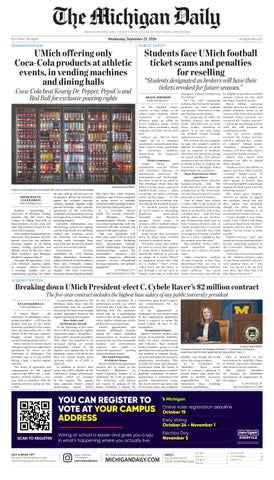
ONE HUNDRED AND THIRTY FIVE YEARS OF EDITORIAL FREEDOM
Wednesday, September 23, 2026
Ann Arbor, Michigan
ADMINISTRATION
UMich offering only Coca-Cola products at athletic events, in vending machines and dining halls Coca-Cola beat Keurig Dr. Pepper, PepsiCo and Red Bull for exclusive pouring rights
Evan Krummel/DAILY
A glass-front refrigerator is stocked with rows of various Coca-Cola beverages.
REESE KIZY & CALEB OBICO
Daily Staff Reporters
Students approaching a University of Michigan vending machine this fall won’t find Celsius, Dr. Pepper, Red Bull, or Pepsi products. In fact, they will only find products owned by the Coca-Cola Company. After months of negotiations, the University Procurement Services named Coca-Cola the exclusive beverage supplier at all dining venues, vending machines and athletic events for the Ann Arbor, Flint, Dearborn and Michigan Medicine campuses May 21. Through the agreement, CocaCola obtained pouring rights, an exclusive contract between a beverage supplier and an organization granting the brand
the sole right to sell and serve on its premises. Before the University signed the exclusive beverage contract, multiple suppliers could provide beverages under separate agreements to the University, resulting in dining settings serving beverages from a variety of brands, including PepsiCo. Currently, deliberations over the beverage contract are ongoing and the final details are still being worked out. Locations across the University will transition to serving solely beverages from Coca-Cola and its partner brands over the next several months. Procurement Services established the U-M Pouring Rights Evaluation Committee, which consisted of representatives from each University campus. The committee assessed beverage supplier bids from Coca-Cola, Keurig Dr. Pepper, PepsiCo and Red
Bull. More than 3,000 students, employees and retirees completed an online survey or attended virtual town hall meetings to share their pouring rights preferences. In a University Record article, Tim George, University of Michigan Finance communications director, wrote Coca-Cola’s partnership with the University will offer academic and campus-wide opportunities. “The new agreement will offer value across U-M in several ways,” George wrote. “Including direct sponsorship funding, student scholarships, internships, ambassadorships, support for sustainability initiatives and nutrition programs, enhanced customer service, streamlined beverage operations, and updated equipment.”
CONTINUED AT MICHIGANDAILY.COM
michigandaily.com
PUBLIC SAFET Y
Students face UMich football ticket scams and penalties for reselling “Students designated as brokers will have their tickets revoked for future seasons.” GRACE JOHNSON Daily Staff Reporter
As the football season returns to Ann Arbor, so do ticket resale troubles. While University of Michigan officials make an effort to warn students about social media ticket scammers, many students still fall victim each year. Others say they’ve been caught up in a separate crackdown: unwarranted bans from future ticket purchases by University Athletics Department for suspected reselling. Ticket scammers Asmat Noori, chief information security officer and executive director of information assurance for Information and Technology Services, wrote in an email to The Michigan Daily that the office receives many reports of football ticket scams — often occurring on ticket exchange social media pages — at the beginning of the academic year and during the football season. “A common pattern begins on social media or messaging platforms, particularly GroupMe and Facebook groups,” Noori wrote. “A scammer offers football tickets for sale while impersonating a U-M student.” Noori wrote that scammers often lie about their verified University student status. “In some cases, they follow up with an email that appears to come from a legitimate @ umich.edu address or provide an image of a stolen MCard as supposed proof that they are a student,” Noori wrote. “They then ask the buyer to pay through a service such as Venmo, Cash App, or Zelle and
disappear without transferring the tickets.” On ITS’ Safe Computing website, the University includes guidance on how students can protect themselves when purchasing resale tickets. “Be suspicious of offers for football tickets,” the website reads. “The best way to avoid these scams, according to police, is to buy your game day football tickets through authorized sources.” The website advises students to note the sender’s reply-to address if contacted via email and be cautious of members who have just joined the group on social media. ITS advises students who have fallen victim to ticket scams to contact the University of Michigan Police Department for assistance. Bans from future ticket purchases Engineering senior Jennifer Gamino-Alvarez told The Daily that last year, when she transferred to the University, she purchased a partial season pass and received 4 tickets. “Out of those four tickets I wasn’t able to go to three of them, so I ended up transferring them to my brother who is also a student here — and not even selling them to my brother, just transferring them over to him,” Gamino-Alvarez said. “A couple months later I received an email … basically they tried accusing me of being a reseller and so I wasn’t eligible to buy the student pass this year.” The Athletic Ticket Office email identified GaminoAlvarez as a violator of resale rules. “After extensive analysis of your account, it has been determined that you are in violation of Michigan Athletics ticket policies,” the email wrote. “As a result, you will not
be eligible to purchase football student tickets for the 2026 Michigan Football season.” David Ablauf, associate athletic director for public and media relations, wrote in an email to The Daily that student football ticket accounts are reviewed for “broker activity” — meaning purchasing tickets with the sole purpose of reselling for profit. “We do review student accounts for broker activity, which is defined by a variety of criteria,” Ablauf wrote. “Students designated as brokers will have their tickets revoked for future seasons.” Ablauf also noted that students are able to appeal these charges. “Students have the ability to appeal and have their activity reviewed,” Ablauf wrote. “If students do not appeal, or their appeal is denied, they will not be eligible to purchase student football tickets for the following season.” The email gave GaminoAlvarez an option to appeal the decision, which she did. Her appeal was accepted, though the office said her account would continue to be monitored for broker activity. “I just thought it was really weird. Like, I didn’t sell them, I just sent them to my brother,” Gamino-Alvarez said. “That’s family. I’m not trying to make a profit.” Gamino-Alvarez said she would not be purchasing tickets for her remaining semester at the University following her experience. “After this I’m not interested at all,” Gamino-Alvarez said. “I just know football culture’s very popular here, so I was like, ‘Let me try it for my first year here.’ But after that, I’m like ‘Okay, I’m over it.’”
ADMINISTRATION
Breaking down UMich President-elect C. Cybele Raver’s $2 million contract The five-year contract includes the highest base salary of any public university president
KYLIE HARMALA Daily Staff Reporter
C. Cybele Raver — the University of Michigan’s newlyminted president — will have the highest base pay of any public university president in the county when she takes office Dec. 1. The details of her five-year contract, though, extend beyond the record-breaking annual salary. Raver and the University Board of Regents signed the employment agreement for Raver as the University of Michigan’s 17th president Aug. 14. It was ratified during a Sept. 1 special regents meeting. The terms of agreement and compensation in the signed contract take effect Dec. 1, 2026. Raver’s contract denotes a fiveyear term as president, with the existing contract ending on Dec. 1, 2031.
An agreement, obtained by The Michigan Daily, states that her appointment may be extended beyond the five-year term through written agreement between the regents and Raver at any point. Base Salary and Performance Awards At the beginning of her term, Raver will be earning the highest annual base salary — $2 million — of any public university president. This salary has potential to be increased during an annual performance review by the regents. Any adjustment to the president’s salary will not be less than the annual faculty merit increase, which, as of 2022, is about 4%. In addition to Raver’s base salary, she will be eligible for the University’s annual performance awards, which are awarded by the regents. The regents must announce Raver’s annual performance award within
60 days of the conclusion of a performance review year, which lasts from Dec. 1 until Dec. 1 the following year. The maximum award sum for a performance award is 30% of the annual base salary, paid in a single sum within 30 days of its announcement. Raver’s appointment also includes additional benefits during her tenure, including transportation for business and personal use; security; reasonable business and entertainment expenses; and tickets to University-sponsored sporting and performance events. The South University President’s House Raver’s employment agreement requires her to reside in the President’s Residence on South University Avenue, as is traditional for U-M presidents. The University will finance any repairs or upkeep of the house, including a stipend for
renovations upon Raver’s request and reimbursement for any moving costs. If her appointment is terminated for any reason listed in the employment agreement, Raver is required to vacate the house within 30 days of the termination. Termination Clauses Raver’s contract outlines five clauses of termination: disability, death, for-cause, without-cause and voluntary. Most standard faculty benefits, access to U-M sporting events and performances and position as tenured faculty are protected under all clauses for appointment termination. This excludes for-cause and voluntary termination when the reason is to accept employment at another academic institution. If Raver’s appointment is terminated and granted administrative leave, she would receive one more year of her base salary and employee
Ananya Kedia/DAILY Incoming University of Michigan President C. Cybele Raver during the unanimous vote formally approving her appointment Sept. 2.
benefits, even though she would not be the acting president. To be terminated for “disability,” Raver would have to contract a physical or mental illness that limits her ability to perform necessary responsibilities for 180 consecutive days, including weekends and holidays.
This is identical to the termination for disability clause in former University Presidentelect Kent Syverud’s contract. The contract identifies six reasons for immediate termination of employment by the regents.
CONTINUED AT MICHIGANDAILY.COM
YOU CAN REGISTER TO V Michigan voter registration deadline VOTE AT YOUR CAMPUS Online October 19 ADDRESS Early Voting October 24 - November 1
SCAN TO REGISTER
GOT A NEWS TIP? Call us at 734-763-2459 or e-mail news@michigandaily.com and let us know.
Voting at school is easier and gives you a say in what's happening where you actually live. Follow The Daily on Instagram,
@MICHIGANDAILY
For more stories and coverage, visit
MICHIGANDAILY.COM
Election Day November 3 Paid for by NextGen Climate Action
NEWS...................1
OPINION...............6
INDEX D A T A . . . . . . . . . . . . . . . . . . . 2 S TAT E M E N T . . . . . . . . . . . . . . . . 8 Vol. CXXXVII No. 21 N E W S . . . . . . . . . . . . . . . . . . . 3 SPORTS...................10 ©2026 The Michigan Daily ARTS.......................4
2 — Wednesday, September 23, 2026
Data
The Michigan Daily — michigandaily.com
Is Ann Arbor getting more dangerous? The data says no
Audrey Rosenberg/DAILY
JOSHUA LEE
Daily Data Journalist
On Jan. 22, 2025, a crime alert was issued by the University of Michigan for a stabbing that was reported near Michigan Medicine’s D. Dan and Betty Kahn Health Care Pavilion. Later that same year, a shootout at Ann Arbor’s Packard-Platt Plaza led to the death of a teenager. In June, another shooting incident was reported on Green Road, adjacent to North Campus. Ann Arbor has been hailed as a “quintessential” college town, consistently topping all quality of life metrics thanks in part to the University’s presence throughout the city. This perception has undoubtedly been an important factor that many students consider when deciding where to enroll. However, consistent occurrences of violent crime near or on the University campus can raise questions about the proliferation of crime in Ann Arbor, and whether the city is losing the safe charm that once made it appealing for many. A glance at the Ann Arbor crime composition from 2017 to 2024 offers some reassurance. Homicide rates remain low, making up less
Scan the QR code to visit the online version of this article to see interactive charts with more detail.
than 1% of total violent crime and less than 0.1% of total crime in Ann Arbor, roughly in line with national averages. In 2017 and 2024, Ann Arbor recorded zero homicides, notable for a city of 120,000 residents. All crime categories have remained consistent throughout the eight years. While highprofile violent incidents make local headlines, around 90% of Ann Arbor’s crime is propertyfocused, with larceny accounting for the highest proportion of total crime at roughly 72%. This trend is likely driven by the high population of students centered on the University’s campus and downtown district, Ann Arbor’s primary commercial zone, where unattended personal belongings such as laptops and bags become easy targets. Still, a stable crime composition is not necessarily an accurate indicator of overall crime trends in Ann Arbor — it only shows that the mix of offenses hasn’t changed. True crime counts are needed to determine whether the city has been experiencing a surge or decline in felonies. In 2024, Ann Arbor recorded a crime rate of 4,519 per 100,000, a figure lower than the 2018 rate, the city’s most troublesome year in recent memory. Additionally, the
statistic was higher than the 2020 rate, when the city experienced its lowest offense rate in recent history. Although Ann Arbor seemed to experience a consistent rise in crime from 2020 to 2023, the narrative that Ann Arbor was becoming more dangerous could safely be countered by the decreasing numbers recorded in 2024. Furthermore, 2020 and 2021 were years profoundly impacted by COVID-19, so the rise could be viewed as Ann Arbor crime returning to pre-pandemic baselines. An explosive rise in downtown development has reshaped Ann Arbor’s image from a college town to a regional city, fueling assumptions that the city’s population and crime rates are both climbing. However, U.S. Census data shows that Ann Arbor experienced roughly a 1.3% decrease in population in the last 5 years, from 123,899 in 2020 to 122,233 residents in 2025, a decline that helps explain the city’s stable crime statistics. Expanding the scope to the broader Ann Arbor urban area, Ypsilanti has recorded the highest crime rate in seven of the past eight years after overtaking Belleville in 2018. Saline has remained the safest suburban region within the urban area over the eight-year period. An interesting dynamic is that the urban area’s commercial core, Ann Arbor, actually has a lower crime rate than its surrounding suburbs, Ypsilanti and Belleville. This is the reverse of the standard pattern seen throughout the United States, where white flight has historically left suburbs with better quality-of-life metrics than the commercial core cities they neighbor. Overall, the Ann Arbor urban area has enjoyed a decline in offenses, with Ypsilanti and Belleville driving the momentum with more than a 30% decrease in crime rates from 2017 to 2024. A possible catalyst for Ypsilanti’s declining rates could be the
establishment of the Washtenaw County WeLive program, which reinforces emotional rehabilitation for perpetrators and victims of violent crime. But how do Ann Arbor crime statistics compare outside of its suburbs, such as other Big Ten conference college towns? Among these nine Big Ten conference peers, Eugene, Ore. — home to the University of Oregon — leads with the highest crime rate, while West Lafayette, Ind., home to Purdue University, posts the lowest. Ann Arbor falls in the lower half of the list. Meanwhile, East Lansing, the location of the University’s state rival Michigan State University, has reported a stable and low crime trend similar to Ann Arbor. An intriguing observation emerges in New Brunswick, N.J. (Rutgers University) and Evanston, Ill. (Northwestern University): both cities experienced a spike in crime after the pandemic that was not recorded in other areas. Both college towns are in proximity to large United States metropolitan areas — New York City and Chicago, respectively — so it is plausible that major city crime trends influence the surrounding region. Overall, the country has been experiencing a noticeable decline in violent crime in recent years after urban areas had previously recorded a post-pandemic surge, which is reflected in the reports by New Brunswick and Evanston, observing a recent decrease in crime rates. Although instances of violent crime occurring alarmingly close to the U-M campus can spur safety doubts among students, the longterm data shows that Ann Arbor is more reassuring. The college town boasts low and consistent violent crime proportions, and its surrounding region has reported a decline in overall crime rates. With favorable comparisons to other Big Ten conference counterparts, there is no doubt that Ann Arbor is still exceptionally safe.
Joshua Lee/DAILY Ann Arbor urban area crime rate per 100,000 people. According to the US Census Bureau, the Ann Arbor urban area includes three suburban centers: Ypsilanti, Saline, and Belleville. Source: UCR
Joshua Lee/DAILY Big Ten college towns’ crime rate per 100,000 people. Eugene has the highest crime rate, and West Lafayette has the lowest crime rate. Source: MICR
Joshua Lee/DAILY Each bar represents 100% of crime incidents reported in a year. Violent crimes are indicated by red shades and property crimes are indicated by blue shades.
The Michigan Daily — michigandaily.com
News
Wednesday, September 23, 2026 — 3
BUSINESS
Big House advertisements draw mixed reactions from Michigan fans Companies part of the new Leaders and Best Champion Partners Program include Coca-Cola, Meijer and Google Gemini for this season SHAENA FOLEY Daily Staff Reporter
For the first time in its 99-year history, Michigan Stadium is displaying advertisements this season. The University of Michigan Athletic Department announced the change Aug. 19. The ads are a part of the new Leaders and Best Champion Partners Program, which seeks to raise revenue to support the contracts of student-athletes. The University chose to partner with Coca-Cola, Meijer and Google Gemini for the season. The companies’ logos are placed in white on the sides of the scoreboards and on padding at the edge of the track. In an interview with The Michigan Daily, Kinesiology sophomore Abigail Benton
said name, image and likeness agreements, which have allowed student-athletes to earn money through sponsorship deals, have caused increased marketing and advertisements. “I think most college athletics are definitely leaning into professionalism more than amateurism,” Benton said. “Especially with the rise of NIL — and revenue sharing and generation in general — sponsorships are definitely trying to latch on, and it’s only going to evolve more.” Recently, The Athletic reported that, out of the 18 schools in the Big Ten Conference, the University of Michigan spent the fifth most money on its 2026 college football roster — between $36 million and $40 million. The Athletic Department has not specified what the revenue
Stanford Lipsey Student Publications Building 420 Maynard St. Ann Arbor, MI 48109-1327 734-418-4115 www.michigandaily.com
ZACHARY AJLUNI and EDITH PENDELL Co-Editors in Chief eic@michigandaily.com
CICI COPENHAVER
Business Manager business@michigandaily.com
NEWS TIPS
tipline@michigandaily.com
LETTERS TO THE EDITOR tothedaily@michigandaily.com
EDITORIAL PAGE
opinion@michigandaily.com
Akul Gunukula/DAILY Advertisements line the sides of the jumbotron in the Big House.
generated actually funds, with Athletic Director Warde Manuel saying in a press release that the ads are helping Michigan Athletics “thrive in the evolving revenue-
sharing and NIL landscape while continuing to pursue championship success.”
CONTINUED AT MICHIGANDAILY.COM
“Anytime a print edition of a publication goes away, it represents a loss for a community.”
Daily Staff Reporter
The nationwide trend away from print newspapers is now affecting Ann Arbor. On Sept. 2, MLive announced it will transition to fully digital formats for all eight of its publications — including The Ann Arbor News — in December. The final printed copies will be delivered to homes Dec. 6. MLive community president John Hiner attributed this decision to readers’ digital consumption of news, with 99% of its readership coming from email, the MLive app and website. He acknowledged that some prefer
decision is made based on the realities of their financials and the circulation of the print edition.” The Ann Arbor News became part of MLive Media Group when its parent company, Advance Publications, acquired MLive in 1976. The Ann Arbor News stopped printing weekly and shifted to a twice-weekly print edition in 2009. Clemetson said the disappearance of a print edition represents a change in how community members are engaging with local publications. “I think anytime a print edition of a publication goes away, it represents a loss for a community because people interact differently with a print product
than with digital products,” Clemetson said. “What the print edition of The (Michigan) Daily means to people, and the way they interact with it — reading stories over time — there’s just a different character to it.” In an interview with The Daily, Engineering senior Madeline Fournier said she values the print format of news and likes to keep newspapers as keepsakes when important events happen, such as the U-M men’s basketball team’s national championship edition. “I think it’s just crazy that in today’s day and age we are moving completely to digital media,” Fournier said.
CONTINUED AT MICHIGANDAILY.COM
If approved, the city will elect a public utility board by 2028 to guide the transition to a city-run power grid
Daily Staff Reporters
Ann Arbor for Public Power successfully gathered more than 5,000 signatures on a petition to place a utility governance proposal on Ann Arbor’s 2026 midterm ballot, offering residents a chance to replace DTE Energy’s electrical utility with a city-run power grid. If voters approve the proposal on Nov. 3, the city would elect a public utility board by 2028, which would guide a city-wide power supply transfer toward collective ownership. In an interview with The Michigan Daily, A2P2 Executive Director Brian Geiringer said the proposal would establish this new board. From there, the group would then advocate for the city to issue a feasibility study into purchasing DTE’s power utility, including an
Environment and Sustainability student Ethan Devereaux said a publicly owned utility could be more responsive to the public’s concerns. “The benefits are a democratically-owned municipality,” Devereaux said. “Which is great because the interest of our basic necessities, which extend to electricity and water, should probably be governed by the entities built on democracy rather than corporate and legalized monopolies.” At the same time, Devereaux acknowledged the switch to public power could be costly for the city and its residents. “I think, overall, it is probably a good thing to at least have a feasibility study done because there are a lot of unknowns,” Devereaux said. “I do wish that people understood how the buyout would work because it would be a lot of money upfront. It might not be an investment that will really
ADVERTISING
CORRECTIONS
wmg-contact@umich.edu
Editorial Staff Joshua Mitnick ’92, ’95 Managing Editor
What to know about Ann Arbor for Public Power’s ballot proposal estimation of the up-front utility purchase cost and continued maintenance costs. The Ann Arbor Responsible Energy Coalition, a DTE-funded group that opposes municipalizing Ann Arbor’s electrical grid, has attempted to block A2P2’s proposal through the courts twice, alleging invalid petition signatures. Both times, the case was dismissed. In an interview with The Daily, mechanical engineering professor Volker Sick, the DTE Energy professor of advanced energy research — a position funded by DTE, though with freedom to express contrary perspectives — said the push to change Ann Arbor’s energy system is understandable in the face of frequent outages. “We have power outages all the time,” Sick said. “Sometimes they last more than a week. This is the 21st century in the developed world. This should not happen.” In an interview with The Daily,
sports@michigandaily.com
ANNABELLE YE
ANN ARBOR
ALISSA TISCH & CLAIRE BLANTON
SPORTS SECTION
NEWSROOM
news@michigandaily.com
MLive axes print edition of The Ann Arbor News hard-copies, said falling demand made the continuation of print newspapers not economically feasible. MLive reports that the change will lead to some job losses, but none at their Ohio printing facility. In an interview with The Michigan Daily, Lynette Clemetson, director of the Wallace House Center for Journalists at the University of Michigan, said she believes the decision was primarily driven by economic considerations. “MLive has been a digitalfirst publication for years,” Clemetson said. “I’m not privy to their finances, so I can’t speak with any direct knowledge of their decision, but I assume their
arts@michigandaily.com
photo@michigandaily.com
corrections@michigandaily.com
ANN ARBOR
JENSEN STANZI
ARTS SECTION
PHOTOGRAPHY SECTION
benefit us, and it might burden the taxpayers for years and years to come.” Sick also expressed concerns about the cost of purchasing and maintaining the grid. Although mayor-elect Yousef Rabhi supports the municipalization of electricity in Ann Arbor, most of the current City Council, including Mayor Christopher Taylor, doesn’t support the plan in the short run due to the cost of purchasing the equipment. “We would first have to pay for the entire installation,” Sick said. “Then we would have to pay for the upgrades, the repairs, the expansions. Then we would have to continue to pay for our monthly electricity usage. So our monthly bills would be much, much higher for a very long time in a city that is already not affordable.” Sick said the current grid is not designed to survive storms.
CONTINUED AT MICHIGANDAILY.COM
PHOTO OF THE WEEK
bellaye@umich.edu
GEORGIA MCKAY
Digital Managing Editor
gmckay@umich.edu
AANYA PANYADAHUNDI and CHRISTINA ZHANG
Managing News Editors news@michigandaily.com Senior News Editors: Alexa Cheaney, Dominic Apap, Gia Verma, Quinn Mittlestat, Sarah Palushi, Sarah Spencer
ELENA NICHOLSON and GABE EFROS
Editorial Page Editors tothedaily@michigandaily.com Deputy Editorial Page Editor: Mateo Alvarez Senior Opinion Editors: Avery Allen, Maggie Berling, Madeleine Burke, Stephanie Bouserhal, Isabel Seniawsk
LYRA SHARMA and GRAHAM BARKER
Managing Sports Editors sports@michigandaily.com Deputy Sports Editor: Sophie Matthews Senior Sports Editors: Amanda Bergman, Niyatee Jain, Drew Lenard, Nate Schreck, Grace Wright, Hadley Zann
CAMPBELL JOHNS and CORA ROLFES
Managing Arts Editors arts@michigandaily.com Senior Arts Editors: Hudsen Mazurek, Abigail Weinberg, Tara Wasik, Ana Torresarpi, Meagan Ismail, Siena Beres
MAISIE DERLEGA and SELENA ZOU
Managing Design Editors design@michigandaily.com Senior Layout Editors: Frances Leibovich, Kathryn Palsrok Senior Illustrators: Gabriella Spagnuolo, Emmeline Meldrum, Ella Flores Brosnan
BRIDGETTE BOL and HOLLY BURKHART
Managing Photo Editors photo@michigandaily.com Senior Photo Editors: Ananya Kedia, Arushi Sanghi, Isai Hernandez-Flores, Ava Farah
AYA FAYAD
Managing Statement Editor statement@michigandaily.com Deputy Editors: Oummu Kabba, Lola Post, Riya Kommineni
ALINA MURATA and JOSUE MATA
Managing Copy Editors copydesk@michigandaily.com Senior Copy Editors: Meagan Ismail, Claudette Johnson, Ayah Maskoun, Caroline Niccolini, Emma Oftedal, Zoey Ueland, Justin Xhelilaj
EMMA PENG and JULIA MEI
Managing Online Editors webteam@michigandaily.com Data Editors: Darby Jones, Zora Tucker Engineering Manager: Alyssa Locke, Grace Liu Product Managers: Annice Chang, Sanvika Inturi Senior Software Engineer: Becky Pan
EVAN KRUMMEL and JOVANNA GALLEGOS
Managing Video Editor video@michigandaily.com Senior Video Editors: Samridhi Sharma, Grace Wright
AMARA M. SMALL and IHAA MOHAN Michigan in Color Managing Editors Senior MiC Editors: Allana Smith
michiganincolor@michigandaily.com
HANNAH BODNAR and AVA HOOGTERP
Managing Podcast Editors podeditors@michigandaily.com Senior Podcast Editors: Rogen McLean, Zora Burroughs, Karina Shahinian, Olivia Dickerson
DA YOUNG KIM and UWAEISH AHMAD
Managing Audience Engagement Editors socialmedia@michigandaily.com Senior Audience Engagement Editors: Amanda Bergman, Caleb Starr, Isabella Burke, Libby Le Febre, Michelle Fang, Sophia Polega, Heewon Moon
MAHEE KAVDIA and PUJITA RUPANI Culture, Training, and Inclusion Co-Chairs
accessandinclusion@michigandaily.com
LUCY LANGERVELD and TIFFANY MCKALKO
Managing Focal Point Editors lucykate@umich.edu, tmckalko@umich.edu Senior Focal Point Editors: Amaya Choudhury, Claudette Johnson
JAMES KNAKE and MILAN THURMAN
Managing Games Editors crosswords@umich.edu Senior Games Editors: Eleanor Sullivan, Kiran Parekh, Sam Martin, Tobin Saxton
Business Staff CAROLINE ZOLTAK
GABRIELLE GONDOLY
KATE PARAMBO
MORGAN ORTH
Marketing Manager
Creative Director
Sales Manager
Strategy Manager
The Michigan Daily (ISSN 0745-967) is publishing weekly on Wednesdays for the Winter 2026 semester by students at the University of Michigan. One copy is available free of charge to all readers. Additional copies may be picked up at the Daily’s office for $2.
Geoffrey Huang/DAILY University of Michigan student groups and Neighbors for More Neighbors Ann Arbor hold a joint Park(ing) Day event together Friday afternoon.
If you would like a current copy of the paper mailed to you, please visit store.pub.umich.edu/michigan-daily-buy-this-edition to place your order.
Arts
4 — Wednesday, September 23, 2026
The In the Rough B-Side
The Michigan Daily — michigandaily.com
‘Glee’ Season 1 is genius socio-political commentary (because it sucks) “Glee.” We have made it through a full season thus far, and it has opened up a world that I never could have imagined. “Glee” is a TV show about a group of marginalized teenagers in their high school show choir attempting to discover themselves and their love for music with the help of their adorable glee coach Will Schuester (Matthew
NATHANIEL EVANS Daily Arts Writer
One of the perks of having a girlfriend who was deeply invested in her local theatre community is that I now have the privilege of watching one of the most culturally relevant pieces of modern television:
HUDSEN MAZUREK Senior Arts Editor
What sticks in the public memory — and what is talked about the most — are often the best works of art on offer. But, every day, there are games, films, books and shows that seem to slip through the cracks. Those experiences that aren’t perfect — but certainly still meant something to you — are prone to being relegated to niche corners of the internet with a few cookie-cutter takes on their quality. The In the Rough B-Side is dedicated to appreciating those f lawed pieces of art. Sure, they aren’t perfect, but there’s still something there if we just take the time to go looking.
Cornelia Ovren/DAILY
Morrison), who imparts lessons about performance, identity and life in general. However, if you were to read this synopsis of the show and then view it through that lens, you would come to the same conclusion I did about Season 1: it sucks. The vast majority of the tangible drama between characters is completely manufactured and unbelievable to the point of absurdism, with nearly every serious conflict in the show being ramped up to an inane degree. It’s not enough for Will Schuester to be struggling with balancing his responsibilities as a coach and as a husband; his wife needs to be faking a pregnancy in order for the audience to be engaged. Please. The show’s commentary on what high school is like for marginalized groups is mostly surface level, and despite its inclusivity, constantly sidelines its characters in minority groups both in terms of screentime and their presence in the glee club. It’s
a widely held opinion in the “Glee” community that Santana Lopez (Naya Rivera) and Mercedes Jones (Amber Riley) — a Latina and Black woman, respectively — are incredible singers and absolutely deserving of vocal spotlights. Despite this, the show seems insistent on centering its emotional core on the whitest of white males, William Schuester. Often, the other characters are simply pawns in his rivalry with Sue Sylvester (Jane Lynch), the school’s cheerleading coach. This may not be so problematic if Will were compelling, but as a de facto main character, he is handled wholly antithetically to the show’s sentiment. Will is never shown to improve the students in any concrete way, his advice is unhelpful, his boundaries with his students are highly questionable and he lacks the conviction the show constantly says he has in protecting the marginalized kids he is in charge of. Despite these
consistent failures, the show pretends that Will is an amazing teacher and positive influence in the kids’ lives with very little push back on this premise. All of these writing issues make “Glee” a frustratingly middle-brow show on a writing level, however, they are also what make “Glee” genius. “Glee,” when analyzed through the lens of a socio-economic system, is a perfect analogy for the struggle of oppressed classes in America today. Stay with me now. If there’s anything that the voting patterns of the last three presidential elections have shown us, it is that white privileged Americans are often an obstacle to progress, and rarely live up to the progressive rhetoric and attitude that they purport. “Glee” illustrates a similar conflict through Will Schuester and Sue Sylvester, the main protagonist and antagonist of the show.
hard to read. If it’s difficult to understand, that must mean it’s written at a level high enough to merit analysis. In contrast, a YA novel written today is seen as too simple and lightweight. It doesn’t make any sense to discount modern literature simply because it’s not written the way books in the past were written. Historically, we’re pretty bad at deciding the worth of art during its time. Fitzgerald’s “The Great Gatsby,” now considered one of the best books ever written, barely sold any copies when the author was alive. And Shakespeare, who we now consider a literary genius, was more of a comedic entertainer during his lifetime. The point is, genre novels and contemporary YA fiction books
don’t stop being literature just because they’re enjoyable and accessible. If anything, readers should be happy that people are being drawn to reading more, regardless of what the specific books are. I’m tired of feeling like less of a reader every time I pick up a book for the fun of it. Books that aren’t on some Top 10 or New York Times bestsellers list deserve to be read, too. I like Lynn Painter as much as I like Jane Austen, and if there is some objective measure that finds one better than the other, it won’t take away from my reading experience. Besides, if the past has taught us anything, it’s that the books society turns its nose from today may well be the classics of the future.
CONTINUED AT MICHIGANDAILY.COM
Make reading fun again question from family and friends. I’m an English major! I should be reading John Steinbeck novels by candlelight and scribbling in the margins of my books until they’re impossible to reread, not skimming mindlessly through cheesy young adult fiction for the fun of it. I’ve come to a realization though: This self-imposed shame is counterproductive. I don’t feel more excited to read if I force myself to pick books that sound smarter. I lose motivation to read altogether. I’ve noticed a culture among readers that leans against any genres that are common among YA works. Fantasy or romance novels under the YA umbrella are deemed unworthy of time and respect. If you read Emily
AMANY SAYED Daily Arts Writer
I hate reading in public. Anything that isn’t mindless scrolling feels hopelessly performative in today’s society, and I feel unnecessarily judged by non-readers when I pull out a book instead of my phone. I could handle this judgment, if only I weren’t also worried about the judgment of my fellow readers. I consider myself a reader of all genres. I might finish a hard-hitting classic by Mark Twain, only to turn next to the latest Lynn Painter rom-com. Whenever I’m reading these lighter, less “academic” books, I’m extra weary of answering the dreaded “What are you reading?”
Henry or Cassandra Clare novels, you aren’t a real reader, no matter how much you engage with the books or enjoy them. This discourse is completely antithetical to what readers should be doing, and makes no sense when considered in the context of studies in literature. We could debate for hours about what makes a book “good.” I recall having a conversation in my American literature class in high school about this very topic. Everyone brought different characteristics to the table: books are good if their themes are timeless, or if their characters are relatable or if their plots are well crafted. The reality is, such an artistic classification will always be at least partly subjective, and I find
The Michigan Daily Crossword
Sunday, September 20, 2026 — Puzzle by Eleanor Sullivan ACROSS 1. Sir's counterpart 5. "Every cloud ___ silver lining" 9. Make full
1
2
3
16
8
21
9
22
27 33
46
HUDSEN MAZUREK Senior Arts Editor
28
25
29
34
30 35
36
31
37
39
40
42 45
12
20 24
38
11
41
43
47
48 52
25. It might shock you?
51
26. Like an untrustworthy crewmate in Among Us
58
27. Q neighbor
62
63
30. Artist Emily and comedian Jimmy, for two
67
68
32. Wound covering
70
53
54
49
55
59
56 60
44 50
57
61 64
65
66
69
71
72
34. Spoke unclearly 38. 2016 film about African American mathematicians ... or what the circled letters contain? 42. Physically aware 43. Word with light or leap 45. "Me too!" 48. Suffix that's doing the most 50. With "t", amino acid linker 51. It's all the rage! 52. H.S. exams 56. Cathedral alcoves 58. Chiles that can be more than 170 times hotter than Tabasco sauce 62. Stag
DOWN 1. Part of RAM: Abbr.
37. T-shirt sizes: Abbr.
2. Like
39. Many a founding father, religiously
3. Entirely
40. Ending for musket or auction
4. Pilgrimage destination
41. Not mad
5. Starter for 18-Across
44. Hall monitors, briefly
6. Devoured
45. Knitted blanket
7. ___ Domingo (Caribbean capital)
46. Desert that translates to "desert"
8. Soviet cooperative
47. Lover
9. Double ___ (thick Oreo variety)
49. Like lemons
10. More open
53. H.S. course that covers the cell cycle
11. Word with bank or fortune 12. Detroit duds
54. Seagull relatives
14. Southwestern univ. offering the only law school in its state
57. Attention-grabbing sounds
17. Comet-producing cloud
63. "Mr. ___" (song often sung at a U-M football game) 20. Texas sch. with an owl mascot 67. Two-dimensional calculation 21. Behind 68. Machu Picchu architects
22. Comparable things
69. Bull, in Barcelona
23. Taiwan's first female president
70. ___ a soul
28. "So true!"
71. Saccharine suffixes
29. Poor quality, in modern slang
72. Lays down a suit?
31. "There wasn’t ___ eye in the house!" 33. Kinky letters 35. Musician's deg. 36. Vampire's attack
Chrono Cross never wanted to be a sequel
18
23
32
10
15
19
19. Collection of data that may contain images, videos, text or programs 24. Sci lead-in
7
17
16. One who is not satisfied with 26 the way things are
21. "When You Wish Upon ___"
6
14
14. ___ Pradesh (Indian state)
18. Web links
5
13
13. Actress Fanning 15. Like ribbon in a knot or bow
4
no reason not to consider being enjoyable among the list of a good book’s qualities. In high school English classes, we read from writers like William Shakespeare, Steinbeck and F. Scott Fitzgerald. Their works tend to be dense and difficult for a teenager to comprehend on their own. The language and style used by what we consider authors of classics is also often outdated. Many consider the late 1800s and early 1900s to be the best years of literature in general, having birthed greats like Jane Austen’s “Pride and Prejudice” or Virginia Woolf’s “Mrs. Dalloway.” As a result of this conversation surrounding classic literature, it’s easy to conclude that what makes a book worthwhile is that it’s old and
55. "Sugar, ___ and everything nice!" 59. Command for Fido, perhaps 60. Awards given to "Little Miss Sunshine" and "Apollo 13," for short 61. Canadian interjections 64. "Pay me back later" letters 65. Dr. of hip-hop 66. Egg-shaped lip balm brand
If you read reviews for Chrono Cross, you’ll often find a similar sentiment among its detractors: It’s nothing like Chrono Trigger. Chrono Trigger, a 1995 Super Nintendo role-playing game, followed the adventures of a group of heroes as they traveled across time to fight an ancient evil. It was, in no short order, foundational for the Japanese Role-Playing Game genre. Chrono Cross, which was released in 1999 in Japan for the PlayStation, is what could be called its sequel. The game follows a boy as he becomes trapped in an alternate reality, eventually making it home to his own dimension. During the adventure, he uncovers his own past and a mysterious reality-warping evil that only he and his companions can stop from collapsing all realities. These two narratives have thematic ties, but share little in terms of actual content. But does the comparison even matter? Before answering that question, we need to understand why this is a divisive topic. Despite being a sequel, Chrono Cross is barely recognizable as part of the same franchise. The gameplay is made up of systems that look nothing like Chrono Trigger’s, and the art style is a far cry from that of its predecessor. Really, the only connection between the two titles is their names, a few thematic concepts and some confusing lategame narrative similarities. It’s easy to see why fans of Chrono Trigger were blindsided and disappointed by what is offered in Chrono Cross. However, disappointment from a lack of familiarity should not mean that a game is instantly labeled as bad. Comparison is the thief of joy, and here that is absolutely the case. Chrono Cross is not trying to be Chrono Trigger 2. If it were, that would be the name of the game. Instead, Chrono Cross acts as a spin on the themes of its predecessor, not a continuation of its narrative. But because it is perceived as the sequel —
Cornelia Ovren/DAILY
especially because there is no official Chrono Trigger 2 — it is expected to be just like it, when it really doesn’t want to. If you took Chrono Cross and added in more ties to Chrono Trigger, the game would only get messier. The most confusing parts of the narrative are the few slim connections to Chrono Trigger, so stretching that frail bond even thinner would only make the game’s biggest weakness more obvious. That weakness — the need to be tied to Chrono Trigger — is truly what holds the game back. As you progress through Chrono Cross, you meet tons of characters from all sorts of places across the two worlds, and they offer to join the protagonist’s cause. When he is at his lowest, after he has lost everything — even the friends he leaned on — it is not time travel or dimension hopping that saves him: it is someone reaching out a helping hand. While getting a new party member is a common occurrence in Chrono Cross, gaining that one single ally when I had no one left truly meant something. It drove home just how important other people are in our lives, and why we spend so much time just to be with them. Moments like these are when Chrono Cross is at its best. At its worst, Chrono Cross gets tied up explaining its own
physics- breaking story beats. This is the part of the narrative where the ties to Chrono Trigger come in, only exacerbating the narrative complexity problem by adding even more to an already overflowing pot. By trying to force the two together, the game’s narrative suffered and nearly lost sight of itself. Fortunately, it manages to patch up what it can by the time credits roll for a satisfying, if a tad ambiguous, ending. When you step back and look at Chrono Cross as its own game, you’ll find it has some standout moments. The art and soundtrack are both great, painting beautiful vistas with adventurous melodies, and the gameplay, while fairly easy, leaves a lot of room for customization and experimentation. The narrative certainly twists and turns in baffling ways, but it rings human to its very core. These wellearned successes may appear to be failures if you only wanted Chrono Cross to be just like Chrono Trigger, but what makes the two different is actually what makes each one shine. If we simply allow ourselves to meet something where it’s at, we may just have fun, even if it’s not what we’re used to.
CONTINUED AT MICHIGANDAILY.COM
Arts
The Michigan Daily — michigandaily.com
Wednesday, September 23, 2026 — 5
How (not) to read ‘Infinite Jest’ SIENA BERES
Senior Arts Editor
Step 1: Do not read the reviews They will be called things like “Why Insufferable People Love Infinite Jest,” or worse, “How to Read Infinite Jest,” implying that you, the reader, are too stupid to read “Infinite Jest.” There will be statistics of dubious origins claiming that only 6.4% of people will finish “Infinite Jest.” The book will be on lists titled “Most Difficult Novels.” Your copy will be preceded by three full pages titled “Extraordinary Acclaim for Infinite Jest.” When a book is 1,079 pages long and critically beloved, oftentimes public perception of said book can quickly shift from a work of genius to a work of pretentiousness. Its thick blue spine just makes it look like the sort of book that sits on a shelf, unread, as a signal of higher intellect. Crack it open and find that David Foster Wallace’s style is non-linear, vocabpacked and “unfashionably male,” and understandably, you might be a bit turned off. Both people who love and hate “Infinite Jest” want you to think it’s difficult to read — either because they think Wallace is pretending to be a good writer, or he really is a good writer. Yet, Wallace is not posturing like a “Jeopardy!” contestant, buzzer in hand, ready to prove how smart he is by fitting the words “espadrille,” “psychodysleptic” and “oubliette” into a winding yet grammatically correct sentence. Instead, he believes that his readers are smart enough to pick up what he’s putting down. And by God, we need that. Contemporary writing is often too afraid to demand any more than the bare minimum amount of attention from its audience. And while the length of “Infinite Jest” might seem masturbatory at first glance, Wallace is deliberately
Maheen Rashid/DAILY
crafting a different kind of entertainment. The challenge is whether or not you’ll stick around to be entertained. Step 2: Do not ask “What is it about?” To attempt to coherently summarize the plot of “Infinite Jest” is sort of like trying to put a swim cap on a dolphin. You will be minimally successful — and the dolphin doesn’t need a swim cap, anyways. If I attempted a plot summary, I would tell you that the book is set in a not-sodistant future, where the names of years can now be bought by companies to advertise their products (i.e. Year of the Whopper, Year of Glad, Year of the Trial Sized Dove Bar). In the Year of the Dependent Adult Undergarment, North America has been combined into the Organization of North American Nations and cleaved in half by a hazardous wasteland. Somewhere in
metro-Boston, there’s this family called the Incandenzas who own a tennis academy down the street from an addicts and alcoholics recovery home. Shortly before his suicide via microwave oven, the Incandenza patriarch creates a film called “Infinite Jest” that’s so damn entertaining it turns you into a vegetable. This all culminates in a violent group of Quebecois separatists in wheelchairs who are trying to disseminate “Infinite Jest” among Americans as a weapon of mass destruction. From the plot, you might think “Infinite Jest” is just an absurdist parody of late capitalism in America. And it is. But if you stop there, you might miss what it really is — a long and frightening portrait of American loneliness. Wallace’s assessment is that, in the absence of community, we have nothing to devote ourselves to and become
WALLACE HOUSE PRESENTS
spiritually untethered. We devote ourselves to our TVs and become so easily entertained that entertainment becomes a weapon. Time can quite literally be bought and sold. Through horrifying portraits of narcotics addiction and recovery, Wallace tells a soberingly real cautionary tale of what happens when we stop caring for each other. Step 3: Do not try to finish it I know it’s tempting. I know you want it in your Goodreads “read” list. But if you rush “Infinite Jest,” you will have completely missed the point. I read the book in 62 days, mostly because it was entertaining, but also because I was waiting for it to be the greatest thing I’ve ever read. I read it much too fast, and now I have to read it again. While “Infinite Jest” seems to demand a lot from its readers, it’s just as easy for us to demand too much of “Infinite Jest.” We can quickly slip into reading it
Film Beat Editor
A DARING ESCAPE FROM AFGHANISTAN & COMING OF AGE IN AMERICA
Rackham Amphitheatre Fourth floor
THU, OCT. 1 | 4:30 PM
With Rebecca Blumenstein, Diana Kapp, Mursal Rahim and Anna Quindlen When the Taliban took control of Afghanistan in 2021, Rebecca Blumenstein, then a top editor at The New York Times, was deeply involved in the company’s effort to evacuate more than 200 Afghan colleagues and family members, eventually resettling 124 people in the United States. Among them were four young Afghan women who had been on the path to careers as doctors and lawyers.
Free and in-person More information at wallacehouse.umich.edu/events
Co-sponsors: Donia Human Rights Center Global Scholars Program Global Islamic Studies Center Weiser Center for Europe and Eurasia
This unsatisfying ending is because, above all, Wallace is a champion of the slow and the mundane. The failures of each character in “Infinite Jest” prove that, if we try to chase a higher kind of existence, we reach fundamentally unsustainable places, like the top of a tennis ranking or a synthetic opiate high. And yet, the human condition is to chase. About halfway through, one of Wallace’s horrifically yet lovingly rendered addicts explains that the Latin root of the word addiction means the same thing as “to worship.” He implies that “addicts” were once priests, at the top of a social hierarchy, but are now at the bottom. This is because we must choose what we worship carefully. So, if you need something to devote yourself to, let it be a book that never ends.
a bit by bringing this series up, as it actually has 36 episodes across three seasons, but perhaps as a result of its length, the show is actually good. Characters aren’t just caricatures; they carry actual depth. Their growth and change feels earned instead of forced. With that comes the show’s love lessons about superficiality and vulnerability in relationships: In the finale of Season 2, the male protagonist Hikigaya confronts the two love interests of the show, Yukino and Yui about his desire for a real, genuine relationship — a mature teaching that can be applied to any connection in life, even outside of love. But with the “good” out of the way, there still exists the slop. The first of these anime that comes to mind is one titled “Mysterious Girlfriend X,” a romance that revolves around a generic protagonist who falls in love with a mysterious manic pixie dream girl crafted for the male eye. How? After they swap saliva after school … yeah. But no matter how weird, fetishistic or fan service-y this sounds, just like “Oregairu,” there is still a lesson about love here. Instead of portraying love as clean and perfect, the show demonstrates that while love can be pure, it can simultaneously be awkward and gross — in this case, displayed explicitly and physically through the use of drool exchanges. Just as how a good romance anime such as “Oregairu” or a mid “slop” show such as “Mysterious
Girlfriend X” can offer lessons about love, the series at the bottom of slop barrel can as well. The anime “Scum’s Wish” exists in this space; it’s a series filled with problematic relationships, queerbaiting and toxicity. The show revolves around two protagonists unable to let go of their childhood crushes, resulting in choices that slowly lead to their demise. But again, no matter how rage-inducing this show is, there are still lessons about love. Lessons that revolve around the frivolity of juvenile love and how idealizations and limerence holds one back. For a viewer in their youth, a teaching like this can go a long way. I must admit there’s a bit of bias that came when writing this. Honestly, I was once one of those young men whose perception of love was shaped by romance anime slop. At 14, I watched “Rascal Does Not Dream of Bunny Girl Senpai” (yes, what a title). In one episode, the main protagonist and his love interest had a minor conversation in which she told him “It’s likely I’m in love with you more than you think” — which lingered in my mind. It taught a young me that love doesn’t have to be a form of in-your-face physicality; it is a deep emotional presence that influences every action in life. And perhaps having benefitted from these lessons is why I believe romance anime slop does good.
In defense of 12-episode romance anime slop
JC RAFAL
THE LAST FREE WOMEN
as a prophecy — the president of ONAN is a former celebrity turned unpredictable populist with a knack for god-awful foreign policy; new advances in “videophony” (FaceTime) push Americans to wearing hyperrealistic masks in their day-to-day lives. It’s easy to spend the whole book feeling Wallace’s finger so tight on the pulse of our current world, just waiting for him to spill the secret on how to fix it. But Wallace’s solution is not to go to Alcoholics Anonymous, or to church or to become a professional tennis player. In fact, there is very little solution in “Infinite Jest.” The ending of the novel, despite having introduced countless plotlines demanding to be neatly tied up, amounts to nothing. The first chapter chronologically follows the last, creating an infinite loop where the only way you can eke out a moral is by again sifting through what is already there.
If there is one entertainment medium that saw its popularity rise during this decade, it’s anime. What was once a niche subgenre of animated television has now become a cultural staple. However, even with the popularity of anime rising, there still appears to be a fine line between the series that are considered “mainstream” (think “Demon Slayer”) or “prestige” (a la “Neon Genesis Evangelion”) and the series that are considered weird, “mid” and given the side eye. One genre of anime that seems to be a part of that category? The 12-episode romance. Now, truthfully speaking, this reputation is almost certainly deserved. A majority of the shows under this genre can be categorized as “slop.” These shows rehash the same formula of a high school romance. Most of the male protagonists are generic caricatures for male viewers to project themselves onto. Female love interests are intentionally drawn and crafted for the male gaze in order to sell merchandise. And in the end, the purpose of these 12-episode series are to promote manga sales rather than contribute to the canon of the medium. It’s fair to say that these shows are, indeed, slop. But even with all that being said, I come to the defense of said anime. Yes, I admit that this genre is filled with slop, but at the same time, these shows can be beneficial for their intended audience — young adolescent men. These shows provide them a vehicle to be vulnerable and emotional; they create a space that teaches them and influences their own perception of love … even if it originates from a strange source. Perhaps I should talk about the “good” in romance animes, and the first series that comes to mind is “My Youth Romantic Comedy is Wrong, as I Expected,” otherwise known as “Oregairu.” I’m cheating
CONTINUED AT MICHIGANDAILY.COM
Maheen Rashid/DAILY
Opinion
6 — Wednesday, September 23, 2026
Edited and managed by students at the University of Michigan since 1890. Stanford Lipsey Student Publications Building 420 Maynard St. Ann Arbor, MI 48109 tothedaily@michigandaily.com
EDITH PENDELL & ZACHARY AJLUNI Co-Editors in Chief
GABE EFROS & ELENA NICHOLSON Editorial Page Editors
Hayden Buckfire Madeline Burke Willem DeGood Gabe Efros Seth Gabrielson
Opinion Contributor
GEORGIA MCKAY & ANNABELLE YE Managing Editors
Jovanna Gallegos Emma Margaron Elena Nicholson Isabel Seniawski Sarah Zhang
Unsigned editorials reflect the official position of The Daily’s Editorial Board. All other signed articles and illustrations represent solely the views of their authors.
Re: National college church organization Acts2 Network connected to decades of spiritual abuse PAULINE KIM
Opinion Contributor
W
riting for The Michigan Daily throughout my college years was one of the greatest privileges I had at the University of Michigan. So it’s hard to capture the dismay I felt at The Daily’s seemingly random investigation of Acts2 Network — whose only relevance to the University is a registered student organization known as Anchor Fellowship, which The Daily itself admits has no connection to the spiritual abuse allegations they’ve reported. My experience with Anchor College Church couldn’t be more different than the picture the article paints of A2N. Throughout my time there, I found the community at Anchor to be filled with incredibly genuine, kind people who had a big heart for this campus and its students. I experienced many concrete acts of care from the people at Anchor. Mentors would invite us into their homes for home-
cooked dinner and study hall during finals season. They would plan legendary road trips for fall break, and students would even go out of their way to schedule coffee chats with newcomers, so no one felt like a stranger for long. It’s dangerous to seem extra nice when you have ulterior motives, but the people at Anchor were simply not that kind of people. They were incredibly gung-ho about their Christian faith, and that was what inspired them to be so open-hearted toward the students they encountered. They were people that I could look to for guidance as I figured out my own beliefs, and they stuck with me through the ups and downs of college life. And this wasn’t just unique to me. Students of all backgrounds and walks of life were warmly welcomed in and invited to learn and grow at their own pace. Over the years, we became a diverse group of people that somehow felt like family. Whether you attended on Sundays or stopped for a free cup of Italian soda during Welcome Week, Anchor has been a familiar, trusted part
Gun safety education won’t save Michigan’s kids MADELEINE BRUGMAN
EDITORIAL BOARD MEMBERS Zachary Ajluni Avery Allen Mateo Alvarez Maggie Berling Stephanie Bouserhal
The Michigan Daily — michigandaily.com
of our campus community these past five years. For neutral observers, I know reading an article online that screams religious group malpractice is an easy call and reason enough to stay away from related organizations. And that’s what pains me most about this situation — reputations are very real. The Daily’s investigation connecting Anchor to A2N will undoubtedly be used to mar the reputation of the church, whether it was their intention or not. To the students reading this, I would challenge you: Don’t let people who’ve never even set foot inside Anchor determine the choices you make about it. Check out the church for yourselves, if you so desire. It changed my life — and my friends’ — for the better. For those who are at Anchor now: Remember that there are people who actually know you and know what you’re about. My hope is that you’d continue to be the joyful, uplifting community that you were to me, and that you’d keep your heads up through it all.
E
arlier this year, Michigan passed House Bill 4285, which established a model program of firearm safety instruction for students in Grades 6 through 12. The bill’s sponsor, state Rep. Curtis VanderWall, R-Ludington, intended to improve hunting safety by teaching “young, aspiring hunters” responsible firearm handling and storage. These methods are aimed at reducing gun violence accidents without placing restrictions on gun owners. VanderWall emphasized the cultural importance of hunting in Michigan and claimed the program would instill valuable skills and respect for weapons in students. After signing the law, Gov. Gretchen Whitmer argued that this bill is a part of a “commonsense” package — which refers to a group of laws or reforms that are considered logical and widely agreeable. “I’ll work with anyone to lower costs for Michiganders, protect consumers, keep kids safe, and cut red tape,” Whitmer said. The bill has not yet been implemented in schools. But because schools are not required to teach the gun safety class, nor are their students obligated to enroll, it is unlikely this safety education option will ever be implemented. Not to mention, the plan for creating this course is extremely vague. Though the bill claims it won’t create additional financial burdens, it expects the Michigan Department of Education and the Department of Natural Resources to develop an extensive curriculum without additional funding, leaving schools without the guidance or incentive necessary to implement the program at all. In addition to this bill’s
inefficiency, there are efficacy problems that VanderWall neglected to address. According to the Michigan DNR, hunting rates among Michigan youth have decreased significantly over the past couple of decades. So the primary rationale for this policy — teaching adolescents how to handle guns safely for hunting — only applies to a very small minority. On the surface, school-based gun safety education laws seem straightforward. Hunting guns, specifically rifles and shotguns, are frequently used in suicides, particularly in rural areas and among adolescents. Injury from firearms is the leading cause of death among children in the United States, and supporters of gun safety education argue that teaching kids about safe handling and responsible behavior will prevent tragedies. Considering the high gun ownership rates in the U.S., it seems reasonable to equip children with knowledge beyond the usual “don’t touch, tell a grown-up” mantra. However, the harsh reality is that gun safety education is not a substitute for meaningful reform. According to a study by Rutgers University, gun safety programs do not prevent children from handling firearms, nor do children retain previously learned safety skills when encountering a firearm in a real-world scenario. Relying on training for minors also places the responsibility of safety on the child. In reality, it is the gun owner’s duty to prevent access to their firearm in the first place. Many children know where guns are hidden in the house, even when the parents believe otherwise. Equally troubling is the fact that the National Rifle Association supports this legislation. The NRA has historically opposed meaningful gun control. Yet they have expressed support for the legislation and even
AI infiltration LAURA CENCER – Opinion Cartoonist
How is U-M research supporting NASA missions? A. By preparing astronauts for solar heat B. By predicting space weather C. By developing food for long-duration missions
Find the answer: myumi.ch/solar
thanked VanderWall for sponsoring it. This support further demonstrates how this legislation is not a genuine effort at implementing effective gun control and will not save children from the dangers of gun violence. In February 2024, after the Oxford High School and Michigan State University shootings, Michigan lawmakers passed a Secure Storage Law requiring gun owners to keep unattended firearms unloaded and locked, or stored in a locked container — a policy that has inspired other states to follow suit. But by passing HB 4285, Michigan risks eroding its policy leadership. Instead of building on effective measures that hold adults accountable, the state is enacting ineffective legislation that risks shifting blame onto children — those least able to prevent tragedy. With more than 40 gunrelated incidents in American public schools already reported in 2026, the need for meaningful, evidence-based action has never been more urgent. The nation should prioritize measures proven to reduce harm, including comprehensive background checks, safe storage requirements, child access prevention laws and gun dealer licensing. In Michigan specifically, lawmakers should strengthen existing protections while also implementing new legislation. For example, Michigan currently lacks a licensing system for gun dealers. Such a system — which often incorporates background checks and safety training — reduces gun violence by screeningout high-risk individuals and encouraging safer household storage practices. If Michigan is serious about keeping children safe, its legislators must demand fact-based interventions, not distractions that delay real progress.
The Michigan Daily — michigandaily.com
Opinion
Wednesday, September 23, 2026 — 7
Michigan needs to regulate the cameras reading your license plate KAI FARJO
Opinion Columnist
M
ore than 125 Michigan cities and counties now operate Automated License Plate Reader systems, yet Michigan has no law governing them. The lack of oversight is especially disconcerting given the facts that the data ALPRs collect is available to law enforcement agencies outside the state, the alerts they generate are frequently incorrect and officers use them for personal purposes. Due to the invasive nature of ALPRs, Michigan should regulate them. Most of these cameras are operated by Flock Safety, a private company whose ALPRs scan each passing license plate and compare it against police department databases. Police departments run searches on behalf of U.S. Immigration and Customs Enforcement and Customs and Border Patrol, agencies that have brutalized and killed innocent civilians.
Officers have access to ALPRs, often without authorization. In April 2025, Wisconsin police tracked a driver using Flock’s camera network as he traveled into Michigan and back. The Wisconsin police already had a warrant for his arrest on an unrelated domestic violence charge but decided to search his movement history using ALPRs. The police inferred that he made the trip to purchase marijuana because the drug is legal in Michigan. He was stopped and charged with marijuana possession while the original charge was dismissed. Because neither Wisconsin nor Michigan law requires a judicial warrant for ALPR searches, Wisconsin deputies searched a nationwide database for the driver’s movements without it. A judicial warrant would not have stopped them from arresting him on the charge they already had. Requiring a warrant, however, would have stopped the ALPR search that led the officers to suspect he was purchasing marijuana. A warrant forces
an officer to state in advance what they are looking for and to convince a judge that they have a reason to look, which means an officer cannot search a person’s entire movements first and decide afterwards what the results could support. This protection matters in cases like this one, where the driver’s movements were tracked and a suspicion was formed without justification for searching all of his movements in the first place. ALPRs also frequently produce inaccurate alerts. ALPRs read the characters on a plate without verifying which state issued it, so a stolen New Jersey plate can trigger an alert on an identically numbered Pennsylvania plate. Other errors can arise from police databases that list vehicles as stolen even after their recovery. In California, it was found that 37% of alerts from fixed readers were misreads. When an alert wrongly flags a vehicle as being involved in a criminal case, officers approach the stop as a high-risk encounter. As a result, innocent drivers have been held at gunpoint, arrested or
put in jail. The police department in Roseville, California has responded to this by implementing a policy to manually review every ALPR alert. Michigan does not require any official verification of ALPR alerts before initiating a search or arrest. Therefore, Michigan residents are put at risk any time they drive. Though it is important to implement such a manual review system, it still does not address who is able to access and collect
the ALPR data. Some officers have used their camera access beyond their professional capacities, utilizing the technology for personal motives. Earlier this year, a Milwaukee officer pleaded guilty after running nearly 200 searches to track a former partner and that partner’s ex. After this, Milwaukee imposed monthly audits on ALPRs, which ironically caught the internal affairs detective assigned to investigate
the original violation. The officer was only caught because a victim searched their own plate out of curiosity on haveibeenflocked. com and reported it, prompting the investigation. Without private citizens choosing to audit the police, this internal misuse would have gone unnoticed. However, ALPRs are not completely bad. For example, they can speed up investigations.
CONTINUED AT MICHIGANDAILY.COM
Isabel Pohrt/DAILY
Michigan politicians are saying no to data centers, but voters should be skeptical
Photo courtesy of Elena Nicholson.
ELENA NICHOLSON Editorial Page Editor
I
n the past year, I have closely followed data center stories throughout the state of Michigan, particularly the University of Michigan’s development in Ypsilanti Township and OpenAI’s in Saline
Township. Some data center projects have gone through despite public disapproval; however, many have also faced successful resistance movements, like those in Kalkaska, Howell, Wixom and Augusta Township. One thing that has struck me as the midterm elections approach is how politicians have begun attending data center meetings
alongside the citizens they either already represent or hope to. Watching the issue’s visibility increase, it has become quite clear that data centers will be a deciding factor in this consequential election year. At an Ypsilanti Board of Trustees meeting in August, Ypsilanti Township resident Veleria Banks called on her community to act and criticized current state leaders. “Let them know we aren’t going to stand for this,” Banks said. “And let our governor know: Your exit interview is an F.” Gov. Gretchen Whitmer has drawn scorn from Michiganders after opening Michigan’s doors to data centers in 2024. Once beloved, she has become a pariah among progressive Democrats for passing tax breaks for data center developers through the Michigan Legislature and serving as a vocal proponent of these projects. Now, in a contentious election year,
politicians must either learn from Whitmer’s fall from grace or face challenges in the coming months. In an interview with The Michigan Daily, U.S. Representative Debbie Dingell, D-Mich., gave a very straightforward answer to rising data center concerns. She emphasized a need for federal regulation, and when asked about whether the state of Michigan should impose a moratorium, she was blunt. “I don’t think it should be coming into any community that doesn’t want it,” Dingell said. And communities resoundingly don’t want it. At Ypsilanti Board of Trustees meetings and a recent University-sanctioned public forum, they made that clear. Attendees at the University of Michigan’s data center meeting at the Ann Arbor Marriott Ypsilanti at Eagle Crest on Wednesday evening. State Rep. Jason Morgan, D-Ann Arbor, watches the panel at
the University of Michigan’s data center meeting at the Ann Arbor Marriott Ypsilanti at Eagle Crest on Wednesday evening. Attendees cheer in support of a speaker at the University of Michigan’s data center meeting at the Ann Arbor Marriott Ypsilanti at Eagle Crest on Wednesday evening. At these meetings, some attendees are U-M employees or former students, some live right next to a proposed data site in Southeastern Michigan, some have never spoken to a crowd in their lives and some commanded the room with practiced presence. Two politicians — Washtenaw County Commissioner Yousef Rabhi, Democratic nominee for Ann Arbor mayor, and Amir Makled, Democratic nominee for University of Michigan Board of Regents — sat among township residents at one such meeting. At another, Regent Paul Brown (D); state Reps. Jimmie Wilson Jr.,
D-Ypsilanti, and Jason Morgan, D-Ann Arbor; and Dingell were in attendance. These eclectic groups of residents and politicians have demonstrated another theme I have noticed in data center conflicts: Strange coalitions are forming in Michigan as communities unite against their common enemy — data center developers. Across party lines, voters are extremely concerned about data center policy. This bipartisan issue will decide elections, especially in Michigan, where development proposals seem to be springing up from nowhere. Particularly in the southeastern region, voters are saying that they will swing toward candidates that oppose data centers out of concern for their livelihoods — electricity bills, property value and water quality.
CONTINUED AT MICHIGANDAILY.COM
8 — Wednesday, September 23, 2026
STATEMENT
Date men who read LISKA TOROK
Statement Columnist
In August, I found myself unwillingly watching a TikTok with the caption “words I don’t think my boyfriend can pronounce:”. A couple sits together, and a green screen of the girlfriend’s Notes app with a list of words appears behind them. The boyfriend attempts (and primarily fails) to pronounce each word on the list while his girlfriend sits next to him, laughing hysterically at his mispronunciations and giving an occasional “okay” if he isn’t too far off from the correct enunciation. Since then, it has become an online trend for adults to present their partners with a list of — often common — words that are difficult for them to read. Examples of frequently listed words include: thyme, epitome, fuchsia, conscientious, colonel, sorbet, queue, regime, hyperbole, forte, draught, cupboard, prejudice and lingerie. Yes — colors, spices, words likely used in everyday conversations and “prejudice” made the list. Initially, I was dumbfounded. Then, whether because of the emphasis my parents placed on reading during my childhood, my
love for learning or my decision to major in English, fear crept in. An adult, native Englishspeaking man with the inability to read a list of words I’ve known primarily since middle school is sad, but also signifies some sort of societal or systemic failure. One viewer commented, “he’d be so upset if he could read these comments,” to which the girlfriend responded with a like. For his partner to laugh at and post this video online for 9.7 million people to view reveals that not everyone’s reaction to this type of content is to feel concern. In the context of the national literacy crisis, this comedicization of illiteracy is a depressing response. When I first heard about our nation’s struggle with literacy, I felt sadness toward those affected by an education system that fails to meet many learning needs, anger toward our politicians for not prioritizing such a serious issue and fear that so many people in our country have difficulty mastering a skill necessary to live a meaningful life, in my eyes. But I think that it also signifies a lack of true understanding around what a literacy crisis means for society. While gaining literacy is impossible to do from reading a
Audrey Rosenberg/DAILY
The Michigan Daily — michigandaily.com
Is higher education dying?
single article, perhaps learning to take our own, our children’s and our country’s literacy seriously can be a starting point. Literacy’s definition is much more multifaceted than many of us believe. Literacy is not simply the ability to read, write, speak and listen; rather, it’s the capacity to use written and printed information to be a functioning part of society, communicate effectively, make sense of the world around us, achieve our goals and evolve in our knowledge and potential. To contrast, illiteracy does not just look like being unable to read. While that is one end of the spectrum, literacy is a spectrum: there are literally levels to it. The Program for the International Assessment of Adult Competencies, an internationally trusted study that assesses workplace and cognitive skills in adults, found that 28% of American adults function at Level 1 or Below Level 1 literacy proficiency — the latter being the lowest category. And to much surprise, functioning at Below Level 1 does not mean one has the inability to read at all. In fact, most adults at Below Level 1 proficiency are able to understand short, simple texts at the sentence level, identify if statements make sense and locate explicitly stated words and information. However, the ability to interpret and navigate information across more complex texts is limited, such as evaluating arguments or making inferences. Essentially, most adults at this level are capable of “reading” in the way we think of it — comprehending menus, signs, basic instructions and simple paragraphs, but unable to actually use this information to make sense of and navigate external circumstances.
CONTINUED AT MICHIGANDAILY.COM
SIENA BERES
Statement Correspondent
Welcome to the week of blue bins. Welcome to the week of overstuffed cars marked with license plates from near and far. Welcome to the week of watching teenagers get into petty arguments with their loving parents over the most efficient way to lift a minifridge up a flight of stairs. Welcome to the week of those multicolor, plastic Amazon moving bags. I am 20 years old, and I live down the street from the dorm that I pushed a big blue bin into two years ago. So every day, I walk the same path I’ve walked since freshman year into the heart of campus. During this year’s ceremonial week of blue bins, I noticed that the bodies pushing said bins were attached to faces that looked suddenly, disturbingly, younger than mine. I struggled against a maternal urge to grab them by the shoulders and shout all the advice and warnings that I never sought out during my freshman year. Do not take 18 credits in your first semester! Actually keep your dorm room door open and say hi to people! Do not make popcorn in the communal microwave! Get your flu shot, like, yesterday! I am the first person in my family to pay tens of thousands of dollars per year to watch a recorded lecture at two-times speed while chugging an energy drink at 1 a.m. in a cramped dorm room. This is to say, despite the wealth of available knowledge passed down about the enterprise of “college,” I had only vague and romantic ideas of what I was getting myself into when I pushed my blue bin over the cracks in the sidewalk. Back then, my college acceptance was a promise: I give this faceless maize and blue thing a lot of money, and in turn, I make
Caroline Xi/DAILY
more money than my parents did. I have this shirt in my closet that says “First Gens: We may be the first, but we won’t be the last!” implying that my choice to go to the University will have longlasting, connotatively positive implications for my bloodline. Two years later, I’m not so sure about that. It started slowly. I began to question my decision to major in the humanities without stamping a “Pre-Law” qualifier on it. I suddenly felt in competition with everyone, all the time. The wide breadth of resources available to me was barred behind weekslong club applications and rushing processes. By the end of my freshman year, I realized that even summers needed to be optimized because the classes I was paying an inconceivable penny for were simply not enough to guarantee a cushy postgraduate job. In hindsight, I feel naive admitting that these were “realizations” for me. I should have seen past the smiling friend groups on the tri-fold Go Blue brochures. I should have had a five-year plan, or something. But in my family, a college degree from a top university was spoken about like a golden ticket. If I could just get in the same classroom as people with more opportunities and connections than me, the
wealth would naturally trickle down. And now I’ve done it. I am part of the 60% of my high school graduating class who went on to attend college. Sometimes, I have to remind myself that I’ve already won half the battle. Maybe I’m only in competition with my own vague expectations. It could all be in my head. The unemployment rate is only 4.3%, right? Yet, the percentage of Americans who believe that college is “very important” is reaching a new low. University enrollment nationwide is trickling down. Jokes about baristas with English degrees suddenly become very real when the underemployment rate for recent college graduates is about 40%, the highest it’s been since the COVID-19 pandemic. Most of all, I feel a sense of unease among my peers — from the stress of compiling a spreadsheet of internships in late August to the early September Reddit posts from undergraduates panicking about extracurriculars. All the while, humming in the background, systemic political attacks are being levied on the institutions we are pouring so much of ourselves into and hoping to get so much out of. Amid all of this, I can’t help but wonder: How must it feel to be pushing a blue bin right now?
CONTINUED AT MICHIGANDAILY.COM
For artistry that enriches lives, Look to Michigan. Learn how the arts are an integral part of the University of Michigan, serving as a catalyst for research and scholarship, innovation and learning, and individual and collective growth. For exploration. For excellence. For everyone. Look to Michigan.
umich.edu/look
The Michigan Daily — michigandaily.com
STATEMENT
Wednesday, September 23, 2026 — 9
We’re still scared of wanting MICHELLE LIAO Statement Columnist
What do you want? Does that question make you uncomfortable? For me, it does: The idea of admitting my genuine desires to people I know, not to mention strangers on the internet, seems a little too vulnerable. There’s an odd rawness to voicing your wants or otherwise making it known that you have them. It feels as though I’m stripping myself down to the marrow, presenting my wishes on a fine platter for everyone else to pick apart and decipher. Are these fitting desires, or is she overconfidently pursuing pipe dreams? Are these goals worth chasing, or is she pointlessly holding out hope? Over my 21 years, as people continue to ask me what I want, I’ve gotten into the practice of hedging. What law school do I want to go to? Well, I would love to come back to the University of Michigan or go somewhere on the East Coast, but I know admissions are competitive. Where do I want to intern this summer? I would love to work at this nonprofit I’m still waiting to hear back from, but I’m open to trying out other options. Even when I do directly admit what I want, I tend to understate the strength of my desire, scared that sharing my full dreams with the world will make them that much more official — and make the disappointment that much more poignant if I fail. There are so many scholarships, fellowships, writing awards and countless other prizes I have not dared to tell anyone I was applying for until they were well and truly mine. It’s surprising, sometimes, how closely I keep certain cards pressed to my chest. I rarely ask people for help, preferring to spend hours polishing my
applications until I’m ready to send them out into the abyss. I was the child who always had her class schedule handpicked without my counselor’s input, waiting with bated breath for the results of a schoolwide poetry competition my parents didn’t even know I entered. My mother liked to call me independent — and while there is certainly truth to that statement, there was, and still is, more to the story. It’s not humility — not exactly. Rather, it’s the fear that I will be judged for what I want, a trait so utterly terrifying even though it is completely beyond my control. Part of it is societal pressure: We are told to dream big, but we are still conditioned to evaluate whether these dreams are “realistic.” I shudder at the thought that someone could compare my goals to my abilities and find me wanting. I don’t want to be pitied for wanting something I can never have. Part of it, also, is the pressure I place on myself to always succeed. Even now, every failure feels like a personal attack on my capabilities, even when the failure is entirely caused by external circumstances. Pretending that I never cared in the first place — convincing myself that I didn’t really want whatever it was so badly — is a blissful delusion. I know that we have no say in what we want and that wanting elusive things sometimes does not work out in our favor: stories of professional redirection and unrequited love permeate our culture. Even surrounded by examples of the frequent mismatch between want and reality, I remain petrified of people knowing I wanted something I failed to get. But the trend is far from limited only to the professional, and it is far from just me. My artistic friends hide how much they want
others to like their paintings or music, concealing their nerves under self-deprecation or a wellplaced joke. Some of the bravest, most accomplished people I know would never consider confessing their feelings to their crushes. I even see this phenomenon when my friends and I try to decide what restaurant to go to for lunch. We hesitate, unwilling to voice our preferences to the larger group. There’s a shared fear that we’ll timidly reveal our favorite restaurant and be disappointed when everyone else dislikes it. Or, worse — my friends will pretend to agree and sit down for food, secretly hating the choice the entire time. What often manifests as indecision is actually an unwillingness to tell the complete truth. This trend is driven largely by the nonchalance epidemic infusing itself into our culture, especially that of the younger generation. People are putting on a false air of indifference. We are scared to demonstrate that we care about anything, worried that to do so would equate to opening ourselves up to potential criticism and disdain. As a society, we are so scared of simply saying what we want. However, I have never faced these same reservations in one aspect of my life, and that is with personal relationships. Dashing from classes to clubs to work, I meet people constantly. Regardless of whom I meet and where, I’ve rarely felt uncomfortable asking for an Instagram or extending the metaphorical olive branch. If I sit next to someone in class and we have a great conversation, I see no reason why I wouldn’t want to nurture that friendship. If I see a student out in public with a friendly demeanor and “Gone Girl” tucked underneath their
Ella Flores/DAILY
arm, I have no qualms in going up to say hello. Romantically, I abide by principles that are largely the same. If I like someone, I tend to reach out, finding opportunities to see them or simply to chat. It doesn’t bother me that they know I want to see them. If someone were to ask me point-blank whether I liked them, I’m fairly confident I would tell them the truth. Liking a person, to me, doesn’t feel vulnerable. Vulnerability comes from being in a relationship and letting other people in, giving them the power to potentially hurt you. But just liking someone is fundamentally only a trial period. If it doesn’t work out, that’s okay. I’m not certain why I feel so comfortable in this area of my life compared to others, but perhaps it is because the stakes are lower. There is an unfathomable number of people out there. We are all beautifully unique, puzzle-pieced together from countless small moments that would be impossible to recreate in anyone else. If I want to get closer to someone and it doesn’t work out, then I
know it wasn’t meant to be. Some people just don’t click, and it’s not a personal judgment of either person. As a quote that has been circulating around the internet reads, “You can be the prettiest shade of green, but you’ll never be enough for someone whose favorite color is blue.” There’s another friend, lover, whatever it may be, out there for you. We can’t control who or what we want, but we can certainly control how we respond to those desires. For some reason, this mindset never extended to my professional life. In my relationships, I know that wanting to no avail does not mean I have something lacking. There are so many people out there — statistically speaking, you likely won’t find the right person on the first, second or even third try. When it comes to my professional or academic career, however, failure feels like the result of some flaw. It also feels so much more monumental. Unrequited feelings are simply an indication that I haven’t yet found the one. Failing to secure an internship, ace all my classes or attend a top law
school feels like it could derail my entire career, even though that’s often not true. To want something professional, therefore, is so much more poignant. To openly admit to wanting and then failing to get what I want hurts that much more. I want to feel comfortable wanting in every aspect of my life, just like I do in my social life. Want is such a fundamental human emotion. It guides everything we do and is the driving force behind every accomplishment we can conjure. Our desires weave a golden thread among the tapestry of human experience, and it has led to both our greatest successes and greatest failures as a species. After all, isn’t there some beauty to unrequited love or a dream that seems out of reach? Somewhere, deep down, is an innate feeling, centuries in the making, pulling you toward someone or something. Why would we be ashamed of an experience that is perhaps the defining characteristic of what it means to be human?
CONTINUED AT MICHIGANDAILY.COM
Biking at the University of Michigan — let’s talk about it MEGAN AHRENS
Statement Contributor
My house is nestled in a neighborhood somewhere at the bottom of a sloping Ann Arbor street. If you climb that street toward the horizon, the road flattens gently to a classic view of the University of Michigan campus. The Michigan Union sits to my left, the gothic architecture of the Law School buildings to my right. Completing this journey up the hill on my bike is the perfect dose of humility. As my pedaling is met with the natural resistance of the incline, my pace slows, and so do the tire rotations, until it feels like my bike is advancing forward at the pace of a snail. My heart rate increases. I wish I’d drunk some more water before leaving today, I sometimes think to myself. Other times I incredulously question my abilities: How can I be so out of breath? If you know the hill I’m talking about, this might sound like familiar pain. I started biking to get around during my junior year. My schedule was packed with classes and several part-time jobs, and I realized that I could travel farther distances in shorter amounts of time if I just committed to hopping on my bicycle and pedaling to class. I’m a student tour guide, and my route usually passes by the Central Campus Transit Center to discuss the logistics of the Blue Bus schedule and TheRide. Now, I always encourage students to bring their bicycle to campus if they have one.
Once I started cycling, I couldn’t stop. Each morning I’d unlock my neon green bicycle from the balcony of my porch (I picked the color when I was 12, who can blame me?), throw my leg over the seat and zoom off down the street. What a miraculous invention the modern bicycle is! How sustainable! How efficient! While on a trip to Paris during my semester abroad, I fit as many quintessential Parisian landmarks into my day as I could because I rented a Lime bike. While I wouldn’t recommend nearly getting lost on an electric bicycle in a country where you don’t speak the native language, it was one of the most memorable experiences of the trip. Now, several months after Paris, I enter Mason Hall for my first class of the day with my forehead slightly damp with sweat. I carry my helmet underneath my arm, feeling accomplished before the day has even begun. *** There are more than 8,500 bike parking spots on the University campus, if you count each individual inverted-U as two parking spots. Wolverine Village, the newest residence hall, is the first dorm to offer a covered parking space and repair room for bikes. The downtown Ann Arbor area boasts another 1,000 spots. These numbers suggest that there is perhaps more than an adequate number of parking spaces for student cyclists. Biking culture in Ann Arbor is seemingly real! Yet, as students came back to campus this fall, it became harder to navigate the new levels of
pedestrians. While I was annoyed if someone stepped out into a bike lane, it was likely they were also annoyed with me. Then, one of my trusty lanes closed due to construction on a high-rise apartment. So I started to wonder, do students actually ride bikes to get around? Ann Arbor is considered one of the most walkable cities in Michigan, and while what can sometimes be a half-hour walk to class might not sound appealing, it’s certainly doable in this city. Within my own social circles, walking is the most popular way to get anywhere; my friends walk from their apartments to the library, from class to coffee shops and take the buses up to North Campus whenever necessary. Naturally, I took this to mean that biking is an underutilized mode of transportation by students, and we should all be biking more. So, when I sat down with Jonathan Levine, Taubman College professor of urban and regional planning, I expected to hear a similar sentiment reflected back to me. I was wrong. Levine didn’t seem to be overly concerned with numbers or ready to rant that Generation Z has let previous generations of cyclists down with their biking habits. His biggest concern was safety. “Bicycle lanes improve safety for cyclists, pedestrians and drivers,” he explained. “They do it by controlling driver speeds. If you can control driver speeds, you will improve safety — the results are crystal clear.” Safety is a top priority for me, too. I definitely don’t want to end up with a concussion or something worse
Caroline Xi/DAILY
because a driver doesn’t see me. (Don’t worry, Mom, I do wear my helmet!) I’ve had a handful of those ‘that was a close-one’ moments over the last two years: four-way stops with cars on all four sides easily become dangerous battlegrounds; corners make my heart beat faster; and I need to swerve around students who wander into bike lanes. All of these examples probably deter students from riding their bikes Because of this, I liked knowing that adding bike lanes had a clear cause-and-effect. Bike lanes equal safer rides, which equals better safety for cyclists, and recent downtown Ann Arbor projects like the Miller Avenue Improvement Project and William Street bikeway certainly increase mobility and access in residential areas. But was there anything missing? Campus has plenty of lanes and bike racks, as I mentioned earlier, so why did I get blank stares when I mentioned bicycling to prospective students on my tours? Zooming out, there is considerable pushback on the development of biking infrastructure at both the federal and local level. Questions of who the bike lanes serve, monetary costs and concerns over increased travel time for cars are common arguments against adding more biking infrastructure. One writer even argued that President Donald Trump’s administration sees biking as an affront to masculinity. But putting the rhetoric aside, increased driving time seems to be the most pervasive concern. Levine diagnoses this sentiment as a mismatch. “Drivers can be a very entitled class of people, and they feel that anything that gets in the way of their easy travel is to be resisted,” Levine said. “That feeling is misguided. The reason why it’s misguided is that the time effects (of biking infrastructure) are rather small, and the safety effects are rather large.” Of course, this makes sense; concerns about pedestrian safety are nothing new. Any U-M student who has ever stood on the Diag during passing period knows the chaos of our large campus at peak hours, common spaces and pathways crawling with students and faculty alike. The Michigan Daily often writes about pedestrian safety, like Statement’s Oummu Kabba, who called out the Division of Public Safety and Security’s pedestrian and
driver policy. Before my conversation with Levine, I had also reasoned U-M students may not find biking particularly appealing because of winter slush and snow. In early December, no student necessarily wants to leave the Shapiro Undergraduate Library after studying for finals and have to ride their bike through incessant flurries, dodging snowbanks along the way (I speak from experience). One frigid night last winter, I faced a moment like this. After getting out of my closing shift at Sweetgreen, my bike lock wouldn’t unlock due to the low temperatures. I walked back into the restaurant, filled a plastic cup with hot water and poured it onto the lock, hoping the temperature shock would loosen the mechanism. I had to do this several times before the lock eventually came loose. As a result, I was definitely disheartened about winter cycling. Was this even worth it? What if there had been no hot water available? Would my bike have stayed chained to a rack outside Sweetgreen for weeks? But Dr. Levine pointed to Europe, known for its transportation and walkability, as an example. “The big cycling cities of Europe are not the southern cities; they’re the northern cities,” Levine noted. “Winter is not necessarily an impediment to cycling if safe facilities are provided.” And he’s right. In Copenhagen, two-thirds of cyclists say they use their bikes in the winter. Anti-slip treatments and efficient snow clearing contribute to this attitude that is quite different from the one in North America. Accordingly, bike storage seems to be something to turn to in the winter. Though Wolverine Village does have a bicycle repair room, in general, bike storage facilities on campus are not prominently advertised to students. Certain student groups, like Wolverines on Wheels, a student organization dedicated to building a safe, accessible and sustainable bicycling community, host workshops on bike repairs. But in general, students receive relatively little information about their options for imagining other forms of transportation on and off campus besides buses, which can be overcrowded or unreliable.
Students may prefer a bike, but they might not even know how nice they could have it! I think what I’ll take away from my investigation is: We should encourage college students to bike to campus, but we should also educate students on safe pedestrian behavior. Biking is not only a more convenient option, but the more people who bike, the more we demonstrate to policymakers and urban planners that there is a need for this type of infrastructure. The more students who bring their bikes to campus, the more we will (hopefully) have students looking up and not at the ground. As Levine explained, the potential minimal changes in traffic flow are worth it to increase safety and save lives. Accessible transportation is just one facet among many of sustainable city planning, but it’s one we should talk about more. *** It’s certain that what we pay attention to shapes our perception of reality. When I’m on my bike, I notice the students with their phones out and headphones in, who almost don’t see me coming. Similarly, I notice which roads are in need of repavement and which parts of town are most accessible on a bike. Perhaps other students were excited at the completion of the seven-month-long construction project on State Street because it meant the bus route would be smoother or that they wouldn’t have to shove their way past other students on the narrow temporary sidewalks. Their desires and their perspectives were far different from my own — I was excited for the bike lanes. At the end of my day, the wind rushes past my ears as I speed down the hill at top speed, passing troves of students walking home from class. Provided the lights are green all the way down, the ride home is typically faster than my uphill climb. Helmet on and eyes on the road, the ease and steady turn of my wheels is the perfect reward for a day of writing, learning and thinking. But my biking carries new importance after all these conversations. It’s less about how quickly I can get home, and more about enjoying the ride — about being able to safely engage with my city.
10 — Wednesday, September 23, 2026
Sports
The Michigan Daily — michigandaily.com
FOOTBALL
SportsMonday: Michigan’s run game is right where it needs to be
LYRA SHARMA
Managing Sports Editor
Usually, one thing is certain about the Michigan football team — it will know how to run the ball. It’s a constant, really, an assumption backed by years of excellence and reliability even in the worst of times. Resultantly, the lack of motor behind the 18th-ranked Wolverines’ run game has been more than a little jarring. Michigan scratched out a pair of hard-fought wins in its first two weeks of the season, and while it found success on the ground, it was in quite an atypical fashion. In both games, sophomore quarterback Bryce Underwood led the Wolverines in rushing yards by a significant margin while their running backs couldn’t find the same footing. While that lack of production could spell eventual trouble, the reality is that Michigan’s run game will make significant strides as the season wears on — in fact, it already has. In their win over Texas El Paso, the Wolverines’ running backs finally fell into a rhythm and uncovered their higher ceiling. And with this progress and promise, it’s clear that what Michigan’s run game needs most is time. Leading the Wolverines’ rushing attack is none other than junior running back Jordan Marshall. But despite being described by his coaches as the “lead guy,” Marshall had a pair of uninspiring performances against Western Michigan and Oklahoma. In both games, he tallied 11 carries and rushed for 44 and 32 yards, respectively — definitely not the production Michigan wants to see from its RB1. But a year ago today — although he wasn’t a starter — Marshall was
Ananya Kedia/DAILY
in a similar spot. With 11 attempts against New Mexico and nine against the Sooners, Marshall just barely failed to eclipse 30 rushing yards in both games. It wasn’t until his third week, against Central Michigan, that things started to click. Subbed in during the drubbing, Marshall made his mark by tallying double the yards on a similar number of attempts and scored his first touchdown of the season. He only continued to grow from there. His physicality and intention earned Marshall a starting spot against Washington, where his success ballooned — reaching his
then-career high of 133 yards off 25 carries. He wasn’t explosive, but he was intentional, moving the chains bit by bit. Keeping his foot on the gas, Marshall churned out three more 100-plus yard performances to close the season. So what does that have to do with the Jordan Marshall of today? Well, it’s a similar story. Against the Miners Saturday, Marshall took a step up. With 12 carries, he moved the ball 60 yards for the Wolverines, averaging 5.1 yards per attempt. The yardage wasn’t the only improvement, however. Marshall was more physical, dynamic and imposing, and was an
early catalyst for Michigan’s thirdquarter explosion before he left the game due to a lingering injury. If his record says anything, there’s only more to come from Marshall as the season wears on — he just needs some time to warm up. “The more carries he’s gotten, I watched last year’s tape, obviously, the stronger he seemed to get during games,” Wolverines coach Kyle Whittingham said. This progression hasn’t been limited to just Marshall. Freshman running back Savion Hiter is again following a similar progression: a rough couple of games followed by Saturday’s 62-yard performance. It
wasn’t all sunshine and rainbows, though, as a second-quarter fumble from Hiter allowed UTEP its second score of the game. Yet instead of crumbling, Hiter was a workhorse, displaying his long-lauded toughness and patience — and tallied his first two touchdowns of his collegiate career as the cherry on top. “His ceiling is very high, and you saw flashes of what his capabilities are, and he’s a very violent runner,” Whittingham said. “He’s a powerful runner, and you’re right. He needs to get lathered up a little bit, and my guess is, is when he starts to become a 20-carry-a-game
guy, whenever that may happen, he’s going to be very effective.” One hundred ninety-three total rushing yards is still not where Michigan strives to be, especially against the smaller, not-soformidable Miners defense. As a whole, they lack the explosiveness and fire that will allow for consistency as the Wolverines enter Big Ten play. But still, they shouldn’t be sounding the alarms. Michigan is moving the ball just as much as it needs to. Its running backs are following a known and steady progression. And the Marshall-Hiter connection seems to be in the early stages of blooming. “I feel like we’re a dynamic duo,” Hiter said Tuesday of him and Marshall. “I feel like when we get farther into the season, it’s gonna really show.” The duo’s lack of production can’t only be blamed on them, however — the Wolverines’ ceiling has been firmly set by their offensive line. Michigan’s rhino tactic has stifled its run production entirely, as its extra lineman allows opposing defenses to load the box. To make matters worse, the O-line has lacked forcefulness, failing to push past the line of scrimmage, and intentionality, with numerous missed assignments. Still, the picture of the duo is starting to show, and with some breathing room, the pair will be able to color in the Wolverines’ rushing attack even more. That breathing room — for now — seems to be there, made up for by an unusually stable and simple passing attack coupled with Underwood’s legs. In the past, Michigan hasn’t had the luxury of winning games without a strong ground game. But for now, its running backs have the room they need to try, fail and get better.
SOCCER
Michigan flips the switch offensively to upset No. 1 Michigan State, 3-1
MACKENZIE KASIOREK Daily Sports Writer
The first half of Sunday’s matchup was the true antithesis of the second. No. 1 Michigan State’s lethal offense outmatched the Michigan women’s soccer team in shots, 10 to five, in the first 45 minutes. The Wolverines’ offense was practically invisible. But nothing could’ve prepared the Spartans for the revival Michigan manifested after halftime. The Wolverines (4-1-3 overall, 2-1-0 Big Ten) were looking for an upset against their longstanding rival, Michigan State (6-1-2, 1-10). The first half was offensively stagnant for Michigan, remaining offensively strong thanks to freshman goalkeeper Malia Zillman. After halftime, the Wolverines returned to the pitch fired up and snatched the victory, 3-1. The Spartans maintained possession well into the first 20 minutes of the game. Anytime Michigan stole the ball, small missteps — combined with the hunger of Michigan State — led
FOOTBALL
to quick turnovers. Zillman kept the Spartans off the score board, however. “Malia Zillman, our freshman, made a couple really nice saves to keep us in the game until we got got a good feel for the speed of the game,” Wolverines coach Dave DiIanni said. Zillman’s performance stood out, conceding only one of 10 shots in the entire game. The majority of those shots, though, came in the first half. The halftime locker room conversation was a catalyst for Michigan’s offense in preperation to respond and explode. While the stalemate was first broken by Michigan State, the Wolverines weren’t rattled. Instead, the deficit brought them to life. “At halftime our coach was not super focused on MSU, but rather us as a team and how we were about to go out and perform,” junior forward Ella Jablinskey said. “Working together was a big key point for him and our team, and that really just helped us have a better connection for the second half.”
That connection snapped into place with 30 minutes left in the game when, from a corner kick, the ball was headed to Jablinskey. She launched it from outside the box and sent the ball into the top left corner, stunning Spartans goalkeeper Bella Schopp. Now equalized at 1-1, Jablinskey thrusted another goal three minutes later off her right foot into the center of the net, bringing the Wolverines to a 2-1 lead. To make matters worse for Michigan State, a third goal was achieved capping of a seven minute stretch of goals, settling the score at 3-1. “All three goals resulted in really fast transitions and getting the ball vertical as fast as possible,” DiIanni said. “… Michigan State put so much pressure on you that when you do win the ball and you can break out of pressure, you usually are running in the attack with numbers up or at least even.” But the Wolverines knew they couldn’t just get comfortable with the lead, they needed to maintain strong defensive control. Michigan kept
Esther Tirat-Gefen/DAILY
possession, and this time didn’t give it up. This clean execution set it up to secure a massive upset. “I really was trying to get enough fresh subs off the bench so that we were able to continue
to push back and build out of pressure, and flip the field,” DiIanni said. “So our kids stayed pretty mentally focused and involved.” This win showcased a trait the Wolverines were lacking
all season — plentiful offensive production. While it took over 45 minutes to find their footing and gain momentum, they overcame their offensive lulls, ultimately taking down the No. 1 team.
Pass game heats up in No. 19 Michigan win over UTEP
GRACE WRIGHT Daily Sports Editor
The conditions were nearperfect for the Wolverines to show off their pass game against Texas El Paso Saturday. Sophomore quarterback Bryce Underwood took his time working through progressions, he had trusted receivers to go to and the offensive line provided extensive protection. All of that accumulated in 246 passing yards and a 76% competition rate for the captain, leading the No. 19 Michigan football team to victory. “He took care of the football when he threw it, made good decisions,” Wolverines coach Kyle Whittingham said of Underwood. “… Didn’t throw it to the other team and really just went through his progression. It seemed like his clock in his head was really synced up and getting rid of the ball in good time.” Underwood was 19 for 22 on completion attempts against the Miners, significantly better than his 9 for 17 showing against No. 24 Oklahoma last week. While UTEP had a less aggressive
Dan Kim/DAILY
pass rush than the Sooners, Underwood’s comfortability and time in the pocket expanded nonetheless. But Underwood wasn’t trying to be a hero with his pass attempts, either. A majority of his throws came in the form of
short reads out of the gun. In fact, the first two competitions of the game were back-to-back passes to sophomore wide receiver Andrew Marsh, where all positive yardage was gained with Marsh’s legs once catching the ball.
Michigan’s offensive line essentially shut down the Miners’ defensive front, giving Underwood enough time to go through his progression. Yet more often than not, the ball ended up in the hands of Marsh or sophomore wide receiver JJ Buchanan.
Underwood further showed an improvement in comfortability in the pocket. Instead of flustering when it began breaking down, he stepped up into his front foot and connected with one of his trusted receivers — who were more than comfortable coming down with the ball in coverage that they dominated. “I’m proud of our guys going up and challenging their receivers,” UTEP coach Scooty Walden said. “But they made us pay a few times, and they did a nice job too. They got great players over there, and I thought Underwood did a good job of distributing the ball.” Despite Underwood’s success, the standout guy Saturday for the Wolverines’ pass game was easily Marsh. While it was the third quarter when Michigan truly pulled ahead of the Miners, Marsh was ahead of the curve, showing off early in the second quarter. On the second play of the quarter, Underwood lobbed the ball down the left field line under pressure to Marsh, who was in tight coverage of his own with UTEP safety Darnell Williams providing no breathing room.
But snagging the ball out of the air, and sneaking his toes inside the sideline, Marsh secured the catch and extended the drive that ultimately led to the Wolverines’ first touchdown of the game. Later in the competition, Marsh grabbed a TD of his own. At the end of the third quarter Underwood faced an all-out blitz, and with no time to go through his entire progression, he threw the ball to Marsh, who grabbed it with plenty of green grass ahead of him. Marsh snuck out of one tackle before dashing in the endzone for a cherryon-top moment in a standout performance. “I feel like we got a lot of good calls today,” Marsh said. “And really just the trust was there for the ball to be in the air and let the guys go make plays today.” Underwood and Marsh have a history of success with Michigan. But until Saturday’s competition, there had only been mere flashes of their potential. Through a combination of comfortability and confidence, the Wolverines established a pass game that was more than productive — it was game-defining.
The Michigan Daily — michigandaily.com
sportswednesday
MINER Threat
Wednesday, September 23, 2026 — 11
mich 52 | UTEP 17
No. 19 Michigan overcomes first-half mishaps with second-half explosion, downs UTEP DREW LENARD Daily Sports Editor
A
s the first 30 minutes trickled out in Ann Arbor Saturday, the No. 19 Michigan football team was facing deja vu. Texas El Paso had just scored its second touchdown on the Wolverines’ second turnover of the half, and Michigan found itself staring down the barrel of a crushing upset for the second time in just three weeks. Perhaps it was the bad taste still in Michigan’s mouth from its close call with Western Michigan, or perhaps it was simply a conscious effort to take care of the ball, but the Wolverines refused to rely on a last-ditch saving grace this time. In spite of two early offensive blunders, Michigan (3-0) brashly recovered with a balanced offensive swarm, drowning out
UTEP (1-2) to the tune of 28 third-quarter points to claim a 52 – 17 victory. “(We) went into halftime thinking kind of like the same thing that we were thinking (against) Western Michigan, that we weren’t giving our all,” freshman running back Savion Hiter said. “So we went out in the second half and finished the job.” Unlike the contest with the Broncos, the Wolverines’ turnover dilemma began at the outset on Saturday. After sophomore quarterback Bryce Underwood marched his unit down the field to the tune of 40 passing yards on 4 straight completions, his progress in the air was quickly put on the backburner as he tucked the ball to run for the first time. The ball was punched out from behind by UTEP defensive lineman Elijah Fields, marking Underwood’s third fumble in as many weeks, and the second recovered by the
defense. The Miners capitalized with a 45-yard touchdown a mere five plays later. Michigan managed to tie the game back up two drives later with Hiter slamming in his first collegiate touchdown, but Hiter’s name didn’t stay on the positive side of the stat sheet for too long — not even for another offensive play. The very first snap of the Wolverines’ next drive went to Hiter, who put the ball on the ground after taking a helmet to the gut from UTEP safety Darnell Williams on Michigan’s own 18-yard line. It took the Miners only one play to capitalize on Michigan’s mishap this time, and the Wolverines were forced to keep playing a familiar game of catch-up. “The first half was not good enough,” Michigan coach Kyle Whittingham said. “We only had six possessions, and if you give it away on two of the six possessions
and have a three-and-out (that) doesn’t leave a lot of room for production, and so that was disappointing.” That flashback was short-lived, however, as the Wolverines’ topbilled defense took control over its opponent as the Wolverines’ own offense exploded. Sophomore wide receiver JJ Buchanan caught a touchdown pass over the middle to tie the contest, and the floodgates opened from there. Carrying a 17-14 lead out of halftime, Michigan poured on an additional 28 points in the third quarter while holding its opponent scoreless during that time frame. Those scores included two rushing touchdowns — one each for Hiter and junior running back Jordan Marshall — and a receiving touchdown from Marsh, his first of the year on a day he racked up 105 yards on 10 catches. The offense, which finished the day with 432 total yards, was finally firing on all
cylinders, and even the defense got home on a pick six from senior defensive tackle Jonah Lea’ea with two seconds remaining in the quarter. UTEP finally got up off the ground halfway through the fourth quarter, punching a field goal through the uprights to cut the Wolverines’ lead to a 28-point margin. That was no concern for Michigan, however, who rolled out freshman backup quarterback Tommy Carr on the next drive. The game was over, and the Wolverines’ focus shifted to getting valuable reps for its nextup guys. Carr made his moment count, keeping momentum going from his Spring Game performance by connecting with fellow freshman wide receiver Salesi Moa in the endzone to extend the Michigan lead to 35, where the onslaught halted at last. The Wolverines’ second half was as smooth as they come, but what occurred in the first half will
weigh on Whittingham’s mind in the weeks to come. Those two fumbles marked the fifth and sixth for Michigan on the year, adding to a ball security problem he feels is in urgent need of addressing. “It’s a big concern,” Whittingham said. “Look at Indiana. They won the championship last year, and they fumbled one time in the first game, and never again the rest of the season. And so, that tells you right there how impactful that can be to take care of the football. We have definitely got our work cut out for us.” Mishaps initially made things bleak for Michigan once again Saturday, but with plenty of time to recover, the Wolverines deftly evaded a repeat of the close call from two weeks ago and cruised past UTEP by means of their entire offensive arsenal.
Esther Tirat-Gefen/DAILY Dan Kim/DAILY Design by Katie Palsrok
12 — Wednesday, September 23, 2026
The Michigan Daily — michigandaily.com