ONE HUNDRED AND THIRTY FIVE YEARS OF EDITORIAL FREEDOM michigandaily.com
Wednesday, September 16, 2026
Ann Arbor, Michigan
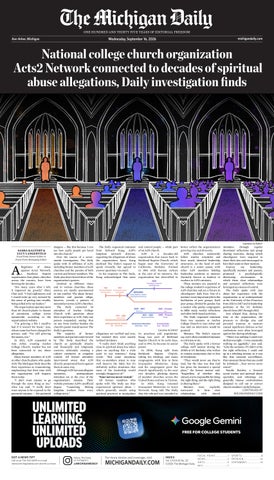
National college church organization Acts2 Network connected to decades of spiritual abuse allegations, Daily investigation finds
Caroline Xi/DAILY
SASHA KALVERT & LUCY LANGERVELD
Focal Point Senior Editor & Focal Point Managing Editor
A
llegations of abuse against Acts2 Network, a Southern Baptist organization that plants churches across the country, have been brewing for decades. “For many years after I left, it impacted me greatly,” Mary Choi said. “I had nightmares and I would wake up very stressed by the sense of getting into trouble, being yelled at by my leaders.” The organization operates more than 60 church-plants in dozens of prominent college towns nationwide, according to the organization’s website. “I’m grieving a life I could’ve had if it weren’t for them,” Jess, whose name has been changed for privacy, said. “I’m still grieving the money, too.” In 2021, A2N expanded to Ann Arbor, creating Anchor College Church. Anchor has not been connected to any abuse allegations. Many former members of A2N at other church-plants who spoke with The Michigan Daily describe their experience as traumatizing, emphasizing that their time with the organization still impacts them today. “I don’t want anyone to go through the same thing as me,” Alice Liu said. “I really don’t want anyone to be exposed to the potential traumas — the potential
dangers — like this because I can see how easily people get lured into the church.” Over the course of a sevenmonth investigation, The Daily spoke with 15 affiliates of A2N, including former members of A2N churches and the parents of both current and former members. The Daily also interviewed three of the organization’s pastors. Involved at different times and in various churches, these sources are mostly unconnected to one another. The abuse former members and parents allege, however, reveals a pattern of misconduct across A2N’s churches. The Daily contacted 10 attendees of Anchor College Church with questions about their experience at A2N. Only one person responded, stating that no one from Anchor besides the church’s pastor would answer The Daily’s questions. The majority of former members and parents interviewed by The Daily described the church as spiritually abusive and financially and religiously coercive, ultimately creating a culture conducive to complete control. All former attendees interviewed attest that A2N directly perpetrated harm against them in some way. Although A2N has noncollegiate ministries, undergraduate attendees are at the crux of the organization’s mission. Their website promotes A2N’s unofficial slogan: “Launching lifelong kingdom workers from every college town.”
GOT A NEWS TIP? Call us at 734-763-2459 or e-mail news@michigandaily.com and let us know.
The Daily requested comment from Edward Kang, A2N’s longtime network director, regarding the allegations of abuse the organization faces. Kang declined The Daily’s request to speak virtually, but agreed to answer questions via email. In his response to The Daily, Kang acknowledged that some
and control people — while part of an A2N church. A2N is a decades-old organization that traces back to Berkland Baptist Church, which began near the University of California, Berkeley. Formed in 1981 with Korean culture at the core of its ministry, the organization has diversified in
allegations are verified and true, but insisted they were mostly isolated incidents. “I really don’t think anything close to spiritual abuse has taken place on anything like a wide scale in our ministry,” Kang wrote. “But some situations that ex-members attest to may well deserve the label, but it’s definitely outlier situations that most of the leadership would strongly disapprove of.” ‘Your nerves never rested.’ All former members who spoke with The Daily say they experienced spiritual abuse — which generally entails using spiritual practices to manipulate
its practices and population. Kang was part of Berkland Baptist Church in its early days, and in 1991, he became its senior pastor. In 2006, Kang split from Berkland Baptist Church, taking his ideology and many congregants with him to form Gracepoint Ministries. Kang and his congregants grew the church significantly in the next two decades, planting dozens of member churches across the United States and one in Taiwan. In 2023, Kang renamed Gracepoint Ministries to Acts2 Network. Kang told The Daily that the rebrand was intended to
Caroline Xi/DAILY
Follow The Daily on Instagram,
@MICHIGANDAILY
For more stories and coverage, visit
MICHIGANDAILY.COM
better reflect the organization’s growing size and diversity. A2N churches nationwide follow similar schedules and have nearly identical leadership structures. At the head of each church is a senior pastor, with other A2N members holding leadership positions as mentors (formerly known as leaders) or workers in A2N’s ministry. These mentors are essential to the college student’s experience of A2N churches and are a fixture in churchgoers’ daily lives. One of a mentors’ most important jobs is the facilitation of peer groups. Each peer group, divided by gender, has a mentor who guides congregants in Bible study, weekly reflections and other faith-based activities. The Daily requested comment from two mentors at Anchor College Church in Ann Arbor and was told no interviews would be granted. Mentors, The Daily’s sources say, were often considered immune to criticism or sin. The Daily spoke with a former college staff mentor during the 2000s at UC Berkeley who wishes to remain anonymous due to fear of retaliation. “They would never say they’re God, but the idea was that God has given the (mentors) a special place,” the former mentor said. “Regardless of whether they sinned, you’re responsible for doing the right thing, and the right thing is obeying them.” Mentors were explicitly instructed to form close relationships with church
INDEX Vol. CXXXVII No. 20 ©2026 The Michigan Daily
attendees through regular devotional reflections and group sharing exercises, during which churchgoers were required to share their sins and encouraged to bare their souls to their mentors. Sources say leadership, specifically mentors and pastors, promoted a psychologically distressing environment in which these close relationships and personal reflections were leveraged as a means of control. The Daily spoke with Jess about her experience with the organization as an undergraduate at the University of San Francisco from 2013 to 2017 and in leadership positions at the UC Berkeley church from 2017 through 2022. Jess alleged that, during her time at the organization, the pressure to divulge sins and personal traumas to mentors caused significant distress as her confessions were often leveraged against her during rebukings. “There was nothing I could ever do that was right — I was constantly walking on eggshells,” Jess said. “Like the sermons: If I didn’t write the right reflection, I could end up in a rebuking session, so it was like that constant surveillance, that constant threat that you could be (rebuked). …Your nerves never rested.” Natalie Kember, a licensed social worker and spiritual abuse specialist, said rebukings are generally intense confrontations designed to call out or correct church members’ sinful behavior.
F O C A L P O I N T. . . . . . . . . . . . . . . 1 NEWS........................2 ARTS......................5 MIC........................7
CONTINUED AT MICHIGANDAILY.COM
SPORTS.....................8 OPINION.................10 S TAT E M E N T. . . . . . . . . . . . . . . . .1 4
News
2 — Wednesday, September 16, 2026
The Michigan Daily — michigandaily.com
PHOTO OF THE WEEK
Stanford Lipsey Student Publications Building 420 Maynard St. Ann Arbor, MI 48109-1327 734-418-4115 www.michigandaily.com
ZACHARY AJLUNI and EDITH PENDELL Co-Editors in Chief eic@michigandaily.com
CICI COPENHAVER
Business Manager business@michigandaily.com
NEWS TIPS
tipline@michigandaily.com
LETTERS TO THE EDITOR tothedaily@michigandaily.com
EDITORIAL PAGE
opinion@michigandaily.com
ARTS SECTION
PHOTOGRAPHY SECTION
arts@michigandaily.com
photo@michigandaily.com
SPORTS SECTION
NEWSROOM
sports@michigandaily.com
news@michigandaily.com
Local artist Charlie Boike paints a mural during the Street Art Encounter in downtown Ann Arbor Friday afternoon.
Dan Kim/DAILY
ADVERTISING
CORRECTIONS
wmg-contact@umich.edu
corrections@michigandaily.com
ANN ARBOR
City Council unanimously votes to sell Kline’s lot to developer for high-rise The 1.31-acre parking lot will be purchased for than $14 million for the development, which will include 500 new residential units
NIKO WILSON
Daily Staff Reporter
The Ann Arbor City Council met in Larcom City Hall Tuesday evening to unanimously approve a purchase and sale agreement for the Kline’s lot — a 1.31-acre parking lot on the corner of Ashley and West William streets — to a real estate developer. The location has been owned by the city since Kline’s Department Store closed in 1994. Real estate developer Hines has agreed to purchase the lot from the city for more than $14 million to construct a large, mixed-use development. The building will be all-electric, with more than 500 residential units and 10,000 square feet of commercial space. Since the 1980s, residents and officials have debated over the next use of the Kline’s lot, with previously considered city projects including office spaces, retail and a Sports Illustrated resort. In 2019, City Council designated the Kline’s lot for development as city-owned affordable housing — but in 2024, voted to pursue selling the property to a developer due to concerns about high construction costs.
During public comment, many residents spoke about the council’s pending agreement to sell the Kline’s lot. Ann Arbor resident Mark Madonna spoke in support of the sale and said that he believes the city must keep building multiple types of housing to accommodate the University of Michigan’s growth. “There isn’t enough affordable housing, but there just isn’t enough market-rate housing as well,” Madonna said. “It would be great if we can bury our heads in the sand and say, ‘We don’t want all those wealthy U of M students to come here.’ The fact is, U of M keeps adding students. They keep adding employees, too.” Earlier on Tuesday, The Ark music venue, adjacent to the lot, requested that the council delay the vote to ensure the development would maintain their access to alleys, sidewalks and parking. Ashley Schafer, executive director of the Main Street Area Association, said businesses in the area hoped Hines and the city would incorporate their feedback regarding the development.
“Our members raised specific concerns about construction disruption, the loss of existing downtown parking, the proposed development and housing demand and what protections would be in place for the city if the development does not ultimately move forward,” Schafer said. “As we review the purchase agreement materials now for council, it is unclear which of these concerns are addressed by the current agreement.” Ann Arbor resident Alan Haber criticized the council’s decision to change course on plans to build affordable housing in a prime downtown location. Haber said he believes the space would be more effective as affordable housing for residents. “To sell this — essentially for luxury housing — is a complete betrayal of the commitment that this council, previous councils, had given to the public that we need affordable housing downtown,” Haber said. “We need it for the people who work downtown, and that is something that was your job to ensure.” In the August Democratic primary, Mayor Christopher Taylor lost his reelection bid to
Washtenaw County Commissioner Yousef Rabhi, who will take office in November. During his campaign, Rabhi posted a video to social media arguing that the city should use the Kline’s for affordable housing. “This lot could be an amazing opportunity to build housing for those that need it the most,” Rabhi said. “Unfortunately, the city has been on a trajectory of selling off public assets like this lot, privatizing public jobs and sending public dollars to private, for-profit corporations. As your next mayor, I will make sure that public land is used for public purposes, not private profits.” Before the council voted on the sale agreement, Jennifer Hall, executive director of the Ann Arbor Housing Commission, said rising construction costs have made it increasingly difficult for the city to fund affordable housing developments. She said she supports market-rate housing on the site and using the proceeds from the Kline’s lot sale to fund affordable housing elsewhere in the city.
CONTINUED AT MICHIGANDAILY.COM
CAMPUS LIFE
J Street UMich splits from Hillel, sparking concerns over polarization in Jewish campus community “It’s extremely disappointing for an organization that should feel very safe and meaningful for all Jewish students on campus.”
ANNABELLE YE
Joshua Mitnick ’92, ’95 Managing Editor
bellaye@umich.edu
GEORGIA MCKAY
Digital Managing Editor
gmckay@umich.edu
AANYA PANYADAHUNDI and CHRISTINA ZHANG
Managing News Editors news@michigandaily.com Senior News Editors: Alexa Cheaney, Dominic Apap, Gia Verma, Quinn Mittlestat, Sarah Palushi, Sarah Spencer
ELENA NICHOLSON and GABE EFROS
Editorial Page Editors tothedaily@michigandaily.com Deputy Editorial Page Editor: Mateo Alvarez Senior Opinion Editors: Avery Allen, Maggie Berling, Madeleine Burke, Stephanie Bouserhal, Isabel Seniawsk
LYRA SHARMA and GRAHAM BARKER
Managing Sports Editors sports@michigandaily.com Deputy Sports Editor: Sophie Matthews Senior Sports Editors: Amanda Bergman, Niyatee Jain, Drew Lenard, Nate Schreck, Grace Wright, Hadley Zann
CAMPBELL JOHNS and CORA ROLFES
Managing Arts Editors arts@michigandaily.com Senior Arts Editors: Hudsen Mazurek, Abigail Weinberg, Tara Wasik, Ana Torresarpi, Meagan Ismail, Siena Beres
MAISIE DERLEGA and SELENA ZOU
Managing Design Editors design@michigandaily.com Senior Layout Editors: Frances Leibovich, Kathryn Palsrok Senior Illustrators: Gabriella Spagnuolo, Emmeline Meldrum, Ella Flores Brosnan
BRIDGETTE BOL and HOLLY BURKHART
Managing Photo Editors photo@michigandaily.com Senior Photo Editors: Ananya Kedia, Arushi Sanghi, Isai Hernandez-Flores, Ava Farah
AYA FAYAD
Managing Statement Editor statement@michigandaily.com Deputy Editors: Oummu Kabba, Lola Post, Riya Kommineni
ALINA MURATA and JOSUE MATA
Managing Copy Editors copydesk@michigandaily.com Senior Copy Editors: Meagan Ismail, Claudette Johnson, Ayah Maskoun, Caroline Niccolini, Emma Oftedal, Zoey Ueland, Justin Xhelilaj
EMMA PENG and JULIA MEI
Managing Online Editors webteam@michigandaily.com Data Editors: Darby Jones, Zora Tucker Engineering Manager: Alyssa Locke, Grace Liu Product Managers: Annice Chang, Sanvika Inturi Senior Software Engineer: Becky Pan
EVAN KRUMMEL and JOVANNA GALLEGOS
GLENN HEDIN
Managing Video Editor video@michigandaily.com Senior Video Editors: Samridhi Sharma, Grace Wright
Daily Staff Reporter
J Street at the University of Michigan has disaffiliated from Michigan Hillel after receiving an ultimatum to cut off ties with its national parent organization, J Street. The split, which appears to originate from the two organizations’ differing positions on Israel, has led some left-leaning Jewish students to worry that their views are increasingly not welcome within mainstream Jewish institutions on campus. J Street is a national political group that advocates for liberal Zionism, an ideology that is broadly supportive of Israel but remains critical of its various human rights abuses. In an interview with The Michigan Daily, LSA junior Eliana Adler, J Street UMich president, said the campus branch represents a similar — if somewhat wider — spectrum of opinion and focuses on fostering what it sees as healthy discourse on Israel-Palestine issues. “There definitely is some variation within opinions of the individual students who are part of our organization,” Adler said. “We really welcome disagreement; I think it’s something that brings a lot of value to the conversations we bring to campus.”
Editorial Staff
AMARA M. SMALL and IHAA MOHAN Michigan in Color Managing Editors Senior MiC Editors: Allana Smith
michiganincolor@michigandaily.com
HANNAH BODNAR and AVA HOOGTERP
Managing Podcast Editors podeditors@michigandaily.com Senior Podcast Editors: Rogen McLean, Zora Burroughs, Karina Shahinian, Olivia Dickerson
DA YOUNG KIM and UWAEISH AHMAD
Managing Audience Engagement Editors socialmedia@michigandaily.com Senior Audience Engagement Editors: Amanda Bergman, Caleb Starr, Isabella Burke, Libby Le Febre, Michelle Fang, Sophia Polega, Heewon Moon
MAHEE KAVDIA and PUJITA RUPANI Culture, Training, and Inclusion Co-Chairs
accessandinclusion@michigandaily.com
LUCY LANGERVELD and TIFFANY MCKALKO
Managing Focal Point Editors lucykate@umich.edu, tmckalko@umich.edu Senior Focal Point Editors: Amaya Choudhury, Claudette Johnson
The outside of the Michigan Hillel building on Hill St.
J Street’s position has become harder to maintain in recent years. The group has received criticism from both hard-line zionists, who believe it undermines the geopolitical interests of the state of Israel, and from anti-zionist critics, who believe the organization’s conciliatory attitude helps downplay concerns about Israeli settler colonialism and credible accusations of genocide in Gaza. These tensions have increasingly been felt at Michigan Hillel, a major Jewish cultural center on campus that has historically positioned itself as
a more inclusive alternative to religiously orthodox spaces like Chabad House at the University. Hillel has also associated itself with pro-Israel advocacy and cultural programming — particularly as a major partner of the Taglit-Birthright Israel program — but for years, J Street UMich was able to exist as a student club within Michigan Hillel without issue. This acceptance has begun to disappear recently. Adler alleged that Michigan Hillel has treated J Street UMich with increased hostility, forbidding the club from
Akul Gunukula/DAILY
engaging in political advocacy and making it temporarily change its name to Dialogue Across Differences: A J Street Affiliate. According to Adler, this recently culminated in an ultimatum from Michigan Hillel demanding J Street UMich disaffiliate from national J Street entirely. Concerned that doing so would fundamentally alter the character of their group, J Street UMich decided to leave Michigan Hillel instead, though Adler said they did not do so happily.
CONTINUED AT MICHIGANDAILY.COM
JAMES KNAKE and MILAN THURMAN
Managing Games Editors crosswords@umich.edu Senior Games Editors: Eleanor Sullivan, Kiran Parekh, Sam Martin, Tobin Saxton
Business Staff CAROLINE ZOLTAK
GABRIELLE GONDOLY
Marketing Manager
Sales Manager
KATE PARAMBO
MORGAN ORTH
Creative Director
Strategy Manager
The Michigan Daily (ISSN 0745-967) is publishing weekly on Wednesdays for the Winter 2026 semester by students at the University of Michigan. One copy is available free of charge to all readers. Additional copies may be picked up at the Daily’s office for $2. If you would like a current copy of the paper mailed to you, please visit store.pub.umich.edu/michigan-daily-buy-this-edition to place your order.
The Michigan Daily — michigandaily.com
Wednesday, September 16, 2026 — 3
News
4 — Wednesday, September 16, 2026
ADMINISTRATION
The Michigan Daily — michigandaily.com
UMich town hall over data center draws severe backlash from community members
“People are leaving, they’re selling their homes because of the thought of Los Almos.”
Nasen/DAILY The University of Michigan holds an open house Wednesday evening on the proposed Ypsilanti Township data center at Ann Arbor Marriott Ypsilanti at Eagle Crest.
of the noise and pollution and all the things this will cause.” Lakatos asked the six panelists, all of whom were associated with the project, whether they would raise a family close to the development. Every panelist — Project Lead Steven Ceccio; Patricia Hurn, University interim vice president for research and innovation; Drew Smith, U-M interim vice president of finance; Chris Kolb, vice president for government relations; Khalil Rahal, DTE Energy director of economic development; and Project Director Rob Green — said yes. Green added that, despite his confidence in the center’s safety, Lakatos’ concerns were valid and residents deserved more information about the impacts of the project. “We need to speak to your concerns about pollution,” Green said. “Whether that’s noise, heat, light, electricity use, water use — we need to be able to give you those answers.” University Regent Paul Brown (D) recently released a statement condemning the selected data center site and alleged the University’s actions resemble environmental racism. Brown told The Daily he believed representatives of the University have not conducted themselves appropriately and with enough respect to Ypsilanti residents through the data center’s planning process. “This is a huge lost opportunity if we don’t really use all of the brain power in the University and all of the activism in the community and try to find — if there is a way — to make this project a big win for the local
NEWS BRIEF
NEWS BRIEF
ALEXA CHEANEY & CALEB OBICO Daily News Editor & Daily Staff Reporter
Nearly two years ago, the University of Michigan announced a partnership with Los Alamos National Laboratory to build a data center in Ypsilanti Township. The University claims the development will be a technological feat and used for significant scientific advancements, including cancer research. Residents of the township have long been skeptical of the development. During Wednesday’s open house — the first of its kind to feature two-way dialogue — many township residents spoke about their concerns regarding
the environment and their quality of life and safety. The format of this meeting was vastly different from the prior data center town hall held Jan. 29 where community members milled around an open room with poster boards displayed in a semi-circle. Now, they sat in an auditorium listening to the panelists speak. At times, residents shouted demands for a vote or expressed their unequivocal rejection of the project and frustration with the U-M administration. Corey Lakatos and his family, who live near the intended site of the data center, moved to Ypsilanti Township last November. He learned about the data center shortly after. In an interview with The Michigan Daily, Lakatos said the data center would have
impacted his decision to move to the township. “We really wanted to purchase a house at that time, but I don’t think I would have jumped on something in Ypsilanti Township if there was a real concern about the data center going in,” Lakatos said. During public comment, Lakatos said he was concerned for his family. Lakatos, who has four children, all under 10 years old, told those in attendance that he doesn’t want them to grow up down the road from a data center, citing concerns about its potential environmental impact. “I probably can’t move away,” Lakatos said. “I’m faced with the possibility of needing to raise my children here, and the possibility of not wanting to — or being able to — go outside our home because
Ann Arbor Board of Education approves new teacher contract, ending 8-month standoff
The new contract will run through 2027 and gives teachers a salary and health insurance increase DOMINIC APAP Daily News Editor
The Ann Arbor Board of Education unanimously approved the tentative agreement between Ann Arbor Public Schools and the Ann Arbor Education Association Wednesday. The new contract, which was approved by 58% of teachers who voted last week, is set to run through 2027. The AAEA complained about their previous contract — which expired December 2025 — saying their pay did not increase enough with experience, pushing educators to leave for other districts. AAPS teachers are paid
based on steps and advance to a higher step with a salary increase every year. The new contract gives a 1.5% salary increase for teachers on steps three through 11 for the 2026-2027 school year. Additionally the district will create a new step 12 in 2027, meaning some veteran teachers can see their salaries increase one more time. The deal also includes a 1.5% retroactive salary increase for teachers who worked during the 2025-2026 school year, meaning employees will receive an immediate payout. The district currently contributes about $15,000 to healthcare per teacher, and
this contract will increase that number by 5%. Unlike the previous April tentative agreement, this contract does not increase class sizes or decrease planning time. At the meeting, Torchio Feaster, Board of Education president, said he is relieved negotiations have concluded. “I’m glad that we got here after having to go through lengthy negotiations and a lot of backand-forths and anger on both sides,” Feaster said. “Although I don’t like how long it took, I know we all worked hard to get here, and I’m glad that we reached a resolution that we can at least deal with for the next year.”
community,” Brown said. “If the local community ultimately decides it’s not (a win) then they shouldn’t have to bear the brunt of it.” In response to a community member’s question on whether environmental impact studies had been conducted, Ceccio said they would be done but haven’t been completed at this point. Throughout the open house, several community members brought up concerns about the University’s direct collaboration with Los Alamos and the data center’s planned role in the research and design of nuclear weapons. A letter from Los Alamos Director Thomas Mason was distributed at the meeting. It reiterated the longstanding partnership between the University and Los Alamos, along with the importance of scientific collaboration. Mason wrote that nuclear materials would be absent from the site. “The center would be for research computing,” Mason wrote. “It would not be a military installation or weapons production site. No plutonium or other nuclear or hazardous materials would be produced, used, or stored at the facility.” Residents broadly opposed the use of the facility for such research, however. During public comment, Ypsilanti Township resident Elizabeth Bridger, who lives about two miles away from the complex, told the panel she believes the data center could make her community a target due to heightened political tensions globally. “All you guys are doing with all these papers and everything with the letter from Los Alamos
— it’s all propaganda jargon to try to assure us that everything is fine,” Bridger said. “We are in a very, very scary time concerning military actions right now.” Residents also expressed concerns with the communication and decorum of project officials throughout the night. Many called for an increase in communication transparency, or called out panelists for a perceived disrespect. In an interview with The Daily after the event, Monica Ross-Williams, former Ypsilanti Township trustee, said she was shocked the project had not contacted Van Buren Public Schools. Rawsonville Elementary, which sits less than two miles from the planned construction site. “When I think about the fact that they have not talked to the district … it’s absolutely an atrocity,” Ross-Williams said. “That school is a Title I school. Which means it basically has a lot of the kids who suffer some economic harms — and yet, you haven’t thought about talking to Van Buren Public Schools?” The three-hour meeting concluded with a comment from Ypsilanti Township Supervisor Brenda Stumbo, joined by state Rep. Jimmie Wilson Jr., D-Ypsilanti. Stumbo said she felt slighted by the University and asked the panel to not build in the township. “We don’t deserve this; our people don’t deserve this,” Stumbo said. “People are leaving; they’re selling their homes because of the thought of Los Alamos. That’s a fact. The emotion and the rage is fear. We don’t — they don’t — deserve this. Please, change your mind.”
Feds demand GEO membership, financial records in subpoena
“What they’re trying to do is to disorganize us, to discourage us from speaking out about Palestine and from demanding a contract.” PATRICIA LEONCIO Daily Staff Reporter
The University of Michigan’s Graduate Employees’ Organization received a federal grand jury subpoena Aug. 26, according to a statement released by the union Wednesday morning. The subpoena, issued by prosecutor Maggie Smith and FBI special agent Kara Phipps, demands a list of current and former GEO members, executive board and membership meeting notes, staff personnel records and financial records dating back to January 2023. GEO retained attorneys and filed a “motion to quash” — or void — the subpoena Aug. 20, claiming
the original attempt to serve the paperwork through Federal Express mail on Aug. 11 did not meet official requirements. Ultimately, the federal government served the subpoena again via hand delivery on Aug. 26. Both Smith and Phipps are connected to the federal criminal indictment of eight pro-Palestine activists affiliated with the University, which was filed by the U.S. Department of Justice in June. GEO believes that the case and the subpoena are attempts by the federal government to suppress student activism, a goal it alleges the University of Michigan has helped to bring about. In an interview with The Michigan Daily, Rackham student Natalie Chen, GEO communications
chair, said the subpoena was signed the same day the charges against GEO President Hiab Teshome by the University were dismissed by a judge. The union believes the charges were politically motivated. “There’s been this domino effect of events in which the University has continuously repressed any sort of speech and activism around Palestine, beginning way back three years ago now in 2023,” Chen said. “Following Hiab’s charges this subpoena is obviously (a) very stunning thing that you don’t necessarily expect as an organization of people who are trying to do all these different things that are advocating for basic livelihood.”
CONTINUED AT MICHIGANDAILY.COM
GOVERNMENT
Abdul El-Sayed kicks off ‘Shouldn’t Be This Hard’ town hall tour in Detroit El-Sayed urged attendees to treat the final weeks of the U.S. Senate race as an act of civic participation
ZAHRA KAGAL Daily Staff Reporter
Hundreds of Detroit residents gathered at the Health Science Center in Detroit Wednesday evening for the first stop of Democratic U.S. Senate candidate Abdul El-Sayed’s “Shouldn’t Be This Hard” town hall tour. The tour is part of El-Sayed’s push to court voters ahead of the Nov. 3 general election against former U.S. Representative Mike Rogers. The event comes roughly eight weeks before Election Day and just a day after President Donald J. Trump’s speech in Dallas mentioned El-Sayed. Unlike the primary-season rallies that pitted El-Sayed against fellow Democrats U.S. Representative Haley Stevens and state Sen. Mallory McMorrow, D-Royal Oak, Wednesday’s town hall focused on drawing a direct contrast between El-Sayed and Rogers on healthcare, food safety, artificial intelligence and the cost of living. El-Sayed acknowledged Trump’s attacks against him during his Dallas speech,
arguing the country’s political dysfunction runs deeper than any one man in the Oval Office. “Donald Trump is not himself the disease of our politics,” El-Sayed said. “Donald Trump’s just the worst symptom of the disease of our politics. The disease is the system that allows big corporations and millionaires and special interests to buy and sell politicians in ways that leave them rigging the system against us.” After his introduction speech, El-Sayed invited attendees to ask questions about his campaign and policy issues. Attendee Caron Houston, a Detroit resident, told El-Sayed she identifies as an independent after growing disillusioned with what she described as the Democratic Party’s unwillingness to act boldly. “I consider myself a recovering Democrat, primarily because of — I’m going to say it — the cowardice of some other Democrats,” Houston said. “If the Dems win back the House and the Senate, will the progressives and (Democratic Socialists of America) be able to create a critical mass to push
through the policies you have been running on?” El-Sayed responded, asserting legislative follow-through is as much a matter of political courage as it is strategy. “I think sometimes we’re afraid of our own shadow,” El-Sayed said. “We assume that all people aren’t going to like it. ‘We shouldn’t be talking about immigration.’ Yes, we should. What are you afraid of? What are we afraid of? And people will see that on you. They’ll see when you have the courage of your convictions to stand in and say, ‘I believe in certain things, I think you should, too.’” In an interview with The Michigan Daily, attendee Michelle George, a Detroit resident and advanced nurse practitioner who previously worked at the Detroit Health Department, said she wants to see El-Sayed continue to prioritize rebuilding the country’s food safety infrastructure if elected. “Food safety is very critical because every minute something is popping up, and the pathogen doesn’t know if you’re a Democrat or Republican,” George said. “We got the highest
cases of cyclospora in the country, and we had two deaths. So I would like to see him, in terms of focusing on as a senator, just bringing transparency back with the (Centers for Disease Control).” When she stood and shared her sentiment, El-Sayed agreed federal cuts amount to more than government waste. He said cuts to the Food and Drug Administration and the Centers for Disease Control and Prevention likely exacerbated the recent cyclospora outbreak. “The CDC, who’s supposed to be able to keep an eye on all of this, didn’t have the capacity to do it,” El-Sayed said. “When I get to the U.S. Senate, I’m going to be the first U.S. senator who’s ever been a public health official. So we’ve got to be able to architect all of the services back from where they cut them.” In an interview with The Daily, El-Sayed said his campaign’s traction with young voters has only grown since the primary against Stevens, and reaching them requires giving voters a direct stake in the race. “We took on Goliath in the primary,” El-Sayed said. “We’re
Isai Flores/DAILY Abdul El-Sayed speaks to attendees at the ‘Shouldn’t Be This Hard’ Town Hall Tour at the Wayne County Community District North West Campus Thursday afternoon.
taking on Goliath again in the general, and this is the kind of campaign that young people have told us that they believe in and want to be a part of. Our job is to give them the tools to have those conversations among each other and to turn this into a kind of opportunity to make sure that their voices are heard in our politics.” El-Sayed closed the town hall by urging attendees to treat the final weeks of the race as a shared act of civic participation,
rather than a contest to be won or lost. “We believe in an America that has yet to be greater, and we believe that the work of that is not about telling some people that they don’t belong here,” El-Sayed said. “It’s not about picking and choosing winners. It’s not about letting corporations run buff wild on our economy; it’s about empowering everybody. Democracy is about two questions: Who are we, and who do we want to be?”
Arts
The Michigan Daily — michigandaily.com
Wednesday, September 16, 2026 — 5
‘The Jellyfish Problem’ casts a wide net
ESTLIN SALAH
Digital Culture Beat Editor
There is something terribly funny about a book called “The Jellyfish Problem” attempting to contain as many problems as it possibly can. A giant sea monster is terrorizing a small town. Our protagonist is wracked with survivor’s guilt, grief and — worst of all — mommy issues. And a shitty job. And she’s a lesbian. Oh, and the small town is racist. She also has a book to write that’s past due. And a past to reckon with, or did I say that already? Somehow, strangely, the jellyfish are not the biggest problem brought to the table. At her best, Tessa Yang makes the overcrowded premise of “The Jellyfish Problem” feel intentional. The novel moves between sea monster sadness and lesbian blues with an earnestness that is difficult not to empathize with, even when it occasionally seems like Yang has opened one too many narrative tabs. Some of these threads are given room to breathe; they develop alongside the characters and eventually circle back into satisfying conclusions. Others are introduced with enough weight to suggest they will matter, only to disappear for chapters at a time or return, already resolved, in a single line. By the end, the novel has cast
a very wide net, but not everything it catches gets reeled in intact. One of the novel’s more successful threads is its protagonist, Jo, who is — for a considerable portion of the story — deeply annoying. Her grief makes her defensive; her relationships are strained by her inability to communicate and she possesses the particular self-absorption of someone who is convinced she is always right. Everyone else is misunderstanding her all the time, obviously. I spent a majority of the book clinging to the life raft of hope that Jo might get over herself. Thankfully, she does. Yang stages Jo’s growth carefully enough that the reader can see the machinery beneath it, but that does not make the destination any less satisfying. Jo’s gradual capability to look beyond her own grief is one of the novel’s more effective emotional arcs, particularly because the book does not pretend that becoming a better person means becoming a different one. Her flaws remain recognizable even as she begins to understand the damage they cause. Unfortunately, I’m not sure Yang planned out resolutions for the novel’s many other concerns with the same care. “The Jellyfish Problem” wants to be a story about grief and environmental
catastrophe, but also about Queer love, family, economic decline and the specific loneliness that comes with living in a small town. Some of these ideas complement one another naturally. Grief, for instance, becomes inseparable from Jo’s fascination with the ocean: Both are vast, unknowable and capable of swallowing people whole. The sea monster gives the characters something enormous to fear while also functioning as a way for each character to project their own unique struggle onto an external force. Other issues feel as though they were pulled from a much longer book and then written into the margins. The novel occasionally gestures toward issues such as racism, social inequality and domestic violence without affording them enough space to become as meaningful as the story seemingly promises. A single line can introduce a problem that feels enormous before the narrative brushes past it to something else. These moments are not necessarily poorly written, but their presence raises the question of why they are included at all if the novel does not intend to investigate them. The pacing suffers from a similar lack of attention. “The Jellyfish Problem” could have used another 60 or so pages, if only to give its various resolutions enough
Cover art for ‘The Jellyfish Problem’ owned by Penguin Random House
time to settle. Instead, the novel’s final stretch begins untying knots almost as quickly as it created them. Some conflicts — such as Jo’s grief and familial struggles — receive careful, emotionally satisfying conclusions. Others either feel brushed under the rug, or resolved with a suddenness that leaves readers feeling marooned in the wake. This creates an odd sensation of being rushed toward the conclusion of a book that has spent
so much time wandering. The novel is rarely boring; if anything, its biggest problem is that it is too interested in everything. Yang has a lot she wants to say about the people who live in this town and the things that have shaped them, but not every idea can receive the same attention. The result is a book whose strongest threads feel genuinely earned, while its weaker ones leave the reader stranded somewhere between relevance and resolution.
Still, there is something admirable about a novel that takes this many swings. “The Jellyfish Problem” would be easier to criticize if it were timid. Instead, it reaches for the giant sea monster, a messy family, Queer love, unending grief and the town’s buried histories all at once. Sometimes it catches exactly what it cast for. Sometimes it reels in nothing at all. But the things it does pull ashore make the journey worthwhile, even when the waters get a little crowded.
Starseeker’s gameplay is dry, but meaning can be found in its simplicity HUDSEN MAZUREK Senior Arts Editor
STARSEEKER: Astroneer Expeditions is a confusing game. The gameplay and the mechanics are simple, but many will struggle to find meaning in its repetitive nature. Starseeker isn’t a hollow experience, but it certainly struggles to keep players engaged. Starseeker is a multiplayer extraction survival game where players embark on short missions to the surface of an alien planet. Unlike more traditional games within the extraction genre, which are usually driven by inter-player conflict and combat, Starseeker focuses on other aspects. Almost every mission involves gathering
resources, crafting specific items or navigating to an indicated location to complete a number of tasks. What makes Starseeker stick out within the genre is its near-lack of combat, though it does exist in a simple, rarely practiced form. Conflict at large isn’t something Starseeker is interested in, combat or otherwise. The game builds itself on the loop of taking quests, dropping down to the planet for 20 minutes to mine or search for old wrecked spaceships, then going back to base to repeat it all over again. This formula works well for other games, but Starseeker struggles to find a way to make this continued effort feel meaningful. Players will be met with minimal resistance, and most tasks are fairly easy. The only true conflict the
game presents is time itself. Some tasks simply take a lot of time. Crafting requires a lot of resources, and some missions’ goals are solely to gather a lot of something rare. These are not challenges, but roadblocks — only stop-gaps until the next mission. Unfortunately, the next mission will always be about the same. Variety is not the strong suit of Starseeker. The story doesn’t help much in this regard either, as it’s restricted to skippable text box prefaces for missions. What modicum of story does exist is simple and not particularly memorable. Without much motivation to be found in the narrative, Starseeker has no way of incentivizing players to engage other than their own desire to
The Michigan Daily Crossword
Sunday, September 13, 2026 — Puzzle by Johan Landis Lewis ACROSS 1 2 3 4 5 6 7 8 9 10 11 12 1. Academic acronym 13 14 15 5. "Dancing Queen" group 9. LeBron's first pro team, 16 17 18 familiarly 19 20 21 13. One from Warsaw 14. U.S. World Cup captain Tim 22 23 24 25 26 15. Region 27 28 29 16. Leading man who wrote "Bohemian Rhapsody" and 30 31 32 "Don't Stop Me Now" 19. Connect via Bluetooth 33 34 35 20. Letting one borrow 36 37 38 39 40 41 42 22. Famed ancient Greek sculpture found in the Louvre 43 44 45 46 26. Place to find dolphins, lions and eagles 47 48 49 27. "Hamilton" actor Leslie ____ Jr. 50 51 52 28. Best case 53 54 55 56 57 29. Carry around, or a bag to carry around 58 59 60 30. Erling Haaland's nation on World Cup scoreboards 61 62 63 31. " ____ there, done that" 32. One above bass DOWN 38. Song that performs extremely well 33. "24K Magic" and "Die With A 1. Letters on a sunscreen bottle on the charts Smile" singer 2. Underwater missile 40. Sports injury that is more common 36. "American" territory that on artificial playing surfaces 3. Rigby in a song by The Beatles produces the most NFL 41. Holds in high regard 4. Not toward either extreme players per capita 42. Pokémon protagonist 5. Singer Grande, to fans 39. Actor Malek that played 44. Preppy shirt 6. Busy insect 16-Across in a 2018 biopic 45. Slanted, as text 7. Comic book onomatopoeia 40. Gossip 46. Places for belts 8. Aviator Earhart 43. Poems of praise 48. Group of nine goddesses that 9. Chocolate bean 44. Instrument with a name that represent the arts in Greek means "play softly" 10. "Give 'em _____ for their money" mythology 46. Wimp 11. Sprint competitor 49. Suffix with buffoon 47. Swampy place 12. Turn down 51. Lead in to vision 48. Personification of nature 17. Those with MDs 54. Acronym that comes before a fake 50. Handy utensil for 18. Unit of sushi name pancake-making 21. Suffix with party or movie 55. "Losing My Religion" band 52. Widespread 22. Word in many German names 56. Tree juice 53. Collection of astronomical 23. God, in French 57. So-so bodies with members found 24. Biblical garden inside 16-, 22-, 33- and 48-Across 25. Symbol of Hannukah 58. 5,280 feet 29. Rob Gronkowski and Colston Loveland 59. Store where you can buy a djungelskog, vattenkrasse or 31. Sports ___ grunka 32. Swim-bike-run race, for short 60. Big book 33. Red Sox, on scoreboards 61. Parisian summers 34. Thick head of hair 62. Pitch a tent 35. Love, in Lisbon 63. Shortened word that might 36. Bawls follow "study" 37. Sign found at a pet shelter, maybe
play. Within the first few hours of gameplay, you will have likely seen most of what the game has to offer. Of course, this comes with a grain of salt, considering the game is still in early access. There may be more down the line, but as of now, there isn’t much to experience. What there is to experience, however, is not bad by itself. Despite being repetitive, it’s easy to feel like you are making progress. As new blueprints unlock and you acquire new tools and weapons, the game ceases to feel so stagnant. The exploration is also a high point, as environments are often fascinating and colorful, with unique options for traversal such as slides made of mud or underground tunnels that weave through the planet. These moments of discovery and playful
wonder are Starseeker’s best, and they help make monotonous tasks feel less mundane. That is truly the game’s strength: the beauty in the mundane. There is nothing special about the tasks or how one accomplishes them, but to be brought back time and time again to somewhere fantastic reminds you of how beautiful simple things can be. If you didn’t have to run back and forth collecting scrap and compound, you’d never realize that everything great about the game had been around you the whole time, since the second you landed on the planet. This doesn’t make the game any more fun, but it does make the effort seem more meaningful. Whether working through similar tasks over and over is worth that
realization is up to the individual, but it is important to recognize where the game can succeed, even if it is in the subtext. Starseeker is not a game for everyone. Most of the player’s satisfaction will come from taking joy in little moments, sometimes shared with others. What is offered is a simple game with a cycle of gameplay just engaging enough to keep going, but not interesting enough to speak for itself. Starseeker is beautiful, and there is some sort of fun to be had if you go looking, but it certainly won’t help you find it. If you like alien landscapes with great views and are willing to stop to watch every sunset, then Starseeker is a game that may just have enough for you to put up with drab gameplay.
It’s not Anthony; it’s ‘Tony’ SAMUEL BROWN Daily Arts Writer
When director Matt Johnson announced that his next film would be a biopic about famed writer and chef Anthony Bourdain, it was a bit confusing. In the minds of Generation Z, Bourdain is a perfect example of a modern philosopher: a confident man with an ability to magically express every detail of his life with precision. Johnson’s body of work certainly doesn’t reflect that. Just a few months ago, he released “Nirvana the Band the Show the Movie,” a magical film about childish men doing everything they can to get a show at a local bar. All of his movies are about lovable losers who seem to inevitably fail in some capacity. But when the film’s tagline was revealed to be a quote from Bourdain’s memoir “Kitchen Confidential: Adventures in the Culinary Underbelly,” everything clicked. Bourdain wrote, “I was — to be frank — a spoiled, miserable, narcissistic, self-destructive and thoughtless young lout, and badly in need of a good ass-kicking.” This is the very framework that makes “Tony” a fast-paced encapsulation of what it’s like to be young and delusional. The story itself is a loosely true tale about the summer that Tony fell in love with the kitchen. It functions as a piece of folklore, making a creatively interesting movie that captures the general feeling of Bourdain’s youth over an accurate biography. Taking place in Provincetown, Massachusetts, the myth begins with a drunk and passed out Anthony Bourdain (Dominic Sessa) — who at the time refused to go by anything other than “Tony” — lying in a gutter with an empty wallet. Tony is the encapsulation of that one insufferable kid in your English class: He’s pompous, quotes Latin and claims to be a literary genius. Failing to receive a summer writing fellowship that would’ve stamped him as a true, professional writer, he runs away from home. To avoid his parents for the summer and
Official image from ‘Tony’ courtesy of A24
find shelter, he is taken under the wing of Chef, played lovingly by Antonio Banderas, who offers Tony a porch hammock to sleep on and a job at his small clam shack. Learning from Chef and his ragtag team of cooks, Bourdain’s vision of himself as a writer slowly melts away like butter in a pan. Here, the beauty of Johnson’s filmmaking shines through as we see Tony fail at his goal of becoming a writer but find acceptance with a group of lovable losers in the kitchen. Dominic Sessa brings Anthony Bourdain to life as a bad-postured, quiet and dorky kid who shields himself with self-proclaimed confidence. Tony’s quiet and unassuming character leaves room for two over-the-top performances by Stavros Halkias and Leo Woodall. Together, the two portray experienced, rough-looking sous chefs who continuously spew some of the foulest phrases you will hear in a movie this year. When the film pushes this highpaced kitchen culture mixed with locker-room talking charisma, it truly soars. It is moments like these when the boundaries of the biopic fade away and instead meet a beautiful coming-of-age film. Seeing a family sprout from this kitchen highlights the bliss of finally discovering your passion and adds a tender touch to the film. Seeing Tony go from getting decked in the face to shucking clams and creating Sunday specials shows a portrait that any young person lost in life can relate to, which is far more important than
biographical facts about a man’s life we could already read about. The film only stumbles when it tries too hard to live up to Anthony Bourdain’s persona and ignores what actually works in the context of the film. Some moments directly quote “Kitchen Confidential”; Tony talks oddly about the first time he ate a clam in France, and when referring to the culinary school Bourdain would one day attend, it almost sounds like a teaser for a sequel. But perhaps cringiest of all, in the film’s closing line, Tony proclaims himself “Anthony Bourdain,” which is the first time his full name is said in the film. The line is framed as if it’s something we didn’t already know, prompting an eye-roll as the lights come on. Maybe if these moments were better integrated into the script they wouldn’t feel like easter eggs from a different, much worse movie. Pulling apart Bourdain’s actual life is what makes the film so entertaining. “Tony” is the perfect end to the summer movie cycle. However, its need to shoehorn biographical information keeps it from fully flourishing as a monument to one of our great modern thinkers. Still, it captures the rushing, never-ending feeling of joy that summer brings thanks to its wonderful cast and premise. Tony is proclaimed as someone “in need of a good ass-kicking,” and he certainly got one; it’s a whirlwind of a journey that settles into a warming coming-of-age film rather than a strict, boring biopic.
Arts
6 — Wednesday, September 16, 2026
The Michigan Daily — michigandaily.com
Denzel Curry and Kenneth Blume brought themselves back to basics on ‘ii’ NATHANIEL EVANS Daily Arts Writer
Denzel Curry has outperformed every other mainstream rapper in the last 10 years, and it isn’t particularly close. Not only has Curry dropped consistently exciting projects at a staggering rate, but he has also reinvented his sound and persona from the ground up on every major release. He has proven himself to be a toptier lyricist and performer, all while having a near-perfect ear for production, consistently operating at a conceptual level and creating new worlds in every style he explores. Curry clearly has a deep respect for all things hip-hop, both in his odes to its history as well as his chameleon-like ability to execute upon a number
of subgenres. His collaborations and homages never feel forced, and he has clearly matured as both an artist and a person throughout his career. So when Curry and Kenneth Blume dropped ii, a spiritual successor to their previous effort UNLOCKED, there was a fascinating realization: Curry has never truly made a record like this. Despite the album having so many of the conventions that you would expect a rapper’s rapper like Curry to be naturally drawn to — soul samples, boom bap beats, witty punchlines and dense rhyme schemes — it’s never something he has tried. While it’s his first attempt at a “bars only” album (largely without his DMX-style affectations, melodic hooks or hypnotic trap beats), Curry knocks it out of the park, just as he has done with all his previous work.
Curry’s growth as a writer stands out in several expertly penned verses. “CANDLELIGHT” combines Curry’s typical wit with nuclear confidence, knocking out listeners with every lyrical trick in the book. Wordplay (“readin’ you pussies, that’s hieroglyphics”), alliteration (“holy man, heavenly saint, the Earth holdin’ holy hands”) and clever references (“Won’t follow commandments, but got a pocket full of stones”) make the song so airtight it feels like Curry forgot to breathe. With this said, this lyrical growth is not strictly technical. Curry’s ever-evolving social commentary and self-reflection are present in full force on ii. Despite being largely dedicated to a scathing diss against a duplicitous colleague, “COLD NIGHT IN HELL” reminds
Curry’s adversary and his listeners who the real enemy is, rapping “Worry ’bout this ice on me when there’s men in mask about.” These political undertones are more fully realized on the closer “DIFFERENCE,” where Curry reflects on the economic asymmetry of the rap game he finds himself in. He brings the braggadocio with his first few verses, but swiftly pivots on the line “wait a whole cottonpickin’ minute” and proceeds to pierce the veil of success that many of his peers live under. Curry aptly points out that the only way for most to get ahead is to step on others and that most of the charity given by those around him is performative. Get too wowed by Curry’s propulsive flows and shiny flexes and you might miss the ominous character of these final moments. Kenneth Blume III is on his best behavior as well, delivering a series of beats that exemplify the beauty and grit of Curry’s classic lyricism. It’s clear that
Blume’s time as a producer in modern rock for bands like Geese and Weezer has inspired his hip-hop production, from the jazzy guitar licks on “GONE FISHING” to the stabby Indonesian rock inclusions on “CANDLELIGHT.” These colorful, rock-centric loops go a long way in characterizing the verses on this album, which may otherwise blur together in a less dynamic producer’s hands. Still, the production and rapping do not simply complement each other on this record. There is a frightening level of synergy between the two, as Curry often uses the vocal chops that Blume inserts as a part of the verse itself. “PRODUCT” sees Curry initially using a woman’s voice singing “in my life” to refer to those who want to ride his coattails out of economic hardship. However, in his verses, Curry raps such that the very same sample reads as “end my life.” Despite the wordsmithing genius, it’s a blink-
and-you’ll-miss-it moment, and a testament to Curry’s restraint. It’s incredibly clear that Blume did more than send Curry a folder of beats in an email; this combination of highly intentional production choices and focused song concepts amount to a chemistry that puts most rapper-producer pairings to shame. That same chemistry may leave some feeling that this record is running on autopilot, with neither artist swinging for the fences in an extraordinary fashion. However, that sentiment fails to appreciate the value of an artist like Curry. Curry’s catalogue is as wide as it is deep, and there is no telling what he will conquer in the future. Will every new album be a towering achievement above the previous? Not necessarily. But Curry has proven to be insanely reliable. What we should take away from ii is the same thing listeners took away from his previous works: We are never going to hear this version of Denzel Curry again.
Album art for ‘ii’ by Loma Vista Recordings
For curiosity that leads to discovery, Look to Michigan. At the University of Michigan, we’re turning learning into impact—from classrooms and labs to clinics and studios. Across education, research, and health care, we’re preparing the next generation to defy boundaries and improve lives. For access. For opportunity. For all of us. Look to Michigan.
umich.edu/look
MiC
The Michigan Daily — michigandaily.com
Wednesday, September 16, 2026 — 7
In the comfort of her kitchen Michigan in Color is The Michigan Daily’s section by and for People of Color. In this space, we invite our contributors to be vulnerable and authentic about our experiences and the important issues in our world today. Our work represents our identities in a way that is both unapologetic and creative. We are a community that reclaims our stories on our own terms.
What defines a Muslim FAHMIDA RAHMAN MiC Columnist
In my experience, Muslim communities across the West are fragmented by ethnic loyalty. The mosque I spent a majority of my life frequenting was not exclusively a space to learn about religion. Instead, it felt like a macrocosm of my own household dynamics. My childhood mosque was almost exclusively frequented by families who hailed from Bangladesh’s Sylhet province. Bangladeshis who originated from other major cities, like Dhaka or Cumilla, had their own designated mosques. This meant that the mosque was a deeply insular space that manifested in unique rituals. Every Saturday afternoon, large circles of aunties would review Islamic text before closing their books to discuss Bangladeshi politics, events and (in hushed voices) community gossip. I remember being entertained by the performances in the women’s prayer hall as a child, when they would sing Bangla nasheeds in choir style with high-pitched voices. Religion and culture blurred together, and the mosque served as the bridge between the two. We had grown so accustomed to our insular mosque bubble that newcomers felt unimaginable, despite being taught that the mosque was a space for all. One year during Ramadan, a Syrian woman had come to our mosque to pray taraweeh. Clad in a long black abaya and prayer beads in hand, the woman drew numerous glances from the resident aunties. Some marked by a discernible admiration for her fair skin, others out of apprehension. An Arab woman gracing us with her presence was code for the notion that a “model Muslim” was in our company. With the little English they knew, aunties passed her a water bottle and used hand motions to instruct her to move forward. They tended to her with caution but also an eagerness to impress. As I watched these interactions unfold, I could not comprehend why we were treating this woman with such esteem when she, just like us, was there to speak with God. A God that I was taught did not distinguish between our backgrounds. Islam’s assertion that an Arab is not superior to a non-Arab suddenly lost meaning that night. As the prayer came to a close, the last dua was in Bangla, and she sat with her hands cusped but her eyes furrowed. I assumed she was waiting for an English or Arabic translation, which our mosque did not provide out of habit. I stopped attending the Bengali mosque regularly because, in the third grade, my parents enrolled me in Sunday school. Every weekend from 10 a.m. to 2 p.m., we learned Islamic content through colorful workbooks followed by cold cheese pizza that you could purchase for $1 from the local halal spot. This mosque was much nicer than the one I was accustomed to. It actually had the signature minarets emblematic of Islamic architecture with a built-in Islamic school, banquet halls and a gym. Compared to the small office building that was my original mosque, with its walls covered in crayons and fans that didn’t
work, I felt privileged to be in such a beautiful space. It bolstered my sense of pride to think that something so impressive could be produced by Muslims. But it was also missing that feeling of familiarity. My family and I were not part of this community. The teachers and volunteers spoke to me in Urdu or Hindi, and when I would say I was Bengali, a hesitant expression loomed on their faces. My dad’s reasoning for enrolling me in Sunday school – and whose language I could not understand – was so that I could not only learn Islam, but be inspired by a highlyeducated circle, motivating me to do well in school by example. Indeed, the prestige that these families carried was evident in their mannerisms and lifestyles. The entire parking lot was dotted with luxury cars. My classmates’ parents were doctors and engineers. These families held an air of sophistication that instilled feelings of inferiority in me. Why couldn’t we be Muslims in the way that they were Muslims? Their educated upbringings, however, did not hinder the tendency to judge. One Sunday afternoon, a teacher suddenly turned to my Somali friend who had forgotten to do an assignment and bashed her for falling behind. When my friend remained silent, the teacher mockingly told her, “Do you want me to say it in Swahili? I don’t speak Swahili.” It was clear that the teacher’s intention was to ostracize my friend and act on an ardent desire to make her feel like she did not belong. The atmosphere in the room turned tense, and for the first time, I noticed the unspoken hierarchies between Muslims. The teacher ignorantly stereotyped my classmate, all the while teaching us key Islamic principles that encouraged compassion, which said we were all “brothers and sisters.” I’ve become hyper-aware of how cultural dynamics distort Islamic tenets on unity. Teachings that are meant to transcend race, ethnicity and class become stratified by classic them versus us frameworks. In these instances, being Muslim does not just hinge on subscribing to core beliefs. Being Muslim suddenly mandates aligning with preconceived cultural rules, and failure to do so negates your place within a community presented as an inclusive faith. So often on social media, Muslims celebrate the diversity of Islam. Through the Balkan’s rugged terrain, from the Sahara to the Horn of Africa, stretching from Arabian deserts into the Indian Peninsula and down to the islands that dot the South Pacific, the Muslim ummah is geographically dispersed and connected by submission. But it feels ignorant to celebrate statistics that parade Islam’s integration with various cultures when, in reality, Muslim communities regularly struggle to embody the solidarity they glorify. On platforms like TikTok, comedic bits perpetuate harmful microaggressions toward African American Muslims, who comprise 28% of the United States’ Muslim population. Through labels like “Philly Muslims,” immigrant Muslim communities mock the “prison to Islam” pipeline and critique expressions that balance
Photo courtesy of Zayd Rahman
Black culture with Islamic practice, such as clothing, hair and music. Black Muslims enter the faith most often through conversion. They are not always born into it. By their personal conviction, they choose Islam. How then, is their authenticity questioned when they embody one of the first truths of Islam, iman? Well, it is simply because of the anti-Blackness that is rampant throughout the Muslim community. With an extreme devotion for image preservation, we fail to acknowledge the internal prejudices that leave so many conflicted whilst constantly seeking ways to grow in adherents. Apologetics will rave to you about the Black companion to the Prophet Muhammed named Bilal. Ask them about how Black Muslims are characterized in their communities, though, and you are met with silence. These negative portrayals fail to acknowledge the foundational contributions of African American Muslims. Islam’s core principle of justice is etched into American history courtesy of Black Muslims, from those who quietly held their faith through slavery to Muslim collectives who utilized Islam to fuel the Civil Rights Movement. You cannot call yourself an American Muslim and dishonor those who preserved its legacy in defiance of racialized, colonial Christian rhetoric. We poke fun at common patterns in Muslim communities. That Arabs carry a sense of superiority. That Desis lack a true understanding of Islamic rigidity in favor of cultural or “Sufi” mysticism. Institutionalized stereotypes that reduce us to onedimensional identities. But by normalizing these assumptions, we undermine the true social, political and economic conditions that plague communities. Each community grapples with a different reality. For many Muslims of Middle Eastern backgrounds, war and conflict are far too familiar. Activism against the U.S. imperialist machine becomes a means of reclamation. In the aftermath of 9/11, South Asians – targeted for their darker skin colors and cultural attire – recount having to make extreme efforts to be tolerated. Black Muslims disproportionately fall below the poverty line, as their households are more likely than any other Muslim group to earn less than $30,000 a year. This is not to say that we have to abandon our ethnic identities in favor of a homogenous agenda. But it’s important to recognize the cultural prejudices that sway our best judgments and run contrary to the fundamental teachings of Islam. Failing to do so enables greater division when we already collectively face systemic discrimination. When I think back to my time at Sunday school or the mosque I consider a second home, I feel sympathetic toward these communities. It is natural to gravitate toward people who look like you, speak the same language as you and understand your narrative. At the same time, if we want to embody the strong collective we brandish, then we need to be willing to release trivial differences in favor of upholding fundamental Islamic traditions of justice. If I encountered that Syrian woman again, I would translate the dua for her. Because the Islam I know, not the one I was taught through a narrow cultural lens, informs me that everyone is worthy of respect, regardless of their origins. As God says, mankind was created so that people and tribes could get to know each other (Quran 49:13). Seek out those who are different from you. Listen earnestly. Remain sincere. Regardless of how Islam manifests in your life or whether you are Muslim or not, universal faith is universal for one reason: pluralism.
Kinana Abdalla/MiC
KINANA ABDALLA MiC Columnist
The smell of spices draws me to the kitchen. I find my mother sitting at the table, bowls scattered around her with her sleeves pulled up to her elbows. Her knife tapping rhythmically against the cutting board fills the room, blending with the quiet hum of whatever music she has playing in the background. I linger by the doorway for a moment, watching the easy way she moves — quick, practiced, effortless — while she prepares my favorite dish: kousa mahshi. She works diligently, salting the tops of each zucchini, placing them in the bowl, grabbing the carver and scooping out the insides of each piece. I think back to the first time she allowed me to help carve the vegetables. I remember trying to imitate my mother’s technique, gently twisting my wrist the way she did, but my movements were still clumsy, and I accidentally poked a hole in the bottom of the zucchini — a reminder that her skills took years to master. My mother and I had looked at each other and burst into laughter. “Get out of my kitchen!” she yelled jokingly as I giggled at the pile of vegetables I had butchered. But even in moments like this, sitting right beside her, there was always a quiet distance I couldn’t quite name. My connection to my Syrian culture felt elusive — something I could see and touch, but not fully understand. That distance became especially clear in moments when my mother would sit across from me, pausing her cooking to explain the history
behind each dish. What came naturally to her felt like something I had to be taught, rather than something I inherently knew. She carried generations of knowledge effortlessly, while I was trying to piece together an identity that hadn’t been fully passed down to me. Growing up in the diaspora made it difficult for me to connect with a culture that carried so much pain. Sharing memories of her childhood growing up in Syria under the Assad regime was a tender subject for her. “I loved being in the kitchen with your grandmother,” she softly explained. “It felt safe to cook with her as she passed down our traditions and recipes.” Still, that feeling of discomfort always lingered. “We lived in constant fear of doing most things,” she would tell me. “Cooking was one of the safest ways to keep our culture alive.” My mother carried memories of a place shaped by fear, silence and the need to be careful. Those are not the kind of experiences easily shared, especially not in full. And so, what reached me were fragments — small pieces of a larger story that I could sense, but not fully grasp. If fear shaped what could not be said, then the kitchen became the place where everything else could be expressed. My mother did not often speak about love directly, but she showed it in the way she cooked. Nothing was rushed. Every dish took time, care and attention, even when it would have been easier not to. I used to see it as work — the peeling, the carving, the hours spent preparing a single meal. But to her, it was something else entirely. Feeding people was not
just a responsibility; it was a way of caring for them, of making sure they were provided for in the most constant, reliable way. This was how she was passing down our culture to me — not through long explanations, but through repetition and the quiet insistence that some things were worth doing properly. I didn’t notice when the gap in our skills began to fade. It wasn’t something that happened all at once. It showed up in small moments: when I stopped hesitating before acting, when I understood what she meant without asking, when I could follow her rhythm instead of just watching it. What once felt unfamiliar slowly became something I recognized, something I could move through without thinking. Through every recipe and every story, pieces of our culture were quietly being passed down to me. The kitchen has followed me through every phase of my life — from childhood into the person I am now. Every time I step into one, I carry those same memories and traditions with me. The same culture, the same love, passed down through her hands to mine. Now, whenever I find myself standing in a kitchen, I often catch glimpses of my mother in the way I move. I see her in the way I carefully season a dish, the way I instinctively reach for spices or the way I pause to taste something before serving it. The kitchen that once belonged to my mother slowly became a space that I could claim as my own. In those quiet moments over a stove or a cutting board, I realize that the love, culture and traditions she passed down to me live on in every dish I make.
I am slowly forgetting your face RIVER STRASNER MiC Columnist
Dear younger self, In your childhood bedroom, your walls are decorated in memories. One wall is almost covered from top to bottom — posters from the musicals and plays you’ve performed in, the awards you’ve achieved, your Thespian induction and Choir participation certificates. Your graduation cap is clumsily pinned next to a physical copy of your University of Michigan acceptance letter and the photos you’ve collected between each accomplishment. You keep this wall as a mosaic of all the grand experiences of your life, a time capsule showcasing the moments you’ve nurtured with gratitude, now preserved in pictures fading in time. I’m sitting in our childhood bedroom now, and we have just survived our first year as a transfer student. Congrats to us both — we did it! But I wince at these photos — the reminders of a younger, different version of myself smiling back at me. If you saw me now, the person I have become, would you wince at me, too? In your sophomore year of high school, you were told a harsh truth. You were sitting in your Air Force Junior ROTC class. It was Uniform Day, and your wolfcut-styled hair was gelled back into a ponytail. Your cohort had just finished their uniform inspections. The daughter of the captain was visiting, and she told the class: A goal you have now may not be the same goal you have in the future; you’ll grow up, you’ll become a different person, you’ll find interest in something
completely new and will want to pursue that instead. I remember how blasphemous you found this statement, how perplexed you were. You felt like it was some personal attack upon you and all your passions because you knew how vastly your artistic expression differed from their military discipline — you were the only theater kid in the JROTC program. In your swiftly developing theater-kid-eccentric personality, you thought this was an elaborate joke, some mode of persuasion, to get you to fully commit to joining “their side” — to leave performance behind for a “real career.” But you were firm in your goal, loyal to your decision and refused to hear otherwise. That year, you had already determined your career path, set it firmly in stone: You were going to pursue musical theater in college. Ultimately, I think hearing what she’d said just frightened you. You were a perfectionist in every single thing you did — but this meant you doubted yourself constantly. All your friends knew this; all your teachers were a witness to this. It’s written in all of your achievements. Every “Superior” rating you received from Solo & Ensemble and all of your High School Thespian awards. Anything to prove that you deserved a place in the performing arts industry. Do you remember that time in your junior year? When you had a meltdown during your theater class because of an “Excellent” rating at Thespian Regionals, just one point off from a “Superior”? I remember how you thought it was the end of the world. You didn’t know if all your desired musical theater programs would accept this rating.
As a rising junior in college now, I want to reiterate a harsh truth: The captain’s daughter was right. Partially. You grew up to pursue a different field, but your interests stayed relatively the same. I’ll also share another truth: That “Excellent” wouldn’t have hurt your chances, anyway. I’m sorry you didn’t know that then, and I’m sorry you’ll experience greater heartbreak in the future. In one genre of the photos I have of you, you are onstage. You are in your prime, your home away from home, your natural habitat. The energy is so vibrant and free, it radiates off the pictures, even now, after all this time. In another, you are at prom. You are with your theater troupe — your best friends, your found family. The energy is explosive and chaotic as you confine yourselves in a small photobooth. One set of photos noticeably begins with just four of you, then proceeds to grow in size, fitting nearly all the upperclassmen. I’m sorry I don’t have any more theater-related photos to add. That any new additions to this wall became sparse, and practically desolate. I’m sorry that you’re not majoring in musical theater. That the hard audition process to get into this program burnt you out so severely that you nearly opted out of some of your pre-screens. That you haven’t been in any new shows since graduation (I know, you’ve had nightmares about this), and that you’re slowly forgetting what being on stage feels like. That you’ve decided to get your Bachelor of Arts in theater arts instead because auditions weren’t required.
CONTINUED AT MICHIGANDAILY.COM
S N ED W
B 8 — Wednesday, September 16, 2026
R E M S O U O B
T S AY OR SD E SP N ED
R T S
Michigan reasserts identity against No. 11 Oklahoma, scratches out gutsy win, 17-10 NATE SCHRECK Daily Sports Editor
C
oming off one of its worst openers in program history, Saturday was gut-check time for the Michigan football team. But as No. 11 Oklahoma rolled into Ann Arbor for a difficult preseason test, the Wolverines answered the bell. In a game-long defensive struggle, Michigan (2-0) executed when it counted. They didn’t play a perfect game, but the Wolverines made the necessary adjustments to grind out a hardfought win over the Sooners (1-1), 17-10. “I don’t know if it was a
must-win (game), but it was a game where we needed to play a heck of a lot better than last week,” Michigan coach Kyle Whittingham said. “And we did.” While each team traded punts on their opening drives, Michigan’s offense settled in first. Sophomore quarterback Bryce Underwood began to find his rhythm late in the first quarter, hitting sophomore wide receiver JJ Buchanan for a 36-yard catchand-run — and penetrating toward Oklahoma territory. With the Sooners’ defense on their heels, the Wolverines gashed them. Michigan had already established Underwood’s presence in the rushing game, so after keeping a speed option on second down, he scampered 38 yards to the house for the game’s first score. “Last week was not up to our standard of what the Michigan offensive line is supposed to be,”
junior tackle Blake Frazier said. “… (Our mindset was) put your hands on somebody and bury them every play, and that’s what it was. That was our mindset going into the game, and we put up 152 rushing yards.” The Wolverines capitalized on their first drive last week, but after that, their offense was nothing short of listless. Against the Sooners, however, a fruitless opening drive for Michigan didn’t derail the offense — instead, the Wolverines made the necessary adjustments. While Michigan’s offense was gaining ground, its defense was refusing to give any up. The Wolverines’ D-line got pressure early in drives, and their secondary played sticky man-to-man coverage in passing situations. Michigan’s defense controlled the field position battle, forced a fumble and limited the
Sooners to 2-for-7 on third downs in the first half — addressing three issues that plagued it last week. After another Oklahoma three-and-out, the Wolverines picked their way down the field and chipped in a field goal before halftime to make it 10-0. But as Michigan three-andouted on its first possession of the second half, Oklahoma punched back. Unlike the first half, the Sooners played quicker while — just like the first half — penalties continued to hurt the Wolverines. Orchestrating an efficient 90-yard touchdown drive, Oklahoma quarterback John Mateer was 5-for-5 for 77 yards. “We were staying efficient on downs,” Mateer said of the touchdown drive. “We were moving the ball forward and staying on the attack.” The Wolverines moved the ball into Oklahoma territory on their
subsequent drive, but a thirddown sack knocked them out of field goal range. And even though Michigan pinned the Sooners within their own half-yard line, 30 yards worth of personal fouls gifted Oklahoma good enough field position to knock home a field goal and tie the game, 10-10. But with a stagnant run game and more penalties killing the Wolverines’ offense, momentum seemed to favor the Sooners. Still, Michigan’s defense showed up. Fresh off the dead-ball personal foul that kickstarted Oklahoma’s game-tying drive, senior cornerback Jyaire Hill was undeterred. On third down, Hill undercut a would-be Mateer pass, picking it off and bringing it back to the six-yard line. Two plays later, junior running back Jordan Marshall punched it in to give Michigan a 17-10 lead. Protecting a seven-point lead,
the Wolverines’ defense dictated the rest of the game. The D-line swarmed on the Sooners’ last three drives and, as if on cue, sophomore defensive end Nate Marshall crashed into the backfield and sacked Mateer to ice the game. “The walk-off win with a defensive sack was fantastic,” senior defensive end John Henry Daley said. “(Marshall told me) ‘When you put me in the game, we’re going to make plays.’ And he’s able to do that.” Michigan’s win over Oklahoma was the first demonstration of what it wants its identity to be: it played stout defense, won the turnover margin and scored enough points to scratch across a win. So after a shaky Week 1, the Wolverines found the blueprint of how they want to win games.
Ananya Kedia/DAILY Mahi Garg/DAILY Design by Annabelle Ye
Wednesday, September 16, 2026 — 9
Opinion
10 — Wednesday, September 16, 2026
Edited and managed by students at the University of Michigan since 1890. Stanford Lipsey Student Publications Building 420 Maynard St. Ann Arbor, MI 48109 tothedaily@michigandaily.com
EDITH PENDELL & ZACHARY AJLUNI Co-Editors in Chief
GABE EFROS & ELENA NICHOLSON Editorial Page Editors
Hayden Buckfire Madeline Burke Willem DeGood Gabe Efros Seth Gabrielson
AVERY ALLEN
GEORGIA MCKAY & ANNABELLE YE Managing Editors
Jovanna Gallegos Emma Margaron Elena Nicholson Isabel Seniawski Sarah Zhang
Unsigned editorials reflect the official position of The Daily’s Editorial Board. All other signed articles and illustrations represent solely the views of their authors.
The Lindsay Clancy trial shows us we’re not doing enough for women’s mental health MARGARET BERLING Senior Opinion Editor
I
n recent weeks, a Massachusetts trial has garnered national attention — most notably on social media. Lindsay Clancy, a 36-year-old labor and delivery nurse, was tried for the murder of her three children in 2023. If the jury found her guilty, she would be convicted of firstdegree murder, second-degree murder or manslaughter, and the main question of the case was whether Clancy was criminally responsible for her actions at the time of the murders. On Sept. 6, an obstinately deadlocked jury resulted in a mistrial, a reflection of the conflicting opinions held by the public regarding Clancy’s mental state in 2023. Though the prosecution holds that Clancy planned for and was of sound headspace when the crimes were committed, it seems the situation was much more complex than that. For now, it is unclear how or if the case will continue. Clancy’s situation is a shocking example of the failures of women’s mental healthcare and treatment. She was suffering from postpartum psychosis after the birth of her children, leading her to seek treatment at a postpartum depression program and a psychiatric hospital in 2022. Family members testified that Clancy felt increasingly paranoid and suicidal, even verbally expressing thoughts of harming her children. Her defense team argues that she was heavily overmedicated and failed by the professionals who should have helped her. Clancy tried on more than one occasion to obtain help for her serious mental health concerns, but was turned down. She was discharged after just one day from the postpartum depression program and was denied care at another when she couldn’t prove she had a suicide plan. Regardless of personal opinions on Clancy’s level of criminal responsibility, the trial is opening the public’s eyes to the failures of women’s mental healthcare — a field that is in desperate need of reform. While the mental health care system is inadequate for many Americans, it is decidedly more so for women. Women are a vulnerable population when it comes to mental health, because they are much more likely to face
high-impact personal trauma than men, and at a younger age. This includes domestic abuse and sexual violence. Furthermore, women are two to three times more likely to develop posttraumatic stress disorder than men — a disorder that can lead to other mental health issues, including severe anxiety and depression. Despite this, gender disparities are often very prevalent in clinical settings. Additionally, the lack of understanding about women’s mental health often leads to harmful stigmas that discourage women from seeking help and make it harder for them to obtain proper treatment when they do. Scarce mental healthcare for women today stems from a lack of it throughout American history. Consider the lengthy record of hysteria diagnoses, which prevented women from receiving proper care for hundreds of years. Sixty percent of all mental health patients who received lobotomies, a practice that has been long discredited, were women. Women were not even required to be subjects for clinical research until the National Institutes of Health inclusion policy was signed into federal law in 1993, meaning there was no guarantee that baseline medical and mental health research before the early 90s included women. It’s clear there’s a long road ahead to better understanding women’s mental health, much less properly addressing it. Men and women both face mental health struggles — often in different ways. But when women seek professional care, they are more likely to experience the consequences of gender disparity. Women wait longer on average for diagnoses and treatment than men do — in part due to their concerns not being taken seriously. They are also less likely to be accurately diagnosed with depression. Furthermore, stigma —- such as pressure to be a “perfect mother” or being “too emotional” — is an especially strong barrier, notably for postpartum women. Feelings of shame or guilt among women who experience postpartum depression or psychosis inhibit them from seeking treatment, further exacerbating what could become a crisis. “Perfect mother” syndrome causes many who suffer to remain silent in order to hold up a strong or capable facade. After childbirth, women are often left to deal with their mental
How far-right ideology idealizes thinness
Senior Opinion Editor
EDITORIAL BOARD MEMBERS Zachary Ajluni Avery Allen Mateo Alvarez Maggie Berling Stephanie Bouserhal
The Michigan Daily — michigandaily.com
health alone and are abandoned by the medical professionals who provided for them while they were pregnant. Care for mothers after birth is severely lacking, which is especially alarming considering at least 40 million women every year are likely to experience long-term health effects after delivering. Currently, the field of postpartum healthcare is severely under-researched. However, the Lindsay Clancy trial is illuminating the disparities in women’s mental healthcare — postpartum or otherwise. We must take advantage of this attention. As Clancy’s story is already prompting calls for improved postpartum healthcare, other women who have experienced postpartum psychosis are beginning to share their stories of recovery. This is destigmatizing, because when women feel comfortable speaking out about their struggles, they are more likely to connect with help and find community. However, the answer to the postpartum problem involves more than inviting conversation. Policymakers and healthcare officials must pay attention to the stigmas, discrepancies and failures that result in crisis. They must champion reform. Strategies like women’s group therapy, mental health research and individualized training for clinicians are all building blocks for creating a more inclusive mental healthcare system. Campaigns like HEAR HER by the Centers for Disease Control and Prevention and Women in Mind by Agenda Alliance encourage public investment in and awareness of women’s mental health. Legislators should learn from these groups and scale up monetary investments aimed at researching and disseminating affordable, accessible mental healthcare for all women. In 2025, there was a 46%-47% increase in the number of maternal mental health bills championed by state legislatures — a sign that lawmakers are starting to pay attention to women. Public awareness surrounding the Lindsay Clancy trial should only augment this process. Women must feel comfortable speaking out, and the avenues for treatment should work for them, not against. When a struggling woman seeks mental healthcare, she should never be turned away.
Audrey Rosenberg/DAILY
I
f you’ve spent any time on the internet recently, it’s likely you’ve stumbled across some form of content related to the rise in “skinny culture” — the idolization of thinness that promotes disordered eating habits and views body size as a measure of beauty and self-worth. From Hollywood red carpets filled with extremely thin celebrities to influencers posting restrictive “what I eat in a day” videos to the direct promotion of weightloss drugs, there’s no shortage of problematic body standard discourse on the internet. While the discussion of body size has been present in online spaces for a while, I’ve noticed as it increasingly permeates into everyday interactions and conversations. I’ve talked to friends who want to buy peptides so they can lose weight. I’ve overheard self-deprecating comments about body appearance and food intake. And, gradually, I’ve witnessed skinny culture distort young women’s perceptions of health. This damaging rhetoric has already begun to harm the wellbeing of young women — those most susceptible to disordered eating habits like anorexia and bulimia. In recent years, eating disorder rates among young women have risen, with about 12% of adolescent girls experiencing any eating disorder and between 19% and 30% of college-aged women experiencing anorexia or bulimia. In order to combat the mental toll skinny culture is taking on young women, it’s necessary to confront the problematic roots it stems from and the ways in which it persists in modern political and social landscapes. This rise in skinny culture, while influenced by a wide variety of cultural factors, has concerning ties to the rise in far-right
Natasha Eliya/DAILY
extremist ideology, particularly white supremacy and misogyny. First, it’s important to understand that this is not an isolated event. Thinness has nearly always been an aspect of American beauty standards. That said, there have been periods of time when thinness was not idolized or pursued to the same extent. Consider the body positivity movement, for example. This movement — defined by the rejection of diet culture and pursuit of self-acceptance — can be traced back to the 1960s, with the key phrase “body positive” later becoming a buzzphrase on the internet in the 2010s. In 2020, the body positivity movement gained widespread popularity, particularly online. During the pandemic, many social media influencers began creating videos that encouraged women to love themselves, and many of them achieved virality. Research suggests that exposure to such content was associated with higher levels of positive body image among young women. While the movement received valid criticisms, it seemed to temporarily improve young women’s sense of confidence and relationship with their bodies. In contrast to the promotion of body inclusivity, now there is an exaggerated emphasis on thinness as the beauty ideal. This shift was by no means immediate. In recent years, there has been a gradual return
to thinness as the prominent beauty standard, seemingly coinciding with the rise of farright conservative ideology and political prominence. While it may seem like a stretch to imply body-related beauty standards are connected to the political zeitgeist, it’s not an unfounded connection. The idea of thin-supremacy has long been tied to ideas of white superiority, and modern prejudices regarding weight are closely linked to the notions of racial hierarchy. Historical analysis demonstrates that European colonialism is directly responsible for shaping fatphobia. This stems from the Enlightenment period. As interracial procreation rose in the colonies, using skin tones for racial distinction became more ambiguous. As an alternative to skin color, body sizes and shapes were increasingly used as an indicator of race. Colonizers suggested that Black women were naturally voracious and therefore naturally had fuller body types. This racist discourse treated larger body size as an indicator of poor discipline, gluttony and lack of civilization, thus shifting Eurocentric beauty standards toward thinness. Ultimately, fatphobia and modern preferences for thinness emerged from vilification of Black women and their body types.
CONTINUED AT MICHIGANDAILY.COM
Therapeutic terminology and self-diagnosis are becoming too commonplace ISABEL SENIAWSKI Senior Opinion Editor
S
ay you have a conflict with a friend. You tell two people about what happened: a different friend and your therapist. One tells you that the person you’re in a fight with was gaslighting and manipulating you and that they suspect the person may be a narcissist. The other tells you that the person seems immature and quick to get defensive. Guess which one is the therapist? The difference between these responses draws attention to the problem with “therapyspeak.” Therapy-speak is when psychological phrases and diagnoses previously confined to clinical environments become part of our everyday language. At least once a week, I hear someone mention gaslighting, love bombing and manipulation. This influx of psychological terminology doesn’t just apply to relationships and conflicts — interests are rebranded as hyperfixations, mundane behaviors are pathologized and several people I know claim their ex-boyfriend is a legitimate narcissist. Not to mention, many people describe themselves as overstimulated, traumatized or triggered. Although the rise in therapyspeak is seemingly harmless, people who are neither professionals nor experts are using these labels inaccurately. This leads to self-diagnosis, spreads misinformation and impedes resolution during arguments. There have been many positive gains in mental health awareness and treatment: therapy has become less stigmatized, more well-received and more common. These gains are partially attributed to open conversations on social media surrounding mental health and
therapy. More dialogue about these topics destigmatizes them and increases viewer familiarity with mental health conditions and psychological concepts, introducing viewers to new terminology. Social media users learn labels for symptoms, terms to describe behaviors and the names of mental health disorders. This enables people to recognize their symptoms, feel validated and look into helpful coping strategies for those who are unable to access professional help. The issue is that people are taking this a step beyond recognizing symptoms and learning new concepts; instead, people are directly applying psychological diagnoses and phenomena to themselves and others. Without the expertise needed, content intended to be informational often provides viewers with an oversimplified understanding of disorders and behaviors, leading people to pathologize behaviors that would not meet diagnostic criteria or therapeutic definitions. People often mistake symptoms as guarantees that they have a specific mental disorder, although symptoms alone aren’t necessarily indicative of mental disorders. The level of distress, impairment of function and duration of symptoms are also
vital for understanding the full picture. Since mental health disorders are incredibly complex and show up differently for each person, they can’t be accurately diagnosed by a 10-question online quiz or through a 15-second TikTok explanation. Mental health and medical practitioners are the only people with the authority to diagnose psychological conditions; they go through years of training and education. Even with this expertise, professionals don’t rush to diagnose clients immediately — it’s quite the opposite. In order to diagnose someone, practitioners conduct thorough intakes, consult diagnostic manuals and continue to evaluate symptoms. Unless we have a clinical background, we should not be applying these terms as we see fit. We do not have the necessary knowledge and context to do so. People who self-diagnose are five to 11 times more likely to incorrectly diagnose themselves. Additionally, the content introducing these concepts is often misinformed. Eighty-four percent of TikTok videos on mental health are misleading. These videos indicate that if viewers resonate with one symptom, it is likely that they have a certain mental disorder. This is false.
CONTINUED AT MICHIGANDAILY.COM
Gabriella Spagnuolo/DAILY
Opinion The hidden power of campus architecture
The Michigan Daily — michigandaily.com
HAYDEN BUCKFIRE Opinion Columnist
I
n 2013, the University of Michigan announced the development of the $110 million Munger Graduate Residences, funded entirely by alum Charles Munger. Munger, the late vice chairman of Berkshire Hathaway, made his donation under the condition that he, not a trained architect, design it. The plans garnered controversy almost immediately. Students bemoaned the lack of natural light in nearly all of the dorm’s bedrooms, and residents complained that Munger’s emphasis on communal-style living was better ill-suited for graduate living. Still, the University went ahead with the project, and the dorm opened in 2015; as anticipated, the windowless rooms elicited complaints. Nearly a decade later, a study by University researchers found that Munger residents suffered from decreased mental well-being. Despite these shortcomings, the building likely isn’t going anywhere anytime soon. University buildings have lasting impacts on students and campus culture at large. Some older buildings, like the Michigan Union and the Hatcher Graduate Library, are still popular among students. Others, like the Modern Languages Building and Mary Markley Residence Hall, are outdated remnants of their time. Most students could tell you whether they like a building, but few stop to consider how much that building is shaping them: their mood, their habits, who they run into and when. Albert Kahn and Eero Saarinen, two of the 20th century’s visionary architects, planned much of the University’s campus. Kahn, whose firm designed Hatcher Library, Hill Auditorium, Burton Memorial Tower and many other University buildings, is best known for his industrial buildings in Metro Detroit. Accordingly, Kahn envisioned the University as a “factory of education” and combined his industrial sensibilities with historical references to create a timeless architectural foundation for a rapidly growing student body. Saarinen designed the first master plan for North Campus. He believed that architecture should shape and strengthen communities with humanistic ideals, not just reflect them. In other words, both architects viewed buildings as active participants in university life, not
passive areas for classrooms and offices. Saarinen’s ideals are now backed by newer research that shows architectural spaces can influence emotion, cognition and behavior. For example, a 2017 study found that green spaces significantly improve the mental health of local populations. Further research found that large windows and natural light also contribute to better mental well-being. Whether you view Kahn’s grand Angell Hall or the sprawling School of Dentistry as architectural masterpieces or concrete monoliths, they shape our college experiences every single day. Even in newer campus buildings, intentional choices — and unintentional consequences — dictate our daily routines. The Ross School of Business’s $280 million campus — fully completed in 2018 — drew mixed responses from the community over its aesthetic appeal. Its orange terra-cotta exterior and teal windows combine a modernist approach with the University’s timeless look. Regardless of what one thinks of its exterior appearance, the building is almost always full. The Davidson Winter Garden, with its open spaces and tables designed for group projects, has become one of the University’s busiest gathering spaces, which suggests the architects succeeded in designing spaces students actually want to use. Meanwhile, the Central Campus Classroom Building, another nine-figure project completed in 2022, has some obvious design issues. The long, narrow main hallway crowds in between lectures when class ends in the 572-seat first-floor lecture hall, the largest on campus. Adding to the difficulty is that there are only two main exits to leave the auditorium. Even as it boasts modern facilities and great views of North University Avenue and Church Street, I’ve found it to be one of the least popular study spots on campus. The comparison illustrates that successful architecture is measured less by appearances than by how people actually use a space. The Diag itself demonstrates this principle. Its open design funnels thousands of students together each day, making chance conversations, student demonstrations and Festifall almost inevitable. Had it been designed differently, campus culture might look very different. Just as 20th-century University leadership leaned on Kahn and Saarinen to build a campus suited
Wednesday, September 16, 2026 — 11
Holly Burkhart/DAILY
for the 20th century, today’s leaders are charting the layout of the next one. In late 2024, the University, then led by President Santa Ono, unveiled Campus Plan 2050, a blueprint for the University’s next 25 years of spatial development. The plan outlines sweeping changes, including the possible development of the Stephen M. Ross Athletic Campus, demolition of Markley Hall and a monorail connecting North Campus and the Hill to the Central Campus Transit Center. The monorail would likely pass over Nichols Arboretum, more than a century-old 123-acre park. These decisions will determine which aspects of campus will be inherited by the next generation, and which will disappear. While a 2050 timeline may seem like a distant future right now, the University’s groundwork will soon cascade into tangible change. It is arguably the most important action the University is taking at the moment. The buildings and spaces created under Campus 2050 will shape how generations of students learn, collaborate and experience the University long after today’s administrators have moved on. That makes today’s decisions consequential. If the University hopes to leave the next generation a campus as enduring as the one Kahn and Saarinen helped create, it will need a new unifying vision that recognizes the power of architecture on students.
File Photo/DAILY
File Photo/DAILY
LSA ENDOWED PROFESSORSHIP LECTURE
Even the Greeks ...
C O M M E M O R AT I N G
A discussion of Inquiry Based Learning at Michigan
STEPHEN DEBACKER
MAHENDRA PAREKH DIRECTOR OF THE CENTER FOR INQUIRY BASED LEARNING, ARTHUR F. THURNAU PROFESSOR OF MATHEMATICS
Thursday, September 17, 2026 4:00 p.m. – 5:00 p.m. LSA Multipurpose Room, #1040 500 S. State Street, Ann Arbor, 48109
SCAN HERE
A public lecture and reception; you my attend in person or virtually. All are welcome. For more information, including the Zoom link, visit https://events.umich.edu/ event/149350 or call 734.516.1027.
THURSDAY, SEPTEMBER 17
Alum Emily Alberts/DAILY
4:30–5:30 p.m., Jeffries Hall 1225 Request a video recording of the lecture by contacting lawacademicevents@umich.edu.
Louisiana v. Callais: The Constitutional Transformation of Democracy and Racial Equality Guy-Uriel E. Charles, Harvard Law School Co-sponsored by U-M Office of the Provost
How is Warmilu, a former student project, helping to save lives? A. By providing non-electric infant blankets B. By shipping formula to rural clinics C. By building heated mobile clinics
Find the answer: myumi.ch/warmilu
Alum Sydney Hastings-Wilkins/DAILY
12 — Wednesday, September 16, 2026
The Michigan Daily — michigandaily.com
Supercharge your sign-in with Okta FastPass
Set up Okta FastPass on your computer and sign in to your UMICH account without having to use your phone. Set up Okta FastPass on your computer in a flash: On your desktop or laptop 1 Download the Okta Verify app for desktop 2 Complete the guided steps in Okta Verify for desktop A When prompted for a URL, enter okta.umich.edu B Optionally, enable Touch ID (macOS) or Windows Hello for an even faster experience 3 Test Okta FastPass on your device: in a private browser window, sign in to your UMICH account at okta.umich.edu and select “Okta Verify - Use Okta FastPass” as your security method.
oktaverify.umich.edu
Opinion The Democrats have it wrong: Climate and environment cannot be separated from affordability
The Michigan Daily — michigandaily.com
WILLEM DEGOOD Opinion Columnist
A
s far back as the 1980s, environmentalism, climate change and renewable energy have been key focuses of the Democratic party. In the time since, the party has led efforts to fund environmental research, develop the nation’s renewable energy capacity, mitigate pollution and implement goals to minimize carbon emissions, recognizing the growing threat of climate change and environmental harm. Frustratingly, this year has seen ranks of Democrats step back in their eagerness to combat environmental harm and climate change. Most notably, U.S. Rep. Alexandria Ocasio-Cortez, D-N.Y., — often recognized for her staunch environmentalism and being a founding supporter of the Green New Deal in 2019 — has increasingly avoided environmental, climate and clean energy issues over the past year. This comes as she eyes a prospective presidential bid in 2028. In California, establishment affiliate Xavier Becerra, former health and human services secretary, won the Democratic gubernatorial primary over longtime progressive Tom Steyer. Accordingly, Becerra incorporated a pragmatic, practical take on affordability that disparaged spending on climate and clean energy issues, contrary to Steyer’s campaign-defining support of environmental regulations and clean tech investment. Contrary to these changing agendas, the reality is that affordability is mutually linked with climate change and pollution. In the 2026 midterm elections, surging populist support does not have to come at the expense of strong environmental and emissions policy. In fact, over both immediate and distant time horizons, ingraining a strong environmental agenda is a necessary cornerstone to this movement, if the Democratic party is willing to make the leap. Over the last two decades, control of the national government has changed hands between the two parties multiple times, and Americans
remain markedly divided on environmental issues and climate change. However, in the 2024 presidential election, rhetoric emphasizing affordability through investment in legacy fossil fuel energy sources like oil, natural gas and coal propelled President Donald Trump to a successful reelection, essentially putting environmental policy on the back burner. Certain critics have worried that over-emphasizing certain issues such as social justice and climate change dissuaded potential Democratic supporters who were more enticed by Trump’s appeal to everyday economic anxieties. Since 2020, support for renewable energy investment has been dropping across voters of both parties as Americans lose faith that solving environmental problems can noticeably benefit their own lives. In this light, the reinvigorated Democratic party’s attempts to capitalize on the same concerns of affordability might naturally gravitate toward sidelining strong renewable energy and environmental regulatory policies. It might seem like an intuitive strategy for the Democrats to reverse course in order to secure needed votes in November, but the need for climate action and the benefits of clean technology investment conflict with this new political realignment. Clean and efficient technologies like renewable energy and battery storage continue to get more competitively practical and inexpensive every year. With technological progress, business development and expanding production capacity, 90% of new clean energy projects are — without subsidies — cheaper than fossil fuel ones, meaning that investing in renewable capacity can maintain and often shrink utility costs. Politicians have to recognize the impressive potential for clean energy to both help lower utility bills and reduce our carbon emissions. Included in President Trump’s election agenda against climate-conscious policy was a deep opposition to former President Joe Biden’s consumer electric vehicle tax credits. Claiming that these subsidies were far too expensive
Wednesday, September 16, 2026 — 13
Your friendly neighborhood NYC mayor SOPHIA BARCZAK Opinion Columnist
R Gabriella Spagnuolo/DAILY
and limit consumer choice, he quickly repealed them once he returned to office in 2025. Yet, beyond accounting for the external benefit of reduced carbon emissions, an increase in the amount of EV’s on the road makes gasoline cheaper for everyone else who decides not to buy one, an advantage that should pique the interest of Democrats advocating for affordability. Two years ago, we surpassed the 1.5 degrees Celsius limit above pre-industrial global average temperatures as outlined in the Paris Agreement, which signals dangerous progress toward increasingly harsh climate conditions. With this temperature raise, every year the tangible cost of climate change becomes increasingly felt in the present. In 2025, climate change cost the average American household several hundred dollars, an amount that balloons to more than $1,000 for those living in the 10% of U.S. counties most affected by climate change and severe weather. Over the following decades, an increasingly volatile and harsh global climate will mean that damage mitigation and repair costs will rise, as will utility prices and insurance premiums. More than 58% of American voters accept that the accelerating frequency of severe droughts, floods, storms and other increasingly severe weather events affecting us are the result of human-induced global warming. Critically, a report published last year explains that climate change disruptions will cost the average American born in 2024 $500,000 total over their entire life span. The Democratic party cannot ignore that this issue may grow more important to
Last first week LAURA CENCER — Opinion Cartoonist
voters as election season draws near. Every year, as the world gets warmer and warmer, affordability will become more and more intertwined with our carbon emissions and the changing climate. If we do not accept the need to undertake the cost of clean energy and climate mitigation now, we will face incredibly disproportionate costs in the coming decades. As with inf lation, trade or the job market, climate change exerts its own burden on affordability for all Americans. Accordingly, investing in strengthening our country’s capital stock of clean energy, carbon sequestration and clean transportation technologies should be seen not as a wasteful side project, but necessary to secure an affordable future for Americans. Climate change cannot be forgotten. Looking not just to the 2026 midterms, but to the 2028 presidential election, the Democratic party has to take the lead on attacking climate and environmental issues instead of viewing ambitious environmental agendas as a weight bringing the party down. As an example, progressive Democratic nominee William Lawrence looks to f lip the congressional seat in Michigan’s 7th district this November, and he won his primary on a platform that incorporated climate and environmental concerns with the need to lower utility bills. If the party can take steps to connect climate and clean energy to everyday activity and affordability, they can build trust with more voters and have an unprecedented ability to positively inf luence environmental policy.
ecently, New Yorkers requiring assistance from their local government have only needed to press one button: “post.” In a new social media trend, New Yorkers have begun sharing their problems via platforms like TikTok and X in hopes that Mayor Zohran Mamdani will solve them. The surprising part is that he’s actually doing it. While posting a TikTok requesting Mamdani to fix a problem doesn’t guarantee a response, a variety of viral videos have caught his attention. The mayor has helped New Yorkers find a date to the Brooklyn Museum and filled potholes in NYC neighborhoods, using social media as a tool for connection and communication with his constituents. His online presence, coupled with his affordability agenda and emphasis on the working class, is not going unnoticed by residents. Mamdani’s approval rating has been steadily high compared to other New York and nationwide political figures. Mamdani is popularizing the relatable and accessible everyman politician archetype — and others need to follow suit. His approval rating isn’t simply because of his ideology; it’s also because of his willingness to address New Yorkers’ everyday concerns that sets him apart from his fellow politicians. One of the primary characteristics of Mamdani’s mayorship is that seemingly no problem is too small for him to address, via social media or otherwise. From fighting corrupt landlords to fixing water fountains, his versatility showcases his personality as a leader who cares about the ordinary citizen. This not only leads to positive change for the electorate, but it’s also a replicable campaign strategy for similar political positions. For example, politicians like Michigan Senate candidate Dr. Abdul El-Sayed and Rep. Alexandria Ocasio-Cortez, D-NY, have used similar tactics, utilizing platforms like TikTok and connecting with influencers to reach a larger audience. While this campaign and governing strategy doesn’t directly help solve the inflation crisis, paying attention to smaller, impactful issues only adds to a politician’s popularity by cementing the fact that all voices and issues, no matter how seemingly inconsequential, are heard and seen in New York. Each social media campaign and post is expertly crafted in congruence with policy and legislation, making his public image one of fulfilled promises. Thanks to his responsiveness on social media, neighborhood parks are cleaned and reopened, tickets to sporting events are discounted for New York residents, NYC parents are able to enjoy a night with free babysitting and high schoolers are given free Broadway tickets. Most other politicians use social media to platform their own ideologies. Mamdani, on the other hand, uses his social media platforms to communicate and contribute to the public good by meeting his constituents where they are at and listening to their problems Mamdani has also proven that this isn’t just an online persona — it’s how he lives his life as a New Yorker. Skipping expensive extravagances, his inauguration took place in an abandoned subway station under New York
City Hall — a setting all New Yorkers are familiar with. You can also find Mamdani riding the subway on his way to work, eating at food trucks and sitting in the nosebleeds at New York Knicks games. This political strategy is a breath of fresh air compared to the other politicians we see in office. Many politicians flaunt extreme wealth while evading taxes and ignoring the economic issues their constituents face. The recently gilded Oval Office is a perfect representation of politicians enriching themselves without paying any interest to the struggles of the American people. These politicians also lack the relatability factor Mamdani radiates, whether it is due to their large assets, corporate donors who contribute to their campaigns or their privileged family backgrounds, causing the electorate to feel like their elected politicians are serving themselves the elite instead of their public interests. Other politicians also haven’t perfected the formula to make functional publicity — action oriented public stunts — work for them. They often lack accessibility and fail to engage apathetic young voters, leaving constituents yearning for more transparency. This isn’t to say that Mamdani lacks critics, though. He has been widely criticized for implementing smaller, more visible affordability programs — like the city-run grocery store and cutting regulations for small businesses — while neglecting the larger housing shortage crisis and battling the city budget. While this positive publicity surrounding smaller improvements are trending on social media, it can create a culture of apathy toward larger reforms: If users are only seeing the positives, they tend to become distracted and stop calling for larger, more systemic change. However, when looking at these bigger-picture items, it’s important to remember that Mamdani’s small-scale actions can build the foundation for the support and trust needed from New Yorkers to enact larger reforms. When people see their everyday concerns come to the attention of high-level political figures, they demonstrate a capacity to notice issues facing the electorate and execute positive change at different levels, combatting community skepticism as a result. Mamdani’s commitment to fixing everyday problems shows that solutions are possible, and watching a personable politician make life easier for New Yorkers by listening and responding to them makes engaging in politics more accessible and appealing. This also aids in public approval, as statistics show that voter satisfaction increases when constituents feel heard and their representatives are responsive to their needs. By creating tangible change, meeting voters where they are and emphasizing transparency, politicians can be vessels for improvements while maintaining the support of their electorate. This change is also dependent on voters. While anything can go trending on social media, the ultimate test of political reform is whether it translates to tangible action. Instead of simply liking and commenting on Mamdani’s social media accounts, take your opinions to your local polls on election day. Researching and voting for progressive candidates that can connect to your constituency will solidify the change that you want to see. The mayor’s social media may have started the ripple effect, but it’s up to voters to champion it in their local communities.
Emmeline Meldrum/DAILY
14 — Wednesday, September 16, 2026
STATEMENT
Abdul El-Sayed: The revolution that won’t end and the king of democracy in America GABE EFROS
Statement Columnist
If you remember, a little over a year ago, Zohran Kwame Mamdani won the Democratic primary to become the nominee for New York City mayor, setting off a chain of events that have shaped — and continue to shape — the landscape of the Democratic Party. Mamdani is, of course, a member of the Democratic Socialists of America. His win and subsequent influence across America have helped numerous DSA members nearly reach the House of Representatives. Yet, these farther-left wins have been traditionally restricted to fartherleft districts. However, the far-left fever has finally come home. On Aug. 4, 2026, Abdulrahman Mohamed El-Sayed won the Democratic primary to become the nominee for Michigan’s U.S. Senate race this fall. This territory is uncharted waters: A candidate who supports Medicare for All and campaigned with Twitch streamer Hasan Piker is about as progressive and left-wing as one can be without being a socialist, and he will face off against a Republican, in a swing state, for a Senate seat, of all things.
Even if the story ended here, it would be instructive because it demonstrates that at least some Democratic voters in key states are tired of “electability” arguments. Once a criticism of U.S. Sen. Bernie Sanders, I-Vt., in his quest for the presidency, it seems that this line of attack doesn’t quite land against progressive candidates anymore, which has obvious implications for a looming presidential election. For El-Sayed to get the nomination, he had to face state Rep. Haley Stevens, D-Mich., a candidate who was backed by more than $50 million worth of corporate donations and a slew of establishment support. He had to face questions about whether he could actually get elected in a general election. And, of course, he had to face erroneous questions about misogyny and racism. While I was frustrated that he had to deal with such attacks on his character, I can admit that, selfishly, I was a bit more concerned with his election chances. El-Sayed was a candidate that I liked and that I could actually vote for, running a campaign in the way that I wanted him to. Seeing someone like that win would make me really, really believe in monumental change in America. In the end,
none of the things that people tried to make this election about mattered. El-Sayed beat Stevens in a moment of massive personal catharsis. But the story is not over. Understanding the El-Sayed campaign is not very hard. His slogan is “Money out of politics, money in your pocket, Medicare for All.” That is pretty much all there is to it. It isn’t too different from when he ran for governor as a Democrat in 2018. But now, El-Sayed is primed to become, legitimately, one of the most powerful people in the country just eight years after coming nowhere close to winning the Democratic nomination for governor of Michigan. Like with Mamdani, the story isn’t actually about El-Sayed. As with most things in politics these days, it is about the old, ornery, Jewish senator Sanders. *** About a year ago, I likened Democratic Socialism to a “Chinese Finger Trap,” in that the more you struggle against it instead of cooperating with it, the thornier and, eventually, more powerful it becomes. To understand why Democratic Socialism, El-Sayed and Mamdani have become powerful, it is important to understand that Sanders places that original Chinese Finger Trap. Not in 2024, when he decried the Democratic establishment’s ignorance of the working class. Not in 2016 or 2020, when he ran for president as a Democratic Socialist. Nor was it placed in 2002, when he spoke out against the Iraq war. It was placed even before 1981, merely when Sanders entered politics as the mayor of Burlington — as a socialist — during former archconservative President Ronald Reagan’s rise.
Emmeline Meldrum/DAILY
CONTINUED AT MICHIGANDAILY.COM
During winter storms, the City of Ann Arbor may call an on-street parking ban. Vehicles parked on the street during an active ban are subject to ticketing and towing. Parking off-street before snowstorms allows crews to clear snow faster, emergency vehicles to get to those in need more quickly and safer roads for everyone. What to do • Sign up for mobile alerts using the QR code • Make a plan, know where you can park off-street • Move your vehicle when a ban is called • Enjoy winter
The Michigan Daily — michigandaily.com
Why did we stop playing? MEGHAN DWAN
Statement Correspondent
When was the last time you felt completely and totally in the moment? The last time you were somewhere and had no thoughts about the next homework assignment, or shift at work, or argument with a friend? How often are these moments hitting you? A few weeks ago, I was asked: “When was the last time you felt totally you?” Immediately, my mind was drawn to playing in the water with my family years ago. I remembered body surfing and feeling the waves absolutely floor me. I’d surface to hear my parents laughing like kids, and my sister would let me ride her back when I got tired. Then I remembered last year, playing tag spontaneously after a night out with friends. We ran through the park and ended up on a swing set. We had a competition of who could jump the furthest, and I laughed when I hit the ground. Essentially, I felt “totally me” when I was playing around. I wasn’t in my head or trying to think of the next thing to say or worrying about what homework I had to do tomorrow. I wasn’t thinking about what I was doing at all — I was just acting. I wasn’t second-guessing either. I felt elated. While this might be someone’s normal, it’s rare for me to operate completely in the moment. Growing up, I’ve noticed myself in my own head a lot more. Yes, in the sense of overthinking, doubting myself or worrying excessively, but also in the sense that most of the things I’m proud of come from mental work. I take credit for all my mental achievements: I do objectively well in school and socializing. When it comes to the mental part of myself, it’s inescapably present. I find myself so reliant on using my head that burnout chases me down a lot
Ella Flores/DAILY
faster. I forget that I exist outside of my head. I can’t take credit for the things I do for others, or the distances I’ll walk to see my friends. This has left behind the physical. I don’t always feel like I am my body as much as I am my mind. My body is the reliable thing I use to do what I need to do. I sleep to work, I exercise for routine. It’s a means to an end, it handles what I throw at it. It’s a little disheartening because I used to live so in myself. I used to feel proud of what I could do, as a whole. Now I don’t confront the physical me. I don’t challenge that part of myself and I certainly don’t feel proud of it. I don’t win in tag or soccer anymore. I don’t even give myself the chance. I don’t mean to make it sound like playing is just running around — play is defined by lots of things. The Merriam-Webster dictionary definitions are a mile long. The National Institute for Play breaks play into a state of being, a trait and a sense of aliveness. Overall, I’ll summarize it as an activity I do just for the sake of doing, which challenges my mind or body. Crosswords, soccer, Minecraft or going to the gym all fit play by that definition, and intentionally so. They’re not structured to produce, earn or consume anything. They could almost be seen as monotonous from the outside, but anyone who participates in these
passionately knows they’re far from boring. When I played Minecraft, it would genuinely consume my thoughts for hours at a time. When I played soccer, I felt a focused part of me that can seemingly come alive again. Each game, match and day of playing brings different challenges — they’re completely customizable, but still simple enough to be shared. While these games can be mentally or physically taxing, no one is there to measure your successes or losses — they’re completely optional. Still, we do them. Why do we continue to opt in, even in times of immense stress and pressure? The NIFPlay lists play as a biological need. It not only helps us with cognitive function but also to learn in a low-stakes environment. Throughout our evolution into the species we are today, play has been a way of practicing skills that we need to survive without the risk of an arm being bitten off by a predator. Today, we might not have the same threats looming over us, but play still helps us. It keeps our minds sharp with mental games that help improve cognition. It keeps our bodies healthy with physical games that keep us moving. Psychology Today also lists it as a need for both children and adults. So, adults must find tiny crevices to fit their fun in a packageable way.
CONTINUED AT MICHIGANDAILY.COM
The Michigan Daily — michigandaily.com
STATEMENT
Wednesday, September 16, 2026 — 15
You have to be a villager EUGENIO CAMINO-CANTU Statement Columnist
Every morning, the sun shines through my raggedy blinds, and I wake up in one of Ann Arbor’s Inter-Cooperative Council houses, more lovingly known as a co-op. My roommate on the other side of the room continues to snore, so I tiptoe to the communal bathroom so as to not startle him awake. Prior to moving in, I was very scared to live with 40 other people, most of whom were utter strangers. But, to my surprise, it has been an incredibly fruitful experience. In spite of the sizable house, I have never had a problem with finding clean dishes, sleeping through loud noises or having toilet paper stocked in the bathrooms. In return, I do four hours of chores each week and must be willing to do more. Everyone also knows everyone else’s business due to thin walls and chatty common spaces, but I have learned how to live with that. In other words, I have to be a villager to have a village. At the same time as me, another student is waking up in a oneperson bedroom in a high-rise apartment located in the heart of campus. They get ready in their remodeled, individual bathroom.
They are given the right to privacy and comfort in their student home. But then, they go on to complain about their roommates to their friends: Problems about cleaning up shared spaces, sharing condiments, noise complaints and somehow, always, a complaint about one of the roommate’s boyfriends — also known as the unofficial roommate— fill up the gossip time. University of Michigan students have heard these complaints from their peers way too many times. But does this have to be the norm? Some people yearn for privacy and great amenities in their student housing. After all, why wouldn’t they? It comes at a hefty price tag, but there are students — and families — who are willing to pay it. Off-campus housing complexes such as The Legacy Apartments provide heated spas and individual study rooms, and they rent rooms at a minimum of about $1,500 per month. VERVE gives students access to a poolside jumbotron and a stocked gym — these students didn’t even have to wait for the Hadley Family Recreation Center to open. VERVE rents out rooms for roughly $1,600 to $3,000 per month. Now, you must understand, I am not advocating against these amenities — they are amazing benefits to students who can afford them. But
that is not the reality for many of the students on this campus. My personal experience in the ICC has been anything but luxurious. My bedroom lacks air conditioning (which was quite an experience in Ann Arbor’s sticky summer), the eccentric pink paint is peeling off the walls and the living room’s thrifted couches have sagging cushions. But within the more frugal lifestyle, I have found an actual community in our tiny shared spaces. In my co-op, we have house dinners several times a week. These operate by having two people sign up to cook for about 40 people, while another two renters sign up to clean up afterward. We eat all together as a house on a series of mismatched thrifted plates that we later wash using an industrial dishwasher affectionately nicknamed “Hobart” by the house’s community. Obviously, my housing situation isn’t perfect or posh, but I do want to acknowledge that I am paying much less in rent than students. After accounting for utilities and groceries, I spend approximately $850 a month on housing. I don’t have a state-of-the-art gym or individual study pod — I am getting what I paid for, and I accept that. And if I were the student paying more, perhaps double
Emmeline Meldrum/DAILY
JAMES CALLAGHAN Statement Columnist
“And outside, the silent wilderness surrounding this cleared speck on the earth struck me as something great and invincible, like evil or truth, waiting patiently for the passing away of this fantastic invasion.” - Joseph Conrad, “Heart of Darkness” The darkness engulfed Ali and me as we stepped out of the minivan at 3:30 a.m. It was a clear morning, the stars were ever-visible and the moon was the brightest thing within five miles. We were climbing Roy’s Peak in Wānaka, New Zealand — the first true hike of our trip. We had been in Wellington for two and a half months up to that point, working and playing rugby, and now we were taking time for ourselves and exploring this vibrant and natural country. We took our headlamps out and equipped them, brushed our teeth and had a snack. I texted my family group chat: “3:45 a.m. today we conquer Roy’s Peak for sunrise, don’t worry we have headlamps!” I put my phone on low power mode, and without allowing ourselves any time to hesitate, we began our ascent. Five thousand feet of elevation, three hours up and three hours down, in the cold and dark, a light that reached two meters in front of us and only each other to keep company. The air filled our lungs as we began up the steep slope. There was not much talking for a while: We’d walk, climb and walk again before taking a break to catch our breaths and help our legs stay fresh. I would turn around to try and see where we came from, but only a dark abyss lay there in place of the route we had been following. Our only point of reference to the bottom was the time we had taken to get up, and our only reference to the summit was the revolving light going back and forth over our heads, imitating a lighthouse — not for sailors, but for those climbing the peak like we were that day. As we continued, I began to tell Ali how insane this trip felt to me. Just a few years ago, I was suffering
from insomnia. As a sophomore in high school, I couldn’t sleep anywhere but my own bed without suffering from waves of anxiety that would keep me up for hours. Even at home, I would find myself wide awake at night, mind racing, to the point where I’d wake myself in a panic when I did fall asleep. It was something I had to put serious time into getting over. Hours of prayers and maturity took place before I was able to comfortably say that I had gotten through that stage in my life. Now, however, I had lived 9,000 miles away from home for two months, working, playing rugby and immersing myself in a foreign world. Life works weirdly in that way. Even when it came to school, I remember discussing with my mom how I couldn’t go to college where I’d have to sleep in a dorm and worry about my inability to sleep for days at a time. Yet, quite abruptly, it resolved itself. A switch flipped, and all of a sudden, I was a quarter of the way up a mountain in New Zealand. *** The mountain can be broken down into four sections: The first is the hardest, as it is steep and long. Then, the two middle sections can be categorized by the sheer amount of sheep surrounding the route; they’re split by a sort of checkpoint barrier, and the difference can be found in steepness and the windiness of the paths. The last section wraps around the backside of the mountain, working into the snowcaps at the top, filled with ice and sweeping winds. Working our way up the steep path, we noticed animal feces everywhere and immediately tried to spot figures in the dark. We began to see dark shadows around us, then glares from our lamps started popping from the shadowy figures. We realized they were sheep, but the sheep were nothing but pairs of glowing eyes watching over us as we dodged their poop, imitated their “baa’s” and continued our trek. We laughed, recounting the night we watched Sheep Detectives while intently trying to figure out who the murderer was before the story revealed it. It was those nights that Ali and I would talk about the most.
what I currently pay just for the base rent, I could see why I would expect more special amenities out of my rent. But when people spend more money, their expectations increase greatly and create a sense of entitlement. Pristine amenities, such as modern common areas and private study pods, become the standard. From my point of view, as the rent increases, the tenant feels more entitled to privacy, comfort and silence while becoming less tolerant of the inconveniences that naturally come from shared living spaces. The affordable housing crisis on campus is partly to blame for this. From 2016 to 2023, the price of rent has increased disproportionately to the rate of inflation by at least 35%. Alan Kantor, a Class of 1994 School of Education alumnus, said in an interview with The Michigan Daily that his housing and rent were different when he was a student. “I lived in a house directly across from East Quad (Residence Hall),” Kantor said. “I had a single … it was around $300 a month.” Accounting for inflation, $300 in 1994 is about $675 today. However, now, that same room is going for roughly $1,330 a month — nearly double what it used to be. This same story has countless versions for most of the old housing units off campus. Despite the good location and price of Kantor’s past house, it isn’t considered to be “luxury housing” since it lacks the extravagant amenities consistent with high-rise apartments. Due to the rise of instant communication via social media, parents are much more involved in student life and housing than they were back then. Now, unofficial University Facebook parent groups litter the internet and provide a space for anxious parents to find housing and general living advice for their children. This doesn’t apply to everyone, as there is a varying amount of shared responsibility between families and individual students across campus. However, I believe that the shift of responsibility from the students to
Our true size
Not the ones where we went out or ate at a restaurant, but the nights we stayed in our flat watching stupid movies and TV shows, laughing ourselves to exhaustion. Living in New Zealand truly cemented a sense of independence in my life. There was no family to fall back on, dining halls to sit in for hours or free buses to take to and from places I needed to be. Ali and I often recognized just how good we had it at home, and how different it is for the people around us in New Zealand. While I would get home from my 9-to-5 internship and complain about going to rugby practice, most of our teammates would walk into the locker room with construction boots and dirty hands, yet not once did they have anything but a smile on their faces and a fist bump to give. Life was so different for them. By their early 20s, they had been working their blue-collar jobs for three or four years. At home, everyone I knew planned on going to college, and almost everyone did. *** We continued up the sheep section of the mountain, their eyes continuing to watch over us. Ali and I decided to stop and have a snack. We broke out our rice cakes and downed two each. All of a sudden, however, we realized we were out of water. At this point, we were about an hour and a half into the climb, exactly halfway. I was freaking out thinking to myself how miserable the rest of the climb was going to be. I couldn’t shake it. I kept getting thirstier, and the water bottle felt more empty every time I looked at it. After about an hour of overthinking and minor panic, we wrapped around the mountain. We had hit the snow cap and ice, mud- and white-carpeted inclines surrounded us. I truly felt like I was in a movie. Wind whipped around our heads, snow blowing in our faces. We would slip and get back up, dodge big rocks on the ground and take high steps to get over barriers. The light of the sun began to peek just barely over the horizon, and I could suddenly see just how beautiful our surroundings were. The stars mixed with the horizon,
blending the bright whites of the stars with pale morning colors. The steep landscape put a bit of fear into me, cluing me in to just how small Ali and I were compared to the wider world around us. Looking back, this experience truly reflects what New Zealand taught me. I am so caught up in my own world — my experiences at the University of Michigan, the daily stress I decide to harp on, the social groups I choose to be a part of — but really, I am but a speck in the universe. Whether I am in Ann Arbor or Wānaka, the world around me is so much bigger. There are more people to meet, people with lives so much more difficult, experiences that I could never comprehend. It is so easy to see your own life and those around you as small and insignificant in this terrifying universe, but being 9,000 miles away showed me just how unique and important everyone’s life is. Nothing is small when the most minuscule actions create gigantic outcomes for so many around you. After another half hour, we found ourselves steps from the peak. The sun was just about to break through. When it did, fog enveloped the sky, but just as everything up to that point had worked itself out, the sky
the parents to find somewhere to live has led to a more transactional living situation, resulting in housing as a direct service rather than a space for a community to grow. Kantor continued on, discussing how his family wasn’t involved in his housing decisions. He just filled them in once the decision was made. When students live away from their family homes for the first time, setting boundaries with roommates is one of the first ways they practice an independent adult lifestyle. I was one of these students as well, and I discussed with my roommate how guests, cleaning and other preferences would work. However, when roommates break these boundaries, people tend to be afraid to call them out for their poor coexistence behavior since it may seemingly break the unit’s sense of peace. This leads to further isolation and resentment toward one’s housemates. It should be normal to communicate with the people that you live with to determine the best mutual living environment — why is this such a bizarre concept? From my point of view, the distance created between roommates further reinforces an “I don’t owe you anything” mentality. My roommate and I don’t really have much distance between us. If I see his dirty Tupperware while I’m on the way to the kitchen to clean mine, I’ll take it and clean it as well. He has asked me to clean out some old leftovers in our mini fridge — and that was okay! I didn’t hate him for it. I have heard of instances of my peers keeping toilet paper in their room since their roommates never pitch in, or of them letting their roommates’ dirty dishes pile up in the sink to send an implicit message. Sometimes, to reduce this social distance, one tenant might just have to offer to wash a roommate’s plates — it only takes a couple of minutes. Or if one roommate wants a bit of ketchup, the other should gladly offer it up. People have become unnecessarily overprotective about a lack of these practices, perhaps
stemming from a feeling of a lack of control in other aspects of their lives. Being a “bad” roommate may offer a tangible agency of control. But by “being a villager” and making the first steps in a roommate relationship, one curates a more positive living environment. To know these small pieces of information, however, one must actually communicate with their roommates frequently. Housing organizations such as the ICC’s co-ops resolve this issue by giving renters direct membership over the house and an enforceable house constitution contract. Tenants are required to complete their chore hours and follow each house’s rules, such as respecting quiet hours and cleaning dishes. As a result, the ICC students feel a shared responsibility to take care of the space and truly make it a home. If it weren’t for this, I don’t believe that I would take care of the space as well as I do now. Of course, living in a co-op is not for everyone. Some people want air conditioning, their own room and more independence in their living situation. But “being a villager” does not have to be a formal agreement on paper in a house of 40. It can be an active decision to have a brief one-on-one conversation with a fellow roommate. It can also be cleaning a roommate’s unwashed plate as an opportunity to give one another some slack. As nice high-rise apartments continue to reshape Ann Arbor’s skyline, it will be easier to mistake personal comfort as an excuse to decrease communication and community. Private bathrooms and muted dialogues between roommates may isolate students from explicit friction, but they will not adequately teach students how to compromise or directly communicate. The biggest lesson we can learn from our housing situation during our time as students is the mutual respect, effort and grace we give each other to build a healthier “village” and community.
opened up and revealed the pink and orange heavens shining down on the world. Beautiful lakes surround the mountain, and you could see the city below — people waking up, lights turning on, coffee brewing, all looking as if an ant colony was beginning its day. For the first time, I did not feel so small compared to the world. I was looking down on these people mirroring the life I live, and although they seemed small, I knew just how much went into their daily lives. The air was so crisp and fresh that I could not help but continuously take deep breaths, trying to fill my lungs with every inhale. Looking down, it was almost unfathomable how long we walked, how steep the paths we took were. There was this feeling that I could not shake, an intimidation of the surrounding beauty, a disbelief in what we had done. We interacted with a few people who had also made the early morning trek. One kid about our age found his way up by himself in nothing but a hoodie. He was from Australia and started the climb with three friends; they, however, left him to himself, deciding to turn back before the climb got harder. We were in disbelief at this story — how lucky I was to have Ali by my
side. Without him, I wouldn’t have even thought about this hike. We took our time on the way down. We talked about how crazy the whole experience was, how we could not wait to tell people we climbed 5,000 feet at 3:30 a.m., how we saw a once-in-a-lifetime sunrise 9,000 miles away from home. When we finally reached the bottom, we turned around and looked at where we had peaked the mountain three hours prior. It was nothing but a dot in the sky. I could see myself in the third person looking up, appearing as an ant-sized man, as I had felt the rest of the world was a few hours before. The experience ended just as it started. We walked to the car and left, and you would never have thought we just conquered Roy’s Peak. My whole experience in New Zealand echoed that sentiment. Yes, I was thousands of miles from home. Yes, I was by myself, with no family and just one friend. But at the end of the day, I was just living my life, one day at a time, taking in the immense world around me, expanding my own size — trying to be not just an ant in the world, but a man living life to its fullest, no matter how monotonous or how exciting.
Audrey Rosenberg/DAILY
16 — Wednesday, September 16, 2026
The Michigan Daily — michigandaily.com