ONE HUNDRED AND THIRTY FIVE YEARS OF EDITORIAL FREEDOM
Wednesday, September 9, 2026
Ann Arbor, Michigan
michigandaily.com
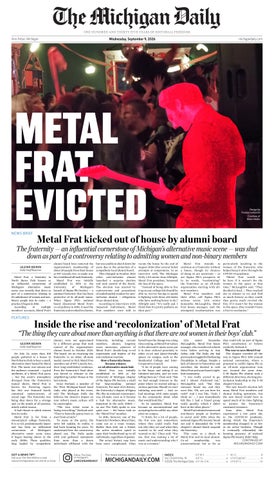
METAL FRAT EVICTED
Design by Frances Leibovich Courtesy of Glenn Hedin
Metal Frat kicked out of house by alumni board
NEWS BRIEF
The fraternity — an influential cornerstone of Michigan’s alternative music scene — was shut down as part of a controversy relating to admitting women and non-binary members GLENN HEDIN
Daily Staff Reporter
Metal Frat, a fraternity in North Burns Park known as an influential cornerstone of Michigan’s alternative music scene, was recently shut down as part of a controversy relating to it’s admittance of women and nonbinary people into its ranks — a practice it began in 2016. According to multiple members’ accounts, Metal Frat’s
FEATURES
alumni board have removed the organization’s membership of about 20 people from their house at 907 Lincoln Ave. to make way for a traditional all-male fraternity. Metal Frat was initially established in 1858 as the University of Michigan’s branch of Sigma Phi Society — a national fraternity that has been protective of its all-male status. When Sigma Phi’s national board discovered Metal Frat’s co-ed policies in 2019, it sued the fraternity and revoked its charter,
but was unable to shut it down for years due to the protection of a sympathetic local alumni board. This changed in October 2025 when anti-inclusion alumni launched a surprise election and took control of the board. The election was marred by controversies and accusations of underhanded conduct by antiinclusion alumni — allegations those alumni deny. According to interviews with impacted individuals, Metal Frat members were told to
vacate the house by the end of August 2026 after several failed attempts at compromise. In an interview with The Michigan Daily, LSA senior Juno Albright, Metal Frat president, lamented the loss of the space. “Instead of being able to live it up as any college kid should be able to, (we’re) having to spend it fighting with these old dudes who have nothing better to do,” Albright said. “It’s really sad. I think that it’s pretty pathetic on their part.”
Metal Frat intends to continue as a fraternity without a house, though its chances of doing so are uncertain — as are Sigma Phi’s prospects of, in its words, “recolonizing” the fraternity as an all-male organization starting with allnew members. Metal Frat members and their allies call Sigma Phi’s actions sexist. LSA senior Samantha McLaughlin, Metal Frat house manager, said the attempted recolonization was
particularly insulting to the women of the fraternity who helped keep it alive through the COVID-19 pandemic. “Metal Frat would not be here if it weren’t for the women in the space at that time,” McLaughlin said. “They decided to lead. … They reached out to alumni to try and find as much history as they could; they pretty much revived the frat. If it wasn’t for the women in the space, they wouldn’t have a frat to recolonize.”
Inside the rise and ‘recolonization’ of Metal Frat
“The thing they care about more than anything is that there are not women in their boys’ club.” GLENN HEDIN
Daily Staff Reporter
On July 24, more than 100 people gathered at a house in North Burns Park to hear a small, alternative show hosted by Metal Frat. The music was intense and the audience crammed — typical attributes of a Metal Frat party — but the event’s atmosphere diverged from the fraternity’s typical shows. Metal Frat is known for throwing ragers, but this one featured barely contained undercurrents of actual rage. The fraternity was being shut down for a strange and, in the minds of all present, utterly unfair reason. It had chosen to admit women into its ranks. Metal Frat is far from a stereotypical college fraternity. It is co-ed, predominantly Queer and has been an influential cornerstone of Michigan’s alternative music scene since it began hosting shows in the early 2000s. These qualities, long lauded by sympathetic
alumni, were not appreciated by a different group that took control of the organization’s alumni board in October 2025. The board, set on returning the fraternity to an older, all-male model, moved to kick Metal Frat members out of 907 Lincoln Ave., their long-established residence. Even the fraternity’s final show was forced to relocate to the neighboring Luther House at the last minute. Graci Darland, a member of the West Michigan-based band Judo, who played at the event, told The Michigan Daily she believes the closure’s impact on Ann Arbor’s music culture will be catastrophic. “The Ann Arbor scene is losing everything,” Darland said. “They’re basically gonna have to start from scratch.” To many at the party, the news felt sudden. In reality, it had been looming for years. To understand how the controversy played out, The Daily spoke with and gathered statements from more than a dozen individuals affiliated with the
GOT A NEWS TIP? Call us at 734-763-2459 or e-mail news@michigandaily.com and let us know.
fraternity, including current members, alumni, longtime scene musicians, pioneers of Metal Frat’s decade-long co-ed experiment and leaders of the anti-inclusion reaction. How a fraternity house became a Queer, co-ed alternative music hub Metal Frat was initially established in 1858 as the University of Michigan chapter of the Sigma Phi Society, a small but long-standing national fraternity. For most of its history, the University’s chapter of Sigma Phi, like its national counterpart, was all-male, even as it became a hub for alternative music. Sometime in the early 2000s — no one The Daily spoke to was quite sure — the house took on the “Metal Frat” moniker. In 2016, however, one of the fraternity’s brothers, Maya Chun, came out as a trans woman. Rather than kick out a friend, the active members opted to open their brotherhood up to all individuals, regardless of gender. The actual history may have been more complicated. Chun
Follow The Daily on Instagram,
@MICHIGANDAILY
herself says the change was a long time coming, as Metal Frat’s place in the alternative music scene put it in close cultural proximity to other co-ed and Queer-friendly spaces on campus, such as the Residential College and InterCooperative Council. “A lot of people were coming to the house and asking if we initiated non-men, and we were telling them no,” Chun said. “But we had enough interest to the point where we started asking a serious question: Should we start initiating non-men? … And we had meetings with some people in the community about what that would look like.” To its members, Metal Frat became an unconventional and accepting haven unlike any other place on campus. “I think, for a lot of people, the frat was just somewhere where they could really find out who they are and what they wanted to be and what they wanted to do,” Chun said. “For me, that was making a lot of music and understanding who I was as a woman.”
For more stories and coverage, visit
MICHIGANDAILY.COM
LSA senior Samantha McLaughlin, Metal Frat house manager, who transferred schools twice before arriving in Ann Arbor, told The Daily she had previously struggled to find lasting friendships in college. Despite a lack of interest in fraternities and sororities, she decided to rush Metal Frat and soon found a tightknit community. “I was really scared to go, and I almost chickened out,” McLaughlin said. “But then someone found me, and they were like, ‘Oh, are you here for rush?’ And I was like, ‘Yeah, I think so.’ … I just immediately felt like I had a friend group really quickly, which I didn’t have at the other places.” Metal Frat initiated women and non-binary people as brothers in secret until 2019, when the national Sigma Phi Society found out and it demanded the U-M chapter’s alumni board suspend the fraternity. This came as a shock to Metal Frat and its local alumni. Co-ed membership was unconventional, but as far as
they could tell, no part of Sigma Phi’s constitution or bylaws explicitly forbade it. The war to save Metal Frat The dispute traveled all the way to Sigma Phi’s 2019 annual national convention, where a proposal to codify Sigma Phi as an all-male organization won out. Around the same time, U-M Sigma Phi alumni took a different direction, electing proinclusion leadership to the U-M chapter’s board. The new board’s election left many Metal Frat members and alumni feeling optimistic, but the new board would have to spend much of its time fighting to protect the fraternity’s continued existence. Soon after, Metal Frat experienced a low point due to the COVID-19 pandemic, during which the fraternity’s membership dropped to as few as six active brothers. Though it eventually rebounded, the looming presence of national Sigma Phi Society didn’t help.
CONTINUED AT MICHIGANDAILY.COM
NEWS...................1 MIC....................8 INDEX A R T S . . . . . . . . . . . . . . . . . . . . . . . 4 S TAT E M E N T. . . . . . . . . . . . . . . . . . 9 Vol. CXXXVII No. 19 ©2026 The Michigan Daily O P I N I O N . . . . . . . . . . . . . . . 6 S P O R T S . . . . . . . . . . . . . . . . . . . 1 0
News
2 — Wednesday, September 9, 2026
PHOTO OF THE WEEK
The Michigan Daily — michigandaily.com
NEWS BRIEF
Ann Arbor teachers vote to ratify new contract
“We are still a long way from where we need to go.” DOMINIC APAP Daily News Editor
Students walk through Festifall to club booths around the Diag Wednesday afternoon.
FEATURES
Akul Gunukula/DAILY
Teachers from the Ann Arbor Education Association, the city’s union of public school teachers and staff, voted to approve the tentative agreement reached by the union and Ann Arbor Public Schools last week, the district announced Friday. AAPS teachers had been working without a contract since Dec. 31, 2025, and stopped completing unpaid tasks outside of scheduled hours like grading and responding to emails. The AAEA has since been fighting for increased wages to keep up with other school districts.
58% of AAEA members who voted chose to approve the contract, while 42% rejected it. About 83% of the membership participated in the vote. In an email to The Michigan Daily, AAEA president Fred Klein wrote that this deal marks a momentary victory but not a future-proof plan. The contract will end in December 2027. “Passing this TA is a step in the right direction — but we are still a long way from where we need to go,” Klein wrote. “A short-term deal is not a long-term plan. The District needs to demonstrate that it is planning for us — the teachers — in its initial budgeting priorities,
rather than continuing to make educators an afterthought.” Both sides had previously reached a separate tentative agreement in April, but 99.6% of AAEA teachers voted against it because the agreement would have maintained a 1.5% annual salary increase, decreased elementary teachers’ planning time, increased class sizes and capped contributions to healthcare. The new deal does not include some of the more controversial provisions from the April agreement — including reductions in planning time and increases in class sizes.
CONTINUED AT MICHIGANDAILY.COM
Northside Grill owner battles city over 20 inches of land
A land survey revealed that the building stands on top of about 20 inches of city property, leading to contentious negotiations with the city DOMINIC APAP Daily News Editor
For decades, the businesses on the block of Broadway Street between Swift Street and Moore Street have sat nested against the sidewalk — presumably right up against the property line. The block is home to Sic Transit Cycles in the former Anson Brown Building — the oldest commercial building in Ann Arbor which was built in 1832; the former office of Dr. Daniel Kellogg, a renowned physician; and Northside Grill, which used to house the Cloverleaf Dairy Farm. In 2023, Jim Koli, the owner of these buildings, wanted to renovate and make changes to the parking lots behind the Northside Grill. To do this, he needed to survey the land. The survey revealed something that would consume the next three years of his life — his businesses stand on top of about 20 inches of city property and encroach upon the
city’s public right-of-way. $78,000 in legal fees later, the issue has still not been resolved. In an interview with The Michigan Daily, Koli rejected the claim he is on city land and asserted that Anson Brown, the original builder, did not pass the property line, but at some point in the future, the city made a decision or error that extended the city’s claims to the land. “The city cannot point to when this happened,” Koli said. “The city cannot say, ‘This is when we did this and therefore took possession of your property.’ They didn’t even know about it till we surveyed it. … If it was a grassy knoll out here, I don’t care where the dogs pee or poop — they can have it, but it’s the walls and foundations of the buildings.” Koli argues his buildings could not have moved 20 inches since they were built. However, in an interview with The Daily, Brian Connolly, assistant business law professor, said the original developers could have erected the building before the city
determined the right-of-way lines on Broadway Street, or they could have accidentally built over the property line. “If we’re only talking about 20 inches, it’s probably the case that surveying methods have just gotten a lot better than they used to be,” Connolly said. “So the building may have been built in the 1800s when surveying wasn’t as good, and so somebody made a mistake, and it’s been sitting there for a long time.” He said cities typically settle disputes like these by granting encroachment licenses, allowing the city to maintain ownership of the land while the business continues using it. “There definitely are precedents in many cities where they will grant a license for a building encroachment, and the building encroachment might be there for 50 or 75 or 100 years, and the city doesn’t touch it because the city doesn’t really have any reason to try to knock down 20 inches of a building,” Connolly said. Koli said he began negotiating license agreements with the city
after trying and failing to receive a property line readjustment. He said he requested a copy of a license agreement in December 2024, but did not get a response from the city until August 2025. He said he realized he needed a more permanent solution since the city could revoke the license at any point. “Any settlement I come up with has to work for my bank, which means it has to work for the appraisers and has to work for title insurance, and things like licenses don’t work,” Koli said. “We need a permanent settlement.” Koli said he then pursued the rights to the property and sued the city of Ann Arbor, but the case was dismissed in January 2026 after the court sided with the city. However, Koli decided to appeal the decision and the case remains ongoing. Koli then proposed an easement, in which the city would maintain ownership of the land but, unlike the temporary solution a license provides, the property owner and future property owners would be able to
Nasen/DAILY
The storefront of Northside Grill on Broadway St.
use the space permanently. He said his proposal stated that, if he ever rebuilds any of the structures, he will push them back 20 inches to fit within the space he’s officially allowed. However, Koli said the city inserted clauses into the agreement about circumstances which would allow them to revoke the easement, such as property damage, making him unwilling to sign it.
“They took that page-and-ahalf, two-page agreement, blew it up over four pages, with all these clauses, ways that they could cancel the easement,” Koli said. “If I had signed that easement, if somebody ran into the side of my building here, under that agreement, I couldn’t rebuild it. I’d have to pull back the damaged part, the 20 or so inches.”
CONTINUED AT MICHIGANDAILY.COM
For the public good, Look to Michigan. Learn how the University of Michigan is turning research into real-world answers and putting knowledge to work for better health, better policy, and the public good across our state. For answers. For action. For all of us. Look to Michigan.
umich.edu/look
The Michigan Daily — michigandaily.com
NEWS BRIEFS
News
Wednesday, September 9, 2026 — 3
UMich seeks community feedback on AI policy draft
The University will accept feedback on policies proposed by the AI in Education Working Group until Sept. 17 CALEB OBICO
Daily Staff Reporter
The University of Michigan called for community input regarding a set of proposals for how to handle generative artificial intelligence on campus Thursday. The recommendations come from the AI in Education Working Group, which was established in December 2025 to investigate the role of AI in classrooms and provide policy suggestions. Feedback will be accepted through a community comment form until Sept. 17. The group’s objective was to offer strategic suggestions to the University based on faculty feedback, student surveys and a benchmarking study of AI approaches at other universities. In a report, the group outlined the challenges with AI and education.
“AI systems have been developed to speed up processes; learning requires processes that slow things down,” the report read. “To learn is to confront desirable difficulties and overcome them through productive struggle. … But it is in education that AI’s fundamental purpose to make things easier and faster poses a particular challenge.” The report made various policy recommendations, including establishing AI literacy training for students and faculty, creating an AI advisory board, setting up AI-free spaces for learning and avoiding AI-based surveillance. It also suggested taking different approaches to AI depending on the setting; it proposed that committees from different curriculums would decide specific policies that vary by school or program.
“The working group recommends that the University of Michigan approach generative AI through a spirit of deliberate experimentation, piloting diverse strategies, learning from what works, and scaling investment thoughtfully as evidence emerges,” the report read. “This iterative approach reflects U-M’s commitment to rigorous inquiry applied to its own institutional practices.” Gregory Teachout, director of communications and strategic initiatives in the Office of the Provost, wrote in a Sept. 3 University Record article that the University plans to collect community feedback about and to inform future University policies. “The principles also state that people, rather than AI systems, retain final responsibility for the decisions and outcomes associated
with their use of AI,” Teachout wrote. “Several implementation steps reflecting the principles and recommendations from the AI in Education Working Group report will begin during the 2026-27 academic year.” Teachout also wrote there will be school-specific adoptions of AI and experimental AI-competency programs throughout the upcoming academic year. “During the 2026-27 academic year, 20 courses will carry out pilot explorations to evaluate the integration of AI into a range of aspects of curricular activity,” Teachout wrote. “The pilots will provide opportunities to examine different approaches to AI-supported teaching and learning and build practical experience as schools and colleges develop their longerterm plans.”
Stanford Lipsey Student Publications Building 420 Maynard St. Ann Arbor, MI 48109-1327 734-418-4115 www.michigandaily.com
ZACHARY AJLUNI and EDITH PENDELL Co-Editors in Chief eic@michigandaily.com
CICI COPENHAVER
Business Manager business@michigandaily.com
NEWS TIPS
tipline@michigandaily.com
LETTERS TO THE EDITOR tothedaily@michigandaily.com
EDITORIAL PAGE
opinion@michigandaily.com
ARTS SECTION
PHOTOGRAPHY SECTION
arts@michigandaily.com
photo@michigandaily.com
SPORTS SECTION
NEWSROOM
sports@michigandaily.com
news@michigandaily.com
ADVERTISING
CORRECTIONS
wmg-contact@umich.edu
corrections@michigandaily.com
GOVERNMENT
Gilchrist and Ann Arbor politicians discuss civic engagement with College Dems “The whole state of Michigan needs you to step up and step in. If we need stuff to be less expensive, we vote for it.”
Editorial Staff ANNABELLE YE
Joshua Mitnick ’92, ’95 Managing Editor
bellaye@umich.edu
GEORGIA MCKAY
Digital Managing Editor
gmckay@umich.edu
AANYA PANYADAHUNDI and CHRISTINA ZHANG
Managing News Editors news@michigandaily.com Senior News Editors: Alexa Cheaney, Dominic Apap, Gia Verma, Quinn Mittlestat, Sarah Palushi, Sarah Spencer
NATHAN ENGMAN Daily Staff Reporter
Students gathered at the Michigan Union Thursday evening to meet Lt. Gov. Garlin Gilchrist, Michigan secretary of state candidate, and other local political officials. The event, hosted by College Democrats at the University of Michigan, featured conversations about data centers, housing, and the importance of voting. It included Gilchrist alongside Ann Arbor Mayor Christopher Taylor, Ann Arbor mayoral candidate Yousef Rabhi and Aidan Sova, an Ann Arbor City Council candidate for Ward 4. Gilchrist, a University of Michigan alum, has served as Michigan’s 64th lieutenant governor since 2019 under Gov. Gretchen Whitmer. He became the Democratic nominee for secretary of state after withdrawing his gubernatorial bid in January. Gilchrist’s campaign focuses on exposing dark money in politics, reducing inefficiencies in motor vehicle licensing and registration and protecting data from Big Tech corporations. In his speech to students, Gilchrist emphasized how important voting is, especially for young people, in achieving civic goals. “The whole state of Michigan needs you to step up and step in,” Gilchrist said. “If we need stuff to be less expensive, we vote for it. If we need housing to be more
ELENA NICHOLSON and GABE EFROS
Editorial Page Editors tothedaily@michigandaily.com Deputy Editorial Page Editor: Mateo Alvarez Senior Opinion Editors: Avery Allen, Maggie Berling, Madeleine Burke, Stephanie Bouserhal, Isabel Seniawsk
LYRA SHARMA and GRAHAM BARKER
Managing Sports Editors sports@michigandaily.com Deputy Sports Editor: Sophie Matthews Senior Sports Editors: Amanda Bergman, Niyatee Jain, Drew Lenard, Nate Schreck, Grace Wright, Hadley Zann
CAMPBELL JOHNS and CORA ROLFES
Managing Arts Editors arts@michigandaily.com Senior Arts Editors: Hudsen Mazurek, Abigail Weinberg, Tara Wasik, Ana Torresarpi, Meagan Ismail, Siena Beres
MAISIE DERLEGA and SELENA ZOU
Michigan Daily Photo Staff/DAILY Garlin Gilchrist, the Democratic nominee for Secretary of State, speaks at the mass meeting for College Democrats in the Union Thursday night.
available and more affordable, we vote for it. If we need to get tech out of our pockets and out of our lives, we vote for it. If we need to make sure that more people can vote, we have to vote for it.” Taylor followed, saying organizations like College Democrats play a pivotal role in increasing communication and highlighting policy priorities between local officials and students. “Do not sleep on local government and your ability to make an impact,” Taylor said. “We talk to students and when we want to know what’s going on, we
talk to College Democrats. They understand policy; they understand politics; they understand what can be done and how to get it done.” In an interview with The Michigan Daily, LSA senior Stella Camerlengo, co-chair of the College Democrats, said the organization aims to bolster civic engagement by improving transparency and visibility in politics. “One thing we want to do is create an experience where students are listening to their local leaders, but are also able to talk to them,” Camerlengo said. “We want politics to be as accessible as possible so that we can ensure
people are actually engaged and enthralled about politics, because politics doesn’t always have to be scary or boring.” In an interview with The Daily, Gilchrist said young people need to realize the power they possess over the government and country. “We need (students) to organize on campus and beyond,” Gilchrist said. “If young people don’t show up, those candidates will lose and the wrong people will win. … No system ever improved through disengagement. Nothing has ever gotten better from the perspective of young people when young people aren’t involved in shaking it.”
NEWS BRIEFS
DTE-funded group loses appeal to block Ann Arbor for Public Power ballot proposal The proposal would replace DTE as the city’s electricity provider
DOMINIC APAP Daily News Editor
The Ann Arbor Responsible Energy Coalition, a group fighting against the municipalization of electricity in Ann Arbor lost an appeal to block an Ann Arbor for Public Power ballot proposal Wednesday. The group has received at least $1.8 million from DTE Energy. This year, A2P2 led a successful petition that put a proposal for a city-run power grid to replace DTE Energy’s electrical utility on Ann Arbor’s 2026 midterm ballot. A2REC has been fighting against the ballot proposal, which would allow voters to decide whether the city should begin the process of transferring the city’s power supply to a system of collective ownership with a board to govern it. A2REC sued the city of Ann Arbor and the city clerk Aug. 10 in an attempt to block the ballot proposal, on the grounds of improper certification by the city government. The case first went
to the Washtenaw County Circuit Court, where Judge Patrick Conlin sided with the city and dismissed the case last week. A2REC appealed the ruling in the State of Michigan Court of Appeals and lost. While proponents of energy municipalization argue it would lower consumer costs and increase sustainable energy use, most of the current Ann Arbor City Council, including Mayor Christopher Taylor, oppose pursuing the idea right now because it would likely require the city to purchase all of the current equipment from DTE and endure a long period of litigation. In its lawsuit, A2REC argued A2P2 did not submit enough signatures for the ballot proposal. A2P2 had to submit 4,957 signatures, or 5% of registered voters in Ann Arbor, for the City Clerk’s Office to certify the proposal. A2P2 submitted about 5,130 signatures on June 22 and turned in about 1,600 more supplemental signatures on July 21 and July 27. After accounting for invalid signatures, the clerk’s final
count was 5,383 — well above the necessary threshold. However, A2REC argued the clerk should not have accepted the supplemental signatures in July, claiming that Michigan’s Home Rule City Act only allows cities to turn in signatures one time until enough are recorded. The court sided with the city, finding that the Home Rule City Act does explicitly permit the clerk to accept supplemental signatures, but it also does not require it to reject them . In addition to the dispute over signatures, A2REC argued the proposal was invalid because it wasn’t confined to a single subject, as is required by state law. The court argued A2P2’s proposed question “Shall Chapter 15 of the Charter be amended to require the City to establish a municipal electric utility and governance structure therefore?” only pertains to the topic of public power as a single subject. A2REC also claimed the proposal was invalid because it would revise the City Charter,
but the decision stated that the organization did not provide enough evidence for this argument. “The argument in AAREC’s brief filed with the trial court was barely one page long and included one citation to caselaw,” the decision read. “AAREC could not expect the trial court to unravel and elaborate its argument.” City Attorney Atleen Kaur wrote in an email to The Michigan Daily that she is happy with the court’s decision. “The City is pleased that the Court of Appeals upheld the Clerk’s canvass as compliant with the Home Rule City Act,” Kaur wrote. “The City always strives to provide best in class services compliant with the law.” In an email to The Daily, A2REC spokesperson Rudy Harper wrote that he still thinks voters will vote against the proposal in November, citing a DTE-commissioned research report from Charles River Associates.
CONTINUED AT MICHIGANDAILY.COM
Managing Design Editors design@michigandaily.com Senior Layout Editors: Frances Leibovich, Kathryn Palsrok, Junho Lee Senior Illustrators: Gabriella Spagnuolo, Emmeline Meldrum, Ella Flores Brosnan
BRIDGETTE BOL and HOLLY BURKHART
Managing Photo Editors photo@michigandaily.com Senior Photo Editors: Ananya Kedia, Arushi Sanghi, Isai Hernandez-Flores, Ava Farah
AYA FAYAD
Managing Statement Editor statement@michigandaily.com Deputy Editors: Oummu Kabba, Lola Post, Riya Kommineni
ALINA MURATA and JOSUE MATA
Managing Copy Editors copydesk@michigandaily.com Senior Copy Editors: Meagan Ismail, Claudette Johnson, Ayah Maskoun, Caroline Niccolini, Emma Oftedal, Zoey Ueland, Justin Xhelilaj
EMMA PENG and JULIA MEI
Managing Online Editors webteam@michigandaily.com Data Editors: Darby Jones, Zora Tucker Engineering Manager: Alyssa Locke, Grace Liu Product Managers: Annice Chang, Sanvika Inturi
EVAN KRUMMEL
Managing Video Editor video@michigandaily.com Senior Video Editors: Jovanna Gallegos, Samridhi Sharma, Grace Wright
AMARA M. SMALL and IHAA MOHAN
Michigan in Color Managing Editors michiganincolor@michigandaily.com Senior MiC Editors: Hilary Adjei, Amany Sayed, Allana Smith
HANNAH BODNAR and AVA HOOGTERP
Managing Podcast Editors podeditors@michigandaily.com Senior Podcast Editors: Rogen McLean, Zora Burroughs, Karina Shahinian, Olivia Dickerson
DA YOUNG KIM and UWAEISH AHMAD
Managing Audience Engagement Editors socialmedia@michigandaily.com Senior Audience Engagement Editors: Caleb Starr, Isabella Burke, Michelle Fang, Sophia Polega, Heewon Moon
SAYSHA MAHADEVAN, MAHEE KAVDIA and PUJITA RUPANI Culture, Training, and Inclusion Co-Chairs
accessandinclusion@michigandaily.com
LUCY LANGERVELD and TIFFANY MCKALKO
Managing Focal Point Editors lucykate@umich.edu, tmckalko@umich.edu Senior Focal Point Editors: Amaya Choudhury, Claudette Johnson
JAMES KNAKE and MILAN THURMAN
Managing Games Editors crosswords@umich.edu Senior Games Editors: Eleanor Sullivan, Kiran Parekh, Sam Martin, Tobin Saxton
Business Staff CAROLINE ZOLTAK
GABRIELLE GONDOLY
Marketing Manager
Sales Manager
KATE PARAMBO
MORGAN ORTH
Creative Director
Strategy Manager
The Michigan Daily (ISSN 0745-967) is publishing weekly on Wednesdays for the Winter 2026 semester by students at the University of Michigan. One copy is available free of charge to all readers. Additional copies may be picked up at the Daily’s office for $2. If you would like a current copy of the paper mailed to you, please visit store.pub.umich.edu/michigan-daily-buy-this-edition to place your order.
25 4 — Wednesday, September 9, 2026
28
29
30
Arts
The Michigan Daily — michigandaily.com
‘Henry Tudor Must Die’ is a freeing, feminist adventure 33 Daily Arts Writer
AMANY SAYED
“Just be happy when you can. And when you can’t, make your anger count.” At first glance, Jillian Laine’s “Henry Tudor Must Die” does not seem like historical fiction. With contemporary dialogue, a healthy dose of diversity and women at the forefront, Laine’s novel appears to be set anywhere but Tudor-era England. Despite this, HTMD is a reimagining of the six wives of Henry VIII told from the women’s perspectives with a sprinkle of magic on top. Aided by the Hellebore Sisterhood, a fictional secret society, the queens hatch a plan to exact revenge on Henry in a fashion that wasn’t possible in true history. Though the book might not be perfectly historically accurate — something Laine jokes should be apparent from the hot pink text on the cover — it is a delight to read. I caught myself laughing out loud at various points throughout the novel and thoroughly enjoyed the witty banter between the
39
characters despite — or maybe
few more meaningful moments
written in Old English. The rich character building and relationship development add to the quality of the story. Each queen — save for Jane Seymour, who dies early on — is given their time to shine as a fully developed character. We watch five unique women develop over the course of the book and bond over their common enemy, finding friendship and sisterhood amid all the terrible tragedies in their lives. Oftentimes, women are pitted against each other, both in fiction and in historical narratives like that of Henry’s six wives. It was refreshing to see them come together instead, which felt inspiring to me as a woman reading the novel. My only complaint with regard to the main characters is that we didn’t get to see more of them interacting. The novel has a lot of time jumps to account for the historical timeline and the characters traveling across the country. This led to long periods of time where characters were bonding off the page, which left me, as a reader, wanting just a
The book is in limited third person, switching perspectives between queens every other chapter. Marguerite, the leader of the Hellebore Sisterhood, serves as the narrator of the novel, and every few pages, she interrupts the story with a footnote either explaining a historical tidbit or making a snarky joke. As amusing as these footnotes were, the idea of having a side character serve as a narrator was distracting at certain points. I didn’t understand how Marguerite could have such an intimate knowledge of the inner thoughts of each character and everything that transpired, especially when she hadn’t witnessed the events firsthand. Ignoring these variables, HTMD ultimately succeeds as a historical fiction novel because of its political criticism. Beneath the magic and comedy lie sobering questions about our current governmental systems, the people in power and what they’re able to get away with. In the book, like in the 1500s, Henry consistently gets away with the very same crimes for which he sentences his
34thanks to — the fact that it wasn’t between the queens.
40
41
44
47
es
48
49
63
45
50
51
56
60
64
66
52
SABRINA ROSENSTOCK Daily Arts Writer
w
age
historical fiction and does well in all three genres. Marguerite’s last words in the novel are: “One day, women will rule the world.” I hope I continue to see other authors embrace this unapologetic feminist energy the way Jillian Laine has with her debut.
53
is one of hope for horror fans and aspiring auteurs. “Backrooms” lives up to its source material’s cult status in the found footage genre, using its uniquely abstract setting to great effect. In addition to the visceral thrills it provides, the titular Backrooms gradually reveal introspective elements of horror, functioning as an echo chamber for its inhabitants’ deepest flaws. Discovered in the basement of a furniture store, the Backrooms are a labyrinthine parallel dimension of unknown origin which mimics real objects and locations with uncanny accuracy. Its gorgeously realized sets (based on Parsons’s own 3D renders, with at least 27,000 square feet of carpet) are
simultaneously sprawling and claustrophobic — unnervingly long hallways are juxtaposed with cramped crawl spaces. Even sparsely decorated rooms are made disquieting by geometric anomalies like misplaced doors or randomly occurring inclines. The atmosphere of the Backrooms conveys the iconic fluorescent nightmare of the original mythos and, eventually, goes beyond by delving into the twisted logic of the dimension’s procedural generation. Parsons’s assured visual approach permeates the entire film; even shots outside of the Backrooms are suggestive of his larger ideas about how memories are distorted in isolation. Within the actual execution of the film, “Backrooms” knows
45. Layered honey dessert
“Backrooms” is a film defined by firsts. It is the culmination of a years-long internet sensation around the broader Backrooms mythos, which began as an unsettling piece of flash fiction on 4chan in 2019 and later-spawned director Kane Parsons’s own YouTube series. With a record-breaking box office performance, this is the first high-profile movie derived from internet-based intellectual property, and the first A24 release directed by a 20-yearold filmmaker. “Backrooms” was poised to alter Hollywood’s valuation of horror regardless. Thankfully, the film’s impact
48. Swiss city with eponymous conventions
49. All worked up 51. CC, perhaps
52. Drill sergeant's order
53. Ukrainian port city
1 1
2 2
3 3
4 4
5 5
6 6
7 7
15 15
8 8
9 9
10 10
11 11
12 12
13 13
16 16
14 14
15. "Don't ___" (1966 "Cabaret" 17 18 15. hit) "Don't ___" (1966 "Cabaret" 17 18 hit) 19 20 21 22 16. Make fizzy 19 20 21 22 16. Make fizzy 17. Abandoned 23 24 25 17. Abandoned 23 24 25 18. Gave, as flattery 18. Gave, as flattery 26 27 28 29 30 19. Napoleon's fighting force 26 27 28 29 30 19. Napoleon's fighting force 20. Grps. such as Doctors without 31 32 33 34 20. Borders Grps. such as Doctors without 31 32 33 34 Borders 35 36 37 38 39 40 41 22. The S of SOH CAH TOA 35 36 37 38 39 40 41 22. The S of SOH CAH TOA 23. Sea squawker 42 43 44 45 23. Sea squawker 42 43 44 45 24. Indonesian volcano that 24. spewed Indonesian volcano that sulfur dioxide in 46 47 48 49 50 51 52 53 spewed sulfur dioxide in 46 47 48 49 50 51 52 53 1883* 1883* 54 55 56 26. 1974 CIA spoof 54 55 56 26. 1974 CIA spoof 27. Builder of Curiosity? 57 58 59 60 27. Builder of Curiosity? 59 60 28. Like a ballerina using pointe 57 58 28. shoes Like a ballerina using pointe 61 62 63 64 61 62 63 64 shoes 31. H, to Heracles 65 66 31. H, to Heracles 65 66 33. Form a brown crust on 33. chicken Form a brown thighs,crust say on 67 68 chicken thighs, say 67 68 35. "It's so quiet you could hear a 35. ___ "It'sdrop" so quiet you could hear a DOWN 45. Layered honey dessert DOWN 45. Layered honey dessert 1. Desirable designer purses ___ drop" 48. Swiss city with eponymous 38. Circuits that both slow down 1. Desirable designer purses 48. Swiss city with eponymous 2. Get misty-eyed 38. electrical Circuits that both slow down conventions flow and store 2. Get misty-eyed conventions electrical flow and store energy: Abbr. 3. In a thin manner 49. All worked up energy: Abbr. 3. In a thin manner 49. All worked up 40. ___-de-France 4. "When ___ fails ..." 51. CC, perhaps 40. ___-de-France 4. "When ___ fails ..." 51. CC, perhaps 41. Hog haven 5. Hook's right hand 52. Drill sergeant's order 41. Hog haven 5. Hook's right hand 52. Drill sergeant's order 42. What Alice did to change in 6. Scoundrel 53. Ukrainian port city 42. size What Alice did to change in 6. Scoundrel 53. Ukrainian port city 7. Detroit Lions wide receiver St. 55. Dutch dough? size 7. Brown Detroit Lions wide receiver St. 44. Woodsy U-M area by the 55. Dutch dough? 57. Cash dispensers, for short 44. Huron Woodsy U-M area by the Brown River 57. Cash dispensers, for short 8. Japanese graphic novels Huron River 58. Café au ___ 8. Japanese graphic novels 46. Regarded in a certain way 58. Café au ___ 9. Roja or verde, e.g. 46. Regarded in a certain way 60. Surgeon Gawande who was on 9. Roja or verde, e.g. 47. Opposed to, in Appalachia 60. President Surgeon Gawande who was on 10. Drink with crumpets Biden's COVID-19 47. Opposed to, in Appalachia 10. Drink with crumpets 50. Type of sax PresidentBoard Biden's COVID-19 Advisory 11. Prayers 50. Type of sax Advisory Board 11. Prayers 54. American volcano that 62. Yoko from Tokyo 12. Projects, as light 54. blanketed American the volcano that Pacific 62. Yoko from Tokyo 12. Projects, as light 64. "The cake ___ lie" (Portal 13. School founded in 1440 blanketed the Pacific Northwest with smoke in 64. catchphrase) "The cake ___ lie" (Portal 13. School founded in 1440 Northwest with smoke in 1980* 14. Mathematician Descartes catchphrase) 1980* 14. Mathematician Descartes 56. Gave the final blow, in boxing 21. Animal also called a zebra giraffe 56. Gave the final blow, in boxing 21. Animal also called a zebra giraffe 57. Michigan college town in the 24. Natural talent 57. middle Michigan college town in the 24. Natural talent of the mitten 25. Skin-cleansing product middle of the mitten 59. Sch. for midshipmen 25. Skin-cleansing product 29. Meal starter? 59. Sch. for midshipmen 60. Without accompaniment 29. Meal starter? 30. Ending for trick or brew 60. Without accompaniment 61. Make alterations to 30. Ending for trick or brew 32. Rubbish 61. Make alterations to 63. Tombstone texts 32. Rubbish 34. Turing and Shepard 63. Tombstone texts 65. Oblong Pepperidge Farm 34. Turing and Shepard 35. ___ de deux 65. cookie Oblong Pepperidge Farm 35. ___ de deux cookie 36. "Make ___ double" 66. Italian volcano that gushed 36. "Make ___ double" 66. molten Italian volcano that gushed 37. Orthodontist's promise rock in 79* 37. Orthodontist's promise molten rock in 79* 39. Semiaquatic barkers 67. Shorthand experts, briefly 39. Semiaquatic barkers 67. Shorthand experts, briefly 43. Andorra's official language 68. Mythological boar huntress 43. Andorra's official language 68. Mythological boar huntress
bra giraffe
have to beg for basic human rights. While we’ve come a long way from Tudor-era England, it’s funny (in a depressing sort of way) that we could have anything in common with their women at all. Thanks to these small moments, HTMD succeeds as a satire along with fantasy and
Cover art for ‘Henry Tudor Must Die’ owned by Penguin Random House.
‘Backrooms’ is a terrifying trip inward
68
iver St. 55. Dutch dough? The Michigan Daily Crossword The Michigan Daily Crossword Sunday, September 6, 2026 — Puzzle by Eleanor Sullivan Sunday, September 6, 2026dispensers, — Puzzle by Eleanorfor Sullivan 57. Cash short ACROSS ACROSS 1. "Don't fall for it!" s 1. "Don't fall for it!" 9. Chipmunk or58. beaver Café au ___ 9. Chipmunk or beaver
es
wives to beheadings. These double standards are painfully apparent in the book, and they force us to look outward at the embarrassing ways they show up in the present. Near the end of the novel, Marguerite and former Queen Anne Boleyn discuss their hopes for a future where women don’t
60. Surgeon Gawande who was on President Biden's COVID-19 Advisory Board 62. Yoko from Tokyo
64. "The cake ___ lie" (Portal catchphrase)
when to shift gears; taking clear inspiration from “Barbarian,” time jumps and perspective shifts break up the frequency of its scares. Heart-pounding found footage segments in the Backrooms are interspersed with moments of quiet contemplation from the outside world, cooling the narrative momentum right when it’s on the verge of overheating. It’s a smart way of squeezing more story out of the film’s lean runtime, though it occasionally causes a disjointed sense of progression. This is a microcosm of the one major issue with “Backrooms,” which is its questionable grasp on character work. The inner lives of Clark (Chiwetel Ejiofor) and Mary (Renate Reinsve) are predictable and dull, a choice
that’s undoubtedly intentional but uninspired to the point that their dangerous trips to the Backrooms are almost exciting when they should be frightening. The rest of the cast, on the other hand, are barely characters at all. Phil (Mark Duplass), a scientist for the mysterious Async Research Institute, mostly serves to distract from the film’s most intriguing elements. Async’s presence also undermines the film’s otherwise steadfast avoidance of what Parsons calls “lore bloat,” providing logical meaning where emotional substance would have sufficed. The dialogue eventually takes an enjoyably pulpy turn in the third act of the film, but overall, the immersion is broken the
longer these characters are allowed to go on speaking in clichés. Whatever issues exist in the writing of the film are largely outweighed by its compelling imagery. None of the flaws are for a lack of trying; each scene is crafted with care by a director with a keen eye for visuals and the ambition to do more with this material than chase trends. In a crowded year for horror, “Backrooms” stands out as the work of a promising filmmaker who’s just getting started, a generation-defining exploration of how antisocial behavior is intensified by isolation and minimized by “therapy speak” and a landmark showcase of the possibilities of Internet-based horror.
‘Disclosure Day’ is a beautiful yet cumbersome message to humanity SAMUEL BROWN Daily Arts Writer
Steven Spielberg is, without a doubt, one of Hollywood’s most prolific filmmakers. If you tell the average person you have not seen the likes of “Jaws,” “E.T. the Extra-Terrestrial” or “Jurassic Park,” you might as well tell them you’ve never heard Journey’s “Don’t Stop Believin’.” These films are so ingrained within American culture that they are unlikely to ever fall out of it. At 79 years old, Spielberg has never lost his ability to cultivate heartfelt wonder through filmmaking, even in his latest projects. Despite our current cultural state of negativity, he seems to be one of the only filmmakers interested in happy endings. “Disclosure Day” could be described as an old man’s fantasy that, to some, may seem out of touch with current reality, but Spielberg’s unbridled faith in humanity is too endearing for modern pessimism to topple. “Disclosure Day” follows two people trying to tell the entire world that extraterrestrial beings exist and the American government has been lying about it for more than 80 years. The world is also on the brink of World War III, and society is at the ultimate point of fear, dissociation and hatred, filling the film with a modern commentary on our lack of true communication. It is at this breaking point these aliens decide to reveal themselves, orchestrating their arrival through two messengers, Daniel Kellner (Josh O’Connor) and Margaret Fairchild (Emily Blunt), with the hope of saving the world from destroying itself. Much like the inscrutable obelisk in “2001: A Space Odyssey,” the goal of these aliens is to supply man with what they describe as “the last step in evolution,” unrestrained empathy. “Don’t be afraid of what you don’t know” is the stinging mantra of the film. Empathy can stop wars, heal families and prevent us from fearing things we don’t understand — which in this situation is intergalactic beings. Their message is channeled
through the film’s two leads, who mysteriously gain differing powers of communication. Margaret possesses a psychic power to perceive others and instantly read who they are, grasp what the root of their problems is and supply a soulful solution. Daniel is gifted an adept knowledge of mathematics, which is used to steal the government’s hidden files on the creatures and translate their math-like language, allowing him to understand who they really are. Together, the two form a complementary partnership: One understands humans, the other understands aliens, creating the ideal bridge to share these beings — and the knowledge they carry — with the world. This goal is not without conflict, as they try their best to evade a top-secret government-funded company named Wardex, whose sole priority is keeping the truth about aliens sealed. It is led by Noah Scanlon (Colin Firth), who firmly believes that humans can not handle the truth about aliens. His journey of stopping our protagonists is filled with rage and poses the polar opposite of Daniel and Margaret’s sympathetic philosophy. Ultimately he does not trust humans with complete disclosure of information, as it would only cause more fear and division. In many ways, Noah’s a stand-in for our growing society that does not think this world is capable of change. This juxtaposition creates an interesting counterpoint to our characters and shows how the modern lack of hope can make one lose complete faith in humanity and lead them down a path of despair. The problem with mirroring our modern reality is it creates a level of inference in this film that, for many, will turn them completely off completely. The main one being, if our world is on the brink of destruction, why would anyone care about aliens? This creates a bit of a logistical gap that can lead to a lot of questions, holding people back from what the film is trying to say about our world’s lack of empathy. On paper, these plots sound overly complicated, but in
practice, the film intersperses its abundant ideas about war, government control, human understanding and religion with action sequences, preventing the story from becoming completely overwhelming. The film has so much it wants to get across about the world, even outside the aliens; in hindsight, some of it appears clunky, but it never detracts from your experience in the moment. The nearly two and a half hour runtime could benefit from being a bit more length. In its current state, it is nonstop from the very beginning, creating an imbalance in the movie’s sequencing, with some things favored over others in an attempt to maintain its fast pace. Most notably, the film seems primarily interested in Emily Blunt’s character, Margaret, and rightfully so, as this is by far Blunt’s best performance to date. Every scene where she uses her powers of understanding is a marvel of cinematic storytelling, once again placing empathy at the forefront. In several scenes, Margaret prioritizes the values of whoever she is talking to, bringing them to a level of comfort and understanding, drawing heavily from Christian theology and imagery to display her sensibility. Throughout the film, she never instigates violence and only empathizes with others to reveal what is bringing them anger or pain. In contrast, there is a lingering underdevelopment of Daniel’s character. Where Margaret has several lights-out moments, Daniel does not. This misses the one-two punch the movie is going for. He is left with much less to do and, as the film progresses, is blatantly sidelined. He possesses a quiet tone — in direct contrast to Margaret — which creates an interesting dynamic between the two, but it feels like a scene missing that could show their unbreakable bond. Daniel’s lack of spotlight places him in this odd in-between state of a main character and a supporting one, hurting this movie’s journey and straying from its message.
CONTINUED AT MICHIGANDAILY.COM
Arts
The Michigan Daily — michigandaily.com
Festifall 2026: Creativity flows from ‘Writer to Writer’ at the U-M literary journal AMANY SAYED Daily Arts Writer
There are many spaces for writers and creatives to flourish at the University of Michigan, and one such space is the Writer to Writer Literary Journal. Sponsored by the Sweetland Center for Writing, Writer to Writer is a completely student-run literary magazine on campus that publishes a virtual edition every fall and a print edition every winter. Writer to Writer allows students to publish their writing or art and provides a space for like-minded creatives to learn and grow together. In an interview with The Michigan Daily, LSA senior Harper Johnston, editor-in-chief of the magazine, said she is proud of the way the journal has grown since its inception in 2018. Within her own three years as a member, she has seen submission numbers increase from about 30 a cycle to almost 200. Johnston especially appreciates the way it fosters community among students. “Writer to Writer is really unique in that not only are we focused on putting out our journal every
semester, but we’re also really focused on building community and connecting writers on campus with programs,” Johnston said. Besides putting out a journal, Writer to Writer also hosts collaborations with other writing organizations on campus for projects and events. Every year, they team up with the Sweetland Center’s minor for writing to put on an Open Mic Night, which gives students the chance to perform their work to an audience. Despite its name, Writer to Writer is open to artists of all types and encourages students to submit whatever work they create to the journal for consideration. Johnston explains that Writer to Writer is always excited to see students submit unique art and aims to publish fresh, distinctive works. “(We’re) very unlimited with the type of work that we accept. We want to work with whatever format that the person is most comfortable in, that they want to present to us, so we’re not going to say, ‘Oh, well, you know, we’ve never published a choreography video before,’ or, ‘We’ve never published a podcast before,’”
Johnston said. “We’re going to say, ‘How can we make this work, and how can we include this work in the journal, because we think it’s interesting and unique and important?’” Getting involved with Writer to Writer is as simple as submitting work to the journal in the fall or winter. To work behind the scenes as a member of the journal, students only need to attend three of the club’s weekly meetings where students write together, share their work and read and evaluate submissions for publication. Johnston says students don’t need to worry about having any prior experience when thinking of joining. “(We’re) a very open club, which I think is really nice, because it kind of takes away that feeling of intimidation, of ‘I am not good at writing’ (or) ‘I’m not an English major … I don’t know what I’m doing,’” she said, “We have people from all across the board, from every major.” Writer to Writer is the perfect space for anyone looking to get into the publication industry, publish their art and writing or just have some fun outside class.
Photo courtesy of Writer to Writer Literary Journal.
Wednesday, September 9, 2026 — 5
Festifall 2026: Women’s Glee Club is the place for you
Photo courtesy of the University of Michigan Women’s Glee Club.
CHLOE JARRETT Daily Arts Writer
The Women’s Glee Club has been on campus since 1893 as a Soprano Alto choir. The WGC is both a class through the School of Music, Theatre & Dance and a club for other students outside of SMTD. Twice a week, members meet to practice for their formal performances, which occur two to three times per term with a flexible amount of involvement for club members. In an interview with The Michigan Daily, WGC President Julia Housey discussed the opportunities for the club. “WGC has many unique performance opportunities such as our annual tour, semesterly concerts in the esteemed Hill Auditorium concert hall, Winter and Spring Commencement ceremonies, SMTD’s Grand Night for Singing, hosting Women’s Vocal Arts Day every January for high school SSAA singers across Michigan and invitations to sing at official U-M tailgates, Michigan
Medicine’s annual Medical School Reunion, M-Housing events, U-M sporting events, official football tailgates and more,” Housey said. Outside of the club, the members host many social, outreach and educational events to foster connection and gain more members. “Amidst the chaos of college life, WGC has allowed me a constant tether to music and a community of wonderful, deeply kind people for whom that tether is equally as important,” Housey said. Currently, WGC has approximately 80 members, the majority of whom are non-music majors. “We exist for those who may not be pursuing music formally, but for whom it is undoubtedly special to remain connected to,” Housey said. WGC strives and succeeds in creating a welcoming environment where the most important goal is to enjoy creating music together. Each year, the club partakes in an annual tour, a highlight for many members.
The most recent locations the club traveled to were Ireland, New Orleans and Spain. During their visit to Spain this last May, WGC got the opportunity to attend a flamenco show in Madrid. After the show ended, WGC met with the performers and were asked to sing a piece. They chose a Mexican folk song, “La Llorana.” As they sang, one of the dancers unexpectedly began improvising. “It felt like we were suspended in time for those few minutes,” Housey said, “two groups of musicians from two parts of the world sharing their joys with one.” Throughout the ups and downs of college, WGC continues to be a creative outlet and connection to music for its members. The club has created a community of kind people where long-lasting friendships are prioritized. If you are looking for a space to escape from a hectic college semester and perform with a talented group of individuals, Women’s Glee Club might be right for you.
Madison Beer stuns in ‘locket’ tour TIFFANY MCKALKO Daily Arts Writer
On July 9, a small yet impassioned group of Daily writers took the 6 p.m. D2A2 bus to downtown Detroit to see one of pop music’s biggest names: Madison Beer. Being a fan since she was “supposed to be in the video,” I oozed with excitement to see an artist I watched growing up. When Madison finally took the stage, we were captivated, unable to pick our jaws up off the floor. Safe to say, we are glad to have stuck with her all these years and are amazed to see what an incredible artist and performer she has become. The concert officially started at 7:30, with an opening set performed by indie pop artist Lulu Simon and a another act by pop-R&B singer Thủy. Both openers were incredible and perfectly matched the locket tour vibe with their playfulness and romantic air. Madison’s set began at 9:30 with a video trailer displaying her in an amusement park of sorts, riding on a carousel and ferris wheel. The trailer encapsulated the joyous energy of the album and also introduced a swan motif that would be present throughout the rest of the show. As the trailer ended, Madison came out to “yes baby,” a sexy dance-pop song. It was the perfect opening to the concert, with everyone on their feet to the music and Madison’s fierce and captivating stage presence solidified from the first second. The rest of the concert continued in a similarly fantastic fashion, as she sang most of her songs live. Her performance of hit song “Selfish” from her debut album, Life Support was particularly electrifying; her live vocals were raw but unwavering and everyone in the crowd was silent in awe. She sang “you’re still everything” with a minimal backing track, further further demonstrated her incredible live vocals. This performance was my favorite of the night, as the emotion and grace she sang with brought multiple fans —
including myself — to the brink of tears. Her stage presence held throughout the show and during “lovergirl,” a song from her locket deluxe album, she commanded even more of the fans’ attention. At the beginning of the song, she walked off the stage to greet each of the fans in the front row, taking pictures, signing autographs and accepting gifts. At one point, a fan handed her a custom cowboy hat, and — after expressing her sincere gratitude — she wore it throughout the rest of the show, further showcasing her authenticity and love for her fans. That love was present throughout the show, as she constantly thanked the fans for being there and made it known she would not be where she is without their support. While those words may seem empty from other performers, her appreciation rang true, and her love was palpable in every moment of the show. While the raw vocal moments and power ballad performances were incredibly moving, the concert also exemplified Beer’s strong presence in the dancepop genre. Her performance of her Grammy-nominated song “make you mine” was absolutely unreal. The set and lighting design paired with her powerful dancing and explosive back track made those three minutes the most electric of the whole night. She used blinding strobe lights for the beat drop and a camera that followed her around,
making sure to capture every wink and iconic serve during the performance. Another amazing aspect of her show was its organization into three acts. Each act had a distinctive character, outfit and mood lighting, which made the whole performance feel like a story rather than a collection of random songs. The first act started light-hearted and playful, with a few sensual notes thrown in throughout. It then transitioned into a more deep and meaningful second act, with her changing into a flowy dress and dimming the lights for a moodier environment. The backing tracks for her songs were minimized, and her live singing talent was on display with a number of power ballads. The third act leaned back into the playful elements, with a few notes of confidence and seriousness. Throughout the show, it felt as though we went on a journey with Madison. She started off with a playful girlishness, which transitioned into a sentimental womanhood, and ended in a grounded and powerful final act that felt as though she had brought both elements together to establish a true sense of who she was. In only her fourth concert tour, Madison Beer performed to a packed Fox Theater and did nothing but impress. Every audience member was captivated by her incredible presence and talent, and I am more than excited to see her continued rise to the top.
Album art for ‘Locket’ by Sony Music Entertainment.
Opinion
6 — Wednesday, September 9, 2026
The Michigan Daily — michigandaily.com
Slacktivism doesn’t work Edited and managed by students at the University of Michigan since 1890. Stanford Lipsey Student Publications Building 420 Maynard St. Ann Arbor, MI 48109 tothedaily@michigandaily.com
EDITH PENDELL & ZACHARY AJLUNI Co-Editors in Chief
GABE EFROS & ELENA NICHOLSON Editorial Page Editors
GEORGIA MCKAY & ANNABELLE YE Managing Editors
EDITORIAL BOARD MEMBERS Zachary Ajluni Avery Allen Mateo Alvarez Maggie Berling Stephanie Bouserhal
Hayden Buckfire Madeline Burke Willem DeGood Gabe Efros Seth Gabrielson
Jovanna Gallegos Emma Margaron Elena Nicholson Isabel Seniawski Sarah Zhang
Unsigned editorials reflect the official position of The Daily’s Editorial Board. All other signed articles and illustrations represent solely the views of their authors.
UMich’s playbook in Ypsilanti Township isn’t that different from OpenAI’s in Saline Township ELENA NICHOLSON Editorial Page Editor
I
t’s no secret that Michigan has a data center problem. Developments are emerging across the state, thanks to tax breaks spearheaded by Gov. Gretchen Whitmer that exempted data center projects from the 6% sales tax from now until at least 2050. People on both sides of the aisle are angry for the same reasons. It seems as though the money data center developers possess provides unilateral power over local communities — often in rural or low-income areas. The Saline Township data center is what some might consider a blueprint: the poster child of the artificial intelligence tech industry — OpenAI — proposes a data center development, the township resoundingly rejects it, then OpenAI sues the local officials, drowning them in legal fees they can’t afford until they have no option but to let the data center project begin. The anger Michiganders are feeling is understandable. When I drove by the Saline Township data center, I felt it myself. It was just a few weeks after OpenAI CEO Sam Altman, Whitmer and a cabinet of upper-level AI executives posed together and broke ground on the project. The development’s doting nickname, “The Barn,” flashed mockingly on a temporary road sign. Already, the outline of the data center emerged from the scenery, splitting the landscape into two very different worlds. On one side, cranes arched into the sky and dust floated, suspended above a cavalry of construction trucks and equipment as well as the skeleton of the $43 billion project. Across the road, green farmland extended into trees. OpenAI was rejected by the local community, yet they built the project anyway. Despite pleas and protests from people across the ideological spectrum, the project went through. This push for the project proves that money and power can trump local politics and public opinion. Saline Township isn’t alone in facing injustice. Residents have been up in arms against the University of Michigan’s data center development in partnership with Los Alamos National Laboratory. While the University’s research-focused data center facility is quite different from the commercial one in Saline Township, it broadcasts the same idea: The people with money will ultimately succeed in accomplishing whatever they want, regardless of legal or political pushback. Following the final selection of the site for the data center at the corner of Bridge and Textile Road in Ypsilanti, the Aug. 18 township council meeting was filled with residents and local lawmakers expressing their discontent. In an interview with The Michigan Daily, University regent candidate Amir Makled echoed many of the locals’ concerns about the University’s misuse of power. “We’re spending a billion dollars of public University funds to build a data center that the community that’s being built on doesn’t want,” Makled said. “And so there’s a better use of our resources. And I think that we
have to have a lot more reflection on the decisions we’re making from the University level.” Ann Arbor mayoral nominee Yousef Rabhi also spoke in opposition of the Ypsilanti Township data center — an unusual thing for an Ann Arbor candidate to do, considering Ypsilanti is outside of the boundaries of the community he will represent. Rabhi noted that it was important to show up for the township anyway, because environmental issues related to data centers do not stay within boundaries. “Like we saw in Saline Township, with the data center there, consumers energy proposing to build a cogeneration power plant, the fumes from that plant would have gone over Ann Arbor and polluted our air,” Rabhi said. “You know, we need to be cognizant that it is going to have an impact on all of us.” Initially, the University attempted to maintain a guise of higher moral ground over projects like Saline Township’s data center. They refused — and still refuse — to call the project a data center because it would not be for commercial use; in their partnership with Los Alamos, they refused to disclose the use of the facility for nuclear research and they held relatively useless community forums. However, Ben Green, assistant professor of information and professor in the school of public policy who has researched data centers extensively, spoke to the similarity between Saline and Ypsilanti in an interview with The Daily. “The University is essentially acting like these companies,” Green said. “They’re kind of playing out the playbook of the big tech companies and coming in and holding these incredibly superficial and insulting public meetings. And, you know, clearly just overriding the sentiment of the community.” The University lost their public relations war. Though University officials maintain that it isn’t a data center, at a community meeting in January, several presenters conceded that the facility would function similarly. It was also confirmed that nuclear weapons research would be conducted there. The University has placated no one, and yet there are no established pathways for the township to halt data center construction. On Aug. 9, University leadership selected the final site for the data center — bordering South Hydro Park, the Huron River and affordable housing units. It is surrounded by several housing developments, and the access road to the park cuts through the edge of the property. People fish and walk along the Huron River, just a couple hundred feet from where the data center will be in their public park. It all makes for an utterly ridiculous site to build on. The property is in an area with the lowest opportunity index in Southeast Michigan — the University is imposing it on people who already face a dire lack of resources and opportunity. The site selection process alone showcases an obtuse lack of consideration for township residents, and the University’s lack of transparency has only perpetuated that disregard.
The controversial — yet entirely unsurprising — site selection comes after several years of conflict about where to put the data center. The feedback has overwhelmingly been that residents do not want this data center near their public park and the Huron River. Like the Saline Township project, lack of legal support has forced the local community’s hand. The University’s special zoning, tax exemptions and sheer resource differentials between the University and Ypsilanti Township exemplify a similar dynamic that played out between OpenAI and Saline. In many ways, the scale of the developments are very different, and their intended usages differ as well. However, some say this makes the University’s conduct surrounding this development worse than a private enterprise like OpenAI. The University is a public entity — which, to some, grants them the benefit of the doubt. But their conduct has resoundingly proved their unworthiness of public trust. In a statement from project lead and professor of engineering Dr. Steven Ceccio, he reassured The Daily that they have been communicating with the township government and its constituents. “With the site now finalized, U-M looks forward to collaborating with local leaders and residents to identify community projects and initiatives that deliver long-term, meaningful value to Ypsilanti Township,” the statement read. Residents remain unconvinced. They believe the University doesn’t care about them. Several of them are U-M employees themselves and testify to the University’s disregard for their wellbeing. Many are also members of Stop the Data Center and are working in groups to resist data centers across the state — especially Saline and Ypsilanti’s. One resident in particular, Sarah Brabbs, voiced her concerns and called on other residents to speak to U-M donors and students with influence. “We’re the many against the money,” Brabbs said. She’s right. This is a fight where the people with the money will do what they need to do to get past community members and local governments who lack the resources to fight back. In that sense, Saline and Ypsilanti Townships— two very different situational circumstances — appear one and the same. Ypsilanti Township Council Supervisor Brenda Stumbo is similarly dismayed with the University’s conduct, saying that she only received a phone call about the site selection after it had been published in The University Record. She pointed out a key difference between Saline and Ypsilanti Townships: Ypsilanti Township’s project isn’t a done deal yet, as construction has not begun. “There is still time to do the right thing,” Stumbo said. Community members are viewing the University’s project as an equally disastrous corporate venture to that which occurred in Saline Township. Given this sentiment, it is in the University’s best interest to reverse course on the data center and save face before this association leaves a permanent stain on its reputation.
KAI FARJO
Opinion Columnist
S
lacktivism is the practice of supporting a cause through low-effort online actions like sharing posts, signing petitions or participating in viral challenges. One of the most prominent examples, the Ice Bucket Challenge in the summer of 2014, turned slacktivism into a global phenomenon. More than 17 million people posted themselves pouring ice water over their heads on social media, and their efforts raised over $220 million for ALS research in a matter of weeks. The scale of that moment appeared as proof that slacktivism works. However, slacktivism’s viral structure actively discourages the sustained engagement that change requires, rewards oversimplification instead of accuracy and gives participants a sense of moral completion that makes them less likely to act in the future. Many who engage in slacktivism feel as if they have done their part and don’t need to pursue further contributions, which can decrease the likelihood of participating in future actions or causes. This phenomenon, called moral licensing, refers to the observation that people who believe themselves to have committed a good deed feel less obligated to act in a morally positive way in the future. When someone shares a post or participates in a viral challenge, they may experience a sense of moral completion that reduces their motivation to follow up with more demanding forms of engagement like volunteering or donating. Many people participating in the Ice Bucket Challenge made no financial contribution to ALS at all, yet the act of pouring ice water and posting the video produced a feeling of helping, despite the lack of further impact.
Selena Zou/DAILY
Slacktivism reduces the likelihood that people will take sustained, meaningful action. Slacktivism’s viral structure also actively rewards oversimplification, producing a bandwagon effect that harms the causes and communities it aims to support. Complex and nuanced accounts of political conflicts do not go viral, whereas simple hero-villain narratives do. Social media platforms rank content by engagement, favoring material that can be understood in a few seconds and produces a strong emotional reaction. This creates a structural incentive for activists and organizations to strip away context, flatten complexity and present difficult situations in whatever form is most shareable — regardless of whether that form is accurate or helpful. The Kony 2012 campaign by Invisible Children illustrates this well. The film presented a complex civil conflict in Uganda as a simple story of one evil man who needed to be stopped, primarily through the small intervention of Western audiences sharing a video on the topic. It went viral almost immediately, raising more than $30 million and generating millions of shares from people with no prior knowledge of the conflict. What the campaign did not show was that Joseph Kony, the warlord who the campaign aimed to bring to justice, had largely left Uganda years before the film was released. Moreover, their proposed solution of
calling for Western military intervention reflected a white savior narrative that centered American audiences as the heroes of an African problem, rather than the needed engagement with Ugandan communities and scholars. African journalists and academics pushed back against the campaign’s oversimplifications immediately, but their critiques did not reach the same virality. This shows that slacktivism can actively spread a distorted picture of the world and build mass consensus around that distortion, crowding out more accurate representations of the problems it claims to address. The harm here is that slacktivism’s viral logic made the oversimplified version of events more visible and more influential than the complicated truth. The strongest argument in favor of slacktivism is that it still generates substantial resources and initiates meaningful research. Online challenges and viral campaigns demonstrate an ability to bring in donors who have never contributed to a cause before, converting passive observers into active participants. The Ice Bucket Challenge is the clearest example of this broader claim: It raised over $220 million for a disease that was chronically underfunded. If slacktivism can do that, then dismissing it as ineffective ignores its capacity to produce financial outcomes.
CONTINUED AT MICHIGANDAILY.COM
Why is Reproduction a Religious Issue? September 22, 2026 4:00pm Rackham Amphitheatre Why is reproduction a religious issue? What can religious values teach us about reproduction, and what role, if any, should those values have in public policy and Lisa Harris personal health? This Director of Michigan Medicine’s new Center for History, Humanities, Arts, Social Sciences, conversation, part of the and Ethics in Medicine Samantha Woll Dialogues, brings together experts on religion, health, and law to discuss these issues before a public audience. The conversation will be moderated by Lisa Harris. Panelists will include Terri Laws, Laws whose scholarship focuses on the Associate ProfessorTerri and Co-Director of African and African American Studies at the University relationship between religion of Michigan-Dearborn and health; Rabea Benhalim, who publishes on abortion in Jewish and Islamic law; and Cara Rock-Singer, whose book, Gestating Judaism: The Corporeal Technologies of American Jewish Religion, shows how religious Cara Rock-Singer of Contemporary Judaism at tradition is transmitted through Assistant Professor the University of Michigan reproductive practices.
Rabea Benhalim Associate Professor of Law at the University of Colorado Law School
Opinion AI’s rulebook is being written without the scientists who could check it
The Michigan Daily — michigandaily.com
SETH GABRIELSON Opinion Columnist
O
n Aug. 4, White House officials gathered Meta, Nvidia, Microsoft, OpenAI and Anthropic to review a new government framework for evaluating powerful artificial intelligence models before they reach the public. These models are some of the largest and most capable AI systems, the kind that can write software, carry out multi-step tasks or uncover security flaws with little human direction. This developing government framework is meant to test those models for dangerous capabilities before release. Although gathering the companies that build these systems was the right call, they were the only people in the room — and a safety review written entirely by the companies being reviewed is not oversight. It is a suggestion the industry gets to approve. The companies belong there because they have significant
knowledge about their models. Very few people outside these firms fully understand how the newest models behave, and the government itself is still building the expertise to evaluate them. A regulator who does not grasp the technology writes rules that misunderstand how the systems work, banning harmless uses while overlooking genuinely dangerous ones — like a model quietly walking a user through building a weapon or discovering a flaw that cracks critical infrastructure. Excluding these companies would guarantee exactly that kind of failure — including their expertise is not optional. The issue is that industry was the only technical expertise at the table. The reported attendees were Meta, Nvidia, Microsoft, OpenAI and Anthropic, as well as a group of smaller firms. No independent researchers or university scientists were reported to have attended. The advisory body that shaped the framework — the President’s Council of Advisors on Science and Technology — now
Wednesday, September 9, 2026 — 7
includes the CEOs of Meta and Nvidia. When the only people who understand the technology are also the people who profit from selling it, no one can verify their claims. Even honest engineers cannot see their own blind spots, and a company has every reason to define “safe enough” as roughly whatever its current product can already do. This concern is not just hypothetical; independent researchers have repeatedly caught issues that companies missed. Third-party red-teaming — the practice of deliberately attacking a model to expose its weaknesses — has surfaced vulnerabilities in released models that the developers did not anticipate. In late 2025, a team of researchers tested 12 published defenses against common attacks, defenses their makers had reported as nearly foolproof, and broke most of them with success rates above 90%. The gap between what the companies reported and what independent testers found was enormous, underscoring the
problem with allowing companies to rely solely on their own testing. This is the same logic that governs every other high-stakes field. The U.S. Food and Drug Administration does not take a drugmaker’s word that a drug is safe; it weighs that data against independent trials. AI is a rare example in which we allow the builders to grade their own work. Independent researchers are not a hypothetical resource, either. Universities and public labs already run exactly this kind of evaluation, and the industry knows it works. In July, Microsoft itself began funding 18 university labs to hunt for failure modes that its internal teams were unable to identify on their own. The company stated that external safeguards are necessary to manage frontier AI risk. If the most powerful firms in the field concede that outside researchers catch problems they cannot, a government safety framework built without those researchers is missing its most important check. The strongest objection to researcher oversight is that it
Dear University of Michigan Hillel: I am a part of the Jewish community too GABE EFROS Editorial Page Editor
JOHN ROGAN Opinion Columnist
A
t the end of the 1980s, one of the most influential American cartoons aired for the first time: “The Simpsons”. Homer Simpson, the American everyman, works as a nuclear technician at the iconic Springfield Nuclear Power Plant, whose two nuclear cooling towers are always visible in the memorable intro of the classic cartoon. That’s the dream I want to realize in America’s immediate future. The country needs a nuclear infrastructure revolution, where cities and towns alike are powered by nuclear reactors. Large cities are equipped for standard large-scale reactors, and substantial infrastructure investments in small modular reactors and microreactors can power cities and towns across the nation. With this kind of investment, the United States could have a renaissance of job creation and sustained economic growth spurred by government research and development. This change to nuclear power is needed now more than ever, with fossil fuels creating a climate crisis through dirty energy
Isabel Pohrt/DAILY
about it are dwindling fast. Hillel boiling down who belongs in their community to an individual’s opinion of Israel denies many people from being a part of our campus’ Jewish community. But continuing to shrink the tent of people they consider as having the “correct” opinion on Israel is one made with poor judgement and no foresight. This dominant philosophy will backfire immensely, leaving every Jew to feel the effects and reveal a larger inability to deal with antisemitism at home. By connecting with organizations based on their stated position on Israel, Hillel is becoming less of a conduit for Jewish congregation on campus and more of a pro-Israel one. In contrast, J Street is an explicitly Jewish organization. The difference between them and Hillel is that J Street is simply not as pro-Israel as Hillel. They even endorsed the Block The Bombs Act, which would have limited offensive weapon sales to Israel. In fact, they are one of the biggest organization representing leftwing, pro-Israel Jews in the
production and the cost-of-living crisis bleeding into energy prices. The United States power grid is ill-equipped for rising energy demands. Renewable energy sources like solar, wind and hydroelectric are helpful buttresses to the fossil fuels that power the majority of the U.S. grid, but these renewables are an intermittent power source. So, without large-scale battery energy storage systems, we lose the ability to power the grid on demand, which is a known strength of fossil fuels. We could supply the entire U.S. with sufficient power using less than 1% of the country’s land covered in solar panels; however, the country would have no power when the sun stops shining. Nuclear power is the alternative the U.S. isn’t investing in, but needs. The U.S. is the second-largest emitter of carbon dioxide per year, only behind China. This stems from the American grid’s heavy reliance on coal and natural gas. There is one cleaner alternative to natural gas and coal that also checks the box of on-demand power: nuclear. Nuclear power plants functionally work the same as fossil fuel-powered plants; In a fossil fuel-powered plant, burning fossil fuels is
entire country. An organization that exists for the entirety of the Jewish community on campus, and not just ardent supporters of Israel, should have no problem partnering with J Street. Hillel, despite continuing to brand itself as such, is not that type of organization. Their website clearly spells out their mission: “to cultivate an inclusive, supportive, and dynamic Jewish community that fosters the growth of each and every Jewish student.” With the recent decision to end their relationship with J Street, Hillel has failed their very goal. To outside observers, then, it seems as though being a Zionist is a necessary condition for being a part of the Jewish community as a whole. The obvious problem here is that this is not true. One can be Jewish and not pro-Israel. Hillel has thus maintained this false axiom, working to further conflate Judaism not only with Zionism, but a close-minded Zionist ideology that shuns disagreement and turns inward when faced with diverse viewpoints.
CONTINUED AT MICHIGANDAILY.COM
companies being reviewed. Representative Valerie Foushee of the House Committee on Science, Space, and Technology has already argued that academia and civil society need a say in how AI is governed. Even an industry executive, Appian CEO Matt Calkins, has warned that keeping the framework private creates a small group of insiders while shutting everyone else out. This framework will shape how the most transformative technology in a generation is allowed to enter public life, and the students graduating now will spend their careers inside the economy it reshapes. The rules are being written this month, by the five companies with the most money riding on the outcome, in a room they built for themselves. Getting the composition right — expertise and independence together rather than expertise alone — is not a nicety. It is the difference between a technology governed in the public interest and one governed by the people who profit from it.
Let’s redefine patriotism MAXIMUS CRAIG Opinion Columnist
I
I
n late August, the University of Michigan Hillel, our University’s branch of a larger organization dedicated to fostering a diverse Jewish community on college campuses across the country, cut ties with the University’s chapter of J Street. The selfdescribed Jewish and proIsrael organization lost Hillel’s support for continuing to associate with their parent lobbying organization that goes by the same name. This decision sends an aggressive (and wholly inaccurate) message from hardline pro-Israel Jews to the larger Jewish American society: The Jewish community cannot tolerate diverse perspectives on Israel. This implies that someone like me, who is both Jewish and does not support Israel’s genocide in Gaza, may never be included in the broader Jewish community. To be clear, I do not share J Street’s broader opinion of the Middle East conflict. They describe themselves as pro-Israel — I would not. Nevertheless, they represent a longstanding faction of Jewish Americans who understand that America’s relationship with Israel, and Israel’s relationship with Palestinians, must change. For Hillel, this seems to be too much. But what Hillel fails to consider is that, according to some polls, a staggering 45% of secular American Jews do not describe themselves as Zionists. Whatever you think about Israel, the fact of the matter is that those who share the hardline opinion
would slow processes down, since academic review is famously slowpaced and AI moves fast. But that objection misreads what the framework is. It is not a product being shipped on a deadline; it is a government standard whose entire purpose is designed to prioritize caution, with its authors spending months developing it. Independent expertise does not require bureaucratic delay in any case. University and national laboratory researchers already work on classified, time-sensitive problems in nuclear weapons and biosecurity, fields at least as urgent and far more dangerous. The deeper problem is that the framework is being kept secret and voluntary. Standards are developed without outside guidance and are simultaneously prevented from receiving outside criticism. The fix is straightforward. Congress should require that any federal body reviewing frontier AI include independent technical experts from universities and public research institutions, not just representatives of the
n light of the United States’ 250th anniversary, many have expressed a variety of feelings about the current state of our country. Americans have evaluated the first 250 years of the nation’s history and speculated as to where it will go next. Though the Fourth of July was widely celebrated, many understandably feel that there was little worth celebrating in the U.S., and as a result, did not feel patriotic. In fact, patriotism can even appear dismissive of the financial or social struggles many Americans face. It may even come across as an endorsement of the country or its government whose messaging has conflated patriotism with partisanship and nationalism. It’s important for us to be mindful of the truth that these feelings aren’t new. Since 1776, our country has been imperfect. And while it remains imperfect, we have made great strides, too. Patriotism — devotion to one’s country — should acknowledge this. But to love one’s country is to embrace these imperfections and appreciate the progress we have made, not to uncritically accept political leadership or dismiss a complicated history. This definition of patriotism as a commitment to progress is not the same as unconditional support of one’s country. This is true under any government or presidency, but it is especially relevant right now. Unconditional support of one’s country has led to a presidential administration that has shown blatant disregard for election results, transparency, the judiciary, minority groups and immigrants. This administration has politicized science, once-
nonpartisan executive agencies and, as it happens, the very notion of patriotism itself. We must reject the dangerous precedent this sets. Claims to patriotism should not be reserved for those who support a certain politician, party or policy. The essence of being American is not political allegiance; it is to be granted the promise of life, liberty and the pursuit of happiness, as well as to play one’s part in bettering the American experiment. The U.S. is a republic with democratic features, meaning we have a right — a responsibility, even — to make our voices heard. Furthermore, it’s important to recognize the vast privileges that come with being American, ones that allow us to uphold that responsibility. Of course, not every American enjoys the same amount of privilege; to this day, the disparity of privilege between races, genders and economic classes remains, as seen in wealth gaps, incarceration rates, housing and education access. At a worldwide scale, however, Americans have access to certain freedoms that are far from globally universal. For example, freedom of speech, the right to protest and due process are not globally omnipresent. In countries that have elections, not all are fair and free; there are a number of places led by authoritarian figures who withhold democratic and economic freedoms. We should recognize these freedoms. In appreciation of how far we have come in 250 years, it is time to define patriotism as a commitment to progress: civil rights, social justice and economic opportunity. While Americans are relatively privileged, there is truth to
American democratic backsliding — declining democratic integrity within a political system. This is seen when the Supreme Court defers to President Donald Trump’s whims, partisan gerrymandering sweeps across the country, disinformation ferments in stratified media spaces, election denialism rises and political power concentrates in the hands of the wealthy. As Trump vilifies journalists and targets political dissenters via executive agencies, it’s necessary to call out the imminent dangers. To this end, we should use our existing freedoms to prevent such a descent while using patriotism as an avenue for criticism. To recognize certain privileges is not incompatible with a desire for better; in fact, having this wider perspective might better serve future progress. An illustrative case in point: It may surprise some to know that immigrants, on average, express more patriotism and have more faith in American institutions than U.S.-born Americans. This is despite the fact that immigrants in the U.S. face an immense amount of xenophobia and are often scapegoated for whatever issues the country faces. This apparent contradiction may be resolved by the fact that immigrants have a benchmark of comparison. In coming to the U.S. in pursuit of economic opportunity or in escape from persecution, there is more understanding of the wider context the U.S. belongs in. While some might deem patriotism inappropriate for Americans to exercise, it’s also insensitive to dismiss the patriotic sentiments of people — such as immigrants — whose pride can be justified.
Soviet engineers didn’t create a proper failsafe for cooling the reactor and were testing whether residual power from the steampowered turbines could drive water pumps to cool it. In the Fukushima Daiichi accident, a tsunami temporarily disabled the plant and radioactive material was released, but no deaths have been attributed to radiation sickness from the accident. The Three Mile Island accident resulted from a cooling malfunction, but no injuries or
health issues came from it. In fact, now the Three Mile Island nuclear plant is being restarted to power a Microsoft data center. The United States has strong guardrails in place; there are high regulatory standards that must be cleared for a plant to operate, including fuel standards that give longer response time in the event of power failure — which is what led to the aforementioned nuclear accidents.
CONTINUED AT MICHIGANDAILY.COM
The nuclear problem
the mechanism to generate pressurized steam. With nuclear plants, fission is used to boil water and generate pressurized steam to spin a turbine that generates power. While the fundamental processes — heat creates steam that turns a turbine to generate electricity — behind nuclear and fossil fuel plants are identical, opposition to nuclear power comes from the United States fossil fuel industry. This industry is worth approximately $1.61 trillion, suggesting that there are huge amounts of capital behind lobbying the government to favor fossil fuels. Despite the moneyed interests fighting energy alternatives, the research is clear: Nuclear is by far the most reliable form of energy production. Unfortunately, it isn’t just capital investors who fight the development of my vision of a nuclear paradise; around half of Americans have not yet bought in. Four words stand in the way of this energy revolution in America. Those four words are “not in my backyard”. Polling data shows that the majority of Americans favor the use of nuclear energy in the grid; shockingly, the partisan divide shows that republicans and independents strongly
Ella Flores Brosnan/DAILY
favor nuclear initiatives while democrats sit below 50%. Regardless of the polling data, Americans like the idea of nuclear power until the plant goes up near their home. They fear what the adverse health effects will be if there is an accident at these plants. Historical events such as the catastrophic Chernobyl disaster have been ingrained in many people’s minds when they think of nuclear energy, yet that reactor had flawed designs.
CONTINUED AT MICHIGANDAILY.COM
MiC
8 — Wednesday, September 9, 2026
The Michigan Daily — michigandaily.com
Iran; the lost art of nuance NADIA JAHANBIN
Michigan in Color is The Michigan Daily’s section by and for People of Color. In this space, we invite our contributors to be vulnerable and authentic about our experiences and the important issues in our world today. Our work represents our identities in a way that is both unapologetic and creative. We are a community that reclaims our stories on our own terms.
Promise of blue horses ZAINAB HUSEIN MiC Assistant Editor
04:53 a.m.. There are nearly five hours left until my flight lands in Istanbul. My book is boring me, and my body feels restless. I tap the television screen in front of my seat for probably the hundredth time now; it doesn’t help my impatience. A little girl is crying in the seat across from me. I’m not sure of her age, but she seems to be about six years old, maybe seven. Her father appears to be a patient man. He speaks to her gently in Turkish, and she calms down. The turbulence has gotten quite bad, but she does not seem anxious. They hold hands with one another, and she laughs at his attempts to humor her. As I observe them, I am reminded of the ending of a poem I reread recently by Joy Harjo: “The heart is constructed of a promise to love. As it distributes the blood of memory and need through the body its song reminds us of the promise—a promise that is electrical in impulse and radiation.” “Promise of Blue Horses” is one of my favorite poems. In observing small moments such as these, I am reminded of it. The poem’s central thesis — that we as humans hold in our hearts an unbearable need to love one another — is beautifully captured in Harjo’s prose. As I sit here alone, thousands of miles away from everyone I love, I try not to contemplate what this love for one another means too deeply.
I am not successful. How do we truly determine what it means to love? Does it not mean something different to each of us, or is there a universal form — a root of sorts — for love? Might love truly be defined by the actions we take in pursuit of caring for one another; the very actions that make up our lives? I think of my little brothers running out of the garage and jumping in the car to hug me before my flight earlier today. My mother cooking Fesenjoon in a rush so I can eat before leaving, despite her unwillingness to let me leave in the first place. Parking the car to check my baggage in with me. Texts and calls wishing me a safe trip. Dala — a friend from high school whom I haven’t seen in six years — taking the day off and coming with her uncle to pick me up from the airport in Istanbul. I think of fleeting interactions with strangers. On my last shift at CVS this week, a patient called the pharmacist and me angels, then thanked us profusely for simply doing our jobs. It had been such a long and grueling day, but seeing him smile as he left with the medication he needed was why I ultimately left the pharmacy with a smile as well. That night, I thought back to Harjo’s prose once again. “I can’t calculate how the earth tips hungrily toward the sun – then soaks up rain — or the density of this unbearable need to be next to you. It’s a palpable thing — this earth philosophy and familiar in the dark like your skin under my hand. We are a small earth.”
Unbearable. The need to love. To be next to you, at times. Is this not clearest through the way the actions we take make us feel; unbeknownst to us, this underlying need? How making one another laugh feels as if it’s a grand accomplishment. How we seek out every chance to be in proximity to one another. How I forget what sadness feels like whenever I do happen to be in your vicinity. How I long to hear your voice. The way I find myself wishing time would come to a pause when we are together. Sadness, a mere afterthought, and laughter inevitable when I am with you. Is this not how all those who love come to feel? A root of sorts, is it not? “Laughter and sadness eventually become the same song turning us toward the nearest star – a star constructed of eternity and elements of dust barely visible in the twilight as you travel east. I run with the blue horses of electricity who surround the heart and imagine a promise made when no promise was possible.” 5:00 a.m. I think again of the promise. A promise of blue horses and hearts that are constructed to love. It might be best to attempt to be productive and get some work done before the flight lands instead of sitting here contemplating this topic endlessly — love. Although, before I leave this tab, if there is one message I do want to remember to write down: Do not forget. All these small moments that seem to pass us by in our lives? They are a testament to the love we hold in our hearts for one another. Don’t forget.
MiC Assistant Editor
Home. A fragment of a sentence. Fragments of fields, pieces of a place. How can you have nostalgia for a place you’ve never been? For a language that struggles to sit on your tongue because you cannot plant your feet in the soil its syntax grew out of. My mother tells me stories about Iran so acutely, I’ve lost my own hearing in the crowds of Tairish Bazaar. I’ve touched the chipped paint of stairwells and courtyard gates. I let mulberries and sour cherries stain my fingertips before we turned onto her street. I ran alongside her and her siblings through narrow alleys still glowing long after sunset. I’ve even sat by her side as she counted tomans at the kitchen table while her father watched patiently. The feelings echo in my body so strongly, I swear the memories are my own. I want them to be. Maybe I’ve inherited them the same way I did my mother’s genes. Since I was a child, I’ve repeated the same sentiment I write now as a college senior: I want to go home. Well if these sentiments are as strong as I contend they are, then is “go” the right word? Dare I say I want to return home. Yet, when I share my deep yearning, I’m met with shame, confusion or both. People interrogate me: Is it safe? Why would you want to go there? As if longing for my country is controversial. Various orientalist narratives reduce one of the oldest and most beautiful countries to sand dunes, to bombs, to — nothing. It’s like asking why you would want to be held in your mother’s arms. Why wouldn’t I want the hums of Persian poetry that already flows through my blood to have a heartbeat? Often, I find that the more news we are fed about Iran, the more Iran itself becomes obscured from my mother’s memory, and other Iranians’ lived experiences. Its centuries of people, history and culture are collapsed into a regime less than 50 years old, filtered through political propaganda
and narratives that leave little room for anything else. These misconceptions have followed my parents as they tried to assimilate into America, as they were spat on, assaulted, ridiculed and told to “go back home” — as if home wasn’t the very thing they prayed for every night. When war broke out this year, these misconceptions only hardened. They influenced a new false binary: pro-regime or proimperialism, as though those are the only two positions available to us. They aren’t. Imperialism can be opposed without defending a regime that has stripped its people of their freedoms, imprisoned them and killed those who demand a different future. We can condemn the Islamic Republic of Iran without resorting to Islamophobia or imagining the West as Iran’s salvation. And we can recognize the regime’s use of religion as a tool of tyranny without reducing Islam itself to oppression. My mother and her family were Muslim, and they still had to flee after the Iranian Revolution. Their faith did not protect them from persecution, nor did it spare them from having to leave the country they loved. The Islamic Republic’s oppression is not an honest reflection of Islam. Rather, it is the work of a government that weaponizes religion to legitimize its violence and silence dissent. These truths are not mutually exclusive, yet they are so often treated as they are. Many Iranians I’ve spoken with understand this nuance, but their voices are
seemingly drowned out by those who lean furthest into these extremes. Somewhere along the way, we’ve lost the art of holding two, if not multiple, truths at once — the art of nuance. Instead, we’re pushed to choose one side of a story, further dividing us rather than encouraging us to understand the whole. This loss of nuance has come at the expense of educational humility. We’ve become more interested in defending our beliefs than expanding or questioning them. I’m not immune to it either. Even as I write this, I feel compelled to explain every nuance, every contradiction, afraid that if I leave something unsaid, that I’m doing my country a disservice. But no one person can carry the burden of explaining it all. We have to be willing to relearn this art with open minds. I can’t tell you what every Iranian thinks, wants or believes. But they deserve the right to respectfully express it without fear. My mother’s memories were never of a perfect country, but one full of contradictions of hardship and harmony. Still, I want people to see Iran through her eyes. The Iran that lives in Persian poetry, in centuries of art and resilience. Where Cyrus the Great authored one of the earliest known charters of human rights, rights that so many Iranians are denied today. I want Iran to be known for what it has given the world, not only reduced to what its government has taken from its people. Like living in my mother’s stories, or being held in her arms — I want to go home.
Courtesy of Mehry Bagheri.
The Michigan Daily — michigandaily.com
STATEMENT
Wednesday, September 9, 2026 — 9
Kretek hands TIFFANY SUDIJONO Statement Columnist
In Kudus, before the call to prayer has finished unspooling over the rooftops, the women are already seated. Long wooden tables stretch beneath tin awnings, each one crowded with shallow trays of shredded tobacco and cloves dried to the color of rust. The air smells sweet before it smells sharp — that particular scent of clove oil warming under morning sun, mixing with kretek smoke drifting in from somewhere outside where the men take their coffee. Radios murmur dangdut from cracked speakers propped against the wall. Somewhere, a baby cries and is hushed. The women do not look up. Their hands are already moving, folding thin rice paper around loose tobacco with a motion so practiced it looks less like labor and more like breathing. A small brown cigarette taking shape between thumb and forefinger every few seconds, then another, then another, the pile beside each woman growing taller than the last. I did not grow up in Kudus. I grew up hearing about it, the way children hear about places that shaped their family before they were born, secondhand and half mythical. My great-aunt worked as a buruh linting for years, rolling kretek by hand in one of the small home industries that once dotted the town by the hundreds. Her experience was far from unique. For over a century, the work of hand-rolling kretek in Kudus has belonged almost entirely to women. Today, women still make up the overwhelming majority of workers in the handrolled cigarette industry, a fact so consistent across generations that it has come to feel like an inheritance. Kudus itself grew
into Indonesia’s kretek capital: first as a cottage trade practiced in home kitchens in the late 19th century, then transformed by the entrepreneur Nitisemito in the early 20th century into a mass industry that at its peak employed tens of thousands of workers, most of them women, bent over trays like the ones my great-aunt worked over. What strikes me most, listening to my mother describe her aunt’s hands, is not the speed of the work but its rhythm. A skilled roller can produce hundreds of cigarettes in an hour without once glancing down, her fingers reading the tobacco the way a pianist reads keys they have touched a thousand times before. This is not unskilled labor, though it is often paid as if it were. It is a craft passed from mother to daughter to granddaughter, taught not through instruction manuals but through years of sitting shoulder to shoulder, watching a wrist twist just so, feeling a mother’s palm guide a child’s smaller one around the first clumsy roll. My great-aunt once told my mother that she knew she had become a real roller not when her cigarettes stopped falling apart, but when she stopped having to think about them at all. The tobacco simply became something her hands understood. There is a particular kind of intimacy in labor that moves through a family like this, skin against skin, generation folded into generation. I think of the women I have watched at wet markets in Pluit, their forearms dusted with turmeric, teaching daughters to tell apart a ripe mango from an unripe one by smell alone. I think of my own mother’s hands, learned from her mother, pressing eucalyptus oil into my chest when I was sick as a child, a gesture inherited without ever once being written down.
Ella Flores/DAILY
Kudus’s mothers pass down kretek rolling the same way — not as an occupation chosen from a list of options, but as a body of knowledge lodged somewhere between muscle and memory. And yet, I do not want to romanticize what romanticizes easily. The women who roll kretek by hand often work 12-hour days for wages that have not kept pace with inflation, in factories that offer little in the way of health protections despite the tobacco dust that settles into their lungs over decades. Many began this work as teenagers, some younger, pulled from school when the family needed another income. The same intergenerational transmission that gives the craft its dignity also traps daughters inside their mothers’ circumstances, an inheritance of skill that is also, quietly, an inheritance of limited
choice. Machine-rolled cigarettes have eaten into the market once dominated by hand-rolled kretek, yet factory owners defend their hand-rolling tradition publicly, citing the jobs it preserves while paying rates that keep those same jobs precarious. It is possible to hold both truths at once. The work is skilled, generational and worthy of reverence. The work is also underpaid, physically punishing and offered to women because it has always been offered to women, an arrangement convenient for everyone except the ones doing the rolling. I think about this tension whenever I return to stories of my great-aunt, the way my family speaks of her rolling table with a kind of pride that never quite acknowledges the cost beneath it. We remember the skill in her hands and forget — or choose not to dwell on — the years of
counter in Pluit. There is a kind of solidarity that grows in rooms like that, unplanned and unpaid for — women teaching daughters not just how to fold tobacco but how to sit with each other through long hours, how to laugh at a supervisor’s turned back, how to hold a family together with hands that never quite stop moving. Somewhere in Kudus, this morning, a woman is guiding her daughter’s fingers around a piece of rice paper for perhaps the hundredth time, correcting the angle of her wrist, saying nothing about wages or dust or the years ahead. The daughter will get it right, eventually, the way daughters always do, and one day she will not remember learning at all, only knowing, her hands already moving before she has decided to move them, folding one more cigarette into the pile beside her mother’s.
Where are we supposed to hang out?
Part for whole, hole for part
JULIA ARBOLEDA
JULIA CARNEY
Statement Correspondent
Statement Correspondent
I recently stumbled upon my copy of Shel Silverstein’s book, “The Missing Piece”, for the second time in my life. It’s a seemingly simplistic tale of a Pac-Man-shaped creature who is rolling on a hill, looking for the little curved triangle that could make him a complete circle. The first time I read the book was when I was 12 and just as earnest about figurative language as I am today. I filled the pages with pink and yellow sticky notes detailing my thoughts on the book, excited to agreeably talk back to the words. But I noticed my sudden absence of dialogue during the part in the story when the creature chooses to leave behind the one piece that fits perfectly. How rare I had imagined that to be, to find a solution so efficient! He begins to roll with such speed that the book could have ended right there, and my young mind was happy to resolve that life could be so quick, and sharp gravel doesn’t have to hit our skin because we can launch ourselves over each rough patch. And then, he just gives it up. I had no affirming language for that part. It made no sense to choose to be incomplete. It was around this time that my anxiety attacks began. I was always the sort of child my siblings referred to as “too sensitive,” teachers as “too distracted” and peers as “too dramatic.” I had anxious reactions to most encounters with the people in my personal space, which at that point was extreme nausea that caused me to swiftly leave many rooms with a pounding heartbeat and a rising brick in my throat. But, by the time I was sitting on the floor of the bathroom, I often stared down at the clear water and white toilet, unable to add the color of whatever sat in my esophagus. Other kids with stomach bugs would come and go from the room, throw up and then be excused from school with the proof in the porcelain bowl. I was so jealous that everybody else could see the color of their pain. Mine just remained stuck in my throat, all of the time. My loving parents tried to help me in many ways — living room lectures, therapy — and then, in light of my continued nausea, I
The last time I got a coffee at Misfit Society Coffee Club, it cost more than $7. And this was before tip, which I like to give because I remember what it’s like to work behind the counter and know I would likely crumble under the stress of being a barista. I attended a discussion about three months ago about building a sustainable and enriching career. The presenter, who was my parents’ age, was telling the audience how crazy it is that “the young people” put down $5 on coffees, and I had to bite my tongue. I desperately wanted to tell her I’d jump for joy if an iced oat milk latte cost that little at an Ann Arbor coffee shop. If we were talking about an iced oat milk latte in New York City, where this conversation was taking place, they often go for upward of $8. I am a bit embarrassed to admit that one of the biggest things I took away from the discussion was that she thought $5 lattes were expensive. It is normal for the Target on State Street to charge $5.39 for milk, while the average cost nationally sits at about $3.80. Grabbing a quick bite to eat at a place close to class like Revive + Replenish, where no sandwich costs less than $10, feels like paying an arm and a leg. When things as simple as milk, sandwiches and coffee start to feel like luxuries, what happens to the bigger ticket items? They, too, get blown out of proportion. It is normal to pay upward of $1,800 monthly per person in an Ann Arbor highrise, a city made up of fewer than 125,000 people. Some go for $2,000 monthly, which is more on par with living in a major coastal city than a small Midwestern one. Also, since the University of Michigan doesn’t guarantee housing past freshman year, I almost felt like I had no other choice but to live in one of those high-rises when my back was up against the wall for sophomoreyear housing in February 2025. It wasn’t much better my junior year. My two friends spent hours for about four weeks walking up and down each street in Ann Arbor to find openings that didn’t break the bank for the following year. Even now, we pay more than I’d
Ella Flores/DAILY
found myself sitting before my cold-handed pediatrician with a worried forehead as crinkled as the paper below my thighs. She wore an unnaturally sober expression as she asked me why I was nauseous. At some point, I admitted to her that I didn’t think I was good enough, and I wanted to just give up all of the time. I could tell that broke her heart, and that alone made me want to cry. We talked for a while, and whatever I confided in her that day led to me being handed a small orange cylinder with colorless pieces of confetti inside and a small speech ending with, “Life doesn’t have to feel this way.” She had handed me my very own missing piece, and I felt myself push it into my throat with my own hands every day for the next eight years. Some things got better after I started taking medication. If depression is a distortion of the concepts and feelings we are subjected to as humans, antidepressants are a device that softens the strange shapes so that we may have an easier time perceiving them. The nausea finally stopped. I began to develop a heartening idea that the hole that had always festered in my body was no larger than a piece of confetti. The pills made the anxiety feel less powerful. But instead of that lost power being returned to myself, it felt like it was going to the medication. From there on out, whenever the anxiety started to get worse, I met with my pediatrician to increase my dose. Over the course of my medicated years, I increased my dosage several times and ultimately maxed out on a completely different medication than the one I had started with. The
repetitive strain, the small bent posture she carried into old age, the wages that never let her stop. Perhaps this selective memory is its own inheritance, too: the way families soften the hardest parts of their labor into something that sounds more like legacy than survival. It is easier to tell a granddaughter that her greataunt had magic in her fingers than to explain that magic was also an economic necessity dressed up as tradition. Still, when I picture those long tables under the tin awnings, I do not only see exploitation. I see something that has outlasted three generations of Indonesian economic upheaval, built entirely from women’s hands moving in rhythm beside one another, trading gossip and complaints and small comforts across a shared table the way my mother’s family traded stories across a kitchen
obsessive thoughts and anxious behavior never went away. I just lost the will to talk back to them, letting the antidepressants keep me just above the surface. By the summer of 2026 — my eighth year on antidepressants — something inside of me was begging to break to the surface. I was on the maximum dose of my current medication and still, I was unhappy. I, a born outdoorswoman, had spent two years in a concrete city while suffering the many usual college heartbreaks. I was unhappy with my education at my old school, felt unfulfilled in friendships and was completely out of touch with my needs. When the winter semester ended, I made the biggest risk of my entire life by packing up and moving to North Carolina to become a white water raft guide. I met several souls, old and young, who knew so much about themselves. Some of my new coworkers confided in me about what it was like to be on antidepressants, and then to get off of them. They validated the emotional muteness of it all and the continued feelings of emptiness. Just as my pediatrician had said, they, too, didn’t realize that “life didn’t have to feel like that.” I was 20 by then and, having made the biggest risk of my life with my new job, was willing to make another for a sense of autonomy over my mental health. I stopped taking my medicine that week, only two months ago from today’s date, leaving my last bottle of pills full and unclaimed in a Walgreens in Southern Appalachia.
CONTINUED AT MICHIGANDAILY.COM
expect for a house built in 1910, with its dry rot porch and side door that lets water in when it rains. I don’t list out these prices just to talk about money, but to demonstrate just how expensive the necessary costs of living are in Ann Arbor. I know I’m not saying anything new by observing these ridiculous costs, but when prices rise on a college campus, it makes me genuinely question how we are spending our money and, by consequence, our time. To me, the quintessential college day is easy to picture: meeting a friend for coffee in between classes, going to a hockey game at night, living close enough to campus that you can walk to class. None of these activities seem extravagant on their own, but they’re the kinds of moments I hear alumni reminisce about and experiences that brochures push to prospective students on campus tours. But each one is something that gives me a bit of anxiety every time I go to pay for it, making me question how and why it could cost so much. Last time I went to buy a U-M hockey ticket in January, my jaw dropped. $80?! Maybe I was naive for thinking hockey tickets would be priced similarly to other cheaper UM sporting events, but $80 felt like a true financial investment. I checked ticket prices every week, but didn’t go to a single hockey game last season, even though it’s one of my favorite U-M sporting events. Eighty dollars just felt like a stupid amount for an hour of fun that didn’t even include the cost of concessions. Maybe this is extra frugal (or perhaps even too frugal) of me. I know on a spectrum from saving to spending, I lie comfortably on the saving side. I get a great deal of anxiety watching the number in my bank account decrease, but I can’t imagine that these high costs don’t make even the biggest spenders anxious. They’re simply unsustainable. The general consensus that things need to be on trend, aesthetic and elaborate also bothers me. Part of the college experience, to me, means living in close quarters, sharing one shower between five people, drinking sour coffee and getting cheap chicken fingers at the football game. In reality, I don’t
want the upgrades being offered. I want an apartment that’s clean and safe and has running hot water and a sporting event serving hot dogs that I don’t think twice about buying. Upgrades aren’t necessary in a stage of life when you probably don’t have the money to afford them. I came to this realization most concretely when I got a “Happy Valentine’s Day” email from my apartment advertising a free food spread in the lobby. This came at a time when both the heating and hot water in my apartment weren’t working. Despite calling the front desk and maintenance staff endlessly, I still had my sweatpants and puffer coat ready in my bathroom as soon as I got out of the shower to keep warm. It felt like a slap in the face watching my corporate high-rise apartment building nickel-and-dime me when they had no reason to, then offering heart-shaped cookies on Valentine’s Day like they really cared. I had another watershed moment in the fall of my sophomore year, when I joined two business clubs and was required to coffee chat a total of 45 members over the semester. While it’s not a requirement to actually get coffee, there was one week in particular where three coffee chats took place at either Misfit or M-36 Coffee Roasters, and I got coffee each time. Along with my weekly coffee indulgence with friends or before class, I gawked when I realized I had spent about $40 on coffee alone. And with only a handful of coffees priced at $5 at Misfit (excluding whatever milk or flavoring you want), it’s no wonder. It’s a strange contradiction because the University talks endlessly about fostering community and encouraging students to immerse themselves in campus life, yet so many of the ways students are traditionally expected to build that community require spending more money than seems reasonable. As someone who has felt the stress of spending money here — missing out on sporting events and restaurant outings — I sometimes feel like I’m not making the most of my college experience as a result.
CONTINUED AT MICHIGANDAILY.COM
10 — Wednesday, September 9, 2026
Sports
The Michigan Daily — michigandaily.com
FOOTBALL
Breaking down Michigan’s controversial final play against Western Michigan NATE SCHRECK Daily Sports Editor
With just a 0.1% win probability, in the waning seconds of its season opener, the No. 16 Michigan football team converted an incredible Hail Mary to steal a victory from the jaws of defeat. But the story doesn’t end there. In a controversial decision to add one final second to the game clock — thereby giving the Wolverines an additional try at the end zone — the Big Ten officiating crew catapulted Michigan’s seasonopening win into the gaping maw of college football discourse. Before sophomore quarterback Bryce Underwood heaved up a 47-yard prayer that was hauled in by sophomore wide receiver JJ Buchanan, the Wolverines’ latest drive chart read: punt, punt, punt, punt, interception, punt, punt and fumble. Michigan had a putrid offensive showing, with its lone score coming on the opening drive. With 35 seconds on the clock, no timeouts and a listless offense facing a five-point deficit, the outlook was beyond bleak. But after back-to-back incompletions to start the drive, Underwood uncorked a 28-yard strike to Buchanan to get the Wolverines to midfield. Hurrying to the line and spiking the ball, Michigan had just nine seconds to get into the end zone. With the game clock counting down on Underwood, he flung a last-ditch ball through the back of the end zone and it looked like the game was over. Western Michigan thought it had toppled the Wolverines for
Akul Gunukula/DAILY
the first time in school history, and its players rushed onto the field accordingly. That was, until the officials began waving the players off the field. After review, the officials determined that the ball was touched by Western Michigan defender Micah Davis with one second left on the clock. Michigan would get one more second, one final do-over — and that’s where the controversy started. “The ball isn’t even close to touching a player when (the clock) goes to zero,” NBC rules
official Terry McAulay said on the broadcast. “Their HawkEye system was apparently at a different sync, or whatever. … The Big Ten is going to have to tell a lot of us, how did they get to one second?” Regardless of the official’s decision, Michigan’s playcall was simple: three receivers to the left, one to the right — all four of them streaking to the end zone. And after sailing the first attempt past the back line, Underwood made the adjustment and floated his pass directly at the goal line.
Buchanan, listed at 6-foot-4 and heralded for his jump-ball ability, lingered in front of the defense, leapt from the two-yard line and hauled in the pass for one of the most improbable finishes in Wolverines history. After the dust settled on the first field storm at Michigan Stadium since 2023, each team retreated to their respective post-game press conference. The controversy was already so apparent that the Broncos’ university president, Russ Kavalhuna, made a statement.
“We’ll talk to (the MAC) commissioner and see if there’s anything we can ask for a review on,” Kavalhuna said. “Frankly, I don’t know if we can. But I want everyone to know that this football team deserves a second chance.” The Broncos’ outrage is understandable, given the television broadcast read zeroes across the board before Davis made contact with the ball. Amid the controversy, Whittingham did note postgame that he was “pretty sure there was one second left.”
While a pool report was requested postgame, the Big Ten was unable to provide one. The conference did issue a statement. “Following video review, it was determined Western Michigan’s #18 started his jump from an established out-of-bounds position (left foot) and made contact with the ball with one second remaining on the clock.” The Big Ten said via X. “As shown in the provided video of what was viewed during the replay process, a side-by-side view of the play and the game clock, using a direct shot of the game clock in the stadium, was used to determine the final ruling. Eighty-five minutes prior to the game, all broadcast cameras used for the replay system, including the camera on the game clock, are synced using a strobe system to ensure all cameras are aligned.” MAC commissioner John Steinbrecher confirmed postgame that the Big Ten Conference was contacted and affirmed the outcome. Steinbrecher also offered congratulations to the Wolverines postgame. The result is the result, and it won’t be changed. But obviously, that didn’t stop Michigan fans from defending the decision, and the general college football landscape from placing its ire upon a program that many already view in a negative light. In what could be the least joyous Hail Mary-driven win of all time, Underwood to Buchanan will still go down in the history books. But in spite of the 1-0 ledger next to the Wolverines’ name, the play’s legacy will likely take a backseat to the firestorm surrounding it.
FOOTBALL
SportsTuesday: For Michigan, a 0-1 record would almost be better than this LYRA SHARMA
Managing Sports Editor
One second was all it took to change the complexion of a season. Swarmed by thousands of students donning maize and blue, the No. 16 Michigan football team stood at midfield, the spotlight raining down as the Wolverines’ newest drama began to brew. It isn’t how they expected their first week to go. “That wasn’t a moment we really wanted to be living in, to be honest,” junior defensive end Dom Nichols said of the field rush Saturday. “I mean, it’s Western Michigan.” Michigan coach Kyle Whittingham came to Ann Arbor to foster a cleaner, calmer era that could bring the narrative firmly back to football. Unfortunately for him, 59 minutes and 59
SPORTS
seconds of sloppy play against a 27.5-point underdog in Western Michigan, along with a controversial final-second Hail Mary, have put a serious wrench in that plan. At this point, the mass-scale scrutiny makes it hard to see any sort of upside in a victory for the Wolverines. This single-second scandal isn’t a debate about fairness. This wasn’t an organized effort of noncompliance or a scathing personal drama — it was only one clock a second out of sync. Despite the on-air and postgame consternation, nothing truly odious occurred. Still, anonymous armies on X and acclaimed pundits alike haphazardly levied condemnations of cheating and scandal — a sentiment that at this point has been shared in excess about Michigan. What should be truly dizzying for the Wolverines is that the
newly realized doubt surrounding this team’s performance in particular is entirely wellfounded. To put it simply, Michigan’s play was dismal, and the victory does nothing to change that. Underwood’s 47-yard dagger may have cut him a bit more slack for the season, but he isn’t free from the shackles of his underwhelming evening. “He’s our QB right now and it’s not something that’s infinite,” Whittingham said Monday. “At some point, we’ve got to turn a corner and we’ve got to see improvement as we do with a bunch of stuff.” The rest of the team didn’t fare much better. The Wolverines’ seemingly formidable offensive line was far from a bastion and their running backs couldn’t juice up for explosive plays. Even the defense — while solid — was still flappable and allowed 221
total yards from a relatively less talented offense. As a collective, Michigan spent the offseason with nothing but its praises sung. The Whittinghamera had all the fanfare before a single snap was taken. Yet all of the supposed progress and freely held hopes failed to materialize when it mattered, leaving tattered dreams in its wake and a host of questions unanswered as one of the Wolverines’ biggest tests lies ahead. By all accounts, Michigan should’ve been 0-1 after Saturday. But sophomore wide receiver JJ Buchanan made the catch. Michigan escaped the night victorious by only a single point. Suddenly, the college football world caught ablaze, leaving the Wolverines stranded in the center of the firestorm. While the Big Ten’s explanation of events has since
been accepted by the Broncos, the Mid-American Conference and news outlets alike, it was not without original sparks of protest that fanned the flames of public sentiment. Michigan — although only partly due to the fault of its own — has achieved something truly remarkable: the closest anyone can get to losing without, well, losing. Now the Wolverines have lost their best opportunity for a clean slate and will be back under the microscope for the foreseeable future. A loss would’ve been crushing, but a dominant season could bury it as first-week jitters. Even in Michigan’s best-case scenario, both the national media and the football-watching public will continue to remember the narrow margin of victory and uphold the narrative of the supposed wrongdoings that got it there.
Meanwhile, the bounties from Saturday’s victory are few and far between. While the win may have saved the Wolverines from falling completely out of the Top25, it’s still projected that they will take an embarrassing tumble. The visual of students flooding the field was just a sour cherry on top, especially when facing a team of Western Michigan’s caliber. It was a scene that was unbecoming of a multimillion-dollar blue blood program and a shocking rebuttal to the fan base’s overinflated belief. By the fourth quarter, the Wolverines were in a lose-lose scenario and most certainly did not come out unscathed. In fact, while a dysfunctional clock doesn’t come close to the myriad of scandals that have plagued Michigan over the years, it’s hard to think of a worse welcome for Whittingham the scorn that this win has invited in.
Nonye Brantley breaking the mold, then rebuilding it for everyone else
MACKENZIE KASIOREK Daily Sports Writer
The dance community is built around a specific look — a mold every dancer is expected to fit, no matter how unrealistic that standard is for bodies and complexions that don’t match it. That’s a reality sophomore dance team member Nonye Brantley had to learn early on in a predominantly white sport with a long history of dictating how dancers should look and move. Hair is expected to be neat and slicked back. Bodies are expected to be slender, with legs as long as possible. “Everyone is wanting you to have a certain body type, a certain hair type, a way for you to look uniform,” Brantley told The Michigan Daily. “But you know deep down you’re never gonna look uniform. You’re always gonna look a little different, and that’s why I strayed away from ballet for so long.” Beyond hair and leanness, there’s the trait nobody says aloud but many picture when they think of a dancer — pale skin. Ballet tights and shoes are made in pink to blend with a dancer’s skin tone, a tone that doesn’t match deeper complexions. While those details may seem benign, they speak loudly to all who don’t conform. “That’s why I really hated ballet,” Brantley said. “I hated
anything that had to do with it. I didn’t want to wear the tights. I didn’t want to wear the leotards. Everyone already thinks I’m different, so I might as well just not do (ballet).” For Brantley, putting on pink tights and pink slippers felt like being told she didn’t belong. But after years of dance across different cities, she came to a different conclusion. She was never the problem — the system was. *** From her first studio in Champaign, Ill., to her second home in Milwaukee, Wis., to her current home of Tallahassee, Fla., Brantley saw firsthand what the dance world looked like in different places, and it rarely looked like her. She joined Ballet Art Conservatory when she moved to Tallahassee at around 10 years old. She didn’t like ballet then, but her parents insisted it was necessary if she wanted to keep competing in dance. Being the only person of color in a dance class didn’t change at Ballet Arts Conservatory. But years of hard work and dedication leading up to her move, and the stepping stones laid by her new studio, allowed her to take opportunities in Los Angeles and New York — cities that showed her how welcoming and inclusive dance spaces could be. “Going to LA (and) New York, they have so many people who are so talented that have made it so far
from all different backgrounds,” Brantley said. “… Everyone is welcome, and everyone’s able to just show their talent, which is what changed a lot of my perspective with dance.” That access to masterclasses and intensives in major dance cities marked a turning point in Brantley’s dance journey. She auditioned her way into the Debbie Allen Dance Academy Summer Intensive in Los Angeles, an elite training ground for ballet dancers looking to advance their technique. Debbie Allen — a successful African American dancer and choreographer — became a role model for Brantley beyond the technical training the intensive offered. “When I ended up going to all these intensives and classes and going around the world, I was like, ‘Wow, this is possible,’ ” Brantley said. “It doesn’t matter what you look like. It doesn’t matter if my hair is in braids or curly. People are only looking at your talent and how much you love it and how deep your passion really is. And that’s what really changed it for me.” Seeing even one successful dancer who looked like her was enough to reignite something in Brantley. She found her love for ballet again after a lifetime of feeling ostracized by it. *** The support Brantley received extended beyond traditional dance studio environments. In
Photo courtesy of Nonye Brantley.
high school, Brantley found Jack and Jill of America, a nationwide organization supporting African American mothers and their children, gave Brantley another safe space. Children in the program explore hobbies and get academic support while their parents work through financial literacy and leadership training. “Having opportunities that you’re defying the odds of what could happen for African Americans is so refreshing,” Brantley said. “You are surrounded by individuals whose parents are doctors, lawyers, engineers, which are all amazing
careers, but there was once a time where people didn’t think that was possible.” As a vital pillar in her development, both as a dancer and a person, the foundation pushed her toward service of her own. After attending a regional Jack and Jill conference that included a business workshop, Brantley decided she wanted to give back to her community through dance. “The moms would always encourage me to set up different programs,” Brantley said. “… But I was kind of getting to a point where I wanted to do service
myself, and so a lot of those moms in that program helped me understand what exactly I wanted to do and helped me find my service through dance and I’m very grateful for every single one of those women, including my mom.” Brantley didn’t expect to make that kind of impact, but being the ‘only one’ in so many rooms had shaped her awareness of representation. And, T.U.T.U. gave her the chance to become that figure to look up to for someone else.
CONTINUED AT MICHIGANDAILY.COM
SECOND CHANCE The Michigan Daily — michigandaily.com
Wednesday, September 9, 2026 — 11
UM 13 WMU 12
SPORTSWEDNESDAY
Underwood-to-Buchanan Hail Mary pushes No. 16 Michigan over Western Michigan JORDAN KLEIN Daily Sports Writer
A
fter 59 minutes and 59 seconds of football, the No. 16 Michigan football team’s offense had scored seven points — a touchdown that came on the opening drive — and trailed 12-7. It seemed as if the Wolverines’ fate was sealed. But not to sophomore quarterback Bryce Underwood and sophomore wide receiver JJ Buchanan. On the game’s final play, Underwood launched a Hail Mary toward the end zone that was hauled in by a leaping Buchanan, giving Michigan (1-0) a 13-12 win over Western Michigan (0-1) in a game that had gone anything but according to plan offensively. “Just got (to) run down, and hopefully the ball finds you,” Buchanan said. “I just saw the ball, and I attacked it.” Buchanan’s Superman-esque catch came after a night that was
far from pretty for the Wolverines’ offense. Prior to that play, Underwood was 11-for-21 with 123 yards, and Michigan had rushed for just a collective 106 yards. Fittingly, it had scored just seven points. Just a few hours earlier, there was a sense of optimism in the air at Michigan Stadium. There was a new, previously accomplished sheriff in town in head coach Kyle Whittingham, and the Wolverines were sporting maize uniforms for the first time in nine years. And early on, Michigan had the Big House rocking. On the game’s first series, the Wolverines marched down for an 11-play, 75-yard touchdown drive, with Underwood completing all five of his pass attempts and sneaking in for a touchdown from the half-yard line. From there, however, the positive vibes inside Michigan Stadium slowly yet painfully dissipated. The Broncos responded on the ensuing drive, with an offense
that typically relies on their ground game instead moving down the field through the air. Western Michigan completed three passes for 35 yards on the drive and nailed a 52-yard field goal, bringing the score to 7-3. From there, Michigan’s offense went silent. On their next four drives, the Wolverines’ only first down came via a penalty, and they attempted seven rushes for just 18 yards and recorded zero passing yards in that span. Underwood was nearly intercepted on an illadvised third down throw on the first of those four series. “We just stopped executing,” Whittingham said. “We stopped controlling the line of scrimmage.” And if things seemingly couldn’t get worse for Michigan, they somehow did near the end of the first half. After the Wolverines recorded their first and only two first downs of the quarter, Underwood was intercepted as a defender jumped an out route,
enabling the Broncos to take over at Michigan’s 27-yard line. Western Michigan nailed a 45-yard field goal on the final play of the first half to exit down 7-6. The Wolverines’ offense showed some signs of life on its first drive of the second half, but to no avail. After two chunk plays put Michigan at the 50-yard line, a 20-yard rush from senior running back Bryson Kuzdal was negated due to a holding call on Underwood himself. The Wolverines were unable to recover from the miscue and ended up punting. On the following drive, Michigan finally paid the price for its stalling offense. The Broncos rammed the ball down the Wolverines’ throat, rushing 13 times for 52 yards on a 20 play, 14-minute drive that was capped off by a 39-yard field goal, putting Western Michigan up 9-7. Trailing for the first time all night, Michigan was still unable to
respond. Yet another threeand-out was capped off by an incompletion from Underwood, prompting boos from the 100,000+ onlookers at Michigan Stadium whose optimism had been slowly yet painfully drained all night long. “We just didn’t hit movement for the rest of the game like we needed to hit it,” Whittingham said. “I don’t know if we were a little conservative in our play calling. Maybe we should have taken some more shots down the field, try to open up the pass game a bit.” After that, Michigan’s defense granted its offense another chance to redeem itself. It forced a Western Michigan punt, and the Wolverines took over at their own seven-yard line. They showed some life early, but like clockwork, the Wolverines once again shot themselves in the foot. Underwood fumbled, and the Broncos eventually kicked a field goal to go up 12-7. With 35 seconds, the game seemed just about over.
Yet, Underwood and Buchanan had other plans. Underwood completed a 28-yard strike to Buchanan to bring Michigan to Western Michigan’s 47-yard line. After a failed initial Hail Mary attempt, the officials put a second back on the clock, giving the Wolverines one final shot. And they took advantage. Underwood found Buchanan in the end zone to seal the win, a miraculous ending to an otherwise disappointing game and that spurred the onlookers at Michigan Stadium to storm the field. “(The field storming) wasn’t really a moment we wanted to be living in, to be honest,” senior defensive end Dom Nichols said. “I mean, it’s Western Michigan.” The first game of the Kyle Whittingham era didn’t go exactly as planned. It wasn’t pretty, but Michigan still came away 1-0.
Varun Tandon/DAILY Akul Gunukula/DAILY Design by Annabelle Ye
12 — Wednesday, September 9, 2026
The Michigan Daily — michigandaily.com