Get credit for exploring the performing arts at U-M
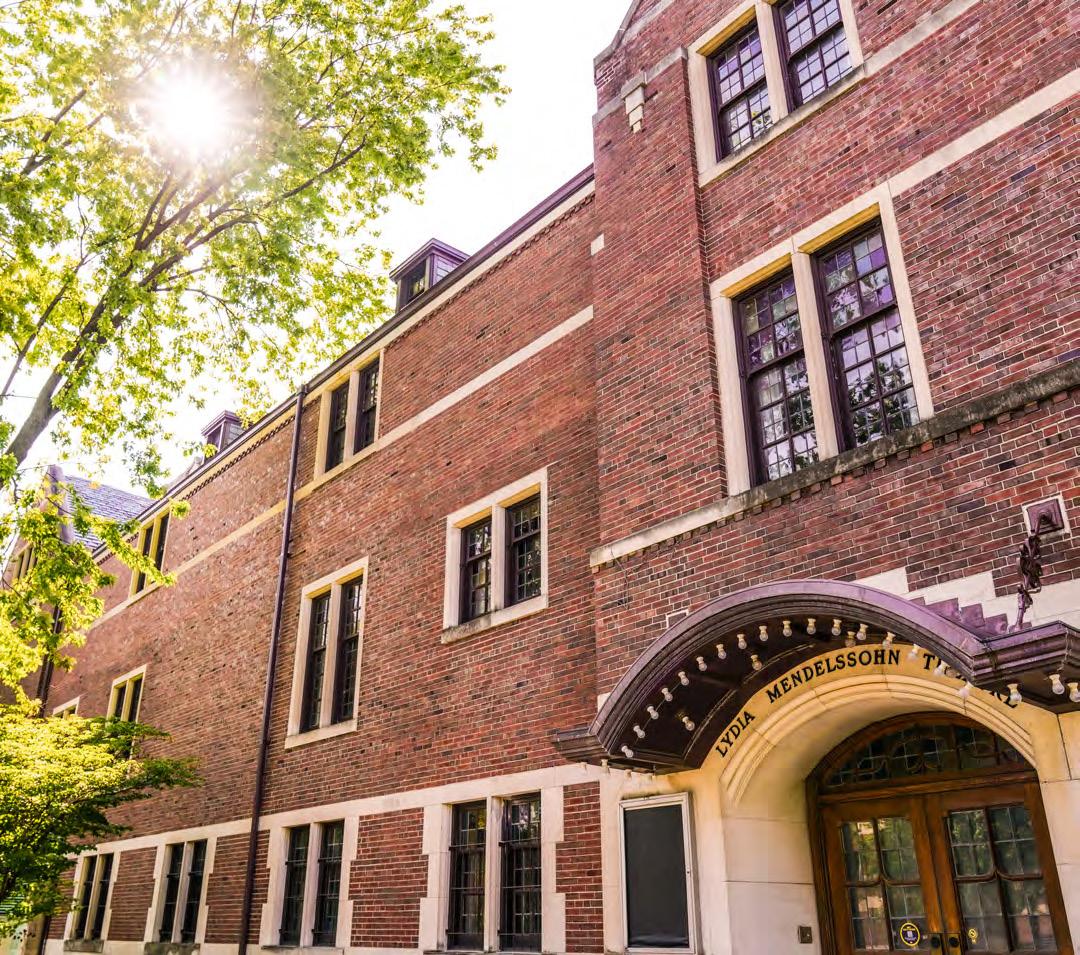
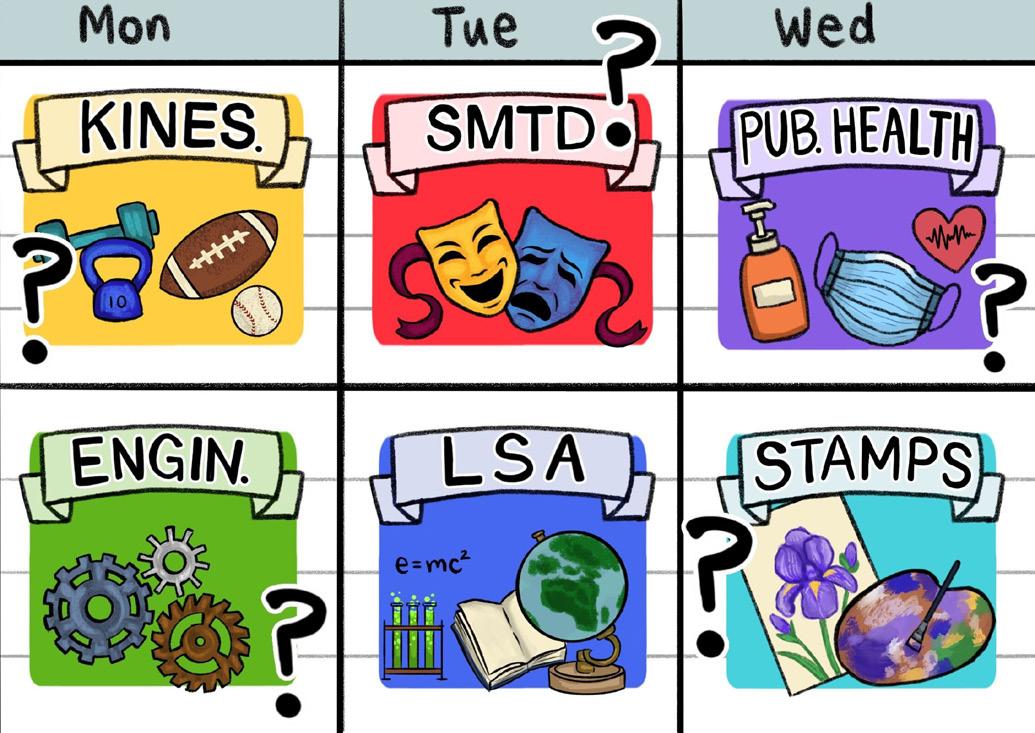
Looking for a fun elective? Liven up your schedule and learn to dance, act, play guitar, and much more! Play an instrument? Consider joining one of many campus ensembles! Bonus: You can add a music minor to your degree with only 15 credits of mainly electives. For details about performing arts classes open to all U-M students, visit smtd.umich.edu/campus-creatives.
STUDENT FLEX SERIES
Join us for performances — and save!
Interested in attending plays, musicals, operas, dance shows, and more? Save with a Student Flex Series package!
• $10 per ticket—a savings of more than 20%
• Main floor seats, closer to the action
• Early access with priority ordering
• Flexible exchange policy
Visit smtd.umich.edu/flex-series to learn more!
Dear class of 2030 ,
Congratulations! All of your hard work has led to this moment — welcome to the University of Michigan. What’s to come could quite possibly be the greatest and most exciting challenge you have ever faced.
Luckily, The Michigan Daily understands that, and in this 2026 Orientation Edition, we have all you need to navigate the beginning of your time here.
Rest assured, you are all united in the fact that you don’t know exactly what’s to come. On move-in day, you will share the anxious jitters of your dorm neighbors, the preliminary panic of not knowing something that you think you’re supposed to know and the powerful feeling of stepping into a new chapter of your life.
Everything else about these four years, however, might not be a completely shared experience. When you look around the Big House, alongside thousands of your fellow Wolverines, know that every student there will have a wholly unique experience on this campus.
You now have the distinct opportunity to explore who you are and what you want to be — and there is no better place to do that. Know that The Daily will be here to explain everything related to Ann Arbor and provide a glimpse into the experience of some of our Leaders and Best. Your time here might not be easy or what you expect, but at The University of Michigan, you will have every opportunity to do great things.
As they say, it is the best university in the world. Go Blue.
Elena Nicholson
Stanford Lipsey Student Publications Building 420 Maynard St. Ann Arbor, MI 48109-1327 www.michigandaily.com
ELENA NICHOLSON Editor in Chief eic@michigandaily.com
GIGI GONDOLY Business Manager business@michigandaily.com
Amara Small and Allana Smith Michigan in Color Editors michiganincolor@michigandaily.com
Isabella Burke and Sophia Polega Audience Engagement Managing Editors socialmedia@michigandaily.com
Saysha Mahadevan and Pujita Rupani Culture, Training, and Inclusion Chairs accessandinclusion@michigandaily.com
Daniela Cesario and Lucy Langerveld Managing Focal Point Editors tipline@michigandaily.com
Tobin Saxton Managing Games Editor crosswords@umich.edu
LEADERSHIP
can be learned
how are you elevating your leadership?
ALA: 174 LEADERSHIP LAB
Build real leadership skills through a hands-on self-designed team project, teamwork, and real-world problem solving.
1 CREDIT - FALL 1ST & 2ND HALF / 3 SECTIONS
ALA: 170 LEAD & FOLLOW
Great leaders know when to lead and when to follow. This course helps you build the self-awareness, confidence, and real-world skills to do both well.
1 CREDIT - FALL 2ND HALF / 2 SECTIONS
ALA 275: LEADING WITHOUT AUTHORITY
Leadership isn’t about titles, it’s about taking action, building connections, and creating change from wherever you are. Learn to lead with influence.
3 CREDITS WINTER
Tuesdays, recently increased from $2. During the day, you can find students lined up at the street’s many cafes, as well as chain restaurants like Panera, Chipotle and Sweetgreen.
Housing in the State Street district is mostly made up of high-rise apartments. Nestled between a high-rise and the Michigan Theater is Graffiti Alley, a commonlyphotographed destination where spray paint artists can add to an ever-changing canvas. State Street also has a visible homeless population, which has increased 77% citywide since 2022. Some students report feeling unsafe in the area, although data does not show significantly high crime compared to other parts of downtown.
South University
A short stroll across the Diag from State Street will take you to South University, Ann Arbor’s other major student hub. While State Street and Main Street stand out for their historical character, South University clearly reflects Ann Arbor’s recent growth. High-rise construction has transformed
the corridor over the past decade as University enrollment and citywide housing demand continue to increase.
Recently completed projects include Vic Village and VERVE, while The Metropolitan, Rambler Ann Arbor and Chapter Ann Arbor are currently under construction. These developments have displaced longstanding businesses, including Pinball Pete’s arcade and Pancheros Mexican Grill, while giving the neighborhood a new skyline. Before its transformation, South University was known for quirky, independent stores.
Despite its changing streetscape and skyline, South University remains popular for its dining, nightlife and new apartments. Along the avenue lies multiple Korean restaurants as well as one of only three Joe’s Pizza locations outside of New York City.
Good Time Charley’s is a cozy sports bar on South University Avenue known for its gameday atmosphere, with the 18+ Cantina nightclub located upstairs. Rick’s American Cafe — a student favorite since 1979 — has lines looping around
of the Diag, which boast more social life and school spirit.
Kerrytown was also part of the original Village of Annarbour. In the 20th century, Kerrytown became one of Ann Arbor’s historically Black neighborhoods, as Black residents were not allowed to purchase homes in many other parts of the city.
With narrow streets, brick roads and wide tree-lined sidewalks, the neighborhood is easy to explore on foot. It is the downtown district with the fewest daily visitors and, unlike South University or State Street, most of the neighborhood is still made up of single-family homes shared by students and long-term residents.
Audrey Rosenberg/DAILY
the block most Thursday nights. During her time as a University student, Madonna met longtime collaborator and producer Steve Bray at Rick’s.
In 2026, the bar has seen visits from Stranger Things actor Noah Schnapp and Yaxel Lendeborg, the Michigan men’s basketball Big Ten Player of the Year and NCAA Tournament winner. Immediately after the men’s basketball team won the national championship, thousands of students flooded South University Avenue to light fireworks and sing U-M chants. The area also continues to be a go-to gathering spot on football Saturdays. South University remains a central part of Ann Arbor’s downtown, even as the area adapts to a new role as a dense student housing community.
Kerrytown
The fourth and final downtown neighborhood is Kerrytown, a charming, family-friendly district often called the polar opposite of South University. Students living in Kerrytown frequently describe it as a quieter, more peaceful experience compared to busier neighborhoods south
Kerrytown has been named the top shopping district in all of Michigan for its selection of unique craft shops and luxury boutiques. More than 25 small and independent businesses operate in Kerrytown, many of which are housed in the heart of the neighborhood, Kerrytown Market & Shops. Next door is the Ann Arbor Farmers Market, which sells food from local producers on Wednesday and Saturday mornings. Across the street is Zingerman’s Delicatessen, perhaps the city’s most famous restaurant and a favorite of former President Barack Obama. Kerrytown is the only downtown district with a full grocery store, the People’s Food Co-op, although its organic and high-quality products can be pricey.
The neighborhood is also home to the Kerrytown Concert House, a 110-seat jazz venue, and the Washtenaw County Historical Society Museum. Kerrytown has also historically been a hub for the city’s LGBTQ+ population.
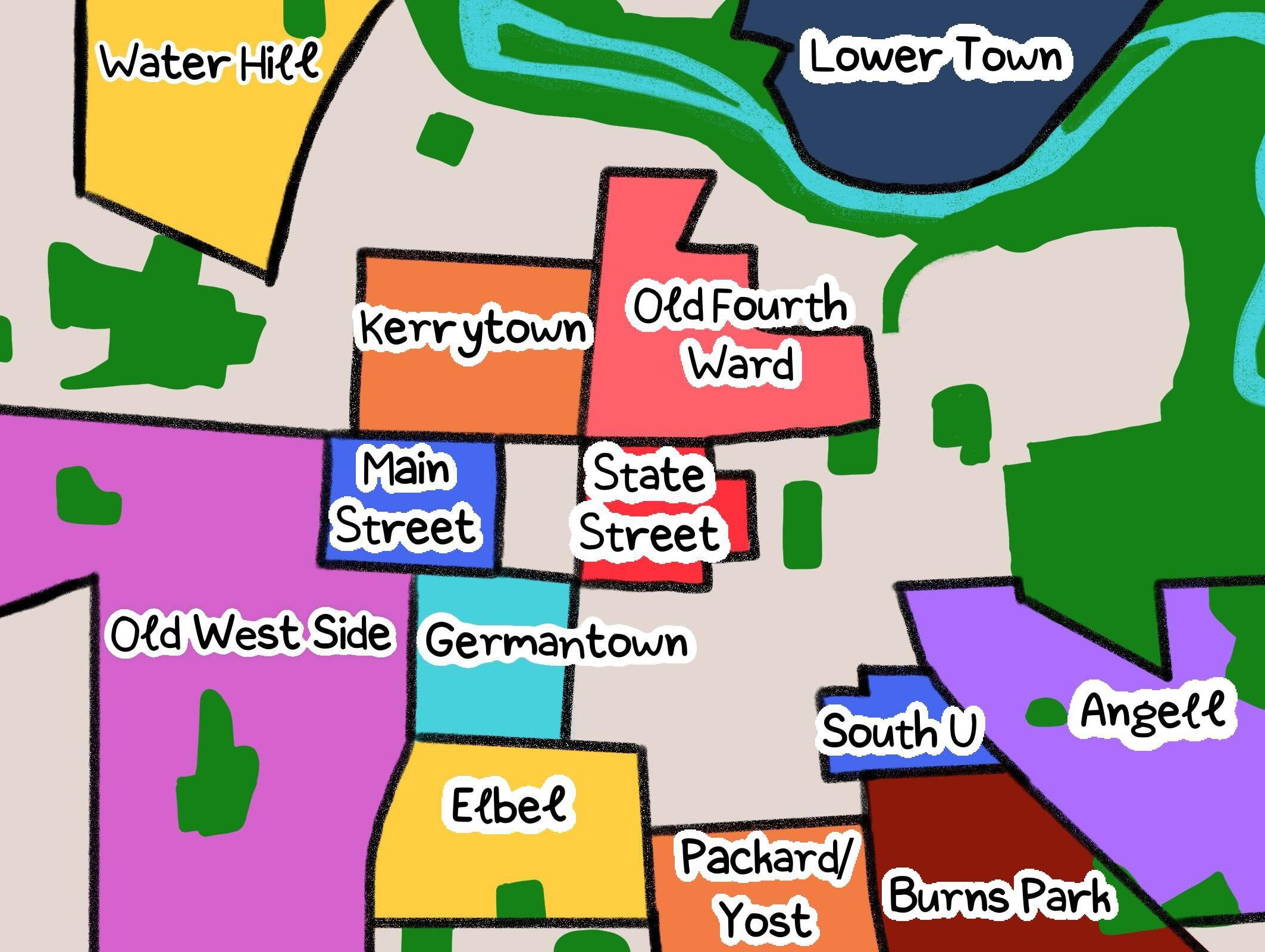
Those intrigued by downtown’s historic architecture may also enjoy the Old Fourth Ward and Old West Side, neighborhoods largely preserved through Ann Arbor’s historic district protections.
CONTINUED ON OUR 2026 ORIENTATION EDITION WEBSITE
LOLA POST Statement Deputy Editor
First, congratulations on being accepted into the best university in the world!
Second, I promise I understand your inevitable desire to reinvent yourself for college. But, let me beg you to reconsider doing so.
I came to the University of Michigan from a high school in Pennsylvania with a graduating class of 140. I was the only person from my school’s graduating class to attend the University, and one of only two students from my county to end up here.
Getting out of Pennsylvania, I was so excited to be able to express the “real me” that I had allegedly been hiding throughout high school. Honestly, I actually liked who I was in high school. I was a member of the track and cross country teams, I went to yoga every Sunday, I took fashion classes that offered me a creative space to sew, I was an elementary school classroom assistant and I worked at a smoothie shop every weekend with my best friend. I had a great balance of working, studing, staying healthy, seeing my friends and feeding into what I loved. Still, I felt that I needed some drastic change to accompany the move to college.
Once I got to Ann Arbor, I cut and dyed my long blonde hair into the shortest brunette bob imaginable. I stopped running immediately, I went out every weekend and I neglected the routines that had guided me in high school. I didn’t make time to read, sew or even go on walks. I joined a sorority, didn’t find my people and started my sophomore year with very few lasting friendships. Was I even myself anymore?
***
The first point you should consider is that no one knows who you are. Deep down. It may be different if you are coming to the University with your best friend or worst enemy, but I can tell you for a fact that the
On re-inventing yourself
vast majority of your 35,000 undergraduate peers don’t know you. Therefore, why do you feel the need to change when you are already coming in with an essentially blank slate?
The student environment at the University is very different from what I experienced in high school. Since my graduating class was relatively small, I had been friends with everyone at one point or another. I even had a brief friendship with the other Erie, PA representative who goes to the University now, before he transferred to our town’s private high school. At the University, though, I truly meet new people every day. It’s impossible to be friends with everyone, and there is no promise that you will see the same person twice unless you put in an effort to do so. Unless you had a high school class of 9,000, I’m not sure you can conceptualize it yet, so I’ll try my best to help.
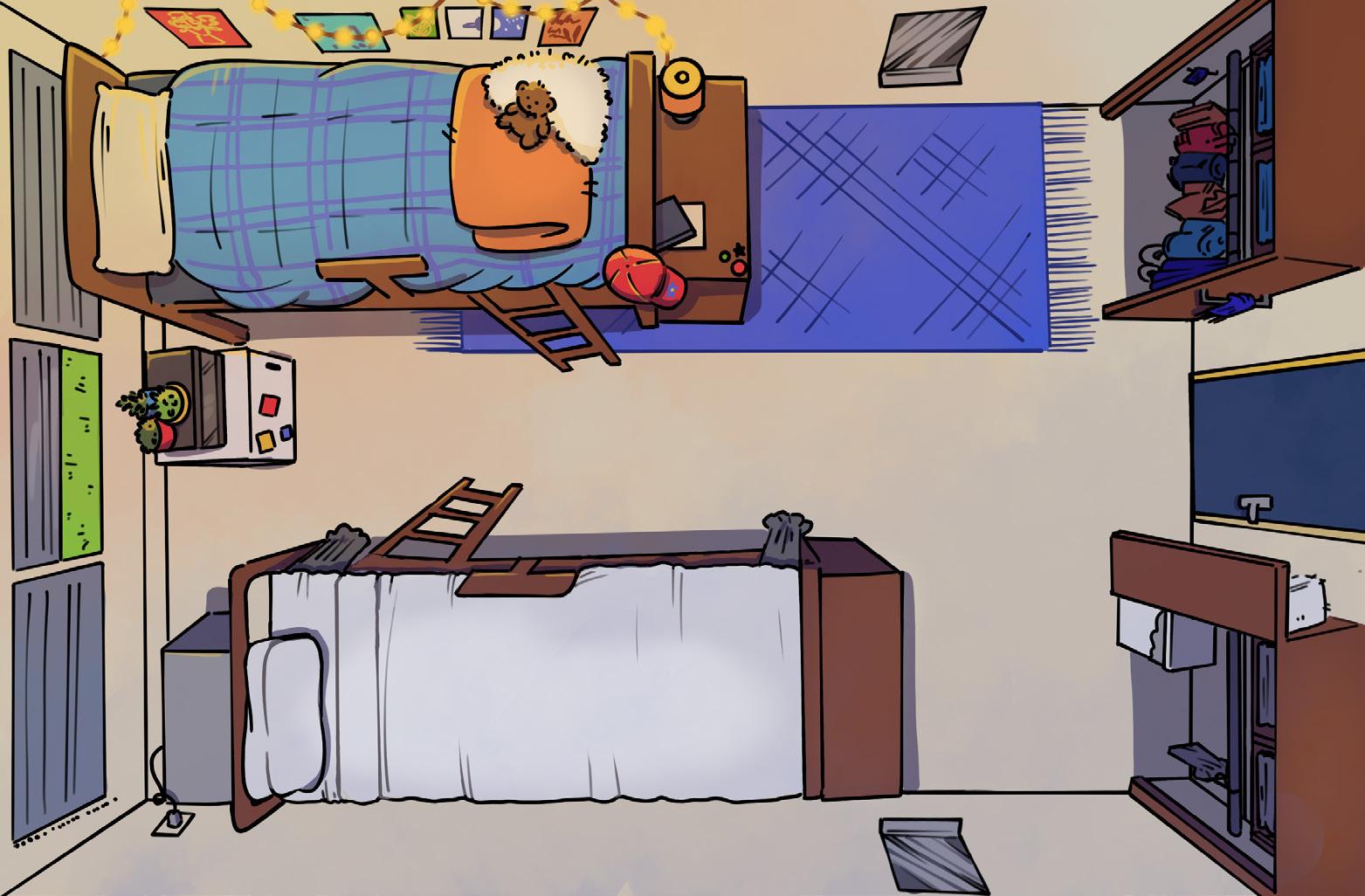
My first Tuesday at the University looked like this: I
woke up at 9 a.m. in my twin XL, so close to my roommate that I could’ve grabbed her hand. I didn’t know her well yet, so I was still trying to make a good impression every day. I primped and preened, then walked to Statistics 250, passing hundreds of people I didn’t know. I sat down in the middle row on the far right side of a lecture hall that had a capacity of 500 students and watched as the other 499 filed in around me. The professor asked us to find partners, and I excitedly introduced myself to the girl on my left, only to never see her again, even a year and a half later. There were just too many people. I rinsed and repeated for the rest of my classes throughout the day and topped it all off with a trip to the dining hall with my roommate, who I was only a few hours closer to. It didn’t matter who I was that day, as I wouldn’t see the majority of the people I talked to again.
The point is, no one knows you! College removes the audience that makes you selfconscious about who you are. You don’t need to stray from your high school self if that’s who you have grown to be comfortable with throughout the past four years. If that’s you, that’s the best
person to be. You won’t — you can’t — be viewed with the same perceptions your high school peers had, as you’re about to be surrounded by peers from all over the world! Be prepared to be the best version of yourself, even if that means staying the same. I found myself engrossed in the stories of so many unique people that it became hard for me to find the value in my own experiences. But, with friends from Maine, Michigan, California, Illinois, Wisconsin, Puerto Rico and Sweden, I realized that my life could never have been experienced by anyone else. Even being from a small town in Pennsylvania, I was full of stories to share that were just my own. You are about to have the opportunity to present your same self in a different way than you ever have. That’s exciting!
During my second semester, I was faced with another thought that challenged my initial desire to change. How can you make friends that are meant to stick around if you’re not presenting the real you?
CONTINUED ON OUR 2026 ORIENTATION EDITION
Ella Flores Brosnan/DAILY
Presidents, protests
Record setting enrollment and ranking
The 2025-26 academic year commenced on Aug. 25, as the University of Michigan welcomed a record number of new students to campus. A total of 9,711 new undergraduate students — composed of 8,178 freshman and 1,533 transfer students — joined the campus community as the University earned its spot as the 20th best university nationwide, while preserving its ranking as the third best public university.
The Big House hosts Zach Bryan in first concert
The University continued to set records going into September. Country singer Zach Bryan headlined the very first concert at the Big House on Sept. 27, with 112,408 attendees packed into the
stands — the largest concert in U.S. history. Bryan welcomed guests such as John Mayer, seven-time Grammy award winner, while performing chart-topping hits from across his discography. The inaugural concert opened the door for future shows in the Michigan Stadium, including performances by country singer Morgan Wallen, who will play two shows in July.
Government shutdown affects student lives
However, Ann Arbor was not immune to the politics of Washington, D.C., including the federal government shutting down Oct. 1 after failing to reach an agreement on funding for the 2026 fiscal year. Ripple effects of the shutdown — which continued for 43 days, marking the
longest shutdown in U.S. history — created confusion for those utilizing federal research funds, and caused chaos for students traveling home for Thanksgiving break.
On Nov. 1, statewide disruption to the Supplemental Nutrition Assistance Program caused strain for many Michigan families.
Proposed UMich data center met with community protests
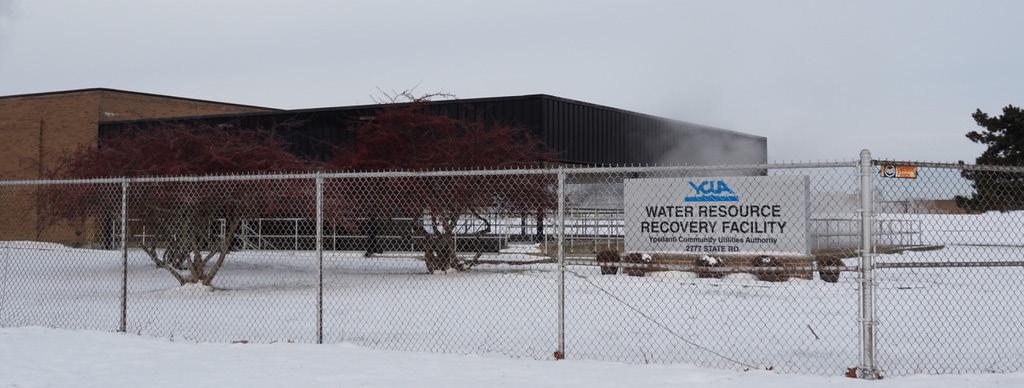
Locally, members of Ann Arbor and the neighboring communities began protesting the University’s development of their proposed data center. After purchasing land in Ypsilanti Township, the University announced plans to build a $1.25 billion data center in partnership with Los Alamos National
Laboratory. The University claims the facility will be used for academic and federal research purposes, and one Los Alamos representative confirmed the facility will be used for nuclear weapons research. Many community members have expressed frustration regarding potential environmental and fiscal impacts, including concerns over the project’s transparency.
Increased local ICE activity causes protests
In January and February of 2026, Washtenaw County experienced a significant increase in U.S. Immigration and Customs Enforcement activity. The Washtenaw County Board of Commissioners passed a resolution Jan. 21, restricting
Michigan Daily Photo Staff
Design by Katie Palsrok
Story by Alexa Cheaney & Brady Middlebrook, Summer Managing News Editors
and politics:
2025-26 at UMich
ICE agents from county property in response to the fatal shootings of Renee Good and Alex Pretti from ICE agents in Minneapolis. Less than a week later, ICE agents were seen near a Ypsilanti Community School campus detaining parents. Soon after, the Ann Arbor Police Department confirmed the presence of ICE agents in downtown Ann Arbor. This prompted the University to publish guidance for interactions with ICE. Protestors demanded ICE be removed from Ann Arbor and that the University take action to protect the U-M community. In April, the Trump administration sued Washtenaw County over policy measures that protect undocumented immigrants.
UMich community elects new student body president and vice president
On March 27, the student body elected LSA rising juniors Summit Louth and Naimah Perez of the Human Rights Party as 2026-27 president and vice president, respectively, of the University’s Central Student Government. Louth and Perez’s platform focused on progressive advocacy and campus affordability. The Human Rights Party is a party focused on student activism, progressive politics and University divestment from Israel.
UMich Board of Regents appoints new University president, who later steps down The University’s Board of Regents held a special
meeting Jan. 12 to officially appoint Kent Syverud, chancellor and president of Syracuse University, as the 16th University president, succeeding Interim President Domenico Grasso. On April 15, two weeks after Grasso’s final presidential interview with The Michigan Daily, Syverud announced he was recently diagnosed with brain cancer and would step down from his appointment. Later that day, Board Chair Mark Bernstein (D) announced in a video to the campus community that Grasso would continue his tenure until a new president is selected. Incumbent Regent Jordan Acker ousted by challenger Amir Makled in upset
At the Michigan Democratic Party’s State Endorsement Convention on April 19,
progressive challenger Amir Makled beat incumbent Jordan Acker in the race to be one of two Democratic nominees to the University’s Board of Regents. Acker is seen by many progressive activists as representative of the Board’s current policies, such as ending the University’s Diversity, Equity and Inclusion programs; cutting gender-affirming healthcare for patients under the age of 19; and prosecuting proPalestine student protesters. The victory of Makled — who provided legal representation for protesters and has been critical of the current Board — was perceived by many convention attendees as a major progressive upset. Makled will appear on the ballot alongside incumbent Regent Paul Brown (D) on Election Day.
Downtown Ann Arbor is home to hundreds of businesses, with some of these establishments finding their way into the daily life of University of Michigan students. Whether it’s a gameday hangout or a casual bite, the businesses surrounding campus define traditions every student inevitably takes part in. The Michigan Daily is highlighting some of Ann Arbor’s recognizable storefronts — the places where students eat, shop and make memories during their time on campus.
A cup of coffee to start your day: Ondo
Ann Arbor’s seemingly endless selection of coffee shops offers something for everyone. Nestled right on S. State Street is Ondo Bakery, serving coffee and tea alongside fresh and delicious bakery items.
In an interview with The Daily, Public Health rising junior Naomi Allen said she frequents Ondo year-round because of the atmosphere and menu.
“Usually, this is the ‘get to know each other’ spot,” Allen said. “I’ve been coming here since freshman year. The drinks are really good and the desserts are cute and delicious. During the semester, I come here probably twice a week. This is where my friends and I would come to study. Now, I’m here pretty much every day because of my online classes.”
For a convenient shopping trip: Bivouac
Whether you’re dressing for a special occasion or need a jacket that can take on the Michigan winter, Bivouac is there for you. Established in 1971 and located at 336 S State St., Bivouac has become the place for last-minute shopping needs.
Bivouac Owner AJ Davidson told The Daily the store has important ties to student and college life.
“Bivouac has always been about more than retail — it’s
about helping people experience Ann Arbor,” Davidson said. “For decades, students have come here for everything from their first Michigan winter coat to outfits for football Saturdays, spring break trips and life outdoors. Being in a college town keeps us constantly evolving while still staying rooted in community, adventure and personal connection.”
Information rising senior Mariah Cooperwood, Bivouac staff member, said she believes the shop is very welcoming to students.
“I started coming here my freshman year,” Cooperwood said. “I feel like it’s an inviting (place) to shop. They understand that they’re on campus, so they really try to take heed of that. There’s sales for stuff like the art fair and parents’ weekend. I really like it.”
A quick and classic meal: No Thai!
Established locally in 2005, No Thai! has become one of Ann Arbor’s iconic restaurants. This spot offers modern Thai food that is both quick and flavorful. With
locations on South University Ave., Kerrytown, S. Main Street and on Plymouth Road near North Campus, No Thai! has expanded all across Ann Arbor.
LSA rising sophomore Éowyn Johnson told The Daily that No Thai! is consistently appetizing.
“I get No Thai! all the time,” Johnson said. “I always have leftovers for like two to three days after, which is good for budgeting. … The food makes me feel very warm and happy. It’s amazing, always high quality and always delicious.”
To get the newest comic or Sonny Angel launch: Vault of Midnight
Vault of Midnight is a comic book store that sells hundreds of different books, board games, toys and figurines. In the Main Street district of downtown, students and locals know the store for its constantly changing series of comics and blind boxes — a perfect spot to stop in and check out new finds.
In an email to The Daily, Curtis Sullivan, Vault of Midnight owner, wrote the store has been operating for years with the purpose of serving the community.
“Since 1996 we’ve sold comic books, manga, board games, blind boxes and stuff. After moving a few times, we landed on Main St.
in 2006,” Sullivan wrote. “We’ve built a strong community through multiple generations of patrons, with our comic book subscription service, game nights, Free Comic Book Day, author and artists signing and tons of other fun things.”
Something sweet after a long day: Washtenaw Dairy
Just a slight trek from Central Campus lies Washtenaw Dairy. At 602 S Ashley St., Washtenaw Dairy has both classic and unique flavors, affordable scoops, cake donuts, excellent dairy products and more — all best when appreciated with friends. As a 2025 Best of Ann Arbor winner, it’s no surprise Washtenaw Dairy has operated in Ann Arbor for more than 86 years.
Music, Theatre & Dance rising senior Nigel Floreska said he finds Washtenaw Dairy to be both affordable and enjoyable.
“You can get so much ice cream for such a small amount of money,” Floreska said. “All the flavors are really good and the donuts are probably my favorite. Their coffee is also good: it’s a staple. The vibes in here are fantastic, and the employees are always really nice.”
CONTINUED ON OUR 2026 ORIENTATION
Ella Flores Brosnan/DAILY
Bookstores and libraries to visit in Ann Arbor
AMANY SAYED Daily Arts Writer
Wherever I am, it’s always places with books that draw me in and make it feel like home. Ann Arbor is no exception. As much as going away for college can shake up your routine, for a reader, stepping into a library or bookstore can help the unease fall away.
Thankfully, the University of Michigan campus and wider Ann Arbor area are full of libraries and bookstores, old and new. Whether you’re looking for your next great read, a place to study or just that sharp paper and ink smell, there is a place for you. Without further ado, here are some of my favorite bookish places in Ann Arbor.
Dawn Treader Book Shop
The Dawn Treader Book Shop, which has been featured in The Michigan Daily a couple times, is not only my favorite bookstore, but my personal favorite place in all of Ann Arbor. Filled to the brim with tall shelves of previously loved books, Dawn Treader is a great place to destress and find a book for cheap. If you’re looking to splurge, they also have a collection of rare items, first editions and signed books for sale.
With its piles of books and homey vibe, Dawn Treader invites you to stay awhile. Sometimes, I like to grab a coffee from across the street at Lab Cafe and immerse myself in the shop for a while. They even have a small cart outside with books for just a dollar each, making the shop not only cozy, but budgetfriendly and a comfortable environment. Though I love that new book smell as much as the next bookworm, holding a book in Dawn Trader and knowing it’s passed through hands before mine is an altogether irreplaceable experience.
Hatcher Graduate Library
Standing as the biggest and oldest library at the University, Hatcher Library is one of the most popular study spots on campus, and is home to over three and a half million books. The library is huge, with eight floors and a range of different places to work or read. Hatcher is also home to the Special Collections Research Center, which holds archival materials from various subjects. Some materials can be checked out, while others can be requested for viewing in the Center’s Reading Room.
Hatcher is famously known for its “stacks,” shelves upon shelves of books going from the basement all the way up to the eighth floor. Cubicles of study spaces line most of the library walls, so you can sit and study surrounded by books. Hatcher is a loved and appreciated study spot — especially around finals season — but not many students take advantage of the opportunity to check books out from the library. It’s easy to get lost in the maze of the stacks, but it’s such a rewarding experience to find the book you are looking for. The librarians across all U-M libraries are also readily available for any of your research needs. If you are looking for a book to read for fun or the perfect source for an assignment, Hatcher is likely to have what you need.
Law Library
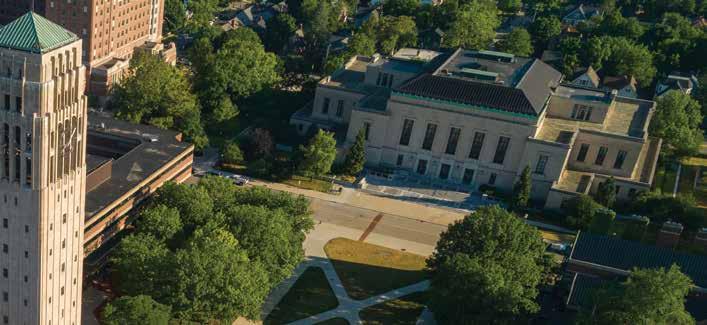
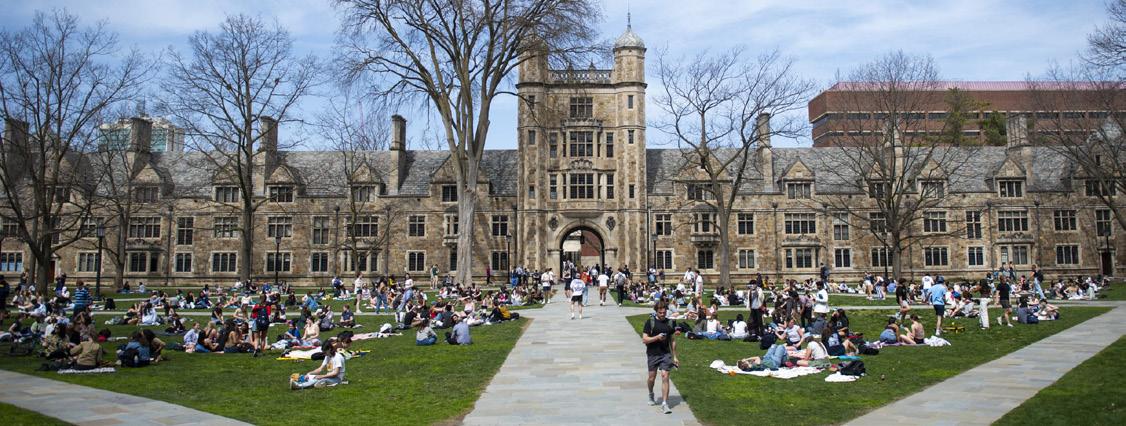
Every U-M student, interested in law or not, knows the magnetic pull of the Law Library. Situated in the center of the Law Quadrangle, the Law Library is gorgeous inside and out. It’s not just a pretty place to take graduation pictures, though. The Law Library’s Reading Room offers a quiet, focused setting to hunker down and get some real work done. Hours and seats are limited for non-law students, but if you get there early enough, it is worth it.
With chandeliers, dark wood tables and soft lighting, the Law Library is a taste of Hogwarts in Ann Arbor. As a pre-law student, the Law Library holds an extra special place in my heart. I long
for a future day when I can sit on the side of the Reading Room that’s reserved for law students and even check legal research materials out. Until then, though, I am content to sit in the undergraduate section and bask in its motivating, academic atmosphere.
Literati Bookstore
For ten years in a row, Literati has been dubbed the best bookstore in Ann Arbor. Thanks to its welcoming vibes and friendly staff, it’s a popular favorite among students. Literati is a great place to shop for books and even get a recommendation. As an independent bookstore, it offers the chance to discover new or indie books that might not make it to chains like Barnes & Noble. There’s a reason Literati keeps winning the vote, and your time in Ann Arbor is incomplete until you visit the shop at least once.
William L. Clements Library
Like Hatcher, the William L. Clements Library is just as much a historical building as it is a library. It collects and preserves historical books and documents, specifically from the United States in the 18th and 19th centuries. U-M students can browse the archives and make an appointment to view documents using the website.
Unfortunately, the library is not regularly open for students to study in. However, anyone can come in during public exhibit hours to browse the artifacts on
display. Additionally, the library typically opens for limited study hours during U-M finals season. The Reading Room is a gorgeous, awe-inspiring space, and the library even brings in therapy dogs and offers food and snacks for students.
Shapiro Undergraduate Library
While not the prettiest place to study, the Undergraduate Library is certainly accessible and convenient. With a cafe on the first floor and countless seating areas, Shapiro is a go-to for students to study, hold meetings or just hang out. The library is known for staying open 24 hours a day during the school week, making it a good place to hunker down for finals. There are places to sit on every floor of the UGLi, but a favorite for many students is “Clark Commons,” a recently renovated study area located on the third floor, which has whiteboards, easy outlet access, a bookable multipurpose room for events and many other amenities.
The UGLi also has some books available for students to check out. Books checked out at Hatcher can be returned at the UGLi, and vice versa, thanks to the University’s connected library system. The libraries themselves are even connected via a bridge on the second and third floors.
CONTINUED ON OUR 2026 ORIENTATION WEBSITE
Maisie Derlega/DAILY
Finding your place on campus takes time
Did you know U-M is a non-profit? A non-profit, for Wolverines!
Donations from alumni, supporters, and even students like you advance our mission as a university.
AVERY ALLEN Summer Editorial Page Editor
Over 32,000 U-M alumni gave back to the university
Student orgs raised over $865,000
Telefund student fundraisers raised $900,000+
You are joining a tradition of generosity that spans generations of wolverines. For example, during in the last year: Welcome and Go Blue!
More than 2,100 students donated to a cause at the university, including student organizations, the Maize and Blue Cupboard, emergency support funds, and more
At my freshman orientation, our tour guide suggested we check out Maize Pages, a website that lists more than 1,400 student organizations offered at the University of Michigan. I took that advice and ran with it. When I arrived on campus that fall, I had already decided which clubs I would join, which professional fraternity I planned to rush and which sorority I wanted to be a part of.
My tour guide wasn’t the only person to emphasize the importance of campus involvement. Many of my family members had given me similar cookie-cutter advice, portraying clubs as the perfect remedy
University of Michigan, joining student organizations is an overwhelming and sometimes defeating experience. And even if it goes smoothly, feeling like you belong in those organizations takes time and effort.
Nevertheless, there are ways to navigate this process.
Most importantly, focus on staying open-minded and be ready to adapt. Evaluate your options, but don’t hyperfixate on certain organizations, even if they seem to be the “perfect fit.” If you’re like me, and have already planned out which clubs to join in precise detail, this receptivity is even more crucial.
Coming into freshman year, you have no clue whether the clubs you have chosen are actually a good fit. In my experience, some of the organizations I thought were perfect for me were far from it; and the ones I never planned on joining were where I thrived.
Instead of hyperfixating, you should familiarize yourself with as many opportunities as possible. I strongly recommend attending
Aylin Garcia-Solis/DAILY
‘Finding your niche’: Attending the #1 public research institution
KYLIE HARMALA Summer News Editor
The University of Michigan remains a top-ranked research institution, acting as a significant contributor to multidisciplinary fields worldwide. In 2025, the University expended $2.16 billion on research initiatives across all U-M colleges, schools and academic units. Incoming students are presented with many opportunities to participate in and contribute to Universitysupported research.
A study conducted by the Integral Postsecondary Education Data System in 2024 revealed that more students at the University are entering STEM fields, as opposed to social sciences or the humanities. However, students in non-STEM areas of study are not excluded from the University’s vast research funding and resources. The University Institute for Social Research and Institute for the Humanities exist to represent opportunities for innovative research by students and faculty in these fields.
Associate sociology professor Karyn Lacy has spent her career researching the experiences of Black middle-
class communities and impacts of racial discrimination in the housing market. In an interview with The Michigan Daily, Lacy said she has been able to explore her academic interests by conducting social science research through the University.
“I teach a lot of courses about race for undergraduate students,” Lacy said. “Michigan is a big place and students come from all over, so their understanding of how race works in society varies … There can be a lot of stereotypes that are circulating that people use as the basis for their interactions with other people — and as you can imagine, that can be really problematic.”
Lacy said support for researchers at the University and a desire to continue learning allow her to blend social science research with her role as an undergraduate professor.
CONTINUED ON OUR 2026 ORIENTATION EDITION WEBSITE
Michigan athletics: A year in review
Football hires new coach Kyle Whittingham for 2026-27 season
Former Wolverines coach Sherrone Moore was fired with cause Dec 10, and Michigan’s search for a new coach culminated in the hiring of former Utah head coach Kyle Whittingham. Over 22 years with the Utes, Whittingham posted a career record of 177-88, with an 11-6 bowl game record. Whittingham led Utah to eight 10-win seasons, bringing the program from mid-major ranks to a perennial power conference contender. Fresh off a 10-2 campaign in 2025, Whittingham brings offensive coordinator Jason Beck, five former Utes and high expectations with him to the Big House.
Men’s basketball wins national championship
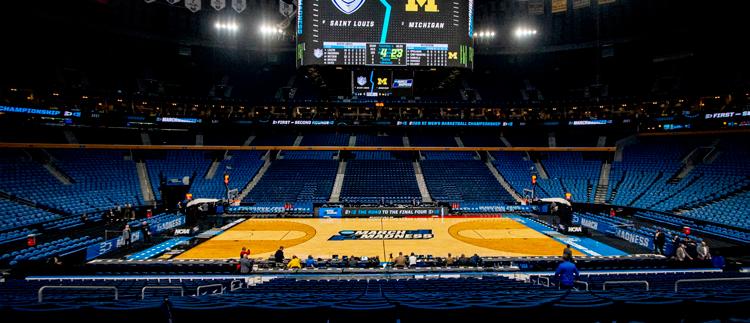
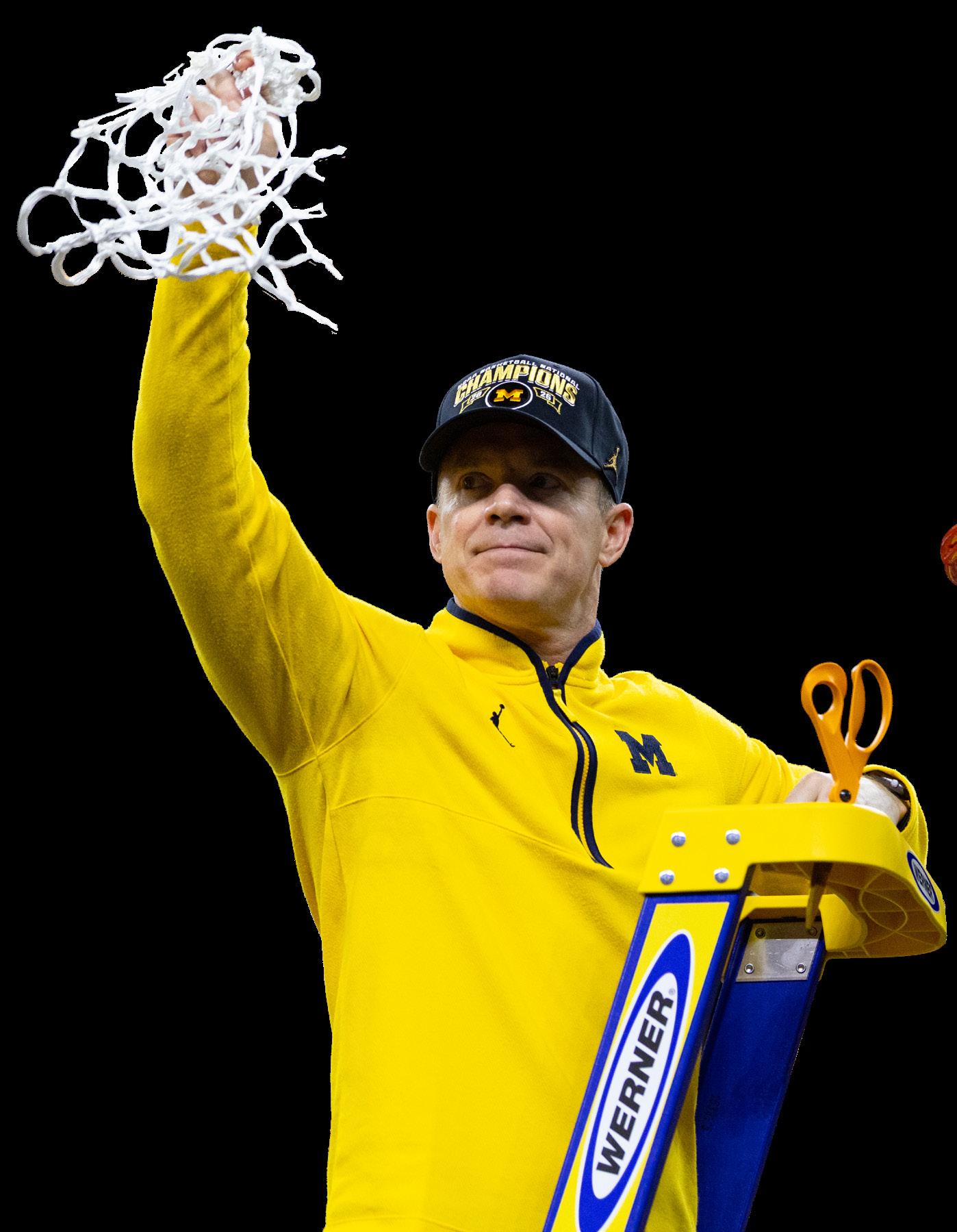
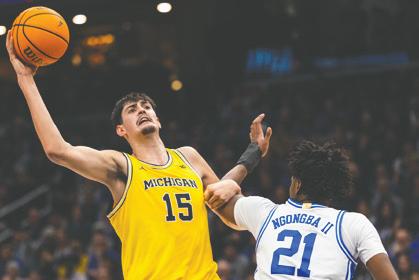
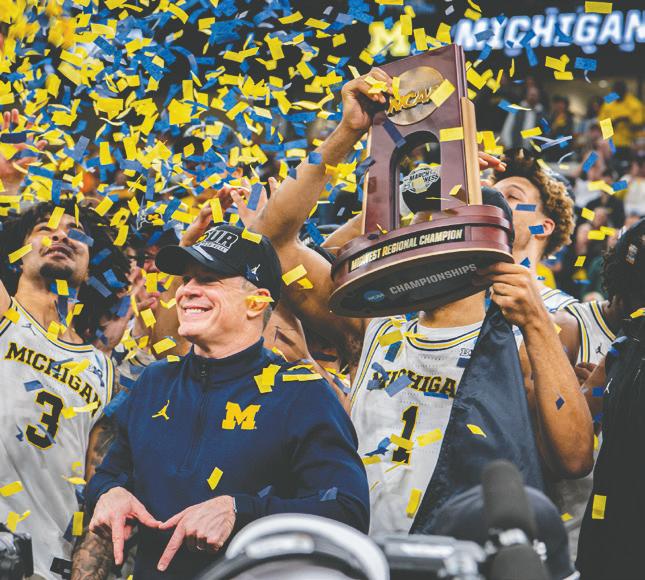
In his second season with the program, Michigan coach Dusty May took the Wolverines all the way to the March Madness title game, where they overtook Connecticut 69-63 for their second- ever national championship—the first since 1989. Led by star transfers like graduate forward Yaxel Lendeborg, junior point guard Elliot Cadeau, sophomore forward Morez Johnson Jr. and junior center Aday Mara, Michigan finished the season 37-3 with an average margin of victory of 17.8 points per game. The Wolverines tied their program record for regular-season wins on the way to clinching a Big Ten regular season title, before stomping through March and bringing hardware back to Ann Arbor.
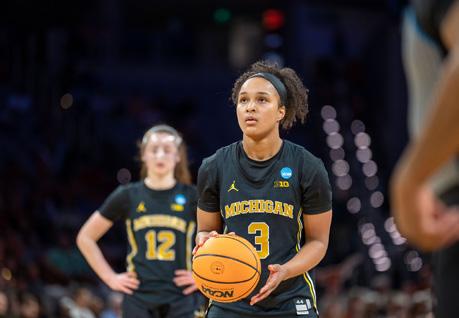
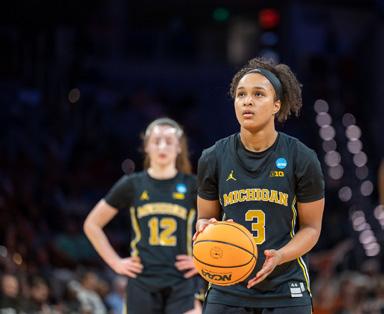
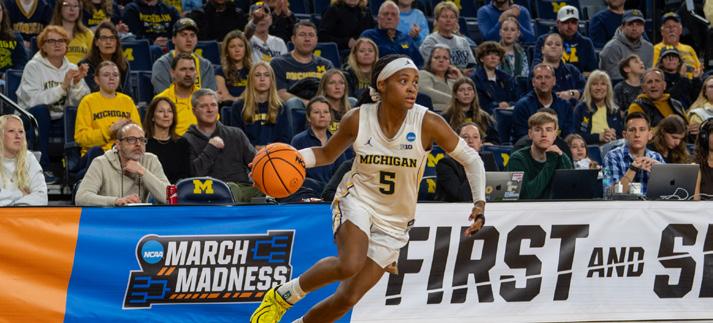
Women’s basketball makes run to Elite Eight Wolverines coach Kim Barnes Arico matched 2021’s program-best March Madness finish with a run to the Elite Eight, powered by the sophomore guard trio of Olivia Olson, Syla Swords and Mila Holloway. Olson and Swords, who averaged 18.9 and 16 points per game, respectively, were each named to the AllBig Ten First Team. Holloway was selected as an honorable mention, while senior guard Brooke Quarles Daniels made the All-Defensive Team. The squad fell to No. 1 seed Texas 77-41, but all three guards will return as juniors — a steady core that already drove the Wolverines to their most successful season in program history.
Hockey wins Big Ten Tournament, falls in Frozen Four
After a dominant season boasting some of the best players in the country — including Hobey Baker finalist T.J. Hughes —- the Wolverines finished second to in-state foe Michigan State in the Big Ten standings. Entering the Big Ten Tournament as the No. 2 seed, Michigan went on to hammer No. 5 seed Ohio State 7-3 in the final to hoist the tournament trophy in Yost Ice Arena for the first time ever on home turf. The Wolverines entered the postseason as the No. 1 seed nationally, defeating No. 20 Bentley and No. 6 Minnesota Duluth for a national record 29th Frozen Four appearance, where they lost to Denver in a close double-overtime game, 4-3.
Story by Jaxson Kaplan-Rudolph and Hadley Zann, Summer Managing Sports Editors
Michigan Daily Photo Staff Design by Katie Palsrok
Softball makes third-straight NCAA regional, 32nd all time
After a season of ups and downs — from getting swept twice to start conference play to sweeping Michigan State to finish it — the Wolverines qualified for their third consecutive NCAA Tournament and 32nd in history. Michigan received an at-large bid as the No. 3 seed in the Norman regional, drawn against Kansas, Binghamton and an Oklahoma squad that’s won four of the past five Women’s College World Series. Super sluggers sophomore right fielder Lauren Putz and junior center fielder Jenissa Conway, along with ace right-hander Gabby Ellis, led Michigan to a pair of wins, before the Wolverines fell to the Sooners 8-1 in the regional final, ending their season with a 36-22 record.
026 was a star-studded year for athletics at the University of Michigan. Leading the Big Ten with nine championships, the Wolverines’ 29 varsity sports continued to excel and compete at the highest level. Seven of those 29 programs finished the season top 10 in the national rankings, highlighted by the men’s basketball team’s first national championship since 1989.
The Michigan Daily penned stories for every notable moment of the 2025-26 school year. In honor of athletics entering its final stretch, The Daily provides a recap of every memorable moment
Baseball topples No. 15
Oregon with Cooper Mullens walk-off, shuts out Ohio State at Big Ten Tournament Redshirt sophomore designated hitter Cooper Mullens sparked the Wolverines’ best upset of the season when he stunned the mighty No. 15 Oregon with a walkoff single. In a storybook finish, the son of Ducks athletic director Rob Mullens came through at the bottom of the ninth inning with bases loaded and two outs to give Michigan a 4-3 win over his father’s team. After the Wolverines were swept by Ohio State to end the regular season, they got their revenge by defeating the sixthseeded Buckeyes 3-0 in the Big Ten Tournament and ending their rivals’ season. Michigan finished the year with a 34-24 record after falling to No. 2 seed Nebraska in the quarterfinals.
Fred Richard wins third NCAA all-around title in four years
Senior Fred Richard became the third male gymnast in NCAA history to earn three outright individual titles. Richard earned silver medals on the floor, parallel bars and pass, along with the highest rings score among all-arounders — cementing himself as one of the most decorated Wolverines ever.
Women’s tennis wins Big Ten Tournament and regular season titles
Michigan women’s tennis finished with a 21-7 season, winning both the Big Ten regular season and Tournament titles — coach Ronni Bernstein’s 19th and 20th titles in 19 seasons at the helm. The Wolverines fell to No. 5 North Carolina at NCAAs, but sophomore Piper Charney
brought down the Tar Heels’ NCAA individual champion Reese Brantmeier at one singles. Max Dahlin sweeps Big Ten awards
In men’s tennis, freshman Max Dahlin became the firstever player to win both Big Ten Freshman of the Year and Big Ten Player of the Year honors, while also a unanimous selection to both the freshman and overall All-Big Ten teams.
Taye Ghadiali wins Big Ten heavyweight title, places 3rd at NCAAs
Graduate wrestler Taye Ghadiali capped off an impressive collegiate career with a late third-period takedown of Nebraska’s AJ Ferrari to win the Big Ten heavyweight title in a 5-2 decision. Ghadiali went on to notch two wins at NCAAs and a national bronze medal.
MICHIGAN CHAMPIONSHIP HARDCOVER BOOK
RELIVE THE WOLVERINES’ CHAMPIONSHIP SEASON IN A HARDCOVER BOOK
This book is for every Wolverines fan who spent 37 years waiting for this team.Celebrate the champs! Relive their record-breaking 2025-26 season in “Conquered: Michigan’s Journey to the 2026 National Championship,” a hardcover commemorative book from The Michigan Daily. This limited-edition coffee table book provides a unique perspective and combines student journalists’ on-the-ground reporting on every game, player and coach feature stories, and never-before-seen photos to tell the story of a national championshipwinning team across 128 pages. Relive the whole story of the team that brought a national title back to Ann Arbor. Books are available now! Order today and own a piece of Michigan basketball history.
Order online at
A guide to professional and personal resources at UMich
ALEXA CHEANEY Summer Managing News Editor
The University of Michigan offers a wide variety of resources to undergraduate students, both on campus and online. As students navigate the next four years, they are encouraged to take advantage of all the University has to offer.
Academic resources
Each student has access to standard and major specific academic advising. Additionally, students can access a wide variety of scholastic resources through the University’s library system. There are 20distinct libraries on campus, including the Shapiro Undergraduate Library, which is open 24 hours, Monday through Thursday. Additional academic resources are available online. U-M library research guides compile and sort scholarship by academic discipline to help streamline the research process. Students seeking further help can connect directly with an expert in their field.
The University also offers tutoring services. Students seeking in-person help for specific courses can be paired with someone who has previously taken the course for weekly tutoring sessions. Additional
resources are available online, including the LSA Language Resources Center and Science Learning Center, which offer peer tutoring for language and natural science courses, respectively.
All students have access to the Sweetland Center for Writing, which offers a variety of services, including one-onone tutoring and multilingual support. Similarly, the Math Learning Center offers dropin assistance and study groups
for select undergraduate math courses. Learning accommodations and disability services are offered through the Student Accessibility and Accommodations Services.
SAAS offers assistance through Services for Students with Disabilities, Academic Support and Access Partnerships, Testing Accommodation Centers and Adaptive Sports and Fitness.
Health and wellbeing
Students seeking support with their mental health are encouraged to take advantage of the Counseling & Psychological Services offered through the University. All services have no out-of-pocket cost. CAPS offers both individual and group counseling sessions, as well as non-urgent drop-in sessions. Students seeking urgent care can access services through University Health & Counseling. Most students can utilize these services for free, although some services — such as immunizations, prescriptions, imaging, and most labs — will be billed to insurance or require payment. Students seeking community-based mental health support can join the
Wolverine Support Network. WSN is a student organization offering peer-facilitated support groups led by students trained in holistic mental health.
The Sexual Assault Prevention and Awareness Center provides survivors with free, confidential resources. The Sexual and GenderBased Misconduct Reporting & Resources page provides the campus community with information to help mitigate sexual assault at U-M.
For physical health, students have access to a variety of indoor and outdoor recreational facilities. The Hadley Family Recreation & Well-Being Center — expected to open spring 2026 — will be the largest gym on campus, offering students access to weights, pools and a climbing center. The University is also home to 30 club sports, which compete against other college teams across the country. In the event a student faces food insecurity, the Maize & Blue Cupboard offers free groceries on an appointment-only basis.
Professional resources
The University Career Center offers free professional headshots for U-M students and
professional attire, in addition to a range of career-building resources. Undergraduate and graduate students are also able to sign up for Handshake, which allows students to navigate internship and job opportunities. In further preparation for the eventual post-grad job search, students are able to use the Career Path Navigator to help map out an individualized plan.
Specific colleges throughout campus have individualized resources as well. Those enrolled in the College of Literature, Science and the Arts — the largest college on campus — are able to attend a variety of professional development workshops hosted by the Opportunity Hub. Topics often range from interview upskilling to LinkedIn advice. Many specialized colleges offer similar resources, such as the Career Development Office offered through the Ross School of Business.
The Center for Campus Involvement hosts Festifall shortly after the fall semester begins, where students have the opportunity to discover other campus resources and clubs that will help define their next four years.
Maheen Rashid/DAILY
An anecdote — with love, from me to you
ALLANA SMTIH MiC Managing Editor
When I was in the eighth grade, I wrote myself a letter. I asked for little, and mused about who and where at I’d be 18. About where I would go, and who would follow — someone to hold my hand — if anyone would follow. At 14, I was lonely and optimistic. At 18, I hadn’t gotten anything I’d wanted hold my hand — the realization was quite stifling.
This is the essence of a childhood, or my childhood, I suppose. Being subject to place and person. What you have has little to do with what you want. Hold my hand. But —
Here’s an anecdote:
On August 28, 2023, I graced the halls of U-M Dearborn for the first time. It was the first day of the rest of my life. After May, I would never come back. Characterizing this stage of pre-
adulthood is wanting — more, more, more; I can be so much more — it is not a crime.
I received an email from Ann Arbor admissions during in February in the Dearborn bathroom. You can be so much more.
/
In my image of the future, I’ve been to Paris. I am stable and un-lonely rather than lonely and unstable. When I imagine my future, it is bright. I imagine it for my mother and me.
/
On August 31, you’ll bump into bodies, bodies, bodies on the Mbus. You’ll walk into a lecture hall of either 30 or 300 and after May, you may not come back.
I am hungry, I was hungry. Maybe you are — maybe you will be, too. For something not quite like this.
This is the first day of the rest of your life — so I will hold your hand.
Double-majoring is good for the soul
MAGGIE BERLING Summer Editorial Page Editor
Choosing a major will likely be one of the more stressful parts of your underclassman experience at the University of Michigan. Your major will determine which classes you take and likely guide your post-graduate prospects. It’s safe to say that this decision weighs on the minds of many freshmen as they begin college. This selection process can feel overwhelming, especially when there is such a wide range of options to choose from. And this choice always comes with trade-offs — the major you truly want might not bode well in the job market, and the one that ensures steady income may not feel right for you. While you may feel pressured to pick one major and stick to it, there is much more flexibility in your undergraduate education than you might think. Pursuing multiple majors — ideally one practical and one you’re truly passionate about — can benefit you by preventing burnout and helping you prepare for a future career.
In my experience, combining a more intense major with a more pleasurable, passion-based one might help mitigate the effects of burnout, which is extremely common among college students. Academically or career-rigorous majors can be stressful and intense, leading to intellectual exhaustion. This can then lead to a plethora of negative repercussions such as difficulty sleeping, anxiety or depression.
As a dual political science and English major, I often find myself overwhelmed with my political science homework. However, when I am able to
pick up a fiction novel or write a poem for an English class, I can find joy in my learning. This pleasure ends up balancing the stress I feel from my critical reasoning-oriented classes. Although being an English major may not be the most career-savvy choice, it certainly keeps me engaged in and excited for my studies.
For those who elect to take two different majors — especially one in humanities and one in STEM — this path can also be beneficial because of the diverse skill set it develops. While STEM classes often revolve around logic, numbers and reasoning, humanities courses teach intuition, perspective and creative skills. A wellrounded academic experience appreciates both fields and provides a wide set of valuable skills that can be used across many types of careers.
For undergraduates interested in pursuing higher education such as medical school, law school or graduate school, unique and differing majors can diversify you as an applicant. These areas of study show recruiters that you bring
something new to the table, something that sets you apart from the everyday candidate. Moreover, even though two majors may appear different, they can actually strengthen academic skills across the board. Take political science and statistics for example — a student may use the mathematical and statistical reasoning skills learned in a statistics class to apply numerical evidence in a political science paper or a debate. Similarly, a chemistry major who is also a creative writing major could be able to write a more eloquently worded conclusion to a lab report. By balancing two different areas of study, students have the unique opportunity to further themselves as scholars. While it is true that some students may not have room in their busy schedules to pursue two majors, these methods can be applied in less “major” ways. Minoring in another subject can reap similar benefits, but with less of a time commitment. Alternatively, you could join organizations that align with interests not covered in your
Ella Flores Brosnan/DAILY
degree. Continuing to engage with your passions does take work, but is always beneficial in the end.
If you find yourself in a position similar to mine — taking a certain major because it is more useful or applicable to your career aspirations, you should remember to prioritize your passions along with your future goals.
Opting for two majors and developing different skillsets prepares you for the real world wherein you may be tasked with addressing situations, or problems, that just one major wouldn’t have equipped you for. Those who work in labs will still have to solve interpersonal conflicts, and those who write for magazines may need to conduct studies or cite scientific research in their work. Hands-on, applied scenarios in the workplace are rarely so black and white.
Ultimately, pursuing a dual major will help you enter a post-graduate universe with tact and a broadened perspective, making you a well-rounded person prepared to face the often unpredictable world we live in.
A first-time voter’s guide to Michigan’s 2026 midterm elections
The midterms are approaching, which means as you are navigating through everything that comes with being a freshman, you must decide: vote in Michigan, or vote back home? You might be registered at your parents’ house, or not registered at all. Now that you’re in Ann Arbor, your options have changed.
Voting rights for college students have faced real and deliberate challenges over the years, with efforts designed to make the process feel confusing, inaccessible or not worth the trouble. Except, it is worth the trouble. Our guide breaks down all the information you need to feel confident at the polls come Election Day.
Where to vote
Students attending college — out-of-state or out-of-city — have the opportunity to register with either their hometown or campus address, providing the complicated privilege of choice for many students. To be eligible to vote in Ann Arbor, you must be 18 by Nov. 3, a U.S. citizen and living at your Ann Arbor address for at least 30 days by Election day.
There is no “wrong” choice: By choosing to vote in Ann Arbor, you take on the responsibility of selecting government officials who will shape the future of the state and city — political terms that could last longer than your intended stay in the city. With this in mind, it is always important to take the time and thoroughly educate yourself on each name on the ballot. What to expect on Ann Arbor’s ballot
The 2026 midterms are looking to be a competitive election cycle, with races for prominent positions such as governor, attorney
general, secretary of state and numerous congressional seats. Republican candidates were nominated at the MIGOP Endorsement Convention in March, and Democratic candidates were nominated at the Democratic Party’s 2026 State Endorsement Convention in April. Additionally, various elected positions on the governing boards of in-state public universities are on November’s ballot, such as Democratic and Republican candidates for the University of Michigan’s Board of Regents. Michigan voters will have the opportunity to vote for gubernatorial and senator candidates Aug. 4 during the statewide primary election.
The Ann Arbor ballot will also include candidates for the Ann Arbor City Council, Michigan Supreme Court, State Board of Education and more. The election also comes amid scrutiny of Michigan’s election systems by the U.S. Department of Justice, met by resistance from current Michigan officials.
Voting in Michigan: Navigating the registration process
The decision to vote in Michigan means it’s time to
register. First, you should know how Michigan’s three registering windows work. Each window has different requirements depending on when you register.
The first window, which is open now, runs until 15 days before Election Day. As the largest time period, it is highly recommended you register to vote during this window. Residents have the option of registering in person, online or by mail.
In-person
In-person voter registration takes place at the local clerk’s office. For most students living on or near campus, this will be the City of Ann Arbor City Clerk’s Office. Once you walk in, you can request a voter registration form and either fill it out on site or complete it at home and return it in person. Photo identification is required, or can be bypassed by signing an affidavit.
Online
Go to the Michigan Online Voter Registration System and input your information. Your registration will automatically submit for approval once you complete the online survey.
A Michigan driver’s license
or Michigan state ID number are required, in addition to the last four digits of your Social Security number. By mail
Fill out a voter registration application form, available online or at your local clerk’s office. Once completed, physically mail or scan your form to your local clerk. Your application must be postmarked at least 15 days in advance, so it is recommended to mail it at least a few days sooner than the cut off. A Michigan driver’s license or Michigan state ID number; last four digits of your SSN; copy of a valid photo ID or any official document listing your name and address are required.
Window two is the 14 days leading up to Election Day. Within 14 days of an election, voters who wish to cast a ballot in the upcoming election must register in person and present proof of residence at their local clerk’s office. University students can use the Campus Personal Information page on Wolverine Access to provide digital proof of residency.
Window three is on Election Day, when you are required to register in person the day
Aylin Garcia-Solis/DAILY
of. Although it is strongly recommended to plan ahead, your first semester on campus is busy and many students may miss the first two windows. Fortunately, Michigan has same-day voter registration, so you can head on over to the City Clerk’s office to both register and vote until 8:00 p.m. Nov. 3.
To vote in the Michigan statewide primary election, you must complete your online registration or postmark your mail-in ballot by July 20. You can register in person at the clerk’s office or a satellite office up until Aug. 4, the day of the primary election.
To vote in the general election, you must complete your online registration or postmark your mail-in ballot by Oct. 19. You can register in person at the clerk’s office or a satellite office up until Nov. 3, the Michigan statewide general election.
Your registration should process within a few weeks, and you will be mailed a voter registration card. Voter status can also be viewed in real time by
signing into the Michigan Voter Information Center website with your identifying information.
If you’ve moved or changed your address from the last time you voted, you will need to update your registration to ensure you vote in the right district.
Voting out-of-state
Every state has a slightly different voter registration system. While we’ve walked through Michigan’s voting process, there’s still the option to vote at home. Choosing to vote in a different state often means navigating a completely different set of steps, websites or locations. To find out how to register in your home state, visit vote.gov to find statespecific information. How to vote
In addition to registering, you must also know where to
cast your ballot. You can find your polling location using the MCIV site. Polling locations are open from 7:00 a.m. to 8:00 p.m. on Election Day, but you can vote as long as you are in line by the 8:00 p.m. cutoff.
You can also request an absentee ballot online; for Michigan, it will be sent to you 40 days in advance and must be submitted at least 15 days before Election day. If you decide to vote in your hometown and will not be home on Election Day, you will need to request, fill out and mail in an absentee ballot ahead of time. Once you submit your ballot, you can monitor the status using Vote.org’s Mail-in and Provisional Ballot Tracker.
Before casting your vote, make sure you are familiar with voting terminology and conduct unbiased research on the candidates and ballot proposals. UMICH Votes, a nonpartisan campus coalition dedicated to increasing voting accessibility, provides educational resources to guide your research and ensure you are fully informed before
stepping into the voting booth. Turn Up Turnout, a nonpartisan student organization working to increase voter participation across all three U-M campuses, also hosts voter education events for students throughout the year. If you have a party affiliation, you can also check out the College Democrats and College Republicans at the University.
More information for Ann Arbor residents will be updated and shared as it becomes available on the City of Ann Arbor’s Elections page.
Your vote matters
Whether on campus or back at home, there are numerous ways to vote. As we approach the midterm election season, it is important to remember your right to vote. Where, how and why you choose to do so is entirely up to you. Regardless, your vote matters. Voters ages 18-29 have had a historically low voter turnout, especially during midterm elections. We hope this guide simplifies the process and motivates you to make it to the polls this Election Day.
Curriculum Explore the Mysteries of the Universe Hands-On Research
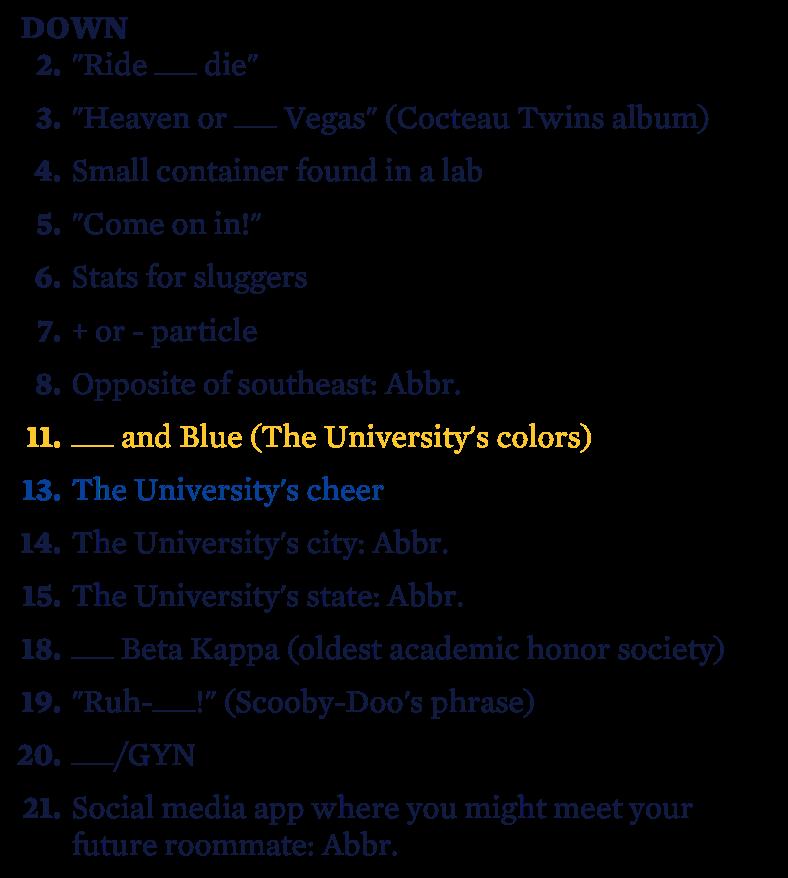
TO MICHIGAN CROSSWORD
Interested in making or solving crosswords? Check out more of our games at games.michigandaily.com and consider applying to The Daily’s Games section in the fall! Contact tobinsax@umich.edu with any questions or interest! Happy solving, and welcome to Michigan!
H
Becoming a doctor? Arguing before the Supreme Court? Leading a team of engineers? Designing buildings? Teaching children? Building systems? Performing for sellout crowds? Something big?
N E E D A J O B ? N O W H I R I N G !
Earn $15-17 per hour
Meet great people
Have fun & get paid
Work study is available
Looks great on your resume
Develop communication skills
Network with alumni and donors
Leadership opportunities available
A letter from a fellow (graduated) Wolverine
KAYENNE OHNO MiC Columnist
To my out-of-state students, You’ve made it. You graduated high school and now you’re coming to the University of Michigan. That’s a really big deal – congrats!
Are you scared? Nervous? Excited?
It’s okay to feel all of these things, especially when you’re moving away from home, be it from the next state over or all the way from the other side of the coast. I get it. I’m an out-of-state student, too, and I can tell you that despite being excited for a new journey, at first it was terrifying.
I went to an all-girls Catholic high school with a graduating class of 80 in Los Angeles, Calif. The idea of coming to a new place to start over was petrifying. The sheer size of the campus was enough for me to feel scared. My high school was a singular, fourstory building — I didn’t do a lot of walking to class. The idea that I had to trek 10 to 15 minutes for my classes was a completely new thing. Every day, all the people that I walked by were just new faces, different from the ones I saw every day at home. Then, I didn’t know if I would be able to find the group of people that I had grown up with: K-pop lovers, K-drama watchers, anime enthusiasts and fan fiction readers. Everything was different. Every little thing about Michigan, as a state and as a school, was shockingly new.
I grew up in a community where there was a big Japanese population, but, moving to Michigan, I knew that I wasn’t going to have that same community. The University is similar to my high school — predominantly white. Would I meet anyone of Japanese descent? Anyone who spoke Japanese? I wanted to be able to connect with that part of my family’s culture that I grew up with.
Back then, going to a whole new state where I knew no one — it felt like I was taking a gamble with more risks than benefits.
Four years later, I couldn’t be happier.
Though she was scared, my 18-year-old self took the risk and did her best to make the University her place. During freshman year, the easiest way
for me to get to know others was going out. It’s certainly not for everyone — I’ve heard from a couple of my other friends that they kept their dorm room doors open, in case anyone passed by. I heard many others just hung around their dorm lounges hoping to randomly meet people. It wasn’t easy making friends though, but I had someone that showed me around once I got to campus.
I met my first friend, Phiphi, through the class of 2026 Instagram page when I was looking for a roommate. I’ll never forget her. I didn’t know what it would be like DMing some random girl, but she was the first person who pushed me to branch out from the small all-girls environment I was so comfortable with to that of a larger public university. Phiphi made me realize that I should join different clubs to find my own group of people and look into things that I might be interested in. To her, I’m eternally grateful. Now, she’s off with her big-girl job at Whirlpool, but she still checks in on me, even if we’re in different places in our lives.
But I’m not going to lie, even with Phiphi as my guide, college was not easy. I listened to her advice and created a community for myself here, a community that would last me a lifetime. In my freshman year, I joined the Japan Student Association to meet people who wanted to learn about Japanese culture or were trying to find others who came from similar backgrounds. And though I didn’t go to a lot of events because I had a part-time
job, I signed up to volunteer for their biggest annual event: the Japan Culture Festival. From there, I applied to be on the JSA board. Now, I can proudly say that I’ve been a part of their leadership board since my sophomore year and have gained a whole new group of friends.
I’ve made mistakes again and again and again. I’ve made mistakes in my friendships, resulting in heartbreak. I chose the wrong man to date while figuring out college. I’ve made the mistake of putting things that I didn’t value as much over my academics. I’ve made the mistake of not putting my mental health and myself first. I almost made the mistake of not applying to the JSA board because I thought that I wouldn’t be good enough to be on it. I’ve learned and am still learning from these mistakes, but that’s all a part of the experience.
Michigan is hard. I thought about transferring so many times. Being a STEM student on the pre-dental track is definitely not for the weak. I barely scraped by, but I kept going. With the classes being hard, I lost myself. It got to a point where I needed therapy because I was putting myself under so much pressure. Every day in sophomore year felt like I was in hell, sinking deeper and deeper without a stopping point. Every week I would call my mom crying to her that I wanted to give up because university was hard.
What made that sinking feeling even worse was that all of my roommates were local. They were able to go home and see their family every weekend, but I had to deal with my classes, stress and homesickness all by myself. In freshman year, I didn’t feel homesick because I was trying to get used to campus life, but it hit hard sophomore year. It might be the opposite for you, but there was no easy way to get used to that empty feeling in my stomach. I wanted to move back home and transfer to some University of California school, but I still wanted to prove to myself that I was capable of surviving here. Keep telling yourself that you are capable, but
most importantly, know that even if everyone looks like they have it all figured out, most of them don’t. When you go home for the breaks, cherish the time that you have with your family or friends and use it to recharge and refresh before going back to school. Being able to see my friends and family kept me pushing through. Being out of state is tough, but know that the risk you took leaving home was not for naught.
There’s no one solution for all of the mistakes and hardships that I went through, but I learned that there’s only one me, and I need to cherish her. College life is about taking risks, ignoring the scary thoughts in the back of your mind and trying, regardless. Life is too short to regret anything. Now, I realize that I should just take the risk, then at least I can tell myself that I did it scared. While I didn’t really put this into practice until I was an upperclassman, it is a mindset that I have carried with me even after graduation.
I found a sense of belonging and a home at the University and you will, too. The people that you love all the way back home and all the people that you will come to love here at the University will be your support system—don’t take them for granted.
This sense of belonging might not come easily, but figure out what you like or value: something related to your major, a passion, your culture. JSA was the organization that made me feel like I finally found my place at this University. The group of people that I was on the board with made me feel at home.
The University isn’t necessarily home to me, but the people that I met and became close with are. It might not be easy at first, coming to a new place and figuring it all out for yourself, but I was able to do it, so that means that you can, too.
Be ambitious and curious. Honestly, that’s all that it takes.
Congrats, again! Welcome to the Wolverine family.
Forever Go Blue!
Sincerely,
A fellow (graduated) Wolverine
On behalf of the nearly 700,000 alumni family, congratulations on your acceptance to the University of Michigan.
From orientation to graduation and beyond, the Alumni Association is here to support you. Discover various programs designed to enrich your academic experience and cultivate lifelong connections, including Welcome Wednesdays, the Mbassador program, and more. Begin your lifelong U-M connection as a Student Life Member for only $749 — more than 45% off the original price — or as an Annual Member starting at $30.
You don’t get much time here. Spend it with intent.
ELENA NICHOLSON Summer Editor in Chief
It’s hard to take your time in college. Days get booked to the brim. Semesters fly by. And somewhere along the way you’ll end up building a life here in Ann Arbor.
I find that my most pivotal college moments are also the most prominent in my memories: meeting my nowroommates while moving in on the fourth floor of South Quad Residence Hall, driving down to Florida with a club sports team, the excitement I felt walking into The Michigan Daily’s newsroom week after week to have endless conversations around the desk. I could go on.
It is easier to reflect on friends made, communities joined and accomplishments earned while looking in the rearview mirror. It is these small memories that aggregate into the communities and knowledge that feel like they’ve existed forever. But slowing down to appreciate each moment as it occurs is much more difficult.
Because college is so fleeting, being intentional is crucial to becoming a better student and enjoying your time here. It takes effort to choose to grow, which is what you are at the University of Michigan to do. Given the current academic landscape, it is imperative to challenge yourself when possible, choose to put in the work and try to appreciate all the moments that lead to the end result.
There are plenty of reasons why approaching an education with purpose is harder now than it used to be. Generally, people are distracted. Social
media algorithms and shortform content have decreased our attention spans. The news cycle rarely provides a positive outlook on our world. Mental health for college-aged people remains poor. There is always something competing for our focus: work, school, relationships, our phones and other obligations. Coming from a student, being a student certainly isn’t easy right now.
Some technological developments seem to promise an easier student experience — but only at surface level. Generative artificial intelligence is changing the way we receive information and study. If you don’t want to do your homework, there are dozens of computing systems at your disposal that will do it for you in a fraction of the time.
This is where intent comes in: Now more than ever, you must be mindful enough to want to learn. Working hard at something is certainly rewarding; it’s also where people develop skills and improve. An obvious example of this can be seen with writing. As AI usage diminishes human writing capabilities and potentially overall literacy, if college students want to maintain and grow their capabilities — as one of the last generations to see a world with and without AI — they must continue to put pen to paper.
The real challenge for incoming freshmen and anyone looking to gain something out of their education is to focus on putting in work despite available shortcuts. This means choosing to pursue a degree not just to get the diploma, but also to discover a worldview and things to be passionate about.
Technology is shifting the academic landscape, but that’s not the only challenge new students must approach with purpose. It is also important to be intentional while exploring interests outside of classes through student organizations, local groups and new relationships.
It takes considerable effort to build community, no matter how socially capable you might be. As new students work through the process of joining organizations and finding friends, taking the time to reflect, absorb what is happening around you and ask the right questions about who you are and what you want to be is important. Opportunities are endless on this campus, but only when you’re motivated to find them. That will mean doing hard things and going the long way around instead of the easy route. But in choosing to explore campus with intentionality, you will find community and connectivity.
All that said, going through your college experience with drive does not mean that
everything must be done perfectly or that having an overwhelmingly competitive mindset is productive. It is natural and good to hone in on the things that are best for you. Prioritizing your own growth and the people in your life is a balance, but it is counterproductive to approach college with any preconceived notions of what it will be like.
In the newsroom, we often say that The Daily will change your life if you let it. The same applies to your college experience, both in academics and social life. Those willing to put work, time and thought into the things they do will see results in the form of a loving community and immense personal development.
A sense of purpose and determination to learn and grow will always be something you have to work toward. But you will find, in time, that the work lightens. Like writing, pushing yourself toward your passions is a muscle. The more you choose to prioritize projects you care about, the more it will become muscle memory. The relationships in your life will always require attention, but they will feel less forced as time passes.
I reflect often, especially on the moments that have shaped my life and the person I’ve become. I like to recount those moments with the people that I call my best friends. I have a deep gratitude for every opportunity I have pursued, because the work didn’t end when I got into this university, and it never will. My love for learning and affinity for connectivity have served me well, but not without consistent effort toward maintaining those things.
All in all, one could describe this mindset as having an enthusiasm unknown to mankind. In the short time we have at the University, we should all strive to approach every day with that kind of intent.
Maisie Derlega/DAILY
The Michigan legislature and you:
How you’re impacted by lawmakers’ decisions
REBECCA BORLACE Daily Staff Reporter
As budget negotiations for the 2026-2027 fiscal year are underway in Lansing, some decisions have the potential to affect life at the University of Michigan. Topics discussed include the Tuition Incentive Program, one-time budget increases, public transport funding and Local Bus Operating funding. Notably, discussion of funds to offset federal research cuts has been absent. Lawmakers are aiming to finalize the budget by the statutory deadline of July 1.
University Funding
Public universities — like the University of Michigan — have a general fund which pays for teaching, student services, facilities, administrative support and research costs. State governments annually allocate spending towards these general funds. According to the University, it was granted an estimated $365 million in state funding during the 202425 fiscal year, making up 12.4% of the University’s General Fund.
The Michigan Legislature also funds the TIP, awarding tuition assistance to eligible in-state students on Medicaid. Recipients must have had Medicaid coverage for at least 24 months within any 36-month period from age 9 to high school graduation. Gov. Gretchen Whitmer’s proposed 2027 fiscal year budget book contains plans to increase
total TIP funding to $148.8 million — a $26.5 million net increase from this year. It also plans to cap financial assistance for those attending public universities at 2.5 times the average per-credit tuition rate at Michigan community colleges, which may impact some U-M students.
Tuition
The state has increased funding for University operations by 19% since 2019 to maintain academic programs and manage tuition costs. CONTINUED ON OUR 2026 ORIENTATION EDITION WEBSITE
Audrey Rosenberg/DAILY
Navigating the numbers of academics: Registration, information and how first-year students fit in
CALEB OBICO Summer News Editor
For incoming students, the University of Michigan can seem overwhelming. The Ann Arbor campus alone includes 19 schools and colleges, offering over 280 majors and thousands of classes. With more than 35,000 undergraduates in 2026, understanding the numbers the University can help you understand where each student fits in on campus. Schools, colleges and cross-campus transfers
Five of the Ann Arbor campuses’ 19 colleges are graduate only. Of the remaining colleges, 10 admit first-year students who directly apply upon admission into the University. There are four upper-level admitting schools — the School of Dentistry, the School of Public Health, the School of Information and the Ford School of Public Policy — which accept presently enrolled students on a yearly or semesterly basis.
Upper-level admitting programs have separate requirements for admission specific to their school.
These requirements often include completion of certain prerequisite courses. Although many of these programs also recommend a minimum grade point average and demonstrated involvement in extracurricular activities, their competitiveness varies. For example, the Public Policy School enrolls approximately 100 students a year.
Once accepted, a student must complete a cross-campus
transfer to enroll into the selected school. The Taubman College of Architecture and Urban Planning, Ross School of Business, College of Pharmacy and Information School offer preferred admission, a process guaranteeing students placement into their desired program after the completion of their first or second year at the University.
Course registration
According to the University’s 2025-26 Common Data Set, the University offers a total of 4,559 course sections, not including labs, internships or lecture subsections. Out of 1,598 course sections, the most common class size was 10-19 students. This reflects the University’s average student-faculty ratio of 15:1.
Returning students register for new courses at the end of each semester on an assigned date. While registration experiences vary by program, many students have critiqued the process; students report courses filling up quickly, and getting off a course’s waitlist is not guaranteed. Typically, the earlier a registration appointment, the greater the chance a student will be enrolled in their selected courses.
During the class registration timeline, students are placed into one of 27 registration blocks based on the total number of credits completed. Often, this does not count credits from Advanced Placement tests, but will consider transfer credits from other universities — meaning students may be placed in earlier blocks than peers in higher grades.
The earliest available registration appointments are often reserved for students with upperclassman standing. However, exceptions exist for students belonging to one of four categories: student athletes, students meeting
criteria set by the Services for Students for Disabilities, current or former militaryaffiliated students and dance and cheer team students. During the winter 2026 registration session, 2,223 students were awarded these appointments. Among those students, athletes were the largest group with 831 students, followed by veterans and active-duty students with 614, students with disabilities at 527 and dance and cheer team students at 51.
Advising
The University has advisors across each academic department. Often, these advisors are specific to their schools, such as the Business School and College of Engineering. For students on specialized academic tracks — such as pre-law and pre-health — course advising is managed by Newnan Academic Advising Center.
There are also advisors who specialize in unique student circumstances or interests. There are advisory offices that exist to assist with student affairs, students from the Upper Peninsula, study abroad programs and others.
Due to the decentralization of advising, all department advising experiences are unique.
First-year students
Some programs at the University are only offered for incoming and first-year students. Theme Communities and Michigan Learning Communities are programs focused on a specific topic, social identity or academic discipline. Additionally, these types of communities have designated residence halls intended for first-year students. MLC programs influence a student’s academic path by requiring courses for the program, often providing reserved seats for those courses. This also includes the LSA Honors Program — the largest learning community — which enrolls about 350 applicants per year. Other supplemental academic programs require admission for admitted students graduating high school, such as the Learning, Equity and Problem Solving for the Public Good program within the School of Education. In addition, there are required classes limited to first-year students, including the FirstYear Seminars program — courses capped at 18 undergraduate students with a focus on specialized academic topics.