


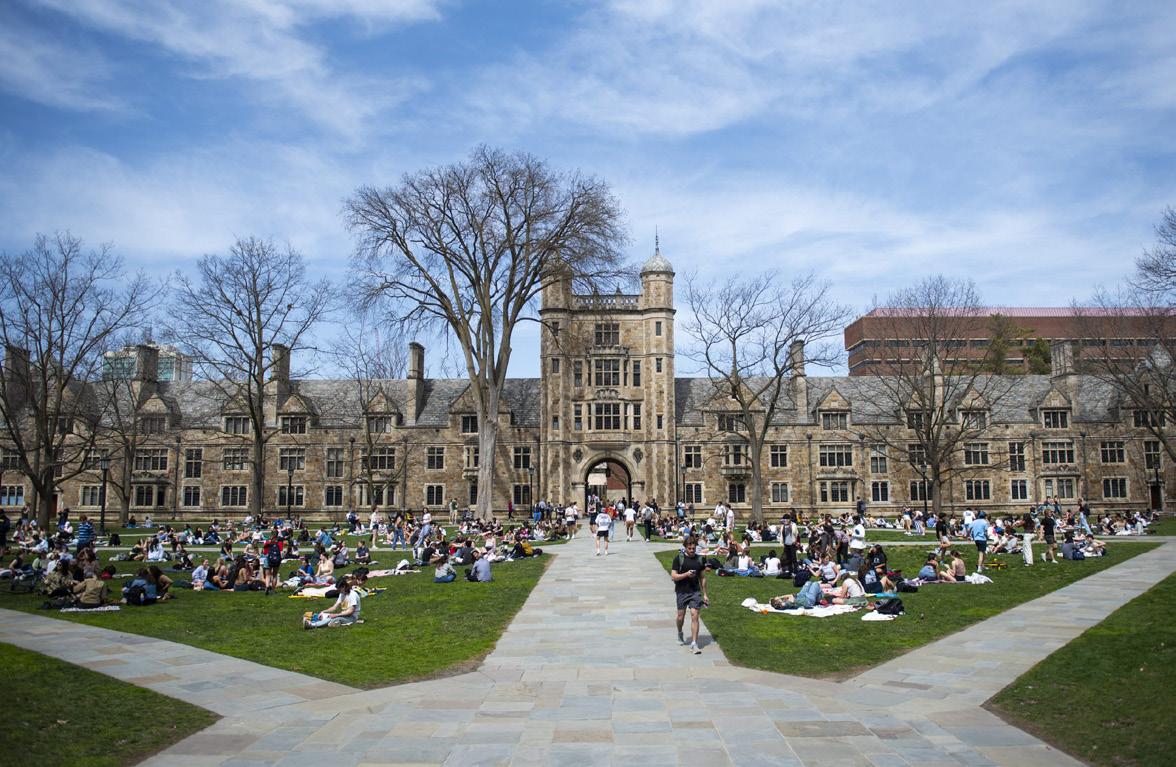







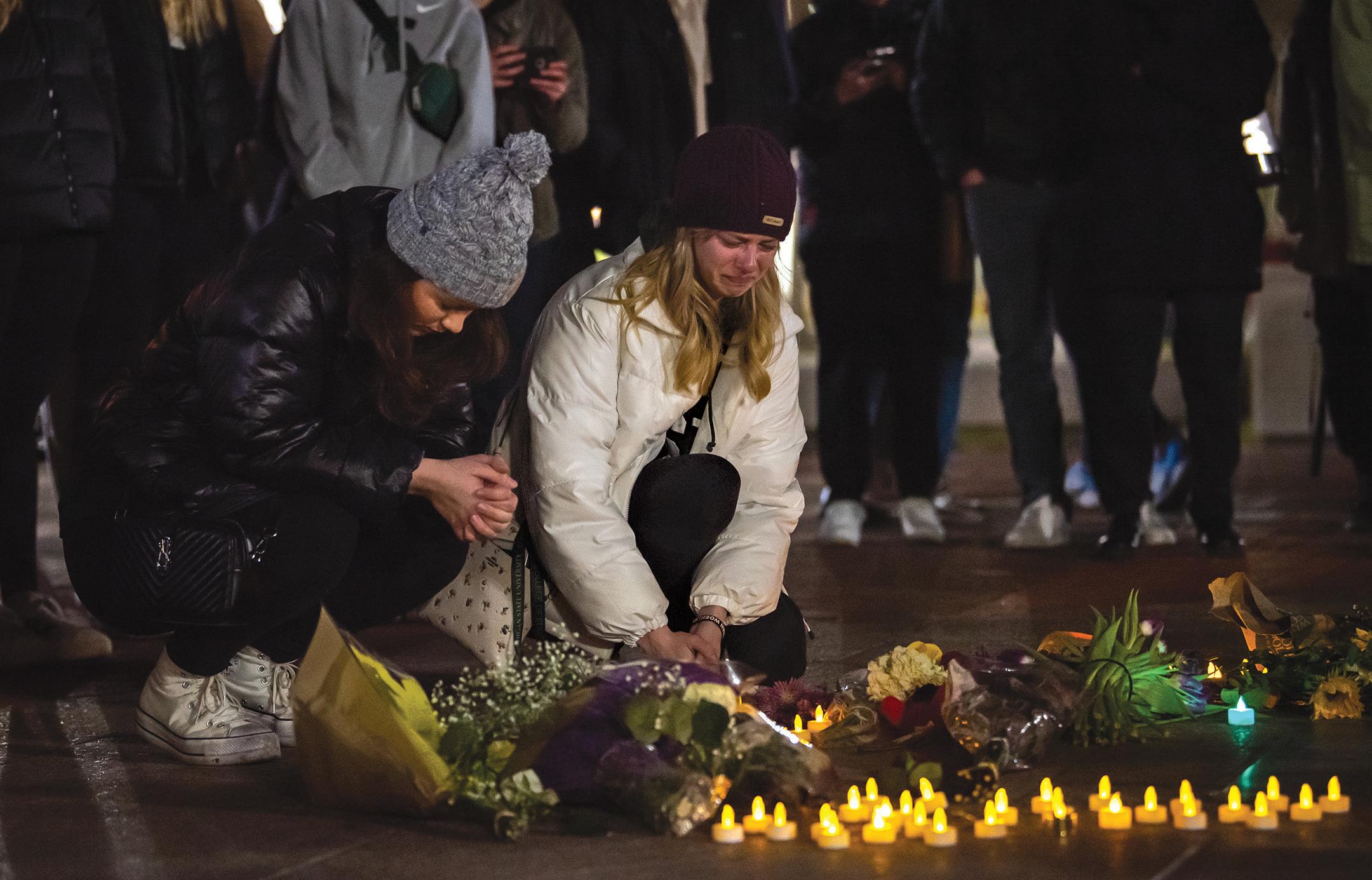
FEB. 16, 2023 — More than 3,000 University of Michigan community members gather on the Diag to mourn the three victims of a mass shooting at Michigan State University.
AUG. 25, 2023 — GEO successfully negotiates for increases in salary and expanded access to mental health coverage, ending a five month strike.
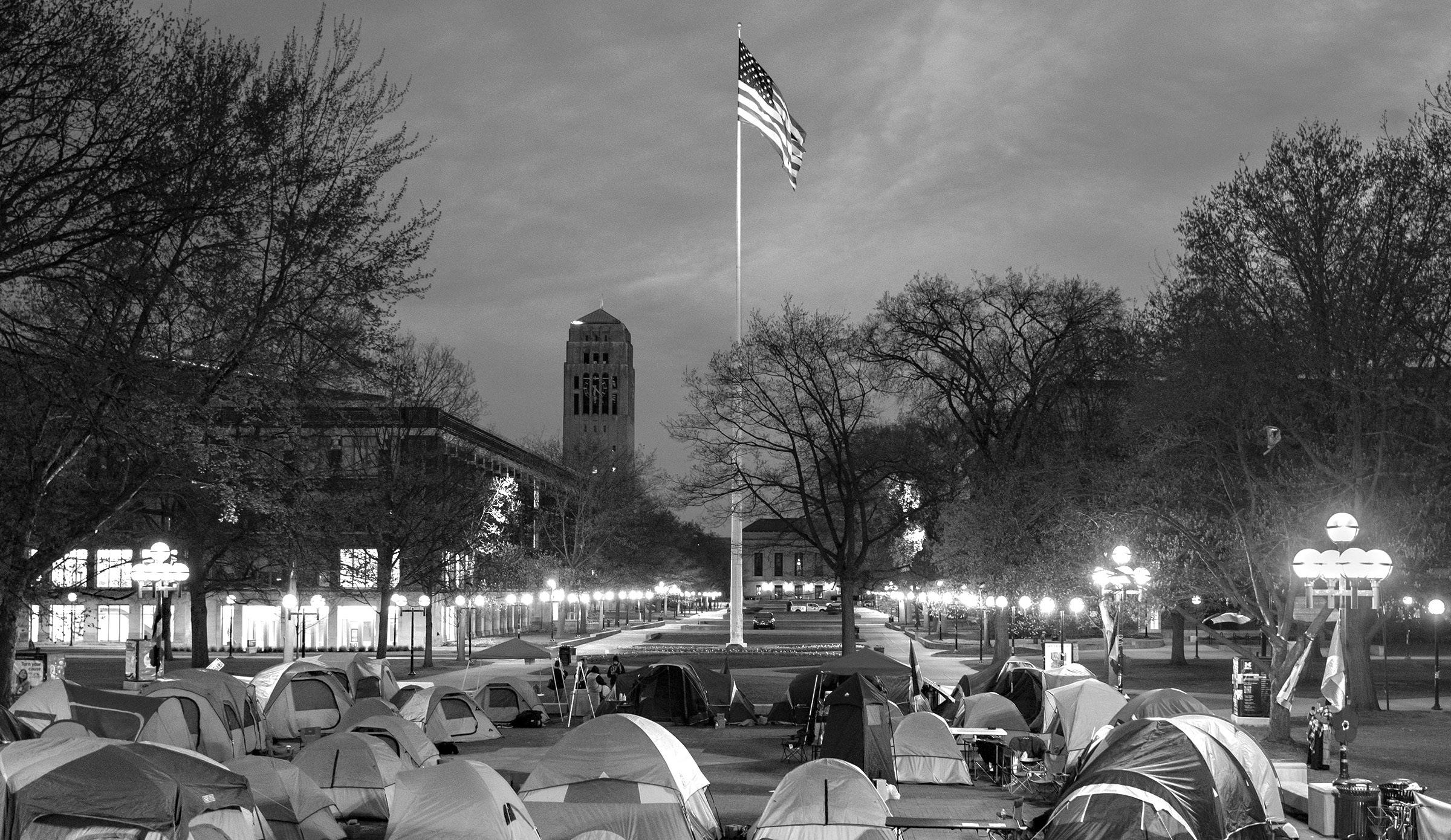
APRIL 24, 2024 — Hundreds of protesters set up an encampment on the Diag to protest Israel’s military campaign in Gaza and University of Michigan endowment investments tied to Israel. The encampment lasts for a month before UMPD forcibly removes it May 21.
MARCH 31, 2025 — The University of Michigan cuts all DEI 2.0 initiatives in efforts to comply with executive orders from President Donald Trump. Many U-M community members vocalize concern and discontent with the closure of ODEI and OHEI.
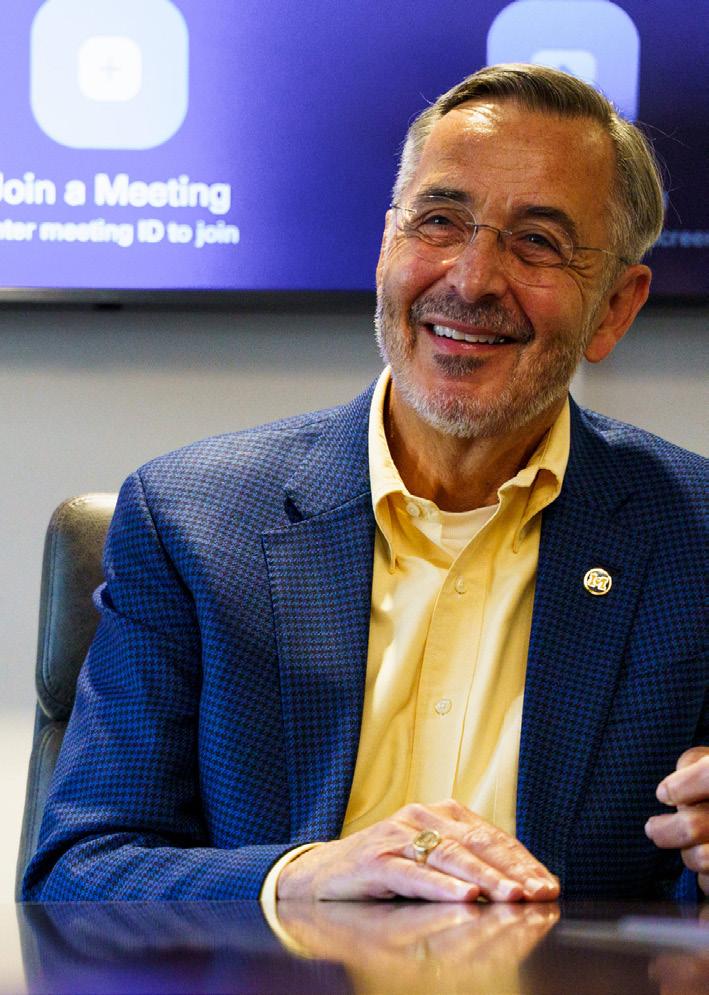
MAY 4, 2025 — In a campus wide email, 15th University President Santa Ono announces his departure from the University of Michigan.
JAN. 31, 2026 — Following U.S. Immigration and Customs Enforcement shooting two Minneapolis residents, more than 1,000 U-M students and community members gather on the Diag for “Salt the Earth” protests.
APRIL 20, 2026 — Amir Makled, progressive University Board of Regents hopeful, upsets incumbent Jordan Acker at the Michigan Democratic Party’s state endorsement convention.
Regents to establish interim president as Ono looks to University of Florida
University President Santa J. Ono announced in an email Sunday evening that he will be leaving the University of Michigan in pursuit of a new position as president of the University of Florida. The announcement follows the University’s Spring 2025 Commencement ceremony and the recent extension of Ono’s contract through 2032 by the University’s Board of Regents.
In the email, Ono wrote that he expects to take on his new role later this summer and that
UMich
he would miss the University’s community.
“Serving as your president over these past three academic years has been a distinct honor,” Ono wrote. “Every day, I have been inspired beyond words by the vibrancy, brilliance, and dedication of our faculty, staff, students, and alumni … The University of Michigan — and the State of Michigan — have forever captured my heart. It has been a profound privilege to be part of this extraordinary community and this remarkable state.”
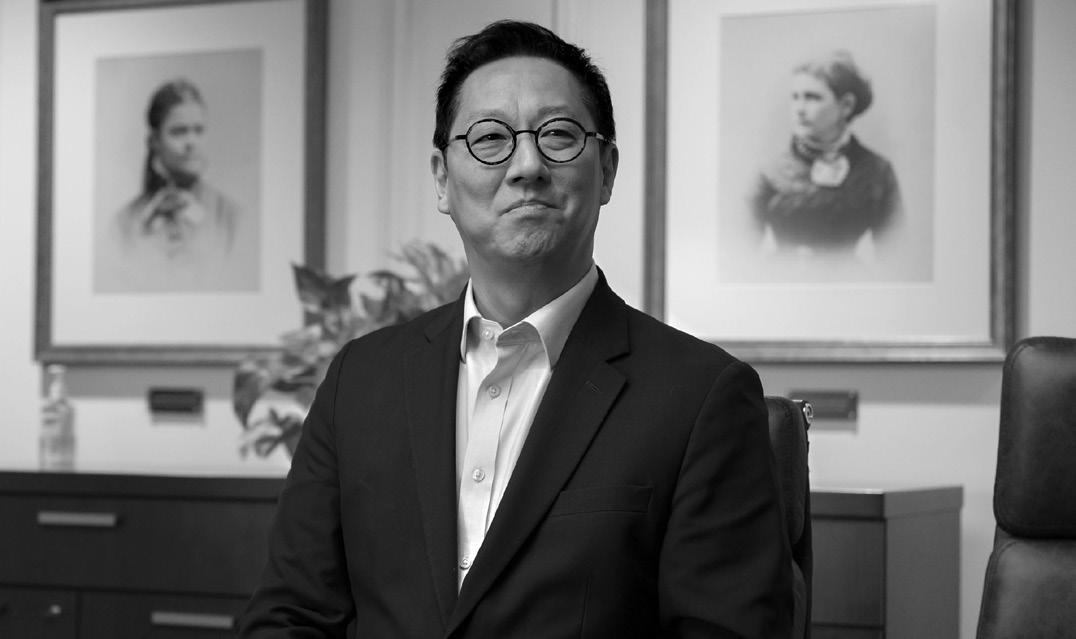
Ono went on to acknowledge various accomplishments the University has made during his term, including the further development of artificial intelligence, advancements in sustainability, expansion of the Go Blue Guarantee and more.
“These accomplishments are a testament to the collaborative spirit, creativity, and dedication of our entire university community,” Ono wrote. “They reflect a deep commitment to ensuring that Michigan’s best days are still ahead … I have every confidence that our exceptional leadership team, our deans and directors, and our Board of Regents will come together behind a new leader, ensuring that Michigan’s extraordinary momentum continues to serve the people of Michigan and the world.”
In an email sent by the Board of Regents, the board wrote that they are working to ensure a
“It doesn’t appear that there’s really a true effort in trying to identify a solution.”
Ypsilanti’s elected officials are concerned about the $1.25 billion data center the University of Michigan plans to construct in their township and do not believe the University is listening to their concerns about the facility’s location and potential impact on the local community. On the contrary, they feel they have been misled and left out of pivotal negotiations.
The University intends to build the data center in partnership with Los Alamos National Laboratory, with construction projected to begin in 2028. The larger part of the center, measuring at least 220,000 square feet, will be dedicated to LANL for national security research. 50,000 square feet of the center will host a non-classified facility for academic research by the University.
Unease surrounding the proposal centers on its energy usage and environmental impact. The data center is projected to consume 110 megawatts of energy — roughly equal to the township’s entire current energy consumption — and to use roughly 200,000 gallons of water per day. Many Ypsilanti township residents have also raised concerns about the University’s partnership with LANL, due to the laboratory’s involvement in nuclear weapons research.
Following the Michigan Economic Development Corporation’s announcement Dec. 10, 2024 of a $100 million grant to fund the data center, Ypsilanti Township supervisor Brenda Stumbo said she met with Chris Kolb, U-M vice president for government relations, to discuss the project’s potential impact on the township.
In an interview with The Michigan Daily, Stumbo said township officials were not satisfied with the information
they received, which was little more than had already been publicly announced. Still, they said they were led to believe the project would entail two officelike buildings on about 20 acres by Textile Road, which would bring 200 high-paying jobs to Ypsilanti — a development they saw as positive and minimally intrusive.
According to Stumbo, the township later received a phone call from Michael Rein, U-M director of community relations, who told them the University intended to purchase an additional 124.68 acres directly adjacent to the property, indicating the planned data center would be far bigger than the officials had previously believed. A few days later, at the University’s Board of Regents’s meeting in June, they announced their recommendation of the purchase.
Stumbo said she felt misled about both the size of the facility and the nature of its land use — including the University’s intention to partner with DTE Energy to
construct an electric substation to power the data center.
“At the time, (the facility) seemed like a positive, kind of a gamechanger,” Stumbo said. “It could change the future of our business corridors … is what we thought, not understanding what a data center really was. Because you can say it looks like two office buildings, but it’s really more of an industrial use, and that was never explained.”
Many Ypsilanti residents oppose the construction of a data center anywhere in their township, but the Textile Road location has drawn particular ire. The site lies along the Huron River, with a public park on the other side. An affordable housing development, Lake Pointe Apartments, is located across the road from the site of the planned substation.
Stumbo said the township requested the University to reconsider the location of the data center.
CONTINUED AT MICHIGANDAILY.COM
smooth transition to an interim president.
“The Board of Regents is unified in our commitment to maintaining steady leadership, and President Ono has agreed to remain with the university as long as needed to establish an interim president,” The Regents wrote. “We are working thoughtfully and expeditiously as we execute our transition plan and we will be sharing more details in the near future.” In an email to The Michigan Daily, University spokesperson Kay Jarvis wrote that all available information regarding Ono’s departure can be found within the issued email.
Graduate workers’ union secures increased wages, health care benefits days before fall semester begins
RILEY HODDER Former Managing News Editor
As of midnight on Friday, the bargaining team of the University of Michigan’s Graduate Employees’ Organization has officially ratified the University’s final contract offer, ending more than nine months of negotiations, including a fivemonth-long strike. The ratified contract will last from August 25, 2023 to May 1, 2026, and ensure that graduate student employees will be in the classroom by the time classes begin on Monday. On August 17, with a little more than a week before classes began, GEO President Jared Eno asked the University to provide the union with their “last, best, and final” contract offer, to be reviewed at their Aug. 21 meeting. The meeting resulted in the union voting to authorize the contract, leaving their bargaining team free to ratify the deal before the start of the fall term.
The final contract offer saw significant gains on multiple issues that GEO brought up in their original bargaining platform. The University committed to continuing the Rackham Summer Funding Program through August 2026. The contract also saw pay gains for graduate student workers, with Ann Arbor campus union members receiving an 8% pay increase in 2023, a 6% increase in 2024 and 6% increase in 2025. Graduate student workers at U-M Dearborn and U-M Flint are also set to receive annual raises for the next couple years, with Dearborn receiving a 10.5% increase over three years, and Flint receiving a 9% annually until their minimum pay aligns with Dearborn. The contract also expanded access to mental health coverage and gender affirming health care benefits, and made concessions to GEO on many other points. CONTINUED AT MICHIGANDAILY.COM
TAHRIR Coalition occupies Diag, demands U-M
Monday 4:00 p.m.
By Christina Zhang
As of 6 a.m. Monday, University of Michigan students set up a Gaza solidarity encampment on the Diag, planning to remain until the University meets their demand of divestment from companies profiting off Israel’s military campaign in Gaza. The encampment was organized by the TAHRIR Coalition, a student-led coalition of more than 80 organizations including the U-M chapter of Jewish Voice for Peace and Students Allied for Freedom and Equality.
The encampment follows six months of student protests for the University’s divestment, which began with a sit-in at the President’s house in October. Since then, students have continuously organized protests across campus demanding the University divest from Israel’s military campaign in Gaza. Similar encampments have been set up on college campuses across the country, including at Yale University and at Columbia University, with many students facing arrest and suspension, among other disciplinary actions, for their participation.
The Michigan Daily spent 24 hours on the Diag to document day-to-day operations at the solidarity encampment and understand students’ motivation for their advocacy.
At 4:00 p.m., organizers hold a rally calling on the University to divest from companies profiting off of Israel’s military campaign in Gaza. The rally features four speakers, including SAFE president Salma Hamamy, Murad Idris, associate political science professor and two student activists.
Around a dozen pro-Israel students hold Israeli flags on the northwest corner of the Diag. Police officers from the Division of Public Safety and Security as well as Michigan State Police stand outside of Mason Hall watching the rally, but do not engage with students.
Speakers deliver their remarks from in front of the Hatcher Graduate Library. Hamamy speaks first and says living in the encampment is a way for protesters to call attention to living conditions in Gaza. Since the beginning of Israel’s military campaign in Gaza, residents have been subjected to increasingly poor living conditions and food shortages.
“As student organizers, we have sacrificed our time and our sleep,” Hamamy said. “But one thing we tend to not sacrifice very often is our comfort, and this is allowing us to experience
another level of our privilege … to be living here with a roof over our heads, have easy access to bathrooms, food, water, heat. We are stripping ourselves of those right now, and that is entirely pale compared to what the people of Gaza are going through.”
The rally ends at 4:30 p.m. Some attendees leave while others join organizers on the Diag and chant various proPalestinian chants, including “Fund our education, not the occupation,” “Israel bombs, U of M pays, how many kids did you kill today?” and “From the river to the sea, Palestine will be free.”
5:00 p.m.
By Christina Zhang
By 5:00 p.m., many picketers hold Palestinian flags and signs reading “Michigan Strike for Gaza / No Class No Work No Business As Usual.” Picketers chant for the University to divest as they circle around the Diag, while drummers in the middle of the Diag match the rhythm of the chanting with their drumming. Some of the chants include “Screw your lines, screw your threats, we’ll disrupt ’til you divest,” “We want justice, you say how? End the siege on Gaza now” and “From the valley of the beast, hands off the Middle East.” At 5:38 p.m., an organizer thanks picketers and attendees for showing support for Palestine. The organizer reminds
attendees to stay safe from both the police presence and proIsrael counterprotesters, and asks picketers to stay for as long as they are able. The organizer also encourages picketers to change directions while circling the Diag.
The organizer’s announcements are met with cheers as picketers continue to circle the Diag to the beat of makeshift drums.
6:00 p.m.
By Rachel Mintz
At 6:10 p.m., about 50 U-M student protesters slow their
chants and come to a halt in the center of the Diag. Organizers collect signs and hand out snacks to protesters, who sit in a circle around the block ‘M,’ covered by a sign reading “Apartheid Isn’t Kosher, Jews Demand Divestment.” Members of the Graduate Employees’ Organization lead a teach-in on Palestinian social
spoke for around ten minutes, but invited attendees to stay as long as they wanted to and asked students to sign or write messages on a banner sitting below the steps of the Graduate Library.
When asked if Nguyen wanted to share anything else with The Daily, he responded with two words.
“Spartan Strong,” Nguyen said.
There were 3,000 people standing side-by-side across the Diag on the University of Michigan’s campus Wednesday night. U-M students and community members gathered together in silence to mourn the mass shooting that took place on the Michigan State University’s campus Monday night which led to the death of three MSU students: Brian Fraser, Alexandria Verner and Arielle Anderson. The U-M Central Student Government organized the vigil as a way for Wolverines to stand in solidarity with Spartans and mourn the tragedy.
A similar vigil took place on MSU’s campus at 6 p.m. on Wednesday and was attended by thousands of students, according to The State News, MSU’s studentrun newspaper. Both vigils honored the lives of those who were killed in the shooting and were intended to help students at both campuses heal together. Attendees in Ann Arbor held candles in a circle around the block ‘M,’ before moving toward the Hatcher Graduate Library to listen to remarks by members of CSG.
LSA senior Noah Zimmerman, CSG president, spoke first, emphasizing that the U-M community is mourning alongside MSU.
“When one of (Michigan’s universities) is hurt, we all feel the pain,” Zimmerman said. “We feel for them.”
With a half-mast American flag behind them, CSG members only
According to LSA senior Jacklyn Hillman, CSG vice president, the banner was given to MSU’s student government following the vigil.
In an interview with The Michigan Daily at the vigil, LSA sophomore Kayla Wehner, a transfer student from MSU, said she has several loved ones at MSU.
She said she couldn’t process the shooting while it was happening, and the impact of what had happened didn’t sink in until she saw it all over social media and in the news.
“My boyfriend, who’s a student at MSU, called me and told me about the shooting,” Wehner said.
“All of my friends and my siblings go to MSU, and so I was really shaken and I couldn’t even process what was going on.”
MSU junior Andy Nguyen said he lives off campus, so he was shocked to hear about the shooting Monday night and he immediately started sending texts to loved ones. Ngyuen said he left East Lansing the morning after the shooting and came to Ann Arbor to stay with his girlfriend who attends the University of Michigan. He decided to attend the vigil on the Diag to show support for his school.
“I just thought it was best to leave Lansing,” Nguyen said. “I feel like leaving may have helped a little bit, but I kind of wish I stayed just because … we’re all in this together. I was very surprised that Michigan had a vigil, so, very luckily I decided to come here.”
LSA sophomore Gabriela Muniz said she was at home studying for an exam when she heard the news about an active shooter on MSU’s campus. Muniz said she was immediately shaken.
“It’s unbelievable that this is the reality of this country,” Muniz said. “(The victims) were just students, living life, just going on about their life, and now they are gone. Nobody’s gonna reverse this senseless tragedy for this family. It’s just terrible.”
Sueann Caulfield, professor at the U-M Residential College, told The Daily at the vigil that she was inspired by the number of students who came out to the Diag to stand in silence in support of the MSU community.
“I was really struck by the silence when I arrived,” Caulfield said. “I arrived a few minutes early and already the crowd (had) gathered, and more were coming in. Everyone was just here to be here with each other.”
MSU is a mere 62-mile drive from Ann Arbor, and Caulfield said this proximity means that almost every U-M student knows at least one person at MSU.
“(MSU is) not just close to home, it is home,” Caulfield said. “It’s happened to so many other people, and now it’s happening to us.”
Nursing freshman Nicole Godfrey said she attended the vigil to show support for the MSU community, including for her friend who knew of one of the victims. Godfrey, who is from Rochester, Mich. said she is also
AANYA PANYADAHUNDI & BRADY MIDDLEBROOK Managing News Editor & Summer Managing News Editor
On Thursday afternoon, campus-wide cuts to University of Michigan diversity, equity and inclusion initiatives were announced in an email from University President Santa Ono and other U-M leaders. The changes include the immediate closing of the Office of Diversity, Equity and Inclusion and Office of Health, Equity and Inclusion at Michigan Medicine, discontinuing of the University’s DEI 2.0 Strategic Plan and ending the use of diversity statements in admissions and hiring across the University. Student-facing ODEI programs will shift to other offices and all units will evaluate their web presence to ensure compliance with President Donald Trump’s executive orders. According to Ono’s statement, this decision was made in response to last month’s Dear Colleague letter from the Department of Education — which criticizes DEI initiatives as perpetuating racial stereotypes. The decision also was made to ensure compliance with three executive orders released in January — the
Improving Education Outcomes by Empowering Parents, States, and Communities, Ending Radical And Wasteful Government DEI Programs and Preferencing and Ending Illegal Discrimination and Restoring Merit-Based Opportunity.
In the email, the University pledged to increase investments in other student-facing services, including expanding financial aid and enhancing mental health support, advising and counseling, pre-professional guidance and various student life programs. However, it did not specify which ODEI, OHEI and DEI 2.0 services and programs would be relocated to other University offices, what changes DEI-related programs across the University community will see or how employees will be affected by the closures. In an email to The Michigan Daily, University spokesperson Kay Jarvis provided a general statement on the funding changes and directed community members back to Ono’s email and the University of Michigan Public Affairs Key Issues page.
“The University of Michigan is moving forward with important changes to our diversity, equity and inclusion (DEI) programs,” Jarvis wrote. “In a message today to the Ann Arbor campus
and Michigan Medicine, the university announced it will reallocate funding away from administrative functions and toward student-facing initiatives that directly enhance student success and foster a sense of belonging for all members of our community.”
Following the University-wide email, some student organizations condemned the changes via social media, including Central Student Government and a critical joint statement signed by the University of Michigan College Democrats, Michigan Institute for Progressive Policy and American Civil Liberties Union Undergraduate Chapter. The statement claimed that the office closures represented the University’s submission to attacks on higher education and intellectual research, erasing decades of work towards racial justice within the University community.
In an interview with The Daily, Ford junior Madeleine Wren, the co-president of MIPP addressed the organizations’ core intentions behind the statement and said she wished the University allowed for input from community members before making decisions on DEI. CONTINUED AT MICHIGANDAILY.COM
very close with many people who survived the shooting at Oxford High School in November 2021.
“Justin Shilling was actually a friend of mine, and I lost him at Oxford,” Godfrey said. “I just wanted to give all my support, especially to the Oxford students who had to endure that and then went to Michigan State as well … no one deserves to go through this, especially (not) multiple times.”
Engineering sophomore Hunter Schrupp said he grew up in Ann Arbor and has been participating in the MSU and U-M rivalry for years, but right now he thinks it’s incredibly important that the U-M community shows their unwavering support for everyone in East Lansing.
“I’ve been to events like this after tragedies, but this one is
definitely different,” Schrupp said.
“I’m seeing people I knew from high school who have come back for the week from MSU. I see the look on their faces, and they’re sad and they’re scared and I get it.”
Several hundred students remained on the Diag late into the night, their faces solemn as the wind whipped back and forth. While some students hugged each other and offered support, others stood quietly around the block ‘M’ until their candles burned to the wick and eventually went out.
In an interview with The Daily at the event Peter Railton, a U-M philosophy professor, spoke about the prevalence of guns and gun violence in the U.S., which became the leading cause of death for children in 2022.
“With guns as widely present as they are in our society, every day, people are being shot in their homes quietly,” Railton said. “Not by necessarily criminals, but through domestic violence and suicide. (Gun violence is) an illness that (the U.S. doesn’t) seem to be willing to cure ourselves of.” U-M leadership, including University President Santa Ono, have encouraged students to take care of their wellbeing over the next several days, highlighting the campus mental health resources available to students such as Counseling and Psychological Services, the Faculty and Staff Counseling and Consultation Office, Michigan Medicine Office of Counseling and Workplace Resilience and Wolverine Wellness.
‘We want ICE out of sight’: Thousands rally for ‘Salt the Earth’ protest
ZAHRA KAGAL Summer Senior News Editor
Over 1,000 students and community members gathered on the Diag Friday afternoon for “Salt the Earth,” a protest opposing escalating federal immigration enforcement and advocating for the abolishment of U.S. Immigration and Customs Enforcement.
The protest — part of a nationwide wave of anti-ICE demonstrations sparked by the recent fatal shootings of Minneapolis residents Renee Nicole Good and Alex Pretti — drew students to the heart of campus to voice solidarity with immigrant communities and condemn brutality by enforcement agencies.
The event was organized by a coalition of student groups at the University of Michigan, including Wolverines for Abdul, La Casa, First-Generation Pre-Law Students, Lambda Theta Phi Latin Fraternity Inc., the University’s chapter of College Democrats and the Human Rights Party.
In an interview with The Michigan Daily, LSA sophomore William Lewis, Wolverines for Abdul member and an event organizer, said the protest’s
central demand was the abolition of ICE.
“We felt like now was the time to capitalize on that energy and show statewide that students are really fed up with what’s happening,” Lewis said. “The goal is to abolish ICE. We’ve seen that ICE has completely ignored the Constitution. They’ve started going into places without warrants; they think they don’t even need a warrant.”
The protest began with organizers reading aloud the names of individuals killed by ICE in 2026 so far — Luis Gustavo Núñez Cáceres, Víctor Manuel Díaz, Parady La, Heber Sánchez Domínguez, Pretti, Good, Keith Porter Jr., Luis Beltrán YáñezCruz, and Geraldo Lunas Campos — followed by a moment of silence in their honor.
Student speakers from each organization then gave speeches condemning ICE and calling for solidarity with undocumented and immigrant communities. LSA senior Sean Shelbrock, HRP co-president, addressed the crowd, calling the protest a part of a broader political moment.
“We have seen fascist policy, brutal policy and inhumane policy after inhumane policy attempt to tear us apart, divide us and brutalize our neighbors
and citizens,” Shelbrock said. “They want us to cower in fear. They want us to respond with timidness. But what are we going to do? We’re going to show up.” In an interview with The Daily, Shelbrock said the protest was motivated by empathy and solidarity. He said its primary goals were educating the community and sustaining longterm organizing efforts.
“We’re out here fighting out of love for our neighbors,” Shelbrock said. “I hope that people go into tomorrow and go into the future and keep that spirit, keep fighting for one another and keep organizing.”
Public Policy junior Aidan Rozema, member of College Democrats, called on attendees to take action against President Donald Trump’s immigration crackdown.
“After the deportation of 230,000 people, you have to look around and see what’s going on,” Rozema said. “We see immigrant children shouting for freedom in detention centers. We see lies spoken behind a government podium asking us to deny the evidence of our eyes and ears. Will these atrocities finally move America to action?”
CONTINUED AT MICHIGANDAILY.COM
and Makled has mirrored national divides between moderate and progressive Democrats. Acker is seen by many progressive activists as representative of the Board’s current policies, such as ending the University’s Diversity, Equity and
Inclusion programs; cutting genderaffirming health care for patients under the age of 19; and prosecuting pro-Palestine student protesters. The victory of Makled — who provided legal representation for protesters and has been critical of the current Board — was perceived by many convention attendees as a major progressive upset. In his acceptance speech, Makled thanked those who voted for him at the convention and promised to embark on a program of reforms at the University.
“This moment obviously doesn’t belong to me,” Makled said. “It belongs to every student who believed their voice mattered, every worker who showed up and said, ‘We deserve better,’ every family across the state who looked at this university and thought, ‘Maybe it could be for us, too.’” Brown kept his acceptance speech brief and expressed gratitude toward his family, labor unions and the LGBTQ+ community for supporting his campaign.
“I just want to thank my children and my wife, my union brothers and sisters, my LGBTQ family and all progressive Democrats,” Brown said. “We will continue to make the University of Michigan the greatest university in the world because of our progressive values.” Acker and his campaign staff declined The Michigan Daily’s interview requests during and after the convention. The final days of the race were dominated by a series of personal attacks against each candidate, with Acker receiving backlash for sexually degrading messages sent over Slack and Makled receiving criticism over a series of old retweets of posts praising members of the militant group Hezbollah. This media attention does not seem to
detracted from Makled’s support at the convention, though it did polarize some attendees against Acker.






MAY 2, 2023 — Sophia Lehrbaum and Noah Lusk publish an investigation into allegations of hostile work environments and unethical business practices at Cannelle Bakeries in Ann Arbor.
APRIL 5, 2024 — Reva Lalwani, Kim Ly, Nirali Patel and Sophia Lehrbaum spoke with survivors of alleged sexual misconduct by the University’s former athletics director Dr. Robert Anderson in the 1980s. The team investigated the process of settlement for the victims and how their experiences continued to impact them decades later.
‘I would make it up to you’: A local developer, an FBI inquiry and money in Ann Arbor politics
I would make it up to you. I don’t mean a bribe, but I just really need your help.’”
In December 2020, Elizabeth Nelson published a blog post detailing her account of the phone call with an unnamed developer, which Nelson later confirmed to The Daily was Poscher.
On July 16, 2020, at her home in Ann Arbor, former City Councilmember Elizabeth Nelson, D-Ward 4, had an unexpected phone call. On the other end was Heidi Poscher, sustainable technology advisor at a local development company, 4M. City Council had just proposed an ordinance to restrict the number of short-term rental properties permitted in residential areas — a step taken to address Ann Arbor’s worsening housing crisis. According to Nelson, Poscher said the ordinance proposal would jeopardize 4M’s short-term rental properties in Ward 4. Nelson then alleged Poscher attempted to convince her that 4M’s pre-existing short-term rental properties should be permitted to continue to operate regardless of the new restrictions.
As a sitting City Councilmember at the time, Nelson was a key player in that decision.
“She got really desperate,” Nelson said in an interview with The Michigan Daily. “She was just like, ‘If you could help me with this,
“In my two years on Council, I have had many conversations with people who hope to see me vote in support of something, people who have a lot at stake that depends on my vote,” Nelson wrote.
“Until recently, none of those conversations have ever referenced personal benefit or favors to me.”
Nelson’s public allegations drew the attention of the FBI — within weeks, two agents showed up at her door. City Councilmember Kathy Griswold, D-Ward 2, and Ann Arbor Mayor Christopher Taylor told The Daily they also spoke with the FBI regarding this blog post.
Upon notification of the FBI’s involvement, The Daily began an in-depth investigation into Poscher’s criminal history. Hundreds of pages of court records reviewed by The Daily show that Poscher has been convicted of three felonies, all of which were related to financial crimes.
Poscher has recently established a political presence as one of the
biggest individual campaign donors in the Ann Arbor political landscape, donating thousands of dollars to local elections.
Taylor told The Daily that, upon learning about Poscher’s criminal history, he took the money Poscher donated to his political action committee, Ann Arbor for Everyone, and regifted it to the Jim Toy Community Center.
“After learning her personal history, I chose to make that contribution from the PAC,” Taylor said.
The Daily reached out to Poscher for comment and received a response from her and her legal counsel, Arthur Siegal. In Poscher’s response, she wrote that the allegations Nelson made in her blog post are without merit.
“It is totally irresponsible for the Daily to consider repeating false and baseless claims based on lies and hearsay and not one shred of evidence,” Poscher wrote in an email.
Poscher and Siegal did not respond to The Daily’s questions about whether the FBI had, at any point, contacted Poscher.
The Daily also asked Poscher whether she expected favors from political candidates in return for her individual campaign donations. CONTINUED AT MICHIGANDAILY.COM

MARCH 26, 2025 — Anna McLean, Daniel Johnson, Sasha Kalvert and Sophia Lehrbaum utilize public legal records, campaign donation reports and source interviews to investigate the role of money and backdoor dealing in Ann Arbor city politics. They uncover local developer Heidi Poscher’s criminal history and impact on Ann Arbor development.
FEB. 15, 2026 — Anna McLean, Elizabeth Rozeboom and Elizabeth Foley investigate former Michigan Medicine dean’s omission of multimillion dollar pharmaceutical ties in published research.
omitted multimilliondollar pharma ties in multiple publications, Daily investigation finds

Runge was on another payroll, too.
Over a decade marked by a pandemic and nationwide cuts to health care funding, Marschall S. Runge led Michigan Medicine in a historic triple-leadership position. He served as executive vice president of medical affairs and chief executive officer of Michigan Medicine starting in 2015. In 2016, he was appointed dean of the Medical School, serving in all three roles until 2025.
The University of Michigan credits Runge with doubling philanthropic funding and leading the University to its greatest growth in research advancement. In addition to his administrative roles, Runge conducted research of his own, which was largely centered on cardiovascular topics.
His University responsibilities made him one of the institution’s highest compensated faculty. In 2024, he was the second-highest paid U-M employee with a salary surpassing $2.38 million.
In 2013, Runge was elected to the board of directors at pharmaceutical giant Eli Lilly, where he served until August 2024. Though Lilly is a known producer of at least one cardiovascular drug, it is unclear whether the research Runge conducted is directly affiliated with the drugs Lilly manufactures.
Runge received at least $2 million from Lilly throughout his tenure as a board member according to Open Payments, a government database that discloses physicians’ external financial relationships.
It isn’t uncommon for doctors to receive compensation from drug and medical device companies for consulting for them. But, an investigation conducted by The Michigan Daily found the payments Runge received from Lilly far exceeded the amounts most of his peers at other hospitals accepted from similar companies, and that the level of outside compensation is not mirrored by Runge’s U-M leadership colleagues.
The Daily also found that Runge omitted his financial ties to Lilly in at least 12 of his journal publications. Two of these
nondisclosures appeared in Redox Biology and Journal of Molecular and Cellular Cardiology, which are owned by Elsevier.
The Daily requested comment from Elsevier about whether the journal was aware of Runge’s conflicts of interest at the time of publication. In a Dec. 5, 2025 email response to The Daily, Elsevier Communications Director Rebecca Clear wrote the company upholds the highest standards of ethics in its publishing to protect the quality and integrity of research.
“In accordance with our commitment, this case is currently under investigation, and we cannot disclose further information until the investigation is complete,” Clear wrote.
In a Jan. 20 corrigendum to one of Runge’s articles, Elsevier noted Runge’s omission of his board of directors position at the time of the article’s original publication.
“The authors regret omitting to include that Marschall S. Runge was a member of the Board of Directors of Eli Lilly at the time of this publication and apologize for any inconvenience that resulted,” the corrigendum read.
CONTINUED AT MICHIGANDAILY.COM
SOPHIA LEHRBAUM
Former Managing Editor
On the morning of May 21, the University of Michigan Division of Public Safety and Security forcibly removed the proPalestine encampment on the Diag. According to Ann Arbor Police Department dispatch records, the University called AAPD to request “a unit or two to help clear out” the encampment at 6:34 a.m. The encampment sweep followed repeated instances of police violence against proPalestine protesters on campus, including during a sit-in at the Alexander G. Ruthven Building in November and a demonstration outside of the University of Michigan Museum of Art in early May. Using the Freedom of Information Act, The Michigan Daily obtained body-worn camera footage from 15 officers who assisted DPSS in the sweep.
In one video, AAPD officers drive on State Street toward the Diag before running over a curb and parking on the grass. A police officer reports over the police scanner that the Diag is “stable.”
One officer in the car says to the other, “This is the best-case scenario, we’re leaving.” The other responds, “Now they’re just going to fucking walk through the city now.”
The officer with the body-worn camera says, “Oh shit — camera,” before the video cuts off. Chris Page, AAPD strategic communications manager, wrote in an email to The Daily that the officer in the video did not violate AAPD policy.
“The officer was not taking enforcement and not interacting with anyone so there was not a policy violation,” Page wrote.
The fourth point in Article IV, Section A of AAPD’s body-worn camera policy states that should an active-duty officer deactivate their body-worn camera during a call for service, they must first “verbally indicate their reason” for doing so. Body-worn camera videos obtained by The Daily show AAPD officers directly violating this policy. The city of Ann Arbor allocated $900,000 for body-worn cameras and tasers in 2021, an investment Ann Arbor City Councilmember Lisa Disch, D-Ward 1, said would “provide better safety and better transparency” in a June 2021 City Council meeting.
The Daily also requested DPSS’ body-worn camera footage and incident report from the morning of the encampment sweep. The University’s FOIA Office denied The Daily’s request, saying it would “(i)nterfere with law enforcement proceedings” and “(c)onstitute an unwarranted invasion of personal privacy.”
As a result of the University’s denial, The Daily could not confirm if DPSS officers recorded the sweep using body-worn cameras or produced an incident report.
Between April and June, proPalestine student activists across the country set up more than 100 protest encampments demanding their colleges and universities divest from companies profiting off Israel’s military campaign in Gaza. Within weeks, protesters faced violent police sweeps that ended their encampments and resulted in mass arrests, including at Columbia University, The University of Texas at Austin and the University of California, Los Angeles.
The University of Michigan’s encampment was one of the longest lasting, remaining untouched by law enforcement for 30 days. In a statement released the morning of the encampment
sweep, University President Santa Ono said the University decided to remove the encampment after a May 17 inspection by the U-M fire marshal, who declared it a safety hazard.
Videos of the encampment sweep posted to Instagram by Students Allied for Freedom and Equality show police using chemical spray on protesters, forcing them to wash their faces and eyes.
According to AAPD policy and procedural order 041-044, “(Body-worn cameras) allow for accurate documentation of police interactions in the public, to facilitate reviewing of use of force incidents and personnel complaints; and serve as evidence for investigative and prosecutorial purposes.”
If and when a body-worn camera is turned off during an active call for service, the officer must list the reason for deactivation in an incident report, as described in Article IV of the policy. Incident reports typically contain police officer narratives about the call for service they responded to and may contain documentation of why the body-worn cameras were deactivated or not activated at all.
The Daily requested AAPD’s incident report from the
encampment sweep in a FOIA request but did not receive one.
Page said responding officers did not produce an incident report because AAPD was acting as an assisting agency to DPSS.
Incident reports are best practice in policing, explained Jim Bueermann, president and founder of the Future Policing Institute. In an interview with The Daily, Bueermann said it is common for police officers to record what happened during a call for service, including by writing an incident report, in order to have documentation if the police department is sued. He added that an incident report is not necessarily a requirement or legal obligation.
The body-worn camera footage
The Daily received features police officers patrolling around the Diag during and after the encampment was ended by law enforcement, mainly directing foot traffic for protesters. According to Page, AAPD did not clear protesters during the encampment sweep or make any arrests following the incident.
Another body-worn camera video obtained by The Daily features a conversation between two officers patrolling around the Diag in a police car. One officer
says, “How do you feel right now? All amped up, right?”
The officer goes on to say they did not know why the University had called in AAPD to support DPSS officers during the encampment sweep. “We don’t even know what the fuck’s going on, that’s why, these idiots — it needs to be one person telling them what’s going on,” the officer says. “Because you have two completely conflicting stories from (the University) right now. One of them’s like, ‘We’re being overtaken,’ and then, I’m like, ‘What are they overtaking? What are they overtaking?’” The officer reaches for their body-worn camera and deactivates it, ending the footage. Stefani Carter, chair of the Ann Arbor Independent Community Police Oversight Commission, confirmed in an email to The Daily that the commission is not currently looking into AAPD officers deactivating their cameras during the encampment sweep. Carter also wrote that the commission could treat The Daily’s email for comment as a complaint and initiate an investigation into the use or misuse of body-worn cameras by the AAPD. CONTINUED AT

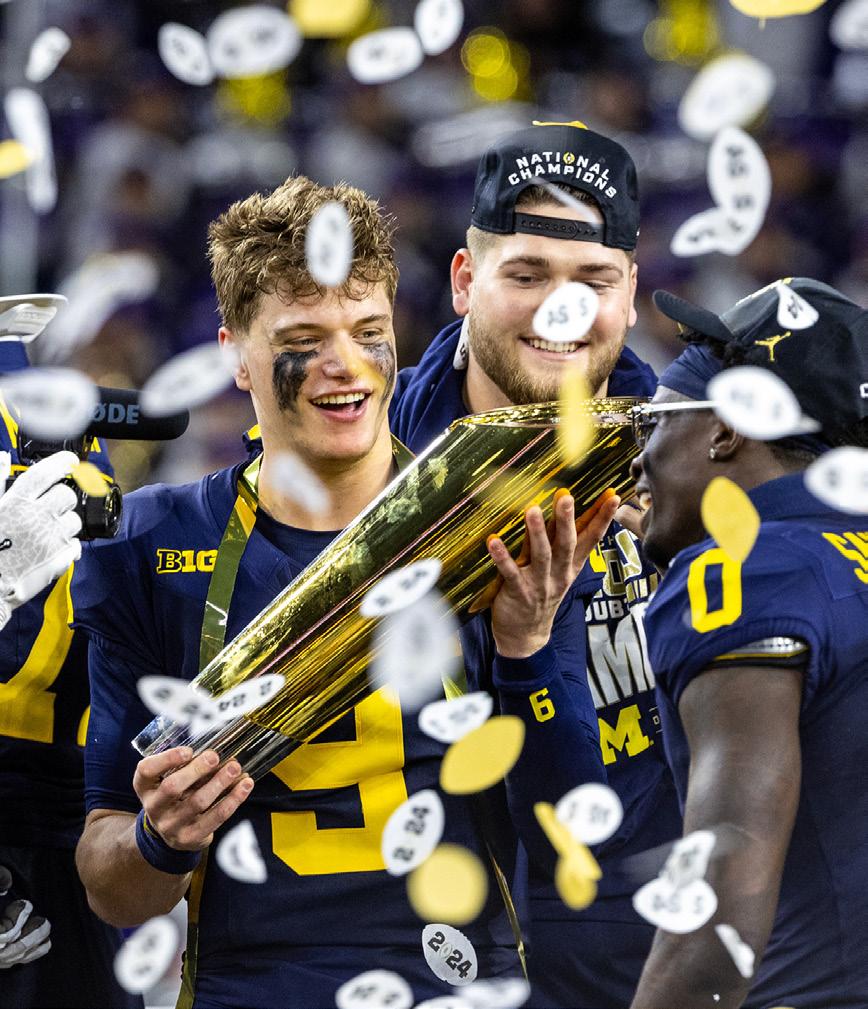
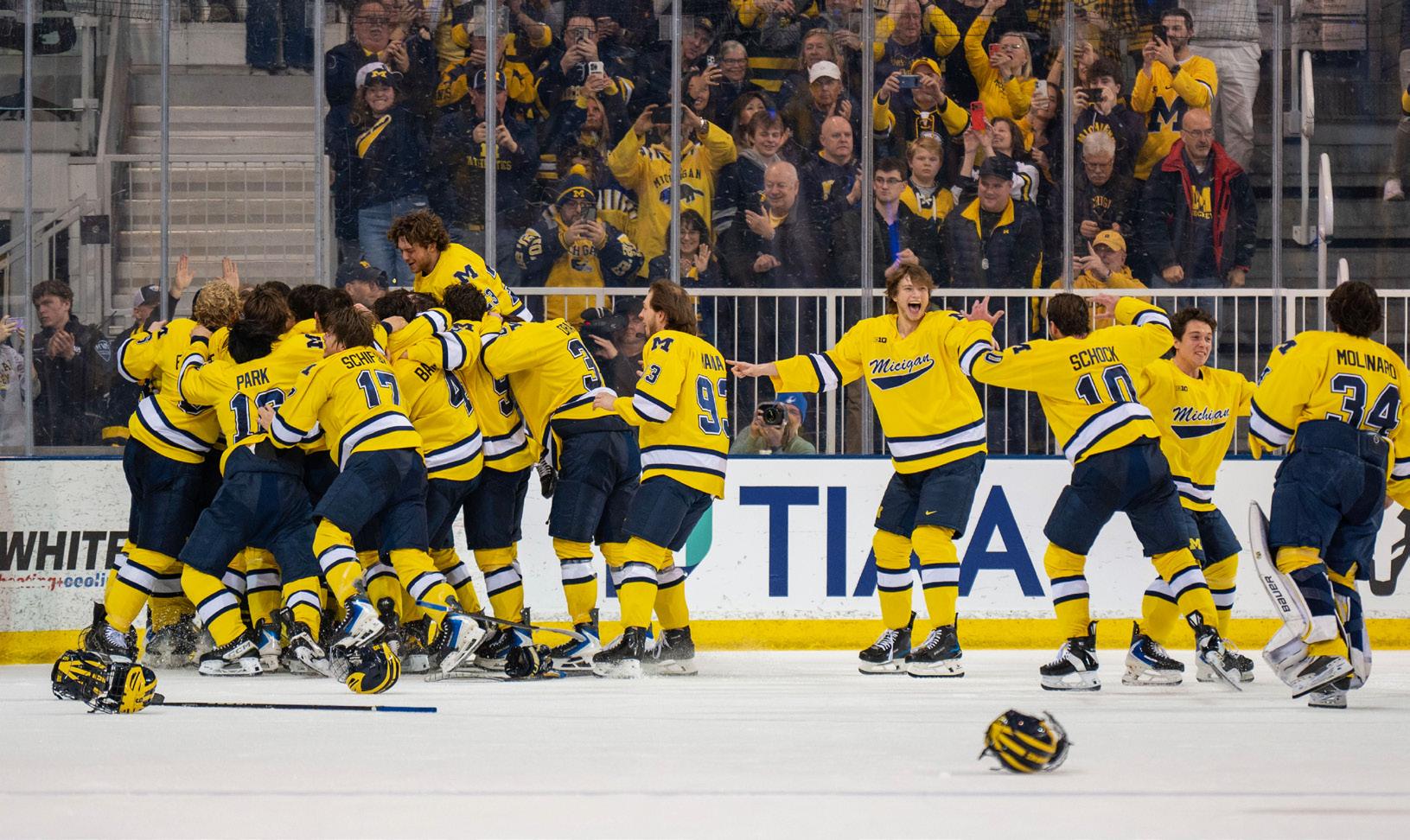
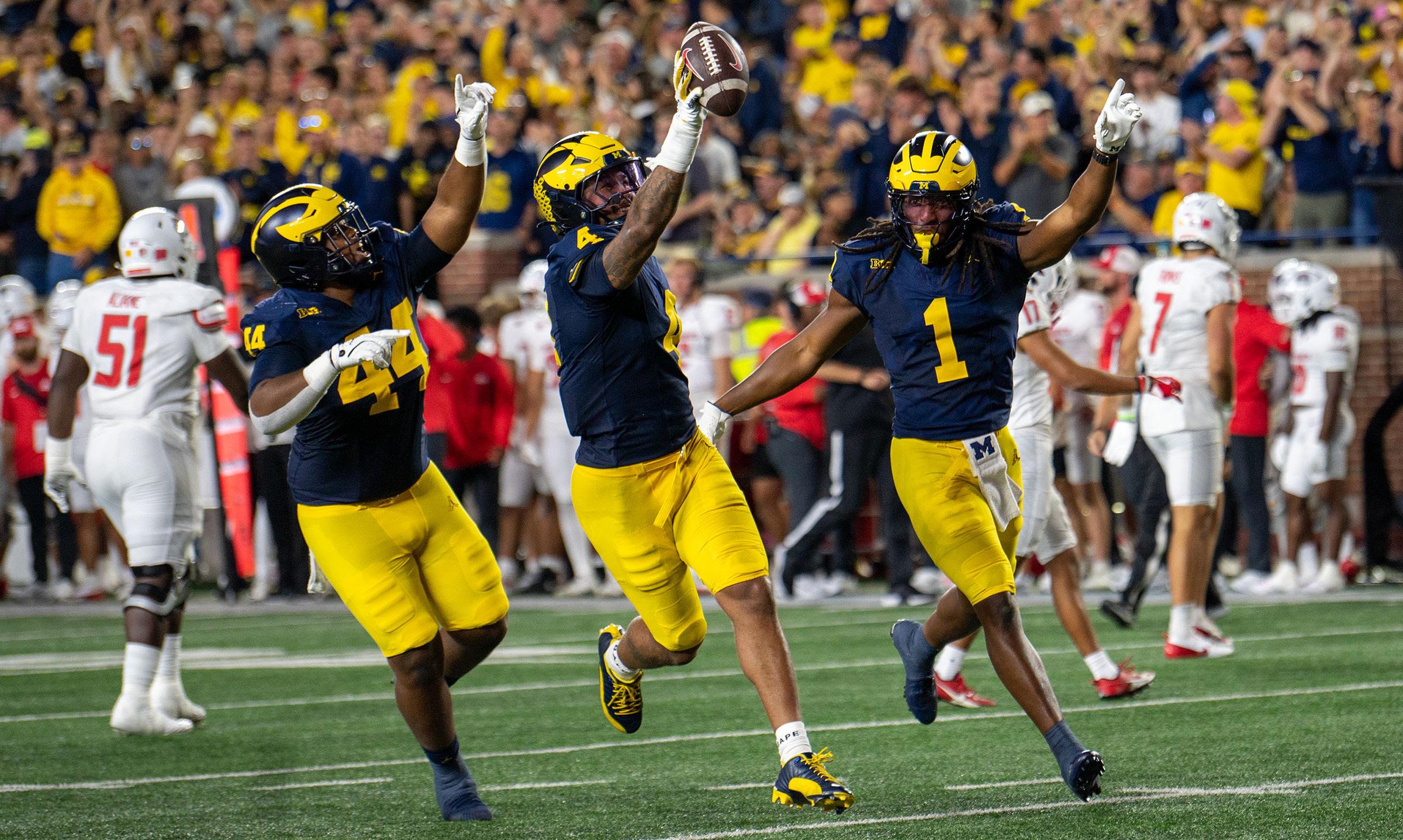
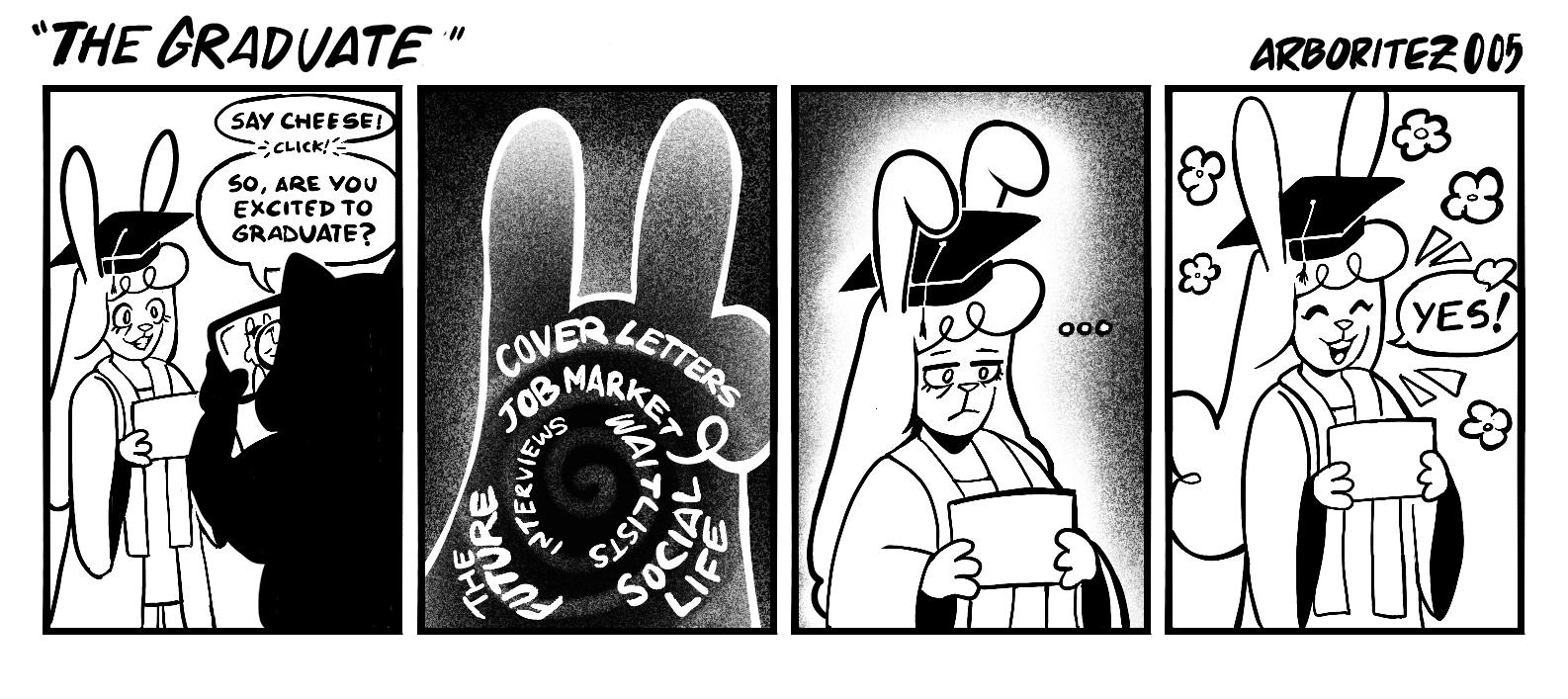
Over the last four years, our seniors have been an essential part of The Daily and have witnessed some of the most memorable moments across campus. Through their time here, they have seen everything from two National Championships to
a presidential election, as well as the quieter, everyday scenes that define campus life. This collection features a selection of their favorite photographs taken over the years, each reflecting the moments and stories that have stayed with them most.




ISABELLE PERRAUT Senior Arts Editor
SEPT. 12, 2022 — Consistent with Arts’ yearly tradition, 12 Daily Arts writers run the Ann Arbor Marathon and reflect on their experience through their favorite thing: Daily articles.
MARCH 9, 2023 — Arts staffers release The Swiftie Project — a collection of blurbs matching every Taylor Swift song to popular characters in media’s first part, “Taylor Swift” (corresponding to her debut album).
When I’m asked about my favorite movie, I usually have a moment of panic. I need to assess my audience. Should I be honest? Do I risk embarrassment or judgment?
I love chick flicks — “10 Things I Hate About You,” “Clueless,” “Easy A” — they’re my go-to films. And yet, like many others, I’m usually ashamed to admit my affinity for them. The chick flick genre, encompassing films marketed primarily toward women, isn’t taken seriously despite offering a bounty of big box-office hits. I’ll admit, chick flicks are definitely imperfect, suffering obvious flaws, most notably a lack of diversity; however, the genre is often subject to more intense scrutiny than its industry counterparts. These movies frequently face the same tired criticisms, such as being overly optimistic and vapid, which overlook the vast range of films within the genre. After decades of fighting for respect from critics and viewers alike, we owe chick flicks an apology.
‘Perverts’:
JAN. 7, 2024 — The Arts section and Opinion section publish The Society B-Side, marking an important collaboration between The Daily’s commentary sections.
MARCH 14, 2024, — The Daily sends writers to the 2024 South by Southwest Film & TV Festival in Austin, Texas, for the first time, a festival we have covered annually since.
NOV. 13, 2024 — For the first time, The Daily sends writers from the Style Beat to New York Fashion Week.
MAY 2, 2025 — The Style beat collaborates with SHEI magazine to publish seven pieces covering the met gala.
Like any movie genre, there’s a variety in quality among chick flicks, from amazing to practically unwatchable. The term itself is an umbrella that encompasses both critically-acclaimed and irreparably-trashy films, offering diversity that often gets overlooked. Chick flicks should be subject to fair criticism, but not at the expense of respect for the genre and its audience The trend of criticizing and belittling things marketed toward women is nothing new. From boy bands and pumpkin spice to romance novels, anything loved primarily by women is viewed as tasteless and frivolous. This isn’t unique to the internet age either — Beatlemania began with young, screaming female fans in the early ’60s. While their contemporaries originally scoffed at them, the reputation of the Beatles became more respectable as more men joined their fanbase. The reverse is true as well, which can be seen in the pushback to historically maledominated franchises, such as Star Wars, attempting to introduce more female perspectives. Unfortunately, chick flicks have
long been subjected to the same treatment. While a few lucky films such as “Terms of Endearment” and “La La Land” have scored Academy Awards while pushing the definition of chick flick, the majority of the genre is considered unintellectual and unartistic. Part of this boils down to the phenomenon of femininity being viewed as lesser or undesirable, evident when you compare the reputation of chick flicks to genres dominated by a masculine audience. Mindless action movies made for men receive a pass for being funny and entertaining while films with a mainly female audience are called ridiculous and trashy. Evidently, chick flicks receive an unfair amount of hate. Aside from the enduring effects of sexism, the characteristics of chick flicks further contribute to their notorious reputation. Filled with fluff, glitter and romance, the average chick flick likely won’t challenge your worldview or present a remarkably profound message on human nature. But the genre subscribes to the idea of cinema for the sake of enjoyment and entertainment, there’s nothing
This moment in world history is looking pretty dour. At night, I watch fascists seize power on TV; I watch a bankrolled apocalypse unfold; I watch ruins and ruins and ruins. Forced to do all this watching, Ethel Cain asks: Is it so wrong to get off on it?
Playing the cool girl’s cannibal, Ethel Cain is a perfect pop star for these anthropophagous times. Rife with sex, drugs and religious groveling, her discography transforms her Deep South upbringing into the stuff of Gothic fantasy. Her preceding album, Preacher’s Daughter, is a high-budget ghost story. It’s not real, but it reveals something of reality — some fundamental truth about love and power. With Cain’s January release, Perverts, this wasn’t the case. Cain spent the year running into thunderstorms and lying under telephone poles with a tape recorder in hand. Now, after three albums’ worth of incestuous pop ballads and one cross-country expedition, Perverts drives listeners to the darkest corners of the American heartland — and drops them off alone. In the past, producer Matthew Tomasi’s mix functioned more like a camera lens — he places the subject, the singer, in the foreground and bokehs the rest. Perverts has no hierarchy of scene; its sample-
collage landscape descends like a jet turbine, it diffuses like a ring of smoke and it embraces like a power grid. Ethel Cain built Perverts’ sonic landscape by transcribing the world around her: At last, sound speaks for itself. Its first words were the Victorian hymn, “Nearer, My God, To Thee.” Now, apart from scripted speech (and far from God indeed), the 12-minute title track sees Cain lament her alienation. “Masturbator…” she groans mechanically. “Heaven has forsaken the masturbator.”
The way she moans the lines — her’s is a forbidden love. But Cain’s music has always enraptured a certain kind of listener: the millions who love America black and blue, who love America like she does. Fans flock to her songs of depravity in the backcountry — and Perverts is not a departure from this at all. Cain’s exploiting the same stadiumfilling desire as does all of her discography, only at an angle. The fantasy of the Southern Gothic is really a death drive: permission to dance on the graves of plantations, through the evidence of your nation’s abandonment. And that is not perversion. That is America as usual.
These quarter-hour interludes exist throughout the album, not as songs, but places of respite. “Housofpsychoticwomn,” Perverts ’ “most erotic” track, buries listeners at the bottom of an elevator shaft, surrounded by whirring and
omniscient breathing. “Pulldrone” invites ritualistic contemplation, only to break it with the gong of a singing-bowl. Where Cain’s second album Inbred’s balladeering inspires a schoolgirl crush for backwater America, Perverts demands total surrender. But that surrender? Perverts does not achieve it. The album’s samples are too muddied by paulstretching to inhabit the world she put to tape. Cain’s characters are too self-conscious, obsessed with their own wrongness. Its audible geography is transportive, but sparser and flatter than the American landscape it transcribes. Whatever its shortcomings, though, Perverts dares to observe a reality most want to keep an interpretation’s length away.
All this time, she admits in a Flood Magazine interview, Ethel Cain has been a “crash test dummy” — a body double — for her maker, Hayden Anhedönia. She has abandoned her faith. She has fled out West and paid the price. She has died and loved from Heaven, but Anhedönia was the one who traveled across America to record her drones, in search of sounds she could fit inside.
Since this grim year began, I am tempted to abandon my body in the now: to reach across the chasm of the known future, unsure how far out to land. In these forever goddamned trying times, Cain puts us up to a near-insurmountable challenge: presence.
wrong with having different intentions behind a movie. As viewers, we don’t always want to watch something intense — sometimes we just want a movie that will make us feel good about life. Chick flicks accomplishing exactly what they set out to do by making viewers smile, laugh and feel better about themselves doesn’t make them inherently worthless or unintellectual. Rather, chick flicks fulfill a different niche that they often don’t get credit for.
While chick flicks are owed more respect, this isn’t to say that the genre is flawless or undeserving of criticism. Many of these films are problematic, leaving viewers to battle with a lack of representation and abundant tokenism due to many protagonists being young, thin, white women adhering to Western beauty standards. Aside from this clear problem, the genre also often deals with commercialization, prioritizing profit maximization over quality. A focus on revenue leads to lazy writing and repetitive, cliche storylines. These issues should not be ignored but rather should be taken more seriously as
OCT. 1, 2025 — Daily Arts publishes its Magic Tree House Project, a custom website containing short reviews for every Magic Tree House book.
MAY 2026 – Daily Arts releases its largest B-Side, the Goodbyes B-Side, combining work from six sections, including Podcast, Games and Video.

chick flicks continue to dominate within the film industry. They are problems to address in future films, not weak points that should be used to undermine the genre and its accomplishments. While chick flicks frequently receive the same dismissive, tired criticisms, they deserve to be talked about with the respect and thoughtfulness reserved for other genres.
While they have been subject to scorn for decades, chick flicks are a testament to the power
of the female audience. They remain wildly successful and have propelled women to the forefront of our screens and the American film industry. Additionally, they provide an opportunity to highlight female voices and experiences, especially as the industry continues to become more diverse. While they have long lagged behind as an “unrespectable” genre, it’s time we admit that there’s nothing wrong or unintelligent about liking chick flicks.
‘Squid Game’ is back with a bang
Former Senior Arts Editor
I’ll be the first person to admit that I expected “Squid Game” season two to be awful. Season one was an international hit, and the show remains the most streamed Netflix series of all time — and for good reason. Between its memorable premise, cast and commentary, the first season was a tough act to follow. And with how cleanly the narrative wrapped up, it didn’t make sense to unravel it all again.
The premise of “Squid Game” is simple: 456 participants facing financial hardship enter into a secret competition for the chance to win 45.6 billion won. The challenges are modeled after common Korean children’s games, but, instead of losing the game, any eliminated players are killed. High risk, high reward. As the number of contestants dwindles, the prize money goes up, and players are incentivized to assassinate each other. It’s a choice between murder for money or moral innocence.
The first season explores the horrors of capitalism and class conflict, demonstrating just how quickly desperation turns into betrayal. The intensity of these themes is greatly aided by a vibrant cast of characters. Every major character is thoroughly fleshed out and given a clear motivation to participate in the games, winning
over audiences’ empathy and raising the stakes for them, too. Even when you disagree with their decisions, you understand why they made them. So, seeing as season one covered all of those bases, I didn’t think a second season was necessary. I worried that season two would function as a replication rather than an addition, and that Netflix would trade quality for a quick buck as it has in the past.
For a long time, I believed my fears would be validated. Even with season two confirmed, Netflix released a “Squid Game”themed reality competition series to further profit off of the show’s success. Given the heavy critique of exploitative competition shows in “Squid Game,” it seemed ironic how quickly Netflix capitalized on the hype.
Upon release, “Squid Game” season two broke the record for the biggest Netflix TV debut ever, racking up 68 million views in four days. The buzz has continued online, with many viewers taking to social media to discuss the season. If it was a cash grab, it was a highly successful one. When I finally sat down to watch it, though, I was happy to be proven wrong.
While season one has a larger focus on the games themselves, season two centers a new voting system. After each game, the remaining players are given the
chance to vote on whether or not the games should continue. If the majority votes to leave, the contestants will split the total prize money made up to that point and they can return to their lives outside. If the majority votes to stay, they play another game. Depending on how a player votes, they are given either an X or an O badge to wear at all times. Adding the voting system was one of the best ways to keep season two fresh. While season one’s players formed small groups to strategize and protect one another, those of season two are assigned to one group or the other based on their vote. They must advertise their decision to the other players and, thus, risk being targeted by players who voted differently. The characters who want to stay start to isolate themselves from those who want to leave and vice versa, eventually culminating in a massive brawl that leaves dozens of players dead. By implementing this system, the creators of the game effectively create two opposing groups, distracting players from their common enemy: the game itself. One trend that season two continues faithfully is its use of a memorable cast of characters. Season two dedicates much of its time to exploring character development and dynamics.
CONTINUED AT MICHIGANDAILY.COM
CAMILLE NAGY Former Managing Arts Editor
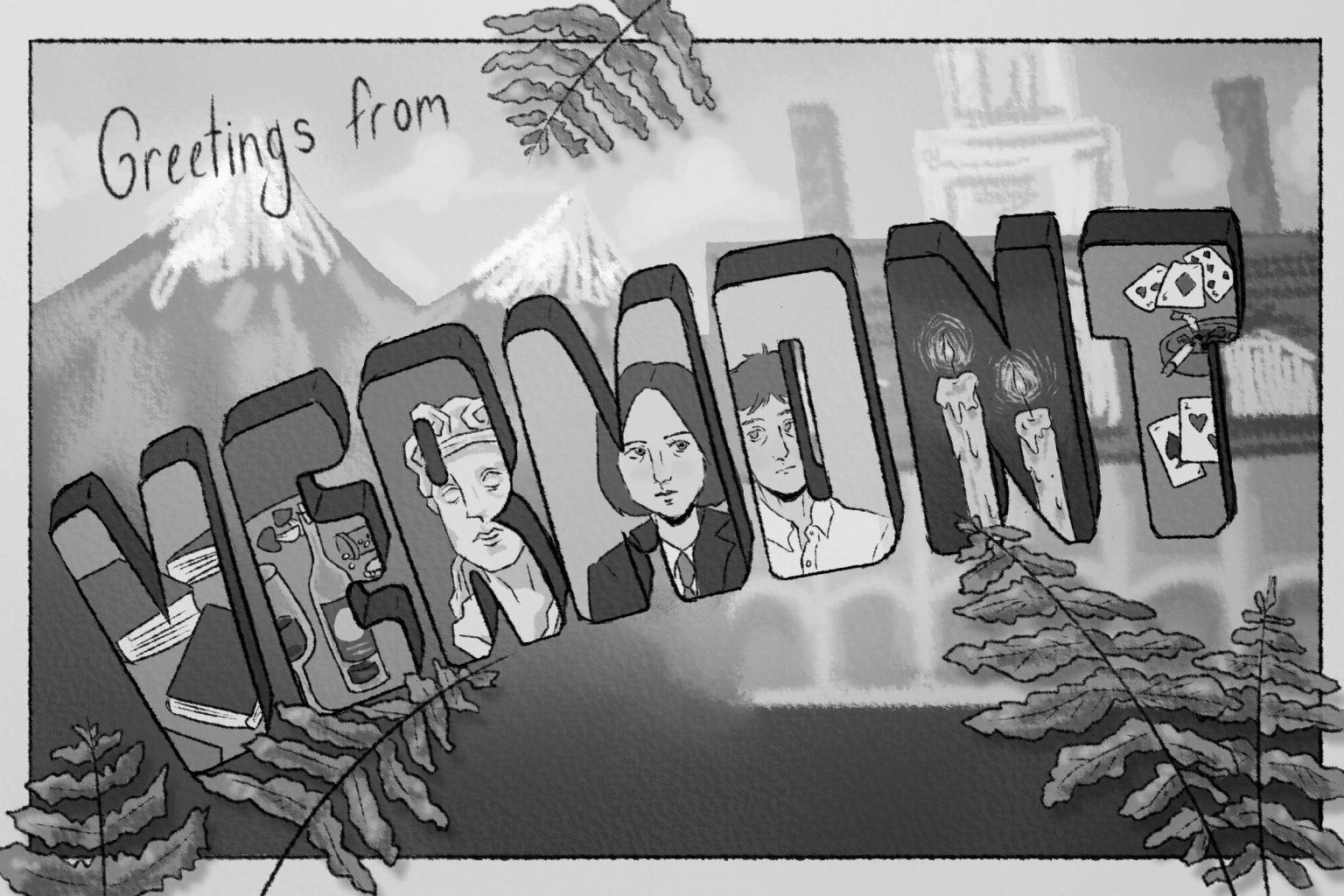
Here is the story most people know: In 1991, a then-28-year-old and relative nobody Donna Tartt sells what will soon become the critically-acclaimed cult classic, “The Secret History.” Shortly after its publication, the book’s overnight popularity pulls Tartt into the hazy, drug-filled world of ’90s stardom, alongside names like Robert Downey Jr., Michael J. Fox and Molly Ringwald. The world quickly becomes obsessed with this young genius: Who is she? Where did she come from? How did someone so inexperienced, so unconnected make a splash so large? Even more quickly, it becomes clear that Tartt has no interest in answering any of these questions.
Many prolific writers keep their private lives more private than Tartt. What makes this case so peculiar, however, is just how badly we want to know about her
— and how badly she wants us to know nothing at all. She leads an incredibly secretive life, swearing off social media and denying all requests for interviews (save for her decennial press tour whenever she releases a new book). When she does appear in interviews, her answers are often captivating, but reveal little information about her life beyond her writing. Rather than quelling anyone’s curiosity, this air of mystery surrounding Tartt has only fed into the cultural obsession with finding out who the author really is. And that nagging question, problematic as it may be, has yielded some interesting results. She’s the protagonist of a (sort of) rags-to-obscene-riches story. She’s a Southern-belleturned-crossdressing tomboy. She’s someone who, against all odds, seems to have made her way into the literary spotlight not by nepotism, backdoor deals or cheating her way to the top, but by rather quite literally “faking it ‘till you make it.”
Oh, and not to mention by stealing — a lot.
So let’s explore then, shall we? Here is the story most people don’t know; here is the secret history of Donna Tartt.
At least, I can admit there’s one in me. Who doesn’t dream of that infamous movie sequence: a stranger appearing from out of the blue to tell you that you — yes, you! — are gifted, important,
Small-town genius:
mediocrity and Mississippi
I think there’s a small part in all of us that would like to believe we’re secretly a genius.
special? Yet, rarely is that quiet desire actually proven true. I’m sure many of us have discovered since coming to college that, even when we’re the “special
one” in our hometowns, that identity quickly falls apart after moving away. No matter how “gifted” or “important” or “special” we may be to the ones who love us, the world has a knack for showing us just how average we really are once we venture beyond those spaces.
Not so for Donna Tartt.
Born in Greenwood, Miss., in 1963, Donna Louise Tartt was raised almost as if her parents knew who and what she’d later become. Fed on classics like “The Wind in the Willows” and Robert Burns’ poetry, one could say that, as a child, Tartt was trained more than brought up. Both her mother and father — Taylor and Don, a secretary and freeway service station owner, respectively — were avid bookworms who passed their love of literature on to their eldest daughter. From keeping classics around the house to reading them while driving (as Tartt’s mother was often rumored to do), they made absolutely sure their Donna loved to read. Though it was from her father that she got her (soon to be iconic) name, it was from her mother’s side of the family — the Bouches — that Tartt’s deep Mississippi roots stemmed. From these same Southern roots, Tartt seems to accredit some of her writing prowess.
“The American South is really a storytelling culture,” she said in a 2002 interview with The Sunday Herald. “It’s a culture of oral storytelling. It’s just extraordinary. Anywhere you go you hear a story.” Taken together, this cultivated love of literature and embodied experience of storytelling eventually turned into a love for writing itself. Tartt began her career with poetry at the age of 5, and she was published for the first time at only 13 years old with a sonnet in a state literary magazine.
IAN GALLMORE Senior Arts Editor
There is truly nothing more embarrassing than arriving at Mason Hall 3330 at 10 a.m. panting, beads of sweat beginning to perspire on my forehead. No, I did not run to class (an image of me lumbering down State Street with my backpack haunts my nightmares) nor did I have some illicit affair in the inner workings of the Mason/Angell/Tisch/Haven Hall labyrinth. Unfortunately, it’s much worse: I took the stairs.
In a time where our tallest skyscrapers reach more than 130 floors and stairs are hidden in dingy back corners of buildings, elevators feel like a Darwinian adaptation. Not only do they provide a modern luxury and the slight thrill of feeling the floor rise or fall under your feet, but they also have their own sub-genre of music to bump on your way up or down. Yet, as someone who hates cramped spaces and the awkwardness of spamming the “close” button, the stairs are often my favorite mode of ascension and descension. Maybe it’s some lingering childhood trauma from the “Stretching Room” in Walt Disney World, or the omniscient voice of my father describing how
SEPT. 1, 2024
he always takes the stairs — a separate form of childhood trauma — but since coming to college, I’ve been the one searching for the staircase in any building. On a campus more than 150 years old with a diverse array of architectural styles, this search has led me to some interesting places. Back hallways, strange doors and coming close to setting off emergency exit alarms are all a part of the stair-seeker journey. So is trudging up the Hatcher Graduate Library stacks steps before another long night, or circling the Kinesiology building 500 times in order to find a study spot (they knew what they were doing with that architectural maze). After climbing up and down (and then up again), I decided it’s time to bring to light the highs and lows of the best, worst and strangest stairs on campus. So start stretching those hamstrings and fill up your water bottle because by the end of this article, you’ll be out of breath, too. Worst: Mason Hall Staircase Yeah, we’re starting here, and I have thoughts. To keep this from turning into its own essay, here they are, rapid-fire: First off, you’d think you were waiting in line for Free Cone Day at Ben & Jerry’s or trying to get a taco from the dining hall in South Quad Residence Hall judging by the way the line
looks at 11:50 a.m. on a weekday. The poorly planned locations of the exits mean you are constantly cutting someone off, or awkwardly holding the door for someone — only to find out they’re going up another level. That’s because there is always another level with these stairs, especially since the building starts on ground floor instead of floor one. What? We are not in Europe. With the news looking the way it is, I can’t even pretend we are in Europe. I will be filing a cease and desist letter to Mason Hall with my lawyer. Oh, and it truly doesn’t matter which one you go to, because they’re both poorly placed. Though I have found the one closest to the north entrance of the building is typically more congested, despite being larger. I suppose everyone just wants to get out of that building as soon as possible. Relatable.
Weirdest: Modern Languages
Building Corner Staircases
The Modern Languages Building: A square that I will continue to get lost in every single time, always taking the longest path possible to get anywhere. You can’t really ever lose the stairs though, because there’s four of them — one in every corner. Unfortunately, four staircases does not mean four times the fun. The amount of backand-forth these stairs have always
My journey into ponydom began the summer of my freshman year. I finished season one of “My Little Pony: Friendship is Magic” over the three days it took me to unpack into a leased room and continued to catch up during breaks from my internship. The interest continued into the school year; when I blew out the candles for my 20th birthday in winter, it was in an Equestria Girl Twilight Sparkle cosplay at my ponythemed party.
I’ve taken a weird route here, all things considered. I recall watching “Rainbow Rocks,” the 2014 Equestria Girls movie, in middle school but didn’t watch much else from MLP. Though part of the target audience who grew up alongside the more famous airing of “Friendship is Magic,” I don’t even remember seeing it on TV, only noticing the occasional toy on store shelves that didn’t interest me much. I wasn’t even a horse girl. It just so happened that at 19, something clicked, and I became a magical horse enthusiast as an adult. It’s a little weird, being a grown MLP fan in a post-brony age. I remember the hay day of bronies, a fandom term for (typically adult) male fans of “FiM” and its spin-offs. They were close to internet bogeymen for a tween discovering fandom spaces like myself; a group of adult men deriving enjoyment from kids’ shows was often framed as sinister. I couldn’t seem to make manes or tails of it:
MARCH 19, 2025
OLIVIA TARLING
Arts Editor
Former Managing
I read “Challengers” before I saw it. I had got my hands on a copy of the screenplay and started to read it before my first class of the day. I spent the next hour and a half of my class thinking about it — I needed to know what happened. I spent my second class of the day splitting my screen between my class notes and the gradually intensifying script. The sociology of sports was interesting, but the lives of fictional tennis players fighting for what and who they wanted was absolutely enthralling. I remember reading about an intense, hardworking young woman forced to abandon her passion and thinking, as she smashed her racket to the ground in pure frustration, that I absolutely loved this character. The first time I saw “Challengers” in theaters (and I went many times), I spent the last quarter of the movie leaning at a 45-degree angle toward the screen, with my hands glued to my face

I was just entering my “children’s media is below me, a doubledigit-age-haver” era and couldn’t wrap my head around how a show for babies was seemingly regarded as highly intellectual but also profane. I, of course, also stumbled into erotic fan-made art of the ponies, posted mostly as a gotcha punchline against bronies as a whole. It confounded and upset me so I left it alone for a much saner alternative: Superwholock. Jenny Nicholson’s brony autopsy is a great first-hand account of the phenomenon, and she helps explain a lot of the edgy and perverted corners of the bronysphere. She boils down the overt sexualization of the ponies as being caused by men, particularly the ironic fans that began posting about the show on 4chan forums. She argues that, as users adjacent to the manosphere, men “are not socialized to recognize uncomplicated, unsexual fondness for a female character,” so they warped their genuine interest
and investment in the show into a sexual fantasy to justify liking a girly show. However, though loud and the easiest to point and laugh at, Nicholson notes this was not the general makeup of the fandom nor did it reflect all fans’ (regardless of age and gender) interactions with the franchise; this toxic minority is ostracized from the general community. Nevertheless, the image persists. I recently became uncomfortable watching the Bob’s Burgers episode “The Equestranauts” which parodied bronies (here called “equesticles”); the eldest daughter in the family goes to a Bronycon and is the only little girl around with all the other attendees men pushing 40 in horse costumes. To stress how pervasive this image had quickly become, the episode aired 10 years ago in the middle of “FiM’s” run; this wasn’t a quick topical joke but the basis of an entire episode, that’s how much pop cult weight the subculture held.
CONTINUED AT MICHIGANDAILY.COM
‘Challengers’
and my eyes to the screen. When I left the theater, my friend told me that she “didn’t understand the ending.” Luckily, I am obnoxiously willing to over-explain movie endings to my unsuspecting friends, so I explained to her that it didn’t matter who won the final tennis match of the film, because everyone was satisfied. In less than a minute, the movie’s ending had turned on its axis, shifting from a stressful, anger-inducing game to the perfect release of tension which had been building for more than two hours. Art (Mike Faist, “West Side Story”) got his spark back, Patrick (Josh O’Connor, “The Crown”) got Art back and Tashi (Zendaya, “Dune: Part Two”) got to watch some “good fucking tennis.”
A few months later, I took my phone to the Apple store to get it fixed. There, I met one of the most interesting people I’ve probably ever met, though I don’t remember his name. I told him I wanted to be a screenwriter one day, and he told me he used to work with film and television scripts. But when we began talking about our
makes them seem longer than they actually are, like a torturous hidden StairMaster. Plus, the stepheight ratio seems subtly off. Either way, not a fan.
Most Like a Parking Structure: Weiser Hall
10-Floor East Staircase
Weiser Hall has two associations in my mind: The site of Math 116 exams and a weird hotel vibe from the 10 identical floors. After taking the stairs — specifically the east staircase — to the 10th floor for a meeting that frankly could have been on the fourth, I have a new association: parking garage. As I slowly ascended, each level granted me a colorful wall with a giant number reminding me how far I had to go. I debated changing my calendar invite to say “light gray level” instead of the 10th floor, because maybe that would help me remember it easier.
Biggest: Central Campus Classroom Building Grand Staircase
Everything about the CCCB is big. The lecture halls, the classes, the number of whiteboards in each classeroom, the egos of most people in classes there — and obviously, the stairs. I really appreciate the architects who finally recognized the need for a staircase that matched the capacity of the building. While the lofted ceilings
APRIL 2, 2023
in all of the classrooms make these stairs longer than normal, the massive windows illuminating the steps with natural light are a stark contrast to the typical dungeon staircase, making the extra steps worth it. Just not more than once in a day.
Best Spot for Prom Dress
Reveal: Lorch Hall Concrete Staircase
In my three years at this school, I have maybe been in Lorch three times? None of which involved going to stare at a staircase. Clearly, I should have been going more often. This extravagant stone stepper gives all the design you could ever want, with columns up to the ceiling, a dramatic turn midway through and carvings in the concrete railings. These steps would be perfect for the prom dress reveal scene in a teen rom-com. Imagine the gasp of the audience as she steps around that corner, stunning the lobby of Lorch. The economics majors could never dream of a serve so intense.
Most Interactive: MonroeBrown Staircase in the Bob and Betty Beyster Building
This is the first staircase I’ve ever climbed that I’ve known to have a name, but honestly it felt fitting. When I die, please memorialize me as a spiral staircase. These granite stairs feel sturdy under the feet and
have a lovely wooden railing that incorporates seamlessly with the balcony railing of each floor. Plus, there is a table on the ground floor right in the middle of the spiral, so you can stare down at people as you’re “stairing” down. Very cool. However, the real kicker is not the spiral, but the programmable lights that flash along the underside of the stairs. If you head to blinken. org you can create code that you can queue to run on the actual stairs. While I sat and wrote this bit, the stairs danced yellow, flashed red and even went rainbow for a bit. Arguably the most tunedin to stairs I have ever been, this genuinely is a must-see and try during five minutes of your four years here — a crazy thing to say of stairs. Monroe and Brown, you guys ate with this one. Most Educational: Sundial Staircase in the Michigan Memorial Phoenix Laboratory I’m currently sitting in an orange, plush chair as I stare in awe at these stairs. The steps themselves are mediocre — average height with your typical three lines by the edge. But as you can guess from the title, these stairs aren’t about what’s below your feet: they’re about what’s above.
CONTINUED AT MICHIGANDAILY.COM
‘Yellowjackets’ returns to satiate a primal hunger
Imagine it’s 1996: You and the rest of your high school’s all-girl star soccer team are headed to nationals when your plane crashes into a remote forest. Half of your friends die in the crash, and the remaining few teenage girls (and a couple of moral-support boys) are left to survive out in the wilderness. You get lucky when you find an abandoned cabin with some survival equipment, but winter is here and there’s no food in sight. How far would you go to survive?
The Yellowjackets go to any length necessary, from learning to hunt wild deer to hunting each other and eating the flesh in a ritualistic offering to the forest. The introduction to the show’s second season hints at their descent into this primal behavior as a harsh winter takes hold. The girls’ chances of rescue have reduced to practically nothing, and a deeper despair has overtaken them. In the show’s flashforwards, they pick up where they left off, covering their tracks to avoid association with a local artist’s murder. The sinister symbol that follows them in both the present and future timelines is a string that binds them supernaturally. In the present, 1996 timeline, this string functions as a beacon of hope that a higher power watches over them; in the future, it’s a terrifying reminder of the heinous extremes they once resorted to.
As the grueling wild days continue, they tightly cling to scraps of hope despite their fragile state and depleting energy. The girls at times feel giddy and have petty fights that shine through the traumatic events they’re living through. Some conversations are akin to lunchroom gossip, which, transplanted into this morbid context, reveals the series’ strength in blending the unforgiving environment with the warm youth of their free-flowing spirits. Van (Liv Hewson, “Santa Clarita Diet”) and Taissa (Jasmin Savoy Brown, “Scream VI”) sleep physically tied to one another each night so Taissa’s nightmares don’t cause her to hurt herself. Even in this situation, the girls are allowed a giggly confession of love in the dark of the abandoned (probably haunted) attic. These moments of feminine connection bring a much-needed lightness to otherwise heavy themes.
“Yellowjackets” has been described as “‘Lord of the Flies’ with girls,” a comparison also made to other recent titles like “The Wilds” and “Class of ’07.” This particular genre of television aims to reveal humanity’s true nature while honing in on the female perspective. In a world with little male influence, the girls are shown as strong, pragmatic and empathetic as they forge a tight-knit community. They work together to establish roles within their new society and even try to bring celebration to the forest by throwing themselves a makeshift
favorite movies and I mentioned that my latest obsession was Luca Guadagnino’s “Challengers” (which I had seen four times by that point), he grimaced. He hadn’t seen it, he told me. It looked too cheesy.
My mom, an avid book lover, had said the same thing, as did my professor from a Shakespeare course I had taken over the summer. It looked “predictable.” “I saw the trailer,” they had all told me. They “could guess” what it was about.
I began to wonder why so many curious and intelligent people talked about this great movie with such a disinterested attitude. If the plot was gripping, the characters layered and interesting and the music engaging, what was the problem? Even awards season didn’t seem to respect the film, despite the fact that it has one of the best scores and screenplays I had ever come across. But when I thought back to my first time watching the trailer, I found a potential contributor to the anti“Challengers” agenda — the film’s
marketing. By including Rihanna’s “S&M” and the beginning of a threesome scene (that doesn’t actually result in a threesome) in its trailer, was it possible that “Challengers” had sold itself on its sexiness? What had that cost the film? By highlighting overt sexuality, had “Challengers” lost the respect of an audience that would have otherwise really engaged with its messages?
If you’ve never seen “Challengers,” let me make one thing clear — despite its sex-heavy marketing and the sexual tension between the characters, there is absolutely no sex in the movie. While the underlying sexuality is always present (and incredibly important), the sexually explicit reputation the film gained is purely a product of its marketing. Each of the four times I saw “Challengers,” I realized something new. In fact, every time I watched it I would take it home with me, having some revelation about the story or noticing a pattern I’d missed while washing my face or brushing my
homecoming. Above all, they are granted the freedom to be their truest selves without the confines of what is considered socially acceptable behavior for young women. Their rage and frustration are palpable from the gory violence they enact, and they take on more traditionally masculine tasks like hunting and skinning animals. Women are so rarely granted the freedom to express anger at their trauma or explore that anger in unsavory ways, which makes this series even more groundbreaking. The girls’ trauma surfaces in many ways, like Taissa’s nightmares and Shauna’s hallucinations, but Lottie’s (Courtney Eaton, “Gods of Egypt”) response is the most fascinating. While in civilized society, she was a quiet girl who faded into the background, but out in the wild, she becomes the team’s cult leader, propelled to power through her hyperrealistic visions. As her prophecies and Wiccan protection rituals are taken more seriously by the Yellowjackets, she becomes the de facto beacon of hope for survival. The wilderness hasn’t changed who she is — she has always been capable of this — but the confines of high school social norms prevented her from rising to this kind of power. This return to the primal world allows all of the girls to unleash their repressed traits and completely topple the established hierarchy.
Knowing how these characters change doesn’t make their year in the wilderness any less gripping. CONTINUED AT MICHIGANDAILY.COM

MARCH 7, 2023, — Santa Ono is inaugurated as the 15th president of the University of Michigan. He is welcomed warmly by the community as he brings newfound energy to campus.
MARCH 27, 2023 — The Graduate Employees’ Organization goes on strike. This lasts for five months, and is pivotal in securing better working conditions for graduate employees.
MARCH 24, 2024 — Protesters disrupt the University of Michigan’s 101st Annual Honors Convocation, prompting discussion on how protest should be conducted. This marks the start of a wave of protests against the University administration.
APRIL 7, 2024 — SHUT IT DOWN candidates become president and vice president. They promise not to pass a Central Student Government budget, and they don’t.
JULY 18, 2024 — The University of Michigan President Santa Ono and the University’s Board of Regents vote to change the Statement of Student Rights and Responsibilities without input from campus.
MARCH 27, 2025 — The University of Michigan ends its DEI initiatives, announced in a letter by thenPresident Santa Ono. Ono then announces his resignation.
SEPT. 8, 2025 — The University of Michigan alters its Statement of Student Rights and Responsibilities again. This series of changes further restricts students’ freedom of speech on campus.
APRIL 19, 2026 — After years of repressing student rights and persecuting protestors, University Regent Jordan Acker (D) loses his bid for re-election by a landslide.
ZHANE YAMIN Former Editor in Chief
Scandals happen at universities. In early 2024, for example, Claudine Gay resigned from her position as president of Harvard University after multiple serious allegations of plagiarism and a weak congressional testimony. The admissions offices at Yale University and the University of Southern California were once ensnared by several instances of bribery. And in 2022, Columbia University shared outdated and misleading information to inflate its
ranking on U.S. News & World Report’s annual list of the top colleges in the United States.
However, if a university lands under national scrutiny every year, that should prompt some serious reflection — and serious action. That’s where the University of Michigan finds itself now, and it’s going to take more than tepid apologies to prevent further damage to its reputation.
Because scandal is a widely subjective term, it’s helpful to define it. For the purposes of this column, scandals aren’t just bad or unpopular decisions by the University (of which there are many). Instead, they are insulated instances of national scrutiny
that forced the administration to apologize or walk back some of its decisions. This means that there was agreement both in the administration and beyond campus that what took place was wrong — something reserved for truly notable instances of misconduct. Given that definition, over the past four years, there have been at least four major scandals at the University.
In 2022, the University’s Board of Regents fired former President Mark Schlissel after emails revealed his intimate relationship with a subordinate. After that, the New York Times magazine wrote a groundshaking investigation into the inefficacy of U-M diversity,
LUCAS FELLER
Former Senior Opinion Editor
Every semester, almost as soon as the course guide goes live, I log on to Atlas to review prospective classes for the next term. When I find a class that sounds interesting, I click on its tab. But before I look at how well-reviewed the professor is, how many students typically enroll or even the course description, I scroll down to the bar graph that displays the course’s grade distribution. The Atlas grade median functions like a Roman emperor’s thumb at the end of a colosseum bout: A median in the A-range signifies a thumbs up, and the course lives. If the median is significantly lower, I probably won’t enroll.
I don’t instinctively search for a course’s grade history out of desire. I do it out of perceived necessity. Like many students
If given the choice between living in the U.S. or Canada, I’d choose the U.S. every single time. I love this country — the people, the culture, the system of government. But our northern neighbor does have one key advantage. I’m talking, of course, about the drinking age. (If your mind jumped to health care, this column isn’t for you). Before turning 21, my friends and I spent our fair share of birthdays crossing the border and enjoying a legal beer in
Skibidi toilet. Six seven. Tralalero tralala. Unc.
Chopped. Aura. Sigma.
Gyatt. Rizz. These slang words echo in the brains of educators, parents and older siblings. Middle schoolers today constantly spew unfamiliar terminology, referred to as brain rot, and spend significant portions of their time looking at trivial online content. I’ll admit — during student teaching, I almost fell victim to a middle school boy’s deez nuts joke setup. Yet in all of my experiences with education and student dialogue, the same mantra remains true: the kids are okay. The new era of brain rot is not cause for adult concern.
Language is always evolving, and tweens curating a secret code that irks older generations is a rite of passage that is not new to Generation Alpha. New language
trying to attend graduate school, I feel compelled to take GPAboosting classes to compete with the ever-rising applicant medians. This behavior is likely all too common among University of Michigan students, and the culprit is clear: grade inflation. To give students the freedom to seek out courses that actually interest them, and to send more accurate signals to graduate schools and employers, the University should institute a mandatory grading curve for LSA courses within the humanities and social sciences. Average GPAs at the University and nearly everywhere else have been steadily rising for decades. Nearly 75% undergraduate grades at the University in 2022 fell in the A-range — an increase from 58% in 2012. Professors want students to enroll in their courses and leave positive reviews, so they offer easy grading as an incentive.
various Canadian bars. Yes, American patriots like us had to leave the Land of the Free behind to seek alcoholic refuge in the Great White North. If this sounds like an intolerable state of affairs, that’s because it is. But it doesn’t have to be this way. The standardized American drinking age is a surprisingly recent development. For much of the country’s history, states could decide the number for themselves, leading to a wide range of approaches across the country. The system lasted until 1984, when, at the behest of the non-profit Mothers
trends that emerge as teens engage on social media do not signal declining language skills in adolescents, but teachers and parents do have an obligation to educate young students on how to be safe and literate digital citizens when navigating mature content and dangers of the online world.
Every generation creates their own annoying teeny-bopper slang or fads, as waves of popular slang are rooted in inventing a secret language to share an identity with peers. In the ’60s, it was all groovy, and in the 90s it was all phat. For older Gen Z kids, Vine references like “21,” “on fleek” and “what are those?” infiltrated our middle school years. Cycles of youth-based language are culture-specific, and reflect the environments that teens grow up in, so it is inevitable that each generation has weird slang. Along with each shift in language, concerns from adults and educators about adolescent
Furthermore, students tend to react poorly to receiving unsatisfactory grades, which for some means anything less than an A. When that happens, teachers who assign lower grades risk a line of angry students appearing outside their office.
Grade inflation may feel abstract to most U-M students. It’s not something an individual student can necessarily feel. But regardless of how noticeable it is, the effects of grade inflation are very real. When the average grade at elite universities was in the B-range, a poor grade in one course had a minor impact on overall GPA relative to one’s peers. Students could always bounce back the next semester, leaving them free to take challenging courses without fear of academic and professional ruin.
CONTINUED AT MICHIGANDAILY.COM
equity and inclusion programs.
Later, an investigation by The Guardian found that the University spent $800,000 to hire plainclothes thugs to harass and intimidate pro-Palestine students. And most recently, after several indications of a mental crisis, then U-M football coach Sherrone Moore threatened to kill himself with two butter knives in front of the staffer with whom he had an inappropriate relationship. Not a good look for the Leaders and the Best.
In each one of these instances, U-M administrators or the Board of Regents admitted, in the wake of widespread scrutiny, that something needed to change.

Even the University’s incoming president, Kent Syverud, acknowledged its recent rough patches during his approval meeting. Though the University has addressed these instances of
From The Daily: The administration is turning its back on student rights
On the afternoon of July 18, University of Michigan President Santa Ono and the University’s Board of Regents quietly voted to approve new amendments to the Statement of Student Rights and Responsibilities. The changes are, in short, disastrous.
The statement, which lays out campus rules and possible disciplinary actions against students who violate those rules, is subject to routine revision at least every three years. But these particular revisions, the context within which they were adopted and the consequences they will have for students are unprecedented — and representative of the administration’s growing infrastructure to silence dissenting voices.
Against Drunk Driving, former President Ronald Reagan stepped in. Citing an intolerable number of alcohol-related car accidents, especially among young people, he made the distribution of federal highway funding contingent upon states raising their drinking age to 21. They all obliged.
It’s not the 1980s anymore. America is living in the hangover of a different era. It’s time to sober up and lower the drinking age to 19, the same as most Canadian provinces.
Reagan and MADD had good reason to be concerned about drunk driving, but times have changed. Between 1982
and 2023, the annual number of drunk driving fatalities in the U.S. among people under the age of 21 has declined by 73%. Some of this trend can be explained by the fact that alcohol is less accessible for this cohort today than it once was, but a big part of the drop is the development of new technologies.
Young people now have access to Uber, Lyft and other rideshare apps. They also have smartphones, allowing them to call their parents or a friend in the event of an emergency. Put simply, young people have alternatives to drunk driving that just didn’t exist before.
development rise. Older demographics fail to understand or relate to the shifts, despite once participating in them themselves, and respond by restricting the usage of slang by banning it or avoiding it altogether. New technologies and cultural shifts separate generations, so even though adults know they were once in their children’s shoes, they fear change because they can’t identify with the shared experience of social mediainfluenced childhoods.
Though older generations condemn brain rot as the end of formal language, trends in language among teens have little effect on the trajectory of language as a whole. Linguists at Kansas State found that teen slang usually drops away as students develop a stronger self-image and prepare for life outside of school.
Unless employers and college professors begin expecting students to speak exclusively in slang in formal settings, this “new wave” of adolescent slang is fairly
similar to the countless that have come before.
Nonetheless, there is one key difference — the current wave of middle school lingo is mainly spread through social media. Social learning, or individuals learning new behaviors by imitating and observing others, occurs among people who see similar online content. Algorithms on social media track which content keeps your attention, which content you like, share or comment on, then sporadically reinforce your preferences. A 2023 study from the U.S. Surgeon General found that up to 95% of kids 13-17 report using social media. This widespread access to technology means that most slang input or feedback happens online, so spending time online is necessary to understanding it. Age demographics influence social media usage, so if parents only have social media literacy for Facebook, they fail to truly understand Instagram reels or TikTok-based language.
Ono and the Board passed the amendments in only 40 seconds without any public comment or input from members of the campus community. They did so in clear violation of U-M policies, many of which are described by the Office of Student Conflict Resolution and, ironically, in the statement itself.
The OSCR website explains that the statement is meant to be “revised and approved by students, faculty and staff.” The body of the statement provides even more detail.
“Campus community members are encouraged to participate in the (revision) process,” the text states. “SRAC (Student Relations Advisory Committee) will review the proposed amendments and consult with the Office of General Counsel.”
An Aug. 20 internal letter from the Senate Advisory Committee on University Affairs, the executive arm of the
Faculty Senate (within which SRAC operates), reveals that the University made no effort to either inform or engage SRAC about these revisions at all. Moreover, SACUA writes that the amendments “deprive students of the right to due process and fair hearings with faculty oversight, curtail freedom of speech and expression, and radically increase administrators’ power to prosecute students and limit inconvenient forms of free speech.” This Editorial Board agrees. Still, the University continues to claim — including in an Aug. 21 email from Ono — that it values and celebrates protest. The University is lying. The revisions to the statement give Ono and the Regents the power to arbitrarily dictate what speech is acceptable on campus and what speech is not.
CONTINUED AT MICHIGANDAILY.COM

Additionally, studies of teen social media addiction raise concerns about its link to a decline in teen mental health. In the rise of brain rot, overconsumption of low-quality endless loops on social media is tied to negative self-concept and decreased executive functioning skills. The eccentric phrases rooted in brain rot shouldn’t indicate dysfunction in kids; rather, the patterns in poor digital wellness connected to brain rot and lack of education on the matter is a cause for concern.
Therefore, adults should think about what teens view on their devices. Some data suggests that social media usage may start to desensitize children to violence or mature content. Parents have taken action against social media corporations for both addictive elements of the platforms as well as a failure of corporations to protect teens from graphic content. Unfiltered, addictive online platforms allow adolescents to spend hours a day watching
media that deteriorates their mental health and exposes them to age-inappropriate content. This is the real risk of social media — not online linguistic trends. The response to unfamiliar slang should be to help students become safe digital citizens rather than banning the language itself. Educators and parents alike must help students navigate a social media-dominated youth. Schools must prioritize teaching digital citizenship to students without being condescending or blaming them for an overuse of technology that is designed to be addictive. The United Nations International Children’s Emergency Fund works through digital citizenshiprelated programs to help students stay informed of harms like cyberbullying, and how to avoid the negative effects of social media usage. Rather than oneoff assemblies, parents and teachers must deliver more direct instruction to students on safely navigating life online before teens gain full access to technology.
‘Heated Rivalry’ won’t melt the NHL’s homophobia
The first season of “Heated Rivalry” — a show about two hockey players in a Queer relationship — has taken the world by storm. For example, the fifth episode, “I’ll Believe in Anything,” tied “Breaking Bad” for the highest rated episode of television ever.
Even the National Hockey League has participated in the hype; on Dec. 23, 2025, the Boston Bruins’ official X account posted pictures from the team’s game against the Montreal Canadians. Their caption referenced the show, since the two main characters, Ilya Rozanov (Connor Storrie, “April X”) and Shane Hollander (Hudson Williams, “Tracker”), play for Boston and Montreal, respectively.
Contributing to the buzz, a representative for the NHL recently commented on the show. When asked about new fans joining the hockey world because of “Heated Rivalry,” the representative replied positively.
“There are so many ways to get hooked on hockey and, in the NHL’s 108-year history, this might be the most unique driver for creating new fans. See you all at the rink.”
Considering the representative’s response and the Boston Bruins’ tweet, it may seem as though the NHL is aiming to be inclusive. Sadly, this isn’t the case. The NHL’s 108-year history has never included an openly gay player, and recently, the NHL has been becoming considerably less inclusive. Consequently, in a social media poll, respondents voted the league as the most anti-LGBTQ+ out of the Big Four men’s sports.
Both the tweet and the league’s response are performative. One of
Ithe show’s actors, François Arnaud (“The Borgias”), pointed out the irony in the NHL using “Heated Rivalry” to promote hockey.
“If you’re gonna use our name, back it up with real life shit,” Arnaud said.
Since the NHL has not taken steps to counter homophobia, and has created a more anti-LGBTQ+ environment in recent years, they should not be using “Heated Rivalry” as a marketing tactic.
The league’s issues with the LGBTQ+ community first came to light during the 2022-2023 hockey season. It all started with Ivan Provorov, then a defenseman for the Philadelphia Flyers. On the Flyers’ annual Pride Night, he refused to wear a Pride jersey for warm-ups, citing his religious beliefs. Despite the fact that religion is never an excuse for homophobia, Provorov did not face any repercussions for his actions. Fans showed support for Provorov as well, selling out his jerseys on both the NHL Shop and Fanatics in the following days. Soon after, other players followed suit, and league commissioner Gary Bettman commented on the situation.
“You know what our goals, our values and our intentions are across the league, whether it’s at the league level or at the club
level. But we also have to respect individual choice,” Bettman said. “And part of being diverse and welcoming is understanding those differences.”
Bettman’s statement shows no respect for Queer people, and it legitimizes hockey players’ discriminatory actions. Being diverse and welcoming means protecting the LGBTQ+ community, not releasing a vague statement that downplays homophobia as a diverse and valid viewpoint. Refusing to wear a Pride jersey and disrespecting the LQBTQ+ community isn’t a difference of opinion; it’s homophobic, and homophobia is a form of hate that invalidates the experiences of an entire population.
After significant debate, the NHL banned Pride jerseys. Bettman believed the jerseys, and players who refused to wear them, were a distraction from Pride Nights. Queer hockey players at lower levels spoke out after the ban, explaining that they no longer felt supported by the league. You Can Play, a campaign that aims to eliminate homophobia in sports, disagreed with the move as well.
CONTINUED AT MICHIGANDAILY.COM

ANGELINA AKOURI Former Summer Editorial Page Editor
Some of my favorite stories from my friends or drunk girls in club bathrooms usually begin with “You will not believe how we ended things.” The rest is relatively predictable, especially when the cited reasoning for the breakup ends up being: “It’s not you. It’s me.”
I don’t find joy in knowing that the life of the person pouring their heart out to me, sometimes a complete stranger, is in shambles. However, it does put a hint of a smile on my face to know that after decades, the relationship between bad breakups and cliche one liners is stronger than ever.
In my experience, many breakups nowadays consist of some form of ghosting, though it’s hard to constitute any form of separation as a “breakup” if the relationship was never truly defined in the first place. Sure, my situationships and I went on dates, but nowadays a collection of dinners or trips to the bar doesn’t really mean dating. When one or both of us decided the “relationship” had run its course, we practiced the subtle art of never speaking again and dodging each other in public.
These slow fades and ghostings cause feelings of emptiness after a few wasted weeks and facilitate the idea that no matter how amazing the relationship was or how far it progressed, the ending is usually an unproductive disaster. While there’s really no nice way to dump someone, there are certainly right ways to break someone’s heart.
Call me old-fashioned, but the idea of letting a relationship fizzle out on its own, whether
it’s platonic or romantic, seems spineless. It seems that, in the 21st century, young people prefer ghosting over other methods, even the tried-and-true, “We can still be friends, though.”
We live in a society where technology and dating apps make it easier for people to communicate. This can create more options for connections, but ironically, all they seem to do is give people more opportunities to avoid the discomfort that comes with a face-to-face break up. Now when someone messages to make plans or follow up on yesterday’s not so exciting date night, you simply ignore the call and switch your phone to “Do Not Disturb.”
While dodging any form of confrontation seems ideal in theory, clicking “ignore” does more harm than good. Avoiding the reasons a relationship might not have worked means missing out on an opportunity for growth.
One of the boldest post-break up interactions I have ever witnessed was when my friend explained in detail why her and her situationship ended things. After I asked how she got so much information out of her “man of one month,” she pulled out her phone and showed me a Google Form. She used it to ask all her failed relationships in-depth questions as to why it didn’t work out.
Needless to say, she got some pretty constructive input explaining why they decided to end things. Although some reasons were out of her control, others were completely avoidable. With each response, she found comfort in knowing that sometimes general incompatibility ends modern romance affairs. And if it does end based on things she can control, she has the opportunity
to work herself in the process. When you think about it, barring an actual Google Form, giving the other person feedback is the best way to break up. If the person you are dumping might have deserved your time at one point, they also deserve your honesty when you head for the exit.
Ending a relationship and knowing that you were truthful and considerate of the other person’s time allows both parties to process the relationship in a more thoughtful way. An unambiguous ending forces the “exes” to evaluate what they’re truly looking for and learn what may or may not work for them in the future. It helps you understand how people perceive you, which heightens self-awareness. In turn, this can lead to an even more respectful potential relationship.
Genuine conversations that evaluate what went wrong make the closing “let’s keep in touch” or “I hope we can still be friends,” more sincere. People can be honest to a fault, or have their reasoning misinterpreted. But, as long as they’re cautious and respectful, there’s no reason a usually difficult discussion can’t be constructive. Then, the once romantic relationship can hopefully remain a friendship, avoiding the subsequent fade-out all together. Breakups are never going to be easy, but, at the very least, they should be transformative. We need to embrace them as an opportunity for personal growth that will help us form healthier relationships in the future. This way, a lose-lose situation becomes, at the very least, a chance for self-improvement. With feedback focused mindsets, we can shift the narratives surrounding breakups toward actively thriving in them, not just surviving them.
f social media has taught us anything, it’s that old ideas can be made anew. Social conservatism is on the rise, and alongside it comes the promotion of the tradwife lifestyle, made in the image of 1950s homemaking and the male breadwinner model.
Dressing in floral, frilly dresses and red lipstick, tradwife influencers advocate for women’s return to the home, inclusive of traditional gender roles, a passion for cooking and baking and a willingness to submit to one’s husband. For young, unmarried women, this mandate of a return to so-called traditional values
into traditional gender roles. Another reason, though, is the typical devaluing of housework. For a woman to go into a nonprofessional line of work, for some, suggests a lack of ambition or modern belief. Pair this with the issue of invisible household labor done often by women, and it’s clear why tradwives are rarely taken seriously.
It is, of course, the right of women — and people generally — to opt into housework themselves. But in addition to being able to make that autonomous decision, tradwives, stay-athome girlfriends and all others carrying out domestic tasks deserve salaries that recognize their labor and provide them with independent support. The formalized conception
salaries to the people — mostly women — performing unpaid domestic labor. This stance affirms the idea that domestic labor, though often undervalued, is nevertheless labor. A devaluation of housework comes from a history that associates housekeeping with unskilled labor often performed by women and people of Color.
Today, the current developments to the idea of the right to care in Latin America strive to fully recognize the contributions of care-based work. While in part asserting the right to receive care, the right to care also maintains the importance of recognizing, supporting and funding care work.
Achieving a more caring society does, in part, require norm shifts that expand the involvement of husbands, fathers and men more generally.

Equally important, though, is the aspect of financing care so as to solidify the economic autonomy of caregivers.
In broadening this principle and imagining it in our current cultural context of tradwives and stay-at-home girlfriends, we
can understand that care work might not just pertain to caring for people like children or seniors, but caring for a home too. Funding this care through a salary that allows the worker to sustain themselves is an extension of this idea of a right to care.
Paying full-time domestic laborers doesn’t have to take a single form, but the United States can begin compensating homemakers by adopting a system similar to Venezuela’s. For over a decade, Venezuela’s labor laws have included pensions for those keeping house full-time. A similar framework in the U.S. could guarantee minimum wage funded by taxation or even supplemented by the partner.
At present, with no guaranteed wages for housework, it’s up to individual partnerships to decide how to share finances or figure out an informal salary on their own. While this system allows partners to decide what works best for them, it also puts women and homemakers more broadly at risk of financial abuse.
The unfortunate reality is that when you’re dependent on your
spouse’s income, they can cut access to not only their funds, but also the assets they paid for.
That might mean no car, no place to live or no finances to fall back on. A wage is not only a means of making overlooked labor visible; it’s also a means for independence and survival for those who could very well need it someday.
The thing is, though, that tradwives — or tradwife influencers, at the very least — aren’t often in favor of receiving salaries of their own. They tend to put forward the idea of submitting to your husband, allowing him to make the bulk of the decisions for the family unit, inclusive of financials.
Still, it’s important to recognize that these influencers posing as tradwives or stay-athome girlfriends we see online are, in fact, content creators.
Through selling the image of a perfect lifestyle online, they earn salaries of their own, something an offline, traditional to film their work for content deserve an income all the same. It’s likely that most of us at the University of Michigan, as we work toward receiving our degrees and securing a career, are not planning for a life in homemaking. Nevertheless, it’s necessary that we advocate for the support and recognition of the work our peers might opt into. In doing so, we’ll also be moving toward a greater awareness of the unrecognized domestic labor across all partnerships, not just those with a single breadwinner. This then leads, in turn, to broader discussions of more equitable distributions of labor within every household, as well as how other policies like universal basic income might begin to address labor in the home. But to eventually arrive there, we first need to address how to financially support the people who are providing that labor fulltime. The idea of distributing wages for housework and the

OCT. 5, 2022 – Michigan in Color hosts its first annual Open MiC Night on the Diag, showcasing the talents of students of Color on campus.
FEB. 2023 – Michigan in Color launches the MiC X Groundcover News Collab, highlighting the stories and voices of Ann Arbor’s unhoused population.

DEC. 2023 – Michigan in Color releases Palestine in Focus, a collection of columns, creative pieces and news coverage to discuss and advocate for Palestinian liberation in various mediums.
FEB. 2024 – Michigan in Color releases Love in Color, a collection of MiC pieces highlighting how persons of Color navigate relationships, family and intimacy.
In this space, we invite our contributors to be vulnerable and authentic about our experiences and the important issues in our world today.
Our work represents our identities in a way that is both unapologetic and creative. We are a community that reclaims our stories on our own terms.
SEPT. 11, 2024
AYA SHARABI Former Michigan in Color Managing Editor
A few months ago, I was flyering for the TAHRIR Coalition’s Divest, Don’t Arrest campaign in the Chemistry Building. After a few hours of flyering I’d pretty much memorized my script and gotten used to the awkward avoidance of eye contact and fast walks of passersby as they tried to avoid my, “Do you have a minute to talk about the Divest, Don’t Arrest campaign?”
Near the end of my shift someone stopped by, and I started with my usual line: “Have you heard of the DDA campaign?” Upon an affirmation of interest, I described the campaign to him, and the University’s history of arresting pro-Palestinian protestors. I showed him a zine put together by the TAHRIR Coalition, which highlights the University’s direct investment in Israel — including but not limited to the investment in research and development of spyware, drones and weapons technology. I explained all the different ways he could get involved, but ultimately he told me that he wasn’t really interested and how he didn’t want to get involved in something that had nothing to do with him and that that was unfortunate for “those people” but he had his own problems to deal with. More than just his actual words, what struck me was his apathy. I forgot my script; all I wanted to say to him was, “Why?” Not just why, but “How?” Why don’t you care? How can you not care?
At the same time, it felt less like a simple question but more like a “How can I convince you to care?” What could I say that I haven’t already said? Convincing this stranger in the middle of the Chemistry Building to care about an active, ongoing genocide — one of the most documented in history — by Israel against the Palestinian people became tantamount to
NOV. 9, 2025
convincing the whole world. I thought that if I could just figure out what to say and change his mind, then I’d have unlocked the key to overturning the apathy I saw in everyone else.
As Students Allied for Freedom and Equality (SAFE) set up their encampment on the Diag in the beginning of May, my last few weeks as a junior at the University of Michigan were distinctly characterized by the apathy people around me had towards the Palestinian cause.
Seeing people taking graduation photos on the steps of Hatcher Library, their cameras angled in such a way to conveniently crop out the encampment a mere few feet behind them, left me feeling upset for reasons I couldn’t articulate. While I wanted to join them in their earned celebration of graduation and accomplishment, it unsettled me to see how people could be so close and yet just skirt by and gingerly avoid acknowledging both the encampment and what it stood for; for them, it seemed, the encampment was simply an inconvenient issue of pictorial composition. All I could think about was how most universities in Gaza have been destroyed by the Israeli Occupation Force in
the past year, with the United Nations quoting billions in damage to the education system.
Of how Nada Almadhoun, a medical school senior at Al-Azhar Medical School in Gaza, wrote : “Graduation year turned out to feel like an amputation of our aspirations.” ***
Despite what I desperately want to believe, it often seems to me that apathy prevails as the guiding political world view for the average University of Michigan student. Year after year, beyond just DDA flyering in March or the encampment in May, engagement in student activism for Palestine on campus in all its forms — whether it be a protest or petition — is consistently limited by the fact that some people just don’t seem to care. While I want to pathologize and rationalize reasons why (discomfort, ignorance, the list goes on), my naivete has limits: It’s clear to me why some people don’t care. Like Karim Kattan describes in his essay, “On the Threshold of Humanity,” “Gaza is an abstraction, a space designed for the violent death of an abstract people inhabiting it.”
CONTINUED AT MICHIGANDAILY.COM

Aya Sharabi/MiC
Mulberries 5,000 miles away
SUMMER SALMAN MiC Columnist
In Al-Brazine, everyone knows my name even if I don’t know theirs. It’s a village of farmers, humidity and fruit. A younger version of myself used to play in front of my grandfather’s house with my little cousins and a ball. We loitered out there for hours on end, running to the mausoleum and back with the dirt grinding under our feet before finding a place to hide from the sun. I opted for the shade of the oak tree. Whose land it stood on, no one knew, but it was always lined with the neighbors sitting on either side, playing cards and drinking tea. I sat next to Um Hamzeh, who lived across the street; it was as if we shared a front yard. She had the accent of the mountains, of self sufficiency. Of tough love and back-breaking work. Of drying your own tobacco, a place where spending the day in bed is a luxury. She knew me as “Reem’s Daughter” the first time we met years before, but now, she remembered me as Summer.
“You look out of place,” she said, pointing to her home. “Come,
there’s a better spot to cool down.”
I followed her just 10 feet to the side of her house. There, I could hear the conversations pouring off the oak tree where others doted on someone’s youngest granddaughter. She showed me her figs, which were too green to pick, her husband who greeted me with kisses on my sweaty cheeks and finally, her mulberries. They were bright red, so I thought they weren’t ripe, but Um Hamzeh shuffled around the tree, picking off the reddest berries from the low hanging branches. She placed them in my hands, unmoved by my attempt to give her one. I brought them to my tongue as she watched me have my first taste. The fruit was juicy, perfectly sour and bigger than any mulberry I’d seen before. Once she was content with my eating, she began to pick some for herself and gave me an unfamiliar smile that reminded me I was mostly a stranger to her. She had no duty to me, but she saw a girl in her village with red cheeks and chapped lips, so she gave me the only thing she could offer: her livelihood. We plucked fruit off the branches and ate one after another. Each berry washed down my throat and eased a scratch in my voice that I hadn’t
even noticed was there. We talked as we ate, and passersby stopped to join our conversation or have a taste of their own. Um Hamzeh asked me how I found my visit to Syria, as I continued eating them with no intention of stopping. I don’t remember what I said, but I must’ve told her it was perfect.
***
Near Flint, Michigan, my family goes out every evening of the summer and picks mulberries by the bucketful from the tree in front of our house. They are so ripe that picking them makes the juice drip out and stain red from our fingernails to our elbows. We take turns on the ladder and yap about this and that, singing, or enjoying the weather in silence. Sometimes, when my brothers and I have been out there with Baba for an hour or two, I wonder if this is what harvest seasons are like in the mountains back home. We wave at the neighbors as they drive in and out, but no one stops to talk and neither do we. Inside, I help Mama wash them, cut off the stems and make jars upon jars of slimy jam that we will end up giving to our friends and eating throughout the winter.
CONTINUED AT MICHIGANDAILY.COM
APRIL 8, 2025 – MiC staff issue a collective statement on DEI: “We are still here … do not let any letter, ploy or policy shift make you forget that while we’re here as students — having been granted the heavy but incredible opportunity to learn, foster community and stand our ground — we are also here to protect each other.”
OCT. 11, 2023
SEPT. 2025 – Michigan in Color releases the South Asian Jewelry Series, a project celebrating and interrogating the connection between jewelry and South Asian identity.
APRIL 19, 2026 – Michigan in Color hosts its fourth annual MiC Arts Expo, platforming creatives of Color on campus — including local art vendors, performers and a curated selection of static artists.
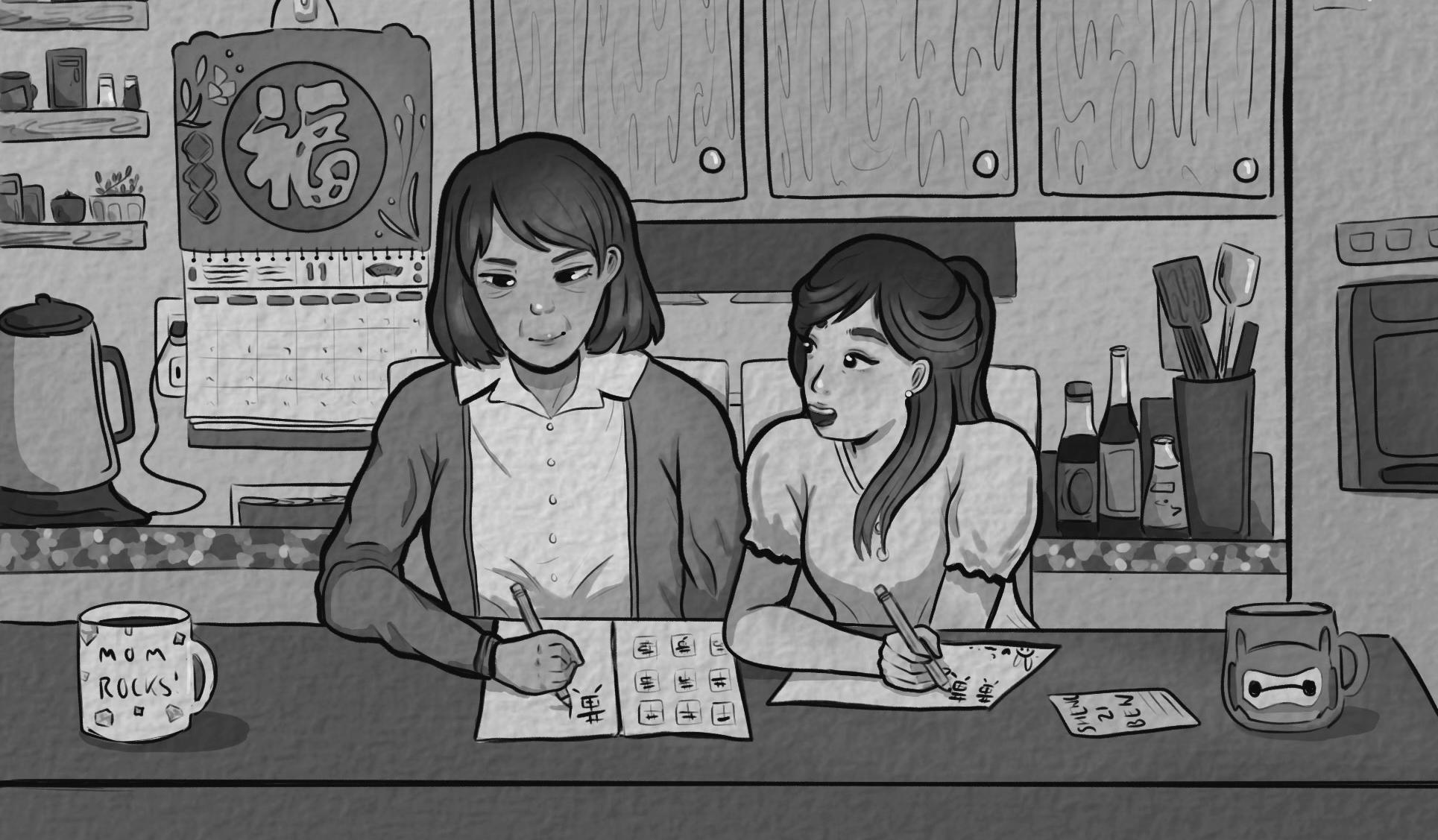
SARA
A dust-ridden textbook mocks me beneath my bed every day, every night, never failing to remind me of my own selfreproach. “Integrated Chinese 4th Edition, Volume 1.” Inside, whether it can teach me how to say loser or fool, I wouldn’t know. It’s $68 of language-learning gold, and I’ve never read a single page. During my first semester of university, I took introductory Chinese to fulfill LSA’s language requirement. Learning Chinese seemed like something I was just supposed to do. My classmates, most of whom were white students interested in Chinese for its business practicality, seemed to think the same. My mom taught me a little bit of the Chinese writing system and pinyin when I was younger, so all of the early lessons were merely review. And yet, I couldn’t shake the crawling fear that I was being judged. What
FEB. 12, 2026
was a Chinese girl doing in firstyear Chinese? I lasted less than a week before dropping the class.
The feeling of “not being Chinese enough” is one familiar to many second-generation immigrants and other individuals that identify with the ChineseAmerican label, but I’ve always faced a different issue altogether — I’m the wrong type of Chinese. The word “Chinese” as a language has become synonymous with “Mandarin,” or “Standard Chinese,” but in reality, there are over 300 Chinese dialects, many of which are not mutually intelligible.
My family speaks Hoisan-waa, or as Romanized, Taishanese. The language originates from the city of Taishan, Guangdong, home to the village in which my parents spent their childhood catching snakes and skipping stones. It’s a tonal, sing-songy dialect full of southern twang. Rural dialects just happen to be more colorful. More fun, if you will. To my parents, Taishanese was the
Sara Wong/MiC
language of home and family, while Mandarin and Cantonese were the languages of practicality. Then, my parents had to learn English when they moved to the faraway, mystical land of Ohio to start a new life together. English was the language of survival. The other family members we slowly brought over, like my grandparents, never learned English at all, because we could protect each other.
The nature of my upbringing as a Chinese-American, like the true embodiment of the hyphen, is that I learned both languages at once, and rather clumsily. Sometimes, I can’t translate back certain phrases in either direction, and there’s a handful of Taishanese words I’d frequently hear without realizing they were profanities. My parents always like to tell one story in particular, where we all piled into the navy Honda Odyssey on a grocery trip and my grandpa tiraded about some obnoxious person or another.
CONTINUED AT MICHIGANDAILY.COM
ARYA KAMAT Michigan in Color Senior Editor
A friend once told me that she could tell I “grew up with a lot of love.” She said it on one of those frigid Michigan winter nights, where icicles adorned the bare oak trees. I don’t remember whether we were huddling outside of a cozy boba shop or strolling through downtown, but I do remember snow swirling around us like glitter dust. I don’t remember what I said or did to prompt her response. Maybe I smiled wide enough to show all 32 of my pearly whites or shared how exorbitantly happy I was to spend time with my extended family over Christmas break. What I do remember, though, is being at a loss for words before nodding and laughing about it with a quick “thanks.”
When I think of love, I think of the five love languages and how I’ve heard about them so overwhelmingly through pop culture. As I currently run a quick Google search on them, I find that they were first introduced by a man named Gary Chapman, who argues that understanding someone’s primary love language and learning to “speak it” is key to building a stronger relationship.=
Upon reading Chapman’s book’s synopsis, I find many other things: a “5 Love Languages® Quiz” (yes, these are trademarked), a Reddit post of dozens of differing opinions about the concept, other explanatory websites and short reel videos of millennials sharing unsolicited advice on how to “strengthen your
relationships.” Out of these options, I lean into the first and take the whopping 30-question quiz, receiving (you guessed it) Acts of Service™ as my love language.
While I still can’t quite figure out whether your love language describes what you receive from or give to other people, I am not surprised by my result. I don’t always find the time to consistently see the people I love, ruling out quality time. I can sing praises but still feel empty, taking words of affirmation out of the equation. I would really rather not burden someone with the task of finding me a gift (or do so myself), so definitely not receiving gifts. As for physical touch, I just cannot do hugs … maybe a side hug?
Marathi was the language of my parents’ childhoods in India. Whether it was report cards or reprimands, or lullabies and festivals, it was predominant in their lives, later culminating in their attempts to teach their children.
There was a time, perhaps under one score ago, when Marathi was the language I mainly spoke in as well. With the advent of things like preschool and not being able to fully tell the teachers in our suburban Michigan town when I was hungry, my mom made the decision to switch the language spoken in our household, letting English take the reins. It was no surprise that speaking English essentially all the time led to my loosened grasp on Marathi. The phrase I usually default to nowadays, whether I’m meeting new Marathi folks at community gatherings or family abroad in India, is “malā samajat pa a m b latā nāh ” (I understand, but I don’t speak). The truth is, I understand far more than I can comfortably say. I usually freeze and tangle my words as I mess up tenses and pronouns when put on the spot. Still, I think I’ve tried my best.
However, acts of service have always seemingly come natural to me. If you were to ask me to edit your graduate school essays, wait no more than 5 minutes, and you’ll see my Ross School of Business headshot icon pop up on your Google Doc, typing up feedback. If you were to ask me to grab $8 boba with you, even in these trying times, even when both of our wallets are nearly empty, I would say “yes” in a heartbeat. And if you were a student in the dreaded chemistry study group job I have, I would complain and groan and trudge in annoyance through unpaved snow for 20 minutes to your group classroom, but I would still explain problems with a smile and feel my heart swell when you understand the concept. Granted, I do love writing and boba (and chemistry, sometimes). But, the point of all of this is that I, Arya, am a lover of acts of service. Even when I leave college to go home to my family, I still feel myself leaning into this particular love language, despite being a perhaps quieter and more real version of myself. As my paternal grandparents have recently moved to the United States, alternating spending time between mine and my aunt’s home, I’ve found myself intertwined with perhaps my deepest act of service yet: relearning Marathi.
KARAH POST MiC Columnist
Watching the recent events unfold in Minneapolis has been devastating to say the very least. Since before President Donald Trump was inaugurated, threats of his mass deportations and extreme immigration policies left many Americans fearful of what would happen once he was elected. Now, American citizens have turned to protesting the violent acts of the U.S. Immigration and Customs Enforcement, but ICE’s actions have caused irreparable fatalities. The killings of Alex Pretti and Renee Good sparked national outrage. But in response, the White House chose to vilify the victims — one who was an ICU nurse for veterans and one who was an award-winning poet and mother of three.
For months now, we have seen families ripped apart and acts of murder in our streets at the hands of ICE agents. But behind the events that receive national news coverage are just as many underreported incidents of deaths of detained people who were picked up by ICE. Yet, the agents seem to face no consequences, nor are they held accountable for their crimes. And as their power surges, so do feelings of uncertainty for many who might lack citizenship.
As an international adoptee brought to America from China by American citizens when I was 17 months old, my presence in America was entirely fortuitous. With Trump’s focus on deporting immigrants, many intercountry adoptees feel increasingly vulnerable. Tens of thousands of intercountry adoptees in America are not citizens despite being adopted by American citizens. Many were brought to America as children and grew up with the same rights as Americans.
Parents could have adoption paperwork signed and stamped by the judges and governments
MUNTAHA RAHMAN
Michigan in Color Senior Editor
One of the most utterly dystopian things I have ever witnessed was an elderly man dancing to “Calm Down” by Rema and Selena Gomez on a TikTok livestream. My first scroll past, I dismissed it as a mere trend. It was not until he reappeared on my page a full day later, still rapidly dancing to the same song, that I looked at not only his movements but his face — wrought with the desperation of being reduced to nothing but a point of entertainment for viewers around the world, just for donations. Then I noticed his appearance: He was frail and barefoot, dressed in a plain white panjabi and prayer cap.
My father wears the same outfit on Friday afternoons for jum’ah prayer, as do many of my uncles and elders in my local Bengali-Muslim community.
The man behind the screen was not any of my loved ones fervently dancing at the mercy of the TikTok algorithm; yet in his appearance, I saw the reflection of almost every man who had raised me. Unfortunately, this reflection of myself and my people was the only factor that
that granted them the privileges of becoming children of American families. But for decades, “adoption … did not automatically guarantee (U.S.) citizenship.” It is estimated that between 18,000 to 75,000 adoptees lack citizenship. Parents were supposed to secure their adopted children’s legal status or naturalized citizenship, but some never finished the process.
One adoptee interviewed by The Associated Press learned that she was not a citizen and shared her feelings of identity disjuncture.
“Adoption tells you: You’re an American, this is your home,” she said. “But the United States doesn’t see me as an American.”
She goes on to mention that her father died thinking he did his part in ensuring her legal status. But what she was left with instead were feelings of instability and fear, not knowing what living illegally in America could mean for her.
Before the Child Citizenship Act of 2000, intercountry adoptees were not automatically guaranteed citizenship. This citizenship act, which would go on to take effect in 2001, granted automatic citizenship to adoptees from a foreign country who were younger than 18. However, the law only covered future adoptions or those born after Feb. 27, 1983. Those born prior to that date, or those who were on tourist or medical visas, were left without legal status when those visas expired.
Many adoptees might be unaware of their citizenship status until they try to apply for a new Social Security card, passport or financial aid. It isn’t until they are denied that they learn that they are not citizens due to bureaucratic semantics, even though they have spent their whole life believing themselves to be.
Many intercountry adoptees were merely babies when they were brought to America. To
learn about their status as adults by accident is often an incredibly jarring, unfair experience.
The obstacles that stand in the way to legally becoming a naturalized citizen are now copious and dangerous, especially when harsh consequences exist if standards aren’t met or if there is mishandling of proper immigration documents. All can be devastatingly costly.
And regardless of if they have the appropriate paperwork, immigrants do not feel safe in Trump’s America. I was born in Jiangjin city outside of Chongqing, China. And for the first year and a half of my life, nannies cared for me in an understaffed orphanage. When I was adopted, I moved to Southern California and have been raised in this country my whole life. I grew up believing that I am American, even though others viewed me as a product of my homeland. Living in America is all I’ve ever known. I never questioned my citizenship status, nor have I ever thought about what paperwork I did or did not have, until now.
Some adoptees don’t label themselves as immigrants as they didn’t come to America with a “second language, a different culture, family members, (or) ties to a country (they were born in).” But the threat of violence against people of Color in America is very real. The thought of any immigrant being forced to return to their “native countries” without having ever lived there, or the thought of being deported to a foreign country when America is home seems arbitrarily gratuitous.
Each day, we hear news stories about more cases of unconscionable detainments of Americans. But, we also see how neighbors in our own communities are subjugated to these very acts. As Trump sends more ICE agents to major cities in America, I hear from friends about their concerns for their

families or for their own safety. No longer can someone claim not to know what is going on when these acts are happening in our very streets, backyards and cities.
Some might think that these deportations only affect immigrants or “illegal aliens,” or that they themselves personally don’t have anything to do with what is going on. But everyone has a part to play. Silence is selective and it only allows for the fueling of the very systems that fund and support these atrocious acts committed against our fellow Americans.
The U.S. Department of Homeland Security would like to spread misinformation about how they are arresting the “worst of the worst” criminals, and that immigrants are more likely to commit crimes. But this is not the case. In actuality, tens of thousands of people who have been detained by ICE have no criminal record or pending criminal charges. According to USA Today correspondent Terry Collins, research actually
suggests that immigrants commit fewer crimes than people born in America. Even if the former was true, it does not justify the unlawful detainments and deportations of Americans.
Refugees and immigrants are guaranteed rights under the constitution. The right to live peacefully and the right to be in America are neglected when immigrants are terrorized without due process.
When the purging of immigrants, whether they are American citizens or not, is seen as revelry, we are reminded of America’s established behavior of devaluing and erasing immigrants’ value.
John Tunheim, U.S. District Judge of Minnesota, recently ordered the release of refugees detained in Minnesota and also granted a temporary pause on detentions.
“At its best, America serves as a haven of individual liberties in a world too often full of tyranny and cruelty … ” he wrote in his order. “We abandon that ideal when we subject our neighbors to fear and chaos.” In times of profound uncertainty and despair, it’s our very own selves who protect each other in our communities. The prospect of freedom is one that many of us take for granted, but it is not a guarantee: It is a protection so many have fought for and will continue to fight for.
Some will say America is a melting pot: a conglomeration of different ethnicities and backgrounds. But to say this without acknowledging the deliberately varnished (but wholly unconcealable) history that America was built on the backs of immigrants and African Americans is an incredible miseducation and lie. Even worse, this erasure took place at the hands of governmentendorsed racism, segregation and maltreatment. By accepting our government’s actions as admissible, we begin to excuse their crimes against the American people. But neutrality and complacency is not innate: they are taught and chosen.
had compelled me to see the man rather than just look at him.
The development of social media has placed the world at our fingertips, while simultaneously making it easier than ever to fall into the trap of apathetic indifference. At what point do we truly begin to care and take a stance rather than passively clicking through Instagram Reels of war-torn nations and displaced peoples on our phones over breakfast? Is it necessary that the victim looks like us or is a member of our community in order to spark outrage?
Tell me about yourself. Are you like me, one of “my people”? Is this Shark Tank, or the internal scale that we use to judge which tragedies and catastrophes are “worthy” of our attention? The transactional nature of empathy — the rarest, yet most soughtafter currency — feels like an unspoken rule in our increasingly desensitized world.
It is admittedly tempting to live in blissful ignorance, consoling ourselves with the lie that what we don’t know won’t hurt us. However, tragedies and horrors are not mere anomalies to be ignored. Understanding the world requires confronting its complexity and resisting the urge to dismiss what feels
uncomfortable. Only by looking past the surface-level posts and empty gestures can we truly see the world, rather than just look at it.
This same principle, where concern is doled out selectively and is contingent upon relatability, not only shapes individual indifference but also institutional policy. Institutions, like individuals, often cling to the guise of neutrality as an “ethical stance” to avoid discomfort, controversy or even outright condemnation. But is it truly possible to remain impartial in a world that is anything but? When global affairs are governed by politics, it seems unfeasible to tangibly engage them without “making it political.” Neutrality, then, is not the absence of a stance, but a silent endorsement of the status quo.
On Oct. 17, 2024, the University of Michigan’s Board of Regents unanimously voted in favor of a bylaw supporting institutional neutrality. The controversial policy declares that although members of the U-M community can still speak their minds regarding issues, the University and the administration as a whole will refrain from making statements on sociopolitical topics not directly tied to its

internal university functions. Yet, the University’s so-called neutrality has not meant disengagement — it has meant selective silence.
In a widely publicized and controversial student movement at the University, student activists held a vigil on the Diag to honor those who they believed had wrongfully fallen. They organized numerous rallies, and staged protests outside bureaucratic offices in downtown Ann Arbor. Their actions led to clashes with University administration, which faced accusations of violating students’ First Amendment rights due to handing over student and faculty records for investigation by the federal government.
The organizers faced harsh backlash, accused of disrupting education with their personal political views and were told that there was a “time and place” for civil disobedience. Critics of the movement argued it was pointless to protest against the University when the ultimate target was the presidential administration. They even suggested protestors be sent to the region they were advocating for to experience its conditions firsthand. Ultimately, the movement resulted in 39 student protestors being arrested on charges of trespassing and civil disobedience.
These events did not transpire in 2023, 2024 or 2025 — nor were they even associated with the pro-Palestinian student movement. Instead, they unfolded during the late 1960s as students mobilized against the continuation of the Vietnam War. Despite the decades between them, the parallels are striking — not solely in the tactics of student activists, but also in the University’s response.
In the 60 years following the famous Vietnam War student protests at the University, student activism has been repackaged as a point of pride. What was once condemned as disruptive is now a convenient symbol of the University’s alleged commitment to student voices, to the extent that it even ironically touts community organizing
and activism as one of its six Pathways to Civic Engagement and Community Change.
History is not only repeating itself; it is exposing itself. If we are taught to revere past historical instances of student activism and applaud their bravery for speaking out, why are today’s activists vilified for doing the same? If those who protested Vietnam are now upheld as visionaries, what does that make those fighting today? Societal perception regarding activism is a predictable cycle: The voices of activists will be celebrated, and the prejudice of institutions will be acknowledged — but only once the fight is over and the history books have been written.
On Jan. 30, 2025, Students Allied for Freedom and Equality announced that it had been suspended for up to two years and no longer recognized as a campus organization, in accordance with a Jan. 16 decision by Dean of Students Laura Blake Jones. This suspension also follows the University’s initiative to file a formal complaint through the office of Student Organization Advancement and Recognition on Oct. 31, 2024, claiming that SAFE had violated the Center for Campus Involvement’s Standards of Conduct for Recognized Student Organizations.
This complaint was filed by Stephanie Jackson, an outside consultant appointed by the University, who claimed that the protesting techniques used by SAFE, such as a die-in protest during Festifall, blocked pedestrian pathways and created safety risks. The case also came after recent revisions to the University’s SSRR, which removed student input from the appeals process. According to the SOAR manual, the University’s Central Student Judiciary may act as a student governing body after a complaint is referred to them.
While CSJ found SAFE not responsible for 10 of 13 alleged violations in a public hearing, Jones overturned CSJ’s decision to find SAFE responsible for some of the additional violations as well. In addition to the
smaller formal reprimands suggested by CSJ, Jones passed an additional sanction — a twoyear disciplinary suspension against SAFE, preventing it from recognition as a campus organization with no possibility of suspension review before Winter 2026. This action of amending the SSRR was also taken without the consultation of the Student Relations Advisory Committee, Office of Student Conflict Resolution and Central Student Government. The University is technically within its authority under the Michigan Constitution to amend the SSRR without such a consultation. However, taking such an action with a lack of faculty and student input creates a dangerous and unsettling precedent in which the Regents have an overwhelming amount of power to direct University policy as they see fit. This also inherently makes the judgement of student affairs more susceptible to the influence of politicians and donors. On Oct. 6, 2024, the TAHRIR Coalition posted a leaked audio recording in which University President Santa Ono admitted that he believes universities are forced to treat reports of Islamophobia and antisemitism on campus in an unbalanced way due to pressures from Congress and interest groups. Ono also implied that the government threatened to withhold federal funding if antisemitism was not addressed.
Just searching the word “activism” on the LSA Course Guide will give you an overwhelming amount of course options to select from. Yes, activism is certainly beloved by the University — we love to talk about it in our classrooms and even dedicate entire areas of campus to it. However, activists of the past stood up against the status quo, which is something the University is not only preventing its own students from doing, but is also something that the institution fails to accept to realize.
STATEMENT over the YEARS

JULY 15, 2022 — Lilly Dickman, former Statement managing editor, writes about a shooting in her hometown. She shares her heartbreak and reflects on the issues surrounding gun control in the U.S..
SEPT. 27, 2022 — Valerija Malashevich, former Statement deputy editor, writes about the romanticization of addiction in the media.
Tucked away in the middle of the woods and accessible only by Northern Michigan backroads lives a quintessential up north dive bar called The Hideaway. It’s big with snowmobilers in the winter — hence the dryer built in behind the bar for wet jackets — but The Hideaway is also busy year-round, in an up north kind of way. The inside is exactly how you’d imagine it — wood panel walls adorned with ATV and hunting paraphernalia, string lights crisscrossing on the ceiling, the smell of fried food hanging in the air and tables always a little bit sticky with spilled beer. It’s got a cozy feel to it, metallic well-water taste and all, and the mentality that anything goes reigns supreme: people wear whatever they want, drink whatever they want and say whatever they want, and everyone seems to have a good time.
This past Fall Break, I went up to the Mancelona area with a friend and some family to celebrate my 21st birthday. Naturally, The Hideaway was our first stop, and we hastily made our way there from the cabin to eat dinner and watch the Detroit Tigers play the Seattle Mariners. In a beautiful twist of fate, it was karaoke night, and we watched with glee as the makeshift DJ dimmed the lights and raised the sign-up sheet in the air. I’ve been going up north my entire life — to the point where I don’t even question how silly it sounds to non-Michiganders when I say “up north” like it’s a proper noun, a place to arrive at — and for the past 10 years, the Hideaway has been a summertime staple. Somehow, though, my family has always seemed to miss karaoke night, having seen the signs advertising it and wondering wistfully when it would be our turn to partake. Friday, Oct. 10, was our lucky night, it seemed,
JULY 4, 2024
I am from a place of many anthems, many ancestors, many histories. I am from a place of many opinions, political and otherwise; a place that is geographically small yet big in the hearts of its natives. A place that, for so long, has been made to follow laws and customs and traditions dictated by those who don’t even live here — who, chances are, haven’t even visited our little island.
I am from what some call the best of both worlds. I am from the eternal colony.
*** Puerto Rico is considered the world’s oldest colony, yet the official term for the island’s status is “U.S. territory.” The island has been ruled by one global power after another, as Spain passed the colonial baton to the United States in 1898 after the end of the SpanishAmerican War. Although now a U.S. territory, the island remained in a limbo of sorts until 1917, when the Jones-Shafroth Act granted American citizenship to Puerto Ricans, which made it easier for the United States to recruit Puerto Ricans to serve in the U.S. Army during World War I. It wasn’t until 1948, however, that Puerto Rico was able to elect its first governor, granting the island commonwealth status. As a result, Puerto Rico
MARCH 26, 2024 - Liam Rappleye, former summer Statement managing editor, interviews convicted criminal Temujin Kensu, known as the “Ninja Killer,” in prison. He writes about the history of Kensu’s case and asks him about his hopes and thoughts on his future.
FEB. 25, 2025 - Former Statement Columnist Anna McLean writes about her experience at a rage room, and how it did not make her less angry.
JULY 24, 2025 - The Statement publishes the “Dog Days” edition, commemorating the long, still stretch of summer that takes place at the end of July and beginning of August.
OCT. 21, 2025 - Former Statement Correspondent Katie Lynch writes on the efficacy of pepper spray and how it is a blanket solution to a deeper, more pervasive issue.
APRIL 15, 2026 - The Statement publishes its largest graduation edition to commemorate The Daily’s graduating seniors. The edition includes seven pieces from previous Statement staffers and beyond.
and for the next seven hours, the five of us entered a fugue state, playing endless rounds of Nerts, watching the Tigers lose to the Mariners over 15 long innings and listening to an increasingly drunk handful of people try their hand at karaoke.
Suddenly, the familiar hum of a 12-string guitar filled the air, and looking over the crowd in search of its source, we saw an old, mustached man dressed in all black and a cowboy hat fearlessly taking to the stage with a microphone. His song of choice? Gordon Lightfoot’s 1976 classic, “The Wreck of the Edmund Fitzgerald.”
“That good ship and true was a bone to be chewed / When the gales of November came early,” the man sang, his voice deep and gravelly like an old country singer.
He was wholly unfazed by any of the theatrical logistics of the “stage” he was performing on — a dance floor in the middle of the bar surrounded fully by tables, not unlike a gladiator’s arena. Throughout each of the song’s seven verses, this mysterious cowboy held steadfast and serious, lost in his own world even as the rest of the bar sang along here and there. We giggled about this in the car afterward, remembering the way he sort of tipped his hat at the crowd in gratitude when the song was finished, but I was equally struck by what a beautiful moment it had been — and how emblematic of Michigan it was for this man to have picked out this song so proudly.
The story of the Edmund Fitzgerald has always fascinated me. It was a freighter that sank in a terrible Lake Superior storm (the “gales of November”) Nov. 10, 1975, resulting in the loss of her 29 crew members’ lives. To this day, nobody really knows exactly why the Edmund Fitzgerald sank. It didn’t split in half or hit an iceberg like the Titanic; the Fitzgerald just fell prey to the might of Lake
Superior, it seems, and fell to the bottom of the lake just 17 miles off-shore without so much as a “mayday” call. The following year, Canadian folk-rock singer Gordon Lightfoot released “The Wreck of the Edmund Fitzgerald,” a haunting and hypnotic folk ballad recounting the night of the wreck in careful detail. Since then, both the story of the Edmund Fitzgerald and its song have become these iconic symbols of Michigan and the Great Lakes, recalling the quiet cruelty of Lake Superior and the way she never “gives up her dead,” paying tribute to the force of the waters around us in ways that send shivers down my spine.
“Does anyone know where the love of God goes / When the waves turn the minutes to hours?” Lightfoot sings.
I don’t remember the first time I was told about the Edmund Fitzgerald, or even the first time I heard Lightfoot’s song. Growing up in Michigan, it’s just the sort of story I’ve always known. I remember as a kid how, when the song would come on the radio every now and then, I would listen, enraptured, feeling the weight of this lore and the mystery surrounding it. I still feel this way now, and when this Hideaway karaoke scene happened to coincide with the season of the wreck’s 50th anniversary, I enjoyed returning to this spooky feeling, lingering on the continued uncertainties of the ship’s demise. There’s something, too, about the way it’s a story collectively shared — if you’re from the Great Lakes region, chances are you’re already deeply familiar with the Edmund Fitzgerald, and if you’re not from around here, the captivating story almost serves as a tool for indoctrination into regional culture (yes, Lake Superior waves really can get close to 30 feet tall).
Cynics everywhere are quick to say that the United States has no culture — or that if we do, it’s dominated by the likes

of greasy fast food chains and football games saturated with consumerism. This argument frustrates me for a variety of reasons, not the least of which is that it totally disregards the cultures of Indigenous groups that have lived on this land for thousands of years and aspects of cultures around the world that are brought in with immigrants. Schoolhouse Rock’s “The Great American Melting Pot” may be infamously flawed in the ways that it preaches assimilation, but the general idea of the U.S. as a cultural patchwork still stands. Even outside of these populations, though, the U.S. does have culture, but it just might look a little less romantic than colorful Mayan huipiles in Guatemala or Munich’s Oktoberfest, for example. The U.S. is also such a huge country that culture and identity are so easily fragmented, and an overarching sense of “U.S. culture” is harder to define than regionally specific ones, like in Appalachia or the Deep South. In terms of cultural resonance, my heart lies with where I grew up and what I know best: the state of Michigan and the Great Lakes region. This state has a rich history of
Indigenous storytelling that has given name to some of our most beloved landmarks, a plethora of regionally distinct foods (for better or for worse — see Midwestern “salads”) and dialects that unforgivingly distinguish Yoopers from trolls (one of my roommates from Marquette pronounces “bag” like the “a” is a suggestion and she’d much rather say “beg” instead). I love the feeling of community in hand maps and love for the Great Lakes, our pride and joy. I love that there is a song about a shipwreck from 50 years ago that is sung and revered across the whole state, unifying generations in an awestruck celebration of the stories that sustain us. But, more than this, or maybe because of this, I love to know that there are such tangible reminders of who I am and where I’m from, and that they’re enjoyed in the collective. I love to know that anytime “The Wreck of the Edmund Fitzgerald” mysteriously surfaces in my Spotify queue, I’ll be called back to summers spent slipping beneath Lake Michigan waves or sitting on the rocky shoreline of Belle Isle and watching freighters drift past on the Detroit River.
supposedly gained a more highly developed relationship with the U.S. federal government, but still remained economically and politically dependent on the U.S. Little did Puerto Ricans know that this first taste of selfdetermination would be their last.
***
Growing up in the eternal colony, I didn’t really think about, nor did I understand, why I had been born with American citizenship and the benefits that such a designation gifted me. For most of my childhood, I was elated whenever I left home. I loved to travel as a kid, and I self-assuredly claimed that once I left Puerto Rico for college, I would never come back, except for holidays and family reunions. I would watch Disney Channel sitcoms and strictly read in English. I would tell my parents that I wanted to move to New York City, or wherever the characters in the books I read and TV shows I watched lived. But, at the end of the day, this was all just a far-off fantasy, an American Dream. However, when my family was almost uprooted to Boston after my dad lost his job when I was in the third grade, I suddenly didn’t want to leave the eternal colony after all.
*** What is most ironic about Puerto Rico’s current political status is that it was never meant to be permanent. Lack of change and conviction of action from both the U.S. federal government and the local Puerto Rican government
have led to the development of three principal ideologies — statehood, commonwealth status and independence. The existence of differing ideologies eventually gave shape to the multiple political parties that now run for the governorship, as well as other government positions each election year. Whether it’s statehood, independence or the free-associated state a candidate favors, it is undeniable that Puerto Rico has been, and continues to be, in a perpetual struggle for self-determination. Puerto Ricans exist in a constant push and pull between the fervent passion we feel to cultivate and defend our national pride and cultural identity while also needing to define the island’s status and mediate the relationship with those up north.
Almost every election year, the governor of Puerto Rico changes, and with this transition typically comes a change in the political party in power.
But there is much, much more to the eternal colony than what meets the eye.
***
Leaving the eternal colony meant leaving my friends. It meant leaving my school and teachers, my extended family and the house I’d lived in my entire life. My naïve, eight-year-old mind even thought I would have to leave my dogs. The move to Boston meant leaving everything I’d ever known. Suddenly, the lives of the characters in those Disney Channel sitcoms
I loved and the books I devoured one after the other didn’t seem so appealing after all.
When I found out that my dad was considering job offers in both the continental U.S. and Puerto Rico, however, a lost sense of hope reignited within me. I was living the best of both worlds once again. Now, I could watch my sitcoms and read my books and imagine the life these characters led without having to live it myself just yet. I could stay in the comfort of my little island and visit those up north as I pleased, not having to worry about abandoning one or the other forever.
A month later, my dad signed a contract to work for a bank in Puerto Rico. He had bought me more time. The best of both worlds was still within reach.
***
In 1947, the Industrial Incentives Act was implemented by Luis Muñoz Marín, who would become the first elected governor of Puerto Rico, with the help of the U.S. federal government as part of a larger policy initiative known as Operation Bootstrap. After being amended in 1948, this law established a tax exemption program for private firms from the United States, aiming to help these firms establish themselves on the island to boost the economy. Never was it a priority, or a goal, to provide these tax exemptions for individual investors — until 2012.
In 2012, the Legislative Assembly of Puerto Rico enacted Act 20
and Act 22. Act 22, specifically, aimed to attract new residents to Puerto Rico by providing total exemption from income taxes on interest and dividends that result after individuals become residents of Puerto Rico. This thus reduces their federal income tax to zero.
With the implementation of Acts 20 and 22, the goal of these tax exemptions shifted from the business level to the individual level. In simple terms, these acts have invited investors from the continental U.S. to move to Puerto Rico and have stripped benefits from an economy that is already in shambles. The local taxpayer is left to pay for the brunt of the taxes that these high-net-worth investors are exempted from.
A question for Puerto Rican readers: Ever wonder why more and more people around you are speaking in English on the island? The history and the policies above are your answer.
***
At the end of my senior year of high school, the foreign possibility of moving from the eternal colony to the continental U.S. was about to become a reality. I had gotten into my dream school, and I was excited to embark on this new journey.
In less than six months, I will graduate from the University of Michigan, and the world will open up wider than I’ve ever seen it before. On the other side of this veil is the quintessentially agonizing and exhilarating question of what the next years of my life will hold — and whether or not I’ll still be living in Michigan. Sometimes I wonder how I could ever leave, and sometimes I know the day will inevitably come. It’s never been an absolute either way — that I would stay in Michigan or move somewhere else — and both options feel like equally improbable leaps of faith. I’ve pretty much lived in the same 45-mile radius for my entire life, and there is so much more I want to see and experience, so why shouldn’t I go out and live somewhere new, especially while I’m young? But then there are these moments like “The Wreck of the Edmund Fitzgerald” sung at karaoke night in a Northern Michigan dive bar that tap on my shoulder, interrupting these visions of grandeur, and I am reminded once again of the reasons to stay nestled within this community that I love so dearly. CONTINUED AT MICHIGANDAILY.COM
Once I fully committed to the University of Michigan, I began reaching out to the other Puerto Ricans who would also be on campus in the fall. I joined any and every group chat I could find to meet students from other Latin American countries. Contrary to my third-grade self, this time around, I was enamored by the possibility of moving to the United States and finally living out the fictional life that I had spent years seeing in modern media. Yet, I also wanted to make sure I maintained a tie to my culture. I knew what the best of both worlds tasted like and I was going to do everything I could to keep that feeling within my grasp once I left home.
Upon arriving at the University, the intensity with which I desired to keep the best of both worlds a reality in my mind intensified. I joined a few different student organizations that allowed me to meet people from all over the United States and the world. At the end of these long days, I would always go back to my dorm to find my Puerto Rican roommate falling asleep as we both told each other about our respective new lives. I would face the world-altering reality of having to speak English in class, but it soon became fun, rather than an arduous and emotionally taxing task. After those long days of speaking only English, I knew I could always call up my other Latino friends to have lunch at the nearest dining hall and debrief about our “gringo” classes loudly in Spanish, convinced that no one sitting at any of the tables around us could possibly understand what we were saying.
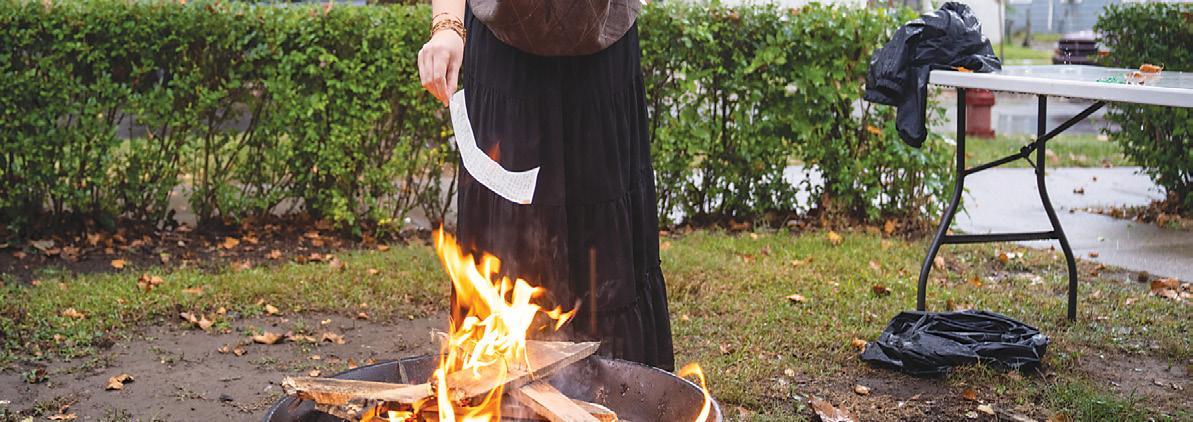
Grab a friend, start a fire!
IRENA TUTUNARI Former Statement Deputy Editor
I, having never lit a match in my life, decided that this week I would start a fire.
Now, I wasn’t planning on doing anything too crazy. I mean, hell, if I can’t even light my roseand coconut-scented candle, I’m certainly not equipped to conduct a roaring wildfire. Or perhaps my inaptitude lends itself better to the creation of such inferno-style accidents — hopefully, I’m not tempting fate here.
Regardless, I decided that this week I would create a very special kind of fire. A fury fire. I know what you’re thinking: “Oh brother, we already have a wackjob on the loose and now some idiot’s gonna teach her how to light a match.” So I ask that you kindly remove 911 from your speed dial lest you be included in this fury fire of mine.
A fury fire is, in essence, a small handcrafted fire that is used to burn one’s grievances.
In more specific terms, a person may sit down, write out a few letters laced with anger, negative emotion, or dare I say fury, and then burn them in a fire to release negative emotions — specifically, ones harbored toward those who had the pleasure of getting a letter addressed to them. Are the merits of the fury fire empirically proven? By no means.
But if enough Quora users swear by its healing properties, that’s certainly good enough for me to give it a try.
I’m not a person who walks around with a veritable knapsack of fury strapped to her back. No, I like to think that any baggage I carry with me comes in a more
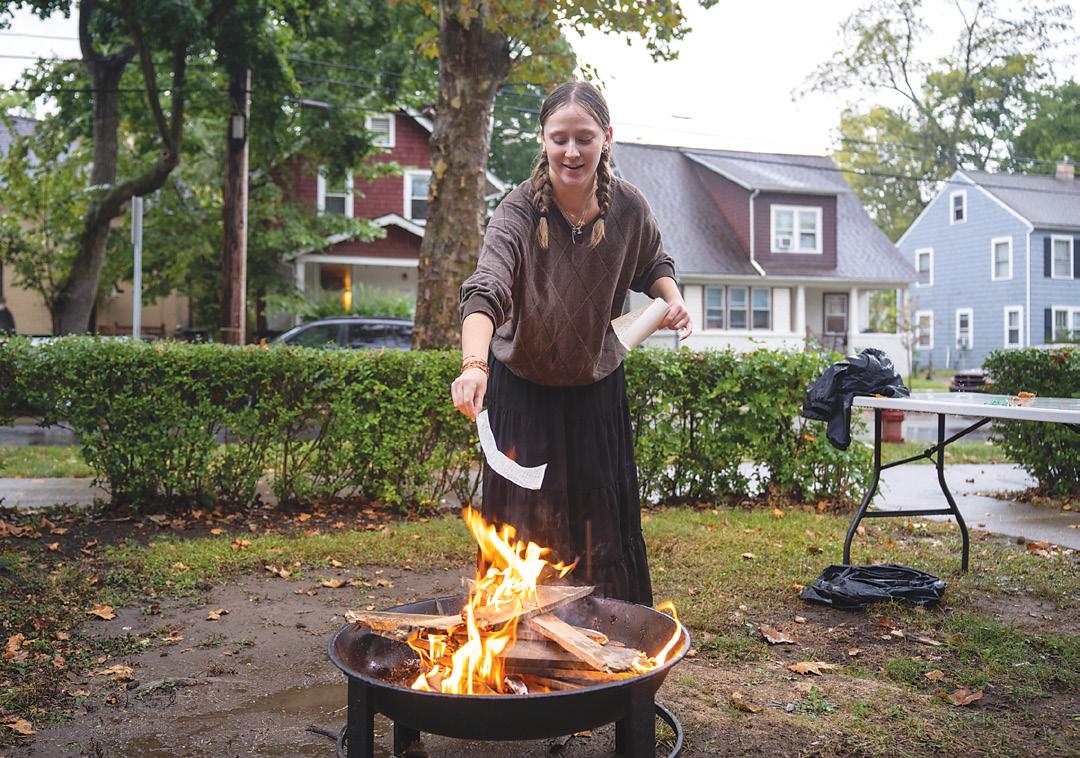
subtle form, like a handbag or pocketbook of sorts. But I think that we all — unless you’ve reached a level of enlightenment that I personally can only aspire to — harbor some resentment or hurt toward others in our pasts. And we all have different ways of dealing with this pain.
While some may scream into pillows and curse out ex-boyfriends’ names, or find very creative ways to etch their car keys into others’ motor vehicles, I find that my pain and resentment turns inward more often than outward.
Anger is not a frequent visitor in my pocketbook of baggage. I am more often visited by selfblame and hurt feelings, which makes it harder to let go of unresolved pain in interpersonal conflict. I’m not able to just get mad and get over things: I sit and I wallow and I ruminate and I play things over tenfold. And, of course, I cry tears the size of Texas.
Despite my skepticism at the supposed healing properties of setting my personal grievances aflame, I certainly have some
people from my checkered past that haunt the back of my mind, so why not try to get angry and burn these qualms? It couldn’t make things any worse, right?
Regardless, before I set matches to the lighter (or however the hell I’m supposed to do this), I had to set pen to paper first and write some honest-togoodness hate letters.
I sat down a few days ago with the empty, cobweb-collecting journal that I’ve had since my sophomore year of high school and felt … awkward. I waited for the anger to arrive like a farmer trying to coax his prizewinning hogs toward a balanced breakfast. C’mere, fury! Heeeere, fury fury fury! Yet, none arrived, neither oinking nor squealing. I squinted hard, trying to think about my severed relationships, the times where I’ve felt the shock of betrayal or the sharp slap of someone’s words on my cheek. But I couldn’t conjure up anything past slight frustration at my inability to just get mad, dammit!
CONTINUED AT MICHIGANDAILY.COM
ANANYA GERA Former Statement Managing Editor
I am turning 20 in three days and I am terrified. Turning 20 feels like a beginning and end, a hello and a goodbye. I am leaving my childhood in the past, placing my memories of adolescence in a box that I’ll tuck away under my bed. And I am saying hello to a new decade, one that will bring so many milestones: college graduation, a new place to live, hopefully a job and possibly some soul-searching. I have so many hopes and dreams for my 20s, so many aspirations for who I want to be and how I want my life to unfold. At the same time, I have never felt so lost, standing on the brink of the unknown. I’m unsure of myself and what I’m doing and where I see myself going — a common sentiment shared by most people in their early 20s. Turning 20 seems like such a momentous change; yet, at the same time, it also feels like nothing is changing. In these last few weeks before my birthday, I find myself wanting to turn to the wisdom of my ancestors, only to be confronted by a deep dark hole instead. So, I have made it my mission to attempt to reconstruct my family tree and collect the stories of the women I come from. I don’t want to breeze through my 20s without understanding the nuances of my history, and this is my attempt to remediate years of lost time.
I sat at my kitchen counter this Saturday morning and called my parents, eager to record the things they were going to tell me. I gave them a very barebones description of my piece, moreso focused on the collection of stories rather than
my life-altering birthday around the corner. As they imparted their knowledge to me, I could feel the love and excitement radiating from them. Not only did I have the privilege of hearing their memories, but I was also giving them a chance to speak aloud the memories they carry with them. This piece commemorates my parents, my grandmothers and my great-grandmothers. I hope that one day my children will sit me down and ask about the stories that now reside in my heart and my mind.
***
When my mother’s maternal grandmother was 20, the Partition of India happened. It was a callous division of South Asia by the British Parliament in order to stabilize the subcontinent. Yet, the borders the British had created did not take into account the diversity of South Asia and left the entire region in a state of confusion, panic and terror. Thus began one of the largest forced migrations in history.
Before the Partition, my mother’s side of the family resided in Burma, which is now known as Myanmar. Because of the instability that arose from the partition, my mother’s family migrated to present-day India, settling down in the state of Haryana. My mother’s maternal grandmother was married right after the partition and had children a couple of years later. My mother knows little about her life before the partition. She knows far less about the women that came before her. The partition was a severance of colonial ties, symbolizing a new beginning for South Asia. But it was also a severance of familial ties; it was an unwarranted restart, allowing me in the present-day to
only trace back three generations rather than countless more. My mother thinks that her maternal grandmother’s life must have been simple before the partition. But what simple means, I cannot even fathom. All I know is that she lived near the mountains and that will have to be enough for me. My maternal grandmother was born in 1950, three years after the partition. Her life would be characterized by the adjustment of South Asia to post-colonial life. My maternal grandmother attended college when she was 20, working toward receiving her Bachelor of Arts in economics and language at Delhi University. When my mother told me this last piece of information, I couldn’t help but smile. I am currently infatuated with the notion of mother tongues and translation. How prophetic it is that I am here, taking a class on language and studying my mother tongue and my maternal grandmother, whom I do not remember, was doing the same when she was 20. Her father pushed his four daughters to be educated, and my maternal grandmother was the second woman in her family to receive a post-secondary education, after her older sister. It is a loss not to have the chance to know her, but also a privilege to know her story and what she meant to the people around her. From what I’ve heard, she was strong and smart and fearless, all the qualities I hope to embody one day. I know that I have her eyes and her hair, and as I trace these features with my fingers, I feel as if I’m touching her instead.
CONTINUED AT MICHIGANDAILY.COM

- 2023
NOV. 26, 2022 – Led by quarterback
J.J. McCarthy, the Michigan football team beats Ohio State for the second straight year, 45-23. This is the first time they have won in Columbus since 2000.
MARCH 18, 2023 – The Michigan hockey team wins its second straight Big Ten Championship over Minnesota, 4-3. Led by freshman forward Adam Fantilli, the Wolverines advance to their second straight Frozen Four.
NOV. 25, 2023 – Thanks to a gamewinning interception from safety Rod Moore, the Michigan football team beats rival Ohio State, 30-24, ending the regular season undefeated.
JAN. 8, 2024 – The Michigan football team wins its 12th national championship. The Wolverines defeat Alabama, 27-20, in the Rose Bowl and Washington, 34-13, in the championship game, completing a perfect 15-0 season.
MARCH 16, 2025 – Led by forward Danny Wolf and center Vlad Goldin, the Michigan men’s basketball team wins the Big Ten Tournament Championship in its first year under coach Dusty May.
APRIL 21, 2025 – For the first time in 11 years, the Michigan men’s gymnastics team wins the NCAA Championships, defeating reigning national champions Stanford.
MARCH 21, 2026 – For the first time at home at Yost Ice Arena, the Michigan hockey team wins the Big Ten Tournament Championship over Ohio State, 7-3.
APRIL 6, 2026 – The Michigan men’s basketball team wins the national championship over Connecticut, 69-63, clinching its first title since 1989.
HOUSTON — It had almost started to fade.
Victors valiant. Conqu’ring Heros. Champions of the West. Words that had once invoked so much, slowly dulling to a blunt edge. They certainly hadn’t lost all their shine, but the punch those lauded lyrics packed was perhaps no longer the same. The antiquated Michigan football program had stumbled its way into the new millennium.
No Big Ten Championships since 2004, a 3-17 record against Ohio State in the 21st century, a 6-12 bowl game record and a 2-4 finish in a rock bottom 2020 season. But by 2023, everything had changed.
Asked by some to step down, Jim Harbaugh doubled down. Jeered for being antiquated and old, the Wolverines went full bore — full Big Ten. Starting in 2020, they built from the lines out, establishing a dominant groundand-pound style that harkened back to football of old. Even as Michigan fell in two difficult CFP semifinal losses, something had changed within the storied walls of Schembechler Hall.
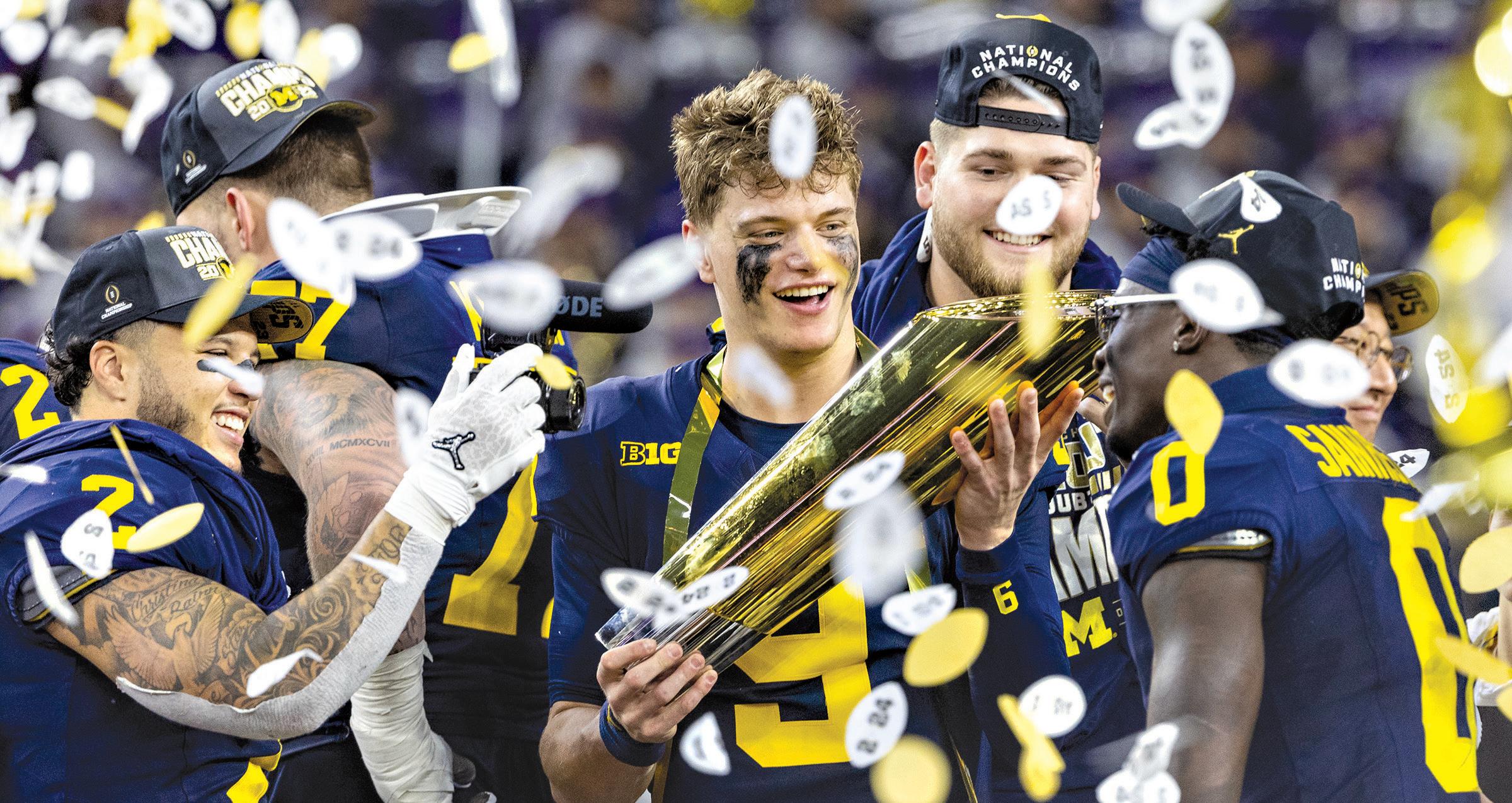
back Blake Corum said. “But when we needed to start fast again, we started fast.” Up 20-13 with just over nine minutes left in the fourth quarter, Michigan’s offense found its footing. As a ground and pound playstyle gave birth to an electric play action completion to sophomore tight end Colston Loveland, the Wolverines strung together an offensive drive that punctuated in a fashion befitting only of the latter Jim Harbaugh era.
Making a cut in the backfield before surging up the middle, senior running back Blake Corum sprinted into the endzone for six points, giving the Wolverines an insurmountable 26-13 lead. And then he did it again. Just eight plays later, after graduate defensive back Mike Sainristil returned an interception to within the Washington 10, Corum needed two carries to gain eight yards, and drive the final stake into the heart of the Huskies.
“Dominance — (offensive coordinator Sherrone Moore) say every day we gon’ smash some,” sophomore quarterback Alex Orji said. “And I think he showed exactly who he is today. We got the best back duo in the nation, we got the best O-line in the nation. I promise that.” For a moment, it looked like the Wolverines would run away with it.
If they were going to go all the way, it was only going to happen one way. Running into Houston, the first-ranked Wolverines didn’t skip a beat. Thrashing No. 2 Washington’s (14-1 overall) run defense, Michigan (15-0) summited the Huskies 34-13 on the back of none other than a good, old-fashioned 300 yard, four touchdown rushing attack en route to winning a 12th national championship in grand fashion.
On their first two offensive drives they found the endzone with ease, courtesy of two 40-yard home runs by junior running back Donovan Edwards. Scoring 17 points on its first three offensive drives, Michigan throttled the gas pedal as the Huskies spiraled. But three stalled offensive drives later, the Wolverines went into the halftime break up just 17-10. A once red-hot rushing attack sputtered, and Michigan allowed Washington to hang tough. The yard differential was large, but the margin for error small.
No. 1 seed Michigan overpowers No. 2 seed Connecticut to win national championship, 69-63
INDIANAPOLIS — Nobody could’ve seen it coming just two years ago.
The Michigan men’s basketball team was in despair. An 8-24 record marked the worst season in program history. The Wolverines were without a coach and the roster was in pieces about to lose the majority of its roster.
The memories of 2018, of 2013, of 1993 and 1992 had haunted the Wolverines. School legends had come and gone. 1989 — the only national championship — was 37 years prior. A program that had been so close so many times kept on falling short. The 2023-24 season, about as far from coming close as could be, stung even more.
But Dusty May picked Michigan up even quicker than it fell. The coach that made the Final Four with Florida Atlantic in the Wolverines’ ill-fated season had a clear vision. Built on the back of hard work, roster construction and innovative coaching, there was light at the end of the tunnel.
May had almost been there before with the Owls; now, in his second year with the Wolverines, he did it. After 37 years, the drought is over. In just 24 months, he brought the Wolverines from rock bottom back to the summit.
On Monday, after a slow first half in which No. 2 seed Connecticut (34-6) played the game at its speed, No. 1 seed Michigan (37-3) pushed the pace in the second to take a considerable lead. The Wolverines never lost that lead, winning their second national championship in program history, 69-63.
“It’s a surreal moment, it doesn’t feel real,” May said. “It still doesn’t feel real because you watch this as a kid, I (went) to bed early … staying up for One Shining Moment. It’s been a tough task for me over the years to see that and think back of all the years that you just want to be a part of something greater than
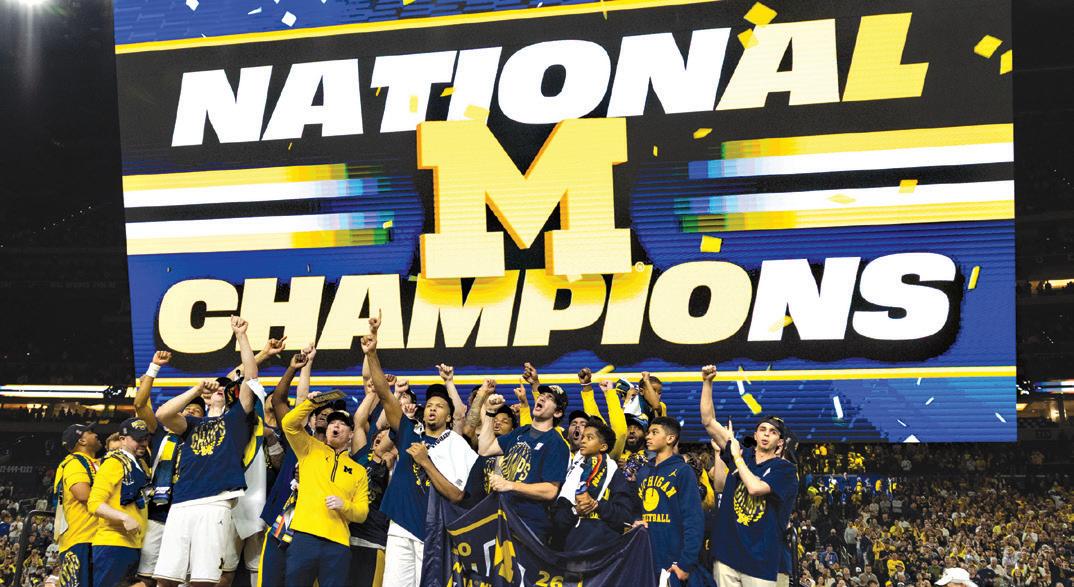
yourselves, more than yourself. And for this to come to fruition, it just doesn’t seem real.”
The Huskies made sure the game was slow from the jump. Running possessions deep into the clock — as they typically do — led to good looks around the court. Though many of them didn’t drop as Michigan’s interior defense swarmed, UConn had its foot on the gas as its game plan thrived.
Unable to flourish in the slog of a slow-paced, half-court game, the Wolverines struggled to generate offense early. With its sets stagnant and graduate forward Yaxel Lendeborg playing hampered by injury, the typical fluidity of Michigan’s offense was halted; it missed all eight of its threes in the first half and the fast break was a complete non-factor.
But the Wolverines stayed in it through their work down in the paint — like they have all season.
Sophomore forward Morez Johnson Jr. feasted down low, having his way against a defense that struggled with his tenacity. Meanwhile, Michigan earned numerous trips to the charity stripe as its physicality scrambled UConn. With the Huskies leading 25-23, forward Alex Karaban was charged with a hook-and-hold, and Johnson got two more at the line. The Wolverines continued to do damage around the rim as two interior baskets on the following possessions forced a UConn timeout.
Despite struggling to push the pace, Michigan went into the break up four points anyway. Coming out of half, though, the Wolverines finally played the game their way.
“Sometimes, when you break the runs like that early, you tend to think that you may not need to block as hard throughout the rest of the game,” graduate center Drake Nugent said. “… But in reality it’s kind of the opposite because the defense is gonna get more stout.”
Those same frustrations carried into the second half as the Wolverines struggled to get anything going offensively. Michigan secured just three points on its first four offensive drives of the second half — with the single field goal coming off an interception by quarterback
Michael Penix Jr. that set up the Wolverines with plus field position. That slow churning was all in a classic fashion though.
The antiquated, hard-nosed, traditionalist style of football may have died years ago amid the airraid offenses of bustling cities out West, or conferences down South. But three years ago, Michigan had decided to double down. Jim Harbaugh had decided to double down. And the Wolverines wouldn’t stop now.
“We started fast. They slowed us up a little bit,” senior running
“Now we’re in the history books forever,” Nugent said. “We’re legends.” Victors valiant. Conqu’ring Heros. Champions of the West. By 2020, they had faded, crushed under the duress of losing seasons and long-remembered anguish. By 2022, they had found color, attaining glimpses of the exceptionalism that had defined Michigan seasons of years past. But on a January evening in 2024, they found vibrance. The Champions of the West have become the champions of the rest.
“Dusty at halftime was like,
‘Remember when we put that score sheet up at the end of the (Wisconsin game from last season)?’” graduate forward Will Tschetter said.
“‘Nothing matters stats wise.’ He’s like, ‘All that matters is that we’re cutting down nets in 20 minutes.’”
It was night and day compared to the first half. Michigan forced more turnovers in seven second-half minutes than in the entirety of the first, which let junior guard Elliot Cadeau kickstart the Wolverines’ transition offense. The trivial lead at the break turned to double digits as Cadeau nailed Michigan’s first three of the game, after a fake pass freed him up. Just as it seemed like UConn was about to thrust back into the game with less than eight minutes to go, junior center Aday Mara slammed home a lob in transition. A few minutes later, with the game inching to a close, the Huskies went on a minirun to close it to five. But freshman guard Trey McKenney, who’d struggled all night, hit a wide open 3-pointer with less than two minutes remaining after a convoluted looseball sequence.
The Huskies never got back within four. As the final buzzer sounded and the Wolverines rushed the court, the dream became reality. Thirty-seven years later, Michigan is back atop the mountain.

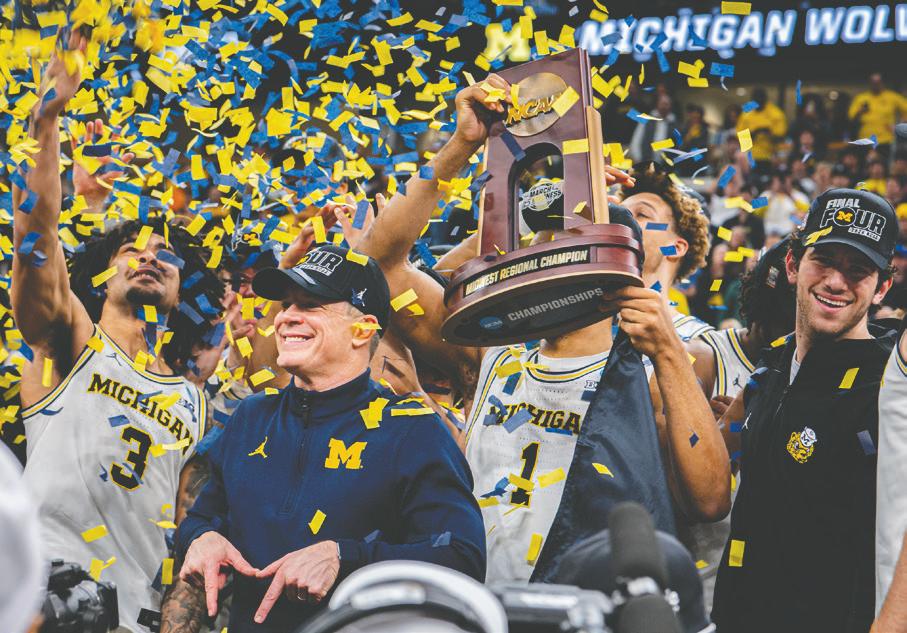

team clearly felt Whittingham’s
In the wake of former coach
Sherrone Moore’s sudden dismissal, the Michigan football team has emerged with Moore’s successor 16 days later.
Friday afternoon, reports emerged that the Wolverines were expected to hire Kyle Whittingham as head coach. Later that evening, Michigan officially announced the hire, making Whittingham the 22nd coach in program history.
As the front man, Whittingham is a sharp turn away from the Moore regime.
Moore was a young Jim Harbaugh protégé, picked to keep the good times rolling after Harbaugh’s departure following the Wolverines’ first national championship in 26 years. A dropoff to 8-5 and 9-3 seasons marked a middling start to Moore’s tenure before it ended abruptly by his own wrongdoing — an inappropriate relationship with a staff member. Moore was then arrested after breaking into the staff member’s home.
Whittingham is 27 years Moore’s senior. He recently announced he’d be stepping down as the Utah coach after 21 seasons on the job. These past two decades have
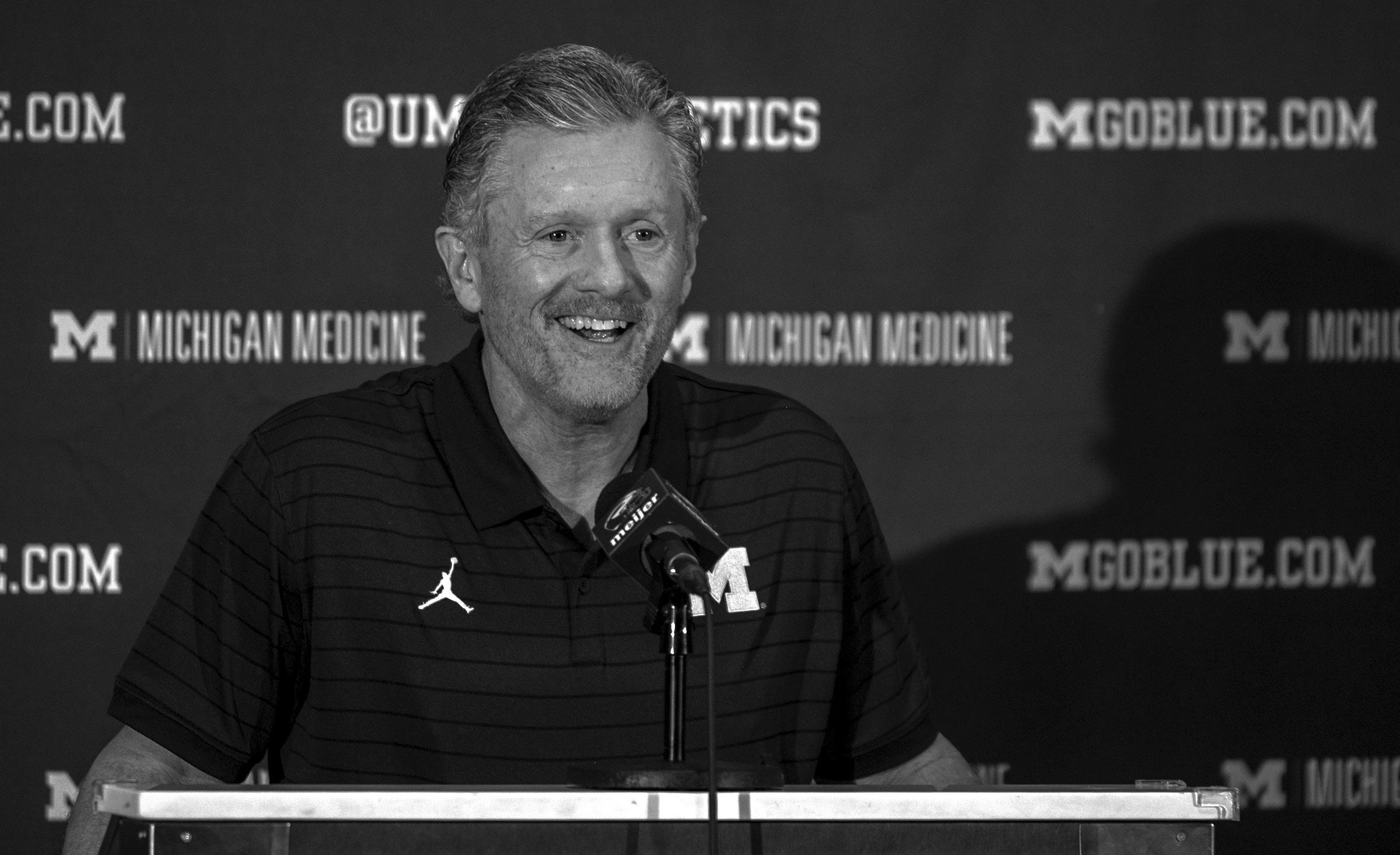
No. 1 Michigan punches ticket to Frozen Four with 4-3 win over Minnesota-Duluth
Schifsky swooped in, picked it off, and again beat Gajan five-hole to extend the lead to 3-0.
ALBANY, N.Y. — Three goals in the first period for one team, three goals in the third for the other. With a trip to the Frozen Four on the line, it was the extra goal that counted. With a 4-3 victory, the No. 1 seed Michigan hockey team (317-1) weathered a third-period push from No. 2 seed MinnesotaDuluth (24-15-1) to win the Albany Regional and punch its ticket to Las Vegas.
“That’s playoff hockey,” senior defenseman Luca Fantilli said. “Other teams are gonna make their push, they’re gonna get bounces, and you’re gonna get bounces. (It’s) just how you respond. And I’m so proud of how our group came together. It was positive energy on the bench the entire time, and just happy we got it done.”
The Wolverines’ offense was hot from the start. Three minutes in, sophomore forward Will Horcoff put Michigan on the board with a tip on a blue-line wrister from junior defenseman Ben Robertson. Seven minutes after that, junior forward Nick Moldenhauer found freshman forward Adam Valentini wide open at the side of the net on the power play. Valentini slid it through Bulldogs goaltender Adam Gajan’s five-hole to make it 2-0. The Bulldogs were reeling from the onslaught, but they had a chance to right the ship just 20 seconds later as the Wolverines took a penalty. The second-best power play in the country went to work, but as defenseman Ty Hanson sent a drop pass toward forward Jayson Shaubagay, Wolverines junior forward Garrett
“I think the worst part about that first period was the score,” Minnesota-Duluth forward Zam Plante said. “We let up three goals, but we really didn’t come out flat.”
Michigan went into the first intermission matching the secondmost goals it had scored in a first period all season. But the Bulldogs weren’t going to go down without a fight, and the Wolverines began the second period on their heels. Forward Max Plante went one-onone with freshman goaltender Jack Ivankovic a mere minute into the period. Ivankovic was ready, but Plante rang it off the post to help him out. The rest of the period continued similarly, though Michigan also got chances of its own.
“Honestly, I thought we stuck to our game plan to a T, and then to score on the power play, for Garrett Schifsky to get that shorthanded goal, it was almost like everything was going right,” Wolverines coach Brandon Naurato said. “It’s just another learning experience (for) us. It wasn’t that we got away from our game or weren’t playing as hard, but I felt like going into the second period, maybe unconsciously, we were just trying to hold on, and it was way too early to be in that position.”
Minnesota-Duluth was on the hunt, needing to chip into the Wolverines’ lead. It had plenty of opportunities to do so, including another power play from a Schifsky cross-checking minor as the period wound down. As the penalty expired at the beginning of the third period, Michigan’s penalty trouble finally cost it when Minnesota-Duluth forward Harper Bentz wristed
the puck past Ivankovic and put one on the board for his team. Hope was quickly restored for the Wolverines, though, as junior forward Jayden Perron extended the lead to three again just three minutes later.
Right after that, the Bulldogs began tearing chunks out of Michigan’s lead. The Wolverines’ penalty kill faltered once more as Hanson beat Ivankovic to cut the lead to two again. And with three minutes left in the game, forward Scout Truman jammed the puck under Ivankovic’s pads. Michigan challenged, but it was unsuccessful.
Just like that, it was a one-goal game.
With its season on the line, Minnesota-Duluth immediately pulled Gajan for the extra attacker. Michigan was endlessly hemmed in its own zone, unable to get the puck down the ice into the empty net as the Bulldogs hammered them with shots.
With 30 seconds left, Ivankovic sprawled out for a save, aided by a critical block from Schifsky.
“Just please don’t go in the net,” Schifsky said about his thoughts during the play. “We were holding on for dear life. Good on them for bringing it to us at the end. They’re fighting for their season. But we weathered the storm pretty well and eventually got the win. So proud of the guys for anchoring down and getting that win.”
After the Wolverines defended a last-second faceoff, time expired, and so did the Bulldogs’ hopes of a comeback. In turn, Michigan’s hopes of a championship blossomed as, for the third time in Naurato’s four-year tenure, the Wolverines are headed to the Frozen Four.
and
unfamiliarity with the school and the region. The expectation to win at a high level on an annual basis will also loom over Whittingham, who presumably had a great deal of job security at Utah. Whittingham went 177-88 with the Utes. His run includes two recent Rose Bowl berths and a Sugar Bowl victory to cap off an undefeated 2008 campaign. This season, the Utes are 10-2, rebounding from a 5-7 record last year. The union of Whittingham and Michigan is something that neither probably envisioned as recently as a month ago. But after Whittingham’s shocking resignation to end one of the longest coaching tenures in college football and Moore’s even more shocking firing, the two parties have agreed for Whittingham to become the Wolverines’ new head coach. A rocky recruiting and transfer portal period will still likely occur following a dramatic month. But in Whittingham, Michigan has found a veteran coach to attempt to right the ship and — amid an investigation into the program — steer it away from scandals and controversy.
No. 2 seed Michigan opens the floodgates in third quarter, securing 71-52 win over No. 3 seed Louisville
hurrying Louisville’s guards into difficult passes.
FORT WORTH, Texas — The No. 2 seed Michigan women’s basketball team knew what it needed to do to advance in the NCAA Tournament: They needed to win a game of runs. And after Louisville refused to go down early, it was only a matter of time before the Wolverines unleashed the run that cracked the game wide open.
The defensive pressure intensified like a storm rolling in, each possession bringing heavier pressure. Michigan (286) pushed into the frontcourt, pressuring the Cardinals (29-8) through sideline and halfcourt traps. The Wolverines took full control in the second half, swinging the rhythm. It rode this momentum all the way to the final whistle, and Michigan secured the win 71-52, clinching its second-ever Elite Eight appearance.
“We’re excited to still be playing,” Wolverines coach Kim Barnes Arico said. “I think we have an incredible team and the country got to see them on display today.”
Both teams opened the game by pressuring guards well beyond the 3-point line. Often blitzing ball screens to force rushed decisions, neither team could build an offensive rhythm.
Trailing 15-9 to open up the second quarter, the Wolverines finally began utilizing their stifling press. This pressure resulted in immediate success,
“Our press has been our strength the whole year, so we didn’t want to shy away from that,” sophomore guard Olivia Olson said. “I feel like we didn’t press in the first quarter that much. They were kind of sending people out and we didn’t really gamble at all. … And I felt our second line did a really great job of moving and getting to the next person.”
The Wolverines built a lengthy 16-0 run spanning over more than five minutes. The most crucial aspect of this run wasn’t just the turnovers; it was what the Wolverines made out of them. Michigan used the turnovers to do what it does best — bruise through transition.
The Wolverines accumulated six points off turnovers, all in the form of fastbreaks. By generating turnovers, Michigan found its rhythm, leading 32-27 at halftime.
The Cardinals took the early advantage in the third quarter, clawing back from its halftime deficit. Louisville bursted out of halftime with a quick 7-0 run, regaining the lead. The Wolverines stopped the bleeding there, with both teams trading punches on every possession. And that’s when the Wolverines began to separate themselves.
Michigan built another run, 19-2, punctuated by an Olson 3-pointer off a turnover. The scoring run resulted from a collective effort, tightening up on both sides of the ball. Five
different Wolverines scored during this stretch, with sophomore forward Kendall Dudley adding a spark off the bench. As a pair, Olson and sophomore guard Syla Swords outscored the Cardinals in the quarter, 16-12, showcasing their abilities to take over a game. Simultaneously they were both finding teammates to spread the wealth, highlighted by Olson’s three assists in the quarter. Michigan’s outburst highlighted the final five minutes of the quarter, and suddenly, the Wolverines were in the driver’s seat, leading 57-40 after three.
“When we just take a breath and relax, we have so much fun, and so you could see that in the beginning of the third,” Olson said. “ … We were just really playing loose and having fun. I think that’s what ignited our run.”
By the time the fourth quarter rolled around, most of the damage had already been done. Michigan generated only one turnover during the quarter but used it to put two more points on the board. As time dwindled, the Wolverines grew content to drain the shot clock on their offensive possessions. The lead remained intact, and Michigan could feel an Elite Eight berth brewing.
Building momentum from the second-quarter comeback, the Wolverines built a significant scoring run in the third quarter that completely shifted the game. And they never looked back.
NOV. 25, 2023
PAUL NASR Former Managing Sports Editor
That much was clear when the rumbling Big House turned into a mosh pit of fans storming the field as No. 3 Michigan (12-0 overall, 9-0 Big Ten) took down the second-ranked Buckeyes (111, 8-1), 30-24, in an iteration of The Game that had everything on the line. Both undefeated squads entered with College Football Playoff hopes, but after converting on timely moments throughout the game — capped by a late interception from junior defensive back Rod Moore to seal the win — only the Wolverines managed to walk away with their lofty goals intact.
“This game is something we prepare for 365. It’s not a oneweek affair,” offensive coordinator and acting head coach Sherrone
Maybe it isn’t all that surprising anymore. A top-five matchup with Ohio State, a victory over the Buckeyes in The Game, a Big Ten East title punched in the process, a College Football Playoff berth all-but sealed by beating its biggest rival. In recent memory, all of it used to sound pretty out of the ordinary for Michigan. Now, it’s normal. Three wins over Ohio State in a row, three Big Ten Championship appearances in a row, a likely third College Football Playoff appearance in a row — for years such success looked like a fantasy for the Wolverines. But after 60 minutes against their biggest foe, it became something else: the standard.
Moore said. “It’s not something we just dropped that week, so it’s something that’s planned out very strategically.” No matter how normal a win like this has become, it was far from a normal afternoon at Michigan Stadium; everything was a little bit bigger. For one of the sport’s greatest rivalries, differences as minute as six Ohio State-branded benches sitting idle and empty on the visitor’s sideline hours before kickoff signified a clash anything but idle and empty to come. To overcome its toughest test of the year amid the highest of stakes, Michigan had to make timely plays.
Be it a first-quarter interception by sophomore cornerback Will Johnson to keep star receiver Marvin Harrison Jr. in check and set up an easy score, or junior
quarterback J.J. McCarthy hitting an extremely tight window for a touchdown strike to senior receiver Roman Wilson, the Wolverines made plays when they mattered to take a 14-10 lead into halftime.
But for most of the game, no one really dominated the other side, no matter how badly each side wanted to. So it came down to picking spots, picking moments and striking in the second half. Ohio State first picked its spot by going smash-mouth in the third quarter. Rush after rush after rush, the Buckeyes moved the sticks, capping off a touchdown drive that tied the game at 17 with eight straight rushing attempts.
Michigan needed to stay on time in response, but for a moment, everything stood still.
Because in the ensuing drive as the Wolverines were rolling down the field late in the third quarter, senior guard Zak Zinter went down with a bad leg injury. Strapped with an aircast and placed on a stretcher, his entire team gathered around to end the multi-minute stoppage. He put his fist up in the air as he was carted off, showing support to a team and crowd that he wouldn’t be able to finish the game alongside. And on the very next play, senior running back Blake Corum broke free for a 22-yard touchdown, flashing the number ‘65’ — Zinter’s number — with his hands in celebration. A timely celebration for a timely score, as Michigan retook the lead, got a quick stop and then tacked on a field goal to make it 27-17 early in the fourth quarter to start feeling comfortable.
“We came together and we knew we had to do it for (Zinter),” Corum said. “And the very next play — boom.” From that “boom,” Michigan led for the rest of the game. And the Wolverines weren’t just feeling comfortable on the field; they were feeling comfortable in their new place in this rivalry and the college football landscape, too. A place that was once strange for them, and now their usual stomping grounds. So comfortable that to ice the game after an Ohio State touchdown made it 27-24, they went back to the basics, back to how they created this new reality in the first place: beating up the Buckeyes in the trenches and dominating on the ground. CONTINUED AT MICHIGANDAILY.COM