Thursday, July 8, 2021
ONE HUNDRED AND THIRTY YEARS OF EDITORIAL FREEDOM
michigandaily.com
inside NEWS
State of Emergency Washtenaw County experiences flooding, causing damage for citizens >> SEE PAGE 2
OPINION
School Rankings School rankings may matter, but at the same, they should not >> SEE PAGE 5
MICHIGAN IN COLOR
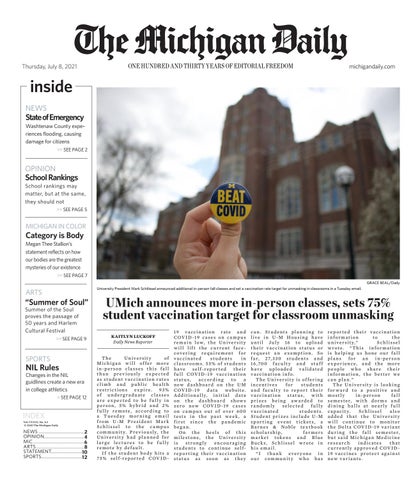
Category is Body Megan Thee Stallion’s statement reflects on how our bodies are the greatest mysteries of our existence >> SEE PAGE 7 GRACE BEAL/Daily University President Mark Schilissel announced additional in-person fall classes and set a vaccination rate target for unmasking in classrooms in a Tuesday email.
ARTS
“Summer of Soul” Summer of the Soul proves the passage of 50 years and Harlem Cultural Festival
>> SEE PAGE 9
SPORTS
NIL Rules
Changes in the NIL guidlines create a new era in college athletics > SEE PAGE 12
INDEX Vol. CXXIX, No. 112 © 2020 The Michigan Daily
NEWS .................................... 2 OPINION................................ 4 MiC......................................... 6 ARTS.......................................8 STATEMENT..........................10 SPORTS.................................12
UMich announces more in-person classes, sets 75% student vaccination target for classroom unmasking KAITLYN LUCKOFF Daily News Reporter
The Un iver sit y of Michiga n will of fer more in-person classes t his fa ll t ha n prev iously expected as st udent vaccination rates climb a nd public hea lt h rest rict ions expire. 93% of underg raduate classes are expected to be fully in person, 5% hybrid a nd 2% f ully remote, according to a Tuesday morning ema il f rom U-M President Ma rk Schlissel to the ca mpus c o m m u n i t y. P r e v i o u s l y, t h e Un iver sit y had pla n ned for la rge lect ures to be f ully remote by default. If t he st udent body hits a 75% self-repor ted COV I D -
19 vaccination rate a nd COV I D -19 ca ses on ca mpu s r e m a i n l o w, t h e U n i v e r s i t y will lif t the current facecovering requirement for vaccinated st udents in cla ssrooms. 55% of st udent s have self-repor ted their f u l l COV I D -19 vacci nat ion status, according to a new dashboa rd on the UM COV I D -19 data website. A d d i t i o n a l l y, i n i t i a l d a t a on the dashboa rd shows zero new COV I D -19 ca ses on ca mpus out of over 600 tests in t he pa st week, a f irst since t he pa ndemic began. On the heels of this m i lestone, t he Un iver sit y is strongly encourag ing st udent s to cont i nue selfrepor ting t heir vaccination stat us as soon as they
ca n. St udent s pla n n ing to live in U-M Housing have u nt i l Ju ly 16 to upload t heir vaccination stat us or request a n exempt ion. So f a r, 2 7, 3 3 0 s t u d e n t s a n d 16,700 facult y a nd sta f f have uploaded va lidated vaccination info. The Un iver sit y i s of fer i ng incentives for st udents a nd facult y to repor t t heir vaccination stat us, wit h prizes being awa rded to ra ndomly selected fully vaccinated st udents. St udent prizes include U-M spor t ing event t ickets, a Ba r nes & Noble tex tbook schola rship, farmers ma rket tokens a nd Blue Bucks, Schlissel w rote in his email. “I tha nk ever yone in our communit y who has
repor ted t heir vaccination information to the u n i v e r s i t y, ” Schlissel w rote. “This information is helping us hone our fa ll pla ns for a n in-person experience, a nd t he more people who sha re t heir information, t he bet ter we c a n pla n .” The Un iver sit y i s look i ng for wa rd to a positive a nd mostly in-person fall s e m e s t e r, w i t h d o r m s a n d dining ha lls at nea rly f ull c a p a c i t y. Schlissel also added t hat t he Un iver sit y w ill continue to monitor t he Delt a COV I D -19 va r ia nt d u r i n g t h e f a l l s e m e s t e r, but sa id Michiga n Medicine research indicates that c u r rent ly approved COV I D 19 vaccines protect aga inst new va ria nts.
2 NEWS Washtenaw County flooding prompts state of emergency declaration Thursday, July 8, 2021 The Michigan Daily — michigandaily.com
JUSTIN O’BEIRNE Daily Staff Reporter
Follow ing a week of severe ra infa ll in Michiga n a nd water da mage to homes a nd
The Phenomenon of COVID “Long Haulers” ANNA RAPP Videographer
As p er a M ich ig a n Me d ic i ne s t udy, pat ient s t h at cont rac t COV I D -19 c a n l i kely ex p er ience s y mpt om s over long p er io d s of t i me. The s t udy fou nd t h at 53% of p e ople t o cont r ac t t he SA R S v i r u s s t i l l d i splaye d s y mpt om s 30 d ay s a f t er f i r s t s y mpt om s pre s ent e d .
roadways, Sue Shink, cha ir of t he Wa shtenaw Count y Boa rd of Commissioners (WCBC), a nnounced Thursday a count y-w ide state of emergency. According to t he WCBC, t he state of emergency is ef fective immediately a nd w ill continue a s t he heav y ra infa ll persists. To stay safe, count y of f icia ls sa id t hey urge residents to avoid f looded roads a nd da maged wa lk ways. In a press relea se, Shink sa id t he ma in rea son for decla ring a state of emergency wa s to ensure t hose in need received t he help t hat t hey required. “A lt hough Wa shtenaw Count y ha s a lready been working to a ssess a nd respond to f looding a nd to shelter a nd suppor t residents who have been displaced by t he f looding, t his decla ration w ill a llow for loca l resources to be utilized to t he f ullest extent practica l,” Shink sa id.
Additiona lly, Shink w rote to Michiga n Governor Gretchen Whit mer urg ing her to decla re a state of disa ster or state of emergency for t he a rea. Shink w rote t hat ext ra at tention f rom Whit mer could help improve t he disa ster response by prov iding f ur t her f ina ncia l suppor t for t hose whose proper ties may be da maged a nd prov isions for a nyone who may need a ssista nce or tempora r y shelter. Ca roline Sa nders, Wa shtenaw Count y Commissioner for Dist rict 4, reiterated Shink’s concerns in a statement in t he press relea se. Sa nders sa id f ur t her action is impor ta nt especia lly since ma ny residents might not have f lood insura nce. “If we don’t act quickly a nd decisively to f ully suppor t t hem, t hey w ill be lef t holding t he bag for t housa nds of dolla rs of needed repa irs,” Sa nders sa id. “ We must work w it h t he state a nd
ot her pa r t ners to prov ide t he resources a nd suppor t necessa r y to help t hese fa milies beg in to recover.” Wa shtenaw Count y Administ rator Gregor y Dill sa id t he count y is doing ever y t hing t hey a re able to protect its citizens. “Our f irst a nd prima r y goa l during a ny disa ster response is to ensure t hat ever yone involved is safe a nd sheltered,” Dill sa id. “The count y ’s emergency response tea m w ill continue to monitor t he sit uation a nd prov ide updates to residents a s we have t hem.” For a ny non-lifet hreatening emergency, such a s proper t y da mage, t he WCBC encourages residents to ta ke photos of da maged possessions a nd repor t t he da mage by ca lling 211. For more information a nd g uida nce, residents should v isit: ht t ps://w w w. wa shtenaw.org/1807/ Flooded-Homes.
420 Maynard St. Ann Arbor, MI 48109-1327 www.michigandaily.com
CALDER LEWIS Editor in Chief eic@michigandaily.com
KATIE LYNGKLIP
Business Manager business@michigandaily.com
CONTACT INFORMATION News Tips Corrections Letters to the Editor News section Photo Department Arts Section Editorial Page Sports Section Advertising
tipline@michigandaily.com corrections@michigandaily.com tothedaily@michigandaily.com news@michigandaily.com photo@michigandaily.com arts@michigandaily.com opinion@michigandaily.com sports@michigandaily.com wmg-contact@umich.edu
EDITORIAL STAFF Madison Gagne Managing Editor mbgagne@umich.edu
Allison Engkvist Digital Managing Editor engkvist@umich.edu
Christian Juliano and Shannon Stocking Managing News Editors news@michigandaily.com
Josh Taubman and Max Wadley Managing Sports Editors sports@michigandaily.com
Rosa Sofia Kaminski and Julian Wray Managing Arts Editors arts@michigandaily.com
Becca Mahon and Dominick Sokotoff Managing Photo Editors photo@michigandaily.com
Sarah Chung and Allison Yih Managing Design Editors design@michigandaily.com
Ethan Patrick and Caroline Atkinson Managing Copy Editors copydesk@michigandaily.com
Eliya Imtiaz and Lola Yang Managing Michigan in Color Editors michiganincolor@michigandaily.com
Amelia Duffy and Zoe Storer Managing Social Media Editors socialmedia@michigandaily.com
Mary Rolfes Editorial Page Editor opinion@michigandaily.com
Margaret Rudnick Managing Video Editor video@michigandaily.com
Samantha Cole Managing Statement Editor statement@michigandaily.com
The Michigan Daily (ISSN 0745-967) is published Monday through Friday during the fall and winter terms by students at the University of Michigan. One copy is available free of charge to all readers. Additional copies may be picked up at the Daily’s office for $2 per issue. Subscriptions for September - April are $250, and year-long subscriptions are $275. University affiliates are subject to a reduced
ALEC COHEN/Daily Michigan experienced widespread flooding during rainstorms earlier this week.
subscription rate. Subscriptions must be prepaid.
Thursday, July 8, 2021 The Michigan Daily — michigandaily.com
NEWS 3
UMich hosts rescheduled anti-Asian hate, mental health event after last week’s Zoom disruption NIRALI PATEL Daily Staff Reporter
The Universit y of Michigan hosted a live Zoom discussion Wednesday regarding antiAsian hate and addressing mental health topics for Asian Americans and Pacif ic Islander (A A PI) communities in light of rising anti-Asian hate crimes across the United States. The event was co-sponsored by the Steve Fund, a national organization dedicated to the mental health and emotional well being of young people of color, and the National Center for Institutional Diversit y at the Universit y of Michigan. The event was moderated by Dr. Marcia Liu, a mental
health coordinator for Hunter College. The virtual event included keynote speaker Kevin Nadal, a professor at John Jay College and the Cit y Universit y of New York (CUN Y), along with four panelists: Dr. Anmol Satiani, assistant director for clinical training at Depaul Universit y; Dr. Ian Shin, assistant professor of Asian American Studies at the Universit y of Michigan; Dr. Sam Museus, professor of education studies at Universit y of CaliforniaSan Diego and Dr. Hendr y Ton, associate vice chancellor for health equit y, diversit y and inclusion at Universit y of California-Davis. Liu said she hoped the presentation would help clarif y the advocacy strateg ies
that could be used to uplif t A A PI students on campus. The virtual event was a continuation of the discussion that occurred last week, which was abruptly cancelled af ter a zoom-bomber caused a sig nif icant disruption to the event with racist and explicit remarks. “ We were forced to end the event abruptly and, I know I can speak for myself, I was quite shaken by this intrusion, and we wanted to acknowledge how this event was traumatic for us, as well as for many of our participants,” Liu said. In a pre-recording of a discussion bet ween Nadal and Liu, Nadal ref lected on last week’s disruption. “I think one of the things that this (incident) brought
up for me is this whole idea of racial trauma or historical trauma,” Nadal said. “It brought up overt experiences with racism, brought up feelings of uncertaint y, or lack of control in the world. But, like I mentioned on the actual day that all this happened, I really do believe that we are resilient people. The lesson is that you can’t shut us out-we will continue f ighting (and) advocating for justice.” Nadal said he believes one can never get too comfortable or too complacent so long as white supremacy exists, and he emphasized that Asian Americans are not a monolith identit y. “ While it’s important to name certain cultural values and patterns that might be
more or less common across different Asian American g roups, it’s also important to understand that each countr y of orig in comes with unique histories of oppression and colonialism,” Nadal said.“(You must) really be able to challenge any of your biases about what you view as being normalized.” Af ter the pre-recording ended, Shin elaborated on how A A PI emerged as a political identit y as a result of the Asian American studies out of the San Francisco Bay area in the late 1960s, which contributed to the ethnic studies sect that advocated for representation of people of color and Indigenous Peoples in academia. Read more at michigandaily.com
“We need progressive voices”: County Commissioner Jason Morgan runs for State Representative JASMIN LEE Daily News Editor
Washtenaw County Commissioner Jason Morgan (D-Ann Arbor) on June 17 announced his campaign for Michigan State Representative of District 53 in the 2022 elections. If elected, Morgan will replace incumbent Yousef Rabhi (D-MI), who will complete his term-limited tenure in 2022. Currently Washtenaw County Commissioner for District 8, Morgan was elected in 2016 and won re-election for his next two terms. Morgan was also elected to serve as the Chair of the Washtenaw County Board of Commissioners from 2019 to Jan. 2021, making him the first LGTBQ+ Chair in Ann Arbor history. Since announcing his campaign, Morgan has been endorsed by half of Ann Arbor City Council members, over a dozen local community leaders and other elected officials in Washtenaw County.
For example, Ann Arbor Mayor Christopher Taylor expressed his support for Morgan’s campaign in a press release. “I am thrilled to support Jason’s candidacy for State Representative,” Taylor said. “Jason has the energ y, drive, and compassion needed to be an effective voice for Ann Arbor residents. I look forward to working with him to move our community forward.” In an interview with The Michigan Daily, Morgan said his advocacy for progressive policies will help represent Ann Arbor and Washtenaw County at the state level. “I am running because I believe we need good representation in Lansing,” Morgan said. “I think we need somebody who is willing to be boldly progressive, forwardthinking and pragmatic all at the same time for Washtenaw County and for Ann Arbor. I believe that we can work on things like protecting our access to voting, and the environment and LGBTQ rights, and all these things. The
representative for Ann Arbor has a uniquely powerful and large role in making sure that those voices are heard in our state legislature.” As a member of the LGTBQ+ community, Morgan said community members have shared meaningful experiences of seeing him, a gay man, thrive as a public servant in Ann Arbor and Washtenaw County. “It’s part of why I think it’s very important to be out and proud; to be gay and to make sure that people know that I am,” Morgan said. “Not because that’s a marker of a good public servant or not, but because representation does matter.” Legislation against transgender athletes and other anti-transgender bills have been increasingly common in the United States since the start of 2021. Morgan said the work of anti-LGBTQ+ legislation is happening at the state level, and he wants to continue to progress LGTBQ+ rights and push back against these anti-transgender and other discriminatory bills. “My hope in getting elected would be to continue to advance
LGTBQ+ rights,” Morgan said. “(To) make sure that people who are gay or transgender or otherwise, are not fired for who they are, they aren’t discriminated against based on housing or any other aspect of participating in our society, because of their identity. That is something that is still a struggle for the LGBTQ community, and particularly our transgender community and those who are black and brown in the LGBTQ+ community as well.” Based on his experience as an instructor at Washtenaw Community College, Morgan said he believes in the importance of teaching and wants to make sure Michigan’s K-12 education system is getting the support it needs at the state level. “Our K-12 education system has been so incredibly underfunded and our teachers have been taken for granted,” Morgan said. “We don’t serve our students well when we do that. We have teachers who want to do this work, they will want to show up and teach but the classrooms are falling apart.
We have textbooks that are far outdated, and they lack the technolog y that they need to do their work. A lot of that is tied to funding, and the inequity in our state funding system…I think that’s one place where our state has done a terrible job over the past couple of decades.” LSA sophomore Jacob Sendra is an intern for Morgan’s campaign for State Representative. Sendra intends to major in political science and has worked on multiple political campaigns on the local, state and national level. An Ann Arbor local, Sendra participated in the Washtenaw County Youth Commission — a group that works with teenagers in Washtenaw County to discuss and educate students on local government issues — while in high school and met Morgan through his work in that program. Sendra said working with Morgan showed him how local government can impact the lives of people around him. Read more at michigandaily.com
4 OPINION
Thursday, July 8, 2021 The Michigan Daily — michigandaily.com
JULIA VERKLAN MALONEY | OPINION COLUMNIST
Advance token to…
Edited and managed by students at the University of Michigan since 1890. 420 Maynard St. Ann Arbor, MI 48109 tothedaily@michigandaily.com
CALDER LEWIS
MARY ROLFES
Editor in Chief
Editorial Page Editor
EDITORIAL BOARD MEMBERS Julian Barnard Zack Blumberg Brittany Bowman Elizabeth Cook
Brandon Cowit Jess D’Agostino Andrew Gerace Jessie Mitchell
Mary Rolfes Gabrijela Skoko Jack Tumoowsky Joel Weiner
Unsigned editorials reflect the official position of The Daily’s Editorial Board. All other signed articles and illustrations represent solely the views of their authors.
BRANDON COWIT | OPINION COLUMNIST
E
Is Bitcoin a viable national currency?
arlier this month, 39-year-old Salvadoran President Nayib Bukele made international headlines when he announced — and quickly passed — a bill to make Bitcoin legal tender in El Salvador, making it the first country to do so. This is unlikely to have a massive immediate impact on the economy of El Salvador, where only roughly 30% of people have bank accounts and less than 51% have access to the internet, which is necessary to use Bitcoin. However, the precedent that it sets is noteworthy, and merits debate on whether other countries should follow suit. One of the most prominent arguments in favor of Bitcoin is that, allegedly, it is immune to inflation in a way that fiat currencies like the U.S. dollar are not. Jack Mallers, CEO of Strike, a payment platform that has partnered with the Salvadoran government to implement Bitcoin in the country, stated, “Holding bitcoin provides a way to protect developing economies from potential shocks of fiat currency inflation.” El Salvador itself has not suffered immense inflation in recent decades, largely due to the fact that it uses the U.S dollar (a choice that has its own flaws). However, in other Latin American countries — like Venezuela or, to a lesser extent, Argentina — that have experienced inflation, a currency that is supposedly immune to inflation would seem attractive. The problem is that Bitcoin is far from immune to wild fluctuations
in value. Indeed, within the last few months alone, Bitcoin has gone from a peak value of $63,347 on April 15 to $32,404 on June 22. Most of that loss in value occurred in just two weeks. Were that rate of inflation to continue for a year, that would be a 5,569% annual inflation rate, roughly equivalent to Venezuela’s projected inflation rate for 2021. Could Bitcoin rebound from where it is now? Certainly. Bitcoin’s current value is roughly equivalent to where it was at the end of January 2021, and obviously, it has increased significantly from there. But that’s precisely the problem. Bitcoin is not a stable currency; it’s prone to the same extreme oscillations in value that some fiat currencies are, and often more so. Worse yet, those variations can be — and have been — because of policy changes in just one country. Bitcoin’s value fell by almost 50% within a week in December 2017, shortly before South Korea, a country with 51 million people, banned new trading accounts. More recently, China’s crackdown on cryptocurrencies wiped away $400 billion from the global cryptocurrency market in the three days after June 18, including a 16% drop in the value of Bitcoin. These incidents show how, even though Bitcoin is a decentralized currency, governments around the world can meddle with its value. So unless the world’s Bitcoin-using countries get together to establish rules for how countries can
legislate — which, given how well the world was able to cooperate to fight COVID-19, I wouldn’t count on — this international currency will forever be prone to giant shocks because of national policies. This is not to discount the extreme amount of electricity that mining Bitcoin requires, which is incredibly important as the threat of climate apocalypse looms closer and closer. In 2020, the Bitcoin network, which includes mining and transactions, used up 58 terawatt-hours of electricity, roughly equivalent to the annual electricity usage of Switzerland. Bitcoin’s proponents usually have two rebuttals to this statistic: fiat currency also uses a lot of electricity in its creation, and that the majority of Bitcoin mining runs on renewable energy. While both of these are technically true, neither is actually an effective argument in Bitcoin’s favor. Paper currency production and banking use roughly 100 terawatthours of electricity every year, about 80% more than Bitcoin mining. However, this does not take into account the actual monetary value of what is produced with that electricity. In 2020, approximately 420,000 Bitcoin were mined, worth roughly $14 billion at present value. Read more at michigandaily.com Brandon Cowit is an Opinion Columnist and can be reached at cowitb@umich.edu.
Design by Jessica Chiu
T
he board game Monopoly feels as though it is meant to be torturesome by design. Every time I take the famed game out of the cupboard, I know that I don’t want to play it, yet it still manages to make its annual appearance at family gatherings. The game is exhausting — some people grow bored of their fictional land-owning dominance while others feel hopeless when forced to traverse the green squares. But recently, for the first time in my life, I was able to take out and dust off Monopoly and not feel a premature sense of boredom and aggravation. I instead experienced a historical and rousing deep dive, sparking internal realizations of how a game that has suddenly seen a surge in play as a result of the pandemic has implications for change beyond the board. With the announcement of a return to campus in the fall of 2021, University of Michigan students are eager to traverse the streets of Ann Arbor much like game pieces advancing to “Go,” finding utility in a promise of normalcy amongst change. Yet this return will still be one of luck balanced with uncertainty in need of revision, much like the game Monopoly. In line with this eager sentiment, Hasbro announced in March that, for the first time in over 85 years, the classic yellow Community Chest cards would be updated. According to the game makers, “covering topics like beauty contests, holiday funds, and life insurance, there is no denying the Monopoly game’s Community Chest Cards are long overdue for a refresh. And, coming out of the tumultuous year of 2020, the term ‘community’ has taken on a whole new meaning.” Hasbro’s plan has opened a public vote on
modern incentives to be printed on the famed yellow cards, removing all of the original 16 and, instead, asking Twitter users to “add a little community to the Community Chest.” When looking at life through the lens of a giant board game, Hasbro is correct in its need to add value to the community as we know it. Their challenge spurred me to think of what I would like to add or remove from my community’s chest, transcending the board and game pieces. With that in mind, perhaps removing the metaphorical get out of jail free card for professors facing allegations of sexual harassment or adding an advance to State Street and pass go without feeling unsafe fits the challenge. It is easy to feel as though college life is simply a game of collecting and paying. With every new step comes the potential for upset or victory at the hands of those in power. Eagerness is there — whether it is the return to somewhat capitalistic endeavors of shopping and eating at full capacity or living on campus in an apartment, residence hall or house. However, such a return comes with financial, social and physical burdens that we have gone a year without experiencing. I can’t help but feel like a tiny silver piece being taken out of the cupboard for the first time in a year, thrust amongst a community that has changed yet remains bound to the same outdated instructions and playing cards. This idea of college being a reallife board game is not a new concept. Read more at michigandaily.com
Julia Maloney is an Opinion Columnist and can be reached at jvmalo@umich.edu.
Thursday, July 8, 2021 The Michigan Daily — michigandaily.com
THEODORA VORIAS | OPINION COLUMNIST
I
Your summer job doesn’t determine your worth
spent every summer break during college working a part-time job in my hometown. While I considered summer internships my first few summers, I was never confident enough in my skills or resume to actually apply to any. I wasn’t too upset with the prospect of working at a fun, low-stress job with coworkers that made it all worthwhile. However, as I progressed in my college career, I became acutely aware of my peers who were scoring prestigious summer internships at large investment banks and federal agencies. When COVID-19 canceled my summer study abroad program in 2020, I was left with no backup plan and ended up back at the same part-time job. I remember feeling embarrassed about still working at the same place I had since I was a teenager. That embarrassment led me down a rabbit hole of disappointment, self-criticism and a devaluation of my worth. Reconfiguring my perception of what summer break is and can be has allowed me to reflect on those experiences positively.
If you’re feeling down about your lessthan-ideal summer plans, reframing your mindset can help the break be just as transformative as if you had gotten that dream internship. As college students, we often feel pressured to look at summer break as a time to make money and gain industry experience. However, there are so many more possibilities that can come out of a well-utilized break from classes. The fact that the word “break” is what we call the months between school years isn’t for nothing. The pressure and stress college students face are greater than ever before. So often, college requires students to make sacrifices. When trying to juggle a heavy course load, extracurriculars, parttime work and a social life, it is easy for the parts of ourselves that seem less productive to fall through the cracks. Leisure reading, making artwork or other hobbies and personal projects become victims of wishful thinking. Summer break is a great opportunity to reconnect with the parts of ourselves
that all too often fade away during the busy academic year. Summer break can also provide the time and mental space for discovering new passions. Especially for students earlier in their college career, the extra time that summers provide can be used to explore new majors or career paths. Though it may feel most pertinent to figure those things out during the school year, being out of class can allow for a more thoroughly thoughtout plan for choosing what to study and what career to pursue. Even if those new passions are only hobbies, they can still have major benefits. Hobbies and recreational activities can improve our mental health and help us identify the ways that we best cope with stress. I often feel guilty about not having enough hobbies because I get too busy with school and work. Working a parttime job over the summer afforded me the time to pursue my interests outside of the classroom, which may not have been possible had I landed a full-time summer internship.
OLIVIA MOURDIAN | OPINION COLUMNIST
I
OPINION 5
School rankings matter, but they shouldn’t
n high school, like many other academically motivated students, I was obsessed with the idea of getting into a competitive, highlyranked college. By the time senior year rolled around, after three years of filling my schedule with honors and advanced placement classes and being actively involved in different clubs and teams, I thought my sparkly, hollow dreams of attending a “prestigious” — whatever that meant to me — college were in sight. Alas, when college decisions came by way of cryptic “Your Admissions Status Has Been Updated” emails, I realized that a lot of these prestigious schools did not want me back, and the ones that did were way beyond my price point. After my initial disappointment had worn off into quiet resentment, I decided to go to the University of Alabama because of the scholarship they had given me. My achievementoriented, somewhat shallow self was not looking forward to attending America’s number one party school after all the work I had put into my grades and extracurriculars in high school. Now, two years and two schools later, I wish I could tell myself that that party school would teach me more about generalizations, independence and conformity than I could ever learn in a classroom.
Academically speaking, my three semesters at Alabama were amazing; I was challenged, and I loved almost all of my professors. Socially speaking, my three semesters at Alabama were meaningful in a different way. I met people who changed me for the better, and I learned how to think for myself. While I ultimately ended up transferring to the University of Michigan, my time at Alabama was by no means the disappointment I had expected it to be, given its “unremarkable” academic ranking. Retrospectively, I see that my disappointment came from the importance I had placed on appearances and school rankings rather than which school was the best fit for me. Now, I question what use rankings really serve. The academic rigor that our University and other selective schools frequently tout is not anything different from what I experienced at Alabama. Considering the similarity between the quality of my academic experiences at Alabama (which sits at #143 nationally) and the University of Michigan (which comes in at #24) these surface-level rankings just seem to provide a means for schools to separate themselves from less socially acclaimed schools. Beyond my anecdotal evidence
for the emptiness of college rankings, these rankings have larger implications that affect students on a national scale. As school rankings rely heavily on standardized test scores, they perpetuate the inequities that come along with these tests. Pulling in approximately $1 billion in revenue each year, these exams are ultimately a business. Students in low-income areas do not have the same access to this business — the prep courses, tutors and funds required to take these tests multiple times — as students in more affluent areas do. However, with the way college rankings are measured, schools continue to rely on these futile and prejudiced scores in an effort to improve their stats. An easy way for universities to climb up the rankings is to increase the average SAT or ACT scores of their incoming class. To do this, many universities, particularly in the South, have created extensive merit-based scholarship programs to attract students with high test scores to their schools. While there is nothing wrong with financially supporting students with high grade point averages and test scores, these programs prioritize students who have the resources to help them reach those standards. Given this prioritization, placing importance
Another misconception about working a part-time job, especially in the service industry, is that while you may be acquiring skills, they aren’t the “right” skills. It is easy to undervalue a person’s experience in a part-time job. However, highly valuable skills in the workforce, including skills in communication, problem-solving and teamwork, are the foundation of many of the tasks that such jobs require. In interviews, I’ve found myself avoiding talking about the part-time summer job I have listed on my resume because of the negative way I think the interviewer will perceive that experience. However, some of my greatest strengths and skills have been developed through that job. More times than not, when I have answered an interviewer’s question with an example from that summer job, they have been impressed with the professional skills I am able to relay through those experiences. It isn’t always necessarily about what you do for work, but rather how you articulate the skills you’ve gained that matter.
While industry experience during college can look great to companies during the post-grad job search, a summer job in your chosen field isn’t the only way to get the career you want. Internships have been criticized for being exploitative, especially those that are unpaid, and for having interns do menial work. A study done by LiveCareer found that of those surveyed, 93% of respondents reported doing menial work during their internship. Though a job description may tout the exciting responsibilities of the internship, it is not guaranteed this will be reflected in the actual work the intern takes on. Steadfastly supporting internships also fails to take into account that the experiences gained and the professional connections made can be strongly impacted by the superRead more at michigandaily.com
Theodora Vorias is an Opinion Columnist and can be reached at tvorias@umich.edu.
AMBIKA TRIPATHI | OPINION CARTOONIST CAN BE REACHED AT AMBIKAT@UMICH.EDU.
Back to the grind
on standardized test scores — and the collateral biases of those scores — comes along with placing importance on school rankings. This is not to say rankings do not matter — this is to say they should not matter. However, the reasons these rankings are significant have little to do with academics or opportunities for involvement and everything to do with perception. As a student at Alabama, the first responses I typically received when I said I went there
had to do with football or something involving cousins or intrafamilial relations. As a student at the University of Michigan, the first responses I receive pertain to my academic achievements or questions about what kinds of things I am doing in school. Read more at michigandaily.com
Olivia Mouradian is an Opinion Columnist and can be reached at omouradi@umich.edu.
6 MICHIGAN IN COLOR ANDREW NAKAMURA MiC Columnist
65. The atomic number of the element terbium. The amount of known Euler’s idoneal numbers. The traditional age for retirement in America. And the grade my small chin, wide interocular distance and asymmetrical face received on prettyscale.com. Prettyscale.com is an online beauty calculator that calculates a score from 0-100% based on the measurements of the user’s face. The user uploads a headshot and plots various coordinates on the face to measure the size of each feature and their distance between each other. Once the algorithm has obtained enough data to outline each facial feature, it then produces a score, along with a list of pros and cons for the face. I tried the website out of curiosity and amid the long list of cons, one flaw stood out to me: “wide nose.”
Thursday, July 8, 2021 The Michigan Daily — michigandaily.com
Beyond face value
More than hurt or outraged, I was confused because it had never occurred to me that my nose was a negative physical trait. What makes a wide nose flawed? Who gets to decide whether they are flattering or not? Nose shapes are often used as examples to illustrate the divide between the natural features of people of color and people who fit the Eurocentric beauty standard because, overall, ethnic noses are wider and flatter than European noses. While prettyscale.com identifies features prevalent in people of color as ugly, it exposes itself as a software that upholds racial biases and Eurocentric beauty standards. In order to confirm my speculation, I ran a few more tests through the calculator using stock images of men, each from a different race. Sure enough, all images except for the white man yielded a “wide nose” result. Interestingly, Googling the term “ethnic noses” yields a plethora of resources regarding corrective plastic
surgery, whereas the search term “European nose” produces much fewer articles relating to surgery. All of these websites find that ethnic noses are too large, wide or flat — and that they need to be corrected. I would never blame someone for getting plastic surgery to feel beautiful in this soul-crushing society. However, I take immense issue with the pressure placed onto people of color to alter their appearance in order to feel beautiful in accordance with obsolete Eurocentric beauty standards. As I returned to the homepage after repeating the test multiple times, a stream of tiny text at the bottom of the site caught my eye: “Results are based on complex mathematical calculations performed by a blind computer beauty calculator and could be incorrect.” The framing of the algorithm’s process as “complex mathematical calculations” seems to apply a sense of authority — that the computers’ results are purely objective and thus indisputable.
Although studies have shown that humans already trust algorithms more than their fellow humans, computers are not always suited to make subjective decisions. Machines do not exist in a vacuum; facial recognition algorithms are trained on data fed by the humans developing the software. Whether or not this was intentional, prettyscale. com upholds Eurocentric beauty standards as ideal by flagging wide noses as a flaw. In addition, there are plenty of other examples of racial bias in facial recognition technology, such as artificial intelligence’s misidentification of Asian faces and Twitter’s algorithm favoring white faces. Without carefully confronting unconscious biases, they will infiltrate our AI, further harming people of color as technology only becomes more important in our society. The sheer volume of racism pervading our technology stems from the lack of diversity in the computer science field. Many companies in
Silicon Valley admit that they “have a lot of work to do” in terms of diversifying their staff, but are they really doing the work? Companies like Google promote Black History Month for engagement, but Black employees only make up 3.7% of their global workforce. The lack of Black, brown and Indigenous employers limits the number of connections available to underrepresented minorities, especially in a career path that relies on referrals. While white executives may vocally support people of color, they fail to use their immense power to open up more opportunities for BIPOC engineers. Our technology is more than capable of conceptualizing and constructing facial structures, yet it becomes a manifestation of its programmers’ conscious or unconscious bias. Until computer science spaces actively work to include underrepresented minorities, racist algorithms will always permeate our technology right under our noses.
Confessions of a washed-up Black swimmer JASMIN LEE MiC Columnist
Stepping up on the block, I wait for the whistle that commands my body to get in a diving position. Next to the five other swimmers lined up on the blocks, I curl my toes and squeeze my hands on the edge of the block when I hear the second whistle. Go. I push off in a horizontal dive into the water and immediately start dolphin kicking to the surface. As my head comes out of the water, I realize something is missing: my swim cap. I’ve loved the water since I was a kid. My dad threw me in the pool when I was nine months old and suddenly, I could float. When I am submerged in the water, it feels like time stops. It comforts me to be surrounded by water, knowing that it was there to support me even if I couldn’t support myself. I was 12 when I decided to start swimming competitively, and that’s where I met my first swim coach: Kwame. When we were too slow to get in the water, Kwame would yell “SPARTA!” and kick us in the pool. When I fell asleep doing dryland workouts, he poured a bucket of water on me to wake me up. He always made us play soccer because it would help us with our kicking skills — although
sometimes I think Kwame just wanted to play soccer. Kwame not only taught me how to swim all 4 strokes — freestyle, backstroke, breaststroke and butterfly — but most importantly, he taught me how to have fun even in difficult situations. I met my closest friends, Durga and Eva, at the community swim team. During practices, we would encourage each other to go faster and complain about how sore we were afterward. We declared ourselves the “Mermaid Sisters” and would practice our backflips in the water as if we were magical — no one could tell us otherwise. In the water, I was both weightless and powerful all at once as I glided through the water and barely broke the surface to reach the other side. And I only wanted to get better. I never felt lonely or the slightest out of place, because I was surrounded by my closest friends and swim coach, who were all people of color. Although most people I practiced with looked like me, this was not the case outside of my community team. Whenever I told my Black friends in high school that I was on the swim team, they would respond with something along the lines of, “Girl, I could never! I don’t even know how to swim, and I don’t want to mess up my hair.” As a young BIPOC swimmer, I
was looking for role models to follow in swimming — a field dominated by white athletes in America — and that’s when I looked to social media. Instagram had introduced me to Lia Neal years before she became the first African-American and AsianAmerican swimmer to compete in the Olympics for the United States, but even then, I saw myself in Neal: a mixed-race athlete who aspired to greatness. Since I also come from a mixed-race background, Neal was my swimming idol and I wanted to break records just like her. At the same time, I learned about Stanford University swimming commit Simone Manuel, who would go on to be the first African American woman to win an Olympic gold medal in swimming. Seeing Neal and Manuel succeed in swimming made me believe I could, too, thrive as a competitive swimmer. After a couple of years of swimming with Kwame, I realized swim practices were not challenging me as much as I wanted. If I wanted to get faster, I needed to make a change. As I entered high school, I decided to join a competitive club swim team with a tough coach who was known for molding champion swimmers. Joining this new team was a wakeup call for me in the swimming world. I swam year-round, so when high school season was over, the club season
Design by Sarah Chung
began. Even though I was able to score points for my high school team, I never ranked high enough on my club team to even compete for points. All the swimmers were considerably faster than me and I was always delegated to the last lane, the slow lane. These swimmers had started swimming as early as five years old and their parents spent the extra time and money on private coaching and the best training equipment on the market. I was years late to the game and I qualified for free lunch in my school district, which did not always make the most nutritional meals for high-intensity swimming. Any time I tried to rest, the main coach
— an old white man — and assistant coaches would scold me for missing even one set despite not knowing my limitations. “Why didn’t you go?” they had said. “Everyone else is making the set, why aren’t you?” This unhelpful criticism and more like it felt like personal attacks on my work ethic as an athlete. As a result, I pushed myself past my limits to make the interval times — even when I would be so behind that I had no breaks in between sets — in hopes that I would get faster. Read more at michigandaily.com
Thursday, July 8 2021 The Michigan Daily — michigandaily.com
The category is body KARIS CLARK MiC Columnist
“The category is body.” As put by Megan Thee Stallion in her latest album, this statement couldn’t be more true. Our bodies are one of the greatest mysteries of our existence. To embody a human body means to contain roughly 7 octillion atoms, 37.2 trillion cells and enough DNA that, if elongated linearly, would extend over 10 billion miles. The bodies we belong to construct our consciousness, which builds and sustains our entire earthly existence. Our body identity, as described by somatic counselor Dr. Christine M. Caldwell, “is our core identity, out of which other identities are built. It is generated, preserved, and enacted by the body via our explicit and implicit relationship to sensation, movement, physiological processes, relationships, interactions and bodily awareness of emotion.” But as a growing body of research has confirmed over the past few decades, the experience of trauma manifests itself in namely the physiological body — rather than solely the neurological brain — rendering it difficult for the body to function. As Caldwell and co-author Lucia Bennet Leighton assert in their book, Oppression in the Body, singleincident or complex traumas and the traumas of oppression all have the capacity to prompt a disconnection to our body as well as constriction within our body movements and foster hypervigilance, all while altering our neurobiological chemistry. And when the harm that is done to us hangs on for the long run, we must learn to take the steps necessary to heal. Distinguished neuroscientist Stephen Porges’ polyvagal theory categorizes the autonomic nervous system into three physiological states determined by our level of safety, which consist of social engagement, fight-or-flight and freeze-or-collapse. In social engagement, we seek support from those around us in the face of a perceived threat. If there is no support, we enter fight-or-flight, in which we take on active means to defend ourselves by either fighting back or fleeing. If this does not work, we enter freeze-or-collapse where our body, in an attempt at self-preservation, disengages. In his book, The Body Keeps The Score, psychiatrist Bessel van der Kolk posits that severe trauma prompts the body to remain lingering in the latter two states of “fight-or-flight” or “freeze-orcollapse.” In(habitating) a constant state of survival, trauma increases the secretion of stress hormones and impairs the subcortical systems of our brain which regulate our
body’s digestion, breathing, immune system and cardiovascular system. Immobilization in the body, which van der Kolk cites as being “at the root of most trauma,” causes shallow breathing and disassociation and forces us to lose touch with ourselves and our surroundings. The physical stress of trauma adversely impacts how we relate to one another socially and emotionally — when we feel unsafe, we’re unable to reciprocate and connect with others. Our being thrives on intimacy, kinship and love for one another. Trauma prompts us to isolate ourselves, resulting in an enormous amount of pain and — as we know a year and a half into a pandemic — the pain of social isolation emerges in the physical as well. Caldwell claims that “physical, emotional, and mental pains are all related, often interwoven.” In his book, Care of the Soul, author Thomas Moore recognizes the inherent poetics of illness in the body. He claims that the human body functions as “soul presented in its most rich, expressive form” (in terms of gesture, shape, physiognomy, temperature, skin, etc.), and that in examining the afflictions of the body we can find deeper meaning in the emblematic nature of the illness, which paves the path towards a better understanding of how to heal. As Moore puts it, “the body is always speaking silently.” Traumatic stress, according to Van der Kolk, entails “timeless relieving” (the re-experiencing of sensory details) and “dissociation” (inability to distinguish between the past and present). In other words, trauma makes it so that the body feels as if it is literally and figuratively stuck in the past. This is especially true when thinking about epigenetics and the transgenerational impacts of trauma. Biological anthropology professor Grazyna Jasienska claims in her study on the intersection of race, epigenetics and slavery that “intergenerational information about environmental quality can be passed to next generations by changing gene expression.” In this vein, the intense psychological stress in tandem with the extreme physical abuse endured by those in the past materializes in the present. As the traumas of oppression persist in the present, the cyclical ramifications will continue on and on. Today, the body as an entity remains marginalized. Our Western society, in its increasing domestication, alienation from the natural world, and consumerist modes of thought, prompts us to dissociate from our own bodies. We lose our true essence. We stop seeing ourselves as sacred manifestations of the divine, pristine presentations of the universe — and instead, we see
our bodies as machines, mastered by our minds in bondage to a conditioned brain. Western civilization’s control of the body, from the subjugation of the Black body through racialized oppression to the objectification and hyper-sexualization of women, has caused us to see our bodies as tools for labor, production and exploitation. Caldwell states that “making the perceived body (as
MICHIGAN IN COLOR 7
the white power structure. As philosophy scholar Seunghyun Song writes, “The stylization of racialized bodies self-audit their bodily existences in anticipation of the punitive norms, so that the ‘white’ standards become ingrained as a panoptic presence in the Black individual’s consciousness.” Black bodies serve as sustaining sites of oppression, in perpetual anticipa-
to van der Kolk, cultivating a self awareness of our physical sensations and how they shift with our circumstances also gives us a better understanding of what our body is trying to say to us. We can also get back in sync by stepping out of sync with exploitative systems of oppression. Rejecting the sadistic, sleep-depriving and soul-crushing demands of academia
MEGHANA TUMMALA/Daily
opposed to the body experienced from within) conform to rigid, arbitrary, and abusive norms created by those in dominant social groups is likely a factor in eating disorders, poor body image, the objectification and commodification of the body, obsessive interest in a particular appearance, persecution of the ‘differently abled,’ violence against the gender nonconforming, deligitimization of people of color, and subjugation of woman.” We’ve been socialized to place value judgments on bodies based on their adherence to mere aesthetics, implicitly devaluing that which lies in the peripheral. We become fearful of inhabiting a body that transgresses the norm. Caldwell cites the demand for Black people to simulate whiteness as a means of white supremacy, further complicating the experience of being in a Black body. She claims that navigating racist systems requires an alteration of paralinguistic traits such as accent, inflection, volume and articulation as well as an alteration of bodily movements such as our posture and gestures. All must be modified at the whim of
tion of punishment. But how can we mitigate the harm done by trauma in all forms, and move toward healing? Thinking back to Moore’s notion of the body’s illnesses being poetic, if we see traumatized bodies as having been thrown out of sync, any healing practices should be geared towards getting ourselves back in sync. Beyond seeking professional psychotherapeutic treatment (which is certainly an indispensable method for healing that remains inaccessible for many), there’s a lot we can do personally on our own, starting with increasing our capacity to self-regulate by becoming aware of visceral sensations. In his book, The Body, author Bill Bryson asserts that our breath(ing) is one of the only autonomous functions of the body which we can control (to some extent). Deep, controlled breaths signal to the brain that we are safe. The practices of mindfulness and bodyfulness allow us to relax our bodies through the process of continuous deep breathing. Deep breathing allows us to remain present and in the moment, giving us the ability to develop a stronger sense of self-awareness. According
and the professional world’s individualistic grind culture by prioritizing rest and well-being is what Black artist and community healer Tricia Hersey’s liberation practice entails. Hersey recognizes resting as a spiritual activity which embodies a strong connection to our ancestral heritage. When we’re sleeping and well-rested we’re more in touch with ourselves, thus allowing us to be more in touch with the divine. Another way we can get back in sync with ourselves is by being in sync with others. Van der Kolk claims that “a good support network is the single most powerful protection against becoming traumatized.” He posits that being touched or hugged in an affirmative, mindful manner allows us to relax and identify areas of tension within ourselves. Porges’ polyvagal theory infers that it is our natural tendency to be in a state of defensiveness. To be in sync with others, however, requires a temporal dismantling of our defenses so community can form. Read more at michigandaily.com
8 ARTS
Thursday, July 8, 2021 The Michigan Daily — michigandaily.com
‘CALL ME IF YOU GET LOST’ is Tyler, the Creator’s Victory Lap KAI BARTOL
Daily Arts Writer
Listening to a Tyler, the Creator album is like enjoying a Van Gogh painting. Each note is a richly textured, perfectly placed brush stroke that, when combined with its companions, creates a vivid image. Just like with a Van Gogh, every time the listener returns to a Tyler album, they will gain new insights. Maybe on one repeat listen, the listener will notice a fluttering synth trill; on another, they develop a new emotional attachment to a song. In many respects, Tyler, the Creator’s “Starry Night” — his magnum opus — is his 2019 album IGOR. IGOR, Tyler’s 21st century spin on old-school R&B, was responsible for cementing Tyler’s transition in the public eye from an amateurish shockjock to a serious artist, after laying the groundwork with Flower Boy. So how do you follow IGOR? How does an artist continue a career when the public has already decided their peak? Tyler’s answer to this seemingly inescapable question is a move remarkably in character for him; release an album straight out of
left field. CALL ME IF YOU GET LOST is Tyler’s victory lap. Thanks to Tyler’s newfound superstardom, material wealth, such as Rolls Royces and fancy European travel, is now obtainable. This opulence comes out delightfully in the production of the album as everything from the intricately layered instrumentals to the Wes Andersonesque aesthetic exudes extravagance. Features from hip-hop legends like Pharrell Williams and DJ Drama only affirm Tyler’s success during the album’s 53-minute runtime. Rapping about material wealth is nothing new in the world of hip-hop, but listeners of CALL ME may find deeper meaning buried beneath the album’s gold-plated surface. Although Tyler is the man who has everything, his success is undercut by a potential lover deep in a relationship with a close friend. CALL ME is not nearly as conceptual as IGOR but does allude to a narrative thread. The album reaches a climax deep in the tracklisting on “WILSHIRE,” in which Tyler breathlessly narrates over an eightminute backbeat rhythm about his anguish. Fans may recognize this plot as nearly the inverse to IGOR, in which
Tyler’s lover leaves him for another person. Although the roles may have been reversed, the result is the same; Tyler is left alone in a lavish mansion. Looking through Tyler, the Creator’s catalog, one naturally sees a divide between “old” and “new” Tyler. Back when he was known as the frontman of hip-hop collective Odd Future, Tyler crafted songs that were abrasive and meant to offend. But much of Tyler’s newer work is far more emotionally vulnerable and approachable. CALL ME may be the perfect bridge between the two halves of Tyler. Its faster tempo and carefree production are reminiscent of older Tyler, the Creator albums like Wolf and Cherry Bomb, while the overall aesthetic direction of the album feels more in line with Flower Boy and IGOR. CALL ME also represents a return to an old staple of Tyler’s discography – his heavy rapping over some downright dirty beats. On IGOR, Tyler assumed a more directorial role. While he had many memorable moments, much of the scant rapping on IGOR was delegated to the album’s many features. However, CALL ME is distinctly Tyler’s album, written, directed and performed. The return
Design by Maggie Wiebe
of Tyler’s distinctive sonorous voice is long overdue, and tracks such as “LEMONHEAD,” “LUMBERJACK” and “JUGGERNAUT” set themselves out as some of the hardest in Tyler’s discography. Although CALL ME IF YOU GET LOST may be Tyler’s celebration, his story is far from over. Now that he’s made it to the top, Tyler has made it clear he will not give up the throne without a good fight. With his exuberant public persona,
wildly successful fashion line Golf le Fleur* and his various TV projects, Tyler’s influence has reached more people than ever before. Although Vincent Van Gogh is known for making the world more colorful, he was famously awarded that honor posthumously. Through his many creative projects and celebrity status, Tyler Okonma is ensuring he can enjoy his time in the limelight. Read more at michigandaily.com
Faye Webster explores the growing pains of love and loneliness on ‘I Know I’m Funny haha’ NORA LEWIS
Daily Arts Writer
Faye Webster’s I Know I’m Funny haha feels like a summer rainstorm. In the somber warmth and haze of her words, the 23-yearold indie artist unlocks a floodgate of emotions with each tear-stained ballad. I Know I’m Funny haha is uniquely beautiful because of Webster’s honesty, paired with her keen ability to counter the melancholy blues of sadness with touches of amber-imbued country and R&B. On her last album, the 2019 record Atlanta Millionaires Club, Webster solidified her knack for storytelling and writing the platonic ideal of a sad song. I Know I’m Funny haha continues to explore these same aches of longing and isolation, but in the time between, Webster has weathered the throes of a relationship amidst social isolation
and her own rising indie stardom. She meets mundane daily pangs of loneliness and unexpected swells of happy tears with impressive levelheadedness. “Better Distractions,” the project’s opening track and lead single, landed on former President Barack Obama’s “Favorite Music of 2020 List,” and in many ways encapsulates the solitude of the past year and a half in quarantine. Webster describes an unsuccessful search for distraction from her troubled love life in unavailable friends, singing, “Got two friends that I could see, but they got two jobs and a baby / I just wanna see you.” Whether intentionally or not, Webster’s pining and search for “better distractions” from this absent love interest mirrors the feeling of disconnection many felt from loved ones during the pandemic. “Kind Of” is a breathtaking groove of soft drums and keyboard,
and a tale of blossoming new relationships. Webster reflects on the pessimism of her past and moving out of her comfort zone, crooning, “I’ve always been the type to see all the bad before all the good things / Haven’t written the song in a minute / Haven’t been in love forever / But I’m looking at you, you’re looking at me at every single possible angle.” The album’s titular track details the daunting experience of meeting a partner’s family, reminiscing, “I think your sisters are so pretty / Got drunk and they forgot they met me / I made her laugh one time at dinner / She said I’m funny and then I thanked her / But I know I’m funny haha.” She punctuates these simultaneously fraught and rewarding moments with a sardonic “haha,” as if to soften the awkwardness of her recollection. This isn’t the only time Webster’s dry humor peeks through the project’s emotional veneer. On the
track “A Dream With a Baseball Player,” she recounts a crush she used to have on Atlanta Braves outfielder Ronald Acuña Jr, and sings, “There’s so much going on / My grandmother’s dead / And I can’t sleep ’cause this isn’t my bed / He doesn’t even know those things exist.” Her baseball crush is the definition of unrequited love but serves as more of a funny anecdote to look back on rather than a heartcrushing and prolonged yearning. Webster eventually met Acuña at a game, and stated, “It was so anticlimactic. Not in a bad way, it was just like, ‘OK, he doesn’t give a fuck about me.’ I’ve spent two years obsessing over this person who will not remember meeting me after tonight.” It’s the kind of fleeting infatuation that none of us are immune to. Webster’s Atlanta roots are central to her music, whether it be home-team heartthrobs or the soft country instrumentals that
characterize her unique sound. Steel guitar twangs, gentle layers of washboard and electric organ whirs flow with soulful bass lines in perfect harmony. Webster paints pictures of neighborhood porch gossip on “I Know I’m Funny haha” in true Southern fashion, with a kind of unhurried probing to her voice. In a recent interview, Webster revealed she only records vocals on Garageband and rarely in a studio, which might explain her music’s intrinsically home-grown feel even more. The specifics of Webster’s misadventures and quiet victories in love are not always universal, but the project still remains as intimate and unrestrained as a stream-of-consciousness journal entry or candid conversation with a friend. I Know I’m Funny haha is the quintessential album for the lazy lulls of summer, and the multiseasonal growing pains of love and self-growth.
Thursday, July 8, 2021 The Michigan Daily — michigandaily.com
ARTS 9
Celebration and remembrance in ‘Summer of Soul’ KATRINA STEBBINS Daily Arts Writer
Summer belongs to live music. In a normal year, you’d find me spending the last few days of July at Mo Pop Festival in Detroit, having an overpriced drink and sweating next to the Detroit River, listening to whichever indie group might be headlining. The experience of being at a live event with thousands of other goodnatured people, listening to good music, is by no means exclusive to the summer, but it is at its best in the warm weather. “Summer of Soul (…Or, When the Revolution Could Not Be Televised),” directed by Ahmir “Questlove” Thompson in his filmmaking debut, certainly recognizes this in its recounting of the Harlem Cultural Festival of 1969. The Harlem Cultural Festival took place over six weekends from
June to August. It was a free event that accommodated an audience of over 300,000 and featured legendary Black and brown artists including Stevie Wonder, Gladys Knight, Mahalia Jackson, Mongo Santamaría and Nina Simone. When it was over, hours of footage shot with the intention to immortalize the event spent over 50 years sitting in a basement, unseen. The festival fell away into history, largely overshadowed by Woodstock, which took place during the same summer. “Summer of Soul” takes the lost 34 hours of film and whittles them down to an excellent, joyful two hours. Highlights include Mavis Staples and gospel legend Mahalia Jackson singing “Take My Hand, Precious Lord” in honor of Martin Luther King Jr. (who was assassinated the previous April), David Ruffin of the Temptations hitting impossible whistle tones in “My Girl” and Nina Simone calling
an audience of thousands of Black people to revolution with “Are You Ready?” Most of the performances go uninterrupted by commentary, and by showing each in its entirety, Questlove invites viewers to appreciate the monumentality of the event and feel the same wonder the live audience did. After each performance, the question of how the festival was so easily forgotten by history grows more and more present as the talent displayed overwhelms. Archival footage and interviews with attendees, performers and, to a lesser extent, celebrities (the ever-ubiquitous Lin-Manuel Miranda makes an appearance) fill in contextual blanks. They reflect on the cultural and historical circumstances within which the festival existed: the assassinations of Martin Luther King Jr. and Malcolm X, the moon landing, the Black is Beautiful and Backto-Africa movements, Harlem’s
heroin epidemic. The film’s efforts to include all of these things make it feel somewhat overstuffed at times, but it succeeds in creating a holistic picture of the time and highlights the impact and necessity of the event to the people of Harlem, N.Y. An interview with one attendee, Musa Jackson, bookends the documentary. At the end of the film, after being shown footage of the event, Jackson comments tearfully, “You put memories away, and sometimes you don’t even know if they’re real. So, it’s almost confirmation that what I knew is real.” Concluding with this sentiment powerfully underscores a large part of the film’s message: the importance of remembrance and the acknowledgment of the power of choice in what is immortalized and what slips away. The film’s subtitle — “(…Or, When the Revolution Could Not Be Televised)” — is a reference
and small amendment to the title of Gil Scott Heron’s spoken-word poem, “The Revolution Will Not Be Televised.” The slight change in language is essential, and it gets to the very heart of “Summer of Soul”’s purpose and message. The Harlem Cultural Festival was a weeks-long display of talent and joy that hosted some of the greatest Black and brown performers of its time but was nearly lost because producers and distributors were uninterested in the material. This is indicative not only of the insidious racial biases that creep into the process of choosing what to remember and memorialize but a great misunderstanding of what audiences will find worthy of recollection. “Summer of Soul”’s revival of the event’s legacy, with help from those who were there to witness it themselves, proves that despite the passage of 50 years, people want to remember the Harlem Cultural Festival.
This image is from Searchlight Pictures’ official Youtube channel.
10 STATEMENT BY SAMANTHA COLE
I
t was a 1999 Toyota 4Runner — painted black and carefully decorated with scratches that revealed its original silver shade. Last Saturday, it got a massage. Tall, bristled columns whirled around and brushed up against the thin layer of metal that was its body. The car was naked, vulnerable, and it was waiting to be lubed up and rubbed down. Sponges snapped out of the ceiling and lathered the car with a continuous circular motion until the dark chamber that the car was gliding through looked like Christmas, and the soap was snow. Then, it was time to rinse the foam from its oily surface, so the hoses were erected from the floor and began to squirt a white goo onto the body of the vehicle. Arlo and Jessie stood behind the tall glass window as they watched their child receive its first bath. Arlo’s eyes quickly diverted from the car and settled on Jessie. Despite having been with her for seven years since they graduated high school, he managed to find something that made her seem more beautiful each time he would look at her pale, round face. This time he marveled at her freckles, light in complexion and abundant across her nose and forehead. She was twirling one of her five earrings that ornamented her right ear, occasionally tightening the ponytail that sat on top of her head. Her lips turned upward as she admired the dramatic car wash. Impatient and hungry as she often was, Jessie walked over to the vending machine for a bag of Ruffles, but she was stopped short by Arlo. He grabbed her from behind and slid his fingers into the front pockets of her jeans. “Where do you think you’re going?” “I need a snack. It’s been a whole thirty minutes.” Jessie turned around, widened her hazel eyes and reached both hands up to place them on Arlo’s broad shoulders. “Alright, grab me a granola bar while you’re over there.” He slid four onedollar bills into her back pocket as she walked away. It was a Sunday afternoon, and Arlo and Jessie took the car for more than a spin. There were four hints in their newly washed Toyota that indicated the trip was to be longer than their routine drive to the bowling alley at 3:30 p.m. The first was the full tank of gasoline, that, if shaken, would not make a sound. Next was the chaos of the trunk, loaded not with suitcases or bags, but piles of clothing and what looked like more than four pairs of
Thursday, July 8, 2021 The Michigan Daily — michigandaily.com
How to not pay rent
tennis shoes. The clothes were stacked in a Tower of Pisa-like diagonal, as if the drivers were expecting to scream “Jenga!” when the car jolted to a stop and the cloth came tumbling over. The third hint of a long journey was the amount of food — the bags of Ruffles, along with the packs of Ring Dings that sat atop the large packs of water and party pack of Diet Coke. There was a cooler behind the driver seat filled with disposable foods, and cans of beans shoved into the side doors. Lastly were the blankets, the pillows, the portable fan, the mini DVD player and the foam mat that covered the middle seat. “You ready?” Arlo asked as he reached over and nudged Jessie’s shoulders. Jessie turned her head toward the house. She thought about the small patch of grass behind the back door that they once laid towels on while gazing at the stars. They smoked a joint that night, laughing at anything and everything as they shoveled Doritos into their mouths. That was the only time they were able to enjoy that grass. She thought about all the other days, the ones when she could barely make it to the bedroom, exhausted from hours of work and hours of fighting with the landlord to keep living in their home. “Hit it.” The car pulled away, cruising along the smooth surface that bordered Sebago Lake. They never thought their house could appear tinier than it already did, but their home shrunk to the size of a pea as they watched it disappear through their rearview windows. The Maine sky was dark, but still light enough for the headlights to be pointless. The air was cool, but not cool enough for Jessie to match her oversized jeans with a sweater. She sat in the passenger seat twirling one of her right studs around in her ear. As Arlo drove, he squinted, one eye partially blocked off by his curly brown hair. With the risk of conversation slowing them down, Arlo reached his hand over to the stereo and pressed on the power, hoping that music might make the wheels spin faster. A startling static blasted from the speakers, sending both Jessie and Arlo a few inches out of their seats, causing their heads to pound, their shoulders to stiffen and their hearts to race. Jessie quickly leaned over to the volume dial and spun it down. She clicked the arrows sending the radio to the next station, and then the next, and the next, until The Black Keys rang through the car at an appropriate level. The
vibrations of “Lonely By” sent Arlo’s size-12 foot immediately toward the gas pedal. At 100 miles per hour, the couple moved forward into the abyss. Jessie’s hand found Arlo’s over the stick shift. To them, the car was a mansion. Their new address was the empty parking lot a mile east of the gas station that sat three hours away from their previous home. While the average eye might see a mid-sized vehicle, their minds turned the four rubber wheels into a basement where Arlo could host elaborate parties and make drinks for his only guest. When it came time to eat, Jessie was in the kitchen preparing their favorite meal that dabbled in the world’s finest cultures: Cup Noodles with a Bud Light and a side of bagged plantain chips. When they were lucky, Jessie brought home leftovers from Applebees, where she worked. They’d indulge in platters of onion rings, mozzarella sticks and chocolate cake. “Good even to my ghostly confessor,” Jessie would recite from their favorite scene in “Romeo and Juliet,” as she passed the burning cigarette to Arlo. Cigarettes, they decided, were the best form of light when they wanted to forget their reality. Binge-watching Seinfeld and Full House was an activity for the living room — a room so unique in its striking similarity to the kitchen, bedroom, bathroom and foyer. Arlo would lie across the middle seat and Jessie would take his shape with ease, curling up alongside him with her head on his chest. When Arlo had a long day working at the gas station, the episode would be interrupted by a deep snore. When their legs intertwined, the ground beneath them sank and the roof above them disappeared. They were exactly where they wanted to be. “This is all we have, but this is all we need,” Arlo told Jessie. The master bedroom proved to be the most extravagant quarter of their home. At around 10 each night, Arlo would magically convert the living room into a plush, king-size bed surrounded by the finest of drapery and softest of pillows. On nights when Jessie stumbled home, Arlo would open the trunk and quietly set her down on the mattress, softly pressing his lips against her cheek and combing her straight brown hair behind her ear. After a night of dancing at Captain Dingley’s Pub, he caressed her and swung her against the back of the car, holding her waist and proceeding to slide his hand up her skirt. He kissed
her neck and then her breast and then her chapped lips Right when the moment felt right, he realized that the bed was yet to be made. “I gotta fix up the back seat,” he whispered into her ear. But by the time the living room was converted into the bedroom, Jessie remembered their fight about their future from dinner and pulled up her salmon-colored panties as she stormed away from the car. “Is this what we want?” Jessie quietly asked as they sat at the Applebees counter after Jessie’s shift. “Jess, remember that time you tried to convince me that everything happens for a reason? Well, consider me convinced. We hated that house. We hated our lives, we were forced into jobs that gave us five minutes at most to lay together at night before we passed out.” “But we had a bed. We had a front door!” “We were choosing the house over each other.” “What? I hate when you say things like that. We didn’t choose to move out. I hate pretending all the time! This isn’t a dream, Arlo. When I take four more sips of my milkshake and my straw hits the bottom of the glass, we are headed back to our home on wheels. And then what? Stop calling it a fucking living room. Stop asking me to meet you in the bedroom. Just face it! I don’t know what I want, but I do know one thing: I’m done playing dress up.” “Jess…” “No. I’m walking home. You’ll find me in the front seat. ” “Jess, I wish that I could give you more. I wish it was different.” “I’m sorry” was the phrase that seemed to dominate their pillow talk. But when those terribly long nights turned into day, Arlo could not keep his hands off of Jessie and Jessie could not take her eyes off of Arlo. One particularly warm Thursday evening, Arlo held out his hand and revealed a small white pill. “The fuck is that?” Jessie asked with her mouth full of Pringles. “You know Henry? His wife is the one who gives us drinks at the pub. Turns out he’s more than a cable guy. He’s a drug dealer too.” Without another word, Jessie popped one of the two pills into her mouth and chased it down with the last drop of orange juice in the first bottle she could find; soon after, she began to scream. Arlo laughed and followed her lead, swallowing the second pill. They
walked for miles along the lake and through niches created by the tall, dark trees. When they stopped, they danced and sang and yelled. As the sky got darker, they became higher and louder and happier. Soon they were naked and wet, and then Jessie was in Arlo’s t-shirt and he was in her dress. They laughed and spun and danced some more, and then they slept. Four weeks later, Jessie promised Arlo an oreo milkshake. She left the bike basket empty, hopeful that it would be filled with doggy bags on her way home from work. She pedaled her usual route, which took around 25 minutes each way. Her regret for skipping breakfast that morning and dinner the night before grew until she became so lightheaded that she forgot how to move her feet. As she turned the corner on the second mile, her hands began to shake and her knees gave out. Jessie lay unconscious in the tall grass. According to Arlo, she was sick. She had a terrible virus, and she had to remain in bed for as many days as it took to recover. He found somebody to cover her shifts at the restaurant and worked extra hard on his own. But Arlo still found time to care for Jessie, telling her stories of his unfortunate childhood and massaging her feet. Most mornings, she would vomit out the window. “After all these years you still get carsick?” he joked. But she didn’t laugh. Her mouth was far too dry and her face too stiff. “Where would we keep it? What would we feed it? How would we raise it? I don’t want to. We can’t.” Tears began to fall out of Jessie’s dark tired eyes and down her smooth cheeks. Jess…” “No, Arlo. You don’t get it, do you? This isn’t a decision we have to make! You’re doing it again. Pretending. Pretending that a car is a place to raise a child. Pretending that we chose this life. I wake up in the morning and I convince myself that the smell of exhausted leather is the smell of vanilla roast. When I close my book at night, I convince myself that I’m putting it on my nightstand, not on the dirty floor. But I cannot, and will not, be able to convince myself that it is right to raise a child in this filthy vehicle that has not been washed in a year.” They named him Cooper. His skin was tinted gold with a hint of yellow and carefully decorated with freckles. Read more at michigandaily.com
Thursday, July 8, 2021 The Michigan Daily — michigandaily.com
The predator
T
he old man’s truck appeared in the parking lot of a supply store just a quarter of an hour after the sun had come up. Through thick glasses, the store manager, Kent, watched as the truck found its way into an empty spot. When the headlights were finally extinguished, a frail and graying figure ambled out of the front seat of the vehicle and started for the door. Annoyed that the first customer of the day had arrived, Kent put away the sport fishing magazine he had been reading. He took a seat behind the checkout counter and opened a desktop file filled with order forms. His clients spanned most of the neighboring counties on the Eastern Shore of the Chesapeake Bay, from small-time farmers and fishermen to some of the larger industrial chicken farms. But the order forms had to wait, for soon enough the bells on the front door chimed and the old man walked right up to the counter. “Hey there,” Kent said. “How are you doing?” Except the fact that your wife ain’t around anymore, he thought to himself. The word had spread through the county in dribs and drabs: it reached Kent only a few weeks after the event. This was the first he had seen of the old man since he and his wife had come in February to buy several sacks of fertilizer for their vegetable garden. Lettuce, carrots, peppers, eggplant and radishes, not to mention the range of herbs she had mentioned proudly to Kent during her ten-some years of rushing in and out of that store. Kent had never seen the garden for himself, but thinking of it filled him with a quaint feeling, like the kind he used to have with his own mom when she would have him cut carrots for the family supper. He wondered how all those plants were faring now. “Oh, I’m doing good,” the old man replied with a smile. A short silence passed between them. Kent thought he should say something about Helen. “And my condolences for your wife, Bill. We’ll all miss her a lot, believe you me,” he offered. That seemed to spark something of a sad twinge in the old man’s breast. “So, you heard,” he surmised. “Then you must have also heard
that I’m now taking care of her pride and joy?” “Yes, of course. That must be why you’re here.” “Exactly,” the old man said, shaking his head. “Specifically, I have got to deal with these damn rabbits. The pests! They’re eating everything: the lettuce, the basil, the peppers…. It never seemed to be a problem for Helen.” “That’s because she had the right rabbit repellent,” Kent said. “Oh, yeah? What are we talking about?” “I’m technically not allowed to sell the stuff.” “But you sold it to my wife,” the old man replied. “Is it illegal?” Not illegal, Kent explained, but the shop’s license expired some time ago. The “stuff” was liquid blood product drawn from the European rabbit. Regular blood meal, he said, is a scam. The meal that you can buy from the big hardware stores is made of dried cow blood; if you want the good stuff from bona-fide rabbits, you have to pay top dollar. The old man listened carefully to this sales speech, perplexed. He couldn’t bring himself to believe that his wife used to come in here every few months and load up on rabbit blood. After they had retired from their jobs, both in the federal government, they had come to the Eastern Shore to live a more modest life. Part of this modesty, in her view, was giving up red meat, pork and most dishes involving chicken and fish. Better for the environment and more cost effective, she argued. To their surprise it wasn’t long before their steak dinners were a thing of the past. This blood business, then, was certainly out of the ordinary. “How much?” the old man asked. “Three hundred for a pint. Cash.” “I don’t have that kind of money on me.” “That was Helen’s usual order.” “That doesn’t matter,” the old man insisted, furrowing his brow. “Why would this stuff be so expensive anyway?” “It’s an investment,” Kent explained. “That one pint would last your wife a whole year.” The old man thought it over for a moment. “How about if I bought less? Let’s see here.” The old man
grappled with his wallet, thick with credit cards and rewards slips from different stores. He palmed the cash and counted it in front of the cashier: one hundred and twenty-six dollars. “A pint is the lowest I can go,” Kent said. I could special order a one hundred milliliter bag, if you’re interested.” “No, no. That’s fine. The whole thing doesn’t sit too good with me anyway.” “Well, hold on. I got a deal for you,” Kent interrupted. “If you put down one-twenty today you can go home with the pint. All I ask is that you make three more payments of eighty bucks over the next three months. Think of it as a layaway.” The old man knew this didn’t add up, but he was tired, and all he wanted was to take care of the rabbit problem. “That’s more than the original three hundred,” the old man pointed out. “How is that fair?” “It’s no small favor I’m doing here,” Kent replied. “Gotta factor in the considerable risk I’m taking on you, since you’re new to the game.” The old man nodded. He stripped off six dollars from the money in his palm and handed the rest over the counter. When Kent came back from the storeroom in the back, he was holding a Styrofoam container with a detachable top. The bag was inside, and Kent instructed the old man to inspect the bag for himself to see that everything was in order. The old man picked up the bag, weighing it in his hands; he was surprised by how cold it was. “You have to keep it refrigerated if you’re not going to use it right away,” Kent said. “The shelf life is only about a month, so the sooner you spread it around the better. You’re gonna want to let the blood drip through the soil; not too much in one area, or else you’ll be wasting it.” As the bag lay limp in his hand he inspected the color—most of the liquid was dark red, almost black. The hue cheered up in a rose color around the edges in small bubbles. A light froth had collected around the bottom of the plastic interior. The bag also had a small plastic spigot attached to a short tube. Placed on the front was a label with the product specifications: Rabbit
STATEMENT 11 BY ALEXANDER SATOLA
whole blood product, Dutch rabbit (Oryctolagus cuniculus), Male, Origin: United States, shelf life approx. 30 days, 16 oz, CUSTOM PACKAGED. Everything seemed to be in order. Back in his garden, the old man hunched over rows upon rows of raised garden beds. He slowly dripped the contents of the bag over them, letting the sweat collecting on his forehead intermingle in the soil with the rose-red blood. Now that he had opened the bag, a faint metallic scent wafted up from his fingertips to his nostrils. And as the bag emptied, all he could think about were the long afternoons his wife would spend tending to the garden. On Sundays, he would take the newspaper out onto the porch while she would slip on a pair of gloves and get to work. Had he ever watched her spread blood over the earth? In the weeks leading up to her passing, she was too sick to come out into the garden. Still, the rabbits must have been deterred from the last batch. But now it was August, and through wind and rain the blood from before had lost its potency. Blood has been spilled here. For that reason, the garden was as much a place of mourning for the animals as it was for him. It was only natural for them to come and visit after the soil had turned over, after time had worked itself into the land. The old man remembered fondly a trip he had taken with his father when he was still young, about to finish grade school. They saw the battlefield at Gettysburg that weekend, where the blood of around fifty-thousand men had soaked through the same grass that he and his father trampled upon. Though all he could remember now were the miles of wooden fencing, replica cannons and white-marble monuments and memorials that covered a marsh of blood, dirt and flesh. After washing his hands in the kitchen sink, the old man retired for a long nap in his dark bedroom. When he awoke it was already near sundown, and the whole world was bathed in shades of pink and gold. He made a pot of coffee, as was his custom, and brought it out onto the porch along with a couple of sugar cubes to accompany him while he read the newspaper.
Stirring the sugar into the mug, he noted that the rabbits had gone to the other end of the rusted wire fence that bounded it. The old man let out a short chuckle; they were, it seemed to him, visibly annoyed that this morbid ritual had continued. Everything was in order. As the hot coffee wisped into the humid air and the late summer mosquitoes zipped around his head, he knew that, from now on, every day would be like this. Until his final hour, he would find himself here on the porch surveying what they had created. All he could do now was tend to the garden the best he could, staying the hand of time that threatened to envelop paradise. The old man’s mood of calm acceptance persisted until, out of the corner of his eye, he witnessed a fox dart from behind the fence toward the two rabbits that had been peacefully chewing on grass. The rabbits turned their heads and bounded away at full clip, but the fox slithered toward them filled with sly confidence, graceful and sure in its violence. One of the rabbits got away in time, but the other found its soft underbelly pierced by a sharpened set of canine teeth. Crying out, the victim attempted to scamper away, only to find itself further enmeshed in the clutches of the beast. “Hey!” the old man cried from his rocking chair. Dragging the rabbit along, the fox turned to stare at him. Their eyes met for only a moment before the fox ran away into the bushes, leaving the twitching, but very nearly dead, rabbit behind. The old man walked over to the animal. It was no longer suffering, but the flow of blood that the fox had opened was now staining the grass and seeping into the soil. There was no smell yet, but the old man knew it was only a matter of time before the remains would start to fester in the summer heat. He went back inside to fetch a trash bag. Using the gloves his wife had left behind, he lifted the deceased rabbit and placed it inside, tying the bag tightly at the opening. Dark red blood began to collect at the bottom. There must be a quarter of a pint down there, the old man thought to himself.
12 SPORTS
Thursday, July 8, 2021 The Michigan Daily — michigandaily.
Michigan issues guidelines on NIL rules JOSH TAUBMAN
Summer Managing Sports Editor
July 1 marked the first official day that student athletes could follow the new Name, Image, & Likeness (NIL) guidelines under the NCAA which allowed them to profit off their name, image and likeness and sign endorsement deals, in accordance with Michigan law and NCAA regulations. Michigan associate athletic director Kurt Svoboda sent out an email to the media detailing Michigan’s guidelines for handling NIL. The email detailed what activities student athletes could monetize their name, image and likeness including: traditional commercials or advertisements for products or services, student-athletes developing and promoting their own business, personal appearances, sponsored social media posts and autograph sessions. The email also specified that “There are no limits on the amount of income a student-athlete may earn through name, image and likeness activities provided any compensation is for work actually performed.” Under a section of the email titled
‘Role of the University’ it states July 1, 2021 until July 15, 2021, student- and going forward, consistent with calendar days prior to entering into an that, “The University of Michigan athletes must disclose any name, Michigan House Bill 5217, student- agreement for the proposed activity.” supports student-athletes receiving image and likeness activities as soon athletes must disclose any name, image Read more at michigandaily.com compensation for the use of their as practicable. Beginning July 16, 2021 and likeness activities at least seven (7) name, image and likeness from sources outside the University consistent with the requirements of the future Michigan state law and limited guidance provided by the NCAA.” However, the University says they are not responsible for providing NIL opportunities for student athletes. In December 2020, the Michigan state legislature passed House Bill 5217 which allows student athletes in Michigan to earn sponsorships. On June 21, the Supreme Court decision in NCAA v. Alston, who ruled the NCAA could not impose compensation related restrictions to student athletes, cleared the way for NIL rules to be enacted. The debate on whether to pay student athletes has been going on for years but only recently has momentum shifted in the student athletes favor. In September 2019, California passed the “Fair Pay to Play” act, becoming the first state to pass legislation that allowed student athletes to sign endorsements. ALEC COHEN/Daily The email states in a section titled ‘Disclosure and Review’ that, “From Michigan student athletes will now be able to profit off their name, image and likeness.
In advance of draft, Beniers hopes to “get the whole crew back together” for another year at Michigan LANE KIZZIAH
Managing Sports Editor
With the NHL Draft fast approaching at the end of July, forward Matty Beniers will soon have a major decision to make: to stay at Michigan another year or try his hand at a professional career. At 18 years old, Beniers would be one of the youngest players in the NHL — the average age of which is 27 years old. However, youth has never been an issue for Beniers. When Beniers was just 17, he was named an assistant captain for the U.S. National Team Development Program, ranking second in scoring for the season and tallying 18 goals and 23 assists. As one of the youngest players on the Wolverines roster this past season, Beniers put up 10 goals which tied for the most on the team in Michigan’s 26 games. Most recently, he competed for the U.S. in the IIHF World
Championships, playing with and against much older and larger players, some of whom were already playing professionally. While he said the speed of the game did take some adjusting, the experience built up his confidence in terms of playing at the next level. But after a case of COVID19 cut the Wolverines’ season short, Beniers feels he has some unfinished business in Ann Arbor. “For me, I’m definitely leaning towards coming back,” he told reporters on Thursday. “Got a really good group coming back, a lot of good players. We’re gonna get a real run at a national title, I think, and I definitely want to win a Big Ten championship. (Defenseman Owen Power) is kind of leaning towards coming back, so that’d be fun if he came back and we got kind of the whole crew back together and gave it another go.” Read more at michigandaily.com
MILES MACKLIN/Daily Forward Matty Beniers is leaning toward returning to the Wolverines next season, but still needs to make a final call.
SPORTS 13 Power discusses NHL draft process, mulls returning for sophomore year Thursday, July 8, 2021 The Michigan Daily — michigandaily.com
JOSH TAUBMAN
Summer Managing Sports Editor
Owen Power is not hav ing t he summer of a t y pica l 18 -yea r- old . The Michiga n defensema n a lready won a gold meda l for T e a m C a n a d a a t t h e Wo r l d Cha mpionships la st mont h. H e ’s n o w i n t h e t h i c k o f t h e NHL draf t process, where recent project ions indicate he could be t he number one overa ll pick when t he draf t t a kes place on Ju ly 22 . A n average day for the Michiga n defensema n consist s of get t ing up ea rly to work out, get ting in some skating at the ice rink, a nd t hen pa r t icipat ing in pre-draf t inter v iews with numerous NHL teams. When he has free time, Power w ill go play some golf or ba sketba ll to rela x. “I haven’t been too busy
where I ca n’t ha nd le it ,” P o w e r s a i d . “ I t ’s b e e n a good bala nce of just being b u s y, b u t n o t t o o b u s y. ” The draf t buzz a round Power ha s existed since h e s e t f o o t o n M i c h i g a n ’s c a m p u s . A t 6 - 5 a n d 2 14 p o u n d s , h e ’s a b i g - b o d i e d defensema n who NHL s c o u t s a r e r a v i n g o v e r. He proved t he hy pe wa s wa rra nted t hroughout his f r e s h m a n y e a r, c o n t r i b u t i n g on both ends of the ice. He f inished his colleg iate season with 3 goa ls a nd 13 a ssist s a nd a plus-m inus of +2 0 , w h i l e o n t h e d e f e n s i v e end he had 40 blocked shot s — t he most on t he tea m. He was a lso a f ina list for Big T e n F r e s h m a n o f t h e Ye a r. NHL f ra nchises should be lin ing up to select a player w i t h P o w e r ’s a b i l i t i e s . T h e fact t hat he doesn’t t urn 19 unt il November is a n added bonus, as he has t he
potentia l to become a n even b e t t e r h o c k e y p l a y e r. W h e n h e ’s t a l k i n g w i t h t e a m s , t hough, hockey is act ua lly a topic t hat doesn’t a lways come up. “ I t h i n k a l o t o f (t e a m s w a n t t o k n o w) a b o u t m y p e r s o n a l i t y, w h a t I d o w h e n I’m not play ing hockey a nd d if ferent t h i ng s l i ke t hat ,” Power sa id. “ Pret t y much ever y tea m just a sked about what I do of f the ice a nd t h e n a b o u t m y f a m i l y, m y pa rent s a nd my sibling s a nd what t hey ’re like a nd what they do for a liv ing, other spor t s t hey play a nd just d i f ferent t h i ng s l i ke t h at .” I n t e r e s t i n g l y, o n e t e a m Power ha sn’t inter v iewed with yet is the Buf fa lo Sabres, who hold the number one pick in t he dra f t. Wherever Power does e n d u p , Wo l v e r i n e f a n s w i l l be monitoring whether he decides to go st ra ight to
the NHL or come back for a nother season at Michiga n. One factor t hat could push Power to come back is the sheer a mount of ta lent o n t h e Wo l v e r i n e s r o s t e r. While Power w ill likely be t he f irst Mich ig a n player to hea r h i s n a me ca l le d , he ’l l be fa r f rom the only top-ten pick. Freshma n for wa rds Mat t y Beniers a nd Kent Joh n son a re a l so ex pe c ted to go in the top ten, as well as incoming f reshma n defensema n Luke Hughes. O n p a p e r, t h e Wo l v e r i n e s could a rg uably have t he most ta lented roster in a ll of college hockey — a nd a leg it shot at winning the nat iona l cha mpionship. “ It wou ld be awesome,” P o w e r s a i d “ We g o t s o m a n y good g uys a nd such a close g roup a nd we’re gon na have a really good shot of winning the nationa l cha mpionship with the
tea m we have. So being able to play w it h Luke a nd a ll t he ot her g uys would be pret t y sp e cia l .” Power may have played a f ull season at Michiga n, but he has yet to experience a t r ue home g a me. Play i ng i n f r o n t o f a p a c k e d Yo s t A rena, while being a pa r t of such a ta lented tea m, may be a n oppor t unit y Power ca n’t pa ss up. It w i l l be a decision t hat won’t b e m a d e u n t i l a f t e r h e ’s been draf ted, but as of now h e ’s s t i l l l e a n i n g t o w a r d s ret urning for sophomore y e a r. “ What t he tea m t hat picks me thinks, what my family a nd my adv isors think, t h at ’l l be a conver sat ion ,” Power sa id “ But I t hin k just the oppor t unit y to win at Michiga n a nd kind of get a t r ue college experience is a l l s o m e t h i n g t h a t ’s g o i n g to f ac tor i n .”
MILES MACKLIN/Daily As the draft nears, Owen Power is leaning towards returning to Michigan.