ONE HUNDRED AND TWENTY-NINE YEARS OF EDITORIAL FREEDOM
Thursday, February 20, 2020
Ann Arbor, Michigan
michigandaily.com
Gerstein apologizes for 2017 comments involving IsraeliPalestinian conflict
CSG President expresses regret, rejects previous political stance ALEX HARRING & EMMA RUBERG Daily News Editor & Daily Staff Reporter
JULIA SCHACHINGER/Daily University of Michigan Law students protest against the law firm that represents ExxonMobil at a recruitment event at Pizza House Wednesday evening.
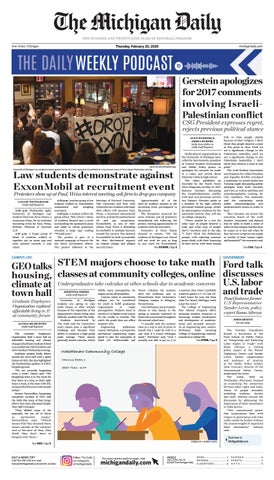
Law students demonstrate against ExxonMobil at recruitment event
Protesters show up at Paul, Weiss interest meeting, ask firm to drop gas company CALLIE TEITELBAUM Daily Staff Reporter
6:30 p.m. Wednesday night, University of Michigan Law students filed into Pizza House, a restaurant chain, for an exclusive recruiting event for Paul, Weiss, Rifkind, Wharton & Garrison LLP. 6:51 p.m. A larger group of about 15 students walked in together, put on name tags and were pointed towards a coat check.
6:54 p.m. Another group of ten students walked in. Handshakes commenced and mingling continued. 6:59 p.m. A student within the group yelled, “Mic Check.” About 45 students formed into a circle surrounding the sponsored pizza and salad in which protesters revealed a large sign reading “#DropExxon.” The protest is part of a national campaign to boycott the law firm’s recruitment efforts. The protest followed in the
footsteps of Harvard University, Yale University and New York University law students who hope their efforts will pressure Paul, Weiss, a renowned international law firm, to drop the multinational oil and gas corporation, ExxonMobil, as one of their clients. Paul, Weiss is defending ExxonMobil in multiple lawsuits around the country that demand ExxonMobil be held accountable for their detrimental impacts on climate change and alleged security fraud.
Approximately 45 of the total 60 students present at the recruiting event participated in the protest. The disruption occurred for seven minutes and all protesters immediately left following the protest, leaving approximately 10 students with the recruiters. Protesters at Pizza House chanted in unison, “We the students of Michigan Law School will not work for you, as long as you work for ExxonMobil. See EXXON, Page 3
Multicultural organizations at the University of Michigan have called for Ben Gerstein, president of Central Student Government and Public Policy junior, to apologize for remarks he made in a video and article about Palestine while in high school. The video, published on YouTube by the North Town News Magazine on May 23, 2017, features Gerstein discussing the Israeli-Palestinian conflict with host and pro-Israel activist Avy Meyers. Gerstein spoke as a member of his high school’s pro-Israel student group, which he said prepares students for the anti-Israel activity they will see on college campuses. “There should be a test for what type of people deserve a state and what type of people don’t,” Gerstein said in the clip. “I don’t think the Palestinian people, with rejecting constant peace deals, with their financing of their terror, with their raising
See CSG, Page 3
CAMPUS LIFE
GEO talks STEM majors choose to take math housing, classes at community colleges, online climate at Undergraduates take calculus at other schools due to academic concerns town hall KRISTINA ZHENG Daily Staff Reporter
Graduate Employees Organization explored affordable living in A 2 at community forum ALYSSA MCMURTRY Daily Staff Reporter
The Graduate Employees’ Organization held a town hall on affordable housing and climate change in Rackham Graduate School to an auditorium full of students and GEO members Wednesday evening. Rackham student Emily Sheetz started the town hall with a quick history of GEO. She also highlighted the hardworking qualities of GEO’s bargaining team. “We are currently bargaining twice a week,” Sheetz said. “The bargaining team is in the room for four hours at a time, so that’s eight hours a week, in the room with HR, on top of all of the extra work outside of that.” Sumeet Patwardhan, bargaining committee co-chair of GEO, told the Daily that many of their larger efforts have been dismissed despite their right to bargain. “They labeled many of the proposals, but not all of them as permissive issues,” Patwardhan said. “Which means that they deemed these issues outside of the contract and so because of that, they think they don’t have to bargain over them.”
University of Michigan students are opting to take math classes at other schools because of the reputation of the department’s classes being more difficult, students told The Daily. Students interviewed by The Daily said the University’s math classes pose a significant challenge and threaten their ability to maintain a high grade point average. These classes generally involve calculus, which
fulfills many prerequisites for majors across all disciplines. Courses taken at community colleges can be transferred for credit to fulfill graduation requirements or major prerequisites. Students need to receive a C or higher in the course for the credits to transfer. The catch: the grade does not affect students’ GPA. Engineering sophomore Lauren McNamee, a prospective mechanical engineering major, opted to take the equivalent of Math 215: Multivariable and
Vector Calculus the summer after her freshman year at Pennsylvania State University’s Abington campus in Abington, Pennsylvania. Like McNamee, many students choose to take classes in the spring or summer semesters to lessen the course load throughout the normal school year. “I actually took the summer class as a way to sort of prove to myself that I could do well in a calc class if it wasn’t Michigan math,” McNamee said. “And I actually was able to get an A in
Call 734-418-4115 or e-mail news@michigandaily.com and let us know.
a summer class when I probably would’ve gotten a C+ in Calc III. I don’t know for sure, but from what I’ve heard, Michigan math is just the worst.” The College of Engineering Peer Mentor Program offers incoming students resources to encourage student involvement and development of academic, social and personal interests. As an Engineering peer mentor, McNamee helps incoming College of Engineering students transition to college life. See STEM, Page 3 See STEM, Page 3
GOVERNMENT
Ford talk discusses U.S. labor and trade Panel features former U.S Representative Sander Levin, policy expert Bama Athreya JOHN GRIEVE For the Daily
The Towsley Foundation hosted a discussion at the Ford School of Public Policy on “Integrating and Enforcing Labor Rights in Trade” with Bama Athreya, a visiting policy expert at the Weiser Diplomacy Center, and Sander Levin, former congressman and professor of practice at the Public Policy School. John Ciorciari, director of the International Policy Center, moderated the event. The event, held on Wednesday afternoon, focused on examining the connection between labor rights and trade. About 25 people attended, including students, faculty and staff. Athreya started the discussion by addressing the importance of labor movements in trade justice. “This concentrated power that corporations have with respect to governance and rules really cannot be broken without the counterweight of organized labor movements,” Athreya said.
DESIGN BY LAUREN KUZEE
See GEO, Page 3
GOT A NEWS TIP?
kids to hate people clearly because of their religion. I don’t think that people deserve a state at this point in time. Until we see a significant change in the Palestinian mentality, until we see a significant change in the Palestinian leadership, I don’t think they deserve a state at this point.” The Arab Student Association and Students For Allied Freedom and Equality (SAFE) circulated a statement on social media late Tuesday night demanding public apologies from both Gerstein and CSG, as well as anti-bias and anti-Islamophobia training for CSG members. The statement said the community needs public acknowledgment and administrative action in order to heal. “Ben Gerstein sat across the executive board of the Arab Student Association and claimed that he seeks to build a sense of safety on this campus, but how does he expect us to feel safe when he does not even recognize our people as worthy of basic human rights and humanity?” the statement read.
Follow The Daily on Instagram, @michigandaily
For more stories and coverage, visit
michigandaily.com
INDEX
Vol. CXXIX, No. 74 ©2020 The Michigan Daily
NEWS.........................2 OPINION.....................4 CLASSIFIEDS..............6
Read more at MichiganDaily.com
SUDOKU...............6 SPORTS...................7 ARTS .............. 5
News
2 — Thursday, February 20, 2020
MONDAY: Looking at the Numbers
TUESDAY: By Design
The Michigan Daily — michigandaily.com
WEDNESDAY: This Week in History
Elayna @elaynaswift
THURSDAY: Twitter Talk
FRIDAY: Behind the Story
Lauren @laurboh Now feels like a good time to remind everyone who told me to stop complaining about and booing Mike Bloomberg’s commencement speech at my Umich graduation: I told you so
my biggest pet peeve is when people call umich “michigan university”, especially if you go here??
Neil Lewis Jr. @NeilLewisJr 45 years later, Black student enrollment at Michigan is *checks notes* 5%
Jenny Siegel @jennysiegel2 the only reason I want Airpods is so I’m not embarrassed in Ross anymore. seriously, I feel like I’m being shamed #umich
Bridgette Carr @Bridgette_Carr @Umich is in the news right now for cases of sexual misconduct. My hope is that we can be in the news for dismantling the systems that allowed this abuse to take place. One key step is to include survivors in the process. Can we rise to be the Leaders and Best? I hope so.
F E AT U R E
Stanford Lipsey Student Publications Building 420 Maynard St. Ann Arbor, MI 48109-1327 www.michigandaily.com
ELIZABETH LAWRENCE
ANITA MICHAUD
Editor in Chief 734-418-4115 ext. 1251 esla@michigandaily.com
Business Manager 734-418-4115 ext. 1241 ammichau@michigandaily.com
NEWS TIPS
news@michigandaily.com
LETTERS TO THE EDITOR tothedaily@michigandaily.com
EDITORIAL PAGE
opinion@michigandaily.com
ARTS SECTION
PHOTOGRAPHY SECTION
arts@michigandaily.com
photo@michigandaily.com
SPORTS SECTION
NEWSROOM
sports@michigandaily.com
734-418-4115 opt. 3
ADVERTISING
CORRECTIONS
dailydisplay@gmail.com
corrections@michigandaily.com
Editorial Staff ERIN WHITE Managing Editor
PAULINE RAJSKI/Daily Dr. Sarah Knox presents her findings on peripheral nerves, organ development, regeneration and aging at the School of Dentistry Wednesday afternoon.
‘hEARt Listens’ launches new mental health support text line Student-founded nonprofit offers peer-peer support for first years struggling with transition to college through anonymous helpline IULIA DOBRIN
Daily Staff Reporter
When Engineering senior Aria Thakore and LSA senior Aastha Dharia roomed together as freshmen at the University of Michigan, they noticed a lot of their peers struggled with the transition to college, turning to their friends or to other students for advice. “We always wanted to be that ear for them,” Dharia said. “But it was really hard to sometimes have those conversations without having had those experiences.” As the year went on and more of their friends reached out to them, Thakore and Dharia said it became increasingly difficult to support their friends while also maintaining their own well-being. But it wasn’t until Thakore went home that April that she realized it had become too much to manage on her own. “I checked my phone and I had nine text messages from nine different people, asking for peer support,” Thakore said. “It was that moment where I was like ‘I’m at home, I’m walking my dog, I want a moment to myself and I can’t manage this anymore.’” From there, Thakore and Dharia, along with their friends from high school LSA senior Sheily Shah and Public Health senior Swathi Sampath, began working on a nonprofit organization, hEARt Listens, to address this need.
“It was really weird to have so many people talking about the same problem,” Shah said. “But it was like a never-ending conversation. There wasn’t any solution to it.” The hEARt Line, which officially launched Feb. 10, was their solution. The text line is open noon to midnight every day of the week, and students can send an anonymous text at any time and get connected with a trained peer supporter within 48 hours. The process is free and open to all University of Michigan Ann Arbor campus students. “We were able to figure out that students really like turning to other students first,” Dharia said. “Students also want to be able to help other students, but it was really hard for them to know how to do that while also prioritizing their own wellbeing.” Before becoming a peer supporter, students have to go through a semester of training, which consists of weekly sessions focused on different skills such as motivational interviewing, navigating resistance and how to tackle difficult issues such as sexual assault. The founders worked with Social Work professor Lindsay Bornheimer to develop this training program. According to peer supporter LSA senior Divya Gumudavelly, once students text the helpline, they are connected with a trained peer supporter who feels comfortable navigating
the particular topic of conversation. “(Having peer supporters) eliminates the power structure that can sometimes exist between someone who is seeking help and someone who is trying to offer help,” Gumudavelly said. “You’re talking to somebody who is coming from a place that is, hopefully, somewhat similar to yours because at the end of the day, we’re all the same age and we’re all students.” To get a better idea of the mental health climate on campus, the four founders spent nearly a year talking to students across campus to assess their needs. They found many students felt current resources were difficult to access, and they were not aware of all of the possible resources available to them. “There have been times when it’s been very disheartening,” Sampath said. “It’s kind of hard to keep going through the process hearing about how present a lot of the issues and challenges that we faced or our peers faced really (are) on campus.” The founders worked with Christine Asidao, associate director of community engagement and outreach for Counseling and Psychological Services, as well as other resources such as the Spectrum Center, Sexual Assault Prevention and Awareness Center and Wolverine Wellness to ensure hEARt Listens is a known and available resource for all students. The founders said the nonprofit also serves as a
gateway to other resources on campus. “We spend workshops just talking about other resources on campus we can direct (students) to,” Gumudavelly said. “This is another reason I really like hEARt, because it’s not trying to reinvent the wheel.” Public Policy senior Hannah Connors is the executive director of Wolverine Support Network, a student organization on campus focused on creating an inclusive community for students. Like hEARt Listens, WSN is a peerbased resource. According to Connors, there is a lot of research that speaks to the effectiveness of peer support, especially for young people, who tend to go to their peers first. WSN offers weekly support groups but does not currently have the online component that the hEARt Line provides. “I think it’s an amazing idea because texting is probably the least intimidating form of communication,” Connors said. “I think it’s really going to benefit students who might feel too intimidated to make a counseling center appointment.” Though the idea for hEARt Listens started their freshman year, now that the four founders are seniors, they are working on passing the leadership role on to younger students. LSA freshman Nidhi Tigadi is one of the students stepping up to leadership in hEARt Listens. See HEART, Page 3
ekwhite@michigandaily.com
SAYALI AMIN and LEAH GRAHAM
Managing News Editors news@michigandaily.com Senior News Editors: Barbara Collins, Claire Hao, Alex Harring, Ben Rosenfeld, Emma Stein, Liat Weinstein Assistant News Editors: Francesca Duong, Julia Forrest, Brayden Hirsh, Jasmin Lee, Hannah Mackay, Parnia Mazhar, Alyssa McMurtry, Emma Ruberg, Julia Rubin, Michal Ruprecht, Arjun Thakkar
EMILY CONSIDINE and MILES STEPHENSON
Editorial Page Editors tothedaily@michigandaily.com Senior Opinion Editors: Alanna Berger, Brittany Bowman, Zack Blumberg, Timothy Spurlin, Joel Weiner
THEO MACKIE and ETHAN SEARS
Managing Sports Editors sportseditors@michigandaily.com Senior Sports Editors: Aria Gerson, Bailey Johnson, Ben Katz, Jacob Kopnick, Anna Marcus, Rian Ratnavale Assistant Sports Editors: Connor Brennan, Lily Friedman, Lane Kizziah, Brendan Roose, Kent Schwartz, Molly Shea
JOHN DECKER and JULIANNA MORANO
Managing Arts Editors arts@michigandaily.com Senior Arts Editors: Jo Chang, Elise Godfryd, Zoe Phillips, Jonah Mendelson, Ally Owens Arts Beat Editors: Samantha Cantie, Dana Pierangeli, Andrew Pluta, Cassandra Mansuetti, Anish Tamhaney, Sophia Yoon
SHERRY CHEN and CHRISTINE JEGARL
Managing Design Editors design@michigandaily.com Senior Design Editor: Lizzy Rueppel
ALLISON ENGKVIST and ANNIE KLUSENDORF Managing Photo Editors
photo@michigandaily.com
Senior Photo Editors: Keemya Esmael, Asha Lewis, Miles Macklin Assistant Photo Editors: Olivia Cell, Ryan Little, Emma Mati, Alexandria Pompei, Alexis Rankin
MAGDALENA MIHAYLOVA
Statement Editor statement@michigandaily.com Deputy Editors: Emily Stillman, Marisa Wright
MADISON GAGNE and SADIA JIBAN Managing Copy Editors
copydesk@michigandaily.com
Senior Copy Editors: Olivia Bradish, Sophie Kephart, Silas Lee, Olivia Sedlacek, Ellie Scott
TIM CHO and SIMRAN PUJJI
Managing Online Editors webteam@michigandaily.com Senior Web Developers: Parth Dhyani, Abha Panda, Rohan Prashant, Jonathan Liu
ALEC COHEN and ELI SIDER
Managing Video Editors video@michigandaily.com Senior Video Editors: Ryan O’Connor, Joseph Sim
MAYA MOKH and ANA MARIA SANCHEZ CASTILLO
Michigan in Color Editors michiganincolor@michigandaily.com Senior Michigan in Color Editors: Zoha Bharwani, Lora Faraj, Ayomide Okunade, Gabrijela Skoko Assistant Michigan in Color Editors: Cheryn Hong, Anamkia Kannan, Vaishali Nambiar, Sean Tran, Angela Zhang
SAMANTHA SMALL and SONYA VOGEL Managing Podcast Editors
JOHN GRIEVE and BEN KORN
Managing Social Media Editors Senior Social Media Editors: Jessie Norris, Mya Steir, Kristina Zheng
Business Staff MOLLY WU
Creative Director
RYAN KELLY Sales Manager
LILLY HANSON Senior Account Executive
ANALISE DOORHY Senior Account Executive
TARA MOORE
Senior Account Exeucutive
The Michigan Daily (ISSN 0745-967) is published Monday through Friday during the fall and winter terms by students at the University OF Michigan. One copy is available free of charge to all readers. Additional copies may be picked up at the Daily’s office for $2. Subscriptions for September-April are $250 and year long subscriptions are $275. University affiliates are subject to a reduced subscription rate. On-campus subscriptions for fall term are $35. Subscriptions must be prepaid.
News
The Michigan Daily — michigandaily.com
HEART From Page 2 She trained last semester as a peer supporter, and is now a “trainer-in-training.” “I know that not everyone has that one person to turn to when they’re going through a hard time,” Tigadi said. “I thought this would be a cool thing, to be that person for someone else who might need a friend to listen to them.” With the help of the four founders, Tigadi is learning how to train the next cohort of peer supporters, and will eventually help run the organization after the founders graduate. “I really like what these girls are doing,” Tigadi said. “I think it’s a very important thing that we have on campus, and I definitely think it is something that should be continued once they do graduate, so I would love to keep it going.” Describing the project as a constant work in progress, the founders urged students trying out the hEARt Line to provide user feedback that they’ll use to improve the resource.
EXXON From Page 1 No salary is worth destroying our own future. If you want our talents, then drop ExxonMobil and join us in fighting for a livable planet … Employees in this room, you are nowhere near the responsible corporation you make yourself out to be.” Protest organizer Max Vogel, first-year Law student, shared a press release with The Daily, which explained the passion law students feel to fight against environmental offenses. “Paul, Weiss may say they’re just doing their jobs, but a new generation of law students — faced with a world, quite literally, on fire — sees things differently,” the press release said. ExxonMobil has been a point of controversy in the climate change movement since 2015 when the Los Angeles Times and Columbia University Graduate School of Journalism uncovered internal ExxonMobil documents proving the company understood the environmental impacts of climate change since the 1970s. While ExxonMobil privately projected climate change impacts, ExxonMobil leadership publicly launched a climate change denial campaign. Paul, Weiss was recently victorious in defending ExxonMobil in the State of New York lawsuit, The People of The State of New York v ExxonMobil. The New York Attorney General accused ExxonMobil of misleading investors about the negative impact climate change regulation would have on the company’s financial assets and sought 1.6 billion dollars to be returned to ExxonMobil shareholders. The New York State Supreme Court ruled there was not sufficient evidence of ExxonMobil misleading investors. This was the second climate change lawsuit to reach trial in the United States, and the verdict marked a big win for the oil and gas company. After the protest at Yale, Law.com published a statement by Paul, Weiss chairman Brad Karp that said Paul, Weiss stands by their representation of ExxonMobil. “We are proud of the outstanding work we do for a wide range of commercial and pro bono clients in their most challenging and high-profile matters, including our recent defense of ExxonMobil in a securities fraud case in which the court found, after trial, that plaintiff’s claims were entirely without merit,” Karp said. “Paul, Weiss is committed to free speech and debate, just as we are committed to the principle that we represent our clients and safeguard the rule of law zealously and to the best of our abilities.” Vogel emphasized the power that law students have in encouraging law firms to reconsider clientele in an interview with The Daily. “Law students have a really powerful voice in this because Paul, Weiss needs us to maintain its influence and power as a top
“One of the things that we’re really proud of is that it’s for students, by students,” Dharia said. “We really want to make that a central piece of what we continue to do as we develop. The more that we hear students’ voices in it, the more that it is going to be a resource that they actually feel like meets the needs that they’re looking for.” Through the development and launch of hEARt Listens, the founders said they hope to improve the mental health climate by harnessing the types of support systems they observed among peers on campus. “This campus is filled with people who are so purely dedicated to helping the people around them,” Sampath said. “That’s something that I personally, and all four of us, have worked really hard to not lose sight of, and to be really inspired and encouraged by. Hopefully, hEARt is just another addition to that same mentality that is already here.” Reporter Iulia Dobrin can be reached at idobrin@umich.edu.
law firm,” Vogel said. “They spend a lot of time and money recruiting students like Law students at the University of Michigan because of how valuable an asset we can be which means that if we put our foot down, and say we’re not willing to work for a firm like this, that can have huge ramifications for the firm itself and we’re willing to use that voice now to say that firms like Paul, Weiss should reject Exxon’s money.” Vogel said the firm’s legal tactics are particularly unethical, as they use their prestige and finances to engage in aggressive practices to intimidate and stifle any suits brought against them. The press release mentioned a statement made by San Francisco City Attorney which referred to ExxonMobil’s defense strategies as “an outrageous abuse of the legal process that seeks to limit the ability of law enforcement and local government to protect their residents.” First-year Law student Maiya Moncino participated in the protest and said Paul, Weiss’ ties to ExxonMobil contradicts their proclaimed progressive agenda and law students should be aware of this discrepancy when applying to work with them. “Paul, Weiss’ image is as a progressive firm,” Moncino said. “They were involved in Brown v. Board of Education, and they just have a reputation for being a good place to work. So part of the issue is profiting off of that recruitment strategy and then taking on clients like ExxonMobil just does not fit with that image. And we just want people to be aware of that as they are making their decisions.” Moncino said students are taking a stand to remove themselves from the narrative of lawyers defending multi billion dollar companies who she believes have unethical agendas. According to Moncino, powerful law firms like Paul, Weiss should reject offers to defend companies like Exxon. “We’re not trying to say ExxonMobil shouldn’t have a lawyer,” Moncino said. “Because everyone should have a lawyer. But when you bring in a law firm like Paul, Weiss, you bring in the big guns. You bring real power into a courtroom, and we just think ExxonMobil does not need to have that level of aggressive representation when what they’re doing is putting our climate at risk.” Paul, Weiss recruitment representatives declined to comment after the protest. Vogel said the protest should be a message to law firms that students will consider firms’ ethics and client lists when deciding where they will invest their talents. “Law students, as future lawyers, are incredibly powerful and have the ability to bring in a lot of money for a firm or to use their choices to make a big impact on the world,” Vogel said. “And if we encourage more law students to really think critically of what impact the firms they work for have on the world, we think firms might think twice before taking on a client like ExxonMobil. Reporter Callie Teitelbaum can be reached at cteitelb@umich.edu
GEO From Page 1 As a way to convince GEO to drop their demands, the University of Michigan is refusing to discuss further negotiations for salary and benefits, Patwardhan said. Patwardhan called the tactic “bad bargaining” and said the University’s decision will not distract GEO from issues affecting the community as a whole. “We can’t even organize around and that’s not the kind of thing that should be permitted as a tactic at the bargaining table,” Patwardhan told The Daily. “I also think our commitment to kind of keeping these issues in the minds of the broader community is a commitment to our members democratically generating our platform and telling us that climate and housing issues matter to them.” In a press release regarding GEO bargaining last semester, Sascha Matish, associate vice provost for academic affairs and senior director of Academic Human Resources, said the University values graduate students and is working towards a fair agreement. “We recognize the importance of graduate student instructors and
STEM From Page 1 McNamee explained that as part of her experience as a peer mentor, she was not allowed to encourage incoming students to take classes outside of the University. “They do tell us to not tell people to take things outside of Michigan, and not encourage that just because it’s sort of a negative outlook on the classes here,” McNamee said. “Obviously it is challenging, so I think the fact that they do accept credits from elsewhere is because they think it is equivalent.” Joanna Millunchick, the associate dean for undergraduate education in the College of Engineering, spoke to The Daily about the impact of math classes on students’ learning experiences. “Math grades are pretty highly correlated with how well you do, at least in engineering,” Millunchick said. “I imagine that must be true in other fields of sciences as well. One of the things that I do worry about is that we start with the math, and
CSG From Page 2 “How can we trust his student government, that was run on a campaign of inclusion, when he believes radicalism is ingrained in our societies?” Gerstein released a statement on his personal Facebook page Wednesday afternoon apologizing for any harm caused and saying he no longer holds the views conveyed in the video. “I have grown considerably since I made those statements, and the repulsive views I expressed in the video no longer reflect my current understanding,” Gerstein wrote in his statement. “I am devastated to see them reappear and be defended today. I know an apology is never enough and I am complicit in the oppression of Palestinians through my past actions.” The statement from Arab Student Association and SAFE also called on CSG to recognize a resolution passed in 2017 supporting Boycott, Divestment, Sanctions . Though CSG supported the resolution after a contentious debate, the University’s Board of Regents ultimately voted against the action, which would have made the board create a committee to investigate three companies operating in Israel and involved in alleged human rights violations against Palestinians.l. The statement said Gerstein’s comments are particularly hurtful considering past instances in which proPalestinian activists have been targeted for their activism. The Daily investigated Canary Mission, a pro-Israel blacklist that named multiple University students as anti-Israel for partaking in actions such as voting in support of BDS as a CSG member. “If we cannot trust that our own student body government
Thursday, February 20, 2020 — 3
Sheetz discussed a variety of topics GEO was fighting for outside of affordable housing and climate change, including better wages and healthcare for people in the LGBTQ+ community. “So among the more common asks on our platform this year are reports asking for a raise that attempt to give graduate employees enough to close the gap between the outrageous cost of living in Ann Arbor,” Sheetz said. “We’re trying to improve the benefits for trans healthcare and disability accommodations.” Next, the town hall transitioned to the topic of affordable housing. Over the last few decades, the University has grown exponentially, adding thousands of students and faculty. GEO member Joseph Valle said the University
had not adjusted to this growth. “Over the past several decades, the University has continued to grow,” Valle said. “Tens of thousands of more students and employees … yet the University has built a total of a thousand new beds on campus in the past thirty years.” Valle critiqued the money spent on parking units and said one of GEO’s demands is to have this money spent on housing instead. “One of our main demands is for the University to compensate for the increases in enrollment by building 5,000 new on-campus housing units in the next five years,” Valle said. “We spend millions to house cars, I don’t know why they can’t do the same for people.” GEO Solidarity Chair Amir Fleischmann said the housing crisis is not only a student body problem but a problem for Ann Arbor residents. “We need a union that covers all of Ann Arbor, not just students,” Fleischmann said. “If it just covers students, we won’t be as affected in building power across the community. More importantly, if it just covers students, it won’t be helping those most affected by the housing crisis.” After the Washtenaw Office
of Commission and Economic Development report found the poor state of affordable housing in Washtenaw County, Ann Arbor Housing set out a plan in 2015 to create 2,787 new affordable housing units by 2035, but they are behind on this plan. GEO member Noah Weaverdyck went over the plan to address climate change on campus. This would include a plan to transition towards carbon neutrality, including no further construction or investment in fossil fuel infrastructure. Patwardhan spoke about food justice efforts, which included an affordable grocery store on campus and space for a community garden. He also discussed better water quality at all three U-M campuses as one of GEO’s objectives. “We also represent graduate students on all three campuses,” Patwardhan said. “We want to ensure that water quality on each of those campuses and all of the drinking fountains are tested for lead.”
it becomes a barrier and students kind of lose sight of why it’s important. I wish there was a way in which we can think about how we change that a little bit.” LSA sophomore Isabella Yockey is studying biomolecular sciences and took the equivalent of Math 115: Calculus I at Washtenaw Community College in the summer after her freshman year. Yockey took calculus at her high school but was required to take the class again at the University after she did not receive enough AP credit. She described how the reputation of the University’s math classes influenced her decision to take the class elsewhere. “I had already taken calculus in high school and I just heard about how hard it was here, so I didn’t want to take it here (and) get a bad grade in a class that I basically had already taken,” Yockey said. Yockey also said taking the class at Washtenaw was cheaper than enrolling in the course at the University over the summer. Additionally, Yockey said the calculus difficulty level could potentially influence her
application to graduate schools. “If I had taken it here, gotten a lower grade, it would have brought down my transcript, and I might not get into med school down the line, which is extreme, but it all adds up,” Yockey said. “I think that I didn’t see the point in doing that and risking that. I knew the material, I just didn’t want to be penalized for any group homework or super hard exams, even though I obviously know the material very well.” Millunchick said some of the changes in the number of students taking math classes in higher education. Approximately 40% of students took Math 115 during their first semester as a freshman in 1996, compared to 27% in 2018, according to Millunchick. Comparatively, only 6% of students took Math 215 in 1996 and now 26% of students do. Millumchick said she believes this change in enrollment is due to the prevalence of accelerated math programs in high school. “I just held a town hall last week, where the math department came, and they talked about Calc I through III, and a lot of our faculty came just to have a dialogue over what do
our students need, what do they provide and how can we actually align the math curriculum and the engineering curriculum for the needs of the 21st century engineer,” Millunchick said. When asked about students opting to take classes outside of the University, Millunchick did not comment, citing a lack of data. Regardless, the reputation of many of the University’s STEM classes continues to impact students’ decisions to complete the courses outside of the University, according to McNamee. “My roommates actually have never taken a calc class here at Michigan math, but they do have to take Calculus I,” McNamee said. “And even though they haven’t really looked into it, haven’t really heard anything about the calc classes other than what they’ve heard from the grapevine, they still are not willing to take it here, despite not having ever tried a calc class here.” Reporter Kristina Zheng can be reached at krizheng@umich. edu.
graduate student staff assistants to the academic mission of the university and to the academic success of our students,” said Sascha Matish, associate vice provost for academic affairs and senior director of Academic Human Resources. “We are committed to bargaining in good faith with GEO to reach a fair agreement that serves the interest of all parties.”
president believes in our humanity, how can we feel supported and safe on our campus,” the statement read. “Our community can no longer trust any intentions or policies from the Central Student government, and once again have watched our university isolate and turn their backs on us.” In an interview with The Daily Wednesday night, Gerstein acknowledged his comments and the statement circulated by SAFE on Facebook. He also said the changes demanded in their statement were reasonable and that CSG would pursue them in the following weeks. “I think in the statement by SAFE last night, they outlined some really important points that I had not previously considered,” Gerstein said. “Just in general, with the executive order that came from the White House — that I believe is a targeted attempt to silence Palestinian activism — there has been an increased climate of hostility towards those communities. I want to make sure that I’m not derelict in my responsibility to be a partner in their movement.” LSA senior Sharif-Ahmed Krabti initially shared the clip on Facebook, which contains a short portion of the 15-minute video, in which Gerstein questions whether the Palestinian people are worthy of a state. In his interview with The Daily, Gerstein reiterated his positions have changed and he no longer agrees with anything said in the video. He also said he recognizes his role in combating oppression on campus. “I think this video is a representation of what specifically we’re fighting against, which is a frame of thought that denies and erases the history and real story of people,” Gerstein said. “And back in when I was in high school and in middle school, I had beliefs that were complicit in that. And so I think it’s incumbent upon people
who are in leadership positions, especially representing the different communities we have on campus that are oppressed and marginalized, we do have a responsibility to not be passive members in fighting systemic oppression.” Gerstein also urged people to not defend his previous statements, explaining he recognizes the harm the video has caused. He thanked fellow students at the University for helping him evolve. “I hope people who would defend what I said in the past, recognize the real impact that words and the history of our society have on people,” Gerstein said. “(It’s important) to participate in that difficult path of realizing the faults in your own thinking and have the vulnerability to move forward and seek empathy. I would encourage people not to resist being open to change and being open to empathy. I want to thank the students here at this university for showing me a different way over these last three years, and I know that there’s a lot more work that I need to do.” CSG Communications Director Alex Johnson released a statement Wednesday night, acknowledging the harm done to the Palestinian, Muslim and Arab students on campus by Gerstein’s comments. He also addressed the steps CSG would take to repair relationships with affected communities moving forward. “As an organization we wholeheartedly realize the need to better support Palestinian, Muslim and Arab students on campus,” Johnson wrote. “In the next several days, President Gerstein hopes to listen to the concerns and needs of impacted students and work towards the various asks outlined in SAFE’s statement last night. Apologies are insincere without corresponding action and we
Read more at MichiganDaily.com
collectively are committed to acting on these wrongs.” Krabti called on the CSG parties running for the election in March to denounce this behavior. He specifically tagged the Facebook account for Mobilize, a new CSG party that announced its formation Monday night. In a statement to The Daily, Amanda Kaplan, Public Policy junior and presidential candidate for Mobilize, and Sav Nandigama, LSA junior and vice-presidential candidate for Mobilize, said they would pursue anti-racist policies if put in leadership positions. “If elected, we will require our executive team and strongly encourage all elected representatives to attend antiracism teach ins and other programs that target biases...” the statement said. “At this time, we have already submitted a request for, and will be participating in, a MESA antiracism teach in with our core team. We call on all future CSG candidates/campaigns to do the same during this election cycle.” Sam Burnstein, communications director for Change at Michigan — another CSG party running for seats in the March election — also released a statement about Gerstein’s comments. The party does not officially launch until Feb. 26, and no presidential or vice-presidential candidates have been announced. “We believe that these remarks, as SAFE rightly states, are inappropriate and unacceptable for any member of our community - but especially for its chief advocate,” Burnstein wrote. “The President’s words make our community more divided, less safe and secure, and less inclusive and we condemn them.” News Editor Alex Harring can be reached at harring@umich. edu and reporter Emma Ruberg can be reached at eruberg@ umich.edu
Opinion
4 — Thursday, February 20, 2020
The Michigan Daily — michigandaily.com
SHAD JEFFERY II | COLUMN
Edited and managed by students at the University of Michigan since 1890. Stanford Lipsey Student Publications Building 420 Maynard St. Ann Arbor, MI 48109 tothedaily@michigandaily.com
ELIZABETH LAWRENCE Editor in Chief
ERIN WHITE
EMILY CONSIDINE AND MILES STEPHENSON
Managing Editor
Editorial Page Editors
EDITORIAL BOARD MEMBERS Alanna Berger Zack Blumberg Brittany Bowman Emily Considine Cheryn Hong
Krystal Hur Ethan Kessler Mary Rolfes Michael Russo
Timothy Spurlin Miles Stephenson Joel Weiner Erin White Lola Yang
Unsigned editorials reflect the official position of The Daily’s Editorial Board. All other signed articles and illustrations represent solely the views of their authors.
FROM THE DAILY
What we can learn from the pension protests in France
F
rench President Emmanuel Macron recently backed down from his proposal to streamline France’s pension system, a proposal that would have awarded pensions at a later age based on the number of points accrued over one’s lifetime. This prompted
protests that shut down public transport services for over six weeks and gained nearly 70 percent public support. The demonstrations are the latest installment in a series of labor protests that have rocked France for two years.
The United States was founded with protest. Every major social change, from ending the Vietnam War to working toward racial equity after the Civil Rights Movement, has been a product of protest, and it is often said that this tendency to question and rebel is central to the American ethos. Recently, however, “slacktivism” — or the proclamation of support for a protest’s cause without active participation in the protest itself — has saturated sociopolitical behavior in the U.S. This passive solidarity signals virtue but limits the effectiveness of practical change. Americans should focus on renewing our dedication to civic engagement, whether that be voting in local elections, calling representatives, physically marching or engaging in other forms of political participation. If our founders had only signalled a disapproval of British tyranny among their friends to gain popularity, instead of organizing public demonstrations, our treasure of American democracy might have never been possible. In this regard, the U.S. has something to learn from France. Before the pension protests, working class drivers sparked the “Yellow Vest” movement with a fuel tax protest, a movement named after the highvisibility jackets that French motorists must carry in their vehicles. The outcome of this protest included foremost a six-month suspension of the diesel and petrol tax, as well as a cancellation of taxes on both overtime and end-ofyear bonuses, and a 100 euro
increase in social minima for employees. The movement also encouraged protests in Iraq and Jordan. Due to help from the SNCF (Frane’s stateowned railway company) and the CGT union, the pension protest’s victory in rolling back Macron’s proposed reform serves as a reminder to the American public of how remarkably effective public protest can be. Throughout France, protests shut down cities, derail infrastructural systems and force significant concessions from Macron. In comparison, protests in 2020 America are largely symbolic in nature, occupying massive space in the political imagination but little space in legislative change. For instance, some of America’s most prominent protest movements of the past five years have been #MeToo, Black Lives Matter and the annual Women’s March. While these are all worthy causes, it is difficult for these inf luential social movements to demand concrete legislative changes since their objectives target behavioral and cultural structures in Western culture. And while protest turnout has increased since President Donald Trump took office in 2016, still only one in five Americans have gone to a protest since he was inaug urated. Perhaps the most narrowly tailored American protest movement in recent memory was the March for Our Lives, which has earned national recognition for stricter g un legislation but has led to little institutional change. Many in the U.S. may feel disillusioned with the lack of
government response to civic action, but we can learn from France’s civic engagement that protests are effective when they are specifically action-oriented and routinely disruptive. The most effective protests, as we have learned from France, are those that target specific legislation with widespread and highly visible public support. We can only achieve this in the U.S. through continued practice. Many protests in the U.S., and more locally in Ann Arbor — like the No War in Iran protest and the Climate Strike — enjoy social media support, but lack attendance relative to the levels of French activism. Civil engagement is a muscle that needs to be exercised continuously or it may wither. The more you engage — and not just repost and like in online message boards — the more you motivate change. As Franklin D. Roosevelt once said, “Democracy is not a static thing. It is an everlasting march.” While French protests rage on with impressive physicality and scale, modern American efforts fail to match a similar spirit. Resist the cozy nook that “slacktivism” provides. Avoid free riding for a commonly-shared public good achieved only by the small minority who actually make an in-person appearence. Only by inspiring Americans to learn from our French counterparts, can we rumble the streets with voices and fill the air with picket signs. American protests can become more compelling, acknowledged and successful. But it starts with you.
CONTRIBUTE TO THE CONVERSATION Readers are encouraged to submit letters to the editor and op-eds. Letters should be fewer than 300 words while op-eds should be 550 to 850 words. Send the writer’s full name and University affiliation to tothedaily@michigandaily.com. CASEY RHEAULT | CONTACT CARTOONIST AT CRHEAULT@UMICH.EDU
S
How the Michigan Union serves the community
ince I transferred to the University of Michigan in the fall of 2018, I didn’t get the chance to appreciate the significance of the Michigan Union on campus life until renovations concluded last month. Students starting their journey at the University during the 20-month renovation period of the Union didn’t know what they were missing, and sadly, I was one of them. During those 20 months without the Union, Central Campus lacked a heart. While the doors of Pierpont Commons and the Michigan League were still open, they didn’t foster the sense of community that the Union always has. The League provides little space for students to study, meet and socialize in comparison to the Union and is composed chiefly of event and conference space, outside of the basement and Maizie’s. Pierpont serves the North Campus community well, but it didn’t add to what was missing from Central Campus — a large gathering space that existed for students in the heart of campus. After the renovation, with the block ‘M’ flag waving high above its tower, the Union brings a sense of new life to the campus community. I like to think of the Union as a great equalizer, where students, faculty, staff and alumni can catch up and bask in the pride of our great university. One lap through the Union and I see familiar faces from all aspects
of my life at Michigan; we are all united in that space for a common reason. Coworkers, classmates, friends from Greek life and fellow writers at The Daily. To me, the Union represents the crossroads of my social, academic and personal life at Michigan. Athlete or non-athlete, Greek or non-Greek, a person of any major or of any socioeconomic background congregates at the Union under a common understanding of self-perception: We are the student body of the University of Michigan. Before the ribbon-cutting ceremony this January, there was not a place on this campus where I could interact with the same range of people from my Michigan experience as I now can at the Union. The Union’s large and stately presence on South State Street fosters a campus community that makes Michigan feel a lot smaller. Its paneled and historic halls make a university with an undergraduate enrollment of over 31,000 feel like a tight-knit community. The renovation brought this storied building into modernity without sacrificing the character or charm of a space steeped in history. Some changes had to be made to meet the needs of students in the 21st century, such as replacing the second floor pool hall with the new IdeaHub. This decision received some push back from alumni. I can recall from my first trip to the Union on its opening day last month that a middle-aged man stood on the front
steps yelling at people entering and exiting the Union that this “used to be the best place on campus to shoot pool” and how removing it was a travesty. While this encounter was certainly extreme, I do see the validity in wanting to return to your alma mater and find it the way it was left. However, time waits for no man, and the needs of today are inherently different from the needs of yesterday. This renovation catered to the needs of the modern student, who needs space to congregate, study and eat more than they need space to play pool. I took on a part-time job this semester, working as a member of the program staff for Conference and Event Services at the Union, helping to set up the different events held daily at the Union. Working at the Union has given me a fond feeling for the space, to say the least, and being able to assist the flow of such an important building to the campus community gives me a lot of pride in how I’m able to give back to the University, a school to which my character is indebted. In the post-renovation period, the sense of community and school pride I have felt has increased ten-fold, solely based on the interactions I have had and that I witness here nearly every day. The heart of Central Campus is back and stronger than ever, and may the Union last another 100 years as we all hail back to Michigan. Shad Jeffery II can be reached at shadj@gmail.com.
LEAH ADELMAN | COLUMN
Small business’s unheralded environmentalism
S
upporting a small business can mean supporting environmentalism even when it might not be obvious. As local businesses in Ann Arbor shut their doors, students bemoan the loss of their favorite unique stops. Recent closures include The Local Bike Shop, Elixir Vitae coffee shop and Elevation Burger. With their closures, we lose not only some of Ann Arbor’s small-town charm but some of the city’s built-in environmentalism. Supporting small businesses is not a new idea. Advocates tout the advantages shopping small has for the local economy and local job creation. It is also widely understood that businesses offering products made locally are sustainable since they don’t require a large energy expenditure for transportation. The main selling point for some small businesses is that they are environmentally friendly alternatives, like the People’s Food Co-Op, which sells locally grown produce and products. Oftentimes, a sustainable local business may openly advertise its environmentally friendly practices to help attract environmentally conscious customers. The sustainable habits of local businesses can go under the radar, and sometimes small businesses practice sustainability without even trying. The Mail Shoppe, a local mail processing, packing and shipping store is an unexpectedly sustainable business. The store, that looks like a house, has been open for more than 30 years on South Division Street between William and Liberty. The shipping and mailing industry as a whole is not an environmentally friendly one — however, The Mail Shoppe’s personalized way of doing things is a step above industry standard.
The Mail Shoppe doesn’t have more environmentally-friendly practices because they go out of their way to be a green business, but simply because, as an independently owned store, they have the freedom to do what they want. The Mail Shoppe uses donated boxes and shipping materials that would otherwise have been thrown away. Ryan Powell, who has worked there for 12 years, said, “In the corporate setting, they wouldn’t be allowed to accept previously used materials like we do.” Reusing materials is more environmentallysound than using new, recycled or sustainable products.
The sustainable habits of local businesses can go under the radar. Another example of a small local business’s unheralded environmentalism is Literati Bookstore. At first glance, a store selling new books and magazines does not seem like a sustainable business, though the bookstore has a reputation for being very community-focused. However, the bookshelves and tables inside were bought used, and the sign was designed and constructed locally. Both reusing furniture and utilizing local resources are environmentally-friendly business practices that may not be possible with a corporate-owned retail store. Public places, like Urban Outfitters or Starbucks, focus
on curating a national brand with standardized signage and consistency in their interior decoration. At a time when environmentalism is becoming a high-profile issue, some businesses, especially ones looking for good press, are transitioning to more sustainable practices. Initiatives like only offering straws upon request, giving out compostable ware or encouraging buyers to bring their own bags could make a difference in lessening the business’s environmental footprint. However, this practice of starting from an unsustainable position and working backward is slowmoving and often has a minute impact. The businesses with sustainable practices that do not go out of their way to advertise it deserve more credit. Small businesses also have more of a stake in the community as a whole. Because of their reliance on the local community, they are more likely to want to get involved in local politics. For instance, small businesses may advocate for more walkable infrastructure since walkability is related to a street’s economic productivity. A corporation does not have the same stake in the success of downtown Ann Arbor. As the trends point toward more consumer support of environmentally-friendly businesses, it should be kept in mind that local businesses without an advertised environmental purpose may indeed have one. Even if a restaurant is not offering a wide vegan selection and utilizing allnatural cleaning products, it may very well be providing a larger source of sustainability to the community. Leah Adelman can be reached at ladelman@umich.edu.
Arts
The Michigan Daily — michigandaily.com
Thursday, February 20, 2020 — 5
TV REVIEW
COMMUNITY CULTURE PREVIEW
‘Sonnets, Soliloquies, and ‘Homeland’ is finally back Soul’ seeks to open minds after two-year hiatus ROSA SOFIA KAMINSKI For the Daily
It’s almost a pity to ground Michael McElroy’s words in text when his everyday way of talking is so expressive and passionate. The director of “Sonnets, Soliloquies, and Soul”’s gesturing hands and ever-shifting facial expressions engaged me completely in his words, and I hadn’t even gotten around to seeing the runthrough of the show yet. We surveyed the jumble of actors milling around below from the balcony of the Arthur Miller Theater and chatted about Shakespeare, soul music and how torn apart our world is today. I have never been a fan of Shakespeare. To me, his work has always seemed to be something people attest to liking to prove their well-read character. However, McElroy’s words – along with the passionate, nontraditional mediums of song and modern dance with which the piece was performed — made the bard seem accessible at last. McElroy got involved with acting in high school, and was cast in his first musical theater piece by Vincent Cardinal, director of the Musical Theater program at the university. He has done on and off Broadway performances, has been nominated for a Tony and currently teaches at New York University’s Tisch program. He is most comfortable as an actor and directs only because he must find a way to express his love of creating. Directing is a way to help display that creativity. “Sonnets, Soliloquies, and Soul” takes the work of Shakespeare and makes it musical, using genres such as soul, gospel, R&B and pop. It will play in the Arthur Miller Theater at 7:30 p.m. Thursday, Feb. 20, then 8 p.m. Friday and Saturday, finishing with a 2 p.m. matinee on Sunday the 23. McElroy began writing the show by sitting down and looking at different Shakespeare sonnets, trying to find the thread of emotion that connected them. Shakespeare used to write for the masses, describing the elements that make humans tick and creating our concept of humanity as we know it. Hundreds of years later, he is still relevant; it must be for a reason.
Then, putting it all together, he asked himself, “Where’s that grain of truth in the human experience that can be articulated the same way but through a different lens?” That different lens, he decided, is African American music. With that, he sent out requests to friends to write a handful of songs for the show, even contributing some himself. All songs featured are originals intended for this piece. The cast is diverse enough in race, ethnicities and gender identities to be able to accurately use this music to bring across the theme: Love is universal, no matter who you are. The piece is split into different parts. Some display the happy sides of the theme (“Blossoming Love” and “Eternal Love”). Some are sad, such as “Love Loss” or “Rejected Love.” “Self Love” sends a badass message of independence, especially directed at females. The diverse theme is ref lected through the range of the music. The audience experiences everything from Motown group-style singing, to soft R&B/ pop, to hip-hop. Lines such as “cause baby, you are my summer’s day” makes the complicated lang uage in Shakespeare accessible. The talented cast members make direct Shakespeare quotes feel everyday; the warm, casual tone makes it welcoming to the audience. McElroy aims to find the intersection between Shakespeare’s times and now, mixing the classical with the modern, and finding the human themes that still resonate today. It is fitting that the show opens with the prolog ue from Romeo And Juliet, as McElroy intends for the piece to “hold a mirror up to the world in which we live.” McElroy resents the polarizing “you’re either with us, or against us” mentality of the world today. He hopes the audience will learn not to focus on their differences, and that this show will challenge the viewer to broaden their mind. As the timelessness of Shakespeare’s themes show, we are more alike than we are different. Sonnets, Soliloquies, and Soul is on Feb. 20, 7:30 pm, Feb. 21 and 22, 8:00 pm, & Feb. 23, 2:00 pm at the Arthur Miller Theater. GA: $20, Student: $13
I have never been a fan of Shakespeare. To me, his work has always seemed to be something people attest to liking to prove their wellread character. However, McElroy’s words – along with the passionate, nontraditional mediums of song and modern dance with which the piece was performed — made the bard seem at last accessible.
JUSTIN POLLACK Daily Arts Writer
You know those shows that have a season-ending cliffhanger that makes you scream to yourself, “HOW IN THE WORLD AM I SUPPOSED TO WAIT FOUR MONTHS TO FIND OUT WHAT HAPPENS?” Well, it’s been years since the season seven finale of “Homeland” and somewhere along the way, I stopped caring. To refresh your memory, when we last saw Carrie Mathison (Claire Danes, “A Kid Like Jake”), she had spent six months undergoing intense interrogation in Russia without her meds to treat her bipolar disorder. When Saul Berenson (Mandy Patinkin, “Criminal Minds”) negotiated her release, she was unable to recognize her longtime boss. When the new season opens, we have already skipped through most of Carrie’s recovery process, yet the repercussions of her imprisonment will be felt for weeks to come. Saul, who now serves as the National Security Advisor to the President, is in Qatar trying to negotiate a peace agreement with the Taliban that would get U.S. troops out of Afghanistan. Once negotiations break down due to resentment from Abdul Qadir G’ulom, Afghanistan’s vice president, Saul rushes to grab Carrie from Germany, where she’s recovering, because she’s an “old friend” of G’ulom’s and, more importantly, Saul’s most accomplished agent. No one — except for Saul and Carrie — thinks it’s a good idea to put her back in the field. With this, the status quo of “Homeland” is forcefully reinstated. Elsewhere in Afghanistan, the nerdy Max Piotrowski’s (Maury Sterling, “Girlfriends’ Guide to Divorce”) mission to replace a listening device
by the Pakistan border presents nothing more than a convoluted storyline meant to add some gunfire to an episode relatively devoid of violence. A more optimistic outlook on the season opener’s B-plot is that it highlights the instability and danger taking place in the region. Regardless, the arc that is being set up for the season to come is whether or not the United States can see if real peace in the region is still on the table. Unlike other longrunning shows that fail to utilize the worlds they spent seasons building, “Homeland” brings us back to where we started: Nearly a decade after fans spent a season wrestling with whether or not al-Qaeda prisoner of war Nicholas Brody (Damian Lewis, “Billions”) could be trusted, the same tactic is being used to create intrigue with Carrie. After spending seven months held in a Russian prison without her medicine, it’s very possible that Carrie could have given up vital information. Carrie herself isn’t even sure what she’s done — she can’t remember 180 out of the near-210 days spent in imprisonment. As Carrie waits for her meeting with G’ulom, she spots her Russian captor Yevgeny Gromov (Costa Ronin, “The Americans”). Haunted with memories of her clinging to Yevgeny and begging him not to leave, we’re left wondering if a severe case of Stockholm Syndrome caused Carrie to betray her country. Something feels very right about “Homeland” ending with a storyline about Carrie’s bipolar disorder possibly being used as an asset by foreign enemies. The series truly comes full circle — Carrie, who was uncertain if she could trust the man she fell for, ends up being unsure if she can even trust herself.
“Homeland” Season 8 Premiere Showtime Sundays @ 9:00pm
SHOWTIME
BOOKS REVIEW
FILM REVIEW
Review: ‘To All The Boys’ 2 ‘The World Beneath Their Feet’ is almost too precise EMMA CHANG Daily Arts Writer
The first time I met Lara Jean Covey, I was a freshman in high school reading Jenny Han’s newest release, “To All the Boys I’ve Loved Before,” in an armchair at the Barnes and Noble on Washtenaw. I distinctly remember swooning at every flirtatious scene between Peter and Lara Jean and it really wasn’t any different for either of the movies. The latest release in the series, “P.S. I Still Love You,” follows Lara Jean (Lana Condor, “Alita: Battle Angel”) and Peter (Noah Centineo, “Sierra Burgess is a Loser”) as they navigate the ups and downs of a high school relationship. Addressing everything from jealousy to old flames, the film is the epitome of a high school romantic comedy. Though the soundtrack is much better than anything I ever listened to in high school, “P.S. I Still Love You” is still dripping with the mortifying characteristics of teenagers convinced that they’re in love. And maybe they are, but Lara Jean is still a character whose only understanding of what “love” is comes from romance novels written by ghostwriters trying to make money off of lonely people in airports. This aspect of her character shouldn’t be surprising — the films and books are relatively similar, and for how much I enjoyed “To All the Boys I’ve Loved Before,” once the novel experience of the love letter played out, there isn’t much left that makes Lara Jean’s character interesting, or Peter’s for that matter. The two live in the suburbs of Portland, Peter plays lacrosse and Lara
Jean doesn’t like to drive in the snow. That’s it. The drama that ensues is a result of poor communication skills and two people who aren’t confident enough in themselves to truly trust one another. The introduction of John Ambrose Mcclaren (Jordan Fisher, “Grease Live!”) only heightens this mistrust, pushing Lara Jean, and the audience, to try and choose between the two boys. The fact that she is even able to make this choice, though after a considerable amount of consideration and drama, is a surprising character development for Lara Jean. Frankly, “P.S. I Still Love You” focuses on the wrong characters. We know Lara Jean and Peter are going to have issues, that’s a fact. It wouldn’t be a healthy relationship otherwise. It’s her father and Mrs. Rothschild, excuse me, Trina, who we want to see. The budding relationship that plays out in the background of the film has all the makings of another cliché romantic comedy without the unnecessary drama of high school. Despite its clear lack of understanding for what high school actually is, “P.S. I Still Love You” is, for lack of a better word, really pretty. The film looks like a teenage girl put it through the VSCO C4 filter, but she doesn’t know how to use the toggle features of the editing app. And it’s perfect. The over-saturated warm tones give “P.S. I Still Love You” a nostalgic feel that is necessary to enjoy any kind of movie set in high school. And while I might have been screaming at the fact that Lara Jean paints “PK” on her face on the day of Peter’s lacrosse game, at least the rich yellow of the school bus was still enjoyable. Beyond the comforting colors, “P.S. I Still Love You” also has beautifully framed scenes. Particularly, the driving transitions to literally anywhere — the drone shots of a car driving through a winding road with either trees or mountains on the side — were prevalent throughout the second film and, though a little overused, they were incredibly satisfying to watch. Both the film and the books read like a young girl’s fantasy of the high school experience. They take what we expect high school to be like, based on movies like “Pretty in Pink” and “Sixteen Candles,” and turn them into something Hollywood considers more “realistic.” But it’s not the ’80s, it’s not even the 2010s anymore, so why are we still pretending anybody has time to break another NETFLIX person’s heart in high school?
EMMA DOETTLING For The Daily
“Mountaineering, madness, and the deadly race to the summit of the Himalayas.” The catchphrase on the cover of the novel “The World Beneath Their Feet” by Scott Ellsworth says it all. An epic account of the Great Himalayan Race in the years leading up to the Second World War, the new novel follows the many successful and failed attempts to climb the so called “Achttausender” (the world’s highest mountain range, stretching over 8000 meters into the sky). This elite class of mountains consumed the hearts and minds of mountaineers all over the world in the mid to late 1930s and sent countries scrambling to be the first to send climbers to seemingly unreachable peaks. Each team attempted the mountain in its own distinct way, and with every new chapter, Ellsworth describes a different summit attempt and the variations in strategy that the different players brought to the game. The conditions of the world in the 1930s play an important role in the story as well. As the Nazi party in Germany gained power, the battle to the top of the “Achttausender” became a matter of national pride. The Nazi party vied to be the first to ascend the highest mountains in order to showcase the superiority of their people, while representatives of other countries, in turn, strived to bring glory to their home countries. The confusion that arose from competing climbers and expeditions resulted in a chaotic race to the top of the world, and every detail of this complex struggle is thoroughly recounted in the pages of “The World Beneath Their Feet.” The story is beautifully written. Ellsworth describes the vast Himalayan mountain stretch with reverence, recounting the incredible beauties and horrors that the climbers faced there. Through his carefully chosen words, the mountains come alive like ancient and temperamental beasts, and the mere humans striving for the lofty peaks are lowly slaves to their volatile whims. His fervent words attest to the humbling power of the Himalayas, telling of a “landform so vast and impenetrable that it altered the very course of history” and “behemoths of rock and ice so large they created their own weather systems.” Ellsworth
describes the uncharted wonders to be found in depths of the Himalayas, from hidden paradises to “deadly crevasses and towering seracs” to dangers at every turn. It is easy to fall under the spell Ellsworth paints through his rapturous words in the first few chapters. Though beautifully written, it soon becomes clear that the story doesn’t have any real direction. It falls into a repetitive cycle, where every few pages a new expedition is described in unnecessary detail without the necessary emotion to compel the reader to keep reading. Ellsworth breezes by the death, hardship and trials of the human spirit that characterize these grueling expeditions with a nonchalant ease, leaving us with a novel that describes these events with an almost textbook impartiality. “The World Beneath Their Feet” is meticulously researched, but the level of detail that Ellsworth incorporates about the innumerable climbers he discusses makes the novel dense and unpleasant to read. The result is a barrage of names, dates and purposeless facts that only serve to confuse the reader and draw all emotion out of the story. Each new climber Ellsworth introduces becomes just another faceless individual, lost in the sea of dreamers who more often than not do not achieve their goals. Then Ellsworth is off to the next expedition and the next set of climbers, leaving us with no emotional connection to the people who put their lives on hold and threw themselves into harm’s way just to summit the Himalayan titans. What made them do it? Why did they risk everything just to climb these monstrous peaks? Ellsworth has no answer for us, only more trifling facts about equipment, food and weather conditions. “The World Beneath Their Feet” has potential that stretches as high as the towering mountains it so lovingly describes, but in the end it falls short. The novel drags toward the middle and end, and reading it becomes a slow and sluggish process when it could have been a moving account of human achievement with just a little bit more emotion. Though an avid mountaineer may enjoy this novel, it is inaccessible to the average person looking for a glimpse into the mysterious minds of Himalayan climbers. If you are looking for a book about the awe-inspiring realities of mountaineering, stick to John Krakauer’s “Into Thin Air.”
Arts
6 — Thursday, February 20, 2020
The Michigan Daily — michigandaily.com
COMMUNITY CULTURE NOTEBOOK
COMMUNITY CULTURE COLUMN
E-boys and E-girls: a new, ‘Caroline, or Change’ and nonchalant counterculture the beauty in ambiguity GRACE TUCKER Daily Arts Writer
As a grown-up college-kid, it’s a rite of passage to graduate from high school and mock the subgroups of my generation who are struggling through the same phases of adolescence I conquered just a few years ago. One high school diploma and one college orientation later, and the same adolescent antics that used to carry so much significance in my life — making YouTube makeup tutorials and taking selfies with my friends on our laptop cameras — seem laughable now. It’s easy to forget that I was once part of that middle-school aged faction of Gen Z-ers — the group that carries an incessant need to part their hair in the middle and treats keeping Snapchat streaks like it’s a humanitarian duty. Yet, despite my most enthusiastic attempts to separate myself from this part of my generation, its e-boy/e-girl counterparts have made an undoubtedly impressive impact on today’s 21st century digital sphere — I’m talking about TikTok. One 15-second video clip at a time, they’ve converted the app from its originally irrelevant, adolescent status to a global phenomenon encompassing both mainstream and countercultural movements. With Gen Z’s influence, TikTok has become a kind of post-Tumblr entity, integrating countercultural trends into today’s mainstream media realm and promoting a culture of inclusivity for today’s middle school-aged folks. In middle school, I was never an active user of Tumblr. I existed in that short-lived and agreeable time somewhere between when the hyper-grunge Tumblr community was created and the lip-biting TikTok crowd was formed. I didn’t feel the need, nor have the curiosity, to explore anything subcultural in nature. During that time, my friends and I had no way to tap into the moody counterculture spirit that typifies today’s “e-boys and e-girls” because the only social media we had at our disposal, truly, was Pinterest and Instagram. But today’s middle-schoolers are immersing themselves in TikTok’s digital space in a way I could have never imagined when I was in middle school. After you scroll past the worrisome amount of clips made by 15-year-old girls “whipping” and “shooting” in sweatpants and not much else, you’ll soon find the great, emo presence of our favorite e-boys and e-girls: Gen Z’s current producers of mainstream counterculture. Noteably androgynous in their appearance, e-adolescents, regardless of their gender, have slowly motivated a resurgence of all things counterculture into the mainstream media. They’re giving great power to an app once deemed by many, myself included, as juvenile nonsense, and, because of this, it becomes harder to mock and make fun
of them and their mega-influential e-posse. Call it cringe, call it weird, call it odd; their TikTok content is still making waves in 21st century media culture. The e-girl puts the style into being sad; she is misunderstood in the coolest way. Her doe eyes shine through layers of jet-black winged eyeliner. Legend has it her neck has never seen the light of day due to the abundance of turtlenecks she has in her wardrobe. The e-boy is her playful, middle-parted
The Tik-Tok-sphere has brought countercultural content to it’s middleschool Gen Z audience, thus perpetuating the idea that it’s cool to challenge the status quo counterpart. Ears pierced. Nails painted. He makes us question what we once found so appealing about Zac Efron’s eight-pack and Channing Tatum’s gorilla-like shoulders. Under their reign as TikTok royalty, e-boys and e-girls have introduced to us a new kind of cultural appeal, particularly for young men. Hegemonic masculinity doesn’t mean the same thing it did five years ago. With their dimpled cheeks, feminine bone structure and aesthetic rebellion against gender expectations, guys like Timothée Chalamet and Harry Styles are our championed e-boys. They demonstrate that there’s something unattractively insecure about toxic masculinity and present the notion that flexible gender presentation can extend beyond the limitations of subcultural phenomenon and find itself integrated into mainstream trends. Though counterculture and all of the moody tropes it promotes have occupied a steady presence throughout the decades in its multiple forms, Tumblr posts, Urban Outfitters clothing and Indie music alike, it has never before been given a platform as far-reaching and ultra-popular as TikTok. A community that spans from flat-bellied middle school girls to hype beasts to washed up B-list celebrities, the Tik-Tok-sphere has brought countercultural content to its middle-school Gen Z audience, thus perpetuating the idea that it’s cool to challenge the status quo. It’s cool to lean into your own style regardless of gender expectations. It’s cool to be an e-person in whatever way you want. And that’s pretty cool.
SAMMY SUSSMAN
Daily Community Culture Columnist
This past week, as the media hype continued to build over the Roundabout Theatre Company’s upcoming Broadway production of Tony Kushner and Jeanine Tesori’s “Caroline, or Change,” I found myself reanalyzing and re-understanding this complex work. “Caroline, or Change” follows the relationship between Noah, a young boy in a wealthy Jewish family and Caroline, the family’s maid, a single mother of four. It takes place in 1963, the days of Vietnam, LBJ and the civil rights movement. The work’s central conflict comes after Noah’s parents ask Caroline to keep the spare change that Noah keeps leaving in his pockets before putting them in the laundry. When Noah leaves a $20 bill in his pants pockets, he is forced to pick between giving Caroline the money or asking for it back. Noah’s feelings in this scene quickly devolve to anger. He exchanges racist insults with Caroline, leading her to quit her job working. Noah and Caroline’s relationship is destroyed, their brittle friendship utterly shattered. I’ve never had the chance to see this work live. I’ve studied the piano vocal score many times after getting it a couple of years ago, both playing through it at the piano and following along with it while listening to a recording. And the more I’ve studied, the more I’ve struggled to understand the work’s theme, it’s message. What is it trying to teach me, I find myself asking. What should I learn from this work? How should I be affected by this art? How should I act differently? The ending to this show, after all, is not exactly hard to predict. Caroline and Noah’s connection is overrun by the race-based socioeconomic stratification endemic to Southern culture in 1963. The music is uplifting — a unique, joyous mix of blues/Motown and klezmer — though the cultural context that overshadows it all fills one with despair. In talking to my friend about this show, I was reminded of another Jeanine Tesori’s musical about race, “Violet.” The department of musical theater presented this show in fall 2017 as that semester’s studio production. Unlike “Caroline, or Change,” “Violet” explicitly confronts race. It follows Violet, a young girl with a facial disfigurement, as she travels by bus from North Carolina to Oklahoma in 1964. She befriends a young black soldier, Flick, and his colleague, Monty — the show’s interpersonal dramatic arc, as Syndication one might expect, is Violet’s Sudoku attempts to overcome her prejudices and befriend Flick at the expense of
Monty. The analogy in “Violet” — the comparison between Violet’s disfigurement and Flick’s race — is almostly obviously overt. And when I first saw the show, I was briefly obsessed with this concept. What an interesting means of confronting a delicate subject, I thought to myself, distorting the visual aspect to perceptions of race. But as I tried to analyze the work further, as I tried to move past this one dramatic device and delve into the intricacies of the work’s message, I found little material to work with. “Violet” was an inherent criticism of judging others based on their looks. But it seemed to be little more than that. Audience members leave “Violet” believing that they should try to see past visual appearances, that they should, (in a perhaps cliche manner), avoid the pitfalls of judging a book, or a person, by their “cover.” They leave assured that this was the impetus behind the work they just experienced. “Caroline, or Change,” on the other hand, has no obvious meaning. It has no clear meaning from one’s first listening to one’s last. It has many individual meanings — many interesting devices that provide for individual meaning — but it lacks the hierarchy to pull them all together under one primary focus. Rather than just confronting the visual aspect to perceptions of race, “Caroline, or Change” pulls apart the intersection between race, religion, wealth and social class. And rather than providing audiences with a clear message or takeaway, “Caroline, or Change” raises many questions while providing few answers. When I think about the means of consuming both works, too, I’m struck by the differences between the clarity of thematic material. “Violet” is easier to watch. It is short, entertaining and powerful. “Caroline, or Change,” on the other hand, requires more time, attention and emotional stamina. But perhaps there’s some beauty in the ambiguity of “Caroline, or Change.” Perhaps there’s something to be said for a show that is difficult to understand, a show that all but demands multiple viewings with intense analysis in between. Though our natural inclination may be to gravitate towards clarity and simplicity of messaging, perhaps there’s something to be said about resisting this urge. Perhaps this obsession the show’s ambiguity provoked in me is something it will provoke in many of its viewers. And while this type of show may not guarantee commercial success, while it might generate positive feelings in relatively few viewers, it is the depths of these feelings that makes it all worthwhile. There is a meaning beneath the show’s surface, I have to believe, for those willing to put in the time and track it down. And just because I haven’t gotten to it http://sudo yet doesn’t mean that I am never going to.
SUDOKU
SUDOKU
EASY
1
CLASSIFIEDS dailydisplay@gmail.com
Release Date: Thursday, February 20, 2020
Los Angeles Times Daily Crossword Puzzle Edited by Rich Norris and Joyce Nichols Lewis
ACROSS 1 Play with strings 6 Blubber 10 __ buco 14 Want in the worst way 15 Lounge around 16 Place to talk shop? 17 Tackled the job 19 Passionate 20 Second sequel’s number 21 Sacred chests 22 Thrash 23 Winter coat? 25 Range for a manhunt 28 Arizona landforms 30 TourBook-issuing org. 31 Designer monogram 32 “Hasta la vista” 33 Comic strip frames 36 Tot’s plaything ... and a feature of 17-, 25-, 48- and 59-Across 40 Forklift load 41 Stuffy-sounding 43 Many AARP mems. 46 Issa of “The Hate U Give” 47 Dire 48 Intercepting, as at the pass 53 Christmas poem opener 54 “Hasta la vista” 55 “The Daily Show” host 57 Nos. on driver’s licenses 58 Sharp turns 59 Ready to start the day 62 Succulent plant genus 63 Gumption 64 __ toast 65 Sew a patch on, perhaps 66 Possessive pronoun 67 Roundup critter DOWN 1 Deep rifts 2 New recruits 3 Hobbyist’s contraption
4 Sch. founded by Jefferson 5 Prefix with bytes or bucks 6 Oddball 7 Tons o’ 8 “The Rookie” actress Larter 9 Club alternative 10 Home of Minor League Baseball’s Storm Chasers 11 Cooking show adjective 12 Covers with goop 13 Bud from way back 18 “Grey’s Anatomy” settings, for short 22 33-Down’s purview 24 Path to the top 26 Charged 27 Normandy city 29 Trips where big cats are spotted 33 Ship owner who described Ahab as “ungodly, god-like” 34 Stand buy 35 “Good thinking!”
37 Custard dessert 38 Considering everything 39 Conduit created by volcanic activity 42 Cigarette ad claim 43 Superhero acronym involving Hercules, Zeus, Achilles and three others
44 Killian’s, originally 45 Former Southeast Asian capital 49 Gave a shot, say 50 Studio sign 51 Formatting menu list 52 It’s not hot long 56 Ones acting badly 59 “So gross!” 60 Ante61 Exacta or trifecta
FOR RENT 5 BDRM HOUSE Fall 2020 511 Linden - $4,000
2BR close to central. Info at
6
FOLLOW US ON TWITTER
NOW. @michigandaily 02/20/20
6
6
8 7
2
5
5 2 8
6 7
8 1
4
8
1
9
9 3
© sudokusolver.com. For personal use only.
puzzle by sudokusnydictation.com
Generate and solve Sudoku, Super Sudoku and Godoku puzzles at sudoku
“My pen fell in the toilet. Tragic”
HELP WANTED HOUSE CLEANING HELP for middle-aged profcouple in A2. Scrub floors & bath, 2-3 hrs/visit, bimonthly, $20/ hr. Some exper-ience in & enjoyment of house cleaning, energetic, strong, conscientious. Non-smokers only. pion@ameritech.net
9
8
www.tcapts.com
02/20/20
3
1
734-996-1991 FOR RENT - avail fall 2020
4
2
“My wrist turned green”
Washer/Dryer 2 Pking Spaces Tenant pay all Utilities
ANSWER TO PREVIOUS PUZZLE:
By Bruce Haight ©2020 Tribune Content Agency, LLC
3
WHISPER
“We might lose. But it’ll be glorious”
SUBMIT A WHISPER
734-418-4115 option 2
4
5
1 of 1
Sports
The Michigan Daily — michigandaily.com
Thursday, February 20, 2020 — 7
Back to basics
Michigan easily beats Illinois, 80-59, behind full-strength Hillmon and 22 points from Johnson JACK KINGSLEY Daily Sports Writer
In a game that wasn’t supposed to be much of a challenge, the Michigan women’s basketball team found itself in an early scare. Powered by a first quarter in which it shot 11-for-16 from the floor and 6-for-8 from 3-point range, Illinois led the Wolverinesfor much of the first half. Michigan didn’t take a lead until 44 seconds remaining in the half, but a coastto-coast layup by Fighting Illini guard Brandi Beasley as time expired put Illinois back on top by one entering halftime. But that was the last time Illinois led, as the Wolverines (17-9 overall, 8-7 Big Ten) held off the Illini (1115, 2-13) for a 80-59 victory. Early in the third quarter, sophomore forward Naz Hillmon — who scored just three points in the first half — got going. After suffering an upper body injury in the Feb. 13 loss against Northwestern, Hillmon struggled Sunday against Rutgers, clearly less than full strength. She scored the Wolverines’ next six points and finished with 15 points and 10 rebounds, quelling any concerns the injury would be a lingering issue. “She didn’t have a tremendous statline in the first half, but just her presence out there was great,” Michigan coach Kim Barnes Arico said. “And then second half, we tried to go to her a little bit more and she kind of got back into her groove.” The Wolverines’ defense stayed strong throughout
the third quarter. Despite giving up 42 points in the first half, Michigan didn’t play particularly poorly — the Illini just kept making improbable shots. Without Illinois knocking down an uncharacteristically high percentage of those shots, the Wolverines held the Illini to just six points in the third quarter. “We decided ‘Let’s just take the ball, get the ball out of their hands,’ ” senior guard Akienreh Johnson said. “ ‘Let’s deny the next pass. Let’s mess up their offense, get them a little rattled so that once they do get that wide open shot they’re shaken up so much that they can’t make it.’ ” Michigan took a nine-point lead into the fourth quarter, powered by eight third-quarter points from Hillmon and six from Johnson, who finished with 22 points. In the fourth quarter, the Wolverines continued to score at a pace Illinois couldn’t keep up with, outscoring the Illini 23-11 in the quarter. Despite a brief scrum between junior forward Hailey Brown and Illinois forward Ali Andrews with three minutes remaining in the game that resulted in Brown getting disqualified, Michigan cruised past the Illini. After a hot Illinois start, the Wolverines got their offense going — Johnson and sophomore guard Amy Dilk led the way with seven points each — but the Illini continued to knock down improbable shots, including multiple 3-pointers while heavily defended. They led 28-24 after the first quarter,
Second half, we tried to go to (Hillmon) a little bit more.
A
backed by two 3-pointers apiece from Andrews and guards Petra Holesínská and Jeanae Terry. But Andrews picked up her second foul early in the second quarter and had to sit, while Holešínská and Terry both cooled down. After combining for 20 points in the first half, the trio scored just six the rest of the way. Michigan, on the other hand, got hot from deep, knocking down 3-of-6 — two from Brown, who scored 11 points in the first half. “When (Brown) hits 3-pointers, it gives her the confidence to play a little harder, play on the defensive end,” Johnson said. “We knew that the next rotation they were going to be out denying Hailey or out denying shooters and we were going to have an easy post touch.” It wasn’t easy from the start, but a strong all-around offensive performance and a resurgent Hillmon led the Wolverines to a comfortable win.
Daily Sports Writer
As it entered the locker room at halftime Wednesday, the Michigan women’s basketball team had to catch its breath. The Wolverines just watched Illinois guard Brandi Beasley drive the length of the Crisler Center floor in five seconds, sinking a layup to give the Fighting Illini — the No. 13 team in the Big Ten — a one-point lead entering the break. It was a fitting end to a first half where Illinois shot 56.7 percent, including an electric 8-for-13 from three. For Michigan to avoid an embarrassing loss to the Big Ten’s doormat, it would need to lock in defensively. The Wolverines did just that, allowing just 17 points the entire second half and running away with an 80-59 victory. “It was really nice that we weren’t in a panic mode,” Michigan coach Kim Barnes Arico said. “But I also thought that we needed to be locked in and focused. I said that we need
to defend, we need to lock in, we need to focus. I was kind of on them during one of the timeouts, that we need to turn this up … and I think they really took that to heart and went back out there and tried to do a better job on the defensive end.” From the beginning, the Illini were on fire offensively. With 3:28 remaining in the first quarter, they entered the first media timeout with 21 points, 15 of which came from their perfect 5-for-5 on 3-pointers. The Wolverines hung around — largely thanks to scoring from sophomore guard Amy Dilk, senior guard Akienreh Johnson and junior forward Hailey Brown — but they couldn’t keep up with Illinois defensively. But the second half looked like a completely different ballgame. Suddenly, Illinois’ shooters couldn’t find any space. After going underneath screens in the first half to deny the inside, the Wolverines’ defenders instead went over the screens to close out on shooters. As a result, Illini guards Jeanae Terry and Petra Holešínská —
MILES MACKLIN/Daily
Sophomore center Naz Hillmon put up 15 points and 10 rebounds, quelling any concerns about her injury.
A buy-in and a turnaround
lmost exactly three months after Michigan went to East Lansing in November and got shut out, 3-0, by Michigan State, the Wolverines went back to Munn Ice Arena and BAILEY wrote a very different JOHNSON story. They won, 5-1, and followed that win up with a 4-1 win over the Spartans in Detroit on Monday to complete the sweep. “We looked at the tape when we played them here earlier this year,” Michigan coach Mel Pearson said Friday night. “It’s like a horror movie. We were so bad. And nothing against them, but we were just so bad, and we played so much better (tonight).” On Nov. 16 after Michigan lost in East Lansing, the Wolverines were six games into Big Ten play and had only one point in the conference standings. Before Michigan got its first Big Ten win, it went 0-6-1 through its first seven conference games. The picture for the Wolverines couldn’t be more different now. After starting out firmly in last place in the Big Ten, Michigan is now in third place and just three points behind Penn State and Minnesota, which are tied for the lead. If — emphasis on if — the Wolverines sweep Notre Dame and Minnesota to close the regular season, they’ll win the Big Ten regular season title. In that first series against Michigan State, Pearson saw his team struggle in nearly every aspect of the game. The Wolverines blew a 3-1 lead on the Thursday night to lose, 4-3, and couldn’t put the puck past goaltender John Lethemon on the Saturday. Wednesday in the offices at Yost Ice Arena, Pearson reeled off a laundry list of things that went wrong for Michigan in November. “Just our overall compete level,” Pearson said. “Our execution of passing and plays. I’m
BRENDAN ROOSE
who each went 2-for-3 from three and scored eight points apiece in the first half — were held to a scoreless, 0-for-6 combined second half. The rest of the team followed suit, shooting an abysmal 1-for-12 from beyond the arc. “They came out lights out (early on), and our kids had to realize that they couldn’t help off the shooters,” Barnes Arico said. “We had to take away space and give up twos for threes at that point and really deny the reversal passes. … And then we did a great job in the second half of not allowing those threes.” Meanwhile, Michigan maintained its level of scoring. Sophomore forward Naz Hillmon — who was limited by an upperbody injury in Sunday’s loss at Rutgers — contributed to this effort, notching 12 second-half points after a quiet start to the game. Alongside Johnson’s continued scoring and Dilk’s passing, the Wolverines got back to their lethal high-low attack that was missing Sunday, best exemplified by a well-worked fourth-quarter sequence that stretched their lead to nine. “I remember it was after a timeout, and (junior forward Hailey Brown) threw me a pass I had to get up and get,” Dilk said. “And flash in the middle was open the whole game, and (Johnson) made the right read, she flashed in and hit the high-low to Naz who sealed the player off and hit that huge bucket for us.” That bucket, of course, didn’t win Michigan the game. It made up just two points in a 21-point victory over an inferior opponent. But considering how the Wolverines looked Sunday against Rutgers, it’s definitely a positive sign. It shows they’ve moved on from their most disastrous outing all season and are back to doing what they’re expected to do. Even if that’s just blowing out a bottom-tier Big Ten team.
Bottom third of lineup produces
ALLISON ENGKVIST/Daily
Michigan coach Mel Pearson noted his team’s turnaround since November.
maybe being overcritical, but we’re so much better in those areas now for the most part. … Just our awareness, our alertness. Just our compete level. Just our execution. Skating. Breaking the puck out. “...We’re a lot different team. We’re playing a lot better. But we were way off early.” Some of this resurgence has been keyed by Michigan playing with, for the most part, a healthy lineup. Michigan had five players miss at least one game in the 12-game span between the beginning of the season on Oct. 11 and the second game against the Spartans in November for a total of 11 man games lost to injury. Three players have missed a total of four games in the 18 games since. Freshman forward Eric Ciccolini has also been lost for the rest of the season, but his 11 points in 26 games is an easier loss to absorb than, for example, senior forward Jake Slaker, who has 23 points in 17 games since scoring his first goal on Nov. 23. But it isn’t just having healthy players that’s enabled Michigan to find success and turn things completely around after getting swept by Michigan State early in the year. The Wolverines spent months working in practice to crisp things up, and now that the offense has started to come, the confidence has followed. It’s somewhat of a self-fulfilling prophecy. When the puck isn’t going in the net, your confidence drops, and then your next shots become even less likely to find twine. The opposite is true when
a player is able to break out of a slump and start lighting the lamp. “I just think things are starting to click,” sophomore defenseman Nick Blankenburg said. “I think we’re starting to figure out the way we need to play, and I think everyone’s playing to their style and everyone’s doing what they need to do to help the team win.” And Michigan is also demonstrating a full commitment to team defense in a way it didn’t always early in the year. In Monday night’s win, the Wolverines blocked 30 shots — nearly double their average of 15.1 blocks per game. “It’s something that we’re gonna have to do,” Blankenburg said. “I think when all the guys are putting their bodies on the line, you’re gonna keep seeing those games where we’re letting up one goal, two goals. That’s what we need is everybody to buy in to keep blocking shots.” At a basic level, blocking shots is a simple box-score demonstration of a team’s buy-in to the gameplan. If players are putting their bodies on the line to secure a win, it probably means that team is fully committed to the game plan and willing to do what it takes to win. When the Wolverines got shut out on Nov. 16, they blocked just three shots and 16 across the two games. This past weekend, they blocked 42. Things are a little different now. Johnson can be reached at bajohn@umich.edu or on Twitter @BaileyAJohnson_.
ALEC COHEN/Daily
Fifth-year senior infielder Matthew Schmidt hit a go-ahead home run to pull Michigan past Vanderbilt last weekend.
JACOB COHEN
Daily Sports Writer
As freshman outfielder Clark Elliot stood on first base with one out in the top of the ninth last Friday against then-No. 1 Vanderbilt, fifth-year senior infielder Matthew Schmidt walked from the on-deck circle to the right-handed batter’s box as the go-ahead run. Two pitches later, every hitter’s favorite sound resonated throughout Salt River Fields in Scottsdale, Ariz. as Schmidt sent a 1-1 fastball from Vanderbilt junior right-hander Troy Brown skyward, launching the ball over the left field fence for his first career home run. “It was kind of a surreal experience,” Schmidt said. The Wolverines went on to win their College World Series rematch with Vanderbilt, 4-3, in large part thanks to Schmidt’s go-ahead blast. Given that Schmidt hit in the seven spot against the Commodores, the long ball wasn’t necessarily expected. It was indicative of the bottom third of the lineup’s production from the weekend. “One through nine we can all provide pop,” Schmidt said. “It doesn’t really matter if it comes from the three-hole or whatever
position you are in the lineup. I think our team has a dynamic like that. It doesn’t really matter who it is, we can all provide pop like that.” Schmidt contributed two RBI when he barrelled up Troy Brown’s fastball, but this was far from the only strong swing from the bottom third of Michigan’s lineup. In fact, the Wolverines’ seven, eight and nine hitters accounted for nine of the 15 RBI Michigan accrued in its four games last weekend. It is always helpful for a team’s bottom third of the lineup to contribute to the offense, but Michigan’s current situation makes it particularly important. Much of the Wolverines’ production from the 2019 season — 129 RBI to be exact — left the team when Jordan Brewer and Jimmy Kerr went to the minor leagues. And with junior centerfielder Jesse Franklin — the favorite to fill the cleanup spot — currently injured, the Wolverines are certainly thankful for any production their bottom third can bring to the table. Aside from Schmidt, freshman designated hitter and noted power threat Jimmy Obertop is another potential contributor. The promising freshman flashed his power stroke with a double
against the Commodores and has repeatedly drawn praise from teammates and coaches alike. “I made the mistake of shoving Jesse Franklin up in the four-hole his freshman year — probably not smart on my part to put those kinds of expectations on a young kid,” Michigan coach Erik Bakich said. “We did that again to Jimmy Obertop against Vanderbilt in the fall game, put him in the four-hole — that was a nice four-strikeout game.” Bakich’s self-deprecating tone indicated that he doesn’t plan on moving the young slugger far away from his current place in the eighth slot in the immediate future. And as long as Obertop occupies the bottom third, Bakich thinks he will have a productive hitter in that slot. “I like the fact that he’s got big juice in his bat,” Bakich said. “He can hit a double or extra-base hit at any time, really put a charge into a ball, very mature approach for a young kid.” While the seventh, eighth and ninth slots are not where teams expect to see the bulk of their production, Michigan will take offense from whatever source it can. After all, the cleanup hitter isn’t always the one making the walk to the batter’s box with the game on the line.
Sports
8 — Thursday, February 20, 2020
The Michigan Daily — michigandaily.com
RAC ATTACK
Design by Jack Silberman
WITH LIVERS OUT, MICHIGAN RIDES ZAVIER SIMPSON’s 16-6-5 TO 60-52 WIN OVER SCARLET KNIGHTS
ALEC COHEN / Daily
‘M’ tops Rutgers, 60-52, on the road Castleton makes his presence known CONNOR BRENNAN Daily Sports Writer
PISCATAWAY — Prior to Wednesday’s night-matchup, the Michigan men’s basketball team had never lost to Rutgers — 12-0, to be exact. The Scarlet Knights meanwhile, currently tied for third in the Big Ten, were a perfect 17-0 at home. Something had to give. The process of breaking that standoff wasn’t pretty, but even without leading scorer, Isaiah Livers, the Michigan men’s basketball team (17-9 overall, 8-7 Big Ten) held on to beat Rutgers (18-9, 9-7), 60-52, undaunted in a hostile environment. It didn’t take long for the Scarlet Knights to get the Rutgers Athletic Center riled up. Down Livers — who’s now missed 10 games this season due to injury — and facing a talented backcourt, Michigan had to dig in. Unsurprisingly, that grit came from their catalyst, senior guard Zavier Simpson. Simpson shot out of the gate with a pair of 3-pointers and his patented hook shot en route to 16 points. The Wolverines fed off their leader. Amidst recent struggles, senior center Jon Teske even nailed a 3-pointer. “It’s nothing new,” Michigan coach Juwan Howard said. “(Zavier’s) a smart enough player to know where the reads are. Any time a guy steps off you and you’re able to line it up, massage the ball, line the seams up and shoot it, it’s great. He was confident enough
to take the shot, the ball went in.” As the half progressed, sloppy possessions and turnovers — six for Michigan and five for Rutgers — were a more frequent occurrence than scoring plays. Still, Rutgers’ own energizing presence, guard Geo Baker, sent the Scarlet Knights into the locker room with a 31-28 edge after drilling a buzzer-beating triple. With the Wolverines’ rotation thin in Livers’ absence, Howard needed someone from his bench to step up. Sophomores Colin Castleton and David DeJulius answered the call. Castleton, who had played a total of five minutes in the last three games, converted an and-one layup to halt a 6-0 Rutgers run. Moments later, the 6-foot-11 forward plucked an offensive rebound out of nowhere, drawing a foul in the process. “Not only the big bucket that came in the second half, but the energy he gave us on the court.” DeJulius said. “When you’re on the road you’ve got to bring your own energy. We were just so happy for him because he works so hard, and he deserves this and much more.” Confident as usual, DeJulius knocked down consecutive jumpers — culminating in a 3-pointer from the corner — to hand the lead back over to the Wolverines with 9:14 to go. Solitary spurts from the Scarlet Knights were quelled immediately by Michigan. Every time fiery Rutgers’ coach Steve
(Simpson) was confident enough to take the shot.
Pikiell pumped his arms in encouragement, every time the crowd rose to their feet raising the decibel level to absurd heights, the Wolverines had an answer. What did those answers look like? Junior guard Eli Brooks hitting a deep 3-pointer to extend Michigan’s lead to nine; sophomore forward Brandon Johns Jr. and DeJulius sinking three throws late; Brooks, catching a lead-out pass from Simpson and flushing it coolly on the other end. “It comes from within your heart and within your mindset,” Howard said. “I think our guys displayed a lot of grit. When you talk about Rutgers, a very tough team who plays well at home, they put a lot of pressure on the rim, and today we protected the paint very well. … That’s part of the grit that I see from this group and I’m actually happy I’m able to coach it.” In the end, it didn’t matter where they were or who they were without, the Wolverines stood tall in the face of adversity — something Howard says they’ve learned over time. “I see a lot of growth in this group,” Howard said. “... Each and every guy in that locker room, on this team has always been positive about the process and now we’re improving. Obviously today we didn’t have one of our best player, but our guys did a terrific job of staying locked in and figuring it out. At times, it’s not always going to be pretty.” Sure, Michigan extended its winning streak over Rutgers to 13-0, but more importantly, its victory over the much-improved Scarlet Knights on Wednesday indicates that the Wolverines have bought in, undaunted.
DANIEL DASH
Daily Sports Writer
PISCATAWAY — For Colin Castleton, Wednesday’s success began 72 hours before the Michigan men’s basketball team tipped off against Rutgers. During the Wolverines’ 24-point win over Indiana on Sunday, the sophomore forward played just two minutes, a brief stint when the game was already well out of reach. As some of his teammates hit the showers and made their way back to university dorms after the game, Castleton remained on the Crisler Center hardwood — basketball in hand — putting up extra shots. No student managers, no rebounding machine. Just Castleton, the rim and the ball. Leading up to Wednesday, Castleton had played just five minutes over the Wolverines’ last three games. But when Michigan needed a secondhalf spark against Rutgers, coach Juwan Howard called his number. Castleton delivered a timely and-one layup and a much-needed defensive presence, propelling the Wolverines to a 60-52 victory. “It’s a big thing in basketball. People hold their head down if they’re not playing,” Castleton said. “But I just get told every day, and coach Juwan preaches to me every day, ‘Just stay ready.’ “His big key word is just being positive. You never know when your name is going to get called. So when your name does get called, you’ve got to be ready.” In Castleton’s case, there were reasons why he could’ve lost sight of that mindset. After showing promise as a
backup center in November at the Battle 4 Atlantis, he was ultimately surpassed by senior center Austin Davis in Howard’s rotation. Minutes became hard to come by as he fell in the pecking order, and he struggled to capitalize on limited opportunities. From Dec. 11 to Jan. 25, Caslteton shot a dismal 20 percent from the field. But through it all, one thing never wavered. “You never know when your name’s going to be called on,” Howard said. “But when you have that positive mindset and you’re staying ready, staying locked in, feeding energy and cheering for your teammates, knowing what’s happening on the floor, buying into film, coming in on off-days, getting shots up for yourself, I feel comfortable with going with (Caslteton).” On Wednesday, the odds were stacked against Castleton. Lack of recent playing time took him out of a rhythm he couldn’t seize in November. He was forced to deal with the raucous crowd that had propelled Rutgers to a 17-0 home record. He was cold after spending the entire first half on the bench. He was forced to play the ‘4’ due to junior forward Isaiah Livers’ absence, even though it’s not his natural position. Still, he made an immediate impact when Howard looked his way. His driving and-one layup gave Michigan its first points of the second half, halting the
Scarlet Knights’ six-point run before they could pull away. Castleton celebrated by marching over to the Wolverines’ bench, where he promptly went down the line to claim a high-five from every teammate. “Colin’s a guy that everyone likes,” senior point guard Zavier Simpson said. “When he comes in the game, it shows his emotion, shows the winning positive spirit when he gets the and-one by just dapping the bench up. Being encouraging, being energizing, that means a lot. “Because some guys get in the game, get an and-one, haven’t played the whole first half, they just think, ‘Ah, it’s alright.’ … When we see someone on the court being so energized and energetic coming in, just giving us that boost that we need.” The and-one marked the beginning of a 10-minute stretch in which Castleton changed the game’s landscape. He scored five points without missing a field goal, but his biggest impact was felt on the other end of the floor. He grabbed four rebounds when his teammates were struggling to keep the Scarlet Knights off the offensive glass and used his length to alter shots in zone defense. In Piscataway, Castleton reaped the benefits of seasonlong perseverance — the same characteristic that fueled his postgame solo shootaround just three days prior.
You never know when your name’s going to get called on.