ONE HUNDRED AND TWENTY-EIGHT YEARS OF EDITORIAL FREEDOM
Monday, March 25, 2019
Ann Arbor, Michigan
michigandaily.com
Later, Gators
Michigan earns its fifth trip to the Sweet Sixteen in the last seven years with 64-49 victory over Florida on Saturday.
» Page 2B
ACADEMICS
Students, faculty reflect on political climate, law National Kaplan survey indicates current politics influence interest in law school MAX KUANG/Daily
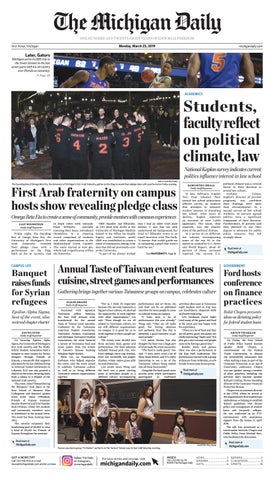
The founding line of Omega Beta Eta, the Univerisyt of Michigan’s first Arab fraternity, gather on the Diag to reveal their pledge class with a performance Friday evening,
First Arab fraternity on campus hosts show revealing pledge class Omega Beta Eta to create a sense of community, provide mentors with common experiences LIAT WEINSTEIN Daily Staff Reporter
Friday night, the founding line of Omega Beta Eta, the University of Michigan’s first Arab fraternity, revealed their pledge class with a performance on the Diag. Each of the 16 recruits, clad
in black robes with red-andblack keffiyehs partially covering their faces, introduced themselves to a cheering crowd comprised of students and other organizations in the Multicultural Greek Council. The event started at 8:34 pm, which had a significance within the fraternity.
CAMPUS LIFE
Banquet raises funds for Syrian refugees Epsilon Alpha Sigma, host of the event, also recieved chapter charter ZAYNA SYED
Daily Staff Reporter
On Saturday, Epsilon Alpha Sigma, the University of Michigan’s first Arab sorority, and the MultiEthnic Student Association held a banquet to raise money for Syrian refugees through Friends of Kayany, a non-profit that supports education for Syrian children living in Informal Tented Settlements in Lebanon. EAS was also granted a charter at the event, elevating them from a colony to a chapter of the national Arab sorority. The event, titled “Remembering the Refugees,” took place at the Ross School of Business Blau Colloquium and featured spoken word artist Omar Offendum, Friends of Kayany treasurer Bandar Shawwaf and EAS founder Rula Othman. About 140 students and community members were in attendance at the annual event. The event has been running since 2012. The sorority surpassed their fundraising goal of $8,000 to raise a total of $9,400 for Friends of Kayany throughout the semester.
OBH founder Jad Elharake, an LSA alum who works at the University of Michigan Medical School in the Office for Health Equity and Inclusion, noted OBH was established to create a sense of community among Arab men that did not previously exist at the University. “A part of me always wished
that I had an older Arab male mentor — one that not only understood my background, but lived it,” Elharake wrote in an email interview with The Daily. “A mentor that would guide me in navigating a place that wasn’t built for me.” See FRATERNITY, Page 3
SAMANTHA SMALL Daily Staff Reporter
In late February, Kaplan Test Prep released their annual law school admissions officers survey, an analysis that attempts to measure student interest in attending law school. After years of decline, Kaplan reported an increase of over 4,000 applicants. The cause, they reported, was the chaotic state of the political climate. In a survey of 121 different law schools, encompassing some of the top 50 in the nation as ranked by U.S. News and World Report, about 87 percent of those surveyed reported the current U.S.
political climate was a critical factor in their decision to attend law school. Anthony Coloca, Kaplan’s director of pre-law programs, was confident their findings were more than circumstantial. In a second survey of law school students, 45 percent agreed politics were a significant component of their decision. Furthermore, 57 percent said they planned to use their degree to advocate for public policy concerns they felt strongly about.
Read more at MichiganDaily.com
Annual Taste of Taiwan event features Ford hosts cuisine, street games and performances conference GOVERNMENT
Gathering brings together various Taiwanese groups on campus, celebrates culture JIALIN ZHANG
Daily Staff Reporter
Decorated with signature Taiwanese yellow lanterns, the East Hall atriums were transformed for the annual Taste of Taiwan event Saturday. Co-hosted by the Taiwanese American Student Association, Taiwanese Student Association and Michigan Taiwanese Student Associations, the event featured a variety of Taiwanese food and street games from the streets of Taiwan’s famous Keelung Miaokou Night Market. Elton Lin, an Engineering freshman who helped organize the event, said the event aimed to celebrate Taiwanese culture as well as to bring different Taiwanese student organizations together.
“For us, I think it’s important because this not only represents a big part of our culture, we also had the opportunity to work together with other organizations,” Lin said. “Even though we are all related to Taiwanese culture, we are still different organizations on campus. It is good for us to work together to show people our culture.” The events were divided into three sections: food, games and performance. The food selection included braised pork rice, stirfried cabbage, three cup chicken, fried rice vermicelli, salt pepper chicken, winter melon grass jelly tea and shaved ice. LSA senior Jason Wong said the food was a great starting point to introduce people to a different culture, accompanying
performances and art forms. He said food can be an additional incentive for more people to come to cultural events on campus. “I have seen a lot of performances this year already,” Wong said. “They are all really good, but having delicious and authentic food like this is definitely a good incentive to get more people.” LSA junior Jeremy Yun also thought the food was a huge part of what made the event successful. “The food is really good,” Yun said. “I have never tried a lot of these foods before, and it is really interesting to see a lot of the Taiwanese culture being soaked into all these food stands.” Alongside the food stands were activity areas where participants participated in traditional
activities often seen at Taiwanese night markets such as ring toss, can knockdown, chopstick skills and bottle balancing. LSA freshman David Sigler tried many of the games and food at the event and was happy with his experience. “There is a lot of food and they are all pretty good, the games are really interesting,” Sigler said. “It’s also got a nice turnout and people seem to be having a good time.” Besides foods and games, there was also a performance in the East Hall Auditorium. The performance started with a group of dancers from K-Motion, an allfemale Korean pop dance group.
Read more at MichiganDaily.com
Read more at MichiganDaily.com
on finance practices Rohit Chopra presents ideas on dictating policy for federal student loans ARJUN THAKKAR Daily Staff Reporter
On Friday, the Ford School of Public Policy hosted keynote speaker Rohit Chopra, a commissioner on the Federal Trade Commission, to discuss the vulnerability consumers face when seeking a loan, as part of the Consumer Protection in an Age of Uncertainty conference. Chopra was one speaker among a number of other panelists, including the previous day’s keynote speaker Richard Cordray, former founding director of the Consumer Financial Protection Bureau. Chopra was an assistant director at the CFPB, where he served as the organization’s first student loan ombudsman — helping to establish federal guidelines that dictate policy and management of student loans and for-profit colleges. He was confirmed as an FTC commissioner with unanimous support from the Senate in April 2018. The talk was structured as a conversation between Chopra and Public Policy Dean Michael Barr, who facilitated the discussion.
CARTER FOX/Daily
Korean pop dance group “K-Motion” performs at the Taste of Taiwan even in East Hall Saturday evening,
GOT A NEWS TIP? Call 734-418-4115 or e-mail news@michigandaily.com and let us know.
Follow The Daily on Instagram, #rushKTP @michigandaily
For more stories and coverage, visit
michigandaily.com
INDEX
Vol. CXXVIII, No. 93 ©2019 The Michigan Daily
NEWS.........................2 OPINION.....................4 ARTS......................6
Read more at MichiganDaily.com
SUDOKU.....................2 CLASSIFIEDS...............5 SPORTS....................1B
News
2A — Monday, March 25, 2019
MONDAY: Looking at the Numbers
TUESDAY: By Design
WEDNESDAY: This Week in History
The Michigan Daily — michigandaily.com
THURSDAY: Twitter Talk
FRIDAY: Behind the Story
DESIGN BY VIVIAN HARBER
C L I M AT E A C T I O N S I T- I N
Stanford Lipsey Student Publications Building 420 Maynard St. Ann Arbor, MI 48109-1327 www.michigandaily.com
MAYA GOLDMAN
TOMMY DYE
Editor in Chief 734-418-4115 ext. 1251 mayagold@michigandaily.com
Business Manager 734-418-4115 ext. 1241 tomedye@michigandaily.com
NEWS TIPS
news@michigandaily.com
LETTERS TO THE EDITOR tothedaily@michigandaily.com
EDITORIAL PAGE
opinion@michigandaily.com
PHOTOGRAPHY SECTION
ARTS SECTION
photo@michigandaily.com
arts@michigandaily.com
NEWSROOM
SPORTS SECTION
734-418-4115 opt. 3
sports@michigandaily.com
CORRECTIONS
ADVERTISING
corrections@michigandaily.com
dailydisplay@gmail.com
Editorial Staff MAX KUANG/Daily Students observe a study-in at University of Michigan President Mark Schlissel’s office to demand climate action by the University.
FINNTAN STORER Managing Editor
frstorer@michigandaily.com
GRACE KAY and ELIZABETH LAWRENCE
FRATERNITY From Page 1
Managing News Editors news@michigandaily.com Senior News Editors: Sayali Amin, Rachel Cunningham, Remy Farkas, Leah Graham, Amara Shaikh Assistant News Editors: Barbara Collins, Alex Harring, Danielle Pasekoff, Atticus Raasch, Ben Rosenfeld, Samantha Small, Emma Stein, Zayna Syed, Callie Teitelbaum, Liat Weinstein
my priority, and like lions in the and around the country. “The Arab identity as a race jungle, we lead with authority.” JOEL DANILEWITZ and MAGDALENA MIHAYLOVA The creation of OBH is often unrecognized and goes Editorial Page Editors tothedaily@michigandaily.com comes just four months after unrecognized because we don’t Senior Opinion Editors: Emily Huhman, Alexander Satola, Elias Khoury, the University’s first Arab have a checkbox if you’re filling OBH is not the first Arab Nicholas Tomaino, Erin White sorority, Epsilon Alpha Sigma out applications or whatever,” fraternity in the nation. MAX MARCOVITCH and ETHAN SEARS Empowered Arab Sisterhood, Fadlallah said. “We’re marked However, Elharake said the Managing Sports Editors sportseditors@michigandaily.com introduced its first pledge class under white, which isn’t true. A founders of OBH decided to Senior Sports Editors: Mark Calcagno, Jake Shames, Matthew Kennedy, Anna Marcus, Paige Voeffray, Avi Sholkoff in a reveal show held in Angell lot of it has to do with advocating create their own fraternity so Assistant Sports Editors: Aria Gerson, Tien Le, Rian Ratnavale, Bennett Hall. EAS, which has chapters at for that Middle Eastern and they could build the traditions of Bramson, Theo Mackie, Akul Vijayvargiya several other universities, is the North African checkbox and, the group themselves. JACK BRANDON and ARYA NAIDU first Arab sorority in the nation. within that, the Arab identity.” Before presenting themselves Managing Arts Editors arts@michigandaily.com Throughout the performance, Silan Fadlallah, LSA junior to the audience, the brothers Senior Arts Editors: Clara Scott, Emma Chang, Cassandra Mansuetti, Samantha recruits referred to and president of EAS, said it the of OBH recognized the other Della Fera, Trina Pal was important for her sorority themselves as lions, the symbol multicultural fraternities and Arts Beat Editors: Verity Sturm, Sayan Ghosh, Mike Watkins, Ally Owens, Stephen Satarino, Izzy Hasslund, Margaret Sheridan to attend OBH’s reveal show of the fraternity. According sororities attending the event. because EAS had received to Elharake, the symbolism Members of other organizations, ROSEANNE CHAO and JACK SILBERMAN Managing Design Editors design@michigandaily.com support from the University’s harkens back to when Asiatic including Sigma Lambda Beta Senior Design Editor: Willa Hua Arab community at their own lions lived across the Middle fraternity and Sigma Sigma Rho East and North Africa. While debut performance. sorority, responded with chants ALEXIS RANKIN and ALEC COHEN Managing Photo Editors photo@michigandaily.com “We’re here to show solidarity Asiatic lions still live in suband calls of support. Senior Photo Editors: Alexandria Pompei, Natalie Stephens, Alice Liu, Annie Klusendorf and support them, because we Saharan Africa, there are very Kneeling huddled together in Assistant Photo Editors: Katelyn Mulcahy, Miles Macklin, Emma Richter, Hannah were the first Arab sorority to few left in the Middle East. In a circle, the brothers introduced Siegel, Allison Engkvist come to the campus and we a text message to The Daily, themselves one by one by know what that feels like,” Elharake said the members of standing and removing their ANDREA PÉREZ BALDERRAMA Statement Editor statement@michigandaily.com scarves and robes. Elharake Fadlallah said. “We’re not sisters OBH and the Arab community Deputy Editors: Matthew Harmon, Shannon Ors brought each recruit to the with them, but we’re here to at the University embody the history of the Asiatic lions. middle of the circle and took support them.” MADELINE TURNER and MIRIAM FRANCISCO Managing Copy Editors copydesk@michigandaily.com “Their story has become In 2017, Elharake helped http://sudokusyndication.com/sudoku/generator/print/ away their scarves before Sudoku Syndication Senior Copy Editors: Dominick Sokotoff, Olivia Sedlacek, Reece Meyhoefer organize the #WeExist our story,” Elharake said. “For stepping out. Amid chants of campaign to add a Middle decades, most Arab men at CASEY TIN and HASSAAN ALI WATTOO Managing Online Editors webteam@michigandaily.com Eastern/North African the University did not hold Senior Web Developers: Jonathon Liu, Abha Panda, Ryan Siu, David Talbot, identity category to University leadership positions across Samantha Cohen applications and documents. campus, take advantage of the NOAH TAPPEN In December 2018, Rackham opportunities and resources Managing Video Editor video@michigandaily.com announced plans to include offered or advocate for the Arab Senior Video Editors: Jillian Drzinski, Aarthi Janakiraman EASY Middle Eastern and North community. In many ways, we CARLY RYAN and NA’KIA CHANNEY African identity options on were extinct.” Michigan in Color Editors michiganincolor@michigandaily.com Saad mentioned how the applications for Fall 2019. Senior Michigan in Color Editors: Maya Mokh, Samuel So, Ana Maria SanchezElharake said his work performance was meant to be Castillo, Efe Osagie, Danyel Tharakan with this campaign and his both a humorous introduction Assistant Michigan in Color Editors: Grace Cho, Harnoor Singh, Nada Eldawy, decision to found OBH reflect to the group and a reflection on Lorna Brown his desire to bring awareness one the organization’s official CATHERINE NOUHAN and JOHN FABIAN to the Arab identity on slogans: “Protect what’s yours, Managing Podcast Editors even when they claim it’s theirs.” campus. CARRINGTON TUBMAN and MADALASA CHAUDHARI “Every year, I see Arab Saad said this underlying theme Managing Social Media Editors men who come to U-M, expresses the more serious ignore the community on aspects of the reveal show. “It’s to show how we’re serious campus, forget their roots and cave into the pressures about what we’re doing — we of attending a predominantly put in a lot of work in rehearsal ADRIANNA KUSMIERCZYK white institution,” Elharake and we wanted everything to be Creative Director CAMERON COANE ZELJKO KOSPIC said. “My experiences fueled very structured and organized in Sales Manager Special Projects Manager my desire to create, with the conveying our message instead ROBERT WAGMAN ANITA MICHAUD founding fathers, a peer-to- of being disorganized,” Saad Marketing Consulting Manager Brand Manager peer structure for Arab men said. “It really highlights the consistency and how serious we to mentor each other.” Fadlallah echoed are about this.” Elharake’s statement and said The Michigan Daily (ISSN 0745-967) is published Monday through Friday during the fall and winter terms by students at the University OF Michigan. One copy is available organizations like EAS and Read more at © sudokusolver.com. For personal use only. free of charge to all readers. Additional copies may be picked up at the Daily’s office for ARIES SZN puzzle by sudokusyndication.com OBH aim to draw attention MichiganDaily.com $2. Subscriptions for September-April are $250 and year long subscriptions are $275. to the presence of a distinctly University affiliates are subject to a reduced subscription rate. On-campus subscriptions for fall term are $35. Subscriptions must be prepaid. Arab identity at the University “ossoud,” or “lion” in Arabic, each member then revealed his name and pledged to support his fellow brothers. Many of the members introduced themselves through rap. Ahmad Saad, Business senior and OBH brother, said each member of the fraternity was given a lion name prior to the reveal. According to Saad, these names are given by members and denote certain characteristics about the recruit, like leadership or courage. Saad’s lion name is “Bassel”. “Immigrating from Bint Jebail, my parents don’t have it easy,” Saad rapped. “They look to me to carry their legacy. Strongest of the pack, I protect my brothers — no matter what it is, we’re always here for each other. Ballin’ since I was a kid, I’m the real MVP. The best there ever was, I got that lion mentality. Yeah, I go to Ross, I’m a different kind of lion. Imma build stacks on stacks without even trying. My brothers are
SUDOKU
3
7
2
8
1
5
4
1
6
7
8
7
7
6
1
9
2
Business Staff
5 7
2
3
6
3
9
7 6
4 1
6
5
1
Generate and solve Sudoku, Super Sudoku and Godoku puzzles at sudokusyndication.com!
The Michigan Daily — michigandaily.com
Michigan in Color
Monday, March 25, 2019 — 3A
March 16th: A joke to some, a nightmare to me HALEEMAH AQEL MiC Contributor My name is Haleemah Aqel. I am a graduate of the class of 2018. I am a Palestinian Muslim American woman. I serve as the current program coordinator at the Program on Intergroup Relations. I am one of the founders of the Islamophobia Working Group. I was the head organizer of the New Zealand Mosque Vigil on Saturday, March 16. I’ve spent the last few days processing the events of Saturday. I tend not to publicly share my thoughts with people. However, I have seen many individuals on campus joke, ignore, or fail to acknowledge both the attacks in New Zealand and the Saturday incident and their traumatic effects on individuals in the community -- specifically the Muslim community present at the vigil. For that reason, I have decided to share my thoughts starting on Saturday afternoon. Saturday, March 16th. 12:38 p.m. I wake up. I slept in, which is unusual for me. Something felt off. I open my phone to texts and emails about the vigil at 4 PM. I call my mom telling her I already felt off about the day. I knew I was still mourning the victims of the New Zealand mosque terrorist attack, but I tried my best to pull myself together to finalize the vigil schedule and gather the list of innocent lives lost. 2 p.m. I text one of the other organizers of the vigil asking her what she thought about the possibility of cancelling the vigil. Something didn’t seem right, or safe, about having the vigil when numerous students would be participating in St. Patrick’s Day festivities. I was scared. I kept imagining someone running into the crowd and attacking students — like I said before, something definitely did not feel right at
all. I email the other organizers, but they convince me that everything would be okay. I believe them. 3:40 p.m. I walk out of my apartment. I make my way to Espresso Royale on State Street to buy a coffee to ease my nerves. I make my purchase and begin my walk to the Diag. I pass by familiar faces and smile as I walk towards the steps of Hatcher. The sunny sky soon turns grey. 3:55 p.m. Volunteer speakers walk up to greet me. I give them their speaking order. Another organizer arrives with the box of candles. Professor Samer Ali calls for the large crowd of 200 individuals to gather around. We pass out the candles. 4:05 p.m. The vigil begins. Samer gives opening marks, commemorating the lives of those taken from hate crimes and acts of terror since 2011. I look around. I see members of all different identities in the crowd. I recognize more familiar faces as they nod their heads towards me. I begin to tear up. I pull myself together knowing I am standing in front of hundreds of people. 4:10 p.m. Members of the Muslim Student Association begin with their words. A verse of the Quran is recited. The beautiful and peaceful words soothe the crowd and my nerves. The sounds of the Quran bring me back to a safe haven. Another individual proceeds to recite the English translation. 4:15 p.m. It is now my turn to speak. I walk up to the microphone. I take a deep breath. I introduce myself. I usually have a loud voice, but my voice is soft. My hands begin to shake as I hold one candle in one hand and my phone in the other. I pause before I begin to call out the names of the victims so far counted as dead by
ILLUSTRATION
Is that how they see me?
New Zealand officials. Not all of the names of the 51 victims (at the time) were announced. I encourage the crowd to remember these victims, not just as victims, but as individuals with stories and experiences. That we will remember their beautiful lives and never forget them. I conclude my words. The next few speakers follow me. 4:30 p.m. State Representative Yousef Rabhi speaks. I’m nervous once again. Elected officials could serve as targets to the public. He concludes his speech and
my beautiful memories with family. I start tearing up again. I put my head down for a second and when I looked up, my life flashes before me. 4:35 p.m. I will never forget this moment. I see two cops running into the crowd from East side of the Diag. I see them run before I hear them. I instantly freeze, my legs tense up. I hear the cops scream “MOVE, MOVE, MOVE” as they run into the crowd. This image continues to replay in my head.
These could be my last moments.
steps off of the steps. 4:34 p.m. Another volunteer begins to speak. Yet, this time her poem is about Palestine. The nature of anyone discussing Palestine, especially in such a public space, has always put me on edge. Speaking about the injustices in Palestine on the University of Michigan campus has always brought some controversy. I immediately remember the time students had yelled at me and other Palestinian students for a peaceful display a few years back in the Diag. My mind begins to race. The speaker discusses the nature of violence against Palestinians in Palestine and how it is similar to acts of white supremacy in the world. I begin to remember my times in Palestine and
My immediate thoughts were: someone in the crowd has a gun. Someone in the crowd has a bomb. My adrenaline spikes as I sprint up the rest of the steps into Hatcher to take cover. Maybe I would be a target, I thought. Maybe they were aiming for me. I didn’t look back. I had no idea what was happening. Why was this happening? I instantly run into the side rooms. I see students studying and yell we need to hide. We need to take cover. I run with them into the North Stacks. I begin to cry. 4:46 p.m. We find a space hidden in the stacks. I immediately open up my Facebook and Twitter on my phone, updating everyone
I am driven home where two friends stop by later to comfort me. I continue to receive more texts. I receive a call from the Michigan Daily asking for a quote. I provide them with my statement. My friends leave and I am alone. I am hesitant to ask other friends to come over. I don’t want to burden anyone. 8:30 p.m. I contemplate leaving my apartment. I feel closed in. I feel lonely. I call some friends to pass the time. I am still shaking. People continue to text me asking about the vigil. My mind is racing. 10:00 p.m. My best friend texts me telling me not to leave my apartment alone since I was the head organizer. I am on edge because she warns me of being a target. I shower and begin to cry as the water races down on my body. My tears are washed away. I silence my phone, ignoring any calls. 12:00 a.m., Sunday, March 17th I spend the rest of the night locked in my bedroom. Any noise immediately startles me. I can’t sleep. I end up falling asleep around 2:00 a.m. or so. 5:30 a.m. I wake up from a nightmare screaming, “Help!” I immediately start crying. I call my brother, he calms me down. I’m shaking and I immediately run into my bathroom almost throwing up. I stay awake. I’m too scared to go back to sleep. 8 a.m. I decide to open my phone at this time. I check my email. My inbox is flooded. Hate mail, news inquires, old professors reaching out asking if I’m okay. I text a friend to meet up. 10:30 a.m. I end up going to the gym later that morning with that friend.
READ MORE AT MICHIGANDAILY.COM
To photograph or not to photograph? MONICA KIM MiC Columnist A few weeks ago, I was scrolling through Instagram when I actually paused for a second: two photos had caught my eye. One was of a Japanese family in kimonos at a temple, faces turned away from the camera; the other was of a Vietnamese family, a father and son, their faces also turned away from the camera. These were not photos taken by a photojournalist — they were images taken by a college student studying abroad in Asia. And for some reason, they made me slightly discomfited. It might have been the fact that in both photos, the families’ gazes were turned away from the camera, preoccupied with whatever they were doing in the moment. I wondered — did these people know their photos were being taken? Did the student have their consent? In these photos, subjects were transformed into objects to be gazed upon. They were another part of the foreign, exoticized landscape, blending into stereotypical images associated with people who live in these countries: individuals wearing kimonos in Japan, individuals in rural Vietnam. I wondered — if the student
was studying abroad in Europe, would she have taken photos like these, of random strangers living their lives? Perhaps in a specific cultural context, like Oktoberfest in Germany or flamenco dancers in Spain. But would she ever be compelled to stop and take a photo of random strangers by their houses or other buildings? I could see the same thing happening in African, Middle Eastern and Latin American countries — but not necessarily European countries. Yes, the student might have taken the photo because she thought the people looked interesting and “exotic”. Yes, she might have taken it as appreciation of the country she was visiting and to share that with other people. But it’s important to consider the current and historical contexts of travelers photographing people in foreign countries in ways that are steeped in colonialism and the fetishization of those people and that landscape that renders them objects to look at rather than actual humans. It isn’t just regular tourists that perpetuate this either — popular and well-established media do it, too (see: National
/& zKh d,/E< zKh hE Z^d E ,Z/^d/ E/dz zKh’RE PRK >z tZKE'͘
Illustration by Jhoanne Castro
that I’m safe. 4:48 p.m. My phone soon blows up with text messages, twitter notifications and numerous calls. My sister messages me. She asks me if I’m okay. She asks me where I’m hiding. I tell her I’m safe and that I love her. I told her to update my mom and let her know I’m safe. Friends begin to call and text me. I’m surrounded by 15 students. Each student sends similar texts to family. Many of us crying. We do a calming exercise. These could be my last moments. I send ‘I love you’ texts to close friends. I check my pockets and grasp the fluorescent candle in my hand. Everything from this point on is a blur to me. 5:17 p.m. I’m still hiding in Hatcher. I continue to receive updates. We are told that a gunman is in the UGLi now. My whole body feels numb. Again, everything is a blur to me. 5:50 p.m. We immediately evacuate to the basement of Hatcher. The PA system in Hatcher finally goes off. We are given the OK to leave from the south doors. I evacuate with 20 students. We are escorted to South University. I am not well. I felt sick. My hands were shaking. I wanted to throw up. I begin crying again. Many random individuals begin to hug me. I walk away. 6:00 p.m. I walk off campus alone to the apartment where other attendees of the vigil were. I feel faint. I sit down on the ground and open my phone once again. I call my mom. I told her everything was okay. I was angry. I really was not okay. I recall the moments of 4:35PM again and again. The image of the police officers running into the crowd haunts me. 7:00 p.m.
tĞĞŬůLJ ůŝǀĞ ƉƌŽŐƌĂŵƐ ƚŚĂƚ ĐĂůů ďƵůůƐŚͺƚ͘ ǀĞƌLJ dƵĞƐĚĂLJ EŝŐŚƚ ϳ͗ϭϱWD DdE ǁǁǁ͘ ŚƌŝƐƚŝ ŶĂƌĐŚLJƚŽĚĂLJ͘ĐŽŵ
Geographic). The photos also reminded me of similar, though different, kinds of images that are often uploaded to social media. These are the photos of volunteers with the people they are supposedly helping. And the volunteers are usually white, and the people are usually non-white and live in low-income countries with entrenched histories of colonialism and exploitation
from the West. These photos often perpetuate the problematic white savior complex, wherein a white volunteer goes to a (usually) non-European country on a volunteer project with ideas of “saving” the local population there, who are deemed to be in need of help. READ MORE AT MICHIGANDAILY.COM
Opinion
4A — Monday, March 25, 2019
The Michigan Daily — michigandaily.com
MARIA ULAYYET | COLUMN
The power of community following the false alert
Edited and managed by students at the University of Michigan since 1890. Stanford Lipsey Student Publications Building 420 Maynard St. Ann Arbor, MI 48109 tothedaily@michigandaily.com
MAYA GOLDMAN Editor in Chief
MAGDALENA MIHAYLOVA AND JOEL DANILEWITZ
FINNTAN STORER Managing Editor
Editorial Page Editors
EDITORIAL BOARD MEMBERS Zack Blumberg Emma Chang Joel Danilewitz Emily Huhman Tara Jayaram
Jeremy Kaplan Magdalena Mihaylova Ellery Rosenzweig Jason Rowland Anu Roy-Chaudhury
Alex Satola Timothy Spurlin Nicholas Tomaino Erin White Ashley Zhang
Unsigned editorials reflect the official position of The Daily’s Editorial Board. All other signed articles and illustrations represent solely the views of their authors.
ALPHA KAPPA DELTA PHI | OP-ED
T
An apology from aKDPhi
o our fellow students at the University of Michigan, the University of Michigan Chapter of alpha Kappa Delta Phi would like to sincerely apologize for the events that took place last Saturday as a result of our actions. Last week, a group of our members had planned a bonding event that involved team-building activities, including one that involved popping balloons that set off the false shooter alert. We are truly sorry to everyone who feared for their lives and had to experience the traumatic events of that day, especially to our fellow Muslim students and all those who were present at the New Zealand Mosques Solidarity Vigil. It is unacceptable to merely pass off our actions as a poorly timed coincidence. To do so would be to ignore the politicallycharged atmosphere that day and the many serious events on campus that preceded the false
alarm. Failure to acknowledge these circumstances would only further enable us to benefit from the privilege that comes with a lack of understanding about the real dangers and fears that many of our fellow peers, students of color and Muslim students live with on a day to day basis. We also want to acknowledge our silence and delay in responding to the events of last week. As part of a large and diverse community of color, we understand that everyone perceives and processes traumatic events in different ways and at different speeds. We have used this past week to not only process our feelings of guilt and disbelief, but to also reflect on our mistakes and take responsibility for our actions by reaching out to members of our immediate communities. We take this event as a stark realization that we need to further educate ourselves about Islamophobia, white
supremacy and what it means to use our position as A/PIA students to participate in more meaningful coalition building on campus. Moving forward, we are committed to standing together in solidarity with our fellow Muslim students and marginalized communities on campus by holding necessary conversations and taking the right steps towards being more cognizant of our actions. While our words cannot undo the trauma that was experienced that day, we will use Saturday’s events as a way to further educate ourselves more about social justice and to empower and uplift our fellow Muslim community and communities of color. Respectfully, The University of Michigan Chapter of alpha Kappa Delta Phi The University of Michigan Chapter of alpha Kappa Delta Phi can be reached at akdphiexecs@umich.edu.
ANIK JOSHI | COLUMN
The upside of the college admissions scam
W
hatever happened in 1999, Harvard’s full-time to predictability? undergraduate enrollment was No, seriously — roughly 6,816 students. Turn the clock forward what happened to to 2017 and it was a it? Because there grand total of 6,699 is no universe in students. For the sake which any of us of comparison, in 1999 predicted Aunt there were around 6 Becky would be billion people in the charged with world and in 2017 there felonies, but life were 7.5 billion. The is funny that way. population of the world After everyone grew by more than a finished cracking ANIK billion and Harvard’s jokes about the JOSHI enrollment actually developments of the past week, it looked pretty shrunk by about a hundred. bad for a lot of people and Another way of looking at this schools (thankfully, not this is that the population of the world grew by 25 percent and one. Go Blue). There was a lot to be the Harvard undergraduate surprised and upset about enrollment dropped about 2 — that parents were buying percent. their students’ spots paying someone else to take their tests, that schools were letting their athletic directors work without almost any oversight and most importantly that someone would pay $500,000 to be admitted into the University of Southern California when they could light the money on fire instead. However, there was one silver lining and it’s something In addition to this, the important of which we cannot afford to lose sight (and it’s number of students who not because we spent our last applied to college grew as well. half million at USC). It is that All of this is a polite way of those schools are, to an extent, saying we value these degrees overrated. Having an Ivy so much because they’re so League degree is no guarantor hard to get, and they’re so of success, but that idea is hard to get because so many implanted in so many minds in apply for them. So many apply high school, middle school and for them because of how much we value them. This is a selfeven elementary school. I have heard from past perpetuating cycle and will middle school teachers of mine always be, unless, for some that sixth grade students were reason, we as a society begin crying about a B because it to value these elite degrees a might hurt their chance to get whole lot less. I believe, after many years, into Harvard. Whatever else that is, it is also wrong beyond we have found that reason. words. This much stress only There’s an idea that not all fraud exists for one reason: It is is caught. This may mean that, because we have all lied to in some cases, scams could go ourselves. We are the ones on for years until it eventually who decided that a Harvard blows up in someone’s face degree is worth what it is — (see this college scam for one not Harvard. And the same is example — for another, look at true for Stanford, Yale and this Bernie Madoff ). It also might school too. Part of what makes not blow up at all — which is to these degrees so valuable is that say we have no idea what kind of fraud is being committed the supply is so low. According to Bloomberg, and we will not have any idea
Once fraud of some type is revealed, there does tend to be more suspicion of those who let it happen
of this until it comes out in the paper. This is a clear example of Donald Rumsfeld’s “unknown unknown” — we assume there is fraud going on but we aren’t positive about it or about what it looks like until it’s staring us in the face. However, once fraud of some type is revealed, there does tend to be more suspicion of those who let it happen. One example of this is how hated much of Wall Street was after the 2008 stock market crash. That wasn’t fraud as much as it was shady business practices, but the point stands. After the crash, a good number wanted to burn the CEOs of Goldman Sachs, Lehman Brothers and the like at the stake. I think we have found a reason to value these elite degrees a lot less because we do not know which students had their entrance and admission paid for and which students actually earned theirs. There will be more suspicion of those degrees in years to come, and that is good. This is because having a Harvard degree doesn’t mean you’re a decent person or you’re super smart. What it does mean, though, is you got lucky. Whether it be lucky enough to have parents who could buy your way into the university (albeit unartfully), or be it the luck of getting your application read by someone on the admissions board sympathetic to you, it had a lot to do with luck. This is because there is really no academic difference between all the 4.0/36 kids who got the thin envelope and those who got the fat one. There is nothing wrong with that, but now that this admissions scandal has forced us to examine how people got into these schools, maybe we’ll value those schools less since all it took was luck and money, and no one can be faulted for not having those. That devaluation is an unrequited positive good that has come from this mess. In other words, mission accomplished, ladies and gentlemen. Anik Joshi can be reached at anikj@umich.edu.
T
he texts that bombarded my phone last Saturday afternoon will remain etched in my mind for the rest of my life. “Run. Hide. Active shoot (sic) on the Diag. RUN.” While I couldn’t comprehend what was happening in that moment, I knew this day would quickly become a day I would never forget. For the next four hours, with each “ping,” my phone continued to make my heart drop even further. As I sat in the safety of my apartment, I was nowhere near comfortable, knowing my best friends and community members feared they may be living the last moments of their lives. I sat in my living room frozen and expressionless, holding back tears every time one of my friends didn’t answer his or her phone. My heart raced each time I heard rumors the alleged g unman was getting closer to my apartment or where my friends were. I feared for my safety and dreaded losing the people dearest to my heart. I worried about getting to class safely and walking home late from the library. I stopped at the idea that our safety as students is not a g uarantee and tomorrow is not promised. Last Friday, two New Zealand mosques faced an act of terrorism executed by a white supremacist who took the lives of at least 50 people and wounded at least another 50. The terrorist responsible for these acts of violence live-streamed his attacks on Facebook for the world to see. While Facebook had the video down within minutes, it has circulated to various online platforms and generated over one million views. In addition to his live-stream, the shooter also released a manifesto highlighting his white supremacist views, in which he praised President Donald Trump and voiced his support for Trump’s views.
The Muslim community around the world has been put under extreme pressure to openly express its identity during a trying time of bigotry. With popular fig ures like Trump continuing to fuel the energ y and passion of white supremacists, xenophobia has continued to rise along with the daily fear of being openly Muslim in today’s society.
The emotional trauma that minority groups will face will continue to be ignored Many communities have come together to express their support by acts of unity. The University of Michigan’s Islamophobia Working Group and the Muslim Student Association planned and came together for a vigil Saturday to express their solidarity for the community and pay respect to the lives lost to senseless violence. The vigil was quickly broken up by police shouting for the attendees to run. With no explanation or further instructions, attendees of the vigil ran for their lives, getting trampled and dropping belongings along the way. Just as the Muslim community in New Zealand was attacked the safe space of their place of worship, the threat the Muslim community at the University felt was also in the safe space of their campus community. While the reports of an active shooter threat were false alarms, the trauma that existed within the Muslim and Arab communities and their allies was certainly not a false alarm. The lack of response I saw from faculty and administration regarding the active shooter threat downplays the
emotional trauma that a group of predominantly minority students felt that day. The lack of concern from these bodies made the University a place where students felt alienated rather than one where they could find solace. Before the University had even officially issued an “allclear” to the active shooter threats, students had already began circulating and sending memes and jokes about the incident and completely undermining the real fear felt by many of their peers, some who were still barricaded in classrooms, hiding to save their lives. The lives of my people are worth more than a meme. The emotional toll my community has faced deserves more than a “just get over it, nothing really happened.” The reality is the emotional trauma that minority groups face will simply continue to be ignored. Had this threat affected a predominantly white group of students, the University would not have reacted the same way. Muslim students and their allies were expected to carry on as normal in the days following, whether it was going to work the next morning or taking an organic chemistry exam less than 48 hours later. Official statements from University administration were scarce and the sentiment on campus was business as usual. While the greater campus community may not have come through for us that weekend, I realized the strength and beauty in our smaller Muslim and Arab communities here on campus. Whether it was letting people hide for safety in each other’s apartments or simply offering to talk to affected students, my communities came together in a time of need and highlighted the importance of celebrating our unity in diversity.
Maria Ulayyet can be reached at mulayyet@umich.edu.
ERIN WHITE | OP-ED
I
We’re afraid, and can you blame us?
was sitting with my two best friends in a dorm room, laughing after an afternoon of St. Patrick’s Day celebrations, when one of us received the first text from a friend. “There’s an active shooter in Mason Hall,” he said to me. “That’s not a funny joke to make,” I responded, hoping he was kidding but knowing he wasn’t from the serious look on his face. This initial message, followed by many more, sent us into a frenzy of checking all our group chats, texting and calling everyone we knew and telling them to stay away from the Diag, stay indoors and stay safe. My brother was in the Shapiro Undergraduate Library, and I had to beg him in a series of texts to interrupt his exam studying and call me, thinking he was a minute away from an active shooting. The only sound among the three of us for the next 30 minutes was the tapping of our phone screens and the static of an online police scanner that we should not have been listening to. Saturday’s false alarm was stressful and damaging for a variety of reasons — the University of Michigan’s blatant emergency response problems, the further trauma inf licted on the Muslim community, the spread of misinformation and conf licting rumors that heightened fear. But what struck me most deeply about this event was how, despite it being a false alarm, students were instinctively preparing for the worst. The second that an initial report went out, and before the University or the Division of Public Safety and Security or any news source addressed campus, students sprung into a variety of immediate, fear-driven actions. An unconfirmed report with no official comment gained instant credibility and led to prompt student response. But
living in the United States, can you blame us? Columbine. Virginia Tech. Sandy Hook. Parkland. Growing up in a country that from 2009 to 2018 had 57 times more school shootings than other industrialized nations, is thinking that the University of Michigan could join the list of places national tragedies have occurred irrational? The recent, targeted shooting at two New Zealand mosques was the first mass shooting to occur in the nation in over 20 years. Conversely, the United States has had a conservative estimate of 90 mass shootings since 1997, according to an open-source database by Mother Jones. In a study published earlier this month by The BMJ, it was shown states with weaker gun laws had more mass shootings, and there are more mass shootings in areas with higher rates of gun ownership. But even outside of these horrific stories that are oftentimes claimed by conservatives as being sensationalized, the United States still has the highest rate of murder and manslaughter by firearms in the developed world. It’s hard to not see the connection between access to guns and harm. Being exposed to this scale of gun violence has pushed the threat of an active shooter situation to the forefront of my mind more than a few times, and that weekend made that fear all the more prominent, while making me more sensitive to an issue I have been culturally trained to tune out. This is something I know that many of my fellow students have felt too. This is the time to channel that fear and concern into productive dialogue about gun policy and emergency procedures. The gun debate in the United States is tense and passionate. But as much as
our current political climate has made us feel increasingly polarized on either side, the only way to achieve what should be a common goal among all Americans — decreasing deaths — is by considering the data, looking to international comparisons and enacting compromises that bring us closer to safe gun regulation. Because as of now, I see no reason why roughly a third of American gun owners have been able to buy their guns without a background check. So instead of screaming “no guns, yes guns” at each other from opposite sides of the chamber, why don’t we enact common-sense gun laws that will keep the volume of guns down while insuring that the remaining firearms are in the hands of nonthreatening citizens? The events of last weekend have caused a lot of residual stress within our campus climate, but there is potential for it to be used for beneficial progress, both politically and within the University community. In the foreseeable future, continue to demand the University has a line of communication about its emergency response measures, and actually give your input on how they can be improved upon. Use these spaces to encourage the University to enact clearer and more comprehensive active shooter protocols to keep us safe in the instance of an actual emergency. And in a continuous push, contact your local and national representatives. Press gun control as a platform plank. Keep it at the forefront of the conversation and don’t wait for another tragedy to occur. Work so the next generation doesn’t have to be so afraid. Erin White can be reached at ekwhite@umich.edu.
Arts
The Michigan Daily — michigandaily.com
Monday, March 25, 2019 — 5A
BOOK REVIEW
FILM REVIEW
‘Music for Mister Moon’ uses imagination as power SARAH SALMAN Daily Arts Writer
As a 20-year-old, I haven’t opened a children’s book since I was a child myself. I vaguely remember some classics like “The Giving Tree” and “Goodnight Moon” that formed my reading experience. Children’s books are not like children’s movies— they’re used as tools of literacy. They don’t have the complexity of movies, no deeper messages or obscure symbols. At least, that’s what I had assumed. But despite its simplicity, “Music for Mister Moon” still manages to convey a message that’s relevant to all ages. Harriet Henry plays the cello. One day, her parents said, “You will play your cello in a big orchestra. Won’t that make you happy?” Harriet Henry had a big imagination. She pictured herself on the stage with rows and rows of people dressed like penguins. See, Harriet Henry was like every child at the thought of a public performance. She had stage fright. She told her parents, “No, I don’t think that would make me happy.” Harriet Henry did not want to play the cello in a big orchestra. Harriet Henry wanted to play the cello alone. In the dead quiet of the night, Harriet Henry used her big imagination to transform her
little room into a cellist haven, decorated with everything from a fireplace to a staple teacup. It was the perfect set up for Harriet Henry to perform in solitude. When a noisy owl threatens to disrupt her peace, Harriet Henry — naturally — becomes very upset. She throws the teacup out the window and misses (a tragedy that is entirely too familiar), knocking the moon out of the sky and into
moon back to its rightful place, Mister Moon and Harriet also develop a warm friendship. When Mister Moon confessed his regrets and dreams, Harriet, in turn, thought of her own wishes and worries. Will she be able to muster the courage to share her music to Mister Moon? “Music for Mister Moon” takes its readers on a fantastical journey to ref lect on their own fears. As Harriet Henry and Mister move from one scene to the next, the readers, too, are able to f luidly transition from one notable time in their lives to the next. Although the sentences are sparse, each word is laden with the theme of camaraderie and lost childhood. I was reminded of “Up” and “Peter Pan” several times while reading. Erin Stead’s muted watercolor illustrations, moreover, are perfect for the serene atmosphere of “Music for Mister Moon.” While examining the pictures, I almost wanted to curl up in my own bed, dreaming of orchestras, penguins and an enchanting moon. It is a lovely children’s book that shows that the support of friends and family are one of the most important tools in conquering your fears and expressing courage. The story is moving while at the same time relatable for all ages, even jaded college students, such as myself.
Music for Mister Moon Philip C. Stead Neal Porter Books Mar. 26, 2019
her chimney instead. And so their adventure begins. Harriet Henry showed Mister Moon around her neighborhood. They stopped by the hatmaker for a hat to put on Mister Moon’s chilly head. They borrowed a boat from the fisherman so that Mister Moon can f loat on the lake. These interludes are enhanced with a sense of magical realism. The hatmaker and the fisherman are a bear and seal, respectively. Their exchanges, however, transcends any interspecies dissonance. The hatmaker and fisherman are humanized by their fond memories with Mister Moon and their altruistic actions. In her quest to return the
Classifieds
Call: #734-418-4115 Email: dailydisplay@gmail.com
FOR RENT
Release Date: Monday, March 25, 2019
Los Angeles Times Daily Crossword Puzzle Edited by Rich Norris and Joyce Nichols Lewis
ACROSS 1 Super bargain 6 Effective on 10 Ed.’s backlog 13 Bisect 14 “Good Morning America” co-anchor Spencer 15 Boarding site 16 Sellers of build-ityourself furniture 18 Mythical monster 19 Delt neighbor 20 Mets’ home before Citi Field 22 Enemies 23 Puts up, as a skyscraper 24 Climate-affecting Pacific current 27 Citrus-flavored soda, on its labels 29 Minnesota’s state bird 30 Final Four org. 32 Eye-boggling work 35 __-di-dah: pretentious 36 Five-armed ocean creature 38 “I’ll pass’’ 39 Decree 41 Wander about 42 Warehouse gds. 43 East Asian home of Acer and Asus 45 Like partly melted snow 47 Merkel of Germany 49 Molecule component 50 Leaves-catching brewing sieve 53 Drag to court 56 Witty Bombeck 57 Arabian Peninsula region, and what 16-, 20-, 36- and 50-Across literally have 59 Done with 60 Falco of “Nurse Jackie” 61 Wheel connectors 62 Mario Bros. console 63 Ruby and scarlet 64 Suspicious (of)
DOWN 1 Cruise vessel 2 Box office income 3 Monthly util. bill 4 “Selma” director DuVernay 5 Classroom session 6 Soothing medicinal plants 7 __ Lee cakes 8 Mine extractions 9 Make secure, as a seat belt 10 “Presto!” sticks 11 Peacock’s gait 12 Appears to be 15 Try for a long pass, in football lingo 17 Romantic ideal 21 Fervent feeling 22 Dolphin feature 24 Vogue competitor 25 Laundry batch 26 Pitching masterpieces 27 Bricklayer 28 “Ciao!” 31 Irene of “Fame” 33 Poison ivy symptom
34 Rock music’s __ Might Be Giants 36 Prop for a clown 37 Dutch beer brand 40 Ides of March victim 42 Tight-lipped 44 Not as cold 46 Parent of Maybelline 47 Used, as china 48 Chutzpah
49 South American mountain range 51 Staff assistant 52 “Look what __!”: “Yay me!” 53 Bargain hunter’s delight 54 App downloader 55 Site for handmade art 58 Application file suffix
ANSWER TO PREVIOUS PUZZLE:
EFFICIENCY ‑ 1 & 2 Bdrm Apt Fall 2019/20 Rents range $875 ‑ $1850 most include heat and water. Showings scheduled M‑F 10‑3 734‑996‑1991
SERVICES STUDENT SUMMER STORAGE Closest to campus, Indoor, Clean, SafeReserve now at annarborstorage. com or (734) 663‑0690
SUMMER EMPLOYMENT
‘Us’ is an accomplishment, if not a stride, for Peele ANISH TAMHANEY Daily Arts Writer
It’s fitting that Jordan Peele, whose reimagining of “The Twilight Zone” will premiere this April, crafted his followup to cultural juggernaut “Get Out” by making an essentially extended version of a “Twilight Zone” episode. His latest feature film, “Us,” is a tightly wound horror-thriller much in the same vein as “Get Out,” but rather than being grounded in the answers it provides, the power of “Us” comes in the questions it leaves lingering in its wake. The story surrounds the four members of the Wilson family as they are confronted by dopplegangers of themselves during a pleasant summer vacation to Santa Cruz beach. To reveal any more of the plot beyond this would be to take away from the twist-riddled, ref lective and thoughtprovoking experience of the movie. It’s practically impossible to talk about the big ideas “Us” posits without spoiling the fun, so I’ll avoid them for the most part. By far, my favorite aspect of the film was Lupita Nyong’o’s (“Star Wars: The Last Jedi”) performance as Adelaide Wilson. Since the film revolves around duplicates, she must play both herself and her sadistic, wide-eyed double, Red. As a result, Nyong’o has to be both protective and malevolent, frightened and robotic, along with several other notable dualities. Her ability to carry off what is basically twice the burden of what a normal role entails is purely astounding. Without her, the movie probably wouldn’t work. Winston Duke, (“Black Panther”), on the other hand, was the film’s comic relief. As Gabe, Adelaide’s husband, his corny presence
gave “Us” an initial levity. More importantly, when the horror setpieces began, his one-liners didn’t take away from the tension at hand. “Get Out” boasted notably ominous camerawork and cinematography, and “Us” demonstrates Peele honing these skills. Peele constructs nearly every frame with visually arresting and symbolismdrenched composition. The embryonic suggestions of his ideas manifest with the right amount of subtlety, so that when they finally reveal themselves, it feels like we have been thinking about them all along. Without getting too specific, a hint I have for those who haven’t seen the movie: Pay attention to what everyone is wearing. Of course, as a self-
Us Universal Pictures The State Theatre, Goodrich Quality 16, Ann Arbor 20+ IMAX
proclaimed horror nerd, Peele references several of the works that inf luenced him, from “A Nightmare on Elm Street” to “The Shining” to the obscure sci-fi f lick “C.H.U.D.” To see and understand these mini love-letters to horror films of the past was invigorating to me, but Peele does far more than repurpose style. It would be presumptuous to say that Peele has comprehensively realized a style of his own, but one is certainly emerging. His camera placement is uniquely conducive to effective jumpscares, and he peppers them into the narrative at an
impressively measured pace. He also has an obsession for totems of his own mythology, from the tea cup in “Get Out” to the creepy white rabbits and golden scissors that were centerpieces in marketing campaign of “Us.” Michael Abels, composer of the music for “Get Out,” outdid himself with his second film score. Many have heard his ominously groovy remix of “I Got 5 On It” from the trailers, but a larger standout from the film is “Anthem,” a primal, crescendoing, war-chant that is sure to induce nightmares. Abels demonstrates a knack for weaving in impactful leitmotifs into otherwise dissonant horror sounds, going for melody where other composers wouldn’t dare. In all honesty, even though I adored so many aspects of the film, I didn’t love it. Again, it’s impossible to be specific as to what thematic elements were tough to internalize without ruining the entire movie, so I’ll say this: You have to see “Us” for yourself. I can’t understate how important it is to see the film in theaters, too. In my viewing, the crowd was utterly cacophonous, crying, laughing, screaming and muttering hysterically. Few theater experiences are this collectively engaging. “Us” might be a more interesting movie to think about than it is to see. There are details of the script that, in ref lection, have made me rethink about every aspect of what I saw, and I’m still formulating an understanding of the ending. Beyond my confusion and my doubt, I’m glad “Us” exists and that Jordan Peele is making horror movies. He clearly wants to tackle American issues by reframing them and inciting discussion about about them. And that discussion, in and of itself, is a gift. UNIVERSAL PICTURES
03/25/19
WORK ON MACKINAC Island This Summer – Make lifelong friends. The Island House Hotel and Ryba’s Fudge Shops are seeking help in all areas: Front Desk, Bell Staff, Wait Staff, Sales Clerks, Kitchen, Baristas. Dorm Housing, bonus, and discounted meals. (906) 847‑7196. www.theislandhouse.com
FOLLOW US ON TWITTER By C.C. Burnikel ©2019 Tribune Content Agency, LLC
UNIVERSAL PICTURES
03/25/19
NOW. @michigandaily
Arts
6A — Monday, March 25, 2019
The Michigan Daily — michigandaily.com
DAILY WORLD MUSIC COLUMN
ALBUM REVIEW
Black Coffee, South African house SAYAN GHOSH
Daily World Music Columnist
Certain genres of electronic music, such as house and techno, are ostensibly quite limited in their scope. 110-150 BPM. Four-on-the-f loor beats. Synthesized basslines. These frameworks exist to make DJ’s lives easier, allowing them to tempo match and transition seamlessly between songs in their mixes. The last thing a DJ wants, after all, is a transition that makes things choppy and disrupts the f low of the party. It takes a truly talented musician to reside in this somewhat limited framework and be creative and innovative within it. One of the most exciting of these masters is South Africa’s Black Coffee. Nkosinathi Innocent Maphumulo, better known as Black Coffee, was born in Durban, South Africa and studied music at the Durban University of Technolog y before launching into the South African dance music scene. He started DJing at a very young age, taking inf luences from the local disco and popular music coming from the townships of South Africa. His first big break came when he was selected as a participant in the Red Bull Music Academy. Since then, he’s only risen upward, winning award after award for his work and performing with Boiler Room, Mixmag, Ultra, Sonar and a host of other electronic music institutions. He sells out shows everywhere from Miami to Ibiza, with a unique style that has helped him stand out from the hordes of similar-sounding European DJs. Black Coffee’s specialty house originated in Chicago in the early 1980s. Black DJs such as Frankie Knuckles used new instruments, particularly
DOMINO
‘Cows on Hourglass Pond’ is folk for a new generation JIM WILSON
Daily Arts Writer
The magical thing about Animal Collective’s co-founding member Avey Tare, also known as David Portner, is his ability to make the abrasive sound beautiful. He can take piercing, droning synths fit for an industrial show and alter them until they are more fit for a relaxing summer evening of ref lection and remembrance. Avey Tare showcases this prowess once again on his sixth full-length release, Cows on Hourglass Pond. Tare kicks off the album with the remarkably abstract “What’s the Goodside.” Though a danceinspired drum pattern drives the song, Tare has no intention of coaxing listeners to get up and dance. Instead, through the utilization of nearly indecipherable lyrics and vocals processed with effects like distortion, reverb and god knows what else, he conjures a song that is guaranteed to make listeners stop what they are doing for a chance to decode whatever meaning they believe to be hidden within the song. This trend continues and is expanded upon as the album rolls. Songs like “Nostalgia in Lemonade” are not nearly as lyrically dense as “What’s the Goodside,” but they are just as challenging sonically. “Nostalgia in Lemonade” is simply about enjoying
lemonade on a warm day, yearning for just one more sip long after the drink has been finished. Despite this straightforward message, the instrumental is anything but simple. It begins with a clipping, skipping hum that metamorphs into a buzzing synthesizer burst layered beneath a glimmering string section led by an airy guitar. The sheer contrast of these sounds is challenging enough, but further exacerbated by the fact that it is just as gorgeous as it is trance-inducing. If the electronic
Domino Recording Company
instrumentals were stripped away and replaced by something more acoustic and folksy, Cows on Hourglass Pond would be fit to be performed at local folk venue The Ark. Each song on the album has the ability to call old memories to the forefront of listeners’ mind and make readers ref lect on the lyrics, no matter how nonpictorial they may be. Tare’s ability to combine psychedelic folk music with the avant garde and create something completely new is truly a marvel. The album’s closing track “HORS_” is the ultimate culmination of Tare’s skill. Unlike “Nostalgia in
Lemonade” and “Chilly Blue,” “HORS_” finds Tare at his most subdued musically. Until the very end of the song, he keeps the instrumental relatively simple with a driving acoustic guitar, pulsating hand claps and chime-like keys, instead opting to experiment with his voice by messing with the elongation of each word and raising and lowering his voice at whim. The lyrics are marked by non sequiturs and verge toward the nonsensical, described by Tare himself as “an ode to horses.” As the song continues, all lyrics are replaced with unintelligible vocals and humming that would sound right at home on Bon Iver’s 22, A Million. As soon as listeners settle into this soothing section, the song disintegrates into static, providing an abrupt end to the album. Avey Tare’s efforts on Cows on Hourglass Pond do not go unnoticed. He creates an atmosphere of curiosity and wonder in manner similar to the early work of Wallace Stevens, specifically “Comedian as the Letter C.” That is to say that album does not primarily emphasize meaning. The lyrics are still important, but they are not central to the album, which is why they are often muddled and processed. Cows on Hourglass Pond focuses instead on the form and execution of its sound, so that all listeners can find a way to relate their own nostalgia and memories to each song.
So I was in a very fortunate position. What I wanted to do was bridge the gap, and with my understanding of jazz, be able to simplify it so the dance music fan doesn’t feel overwhelmed by it.” But jazz is far from the only genre to inf luence his mostly deep house discography. In the backdrop of the fall of apartheid in the late 1980s and early 1990s, a genre called kwaito emerged in the Soweto township of Johannesburg. Kwaito borrows heavily from house, but often slows down the beats and incorporates
TV REVIEW
‘The Village’ aspires to emote, falls short of feeling MAXWELL SCHWARZ Daily Arts Writer
Community is a fragile thing, often built on fantasy, or a promise of a different reality. A community is a collection of people, some good and some bad, who share the goal of doing what’s best for their small locality. Yet, NBC has crafted “The Village”: a show based not on the give-and-take of living and finding commonality with those who are vastly different from you, but on the premise of interlocking stories as the sole basis of a familial relationship. “The Village” is an almost fairytale-like apartment building in Brooklyn, where the colorful residents find not just a community, but a family. The premiere follows a few intertwined threads. First, disabled veteran Nick (Warren Christie, “The Resident”) returns home from Iraq, finding companionship with some old retired soldiers. One of these
is Enzo (Dominic Chianese, “The Sopranos”), who’s escaped from his nursing home with his son’s credit card. Meanwhile, one of Enzo’s nurses — and Nick’s old girlfriend — Sarah (Michaela McManus, “Aquarius”) struggles to relate to her teenage daughter, Katie (Grace Van Dien, “Charlie Says”), who finds out she’s pregnant. Meanwhile, when Ava (Moran Atias, “The Resident”), an Iranian refugee, is apprehended by ICE, local police officer, Ben (Jerod Haynes, debut) takes her son in as she is being investigated further. To clear the air, “The Village” has been compared to — and for good reason — NBC’s emotional tour de force, “This Is Us.”
elements of disco and R&B as well as spoken lyrics. Watching one of Black Coffee’s sets, it’s easy to notice he is not a run-of-the-mill DJ. Tall and imposing, he is one of those DJs who is fully focused on the technicalities of his craft, preferring to eschew frequent crowd interaction. His mixes are f luid and vibrant, with several remix tracks of the South African canon. He is particularly talented at managing the dynamic of the mix, pacing his sequence of tracks, not only using melodic or rhythmic cues but also dynamic range and character. Even more impressively, he does his work without the use of his left arm, which was paralyzed after a car accident when he was only 14. Even within the aforementioned limited house framework, Black Coffee innovates. Those same four-on-the-f loor breakbeats are infused with rhythms and instrumentation from his home country’s musical tradition. House clichés, such as whispery female vocals, are executed using samples from South African soul and disco music coming from the townships of Johannesburg and his hometown, Durban. Diversity is not quite what people associate with house these days. But it’s worth remembering the origins of the genre, and especially now, it’s worth getting excited about its future. The rise of artists such as Black Coffee represent a future of house where the world’s soundscapes become ever more present. The bare bones of house will likely remain the same, and will remain as a canvas for artists to paint over. But the sounds will hopefully be as varied as the people that make them, and the parties of the world will become a bit richer.
Even within the aforementioned limited house framework, Black Coffee innovates. Those same four-on-the-floor breakbeats are infused with rhythms and instrumentation from his home country’s musical tradition.
Cows on Hourglass Pond Avey Tare
a variety of drum machines and synthesizers. They used a love for genres, such as disco and European dance music, to create a genre to be played in spaces which expressly forbade any discrimination with regards to race, gender, sexual orientation, etc. In an interview with DJ Mag, Black Coffee notes, “I understood the depth of the jazz genre, and on the f lipside I also understood dance music.
NBC
They share a lot in common: interconnected stories, tearjerker moments and a plot built on the struggle of familial relationships. That being said,
of “This Is Us.” First and foremost is the very strange use of “Talk Dirty to Me” by Jason Derulo, featuring 2 Chainz. When
The Village Pilot NBC Tuesdays, 9 p.m.
“The Village” is absolutely not “This Is Us.” It isn’t because the story is different, but because “The Village” has fundamental f laws that stop it from ever reaching the emotional gravity
might this song play during a show whose integral drive and fuel is its viewer’s tears? When three old guys are ogling a yoga instructor in the nursing home. Additionally, rather than
crafting a story that will organically offer emotional gravitas, “The Village” exploits elements that will guarantee cheap sympathy. Take Nick, who represents the show’s pinch of token patriotism. There’s no genuine discussion of the horrors of war or the hidden repercussions that haunt the minds of veterans — something that is very important thematically to “This Is Us.” Instead, we simply receive the hollow presence of a one-legged vet and his twin German Shepherds. While the show is on the verge of a diverse cast, the problems are very white, while the problems facing minorities go mostly overlooked. There’s yet to be a discussion of what
inner conf lict Ben must feel as a Black cop in gentrified Brooklyn. Likewise, the presence of undocumented immigrants are used as a selfexplanatory critique on current politics, rather than a genuine exploration of what it means to be stateless in modern America, following a disturbing new trend in TV where all immigrant characters are undocumented and on the verge of deportation. The emphasis on family in “The Village” is awkward and misplaced. Not because it doesn’t belong, but because it feels forced. The show’s generally talented cast cannot save the story’s inability to create genuine connections between the characters. It’s very mellow and seeks to score easy, passionate clout that it really doesn’t deserve. If there’s any takeaway from “The Village,” it’s that this is not what a community is like. It’s time to put an end to the “This Is Is” counterfeits.
Katelyn Mulcahy / Daily | Design by Jack Silberman
SportsMonday Column: What it’s like to be a female sports photographer
INSIDE
michigandaily.com | March 25, 2019
SPORTSMONDAY
WOLVERINES ADVANCE TO THIRD CONSECUTIVE SWEET 16
dunked on repeatedly
SportsMonday
2B — March 25, 2019
The Michigan Daily — michigandaily.com
SportsMonday Column: Behind the lens of two female sports photographers In observance of Women’s History Month, The Daily’s sports section is launching its second annual series aimed at telling the stories of female athletes, coaches and teams at the University from the perspective of the female sports photographers on staff. We KATELYN continue the MULCAHY series with this story from the 2018 Managing Photo Editors Katelyn Mulcahy and Alexis Rankin. n old issue of The ALEXIS Daily hangs RANKIN in the photo closet. Every time a Daily photographer walks into the closet to check out equipment to shoot, they are reminded of its presence. On it, there is a photo of Sara Krulwich on the sideline in the Big House, with two of her football photos included. Krulwich was the Daily’s first female photographer in 1969, and that photo captures her during her first time on the field, as the first woman to do so. Standing there smiling and proud, she encourages us every time we go out to shoot, knowing that we’re following the trail she blazed for us. As Managing Photo Editors in 2018, we both came into the job with different experience levels and different goals with sports photography. Katelyn, who will be working for the Houston Astros as their live content creator after graduation, knew that she wanted to pursue sports photography from the start. At first, Alexis didn’t even know if she wanted to shoot sports at all. But now as a second-year MPE, she has had the opportunity to shoot
A
at countless basketball, hockey and football games with the intention, and desire, to do more. It’s an intimidating experience to photograph sports, especially “the Big Three”: football, basketball and hockey. It’s even more intimidating for a woman working for a student paper with minimal experience. But like the writers on the Sports section and the rest of The Michigan Daily staff, we take the job as seriously as any other professional. Because that is what we are — professionals in our craft. Since we both started at The Michigan Daily, we’ve practiced and learned from each other’s confidence, experience and support. We didn’t always consider ourselves sports photographers, and many other people still don’t. But when we step onto the court at Crisler Center, walk through the tunnel leading into the Big House, or take a seat at a photo hole against the glass at Yost Arena, that is exactly what we are. When either of us sets up our laptop and unpacks our equipment in the media room, we have to believe that we deserve to be in that room as much as any of the other photographers there, because if we don’t believe it, they never will. It’s telling that no matter our amount of experience, sometimes we still get treated as if we have none. So, when we step out onto the field, the court or the ice, it’s easy to feel small. The job is strenuous. We carry two, sometimes three cameras, that make our arms sore the next day. We stand, kneel and crouch through rain, snow and freezing temperatures. We dodge football players that run off the field and basketballs that come flying toward us, and keep our cameras focused on the action when two hockey players slam into the glass in front of us. It’s stressful and intense, but we never complain. It’s part of the job and we love it. We barely even notice anymore. But everyone else seems to
think we do. It sometimes feels like we’re at a disadvantage right as we step in the room. When one of us goes to an event, the event staff is often unintentionally condescending. Like when one of us was in an elevator and someone referred to us as “sweetie.” In an elevator full of men, it served as a reminder of who we are in a male-dominated profession. He didn’t mean ill by it, and neither do the people who make comments about our cameras being bigger than us or other similar remarks, but they are all reminders of how we are viewed differently as young women in this profession. But the people who’ve told us we’re “overcompensating” by having two cameras or a 300mm lens don’t mean well. It sometimes feels the same way with the overly helpful male photographers who stand behind our computers while we’re ingesting
photos, giving unsolicited advice and comments. We’ve had men take photos of us while we’re busy shooting, only for them to show us later and comment on what we’re doing or the way we look. We hear these comments and have these experiences almost every time we shoot, and while it’s frustrating, it also makes us work harder. We know we don’t need to prove ourselves to the boy making snide comments from the student section — who has probably never picked up a DSLR in his life — or to the sideline photographer who thinks we can’t handle our equipment. While the negative experiences sometimes outweigh the positive ones, it’s important to recognize the support we’ve received as well. Many of the photographers we’ve met at games have welcomed us, anything from chatting during a media timeout to giving us freelance tips. Sometimes
something as simple as a comment, like or retweet of our photos online goes a long way. Our sports writers are equally as supportive, retweeting our content and texting us to tell us how much they liked our photos. And we find allies in the other women out there with us, whether it’s another Daily staff photographer, an editor from the Michiganensian or one of the few experienced, professional women photographers. The encouragement we receive makes up for the microaggressions and outright insults that we sometimes experience. We knew going into sports photography that it would be difficult. We heard stories from editors and photographers before us about the comments they received while shooting. For example, a former MPE was told, “You’re only here to get closer to the basketball boys, right?”
Wrong. He said it with a laugh, probably thinking it was funny, but it was a comment that lingered and was passed down to us as managing editors. So while we appreciate the support and advice we’ve received from some of the other photographers, we know that we have to work twice as hard every time we shoot. Every time we pick up a camera, we are building a reputation for ourselves and for the other women on our staff, as talented, dedicated photographers. We’ve come a long way since Krulwich stepped out onto the field as the first female photographer to do so. Stories like hers push us to keep going. That’s why we’re proud to be women on the sideline, to even out that imbalance. To show the girls in the crowd that they could be us someday, too, just like Sara Krulwich did for us.
COURTESY OF ALEXIS RANKIN AND KATELYN MULCAHY/Daily
Katelyn Mulcahy and Alexis Rankin served as co-Managing Photo Editors in 2018, each shooting many different sports in their times at The Daily so far.
WOMEN’S BASKETBALL
Michigan bows out of Tournament Road crowd and slow start lead to with 71-50 loss against Louisville season-ending loss for Wolverines CONNOR BRENNAN Daily Sports Writer
LOUISVILLE, Ky. — From the tip, the game followed a frenetic pace. Egged on by a sea of red, the top-seeded Cardinals jumped out to a quick start. The crowd was raucous to begin with, but a 3-pointer and breakaway layup from Louisville’s All-American guard Asia Durr put it into a full-out frenzy. After just three minutes of play, Michigan coach Kim Barnes Arico had already called timeout in an attempt to calm her team nerves after falling behind 10-2. Though those nerves calmed eventually, the Michigan women’s basketball team (2212) had already dug itself a hole against the Cardinals (31-3) that it couldn’t climb out of, eventually losing 71-50. The Wolverines’ offense looked completely out of sorts early. Louisville’s pressure defense overwhelmed Michigan’s ball-handlers, leading to five turnovers within the first five minutes of the game. “They sped us up a lot,” said junior guard Akienreh Johnson. “That was their game plan. They like to take away the point guard because it messes up everything on offense. I don’t think they did anything different against us, but they definitely brought a lot of intensity the first couple minutes of the game.” The turnovers led to offensive opportunities, especially for Durr, who went 3-of-5 from beyond the arc in the first quarter — including a four-point play. “I don’t think we did a good job on Durr initially,” Barnes Arico said. “Anytime a great player gets going early, you know you’re trouble. Once you get some open looks and you get them to fall, holy cow and that happened with her. They did a tremendous job finding her early.” With the help of their fullcourt press, the Wolverines did settle in towards the end
of the quarter. Off an inbounds play, Michigan’s freshmen duo connected for two as point guard Amy Dilk lofted the ball to forward Naz Hillmon. Louisville’s stellar 3-point shooting also subsided as the quarter went on. Even still, the Cardinals led the Wolverines by eight after 10 minutes. The pace continued into the second frame. Dilk answered a tough fadeaway from Durr with a contested layup over 6-foot-4 forward Kylee Shook. Louisville’s offense methodically worked through Michigan’s press. In one sequence, Durr caught in midair between two Wolverine defenders made a no-look pass to a cutting Jazmine Jones, who finished the layup with ease. Michigan was made to continually climb out of a hole. Every time the Wolverines had a productive offensive possession, they gave up two on the other end. In many ways, Michigan was lucky to trail by just 12 points entering the halftime break — given a season-high 17 turnovers and a potent offensive performance from the Cardinals. The Wolverines cleaned up their turnover issues in the third quarter. Dilk and sophomore guard Deja Church handled the Louisville press more efficiently and yet, Michigan couldn’t outpace the Cardinals’ offense. Durr continued to orchestrate their offense to perfection — hitting difficult jumpers and sharing the ball when necessary. Jones also provided a spark for Louisville with six third-quarter points. “(Durr’s) an All-American, but she is also the kind of kid that let’s the game come to her,” Barnes Arico said. “She doesn’t press too much. She did a tremendous job for them tonight.” Though not induced by turnovers, the Wolverines’ empty possessions cost them. Consecutive over-the-top dishes from Jones to her bigs and
another three-pointer from Durr increased Michigan’s deficit to 23 entering the final quarter. Rebounding had been a strength of the Wolverines throughout the year and particularly in their first-round game against Kansas State — when they out-rebounded the Wildcats 50-19. That disparity was nowhere to be seen against the Cardinals, who managed to outdo Michigan on the glass. “Everybody started to get into the mix,” said Louisville coach Jeff Walz. “We had talked to the guards and said ‘You’ve got to rebound the basketball.’ One thing we told our kids, whoever was guarding Hillmon, ‘I don’t care if you get a rebound, she can’t.’ ” The Wolverines did what they could to chip away. In what ended up being her final game, senior guard Nicole Munger, as she has done so many times before, hit a three-pointer from the wing. On a fastbreak, she then found senior center Hallie Thome for two points to briefly cut the lead to 18. Unfortunately for Michigan, this run was short-lived. Louisville was one step ahead of the Wolverines and exploited any holes in their defense. Durr — who finished with 24 points — hit her fifth three-pointer to officially put the game out of reach. As the seconds ticked away on Michigan’s season, the Cardinals emptied their bench, replacing key contributors Durr and Jones to standing ovations from the 8,000 Louisville fans in attendance. On the other side, Munger and Thome trotted off the court for the final time in their impressive careers as Wolverines. “I think a lot of people doubted us this year with losing Katelynn Flaherty,” Thome said. “But we proved so many people wrong. I definitely wouldn’t have traded it for the world to have gone through Michigan. I’m excited to see them only get better.”
TEDDY GUTKIN Daily Sports Writer
LOUISVILLE, Ky. — It was never going to be easy. Playing in front of a crowd of 7,725, the Michigan women’s basketball team knew that it would be a daunting order to defeat the top-seeded Louisville Cardinals, who boast one of the best home-court advantages in all of college basketball. The Wolverines even tried to replicate the raucous environment of the KFC Yum! Center before the game. “We practiced yesterday with a speaker and a lot of loud noises,” said senior forward Hallie Thome. And yet, despite its prep, Michigan was blitzed out of the gate. National Player of the Year candidate Asia Durr scored 12 quick points, and the Wolverines found themselves in a 19-4 hole before the game’s first media timeout. With each basket, the Cardinals’ lead — and cheers — only grew. Before the season even began, Michigan head coach Kim Barnes Arico made a point to schedule tough nonconference road games in order to prepare her squad for the road environments it could face if it earned a spot in the NCAA Tournament. “We’ve tested ourselves against the best teams in the country in hopes for an opportunity like we’re going to have tomorrow,” Barnes Arico said in a press conference on Saturday. While Michigan had played against hostile road crowds, nothing came close to the atmosphere that the Wolverines were faced with on Sunday afternoon. The crowd’s sheer volume sounded like it could have easily been ripped from a sold-out football stadium. “We just got shook and rattled,” Barnes Arico said, “It took us a few minutes to get out
of that.” While the Cardinals thrived off of the crowd’s energy, it ended up serving as the catalyst for the Wolverines’ undoing. The team committed five turnovers by the time the first media timeout hit, and struggled to find any offensive rhythm against Louisville’s daunting press. The Wolverines, who had used the press to spearhead its dominant 84-54 win over Kansas State just two days prior, now found its own weapon being used against it. Though Michigan eventually settled down, cutting Louisville’s lead to 21-15 with eight minutes remaining in the first half, turnover struggles — it finished with 17 in the first half alone — prevented it from further attempts at a comeback. Once again, the crowd helped play a major role. “We couldn’t hear … our defensive switches or offensive plays or things like that,” said junior guard Akienreh Johnson.
Despite the loss, there is still plenty of room for optimism as the book closes on the Wolverines’ 2018-19 campaign. Though Michigan will lose Thome and senior forward Nicole Munger, the team will return several of its key contributors, including freshman forward Naz Hillmon and guard Amy Dilk. “I’m sure that they’re going to watch that film and learn from that experience so they are never in that position again,” Barnes Arico said. Even in a loss where it may be difficult to find a silver lining, the Wolverines showed fight against one of the toughest home crowds the sport has to offer. Barnes Arico, despite another second-round loss, says her team will enter the offseason with its heads held high. “We have a great basketball team,” Barnes Arico said. “Just going up against one of the top teams in the country on their home court is tough and Louisville was great tonight for sure.”
It took us a few minutes to get out of that.
ALEXANDRIA POMPEI/Daily
Senior guard Nicole Munger scored eight points in the Michigan women’s basketball team’s season-ending loss to Louisville on Saturday.
The Michigan Daily — michigandaily.com
SportsMonday
March 25, 2019 — 3B
Ben Mason’s viability through versatility Wolverines complete SOFTBALL
MAX MARCOVITCH Managing Sports Editor
Steve George paused long enough to make it clear he rejected the very premise of the question. George coached nowMichigan sophomore Ben Mason at Newtown High School. He granted Mason free reign to traverse the field at just about every position from wide receiver to running back, linebacker to defensive line. You name it, Mason did it. He watched Mason set the Connecticut state record for picksixes. So, asked last November whether perhaps Mason would have thrived at linebacker in a different era — in a bygone time where downhill, run-stopping linebackers were in vogue — George made his feelings known. Time period be damned. “I mean, I don’t even know in a different era,” George said. “I think this era would be no different.” At the time, Mason was in the midst of a breakout campaign at fullback, and the idea that a different position might suit him better seemed outlandish. The sophomore had tallied six touchdowns in just five weeks. He was emerging as a reliable staple of an offense with otherwise maddening inconsistency. His persona defined by brute physicality was increasingly endearing him to fans, who regularly greeted his presence on the field with hymns of excitement. In his own way, Mason was emerging as a star. Fast forward four months and Michigan coach Jim Harbaugh is talking about Mason moving around positions, not as any sort of demotion, but rather quite the opposite. Harbaugh said last week he wants to get Mason on the field for 60 to 70 plays per game, rather than the roughly 20 to 25 he played last season. To do so, he’ll be operating all over the field rather than primarily at fullback. In his
answer, Harbaugh listed running back, fullback, 3-technique, linebacker, tight end and multiple special teams positions. And even that seemed more like an offthe-cuff hypothetical than any exhaustive list. Spotting Mason on the field next year will seemingly become a task akin to solving a Where’s Waldo puzzle. “One day he’s on defense, the next day he’s on offense, the next day he’ll go to defense and so on, and rotate,” Harbaugh said. “… It’ll be a lot on his plate, we’ll see how he can handle it. I think he’s going to handle it really well.” Harbaugh isn’t alone in holding that sentiment. Ask anyone about Mason’s skill set and there is a remarkably consistent trope. “You can put him anywhere and he can work his tail off,” said junior VIPER Khaleke Hudson. “Anywhere he ends up, I feel like he’ll be great for the team and do his position really well.” New defensive line coach Shaun Nua added that Mason is “mentally tough, and (has) enough athletic ability to help us out on D-Line.”
According to Harbaugh, Mason “could be a little bit undersized as an inside 3-technique. But with his speed and quickness, I don’t know who’s going to stop him.” Mason came to Michigan hoping to contribute as a linebacker in Don Brown’s aggressive scheme. In a conversation with The Daily last November, he attempted to list all the positions he had previously played and/or hoped to play — and struggled to do so. And yet, the staff’s decision begs the question of whether plugging Mason all over the field truly maximizes his value, or simply alleviates some depth concerns. At 3-technique, for example, Michigan lost Lawrence Marshall, Bryan Mone and Aubrey Solomon, who, it should be noted, weigh an average of 48 pounds more than Mason. At linebacker, the Wolverines lost Devin Bush, and are looking to a relatively inexperienced group to fill the massive void. All the while, there’s uncertainty as to how actively new offensive coordinator Josh Gattis will deploy a fullback relative to Mason’s prior two seasons on
the team. Harbaugh voluntarily hinted the fullback position will de-emphasized — “used in short yardage and goal line situations predominantly” — as Gattis’ “Pro Spread” offense begins to take shape. Trying to shoehorn twoback sets into a spread offense creates a square-peg, round-hole predicament. Perhaps trying to theorize specifically how Mason will fit into the equation next season belies the point Harbaugh is making. When Harbaugh first called Mason after the spring of 2016 to ask what he thought about a move to fullback, Mason’s response was unequivocal. “I said that I would do anything for the team and that I was excited to do it,” Mason recalled. “… I wanted to come in and make an impact no matter how I could do it — and I was going to find a way no matter what to come in and make an impact.” That, above all else, is what defines him. And as everything else changes around Ben Mason’s unique Michigan career, it appears that never will.
EVAN AARON/Daily
Michigan fullback Ben Mason has shown his value to the Wolverines with the multiple positions he can play.
sweep of Cornhuskers AKUL VIJAYVARGIYA Daily Sports Writer
What used to be Michigan’s kryptonite turned into its friend Sunday. Senior outfielder Natalie Peters stepped up to bat with two outs and the bases loaded during the bottom of the second inning. But rather than leaving runners stranded on base like the Wolverines often do, Peters pounded a bases-clearing double to left field and drove in the first three runs that kickstarted Michigan’s 12-0 onslaught of the Nebraska Cornhuskers. After a four-run second inning, the Wolverines showcased their power in the third. Senior designated hitter Mackenzie Nemitz led off the inning with a solo home run as Michigan celebrated “Kenzie Nemitz Day” at Alumni Field. “I was rounding third and I was like, ‘Please don’t wake up,’ because I thought it was a dream,” Nemitz said about the home run. “As I was rounding third and running into my team, I was like ‘This is real.’” Right after her was junior third baseman Madison Uden who drove another home run to center field, her first of the year after going without a hit in Saturday’s game. But the Wolverines didn’t stop there. Senior outfielder Haley Hoogenraad made it three consecutive solo home runs for Michigan when she drove her first of the season as well down the left field line, putting the Wolverines up 7-0 after three innings. “In each of the games (this series), it took us a while to get our timing,” said Michigan coach Carol Hutchins. “When we found our process, especially today, I felt that we had a lot of better at-bats and we connected.
“I say it every time. Hitting is contagious and if you get a few, then people feel looser and more confident… Our kids were definitely loose and having fun today.” Michigan continued to step on the gas pedal during the bottom of the fourth inning, determined to finish the game on the fiveinning mercy rule. Loading the bases with runners throughout the inning, Michigan found stability from the middle of its lineup as Nemitz, Uden, and Hoogenraad each had at least one run batted in, extending the lead up to 11. Hutchins then decided to unleash the rest of her weapons, giving playing time to many of the bench players including junior catcher Abby Skvarce who added another RBI to her campaign. In the meantime, sophomore left-hander Meghan Beaubien continued her dominance of the Cornhuskers, pitching a perfect game going into the final inning. However, with two outs remaining, Beaubien gave up a double to Lindsey Walljasper, the other starting pitcher today. Beaubien still finished with seven strikeouts and no walks, completing the sweep of the Cornhuskers. “I mean, (Beaubien) keeps us in the game,” Nemitz said. “We just have to produce for her so that’s what we did, and she owned it out there.” Added Beaubien: “It was just a lot of fun. I think our dugout was having a lot of fun and we were hitting the ball really well and that kind of energy is contagious.” With a seven-game winning streak and a perfect start to the young Big Ten season, the Wolverines seem to have found some momentum and quite possibly its identity, both offensively and defensively.
Wolverines’ lack of consistency proves costly ‘M’ earns sixth-straight WOMEN’S GYMNASTICS
ABBY SNYDER
Daily Sports Writer
Over the course of Michigan’s young baseball season, junior left-hander Tommy Henry has established himself as the ace of the Wolverines’ rotation. He went undefeated over his first five starts, allowing just two runs to cross the plate over those 35 innings, both to No. 1 UCLA. He still came out of the day with a win, as the Wolverines went on to defeat the Bruins, 7-5. Thursday, however, was a different story. Despite not allowing a single earned run, Henry took his first loss decision as the Wolverines fell to No. 19 Texas Tech, 11-2, in the first contest of a mistake-laden three-game series for Michigan this weekend. Against some of their toughest competition of the season so far, the 23rd-ranked Wolverines could not find a rhythm, as the Red Raiders took all three games of the series. Though a 16-6 win over Stetson on Saturday night was a bright spot on the weekend, Texas Tech overpowered the Wolverines across the board in every contest this weekend.
“Texas Tech is just better than we are, and they outplayed us all weekend long,” Michigan coach Erik Bakich said. “They were better than us in all the phases of the game – offensively, defensively, on the mound and in the bullpen. They’re an elite program, and they’re the best team and the most complete team not only that we’ve seen this season, but one of the best teams I’ve seen in a long, long time.” The beginning of Thursday’s game was a pitcher’s duel between Henry and Red Raiders right-hander Micah Dallas. The Wolverines put a run on the board in the top of the fourth inning, but Texas Tech answered by breaking the game open with six runs in the bottom of the fifth inning. They added a run in both the sixth and seventh innings and tacked on three more in the eighth en route to a comfortable victory. Friday was more of the same. The Red Raiders were on the board first with a run in the first inning, but Michigan answered with runs in the fourth and fifth innings to jump out to a one-run lead. But fielding woes for the Wolverines helped Texas Tech to a five-run
sixth inning. The Red Raiders went on to add three more in the seventh, and though the Wolverines were able to score a run in the eighth inning to bring the score to 10-3, they could not manage a comeback. Michigan showed some fight in their first game on Saturday, the conclusion of the Texas Tech series. Though the Red Raiders were again the first to put a run on the board, the Wolverines answered with a four-run third inning to take the lead. The Red Raiders kept the game close, though, scoring two runs of their own in the bottom of the third. They later tied it, tacking on another run in the fourth. Both teams added a run in the fifth inning. But Texas Tech grabbed the lead with two runs in the seventh inning. And when they added another in the eighth off freshman right-hander Willie Weiss to bring the score to 8-5, Michigan could not come up with an answer. “We couldn’t hold them down in the bullpen,” Bakich said. “They sped the game up on us defensively. They ran out one mid-to-uppernineties pitcher after another. And we weren’t able to handle it as well as we would’ve liked to. They were
just better. We can’t make any excuses for that.” The Wolverines flipped the script in Saturday’s second game, when they beat Stetson, 16-6. Every Michigan starter had at least one hit, including one home run from sophomore outfielder Jesse Franklin and two from junior outfielder Jordan Brewer. Michigan’s offense showed its explosive potential in the game – they had two four-run innings and a three-run inning. Still, though, its lack of offensive consistency coupled with defensive woes against an extremely-capable Red Raider offense led to a disappointing Texas swing for the Wolverines. “Growth is a big part of who we are as a program,” Bakich said. “I haven’t lost a single ounce of confidence in our team, and in what kind of team that we’re going to have this year. We’re on the right track. They’re ahead of us right now, but we’re getting there. I’m glad that we had this type of weekend now instead of in a regional where our season would be over. This was a very beneficial trip for us.”
ALEXANDRIA POMPEI/Daily
The Michigan baseball team struggled to find consistency in its trip to Texas, finishing 1-3 in games against No. 19 Texas Tech and Stetson.
Big Ten Championship JAMES HILL
Daily Sports Writer
The Michigan women’s gymnastics team has dominated the Big Ten in women’s gymnastics this year, going 9-0 against conference opponents. On Saturday, it was more of the same. The Wolverines capped off a successful year of conference play with a strong performance at the Big Ten Championships at Rec Hall in State College. They came away with two gymnasts tied for the all-around award as well as the program’s sixth consecutive Big Ten trophy. “It’s awesome,” said Michigan coach Bev Plocki. “There’s been a lot going on and this team has refused to let anything get in the way of their goals and they’ve overcome a lot.” The two Michigan gymnasts tied for the all-around award were freshman Natalie Wojcik and senior Olivia Karas. They each scored a total 39.600, and they also shared the award with Minnesota’s Lexy Ramler. Karas and Wojcik’s scores, combined with the rest of the team’s performances, gave the Wolverines their total score of 197.400, nearly a full point ahead of second place Illinois. Michigan started the meet on the balance beam. Though it’s one of the more difficult events to get high scores, the Wolverines led the meet with a combined score of 49.300 at the end of the first session. Wojcik and Karas tied for the high score, each earning a 9.900. They were followed by sophomore Lauren Farley with a 9.875, freshman Maddie Mariani with a 9.825, as well as juniors Lexi Funk and Maddy Osman, who both had scores of 9.800. The team had a bye for the next event and took a break while other teams began with their respective events. Soon enough, the Wolverines were back in action on the floor exercise. On floor, Wojcik had the high score for the team with an impressive 9.950. She was followed by Karas with a 9.925 and senior Emma
McLean with a 9.900. McLean and Karas are the sole seniors on the squad, and there was no better way to end their Big Ten careers than with a championship. “I am speechless,” McLean said. “I am so proud of my teammates and the battles we’ve overcome, and we stuck together through all of it. We really just gave it everything we had from the fall to now and no matter what we kept pounding.” Michigan was rounded out in scoring by freshmen Abby Brenner and Abby Heiskell, with scores of 9.850 and 9.825, respectively. Brenner and Heiskell, along with Wojcik and Mariani, were integral to the team throughout the season and have high expectations for the coming years. The team was on vault next, where Wojcik had earned a perfect score of 10 earlier in February. There was no perfect score Saturday, but the Wolverines still had the highest vault scores of the meet. McLean had the high score of the event with a 9.900. Wojcik and Karas each had a 9.875. Brenner earned herself a 9.825 and they were rounded out by Heiskell and sophomore Anne Maxim, each with a score of 9.800. The final event of the meet for Michigan was the uneven bars. Brenner and Karas had the high scores of 9.900. Mariani and Wojcik each had a score of 9.875, and Maxim and Heiskell both earned a 9.825. With the conclusion of the uneven bars, the scores were added and the Wolverines were crowned champions. The Big Ten Championship isn’t the end for Michigan, though. “I think we can build on our momentum (into the NCAA championship) we’ve been creating all season,” said McLean. “We’re still climbing uphill and we haven’t reached our best yet. That’s what we’re looking for and hopefully, we put it together at the right time. I know we will. I know there’s exciting things waiting for us.”
Read the full story online at MichiganDaily.com
The Michigan Daily — michigandaily.com
SportsMonday
March 25, 2019 — 4B
‘M’ tops Florida, 64-49, advances Wolverines posterize Gators in win to third consecutive Sweet Sixteen ARIA GERSON
THEO MACKIE
Daily Sports Writer
DES MOINES, Iowa — As Michigan entered the halftime locker room with a tenuous fourpoint lead, John Beilein did not look like the coach of a team just 20 minutes away from its third consecutive Sweet Sixteen. When Jordan Poole sent the Wolverines into halftime by firing up a contested three, all Beilein could do was turn to his bench — but no one in particular — and offer up a look of confusion. At the time, it was justified. Michigan (30-6 overall) had shot 13-for-30 from the field and 4-for-13 from three, allowing No. 10-seed Florida (20-16) to remain within striking distance. But as Beilein walked into the locker room, he carried an air of positivity, sandwiching each criticism with positive reinforcement. And when he and the Wolverines returned an hour later, where there had been an intense half-time team talk, whoops and hollers filled the air, spilling over from a celebratory shower room after No. 2 Michigan’s 64-49 win over the Gators. “We should be measured by a lot of things,” Beilein said. “This is one of them — did we get in the NCAA Tournament and then did we advance in the NCAA Tournament? That’s what my measuring stick will always be.” Amid the celebratory postgame, the Wolverines harkened back to their halftime adjustments. Beilein praised his assistants. Assistant coach Luke Yaklich focused on the defensive resiliency. Sophomore forward CJ Baird credited the positivity Beilein instills. Whatever the conclusion, the results were obvious. As freshman forward Ignas Brazdeikis fired up a three on the Wolverines’ first possession out of the break, it momentarily looked as if the second half would mirror the first. His shot clanged off the back
of the rim, then the front, before popping above the basket as the heavily maize-and-blue clad crowd let out a collective sigh. Then, the ball magically dropped back through the hoop, turning that sigh into a raucous ovation. With the ovation came a return of Michigan’s swagger. “At first I thought it was good, but once it stopped bouncing around the rim, I was like, ‘Oh no, this might miss.’ And then I hit it so that was a bit of a relief for me,” Brazdeikis said. “… It definitely helped our rhythm for sure. Coming out of the half and scoring a big three is always huge.” That swagger manifested as junior center Jon Teske followed the three by finding his way into the paint for a layup. Then, Poole finished through contact and buried the ensuing free throw, sending the Wolverines’ bench onto their feet. When Poole hit a step-back three 30 seconds later, Michigan’s once fragile lead had grown to 15 on the back of an 11-0 run. The Gators’ resiliency, though, didn’t end there. They drew back within six with a 9-0 run of their own that sent an air of palpable tension through Wells Fargo Arena as the Wolverines were forced into a 30-second timeout. Moments later, a whistle came piercing through the building as Poole went crashing to the floor in front of Michigan’s bench. His 3-point attempt had smacked the front of the rim, but the foul call gave the Wolverines an opportunity to expand their lead back to nine. Poole — the subject of much of Beilein’s first-half frustration — calmly stepped to the line and did just that. For the next seven minutes, the teams traded baskets, Florida wedging its foot in the door but never daring to enter. On the rare occasion that the Gators threatened — they managed just 21 points after halftime — the Wolverines responded with some buffer of their own.
“We hang our hats on defense,” said assistant coach DeAndre Haynes. “Coach (Yaklich) does a great job. All our staff come together to see how we can stop their offense. And these guys right here, I give the credit to our players.” With Michigan’s lead at 11 and the game’s final stretch teetering on becoming a formality, Zavier Simpson cocked the ball above his right shoulder and sliced a bounce pass through the Florida defense and into the hands of Isaiah Livers. Between Livers and the basket stood Florida guard Andrew Nembhard, but not in Livers’ mind. The sophomore forward took to the air just beyond the restricted arc and delivered a two-hand slam over Nembhard, sending the arena into hysteria and — more importantly — the Wolverines into the Sweet Sixteen. An hour later, as Haynes packed his bags and headed for the team bus, he, like the rest of the team, was met with congratulatory greetings from Kathleen Beilein, John’s wife. By that point, there was just one thing left to say. “Thanks, Mrs. B. We going to Cali!”
Daily Sports Writer
DES MOINES, Iowa — Isaiah Livers didn’t know the ball went in until he saw walk-on guard Luke Wilson gesturing excitedly on the sidelines, until he saw his brother and his brother’s girlfriend standing up to applaud in the audience. The sophomore forward had just received an outlet pass from junior guard Zavier Simpson, driven to the basket, elevated a few feet from the basket and thrown down a two-handed slam that put Florida guard Andrew Nembhard on a poster. “Oof,” Wilson said later. “Oof. I mean, oof.” Two possessions later, Livers did it again, driving into the paint and dunking, as if there were nothing to it. But there wasn’t always nothing to it. Livers has struggled with aggression and on-court selflessness since his days as a high school point guard, where he distributed but didn’t always shoot. Coming into college, he was stunned at his coaches’ advice to be more aggressive and in his sophomore year, it’s still a
process. Earlier in the game, Livers had come out, frustrated that his shots weren’t going in. But he had been settling for low probability mid-range jumpers instead of taking his opportunities to turn the corner, go downhill and drive. “Stay aggressive,” assistant coaches DeAndre Haynes and Saddi Washington told him, according to Haynes. “Keep your head up, don’t carry suitcases right now, you’re gonna get in and have a really big game.” Livers saw the advice as them ripping on him. It only made him angrier. “OK,” he said. “Imma show you aggressive.” Now, the only suitcases he’ll be carrying are those he packed for Anaheim, Calif. on the way to the Sweet Sixteen after the Wolverines’ 64-49 win over Florida. But Nembhard wasn’t the only one posterized on Saturday. Freshman forward Ignas Brazdeikis set the tone on Michigan’s very first possession of the game. He drove baseline, leaving the Gators befuddled, and slammed. Junior center Jon Teske got the ball from Simpson
KATELYN MULCAHY/Daily
Sophomore forward Isaiah Livers notched the highlight of Saturday’s game, dunking on a Florida player on the fastbreak.
on the next possession and he, too, drove into the paint and found nothing but rim. And that was only his first dunk of the night — a minute later, he did it again. “You forget all about those,” Livers said. “It was just aggressiveness. Iggy ripped baseline. I think the guy overplayed him because Iggy, lefty, baseline with his right, one up and two, and that’s how you start a game off right. And Jon? Jon’s seven foot, he doesn’t count. He’s gonna go up there and just dunk it easy.” Redshirt junior wing Charles Matthews, meanwhile, dunked with three minutes left in the first half, back when the score was still close, giving Michigan a three-point cushion. And with 49 seconds left in the game, Matthews threw down another dunk, complete with a death stare, to put the finishing touches on the win. Fresh off the rush of jumping off the bench, again, to celebrate, the bench players came in to ice the game. “It gets contagious after a while,” Washington said. The dunks — particularly Livers’ — got the whole team rolling with a ferocity it hadn’t had before, when the Wolverines went seven minutes without a field goal and let the Gators back in the game partway through the second half. Afterward, they played like the game, and the Sweet Sixteen trip, was theirs for the taking. A good 30 minutes after the last dunks had landed, the players still remembered them in the locker room, responding with a chorus of “ooohs” and “oofs” and speechless head-shakes. The only person who was nonchalant was Michigan coach John Beilein, who saw the dunks not as a show, but as just another piece of a win. “Two points,” he said when asked his reaction. “Way to go, man. Get back on defense.”
Poole gets another step closer to shedding the stigma of ‘The Shot’ ETHAN SEARS
Managing Sports Editor
DES MOINES, Iowa — Jordan Poole walked to the bench. DeAndre Haynes had a message. In the midst of a first half that defined the two-sidedness of Poole’s game and his season, the sophomore guard had just driven the lane, shot-faked, then thrown up a f loater with no chance of hitting. Earlier, he hit two 3-pointers with hands in his face, one of them while falling to the f loor, helping Michigan to an early lead against Florida. Now, that lead was in jeopardy. “Hey, take a deep breath. Breathe,” Haynes, an assistant coach, recalled telling Poole. “Just slow down, take the easy shots that they give you. When they close out hard, just drive past, to either take a shot or
make somebody else better.” So, when the Wolverines came out in the second half, Poole looked for Jon Teske down low, found the right angle on an entry pass and picked up an assist. Next time down, with the lane open, he drove, winding his body and finishing through contact. Then, he swished a step-back three. Poole, all told, scored 19 points, shot 4-of-9 from 3-point range and buoyed Michigan to a 64-49 win over the Gators and its third-straight Sweet Sixteen. Last year, it was Poole who sent them there. The questions about the shot against Houston f lowed towards Poole on Saturday. Inevitably, they always will. Jordan Poole will never escape it. One day after the season, Poole was working with Isaiah Livers in the gym and stopped to take a picture. Livers made
fun, saying something to the effect of, “You made the big shots, Mr. Big Shots.” Poole snarled. “I don’t wanna be known for only just the shot,” Poole said. “Know what I’m saying? Being able to put all the hard work that I have in, being able to start, get the opportunity. Last year I think I only played 11 minutes, something like that, in that game.” On Saturday, Poole played 33 minutes. He took some bad shots, a whole lot more good shots, played strong defense and helped his team win. The shot against Houston was great. But performances like Saturday’s are what Poole cares about.
He has put in extra time, over the summer and during the season, as coaches have stressed time and time again to keep things simple, let the game come to him. Those clichés, for Poole, represent consistency. Just last week, on an equally big stage against Michigan State, Poole tried to force up shots and went 3-for7 from beyond the arc, missing a potential game-tying shot. Consistency is an elusive ideal — and it’s one Poole has worked towards in the good times and bad. “He just doesn’t show up, enjoy the bright lights,” said assistant coach Luke Yaklich. “He works for the bright lights.” Poole will always be
I don’t wanna be known for only just the shot.
recognized for the shot. It will be on every highlight, every pregame video at Crisler Center, every YouTube compilation of March buzzer-beaters. Poole is just fine with that. But the rest is what matters. “Obviously it’s an amazing opportunity to make a 3-point shot, and advance us to the Sweet Sixteen as a freshmen,” Poole said. “But I’ve worked so hard and have so much more to my game that I’m not able to show. I am able to show — to be in a position like this, spending days, countless hours and summers in the gym is just something that I feel like I work on.” Games like Saturday, where Poole leads his team to its biggest win of the season, staying alive and getting one step closer to the ultimate goal of a national title, are the reward for those hours, that time.
He’s had games like this during the regular season, of course, and proved himself beyond the shot before. But this is on a bigger stage, with brighter lights and bigger stakes. To shed that image, at least as much as history will allow, these are the types of games Poole must have. After the reporters had cleared out of Michigan’s locker room and John Beilein was ready to hop on a plane, the grace of home beckoning, he leaned in close with a final point to make about Poole and about that goal. “We’re all working really hard with him to become a basketball player,” Beilein told The Daily. “A really good basketball player. Not just play basketball. Become a basketball player.” On Saturday, that’s what Poole was. He’d like you to remember it.
KATELYN MULCAHY/Daily
Sophomore guard Jordan Poole scored 19 points on 4-of-9 from 3-point range, notching his best all-around NCAA Tournament performance to date.