ONE HUNDRED AND TWENTY-SEVEN YEARS OF EDITORIAL FREEDOM
Thursday, November 2, 2017
Ann Arbor, Michigan
michigandaily.com
CRIME
Student was attacked by roommates for sexuality Student alleges after he came out as gay, his roommates became hostile, violent RHEA CHEETI
Daily Staff Reporter ALEC COHEN/Daily
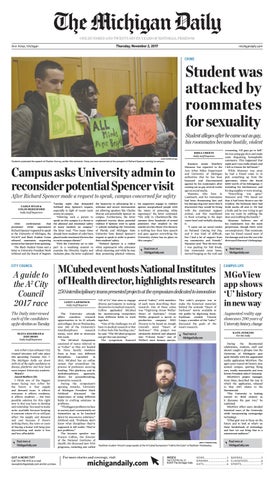
Students protested the speech of Charles Murray, earlier this semester. Many are now concerned at the prospect of Richard Spencer coming to campus.
Campus asks University admin to reconsider potential Spencer visit
After Richard Spencer made a request to speak, campus concerned for safety CARLY RYAN & COLIN BERESFORD Daily Staff Reporters
After confirmation that prominent white supremacist Richard Spencer requested to speak at the University of Michigan, the NAACP and Black Student Union released statements requesting action to bar Spencer from speaking. The Black Student Union sent a letter to University President Mark Schlissel and the Board of Regents
Tuesday night that demanded Schlissel deny Spencer’s request, especially in light of recent racist events on campus. “Allowing such a person to speak on this campus is a threat to the physical and emotional safety of many students on campus,” the letter read. “Too many times already have students of color been placed under emotional distress due to racist campus climate.” With the University set to take part in a weeklong summit to examine the Diversity, Equity and Inclusion plan, the letter explained
the hypocrisy in advocating for a welcome and secure environment yet allowing speakers like Charles Murray and potentially Spencer on campus. Furthermore, the letter explained worries about potential violence if Spencer were to speak — schools including the University of Florida and Michigan State University have denied Spencer’s request to speak in order to protect their students’ safety. “Richard Spencer is a violent white supremacist who advocates ethnic cleansing, and while he may deny promoting physical violence,
his supporters engage in violence against marginalized people with the intent of protecting white supremacy,” the letter continued. “His rally in Charlottesville this summer drew hundreds of armed protesters that resulted in the murder of a Ms. Heyer. His rhetoric is nothing less than hate speech and goes against everything the University claims has no place on this campus.”
Read more at MichiganDaily.com
Business senior Matthew Mansour has reported to the Ann Arbor Police Department and University of Michigan authorities that he has been harassed and discriminated against by his roommates after coming out as gay several weeks ago on social media. Mansour, who lives in Landmark, said his roommates had been threatening him and his therapy dog ever since they’d discovered they would be living with the emotional support animal, and this manifested in them urinating in the dog’s water bowl and verbally abusing it. “I came out on social media on National Coming Out Day, and it was kind of difficult, but I had a lot of support from my community and friends.” Mansour said. “But the next day I was packing for Fall Break, (my roommate) came home, started banging on the wall and
screaming, ‘All gays go to hell.’ He was using gay slurs and made some disgusting, homophobic comments. This happened that night and I was really afraid, and I left to Denver for fall break.” While Mansour was away he had a friend come in to pick something up from the apartment, where she found $680 worth of his belongings — including his kitchenware and his dog supplies — were missing. “Everything was gone,” Mansour said. “We found out that it had been thrown out the window. My bedroom door had knife marks all over it. He had a knife and he was trying to get into my room by stabbing the door and stabbing the handle.” Mansour believes one of his roommates was the main perpetrator, though there were co-conspirators. That roommate says his friend caused most of the damage and was the one who destroyed Mansour’s belongings.
Read more at MichiganDaily.com
MCubed event hosts National Institutes A guide to MGoView the A2 City of Health director, highlights research app shows
CITY COUNCIL
Council 2017 race
The Daily interviewed each of the candidates up for election on Tuesday MAYA GOLDMAN & ISHI MORI Daily Staff Reporters
Ann Arbor’s last odd-year City Council elections will take place this upcoming Tuesday, Nov. 7. The Michigan Daily sat down with six of the eight candidates to discuss platforms and how local races impact University students. Ward 2 Jared Hoffert (D) I think one of the biggest issues facing Ann Arbor for the future is that supply and demand issue. It affects everyone: it affects residents, it affects students … the best possible solution for this right now is that you have to develop and redevelop. You need to make units available because keeping it constant where it’s at will just affect the supply and demand and cost because if there’s nothing there, the rents or costs of buying a house will keep just skyrocketing and make it less and less affordable.
Read more at MichiganDaily.com
GOT A NEWS TIP? Call 734-418-4115 or e-mail news@michigandaily.com and let us know.
CAMPUS LIFE
250 interdisciplinary teams presented projects at the symposium dedicated to innovation LIZZY LAWRENCE Daily Staff Reporter
The University already offers countless research opportunities in its 19 schools and colleges. But on Wednesday, over 250 of the University’s interdisciplinary research teams, were able to showcase this work. The MCubed Symposium consisted of teams referred to as “cubes” as they are headed by three faculty members from at least two different disciplines. Launched in 2012, MCubed has an online system that streamlines the process of professors securing funding. This platform, and its multidisciplinary approach, allows for groundbreaking, innovative research. During the symposium’s opening remarks, University of Michigan President Mark Schlissel discussed the importance of using different fields in crafting solutions to problems. “The biggest problems we face in society don’t conveniently set themselves up to be knocked down by one-source solutions,” Schlissel said. “Problems don’t know what disciplines they’re supposed to fall under. They’re just problems.” The keynote speaker was Francis Collins, the director of the National Institutes of Health. He discussed new NIH programs, including one called
“All of Us” that aims to engage diverse participants in making discoveries in medical research. Collins applauded MCubed for incentivizing researchers from different fields to work together. “One of the challenges we all have in medical research is that it often feels like herding cats,” he said. “The MCubed program can get the cats moving.” The symposium featured
several “cubes,” with members of each team describing their research. One of these cubes was “Digitizing Orson Welles’ Heart of Darkness.” Orson Welles proposed a movie to production company RKO Pictures to be based on Joseph Conrad’s novel “Heart of Darkness.” This project was ultimately shelved and adapted into “Citizen Kane,” one of Welles’s most famous movies.
This cube’s purpose was to make the historical materials behind the unmade “Heart of Darkness” movie available to the public by digitizing them. Rackham student Vincent Longo, a member of the “cube,” discussed the goals of the team’s research.
‘U’ history in new way
Augmented reality app showcases 200 years of University history, change KATE JENKINS
Read more at MichiganDaily.com
For the Daily
During the Bicentennial celebrations, students, staff and alumni caught a glimpse into the University of Michigan’s past quite literally with the augmented reality application MGoView. The app’s users toured 30 historic sites around campus, spotting flying cars, woolly mammoths and even former President John F. Kennedy. MGoView’s project manager, Evan Hoye, described the way in which the application, released in May 2017, relates to the Bicentennial. “The University is looking toward its third century as it discusses the past two,” he explained. MGoView offers users detailed historical tours of the University while incorporating cutting-edge technology. “(The) goal was to focus on the future and to look at what’s on these borderlands of technology and how we can bring that to a mainstream audience.” JOHN YAEGER/Daily
Rackham student Vincent Longo speaks at the M Cubed Symposium “Hail to the Cube” at Rackham Wednesday.
For more stories and coverage, visit
michigandaily.com
INDEX
Vol. CXXVII, No. 22 ©2017 The Michigan Daily
NEWS.........................2 OPINION.....................4 ARTS......................6
Read more at MichiganDaily.com
SUDOKU.....................2 CLASSIFIEDS...............6 SPORTS....................7
News
2 — Thursday, November 2, 2017
S A F E WA L L
ON THE DAILY: ‘U’ ALUM — FROM WOLVERINE TO LION University of Michigan alum James Earl Jones is slated to play Mufasa in Disney’s live-action remake of “The Lion King,” scheduled to come out in July 2019. He’ll be acting alongside Beyonce KnowlesCarter as Nala and Donald Glover as Simba. He is the first actor to reprise his role in a live-action Disney remake. Jones graduated in 1955 from the University, where he originally planned on being a pre-med major before transferring to the School of Music,
The Michigan Daily — michigandaily.com
Follow @michigandaily
Tweets
UMich Catholics @UmichCatholics
Theatre & Dance after deciding his passion was not medicine. While at the University, Jones was a member of the ROTC, and part of the Scabbard and Blade Honor Society. Jones has acted in severable notable roles since then, most memorably as Darth Vader in “Star Wars” and Mufasa in the original animated “Lion King.” Fans are excited at the prospect of seeing Jones act alongside some of their favorite celebrities. - RHEA CHEETI
When it’s 75: It’s too hot to walk to class can it please just be 35 When it’s 35: It’s too cold to walk to class can it please just be 75
Marissa Maniaci @MarissaManiaci Pros: profs still bring us Halloween candy Cons: college kids are a******* and take multiple pieces and eat up all the good s*** first
JOHN YAEGER/Daily Students Allied for Freedom and Equality displays two walls to promote Palestinian rights on the Diag Wednesday.
LSA SG addresses exam policy, Election Day
Overheard @ Michigan @UmichBullshit
Members sponsored a resolution for students to request alternative exam times if taking several exams on one day RACHEL CUNNINGHAM Daily Staff Reporter
LSA Student Government held its weekly meeting Wednesday evening in Mason Hall to discuss final examination policy and making Election Day a potential academic holiday. LSA SG passed a resolution 28 to 0 in favor of supporting better enforcement by the University of Michigan ensuring faculty members abide by the final examination slot they are assigned to by the Office of the Registrar. President Nicholas Fadanelli and Vice President Ryan Gillcrist, LSA seniors, and LSA junior Hanna Simmons, sponsored the resolution and discussed their concerns that many
faculty members hold their final examinations during the last day of classes rather than their allotted time slot, potentially threatening student rights to alternate examination times. They also recommended policies be changed to allow students to request alternate exam times when they have more than two exams in one day, instead of the current policy of more than three per day. “This is not only University policy that final examinations be held in the scheduled spot, but it’s also compiled in the LSA Faculty Code, the governing document of the college of LSA ... I think the fact that they’re violating the document that they approve (themselves), that in any
other circumstance they hold high above their heads when it comes to us doing anything to them that they might not fly by it … that doesn’t fly well with me,” Fadanelli said. Fadanelli also gave an update on Richard Spencer’s request to speak at the University. Spencer is a noted white supremacist who the University confirmed requested to speak but neither approved nor denied his request. “At this time, although I have not heard anything official, if I were to take a wild guess the University will most likely approve him speaking, as in let him have a space … whether or not there will be a counter-event sponsored by the University or an accommodation of the event
while also still allowing it, I am not aware of at this time,” Fadanelli said. The group also passed a resolution 27 to 1 regarding an amendment to the 18th chapter of its bylaws for better flexibility for its election policies, as well as making amendments to its ballot questions for its upcoming elections on Nov. 20 and 21. The government also welcomed a speaker on behalf of the Sexual Assault Prevention and Awareness Center, LSA senior Nora Akcasu. Akcasu discussed SAPAC’s influence on campus and its relationship with LSA SG.
“I’m in love with one of the Orgo GSIs. He’s not even hot, he just seems like he has a great personality.” sydney jo @sydney_enck50 if you think I listened to christmas music while I got ready for class today then you would be absolutely correct!
Read more at MichiganDaily.com
MANY VOICES
420 Maynard St. Ann Arbor, MI 48109-1327 www.michigandaily.com
OUR MICHIGAN
EMMA KINERY
NATHAN GUPTA
Editor in Chief 734-418-4115 ext. 1251 kineryem@michigandaily.com
NEWS TIPS
NEWSROOM
tothedaily@michigandaily.com
YEAR ONE: CELEBRATING PROGRESS, ADDRESSING CHALLENGES
EDITORIAL PAGE
734-418-4115 opt. 3 corrections@michigandaily.com
Editorial Staff rebler@michigandaily.com
ALEXA ST.JOHN
NOVEMBER 7
NOVEMBER 8
MICHIGAN LEAGUE BALLROOM 4:30–6 pm | Opening Keynote Acclaimed social psychologist Dr. Claude Steele STATE STREET (NEAR BETSY BARBOUR/HELEN NEWBERRY EAST LAWN) 11:30 am | Trotter Multicultural Center Groundbreaking RACKHAM AUDITORIUM 2–3 pm and 5–6 pm | Poster Session 3–4 pm | Community Assembly Year One Progress Report update 4–5 pm | Interactive Panel Discussion With select Bicentennial Alumni Award Recipients MICHIGAN LEAGUE BALLROOM 5:30–9 pm | Student DEI Summit Student-organized Summit focused on developing actionable plans to improve campus climate. Dinner provided.
PLUS MORE UNIT-SPONSORED AND CENTRAL EVENTS THE WEEK OF NOVEMBER 6–10, INCLUDING CLIMATE SURVEY INFORMATION SESSIONS FOR STUDENTS, FACULTY AND STAFF
DYLAN LAWTON and BOB LESSER
Managing Online Editor lesserrc@michigandaily.com Senior Web Developers: Erik Forkin, Jordan Wolff
Managing Sports Editors sportseditors@michigandaily.com Senior Sports Editors: Laney Byler, Mike Persak, Orion Sang, Max Marcovich, Ethan Wolfe, Chris Crowder Assistant Sports Editors: Rob Hefter, Avi Sholkoff, Matthew Kennedy, Paige Voeffray, Mark Calcagno, Jacob Shames
Managing Arts Editors arts@michigandaily.com Senior Arts Editors: Dayton Hare, Nabeel Chollanpat, Madeline Gaudin, Carly Snider Arts Beat Editors: Danielle Yacobson, Danny Hensel, Erika Shevchek, Matt Gallatin, Naresh Iyengar
Managing Design Editors
Business Staff EMILY RICHNER Sales Manager
CAROLINE GOLD
Media Consulting Manager
copydesk@michigandaily.com
Senior Copy Editors: Marisa Frey, Ibrahim Rasheed
BETELHEM ASHAME and KEVIN SANTO
Special Projects Manager
diversity.umich.edu/summit-events
Managing Copy Editors
Senior Opinion Editors: Anu Roy-Chaudhury, Ashley Zhang, Max Lubell, Madeline Nowicki, Stephanie Trierweiler
JUEUI HONG
LEARN MORE ABOUT EVENTS:
ELIZABETH DOKAS and TAYLOR GRANDINETTI
opinioneditors@michigandaily.com
MICHELLE PHILLIPS and AVA WEINER
photo@michigandaily.com
Statement Editor statement@michigandaily.com Deputy Statement Editor: Brian Kuang, Yoshiko Iwai
ANNA POLUMBO-LEVY and REBECCA TARNOPOL
ANAY KATYAL and NATALIE ZAK
Managing Photo Editors
Senior Photo Editors: Zoey Holmstrom, Evan Aaron, Alexis Rankin, Zach Moore Assistant Photo Editors: Claire Meingast, Katelyn Mulcahy, Aaron Baker, Sam Mousigian, Kevin Zheng
LARA MOEHLMAN
Managing News Editor alexastj@michigandaily.com Senior News Editors: Riyah Basha, Tim Cohn, Lydia Murray, Nisa Khan, Sophie Sherry Assistant News Editors: Jordyn Baker, Colin Beresford, Rhea Cheeti, Maya Goldman, Matt Harmon, Andrew Hiyama, Jen Meer, Ishi Mori, Carly Ryan, Kaela Theut Editorial Page Editors
ADVERTISING
dailydisplay@gmail.com
AMELIA CACCHIONE and EMMA RICHTER
In an
Managing Editor
SPORTS SECTION
sports@michigandaily.com
CORRECTIONS
opinion@michigandaily.com
REBECCA LERNER
arts@michigandaily.com
photo@michigandaily.com
LETTERS TO THE EDITOR
DIVERSITY, EQUITY & INCLUSION SUMMIT
ARTS SECTION
PHOTOGRAPHY SECTION
news@michigandaily.com
Bryan K. Roby, U-M Faculty
Business Manager 734-418-4115 ext. 1241 nathankg@michigandaily.com
ABE LOFY
Managing Video Editor video@michigandaily.com Senior Video Editors: Gilly Yerrington, Matt Nolan, Aarthi Janakiraman, Emily Wolfe
JASON ROWLAND and ASHLEY TJHUNG
Michigan in Color Editors michiganincolor@michigandaily.com Senior Michigan in Color Editors: Christian Paneda, Adam Brodnax, Halibut Olaniyan, Tanya Madhani, Sivanthy Vasanthan
ELLIE HOMANT
Managing Social Media Editor Senior Social Media Editors: Kayla Waterman and Anna Haritos
design@michigandaily.comeffort
to increase awareness of opportunities within the CAYLIN WATERS Brand Manager
CLAIRE BUTZ
Business Development Manager
JULIA SELSKY
Local Accounts Manager
SANJANA PANDIT Production Manager
The Michigan Daily (ISSN 0745-967) is published Monday through Friday during the fall and winter terms by students at the University OF Michigan. One copy is available free of charge to all readers. Additional copies may be picked up at the Daily’s office for $2. Subscriptions for September-April are $250 and year long subscriptions are $275. University affiliates are subject to a reduced subscription rate. On-campus subscriptions for fall term are $35. Subscriptions must be prepaid.
Michigan in Color
The Michigan Daily — michigandaily.com
Thursday, November 2, 2017 — 3
Sinigang for the sentimental Ivy League stew CHRISTIAN PANEDA
YOUNG LEE
MiC Senior Editor
MiC Columnist
In 1966, sociologist William Petersen coined the term “model minority.” Model minorities are minorities who had supposedly overcome discrimination through solid family structure and values of hard work.
Making Filipino food is to retell a story of my culture — complex, humbling and personal. Sinigang is a classic Filipino sour soup with a variety of vegetables that are reminiscent of a Filipino farm. It’s the warm hug that withholds its sentimental, cultural significance in times of a harsh Midwest winter.
Ingredients list: one new 3-year old immigrant from South Korea Prep time: 17 years Cook time: four years Servings: one
Prep time: approximately 15 minutes
Preparation list: 1. Your child is in elementary school; though they are at the prime age to play and develop social skills, quickly enroll them in private education such as Kumon.
Cook time: whenever my parents said the sinigang is ready. I used to call to ask my parents when I made it by myself. Total time: my whole existence as a Filipino American, because I never stop questioning it. Note: best prepared with Filipino parents at home, because they are the best cooks in the entire world and all-knowing when it comes to Filipino cuisine, but you reserve the right to disagree with them on other things. Ingredients • Meat (pork or salmon are my favs, but if you’re going to use salmon, it’s absolutely necessary that you use the salmon head. Go big and go home.), cubed • Tubig (water) • Patis (fish sauce, but always use the one with the green and white label because it reminds you of home) • Kangkong leaves • Sili (long green chili pepper, the best ones come from the garden in the backyard), whole • Kamatis (tomato, the best ones also come from the same garden in the backyard) • Labanos (daikon radish), sliced • Taro root, peeled and sliced • Sinigang seasoning mix, because no one has time to make sinigang from scratch. (You can find packets at your local Asian grocery store. My local Asian grocery store was 50 minutes away. I recommend Knorr or Mama Sita, but I usually just trust whatever my mom or dad picked out. Sampalok, or taramind, is the best flavor in my opinion.) • Sorry but I never learned exact quantities, because my parents cooked by feel and I carried that technique throughout life.
2. Put them in a foreign language club or school during the weekends, preferably in the mother tongue.
ILLUSTRATION BY NOAH SHERBIN
Instructions 1.
Fill a large pot with water and bring to a boil.
2.
Put the meat into the boiling pot of water.
3.
Wait for a long time, so long that you wonder the odds of ending up in the cold Midwest when your family comes from a hot and humid archipelago.
4.
5.
6.
7.
8.
9.
Become hungry.
even
12. Listen to your parents talk to each other in Ilocano and wonder what they’re talking about. 13. Add the kangkong leaves, one for each time you said thank you to your parents for giving you your life — a lot but not enough. 14. Wait for a little bit, but not too long because overcooked kangkong leaves are the worst.
more
Add the taro root and kamatis. Make sure you cook it all the way, because you heard from a Filipino friend that raw taro root is poisonous. Skim the fat out of the broth. Question why your parents never told you raw taro root was poisonous and how they knew it was properly cooked. Question the legitimacy of your Filipino friend’s sources on taro root. Add the sinigang mix and patis. Stir occasionally.
10. Put the daikon radish into the soup.
15. Enjoy with rice. Always enjoy everything with rice. It’s also not a complete meal without it. 16. Cherish each spoonful, because despite moving from small town to small town, your family has preserved the Filipino culture regardless. 17. Go home for Fall Break, for Thanksgiving, for Christmas, or every time you felt defeated and rest easy to the fact you have your family and a hot pot of sinigang ready. 18. Make baon. Take leftovers with you.
the
19. Take the strength of your family, their achievements, their sacrifice, and use that as your drive to fight.
20. Try your best to make sinigang when you’re away at college, but know that your sinigang is levels beneath your parents’and smile at the fact that they’re just happy you tried your best. 21. Find Filipino communities everywhere. Eat their sinigang. Each rendition is similar yet different. 22. Share your recipe as if it were a page out of your autobiography. It’s something to be proud of. 23. Make Filipino food whenever you can, not just sinigang, in symbolic honor of your parents’ sacrifices for you. 24. Remember that Filipino American history isn’t always academic. It’s weaved into the recipes and lessons your family passed down to you.
Best prepared with Filipino parents at home
MiC Columnist
Last week, I was in an argument. Although no punches were thrown, I felt like I got slapped in the face a few times, but I thought I did the best I could. Even though I was ducking and weaving through the racist rhetoric, it still felt like I got my ass beat. As soon as it ended, I went upstairs to my room, pulled the covers over my head, and cried. Now, I know I’m the only Black kid in my house. Most days, I think I can handle anything. But obviously, I can’t. And I should’ve known that. Even my grandma thought I was crazy when I said I was going to live with four white girls in a house my junior year of college. She knew that I didn’t really understand that being Black in a white house means constantly walking on eggshells, and making sure not to draw too much attention to your most prominent feature: your blackness. Ah, if anything, I’d like to ask Michelle and Barack… but they can’t come to the phone right now so I’m constantly stuck on mine. Scrolling, trying to muster up
4. Don’t forget to enroll them in a sport. Asians are stereotypically the best at racquet sports and sports about hand-eye coordination. Recommendation is tennis. 5. Continue to put them through copious hours of tutoring. 6. Take away video games and TV shows, as they are a waste of time that could be used for education. 7. Force them to take the Math Placement Exam and as many honors and AP courses as possible. 8. Stuff them into STEM field extracurriculars. 9. Make sure child is well-fed, but it’s not necessary to ask how they are doing. 10. Surround your child with adults who think they can control their life at whim, and never ask your child what they want. 11. Every moment should be used as a teaching lesson, including car rides and birthdays. 12. Make sure they are only involved in things that can improve résumés.
11. Put the celi in.
Classified yet obvious: room for sale, dm for details ALLIE BROWN
3. Make sure they play an instrument, preferably violin or clarinet so they are seen to be competitive and able to be in the spotlight to play the melody.
the strength to go to class. And since, I have come to one conclusion. C.C. Little and Angell are not the only problems the University of Michigan needs to confront. The University needs to address and hold accountable the assailants whom bleed out the soul, compassion and fight of the Black students. Because there aren’t any dead men coming to evict me. But these little white girls are doing everything in their power to make sure I don’t stay. It felt as though they kicked me repeatedly while I was down; I had just lived through a week of white supremacist posters were affixed to campus structures. The word “n****r” was being written on the backs of Black students’ dorm doors, screamed at a group of students and posted on Snapchat by groups of white kids. You all want to be able to say the word “n***a” in your snaps, songs and at your parties, but do you realize you use n***as every day? We write the music you blast at frat parties. We create the culture you steal. Kim Kardashian came on the scene, and now everyone wants the fat ass that was exhibited as
a “freak show attraction” on numerous Black women, most famously Sarah Baartman, in circuses during the 1800s. Kylie Jenner has made the big pouty lips (which pushed pseudo scientists to argue Black people were closer to apes) attractive. And Katy Perry has toldyou it’s okay to wear cornrows, despite the discrimination Black people encounter in schools and the job market when they wear them. Additionally, many of you all exploit Black people for a chance to reinvigorate the white savior complex passed down to you from your imperialist ancestors. You volunteer for Teach for America so you can have a feelgood résumé booster. Yet you don’t know a damn thing about the inner city or its trials. And I’m that n***a a lot of you at the University use. Somehow, somewhere along the way, I became your Negro — the proof to your friends and family that you aren’t racist. Yet, you watched as I was verbally assaulted. While I crafted intellectual, academic arguments from the Pew Research Center, academic journals and personal anecdotes, my
roommate repeatedly told me systemic prejudice no longer exists — that my experiences were superficial and fake. That white and Black people move throughout the world in the same way — insinuated that institutional racism and systematic injustice are simply in my imagination — that I have a “chip on my shoulder” and racism is only as meaningful as I let it be. I sleep in a bed 29 inches from my other roommate. Yet somehow, even though she saw me hurting and upset, she couldn’t muster the strength to say, “Stop”? Or, “She’s had enough”? You saw my eyes watering. Hands shaking. Lip quivering from the anger I felt as she dismissed my statistics and data. But you complained that I was making too much noise as she made slight after slight. We were “disturbing” your ability to study. So, I smiled. I chalked up our exchange to “politics” and went to bed. And as I lay there, feeling assailed, I realized I no longer feel safe in my home. I don’t know if I will heal. All I know is that I might need a new place to stay.
13. Use fear tactics to motivate your child, teaching them failure is never OK. 14. Buy them an entire classics book set or demand other lofty pursuits. 15. Career professions must be limited to: engineer, business and doctor.
Success Rate: 5 percent (acceptance rate of Harvard) Warning: Your recipe could go awry. Though it may look fine from the outside, there could be a sudden souring flavor as your recipe may undergo crippling depression or constant anxiety and panic attacks. No need to worry, just continue to go through the recipe and hope things get better. Notes: Make sure to ask other parents what they do with their children to make sure your recipe will not finish “last.” “If you judge a fish by its ability to climb a tree, it will live its whole life believing it is stupid” -Albert Einstein. For many East Asian parents, the ultimate measure of the success of their offspring is based on the mere names of prestigious institutions and Fortune 500 companies, worshipping them as idols and as points to brag about to their social circles. Through this belief, many Asian-American students are pigeonholed into paths that are supposed to lead to these outcomes. Granted, there are those who do make it down this path and become doctors, bankers and engineers. You often hear of these stories on the news; reflected as “model minorities,” Asian Americans are held as the gold standard for the rest of the country for our work ethic and prized as evidence that the American dream is still vibrant and possible. However, what is less often presented are the statistics on mental health for Asian Americans. Two-point-two million Asian Americans have been diagnosed with mental illnesses, and 18.9 percent of Asian-American high school students have reported considering suicide. Consider also that not all Asian Americans come from the same background. Not every Asian American came over as an immigrant working in the tech industry, and there are those who face financial hardship, with a wealth gap of the richest Asian Americans wealth being 168 times the amount of the poorest ones. I am not saying there is something intrinsically wrong with jobs such as doctors or bankers, but when it becomes a one-size-fits-all, there are consequences. When excellence becomes defined in limited and damaging ways, it removes the human aspect of it all. The fact is that humans inherently are all born with different gifts and talents, especially when these jobs are selected for the sole reason that they have high salaries. In addition, Asian Americans do not realize that the very spots at Harvard we strive for have already been given away to donors and wealthy white folks who have legacies at the school — or when admissions officers say they are moving toward more holistic approaches, valuing sports higher than musical ability in priority in admissions because too many Asians are good at music.
Read more online at
michigandaily.com
1ST SNOWFALL puzzle by sudokusyndication.com
Opinion
4 — Thursday, November 2, 2017
The Michigan Daily — michigandaily.com
JOSIE TOLIN | COLUMN
Edited and managed by students at the University of Michigan since 1890. 420 Maynard St. Ann Arbor, MI 48109 tothedaily@michigandaily.com
EMMA KINERY Editor in Chief
ANNA POLUMBO-LEVY
and REBECCA TARNOPOL Editorial Page Editors
REBECCA LERNER Managing Editor
EDITORIAL BOARD MEMBERS Carolyn Ayaub Megan Burns Samantha Goldstein Caitlin Heenan Jeremy Kaplan Sarah Khan Anurima Kumar
Max Lubell Lucas Maiman Alexis Megdanoff Madeline Nowicki Anna Polumbo-Levy Jason Rowland
Anu Roy-Chaudhury Ali Safawi Sarah Salman Kevin Sweitzer Rebecca Tarnopol Stephanie Trierweiler Ashley Zhang
Unsigned editorials reflect the official position of the Daily’s Editorial Board. All other signed articles and illustrations represent solely the views of their authors.
FROM THE DAILY
Make housing less stressful
F
all term brings a familiar struggle back to students: the scramble to get a group of friends together, the hours scouring the internet or taking to the streets to find that perfect house or apartment, the scraping together of money for a security deposit. Then, once everything is in place, they arrive at the leasing office only to find out that house has already been reserved for the upcoming school year. They thought they were being proactive. After all, school just started a few weeks ago. This is not a new phenomenon — the housing search has been an immense source of stress for students for years. The Michigan Daily Editorial Board believes students and Ann Arbor City Council must work in tandem to improve housing policies to lessen stress for students. Among the many worries students face upon their arrival to campus, none hits harder than the race to find housing before all future leases are sucked away. City ordinances require Ann Arbor landlords to honor a 70-day grace period at the start of the lease period, during which landlords are not allowed to show properties or give out housing contracts to prospective renters. The lack of time pressures students into locking themselves into a lease that is out of budget, since there is often little time in a student’s schedule for rigorous price hunting. This “running race” for housing can be particularly unfair for lowincome students who don’t have the luxury to wait in long leasing office lines. On top of economic considerations, housing has social implications. This issue is particularly salient for freshmen, who might not have a solid group of friends in the first few weeks of school. Freshmen often find themselves wondering if their budding relationships will last long enough to ensure a stress-free living situation with a group they aren’t quite sure will stay together. These problems are due in part to the fact that many leasing companies and landlords neglect to follow the regulation in the first place. According to a 2015
Michigan Daily interview with Ann Arbor property manager Jon Keller, the penalty fee for violating the 70-day rule is negligible to landlords who generate larger profits and often is not even enforced. Many landlords further bypass this regulation through reservation systems. This makes an alreadycompetitive housing season even less forgiving, as properties are scooped up off the market before many students even consider their housing situation for the next year. The city can begin to address this housing anxiety by legitimizing the 70-day rule. This would require upping the penalty fee to a price that has some teeth and enforcing it. If landlords can no longer ignore the costs incurred by violating the city code, students would be given space to breathe in those 70 days. At the very least, the housing hunt would become a more even playing field for first-year students. Ann Arbor’s new revenue from the increased fee could also be funneled into a subsidy program for lowincome students to better afford housing. With some clever political maneuvering and activism from students, the Editorial Board believes Ann Arbor City Council can agree on a fine that preserves the integrity of the law while ensuring businesses remain
SARAH JEFF | SARAH CAN BE REACHED AT SANE@UMICH.EDU
incentivized to provide housing services for the city. For most students, the housing process is a negative, anxiety-provoking experience. There is almost a consensus that finding an apartment or house is expensive and risky, especially when only freshmen are guaranteed spots in University of Michigan housing. The Editorial Board believes the most effective way to bring about change is through the Ann Arbor city government. Students should direct their frustrations to elections, to town halls, to petitioning what vexes them. City Council needs to know this is a top priority for students, who make up a substantial portion of Ann Arbor’s population. With this knowledge, it can begin to work to lower leasing costs and create a more productive system. The housing issue is complex, with fault on students and City Council alike. The letharg y seen among undergraduates is key to why nothing changes; however, City Council is to blame for deprioritizing an issue that affects a great percentage of Ann Arbor’s population. The best course of action is for students to step up and push City Council to consider the issue past the surface level. Building these relationships will be integral to instituting tangible change to make housing more affordable and less stressful to find.
Niche academia
I
’m an evolutionary noticeably and detrimentally anthropology major, and, experienced the direct effects if asked for a detailed of Western industrialism and definition of what exactly that require conservation action to means, I wouldn’t preserve a globally be able to give a unparalleled amount comprehensive of biodiversity. answer. My And here, between apologies for not the white walls of an yet memorizing Ann Arbor classroom, my degree-tailored my fellow classmates elevator pitch for and I are informed future employers — that the conservation that’s a problem for need is desperate another day. The domestically — JOSIE truth is, I had a lot of but perhaps to a TOLIN biology credits after much different my freshman year of college but degree than the international didn’t feel like taking physics to need for conservation. As fulfill the prerequisites for any centers for ecotourism and of the University of Michigan’s foreign consumerism, these more standard science majors. prime locations for biological So, I scanned LSA’s website until anthropology research face I finally found it, a major that environmental threats such incorporated my hard-earned as the logging and subsequent science credits without asking forest degradation often inflicted me to think in watts or joules. upon areas with features such as This is often the way that tropical rainforests. undergraduates end up in Basically, our discussions the more obscure corners of are grounded in specialized academia. Sometimes, these knowledge and facilitated by decisions are originally made perhaps the only person in the out of credit-based convenience, classroom with the precise with that convenience leading travel and research experience (hopefully) thereafter to a love to really understand the topic or enjoyment for the chosen area on a broader, more practiceof study. oriented scale. The fact that these niche The terminology, the fields are available to college statistics — they’re all indicative students is absolutely a good of the scientific method at thing — it really is. It’s proof that work. There’s no doubt about the college environment, major- that. Yet, this subject is much permitting, can be conducive to more theoretical than, say, academic experimentation and biochemistry, genetics and the self-discovery. However, with like. It’s a large-scale practice the specificity of these singular of an emerging field, the pursuit academic niches seeming, at of constructing a human past times, slightly disconnected unknown and reconciling from reality, what is truly gained present-day environmental issues from channeling time and energy that remain unresolved. What into these fields over other then is theory unaccompanied by subjects with a broader and more its actual practice? intersectional academic scope? And that’s just the thing: As Upper-level courses in much as we undergraduate folks the biological anthropology who’ve made our way into these department are facilitated by corners of niche academia would highly experienced professors like to put learned theory to with strong histories in practice, we’ve already limited hands-on conservation work. ourselves to an extent. With the These impressive individuals extreme specificity of these fields have doctorate degrees and comes a hierarchical academic research histories in various constraint on options for conservation hotspots such upward mobility in jobs directly as Indonesia, Kenya and New applicable to our majors. That is Zealand. These places have to say, academia is truthfully one
of the few professional places that provides jobs aligning exactly with such specific undergraduate degrees. As common knowledge would tell, jobs in academia come only after a master’s or Ph.D., necessary tools of higher education needed to whittle a vested “interest” or “passion” down to its bare bones. In limiting ourselves to rather niche fields to which we’ve had only limited exposure over just a couple of years of undergraduate study, we’re also limiting our academic scope. We then cast ourselves into unusually specific categories of self-identification. Students often adhere to majors as selfassessments of individuality, and they’re not wrong in doing so — academics make up such a vast component of college life that it seems nearly impossible not to identify, in some capacity, with a prospective degree or career path. Maybe the biggest danger of all would be to fall passively into one of these niches, limiting intersectional visibility between subjects and sacrificing holistic knowledge for specialized expertise. This is not to say that these fields aren’t just as important or interesting as pre-professional ones that leave the specialization for after undergrad. It’s also not an advisory against these areas of undergraduate study. Rather, it’s a meditation on how to possibly navigate the intersectional nature of academic subjects in a market pushing increasingly for that pinnacle of expertise, that smaller range of knowledge with somehow profound and valuable depth. So, as much as I love to theorize about the possible language of Neanderthals, I’m aware that this knowledge is only applicable in a very narrow sphere. While I’ll continue with the pursuit of my evolutionary anthropology degree, I must remember to retain a wider academic scope in order to prevent falling into a sort of passive tunnel vision within this specialized field. Josie Tolin can be reached at jostolin@umich.edu.
BEN CHARLSON | COLUMN
When character transcends policy
O
n Oct. 4, reports emerged of an alleged ambush on U.S. troops in Niger by ISIS forces occupying neighboring territory. While the first few reports by news outlets like CNN focused on the lack of information and clarity surrounding the circumstances that led to this attack, specifically why a group of 12 U.S. Green Berets would be left without backup in the middle of Niger, the narrative shifted to President Donald Trump’s response over the following weeks. Initially, U.S. Africa Command released a statement revealing that three U.S. troops had been killed in the ambush and that one member of the Green Beret team was still unaccounted for. The missing soldier, whose identity was not released until almost 48 hours after the attack, turned out to be Sgt. La David Johnson from Florida. The secrecy surrounding the mission in Niger and Trump’s subsequent response to the death of Sgt. Johnson, publicized in a recent NBC interview with his widow, Myeshia Johnson, reveals a gaping hole in the president’s character. In her account of Trump’s condolence call, which came almost two weeks after her husband’s death, Myeshia Johnson highlighted the president’s inability to show empathy for her situation and grief. Not only did she divulge that Trump’s tone “made [her] cry,” but she claimed that Trump stumbled over and nearly forgot Sgt. Johnson’s name — a statement that was backed. up by Rep. Frederica Wilson, D-Fla., who was present during the call. More than any of Trump’s policy decisions that might garner criticism from a political lens, like building a wall on the U.S.-Mexico border or destroying Obamacare, his
inability to show compassion, empathy and integrity in times of crisis is a far worse prospect for the future of this country. While Trump’s striking lack of compassion for Myeshia Johnson and her family shook the nation, unfortunately it should not come as a surprise given his actions so far during his time in office. In a previous article, “What entertainers got right,” I detailed the slow speed and lack of handson intervention with which Trump acted on Hurricane Harvey relief efforts in Houston, Texas. Though far from the domestic sphere, the ambush in Niger marked the deadliest U.S. military conflict of Trump’s presidency and instilled in many a sense of fear and confusion. Yet in the wake of these situations, Trump’s response was hesitant, distant and impersonal, highlighting what some would call an utter lack of humanity. Even worse than Trump’s emotionless responses in situations like these, however, is his use of deceit to cover up his actions. Immediately after Johnson’s interview with NBC made national news, Trump rebuked her claim that his tone and rhetoric during the call were inappropriate. Regardless of the validity of her account of the phone call, no one should challenge the feelings and judgments of a grieving widow, much less the president of the United States. Trump’s gut instinct — to lie and project his flaws onto others instead of accepting responsibility for his actions — is by no means an acceptable quality for the country’s supposed role model. When pressed about his condolence call by the media, Trump attempted to glorify his efforts by claiming that past presidents, including Barack Obama, had not called the
families of slain servicemen in the past. Unsurprisingly, this statement proved to be false. How did Trump deal with criticism from the press following his untrue claim about Obama? By blaming someone else, of course, saying, “I was told he didn’t (call the families of soldiers) often.” All of this is to say that though Trump’s policy decisions may warrant negative attention, his inability to show a basic a level of human decency and compassion during times of despair is a critical flaw Democrats and Republicans should acknowledge. And while it might seem like Trump’s character flaws are far removed from the lives of college students like myself, his rhetoric conveys a dangerous message about the power of scapegoating, which has the ability to influence hate-fueled behavior across the country. By normalizing the use of deceit and scapegoating as a defense mechanism, Trump could very well indirectly encourage the efforts of hate groups on college campuses that see the use of lies and propaganda as an excuse for their actions. For example, in September, racist language was placed on doors in West Quad Residence Hall in an act the Black Student Union said was a deliberate hate crime. It would not be fair to say that Trump’s administration has condoned actions like this, as the president has publicly condemned racist incidents that have occurred so far this year. However, if Trump consistently fails to show the qualities of respect and integrity necessary for any president, it may open what hate groups see as a window of opportunity — a far more dangerous prospect than any policy concerns expressed by the public. Ben Charlson can be reached at bencharl@umich.edu.
The Michigan Daily — michigandaily.com
Arts
TV REVIEW
Thursday, November 2, 2017 — 5
ALBUM REVIEW AMC
COURTESY OF SACHYN MITAL
‘Walking Dead’ season 8 Julien Baker’s latest is premiere ends with fizzle a portrait of heartbreak of the show is how it tends to cut to many different scenes, yet For the Daily always seems to keep the storyline coherent. It will bounce from Rick and his gang are back for Rick, to his son Carl (Chandler an explosive season eight premiere, Riggs, “Robot Chicken”), to literally. Rick Grimes (Andrew Daryl’s (Norman Reedus, “Robot Lincoln, “Robot Chicken”) once Chicken”) attacks on many of the again manages to assemble a Survivors. Instead of confusing the detailed, methodical plan to viewer, it keeps them on their toes overthrow the newest, baddest and draws in their interest. villain introduced in season six: Although the main plotline is Negan (Jeffrey about Rick Dean Morgan, and his group’s “The Good Wife”). vendetta Disclaimer: against I watched Negan’s group “The Walking called the Season 8 premiere Dead” from the Survivors, AMC beginning until there are many about season five. subplots that Sundays at 9 p.m. I was hoping this reveal heart, season premiere grit, sacrifice, would recapture vulnerability my interest in the show. It turned and loyalty. In a world gone to out to be semi-successful. hell, the writers still give these Many members of Rick’s characters complex, intricate original entourage are still around, values that can’t be discerned into making the show feel familiar and simply good or evil. Gabriel saves steady. However, some of them the head of the Hilltop Colony, have undergone some character even though the man essentially changes, like Father Gabriel threatened to kill him. Carl delivers (Seth Gilliam, “Teen Wolf”). The canned food to a stranger that previously goody-two-shoes pastor could be a potential danger. Negan has shown his darker side — one has the chance to surrender but suited up in armor, a machine doesn’t out of pride. gun and a willingness to kill he To all the viewers out there, didn’t have before. He devolves, can we just talk about this tiger? which reveals a terrifying truth: King Ezekiel (Khary Payton, Even a pastor is capable of turning “Teen Titans Go”) has a pet tiger, to murder. This example of Shiva. I’m so confused as to how. character development is strangely What does she eat? How does she refreshing, and it elevates the behave? Where did he even get her? quality of the show, somehow How has she not eaten the entire making it relatable in a completely cast yet? For a multidimensional unrelatable world. show, there are some stretches that Another fascinating feature are just too extraneous. OLIVIA ASIMAKIS
“The Walking Dead”
Throughout the episode, many scenes are a close up of Rick’s face. His eyes are bright blue, contrasted against his red, puffy eyelids. His face is drenched in sweat, and he appears to be looking off into something far in the distance. The director randomly cuts to this scene many times. Although the scene itself appears random, Rick’s face shows raw emotion and pain, which grants Lincoln an “A” in my book. This scene is used as a break between all of the high intensity drama and offers the viewer an insight to Rick’s true feelings — ones of fear and agony. In almost every scene, there is almost always a hint of music playing in the background. Whether it’s strong or mild, it tends to keep the dialogue even more dramatic or serious without overdoing it. The light piano riffs always succeed in creating a sense of nervousness whenever there is a walker around: is this person going to die right now? The biggest problem with this episode was the ending — there was absolutely no cliffhanger. For a show famous for its unnerving, jaw dropping, goosebumpworthy endings, it simply didn’t deliver. Instead, it ended in with an unrealistic, utopian dream of Rick’s that gave viewers a warm and fuzzy feeling, too foreign for this show. I may have taken a break from “The Walking Dead” but overall, the season premiere proved why this show is back for its eighth season. The drama, horror and character developments work together to generate a cohesive theme.
unseen floorboards; the intimate clatter of someone entering an Daily Arts Writer empty room builds a sense of privacy. As listeners, we are the In 2015, singer-songwriter guests in her home, allowed to Julien Baker released Sprained trespass on her solitude, voyeurs to Ankle. Filled with a hushed her introspective melancholy. tenderness, her first studio album The chronicle in “Over” tiptoed in shadows. Yet, despite the continues: a piano boldly uniformity of its muted restraint, commences, followed by the sigh the album was distinct in its humble of backing instrumentals. No reverence. The quavering delicacy vocals breach the crescendoing of Baker’s voice stripped songs like climb of orchestral harmonies that “Vessels” and “Everybody Does” eventually tapers out and smoothly to their bare transitions into bones. Rattling the first verse of Turn Out The skeletons in “Appointments.” Lights the closet, the Baker’s murmured haunting of “I’m staying in Julien Baker Sprained Ankle tonight / I won’t Matador left a lingering stop you from impact. leaving / I know Now, nearly that I’m not what two years later, Baker has you wanted / Am I?” is a gossamer released Turn Out the Lights. layer over subdued background The LP fills in the shaky outline harmonies. of Sprained Ankle with weighty Without warning there is an piano and unflinching vocals; the exoneration; within the last few masterpiece that is left behind minutes of the song, Baker delivers blooms in full color. In Turn the chorus in a half-yell. The once Out The Lights, Baker professes nearly indistinguishable piano is secrets, revelations about anything now an uproar of crashing chords. from past failed relationships to “Turn Out the Lights” follows God, with an ache that bruises. a similar pattern. The first few The beginning of the verses are like sheer curtains that album’s opening track, “Over,” dance on the edge of subconscious, is surprising. Instead of the a soft lull that breaks when Baker traditional quiet hum of Baker’s does. The cathartic howl of “When guitar, an audio narrative unfolds: I turn out the lights / there’s no a door creaks open to welcome one left / between myself and me” shuffling footsteps that rattle reveals the tension and turmoil SHIMA SADAGHIYANI
lying hidden beneath Baker’s initial measured composure. Julien Baker is defiant in a way that was rarely seen on Sprained Ankle. Her emotive declarations are unapologetic. The profession of “the harder I swim, the faster I sink” in “Sour Breath” rasps with a grating desperation. The question of “then why, then why, then why / then why not me?” in “Happy to Be Here” is a frustrated appeal that intensifies with every repetition. There is a focus on her struggle with mental health: a loss of purpose and a resulting slip into substance abuse. Songs like “Sour Breath” and “Everything That Helps You Sleep” reveal Baker’s own past experiences, bluntly detailing toxic relationships and insomnia wrapped up in layers of religious iconography — an interpersonal struggle between her Christian faith and the things she has done that she views as sinful. There is no holding back on Turn Out the Lights. The unrelenting anguish is hard not to drown in, but it’s a surprisingly easy album to listen to from beginning to end. Throughout it all, the consistency of the underlying piano and overarching motifs — stitched together by Baker’s voice as it fluctuates between soothing and heartbreaking — creates an effortless progression; every song feeds into the next. It’s the ceaseless wave of Julien Baker’s most private confessions.
BOOK REVIEW
‘We Were Eight Years in Power’ profound, essential Laith al-Saadi performing at the Michigan Theater COMMUNITY CULTURE PREVIEW
LAURA DZUBAY Daily Arts Writer
Allman and B.B. King. In addition to JACOB EMERY that, major retailer and influential For the Daily voice in the guitar community, Guitar Center, named Al-Saadi “one Finalist on NBC’s “The Voice,” of the top four blues guitarists in the Ann Arbor native and University United States.” of Michigan alum Laith Al-Saadi More than just being an iconic returns to his home-town for one Ann Arbor venue, the Michigan rockin’ concert at the Michigan Theater holds sentimental value for Theater. Al-Saadi. Armed with “I grew up a degree from in Ann Arbor, “Laith al-Saadi’s the University of and my first 40th Birthday Bash” Michigan in jazz professional Michigan Theater guitar and bass, theatre gigs and an incredible when I was a November 3rd @ 8 p.m voice and vocal kid were there.” $25 - $60 growl, Al-Saadi He performed in is a powerhouse many shows at of a vocalist and a the theater and certified master of the guitar. even “graduated from high school “We’re gonna have a blast over on (its) stage.” When Al-Saadi the evening,” Al-Saadi said in an returned from “The Voice,” the interview with The Daily. The Michigan Theater was the venue concert will feature special guest for his homecoming concert. performers made up of Al-Saadi’s This will be Al-Saadi’s second long-time friends: Ann Arbor blues time performing at the Michigan favorite Al Hill and the funky Theater since returning last year. METERS’s Brian Stoltz. On top of Before his time on the show, that, the audience should be ready Al-Saadi performed 300 nights for “tributes and surprises.” annually in Ann Arbor over the Throughout his career, Al-Saadi course of 20 years, prompting The has shared the stage with many Ann Arbor News to name him big names like Taj Mahal, Luther “the hardest working man in Ann Alison, Buddy Guy, Son Seals, Gregg Arbor showbusiness.” It was his
constant dedication and talent that captured the attention of “The Voice” producers, who gave him a VIP audition for the show. Al-Saadi started off strong with his blind audition, performing “The Letter” by Joe Cocker. As of October 31st, 2017 the video has been viewed almost 6 million times on YouTube. He’s proud to have stayed true to his style and character while on the show, performing classics like “With a Little Help from my Friends,” “The Thrill is Gone” and “All Along the Watchtower.” Now that he’s no longer on the show, this means his fanbase expects to hear the songs that he loves to perform. According to Al-Saadi, his time on “The Voice,” “couldn’t have turned out better,” because it helped him gain national and international exposure by making it all the way to the final round, while avoiding being tied to a contract that would’ve come from placing first. This gave him the freedom to perform where and what he wanted. Now, Al-Saadi is excited to be returning to the Michigan Theater to celebrate his 40th Birthday Bash where he and the audience are “gonna jam out all night.”
The term “We were eight years in power” signifies immediate connotations. Historically, it refers to the eight years of Reconstruction that occurred before white supremacy firmly reasserted itself in the South. In his new book, “We Were Eight Years in Power: An American Tragedy,” Ta-Nehisi Coates adapts it as a way of examining the eight years of Barack Obama’s presidency. The framework within which “We Were Eight Years in Power” operates is a series of eight essays in chronological order, all originally published in The Atlantic, tracing recent American history through Obama’s initial campaign to the ultimate election of Donald Trump. The question one starts the book with is, How did we get here? What led to Trump’s presidency? The sense is that the 2016 election will be the ultimate “climax” of the book, so to speak, that Trump’s victory is the “American tragedy” to which the title is referring. This both is and isn’t true. All in all, the focus of the book is surprisingly independent of the topic of Trump. For the majority of it, the 2016 election comes into play only tangentially. The true “American tragedy” that takes shape over the course of the book
doesn’t take the form of one man; rather, one gets the sense that it is really our country’s whole history that has been, and continues to be, the tragedy. A big part of this is due to the historical depth and extraordinary span of the book. The focus of many parts reaches back to the Civil War and even beyond, to the founding of this country itself. His analysis of various aspects of race bring in well-known figures like Abraham Lincoln and Frederick Douglass, but also — equally often, if not more so — names that might be less commonplace in households and history books, like Margaret Garner and Ida B. Wells. Every single subject he comes across, Coates treats with dignity, respect and complexity. The book’s approach seems to be that there is no story not worth telling. The result is a book that feels rich, natural and wholly comprehensive. Every article is extremely well researched, and yet Coates’s eloquence leaves the reader with the impression that he knew it all to begin with. These facts and stories were just at his fingertips, and because we are reading his work, they are at ours. He effectively makes things as easy as he can for the reader, at least in terms of comprehension. This is particularly impressive because the subject matter itself is in no way easy. In “We Were
Eight Years in Power,” Coates establishes a pattern of explaining an argument as fully and fairly as possible, then challenging it at every turn in order to see whether or not it holds up to scrutiny. He does this through a wide array of lenses and topics, including the black conservatism of Bill Cosby, the American-ness of Michelle Obama, the firing of Shirley Sherrod, the Civil War, the Contract Buyers League, hip hop, the murder of Trayvon Martin and so much more. The web that Coates spends the book spinning is not only historically far-reaching; it also digs deep into the fabric of American culture, entertainment and class. Some of the essays are already more well-known than others — “The Case for Reparations,” for instance, and “Fear of a Black President.” But even these are well worth revisiting within the context that Coates sets up in the book. When all of these essays are combined with Coates’s added notes, they form a complete, and profoundly articulated, image of Obama’s presidency and the layered context surrounding it. “We Were Eight Years in Power” is essential reading for anyone seeking to better understand the integral place of race within America, from one of the most eloquent masters of essay-form writing today.
Sports
6 —Thursday, November 2, 2017
The Michigan Daily — michigandaily.com
Defense “getting back to business” Under McCaffrey, scout team
pushes ‘M’ defense forward BETELHEM ASHAME Managing Sports Editor
MATT VAILLIENCOURT/Daily
Michigan defensive coordinator Don Brown has watched his team play with more intensity and physicality in practice.
KEVIN SANTO
Managing Sports Editor
There’s a lot to admire about this Michigan defense. Just ask Pep Hamilton. After all, as Michigan’s passing game coordinator, there are few out there who see the unit as much as he does. “I find myself, at times, just taking a break from trying to sort out what we’re gonna do on the next series,” Hamilton said, “and just watching how intense and how physical Don Brown’s defense is playing.” Seven times this year, the unit has warranted Hamilton’s admiration. The one exception came 12 days ago, when then-No. 2 Penn State hung 42 points and 506 yards on the Wolverines. For sophomore defensive end Rashan Gary, it was a bad feeling. Last Tuesday, he voiced that the blowout was something worth going through, something that could ultimately make this defense better. But he admitted it hurt nonetheless, and that a matchup with Rutgers was a chance to get the bad taste out of his mouth. Michigan seized that opportunity, holding the Scarlet Knights to 195 yards, notching five sacks and recording 11 tackles for loss. It was, as defensive coordinator Don Brown called it, “getting back to business.” “I’m just gonna say this: The last two weeks in practice have been unbelievably good. Period,” Brown said. “I come off yesterday’s practice, (and) we can’t go much harder. If we go much harder, somebody’s gonna get hurt. And that would be dumb, that’s on me. “It’s kind of a sense of urgency. I don’t think we were fat-catting it (before Penn State) by any stretch of the imagination, but it certainly
refocuses your energy and your enthusiasm and your passion to get the thing right.” Against Rutgers, most things did go right. But there were still mistakes. With just under 11 minutes remaining in the third quarter, the Scarlet Knights were facing 3rd-and-15 from their own 20-yard line. Rutgers quarterback Giovanni Rescigno called for the snap, and subsequently whipped a 30-yard completion to tight end Jerome Washington. It was well covered by Noah Furbush, but the senior linebacker couldn’t manage to turn his head around and break up the pass. Just four plays later, there was another setback. Rescigno lined up on 1st-and-10 from Michigan’s 38-yard line, floating a pass to Hunter Hayek on the left sideline. Junior safety Tyree Kinnel tracked the Rutgers wide receiver the entire way, but Hayek still made a highlight reel play, pulling off a one-handed catch for a 21-yard gain. On plays like that, Brown said he can only credit the opposing quarterback. And those plays aren’t cause to dismiss his aggressive, man-coverage scheme. As Brown put it himself, zone coverage is “just not what we do.” He did qualify that by saying that Michigan will, at most, line up in combination zone coverage — something the Wolverines did frequently against the Scarlet Knights. But he has no interest in allowing receivers to run free through a zone. Instead, he stressed that he would rather teach fundamentals, allow defensive backs coach Brian Smith and secondary coach Mike Zordich
Classifieds
to train the Wolverines’ secondary and implement other coverage concepts when appropriate. One play, however, did warrant Brown’s attention. It just so happened to result in one of Rutgers’ two touchdowns. With just under 11 minutes left in the second quarter, wide receiver Janarion Grant took the direct snap from the Scarlet Knights’ own 35. He faked the handoff and picked up a block on the left side of the line before cutting back to the middle. From there, he beat every Michigan defender in a foot race to the end zone. “The one play that just irks the hell out of me was the run play,” Brown said. “That’s simple. … Guard pull, wide pull, one of our guys misses the pull. So obviously that’s on me. It’s not on him — didn’t run it enough or something. So you’ve gotta make sure you get on the pull. “But still, (we) have a middle third defender coming down. We still have a back side that I don’t think was flying to the rock. We’ve got to fix that, and that’s what we talked about, is if you eliminate that run play right there and one other play, I mean come on, come on, that’s pretty good defense.” Brown isn’t wrong. But the direct snap was a large reason why the Wolverines were thrashed in State College. It came back to bite them only a week later. And they will surely see that play in the coming weeks. But Michigan’s defensive unit took that loss personally. If that is any indication, they will take Grant’s touchdown personally, too. Just ask Gary. “If people think that we need to prove things to them,” he said last Tuesday, “they need to watch this game and every game after that.”
Call: #734-418-4115 Email: dailydisplay@gmail.com
RELEASE DATE– Thursday, November 2, 2017
Los Angeles Times Daily Crossword Puzzle
FOR RENT
Edited by Rich Norris and Joyce Nichols Lewis
ACROSS 1 Ford crossover SUV 5 Fawning flattery 10 Void partner 14 Melt fish 15 Surrounding glows 16 Pennsylvania city subject to lakeeffect snow 17 Where to find 37-Across 20 Go hog-wild 21 Gardener’s transplant 22 Penn of “Harold & Kumar” films 23 U.N. workers’ gp. 24 Where to find 37-Across 33 Table spreads 34 Ostrich kin 35 “__ rule ... ” 36 Clutter-free 37 Road trip troubles ... and what can be found in 17-, 24-, 43- and 57Across 39 Piedmont bubbly 40 Nine-time NHL All-Star 41 Walk or run 42 Cathedral areas 43 Where to find 37-Across 47 Map line: Abbr. 48 Kendrick Lamar’s genre 49 Greek vowels 52 Send up 57 Where to find 37-Across 60 Popular jeans 61 “Once Upon a Time in China” star 62 Attitude 63 White-tailed seabird 64 Dutch painter of “The Drawing Lesson” 65 Poker buy-in DOWN 1 Abbr. in an abbreviated list 2 Con 3 Pest you might slap 4 British peer
5 South Pacific islander 6 Oaty breakfast mix 7 Obama Education secretary Duncan 8 Traitor 9 [Yawn] 10 Cell using a synapse 11 Bear in the sky 12 Willingly 13 For fear that 18 Tips for dealers 19 Checks figures intently? 23 Post-op sites 24 Dismissive words 25 Last Olds off the line 26 Furnish with more weapons 27 One of four in Mississippi 28 Under, poetically 29 Clock-setting std. 30 Italian Renaissance poet 31 Aromatic compound 32 Jack up 37 Ramadan ritual 38 Fleur-de-__
39 Germane 41 Grate together, as teeth 42 Mold that’s cold 44 Slide by 45 Big name in databases 46 Has leftovers, say 49 Daysail destination 50 Terminer’s partner, in law
51 Feds under Ness 52 Place to build 53 Parks whose famous bus is in the Henry Ford Museum 54 Shah’s former land 55 Fragrant peel 56 Cato’s “to be” 58 a.m. beverages 59 Fishing aid
ARBOR PROPERTIES Award‑Winning Rentals in Ker‑ rytown Central Campus, Old West Side, Burns Park. Now Renting for 2018. 734‑649‑8637 | www.arborprops.com
ANSWER TO PREVIOUS PUZZLE:
FALL 2018 HOUSES
xwordeditor@aol.com
11/02/17
# Beds Location Rent 11 1014 Vaughn $7700 9 1015 Packard $6525 6 511 Linden $4800 6 1016 S. Forest $5400 6 1207 Prospect $4900 6 1355 Wilmot Ct. $5075 5 935 S. Division $4000 4 412 E. William $3200 4 507 Sauer Ct $3000 4 509 Sauer Ct $3000 4 827 Brookwood $3000 4 852 Brookwood $3000 4 927 S. Division $3100 4 1210 Cambridge $3400 Tenants pay all utilities. Leasing starts Nov. 10th Reservations Accepted till 11/8. CAPPO/DEINCO 734‑996‑1991
There is a long list of Wolverines who have built the Michigan football team’s defense into the fourth-ranked unit in the nation. But when defensive coordinator Don Brown was asked Wednesday about the state of his unit, he sang the praises of a Wolverine that might catch people by surprise. That’s because he doesn’t play defense. “When we’re going in practice, not only are we good on defense,” he said, “Our scout team, without question, with Dylan McCaffrey at the helm, they go now.” The true freshman quarterback may not have taken the field in a Michigan uniform yet, but he wasted no time making his impact on the team. According to Brown, the past two weeks of practice have reached a new peak of intensity, as the Wolverines have taken it upon themselves to continue to improve on a daily basis. Even though Michigan has two losses on the season, Brown claimed that the expectations for the team haven’t been reduced. But in order for the defense to push itself to compete at a high level, the scout team has to prepare for the particular offense of the upcoming opponent. That is where McCaffrey has proven to be most valuable. “This is a special guy now,” Brown said. “... From our standpoint — to get ready — it’s nice when you have a scout team that is committed to the defense. “…These guys take it seriously, and they help us get ready to play on Saturdays. And he spearheads it.” Brown noted that he sees the young quarterback inside Schembechler Hall “all the time”, eager to bury his head into the playbook of the next team the Wolverines will face. Leading up to their game against
Minnesota, that preparation has shown up on the practice field. “There’s a couple plays yesterday where he has to re-center the tight end, re-center the back and then run this specific scheme,” Brown said. “I swear it was the quarterback from Minnesota doing it ‘cause he did it exactly the same way. “Our guys got him watching a little tape there, but then to come out and actually do it the same way. … It just gives you a chance.” Instead of simply going through the motions and lamenting their standing on the scout team, those Wolverines have bought into the importance of their role in Michigan’s success. Taking the reins as the leader of that unit, McCaffrey has helped them do just that. “When a guy takes it upon himself like that, he takes the whole group with him,” Brown said. “That gives us a chance to have a quality practice. And you don’t realize how important that is until, at the end of practice, you go, ‘Wow, that was really a good practice. We got a lot of work done.’” Brown isn’t the only coach who
KATELYN MULCAHY/Daily
True freshman quarterback Dylan McCaffrey has made an early impression.
Michigan set to host Ferris State JACOB SHAMES Daily Sports Writer
Last October, the Michigan hockey team traveled to Big Rapids, Mich. for its first road test of the season against Ferris State. The Wolverines were outshot 29-16, and only took the lead for good with four minutes to play, pulling out a 2-1 victory over the Bulldogs. Of course, if it isn’t clear by now, this is a much different Michigan team, one coming off an impressive weekend split at No. 15 Penn State in which it scored nine goals. While last season the Wolverines were a young, inexperienced squad learning the nuances of the college game, Michigan (4-2 overall) now possesses a balance of skilled underclassmen and veterans eager for redemption. Against Ferris State (2-51), the Wolverines will try to maximize this balance and hope it comes together at the same time. Michigan’s underclassmen carried them against Vermont two weeks ago, recording six of the Wolverines’ seven goals and seven of 10 assists. But in State College, it was the upperclassmen’s turn to take charge: Michigan was paced
by the line of seniors Dexter Dancs and Tony Calderone and junior Cooper Marody, who combined for six goals and nine assists against the Nittany Lions. “We’re gonna need the younger guys to chip in,” said Michigan coach Mel Pearson. “They’ve chipped in a little bit, but we need a little bit more and we’re going to ask more of them.” Whether it’s the underclassmen or the upperclassmen finding the net, a balanced attack has been one of the Wolverines’ strengths so far: Six of them have scored multiple goals throughout the season’s first six games, led by Calderone and Marody with three apiece. Meanwhile, perhaps the biggest story of last weekend was how Michigan’s defense rebounded from a shaky performance Friday night, where it surrendered 54 shots and five goals. On Saturday, sophomore goaltender Hayden Lavigne saved 42 of the 44 shots he faced, and the Wolverines turned in a tougher, more physical effort, blocking 29 shots on defense. The goaltender battle, one of the biggest storylines for Michigan before the season, saw a turning point this weekend. Pearson originally had hoped to see either
MAY 2018 – 6 BDRM HOUSE 811 Sybil ‑ $4400 Tenants pay all utilities. Showings Scheduled M‑F 10‑3 24 hour noticed required DEINCO PROPERTIES 734‑996‑1991 By Peg Slay ©2017 Tribune Content Agency, LLC
11/02/17
has noticed McCaffrey’s influence on the scout team. Passing game coordinator Pep Hamilton noted how well McCaffrey has been able to handle the challenge of facing off against one of the best defensive units in the country. “He has really good football instincts as far as having an understanding of what the defense is trying to do to him,” he said. “And with (Brown’s) defense, it’s real simple: they’re trying to hit the quarterback. … But he’s responded well in the situations that we’ve put him in.” On a unit where it would be easy for him to fly under the radar, McCaffrey has stood out instead. Despite entering as the No. 6 quarterback in the nation, the true freshman knew he wouldn’t have the opportunity to play on Saturdays in his first fall in Ann Arbor. He has done the next best thing: prepare his teammates to play. “It’s next door to what you want on a Saturday,” Brown said. “So in terms of giving us a chance from a preparation standpoint, all those things are in place.”
SAM MOUSIGIAN/Daily
Michigan coach Mel Pearson has challenged his underclassmen to step up.
Lavigne or sophomore Jack LaFontaine assert themselves as Michigan’s No. 1 between the pipes by this point. But with the strong performance of both so far this season — LaFontaine and Lavigne rank second and third in the Big Ten in save percentage, respectively — that doesn’t appear likely to happen in the near future. “We rotated them right from day one and it looks like that’s going to continue,” Pearson said Saturday. “I come from a school of being a one-goalie guy, but we have two good ones and the competition is good. They push each other and I hope it continues, because if they’re both playing that means they’re both playing well.” Whether it’s LaFontaine or Lavigne, Ferris State will have its work cut out for it regardless. The Bulldogs average just 1.5 goals per game and have converted an NCAA-low five percent of their shots in eight games this season. Forwards Corey Mackin and Mitch Maloney lead Ferris State with five and four points, respectively. But goaltender Darren Smith might be most important if the Bulldogs are to pull an upset. In four games this season, he has allowed an average of 2.2 goals and posted a .927 save percentage. A needed area of improvement for the Wolverines is discipline. Michigan’s special teams units were particularly impressive this weekend, stopping all eight of the Nittany Lions’ power plays. But this performance, no matter how solid, wouldn’t have been needed if not for the 18 penalty minutes the Wolverines racked up Saturday, and they know they must stay on the ice to sustain their defensive momentum. “We’ve got to do better,” Pearson said Saturday. “To be the leastpenalized team in the conference, that’s our goal. … Sometimes some things happen, but we’ve got to be more disciplined and understand how to manage that and manage how they’re calling the game.” If Michigan is able to take the lessons it learned last weekend into this weekend’s contests and execute to its full potential, it will be tough for Ferris State to keep pace.
The Michigan Daily — michigandaily.com
Thursday, November 2, 2017 — 7
8 — Thursday, November 2, 2017
The Michigan Daily — michigandaily.com