Weekly Summer Edition Ann Arbor, MI
inside NEWS
City Council Ward I candidate Anne Bannister discusses her plans to improve city council if elected. >> SEE PAGE 2
NEWS
Immigration Community discusses protections for undocumented residents.
michigandaily.com
ONE-HUNDRED-TWENTY SIX YEARS OF EDITORIAL FREEDOM
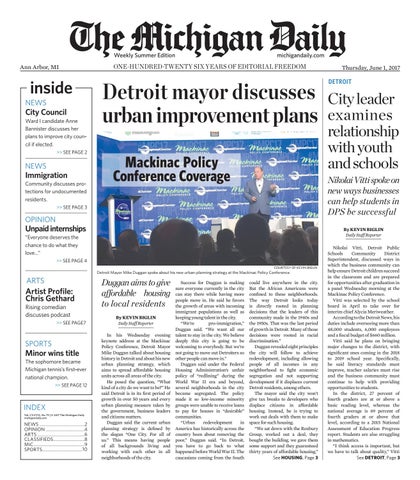
Detroit mayor discusses urban improvement plans Mackinac Policy Conference Coverage
OPINION
Unpaid internships
Daily Staff Reporter
>> SEE PAGE 4 COURTESY OF KEVIN BIGLIN
Detroit Mayor Mike Duggan spoke about his new urban-planning strategy at the Mackinac Policy Conference.
Rising comedian discusses podcast
>> SEE PAGE7
SPORTS
Minor wins title The sophomore became Michigan tennis’s first-ever national champion. >> SEE PAGE 12
INDEX Vol. CXXVII, No. 75 | © 2017 The Michigan Daily michigandaily.com
NEWS .................................... 2 OPINION ...............................4 ARTS ......................................6 CLASSIFIEDS.........................8 MiC.........................................9 SPORTS................................ 10
City leader examines relationship with youth and schools
By KEVIN BIGLIN
“Everyone deserves the chance to do what they love...”
Artist Profile: Chris Gethard
DETROIT
Nikolai Vitti spoke on new ways businesses can help students in DPS be successful
>> SEE PAGE 3
ARTS
Thursday, June 1, 2017
Duggan aims to give affordable housing to local residents By KEVIN BIGLIN Daily Staff Reporter
In his Wednesday evening keynote address at the Mackinac Policy Conference, Detroit Mayor Mike Duggan talked about housing history in Detroit and about his new urban planning strategy, which aims to spread affordable housing units across all areas of the city. He posed the question, “What kind of a city do we want to be?” He said Detroit is in its first period of growth in over 50 years and every urban planning measure taken by the government, business leaders and citizens matters. Duggan said the current urban planning strategy is defined by the slogan “One City. For all of us.” This means having people of all backgrounds living and working with each other in all neighborhoods of the city.
Success for Duggan is making sure everyone currently in the city can stay there while having more people move in. He said he favors the growth of areas with incoming immigrant populations as well as keeping young talent in the city. “We’re pro-immigration,” Duggan said. “We want all our talent to stay in the city. We believe deeply this city is going to be welcoming to everybody. But we’re not going to move out Detroiters so other people can move in.” Duggan said under the Federal Housing Administration’s unfair policy of “redlining” during the World War II era and beyond, several neighborhoods in the city became segregated. The policy made it so low-income minority groups were unable to receive loans to pay for houses in “desirable” communities. “Urban redevelopment in America has historically across the country been about removing the poor,” Duggan said. “In Detroit, you have to go back to what happened before World War II. The caucasians coming from the South
could live anywhere in the city. But the African Americans were confined to these neighborhoods. The way Detroit looks today is directly rooted in planning decisions that the leaders of this community made in the 1940s and the 1950s. That was the last period of growth in Detroit. Many of those decisions were rooted in racial discrimination.” Duggan revealed eight principles the city will follow to achieve redevelopment, including allowing people of all incomes in any neighborhood to fight economic segregation and not supporting development if it displaces current Detroit residents, among others. The mayor said the city won’t give tax breaks to developers who displace citizens in affordable housing. Instead, he is trying to work out deals with them to make space for such housing. “We sat down with the Roxbury Group, worked out a deal, they bought the building, we gave them some support and they guaranteed thirty years of affordable housing,” See HOUSING, Page 3
Nikolai Vitti, Detroit Public Schools Community District Superintendent, discussed ways in which the business community can help ensure Detroit children succeed in the classroom and are prepared for opportunities after graduation in a panel Wednesday morning at the Mackinac Policy Conference. Vitti was selected by the school board in April to take over for interim chief Alycia Meriweather. According to the Detroit News, his duties include overseeing more than 48,000 students, 6,000 employees and a fiscal budget of $660 million. Vitti said he plans on bringing major changes to the district, with significant ones coming in the 2018 to 2019 school year. Specifically, he said literacy standards must improve, teacher salaries must rise and the business community must continue to help with providing opportunities to students. In the district, 27 percent of fourth graders are at or above a basic reading level, whereas the national average is 69 percent of fourth graders at or above that level, according to a 2015 National Assessment of Education Progress report. Students are also struggling in mathematics. “I think access is important, but we have to talk about quality,” Vitti See DETROIT, Page 3
2 NEWS
Thursday, June 1, 2017 The Michigan Daily — michigandaily.com
Ward 1 candidate Anne Bannister looks to bring transparency to city council Bannister, a life long Democrat, said she was encouraged to run by her neighbors By ANDREW HIYAMA Summer Daily News Editor
On Tuesday, August 8, Ann Arbor residents will vote in the primary election for City Council. In Ward 1, Democrat Anne Bannister is challenging the incumbent, Democrat Jason Frenzel, who lost to Councilmember Sumi Kailasapathy in last year’s election, but was appointed by the council to fill a vacancy left by Councilmember Sabra Briere’s abrupt resignation. Bannister, a lifelong Democrat, University of Michigan alum and now Certified Financial Planner, said she was encouraged to run by neighbors who felt their voices weren’t being heard by City Council. She joined the Daily for an interview Monday to discuss
who she is, why she’s running, and what she sees as the main issues facing Ann Arbor city government. TMD: Let’s start with the basics. Why do you want to be on City Council? AB: Well, I’m a 43-year resident of the town, and I moved into the first ward — so I’ve been 27 years with my neighbors down here in the first ward. And I’m a personal finance educator. That’s my background. Running for City Council was not on my radar. I do volunteer, I’m going to Huron High this Wednesday as a guest speaker in the economics class, and my main work is in educating people in the basics of personal finance. But then in April, community activists started to get concerned about the existing council members that were not listening to the residents enough, that they were disregarding a little bit of the public process in things that we, as residents, feel that we need a bigger voice in. They’re also a little bit brushing aside local business too. As an educator, I want to help people understand a little bit more about — you know, we all understand national politics, and
even quite a bit about state politics — but when it comes down to the city decisions that are affecting long-term effects on the future of Ann Arbor, I find that people don’t know what ward they’re in, they don’t know who their council member is, and they’re not sure about anything. So that’s one of the reasons I’m running, is to help people understand the
WARD 1 CANDIDATE ANNE BANNISTER COURTESY OF ANNE BANNISTER
decisions that are being made that affect us, without having to decipher — I want to decipher it for them. It’s not about Anne Bannister’s opinion about anything. It’s about listening to the neighbors and the voices, and what they feel are priorities in the city, and then trying to represent those voices at the council meetings. TMD: By running for a Ward 1 seat, you’re going to inherently be challenging the incumbent Jason Frenzel. What are your thoughts on your opponent? AB: I’ve been a friend of Jason’s for years. I bump into him out on the hiking trails in our neighborhood, and I’m also friends with his (step)mom, Sandi Smith. So it’s not a big divisive race — we’ve all been friends. But I think, back in April, when community activists were concerned about some of the vote ... we have a public lot downtown next to the public library, and our taxpayers own that lot, and we own the parking structure underneath it. That’s a public piece of land. There were petitions; 5,647 people signed that they wanted a bigger voice in creating some sort of different development on that lot. I want
to put people first and bring that voice to City Council and make sure that we are represented in these decisions that are forever going to change Ann Arbor. TMD: You’re a Certified Financial Planner. Can you explain a little more about what that means, and how you think it prepares you to be on Council? AB: The Certified Financial Planner designation — roughly only half of the people in the country who sit for that exam actually pass it. It’s sort of a gold standard for people in financial planning. And not only does it show that we’ve really studied taxes — so I’m a lifelong financial person, I started out as a bank teller when I was at U of M. One of the things — and maybe this is too big of a word — is fiduciary. I’m a big believer that the person sitting across the table from you, whether you’re their financial planner, or whether they’re your neighbor and you’re on City Council, people need to know that person is representing your best interests. We call it the fiduciary. In order to be a CFP, you have to take ethics courses every two years to make sure that you understand that you don’t represent any particular investment or commercial interest, you represent the best interests of the person who’s seeking your advice, who thinks you’re protecting them. If my neighbors tell me that they want better safety at the crosswalk, then I want to take that voice and work to make sure that the city’s actions and budget priorities reflect what people are saying they need. So it’s a code of ethics, where I’m just a plain old resident, and I’m not running for a political career, I’m not running because I’m a real estate developer or anything, I’m running just because I’m 53 years old, and it feels good to me to do the right thing for the people for the greater good and to listen to what their priorities are. TMD: Walk me through your political experience. I know you served a variety of roles in the Ann Arbor Democratic Party, but what kinds of things did you do, and what did it provide you?
Read more at MichiganDaily.com
420 Maynard St. Ann Arbor, MI 48109-1327 www.michigandaily.com
NISA KHAN
JUEUI HONG
Editor in Chief 734-418-4115 ext. 1251 nisakhan@michigandaily.com
Business Manager 734-418-4115 ext. 1241 jueuih@michigandaily.com
CONTACT INFORMATION Newsroom
Office hours: Sun.-Thurs. 11 a.m. - 2 a.m. 734-763-2459 opt.3
News Tips Corrections Letters to the Editor
news@michigandaily.com corrections@michigandaily.com
tothedaily@michigandaily.com or visit michigandaily.com/letters
Photo Department Arts Section Editorial Page Sports Section Magazine Advertising Department
photo@michigandaily.com arts@michigandaily.com opinion@michigandaily.com sports@michigandaily.com statement@michigandaily.com Phone: 734-418-4115 dailydisplay@gmail.com
EDITORIAL STAFF Dayton Hare
haredayt@michigandaily.com
Jennifer Meer
Managing Editor
Managing News Editor
news@michigandaily.com SENIOR NEWS EDITORS: Andrew Hiyama, Kaela Theut
Sarah Khan
Editorial Page Editor
tothedaily@michigandaily.com
Jacob Shames
Managing Sports Editor
sportseditors@michigandaily.com
Will Stewart
Managing Arts Editor
arts@michigandaily.com SENIOR ARTS EDITOR: Dom Polsinelli
Alexis Rankin and Max Kuang
Managing Photo Editors
photo@michigandaily.com
Michelle Phillips
Managing Design Editor
design@michigandaily.com
Emily Miiller
Managing Copy Editor
copydesk@michigandaily.com SENIOR COPY EDITOR: Ashley Woonton
Christian Paneda
Managing MiC Editor michiganincolor@michigandaily.com
Abe Lofy
Managing Video Editor
video@michigandaily.com
Ishan Vashinta
Managing Web Editor
ivashi@michigandaily.com
Ellie Homant
Managing Social Media Editor
The Michigan Daily (ISSN 0745-967) is published every Thursday during the spring and summer terms by students at the University of Michigan. One copy is available free of charge to all readers. Additional copies may be picked up at the Daily’s office for $2. Subscriptions for fall term, starting in September, via U.S. mail are $110. Winter term (January through April) is $115, yearlong (September through April) is $195. University affiliates are subject to a reduced subscription rate. On-campus subscriptions for fall term are $35. Subscriptions must be prepaid. The Michigan Daily is a member of The Associated Press and The Associated Collegiate Press.
Thursday, June 1, 2017 The Michigan Daily — michigandaily.com
DETROIT From Page 1
HOUSING From Page 1
said. “It can’t just be babysitting. It has to be deep intervention and literacy development. I think the opportunity for the school district is to have curriculum that’s directly aligned to the standards. We can’t wait until third grade to make sure students are on grade level.” A major factor inhibiting educational development, according to Vitti, is poverty. This, he said, leads to social and emotional distress, which wears on many students’ ability to learn. “We can’t talk about our children and our school system without talking about poverty,” Vitti said. “There has to be ways of overcoming literacy challenges at young ages, early learning opportunities, access to address social and emotional needs, mental wellness needs — those are real factors that get in the way of being on grade level in reading, math science and social studies.” COURTESY OF KEVIN BIGLIN New DPS Superintendent Nikolai Vitti discusses major changes he plans to implement in the school district next year.
Read more at MichiganDaily.com
Duggan said. “We can do this. And we can keep people downtown.” On the topic of economic segregation, Duggan said the city will not help finance any housing development unless they allocate at least 20 percent to being affordable units. The mayor turned to successes of this policy with the Strathmore apartments in midtown. They were renovated over the last three years and now offer 40 percent of their units to lower-income renters. “I’ve got 20 separate projects across the downtown and midtown area with 1,000 guaranteed affordable units,” Duggan said. “Instead of being stuck over here in six towers, with the poor in one place, and everybody else somewhere else, we spread the affordable housing across downtown and midtown because this is what we believe as a city.” Another principle for Duggan over the past three years has been
NEWS 3
blight removal. While restoring as many houses as possible and removing those deemed unsafe, Detroit has been able to increase property values. “The homesale prices are up 50 percent,” Duggan said. “If you listen to the media, you would think it’s in downtown and midtown, and nothing’s happening in the neighborhoods. In the neighborhoods, they know that the great majority of the neighborhoods have seen home improvements of more than 50 percent in the property values.” The city is removing urban blight at an unprecedented rate, with 4,000 houses being torn down per year, which is four times faster than any other U.S. city. Duggan said 1,500 formerly vacant houses are now fully restored and another 1,500 are in the process of rehabilitation. “People thought Detroit had no future,” Duggan said. “When you take out the burned down houses on the block, people will buy the other houses.”
Read more at MichiganDaily.com
Campus and city leaders reflect on immigration events in Ann Arbor community, discuss action moving forward Leaders on campus and the city of Ann Arbor affirm strong intent to protect the immigrant populace By JENNIFER MEER Summer Managing News Editor
In the aftermath of incidents involving immigration spanning several months, campus and Ann Arbor leaders affirm a strong intent to protect immigrants in the area, in reaction to the new political climate created during President Donald J. Trump’s first 100 days. Earlier this month, the Washtenaw County Board of Commissioners pledged $145,000 in taxpayer funds to services for immigrants and undocumented residents. The board passed three resolutions by a vote of 6 to 1 — one of which affirms the funding, while the other two prevent county officials from asking for an individual’s immigration status
under most circumstances and ask Congress to modify immigration policy such that it “creates clear and reasonable immigration sanctions short of deportation for noncitizens convicted of crimes.” The funds are to be split between the Barrier Busters coalition — several agencies that provide short-term support for citizens and immigrants — and the Michigan Immigrant Rights Center, a resource for immigrants and immigrant advocates in Michigan. In a May interview, Sara Cusack, an LSA alum who now works for MIRC said the funding will be very useful, speaking for herself and not as a representative of MIRC. “The grant that Washtenaw just agreed to give to MIRC… will hopefully in the future allow us to have an attorney who focuses on immigration matters specifically in Washtenaw County, whereas right now we serve all of Michigan broadly and have really limited resources,” Cusack said. “We have to be very stringent about what types of cases we can take, and so what Washtenaw County is kind of saying by
giving this donation to MIRC is that they’re investing in the wellbeing of immigrants and their community.” In Ann Arbor, the city council is no stranger to immigration support either. In an interview, City Council Member Chuck Warpehoski (D–Ward 5) reflected back on the work the council has done in recent months to protect immigrants. “I think, in broad strokes, Ann Arbor is a diverse community and immigrants are important members of our community — both documented and undocumented,” he said. “We want to make our community safe and welcoming for everybody.” In January, the council passed a resolution urging then-President Barack Obama to protect students who applied to the Deferred Action for Childhood Arrivals program. Established by Obama in 2012, DACA allows undocumented immigrant youth, under certain circumstances, to receive a deferral from deportation as well as a work permit. At the council meeting, Jessica Provinski, a member of BAMN — the Coalition to Defend Affirmative
Action, Integration and Immigrant Rights and Fight for Equality By Any Means Necessary — said she hoped to see Obama sign one last order before he left office. “(Obama) must use his executive power to do everything he can to defend young immigrant recipients of the DACA program,” Provinski said. “If we are to defend each other and our society from a dark future, we must protect the most vulnerable of us.” One day prior to the passage of the resolution, on Martin Luther King Jr. Day, the University Michigan chapter of BAMN organized a protest against the inauguration of President Donald Trump, specifically opposing his plans to change immigration reform. The week prior, Central Student Government passed a resolution asking Obama to protect undocumented students by a vote of 26 to 4 with 7 abstaining. The policy, introduced by BAMN, asked CSG to send a statement to the White House in support of DACA students. A similar resolution, authored by memeber of the OG execuvtive board, had, in fact, passed
CSG last December, though at the time only served to express solidarity with undocumented students. Additionally, in late January, University President Mark Schlissel released a statement to affirm the University’s commitment to international students and faculty. The statement was written in response to an executive order signed by Trump banning immigration and travel of people from many Muslim-majority countries. Despite all such measures, undocumented students at the University still worry for their futures under the Trump administration. In February, four undocumented individuals were detained by U.S. Immigration and Customs Enforcement during a raid in Ypsilanti. In a March interview, a female student, who asked to remain anonymous due to concern for the safety of herself and her family, described the fear associated with living as an undocumented resident.
Read more at MichiganDaily.com
4 OPINION
Thursday, June 1, 2017 The Michigan Daily — michigandaily.com
Edited and managed by students at the University of Michigan since 1890. 420 Maynard St. Ann Arbor, MI 48109 tothedaily@michigandaily.com NISA KHAN EDITOR IN CHIEF
DAYTON HARE MANAGING EDITOR
SARAH KHAN EDITORIAL PAGE EDITOR
EDITORIAL BOARD MEMBERS Carolyn Ayaub Megan Burns Samantha Goldstein Caitlin Heenan Jeremy Kaplan Sarah Khan
Anurima Kumar Ibrahim Ijaz Max Lubell Lucas Maiman Alexis Megdanoff Madeline Nowicki Anna Polumbo-Levy
Jason Rowland Ali Safawi Sarah Salman Kevin Sweitzer Rebecca Tarnopol Stephanie Trierweiler Anna Polumbo-Levy
Unsigned editorials reflect the official position of the Daily’s Editorial Board. All other signed articles and illustrations represent solely the views of their authors.
ANNA POLUMBO-LEVY| COLUMN
A
“What are you doing this summer?”
question I hate is one, like clockwork, that I find myself answering every year beginning in April and through June. And after summer? It becomes a question in the past tense. I don’t like that question for largely two reasons. Firstly, because I sometimes don’t know what I’m going to be doing and secondly, it’s often not nearly as cool as what others are doing. But even more so because follow up questions almost always lead to the “paid or unpaid” question. Sheepishly, I would sometimes admit to someone that I am not getting paid, quickly adding that I know I’m very fortunate to be able to have the position. But sometimes, hopefully trying to avoid further conversation, I would be somewhat vague as to my position — hoping that the person won’t ask the question in the first place. Before I go further, I want to make it clear that I recognize that some people who need to get a paying job might feel uncomfortable in these conversations as they cannot necessarily accept a potentially exciting position because it is unpaid. Here, though, I can only speak to my experiences, and for me, what made me uncomfortable about this question was I had to recognize my privilege. For the past two summers, I’ve worked at a few law organizations as an unpaid intern, learning extensively about asylum law and the procedure to gain legal status
in the United States, as well as observing the workings of different civil courts and the process of eviction cases. Though I am certainly not ready to take the Bar or anything, there is no doubt I have gained valuable experience. And as became evident in interviews for internship positions, my unpaid, stipend positions at the Daily helped me get these jobs. These are
Everyone, regardless of their financial situation, deserves a chance to thrive. experiences I likely would not have had if I needed a full-time paying job throughout the year. Furthermore, though being enrolled in top schools is still important, recent findings make it clear that something else is often what sets some job candidates apart. Lauren A. Rivera, a researcher at Northwestern University, found that it wasn’t enough for someone to hail from an elite university. Extracurricular activities have become a large part of what recruiters for elite companies are looking for in their interns. More frequently now than
ever before, recruiters are doing what Rivera calls a “secondary screening” — looking for people who have also done “high status, resource-intensive activities” outside of the classroom. And these types of activities, according to Rivera, are most specifically in line with the activities of those who are white and in the upper-middle class. This practice “contributes to a social closure of elite jobs based on socio-economic status.” The bottom line? Having the ability to partake in extracurricular activities that do not pay, getting unpaid internship experiences that will give them more of a leg up, helps tremendously in the long run. And unfortunately, without change, this structure will continue to perpetuate inequalities, which is especially dire given the studies that show how certain groups of people — especially minorities — disproportionately face financial barriers to these opportunities. Nonetheless, I am not trying to say that people who work multiple jobs cannot also hold unpaid internships simultaneously. My intent is not to paint a picture that diminishes anyone’s ability to balance many responsibilities. I know many people who have multiple paying jobs and do amazing internships. But even so, there will be some internships that won’t be possible, or they will not get time to do other things and further their interests outside of work and internships. Finances
shouldn’t ever be a barrier, but they are, and we need to do something about it. Those who can work the most rigorous, all-encompassing internships, those who can afford to be paid very little if nothing at all, have their pick of a much larger number of internships. Those who can spend hours each week in organizations as an undergraduate, those who can volunteer extensively at nonprofits, are the ones whose resumes will presumably be sent to the top of the pile when they apply for jobs. I know many smaller organizations — non-profits, for example, that are helping people of low income — cannot, understandably so, pay a bunch of students to do some filing and shadow lawyers to court. But I implore the organizations that have the capabilities to do so to really invest in their interns. And the University of Michigan must also do its part. I can tell you now, administrators, if you’re reading this, that what I won’t remember is the extra comfy chairs in the study room in Mason Hall, or the extra shine of the building plaque. But what I will remember are the nights I was at the Daily until 2 a.m. to publish an editorial alongside a breaking news story. I’ll remember standing for nearly 24 hours at Dance Marathon. I’ll remember learning about asylum law and sitting in on cases at eviction court. I know funding is often tied up in a specific entity, I know it’s not as simple as reallocating funds and all that stuff. But to encourage diversity, to attract people from all walks of life, I ask that the University take the lead in continuing to create and promote scholarships for students to take on leadership roles in campus organizations and summer internships so everyone has a more equal chance at the best opportunities. Central Student Government’s
scholarship is an important start, but we need more. Everyone, regardless of their financial situation, deserves a chance to thrive. Because when given the tools, more often than not, people will take these opportunities and thrive. And furthermore, everyone deserves the chance to do what they love and not worry about the financial barriers. This might seem overly optimistic, but even as a person who leans pessimistic more often than not, I truly believe we can work toward giving everyone these chances. And for the individuals who may be reading this and frustrated because you think I am telling you to forgo your job at the American Embassy to stand up against unpaid internships, I’m not. Keep your plane ticket, move into your apartment and enjoy your job. But I implore you to recognize it as a privilege. There are many students, as summer rolls around, who can’t afford to pick and choose their jobs or internships because they need to work somewhere that will pay them. They can’t go out-of-state or abroad because that would mean finding housing and transportation. Be thankful for what you have, and do your part to work to shape the future. Whether it’s committing to continue research like Rivera’s, writing articles exposing these inequalities, advocating for changes to work policies, writing grants or lobbying for scholarships for students to do unpaid internships or take on a leadership role in a student organization, everyone can make a difference. Changes to the system don’t only have to come from the ones with millions of dollars to give to charities. Big or small, what you do will make a difference. —Anna Polumbo-Levy can be reached annapl@umich.edu.
CONTRIBUTE TO THE CONVERSATION Readers are encouraged to submit letters to the editor and op-eds. Letters should be fewer than 300 words while op-eds should be 550 to 850 words. Send the writer’s full name and University affiliation to tothedaily@michigandaily.com.
Thursday, June 1, 2017 The Michigan Daily — michigandaily.com
MICHAEL MORDARSKI| COLUMN
What I’ve learned by traveling abroad
I
am always surprised by h ow much larger places are than I imagine. With every arrival to a new country, my imagination collides head-on with the realities of the world as my flight descends toward a new airport. Every single time, I am overwhelmed with the first glance out of the plane window of my destination below — overwhelmed by the seemingly endless cities, the sheer magnitude of land and the countless number of invisible people, all carrying on with their lives oblivious to yet another tourist who is about to desperately attempt to “understand” their country and culture. And I am overwhelmed because our imaginations are selfish, they never prepare us for how much more diverse and massive the world really is. Our imaginations are constricted to storylines and creations related solely to ourselves, and as an American tourist, that means deceiving us into believing the world is small, filled with few people who matter, and that foreign countries are simply playgrounds that will adhere to our schedules and are meant to be explored with our U.S. passports and Canon cameras. Yet this is never the reality I have experienced abroad. Instead of the false narratives pictured in my imagination of a smaller world that is easy to explore and discover, I am immediately humbled by both the size and complexity with my arrival somewhere new. With every country, whether it be the island of Iceland located near the Arctic Circle, or Spain on the warm Mediterranean Sea — the world and its people immediately become materialized and brought to life, overwhelming my self-absorbed imagination and helping to expand my understanding of reality outside of our borders. To see that everywhere, life goes on, no matter how different it may be from the suburban lifestyles of the United States. The once-invisible people I imagined from the airplane window above instantly become real. Mothers with strollers on the metro, families rushing to dinner, homeless people begging near bus stops — the world suddenly collides with my imagination, and I realize how much smaller and more insignificant I am. Because having the luxury of being an American tourist means that you have the opportunity to properly invest your time abroad into some actual character building. To step out of the tourist gimmicks and
traps, and past the cliché Instagramtailored adventures and day trips — and instead, wade into the daily life of foreign cities and towns and experience how people still exist with the same stresses and desires outside of our borders. Everywhere in the world, people want not just security, food, shelter or even democracy — but the same complex lives with all the same emotions we develop back home. Everywhere, human beings are being human. They want to laugh with friends, argue over sports or competitions, to fall in love. My imagination never pictures that when I think of some foreign country. And that is why every opportunity I have to travel abroad, I continually embrace the awe I have over the size and complexity of the world and human life outside of my small suburban bubble. That hopefully my imagination — which was shaped by an adolescence living in an over-ambitious capitalistic global superpower — will one day be curbed and grow in empathy and understanding. To not picture the world as small, but remember how humbled I was by the view out of a plane window. To remember that these far-away places are filled with people like me. There is a common desire among the young, educated millennials I know to travel to and experience as many countries in the world as possible. I believe there exists this obsession (amplified by the photoworthiness of social media) to backpack across continents, and one day adorn a trendy IKEA-saturated apartment with souvenirs from Nepal to Brazil. And though on the surface, such goals may seem shallow and reflect a thinking that the world is just a playground to explore — individuals can utilize such trips to develop a greater sense of empathy, trips not for souvenirs and photos, but memories of others and experiences in new lives. And hopefully, my generation will be one to understand the necessity and importance of international cooperation. That my generation, despite our domestic problems and strife, will be able to develop a sense of empathy not only for the disadvantaged domestically but internationally, as well. I hope that my generation will not look for differences between people, but instead embrace commonalities. — Michael Mordarskican be reached at mmordars@umich.edu.
OPINION 5
ANGELA CHEN| COLUMN
I
A major misunderstanding
f you were to ask me today what I’m studying, I’d reply with full confidence and a bright smile: “I’m prepharmacy!” After all, pharmacy was always the only profession in which I could truly see myself. But a year ago, I would’ve told you I was pre-med. For a long time, I tried to believe that medicine was what I truly wanted to pursue. I tried to convince myself that bloody operation videos interested me, that my hyper-sentimental self was strong enough for the emotional ride of life and death at the bedside. While I knew I wanted to work in healthcare, to treat patients, to apply the science that I so loved, I also knew I was not meant to be a doctor. So why did I pretend? In short, I fell victim to a common misconception about the health professions, an unspoken axiom: Pharmacists are just a lesser version of doctors. Perhaps it’s why so many freshmen claim to be pre-med, and why so many pharmacy students hesitated to walk down this path in the first place. After all, doctors are the ones saving the lives, writing the prescriptions. They’re the ones we fear as children and respect as adults, who’ve triumphed through decades of school to receive the emblem of expertise and prestige. And I do not resent this, because they indeed are all of those things — in a perfect world, I would want to be one of them. But that doesn’t change a less popular fact: medicine and pharmacy are two entirely different professions. Hence, it didn’t help when, after I’ve finally found the conviction to call myself prepharm, not everyone I knew or met was prepared to hear it. While I got the usual “Cool’s and Wow’s,” I began to notice a different, distinctly unsettling trend: “Wait, I thought you’d be pre-med because you’re smart!” “Is it because med school is too hard?” And my personal favorite: “Nice, that’s so much easier than being a doctor!” Whether or not these
comments were meant as compliments, I could not help but feel insulted. It confused me how people were so quick to compare pharmacy to medicine. It frustrated me how they accepted the stereotype so readily, without even realizing there was one. Most of all, it hurt me that they could assign a finite level of competence to a career choice that was entirely my own. Nevertheless, I couldn’t blame them. After all, compared to medicine, pharmacy is far less talked about as a profession. It was understandable that those outside of the health field tended to group the two into one muddled “clinical bubble.”
It frustrated me how they accepted the stereotype so readily, without even realizing there was one
But it was not excusable. We cannot speak for what we do not know. Though all these comments hurt, they hit the hardest when pre-med students themselves were at the outgoing end of them. To give the benefit of the doubt, I do not believe they did so because they feel superior to me, or because they have too much pride to admit they are not. The issue, as it often is, is nothing more than ignorance. We don’t teach it to our kids: while the doctor’s playing field is the human body and all that could go wrong with it, the pharmacist specializes on exogenous medications and the body’s specific responses to them. And though it’s tempting to think that this means simply putting pills in bottles at your local CVS, there is a large variety of settings at which pharmacists work and an even larger scientific skill set required to do so. Just as pharmacists cannot be “promoted” to physicians, physicians cannot “step down” and be pharmacists when the job gets too hard. They are
different in title, degree and specialty, but NOT extent of capability. In a hospital setting, where the “doctor’s superiority” assumption is perhaps most expected, this difference is clear. According to second-year Pharmacy student Cecilia Li, a current intern at Beaumont Hospital, the two professions practice separate specialties and contribute equally to the healthcare system. “There are the pharmacists who stand passively in the corner of the room, but the majority are extremely active, knowledgeable and function at the same level as doctors,” she said. “Sometimes, if I were to close my eyes and listen, I couldn’t tell if it was the pharmacist or the physician talking.” Which just goes to show that pharmacists are, like doctors, nurses, dentists — or any profession, for that matter — respected only as much as their personal performance warrants. It’s only fair, as it should be. At last, I have found the self-assurance and validation that is so, so long overdue. While becoming an actual pharmacist is quite a way down the road for me, my choice to become one is certainly not a measure of my intelligence, ambition or aptitude. Too many times over the past year, I’ve let ignorant and off hand judgements come close to dictating my entire future, and I’m tired of it. I’m tired of dreading selfintroductions, in fear that sharing my major will brand an unwanted label across my forehead. I’m tired of secretly wishing I’d done worse in school, just to justif y myself for taking a “dumber” career path. I’m tired of pretending, and even more tired of being ashamed. Now, I know I don’t have to. Each and every profession deserves merit in its own right, and should be treated as such.
—Angela Chen can be reached at angchen@umich.edu.
6 ARTS
Thursday, June 1, 2017 The Michigan Daily — michigandaily.com
ARTIST PROFILE
Gethard discusses his success as a comedian By ELI RALLO Daily Arts Writer
“I was 20 years old, hang ing out in an old strip club that had been shut down, doing comedy, and Amy Poehler was just hang ing out there ever y day. It was the most punk rock thing in the world,” said American actor and comedian Chris Gethard about the Upright Citizen’s Brigade, the birthplace of New York Cit y’s massive comedy scene (and his career). Gethard spoke on the nature of the beloved comedy joint and finding his place between its walls. “I was a little self conscious when everyone started to blow up back then… but as for me, so far, big thumbs up,” Gethard said. The hilarious New Jersey native had his start with his talk show, “The Chris Gethard Show,” at the Upright Citizen’s Brigade in 2009, after taking classes there since 2000. He has since gone on to write a book, become a well known stand-up comedian, appear on a myriad late night shows including “The Late Show with Stephen Colbert” and is currently traveling around the country to film his podcast, “Beautiful/ Anonymous,” live. Gethard fell in love with comedy when he first began taking classes in the city during college. “I was just this confused, sad kid from New Jersey that kind of found this place,” he said with a nostalgic pause upon being asked when he knew he wanted to pursue comedy as a career. Despite consistently having work in the field of comedy throughout his early career, he was continuously finding reasons to underestimate himself until he was asked by “Saturday Night Live” to be a guest writer for a few weeks in his mid twenties. The day Saturday Night Live comes knocking at your
door asking for your brain, you been receiving over 5,000 calls kind of realize you’re just where per show. The conversations you are supposed to be. range from family secrets to Gethard finds solace in the shocking confessions to psycholittle things; he sings praises of logical discussions — anything New York City, the human con- can happen, and that spontanenection, news reporters messing ity keeps the audience engaged. up during newscasts and never In his conversation with the falling into mundane routines. Daily, Gethard ref lected on the He called New York a “beauti- nature of real interaction, tying ful laboratory of comedy” and this notion of human connection spoke about the nature of doing into his intentions with creating comedy in New York by praising “Beautiful/ Anonymous.” its authenticity. “As a society, we’re moving “I like to keep things ground- away from phone calls. I can ed and real. I want to live remember when the kitchen around real people, with real phone would ring and you’d lives,” Gethard said. have no idea who would be on He believes it is truly quint- the other end. There are one essential New York City to be billion people in this world and able to perform for tourists everyone has something to say,” from Germany, a bunch of your Gethard said. comedian friends Everyone and some people definitely has from suburban something to New Jersey all in say, and the Chris Gethard: one night. words of Chris ‘Beautiful/ Gethard is just Gethard should Anonymous’ about as real as certainly not they come — in go unnoticed. June 7th @ 8 P.M. addition to an Whether he is The Magic Bag infectious perhaving a blast sonality, he is with friends $25 well spoken in a on his talk casual way, conshow, apprecistantly littering ating the gaps his responses with jokes and of silence in a live one man self-deprecating digs. He wasn’t show, hitting the punch line afraid to consider himself a in a stand-up performance or “genuinely stressed out dude” cracking up over a YouTube clip and has not let his growing fan- of drunk Ewoks on the “Today base and fame get to his head. Show” humping Al Roker’s leg, “People probably think, ‘This Gethard is creating spontaneguy shouldn’t be in the enter- ous humor and hilarious chaos tainment industry; he’s a ner- in a world that is increasingly vous guy with a giant forehead,’” scary and negative. he said. “Regular people want to “Just put me in a room with watch TV and see a regular guy. a whole bunch of people and I’m just a regular person trying give me a microphone,” he said to make a couple people laugh.” when asked what he hopes to And with that goal in mind, do more of in the future. “And Gethard has been immensely afterwards, let me go into the successful. His current proj- lobby and shake their hands, ect, the live filming of “Beau- and look each of them in the eye tiful/Anonymous,” has had an and thank them for their treoutpour of support. In the live mendous support.” performance, he takes an hour Gethard will be recording long phone call with an anony- “Beautiful/Anonymous” live mous caller and really “sinks his in Ferndale, Michigan on June teeth into the conversation in a 7th at 8 p.m. The show is 18 and big way.” He tweets out a phone over, and tickets are available number before the show and has on his website for $25.
MOVIE REVIEW
PARAMOUNT PICTURES
‘The Rock’ and his crew posing
‘Baywatch’ flops By FALLON GATES
to work with others. Summer follows the rules but discovers that breaking them can be for the greater good. Ronnie, a total geek, somehow overWith big time actors Dwayne ‘The comes the impossible and gets with Rock’ Johnson (“Fast and Furious”) a hot girl. It’s a regurgitation of the and Zac Efron (“The Lucky One”), main storylines seen in cinema over “Baywatch” (for many fans) raised and over again. the hope of a hilarious summer action While the idea of “Baywatch” is comedy. Unfortunately, it didn’t come comical, the delivery failed to make close to reaching these standards and the audience laugh out loud. The only left the audience wondering if a plot sound to be heard is an occasional could be even more uncreative than small noise produced by blowing air this one. out of one’s nose at something halfDirector Seth Gordon (“Hor- way amusing. The material of the rible Bosses”) based this film off movie is weak, superficial and unsurthe late ‘90s television series prising. The ending was already starring David Hasselknown 10 minutes into the movie. hoff. Though canceled Baywatch However, the film is not a after its first season, Paramount total waste. Efron is truly a it became a popular Pictures “blue-eyed demon” as labeled show; even members in the movie. He is reason of the television show Quality 16/Rave enough to see “Baywatch.” The “Friends” would watch Cinemas big screen was made to look at the original slow-motion shot of his countless abs and killer smile. beautiful people running on the Johnson, packed with even more beach. However, the popularity of muscle than Efron, is also a favorthe ‘90s show will not be shared with ite to watch. From movies like “The the latest version. Game Plan” and “Moana,” there is Mitch Buchannon (Johnson) is something about his warm and the chief lifeguard of the Baywatch friendly demeanor that is always crew, a legend and hero within the so enjoyable to watch. Emerald Bay he protects. Mitch, The girls, too, are absolutely along with the rest of his gorgeous drop-dead gorgeous, leaving you baywatch crew (including swimsuit with a whole new definition of model Kelly Rohrbach), holds tryouts swimsuit goals. They are so perfor new recruits. Possible candidates fect that they will probably leave including the disgraced Olympic you cringing at the site of your own swimmer Matt Brody (Efron), by- summer body readiness. Hopethe-book Summer Quinn (Alexandra fully, they can serve as some motiDaddario, “San Andreas”) and local vation to hit the gym and skip the nerd Ronnie Greenbaum (Jon Bass, junk food. “Loving”). If you like a groundbreaking, Although Mitch’s character has an makes-you-ponder movie, steer far aura of mystery and god-like abilities, away from “Baywatch.” But if you the majority of the characters are feel like shutting off your brain for one-dimensional, and the character a few hours to watch a simple plot development is annoyingly predict- with beautiful people, then “Bayable. Matt was self-serving but learns watch” is your summer flick. Daily Arts Writer
Thursday, June 1, 2017 The Michigan Daily — michigandaily.com
TV REVIEW
ARTS 7
MOVIE REVIEW
SHOWTIME
Kyle MacLachlan stars as the famous and beloved Special Agent Cooper
‘Twin Peaks’ lives on By JACK BRANDON
change the memory card on Daily Arts Writer camera three. Within the first 10 minAs foreseen by the enchant- utes, “Twin Peaks” estabing Laura Palmer, “Twin lishes itself as a continuation Peaks” is back after nearly of the narrative, but through 25 years. Kyle MacLachlan different techniques. The (“Portlandia”) returns with original two seasons were some of the original cast: firmly grounded in the ficSheryl Lee (“Winter’s Bone”), tional location, with occaRichard Beymer (“West Side sional forays across the Story”) and Al Strobel (“Child border to One-Eyed Jack’s. of Darkness, Child of Light”) Season Three defies the among many others. While constriction to the town of many of the faces from Laura Palmer’s the show have returned, Twin Peaks death and flicks the heart of “Twin back and forth Peaks” has changed, if Showtime between storylines only by a small margin. Sundays 9PM Est and timelines, Although a triumph for which would be David Lynch (“Eraserless disorienting if head”), the Showtime limited there weren’t so many new release differs in spirit from characters and facets. PerSeasons One and Two. haps, as viewers, it may be Season Three opens with necessary to trust that the a prophecy from The Giant direction will answer its own delivered to Agent Cooper questions and fill in its own in a dream, or a space like blanks, like when watching the Black Lodge. The scene “Game of Thrones.” Angelo proceeds in typical “Twin Badalamenti’s sultry jazz Peaks” style — patient, eerie and musical motifs are also and bizarre. Their conversa- lacking, leaving the audience tion, cast in black and white, listening to the sounds of precedes a delivery of shov- the moment — footsteps, an els to Dr. Jacoby at his idyl- alarm, the scratch of a record lic, quiet shack in the woods. player. After these two scenes, with Most dramatically, the paltheir intensity juxtaposed, lette of the series has changed. the narrative clips to New Many scenes are cast in cool, York City, eventually zoom- dark shades, which evoke ing in on an empty glass box gloom and heaviness. Other inside a high-rise, monitored brighter scenes are shown consistently on all sides by white, creating a mood of hosvideo cameras and a watch- tility and sharpness. Howevman. The man and the box er, when Lynch turns back to stare each other down in a the core characters that occumoment of quiet tension that py Twin Peaks — Cooper, his is broken by a notification to doppelganger, Ben and Jerry
Horne, The Log Lady, Hawk and Lucy — he restores the rich, warm, earthy tones that visually defined Seasons One and Two. The episode itself reaches two separate climaxes that at first seem to have nothing in common. The first is the grisly murder of the watchman and his daring lover, who comes to visit at an inopportune time. As they begin to have sex, a violent specter appears in the glass, bursts out of the box and shreds the couple’s heads. The second is the discovery of the decapitated head of Ruth Davenport, shot in the eye, and the body of an unidentified man in the bed of Ruth’s apartment. Lynch returns to the murder of a young, beautiful girl as a crux for the narrative. While Lynch may have left other visual motifs behind, the motifs of headlessness or the separation between body and mind are established twice within the first episode. In short, “Twin Peaks” stays true to Lynch — macabre, strange images and questions rather than answers. Episodes One and Two, released simultaneously, provide a rich, mystifying experience that may take two or more viewings to fully understand. While die-hard fans may struggle adjusting to the disparities, the limited release is ambitious, looking beyond the confines of its legacy and into the plight of FBI Special Agent Dale Cooper.
WALT DISNEY PICTURES
Johnny Depp as Capt. Jack Sparrow
‘Pirates 5’ drowns By IAN DAVID HARRIS Daily Arts Writer
There was a time when a new “Pirates of the Caribbean” movie was a cause for excitement. That time has long since passed. “Dead Men Tell No Tales,” the fifth (and hopefully final) entry in the Johnny Depp (“Mordecai”) led franchise is quite possibly the worst one yet. Picking up approximately five years after the forgettable “On Stranger Tides,” this new film follows Jack Sparrow as he joins forces with Henry Turner (Brenton Thwaites, “The Giver”) and Carina Smyth (Kaya Scodelario, “The Maze Runner”) to find the legendary Trident of Poseidon, which gives its wielder control over the seas. If this all sounds a little familiar, that’s because this is essentially the same plot that three of the other films have as well. Sword fights, chases and curses abound, but in the end it all just feels like a cheap knock-off of the earlier (and better) Pirates movies. The only things this film does well have been done better in previous films and so much of what this film does badly only takes the franchise lower than it was already. It’s difficult to say whether or not this film is worse
than the derided fourth about Captain Jack? What one. Although that movie was once an iconic charwas largely meaningless in acter has slowly become the overall trajectory of the a bumbling buffoon remiPirates saga, this time around niscent of Jar Jar Binks. In the audience is constantly the first three Gore Verbinreminded that there are bet- ski (“A Cure for Wellness”) ter Pirates movies out there, directed films, Sparrow with the presence of Orlando was witty, charming, smart Bloom (“The Lord of the and, yes, just a little bit Rings”) and Keira Knightley drunk. Now the drunken(“The Imitation Game”) con- ness is all that remains. tinually reminding the audi- Jack Sparrow does not do ence that these movies were a single thing that could actually good once. Unfortu- be called even semi-heroic nately their limited presence in the entire runtime of only adds to the sense that “Dead Men Tell No Tales.” this is a ship He barely even does that should’ve Dead Men anything useful. If he been docked taken completely Tell No Tales was long ago. By out of the movie and the end of the Walt Disney everything else was third film the Studios the same it would probcharacter arcs ably be a more enjoyable were all played Rave Cinemas/ film. It’s truly the death out, the ship-to- Quality 16 knell for the franchise ship battles had when, during the emoreached their crescendo, and tional reunion that is the it was time to let Jack Sparrow climax of the film, it cuts sail off into the great beyond. back to Sparrow and there What could’ve been remem- are audible groans from the bered as a fun trilogy of action audience. What was once flicks has instead become one the main draw has become of the most continually disap- a horrible drag on the propointing franchises in recent ceedings. It’s high time for memory. By this point the this franchise to be put into series has lost almost every- port — asking audiences thing that once made it great. to continue to sit through But by far the biggest sin of these things would be akin all is what has become of Jack to asking pirates to wash Sparrow. up and brush their teeth. What more can be said Enough already.
8 NEWS
Thursday, June 1, 2017 The Michigan Daily — michigandaily.com
U-M Dearborn reveals new small business major the University of MichiganDearborn College of Business will have the opportunity to learn how to build their own business from the ground up with the new small business
By ANDREW HIYAMA Summer Daily News Editor
Rather than finding an area of specialization, students at
Classifieds
management major that will be introduced this upcoming fall. The program will span a broad array of topics in business — focusing on all information a CEO would need to know — from
Call: #734-418-4115 Email: dailydisplay@gmail.com
RELEASE DATE– Thursday, June 1, 2017
Los Angeles Times Daily Crossword Puzzle
FOR RENT
Edited by Rich Norris and Joyce Nichols Lewis
ACROSS 1 Wines that can be white or red 7 Greetings 10 Lighthouse view 13 Widely recognized 14 Sleep on it 16 Immediate caregiver, briefly 17 Highlighted publication part 19 “All Things Considered” airer 20 Mongrel 21 Brest bestie 22 Howe of hockey 24 Singer DiFranco 25 Halves of some master-servant relationships 27 Little pitchers have big ones, per an old maxim 28 Pioneering computer 30 Stick-in-the-mud 33 Cabbage 35 Insect stage 36 Quarterback Roethlisberger 37 Nice and easy 40 Degree for Dr. Oz 43 Southwestern lizards 44 Traveling from gig to gig 46 Score keeper? 51 Takes care of 52 Boss of fashion 53 Procedures involving suction, familiarly 55 FDR agency 56 “How nice!” 59 Bridge, e.g. 60 Dandy 61 Sought office 62 What narcs may do ... or what can literally be found in three pairs of puzzle answers 66 “Microsoft sound” composer 67 Meanies 68 Result of a big hit 69 Circle div. 70 Vicious of the Sex Pistols 71 Levels of society DOWN 1 Short movie? 2 Quebec Winter Carnival race vehicle
3 Like some workers in an open shop 4 Seeking exoneration, in a way 5 Deadlock 6 Skinny sort 7 “I found the place!” 8 Wrath 9 Deer fellow 10 “Where the Wild Things Are” author 11 Rome, once 12 Not moving 14 Chiropractor’s concern 15 Bother 18 Fish-eating duck 23 Truckee Meadows city 26 Pioneering PCs 28 Diplomatic HQ 29 “Oh, be quiet!” 31 Composer Schifrin 32 Secret Service title 34 Fighter Holly who ended Ronda Rousey’s undefeated streak
38 Schlep 39 Given as homework 40 African capital named for an American president 41 Capital on the Danube 42 Horace’s “__ Poetica” 43 Natural sci. 45 “Copy that”
46 British counties 47 Compassionate 48 Creamy quaff 49 Popular tablets 50 Show up 54 Some Croatians 57 In the past 58 Ballpark fare 63 The Rams of the Atlantic 10 Conf. 64 Old PC component 65 Blues-rocker Chris
ANSWER TO PREVIOUS PUZZLE:
CENTRAL CAMPUS, FURNISHED rooms for students, shared kitch., ldry., bath., internet, rent from $650 and up. Call 734‑276‑0886. ARBOR PROPERTIES Award‑Winning Rentals in Kerrytown‑ Central Campus, Old West Side, Burns Park. Now Renting for 2017. 734‑649 8637. www.arborprops.com NOW AVAIL. FOR FALL 2017! Hill & State, fully/semi furnished 2 bdrm apts w/ heat, water, parking, laundry & A/C ‑ 734‑904‑6735 or 734‑497‑0793
HELP WANTED EXPERIENCE NOT REQUIRED! 13 dollars/hour with opportunity to advance, easy commute and on the job training available,great for medschool/so‑ cial work students, send resume to hireplm67@gmail.com xwordeditor@aol.com
06/01/17
CHECK OUT OUR COOL
WEBSITE. www.michigandaily.com
Question: What goes great with your morning coffee?
Answer: By Agnes Davidson and C.C. Burnikel ©2017 Tribune Content Agency, LLC
06/01/17
michigandaily.com
human resource management to accounting. In a press release, Karen Strandholm, the Strategy and Management Studies Department Chair at the COB, noted typical curricula for bachelor’s degrees in business don’t necessarily prepare students to establish their own startup. “This curriculum is specifically designed for the small business environment, where workers must be f lexible,” she said. “In a large corporation you can be specialized in your education, but that’s not really an option when starting or running a small business. We’ve also seen that larger employers are interested in graduates with this education because they’ll have a solid foundation in how business works, from entrepreneurial
advantage by having a unique major that lets them stand out from the average business school graduate,” he wrote. “For future entrepreneurs it could be quite beneficial to major in something like that. Learning from experienced entrepreneurs could help encourage graduates to start their own business.” Becca Solberg, Business junior at the University of MichiganAnn Arbor, agreed, saying she thought Ross School of Business could do more to facilitate small business ownership. “Ross does focus a lot on finance in general,” she said. “They bring in these huge companies for recruiting and stuff, and I feel like in my one year at Ross there wasn’t much encouragement about starting your own business, so maybe some workshops or something around that would be
There is something appealing about determining what is right for you and having the freedom to make that decision. It’s also an education that you can use at any point in your career — starting out, deciding midcareer that you want to go out on your own, or after retirement. thinking to financial reporting.” According to the press release, the college is implementing the major in response to popular demand. Contracted by the COB, the Educational Advisory Board, which provides consulting services in the field of education, found regional employers’ demand for employees with small-business expertise at an undergraduate level increased 57 percent just from 2014 to 2015. In a message, Colin Meldrum, who recently graduated from the UM-Dearborn College of Business, said he thought in addition to being able to start your own business, expertise in that area could increase appeal to employers. “I think it offers students the opportunity to gain a competitive
useful. I mean we are learning the skills that could be transferred over to starting your own business, but I would say in general there’s not much encouragement to make those strides.” Strandholm added that even if one doesn’t end up starting their own business, the purpose of the major would give them f lexibility down the road and a skillset that will be useful in any venture. “There is something appealing about determining what is right for you and having the freedom to make that decision,” she said. “It’s also an education that you can use at any point in your career — starting out, deciding mid-career that you want to go out on your own, or after retirement. Knowing how to run a business is a valuable skillset to have.”
Thursday, June 1, 2017 The Michigan Daily — michigandaily.com
Y(O)ur people By CHANDANI WIERSBA Michigan in Color Contributor
I’m not here to talk about all of the wonderful aspects of being biracial. That’s for another time. I’m not here to explain to you the entire world of a mixed kid in one essay. That’s impossible. I’m here to bring up one thing and all of its uncomfortable truth: the exclusivity of our dearly beloved South Asian-American community. * I have white-passing privilege. I don’t know what it’s like to be you. To have dark skin. To be tokenized as a brown South Asian. But you also don’t know what it’s like to be me. Everyone who knows that I’m biracial also knows that I care very much about my Indian culture. The reason they know is because I need to continuously prove to the South Asian community that I’m good enough to be allowed in. Before you get defensive, pause and reflect for a moment. Are you actually an inclusive community? I’m not referring to the gatekeeping that shuns non-South Asian people of color. I’m not really talking about the treatment of darker-skinned, ambiguous-looking multiracial people. I’m asking you, are you actually inclusive of me and people who look like me, or is it just because I force my way in? You think I don’t have to prove my worth, but that’s because I’ve already proved myself to you. I’ve passed your tests. With every new Desi I meet, I have to prove myself all over again. I have to explain my personal and family history just so they’ll stop staring at me after I correctly pronounce their name — and tell them mine. Why do I feel this pressure? Well, look at me. Some of my South Asian friends say that my big eyes, round face and curly hair make me look “ethnic.” “Exotic.” They say, “oh yeah, I can tell you’re not white.” But no, you can’t. You can’t tell because anyone I meet who doesn’t know anything about me beforehand cannot tell. You can’t tell because all of you had some clue that gave me away. And because I look so white, I’m forced to care. I’m forced to prove myself. At my dancer teacher’s Bharatanatyam recitals — which
I’ve been going to for 15 years — I still get looks as I walk around in my kurtha pajama. It’s only after I let it slip that I’ve done my own arangetram that the looks start to fade. Strangers say to me, “Oh. So you’re half,” as if breaking my identity down into fractions justifies their skepticism. It doesn’t make a difference that I’ve spent my life engrossed in Indian culture and Hinduism, because I look white and their opinions are already formed. For someone who gets stares that last a millisecond too long when I kiss my mom’s cheek at a puja, when I dance at a wedding with my little cousins… I can tell you, there’s a reason I’m calling the South Asian community exclusive. I could have chosen to ignore my Indian culture or only halfheartedly partake in it. The irony is, if I acted as “white” as some of my South Asian friends do, I know I wouldn’t be accepted in the South Asian community at all. Want to know what I used to do when I was young and still think about doing at 20 years old? I used to work in the garden with my mom, so I could tan and be brown like her. I used to wish and wish that I would get dark and stay dark throughout the year, so I could be brown like her. It was a contest between me and my sisters: who can look the most like Mama? Everyone said I had the closest skin. Those fleeting moments of happiness I get when I am compared to my mom and her family mean so much to me. Perhaps the most frustrating part of this, for me, is that I don’t get to represent something that I find so meaningful. But you — as South Asians who look South Asian — have to represent our shared cultures, whether you like it or not. You have to answer questions about cultures and religions you might not even subscribe to! Every time I hear you say your own names incorrectly when introducing yourselves, I get frustrated. When I hear you mispronounce sacred Sanskrit words, I feel ashamed. Logically, I know that there could be a dozen different reasons why you didn’t pronounce that word correctly — you never got the chance to learn the etymology, you forgot how it’s actually pronounced after years of hearing it butchered or you thought it was trivial. Emotionally, however, I’m hurt that you didn’t take the chance to say it correctly. To me, it’s much more than
just a word. To me, a name is much more than just a name. My own name represents the connection I have to Indian culture. I can use it as proof that I actually am, in fact, half-Indian. If I were to mispronounce my own name — like you mispronounce yours — my connection to the culture I care most about would be severed. It doesn’t work the same way for you, and that’s agonizing for me. You’re targeted for being too invested in the same community I’m not welcomed into. You can ridicule, push away or ignore the South Asian community and the consequence will not be the same for you as it is for me. After all is said and done, you can still claim our shared cultures, religions and people as your own. As your people. After all, you look the part. * So now do you see? You’re not inclusive of people like me. Maybe it’s because you don’t want me to reap the rewards of a culture so great without dealing with the pains of having dark skin. I’ve stayed up so many nights wondering what my life would be like if I looked darker all the time. I’m sure it would make all the difference. I will never quite understand how you feel, because I’m not you. But know that you won’t ever quite understand how I feel, the way that I have to experience our shared community, because you’re not me. Maybe one day, I won’t need to prove myself. I won’t need to force my way in. When that day comes, I’ll stop wishing for darker skin and more resemblance to my mom, but for now, that’s all I can think about.
MICHIGAN IN COLOR 9
How dare you
By HALIMAT OLANIYAN Michigan in Color Contributor
Dear friend, Today I cried in public for the first time in a long time. I cried in reaction to a performance by the CRLT Players from the Center for Research on Learning and Teaching. I was not supposed to be there since they only perform for graduate students, faculty and staff. However, my participation in the English Department’s Diversity Committee got me the invite so there I was. I sat next to Theresa Braunschneider, not knowing she was the associate director of CRLT and the coordinator of Diversity Initiatives Dramaturg for the CRLT Players. I was grateful to be able to discuss the performance and work through my emotions with Theresa of all people. Even so, I could not hold back my tears. I cried as I watched Mariam, a fictional character from “A Thousand Cuts,” represent my Muslim identity and its depth on stage. I watched as other fictional characters who were supposed to be her friends and peers make assumptions of her, portray their stereotypes onto her, dismiss her and call her out for not being a “real Muslim” because she did not wear a hijab or fit their stereotypes of what it means to be Muslim or what Islam looks like. I watched as other fictional characters idly sat back and witnessed Mariam be labeled, attacked and excluded by the community. They told her not to worry about the election and that nothing could really happen because of checks and balances.
Yet here we are. I, too, was repeatedly told how to feel, be and handle my identity. After watching how Mariam was treated, I couldn’t help but to think of you, my friend. You represent every person who has ever claimed to not be racist because of their one ethnic friend. You represent every person who will hold up a poster that claims their solidarity to take a picture for the news or post it on social media but truly does not care about minority issues. Most importantly, you represent the people who claim to respect my identities and yet support the policies that attack my identities. How dare you. How dare you claim to respect how I feel and say you stand in solidarity with me yet support my attacker and feel nothing for how my identity is being attacked. However, this is not about you or your fake support. This is about how we claim “all men were created equal” and “thou shalt love thy neighbor,” yet that truly only applies to the dominant, white, Christian men and, sometimes, women. I have had enough of the fake pretenses. The very government that is supposed to protect me sees me as a threat. What am I to do? I’ll tell you what I am not going to do. I will not allow you to pretend to be my ally. I will not allow you to fill me with dismay or make me feel like I am in the wrong for being upset. I will not idly sit back while you disrespect me. I will call you out and remove you from my life. I will forever stand up for what I believe in.
Read More at MichiganDaily.com
10 SPORTS
Thursday, June 1, 2017 The Michigan Daily — michigandaily.com
Indiana ousts ‘M’ from Jacob Shames: What happened? Big Ten tournament
BASEBALL
JACOB SHAMES
Summer Managing Sports Editor
The longest game in Big Ten Tournament history — a 13-inning epic between Michigan and Indiana — had just concluded. The triumphant team entered the postgame press conference to revisit the previous four hours and 28 minutes. “We’re almost better with our backs against the wall,” said the player who had delivered the game-winning hit in the final frame. “We don’t give up.” Added the winning coach: “They’re used to playing a little bit better when there’s pressure. And it’s been like that all season long.” If one saw those quotes without attribution, they might immediately assign them to Michigan. But neither statement was uttered by a Wolverine. Instead, it was Hoosier left-fielder Alex Krupa, and his coach, Chris Lemonis, recounting their team’s 5-4 elimination-game victory, which knocked Michigan (42-15) out of the tournament after just two games. It’s not only that the second-seeded Wolverines suffered two straight upset losses. Superior teams are sometimes defeated. That’s the nature of sports, and especially postseason play. But Michigan was eliminated in a fashion few could have predicted. The Wolverines never forgot their collapse at the end of last season which knocked them out of NCAA Tournament contention. In the offseason they went to work, steeling their resolve and using the painful memories of 2016 to forge the “fighter mentality” that coach Erik Bakich has extolled all season. Before the season, Michigan believed it would have a potent offense and a deep pitching staff. Both of those assumptions turned out to be true, as the Wolverines scored more and allowed fewer runs than anyone else in the Big Ten. In terms of talent, this was the most complete team in the conference. But maybe just as importantly, Michigan had an identity. Mentality is, of course, impossible to quantify. Not even the most dedicated observer can say that the Wolverines’ success in the face of adversity has come solely because they are tougher or more motivated than their opponents. But for 55 games, Michigan’s results under pressure backed up this idea of resiliency. Coming into the Big Ten Tournament, the Wolverines had won six games in the ninth inning or later, as opposed
to just two such games a year ago. With an emphasis on quality at-bats (Michigan led the Big Ten in on-base percentage) and two relievers in Mac Lozer and Jackson Lamb who had not given up a run in 51.1 innings, this is a team used to dominating in clutch scenarios — the same ones it faced against Northwestern and Indiana. Wednesday’s Big Ten Tournament opener was the exact type of game the Wolverines pride themselves on their ability to win. In unpleasant, rainy conditions, Michigan had come back from an early two-run deficit to shut down the Wildcats and claw its way ahead, 4-3. It wasn’t pretty. But this is postseason baseball. An ugly win is still a win. And it looked like the Wolverines were going to get one, with Lamb taking the mound in the ninth inning. But to the surprise of everyone except for Northwestern and its fans, Lamb surrendered a leadoff single. Then a wild pitch. Then a single and a walk to load the bases with no outs. Sophomore left-hander William Tribucher couldn’t stop the bleeding, and he allowed all three inherited runners to score. And down 6-4 with three outs left, Michigan — maybe for the first time all season — was without an answer. “50-some games where we’ve been pretty consistent (in the ninth inning) so I just look at this as a fluke, just a speed bump,” Bakich said. “Our guys have responded every time they’ve been knocked down all season and
they’ll respond tomorrow.” But they didn’t. Leading the Hoosiers 3-2 in the eighth inning, Lozer — who had given up just six hits in 23 innings — gave up a leadoff double. He settled down to record two quick outs, but three straight base hits delivered Indiana the lead. The Wolverines staged their own two-out rally to send the game to extras in the ninth inning. But it was clear they had met their match in late-inning resiliency. The two most important games of their season contradicted the entire three months that came before. Maybe we didn’t take all the variables of postseason play into account. Maybe we overlooked the fact that Michigan, despite a 16-8 Big Ten record, was just 2-4 against the conference’s top six teams. Maybe fatigue had caught up to the Wolverines — Bakich explained that Lamb was dealing with some shoulder soreness Wednesday. “He didn’t look as sharp as he normally is and sometimes when you’re a closer that’s what happens,” Bakich said. “If you’re a closer, some days you’re going to have that happen.” That’s what happens. Maybe you could apply that to the entire team. It may not be the clearest answer. But the question of “what happened?” doesn’t call for clarity. Shames can be reached at jacosham@umich.edu or on Twitter @Jacob_ Shames.
CEREN BURCAK DAG/Daily
Junior third baseman Drew Lugbauer in a game against Ohio State on May 7.
PAIGE VOEFFRAY Daily Sports Writer
As the ball wrapped around third base and rolled into the outfield, the Michigan baseball team knew its hopes of a Big Ten Tournament Championship were over. Indiana (33-21-2) had taken the Wolverines to 13 innings and brought the runner from second across the plate to hand Michigan (42-15) a 5-4 loss. “Heck of a college baseball game,” said Michigan coach Erik Bakich. “Two good teams going at it. A lot of little plays under the microscop. … Both teams had opportunities throughout the game. Big defensive plays were made by both teams, big pitches were made by both teams, big hits. “A very good baseball game and (I’m) disappointed we didn’t come out on top.” With their ace pitcher on the bump, the Wolverines were primed to redeem themselves after an opening round loss to Northwestern the day before. Junior left-hander Oliver Jaskie didn’t allow a hit until the fourth inning. He had nine strikeouts through seven innings, but in the bottom of the seventh inning he allowed a two-run home run to Indiana centerfielder Craig Dedelow to tie the game. The home run was the first scoring play since the second inning, where the Wolverines had struck first. Junior first baseman Jake Bivens led off with a single to right-field, stole second and advanced to third on a sacrifice fly. With the first run of the game just 90 feet from the plate, sophomore Jonathan Engelmann blasted a single up the middle to score Bivens. Engelmann would later be the second run of the inning after senior centerfielder Johnny Slater ripped a ground rule double to centerfield. After Dedelow’s game-tying homer, Michigan had to go to work again. It responded right away by taking the lead in the top of the eighth inning on an Indiana error that allowed junior third baseman Drew Lugbauer to score from second. A groundout ended the inning and stranded Bivens on third base, but the Wolverines hoped the one-run lead would be enough. Senior right-hander Mac Lozer, who coming into this contest had a 0.00 earned-run average and had allowed just seven hits through 25 innings, took the mound. But
in similar fasion as Wednesday’s contest, the bullpen couldn’t get the job done. A leadoff double to leftcenter field set the Hoosiers up for a sacrifice bunt to advance the runner to third. A slow grounder to shortstop would score the tying run after senior Michael Brdar considered trying to make the play at the plate but went for the guaranteed out at first base. With two outs, Lozer allowed three consecutive singles, which scored another run and gave Indiana the lead heading into the ninth inning. However, the Hoosiers weren’t the only ones that could rally with two outs. After sophomore second baseman Ako Thomas was hit by a pitch, a Brdar single through the right side advanced him to second. But Lugbauer did the most damage with a single through the left side. Thomas scored easily, but Indiana’s leftfielder slightly bobbled the ball which brought the go-ahead run to third base. Unfortunately for Michigan, a checked swing strikeout would strand two men on base. Eager to end it, the Wolverines made some noise in the 12th inning. Lugbauer began the inning with a walk and was followed by a single. With two men on and no outs, Michigan’s chances of scoring looked good. But Lugbauer was caught in no man’s land and Indiana’s catcher threw him out. The play shifted the momentum of the inning, and the Wolverines went down quietly. In the 13th inning, it appeared Michigan had played out of a jam and would live to see another frame. After an overthrow by sophomore third baseman Jimmy Kerr and a four-ball walk, the Hoosiers had two men on with no outs. But two clutch strikeouts from sophomore lefthander William Tribucher gave the Wolverines hope — until left-fielder Alex Krupa’s hit ended Michigan’s tournament. It was a strong showing by both teams. But in the end, the Wolverines couldn’t string enough hits together, and the 13 batters they left on base came back to haunt them. “There’s no question about the fight and character of this group,” Bakich said. “If I know this group at all, which I do, this will piss them off a little bit. They wanted to be Big Ten Champions and we didn’t get that done. But they’ll get back at it this week, and whatever happens, wherever we go, we’ll be ready.”
Thursday, June 1, 2017 The Michigan Daily — michigandaily.com
SPORTS 11
Previewing Michigan’s opponents in the Chapel Hill Regional JACOB SHAMES
Summer Managing Sports Editor
After its winningest regular season since 2008, the Michigan baseball team qualified for its second NCAA Tournament under coach Erik Bakich, and first since 2015. This time, though, the Wolverines had to sweat things out. Two years ago, Michigan qualified for the tournament automatically by virtue of a surprise run to the Big Ten Tournament championship. This season, the Wolverines dropped both of their games at the conference tournament, and despite a 42-15 record, they made the NCAA Tournament as the last team in. “They say that we’re the last team in, but we’re going to be the last team standing,” said senior right-hander Mac Lozer after the selection show aired Monday on ESPN2. “That’s the way we’re looking at it.” But being the last team standing won’t be an easy task, as Michigan was placed in the Chapel Hill regional, hosted by No. 2 national seed North Carolina. The regional also consists of No. 2-seed Florida Gulf Coast of the Atlantic Sun and No. 4-seed Davidson of the
Atlantic 10. The Wolverines will meet the Eagles in their opener at 1 p.m. Friday, while the Tar Heels and Wildcats will square off at 6 p.m. later that day. The double-elimination bracket is set to continue through Sunday and possibly Monday, and the winner will advance to the Super Regional round next week, where they will take on the winner of the Houston Regional hosted by Houston. After Michigan dropped an extra-inning heartbreaker to Indiana Thursday, Bakich stated that the Wolverines will need to use their Big Ten Tournament performance to feed the chip on their shoulder in order to have a successful showing in the NCAA Tournament. “We’ve been playing with a chip all along. Every step of the way there seems to be something that just makes that chip a little bit bigger and sharpens our edge a little bit more,” Bakich said. “Not that we need any motivation for the NCAA tournament, but it certainly provides a little bit more because we want to play well in tournament baseball.” The Daily looks at the three teams Michigan may face in the Chapel Hill Regional: No. 2 seed North Carolina (47-
12, 23-7 Atlantic Coast) The Tar Heels are a traditional powerhouse, having appeared in six College World Series from 2006 to 2013 under coach Mike Fox. But this year marks their first NCAA Tournament berth since 2014. North Carolina’s dominant pitching staff — which ranks fifth in the country with a 2.96 earned-run average — is led by right-hander J.B. Bukauskas (9-0, 2.02 ERA, 111 strikeouts), the ACC Pitcher of the Year who is also projected by Baseball America as the sixth overall pick in this summer’s MLB Draft. Right-handers Luca Dalatri (6-3, 3.50) and Tyler Baum (6-0, 2.65) round out the rotation, while right-hander Josh Hiatt anchors the bullpen with 13 saves and a .167 opponent’s batting average. The Tar Heels also possess a deep, well-rounded lineup. Six players have hit at least seven home runs, while three players — shortstop Logan Warmoth, outfielder Brian Miller and second baseman Ashton McGee — bat above .340. Defensively, the Tar Heels are just as solid, ranking 21st in the country with a .979 fielding percentage. North Carolina is a team with almost no weaknesses on the mound, at the plate or in the field. As a result, the Tar Heels
are unquestionably one of the favorites to advance to Omaha — and possibly win the first national title in program history. Florida Gulf Coast (42-18, 13-8 ASUN) Only a Division I program since 2010, the Eagles are making their first NCAA Tournament appearance in history. However, despite its youth as a program, Florida Gulf Coast proved it could hang with anyone this season — it went 2-0 against No. 3 national seed Florida and defeated then-No. 1 Florida State in March. When they meet the Wolverines Friday, the Eagles will likely send Kutter Crawford to the mound. The right-hander is 7-1 with a 1.58 ERA and 91 strikeouts in 79.2 innings. Righthander Kenton Hering (7-3, 2.04 ERA, 75 strikeouts) has been FGCU’s ace reliever this season. The Eagles’ lineup is anchored by ASUN Player of the Year Nick Rivera. After his senior season last year was cut short due to injury, the first baseman received a medical hardship waiver. Rivera has made the most of it, leading the Eagles with 17 home runs and .585 slugging percentage. He has plenty of support from the rest of the lineup, which has eight players
hitting at least .280, including shortstop Julio Gonzalez’s .337 clip. Davidson (32-24, 13-11 Atlantic-10) Florida Gulf Coast isn’t the only team that will be making its NCAA Tournament debut in Chapel Hill. The Wildcats have played baseball since 1902, but won the most games in program history this season on their way to a long-awaited postseason appearance. Davidson finished just sixth in the A-10 regular season standings, but defeated regular season champions Virginia Commonwealth twice Sunday to claim the conference’s automatic bid. For their Cinderella story to continue, the Wildcats will rest their hopes on two sluggers. Outfielder Will Robertson has hit 18 home runs on a .335 average while slugging .657, while first baseman Brian Fortier is just behind him with 15 home runs and a .318 average. Davidson’s pitchers, however, have combined for a mediocre 4.54 ERA this season, and just four players have an ERA below 4. The Wildcats will look for a strong performance from righthander Durin O’Linger (8-3, 2.85 ERA) to boost their pitching staff.
AARON BAKER/Daily
Erik Bakich and the Michigan baseball team are preparing to compete in the NCAA Tournament for the first time since 2015, and the second time in Bakich’s time as head coach.
12 SPORTS
Thursday, June 1, 2017 The Michigan Daily — michigandaily.com
BASEBALL
‘M’ earns NCAA berth JACOB SHAMES
Summer Managing Sports Editor
The Michigan baseball team is going dancing. After the Wolverines went 42-15 during the regular season — their most successful regular season since 2008 — they were selected for the NCAA Tournament, receiving a No. 3 seed in the Chapel Hill regional, hosted by No. 2 national seed North Carolina. Despite a top-20 ranking for most of the season, Michigan’s relatively low RPI (35) and strength of schedule (138), as well as the two losses it suffered in last week’s Big Ten Tournament caused it to remain on the bubble, and contributed to the Wolverines’ fairly low seeding relative to their win total — in fact, Michigan was the last team in the tournament, according to the NCAA. Including the Wolverines, five Big Ten teams qualified for the tournament, tying a record set two years ago. Iowa won the conference’s automatic bid by winning the Big Ten Tournament
Sunday, while Indiana, Nebraska and Maryland received at-large nods. The Chapel Hill regional, which features a doubleelimination format, includes Michigan, No. 1-seed North Carolina, No. 2-seed Florida Gulf Coast and No. 4-seed Davidson. The Wolverines will open play against the Eagles at 1 p.m. Friday. Nationally, Oregon State, which held the No. 1 ranking for much of the season in the D1baseball.com poll, among other polls, was named the top overall seed. Other nationally seeded teams include North Carolina, Florida, LSU, Texas Tech, TCU, Louisville and Stanford. The NCAA Tournament Regional round begins Thursday, and the regional round runs through Monday. Following regionals are the super regionals, hosted by the regional winners. The eight Super Regional champions advance to the College World Series in Omaha, Neb. starting June 17.
Minor wins National Championship
KATELYN MULCAHY/Daily
Sophomore Brienne Minor became the first individual national champion in Michigan women’s tennis history.
PAIGE VOEFFRAY Daily Sports Writer
After sending a backhand crosscourt, Brienne Minor watched her opponent’s return sail long and she threw up her racket in celebration. It had been a whirlwind week for the sophomore on her way to becoming the NCAA tennis singles champion. “It feels amazing, I’m still soaking it all in,” Minor said in a press conference after the match. “When I threw my racket at the end of the match I just felt this wave of relief because I was just so happy I could get that win. I was super tired, so I was excited to let that racket go and just be done with the match.” Entering the tournament unseeded didn’t seem to phase Minor. Once the Michigan women’s team had been eliminated from the team competition, Minor and her teammate sophomore Kate Fahey both entered the singles tournament. While they both made historic runs — both being the first Wolverines to make it to the quarterfinals — it was Minor
who walked away with the title. Her path to a national championship wasn’t easy. The 24th-ranked sophomore had to battle passed six opponents — including three in the top 15 — on her way to the title. After winning her first round match in three sets, Minor seemed to breeze through the rest of the tournament. She won four of the preceding five matches all in two sets, including the championship. The semifinal matchup against Vanderbilt’s No. 15 Sydney Campbell didn’t initially go Minor’s way. She dropped the first set in a tiebreaker after rallying back from a 4-1 deficit, but stormed back and took the second set, 7-5, on a double fault from Campbell. From then on it was Minor’s match to win and she dominated the third set, 6-0. With a national championship on the line, Minor was set to face Florida’s No. 6 Belinda Woolcock. It was a surprise to many, herself included, that Minor had made it this far in the tournament. The Gators had already claimed the team title and
“It feels amazing. I’m still soaking it all in.”
Woolcock seemed poised to take the singles crown as well. That’s until Minor opened the championship match by winning the first four games. Braced with a lead, Minor cruised to a 6-3 win in the first set, and the second set wasn’t much different. Woolcock kept the score closer in the second set, but Minor won a crucial game when she was up 4-3 to put her within one game of winning the set, as opposed to being tied at four. With Minor one game away from clinching the second set, she broke Woolcock’s serve and clinched a 6-3 win. It was a record-breaking season for Minor. Not only is she the first player in program history to win a national championship, but she also garnered her second AllAmerican honor and she joins just six other Wolverines to have a 30-win season. Minor finished the season with a 32-6 record, and with a national championship under her belt and still two years remaining at Michigan, the future appears bright for the sophomore. “I just feel so honored to represent such a great school,” Minor said. “I love Michigan and I’m so glad I committed here. I wouldn’t want to be anywhere else.”