ONE HUNDRED AND TWENTY-FIVE YEARS OF EDITORIAL FREEDOM Friday, February 5, 2016
Ann Arbor, Michigan
michigandaily.com
ACADEMICS
Professor lauded for dedication to students Vocal instructor’s mentorship supported diversity on campus By CAMY METWALLY Daily Staff Reporter
MATT VAILLIENCOURT/Daily
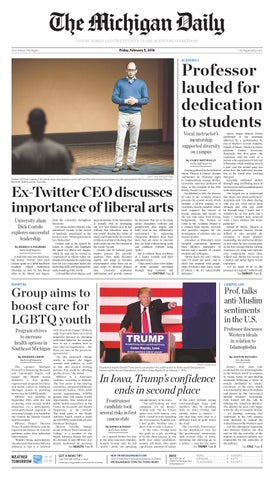
Twitter CEO Dick Costolo, a University alum, discusses his career path and the field of communications at a talk sponsored by the Ford School of Public Policy at Rackham Auditorium on Thursday.
Ex-Twitter CEO discusses importance of liberal arts University alum Dick Costolo explores successful leadership By REBECCA SOLBERG Daily Staff Reporter
It took him over 140 characters, but former Twitter CEO Dick Costolo spoke to a filled Rackham Graduate School auditorium Thursday on how he has found value in his liberal arts degree
from the University throughout his career. LSA Dean Andrew Martin, who introduced Costolo to the crowd of hundreds, proclaimed at the lecture’s start, “What a great day to be a Wolverine!” Costolo said in his speech he aimed to inspire and highlight the merit of a liberal arts degree, which he said can be viewed as “impractical” in Silicon Valley. He disputed this opinion by explaining how his LSA education fueled his leadership skills and broadened his understanding of the world. “A broad liberal arts degree, and
deep immersion in the humanities is actually vital to developing our very best leaders and in fact without that education, none of you would develop the habits of mind, and frameworks for creative synthesis and lateral thinking, that really make the very best leaders in the world,” he said. Costolo said he believes great leaders possess five speccific qualities: They make decisions rapidly and adapt to dynamic environments when there are no road maps or obvious choices; they creatively synthesize information and provide context
for decisions that are to be made across disciplines, cultures and perspectives; they inspire and build trust in any collaborative environment by welcoming viewpoints different than their own; they are never in reaction; they are kind without being weak and confident without being “jerks.” But to achieve these attributes of a leader, Costolo said their education is key. “They need to have a few habits of mind uniquely developed through deep curiosity and See COSTOLO, Page 2
Dozens gathered in the School of Music, Theatre & Dance’s Stamps Auditorium on Thursday night to commemorate George Shirley, University emeritus professor of voice, as the recipient of the 2016 Shirley Verrett Award. Established in 2011, the Women of Color in the Academy Project presents the annual award, which includes a $5,000 stipend, to a University faculty member whose work supports the success of female students and faculty in the arts who come from diverse backgrounds. The Women of Color in the Academy Project is a campus-wide faculty network that provides support for the development of scholars who are women of color. Attendees at Thursday’s event included community members from Shirley’s hometown of Detroit and a number of current students and colleagues. “Music feeds my soul,” Shirley said. “It feeds my spirit, and to share this moment with people, some of whom I don’t know, many of whom I do, it’s indescribably delicious.”
CAMPUS LIFE
HOSPITAL
Group aims to boost care for LGBTQ youth Program strives to increase health options in Southeast Michigan By DESIREE CHEW Daily Staff Reporter
This summer, Michigan Forward in Enhancing Research and Community Equity will launch the Health Access Initiative, a free qualityimprovement program for clinics and health centers in Southeast Michigan aimed at providing better care for LGBTQ youth. MFierce was founded in September 2014 with the aim of dealing with societal health disparities via a participatory, community-based approach of structural change. It is funded by the Centers for Disease Control and Prevention. MFierce Project Director Triana Kazaleh Sirdenis said the organization focuses on systemic problems rather than individual interventions. “Besides being participatory, the other part that makes MFierce different is that it is involved
WEATHER TOMORROW
HI: 39 LO: 24
with structural change,” Sirdenis said. “Currently there are a lot of programs focused on changing individual behavior, for example how to use a condom, how to have safer sex negotiations — but these are more on the person-toperson level.” “So this structural change works to impact the bigger systems and policies, as well as take into account existing policies that could be affecting quality of care,” she added. MFierce is a three-part coalition, according to Sirdenis. The first entity is the steering committee, composed of different community leaders, CEOs, AIDS service organizations, LGBTQ groups, state and county health departments. Also involved are public health researchers in the Center for Sexuality and Health Disparities, or the SexLab. The final piece is the Youth Advisory Board, which is made up of LGBTQ youth from all over Southeast Michigan. Marcos Carrillo, biology junior at Henry Ford Community College, is a member of the Youth Advisory Board. He said his decision to join MFierce was deeply motivated by personal See HEALTH, Page 3
Opera singer Marcia Porter performed at the ceremony followed by a performance by one of Shirley’s current students, School of Music, Theatre & Dance graduate student Kaswanna Kanyinda. Her first piece, she explained, told the story of a person who experienced trials and tribulations while working toward a goal, and the second song was about how the individual became lost to the world after reaching that goal. Kanyinda celebrated Shirley through song, attributing many of her successes and accomplishments to his instruction. “He helped me to understand that music isn’t about perfection,” Kanyinda said. “It’s about sharing who you are, what you’ve been through and who you could be through song. I know that I wouldn’t be on this path, and I know I wouldn’t have achieved what I have without this man’s guidance.” School of Music, Theatre & Dance graduate student Dorian Dillard II also attended the ceremony to honor Shirley’s mentorship. He said he met Shirley in 2011 when he won second place in the first George Shirley African American Art Song and Operatic Aria Competition. Since then, Dillard said, Shirley has served as a mentor and father figure to him and others. “It’s an honor to be in the presence of a legend,” Dillard said. See SHIRLEY, Page 3
Prof. talks anti-Muslim sentiments in the U.S. Professor discusses Western ideals in relation to Islamophobia By AUSTIN HIYAMA For the Daily GRANT HARDY/Daily
Presidential hopeful Donald Trump points out people in the audience that he thinks would have good aim, referencing the Second Amendment, at a rally in Cedar Rapids, IA on February 1, 2016
In Iowa, Trump’s confidence ends in second place Frontrunner candidate took several risks in first caucus state By EMMA KINERY Daily News Editor
In a speech before his loss at the Iowa caucuses Monday, Donald Trump said he felt “guilty” about not spending
GOT A NEWS TIP? Call 734-418-4115 or e-mail news@michigandaily.com and let us know.
enough money in the state. “I’m self-funding my own campaign, it’s my money,” Trump said. “So far I have spent very little money, very little. I need to start spending for two reasons: Number one, I feel guilty. Number two, I don’t want to take a chance.” At the time, Trump used his guilt as a jab, ascribing it to his then-success in the polls over other candidates, namely Jeb Bush, who spent significant amounts of money
NEW ON MICHIGANDAILY.COM GOP to hold March presidential debate in Detroit MICHIGANDAILY.COM/SECTIONS/NEWS
INDEX
in the state without seeing correspondingly large poll numbers. But, by spending little in Iowa Trump had already taken a chance — one that may now lead to a different kind of guilt down the road. The erstwhile frontrunner in the Republican race for the presidential nomination took several risks in Iowa, including not showing up to a debate — and for the most See TRUMP, Page 3
Vol. CXXV, No. 67 ©2016 The Michigan Daily michigandaily.com
History Prof. Juan Cole examined the rise of Islamophobia in the Western world in response to recent waves of anti-Muslim sentiment following a series of attacks attributed to Islamic extremists. At the event, which was attended by about 50 students and hosted by the University’s Muslim Students’ Association, Cole kicked off the talk by defining the “American identity.” The identity, he said, truly began with the idea of manifest destiny — an ideology asserting that Americans in the 19th century were destined to expand the United States to the Western coast — and the subsequent expansion into Western frontier. He also said he felt the centrality of the frontier in America’s identity was responsible for the centrality of the military. See COLE, Page 3
NEWS.........................2 OPINION.....................4 CL ASSIFIEDS.................6
SUDOKU.....................2 ARTS....................5 SPORTS...............6
News
2 — Friday, February 5, 2016
MONDAY: This Week in History
TUESDAY: Campus Voices
WEDNESDAY: In Other Ivory Towers
THURSDAY: On the Daily
The Michigan Daily — michigandaily.com
FRIDAY: Photos of the Week
LEFT: LSA freshman Isabella Little
420 Maynard St. Ann Arbor, MI 48109-1327 www.michigandaily.com SHOHAM GEVA ROSE FILIPP
Editor in Chief 734-418-4115 ext. 1251 sageva@michigandaily.com
practices dance in a hallway in East Quad on Wednesday.(MARINA ROSS/ Daily)
RIGHT:
Engineering sophomore Pascal Sturnfels works on a desktop projection called “The Weather Buddy” at Makeathon in the Art and Architecture Building on Sunday. (LUNA ANNA ARCHEY/Daily)
NEED MORE PHOTOS?
Business Manager 734-418-4115 ext. 1241 rfilipp@michigandaily.com
Newsroom
News Tips
734-418-4115 opt. 3
news@michigandaily.com
Corrections
Letters to the Editor
corrections@michigandaily.com
tothedaily@michigandaily.com
Arts Section
Editorial Page
arts@michigandaily.com
opinion@michigandaily.com
Sports Section
Photography Section
sports@michigandaily.com
photo@michigandaily.com
Display Sales
Classified Sales
dailydisplay@gmail.com
classified@michigandaily.com
EDITORIAL STAFF Laura Schinagle Managing Editor Emma Kerr Managing News Editor
schlaura@michigandaily.com emkerr@michigandaily.com
SENIOR NEWS EDITORS: Allana Akhtar, Alyssa Brandon, Jacqeline Charniga, Katie Penrod, Emma Kinery ASSISTANT NEWS EDITORS: Riyah Basha, Marlee Breakstone, Desiree Chew, Anna Haritos, Tanya Madhani, Camy Metwally, Lydia Murray, Caitlin Reedy, Alexa St. John. Brandon Summers-Miller
See more Photos of the Week on our website, michigandaily.com.
Claire Bryan and Regan Detwiler Editorial Page Editors
opinioneditors@michigandaily.com
SENIOR OPINION EDITORS: Jeremy Kaplan, Ben Keller, Anna Polumbo-Levy, Jason Rowland, Stephanie Trierweiler
THREE THINGS YOU
CAMPUS EVENTS & NOTES
Lecture: Lecture on Ginés Garrido public history WHAT: Spanish job market architect Gines Garrido
SHOULD KNOW TODAY
Lunar New Year Science as Art Contest Celebration WHAT: Celebration of exhibition the Lunar New Year will
will host a lecture on his work. Garrido has worked on large urban and cultural designs. WHO: Taubman College of Architecture and Urban Planning WHEN: 12 p.m. to 2 p.m. WHERE: Art and Architecture Building
WHAT: Cathy Stanton, senior lecturer of anthropology at Tufts University, will discuss public history as a career path and workplace. WHO: Eisenberg Institute for Historical Studies WHEN: 12 p.m. to 2 p.m.
Symphony Band performance
“The Making of Asian America”
Taylor Mac: history of pop music
WHAT: Michael Haithcock will conduct a performance by the University’s Symphony Band featuring works by Mozart, Wagner, Michael Colgrass and Paul Dooley WHO: School of Music, Theatre & Dance WHEN: 8 p.m. WHERE: Hill Auditorim
WHAT: Erika Lee, chair of immigration history at the University of Minnesota, will discuss the forgotten history of Asian Americans, including stories on immigration and politics. WHO: Department of History WHEN: 4 p.m. to 6 p.m. WHERE: Tisch Hall, room 1014
WHAT: Taylor Mac, actor, playwrite and performer, will perform a cabaret featuring American music from 1956 to 1986. WHO: University Musical Society WHEN: 8 p.m. to 10 p.m. WHERE: Lydia Mendelssohn Theatre
feature demonstations of various crafts and traditions and a chance to learn basic Mandarin. WHO: North Quad Programming WHEN: 2 p.m. to 4 p.m. WHERE: North Quad, space 2435
WHAT: Students will display their artwork submitted to the Science as Art Contest, and winners will be announced. WHO: Arts at Michigan WHEN: 2 p.m. to 4 p.m. WHERE: Hatcher Graduate Library, room 100
Science Trivia Night WHAT: The museum will host a casual science trivia competition for teams of five with prizes from Chipotle, Cherry Republic, MDen and more. It will also feature free Insomnia Cookies and popcorn. WHO: Museum of Natural History WHEN: 5:30 p.m. to 7:30 p.m. WHERE: Ruthven Museums Building
1
Rep. Jason Chaffetz (R-Ut.), House oversight committee chairman, announced he will launch an investigation into recordkeeping in the federal government — including Hillary Clinton’s personal e-mail server, Politico reported.
2
Hillary Clinton plans to visit Flint this Sunday to aid with efforts surrounding the water crisis in the city, according to MSNBC. The presidential hopeful brought attention to the Flint water crisis in the past two Democratic debates.
3
The United Nations has suspended Syrian peace talks in Geneva, The New York Times reported. The suspension follows an escalation of conflict by the Syrian government in a strategic rebel-held city. UN mediator Staffan de Mistura said the talks will resume no later than Feb. 25.
Max Bultman and Jake Lourim Managing Sports Editors
sportseditors@michigandaily.com
SENIOR SPORTS EDITORS: Minh Doan, Jacob Gase, Kelly Hall, Simon Kaufman, Jason Rubinstein, Zach Shaw, Brad Whipple ASSISTANT SPORTS EDITORS: Betelhem Ashame, Chris Crowder, Sylvanna Gross, Leland Mitchinson, Ted Janes, Kevin Santo,
Kathleen Davis and Adam Theisen Managing Arts Editors
arts@michigandaily.com
SENIOR ARTS EDITORS: Caroline Filips, Melina Glusac, Jacob Rich, Ben Rosenstock ARTS BEAT EDITORS: Matthew Barnauskas, Christian Kennedy, Rebecca Lerner, Natalie Zak
Amanda Allen and Grant Hardy Managing Photo Editors
photo@michigandaily.com
SENIOR PHOTO EDITORS: Zoey Holmstrom, Zach Moore, James Coller ASSISTANT PHOTO EDITORS: Claire Abdo, Robery Dunne, Sam Mousigian, San Pham, David Song
Anjali Alangaden and design@michigandaily.com Mariah Gardziola Managing Design Editors Karl Williams Statement Editor statement@michigandaily.com DEPUTY STATEMENT EDITORS: Nabeel Chollampat and Tori Noble STATEMENT PHOTO EDITOR: Zoey Holmstrom STATEMENT LEAD DESIGNER: Shane Achenbach
Emily Campbell and Alexis Nowicki Managing Copy Editors
copydesk@michigandaily.com
SENIOR COPY EDITORS: Taylor Grandinetti and Jose Rosales
Nivedita Karki
Managing Online Editor
nivkarki@michigandaily.com
SENIOR WEB DEVELOPERS: Dylan Lawton and Bob Lesser
Levin Kim Managing Video Editor
SENIOR VIDEO EDITORS: Michael Kessler, Abe Lofy, Emma Winowiecki
Michael Schramm Special Projects Manager Emma Sutherland Social Media Editor
BUSINESS STAFF Hussein Hakim Finance and Operations Manager Claire Ulak Production Manager Jordan Yob Marketing Manager Matt Pfenning UAccounts Manager Asja Kepes Local Accounts Manager Chris Wang Classifieds Manager Colin Cheesman National Accounts Manager Anna He Special Guides and Online Manager Claire Butz Layout Manager The Michigan Daily (ISSN 0745-967) is published Monday through Friday during the fall and winter terms by students at the University of Michigan. One copy is available free of charge to all readers. Additional copies may be picked up at the Daily’s office for $2. Subscriptions for fall term, starting in September, via U.S. mail are $110. Winter term (January through April) is $115, yearlong (September through April) is $195. University affiliates are subject to a reduced subscription rate. On-campus subscriptions for fall term are $35. Subscriptions must be prepaid. The Michigan Daily is a member of The Associated Press and The Associated Collegiate Press.
City sustainability panel talks new waste reduction practices Businesses, University discuss environmental reforms By MADELEINE GERSON For the Daily
The Ann Arbor District Library and the city of Ann Arbor held their fifth annual sustainability forum Thursday night. Fifty members of the community gathered to listen to an array of speakers, including Rodger Bowser, the managing partner of Zingerman’s Delicatessen, Eileen Spring, president and CEO of Food Gatherers, a food rescue and food bank program serving Washtenaw County, Noelle Bowman, solid waste program specialist of Washtenaw County and Tracy Artley, Sustainability Programs coordinator of the University of Michigan Plant Building and
Ground Services. Matt Naud, the environmental coordinator of the city of Ann Arbor who facilitated the discussion, said he believes Ann Arbor has exhibited progress in initiating programs promoting sustainability. He also noted issues the city is working to address including the frequency of recycling, compost and the promotion of waste reduction. Bowman explained the role of waste reduction in managing the city’s resources, an issue he said is specifically exemplified by the excess use of plastic bags. “Plastic bags rank number four as the most common item found in litter surveys around the country,” Bowman said. “To manufacture these materials, about 11 barrels of oil are required per ton of bags manufactured.” Bowman added that plastic bag disposal not only negatively impacts the appearance a city but also presents a threat to wildlife.
“The harm to wildlife has been devastating,” Bowman said. “That begs the question: Do we want to be a community that contributes to this negative environment?” Artley brought the discussion back to campus, citing the University’s goal to reduce their waste by 40 percent from the numbers in 2006 by 2025. Current University projects, Artley said, include a waste bin and labeling standardization effort, expansion of composting and zerowaste events. Bowser described a few sustainable practices used at Zingerman’s Deli, including its continuous push for composting practices as well as purchasing store supplies in bulk when possible. “Every single disposable that we buy is either recyclable, reusable or compostable,” Bowser said. Spring also discussed the efforts of her organization, Food Gatherers. “When we started we had a dual mission of food rescue and hunger relief. We rescue food from retailers, primarily grocery stores,” said Spring.
MATT VAILLIENCOURT/Daily
Noelle Bowman, solid waste specialist for Washtenaw County, joined community business leaders who gave presentations and answered questions from the public on the topic of sustainability at the Ann Arbor District Library on Thursday.
The sustainability forum is one of several events in the annual Sustainable Ann Arbor series. The goal of the program was to join representatives from the community with the public in order to provide information to residents about how to live more sustainably. The panel concluded with a question and answer session during which members of the Ann Arbor community presented their thoughts and concerns.
COSTOLO From Page 1 immersion in the humanities and liberal arts,” he said. The three habits Costolo outlined were creative synthesis, disciplined thinking and awareness beyond oneself — all of which can be attained through a liberal arts education. To exemplify the importance of creative synthesis, Costolo used an example from his career in which he gave a speech that was streamed to the 4,000 Twitter employees around the world. It in, he showed the famous Michelangelo sculpture that depicted the biblical story of David and Goliath and emphasized the sculpture’s intense gaze to inspire employees and inspire mental
toughness and focus in the face of external distractions. He said this speech helped his team by providing “tremendously vivid context” for what is otherwise an abstraction for people, and it creatively synthesized simple but powerful imagery from one domain into a frame of reference to another one that was easily understandable. In discussing disciplined thinking, Costolo said the poetry he analyzed in his LSA curriculum taught him to synthesize what was happening in environments that he didn’t initially understand. “It helps me solve puzzles,” he said. “It helps me look for clues that I might not recognize initially from previous patterns. And I think poetry is an example of learning to understand the context of some peculiar or unique
Clark McCall, a resident of Ann Arbor, suggested the city provide compost services throughout the entire year, rather than between December and April. “We haven’t had compost pickup in the city for that long, maybe a couple years,” McCall said. “Ann Arbor is an affluent community with forward-thinking people. We have a responsibility to set the pace for other communities.” Wayne Appleyard, chair of
situations.” In his experiences, he said he’s found that as a leader one is constantly navigating grey areas, and making hundreds of decisions every day that have ethical challenges and winners and losers on both sides. “Nothing prepares you for the decisions of this world better than the ability to contextualize everything about an environment that you’re in and the people and cultures and psychology and history of everyone involved,” Costolo said. Costolo also talked about the importance of the awareness beyond the self, and how studying the humanities allows people to be conscious of the biases and preconditions of any situation. “You will jump to fewer conclusions without first
the city’s Energy Commission, attended the sustainability forum and shared his thoughts on the importance of addressing sustainability in Ann Arbor. “We all need to do our part to reduce the impact on the planet,” Appleyard said. “We have overreached the carrying capacity of the planet so we need to make changes so our daughters and granddaughters can have as nice of a life as we do.”
understanding the entirety of the landscape, and you will be better equipped to communicate decisions that you’ve made in a way that transcends the boundaries of culture and of politics and even of language,” he said. There were a wide variety of University faculty, alumni and students at the event. Engineering freshman Robbie Greenberg said he was curious to see how Costolo could inspire him, regardless of the fact that he is not pursuing a liberal arts degree. “It is incredible to see what Michigan alumni have done with themselves,” he said. “He became the CEO of a major technology company that I use in my daily life. So I want to see if he can give me any ideas of what I want to do with my life.”
The Michigan Daily — michigandaily.com
HEALTH From Page 1 experiences of stigma and inadequate accessibility to quality health care, which he saw to be outgrowths of the larger system. “Imagine facing stigma every day with your friends and family, and just understanding that changing transgender perspective is not necessarily an individual person’s problem but also a structural thing,” Carrillo said. “Places that have increasing rates of sexually transmitted infections (STIs) are often the same places where people lack access to health care because they don’t know how to apply for Medicaid, or service providers aren’t creating a safe environment for people who seek help, or money isn’t going toward helping them. Accessibility is a big issue because it is related to a lot of other pressures — social, economic, psychological.” Sirdenis said engaging the Youth Advisory Board was a core part of the organization’s programming. “Often public health programs are created in isolation without input, guidance, leadership and wisdom from the people most impacted by it,” she said. “The youths are here to help us understand what is going on, what they would like to see in terms of STI treatment and access. They are our reality check.” The Health Access Initiative is a two-part engagement with individual clinics and health centers. The first part is
TRUMP From Page 1 part, they might not have paid off, as evidenced by his second place finish in a state he was projected to win. In contrast, his opponent, Sen. Ted Cruz (R–Texas) at his rally in Iowa City the day before spent his time portraying himself as a true conservative, evoking time-tested symbols like the Bible and the Constitution. For Iowa though, where, according to NPR, 53 percent of voters consider religion “very important” and where more Evangelical voters participated than anticipated, Cruz’s morals emphasis was more appealing. The candidate won the state’s caucus with 27.6 percent of votes. Trump took second carrying 24.3 percent. In addition to not campaigning as much as his opponents, Trump refused to attend the last Republican debate a mere two days before the caucus, following tension with moderator Megyn Kelly stemming from the first Republican debate in August where he said he felt she did not treat him fairly. At the rally, Trump said he believed had he attended the debate, it would have had its highest ratings ever. “You have to stick up for your rights in life,” Trump said. “I wanted to debate so badly the other night. I wanted to go back.
News
cultural humility and cultural responsiveness for staff — from medical personnel such as doctors and nurses to front desk and administrative staff. This includes equipping them with inclusive language and practices to serve LGBTQ patients more comprehensively. The second component of the HAI is technical assistance, which aims to support clinics and health centers with creating and revising protocol and policies. This includes re-examining current practices and other aspects of the patient experience that could impact quality of care. All training and support is provided for free. Sirdenis said conceptualizing the Health Access Initiative involved significant groundwork and community engagement. Twelve town halls throughout Southeast Michigan — encompassing Flint, Ypsilanti, Ann Arbor and Detroit — were conducted to survey public opinion and facilitate open conversations on how to best meet the needs of the population of interest. Jack Andrzejewski, a secondyear Master’s student in the School of Public Health, works as a research assistant for MFierce. Part of his job involves literature review and data evaluation. He said the program development phase was both challenging and fulfilling. “The town halls engaged community members via process-oriented activities, to gather their input on what they felt was important and salient. This really helped the coalition to make future decisions,” Andrzejewski said. “Time is
always an issue. Communityengaged participatory approach to research requires a lot of time. Nonetheless, outcomes are better, engagements are better and there is more buy-in from community members.” Sirdenis emphasized the efforts devoted to ensuring the Health Access Initiative was directed at meeting the needs of its target population. “We looked over the data gathered by SexLab and talked it through with the Youth Advisory Board; we asked them what they thought, and if the research resonated with their personal experience,” she said. “Using existing data, as well as everything else gathered from the town hall ideas, we went from 100 ideas and whittled down to two ideas.” Aside from the Health Access Initiative, MFierce is also working on the Advocacy Collective, aimed at providing advocacy and professional development training for the Youth Advisory Board so that members can go on to do consulting work. Carrillo said he hoped the Health Access Initiative would ultimately affect large-scale change. “I think that the cool thing about this project is not only that we’re hoping to increase awareness and reduce STI rates, we are also involving institutions that would otherwise not be involved, and challenging them to consider what they can improve, what has been working, what hasn’t been working, who is being left out and how do we make whatever we are doing more accessible to people,” he said.
But when people don’t treat you properly, just like when people don’t treat our country properly … We would’ve broken the (rating) record that night, but we did the right thing. Frankly, Fox is great. We’re back, we’re friends, all of that stuff, but I said I’m not going into that debate.” Instead of debating, Trump held a rally for veterans that night and said he raised $6 million. At the time, Trump said his absence from the debate showed how strong of a leader he is, versus Cruz, whom he has called a “puppet” and a “nervous wreck.” His rally was comparatively more policy-focused than Cruz, who focused on building up his character at his rally and whose expressed policy platform was largely focused on dismantling Obama administration policies. Aaron Kall, director of the Michigan Debate Program and an expert on presidential debates, said missing the debate because of his feud with Kelly only hurt him instead of making him look strong as Trump said it would. “It made him look weak,” Kall said. “That he wouldn’t attend a debate because of a conflict with a moderator kind of showed that he had poor negotiating skills because he tried to get the moderator excluded and when Fox news decided to stick with her he basically was left with no
choice but to skip the debate. And it was just disrespectful for the voters of Iowa.” Kall said the small margin between the candidates’ polling numbers, and how soon the debate was to the caucus, made Trump’s choice to skip it even riskier. “The debate was just a few days before people made their decision and some entrance poll data of people right before they voted revealed that those that decided late in the process, just in the last few days, he only won a very small percentage of — only about 15 percent,” Kall said. “Where Rubio and Cruz won just about half of the overall voters. So, I think it definitely hurt him with those late deciding voters.” But after the loss, Trump didn’t express any of the guilt he had joked about on Sunday — after results came in, he tweeted he was taking the second place in stride. However, in a series of further tweets, Trump did associate the loss with the little time he spent campaigning in the state. That kind of rhetoric mirrored the confidence he expressed pre-caucus — and the kind of confidence that’s characterized his campaign. On Sunday, Trump said he anticipated he would win the race so extremely he would garner votes in historically Read more online at michigandaily.com
Friday, February 5, 2016 — 3
DELANEY RYAN/Daily
George Shirley, professor at the School of Music, Theatre and Dance, accepts the Shirley Verrett award, which is given to a supporter of women of color in creative arts, at the Stamps Auditorium on Thursday.
SHIRLEY From Page 1 “One thing that I always take away from George Shirley is to remain humble. And know that everybody is somebody and everybody matters. He’s very humble and beyond deserving.” Olwyn Shirley, George Shirley’s daughter, attended the event as well. With pride, she said he has always had many children: his students. He showed the same attention and devotion to his students as he did to her and her brother, she said. “His door is always open,” Shirley said. “They come to the house, he hosts parties for them, he encourages them, and I watch him and I feel so blessed to have him.” In an interview with The Michigan Daily following the ceremony, Shirley said the most important advice he’d like to impart on his students is to enjoy the challenge of expressing themselves through music. He described this gift of expression as a public service that should never be taken lightly. “You’re serving the composer, you’re serving the poet, you’re serving the public,” Shirley said.
COLE From Page 1 “I think there was a 19th century sense,” Cole said, “that there was turbulence out there on the frontier, and it was important to the wellbeing of the nation that that turbulence be dealt with militarily.” The new frontier of today, Cole said, is no longer the American Southwest but the Middle East. He noted the so-called frontier has shifted many times in American history, encompassing groups such as Native Americans, Roman Catholicism, communism and still others at different points at time. He then made a point he would return to throughout the lecture, that there are two ways for politicians to motivate voters: promising things and making them afraid.
“It’s a kind of public service that is blessed.” Shirley announced during his speech that he will use his monetary prize to fund his George Shirley African American Art Song and Operatic Aria Competition. He said the competition was established to encourage the next generation of musicians and to acknowledge many operatic songs written by African American composers who are not as widely known. “I want people to know this music,” Shirley said. “And the best way of doing that is getting young people interested in performing it, helping them to appreciate it and to perform it for people so audiences will know more of it.” Shirley is known internationally as an esteemed performer, teacher and lecturer. In 2015, President Barack Obama awarded him the National Medal of Arts, the nation’s highest public artistic honor. He has performed in more than 80 operatic roles throughout his career and won a Grammy Award in 1968 for one of his roles. Although Shirley’s name is prominent in the global art community, he has also remained loyal to his Michigan roots, as evidenced by the large number of
attendees from his hometown of Detroit. Detroit natives Stephanie Donaldson and Reverend Barbara Kelley came in support of Shirley, explaining that they attended the same church as him in their youth. While he was studying music education at Wayne State University, Shirley found the time to start and conduct the first chancellor choir in the People’s Community Church. “I’ve had occasion to attend some of his performances, operatic performances, and he’s just a wonderful human being,” Kelley said. “He’s a hero for me.” Shirley said his life has revolved around music since his mother sang to him while she was pregnant. He added that he remembers singing with his parents at the age of four, noting that his mother had a beautiful voice. “It’s my language,” Shirley said. “It’s a language that I believe everyone speaks. I’ve always known that my life would be centered on music in some way. So to me, it’s like the air I breathe, it’s the food I eat, it’s what makes me feel good, it’s the way I express myself, it’s a spiritual life force. I’m grateful for that.”
Cole said following the Camp David Accords of 1978, which led to a peace treaty between Israel and Egypt, the next biggest threat to Israel was Iraq, he said. As a result of this threat — which Cole noted he felt was exaggerated — neoconservative groups put pressure on the U.S. government to take military action against Iraq, culminating in Operation Desert Fox, a fourday bombing campaign in Iraq in 1998. Touching on terrorist groups in the Middle East, Cole compared their tactics to those of American politicians. Groups like ISIS, Cole said, are “the mirror image of fearmongering in America.” He also noted that it was incorrect to call such groups “Islamic.” While they could be called “Muslim” because “Muslim” can describe any person of that faith, the word “Islamic,” he said, is used to describe a set
of religious ideals with which terrorism is not consistent. When Cole opened up the floor to questions, one student asked if he thought the prevalence of Muslims in professional fields like medicine and engineering was detrimental to their voice in the community, as opposed to encouraging Muslims to pursue careers in arenas like the media. “Having only professionals is like wearing a muzzle,” Cole said in response. “They’re never going to ask a doctor about Islamophobia.” LSA freshman Yasmeen Afifi said she felt obligated to come to the talk because of her personal connection to it. “I feel like I was sort of forced into the political realm because of my identity as a woman and as a Muslim,” Afifi said. “I basically came here to understand more about how Islamophobia is manifesting in the West.”
Opinion
4 — Friday, February 5, 2016
Edited and managed by students at the University of Michigan since 1890. 420 Maynard St. Ann Arbor, MI 48109 tothedaily@michigandaily.com SHOHAM GEVA EDITOR IN CHIEF
CLAIRE BRYAN AND REGAN DETWILER EDITORIAL PAGE EDITORS
LAURA SCHINAGLE MANAGING EDITOR
Unsigned editorials reflect the official position of the Daily’s editorial board. All other signed articles and illustrations represent solely the views of their authors.
SARA RADIN | OP-ED
Grieving and gratitude L ast Thursday night, I received a phone call from my college roommate. She broke the news that a friend of ours who had graduated from Michigan with us had died while on a business trip. At the ripe age of 27, Adam went to sleep and never woke up. Upon hearing this, I was in total shock. My entire body went numb. I was completely speechless. How could this possibly be true? Only a month prior, I had seen Adam in Chicago. We hadn’t spoken much in the last few years, but shared close friends and kept in touch through social media. For some reason, I went out of my way to see him and catch up on this trip. I was there during the week, so I met him by his office for a quick coffee. Adam was just as upbeat, kind and delightful as I remembered him to be in college. He shared his hopes and optimism for the future. He was supportive of my own creative pursuits. He had immense energy, the sunniest disposition and the warmest heart. Now, I can’t help but replay that conversation in my head, over and over again. It’s as if our meeting was yesterday, and I can’t seem to erase his words and face from my mind. After receiving the phone call, I reached out to other close friends, sharing the terrible news. All of us were stunned. How does this happen to someone so young? How does this happen to someone so great? Later, three of us talked on the phone. No one knew what to say or how to feel. Most of us hadn’t spoken to Adam since college four and a half years ago. One friend said Adam, or “Alo,” as our friends called him in college, would want us to celebrate his life; he wouldn’t want us to be so heartbroken over his loss. We began sharing stories and reliving funny and ridiculous college memories Alo was a part of. After all, we shared four years of frat parties, football pregames and some hookups with this or that person. Our cries mixed with laughter as we remembered the joyful, ambitious Adam we all knew and loved. You see, Adam wasn’t your average guy. With some 6,000 people in the class of 2011 at the University of Michigan, Adam managed to stand out. He was involved in more extracurricular activities than most of us. He was an LSA representative, a campus tour guide and even a Move-In Maker. He was president of AEPi and started a tutoring program called Letters to Success, in which Greek life members tutored kids in Detroit. While all of our futures were unclear, one thing was certain: Adam was bound for a bright, successful adult life. After college as an outsider looking in, it felt like he was the king of Chicago. I, like many of our peers, followed his post-grad life through his well-crafted Instagrams of cappuccinos at hip coffee shops and his well-written, thoughtprovoking and insightful posts on his blog, A Brewing Thought, as well as ones he shared on Medium and The Huffington Post. When I awoke the next morning, the harsh reality that this special person was really gone set in. I told myself it must be a joke and then remembered that he’s really no longer here. a
My eyes swelled up, my lips went numb and I forced myself to hold back tears. Since hearing the news, time feels like it’s moving slower than a snail’s pace. Everything feels irrelevant. Work, dating, side projects. None of it really matters. Nothing seems to relieve this numbness I feel. Though I didn’t fly to Chicago for Adam’s funeral, it doesn’t mean I won’t miss him. It doesn’t mean the pain of his passing doesn’t hurt like hell. How do you grieve for someone who wasn’t a huge part of your life? How do you make sense of the loss? Since hearing the news, our friends have been sharing pictures with Adam from over the years: pictures of him as an underclassman, wearing maize and blue; later ones of him and his friends traveling the world; recent images of him as a young professional in his adult life. Just a few weeks ago, he was snapped as a groomsman in one college friend’s wedding. In all of these photos, Adam has a huge grin on his face. He was truly a bright light. People I haven’t heard from since college have reached out to ask what’s happened, to express their condolences and sadness over this terrible loss. In a way, Adam’s death has brought many of us who live halfway across the world from each other together again. He’s forced some of us who haven’t talked in years to take the time to get in touch. Oddly enough, I haven’t felt so connected to the Michigan community since I threw up my cap at the Big House and bid Ann Arbor farewell four years ago. We’ve also been sharing his blog posts, like this one about the Boston Marathon Bombing. In it, he said, “I suppose that the nature of tragedy is such that you hope that you’ll never truly become accustomed to shock, desensitized to the emotion of profound loss.” We are truly, deeply shocked to have lost such a profound person. In the coming months, I hope to help organize a memorial for Adam, an opportunity for us all to get together and relish in the fond memories of this wonderful person. Life is incredibly precious and short. In the wake of Adam’s death, let us be reminded of a few important things: We must be grateful for those, like Adam, who have shaped our lives in big ways, no matter the size of the friendship. We should strive to be as kind, selfless and hardworking as Alo. We should cherish the Michigan community, despite different time zones, zip codes and geographical distances. And as his best friend, Sam, shared on Facebook, we must remember “…to always hold the ones you love a little closer than you think you need to.” Thank you for touching our lives in so many ways, Adam. While you may no longer be here, we will never, ever forget you. As he once wrote, “We need to carry on, through the darkness, without turning.” Alo, thank you for reminding us to forever go blue. —Sara Radin is a 2011 University alum
EDITORIAL BOARD MEMBERS
Claire Bryan, Regan Detwiler, Caitlin Heenan, Jeremy Kaplan, Ben Keller, Minsoo Kim, Payton Luokkala, Aarica Marsh, Anna Polumbo-Levy, Jason Rowland, Lauren Schandevel, Melissa Scholke, Rebecca Tarnopol, Ashley Tjhung, Stephanie Trierweiler, Mary Kate Winn, Derek Wolfe, Hunter Zhao
ANNIE TURPIN
E-mail Annie at asturpin@umich.edu
R
The Michigan Daily — michigandaily.com
Classroom language limits
ecently, in Cultural Anthropology/Linguistics 272: Language and Society, we were assigned a chapter of Laura Ahearn’s book, “Living Language: An Introduction to Linguistic Anthropology,” which discussed instiPAYTON tutionalized LUOKKALA conformity through language. It stuck like gum on the bones of my ribcage. It won’t come off. Ahearn discusses an article by linguistic anthropologist Carol Cohn, “Sex and Death in the Rational World of Defense Intellectuals,” and describes how Cohn spent a year living among nuclear strategists. Ahearn notes that in this community, “(Cohn) was required to learn a new way of speaking — lots of acronyms for types of missiles, for example, and many euphemisms and abstractions for describing nuclear war.” Like babies, Cohn picked up on how, through speech, she had become a competent member of the group. She found this new way of speaking seemed to rewire her brain. For example, instead of people, weapons were most commonly the subjects of her sentences. Different languages and language styles work in different ways. The problem is not learning something new, but what you leave behind. I read on: “Cohn reports that in order to be taken seriously in this social and intellectual environment, she had to learn how to speak this ‘technostrategic’ discourse — but as soon as she did, she found herself at first unable to articulate her anti-nuclear sentiments, and then, frighteningly, unable even to
think about her anti-nuclear opinions.” Here at the University of Michigan, while many of us are not going to be in direct contact with nuclear technology and therefore will not learn that specific language, we all change how we speak in order to better fit the environment. When one speaks to fit a specific environment, it is called “code-switching.” However, when people change their thoughts to fit into a different language or style of speech, their thoughts are limited as Cohn’s was among the nuclear scientists. When one feels forced to express oneself in a way that may not even allow their true thoughts, something about that situation seems potentially dangerous. In high school, we learned there was one specific way to write an essay, an exact formula to get an idea across effectively. There was a recipe to any persuasive essay: introduction, evidence, evidence, evidence, counter-argument and conclusion (make sure you restate your thesis). College application essays should be done a proper way: Make sure you show who you are, but not too much of who you are. Make sure to use proper language, language that makes you seem like a fit candidate for academic life. The University is no exception to the afflictions of society — the homogenizing of language undoubtedly limits the sharing of ideas on our own campus. We all begin thinking quite uniquely and change to fit whatever society we belong to — in our case, the University of Michigan — and so we cannot tell where our current ideas lack. Together, the ideas of social scientists Franz Boas, Edward Sapir and Benjamin Lee Whorf have been combined into a commonly known, though not formally recognized, hypothesis that states: Language,
thought and culture are a triad of concepts. Language influences culture and culture influences language. Both culture and language influence and are influenced by thought. Here at the University, in particular, smaller discussions or seminar-oriented classes, I feel as if I cannot speak how I speak, but instead, I think over each of my ideas, changing them to effectively fit into an “academic-worthy” style. I think in long, varied strings, like two infinite roads that fork in opposite directions. Because of this, it takes me a while to form a concrete thought, an idea that will easily make sense to my peers. It doesn’t translate, and so I always miss my chance of being relevant, and am left wondering how what I had to say may have changed the conversation. How do we fix this learning environment where only one type of conversation — one that is fixed, fast-moving and loud — can thrive? I can see where some may think this must be solved first by our country’s entire education system — that our educators need to teach us how to fix this. While I agree that this problem is bigger than us, it is also bigger than education. It is the cultural construct; our culture and society expect us to behave and learn and express ourselves in a very specific way. And so we do. I am tired of being afraid that my voice — slow, clumsy and without an accent of academia — will not be taken seriously (not to mention that my participation grades are paying a cost). The only suggestion I can offer: Let’s just start talking like ourselves. In time, my English professor will understand. Payton Luokkala can be reached at payluokk@umich.edu
NICOLE KHAMIS | OP-ED
A world of one’s own
I press my hands against the car window, watching the fog appear and recede along the outlines of my fingers. I’m thinking — overthinking — as I often do. My dad glances at me. “A penny for your thoughts?” He always says that. I smile. I give the usual response: school, my future. It is important to note here my dad is deaf, profoundly deaf. He proceeds to give me the usual lecture of how difficult it was for him to get through school, telling me that if he could get by in a world that was not made for him, and still isn’t, I would be just fine. He grabs my hand, like he always does. I look back out the window and begin to wonder. I often wonder what my life would be like if two things had not happened: the death of my aunt to suicide, and growing up in a deaf household. These two things have shaped the lenses through which I see the world, and my life as it is now at the University of Michigan. What it has also informed me of are the things that must change on this campus. If I look back two years ago to my freshman year, I find myself failing to understand what depression, and what mental illness as a whole, is. I see myself entering Michigan from a highly competitive high school, placing on myself enormous pressure to keep my grades consistent. If I look closer, despite bouts of anxiety, mental health was never something talked about in the classroom. Even recognizing my own mental health seemed wrong — when there is no encouragement, no sustained conversation, no mention — naturally, these things become foreign, almost unwanted. To me, my anxiety and almost sub-human work ethic had left me believing that these things were necessary in order for me to make it. My model of what success was in this context was informed by two people: my father, who had made it against sharp odds to become the first deaf dentist in Michigan, and my aunt, a Harvard-educated, self-made woman teaching constitutional law. Thus, nothing had changed my freshman year — in fact, things had only gotten worse in terms of my anxiety. But, I had come out with the grades. Wasn’t that all that mattered? I had then left for a summer away from Michigan that would change everything. While my job as a camp counselor
for the summer was coming to a close, I received the news of the death of my aunt. A combination of rain and tears fell as I stood in the mountains of Pennsylvania, so too did my image of what I thought my aunt was. Everything that I had desired to be, and the picture of what I thought success was, shattered instantaneously. For someone who I believed had it all to be struggling with severe depression was unthinkable. As time continues to pass, the questions still remain. And I know I will never know the answers. But what I did know was that mental health was, up until that moment, something I had never thought about, and as I returned to Michigan
Mental health isn’t acknowledged as the crucial part of our college experience that it is for a particularly hard year ahead, mental health became the first thing on my mind. When I think of mental health, two statistics surface. First, the fact that one in three college students will struggle with depression; second, that one’s mental health is the primary indicator of how we do in college, according to the American Psychological Association. These are statistics that are not without mention due to the fact that I have been on Housing Staff for two years. This opportunity has afforded me the space to be vulnerable, and to have real conversations with students about mental health in my role as an RA. It is incorrect to say that most students have been given the spaces I have to facilitate these conversations; it is also incorrect to say that the University, as an institution, promotes conversations about mental health. When one is expected to be among the “leaders and best,” and we are valued in a capitalist society for our productivity, is it OK to not be on top of it all, all of the time? I carry this frustration with me at Michigan, where there are some, but not enough, efforts being taken to create consistent and meaningful conversations regarding mental health as a whole. If professors announced the first day of class that our mental health
will be the number-one determinant of our performance at this University, how many of us would be willing to take a look into ourselves, or into the façade we have created as a society, to question why mental health isn’t acknowledged as the crucial part of our college experience that it is? If we are truly a campus grounded in reality, we must ask why mental health is not incorporated into our curriculum? I argue that it should be — and one crucial aspect is utilizing the classroom as a space to implement these conversations. A student-led initiative that is already taking on these and other hard questions and searching for tangible solutions is the UM Student Forums on Campus Climate. These student forums will be happening on two separate occasions this week, and I challenge each student to attend to shape what Michigan’s campus can be. It is not wrong, nor is it unnecessary, to recognize mental health problems for what they are: a reality. Among our countless conversations around inclusivity, we must not forget to include something so vital — yet so infrequently talked about — on this campus. We must work to make this campus one that recognizes the real, lived-in experiences of all of us. It is time for the façade of mental health as something superfluous to address to fall. It is time, and it is long overdue, that we make this campus a world of our own. The UM Student Forums on Campus Climate are student-led forums that are aiming to address campus climate issues. This month’s forums will focus on issues surrounding identity and inclusivity in the classroom setting. Attendees will be able to speak openly with their peers about experiences they have had in class that relate to social issues and their impact on classroom dynamics. From there, students will be able to share their ideas on and organize around how to make their classes safer and more inclusive spaces, specifically for those with marginalized identities. Students are welcome to attend one (or all) of the forums. These events are completely student-organized and will be facilitated by students as well. The events will occur Friday, Feb. 5, 3 p.m. to 4 p.m. in Couzens Residence Hall, Room 1413; and Monday, Feb. 8, 7 p.m. to 8:30 p.m. at Pierpont Commons in the Boulevard Room. —Nicole Khamis can be reached at nlkhamis@umich.edu.
Arts
The Michigan Daily — michigandaily.com
CULTURAL CURES COLUMN
Who do I trust? D
ear Gillian, It’s not that I have trouble making up my mind. It’s just that I want to know everything before I do. So I am incessantly reaching out for input. I have my therapist once a week, I see my two academic advisors every other week GILLIAN and I communicate with JAKAB the teacher who mentored me in high school almost every day. My sister was understanding when I was younger, but now she’s stopped taking my late night calls. I once hired a “life coach” and I’ve seen a psychic several times. OK, more than several times. Now I’m writing to “Dear Gillian.” Is there something wrong with wanting a lot of input? — Advice Addict Dear Advice Addict, OK, let’s embark on this meta journey: advice on advice. The first thing I did upon reading your letter was to consult the great Oracle at Delphi. The mystical prognostications of the Oracle at Delphi held great sway in the classical mythology and literature of Ancient Greece and early Rome. Those of the ancient world would come to Pythia, the priestess of Apollo, for prophecies and questions about the future. The Oracle touches the lives of towering literary figures from the murderous and incestual prophecy of Oedipus, (kills his father, marries his mother) to the epic heroes Achilles and Odysseus. The Oracle worked herself up into a mystical frenzy in contacting the godly realm to divine her prophecy for you. The Oracle emerged to offer simply this: “no one was wiser than Socrates.” So if the psychics weren’t doing it for you, maybe sit down with a philosophy professor or two in Angell Hall. But be careful, philosophy tends to answer questions with questions, as Socrates was known to do. This will either take your advice addiction to a whole ’nother level or it will cure you of it for good. Religions across the globe are full of advisors and seers. Prophets in the Abrahamic religions serve as middlemen between God and mortals, dispensing what amounts to advice. Joseph interprets his dream to prepare the Pharaoh and the Egyptians for years of drought and famine. For you, Ad, I chose a random minor Biblical prophet, figuring he might have time on his hands to deal with your situation. Jonah was asked by God to
go give advice to the Ninevites to repent or be destroyed, but he wants nothing to do with it. He tries to escape his task, gets swallowed by a sea monster and saved by God, and then gratefully heads to Ninevah, where his prophecy saves the day. Jonah offers to you this suggestion: “Compare the advice you have received with the advice you have followed.” I’m not sure what this means, but if it helps, let me know. In the Vedas texts and Upanishads of Hinduism, we see early references to gurus: literal and spiritual teachers who counsel people, help mold their values and help them find the path. In the Sikh tradition, Guru Nanak drops some hymnal knowledge: “Truth before me, Truth throughout Time, Truth here and now, Truth is evermore.” Got that? All good? Yoruba priests in Africa imagine two parts of the cosmos: “aye,” the visible, tangible world of the living and “orun,” the spiritual world of the ancestors, gods and spirits. The priests communicate with the spiritual world as a source of wisdom and interpret the significance of the signs they receive for individuals or communities. Listen for the rustling of leaves at night because there’s truth in the spirits that move them. In the Shakespearean tradition, soothsayers predict the future and serve as dramatic plot devices. In “Julius Caesar” the soothsayer delivers an omen and speaks the badass line: “beware the Ides of March.” The characters don’t pay much attention, but the words alert the audience and raise the question of fate. Could it have been altered? To you, this same character soothsays to “Beware the Ides of April,” which is either the date of your Econ final or the day your tax returns are due — either way, solid advice. By this point, the one thing that should be clear is that not everyone — and surely not Dear Gillian — can be trusted for good counsel. Oftentimes people in your life have their own interests or are so embedded in a societal system they can’t give objective advice. Your friend who’s tryna turn up might not be the best advisor on whether you stay in and catch up on sleep or go take a pickleback at Mash. In Balzac’s 19th century novel “Le Pere Goriot,” Rastignac, a young law student from the country, tries to tap into Parisian high society. He takes advice from corrupt neighbors and acquaintances who push him toward callous social climbing informed by the ethos of the city, rather than by genuine concern. You ultimately
have to mediate your intake of counsel. The early 20th century advice scene took a break from divinely sourced prophecy and was instead an era influenced by Freud’s psychoanalysis. Here, the objective is not prescriptive but analytic: you need to uncover repressed elements of your self that may help you understand your internal desires and determine what course of action suits you best. Inspired by this revelatory elevation of the subconscious, Surrealist artists used various techniques to bring it forth. Exercises such as creating an “exquisite corpse” where multiple artists collaborate on a rendering of a human body, like the one done by Yves Tanguy, Joan Miro, Max Morise, and Man Ray from 1926-27, allowed surrealists to transcend the rational mind. Martha Graham dug down to find the subconscious or “inner landscape” embodied in movement. She believed emotions not easily expressed by words could be communicated through dance: contractions and releases. Her choreography in “Lamentation” is rich with emotion and the corporeal representation of grief. Sometimes your body can tell you more than your mind and will give you signals to how you feel about a certain situation or decision. Not that there’s anything wrong with advice, counseling or therapy, from whatever trusted source. It is time well-spent. The reality is that most people feel overwhelmed at some point and need to vent the anxieties of our modern lives where we’re blessed with too many opportunities and too much time for self-reflection. Plus without it, we wouldn’t have those satirical Woody Allen scenes or New Yorker cartoons. The parodies are entertaining, but also comforting in a sense. I’d love to know how your modern-day psychics compare with the oracles, priests, gurus, soothsayers and prophets; but friends, sisters, therapists and academic advisors can only go so far. As I believe the arts are the fountainheads of powerful wisdom, AA, find a book, film, museum exhibit or performance that deals in some way with your dilemma du jour, and you’ll be surprised how the same human heartaches recur and recur with creative solutions in the archives. E-mail deargillian@michigandaily. com describing a quandary about love, relationships, existence or their opposites. We may publish your letter with your first name (or penname). Submissions should be 250 words or fewer and may be edited prior to publication.
Friday, February 5, 2016 — 5
ALBUM REVIEW
VAGRANT
More like Beach Party
Bloc Party’s ‘Hymns’ simple and soothing By DANIELLE IMMERMAN Daily Arts Writer
Before indie-rock Tumblr girls obsessed over Arctic Monkeys, there was Bloc Party. Effortless, provocative, innovative and distinct, Bloc B Party is by far my favor- Hymns ite indie-rock Bloc Party band. In fact, their 2008 Vagrant Intimacy was my first real favorite album — they just have a way of modernizing the gloomy yet beautifully poetic sound of The Smiths in a modern and slightly more electronic way. Given that my love for Bloc Party is still very much alive, you can imagine my disappointment when I first listened to Hymns. I hated it. I thought it was basic, try-hard and vaguely reminiscent of something I heard before. However, I then realized that for the past hour I had been streaming the wrong album. I was, in fact, listening to their failed 2012 electronic mess of an album, Four. For a solid hour I was beside myself — a visible pile of tears may or may not have surrounded me in the middle of Espresso Royale. I couldn’t understand why Kele Okereke and the rest of Bloc Party went on a three-year hiatus and suffered through the perils of a lineup change, only to came back with a sub-par album. I was devastated. Confused. Heartbroken. Luckily, thanks to iTunes (Spotify, you suck), I eventually listened to Hymns. Compared to Four, Hymns is a drastic improve-
‘The Virgin’ still fun By DANIELLE YACOBSON Daily Arts Writer
After an unbearably bleak month of attempting to be entertained by real people’s mundane drama, hearing the words A“accidentally artificially Jane the inseminated” has never felt Virgin better. “Jane the Virgin” is back Season 2 Midseawith a killer son Premiere midseason pre- Mondays at miere, making 9 p.m. up for lost time The CW with an exceptionally hip and “in with the gays” Abuela, a guest appearance from Glam-ma (Rita Moreno, “West Side Story”) and a college English class with giants. An explanation will follow. In the telenovela world of drug lords and baby kidnappers, the badassery that exudes from Gina Rodriguez is the only constant. The second Latina woman to ever win the Golden Globe for Best Actress in a TV Comedy, Rodriguez (“Filly Brown”) delivers a consistently exceptional performance as Jane. A single, working mom with dreams of a career and more on her mind than the next
guy, Jane shines as one of the most inspirational women on television. Her one-of-a-kind sense of humor, brains and general awesomeness are only heightened by her acute sensitivity, a characteristic that is too often either entirely lacking from independent female leads or portrayed as their detrimental flaw. Instead, Jane’s vulnerability is a testament to her strength as she unapologetically embraces all the emotions that come with raising a child, starting a career and constantly reevaluating the messiness of her love life. The midseason premiere kicks off with the terrifying realization that the “Great Books” literature class that Jane is teaching is instead coined “Books for Ballers.” A swarm of six-foot athletes (the previously mentioned giants) enters. Understandably, a visceral reaction to the word “sports” follows shortly thereafter as Jane has traumatic flashbacks to elementary school gym class. But, in the true glass-half-full spirit of Jane Gloriana Villanueva, she bravely sacrifices the home telenovela reel for a sports broadcast in an attempt to connect with her students. “Pride and Prejudice” is translated into “baller” terms as the athleticallychallenged viewers gawk at the millionth reason why Jane is the
coolest person ever. “Jane the Virgin” constantly delivers surprising character development that easily rivals the usual melodrama of artificial pregnancies and presumed-to-bedead-mothers-turned-drug-lords — yet another quality that sets the show apart from other network comedies. Season two begins to convince the audience that the now very pregnant Petra (Yael Grobglas, “Jeruzalem”) might not be the physical manifestation of evil after all. Her mistakes, as ridiculous as they may be, color the misguided “villain” in a weirdly relatable way. At the very least, the fiery anger sparked by the second not-so-accidental insemination has died into a controllable sizzle. For the record, there are now three babies, and nobody has had sex. The midseason premiere was light on the Michael-RafaelJane love triangle, but romance is inarguably on the horizon for the rest of the season. Michael might claim he has “moved on” with a new girlfriend, but the rest of us are definitely not ready to let go. Nevertheless, the Villanueva women have a collectively long list of suitors, and if there’s anything the audience can unanimously agree on, it’s that we are all #TeamJane.
heartbeat rhythm that overtakes the song makes for a great listen, but you’re so caught up in the the sound that the lyrics easily lose when at battle with the beat. Much of the album is like this — the lyrics fade into the background of the noise. Only two songs really prove otherwise; “Into the Earth” and “Exes” both lack heavy electronic beats. “Into the Earth” is the most stripped down song on the album — the dominating sound is the distinctive guitar chords that fluctuate between staccato plucks and smooth riffs, a departure from the mostly electronic basis for the album. With less going on instrumentally, it’s easier for Okereke’s lyrics to actually be heard — the problem is that what we hear isn’t anything noteworthy. “Exes” is similar to “Into the Earth” in its seemingly simplistic sound — the main focus of the song is the lyrics with a mellow, smooth backdrop of sound. Okereke croons “To all the exes / That I left behind / These words will fall short / But I must try.” This would be a great chorus if it weren’t actually true; his words do fall short and he barely tries. This isn’t to say that this song, or any song for that matter, is bad. Each song on the album is good and different from what other bands produce. The album, as a whole, is a pleasant listen, but after you listen to each song over and over again, everything blurs. Although the electronic beats and rhythms are unique, Okereke fails to vocally and lyrically match each song’s distinct instrumentals. The result is 15 songs that sound great but mean very little.
ALBUM REVIEW
Your 3 a.m. thoughts By SHIMA SADAGHIYANI For the Daily
TV REVIEW
ment as a whole. Inspired by religious memorabilia found in his parents’ home, Okereke attempts to make this album a modern day religious gospel by masking his somewhat religiously fueled lyrics with overpowering instrumentals. Whether you like Bloc Party or not, it’s inarguable that their sound is unlike any other indierock band’s — they have an ability to create their own genre within a genre. Yes, it’s indie-rock, but it’s more than that. Electronic beats overtake each track with underlying gospel, jazz and new wave elements popping up when you least expect it — resulting in a sound that, when you hear a song playing, can only be identified as Bloc Party. This unique sound is pushed to its limits in all 15 tracks on Hymns. Violins are electronically warped, each guitar riff never appears to resemble the last and Okereke’s DJ sound mixing past is put on full display. The listening experience is never unenjoyable, you never want to press next and to play Hymns on a loop for the rest of time is a distinct possibility — but this in and of itself is a problem. I can play this album non-stop, time and time again and never tire of it because it has a way of fading into the background. It’s noise, but it’s pleasant noise. It’s soothing yet predictable. It doesn’t stir any emotions in me. It doesn’t make me want more from Bloc Party. Fundamentally, the problem with Hymns is that the balance between sound and lyrics is heavily skewed in favor of sound. For example, “Only He Can Heal Me” is a catchy song — the distinct
The Brooklyn-based trio known as Wet first turned heads with their self-titled, four-track EP in late 2013. Through songs such as “Dreams,” “No BLie” and “You’re the Best,” Wet Don’t You introduced a Wet sound that was Columbia organically beautiful in its simplicity. With Kelly Zutrau’s enchanting vocals layered perfectly over the sparse and muted electronic background, it felt like this EP was the beginning of even greater albums to come. Boy, what a disappointment. Wet’s debut 11-track album, Don’t You, is the physical embodiment of 3 a.m. thoughts: lonely, ambient yet weirdly empty and unfocused. The most impactful thing this album drops is the idea that Kelly Zutrau doesn’t want to be your girl anymore (but she’s, like, super sad about it). Don’t You keeps the same unique sound Wet instituted with their EP: breathy vocals and an idiosyncratic beat, which worked in the short EP but causes the much longer Don’t You to sound repetitive and disillusioned. All the different ways Wet could have developed their music further were pushed aside somewhere between the years of 2013 and 2016, leaving Don’t You with a set of similar-sounding songs scrambling to push past superficiality.
One such song is “Body.” As the second-to-last song in the album, its slow, churning beat would be a serene way to wrap up Don’t You — if the same structure wasn’t repeated at various points earlier in the album with songs “Move Me” and “Island.” At four minutes long, “Body” is just exhausting to get through. The other songs fare no better. The constantly reiterated “call me by my real name / say my name out loud” in “Move Me” loses all meaning in its monotony, and the slow, mournful ballad “Island” weighs the album down with its heaviness. These songs, standing alone, are generally harmonious and pleasant to listen to for roughly three to four minutes; the problem arises when they’re put together in one album, as they bore the listener with unvaried tones. However, songs like “Weak” and “Small and Silver” redeem the album from becoming a complete failure, and they show what could’ve been if Wet pushed themselves to experiment with their sound just a little bit more. In “Weak,” the structured “oh baby, baby, baby / if you’re leavin’, leavin’, leavin’ / you would only, only, only / take from me, me, me” of the chorus contrasts nicely with the more organic verses, making the song more engaging. “Small and Silver” is exactly what its title promises: delicate and innocent, yet grounded through the deep electronic bass that remains constant through the song. The one song that has any differentiation from the rest of the
album is the final song, “These Days.” Armed with only a soft piano melody in the background (an extreme divergence from the rest of the album’s heavy dependence on a glossy, computerized rhythm) Zutrau is almost naked as she croons, “today I scare so easily / these days I can’t take too much.” It’s a deeply personal and raw moment for both the band and the listeners. And it really shows how amazing Wet could be if they turned away from trying to make all songs fit a particular mold. Don’t You finishes with “These Days,” and one can only hope that it’s as much as a salute to new beginnings as it is a conclusion. Even though Wet has mastered creating intimate songs that explode with sensuality and sensitivity, they have also mastered creating songs that explode with similarity. Through their EP, Wet had a good base to stand on while they augmented their music to explore all the different types of songs they could create, but they just didn’t take the chance. Don’t You is unfulfilling in the sense that it could have been so much more if Wet trusted themselves enough to step into unknown territory. Instead of an indistinguishable blend of homogeneity featuring breathy vocals and overly polished tempos, perhaps this new album would have been an adventure, full of spontaneous twists and turns. But, hey, Wet is only just getting started. And “These Days” showed enough of a glimpse to be hopeful that Wet’s next album will be as good as what Don’t You could have been.
Arts
6 — Friday, February 5, 2016
HIP-HOP COLUMN
Women aren’t pawns in your beef By LEJLA BAJGORIC Hip-Hop Columnist
“
Don’t do no press, but I get the most press kid.” The last Michigan Daily hip-hop columnist, Adam DePollo, wrote his first piece on college hip hop with an obligatory focus on Kanye and the monumental moment that was the ’04 release of Dropout. Before him, columnist Jackson Howard recounted the hip hop that set the scene for the summer of 2013, making sure to include Ye’s “Bound 2” on his list of songs that lasted into the fall. So I ask, as Killa Cam might, who am I to fuck tradition up? Besides, Kanye just makes it too damn easy. I’ll safely assume that the Daily’s readership is composed of cultured college students who make it a personal duty of theirs to stay up to date on the world’s current events, latest political scandals and, of course, Twitter beefs. (Read: You saw the belligerence that was Kanye’s Twitter account last week, right? Or at least read about it before he deleted those embarrassing-ass messages chock-full of self-absorption and sexism? Cool, I figured.) Just in case, though, here’s a quick refresher to get us going: Wiz wasn’t feeling Kanye’s album’s name change (initially Swish, now Waves). If you’ve ever heard someone say “free the wave,” you can be 99% sure she was referring to Max B, the Harlem rapper currently serving a 75-year sentence, best known for creating the Wave sound. This is what upset Wiz: Everyone in the (rap) world knows the wavy movement is associated with Max B, the reason he’s lauded and loved, so why is Ye biting Biggavelli? This set the scene, but it was a misinterpretation on Kanye’s behalf that caused the conflict; Wiz was tweeting about his weed, known as KK, or Khalifa Kush, but in Kanye’s mind, the
only thing KK could possibly refer to is Kim Kardashian. So he flipped, called Wiz out for being corny, made observations about Wiz’s “cool pants” and asserted that he is Wiz’s “OG and will be respected as such.” But it didn’t take long for Ye to bring up his ex, the mother to Wiz’s child, socially conscious SlutWalk-organizer and baldheaded baddie — Amber Rose. “You let a stripper trap for you” is point four on a 17-pointlong tirade by Ye. It makes you wonder if he really made that misinterpretation or if he was just looking for a reason to talk about Amber. He does it an awful lot, every time just as uncalled for as the last. I’m going to refer to this spat between Wiz and Ye as a “rap beef” just for the sake of the argument. The use of women, specifically Black women, and even more specifically Black women who occupy or occupied the role of ex-girlfriend/ lover/etc., as pawns in a conflict between two men is pretty common in rap. It’s actually something like a staple. Think: What’s the most famous rap diss of all time, and what do you hear within the first two seconds, the line that sets the pace for the rest of the song, and cements the track’s place in rap diss history? “That’s why I fucked your bitch, you fat motherfucker.” Pac was never subtle about anything — not about his paranoia surrounding death, not about his views that the government and police were the true gangs who ran the country and, sure as hell, not about his sexism. “Hit ‘Em Up” is the most famous track birthed during the infamous East Coast/ West Coast rap beef. The opening line is an allusion to Biggie Smalls’s wife at the time, Faith Evans. “You claim to be a player, but I fucked your wife,” spits Pac, and we’re not even thirty seconds into this shit yet. Though Pac makes multiple
threats aimed at each and every member of Bad Boy, threatens to cut up Cease until he’s deceased (clever) and “snatch” Lil Kim off the streets, the most insulting line is the one heard first; everything else seems like an afterthought. Faith is positioned as a pawn, reduced to nothing more than a tool Pac can use to discredit Biggie on all accounts. Simply put: How could anything Big say hold weight when Pac “fucked (his) bitch?” Though Pac claims to have been amorously involved with Faith, there’s nothing romantic about their supposed relationship; he simply used her sexually to compromise Biggie’s reputation. As a means of asserting his power over Big, Pac places Faith, a sexual pawn, beneath the both of them. But we don’t have to go back 20 years to find comparisons. There’s a prime case from last summer that I know you haven’t forgotten yet, no matter how much we all want to: Drizzy vs. Meek, the feud that we can safely say Drake won, but damn, did he really say much outside of all those lines referencing Nicki Minaj? Nicki and Drake, longtime friends and Young Money family, have always had a flirty relationship, so it’s natural people would assume the two were at some point romantically involved; after all, he took her to a convenience store and bought her snacks that one time. That’s real. But on The Pinkprint’s “Only,” Nicki lets it be known, loud and clear: “I never fucked Wayne, I never fucked Drake / On my life man, fuck’s sake.” Instead, she’s been cozied up with MMG representer Meek Mill for a minute now, and the
was leaked, but Kim still struts her stuff every chance she gets. And this isn’t said to shame Kim. I’m all for bodily autonomy (as I hope you are too). It’s sad to point out the cognitive dissonance it seems Ye is dealing with, since he knows Kim’s success is strongly associated with her sexuality: “My girl a superstar all from a home movie.” But there’s a difference between how certain acts or occupations, all sexual in nature, are understood based on differences in race and class. For example, burlesque vs. stripping. The two differ in compensation, in historical elements and some performance ones as well — burlesque being viewed as a performance piece that doesn’t necessarily involve direct engagement with the audience. But race and class can’t be factored out of the equation and are intimately woven into the difference in perception between highclass, sophisticated burlesque performers and “ratchet,” for everybody strippers. It’s important to incorporate race and class dynamics when we discuss sexism, and that’s really the common thread here — the domination of women, or sexism. How do we talk about sexism in hip hop? There’s a few options here, and most suck, but hopefully the good one (I saved it for last) can help us out when the next rap beef ensues and someone’s baby mother is unnecessarily mentioned, grossly demeaned and nonchalantly objectified. Option one: adopt an anti-hip hop stance, because if hip hop goes away, then sexism in hip hop goes away too by default. My vote here is no. For one thing, by erasing all hip hop, we’re erasing the good stuff too — the politically charged, radical and rebellious, uplifting and liberating stuff. And that’s uplifting and liberating for women too. “So preserve the Golden Age tapes and just get rid of contemporary rap,” you might be thinking. Still no. “Fight the Power” was more than a song; it was an anthem, I agree. But present day artists have proven to have the same capacity to make powerful music, music that calls for reflections on excessive consumption, for the sexual liberation of women, for the dis-
Los Angeles Times Daily Crossword Puzzle
Call: #734-418-4115 Email: dailydisplay@gmail.com
SUMMER EMPLOYMENT
Edited by Rich Norris and Joyce Nichols Lewis
66 Site of 34 Place to see 50 Common stars fastener Cornwallis’ surrender 36 Tricks of the 51 Historic Omaha trade suburb 67 City on New York’s Black River 37 Annual award 52 Crazily recipient 53 Munro pen name DOWN 39 Pitcher? 54 Corn cover 1 Cattle-raising 40 Simba, to Sarabi 57 Canine warning district 45 Company 59 Canine 2 He lost to RMN founded in command 3 Nest egg letters Beaumont 60 Seagoing 4 Migrants 46 Scott of “NCIS: pronoun 5 Like stars New Orleans” 61 Drama set in 6 Witches 48 “Neato!” Grover’s Corners 7 Miss modifier? 8 Good qualities ANSWER TO PREVIOUS PUZZLE: 9 Kick out 10 The 18th edition of his original work was published in 2012 11 Type of arch 12 __-B 13 Textile production settlement 21 Without success 23 Opened 24 Tourism hub 25 Bank, cardwise 26 Plea to remain 27 Move like ophidians 30 “Catch-22” pilot 32 H.S. experiment site 02/05/16 33 Reckless, say xwordeditor@aol.com
WORK ON MACKINAC Island This Summer – Make lifelong friends. The Island House Hotel and Ryba’s Fudge Shops are looking for help in all areas beginning in early May: Front Desk, Bell Staff, Wait Staff, Sales Clerks, Kitchen, Baristas. Housing, bonus, and discounted meals. (906) 847‑7196. www.theislandhouse.com
HELP WANTED DOMINICK’S HIRING FOR spring & summer. Call 734‑834‑5021.
SERVICES THESIS EDITING, LANGUAGE, organization, format. All Disciplines. 734/996‑0566 or writeon@iserv.net
FOR RENT 1 & 2 Bedroom Apts on Wilmot Avail Fall 2016‑17 $975 ‑ $1575 Plus Electric to DTE Coin Laundry Access, Free WiFi Parking Avail $50‑$80/m CALL DEINCO 734‑996‑1991 1, 2 & 3 Bedroom Apts on Arch Avail Fall 2016‑17 $1050 ‑ $2500 + electric contribution CALL DEINCO 734‑996‑1991
02/05/16
mantling of white supremacy. The real issue with this stance is that it is often tinged with conservative rhetoric, antiBlack at its core, blaming rap’s content for societal issues at large and the decline in American society. Essentially, it uses hip hop as a racially charged scapegoat, and I hope I don’t have to explain why that’s wrong. Option two: if the issue (sexism) isn’t a product of hip hop, then leave it be and address it at its core instead. This is better, but still no. Sexism predates hip hop culture, but the issue with sexism, as is the issue with any systemic form of oppression that permeates all facets — media, government, you name it — of society is that any fight against it is “necessarily partial and incomplete.” Tricia Rose elaborates on this in “The Hip Hop Wars” (I know I mentioned the text in my last column too, this is the last time I promise, I just really want you to read it), but the takeaway is we’d be doing ourselves a disservice. Sexism is everywhere, yes, but that means it must be fought on all fronts, including and especially hip hop — the dominant music of our time, a primary means through which we’re socialized. Option three: come to terms with the fact that most sexism in rap isn’t an articulation of what rappers observe, but instead is a reinforcement of those observations, and hold rappers, as you should hold anyone, accountable. Winner, winner. This attack on sexism must not be of the religious kind — encouraging women to dress and act modestly, submissively, as a means of avoiding degradation. Basically “don’t act like a hoe and you won’t be called one” — inherently flawed, oppressive logic. And the attack also must not be anti-Blackyouth, pinning the plights of our time on the most marginalized peoples. Only a progressive engagement that successfully avoids the aforementioned traps can do hip hop any good, and as sexism is found virtually everywhere, a synchronized and similarly structured engagement in other arenas is the only thing that can do us all some good. Bajgoric’s hip-hop net worth is twenty times more than Meek Mill’s. To charge her up, e-mail lejla@umich.edu.
STYLE NOTEBOOK
The hip hijab By MARIAM SHEIKH
RELEASE DATE– Friday, February 5, 2016
By Alex S. Vratsanos ©2016 Tribune Content Agency, LLC
two are happily engaged. Knowing how longstanding Drake’s friendship with Nicki is, you’d assume he wouldn’t bring her into the beef with Meek; their friendship precedes Meek’s claims of Drake’s history of ghostwriting. Drake is better than that, right? Not in the slightest. “And shout out to all my boss bitches wifin’ n****s / Make sure you hit him with the prenup.” “Back to Back” was performed at OVO Fest before thousands, a screen full of memes accompanying Drake’s performance and adding to the embarrassment. Many of the memes feminized Meek, illustrating him in dresses and Nicki in suits; Meek’s in a relationship with a woman who has built an empire around her name, which is to say she’s making more money than him. Like, a lot more. Like, her net worth is more than 20 times Meek’s. But the breadwinner in the States is traditionally male, as is the case in any patriarchy; thus, whoever is financially subordinate occupies the “wife” role, regardless of gender, as is implied by Drake. And in a capitalist society, if you’re financially subordinate, you’re actually worth less — I’m speaking about your humanity here. Keep this point about class in mind. Nonetheless, the main point here is that once again the easiest and most hurtful way to diss a dude is to bring his girl into the mix, reduce her to a instrument and if you can somehow incorporate financial status, definitely do so, since cash rules everything around us. “You let a stripper trap for you.” Sex-shaming isn’t cool, never was, never will be, but it’s fascinating that Kanye has the audacity to shame Amber’s history as a sex worker while praising Kim as the Marilyn Monroe of our generation. Both figures — Kim and Marilyn — are regarded as sex symbols, Kim specifically entering mainstream popular culture discourse through an appearance in a sex tape. I mean, the tape
How do we talk about sexism in hip hop? Most options suck.
Classifieds ACROSS 1 San Francisco section 6 Hailing place? 10 One growing up fast? 14 Laura Petrie catchphrase 15 Will’s role in “Celebrity Jeopardy!” sketches on “SNL” 16 Cultural opening? 17 Slip ’N Slide maker 18 Singer Halliwell 19 __ time 20 National alternative 22 Playground threat 24 Word with guilt or debt 27 Symbol of strength 28 Those, in Tijuana 29 Tennessee team, briefly 31 Unveiling 35 It’s doublehyphenated: Abbr. 36 South Asian garment 37 Helical pasta 38 Border area, which contains a hint to solving this puzzle’s 12 border answers 41 Get back 42 Foot on a farm 43 Fleur-de-__ 44 Search casually, as for a bar pickup 45 Marathon prep run 46 Found (on) 47 Toon with an odd laugh 49 Author Allende 51 Big wind 54 “Doggone it!” 55 General Bradley 56 Rao’s competitor 58 Richard __, Pulitzer-winning author of “Empire Falls” 62 Ranch neckwear 63 Old players, briefly 64 Root of the Progressive Era 65 Hightail it
The Michigan Daily — michigandaily.com
2, 3 & 4 Bedroom Apts @ 1015 Packard Avail for Fall 2016‑17 $1400 ‑ $2700 + gas and water; Tenants pay electric to DTE; Limited parking avail for $50/mo; On‑site Laundry CALL DEINCO 734‑996‑1991
2016‑17 LEASING Apartments Going Fast! Prime Student Housing 761‑8000 www.primesh.com Efficiencies: 344 S. Division $835/$855 610 S. Forest $870 1 Bedrooms: 508 Division $925/$945 2 Bedroom: 1021 Vaughn (1 left) $1410 *Fully Furnished *Parking Included *Free Ethernet (* Varies by locations) 4 BEDROOM HOUSE NORTH CAMPUS/HOSPITAL 1010 CEDAR BEND ‑ $2400 + utilities PARKING & LAUNDRY 734‑996‑1991 4, 5 OR 6 BEDROOM HOUSES 1119 S. Forest ‑ May or September 1019 Packard ‑ September $2800 ‑ $3500 based on number of ppl Tenants pay all utilities. Both have parking and laundry. Showings M‑F 10‑3; 24 hour notice required. www.deincoproperties.com 734‑996‑1991 6 BEDROOM FALL 2016‑17 Central Campus House 335 Packard ‑ $3800 + Utilities Parking, Laundry, Lots of Common area www.deincoproperties.com 734‑996‑1991 ARBOR PROPERTIES Award‑Winning Rentals in Kerrytown, Central Campus, Old West Side, Burns Park. Now Renting for 2016. 734‑649‑8637. www.arborprops.com NEAR CAMPUS APARTMENTS Avail Fall 16‑17 Eff/1 Bed ‑ $750 ‑ $1400 2 Bed ‑ $1050 ‑ $1425 3 Bed ‑ $1955 Most include Heat and Water Parking where avail is $50/m Many are Cat Friendly CAPPO 734‑996‑1991 www.cappomanagement.com ! NORTH CAMPUS 1‑2 Bdrm. ! ! Riverfront/Heat/Water/Parking. ! ! www.HRPAA.com !
Daily Style Editor
This year Dolce & Gabbana joined the ranks of innovative fashion designers by creating a line of designer couture hijabs and abayas. Muslim girls and women in hijabs, including those in full abayas, are often the most stylish ones of my friends, family and peers so it’s great to see the fashion industry finally catering to these women, who undeniably make up a significant portion of their market from shoes, to bags, all the way down to jewelry. Other retailers, like H&M and DKNY, have also been notable in the past year for catering to Muslim women in their use of hijab-wearing models. In summer 2014, DKNY launched a collection specifically catered to “Muslim-friendly” clothing for the month of Ramadan. For anyone, fashion choices and style are a huge part in expressing self-identity. For women who choose to proudly sport a hijab or an abaya, it’s an intrinsic part of their self-expression, so why shouldn’t they be given as many options as the rest of us are when shopping at our favorite stores? Debuting intrinsically patterned hijabs, as well as detailed lace and embroidered abayas, Dolce & Gabbana has taken that step in allowing more women to be themselves, and to do so fashionably in their own right. In fact, while the collection is catered toward women who wear hijabs or abayas, any woman would be lucky to be able to wear the rich, long-flowing dresses that exhibit both classic elegance and style. While D&G has opened the gates for more high-fashion houses to follow in example,
not all people can afford or are understandably willing to spend that much on any item of clothing. So what about everyone else? It is time that more everyday ready-to-wear retailers start embracing these broader fashion needs. I can go to the mall tomorrow and find an outfit for any type of personality, age or fashion sense, so why should Muslim women not be catered to as well? Taking true pride and putting conscious thought into what they wear and how they wear it, Muslim women — those wearing a hijab, abaya or none at all — often find it hard to reconcile dressing fashionably with dressing modestly. Especially in today’s society where “less is more” seems to be the ongoing trend amongst millennials around the world.
Comforting and crucial. By no means is the Dolce & Gabbana collection perfect; in fact, there have been many issues with the marketing of the line in general. Debuting the designer hijabs with non-Muslim, white models definitely hovers over the line of cultural and religious appropriation. It also leaves Muslim women for whom the line was tailored a bit excluded. So, no, it’s not perfect, but I guess in the midst of a society wracked by Islamophobia and the ignorant rants of Donald Trump threatening a ban on Muslims, it’s not only comforting, but crucial, to see companies and designers embracing both the hijab and the abaya.
The Michigan Daily — michigandaily.com
Sports & Arts
Friday, February 5, 2016 — 7
Wolverines to compete for Iron D ‘M’ hosts Illinois WOMEN’S BASKETBALL
By KEVIN SANTO
By TED JANES
Daily Sports Writer
Daily Sports Writer
For the past 91 years, the Michigan hockey team has played for plenty of trophies against Michigan State. But never before have Michigan vs. the Wolverines Michigan had the chance to take home State hardware quite Matchup: like the one up Michigan for grabs against 16-3-4; Michigan their in-state State 6-18-12 rival this When: Friday weekend. 7:30 P.M. Now, with the Duel in the D Where: Joe on the horizon, Louis Arena Michigan (7-1-2- TV/Radio: 1 Big Ten, 16-3-4 FSD overall) has the chance to claim possession of the newly crafted Iron D trophy. The trophy — crafted by Erik and Israel Nordin — has a “made in Detroit feeling” according to Michigan coach Red Berenson. And while Berenson praised the Nordin brothers’ work, he also emphasized that the in-state rivalry already has a life of its own. “We went down to the factory where they made that trophy and watched a little bit of the production of it — how it’s made, where it’s made and why it was made,” Berenson said Jan. 25. “I think it’s good. It’s the beginning of another tradition between the two schools. We’ve had that game (at Joe Louis Arena) forever, but now you’ve got another thing to play for. “It’s a goal, it’s a mini championship, if you would. It’s bragging rights. If the players had to play for a gum wrapper, they’re going to play hard. It’s important to them to win.” The last meeting between the two teams came Jan. 8 and Jan. 9, when the Wolverines handed
JAMES COLLER/Daily
Junior forward JT Compher is part of a line that combined for seven goals in two games last weekend against Penn State.
Michigan State back-to-back losses, 9-2 and 6-3. Though the Spartans (2-8-00, 6-18-2) got on the board first in both matchups, they had no answer for the Michigan offense that is averaging a nation best five goals per game. The 15-goal weekend was led, as usual, by the Wolverines’ first line. Freshman forward Kyle Connor and junior forwards Tyler Motte and JT Compher combined for seven goals in two games. Michigan State now faces the task of stopping the trio that seems to be growing more dominant every time they take the ice together. And that will be a tall task for the Spartans’ blueliners, who are tied for last in the Big Ten in team defense, allowing 4.30 goals per game. Part of that problem falls on the shoulders of goaltender Jake Hildebrand, whose .930 save
percentage from last year has plummeted to .896. Regardless of the approach Michigan State takes to stop the top line, the Wolverines won’t look to fix what isn’t broken, as Compher, Motte and Connor have combined for 75 points in 10 games. “We’re just trying to focus on ourselves,” Compher said. “For my line, just keep playing hard, second efforts, two-way hockey. (We will be) sticking to what’s been working, which is moving the puck and get in the dirty areas.” Michigan’s defensive unit, on the other hand, is coming off a weekend in which it allowed seven goals to then-No. 15 Penn State. While that mark is unimpressive, senior goaltender Steve Racine recorded a .918 save percentage on the weekend against the Nittany Lions, giving the Wolverines some reason for optimism. And coming off
FILM REVIEW
the sweep against Penn State, Michigan will have solid footing entering the matchup with the Spartans — standing at No. 4 in the PairWise Rankings. But that ranking comes with a bullseye, as the Wolverines have a lot more than a trophy to lose this weekend. A loss to the Spartans, who are fifth in the Big Ten, could be catastrophic to Michigan’s position in the PairWise Rankings, which are used to determine the NCAA Tournament field and seeding. Based on the last meeting between the two sides, these aren’t games the Wolverines should lose, but nothing is guaranteed. “Obviously they compete really hard,” Connor said. “I think it’s just something with the rivalry. When you throw out the rankings, you throw out the record, it doesn’t really matter at this point. It’s going to be a hard game to play in.”
The Michigan women’s basketball team (4-7 Big Ten, 12-10 overall) needs to rebound — both metaphorically and literally. After the Wolverines were handed Illinois at their worst loss Michigan of the season Wednesday — a Matchup: Illinois 8-14; 21-point defeat Michigan 12-10 against No. 17 Michigan State When: Sunday — they have 2 P.M. Where: potentially their easiest Crisler Center chance to TV/Radio: BTN Plus bounce back. Sunday, Michigan hosts Illinois (1-10 Big Ten, 8-14 overall), the lowest-ranked team in the Big Ten. It’s likely that neither team will make the NCAA Tournament, but the game has postseason implications nonetheless. The Big Ten Tournament begins in less than a month, and the four worst teams in the conference face each other to start the tournament. Depending on the outcomes of other games, a loss for Michigan this weekend could drop the team one spot down into the bottom four. Michigan wants the highest seed it can get when it arrives in Indianapolis on Mar. 2. With just seven games left, including road games against No. 5 Maryland and Purdue — a team that scraped past Michigan by two points Dec. 30 — it will be tough for the Wolverines to get any higher than the No. 5 or No. 6 spot. But if Michigan coach Kim Barnes Arico has a plan up her sleeve, it will start with rebounding this weekend against Illinois. Against a strong Michigan State
frontcourt, Michigan suffered on the glass and lost the rebound battle, 38-23. In conference play, Michigan is 0-5 when it loses the rebounding battle. For the most part, the Wolverines have been neck and neck on the glass — averaging 35.5 rebounds, just half a rebound fewer than their opponents. Michigan can’t afford to get blown out on the glass, but Illinois doesn’t have the same quality that Michigan State possessed. The Fighting Illini are on a fivegame skid, bear the worst record in the Big Ten and are averaging double-digit losses against conference opponents. Illinois’s worst loss of the season came Jan. 7, losing by 31 points to the Golden Gophers, a team the Wolverines beat twice this season. The Illini’s match for Michigan freshman center Hallie Thome will be center Chatrice White. At 6-foot-3, White doesn’t have the height advantage over Michigan’s star freshman, who measures at 6-foot-5. Thome averages 14 points and 5.8 rebounds. Michigan’s advantage, though, comes from its guards. Standout sophomore Katelynn Flaherty, who averages 22.3 points per game, continues to impress despite a struggling supporting cast. Besides Flaherty, who scored 18 points against the Spartans, freshman guard Boogie Brozoski put up 13 points off the bench, but not much else went right on offense in East Lansing. “We got tight, and we just tried to get the ball to (Flaherty),” Barnes Arico said. “Instead of multiple people trying to do things for our team, their pressure really got to us.” Flaherty won’t have as tough an opponent against Illinois, and it’s not unreasonable to think she could go for at least 20 points, but how the rest of the team steps up could be the deciding factor.
TV NOTEBOOK
‘Jane Got a Gun’ Death Wish Coffee is a sappy failure super ad to watch Natalie Portman’s romantic Western is shooting blanks By MADELEINE GAUDIN Daily Arts Writer
“Jane Got a Gun,” but she doesn’t really use it. Natalie Portman’s (“Black Swan”) latest film has so much potential C to be a badass reversal of Jane Got traditional Western gen- a Gun der roles, but Rave & Quality 16 it loses itself The Weinstein somewhere Company along the way. Portman plays the titular character seeking revenge against the band of outlaws known as the Bishop Boys, who want her and her husband Bill Hammond (Noah Emmerich, “Pride and Glory”) dead. When they send Hammond home alive but full of bullets, she calls on the help of her ex-fiancé Dan Frost (Joel Edgerton, “Black Mass”) to be her “gunslinger.” The only catch is that Hammond thinks Dan is dead. With a tangled plot of love triangles, betrayal and dead
characters who come back to life, “Jane Got a Gun” often feels like a Nicholas Sparks Western. Dan and Jane’s love story is told through golden-hued flashbacks in which the pair laugh and run through various fields. Jane starts out with peak bad bitch potential. She tells her husband to “watch his language” as she pulls bullets out of his back, then turns around and buys an obscene amount of ammo to get her revenge. Unfortunately, it’s not long until Jane finds herself in need of saving. Dan rescues her from an alley attacker early on, and continues to save her for the duration of the film. It’s so disappointing because “Jane Got a Gun” ends up being more about the men around her than Jane herself.
The film wants to be over just as badly as the audience. “Jane Got a Gun” wants to be over just as badly as the audience wants it to be. The plot is rushed,
only taking its time to flesh out dramatic flashbacks. Most of the film is spent on Jane’s property while she and Dan (but mostly Dan) fortify the house and wait for the impending attack. The few scenes of action are rushed and therefore insufficient to give “Jane Got a Gun” the excitement it so desperately needs. The movie sacrifices drama for time efficiency and loses in a major way. “Jane” had a rough time making it to theaters, and perhaps that’s why it feels tired before it even begins. After losing the original director and a chunk of the male cast, Gavin O’Connor (“Warrior”) came in, Edgerton overhauled the script and the movie was “saved.” However, it still feels at times like two movies stitched together. Characters — especially villain John Bishop (Ewan McGregor, “Mortdecai”) — are left painfully underdeveloped. Perhaps the result of too many hands on deck, “Jane Got a Gun” seems torn between wanting to be a vengeful action flick or a movie about the emotional toll of the West. It can’t commit fully to either one, and fails to find the proper blend of the two. Unfortunately for “Jane Got a Gun,” it seems all the action and excitement was had off screen.
DO YOU LIKE THE BOTTOM HALF OF THIS PAGE MORE THAN THE TOP? FIGHT THE POWERS THAT BE. E-mail ajtheis@umich.edu and katjacqu@umich.edu for information on applying to Daily Arts.
By HAILEY MIDDLEBROOK Daily Arts Writer
Super Bowl 50 is on CBS this Sunday, which means three things: beer, Beyonce and banging commercials. (And Coldplay, the Carolina Panthers and the Denver Broncos, if we’re getting technical.) For me, all the entertainment of the Super Bowl happens outside the game — the pregame and pizza; the gaudy halftime show; the advertisements that make you cry (Budweiser clydesdales and puppies, I’m looking at you) and split your sides (if you haven’t seen Anna Kendrick’s Newcastle beer commercial, watch it now). Altogether, the Super Bowl is really just a big, fat televised spectacle of all things American, from its whooping football fans and celebrity shows, to its corporate commercials that cost upwards of five million dollars for 30 seconds of airtime. To afford a commercial slot during the most-watched event on TV, companies must be very powerful — think Pepsi, Doritos, or State Farm Insurance — because the Super Bowl doesn’t do small. There’s hope, however, for small businesses to be heard in the Super Bowl. Last August, Intuit QuickBooks, an accounting software company catered towards small businesses, hosted a competition called “Small Business, Big Game,” in which 15,000 companies across the country entered for the chance to win an all-expenses paid, 30-second advertisement to air during the Super Bowl. For inspired entrepreneurs and mom-and-pop shops, winning the ad slot would be the opportunity of a lifetime — their products would be broadcast in
front some 114.4 million people, giving the company incredible exposure and a springboard for future sales. And for some small businesses, like New York-based Death Wish Coffee, the quirky winner of this year’s competition, winning meant another thing: getting the country hyped on caffeine. Though Death Wish Coffee founder Mike Brown has now hired new staff members for his roasting crew (for a still-tiny staff total of 12) and is expecting a huge business growth after the Super Bowl, his future hasn’t always been certain. Before founding Death Wish in 2012, Brown worked at a small coffee shop, Saratoga Coffee Traders, in Saratoga Springs, NY. Brown told Fortune magazine that his customers would often request “a cup of your strongest coffee,” inspiring Brown to tinker with his roasting process, using robusta coffee beans instead of classic arabica beans. The result? A cup of coffee with two times the caffeine of an average cup of joe. Brown dubbed the jitter-juice “Death Wish Coffee,” and the brand has steadily gained a cult-like fan base (maybe because it’s so addictive?), earning more fivestar reviews than any bag of coffee on Amazon. Brown accredits to his loyal fans Death Wish’s victory in “Small Business, Big Game,” as the winner was determined by public votes. His roastery beat runner-up companies Chubbies Shorts, official clothing sponsor of frat boys everywhere, as well as Vidler’s 5 & 10, a family-owned general store. Naturally, the commercial for Death Wish is just as intense as the brand itself. Released late last week, the finished ad
looks remarkably similar to a “Poseidon”-esque movie trailer: there’s a soaking wet crew of Vikings rolling on a sea of black coffee, their fearless captain shouting, “The day of reckoning is upon us! Row, awaken and welcome death!” Intense battle cries follow, like a real-life reenactment of a caffeine-induced energy surge. The sea turns dark, then pours from a mug into a coffee drinker’s mouth. Death Wish signs off with the slogan, “Death Wish Coffee: Fiercely Caffeinated.”
Because the Super Bowl doesn’t do small. “I think it’s going to be one of the best, if not the best ad in the Super Bowl,” Brown told Fox Business. Whether the commercial stands its ground alongside the likes of GoDaddy.com and the Esurance baby is yet to be determined, but we can safely say that Death Wish will be the only small business on the field this Sunday — and that’s something to applaud. Brown continued in his Fox Business interview, “Half of the entire workforce works for small businesses. The fact that I’m able to represent small businesses is an honor.” Maybe Super Bowl 50 can be the game when we all drink a little more craft beer and a little less Budweiser, the year we brew a little more Death Wish Coffee and a little less Starbucks. After all, what’s more American than rooting for, the underdog?
Sports
8 — Friday, February 5, 2016
The Michigan Daily — michigandaily.com
Walker’s bravado impresses Recruiting class FOOTBALL
raises standards
By ZACH SHAW Daily Sports Editor
As one of the nation’s top high school running backs, no one would be surprised at Kareem Walker’s high self-confidence. The Michigan early enrollee has boasted about his ability to recruit other prospects and didn’t shy away from saying he has no intentions of riding the bench for the Wolverines on Wednesday. But Michigan running backs coach Tyrone Wheatley was still taken aback on a visit with Walker, when the discussion turned to Walker wearing Wheatley’s old number in the fall. “He looked at me, and he said, ‘So, that was your number, No. 6 right?’ And I said, ‘Yeah, 6 was my number,’ ” Wheatley said to the Daily on Wednesday. “Then he looked right at me and he said, ‘You were pretty good, huh?’ and I said, ‘Yeah, I was alright.’ “Then he said, ‘But I’m gonna show you how to rock No. 6, and I’m gonna show you how to rock it with swag. And, um, I’ll probably be the leading rusher when I leave here.’ ” Though surprised at the audacity, Wheatley knew well before that moment that Walker’s confidence is more ambition than arrogance. The 6-foot-1, 210-pound Walker finished his high school career with 4,563 rushing yards and 55 touchdowns, and enrolled less than a week after committing to the Wolverines in December. “The thing about him is that he wants to work to back his words up,” Wheatley said. “That’s what I like about him, and that’s what you want as a coach. It’s not words with him, it’s work. He’s not afraid of it.” If Walker wants to make good on his pledge to play as a freshman, he will need to surpass several experienced backs. Michigan returns its top three rushers from last season (junior
By JAKE LOURIM Managing Sports Editor
ALLISON FARRAND/Daily
Freshman running back Kareem Walker figures to compete for playing time in his first season at Michigan.
De’Veon Smith, redshirt junior Drake Johnson and redshirt sophomore Ty Isaac) and bears plenty of underclassmen who Wheatley said should compete for carries. But Wheatley also noted that the running back race is one of equal opportunity, and that Walker has a chance to run away with the job. “He’s in it to win it,” Wheatley said. “He’s one of those guys that wants to be the best, and he’s also hungry to learn. He’s a sponge right now. He wants to be around the best, and that’s one of the top things I like about him. “If Kareem sticks, then hell, we’re gonna go with Kareem.” And though some might want unproven freshman running backs to hold back on the confidence, Wheatley said as long as the work is behind it, he doesn’t mind. “It’s just one of those things
that draws you closer to him,” Wheatley said. “It’s a confidence, not arrogance, just a confidence. … The first time I met him, I knew I liked this guy.” Even if Walker takes Wheatley’s old number. Johnson back on track: One of Walker’s competitors, Johnson, has temporarily taken his talents elsewhere, joining Michigan’s track team as a hurdler. Though it detracts from Johnson’s football focus, Wheatley — a former AllAmerican track athlete at Michigan — had no hesitation signing off on the decision, and thinks it might even benefit Johnson. “What it did for me was it refreshed me. It gave me a reset,” Wheatley said. “It gave me a chance to get away from Schembechler (Hall). Different group of people, different environment, different
competition level. Then all of a sudden, what it’s time to get back into Schem, I can’t wait to get back.” Wheatley also noted that Johnson, who was an AllAmerican hurdler in high school, could use the time to rebuild confidence in his speed. Johnson has already suffered two anterior cruciate ligament tears and said after Michigan’s Citrus Bowl win that his recovery took longer than he had hoped. “I think he understands that football is a priority, and I think that’s part of why he’s running track,” Wheatley said. “To help liven his legs back up, get the speed back, get the agility back. Even though you’re racing against an opponent, you’re really racing against the time, against self-improvement. “All those things that he’s doing (are) really to make him better at football.”
Just before noon Wednesday, Brandon Peters heard his name called. He stood and walked onto the stage at Hill Auditorium during the Michigan football team’s “Signing of the Stars” ceremony. At that point, Peters — a fourstar quarterback recruit from Avon, Ind. — took the microphone from New England Patriots quarterback Tom Brady and sat down next to Harbaugh on the stage. If that was setting the bar too high for the 18-year-old Peters, he didn’t show it. “It’s not easy, but I’m kind of a humble person, so I don’t really look to do that stuff that much,” Peters said. “I just do me.” In his first season, Harbaugh exceeded all realistic expectations with a 10-3 season. Now, he has plenty more talent on the way — and for them, the expectations will be much higher from the get-go. In all, the class currently comprises 28 players. Dytarious Johnson, a three-star linebacker from Prattville, Ala., could be the 29th if he signs. While the Wolverines’ class is bigger than average, the seven early enrollees’ scholarships can be back-dated to the class of 2015 to balance it out. Michigan’s class of 2015 featured just 14 players, decimated by the program’s struggles during the 2014 season and the firing of former coach Brady Hoke. But the Wolverines bounced back in a big way this season, garnering the nation’s fifthranked class. “From top to bottom, this recruiting class is youngsters that have a real heart for competing, a heart for football,” Harbaugh said.
“They’ve got football faces. They’re competitive in the classroom. They have worked so hard to put themselves in a position to be here. I love them all.” No discussion of Michigan’s recruiting class is complete without perhaps the jewel of the class, five-star defensive tackle Rashan Gary. Gary, the No. 1 overall recruit in the nation, committed Wednesday toward the end of the “Signing of the Stars” ceremony. Of the early enrollees, Peters has received the most publicity. He came to the stage first Wednesday, and Harbaugh compared him to his former quarterback at Stanford, Andrew Luck. “I saw a lot of similar things in Brandon — a natural player, not over-coached, over-mechaniced, naturally out there playing,” Harbaugh said. At the event, four-star linebacker Devin Bush shared a Harbaugh recruiting story. During his in-home visit, the two started playing spades, and Harbaugh lost a couple of games — so Bush and the ultracompetitive Harbaugh ended up playing for four hours, according to Bush. Another signing day highlight was adding top-ranked kicker Quinn Nordin out of Rockford, Mich. Nordin’s name has been in the headlines in recent weeks for a different reason: When the recruiting dead period ended last month, Harbaugh slept over at Nordin’s house during an in-home visit. Finally able to comment on the sleepover, Harbaugh joked that the bed he stayed in at Nordin’s house was one of the most comfortable he’d ever slept in. “Just having fun,” Harbaugh said. “If people criticize that, then so be it, but we’re enjoying the heck out of it.”
Partridge wins top recruiter award MSU’s Costello talks ‘M’ rivalry MEN’S BASKETBALL
By ZACH SHAW Daily Sports Editor
By KELLY HALL Daily Sports Editor
The No. 10 Michigan State basketball team (6-4 Big Ten, 19-4 overall) is headed to Ann Arbor on Saturday hoping to extend its threegame winning streak. The Wolverines (7-3, 17-6), on the other hand, seek redemption after letting No. 22 Indiana stomp all over them Tuesday. In Michigan’s worst stretch of the season, the Hoosiers scored 25 straight points in nine minutes to give Indiana a 45-24 lead at halftime, then they scored the first three points of the second half, too. On top of the pressure that comes with regrouping after a poor performance, Michigan might have to play its 10th straight game without senior Caris LeVert. The guard’s status is still uncertain after being sidelined with a lower leg injury Jan. 2. The Daily sat down with Michigan State forward Matt Costello at Big Ten Media Day in October to chat about the in-state rivalry, Crisler Center’s environment and the picture of Michigan football coach Jim Harbaugh wearing an Izzone T-shirt. The Michigan Daily: How does growing up in Michigan play into your emotions for the rivalry? And now that you’re a senior, what it going to be like playing (Michigan) for a last time? Matt Costello: What’s a team without a rival? It’s been a fun ride. I love playing Michigan every time just because everyone gets so hype for it — fans, players, coaches, everybody. I’ve really enjoyed the rivalry. It kinda stinks we only get to play Michigan once this year. I wish we could play
BEHIND ENEMY LINES
(Michigan) twice. TMD: What do you think of the Crisler Center environment? MC: I think it’s really good. The thing I don’t like about it is how spread out everything is because it’s like, at the Breslin Center, everyone’s on top of you, and Crisler is a little more spread out. It’s a little more of a dimmed-out environment, but when the fans are rocking, it’s just like any other stadium. It gets crazy. TMD: You’ve been playing against some of these guys for a few years now, like Spike (Albrecht) and Caris (LeVert). What is it like, getting to play these guys years after year? MC: It’s a cool experience because you don’t get to talk to them that much when you’re playing, but just seeing faces over and over again, seeing film. Like, I probably know their games better than most other people because we’ve watched so much of it. It’s kind of a bond you’ll have forever. Not that you were that personal with them, but you’ll follow them wherever you go because you played them so much. TMD: The Magic Johnson statue was vandalized not too long ago (in October). What do you think about that? MC: I think it reflects the opinions of some of the fans, but that’s not all of the fans at Michigan. We know that not everyone is disrespectful like that. It is what it is. It’s a college campus. It’s going to happen. I know we did some last year. What it all really comes down to is we have a (football) game on Saturday, and that’s what we’re playing for. Fans are going to do what they’re going to do. It’s game time Saturday. TMD: Have you seen the picture of Harbaugh wearing the Izzone T-shirt? MC: Yeah, it’s funny. It’s crazy what people can dig up. It was really funny seeing that.
It didn’t take long for Chris Partridge to prove he was ready to help out a college football program, and now he has an award to show for it. Less than two years removed from coaching Paramus Catholic High School in New Jersey and less than one month after being promoted to linebacker and co-special teams coach for Michigan, Partridge took home Scout.com’s National Recruiter of the Year award. Partridge earned the award after playing a key role in landing the nation’s No. 1 overall recruit in Rashan Gary, helping implement the innovative-yet-controversial “satellite camps,” and hosting dozens of recruits on campus as a recruiting coordinator during the Wolverines’ regular season. But to Partridge, it wasn’t until he became a position coach in December, allowing him to recruit off campus, that he truly got to make an impact at Michigan. “If you think about it,” Partridge said, “I spent the entire year talking to these kids and their families, and then finally in December, I was able to get out there and get in their home and really meet them. “It was awesome. I got to know who they really are. I was really excited about it, and I was trying to get to see as many as I could in December and January.” After two months of joining his fellow coaches on the road, Partridge’s efforts as recruiting coordinator and assistant coach came to fruition. The Wolverines landed Gary, five other highly touted recruits from Partridge’s home state of New Jersey and ended National Signing Day with the nation’s No. 6 overall recruiting class. When reflecting on the effort, Partridge, 34, cited innovation and quick learning as traits that allowed him to adapt to the college level. “You’ve got to be open-minded
RUBY WALLAU/Daily
Chris Partridge was named linebackers and special teams coach after two Michigan assistants left the program.
when you come into a job like this,” Partridge said. “You’ve really got to be a sponge. “I feel like in the game of football you can never learn enough. You can never stop moving.” One of the most significant ways Partridge kept moving, even when NCAA rules mandated he could not travel to visit recruits, was through Michigan’s “Summer Swarm” tour. The series of football clinics were based in recruiting hotbeds such as Alabama, California, Florida, Texas and Pennsylvania. A large portion of Michigan’s recent signees attended the camps, validating their effectiveness. They were so effective, in fact, that both the Southeastern Conference and Atlantic Coast Conference have begun an effort to make them illegal. When asked about the ethicality of the camps Wednesday, Partridge doubled down. “It has nothing to do with poaching recruits,” Partridge said. “We’re going out, and we’re coaching football. If you
came to those camps, you would see our coaches got off the bus, got out of their cars and just starting working and coaching. We weren’t evaluating, we weren’t standing there with a pen and paper or stopwatch, we were just coaching football. “Maybe the people complaining about it don’t want to get off their butt and go do it. We’re willing to do it, and I think they should continue to let us do it more and more.” With a slight post-signing day lull in the recruiting cycle, Partridge now turns his focus to learning his latest jobs. Though he was a successful head coach at the high school level, Partridge has rather large shoes to fill in 2016. He will replace D.J. Durkin — who became the head coach at Maryland in December — as linebackers coach and succeed John Baxter at special teams. The Wolverines finished 12th last season in special teams efficiency under Baxter, who left for Southern California. Special teams assistant and tight ends coach Jay Harbaugh and Partridge plan to travel the country and visit practices and clinics to create a scheme
for special teams. Partridge listed the Baltimore Ravens and “whoever’s good” as current targets. “It’s like anything,” Partridge said. “You can always learn. You can always get better and learn. Baxter’s a great coach, and, of course, we’ve got heavy shoes to fill, but we’re just going to do as much research as we can and figure out exactly what schemes we want, work our kids hard and work tirelessly at getting them to fit into the scheme and do the right thing on the field and hopefully be pretty good.” Partridge applies that principle to Michigan as well. Recognizing that he has less experiences than most coaches in Schembechler Hall, Partridge quickly began taking notes every step of the way. “It’s like a coaches’ clinic every day,” Partridge said. “You can carry a notebook around and just write down what the different coaches say. You can sit in their office and always learn stuff from them.” If he keeps up the awardwinning pace, Partridge’s office might become a clinic of its own soon.