ONE HUNDRED AND TWENTY-FIVE YEARS OF EDITORIAL FREEDOM Tuesday, October 27, 2015
Ann Arbor, Michigan
michigandaily.com
ADMINISTRATION
Students talk increase in student body diversity
CLAIRE ABDO/Daily
Kinesiology junior Drew Ohlrich, Business junior Conor Irwin and LSA junior Jake Glaser light their candles after a prayer for their injured Phi Kappa Psi fraternity brother Taylor Janssen, a Business junior, on the Diag on Monday.
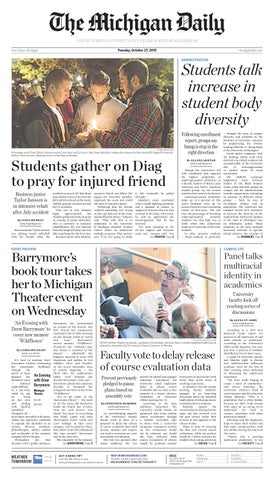
Students gather on Diag to pray for injured friend Business junior Taylor Janssen is in intensive rehab after July accident By LYDIA MURRAY Daily Staff Reporter
Business junior Taylor Janssen was playing beach volleyball with his friends when the
accident occurred. He had dived into shallow water to retrieve the ball and hit his head on the rocky, shallow ground. Janssen severed his C5 vertebrae. That was in July. Monday night, approximately 100 students gathered on the Diag for an evening of prayer dedicated, who is currently in intensive rehabilitation, but was released from the hospital Friday and was able to go home for the first time. Business junior Seth Johnson,
Janssen’s friend and fellow Phi Kappa Psi fraternity member, organized the event and retold the story of Janssen’s injury. “Following that, his friends realized something was wrong so they got him out of the water and notified the police,” Johnson said. “They took him in an ambulance to the University of Michigan Hospital Trauma Center where he underwent multiple surgeries. They weren’t sure if he was going to make
Following enrollment report, groups say bump is step in the right direction By ALLANA AKHTAR Daily Staff Reporter
it, but eventually he pulled through.” Monday’s event concluded with a candle-lighting ceremony and a moment of silence in support of Janssen, who was also on hand in the Diag. Afterward, he said he appreciated the encouragement that he has received. “It’s truly amazing to see all the support and everyone come out,” Janssen said. “It’s See PRAYER, Page 3
Though the University’s fall 2015 enrollment data reported the highest proportion of underrepresented minorities in a decade, leaders of Black, Latin American and Native American student groups say the current numbers leave more to be desired. Underrepresented minorities make up 12.8 percent of this year’s freshman class, up 2.8 percent from last year’s incoming cohort of first-years. The last time the percentage of incoming underrepresented minority students was this high was in 2005, when they collectively made up 13.8 percent of first-year students. In 2013, minority students — Black students in particular
EVENT PREVIEW
CAMPUS LIFE
Barrymore’s book tour takes her to Michigan Theater event on Wednesday ‘An Evening with Drew Barrymore’ to cover new memoir ‘Wildflower’ By CAROLINE FILIPS Daily Arts Writer
It’s hard to mention Drew Barrymore without referencing her tumultuous childhood. Though the perils of fame plagued her An Evening formative years with Drew — habitual Barrymore nightclubbing as a pre-teen, Michigan rehab by age Theater 14, living on her own Oct. 28 and dealing $25-$50 with familial instability through it all — Barrymore prevailed with poise. Today, her repertoire continues to expand: she identifies as an actress, director, producer, philanthropist, author, mother and co-founder of the cosmetic company Flower Beauty. Throughout her four decades with a public audience,
WEATHER TOMORROW
HI: 62 LO: 41
— brought the issue of campus diversity and inclusion to the forefront of University concerns by popularizing the Twitter hashtag #BBUM, or “Being Black at the University of Michigan.” Social media responses with the hashtag, which went viral, detailed ways Black students felt uncomfortable at the University due to microaggressions or explicit forms of racial harassment. The #BBUM campaign heightened work between leaders of the Black Student Union, other minority groups on campus and the administration to make campus more welcoming to students of different ethnic groups — both by way of on-campus climate and in admissions. The University has outlined several new initiatives to increase the diversity of the student body, within the confines of the state of Michigan’s ban on affirmative action. Those programs so far have included increased outreach to specific school districts, the creation of See NUMBERS, Page 3
Panel talks multiracial identity in academics University faculty kick off yearlong series of discussions By ALEXA ST. JOHN
Barrymore has accumulated an arsenal of life lessons. She first shared her uncensored, cautionary tale in 1990, focusing on her deviant youth in “Little Girl Lost.” Barrymore’s newest memoir, “Wildflower” chronicles her turbulent past and deems it essential to her present — admittedly her happiest, married to actor Will Kopelman and mother to two toddlers Olive and Frankie. In the recent November issue of InStyle magazine — the third time the publication’s editor Ariel Foxman has elected Barrymore cover girl — Barrymore admits her conscious decision to disregard her inaugural narrative as she wrote “Wildflower.” “It’s in my room, in the ‘Barrymore library’ — the stack of all the dusty old hardcover books my family has written, from my Aunt Diana’s ‘Too Much, Too Soon’ to everything that Ethel, Lionel and John (Barrymore) wrote. ‘Little Girl Lost’ belongs in that crazy category, and I’m glad it’s there, but I didn’t want to be influenced this time around,” Barrymore said in the interview. The remainder of the intimate See BARRYMORE, Page 5
Daily Staff Reporter
RYAN MCLOUGHLIN/Daily
SACUA member Stephan Szymanski, a professor of kinesiology, discusses flaws in studies regarding student course evaluations during the SACUA meeting in Palmer Commons on Monday.
Faculty vote to delay release of course evaluation data Provost previously pledged to pause plans based on assembly vote By GENEVIEVE HUMMER Daily Staff Reporter
An overwhelming majority of the University’s Faculty Senate voted in favor of a proposal to delay the release of course evaluation data until faculty, students and experts can reach a consensus on a new instrument of evaluation. The vote was planned after James Holloway, the vice
GOT A NEWS TIP? Call 734-418-4115 or e-mail news@michigandaily.com and let us know.
provost for global and engaged education, announced the University could implement plans to release course evaluation data as early as this semester at a Senate Advisory Committee on University Affairs meeting Oct. 12. According to the plan Holloway presented, the University would release all numerical data from student course evaluations through a website accessible only to those with a University uniqname. Comments written on the evaluations would not be released, nor would the data collected from course evaluations of classes taught by graduate student
NEW ON MICHIGANDAILY.COM YouTube: a guide to genre part three MICHIGANDAILY.COM/SECTION/ARTS
INDEX
instructors or instructors with fewer than seven terms of teaching experience. At Monday’s Faculty Senate meeting, faculty members engaged in an hour-long discussion about the potential implications of releasing course evaluation data to students. Weineck opened the conversation by sharing faculty input she has received over the past several weeks both in favor of and opposed to the release of data. Those in favor of releasing the data said current course evaluations, while not perfect, would be a better resource for students than ratings posted on See SACUA, Page 3
Vol. CXXV, No. 19 ©2015 The Michigan Daily michigandaily.com
According to a 2015 Pew Research Center report, 6.9 percent of all Americans 18 and older identify as multiracial. According to the University’s Office of the Registrar, last year, just over 3 percent of students identified as two or more races. A panel of University faculty met Monday night to discuss how multiracialism influences academic work for the first of their yearlong series dedicated to discussing the multiracial experience. “We were really hoping to create a sense of community,” said Karen Downing, the University Library’s head of social sciences and the education liaison librarian. “This is a population that is often hidden because we don’t walk around with signs on us saying we’re multiracial. It’s hard to connect sometimes with other multiracial people.” Downing said the organizers hope to share their stories and find some commonalities with one another during the course of this series. “There’s also a growing multiracial population in our See FACULTY, Page 2
NEWS............................ 2 OPINION.......................4 ARTS...........................5
SPORTS........................7 SUDOKU.......................2 CL ASSIFIEDS.................6
News
2 — Tuesday, October 27, 2015
TUESDAY: Campus Voices
MONDAY: This Week in History
WEDNESDAY: In Other Ivory Towers
THURSDAY: Twitter Talk
LAUREN BARRETT
What do you do for each organization? Midnight Book Club is a long-form improv team. In an MBC show, we get a suggestion from the audience, then proceed to create a 30-minute montage of scenes based on that suggestion. Funny or Die University of Michigan is a brand ambassadorship for Funny or Die. The goal is to unite and incubate comics on campus. I am one of the ambassadors
alongside Ryan McDonough, and we put on shows, make sketches, have writers’ rooms and panels, etc. Why business and comedy? My dream is to become a marketer, improviser, and mix the two. The fear is that I become Michael Scott of sorts. The dream is that I don’t. I really like improv and sketch, and I really want to work with people who care about it at its core. How has your experience at the University made that possible? Stephen M. Ross is my comedy idol. Actually, it’s
Research lunch
Biological chemistry
Assessing alQaradawi
WHAT: This lunch is for students who are interested in learning about emerging climate change adaptation and public health research. WHO: Graham Sustainability Institute WHEN: 12 p.m. to 1:15 p.m. WHERE: School of Public Health, Community Room
WHAT: Andrew Spakowitz, associate professor of chemical engineering, will be giving a seminar about biomolecular kinetics. WHO: Bioligical Chemistry Department WHEN: 12 p.m. to 1 p.m. WHERE: Medical Science Building
WHAT: Prof. Jakob Skovgaard- Petersen from the University of Copenhagen is giving a speech on Arab revolutions. WHO: Center for Middle Eastern and North African Studies WHEN: 4 p.m. to 5:30 p.m. WHERE: International Institute, 1636
Latin music guest recital
WHAT: This event will bring together 10 interdisciplinary faculty members to talk about food and agriculture. WHO: UM Sustainable Food Systems Initiative WHEN: 5 p.m. to 7 p.m. WHERE: Dana Natural Resources Building, 1040
WHAT: Three multimedia acts will perform Latin-American electronic music as part of a travelling audiovisual concert series. WHO: School of Music, Theatre & Dance WHEN: 8 p.m. WHERE: Walgreen Drama Center, Stamps Auditorium
The Partisan Divide talk WHAT: Former Congressmen Martin Frost and Tom Davis will speak about their book “The Partisan Divide: Congress in Crisis.” WHO: Gerald R. Ford Presidential Library WHEN: 7:30 p.m. to 9 p.m. WHERE: Gerald Ford Library
Business Manager 734-418-4115 ext. 1241 rfilipp@michigandaily.com
News Tips
Newsroom
news@michigandaily.com
734-418-4115 opt. 3
Letters to the Editor
Corrections corrections@michigandaily.com
tothedaily@michigandaily.com
Editorial Page
Arts Section
opinion@michigandaily.com
arts@michigandaily.com
What’s your favorite thing about being a University student? The homework. I love that it’s constant, I can rely on it and no matter what I do, it’ll never go away. It’s like a really great boyfriend. This is cliché and college-brochure-esque, but I don’t think I’ll ever surround myself with such a diverse group again, in terms of interests and personalities. —MEGAN DOYLE
420 Maynard St. Ann Arbor, MI 48109-1327 www.michigandaily.com JENNIFER CALFAS ROSE FILIPP
Editor in Chief 734-418-4115 ext. 1251 jcalfas@michigandaily.com
helped me learn to selfstart. I don’t need to wait for permission to make sketches or start an improv team; I can do it on my own.
Photography Section
Sports Section
photo@michigandaily.com
sports@michigandaily.com
Classified Sales
Display Sales
classified@michigandaily.com
dailydisplay@gmail.com
Finance
Online Sales
finance@michigandaily.com
onlineads@michigandaily.com
EDITORIAL STAFF Lev Facher
Managing Editor
Sam Gringlas
lfacher@michigandaily.com
Managing News Editor
gringlas@michigandaily.com
SENIOR NEWS EDITORS: Shoham Geva, Will Greenberg, Amabel Karoub, Emma Kerr, Emilie Plesset, Michael Sugerman ASSISTANT NEWS EDITORS: Tanaz Ahmed, Alyssa Brandon, Katie Penrod, Sami Wintner, Gen Hummer, Emma Kinery, Tanya Madhani, Lara Moehlman, Lea Giotto, Isobel Futter
CLAIRE ABDO/Daily
Friends and family gather to support and pray with injured Business junior Taylor Janssen on the Diag on Monday.
CAMPUS EVENTS & NOTES
Fast Food for Thought
FRIDAY: Photos of the Week
N I G H T O F P R AY E R
Campus funny girl Business senior Lauren Barrett is involved in an improv comedy group, Midnight Book Club, as well as Funny or Die at the University.
The Michigan Daily — michigandaily.com
Louise Glück reading WHAT: Louise Glück, author and writer-inresidence at Yale University, will be reading her works and doing a book signing. WHO: Helen Zell Writers’ Program WHEN: 7 p.m. to 9 p.m. WHERE: University Museum of Art, APSE
Fellows Info Session WHAT: Students interested in the Carnegie Jr. Fellows Program are invited to this info session. WHO: The Career Center WHEN: 1 p.m. to 2 p.m. WHERE: The Career Center, Program Room Please report any error in the Daily to corrections@ michigandaily.com.
opinioneditors@michigandaily.com
SENIOR EDITORIAL PAGE EDITORS: Claire Bryan and Regan Detwiler ASSISTANT EDITORIAL PAGE EDITORS: Mary Kate Winn, Melissa Scholke, Stephanie Trierweiler, Ben Keller
THREE THINGS YOU SHOULD KNOW TODAY
1
Northern Afghanistan was hit by a 7.5 magnitude earthquake Monday. According to The Guardian, more than 180 people have been killed. Abdullah Abdullah, chief executive of Afghanistan, said that the earthquake was one of the strongest recently.
2
Your weekly Jim Harbaugh-ism, on the topic of hypotheticals from last Saturday’s game: “If worms had machine guns, then birds (would) be scared of them.”
3
Aarica Marsh and Derek Wolfe Editorial Page Editors
Ben Carson, former neurosurgeon and a University alum, increased his lead in Iowa ahead of Donald Trump. Carson is now favored by 32 percent versus Trump who is favored by 18 perccent, Bloomberg Politics reported.
Max Cohen and Jake Lourim Managing Sports Editors
sportseditors@michigandaily.com
SENIOR SPORTS EDITORS: Max Bultman, Minh Doan, Jacob Gase, Simon Kaufman, Jason Rubinstein, Zach Shaw ASSISTANT SPORTS EDITORS: Chloe Aubuchon, Chris Crowder, Kelly Hall, Ted Janes, Kevin Santo, Brad Whipple
Adam Depollo and Chloe Gilke Managing Arts Editors
adepollo@michigandaily.com chloeliz@michigandaily.com
SENIOR ARTS EDITORS: Jamie Bircoll, Kathleen Davis, Catherine Sulpizio, Adam Theisen ARTS BEAT EDITORS: Alex Bernard, Karen Hua, Jacob Rich, Amelia Zak
Allison Farrand and Ruby Wallau Managing Photo Editors
photo@michigandaily.com
SENIOR PHOTO EDITORS: Luna Anna Archey, James Coller, Virginia Lozano ASSISTANT PHOTO EDITORS: Amanda Allen, Robert Dunne, Zach Moore, Sam Mousigian, San Pham
Emily Schumer and design@michigandaily.com Shane Achenbach Managing Design Editors Ian Dillingham Magazine Editor statement@michigandaily.com DEPUTY MAGAZINE EDITORS: Natalie Gadbois STATEMENT PHOTO EDITOR: Luna Anna Archey STATEMENT LEAD DESIGNER: Jake Wellins
Hannah Bates and Laura Schinagle Managing Copy Editors
copydesk@michigandaily.com
SENIOR COPY EDITORS: Emily Campbell and Emma Sutherland
Amrutha Sivakumar Online Editor amrutha@michigandaily.com Kaylla Cantilina and Katie Colosimo Managing Video Editors Carolyn Gearig Special Projects Manager
BUSINESS STAFF Hussein Hakim Finance and Operations Manager Claire Ulak Production Manager Jordan Yob Marketing Manager Matt Pfenning UAccounts Manager Asja Kepes Local Accounts Manager Colin Cheesman National Accounts Manager Anna He Special Guides and Online Manager Claire Butz Layout Manager The Michigan Daily (ISSN 0745-967) is published Monday through Friday during the fall and winter terms by students at the University of Michigan. One copy is available free of charge to all readers. Additional copies may be picked up at the Daily’s office for $2. Subscriptions for fall term, starting in September, via U.S. mail are $110. Winter term (January through April) is $115, yearlong (September through April) is $195. University affiliates are subject to a reduced subscription rate. On-campus subscriptions for fall term are $35. Subscriptions must be prepaid. The Michigan Daily is a member of The Associated Press and The Associated Collegiate Press.
Yale prof. presents on human ability to endure toxic materials Speaker says Martinique locals link pesticides with homosexuality By ANNA HARITOS Daily Staff Reporter
Homosexuality and environmental toxins may be unexpected topical pairings for a research study, but Monday, Yale University Prof. Vanessa Agard-Jones explored both in the context of a curious story from the French island Martinique. Faculty members and graduate students listened as Agard-Jones explained her research on homosexuality and gender transgression, both of which she said are frequently discussed topics in Martinique. In recent years, her research
has shifted to include a story about the island’s relationship to bodily contamination by chlordecone, a pesticide better known as Kepone in the United States, that was once used on the island’s banana plantations. Agard-Jones said the Kepone contamination began in 1979 when inclement weather hit the island’s banana population, and the farmers, struggling to rebuild their farms, faced a plague of insects. Plantation owners insisted that the only answer to the issue was a chemical solution. Kepone was sought by pesticide distributing companies on Martinique. It was historically imported from the United States, but after a plant spill in 1958, the distribution and production were halted and made illegal in the U.S. In 1981 the companies and plantation owners, through political and economic pressure, acquired
permission to distribute Kepone, and ultimately bought the patent to produce it. It wasn’t until 1990 that the French government stepped in to stop the production and distribution due to the increased levels contaminating the island. “The body has memory,” she said, quoting Jamaican poet Claudia Rankine. “The physical carriage hauls more than its weight.” She said the World Cancer Research Fund ranks Martinique as having the highest age-standardized rate of prostate cancer diagnosis per 100,000 people. In addition to the rate of cancer diagnoses, she said island residents believe there may be a connection between the pesticide and homosexuality and gender transgression. “This issue with the pesticide is an occasion right now for people to ask questions about where this ‘desire’ comes from,” Agard-Jones said. She said when this chemical breaks down in the environment, it produces estrogen-mimicking chemicals that are then ingested by humans and animals. “These are compounds that can actually raise estrogen loads in the body,” she said. “So then the question that is raised then is what happens when we become more estrogenic? What does that do? Does that change our desires? Does that change the way that we present ourselves in terms of our gender presentation? There are no hard facts about what becoming estrogenic does besides actually emergent studies about estrogenic male bodies and their relationship to cancer.” In addition to raising these questions, Agard-Jones addressed her latest project: a book titled “Body Burdens: Toxic Endurance and Decolonial Desire in the French Atlantic.” “The book will explore the ways in which Caribbean See TOXIC, Page 3
RYAN MCLOUGHLIN/Daily
Art & Design Prof. Edward West discusses his works examining the lives and experiences of multiracial people during a faculty panel in Hatcher Graduate Library on Monday.
FACULTY From Page 1 country and on our campus,” Downing said. “There’s a growing need for more inclusive research and teaching pedagogies that acknowledge intersections of social identities, and there’s a growing pipeline of multiracial students, staff and faculty.” The panel included Martha Jones, a professor of history and Afroamerican and African Studies and co-director of the Michigan Law Program in Race, Law and History, as well as Edward West, professor emeritus in the School of Art & Design, and Mark KamimuraJimenez, Rackham director of Graduate Student Success. All three faculty panelists raised points about the experiences of multiracial people, the diversity of multiracial students on campus and responded to the question, “What does it mean to be multiracial in a monoracial world?” Each also focused on an aspect specific to their own story, research and work at the University. West, the first to speak, was born to an African-American father from Cincinnati and a German mother from Berlin.
West, who grew up in New York City, has been a practicing artist since he was 17 years old and a teacher since he was 22, both professions are what he refers to as “central strands” of who he is as a person. “Being mixed is about living within a very particular state of consciousness, and so is being an artist,” West said. “Being mixed is about seeing things, accessing experiences in new combinations, and so is being an artist. Whether we like it or not, whether we choose it or not, being mixed is also about being a teacher, about the conversations that always arise as we explain to others who we are.” West said the interlacing of place, person and time has always been key to his work, as well as thinking how these contexts change who a person is, how people see themselves and how others see them. West has dedicated more than a decade to his photography project, “So Called.” Centered primarily on mixed race, the project focuses on geography, as West explored many different locations to complete his project, including Honolulu and Havana, Cuba. “So much of mixed-race literature and commentary had revolved around the pressures to choose one race or ethnic
identity over the multiplicity of one’s true lineage,” West said. “I wanted (my daughter) to know that there were places where her cultural conditioning were the norm, not the exception. I wanted her to understand that she didn’t have to subsume one part of her heritage in favor of another. I wanted her to be proud of being this and that.” According to West, to say mixed race or multiethnic means attempting to unpack the concept of race among broader cultural context. “ ‘So Called’ is a modifier that calls out the limits of naming,” West said. “For this project it also calls out the limits of any attempt to quantify, qualify and delimit who we are as mixed people.” Jones retold the story of how she began researching for a book about racial identity in the United States, particularly mixed-race identity. While doing research, Jones said she discovered aspects of her own identity that were unknown to her. “If the generations before mine had kept their silence, preferring dissemblance to socially awkward disclosure, I was different,” Jones said. “I was prepared to put it out there and let others make of it what they liked.” See FACULTY, Page 3
News
The Michigan Daily — michigandaily.com
NEWS BRIEFS
MHealthy launches ‘Ask the Expert’ Beginning Monday, once week per month, MHealthy experts will be accessible on Twitter and Facebook for a series called “Ask the Expert.” From October through December, this online series will consist of the experts posting about health-related topics. They will also respond to faculty questions posted on the social media platforms. The experts will be from the three MHealthy program areas: nutrition, physical activity and stress management. The series will culminate on Dec. 15 with the three featured experts facilitating a live question and answer session on Twitter.
Western Michigan student found dead in Norway Western Michigan University senior Dallas Rauker was found dead Sunday morning on the Reinebringen mountain in Norway, the Detroit Free Press reported. Rauker was attending Hogeschool Utrecht in the Netherlands in a study abroad program with Western Michigan’s Institute for Global Education. Rauker was spending his fall break last week hiking in Norway, when his family became concerned after not hearing from him during the middle of the week. After his family contacted WMU, Utrecht officials were contacted and worked with the U.S. Embassy to pinpoint the area in Norway where Rauker was hiking. Officials searched Friday through Sunday and were often stopped by inclement weather, eventually finding Rauker on Sunday. Rauker’s family flew to Amsterdam Saturday.
Detroit mayor announces land transfer for farming Detroit Mayor Mike Duggan announced a deal to transfer 40-acres of Detroit-owned land near Eastern Market to the RecoveryPark project, the Detroit Free Press reported. RecoveryPark is a project aimed to commercially grow food inside the city. The profits will support SHAR, a drug addiction recovery center. To begin, RecoveryPark will build plastic-wrapped hoop houses to grow vegetables yearround. In coming years, the program hopes to build more permanent growing sheds. The program already grows vegetables at a former industrial area and sells the salad greens to approximately 15 Detroit restaurants. This deal will eventually start as a lease between RecoveryPark and the city, eventually leading to a full purchase of the land. The land transfer is expected to go before City Council next week.
University searches for Wallace House director The University is in the process of searching for a new director of the Wallace House, home of the Knight-Wallace fellowship for journalists. The Wallace House is also home to the Livingston Award for Young Journalists. Current director Charles Eisendrath announced his retirement, effective July 2016. A search advisory committee appointed by Vice Provost James Holloway is in charge of conducting the search and presenting a list of recommended candidates. Engineering Prof. Thomas Zurbuchen and Ken Auletta, journalist and critic for The New Yorker, will co-chair the search. —KATIE PENROD
SACUA From Page 1 the website Rate My Professors. Others said faculty should be transparent and responsive to student requests. Others said because course evaluation data is provided by students, it should be made available to students. Those opposed to releasing the data pointed to potential bias based on race, gender, ethnicity and sexuality in course evaluation data, the low student participation rate in the evaluations and the professional implications such a release could have for faculty members. On Oct. 12, Holloway said a prototype website featuring limited data has been up and running for several months. His announcement earlier this month was met with surprise by SACUA members, who voiced the need for broader faculty consultation before such a plan was implemented. At the time, Comparative Literature Prof. Silke-Maria Weineck, the SACUA chair, said a majority of faculty members dislike the current course evaluation tools. “In my 17 years at the University of Michigan, I have not heard from a single person that thinks this is a good instrument providing good data,” she said. “In sum, nobody thinks that these are good data. And whatever they are, they were not designed to assist students in choosing classes; it is
PRAYER From Page 1 been pretty unbelievable the past 100 days, and just to see it all in one event has been pretty unbelievable as well. It’s hard to express what this all means to me. I love everyone that’s here.” Johnson said Janssen’s recovery has been going well for an injury this serious. “Normally the diagnosis is full paralysis below the chest; however, Taylor has been showing tricep control and has been doing really, really well in his rehab and showing a lot of strength,” Johnson said. “He’s an incredibly motivated kid and incredibly positive.” Johnson started a GoFundMe campaign that raised more than $150,000 in the first month and has helped sell T-shirts and wristbands with a “Janssen Strong” brand. As of Monday evening, the campaign has raised $157,947. “Following the accident, all
the wrong instrument for that. So what we’ve been saying at the Senate Assembly, it’s not that we don’t think students don’t have a legitimate interest in having more and better information on how to choose classes, but we think at a world-class University it behooves us to design an instrument that can actually deliver the data needed for that purpose.” In an interview with the Daily last week, University Provost Martha Pollack said if the University’s Senate Assembly expressed similar disapproval about releasing course evaluation data, she was willing to delay the release. “This came up because the students have requested it — this was all prompted by the students. We then got a response from SACUA that they were not happy about it,” Pollack said. “So I’ve asked them to take it to Senate Assembly, which is a bigger body, and if there’s serious unhappiness about it there, then I’m willing to hold off. But then I’ve said I want faculty governance to meet with student governance to get this sorted out.” Pollack acknowledged faculty concerns about the current evaluations during her interview with the Daily. As a result, she said she has asked Holloway to form a committee including students, faculty and assessment experts to determine best practices for course evaluation. If these best practices are not in line with the current instrument, the committee will be charged with
recommending an alternative. On Monday, Mika LaVaqueManty, a professor of political science, presented an abbreviated summary of his research on bias based on race, ethnicity and gender in course evaluation data. According to his findings, LaVaque-Manty said, there is no indication of such bias. To reach this conclusion, he aggregated data from the 108,000 courses offered by the College of Engineering and LSA over the past 10 years. LaVaque-Manty argued in favor of providing students with current course evaluation data until a new instrument is developed. “There is no evidence of bias,” LaVaque-Manty said. “This does not mean that social identity is not in play, but the instrument seems to be pretty neutral on that. The question of a better instrument is a reasonable one, but at the moment students are using nothing for most of us, or RateMyProfessors. com for about 10 percent of us. The current instrument has shown to be much more consistent, a much better instrument. I don’t see any inconsistency between the idea of developing a better instrument and at the same time releasing data.” Angela Dillard, the LSA associate dean for undergraduate education and a professor of Afroamerican and African Studies, said faculty should focus on whether or not to release course evaluation data, rather than developing a new instrument. “This is not a new conversation; we’ve been looking at this for a
of my friends in the fraternity started coming up with ideas for how we could help him and his family get through this,” he said. “It’s been amazing.” The idea for the night of prayer originally came from Pastor Jim Mong of the Redeemer Ann Arbor church. Mong said he was inspired by the story and wanted to help show support in the community. “I went to visit Taylor two weeks after his accident, and they talked about how overwhelmed they were with how much support they’d been getting from the community,” Mong said. “As I walked away, I hoped that as he had that long-term journey that he would have that support long term, so I met with Seth and had the idea of doing it 100 days out to show that the support will continue.” Looking forward, Johnson said he hopes Janssen continues to recover and is still able to live a fulfilling life. “My hope for him, in the future, is that this doesn’t
impede his ability to do whatever he wants,” he said. “He always wanted to be a CFO, and I hope he can obtain whatever he wants in his career regardless of this injury.” At the event, Janssen’s father, Mark Janssen, spoke about his the family’s experiences during the past 100 days of recovery. “Early on, we saw an amazing difference,” he said. “He has a ton of strength back — nowhere near where he was — but he has a ton of strength back.” He also took time to thank all the people who have been supporting his family throughout the entire process, particularly the Greek life community. Janssen said despite his past experience in a fraternity himself, he did not truly understand its importance until now. “I never got it, really, but I truly get it now,” he said. “I wanted to close with a big thank you to the Greek system. You’ve given such tremendous support, and it truly humbles me.”
follow @michigandaily TOXIC From Page 1 bodies are marked by enduring toxicities in modern times,” she said. “The book invites readers to think in historical and contemporary terms about
NUMBERS From Page 1 new scholarship programs and an move to package financial aid packages with admissions decisions. This year, the percentage of total Black students on campus is at 4.82 percent, or an increase of 59 students since last year. Kinesiology senior Capri’Nara Kendall, speaker of the BSU, said increased number of Black students in class represents a positive trend, though she added that the University still has a way to go in terms of tangibly increasing diversity and subsequently improving student life for Black students on campus. “Talk to me when minority enrollment is out of the 4 percent — when we’re looking at more of a 7-percent enrollment for African Americans,” she said in an interview with The Michigan Daily. “When we’re looking at more of a 7-percent enrollment for Latino students.” Similarly, the number of undergraduate Hispanic students at the University also saw a slight bump in the last year, from 1,209 undergraduate students in the fall 2014 semester to 1,300 students as of this current semester. Hispanic students
archives of homosexual desire.” The questions, issues and data raised sparked conversation between Agard-Jones and University colleagues after her lecture, diving deeper into the sociopolitical issues involved with the story of Martinique.
“Is it a toxic question?” History Prof. John Carson asked. “She brings up the question of what exactly is the problem? Is it a problem of gender identification? Is it a problem of physical health? I thought that was really interesting.”
currently make up 4.93 percent of the undergraduate body and 5.9 percent of the incoming freshman class. Note that the University’s enrollment report employs the term “Hispanic,” whereas most students tend to use, generally, the term “Latin American.” Though the University has increased diversity among its Latin American students, some student leaders say more efforts are needed on campus. LSA senior Thalia Maya, the president of the historically Latina Lambda Theta Alpha sorority, noted that some of the reason for the increase in Latina students on campus is due to the increasing accessibility of higher education to these communities. She said many Latin American students, like herself, are born to immigrant parents and are the first in their families to attend college. This, she added, can pose a challenge. “When I first came here, I was living in the dorms and surrounded by people who did not look like me at all,” Maya said. “That did make me feel uncomfortable, but being able to find people who came from similar backgrounds as me served as that support system.” For Native American students, though increases in diversity
have occurred, they have been slight. In the entire student body, there was an increase of only 12 new Native American students from last fall’s enrollment. This marked a percentage bump from 0.21 percent of the student body to 0.25 percent. Public Policy senior Isa Gaillard, co-chair of the Native American Student Association, said the slight increase of representation for Native American students is a “drop in a bucket.” Gaillard says NASA, originally designed as a group for undergraduate Native American students, has been struggling with retaining and growing its membership. This year, he said, only eight or nine students come to meetings — and they are a mix of both graduate and undergraduate students. “We e-mailed all of the students that are listed as Native and none of them showed up to our meeting,” he said. He attributes the decreased NASA membership to the general lack of Native American students on campus. Gaillard and other NASA members work each year to raise awareness for Native American culture through hosting the Native American Heritage Month in November, alongside the Office
Tuesday, October 27, 2015 — 3 long time,” Dillard said. “I am unconvinced that a study group could come up with a somehow better instrument that would be free from the questions we’re using now. I don’t think that this committee is going to come up with something that is somehow magically better. For me, it’s a question of release it or don’t release it. I can’t tell you how many studies we’ve done; I think that that’s just evasive.” Several student government representatives were also present at the meeting. LSA senior Cooper Charlton, Central Student Government president, said CSG is in favor of working with faculty to develop a new instrument. In the meantime, however, the group plans to advocate for current course evaluation data to be released at the start of the winter 2016 semester. “We want this to be a collaborative effort,” Charlton said. “By no means are we here to shove your concerns into a corner and not listen to you. That being said, it’s a decision, ‘are we going to release these now or are we going to kick the can down the road?’ We see there’s two conversations going on: the immediate release of course evaluations as they stand, and the second conversation is how can we come together through the committee Dr. Holloway has suggested to determine what the instrument looks like going forward?” In an interview after the meeting, LSA senior Jason Colella, president of LSA Student
FACULTY From Page 2 Jones said one of the very first articles she wrote was for a news outlet, editors gave her article the title “Biracial, and also black.” “It was a reflection on shifting categories, one that used my family history to tell about how we got from the one drop pool to mixed race,” Jones said. “It was powerful to hear people respond to the work. Detractors told me I couldn’t be both black and biracial.” Jones referenced feminist writer and poet Helene Cixous’ famous line, “Blackness isn’t black. It is the last degree of reds.” For Jones, Cixous’ line reminded her that writing a family history of race is more than social science. “My family’s story has banished the red, leaving blackness to stand alone, stand in for the whole,” Jones said. She posed questions to attendees: “Can a color be remembered? Does it carry with it memories of red, of black, of white … ? What happens to my blackness when it becomes also red? Is it then blackness at all?” Going through school, Kamimura-Jimenez said people would often ask, “What are you?” and after listing off different ethnicities, he said they would often call him a “mutt.” “The only mutt I knew was my neighbor’s dog,” Kamimura-
for Multi-Ethnic Student Affairs. NASA also organizes an annual “powwow,” or cultural celebration with food, dancers, drummers and fashion. According to Gaillard, the University’s powwow is the second largest student-run powwow in the nation. The 2014 iteration, the 42nd Dance for Mother Earth Powwow, was held at Skyline High School. Despite NASA’s efforts to promote awareness of Native American culture on campus, Gaillard says when he asks, many students are unaware of the heritage month or the powwow. Gaillard says he wants to leave the University knowing there is a more representative and supportive community for Native American students on campus, which starts with increasing their representation within the student body. “We really do want to work with the University in whatever ways we can to make sure that not only is Native American student enrollment increasing, but also that the community feels welcome on campus,” he said. Though the proportion of Asian American students has declined slightly in the new freshman class — changing from 15.28 percent in 2014 to 14.09 percent this year — the University
Government, said he was willing to accept a delayed release of course evaluation data if it meant protecting the relationship between students and faculty. “Personally, I would want the immediate release as well, but I am willing to take a step back and wait until we can get further agreement,” he said. “In my opinion, it’s not worth causing such strife amongst faculty in order to get the release of data.” Following the meeting, Charlton stressed that CSG has a vested interest in collaborating with faculty. “From the outside, it looks like it’s faculty versus students — and it’s really not that,” Charlton said. “I really do believe it is faculty and students wanting to work together. I want that to be extremely clear, we want to work with faculty. That being said, we want the course evaluations to be released for winter 2016.” For this to happen, Charlton said, CSG has developed two potential options. “We have two congruent plans that we can take, one is a little bit more aggressive that we want to avoid because, like I said, we want to commit to a relationship with faculty, not just while I’m here, but down the road,” he said. “We have a softer plan that involves a lot of sit-down meetings, but that probably won’t work, so we’re really left with one aggressive plan. We’d like to avoid taking an aggressive stance on this, but it’s something we might have to do.”
Jimenez said jokingly. “You have these notions of attaching identity to these different events in your life … (As a child) it becomes really complicated to negotiate and understand the world we’re in.” Kamimura-Jimenez said racial history in the United States informs a lot of the climate around mixed-race identities. When beginning his dissertation, KamimuraJimenez said a faculty member asked him why he was studying race and told him to study something more important. So Kamimura-Jimenez wrote his dissertation on multiple race groups and mixed race as related to identity development. In his dissertation, he asked the question, “How do mixed-race people understand themselves and others?” Kamimura-Jimenez found in his research that mixed race people understood others much more than they understood themselves because mixed-race people are constantly trying to negotiate their environment with situational identity. “Do we create environments in which students are being forced to think about who they are all the time?” KamimuraJimenez asked. “We need to create environments in which students can be themselves. They need to be free to be who they are.” A multiracial student panel will take place in winter 2016.
does not consider Asian American students to comprise an “underrepresented” minority group. The U.S. Census Bureau reports Asian Americans make up only 2.9 percent of the Michigan population but represent a much larger proportion of students. Still, LSA junior Eman Hijab, president of Michigan Pakistanis, or MPak, said she and other Asian American students are subject to stereotyping and judgment despite being represented on campus. Furthermore, though Asian American students make up 11.87 percent of all undergraduate students, she said intra-Asian American groups, like South Asian, Southeast Asian, East Asian and Middle Eastern students have much smaller representations. For this reason, Hijab said in an e-mail to the Daily, she hopes to see increases in all minority groups in the coming years. “I can’t help but to think about how many potential connections, friendships, relationships, were forewent due to the decrease in theses enrollment numbers this year alone and how many will be foregone in the future years if enrollment doesn’t increase to include not just Asian Americans but other minorities as well,” she wrote.
Opinion
4 — Tuesday, October 27, 2015
The Michigan Daily — michigandaily.com
The benefits of all-female housing Edited and managed by students at the University of Michigan since 1890. 420 Maynard St. Ann Arbor, MI 48109 tothedaily@michigandaily.com JENNIFER CALFAS EDITOR IN CHIEF
AARICA MARSH and DEREK WOLFE EDITORIAL PAGE EDITORS
LEV FACHER MANAGING EDITOR
Unsigned editorials reflect the official position of the Daily’s editorial board. All other signed articles and illustrations represent solely the views of their authors.
I
Living densely
t’s a law of physics that, in liquid, the denser object sinks lower. But this particular rule doesn’t hold true in the building of cities. Density doesn’t sink a community — sprawl does. That’s because population density makes sense. And it’s the kind of sense that can be measured in taxpayer dollars saved, an economy diversified and a city made greener. Sustainable cities are the building blocks of a sustainable nation, ZACHARY one that can survive in a ACKERMAN changing world. There’s a saying that goes something like, “God was good enough to give man the beauty of the world, but cruel enough to give him the drive to destroy it.” Since 1981, the amount of farmable land in the United States has dropped from about 20 to 16 percent of our total land area. While a drop of 4 percent may seem like a small change, it represents a loss of over 141,000 square miles of arable land. That’s nearly the entire state of Montana. I don’t write this to preach Armageddon, but rather to check a reality that we so easily take for granted. And land is a fleeting reality. Concentrating population centers saves natural beauty and farmland. But more than that, dense cities greatly reduce our dependence on the automobile. A dependence that is responsible for nearly one-fifth of all carbon emissions in the United States. The stark reality is our current mode of life is not sustainable. Our generation will be faced with many existential crises. Survival in our changing environment will be the most critical. Now I’m hesitant to speak in generalizations about our generation. The media loves to pigeonhole Millennials as one of only a handful of things. But as the largest generation ever, diversity of thought is inevitable. That said, three of the things the media tells us we are, I like. First, we seek out cities. Second, we are economically enterprising. And third, we try to be socially conscientious. This is the segment of Millennials that every city wants and Ann Arbor needs. And, you guessed it, urban density can help. Ann Arbor needs a next generation of residents, one that will respect and uphold our remarkable values. As of 2010, people ages 20 to 24 make up more than 20 percent of Ann Arbor’s population. If we bump up one age bracket, to people ages 25 to 29, that number halves. It make sense. After all, we are a college town and people graduate. But how do we retain more of that 20
percent come commencement day? When a city builds out, it cuts off its ability to create vibrant cultural and economic centers or provide meaningful transit options. Both elements are essential to our generation, a whopping 86 percent of whom say that public transportation is critical. When we single out Millennials making less than $30,000 a year, that statistic jumps to 92 percent. This suggests that affordability is also imperative to the Millennial equation. Ann Arbor has one of the hottest real estate markets in the country, with an average rental room that costs a startling $1,118 per month. There is clearly a huge demand for housing that is not being met by supply. Denser housing development provides more housing options with direct access to awesome amenities, like a vibrant downtown and public transit. All that said, creating an affordable city does more than allow young residents to pay rent. It speaks to an inner drive to live in a truly diverse community, not one sanitized by forces of gentrification. But Ann Arbor is still a rich community. With the average price of a house hanging out north of $300,000, it’s not uncommon for residents to be paying $7,000 or more a year in property taxes. It may be startling, then, that the city isn’t in great fiscal shape — every year, our costs are rising faster than our revenue. That’s a scary place to be. Luckily, density can help. The logic is pretty simple. Infrastructure costs a lot of money. And suburban living requires a lot of infrastructure. Just think about how much all those winding roads must cost, not to mention the pipes that run beneath. In fact, the marginal cost of providing services to a new building is so high that a dense, multi-use development costs society between 38 and 50 percent less than a single-family home. Your local government isn’t just saving money, though. It’s also tapping new revenue streams. New neighbors mean everyone’s services keep coming, but new taxes don’t need to. Of course, all of this means change. But change is inevitable, and when it comes to sustainability and survival, change is necessary. The desires of youth will likely shape the future. But those desires must be refined by the moderation and historical perspective of older generations. For that reason, density can’t just mean skyscrapers and subways; often it will simply mean townhouses and duplexes. Like every generation that has preceded us, we will reshape our nation. I hope ours will reshape densely. —Zachary Ackerman is an LSA senior and the Democratic nominee (Ward 3) for Ann Arbor City Council. He can be reached at zdack@umich.edu.
EDITORIAL BOARD MEMBERS Claire Bryan, Regan Detwiler, Ben Keller, Payton Luokkala, Aarica Marsh, Adam Morton, Victoria Noble, Anna Polumbo-Levy, Melissa Scholke, Michael Schramm, Stephanie Trierweiler, Mary Kate Winn, Derek Wolfe JOE IOVINO
E-mail joe at jiovino@umich.edu
T
his past weekend, the Martha Cook Building, one of the University’s three remaining all-female dorms, celebrated its 100th anniversary. Both current and former residents attended the event, and University President Mark Schlissel VICTORIA gave a keynote NOBLE speech that lauded the building’s “unique learning environment, where everyone feels equally included.” The educational experience for women at the University has certainly evolved in the 100 years since Martha Cook opened. Though it’s not obvious that all-women housing fills the same niche in the campus community that it once did, female dorms continue to provide a supportive community for residents. When the University began admitting female students in 1870, the co-education of women and men was exceedingly controversial. Though ultimately successful and enduring, co-education challenged not only classroom dynamics, but also every aspect of the educational structure. Housing female students became a special concern. Prior to construction of the first all-women residence halls, female students typically lived in boarding houses independent from the University, or on occasion, in the homes of University faculty members. The first all-women residence halls — the Martha Cook Building and Helen Newberry Residence — rep-
“
resented the first major efforts by the University to house female students. A 1924 survey of all female alumni evidences that the buildings benefited residents by providing a sense of solidarity and belonging on campus. But since the 1970s, women across the United States have been attending college at higher rates than their male counterparts, and men outnumbered women by only 1 percent in the University’s entering undergraduate class in 2015. Accommodating female students on campus is no longer a special concern for those charged with planning and providing student housing — it’s literally half of the students they’re dealing with. Today, most on-campus housing is co-ed, and fewer than 400 women live in one of the three allfemale residence halls. That trend doesn’t seem likely to reverse anytime soon, as co-ed housing has become increasingly common on campuses nationwide. Based on recent trends in student housing, it may seem that all-female residence halls might be little more than relics of the past, and lack significant roles to play on campus. But, even today, many residents find that their time in all-female housing adds significant value to their University experience — at least I did. I lived in the Martha Cook Building during my freshman and sophomore years. On the surface, I’m not the first person anyone would expect to live there. Across campus, the building’s culture seems to be typified as old-fashioned, ultraconservative and unsocial. But far from being backward or overly traditional, the building’s culture
emphasizes personal and academic achievement, and fosters a community of students dedicated to helping each other succeed. In my experience, all-female housing fosters an educational environment unparalleled anywhere on campus. I have never lived in a more studious, focused environment. Residents were more than willing to help each other understand class materials, and because many women choose to live in the building multiple years, older students were often around to help freshmen adjust to classes and campus life. The atmosphere was in equal parts supportive and serious. Ostensibly, there’s no reason why co-ed on-campus housing couldn’t be restructured to provide similar academic support. Even so, all-women housing is unique in its ability to support female students. Fostering a community of women dedicated to helping each other achieve personal and academic goals is in itself beneficial. Though women and men attend the University in almost equal numbers, women still face obstacles on campus that their male counterparts don’t. For the women who choose to live there, all-female housing can provide a support system that can help residents overcome common barriers. In that respect, the Martha Cook Building still serves the same function that it did 100 years ago. Far from being outmoded and outdated, all-women housing provides tangible benefits for its residents by fostering a supportive campus community. — Victoria Noble can be reached at vjnoble@umich.edu.
NOTABLE QUOTABLE
I’m not into the ‘if this, if that’ type of scenarios. If worms had machine guns, then birds (would) be scared of them.” — Michigan football coach Jim Harbaugh during his press conference yesterday on hypothetical situations.
LILLIAN GAINES | VIEWPOINT
Where is the line? Halloween, or “Hallo-week,” as it’s celebrated in Greek life, is a seven-day romp in costume, a time when otherwise sane students step out as TV characters, tabloid antiheroes, celebrities of the moment and perennial favorites like the sexy kitten. As the ever-popular cat ears vanish from store shelves this week and many of us look forward to our first experience of this curious exhibition, it is time to talk about which kinds of costumes should be showcased in this year’s festivities and which should not. As the “liaison” for my sorority to the Panhellenic executive board, also known as a junior Panhellenic representative, I have had the opportunity, with approximately 30 other girls, to get an insider’s look at these issues. For the past two meetings, we have been discussing cultural appropriation, trying to anticipate and help to preempt the offensive language, costumes and behaviors that have too often stained Greek life — and, let’s be honest, American life. After just one of these sessions, I was appalled, not only because I had now been aptly made aware of how pervasive instances of cultural insensitivity are, but also because it made me realize just how easy it is to perpetuate this behavior. Cultural appropriation is when a privileged group adopts a cultural symbol, norm or behavior and takes it for itself because it’s considered funny, fashionable or cool. Kidada Malloy, our discussion facilitator and the Expect Respect program
assistant, said during her presentation and later reiterated in an interview that cultural appropriation is offensive because “it belittles a culture or identity, in a way that trivializes an entire way of life.” An outrageous example of this was popularized in 2012 when sorority girls from Penn State University wore sombreros and held signs saying, “I don’t cut grass, I smoke it,” and “will mow lawn for weed and beer.” It goes without saying that these girls crossed the line, but where is it drawn? Malloy made it clear in her presentation that there is no line. It’s impossible to know if you’re offending someone without asking, so you should simply err on the side of caution. She said something as small as wearing a bindi as an accessory, without acknowledging its historic and cultural representation, is likely to offend someone. During the meeting, we predominantly discussed the role of celebrity influence in cultural appropriation. Last year, Pharrell Williams was showcased on the cover of Elle magazine sporting a Native American headdress. Selena Gomez performed “Come and Get it” at the 2013 MTV awards dressed in a sari, saying later that it was “fun” to incorporate the culture into the performance. Katy Perry also performed her song “Unconditionally” wearing a kimono, dressed as a geisha. In two of these three cases, the artists apologized almost immediately for their disrespect toward an entire culture.
Malloy deemed it essential to recognize that cultural appropriation primarily happens when people are unaware of how their actions may be perceived as offensive. Malloy urged us to “engage in conversations with our peer community to expand our awareness and understanding of different cultures so that our actions match up with our values.” In practice, there’s no difference between being outwardly offensive, like those who participated in the infamous “Bloods and Crips” theme party at Dartmouth College versus simply wearing a bindi as a body jewel at your next party. In both cases, you’re offending someone, and although the degree might differ, we shouldn’t be inappropriately or inaccurately portraying a way of life. One of the more prevalent occurrences of cultural appropriation stems from sexualizing minorities, which is something to keep in mind when trying to scandalize your costume this year. Try opting for a sexy animal or a sexy mythical creature this time around. Trust me, you’d be hard pressed to find a racy dragon-fairy that feels discriminated against, and you won’t be perpetuating disrespectful stereotypes in the process. With that being said, for this Halloween, let’s foster an inclusive and welcoming environment by opting to wear actual costumes and not cultures. Lillian Gaines is an LSA sophomore.
CONTRIBUTE TO THE CONVERSATION Readers are encouraged to submit letters to the editor and viewpoints. Letters should be fewer than 300 words while viewpoints should be 550-850 words. Send the article, writer’s full name and University affiliation to tothedaily@michigandaily.com.
Arts
The Michigan Daily — michigandaily.com
Tuesday, October 27, 2015 — 5
MUSIC NOTEBOOK
Write for Daily Arts WE GET FREE CANDY FROM THE SIMPSONS
BARRYMORE From Page 1 interview with longtime friend Foxman showcases signature Barrymore — unapologetic, unedited and exceedingly wise — covering everything from her family goldfish’s feeding schedule to the specifics of her latest film, “Miss You Already,” which premiered during the Toronto International Film Festival this September. As Foxman continues to praise her remarkable, persisting likability, Barrymore modestly withholds any self-praise. She simply admits her lifelong goal of being everyone’s cheerleader, a quality she saw best embodied in Norm from “Cheers.” Ever the optimist, Barrymore regards her past with reverence, maintaining the invaluable learning experiences derived from missteps, a key concept of her new autobiography.
In collaboration with Nicola’s Books, The Michigan Theater is hosting the only Michigan stop of her “Wildflower” book tour. During Wednesday’s “An Evening with Drew Barrymore,” the actress is set to speak about her work, read excerpts from the memoir and answer questions from the moderator, theater director of sponsorship Drew Waller. Guests can submit questions upon entry to the show. Each ticket purchase includes a copy of the memoir, released Oct. 27, which Barrymore can sign following the presentation. “I think it’s a really great chance to see someone we know as an actress,” said Ruth Lednicer, the theater’s senior director of marketing and programs. Barrymore’s directorial debut “Whip It” — the roller derby-dramedy starring Ellen Page, filmed throughout the Metro Detroit area. Though her repertoire continues to expand,
today, Barrymore dabbles in all facets of filmmaking from acting to producing. “She’s pretty multifaceted and a very talented woman,” Lednicer said. “She’s lived a very intense life in 40 years, and has some really nice insights to what’s important in life.” Lednicer received a prerelease copy of the memoir, and was apt to share a synopsis. “Her book is really her various life stories — growing up in the crazy world she grew up in and how having her daughters helped her solidify her life and calm her and center her world,” Lednicer said. “Her mother was a single mother that raised her with the idea that she should do whatever she wanted to do. Sadly, her mother ended up checking her into a rehab center at the age of 12, but Drew said that’s the best thing that could’ve happened to her because it taught her respect and gratitude and grounded her.”
FILM REVIEW
PARAMOUNT PICTURES
The photographer won’t be happy when his sex tape gets leaked.
‘Ghost Dimension’ can’t even be OK By BRIAN BURLAGE Daily Arts Writer
There’s a pretty substantial trap that most modern horror movies fall into these days, and I’d like to spend some time explain- D ing it to you — not because Parait’s confusing normal or elusive, but because it’s Activity: worth talking The Ghost about. Dimension “Paranormal Activity: The Paramount Ghost Dimen- Pictures sion” proves to Coming soon be an excellent case study. As to VOD the alleged final installment to a highly successful (and some would argue influential) franchise, “Ghost Dimension” had its work cut out. With a strong, well-developed backstory involving a relatively likeable family, with its cinematographic style already established, with a history of box-office brawn and boom — all “Ghost Dimension” had to do was simply glide by. It just needed to be OK. It failed at even that. This brings us to the trap, which dulls the latest “Paranormal Activity” film like
an ugly dose of NyQuil. I’m going to walk you through it. Are you ready? Paying attention? Keep your eyes poised on the screen, on these words because it’s about to get very GGGGRRRAWAWAWRRRRRR.
Keep your eyes on these words, because it’s about to get very GRAWRRWRAAA
Did that scare you? Did you jump? Because that’s it, that’s the whole trap: the jump scare. For various reasons — weak stories, boring characters, poor style choices, inexperience — more and more horror movies resort to the jump scare for a good pump of adrenaline. Instead of relying on the natural suspense of a scene that’s been building because of its well-positioned place in the story, some horror movies rely on the cheap effect of surprise: not the respectable twist-inspired kind of alarm, but the annoying dumbeddown version of shock. “Ghost Dimension” does this again and again. What makes this especially
difficult to come to terms with is the fact that the film didn’t have to rely on jump scares. The first three “Paranormal Activity” movies were all good and inventive to some degree, and though the franchise has certainly been slipping since then, it has a reliable formula to fall back on: tricks with mounted cameras, eerie sequences without music, kids terrorized by malevolent spirits, creepy and mysterious rituals, you know the drill. “Ghost Dimension” gives a middle finger to all of these. And then there’s the plot. I’ll do it justice with one sentence. A cult demon named Toby preys on a suburban family, latches onto one of the younger girls and uses her to breach a ghostly portal and travel back in time to terrorize the family. Eighty-eight minutes do nothing to make this mundane plotline more compelling or intelligible. While I try to bring this review to a conclusion (hopefully with more success than the franchise), I’m struck by something I hadn’t considered until now. “Ghost Dimension,” like its predecessors, spends a great deal of time focusing on static, empty places. The mounted cameras show empty halls, staircases and bedrooms for minutes at a time. This is where the true horror and fear of the movie resides: in the deliberate vacancy — the promise of emptiness.
COURTESY OF LITTLE BRUTES
Looks more like Little Milds.
Little Brutes rising with unique sound By CATHERINE BAKER Daily Arts Writer
It’s just past 11:00 on a Friday night and I’m one of the lone survivors in the Fishbowl. I’ve reached a point where there’s something deeply satisfying about outlasting the guy at the computer next to me. Or maybe it’s terribly sad that this is what brings me joy today. The low hum of the printers, the clatter of the keyboard and the occasional cough from across the room make for soothing background noise. I can’t help but think that someone infinitely more talented than myself would be able to make something beautiful from such simple sounds. While I may not be able to take a series of snaps and claps and transform it into a chart-topper, my most recent obsession, Little Brutes, does just that. The LA-based pop duo works miracles with what sounds like a minimal amount of instruments. Members Rachael Cantu and Harlan Silverman met while touring with B.B. King and began collaborating in their dressing room before shows. Their debut EP Desire combines airy melodies with strategic vocals to produce a live band sound
despite the computer screen and headphones that separates them from the listener. Exploring themes of lost time, endless future and persistent progress, Little Brutes creates a feeling that mixes nostalgia and excitement. Producing songs with fixed beats that resemble ocean swells and steady rain patter, Desire can easily make the jump from Fishbowl to front porch (though perhaps not with this cold weather rolling in). Opening with “Make Our Own Way,” Little Brutes tells a tale of self-acceptance and adventure with lyrics that claim, “All we need is a roof and a warm place.” Repetitive guitar riffs and harmonies that make your spine tingle dictate the track, constructing a sound that pushes you to seize the moment and live in the present. The background noise is filled with eccentric items, like salt and pepper shakers or the ring of a cowbell, which emphasizes Little Brutes’s unique sound and innovative structure. The title track, “Desire,” speaks of broken relationships and picking up the pieces, comforting listeners with lyrics like “Someone said
to me / You’re where you should be.” (Unrelated, but applicable: These lyrics are particularly consoling during the lovely time of midterms.) Claps, snaps and hands create the bulk of the noise in “Desire,” embodying an almost polyphonic tone. It’s a song reminiscent of dark, highway drives and the changing of the seasons. All the songs are characterized as light electronica and are lyricfocused with a driving bass throughout, but “Wait for Me” takes electronic to the next level. Synthetic, slow and sensuous, “Wait for Me” speaks to the transitive nature of time, musing “If this world is not as it seems / Wait for me.” A mélange of instruments works together to fashion a single sound perfect for those late night contemplations. Little Brutes could make music with whatever instruments, kitchen utensils or people they were given, which in my book makes them true artists. They may not be on the Top 100, nor should they aspire to be. If they keep making music that they love, they’ll attract listeners who love it too. (Salt and pepper shakers and all.)
I CAN’T FEEL MY _____ WHEN I’M WITH YOU. BUT I LOVE IT. A) FACE B) NECK BRACE C) ACE OF BASE D) BLANK SPACE
THE ANSWER IS IN YOUR SOUL. Send us your thoughts, send us your love. E-mail arts@michigandaily.com.
Arts
6 — Tuesday, October 27, 2015
The Michigan Daily — michigandaily.com
BOOK REVIEW
TV NOTEBOOK
‘SNL’ is not mine ‘Purity’ is pretty good, not genius It’s weird to feel nostalgic for something before your time
By DREW MARON Daily Arts Writer
By SOPHIA KAUFMAN Daily Arts Writer
Over the summer, I went with a friend to see Saturday Night Live: The Exhibition, which boasted “40 Years of Saturday Nights.” We were welcomed by a slideshow narrated by Alec Baldwin, who gave a brief history of how “SNL” started and took off immediately, giving the American public something they wanted — something that pushed boundaries and injected humor into situations that didn’t always feel funny in real life. It was satirical, never afraid to skewer those in the public eye. It was pop culture with an unflinching spotlight on politics. It was fresh; it was funny; it was multifaceted — and people loved it. After the slideshow, we were invited to walk down a red carpet into Studio 8H, where the exhibit was organized by the days of the week, chronicling the process of making an episode and putting on a live show. There were original scripts and props and entire sets recreated. There were screens where Seth Meyers, Jimmy Fallon, Aidy Bryant and Cecily Strong each explained how “SNL” pieces came together. Some things we could touch and some we couldn’t (though that didn’t stop a lot of people), and people didn’t even bother putting their phones back in their pockets after taking pictures — every spot was another perfect Instagram shot. We sat at the table where the cast does pre-air table reads, we stood in the dressing rooms next to Gilly, we smelled the faint paint fumes in the room with some of the original plaster casting molds. We saw every cast member’s original headshot and, for the finale, we sat in front of the complete stage while a recording of Tina Fey thanked us for coming to visit.
NBC
I want to go to there.
The exhibit, showed the best of “SNL,” with all the bonus features and extras come to life in front of us. It felt like our favorite characters were waving goodbye as event-goers left the stage. Or at least, that’s how the emotional middle-aged couple who followed my friend and me out of the gift shop and onto 5th Avenue felt. Personally, I felt a little confused. And then confused about my confusion. And then a little sad. And then guilty about feeling sad, and then I started to slightly resent my parents. Here’s the thing: obviously, an exhibit of “40 years of Saturday Nights” would have to be boiled down into only the essentials. And while I recognized a lot of it, there was a lot I didn’t recognize, too. Some I recognized only from hearing my parents talk, and didn’t personally experience. I can only lay claim to a few of the most memorable exploits in the past few years: Kate McKinnon’s Justin Bieber, Tina Fey’s Sarah Palin and Amy Poehler’s Hillary Clinton, Justin Timberlake’s Dick in a Box, Shy Ronnie and anything Kristen Wiig. But the majority of “SNL” ’s “golden years” happened before I was born, or old enough to appreciate their material. (Incidentally, I once made the mistake of referring to the stint of “SNL” with Tina Fey and Amy Poehler as the “golden years” to my parents, who, remembering the likes of Gilda Radner and co., cringed.) But at the same time, I also felt like I could appreciate and connect to the older seasons since I
saw so much of it on the web. Our generation is really the first one to have grown up with the ability to look into the archives of history on the Internet and find a limitless wealth of text, audio, visual and multimedia. I see something on the Internet every week about “ ’90s kids” (which, in case you were wondering, is sometimes held to include those born anytime between 1990 and the early 2000s), and it isn’t weird to hear young adults talking about the ’80s, ’70s or even ’60s, as if they were there, with a kind of familiarity that used to belong just to historians. They speak as if those years belonged to them — because they can immerse themselves in the media of those times. Because of this, the lines between generational TV trends or pop culture trends are becoming more blurred; the importance or influence of certain pieces of media can’t be documented in as linear a fashion as they used to be. Seeing the “SNL” exhibit made me feel nostalgic, which was disconcerting. Even though I’ve seen most of the important or popular sketches on the Internet (including the ones that happened before I was born), it felt weird to be nostalgic for something that was literally before my time. While it was and still is a huge part of my adolescence, partly because it reminds me of my favorite things about living in New York City, “SNL” simultaneously does and does not belong to me. But maybe in five or 10 years, it will.
Classifieds RELEASE DATE– Tuesday, October 27, 2015
Los Angeles Times Daily Crossword Puzzle
FOR RENT
DOWN 1 Mining tunnel 2 Funny business 3 “What a joker!” 4 “Then what happened?” 5 Sweet-talk 6 Prefix with sphere 7 “Frozen” princess 8 Tripoli native 9 Clickable pictures 10 Lawn maintenance tool 11 Nile wader 12 Director Gus Van __ 13 Like French toast 18 “The American Look” cosmetics brand 22 Luv 24 “The Bell Jar” author Sylvia 27 Make a boo-boo 28 Pinto-riding sidekick 30 Enjoy a book 31 Tijuana’s peninsula 32 With 67-Across, co-creator of Spider-Man 33 Announce a visitor, dog-style 34 Bassoon kin
35 Magician Henning 36 Sent on a wildgoose chase 37 Polk’s predecessor 40 Rightmost bowling pin 43 Stripper’s bottom line? 45 Kid 47 Old Faithful, e.g. 50 Cooking stove 52 Constructed
53 Figure out 54 “Sons of Anarchy” actress Sagal 55 Novelist Stoker 56 Romcom subject 57 Over, in Germany 58 Celeb with a big fan base 59 “Oh, for Pete’s __!” 60 Color similar to teal 64 Guitarist Barrett
ANSWER TO PREVIOUS PUZZLE:
xwordeditor@aol.com
By David Phillips ©2015 Tribune Content Agency, LLC
10/27/15
10/27/15
ARBOR PROPERTIES Award‑Winning Rentals in Kerrytown, Central Campus, Old West Side, Burns Park. Now Renting for 2016. 734‑994‑3157. www.arborprops.com WWW.CARLSONPROPERTIES.COM 734‑332‑6000 FALL 2016 HOUSES # Beds Location Rent 9 606 Catherine $5500 7 510 Catherine $4400 6 412 N. Thayer $4350 6 415 N. Thayer $4260 6 418 N. State $4350 6 511 Linden $4200 6 605 E. Hoover $4350 6 605 Catherine $4350 6 708 E. Kingsley $4500 6 716 E. Kingsley $4500 6 1207 Church $4650 5 515 S. Fourth $3500 5 910 Greenwood $4000 5 1019 Packard $4350 5 1024 Packard $3500 4 412 E. William $3020 4 507 Sauer Ct $2800 4 509 Sauer Ct $2800 4 809 Sybil $2800 4 812 E. Kingsley $3000 4 827 Brookwood $2800 4 927 S. Division $2800 4 1010 Cedar Bend $2400 4 1117 S. Forest $3000 3 932 Mary $2200 2 935 S. Division $2100 Tenants pay all utilities. Leasing starts Nov. 10th Reservations Accepted till 11/7. CAPPO/DEINCO 734‑996‑1991 MAY 2016 HOUSES # Beds Location Rent 8 720 Arbor $6400 6 417 N. Thayer $4260 5 1119 S. Forest $4200 4 505 Sauer $2440 Tenants pay all utilities. Showings Scheduled M‑F 10‑3 24 hour noticed required DEINCO PROPERTIES 734‑996‑1991
— had they been explored. However, we never get inside Anabel’s head or understand why she has put her daughter in such difficult situations for largely selfish reasons. We’re left with an utter lack of “why” in regards to her character, and, as a result, the book ineluctably suffers. Yet, “Purity” is still worth readers’ time. While the book’s length might test readers’ patience, Franzen’s non-linear plotting brings a certain level of suspense rarely seen in literary fiction. It’s not quite as genrebending of Franzen’s contemporaries, but it still provides a welcome example of the author’s interest in connecting meaningfully with the culture at large. Franzen’s public image often, perhaps unfairly, overshadows the work he produces. Most who haven’t read him might just see a pretentious-looking man who dissed Oprah and hates Twitter. His image, however, doesn’t do justice to the time, attention and work that goes into every sentence of his novels. In the end, Franzen proves with “Purity” that his humor, dialogue and skillful characterization still provide rewarding experiences for anyone seeking time with interesting, engaging, opinionated human beings — both real and imagined.
NEW MEDIA NOTEBOOK
Vine a youth issue By SAM ROSENBERG For The Daily
Many know Vine as the hugely successful app that allows people to produce six-second videos on their phones. Since its inception in 2013, Vine has become the go-to service for creating and sharing inventive, hilarious and bizarre clips. The most popular Vines are
Call: #734-418-4115 Email: dailydisplay@gmail.com
Edited by Rich Norris and Joyce Nichols Lewis
ACROSS 1 “The Affair” network, briefly 4 Feel the pain 8 Connect (with) 14 “How’s that again?” 15 The season to be jolly 16 Sprain application 17 Lois Lane portrayer in “Man of Steel” 19 Accruing very little interest? 20 Put one over on 21 Earliest recorded Chinese ruling group 23 Ranking card suit 25 Sunrise direction 26 Tavern brew 28 Pantyhose shade 29 Heavenly balls 33 Kevlar-lined vest, e.g. 37 Pet’s reward 38 Blood typing letters 39 Holy threesome 41 Multi-platinum 44-Across album pronounced like a continent 42 Abrasive 44 “Reelin’ in the Years” rock group 46 Frat party barrels 47 Shine, in ads 48 Opposite of paleo49 Arboretum sight 51 Big name in cubes 55 High-definition medium 61 Melt fish 62 Spring tweeters 63 What a nine-tofiver works ... or, literally, what each set of circled letters represents 65 Get payback 66 “I hear you” 67 See 32-Down 68 Corporate consolidation 69 Give for a while 70 Make an effort
If Jonathan Franzen’s previous novel, “Freedom,” was a gently prodding critique of liberal activism, his latest book, Purity “Purity,” is an outright com- Jonathan plaint. Despite Franzen his contentious public Farrar, Straus image, Fran- and Giroux zen can still Sept. 1, 2015 spin a hell of a tale. We follow the titular character, Purity “Pip” Tyler, as she seeks the identity of her estranged father, which leads her to the WikiLeaks-like Sunlight Project and its enigmatic founder, Andreas Wolf. It really isn’t until we meet Wolf that the novel picks up, with Mr. Franzen delivering one of his most memorable creations to date. Wolf is part-Mephistopheles, part-Julian Assange and part-Hamlet. While such a combination might be ridiculous if treated seriously, Franzen makes the intelligent move and plays up the absurdity of such an individual, without losing the pathos and intricate biographical detail for which he is known. Unfortunately, despite being
the titular character, Pip is relegated to the background when compared to Andreas and her investigative journalist father Tom. Consequently, the novel might disappoint readers who hope Franzen spent the past couple of years working over his anxieties about the opposite sex instead of simply enabling them through his fiction. For the most part, it could be argued that this decision translates into his admittedly unique literary style. However, it’s also what holds “Purity” back from being an exceptional work of literature. One of the key points where “Purity” misses the mark is its depiction of Anabel, Pip’s eccentrically feminist mother and Tom’s ex-wife. It’s a shame that in a novel with such engrossing characters like Pip, Tom, Colleen and Andreas, a character as significant to the story as Anabel is reduced to a “crazy feminist” cliché instead of a multidimensional human being. The novel lacks the attention to her character and history that would allow us to understand how she became who she is. Anabel knowingly lies to her daughter about the girl’s father and, in the face of financial calamity, denies her existence as a billionaire heiress. The reasons and rationales that would drive a character to do these things could be fascinating
! NORTH CAMPUS 1-2 Bdrm. ! ! Riverfront/Heat/Water/Parking. ! ! www.HRPAA.com ! FALL 2016; 6 bedrm. House, 523 S. Fourth Ave, furn, dwshr, disposal, parkg, ldry, A/C, $3650 w utilities gpmiles@gmail.com 734‑662‑7121
SERVICES DEFENSE OF FACULTY misconduct cases Nachtlaw.com 734‑663‑7550 DEFENSE OF STUDENT sexual misconduct cases Nachtlaw.com 734‑663‑7550 THESIS EDITING, LANGUAGE, organization, format. All Disciplines. 734/996‑0566 or writeon@iserv.net
HELP WANTED SKIN CARE REPS WANTED for rapidly growing line. Searching for people with strong entrepreneurial drive to help expand successful team. For more info please contact Julie 917‑363‑1546 or julieendich@gmail.com WORD PROCESSOR with excellent skills needed to assist entrepreneur. Finassocltd@gmail.com
created by people who are considered “Vine famous,” based on their large number of followers and the amount of likes and “revines” their videos receive. While the “Vine famous” community may not be the most socially conscious group in the country, their influence could change our technology-obsessed generation for the better. Recently, Vine partnered with Michelle Obama’s new campaign, Better Make Room, which provides creative and educational opportunities for high school students around the United States. According to a press release from the White House, Vine’s purpose in the campaign is “creating entertaining content that will spread the campaign’s key messages,” using the hashtag #BetterMakeRoom. This past week, a group of Viners traveled to the White House to promote the campaign, and even created some Vines with the First Lady during their trip, which can be seen on Vine’s video playlist “Viners go to the White House.” Among this group are some of Vine’s top-rated users: KingBach (14.1M followers), Lele Pons (9.7M followers), Jerome Jarre (8.5M followers), Us the Duo (4.9M followers), AmyMarie Gaertner (4.1M followers) and Chris Melberger (749.4K followers). As an avid Vine user myself, it’s interesting to see these particular Viners come together as spokespeople, considering how different their content is. KingBach and Lele Pons make everyday scenarios into theatrical, over-the-top clips; Jerome Jarre plays pranks on unsuspecting strangers; AmyMarie specializes in freestyle dance Vines; Us the Duo comprises of a young married couple singing pop songs; Melberger’s Vines contain self-deprecating humor and parodies of other trending Viners. But although these Viners may be radically different from one another, their collaboration to promote Better Make Room reinforces their goal of creating a positive change in America’s youth through social media. As Melberger pointed out when he introduced the First Lady at the Better Make Room event, creating content on Vine and other apps can help build creativity, productivity and time management skills. But alas, social media is known to be a double-edged sword — and Vine is no exception. I believe many top viners, including KingBach and frequent collaborators Destorm Power (5.8M followers) and MelvinGregg (3.5M followers)
tend to perpetuate racial stereotypes in their Vines, yet they still receive millions of followers, likes and revines. An example of this includes a Vine created late last year called “Choir in the hood,” in which KingBach and other AfricanAmerican Viners scream in operatic unison as a Jordans shoe is being cut up. Other top Viners, including Jerry Purpdrank (8.7M followers) and BigNik (2.7M followers), simply make videos that are pointless, lazy and unfunny — especially if they are titled “That moment when you…” or “How it feels when … ” Some of these viners, such as Piques (2.8M followers) and Brent Rivera (7.9M followers), have even been known to plagiarize their material. Around two weeks ago, Piques posted a vine called “A Modern Day Romance” that took almost the same exact approach as another Vine created by DonteMacc (513.2K followers) last month. Viner Nash Grier (12.2M followers) has received lots of controversy for making racist, sexist and homophobic jokes in his Vines. Yet, Grier profits from a devoted fan base on Vine and in person. At a traveling meet-and-greet event called Magcon in early 2014, hundreds of young girls paid money to see Grier and his posse, known as the “Vine Boys,” make awkward pun jokes, sing, dance and do backflips — so, normally what Grier and his posse would do in their own Vines. Perhaps Vine’s growing celebrity culture could be the main issue here. How will American teens be motivated to create their own content if all they see is their favorite Viner moving around on an oxboard or making a lame joke about iPhones? Even if a Viner has an insane amount of followers, it doesn’t mean he or she should be recycling the same material in every Vine for the sake of gaining followers. Considering that more than 200 million people watch Vines every month, the content produced and whom it affects matters. Now that Better Make Room has become an official initiative, top Viners now have the responsibility to generate content that is more than just entertainment for teenagers. The same can be said about anyone who creates and shares videos on Vine: It’s not about having as many followers as possible, but about making creative, relevant content that engages our society through social media. And what better way to connect to the youth than doing just that?
Sports Seven stages of grief: The play The Michigan Daily — michigandaily.com
By ZACH SHAW Daily Sports Editor
The thought of the play still stings the hearts of Michigan fans. In 10 short seconds, a defeat of a top10 team and in-state rival turned into the Wolverines’ seventh loss in eight games against Michigan State. The play — in which fifthyear punter Blake O’Neill fumbled a low snap into the arms of Spartan safety Jalen Watts-Jackson, who ran it 38 yards for a touchdown and a 27-23 victory — has been shown frequently on seemingly every sports channel in the country for many of the nine days since it occurred. The stunned crowd of 111,740 couldn’t believe it, and neither could the players. But with games once again on the horizon after a bye week, both are moving forward. Like any major grievance, recovering from the loss to the Spartans was a multi-step process. Putting on our therapist hats, the Daily takes a look at the team’s seven-step process of recovering from the loss. 1) Denial Michigan fans will remember this one well. As Michigan State piled into the end zone, the fans who packed the stands didn’t move, unable to comprehend what had happened — unable to believe it to be true and desperately hoping that it wasn’t. The Wolverines left the field, but they were just as unclear about how the game ended. “It wasn’t until the next day that I believed it was real,” said senior defensive end Royce Jenkins-Stone on Monday. “Definitely the way we lost was, like, unbelievable. Nobody would
Tuesday, October 27, 2015 — 7
have thought we would have lost that way. Just losing to State, didn’t want to do that.” Added senior defensive tackle Willie Henry after the loss: “You go out there and play your hearts out with your teammates, and to lose something like that. … It’s just hard to gather right now.” 2) Pain and guilt Once the loss proved to be inescapable, the sheer pain of such a deflating play set in. The loss almost certainly eliminated Michigan from playoff contention, and stacks the odds against it winning the Big Ten. In addition, it meant another year of thinking about what could have been, and hearing about it from the Wolverines’ in-state rival. “I’m still not over it. It’s in my mind that we lost, but we’ve just got to move on,” said junior cornerback Jourdan Lewis last Tuesday. “We take that loss as a lesson, just execute better and just work on the things we have to work on.” Though the play was on nearly every TV station and dominated social media conversations, the players did their best and “shied away” from the memory, knowing that it wouldn’t go away, but hoping it would. “I mean, I don’t know how many times you can see that (play happen),” said senior center Graham Glasgow. “There were a lot of things that had to go their way. I would consider it more like a miracle than a fluke for them. Everything really went more their way as opposed to things not going our way, but good for them.” 3) Anger and bargaining As time passed, the Wolverines’
perspective changed. No longer was it about avoiding the play; it was about wishing the loss couldn’t be pinned on O’Neill, placing the focus on all the other plays that contributed to the loss. “That play didn’t lose us the game,” Jenkins-Stone said. “We had plenty of opportunities to win that game before that play. I know I left plays on that field — we all did.” O’Neill’s play will forever be remembered by football fans as the defining moment of the game, but the players on the team will remember which plays they didn’t make, and would do anything to try again. “I know everyone thinks that it’s on that last play,” said redshirt junior wide receiver Amara Darboh. “But there were that we could’ve made, and I’m just kind of going over it again in my head and what I could’ve done better … This one just took a little longer.” 4) Reflection Fortunately for the Wolverines, time was on their side in recovery. With a chance to go home during fall break, and return to practices that Michigan coach Jim Harbaugh said were only 50 percent gameplan and 50 percent individual development, Michigan got to reflect not only on its goals on the field, but also on who it is as a team. “We had Sunday off, had Monday off, so it just gave us time to relax and think about the game,” said senior defensive back Dymonte Thomas. “When we came back in, Coach Harbaugh said when we go outside, that’s our medicine. Whatever’s going on, the fresh breeze, the football field, the turf and grass and all that should just clear your mind of anything that’s going on.” Harbaugh was also quick to
ALLISON FARRAND/Daily
Jale n Watts-Jackson returned the fumble that sent Michigan into seven stages of grief over the last nine days.
squash the hypothetical talks of last week in his weekly press conference Monday. “(I’m) not into the ‘if-this, if-that’ type of scenarios,” Harbaugh said. “If worms had machine guns, then birds (would) be scared of them. We’re looking to (define) our season over the next number of games that we play.” 5) Upward turn The Wolverines did just that, using every hit, play and sprint at practice to cope with the miracle loss. The players who had embraced all of Harbaugh’s intense quirks — such as doing extra sprints for winning — once again looked to their leader for the cure. Despite the unique loss, the antidote was nothing new. “We’re doing something very special!” Harbaugh quipped. “(It’s a) dirty, four-letter word:
W-O-R-K.” 6) Reconstruction By step six of the seven steps, the grievers are supposed to have some grasp on what happened and seek realistic solutions to coping in the long term. For the Wolverines, this meant planning for Minnesota, and understanding that there are still at least five games left to win. “It’s on us to start winning again and just keep winning every game we can,” Henry said. “The best way to wash out a bad loss is a good win.” Next up comes Minnesota, another trophy game, and — with the Golden Gophers struggling to a 4-3 start without any quality wins — a great opportunity for the Wolverines to rebuild after the loss. “I feel bad for Minnesota,” Jenkins-Stone said. “We’re going to be coming out with a lot of
energy now.” 7) Acceptance and hope It didn’t happen overnight for everyone, but Michigan enters the week at 5-2, ranked 15th in the country, with lofty goals still in play and plenty of optimism to make them happen. The Wolverines are two-touchdown favorites in their upcoming trip to Minnesota, and have a new outlook on their previous loss. “I look back it and just laugh about it,” said junior running back De’Veon Smith. “Because it was a crazy play, a great play by them. I laughed in disbelief it happened to you because you only see that happen to other teams and it just so happened to our team.” Added Harbaugh: “It’s kind of like a book: the prologue has been written and now if it’s going to be a great book, then it’s got to have one heck of a conclusion.”
Michigan defense forges Wolverines’ third line on with aggressiveness excels early in season FOOTBALL
Wolverines look to fight for one another after tough loss vs. MSU By JAKE LOURIM Managing Sports Editor
When Dymonte Thomas was growing up, his father had some words of wisdom for him and his family: “You fight one, you fight us all.” Fighting them all would be a tall task — Thomas has two older brothers, two little sisters and a little brother on his dad’s side, and an older brother, older sister and two little brothers on his mom’s side. Now, as a junior safety for the Michigan football team, Thomas applies that mindset to the Wolverines. Fight the offense, and you fight the defense, too. Fight the defense, and you fight the offense, too. Fight one player, and you fight the whole team. That mindset was on display last Saturday when Michigan took on Michigan State in a crucial rivalry game at Michigan Stadium. On 2nd-and-9 from the Michigan 45-yard line, Michigan State quarterback Connor Cook ran up the middle, sliding for a gain of six. As he lay on the ground, Bolden and Spartans left tackle Jack Conklin were locked in a one-on-one battle, and Conklin pushed Bolden onto Cook. The officials called the penalty, and immediately Michigan coach Jim Harbaugh, defensive coordinator D.J. Durkin and defensive line coach Greg Mattison started shouting and gesturing in protest. “Hard to fathom,” Harbaugh said after the game. Replay upheld the ruling, and when the referee said Bolden was disqualified, Bolden turned around with a look of disbelief.
By JASON RUBINSTEIN
He pointed to himself as if to ask, “Me?” He loosened his helmet and pleaded his case, but it wasn’t enough. Eventually, he did a halflap around the field, raising his arms to pump up the crowd on his way into the tunnel. The Spartans needed just two more plays to get into the end zone and tie the game at seven. One member of the Michigan defense had been scorned. All were eager for retribution. “That’s the kind of mentality we build,” Thomas said. “One man out, next man up and we gotta compete and fill that hole. Being a ‘we’ team, it allows us to be able to do that. Next guy coming in is already ready, and the guy who just went out is most likely telling him, ‘Hey, you gotta do this, watch out for that,’ and then he’ll walk off the field.” On the next series, after the Wolverines took the lead with a field goal and then gave up a quick first down, they smelled blood. On 3rd-and-8 from the Michigan State 44, redshirt junior defensive lineman Chris Wormley shed his block and hammered Cook in the backfield. The Spartans had to punt, and they gave redshirt freshman Jabrill Peppers an opportunity for a big play. As he took the ball up the sideline and a Michigan State coverage man chased him, Thomas came in from the side and blindsided the Spartan, knocking him to the ground. He earned more than a few pats on the back as he returned to the sideline. Everyone remembers what happened on the final play of the game, when the Spartans ran back a fumbled punt snap for a game-
winning touchdown. Most people even remember Bolden’s targeting penalty. What gets lost sometimes is what happened right after the penalty. You probably only saw the ejection, and not the sack that followed it. Or you saw Peppers’ return, and not the hit that sprung it. But the Wolverines’ message had been sent. It was the same one Thomas’ father gave him: You fight one of them, you fight all of them. “Guys are willing to throw it all on the line for each other,” Thomas said. “That family bond is really important. That’s a big difference — we’re all playing for each other. There’s no ‘me’ guys out there — everyone’s playing for each other, and we’re more like a ‘me’ team than an ‘I’ or a ‘me.’ ” Wormley’s sack, Thomas’ hit and Peppers’ return helped Michigan hold down its lead — until the final play. Of course, that caveat has taken the luster off of statements about Michigan’s play against Michigan State. But the Wolverines insist they are unshakeable, much like they were after the adversity of Bolden’s ejection, and senior linebacker James Ross’ the week before that. “We knew that play wasn’t the way it was supposed to be ruled, but ain’t nothing we can do about it,” Thomas said. “We know when one (player) goes out, everyone’s got to step it up. The next man’s got to step it up.” Michigan returns to the field at Minnesota on Saturday night. Ross will start, as will Bolden. Thomas’ family on defense may have faced a setback, but it’s back at full strength now.
“Guys are willing to throw it all on the line for each other.”
Daily Sports Editor
Opposing teams might consider the Michigan hockey team’s first line its best and its second line the most annoying. But NOTEBOOK they should start fearing its third line — its most steady. Through four games, that line — consisting of freshman forwards Brendan Warren and Cooper Marody and sophomore forward Tony Calderone — has combined for seven goals and five assists. While that might not be the highest total for a Michigan line, it’s certainly a surprise that it has been this productive thus far, considering the line’s youth. “You never know about young players,” said Michigan coach Red Berenson. “Tony isn’t a young player, even though he is a sophomore. But he’s fit in well with the other two. Cooper was the big question mark heading into the year, playing center and playing the role that our centers need to play.” It definitely surprised Rensselaer Polytechnical Institute on Saturday. Warren, Calderone and Marody combined for seven points against the Engineers and boasted a combined plus-8 rating. Against RPI, the trio had goalscoring opportunities on most of its shifts, and Warren found twine twice. In the first period, Mardoy battled for a loose puck behind the net and slid the puck to an open Warren, who wristed one home. Later, it was Calderone who weaved by two defenders and fired a shot that Warren ultimately redirected in. “Brendan Warren has played really well in every game,” Berenson said. And in the third period, Calderone lit the lamp himself after he found the puck in the slot and sniped one past RPI
netminder Jason Kasdorf. Prior to the weekend, Marody and Calderone each scored against Mercyhurst. Warren attributes their success to the immediate chemistry they formed the first week of practice. Warren said all three of them enjoy playing in the dirty areas and have a similar mindset on the ice. “It just clicked from the start,” Warren said. “We all want to play with speed and down low behind the other team’s net, cycle the puck well, get it back to the front of the net and make plays that way.” Specifically, Warren likes to play in the dirty areas and score his goals that way, whereas Calderone boast one of the team’s strongest shots. This is all facilitated by Marody, who is strong on breakouts and facilitates the puck the extremely well. Warren said he can’t remember playing on a line that has clicked this fast. And Berenson loves that his team has one of the best third lines in the country. GOALTENDING QUESTIONS: Statistically, it appears junior netminder Zach Nagelvoort has outplayed senior Steve Racine. Nagelvoort has allowed four goals in his two starts, while Racine has
surrendered nine in the same amount of games. However, to Berenson, the competition is still close. While Racine has let in a few soft goals, many of his goals are the result of porous line changes and poor backchecking from the forwards. So for now, Berenson will continue to let the competition unfold and won’t name Friday’s starter yet. “I was a one-goalie coach for a long time when we had one guy who was just the dominant goalie,” Berenson said. “We haven’t had that since Al Montoya (2002 to 2005). You hear (Toronto Maple Leafs coach) Mike Babcock talk about his dilemma in Toronto, and he said ‘Geez, I’ve never had to worry about goalies this much as I am now.’ Well, I’ve been doing that for the past five years. “It doesn’t matter what a perfect world is; we have to live in the world we’re living in. I’ve seen good things out of both of them. I’m pretty open-minded. I’m not trying to force the situation into something it can’t be.” INJURIES: Senior forward Boo Nieves didn’t play in Saturday’s game against RPI due to an upper-body injury. Berenson said he is day to day, and the senior hasn’t resumed practicing.
JAMES COLLER/Daily
Freshman forward Brendan Warren scored two goals against RPI on Saturday.
Sports
8 — Tuesday, October 27, 2015
The Michigan Daily — michigandaily.com
WOMEN’S BASKETBALL
Guard position provides depth for Wolverines By BRANDON CARNEY Daily Sports Writer
A combination of new and old has spiced up the competition among the guards of the Michigan women’s basketball team. The Wolverines return four outside players who played meaningful minutes last season, including two starters — juniors Siera Thompson and Danielle Williams. Thompson enters the year as Michigan’s second-highest scorer, scoring 10 points per game, but will most likely make her presence known leading the offense. After earning 99 assists last season, Thompson has a proven ability to run the Wolverines’ offense, which has made her feel confident that she’ll keep her spot
in the starting five. Thompson has also excelled at helping her teammates find their fit in Michigan’s offensive system as she looks to become the floor general the Wolverines need in early games. “I’ve had to learn and figure everyone out,” Thompson said. “I’ve needed to figure out who’s the best at doing what, especially since we lost three starters who we knew so well.” Thompson may be considered a lock at the ‘1,’ but who she’ll be paired up with in the backcourt still remains highly contested. After an impressive freshman season, sophomore guard Katelynn Flaherty may seem like the favorite to land next to Thompson in the lineup. Returning as Michigan’s highest
scorer and the Big Ten Sixth Player of the Year, Flaherty has spent a large amount of the offseason working on skills she struggled with last season. Michigan coach Kim Barnes Arico has seen Flaherty’s ability to drive to the basket and overall physicality improve. The expansion of Flaherty’s game may lead to her being able to play more positions as well. The possibility of playing Flaherty at small forward may suit her skills better, opening up the shooting guard position for others. Outside of Flaherty, Williams and senior guard Madison Ristovski both have their eyes on a starting spot. Neither Williams nor Ristovski have eye-popping offensive stats from last season, but they make up for it by playing
tough. The battle between Williams and Ristovski may be the closest through the first few weeks of practice, but both say it’s made them better players and helped the unit as a whole. “It’s super competitive, because girls want to get better,” Ristovski said. “But at the same time, we’re making each other better. Everyone’s competing for minutes, but it’s also great that we help each other, and it’s been important to have a group of guards that have chemistry.” Despite the experience the returning Wolverines bring, their spots aren’t necessarily guaranteed with a talented pair of freshmen catching up to them. Freshman guard Lauren ‘Boogie’ Brozoski has made
a serious push for earning significant time on the court. The Gatorade State Player of the Year in New Jersey isn’t expecting to be in the mix for a starting position, but still has challenged her teammates in practice. “I’ve really been working hard, and trying to learn my role,” Brozoski said. “I’m not trying to say I’m going to fight for a starting position, but I know one day I will, and it comes with hard work, dedication and learning from the best around me.” Barnes Arico has been impressed by the effort Brozoski and fellow freshman guard Nicole Munger have put in, but will be tentative in expanding their roles as the season begins. The pair may need time to adjust to the physical grind of a collegiate
schedule. “With the freshmen, it’s going to be the grind of the season and how much they can handle,” Barnes Arico said. “How much can they handle playing a team like Maryland and bouncing back and playing in a game two or three days later? That’s when you really see how ready these freshmen are.” With a variety of options, whomever Barnes Arico decides to start in the backcourt in the Wolverines’ opener on Nov. 8 will continue to feel the pressure of retaining her spot in a deep and talented position. “Everybody has equal ability to score,” Thompson said. “We’ve all been working hard to not just have one go-to player, but to have everyone able to contribute.”