CELEBRATING OUR ONE HUNDRED AND TWENTY-FIFTH YEAR OF EDITORIAL FREEDOM Friday, January 9, 2015
Ann Arbor, Michigan
michigandaily.com
THE FINAL NOTE
GOVERNMENT
Mich. gets low grade for higher ed. costs State receives poor marks for college affordability in nonprofit’s report By JACK TURMAN
ZACH MOORE/Daily
Daily Staff Reporter
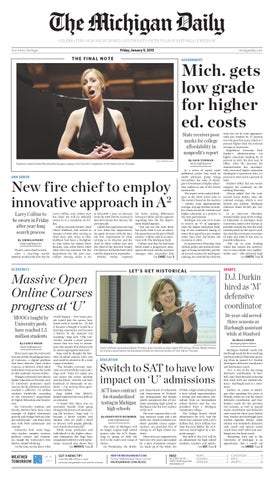
Rackham student Sandra Periord performs opera singing in the Concerto Competition in Hill Auditorium on Thursday.
ANN ARBOR
New fire chief to employ 2 innovative approach in A Larry Collins to be sworn in Friday after year-long search process By EMMA KINERY Daily Staff Reporter
There’s a new chief in town. After a year-long search, Monday marked the first day for
Larry Collins, Ann Arbor’s new fire chief. He will be officially sworn in at a ceremony on Friday. Collins succeeds former Chief Chuck Hubbard, who retired in January of 2014 after serving as chief since 2011. Prior to that, Hubbard had been a firefighter in Ann Arbor for almost three decades. Ann Arbor Police Chief John Seto has overseen the fire department for the past year. Collins’ starting salary is set
at $122,000 a year, an increase from the $104,549 he received at Brevard County Fire Rescue, his previous job. Collins has experience serving at two other fire departments. He spent 30 years with the Dayton Fire Department in Ohio, retiring as its director and fire chief in 2008. Collins was also fire chief of the Brevard County Fire Rescue in Florida from 2009 until he departed in September. Florida Today reported
ACADEMICS
By CARLY NOAH Daily Staff Reporter
Three years ago, the University was one of four founding partners of Coursera, a digital platform that hosts Massive Open Online Courses, or MOOCs, which allow individuals from across the world to take academic courses online. Though a relatively new idea in higher education at the time, now 15 University professors teach courses on the platform and have reached a collective 1.5 million students worldwide, according to the University’s department of Digital Education and Innovation. For University students and faculty, MOOCs have been a key example of digital education’s growth and change both on campus and beyond — one that’s been met with both enthusiasm and caution. University Prof. Scott Page, who teaches complex systems, political science and economics, taught the University’s first MOOC, Model Thinking. “At the time, no one knew what
WEATHER TOMORROW
HI: 10 LO: 1
would happen — how many people would take the course, how much work it would be… (I) did it because I thought it would be a learning experience and because I believe in the material I’m teaching,” Page said. “(The University) wanted a social science course that was easy to decompose into models that did not rely on much copyrighted material.” Page said he thought the benefits of online courses were vast and could be altered to fit a wide range of students. “The benefits everyone mentions are retrievability and scale,” Page said. “Once it’s taped, you can access the course anytime and anywhere. And you can have hundreds of thousands of students — I’m nearing three-quarters of a million.” Page added that MOOCs helped improved his own skills as an educator. “I found that there was an enormous benefit from going through the process of constructing the lectures,” Page said. “I became a better teacher and thinker. Also, it’s really a thrill to interact with people globally, even if only electronically.” While many professors and individuals in the higher education community like Page have responded to MOOCs with enthusiasm, research also shows that See MOOCS, Page 3
SPORTS
LET’S GET HISTORICAL
Massive Open Online Courses progress at ‘U’ MOOCs taught by University profs. have reached 1.5 million students
his leave, noting differences between Collins and his superior regarding how the fire department should operate. “You can use the term fired, but really what it was an amicable separation on the part of both parties,” Collins said in an interview with The Michigan Daily. Collins said that he had been hired under a progressive manager in Brevard, and the assistant manager who succeeded him See CHIEF, Page 3
In a series of report cards published earlier this week by youth advocacy group Young Invincibles, the state of Michigan’s investment in higher education ranked as one of the lowest nationwide. The report cards ranked Michigan as the third worst state in the country based on five metrics — tuition, state appropriations average, average burden on families, financial aid for students and higher education as a priority in the state government. Michigan was one of 31 states to receive an “F” in appropriations for higher education funding. It also numbered among 47 states that spend less per student today than they did before the recession in 2008. In an interview Thursday, Tom Allison, policy and research manager at Young Invincibles, provided several reasons for Michigan’s ranking. He cited the fact that the
state has cut its state appropriations per student by 27 percent over the past few years, which is 7 percent higher than the national average at 20 percent. Republican Governor Rick Snyder’s administration cut higher education funding by 15 percent in 2011, his first year in office. After the decrease his administration has incrementally increased higher education funding by 3.1 percent in 2012, 2.2 percent in 2013 and 6.1 percent in 2014. Snyder’s office did not return requests for comment on the ranking Thursday. Allison added that the state awards fewer dollars than the national average, which is over $6,000 per student. Michigan allocates about $4,500 per student. In an interview Thursday, Donald Heller, dean of the College of Education at Michigan State University, noted a few factors as possible reasons for why the state ranked poorly on the report card. He cited the two major recessions of 2002 and 2008 in the state as possible influences. “The cut in state funding which has caused the universities to raise tuition very rapidly,” Heller said. ” The relatively high See COSTS, Page 3
D.J. Durkin hired as ‘M’ defensive coordinator
36-year-old served three seasons as Harbaugh assistant while at Stanford By MAX COHEN Managing Sports Editor
MCKENZIE BEREZIN/Daily
Susan Caulfield, associate professor of history, gives a lecture on topics about 19th century African-Bahian families for a lecture series held by the Eisenberg Institute for Historical Studies at Tisch Hall on Thursday.
EDUCATION
Switch to SAT to have low impact on ‘U’ admissions ACT loses contract for standardized testing in Michigan high schools By GENEVIEVE HUMMER Daily Staff Reporter
The state of Michigan will no longer require high school juniors take the ACT. Beginning in spring of 2016, the SAT is the state’s new exam of choice. On Wednesday, the Michi-
GOT A NEWS TIP? Call 734-418-4115 or e-mail news@michigandaily.com and let us know.
gan Department of Education and Department of Technology, Management and Budget jointly announced that all students attending high school in Michigan take the SAT in place of the ACT. The state requires that a college entrance exam and a job skills test, which evaluates students’ possible career opportunities, are provided free of charge to all high school students. These tests are competitively bid every few years and ranked by a joint evaluation committee made up of the MDE, the
NEW ON MICHIGANDAILY.COM Former football player faces civil suit MICHIGANDAILY.COM/BLOGS
INDEX
DTMB, a high school principal, a local school superintendent, a testing and assessment consultant from an intermediate school district and the vice president from a Michigan community college. The College Board, which administers the SAT, won the three-year contract with a $17.1 million bid, $15.4 million less than the next bidder, the ACT, and was rated higher by a tenpoint margin. The shift to the SAT will be an adjustment for high school students, teachers and adminSee SAT, Page 3
Vol. CXXIV, No. 44 ©2015 The Michigan Daily michigandaily.com
Michigan football coach Jim Harbaugh made his first coaching staff hire official Thursday morning when he named D.J. Durkin Michigan’s defensive coordinator and linebackers coach. “D.J. is one of the top young defensive coordinators in football, and I look forward to having him work with our student-athletes,” Harbaugh said in a statement. Durkin, 36, comes to Michigan after spending five years at Florida, where he was the team’s defensive coordinator and linebackers coach for the previous two seasons, as well as special teams coordinator and defensive ends coach for three years before that. Durkin and Harbaugh have worked together before, when Durkin was Stanford’s defensive ends coach and special teams coach from 2007-2009 and Harbaugh was the head coach. “Reuniting with Jim at the University of Michigan is an opportunity that I could not See HIRED, Page 3
NEWS.........................2 SUDOKU.....................2 OPINION.......................4
CL ASSIFIEDS.................6 ARTS.............................7 SPORTS.........................8
News
2 — Friday, January 9, 2015
MONDAY: This Week in History
TUESDAY: Professor Profiles
WEDNESDAY: In Other Ivory Towers
The Michigan Daily — michigandaily.com
THURSDAY: Student Voice
FRIDAY: Photos of the Week
LEFT Renaud Garcia-Fons demonstrates his technique on the double bass for the Sall Fleming Masterclass Series Tuesday at Stamps Auditorium. (Sam Mousigian/Daily)
420 Maynard St. Ann Arbor, MI 48109-1327 www.michigandaily.com JENNIFER CALFAS DOUGLAS SOLOMON
Editor in Chief 734-418-4115 ext. 1251 jcalfas@michigandaily.com
RIGHT Obama gives a speech on improving the middle class at a Ford Motor manufacturing plant in Detroit Wednesday. (Luna Anna Archey / Daily)
NEED MORE PHOTOS?
Business Manager 734-418-4115 ext. 1241 dougsolo@michigandaily.com
Newsroom
News Tips
734-418-4115 opt. 3
news@michigandaily.com
Corrections
Letters to the Editor
corrections@michigandaily.com
tothedaily@michigandaily.com
Arts Section
Editorial Page
arts@michigandaily.com
opinion@michigandaily.com
Sports Section
Photography Section
sports@michigandaily.com
photo@michigandaily.com
Display Sales
Classified Sales
dailydisplay@gmail.com
classified@michigandaily.com
Online Sales
Finance
onlineads@michigandaily.com
finance@michigandaily.com
EDITORIAL STAFF Lev Facher
See more Photos of the Week on our website, michigandaily.com.
Managing Editor
Sam Gringlas
lfacher@michigandaily.com
Managing News Editor
gringlas@michigandaily.com
SENIOR NEWS EDITORS: Shoham Geva, Will Greenberg, Amabel Karoub, Emma Kerr, Emilie Plesset, Michael Sugerman ASSISTANT NEWS EDITORS: Tanaz Ahmed, Neala Berkowski, Alyssa Brandon, Nabeel Chollampat, Gen Hummer, Emma Kinnery, Lara Moehlman, Carly Noah, Irene Park, Lindsey Scullen
Aarica March and Derek Wolfe Editorial Page Editors
opinioneditors@michigandaily.com
SENIOR EDITORIAL PAGE EDITORS: Claire Bryan and Matt Seligman ASSISTANT EDITORIAL PAGE EDITORS: Regan Detwiler, Michael Paul, Melissa Scholke, Michael Schramm, Mary Kate Winn BLOG EDITOR: Tori Noble
CAMPUS EVENTS & NOTES
ON THE WEB... michigandaily.com
THE WIRE
York faces civil suit BY NABEEL CHOLLAMPAT
Former University football player Csont’e York, who was sentenced on two counts of misdemeanor assault, is now facing a civil suit for punching a man last July.
THE FILTER
Tarantino BY JAMIE BIRCOLL AND AKSHAY SETH
Daily Arts Editors Bircoll and Seth discuss the career of Quentin Tarantino from the perspective of a director, spanning movies from “Reservoir Dogs” to “Pulp Fiction,” in the first part of an ongoing series.
Historical symposium WHAT: This symposium will feature panelists from the University speaking on “empathy and experience in the writing of history.” WHO: Eisenberg Institute WHEN: Today from 12 p.m. to 2 p.m. WHERE: Tisch Hall
Helen & Edgar Masters recital WHAT: International Theater will host the performance, a tale of a strange childhood in Savannah, from Edgar Oliver and the creative team behind The Moth. WHO: University Musical Society WHEN: Today at 8 p.m. WHERE: Walgreen Drama Center
Faculty recital New Year WHAT: Aaron Berofsky on with UMix the violin, Ellen Hwangbo on the piano and Kathryn Vopatek on the violin will play through a set of classical pieces from composers Mozart and Prokofiev. WHO: School of Music, Theatre & Dance WHEN: Today at 8 p.m. WHERE: Walgreen Drama Center
WHAT: This week’s UMix event will feature many activities, including live music, DIY vision boards, free giveaways and prizes, photo booths, a Free Midnight Buffet and a screening of the movie “Ouija.” WHO: Center for Campus Involvement WHEN: Today from 10 p.m. to 2 a.m.
WHAT: Percussionist Hannah Weaver will perform a host of classical pieces using a range of instruments. WHO: School of Music, Theatre & Dance WHEN: Today at 8 p.m. WHERE: Earl V. Moore Building, Rehearsal Hall
Feel Good Friday WHAT: The first 40 attendees will win a free screening of “Selma”. WHO: Trotter Multicultural Center WHEN: Today at 1 p.m. WHERE: Trotter Multicultural Center Please report any error in the Daily to corrections@ michigandaily.com.
Grand jury investigating loans to Kansas governor’s campaign Sam Brownback’s campaign faces federal scrutiny
WICHITA, Kan. (AP) — A federal grand jury is looking into loans made to Kansas Gov. Sam Brownback’s re-election campaign and has ordered the state’s ethics chief to testify next week as part of its investigation, according to a subpoena obtained by The Associated Press. Carol Williams, the executive director of the Kansas Governmental Ethics Commission, was summoned to appear before the grand jury Wednesday in Topeka, according to documents the AP obtained through an open records request. She also was ordered to provide documents pertaining to loans Brownback’s campaign received in 2013 and 2014. The only loans listed on campaign disclosure reports
for those years are one from Brownback and others from Lt. Gov. Jeff Colyer. Colyer loaned Brownback’s campaign $500,000 in August — the third such loan the governor’s running mate made to their reelection bid — according to the last disclosure report, filed days before the November election. The loans, the first of which was made in December 2013, raised eyebrows on the campaign trail because loans in such large amounts are rare in Kansas political races and because the money was repaid within days. Brownback’s spokeswoman, Eileen Hawley, said the investigation “has no merit.” When asked in August about the reasoning for the loans and repayment, Brownback said, “I’m not going to explain the thought process.” Some Democrats speculated Thursday the loans were an attempt to bolster Brownback’s fundraising totals, to make
the campaign appear in better shape than it was. Craig Holman, government affairs lobbyist for the campaign finance watchdog Public Citizen, said a political motivation for the loans wouldn’t have sparked the grand jury probe. Although the loans themselves are probably legal, Holman said, the timing of them repeated three times is “quite suspicious.” Brett Berry, general counsel for the ethics commission, released the subpoena, which the agency received on Dec. 9, through the open records request, but otherwise declined comment. Colyer told the AP in August that the first two $500,000 short-term loans he made to Brownback’s re-election campaign are examples of the good stewardship Kansas residents expect from government officials. Earlier finance reports indicate that Colyer made his first $500,000 loan on Dec. 31, 2013, the last day covered by a finance report due in early January 2014, and it was repaid on Jan. 2, 2014. He then made a second $500,000 loan on July 23, 2014, the second-to-last day covered by a finance report due in late July. That loan was repaid two days later, when a new reporting period started. The third $500,000 loan from Colyer was made on Aug. 13, and it’s not clear whether it has been repaid. The next campaign finance report, which would disclose such a repayment, is due Saturday.
THREE THINGS YOU SHOULD KNOW TODAY
1
Next Wednesday, the French satirical magazine Charlie Hebdo, which was attacked by gunmen who killed 12 people, will publish one million copies instead of its usual 60,000 to stand up to “stupidity,” the Straits Times reported.
2
Jim Harbaugh is filling out his coaching staff. Yesterday, he introduced D.J. Durkin as his defensive coordinator and linebackers coach. Durkin served as one of Harbaugh’s assistants at Stanford from 2007 to 2009.
3
The Midwest is experiencing blasts of arctic air, with Grand Marai, Minnesota registering a -54 degree wind chill. All-time lows have been reported in New York and North Carolina, Weather.com reported.
Max Cohen and Jake Lourim Managing Sports Editors
sportseditors@michigandaily.com
SENIOR SPORTS EDITORS: Max Bultman, Daniel Feldman, Rajat Khare, Erin Lennon, Jason Rubinstein, Jeremy Summitt ASSISTANT SPORTS EDITORS: Chloe Aubuchon, Minh Doan, Jacob Gase, Kelly Hall, Zach Shaw, Brad Whipple
Adam Depollo and Chloe Gilke Managing Arts Editors
adepollo@michigandaily.com chloeliz@michigandaily.com
SENIOR ARTS EDITORS: Jamie Bircoll, Kathleen Davis, Catherine Sulpizio, Adam Theisen ARTS BEAT EDITORS: JAlex Bernard, Karen Hua, Jacob Rich, Amelia Zak
Allison Farrand and Ruby Wallau Managing Photo Editors
photo@michigandaily.com
SENIOR PHOTO EDITORS: Luna Anna Archey and James Coller ASSISTANT PHOTO EDITORS: Amanda Allen, Virginia Lozano, Paul Sherman
Emily Schumer and design@michigandaily.com Shane Achenbach Managing Design Editors Ian Dillingham Magazine Editor statement@michigandaily.com DEPUTY MAGAZINE EDITORS: Natalie Gadbois STATEMENT PHOTO EDITOR: Luna Anna Archey STATEMENT LEAD DESIGNER: Jake Wellins
Hannah Bates and Laura Schinagle Managing Copy Editors
copydesk@michigandaily.com
SENIOR COPY EDITORS: Emily Campbell and Emma Sutherland
Amrutha Sivakumar
Online Editor
amrutha@michigandaily.com
Kaylla Cantilina Managing Video Editor Carolyn Gearig Special Projects Manager
BUSINESS STAFF Madeline Lacey University Accounts Manager Ailie Steir Classified Manager Simonne Kapadia Local Accounts Manager Lotus An National Accounts Manager Olivia Jones Production Managers Nolan Loh Special Projects Coordinator Jason Anterasian Finance Manager The Michigan Daily (ISSN 0745-967) is published Monday through Friday during the fall and winter terms by students at the University of Michigan. One copy is available free of charge to all readers. Additional copies may be picked up at the Daily’s office for $2. Subscriptions for fall term, starting in September, via U.S. mail are $110. Winter term (January through April) is $115, yearlong (September through April) is $195. University affiliates are subject to a reduced subscription rate. On-campus subscriptions for fall term are $35. Subscriptions must be prepaid. The Michigan Daily is a member of The Associated Press and The Associated Collegiate Press.
University investment fund designed to bolster startups Adrenal cancer company one of many to recieve support BY LINDSEY SCULLEN Daily Staff Reporter
The Michigan Investment in New Technology Startups initiative has invested $6.9 million in 11 different University-based startup companies, according to the University’s Investment Office. MINTS is a $25-million venture fund managed by the University’s Investment Office, established by President Emerita Mary Sue Coleman in 2011. The initiative invests in startup companies that produce technology developed at and licensed by the University. Rafael Castilla, director of Investment Risk Management at the University, said these companies must gain preliminary funding from an independent professional venture capital investment firm before qualifying for MINTS funding. Moreover, MINTS would provide supplementary support for research and entrepreneurship. One of those entrepreneurial research efforts funded by MINTS is Atterocor, a company set on developing a new compound — ATR-101 — for the treatment of adrenal cancer. Atterocor co-founder Julia Owens sad adrenal is
rare, impacting around 1,000 patients in the United States. Owens said that diseases as rare as adrenal cancer often lie “below the radar screen” of major pharmaceutical companies. “It was much more compelling for a startup to take on an opportunity like this,” Owens said. “We do think that there will be a reasonable financial return for our investors, but by doing this in a small company, very capital-efficient manner, we think that we can do the development more quickly and make it financially viable to develop a drug for such a rare population.” Both Frazier Healthcare Ventures and the Michigan Pre-Seed Capital Fund, a Michigan Economic Development Corporation program led by the business incubator Ann Arbor Spark, provided Atterocor with $250,000 in seed funding. With preliminary financing under its belt, the company qualified for MINTS funding after receiving an introduction to the venture fund through the Office of Technology Transfer, the office in charge of commercializing University-developed technology and bringing it to the market. During its second round of financing, Atterocor received $500,000 from MINTS and $15.5 million from three other venture funds. Castilla said MINTS is an additional support that the University’s Investment Office
is able to provide to companies like Atterocor who are rooted in University research and entrepreneurship. Both he and Owens noted that the University is heavily involved in adrenal cancer research. “U of M has a number of adrenal cancer experts and adrenal biologists that make it uniquely positioned to be involved in starting a company like Atterocor,” Owens said. She said this unique positioning comes from an endowment made by former Michigan football coach Bo Schembechler to the University. Schembechler founded the Millie Schembechler Adrenal Cancer fund in memory of his wife, thereby providing the University the money it needed to inaugurate one of the only multidisciplinary adrenal cancer research centers in the world. In addition to holding the Millie Schembechler Professorship in Adrenal Cancer, Atterocor co-founder Gary Hammer is the director of the Endocrine Oncology Program in the Comprehensive Cancer Center at the University. The EOP has been recognized internationally for its accomplishments in the treatment of adrenal cancer. Atterocor is one of the research initiatives that has resulted from the center. Castilla said MINTS is a “small piece” of the University’s venture capital See FUND , Page 3
News
The Michigan Daily — michigandaily.com
NEWS BRIEFS
HIRED From Page 1
DETROIT
Hundreds of Mich. schools close amid another day of cold Hundreds of Michigan schools closed Thursday as the state faced another day of dangerously cold temperatures and braced for more snow. Icy and snowy roads were blamed for four traffic deaths in the Lower Peninsula. Detroit Public Schools and many other southern Michigan districts canceled classes Thursday, and some were already announcing plans to close again Friday. Overnight temperatures dropped to minus 7 at Benton Harbor and minus 6 at Coldwater and Marshall, the National Weather Service said. Thursday afternoon’s readings reached only into the teens or single digits, with Drummond Island and Pellston hitting 18 degrees.
CLARION, PENN.
Two dead in 18-vehicle pileup on Penn. highway Two people died and nearly two dozen were injured in an 18-vehicle crash during a snow squall in western Pennsylvania that left drivers with little visibility. Authorities said the chain reaction pileup happened Wednesday afternoon in whiteout conditions on Interstate 80 in Clarion Township. Nine trucks, several of them tractor-trailers, and nine cars were involved in the crash in the highway’s westbound lanes, state police said. At least one of the trucks was carrying hazardous material, but no leaks were found, a county official said. Two people died after leaving their vehicles. One was struck and the other collapsed and died of internal injuries while looking for his children, who had been ejected, Shaffer said. The children were found unharmed.
CHICAGO
O’Malley to decide on presidential bid by the spring O’Malley says he’ll decide on presidential bid by spring Maryland Gov. Martin O’Malley says he will decide by spring whether to seek the Democratic nomination for president in 2016. O’Malley spoke Thursday at the University of Chicago’s Institute of Politics. He says he’s “very seriously considering running in 2016.” But the outgoing governor says that first he’s going to take a few months to get his family situated back in their hometown of Baltimore. He says he’ll also likely give some talks around the country. O’Malley tells The Associated Press he’s not waiting for former Secretary of State Hillary Rodham Clinton to announce whether she’ll run. The former U.S. senator and first lady is considered the leading contender for the Democratic nomination even though she has yet to declare herself a candidate.
YEMEN
U.S. says Al Qaeda trained Said Kouachi A senior U.S. official says one of the two Kouachi brothers suspected of carrying out the Charlie Hebdo attack trained with al Qaeda in Yemen. Said Kouachi, 34, spent a “few months” being trained in the small arms combat and marksmanship skills used in the Wednesday attack, said the official. U.S. intelligence officials said they are still trying to determine if the al Qaeda cell ordered the attack, which left 12 dead. —Compiled from Daily wire reports
pass up,” Durkin said in a statement. “We had some great times working together at Stanford, and I look forward to producing great results at Michigan.” In his final year at Florida, Durkin’s defense was ranked No. 15 in the nation in yards allowed, giving up 329.8 per game. The previous year under Durkin, Florida’s defense was No. 15 in the country in scoring defense, allowing 21.1 points per game. Durkin replaces former defensive coordinator Greg Mattison, though multiple reports have said Mattison will stay on Harbaugh’s staff work-
MOOCS From Page 1 residential students — those who take classes in-person at a university— aren’t entirely sold on the concept. The primary target for MOOCs are often students who are not currently enrolled at a traditional college campus. Christopher Brooks, a School of Information research fellow, has done extensive MOOCsrelated research and is a member of DEI’s USE Lab, which studies instructional technology. Brooks said while he’s found that a majority of students find value in MOOCs offered by their institution, more than a third still indicate they’re unsure of the benefits. “There has been significant debate as to the value of MOOCs for students in traditional higher education,” Brooks said. “This uncertainty is reflected in the student body.” He said the format and structure of these courses remain in an experimental phase. “(MOOCs) are constantly changing, are being pushed and pulled in various ways — from large public universities like Michigan showcasing the breadth of programming, to private venture capital-backed corporations like Coursera, to quasi-governmental organizations that deal with workplace training,” he said. However, Brooks predicted that within the next five years, MOOCs will become a regular part of public universities. Some critics worry MOOCs might lead to the downfall of traditional college campuses in the future. Still, Dan Russell, one of Google’s top researchers who met with the University’s Board of Regents when they
JOIN THE DAILY WE’RE ACCEPTING APPLICATIONS IN EVERY SECTION. VISIT
michigandaily. com/join-us
WE’RE MORE FUN THAN “TURNING UP” ON A THURSDAY
OR MAKING A DELICIOUS APPLE PIE. yum!
ing under Durkin.opportunity that I could not pass up,” Durkin said in a statement. “We had some great times working together at Stanford, and I look forward to producing great results at Michigan.” In his final year at Florida, Durkin’s defense was ranked No. 15 in the nation in yards allowed, giving up 329.8 per game. The previous year under Durkin, Florida’s defense was No. 15 in the country in scoring defense, allowing 21.1 points per game. Durkin replaces former defensive coordinator Greg Mattison, though multiple reports have said Mattison will stay on Harbaugh’s staff working under Durkin.
traveled to California in 2013, said the courses are not intended to displace four-year institutions. “Historically, once upon a time, universities were threatened by the introduction of lowcost printed books,” Russell said in a 2013 interview with The Michigan Daily. “They survived that. That seems inconceivable now. When we look back at this time 20 years from now, universities, I predict, will still be around and we’ll have the same sort of ‘you’re kidding’ response. ‘How could they think this could destroy the university?’” Citing an experiment currently underway where residential MBA students give virtual office hours for MOOCs on finance, he said the University’s ability to incorporate online courses could also provide opportunities for traditional students to both teach and learn. For University professors who don’t currently incorporate MOOCs in the classroom, like John T. Lehman, ecology and evolutionary biology professor, there’s also caution that MOOCs be created and presented in a way that students find the course beneficial and relevant to their educational growth. Lehman said for them to be useful, they must be tailored to fit the needs of students. “Digital education is a term with a cultural meaning that is changing rapidly,” Lehman said. “I think of it as part of the continuum of technologies to aid learning that includes spoken and written language, the printing press, radio, television, etc. The key is to recognize what it can deliver best, such as repetitive low-stakes learning exercises, to many students asynchronously.”
FUND From Page 1 investments. It allows the University’s endowment to invest in and finance startups with technology licensed through the University’s Office of Technology Transfer. “From the Investment Office point of view, the purpose of MINTS is to generate return for the endowment because that’s what we do,” Castilla said.
Friday, January 9, 2015 — 3 will negatively affect their college admissions prospects. Clara Kaul, a junior at Community High School in Ann Arbor, said the discrepancy between the ACT and SAT comes down to personal preference. “There’s pretty mixed feelings because they’re two different tests, and there are people who do much better on one than they do on the other. Some people are for it, because it means they get to take the test they did better on, some people are against it, some people are like, ‘Oh, now I have to study for a different test.’” Despite these worries, the revamped SAT, debuting in 2016, may alleviate the situation. The College Board website said the focus of the SAT redesign is to create an exam that better predicts college performance. The new exam will include an optional 50-minute essay, a reading section, a written language test and a math section. Other notable changes include removing the penalty for an incorrect answer, limiting multiple-choice questions to four options instead of five and creating a test that rewards students for extensive classroom experience rather than the ability to reason. These changes make the SAT more similar to the ACT, according to The New York Times, though it will take a few years to see if it is a better indicator of college readiness. In spite of existing differences
between the two standardized tests, the University does not foresee that the state’s decision to shift to the SAT will affect admissions. “UM has long accepted either ACT or SAT scores with admission applications, so there is no immediate impact at UM from this change by the state,” University spokesman Rick Fitzgerald wrote in an e-mail. Michael Bastedo, director of the University’s Center for the Study of Higher and Postsecondary Education, said one thing that will likely change after Michigan high schools begin offering the SAT is that the percentage of University applicants submitting the SAT will increase. Currently, the College Board’s website says that 33 percent of first-time freshmen applicants to a university submit the SAT, while 79 percent submit the ACT. Greene said he is uncertain how this shift will impact state universities, but expects it to be similar to the transition his high school will face. “For the last several years the state schools have been used to going off the ACT and have been using that significantly for Michigan students,” Green said. “Now they’re going to have to make a shift, but most in-state schools, to my understanding, have been accepting the SAT for a while, so I think this will be a transition, but like us they will accommodate and move forward.”
a master’s degree in operations management from the University of Arkansas, a bachelor’s degree in public safety management from Franklin University and an associate degree in fire-rescue administration from Sinclair Community College. Collins said he plans to make Ann Arbor’s fire department more progressive, but has not been in the job long enough to pinpoint necessary changes. “I will recommend changes that I think are appropriate for
moving us forward, making us a top notch fire department in the state, perhaps in the midwest part of the country,” he said. Ultimately, Collins said he is committed to keeping all Ann Arbor citizens safe. He added that the fire department makes no differentiation between students, citizens and elected officials. “Our job is to provide good, basic fire and life safety protection to anybody and everybody in the community and folks that visit here as well,” he said.
rate of tuition in the first place and the relatively low grade of spending by the state on scholarships means that Michigan is a fairly unaffordable state for higher education for most students.” Due to both the recessions and the recent cuts in state funding, Heller said Michigan universities have resorted to tuition increases to maintain their budgets. “One of the reasons that
tuition has went up so much in the last 12 years is because the state was cutting funding for the institutions,” he said. “The rational response on the part of institutions is to raise tuition.” To combat the higher tuition prices, Heller said MSU has tried to increase financial aid and scholarships to students, an approach the University has also championed. However, he noted the difficulty for many state universities with limited resources to take this approach for every student. Allison said the report card is
not meant to discredit the quality of education in each state, but rather to allow each student to see how state governments prioritize higher education in their budgets. “The idea here is that we want to provide this context and to inform students of the important role the state budget plays, but then also use this as a tool to advocate for better state investment,” he said. “We don’t want this research to just exist in a bubble.”
MINTS is beneficial to University investments primarily because it helps diversify the University’s endowment. MINTS typically invests in smaller companies and in their early stages while much of the University’s endowment lies in bigger companies. Castilla said the MINTS initiative not only aims to make money but also to help commercialize technology and products like Atterocor’s drug. MINTS strives to make sure
that cutting-edge, worthwhile technology doesn’t remain stuck in the lab. “If we have a drug and we think it can treat adrenal cancer, we need a way to get it out to the world and that costs money,” Castilla said. “You have to raise financing, you have to get investors, you have to do FDA trials.” MINTS serves as a way to back University entrepreneurship, to diversify the University’s endowment and to
commercialize University technology. “There aren’t many universities that have such a program,” he said. “We’ve had calls from other universities that are interested in MINTS, but there aren’t a lot of universities that have a similar program at this point in time.”
SAT From Page 1 istrators. Joe Greene, the principal of North Farmington High School in Farmington Hills, Mich., was relieved the state came to an agreement regarding standardized testing. “We are just pleased that the state made a decision, that we actually have a clear picture of what we’re aiming at, and now we can use that to guide our work going forward,” Greene said. The College Board has promised to begin providing free SAT preparation materials to Michigan high schools this spring. Greene said that he wasn’t worried about the students at his high school transitioning to a new standardized test because he believes the school has made improvements in the last few years that have prepared their students for any type of test. “In talking with my staff and my colleagues, we really believe that the work we’ve been doing in the last two years, to align with the Common Core and to align our instruction and the learning we’re causing to really create student achievement, it almost doesn’t matter what test we put in front of our students, we’re going to have them ready for it,” Greene said. However, the change from the ACT to the SAT has some high school students worried that it
CHIEF From Page 1 did not believe in the direction that Collins was taking the fire department. “I’m not saying he did a bad job,” Brevard County Manager Stockton Whitten told Florida Today last September. “It was just philosophical differences.” In a November press conference, Seto expressed confidence in Collins’ selection. Collins has
COSTS From Page 1
Opinion
4 —Friday, January 9, 2015
The Michigan Daily — michigandaily.com
The sad cloud of employability
Edited and managed by students at the University of Michigan since 1890. 420 Maynard St. Ann Arbor, MI 48109 tothedaily@michigandaily.com JENNIFER CALFAS EDITOR IN CHIEF
AARICA MARSH and DEREK WOLFE EDITORIAL PAGE EDITORS
LEV FACHER MANAGING EDITOR
Unsigned editorials reflect the official position of the Daily’s editorial board. All other signed articles and illustrations represent solely the views of their authors.
Resisting careerist ideology
A
s long as I can remember, I’ve always understood that when people asked, “What do you want to be when you grow up?” what they were really asking was, “What career do you want to have when you grow up?” What’s strange is that none of the words in the first question denote anything job or career-related. This means that our understanding of the question ZAK must rely on connotations. WITUS Even though the question only denotatively asks about what one wants to be as an adult (or a “grown-up”) — which could be a wide range of things, like a parent, a good person, a reader, etc. — we interpret the meaning of the question very narrowly, so that it just refers to jobs or careers. Why would we reduce what could be a beautifully open-ended question to a depressingly close-ended one? Careerist ideology. Instead of independently thinking through apparently enigmatic questions like being and one’s future, we prefer to defer to culturally and societally fabricated answers — e.g. careerist ideology, by which I mean a belief system based on the idea of the career, which holds the virtuosity of careers as self-evident and considers them centrally important to being. In a society where careerist ideology is predominant, when the question of “what to be when you grow up” arises, we connote the condition of “being” accordingly and allow our thought to be guided and constrained. The consequence is that we often confuse or equivocate “being” with “being a (specific) career,” and not exclusively in the context of this question. What scares and intrigues me is that we mostly process these connotations unconsciously — that is, once we’re past a certain age, the intended meaning of this question is automatically clear to us. This careerist ideology exists within us largely outside our conscious awareness. Careerist ideology can be primarily explained by what’s sometimes called a conjunction fallacy — mistakenly believing that a conjunction of events (a hot and sunny day) is more probable than a single event (a hot day). When explaining this concept in lecture, my cognitive psychology professor gave us the following example: “Imagine a health survey was conducted on adult males. Mr. F was included. Which is more probable? (1) That Mr. F has had one or more heart attacks, or (2) That Mr. F has had one or more heart attacks and is over 55 years old? Studies show that about 55 percent of people say they believe (2) is more likely,” even though it’s not! The probability of two events co-occurring (Mr. F having had one or more heart attacks and being over 55 years old) can only be less than or equal to the probability of one of the
events occurring (Mr. F having had one or more heart attacks or the probability of Mr. F being over 55 years old), never greater. “To be” does not necessitate “to be career.” Obviously there are many other ways to be, but in our career-oriented society, we casually believe in just the one partially because of this conjunction fallacy (which, in full, is a conjunction fallacy from casual reasoning). But there’s a deeper question: Why and how do we regularly commit the conjunction fallacy? Why and how is our probability judgment frequently distorted? Psychologists have a few explanations, but one prominent explanation pertains to how we represent these scenarios in our minds. When we imagine someone having a heart attack, we typically imagine an elderly person, and so we sometimes falsely conclude that being old and having a heart attack is more likely than just having a heart attack. So it is with careerism. The careerist ideology in our society is so predominant that we often assume that being an adult and having a career is more likely than just being an adult. When we imagine ourselves as adults, we imagine ourselves with careers, because many of the adults we know have careers. Because modern life (or perhaps more accurately postmodern life) is hyper-saturated with media that what we imagine for ourselves as adults highly depends upon the simulacra shown on television. How many television shows today aren’t only about a character with a career, but are about the career itself? Why would we reduce what could be a beautifully open-ended question that offers the opportunity to actualize the highest potentials of human creativity to a depressingly closed-ended one that basically offers a choice between two collars (blue or white)? I have maybe avoided this bigger question by delving specifically into careerist ideology. Careerist ideology is but one facet of a much larger system, spanning multiple levels of analysis, not least of which is economics (i.e., capitalism). Understanding this single but critical facet of our collective societal consciousness can potentially awaken us to related latent mechanisms in our thinking. My inkling is that individual people, once awakened from their dogmatic slumbers, would choose to focus on becoming more than just a lame career. Cultural thoughtcontrol mechanisms, like the question of what to be, hinder the human creativity that precedes our great capacity for freedom. In recognizing these mechanisms we enable ourselves to push past the hindrances they impose. But then we’re immediately confronted with another challenge: the challenge of independently answering the deeper philosophical questions that ideology answers for us.
My inkling is that individuals would choose to focus on becoming more than just a lame career.
— Zak Witus can be reached at zakwitus@umich.edu.
EDITORIAL BOARD MEMBERS
Edvinas Berzanskis, Claire Bryan, Regan Detwiler, Devin Eggert, David Harris, Rachel John, Jordyn Kay, Aarica Marsh, Victoria Noble, Michael Paul, Allison Raeck, Melissa Scholke, Michael Schramm, Matthew Seligman, Mary Kate Winn, Jenny Wang, Derek Wolfe
CONTRIBUTE TO THE CONVERSATION Readers are encouraged to submit letters to the editor and viewpoints. Letters should be fewer than 300 words while viewpoints should be 550-850 words. Send the writer’s full name and University affiliation to tothedaily@michigandaily.com.
M
om wants me to have a good job. And even though I go to art school, she still thinks that some- WILLIE day I’m going to FILKOWSKI be a great doctor. I know that it’s not likely that I’ll ever make the money a doctor makes, but like most artists, I didn’t major in Interarts Performance for the impressive starting salaries. In fact, a non-profit called BFAMFAPhD reports that only 10 percent of arts graduates are actually making a living as artists. I’m here because the University is a sort of utopia — a sometimes fractured one — that values complex ideas, nuanced views, hard/ boring work and strangeness. I’m here because artists are taught to be a little reckless, a little sloppy, but hopefully smart. I’m here because I get to work with genius professors. I’m here because my peers are geniuses, too. I’m here because I believe in a community of artists who are interested in asking big and foolish questions. But I’m not here for job training. I know that the rest of my life is probably going to be an absolute pigfuck. And I’m happy about that. Excited, even. I knew that when I signed up for a degree in performance art (or whatever). I didn’t always know I wasn’t here for job training. But a class I took in the fall helped me find out. Six credits of my schedule each semester are devoted to thesis work. It’s split between independent studio time and class time with seventeen others also working on their theses. And during the fall, one credit is spent in a Professional Practice lecture. The idea is that Professional Practice will teach the young artists and designers how to get out there and get jobs. The course exists because past graduating classes felt that they were left unprepared in terms of job-hunting. Professional Practice is the Penny W. Stamps School of Art & Design’s way to help fill in those blanks. Faculty, alumni and other guests give presentations on topics like “Inter-
viewing Skills,” and “Resources for Finding Employment Opportunities and Resources About the Materials You Need to Apply for Them.” You know, the sort of classes they offer inmates. While incredibly useful for students planning to enter the design field, Professional Practice is where a young artist might get a little queasy. The conceptual sculptors and installation artists and performance artists amongst us have their dreams squeezed by notions of “startups” and “clients” and “internships.” For an hour a week last semester, the sad cloud of employability hung so large over the Stamps School of Art & Design that its shadow blotted out the “Art” part. If you’re a designer, you can get paid. If you’re an artist, you can become a designer. A guy I will call Mr. Employer visited Professional Practice one day. Mr. Employer is a vice president at a Big Company. He is Important. He spoke with a deep voice in a kind, Midwestern cadence and he offered advice about how to get him to give you a job. Don’t be too early. Don’t be nervous. Don’t make any spelling mistakes. Do take an interest in him. Do look good when you show up at the office for an interview — “I’m judging you as soon as you walk through that door.” Do give him a firm handshake. Do send him a LinkedIn invitation soon after your interview — “I think that’s cool.” Don’t send him a LinkedIn invitation while you’re still in the parking lot — “I think that’s too much.” It’s nice of Mr. Employer to share his time with us. But Mr. Employer is not the boss of me. I don’t want someone to talk at me about how to become presentable for a job interview, because I want to work at a place that is going to hire me for the big dumb idiot that I am. I don’t want to hear about having a firm handshake, because
maybe someday I won’t have arms. And LinkedIn is for the birds. I do think it is important to talk about jobs. Making money is important. But the artists in the room know that being an artist is just like being anything else — you might work so hard you accidentally become a millionaire or you might die in a fire. So talk to us about how to make lattes or how to steal supplies from Jo-Ann Fabric or how to cry silently in public without disturbing others. Because having a job is not the important thing. We’ll find jobs. It’s a tough beat if a brilliant artist is going to be invited to the Venice Biennale because they gave Mr. Employer a very firm handshake. Artists are after something different, and it’s OK to talk about how messy and terrible that might be. Talk to us about how for three years we’re going to be frustrated because it seems like nobody cares, but if we keep at it, something will finally give. Talk to us about how after spending a year trying to be a Real Artist we might find out that all we really wanted all along was to be a social worker. Talk to us about the 90 percent of art grads for whom it just doesn’t work out. Or talk to us about how a young Robert Rauschenberg made some of his most important work out of garbage he found on the street because he was too poor to buy canvas. But don’t ask Robert Rauschenberg to create a LinkedIn profile. (Note: I’m not the Rauschenberg in this case, but our Rauschenberg was there for Mr. Employer’s lecture too.) Job placement rates aren’t really that important. Good art doesn’t happen because you read Mr. Employer’s memos. And you can make good art without making a good career. I hope.
You can make good art without making a good career.
— Willie Filkowski can be reached at willjose@umich.edu.
FOLLOW THE DAILY ON TWITTER
Keep up with columnists, read Daily editorials, view cartoons and join in the debate. Check out @michigandaily to get updates on Daily content throughout the day.
I
Race relations discrepancy
n the wake of Michael Brown, Eric Garner, Tamir Rice, Aura Rosser and many, many more lives, students at the University are taking a stance on an issue that strikes a common nerve. We don’t need to look very far to find these racial JENNY debates happening here on cam- WANG pus. From the “die-in” before finals in December to the march down the streets of Ann Arbor in November, students are actively voicing their collective stance against the issue of police militarization. A year ago, the University community experienced a similar phenomenon of race-related open discussions including the #BBUM hashtag campaign and eventual demands to the administration and sit-ins. Months before that, there was another incident involving a racially insensitive party (the “Hood Ratchet Thursday Party”) organized by Theta Xi fraternity. Both on and offline, students have voiced their dissent or support of the Black Student Union’s demands. Students shared their views on the relevance or inanity of cultural appropriation. Students generally spoke about race relations in America as though they were authorities of these issues. And yet, it also seems that despite the passion presented on the forums, there is a dissenting opinion that race shouldn’t be discussed, race relations shouldn’t be learned. When students aren’t constantly confronted with a piece of news related to racial tensions, discussing it becomes frowned upon. The “not everything is about race” sentiments are thrown around.
There seems to be a strange dis- ple from thinking critically of how crepancy going on. Many students, racism was able to transform from when pressed with the headlines, institutionalized slavery to Jim want to talk about race. They want Crow, and how it can just as easily to offer their two cents. They want change shape in modern contexts. to understand what’s going on, but We students have been given they just as much wish to erase an overly optimistic narrative of issues of discrimination from casu- where our society currently stands, al conversations. Why is this the but we also see situations of raccase? ism in the headlines. Our response The answer might lie in our first to these clashing narratives is just experiences with outward discus- as conflicted — we both discuss sions of race in the classrooms. For racism and feel the discussion is many students, these talks were, at not needed. We both type away on best, outdated. At worst, they were our keyboards or try to talk over completely misaligned with current our friends during heated converevents. The narrative of racism in sations and complain about how America generpointless LSA’s ally goes as folrace and ethniclows: there used requirement Educating people about ity to be racism that is. took the form of Ideally, it is race should allow slavery and then in these heated students to react to Jim Crow segdiscussions regation; how- Ferguson with informed that students ever, thanks to discover for solidarity. the civil rights themselves movement what’s hapand protesters pening in the such as Martin world. But it is Luther King Jr. and Rosa Parks (but just as crucial that we pay attennot the Black Panther Party), these tion to how race is taught to our forms of institutional racism have youngest and most impressionbeen completely eradicated. It is able. Other than the race and a narrative that relegates wrong- ethnicity class required for LSA doings to the past and holds our students, the University does not society today up to a false ideal of provide many other opportunities complete equality. “Free at last! for individuals to reexamine race Free at last! Thank God almighty, in an academic setting. Educating we are free at last!” was a quote people about race should incite by Martin Luther King, Jr. that we much more public interest in race sang in my elementary school while issues. It should reflect what’s holding hands and swaying back actually happening and allow stuand forth. dents to react to Ferguson not with While MLK and civil rights stunned denial but with an outactivists have certainly succeeded spoken, well informed solidarity in improving the lives of people of for those whose experiences with color in many different aspects, the discrimination do not end when way this part of history is told in the the headlines go away. classrooms and textbooks shuts out any need to further analyze racial — Jenny Wang can be reached dynamics in America. It stops peoat wjenny@umich.edu.
Opinion
The Michigan Daily — michigandaily.com
Do you constantly start politcal debates during family gatherings? Do your friends roll their eyes every time you open your mouth to voice your opinions? Come to Editboard on Monday and Wednesday nights at 6 p.m., where instead of ostracizing you for your annoying ideas, we will embrace them! If you are interested in learning more, please email opinion opinioneditors@michigandaily.com
O
Home for the holidays
n my first flight home from Michigan in December 2011, my stomach bubbled with a familiar Pancheros burrito and knots of excitement wound DANI themselves tighter as I flew VIGNOS closer to my at-the-time long-distance boyfriend. Sophomore year, I felt the relief of being done with a semester that I finally enjoyed and belted delayed laughs as a result of the talent show at Detroit Metropolitan Wayne County Airport. Junior year, the flight took off for San Francisco and I played Alt-J’s An Awesome Wave on repeat as I prematurely fantasized about my semester that was about to take place in Madrid while drifting in and out of sleep on the plane home. This year, however, was different; it was calm and platonic. Although it’s the last time I will be making this flight home for such a brief time, it felt tranquil and I felt accustomed to the typical waves of nausea and excitement that one associates with coming home, wherever that may be and whatever that may mean. There’s this weird thing that happens when you are dropped off at college. You watch as your parents cascade down 5th Bartlett as the heavy blue metal door slams in your face and you think to yourself, “What now?” Presumably, you have been caged in your house for a strong 18 years and all of sudden you are let loose. Maybe it’s just my closest friends and me, but I felt confused. For lack of a better word or psychological term, I embarked on the biggest identity crisis of my life upon seeing that dorm room door crash in my face. The process of coming home and the nostalgia of the holidays only exacerbate this reminiscent feeling about my first day on campus and serve as a pivotal point to understand one’s growth. It’s difficult to tell someone to embrace these times. To embrace the awkward hugs that you face in your local supermarket or the run-ins with your mom’s friends at her holiday parties, but these moments of discomfort are essential and inevitably shift through your college formation. These encounters give us something to laugh about and learn from when you are finally 21 and can sit around the bar ordering tequila shots with three guys you took Calculus with six years ago. It’s not that everything is entirely normal or comfortable now, but there’s a certain reassurance in the fact that life continues upon its meandering and ever-changing path. The discomfort and fluctuations are normalized and you began to feel more and more prepared for what’s next even as the future gets more and more expansive. Now, in the depths of my senior year Win-
ter Break, I see home as a different place. I recognize that where I am today was not by fault, and is much accredited to my time at the University. At a bar the other night, I spoke with a guy in my graduating class from high school that had been crowned the biggest clown in our grade. He was that macho man who showed little emotion. This year, he told me he was into writing and screenplays. He reminisced about the time his babysitter thought he was sleeping and he stayed up watching “Silence of the Lambs,” consequently crying himself to sleep. He didn’t stop smiling as we promenaded around the saloon looking at old couples rekindling flames, or more, often-new, love interests emerging from the woodwork. I am reminded to leave room for change. At Christmas dinner, my friend Laura spoke to me about her friends who had developed eating disorders and their strange relationships with food while at college. I told her I remembered those times. After my freshman year 20-pound extravaganza and my workoutaholic sophomore year, I was ebbing into a normal relationship once again with food and my body image. Not to say these feelings won’t emerge again, but I feel at ease with my ability to take the turns as they come. On the way home from skiing in Lake Tahoe, I was discussing an encounter I had with a friend to my dad. He thought for a second and asked me if I remembered the first page of the Great Gatsby. He has been reciting it for years, but reminded me again, “In my younger and more vulnerable years my father gave me some advice that I’ve been turning over in my mind ever since. ‘Whenever you feel like criticizing any one,’ he told me, ‘just remember that all the people in this world haven’t had the advantages that you’ve had.’ ” Sometimes it takes the simple repetition of sacred words. The holidays, fortunate or not, bring back shadows of the past. This year my dog wasn’t dressed in her holiday garb and our dearest family friend wasn’t cutting coffee cake in the kitchen, but we did have a new recipe for garlic mashed potatoes and one young child joined us at the kid’s Christmas table. Remember the time is now. Remember this as hard as you can, and as you hold on to the present moment it lightens the holiday shadows as you remind yourself that now is not forever. What is now the present will next year be a memory. We will continue to wonder who we were and are, but this knowledge that the undulations of emotions and inevitable growth are persistent keep us thinking as the new years roll through.
The holidays, fortunate or not, bring back shadows of the past.
“
— Dani Vignos can be reached at dvignos@umich.edu.
NOTABLE QUOTABLE
One thing is for sure — we may not all root for the Lions, but America is rooting for Detroit.” — U.S. President Barack Obama during his speech to Wayne County citizens on the resurgence of the American auto industry Wednesday afternoon.
E
5 — Friday, January 9, 2015
Why you should still buy her a drink at the bar
very winter, I ask myself the same question: Why do I live in this godforsaken icebox? In the morning, after pushing LAUREN snooze at least RICHMOND twice, eventually I make the insane decision to trade my toasty cloud of a bed for the arctic atmosphere that is my apartment. A morning shower means at least a 15-minute commitment to the blow dryer, a time commitment which would have doubled had it not been for my five-inch trim in October. Walking to class with wet hair is not an option; I learned this when I spent most of 2012 sneezing and sniffling through class. Bundling up in January and February usually means leggings before jeans, at least two pairs of socks, waterproof hiking boots, three layers of shirts, a headband, gloves, scarf and the grand finale, a three-year-old down parka that is starting to lose feathers. Most days, I don’t even look good. Makeup, styling and further delays aside, it takes me — a self-proclaimed lowmaintenance girl — about 45 minutes to get ready in a frosty morning. Getting ready to go to the bar on a Thursday night, well, that’s a completely different animal. We all know the drill, and if you’re new to Michigan and under the impression that November was the peak of our icy damnation, do yourself a favor and invest in some SmartWool socks while they’re probably on sale. People like to say that women and men are equal, but let’s get real. If you’re a girl, you should probably buy yourself two pairs, because you’re probably colder. The average American woman is 92 percent as tall as the average man, and weighs just 85.5 percent as much. Statistically we’re shorter, smaller and surprise: have longer hair. The additional tax we pay as women isn’t limited to an extra 10-minute blow dry and an extra pair of socks. Forget makeup, nail polish and the cost differences of our clothing; in order for women to uphold societal standards of femininity, the cost is significant. Five products are the main culprits of this microeconomic division of the sexes: razor blades, conditioner, tampons, Midol and bras. Of course, men use conditioner and razors, but generally in much smaller quantities (as I’ll explain). A wise woman once said, “Somebody wrote in that book that I’m lying about being a virgin, ’cause I use super-jumbo tampons, but I can’t
T
help it if I’ve got a heavy flow and a wide-set vagina!” She makes a good point. This does, however, mean that she’s a member of the female population. An 18 pack of Playtex Sport tampons at CVS costs $5.49: 30.5 cents each. At a rate of four per day for four days a month, the total monthly tampon cost for women comes to a modest $4.88. Cramps? That’ll cost you. Midol sells for $8.38 for a pack of 24, 34.9 cents each. Two per day for four days out of the month comes to $2.79. Having your period every month? $7.67. Being a woman? Priceless. I firmly believe that men and women are intellectually equal; however, men don’t have boobs. Victoria’s Secret sells bras for over $50 a piece, but as an Economics major, I can’t stomach dropping that much knowing they cost about four dollars to manufacture. In order to maintain as conservative an estimate as possible, I picked out my favorite bra by Gilligan & O’Malley, which goes for $16.99 on Target.com. If you’re a girl, you know that these stretch out and don’t last forever, so two bras per year is a frugal expenditure on bras. Since we’re calculating the extra cost on a monthly basis, this means women are spending $2.83 on bras monthly. Not bad, right? Next, there’s everything that goes on inside the shower. I grew up with two younger brothers, who often accused me of using up all of the hot water. I typically ignored their complaints; I was older, smarter, a girl, and therefore entitled to use more water than them. I asked my brothers how much conditioner they used. RJ, who’s 18, poured out about one teaspoon. My 16-year-old brother denied using conditioner whatsoever, ran into the basement, and got back to his friends on Xbox live. At CVS, I picked out a seemingly gender-neutral and cost-efficient conditioner, Garnier Fructis. The bottle costs $4.79 for 13.5 fluid ounces, which comes to an average cost of six cents per day for my brother and 18 cents per day for me. Nickels and dimes, but still a difference of 300 percent. On a monthly basis, women are spending $3.60 more on conditioner than men. We all know razors for both men and women are overpriced. Worse
than that, they never go on sale. Before going and taking an inventory of CVS, I was under the impression that women paid significantly more for razors. As I compared basic three blade razors for men and women, I realized I was wrong. An eight pack of Gillette Venus Classic for women costs $23.79 each, and an eight pack of Gillette Match 3 for men costs $22.99. Each razor costs a woman $2.97, and a man $2.87. Just a slight difference, right? Not when you account for the differences in total surface area women and men are expected to shave, prescribed by gender norms. For men, from the nose down to the chin until the ears, and the entire area of the front half of the neck, this came to 435.5 cm^2. For women, accounting for average surface area of two thighs, calves and armpits, this number was 7,323.08 cm. Not only are we paying 10 cents more for a similar razor, we have to shave 16 to 17 times more surface area than our male counterparts. Let’s assume that women shave a third as often as men. Let’s say the average man spends $22.99 per year on razors, switching once every month and a half. This means that women who shave even one-third as much as men are spending 5.6 times as much for the same quality of shave, an annual fee which comes out to $133.224. Monthly, this means a woman would spend $9.20 more than men on razors alone. Accounting for just five basic and necessary products, it’s clear that from a cost-of-living perspective, men and women are not equal. I’m not talking about fashionable clothes, makeup or a girls’ nights out. For the bare-minimum hygiene, it costs the average woman approximately $23.30 more per month to live than the average man. Guys, next time you’re at Charley’s with your female colleague, consider these baseline costs that she has to endure. If she’s wearing makeup, a stylish outfit or four-inch heels, the differential expands. Maybe next time, instead of splitting the bill for that fishbowl, you pay that $15. Plus tax.
It’s clear that from the cost-of-living perspective, men and women are not equal.
— Lauren Richmond can be reached at lericho@umich.edu.
All lives matter
he #BlackLivesMatter movement has taken over social, national and international media in recent months. Fueled by tragic vignettes of police brutality against presumably innocent African Americans, the movement is “rooted in AUSTIN the experiences DAVIS of Black people in this country who actively resist (our) de-humanization,” and “is a call to action and a response to the virulent anti-Black racism that permeates our society.” The movement’s official media outlets have striven to make clear that all Black lives matter by calling attention to the rampant systemic injustices facing those Black individuals whose racial identities exist in conjunction with their sexual and gender identities, as well as their status within disabled, incarcerated or immigrant communities. In vying for societal and judicial equality in this country, a movement which stresses the importance of solidarity across the spectrum of all personal identities serves as an example of what modern activism should be: inclusive and empathetic to the plights of similarly affected individuals. In a December 26, 2014 op-ed in The Advocate magazine, freelance writer Randy Roberts Potts touches upon this idea by attempting to draw parallels between the #BlackLivesMatter and past LGBTQ rights movements. Potts calls for solidarity across movements, discussing how riots in Ferguson and subsequent rallies nationwide are reminiscent of the 1969 Stonewall riots. In these riots, LGBT-identifying individuals fought against
police forces conducting an unsolicited raid on the Stonewall Inn—a hub of sorts for impoverished and struggling LGBT youth in New York City’s Greenwich Village. Stonewall served as a catalyst for the queer-rights activism of the 20th century and today, much in the same way, Potts says, that the recent happenings in Ferguson have reignited a national discussion on racial politics and the unequal treatment of minority populations. In his closing remarks on the topic, Potts suggests that respect be given to a movement relative to its importance in the public eye at a particular moment in history: “All lives matter,” he says, “but our focus must center on whichever lives, in our own time, in our own moment, matter least.” In other words, activists must practice solidarity for similarly-rooted causes under the pretense of equity; provide the most energy to the most pressing of issues, only moving on to other problems once the most urgent matters have been dealt with. It’s a logical plan of action—at least for trauma surgeons. In the fight against social inequality, however, letting alone a seemingly small internal bleed in favor of a wound perceived as more threatening could prove to be fatal for the entire, commonly shared cause. Why should combating social injustice be a matter of precedent in line with particular events? When a group of people who have been subjugated into second-class citizenry experience a particularly unsettling event—as is the case with Ferguson,
as was the case with Stonewall— others should empathize and act for the larger cause of social, political and economic equality for all groups. They should act not only against the wrongs made against the group directly affected, but also act in protest of a system which allows that wrong to occur to any minority group, regardless of color, creed, sexuality or gender. Through my eyes, the reaction to the many instances of failures in the justice system pertaining to Black individuals over the past months should serve as an opportunity for the nation to reevaluate its handling of all crimes rooted in hate and social injustice. This reevaluation should be made in consideration of the Black population and their specific needs, but also in consideration of other subjugated minority groups in this nation who have experienced similar wrongs as a result of their ascribed statuses. All lives matter. Michael Brown’s life mattered just as much as the lives of Eric Garner, Larry King, and Brisenia Flores. This being said, combating social injustice should be a fight not based in equity. Rather, it should be a sweeping act in which all victims of social inequality in this country can partake and empathize, come together in solidarity and appeal for equality for all downtrodden groups for all time, not merely at a point in time which is most convenient for one group or another.
Combating social injustice should be a fight not based in equity.
— Austin Davis can be reached ataustchan@umich.edu.
News
6 — Friday, January 9, 2015
The Michigan Daily — michigandaily.com
Suspects from Charlie Hebdo attack were on U.S. no-fly list The Kouachi brothers were known to American and French authorities PARIS (AP) — The younger brother was a ladies’ man who belted out rap lyrics before the words of a radical preacher persuaded him to book a flight to Syria to wage holy war. Less is known about his elder sibling, whose ID card was found in the getaway car used by the gunmen in the newspaperoffice massacre in Paris. But U.S. officials said Thursday both were on the U.S. no-fly list and the older brother had traveled to Yemen, although it was unclear whether he was there to join up with extremist groups such as al-Qaida. The Kouachi brothers — 32-year-old Cherif and 34-yearold Said — emerged as the subject of a huge manhunt after the precision attack Wednesday that killed 12 people at Charlie Hebdo, a satirical weekly that lampooned radical Muslims and the Prophet Muhammad himself. Witnesses said the gunmen in the attack claimed allegiance to al-Qaida’s offshoot in Yemen. Both Kouachi brothers — the Paris-born offspring of Algerian parents — were already known to American and French counterterrorism authorities. Cherif, a former pizza deliveryman, had appeared in a 2005 French TV documentary on Islamic extremism and was sentenced to 18 months in prison in 2008 for trying to join up with fighters battling in Iraq. It was the teachings of a firebrand Muslim preacher that put him on the path to jihad in his rough-and-tumble neighborhood of northeastern Paris, Kouachi was quoted as saying in the documentary. The cleric “told me that (holy) texts prove the benefits of suicide attacks,” Kouachi was quoted as saying. “It’s written in the texts that it’s good to die as a martyr.” Associated Press reporters
who covered the 2008 trial, which exposed a recruiting pipeline for Muslim holy war in the multi-ethnic and workingclass 19th arrondissement of Paris, recalled a skinny young defendant who appeared very nervous in court. Cherif Kouachi’s lawyer said at the time that his client had fallen in with the wrong crowd. During the trial, Kouachi was said to have undergone only minimal training for combat — going jogging in a Paris park to shape up and learning how a Kalashnikov automatic rifle works by studying a sketch. French Interior Minister Bernard Cazeneuve, however, said Thursday that Kouachi had been described by fellow would-be jihadis at the time as “violently anti-Semitic.” Imprisonment changed him, his former attorney Vincent Ollivier told Le Parisien newspaper in a story published Thursday. Kouachi became closed off and unresponsive and started growing a beard, the lawyer said, adding that he wondered whether the stint behind bars transformed his client into a ticking time bomb. There was a time, though, when he had very different interests. Footage in the documentary, part of a prestigious French public television series titled “Evidence for the Prosecution,” shows him in 2004, when, according to the narrator, the lanky young man in a black T-shirt with extremely closecropped hair and a chunky wristwatch was keener on spending time with pretty girls than on going to the mosque. He appears relaxed and smiling as he pals around with friends. After he was released from prison, he worked in a supermarket’s fish section in the Paris suburbs for six months beginning in 2009. Supervisors said he gave no cause for concern. In 2010, police detained him again in a probe of an alleged plot to free an Islamic militant sentenced to life in prison for bombing a Paris train line in 1995. Kouachi was ultimately
released with no charges ever brought. Much less has become public about the older brother, Said, but Cazeneuve said the jobless resident of the city of Reims was also known to authorities, despite having never been prosecuted, because he was “on the periphery” of the illegal activities his younger sibling was involved in. A senior U.S. counterterrorism official said Thursday both brothers had been put on the U.S. no fly list and another U.S. official said Said Kouachi had traveled to Yemen. The officials spoke on condition of anonymity because they were not authorized to discuss foreign intelligence publicly. A French security official, speaking on condition of anonymity because of the sensitivity of the matter, said that American authorities had shared intelligence with France indicating that Said had traveled to Yemen several years ago for training. French authorities were seeking to verify the information, the official said. In Reims, about 90 miles (145 kilometers) northeast of Paris,) Said frequented a prayer room on the ground floor of an apartment building, according to the local imam, Abdul-Hamid alKhalifa. If French authorities are now hunting for the right suspects, it may be because of Said, Cazeneuve hinted. In the stolen Citroen abandoned Wednesday by the gunmen, police found a French identity card in the older Kouachi’s name, the minister said. Moreover, after the attackers dumped the first car, they grabbed another, and Cazeneuve said the elder Kouachi had been identified as “the aggressor” by witnesses shown his photo. A third suspect identified by French authorities in the attack turned himself in Wednesday night. Mourad Hamyd, 18, surrendered at a police station after learning his name had been linked to the case in the news, said Agnes Thibault-Lecuivre, spokeswoman for the Paris prosecutor.
Classifieds RELEASE DATE– Tuesday, December 9, 2014
Los Angeles Times Daily Crossword Puzzle DOWN 1 Crimson Tide coach Nick 2 School, to Yvette 3 Old West brothers 4 “Amen, brother!” 5 Sprinkled with baby powder 6 Medicinal plants 7 Iowa crop 8 “For those listening __ home ...” 9 Oil, informally 10 Unappreciative sort 11 Precinct wheels 12 United 13 Deer girl 21 “No problem here” 22 Actress Thurman 25 Relatively cool heavenly body 26 Building level 28 Ski slope beginner 29 Automaker Ferrari 30 Foreheadcovering hair
31 WWII sea threat 32 “Try and catch me!” 33 “Gone With the Wind” estate 37 Became harder to deal with 38 Coral ring 41 Ginormous 44 Ground water source
46 Feel poorly 47 Life’s work 49 Panoramic view 50 Santa __ racetrack 51 Emotional 52 Perfumer Lauder 54 Aviation prefix 55 PDQ kin 56 Reggae cousin 57 Cookie holder
ANSWER TO PREVIOUS PUZZLE:
PARKING “PRIME” PARKING FOR Sale 721 S. Forest “Forest Place” Discounted Limited Passes Remaining Now thru April or August 2015 734‑761‑8000 primesh.com
SERVICES THESIS EDITING. LANGUAGE, organization, format. All Disciplines. 734/996‑0566 or writeon@iserv.net
FOR RENT ! NORTH CAMPUS 1-2 Bdrm. ! ! Riverfront/Heat/Water/Parking. ! ! www.HRPAA.com !
xwordeditor@aol.com
12/09/14
5 & 6 Bedroom Apartments On Vaughn St. Fall 2015‑16 Apt #1: 1st flr 5 bdrm ‑ $3,125 + Utilities Apt #2: 2nd flr 6 bdrm ‑ $3,300 + Utilities Coin laundry on site. 3 prkg spaces/unit. Call 734‑996‑1991 6 BEDROOM HOUSE 511 Linden. East of CC Little btwn Geddes&South U. 2 Bath, Wshr./Dryer, 2 Prkg. spaces, Pet & Smoke free. Fall 2015‑16 $3,995 + utilities. 734‑996‑1991 ARBOR PROPERTIES Award‑Winning Rentals in Kerrytown, Central Campus, Old West Side, Burns Park. Now Renting for 2015. 734‑649‑8637. www.arborprops.com 4 BEDROOM APARTMENTS Central and South Campus Fall 2015‑16 321 S. Division 1&4: $2690/2750 + Elec. 432 S. Division #5 ‑ $2600 + Electric 1015 Packard #1 ‑ $2680 + Utilities Call 734‑996‑1991 to sched a viewing
By Kevin Christian ©2014 Tribune Content Agency, LLC
12/09/14
Giffords meets with Obama on anniversary of shooting Four years after the mass shooting, former Florida Rep. remembers victims TUCSON, Ariz. (AP) — Former Arizona Rep. Gabby Giffords spent part of the fourth year anniversary of the mass shooting that left her gravely wounded meeting with President Barack Obama as her city paused to remember the tragedy that left six dead and 13 injured. Nineteen solemn bells rang Thursday morning to honor the victims of a shooting in Tucson at a political event hosted by Giffords. Giffords did not attend the event but met with Obama during his visit to Phoenix. “It was four years ago today that Gabby and some other wonderful Arizonans were gunned down outside a supermarket in Tucson. It’s a tough day for a lot of folks down there. We keep them in our thoughts and prayers,” Obama said. “She’s a hero, and she’s a great Arizonan. So we’re really proud of her,” he said. The ceremony in Tucson took place at 10:10 a.m. and
Call: #734-418-4115 Email: dailydisplay@gmail.com
Edited by Rich Norris and Joyce Nichols Lewis
ACROSS 1 Palm reader, e.g. 5 Implied with a nod, say 10 Music-playing Apple 14 Berry rich in antioxidants 15 Solo 16 Taboo 17 Six-time French Open champ Bjorn 18 “I speak for the trees” Seuss character 19 TV series with many choreographed numbers 20 Star system closest to the solar system 23 Snuggles 24 Wallops 27 Long in the tooth 28 Software development phase 30 Good, in the Galápagos 33 Melody 34 Prefix with morph 35 Attorneys’ org. 36 Week-long yearend celebration 39 River to the Rhine 40 Words of denial 42 “Deal __ Deal” 43 Stick around 45 Bit of electromagnetic radiation 47 __ au vin 48 Stonewall 49 Appraise 53 Atlanta-based carrier 56 Use a Taser on 58 “Steppenwolf” author 59 Official proclamation 60 Show of affection 61 Steaming mad 62 Raison d’__ 63 Pay to play 64 Lacking face value, as stock 65 Comical Martha
MAMTA POPAT/AP
Community and staff members from the University of Arizona Medical Center in Tucson, Ariz., gather on the front lawn, Thursday for a moment of silence to remember the Jan. 8, 2011 shooting that severely injured then -Rep Gabrielle Giffords and killed six people.
4 BEDROOM HOUSE Fall 2015‑16 North Campus: Off Fuller by UM Hospital 2 Baths, Wshr./Dryer, 3 Prkg spaces, Pet & Smoke free. $2300 + utilities 1010 Cedar Bend Dr. 734‑996‑1991
EFF, 1 & 2 Bedrooms Avail Fall 2015‑16 $750 ‑ $1420. Most include Heat and Water. Parking where avail: $50‑80/mo. Coin Laundry access on site/nearby. www.cappomanagement.com Call 734‑996‑1991 WWW.CARLSONPROPERTIES.COM 734‑332‑6000 WWW.CHURCHSTREETRENTALS.COM 734‑320‑1244. 721 Church Cen‑ tral Campus/Across from East Quad. 1 bdrm apts avail for 2015‑2016 2015-2016 LEASING Apartments Going Fast! Prime Student Housing 734‑761‑8000 www.primesh.com Efficiencies: 726 S. State (1 Left) $735 344 S. Division $825/$845 508 Division (1 Left) $800 610 S. Forest $870 1 Bedrooms: 511 Hoover ‑ $1025/$1045 508 Division $925/$945
HELP WANTED BIG BROTHER /TUTOR Math tutor and mentor needed for HS sophomore after recent death of father. Wolverine family, Ann Arbor area. Transportation as needed, pay negotiable. Homefront Hugs USA (734) 330‑8203 COMMERCIAL CLEANERS Fulltime position in the Ann Arbor area Must pass drug screen & extensive background check. Own transportation required. 586‑759‑3700
SUMMER EMPLOYMENT
NORTHERN MICHIGAN’S PREMIER co‑ed summer camp is looking for counselors for the 2015 season. Please visit our website to learn more about us, www.campwaldenmi.com. To apply just click on “Work at Walden.”
included a bell-ringing for each of the 19 victims of the attack. Tucson Mayor Jonathan Rothschild also hosted a bell-ringing ceremony at a fire station downtown. “I think it’s important that we never forget what happened because there are a lot of lessons that can be learned from what happened,” said former Arizona Rep. Ron Barber, who was wounded in the shooting and who attended the ceremony. Giffords did not participate in any public events but posted messages on her verified Twitter account. “Since I was shot four years ago today, it’s been step by step. Progress has come from working hard,” Giffords wrote. “Today, I remember, and I take another step. We have to move ahead.” Peter Rhee, chief of the trauma department at the University of Arizona Medical Center, is the doctor credited with saving the lives of Giffords and others. Standing outside the hospital Thursday, Rhee said he was changed by that day and thinks about it often. But he said many positive things came of the tragedy. “The discussion on gun con-
trol is much higher on a national level. We can’t just keep going on like this,” Rhee said. The Jan. 8, 2011, shooting shook Tucson, a city that considers itself a tight-knit community despite its half-million residents. Among those killed was 9-year-old Christina-Taylor Green, whose face adorns many of the memorial messages left at the shooting site and the hospital. U.S. District Judge John Roll and Giffords aide Gabe Zimmerman also were killed. Barber, who worked for Giffords at the time, was wounded but later took over her seat in Congress. Jared Loughner was sentenced to life in prison for the shooting. Giffords, who was shot in the head, still struggles to speak and walk. She has become the face of gun control, having founded Americans for Responsible Solutions with her husband, retired astronaut Mark Kelly. In the 2014 election, the gun control group raised millions for congressional candidates, including Barber, who lost his seat to Republican Martha McSally. The group has garnered attention nationwide but has been able to do little to change gun laws.
Connecticut teen refuses chemotherapy treatment 17-year-old with Hodgkin lymphoma wants to make own medical decisions HARTFORD, Conn. (AP) — A 17-year-old girl being forced by state officials to undergo chemotherapy for her cancer says she understands she’ll die if she stops treatment but it should be her decision. The state Supreme Court ruled Thursday state officials aren’t violating the rights of the girl, Cassandra C., who has Hodgkin lymphoma. Cassandra told The Associated Press in an exclusive text interview from her hospital that it disgusts her to have “such toxic harmful drugs” in her body and she’d like to explore alternative treatments. She said she understands “death is the outcome of refusing chemo” but she believes in “the quality of my life, not the quantity.” The court ruled Cassandra’s lawyers had the opportunity to prove she’s mature enough to make that decision during a Juvenile Court hearing in December and failed to do so. Cassandra will be free to make her own medical decisions when she turns 18 in September. She, with the support of her mother, had fought against the six-month course of chemotherapy. The case centered on whether the girl is mature enough to determine how to treat her Hodgkin lymphoma, with which she was diagnosed in September. Several other states recognize the mature minor doctrine. Cassandra was allowed to go home to undergo treatment in November but instead ran away
for a week, according to court documents. “Cassandra either intentionally misrepresented her intentions to the trial court or she changed her mind on this issue of life and death,” Chief Justice Chase T. Rogers said. Cassandra is confined in a room at Connecticut Children’s Medical Center in Hartford, where she is being forced to undergo chemotherapy, which doctors said would give her an 85 percent chance of survival. Without it, they said, there was a near-certainty of death within two years. The teen’s mother, Jackie Fortin, of Windsor Locks, said after the arguments Thursday that she wouldn’t allow her daughter to die. The single mother said she and her daughter just want to seek alternative treatments that don’t include putting the “poison” of chemotherapy into her body. “This is her decision and her rights, which is what we are here fighting about,” Fortin said. “We should have choices about what to do with our bodies.” Fortin and her lawyer said they are considering their next step after losing the case but expect to go back to the trial court in an attempt to more fully explore the mature minor argument. After Cassandra was diagnosed with high-risk Hodgkin lymphoma, she and her mother missed several appointments, prompting doctors at Connecticut Children’s Medical Center to notify the state Department of Children and Families, court documents say. The child welfare agency investigated and a trial court granted the agency temporary custody of Cassandra. Lawyers for Cassandra and her mother then sought an injunction prohibiting medical treatment but were unsuccessful.
The Michigan Daily — michigandaily.com
Arts
FILM INTERVIEW
Friday, January 9, 2015 — 7
MOVIE REVIEW
DISNEY
“Ugh, moooooooom, I already cleaned my room.”
Film’s stars talk ‘Into the Woods’ Anna Kendrick and Chris Pine sing the praises of musical adaptation By VANESSA WONG Daily Arts Writer
“Into the Woods” may have earned its name as a Sondheim musical, but the Disney film revamp adds a modern twist. In a conference call The Michigan Daily attended, “Into the Woods” ‘s storybook couple Anna Kendrick (“Pitch Perfect”) and Chris Pine (“Star Trek”) — Cinderella and Prince Charming, respectively — discussed the challenges of bridging the stage-to-film genre differences and ushering a classic fairytale into a new era. Though any given first grader could coherently summarize the Brothers Grimm tales featured in “Into the Woods,” the stars argue that a new adaptation still holds relevance. “The great thing was that (director Rob Marshall, “Chicago”) really embraced a modern sensibility for all the characters, because since these stories kind of belong to the ages, you know, it makes sense that in some ways we update them every generation,” Kendrick said. And update them we do. The film’s Cinderella differs from other renditions in that she has a greater awareness of the individual agency she has to shape her life’s trajectory. Kendrick explains how she made Cinderella’s timeless character her own “sort of over-thinking, over-logical, neurotic princess,” even as the world seems to be colliding around her. “I think modern women have a tendency to over-think everything and they don’t trust their gut and we have to look at everything
from every angle and find the right decision, and she’s doing that the entire piece until something that she really has to reckon with happens,” Kendrick said. “You know, when the community is in crisis, suddenly it’s very clear for her what’s important ... she’s very centered and she’s very calm, more so than she is in any other moment in the piece.” In contrast, Pine took on a more satirical portrayal of Prince Charming. “Everybody in this film goes through these really wonderfully complex journeys and they experience joy and heartache and sorrow and grief. And then my prince is just way more two-dimensional than that, and … I think that I had a lot of fun bringing some levity to the picture, or tried to — there’s a bit of a buffoon in the prince,” Pine said. “Cinderella gives him the chance to really feel and to really connect with her, and I think he does for a brief second, but then does make the choice to kind of go back and run off and relive over and over and over again this storybook life that he is so accustomed to.” Because of its heightened realistic awareness, “Into the Woods” sheds the idea that the stories of the Brothers Grimm are nothing more than a sweet bedtime story. Instead, it offers entertainment for children and adult audiences alike. “There’s the element where it’s pure fantasy and it’s exciting for kids and then there’s an element that’s really specifically centered towards parents, which is we have to be careful what we tell our children, and children take lessons to heart, and it’s sort of about understanding that they’re listening to us even if doesn’t feel that way,” Kendrick said. But successfully updating familiar tales and their characters wasn’t the only thing the film adaptation had to master.
At its core, “Into the Woods” is a musical, with an incredible, wellknown score by one of Broadway’s greatest geniuses. The film adaptation must do Sondheim justice, and though both Kendrick and Pine have previous singing experience, molding their technique to fit a new discipline was a welcome challenge. “The musical theater genre is very specific, and the sound that you’re going for is obviously quite different than something like the country music I did before. But I had a lot of fun learning the ins and outs of the technique and of the genre,” Pine said. Kendrick agreed, calling this performance “harder, a lot harder” than her 2012 work in “Pitch Perfect.” But still, she said, “singing Sondheim is so rewarding and fulfilling and it was just, it was just a dream come true.” It also helps that they’re in good company. From director Marshall to accomplished lead actors Meryl Streep (“The Devil Wears Prada”), Johnny Depp (“Pirates of the Caribbean”) and Emily Blunt (“The Adjustment Bureau”), “Into the Woods” features a strong, starstudded cast. For two actors making the technical jump, there’s no better place to be. “I think Rob really set the tone in the beginning. You know, he’s a director that comes from the theater world so he recognized the importance and the real luxury of having a month of rehearsal before you ever show your wares to the public. And he made sure to build that in,” Pine said. “And even though, all of us, we didn’t get a chance to work with everyone, we did get a chance in that month to see one another and to see what everybody was doing. And I think that really helped infuse the project with a sense of community and that we’re all kind of on the same page. And I think you’ll hopefully feel that great feeling in the film.”
MOVIE REVIEW
Gorgeous,‘Wild’ hike By REBECCA LERNER Daily Arts Writer
“What the fuck have I done?” This sentiment echoes like a heartbeat through the first scenes of “Wild,” based on the bestselling memoir, as inexperienced hiker Cheryl Strayed (Reese Witherspoon, “Mud”) begins her 1,100 mile jour- B ney to emotional recovery Wild on the Pacific Crest Trail. Michigan Strayed’s pain Theater and is introduced Quality 16 even before Fox Searchlight she is, through the groans of agony that come from a black screen, leading to an image of her torn-up feet due to hiking hundreds of miles in ill-fitting boots. Though she loses her boots, she continues to walk through both her emotional and physical pain. As Strayed first sets out on the trail, the audience is forced to play connect-the-dots with jagged flashbacks to put together the course of events that led her there. Though she has recently endured a divorce with her ex-husband Paul (Thomas Sadoski, “The Newsroom”), the true tragedy of her life is the death of her mother (Laura
Dern, “Enlightened”), whose optimistic and curious spirit is introduced in dreamy but short scenes. After losing her mother, whom she describes as “the love of my life,” Strayed embarked on a rampage of self-destruction, including the heroin use and promiscuity that result in her divorce and odyssey on the PCT. Some of the most anxietyprovoking scenes come not from the life-threatening conditions or rattlesnakes, but from the sole idea of a woman hiking alone for 94 days. A naïve and inexperienced hiker, Strayed often relies on the kindness of strangers for rides, food and encouragement in ways that her male hiking counterparts cannot. However, the double-edged sword of this help rears an ugly head in the form of unwanted attention from severely creepy male hunters. Later when Strayed meets with fellow hikers, they dub her “The Queen of PCT,” because strange men are always willing to help her. Strayed’s weary smile at this supposed “gift” forces the audience to look deeper into the fist-clenching nervousness felt whenever she is alone and confronted by a man on the trail. The irony is that while these men perceive women like Strayed as blessed to receive favors and male attention, there
is always an underlying danger present that they do not recognize. Witherspoon’s portrayal of the emotionally distant Strayed is authentic and well-done, but could have used more assistance from the supporting characters. Unsurprisingly, the film’s most touching moments come from her interactions with her mother and her brutally honest best friend Aimee (Gaby Hoffmann, “Obvious Child”). Her exchanges with them show who Strayed was before her life went to hell, and why an audience should care that she finds her way back. When trapped in the confines of her own internal monologue, Strayed can become almost intolerably self-aggrandizing and pretentious. But in between eye-roll-provoking proclamations of “how wild it all is,” Strayed proves herself to be funny, self-reliant and strong. Directed beautifully by JeanMarc Vallée, the film alternates between long shots of the harsh but stunning wilderness and close-ups of Witherspoon’s grimy, makeup-free face. He grounds the narrative well, as a love story between a mother and a daughter. Strayed walks her way to being the woman that her mother raised, letting the audience experience the lessons learned with each footstep.
UNIVERSAL
“My leg!”
‘Unbroken’ cracks under its own weight By BRIAN BURLAGE Daily Arts Writer
Joel and Ethan Coen (each credited with the “Unbroken” screenplay) are no strangers to the idea of suffering. They made “A C+ Serious Man” Unbroken in 2009, which is essentially Rave 20 and an entire movie Quality 16 dedicated to the exploration Universal of a single question: why do bad things happen to good people? Of course, the Coen brothers weren’t the first to borrow this question from the Book of Job in the Bible, nor have they really been successful in trying to provide a good answer. But what they have managed to do is address, with great honesty, the perplexity man faces when he tries to understand his circumstances. “Unbroken” proves, to a certain extent, that humanity’s struggle derives not from his attempt to comprehend evil, but rather, from his attempt to comprehend evil’s intention. There’s a scene in the film that illustrates this point very simply. Louis Zamperini (Jack O’ Connell, “Harry Brown”), the film’s captive yet determined hero, stands on the roof of a POW barrack with a couple of fellow prisoners and soldiers. Together they watch as American planes bomb the Japanese territory just outside their camp. As they work to extinguish small fires on the barrack roofs, they begin discussing their fate. One prisoner remarks on how close the Americans are getting to the camp. Another prisoner reassures everyone that in a few weeks the Allied forces will liberate them all. More telling, however, is when a prisoner claims he’s overheard the Japanese officers talk about the Allied approach, and how the officers had made an agreement
to kill every prisoner in the camp. Suddenly, the prisoners’ situation becomes shockingly clear: if the Allied forces lose, they will all be executed, and yet, if the Allied forces win, they will all be executed. After a moment of silence, one prisoner asks, “Then what are we supposed to pray for?” This question is central to
What are we supposed to hope for? “Unbroken” and its effort to retell the remarkable story of Louis Zamperini, an Olympic runner who volunteered to fight in World War II, who drifted for 45 days in a small life raft at sea and who was taken prisoner by the Japanese and tortured for nearly two years. We watch as conflict after conflict befalls him: the death of a friend and soldier, the savage assault of fellow prisoners, Zamperini’s own gruesome and frequent beatings. We watch as his face takes repeated blows — both from Mutsuhiro Watanabe (newcomer Miyavi), the camp’s commander, and from other prisoners – and we see it break and heal, break and heal what seems to be a dozen times. “Unbroken” runs for 137 minutes, and a solid 110 of them take us straight into the grit of Zamperini’s suffering. Soon the prisoner’s question becomes more relevant for us, as the audience: where is the hope in all this misery? Zamperini’s story is a testament to the unbreakable, irreducible will of humankind, and to the power of the mind in times of enormous adversity. However, Angelina Jolie, in her directorial debut, tells this grand story with sufficient grace, but not the necessary
grace. Scenes are too often lost to the drama of the endeavor; the film actively tries to make the audience believe in the value of the story. But the story itself, even if it had been filmed on a $100 budget with an iPhone camera, would be able to deliver its own value a thousand times over. The narrative doesn’t need any additional drama, yet too often Jolie tries to streamline it as if the emotion needs a cue. Take, for example, the f lashbacks that Zamperini experiences while Watanabe is beating him senseless. The scene shifts between Zamperini running shirtless on a beach and lying shirtless in a pool of blood in a Japanese POW camp. The opposing images do nothing to complement one another; instead, given the fact that at one point Zamperini had the choice to leave the camp but decided to stay, this f lashback sequence almost makes you root against Zamperini for not taking his chance to escape. This kind of audience resignation (withdrawing empathy from Zamperini’s story) is indirectly elicited far too often in the film. Another major issue is the film’s conclusion, which occurs suddenly and fails to provide the joyous emotion or relief the viewer has been anticipating for two hours. After so much anguish, despair and defeat, the short-lived victory at the end of the film feels a bit like self-mockery. It’s as though the victory is not what matters. It’s as though Zamperini’s story hinges only on the degree of his suffering, and that through it, through his endless abuse as a victim and a POW, does the significance of his story finally emerge. For the film to be titled “Unbroken” seems almost, well, backward. At the end of it all, we’re again left wondering without any real direction or answer: what are we supposed to hope for?
Sports
8 — Friday, January 9, 2015
The Michigan Daily — michigandaily.com
Behind Enemy Lines: Richard Pitino By JAKE LOURIM Managing Sports Editor
The Big Ten added another young name to its list of top college basketball coaches in 2013 when Minnesota hired Richard Pitino. Pitino spent two years working as an assistant to his dad, Rick, at Louisville from 2010 to 2012. The elder Pitino has reached seven Final Fours and won two national championships during stops at Providence, Kentucky and Louisville. After a year at Florida International in 2012-13, the younger Pitino missed the NCAA Tournament in his first year at Minnesota but won the NIT. In some ways, his defensive style resembles his dad’s with its full-court pressure. Last season, Michigan beat Pitino’s Minnesota team twice — 63-60 in both teams’ Big Ten opener in Minneapolis, and 66-56 on March 1 at Crisler Center. In the latter game, the Wolverines clinched a share of the Big Ten title, while the Golden Gophers dropped to 7-10, severely hurting their chances of earning an at-large bid to the NCAA Tournament. The Daily sat down with Pitino at Big Ten Media Day in October to discuss the coach’s outlook on the season after winning the NIT championship. The Michigan Daily: Last year, it seemed like your team played with a little bit of a chip on its shoulder going into the NIT and getting the championship. How does that translate into this season? Richard Pitino: The beauty of winning the NIT is, when you make the NIT you’re obviously very close to making
BEHIND ENEMY LINES
ALLISON FARRAND/Daily
Caris LeVert and the Michigan men’s basketball team host second-year coach Richard Pitino’s Minnesota team Saturday after a season sweep last year.
the NCAA Tournament. That means you missed out on the NCAA Tournament. So you’re disappointed. But then, what I was proud of was our guys regrouped, didn’t feel sorry for themselves and then corrected all the mistakes that kept us out of the tournament. Our defense got better, our rebounding got better, we cut our turnovers down — all those things I think they learned from, and we were really playing our best basketball at the end. So there’s a lot to be learned from winning the NIT, and there’s a lot to be proud of, certainly. TMD: You won your last game, which not a lot of teams get to do. Does that, maybe even rather than losing early in the NCAA Tournament, does that bring more confidence into this
year? RP: It’s all how everything is perceived. It’s all how the media perceives it and the fans perceive it. We certainly understand that. What I liked (was) we played a really good game versus SMU (in the title game). You can win some games, and you don’t play really well. I thought our guys played a very good team, a very wellcoached team in SMU, and they performed. That was nice to see, and I think our guys are proud of it, and they’re excited to build
off of it. TMD: Mid-season last year, you played four top-15 teams and split those games. When you’re a team with postseason aspirations like you are, how tough is that schedule when you run into a stretch like that? RP: It’s funny, because you do these press conferences and the media implies that, ‘Oh, you got three tough games by then.’ There’s no easy games in the Big Ten. You’ve got 18 of them. I don’t even look at the schedule, I really don’t. I couldn’t tell
“There’s no easy games in the Big Ten. You’ve got 18 of them.”
you who we open up against because I don’t want to have that anxiety. I want to sleep at night. Because there’s not one easy win. I remember our first win — Ben Johnson, who’s my assistant coach, turned to me because he’s been in the league lately, he said, ‘It’s a win in the Big Ten. That’s all you need to be happy about.’ And certainly we understand that. TMD: Michigan won in your building to start last Big Ten season, then down the stretch beat Minnesota at Crisler. Is that something that enters into your mind at all going into the season? RP: No, I try to forget about that. (Laughs.) Michigan certainly is a very good team. I thought we actually played a much better game at their place last year — I thought we played
pretty well, if I can remember. Certainly they’re a very good team. (Beilein) does a great job. I don’t know if we play them twice this year, but when that time comes, we’ll address it. TMD: You lost Austin (Hollins), but you’ve got Andre (Hollins) back. Is he stepping up as a leader for you? RP: Yeah, absolutely. I haven’t decided captains or anything like that, but if there’s a clear-cut guy, it’s him. He’s focused, he’s stepped up, he’s in great shape, he’s healthy, which is huge, and if there’s a leader on this team, it’s Andre Hollins. TMD: You’ve also got DeAndre (Mathieu) — it’s got to be nice to have two senior guards in that backcourt. RP: It is. Our guys last year, DeAndre had never been through the Big Ten. He had never played major minutes in a major college program before. (Drake transfer) Joey King was in the Missouri Valley, so he goes up a conference. Mo Walker lost 75 pounds. Elliott (Eliason) hardly played. So we had guys who may have appeared older, but they were very, very inexperienced. It’s not that way anymore, so now they understand what needs to be done. Now it’s a matter of doing it. TMD: Finally, you talked this morning about a little bit of the full-court press and a little bit of the running game. Are those some things you hope to implement more this season as you kind of get into your systems more? RP: I think it was implemented, it wasn’t implemented as well as I like it to be implemented. In my opinion, like any system that you do, right or wrong, you’ve got to recruit to it. So we bring in a couple of guys this year, I think they fit that, and I think we’re going to continue to move in that direction and hopefully get stronger every single year.
‘M’ hosts Minnesota in pivotal series Behind Enemy Wolverines, Golden WOMEN’S BASKETBALL
Gophers battle at Yost for early Big Ten edge By ERIN LENNON Daily Sports Editor
In September, the six Big Ten hockey coaches gathered at Joe Louis Arena and cast votes to predict how the Minnesota conference’s second season at Michigan would shake Matchup: out. Not Minnesota surprisingly, 10-5-1; Michigan 10-7 preseason rankings listed When: Friday Minnesota 6:35 P.M.; — which lost Saturday to Union in 4:05 P.M. the National Where: Yost Ice Arena Championship last season TV: BTN; Fox — on top, Sports Detroit followed by Michigan and a young Wisconsin squad. Now, three months later, with the Badgers limping into the new year at 2-11-1, it seems this three-team race will come down to the two facing off at Yost Ice Arena this weekend. While it’s only early January, when the Wolverines take on No. 8 Minnesota in their first series of 2015, the results will likely play a major role in determining the Big Ten champion come March. “We talked about it a little bit this week, how hard it is to win (in Minneapolis),” said junior forward Andrew Copp. “There’s some added pressure on winning the weekend here, for sure, and then trying to steal some points up there. “I think everyone in our locker room knows, not just for the Big Ten but for the Pairwise (Rankings) too, we’re in a pretty good spot if we win the weekend.” The reigning Big Ten champion, Minnesota (1-0-1 Big Ten, 10-5-1 overall) currently occupies fourth place in the
conference standings, having earned a win and a tie in its only Big Ten series against Michigan State. Though the Wolverines will have the upper hand at even strength — Michigan boasts the No. 5 offense in the country, scoring 3.65 goals per game — the Golden Gophers will be even tougher to beat if the game is decided by special teams. Minnesota has converted on 30 percent of its power-play opportunities this season, good for second-best in the nation. Four players — forwards Kyle Rau, Connor Reilly, Justin Kloos and Travis Boyd — have combined for 14 of the Gophers’ 18 power-play goals, heading the lethal unit. Both teams will also benefit from the return of key players who participated in the 2014-15 World Junior Championships in Canada. Minnesota forwards Ryan Collins and Hudson Fasching returned to the team following the United States’ loss to Russia in the quarterfinals. The Russians also sent Swedish forward Leon Bristedt back to Minneapolis after the semifinal round. And though they managed two wins and a Great
Lakes Invitational title, the Wolverines managed just four goals in the tournament without three of their top six forwards and their offensive-minded defenseman in freshman Zach Werenski. The offense will welcome the return of freshman Dylan Larkin — who scored seven points, including a teamleading five goals in four games — as well as sophomores JT Compher and Tyler Motte. Larkin will return to his position at center on the second line, flanked by sophomore Alex Kile and senior Zach Hyman. Kile and Hyman skated on the top line with Copp during the GLI and stood out as the most productive trio during the tournament. Still, the versatility the three displayed in those two games means Berenson will have options should the lineup need changing. Beyond conference bragging rights, a win over Minnesota would be impactful to the Pairwise Rankings at the end of the regular season. Though Michigan bettered its resume with a win over No. 5 Michigan Tech in the GLI, it will need wins over its strongest opponents to secure a postseason bid. And given the
weakness of the Big Ten, the Golden Gophers are the team to beat. Following an MVP-worthy performance in net at the GLI, junior goaltender Steve Racine will likely get the start Friday against Minnesota. Racine made both losing starts against the first-ranked Golden Gophers in Minneapolis last season, but sophomore netminder Zach Nagelvoort secured the starting position by March, when the Wolverines split the home series. No matter who starts in net this weekend, Berenson reiterated that there is still a decision to make in practice each week. “I want them to battle,” Berenson said. “I told coach (Josh Blackburn) to tell them that this job is wide open. We need a goalie to step forward and earn the right to be our starting goalie.” Still, Racine has been off ice for the better part of the last two weeks, and he, like the rest of his teammates, will have a tough first opponent in Minnesota. “I don’t know if playing (the Golden Gophers) is nice or not,” Berenson said. “I’ll tell you after the weekend.”
LUNA ANNA ARCHEY/Daily
Junior goaltender Steve Racine will look to continue his momentum from the GLI in this weekend’s series.
Lines: Cait Craft By JACOB GASE Daily Sports Writer
For the second time in a week, the Michigan women’s basketball team will be looking to use a home rivalry game to build some momentum in the Big Ten. Just seven days after a thrilling nine-point victory over thenNo. 24 Michigan State, the Wolverines welcome another rival to Crisler Center in Sunday’s matchup with Ohio State. The Buckeyes, who finished last season with a 5-11 conference record, come to Ann Arbor with three Big Ten victories and an 11-5 overall record. Their most impressive victory, an 85-68 rout over No. 24 Rutgers in Columbus, came against an opponent that beat Michigan by 13 on Wednesday. The Wolverines (2-2 Big Ten, 10-5 overall) nearly pulled off the upset in Piscataway, at one point eliminating a 19-point deficit to tie the score midway through the second half. But Michigan ultimately dropped the game, 81-68. The Wolverines will face a similar defensive challenge on Sunday. Ohio State’s roster features two guards scoring over 20 points per game: freshman Kelsey Mitchell and junior Ameryst Alston. Mitchell has averaged 25.7 points, more than any other player in the country. Along with Alston, junior guard Cait Craft is one of two upperclassmen in the Ohio State starting lineup. Through three seasons in Columbus, Craft has endured a coaching change — coach Kevin McGuff is in just his second year — and become a role model for a young team on the rise. The Daily sat down with Craft at Big Ten Media Day in October to discuss her role in the program, her team’s young talent,
BEHIND ENEMY LINES
and of course, her brother Aaron, the former Buckeye basketball star. The Michigan Daily: What’s it been like playing for an up-andcoming program with a secondyear coach? Cait Craft: It has been different. The whole style is different here from my first year at Ohio State, but I definitely like it a lot better. I think it fits our team better. Especially with the recruits they brought in, his style of play fits our team better than the old style of play I was once a part of. It is different, but I think everybody has adapted to the change. We have such a young team that this style of play is all they know, so it’s really not a transformation for them at all. TMD: Playing guard at Ohio State, I’m sure you get asked a lot of questions about your brother Aaron. How do you feel about your parallel stories, and do you think it’s cool or annoying to be asked about? CC: It’s cool to be compared to him. Personally, I think Aaron is one of the best people that I know. To be compared to him as a player and a person, honestly, to me, it’s a huge blessing and an honor. Certain people get annoying — certain people ask questions I really don’t have answers for. But it is nice to have him. Now that he’s gone, it’s kind of awkward for me, honestly. I haven’t adjusted to it very well yet, it’s different. It’s weird not having him. TMD: Now that Aaron has graduated, are you excited at the opportunity to make your own name for yourself without being tied to your brother? CC: I am. Around campus, it’s like you should just introduce yourself as, “Hey, I play basketball,” or, “Hey, I’m Aaron’s sister,” because that’s all people see. People don’t really know just me as myself. In that respect, it’s kind of nice to be my own person now, not, “Oh, you’re still just Aaron’s sister.” As nice as that is, I like to be known for me.