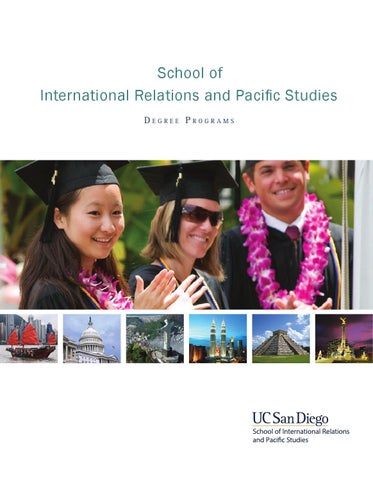
School of International Relations and Pacific Studies Degree Programs
“World dynamics in centuries past were shaped by a dance across the Atlantic between Europe and the Americas. Today, it is the evolving dynamic between the Americas and Asia that is transforming our global society. This is the Pacific Century.� Peter Cowhey, Dean, School of International Relations and Pacific Studies
Photograph by: Casey McGrath, MPIA Alumnus, Machu Picchu, Peru
UC San Diego Named one of the greenest universities in the nation in its implementation of sustainability solutions Geisel Library at UC San Diego
Anchored in the Present, Focused on the Future At the School of International Relations and Pacific Studies (IR/PS) our students aim high, and we hold our faculty and curriculum to that same standard. Built on strong scholarly values, our programs are designed to do much more than teach; they educate leaders, create ideas and support networks — all with an eye toward building a Pacific community. With our unique location on the coast of the Pacific Ocean bordering Mexico, we are positioned to give students unmatched access to Asia and the Americas. We take advantage of this location to prepare students for careers that will help mold the region’s economic growth, technological innovations, and environmental and security challenges into instruments of peace, prosperity and democracy.
San Diego Our city offers a rich variety of social and recreational opportunities and enjoys an average daily temperature of 70 degrees Fahrenheit (21 degrees Celsius). Due to its concentration of more than 12 academic institutions, San Diego has become an important center for advanced research and hosts a large number of rapidly growing biotech, electronic, international trade and service firms.
Part of a Larger Success Story While IR/PS stands among the world’s top graduate schools for international relations and is the established leader in its focus on Asia and the Americas, our success is only part of the story. UC San Diego is one of the nation’s most accomplished research universities and has among the highest ranked departments in the world in both the physical and natural sciences. The political science and economics departments are among the top ten in the country and the university also has the sixth largest research and development budget. We are proud to be named one of the greenest universities in the nation.
Educating Tomorrow’s Leaders Our degree programs address the challenges of the Pacific region by exploring theoretical and practical applications for professionals working in a global context. At its core, the curriculum focuses on the need to have a comprehensive worldview, with a strong understanding of how public policy, management and international interactions shape strategic decision-making.
Degrees with an Interdisciplinary Outlook The curriculum combines three professional school traditions: international relations, public policy and management. Graduates assume senior policy positions in the public and nonprofit sectors as well as in non-governmental organizations and private companies. Our outstanding internship and career services programs allow for opportunities around the world. UC San Diego students at the undergraduate level will find IR/PS a gateway to international studies with a five year bachelor-tomaster’s degree program. At the graduate level, IR/PS offers a two-year Master of Pacific International Affairs, an executive Master of Advanced Studies in International Affairs designed for working professionals and the opportunity for postgraduate study in conjunction with the Department of Political Science. Degree Programs
1
DEGREE PROGRAMS Bachelor of Arts in International Studies and Master of International Affairs (BA/MIA) - 5 year program A degree program open only to UC San Diego undergraduate students enrolled in the International Studies Program • Fourth Year (MPIA Core Curriculum) • Fifth Year (select one MPIA Regional Specialization and one MPIA Career Track)
Master of Pacific International Affairs (MPIA) - 2 year program A full-time professional degree program Curriculum Overview (BA/MIA and MPIA) The BA/MIA and MPIA core curriculum is designed to integrate the diverse subject areas of international management, international relations and comparative public policy. In addition to the required set of core coursework, students must also satisfy the requirements of a regional specialization, a language and courses for a career track. Core Courses
Capstone Courses
IRCO 400 - Policy Making Processes IRCO 401 - Managerial Economics IRCO 403 - International Economics IRCO 410 - International Politics and Security IRCO 412 - Globalization, the World System and the Pacific IRCO 415 - Finance and Accounting for Policy Makers IRCO 453 - Quantitative Methods I: Decision Making and Scenario Analysis IRCO 454 - Quantitative Methods II: Decision Making Under Uncertainty
Choose at least one of the following:
Career Tracks
Regional Specializations
Choice of one of six career tracks is a required part of the BA/MIA and MPIA program. Career tracks are designed for students to acquire expertise in a functional area of their choice:
BA/MIA and MPIA students are required to complete a minimum of two courses focusing on one of the following:
International Development and Nonprofit Management International Economics International Environmental Policy International Management International Politics Public Policy
China Japan Korea Latin America Southeast Asia
IRCO 463 - Strategy and Negotiations IRCO 467 - Policy Responses to Global Problems IRCO 468 - Evaluating Technological Problems
PhD in Political Science and International Affairs Offered in conjunction with the UC San Diego‘s Department of Political Science
Non-Degree Certificate Programs The Global Leadership Institute (GLI) is the executive education program at IR/PS. Since 1989, professionals have enhanced their careers and their organizations through non-degree certificate programs available to individuals on an open-enrollment basis and through customized group programs designed to match specific interests and lengths of study. All programs feature professional tours, which provide insight into the operations and business practices of prominent international industries and influential government agencies. Learn more at irps.ucsd.edu/gli
2
School of International Relations and Pacific Studies
FIND YOUR PROGRAM Master of Advanced Studies in International Affairs (MAS-IA) - 1 year program An executive degree program. Five to seven years of professional experience required. Two year part-time study available on a limited basis. Curriculum Overview (MAS-IA) The MAS-IA program consists of 48 degree units (12 courses) and allows for tailoring a unique program to meet your professional needs. All students must complete the MAS-IA core and capstone courses. Core Courses Two specially designed courses, offered during the fall quarter, provide a solid foundation in political science and economics for the study of international affairs.
Capstone Courses The capstone course, offered in the spring, provides an integrative analytical exercise culminating in an individual written report and oral presentation.
In addition to the two core and one capstone, students are required to take seven courses to complete the degree requirements. Three of these courses must be within the chosen career track, two courses must be region-specific and four additional selections may be made from such fields as economics, public policy, political science and management. Career Tracks
Regional Specializations
Students choose one of five career tracks prior to beginning study:
MAS-IA students are required to complete two courses focusing on one of the following:
Environmental Policy and Sustainability International Political Economy International Public Policy International Relations Security of the Asia-Pacific
China Japan Korea Latin America Southeast Asia
Why IR/PS? Innovative Curriculum Why IR/PS? “I chose IR/PSInnovative because of Curriculum its program design, which balances praxis and theory “I chose IR/PS because of its program to provide students with the innovative design, which balances praxis and theory tools necessary to better global to provide students with meet the innovative challenges.” tools necessary to better meet global challenges.” Veronica Azzi, MPIA Alumna Undergraduate Pontifical Catholic University Veronica Azzi, Institution: MPIA of Rio de Janeiro Undergraduate Institution: Pontifical Catholic University of Rio de Janeiro
Pictured: Elizabeth Stryjewski, MPIA Pictured: Elizabeth Stryjewski, MPIA Alumna
For detailed descriptions of IR/PS programs, curricula, and requirements, visit irps.ucsd.edu/programs
FACULTY AND RESEARCH Students have unmatched access to internationally renowned faculty who integrate rigorous scholarship with an enthusiasm for teaching and active engagement in and out of the classroom. They are participants in far-reaching networks of government, industry and non-governmental organizations. Grounded in the strong University of California research tradition, our faculty-led research centers and programs engage students and reflect a range of topics relevant to our school’s focus.
Why IR/PS? Involved Faculty “With the help of Professor Hanson’s research center, I spoke directly with the finance minister of Timor Leste. I am now organizing a policy workshop to address the country’s comparative advantage and strategies for investment policy reform.” Aggapop Nakphong, MPIA Alumnus Undergraduate Institution: Chulalongkorn University (Thailand) Internship Organization: Ministry of Finance, Timor Leste
Pictured: Gordon Hanson, PhD, MIT
21st Century China Program
Institute on Global Conflict and Cooperation
Aimed at deepening public knowledge and the understanding of contemporary China, this program promotes active discourse on China’s domestic evolution and its international engagement
Facilitating innovative research into the causes of international conflict and cooperation, the institute serves the entire University of California system and is committed to educating the next generation of problem-solvers and peace-makers
Center on Emerging and Pacific Economies Examining central questions about economic growth, equality and market change in the Pacific, this center brings together the worlds of academic inquiry and policy analysis Center for U.S.- Mexican Studies Supporting academic research on Mexico and U.S.-Mexico relations, this center informs the creation, implementation and evaluation of public policy Fudan-UC Center on Contemporary China Connecting all ten campuses of the University of California system, this center brings together leading research scholars from both Fudan University and UC campuses for conferences and lectures, and facilitates cooperative research Global Information Industry Center Studying underlying issues and consequences of technologyenabled change, this center seeks to identify global issues faced by all segments of the information industry
4
School of International Relations and Pacific Studies
Korea-Pacific Program Promoting greater understanding of contemporary North and South Korea, this program supports a wide variety of organized research projects, presents a seminar series and hosts a visiting scholars program Laboratory on International Law and Regulation Exploring when and why laws actually work, this living laboratory looks across a wide array of issues from environment and energy to human rights, trade and security Policy Design and Evaluation Lab Combining advanced social science methodology with the power of information technology, this lab designs policies and programs that alleviate poverty, promote health, welfare and security, and enhance accountability
Visit our research centers at irps.ucsd.edu/research
Our faculty come from the fields of economics, political science and management. They are leaders in research ranging from the resolution of civil wars to implications of the changing pattern of international trade; from domestic politics to finance and business in Pacific countries; from the foreign policy of China to the evaluation of anti-poverty, public health and environmental programs in developing economies.
Stephan Haggard, PhD, UC Berkeley, is the Lawrence and Sallye Krause Professor of Korea-Pacific Studies and Faculty Chair of the MAS-IA program. He works on the political economy of developing countries, with a particular interest in Asia and the Korean peninsula. His current research focuses on the relationship between inequality, democratization and authoritarianism in developing countries.
Susan Shirk, PhD, MIT, is the Ho Miu Lam Professor of China and Pacific Relations at IR/PS and Director of the 21st Century China Program. She has served as Deputy Assistant Secretary of State and founded and continues to lead the Northeast Asia Cooperation Dialogue, an unofficial forum for discussions of security issues. She is an expert on Chinese education, economic policy-making, political leadership and foreign policy.
David G. Victor, PhD, MIT, is a Professor of International Relations and the Director of the Laboratory on International Law and Regulation. Prior to joining UC San Diego, he served as Director of the Program on Energy and Sustainable Development at Stanford University. His research focuses on how the design of regulatory law affects issues such as environmental pollution and the operation of major energy markets.
Barbara Walter, PhD, University of Chicago, is a Professor of International Relations and Affiliated Faculty of Political Science. Prior to joining UC San Diego, she was a postdoctoral fellow at Harvard University and Columbia University. She is an expert on international security, with an emphasis on internal wars, bargaining and cooperation and terrorism/counter-terrorism.
Josh Graff Zivin, PhD, UC Berkeley, is a Professor of Economics and Associate Director of UC San Diego’s Global Health Initiative. He is also an IGCC Research Director for International Environmental and Health Studies and a Research Associate at the National Bureau of Economic Research (NBER). His research spans the fields of economics, health, the environment and international development.
See all of our faculty profiles at irps.ucsd.edu/faculty
Degree Programs
5
CONNECTIONS The Pacific and International Affairs Student Organization (PIASO) is the student body government of IR/PS. PIASO and the many active student groups provide members the opportunity to focus on regions of study and professional development. The following is a list of current organizations:
Regional Focus Groups
Development Club
International Clean Tech Initiative
These student-led groups are dedicated to increasing the understanding of a specific region’s culture, language, politics and economy through a variety of programmatic activities.
Brings together students interested in pursuing international development and nonprofit management by offering largescale projects that make a difference in the San Diego community
Works toward facilitating clean energy related cooperation, identifying energy efficient approaches and commercializing clean energy technologies
Asameshikai (Japan)
Environment Society
China Focus
Organizes a variety of activities to engage students interested in the environment, facilitate discussion about current issues and interact with professors and professionals working in the field
Improves the community by growing and strengthening a network of new leaders who use the power of business to make a positive net social, environmental and economic impact
Chinese Language Film Society Latin America Student Organization Mannam (Korea) Southeast Asia Link
Export Access Global Consulting
Professional Development Groups Provides global market research and Baja Project Serves as a catalyst for change in El Barril, Baja California, Mexico to empower its residents and improve education, health, infrastructure and quality of life Black Box Athletics Provides collegiate, domestic and international statistical sports analysis using methodologies taught at IR/PS
consulting for international business solutions to firms ranging from small-sized to Fortune 500 companies Journal of International Policy Solutions Produces a publication run by students to allow connections with peers to share information and ideas, and find concrete solutions to international problems
Why IR/PS? Connected Community “At IR/PS we do more than teach – we strive to create global leaders who apply unconventional, research-based strategies to solve our evolving world’s political, societal and economic challenges.” Dean Peter Cowhey 2009-2010 Senior Counselor to the United States Trade Representative under President Barack Obama
6
School of International Relations and Pacific Studies
Net Impact
Policy Analysis and Strategy Simulations Presents political crisis simulations where students use skills in negotiation, analysis and strategy to understand how foreign policy decisions are made Strategic Community Consulting Creates links between graduate students and the nonprofit community in San Diego by providing research and consulting services in such fields as economics, public policy, political science and management
CAREER SERVICES Career Development Program
Alumni Mentors
This program is designed to give incoming students the foundation to take charge of their career development today and over a lifetime of job and career changes. It consists of seven workshops held during orientation and throughout the fall quarter.
This program pairs students with alumni for an ongoing relationship designed to provide alumni insights and careerrelated coaching, and to help facilitate internship as well as job opportunities.
Career Coaching
The value of an internship is in exploring possibilities, developing contacts, and obtaining new skills and insights. Our staff works closely with students to help facilitate the best internship given their career interests. Interns have worked all over the world in a wide scope of jobs that transcend their specialties.
A dedicated staff offers one-on-one career coaching, small group workshops, alumni career talks and panels to enhance students’ knowledge base around specific skills, resources or sectors.
Networking Events and Outreach Trips
Summer Internships
Regularly scheduled alumni career talks, employer information sessions and a Thursday Night Networking Series brings to campus panels of local practitioners. Annually, the school organizes a trip to San Francisco and Washington, D.C. to support networking and recruiting opportunities.
Employer Link We connect our students and alumni to top employers locally and internationally through information sessions and on-site interviews. Partnerships with global employers in the public, private and nonprofit sectors provide students with internships and job opportunities.
IRPSCAREERS This online system is a centralized web-based career management tool for students, staff, alumni and employers to gain access to information, resources, jobs, internships, events and to each other.
Alumni Network More than 2,500 graduates have entered the global job market. Our alumni continue to be engaged with the school, its students and events and alumni organizations throughout the world. They provide ongoing networking and career support for current students through the presentation of career talks, networking sessions and larger connections events, which bring alumni from both coasts to speak on panels and conduct interviews for jobs and internships.
Why IR/PS? Comprehensive Career Services “The career support and internship experience I gained during my time at IR/PS were instrumental in helping me pursue my career in international development. I‘m currently managing a complex impact evaluation measuring the effect of conditional cash transfers on HIV-risk for young women in Malawi.” Raka Banerjee, MPIA Alumna Internship organization: The Advocacy Project, Gaighat, Nepal Current organization: The World Bank Pictured: Raka Banerjee, MPIA Alumna
Degree Programs
7
ADMISSIONS Application Deadlines Hard copy materials must be postmarked by the date indicated. If the date should occur on a weekend or holiday, the next business day will apply. Online applications must also be submitted by the date indicated. Program
Early Response Date
Regular Deadline April 22
BA/MIA MPIA
MAS-IA
December 4
January 15
October 30
January 15 Applications will be considered until May 31 contingent upon space availability December 10
PhD
Application Requirements Specific score requirements are available on our website. For more information visit irps.ucsd.edu/programs Program
Statement of Purpose
Second Essay
Three Letters of Recommendation
GRE or GMAT
TOEFL, ELTS or PTE
Transcripts
Resume
CV
BA/MIA MPIA MAS-IA PhD
Why IR/PS? Global Vision
Pictured: Natasha Hanshaw, MPIA Alumna
Contact Admissions at irps-apply@ucsd.edu to apply or to sign up for our newsletter
Graduates of IR/PS are committed to active participation in the global community. Effective action academically, professionally and personally in an international context is the hallmark of IR/PS and UC San Diego.
Photograph by: Rhiannon Kucharski, MPIA Alumna, Phnom Penh, Cambodia
Office of Admissions School of International Relations and Pacific Studies 9500 Gilman Drive, #0520 La Jolla, CA 92093-0520 (858) 534-5914 | irps-apply@ucsd.edu irps.ucsd.edu IR/PS is a member of the Association of Professional Schools in International Affairs Degree Programs
9