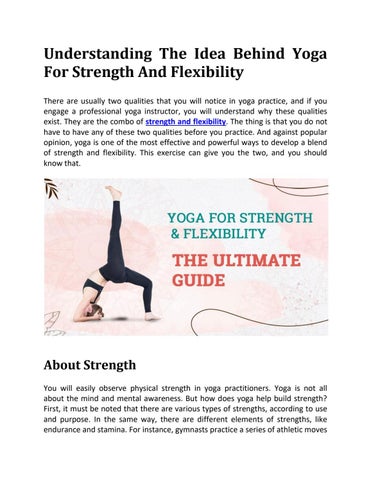
Understanding The Idea Behind Yoga For Strength And Flexibility There are usually two qualities that you will notice in yoga practice, and if you engage a professional yoga instructor, you will understand why these qualities exist. They are the combo of strength and flexibility. The thing is that you do not have to have any of these two qualities before you practice. And against popular opinion, yoga is one of the most effective and powerful ways to develop a blend of strength and flexibility. This exercise can give you the two, and you should know that.
About Strength You will easily observe physical strength in yoga practitioners. Yoga is not all about the mind and mental awareness. But how does yoga help build strength? First, it must be noted that there are various types of strengths, according to use and purpose. In the same way, there are different elements of strengths, like endurance and stamina. For instance, gymnasts practice a series of athletic moves
for a long duration, while weightlifters only require a single attempt to display their physical strength. There is what we call muscle contraction. A muscle fiber usually contracts completely. Muscle fibers do not vary in contraction intensity compared to the load against which they act. However, the force of a muscle contraction can still determine the varying strengths between the strong and the weak. During the period of contraction, more muscle fibers are formed to perform the job. Thus as the central nervous system produces more muscle fibers, the muscular contraction generates more force. This is why different people perform varying exercises. Some people require exercises that supply many muscle fibers to build strength over a short period. Others only need few muscle fibers to make the contraction offer longer strength.
On Flexibility Flexibility is when you practice a free range of motion without pain and discomfort. The joints are built up by soft tissues of muscles, tendons, ligaments, joint capsules, and skin. But since musculoskeletal structures are different, so flexibility varies in individuals. You should note that the elasticity and mobility of the soft tissues are the elements that affect the range of motion. Therefore, lack of stretching can result in a shortening of soft tissues. The primary aim of the muscles is to ensure movement. The movement is only made possible by muscle fibers, as we can see in creating strength. A muscle fiber consists of action and myosin as proteins that attract and contract toward each other whenever the body releases calcium. The coming together of these proteins is the basis of muscular contractions that the body experience.
In Conclusion Now you can see the impact of yoga exercise in the body system, particularly in the formation of contractions that provide physical strength and flexibility. One of the popular yoga exercises that offer these two qualities is hatha yoga, where the body is warmed-up with back-bends. The contractions that occur during this process are what strengthens and extend your muscles. Postures like the plow
pose and shoulder stand bring about isometric contractions of the muscles that stretch the fascia and promote body strength. With this in mind, you can practice knowing how intimately linked your muscular and nervous systems are.