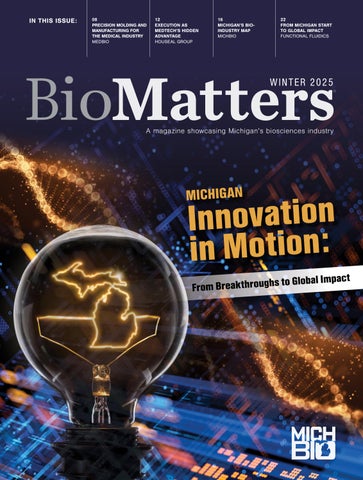
IN THIS ISSUE:
08 PRECISION MOLDING AND MANUFACTURING FOR THE MEDICAL INDUSTRY MEDBIO
12 EXECUTION AS MEDTECH’S HIDDEN ADVANTAGE HOUSEAL GROUP
16 MICHIGAN’S BIOINDUSTRY MAP MICHBIO
22 FROM MICHIGAN START TO GLOBAL IMPACT FUNCTIONAL FLUIDICS
WINTER 2025
A magazine showcasing Michigan’s biosciences industry
MICHIGAN
n o i t a v o n In : n o i t o M n i al Impact b lo G to s h g u ro th k a From Bre
WE MAKE PRECISION MEDICINE POSSIBLE.
GENEMARKERS GENOMIC RESEARCH
MICHIGAN PURE OPPORTUNITY ®
As a top state for biomedical engineering graduates, Michigan is pioneering the next generation of medicine
with advancements in everything from vaccine manufacturing to genomic research. Discover the world-class life sciences talent that make it all possible and seize your opportunity at MICHIGANBUSINESS.ORG
PRESIDENT’S MESSAGE When people talk about “innovation,” they often picture a breakthrough moment—a eureka in the lab, a prototype on a bench, a first-in-human milestone. But here in Michigan, innovation is rarely a single moment. It’s motion. It’s the steady, coordinated progression from discovery to development, from manufacturing to market, from local ingenuity to global impact. That’s why the theme of this issue— “Michigan Innovation in Motion: From Breakthroughs to Global Impact” —feels so timely. Across our state, ideas are gaining traction and velocity: researchers advancing platforms that expand what’s possible, entrepreneurs translating science into solutions, and manufacturers scaling with the discipline and reliability that global markets demand. It’s about momentum - and what happens when an ecosystem learns how to move together. In these pages, you’ll see that motion in multiple forms.
At MichBio, our job is to keep this engine moving—advocating for smart policy, convening unlikely partners, and amplifying Michigan’s story beyond our borders. Momentum is a choice, built through collaboration and strong handoffs across the value chain. Innovation is growing here, moving here—in Michigan. Let’s keep building, together.
You’ll read how the Biointerfaces Institute helps turn fundamental research into real-world tools and companies -connecting talent, technology, and translational pathways so discoveries don’t stall at proof-of-concept. You’ll also see Michigan’s manufacturing edge on display through Medbio’s precision molding—a reminder that breakthroughs don’t reach patients unless we can produce them with consistency, quality, and scale. The ability to manufacture well isn’t a supporting detail in the innovation story; it’s the hinge that swings the door from “possible” to “available.” You’ll meet innovators designing with outcomes and usability in mind—like the team behind a biomechanics product for physical therapy, where engineering meets empathy and practicality. It’s another hallmark of Michigan’s innovation culture: we build with the end in mind. We don’t just ask, “Can it be done?” We ask, “Will it work in the real world - on real schedules, in real clinics, for real people?” And because innovation in motion requires more than technical talent, this issue also highlights a truth that’s easy to overlook: execution is strategy. The piece on accountability, trust, and process as medtech’s hidden advantage speaks directly to what growing companies face. Scaling isn’t only about capital or headcount; it’s about operating habits that make quality and speed compatible. In regulated markets, your processes aren’t bureaucracy - they’re credibility. We’re also proud to spotlight global stories rooted here: Functional Fluidics’ RBC innovation platform, and a “small but mighty” example of how focused teams can help little molecules tell big stories. Global impact doesn’t require being big; it requires being ready, rigorous, and relentless. Sincerely,
STEPHEN RAPUNDALO, PHD President and CEO, MichBio
BIOMATTERS ® | WINTER 2025
1
Science has the power to change lives for the better. Every day, from discovery to delivery, Avantor is an essential partner to the scientific community — pioneers, scientists, innovators and educators — relentlessly focusing on breakthroughs that help solve the world’s most complex challenges. Our proven expertise and trusted portfolio of products and services, combined with a global reach and ability to provide customized materials of the highest quality for highly regulated applications move science forward. As a global leader in life sciences, we fulfill our mission: to set science in motion to create a better world. Visit vwr.com or avantorsciences.com
Better world.
Better solutions. Better focus.
©2024 Avantor®, Inc. All rights reserved.
2
MICHBIO | michbio.org
MichBio is the biosciences trade association for the state of Michigan. Our goal is to drive the growth of the state’s bio-industry through advocacy, education, connections, and supportive resources.
PREMIUM MEMBERS GOLD full color
black
Stephen Rapundalo, PhD President and CEO Emily Brockman Director, Member Relations Carrie Hranko Manager, Administrative Services
white
Jamie Krajny Editor Director, Marketing and Industry Engagement
MichBio 3600 Green Court, Suite 780 Ann Arbor, MI 48105-1175 734-527-9150 info@michbio.org michbio.org Designer: Daina Fuson Designs Printer: Progressive Printing © Copyright Michigan Biosciences Industry Association, DBA MichBio
SILVER MICHBIO BOARD OFFICERS CHAIR Ken Massey, PhD Wayne State University Senior Director, Venture Development Technology Commercialization VICE CHAIR Kevin McLeod Everis Founder, President and CEO
PRESIDENT AND CEO Stephen Rapundalo, PhD MichBio President and CEO SECRETARY Vacant TREASURER Vacant
MICHBIO BOARD DIRECTORS BRONZE
Christy Bigelow Emergent Biosolutions Vice President and General Manager, Manufacturing Operations
Ken Massey, PhD Wayne State University Senior Director, Venture Development Technology Commercialization
Chuck Bird Neogen Corporation Senior Director of Government Relations and Industry Affairs
Kevin McLeod Everis Founder, President and CEO
Rhonda DeLuca Terumo Cardiovascular Group Sr. Vice President Global Human Resources Robert Donofrio, PhD BioScope Innovations CEO
PATRON
Rose Gillesby, DVM Zoetis Vice President, Veterinary Medicine Research and Development Christine Haakenson, PhD Bio-industry Executive Charles Hasemann, PhD Michigan State University Assistant Vice President for Innovation and Economic Development Laura Malagon Grand River Aseptic Manufacturing Vice President, Quality & Regulatory
Dave Morin Care Technology Advisors, President & Chief Operating Officer Kate Remus University of Michigan Senior Associate Director & Business Development Group Lead Stephen Rapundalo, PhD MichBio President and CEO John J.H. Schwarz, MD Former U.S. Representative Uma Sharma, PhD MMS Holdings Founder and CEO Ashlea Souffrou SxanPro CEO and Founder
BioMatters® is published bi-annually to showcase Michigan’s bioscience industry. Much of the content is submitted by MichBio member companies. Interested in submitting an article or advertising in a future issue? Contact Jamie Krajny at jamie@michbio.org. BIOMATTERS ® | WINTER 2025
3
MICHBIO PREFERRED PURCHASING PROGRAM The MichBio Preferred Purchasing Program leverages the collective purchasing power of our member companies to obtain steep discounts from our vetted and endorsed vendor portfolio. Members have saved upwards of 900 times their annual membership dues.
4
MICHBIO | michbio.org
TABLE OF CONTENTS Bench to Business: 06 | From Fueling Translational Science and Innovation University of Michigan Biointerfaces Institute
08
Molding and Manufacturing for the 08 | Precision Medical Industry Medbio
Concept to Comfort: Developing a 10 | From Biomechanics Product for Physical Therapy DISHER Engineering al Group
as MedTech’s Hidden Advantage: 12 | Execution Why Accountability, Trust, and Process Make or Break Growth Houseal Group
14 | By the Numbers MichBio
16 | Michigan’s Bio-industry Map MichBio
22
18 | After the Elevator Pitch Emerging Companies
20 | Consultants to Meet MTM Research LLC
22 | From Michigan Start to Global Impact Functional Fluidics
but Mighty: How a Small Company is 24 | Small Using a Big Idea to Help Little Molecules Tell Big Stories Across the Globe Arbor Assays
Should Seize the Moment to 26 | Michigan Lead in Life Sciences Stephen Rapundalo, PhD
24
Business Solutions: Maximizing Savings, 29 | BIO Strengthening Michigan Science
BIOMATTERS ® | WINTER 2025
5
UNIVERSIT Y OF MICHIGAN BIOINTERFACES INSTITUTE
From Bench to Business: Fueling Translational Science and Innovation BY RUBY M. MILLER, PHD, INNOVATION FELLOW, BIOINTERFACES INSTITUTE, UNIVERSITY OF MICHIGAN
Risky. Expensive. Opaque. These are just a few descriptors attributed to the challenges of moving technology from academic research labs to the commercial market. At the University of Michigan (U-M) Biointerfaces Institute (BI), both leadership and faculty members are tackling these challenges by building infrastructure to support translational science using specific strategies.
First, the labs and offices are co-located to foster interdisciplinary collaboration, uniting faculty from four University Academic Units (College of Engineering, College of Pharmacy, School of Dentistry, and Medical School) with translation as a core focus. Second, BI activates key initiatives: secure major funding for cutting-edge equipment to drive ambitious research, attract top talent to guide commercialization, and invest boldly in breakthrough technologies. Together, these efforts reflect a deliberate plan to develop a pipeline that advances biomedical innovations. Joerg Lahann, PhD, Director, has led the Institute to an impressive track record that has garnered significant attention. Institutional support and recognition from the University’s highest leadership have further propelled BI toward continued success. Provost Laurie McCauley, PhD, recently renewed financial investment in the Institute’s equipment infrastructure, highlighting BI’s outstanding accomplishments.1 Dr. McCauley emphasized that since its founding in 2012, BI faculty have earned 119 patents and launched 25 startup companies, a compelling justification for funding BI’s shared instrumentation cores and equipment. Additionally, these resources provide BI researchers with the operational costs, support staff, programming, and resources needed to remain at the forefront of biomedical innovation, expanding experimental possibilities and strengthening BI’s momentum for impactful science. As part of the ongoing development of infrastructure and resources, BI Managing Director, Elizabeth Herness Peters, PhD, has made recruiting top talent a priority to accelerate translational viability. Dr. Peters oversees the Innovation Fellowship, a postdoctoral program supported by the deans of the four Academic Units. This program embeds PhDs into the innovation projects led by BI faculty, allowing fellows to apply their scientific expertise to shape commercial strategies. The Innovation Fellows gain hands-on business experience, champion translational science, and provide support for the 38 faculty members’ commercialization efforts. Through this immersive experience, fellows broaden their skillsets and
1 “FY-26 Budget Prioritizes Accessibility, Affordability.” The University Record, University of Michigan, 2025, record.umich.edu/articles/fy-26-budget-prioritizes-accessibility-affordability/. Accessed September 16, 2025.
6
MICHBIO | michbio.org
BIOINTERFACES INSTITUTE
The Biointerfaces Institute has actively advanced translational science by investing in talent, funding innovative challenges, and leveraging external investments to enhance its infrastructure. learn to advocate effectively for these technologies, demonstrating BI’s commitment to preparing talent to meet future translational challenges.2 The program has attracted significant interest from the local life sciences community and beyond. Graduate students and postdocs are enthusiastic about this unique training opportunity, which prioritizes exploration of all aspects of commercialization. As part of the program, fellows may help guide a faculty’s technology through initiatives such as the National Science Foundation Innovation Corps (NSF I-Corps). Programs like this allow them to refine value propositions, conduct customer discovery for strategic insights, and perform market and competitive analyses to strengthen Small Business Innovation Research (SBIR) grant applications. The fellowship’s impact is evident in both grant awards and the acceleration of BI innovations. Another core tenet of the Biointerfaces Institute is its investment of funds to create high-impact opportunities for translational research. The leadership has accomplished this by organizing themed challenges, which lay the groundwork for faculty and collaborators to form interdisciplinary teams, develop proposals on curated topics, and compete for internal funding. In 2024, the Brain Health Technology Challenge addressed gaps in the neuroscience commercialization landscape. This resulted in $250,000 awards to each of four teams, totaling $1 million of BI’s own funds. The urgency is clear: neurodegenerative and other brain disorders are leading contributors to the global
disease burden, with 12% of the world’s population now over 60 years old.3 The focus on brain health was chosen to spur technology development in a field traditionally dominated by pharmaceuticals. BI’s unique strengths at the intersection of engineering and biomedical research enable it to create translational solutions. Key categories include models (biological, such as organoids, and computational), drug delivery systems, and probes and implants. By funding the Brain Health Challenge, BI is supporting the development of innovative and commercially viable tools in the neuroscience technology space. The Biointerfaces Institute has actively advanced translational science by investing in talent, funding innovative challenges, and leveraging external investments to enhance its infrastructure.
BI has established itself as a productive member of the Southeast Michigan life sciences ecosystem, and its approach is already yielding results. In 2024, BI was awarded seven U.S. patents, launched two companies, and executed multiple licensing agreements. This year, BI is on track to surpass these numbers, reflecting its growing innovation. The pipeline for real-world impact is taking shape, making now an ideal time to partner with BI as it drives the future of translational biomedical innovation. BIOINTERFACES.UMICH.EDU
2 Visheratina, Anna, Danielle Neale, Kristen Steen, et al. “A Journey from Academia to Innovative Entrepreneurship: University of Michigan Biointerfaces Institute Innovation Fellowship.” MRS Bulletin, vol. 48, 2023, pp. 700–702. Cambridge University Press, https://doi.org/10.1557/s43577-023-00565-w. 3 “Ageing and Health.” World Health Organization, 1 Oct. 2024, www.who.int/news-room/fact-sheets/detail/ageing-and-health.
BIOMATTERS ® | WINTER 2025
7
MEDBIO
Precision Molding and Manufacturing for the Medical Industry SUBMITTED BY MEDBIO
Medbio is a plastic molder and contract manufacturer serving the medical and healthcare industries. Headquartered in Grand Rapids, Michigan, the company also operates facilities in Clinton Township, Schoolcraft, Michigan, and Orchard Park, New York. For more than 20 years, Medbio has been a trusted supplier to the healthcare industry—offering precision custom molding, end-to-end manufacturing, and valueadded assembly and packaging operations.
In-house capabilities include: TOOLING • In-house tool building from prototypes to bridge tool to full production tooling (SPI class 100-105) • In-house tool maintenance and repair at each facility MOLDING
Medbio’s four state-of-the-art facilities include more than 70,000 square feet of ISO Class 7 and Class 8 cleanroom manufacturing space, dedicated to molding, assembly, and packaging. All facilities are ISO 13485, ISO 9001, and ISO 14001 certified, and FDA registered. Together, they are built to serve customers at every stage—scaling from start-ups and new product development to full-volume commercialization. With operations designed for flexibility, Medbio supports a broad range of needs—from low-volume, single-cavity molds to high-cavitation, high-volume production. Smaller, quick-turn and prototyping projects are typically managed at the Clinton Township facility, while full production runs are supported by the Grand Rapids and Orchard Park operations.
From Components to Complete Assemblies (to Packaging)
Medbio provides full-service solutions—everything from molded components to complete assemblies. The company excels at solving complex challenges while driving efficiency for simpler designs, offering a wide range of assembly and packaging capabilities to meet customer specifications. 8
MICHBIO | michbio.org
• Plastic injection molding • Two-shot molding • Micromolding • Overmolding and insert molding • Liquid silicone rubber molding POST-MOLDING OPERATIONS • Thermoforming • Adhesive and solvent bonding • Pad printing and hot stamping • Heat staking • Laser and ultrasonic welding • Laser marking • Bar, heat, and tray sealing ASSEMBLY • Manual • Operator-assisted • Fully automated, including robotics
MEDBIO
Medbio offers the full complement of valueadded services, from post-molding operations and manual assembly to semi- and fully automated solutions. For large, multi-step projects, the company can design dedicated, lean assembly cells tailored to each customer’s specific requirements.
Innovative Problem Solvers At its core, Medbio is a team of problem solvers. Each project is supported by a cross-functional team that guides customers through every stage—from design improvement and Design for Manufacturability (DFM) to in-house tool building, prototyping, molding, assembly, packaging, and inventory management. Medbio’s in-house engineers combine deep medical industry knowledge with tooling and molding expertise to ensure effective, cost-efficient, and timely solutions. By applying DFM and Design for Automation principles early in development, Medbio helps customers achieve repeatable, high-quality parts that meet exacting specifications.
Stringent Quality Management and Control Each Medbio facility features a state-of-the-art quality control and metrology lab. The company’s quality management system is tailored to each customer’s specific program requirements and supported by advanced process monitoring and reporting systems. All molding and assembly processes undergo full validation to meet the highest standards in medical manufacturing.
Existing Tool or New Project? Bring Us Your Next Challenge
Medbio has extensive expertise in tool transfers, helping customers transition existing programs quickly and confidently. The company’s dedicated Transfer Team ensures a smooth, efficient process and a rapid return to production. With in-house tool building capabilities plus repair and maintenance tool rooms at every facility, we have the right expertise to make a tool transfer successful. Across every engagement, Medbio’s goal remains the same: to reduce manufacturing costs while maintaining the highest levels of quality, precision, and reliability.
Bring us your next challenge—or connect with one of our experts to learn how Medbio’s capabilities can help you bring your next medical innovation to life.
MEDBIOLLC.COM
BIOMATTERS ® | WINTER 2025
9
DISHER ENGINEERING
From Concept to Comfort:
Developing a Biomechanics Product for Physical Therapy BY ANDREW HEMPHILL, CONCEPT ENGINEER & CO NGUYEN, CONCEPT ENGINEER
DISHER Engineering is a Michigan-based professional engineering services firm that offers innovation and design, product development, and manufacturing solutions. Since 2000, we’ve helped Fortune 500 companies, suppliers, and independent inventors across industries bring meaningful innovation to life—bridging the gap when time, talent, or tools are limited.
The Challenge A client in the physical therapy industry approached us to develop a device that could replicate the motion and pressure of a therapist’s hands during a specific rehabilitation exercise. They had built a functional prototype prior to our partnership, but it unfortunately missed the mark of their desired finished product. The concept had strong potential—it just needed clearer definition and a structured development path. *Certain project details have been intentionally omitted or generalized to protect client confidentiality.
10
MICHBIO | michbio.org
Our Front-end Design Process
We began by guiding the client through our front-end design process to move from concept to clarity.
Research & Benchmarking Our team started with broad research within the physical therapy environment. We gathered insights into current treatment methods, comparable products, and related solutions addressing similar motions or forces in other industries. This early discovery phase helped us document pain points in existing tools while uncovering opportunities for innovation. Most importantly, it gave us a deeper understanding of the therapist and patient experience—critical to shaping a user-focused product.
Concept Generation Armed with these insights, we moved into concept generation. We started with loose, exploratory sketches, deliberately keeping details to a minimum to encourage divergent thinking. We encourage this by creating “How might we…” statements that speak directly to the problem we want to solve. These early visuals became a fast, effective way to gather client feedback and align on direction before investing significant time or resources. Through this collaborative iteration, we identified the most promising concepts to carry forward into lowfidelity prototyping.
DISHER ENGINEERING
Andrew Hemphill
Co Nguyen
Low-fidelity Prototyping
Project Outcome
At this stage, functionality was our focus. Rather than refining every aesthetic or secondary feature, we concentrated on validating the core motion and mechanical behavior. Using simple materials—wood, glue, spare nuts, and bolts—we built a rough prototype that precisely replicated the intended movement. The goal wasn’t yet comfort or therapeutic performance, but rather to evaluate ergonomics and the relative positioning of key components.
Through this structured, user-focused approach, we transformed an underdeveloped idea into a clear, functional, and manufacturable product concept. The project demonstrates how early research, iterative design, and targeted prototyping can bridge the gap between a promising idea and a solution ready to make a positive difference in biomechanical therapy.
High-fidelity Prototyping Once these fundamentals were proven, we advanced to high-fidelity prototyping, where we could integrate considerations for usability, aesthetics, and comfort. This step brought the product closer to a manufacturable solution—one that not only performed as intended but also aligned with the visual and tactile expectations of a professional therapy environment, using manufacturing methods that are representative of the finished product.
DISHER.COM
BIOMATTERS ® | WINTER 2025
11
HOUSEAL GROUP
Execution as MedTech’s Hidden Advantage:
Why Accountability, Trust, and Process Make or Break Growth BY LESLIE HOUSEAL, FOUNDER AND PRINCIPAL, HOUSEAL GROUP
In MedTech, innovation has long been celebrated as the engine of progress. But innovation alone rarely determines who succeeds. The difference between organizations that scale safely and those that stall often lies in something less visible: the discipline of execution. Execution is not the opposite of innovation; it is the system that allows innovation to endure. For early-stage firms, it represents the infrastructure for growth. For mature companies, it converts technical excellence into reliable performance, quality, and revenue.
In early development, accountability is implicit. Everyone does everything. But growth demands explicit structure. When multiple products, partners, and regulators are involved, accountability must be designed rather than assumed. Strong execution systems make ownership visible at every level - from design control to launch readiness. This isn’t about micromanagement; it ensures that decisions have clear homes. Without it, organizations rely on personality and proximity instead of process.
The Execution Gap in MedTech
For companies entering growth, defining accountability frameworks - decision logs, cross-functional RACI charts, and stage-gate ownership - is the organizational equivalent of design verification. It confirms that what was intended is actually happening.
The result is what many leaders quietly recognize as an execution gap: misaligned priorities, delayed decisions, duplicated work, and late-stage surprises in quality or regulatory review. In systems terms, these are failures of feedback - signals lost between strategy and operations.
Trust: The Cultural Multiplier
The same rigor that protects patients can slow progress if a company lacks internal clarity and coordination. As organizations move from R&D to market launch, informal communication and founder-driven decision making begin to fray.
12
Accountability: Structural Integrity for Scale
MICHBIO | michbio.org
Trust determines the speed at which information moves. In regulated environments, it’s the antidote to fear-based escalation and delayed reporting. When engineers and quality teams trust that raising a risk
HOUSEAL GROUP
will be met with problem-solving rather than blame, issues surface early - when they are still reversible. High-trust cultures turn compliance into collaboration. They replace “check-the-box” behavior with shared responsibility for patient safety and business continuity. This is the cultural architecture that allows quality systems to function as learning systems instead of enforcement tools.
Process: The Conduit of Learning Many growth-stage leaders associate process with bureaucracy. In reality, mature process design is what allows agility to survive scale. A well-architected process doesn’t slow innovation - it stabilizes it. Like a control system, feedback and adjustment keep the signal steady. Process maturity performs the same function for organizations: lessons from validation inform design; post-market surveillance guides R&D; every corrective action strengthens the enterprise. When early-stage companies build these pathways intentionally, they avoid the “hard reset” that occurs when investors or acquirers demand compliance infrastructure overnight. For growth-stage firms, refining these processes enables consistent performance under audit, supply-chain stress, or rapid scaling.
Designing Execution into Growth The most resilient MedTech organizations treat execution as a capability system, not a management layer. They invest early in an execution operating system - the governance rhythm, visual management, and feedback loops that integrate strategy with operations. It’s worth distinguishing this from the formal Quality Management System (QMS). The QMS ensures compliance - verifying that products meet regulatory
and patient safety standards. The execution operating system ensures coherence - translating strategy into coordinated action across functions. When the two operate in harmony, quality becomes not just a requirement but a result of disciplined execution. For early-stage founders, this discipline can feel premature. Yet designing accountability, trust, and process into the company’s DNA early allows for a seamless transition from development to scale. For growth-stage leaders, it becomes the lens through which operational complexity transforms into organizational competence. The New Competitive Competence As competition intensifies and regulatory expectations expand, execution capability may prove to be MedTech’s next frontier of advantage. Product innovation defines what is possible; execution defines what is sustainable. Organizations that master both the creative and the operational, the experimental and the disciplined, will not only innovate faster but deliver with greater reliability and confidence.
The hidden advantage is not more ideas, but more follow-through. That may be the difference between a promising prototype and a marketdefining breakthrough.
HOUSEAL-GROUP.COM
LESLIE HOUSEAL is the Founder and Principal of Houseal Group, a West Michigan-based consultancy specializing in execution systems for manufacturing and MedTech organizations. She helps leadership teams close the gaps that kill results through the firm’s proprietary EXECUTE Command Center™ and Execution Health Assessment™ frameworks.
BIOMATTERS ® | WINTER 2025
13
BY THE NUMBERS
MICHIGAN A LIFE SCIENCES LEADER MICHIGAN BIO-INDUSTRY QUICK FACTS *
6 /10 th
Bioscience Jobs
47,815* 3,319*
+8%
SINCE 2022
Bioscience +27% Establishments SINCE 2022 Average * Bioscience Salary
$110,204
+8%
SINCE 2022
th
LARGEST
5 9 th /
th
BioPharma State by number of establishments / employment
Medical Device State by number of establishments / employment
LARGEST
9
th
Agri-Biosciences by number of establishments
LARGEST
16
th
LARGEST
Bioscience State by employment
BIOSCIENCE PERFORMANCE METRICS*
$55.8 BILLION
In Economic Impact
+24%
SINCE 2022
$1.62 BILLION*
Academic R&D Investment
$991 MILLION*
10th in the U.S.
NIH Investment
+20%
SINCE 2022
*Employment, Establishments and Wages: U.S. Bureau of Labor Statistics, Quarterly Census of Employment and Wages (QCEW), enhanced by Lightcast (Datarun 2024.3). **Academic R&D Expenditures: National Science Foundation (NSF), Higher Education Research and Development (HERD) Survey. ***Venture Capital: Pitchbook Data, Inc. ****Patents: U.S. Patents & Trademark Office data from Clarivate Analytics’ Derwent Innovation patent analysis database.
14
MICHBIO | michbio.org
MICHBIO: BY THE NUMBERS
DISTRIBUTION OF MICHIGAN BIOSCIENCES INDUSTRY * 29%
Agri-Biosciences
33%
20%
27%
EMPLOYMENT
MedTech
ESTABLISHMENTS
24%
BioPharma
9%
R&D/Testing
36%
18% 2%
2%
Distribution
DISTRIBUTION OF RESEARCH FUNDS BIOSCIENCE-RELATED VENTURE CAPITAL INVESTMENTS $ MILLIONS, 2019-2023
BIOSCIENCE ACADEMIC R&D $ MILLIONS, FY 2022 Agricultural Sciences Bioengineering and Biomedical Engineering
PHARMACEUTICAL & BIOTECHNOLOGY
$131.10 $55.60 $516.30
Biological and Biomedical Sciences
Natural Resources and Conservation
$37.00
Other Life Sciences
$69.40
Bioinformatics and HealthTech Biological Sampling and Analysis Biopolymers Drugs & Pharmaceuticals Genetic Engineering
Pharmaceuticals Novel Animal Types Novel Plant Types
$192.6
Discovery Tools
$29.1
Pharmaceuticals
$46.7
Drug Delivery
$21.9
Other
$15.3
Healthcare Technology Systems
$468.2
Other Software
$16.3
Other
$233.6
MEDICAL DEVICES & SUPPLIES
73
Diagnostic Equipment
373 150
Medical Supplies Monitoring Equipment
123 12 519 111 144 408 2 387
$114.6 $7.2 $19.9
Surgical Devices
$37.3
Therapeutic Devices
$99.9
Other
$16.7
BIOBASED PRODUCTS
2,218
Medical and Surgical Devices Microbiology and Enzymes
Drug Discovery
DIGITAL HEALTH
BIOSCIENCE-RELATED PATENTS 2019-2023
Biochemistry
$70.4
$926.50
Health Sciences
Agricultural Chemicals
Biotechnology
Agricultural Chemicals
$0.0
Biofuels and Bio-oils
$2.8
Biopolymers and Other Bioproducts
$9.3
OTHER
Healthcare Distribution
$0.0
Healthcare Lab Services
$20.5
BIOMATTERS ® | WINTER 2025
15
MICHIGAN'S BIO-INDUSTRY Anchored by several large hubs, this representative sample of Michigan life sciences companies illustrates the breadth of the industry footprint.
TR AVERSE CIT Y
MUSKEGON
GRAND RAPIDS
HOLLAND
K AL AMA ZOO
B AT T L E C R E E K / J AC KS O N
16
MICHBIO | michbio.org
UPPER PENINSULA
MID-MICHIGAN
OAKL AND/MACOMB/ S T. C L A I R
G R E AT E R D E T R O I T
ANN ARBOR
LANSING
BIOMATTERS ® | WINTER 2025
17
AFTER THE
ELEVATOR PITCH Bulsai Health is advancing self-administered insulin injections for millions with diabetes through innovative near-infrared (NIR) technology. Our device guides injections precisely into healthy tissue, addressing a critical issue—lipohypertrophy (LH)—which results from repeated injections into the same area. LH buildup causes fat, fibrosis, and scar tissue, reducing insulin absorption efficiency. Over time, injecting into LH can lead to unstable, dangerously high blood glucose levels and increases healthcare costs. Founder Bill Ervin, a 40-year veteran of type 1 diabetes (T1D), experienced these frustrations firsthand. Navigating daily injections, he wondered whether insulin was properly absorbed, prompting the question: Is there a device to help patients identify healthy tissue beforehand? The answer was no. After exploring various scanning technologies, Ervin’s cousin Jim, a PhD in mechanical engineering, conceived an innovative approach (patent application filed) to use infrared light for detecting LH non-invasively and costeffectively.
18
MICHBIO | michbio.org
To validate this technology, Bulsai partnered with the University of Michigan’s Biomedical Engineering department, and the student team successfully demonstrated the ability to locate LH accurately using Ervin as a test subject. The company is now focused on strengthening its intellectual property, refining its prototype, clearing regulatory hurdles, and finding reimbursement pathways. Looking ahead, Bulsai aims to secure Series A funding or strategic alliances with major healthcare players who recognize our technology’s potential to transform diabetes management. By providing a reliable means to identify healthy tissue for injections, Bulsai could significantly improve insulin absorption, reduce complications, and enhance patient safety. Their innovative approach aims to set a new standard in precision insulin delivery and improve outcomes for millions worldwide. BULSAI.GODADDYSITES.COM
Michigan continues to be a leader in advancing biosciences research and commercialization, thanks to its rich pipeline of intellectual property. A whole new crop of startups are germinating in the state, which is good news for the regional cluster of established companies that are focused on innovation in therapeutics, medical devices, healthcare technologies, clinical diagnostics and agri-/industrial biotechnology.
Genevi Technologies: Redefining Women’s Urology from Michigan.
Unlike surgery, bulking agents, or nerve stimulators, Genevi is non-invasive, affordable, and accessible for everyday use.
Urinary incontinence (UI) impacts more than 78 million women in the U.S., with 1 in 2 experiencing it over their lifetime. Yet current treatments focus on pelvic floor strength, nerve modulation, or symptom management, leaving the urethra; the true “gateway to continence,” untreated. This gap leaves millions of women reliant on pads, coping strategies, or invasive surgery, with few effective, first-line solutions.
The system is also digitally enabled, guiding patients through therapy and giving providers compliance and outcome data. With a familiar, tampon-sized profile, the device is designed for comfort, hygiene, and long-term adoption across age groups. By targeting the urethra directly, Genevi offers a novel, root-cause solution that redefines the standard of care.
Genevi Technologies, born from the University of Michigan and supported by leading pelvic health researchers, is pioneering the first at-home urethral health system to directly restore continence. Our device combines a reusable controller with single-use inserts that deliver targeted neuromuscular electrical stimulation (NMES) to the urethral sphincter. Early studies show a >4x increase in urethral closure pressure, evidence we can restore function.
Led by a team with deep expertise in women’s health, medical devices, and commercialization, Genevi is poised to establish “urethral health” as a new category in women’s medicine. From Michigan, we are working to bring this breakthrough to millions of women worldwide, empowering them with control, confidence, and dignity.
GENEVITECHNOLOGIES.COM
BIOMATTERS ® | WINTER 2025
19
Antimicrobial resistance poses one of modern medicine’s most pressing challenges. Iaso Therapeutics is pioneering a synthetic vaccine platform to address the threat through its innovative mQβ technology, enabling faster design, more precise targeting and scalable production compared to conventional approaches.
The platform’s versatility extends beyond salmonella. Iaso’s pipeline includes IASO-002, which targets PNAG, a polysaccharide found across multiple bacterial pathogens. This second mQβ application could address pneumonia, MRSA, urinary tract infections and gonorrhea—validating the technology’s repeatability.
The Lansing, Michigan-based company’s lead candidate, IASO-001, represents a novel approach to salmonella prevention. Rather than targeting individual serovars, the vaccine protects against four major variants using a single conserved O-antigen conjugated to Iaso’s proprietary mQβ carrier protein. IASO-001 is poised to become the first broad-spectrum salmonella vaccine to reach the market— addressing a critical gap given that the WHO and CDC have identified salmonella as a priority pathogen, with 95 million annual cases and 150,000 deaths globally. Industry analysts project the market could exceed $3.5 billion by 2033, with strong demand in low- and middle-income countries and among international travelers.
The company holds an exclusive license from Michigan State University and has built its IP portfolio across major jurisdictions. Its world-class leadership and advisory team bring decades of development, regulatory and commercialization expertise. With recent acquisitions signaling strong investor interest in the AMR space and the urgent need for new solutions, Iaso’s platform positions the company to deliver multiple candidates across high-value immunization markets—transforming how the industry addresses antimicrobial resistance. IASOTHERAPEUTICS.COM
keryx Keryx is pioneering a first-in-class RNA-based therapeutic that transforms type2 diabetes from a lifelong chronic disease into a preventable condition by restoring insulin cell function at the molecular level.
fail, restoring their natural function with a one-time treatment. This isn’t incremental improvement—it’s cellular restoration that prevents diabetes entirely, saving $100,000+ per patient versus lifetime management costs.
Currently, 98 million Americans live with pre-diabetes, yet all existing treatments are reactionary—by the time glucose levels rise and diabetes is diagnosed, irreversible cellular damage has already occurred. Patients face a lifetime of daily medications costing $7,900 annually, with only partial efficacy. Even breakthrough GLP-1 drugs require a lifetime cost of $12,000 yearly and merely manage symptoms. The result: $307 billion in annual costs and devastating complications including amputation, blindness, heart disease, and stroke.
With strong clinical partnerships already established, we’ll initially target women who have had gestational diabetes or who have Polycystic Ovary Syndrome (PCOS), as they face 10x and 7x higher risk, respectively, of developing type-2 diabetes. We’re advancing our therapeutic through preclinical proof-of-concept studies in 2025-2026, followed by IND-enabling studies in 2027.
Keryx has discovered how to intervene before permanent damage occurs. Our therapeutic corrects the molecular dysfunction that causes insulin-producing cells to
20
MICHBIO | michbio.org
By addressing the root cause at the RNA level rather than managing symptoms, Keryx is redefining metabolic disease treatment—with a platform that extends beyond diabetes to other chronic conditions that limit human healthspan. KERY X.BIO
CONSULTANTS TO MEET
CONSULTANTS TO MEET Project Medtech Startup Symposium Panel
BY MICAELA TREXLER, PHD — FOUNDER & PRINCIPAL AT MTM RESEARCH
MTM Research LLC is a Michigan-based consultancy that helps medtech and diagnostics companies turn complex science into clear, investor-ready communication. Through her work at MTM, Dr. Trexler partners with early- and growth-stage teams to sharpen their technical marketing, strengthen their commercialization strategy, and position their innovations for funding success Her path to consulting was shaped directly by her time in the lab. Throughout her years in academic research and diagnostics, she saw promising technologies stall—not because the science wasn’t strong, but because the story wasn’t landing. Founders often struggle to articulate the impact of their work and its place in the broader market, underscoring the need for clear, strategic communication.
In addition to running MTM Research, Dr. Trexler serves as Associate Director at Pointe Angels, supporting deal flow and diligence for one of Michigan’s most active angel groups. This dual perspective provides insight into what early-stage funders look for and how companies can position themselves effectively. She is particularly energized by the momentum she sees across Michigan’s life science community. Founders from Detroit to Grand Rapids are building meaningful technologies, regional clusters are gaining strength, and new talent is entering the ecosystem. She actively seeks ways to better connect these geographic pockets, both among themselves and with national networks. Strengthening these bridges among founders, investors, academic labs, and industry is central to her work and to Michigan’s growing biotech landscape.
Dr. Trexler is a proud alum of Boston University and Wayne State University, where she conducted her PhD research using Raman spectroscopy for label-free pathogen detection. That scientific and writing-intensive experience ultimately inspired her to build MTM Research and help bridge this communication gap. Today, she collaborates with innovators across the country to develop credible market-facing content and create funding strategies that unlock the next stage of growth.
At its core, MTM Research is founded on the simple principle that scientific innovation deserves compelling strategic communication. Whether supporting a firsttime founder preparing for seed investment or helping a growing company articulate the value of a new diagnostic platform, the focus remains on producing high-quality, scientifically rigorous materials that accelerate progress.
MTM Research’s services include technical marketing (white papers, website content, product positioning), SBIR/STTR and nondilutive funding strategy, pitch deck development, competitive landscape analysis, regulatory and technical writing, and fractional scientific marketing support. Many clients rely on MTM as an extension of their internal team, translating their work into compelling, credible materials that resonate with sophisticated audiences.
Michigan’s life science industry is rising, and MTM Research is proud to support that growth—one company, one story, and one connection at a time.
Micaela Trexler
MTMBIO.COM
BIOMATTERS ® | WINTER 2025
21
FUNCTIONAL FLUIDICS
From Michigan Start to Global Impact SUBMITTED BY FUNCTIONAL FLUIDICS
Born from a Wayne State University research lab, Functional Fluidics has grown into a global leader in Red Blood Cell (RBC) health innovation. Headquartered in Detroit and expanding across Sub-Saharan Africa, the company transforms complex cellular data into actionable insights, bridging discovery science, clinical research, and patient care. By combining advanced analytics, proprietary assays, and translational expertise, Functional Fluidics is setting new standards for understanding and improving RBC health worldwide. The company is backed by regional and national investors who share its vision for transforming patient care, including Invest Detroit Ventures, Cantilever Investors, the New Community Transformation Fund, and Ann Arbor SPARK, alongside New York Blood Center Ventures, Seae Ventures, and Wavemaker 360. Recognized as one of Michigan’s 50 Companies to Watch, Functional Fluidics exemplifies the next generation of innovative biotech firms. With over 20,000 patient samples analyzed, it has built one of the largest realworld datasets in RBC biology, enabling breakthrough discoveries in precision medicine.
A Mission Rooted in Experience Functional Fluidics was founded to redefine how the world measures and manages red blood cell health, beginning with sickle cell disease. Founder and CEO Patrick Hines, MD/PhD, a pediatric ICU physician and scientist, experienced the limitations of conventional diagnostics, where predicting vaso-occlusive crises, guiding treatment, and monitoring response were often guesswork. Determined to change that, Dr. Hines and his team developed technologies that translate RBC biology into digital, quantifiable insights. “Our work bridges the gap
22
MICHBIO | michbio.org
between cellular biology and clinical decision-making,” says Hines. “By capturing the dynamic behavior of red blood cells, we’re helping transform complex science into data that directly impacts how patients are treated and how therapies are developed.”
Red Blood Cell Functionomics™ At the core of Functional Fluidics’ innovation is Red Blood Cell Functionomics™, an integrated product platform that quantifies and interprets the performance of red blood cells in real time.
BIOMARKERS: Proprietary assays measure RBC deformability, adhesion, oxygen transport, and membrane integrity, revealing subtle changes that underlie disease progression and treatment response. DATA: High-resolution data support precisiondriven decisions in drug development, trial design, and personalized care. INSIGHTS: Embedded analytics transform biologic signals into actionable intelligence, uncovering disease mechanisms and informing therapy optimization.
“Functionomics turns the red blood cell into a digital biomarker, providing the kind of continuous, quantifiable data that modern medicine and biopharma need to make faster, smarter decisions,” says Dr. Hines.
FUNCTIONAL FLUIDICS
Accelerating Discovery and Development
Biopharma innovators are integrating the RBC Functionomics™ platform into R&D pipelines to accelerate discovery and clinical translation The platform enables precision trial design, pharmacodynamic monitoring, and biomarker-driven patient stratification, reducing risk, strengthening regulatory confidence, and accelerating development timelines. “Our red cell biomarker platform enables pharma partners and healthcare providers to quantify treatment effects and translate red cell biology into actionable insights for better patient outcomes” says Aliya Zaidi, Ph.D., Director of Contract Research at Functional Fluidics.
(Top) Functional Fluidics Nigeria lab team collaborating on new red blood cell health technology with Dr. Julia Xu, MD, Assistant Professor, University of Pittsburgh. (Bottom) Functional Fluidics team at their US lab in TechTown, Detroit.
Advancing Clinical Research and Translational Science Academic medical centers are also using Functionomics™ to uncover new dimensions of RBC biology and translate discoveries into care. “Functional Fluidics is redefining how we understand and monitor red blood cell health,” says Asif Alavi, MD, Director of the Sickle Cell Disease Center at Henry Ford Health System. “It’s exciting to see this level of innovation emerging from Detroit and translating directly to patients.” Olufunke Martin, MD, Assistant Professor of Pediatrics and Clinical Research Scholar at UT Southwestern Medical Center adds,“This approach bridges laboratory and bedside, offering an entirely new lens on how red blood cells influence organ health and therapeutic response.” Through these collaborations, Functional Fluidics contributes to new paradigms in drug discovery and clinical care.
Driving Innovation Locally, Shaping Global Care Functional Fluidics demonstrates how Michigan-grown science can transform global healthcare. The company has scaled its Red Blood Cell Functionomics™ platform across continents, supporting precision-medicine initiatives, gene-therapy monitoring, and nextgeneration therapeutic development. A recent collaboration with the University of Pittsburgh Medical Center and partners in Sub-Saharan Africa exemplifies this reach. The study applies the RBC Functionomics™ platform to understand how red blood cell health metrics can predict outcomes and guide therapy for people living with sickle cell disease. “By applying standardized, data-driven measures of red blood cell health, we can begin to understand why
patients in different parts of the world experience such variable outcomes,” says Julia Xu, MD, Assistant Professor, University of Pittsburgh. “Our partnership with Functional Fluidics is helping build the scientific foundation needed to deliver more effective care globally.” Looking ahead, Functional Fluidics is expanding its platform beyond hematology into health and wellness and cardiovascular disease. By expanding into broader health domains, the company aims to unlock new pathways for predicting, preventing, and improving outcomes across larger populations.
Even as it expands globally, Functional Fluidics remains deeply rooted in Michigan, collaborating with local research institutions, health systems, and innovation networks to advance patient-focused care and shape the future of precision medicine.
FUNCTIONALFLUIDICS.COM
BIOMATTERS ® | WINTER 2025
23
ARBOR ASSAYS
SMALL BUT MIGHTY:
How a Small Company is Using a Big Idea to Help Little Molecules Tell Big Stories Across the Globe SUBMITTED BY ARBOR ASSAYS
Arbor Assays is setting a new standard in biotech. The Ann Arbor-based company designs and manufactures assay kits that help scientists measure biomarkers across a wide range of species and sample types. Instead of trying to be the biggest company with the largest catalog, Arbor Assays focuses on being the most reliable partner in the lab. That reliability comes from its employee-ownership model, which puts every team member’s care and attention into each product. “We have worked hard to build trust with our customers that the products they get from us will always perform to the highest standards because those who work here have a stake in the business and therefore each product that goes out the door,” says Braden Robison, CEO of Arbor Assays. Because of that ownership mindset, Arbor Assays often takes on projects that align with the team’s values. In 2014, the company partnered with the International Society for Wildlife Endocrinology (ISWE), recognizing that the needs of this group, reliable assay kits that work on a wide variety of species and sample types, were not being met by other commercially available kits.
24
MICHBIO | michbio.org
Dr. Stacy Rosenbaum, Associate Professor of Anthropology at the University of Michigan, understands that challenge firsthand through her work with Wild Mountain Gorillas. Dr. Rosenbaum’s research is conducted both in Michigan as well as in Rwanda, and non-invasive sample collection and analysis is paramount to her work. “Arbor Assays understands we’re not always working with the optimum matrix, and I appreciate how easy they’ve made it to work with non-invasively collected samples from wildlife” Rosenbaum says. She also notes how simple the protocols are to use. “The Arbor Assays protocols are written in a very simple manner, with steps that are easy to follow and understand. This really helps when you’re trying to train many people and especially trying to train them across two continents.”
ARBOR ASSAYS
“We have worked hard to build trust with our customers that the products they get from us will always perform to the highest standards because those who work here have a stake in the business and therefore each product that goes out the door,” says Braden Robison, CEO of Arbor Assays. For Rosenbaum, the kits are only part of what keeps her loyal. “One reason I stick with the Arbor Assays products whenever possible is because the customer service is so much better. If we do run into a problem, I know we’ll get help. That has not been my experience with other companies.” That same combination of reliability and responsiveness supports Dr. Kirsten Wilson at the University of Edinburgh, whose research focuses on giant panda reproduction. “Pandas are very unique because they are monoestrus, meaning they can only get pregnant once per year, and that timing varies,” says Wilson. “Fertilized panda embryos also undergo a delayed implantation, typically between three and five months, and we don’t yet know what restarts development.” She explains that pandas can also experience pseudopregnancy, where both pregnant and non-pregnant females show the same signs. In addition to the biological features of pandas that created challenges for Dr. Wilson, there are also logistical challenges to consider. “We can’t take regular blood samples, so we’re focusing on a noninvasive approach by collecting their urine. Additionally, pandas are only loaned out in pairs, so it was really important to be able to work with our collaborators
(in Belgium) who also had one pair of pandas and be able to share data generated in the same manner following the same protocol, regardless of location.” Arbor Assays kits allowed her team to establish a reliable, non-invasive method to track panda pregnancy and fertility windows. “It’s quite a lot of resources that go into monitoring pandas to know if they will give birth. The keepers set up 24hour watches, so it’s really important to know as early as possible if the panda will give birth.” Stories like these reflect why employee-ownership matters. The people behind Arbor Assays are invested not just in their company but in the success of the scientists who depend on them.
“Our team here really strives not just to take care of one another,” says Robison, “but to take care of our customers so they can take care of the animals and projects that make our planet home.”
ARBORASSAYS.COM
BIOMATTERS ® | WINTER 2025
25
MICHIGAN SHOULD SEIZE THE MOMENT TO LEAD IN LIFE SCIENCES BY STEPHEN RAPUNDALO, PHD PRESIDENT AND CEO, MICHBIO
ORIGINALLY PUBLISHED IN CRAIN’S DETROIT BUSINESS ON OCTOBER 13, 2025.
M
ichigan stands at a pivotal crossroads in its economic evolution. With rich research capabilities, deep industrial know‑how, and a longstanding legacy of innovation, the state possesses the core ingredients necessary to emerge as a top leader in the life sciences industry. Yet, without bold and coordinated action from state policymakers, these advantages risk being underutilized or overshadowed by more aggressive competitors in other states.
The life sciences sector, encompassing biotechnology, pharmaceuticals, diagnostics, medical devices, health technologies, and agricultural and industrial biotech, is one of the most dynamic engines of the global economy. It generates high‑paying jobs—averaging $110,000 annually in Michigan—fuels high‑tech exports and drives long‑term economic resilience through continuous innovation. Michigan already enjoys significant contributions from this industry. Its top‑ranked academic biomedical research institutions, combined with robust manufacturing corridors in Kalamazoo, Grand Rapids, and Ann Arbor, provide a strong foundation. Still, when compared to leading hubs such as Massachusetts, North Carolina, and California, or rapidly growing centers like Utah, Tennessee, and Colorado, Michigan falls short in coordinated statewide promotion, investment attraction, and talent development. Michigan’s research universities rank among the best globally and consistently secure top‑tier NIH funding. These institutions produce groundbreaking research that ignites startup activity, generates patents, and leads to scientific breakthroughs. However, producing
26
MICHBIO | michbio.org
research is only part of the equation. To translate discoveries into economic impact, Michigan must close significant gaps in commercialization capacity, venture capital availability, and entrepreneurial support systems.
Another major advantage lies in Michigan’s unparalleled manufacturing expertise. Few states can match Michigan’s comprehensive capabilities, ranging from complex product design and prototyping to precision machining and large‑scale production. This positions Michigan as an ideal destination for biomanufacturing and medical device production. Despite its life sciences heritage dating back to 1864 (when Parke‑Davis was founded in Detroit as the first U.S. pharmaceuticals company), Michigan’s strengths are often overlooked in national conversations, largely due to its persistent image as solely an automotive state. To unlock the full potential of Michigan’s life sciences ecosystem, state leaders must take decisive and strategic steps. First, the life sciences sector must be elevated as a central pillar of Michigan’s economic development strategy. This requires clear, vocal commitment from the governor and legislative leadership to prioritize life sciences as critical to the state’s future. It also means setting measurable growth goals, dedicating targeted resources through economic development agencies, and embedding life sciences into broader industry attraction initiatives.
FEATURE ARTICLE
Second, addressing one of the most pressing challenges—the scarcity of early‑stage capital and commercialization support—is vital. Although Michigan has made investments in various innovation funds, there is a clear need for recurring, targeted funding mechanisms such as proof‑of‑concept grants, translational research programs, and public‑private venture‑matching initiatives. These efforts must be designed to meet the unique development timelines and regulatory complexities life sciences companies face. Third, sustaining long‑term industry growth demands a robust talent pipeline. Michigan has invested heavily in strengthening STEM education and specialized training across community colleges, universities, and vocational programs with a focus on biotechnology, bioinformatics, regulatory science, and advanced biomanufacturing. Unlike other national hubs, Michigan offers no support for industry‑specific workforce training—a differentiator when it comes to company attraction. Supporting regional workforce development partnerships with key life science employers is essential to building and retaining this specialized workforce. Fourth, Michigan’s brand in the life sciences sector needs significant enhancement. The state lacks a compelling national identity in this space, which weakens its ability to compete for out‑of‑state investment and company relocations. A well‑funded, strategic marketing campaign should be launched to spotlight Michigan’s unique blend of deep research expertise, skilled workforce, affordable living costs, and scalable manufacturing capabilities.
Fifth, modern infrastructure tailored to the life sciences is necessary for sustainable growth. Companies in this sector require specialized facilities such as wet labs, clean rooms, pilot‑scale manufacturing plants, and innovation districts that promote clustering and collaboration. Continued public and private investment is needed to build and upgrade these resources, particularly outside traditional university environments. Developing regional life sciences hubs in cities like Detroit, Grand Rapids, Lansing, and even the Upper Peninsula will attract companies, entrepreneurs, and startups alike. Finally, aligning regulatory and procurement policies to nurture innovation can accelerate growth. State agencies have the power to streamline permitting processes, adopt procurement rules friendly to emerging technologies, and offer fast‑track regulatory pathways for biotech and medtech companies. Other states have implemented such programs and reaped economic benefits.
At a time when economic diversification and technological change are accelerating, Michigan’s opportunity to lead in life sciences has never been greater. The time has come for Michigan to reclaim its rightful place on the national stage as a future‑focused hub for health and life innovation.
BIOMATTERS ® | WINTER 2025
27
Breakthroughs that change patients’ lives
Upcoming Events 2026 MAR
BIOTALENT SUMMIT
16
Lansing Community College, Lansing
APR
MICHIGAN PATIENT ADVOCACY FORUM
21 MAY
11 SEP
30
Virtual DRUG DISCOVERY & DEVELOPMENT SYMPOSIUM
Washtenaw Community College, Ann Arbor MICHIGAN MEDICAL DEVICE SUMMIT
Washtenaw Community College, Ann Arbor michbio.org/events
28
Avantor.......................................................................................2 MEDC..................................................................................... IFC MichBio Preferred Purchasing Program.............................4 Pfizer........................................................................................28 Stryker.......................................................................................4 University of Michigan............................................................2
MICHBIO | michbio.org
Want to advertise in the next issue of BioMatters? Contact jamie@michbio.org
BIO Business Solutions
®
Maximizing Savings, Strengthening Michigan Science Innovation requires significant resources — from lab equipment and supplies to operational infrastructure. Through MichBio’s partnership with the Biotechnology Innovation Organization (BIO), the BIO Business Solutions® program helps Michigan life sciences companies reduce costs and reinvest in growth.
SAVINGS THAT FUEL INNOVATION Members benefit from deeply negotiated contracts, including: • Up to 75% off lab supplies • Up to 74% savings on shipping • Up to 40% off lab waste removal
Last year alone, Michigan organizations saved more than $13.1 million, demonstrating the power of collective purchasing across the state’s bioscience ecosystem.
• Up to 50% off workwear and cleanroom services • Discounted pricing on QMS platforms, imaging systems, gas, equipment, and data security
BIO Business Solutions® leverages the purchasing power of 4,500+ companies and $830 million in annual spend, providing MichBio members with exclusive pricing on lab supplies, shipping, waste removal, insurance, HR services, travel, and more — at no cost to participate. Companies can select only the programs that fit their needs, making the platform flexible and scalable.
REAL MICHIGAN IMPACT SMALL AND MID-SIZED COMPANIES OFTEN SEE THE GREATEST RETURN. One Michigan startup with just six employees saved over $140,000 in a single year on lab and imaging equipment. Another company reduced costs by more than $50,000 through operational services such as lab supplies and business tools.
“
Unlock More Value
All supplier agreements are reviewed and renegotiated by industry experts to ensure ongoing value.
MORE THAN COST SAVINGS Every purchase through BIO Business Solutions® also supports state and federal advocacy efforts, strengthening Michigan’s life sciences environment while improving a company’s bottom line.
“
BUILT FOR LIFE SCIENCE COMPANIES
BIO Business Solutions® saved our small team more than $140,000 — savings we reinvested directly into R&D.
Whether you’re a startup or a multi-site research organization, BIO Business Solutions® helps stretch budgets, improve efficiency, and keep teams focused on advancing science. michbio.org/preferred-purchasing-program Contact: info@michbio.org
BIOMATTERS ® | WINTER 2025
29
MichBio 3600 Green Court, Suite 780 Ann Arbor, MI 48105
WE INVITE YOU TO BECOME AN ACTIVE MEMBER OF MICHIGAN’S THRIVING BIOSCIENCES COMMUNITY. JOIN MICHBIO.
Proudly Serving Michigan’s Bio-Industry Sectors Check our calendar often for MichBio events including the Life Sciences Showcase, partnering opportunities, networking events, committee meetings and more. MEDTECH
RESEARCH & TESTING
BIOPHARMA
HEALTHTECH
AGRI-BIOSCIENCES
DISTRIBUTION
KEEP UP WITH EVERYTHING THAT’S GOING ON IN MICHIGAN’S BIO-INDUSTRY AND JOIN THE CONVERSATION. @michbio facebook.com/michbio
linkedin.com/company/michbio @michbio.bsky.social
MEMBERS SAVE Discounts from our network of Preferred Purchasing Program vendors, the Career Center and on national partnered events; plus additional benefits. Contact MichBio for more details.
3600 Green Court, Suite 780 Ann Arbor, MI 48105-1175 734-527-9150 info@michbio.org © Copyright Michigan Biosciences Industry Association, DBA MichBio
MICHBIO.ORG