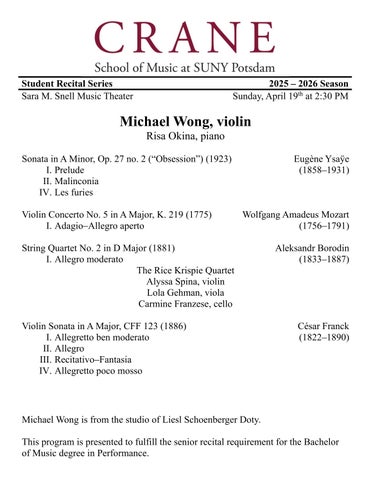
Student Recital Series 2025 – 2026 Season
Sara M. Snell Music Theater Sunday,April 19th at 2:30 PM
Michael Wong, violin
Risa Okina, piano
Sonata in AMinor, Op. 27 no. 2 (“Obsession”) (1923)
Eugène Ysaÿe
I. Prelude (1858–1931)
II. Malinconia
IV. Les furies
Violin Concerto No. 5 inAMajor, K. 219 (1775) WolfgangAmadeus Mozart
I. Adagio–Allegro aperto (1756–1791)
String Quartet No. 2 in D Major (1881)
Aleksandr Borodin
I. Allegro moderato (1833–1887)
The Rice Krispie Quartet
Alyssa Spina, violin
Lola Gehman, viola
Carmine Franzese, cello
Violin Sonata inAMajor, CFF 123 (1886)
César Franck
I. Allegretto ben moderato (1822–1890)
II. Allegro
III. Recitativo–Fantasia
IV. Allegretto poco mosso
Michael Wong is from the studio of Liesl Schoenberger Doty.
This program is presented to fulfill the senior recital requirement for the Bachelor of Music degree in Performance.
PROGRAM NOTES
Sonata inAMinor, Op. 27 no. 2 (“Obsession”) (1923)
Eugène Ysaÿe
As one of the most well-known violinists of the 19th and 20th centuries, Eugène Ysaÿe intrigued music-goers with his unabashedly unique performances. In one such case, the violinist Joseph Joachim remarked, “I [have] never heard the violin played like that before” following Ysaÿe’s performance of Ludwig van Beethoven’s Violin Concerto. This is aptly one of the best ways to describe his playing: a distinctive adaptation to physical limits and musical trends, creating an incredibly intricate musical style Ysaÿe had below-average physical faculties for virtuosic playing, yet he still performed at an exceptional caliber. Evidence of these idiosyncrasies exists in his music, which includes precise left-hand fingerings alongside custom-made engravings. Ysaÿe’s popularization also came about during a similarly transformative time in violin playing. Niccolo Paganini helped drive a pivot in violin playing in the 1800’s towards virtuosity and technicality, and Ysaÿe contributed to this as the first to use a broad vibrato as an exponent of the FrancoBelgian school of violin playing.
Ysaÿe’s second Sonata in A Minor from his set of Six Sonatas for solo violin, Op. 27 embodies his unique violinistic playing. From hyper-specific fingerings and engravings to equivalently difficult passagework across the piece’s varied movements, his Sonata captures the feelings of a violinist pushing their limits. Ysaÿe dedicates this piece to his friend Jacques Thibaud, but it is more so dedicated to the music of Johann Sebastian Bach: themes from the “Preludio” of his Partita No. 3 in E Major for solo violin are quoted in the “Prélude,” and the Dies irae theme recurs often in the sonata.
Violin Concerto No. 5 inAMajor, K. 219 (1775) WolfgangAmadeus Mozart
The relationship between WolfgangAmadeus Mozart and the violin is complex As a performing violinist, he was greatly admired, receiving plaudits at the age of seven for his playing. However, he gradually became tired of public violin performance, writing after his return to Salzburg from Paris in 1779 that “I will no longer be a fiddler,” and he subsequently pivoted toward private performance. Mozart’s compositions for the violin follow this trend: his five violin concertos were all composed by 1775, and his following works prominently featuring violin were mostly sonatas These violin works, however, have become staples of the violin repertory and are regarded as foundational works in Western classical music.
His fifth and final Violin Concerto is the pinnacle of his soloistic works for the instrument.As the last violin concerto of four he composed in 1775, his compositional style had fully matured, featuring abrupt tempo, mood, and texture changes. This concerto is often called the “Turkish,” referencing a representative theme in the third movement. Like many contemporary accompanied works, performers were expected to improvise cadenzas; of these, Joachim’s cadenza is the most well-known, bringing an intricately intense and Romantic conclusion to the work.
String Quartet No. 2 in D Major (1881)
Aleksandr Borodin
Aleksandr Borodin is part of a small crop of musicians, alongside peers such as Emil Votoček and Sir Edward Elgar, who enjoyed major non-musical careers. As a chemist, Borodin worked at the St. Petersburg Medical-Surgical Academy and was the first to perform aldol condensation. It is, however, his musical achievements for which he is most remembered today. Much of Borodin’s life was captured by his dedication to the sciences, so he composed few works and even fewer of major repute. Despite this, his oeuvre is widely acclaimed, including an instrumental output of three symphonies, thetone poem In the Steppes of Central Asia, the unfinished opera Prince Igor, and several chamber music and piano works. Stylistically, he captures a uniquely Romantic and nationalist character, making Borodin a major representative of Russian music.
His String Quartet No. 2 in D Major embodies this character. Of composers in “The Mighty Five” – a group of prominent 19th-century Russian composers including Mily Balakirev, César Cui, Modest Mussorgsky, and Nikolai Rimsky-Korsakov – Borodin was considered “the most gifted and spontaneous melodistof the group” according to Bumpass and Kauffmann.The quartet’s first movement reflects this with lyrical melodies that he weaves into counterpoint. Borodin quickly composed this work in the summer of 1881 and dedicated it to his wife Ekaterina; however, it was not published until 1888, a year after his death. The biographers S.A. Dyanin and E.M. Braudo claim this quartet to be an anniversary gift, making the first movement a symbol for their falling in love in the summer of 1861 in Heidelberg, but this claim is unverified. Regardless, this string quartet evinces a singing and joyous quality that enthralls listeners and performers alike.
Violin Sonata inAMajor, CFF 123 (1886)
The oeuvre of César Franck reflects the multiple pressures on his artistic career. His father was very controlling, even to withdraw Franck from studying composition the Paris Conservatory, and the commercial demands of his wife and son redirected his creative energies to musical forms Franck could not brilliantly render. Therefore, despite his early musical promise, his middle period is dominated by poorly known organ and church music, and it is only in his final decade that Franck created his lasting works such as his Piano Quintet and Symphony in D minor. These works set the stage for the resurrection of Franck’s earlier music: revivals and advocates of his music spurred an unusual posthumous fame enduring for decades after his death.
Franck’s Violin Sonata is another one of these works. Many of these late-period compositions use the cyclic principle – the reuse of motives across movements – and the work displays this: the second, third, and fourth movements draw upon preceding ideas in variation. It is this device that Franck’s pupil Vincent d’Indy described as a cathédrale sonore, a connection linking the music to the Holy Trinity. The sonata is dedicated to Eugène Ysaÿe, who received it as a gift the day of his wedding and performed it during the celebration and throughout his career.
Program notes by Michael Wong
César Franck
PERFORMER NOTES
In the next hour, you will hear a broad range of music spanning nearly 150 years. The works on this recital display two commonthreads:the versatilityofthe Romantic ideal and theuseof music to reflect and comment on life.
Romanticism concerns itselfwith nature, fate, thesublime, and the poweroftheunknown, among many obsessions. Writer E.T.A. Hoffmann argued that music is “the most romantic of all the arts… for its sole subject is the infinite,” and Romantic composers embraced this usually with chromaticisms, references to the folk, and heightened dramatic affect. This idiom became widespread, appearing alongside large ensembles and building upon the public concert tradition, and its ideas continue to endure today. Each of the works on this recital connects to this style. Aleksandr Borodin’s second Quartet and César Franck’s Violin Sonata are rooted in the Romantic vocabulary. Eugène Ysaÿe’s second Sonata for solo violin references the Baroque but is ultimately born from this mold, and Joachim’s cadenza to Wolfgang Amadeus Mozart’s fifth Violin Concerto juxtaposes this style with the Classical tradition.
Music is a pervasive part of our lives, and the works of these musicians reflect its personal impact on their varied careers and lives. Eugène Ysaÿe surpassed the limitations of his physical form in his music, Wolfgang Amadeus Mozart continued to perform and work up until his early death (ending with his Requiem),Aleksandr Borodin composed to much acclaim alongside his job as a chemist, and César Franck persistently sought his musical apotheosis Each of these stories showcases the music’s perseverance as an enduring part of their lives. It is important to recall the roles of the humanities: to unravel the human condition and to advise us on our limited time in life; music is one of the core ways that we reflect and share, and we ought to not stop.
I have had the pleasure of learning to be a musician and a professional at the Crane School of Music for the past four years, and I am grateful for the opportunities I have had. From performing with the Orchestra of Northern New York and attending the Juilliard Starling-Delay Symposium to conducting archival research nationwide and traveling to San Francisco to present a studentled project with collaborators, these experiences shaped my growth. As I enter my next stage in life, I want to recognize the many people who have influenced me. I want to thank Dr. Timothy Yip and Prof. Liesl Schoenberger Doty for their mentorship of my violin playing for the last four years: my playing has significantly grown since my first performance in August of 2022, and I look forward to continue learning as a performer. I also want to recognize my friends at Crane: thanks for making every moment worth living, and I cannot wait to hear what you are up to in the years ahead.
Thank you for joining me in the culmination of my performance studies at Crane. To learn more about what’s next, check out my website at michaelwongmusic.com and my social media at @michaelwongmusic.
- Michael Wong
Visit michaelwongmusic.com/60minsrc to view the bibliography for the program notes and performer notes.