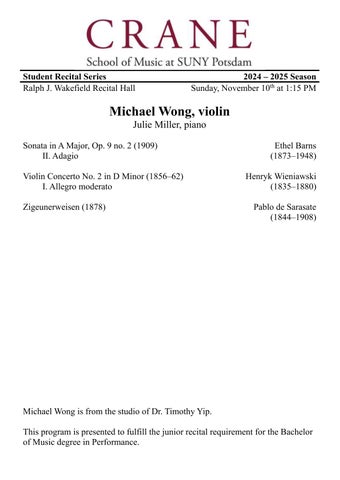
Student Recital Series
2024 – 2025 Season
Ralph J. Wakefield Recital Hall Sunday, November 10th at 1:15 PM
Michael Wong, violin
Julie Miller, piano
Sonata inAMajor, Op. 9 no. 2 (1909)
II.Adagio
Violin Concerto No. 2 in D Minor (1856–62)
I.Allegro moderato
Ethel Barns (1873–1948)
Henryk Wieniawski (1835–1880)
Zigeunerweisen (1878) Pablo de Sarasate (1844–1908)
Michael Wong is from the studio of Dr. Timothy Yip.
This program is presented to fulfill the junior recital requirement for the Bachelor of Music degree in Performance.
PROGRAM NOTES
Sonata inAMajor, Op. 9 no. 2 (1909)
Ethel Barns
Ethel Barns (1873–1948) was an English violinist, pianist, and composer. A skilled instrumentalist, she studied with Prosper Sainton and Émile Sauret at the Royal Academy of Music,receiving accooladesforperformanceof herPolonaiseforviolinandpiano. Sheenjoyed numerous performing opportunities throughout her career, including performing as soloist in the Promenade Concerts with her Concertstück and running the successful Barns-Phillips concert series with her husband. Despite her respected career as a multi-instrumentalist, she has been almost forgotten by history, and of the over 120 works attributed to her, only 86 still survive today.
Her Sonata in A Major, Op. 9 no. 2 (1909) is among her extant works and the two remaining sonatas, and it displays the violinistic passion and charm characteristic of her works. Its second movement, the Adagio, flows a beautiful melody and its gradual evolutions from its minor key beginnings to a leaping middle passage and back to its roots in the minor mode. Beneath all of this, Barns creates a soft but lively piano line supporting the violin’s journey.
Violin Concerto No. 2 in D Minor (1856–62) Henryk Wieniawski
Born into a family of musicians, early teachers recognized Henryk Wieniawski’s exceptional skill at the violin. He began study at the Paris Conservatory at the age of eight, earning first prize in violin and the support of Henri Vieuxtemps His following thirty-year career would largely consist of work as an itinerant violinist, forming a period of constant touring and performing that would end with his premature death. Some of the works from his formative years include his first Polonaise and his Violin Concerto No. 1 in F# Minor.
In 1860, his colleagueAnton Rubinstein asked Wieniawski to join him in Russia to improve the country’s musical life, and he agreed to go. Wieniawski’s time in St. Petersburg from 1860 to 1872 wasoneofthemostproductive periodsofhis life,leading to thecompositionofhisEtudes and of his Violin Concerto No. 2 in D Minor, regarded as one of his most celebrated works for violin and as a staple within the violin repertory.
Wieniawski’s second Concerto for Violin begins with a long orchestral opening that introduces the musical themes of the piece. The violin enters in after 67 measures, reiterating this theme before developing and transforming them into a variety of lyrical and energetic passages. Mirroring the introduction of the work, the orchestra concludes the work and, in the tradition of many Romantic period violin concertos, proceeds directly into the second movement Romance, popular itself as a stand-alone work. This concerto is dedicated to Pablo de Sarasate, another contemporary violin virtuoso with whom Wieniawski engaged.
His life reflected the intensity and passion shown in his virtuosic second Concerto Wieniawski suffered from frequent alcoholism and gambling that exacerbated a serious heart condition he had. On November 18, 1878, he was hit by an asthma attack that forced him to leave the stage. Joseph Joachim, another esteemed violinist who had been in the audience, went on stage a few minutes after, announcing that “although I cannot play my friend’s wonderful concerto, I shall
play Bach’s Chaconne.” Wieniawski would succumb to his medical conditions, expiring on March 31, 1880. Few violinists since Wieniawski have displayed the fusion of both highly technical and virtuosic playing with his emotionally moving tone, and his second Concerto captures this duality
Zigeunerweisen (1878)
Pablo de Sarasate
Thecorollaries between PablodeSarasateand HenrykWieniawski areunmistakable:both were performers in the mid to late-19th century, began their career as child prodigies, won first prize in violin during their study at the Paris Conservatory, and took the instrument to its limits. Following Sarasate’s study at the Conservatory, he began a similar touring career, traveling throughout Europe and the Americas and performing. He was particularly acclaimed for his precision and effortlesslysmooth tone:Ysaÿe noted that “it is hewho taughtus to playexactly,” andCarlFleschattemptedtounravelhowheproduceda“continuallymild,passionless,smooth, eely tone.” His performances were well-received in his four decades of performing, and his conquering of Germany’s tough musical scene in the 1870s is seen retrospectively as one of his pinnacle musical achievements.
In his compositions, he borrowed heavily from the Spanish musical tradition, deploying the power of the violin’s position as one of the most highly expressive and soaring instruments into a style rooted in the guitar and mandolin. His eight dances are strong representatives of his interpretation of this style, and he even served as an authority for other composers on the Spanish style.Although he associated himself closer with the French style after his study at the Conservatory, he advised his friends and colleagues on composing in this style, most notably for Camille Saint-Saëns’s Violin Concerto no. 3 in B Minor and Édouard Lalo’s Symphonie espagnole. Through this, he has served as an effective exponent of Spanish violin music.
Zigeunerweisen, also known as “Gypsy Airs,” departs from Sarasate’s dances by focusing on the folk music of Hungary. This is most apparent in the third thematic section where he exactly emulates Szentirmay’s “Csak egy szép lány van a világon” (There is but a single fair lass in the world), which Sarasate believed was a “popular melody” played by Romanis in Hungary. The violin traverses through three more of these themes, each exploring a different tune he heard fromgypsybands while visitingBudapestin 1877 andtakingtheviolinto evergreater technical and expressive extremes. Sarasate’s dances and Zigeunerweisen continue to be popular works within the violin repertory and happen to be among the first ever to be recorded: there are nine recordings from 1904 of him performing, including one of this work, where he can be heard speaking with his pianist.
Program notes by Michael Wong
BIBLIOGRAPHY
Englesberg, Barbara J. “The Life and Works of Ethel Barns: British Violinist-Composer (1873-1948).” Ph.D. thesis, Boston University, 1987. https://open.bu.edu/handle/2144/8791.
Fuller, Sophie. “Barns, Ethel.” In Grove Music Online.Accessed September 27, 2024. https://www.oxfordmusiconline.com/grovemusic/display/10.1093/gmo/9781561592630.001.0001/omo9781561592630-e-0000045629.
Jost, Peter. “Filched Melodies – Sarasate’s ‘Zigeunerweisen’(GypsyAirs) under Suspicion of Plagiarism.” G. Henle Verlag (blog).Accessed October 28, 2024. https://blog.henle.de/en/2013/08/19/filched-melodies%E2%80%93-sarasate%E2%80%99s-%E2%80%98zigeunerweisen%E2%80%99-gypsy-aires-undersuspicion-of-plagiarism/.
“RoyalAcademy of Music.” The Musical Times and Singing Class Circular 33, no. 598 (1892): 729–30. https://www.jstor.org/stable/3361410.
Sárosi, Bálint. “Everyday Hungarian Music in Pest-Buda around 1870.” Studia Musicologica Academiae Scientiarum Hungaricae 40, no. 4 (1999): 325–52. https://doi.org/10.2307/902502.
Schwarz, Boris. Great Masters of the Violin. New York: Simon and Schuster, 1983.
Schwarz, Boris and Robin Stowell. “Sarasate (y Navascuéz), Pablo (Martín Melitón) De.” In Grove Music Online.Accessed September 27, 2024. https://www.oxfordmusiconline.com/grovemusic/display/ 10.1093/gmo/9781561592630.001.0001/omo-9781561592630-e-0000024582.
Schwarz, Boris and Zofia Chechlińska. “Wieniawski Family.” In Grove Music Online.Accessed September 27, 2024. https://www.oxfordmusiconline.com/grovemusic/display/10.1093/gmo/9781561592630.001.0001 /omo-9781561592630-e-0000030284.
Woolley, Grange. “Pablo de Sarasate: His Historical Significance.” Music & Letters 36, no. 3 (1955): 237–52. https://www.jstor.org/stable/730971.