In everyday life, the evolution of design and artifacts is driven by dynamic interactions. Modern products are not merely utilitarian tools; rather, they are conceived and engineered as mediators that facilitate specific behaviors through human interaction. Over time, these artifacts are exposed to new environments, prompting them to expand and adapt in ways that mirror the adaptive qualities of living organisms. Common examples include surveillance cameras, computer mice, and experimental designs in footwear, which illustrate how everyday objects have evolved from basic tools into complex entities that serve as integral parts of their surrounding environments.
The paper discussed herein emphasizes that interaction-based evolution is not merely a practical design strategy, but a conceptual framework that redefines the relationship between humans, objects, and their environments. The proposal of a "hybrid creature" serves as a metaphor for this transformative process, suggesting that the substitution or reconfiguration of actions rather than a strict adherence to traditional, tool-centric design can lead to novel forms of expression. In this view, modern artifacts become more than static instruments; they evolve into entities that mediate and enhance our everyday experiences. By considering artifacts as components of an extended, evolving system, designers are encouraged to move beyond conventional forms and explore innovative solutions that reflect the complex interplay between technology and human behavior.
This evolutionary process is rooted in the idea that artifacts continuously transform through interaction-based development. The conventional notion that products are designed solely with functionality in mind is being challenged by a perspective that views them as dynamic components of a larger environmental context. Rather than being inspired only by human or biological forms, these objects evolve in an expansive manner, resembling organic growth and mutation. This shift in perspective is further enhanced by advanced visualization techniques, such as those provided by artificial intelligence, which allow designers to simulate and refine these transformative ideas. By harnessing AI, the abstract principles of adaptation and interaction can be rendered into tangible designs that improve both functionality and visual communication.
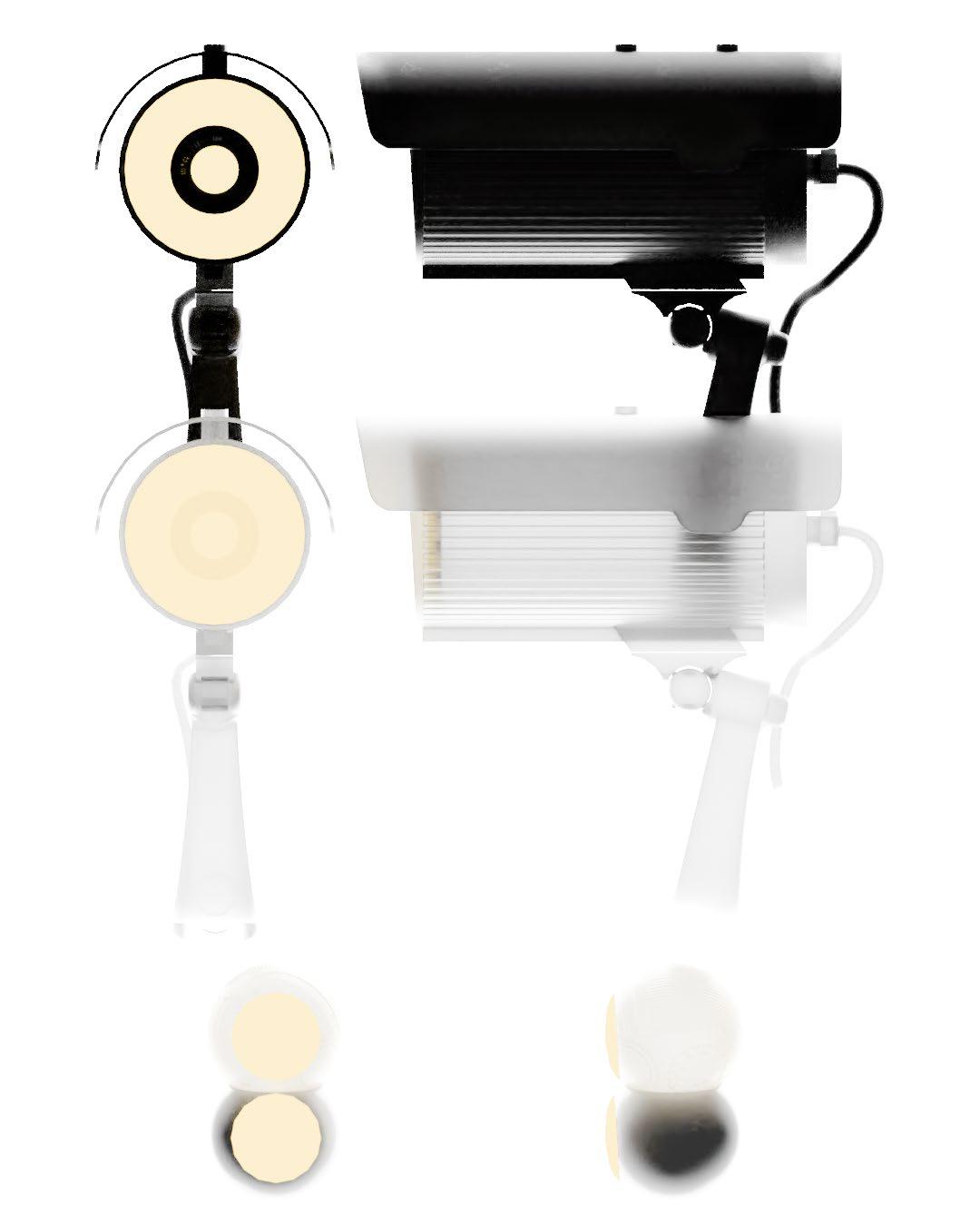
Surveillance Camera
(Digital Rendering of the Surveillance Cameras and eyes, Community 3D Model, 2025 Michael Joongmin Park)
Visual Perception and Hybrid Creature
Surveillance cameras can be understood as a modern form of Ǝinvisible eyesƐthat are seamlessly woven into everyday society. Operating in a manner akin to the human eye, they not only mirror its functional capabilities but also share certain existential qualities, which invites us to view them as hybrid creatures. Our visual perception does not simply register that an object is present when we look at it; rather, it is grounded in a pre-established framework of visual interaction. For example, when two people meet each otherƋs gaze, the experience is less about the realization that one person is looking at the other and more about the mutual interaction that unfolds between them. In this context, the act of seeing transcends mere visual stimulationƆ it becomes an interaction-oriented recognition of the ƎobjectƐor the other party. In a similar vein, even though a surveillance camera may continuously monitor its environment, if there is no cognitive entityƆ comparable to the human brainƆ to process and interpret its data, the camera remains nothing more than a passive Ǝeye.ƐThus, despite its potential to serve as an extension of a human sensory organ, without an accompanying mechanism for information processing, the surveillance camera is rendered functionally ineffective, akin to blindness.
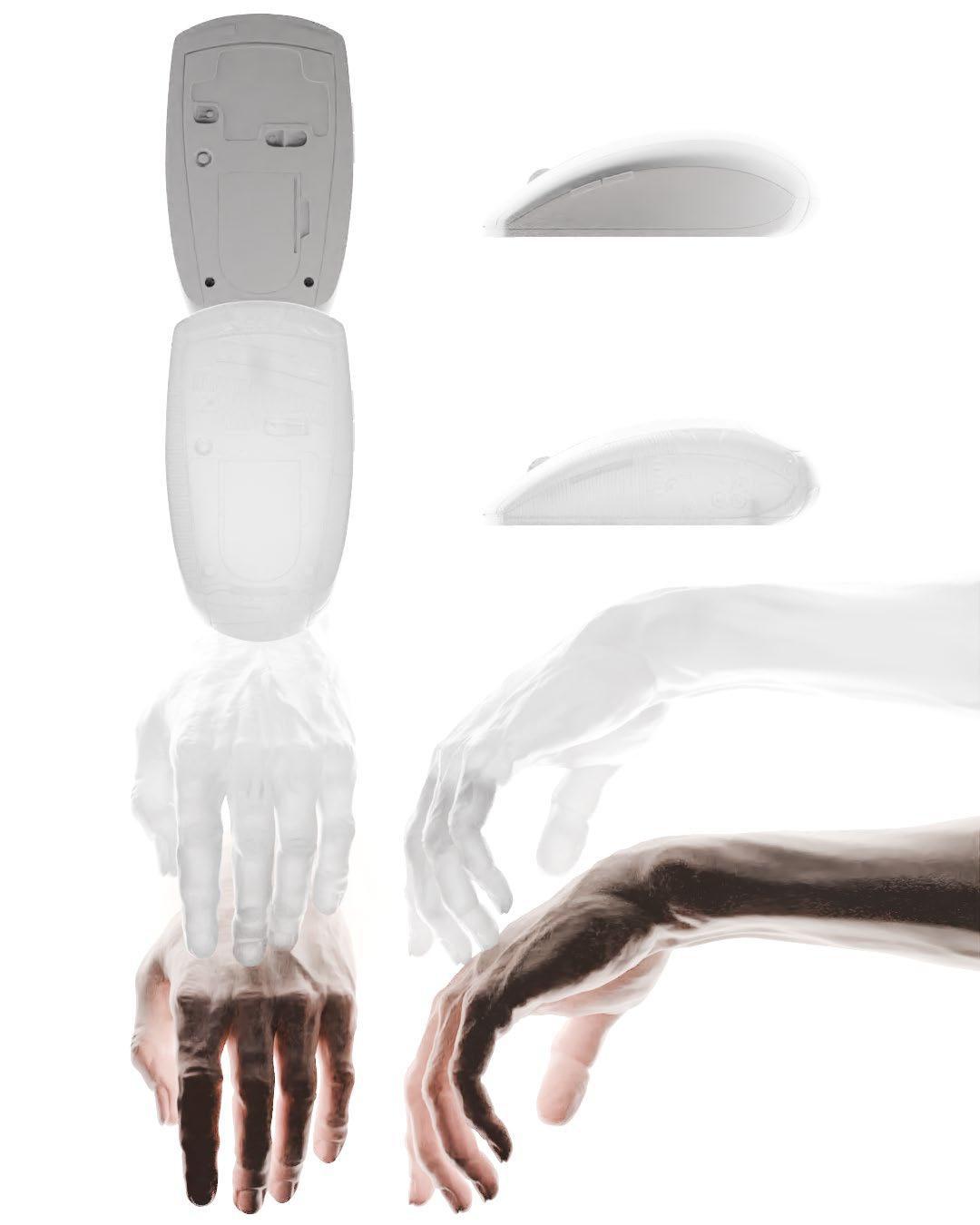
The Mouse
(Digital Rendering of the mouses and hands, Community 3D Model, 2025 Michael Joongmin Park)
Interaction Medium and Hybrid Creature
When we interact with computers, the mouse acts as a mediator that translates our physical actions into the virtual world of code. It not only responds to our hand movements but also performs the role of our hand within the computer environment, making it a hybrid creature
In three-dimensional space, human actions manifest in diverse ways, and while various devices serve as mediators to input these actions into information processing systems for efficient communication and interaction, one design stands out Optimized for efficiency, hand movement, and overall usability, this design is conceived as an extension of the bodyƆ particularly tailored to facilitate the most effective mode of workƆ and thus represents the contemporary standard
It is optimized for navigating within a flattened, two-dimensional space. Although the interaction occurs on a plane, it embodies modern interaction principles tailored to these constraints, establishing an organic connection between humans and computers. In this role, it acts as an intermediaryƆ allowing humans to integrate with the objectƆ and essentially forms a new kind of bodily structure.
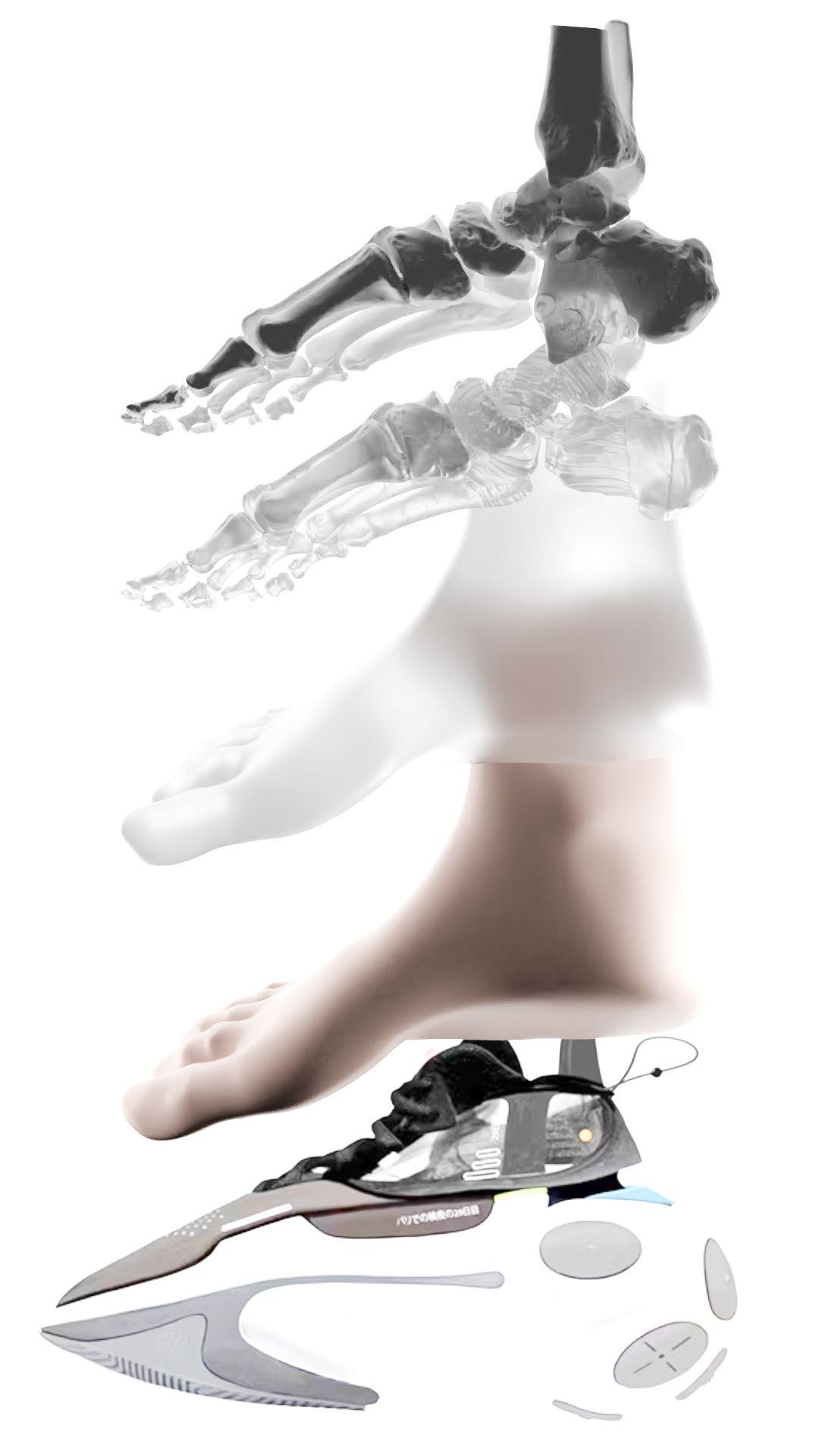
(Digital Rendering of the Safa Sahin shoes and Skeletons and foots, Community 3D Model, 2025 Michael Joongmin Park)
Hybrid Creature as Extended Body
Safa Sahin is a non-traditional footwear designer who can be regarded as the initiator of deconstructivism in shoe designƆ a precursor who challenges the conventional, industrially standardized, efficiency-driven norms In stark contrast to the everyday, seamlessly integrated design advocated by Naoto Fukasawa and the super normal theory, SahinƋs approach embraces a disruptive aesthetic, characterized by the shattering of conventional streamlined and curvilinear forms His work heralds a reconfiguration of footwearƋs organic structure
This method not only signals an engineering breakthrough in footwear design but also derives from an approach based on the anatomical structure of the human foot. It expands the definition of a shoe beyond merely protecting the foot from the harshness of the street, transforming it into an extended part of the body. In doing so, SahinƋs perspective has inspired countless designers by fundamentally reordering the publicƋs perception of shoes. This reordering naturally gave rise to the new conceptualization of footwear as an Ǝextension of the body.Ɛ
Consequently, many modern footwear brands have responded by shifting away from traditional linear designs toward entirely curvilinear forms New production lines have emerged that embrace these innovative shapes, and this evolution has found a natural ally in 3D printing technology Such technology has facilitated a transition from the mass production of standardized items to small-batch production of diverse products In essence, the semantic expansion of footwearƆ viewing it as a part of the body akin to clothingƆ has opened a new direction in contemporary fashion
Footwear ƅ Safa Sahin
(Generative design via Dall-e 3, prompts, 2025 Michael Joongmin Park)
Morphological Transformation
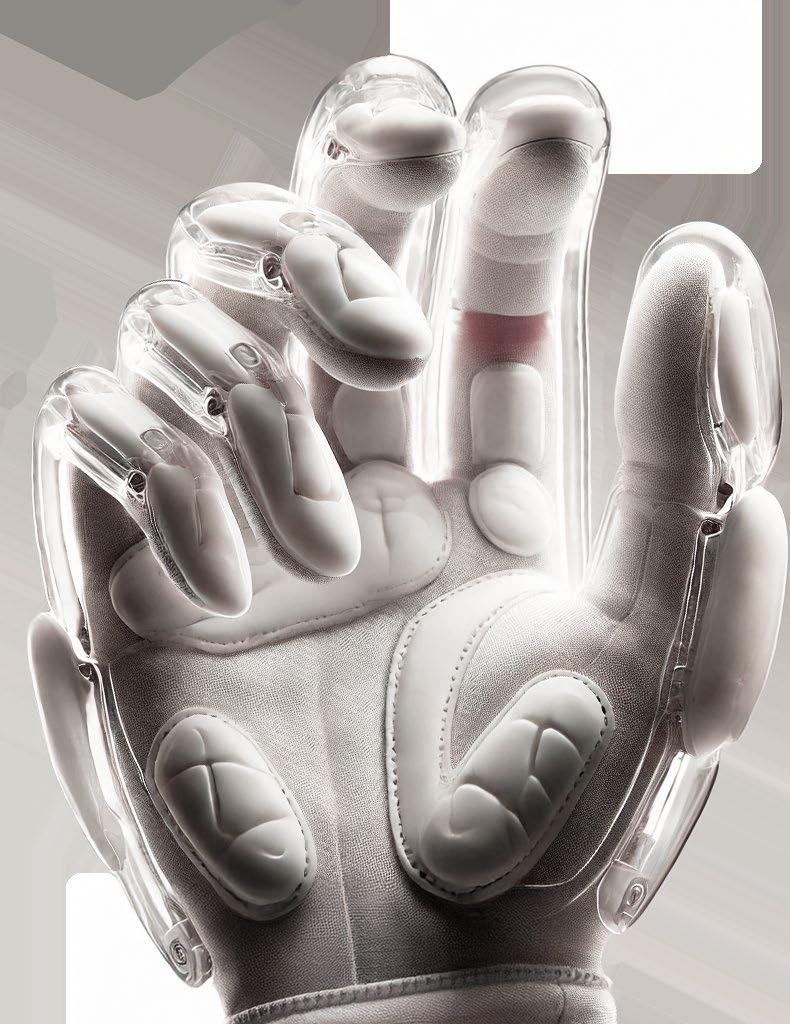
In order to develop a mutation that more conceptually aligns with a Ǝhybrid creature,Ɛ it is necessary to focus on the interaction between humans and objectsƆ a focus that was identified in the ƎMouse part.Ɛ This notion is premised on the idea that such a mutation can be fundamentally realized through the morphological deconstruction and substitution of the mouse, which itself functions as the mediator in our interactions with computers By employing a prompt to reconfigure this concept, it became apparent that crafting such a prompt demands a level of detail and sophistication beyond a mere, one-dimensional representation of forms Rather, a more concrete, refined, and meticulous description is required This approach not only maximizes the visual attractiveness in visual communication but also deconstructs the inherent morphological limitations of the mouse In doing so, it facilitates a transformation in object interaction via an artifactƆ specifically, a glove that resembles a human body part
Prompt Generating sequence (step by step):
Intention
>Mouse that merged with the hands
Visual Communication (Alternative) >refined visualization through prompt ƎGloveƐand ƎPadded sectionsƐ
The concept of the Mouse and merging was not performed through the vague prompt: ƎMouse that merging with the handƐ
Dall-e 3
Prompt:
ƎA detailed close-up of a translucent glove with large white padded sections on the fingers The glove is crafted from a futuristic, semi-transparent material, allowing a faint view of the hand beneath The white pads are thick, cushioned, and designed for extra protection The design is sleek and modern, with a high-tech aesthetic The background is minimalistic with soft lighting to emphasize the glove's unique textures and contours Ɛ
Reflection
In the process of generative image visualization utilizing GAI, a noticeable decline in accuracy occurs when attempting to render abstract objects using only simplified prompts. This reduction in accuracy can be attributed to the inherent vagueness of abstract concepts and the limitations present in the training data. Simplified prompts often compel the model to rely on general patterns learned from diverse but unannotated data, resulting in outputs that may not capture the nuanced details of the intended concept.
In contrast, prompts that are meticulously crafted to encapsulate the intrinsic features of a product enable a clearer and more effective visual concretization of ideas By providing a precise blueprint that mirrors the essential characteristics of the subject, the model is guided towards producing images that align more closely with the original concept This approach essentially narrows the solution space and enhances the model’s ability to reproduce detailed visual elements, thus improving overall accuracy in the output
According to the Super Normal theory, design seamlessly integrates with everyday objects, making them appear natural rather than obtrusive. The visualization process should be context-driven, ensuring that the design resonates with the familiarity and subtlety that characterize super normal objects (Fukasawa & Morrison, [2017])
Furthermore, starting from the raw, primitive forms present in deep learning training images and subsequently applying various mutation generation strategies has proven to significantly boost visualization efficiency. Mutation generation, which involves iteratively refining initial outputs to explore variations, resembles an evolutionary process that leads to optimized visual representations. Comparative experiments involving various GAI tools such as copilot, ChatGPT’s image generation functionality, and Adobe Firefly highlight that DALL-E 3, in particular, excels in object-specific visualization. Unlike stylebased generation, which prioritizes artistic expression, DALL-E 3 focuses on rendering concrete, recognizable objects, making it particularly adept at tasks involving design reinterpretation and re-generation.
In summary, the evidence indicates a clear correlation between the specificity of a prompt and the accuracy of the resulting visual output in GAI-driven image generation. While simplified prompts may result in generalized and less accurate depictions, detailed prompts that incorporate the product’s essential features lead to more precise and effective visualizations. Moreover, leveraging the foundational forms from training data and applying mutation techniques further refines the output, enhancing both accuracy and efficiency Although DALL-E 3 has demonstrated superior performance in object-specific tasks, it is important to recognize that each GAI tool has its own unique strengths depending on the application, and the metrics for “accuracy” and “efficiency” must be carefully defined within the context of the intended use
Fukasawa, N., & Morrison, J. (2009). Super Normal: Sensations of the Ordinary. Gestalten.
Campbell, G. (2022). Safa Sahin: Footwear Vanguard Interview. Highsnobiety. Retrieved from https://www.highsnobiety.com/p/safa-sahin-footwear-vanguardinterview/
OpenAI. (2023). DALL-E 3 [Generative image model]. Retrieved from https://openai.com/dall-e-3