Handbook
Working Together to Protect Traditional Lands While Creating Long-Term Economic Opportunity
VERSION 1.0
Protecting Traditional Lands. Creating Lasting Opportunities. ALWAYS IN A GOOD WAY.
Version 1.0 · First Edition · July 2026
Published by the Birch Carbon Program and MichaelBirch.ca © 2026 The Birch Carbon Program. All rights reserved.
About This Handbook
This handbook serves as the definitive reference document for the Birch Carbon Program. It has been prepared for Chiefs and Councils, Economic Development Corporations, Lands Departments, Elders, Knowledge Keepers, community members, strategic partners, and investors. The main chapters describe the program as a whole, while the appendices are designed to be updated over time as the program grows.
Important Notice
This handbook is provided for general information purposes only. It does not constitute legal, financial, investment, or tax advice, and it does not create any binding commitment between the Birch Carbon Program and any reader. Carbon markets, government programs, and international standards evolve over time, and current requirements should always be confirmed with the responsible organizations. Preliminary estimates are planning tools only — they are not guarantees of project eligibility, carbon credit volumes, or future revenue. Every Nation is encouraged to obtain independent legal, financial, and technical advice before entering into any agreement. Nothing proceeds without community approval.
Version History
1.0 July 2026 First edition — full handbook with all twenty chapters and appendices.
www.birchcarbonprogram.com
Welcome
Protecting Traditional Lands. Creating Lasting Opportunities.
The Birch Carbon Program is an Indigenous-led initiative that helps First Nations identify, protect, and responsibly develop the environmental value of their Traditional Territories. By combining Indigenous stewardship with internationally recognized environmental standards, the program creates long-term economic opportunities while preserving lands for future generations.
Working alongside experienced environmental professionals, industry leaders, and Indigenous communities, the Birch Carbon Program supports the development of carbon and natural capital projects that respect community ownership, self-determination, and traditional knowledge.
Every project is tailored to the goals of each participating Nation. There are no upfront costs, communities remain in control throughout the process, and the focus is always on protecting the land while creating sustainable benefits for future generations.
This handbook provides a clear overview of the Birch Carbon Program, explains how the process works, answers common questions, and serves as a resource for Chiefs, Councils, Economic Development Corporations, community members, and strategic partners.
Together, we can protect our forests, waters, wetlands, and traditional lands while creating meaningful opportunities that will benefit generations to come.
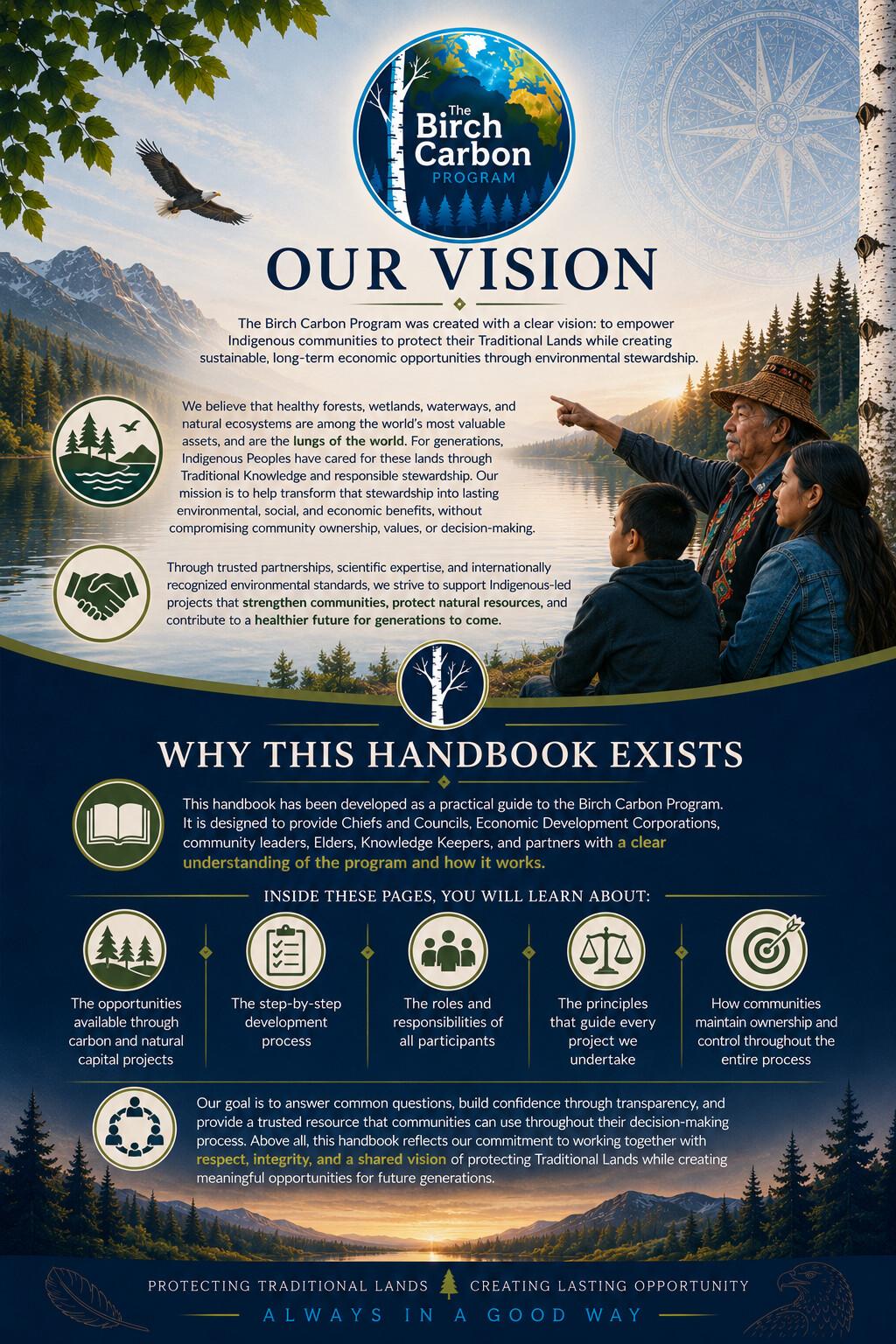
The Birch Carbon Program was created with a clear vision: to empower Indigenous communities to protect their Traditional Lands while creating sustainable, long-term economic opportunities through environmental stewardship.
We believe that healthy forests, wetlands, waterways, and natural ecosystems are among the world's most valuable assets, and are the lungs of the world. For generations, Indigenous Peoples have cared for these lands through Traditional Knowledge and responsible stewardship. Our mission is to help transform that stewardship into lasting environmental, social, and economic benefits, without compromising community ownership, values, or decision-making.
Through trusted partnerships, scientific expertise, and internationally recognized environmental standards, we strive to support Indigenous-led projects that strengthen communities, protect natural resources, and contribute to a healthier future for generations to come.
Why This Handbook Exists
This handbook has been developed as a practical guide to the Birch Carbon Program. It is designed to provide Chiefs and Councils, Economic Development Corporations, community leaders, Elders, Knowledge Keepers, and partners with a clear understanding of the program and how it works.
Inside these pages, you will learn about the opportunities available through carbon and natural capital projects, the step-by-step development process, the roles and responsibilities of all participants, and the principles that guide every project we undertake.
Our goal is to answer common questions, build confidence through transparency, and provide a trusted resource that communities can use throughout their decision-making process. Above all, this handbook reflects our commitment to working together with respect, integrity, and a shared vision of protecting Traditional Lands while creating meaningful opportunities for future generations.
KEY TAKEAWAY
There are no upfront costs, communities remain in control throughout the process, and the focus is always on protecting the land while creating sustainable benefits for future generations.
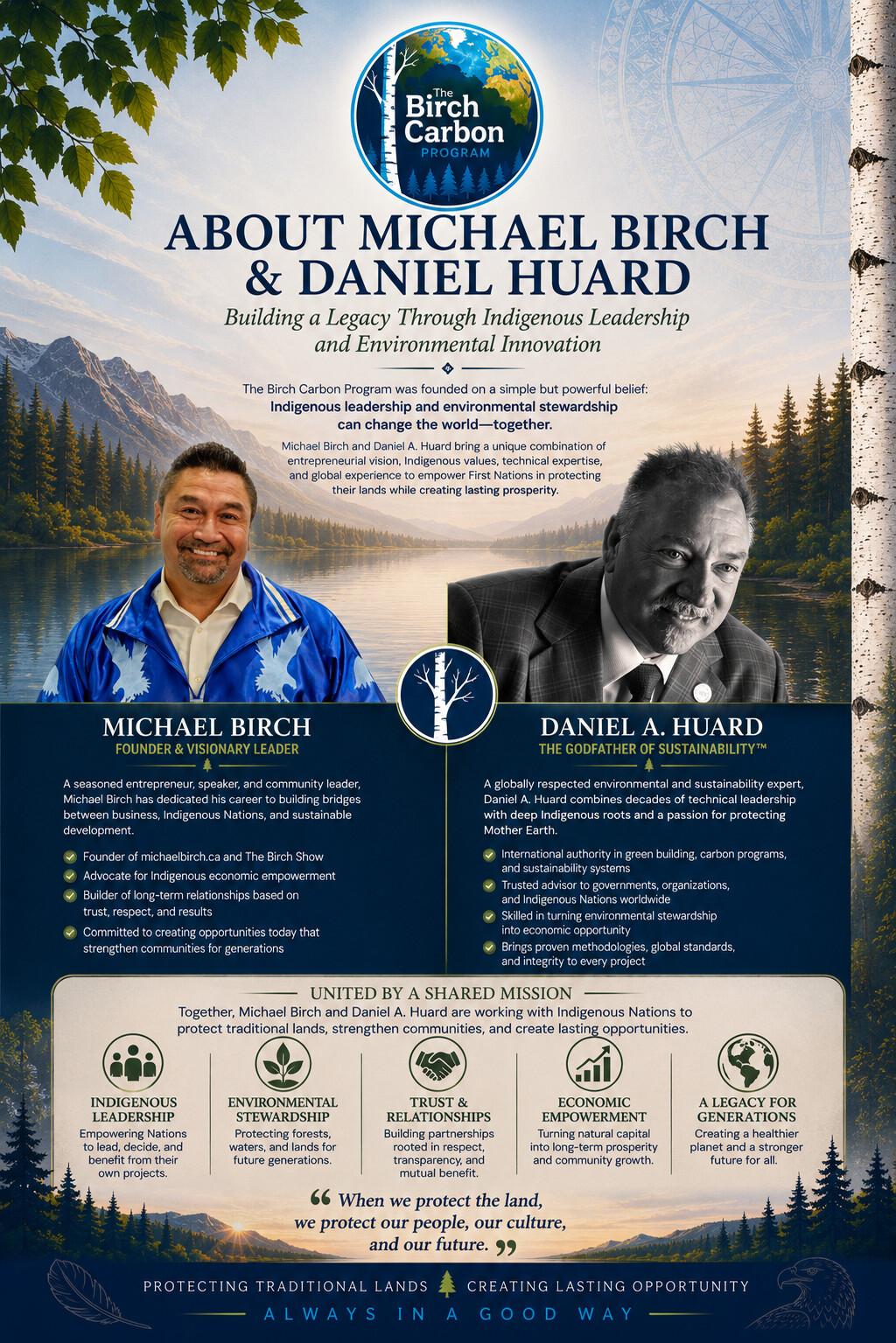
About Michael Birch & Daniel Huard
Building a Legacy Through Indigenous Leadership and Environmental Innovation
The Birch Carbon Program brings together two accomplished leaders whose combined expertise in Indigenous relations, sustainability, environmental innovation, and strategic leadership has created one of Canada's most ambitious Indigenous-led environmental initiatives.
Together, Michael Birch and Daniel Huard share a vision of empowering First Nations to protect their Traditional Territories while creating long-term, sustainable economic opportunities through responsible environmental stewardship. Their partnership combines decades of relationship building, technical excellence, and a shared commitment to Indigenous selfdetermination.
◆ Michael Birch
Founder & Chief Executive Officer
For more than four decades, Michael Birch has built trusted relationships with Indigenous leadership, business executives, governments, and organizations across Canada. Recognized as a strategic leader, communicator, and community builder, he has dedicated his career to creating opportunities that strengthen Indigenous communities while fostering meaningful partnerships built on trust and respect.
As the founder of the Birch Carbon Program and the national media platform The Birch Show, Michael has become a respected voice in Indigenous economic development, helping connect communities with innovative opportunities that create long-term prosperity while honouring Indigenous values and leadership.
Vision
Michael believes that the greatest opportunities for future generations already exist within the lands that Indigenous Peoples have protected for centuries. His vision is to ensure communities remain in control of their resources while unlocking sustainable environmental and economic value through Indigenous-led solutions.
◆ Daniel A. Huard, LEED Fellow
Co-Founder & Partner
Internationally recognized as "The Godfather of Sustainability," Daniel Huard is one of Canada's foremost authorities in sustainable design, green building, carbon markets, and environmental
innovation. With more than 35 years of experience, he has helped shape global sustainability standards while leading some of the world's most advanced environmental initiatives.
Canada's first Indigenous LEED Fellow, Daniel has contributed to internationally recognized sustainability programs, served as an IWBI Commissioner, presented at COP28, and led global teams responsible for developing billions of dollars in compliance carbon credits annually. His expertise ensures every Birch Carbon Program project is supported by world-class environmental science and internationally recognized standards.
Vision
Daniel's lifelong mission has been to develop practical, science-based solutions that protect natural ecosystems while creating lasting environmental, social, and economic value. Through the Birch Carbon Program, he is helping Indigenous communities transform stewardship into measurable, long-term opportunities for future generations.
◆ A Shared Vision
Together, Michael Birch and Daniel Huard have created a program that combines Indigenous leadership, trusted relationships, and internationally recognized sustainability expertise. Their partnership is built on a shared commitment to respect Indigenous rights, protect Traditional Lands, and help First Nations participate in the growing global environmental economy—while ensuring communities retain ownership, leadership, and control every step of the way.
Always in a Good Way.
Executive Leadership & Strategic Advisors
The Birch Carbon Program is supported by an accomplished team of Indigenous leaders, strategic advisors, community developers, and operational professionals who bring decades of experience in Indigenous governance, environmental stewardship, economic development, and community engagement.
Working alongside Founder Michael Birch and Co-Founder Daniel Huard, this team provides the leadership, expertise, and trusted relationships that help Indigenous communities explore, develop, and implement long-term environmental and natural capital opportunities. Together, they are committed to supporting Indigenous-led solutions that protect Traditional Territories while creating lasting benefits for future generations.
◆ Matthew Coon Come
Indigenous Leadership Advisor
Matthew Coon Come is one of Canada's most respected Indigenous leaders and an internationally recognized advocate for Indigenous rights, environmental stewardship, and selfdetermination. A former National Chief of the Assembly of First Nations and former Grand Chief of the Grand Council of the Crees (Eeyou Istchee), he has dedicated his career to
advancing Indigenous governance, protecting Treaty and Aboriginal rights, and promoting sustainable development for Indigenous Peoples across Canada and around the world.
His decades of leadership, diplomacy, and advocacy provide invaluable strategic guidance to the Birch Carbon Program and the First Nations it serves.
◆ Tom Jackson, CC
Partner & National Ambassador
Companion of the Order of Canada recipient Tom Jackson is one of Canada's most respected humanitarians, entertainers, and Indigenous advocates. For nearly four decades, he has inspired Canadians through his philanthropic leadership, helping raise more than $250 million for charitable organizations while championing Indigenous communities, reconciliation, and social responsibility.
As National Ambassador, Tom helps strengthen relationships with Indigenous communities and strategic partners while sharing the vision and purpose of the Birch Carbon Program throughout Canada.
◆ Christopher Henry
Director of Operations
Christopher Henry oversees the day-to-day operations of the Birch Carbon Program, ensuring projects, partnerships, and strategic initiatives are coordinated effectively and professionally. As the former Chief Executive Officer of the Indigenous Chamber of Commerce, he brings extensive experience in Indigenous business development, organizational leadership, and operational management.
His leadership helps ensure every participating community receives responsive support throughout each stage of the program.
◆ David Pratt
Community Developer – Saskatchewan
David Pratt is a respected Indigenous leader and citizen of Muscowpetung Saulteaux Nation in Treaty 4 Territory. As the former First Vice Chief of the Federation of Sovereign Indigenous Nations, representing 74 First Nations throughout Saskatchewan, David has dedicated his career to advancing Indigenous governance, economic development, and community prosperity.
His leadership and longstanding relationships continue to strengthen the Birch Carbon Program's partnerships throughout Saskatchewan and across the Prairies.
◆ Dr. Matt Vickers, CET, LL.D.
Community Developer – British Columbia
Dr. Matt Vickers brings more than four decades of experience in Indigenous economic development, business leadership, reconciliation, and strategic planning. Of Tsimshian, Heiltsuk, Haida, and English ancestry, he has worked extensively with Indigenous communities, governments, and private industry to build partnerships that create lasting value. His expertise supports the Birch Carbon Program's continued growth throughout British Columbia and Western Canada while helping communities identify and develop sustainable environmental opportunities.
◆ A Shared Commitment
Every member of the Birch Carbon Program leadership team shares a commitment to integrity, collaboration, and respect. Together, they work alongside Indigenous communities to build trusted relationships, provide world-class expertise, and support projects that protect Traditional Lands while creating sustainable opportunities for generations to come.
Together, we are building a future where Indigenous leadership, environmental stewardship, and economic prosperity go hand in hand.
3
The Birch Carbon Program
Protecting Traditional Lands. Creating Lasting Opportunities.
The Birch Carbon Program is an Indigenous-led environmental initiative that helps First Nations identify, develop, and benefit from the environmental value of their Traditional Territories. By combining Indigenous stewardship with internationally recognized carbon and natural capital standards, the program creates long-term economic opportunities while protecting the lands, waters, forests, and ecosystems that have sustained Indigenous communities for generations.
Every project is built on partnership, transparency, and respect. The Birch Carbon Program does not take ownership of community lands or decision-making. Instead, it provides the technical expertise, environmental professionals, and strategic support required to help communities participate in emerging environmental markets while maintaining full control over their lands and future.
Why It Exists
For thousands of years, Indigenous Peoples have cared for Canada's forests, wetlands, rivers, and natural landscapes. Today, these same lands play a critical role in addressing climate change, conserving biodiversity, and protecting natural ecosystems.
The Birch Carbon Program was created to ensure Indigenous communities have the opportunity to participate in this growing environmental economy while preserving their culture, traditions, and stewardship responsibilities. Our mission is to create sustainable, longterm economic opportunities that strengthen communities without compromising Indigenous ownership, rights, or values.
How It Works
The Birch Carbon Program follows a structured, community-first process designed to ensure transparency, accountability, and informed decision-making at every stage.
The process begins with an initial discussion and a preliminary environmental assessment to identify potential opportunities. If a community wishes to proceed, a Memorandum of Understanding is established before detailed environmental studies, professional audits, and project development begin.
Once a project meets internationally recognized standards, it is independently validated, verified, and registered, allowing eligible carbon credits or natural capital assets to be generated. Throughout the entire process, the participating Nation remains fully involved in every decision, with ongoing monitoring and stewardship supporting the long-term success of the project.
Who It Serves
The Birch Carbon Program is designed to serve Indigenous communities across Canada that wish to explore sustainable environmental and economic opportunities while maintaining ownership and control of their Traditional Territories.
We work collaboratively with:
First Nations
Chiefs and Councils
Economic Development Corporations
Indigenous Governments and Organizations
Community Members
Elders and Knowledge Keepers
Strategic Partners
Environmental Professionals
Responsible Investors
Every partnership is built on mutual respect, collaboration, and a shared commitment to protecting the land for future generations.
Our Core Principles
Everything we do is guided by a clear set of principles that place Indigenous leadership and environmental stewardship at the centre of every project.
Community Ownership The participating Nation retains ownership of its lands, project decisions, and long-term vision.
Respect for Indigenous Rights Every project honours Indigenous rights, Traditional Knowledge, cultural values, and community governance.
Transparency Communities receive clear information, open communication, and professional guidance throughout the entire process.
Environmental Integrity Projects are developed using internationally recognized standards and best practices to ensure lasting environmental benefits.
Partnership We believe successful projects are built through trust, collaboration, and long-term relationships—not transactions.
Sustainability Our focus is on creating meaningful opportunities that benefit today's communities while protecting the environment for future generations.
The Birch Carbon Program represents more than an environmental initiative—it is a commitment to supporting Indigenous leadership, protecting Traditional Lands, and building a sustainable future where communities can thrive economically while preserving the natural resources entrusted to their care.
Protecting Traditional Lands. Creating Lasting Opportunities.
KEY TAKEAWAY
The Birch Carbon Program does not take ownership of community lands or decisionmaking. It provides the technical expertise, environmental professionals, and strategic support required to help communities participate in emerging environmental markets while maintaining full control over their lands and future.
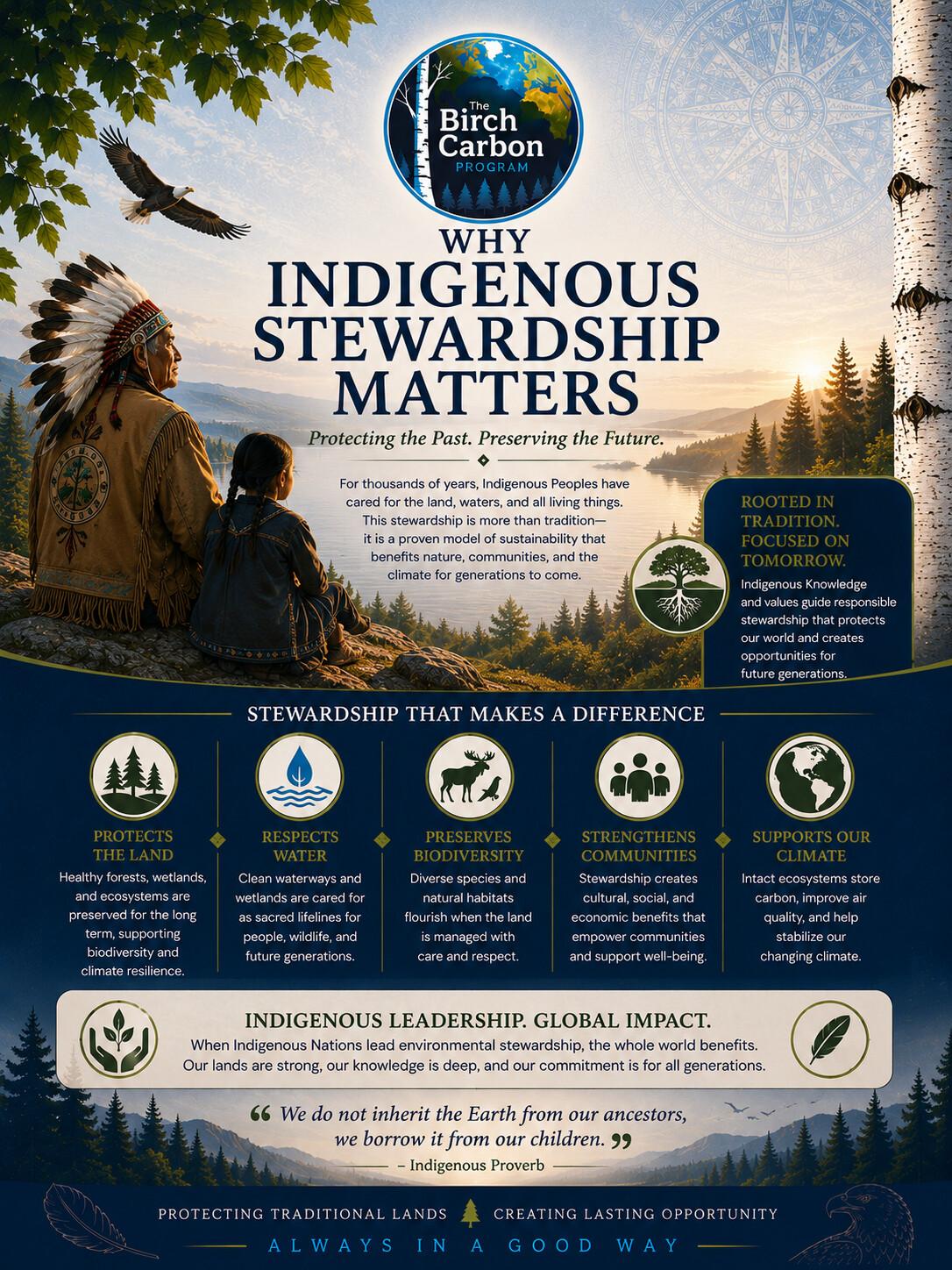
Why Indigenous Stewardship Matters
Protecting the Past. Preserving the Future.
For thousands of years, Indigenous Peoples have cared for the lands, forests, waters, and wildlife that sustain life across Canada. Through generations of observation, experience, and cultural teachings, Indigenous communities have developed a deep understanding of the natural world—an understanding rooted in respect, balance, and responsibility.
Today, as the world searches for solutions to climate change and environmental sustainability, Indigenous stewardship has become increasingly recognized as one of the most effective approaches to protecting natural ecosystems. The Birch Carbon Program is founded on the belief that the future of conservation is strengthened when Indigenous leadership and Traditional Knowledge are respected and supported.
Traditional Knowledge
Traditional Knowledge is the wisdom, practices, and values passed from generation to generation through lived experience and a close relationship with the land. It reflects a deep understanding of local ecosystems, seasonal changes, wildlife, water systems, and sustainable land management.
The Birch Carbon Program recognizes that Traditional Knowledge is essential to responsible environmental stewardship and should work alongside modern science to guide informed, community-led decisions.
Stewardship
Stewardship is more than protecting the environment—it is a responsibility to care for the land in a way that ensures its health and abundance for future generations.
Indigenous stewardship has always focused on maintaining balance between people and nature. It recognizes that forests, wetlands, rivers, wildlife, and natural ecosystems are interconnected and must be managed with care, respect, and long-term thinking.
The Birch Carbon Program supports this enduring approach by helping communities strengthen and sustain their stewardship efforts while creating new economic opportunities.
Natural Capital
Healthy ecosystems provide far more than beautiful landscapes—they deliver essential environmental services that benefit people around the world.
Forests store carbon, wetlands filter water, peatlands protect biodiversity, and healthy watersheds support wildlife and communities alike. These natural assets are increasingly recognized as valuable forms of Natural Capital, providing measurable environmental benefits while supporting long-term sustainability.
By protecting these resources, Indigenous communities contribute to global climate solutions while maintaining the integrity of their Traditional Territories.
Respect
Respect is the foundation of every successful partnership.
The Birch Carbon Program respects Indigenous rights, governance, culture, and decisionmaking. Every project is developed collaboratively, recognizing that each Nation has its own priorities, traditions, and vision for its lands.
Nothing proceeds without community participation, informed decision-making, and leadership approval. Indigenous communities remain in control throughout every stage of the process.
Future Generations
Every decision made today shapes the world that future generations will inherit.
The Birch Carbon Program is designed to help communities create long-term environmental and economic benefits while preserving the lands, waters, and traditions that define their identity. By supporting Indigenous-led stewardship today, we help ensure that future generations inherit healthy ecosystems, stronger communities, and new opportunities built on the values of respect, responsibility, and sustainability.
Together, we can protect Traditional Lands, honour Indigenous stewardship, and leave a lasting legacy for generations yet to come.
Nothing proceeds without community participation, informed decision-making, and leadership approval. Indigenous communities remain in control throughout every stage of the process.
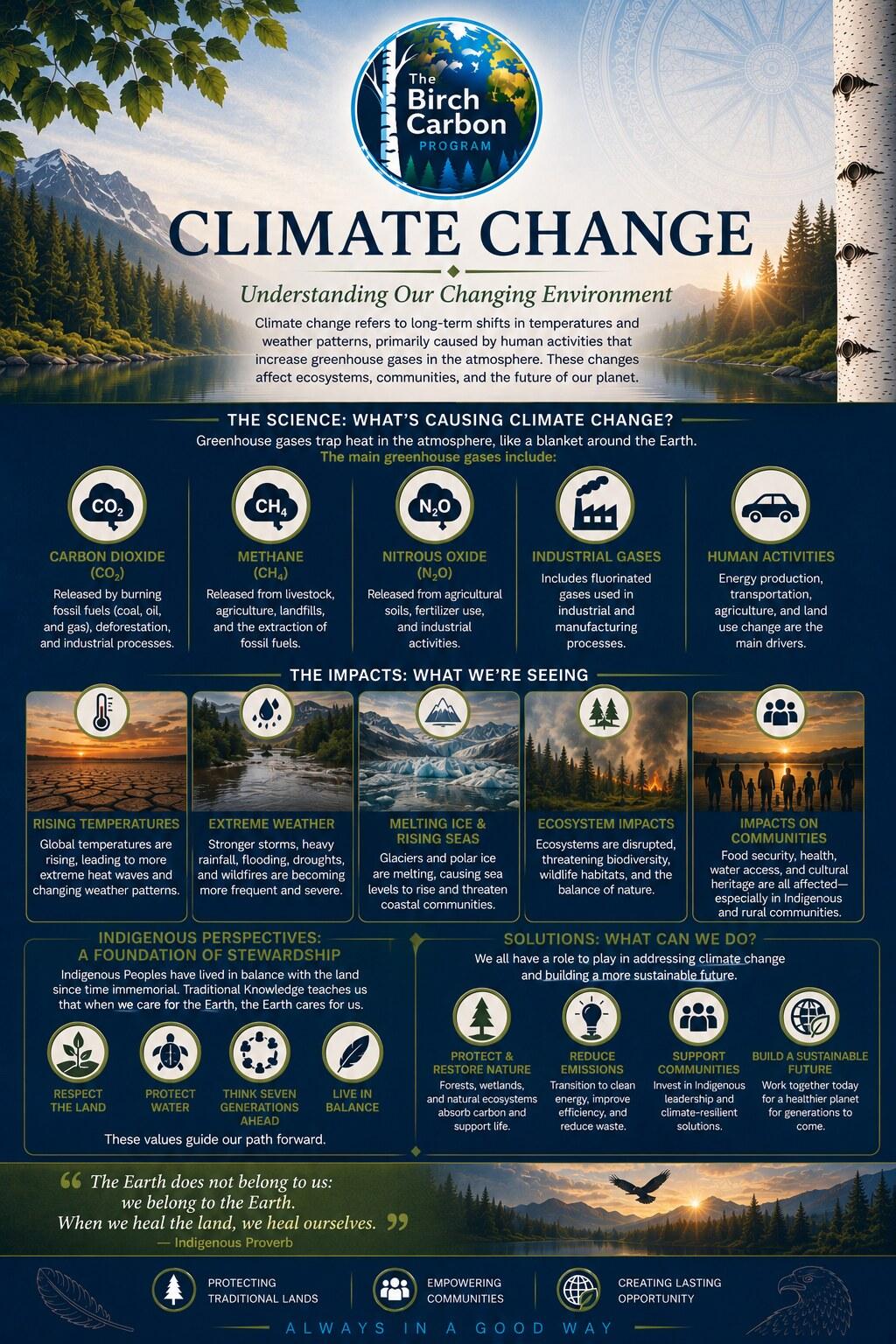
Climate Change
Understanding Our Changing Environment
Climate change refers to long-term changes in the Earth's climate caused by increasing levels of greenhouse gases in the atmosphere, particularly carbon dioxide (CO₂). These gases trap heat from the sun, causing global temperatures to rise and affecting weather patterns, ecosystems, and communities around the world.
Across Canada, the impacts of climate change are becoming more visible through more frequent wildfires, changing precipitation patterns, melting permafrost, warmer temperatures, and increased pressure on forests, wetlands, wildlife, and water resources.
Indigenous Peoples have long observed these changes on the land. Their Traditional Knowledge, combined with modern environmental science, plays an important role in protecting natural ecosystems and building a more sustainable future.
The Carbon Cycle
Carbon is a natural part of life on Earth. It constantly moves between the atmosphere, forests, soils, water, plants, animals, and oceans in what is known as the carbon cycle.
Trees, plants, wetlands, and healthy ecosystems absorb carbon dioxide from the atmosphere through photosynthesis and store it in their leaves, trunks, roots, and soils. This process helps reduce the amount of carbon in the atmosphere and supports a stable climate.
When forests are cleared, wetlands are damaged, or ecosystems are degraded, much of that stored carbon can be released back into the atmosphere. Protecting and restoring these natural systems helps maintain the balance of the carbon cycle and contributes to long-term climate stability.
Why Forests Matter
Forests are among the planet's most effective natural carbon sinks. As trees grow, they remove carbon dioxide from the atmosphere and store it for decades or even centuries.
Healthy forests also:
Improve air quality.
Protect wildlife habitat.
Support biodiversity.
Regulate local climates.
Reduce soil erosion.
Sustain traditional harvesting and cultural practices.
Protecting forests benefits both the environment and the communities that depend on them.
Why Wetlands Matter
Wetlands are among the most productive ecosystems on Earth. They naturally store carbon, filter water, reduce flooding, recharge groundwater, and provide critical habitat for countless species of birds, fish, mammals, and plants.
Healthy wetlands also improve water quality by trapping sediments and pollutants before they enter rivers and lakes. Conserving wetlands protects biodiversity while strengthening the resilience of surrounding ecosystems.
Why Peatlands Matter
Canada contains some of the largest peatland ecosystems in the world. Although they cover a relatively small portion of the Earth's surface, peatlands store enormous amounts of carbon that have accumulated over thousands of years.
When peatlands remain healthy and undisturbed, they continue to lock away carbon and support unique plant and wildlife communities. If they are drained, disturbed, or degraded, significant amounts of stored carbon can be released into the atmosphere.
Protecting peatlands is one of the most effective natural climate solutions available today.
Why Water Matters
Water is the foundation of every healthy ecosystem. Rivers, lakes, streams, and watersheds sustain wildlife, support forests and wetlands, provide drinking water, and hold deep cultural and spiritual significance for Indigenous Peoples.
Healthy watersheds also contribute to climate resilience by regulating water flow, reducing flood risk, supporting biodiversity, and maintaining the ecological balance of surrounding landscapes.
Protecting water means protecting the health of the land, the people, and future generations.
Working With Nature
The Birch Carbon Program recognizes that forests, wetlands, peatlands, and water systems are interconnected. By supporting Indigenous-led stewardship and protecting these natural ecosystems, communities help strengthen biodiversity, improve climate resilience, and contribute to global efforts to reduce greenhouse gas emissions.
Together, we can protect the natural systems that sustain life while creating lasting environmental, cultural, and economic benefits for generations to come.
Forests, wetlands, peatlands, and water systems are interconnected. Protecting these natural ecosystems strengthens biodiversity, improves climate resilience, and contributes to global efforts to reduce greenhouse gas emissions.
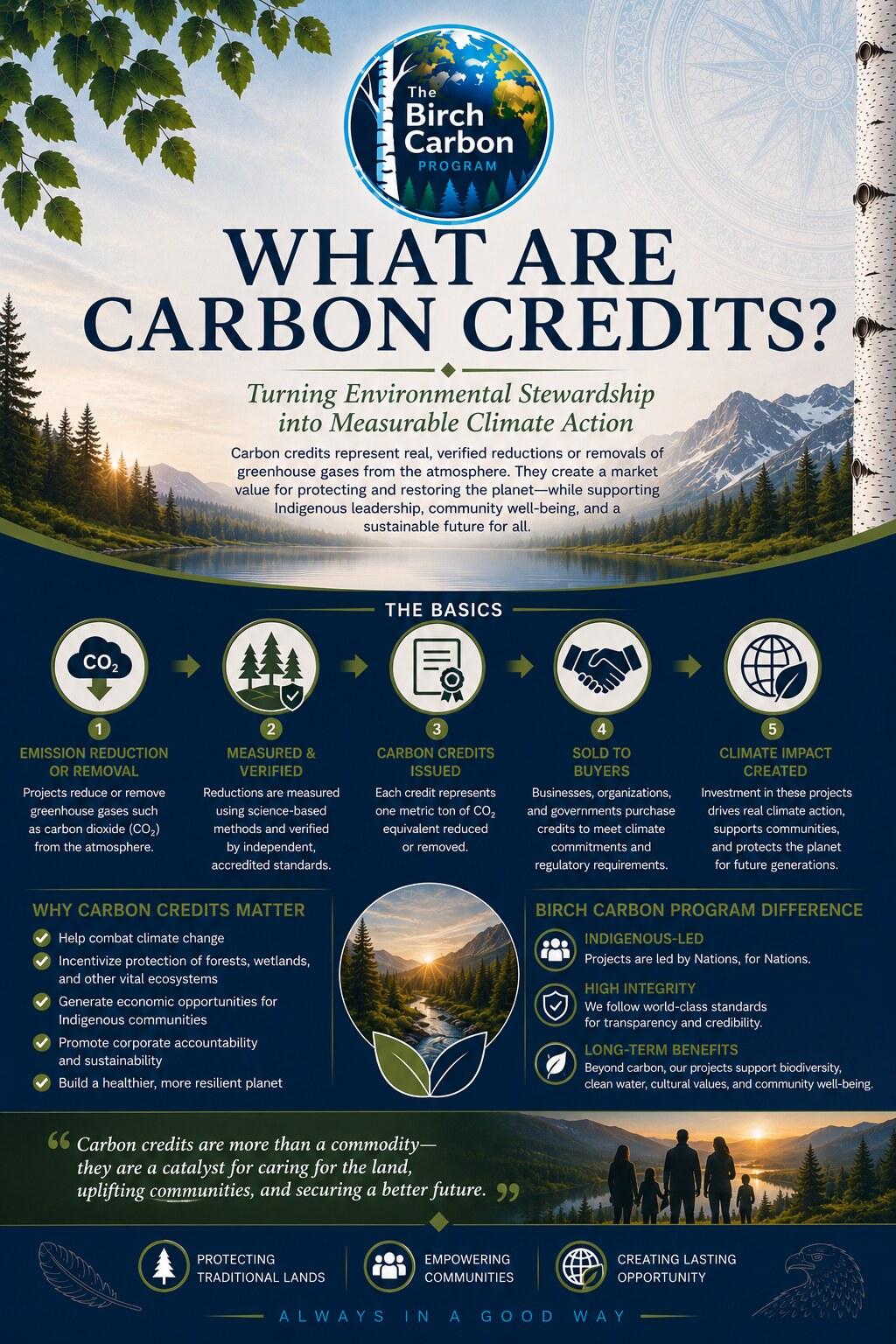
What Are Carbon Credits?
Turning Environmental Stewardship into Measurable Climate Action
Carbon credits are a way of recognizing and rewarding activities that reduce, remove, or prevent greenhouse gas emissions. In simple terms, a carbon credit represents a measurable environmental benefit that has been independently verified and recorded using internationally recognized standards.
One carbon credit generally represents one metric tonne (1 tonne) of carbon dioxide equivalent (CO₂e) that has either been removed from the atmosphere or prevented from being released.
For Indigenous communities, carbon credits can create an opportunity to generate long-term revenue by protecting and responsibly managing forests, wetlands, peatlands, and other natural ecosystems that naturally store carbon.
A Simple Explanation
Imagine a forest that has been carefully protected for generations.
Every year, that forest captures and stores carbon dioxide from the atmosphere through natural growth. Because the forest remains healthy and intact, it continues providing environmental benefits that help reduce the effects of climate change.
Through an approved carbon program, these environmental benefits can be scientifically measured, independently verified, and converted into carbon credits.
Organizations that want to reduce their environmental impact may then purchase these verified carbon credits to help meet their climate commitments while supporting real conservation projects.
In other words:
Healthy ecosystems create measurable environmental value—and carbon credits are one way that value can be recognized.
How Carbon Credits Work
Every carbon project follows a rigorous process designed to ensure that every credit represents a genuine, measurable environmental benefit.
The typical process includes:
Project Assessment – Environmental specialists evaluate the land and identify carbon opportunities.
Scientific Measurement – Forests, wetlands, peatlands, soils, and other natural assets are measured using accepted scientific methodologies.
Validation – Independent experts review the project design to ensure it meets international standards.
Verification – Qualified third-party auditors confirm that the environmental benefits have been achieved.
Registration – Approved projects are entered into internationally recognized carbon registries.
Credit Issuance – Verified carbon credits are officially issued and recorded.
Purchase and Retirement – Organizations purchase credits to support climate commitments, and in many cases the credits are permanently retired after use to prevent double counting.
Every stage is independently reviewed to maintain transparency, credibility, and environmental integrity.
Who Buys Carbon Credits?
Carbon credits are purchased by organizations around the world that are working to reduce their environmental footprint while supporting verified climate projects.
Buyers may include:
Major corporations
Airlines
Manufacturing companies
Energy producers
Technology companies
Financial institutions
Governments
Municipalities
Investment funds
Organizations with Environmental, Social, and Governance (ESG) commitments
Many of these organizations are investing billions of dollars annually in climate initiatives as they work toward achieving net-zero emissions and broader sustainability goals.
Why Do Companies Purchase Carbon Credits?
Organizations purchase carbon credits for several reasons.
Many companies have publicly committed to reducing or balancing their greenhouse gas emissions.
Carbon credits can help address emissions that cannot yet be eliminated through technology or operational changes.
Regulatory Requirements
Some industries are legally required to reduce emissions or comply with government climate regulations.
Customer and Investor Expectations
Consumers, shareholders, and investors increasingly expect organizations to demonstrate responsible environmental practices.
Corporate Leadership
Supporting verified conservation projects allows organizations to invest directly in protecting forests, biodiversity, and Indigenous stewardship while contributing to global climate solutions.
Types of Carbon Credits
Not all carbon credits are the same. They are created under different programs, standards, and regulatory frameworks depending on how they will be used.
Understanding these markets helps explain why some credits are used voluntarily while others are required by law or international agreements.
◆ Voluntary Carbon Market (VCM)
The Voluntary Carbon Market allows organizations to purchase carbon credits voluntarily to support sustainability goals, ESG commitments, or net-zero strategies.
These credits are not generally required by law. Instead, companies choose to purchase them as part of their environmental leadership initiatives.
Many Indigenous forestry, conservation, and natural climate projects are developed for this market.
Well-recognized standards include:
Verra – Verified Carbon Standard (VCS)
Gold Standard
American Carbon Registry (ACR)
Climate Action Reserve (CAR)
The voluntary market continues to grow as organizations around the world seek credible, independently verified environmental projects.
◆ Compliance Carbon Markets
Compliance markets are created through government laws or regulations.
In these markets, organizations are legally required to reduce emissions or purchase eligible carbon credits if they exceed established limits.
Examples include:
Government cap-and-trade systems
National greenhouse gas programs
Provincial or state emissions trading systems
International regulatory frameworks
Compliance credits must meet very strict eligibility requirements established by regulators.
CORSIA Credits
One of the most significant international compliance-related frameworks is CORSIA, the Carbon Offsetting and Reduction Scheme for International Aviation.
Developed by the International Civil Aviation Organization (ICAO), a specialized agency of the United Nations, CORSIA was established to help reduce the climate impact of international aviation.
Air travel is one of the most challenging sectors to fully decarbonize. While airlines continue investing in more efficient aircraft and sustainable aviation fuels, many emissions cannot yet be eliminated. CORSIA provides a framework that allows participating airlines to compensate for eligible emissions by purchasing high-quality carbon credits that meet strict international criteria.
Only carbon credits from approved programs and methodologies are eligible for use under CORSIA. These credits must satisfy rigorous requirements relating to:
Environmental integrity
Independent validation and verification
Accurate accounting
Permanence
Additionality (demonstrating that the emissions reductions would not have occurred without the project)
Prevention of double counting
Transparent registry tracking
Because of these requirements, CORSIA-eligible credits are widely regarded as some of the most rigorously assessed credits available.
For Indigenous-led conservation projects that meet the necessary standards, participation in CORSIA-eligible markets may represent an opportunity to access demand from the international aviation sector. However, eligibility depends on the specific project type, methodology, registry rules, and current ICAO-approved program requirements.
Why Carbon Markets Matter
Carbon markets create a financial incentive to protect ecosystems that provide measurable climate benefits.
Rather than placing value only on extracting natural resources, carbon markets recognize that healthy forests, wetlands, peatlands, and watersheds also provide services that benefit the global environment.
For Indigenous communities, this can help support long-term stewardship while maintaining ownership, governance, and decision-making over Traditional Territories.
Carbon Credits and Indigenous Stewardship
The Birch Carbon Program believes that Indigenous stewardship is one of the world's greatest environmental assets.
By combining Traditional Knowledge with internationally recognized scientific standards, communities can participate in credible carbon markets while protecting the lands they have cared for since time immemorial.
Carbon credits are not simply environmental commodities—they are a way of recognizing the global value of healthy ecosystems and supporting the people who have safeguarded them for generations.
Together, they create an opportunity to protect Traditional Lands, strengthen communities, and contribute to a more sustainable future.
KEY TAKEAWAY
One carbon credit generally represents one metric tonne of carbon dioxide equivalent (CO₂e) that has either been removed from the atmosphere or prevented from being released.
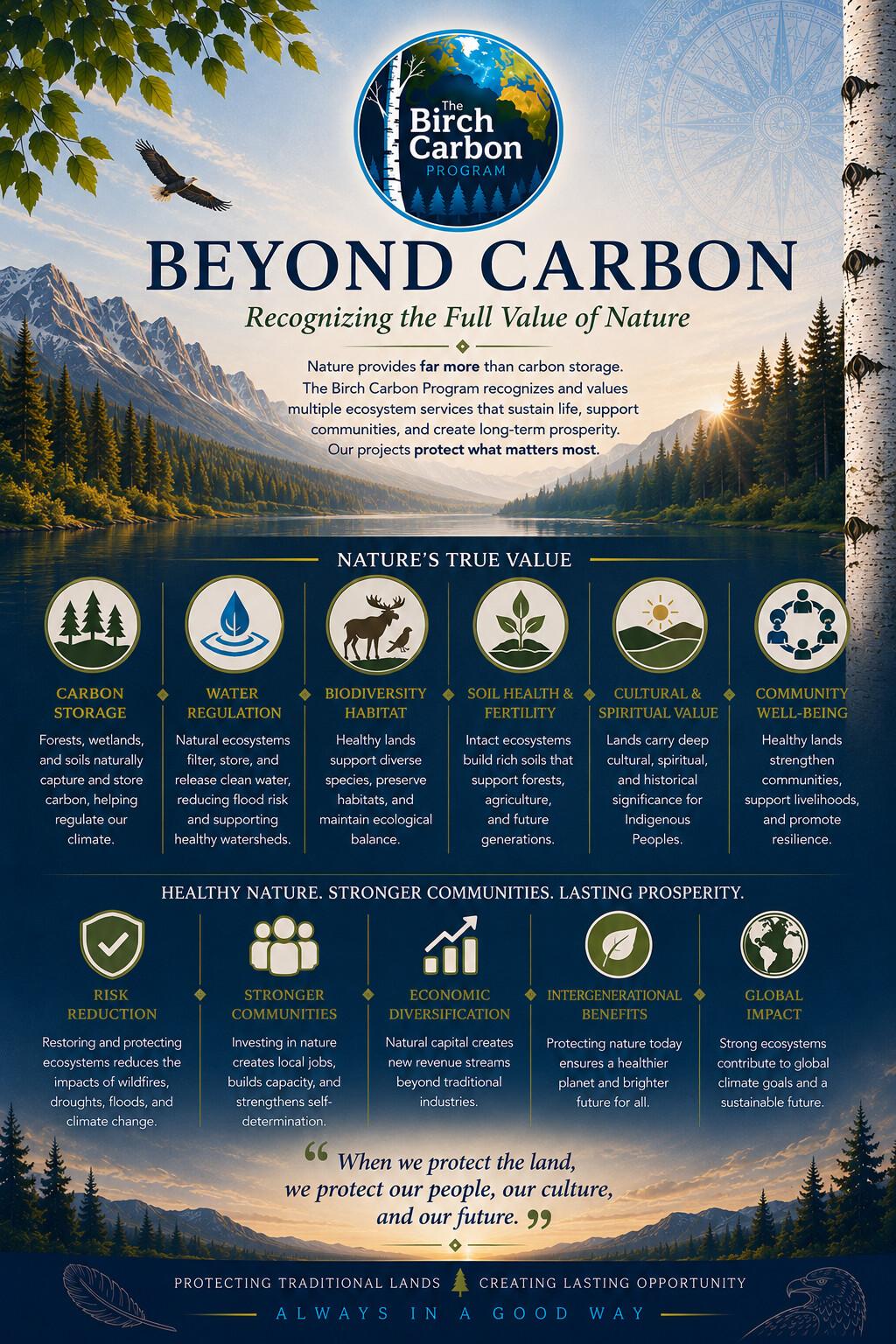
Beyond Carbon
Recognizing the Full Value of Nature
While carbon credits are one of the most recognized environmental markets today, they represent only one part of the value that healthy ecosystems provide.
Forests, wetlands, peatlands, rivers, lakes, and wildlife habitats deliver countless environmental, cultural, and economic benefits that extend far beyond carbon storage. Collectively, these benefits are often referred to as Natural Capital —the value that nature provides to people, communities, and the planet.
As environmental markets continue to evolve, there is growing recognition that protecting biodiversity, safeguarding water resources, restoring habitats, and preserving Indigenous cultural landscapes deserve meaningful investment alongside carbon.
The Birch Carbon Program is designed with this broader vision in mind: helping Indigenous communities explore opportunities that recognize the full value of their Traditional Territories while maintaining Indigenous ownership, governance, and stewardship.
Natural Capital
Natural Capital refers to the world's natural assets and the valuable services they provide every day.
These assets include:
Forests
Wetlands
Peatlands
Rivers and lakes
Grasslands
Wildlife habitat
Healthy soils
Watersheds
These ecosystems naturally:
Store carbon
Filter and clean water
Support biodiversity
Reduce
Sustain traditional harvesting
Strengthen climate resilience
Historically, many of these benefits were never assigned an economic value, despite being essential to healthy communities and a healthy planet.
Today, governments, businesses, and investors increasingly recognize that protecting natural systems is an investment in long-term environmental and economic sustainability.
Biodiversity
Biodiversity refers to the variety of life within an ecosystem, including plants, animals, insects, fish, birds, fungi, and microorganisms.
Healthy biodiversity creates strong, resilient ecosystems that are better able to adapt to environmental change, support wildlife populations, and maintain ecological balance.
Indigenous Peoples have long understood that every species plays an important role within the natural world. Protecting biodiversity means protecting the interconnected relationships that sustain life on the land.
Increasingly, governments and organizations around the world are investing in biodiversity conservation as a critical component of climate action and environmental stewardship.
Water
Water is one of our most valuable natural resources.
Healthy rivers, lakes, wetlands, streams, and watersheds provide clean drinking water, support fisheries, sustain wildlife, nourish forests, and help regulate local climates.
Wetlands naturally filter pollutants, store water during heavy rainfall, reduce flooding, and slowly release water during dry periods. Healthy watersheds also improve water quality for downstream communities and contribute to stronger ecosystems.
For many Indigenous communities, water is far more than a resource—it is sacred, life-giving, and deeply connected to cultural identity, ceremony, and community well-being.
Protecting water today helps ensure healthy communities for generations to come.
Habitat
Every healthy ecosystem provides habitat for wildlife.
Canada's forests, wetlands, peatlands, grasslands, and waterways support thousands of species, many of which are found nowhere else in the world.
Protecting habitat helps:
Maintain healthy wildlife populations.
Support migratory birds and pollinators.
Protect fish spawning areas.
Preserve endangered species.
Strengthen ecosystem resilience.
Maintain natural food chains.
Habitat conservation benefits not only wildlife but also the people and communities who rely on healthy ecosystems for traditional activities, recreation, education, and cultural practices.
Cultural Values
Traditional Territories are more than landscapes—they are living places of history, identity, language, ceremony, and knowledge.
For Indigenous Peoples, the land holds stories passed down through generations. Sacred sites, traditional harvesting areas, waterways, migration routes, medicinal plants, and culturally significant landscapes form an essential part of community identity and heritage.
The Birch Carbon Program recognizes that these cultural values cannot be measured solely in economic terms.
Every project is designed to respect Indigenous governance, honour Traditional Knowledge, and support community priorities. Protecting the land also means protecting the cultures, traditions, and histories that are inseparable from it.
Future Opportunities
Environmental markets are evolving rapidly.
Around the world, governments, financial institutions, and private organizations are expanding their interest beyond carbon to recognize the broader benefits that healthy ecosystems provide.
Emerging opportunities may include:
Biodiversity conservation initiatives.
Nature-based investment programs.
Watershed and water quality projects.
Habitat restoration and conservation.
Ecosystem service markets.
Natural Capital accounting.
Climate resilience initiatives.
Indigenous-led conservation partnerships.
As these markets continue to develop, Indigenous communities that have protected their Traditional Territories for generations are well positioned to play a leading role in shaping the future of environmental stewardship.
Looking Beyond Carbon
The Birch Carbon Program is about more than carbon credits. It is about recognizing the true value of Indigenous stewardship and the many ways healthy ecosystems contribute to our environment, our communities, and our future.
By protecting forests, wetlands, peatlands, waterways, wildlife habitat, and culturally significant landscapes, Indigenous Nations are safeguarding natural assets that benefit not only their own communities but people around the world.
Together, we can move beyond carbon and embrace a future where Natural Capital, biodiversity, clean water, healthy habitats, and Indigenous knowledge are recognized as essential foundations of a sustainable and prosperous future for generations to come.
KEY TAKEAWAY
Carbon credits are only one part of the value that healthy ecosystems provide. Biodiversity, clean water, healthy habitats, and Indigenous knowledge are essential foundations of a sustainable and prosperous future.
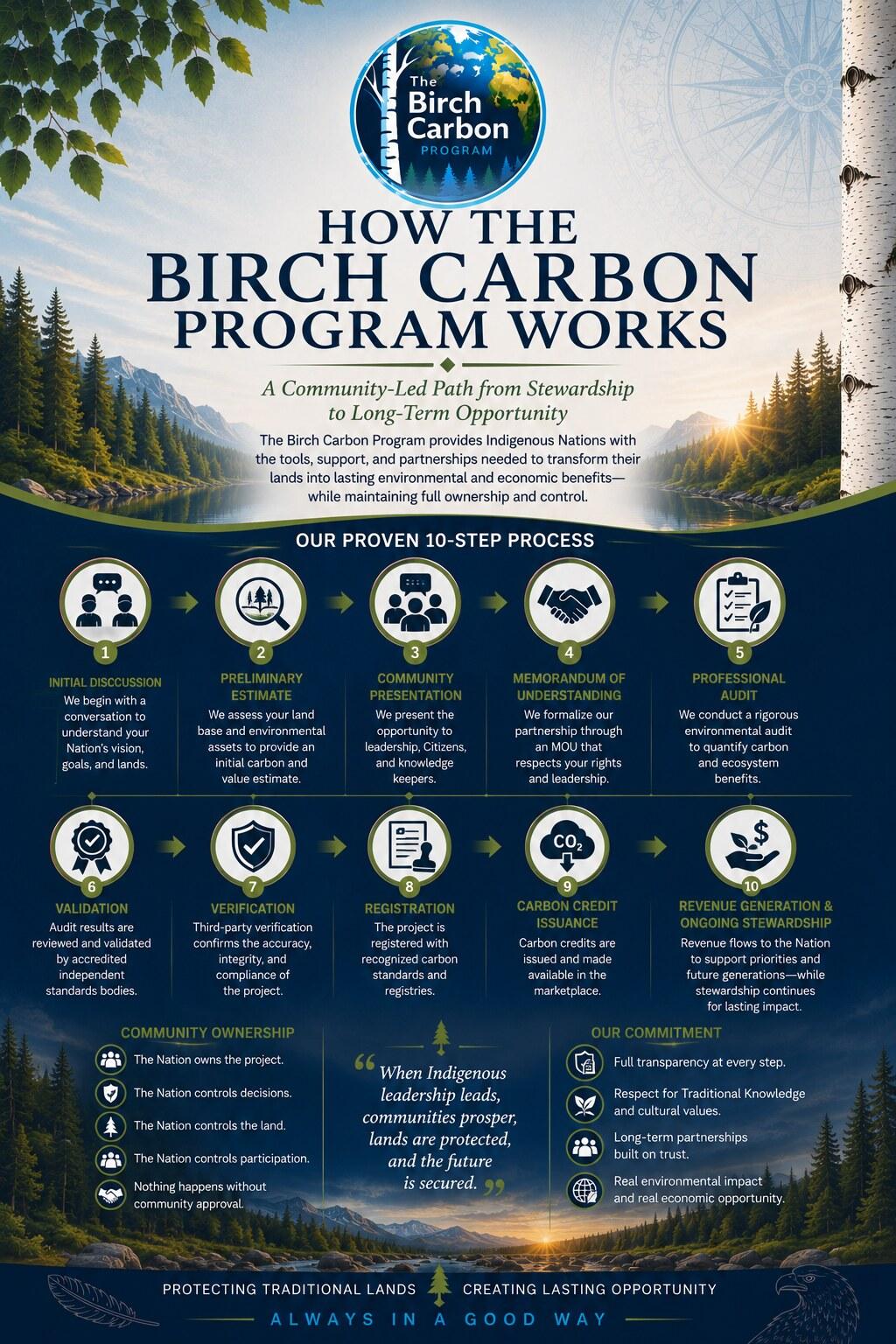
How the Birch Carbon Program Works
A Community-Led Path from Stewardship to Long-Term Opportunity
The Birch Carbon Program follows a structured, transparent, and community-first process that helps Indigenous Nations explore, develop, and benefit from the environmental value of their Traditional Territories.
Every Nation is unique. Land size, ecosystems, governance structures, cultural priorities, environmental conditions, and long-term community goals all differ. For this reason, every project is developed collaboratively and tailored to the individual Nation while following internationally recognized environmental standards and best practices.
From the first conversation through long-term stewardship, the participating Nation remains at the centre of every decision. The Birch Carbon Program provides technical expertise, professional support, environmental specialists, and market access, while the Nation maintains ownership of its lands, authority over decisions, and control of the project.
Each stage of the process builds upon the previous one, ensuring transparency, scientific integrity, and community participation throughout the life of the project.
1. Initial Discussion
Every project begins with a conversation.
The purpose of the initial discussion is to introduce the Birch Carbon Program, learn about the community's interests, and determine whether there may be an opportunity worth exploring. These meetings may include:
Chief and Council
Economic Development Corporations
Lands and Resources Departments
Environmental staff
Elders and Knowledge Keepers
Community leadership
Technical advisors
Other authorized representatives
During this discussion we explain:
What carbon credits are
What Natural Capital means
How environmental markets work
How Indigenous stewardship creates environmental value
The overall development process
Community ownership and governance
Long-term opportunities and responsibilities
Likewise, the Nation may share information regarding:
Traditional Territory
Existing stewardship activities
Forests
Wetlands
Peatlands
Water systems
Community priorities
Existing conservation initiatives
This is simply an exploratory discussion.
There is no commitment, no obligation, and no cost to the community during this stage.
The objective is to determine whether both parties wish to continue exploring the opportunity.
2. Preliminary Estimate
If there is mutual interest, the Birch Carbon Program prepares a preliminary estimate. This estimate is an early assessment intended to provide community leadership with a general understanding of the environmental opportunity that may exist.
The estimate may consider:
Approximate land area
Forest coverage
Wetlands
Peatlands
Waterways
Existing mapping
Satellite imagery
Ecological characteristics
Potential carbon storage
Existing land management
Conservation opportunities
The preliminary estimate is not a certified valuation or guaranteed carbon-credit calculation. Rather, it provides an informed overview that helps determine whether investing additional time and professional resources is appropriate.
The estimate may identify:
Potential project boundaries
Eligible ecosystems
Estimated environmental assets
Possible carbon-credit ranges
Natural Capital opportunities
Areas requiring further study
Community leadership can then decide whether they wish to proceed to the next stage.
3. Community Presentation
Once the preliminary estimate has been completed, the Birch Carbon Program presents the findings to the Nation.
This presentation is designed to ensure that leadership fully understands both the opportunities and responsibilities associated with a potential carbon project.
Topics may include:
The Birch Carbon Program
Preliminary findings
Project maps
Carbon opportunities
Natural Capital opportunities
Environmental markets
Timelines
Technical process
Financial overview
Risks and considerations
Community responsibilities
Questions and discussion
The presentation allows community leadership to make an informed decision based on accurate information rather than assumptions.
Nothing proceeds without community approval.
4. Memorandum of Understanding (MOU)
If the Nation wishes to continue, both parties may enter into a Memorandum of Understanding. The MOU establishes a framework for collaboration while professional assessments begin. The agreement may include:
Purpose of the relationship
Roles and responsibilities
Confidentiality
Information sharing
Community approvals
Technical cooperation
Communication procedures
Protection of community information
Next steps
The MOU does not transfer ownership of the land.
It does not reduce the Nation's authority.
It simply establishes the relationship necessary to move into professional project development. The Nation is encouraged to have all agreements reviewed by its legal advisors before signing.
5. Professional Audit
The professional audit is the foundation of every successful carbon project.
At this stage, qualified environmental specialists begin the scientific and technical work required to determine whether the project meets internationally recognized carbon standards.
Professional teams may include experts in:
Forestry
Ecology
Carbon accounting
Wetlands
Peatlands
Soil science
GIS mapping
Remote sensing
Biodiversity
Hydrology
Environmental law
Indigenous knowledge
Climate science
The audit may include:
Defining project boundaries
Measuring existing carbon stocks
Forest inventory analysis
Wetland and peatland assessment
Water and watershed evaluation
Historical land-use review
Carbon modelling
Risk assessment
Biodiversity review
Additionality analysis
Permanence assessment
Leakage assessment
Monitoring plan development
Registry documentation
Traditional Knowledge, where shared by the Nation, may also contribute to understanding long-term ecological conditions and stewardship practices.
The result of the audit is a complete technical project ready for independent review.
6. Validation
Validation is the first independent review.
An accredited third-party validator examines the project design to confirm it complies with approved methodologies and registry requirements.
Validation reviews:
Project design
Scientific methodology
Carbon calculations
Baseline conditions
Additionality
Permanence
Leakage
Monitoring plans
Community documentation
Environmental safeguards
If revisions are required, they are completed before validation is finalized.
Validation confirms that the project has been properly designed.
7. Verification
Verification confirms that the environmental benefits being claimed have actually been achieved.
Independent verifiers examine:
Field measurements
Carbon calculations
Monitoring reports
Satellite imagery
Forest conditions
Environmental records
Project activities
Registry documentation
Verification ensures that every carbon credit represents a real, measurable, and independently confirmed environmental benefit.
Only verified environmental results can move forward for credit issuance.
8. Registration
After successful validation and verification, the project may be registered within an internationally recognized carbon registry.
Registration provides:
Official project recognition
Project tracking
Credit serialization
Ownership records
Market transparency
Prevention of double counting
Depending on the project, credits may be developed under internationally recognized standards such as:
Verra (Verified Carbon Standard)
Gold Standard
Other approved carbon programs
CORSIA-eligible programs where applicable
Registration formally prepares the project for carbon credit issuance.
9. Carbon Credit Issuance
Following successful registration, eligible carbon credits may be issued. Each carbon credit generally represents one metric tonne (1 tonne) of carbon dioxide equivalent (CO₂e) that has been removed from the atmosphere or prevented from being released.
Every issued credit receives its own unique serial number, allowing it to be tracked throughout its entire lifecycle.
The number of credits issued depends upon:
Project size
Carbon measurements
Registry methodology
Verification findings
Buffer requirements
Risk adjustments
Registry rules
Not every tonne of stored carbon automatically becomes a tradable carbon credit.
Strict scientific standards ensure that only verified environmental benefits receive credits.
Once credits have been issued, the project enters its long-term operational phase.
10. Annual Monitoring
Carbon projects are long-term environmental commitments.
Annual monitoring ensures that the project continues to meet international standards while protecting the environmental value of the land.
Monitoring may include:
Satellite imagery
Forest health
Wetlands
Peatlands
Water systems
Wildlife habitat
Biodiversity
Fire monitoring
Community stewardship
Environmental reporting
Registry reporting
Where appropriate, communities may participate through:
Indigenous Guardians
Community monitors
Youth stewardship programs
Traditional Knowledge initiatives
Environmental education
Annual monitoring protects both the integrity of the project and the long-term interests of the participating Nation.
11. Revenue Generation and Market Development
Once carbon credits have been successfully issued, they become eligible to enter the marketplace.
The Birch Carbon Program believes that the environmental value created through Indigenous stewardship should first benefit the communities, provinces, territories, and country where that stewardship has taken place.
For this reason, the Birch Carbon Program follows a Canada-First Market Strategy.
◆ Local Opportunities
The first priority is always to seek purchasing opportunities close to the participating Nation.
Potential buyers may include:
Municipal governments
Local industries
Regional organizations
Utilities
Large employers
Financial institutions
Community partners
Organizations with environmental commitments
Supporting local purchases allows the environmental value created by the project to remain within the region whenever possible.
◆ Provincial and Territorial Governments
If suitable local opportunities are not available, credits are then presented to the applicable provincial or territorial government.
Potential opportunities may include:
Provincial climate strategies
Crown corporations
Infrastructure initiatives
Government procurement
Conservation programs
Indigenous partnership initiatives
Greenhouse gas reduction programs
This provides the province or territory with the opportunity to retain the environmental value generated within its own jurisdiction.
◆ Government of Canada
If the available credits are not acquired locally or provincially, the next priority is the Government of Canada.
Potential federal opportunities may include:
National climate commitments Federal procurement
Government operations
Crown corporations
Transportation initiatives
Infrastructure projects
Indigenous climate partnerships
National environmental programs
The Birch Carbon Program believes Canada should have every reasonable opportunity to invest in Indigenous-led conservation projects before those credits are offered internationally.
◆ International Markets
Only after Canadian opportunities have been reasonably explored may credits be presented to qualified international buyers.
These buyers may include:
International governments
Global corporations
Airlines
Financial institutions
Carbon investment funds
Environmental organizations
Compliance market participants
Voluntary market participants
International demand for high-quality carbon credits continues to grow, representing billions of dollars in annual investment as organizations pursue climate commitments and net-zero objectives.
Where projects satisfy all technical and regulatory requirements, credits may also qualify for CORSIA (Carbon Offsetting and Reduction Scheme for International Aviation), an international framework established by the International Civil Aviation Organization (ICAO). CORSIA allows participating international airlines to purchase eligible carbon credits to help meet emissions obligations for international aviation.
Because CORSIA has some of the world's most rigorous eligibility requirements, projects capable of supplying these credits may gain access to one of the most significant long-term compliance markets available.
International markets represent an important opportunity—but only after Canadian buyers have been given the opportunity to purchase the credits first.
◆ Selling Carbon Credits
Depending on the project and buyer, credits may be sold through:
Government procurement
Direct purchase agreements
Long-term offtake agreements
Forward purchase agreements
Voluntary carbon markets
Compliance carbon markets
CORSIA-eligible transactions
Strategic institutional partnerships
Every transaction is completed transparently and in accordance with registry requirements, applicable laws, and agreements established with the participating Nation.
◆ Revenue Distribution
Once credits have been sold, revenue is distributed according to the agreements established between the participating Nation and the Birch Carbon Program.
Communities receive transparent reporting outlining:
Credits issued
Credits sold
Sale price
Registry costs
Program costs
Transaction costs
Net proceeds
Revenue distributions
Transparency, accountability, and community trust remain fundamental throughout the process.
12. Ongoing Stewardship
Revenue generation is not the conclusion of the project—it is the beginning of a long-term commitment.
The true success of a carbon project is measured not only by the credits it produces but by the lasting environmental, cultural, and economic benefits it creates for the Nation.
Ongoing stewardship may include:
Forest protection
Wetland conservation
Water protection
Biodiversity management
Wildlife habitat conservation
Indigenous Guardian programs
Community environmental monitoring
Youth engagement
Knowledge transfer
Adaptive management
Long-term governance
As environmental conditions change, stewardship plans may be updated to respond to:
Wildfire
Flooding
Drought
Climate change
New scientific information
Community priorities
Registry requirements
The Birch Carbon Program remains committed to supporting participating Nations throughout the life of every project.
Community Ownership at Every Stage
Every Birch Carbon Program project is built upon one fundamental principle:
The Nation owns the project.
Throughout every stage of development:
The Nation owns the land.
The Nation controls participation.
The Nation approves every major decision.
The Nation governs the project.
The Nation protects its Traditional Knowledge.
The Nation determines its long-term vision.
The Birch Carbon Program provides technical expertise, environmental professionals, project management, market access, and ongoing support—but it never replaces Indigenous leadership or community governance.
Nothing proceeds without community approval.
The Complete Process
Protecting Today. Building Tomorrow.
The Birch Carbon Program is more than a carbon initiative—it is a long-term partnership that combines Indigenous leadership, Traditional Knowledge, environmental science, and internationally recognized standards to create lasting environmental, cultural, and economic benefits.
By protecting forests, wetlands, peatlands, waterways, biodiversity, and culturally significant landscapes, participating Nations strengthen their stewardship legacy while creating new opportunities for future generations.
Together, we are protecting Traditional Lands, recognizing Indigenous stewardship, and building a more sustainable future— Always in a Good Way.
KEY TAKEAWAY
From the first conversation through long-term stewardship, the participating Nation remains at the centre of every decision. Nothing proceeds without community approval.
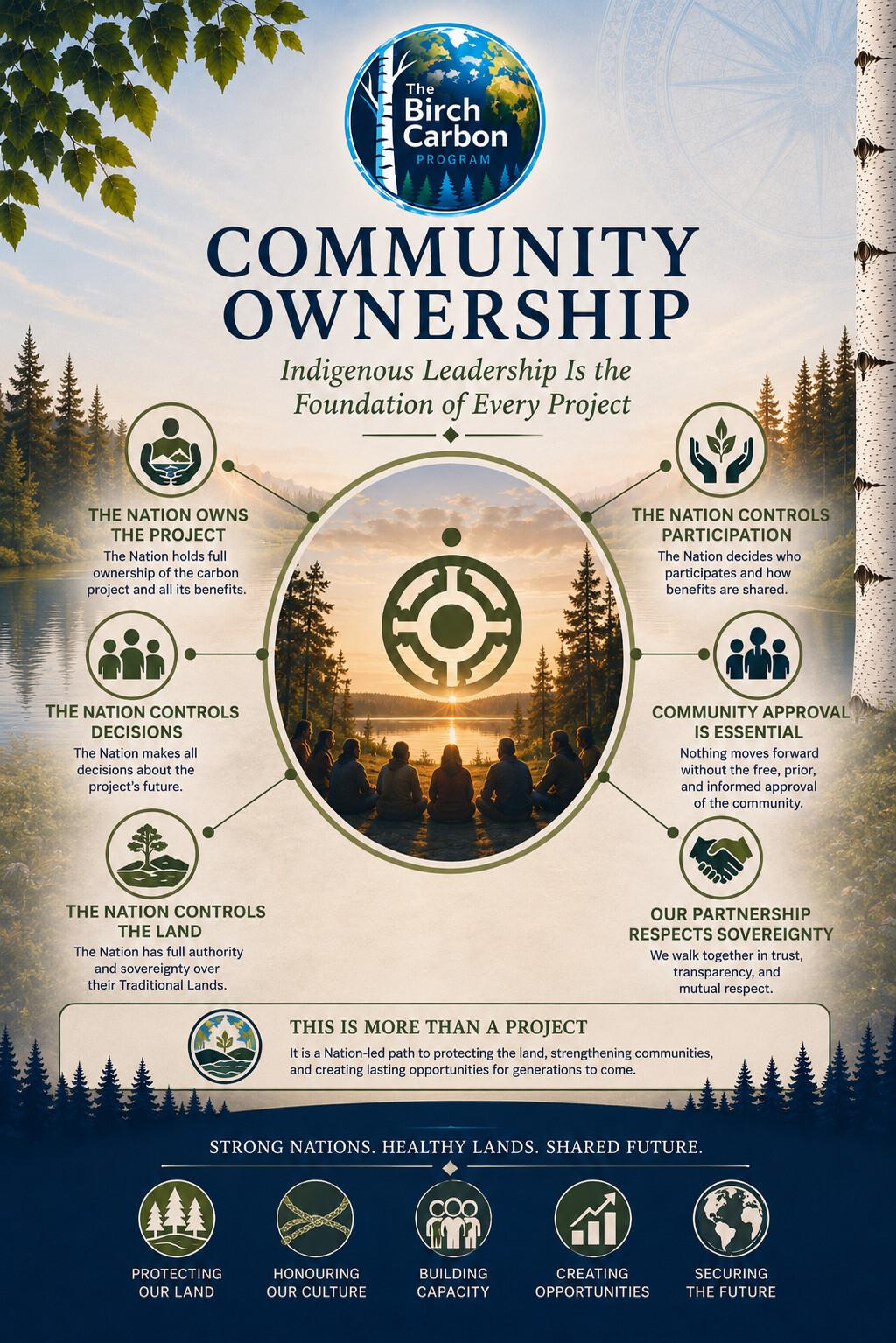
Community Ownership
Indigenous Leadership Is the Foundation of Every Project
The Birch Carbon Program is built on one fundamental principle:
The Nation owns the
project.
Every carbon project begins and ends with Indigenous leadership, community governance, and respect for the Nation's inherent rights and responsibilities. The Birch Carbon Program exists to provide technical expertise, environmental professionals, project management, and access to environmental markets—but it does not replace or diminish the authority of the participating Nation.
Community ownership is not simply a guiding value—it is the foundation upon which every project is built.
The Nation Owns the Project
Every Birch Carbon Program project belongs to the participating Nation.
The Nation determines whether it wishes to explore a project, whether it proceeds beyond the planning stages, and whether it ultimately participates in the carbon market.
The Birch Carbon Program does not own the project, the environmental assets, or the Traditional Territory.
Its role is to support the Nation by providing professional guidance, technical expertise, and access to internationally recognized environmental standards and markets. The project exists because the Nation chooses to participate.
The Nation Controls All Decisions
Every significant decision remains with the participating Nation. This includes decisions regarding:
Whether to begin the project.
Whether to continue the project.
Project boundaries.
Community participation.
Information sharing.
Stewardship priorities.
Long-term project direction.
Environmental management.
Market opportunities.
Carbon credit sales.
Ongoing governance.
The Birch Carbon Program provides recommendations based on professional expertise, but recommendations are never substitutes for community decision-making.
Leadership always has the authority to ask questions, request additional information, seek independent advice, or delay decisions until the community is satisfied.
The Nation Controls the Land
Participation in the Birch Carbon Program does not transfer ownership of land.
It does not transfer Indigenous rights.
It does not transfer jurisdiction.
It does not grant ownership or control of the Traditional Territory to the Birch Carbon Program, investors, buyers, governments, or any third party.
The Nation continues to exercise authority over its lands in accordance with its own governance, applicable laws, and community priorities.
Carbon credits represent verified environmental benefits created through stewardship—they do not represent ownership of the land itself.
The land remains the Nation's land. Always.
The Nation Controls Participation
Participation in the Birch Carbon Program is entirely voluntary. Communities choose whether they wish to:
Explore an opportunity.
Receive a preliminary estimate.
Participate in presentations.
Enter into agreements.
Complete professional assessments.
Proceed through project development.
Register a project.
Offer carbon credits for sale.
Continue long-term stewardship.
The Nation also determines who participates in the project, including leadership, community members, environmental staff, Elders, Knowledge Keepers, technical advisors, and other authorized representatives.
Community priorities always come first.
Nothing Happens Without Community Approval
Every major milestone within the Birch Carbon Program requires community authorization. Nothing moves forward without the Nation's knowledge, participation, and approval.
This includes:
Initial discussions.
Preliminary estimates.
Community presentations.
Memorandums of Understanding.
Professional audits.
Project design.
Validation.
Verification.
Registration.
Carbon credit issuance.
Revenue generation.
Long-term stewardship activities.
The Birch Carbon Program believes that meaningful partnerships are built through trust, transparency, and informed decision-making—not pressure.
Communities are encouraged to take the time they need to review information, consult legal and technical advisors, engage Elders and Knowledge Keepers, and discuss opportunities internally before making decisions.
There are no shortcuts when it comes to community governance.
Respect for Indigenous Governance
Every Indigenous Nation has its own governance structure, traditions, protocols, and decisionmaking processes.
The Birch Carbon Program recognizes and respects these differences. Some communities may make decisions through Chief and Council.
Others may involve Elders, community meetings, advisory committees, hereditary leadership, economic development corporations, or other governance structures.
The Birch Carbon Program follows the Nation's established process and respects the community's timeline for decision-making.
Community governance is never treated as a formality, it is an essential part of every project.
A Partnership Built on Trust
The Birch Carbon Program is not a land acquisition program.
It is not a resource extraction program.
It is not a land management takeover.
It is not a program that removes community authority.
Instead, it is a partnership that combines Indigenous leadership with professional environmental expertise to create long-term opportunities while respecting the Nation's ownership, governance, and stewardship responsibilities.
The Birch Carbon Program succeeds only when communities remain fully informed, fully engaged, and fully in control.
Our Commitment
Our commitment is simple and unwavering:
The Nation owns the project.
The Nation controls every major decision.
The Nation retains ownership and authority over its Traditional Lands.
The Nation decides who participates and how the project is governed.
Nothing happens without community approval.
These principles are not optional, they are the foundation of the Birch Carbon Program and guide every relationship, every project, and every decision.
Together, we build partnerships founded on respect, transparency, Indigenous leadership, and the shared commitment to protect Traditional Lands while creating lasting opportunities for future generations.
KEY TAKEAWAY
The Nation owns the project. The Nation controls every major decision. The Nation retains ownership and authority over its Traditional Lands. Nothing happens without community approval.
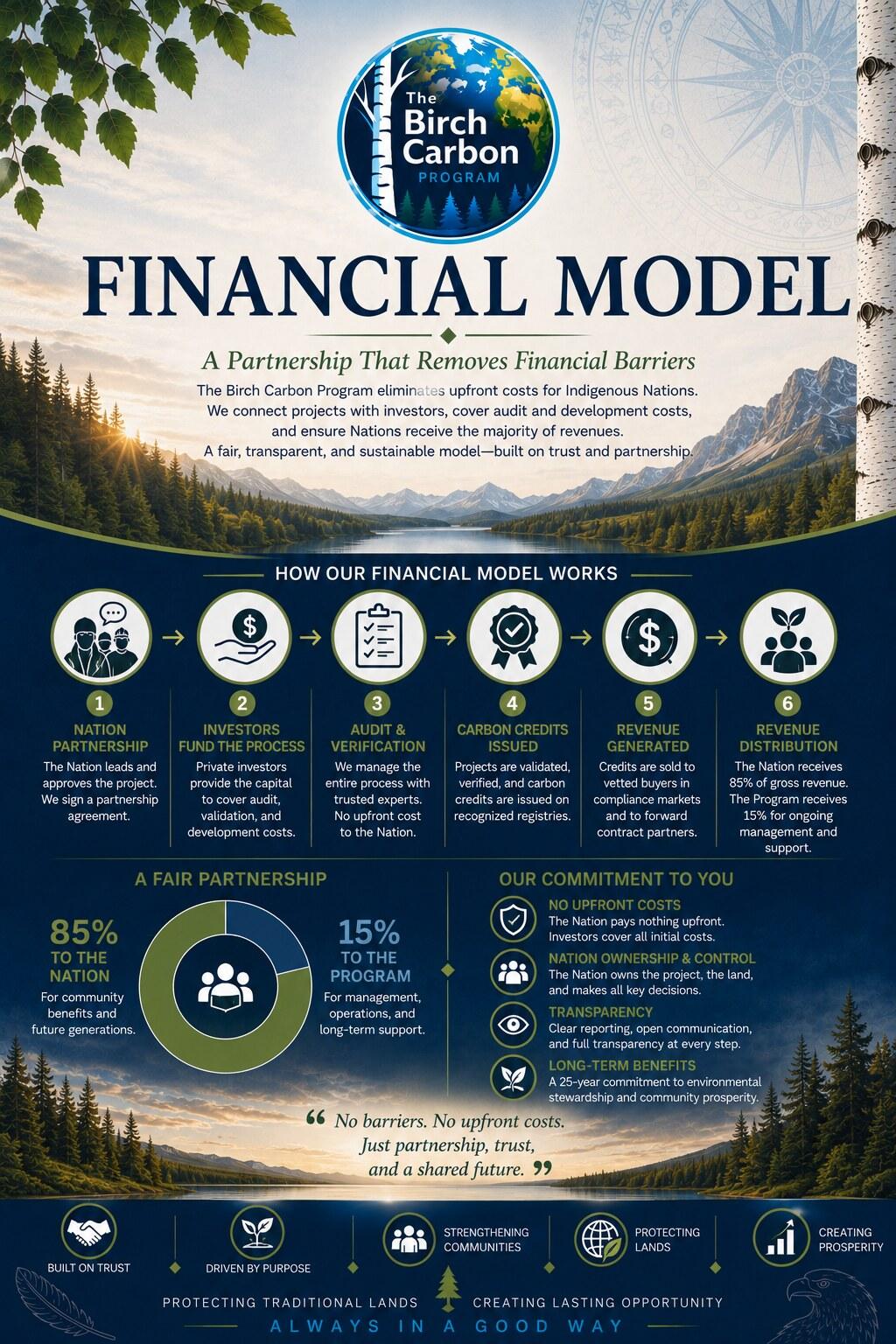
Financial Model
A Partnership That Removes Financial Barriers
One of the greatest challenges facing large environmental projects is the significant investment required before any carbon credits can be generated. Scientific assessments, environmental studies, professional audits, validation, verification, and project registration all require highly specialized expertise and substantial financial resources.
The Birch Carbon Program was designed to remove this barrier.
Our financial model allows participating Nations to explore and develop eligible carbon and natural capital projects without the need for upfront project funding, making participation accessible while ensuring the Nation retains ownership and control throughout the process. The model is built on partnership, transparency, and long-term success.
No Upfront Cost to the Nation
A key principle of the Birch Carbon Program is that participating Nations are not expected to finance the project development process themselves.
The technical work required to develop a world-class carbon project can involve significant costs, including:
Professional environmental assessments
Scientific studies
Carbon modelling
Forest inventories
Wetland and peatland analysis
Geographic Information System (GIS) mapping
Remote sensing
Legal documentation
Independent validation
Independent verification
Registry fees
Project management
Technical reporting Rather than asking communities to invest substantial capital before knowing whether a project will succeed, the Birch Carbon Program has developed a funding model that allows these activities to proceed without requiring upfront financial contributions from the participating Nation.
This approach allows community leadership to focus on stewardship, governance, and longterm planning rather than raising development capital.
Private Investment Supports Project Development
The Birch Carbon Program works with private investment partners who recognize both the environmental and economic value of Indigenous-led conservation projects.
These investors provide the capital required to fund the professional development of eligible projects, including the technical work necessary to move a project from concept to verified carbon-credit issuance.
Investment may support:
Professional audits
Environmental specialists
Technical consultants
Scientific modelling
Carbon accounting
Registry preparation
Validation
Verification
Project administration
Market development
This private investment helps remove one of the largest barriers to participation while allowing projects to be developed to internationally recognized standards.
Every investment arrangement is structured to support successful project development while respecting the participating Nation's ownership, governance, and long-term interests.
Revenue Sharing
Once carbon credits have been successfully developed, verified, issued, and sold, revenue is distributed according to the agreements established between the participating Nation and the Birch Carbon Program.
The financial model is designed so that all parties understand:
How revenue is generated.
How project costs are recovered.
How revenue is shared.
When payments are made.
What reporting is provided.
How financial accountability is maintained.
Every financial agreement is documented before project development proceeds.
The objective is to ensure that the participating Nation clearly understands how the project operates and how long-term revenues will be managed.
Long-Term Income
Unlike many traditional development projects that generate a single payment, carbon projects are designed to create long-term environmental and economic value.
As long as project requirements continue to be met and verified environmental benefits are maintained, eligible projects may continue to generate carbon credits over many years.
This creates the potential for ongoing income while supporting:
Environmental stewardship
Community priorities
Economic development
Capacity building
Guardian programs
Land management
Youth employment
Environmental education
Conservation initiatives The exact duration of a project depends on the approved methodology, registry requirements, agreements, and ongoing project performance.
Annual Revenue Opportunities
Carbon projects are monitored throughout their operating life.
As monitoring and verification continue, additional eligible carbon credits may be issued in accordance with the applicable project methodology and registry requirements.
This creates the opportunity for recurring revenue rather than a one-time financial return.
Future revenue depends on factors such as:
Continued project performance
Environmental integrity
Independent verification
Market demand
Carbon prices
Registry rules
Buyer requirements
Long-term stewardship
Because environmental markets change over time, future revenues cannot be guaranteed. However, projects that continue to meet technical standards may provide ongoing economic opportunities for participating Nations.
Financial Transparency
Transparency is essential to every Birch Carbon Program project.
Participating Nations should always understand how project finances are managed and how revenues are generated and distributed.
Communities receive clear reporting that may include:
Credits issued
Credits sold
Sale prices
Buyer information, where appropriate
Registry costs
Project development costs
Transaction costs
Revenue distributions
Payment schedules
Financial summaries
Questions are encouraged at every stage of the process.
The Birch Carbon Program believes that strong partnerships are built through open communication, accurate reporting, and mutual accountability.
A Sustainable Financial Partnership
The Birch Carbon Program's financial model was created to remove barriers—not create them.
By combining private investment, professional expertise, transparent financial management, and long-term stewardship, the program allows participating Nations to explore environmental opportunities without the burden of significant upfront project costs.
The objective is simple:
Remove financial barriers to participation.
Protect community ownership.
Develop projects to the highest international standards.
Create long-term, sustainable revenue opportunities.
Maintain complete transparency throughout the life of every project.
When successful, this model transforms Indigenous stewardship into lasting environmental, cultural, and economic benefits while ensuring that participating Nations remain in control of both their lands and their future.
KEY TAKEAWAY
Participating Nations are not required to provide upfront capital. Private investment funds professional project development, while the Nation retains ownership and control throughout the process.
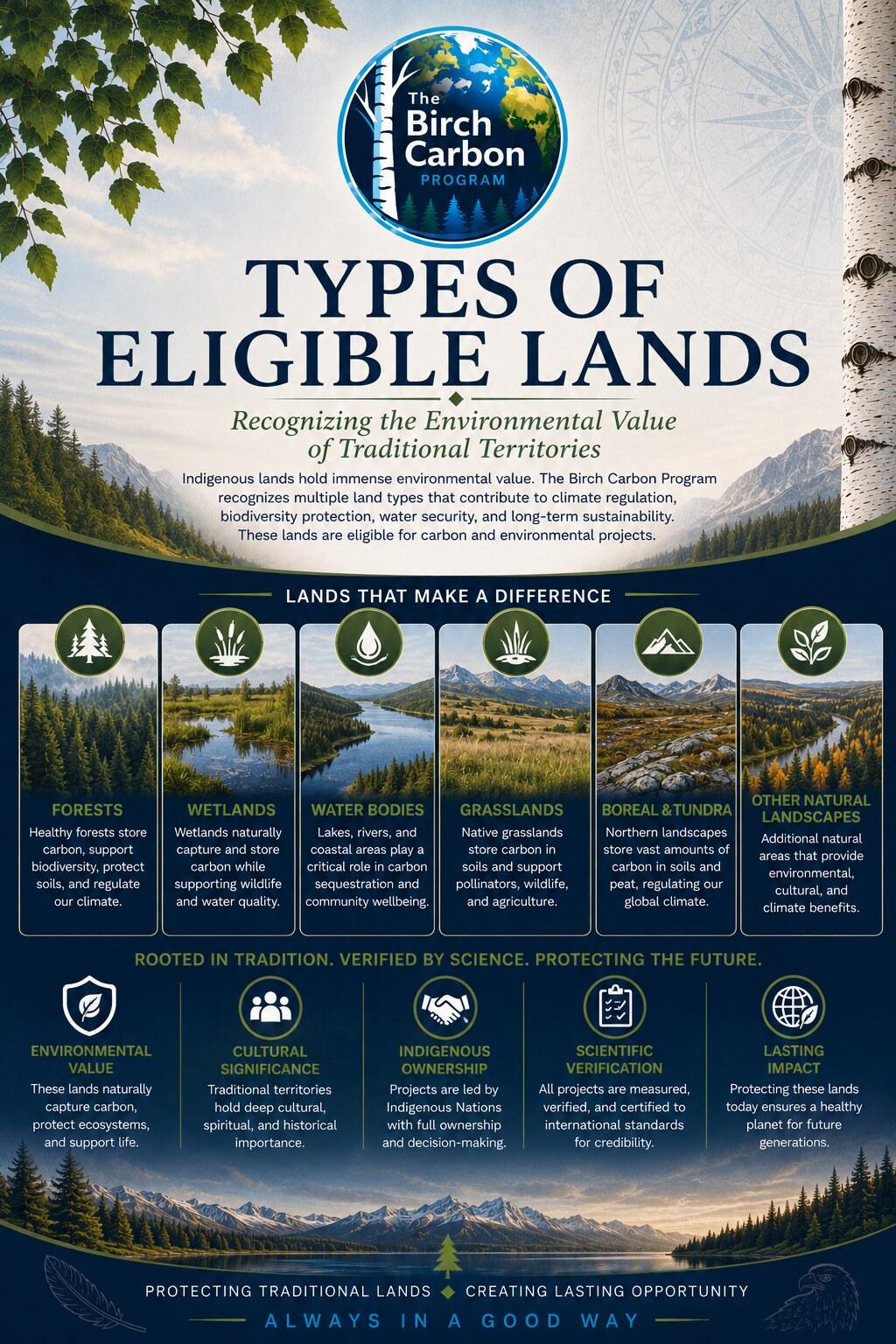
Types of Eligible Lands
Recognizing the Environmental Value of Traditional Territories
Canada is home to some of the world's most important natural ecosystems. Many Indigenous Nations have protected and cared for these lands since time immemorial, preserving forests, wetlands, rivers, lakes, grasslands, and countless other ecosystems that provide benefits far beyond their traditional boundaries.
These landscapes capture and store carbon, support biodiversity, regulate water systems, improve climate resilience, and provide habitat for countless plant and animal species. They also hold profound cultural, spiritual, and historical significance for Indigenous Peoples.
The Birch Carbon Program works with participating Nations to identify lands that may be eligible for carbon, natural capital, biodiversity, and other environmental market opportunities. Every project is evaluated individually using internationally recognized standards, scientific assessment, and the knowledge and guidance of the participating Nation.
Not every parcel of land will qualify, and eligibility depends on many factors, including project methodology, environmental conditions, land management history, and registry requirements. The following examples represent the types of landscapes that may be considered during the assessment process.
Forests
Forests are among the most valuable natural carbon sinks on Earth.
Through photosynthesis, trees remove carbon dioxide (CO₂) from the atmosphere and store it within their trunks, branches, roots, soils, and surrounding vegetation. Healthy forests continue storing carbon for decades and, in many cases, centuries.
Canadian forests also provide numerous additional environmental benefits, including:
Wildlife habitat
Biodiversity protection
Water regulation
Air quality improvement
Soil stabilization
Climate resilience
Cultural and traditional land use
Sustainable harvesting opportunities
Professional assessments examine factors such as forest type, age, species composition, growth rates, historical land use, management practices, and overall ecosystem health when determining potential project eligibility.
Wetlands
Wetlands are among the most productive ecosystems in the world. They naturally store significant amounts of carbon while providing critical environmental services that benefit both local communities and surrounding ecosystems.
Wetlands help:
Store carbon
Reduce flooding
Improve water quality
Recharge groundwater
Filter pollutants
Support biodiversity
Provide wildlife habitat
Protect fish spawning areas
Increase climate resilience
Many Indigenous communities have protected wetlands for generations because of their ecological importance and their role in sustaining traditional harvesting, medicines, fisheries, and wildlife.
Protecting wetlands often produces environmental benefits that extend well beyond the project boundary.
Peatlands
Canada contains some of the largest peatland ecosystems on Earth.
Peatlands develop slowly over thousands of years as partially decomposed plant material accumulates beneath waterlogged conditions. These ecosystems store enormous amounts of carbon below the surface.
Although peatlands may appear quiet or unremarkable, they represent one of the planet's largest long-term carbon storage systems.
When healthy and undisturbed, peatlands:
Store vast quantities of carbon
Support unique biodiversity
Improve water quality
Regulate water flow
Reduce greenhouse gas emissions
Increase climate resilience
Because peatlands are extremely sensitive ecosystems, protecting them can provide significant long-term environmental benefits.
Water Systems
Healthy water systems are essential to both Indigenous cultures and healthy ecosystems. Although lakes, rivers, streams, and watersheds may not always generate carbon credits directly, they often play a critical role in supporting broader environmental projects.
Water systems contribute to:
Healthy forests
Wetland protection
Fish habitat
Wildlife migration
Watershed health
Biodiversity
Climate resilience
Community well-being
Cultural practices
Traditional harvesting
Many environmental markets are expanding beyond carbon to recognize the importance of protecting freshwater resources and watershed ecosystems.
As these markets evolve, water-based environmental opportunities may continue to grow.
Grasslands
Grasslands are often overlooked, yet they represent some of the world's most important natural ecosystems.
Healthy grasslands store significant amounts of carbon below ground within extensive root systems while supporting remarkable biodiversity.
Grasslands also provide:
Wildlife habitat
Pollinator protection
Soil conservation
Water infiltration
Drought resistance
Climate resilience
Sustainable grazing opportunities
Traditional harvesting areas
Protecting native grasslands helps preserve both ecological health and long-term carbon storage.
Conservation Areas
Many Indigenous Nations have established conservation areas to protect environmentally and culturally significant landscapes.
These areas may include:
Protected forests
Wildlife corridors
Cultural sites
Ecological reserves
Watersheds
Sensitive habitats
Species-at-risk areas
Community conservation initiatives
Conservation areas often demonstrate a long-standing commitment to stewardship and environmental protection, making them important considerations during project development. Each conservation area is evaluated according to applicable methodologies and environmental standards.
Traditional Territories
Traditional Territories are the foundation of every Birch Carbon Program project. For Indigenous Peoples, the land is far more than a collection of natural resources. It is the source of identity, culture, language, history, spirituality, and responsibility.
Traditional Territories may include a combination of:
Forests
Wetlands
Peatlands
Lakes
Rivers
Grasslands
Wildlife habitat
Sacred sites
Cultural landscapes
Hunting areas
Fishing areas
Trapping areas
Gathering areas
Travel routes
Historic places
The Birch Carbon Program recognizes that these lands have been cared for through Indigenous stewardship since time immemorial.
The purpose of the program is not to change how the land is owned or governed. Rather, it is to recognize the environmental value that has been created through generations of responsible stewardship while supporting communities in protecting these lands for future generations. Every project begins with respect for the Nation's relationship with its Traditional Territory.
Every Nation Is Unique
No two Indigenous Nations are the same, and no two projects will be identical.
The types of eligible lands, environmental opportunities, project boundaries, and stewardship priorities will differ from one community to another.
Professional assessments consider:
Ecosystem type
Land condition
Environmental integrity
Carbon storage potential
Biodiversity values
Water systems
Traditional land use
Existing conservation efforts
Registry requirements
Community priorities
The goal is not to fit every Nation into a standard model, but to develop projects that reflect each community's unique lands, knowledge, and long-term vision.
Stewardship Creates Opportunity
For generations, Indigenous Nations have protected Canada's forests, wetlands, peatlands, grasslands, waterways, and countless other ecosystems through responsible stewardship. Today, environmental markets increasingly recognize the value of these natural systems and the leadership that has preserved them.
The Birch Carbon Program helps participating Nations identify eligible environmental assets, evaluate opportunities using internationally recognized standards, and build projects that protect Traditional Territories while creating lasting environmental, cultural, and economic benefits for future generations.
KEY TAKEAWAY
Forests, wetlands, peatlands, water systems, grasslands, conservation areas, and Traditional Territories may all be considered. Every project is evaluated individually using internationally recognized standards.
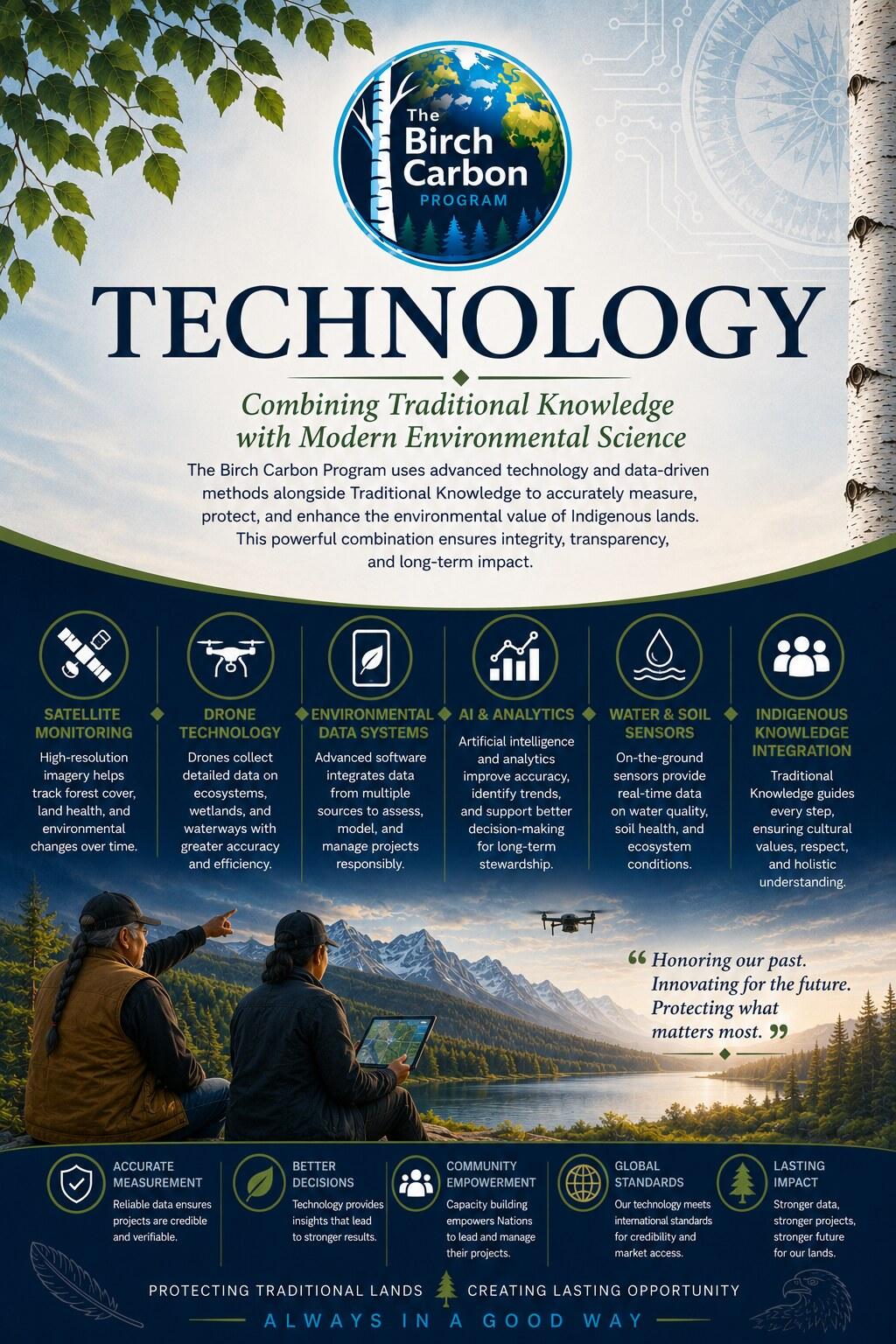
Technology
Combining Traditional Knowledge with Modern Environmental Science
The Birch Carbon Program brings together two powerful sources of knowledge: the generations of stewardship and Traditional Knowledge held by Indigenous Nations, and the advanced technologies used by today's environmental scientists. Neither replaces the other.
Traditional Knowledge provides an understanding of the land that has been developed over thousands of years through lived experience, observation, and cultural connection. Modern technology provides highly accurate scientific tools that help measure, monitor, and verify environmental conditions at a scale that would otherwise be impossible.
Together, they create a stronger, more complete understanding of the landscape and ensure that every project is developed to internationally recognized standards while respecting Indigenous leadership and community knowledge.
Technology plays an important role throughout every stage of the Birch Carbon Program—from the initial assessment through long-term monitoring and reporting.
Satellite Imagery
Satellite imagery provides an accurate, large-scale view of the landscape from space. Modern Earth-observation satellites continuously collect high-resolution imagery that allows environmental professionals to assess forests, wetlands, waterways, and other natural ecosystems over vast areas.
Satellite imagery helps project teams:
Identify land cover and vegetation.
Map forests, wetlands, lakes, and rivers.
Monitor changes over time.
Detect wildfire impacts.
Observe storm damage.
Identify areas of disturbance.
Measure vegetation growth.
Support long-term environmental monitoring.
Because satellites collect information regularly, project teams can compare current conditions with historical imagery to better understand how the landscape has changed over time.
Satellite imagery provides an efficient, non-invasive way to monitor large Traditional Territories while minimizing disruption to the land.
Geographic Information Systems (GIS)
A Geographic Information System (GIS) is one of the most important tools used in environmental project development.
GIS combines maps, aerial imagery, environmental information, and scientific data into a single digital platform that allows specialists to analyze landscapes with exceptional accuracy. Using GIS, environmental professionals can:
Define project boundaries.
Measure land areas.
Identify ecosystem types.
Map forests and wetlands.
Locate peatlands.
Analyze watersheds.
Study wildlife habitat.
Evaluate biodiversity.
Review historical land use.
Overlay multiple environmental datasets.
Produce detailed project maps.
GIS allows large amounts of information to be organized into clear, accurate maps that support planning, scientific analysis, and community decision-making.
LiDAR (Light Detection and Ranging)
LiDAR is one of the most advanced technologies available for measuring forests and landscapes. Using laser pulses emitted from aircraft or drones, LiDAR creates highly detailed threedimensional maps of the Earth's surface.
Unlike traditional aerial photography, LiDAR can measure:
Tree height.
Forest density.
Forest structure.
Ground elevation.
Terrain features.
Water flow patterns.
Vegetation layers.
Canopy cover.
These measurements help environmental professionals better estimate forest biomass and carbon storage while improving the accuracy of project assessments.
LiDAR provides information that is often impossible to collect efficiently using traditional ground surveys alone.
Remote Sensing
Remote sensing refers to the collection of environmental information without physically disturbing the landscape.
Using satellites, aircraft, drones, sensors, and other technologies, specialists can monitor environmental conditions over very large areas while reducing the need for extensive field work.
Remote sensing supports:
Forest monitoring.
Wetland assessment.
Peatland analysis.
Vegetation health.
Water monitoring.
Wildlife habitat evaluation.
Climate observations.
Land-use analysis.
Change detection.
Carbon modelling.
Remote sensing allows environmental professionals to observe long-term changes that may occur over months, years, or even decades.
This technology is particularly valuable when working across large Traditional Territories that would otherwise require enormous amounts of time and resources to survey on the ground.
Field Verification
While advanced technology provides valuable information, there is no substitute for visiting the land itself.
Field verification is an essential part of every professional assessment.
Qualified environmental specialists conduct on-site visits to confirm that the information collected through satellite imagery, GIS, LiDAR, and remote sensing accurately reflects actual conditions.
Field verification may include:
Forest measurements.
Tree inventories.
Vegetation surveys.
Soil assessment.
Wetland observations.
Wildlife habitat evaluation.
Water quality observations.
GPS data collection.
Photographic documentation.
Environmental sampling.
Whenever appropriate, Traditional Knowledge shared by Elders, Knowledge Keepers, Land Guardians, and community members provides valuable insight that complements scientific observations and helps build a more complete understanding of the landscape. Field verification strengthens both the accuracy and credibility of the project.
Professional Auditing
Every Birch Carbon Program project is supported by a comprehensive professional audit. The audit is conducted by qualified specialists using internationally recognized scientific methods and environmental standards.
Professional auditing may involve experts in:
Forestry. Ecology. Carbon accounting. Wetlands.
Peatlands.
Hydrology.
Soil science.
Biodiversity.
Geographic Information Systems (GIS).
Remote sensing.
Environmental law.
Climate science.
Indigenous engagement.
The audit carefully evaluates whether a project satisfies the technical, environmental, and regulatory requirements necessary to proceed through validation, verification, registration, and eventual carbon credit issuance.
Independent auditing helps ensure that every project is scientifically sound, environmentally responsible, and capable of meeting international market expectations.
Long-Term Monitoring
Environmental stewardship does not end once a project is registered.
Carbon and natural capital projects require continuous monitoring to ensure they continue delivering the environmental benefits upon which they are based.
Long-term monitoring may include:
Updated satellite imagery.
GIS analysis.
LiDAR surveys, where appropriate.
Remote sensing.
Field inspections.
Forest health monitoring.
Wildlife observations.
Biodiversity assessments.
Wetland and peatland monitoring.
Water quality observations.
Registry reporting.
Independent verification.
Monitoring allows project teams to identify changes early, respond to environmental events, maintain compliance with registry requirements, and support future carbon credit issuances.
In many cases, community members, Indigenous Guardians, and local environmental staff play an important role in this ongoing stewardship, combining local knowledge with professional environmental science.
Technology Supporting Indigenous Stewardship
Technology is an important tool—but it is not the foundation of the Birch Carbon Program.
The true strength of every project comes from the generations of Indigenous stewardship that have protected these lands long before modern technology existed.
Satellite imagery, GIS, LiDAR, remote sensing, professional auditing, and environmental monitoring help measure and verify the environmental value of the land. Traditional Knowledge helps explain the relationships, history, and stewardship practices that cannot be measured by technology alone.
Together, Indigenous knowledge and modern science create a powerful partnership—one that supports transparent decision-making, internationally recognized environmental standards, and long-term protection of Canada's forests, wetlands, peatlands, waterways, grasslands, and Traditional Territories.
The Birch Carbon Program embraces both perspectives, recognizing that the future of environmental stewardship is strongest when traditional wisdom and modern technology work together in partnership.
KEY TAKEAWAY
Satellite imagery, GIS, LiDAR, and remote sensing measure and verify the environmental value of the land. Traditional Knowledge explains the relationships, history, and stewardship practices that technology alone cannot measure.
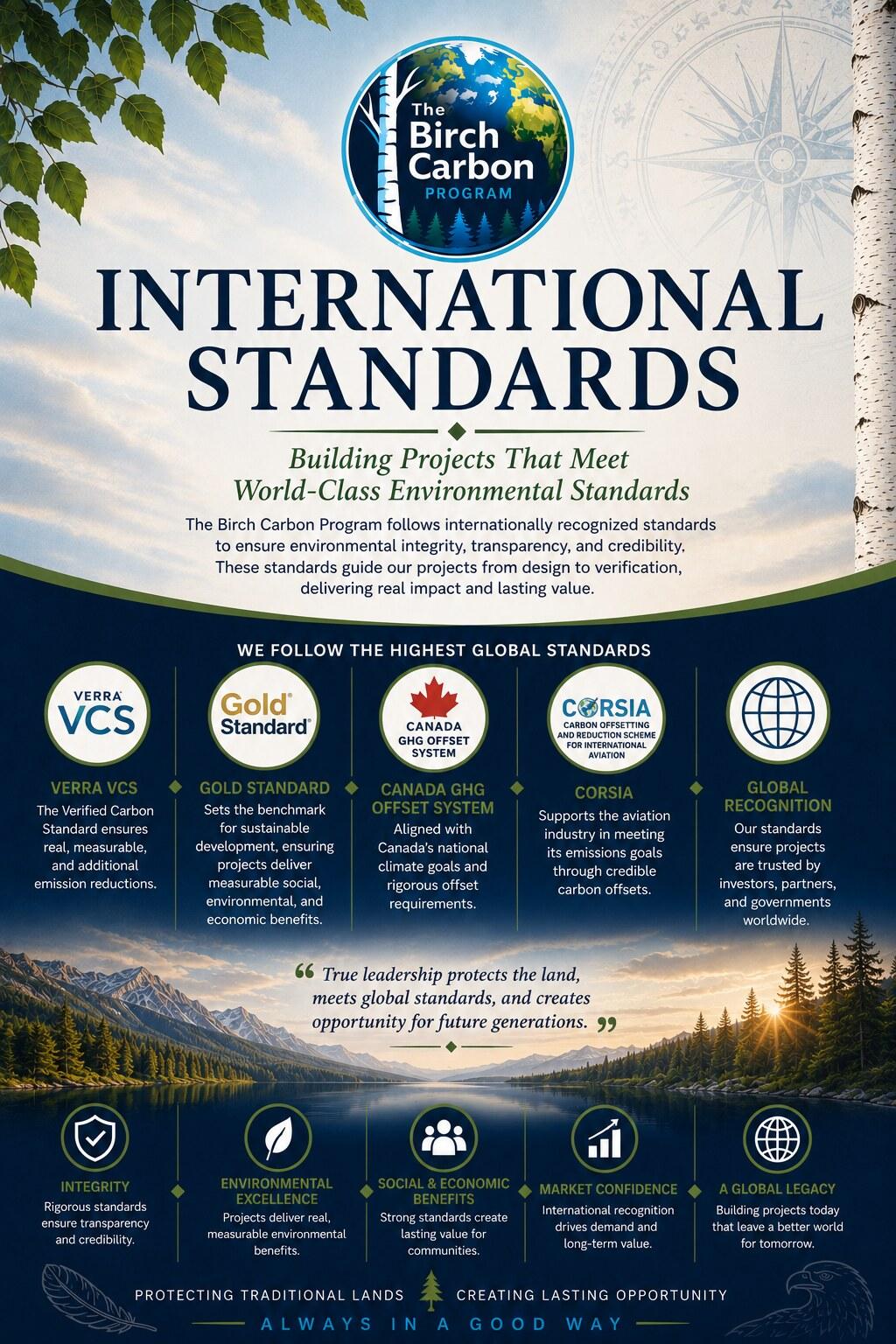
International Standards
Building Projects That Meet World-Class Environmental Standards
One of the most important parts of developing a carbon project is ensuring that it meets recognized international standards.
These standards establish the scientific, technical, and environmental rules used to measure carbon, verify project results, issue carbon credits, and maintain confidence in the marketplace.
Simply put, these organizations help answer an important question:
"Can buyers trust that the carbon credits represent real, measurable, and independently verified environmental benefits?"
By following internationally recognized standards, carbon projects gain credibility with governments, businesses, investors, and organizations around the world.
The Birch Carbon Program is committed to developing projects that meet the highest applicable standards while respecting Indigenous leadership, community ownership, and environmental integrity.
Why Standards Matter
Imagine purchasing a product without knowing whether it had been tested or inspected. Most people would want proof that the product was genuine and met accepted quality standards.
Carbon credits work in much the same way.
Independent standards ensure that every eligible carbon credit has been developed using recognized scientific methods, carefully reviewed by qualified experts, and independently verified before it reaches the marketplace.
These standards help protect everyone involved by providing:
Scientific credibility
Environmental integrity
Independent oversight
Market confidence
Transparency
Consistency
International recognition
Without recognized standards, buyers would have little confidence that carbon credits represent real environmental benefits.
Verra
Verra is one of the world's largest and most widely recognized organizations for developing and managing carbon credit standards.
Its flagship program, the Verified Carbon Standard (VCS), is used by thousands of environmental projects around the world.
Verra provides detailed rules that explain:
How carbon is measured.
How projects are designed.
How environmental benefits are calculated.
How projects are independently reviewed.
How carbon credits are issued.
How projects are monitored over time.
Every project developed under Verra must undergo rigorous independent validation and verification before carbon credits can be issued.
Verra also maintains a public registry that tracks every issued carbon credit from creation through retirement, helping prevent duplication and ensuring transparency.
For many organizations around the world, Verra represents one of the highest levels of credibility in the voluntary carbon market.
Gold Standard
The Gold Standard is another internationally respected environmental certification program. Originally developed with the support of the World Wide Fund for Nature (WWF) and other international organizations, the Gold Standard was created to ensure that environmental projects deliver benefits beyond carbon reduction alone.
While reducing greenhouse gas emissions remains important, Gold Standard projects are also evaluated for their positive impacts on people and communities.
Projects developed under the Gold Standard often consider:
Climate action
Biodiversity
Water resources
Community well-being
Sustainable development
Environmental protection
Social benefits
For Indigenous-led projects, this broader perspective can be especially meaningful because stewardship often supports environmental, cultural, social, and economic values at the same time.
Gold Standard helps recognize that protecting nature is about much more than carbon alone.
Canada's Greenhouse Gas Offset Credit System
Canada has developed its own national framework for greenhouse gas offset credits, known as the Canada Greenhouse Gas Offset Credit System.
This federal system establishes rules for creating eligible offset projects that support Canada's climate objectives.
Projects developed under this framework must meet strict requirements established by the Government of Canada, including:
Accurate measurement
Scientific documentation
Independent verification
Ongoing monitoring
Transparent reporting
Regulatory compliance Where applicable, eligible projects developed under Canadian standards may contribute to national greenhouse gas reduction efforts while supporting environmental stewardship within Canada.
As Canada's climate policies continue to evolve, this system may create additional opportunities for eligible Indigenous-led projects.
Independent Validation and Verification
Regardless of which standard is used, every high-quality carbon project follows the same basic principle:
The project must be independently reviewed.
This means qualified professionals who were not involved in developing the project carefully examine the work to ensure that it meets all required standards.
Independent reviewers confirm that:
Scientific methods have been correctly applied.
Carbon calculations are accurate.
Environmental benefits are measurable.
Project documentation is complete.
Monitoring plans meet required standards.
Registry requirements have been satisfied.
Only after this independent review can eligible carbon credits be issued. This process protects the credibility of both the project and the carbon market.
Choosing the Right Standard
Not every carbon project uses the same standard.
The most appropriate standard depends on several factors, including:
The type of project.
The environmental assets involved.
Project location.
Applicable regulations.
Buyer requirements.
Market opportunities.
Registry eligibility.
Long-term project goals.
Professional specialists evaluate each project carefully to determine which recognized standard or registry is most appropriate for the participating Nation.
The goal is always to select the framework that best supports the community's objectives while maintaining the highest levels of scientific integrity and market credibility.
Building Confidence Through International Standards
International standards are not simply administrative requirements—they are an important part of building trust.
They help ensure that carbon credits are:
Scientifically measured.
Independently verified.
Transparently managed.
Internationally recognized.
Environmentally credible.
Market-ready.
By developing projects that meet respected international and Canadian standards, the Birch Carbon Program helps participating Nations demonstrate the quality, integrity, and environmental value of their stewardship to buyers across Canada and around the world.
These standards provide confidence that every eligible carbon credit represents a genuine environmental benefit—one that has been carefully measured, independently reviewed, and developed with respect for both science and Indigenous leadership.
KEY TAKEAWAY
Independent standards such as Verra, Gold Standard, and Canada's Greenhouse Gas Offset Credit System ensure that every eligible carbon credit represents a genuine, independently verified environmental benefit.
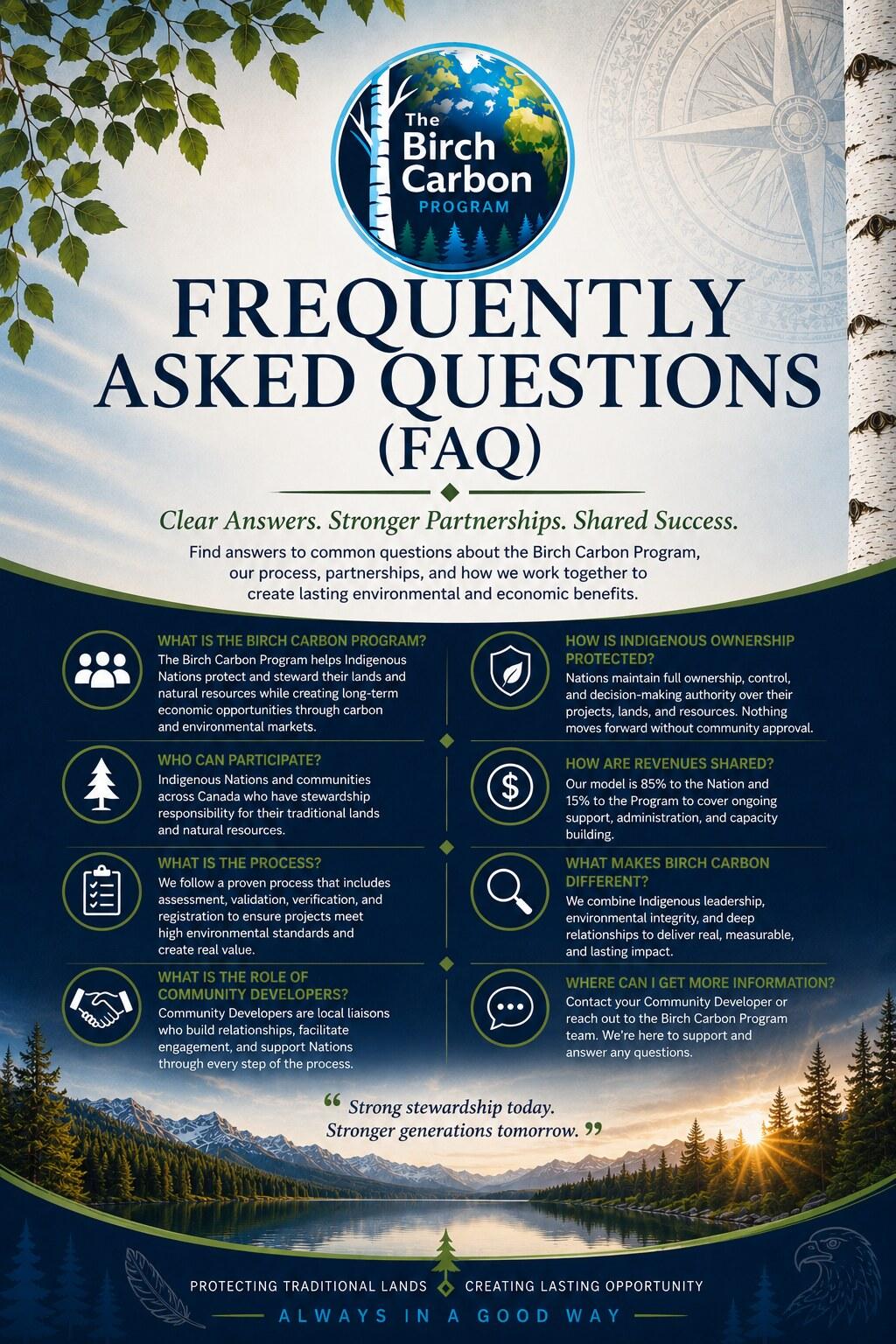
Frequently Asked Questions
Clear Answers to the Questions Communities Ask Most
The following questions are among the most common questions asked by Chiefs and Council, Economic Development Corporations, Lands Departments, Elders, Knowledge Keepers, and community members when first learning about the Birch Carbon Program.
1 What is the Birch Carbon Program?
The Birch Carbon Program is an Indigenous-led environmental initiative that helps First Nations identify, develop, and manage carbon and natural capital projects on their Traditional Territories. The program combines Indigenous stewardship, Traditional Knowledge, and modern environmental science to create long-term environmental, cultural, and economic opportunities while respecting community ownership and governance.
2 Why was the Birch Carbon Program created?
The program was created to recognize the environmental value of Indigenous stewardship and to help participating Nations access emerging environmental markets without giving up ownership or control of their lands. It provides communities with professional expertise, technical support, and access to recognized carbon standards while ensuring Indigenous leadership remains at the centre of every project.
3 Who is the Birch Carbon Program designed for?
The program is designed primarily for First Nations and Indigenous communities that wish to explore opportunities related to carbon credits, natural capital, biodiversity, conservation, and long-term environmental stewardship.
4 Is participation mandatory? No.
Participation is entirely voluntary.
Every Nation decides whether it wishes to explore the opportunity, continue through project development, or proceed with future stages. Nothing moves forward without community approval.
5 Does joining the Birch Carbon Program mean we must complete a project? No.
The early stages of the program are designed to provide information and allow the Nation to evaluate whether the opportunity is right for the community before making long-term decisions.
6 Who owns the project?
The participating Nation owns the project.
The Birch Carbon Program provides professional expertise, project management, technical services, and market access, but the project remains the Nation's project.
7 Who owns the land?
The Nation continues to own and govern its Traditional Territory. Nothing within the Birch Carbon Program transfers ownership of land, Treaty Rights, Aboriginal Rights, or jurisdiction to the Birch Carbon Program, investors, buyers, or any other organization.
8 Does the Birch Carbon Program purchase our land? No.
The Birch Carbon Program does not purchase land and does not acquire ownership of any Traditional Territory.
The program exists to help communities recognize and develop environmental opportunities while respecting Indigenous ownership and governance.
9 Will our Treaty Rights or Aboriginal Rights be affected? No.
Participation in the Birch Carbon Program does not remove, reduce, replace, or alter existing Treaty Rights, Aboriginal Rights, or Indigenous governance.
Communities continue exercising their rights and responsibilities in accordance with applicable laws, Treaties, and their own governance systems.
10 Does the program affect our self-government? No.
Community leadership continues making decisions regarding its lands, governance, and future. The Birch Carbon Program supports community decision-making but never replaces it.
11 Who makes the decisions throughout the project?
The participating Nation makes the decisions.
The Birch Carbon Program provides professional recommendations and technical expertise, but every significant decision remains with the Nation.
12 Can we ask questions before making a decision? Absolutely.
Communities are encouraged to ask as many questions as necessary, request additional information, consult legal advisors, speak with technical experts, and take the time needed before making any decisions.
There is no expectation that decisions be made quickly.
13 Does the program respect our community's decision-making process?
Yes.
Every Indigenous Nation has its own governance structure, traditions, and approval processes.
The Birch Carbon Program respects these differences and works with each Nation according to its own governance and decision-making practices.
14 What if our Chief and Council changes after an election?
Leadership changes are a normal part of community governance.
The Birch Carbon Program continues working with the Nation through its current leadership while respecting all agreements and ensuring that newly elected leaders receive the information necessary to understand the project and make informed decisions.
15 Is there any upfront cost to participate?
No.
The Birch Carbon Program is designed so that participating Nations are not required to provide the upfront capital needed to develop eligible projects.
Professional project development is supported through the program's financial model.
16 Why doesn't the Nation have to pay upfront?
Developing internationally recognized carbon projects requires specialized expertise and significant financial investment.
Rather than asking communities to assume these costs before a project is established, private investment supports the development process, allowing Nations to participate without major upfront financial commitments.
17 How long does it take to develop a project?
Every project is different.
The timeline depends on project size, environmental conditions, technical requirements, community approvals, registry processes, and independent validation and verification.
The Birch Carbon Program works collaboratively with each Nation to develop realistic timelines and maintain regular communication throughout the process.
18 Is this a short-term project?
No.
Carbon projects are long-term environmental stewardship initiatives.
The Birch Carbon Program is designed around a minimum project commitment of ten (10) years, providing the stability needed for environmental planning, project management, monitoring, and long-term revenue opportunities.
Many projects may continue beyond the initial term if the participating Nation chooses to extend the relationship and the project continues to meet applicable standards.
19 Can a project end before the agreement expires?
Projects are developed as long-term partnerships because environmental markets require stability, ongoing stewardship, and continued monitoring.
If exceptional circumstances arise, they are addressed in accordance with the project's governing agreements, applicable registry requirements, and the agreed decision-making process between the participating Nation and the Birch Carbon Program.
Every situation is evaluated individually while respecting the Nation's leadership and the commitments established within the agreement.
20 Can our community leave after the initial project term?
Yes.
As the initial project term approaches completion, the participating Nation will have the opportunity to review the project's performance, environmental outcomes, financial results, and future opportunities.
Any decision regarding continuation, renewal, or conclusion of the project will be made in accordance with the governing agreements and through the Nation's own decision-making process.
21 Will our community lose control over the project? No.
Community control remains one of the fundamental principles of the Birch Carbon Program. The Nation continues making decisions regarding its land, stewardship priorities, governance, and project participation throughout the life of the project.
22 Who can participate in the project?
Each Nation determines who participates.
This may include:
Chief and Council
Lands Departments
Economic Development Corporations
Environmental staff
Elders
Knowledge Keepers
Indigenous Guardians
Youth
Technical advisors
Other authorized community representatives
Participation is determined by the Nation—not the Birch Carbon Program.
23 What is the Birch Carbon Program's role?
The Birch Carbon Program provides:
Project management
Environmental expertise
Professional specialists
Technical assessments
Carbon project development
Registry support
Market access
Financial coordination
Community support
Long-term project administration
The program does not replace Indigenous leadership or community governance.
24 Why are independent experts involved?
International carbon projects require scientific accuracy and independent verification.
Qualified specialists help ensure that projects meet recognized environmental standards, allowing buyers to have confidence in the environmental benefits represented by each carbon credit.
Independent experts strengthen the credibility of the project while supporting transparency and accountability.
25 Why should our Nation consider participating?
Every Nation will make its own decision based on its priorities, values, and long-term vision.
For communities interested in exploring environmental opportunities, the Birch Carbon Program offers a structured pathway that combines Indigenous leadership, Traditional Knowledge, scientific expertise, and internationally recognized standards.
The program is designed to help participating Nations:
Protect Traditional Territories.
Recognize the environmental value of Indigenous stewardship.
Create potential long-term economic opportunities.
Support environmental conservation.
Strengthen community capacity.
Build partnerships founded on transparency, respect, and community ownership.
Ultimately, the decision to participate always rests with the Nation.
Frequently Asked Questions (FAQ)
PART 2
Land, Treaty Rights, Traditional Activities & Community Governance
This section answers many of the questions communities ask about how a carbon project may relate to their lands, governance, Treaty Rights, and traditional way of life.
26 Does participating in the Birch Carbon Program affect our Treaty Rights? No.
Participation in the Birch Carbon Program does not remove, reduce, modify, or replace any Treaty Rights or Aboriginal Rights.
The program is designed to work alongside existing rights and responsibilities while respecting the Nation's governance and legal authority.
27 Does the project affect our Aboriginal Rights? No.
The Birch Carbon Program recognizes and respects the Aboriginal Rights of every participating Nation.
Nothing within the program transfers, limits, or diminishes those rights.
28 Does participating affect our sovereignty or self-government? No.
Every Nation continues to govern its Traditional Territory according to its own leadership, governance structure, and decision-making processes. Community authority remains unchanged.
29 Will the Birch Carbon Program own our Traditional Territory? No.
The Birch Carbon Program never owns the land.
The Nation retains ownership, governance, jurisdiction, and responsibility for its Traditional Territory throughout the life of the project.
30 Will investors own our land? No.
Private investors provide financial support for project development. They do not receive ownership of the Nation's land, Treaty Rights, Aboriginal Rights, governance, or Traditional Territory.
31 Do carbon credit buyers own our land?
No.
Purchasing carbon credits does not transfer ownership of land. A buyer purchases verified environmental credits—not the land itself.
The Nation continues to own and govern its Traditional Territory.
32 Can we continue hunting? Yes.
Traditional hunting activities are generally expected to continue. The Birch Carbon Program is designed to support Indigenous stewardship rather than prevent traditional land use.
Any project-specific considerations would be discussed with the Nation during project planning to ensure activities remain consistent with the project's environmental objectives and applicable standards.
33 Can we continue trapping?
Yes.
Traditional trapping activities are generally expected to continue.
The Birch Carbon Program recognizes that trapping is an important cultural, traditional, and economic activity for many Indigenous communities.
Projects are developed with respect for these longstanding practices.
34 Can we continue fishing? Yes.
Traditional fishing activities are generally expected to continue.
Protecting healthy watersheds, wetlands, and aquatic ecosystems often supports long-term fisheries and environmental sustainability.
35 Can we continue gathering traditional medicines? Yes.
Gathering medicines, berries, plants, and other traditional resources remains an important part of Indigenous stewardship.
Projects are developed to protect the health of these ecosystems, not prevent responsible traditional use.
36 Can we continue cultural and ceremonial activities?
Absolutely.
The Birch Carbon Program recognizes that Traditional Territories hold deep cultural, spiritual, and historical significance.
Ceremonies, cultural practices, and community traditions continue to be respected throughout the life of the project.
37 Can Elders and Knowledge Keepers continue accessing the land?
Yes.
The knowledge and guidance of Elders and Knowledge Keepers remain valuable throughout every stage of the project.
Their continued connection to the land is respected and encouraged.
38 Can community members continue using the land?
Generally, yes.
Traditional community use of the land continues in accordance with community governance, project objectives, and applicable agreements.
The Birch Carbon Program is intended to complement Indigenous stewardship—not replace it.
39 Can we still harvest timber?
Potentially, yes.
Every project is different.
Some carbon project methodologies allow carefully planned forest management activities, while others may place limitations on harvesting within specific project areas.
During project development, professional specialists work with the Nation to identify what activities are compatible with the selected methodology and the community's long-term goals.
The Nation remains involved in those decisions throughout the planning process.
40 Can we still build homes or community infrastructure?
Yes.
Communities continue planning for housing, schools, health facilities, roads, utilities, and other community priorities.
Where proposed development may affect a specific project area, it can be reviewed during project planning to ensure it is managed appropriately.
41 Can we still build roads?
Yes.
Infrastructure projects remain under the Nation's authority.
Where proposed roads intersect with a carbon project area, planning and environmental review help ensure that both community development and project objectives can be considered together.
42 Can we still pursue economic development?
Absolutely.
The Birch Carbon Program is intended to become one component of a Nation's broader economic development strategy.
Communities remain free to pursue business opportunities, tourism, renewable energy, housing, infrastructure, conservation, and many other initiatives.
43 What if our community discovers new economic opportunities?
The Nation continues making decisions regarding future opportunities.
If proposed activities may affect a project area, they can be evaluated collaboratively to understand any environmental or project implications before decisions are made.
The objective is to support informed decision-making rather than restrict community growth.
44 Who decides how the land is managed?
The Nation does.
Community leadership continues making decisions regarding stewardship, conservation, environmental management, and future planning.
The Birch Carbon Program provides technical advice, but final decisions remain with the Nation.
45 Can project boundaries be adjusted?
In some situations, yes.
Project boundaries are established during professional project development and are based on environmental, technical, and registry requirements.
If adjustments become necessary, they are evaluated according to applicable standards and in consultation with the participating Nation.
46 Can more land be added later?
Potentially.
Additional lands may be evaluated in the future if they satisfy technical requirements, registry rules, and community objectives.
Each proposed expansion would require its own assessment and approval process.
47 Can the project include only part of our Traditional Territory? Yes.
Many projects involve only specific portions of a Nation's Traditional Territory.
The project boundary is determined through professional assessment and community discussion based on environmental suitability and long-term objectives.
48 Who approves each major step of the project?
The participating Nation.
Major project milestones—including project development, agreements, professional assessments, registration, and future project decisions—proceed through the Nation's established governance and approval processes.
Nothing moves forward without community authorization.
49 What happens if our community wants additional information before making a decision?
That is encouraged.
Communities are welcome to request additional meetings, technical presentations, legal review, environmental information, financial explanations, or discussions with Birch Carbon Program representatives before making decisions.
The program believes informed decisions create stronger long-term partnerships.
50 What if our community decides not to proceed?
That decision is respected.
Participation in the Birch Carbon Program is voluntary.
If the Nation determines that the project is not aligned with its priorities, leadership may decide not to proceed before entering into a long-term project agreement.
The Birch Carbon Program respects every Nation's right to make decisions that reflect its own values, governance, and long-term vision.
Frequently Asked Questions (FAQ)
This section answers many of the most common questions about carbon credits, project financing, revenue generation, ownership, and how the Birch Carbon Program's financial model works.
51 What is a carbon credit?
A carbon credit is a certified environmental asset that generally represents one metric tonne (1 tonne) of carbon dioxide equivalent (CO₂e) that has been removed from the atmosphere or prevented from being released.
Carbon credits are created only after a project has been professionally developed, independently validated, independently verified, and registered under an approved carbon standard.
52 Who owns the carbon credits?
The ownership of carbon credits is established through the agreements entered into between the participating Nation and the Birch Carbon Program.
Those agreements clearly define the rights, responsibilities, and interests of each party before project development begins.
Nothing proceeds without the Nation understanding and approving the applicable agreements.
53 Are carbon credits the same as selling our land? No.
A carbon credit represents a verified environmental benefit—not ownership of land. Selling carbon credits does not transfer ownership of the Nation's Traditional Territory, Treaty Rights, Aboriginal Rights, or governance.
The Nation continues to own and control its land.
54 Who buys carbon credits?
Potential buyers may include:
Municipal governments
Provincial and territorial governments
The Government of Canada
Large Canadian businesses
Utilities
Financial institutions
International corporations
Airlines
Investment funds
Organizations with climate commitments
The Birch Carbon Program follows a Canada-First Market Strategy, meaning Canadian opportunities are explored before credits are offered internationally.
55 Why would someone buy carbon credits?
Many organizations have committed to reducing their environmental impact.
Purchasing verified carbon credits may help them:
Support climate commitments.
Meet sustainability goals.
Reduce environmental impacts.
Demonstrate corporate responsibility.
Participate in recognized carbon markets.
56 Who decides when carbon credits are sold?
Carbon credit sales are conducted in accordance with the project agreements established between the participating Nation and the Birch Carbon Program.
The Nation remains informed throughout the sales process, and all transactions follow the agreed governance, reporting, and approval framework.
57 Can we choose who buys our credits?
Buyer selection depends on the applicable agreements, market conditions, and project structure.
The Birch Carbon Program works to identify responsible purchasers whose objectives align with recognized environmental markets while following the Canada-First Market Strategy.
58 Why does the Birch Carbon Program focus on Canadian buyers first?
The program believes the environmental value created through Indigenous stewardship should first benefit Canada whenever possible.
Credits are first presented to:
Local organizations
Municipal governments
Provincial or territorial governments
The Government of Canada
Only after Canadian opportunities have been reasonably explored may credits be offered to qualified international buyers.
59 What happens if Canada does not purchase the credits?
If Canadian purchasing opportunities are not available, the Birch Carbon Program may present eligible credits to qualified international buyers.
International demand for high-quality carbon credits continues to grow, providing additional opportunities for participating Nations.
60 How much are carbon credits worth?
There is no fixed price.
Carbon credit values change over time depending on factors such as:
Market demand
Project quality
Registry
Buyer requirements
Carbon market conditions
Environmental co-benefits
Project location
No specific future price can be guaranteed.
61 How is revenue generated?
Revenue is generated only after:
The project is professionally developed.
Independent validation is completed.
Independent verification is completed.
The project is registered.
Carbon credits are issued.
Carbon credits are successfully sold.
Revenue depends on successful project development and market demand.
62 Is revenue guaranteed?
No.
Like any environmental market, carbon markets fluctuate over time.
Revenue depends on:
Project performance
Registry requirements
Independent verification
Market demand
Carbon prices
Buyer interest
Applicable laws and regulations
The Birch Carbon Program cannot guarantee future revenues or market prices.
63 Is there an upfront cost to our Nation?
No.
The Birch Carbon Program's financial model is designed so participating Nations are not required to provide the upfront capital needed to develop eligible projects.
64 Who pays for project development?
Project development is supported through private investment arranged by the Birch Carbon Program.
These funds help cover the professional work required to develop projects to internationally recognized standards.
65 What does private investment pay for?
Private investment may support:
Professional audits
Carbon modelling
Scientific studies
GIS mapping
Validation
Verification
Registry fees
Technical documentation
Project management
This removes a significant financial barrier for participating Nations.
66 How are investors repaid?
The repayment of project development costs is governed by the agreements established before project development begins.
Those agreements clearly explain how development funding is recovered and how revenue is distributed once carbon credits are successfully sold.
The Nation receives full disclosure of these arrangements before making a commitment.
67 How is revenue shared?
Revenue sharing is determined through the formal agreements between the participating Nation and the Birch Carbon Program.
These agreements clearly define:
Revenue distribution
Cost recovery
Financial reporting
Payment processes
Responsibilities of each party
Transparency is a core principle of the program.
68 When does the Nation begin receiving revenue?
Revenue may begin only after:
Carbon credits have been issued.
Credits have been successfully sold.
Applicable project costs have been addressed in accordance with the governing agreements.
Project development takes time, and revenue timelines vary depending on each project's circumstances.
69 Will revenue be received every year?
Many carbon projects are designed to create the opportunity for recurring revenue through ongoing monitoring and future carbon credit issuances.
However, annual revenue depends on:
Project performance
Verification results
Market demand
Carbon prices
Registry requirements
Successful sales
Annual revenue cannot be guaranteed.
70 Can revenue be used for any community purpose?
Revenue belongs to the participating Nation in accordance with the governing agreements. How revenue is ultimately allocated within the community is determined by the Nation's own leadership, governance, and priorities.
Many communities may choose to support initiatives such as:
Housing Education
Elder programs
Youth programs
Infrastructure
Environmental stewardship
Economic development
Cultural initiatives
71 Will we receive financial reports?
Yes.
Transparency is fundamental to the Birch Carbon Program.
Communities receive reporting that may include:
Credits issued
Credits sold
Sale information
Project costs
Revenue distributions
Financial summaries
Payment records
72 Who audits the financial side of the project?
Financial reporting is completed in accordance with the project agreements and applicable accounting requirements.
Professional financial oversight helps ensure transparency and accountability throughout the project.
73 Does the Birch Carbon Program make money only if the project succeeds?
The Birch Carbon Program is committed to developing successful, long-term projects that create environmental and economic value for participating Nations.
The program's financial arrangements are established through written agreements that clearly explain how project development, cost recovery, and revenue sharing are managed.
Communities receive these agreements before making any long-term commitment.
74 What happens if carbon markets change in the future?
Environmental markets continue to evolve.
The Birch Carbon Program monitors changes in carbon markets, government policy, international standards, and buyer demand to help participating Nations adapt to changing market conditions whenever appropriate.
75 Why does the Birch Carbon Program use a long-term financial model?
Carbon projects are not designed as short-term investments.
Healthy forests, wetlands, peatlands, and other ecosystems require long-term stewardship to maintain their environmental value.
The Birch Carbon Program's long-term financial model reflects that reality by supporting stable project development, ongoing monitoring, recurring opportunities for carbon credit issuance, and the potential for long-term economic benefits while respecting Indigenous ownership, community governance, and environmental stewardship.
Frequently Asked Questions (FAQ)
This section answers many of the questions communities ask about how projects are managed over time, including environmental monitoring, natural events, reporting, and long-term stewardship responsibilities.
76 What happens after the project is registered?
Registration is not the end of the project—it is the beginning of its long-term stewardship phase.
Following registration, the project enters an ongoing cycle of environmental monitoring, reporting, verification, and stewardship to ensure it continues to meet the requirements of the applicable carbon standard.
This long-term approach helps protect both the environmental integrity of the project and the Nation's long-term interests.
77 Why is long-term monitoring necessary?
Carbon projects are based on measurable environmental benefits that continue over many years.
Monitoring helps demonstrate that forests, wetlands, peatlands, and other eligible ecosystems continue to deliver those environmental benefits while meeting the requirements of the applicable carbon standard.
Monitoring also supports future carbon credit issuances where applicable.
78 What does environmental monitoring include?
Monitoring may include:
Satellite imagery
Geographic Information System (GIS) analysis
Remote sensing
Field inspections
Forest health assessments
Wetland monitoring
Peatland monitoring
Water and watershed observations
Wildlife habitat assessments
Biodiversity monitoring
Registry reporting
Independent verification The exact monitoring program depends on the type of project and the applicable standard.
79 Will people be constantly working on our land?
No.
Most monitoring activities rely on a combination of technology, professional assessments, and scheduled field work.
Site visits are planned as required and are carried out in consultation with the participating Nation.
The objective is to obtain accurate information while respecting the community, its land, and its stewardship practices.
80 Will community members be involved?
Where appropriate, yes.
Many projects create opportunities for community participation through:
Indigenous Guardian programs
Environmental monitoring
Field assistance
Youth training
Traditional Knowledge
Community stewardship initiatives
Participation is determined collaboratively with the Nation.
81 What happens if there is a wildfire?
Wildfire is a natural part of many Canadian ecosystems and is recognized within modern carbon project methodologies.
If a wildfire occurs, qualified professionals assess the affected area using scientific information, field observations, satellite imagery, and the requirements of the applicable carbon standard.
Depending on the nature and extent of the event, additional monitoring, reporting, restoration activities, or other management measures may be required.
A wildfire does not automatically mean a project ends. Each situation is evaluated individually in accordance with the applicable registry requirements, project documentation, and governing agreements.
82 What happens if there is a flood?
Flooding is another natural event that may affect certain project areas.
If flooding occurs, environmental specialists assess the situation to determine whether any project adjustments, additional monitoring, or reporting are required.
Each event is evaluated individually based on scientific evidence and the applicable project requirements.
83 What happens if insects or disease affect the forest?
Forest health can naturally change over time.
If insect infestations, disease, or other environmental conditions occur, qualified specialists evaluate the impact and determine whether additional monitoring or management measures are appropriate.
Maintaining healthy ecosystems remains a priority throughout the life of the project.
84 What happens if climate conditions change?
Climate conditions continue to evolve across Canada.
Projects are designed with long-term stewardship in mind, and ongoing monitoring helps identify changes in environmental conditions over time.
Where appropriate, management practices may be adjusted in accordance with the applicable carbon standard and the project's long-term objectives.
85 Will someone inspect the project?
Yes.
Independent verification is an important part of maintaining project credibility.
Qualified professionals may conduct scheduled reviews or inspections, as required by the applicable standard, to confirm that project requirements continue to be met.
86 How often is the project monitored?
Monitoring schedules vary depending on the project, the carbon standard being used, and registry requirements.
Some monitoring activities occur annually, while others are completed at intervals established by the approved project methodology.
87 What happens if monitoring identifies an issue?
If monitoring identifies a concern, it is reviewed by qualified specialists in consultation with the participating Nation.
Where appropriate, corrective actions, additional assessments, or updated management plans may be developed to address the situation while maintaining project integrity.
88 Can the project be improved over time?
Yes.
Environmental science continues to advance, and new technologies and management practices become available over time.
Where permitted under the applicable standards, projects may be updated to improve monitoring, reporting, efficiency, and environmental performance.
89 Who keeps the project records?
Professional project records are maintained in accordance with the governing agreements, applicable privacy requirements, and registry standards. These records may include:
documentation
Scientific studies
Environmental assessments
Verification reports
Registry records
Financial reporting
90 Who owns our community's information?
Information provided by the Nation remains subject to the agreements established between the participating Nation and the Birch Carbon Program.
Confidential community information is treated with respect and protected in accordance with applicable agreements and privacy requirements.
The Birch Carbon Program does not share confidential information without authorization or where otherwise required by law or project obligations.
91 How is Traditional Knowledge respected?
Traditional Knowledge is recognized as an invaluable source of environmental understanding. Where a Nation chooses to share Traditional Knowledge, it is treated respectfully and incorporated appropriately into project planning and stewardship.
The Nation determines how its Traditional Knowledge is shared and protected.
92 Will technology replace Traditional Knowledge?
No.
Technology supports project development by providing scientific measurements and environmental data.
Traditional Knowledge provides generations of understanding about the land, ecosystems, wildlife, seasonal changes, and stewardship practices.
The Birch Carbon Program believes both forms of knowledge are strongest when they work together.
93 What happens if environmental laws change?
Environmental legislation and carbon market regulations may evolve over time.
The Birch Carbon Program monitors these developments and works with participating Nations to understand any changes that may affect project operations. Where necessary, projects are updated in accordance with applicable laws and registry requirements.
94 What happens if carbon standards change?
International standards are periodically updated to reflect new science and improved methodologies.
Where appropriate, the Birch Carbon Program works with participating Nations to ensure projects continue to meet the applicable requirements while maintaining environmental integrity.
95 Will we receive regular project updates? Yes.
Open communication is an important part of every partnership. Communities receive updates regarding project progress, monitoring activities, reporting requirements, and other significant developments throughout the life of the project.
96 Can community members ask questions during the project? Absolutely.
The Birch Carbon Program encourages ongoing communication.
Questions, concerns, and requests for information are welcomed throughout every stage of the project.
Strong partnerships are built through transparency and collaboration.
97 What happens when the initial 10-year project term is nearing completion?
As the initial project term approaches completion, the participating Nation and the Birch Carbon Program review the project's environmental performance, stewardship outcomes, financial results, and future opportunities.
This review allows the Nation to make informed decisions about the next phase of the project in accordance with the governing agreements and applicable standards.
98 Can the project continue beyond the initial term? Yes.
Many carbon projects are designed to continue well beyond the initial commitment if they continue to meet environmental standards and if the participating Nation chooses to continue. Any extension or renewal would be discussed collaboratively and documented through the appropriate agreements.
99 What is the Birch Carbon Program's long-term commitment to participating Nations?
The Birch Carbon Program is committed to building respectful, transparent, and long-term partnerships.
Its role extends beyond project development to include ongoing support, environmental stewardship, technical guidance, market coordination, monitoring assistance, and open communication throughout the life of the project.
100 What is the most important thing our community should know?
The Birch Carbon Program is built on a simple but important principle:
The Nation always remains at the centre of the project.
The Nation owns the land.
The Nation governs the project.
The Nation controls participation.
The Nation makes the major decisions.
The Nation's Treaty Rights, Aboriginal Rights, culture, and Traditional Knowledge are respected throughout the process.
The Birch Carbon Program's role is to provide professional expertise, environmental science, project management, technical support, and access to recognized environmental markets while working in partnership with the community.
Together, we strive to protect Traditional Territories, strengthen Indigenous stewardship, and create long-term environmental, cultural, and economic opportunities for future generations.
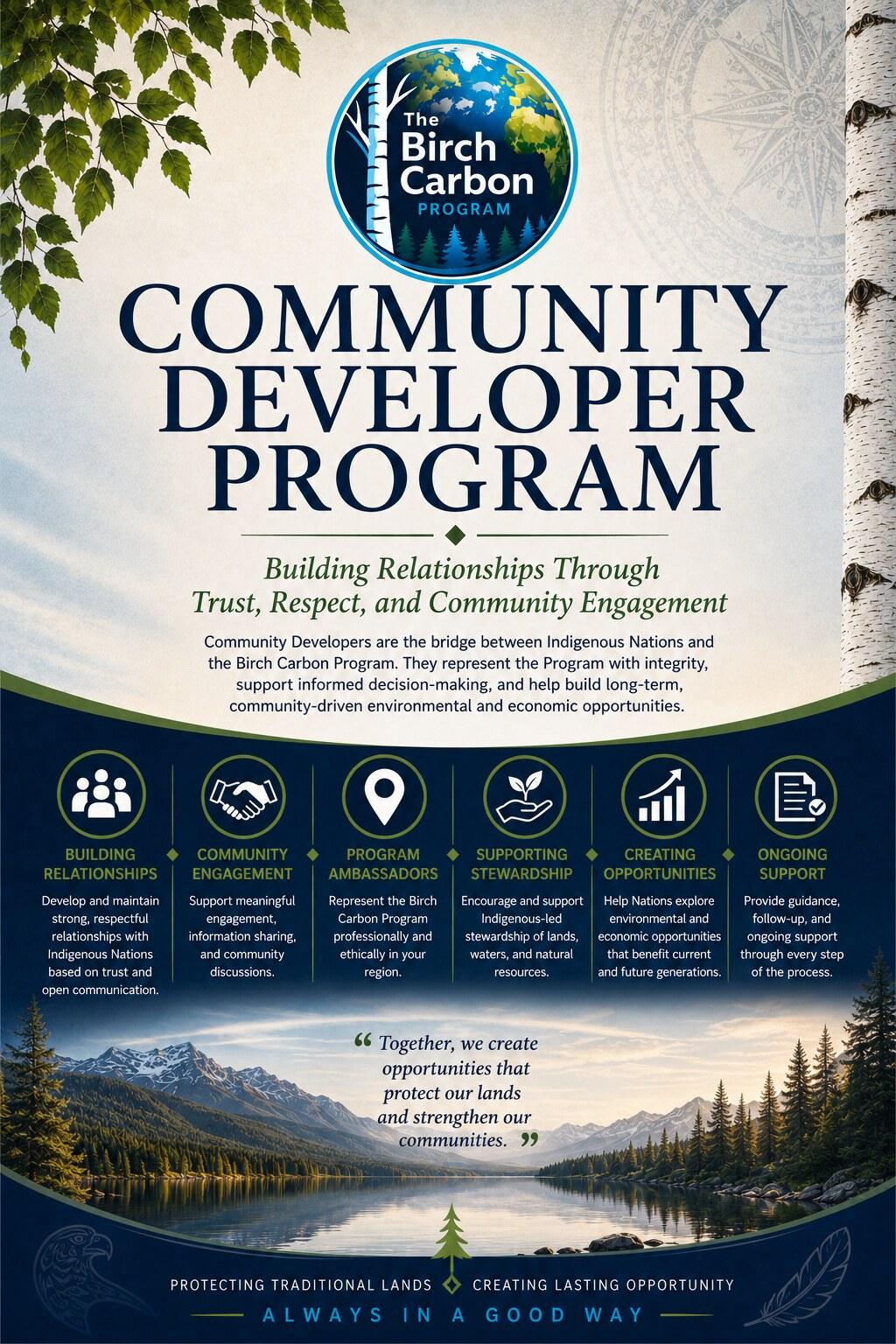
Community Developer Program
Building Relationships Through Trust, Respect, and Community Engagement
The success of the Birch Carbon Program begins with relationships.
Long before a carbon project is developed, there must be open communication, mutual trust, and a clear understanding of a community's goals and priorities. Every Nation has its own history, governance, traditions, and vision for the future. Building respectful relationships takes time, listening, and a genuine commitment to working together.
The Community Developer Program was created to support this important work.
Community Developers serve as the primary connection between the Birch Carbon Program and the Nations they support. Their role is to build relationships, provide information, answer questions, coordinate meetings, and guide communities through the early stages of the project development process.
They are ambassadors for the Birch Carbon Program and are expected to represent the program with professionalism, honesty, integrity, and respect at all times.
What Is a Community Developer?
A Community Developer is an authorized representative of the Birch Carbon Program who is responsible for developing and maintaining relationships with assigned Indigenous Nations or regions.
Community Developers work closely with Chiefs and Council, Economic Development Corporations, Lands Departments, community leadership, and other authorized representatives to introduce the Birch Carbon Program and assist communities as they move through each stage of project development.
They are often the first point of contact between a Nation and the Birch Carbon Program. Their role is not to pressure communities into participation.
Their role is to provide information, answer questions, coordinate communication, and ensure each Nation receives the support it needs to make informed decisions.
The Role of a Community Developer
Community Developers are responsible for creating strong, long-term relationships built upon trust and transparency.
Their responsibilities may include:
Introducing the Birch Carbon Program.
Building respectful relationships with community leadership.
Coordinating introductory meetings.
Presenting program information.
Answering general questions.
Coordinating preliminary estimates.
Assisting with meeting scheduling.
Supporting communication between the Nation and the Birch Carbon Program team.
Coordinating project documentation.
Following up on action items.
Maintaining accurate project records.
Providing regular updates to the Birch Carbon Program team.
Supporting long-term relationship development.
Community Developers are relationship builders first and foremost.
Supporting Participating Nations
Every Nation deserves consistent communication and professional support throughout the project development process.
Community Developers help communities by:
Explaining the Birch Carbon Program in clear language.
Coordinating meetings with technical specialists.
Ensuring questions are answered promptly.
Providing requested information.
Helping leadership understand each stage of project development.
Coordinating follow-up meetings.
Assisting with document delivery.
Supporting communication between departments.
Helping identify next steps.
Maintaining regular contact.
The Community Developer is there to help guide the process—not to replace the Nation's decision-making authority.
Every significant decision remains with the participating Nation.
Professional Representation
Community Developers represent both the Birch Carbon Program and the participating Nations with professionalism and respect.
They are expected to:
Act honestly.
Maintain confidentiality.
Communicate respectfully.
Listen carefully.
Follow through on commitments.
Respond professionally.
Respect Indigenous governance.
Respect cultural protocols.
Build long-term trust.
Protect confidential information.
Every interaction should strengthen the relationship between the Birch Carbon Program and the participating Nation.
Reporting Responsibilities
Accurate reporting is essential to maintaining an organized and transparent project development process.
Community Developers are responsible for keeping current records of their assigned communities and regularly reporting project activity to the Birch Carbon Program.
Typical reporting may include:
Community name.
Primary contacts.
Meeting dates.
Meeting summaries.
Current stage of development.
Documents delivered.
Documents received.
Outstanding action items.
Upcoming meetings.
Community questions.
Opportunities identified.
Next recommended steps.
Consistent reporting allows the Birch Carbon Program team to provide timely support while ensuring every participating Nation receives the attention it deserves.
Communication Expectations
Communication is one of the most important responsibilities of every Community Developer. Participating Nations should always know: Who their Community Developer is.
How to contact them.
What stage the project is in.
What the next steps are.
When meetings are scheduled. What information is still required.
Who to contact with questions.
Community Developers are expected to maintain regular communication with both the Nation and the Birch Carbon Program team.
Good communication helps prevent misunderstandings, supports informed decision-making, and builds lasting partnerships.
Working as One Team
Community Developers are not expected to know every technical detail of carbon markets or environmental science.
Instead, they work closely with the Birch Carbon Program's professional team, which may include:
Environmental specialists.
Carbon professionals.
GIS and mapping experts.
Project managers.
Legal advisors.
Financial specialists.
Communications professionals.
Executive leadership.
When technical questions arise, Community Developers coordinate access to the appropriate subject matter experts, ensuring communities receive accurate and timely information.
No Community Developer works alone—they are supported by the full Birch Carbon Program team.
Relationship Before Project
One of the guiding principles of the Birch Carbon Program is that relationships always come before projects.
Community Developers are encouraged to:
Listen before speaking.
Learn before recommending.
Build trust before discussing business.
Respect community timelines.
Never pressure a Nation into making decisions.
Provide honest and accurate information.
Allow communities the time they need to consult internally.
A successful carbon project begins with a successful relationship.
Measuring Success
Success is not measured simply by the number of projects developed. Success is measured by the strength of the relationships built with participating Nations.
A successful Community Developer is someone who: Earns trust. Communicates consistently. Keeps commitments. Acts professionally. Supports communities. Maintains accurate reporting. Works collaboratively. Represents the Birch Carbon Program with integrity.
Long-term relationships are the foundation of long-term success.
Our Commitment
Every Community Developer represents the values of the Birch Carbon Program. Those values include: Respect. Integrity. Professionalism. Transparency. Accountability. Indigenous leadership. Community ownership. Environmental stewardship. Honest communication.
Long-term partnership.
By working together with participating Nations, Community Developers help create relationships built on trust, support informed decision-making, and contribute to projects that protect Traditional Territories while creating lasting environmental, cultural, and economic opportunities for future generations.
KEY TAKEAWAY
Community Developers are relationship builders first and foremost. Success is not measured simply by the number of projects developed, but by the strength of the relationships built with participating Nations.
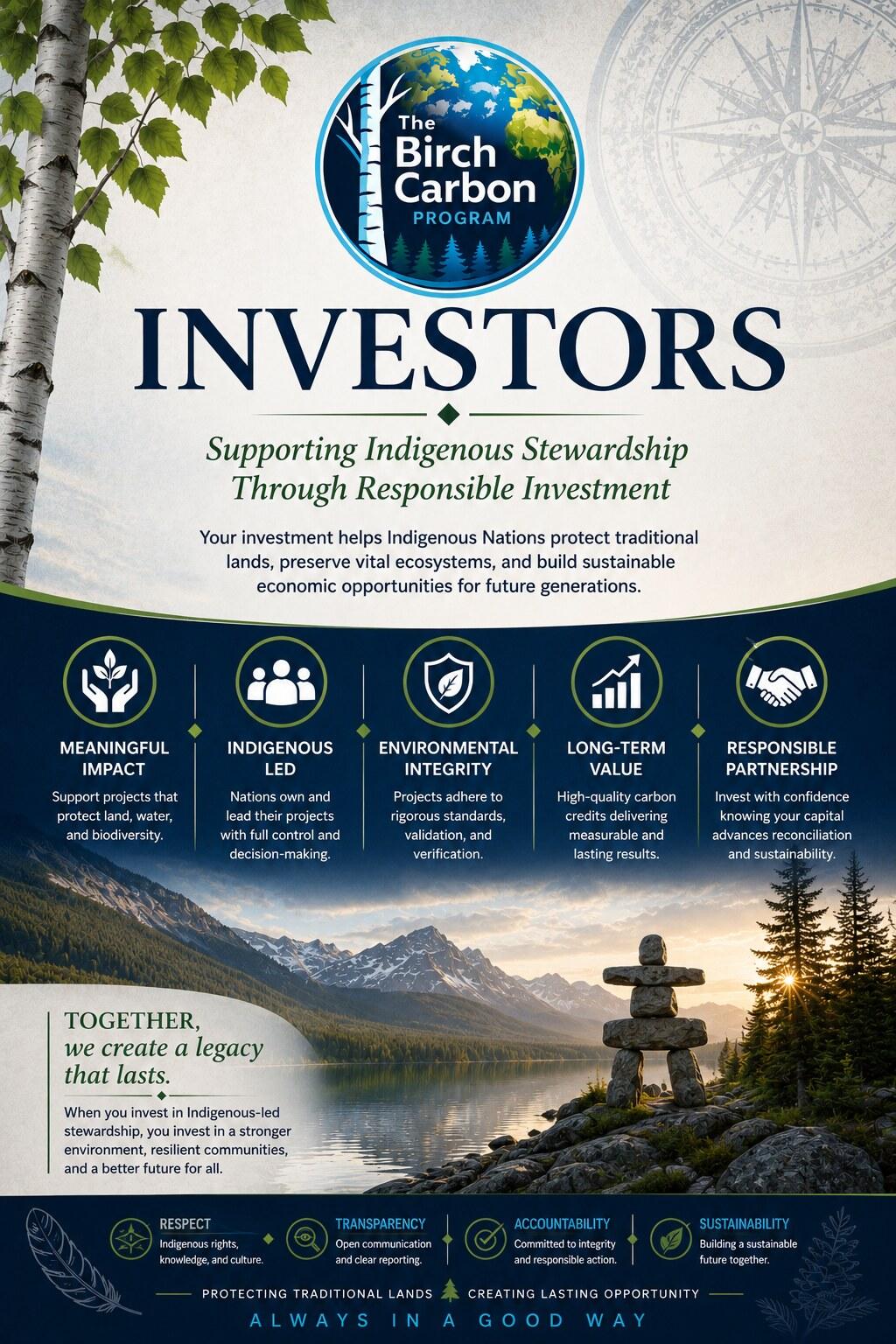
Supporting Indigenous Stewardship Through Responsible Investment
D
eveloping a high-quality carbon project requires significant expertise, scientific analysis, environmental assessments, professional auditing, and years of ongoing project management. These activities require substantial financial resources long before any carbon credits are issued or revenue is generated.
The Birch Carbon Program has been designed to remove this financial barrier for participating Nations.
Instead of asking Indigenous communities to fund these early development costs themselves, the program works with private investors who provide the capital required to develop eligible projects. This approach allows Nations to explore carbon and natural capital opportunities without assuming the significant upfront financial risks associated with project development.
Investors become partners in helping transform environmental stewardship into long-term environmental and economic opportunity.
Why Do Investors Participate?
Investors participate because they recognize both the environmental and long-term economic value of high-quality Indigenous-led carbon projects.
Developing internationally recognized carbon projects requires significant capital before any revenue can be generated. Investors provide this early-stage funding with the understanding that successful projects may generate financial returns in the future through the sale of verified carbon credits and other eligible environmental assets.
At the same time, investors are supporting projects that:
Protect forests, wetlands, peatlands, and other natural ecosystems.
Support Indigenous stewardship.
Help address climate change.
Encourage long-term environmental conservation.
Create opportunities for participating Nations.
Promote responsible environmental investment.
Many investors see these projects as an opportunity to achieve both financial returns and positive environmental and social outcomes.
Why Is Investment Needed?
Carbon projects require extensive professional work before they can be registered and begin generating carbon credits.
This work may include:
Preliminary environmental assessments.
Scientific studies.
Carbon modelling.
GIS mapping.
Remote sensing analysis.
Biodiversity assessments.
Hydrological studies.
Professional audits.
Technical documentation.
Independent validation.
Independent verification.
Registry application and registration.
Legal and contractual support.
Project management.
These activities often require months or years of work before any carbon credits are issued. Without investment, many communities would face significant financial barriers to developing projects of this scale.
Understanding Investment Risk
Like any long-term investment, carbon project development involves risk. Not every proposed project will ultimately become a registered carbon project. A project may require additional scientific work, changes in methodology, further environmental assessment, or may determine that the land is not suitable under a particular carbon standard.
Market conditions may also change over time.
Carbon prices fluctuate.
Government policies evolve.
International standards continue to develop.
Environmental events such as wildfire, flooding, storms, or disease may also influence project development.
Investors understand these risks before choosing to participate.
Their investment supports the project development process with the understanding that successful outcomes cannot be guaranteed.
How Investment Funding Is Used
Investment funding is dedicated to developing projects that meet internationally recognized environmental standards.
Funding may support:
Environmental scientists.
Carbon specialists.
GIS professionals. Ecologists. Hydrologists.
Forestry experts. Independent validators.
Independent verifiers.
Registry fees.
Technical consultants.
Legal documentation.
Project management.
Community engagement.
Professional reporting.
Ongoing project coordination.
This funding allows the participating Nation to move through project development without providing substantial upfront capital.
Protecting Participating Nations
One of the guiding principles of the Birch Carbon Program is reducing financial barriers for Indigenous communities.
Rather than requiring Nations to finance complex environmental assessments and project development themselves, private investment provides the resources necessary to complete this work.
This allows communities to evaluate opportunities based on their environmental and community priorities—not on their ability to finance project development. Every Nation remains in control of its own decision-making throughout the process.
Investor Returns
Investors provide funding with the expectation that successful projects may generate future financial returns.
The specific terms governing investor participation, cost recovery, and revenue distribution are established through written agreements before project development begins.
These agreements clearly define:
The responsibilities of each party.
How project development costs are managed.
How approved costs may be recovered.
Revenue distribution.
Financial reporting.
Transparency requirements.
No investment return is guaranteed.
Returns depend on many factors, including successful project development, registration, verification, carbon credit issuance, market demand, and successful credit sales.
A Long-Term Partnership
Carbon projects are long-term environmental stewardship initiatives. Investors understand that meaningful environmental outcomes require patience, ongoing monitoring, and long-term collaboration.
The Birch Carbon Program seeks investors who share this long-term perspective and who value responsible environmental investment alongside respectful partnerships with Indigenous communities.
The objective is not short-term financial gain but the development of projects that create lasting environmental, cultural, and economic benefits.
Transparency and Accountability
Transparency is fundamental to every investment relationship.
Participating Nations are provided with clear agreements that explain:
Project responsibilities.
Funding arrangements.
Cost recovery.
Revenue distribution.
Reporting expectations.
Governance processes.
The Birch Carbon Program believes that strong partnerships are built on open communication, honesty, and mutual respect.
Respecting Indigenous Ownership
Investment does not transfer ownership of land, Treaty Rights, Aboriginal Rights, governance, or Traditional Territory.
Investors do not acquire ownership of the project lands.
The participating Nation continues to:
Own its Traditional Territory.
Govern the project.
Control participation.
Make major project decisions.
Protect its culture and Traditional Knowledge.
The role of the investor is to provide financial resources that help make project development possible—not to direct or control the Nation.
Our Commitment
The Birch Carbon Program believes that successful environmental projects require collaboration between Indigenous Nations, technical experts, and responsible private investors. Each partner contributes different strengths:
The Nation provides leadership, stewardship, Traditional Knowledge, and community direction.
The Birch Carbon Program provides professional expertise, project management, technical support, and access to environmental markets.
Investors provide the financial resources needed to develop projects without requiring significant upfront costs from participating Nations.
Together, these partnerships help create internationally recognized carbon projects that protect Traditional Territories, strengthen Indigenous stewardship, and create the opportunity for longterm environmental, cultural, and economic benefits for future generations.
KEY TAKEAWAY
Investors provide the capital that makes project development possible — but they do not acquire ownership of land, Treaty Rights, Aboriginal Rights, governance, or Traditional Territory.
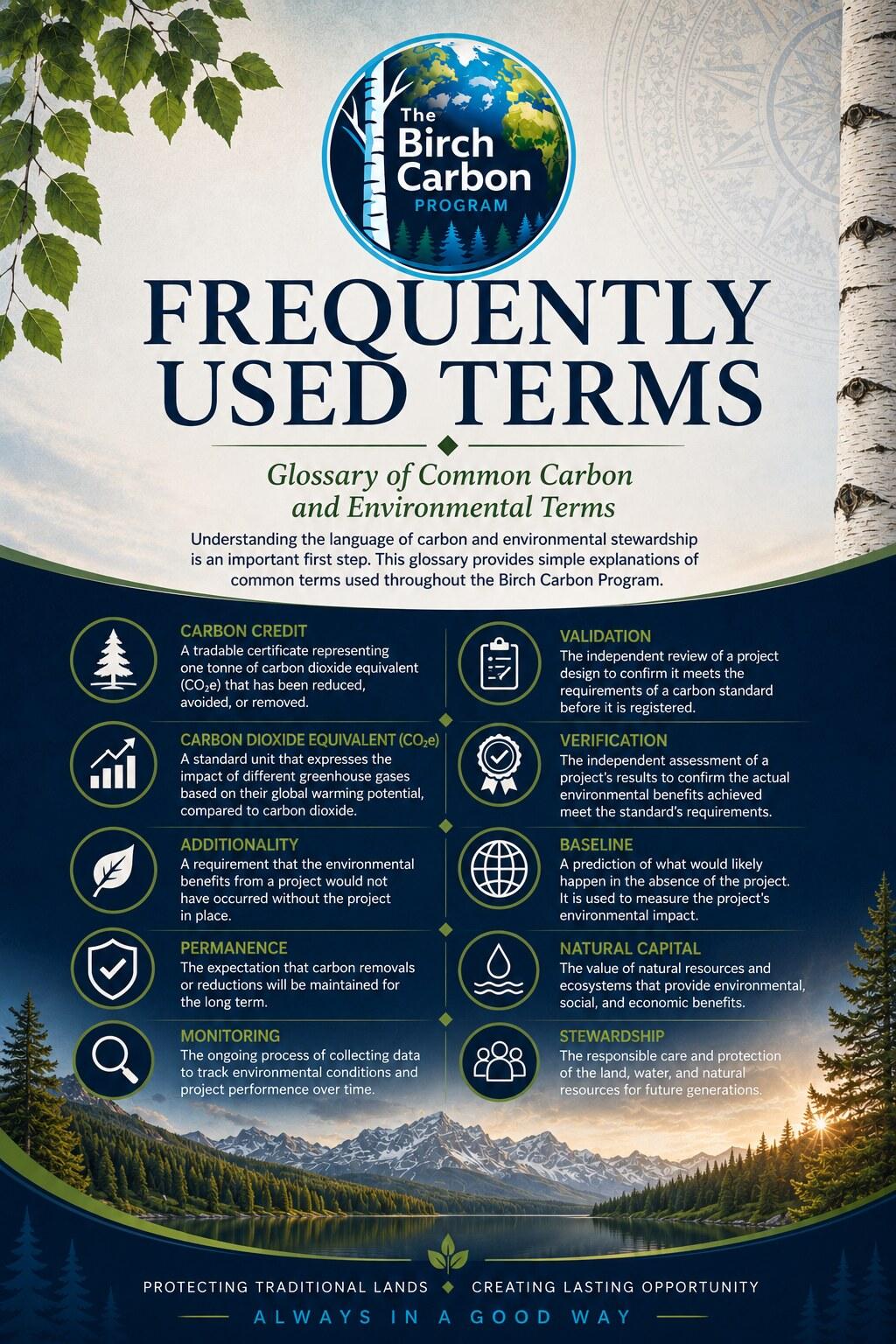
Frequently Used Terms
Glossary of Common Carbon and Environmental Terms
The following glossary explains many of the terms commonly used throughout the Birch Carbon Program Handbook. These definitions are written in plain language to help readers better understand how carbon projects work and how they relate to Indigenous stewardship and environmental conservation.
◆
Additionality
Additionality means demonstrating that the environmental benefits created by a project would not have happened without the project itself.
Carbon standards require projects to show that the carbon reductions or removals are genuinely additional and are the direct result of the project's activities.
Additionality is one of the most important principles in developing credible carbon projects.
◆
Baseline
A Baseline is the starting point used to measure environmental change. It represents what would likely happen on the land if the carbon project did not exist.
Future environmental improvements are compared against this baseline to determine how much carbon has been stored or emissions have been avoided.
◆ Biodiversity
Biodiversity refers to the variety of living things within an ecosystem. This includes:
Plants
Animals
Birds
Fish
Insects
Trees
Microorganisms
Habitats
Healthy biodiversity creates stronger ecosystems that are more resilient and better able to support wildlife, people, and future generations.
◆ Carbon Credit
A Carbon Credit is a certified environmental asset representing one metric tonne (1 tonne) of carbon dioxide equivalent (CO₂e) that has either been removed from the atmosphere or prevented from being released.
Carbon credits are issued only after a project has been independently validated, independently verified, and registered under an approved carbon standard. They may then be purchased by organizations seeking to support verified climate action.
◆ Carbon Dioxide Equivalent (CO₂e)
Carbon Dioxide Equivalent (CO₂e) is the standard unit used to measure greenhouse gases.
Because different greenhouse gases affect the atmosphere differently, scientists convert them into a common measurement called carbon dioxide equivalent, allowing all greenhouse gases to be measured and compared using a single standard.
◆ Climate Change
Climate Change refers to long-term changes in Earth's climate caused by both natural processes and human activities.
Greenhouse gases released into the atmosphere contribute to warming temperatures, changing weather patterns, rising sea levels, and impacts on ecosystems around the world.
Carbon projects are one tool used to help reduce these impacts.
◆ Leakage
Leakage occurs when activities that reduce carbon emissions in one area unintentionally cause increased emissions somewhere else.
For example, protecting one forest should not result in increased deforestation in another location.
Carbon standards evaluate potential leakage to ensure that environmental benefits are genuine.
◆
Monitoring
Monitoring is the ongoing process of observing, measuring, and documenting how a carbon project performs over time.
Monitoring may include:
Satellite imagery
GIS analysis
Remote sensing
Field inspections
Forest health assessments
Wetland monitoring
Wildlife observations
Scientific reporting
Monitoring helps ensure that projects continue meeting environmental standards throughout their life.
◆
Natural Capital
Natural Capital refers to the natural resources and ecosystems that provide environmental, social, cultural, and economic value.
Examples include:
Forests
Wetlands
Peatlands
Rivers
Lakes
Grasslands
Wildlife habitat
Biodiversity
Healthy natural capital provides clean air, clean water, carbon storage, habitat, flood protection, and many other benefits that support both people and nature.
◆ Offset
A Carbon Offset is the use of verified carbon credits to compensate for greenhouse gas emissions that cannot yet be eliminated.
Organizations may purchase verified carbon credits to help offset a portion of their remaining emissions while continuing efforts to reduce their overall environmental impact.
Offsets are intended to complement—not replace—direct emission reductions.
◆ Permanence
Permanence refers to the long-term ability of a carbon project to maintain the environmental benefits it creates.
Carbon standards require projects to demonstrate that stored carbon will remain protected for many years through ongoing stewardship, monitoring, and responsible land management.
Long-term permanence is essential to maintaining confidence in carbon markets.
◆ Registry
A Registry is an independent organization that records, tracks, and manages verified carbon projects and the carbon credits they generate.
Registries help ensure:
Accuracy
Accountability
Prevention of double counting
Public confidence
Examples of internationally recognized registries include Verra, Gold Standard, and the Canadian Greenhouse Gas Offset Credit System.
◆ Remote Sensing
Remote Sensing is the collection of environmental information using technologies such as satellites, aircraft, drones, or other sensors.
These tools help monitor forests, wetlands, vegetation, water, and land conditions over large areas while supporting accurate environmental reporting.
◆ Stewardship
Stewardship is the responsible care, protection, and management of the land for the benefit of present and future generations.
For Indigenous Peoples, stewardship reflects a deep and enduring relationship with the land, waters, wildlife, and natural environment based on respect, responsibility, and Traditional Knowledge.
Stewardship is the foundation of the Birch Carbon Program.
◆ Sustainability
Sustainability means meeting today's needs while protecting the ability of future generations to meet theirs.
Sustainable environmental management seeks to balance environmental protection, cultural values, community well-being, and responsible economic opportunity.
◆ Traditional Knowledge
Traditional Knowledge refers to the knowledge, teachings, observations, and practices that Indigenous Peoples have developed over countless generations through their relationship with the land.
Traditional Knowledge provides invaluable insight into ecosystems, wildlife, seasonal changes, water, forests, and stewardship practices, and is respected alongside modern science throughout the Birch Carbon Program.
◆ Validation
Validation is an independent review conducted before a carbon project is registered.
Qualified third-party experts examine the project's design, methodology, scientific information, and documentation to confirm that it meets the requirements of the selected carbon standard. Validation helps ensure the project is technically sound before implementation.
◆ Verification
Verification is an independent assessment conducted after a project has begun operating.
Qualified third-party professionals confirm that the environmental results reported by the project are accurate and supported by scientific evidence.
Successful verification is required before carbon credits can be issued.
◆ Voluntary Carbon Market
The Voluntary Carbon Market is a marketplace where organizations choose to purchase carbon credits voluntarily to support climate action and sustainability commitments.
Unlike government compliance programs, participation is voluntary and driven by corporate, organizational, or institutional environmental goals.
◆ Wetlands
Wetlands are areas where water covers or saturates the soil for all or part of the year.
Wetlands are among the world's most valuable ecosystems because they:
Store significant amounts of carbon.
Filter water.
Reduce flooding.
Support biodiversity.
Provide important wildlife habitat.
Protecting wetlands plays an important role in many carbon and natural capital projects.
◆ Why Understanding These Terms Matters
Carbon markets involve scientific, environmental, financial, and regulatory concepts that may be unfamiliar to many people.
Understanding these commonly used terms helps community leaders, Elders, Knowledge Keepers, Lands Departments, and community members make informed decisions throughout the project development process.
The Birch Carbon Program is committed to explaining these concepts clearly, using plain language, while respecting Indigenous knowledge, promoting transparency, and supporting informed community decision-making.
Success Stories
Indigenous Leadership Creating Lasting Environmental and Economic Opportunities
The Birch Carbon Program is built on partnership, trust, and long-term stewardship. Every participating Nation brings unique knowledge, leadership, and a deep connection to the land, creating opportunities that benefit both present and future generations.
As additional projects are completed, this chapter will continue to grow with community profiles, success stories, photographs, testimonials, and measurable environmental and economic outcomes.
Our goal is to celebrate the leadership of participating Nations while sharing real examples of how Indigenous stewardship is creating lasting change across Canada.
Our First Participating Nation
◆ Shoal Lake Cree Nation
Saskatchewan
The Birch Carbon Program is proud to recognize Shoal Lake Cree Nation, Saskatchewan, as one of our first participating First Nations and an important partner in the growth of this national initiative.
From the beginning, Shoal Lake Cree Nation demonstrated strong leadership and a commitment to exploring innovative opportunities that support both environmental stewardship and long-term economic development.
Working together, the Nation and the Birch Carbon Program began the process of evaluating the community's Traditional Territory for carbon and natural capital opportunities while respecting Indigenous ownership, governance, and community decision-making. Their willingness to participate has helped establish an important foundation for future projects across Canada.
As one of the program's earliest participating Nations, Shoal Lake Cree Nation continues to demonstrate leadership by exploring new ways to protect the environment while creating opportunities for future generations.
Community Profile
Nation: Shoal Lake Cree Nation
◆
Province: Saskatchewan
Program Status: Participating Nation
Project Focus:
Long-term environmental stewardship
Forest conservation
Natural capital assessment
Carbon project development
Community-led environmental opportunities
Program Principles:
Indigenous ownership
Community governance
Long-term stewardship
Environmental protection
Sustainable economic opportunity
Building the Partnership
Every successful project begins with trust.
The partnership between Shoal Lake Cree Nation and the Birch Carbon Program was developed through open dialogue, relationship building, and a shared commitment to protecting Traditional Territories.
Rather than focusing solely on carbon credits, discussions centered on the Nation's long-term environmental goals, community priorities, and opportunities to strengthen stewardship while maintaining complete community ownership and decision-making authority.
Throughout the process, the Nation remained in control of every significant decision, with the Birch Carbon Program providing professional guidance, technical expertise, and project coordination.
Environmental Opportunities
Like many Indigenous Nations across Canada, Shoal Lake Cree Nation possesses significant natural assets that contribute to healthy ecosystems and climate resilience.
These natural assets may include:
Forest ecosystems
Wetlands
Natural water systems
Wildlife habitat
Biodiversity
Traditional stewardship areas
Through professional environmental assessment, these landscapes may create opportunities for internationally recognized carbon and natural capital projects while supporting long-term conservation and responsible land management.
Community Benefits
Every participating Nation has unique priorities.
Carbon and natural capital projects have the potential to support a wide range of long-term community objectives, including:
Environmental stewardship
Employment opportunities
Youth engagement
Indigenous Guardian programs
Community capacity building
Long-term environmental monitoring
Economic diversification
Conservation initiatives
Cultural preservation
Sustainable community planning
The Birch Carbon Program works collaboratively with each Nation to ensure that project development aligns with community goals and priorities.
Long-Term Partnership
The Birch Carbon Program is committed to building relationships that extend well beyond project development.
As the project progresses, Shoal Lake Cree Nation will continue to receive support through:
Professional project management
Environmental monitoring
Technical expertise
Registry support
Market coordination
Ongoing communication
Long-term stewardship planning
These partnerships are built on transparency, accountability, and mutual respect.
Community Voices
As projects progress, this section will include comments and reflections from participating Nations.
Future editions of this handbook will feature:
Messages from Chiefs and Council
Community testimonials
Elder perspectives
Indigenous Guardian experiences
Youth participation stories
Project team reflections
These voices will help demonstrate the real impact of Indigenous-led environmental stewardship.
Environmental Results
As projects mature and independent verification is completed, this section will highlight measurable environmental achievements, which may include:
Hectares of protected land
Forest conservation
Wetland conservation
Carbon stored or emissions avoided
Biodiversity outcomes
Wildlife habitat protection
Watershed conservation
Long-term environmental monitoring
All reported results will be based on independently verified project data and recognized carbon standards.
Economic Outcomes
Following successful project registration, verification, and the sale of carbon credits, future editions of this handbook will include examples of project outcomes such as:
Carbon credits issued
Carbon credits sold
Long-term revenue generated
Employment opportunities created
Community investment initiatives
Environmental program funding
Infrastructure support
Education and training initiatives
The Birch Carbon Program will report these achievements transparently and in accordance with applicable agreements and confidentiality commitments.
Photo Gallery
Future editions of this handbook will showcase participating Nations through photographs that celebrate:
Traditional Territories
Forest landscapes
Wetlands and waterways
Community events
Stewardship activities
Elders and Knowledge Keepers
Indigenous Guardians
Youth engagement
Environmental monitoring
Partnership meetings
These images will reflect the people, landscapes, and relationships that are at the heart of the Birch Carbon Program.
Looking Ahead
Shoal Lake Cree Nation represents more than the first chapter in the Birch Carbon Program—it represents the beginning of a growing movement of Indigenous-led environmental stewardship across Canada.
As additional Nations join the program, this chapter will continue to expand with new community profiles, photographs, stories, environmental achievements, and examples of longterm partnerships.
Together, these success stories will demonstrate how Indigenous leadership, Traditional Knowledge, scientific expertise, and responsible collaboration can protect Traditional Territories while creating lasting environmental, cultural, and economic opportunities for generations to come.
KEY TAKEAWAY
Shoal Lake Cree Nation, Saskatchewan — one of the program's first participating First Nations — continues to demonstrate leadership by exploring new ways to protect the environment while creating opportunities for future generations.
Trusted Information for Communities, Leadership, and Project Partners
Carbon markets, environmental standards, government policies, and funding programs continue to evolve. Access to accurate and current information is therefore essential for participating Nations, community leadership, Lands Departments, Economic Development Corporations, Community Developers, investors, and technical professionals.
This chapter provides a selection of credible resources related to:
Carbon-credit systems
Project standards and registries
Indigenous climate leadership
Environmental stewardship
Indigenous Guardians programs
Conservation
Carbon-market integrity
International climate policy
Project financing and organizational capacity
Whenever possible, communities should rely on official government websites, recognized standards bodies, registry documents, and qualified professional advice.
Information found on third-party websites should be reviewed carefully and confirmed through the appropriate official source before it is used to make legal, financial, environmental, or project-development decisions.
Important Notice About These Resources
The organizations listed in this chapter are included because they provide potentially useful information, programs, standards, research, or services.
Being listed does not automatically mean that an organization is a formal partner, sponsor, supporter, validator, verifier, registry provider, or representative of the Birch Carbon Program.
A formal partnership should only be described publicly when:
A written agreement exists.
Both organizations have approved the relationship.
The responsibilities of each organization are clearly defined.
Permission has been received to use names, logos, quotations, or endorsements.
Carbon standards and government programs also change over time. Before relying on a particular standard, methodology, funding program, or market opportunity, the most recent requirements should be confirmed directly with the responsible organization.
Government of Canada Resources
◆ Environment and Climate Change Canada
Environment and Climate Change Canada is the federal department responsible for national climate policy, greenhouse-gas regulation, environmental protection, conservation initiatives, and the administration of Canada's federal carbon-pricing and offset systems.
Its website provides information about:
Climate change
Greenhouse-gas emissions
Carbon pricing
Federal offset credits
Indigenous climate partnerships
Environmental funding
Biodiversity
Conservation
Indigenous Guardians
Federal regulations and protocols
This should be one of the first resources consulted when evaluating how a proposed project may fit within Canada's climate and environmental policy framework.
◆
Canada's Greenhouse Gas Offset Credit System
Canada's Greenhouse Gas Offset Credit System is the federal system through which eligible Canadian projects may generate federal offset credits.
A federal offset credit represents one tonne of carbon dioxide equivalent reduced or removed from the atmosphere. To generate credits through this system, a project must satisfy the federal regulations and use an applicable federal offset protocol. (Canada)
The federal system is important because it establishes requirements relating to:
Project eligibility
Additionality
Quantification
Verification
Permanence
Unique ownership
Reporting
Registration
Credit issuance
Reversals and environmental risk
Record keeping
Not every environmental project automatically qualifies. Eligibility depends on the applicable regulations, available federal protocols, project location, project activities, and the evidence supporting the claimed greenhouse-gas reductions or removals.
◆ Federal Offset Protocols
Federal offset protocols contain the official requirements and calculation methods for particular project types.
A protocol explains matters such as:
Which activities are eligible
How a project baseline is established
How reductions or removals are calculated
What monitoring is required
How uncertainty is addressed
What records must be retained
How reversals and leakage are managed Only activities covered by an approved federal protocol can generate credits within Canada's federal offset system. (Canada)
For this reason, a project should never be described as eligible for federal credits until the applicable protocol and project requirements have been professionally reviewed.
◆ Credit and Tracking System and Public Registry
The Government of Canada's Credit and Tracking System, commonly called CATS, is used to administer Canada's Greenhouse Gas Offset Credit System and the federal Output-Based Pricing System.
The system supports the registration, issuance, holding, transfer, retirement, and tracking of federal compliance units. It also helps maintain transparency and prevent units from being counted or used more than once. (Canada)
The public registry may be useful for confirming:
Registered projects
Project proponents
Credit issuances
Account information made publicly available
Project status
Retirement or cancellation information
◆ Canada's Partnership with Indigenous Peoples on Climate
The Government of Canada maintains distinctions-based climate partnerships with First Nations, Inuit, and Métis leadership.
These partnerships recognize Indigenous Peoples as rights-holders, Knowledge Holders, governments, and environmental stewards. They are intended to support joint climate action while recognizing Indigenous governance, rights, and stewardship responsibilities. (Canada)
This resource may help communities understand:
Federal-Indigenous climate initiatives
Joint climate leadership
Indigenous participation in climate policy
National engagement processes
Climate funding and capacity-building opportunities
◆ Indigenous Guardians
The Indigenous Guardians initiative supports Indigenous Nations and communities in caring for lands, waters, and ice through community-led stewardship programs.
Guardians may conduct activities such as:
Monitoring ecological health
Protecting culturally important places
Observing wildlife and habitat
Supporting land-use planning
Collecting environmental information
Maintaining cultural sites
Supporting youth training
Combining Indigenous Knowledge and scientific methods
The Government of Canada describes Guardians as providing important on-the-ground stewardship and monitoring capacity. (Canada)
Guardian programs may become valuable components of long-term carbon and natural-capital monitoring. However, the design, authority, information governance, and responsibilities of a Guardian program remain with the participating Nation.
◆ First Nations Guardians Funding
The First Nations Guardians funding stream provides information about funding opportunities specifically available to eligible First Nations, communities, and organizations.
Application periods, funding amounts, eligible costs, and program priorities may change from year to year. Communities should always consult the current application materials rather than relying on information from a previous funding cycle. (Canada)
Potentially eligible activities may include:
Community-based monitoring
Guardian employment Training
Stewardship planning
Cultural-site protection
Species monitoring
Youth participation
Land and water management
◆ Indigenous-Led Area-Based Conservation
Environment and Climate Change Canada provides information about Indigenous-led conservation initiatives and funding intended to support Indigenous leadership in protecting lands, waters, biodiversity, and culturally significant areas. (Canada)
These resources may be relevant where a Nation is considering:
Indigenous Protected and Conserved Areas
Habitat conservation
Species-at-risk protection
Watershed stewardship
Guardians programs
Conservation finance
Natural-capital opportunities
Long-term land-use planning
Carbon projects and conservation projects are not automatically the same. However, carefully designed initiatives may support complementary environmental and community objectives.
◆ Indigenous Environmental Leadership and Nature Protection
The Government of Canada provides information about Indigenous-led conservation, biodiversity, environmental leadership, and Guardians initiatives.
The federal government recognizes Indigenous leadership as important to achieving national biodiversity and conservation objectives, including the protection of lands, waters, and species. (Canada)
This resource may help participating Nations identify programs that support:
Indigenous-led conservation
Environmental employment
Biodiversity protection
Habitat restoration
Protected areas
Community stewardship capacity
◆ Indigenous Leadership Fund
The Indigenous Leadership Fund is part of the federal Low Carbon Economy Fund. It supports eligible Indigenous-owned and Indigenous-led projects involving areas such as renewable energy, energy efficiency, and low-carbon solutions. The program was established with funding extending toward 2029, although current availability and eligibility must always be confirmed through the official program page. (Canada)
This fund is not specifically a forest-carbon-credit program, but it may be relevant to a Nation's broader climate and sustainable-development strategy.
◆ Natural Resources Canada
Natural Resources Canada provides information, research, mapping, funding programs, and technical resources relating to:
Forests
Energy
Remote sensing
Wildfire
Climate adaptation
Clean energy
Natural resources
Geospatial information
Indigenous participation in resource development
Its Indigenous-led clean-energy resources may be useful for Nations considering a broader environmental and economic strategy beyond carbon credits alone. (Natural Resources Canada)
Canadian Indigenous Leadership Resources
◆ Assembly of First Nations
The Assembly of First Nations represents First Nations Chiefs and supports national advocacy on matters including climate change, environmental protection, lands, water, conservation, and sustainable development.
Its environmental resources emphasize that First Nations are rights-holders and original stewards of their lands and waters and are uniquely positioned to lead conservation and climate action. (Assembly of First Nations)
The Assembly of First Nations may provide useful information relating to:
First Nations climate policy
National advocacy
Environmental protection
Conservation leadership
Climate gatherings
Federal engagement
First Nations rights and jurisdiction
National resolutions and policy positions
◆ Assembly of First Nations National Climate Strategy
The Assembly of First Nations National Climate Strategy presents a First Nations-led approach to climate action.
It reflects the position that climate policy must recognize First Nations rights, knowledge systems, governance, responsibilities, and leadership rather than treating First Nations as ordinary stakeholders. (Assembly of First Nations)
This resource may help communities place carbon and natural-capital opportunities within a broader framework that includes:
First Nations jurisdiction
Cultural responsibility
Indigenous Knowledge
Climate adaptation
Emissions reduction
Conservation
Economic reconciliation
Community resilience
◆ Indigenous Clean Energy
Indigenous Clean Energy is an Indigenous-governed organization that promotes Indigenous leadership in Canada's clean-energy future.
Its work includes community capacity building, training, networking, clean-energy education, and collaboration among Indigenous communities, governments, utilities, developers, innovators, and capital providers. (Indigenous Clean Energy)
Although its primary focus is clean energy rather than forest carbon, its resources may be valuable for Nations developing broader climate, sustainability, and economic-development plans.
◆ First Nations Financial Management Board
The First Nations Financial Management Board supports First Nations in strengthening financial administration, governance, capacity, and long-term economic planning.
The organization provides tools and services that may help Nations improve financial systems and prepare for major economic opportunities. (FMB)
Its work may be relevant to communities considering:
Financial governance
Revenue management
Long-term planning
Investment readiness
Financial policies
Independent certification
Community economic development
The Financial Management Board does not approve carbon credits or determine project eligibility. Its potential relevance relates primarily to governance, financial capacity, and longterm revenue management.
Carbon Standards and Registries
◆ Verra
Verra is a nonprofit organization that develops and administers environmental standards and crediting programs.
Its Verified Carbon Standard is one of the world's most widely used voluntary greenhouse-gas crediting programs. (Verra)
Verra resources include:
VCS program rules
Approved methodologies
Project-development requirements
Validation and verification requirements
Registry information
Project documentation
Credit issuance records
Safeguard requirements
Public consultations
Program updates
A Verified Carbon Unit generally represents one tonne of carbon dioxide equivalent reduced or removed through an eligible project. Verra requires units to satisfy quality principles concerning additionality, durability, independent verification, traceability, robust quantification, and the prevention of double counting. (Verra)
◆ Verified Carbon Standard Methodologies
A Verra methodology establishes the detailed procedures a project must follow to quantify greenhouse-gas benefits and apply for Verified Carbon Unit issuance. (Verra)
A methodology may establish requirements for:
Eligible project activities
Baseline scenarios
Additionality
Carbon pools
Sampling
Remote sensing
Leakage
Permanence
Monitoring
Uncertainty
Verification
Crediting periods
The existence of a methodology does not guarantee that a particular Nation's lands or proposed activities will qualify. Professional legal, technical, land-tenure, and methodological assessments are still required.
◆ Verra Registry
The Verra Registry contains public information about projects registered under Verra programs.
It may be used to review:
Project descriptions
Project locations
Project proponents
Methodologies
Validation reports
Verification reports
Credits issued
Credits retired
Project documents
Public comments and status information
Registry research can help communities understand how other projects have been documented. However, another project's registration should never be treated as proof that a new project will qualify.
◆ Gold Standard
Gold Standard is an international standards organization that certifies climate projects and sustainable-development impacts.
Its standards are designed to measure greenhouse-gas outcomes while also considering benefits for people, communities, and nature. (Gold Standard) Gold Standard resources include:
Project requirements
Methodologies
Safeguards
Stakeholder consultation requirements
Sustainable Development Goal impacts
Validation and verification requirements
Registry information
Carbon-credit issuance records
The suitability of Gold Standard depends on project type, methodology availability, jurisdiction, and the proposed environmental activities.
◆ Gold Standard Impact Registry
The Gold Standard Impact Registry provides information about registered projects, issued credits, transfers, and retirements.
It is an important transparency tool for reviewing whether a project and its credits are recorded within the Gold Standard system.
As with every registry, the current project documentation and credit status should be examined carefully rather than relying only on promotional material.
◆ Canada's Federal Offset System
Canada's Greenhouse Gas Offset Credit System is a regulated domestic system rather than a voluntary international standard.
Projects must comply with federal law and use an approved federal protocol. Federal offset projects are expected to create reductions or removals that are real, additional, quantifiable, verifiable, unique, and permanent. (Canada)
A project cannot assume that credits developed under a voluntary standard can automatically be converted into federal offset credits. The systems have separate registration, protocol, documentation, and eligibility requirements. (Canada)
International Climate and Carbon-Market Resources
◆ United Nations Framework Convention on Climate Change
The United Nations Framework Convention on Climate Change, commonly called the UNFCCC, is the international body supporting global climate negotiations and implementation of the Paris Agreement.
Its resources include:
The Paris Agreement
National climate commitments
International carbon-market rules
Article 6
Climate-finance information
Technical decisions
Methodologies
International reporting
The UNFCCC is an important source for understanding how international carbon cooperation fits within global climate policy.
◆ Article 6 of the Paris Agreement
Article 6 allows countries to cooperate voluntarily in meeting their climate targets and establishes both market-based and non-market approaches.
It includes provisions relating to:
Internationally transferred mitigation outcomes
Government-to-government cooperation
A United Nations-supervised crediting mechanism
Sustainable development
Environmental integrity
Transparent accounting
Prevention of double counting The UNFCCC describes Article 6 as a means of enabling international cooperation and mobilizing financial support for climate action. (UNFCCC)
Article 6 is complex and continues to evolve. Any proposed international transfer of Canadian project outcomes would require specialized legal, policy, accounting, and government review.
◆ Paris Agreement Crediting Mechanism
The Paris Agreement Crediting Mechanism is established under Article 6.4 of the Paris Agreement.
It is intended to support verified greenhouse-gas reductions and removals that may be transferred and used under the rules of the Paris Agreement. (UNFCCC)
This mechanism should not be confused with ordinary voluntary carbon-market registration. Host-country authorization, corresponding adjustments, approved methodologies, and other international rules may apply depending on how credits are used.
◆ International Civil Aviation Organization
The International Civil Aviation Organization, commonly called ICAO, is the United Nations agency responsible for international civil aviation standards.
ICAO administers the Carbon Offsetting and Reduction Scheme for International Aviation, commonly called CORSIA.
◆ CORSIA
CORSIA is a global market-based system created to address carbon dioxide emissions from international aviation.
It complements measures such as improved aircraft technology, operational efficiency, and sustainable aviation fuels. (ICAO)
Airlines subject to CORSIA may use only eligible emissions units that satisfy ICAO requirements.
It is important to understand that:
Not every carbon standard is CORSIA-approved.
Not every credit issued by an approved standard is CORSIA-eligible.
Eligibility may depend on project dates.
Eligibility may depend on project type.
Host-country authorization may be required.
Double-counting controls may be required. The applicable compliance period matters.
ICAO may update its approved programs and eligibility conditions.
ICAO maintains the official list of programs and units eligible for each CORSIA compliance period. The current edition should always be checked before any project or credit is described as CORSIA-eligible. (ICAO)
Carbon-Market Integrity Resources
◆ Integrity Council for the Voluntary Carbon Market
The Integrity Council for the Voluntary Carbon Market is an independent governance organization focused on improving quality and confidence in voluntary carbon markets. It developed the Core Carbon Principles as a global benchmark for identifying high-integrity carbon credits. (ICVCM)
The Integrity Council does not develop an individual community's project. Instead, it assesses carbon-crediting programs and categories of credits against its integrity framework.
◆ Core Carbon Principles
The Core Carbon Principles address areas such as:
Effective governance
Tracking Transparency
Independent validation and verification
Additionality
Permanence
Robust quantification
Prevention of double counting
Sustainable-development benefits
Contribution toward a transition to net-zero emissions
They are intended to help buyers and market participants identify credits that meet a recognized threshold for quality and integrity. (ICVCM)
Meeting the requirements of a registry does not automatically mean every credit carries a Core Carbon Principles label. Program and credit-category assessments should be confirmed through the Integrity Council's official records.
Environmental and Conservation Organizations
◆ Nature United
Nature United is a Canadian conservation organization that works in areas including Indigenous-led conservation, resilient lands and waters, climate action, and natural climate solutions.
The organization states that Indigenous rights, authority, and leadership are essential to effective and durable conservation. (Nature United)
Its research and conservation resources may be useful for communities exploring:
Indigenous-led conservation
Natural climate solutions
Stewardship planning
Land and water protection
Conservation finance
Community monitoring
Biodiversity
Listing Nature United in this resource section does not mean that it is formally affiliated with or endorses the Birch Carbon Program.
◆ Parks Canada Guardian and Watchmen Resources
Parks Canada provides information about Indigenous Guardian and Watchmen programs operating in relation to protected and culturally important places.
These programs can support:
Indigenous land management
Cultural-site protection
Training and careers
Ecological monitoring
Collaborative conservation
Community stewardship
Parks Canada recognizes these programs as supporting Indigenous cultural responsibilities for caring for lands and resources. (Parks Canada)
Technical and Professional Resources
A high-quality carbon or natural-capital project may require support from several independent professional disciplines.
Depending on project type, these may include:
professional foresters
Professional biologists
Ecologists
Wetland specialists
Peatland scientists
Hydrologists
Soil scientists
Wildlife specialists
GIS analysts
Remote-sensing professionals
Carbon-accounting specialists
Climate scientists
Indigenous Knowledge Holders
Legal counsel
Accountants
Financial advisors
Tax professionals
Insurance professionals
Independent validation and verification bodies Professional qualifications, independence, insurance, experience, conflicts of interest, and authorization to practise should be confirmed before an organization or individual is retained.
Validation and Verification Bodies
Validation and verification bodies are independent organizations authorized or accredited to evaluate carbon projects.
They may assess:
Project design
Methodology use
Baseline calculations
Additionality
Monitoring systems
Carbon calculations
Environmental safeguards
Reported reductions or removals
Compliance with the selected standard
The project developer, registry, validator, and verifier perform different functions. These roles should not be confused or represented as though one organization controls the entire process.
The selected carbon standard normally establishes the qualifications, accreditation, rotation, and independence requirements that validation and verification bodies must meet.
Legal Resources
Each participating Nation should consider obtaining independent legal advice before entering into binding agreements.
Legal review may address:
Land ownership and tenure
Aboriginal and Treaty Rights
Title and jurisdiction
Carbon rights
Environmental attributes
Project boundaries
Data ownership
Traditional Knowledge
Confidentiality
Revenue sharing
Investor repayment
Liability
Insurance
Dispute resolution
Project duration
Termination
Regulatory compliance
Tax treatment
International credit transfers
The Birch Carbon Program may provide project information and agreements for review, but the Nation should have the opportunity to obtain advice from its own legal counsel.
Financial and Tax Resources
Carbon-credit revenue may create accounting, taxation, trust, investment, and financialgovernance considerations.
Participating Nations may wish to consult qualified professionals regarding:
Revenue recognition
Tax treatment
Goods and services tax
Corporate structures
Trust arrangements
Community distributions
Investor repayment
Financial controls
Auditing
Long-term investment policies
Own-source revenue implications
Government funding interactions
Financial outcomes will vary according to the participating entity, agreement structure, applicable legislation, and community circumstances.
Recommended Due-Diligence Questions
Before relying on any website, standard, organization, consultant, investor, or project developer, a Nation should consider asking:
Is this the organization's official website?
Is the information current?
Is the methodology currently active?
Does the methodology apply in Canada?
Does it apply to the proposed project activity?
Does the organization have authority to make the claims being presented?
Is the project developer independent from the validator and verifier?
Are the technical professionals properly qualified?
Is the registry recognized by the intended buyers?
Are the credits eligible for the intended market or compliance system?
Have land tenure, carbon rights, and overlapping claims been reviewed?
Have Treaty Rights, Aboriginal Rights, and jurisdiction been protected?
Who owns the environmental attributes and project data?
How will confidential and culturally sensitive information be protected?
Are projected carbon volumes based on professional analysis or only preliminary assumptions?
Are revenue examples clearly identified as estimates rather than guarantees?
What costs must be recovered before revenue is distributed?
What happens if the project does not register or generate credits?
What happens following wildfire, flooding, harvesting, or another reversal?
Has the Nation received independent legal and financial advice?
Resource Review and Updating
This resource chapter should be reviewed regularly.
At minimum, the Birch Carbon Program should check for updates relating to:
regulations
offset protocols
Carbon-standard versions
Methodologies
Registry procedures
CORSIA eligibility
Article 6 requirements
Funding programs
Indigenous Guardians applications
Validation and verification rules
Market-integrity frameworks
The date of the most recent resource review should be recorded in every new edition of the handbook.
Final Guidance
Carbon markets can create meaningful opportunities, but they are technical, regulated, and continually changing.
No single website, consultant, preliminary estimate, or presentation should be used as the sole basis for a major community decision.
Participating Nations should be provided with:
Clear information
Time for internal review
Access to independent advice
Current standards and regulations
Transparent financial explanations
Professional environmental evidence
Written agreements
Ongoing opportunities to ask questions
The Birch Carbon Program is committed to helping communities access credible information while respecting Indigenous governance, Traditional Knowledge, community ownership, environmental integrity, and informed decision-making.
Environment and Climate Change Canada https://www.canada.ca/en/environmentclimate-change.html
Canada’s Greenhouse Gas Offset Credit System https://www.canada.ca/en/environmentclimate-change/services/climate-change/pricing-pollution-how-it-will-work/outputbased-pricing-system/federal-greenhouse-gas-offset-sys tem.html
Federal Offset Protocols https://www.canada.ca/en/environment-climate-change/ services/climate-change/pricing-pollution-how-it-will-work/output-based-pricingsystem/federal-greenhouse-gas-offset-sys tem/protocols.html
Credit and Tracking System and Public Registry https://www.canada.ca/en/environmentclimate-change/services/climate-change/pricing-pollution-how-it-will-work/output-
based-pricing-system/federal-greenhouse-gas-offset-sys tem/credit-trackingsystem.html
Canada’s Partnership with Indigenous Peoples on Climate https://www.canada.ca/en/ environment-climate-change/services/climate-change/indigen ous-partnership.html
Indigenous Guardians https://www.canada.ca/en/environment-climate-change/services/ environmental-funding/i ndigenous-guardians.html
First Nations Guardians Funding https://www.canada.ca/en/environment-climatechange/services/environmental-funding/i ndigenous-guardians/first-nations.html
Indigenous-Led Area-Based Conservation https://www.canada.ca/en/environmentclimate-change/services/nature-legacy/indigenou s-led-area-based-conservation.html
Indigenous Environmental Leadership and Nature Protection https://www.canada.ca/en/ environment-climate-change/services/nature-legacy/indigenou s-leadershipfunding.html
Indigenous Leadership Fund https://www.canada.ca/en/environment-climate-change/ services/climate-change/low-car bon-economy-fund/indigenous-leadership.html
Natural Resources Canada https://natural-resources.canada.ca/
Natural Resources Canada Indigenous Clean Energy Stream https://naturalresources.canada.ca/climate-change/indigenous-clean-energy-stream
Assembly of First Nations – Environment https://afn.ca/environment/ Assembly of First Nations National Climate Strategy https://afn.ca/environment/nationalclimate-strategy/
Indigenous Clean Energy https://indigenouscleanenergy.com/
First Nations Financial Management Board https://fnfmb.com/
Verra https://verra.org/
Verified Carbon Standard https://verra.org/programs/verified-carbon-standard/
Verified Carbon Standard Program Details https://verra.org/programs/verified-carbonstandard/vcs-program-details/
Verra Methodologies https://verra.org/program-methodology/vcs-program-standard/ overview/
Verra Registry https://registry.verra.org/
Gold Standard https://www.goldstandard.org/
Gold Standard Impact Registry https://registry.goldstandard.org/
Canada’s Federal Offset System Regulations https://www.canada.ca/en/environmentclimate-change/services/climate-change/pricing-pollution-how-it-will-work/outputbased-pricing-system/federal-greenhouse-gas-offset-sys tem/regulations.html
Overview of Canada’s Federal Offset Regulations https://www.canada.ca/en/environmentclimate-change/services/climate-change/pricing-pollution-how-it-will-work/outputbased-pricing-system/federal-greenhouse-gas-offset-sys tem/regulations/overview.html
United Nations Framework Convention on Climate Change https://unfccc.int/
Article 6 of the Paris Agreement https://unfccc.int/process-and-meetings/the-parisagreement/article6
Paris Agreement Article 6.4 Crediting Mechanism https://unfccc.int/process-andmeetings/the-paris-agreement/article-64-mechanism
International Civil Aviation Organization https://www.icao.int/ CORSIA https://www.icao.int/CORSIA
CORSIA Eligible Emissions Units https://www.icao.int/CORSIA/corsia-eligible-emissionsunits
Integrity Council for the Voluntary Carbon Market https://icvcm.org/ Core Carbon Principles https://icvcm.org/core-carbon-principles/
Nature United https://www.natureunited.ca/
Nature United – Working with Indigenous Peoples https://www.natureunited.ca/aboutus/who-we-are/working-with-indigenous-peoples/ Parks Canada Indigenous Guardians and Watchmen https://parks.canada.ca/culture/ autochtones-indigenous/gardiens-guardians
Contact Information
We’re Here to Help
Thank you for taking the time to learn about the Birch Carbon Program.
Whether you are a First Nation, Indigenous government, Métis organization, Inuit organization, municipality, conservation organization, business, investor, or community member, we welcome the opportunity to discuss how environmental stewardship can create long-term opportunities while protecting the lands and waters that are important to future generations.
Our team is committed to providing clear information, answering questions, and supporting communities through every stage of the project development process.
We encourage you to contact us to learn more about the Birch Carbon Program, request additional information, or schedule a presentation with your Chief and Council, Lands Department, Economic Development Corporation, or community members.
MichaelBirch.ca
MichaelBirch.ca serves as the public leadership, communications, and engagement platform for Michael Birch and the Birch Group of Companies.
Through MichaelBirch.ca you can learn more about:
The Birch Carbon Program
Indigenous partnerships
Community engagement
Environmental stewardship
The Birch Group of Companies
The Birch Show
Speaking engagements
News and media
Business partnerships
Community initiatives
Website
https://www.michaelbirch.ca
Birch Carbon Program
The Birch Carbon Program works alongside Indigenous communities across Canada to explore carbon and natural capital opportunities while ensuring that participating Nations retain ownership of their lands, governance, and decision-making throughout the entire process.
Our team provides professional guidance and support through every stage of project development, including:
Community engagement
Preliminary carbon and natural capital assessments
Professional project coordination
Environmental planning
Carbon project development
Investor coordination
Validation and verification support
Registry coordination
Long-term monitoring
Ongoing stewardship
Website
https://www.birchcarbonprogram.com
Contact Us
Whether you have questions about the Birch Carbon Program, would like to request additional information, schedule a presentation, discuss a potential partnership, or simply learn more about our work, we welcome the opportunity to speak with you.
General Contact
Email: info@michaelbirch.ca
All inquiries received through this email address will be reviewed promptly and directed to the appropriate member of the MichaelBirch.ca or Birch Carbon Program team.
Request a Community Presentation
The Birch Carbon Program is available to provide professional presentations and information sessions for:
Chiefs and Council
Elders and Knowledge Keepers
Lands Departments
Economic Development Corporations
Community members
Tribal Councils
Treaty Organizations
Regional Indigenous organizations
Provincial Indigenous organizations
National Indigenous organizations
Municipal and government representatives
Industry partners
Potential investors
Presentations may be delivered in person or virtually and can be customized to reflect the interests, priorities, and goals of each community or organization.
Follow Our Journey
Stay connected by following Michael Birch and the Birch Carbon Program online for the latest news, educational resources, community announcements, environmental updates, and partnership opportunities.
MichaelBirch.ca
Website https://www.michaelbirch.ca
LinkedIn https://www.linkedin.com/company/michaelbirch-ca
Facebook https://www.facebook.com/michaelbirchca
YouTube https://www.youtube.com/@MichaelBirchCA Birch Carbon Program
Website https://www.birchcarbonprogram.com
LinkedIn https://www.linkedin.com/company/birch-carbon-program
Facebook https://www.facebook.com/BirchCarbonProgram
Stay Connected
The Birch Carbon Program continues to grow as new Indigenous communities, partners, and organizations join this national initiative.
We encourage you to visit our websites and follow our social media channels to stay informed about:
New participating Nations
Environmental stewardship initiatives
Carbon market developments
Educational resources
Community events
Funding opportunities
Program announcements
Industry news
New partnerships
Success stories from across Canada
Thank You
Thank you for taking the time to read the Birch Carbon Program Handbook. We are honoured to work alongside Indigenous communities in protecting Traditional Territories while exploring opportunities that support environmental stewardship, community leadership, and long-term sustainable development.
If you have any questions or would like to begin a conversation about your community or organization, we invite you to contact us at info@michaelbirch.ca.
Together, through respect, transparency, collaboration, and Indigenous leadership, we can help create lasting environmental, cultural, and economic benefits for future generations.
Always in a Good Way.


Birch Carbon Program birchcarbonprogram.com
MichaelBirch.ca michaelbirch.ca
Supporting Resources and Reference Materials
The following appendices have been included to provide additional guidance, practical tools, and supporting information for participating Nations, leadership, Lands Departments, Economic Development Corporations, Community Developers, and project partners.
Unlike the main handbook, these appendices are designed to be updated independently as the Birch Carbon Program continues to grow and evolve. New forms, templates, checklists, examples, and reference materials may be added without requiring revisions to the core handbook.
These resources are intended to assist communities throughout every stage of the project development process while promoting transparency, informed decision-making, and long-term success.
Appendix A
◆ Understanding the Memorandum of Understanding (MOU)
As discussions progress and a community wishes to continue exploring the Birch Carbon Program, the next step is typically the development of a Memorandum of Understanding (MOU).
An MOU outlines the intention of both parties to continue working together while establishing the framework for the next stages of project development.
An MOU generally describes:
Roles and responsibilities
Project objectives
Cooperation between the parties
Information sharing
Preliminary timelines
Professional assessments
Next steps An MOU is not the final project agreement.
It does not transfer ownership of land, Treaty Rights, Aboriginal Rights, governance, or decision-making authority, nor does it obligate either party to proceed with a carbon project. Rather, it demonstrates a mutual commitment to continue working together while professional assessments and community discussions take place.
Appendix B
◆ Sample Carbon Estimate
Each participating Nation receives a preliminary carbon estimate prepared using available geographic information, publicly available environmental data, and professional mapping tools.
A sample estimate may include:
Estimated project area
Forested land
Wetlands
Water bodies
Peatlands
Preliminary carbon potential
Natural capital opportunities
Project maps
Environmental observations
These estimates are intended for planning purposes only. They are not a guarantee of project eligibility, carbon-credit volumes, or future revenue.
Only a comprehensive professional assessment can determine whether a project qualifies under an approved carbon standard.
Appendix C
◆ Typical Project Timeline
While every project is unique, the Birch Carbon Program generally follows the same structured development process.
A typical timeline includes:
Initial Introduction
Preliminary Discussions
Preliminary Carbon Estimate
Community Presentation
Memorandum of Understanding (MOU)
Professional Environmental Assessment
Project Design
Validation
Verification
Ongoing Monitoring
Long-Term Stewardship
Actual project timelines will vary depending on project complexity, environmental conditions, regulatory requirements, and community priorities.
Appendix D
◆ Due Diligence Checklist
Every Nation should take the time to carefully evaluate any proposed environmental project before making a decision.
Questions to consider include:
Has the community received all available information?
Have legal advisors reviewed the documents?
Has leadership had sufficient time for discussion?
Have Elders and Knowledge Keepers been consulted where appropriate?
Have community members been informed?
Are financial arrangements clearly understood?
Are land ownership and governance fully protected?
Are Treaty Rights and Aboriginal Rights fully respected?
Has the environmental methodology been explained?
Have independent experts been consulted where appropriate?
Are project risks clearly understood?
Are all questions answered to the community's satisfaction?
Careful due diligence helps ensure informed, transparent, and confident decision-making.
Appendix E
◆ Community Readiness Checklist
Before beginning project development, it is helpful for communities to consider their readiness.
Suggested considerations include:
Leadership support
Community interest
Administrative capacity
Lands Department participation
Economic Development involvement
Environmental priorities
Traditional Knowledge participation
Community engagement plan
Internal decision-making process
Long-term stewardship goals
Availability of mapping and land information
Capacity to participate in ongoing project discussions
Every Nation progresses at its own pace, and readiness should always be determined by the community itself.
Appendix F
◆ Document Checklist
Throughout project development, various documents may be prepared or exchanged. Depending on the stage of the project, these may include:
Preliminary Carbon Estimate
Community Presentation
Memorandum of Understanding (MOU)
Project maps
Environmental reports
Technical assessments
Validation documentation
Verification reports
Registry documentation
Monitoring reports
Annual project reports
Meeting summaries
Community resolutions (where applicable)
Supporting correspondence
Educational materials
Maintaining organized records supports transparency, accountability, and effective project management.
Appendix G
◆ Acronyms
The following acronyms are commonly used throughout the Birch Carbon Program.
AFN — Assembly of First Nations
BCP — Birch Carbon Program
CO₂e — Carbon Dioxide Equivalent
ECCC — Environment and Climate Change Canada
GHG — Greenhouse Gas
GIS — Geographic Information System
LEED — Leadership in Energy and Environmental Design
MOU — Memorandum of Understanding
NRCan — Natural Resources Canada UNFCCC — United Nations Framework Convention on Climate Change
VCS — Verified Carbon Standard
Appendix H
◆ Definitions
For convenience, readers are encouraged to refer to the Frequently Used Terms and Glossary section of this handbook for detailed explanations of carbon market terminology, environmental concepts, and project development language.
Topics include:
Additionality
Baseline
Biodiversity
Carbon Credit
Carbon Dioxide Equivalent (CO₂e)
Climate Change
Leakage
Monitoring
Natural Capital
Offset
Permanence
Registry
Stewardship
Sustainability
Traditional Knowledge
Validation
Verification
Voluntary Carbon Market
Wetlands
The glossary has been written in clear, straightforward language to make these concepts easier to understand for readers who may be new to carbon markets and environmental stewardship.
Appendix I
◆ Contact Directory
For additional information regarding the Birch Carbon Program or MichaelBirch.ca, please contact:
General Inquiries
Email: info@michaelbirch.ca
MichaelBirch.ca www.michaelbirch.ca
Birch Carbon Program www.birchcarbonprogram.com
For the latest program updates, educational resources, community news, and partnership opportunities, please visit our official websites and follow our social media channels.
Living Documents
These appendices are intended to remain living documents. As the Birch Carbon Program continues to expand across Canada, new resources may be added, including:
Updated templates
Sample agreements
Community success stories
Professional guidance documents
Frequently Asked Questions (FAQs)
Funding opportunities
Government resources
Carbon standard updates
Educational materials
Training resources
Best practices
Case studies By maintaining these appendices as separate reference materials, the Birch Carbon Program can continue providing participating Nations with the most current information available while preserving the integrity of the core handbook.
Together, the handbook and its appendices provide a practical, comprehensive, and evolving resource designed to support Indigenous leadership, informed decision-making, environmental stewardship, and long-term community success.