CAMPUS MAGAZINE
Fall 2026
CREATIVES WITHOUT BORDERS 5 UNDER 5 CELEBRATING MICA’S BICENTENNIAL
2
MICA
MARYLAND INSTITUTE COLLEGE OF ART
FIRST IMPRESSION Visitors explore students’ work during the final exhibition of MICA’s 2026 Pre-College Summer Intensive. Featuring work across painting, photography, sculpture, animation, illustration, and game design, the final exhibition brings together students, families, and art lovers to celebrate the next generation of creatives.
FALL 2026
1
FROM THE PRESIDENT
WHAT WE CARRY FORWARD There is something powerful about reaching 200 years. A bicentennial asks us to consider not only what has endured, but what has traveled forward: the ideas, relationships, creative practices, and possibilities carried from one generation to the next. As I think about MICA at this extraordinary moment, I find myself thinking less about a single institution or campus and more about the thousands of people who have made MICA what it is. For 200 years, artists, designers, educators, and creative thinkers have come here to discover what they can make, what they can question, and how they can contribute. Then they have carried those experiences outward into Baltimore, across the country, and around the world. That movement is at the heart of this special bicentennial edition. In these pages, you will encounter a MICA graduate student working alongside scientists in Kenya whose careful observation led to the discovery of an ancient hominin tooth (page 18). You will see students reimagining an iconic OLD BAY® tin and bringing a new perspective to a brand synonymous with Maryland (page 20). You will find creativity taking to the field at Camden Yards, where an alumnus, faculty members, and students came together to give the Baltimore Orioles’ Mama Bird a new look (page 22). Elsewhere, you will encounter artists and designers transforming public spaces, experimenting with sustainable materials,
2
MICA
MARYLAND INSTITUTE COLLEGE OF ART
building creative ventures, strengthening communities, and establishing practices that reach far beyond the boundaries of any single discipline. These are wonderful individual stories. Taken together, however, they tell us something larger about MICA. Our reach is global because our community is global. And our impact grows through relationships. A student learns from a faculty member. An alumnus opens a door for a current student. An artist enters into conversation with a scientist. A designer listens to a neighborhood. An organization brings a challenge into a classroom, and students respond with possibilities no one anticipated. Those connections are where creativity becomes consequential. I believe deeply that artists and designers bring something essential to the challenges and opportunities of our time. They notice. They question assumptions. They make connections across disciplines and experiences. They imagine what does not yet exist and then develop the skills, persistence, and partnerships necessary to bring those ideas into the world. That is why this bicentennial is so much more than a celebration of MICA’s past. It is momentum. We enter our third century with an extraordinary foundation and an equally extraordinary responsibility: to widen the reach of a MICA education, deepen our connections to Baltimore and the world, create more opportunities for students to engage with consequential questions, and continue demonstrating the cultural, civic, and economic power of creativity. For 200 years, MICA has held to the belief that creative practice can respond to the needs of a changing world. While the world has changed beyond anything our founders could have imagined, that belief has not. As we celebrate everything this community has made possible, I am even more excited by what we have yet to make and by how far the ideas born here will travel. Our third century has already begun.
PRESIDENT
Cecilia M. McCormick, JD VICE PRESIDENT FOR MARKETING & COMMUNICATIONS
Elizabeth Homan CONTRIBUTING EDITOR / WRITER
Trish Shea DESIGN
Lucas Badger ’07 PHOTOGRAPHY
Aidan McCord-Amasis ’23, Shannon Carroll, Billy Childress, Andrew Copeland ’13, Maximilian Franz, Justin T. Gellerson, Decker Library, Human Being Productions, and courtesy of the artists and galleries noted in image captions ADDITIONAL MICA MARKETING & COMMUNICATIONS SUPPORT
Sabrina Dépestre, Blake English, Ashley Fletcher ’18, ’20, and Rachel Fuller ON THE COVER
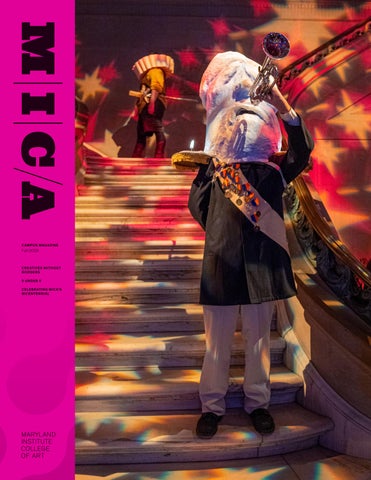
At the Fête of Lights: Bicentennial Gala, Aidan Leizerov ’28 (Interdisciplinary Sculpture BFA) wore their wax soldier costume created in the Mask and Headdress course taught by Valeska Populoh, faculty in the Fiber, Fashion, and Textile program. On the upper landing, Martin Knuppel ’26 (Illustration and Printmaking BFA) is dressed as a modern version of the First Lord of Baltimore. Leizerov and Knuppel were part of a larger student interpretation of the Main Building’s Maryland painting. Students created a living mural that was more representative of MICA's students today. Read more about MICA’s Bicentennial in “200 Years of Making” (page 34). Maryland Institute College of Art 1300 W. Mount Royal Ave. Baltimore, MD 21217 For more information, to adjust your subscription options or to submit story ideas or comments, email communications@ mica.edu or call 410.225.2300.
© 2026 MARYLAND INSTITUTE COLLEGE OF ART
20
CONTENTS
28 MAKING NEWS
IN DEPTH
Eyes on the Prize 4 Students and alumni earn local and national recognition.
Creatives Without 16 Borders Bringing problem-solving to science, iconic brands, professional sports, and communities around the world.
Top Honors MICA graphic designers earn top honors across the industry.
6
Center Stage Baltimore Museum of Art celebrates MICA’s bicentennial legacy.
8
In The Studio
Full Display 10 MICA artists take center stage at the Whitney Biennial and other exhibitions. New Faces 12 MICA welcomes new undergraduate and graduate faculty members. Future Forward 2026 UP/Start recap; MICA Pro & new degree offerings expand creative education.
32
24
5 Under 5 26 Five rising MICA alumni shaping the next generation of creatives. Sketchbook
32
200 Years of Making At 200, MICA celebrates its creative evolution and looks to the future with meaningful impact.
34
By the Numbers
42
42
14
COMMUNITY NOTES Class Notes 44 Recognizing the various accomplishments of students, alumni, and faculty. In Remembrance
54
A FINAL GLANCE
55
FALL 2026
3
MAKING NEWS
EYES
ON THE
STUDENTS WIN AT BIODESIGN CHALLENGE
4
MICA
MARYLAND INSTITUTE COLLEGE OF ART
Megan Hillaker ’26 (Painting BFA) and Sabrina Ortega ’27 (Fiber BFA) took home the Outstanding Exhibition prize for their work, Cell-Phonic, at this summer’s 2026 Biodesign Challenge. Their project creates a platform for interspecies communication. As Faculty Ryan Hoover explained, the students “constructed a device that houses microbes in a series of custom microbial fuel cells that they designed and fabricated. The Cell-Phonic console converts the electricity generated by the microbes’ metabolic activity into sounds and visual patterns.” While in New York, the Biodesign Challenge winners from 2025, Living Records, exhibited the next phase of their
PRIZE project at the BioBAT Art Space in Brooklyn (Michelle Li ’25, Liam Davis ’25, and Sofia Klimkowski Arango ’25). They created a genetic construct to produce colored proteins regulated by exposure to a particular wavelength of light, and used these engineered bacteria to create bio-photographic portraits.
PICTURED (Left to right) Sabrina Ortega, Megan Hillaker, Ryan Hoover, and Mantis Harper ’24.
1
RUBYS GRANT AWARDEES Four members of the MICA community have been recognized through the Rubys Artist Grants, a program of the Robert W. Deutsch Foundation that provides direct funding to Baltimore-area artists for the creation of new and innovative work. Launched in 2013 and named in honor of Creative Capital founder Ruby Lerner, the Rubys support experimentation, risk-taking, and creative exploration across artistic disciplines. Grants provide up to $15,000 in direct project support, with the program shifting to a rotating two-discipline structure beginning in 2026.
2
MICA recipients include Carolyn Case ’97 (Mount Royal School of Art MFA; faculty), Katie O’Keefe ’14 (Fiber BFA; faculty), and James Williams II ’09 (Mount Royal School of Art MFA; faculty). Ashley DeHoyos Sauder ’16 (Curatorial Practice MFA; staff) served on the jury panel.
STUDENTS RECOGNIZED IN 2 PRESTIGIOUS AXA ART PRIZE COMPETITION
3
4
Four MICA students have been named finalists in the 2026 AXA Art Prize, one of the nation’s premier competitions recognizing outstanding undergraduate and graduate artists working in figurative painting, drawing, and original printmaking. MICA finalists are Grace Hall ’27 (Painting BFA), Malyssa Ollar ’28 (General Fine Arts and History of Art, Design, and Visual Culture BFA), Klara Seib ’26 (Painting and Studio and Humanities Sciences BFA), and Nadia Tomoney ’27 (Painting BFA). Now in its ninth year in the United States, the AXA Art Prize has earned a national reputation for showcasing exceptional emerging talent. This year, nearly 600 submissions from art students across the country were reviewed by regional jurors, with just 40 artists selected as finalists. Their work will be featured this fall in an exhibition at the New York Academy of Art in New York City. Winners will be announced during the exhibition at the New York Academy of Art this November 2026.
PICTURED (1) Klara Seib ’26 (Painting and Studio and Humanities Sciences BFA), Fish Bladder Configurations, 2026. Graphite on paper, 11”x17”. (2) Nadia Tomoney ’27 (Painting BFA), Heirloom. 2026. Oil on canvas, 48”x36”. (3) Grace Hall ’27, Portrait of Imauri, 2026. Oil and newspaper, 20” x 16”. (4) Malyssa Ollar ’28 (General Fine Arts and History of Art, Design, and Visual Culture BFA), Pink Stripe (Cross My Mind), 2026. Acrylic, thread, fabric, glass beads, paper, crayon, and fishing wire on shaped canvas. 27” x 25”. FALL 2026
5
MAKING NEWS
TOP
HONORS YOUNG ONES HONORS MICA EXCELLENCE IN GRAPHIC DESIGN The Young Ones competition honors the best student work in advertising, interactive design, and graphic design. As a result of student success, MICA ranked as a top 10 college for design and advertising. A Gold Cube prize went to Kanika Anand ’25 for her design thesis, “Weather Futures,” with support from faculty mentors Ellen Lupton, Jeff Glendenning, and Jennifer Cole Phillips. A Type High Gold Award went to Athang Samant ’27 for the “Gallery of Decay,” with support from faculty Jennifer Cole Phillips and Jeff Glendenning. Bronze Cube winners at the competition include Aayush Agarwal ’26
6
MICA
MARYLAND INSTITUTE COLLEGE OF ART
for “Twenty-One Laps,” with support from faculty mentor Andrew Walters; Alexandria Pak ’26 created a brand system identity called “Peter Shire: Radical Geometry,” which was supported by faculty Andrew Walters; Gold Cube winner Kanika Anand also received a bronze for her UX/UI work called “Cookup,” which she worked on with faculty mentors Stephanie Kotula and Juliette Wang; Gia Chen ’27 won for packaging titled “Bare: Nipple Cover Packaging;” and Harshith Ramesh ’27 for “Sonic Mix” packaging design, with mentor support from Jennifer Cole Phillips. Type High Bronze awards also went to Athang Samant ’27 for “Acoustica Latin and Devangari” and “IND Stencil Latin and Devangari” in the category of type design and text + design typefaces.
PICTURED ABOVE (Left) Kanika Anand ’25, Weather Futures, 2025. (Right) Announcement for The Young Ones winners from MICA’s Graphic Design MFA program. PICTURED OPPOSITE (Top) Athang Samant ’27, Gallery of Decay, 2026. (Bottom) Harshith Ramesh ’27, Primary, 2026.
GRAPHIC DESIGN GRADUATE STUDENTS WIN PRESTIGIOUS NATIONAL AWARDS Twenty-five MICA graphic design graduate students and alumni won one-quarter of all awards at the STA 100 Design Competition in May. Organized by the Society of Typographic Arts (STA), the STA 100 Design Competition is an annual award competition that honors the 100 best examples of typographic excellence worldwide. Twenty students and three alumni from the MICA Graphic Design MFA program and two students from the Graphic Design Master of Art (MA) program secured 25 awards for typographic excellence. Two students, Athang Samant ’27 and Harshith Ramesh ’27, won the highest honors, being selected for the Judge’s Choice Award.
FALL 2026
7
MAKING NEWS
MICA TAKES CENTER STAGE AT BMA WITH BICENTENNIAL EXHIBITION The Baltimore Museum of Art (BMA) is honoring MICA’s 200-year legacy with BMA Celebrates MICA 200, a focused exhibition that places MICA’s artists, faculty, and alumni at the heart of Baltimore’s cultural history. Drawn entirely from the BMA’s collection, the exhibition features 17 works spanning nearly 150 years and a wide range of media, from painting and sculpture to textiles, photography, and film. Together, these works highlight the depth of MICA’s interdisciplinary approach and its enduring influence on contemporary art. At the center of the presentation are the MICA community members whose creative practices have shaped both the institution and the city. Featured artists include alumni and faculty such as Timothy App, Betty Cooke, Grace Hartigan, Maren Hassinger, Connie Imboden, Hugh Bolton Jones, Tom Miller, Elle Pérez, Amalie Rothschild, Joyce J. Scott, Jo Smail, Shinique Smith, Aaron Sopher, Grace Turnbull, and Charles H. Walther. Their work reflects generations of experimentation, critical inquiry, and artistic leadership rooted in Baltimore.
1
2
The exhibition also spotlights the MICA Pandemic Quilters, a collective project that brings together dozens of contributors, from artists and scholars to community members, demonstrating the power of collaboration during a time of global disruption. On view from May 17, 2026, through January 3, 2027, BMA Celebrates MICA 200 affirms the lasting impact of MICA’s community and its vital role in shaping the artistic and cultural life of Baltimore and beyond.
CENTER PICTURED (1) Maren Hassinger, Daily Mask. 1997-2004. (2) Amalie Rothschild, Resortscape. 1954-1955. (3) Tom Miller, Mama's Little Rock and Roll Baby. 1991. (4) Betty Cooke, Necksculpture. c.1976. (5) Charles H. Walther, Attic Plant. 1925. Images courtesy of the Baltimore Museum of Art.
8
MICA
MARYLAND INSTITUTE COLLEGE OF ART
BMA CELEBRATES MICA 200 PLACES MICA’S ARTISTS, FACULTY, AND ALUMNI AT THE HEART OF BALTIMORE’S CULTURAL HISTORY.
3
THEIR WORK REFLECTS GENERATIONS OF EXPERIMENTATION, CRITICAL INQUIRY, AND ARTISTIC LEADERSHIP ROOTED IN BALTIMORE.
4
STAGE
5
FALL 2026
9
MAKING NEWS
ALUMNI, FACULTY, STAFF JOIN JURIED REGIONAL EXHIBITION AT PHILLIPS COLLECTION Twelve MICA alumni, faculty, and staff are among 48 artists selected for Tomorrow Will Also Rise, a juried regional exhibition at The Phillips Collection in Washington, D.C. Chosen from 1,500 applicants from Washington, D.C., Maryland, and Virginia,
PICTURED Kei Ito, Sungazing Scroll, 2024. Chromogenic photogram, sunlight, and artist’s breath. 60” x 12” x 6”. Image courtesy of the artist and The Phillips Collection.
10
MICA
MARYLAND INSTITUTE COLLEGE OF ART
the artists explore the complexities of the contemporary world while highlighting themes of beauty, resilience, and determination. MICA participants are: Mark Armbruster ’92 (Photography BFA), Hannah Atallah ’26 (Rinehart School of Sculpture MFA), Aliana Grace Bailey ’20 (Community Arts MFA), Sasha Baskin ’14 (Drawing BFA), Thea Canlas ’06 (Fiber
BFA), Aishwariya Chandrasekar (staff), Erin Fostel ’04 (Drawing BFA), Kyle Hackett ’13 (LeRoy E. Hoffberger School of Painting MFA), Kei Ito ’16 (Photographic & Electronic Media MFA; faculty), Ringo Lisko ’24 (Rinehart School of Sculpture MFA), Katie O’Keefe ’14 (Fiber BFA; staff, preparator), and Melissa Sutherland Moss ’25 (Studio Art MFA, faculty).
CAMPUS EXHIBITIONS
FULL
1
Making America Again: So Strong, So Brave, So True MICA presents Making America Again: So Strong, So Brave, So True, an exhibition highlighting artists whose work reflects the lasting impact of the Ford/Philip Morris Foundation Fellows for Artists of Color, a national initiative launched by MICA that operated from 1985 to 1999. Funded by the Ford Foundation and the Philip Morris Foundation, the program expanded to four other independent art colleges and helped 200 artists of color earn Master of Fine Arts degrees, mentorship, and professional training. Guest curators are Leslie King Hammond, PhD, MICA graduate dean emerita and founder of the former Center for Race and Culture, and Lowery Stokes Sims, PhD, who previously received an honorary degree from MICA and currently serves as an independent curator, art historian, and curator emerita of the Museum of Arts and Design. The exhibition ran through September 29, 2026, in the Sheila & Richard Riggs Gallery at the Fred Lazarus IV Center.
DISPLAY MICA TALENT TAKES CENTER STAGE AT THE WHITNEY BIENNIAL Three MICA-affiliated artists are featured in the Whitney Biennial 2026, one of the nation’s most influential exhibitions of contemporary American art. Organized by the Whitney Museum of American Art, the Biennial highlights emerging and established voices shaping contemporary art across the United States and beyond. Among the 56 artists selected for this year’s Biennial are alumnus Kamrooz Aram ’01, alumna Taína H. Cruz ’20, and faculty member Maia Chao (Interdisciplinary Sculpture). Originally from Iran, Aram’s work, Beneath the Ruins, is a painted wall that the Whitney says nods to the “rich and complex traditions” of “ceramics, carpets, architectural painting, and folding screens.” Cruz is the youngest artist included in this year’s Biennial. Her
work is on display both inside and outside the museum, extending the exhibition into the public sphere. I Saw the Future and It Smiled Back is featured on the Whitney Museum’s Gansevoort Street billboard. Chao’s performance work, BEING MOVED, was presented live at the museum during a series of performances in May. The 82nd edition of the Biennial explores themes of connection, identity, migration, technology, and cultural transformation through painting, sculpture, installation, performance, film, and interdisciplinary practices. PICTURED (1) Maia Chao, BEING MOVED, 2026. Photograph courtesy of the artist and the Whitney Museum of Art. (2) Kira Nam Green, Room of Her Own (Saya), 2022. Oil, watercolor, gouache, acrylic marker, and colored pencil on canvas. 50” × 40”.
Devoted to Painting: An Exhibition 20 Years in the Making As a part of the Bicentennial Celebration, MICA brings together the work of 29 women artists who have made lasting connections with the school and its community. Open August 28–October 11, 2026, DEVOTED: 20 Years of The McMillan-Stewart Endowed Chair in Painting will feature original artworks with a diverse and intergenerational roster, including science fiction multi-media artist Saya Woolfalk; painter and photographer Jane Dickson; and nationally renowned portraitist Amy Sherald ’04 (LeRoy E. Hoffberger School of Painting MFA). Presented in MICA’s Decker Gallery, located in the Fox Building, DEVOTED celebrates the open, unstinting exchanges fostered by the chairship. FALL 2026
11
MAKING NEWS
Maria De Los Angeles joins undergraduate Painting and Drawing. A Mexican-born American artist, De Los Angeles explores migration, belonging, and identity in her creative practice. Her work has been exhibited at institutions including Crystal Bridges Museum of American Art, LACMA, and the Museum of Sonoma County. A 2026 Fellow at the Lunder Institute for American Art, she previously served in Painting and Printmaking at Yale School of Art. <—
MICA WELCOMES NEW UNDERGRADUATE AND GRADUATE FACULTY MEMBERS WHOSE PRACTICES SPAN PAINTING, SCULPTURE, ILLUSTRATION, PUBLIC ART, DESIGN, AND INTERDISCIPLINARY RESEARCH.
Charlotte G. Chin Greene joins undergraduate Interdisciplinary Sculpture. An artist, curator, and educator, Greene works across sculpture, drawing, video, performance, and writing to investigate the interconnected ecologies and psychologies of human and nonhuman systems in the digital age. Greene is also co-director of the artist-run gallery, FJORD, and has taught at Sarah Lawrence College and Tyler School of Art and Architecture at Temple University. -->
NEW ↑ Lisk Feng ’14, graduate program director of the MFA in Illustration Practice, is an award-winning illustrator and MICA alumna whose work spans editorial, commercial, and children’s book illustration. Originally from China and based in New York City, Feng earned her MFA in Illustration Practice from MICA in 2014 and has worked with clients including The New Yorker, Apple, Penguin Random House, Airbnb, The New York Times, Chanel, and Wells Fargo.
12
MICA
MARYLAND INSTITUTE COLLEGE OF ART
Natovian McLeod, principal faculty for this year in the MA in Teaching program, is an arts educator, curriculum writer, and K–12 social-emotional learning curriculum developer whose work emphasizes culturally responsive teaching and student engagement. Her honors include Baltimore County Public Schools Novice Art Teacher of the Year and the Maryland Art Education Association’s 2022 Elementary Art Teacher of the Year award. -->
John Rego joins undergraduate Illustration. A painter, illustrator, and educator, Rego creates work inspired by lived experience, everyday observations, and relationships between people and the natural world. As an illustrator, he has worked across editorial, book, packaging, advertising, and fine art projects for clients including NPR, The New Yorker, The New York Times, FIFA, and Saucony. ↓
FACES
↑ Zsudayka Nzinga ’25 is serving this year as principal faculty in the LeRoy E. Hoffberger School of Painting. A fine artist, curator, and educator, she is a 2025 graduate of the program and has more than 20 years of arts education experience. She has developed art programs and educator training initiatives, and her work has been exhibited at The Phillips Collection, the National Liberty Museum, AKAA in Paris, and SCOPE during Miami Art Week.
<— Michael Weiss, interim director of MICA’s Mount Royal School, has been a member of MICA’s full-time faculty since 2003 and most recently served as associate provost and dean of undergraduate studies. An artist working with traditional painting and stained-glass materials and methods to create contemporary imagery, Weiss has exhibited widely throughout the region, and his work is held in numerous private and corporate collections.
FALL 2026
13
MAKING NEWS
FUTURE FORWARD
10TH ANNUAL UP/START VENTURE COMPETITION For its 10th annual UP/Start Venture Competition, MICA awarded more than $105,000 to student- and alumni-led ventures advancing creative innovation and community impact in Baltimore. Held as the finale of a four-month entrepreneurial development program, the competition featured eight finalist teams presenting business pitches shaped
14
MICA
MARYLAND INSTITUTE COLLEGE OF ART
through mentorship, prototyping, and strategic planning. The initiative supports emerging creatives working at the intersection of art, entrepreneurship, and social impact. Top honors and $35,000 in funding were awarded to Flying House Arts Collective, a Baltimore-based venture led by Valentino Orlando ’25 (LeRoy E. Hoffberger School of Painting MFA) and Isaac Kim ’25 (LeRoy E. Hoffberger School of Painting MFA). The collective includes
several MICA-affiliated artists and curators, including Rui Jiang ’25 (Curatorial Practice MFA), Tim Moran ’25 (LeRoy E. Hoffberger School of Painting MFA), and Chia Hsiu Liu ’25 (LeRoy E. Hoffberger School of Painting MFA). The annual competition reflects MICA’s growing commitment to creative entrepreneurship and venture development, helping students and alumni transform artistic ideas into sustainable businesses and community-centered initiatives.
PICTURED MICA’s new online master’s degree in Game Design prepares professionals to create, design, and lead interactive games across platforms and genres. Installation by MFA graduate Tyler Grimes ’21.
NOTEWORTHY New Master’s Degree in Game Design MICA has announced a new Master of Professional Studies (MPS) in Game Design, which is a fully online, 30-credit graduate degree for emerging and mid-career professionals to design and lead games across platforms and genres. The program will launch in spring 2027. Offered through the School of Creative and Professional Studies, the MPS in Game Design is taught by faculty who work in the field and offers students three specialization tracks: Visual Design and Art Direction; Game Design and Interactive Systems; or Gamification, Learning, and Applied Game Design. The program ends with a two-course capstone sequence culminating in a fully developed game prototype. President McCormick Talks Bicentennial on Podcast MICA President Cecilia M. McCormick talks 200 years of MICA on the April 15 episode of The Truth In This Art, an arts and culture interview podcast hosted by Baltimore-based Rob Lee. In the conversation, McCormick shared her vision for the college over the bicentennial year and beyond. She connected the bicentennial events to three themes — illumination, innovation, and entrepreneurship — and discussed how MICA is evolving to meet workforce demand. As she explained, MICA students, faculty, and alumni stand out from the crowd because business leaders want creatives at the table.
BUILDING THE FUTURE OF THE CREATIVE ECONOMY For generations, MICA has prepared artists and designers to shape culture and industry. Today, through the School of Creative and Professional Studies (SCPS), the college is expanding that mission in new ways, creating pathways for working professionals, career changers, and lifelong learners to engage with the creative economy. Evolving from MICA’s former Open Studies division, SCPS brings together professional education, online graduate programs, workforce partnerships, and entrepreneurial initiatives under a more focused vision now known as MICA Pro. Leaders across the institution describe the shift as a strategic investment in how creative education can respond to a rapidly
changing world. One of SCPS’s most visible initiatives is MICA Professional Studio, flexible, career-focused courses in areas including branding, entrepreneurship, UX design, and emerging technologies. Many of these offerings allow learners to move between short-form training and advanced study. SCPS also offers fully online Master of Professional Studies (MPS) programs, designed for working professionals, blending creative practice with leadership, business strategy, and technology. An online Master of Arts in Graphic Design will also launch this fall semester, complementing the MPS programs and the MA/MBA Design Leadership program with Johns Hopkins University. Find out more at mica.edu/micapro.
FALL 2026
15
IN DEPTH
Creatives ut Witho Creativity rarely stays where it begins. At MICA, ideas born in studios, classrooms, and field experiences travel far beyond campus, finding expression in places as varied as scientific expeditions, global consumer brands, major league ballparks, and communities around the world. Whether collaborating with industry leaders, contributing to groundbreaking research, or bringing fresh perspectives to beloved cultural institutions, MICA students, faculty, and alumni demonstrate that creative practice is not confined to a single discipline or profession. It is a way of observing, connecting, and solving problems wherever opportunity emerges. The stories in this section reveal creativity without borders in action. One follows a graduate student whose keen eye during a paleontological expedition in Kenya led to a remarkable scientific discovery. Another explores how students partnered with McCormick & Company to reimagine the iconic OLD BAY® tin, balancing innovation with tradition for one of Maryland’s most recognizable brands. A third celebrates an interdisciplinary collaboration that brought a new look to the Baltimore Orioles’ beloved Mama Bird mascot. Together, these stories illustrate a defining characteristic of a MICA education: artists and designers are prepared not simply to make compelling work, but to shape culture, advance knowledge, strengthen communities, and contribute wherever curiosity and collaboration lead.
ders 16
MICA
MARYLAND INSTITUTE COLLEGE OF ART
B
PICTURED
Anjali Biju ‘26 (Graphic Design MFA), Turkana: A Visual Excavation, 2026.
Creatves out W
Borders FALL 2026
17
IN DEPTH CREATIVES WITHOUT BORDERS
Designing a Discovery Dense pockets of pale green grass and shrubbery peeked out from the rocks and dusty Earth. Everywhere Anjali Biju ’26 (Graphic Design MFA) looked, she saw shades of brown in the Turkana Basin, the Kenyan land known for unveiling secrets about mankind. She climbed hills and scrambled over rocks with geologists looking for what might be hidden on the surface. On this expedition, Biju watched and recorded what she saw. Something on the ground caught her eye. “I had started reading the landscape differently,” recalled Biju. “Walking with scientists teaches you to see things you’d otherwise miss. What looks like rubble and gravel starts to take on meaning.” She bent down and held the item aloft. The shouts started immediately. “Hominin! Hominin!” Biju knew exactly what she had found — an ancient ancestor’s tooth. The discovery dates back 1.4 million years, a once-in-a-lifetime find. “There are scientists who have spent their entire careers searching this landscape for exactly this kind of find. What would they think? But everyone — all the geology field school students — gathered around. They were thrilled.” Faculty Thomas Gardner, program director of the Master of Arts in Social Design, watched the excitement unfold and understood how one tooth can reshape knowledge. “What a discovery like this sets in motion is remarkable... We’re talking potentially billions of dollars in follow-on research… the cascade of events from a single find is significant,” recalled Gardner. “I’m trying not to let it become just a story I tell. It happened. And what it
18
MICA
MARYLAND INSTITUTE COLLEGE OF ART
alongside scientific researchers, giving both sides something they could not produce alone. “This has the potential to really transform the way both science is practiced and disseminated, as well as the opportunities for young creative professionals coming up through art and design schools like MICA,” said DeLanty.
opened up mattered more to me than the act itself,” reflected Biju. A UNIQUE PARTNERSHIP IN THE FIELD This shift developed while working with Marine Frouin, an assistant professor of geosciences at Stony Brook University, who leads research expeditions at the Turkana Basin Institute (TBI). “I look at stratigraphy, at the relation to time, and how the [Turkana] basin has evolved, and how the people have adapted,” said Frouin. “I always thought that there is a gap between the science that I do in the field and the way we communicate about our research to the local community. “When you think back in the day, Darwin and the big scientists were scientists and artists at the same time.
We lost this connection between art and science.” With that in mind, Desmond DeLanty, Frouin’s husband, an architect, and principal of the design-build firm EcoDepot, reached out to his former colleague and friend, MICA’s Gardner. After visiting TBI in 2024, Gardner contacted Jennifer Cole Phillips, director of the MFA in Graphic Design, for recommendations of students who might want to work at TBI. Phillips recommended Biju. “In some ways, Anjali was the first one out of the gate — bravely pioneering a path,” Gardner recalled. What emerged is FIELDwork — an acronym for Foundation for International Experiential Learning and Design Work. The premise is to embed creatives
PLANNING FOR THE FUTURE The partnership has led to an exhibition and panel discussion at MICA, a short film, a poster presentation at TBI’s 20th anniversary conference in New York, and Biju’s final thesis project. “What I was asking was: What does it mean to represent this landscape as someone who’s been there as a designer — someone with fresh eyes? I put my experience into a framework that is accessible, so that people could walk away with something close to the feeling of being there,” said Biju. FIELDwork returned Biju to TBI this summer and sent her on another expedition in Botswana. Other MICA students went to TBI and a mammoth fossil site in Texas. The collaboration is extending this fall with a sponsored course and plans for more in the years ahead. “We’ve really started to focus on the different ways we might be able to integrate with MICA to reach more students at any one time, and also engage with different scales of work,” explained DeLanty. For Biju, time in the field reshaped her future and possibly that of generations to come. “This experience changed not only how I see my profession, but also how I see myself within it — it broke stereotypes I had internalized about what graphic design is and can be. Bringing in storytelling, research, and inquiry makes the work more compelling. That shift is going to stay with me.”
FALL 2026
19
IN DEPTH CREATIVES WITHOUT BORDERS
Reimaging an Iconic Brand When McCormick & Company began planning the return of OLD BAY® to its iconic metal tin, the company turned to an unexpected source of inspiration just a few miles away: students at MICA. The collaboration became more than a packaging redesign. It evolved into an educational partnership that challenged students to work within the constraints of one of America’s most recognizable consumer brands while telling a distinctly Baltimore story. The result was a limited-edition OLD BAY® tin celebrating the city’s people, history, and creative spirit, along with an experience that allowed students to research, pitch ideas, navigate manufacturing requirements, and see one concept reach store shelves. MORE THAN A CLASSROOM ASSIGNMENT The project began with a question: What makes Baltimore unmistakably Baltimore? McCormick, whose OLD BAY® seasoning has become synonymous with Maryland culture, wanted to commemorate the brand’s return to traditional metal packaging while celebrating the Chesapeake region. Through MICA’s Graphic Design department, the company developed a partnership involving two courses and more than two dozen students. Graphic Design Chair Kristian Bjørnard (’09, Graphic Design MFA) coordinated the collaboration, while faculty members Mikea Hugley and Hayelin Choi ’17, ’19, integrated it into their courses. Students visited McCormick headquarters, met with the design team, presented concepts, received critiques, and revised their work. “It wasn’t simply, ‘Here’s a class assignment,’” Hugley said. “[The
20
MICA
MARYLAND INSTITUTE COLLEGE OF ART
McCormick representatives] treated our students like professional designers.” DESIGNING WITHIN CONSTRAINTS OLD BAY® packaging is instantly recognizable, and decades of brand equity meant certain elements could not change. Students had to respect production specifications, typography, color limitations, manufacturing processes, and loyal consumers while creating something fresh. “We told them, ‘You can do whatever you want creatively, but if you ignore the required elements or change things the client specifically asked you not to change, you’re reducing the likelihood that your design will be selected,’” Bjørnard said. A visit to the Pennsylvania facility where the cans are manufactured helped students understand why those requirements mattered. “Suddenly those technical requirements weren’t arbitrary anymore,”
Rather than emphasizing seafood or landmarks alone, Cruz focused on the people whose labor helped build Maryland’s identity. Her research explored Baltimore’s industrial history, the Chesapeake Bay’s working waterfront, and traditions surrounding crabbing and seafood production. “I wanted the design to pay tribute to working-class people and to the traditions that are still deeply connected to OLD BAY®, Maryland, and life along the Chesapeake Bay,” Cruz said. Using OLD BAY®’s distinctive geometric layout, Cruz created a photographic collage featuring workers, neighborhoods, landmarks, and scenes reflecting Baltimore’s identity. “I wanted someone walking down the grocery aisle to immediately recognize it as OLD BAY®,” Cruz said. “Then, when they picked it up, they’d realize something was different.” After her design was selected, several photographs had to be replaced because they couldn’t be licensed commercially.
Bjørnard said. “That was a real lightbulb moment.” DISCOVERING BALTIMORE THROUGH DESIGN Students immersed themselves in Baltimore’s history before designing. “Students had to research Baltimore’s history, McCormick’s relationship to Baltimore, and the story behind OLD BAY®,” Hugley said. “They had to do deep research before they ever started designing.” Concepts drew inspiration from Baltimore’s pop-art aesthetic, Chesapeake Bay wildlife, signage, history, and architecture.
Graphic design graduate Bryson Wyatt ’26 created “A Walk Around the Bay,” pairing iconic destinations with Chesapeake favorites. His design advanced to the three finalists presented to McCormick. “It was one of my first experiences designing for something people have an emotional connection to,” Wyatt said. “Learning how to handle that, and then being recognized as a finalist, was a really meaningful way to begin my career.” A WINNING CONCEPT Graphic Design graduate Priscilla Cruz ’26 developed the winning concept, “Hands of the Harbor.”
A BRIDGE TO PROFESSIONAL PRACTICE For Hugley, experiences like this redefine graphic design education. “Our students deserve more than hypothetical assignments like designing a logo for an imaginary company,” she said. “Whenever possible, we should partner with real organizations and bring those experiences directly into the classroom.” Cruz and Wyatt now highlight the OLD BAY® collaboration as they begin their careers, evidence that they can work with real clients, navigate creative constraints, and contribute to nationally recognized brands. “I’m most proud of the concept,” Cruz said. “Knowing that consumers connected with the design means a lot to me.” The limited-edition tin celebrates more than a beloved seasoning. It tells a story about place, community, craftsmanship, and collaboration, showing how thoughtful design can honor tradition while introducing new voices into an iconic brand.
FALL 2026
21
IN DEPTH CREATIVES WITHOUT BORDERS
Taking to the Field On Mother’s Day 2026 at Camden Yards, thousands of Baltimore Orioles fans watched Mama Bird step onto the field in a brand-new outfit. Mama Bird, the Orioles Bird mascot’s mother, appeared in a vintage-inspired floral dress, with a flower-covered hat and coordinated handbag embroidered with the Orioles logo. The look felt nostalgic yet fresh, as though it had always belonged. What most fans didn’t realize was that the costume had begun only weeks earlier inside a classroom at Maryland Institute College of Art, where students were challenged to reinterpret an iconic community character, honor one of Baltimore’s most recognizable brands, and connect generations of fans. AN OPPORTUNITY BORN THROUGH CONNECTION Gabriel Ramos ’25 (Graphic Design BFA), a graphic design associate with the Baltimore Orioles, often spoke about MICA with coworkers. When Orioles Director of Fan Engagement Nick Jones wondered whether someone might help redesign Mama Bird’s aging costume, Ramos thought of his alma mater. “I told him about the Fiber department and explained that there’s a pretty strong fashion community at MICA,” said Ramos. Faculty member Hope Simpara received the call and recognized the educational possibilities. “We met with the mascot coordinator and the events coordinator, and I thought this would be a great fit for my Garment Design and Production course,” she said. Students would research the Orioles, Maryland culture, mascot history, costume design, textiles, branding, and functionality before pitching concepts to the team.
22
MICA
MARYLAND INSTITUTE COLLEGE OF ART
“My hope was that they would learn the design process and how to pitch to and relate with clients on commissioned-based projects,” Simpara said. BEYOND FASHION For Simpara, the assignment blended fashion, illustration, branding, sports, storytelling, and community identity. “Working across disciplines is the only way to be successful in today’s economy,” she said. Students explored vintage Orioles logos and uniforms, Maryland history, and state symbols, grounding their designs in the team and region.
A DIFFICULT DECISION The Orioles reviewed sketches, historical research, mood boards, and branding concepts before selecting Angel Forsyth’s proposal. “We were shown so many beautiful drawings and mockups,” Jones said. “It was truly a difficult decision to choose just one design. There is so much talent at MICA.” AN ILLUSTRATOR DESIGNS FASHION Forsyth, then a sophomore GFA major and Illustration minor, had enrolled to learn garment construction. Her illustrator’s approach became an advantage.“I was still using a lot of my character design
COLLABORATION MAKES THE WORK BETTER With Mother’s Day approaching, the costume became a collaborative achievement. Simpara constructed the garment. An Interdisciplinary Sculpture student created hand-felted Black-eyed Susans for the purse and hat. Fiber artist and adjunct faculty member Hellen Ascoli helped hand-sew accessories and secure the hat to the mascot head. BALTIMORE WITHOUT SILOS For Ramos, the project showed how Baltimore’s creative and sports communities can strengthen one another. “It shouldn’t feel like the arts exist in one part of the city and sports exist somewhere else,” Ramos said. “Building those connections strengthens the community as a whole.” Watching a MICA student’s design appear at Camden Yards reinforced that belief. “It represented a connection between the city and students who are living and creating in Baltimore,” he said.
principles,” Forsyth said. “But I had to start thinking about how the design would function in real life.” One image kept appearing in her research: Black-eyed Susans. Maryland’s state flower carried personal memories. “They remind me of growing up, especially picking wildflowers with my dad to bring home to my mom,” Forsyth said. “I wanted to include symbols that would mean something to Orioles fans while also
representing childhood, family, and nostalgia.” Her design combined vintage silhouettes, floral patterns, puffed sleeves, and a palette drawn from historic Orioles branding. “I’ve always loved older styles because they’re colorful, quirky, and a little campy,” Forsyth said. “I wanted it to feel nostalgic and a little old-fashioned, but still approachable.”
CREATIVITY TAKES TO THE FIELD When Mama Bird stepped onto the field wearing Forsyth’s design, the applause celebrated more than a new costume. It celebrated an alumnus who remembered his school, a faculty member who created experiential learning, and a student who ventured outside her discipline. “I think this experiential learning assignment showed students that opportunities can come from everywhere,” Simpara said. “They do possess the skills and resources to do professional work, even as students.” For Forsyth, success was watching people connect with the story embedded in the design. “If the design resonates with people before I ever have to explain it,” Forsyth said, “then I feel like I’ve succeeded.” That sentiment captures the heart of MICA’s creative impact: It crosses boundaries, builds relationships, and creates connections that make the work and the city stronger.
FALL 2026
23
IN DEPTH
IN THE
Photographed by Summer Elliott ’26 (LeRoy E. Hoffberger School of Painting MFA) “Photography came to me through my paintings. My studio practice already began with found photographs, and after years of deciding what an image holds onto and what it surrenders, it made picking up a camera feel like the same question approached from the other side. Shooting in Sam's studio was the easiest I have ever felt behind a camera, partly because I love them and partly because their work, even at its most spare, already functions as a kind of portrait. The room was doing half the describing before I framed anything. These images matter because they hold a version of someone I care about that no one can really pose for, which is the same thing I look for in paintings – an image that keeps a trace of both the person and the process that made it.”
24
MICA
MARYLAND INSTITUTE COLLEGE OF ART
CONTENTS
SAM WEIBLE '26 LeRoy E. Hoffberger School of Painting MFA Sam Weible’s work addresses the mechanics of perception and attention. Drawing on minimalist traditions, studies of optic effects, and their lived experience with a nervous system condition to create paintings that bring heightened awareness to the mutability of sight. Through specificity of color and optic effects, their paintings slow down the viewer and call attention to how the act of viewing allows a work to act upon them.
MY STUDIO
FALL 2026
25
IN DEPTH
26
MICA
MARYLAND INSTITUTE COLLEGE OF ART
5U N D E R5
THE MARYLAND INSTITUTE COLLEGE OF ART HAS LONG BEEN A PLACE WHERE CREATIVITY MEETS PURPOSE, AND NOWHERE IS THAT MORE EVIDENT THAN IN ITS NEW ALUMNI. Just a few years removed from graduation, these emerging artists, designers, and creative professionals are already building careers that reflect the ingenuity, curiosity, and ambition fostered at MICA. Whether launching businesses, shaping communities, exhibiting their work, or reimagining creative industries, they are proving that impact starts immediately. To celebrate this rising generation of alumni, we’re spotlighting five graduates from the past five years whose work is already turning heads. Their paths are as varied as their disciplines, but they share a commitment to pushing boundaries and using creativity to make a difference. They represent the promise of MICA’s newest alumni and offer a glimpse of the exciting future they are helping to create.
1
HANNAH ATALLAH ’26
Rinehart School of Sculpture MFA, 3D Fabrication and Design
By the time many gallery visitors step into one of Hannah Atallah’s installations, they have already become part of the artwork. They remove their shoes, settle onto handwoven carpets, lean against sculptural forms, and begin talking with strangers. For Atallah, whose work spans sculpture, murals, textiles, mosaics, and installation, the art is never limited to the objects themselves. It lives in the conversations, memories, and relationships they create. Atallah is building a practice that transforms traditional artistic forms into contemporary spaces where history, community, and human connection converge. Working across disciplines is less a stylistic choice than a conceptual one. The daughter of a Palestinian, Lebanese, and Irish family, Atallah draws on artistic traditions from across the Arab world, including weaving, carpet making, mosaics, calligraphy, and sculpture. Rather than beginning with a preferred material, she lets each concept dictate the process. Extensive research into archives, history, language, and traditional craft grounds work that explores identity, belonging, memory, and dignity.
PICTURED
Hannah Atallah ’26, Things You May Find Hidden in My Ear (Exhibition View), 2026.
That approach culminated in Unfortunately, It Was Paradise, an immersive installation inspired by the Arabic concept of the majlis, a place of gathering. Visitors sat together on handwoven carpets surrounded by sculptural forms, sharing stories and experiencing the space collectively.
Workshops and community events extended the work beyond the gallery, reinforcing Atallah’s belief that sculpture is experienced through the body and shared human presence. MICA helped sharpen that vision, expanding Atallah’s conceptual thinking and technical abilities in metalworking, woodworking, digital fabrication, fibers, and 3D modeling. Internships with curator Laila Abdul-Hadi Jadallah and the Baltimore Museum of Art further broadened her practice. At the museum, she designed its first portable tactile access kit, combining 3D printing, Braille, miniature sculptures, and material samples to make artwork more accessible to visitors with visual impairments. Even before graduating, Atallah earned more than 20 grants and awards while building a public art practice. Most recently, she was selected as one of 48 artists for a major exhibition at The Phillips Collection in Washington, D.C., from more than 1,500 applicants. Atallah credits persistence as much as talent, viewing every proposal, whether accepted or rejected, as an opportunity to learn. As her practice evolves, she remains committed to creating spaces where people encounter one another as much as the artwork itself. In a world often defined by division, her work offers an invitation to gather, listen, and connect.
FALL 2026
27
IN DEPTH 5 UNDER 5 PICTURED
(1) Ian Miyamura, empty sprue (orange), 2024. Acrylic on linen, 18” x 26”. (2) Custom look by Jasmin Nessa Ali for musician Spincity Chris, 2026. (3) Runway look from Ali’s “Something Between” collection, 2025.
2 IAN MIYAMURA ’21
LeRoy E. Hoffberger School of Painting MFA
Ian Miyamura doesn’t want viewers to arrive at easy conclusions. Step into one of his exhibitions and you might encounter painstakingly realistic paintings of unpainted Warhammer miniatures, geometric abstractions, text-based works, or soaring seabirds suspended against luminous skies. At first glance, they can feel like the work of several different artists. Spend more time with them, though, and subtle connections begin to emerge, echoes of mirroring, doubling, perception, and taste that quietly bind the paintings together. That slow unfolding is exactly where Miyamura hopes viewers will linger. His latest work began with an unlikely source: Thomas Pynchon’s novel V. Miyamura became fascinated by its elusive search for the mysterious “V,” discovering new meanings each time the letter appeared. It reminded him of the shifting dialogue he values between artist and viewer. “The artist and viewer,” he says, “are like two lines that converge and diverge.” That idea anchors a new Los Angeles exhibition, where visible and hidden “Vs” invite viewers into their own open-ended search. That fascination with perception runs throughout Miyamura’s practice. Moving among abstraction, realism, text, and conceptual painting, he explores how people make meaning rather than settling into one recognizable style. Formal ideas migrate between bodies of work: A mirrored shape in a painting of seagulls might later appear in a geometric abstraction or fantasy miniature.
Those questions came into focus at MICA’s LeRoy E. Hoffberger School of Painting. Miyamura arrived with colorful, theatrical paintings but soon abandoned much of what he thought he knew. Challenged by faculty, visiting artists, and critics, he rebuilt his understanding of painting. “Grad school definitely is the reason I am the artist I am,” he says. In the past two years, Miyamura has mounted solo exhibitions in New York and Los Angeles and was selected for Greater New York 2026. Yet recognition isn’t what sustains his work. He continues working part time as a frame designer and production manager while maintaining a rigorous studio practice. His definition of success is having the flexibility to make ambitious work while preserving time for loved ones. “That is the prime success,” he says. In an era of algorithms, AI, and digital distraction, Miyamura creates paintings that reward sustained attention. Recurring forms and conceptual echoes emerge gradually, encouraging viewers to see differently. For him, ambiguity isn’t a problem to solve but an invitation to look longer. Like Pynchon’s elusive “V,” meaning emerges through the act of searching itself.
1
28
MICA
MARYLAND INSTITUTE COLLEGE OF ART
2
Long before the workday begins, Jasmin Nessa Ali has already spent hours sketching silhouettes, refining patterns, or sewing garments that bridge two worlds. In her Queens studio, bolts of denim sit beside richly colored textiles inspired by her Guyanese heritage. During the day, she helps develop sportswear collections for Donna Karan and BCBG. After work, she becomes NESSA, the founder, designer, marketer, patternmaker, and seamstress behind the fashion label she launched just months after graduating from MICA in 2022. Every collection is created almost entirely by her own hands, driven by the belief that clothing can carry culture, memory, and community as powerfully as any painting or sculpture.
3
JASMIN NESSA ALI ’22
Fiber BFA
3
Ali’s path to fashion wasn’t a straight line. Painting was her first creative language, but after years behind a canvas, she found herself craving something more demanding. She moved from General Fine Arts to Sculpture before discovering Fiber and adding an Experimental Fashion minor. Fashion, she realized, was the discipline that combined everything she loved: drawing, color, construction, storytelling, and problem-solving. More importantly, it challenged her. “When something starts to feel comfortable,” she says, “I want to do the harder thing.” That mindset has shaped every step of her career. Her senior thesis collection, “Jumbee & Rum,” drew on stories of the women in her Guyanese family, exploring migration, spirituality, and identity through clothing. Since then, NESSA has continued that conversation, blending New York streetwear with Caribbean aesthetics while exploring cultural memory and belonging. Ali has presented work in Baltimore, Philadelphia, Brooklyn, and Guyana, including the country’s inaugural Origins Fashion Festival, while growing her madeto-order label. Ali credits MICA with teaching her something even more valuable than technical skills: the discipline of maintaining a studio practice. During her senior-year Multimedia Event thesis, showing up every day became nonnegotiable. That routine continues today as she balances a demanding full-time design career with building her own business. The experience of working inside major fashion houses has also
clarified her vision. Seeing fast fashion up close has reinforced her commitment to creating a slower, more ethical brand centered on craftsmanship rather than volume. Looking ahead, Ali imagines NESSA becoming a New York atelier with a larger team, a brick-and-mortar space, and collections shown during New York Fashion Week. More than a fashion label, she hopes it becomes a gathering place for Caribbean artists, musicians, and designers, a catalyst for collaboration across disciplines and cultures. For Ali, fashion can do more than reflect identity. It can help shape it.
FALL 2026
29
IN DEPTH 5 UNDER 5
That relentless drive has defined Remo since before he graduated from MICA in 2024. He arrived planning to study animation, discovered printmaking almost by accident, and never looked back. The medium combined everything he loved — drawing, storytelling, craftsmanship, and experimentation — and became the foundation for a creative life that has never fit neatly into one title. “I’ve collected a lot of different skills,” he says. “Some I intentionally pursued, and others kind of found me.”
4
That curiosity led him to enlist in the Coast Guard Reserve during college, where training in photography, filmmaking, journalism, and design expanded his artistic vocabulary. It led him to create Dust, a science-fiction graphic novel imagined in high school, and “The Last Times on Dogwater Beach,” his MICA thesis exploring environmental loss through monumental relief prints inspired by the New Jersey shore. And it continues to shape projects from exhibitions and documentaries to Foolproof, his production company celebrating fine artists.
JUSTIN REMO ’24
Printmaking BFA
Justin Remo has a hard time saying no to an idea. One project becomes another. A woodcut becomes a graphic novel. A graphic novel becomes a startup. A chance conversation becomes a documentary. Somewhere between working as a master printer at one of New York’s most respected print studios, serving as a public affairs specialist in the U.S. Coast Guard, and building creative organizations, he still carves plywood late into the night because making art is the one thing he refuses to live without. “If my work ever prevented me from making art,” he says, “I’d know something needed to change.”
30
MICA
MARYLAND INSTITUTE COLLEGE OF ART
For all of his accomplishments, including becoming one of the youngest exhibitors ever invited to the Brooklyn Fine Art Print Fair and landing his dream job as a master printer at Brand X Editions, Remo says one of the most valuable lessons he took from MICA was how to build a sustainable creative practice. Since graduating, he has learned to apply those lessons by setting his own pace, trusting his instincts, and developing a creative rhythm that continues to shape his work. For Remo, every new role ultimately circles back to the same goal: making work that reminds people there’s still value in things created by human hands. Whether through a monumental woodcut, a comic book, a documentary, or a photograph, he hopes viewers recognize not only the craft behind the work but also the person behind its making. “Life is like a comic book,” he says. “Good things happen. Bad things happen. It’s all part of your story.”
PICTURED
(1) Justin Remo, I Should Call Her, 2026. (2) Sarah (Doyeon) Lee, Hale-O Robotic Air Purifier (digital rendering), 2023.
Growing up in South Korea, Sarah (Doyeon) Lee was always looking beyond the horizon. Fascinated by other cultures and eager to understand how people lived differently, she immersed herself in learning English, not simply as a school subject but as a gateway to new perspectives. When the opportunity arose to move to the United States, she embraced it, carrying with her an enduring curiosity that now shapes her career as an industrial designer. After graduation, Lee quickly found herself working on projects that will ultimately touch the lives of millions of travelers. Based in Munich, Germany, she is a designer at N+ P Innovation Design, helping shape the future of public transportation for clients including Hitachi Rail, Hyundai Rotem, and Siemens Mobility.
5
SARAH (DOYEON) LEE ’23
Her work spans high-speed rail, regional trains, metros, and airports, from passenger seating and train interiors to exterior liveries, wayfinding systems, and innovation touchpoints. While the projects vary, they share a common purpose: making travel more intuitive, comfortable, and enjoyable. Lee says there was no single moment when she realized industrial design was the right path. Instead, the realization unfolded gradually as she became less interested in creating objects for admiration and more interested in creating practical products people could use. She began asking why people
interacted with products in certain ways and how those experiences could be improved. That shift toward humancentered problem solving defined her approach to design. The transition from MICA’s studios to an international consulting firm built naturally on her education. At MICA, Lee learned to experiment boldly, develop an individual creative voice, and trust her instincts. Professional practice challenged her to earn the confidence of clients, engineers, suppliers, and multidisciplinary teams and bring creative visions to life through collaboration. The research habits she developed during her senior thesis also guide her work. Her thesis explored how smart-home technology could help people without overwhelming them, examining how trust, emotion, and everyday habits shape relationships with emerging technologies. That mindset now informs her work designing mobility systems. Living in Germany has given Lee a new appreciation for public transportation as more than a means of getting from one place to another. Rail networks connect communities, support daily routines, and influence how people experience cities. For Lee, the lesson she carries from MICA is one she applies every day: stay curious before trying to be certain. It is an approach that continues to guide her work and help shape the future of how people move through the world.
Product Design BFA
2
FALL 2026
31
IN DEPTH
SKETCH
32
MICA
MARYLAND INSTITUTE COLLEGE OF ART
CONTENTS “MY MICA PROFESSORS HAVE ASKED ME CERTAIN QUESTIONS THAT CHALLENGE MY PERCEPTION. ‘WHAT IS MY PREFERRED PERSONAL FUTURE? WHO AM I MAKING ART FOR? HOW WILL I TACKLE AN ASSIGNMENT THAT IS REPRESENTATIVE OF ME?’ MY RESPONSES TO THESE QUESTIONS SHOW UP AS RISKY COLOR CHOICES AND PORTALS TO WORLDS I ONE DAY HOPE TO LIVE AND LOVE IN. HOPEFUL. MY VOICE IS HOPEFUL.” LOGIC THOMPSON ’28 Design and Innovation BFA, Creative Media Production & Creative Entrepreneurship Minors
BOOK
FALL 2026
33
IN DEPTH
YEARS 34
MICA
MARYLAND INSTITUTE COLLEGE OF ART
THEN & NOW
(Left) Students constructing garments in the 1920s; (Right) Kai Nunnally ’26 (Fiber BFA), second row on the right, and student models wearing her Mode of Transport collection, 2026.
S OF MAKING Celebrating MICA’s Bicentennial
FALL 2026
35
IN DEPTH 200 YEARS OF MAKING
DESIGNING MICA’S THIRD CENTURY The studio is quiet, but not still. Fabric pools at Kai Nunnally’s feet, stitched, pinned, and shaped into garments inspired by Baltimore’s buses and trains, the fleeting choreography of strangers in motion. In the fashion studios of MICA, observation becomes design, and everyday life becomes material. “At MICA, I became interested in applying illustrative concepts to textiles and discovering how repetition can create complexity,” said Nunnally, a 2026 Fiber and Experimental Fashion graduate whose work explores identity, memory, and the city. Down the hall, in MICA’s biodesign lab, students cultivate materials. Sheets of bacterial cellulose dry while mycelium spreads across organic matter, blurring boundaries between art, science, and sustainability. “What’s unique here,” said biodesign professor Ryan Hoover, “is that the goal isn’t innovation for its own sake. It’s about making, questioning, and letting those two things guide you somewhere unexpected.” In Main, Anna Rossi (’27 Painting, BFA) builds portraits layer by layer in charcoal and oil, drawing on close mentorship and freedom to move across disciplines. “When I first arrived, I immediately saw how different the method was,” Rossi said. “Everyone was welcoming and approachable. If you ask for help, you’ll always find it.” Together, these spaces tell the story of MICA at 200: an institution where art is not confined to one medium, one discipline, or even one definition. For two centuries, MICA has asked what art can do. Today, the answers are unfolding everywhere.
36
MICA
MARYLAND INSTITUTE COLLEGE OF ART
1
2
“WHAT IF THE FIRST THING WE ASK ISN’T HOW TO DESIGN SOMETHING, BUT WHETHER IT SHOULD EXIST AT ALL?” –Kristian Bjørnard ’09
PICTURED
(1) Kai Nunnally with her work, Mode of Transport, on display during ArtWalk 2026. (2) Sabrina Kindervater ’25, NODO floor lamp, 2024-25.
A SCHOOL TAKES SHAPE In 1826, Baltimore was a city in motion, with its harbor bustling. The Maryland Institute for the Promotion of the Mechanic Arts was founded with a mission to connect art, craft, and industry in service of a changing world. From the beginning, the institution that would become MICA was rooted in the belief that creative skill had a role in manufacturing, design, and everyday life. Early programs emphasized drawing for artisans, mechanical design, and applied arts. Art was not separate from industry; it was embedded within it. That orientation helped position the Institute as a formative force in American art education. As the country industrialized, the Institute evolved alongside it, adapting its curriculum, expanding its scope, and redefining what it meant to prepare artists for the world they were entering. MICA responded again and again to the needs of its moment. Adaptation became part of its identity.
TRANSFORMING, EXPANDING MICA’s bicentennial arrives at a moment of transformation and innovation. “Creativity is a commodity that cannot be automated, outsourced, or depleted,” said President Cecilia M. McCormick. “And what we have to do is turn that creativity into impact.” That idea of impact has become a defining thread across the institution, shaping how students learn, how faculty teach, and how the college positions itself within Baltimore and beyond. For Kristian Bjørnard ’09 (Graphic Design MFA), chair of Graphic Design and Product Design, that change begins with a question. “What if the first thing we ask isn’t how to design something,” he said, “but whether it should exist at all?” Bjørnard describes himself as a “sustainabilist,” someone who considers how design decisions affect users and broader ecosystems. His students consider materials, lifecycles, and consequences, imagining products that can be disassembled, reused, or even avoided entirely. That thinking takes form in projects like Sabrina Kindervater’s modular lamps. A 2025 Product Design graduate, Kindervater researched and tested more than 120 types of knots, evaluating their structural performance, ease of tying and untying, aesthetics, and ability to withstand friction and force. She then applied select knots in her final “Nodo” lamp design, eliminating screws, adhesives, and permanent fasteners. Each piece can be taken apart and reassembled, reflecting principles of a circular rather than linear economy. “I wanted to rethink how things are put together, and what happens when we’re done with them,” she said. Her work is practical, showing how small shifts can change systems. That systems-level thinking extends beyond the classroom and into the city.
FALL 2026
37
IN DEPTH 200 YEARS OF MAKING
AN ANCHOR INSTITUTION “We’re an anchor institution,” McCormick said. “That means we have a responsibility to be part of the city’s growth.” That philosophy is taking shape through MICA’s Design + Innovation Hub, a strategic initiative announced during the bicentennial launch. The Hub connects programs, centers, labs, faculty expertise, and outside collaborators, establishing pathways for creative work to engage communities, industries, and the broader creative economy. Lee Davis and Michael Weikert, co-executive directors of MICA’s Center for Creative Impact (CCI), are key partners in that effort, helping structure collaborations that bring students into engagement with the city. “It’s not about designing for people,” Davis said. “It’s about designing with them and staying engaged long enough for that work to matter.” That approach is evident in CCI’s multi-year Jones Falls Watershed initiative. Partially buried and often overlooked, the Jones Falls River runs through part of MICA’s campus and Baltimore’s history. Students, faculty, and alumni are working with organizations including Blue Water Baltimore and the Friends of the Jones Falls to reimagine the watershed as an ecological and cultural asset, transforming neglected properties into classrooms, galleries, and green spaces. “Faculty and students have long been engaged in meaningful, real-world work, but those efforts often relied more on individual initiative rather than a designed system,” Weikert said. “The goal now is to make that work central to the student learning experience, embedded in faculty teaching, and foundational to how MICA engages with Baltimore.” Drawing from disciplines including product design, biodesign, animation, architecture, social design, and entrepreneurship, the Hub supports partnered courses, applied research, community initiatives, and venture development. “It’s about building a pipeline,” Weikert said. “From ideas to action to impact.” McCormick sees that structure as essential to MICA’s next century. “We want students to have real-world engagement every year,” McCormick said. “To build not just skills, but confidence.”
38
MICA
MARYLAND INSTITUTE COLLEGE OF ART
1
“THE GOAL NOW IS TO MAKE THAT WORK CENTRAL TO THE STUDENT LEARNING EXPERIENCE, EMBEDDED IN FACULTY TEACHING, AND FOUNDATIONAL TO HOW MICA ENGAGES WITH BALTIMORE.” –Mike Weikert
DESIGNING RELATIONSHIPS In the biodesign lab, that confidence comes from designing relationships. Mantis Harper, a 2024 Ceramics graduate who now works as a MICA lab technician and participated in the 2024 Biodesign Challenge, remembers when the program occupied a corner of a room. “Even a couple years ago, people didn’t really understand what biofabrication was,” Harper said. “But this community of people was deeply invested, not just in the work, but in each other.” Trained in ceramics, Harper found a connection between craft and biology through their shared attention to material, process, and transformation. Her Biodesign Challenge project, “Symbiotic Stitches,” explored how mycelium could create textile-like patches dyed with lichen. The project centered on collaboration between people, humans, and organisms.
PICTURED
(1) Mantis Harper ’24 (Ceramics BFA), on the right, working with Nadia Nazar ’24 (Interdisciplinary Sculpture BFA) on “Symbiotic Stitches”, 2024. (2) Aerial view of the gallery alley Opening Event on May 9, 2026.
“How do we practice care with the materials we’re working with?” Harper asks. “How do we think of them as collaborators? “It was one of my favorite experiences at MICA,” she said. “It changed how I think about making.” Hoover sees that shift as essential. “Students aren’t just learning techniques,” he said. “They’re learning how to think differently about materials, about systems, about their role in the world.” THE CITY AS STUDIO gallery alley, a project led by Davis, is a physical manifestation of MICA’s role in the world, an open-air space where art, ecology, and community intersect. More than an exhibition site, it serves as a platform for ecological storytelling,
2
neighborhood revitalization, and interdisciplinary collaboration. Through CCI initiatives like Jones Falls 2076, students and collaborators imagine the watershed’s future 50 years from now, inviting advocates, scientists, civic leaders, and residents to rethink environmental futures creatively. Recent Curatorial Practice MFA graduate Taro Cantú ’26 has helped shape gallery alley alongside Davis while developing her thesis as a live, site-based performance. Together, they collaborated with alumni, faculty, students, and community partners to transform the alley into a creative space celebrating its cultural and ecological heritage. Other alumni and students contribute in tangible ways. “Color Rays,” a mural by Jaz Erenberg ’17 (Interdisciplinary Sculpture BFA), uses bold, radiating bands across alley facades to reflect the layered cultural identities of the neighborhood. Recent graduate Nic Amsel ’26 (Rinehart School of Sculpture MFA) has been commissioned to create work for gallery alley while assisting with professional installation. Product design students are exploring functional elements such as outdoor seating, integrating usability with environmental considerations. What began as a single mural installation has grown into a broader vision: a pedestrian space with public art, native landscaping, sustainable stormwater systems, and infrastructure for performances and community events. The alley becomes both canvas and classroom, a place where ideas are tested, disciplines converge, and the neighborhood is a co-creator.
“WE’RE AN ANCHOR INSTITUTION ... THAT MEANS WE HAVE A RESPONSIBILITY TO BE PART OF THE CITY’S GROWTH.” –Cecilia M. McCormick
FALL 2026
39
IN DEPTH 200 YEARS OF MAKING
CREATING AN ECOSYSTEM The connection between creativity and impact is perhaps most visible in MICA’s entrepreneurial ecosystem. Through the UP/Start Venture Competition, students and recent alumni receive funding and mentorship to develop creative businesses. This year’s winners range from Flying House Arts Collective, which activates underused spaces for community art programming, to Heavy Feather Productions, a creative agency focused on storytelling for underrepresented voices. Wild Clay Ceramics, founded by graduating student Alexandra Ozga ’26 (Ceramics BFA, MAT ’27 candidate), transforms materials like oyster shells, algae blooms, and iron runoff into functional ceramics, bridging environmental science and craft. “I want to make something that has a purpose beyond itself,” Ozga said. The ventures share a belief that creative work can generate cultural and economic value. CONNECTIONS For alumni like Jack Flame Sorokin, that thinking carries far beyond campus. A 2015 photography graduate, Sorokin returned to his former home in Marshall, North Carolina, after Hurricane Helene devastated the town. Initially planning to help with cleanup, he was encouraged by fellow MICA alumnus Frank Lombardo ’02 (Painting BFA) to document what he saw. “Frank told me the most impactful thing I could do was photograph it,” Sorokin said. He captured both destruction and resilience: buildings reduced to debris, but also communities coming together to rebuild. His images were published nationally, bringing attention to a small town that might otherwise have been overlooked. “This is a community worth investing in,” he said. For Sorokin, photography became advocacy. For alumnus Graham Coreil-Allen ’10 (Mount Royal School of Art MFA), advocacy takes shape in the built environment. A public artist, urban designer, and founder of Graham Projects LLC, Coreil-Allen transforms streets, sidewalks, and intersections into spaces that prioritize accessibility, safety, and community connection.
40
MICA
MARYLAND INSTITUTE COLLEGE OF ART
His approach began at MICA, where interdisciplinary exploration encouraged him to see the city as both studio and classroom. Drawn to Baltimore’s do-it-yourself culture and civic energy, he experimented with video, walking tours, performance, and urban planning, merging public art with social infrastructure. One early intervention happened outside MICA’s Main Building. Noticing pedestrians naturally crossed diagonally through a faded intersection, Coreil-Allen and collaborators created a temporary diagonal crosswalk and directed traffic by hand. The unsanctioned project tested how design might change behavior and improve safety. Today, Graham Projects collaborates with neighborhoods to create artistic crosswalks, murals, wayfinding systems, and public spaces. In Reservoir Hill, Coreil-Allen’s “Seasonal Turn” project combined street murals, curb extensions, and redesigned crossings to improve visibility and pedestrian access near a community farm and bus stop. Residents
1
DESIGN IS A FORM OF PUBLIC CARE, ONE THAT CAN RESHAPE HOW PEOPLE MOVE THROUGH AND EXPERIENCE THEIR NEIGHBORHOODS. “THE CLASSROOM AND THE CITY TALK TO EACH OTHER,” –Graham Coreil-Allen ’10
“Each piece starts with touch,” she said. “A reverent attention to the histories these materials carry.” Smith entered MICA at 16, where the General Fine Arts program gave her freedom to explore across disciplines. “MICA undergrad for me was about finding myself,” she said. After working in film and education, she returned for her MFA in the Mount Royal School of Art, where interdisciplinary practice and community helped define her direction. Today, her work transforms the everyday into vessels of personal and collective history. “The best art doesn’t preach the truth,” she said. “It encourages viewers to discover what truth is on their own.” Like Sorokin and Coreil-Allen, her work reflects a belief that art can connect people to place, one another, and overlooked ways of seeing.
“THE BEST ART DOESN’T PREACH THE TRUTH, IT ENCOURAGES VIEWERS TO DISCOVER WHAT TRUTH IS ON THEIR OWN.” –Shinique Smith ’92, ’03 2
PICTURED
(1) Tablewear by Alexandra Ozga ’26 (Ceramics BFA, MAT ’27 candidate). (2) Shinique Smith ’92, ’03 (General Fine Arts BFA, Mount Royal School of Art MFA), Bale Variant No 0027 (Charm City Girl Stele), 2022. Image courtesy of the Baltimore Museum of Art.
helped shape the project through workshops and online voting. “The classroom and the city talk to each other,” Coreil-Allen said of his MICA experience. For alumna Shinique Smith ’92, ’03 (General Fine Arts BFA, Mount Royal School of Art MFA), that impulse toward connection takes a different form. An internationally acclaimed multidisciplinary artist, Smith transforms clothing, textiles, paper, and personal objects into abstractions exploring memory, movement, and care. Born in Baltimore and based in Los Angeles, she has exhibited at institutions including the Whitney Museum of American Art, Boston’s Museum of Fine Arts, and the Solomon R. Guggenheim Museum.
ILLUMINATION, INNOVATION, ENTREPRENEURSHIP As MICA looks toward its next century, that belief is guiding its vision. McCormick defines the themes of its bicentennial — illumination, innovation, and entrepreneurship — as celebratory and strategic. “Illumination means making visible the work happening within the institution and its impact beyond it. Innovation reflects the continued expansion of disciplines, from film and game design to biodesign and sustainability. And entrepreneurship ensures that students leave not only with ideas, but with the tools to bring those ideas into the world,” she said. At the center is the student experience. “We want students to have real-world engagement every year,” McCormick said. STILL BEING MADE Today, the questions are more complex. The systems are more interconnected. The stakes are more visible. Yet the work remains. To imagine. To create. To shape what comes next. And at MICA, that work, carried forward by students, faculty, staff, and alumni, continues to evolve. Year by year, 200 years and counting, MICA’s legacy is still being made.
FALL 2026
41
42
MICA
MARYLAND INSTITUTE COLLEGE OF ART
YEAR LAUNCHED
UP TO
20
Built upon decades of the Commencement Exhibition tradition, it continues as a large-scale, community-centered event today.
ARTWALK TRANSFORMS THE CAMPUS INTO A VIBRANT CELEBRATION THAT CONNECTS THE CREATIVE WORK OF GRADUATING SENIORS WITH THE BROADER COMMUNITY IN ONE OF MICA’S MOST DYNAMIC ANNUAL EVENTS.
ARTWALK 2026
Historically spans multiple campus buildings and public spaces. For 2026, a focused exhibition was built within Bunting, Fox, Brown, Station, Main, and outdoor areas.
EXHIBITION SPACES ACROSS CAMPUS
BY THE 84 ’08 IN DEPTH
WORKS PER STUDENT
BTN (BY THE NUMBERS)
Including community members, alumni, parents, curators, collectors, employers, trustees, and visitors
ATTENDEES AT ARTWALK
UP TO
3,000
Most Represented Disciplines: 1. Illustration 2. Graphic Design 3. General Fine Arts 4. Animation
DAYS IN MAY
ArtWalk 2026 spanned 4 days, including Undergraduate and Graduate Commencement ceremonies. May 15-18
4
Animation Architectural Design Art History Ceramics Drawing Ecosystems, Sustainability, & Justice Fiber Film & Video Game Design General Fine Arts Graphic Design Humanistic Studies Illustration Interactive Arts Interdisciplinary Sculpture Painting Photography Printmaking Product Design
UNDERGRADUATE PROGRAMS REPRESENTED
19 CONTENTS
FALL 2026
43
BY THE
IN DEPTH
84
1
EXHIBITION SPACES ACROSS CAMPUS Historically spans multiple campus buildings and public spaces. For 2026, a focused exhibition was built within Bunting, Fox, Brown, Station, Main, and outdoor areas.
ARTWALK 2026 ARTWALK TRANSFORMS THE CAMPUS INTO A VIBRANT CELEBRATION THAT CONNECTS THE CREATIVE WORK OF GRADUATING SENIORS WITH THE BROADER COMMUNITY IN ONE OF MICA’S MOST DYNAMIC ANNUAL EVENTS.
’08 YEAR LAUNCHED
Built upon decades of the Commencement Exhibition tradition, it continues as a large-scale, community-centered event today.
42
MICA
MARYLAND INSTITUTE COLLEGE OF ART
20 UP TO
19
0
CONTENTS
UNDERGRADUATE PROGRAMS REPRESENTED Animation Architectural Design Art History Ceramics Drawing Ecosystems, Sustainability, & Justice Fiber Film & Video Game Design
General Fine Arts Graphic Design Humanistic Studies Illustration Interactive Arts Interdisciplinary Sculpture Painting Photography Printmaking Product Design
4 DAYS IN MAY
ArtWalk 2026 spanned 4 days, including Undergraduate and Graduate Commencement ceremonies. May 15-18
BTN (BY THE NUMBERS) WORKS PER STUDENT
Most Represented Disciplines: 1. Illustration 2. Graphic Design 3. General Fine Arts 4. Animation
3,000 UP TO
ATTENDEES AT ARTWALK
Including community members, alumni, parents, curators, collectors, employers, trustees, and visitors
FALL 2026
43
COMMUNITY NOTES
Julia Gould ’19 (Painting BFA), was the second place winner at the 2026 Bethesda Painting Awards. Charioteer : Off Leash, 2025. Oil Paint on Stretched Linen, 60" x 84". Image courtesy of the artist and Bethesda Urban Partnership. 44
MICA
MARYLAND INSTITUTE COLLEGE OF ART
APPOINTMENTS Marisa Sage ’02 (Digital Art MA) was recently named executive director of the New Mexico Museum of Art. Sage brings more than two decades of leadership experience in museums, galleries, and cultural organizations, most recently serving as director and head curator of the University Art Museum at New Mexico State University.
AWARDS Kanika Anand ’25 (Graphic Design MFA) has been recognized with a prestigious Award of Excellence from Communication Arts, one of the design industry’s most respected publications. Known for a narrative-driven approach, Anand creates visually compelling pieces that balance concept and form. For Anand, the recognition underscores both her technical skill and her growing influence as a designer. Thea Canlas ’06 (Fiber BFA) recently won the Janet & Walter Sondheim Art Prize, which awards a $30,000 fellowship to a contemporary visual artist living and working in Baltimore. An exhibition of work by Canlas and the other finalists was on display at The Walters Art Museum. The prize is presented by Create Baltimore in partnership with The Walters Art Museum, with support from the Maryland State Arts Council. Two MICA alumni have been named winners of the 2026 Trawick Prize: Bethesda Contemporary Art Awards. Ciarra K. Walters ’24 (Photography + Media & Society MFA) received Best in Show and a $10,000 prize, while Cindy Cheng ’08 (Post-Baccalaureate Fine Arts), ’11 (Mount Royal School of Art MFA) received second place and a $2,000 prize. Fellow MICA alumnus Tony Shore ’93 (Painting BFA, Painting Department faculty) was also among the eight finalists selected for the prestigious regional competition, which honors contemporary artists from Maryland, Washington, D.C., and Virginia. The finalists’ work was exhibited at Gallery B in Bethesda, Maryland, Sept. 3-27.
Two MICA alumni have received 2026 Baker Artist Awards, which recognize Baltimore-area artists for excellence in craft, artistic exploration, and unique vision. Erin Fostel ’03 (Drawing and Art History BFA) and Kei Ito ’16 (Photographic & Electronic Media MFA) are among this year’s awardees. Fostel is known for representational charcoal drawings depicting intimate interiors and shared public spaces, while Ito uses photography, performance, sculpture, and installation to explore memory, trauma, nuclear violence, and environmental impact. MICA alumnae swept the top two honors at the 2026 Bethesda Painting Awards. Monica Ikegwu ’20 (Painting BFA) earned the $10,000 grand prize, while Julia Gould ’19 (Painting BFA) received the second-place award. The annual competition recognizes outstanding painters from across the region, making the alumni duo’s success a notable achievement and a testament to MICA’s strength in the visual arts. Alaina Lurry ’26 (Photography BFA) was named one of the Top 25 photographers in the 2026 Lenscratch Student Prize, a national recognition highlighting emerging photographic artists. Chosen from hundreds of applicants, Lurry was recognized for Colonial Spirits, an ongoing body of work that examines Black womanhood, pageantry, race, and identity through the character “Miss Amerikkka,” challenging Eurocentric beauty standards and reclaiming representations of the Black body.
FALL 2026
45
COMMUNITY NOTES
Amy Sherald ’04 (LeRoy E. Hoffberger School of Painting MFA) has been named to TIME’s 2026 Women of the Year list. This is a banner year for Sherald, who broke records with her sold-out exhibition, Amy Sherald: American Sublime, at the Baltimore Museum of Art. She also received an honorary degree from Johns Hopkins University as one of six honorees. Sherald previously received an honorary degree from MICA in 2021. ↓
Tichacoco ’21 (Interdisciplinary Sculpture BFA) has been named one of the inaugural recipients of the Van Lier Fellowship at The Clemente Soto Vélez Cultural and Educational Center. The fellowship supports emerging Latino artists in New York with studio space, professional development opportunities, and a $20,000 stipend. A Brooklynbased artist drawing on their Salvadoran background, Tichacoco works across performance, poetry, and sculpture to explore memory, displacement, and Indigenous and rural communities. Their work will be featured in the 2026 Historias Reveladas exhibition and a major two-person exhibition at The Clemente in 2027. José Villarrubia ’83 (General Fine Arts BFA), an internationally recognized, Harvey Award-winning colorist and longtime MICA Illustration faculty member, recently served as colorist for Batman: Year 100, winner of the Eisner Award for Best Limited Series. Additionally, Villarrubia is one of the selected finalists for the 2026 Will Eisner Award for Best Colorist, and was quoted in Forbes regarding the use of generative AI.
BOOKS Amelia Bothe ’24 (Illustration BFA) will release her second picture book, Mia's Cheetah, in September 2026. The book is about how "an interminable car trip becomes a portal to the extraordinary.” Her debut, Ellie Has a Secret, was an Amazon/B&N pick of the month (2025). Lindsey Leigh ’19 (Graphic Design MA) released The Dirt!, the third book in the Wild Life series published by Penguin Random House. Leigh shared, “When I started writing The Deep! in 2019, I had no idea this would become a trilogy of books. I’m especially happy to now be receiving excited emails from kids, parents, and teachers about how these books have enticed reluctant readers to learn about wacky and wonderful animals.” <— Eva Lou Phillips ’25 (Illustration BFA) landed a two-book deal with Tundra Books, announced in December 2025. Her debut picture book, Frogatha’s Birthday, is scheduled for 2028, with a second book following in 2029. Phillips won MICA's 2025 Ezra Jack Keats Bookmaking Competition. 46
MICA
MARYLAND INSTITUTE COLLEGE OF ART
COMMISSIONS Elaine Chu ’04 (Painting BFA, Art History BFA) was selected as part of Twin Walls Mural Company to create a new public mural in downtown Los Altos, California, commissioned by Arts Los Altos. Inspired by the movement and grace of birds photographed at Baylands Nature Preserve and Shoreline Park, the mural will transform the exterior wall of the Los Altos Dance Academy into a vibrant celebration of color, harmony, and motion. Gaia ’11 (Interdisciplinary Sculpture BFA) continues to curate murals at Orioles Park Camden Yards as part of a multi-year collaboration with PNC Bank. In total, the Birdland murals now number nine, both inside and outside of the park, with the newest addition this year. Several MICA-affiliated artists are featured in the series: Alumni Logan Hicks, Jessie Unterhalter, Katey Truhn, and Iandry Randriamandroso, and Faculty Ernest Shaw. Caleb O’Connor ’02 (Painting BFA), a Hawaii-born artist known for figurative realism across painting, marble sculpture, and bronze work, created the monumental “Minerva” sculpture and historical installations for Alabama Bicentennial Park commemorating the state’s 200th anniversary. Shanna Hollis ’18 (Graphic Design BFA) was invited to participate in the 2025 Wynwood Mural Fest during Miami Art Week, where she brought Bermudian culture to Miami through a large-scale public mural. Hollis, an award-winning designer, chair of the Bermuda Arts Council, and teacher at the Kaleidoscope Arts Foundation, collaborated with fellow artists to create a vibrant work inspired by Bermudian identity, architecture, and community. Incorporating elements such as Bermuda roofs, kites, and her “Happy Bermudiana” logo, the mural celebrated the warmth and spirit of Bermuda.
O’CONNOR CREATES WORKS THAT BLUR THE LINE BETWEEN THE POSSIBLE AND THE DREAMLIKE, EARNING HIS ART THE DESCRIPTION OF “MAGIC REALISM”
CALEB
PICTURED
Caleb O’Connor, Minerva, 2019. Image courtesy of the artist and The University of Alabama.
O’CONNOR
Growing up on a farm on Maui, Caleb O’Connor ’02 (Painting BFA) learned early to observe the rhythms of nature and the nuances of human connection, lessons that continue to shape his work as a painter and sculptor. Known for detailed figurative realism, O’Connor creates works that blur the line between the possible and dreamlike, earning his art the description of “magic realism.” At MICA, O’Connor received the Painting Department Award in 1999 and the Morris Louis 32 Scholarship in 2000. During his junior year, he mounted his first gallery exhibition at Gallery K in Washington, D.C., launching a career marked by national and international exhibitions.
After graduation, O’Connor taught at the Delaware College of Art and Design before receiving a Fulbright Grant to study in Italy from 2002–2003. Living in Pietrasanta, a center for marble and bronze sculpture, he immersed himself in carving and casting, an experience that expanded his artistic language across two- and three-dimensional forms. Today, O’Connor’s paintings and sculptures are known for emotional depth, meticulous craftsmanship, and cinematic storytelling. His figures, often set in tropical landscapes inspired by Hawaii, capture moments of solitude, wonder, and human interaction. After returning to Maui, he created landscapes tracing the journey from Makawao through Kula to Haleakala Crater. Later, while living in Alabama, he completed a three-year commission for the Tuscaloosa Federal Building and Courthouse, producing large-scale historical paintings. In recent years, O’Connor has increasingly focused on public art, believing art can strengthen communities, beautify environments, and support well-being. Becoming a father has also brought renewed energy and perspective to his work, deepening his exploration of humanity, connection, and place.
FALL 2026
47
COMMUNITY NOTES
LOUIS IN 2026, THE BALTIMORE MUSEUM OF ART OPENED FRATINO AND MATISSE: TO SEE THIS LIGHT AGAIN, PLACING FRATINO’S WORK IN DIALOGUE WITH ONE OF HIS GREATEST ARTISTIC INFLUENCES.
PICTURED
Fratino in his studio, 2025. Photo by Jordan Weitzman.
48
MICA
MARYLAND INSTITUTE COLLEGE OF ART
FRATINO Louis Fratino ’15 (Painting / Illustration minor BFA) has emerged as a celebrated figurative painter, creating intimate works that transform everyday moments into scenes of tenderness, beauty, and emotional depth. Drawing from personal memory, queer identity, and art history, Fratino captures lovers, friends, family, and domestic interiors with warmth and vulnerability. A graduate of MICA’s Painting department with a minor in Illustration, Fratino received the Fanny Blaustein Thalheimer Scholarship and Morris Louis Endowed Scholarship. After graduation, he received a Fulbright Research Fellowship in Painting in Berlin, helping solidify his commitment to painting. Born in Annapolis, Fratino grew up visiting museums in Washington, D.C., where he became fascinated by artists including John Singer Sargent and Leonardo da Vinci. His work pays homage to modernist masters such as Henri Matisse, Pablo Picasso, and Georgia O’Keeffe while expanding figurative
painting through explicitly queer narratives and perspectives. Fratino’s work appeared in the 2024 Venice Biennale exhibition, Stranieri Ovunque—Foreigners Everywhere, and his paintings are held in collections including the Whitney Museum of American Art, Baltimore Museum of Art, Hammer Museum, and Museum of Fine Arts, Boston. In 2026, David Zwirner announced its representation of Fratino, with his first solo exhibition with the gallery scheduled for London. The Baltimore Museum of Art also opened Fratino and Matisse: To See This Light Again, placing his work in dialogue with a major influence. Despite his international success, Fratino’s work remains rooted in intimacy and observation, finding beauty and meaning in the smallest moments of daily life.
IN THE MEDIA Lauren Boilini ’08 (Mount Royal School of Art Fine/Studio Arts MFA) was featured in Seattle Magazine for her recent exhibitions, The Good Death, at J. Rinehart Gallery and her first museum exhibition at San Juan Islands Museum of Art. A Seattle-based painter and educator at The Evergreen State College, Boilini creates large-scale works inspired by animal behavior, ecological research, and field residencies with biologists and environmental scientists. <— Haven DeAnglis ’20 (Fiber BFA), co-founder of STITCH AND DESTROY, a Philadelphia-based upcycled clothing brand that transforms reclaimed garments and unconventional materials into one-of-a-kind pieces, was featured in Bold Journey, an online publication that spotlights emerging creatives and their artistic journeys. Diana Eusebio ’20 (Fiber BFA) was featured in Florida Design for her exhibition Field of Dreams at the Museum of Contemporary Art in North Miami. A Miami-based PeruvianDominican artist, Eusebio combines textiles, natural dyes, and digital photography to create mixed-media works rooted in the Indigenous traditions of the Caribbean and Latin America. ↓
↑ The Baltimore Banner and BmoreArt featured Louis Fratino ’15 (Painting BFA), whose work was on view through September 3 at the Baltimore Museum of Art (BMA) in Fratino and Matisse: To See This Light Again. The exhibition places Fratino’s vibrant, intimate paintings alongside works by Henri Matisse from the museum’s celebrated Cone Collection, sparking a visual conversation across generations. Though separated by more than a century, the two artists share an affinity for bold color, expressive form, and the beauty found in everyday life. The pairing offers a fresh perspective on Matisse while illuminating the ways Fratino has forged a distinctive contemporary approach to figurative painting. Paulo Gregory ’82 (Dual Degree, Education BFA) was featured on Technical.ly for launching a Kickstarter campaign to expand Cohado, his cooperative tabletop game designed to encourage collaboration and inclusion. Based in Baltimore, Gregory created the strategy game around the idea of players acting as “co-ponents,” working together toward shared success. Gregory has introduced the game to universities, entrepreneurial organizations, and community groups as a tool for team building and communal problem-solving.
Peishan Huang ’22 (Mount Royal School of Art Multidisciplinary MFA) was recently featured in Asian Art Contemporary in an interview discussing her evolving interdisciplinary practice across photography, sculpture, and installation. Based in Shanghai, Huang explores themes of spatial narratives, emotional landscapes, visibility, and identity through layered materials and immersive environments. Her recent solo exhibitions include Crack in the Curtain at Fotografiska Shanghai and Imagine a Returning Arrow at Inna Art Space. In the interview, Huang reflected on how her MFA experience at MICA expanded her understanding of contemporary art practice beyond photography and helped shape her approach to images as spatial and material experiences rather than fixed representations. Linling Lu ’08 ’11 (Painting BFA, LeRoy E. Hoffberger School of Painting MFA) is the subject of a feature in Florida Weekly highlighting her exhibition, Linling Lu: Fugue in 3 Voices, on view at The Baker Museum in Naples, Florida, through Jan. 3, 2027. Inspired by classical music, Lu's large-scale circular paintings use vibrant concentric bands of color to create rhythmic, optical experiences that translate sound into visual form, inviting viewers into moments of contemplation, healing, and reflection.
FALL 2026
49
COMMUNITY NOTES
Jinie Park ’15 (LeRoy E. Hoffberger School of Painting MFA) was featured in ArtDaily for her exhibition Twins, on view at Winston Wächter Fine Art. The exhibition marks Park’s New York solo debut with the gallery and features layered assemblages of linen, muslin, and hand-woven fiber that explore materiality, skin, space, and kinship. Drawing on traditional Korean textiles such as Kwangmok and Sambe, Park creates mirrored dual-panel works that investigate perception, connection, and the relationship between painting and physical space. Gina Pierleoni ’85 (LeRoy E. Hoffberger School of Painting MFA) was featured in the Baltimore Fishbowl for her exhibition, Objects Made Holy, at The Peale. The exhibition brings together deeply personal objects and stories contributed by more than 40 Baltimore residents. Pierleoni describes the project as a “love letter” to Baltimore and a community-building effort centered on connection, memory, and the sacred meaning people attach to everyday objects. Dhvani Shah ’22 (Social Design MA) was featured in Our Culture, a digital arts and culture magazine, highlighting her career using design to make complex systems more accessible, intuitive, and humane. After beginning her career in advertising and brand design in India, Shah shifted to UX/UI design and public-sector modernization, helping redesign legacy systems that support services. Her approach, shaped by the research and systems-thinking skills she developed at MICA, centers on making essential services easier for people to navigate.
EXHIBITIONS Lisa Brown ’25 (Community Art MFA) presented her first solo museum exhibition, Hard Lessons in Light, in Omaha, Nebraska, from January through May 2026. Developed during the Kali Baker Residency at The Union for Contemporary Art, the exhibition marked a significant milestone in her emerging artistic career. Brown also exhibited her photographic work in Living the Prescription at George Mason
50
MICA
MARYLAND INSTITUTE COLLEGE OF ART
University from February through May 2026. Created in collaboration with multidisciplinary artist Terence Nicholson, the exhibition explored how home functions as a site of care, memory, and cultural continuity, drawing inspiration from Melani N. Douglass’s The Prescription is HOME: A Manifesto. Corliss Cavalieri’s ’81 (Painting BFA) collection, Ghosts and Beads, was recently featured at Noho M55 Gallery. The exhibition includes four large paintings, six small drawings, and one watercolor inspired by memories from his childhood in Altoona, Pennsylvania. Cavalieri, who studied alongside Keith Haring at the Ivy School of Professional Art, has shown more than a dozen exhibitions with the gallery and continues to pursue new work from his Philadelphia studio. John Hee Taek Chae ’10 (Painting BFA, Art History Minor) has a new solo exhibition, Third, at D. D. D. D. The exhibition, Chae’s third with the gallery, reflects on family, generational identity, and cultural memory following the birth of his son and his move to rural western New York. Drawing from found and archival imagery, Chae’s paintings examine the intersections of Korean, European, and American visual culture. Chae, an assistant professor at Alfred University, has previously received fellowships from MacDowell and Yaddo, as well as the 2024 AHL Foundation Visual Artist Award. John Dean ’77 (Photography BFA) was the subject of an exhibition, A Semester in Nottingham, at Bonington Gallery at Nottingham Trent University. The exhibition features photographs Dean captured in 1976 while studying abroad as MICA’s first exchange student in Nottingham. Fifty years later, the images have returned to the city where they were first developed, documenting everyday life and social history during a transformative era. Dean continues to operate a photography studio in Baltimore and also performs as a lounge-style singer at venues around the region. His wife, Ellen Burchenal ’82 (Mount Royal School of Art MFA), previously taught painting at MICA before retiring.
Kevin Fitzgerald ’77 (Painting BFA) and Evan Fitzgerald ’13 (Painting BFA) presented a father-son exhibition at the Art League of Ocean City’s Thaler Gallery in Ocean City, Maryland. Only their second exhibition together, the show paired Kevin’s atmospheric landscapes and seascapes with Evan’s near-photorealistic portraits exploring identity through elaborate natural forms. The exhibition also highlighted a MICA family legacy spanning more than a century: Kevin’s grandfather and Evan’s great-grandfather, John R. Fitzgerald, graduated from MICA in 1910. Now based on Maryland’s Eastern Shore, Kevin and Evan share a studio and continue to influence one another’s work. Hsiao-Chu (Julia) Hsia ’20 (Community Art MFA) recently presented Bright Sugar Hide at Soulangh Cultural Park in Tainan, Taiwan, as part of a trio exhibition featuring artists from New York. Organized through a residency program sponsored by the Taiwanese American Arts Council and Soulangh International Art Village, the site-specific installation combined video projection and performance art to explore the transmission of traditional culture. Inspired by the rare Taiwanese snack sugar scallions, the work reflects on Taiwan’s complex history and the ways its people blend cultural values from past and present. ↓
MONICA “I WANT MY WORK TO HIGHLIGHT THE DIFFERENT ATTITUDES OF AFRICAN AMERICAN PEOPLE…NOT AS SUBJECTS TO PAINT, BUT AS PEOPLE WITH THEIR OWN SENSE OF SELF.”
PICTURED
Monica Ikegwu, Open / Closed (Diptych), 2021. Oil on canvas, 48” x 36”. Courtesy of Dr. Myrtis Bedolla and Alex Hyman Collection. Part of MICA’s Making America Again: So Strong, So Brave, So True exhibition (page 11).
Monica Ikegwu ’20 (Painting BFA) has built a rising career through portraits that balance technical precision with emotional depth. Known for striking depictions of Black subjects, Ikegwu creates paintings exploring identity, individuality, and perception, transforming everyday people into commanding artistic presences. Born and raised in Baltimore, Ikegwu originally planned to pursue medicine and viewed art as a hobby. That changed when her father encouraged her to apply to MICA. Scholarship support made attending possible, and by her junior year, she had committed to becoming a working artist. At MICA, Ikegwu immersed herself in Baltimore’s arts community through exhibitions, museum visits, and artist talks. Faculty mentors encouraged experimentation while preparing her for a professional studio practice. Even as a student, she balanced coursework with commissions, exhibitions, and gallery deadlines, developing skills that continue to shape her career.
IKEGWU Her success came quickly. In 2019, while still at MICA, Ikegwu sold out a solo exhibition at Los Angeles gallery Band of Vices, signaling growing national recognition. She later pursued graduate study at the New York Academy of Art while exhibiting through galleries including Band of Vices and Galerie Myrtis. Ikegwu’s portraits frequently feature friends and siblings, rendered with extraordinary attention to texture, light, and detail. Clothing becomes an extension of identity and personality, elevating everyday fashion into something monumental. Her collaborative process allows subjects to choose their poses, clothing, and props, reinforcing their agency. Though reserved by nature, Ikegwu uses portraiture as communication and connection. Through scale, realism, and emotional presence, her deeply personal paintings challenge traditional ideas of representation while celebrating the dignity and individuality of ordinary people.
FALL 2026
51
COMMUNITY NOTES
JUAN “WHEN I ARRIVED HERE AND SAW THE BUILDING, I THOUGHT, ‘I DON’T NEED TO GO TO ITALY ANYMORE. I FEEL THAT I’M IN FLORENCE.’ IT WAS LOVE AT FIRST SIGHT.”
52
MICA
MARYLAND INSTITUTE COLLEGE OF ART
BASTOS Juan Bastos ’84 (General Fine Arts BFA), a Bolivian-born painter whose luminous portraits and figurative works have been exhibited internationally, understands that becoming an artist requires more than mastering technique. After studying architecture in Bolivia and attending Georgetown University and Montgomery College, Bastos discovered MICA during a portfolio review at the Corcoran Museum. Encouraged by a faculty mentor, he visited campus and immediately felt a connection. “When I arrived here and saw the building, I thought, ‘I don’t need to go to Italy anymore. I feel that I’m in Florence,’” he recalled. “It was love at first sight.” At MICA, Bastos found himself surrounded by ambitious artists who challenged him creatively. Though he explored graphic design, illustration, photography, sculpture, and architecture, painting and portraiture became his focus. A pivotal lesson came in a portraiture class with faculty member Peter Collier, whose
advice to “squint” at the model transformed Bastos’ understanding of tone and composition. “Nobody had ever told me that before,” Bastos said. “It was magic.” While still a student, Bastos pursued portrait and illustration commissions, developing entrepreneurial instincts that would sustain his career. His senior exhibition earned praise from The Evening Sun, which compared his work to Matisse and Degas. Over his career, Bastos has received numerous high-profile portrait commissions, including one to paint Pope Francis, reflecting both his technical mastery and ability to capture the humanity of his subjects. Today, Bastos credits MICA with giving him the artistic rigor and practical foundation to build a lasting career as a working artist.
Mya Kerner ’11 ( Interdisciplinary Sculpture BFA) was featured in While the Garden Overgrew, a two-person exhibition in Seattle, Washington, from April 24 to May 31, 2026. Presented alongside artist Zak Helenske, the exhibition explored themes of family, stewardship, and the natural world through work inspired by the wetland landscape where the couple lives and creates. Kerner’s paintings drew on the contours and ecology of the land, weaving together stories of past, present, and future through layered imagery of overgrown shrubs, grasses, and shifting waterlines. The exhibition reflected the artists’ shared roles as creators, parents, and caretakers, celebrating the lessons found in growth, wildness, and the rhythms of everyday life. Marley Lake ’23 (Business of Art and Design MPS) collaborated with Inegale and Maketto on “World Pop-Up,” a two-day World Cup activation held in June 2026. The event brought together sport, design, and community through a curated capsule collection, exclusive merchandise, and public match viewings. Hosted at Maketto, the activation created a gathering space for fans and showcased the intersection of creative design and global sports culture. ↓
Haesuh Paik ’26 (Painting BFA) is having a solo exhibition, The Art of Remembering, at Baltimore’s Everyman Theatre through September 27. The exhibition is running alongside Everyman’s season opening production of Kim’s Convenience. Paik won the 2025 AXA Art Prize, a national competition for figurative artists. Joseph Sheppard ’52 (BFA) was awarded an honorary Doctor of Fine Arts degree from University of Maryland Global Campus (UMGC) during the June 2026 opening of Rooted in Classical Realism: The Drawings of Joseph Sheppard, a yearlong exhibition surveying six decades of his work. Now 95, Sheppard taught painting, anatomy, and life drawing at MICA, and continues to work from studios in Baltimore and Italy. He is internationally recognized for his classically inspired paintings, drawings, and sculptures, which include official portraits of President George H.W. Bush and Pope Benedict XVI, as well as a landmark statue of Baltimore Orioles great Brooks Robinson at Camden Yards. His work is held by museums and institutions around the world, including the National Portrait Gallery in Washington, D.C. The UMGC exhibition is on view through June 27, 2027.
<— Mary Kunaniec Skeen ’69 (Painting, Printmaking) continues to expand her artistic practice through the exploration of early photographic processes. A photographer, photography professor, and collector, Skeen has recently begun working with ambrotypes-images created on glass with a black backing. Drawing from corrupted ambrotypes, she produces large-scale paper prints that highlight the marks of age, including scratches, cracks, pockmarks, and whorls. Through the addition of text and layered imagery, her work reimagines these historic photographs, transforming them into evocative studies of memory, time, and renewal. Leslie Smith III ’07 (Painting BFA) is the subject of Leave Your Baggage at the Door, a focused retrospective at the Museum of Wisconsin Art in West Bend, Wisconsin. Featuring 22 paintings created between 2010 and 2024, the exhibition traces 15 years of Smith’s artistic evolution, from traditional rectangular canvases to increasingly complex, multi-panel compositions. His abstract works use color, form, and shape to explore memory, emotion, and human connection, reflecting a pivotal shift in his practice after moving from New York City to Wisconsin. Smith is professor of drawing and painting and chair of the Art Department at the University of Wisconsin–Madison. The exhibition is on view now through Oct. 11. Cynthia Nourse Thompson ’92 (Printmaking BFA), a professor at Kennesaw State University, curated Georgia Women to Watch: A Book Arts Revolution at Atlanta Contemporary in Atlanta, Georgia. The exhibition explored book arts and the wide range of techniques artists use to transform books into art objects, including bookbinding, papermaking, typography, letterpress, sewing, weaving, and sculpture. A longtime specialist in book arts and printmaking, Thompson conducted statewide research to select five Georgia artists whose work demonstrated the breadth of the field. Thompson previously served as associate professor and director of graduate programs in book arts and printmaking at University of the Arts in Philadelphia and has curated more than 50 exhibitions since 2000.
FALL 2026
53
COMMUNITY NOTES
IN REMEMBRANCE Ezra Berger ’99 (General Fine Arts BFA), an artist whose work became part of the visual landscape of Havre de Grace and Harford County, died in July 2026. A painter and muralist, Berger created public art throughout Havre de Grace, with his work appearing on businesses, restaurants, and other community spaces. He described himself as a narrative painter, drawing on impressionism, surrealism, and absurdism to create work marked by bold color, whimsy, and storytelling. He studied at MICA with artists including Philip Koch and Raoul Middleman. Thea Osato ’79 (Painting BFA), a painter and window-display artist whose imaginative work enlivened some of Baltimore’s best-known storefronts, died March 4 at age 69. Osato moved to Baltimore to attend MICA, where she studied with painter Raoul Middleman. After graduating, she co-founded Rozy Windows with fellow MICA alumna Lucy Chittenden. Osato went on to create elaborate displays for businesses including Louie’s Bookstore Café, Nyborgs’ art supply store, and An die Musik LIVE. She was also a prolific painter whose work ranged from biomorphic abstraction to portraiture. Friends and family remembered Osato for bringing creativity and a sense of wonder to both her artwork and everyday life. Barbara Gillette Price, a painter, designer, educator, and former MICA vice president for academic affairs, died April 24 at age 87. Price joined MICA in 1982 and spent 13 years at the College, where she helped shape the curriculum, develop international programs, and establish an artist studio complex while continuing to exhibit her paintings. A Philadelphia native, Price studied at what became the University of the Arts and later earned her BFA and MA from the University of Alabama. Before joining MICA, she taught at the Corcoran School of Art and served as dean of Cranbrook Academy of Art. She left MICA in 1994 to become president of Moore College of Art and Design.
54
MICA
MARYLAND INSTITUTE COLLEGE OF ART
↑ Jack Wilgus, faculty emeritus and longtime chair of MICA’s Photography department, died June 12 at age 82. Wilgus joined MICA in 1968 and taught photography and the history of photography for more than four decades, serving for many years as department chair. The student-run Wilgus Gallery was renamed in his honor upon his retirement. Wilgus embraced experimentation throughout his career,
helping make space for video and early digital art at MICA. Former students remembered him as a generous, patient, and deeply knowledgeable teacher whose enthusiasm for photography was contagious. A photographer, historian, and collector, Wilgus and his wife, Beverly, also assembled an important collection of historic photographs and photographic artifacts.
A FINAL GLANCE
MICA Fiber BFA student Simone Isip ’26 brings a piece of campus history to Commencement, wearing a handmade replica of MICA’s iconic Mount Royal Station. Complete with its distinctive tower, peaked roofs, and arched windows, the imaginative creation transforms a beloved campus landmark into a memorable piece of wearable art.
FALL 2026
55
OCTOBER 9–11
WEEKEND 2026 In honor of our Bicentennial year, we invite you to celebrate MICA Weekend!
• Hear from Jen Stark ’05 and Jeff Koons ’76
Register for tickets and get ready for an unforgettable weekend. Don’t miss this chance to connect with the entire MICA community.
• Hear from alumni about Creative Entrepreneurship
• Go Underground with Logan Hicks ’16 and The Underbelly Project
• Explore exhibitions, Art Market, workshops, and more • Dress your decade and join the Parade of Classes • Join us at Taste of MICA! You can purchase tickets at the door with a valid ID MUST BE 21 OR OLDER • End the weekend with Stoop Storytelling Live at MICA
MICA.EDU/WEEKEND 57
MICA
MARYLAND INSTITUTE COLLEGE OF ART