Medium/sildlak.com
IDLAK
READ MORE STAY UPDATED FOR THE LATEST NEWS
Inside Pages..
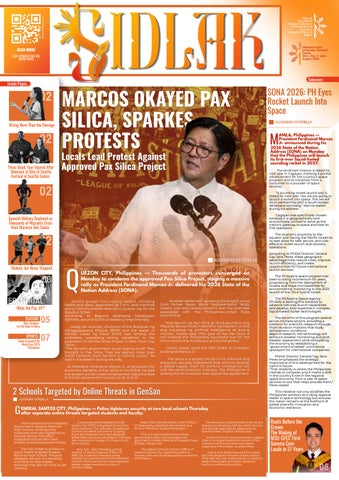
MARCOS OKAYED PAX SILICA, SPARKES 02 PROTESTS 02
Rising More Than the Damage
Three Dead, Four Injured After Shootout at Bite of Seattle Festival at Seattle Center
Locals Lead Protest Against Approved Pax Silica Project
What the Pax, VP? FEATURE
Dear Stranger, Let Me Make It Home
SPORTS
Spain Crowned FIFA World Cup 2026 Champions
05 07
ALESANDRA ESTREBILLA
M
ANILA, Philippines — President Ferdinand Marcos Jr. announced during his 2026 State of the Nation Address (SONA) on Monday that the Philippines will launch its first-ever liquid-fueled sounding rocket in 2027.
The location's proximity to the equator and having the Pacific Ocean to its east allow for safe, secure, and costeffective rocket launch and recovery operations.
Q
ALESANDRA ESTREBILLA
UEZON CITY, Philippines — Thousands of protesters converged on Monday to condemn the approved Pax Silica Project, staging a massive rally as President Ferdinand Marcos Jr. delivered his 2026 State of the Nation Address (SONA).
Activist groups from various sectors, including health and labor, assembled at 7 a.m. and marched along Commonwealth Avenue in Quezon city for the People’s SONA According to Bagong Alyansang Makabayan (BAYAN), around 15,000 protesters joined the rally. Leody De Guzman, chairman of the Bukluran ng Manggagawang Pilipino (BMP) and the leader of Partido Lakas ng Masa (PLM) was among the protesters, expressing strong opposition to the proposed US-led Pax Silica Project in New Clark City, Tarlac. “The dynastic government is just ripping us off. They brought in Pax Silica. They are seizing more than 4,000 hectares from farmers in Central Luzon,” he said in his speech during the rally. As President Ferdinand Marcos Jr. emphasized the economic benefits of Pax Silica in his SONA, he said the project would create employment opportunities and help advance the country as an AI hub.
Another statement opposing the project came from former Bayan Muna Representative Teddy Casiño, who also raised concerns over the promises associated with the Philippines-United State partnership. “Ang layunin ng Pax Silica ay hindi paunlarin ang Pilipinas [kung hindi] makontrol ng Estados Unidos ang industriya ng artificial intelligence sa buong mundo,” Casiño said. (The goal of the Pax Silica is not making the Philippines successful but for the US to control the AI industry across the globe.) Casiño stated amid the fifth SONA of President Ferdinand Marcos Jr. Pax Silica is a project led by a U.S. initiative and economic security framework that aims to develop a global supply chain for artificial intelligence (AI) and the semiconductor industry. The Philippines is among the 24 countries that signed the agreement.
2 Schools Targeted by Online Threats in GenSan ALESANDRA ESTREBILLA
G
SONA 2026: PH Eyes Rocket Launch Into Space
Cagayan was specifically chosen because it is geographically and economically primed to serve as the nation's gateway to space and host its first spaceport.
02
EDITORIAL
Sidenews:
“A sounding rocket launch test is slated for next year. Yes, we are going to launch a rocket into space. This we will do in partnership with a South Korean aerospace company,” Marcos stated during his address.
Spanish Military Deployed as Thousands of Migrants Cross from Morocco into Ceuta
03
Mindanao State University–General Santos Vol. 1, No. 1 • July– August 2026
The landmark mission is slated for next year in Cagayan, marking a pivotal advancement for the country’s space program and its transition from a consumer to a provider of space services.
02
Shaken, but Never Stopped
SIDLAK The Official Student Publication of the Bachelor of Secondary Education Major in English
ENERAL SANTOS CITY, Philippines — Police tightenes security at two local schools Thursday after separate online threats targeted students and faculty.
Police personnel immediately responded to Buayan National High School, while security measures were also tightened at General Santos City SPED Integrated School after both schools received separate threats.
A separate post targeted General Santos City SPED Integrated School-San Isidro Campus. The uploader threatened to shoot students accused of bullying them and teachers who had allegedly failed them without justification. The post also included an image of a firearm and ammunition.
Major Mark Gerald Norbe, chief of RACU 12 Operations, classified the incident as a form of "Nihilistic Violent Extremism."
The first threat to surface on social media targeted Buayan National High School. The post allegedly warned of a shooting once face-to-face classes resumed.they did not want to get involved.
Brig. Gen. Alan Manibog, acting director of Police Regional Office-12 (PRO-12), ordered increased police visibility and patrols around the affected schools. Police personnel were deployed before classes resumed to ensure campus safety.
The DepEd Schools Division Office of General Santos City urged the public to remain calm and avoid spreading unverified information.
"This is a kind of extremism where perpetrators, often young people, are groomed to create chaos and threaten mass killings," Norbe said.
"We assure our stakeholders that we are closely coordinating with law enforcement and partner agencies to safeguard our communities," DepEd GenSan said. Schools Division Superintendent Isagani Dela Cruz urged parents to monitor their children's online activities and report suspicious information to authorities. Police and DepEd assured the public that the situation remains under control. They said security measures are in place to keep schools safe and allow classes to continue without disruption.
According to PhilSA Director General Gay Jane Perez, these geographic advantages help reduce costs, improve launch efficiency, and create opportunities for future international launch services. The Philippine space program has been building momentum for years, progressing from the deployment of Diwata and Maya microsatellites for environmental monitoring to the 2023 launch of the TALA hybrid rocket. The Philippine Space Agency (PhilSA) is leading this initiative to advance national launch capabilities and develop local expertise in complex liquid-fueled rocket technologies. The benefits of this program extend across multiple sectors, providing a platform for scientific research through short-duration missions that study atmospheric conditions. Beyond research, the technology will enhance disaster monitoring and postdisaster assessment while stimulating the economy by establishing a "government-enabled" commercial spaceport for international companies. PhilSA Director General Gay Jane Perez emphasized the strategic importance of this development for the nation's future. “That reliability is where the Philippines intends to compete, and it marks a shift in the country’s role in the regional space economy, from a user of space services to one that helps provide them,” Perez stated. This initiative not only solidifies the Philippines' position as a rising regional leader in space technology but ensures the nation remains at the forefront of global scientific innovation and economic resilience.
Roots Before the Crown: The Making of MSU-CFES' First Summa Cum Laude in 57 Years
06
02 NEWS Three Dead, Four Injured After Shootout at Bite of Seattle Festival at Seattle Center PAULINE MARIE PATAYON
S
EATTLE — A violent exchange of gunfire between opposing groups during the final hours of the annual Bite of Seattle food festival left three people dead and four others wounded, triggering widespread panic and political fallout across the city.
IDLAK SIDLAK The Official Student Publication of the Bachelor of Secondary Education Major in English Mindanao State University–General Santos Vol. 1, No. 1 • July–August 2026
RISING MORE THAN THE DAMAGE Student Leadership Thrives Even in Crisis NORAIZA MACMOD
The shooting happened at around 6:00 p.m. outside the Seattle Center Armory as thousands of visitors gathered for the closing day of the three-day event. An argument between two groups escalated into a gunfight. The gunfire sent festival attendees scrambling for cover, with many fleeing into nearby landmarks including the Space Needle and the Pacific Science Center. The King County Medical Examiner’s Office identified the three fatalities. Four innocent bystanders caught in the crossfire sustained injuries. All surviving victims were treated at Harborview Medical Center and have since been discharged. Police recovered three weapons at the scene, including an untraceable "ghost gun" and an illegally modified automatic pistol. A 15-year-old suspect was arrested and charged with assault, but ballistics confirmed his gun did not fire the fatal shots. Police are searching for additional suspects. Assistant Chief of Investigations Nicole Powell confirmed that the confrontation was a targeted, gang-related altercation between rival groups rather than an attack directed at the general public. The public outcry over the tragedy quickly reached city hall. Following intense criticism and calls for resignation from Mayor Katie Wilson, Seattle Police Chief Shon Barnes resigned from his position. City leadership subsequently appointed Andre Sayles as interim police chief and announced heightened security measures for upcoming city gatherings, including the annual Seafair festival.
Image Source: The Seattle Times
G
Image courtesy of Bagwis
ENERAL SANTOS CITY — Student organizations at Mindanao State University–General Santos (MSU-GenSan) are moving forward with campus operations for Academic Year 2026–2027 after the university officially accredited 110 student groups on July 29, following a devastating magnitude 7.8 earthquake that damaged campus infrastructure.
The approved groups comprise 47 academic organizations, 30 socio-civic initiatives, 12 religious organizations, eight campus publications, eight fraternities, and fThe accreditation, administered by the Office of Student Development and Services under the Office of the Vice Chancellor for Student Affairs and Services, grants official recognition to a broad range of campus entities. ive umbrella councils. Despite restricted access to traditional headquarters and ongoing retrofitting across campus, student leaders have implemented temporary workaround plans and hybrid event formats to navigate spatial limitations and potential aftershocks.
In the College of Education, operations have been restricted exclusively to the ground floor after upper levels were declared off-limits, while the Engineering Students Organization has sought alternative venues following the closure of the university’s structurally damaged H-Building. University administration officials emphasized that despite the increase in accredited organizations this year, evaluation continues to prioritize the qualitative value and accountability of student initiatives. Officials noted that student-led community outreach and volunteer efforts remain vital to supporting MSUGenSan’s broader performance metrics and international standing during the campus recovery phase.
Spanish Military Deployed as Thousands of Migrants Cross from Morocco into Ceuta
C
People mainly from Morocco stand on the shore as Spanish Army cordon off the area at the border of Morocco and Spain, at the Spanish enclave of Ceuta, on Tuesday, May 18, 2021. Image Source: Daily Sabah
PAULINE MARIE PATAYON EUTA, Spain — Spanish military personnel have been deployed to reinforce security along the border of Ceuta after thousands of migrants crossed into the North African enclave from Morocco in a rapid border crisis, authorities reported. Footage captured the scene that showed thousands of individuals swimming around the offshore water border fences and faced down authorities who fired warning shots to reach Spanish territory.
Ceuta, along with its neighboring district Melilla, holds a geopolitical status as one of the European Union's only direct land borders on the African continent. As a result, the two territories frequently serve as key points for migrants attempting to migrate to Europe for better opportunities.
According to initial reports from Spanish state media, an estimated 60,000 people crossed into the enclave. And at least 57 migrants died from drowning or killed in the stampede.
Spanish authorities remain on high alert as security measures and administrative evaluations of those who crossed continue along the border points.
SHAKEN, BUT NEVER STOPPED
General Santos City: Home of the Champions, defined by Resilience NORAIZA MACMOD
G
ENERAL SANTOS CITY — Natural disasters and roster turnovers have failed to slow down Mindanao State University–General Santos (MSU-GSC), as the university's varsity program mobilizes to defend its athletic supremacy at the upcoming Mindanao State University System Athletic Association (MSUSAA) meet.
Seeking an unprecedented sixth consecutive overall championship, the MSU-GSC Generals are finalizing their preparations ahead of the system-wide sports event, which takes place from September 1 to 8 at the MSU-Marawi Main Campus. The delegation's path to Marawi faced a major hurdle when a magnitude 7.8 earthquake hit the region, threatening to disrupt training schedules and campus operations. However, university leadership instructed the athletic department to press forward, turning the sports campaign into a symbol of recovery and community resilience.
To rebuild stamina and sharpen tactical execution following the calamity, the Sports Development Office (SDO) conducted a dedicated 10-day intensive training camp in late July. The dualsession daily program split time between early-morning endurance conditioning and afternoon skill drills supervised by event coaches. SDO leadership confirmed that the target for this year's meet is to achieve a podium finish in every single contested discipline. Maintaining a years-long sports dynasty has also presented a logistical challenge, as several star athletes who anchored previous championship runs recently graduated.
In response to the sudden increase of migrants, Spain’s defense officials mobilized army units to support local police along the border zones, assisting in crowd control and securing perimeters.
anchored previous championship runs recently graduated. To plug those gaps, MSU-GSC tapped its Special Admission Program to bring in high-caliber recruits, securing first-year talent with extensive experience in regional and national athletic competitions. Sports officials stress that while fresh talent provides a necessary boost, execution on the field will ultimately depend on physical conditioning and mental readiness rather than past achievements. Supported by university administrators, the Generals are set to arrive in Marawi with a restructured roster intent on proving that their championship culture remains intact.
Image courtesy of Bagwis
IDLAK LAYOUT:
EDITORIAL
NICOLE ANGELA JOVEN
ALAYSA SOLAIMAN
WHAT THE PAX, VP?
"Ano ‘yan?... Ano?... Foxy Leak?" "I can't comment on that."
Those two statements lasted only a few seconds. But, their implications for Philippine leadership may last far longer.
O
n July 28, 2026, outside the International Criminal Court detention center in The Hague, Netherlands, Vice President Sara Duterte was approached and asked about the widely debated Pax Silica initiative. Instead of offering clarity on one of the country's most debated national issues, she appeared momentarily confused before declining to comment. The exchange quickly went viral, not simply because of what was said but because of what it suggested about the kind of leadership Filipinos deserve from the nation's second-highest elected official.
SIDLAK JULY 2026 - AUGUST 2026
At a time when Filipinos were demanding answers, the country's second-highest elected official offered confusion, then silence.
Public officials are not expected to know everything. No one reasonably demands perfection. But the Filipino people do have every right to expect awareness of issues affecting the nation, the humility to acknowledge public concern, and the willingness to answer difficult questions. Accountability is not about having every answer immediately. It is about showing up when the people demand one.
Leadership is not measured by ribboncuttings, motorcades, or carefully rehearsed speeches but rather by how those entrusted with public office respond when the nation is looking for answers. It is tested not in moments of comfort, but in moments of uncertainty. The controversy surrounding Pax Silica has become one of the country's most debated national issues, with many Filipinos expressing concern over its possible implications and demanding greater transparency. Whether one supports or opposes it is beside the point. The issue has become a matter of public interest, and that alone should have commanded the attention of the nation's highest officials. Yet when the Vice President was asked about it, the public did not hear reassurance. They did not hear accountability. They did not even hear an acknowledgment that the concern deserved to be addressed. Instead, they heard confusion. Even ordinary Filipinos have at least heard the words "Pax Silica." has dominated conversations across social media, news reports, and public discourse. So one cannot help but ask: What the Pax, VP?
03
Faced with one of the country's most talked-about issues, she chose not to speak. “I can't comment on that." Those five words were not merely a refusal to answer but a refusal to lead. Public officials are not expected to know everything. No one reasonably demands perfection. But the Filipino people do have every right to expect awareness of issues affecting the
nation, the humility to acknowledge public concern, and the willingness to answer difficult questions. Accountability is not about having every answer immediately. It is about showing up when the people demand one.
Leadership is not merely occupying an office but it means understanding what burdens your people carry. It means recognizing when the nation is looking toward you. Not for perfection, but for presence.
The Vice President is not an ordinary citizen who can simply shrug and move on. She is not a political commentator who can pick and choose which issues deserve her attention. She occupies the second-highest elected office in the Republic of the Philippines. That office exists because democracy recognizes that leadership cannot rest on one person alone. When uncertainty grips the nation, the Vice President is expected to stand with the people and not stand apart from them.
This is also why conversations about future elections cannot be separated from present performance. Leadership should never be judged solely by campaign promises, political machinery, popularity, or family name. It should be judged by conduct already demonstrated while in office.
If the Vice President cannot, or will not, address an issue that has already captured national attention, then Filipinos are left asking a far more disturbing question: Who exactly is speaking for us? Every election is a contract between the people and those they choose to govern. Filipinos surrender their trust, their vote, and the taxes they work tirelessly to earn in exchange for representation. Every peso that funds the salaries, staff, security, and operations of the country's highest officials comes from ordinary citizens who expect their leaders to be present when accountability calls. The Filipino people are not paying their leaders to remain silent. They are paying them to lead. And this silence carries consequences. Perhaps what made the moment even more disappointing was the apparent detachment. While Filipinos debated the issue, civil society groups staged protests, experts raised concerns, lawmakers called for congressional scrutiny, and citizens demanded greater transparency, one of the country's highest officials appeared disconnected from the conversation itself.
If today, as Vice President, she cannot find the willingness to address one of the country's most pressing public concerns, what confidence can Filipinos reasonably have that greater power will suddenly produce greater accountability? Every public appearance, every difficult question, every opportunity to reassure the nation, and every moment of silence tells the Filipino people exactly what kind of leadership they are being offered. The Filipino people deserve better than officials who appear only when convenient and disappear when accountability comes knocking. They deserve leaders who understand that public office is not a privilege to be enjoyed but a responsibility to be fulfilled. Leaders who face difficult questions instead of avoiding them. Leaders who recognize that silence from someone entrusted with power is never politically neutral, it has consequences for every citizen waiting to be heard. Because silence from an ordinary citizen is a personal choice. Silence from the Vice President of the Philippines is a national statement. And, if a Vice President cannot stand with the people while holding the second-highest office in the land, then perhaps the question Filipinos should be asking is not "What the Pax?" It's "Who exactly are we voting for?"
CARTOONIST:
NICOLE ANGELA JOVEN
IDLAK
OPINION 04
LAYOUT: NICOLE ANGELA JOVEN
JULY 2026 - AUGUST 2026
DemoCRISIS CRISIS E
ALAYSA SOLAIMAN
"Your vote is your voice." very election, Filipinos are fed the same comforting promise: that our vote matters. That power ultimately belongs to the people. We are told to register, to vote wisely, to endure hours in classrooms turned into polling precincts, sweating under broken electric fans,
believing that the ballot in our hands is enough to shape the country's future. But a voice means little when it is forced to choose between the same names every election.
How free is that choice when the names on the ballot have already governed for decades? When one family member steps down only for another to step in? When elections become less about competing visions for the country and more about deciding which branch of the same political family gets the next term? We call it democracy because we still vote and perhaps, that is the biggest lie we continue telling ourselves. One need not look far to see this pattern unfold. The Marcoses continue to occupy some of the country's highest offices, extending their influence from national leadership to local politics. The Dutertes, long dominant in Davao, have likewise maintained a formidable presence on the national stage through multiple family members holding elected positions. Beyond them are the Villars, Binays, Estradas, Cayetanos, Romualdezes, and countless other political families whose names have become fixtures in Philippine elections.
SHAIRA ALBARACIN
Present sa Meet, Absent sa Sarili “Gusto raman unta nako muskwelag hapsay, ay nakatulog?”
These families are not the problem simply because they exist. Nor is this an argument that they are all incapable of serving the public. Some have undeniably delivered programs, won the trust of their constituents, and governed effectively. That is not the point. The Philippines does not suffer from a shortage of capable leaders. It suffers from a political system that keeps returning to the same surnames. Every election, there are teachers, lawyers, doctors, civil servants, youth leaders, community organizers, and ordinary Filipinos with the competence and commitment to lead. Yet many never make it
past the starting line and not because they lack qualifications, but because they lack the machinery, the resources, and most importantly, the family name that has long served as an unofficial passport to public office. When political influence is inherited across generations, elections stop being an open contest of ideas and begin to resemble a closed circle where power simply changes hands within the same families. The ballot may present different names, but too often, those names trace back to the same bloodlines. This is the normalization of concentrated power and the defense is always the same. "If the people elected them, then what is the problem?" The problem is that elections do not begin on election day. They begin long before the ballots are printed, when political machinery is already in motion, campaign funds are already secured, alliances are already built, and familiar surnames have already occupied every corner of public consciousness. By the time an ordinary candidate enters the race, they are not simply competing against another individual. They are competing against decades of influence, resources, and political machinery carefully built to preserve power. Yes, political dynasties are not explicitly prohibited because Congress has repeatedly failed to pass an enabling anti-dynasty law despite the Constitution's clear directive to address them. But something being legal does not automatically make it healthy for a democracy. History has never struggled to produce legal systems that benefited those already in power. The question is not whether dynasties are allowed but rather why they continue to be. And the answer is painfully simple, that those who have the power to change the system are the very people who benefit from keeping it exactly as it is. Power protects itself, it always has.
This is not an argument that every politician from a political family is incompetent. That would be intellectually lazy. Competence is not inherited, just as incompetence is not exclusive to political outsiders. The issue is far deeper than individual capability. Democracy should never depend on bloodlines. Public office should never feel like a family heirloom passed from one relative to another. Leadership is not a surname but a responsibility that must be earned. Not inherited. Not preserved. Not recycled. The most dangerous victory political dynasties have ever achieved is probably not staying in power but convincing the public that staying in power is normal. The consequence reaches far beyond elections. It sends a quiet but devastating message to every young Filipino who dreams of serving their community: unless your surname already carries political weight, your qualifications may never be enough. Is this democracy or exclusion dressed up as representation? A democracy is not judged merely by whether elections happen. Authoritarian regimes have held elections too. Democracy is judged by whether power remains genuinely open to the people and not just to those born into it. The ballot gives us the right to vote but it does not guarantee that the choices before us are equally possible. When political power continues to circulate within the same families, election after election, generation after generation, we are no longer deciding who deserves to lead. We are asking help from the same names that makes us suffer. And when we stop to question that, that is when we can say that it is not a triumph of democracy but a quiet surrender. Until leadership is determined more by competence than by lineage, and until public office ceases to function as a family inheritance, we should stop congratulating ourselves for having choices. Because a ballot filled with the same names is not proof of democracy. It is proof that somewhere along the way, we became comfortable confusing the freedom to vote with the freedom to choose. That is not the democracy we were promised. It is a DemoCRISIS.
I
to ang paulit-ulit kong tanong habang nakatitig sa dalawang open tabs ng cellphone ko—sa kaliwa, ang dalawang oras nang lecture ng prof ko sa Google Meet; sa kanan, ang Reels, Shopee, at Mobile Legends na tila sumesenyas ng "ML na, ano tara?!” Sa gitna ng online class, hindi lang signal ang nawawala; madalas, pati 'yung wisyo ko, nag-drop-out na rin. Tapatan lang tayo, mahirap maging estudyante ngayon. Bilib din ako sa sarili ko kung paano ko nakakayang makipag-interact sa klase habang naglalaro ng online games. Akala ng marami, madali ang buhay-online class dahil "nasa bahay ka lang naman." Pero ang hindi nila alam, ang sarili naming bahay na dapat ay lugar para magpahinga, nagiging battleground na ng mental health, bahay-kubong ingay, at walang katapusang tukso ng social media.
ang mismong kapaligiran mo naman sa bahay ang magho-host ng sarili niyang entertainment. Kasabay ng lecture ang tilaok ng manok ng kapitbahay na tila may pinaglalaban sa buhay, ang sigaw ni Papa na "Hugasi na ang plato, Shaira!", at ang tahol ng aso na tila nakikipag-debate sa prof ko. Paano ka magfo-focus kung sa bawat pagunmute mo ng mic para magrecite, kailangan mo munang magdasal na sana ay walang dumaan na open-piped na motor sa background?
Isipin mo na lang ang eksena sa araw-araw: nakaupo ako nang Naiintindihan ko naman na maayos, handa na sana ang utak ko kailangan nating mag-adjust at na mag-absorb ng kaalaman. Pero mag-shift to online classes lalo na limang minuto pa lang ang at under renovation pa ang kampus nakalipas, bibitawan ng prof ko ang dahil sa kamakailang lindol. Kilala linyang, "Class, can you see my tayong mga MSUan sa pagiging screen?" at doon na magsisimula matatag at palaban—'yung tipong ang character arc ko bilang master “Atake lang gihapon bisan lisod.” of distractions. Habang nagsasalita Pero huwag naman sana nating si Ma'am o Sir tungkol sa ikaila na ang kawalan ng pokus sa napakalalim na teorya, ang kamay online class ay hindi laging dahil sa ko ay kusang gumagalaw patungo katamaran. Minsan, ito ay paraan sa iba't ibang apps. Isang "quick lang din ng utak natin o tinatawag scroll" lang daw sa TikTok, pero bago na coping mechanism para ko namalayan, kalahating oras na huminga mula sa Zoom fatigue at pala akong nanonood ng sa halo-halong stress sa paligid. Ang gumagawa ng Dubai chewy cookie hirap kasing magpanggap na okay o ng walang katapusang Brazilian ang lahat kapag ang attention span dance. "Unsa kaya akong i-notes sa mo ay mas maikli pa sa panahong Messenger?" sabi ng isip ko, habang ibinibigay para sa isang 50-item ang konsensya ko naman ay quiz. sumisigaw na ng "Juicecolored, Shaira! Paminaw!" At kapag sinubukan mo namang labanan ang tukso ng Hindi natin hinihingi na cellphone? Doon ka naman maging perpekto ang tatatamaan ng panibagong lahat. Pero sana, kalaban: ang matinding antok. Dahil magkaroon ng kaunting nakahiga o nakasandal ka lang sa space at pag-unawa para kama habang nakikinig sa sa tunay na sitwasyon ng monotonous na boses ng prof, mga estudyante. dahan-dahang bibigat ang mga mata mo. “Piyong rako mga five seconds,” bulong mo sa sarili mo. Sa huli, hindi lang naman kami nagBago mo mamalayan, nagising ka iinarte kapag sinasabi naming na lang sa gitna ng katahimikan mahirap ang online learning sa —'yun pala, kalahating oras nang bahay. Nagpapatuloy pa rin naman natapos ang klase at ikaw na lang kami, nagpapasa pa rin ng ang natitirang "present" sa Google requirements, at gumagawa ng Meet. paraan para may matutunan—'yun nga lang, madalas ay ginagawa Ito pa ang mas matindi: kapag namin ito habang pilit na iniiwasan gising ka naman at pilit na ang tukso ng ML at ang tawag ng lumalaban sa tukso ng cellphone, malambot na kama.
SHAIRA ALBARACIN
Pitong Taong Basura sa Subic: Ghosting sa Pananagutan!
K
ung may championship award man para sa pinakamalupit na dahilan ngayong taon, walang alinlangan na ang Subic Municipal Environment and Natural Resources Office (MENRO) ang mag-uuwi ng trofeo!
Matapos maipalabas sa iWitness ang miserableng sulyap sa Sitio Tibag sa Barangay Naugsol—kung saan ang virgin forest at Ancestral Land ng ating mga kapatid na Aeta ay ginawang open dumpsite ng pamahalaang lokal simula pa noong 2019— biglang hinarap ng LGU ang publiko na may bitbit na klasikong linya: "Hindi namin alam na may community doon sa area." Oops oops oops, maiipit ka ngani! Pitong taon ninyong itinapon ang toneladatoneladang dumi, kasama na ang peligrosong medical waste noong pandemya, tapos biglang hindi ninyo alam na may nakatira doon? Nakakagulat ang uri ng kapabayaan, selective blindness yarn? nakikita niyo ang bakanteng gubat para tapunan ng basura, pero ang mga taong nag-aalaga rito, biglang naging invisible! Dagdag pa ng municipal engineer Marian del Castillo, "Immediate solution lang ito,
hindi ito magtatagal.” noong sumabog ang krisis sa basura which is akala. Ngunit sa bokabularyo ng gobyerno, ang "temporary" pala ay tumatagal ng pitong taon—sapat na panahon upang malason ang malinis na ilog, bumaho ang hangin, at makompromiso ang tubig-inumin ng komunidad. 123 go kanya kanya na! Ganyan umasta ang pamahalaang lokal kapag usapin na ng respeto. Ramdam ko ang reyalidad sa baluktot na sistema nung sinabi ng dating kapitan na si Virgilio de los Santos: "Kahit na hindi kami papayag... pagpatuloy nila, kasi naumpisahan na nila." Sinundan pa ito ng pait sa pahayag ng residenteng si Erlinda Capistrano: "Kapag nagtitinda nga po kami ma'am, sabihin nila kaagadagad na, 'Wawalisan ninyo, lilinisan niyo yung pwesto ninyo'... Sumusunod naman po kami. Pero sila po, bingi lang po sila o ano po sila."
Napakasimpleng lohika: kapag katutubo ang nagtitinda sa kapatagan, dapat sobrang linis; pero kapag ang pamahalaang lokal na ang magtatapon ng dumi sa bundok, biglang walang nakikinig. Nang mag-viral ang balita at ma-call out sa media, biglang yoohoo dito ang tingin! Agad nagmadali ang LGU na takpan ng lupa ang mga basura para hindi masyadong halata, habang ang DENR naman ay naglabas ng cease and desist order upang ipakita sa publiko na may ginagawa sila. Good news ba na nagmamadali silang magtakip ng ebidensya dahil lang nahuli sila ng camera? oh c'mon! Ang pitong taong pambabastos at pagtatapon ng dumi sa Ancestral Land ay hindi bastabasta matatakpan o mabubura ng kaunting tambak ng lupa. Ang Ancestral Land ay
hindi ekstrang bakanteng lote na pwedeng gawing tapunan ng dumi. Panahon na upang itigil ang pagtrato sa ating mga katutubo bilang mga "invisible resident" lamang kapag may itinatapong dumi—nararapat silang igalang, pakinggan, at bigyan ng tunay na katarungan sa sarili nilang tahanan!
IDLAK SIDLAK The Official Student Publication of the Bachelor of Secondary Education Major in English Mindanao State University–General Santos Vol. 1, No. 1 • July–August 2026
05 FEATURE
Dear Stranger,
Beyond the Ride: The One That Drove Let Me Make It Home Generations of MSUans PAULINE FE DESCARTIN
PAULINE FE DESCARTIN
“Isbug-isbugi lang sa, isa na lang larga nata!” These are the familiar words that daily commuters hear long before the first lecture begins. Every morning, the road leading to Mindanao State University-General Santos comes alive with the familiar rumble of jeepney engines. Students, some still clutching their assignments, while others fighting off sleep, climb aboard with one thing on their mind: “Late na sad ko.” And yet, while most of the students remember the jeepney they rode, only a few stop to remember the people behind every wheel. For many MSUans, the daily commute transcends beyond the means of getting to class. It became a routine shaped by jeepney drivers, who over time, have become the quiet figures that accompanied their college life. “I remember once when a student left her things after taking off the jeepney, the driver immediately stopped and asked us to call her attention so he could return them,” a student shared. “I appreciate their honest work and the way they avoid driving recklessly because they really ensure the safety of every passenger they carry every day,” she added. Stories like these reflect how simple yet meaningful acts of honesty and diligence leave lasting impressions on students. While these interactions may seem ordinary, they gradually build a sense of trust and familiarity between commuters and the drivers each day. These connections are not shaped by exchanges of long conversation but through the quiet rhythm of routine. Each semester brings a new batch of passengers, yet those who steer their aging jeepneys have watched generations of students sit on the same worn-out seats. Over time, the simple exchange of fare has turned into silent recognition: a nod, a smile, or even a warm “maayong buntag” before another day begins.
H
elmets are meant to save the lives of motorcycle riders. They are designed to shield the head, absorb impact, and lessen fatality in case of accidents, giving them a better chance of making it home. But somewhere between two different shifts, a rider's final booking and another rider's first trip in the morning, their helmets began carrying a different kind of protection. It did not have thicker inner padding nor stronger helmet shells. It was a few handwritten words taped at the back of their helmet. “Buntis po ang asawa ko. Huwag nyo po ako sanang saktan…” Similar notes to passengers began appearing only a few days after the passing of Move It rider Fabio Norberte Jr, who was killed while working. It was not a government initiative or part of a company campaign. It was simply a defense mechanism from riders themselves, hoping that a few words might succeed in protecting them where a helmet alone could not. The notes were short, almost apologetic. Yet they carried the weight of an honest work. July 14 was like any other workday for Fabio. He prepared his jacket, fastened his helmet, and began waiting for passengers. Every ride meant more than just a booking, it was an opportunity to provide for his three-year-old son, Anghel, whom he has been raising since after his wife died during childbirth. Like any other ride-hailing driver, he left his home hoping to return before the night ends.
But instead, he never made it home. Investigators reported that Fabio was fatally stabbed by a passenger during a ride in Caloocan City. Before the suspect was arrested he allegedly fled with his motorcycle tagging the case as robbery. His tragic death sparked widespread outrage and heartbreak across the nation, not only because of this senseless act of violence, but because it exposed a realization. The livelihood of our frontline ridehailing workers depends on riding with complete strangers on their motorcycle every single day. “Sa bawat byahe may anak na laging sabik sa paguwi ng kanyang ama.” Every rider deserves protection and the chance to make it home safely. Behind every helmet is not simply a rider identified by a name. It is a person with responsibilities, dreams, and a family waiting for them. Additional protection for every rider is not only about stronger safety measures, it's about protecting every child, parent, and a loved one who hopes to see them come home after every trip. Perhaps the handwritten notes resonated with many Filipinos because they didn't demand recognition or asked to be called heroes. Those notes are quiet reminders that no family should lose someone who was only trying to earn an honest living. They are also letters that were never meant to be written.
“I'm really grateful for our jeepney drivers because we all know that it's the cheapest option for us commuters. It has helped many students, especially those on tight budgets. For us they're not just drivers, they are daily companions in making our dreams happen,” a student shared. Beyond the familiarity they bring to students' daily routines, jeepney drivers also play a vital role in making education more accessible. For many students, the jeepney remains as one of the most affordable and reliable ways to reach campus. With only a fare of ₱30-₱40, it keeps education reachable for every student despite the increasing transportation costs. Yet behind every trip is a driver who owns the rest of the burden. Before the sunrise paints the streets of General Santos City, many jeepney riders are already sipping their cup of coffee, inspecting their vehicles, checking brakes, and preparing for long hours behind the wheel. They spend most of their day navigating endless traffic, enduring the scorching heat of GenSan, and hoping that the day's earnings will be enough to feed their families. Even on days where taking a break is not an option, they still continue to show up. Whether it is the rush of enrollment season, the pressure of examinations, or the heavy rain that leave students stranded, they choose to remain on the road, ready to take students where they need to be. “As a graduating student here in MSU, I can testify that our jeepney drivers have become a huge part of my college journey. They are often the ones who go unnoticed, yet they have never failed to bring us to school despite every storm, the scorching heat, and even their own exhaustion. Without their hard work, many students would not make it on time to their classes or continue fighting for their dreams,” a graduating student shared. For many MSUans, these everyday acts of dedication go unnoticed, yet they leave lasting impacts on countless journeys. As students chase deadlines, dreams, and diplomas, jeepney drivers continue to carry something just as important: the responsibility of getting them there safely, one ride at a time. Their names may never appear in any certificates or graduation programs, but their contribution is woven in every MSUan story, every student who arrives on time for class, every late-night commute home, and every dream that begins with a ride through the university gates. Every name, every story, and every face of the students they carry is a reminder that their service extends far beyond transportation. With every journey, they have driven generations of MSUans not only to their destinations, but also closer to their dreams.
06 FEATURE THE
IDLAK SIDLAK The Official Student Publication of the Bachelor of Secondary Education Major in English Mindanao State University–General Santos Vol. 1, No. 1 • July–August 2026
Unwritten IN THE
LESSONS
Syllabus
PAULINE FE DESCARTIN
“What if the hardest lessons in
--- Running on empty
Every semester begins with pages of certainty. A written syllabus that neatly printed the next five months of students as if it is the blueprint for success. It lays out every lecture, every requirement, and every deadline reduced to a single piece of paper.
--- Reality however, has a way of arriving quietly. It teaches us that even the fullest dreams can run on empty. As it slips into ordinary mornings when alarms ring before sunrise, into late nights spent chasing deadlines, and into the uneasy paranoia of budgeting the last ₱100. Suddenly, a realization hits that independence is not as effortless as it once seemed. It is choosing between buying a meal or saving enough money for tomorrow's commute. It is the rice container that grows emptier each day, hoping that it lasts by the end of the week.
college were never written in the syllabus?”
--- Yet, what they don't realize is that the most important lessons will never appear there. They will be written instead by empty cupboards, a cold cup of coffee, and quiet phone calls from home. --- Lecture of excitement --- For many students, there is something beautiful about leaving home for the first time. It is as if their ancestors were whispering that everything waiting ahead was worth every goodbye left behind. The first week of college is like freedom wrapped in possibilities where every new face is potential for a friend, every classroom in Gemma is a doorway to opportunities, and every step away from home becomes a step closer to the person they dream of becoming. --- But as lonely days settled in, the untouched meal across the table became more than a plate left uneaten. Dinners at the backgate were no longer just a break from studying, it became a bittersweet reminder that growing means learning how to live with emptiness that no food can fill.
--- But despite everything that seems to be running out, they somehow find the strength to keep going. --- The semester finds its rhythm --- There comes a point when every day begins to resemble the last. You wake up, attend class, chase a deadline, study, repeat. A routine so relentless that rest can no longer keep up. Somewhere between the first alarm and the last paragraph due at midnight, college has a peculiar way of making time disappear.
--- It is the rhythm that keeps them going and tells them that perhaps surviving today is enough, and tomorrow can take care of itself. --- Lessons that lasts --- Between the struggles and the small wins, the things that once felt impossible became familiar. The student who used to worry about every remaining coin learns to budget. The one who cried after a call from home learns to find comfort in friendships. The one who doubted their own ability to live alone learns to stand on their own. The unfamiliar place that once felt distant slowly becomes a place they can call home. They do not notice the change immediately. Growth rarely announces itself. --- Perhaps, these are the unwritten lessons of the syllabus. Its pages were never printed, never scheduled, and were never recorded, and yet they teach lessons beyond every classroom could offer.
--- And yet, students still show up, even with heavy eyes or runny noses. They laugh with their friends in the hallway, answer attendance when their name is called, and carry their backpacks as though everything is under control.
ROOTS BEFORE THE CROWN:
The Making of MSU-CFES' First Summa Cum Laude in 57 Years
PAULINE FE DESCARTIN
S ome trees grow taller not because
they are planted in the richest soil, but because they learn to survive the harshest conditions. Such was the story of Orland Phillip L. Salvador, who became the first Summa Cum Laude in the 57-year history of Mindanao State University College of Forestry and Environmental Studies (MSU-CFES). His success did not bloom overnight, it was rooted in hunger, sacrifice, and a promise made to his sister that one day, life would be different. Long before he wore excellence like a crown, he first learned how to grow deep roots. O — On Barren Ground Orland’s roots were planted on the barren grounds of Tubay, Agusan del Norte where dreams often competed with survival. As the third son of seven siblings, his single mother spent 13 years raising him while working as a street sweeper and barangay tanod to provide for her children. Poverty had already become the thorns to the educational journey of his older siblings, leaving him determined to continue when they had been forced to stop. Despite the doubt of many people that no one in their family would ever finish school, let alone enter college, his mother refused to surrender. She believed that one day, one of her children would prove them wrong. That unwavering faith from Orland’s mother became the first root of his journey. R — Rooted in Resilience Growing up for him meant enduring adversities that many students never have to imagine. There were times when he and his younger sister would walk to school, without eating anything, or even money for transportation. He remembers vividly how they would rub herbal oil on their stomachs to ease the pain of their hunger. Those moments never left him. He made a promise to his sister that one day, they would finish school and life would be better.
"Mahirap maging mahirap, pero mas magiging mahirap kung hindi ka aahon sa hirap. Everything begins with mindset. If we're financially poor, then let our mindset be rich. We cannot afford to have limited resources and a limited way of thinking at the same time.”
N — New Heights, New History
During one of Orland's visits at home, he found their nipa house severely damaged, forcing his family to sleep on the other side whenever heavy rain poured. Without any hesitation, he used his scholarship and savings to repair the roof before returning to school.
Forestry tells us that the tallest trees are sustained by the deepest roots. Just like, Orland, it was his unseen roots that made history possible.
When his college journey finally came to an end, Orland received news he never expected.
He became the first Summa Cum Laude in the 57year history of the College of Forestry and Rather than allowing poverty to define his path, he Environmental Studies. For him it was more than an embraced a mindset that shaped his character rooted achievement, it was a historic moment for a college in resilience and a testament that excellence could flourish even on the muddiest grounds. L — Leaving for the Right Path D — Deep Roots of Orland's Legacy After graduating senior high as valedictorian, Orland initially enrolled in Nursing at a Among all the achievements he made, perhaps the private school institution in Iligan through the most meaningful one was a promise he can finally support of a relative. Yet, despite the opportunity at fulfill. hand, he felt that his future would bloom elsewhere. His younger sister who once walked with him in He could not picture himself spending his life inside hunger is now a second-year university student. The hospitals. Instead, he imagined himself wearing words he spoke years ago through empty days have boots, devoting his works in mountains and forests, become a reality. and protecting the environment. He withdrew from the program and passed the MSU System Admission As the first-generation college graduate from their and Scholarship Examination on the final day of family and the first Summa Cum Laude in MSU-CFES application. history, Orland hopes to inspire future students through his story and to challenge what seems A — A Home Before Excellence impossible to others.
Despite struggling financially, it did not stop him from consistently excelling in his studies.
SPORTS
07
IDLAK LAYOUT: NICOLE ANGELA JOVEN
Paper Rex Hold Top Frag After 2–0 Victory Over Team Secret in VCT Pacific 2026 JAPHETH DHEDZ CABAHUG
S
eoul, South Korea — Paper Rex sustained momentum in the VCT Pacific 2026 Stage 2 overpowering Team Secret with 2–0 in a Group Omega matchup on July 31. Team player PRX something consistently fragged the overall match leading PRX's third consecutive win in the tournament. The team claimed a 13–10 win on Summit before closing out the series with a 13–8 victory on Ascent.
In previous matchups, PRX had already begun building momentum after securing back-to-back victories over DetonatioN FocusMe (DFM) and KIWOOM (DRX). This time against Team Secret, the Singaporebased squad once again shone, showcasing their aggressive coordination. In the first round, Summit established an early advantage for PRX through a dominant defensive half, forcing TS to spend much of the time attempting to regain the deficit. Although TS managed to put itself together with firm attacking tactics, PRX maintained control in the remaining rounds to secure the win with a 13–10 score.
On the following map, Ascent, Paper Rex endured its heated-up momentum. Strong team chemistry, and efficient utility/ability usage bolster PRX to rule the pace of the game. The Team Secret struggled to find consistent countermeasures against PRX's relentless pressure and superb tactics, eventually falling 13–8 as Paper Rex overcame the match. The Paper Rex’s victory carries significant implications for the Group Omega standings.
Though PRX suffers an astonishing loss in the first matchup against T1, PRX responded with three consecutive victories, redeeming its record and fortifying its position in the race for the playoffs. With only the top teams advancing to the postseason, every match remains absolutely crucial. Paper Rex has secured itself in a favorable spot heading into the latter phase of the Pacific Stage. The 2–0 victory against Team Secret gives Paper Rex valuable points in the Group Omega standings, continuing its fortified form in Pacific Stage 2. With the playoff race still ongoing, both teams now redirect their attention to the remaining matches that will shape their latter postseason prospects.
The Great Paddle Takeover: How Pickleball Conquered the Philippines JAPHETH DHEDZ CABAHUG
Spain Crowned FIFA World Cup 2026 Champions JAPHETH DHEDZ CABAHUG
N
ew York, United States — Spain secured the FIFA World Cup 2026 title after beating Argentina in the tournament final with 1-0 standing in extra-time on Friday, July 19.
During the Prefinals, Spain had already built momentum through a series of promising results during the knockout stage. Against Argentina, the Spanish footballers organized a defensive approach, potent possession play, and unusual attacking patterns that gained them control over the match. The first half of the match remained heavily contested, both teams defensively limiting clear scoring opportunities. Spain eventually upset in the second half, inflicting sustained pressure in the attacking third. Despite Argentina’s extensive efforts, Spain successfully managed the remaining minutes, securing the match and claiming the championship title. In a hot take, Midfielder Rodri delivered a vital performance in the final, absolutely orchestrating the tempo of the match and helping Spain maintain ball possession during crucial moments. His calm composure and exceptional ability disrupted Argentina's attacks, providing Spain stability as
the contest entered extra time. The breakthrough eventually came following Spain’s colonizing pressure, dominating its contender, rewarding the team's patient approach. Rodri's outstanding contribution on both sides of the ball hailed him the MVP of the match and won the adidas Golden Ball for the FIFA World Cup 2026™. Following the post-match, Spain head coach De la Fuente said, “I never thought of anything like this, I always just wanted joy in moments. When you look back at this process, I would not have achieved anything without these players. The journey with this raw material, this talent. Spanish footballers, the way they compete. These players are amazing.” Spain's victory marked its second ever FIFA World Cup championship, showcasing the team’s progress through-out the competition, bringing home its hard-earned FIFA world cup trophy on the end of its glorious triumph.
P
hilippines — The sharp pop of paddles echoes across courts that barely existed a few years ago. From shopping malls to community lounges, Filipinos across ages are embracing pickleball, turning the once strange sport into one of the country's fastest-growing recreational movements.
The sport's growth has been difficult to deny. Local organizations continue to attract new members, while tournaments and social gimmick draw participants from different age groups. Its drastic rise is evident in the increasing number of dedicated playing courts across the country. According to BrandRap, SM Active Hub expanded its pickleball facilities in 2026 to 86 courts across 29 SM malls nationwide, creating the country's largest mall-based pickleball network. Originally created in the United States in 1965, pickleball blended elements of tennis, badminton, and table tennis. Its basic rules, smaller court, and beginner-friendly nature have made it particularly appealing to Filipinos seeking an accessible and social sport. Unlike more physically demanding racket sports, pickleball allows newbies and seasoned players to compete together. Its affordability and community-oriented atmosphere have also encouraged more Filipinos to take part in the game. “Pickleball doesn’t really require you to be agile or to be a super-athlete; it just asks you to be willing,” 19-year-old player AJ Palo said in an interview with Rappler. The rise of pickleball has also been fueled by influential personalities, local clubs, and community leaders who have introduced the sport to wider audiences. Through tournaments and exhibitions, they have contributed to its growing visibility nationwide. The sport's popularity has also attracted several well-known personalities.
Actress Anne Curtis, along with celebrity couple Rayver Cruz and Julie Anne San Jose, are among the public figures who have been seen playing pickleball, helping introduce the sport to broader future enthusiasts through online and social media invitation. Their participation has helped expose the sport to younger Filipinos who really follow the said personalities online. Organizations have likewise played an essential role in bolstering the pickleball community. The Philippine Pickleball League (PPL), an independent tournament organization, hosts multi-stage competitions across Luzon, Visayas, and Mindanao, providing opportunities for both amateur and elite players to compete and socialize. Several milestones have further fostered the sport's popularity. National tournaments, competitions, and international participation opportunities have strengthened its presence within the Philippine sports’ community. Among them is the planned Pickleball Champions League (PCL), which stages elite team competitions locally and features prize pools of up to ₱1 million per leg. What began as an oddly obscure paddle sport has evolved into a nationwide sporty movement embraced by players of different ages and socials. As the puddle of paddles continues to echo across newly built courts nationwide, pickleball's emergence saturated the Philippines’ appetite for accessible, engaging, and simple forms of recreation sports.
IDLAK EDITORIAL BOARD SY 2025-2026
EDITOR-IN-CHIEF Alaysa Solaiman NEWS WRITERS Alesandra Estrebilla Pauline Marie Patayon Noraiza Macmod EDITORIAL WRITER Alaysa Solaiman OPINION WRITERS Alaysa Solaiman Shaira Jel Albaracin FEATURE EDITOR Pauline Fe Descartin SPORTS EDITOR Japheth Dhedz Cabahug LAYOUT AND DESIGN EDITORS Nicole Angela Joven Diana Marielle Asuncion CARTOONIST Nicole Angela Joven SECTION EDITOR Diana Marielle Asuncion
READ MORE STAY UPDATED FOR THE LATEST NEWS
Medium/sildlak.com
DISCLAIMER The views and opinions expressed in the articles published in SIDLAK are those of the respective authors and do not necessarily reflect the official position of the Bachelor of Secondary Education Major in English, the College of Education, or Mindanao State University–General Santos. The editorial board is committed to responsible campus journalism and the ethical practice of the press.