ESTABLISHED 1826 — OLDEST COLLEGE NEWSPAPER WEST OF THE ALLEGHENIES
Volume 171 No. 1
Miami University — Oxford, Ohio
BACK TO SCHOOL EDITION
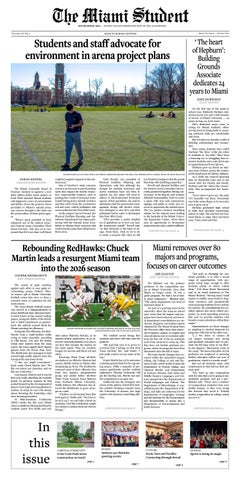
Students and staff advocate for environment in arena project plans
‘ The heart of Hepburn’: Building Grounds Associate dedicates 24 years to Miami ZOEE ROBINSON STAFF WRITER
STUDENTS RELAX ON COOK FIELD LAST SPRING SEMESTER BEFORE THE AREA WAS PERMENANTLY CLOSED. PHOTO BY SEAN MCGLYNN
SARAH KENNEL
GREENHAWKS EDITOR The Miami University Board of Trustees’ decision to approve a new $281 million dollar arena project on Cook Field shocked Miami students and triggered a wave of conversation and debate. Given the project’s direct proximity to Miami’s natural areas, one concern brought to the table was the preservation of these green spaces. “There’s great potential to have enhanced use of the natural areas,” said Natural Areas Committee Chair David Gorchov, “but also we’re concerned that if it’s not done well [there
could be] negative impacts to the natural areas.” One of Gorchov’s main concerns was how an increase in paved parking spots may impact the nearby ecosystem. Impermeable surfaces, such as parking lots, result in increased water runoff during heavy rainfall. Gorchov said this could erode the ecosystem’s soil and carry vehicle pollutants and excess sediment into Four Mile Creek. As the project moves forward, the Physical Facilities Planning and Operations Department has begun partnering with the Natural Areas Committee to discuss these concerns and work towards a plan that will preserve these areas.
Cody Powell, vice president of Physical Facilities Planning and Operations, said that although the designs for parking structures and access roadways have not been finalized yet, any plans will need to adhere to Environmental Protection Agency (EPA) guidelines. He said he anticipates that the stormwater management design will involve retention strategies to slow flow and filter pollutants before water is discharged into Four Mile Creek. “EPA provides a pretty detailed set of guidelines as to how you handle stormwater runoff,” Powell said, “so that obviously is the basis of design. From there, what we try to do is create a scenario like what we did
[on Western Campus] with the ponds that help with clarifying properties.” Powell said physical facilities and the Natural Areas Committee had recently partnered together during construction of the Sharon and Graham Mitchell Sustainability Park to create a space with new trail connections, signage and paths to invite new users in to appreciate the natural areas. The two parties envision something similar for the natural areas leading to the backside of the Miami University Equestrian Center, where there may be opportunity to incorporate improvements and a visible trailhead. CONTINUED ON PAGE 14
On the first day of the 2026-27 school year, Kimberly Durham celebrated nearly two and a half decades of service at Miami University — 24 years on Aug. 24, to be exact. She’s dedicated many years to caring for Miami students, either serving food in dining halls or ensuring residence halls are comfortable and clean. But it is also two decades worth of building relationships and community. Since 2002, students have called Durham “Ms. Kim,” while she refers to students as “my kids.” She’s been a listening ear to struggling first-semester students and a safe ride home to upperclassmen from Uptown. Durham grew up about 20 minutes from Oxford, across the border, in the small town of Liberty, Indiana. As a child, she enjoyed spending time on Brookville Lake and in the woods with her friends and family. Durham said she valued the connectivity that accompanied her hometown. “I love where I grew up,” she said. “It’s beautiful out there. Everybody was in the same clique, so it was a nice area to grow up in.” Durham graduated high school in 1986, then attended cosmetology school in 1990. She married her husband Shane in 1999. They had three sons: Trynt, Josh and Clay.
CONTINUED ON PAGE 5
Miami removes over 80 Rebounding RedHawks: Chuck majors and programs, Martin leads a resurgent Miami team focuses on career outcomes into the 2026 season ABE HAGOOD
COOPER MENEGHETTI
ASST. OPINION EDITOR
ASST. SPORTS EDITOR
The sound of pads cracking against each other is once again reverberating across Oxford, Ohio. As season 138 of Miami University football comes into view, so does a renewed sense of optimism for the 2026 season. The 2025 Miami football season was viewed as a disappointment to many RedHawk fans. Between backto-back losses in big, season-ending games, losing the Battle of the Bricks and a failed experiment at quarterback, the outlook seemed bleak for Miami entering the offseason. Going into the offseason, the RedHawks took a multi-million dollar swing at roster assembly, according to CBS Sports. Not only did Miami retain nine starters from the 2025 roster, the team signed three impact players from the Power Four level. The RedHawks also managed to land several high profile players from the Group of Six and lower levels. “I like our depth everywhere,” head coach Chuck Martin said. “We like our talent, our character, and we like our work ethic.” Last season, Martin said it was his first year really attacking the transfer portal. In previous seasons, he had prided himself on the development of players from high school graduates to seniors. In 2025, he was a bit uneasy about thrusting the leadership roles onto incoming transfers. At Mid-American Conference (MAC) media day this year, Miami chose to platform lifelong RedHawks, redshirt senior Eric Smith and red-
In this issue
MIAMI'S DEFENSE SQUARES OFF AGAINST WESTERN MIGHIGAN IN THE 2025 MAC CHAMPIONSHIP GAME. PHOTO BY SEAN MCGLYNN
shirt junior Malcolm McCain, as its student athlete spokesmen. In an interview with both athletes, it is easy to see how they became the leaders on the 2026 squad. They are cerebral, hungry for success and bleed red and white. Receiving Third Team All-MAC accolades as an offensive lineman last season, Smith returns to Miami after dominating up front. The RedHawks returned most of their offensive line from last season’s inexperienced group and added fellow All-MAC Third Team honoree Evan Malcore from Northern Illinois University. Smith believes this offseason has allowed the RedHawks to grow stronger as a unit. “I believe we all learned from [the bowl game],” Smith said. “We have to be on it 24/7, we can’t take a break on anything. I feel like it definitely taught us a lesson to always keep our foot on the gas.”
The redshirt senior brings that maturity and drive with him onto the gridiron. “My goal this year is to prove to everyone that I belong on that First Team All-MAC list,” said Smith. “I just really want to set my name at the top.” Coach Martin has yet to announce a starting quarterback for the upcoming season. While a majority of preseason guidebooks predict redshirt sophomore Thomas Gotkowski will get the starting role, Martin has said the competition is an open one. Gotkowski has the strongest arm of any of the options. David McComb, the redshirt freshman transfer from the University of Kansas, has high upside with dynamic scrambling abilities.
CONTINUED ON PAGE 8
SPORTS
CAMPUS & COMMUNITY
Is the Cook Field arena construction on track? - page 4
Per Bloland was the primary professor in the composition major at Miami University. Now, that Major no longer exists. “It was a great program. We had a lot of really great composers,” Bloland said. “The whole department was kind of bummed about it.” It's part of a growing trend at the university. Since the 2019-20 school year, more than 80 majors and programs have been removed, and several department consolidations are underway. Registrar curriculum reports obtained by The Miami Student from the Provost’s office show that removals of degrees, majors, co-majors and concentrations met or exceeded additions for four out of the six academic years from 2019-20 to 2024-25. This data does not include graduate programs, where 20 programs have been eliminated since the fall of 2020. The most drastic changes have occurred within the university's largest college, the College of Arts and Sciences (CAS), where in fall of 2025 the Department of French, Italian, and Classical Studies and Department of German, Russian, East Asian and Middle Eastern Languages and Cultures merged into the Department of World Languages and Culture. The Department of Microbiology is consolidating into the Department of Biology, and talks are underway for the departments of Geography, Geology and the Institute for the Environment and Sustainability to merge into a Department of Environmental and Earth Sciences.
CULTURE
America 250: Patriotic sporting events
Hook, Yarn and Needles: Connecting through thread - page 7
“Our goal, in changing our academic portfolio, is to offer a broad range of opportunities, with programs being large enough to offer students plenty of choice within them,” CAS Dean Renée Baernstein said in an email statement to The Miami Student. “Having many small majors in similar areas tends to fragment resources and paradoxically ends up giving students fewer options for courses. By consolidating low-enrolled options into more robust programs, we avoid spreading resources thin and we provide students with broader course selections within their major.” Administrators see these changes as adapting to student demands for programs with jobs at the other end. “[...] We strive to ensure all our majors translate into strong post-graduate outcomes and we promote the life-long value of our liberal arts degrees,” Baernstein wrote in the email. “We know that 98% of CAS graduates are employed or pursuing further education within one year of graduation, which is a terrific result.” But not all students study with employment in that field as their primary goal. “You don’t go into composition with the idea that you’re going to immediately graduate and get a job,” Bloland said. “There were a number of [composition students] that were double majors, so they were doing this because they loved it. Nobody studies composition in college unless you love it.”
CONTINUED ON PAGE 4
OPINION
Sports is losing its magic - page 12
- page 9
2
FYI
BACK TO SCHOOL EDITION
THE MIAMI STUDENT STAFF SHANNON MAHONEY EDITOR-IN-CHIEF
ELISA ROSENTHAL
KISER YOUNG
MANAGING EDITOR
SOCIAL MEDIA EDITOR
EVELYN DUGAN
CAITLIN WONG
OWEN MARTIN
ASST. DESIGN EDITOR
PARKER GREEN
AYLA PEDEN
CAMPUS &
REN CHAFFEE
COMMUNITY EDITORS GRAHAM YOUNG SPORTS EDITOR TAYLOR POWERS OPINION EDITOR STELLA POWERS CULTURE EDITOR CARLEY RAPP HUMOR EDITOR SARAH KENNEL GREENHAWKS EDITOR
ASST. CULTURE EDITORS
2025 Ohio News Media Association Award for First Place in Best Website 2024 and 2025 Corbin Gwaltney Award for Best All-Around Student Newspaper in the large school category
COOPER MENEGHETTI VINCENT JOLLIFF ASST. SPORTS EDITORS ABE HAGOOD ASST. OPINION EDITOR IVY KLEINMAN
2025 Ohio Society of Professional Journalists (SPJ) Award for First Place in the Best College Newspaper category
ASST. PHOTO EDITOR AUSTIN SMITH BUSINESS MANAGER
SYDNEY MULFORD
JOE SAMPSON
DESIGN EDITOR
INTERM FACULTY ADVISER
ELISE HANNA
SACHA BELLMAN
DIGITAL MEDIA EDITOR
BUSINESS ADVISER
EMILY CLARK
AIM MEDIA MIDWEST
PHOTO EDITOR
PRINTER
Advertising information: smith646@miamioh.edu Send us a letter: eic.miamistudent@gmail.com The Miami Student is published biweekly during the school year by the students of Miami University in Oxford, Ohio. The content of The Miami Student is the sole responsibility of The Miami Student staff. Opinions expressed in The Miami Student are not necessarily those of Miami University, its students or staff.
CORRECTIONS POLICY
Our Awards
The Miami Student is committed to providing the Miami University community with the most accurate information possible. Corrections may be submitted up to seven calendar days after publication.
2025 Greater Cincinnati Pro Chapter Society of Professional Journalists (SPJ) Excellence in Journalism Award in the College Student Publication category 2025 Ohio News Media Association Award for First Place in Best Website 2025 Mark of Excellence Award (SPJ) for First Place in Best Affiliated Website
GAMES
3 BACK TO SCHOOL EDITION
The Miami Student Games Crossword
Sudoku
Anagram
E S M R A T
How to play: Unscramble the letters to reveal possible word combinations! The number of possible answers may be greater than the number of answer spots provided, so pick your favorite words to use.
Across 1. With 5 Across, what Aug. 24 is for Miami students 5. With 1 Across, what Aug 24. is for Miami Students 6. A plural pronoun that includes the speaker 7. Internet shorthand for “no problem” 8. Something arched or curved; a portion of a curved line 10. Like 1 across; the beginning of a sequence
3 POSSIBLITIES
Down 2.The most suitable for a purpose or situation; relating to mental ideas or conceptions 3. An older student who lives in and monitors a hall or group of students in a dorm 4. An abbreviation of synchronize; to coordinate in time 9. Abbreviation for repost, used on social media
25 POSSIBLITIES
14 POSSIBLITIES
14 POSSIBLITIES
City council votes to end Flock contract
STEVE SULLIVAN, AN OXFORD RESIDENT, ADDRESSES THE COUNCIL AT THE AUG. 18 REGARDING FLOCK. PHOTO BY SHANNON MAHONEY
SHANNON MAHONEY EDITOR-IN-CHIEF
The Oxford City Council voted to terminate the contract between the Oxford Police Department (OPD) and Flock Safety, a third party corporation that provides surveillance equipment and software to thousands of police departments and companies across the U.S. This resolution comes after Oxford residents raised concerns about OPD’s contract with the organization. Flock has come under fire after numerous reports of law enforcement officers using the data to stalk exwives, immigrants and those seeking reproductive care, among others. Over 50 cities have canceled contracts
or deactivated Flock cameras in 2026, according to a Politico article. The council heard from several members of the public during the public comments section of the meeting who discussed issues of personal freedom, potential for misuse and even errors within the system itself. Over two dozen people have been pulled over, detained or jailed due to system errors, according to an article by the Institute for Justice. “We might say that, like any tool, Flock-type cameras and the databases can be used for both good and bad, but this is a very glib explanation because it neglects to recognize the scale that different tools are capable of,” said Steve Sullivan, an Oxford resident and Miami University professor.
Letter From the Editor: The power of speech
SHANNON MAHONEY SITS AT HER DESK IN THE MIAMI STUDENT NEWSROOM IN ARMSTRONG STUDENT CENTER. PHOTO PROVIDED BY SHANNON MAHONEY
SHANNON MAHONEY EDITOR-IN-CHIEF
Readers, Welcome! Some of you are seeing the campus in full for the first
time, while others are seeking out their favorite spots to sit and split a meal with friends. Whether this is your first year on campus or your fifth, I hope you have the same unbridled excitement for the new academic
OPD’s own contract with Flock began in February 2024 and includes 14 license plate reader cameras placed at locations around the city. “I really feel like Flock might be appropriate for some cities,” Councilor James Vinch said, “but … I don’t believe Flock is the right thing for the city at this moment.” Councilor Amber Franklin said she worried about how systems like Flock could be used by federal agencies. Specifically, she cited Ohio House Bill 26, which, if passed, would mandate that local law enforcement cooperate with federal agencies on immigration enforcement. “Taxpayer dollars are being spent to support the system, and the system may extract something else, which is a sense of privacy and freedom that many Americans hold dear,” Franklin said. “Privacy has value and so does freedom.” Additionally, the council voted to approve a resolution authorizing the city to rent 77 parking spaces to Miami University from Aug. 24 to Dec. 11 for $101,640. The parking spots will be used by faculty and staff while other campus parking areas are unavailable due to construction. The spaces are located on the east side of South Campus Avenue, between East Spring Street and East Chestnut Street. City council will meet again at 7:30 p.m. Sept. 1 at the Oxford Courthouse. mahones5@miamioh.edu
year as I do. During my time at Miami University, the most important thing I’ve learned is the importance of speaking up. The transition to college can feel insurmountable, especially in a sea of thousands of students, but it gets a lot less scary if you remember to extend a simple, “Hi.” Striking up a conversation with a stranger can lead to some of the best memories you’ll ever make. One conversation about going to a Zumba class at the Recreation Center led me to meet a close friend and now-roommate. Another conversation helped me discover this newspaper. From discussions with Oxford residents at the farmers market about international travel to arguments over what cereal is the best in the dining hall, the opportunities for connection and learning are endless. I encourage all of you to create conversation with those around you, both in and outside of academics. Figuring out who you are is not a passive endeavor. It requires curiosity, bravery and most importantly, the help of others.
Quiet week for Oxford police ahead of students’ return
GRAPHIC BY MACY CHAMBERLIN
AUSTIN SMITH
BUSINESS MANAGER Between Aug. 10 and Aug. 17, police officers responded to seven different incidents, according to the Oxford Police Department report. On Aug. 10, at 3:28 p.m., in the 300 block of S. Locust St., officers were conducting a traffic stop when they learned that two passengers had active warrants from other agencies. Officers arrested the passengers and transported them to their respective agencies. On Aug. 11, at 7:32 p.m., in the 5200 block of College Corner Pike, officers were dispatched on a report of a female asleep in her car. When the officers arrived, they made contact with and identified the female. Officers also discovered suspected drugs and paraphernalia inside the Reach out to those around you for support. Take comfort in commiserating with your classmates over a hard exam. Ask the barista making your coffee order how their day is going. Ask a neighbor what they’re studying. We live in an age where social media is constantly vying for our attention, reaching through the screen to pull us away from what really matters. I know how easy it can be to let yourself be consumed by endless scrolling and seclusion, but in this loneliness epidemic, it’s more important than ever to focus on meaningfully connecting with those around us. All journalism begins with communal dialogue. The Miami Student is an entirely student-run organization. We’re proud to be a paper created for and by students. We want to engage with you and hear what you have to say. You can reach out to us at eic@miamistudent.net or leave us a tip at www.miamistudent.net/page/ story-tip. I wish you luck this new semester, no matter where in your Miami journey you are, and I hope to hear from
car. The female was transported to McCullough-Hyde Hospital for evaluation, and charges are pending lab results. On Aug. 12, at 3:03 p.m., in the 5100 block of Red Cloud Court, officers responded to conduct a welfare check on the children who live there. On Aug. 14, at 5:46 p.m., in the 1000 block of S. Locust St., officers responded to a report by a female who said her boyfriend damaged her car’s driver’s-side mirror. No charges are being pursued at this time. On Aug. 15, at 12:32 a.m., in the 1500 block of Dogwood Drive, officers responded to a female who reported that her Nintendo Switch 2 had been stolen. smith854@miamioh.edu you soon. Love and Honor, Shannon Mahoney mahones5@miamioh.edu eic@miamistudent.net
About Shannon Mahoney
Shannon Mahoney is a junior studying journalism, strategic communication and creative writing. She is editor-in-chief of The Miami Student and also acts as the writing director of Inklings Arts & Letters. When she’s not busy working, she can usually be found at the pool.
CAMPUS & COMMUNITY
4
Is the Cook Field arena construction on track?
BACK TO SCHOOL EDITION
Miami removes over 80 majors and programs, focuses on career outcomes
THE SHAKERETTES DANCE TEAM PRACTICES OUTSIDE OF PRESSER HALL, HOME OF THE DEPARTMENT OF MUSIC. PHOTO BY ELISE HANNA
CONTINUED FROM FRONT
CONSTRUCTION EQUIPMENT PLACED IN FRONT OF PULLEY TOWER PREPARING FOR NEW ARENA CONSTRUCTION TO BEGIN. PHOTO BY SHANNON MAHONEY
ABE HAGOOD
ASST. OPINION EDITOR In February, the Board of Trustees voted to begin construction on the new sports arena where Cook Field now sits. The arena will be ready for the start of the fall 2028 athletic season, according to Miami University’s website. Over the summer, progress began on the construction of new recreational sports facilities at Millett and Chestnut Fields. By the time students return to campus, the turf portion of both fields will be available for use, Cody Powell, vice president of Facility Planning and Operations, said. With recreational sports moved to the new fields, Cook Field is open for the university to start construction on the new arena. That construction, according to the university, will finish within 24 months. “A typical arena construction project is 36 months,” said Paul Preissner, principal of Paul Preissner Architects in Oak Park, Illinois, and a professor of architecture at the University of Illinois Chicago. “It could be done quicker, but that’s going to cost you.” Preissner was a project architect for the Arizona Cardinals stadium and on the Chicago Bears Soldier
Field renovation. “When I worked on the Soldier Field stadium renovation project, that was done in 18 months,” Preissner said, “but that cost a lot more money to basically have three shifts of construction workers instead of one to two per day. So many things were occurring simultaneously that would otherwise not be in order to cut that time in half.” The University has taken out $281 million in debt for the project and expects to spend $90 million in interest, with $242 million allocated to the arena itself. Preissner said he can’t be sure about pricing since he doesn’t have access to internal documents and due to the unpredictability of post-Covid construction costs, but believed $240-300 million to be a reasonable estimate. In a statement on its website, the university said it “is not proposing any increase in tuition to pay for the arena nor will any costs be passed onto students,” although tuition for incoming students rose 2%. Powell said the changes are unrelated and that, “increases in price for tuition are related to cost of living or consumer price index and aren’t tied to a specific project. The funding for this project is separate and apart from a student fee.” The arena construction will take
place in the center of campus, with dorms on one side and academic buildings on the other. Powell doesn’t know what times of day work will be done, but says academic schedules and student life will be taken into consideration. “We’re always mindful of the fact that we have people living here,” he said. “We can’t have activities that are so disruptive that it would impact students’ ability to sleep.” Powell said he is confident the arena will meet the schedule. “This is not new to us; we tend to be able to work with our partners […] to hit the deadlines that we set,” he said. One such contractor is Turner Construction, the lead on the design and build team. They have worked with Miami on other facilities in the past. Turner Construction did not respond to an interview request, nor did any of the other contractors. Despite the initial negative student reaction, Powell is looking forward to seeing the project complete. “People have differing opinions on all the projects that we do,” he said, “but I think we’ll have a quality outcome on this particular project and it’ll be something that the university can be proud of.” hagooda@miamioh.edu
While majors have decreased, minors and certificates have increased, with 66 added and only 12 removed between the 2019-20 and 2024-25 academic years. Composition will still retain its minor, but there will no longer be any professors teaching it full-time. No full-time professors were let go as part of the composition major closure, but one visiting professor did not have their contract renewed. “[Adjunct and visiting professors] are never guaranteed any recurring contract,” College of Creative Arts Dean Ryan Fisher said, but he didn’t know of any specific program closures that led to the termination of a contract. The recent increases in faculty workload also led to full-time faculty teaching courses previously taught by adjunct and visiting professors. “Faculty position eliminations tied specifically to low enrollment are extremely rare at Miami. As a general matter, hiring follows current student demand and workforce need, so there is ongoing repurposing of positions,” Provost Trent Gould said in an email statement to The Student. “When faculty retire or move on, their positions are evaluated at that time as part of normal workforce planning,” often meaning these faculty are told to teach in a field with higher demand. Another cause for these changes is new federal and state legislation, like Ohio Senate Bill 1 (S.B.1), which requires that majors graduate at least five students a year on average over a rolling three-year period. “We could never guarantee that that would be the case. We often had five; we didn’t have five every year,” Bloland said. “So it would be a constant battle, and we would probably lose [the composition major] eventually within the next couple of years.”
The composition major couldn’t maintain a large number of students for structural reasons as well as student interest. “As a composition degree, every composer was responsible for finding performers to perform their pieces,” Bloland said. “We only have so many performers, and they’re all very busy. So once we got up to 20 composers, we realized it was very difficult for all of these composers to find enough performers consistently to maintain the system.” Fisher said the closure doesn’t reflect a lack of quality in the program. “[Music composition] is a phenomenal program that was built by a phenomenal professor in Per Bloland. Our students did amazing things. We had world-class musicians and composers coming to our campus because of the work of that professor,” Fisher said. “It’s a wonderful program. It just was not going to be large enough in order for us to sustain it in S.B.1.” These changes aren’t just happening at Miami. Laws like S.B.1 are being written around the country and are even more impactful for smaller universities that can’t sustain many programs that meet the quota. “I’m a little worried,” Fisher said. “What are going to be the knockoff effects from that 15 years, 20 years down the road? Will we have the artists that we need in order to sustain the vibrant cultural cities that have come to depend on them? “I’m going to do everything I can as the dean of this college to make sure Miami is still a strong hub for creative people to come and learn to be creatives and learn to take that expertise and to go and impact communities and to go and hopefully live successful lives.” hagooda@miamioh.edu
Miami’s ‘AI in the Majors’ initiative to begin integration LIAM CLARKE STAFF WRITER
The “AI in the Majors” initiative at Miami University will integrate artificial intelligence (AI) teachings into 13 departments this fall. Additionally, two new minors, courses and a degree centered around AI will be available for students to gain AI capabilities catered to their field of study. New courses such as ENG 224: Professional Writing With Artificial Intelligence and CCA 223: Creating With Artificial Intelligence will be offered, according to Miami University Programs. A new major in artificial intelligence, a deep learning and artificial intelligence minor and an artificial intelligence for business minor will also be offered. The 13 departments involved in the initiative, including accountancy, writing and chemistry, participated in a faculty development program in spring 2026. This fall 15 more departments will follow suit, including biology, finance and nursing. AI is increasingly prevalent in higher education. In 2026, 65% of students in the United States and Canada reported using AI in their learning, which is up from 35% in 2024, according to the Digital Education Council AI in Higher Education Global Survey 2026. Ellen Yezierski is the director of the Center for Teaching Excellence and a professor of chemistry at Miami who facilitates and helps lead the initiative. She said the initiative allows faculty in each department to research how AI is used in their profession, decide what competencies students need, then map curricula to support those learning outcomes. To her, the first wave of faculty development was a success. “It is so much easier looking ahead to fall knowing that we had tremendous success with our colleagues last semester,” Yezierski said. “If you give people the right structure and space, they can do amazing things.” Heidi McKee, professor of English and AI provost fellow at Miami, has studied AI in writing since 2016, and helps support AI teaching and learn-
ing. McKee said the initiative is part of Miami’s broader mission to prepare students to be leaders in their fields. “If we want to help students be prepared, it’s really important that they’re able to critically analyze and consider how to work with AI and how not to work with AI,” McKee said. Charlotte Hudson graduated from Miami in 2026 and is an editorial events associate at Becker’s Healthcare. Hudson said she uses AI to tailor writing to a specific audience or locate emails, but she said nothing AI does is complete without a human editor. “You’re making sure that writing does sound human because AI becomes unethical if you’re submitting something entirely written in AI,” Hudson said. “In any publication, you have to make sure that you are the last check.” Hudson said her first interaction with AI in the classroom was in an interactive business communications class with McKee her senior year, when she was tasked with writing a business report entirely with AI. “I never had a teacher tell me to actually use AI before,” Hudson said. “It totally just wrote the report for me, but did it have that tone of voice that I could capture as a writer? I didn’t think so.” Miami’s core academic AI principles that guide the initiative are “shared wisdom, practical wisdom, student-centered purpose, continuous learning, creative integration and transparency,” according to Miami’s AI in teaching website. Yezierski said Miami’s approach is unique because it leans into the diversity of needs in each discipline, while other universities move to create one universal course for all students to learn AI competencies. Miami does, however, offer an AI fundamentals course that allows students to learn to use core AI concepts for free. The initiative relies on faculty in each department to integrate learning practices that teach students AI competencies related to their chosen field. Yezierski said instructors have
hosted workshops to learn how to use a custom AI model called the Classroom Activity Builder, which builds classroom activities based on concept development and collaborative learning. The model is not currently available on Miami’s website. The way students are taught to utilize AI will vary in each department. Yezierski said the chemistry department has discussed the possibility of custom AI tutor bots to help students understand class concepts so that, ultimately, they can use it for purposes such as finding references, understanding research literature, and data analysis and visualization. McKee said one way AI can be useful in writing is to check grammar, punctuation and spelling, but rather than change it to something different, provide explanations of why the changes should be made. “That helps to have a wonderful editor without giving it free reign to take over your text,” McKee said. Not everyone at Miami shares the same optimistic outlook about AI, however. Quin Ahler, a junior political science and anthropology major and speaker of the senate for Associated Student Government, said students have approached him with concerns about AI’s environmental effects. An increase in AI data centers powered by fossil fuels has generated environmental concerns due to carbon emissions and a massive use of electricity, according to MIT. Data centers use up to 5 million gallons of water per day to cool the hardware, according to the Environmental and Energy Study Institute, which can disrupt local water supplies. Ahler said Miami developed a computer cluster that is fueled by solar energy and cooled by geothermal energy as part of the university’s larger effort to be a proponent of sustainability. “Miami really is at the cutting edge for sustainability,” Ahler said. “I’m really excited how Miami is using sustainable practices to teach and at the same time preparing students for a future of education with AI.” Ahler said ASG’s role in the initia-
STUDENT STUDIES IN THE NEWLY RENOVATED BACHELOR HALL, WHICH NOW HOUSES THE DEPARTMENT OF ENGLISH. PHOTO BY ELISA ROSENTHAL
tive should be to garner student input, but many students are reluctant to share their thoughts and ideas. He said a student can submit concerns on the ASG website, which are discussed at public weekly senate meetings held on Tuesdays. While the “AI in the Majors” initiative looks to sustainably enhance AI education at Miami, the Faculty Alliance of Miami (FAM) has spoken out against it. Theresa Kulbaga, professor of English at Miami and president of FAM, said she is worried that it could undermine students’ abilities to read, write and critically think. She said she has seen inaccurate AI-outsourced work and patterns of syntax that lack a human voice. “I worry very much about the outsourcing of work,” Kulbaga said. “What is lost when a student doesn’t do that work and misses out on the learning experience?” Kulbaga said she is also worried about the job security of faculty at Miami. FAM requested in recent contract negotiations that their jobs won’t be replaced by AI, that they won’t use AI to evaluate or monitor them and that they are notified prior to any planned use of AI instruction. Kulbaga said the university refused to guarantee those safeguards.
Ahler said he has used AI to study and provide additional context to learning materials, but he believes students who use it to complete assignments for them can harm their learning. McKee said it’s important to recognize that people have always tried to find shortcuts to learning in school systems. AI has made assignment completion easier, but students need to learn how to use it for learning purposes. “For some people, AI makes writing easier, but I also think it makes writing harder because you have to [pay] careful attention to editing, voice and style,” McKee said. “I love helping students navigate that.” While some professors choose to embrace AI in the classroom, others, such as Kulbaga, remain concerned. “As a profession, I don’t think we’ve landed on a consensus yet about how to use it ethically and appropriately in teaching,” Kulbaga said. “Until we have research [and] ideas around that, I tend to be cautious about using it.” clarkelt@miamioh.edu
CAMPUS & COMMUNITY
5 BACK TO SCHOOL EDITION
An unexpected contributor: How AI is shaping class projects
A STUDENT WORKS ON CLASS ASSIGNMENTS ON HIS LAPTOP IN HILLCREST HALL. PHOTO BY SARAH FROSCH
SHANNON MAHONEY EDITOR-IN-CHIEF
A survey, conducted by a team of Miami University professors, showed 92% of student respondents reported having used generative Artificial Intelligence (AI), and 88% reported using it for academic work. AI has become ubiquitous on campuses across the U.S., and more than half of U.S. college students use AI in their coursework, according to a 2026 Lumina Foundation GALLUP report. Students are now using the tool to complete coursework, help make study plans and materials and even to assist in group projects. Roberto Robles-Barron, who graduated in May with majors in media and communication and Spanish, said he experienced issues with other students using AI in group work. Robles-Barron was one of two producers for the media and communication capstone class, which wrote and filmed the short film “The Pretender.” The class had a group discussion at the beginning of the semester where they created their own guidelines for how AI could or could not be used for the project. The class decided they would not allow any AI use because they wanted the films to
solely showcase student work. “The class was pretty firmly against the use of AI, just because we were mostly all creative majors, and we all really had a passion for film, and just the process in general,” said Sophia Taylor, another recent graduate who was part of the capstone project. The filming of the short movie went as planned, but when it came time to market the final product for a screening, several members of the group, including Taylor and Robles-Barron, worried the poster one student made was likely generated by AI. They brought these concerns into a class discussion, but ultimately needed to print the posters to advertise in time for the screening. “It seems like a kind of small thing, but it really is the face of the whole project, and the people are going to see it and base the reactions off of that initial first impression they get from the poster itself,” Robles-Barron said. Andy Rice, a professor of media and communication and film studies who taught the capstone class, said he has different AI policies depending on what class he is teaching. In some classes, he prohibits all use of AI, but in others, like the capstone, he allows students to have an open dialogue
about what they feel comfortable using AI for. Even with his level of flexibility regarding AI use in the classroom, practical enforcement of these policies can be difficult for professors to navigate. “There’s almost nothing, it seems to me, that the Office of [Academic] Integrity can do about this,” Rice said. “They have a conversation with the student if you refer them, but it’s not the same as it was with straight out plagiarism, and we’re discouraged from using AI checkers, both because they’re inaccurate [and] because they’re giving away students’ writing work to a third-party corporation.” For some students, like Taylor, the capstone project wasn’t the first time students’ reliance on AI has been noticeable. She saw several classmates use AI daily to complete assignments when she studied abroad in Luxembourg. “Before AI use in group projects, I feel like if people weren’t going to do the project, … their slides would just be bad or incomprehensible, but now it’s like they all have the same sort of AI layout,” Taylor said. “In one of my marketing classes, … on our final project every single person, other than I think five people out of some 30 people presented their project in
almost exactly the same format, and it was so embarrassing.” Heidi McKee, professor of English and affiliate faculty of emerging technology, business and design, has been researching and writing about AI since 2016. She also acts as a provost AI fellow, meaning she works with the provost’s office to shape AI tools and policy at Miami University. McKee said she encourages students to explore uses for AI in her professional writing courses. She aims to help her students think critically about when it’s appropriate to use AI for work and avoid overreliance on the tool. “In the age of AI, it is more time consuming to teach writing than before, because [we’re] having to teach not just the writing for the individual writer and not just all the writing context and the rhetorical situation you have to think about, but also thinking about how to work with this writing technology,” McKee said. In group projects, McKee often pairs students based on how often they use AI for their writing, putting students with similar levels of usage together. By doing this, she finds students experience less frustration when working collaboratively. McKee also asks students to create a kind of charter or agreement at
the beginning of the project that helps determine the strengths and weaknesses of individuals on the team as well as how they will complete the project. She now asks students to discuss their own AI policies as part of this charter. McKee said she thinks departments and faculty need to be given the agency to create their own AI policies for different fields, courses and even specific projects. In her own classes, she will often ask students to complete a project with AI and restrict AI use on a different assignment, so students can see how using the tool impacts or changes the final project. One of the biggest things McKee hopes her students take away from her classes is the ability to talk with others about using AI, which is quickly becoming a fixture in the workplace. Knowing how to approach a coworker about issues involving AI is an important skill that is increasingly relevant. “You’re going to have colleagues that are going to turn in AI slop, and you’re going to have to talk to them about it,” McKee said. mahones5@miamioh.edu
‘ The heart of Hepburn’: Building Grounds Associate dedicates 24 years to Miami
BUILDING GROUNDS ASSOCIATE KIMBERLY DURHAM IN FRONT OF HER SUPPLY CLOSET, DECORATED BY STUDENTS AND RESIDENT ASSISTANTS IN HEPBURN HALL. PHOTO PROVIDED BY KIMBERLY DURHAM.
CONTINUED FROM FRONT Once they began having children, the pair knew they wanted their kids to attend college. Durham joined Miami’s staff in 2002, largely because of the tuition waiver for full-time employees’ children. For more than 10 years, Durham worked in the now-closed Haines Food Court in Shriver Center. She’s now a building grounds associate (BGA) for Hepburn and McFarland residence halls. Each morning, Durham arrives on campus around 6 a.m. She calls this hour her “quiet time,” using it to decompress, watch Netflix or browse social media.
At 7:30 a.m., she clocks in, getting straight to work by taking out the trash and cleaning the kitchen area of her dorms. Next, she heads to her designated floors, the first and the basement. She tackles the hardest job first: the boys’ bathroom. She refills toilet paper and paper towels then wipes down the countertops and mirrors. For floors and shower walls, Durham uses her KaiVac, which she’s named “Kyle.” A KaiVac combines the power of a pressure washer with the cleaning capabilities of a vacuum, helping Durham remove deposits from hard surfaces. “We just get out that machine, spray [the deposit], and suck it up,”
Durham said. “We don’t have to come in contact with it, so I love ‘Kyle the KaiVac.’” Each bathroom requires about an hour’s worth of work, but Durham always adds a little extra. She says her manager often confronts her for buying cleaning supplies with personal money. “I’m one of those people that if I mop the floors, I want it to smell like the floor had just been mopped,” Durham said. Durham also often buys candies and treats for her residents, who she says are her favorite part of the job. Students and resident assistants (RAs) return Durham’s appreciation by decorating the outside of her supply closet. Durham has over 10 years worth of name tags, thank-you notes and coloring pages on display. Student relationships with Durham don’t end with thank-you cards. She’s kept in contact with a plethora of students over her 24 years at Miami. Every few weeks, Durham catches up with Collin Boucher (‘14), a former Miami linebacker. Boucher lived in Hepburn Hall with the football team while Durham was the BGA. She also regularly speaks with former students Anna Wells and Julien Griffith, calling both girls her “adopted daughters.” Wells (‘22) was an RA
in Flower Hall. Griffith (‘19) lived in McFarland Hall. Wells travels to Oxford once or twice a year to visit Durham. Durham has also traveled to Michigan to reconnect with Griffith. Durham even formed close relationships with international students from China. In December 2010, Carrot Bu and Rita Ma stayed with Durham and her family before flying to Los Angeles for winter break. The bond between the trio remains intact as Bu and Ma are both Miami Mergers and have remained in the United States. Durham stays up to date with Bu and Ma’s lives and children through social media. Cody Powell, associate vice president of Facilities Planning and Operations, says that Durham’s care for her students is not atypical. “A lot of our custodial folks feel an obligation to look after the students, almost like a parent,” Powell said. Nanci Jones, building director of Hepburn Hall, has worked closely with Durham for six years now. The pair meets multiple times per week to address issues in the building. Jones has witnessed Durham’s commitment to Hepburn residents firsthand, and said her devotion is unmatched. “It’s more than doing her routine custodial work,” Jones said. “She really does her job with concern, caring
about the state of the hall in which the kids are living, but most importantly, she cares about the kids.” Durham brightens the halls of Hepburn with her warm greetings, asking students about their classes, organizations and sports. She always tries to find ways she can connect with them. “I think Kim truly is the heart of Hepburn,” Jones said. Outside of caring for her residents, Durham also cares for her two grandchildren, Levi, 7, and Lachlynn, 8, while their father, Trynt, works as the emergency dispatcher for Miami University Police Department. With their grandchildren, Durham and her husband enjoy coloring, swimming and going on bike rides. They also spend time together on Brookville Lake. With seven more years until retirement, Durham already has plans for her next chapter. She and her husband want to move to Nokomis Beach, Florida to be near her sister and extended family. Until then, she will continue to care for her students in ways that far exceed expectations. robinsza@miamioh.edu
SPORTS
7
BACK TO SCHOOL EDITION
Miami sports best moments: 2025-26
GRAHAM YOUNG SPORTS EDITOR
Last year, Miami University athletics achieved many great feats, including another MAC championship visit for football, an Elite Eight run for women’s field hockey and an undefeated regular season with a March Madness win for men’s basketball. RedHawk fans had the opportunity to participate in the teams’ successes by attending games and rooting for history in the making. Among all seasons and games were a few moments that encapsulated the dominant run Miami athletics made. Men’s Basketball: RedHawks complete a perfect 31-0 season The RedHawks defeated the Ohio University Bobcats in a 110-108 overtime thriller on March 6 to close out the season with a perfect 31-0 record. Guard Eian Elmer had a career-high 32 points while Bobcat guard Jackson Paveletzke dropped 37. What made this game even more special was the end of the game itself. Heading into the last seconds of the game, Paveletzke missed a 12foot jumper that would’ve sealed the victory for the Bobcats. Instead, the game went into overtime. After a clutch pair of free throws from RedHawk guard Peter Suder to take the lead, the Bobcats had another chance to steal the game from the RedHawks. Down by one with under five seconds remaining, Paveletzke dribbled down the court to put up a game-winning three that rolled off the back of the rim, sending RedHawk coaches, fans and players into mayhem. Men’s Basketball: Double buzzer-beater miracle against Buffalo The RedHawks defeated the Buffalo University Bulls in another overtime thriller, 105-103 on Jan. 17. Buzzer-beater victories are among the most exciting ways to close out a basketball game. The RedHawks hit two. Suder scored an impressive 37
points to help keep the undefeated season alive for the RedHawks. Although Suder led the charge for the majority of the game, it was Elmer who hit the first buzzer-beater three-pointer after a Suder miss and offensive rebound with three seconds remaining. After a low-scoring period in overtime, the game was tied with under 10 seconds remaining, and Suder redeemed himself with a game-winning three-pointer. Men’s Basketball: RedHawks upset SMU and join round of 64 in March Madness After losing in the first round of the MAC tournament, the RedHawks’ only chance at competing in the NCAA Division I March Madness tournament was an at-large bid. After much controversy over whether the undefeated record was a good enough resume to earn it or not, the committee gave the RedHawks an 11-seed and a play-in game against the Southern Methodist University (SMU) Mustangs. It was the RedHawks’ first appearance in the tournament since 2007, marking a historic season for the team. Although Miami wasn’t favored to win, according to CBS Sports, the men rallied together for an 89-79 victory that would send them to the first round. This marked the first tournament win for the program since 1999. Miami set a First Four record with 16 three-point shots, each one electrifying the nearby UD Arena full of raucous RedHawk fans. The team’s basketball season finally came to an end after a 78-56 defeat against the University of Tennessee Volunteers, who made it to the Elite Eight before getting knocked out by the eventual tournament champions, the University of Michigan Wolverines. Women’s Basketball: Lady RedHawks win first MAC Championship since 2008 As the men’s basketball team continued receiving recognition at the national level for its undefeated
Devin Hyatt joins RedHawk receiving core heading into the 2026 season
DEVIN HYATT PUSHES AWAY FROM ANOTHER PLAYER TO MAKE A CATCH DURING FALL CAMP PRACTICE. PHOTO BY ELISA ROSENTHAL
PETE HARTLAGE
THE MIAMI STUDENT In the rapidly evolving landscape of college football, name, image and likeness and the transfer portal are taking a growing role among teams. For the Miami University RedHawks, it often means losing players, but it also allows them to bring in new faces that have prior years of college football experience. One player Miami brought in this year is wide receiver Devin Hyatt, a transfer from the University of Arizona and a native of Bradenton, Florida. Hyatt totaled 8 catches for 119 yards during his time with the Wildcats, and now joins the RedHawks after two years of playing in the Big 12 Conference. Additionally, he is the brother of New York Giant and former University of Tennessee Volunteer, Jalin Hyatt. Hyatt is a 6-foot-2 receiver rated as a three-star prospect who also had offers from Auburn University, the University of Alabama, the University of Colorado, and the University of Kentucky before signing at Arizona. How Martin will use Hyatt is still unknown because he is an athlete who has many tools and a chance to start fresh at a new school. “I’m explosive, I’m versatile,” Hyatt said. “I can get open as a deep threat, or as a route runner, and I can make plays off press or off man.” After entering the transfer portal last winter, Hyatt looked for an opportunity to go to a new school where he could get more playing time and showcase his talent. Hyatt now gets this opportunity at Miami, following his commitment to the RedHawks in January. “I came here for the winning tradition,” Hyatt said, “to be able to perform on the big stage, and for the opportunity to showcase myself and play football.” Hyatt is beginning his time with
the RedHawks and hopes to improve the team as a wide receiver and on special teams, committing to doing what he can to make the team better. Hyatt also said he believes in the importance of the RedHawks’ non-conference games, which will allow the team to see how they stack up against big names. The receiver unit as a whole for Miami this year is set up to be strong. Following the departures of wide receivers Kam Perry and Cole Weaver via the transfer portal, junior Keith Reynolds headlines the group as the only returning starter. The unit also features returning sophomore Braylon Isom, transfer Damarion Witten from Ohio State, freshman Scoop Smith and returning junior Lynel Billups-Williams, among others. Hyatt said he loves what he is seeing out of the unit, which is going to be a reliable group for the quarterback who receives the starting nod once the season begins. “We have great size, depth, speed and a lot of guys who can really contribute and make plays,” Hyatt said. Martin and the rest of the coaching staff have loaded this RedHawks team with talent from returners and transfers. In addition to Devin Hyatt, other new RedHawks freshly acquired from the transfer portal include redshirt freshman quarterback David McComb from the University of Kansas, junior running back Rodney Nelson from Monmouth University, junior linebacker CJ Young from Kent State University and sophomore defensive back Ben Minich from the University of Notre Dame. The coaching staff worked hard over the off-season to acquire talent in the transfer portal, marking the beginning of a new era as students watch to see who will emerge as the star of this team throughout the season. hartlapo@miamioh.edu
PETER SUDER STANDS ALONG TEAMATES WITH MAC REGULAR SEASON CHAMPION TROPHY AT THEIR LAST HOME GAME. PHOTO BY ELISA ROSENTHAL
season, the women’s basketball team quietly put up an impressive 28-7 record, tying for first in the conference. The RedHawks later took down Kent State University, Ohio University and the University of Toledo to win their first MAC tournament title since 2008. This marked a historic achievement for Miami’s basketball programs: the first time in history both men’s and women’s teams played in the NCAA Division I March Madness tournament. The RedHawks earned a 13 seed and lost in the first round to the 4-seed West Virginia Mountaineers 82-54. Baseball: McKie Field’s largest crowd attendance and win over Michigan Miami defeated the University of Michigan Wolverines 12-10 on April 21 after hitting five home runs and erasing a 3-0 deficit after the first inning. McKie Field held 1,643 fans, a program record for the ballpark. What made fans even more excited to watch was that three of the five RedHawk home runs were consecutive. A win against the Wolverines meant a MAC team taking down a Big
Ten conference team, which validated the skill level of Miami’s baseball program and drew national attention. Women’s Field Hockey: Eighth straight title win and Elite Eight appearance Miami’s women’s field hockey program has continued to stay strong after yet another impressive season and an Elite Eight run in the NCAA Division I women’s field hockey tournament. The team finished with a 16-5 record and an 8-1 conference record, earning the one seed in the tournament and later defeating twoseed University of Massachusetts Minutemen 2-1 in a double-overtime game. Luckily for the RedHawks, this momentum carried them on to reach the Elite Eight for the first time in program history, upsetting the number-four-seed University of Virginia Cavaliers 2-1 as an unseeded team. Miami eventually fell to the Northwestern University Wildcats 3-2, an impressive achievement as the Wildcats went on to win the national tournament in a double overtime thriller against the Princeton University Tigers.
Football: RedHawks shutout Lindenwood for first win of the season After losing its first three games of the season, Miami shut out the Lindenwood University Lions 38-0 for its homecoming game. The huge win would boost the team’s confidence and momentum, enough to eventually reach the MAC tournament game for the third straight season. The game wasn’t just high-scoring, but also fun to watch. Early in the game, a blocked punt returned for a touchdown led to the RedHawks’ first score of the game. Wide receiver Kam Perry added two deep touchdowns, 31 and 66 yards respectively. Quarterback Henry Hesson, in his first home start, threw for over 200 yards and a pair of touchdowns to Perry. With the recent success of its various athletic programs, Miami has gained more national attention than ever before and has built a resume for incoming freshmen to support the championship-level sports Miami has to offer. younggm7@miamioh.edu
America 250: Patriotic sporting events
MIAMI UNIVERSITY MARCHING BAND HOLDS UP AN AMERICAN FLAG FOR THE SINGING OF THE NATIONAL ANTHEM BEFORE A FOOTBALL GAME. PHOTO BY ALEX AREHART
VINCENT JOLLIFF
ASST. SPORTS EDITOR This summer marks 250 years since our country was founded. In those 250 years, America has gone through significant changes. The nation today is almost unrecognizable. From territorial expansion to technological advancements, America has changed immensely. But the one common theme has remained: sports. Sports and patriotism are in lock step. Before every event, we sing the national anthem. Some larger events even have flyovers. Many teams and leagues honor America and her veterans through specialty uniforms. The pageantry of athletics is unmatched anywhere in the world. When sports and patriotism are intertwined, the results are magical. There is perhaps no greater example of this than the annual Army-Navy football game. It is famously the only game where everyone playing is willing to die for everyone watching. Patriotism can take many different forms. Patriotic acts can range from sacrificing a career to fight in a war to something as simple as winning a game. Many moments stand out historically, but a few will be forever immortalized. 5. Rocky IV (spoiler warning) This is a fictional event but it fits the patriotic theme perfectly. Rocky IV is the perfect story set in the perfect time. Released in 1985, the movie follows Rocky Balboa and his fight against Russian fighter Ivan Drago. Balboa takes a beating early in the fight but shows his American resilience in the later rounds. His willpower eventually turns the Soviet fans to Rocky supporters, as chants
of “Rocky” echo through Moscow. Balboa lands a knockout to Drago in the 12th round and avenges Creed’s death. Although a fictional event, the film reflected the events of the latter half of the Cold War. The film is available on Netflix. 4. Whitney Houston sings national anthem in wake of Desert Storm On January 17, 1991 United States military forces entered Iraq for the beginning of Operation Desert Storm. This move came after months of buildup with operation Desert Shield. Ten days later, Super Bowl XXV took place between the Buffalo Bills and New York Giants in Tampa, Florida. Whitney Houston was tasked with singing the national anthem as part of the pregame ceremonies. Houston lived up to the moment. In under two minutes she was able to bring goosebumps, if not tears, to millions of people across the nation. Her performance remains iconic and is the gold standard for national anthem performances. 3. Famous first pitch After the 9/11 attacks on the World Trade Center, the sports world shut down. Baseball was nearing its conclusion and the postseason was on the horizon. The World Series was to feature the Arizona Diamondbacks and the New York Yankees. The Yankees’ participation was poetic and allowed for one of the most iconic moments in U.S. sporting history During Game Three of the series, the first in New York, President George W. Bush threw out the ceremonial first pitch of the game. Bush was told by Yankee shortstop Derek Jeter that he needed to throw a strike or he would be booed by the Bronx crowd. The president did just that. A
perfect strike, right down the middle and right into Todd Greene’s mitt. The moment showed resiliency and proved the American spirit even in a time of disaster. 2. Rick Monday saves American flag On April 25, 1976, Chicago Cubs outfielder and Marine veteran Rick Monday became a national icon after preventing an American flag from being burned in the Dodger Stadium outfield. Two protesters, a father and son, were doing this act in response to the matriarch of the family being put in a mental hospital. As the protesters were dousing the flag in gasoline, Monday came in and grabbed it, saving the flag. This garnered significant applause and acclaim for Monday both in the moment and in the media after the game. The flag was eventually sold and Monday spent the following years raising over half a million dollars for military charities. 1. Miracle on ice In the 1980 Winter Olympics, the U.S. men’s national team was made up of amateur hockey players and did not figure to be a contender in the games. On the flip side, the USSR had a team of much older, professional players who had won the previous four Olympic gold medals. It is also important to keep in mind that 1980 was the height of the Cold War. The Soviets had recently invaded Afghanistan, and tensions were the highest they had been since the 1960s. In the semi-final game, the U.S. did what no team in the Olympics had done in 16 years: They bested the Soviets. They won 4-3 and eventually secured the gold medal. Al Michaels’ famous call, “Do you believe in miracles?” is still iconic 46 years later. jollifvm@miamioh.edu
SPORTS
8
BACK TO SCHOOL EDITION
A close look at what Miami athletes did this summer
SENIOR DOUG GRIMES LINES UP AT THE BEGINNING OF GAME AGAINST FERRIS STATE. PHOTO BY: ALEX AREHART
ZOE FLEISCHER
THE MIAMI STUDENT As the 2025-26 school year came to a close, Miami University athletes looked forward to their summer break. RedHawk student athletes hockey forward Doug Grimes and field hockey back Kylie Coughlin shared their stories about how they balance family, friends and internships all while being Division I athletes. Grimes said hockey training maintains its intensity over the summer with sessions every morning, Monday through Friday. “I have a pretty good set up at home, so I’ll be home,” Grimes said. “I have a gym near my house that is very athlete specific with a bunch of trainers that are really knowledgeable and know the caveats of every different sport and what you need in the off season to get your body right.” The team focuses on recovery and mobility in the offseason, skating once or twice a week until the season approaches. Its schedule is provided by a weight trainer on campus. Grimes spends his free time coaching youth hockey teams with a few friends. They participate in tournaments and help shed light on what it is like to be a collegiate athlete. Grimes helps these kids get scouted and begin their student athlete journeys. Besides hockey, Grimes enjoys weekends at his grandparents’ house on Cape Cod. His family participates in a wiffle ball tournament fundrais-
er to support spinal cord injuries. Grimes looks forward to seeing his teammates in the fall, meeting the new players and showing off the work he put in over the summer. “[I’m excited for] getting back into the competitive side of things,” Grimes said. “It’s tough in the summer because you are just working, working, working, and when you finally get to unleash what you’ve been working on and show everything you’ve trained for, it’s just a blast to start up again.” Grimes appreciates the competitive spirit of the team. Knowing everyone is working as hard as they can only makes him want to push himself further. “The summer is a really good time for everyone to take a deep breath from all the [stress of the season], so it’s nice to have some time off and get your mind back right,” Grimes said. “Obviously, the work never stops, but it’s nice to go full force and get as good as you can.” Kylie Coughlin found a balance between field hockey training and an internship she had at Adcom in Cleveland. Her main project this summer was finding ways to get Generation Z more involved at a museum in town. She loved how handson her experience was. For field hockey, Coughlin and the team received a summer packet of training and drills. This included three days of lifting and three days of running. Additionally, once or twice a week, Coughlin visits her closest practice arena at Kent State University for field training. “It was hard in the beginning be-
cause I wanted to wake up and do [my workout] before work,” Coughlin said. “It’s just so hard to get up and figure out how you’re going to shower and do your hair before going into work, so I ended up just doing it after.” Working out at the end of the day resulted in being in the gym at the busiest and hottest hours. It wasn’t an ideal situation for Coughlin, but she made it work. Coughlin coached for the club field hockey team she played for as a kid after the end of her internship. “It’s fun, a couple of [the ones I coached] are committed to Miami, so it was fun to get to know them a little bit,” Coughlin said. Field hockey athletes moved back to school on Aug. 3. As the month progressed, training ramped up, with practices two times a day and scrimmages sprinkled in between. “My coach really values us being mentally and physically fresh, so coming back [earlier] he believes we would burn [us] out early in the season, which is probably true,” Coughlin said. “I’m super grateful for it.” Coughlin said she looks forward to being on campus before all the other students get there and being in Oxford while it’s still quiet. “Training is tough, but we are Division I athletes,” Coughlin said. “We signed up for this, so working out should be a part of our daily routine. There is a way to balance it. I had such an enjoyable summer, working and working out and being on top of my game for field hockey.” fleisczm@miamioh.edu
Rebounding RedHawks: Chuck Martin leads a resurgent Miami team into the 2026 season CONTINUED FROM FRONT Division II transfer Caleb Heavner has moved to Oxford for his senior season and provides the most experienced hand at the position. The true winner of the competition will likely be decided in season. Martin seems unwilling to give any direction at this juncture. The RedHawks enter 2026 with a talented stable of running backs. Redshirt sophomore D’Shawntae Jones returns for year two in Oxford after solid production last season. Redshirt junior Rodney Nelson joins Miami after amassing video game numbers at Monmouth. Team staff is excited about junior Cade Yacamelli, an unproven talent from the University of Wisconsin. The receiving corp has several intriguing players who are largely inexperienced. Junior Keith Reynolds and redshirt sophomore Braylon Isom are the most productive returners. Highly touted transfers junior Damarion Witten and sophomore Devin Hyatt are looking to break out. On the other side of the ball, Miami has recently produced several linebackers who have gone on to play at the professional level. While
the RedHawks brought in several key players like Blayne Myrick from University of South Alabama and CJ Young from Kent State University, redshirt junior Malcolm McCain has emerged as the team’s leader in that role. “We knew [McCain] had the ability,” Martin said. “Once he got his feet wet, he just took off and had a great year. Year two will be a giant step from year one.” As the quarterback of the defense, McCain is not only responsible for leading the team on the field, but he is in charge of making adjustments and reacting to what he sees. “I trust my instincts; I trust myself,” McCain said. “I know whatever stage I’m on, I was meant to be there, so I just play comfortably, falling back on my talents and instincts.” With a young and inexperienced defensive line, the RedHawks will rely on the top half of their defense to lock down the second level until they can acclimate to a high level. Athletes like McCain will feature prominently in stifling the opponent’s run game to force passing situations. “I feel like once you stop the run, you know what an offense is trying to do,” McCain said. “Making an of-
fense one-dimensional makes them easy to stop.” Miami acquired several players to plug into its secondary who will look to fill out a relatively inexperienced pass defense unit. Redshirt senior transfer Dillon Tatum posted solid numbers at Northwestern University last season, while senior Ben Minich looks to prove himself after a stint at University of Notre Dame. Returning for his senior season, Mychal Yharbrough adds another level of depth and versatility at the defensive back position. Martin hopes the secondary can capture the magic of last season and once again stifle RedHawk opponents. The ceiling seems high for the 2026 iteration of RedHawk football. The recent infusion of capital has allowed Miami to aggressively attack targets in the portal to assemble a team that is projected to finish at the top of the MAC this season. Season 138 will start on Sept. 5, in Pittsburgh, Pennsylvania with kickoff slated for 12:30 p.m. meneghcj@miamioh.edu
Five must-see home games to attend fall semester
MIAMI VOLLEYBALL BATTLES KENT STATE AT MILLETT HALL ON OCT. 16. PHOTO BY IVY KLEINMAN
DEVIN MCCARTIN STAFF WRITER
As Miami University welcomes new and returning students back to campus, the five fall sports of field hockey, football, hockey, soccer and volleyball kick-off their seasons. Whether it’s late-night football MACtion on a Tuesday or a weekend field hockey series, the RedHawks welcome support in search of winning the Mid-American Conference title in their respective sport. As students mark their calendars ahead of the semester, here are five games they should keep their schedules open for to support their fellow RedHawks. Soccer vs. LSU (Sept. 6) In one of the last non-conference matchups, the RedHawks are set to face the Louisiana State University Tigers (LSU). LSU is not only one of the premier South Eastern Conference teams, it is one of the best in the nation. Ranked 16th in the preseason poll, the Tigers reached the Sweet 16 last year. LSU has six out of 11 starters returning for this season, along with transfer Allie Fryer, a fifth year from BYU. The RedHawks are also coming off a strong season, finishing 11-5-3 last year, recording their highest win total in over a decade. Miami is led by senior Katie O’Malley, who earned first team MAC honors last season. Courtney Sirmans enters her ninth season as the head coach of the women’s soccer team. Sirmans’ team finished second in the MAC last year, her highest finish ever as the Redhawks coach. Miami has kept most of its core returning eight starters this year. This midseason match will be a big indicator on how Miami will fare in conference play and how the team stacks up against a nationally-ranked contender. Volleyball vs. Ball State (Oct. 20) Miami volleyball has a favorable schedule this season, with lots of winnable matches and invitational tournaments. After finishing 16-15 last year, the third-year head coach Dan Gwitt looks to keep improving his team and finish higher in the conference. The RedHawks open the year with out-of-conference matches and tournaments and will not start conference play until late September. The RedHawks will face the Ball State University Cardinals, the reigning MAC regular season champions, twice this season, which will serve as measuring sticks for the team’s play. Ball State has won the past seven matchups against Miami. Winning the series could make an end-of-season push to help them compete for a MAC championship in late November. Field Hockey vs. Michigan (Oct. 25) The women’s field hockey team is coming off a MAC title and a run in the Elite Eight of the NCAA Tournament. Under 16th-year head coach Iñako Puzo, the RedHawks look to push even farther in the tournament, with 20 of 28 players from last season’s roster returning. Miami has dominated the MAC in field hockey, winning nine con-
secutive conference championships. Looking for the decade-long streak of conference championships, the RedHawks must prove their strength against the University of Michigan. The University of Michigan Wolverines finished fourth in their conference last season, remaining a consistent contender in the Big Ten. This is the hardest test the RedHawks will encounter at home. The women will also face defending national champions Northwestern University Wildcats Sept. 13 in Evanston, Illinois. Football vs. Ohio University (Nov. 10) The Battle of the Bricks is always a competitive matchup, no matter the sport. Miami has a late season matchup against the Ohio University Bobcats in a game that will likely have an impact on the MAC standings. The Bobcats will enter the matchup on a two-game winning streak against the RedHawks. In the 2024 MAC championship game, Miami kept it close in the first quarter before Ohio ran away with the game, winning in commanding fashion 38-3. Last year’s outing featured the Bobcats getting the best of the RedHawks, beating them 2420 in a game that came down to the fourth quarter. The last time the Bobcats traveled to Oxford was 2024. Miami took control of the scoreboard for the first half of the game. Ohio rallied in the second half, but couldn’t stop the RedHawks, who won 30-20. This midweek game is set to take place at 7 p.m. Tuesday, Nov. 10. This is the last home game for the Redhawks. Hockey vs. University of Nebraska-Omaha (Nov. 13-14) The University of Nebraska-Omaha is the Men’s Hockey team’s first real test of the 2026-27 season. The RedHawks will return 16 players from last year’s roster, and with more experience, Miami looks to knock out the University of Nebraska-Omaha in two straight contests during the weekend. Head coach Anthony Noreen is entering his third year as head coach of the RedHawks this fall, with even higher expectations. After elevating his team from three wins to 18 between year one and year two as head coach, the RedHawks look to recapture the NCHC tournament for the first time in a decade. Honorable mention: Football vs. Cincinnati (Sept. 19) One of Miami University’s biggest rivals, the University of Cincinnati Bearcats, is set to face the RedHawks in football for the first time since the 2024 season. The series is narrowly held on by the Bearcats 61-60-7 all time, with Cincinnati winning the last game 27-16. This will be the second Power Four matchup for the RedHawks this season. The Battle for the Victory Bell will be taking place at TQL stadium in Cincinnati, a neutral site for the teams to battle on. The game has an early kickoff at 12:30 p.m., and will be aired on ESPN+. Although an hour away, this game is one of the best of the RedHawks schedule. mccartd6@miamioh.edu
CULTURE
9 BACK TO SCHOOL EDITION
How to style a shoebox: The fun and functional dorm guide
GRAPHIC BY ELISE HANNA
COMMENTARY
ELISE HANNA
DIGITAL MEDIA EDITOR As you take the next steps into
adulthood, it feels as if the world is your oyster. You have people to meet, life-changing classes to take and a dorm the size of a single car garage that you share with a complete stranger.
The Brick Street style guide
GRAPHIC BY REN CHAFFEE
Hook, Yarn and Needles: Connecting through thread
Luckily for you, there are plenty of functional ways to decorate your dorm that remain stylish enough that you can almost forget you live in a shoebox with finicky AC. Use all your space One of the best ways to make your dorm feel bigger is to utilize space that’s already there. I recommend placing at least some of your storage underneath your bed, which creates less visual clutter and more open space in the floor plan. To make it look even more highend, you can opt for a bed skirt, which goes for about $15 on Amazon. This is especially good if you want to hide some of your less aesthetically pleasing items (such as a shoe rack, hamper or the Miami-issued dressers). Don’t forget about vertical space as well. The ceilings in most dorms are decently high, so investing in vertical shelving is a must. I recommend some sort of over-the-fridge unit; that way you can create an entire kitchen space in less than a square foot of your room. Make different spaces Speaking of kitchen space, a great method for making your room feel COMMENTARY
REN CHAFFEE
ASST. CULTURE EDITOR For many, the most exciting part of coming to college is not the academics — it’s the social life. If you are like me, the first time you plan to go out to Brick Street, most of your prep time will be spent frantically trying to pick a cute and at least somewhat functional outfit. This guide will have a few ideas that will make your outfits cuter and possibly more convenient. Boots When the weather gets brisk, my go-to is a pair of tall boots. Not only do they keep you a little bit warmer, but they make a perfect emergency pocket. If you forget to bring a purse or if your pants don’t have pockets, you can easily slip small items into your boots. Boots can also go perfectly with any type of bottom. My favorite combination with boots is a jean skirt. Denim You cannot go wrong with denim. Whether that be full jean pants, shorts or a skirt, any type of denim
larger is to create designated spaces. Yes, this means keeping your studying spaces separate from the comfort of your bed. I know better than anyone that the sweet siren song of that twin XL mattress can completely disrupt your workflow. Maximize your desk for productivity. Add a cup of pens and pencils, a calendar of upcoming deadlines and pictures of women you can’t disappoint. Add extra seating however you can, whether that be a storage ottoman, a comfy folding chair or even a beanbag or futon for more permanent seating. Let there be light If you’re like me and fear the dreaded overhead light, I strongly recommend finding some fun lighting of your own. I got a set of string lights, and it completely changed the vibe of my dorm. You won’t think about it much in the fall, but as soon as winter hits and it gets dark at 4 p.m., you’ll rejoice in coming home to warm, cozy lighting. You can also find a good number of fun and funky lighting options decently cheap, and it does wonders to give your room personality. Let your personality shine Lastly, the best bit of advice I can give someone is to make your room your own. I set aside the wall nearest my bed to decorate with photos from
home, notes from family and friends and things I gathered throughout the year. It became a conversation piece when new people came into my room and an amazing way to remember both my accomplishments and the people I’ve gotten to share them with. All said and done, this place is your home. Fill it with whatever brings you joy.
can immediately elevate your outfit. You can even bring in denim to the top of your outfit with a denim jacket or vest. Layers Even when it’s cold outside, inside Brick Street can be hot and uncomfortable. It’s nice to have something easy to remove for when you inevitably get too hot. I think camo jackets, plain jackets or, as previously mentioned, denim jackets are a perfect way to layer. Halter tops These types of tops are perfect to wear alone or under jackets. They are comfortable, yet the cut of them alone is stylish. A bonus is that underneath jackets, the nonexistent sleeves can’t roll up in strange and uncomfortable ways. Accessories Accessories can elevate an outfit to another level. Belts not only serve functional purposes, but they can add color or patterns to your outfit. Plain belts go best with patterned clothes while fun and colorful belts pair well with a more minimalistic base. No matter what type of jewelry you typically wear — chunky or thin, silver or gold — you can’t go wrong
with a pair of hoop earrings. Cute earrings immediately elevate an outfit. Whatever you choose to wear, aim for comfort and what feels like you.
hannaer@miamioh.edu
About Elise Hanna
Elise Hanna is the Digital Media editor and a sophomore strategic communication major. Alongside writing, she is involved in Kappa Alpha Pi and enjoys the Detroit Lions, the Muppets and learning about the Watergate scandal.
chaffele@miamioh.edu
About Ren Chaffee
Ren Chaffee is a sophomore strategic communication major with a minor in rhetoric/writing. She has a passion for writing and music. In her free time, she enjoys reading, writing, spending time in nature and hanging out with her dog.
In the editor’s rotation: Welcome back COLUMN
STELLA POWERS CULTURE EDITOR
HOOK, YARN AND NEEDLES VISITS THE FIBER FARM. PHOTO PROVIDED BY LIA WATT
REN CHAFFEE
ASST. CULTURE EDITOR Hook, Yarn and Needles is Miami University’s club dedicated to all fiber crafts. This includes crocheting, knitting, embroidery and more. Junior president Kiera Lewis and senior co-president Althaea Adams-Van Schaik currently run the club. They meet every Thursday from 6-8 p.m. in the Art Building in room 136. There’s no need to stay the whole time, as the meetings are come-andgo. Hook, Yarn and Needles provides supplies and is open to all skill levels. “A lot of people come to the club knowing absolutely nothing about fiber arts; we love teaching people,” Lewis said. Anyone can come to the club wanting to learn something entirely new, and someone there will know how to do it and will be more than willing to show them. Most people think of fiber arts as strictly crocheting and knitting. “It includes anything that has to do with fiber,” Adams-Van Schaik said. “There’s needle felting, spinning yarn, dyeing yarn, embroidery or sewing. We try to have all the materials so people can try whatever they want.” Treasurer Annie Lyons said the club was inactive during COVID-19 before being picked back up in 2021.
The club used to do projects for specific reasons such as making hats for newborns. “About once a year we plan to make mats out of plastic bag yarn for homeless folk to sleep on because it is more insulating,” said social media chair Lia Watt. While the club is dedicated to personal projects, there are still times dedicated to creating resources for the community. As a way to show people a deeper side of fiber arts, the club has a yearly visit to Heritage Hills Farm. Each time, they have a demonstration of needle felting, yarn spinning or yarn dyeing. They even demonstrate shearing one of the various animals on their farm. Then, they collect the coat to create their own yarn. Hook, Yarn and Needles creates a safe space for anyone who wishes to join. Lewis said that when she comes to the club, she feels like all her worries are left at the door. “Our goal for the club is just to make people feel welcome, and like there’s a safe space to create or just hang out and be around people they can trust and be comfortable with,” Lewis said. More information on Hook, Yarn and Needles will be available at Mega Fair on Sept. 1 on the Academic Quad from 11 a.m. to 2 p.m. They can also be found on Instagram @mu_knits. chaffele@miamioh.edu
As the semester kicks off and everyone settles into a new routine, I wanted to share what I’ve been listening to. If you’re new here, I have an important disclaimer: I absolutely adore showtunes. That being said, I branched out quite a bit this summer. It’s incredibly exciting. ‘Wild’ — Shoshana Bean, ‘The Lost Boys’ This past spring, I went to see “The Lost Boys” on Broadway last-minute. It’s a musical adaptation of the hit vampire movie with the same name. Sitting in the second-to-last row of the balcony in the massive Palace Theatre, I fell in love. It was the most engaging, immersive and visually spectacular show I’ve ever seen, and Shoshana Bean’s vocals know no equal. When the cast recording came out at the end of July, I couldn’t stop listening, and Bean’s big solo song, “Wild,” is definitely a favorite. ‘Buttons’ — The Pussycat Dolls Unfortunately, there is very little I love more than a Pussycat Dolls (PCD) hit. Anything featuring Nicole Scherzinger is destined to be a banger, and “Buttons” is no exception to that. Almost every playlist I have features at least one PCD track, and it’s usually “Buttons.” ‘The Way of Love’ — Stephanie J. Block, ‘The Cher Show’ I never really got into “The Cher Show,” but when I heard Dee Roscioli perform this song live this summer, it was an immediate addition to my “on repeat.” The Cher song itself is so beautiful, and there’s something about Stephanie J. Block’s Tony-winning performance as Cher that brings a new depth to the piece. It’s hard to believe Block is the one singing the song; she’s brilliant. ‘my way’ — Olivia Rodrigo I’ve been an Olivia Rodrigo superfan since her first album “Sour” released in 2021, and every time she drops something new, I’m reminded of why I love her so much. While I adore every album she’s released, “you seem pretty sad for a girl so
GRAPHIC BY STELLA POWERS
in love” might be my favorite. It’s the perfect mix of fun, angsty and emotional, and “my way” is one of the more upbeat of the angst-filled tracks. It’s nearly impossible to listen to this song and not dance at least a little bit. It’s basically therapy. ‘like i do’ — Ariana Grande Ariana Grande recently released her latest album, “petal,” and it immediately became my favorite of her work. The album feels so raw and genuine, and Grande seems more vulnerable and authentic than she has in her past work. It’s a brilliant collection of music with a powerful message. My most listened-to song on the album is “like i do,” which features what I consider to be one of the most iconic lyrics of all time, “my ego small / but I’m still Grande.” ‘I’m Alive’ — Celine Dion Through being a fan of the musical “Titanique,” I have unintentionally become a fan of Celine Dion and her music. The show is a jukebox musical using Dion’s music to tell the story of the Titanic, but with a twist: In this telling, Dion was on the ship. “I’m Alive” is the big opening number of the show, and because of that, I’ve fallen in love with the song. There’s a reason she is considered one of the greats. ‘Left Over Love’ — Shoshana Bean In addition to her theater work, Bean has a collection of solo music, and it’s fantastic. Her latest album, “Only Smoke,” features both unbelievable vocals and strong songwrit-
ing. The song “Left Over Love” now lives in many of my playlists, and it’s impossible to skip any time it comes on. The vibes are immaculate. ‘2007’ — Charli xcx I finally listened to Charli xcx’s latest release, “Music, Fashion, Film,” and it’s great. After a release as iconic as “Brat,” I was worried her new album may not live up to expectations. But I’m obsessed. “2007,” one of the songs on the release, is unbelievably catchy and constantly stuck in my head. powers40@miamioh.edu
About Stella Powers
Stella Powers is a senior journalism and media and communication major from Wooster, Ohio. Powers is the Culture editor for The Student and former editor-in-chief of The Miami Student Magazine. Outside of TMS, she enjoys film, television and theater.
CULTURE
10
BACK TO SCHOOL EDITION
Ayla’s Adventures: From rural Ohio to Greece COLUMN
STANDING FEATURE
AYLA PEDEN
ASST. CULTURE EDITOR For the past nine months, I have been preparing myself for the journey that will ultimately define my early 20s: studying abroad. Last fall, I, along with Photo Editor Emily Clark, applied for Miami University’s Luxembourg program, also known as the Miami University John E. Dolibois European Center (MUDEC). Once accepted, I started thinking about every country and city I would see, all the food I would eat and stories I would bring home. However, nothing could’ve prepared me for the month leading up to my departure. By July, I had a sudden realization: I would be in Europe, a whole different continent, for four months without my family or support system. It was like my brain finally put two and two together; I would actually be abroad, not some version of me my imagination created. It wasn’t a dream anymore; it was happening, and soon. So, I started to prepare emotionally. I spent more and more time with my family and loved ones. I made plans for when I inevitably got homesick. I let myself mourn the distance between myself and home before I left. Before I knew it, the day had come. On Aug. 9, Emily and I boarded a plane headed for Athens, Greece, for a pre-study vacation. I will say this about the travel day: I’m so glad I don’t have to take a 10-hour flight again until December. I believe I slept for approximately 30 minutes, leaving nine and a half hours to watch “Mamma Mia!”, see how fast the plane was flying, stare into space, watch “Mamma Mia!” again and play some sudoku. Once we arrived in Athens and checked into our hotel, we made our way to Mironi, a little Greek restaurant just down the road from our hotel. The outside of the restaurant resembled a tropical beach, despite being in the middle of the city. One thing that’s different in Greece than the United States is that you order everything you want at once. You order your drinks, appetizers, main course and desserts all in one sitting. Also, you have to ask for the check; they don’t rush you out of the shop.
PARKER GREEN
CAMPUS AND COMMUNITY EDITOR
THE PARTHENON RESTS ON THE ACROPOLIS AND TOWERS OVER ATHENS, GREECE. PHOTO BY AYLA PEDAN
Upon ordering, our drinks came out very quickly. Emily and I tried what they called an “Aphrodite.” It had strawberry and passion fruit mixed in, and tasted like nothing I had ever had before in the best way. For dinner I had rocket parmesan salad. I’m still trying to figure out what a rocket is, but the balsamic vinegar dressing tasted incredibly fresh. I believe they made it inhouse, which made it so much better. The salad itself was pretty simple with lettuce, tomatoes, parmesan and rockets (apparently), but the dressing made it divine. After we asked for the check, a server came over to our table and set a plate of what looked like a slab of cheese covered in honey and a shot of vodka in front of us. Before I could say anything, she informed us that it was a complimentary dessert they were serving that night. The plate of cheese was actually a plate of panna cotta with caramel sauce drizzled on top. Panna cotta is a thick, sweet cream mixed with gelatin. The dessert was the perfect amount of sweet, and a great way to top off the meal. We did, however, opt out of the shot of vodka. The next day, we made the journey to the Acropolis, which is located on a very, very steep hill. Maybe I need to get more exercise, or maybe I need to drink more water, but I thought my heart was going to explode by the time we made it to the top. Also, it was 90 degrees outside, which certainly didn’t help. Despite the blistering heat, the Acropolis is truly a wonder to behold. The fact that thousands of people chiseled and stacked marble with their own two hands will never cease to astound me. Also, despite everything that has happened around it, people can still go and see
A guide to (kind-of) underrated Oxford restaurants COMMENTARY
LAYLA NORRIS STAFF WRITER
Historic red brick architecture, high-ranking academics, diverse nature and exciting sports — Miami University truly has it all. Beyond the campus, the small town of Oxford blooms with excitement and character. Part of this culture comes from the diverse restaurants throughout town. Countless small businesses serve students and town residents alike, giving everybody something to enjoy. There are the obvious Miami staples: Bagel and Deli, Skipper’s and Mac and Joe’s. However, Oxford has numerous underrated places that deserve to be appreciated just the same. Here are five places to eat near Miami University: Cocina Latina This newer restaurant brings delicious Latin American food to Oxford. Tucked behind Oxford Memorial Park, this is a great place for lunch or dinner if you’re craving authentic food. The menu ranges from burritos and tacos to cheeseburgers and chicken tenders. There is a plate for everybody. Krishna Another authentic restaurant, Krishna serves wonderful Indian cuisine. The service is quick and all of the food is amazing. I personally recommend the butter chicken with garlic naan — basic, but so good. The food always looks beautiful and tastes even better. Doughby’s If you’re sick of bagels (or the line is down the street), Doughby’s is the place to go. Open until 3 a.m. every night except Sunday, when they are open until 2 a.m., Doughby’s is always ready to serve. They have a variety of delicious calzones, with so many different flavor combinations. They also have mac and cheese bites and garlic bread. I highly recommend Doughby’s — stop by to try it, and leave something on their chalkboard walls as well. Gaslight Brewhouse Even though it’s not on High Street, Gaslight Brewhouse is an
Romantasy books with yearning so exquisite they make you believe in true love
Oxford staple. They have a large and widespread menu, with typical American bar food that’s taken to the next level. It’s a great place for families and larger groups. If you’re looking for a good buffalo chicken dip, Gaslight is the place to go. MImian Also not located on High Street, this is still a must-have. MImian serves delicious Chinese food. The service is super quick, and you can order it for takeout as well. It is affordable food that still hits the spot every time. You can never go wrong with orange chicken and fried rice. Honorable mention: Fridge & Pantry Fridge & Pantry is a neat and unique place to visit when in Oxford. They serve sandwiches, appetizers, salads, breakfast and smoothies. The restaurant also has a bar, serving drinks and featuring amazing deals almost every day. It is definitely a worthy place to try, especially on those earlier mornings. Realistically, my list of amazing places to eat in Oxford could continue for days. There is a place for everybody, and Oxford guarantees you will find delicious food you love. Try these places out this year, especially if they’re new to you, and bring your friends and family with you. norrisl3@miamioh.edu
About Layla Norris
Layla Norris is a second-year student double majoring in political science and professional writing, with a minor in history. Alongside writing for The Miami Student, she is involved with Kappa Alpha Pi and RedHawk Radio.
it thousands of years later. We get to glimpse into what the lives and cultures of so many people might have looked like, and I think that’s incredible. For the rest of our time in Athens, we explored the city. We walked around the old narrow streets that would be considered alleys back home. We walked around the national garden, taking in the natural plants and animals of the area and stopping under the shade to rest and observe the trees that reached up to the skies around us. Finally, we walked through the museums that told us about this place and all that the Greek people have seen. pedenae@miamioh.edu
About Ayla Peden
Ayla Peden is a junior sociology and journalism major with plans on pursuing a career in law. She is the assistant editor for Culture and spends way too much time in the newsroom. In her free time, she enjoys crocheting, reading and chatting with friends at a coffee shop — basically any old-lady activity.
I’ve been thinking a lot about romantasy (the sub-genre combining fantasy and romance); specifically, what makes a good one. For me, it boils down to two points: The fantasy-world plotline needs to be equally as strong as the romantic one, and the romance should be carried by a heavy, slow-burn, borderline-pathetic amount of yearning. Because I’m feeling generous, I will share five(ish) books that fit this mold exactly. Prepare to have your life changed. Rebecca Ross’s entire bibliography I did say five(ish) books. Here’s your ish. If you love Hozier’s cover of “Do I Wanna Know?” by the Arctic Monkeys, then you will love Ross’s books. Whether you’re reading Ross’s adult “A River Enchanted” or her young adult “Divine Rivals” duology, Ross simply does not miss. Her world-building is nothing short of magical, and her compelling plots, while romance-heavy, absolutely stand on their own. And, of course, the main characters yearn like it’s their sole purpose in life. My personal recommendation is to start with “Divine Rivals” and work your way out from there. ‘Shades of Magic’ Trilogy — V.E. Schwab This is for those who like their romantasy to be heavy on the fantasy. Most, in fact, would not even count this as a romantasy — they’re more of a high fantasy with several romance subplots. Still, the books are a shining example of characters who are so pathetically and secretly obsessed with each other, you’ll take the crumbs and beg for more. This trilogy follows several characters as they fight, steal and pirate their way through inter-dimensional, magical Londons. An addictive, dark and lush read. ‘The Everlasting’ — Alix E. Harrow I have a thing for fantasy interwar-era nerds and their scary medieval girlfriends, apparently. This is a plot that I feel is best to go into blind, but “The Everlasting” not
only serves a heartbreaking romance, but delivers clever commentary on war, nation-building and mental health. Read at the risk of tears. ‘This Woven Kingdom Series’ — Tahereh Mafi Don’t let the first book fool you, this series features one of the most potent yearners I have ever read — I’ll let you discover who. Set in a decadent world inspired by Middle Eastern mythologies, this book follows a lost Jinn queen as she sets out to reunite her oppressed and scattered people, all while being haunted by the devil himself — and no, the devil is not a romantic interest and is actually scary. ‘Emily Wilde’s Encyclopedia of Faeries’ — Heather Fawcett What if faeries were scary, researchable and occasionally worked at Oxford? This unique series is written in a diary format, which I know can be a daunting change for some readers. However, the result is a delightful look into a neurodivergent woman’s head as she sets out to write the first comprehensive encyclopedia of faeries. And yeah, she’s engaged in a just-as-whimsical rivalry with her annoyingly attractive colleague. Does it get any better than that? greenpt@miamioh.edu
About Parker Green
Parker Green is a junior English literature and strategic communication double major with a minor in political science. You can usually find her reading, reviewing food with her roommates or generally dilly-dallying.
Kicking off the school year with culture: Events to look forward to STELLA POWERS CULTURE EDITOR
Despite the crazy move-in schedule and getting used to a new routine and set of classes, you should still (hopefully) have some leisure time coming back to campus. As tempting as it is to stay in your dorm, taking advantage of the communal bathroom shower and breaking in that twin XL mattress, Miami and the Oxford community offer many events at the start of the school year that are definitely worth looking into. Oxford Farmers Market — Every Saturday Every Saturday, local vendors and community members gather Uptown for the weekly farmers market. The event takes place from 9 a.m. to noon and features a variety of food, baked goods, produce, crafts and more. It is great for immersing yourself in and getting to know the Oxford community beyond just Miami. Saturday Under the Stars — Aug. 22 To kick off the school year, the Saturday Under the Stars event will be held on Central Quad on Aug. 22 from 8:30 to 11 p.m. They will be showing the movie “Cars,” and providing snacks. There will also be an opportunity to use a photo booth and create a flower bouquet. The evening will also feature giveaways and free items. Shakespeare in the Park: Much Ado About Nothing — Aug. 25 The Cincinnati Shakespeare Company will be returning to the outdoor pavilion in Oxford to perform “Much Ado About Nothing” at 7 p.m. on Aug. 25. This Shakespearean comedy will be performed for the community free of charge. Designated Outdoor Refreshment Area (DORA) drinks are permitted, and bringing your own blankets and chairs is recommended. Ox Chalks the Walks — Aug. 29 To celebrate art and creativity in the local community, the Oxford Community Arts Center (OCAC) is holding Ox Chalks the Walks, an event where community members can decorate the sidewalk with chalk art. There is a $10 entry fee, but
PEOPLE WALK INTO THE OXFORD FARMERS MARKET SATURDAY MORNING. PHOTO BY IVY KLEINMAN
there will also be a chalk art contest featuring cash prizes. The event will take place on Aug. 29 from 10 a.m. to 1 p.m., and it will feature live music, face painting, balloons, craft vendors, food and more. Mega Fair — Aug. 30 Mega Fair is an annual event where every organization on campus has the opportunity to show who they are and what they do. It’s a fantastic opportunity to get involved on campus, and you’ll likely be able to pick up a few freebies, too. This year’s Mega Fair will be held on Academic Quad from 11 a.m. to 2 p.m. on Aug. 30. Students will be able to meet people involved in the organizations at Miami and join organizations that interest them. Beyond the Bricks: Cincinnati Reds — Sept. 4 For any sports lovers looking to escape the endless brick walls of Miami’s campus, Miami Activities and Programming (MAP) is hosting a Beyond the Bricks event where students can attend a Cincinnati Reds game. Tickets are $10, and Miami IDs are required to attend. Transportation is included and required. Students should plan to be at the bus by 3:30 p.m. on Sept. 4 and expect to return by 11 p.m. Tickets are on sale now, and there is a limit of two tickets per student. Love, Honor and Trivia — Sept. 5 MAP is hosting Miami-themed trivia from 8 to 10 p.m. Sept. 5 at
the Armstrong Student Center Pavilion. This is a great opportunity for students looking to test their Miami knowledge. For trivia lovers who want topics a bit broader than just Miami, multiple local bars such as Steinkeller and Skippers offer weekly trivia nights that are worth looking into. OXtoberfest — Sept. 19 OXtoberfest is an annual Oxford staple. It’s the Oxford twist on the typical German celebration, Oktoberfest. The event, which is held Uptown, will take place on Sept. 19 from 1 to 8 p.m.. It will feature local vendors, lots of food, pumpkin decorating, bouncy houses, battle axe throwing, beer tasting and other activities. An Evening with Nick Offerman — Oct. 16 On Oct. 16, comedian and “Parks and Recreation” star Nick Offerman will be taking the stage at Millett Hall to celebrate Family Weekend. The show starts at 8:30 p.m., and tickets are on sale now for $50-75. Offerman follows family weekend guests from previous years like Seth Meyers, Colin Jost and other comedians. For more details on these events and more, check out the Miami University events calendar, the Oxford events calendar and the MAP Instagram page. powers40@miamioh.edu
OPINION
12
BACK TO SCHOOL EDITION
Why studying abroad makes you a Sports is losing better student, professional and person its magic
ELISA ROSENTHAL POSES ATOP A VIEWPOINT IN THE CITY CENTER OF BUENOS AIRES, ARGENTINA. PHOTO PROVIDED BY ELISA ROSENTHAL
ELISA ROSENTHAL MANAGING EDITOR
MIAMI UNIVERSITY FANS CHEER ON THE REDHAWKS MEN’S BASKETBALL TEAM. PHOTO BY ELISA ROSENTHAL
ABE HAGOOD
ASST. OPINION EDITOR In June, the New York Knicks appeared unbeatable. They were in the NBA Finals for the first time since 1999, up 2-0 over the Spurs, and had won 13 straight playoff games. It seemed nothing could ruin their moment. Then, President Donald Trump showed up for the third game, leading to closed-off streets, hours-long airport-style security and the relocation of the fan watch parties outside the arena. Sports are inherently irrational. Describe American football to someone who has never heard of it, and it’s not far from Roman gladiator matches. We engage in sports not despite, but because they defy rationality. They bring us into a simpler world with its own rules, winners and underdogs. Game studies scholars Eric Zimmerman and Katie Salen popularised the idea of the magic circle, the mystical space that surrounds a game and allows the impossible to take place. Within a game, the rules of our modern world can fall away, and fictional ones emerge. That magic circle doesn’t end at the bounds of the field. It reverberates through the stadiums designed to amplify the crowds’ roars. It permeates through cameras and into the homes of people around the world. It fills bars and cities with cheering fans. Sports are one of the last monocultural events we have — a time when a whole country, or the world, watches one thing together. The magic circle creates a space where we can take a break from the pressures of our rational world. But rationality is a tricky thing; its existence requires it to push on the edges, claiming everything can be calculated. It bears down on the barriers of the circle, trying to break in. The rationale of capitalism tells us anything that can be monetized should and will be. Little holes are punctured in the magic circle — ad breaks remind you you’re a consumer or tell you to gamble and place bets on the odds to quantify the likelihood of a victory. All as if to say, “Forget the magic; there is a 60% chance he will win.” Watch a baseball game today, and behind the batter, you will see signs for the blatantly named “Bet365” with the slogan, “Winning is Everything.” If you’re betting 365 days a year, you have a problem. These holes slowly widen; players are told to transfer teams based on who pays the best, they get embroiled in doping scandals and team owners relocate franchises to different towns or refuse to spend money on coaches. Soon, the circle tears — someone places a bet on the game and rigs it, and the magic exits the circle, leaving behind a poor illusion of the real thing. Trump clearly didn’t care about the Knicks game as he appeared to be sleeping through it. His presence seemed only to remind fans they can’t escape the real world. The magic circle was punctured — the Knicks lost game three. In July, the U.S. team was the underdog story of the FIFA World Cup, making it to round 16 with a hometeam advantage that made their success feel all but inevitable. Then, after U.S. striker Folar-
in Balogun got a red card and was forced to sit out the next game, Trump called FIFA President Gianni Infantino and asked the decision be reversed. FIFA announced Balogun would be allowed to play. Again, Trump punctured the circle, and the magic surrounding the team dissipated — they lost the game 4-1 and were knocked out of the tournament. No one has ever been comforted by the words, “It’s just a game.” Sports are a place where time seems to halt, worry and hate drop away, and we all engage in something truly magical. Games can heal countries, forge bonds between people and reimagine the world to be just a little better. Trump continues to push into sports because he sees this power. He’s not the first president to do so — former President Jimmy Carter presented the World Series trophy in 1979, and George W. Bush bought a share of the Texas Rangers in 1989. Trump won’t be the last to intervene, but he misses the fact that the power of sports comes from its uncontrollability. Sports only work because they exist independently of the rational world. Just like sports gambling corporations and advertisers, his attempts to harness it — to force rationality onto the irrational — always fail. The magic leaks through his grasp and leaves the game. If we want sports to maintain their power, we have to resist these incursions from capital. After the World Cup, Infantino attempted to sell a portion of a new company that would run its major events, like the World Cup, to a Trump-associated investment company. This plan was canceled after being widely rejected by fans and regional soccer confederations, and Infantino’s future within FIFA is uncertain. New Yorkers met Trump’s appearance at the Knicks game with a chorus of boos, and after he returned to the White House, the Knicks went on to win the series 4-1. New York exploded in celebration. Despite Trump’s meddling, the magic held strong; the impossible was made possible. hagooda@miamioh.edu
About Abe Hagood
Abe Hagood is a sophomore double majoring in creative writing and emerging technology in business and design. He is the assistant Opinion editor for The Student, a steering member of the Miami University Young Democratic Socialists of America and a leadership member of the Game Design Club.
During college, you might encounter several people, including your advisor, who will tell you studying abroad is a great option you should take advantage of. It’s certainly a canon event to have a classmate whose entire personality is the time they spent in another country. As one of those obnoxious people who never shuts up about her two incredible experiences abroad, I cannot stress enough the value they have brought to my classes, resume and everyday life. I truly believe it is worthwhile and beneficial for students in any major. Studying abroad introduces you to new people, expands your worldview and forces you to learn in an unfamiliar environment. Miami University offers several different types of study abroad programs. The most popular option is at Miami’s international campus branch in Differdange, Luxembourg, which caters to a wide range of students. There are also faculty-led trips over winter, spring and summer breaks to a variety of locations around the globe, most of which target specific majors based on the professors who lead them. I’m a Spanish education major, and one of the requirements was to spend 10 weeks in a Spanish-speaking country. The goal was to increase fluency through immersion to pass the two required proficiency tests for world language teaching licensure. Though most people choose to go for a semester, I decided to split my time between a four-week winter trip and a six-week summer trip, respectively. I spent both in Argentina, through two different program types. My first trip was called “Business and Conversational Spanish in Argentina,” led by Spanish professor David Motta. My second trip was called “Latin American Studies in Buenos Aires,” and was a provider program through a company called Worldstrides that set up my housing
and enrolled me in classes at the University of Belgrano. On my first trip, I only knew the professor and one other person before touching down in Colonia Almada, Argentina, although all 14 of us were Miami students. I was staying in the house of two locals I had never met, and I remember being so anxious my first night. Not knowing anyone and having to speak in Spanish 24/7 was daunting, and in the moment it felt unbearable. Over the following weeks, I met people who became my new family and learned more Spanish than I ever could’ve in a standard classroom. As we travelled to Patagonia and Buenos Aires, we became a tight-knit group that is still connected months later. I pushed myself, mentally and physically, most notably completing a 12-mile hike after not hiking in at least five years. I realized material belongings mean much less than true connection when I noticed all the clothes I own probably couldn’t fit in my host parents’ small two-bedroom house. I did things I didn’t know I was capable of, got out of my comfort zone and learned enough to pass both of my proficiency tests when I got back. It was a learning experience not only as a student, but as a person. While planning my second trip, I decided to leave the U.S. a week early and spend time with my host family from my first trip. They welcomed me back into their home as if I were their daughter, and the love I felt from everyone in Colonia Almada was immeasurable. My second program was very different; I truly knew no one this time, including the four students living at my homestay and the five American students in my classes. I was taking two classes with native Argentinian professors. One unique thing about the classes was that we took weekly field trips around the city, exploring the class concepts in real life and seeing how applicable they were. Both profes-
Things I wish I knew my first year of college
PEOPLE WALK WITH MIAMI UNIVERSITY TOUR BAGS PAST THE SHRIVER CENTER. PHOTO BY MAUREEN WILSON
ELISE HANNA
DIGITAL MEDIA EDITOR The transition into college is not an easy one to make. I refuse to sugarcoat that fact. It’s a period filled with new habits, tearful goodbyes and a sudden realization that you are now officially in charge of your own life. That’s not to say it doesn’t have its benefits. As a now-sophomore, I consider my first-year experience to be one of the most influential times of my life, and I genuinely wouldn’t change it for the world. First years, I know you may be wondering what advice a sophomore could possibly give you, but don’t forget I was the one most recently in your shoes. I made enough mistakes my first year, so here are a few tricks that kept me from dropping out. As a people-pleaser at heart, I was initially terrified of disappointing my professors. They stood at the front of a huge lecture hall and knew far more about a single topic than I could ever dream of. Then I forced myself to go to office hours. I met with one of my professors, Ryan Barilleaux, in a much more casual setting. I got to see his office, and he told me about his family and how he got to Miami University. The next class, he remembered my name. After that, I felt comfortable sending him emails, asking him to review my assignment or even pop-
ping in for advice. I excelled in that class, and I attribute it directly to that first office hour I attended. Keeping your personal space clean is also surprisingly beneficial. This can be your dorm room, your desk or car if you commute, or even just your laptop and Google Drive. Nothing kills a productive feeling faster than realizing your spaces are a mess. If you’re living in the dorms, your personal space becomes confined to a single room — half of one if you have a roommate. By keeping it clean, you’re not only preventing yourself from being a bad roommate, but you’re also directly influencing your mood. You also become more willing to invite people over when your space is clean. Some of my best memories from my first year were formed in my dorm room, and I wouldn’t have opened my door if the place was a mess. I also recommend becoming active in a club. This is likely one of the most well-known pieces of advice, said by every orientation leader and resident assistant for a reason. In college, you no longer have the same few people in every class, and you tend to lose a lot of day-to-day interactions that high school provided freely. In my first month of classes, I partook in no clubs and found myself sucked into the all-too-common trend of bed-rotting.
sors were kind and patient, and with a small class, I had a more personal learning experience where I got to know everyone. I built connections with those around me, which helped improve my Spanish even further and helped me see things from different perspectives. I left Argentina for the second time with even more people I consider family and close friends, all of whom I want to keep in touch with. I hope to return to that beautiful country again and have even considered working there for a year to experience something new before I enter the American workforce. I feel more confident now in my Spanish classes, am ready to begin my teaching career and now see the world through a more understanding lens. I wouldn’t trade my 10 weeks of first-hand experience for years of learning in a classroom setting, and college is the time to make these kinds of memories and get outside your comfort zone. So book that trip. Learn the culture. Speak the language. Have your life changed for the better. rosente2@miamioh.edu
About Elisa Rosenthal
Elisa Rosenthal is a senior Spanish education major with a passion for writing and storytelling. She’s originally from Georgia and writes sports articles for The Student, honoring a long family love for college sports. Once I started joining clubs, I felt I was gaining back that routine I so dearly missed. I would see people weekly who shared common interests, and I had things to tell my mom about. I now consider many people I met through clubs to be some of the best friends I’ve ever had. I went out with them, had meals together and texted them constantly about how much I missed them over summer. The last thing I suggest tends to catch people off guard, and that’s to break your own rules every once in a while. I have a rule about not staying out terribly late on a school night, but I broke that rule a few times. Now I have some amazing memories, and I still managed to make it to class the next morning. College is all about finding balance and what works best for you. You’ll never test your limits effectively if you stick to the same routine for the rest of your life, and college is the perfect playground to test your boundaries (within safe reason, of course). All that to say, enjoy your first year. It’s a time of great self-discovery, and as I’m sure you’ve heard a thousand times — it goes by in the blink of an eye. hannaer@miamioh.edu
About Elise Hanna
Elise Hanna is the Digital Media editor and a sophomore strategic communication major. Alongside writing, she is involved in Kappa Alpha Pi and enjoys the Detroit Lions, the Muppets and learning about the Watergate scandal.
OPINION Can we stop pretending AI isn’t a stupid scam already? CHARLEY BABB STAFF WRITER
It has become increasingly clear that Miami University is doing its very best to lean into the hype around artificial intelligence (AI). With a new degree in AI being rolled out and 13 different departments integrating the technology into curricula this semester, it’s not hard to see where the Board of Trustees and others calling the shots stand. They think AI is the future, an unavoidable and unstoppable force of progress. If it were not such a bleak statement, it would almost be funny. For starters, the entire AI industry is pretty much built on marketing. Even the name is a marketing term divorced from the reality of the technology. The AI tools most users are familiar with, systems like OpenAI’s ChatGPT or Google’s Gemini, are not really AI at all. They are better defined as large language models (LLMs), which are trained on staggering amounts of information for language
processing tasks, especially language generation. To put it simply, it’s a statistical model that is somewhat good at predicting what word should come after another word. The technology that has taken the world by storm these last few years is more closely related to an overgrown autocorrect system than anything fitting of the lofty term “artificial intelligence.” It has no higher thought. It doesn’t remember you. It’s not a person. It’s a fundamentally derivative technology built on the stolen works of real people and incapable of producing anything new by its very nature. In order to pull that trick off, LLMs require staggering amounts of both water and electricity. According to a 2025 International Energy Agency report, American data centers were estimated to have used around 180 terawatt-hours worth of electricity in 2024, a figure that is projected to grow 130% by 2030. While this number is not all from AI, the bulk of the growth in data centers
My dorm experience as an ambulatory wheelchair user WHITNEY WILSON-HARRIS STAFF WRITER
Since coming to Miami University, I’ve always looked for ways to give myself the college experience I never thought I would have, such as attending hockey games, eating in the dining halls, doing my homework in the library and joining student organizations. But there were still two things on the list I had never done: attend a home football game and live in a residence hall. That changed when I got the chance to experience the latter of the two this past summer, after learning that a construction project on my street would prevent me from being able to access my house because of my disability. In addition, the inside of the house also needed work, which we have otherwise put off as I would
have needed to relocate temporarily. Until now, I have been a commuter student, driving approximately 30 minutes to campus from my house in Hamilton. Due to my disability and the need for Americans with Disabilities Act (ADA) provided accommodations, finding an accessible apartment for me felt impossible, which means I do not have the same housing options as other students. Moving back in with my mom and commuting from her house in Fairfield also wasn’t a great option, as the accessibility of her house is subpar, especially for a longterm stay (that’s why I moved out and got my own place as soon as I was able to). So, as the spring semester progressed, I found myself packing to move into my “home away from home.” After spending my entire child-
13 BACK TO SCHOOL EDITION is directly related to AI. According to that same report, a typical hyperscale AI-focused data center can consume as much electricity as 100,000 average households. On a state-by-state basis, the numbers are even worse. In 2024, the Electric Power Research Institute found that states like Virginia and North Dakota have as much as 25% and 15% of their total energy consumption going to data centers, respectively. Water consumption is equally massive. A 2024 Berkeley Lab report, commissioned by the U.S. government, found that data centers directly used as much as 66 billion liters of water in 2023. Indirect water consumption, measuring the water cost from energy generation, jumped up to 800 billion liters of water. But, even ignoring the extremely damaging effects data centers and LLMs have on the world we all have to inhabit, Miami’s decision to dive headfirst into this technology is stupid for one much more important reason. It’s antithetical to the entire purpose of a university. You don’t attend a university, particularly a liberal arts college like Miami declares itself to be, just to get an extremely expensive piece of paper to hang on your wall. You go to university to learn, better yourself and pre-
pare for a future in a better world you are supposed to help build. You can’t help build a better future if you outsource your thinking to an LLM. If you’re coasting through your classes by cheating off what the model tells you, you’re doing everything wrong. You’re not becoming an engineer or a doctor — not one worth trusting, at least, because those jobs have requirements for a reason. All you’re learning is how to convince the chatbot to give you answers that sound correct enough. You’re learning to be exceptionally mediocre. It’s the only outcome to letting a machine think for you. That’s the real issue with LLMs. It’s not just that the models are confidently incorrect and show little sign of improvement, as found by the Columbia Journalism Review. It’s not just that the entire industry is a bubble of deeply unprofitable companies passing around debts in a scheme that would make the jailed Enron executives blush, as a Japanese financial newspaper found. It’s not just that data centers are being built everywhere with reckless abandon, with no regard for the communities they illegally pollute, with lawsuits being brought by the Southern Environmental Law Center. It’s not even just that AI companies run on stolen data, with a landmark court settlement proving it, and
have recently begun purchasing and destroying rare books to feed their models fresh data. They are a tool for outsourcing the task of thinking itself. AI has no place at Miami and never will.
hood at Cincinnati Children’s Hospital getting treatment for multiple rare diagnoses, this was just another piece of the puzzle that impacts my life (although for once, it is not medical-related). Compared to moving in before the start of the fall semester, I moved in before the start of the summer semester. I am also a non-traditional student. I was placed in Scott Hall on the first floor in a single room (billed as a double). When my mom and I arrived on move-in day, I was not at all surprised to find that my room was at the end of the hall (all my life I have been used to being last in some fashion). However, it was still close to the bathrooms, which, along with the single room, was stated as a requirement in my accommodations form filed with the Miller Center for Student Disability Services. My room is only 151 square feet, but it fits both my wheelchairs, the provided furniture and everything I brought almost perfectly. While I don’t have a roommate, I do have one of my cats with me as an emotional support animal, another
accommodation through the Miller Center. I was afraid that Midnight wouldn’t like the college environment, but so far, she’s doing just fine (and soaking up all the extra attention). After my prior experiences, I was worried I would feel singled out because of my skin color, race and disability. However, my experience here has been exactly the opposite. My hallmates treated me like any other person, and the resident assistants (RAs) treated me (as much as possible, of course) like a typical resident. I was also pleased to find out that social events still took place during the summer, and that I was able to participate without a second thought about the outside factors of my life. After spending much of my life being a puzzle piece that didn’t have a spot in the puzzle, it was nice to finally fit right in. Now, the start of the fall semester is upon us. My hallmates and RAs will be changing, and I am a little worried about having to re-adjust to all new people (and the fact that the building will be a tad more crowded). Whatever it feels like, I know one
thing is for sure: I can handle it. Here’s to a great 2026-27 school year.
babbce@miamioh.edu
About Charley Babb
Charley Babb is a junior majoring in professional writing. He is an Opinion writer for The Miami Student and a fencer in the Miami Medieval Club. He likes reading and creative writing in his free time.
wilso724@miamioh.edu
About Whitney Wilson-Harris
Whitney Wilson-Harris is a journalism major with a co-major in commerce. She is also a combined graduate student in kinesiology, nutrition and health. She initially joined the Design team but occasionally writes for Opinion.
GREENHAWKS
14
Leaving a green footprint: Sustainable clubs and organizations to join
BACK TO SCHOOL EDITION
Outdoor Pursuits Center brings adventure to Miami
MEMBERS OF HYPE LEARN HOW TO REFURBISH OLD COMPUTERS TO PREVENT E-WASTE. PHOTO PROVIDED BY LUKE MACENSKI
VENEZIA MCHENRY
SENIOR STAFF WRITER Miami University has many ways to experience nature, like hiking trails and local parks. In addition, there are many clubs and organizations that can connect the outdoors to academic interests. Humanitarian Youth Preparation for Electronics Education (HYPE) Reduce, reuse, recycle is the mantra HYPE club members follow by refurbishing old computers and donating them to those in need. These computers would normally be recycled, but HYPE is able to give them a longer lifespan. They collect donations from King Library, Farmer School of Business and faculty around campus. They donate the computers locally and internationally. The club has donated to countries such as Senegal, India, Albania, Poland, Ukraine and Laos. Luke Macenski, junior computer engineering major and president of HYPE, said anyone can be involved because they offer meetings dedicated to teaching new members how to refurbish the computers. “We try to be as inviting and open as we possibly can be so anyone, no matter their major no matter their interests or skill level, can join and be a valuable member of our team,” Macenski said. Interested students can connect with HYPE at Mega Fair on Sunday, Aug. 30, or on Miami Central. Students for Sustainable Development Students for Sustainable Development is a subset of Miami University’s Governmental Relations Network that trains students to be consultants who help Oxford businesses become 513 Green certified. The 513 Green program aims to encourage five core categories: sustainable actions, waste diversion, transportation and air quality, water conservation and energy conservation. Businesses located in Hamilton County or Oxford can become certified through a point system and must earn 45 points overall with at least two points achieved in each of the five categories. The organization started when Alex Miller, director of sustainability, connected with Mary Cropenbaker, a Miami graduate who started the 513 Green Certification. Cassie Cannon, a junior majoring in public administration, geographic informational science and sustainable development with a co-major in sustainability, is a founding member
of Students for Sustainable Development and a current student consultant. Cannon said the club is a great way to create new connections and educate local business owners on sustainability. Student consultants meet with the businesses and go over sustainable goals, whether it is carpooling or waste reduction, to meet the 513 Green requirements. “I really like talking with people and sharing information on how to be sustainable,” Cannon said. “I feel like sometimes people hear that word and then think it’s a push and pull, like they’re gonna lose something in their business if they have to do this to save energy, but it’s not like that at all. It can work in tandem, which I think is really cool.” Any interested students can fill out an interest form at mega fair and meet with Sustainability Director Alex Miller to start training to consult. Coalition to Represent Oxford Wildlife (CROW) CROW is a community-led initiative with roots at the Miami University Audubon Society that focuses on the environmental issues with the new arena on Cook Field. Michelle Baker, a senior biology and environmental science double major, is the president of Miami Audubon Society and founder of CROW. She knew many students were upset about the arena being built on Cook Field and wanted to gather students to look at potential threats to the environment the building design might present. The group looked at the window design and how it would affect bird conservation. They also looked at protecting other wildlife and what building designs would best protect the natural areas. Baker said all students are welcome to join the conversation and bring their ideas to CROW. While it is not an official Miami club, it is a way to get involved with other students and discuss environmental issues on campus. “This is meant to be a space for students who care about whatever impacts or implications this new construction could have,” Baker said. “It’s a space for them to be heard and for us to come together and unite, so we’re one unified voice pushing for a more sustainable arena.” Interested students are encouraged to email Baker at bakerme6@ miamioh.edu or talk to the Audubon Society at Mega Fair. mchenrvg@miamioh.edu
MEMBERS OF THE OUTDOOR PURSUITS CENTER KAYAK ON THE LITTLE MIAMI RIVER. PHOTO PROVIDED BY JEN SILIKO
TORI FEE
STAFF WRITER Miami University Recreation offers many opportunities for students through intramural and club sports, a multi-use aquatic facility, numerous fitness classes and more. The Outdoor Pursuits Center (OPC) is a hidden gem within Miami Recreation, with experiences waiting for people of all ages. The OPC sits in the Recreation Center basement, past the climbing wall and near the basketball courts. OPC Director Jen Siliko said their goal is to introduce everyone involved to new activities, equipment and education. Siliko is a Miami alum who joined the OPC after hearing about it at her first-year orientation. She said she participated in Venture Scouts as a high schooler, so the OPC aligned with her values. “Actually, the Outdoor Pursuits Center was one of the main reasons I came to Miami,” Siliko said. She said the OPC offered similar experiences to those she’d had with Venture Scouts, and she wanted to keep doing them. Siliko worked with the OPC throughout all four years of college and climbed the ladder after graduate school. Siliko started out as a student employee and said she got a “boots on the ground” view of what the OPC did at that time. She said at that time, the OPC wasn’t really involved with academics. Now, the OPC offers not only academic courses for all students, but also has a living learning community (LLC). The Outdoor Pursuits LLC groups first-years into Porter Hall, a part of the Recreation and Wellness Neighborhood in South Quad. Junior psychology major Liam McKernan, an OPC student employee, is a former Outdoor Pursuits LLC member. McKernan was first introduced to the OPC through the Miami Bound Get Outside program. According to the Miami Bound website, Get Outside connects firstyear students who share passion for the outdoors while easing the tran-
sition into college life. McKernan said Get Outside gave incoming students the opportunity to choose between backpacking, biking and rock climbing experiences. He chose rock climbing. “My first impression of OPC as a freshman was really great,” McKernan said. “The pre-semester program staff were really kind, welcoming and thoughtful people who wanted us to have a great experience.” Growing up near a national park, McKernan said it was very important to find ways to stay outside while at Miami. He said the OPC does a great job at providing opportunities for people to experience what Ohio has to offer. McKernan works for the OPC as a climbing wall attendant. He said he’s able to balance his school and work life easily with the OPC because of their flexible hours and job opportunities. The OPC provides students with experiences both on and off campus. Students can access the climbing wall and equipment rentals, and take student-led trips to numerous places off campus. McKernan joined a spring break student-led trip through the OPC to southern Tennessee and north Georgia where the group completed a five day backpacking trip through the Big Frog Wilderness. “Being able to do that for a relatively cheap cost really provided an excellent experience for me and everyone else on that trip,” he said. The OPC offers multiple adventure trips through the academic year. According to the Miami adventure trips website, four different adventure trips are scheduled for the 2027 fall semester: Kayak the Great Miami River, Harvest Moon Paddle, Ghosts and Gears Bike Tours and Fall Colors Backpacking at Red River Gorge. The Oxford community can also join the OPC through adventure trips and OPC Camps, which are designed for children ages 9-14. Shr-Shiang Moore, a Miami senior and Oxford resident, was first ex-
posed to the OPC after his counselor recommended he apply for a job with the OPC in high school. After meeting with Bill Sparks, OPC associate director, Moore realized he’d actually met him before at OPC Camp. “Turns out I’d actually met him when I was 11 years old,” Moore said. “He took me kayaking when I was 11 because I was a part of the early renditions of OPC Camp.” He said the OPC offers multiple different camps, including OPC Camp I, OPC Camp II and High Adventure Camp. These camps differ based on age group and difficulty level. “Both OPC Camp I and II are basically an introduction to backpacking, wilderness survival, those kinds of things,” Moore said. “[Camp] has been so much fun, the kids went to Kings Island, they went ziplining and they went kayaking.” Moore said working with the OPC through college has boosted his confidence and helped build connections at Miami. He said he was given a safe space to practice being a leader through public speaking and teaching activities. “I think working at something like the OPC and with students who are anywhere from their freshman year to senior year really helps you, and it has really helped me feel more at home at Miami,” he said. Siliko said working as the OPC director isn’t just a job to her. She takes her OPC experiences with her into her future endeavors, including those from her days as a Miami student and those as a group leader. Siliko said even though incoming first-years play a big role in the OPC, people of any age and background are welcome to join classes and trips. She said the most important part of the OPC is building relationships off of common ground, fostering an appreciation for the outdoors and creating memorable experiences for everyone. feeta@miamioh.edu
Students and staff advocate for environment in arena project plans CONTINUED FROM FRONT “I think it could be done really well on that eastern side of the arena site,” Gorchov said. “Good signage [and] a good trail inviting people to use the natural areas, but making it clear they’re now entering a different sort of space.” Powell said the two groups will continue to collaborate and walk the site together, implementing feedback from natural areas stakeholders where possible. “They’ve been, in my opinion, very reasonable in what they’ve asked for and we’ve partnered well,” Powell said. When senior biology and environmental science double major Michelle Baker heard about the project, she shared similar concern for the nearby ecosystem. As president of Miami’s Audubon Society, she brought the group together to discuss their thoughts. This discussion grew into the student-led movement called Coalition to Represent Oxford Wildlife
(CROW), which has since been in conversation with Powell and Miami President Gregory Crawford. “CROW started with the arena project,” Baker said. “I think it’s no secret that the decision was unpopular with the student body, maybe a bit of a shock as well, but it’s our hope and our goal that by working with the university that this new arena could be a step towards sustainability rather than [a negative] to Miami’s sustainability goals, especially for wildlife.” Baker’s concerns include disruptions to bird populations such as large glass windows and light pollution. Glass windows kill over one billion birds a year while artificial light sources can disrupt their migration patterns. However, Baker said there are many infrastructure possibilities to mitigate these problems, including special bird-friendly glass and participation in programs such as “Lights Out” to dim artificial lighting during peak migration times. “We could have a sign out that
says: Notice the lights are dim — that’s on purpose, because right now birds are migrating from Ecuador,” Baker said. “It could be an education opportunity alongside a way of reducing our carbon emissions, alongside a way of protecting our wildlife.” Powell said that their architects are aware of concerns regarding bird populations and the infrastructure available to help mitigate impacts, but are weighing the possibilities with other factors such as safety, cost and emissions reduction. “We’re still going to have to make some decisions around exactly what we ultimately procure,” Powell said. “We’ll involve them in that. We’ll share with them where we landed and why and partner with them. We are more than willing to take their feedback and suggestions and try to get some pricing and consider it operationally in what we do.” Steve Sullivan, vice chair of the Natural Areas Committee, said there have been many ideas brought to
the table — sometimes competing and sometimes mutually beneficial. Still, he has been encouraged by the collaboration taking place and by Miami’s attention to sustainability and ecosystem preservation in the past. “As I look at what [Miami has] done on campus, they’ve either met the legal requirements or they have innovated,” Sullivan said. “They’ve never done worse, so that’s a huge benefit.” Sullivan said if these natural spaces are not preserved, he worries the student experience may be diminished in ways new students would not be able to see without experiencing the natural areas before development. “If you as a student come here, and you don’t see gnarly, awesome trees and understand what the world could look like, your educational experience is necessarily diminished, but you might not know, and if you don’t know, you can’t care.” Powell said physical facilities will implement new green spaces for stu-
dent use both on Chestnut Fields and the area where Millett sits. They will also aim to preserve notable natural features near the arena site, such as a centuries old osage orange tree, so long as its health and design plans allow. Powell also said a huge sustainability goal of the arena has been reducing emissions by connecting the facilities to Miami’s geothermal plants. “This particular location will allow for us to incorporate [the arena] into our geothermal plants,” he said. “Providing heating and cooling via our geothermal is going to have a big impact on carbon reduction.” Cook Field has been closed off prior to student arrival on campus with construction anticipated to begin in mid to late September. Both CROW and the Natural Areas Committee will continue conversation with physical facilities throughout the process. kennelse@miamioh.edu
HUMOR
15 BACK TO SCHOOL EDITION
Back to school shopping: What to know
GRAPHIC BY SAMANTHA MEDINA
BROOKLYN JENNINGS THE MIAMI STUDENT
My credentials I am going back to school shopping for the 14th year in a row now, and this year I’m doing it without my mother. Despite this, I think I have a pretty good idea of what to do. Also, I have done a lot of research on my trusty search engine, TikTok. They seem to have some consistent advice that isn’t sponsored or biased at all. I wrote this story to share some with you. Most important thing to bring to college As soon as my screen loaded from the search, “What to bring to college,” I saw 10 videos that were almost identical.
“You must have this to survive college! Without it, I think my grades would have been in the dumps.” “Woozoo fans are so COOL!” “I am such a big FAN!” Naturally, I carried my interest to Amazon, only to find these gadgets are double the price of my functioning decade-old box fan. This fan must really blow people away. What else is cool We can’t breeze through fashion, so let’s step into the world of shoes. I purchased some new kicks just yesterday on sale at a grocery store. Of course, I called three friends to verify they are still trending for the upcoming school year. To which one replied “I think my grandpa has those!” Okay, well can he strut them like me? The shoes you pick are important, since you will be walking to class and
picking up gum off the Brick Street Bar dance floor with them. Just make sure that if your mom is with you, she feels for your toe in and makes you walk across the aisle with one shoe on. It’s very important. Sch**l supplies We’ve now come to the most boring part of back-to-school shopping and are no closer to to an answer for the age-old question, “What school supplies do you need at the collegiate level?” The short answer: basically none. I have enough free pens for me and my immediate family to be set for life. I will never have to buy a writing utensil again with how many free pens I have received in my first two semesters. The only thing you’ll really HAVE to buy is books, and if I start talking about that, my bank account
might shed a tear.. Sorry for being dry I’d like to apologize for being dry in the last section. I feel as if being dry is sometimes needed. Speaking of, for the love of everything good, BUY AN UMBRELLA. The first time I saw rainfall at Miami, I think my joy fell down faster than the rain itself. The amount of people I saw without an umbrella made me feel blue, so in my brainstorming of what everyone needs at Miami, I had to sprinkle some weather protection in there. Cough cough Stay away from raindrops and go towards cough drops. Seriously, I am sick of hearing hacking while trying to learn about the Krebs Cycle. Don’t forget to bring some medication to school, because syllabus week is just the start of the nine-week long head-
ache (Dear future employer: I love school. This is a joke). Also, if you do happen to leave your Nyquil at home, make sure you bring your ID with you in an attempt to buy more at Walmart. I made the mistake of forgetting mine and was therefore unable to purchase my very disgusting, cherry-flavored cough medicine. I guess if you’re under the age of 18 they just feed you to the squirrels instead of letting you buy medication at the grocery store. You’ll be okay All this scary talk is just for fun. As long as you have a name brand fan, you will be fine. Legend has it that if your fan is off-brand, you will fail your next exam. jenninbd@miamioh.edu
What the Grubhub robots do over summer ELISE HANNA
DIGITAL MEDIA EDITOR
GRAPHIC BY KEEGAN PEREZ
As everyone retreats home for the summer, getting ready for vacations, real food and the privilege of showering without shoes, there is someone left behind in Oxford — the Grubhub robots. Considering the little robots have nearly tripped me on multiple occasions, I firmly believe they are sentient and pulling a Toy Story, living it up over the summer months. In fact — here’s exactly what I think they’re doing. Crossing the road without fear If you’ve ever watched one of these little robots on their journey to deliver food, you will know how cautious they are in transit. I once watched one get 90% of the way across the street, and then back all the way up to where it began because a car got within 20 feet of it. Who knows, maybe they have beef in some electronic language the simple college student cannot translate.
Soaking up the sun As with nearly every college student, I’m sure the Grubhub robots commit a solid chunk of their summers to tanning. As their white bodies turn a light shade of grey, they gossip over their Starbucks and swap tales of being kidnapped and vandalized (I’ve seen the horror stories on YikYak). Updating their LinkedIn As I’m sure many have seen or heard, Starship Technologies, the group that owns and maintains the robots, will be ending its on-campus operations and shifting to cities. I like to think that this was due to the robots refreshing their LinkedIn and resumes, taking the time to polish off and get a professional headshot done. All that to say, I hope they do well on their future endeavors, but I will miss them and their vengeful nature. Never stop running into people, little robot. hannaer@miamioh.edu
Things I’m looking forward to for my second year CARLEY RAPP
HUMOR EDITOR As a seasoned, incredibly wise and profoundly mature rising sophomore at our beloved Miami University, I am officially done with the trials and tribulations of my first year. I’ve grown and evolved in the last three months. Quite frankly, the only difference between the version of me arriving in Oxford last August, and the version of me returning this August, is that one of us has seen things. Consider this story as a warning if you will. A new building to live in This semester, I am being granted the absolute privilege of living in a newly “refurbished” residence hall. If I’m lucky, it’d have been built in 1915 instead of 1912. I’m just hopeful that my mini fridge will only make aggressive racecar noises five days out of the week instead of seven. One thing that will thankfully remain unchanged, though, is the communal bathroom experience. There’s nothing quite like standing outside the showers with your plastic caddy in hand, waiting for one to open up. Then comes the unavoidable exchange with the person walking out:
Me: *Awkward smile* Random girl: “Hey, haha.” Fantastic conversation. Riveting stuff. Can’t wait to do it all year long. Interacting with redbaggers For the uninitiated, allow me to introduce you to the fresh-faced, incoming first-years who are actually using the complimentary Miami drawstring bags they received during their tours. We like to call them redbaggers. They travel in tight packs of no fewer than 75 individuals, and their natural habitat is smack dab in the middle of your way on the sidewalk… walking extremely slow nonetheless. Somehow, even though they’ve only been on campus for five minutes, they still stare at you as if you’re the one in their way. Crazy, right? As a sophomore, it is now my civic duty to sigh dramatically when they abruptly stop walking or ask where a building is, despite standing in front of a giant sign with the building’s name on it. The annual financial mugging Let’s not forget about my absolute favorite time of the academic year: buying textbooks for the low, low price of a small suburban starter
GRAPHIC BY CAITLIN WONG
home. There’s nothing else I’d rather spend my hard-earned money on than an access code for a textbook I will actually need maybe twice throughout the semester. The best part is when they tell you to wait until the first day of class to see if the book is actually necessary, only
to discover that your homework is due that night. Not to mention, you’ll have to pay an additional expensive-ninety nine to do the assignment. Higher education is so beautiful. Legend has it Oxford, brace yourself. I am coming back, and I am fully prepared to
make the same exact mistakes all over again, only this time as a sophomore. See you on High Street. Oh, and try not to bump into a redbagger on your way up. rappcr2@miamioh.edu
PHOTO
16 BACK TO SCHOOL EDITION
Off the clock: Staffers’ summer travels
IVY KLEINMAN
ASST. PHOTO EDITOR Summer break sent Miami staffers
in every direction; some crossed the globe, others found experiences closer to home. From city temples lit up at night to desert protests over water rights, this
summer’s adventures were anything but ordinary. kleinmim@miamioh.edu
1 3
2 2 4
5
6 GAMES ANSWERS
ANAGRAM ANSWERS Six letters MASTER STREAM TAMERS Five letters ASTER TRAMS TEAMS TAMES MATES TAMER RATES MARES
STARE MEATS TEARS REAMS TEAMS MARTS Four letters TRAM RATS RATE TEAR
STAR STEM MAST SAME TAME TEAS TASE REAM RAMS MARE MART TEAM REST ARTS
SEAM SEAT MATS EATS EAST ERAS SATE Three letters MAT MET SAT SET
RAM RAT ARE EAR EAT TAR TEA SEA ERA ART
Did we miss anything? Contact mahones5@miamioh.edu
1 EVELYN DUGAN BAKES PIES FOR THE NEIGHBORHOOD FROM PEACHES PICKED AT ECKERT’S ORCHARD. PHOTO BY EVELYN DUGAN
4 AYLA PEDEN WALKS AROUND THE GARDENS OF BELMONT MANSION IN NASHVILLE, TENNESSEE. PHOTO BY AYLA PEDEN
2 RED LANTERNS GLOW OVER THE A-MEI TEA HOUSE ALONG JIUFEN OLD STREET IN NORTHERN TAIWAN. PHOTO BY AUSTIN SMITH
5 ELISA ROSENTHAL’S HOUSEMATE SADIE BERES ADMIRES A WATERFALL ON A HIKE IN IGUAZÚ, ARGENTINA. PHOTO BY ELISA ROSENTHAL
3 A BUTTERFLY LANDS ON A PAPER TAYLOR POWERS IS HOLDING AT THE KROHN CONSERVATORY IN CINCINNATI. PHOTO PROVIDED BY TAYLOR POWERS
6 TWO PEOPLE HOLD A SIGN AT A PROTEST AGAINST A DATA CENTER IN TUCSON, ARIZONA. PHOTO BY IVY KLEINMAN