THE JAI LUCAS ERA IS JUST BEGINNING
The ‘U’ is in good hands: Takeaways from Miami’s 79-69 season-ending loss to Purdue
By Jayden Gonzalez Co-Sports Editor
The Miami Hurricanes threw everything they could at the Purdue Boilermakers, but it wasn’t enough.
On Sunday afternoon at the Enterprise Center in St. Louis, No. 2 seed Purdue pulled away in the second half behind Fletcher Loyer and Trey Kaufman-Renn to defeat No. 7 seed Miami 79-69, ending the Hurricanes’ season.
Miami led 40-38 at halftime and appeared poised to pull off the upset. But Purdue (29-8) surged after the break, outscoring the Hurricanes 41-29 behind 45 combined points from Kaufman-Renn and Loyer. The Boilermakers shot 8-for-14 from 3-point range and 21of-22 from the free-throw line.
With less than a minute remaining, Miami (26-8) still had a chance.
Trailing by six, Tre Donaldson and Tru Washington missed backto-back 3-point attempts that would have cut the deficit to one possession. Kaufman-Renn secured his ninth rebound on Washington’s miss, effectively sealing the game. Despite the loss, first-year head coach Jai Lucas has Miami trending upward, with this season signaling the program’s return to national relevance.
“It was an absolute pleasure and a joy to coach this team,” Lucas said. “I thank them for believing in
me, believing in a person who had never coached before, and everything they gave me this year. I’m forever in debt to them.”
Veteran transfers laid the foundation for Miami’s resurgence Miami finished its 2024-25 campaign at 7-24 — one of the worst seasons in program history. Lucas, who took over on March 6, 2025 prioritized veteran leadership to reshape the culture.
Senior transfers Malik Reneau, Tre Donaldson and Ernest Udeh Jr. delivered exactly that, establishing a new standard in Lucas’ first season.
Reneau, an Indiana transfer, arrived in Coral Gables seeking a fresh start after an injury-plagued junior year. The Miami native made the most of it.
“I’m blessed that Coach gave me this opportunity to come back home and come to The U and finish my last year here,” Reneau said.
The senior forward earned First-
Team All-ACC honors, averaging 19 points and 6.6 rebounds per game. His 662 points tied Don Curnutt for fifth-most in a single season in program history.
“This season has meant the world to me,” Reneau said. “Coach giving me the opportunity to not only be a pivotal player on my team and play 30-plus minutes, but also become a leader and be someone these guys look up to.”
Donaldson provided stability
and a clutch factor at point guard, a presence Miami hasn’t seen since Isaiah Wong’s 2022-23 campaign.
After stops at Auburn and Michigan, the senior guard returned to his home state and earned second-team All-ACC honors while averaging 16.5 points and 5.8 assists.
“Coming to Miami, I had to build myself back up coming back off a tough year,” Donaldson said. “Coming into a coaching staff that was going to help me build myself back up and continue to help me get better. I enjoyed every moment of it.”
Udeh anchored the defense, impacting the game in ways that didn’t show up in the box score. The Kansas and TCU transfer earned a spot on the All-ACC defensive second team and played a key role in Miami’s interior presence.
The Hurricanes dominated the offensive glass in the NCAA Tournament, outrebounding Missouri and Purdue 30-11 combined on offensive boards. Udeh contributed 12 of those rebounds.
Together, the trio helped revive the program and establish a foundation for sustained success.
“We really have built a great foundation,” Lucas said.
Shelton Henderson has emerged as a centerpiece of Miami’s future
While the veterans set the tone, freshman Shelton Henderson showed he could be the program’s next star.
The Bellaire, Texas, native
stepped up in the NCAA Tournament, producing strong performances against Missouri and Purdue while consistently attacking the paint.
“He’s a stud,” Purdue head coach Matt Painter said after the game. “He could play for the football and the basketball team. He just runs through people.”
In his two tournament games, Henderson averaged 16.5 points and seven rebounds while shooting 61.5%. His postseason showing capped a strong freshman campaign in which he averaged 13.7 points and nearly five rebounds per game on 56% shooting.
“I learned a lot about myself,” Henderson said. “I had to grow up a little bit faster playing with these guys and I think it helped me in the end.”
Henderson is expected to take on a leading role next season as Miami builds on its momentum.
The Hurricanes are also expecting a return of key contributors such as Washington and Dante Allen, while adding five-star recruit Caleb Gaskins, who could make an immediate impact.
Lucas made it clear that this season is only the beginning.
“It’s my job to keep it going and keep it rolling,” Lucas said. “This time next year we’re talking about going to the Sweet 16, not just the season ending. That’s the goal, that’s the plan until you win the National Championship.”
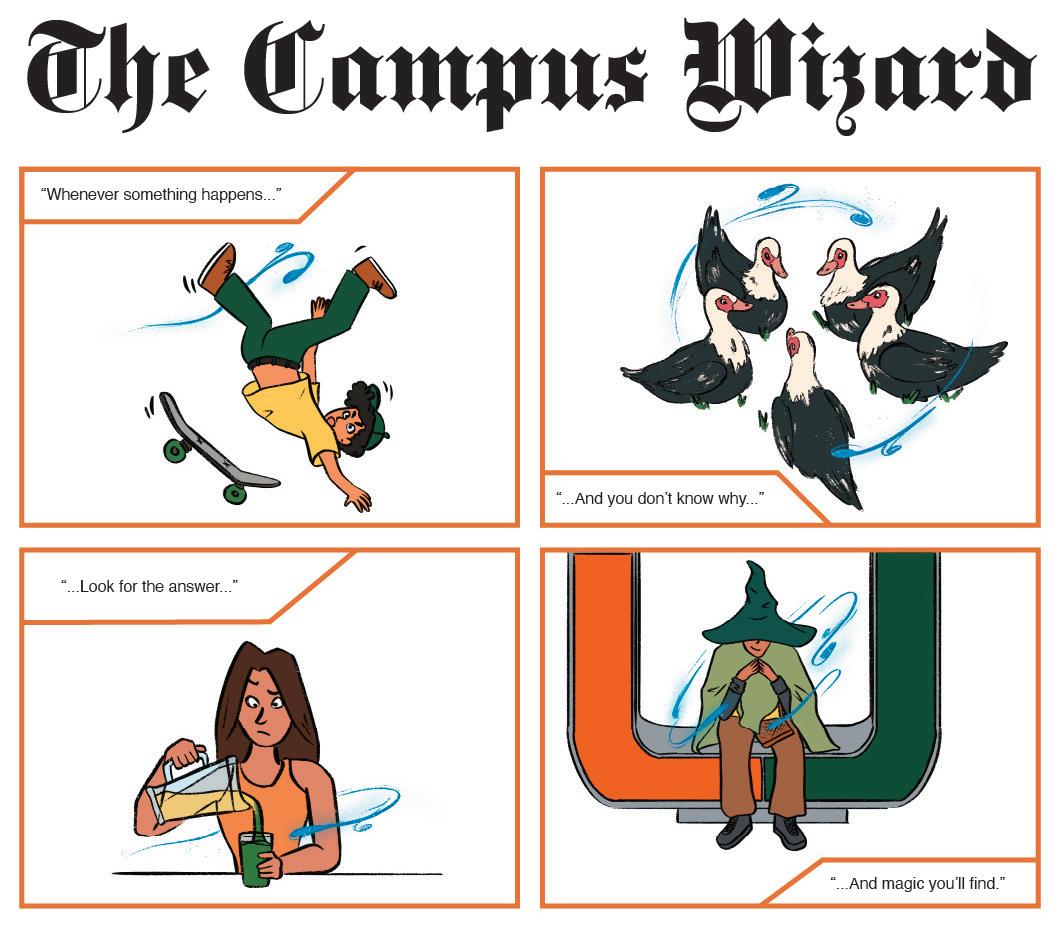
The campus Wizard brings confidence and self expression to UM
By Keira Faddis Co-Opinion Editor
Chances are, over the past few months, you have seen a wizard walking around campus. Whether he’s by the lake, heading to his next class or even sitting in one, the self-described “wizard” is hard to miss.
“I feel like some people are really excited to see someone that looks unique on this campus,” the Wizard, who wished to keep his name unpublished, said. “People always ask me if I play D&D, or what I’m dressing up as, and I always say ‘myself.’”
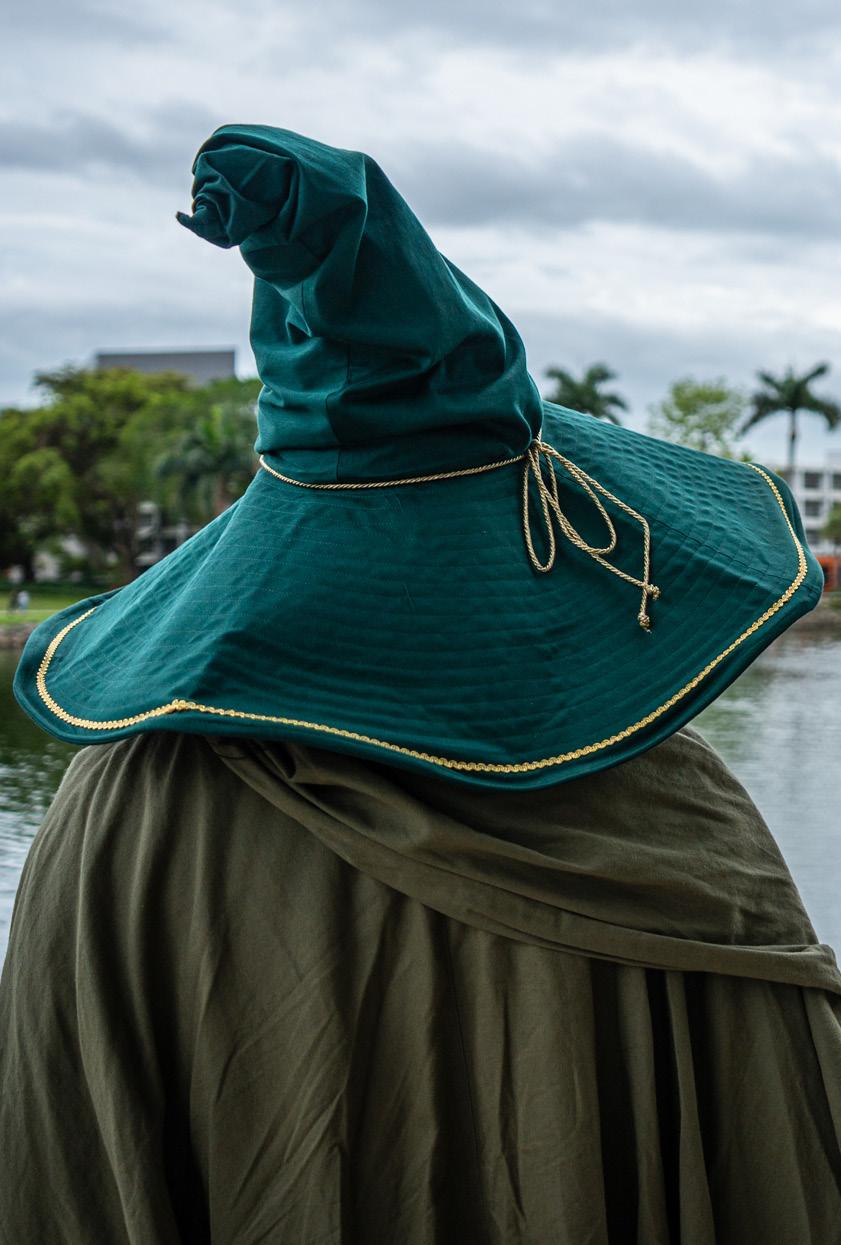
Most of the time, you’ll find the Wizard wearing a green, flowy outfit accompanied by a pointy green hat.
The Wizard, a freshman at UM, didn’t always get to dress so creatively. Before arriving on campus, most of his schools had strict uniform policies. Because of that, he looked forward to any chance to dress up.
“I’ve always loved doing costumes and dressing up for Halloween,” the Wizard said. “Even during school spirit days, I would wear the most complex costume I could.”
He started at UM with a newfound freedom over his clothing choices. The Wizard decided to fully embrace it. After buying the iconic hat at the start of this spring semester, it quickly became a daily staple.
“I really [wanted] to wear this hat as much as possible, so I just started wearing it,” he said. “I don’t think since I got it there’s been a day that I haven’t worn it to campus.”
Since then, he has had many positive interactions with students and said he has not experienced negative reactions.
CONTINUED ON PAGE 5
By Gianni Echeverria Contributing Writer
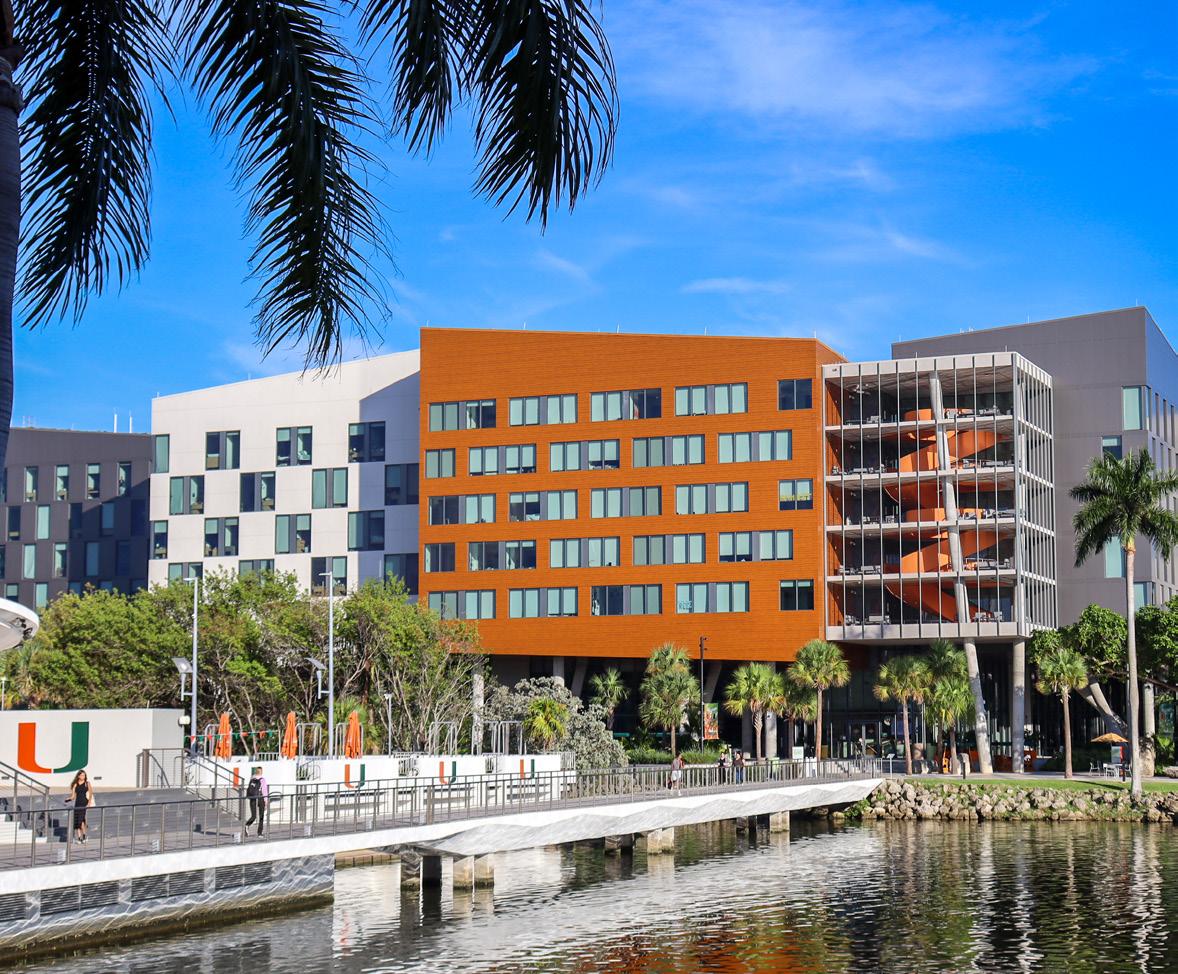
A new initiative in an effort to manage the demand for on-campus housing allows residents of Lakeside Village to move into University Village before the end of the school year, which guarantees housing in UV for the upcoming school year.
“While Lakeside and Eaton residents had an opportunity recently to move into UV now and be guaranteed UV housing next year, a total of 140 students in Eaton and Lakeside took the offer to move,” the University said in a statement to The Hurricane.
The effort comes at a time when housing availability has tightened compared to previous years. The University is operating with 239 fewer beds this year compared to last, further increasing the demand for housing. As a result, students are facing waitlist placements or looking for off-campus housing.
For the 2026-2027 school year, approximately 3,100 students completed the housing application. Out
of those, about 2,000 received a housing assignment, leaving around 1,100 students without immediate placement. On the third
“We lived in Eaton and then didn’t wind up getting UV next year, which was also extremely disappointing.”
day of the waitlist, 612 people were still without housing, demonstrating the demand.
Last academic year, everyone on the waitlist was assigned housing by June, according to the University of Miami.
“I explored off campus housing, but it was honestly very expensive and time consuming,” said Aaron Joe, a junior who lived in Eaton last year. “We lived in Eaton and then didn’t wind up getting UV next year, which was also extreme
ly disappointing.”
THesis Hotel, which is across the street from the University, will continue to be used to temporarily house students while other accommodations are made. The goal is not to assign students to THesis for the whole year, but students currently living there will not be required to move back to campus mid-semester.
The Department of Student Affairs has emphasized its commitment to helping students who rely on campus housing, whether it be for financial reasons or a schedule that makes commuting difficult. Student Affairs is working to evaluate ways to prioritize these students while
Brian Mulvey// Photo Editor The Campus Wizard looks out on Lake Osceola on March 17, 2026.
Reese Annabelle Putnam // Contributed Photo Lakeside Village on a Sunny day on the University of Miami campus.
Aaron Joe UM Junior
David Lebowitz // Photo Editor
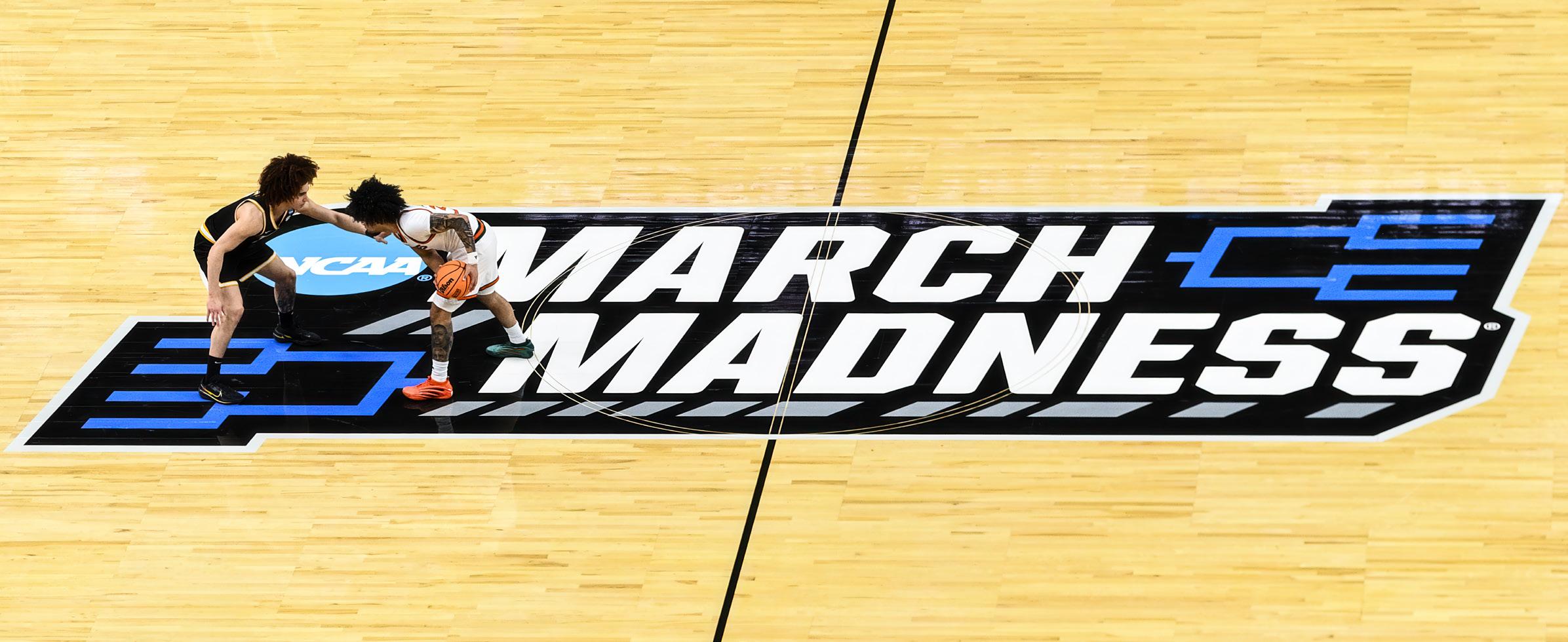
Senior Guard Tre Donaldson holds the ball on the March Madness center court logo on March 20, 2026 at the Enterprise Center in St. Louis, Missouri.
UM researcher releases new “Miami Hurricanes” fight song
By Martina Pantaleon Senior Staff Writer
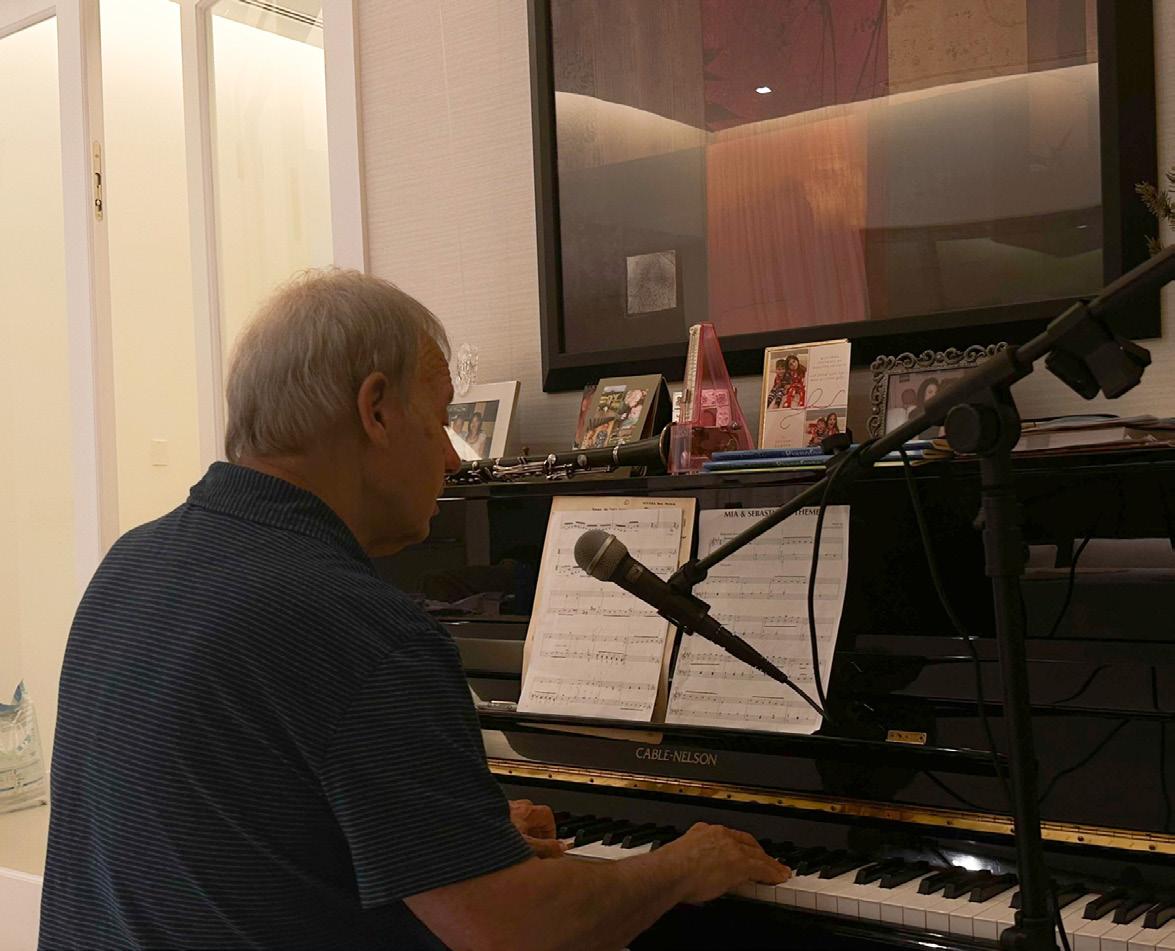
Skilled songwriter and cancer researcher at the Miller School of Medicine, Dr. Theodore Lampidis, released a new ‘Canes Fight Song on Jan. 16 after five years in the making.
Every football game is marked by the beating of the drums, the cheering crowds and the Miami U HowDee-Doo — the Hurricanes’ decades-old fight song that is as much of a tradition as the Alma Mater.
Dr. Lampidis felt like it was time for a change.
Inspired by the promise of a “comeback” in 2022, Dr. Lampidis composed a new fight song, appropriately titled “Miami Hurricanes.”
“They’re back to the old days where they were winning championships,” Dr. Lampidis said. “But what got me to do the song originally is just my love for UM.”
In the beginning stages of the song, the singer was his elevenyear-old daughter and had a softer arrangement. After the original version of “Miami Hurricanes” aired on Local 10 in 2021, he got some feedback from the station.
“I was told that the song should be done by a male,” Dr. Lampidis said. “And that it should be ar-
ranged differently.”
The new version was recorded with Sam Rawls, a singer and music engineer, whom Dr. Lampidis met through other projects.
This was not the first time Dr. Lampidis wrote a song — songwriting had been his hobby since childhood. He finally connected with the music industry after composing a piece inspired by “Marathon Man” in 1976.
“As I was writing the song, and I was getting to where I wanted to get to, I decided to call Paramount Pictures,” Dr. Lampidis said.
The song was not finished yet, but he had gotten the contact for Marvin Cain, former president of Famous Music Corporation, Paramount Pictures’s music publishing division.
With the help of a band of bar musicians, Dr. Lampidis put together a demo. Even though it was never published, his passion for songwriting did not waver.
Almost a decade later, another one of his projects, “Close My Eyes,” appeared in an 80s coming-of-age comedy series called Red Oaks.
Because of his brief history with the industry, Dr. Lampidis knew that the best way to get his fight song out there was to pick up the phone — or, in this case, start sending emails.
“If you wanna do something, go work for it,” Dr. Lampidis said.
Since its re-recording, Dr. Lampidis shared the song with broadcasters, radio stations and UM staff.
Erica Arroyo, associate vice president for engagement at UM, even shared it on the University’s official Instagram. According to Dr. Lampidis, she later sent him an email expressing her intent to keep using the song during events.
Dr. Lampidis recalled an email from President Echeverria with a similar sentiment, saying the song “was excellent,” but it still had a “long way to go.”
In his last exchange with Dr. Craig McKenzie, the director of athletic band at UM, Dr. Lampidis said that Dr. McKenzie thought the fight song was a “cool idea” that the Frost Band of the Hour could “play in the future.”
According to Dr. Lampidis, there are currently no plans to implement his fight song as The Hurricanes’ official chant.
Those were not the only comments Dr. Lampidis received. He also received feedback from the people to whom he sent the demo.
Jim Berry, anchor at CBS News Miami, interviewed Dr. Lampidis about his song during the 7 p.m. news broadcast on Jan. 16.
AEPi surpasses $60,000 goal in Rockathon fundraiser
By Bri Pearson Co-A&E Editor
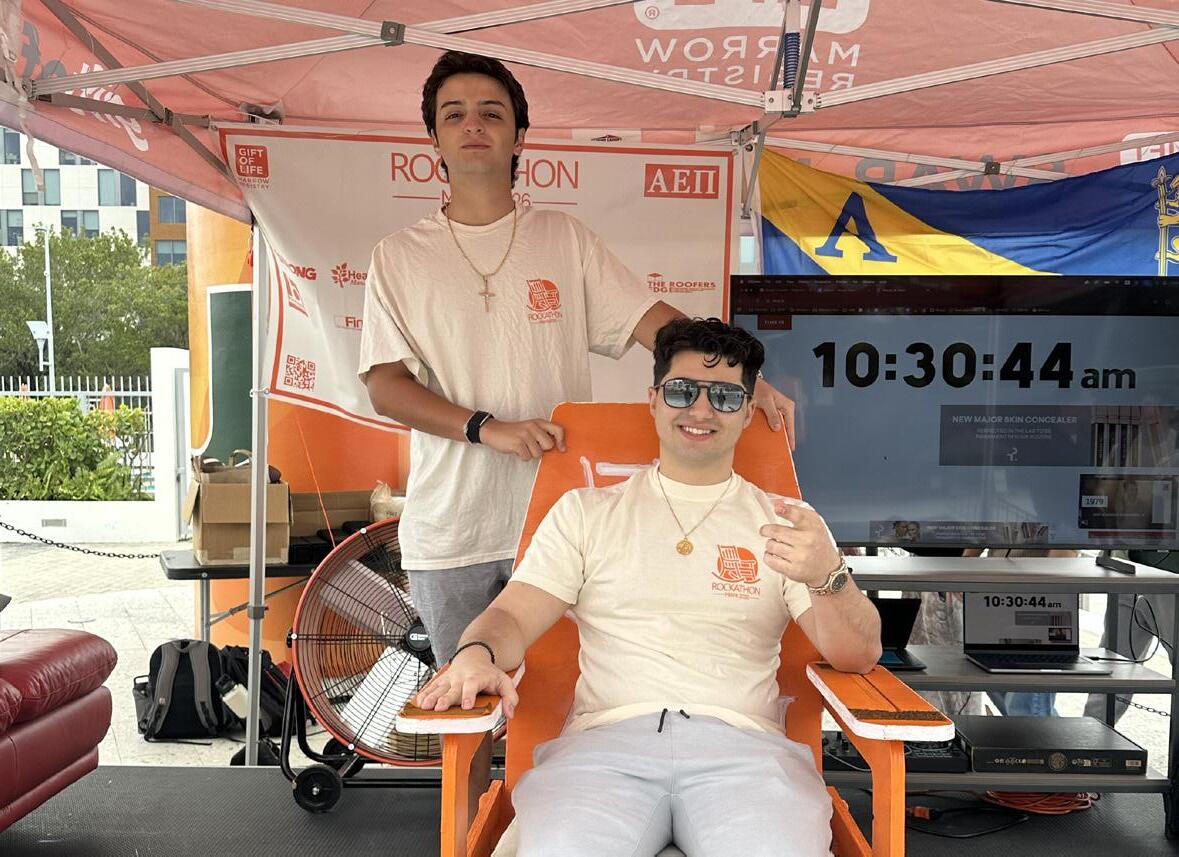
Alpha Epsilon Pi wrapped up its Rockathon fundraiser at 6:30 p.m. on Friday, March 20, after 56 straight hours of nonstop rocking — literally. The event was held on Lakeside Patio, where sophomore Lorenzo Cavallino spent the entire time in a rocking chair to raise money for the Gift of Life Marrow Registry, a national nonprofit dedicated to curing blood cancer through cellular therapy. The event began on Wednesday, March 18, and drew steady crowds of brothers and supporters who stayed with Cavallino around the clock.
Rockathon co-chair Jimmy Koch
said the chapter passed its $60,000 fundraising goal around 3 p.m. on Friday, with donations continuing to come in after the event’s official end.
By the final tick of the clock at 6:30 p.m., the fundraiser had raised a total of $67,722.
Last year’s total was just over $50,000, marking an increase despite a week of wind and rain.
Koch said the Lakeside Patio proved to be a major improvement from last year’s location outside Richter Library, even with the weather challenges.
“It’s a much better spot for visibility,” Koch said. “People walking by stop, ask questions and donate. Even with the wind and the rain, everything came together really well.”
Koch added that Cavallino’s commitment drew attention across campus.
“He’s the most popular guy on campus right now,” he said.
Cavallino, who had just over an hour left when interviewed, said the marathon felt surprisingly manageable.
“Feels like hour one, [I] feel amazing,” he said. “The people around me keep me going.”
He added that he never spent a single moment alone during the 56 hours.
“I haven’t been alone for one second, even guys sleeping over here with me,” he said, noting that the support was entirely voluntary.
He said the overnight stretches were easier than expected thanks to improvised comfort strategies.
“I definitely have gotten better sleep than I thought I would,” Cavallino said. “Last night, I just bundled myself up in a bunch of pillows and blankets, put my feet up and then relaxed.”
The most-asked question of the event — how he handled bathroom breaks — was the only one he refused to fully answer.
“I knew that was coming,” he laughed. “All I’m gonna say is, we make it work.”
As the clock hit 56 hours, the event closed with a full AEPi mosh-pit to “Get It Sexyy” by Sexyy Red, a preview of the fraternity’s party later that evening that featured the artist herself.
Koch called the fundraiser a success, saying the new location came with challenges but ultimately ran smoothly.
“There are always growing pains with a new setup,” he said. “But everything came together really well, especially with keeping him on stage the entire time.”
Crisis in Cuba: How UM students are feeling the impact
By Gaby Collazo Staff Writer
Cuba, an island 90 miles off the coast of Miami, is experiencing a worsening economic and energy crisis. Prolonged power outages, fuel shortages and rising food prices, tied in part to policies from President Donald Trump’s administration, are affecting families on the island and students in Miami who remain linked to relatives there.
The island has faced economic and energy challenges for decades. After the Cuban Revolution, the island adopted a state-controlled economy and became heavily dependent on support from the Soviet Union. When the Soviet Union collapsed in 1991, Cuba entered a severe economic crisis known as the “Special Period,” marked by widespread shortages of food, fuel and electricity.
Conditions improved slightly in the 2000s with oil support from Venezuela. But, as of mid March, U.S intervention in Venezuela has exacerbated issues for Cuba. With efforts to remove Venezuelan President Nicolas Maduro, a blockade of Venezuelan oil and threats of tariffs on Mexico, the Trump administration effectively shut off oil flow to Cuba — aiming to push the communist-run island toward political and economic reforms. With few allies to turn to, Cuba is running out of resources. As the crisis drags on, life in Cuba is slowly coming
to a halt as schools are being shut down and businesses have stopped operating.
“There has been a perfect storm,” said Michael J. Bustamante, director of Cuban Studies and of the Cuban Heritage Collection at UM. “More and more Cuban citizens do not accept the argument that their problems can be laid at the feet of U.S. sanctions alone. Cubans [are] speaking out openly about their desire for not just economic improvement, but political change.”
As possible regime change looms over Cuba, students and faculty at the University of Miami, many with family on the island, are closely following the unfolding crisis is far from distant news.
“Some of us may see reason for great hope that positive change is finally on the horizon,” said Bustamante. “Others may worry rumors of negotiations between the current U.S. administration and the Cuban government will have unsatisfying results. Either way, the situation impacts all of us personally.”
For students with relatives still living in Cuba, that sense of hope is tied to the possibility of reconnecting with relatives and seeing an island they have only heard about.
“I have a higher chance of meeting family members that I have never met before, said Lazaro Chavez, a senior at the University of Miami. “My father’s mother still lives on the island and her business has been struggling for decades but the situation has worsened things along with her aligning health.”
Two radio stations, WVUM 90.5 FM — UM’s station — and WQAM 560 also aired the song during the football team’s playoff run. Despite already reaching a wide audience, the song still “belongs to the students,” and was designed for the UM community to support the Hurricanes.
The developments mark a potential turning point after years of economic hardship and political uncertainty on the island. For students with family ties to Cuba, even a small sign of change can spark optimism.
“Now more than ever it feels like there might be a light at the end of the tunnel,” said Jessica Valdes, a senior at UM.
Those aspirations, however, also raises concerns for relatives and the communities currently on the island having to navigate daily shortages and instability.
“Based on what we’re hearing from family and friends in Cuba, there’s no power and no running water,” said Valdes. “It’s like being homeless here, except you just have four walls around you — and even those walls are rotting.”
Beyond how the unrest affects people, the unfolding events on the island can have broader implications to Florida and the U.S. Changes in Cuba can influence migration patterns, economic opportunity, and relations with the Cuban diaspora in South Florida.
“What happens in Cuba will have significant ripple effects in the United States, and especially in South Florida, whether in terms of renewed migration or potential opportunities for greater economic integration and trade,” said Bustamante. “The Cuban diaspora in South Florida represents a significant resource of capital and Cuba’s future.”
Miami offers a unique perspective
For Dr. Lampidis, the piece is more than an expression of his love for UM. It is proof that a person is not constrained by their profession or a singular interest.
“People are people, they have many capabilities, and they should never label themselves,” Dr. Lampidis said. If you would like to listen to Dr. Lampidis’ work, the song is titled “Miami Hurricanes by Ted Lampidis” on YouTube.
Student Senate elects new Speaker, Trinity Vodovoz
By Emil Salgado Vazquez Podcast Editor
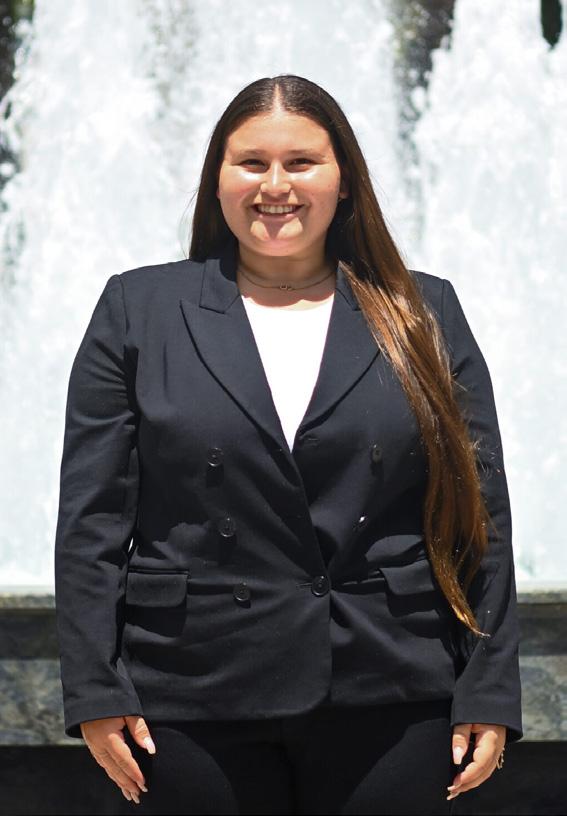
Following passionate speeches from two nominees, the University of Miami’s Student Senate elected Trinity Vodovoz as Speaker for the 20262027 academic year during its weekly general body meeting on March 18 in the Storm Surge Room.
Vodovoz and Grady Knox ran for Speaker, each delivering a speech and answering questions from the Senate.
Knox, representing Lakeside Village and chairing University Affairs, emphasized the Senate’s impact on campus and noted her experience organizing several campus initiatives.
Vodovoz, the current Junior Class Senator and Speaker Pro Tempore — the second-in-command of the Senate — was the highest-ranking member of the Senate running for Speaker.
She highlighted her long tenure in the Senate in different positions.
“I’ve been in the Senate for three years now,” Vodovoz said. “I’ve really enjoyed serving the school and hope to serve you as Speaker.”
She also recognized the lack of connection between the Senate and the Executive Branch.
Vodovoz proposed a student government-wide retreat to build bridges between the Senate and Executive branches for more efficient, thorough legislation.
She suggested inviting guest speakers from local government and business organizations and organizing more informal SG events.
Knox discussed helping others improve legislation through editing and clarified his proposed Senate initiatives.
“I think the process for pushing legislation through is limiting,” Knox said.
“If I were to win, my focus would be to improve this process and the way we
implement legislation on campus.”
In addition to his earlier points, Knox spoke about the need for Senators to interact more with the Executive Branch, suggesting scheduling informal time before committee meetings or around GBMs to build relationships and improve legislation and processes.
There was support for both nominees. Vodovoz’s experience and Knox’s strong leadership of the UA Committee were the main points raised during the discussion portion of the election process. Ultimately, Vodovoz won the election and her term as Speaker will begin in the Fall 2026 semester.
The Miami Hurricane requested the vote count, but was told it could not be disclosed.
“I’m excited to see what the Senate holds for the future,” Vodovoz said after the meeting. “It feels so rewarding to win the election because I’ve been in the Senate since my freshman year, and this will be a great way to celebrate my senior year.”

on Cuba’s history and ongoing struggles. The city’s large Cuban community means that residents, whether they are of Cuban descent or not, feel the impact.
“Miami almost feels like its own part of the country, said Chavez. “Things that fly here certainly wouldn’t fly in the Midwest or LA or NY, and when everyone around you has experienced or someone they know has experienced oppression at the hands of the regime so it is a very different experience than someone would have if they’re from Kansas for example. It’s a much deeper history.” For UM students, the crisis is more than just news, it is personal,
intertwined with family, heritage and identity. Despite the uncertainty and challenges on the island, many hold onto hope for a brighter future.
“We hope and pray for the people of Cuba and for their long awaited freedom and end to their suffering,” said Emma Balleste, a junior at UM.
“My hope is that one day Cuba will change and I’ll be able to visit the island of my family, my culture, and my identity,” Valdes added.
As Cuba continues to navigate these uncertain times, many hold onto hope that political or economic changes could bring new opportunities for the country’s future.
via Wikimedia Commons Map of Cuba showing the lines of the Cuba Railroad.
Courtesy of Trinity Vodovoz Trinity Vodovoz stands in front of a fountain on UM’s campus.
Courtesy of Theodore Lampidis Dr. Theodore Lampidis sits at a piano performing sheet music.
Courtesy of Olivia Atalla & Jimmy Koch Sophomore Lorenzo Cavallino sits in the rocking chair for Alpha Epsilon Pi’s Rockathon fundraiser on Friday, March 20, 2026 at Lakeside patio.
UM students struggle to get back to campus amid flight issues
By Layla Fessler Contributing Writer
As students returned to campus after spring break ended this past weekend, and as students returned to campus, many found that their flights were delayed or cancelled.
The flight issues left students across the country stuck at the airport for hours or days. As a result, students missed lectures, club events, and midterm exams.
In a non-scientific poll posted onconducted by The Miami Hurricane’s Instagram story, 87.5% of NUMBERthe responders said they experienced issues while traveling for spring break. The poll indicates that most of these issues occurred when returning to Miami.
While delays can be common while flying, students were stuck at the airport for unusually long times. One anonymous survey responder of the survey said they had
“I had to email all of my professors because obviously I was not able to attend class , and I was really nervous about it.”
Jared Hinojosa UM Sophomore
“17 [to] 18 hour delays.”
Most of the students just experienced delays, but there waswere a small portion of people who experienced both cancellations and delays, leaving them at the airport for extended periods of time.
Freshman Agus Villalba was one of these people. Her told The Hurricane about her experience and how her flights out of South Carolina were rescheduled across
multiple days.
“I had a lot of issues on my flight from Charleston to Miami,” she said. “I was supposed to return on Sunday night, but my flight suddenly got canceled and it was moved to Monday night, then that flight was canceled as well and it was moved to Tuesday morning at 6 a.m., then that one was canceled as well and moved to Tuesday night.”
A majority of the problems were caused by the extreme weather throughout the U.S. From scattered storms in Florida to the giant snowstorm sweeping across the Midwest and Eastcoast, the weather caused upwards of 4,763 cancellations nationally on Monday alone.
According to the Instagram surveypoll, 64% of the students affected by flight issues indicatedresponded that weather was the main contributor to their delays.
However, weather was not the only reason for a spike in cancellations and delays.
The partial government WHEN shutdown resulted in airport workers not receiving payment, including those at TSA;. Tthe shutdown, coupled with higher volumes of travelers due to college students traveling for spring break, caused busier airports with fewer workers, longer security lines, and numerous delays.
Students also noted that the partial shutdown not only caused less workers, but it also led to excess planes in air traffic, resulting in “air traffic control limiting the planes allowed to come into Miami.”
The mixture of weather, the government shutdown, and spring break travelers resulted in the substantial issues that Villalba and others faced.
Villalba arrived in Miami at 1 a.m. Wednesday morning, meaning she was delayed in Charleston for a total of three days, missing two days of her classes.
Like a lot of students, Villalba was supposed to take a midterm when she got back to campus.
“I had to email all of my professors because obviously I was not able to attend class, and I was really nervous about it, especially since I had a Calculus midterm on Tuesday,” she explained.
Fortunately, her professors were understanding, and “flexible and nice,” andwith her math professor allowedallowing her to reschedule the midterm. Now, Villalba and other students who were delayed coming back from break have to catch up with everything they missed.

Rapper Sexxy Red makes an appearance at AEPi registered party
By Hannah Valdivia Co-Breaking News Editor
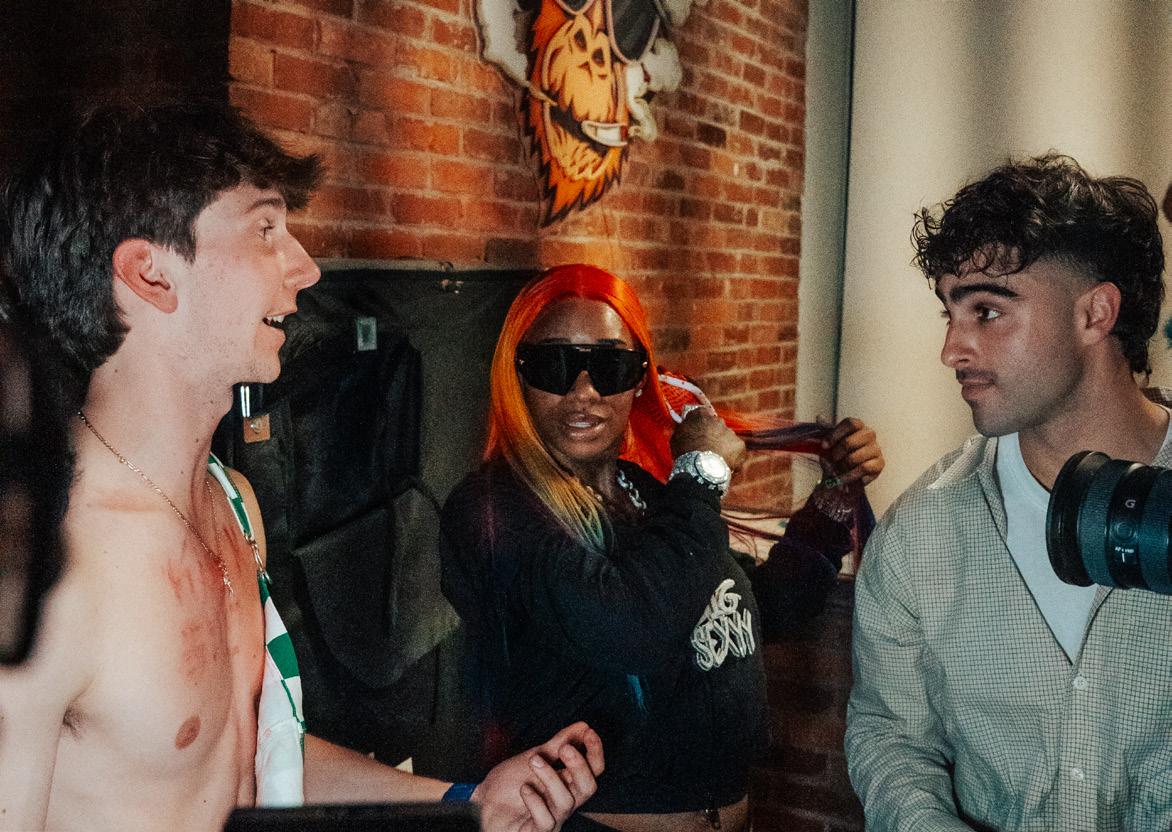
American rapper Janae Nierah Werry, better known by her stage name “Sexxy Red,” performed at the Alpha Epsilon Pi event on Friday, March 21. She took the stage at around 1 a.m. and sang seven songs, including one unreleased single. The fraternity teased on their Instagram page, @aepimiami, that a “special guest” would be performing at their St. Patrick’s Day party.
The post uploaded on Wednesday, March 18, featured an outline of what users assumed to be Sexxy Red with the caption “Test your luck, St. Patty’s 2026.” Sexxy Red became popular around 2023 when she released her single “Pound Town,” which currently has over 42 million streams on Spotify. Her lyrics are known for being particularly head turning and “risque,” but are still widely used by TikTokers and will appear in trends. The offer was first posted on YouTuber Nick Nayersina’s Instagram, asking
if any University of Miami fraternities would be willing to host a party.
Fraternity brother Brady Ashker reached out to Nayersina, and was then added to a group chat where the YouTuber pitched the Sexxy Red performance. Nayersina gained popularity through videos where he would bring famous artists to frat parties, his first one being with Sexxy Red.
“We started this series with her and she really wants to run it back so we want this to be the biggest one yet,” said Nayersina in a text thread with Ashker.
As seen in photos and videos from the night, the registered party was overflowing with students, as well as content creators who were with Sexxy, and her security team.
“[There was] an insane amount of people but she put on a great show and it was such a fun vibe,” said sophomore student Jessi Henige who attended the event.
After her performance, Red played beer pong with several fraternity brothers, two of whom won MacBook laptops.

7:30 pm - 9:30 pm
St. Patrick’s Day Showdown: UDebate vs. The Irish Times Debate Champions
By Madison Block Copy Chief
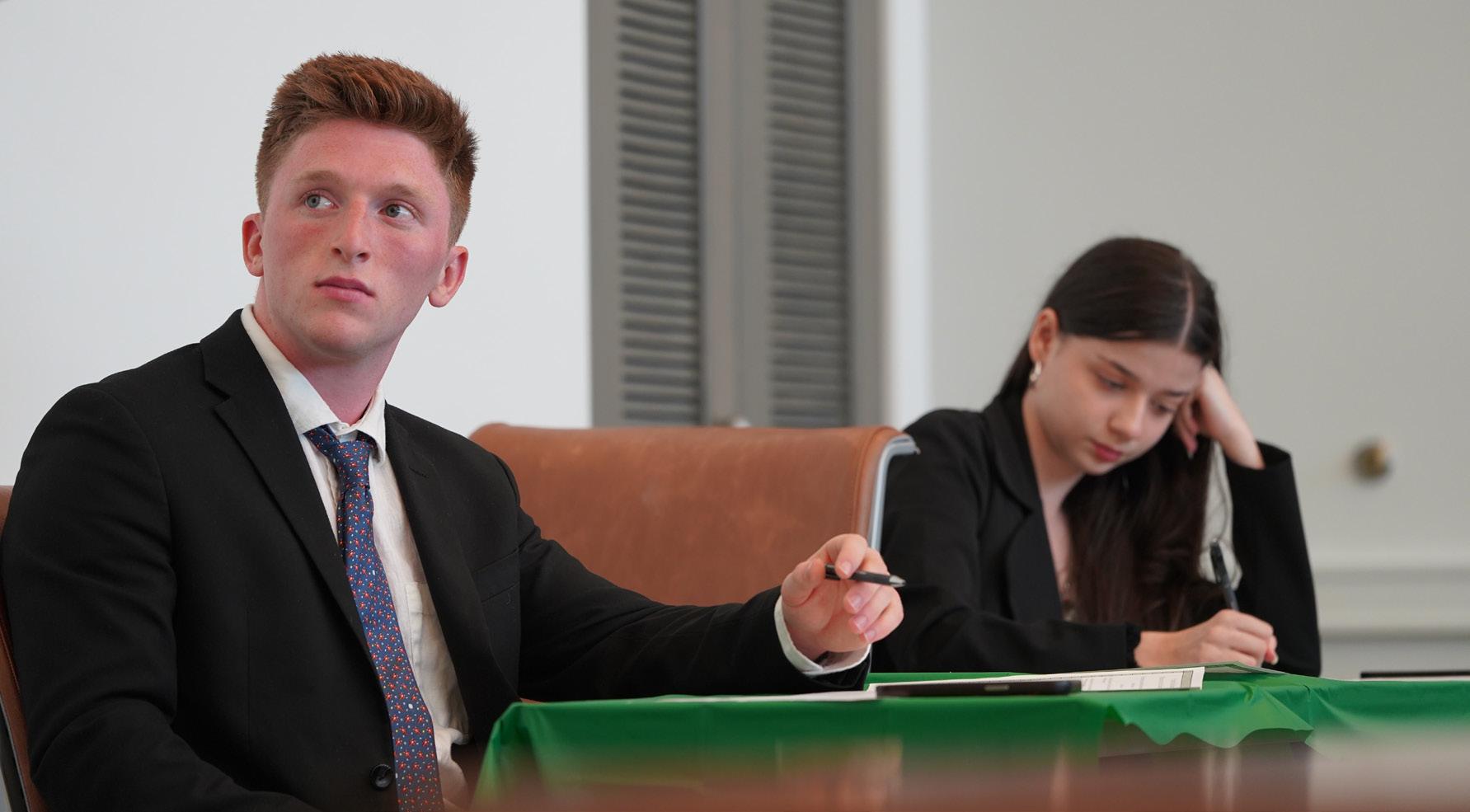
The University of Miami Debate team faced off against The Irish Times Debate champions in a St. Patrick’s Day showdown on Tuesday, March 17.
The topic of debate was social media regulation. The official motion read, “This House Would Hold Social Media Companies Liable for Spread of Misinformation,” with the Irish debating as the government and Miami as the opposition.
The Irish Times Debate is Ireland’s prestigious, longest-running debate competition for students in higher education, established in 1960. The competition begins with around 300 competitors and concludes with three winning speakers.
Athena Wu of Trinity College Dublin’s Historical Society (Hist) was named one of the winners of the 66th Irish Times Debate final. Cian Carew of the Solicitor’s Apprentices Debating Society (SADSI) won the individual speaker award.
Winners not only gain recognition, but win an all-expenses-paid tour of the United States. Wu,
Carew, and finalist Roisin McCormack are currently on tour. Their most recent stop: UM.
Representing UM were freshman Yolanda Del Pino, senior Joe Thiesan and fourth-year architecture student Parker Osth.
The debate followed a format similar to British Parliamentary style, which includes audience participation and an audience vote. The debate took place in the student senate room in the Shala Student Center, where nearly every seat was filled.
The audience voted the Irish champions winners with a score of 27 to 19, all in the spirit of friendly competition.
“Well honestly, I think the audience just voted us because we were guests and they wanted to be nice,” Wu said with a laugh. “I think the opposition did a really good job.”
For both teams, the debate provided an amazing opportunity to discuss an important and timely topic. For the Irish team, the visit provided a chance to step into life at an American university.
“It’s so surreal, I think that we all watch movies about the U.S. so we think that we know a lot about it and we think that movies are kind of a caricature of what uni -
versity is like” Wu said. “But all the people are so nice … we haven’t met a single mean person.”
UDebate promoted the event across UM’s campus, expressing that this opportunity was very special for them.
“I’m very honored and blessed that I was chosen,” Del Pino said. “It’s such a cool thing to have in your life to be able to say that you debated the Irish national champions on St. Patrick’s Day.”
Both teams embraced the experience, spending time together before and after the debate.
When the Irish landed, UDebate coach Dave Steinberg took them to Greenstreet Cafe, a popular restaurant in Coconut Grove and showed them around campus.
After the debate was over, both teams were seen leaving with smiles and laughs and went to Monty’s, another popular spot.
Before continuing their tour to Tennessee, the Irish champions went to UDebate’s weekly debate meeting, where they judged a practice round and soaked up more Miami culture before heading to Tennessee, including visiting Wynwood, South Beach and even got to try Cuban food at the legendary Versailles restaurant.
Courtesy of Zak Potter
Sexxy Red attends AEPi’s party for a performance on Friday, March 20th.
Florida is stifling citizen initiatives. Here’s how.
By Emil Salgado Vazquez Podcast Editor
Florida voters will not have any citizen-led amendments on the 2026 ballot for the first time in years, a clear departure from the state’s tradition of direct democracy.
After lawmakers made initiative rules stricter in 2025, it has become too costly and legally risky to get measures like raising the minimum wage, restoring voting rights and legalizing medical marijuana on the ballot. These new rules make it virtually impossible for voters to have a say in Florida’s government through ballot initiatives.
Citizen initiatives have allowed Floridians to bypass the legislature and enact sweeping policy changes. Voter-approved measures often succeed where elected officials stall. The process has functioned as a crucial check on political power, and a way for us Floridians to have a direct impact on the laws of our own state.
Now, with the harsh regulations put in place last year, zero amend -
ments have made it to the ballot out of 22. The new restrictions are now being challenged in federal court, for good reason: these rules place unconstitutional barriers between voters and the ballot.
Lawmakers fundamentally reshaped the initiative process in 2025 with new petition rules, tighter deadlines, and higher compliance risks. Organizers now face increased legal liability and costs, making ballot access impossible for now.
Supporters of the harsher restrictions say the changes protect election integrity, but in practice, these laws are barriers set by Florida Republicans to limit voters’ power.
Remember, this is not the only barrier for Florida voters. In 2006, the GOP-controlled legislature managed to push the 60% requirement for amendments into Florida’s constitution. However, that measure failed to reach the 60% threshold: Only 58% of Floridians voted in the affirmative to pass the law, yet we all still suffer the repercussions all these years later.
Since then, Floridians have at -
tempted to pass many initiatives: recreational marijuana legalization, abortion rights protections, homestead tax exemptions, property tax assessment charges and even consumers’ choice on solar energy. Many of these exceeded 55% in the affirmative yet were barred by the 2006 amendment.
But, Florida Republicans weren’t satisfied with just preventing voters from passing amendments on the ballot.
What happens next will largely depend on the courts, lawmakers, and future election cycles.
The judicial system may work in our favor and shut down these harsh restrictions. Lawmakers could revisit the rules in future sessions, though no changes are currently guaranteed, especially with a Republican supermajority in our state legislature.
Some advocacy groups have already postponed major campaigns until 2028, widely seen as the next realistic opportunity to place citizen initiatives before voters.
This battle over citizen initiatives is about power. If the path to the bal-

lot continues to narrow, Floridians may lose one of their most direct tools for shaping public policy.
To protect direct democracy, stay informed, support advocacy groups fighting these restrictions and urge lawmakers to reconsider
Nobody’s perfect — except in Miami, where you have to be

By Balaj Raza Staff Writer
Miami sells a dream. It is a city built on sunlight, nightlife and an image of effortless perfection.
But in a place so deeply defined by appearance, that dream comes with pressure.
Unrealistic beauty standards in Miami are shaping a generation of young people who feel that changing their appearance is not just a choice, but a necessity. Scroll through social media or spend a day in Brickell or South Beach and you will quickly notice a pattern: sculpted bodies, flawless skin, designer outfits and faces that all seem just a little too symmetrical to be a coincidence.
Looking “good” no longer means being healthy or confident. It means fitting into a very specific aesthetic. Defined jawlines, plump lips, tiny waists and perfectly contoured features have become the norm rather than the exception. The rise of cosmetic procedures like lip fillers, Botox and body sculpting has made these features more accessible, but also more expected.
Miami’s image driven culture pushes unrealistic beauty standards that pressure young people to change their appearance, making cosmetic procedures feel less like a choice and more like a requirement.
For many college students, this pressure begins the moment they arrive.
Freshman influencer Julia Thomas said she immediately felt the shift when she moved from Texas to Miami. “When I first got here from Texas, I was over-
whelmed by all the other girls around me,” she said. “I even ended up getting lip filler myself my first semester. It felt like something that everyone was doing, and of course I wanted to fit in.”
Young people, especially college students and recent graduates, are absorbing this pressure at an alarming rate. Appearance often feels tied to social status, career opportunities and even dating prospects, and the idea of “keeping up” can feel overwhelming.
Thomas said that expectation to constantly maintain a polished image can be mentally draining. “I think feeling like you have to be perfect all the time is exhausting,” she said. “We should all be accepting of everyone.”
It is not uncommon to hear conversations about saving money not for travel or experiences, but for procedures. The normalization of cosmetic work has shifted the mindset from “I want this” to “I need this to fit in.”
Social media only intensifies the issue. Platforms like Instagram and TikTok amplify a curated version of Miami life where everyone appears perfect all the time. Filters blur reality, editing apps reshape bodies and algorithms push the most visually striking content to the top.
What viewers often forget is that much of what they are comparing themselves to is not entirely real. Yet the emotional impact is real.
This constant comparison can take a toll on mental health. Feelings of inadequacy, low self-esteem, and body dysmorphia are becoming more common, according to SOURCE. When the standard is perfection, anything less can feel like failure. For young people still form-
ing their identities, this environment can be especially damaging. Instead of discovering who they are, they are trying to become who they think they are supposed to be.
Still, some students say stepping away from those expectations can lead to a healthier mindset. “As I accept myself more and care less about what people think, I’m realizing that I’m the happiest I’ve ever been,” Thomas said. It is important to acknowledge that there is nothing inherently wrong with cosmetic procedures. People have the right to make choices about their own bodies. The issue lies in the pressure and expectation behind those choices. When individuals feel obligated rather than empowered, it becomes less about self-expression and more about conformity.
Miami’s culture does not have to be defined by unrealistic standards. There is space for a broader definition of beauty, one that includes authenticity, diversity and individuality. Real confidence does not come from fitting into a mold, but from embracing what makes someone different. Changing this culture will not happen overnight. It requires a shift in what we celebrate and what we promote. It means being more mindful of the content we consume and share. It means having honest conversations about the pressures we face. Most importantly, it means reminding ourselves and others that we are more than how we look. Miami will always be a city full of beauty. But beauty should not come at the cost of self-worth.
Things at UM that would send other students into a coma
By Hannah Valdivia Co-Breaking News Editor
This may come as a shock to University of Miami students, but Goyard bags, graduation raves and frat yacht parties are not a part of the typical college experience.
A brief TikTok search will reveal that UM’s students have certain trends and customs that are extremely uncommon at almost every other university in the country.
Videos of college students naming things at their college or university that would send other students “into a coma” have circulated TikTok for a few years now.
So, let’s get into what UM-specific things I think would send other college students into a coma, starting with something that is probably familiar to all students — partying.
Party culture
The main point that users partaking in the trend seem to mention about UM is its prominent party culture.
This might have something to do with the fact that the University is just an Uber ride away from Brickell, Wynwood and Downtown Miami, all hubs for rave lifestyle and late-night to early-morning to, well, afternoon, clubbing.
Seeing students shuffle back in from
their college-town equivalents versions of Club Space, LIV and E11EVEN between 5 a.m. and 7 a.m. would be uncommon at other universities.
Miami also hosts events like Hocus Pocus and iii Points in Wynwood, Ultra in Bayfront Park and student’s favorite DJs in Factory Town. This large festival presence has led to a huge rave culture among students, who cycle through their favorite mesh Shein tops and Amazon pashminas to post on Instagram.
At schools like the University of Florida and Florida State University, the nightlife scene is limited to backyard frat parties and a small row of local bars to keep them entertained.
“There’s really only one main bar and you always see the same people, it’s gotten kind of played out by now so it’s not as appealing,” said University of Florida student Andres Delgado.
It’s no wonder that University of Miami’s party scene is somewhat of a culture shock for students, and has led to UM being named one of the top party schools in the country.
Influencer central
“Influencer U” is one of UM’s many nicknames thanks to the massive number of smaller and larger influencers who attend UM or just walk around the campus.
Sienna Sacco, Ximena Ponce and Collete Couillard— to name a
few— are all influencers with well more than 500,000 followers on their platforms. It’s not completely bizarre to see them and other aspiring influencers walking around campus documenting their day or filming brand-affiliated content.
Thanks to Alix Earle, it seems like every student is trying to get their start as an influencer at UM by receiving PR and filming TikToks of their lavish lifestyles.
Living in sunny South Florida also has its benefits and has shaped student culture in its own ways.
Seeing people go to class in bikinis or swim trunks isn’t a rare sight, and girls wearing just their bikinis and dirt-covered Air Forces to the frat houses is something even Earle has pointed out as shocking for visitors.
Wet campus
I’m not talking about the bipolar weather of the Sunshine state, I’m talking about our day drinkers over at The Rat.
The Rathskeller is the University of Miami’s student-run restaurant that serves alcohol on campus to those over 21.
According to a Reddit post, most colleges with pubs or bars are only open to graduate students. But, at the University of Miami,even undergraduate students can stop by at 2 p.m. for a beer or a seltzer as long as they show I.D.


Faith Jimenez // Contributed Graphic
Sovannreach Po // Graphics Editor

The campus Wizard brings confidence and self expression to UM
By Keira Faddis Co-Opinion Editor
CONTINUED FROM PAGE 1
His outfit has largely become his identity on campus. Many students who recognize him — and even some of his close friends — don’t know his name at all.
“A lot of people will walk by me and say, ‘Hey, campus wizard,’” he said. “I don’t think a lot of people that I’m friends with know my

name. They just call me ‘the Wizard,’ which is funny.”
For the Wizard, wearing his daily outfits is not just about standing out, it’s a conscious decision to be an example for anyone else who is hesitant to dress differently. He describes this as “a fight against anti-individuality.”
“I really hope that people understand that I’m trying to normalize this,” the Wizard said. “I hope that people see me and think, ‘Okay, I can do that, too,’ because I think anyone can do it.”
His inspiration often comes from cre-
ative spaces like video games and cosplay, where character design plays a major role in how characters are presented.
When deciding what to wear each day, the Wizard approaches the process more like designing a character than choosing an outfit.
“I just try to think about it in a character design frame, because I like video games a lot,” he said.
Instead of following fashion trends, he focuses on wearing pieces that feel expressive and unique.
“I don’t know anything about fashion,” he said. “I just went shop-

ping and picked things that I liked, and that’s what I wear.”
That perspective leads him to choose pieces that create a specific silhouette, such as flowing layers that resemble cloaks or capes. He said he often thinks about the overall shape of the outfit rather than individual items when getting dressed. Ultimately, the Wizard hopes that students who see him around campus feel encouraged to express themselves however they want — even if that means wearing something unconventional.
Get coffee, matcha and connections at Barista Babes
By Charlotte Schuyler Contributing Writer
Marcela Galvez and Allegra Wynne-Kaplan turned their shared love for coffee and women’s empowerment into Barista Babes Coffee & Matcha, a mobile business serving University of Miami students weekly.
The female-owned coffee and matcha cart and trailer regularly sets up at several campus locations, near the School of Communication, the Jorge M. Pérez Architecture Center and the Cox Science Building.
“I have always wanted a coffee business and love the community that coffee brings to people,” said Wynne-Kaplan. “We just put our minds together and this is what came of it.”
Wynne-Kaplan said the idea developed naturally from their shared interests, close proximity and growing friendship, which led them to realize that starting a business together aligned with their goals and passions.
Before launching Barista
Babes, Wynne-Kaplan had long envisioned owning a coffee business, while Galvez expressed interest in starting a female-owned business of her own.
Galvez, a former school teacher, and Wynne-Kaplan, who owns a clothing business, drew on their customer service experience and people skills to expand the simple coffee shop into something more engaging.
They noticed the rising popularity of matcha and decided to add it to their menu. Since then, their customer base has grown, with many returning regularly for their matcha.
The woman chose to cater to UM for several reasons: both are Miami residents, they understand the college student’s need for caffeine, and they enjoy the opportunity to connect with students.
“I like going to Barista Babes because I am a communications student so it is convenient to have a truck there since there are no other spots on that side of campus,” said Kiki Ferreira, a senior at UM. “I honestly find the coffee super good and the women in the truck are so nice.
But, Barista Babe doesn’t only serve matcha at UM. Through collaborations with local Miami businesses and events, the two women bring their coffee cart and truck on the go, providing for a wider community.
The business tailors its offerings to its audience, whether catering events, collaborating with other businesses or serving students on campus.
“UM students know what they like and they are looking for that specifically,” said Wynne-Kaplan “And when they come back, it means we did a good job with providing them.”
In addition to coffee and matcha drinks, Barista Babes sells a variety of baked goods sourced from two other female-owned startups. The company, which will celebrate its first anniversary in April, has continued to grow while emphasizing health-conscience options.
“It is aimed towards giving students and people healthy choices,” said Galvez. “We are so happy talking to people and getting personal interactions. That’s why we love working and our customers every day.”
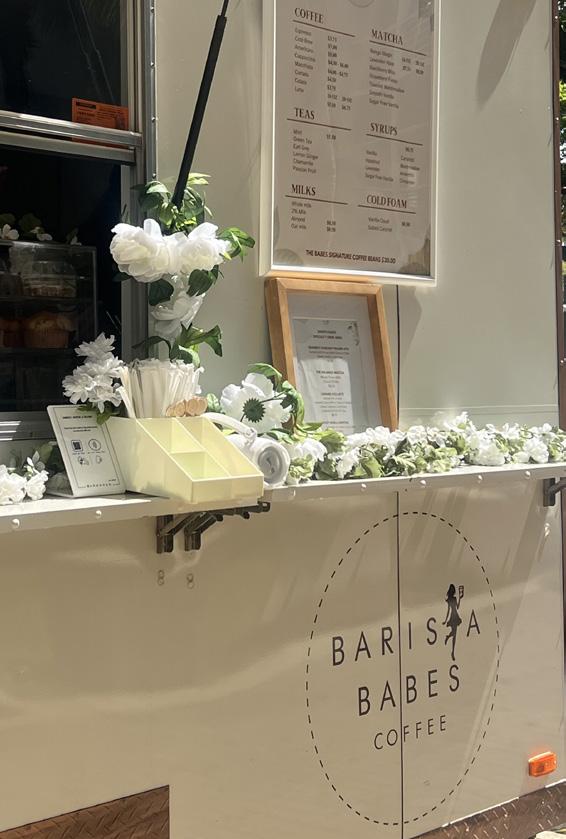
With steady success both on and off of campus, Barista Babes continues to expand, offering students and Miami residents a place to grab a drink and make a new friend along the way.
Café LoCoh combines matcha and Latin America
By Charlotte Schuyler Contributing Writer
Lines at any University of Miami coffee shop are guaranteed to be long on almost any morning. But lately, it’s not just coffee students are lining up for.
Matcha has quickly become a campus obsession. Students can pick up ice matcha lattes and espresso shots between lectures in almost every part of campus.
One stand has become a daily ritual for many students: Café LoCoh. The coffee and matcha shop is the University's school of law and is open from Tuesday to Friday mornings.
The story behind Café LoCoh is surprisingly romantic. According to co-founder Daniela Correa, the idea for the café began during a first date — which was at a coffee shop, of course.
“Oscar and I started talking about how both of our dreams were

to open a coffee shop one day,” Correa said.
For Correa, coffee shops were always more than caffeine. That shared appreciation eventually
turned into a vision: a café that felt personal and meaningful.
That vision shows up in every cup served at the café’s mobile cart. Unlike many quick campus stops, Café LoCoh roasts its own coffee beans and serves highgrade, stone-milled matcha, bringing what Correa calls the “full café experience” directly to campus.
Students have definitely noticed. One drink in particular has become a campus favorite: the Caramel Cubano. Inspired by the founders’ ethnicities, Oscar is Cuban and Correa is Venezuelan, the drink captures what they describe as the bold and vibrant spirit of Latin culture.
“The Caramel Cubano is so good. It’s sweet but still really strong, which I love,” said Ilkim Sarsilmaz, a sophomore at the University of Miami. “It has this caramel flavor but also a really bold coffee taste, so it’s not too sugary. I get it every time.”
Café LoCoh’s appeal goes be -
yond creative drinks. The brand itself leans into a vibe Correa describes as “modern, playful and elevated,” blending imaginative menu items with a commitment to high-quality ingredients and a welcoming atmosphere.
That sense of community may be part of why coffee and matcha culture feels so strong at UM. For many students, it’s not just about caffeine, it’s about routine.
“I think coffee and matcha has become something more,” Correa said. “It has become something that unites the UM community.”
If you’re new to Café LoCoh, Correa recommends starting with the Baklava Matcha or Baklava Latte: a sweet, nutty drink made with the café’s house-made syrup that perfectly balances flavor and comfort.
The best part of the day isn’t just the coffee, it's the moment you take to enjoy it.
Get matcha on wheels at The Matcha Bike
By Amber Del Valle Contributing Writer
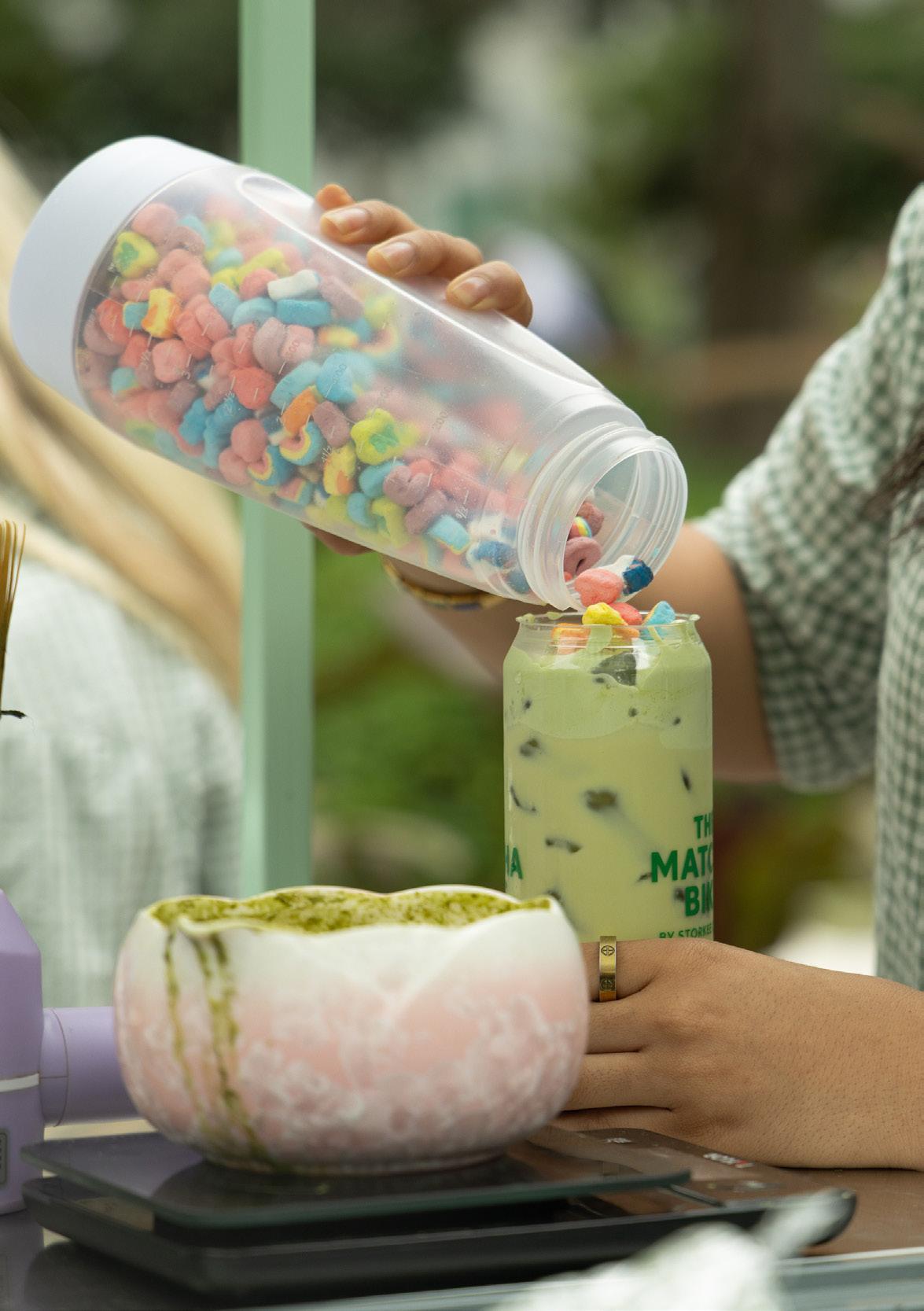
A green bicycle near the Merrick building is UM students’ newest caffeine obsession. The Matcha Bike, the newest matcha shop on campus, offers vibrant, colorful matcha lattes with an assortment of flavors. The student-founded business brings delicious matcha directly to the UM community with its unique flavors tailored to students’ interest making each purchase personable.
The Matcha Bike was created when the founders, who wished to remain unnamed, had trouble finding a sweeter version of matcha on campus. They then started experimenting with recipes and created their own drinks they thought students would enjoy.
Matcha, a powdered green tea traditionally used in Japanese tea ceremonies, has a reputation of tasting bitter and earthy. The Matcha Bike wanted to change that stigma by creating a version of the drink that’s sweet and something even fans of the traditional matcha flavor would like.
“Matcha has a negative preconception among so many for tasting like grass,” an owner said to The Miami Hurricane.
To fix that, the founders spent more than two years developing a signature drink they call the
“Green Velvet.” It blends traditional matcha ingredients with a custom oat milk mixture designed to create a rich and creamier taste. The Matcha
“Whether you’re a purist or someone still warming up to the flavor, there’s something here for you .” Owner of The Matcha Bike
Bike designed custom cans for each drink — giving a personalized experience for each drink. The decision to serve the drinks from a bike came from a desire to make the concept more mobile and interactive.

“From there, the bike concept was born: A mobile, personal way to bring that experience directly to our community,” an owner said.
The entrepreneurial culture at UM also played a significant role in shaping the business. According to the founders, many students at UM have their own businesses, which helped inspire them to pursue their idea.
“UM is hands down the best university in the country for entrepreneurship,” an owner said. “Not only are a large percentage of the student population business owners, but the administration is so supportive of small businesses.”
Balancing academics and starting a small business presented its challenges, including the demands of operating a growing venture, which requires long hours and careful time management.
In spite of the workload, the founders say seeing customers enjoy their drinks makes the challenges worthwhile.
For the founders, The Matcha Bike is about more than just selling a product. They hope each interaction with customers helps build a sense of community.
“What sets us apart is the care we’ve put into crafting our recipes,” an owner said. “Whether you’re a purist or someone still warming up to the flavor, there’s something here for you.”

Lorelei Disanto // Staff Photographer Barista Babes brings fresh coffee, matcha, and baked goods to campus with its mobile pop-up.
Lorelei Disanto // Staff Photographer
The Matcha Bike adds a special edition drink for St. Patrick’s Day!
Olivia Attalla // Contributing Photographer
A fruity matcha drink rests on the Café Locah counter at the Law School Courtyard on March 20, 2026.
‘Little
Shop of Horrors’ production brings music, comedy and puppetry to campus
By Alejandra Chavez Staff Writer
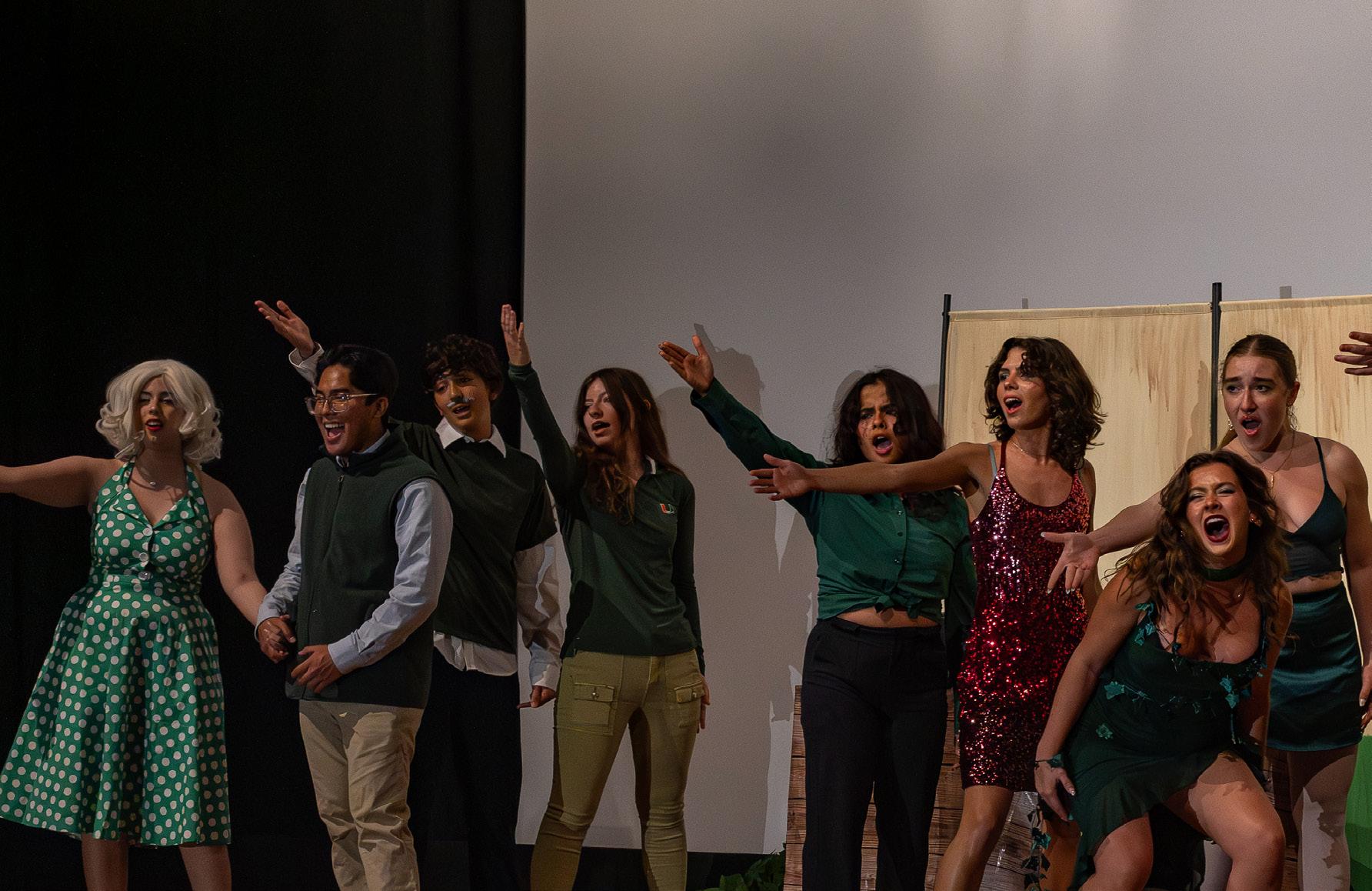
CaneStage is bringing the scifi horror musical “Little Shop of Horrors” to UM’s stage this month in a student-led production.
The show will run at 7 p.m. on March 20, 22, 27 and 29 at the Cosford Cinema. Performances are free and open to the public.
Freshman and director Erika Kato described the production as one that appeals to a wide audience.
“‘Little Shop of Horrors’ is a musical for everyone,” Kato said. “It has comedy, sci-fi and thrilling scenes and deaths, romance, dancing, puppetry and so much more.”
The cult-classic musical tells the story of Seymour, a shy florist who discovers a mysterious plant that promises him fame and fortune — but at a dangerous cost.
Producing the show with University students presented unique challenges. According to Kato, coordi-
nating rehearsals among busy college students was one of the most difficult aspects of directing the production.
“We all have so many things going on at UM,” Kato said. “There will be some days where actors would not be here, so rehearsals for vocals and blocking was an issue, but at the end of the day they all took their own time to review and learn.”
As a first year student directing her first production at UM, Kato initially worried about leading performers who were often older and more experienced than she was. That concern quickly faded after the first table read.
“They all believed in me and supported me,”Kato said.
Throughout rehearsals, Kato said she has watched the cast grow significantly, particularly Valentina Carbonell, the actor playing Audrey — Seymour’s love interest.
“She has truly built her confidence in this role.” Kato said. “As an audience member, you cannot tell this is her first production.”
The show also features one of the musical’s most iconic elements: the talking plant, Audrey II, which is shown as a puppet. CaneStage’s production incorporates both a handheld and a large puppet while also featuring a performer providing the plant’s voice.
“We have our actress and voice of Audrey II walking around the puppet and interacting with the actors,” Kato said. “She has such strong stage presence that we wanted her visible and interacting with everyone.”
Despite balancing academics and rehearsals, Kato said the most surprising part of the process has been the sense of community among the cast and crew.
“We are all college students managing school and rehearsals, but everyone is here for each other,” Kato said. “Actors help each other with lines, dances and cues. It’s truly a strong community.”
SPORTS
A look back to Miami’s thrilling March Madness triumph over Missouri
By Jayden Gonzalez Co-Sports Editor
In a raucous, Missouri-heavy crowd Friday night at the Enterprise Center in St. Louis, the No. 7 Miami Hurricanes defeated the No. 10 Missouri Tigers 80-66.
Up nine with less than two minutes remaining, Miami guard Tre Donaldson held the ball as the shot clock neared expiration.
With Missouri’s Jayden Stone in his face, Donaldson buried a contested 3-pointer to give Miami a 12-point lead, silencing the 17,000 in attendance.
Despite the overwhelming presence of black and gold in St. Louis, “It’s great to be a Miami Hurricane” echoed through the arena as Tru Washington dribbled out the clock, sealing head coach Jai Lucas’ first NCAA Tournament win.
“It was a lot of Mizzou fans in the crowd that were against us,” Shelton Henderson said after the game. “Trash talk really gets me going.”
With less than eight minutes left, Missouri forward Mark Mitchell nailed a corner 3-pointer, forcing Lucas to call a timeout and sending the crowd into a frenzy as the Tigers took a one-point lead.
Lucas said containing Mitchell was a point for Miami. Formerly coached by Lucas at Duke, Mitchell came alive in the second half, scoring 15 points and hitting three 3-pointers over the final 20 minutes of his collegiate career,
“They built a wall that made it hard for me most of the game,” Mitchell said after the game. “I couldn’t get going there until late.”
Following Mitchell’s 3-pointer, the Hurricanes played their best stretch of the season, going on a 28-12 run capped by a Malik Reneau three-point play and Donaldson’s contested 3. During that eight-minute stretch, Reneau, Henderson and Donaldson combined for 23 of the 28 points, carrying Miami when it mattered most.
“These three up here with me in each part of the game, they showed why they have gotten us here,” Lucas
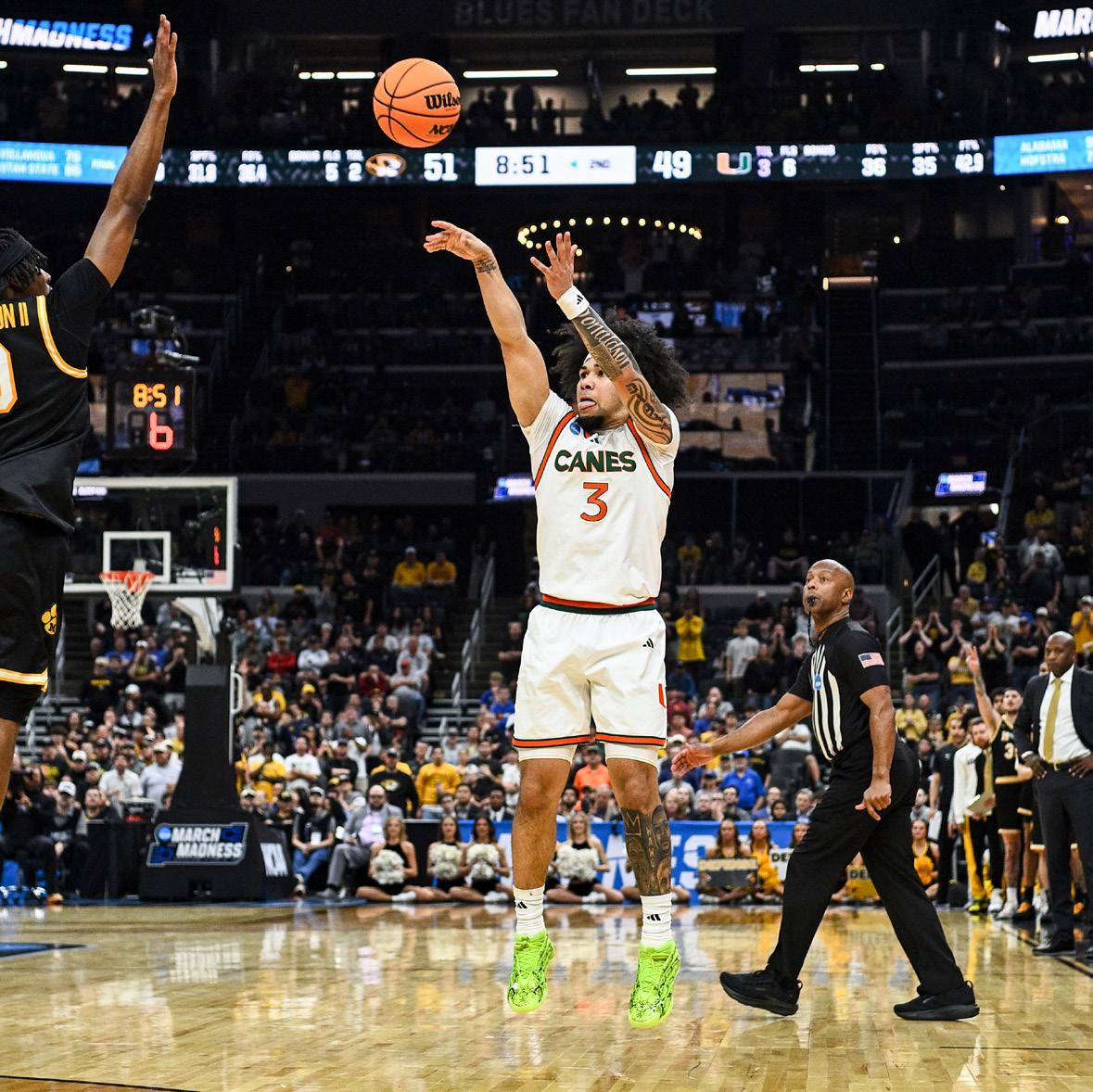
Senior Guard Tre Donaldson hits a clutch three pointer against Missouri on March 20, 2026 at the Enterprise Center in St. Louis, Missouri.
said. “Malik being able to close, Tre with his big shots, Shelton in the first half kinda carrying us offensively.”
Reneau finished his night with 24 points — including 19 in the second half — along with six rebounds and three assists.
Dominance on the glass and second-chance points ultimately proved to be the difference for Miami. Ernest Udeh Jr. helped the Hurricanes to 46 rebounds, including 16 offensive boards, leading to 19 second-chance points. Before fouling out, Udeh recorded 10 rebounds, five on the offensive glass.
Despite the win, Miami struggled at the free-throw line — a season-long issue that has yet to cost it but remains a concern, The Canes entered the tournament shooting 68.5% from the line. Against Missouri, they shot 59%, including a stretch in which they made just 4 of 13.

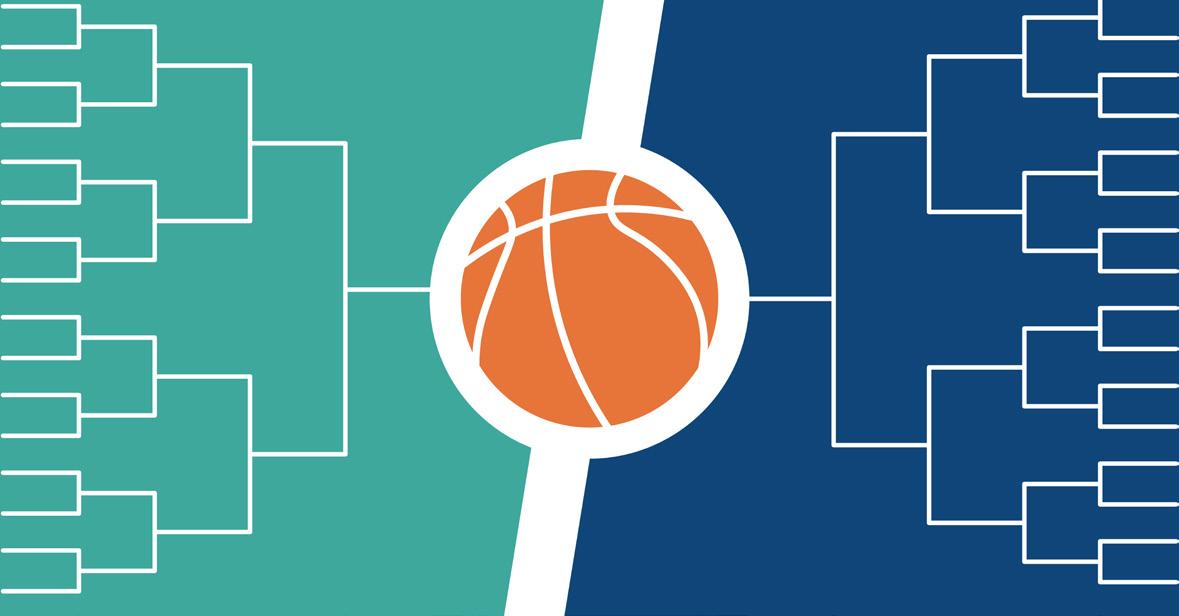
CBS Sports betting analyst Mackenzie Brooks took to Tik Tok to post her breakdown of the tournament with the caption, “The girls are making winning march madness brackets.”
As the month of March peaks, college basketball fans prepare for their biggest event of the year: March Madness.
The NCAA Division I men’s basketball tournament began in 1939 with only eight teams. The idea was created by Ohio State head coach Harold Olsen who wanted to hold a true national championship tournament in the postseason for basketball.
While the second half featured an offensive surge, the first half was a defensive grind.
The first 20 minutes saw both teams combine for 54 points on 30% shooting, along with 12 turnovers and little offensive rhythm.
Missouri found momentum late in the half, closing on a 9-0 run capped by an Anthony Robinson II 3-pointer to cut Miami’s lead to 27-26 at the break.
The 2024-25 Hurricanes were 7-24, one of the worst seasons in program history — a low point for a program that was once discontinued for 14 years.
Under Lucas in 2025–26, Miami improved by 19 wins, tying the Division I record for the largest yearto-year turnaround.
It’s no understatement to call the Jai Lucas era a success, as the Canes find themselves back in the Round of 32 for the first time since their Final Four run in 2023.
The first “March Madness” tournament was held on Northwestern’s campus and officials had to give away tickets just to fill the stands. The official name was coined by H.V. Porter and wasn’t used until 1939.
The tournament has now grown to 68 teams competing in a single elimination, seven round tournament, generating more than $1 billion dollars in revenue for the NCAA, according to Wallet Hub.
As the tournament itself grows, so has its biggest draw: the bracket.
The famous March Madness bracket started almost 50 years ago with the first known public bracket pool being held in a bar in Staten Island, N.Y. in 1997 with 88 participants and a $10 fee.
In the 1990s, with the adoption of the internet, online brackets became more popular. Now, the NCAA estimates that 60 to 100 million March Madness brackets, both men’s and women’s, are filled out annually.
The creating and sharing of brackets has largely been popular among men, but the community of women involved is growing.
Although many people try to make a perfect bracket, it is nearly impossible.
The odds of making a perfect march madness bracket are 1 in 9.2 quintillion, if you are choosing randomly. For reference, the odds of winning the Powerball Lottery is 1 in 292 million, meaning you are 200 times more likely to win the lottery than you are to make a perfect bracket.
Your odds increase to 1 in 128 billion if you are making decisions based on information and data, according to the NCAA.
While these statistics don’t sound promising, people have turned March Madness brackets into a fun game with family, friends, co-workers, teams and more because of how unpredictable the brackets can turn out.
With the
is, personal feelings or “vibes” or even how attractive the players are.
“We need the tournament. The tournament is a unifying factor, whether you’re a big sports fan or not,” said Sportscaster Ernie Johnson on CBS Mornings Instagram. No matter how you decide to set up your bracket, it’s a fun way to foster some friendly competition between your friends or family. Or even just making one for yourself.
By Vivian Amoia Staff Writer
David Lebowitz // Photo Editor
Sovannreach Po // Graphics Editor
Ava Stroshane // Contributing Photographer
Members of the Little Shop of Horrors cast perform their closing number at the Cosford Cinema on March 22, 2026.
Story by Emil Salgado-Vasquez // Illustration by Sovannreach Po
UM diver makes history, defends NCAA national title second year in a row
By Bella Armstrong Senior Staff Writer
History has a way of following Chiara Pellacani.
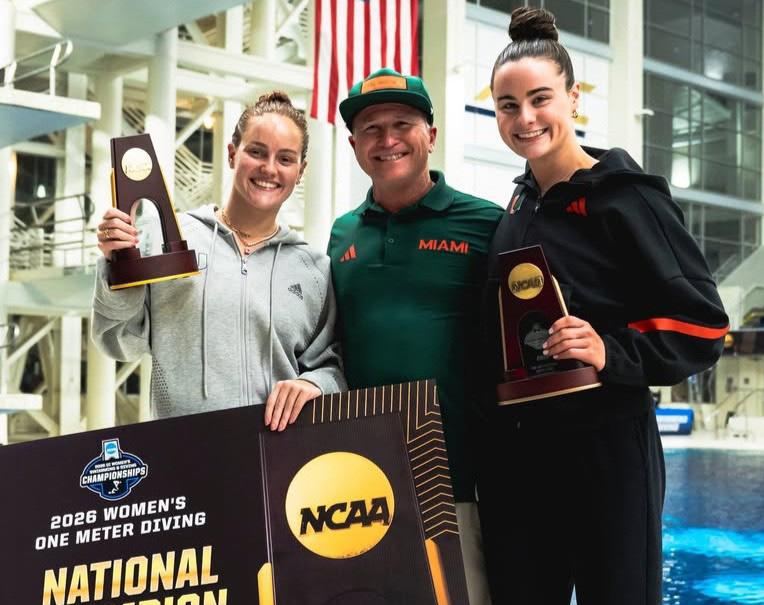
The two-time Olympian and 2025 NCAA 1-meter champion did it again, defending her national title in a performance that kept everyone at the McAuley Aquatic Center on the edge of their seats. All eyes were fixed on Pellacani as the senior diver stepped to the edge of the 1-meter board for one of the final dives of her collegiate career. One last moment to defend a national title and leave her mark in Miami diving’s history. Pellacani had been flawless all night. Six dives, each scoring more than 52 points, a display of precision, control and nerves of steel. Her fifth dive — a reverse 1 ½ somersault with 1 ½ twists — had already stolen the show. But like
most things, it all came down to this singular moment: the final rotation, the last splash.
When the scores flashed, the margin was impossibly tight: 345.70 to 345.45, Pellacani over Sophie Verzyl of South Carolina. A quarter-point difference, a fraction, a heartbeat; the kind of finish that separates great athletes from the legends.
“It’s a little crazy, I also practice for this,” Pellacani said after her victory. “When I’m competing, I just try to enjoy it.”
“We compete against each other, but we’re all friends,” she continued. “It’s always so fun.” Fun, yes — but every movement had been history in the making. And this win cements Pellacani’s legacy at Miami.
She’s the first diver since Brittany Viola (2008, 2011) to win multiple national titles, the first since Jenny Keim (1999, 2000) to claim back-to-back NCAA championships and the first to defend a
title on the same board since Rio Ramirez, a three-time 1-meter champ who now coaches at UM.
“It’s my last year. It’s really important to me and the school,” she said. “[Miami] did a lot for me.”
She wasn’t the only star who shined in Atlanta. Margo O’Meara finished sixth with 311.80 total points, earning her third first-team All-American honor on the 1-meter, while Pellacani collected her second.
Thursday night wasn’t Pellacani’s only success, as the Italian picked up another All-American honor on Friday in the 3-meter springboard after placing fourth in the nation — her final time competing as a collegiate diver.
Her college career concludes not with a single moment, but with a body of work that refuses to be reduced to one. Pellacani thrives under pressure, shines when history is watching and now leaves a legacy that will echo through Miami Hurricanes swimming and diving for years.
Upon the conclusion of the 2026 NCAA Swim & Dive
pionships, one thing is clear: Pel
Miami blasts past Creighton with three homer surge, completes series sweep

By Brendan Cafferty
Co-Print Editor
On Sunday afternoon, the Canes offense loomed large over the Creighton Bluejays in the finale of their three-game series.
Three straight homers off the bats of
third, first baseman West drove a ball to the warning track for a sac-fly, giving the Canes an early 2-0 lead.
After another shutdown inning from Collera, the Canes would bring shortstop Vance Sheahan around in on a passed ball after his single, adding one additional run to their tally.
Collera, making his first start since February against Lafayette, suffered his first setback of the afternoon in the third.
The right-hander would give up a two-run shot to Creighton shortstop Ben North, shrinking the Canes lead to one.
Answering immediately in the bottom half of the inning, however, was the trio of homers from Sosa, Williams and West.
Through 4.1 innings, Collera tallied six strikeouts with only one walk. The sophomore Miami native has made a great leap from his freshman season, doubling his strikeouts relative to the year prior and halving his ERA.
Collera looks to be a formidable weapon in the Hurricanes’ rotation for the remainder of the season, and beyond.
Creighton jumped on Coats, with two RBI doubles bringing in both of Collera’s runners and one of his own for good measure. But the Nebraska transfer worked his way out of the inning with two strikeouts.
The Blue Jays issued their third pitching change of the day, but he met the same fate as the prior two.
Derek Williams and Brylan West sent Mark Light Field into a frenzy — part of a much-needed 15-5 victory and series sweep.
West’s 410 foot homer served as the nail in the coffin for the Bluejays, as the Canes would hold a lead of at least four the remainder of the game.
Following a two -strikeout first for Miami starter Lazaro Collera, the Hurricanes bats struck immediately in the first. Williams hammered a ball to the right field gap to open the scoring with a one-run single. With men on first and
Second baseman Jake Ogden joined the homer party with a two run shot to left field in the fourth, followed up by another RBI from Williams.
After getting into some trouble in the fifth, Collera was pulled for reliever TJ Coats.
Left fielder Dylan Dubovik was driven in by a flyout from Vance Sheahan after a wild throw-in, before Sheahan was at the center of the action again in the sixth, tallying an RBI single.
Miami’s offense had a rare blip in the seventh, recording their first scoreless inning of the afternoon.

The Canes quickly made up for it in the eighth, racking up five consecutive walks leading to two scored runs and, ultimately, a 10-run mercy rule giving the Hurricanes their first sweep since February.
Canes’ comeback falls just short in 72-65 loss to Wisconsin
By Lazaro J. Chavez Staff Writer
Miami’s women’s basketball season came to a close Sunday afternoon with a 72-65 loss against the Wisconsin Badgers in the second round of the Women’s Basketball Invitational Tournament.
The Canes battled back from a double-digit deficit early in the third quarter to challenge the Badgers in the fourth quarter.
As usual this season, guard Gal Raviv and center Ra Shaya Kyle led the way for Miami. Raviv racked up 20 points, playing 38 minutes while Kyle closed out her collegiate career with a hard fought performance in the paint, putting up nine points and 12 rebounds.
Wisconsin’s execution down the stretch proved to be the difference.
Gift Uchenna and Destiny Howell delivered timely three-pointers to keep Miami at bay in the fourth quarter — clutch shots that proved to be the dagger in Miami’s postseason hopes.
Despite the loss, UM head coach
Tricia Cullop noted the progress the team has made in her second year as head coach.
“You know last year we were sitting home at this time. We didn’t get to play the post season”, Collup said. “I’m glad we got a taste of it … It's what we want to be, that's where this program should be.”
Wisconsin dominated the opening quarter with points from Howell, Lily Krahn and Uchenna, capitalizing on the Canes sluggish start to end the quarter with a commanding eleven point lead.
In the second, the story was much of the same. Wisconsin dominated defensive-
ly, slowing Miami down while racking up eight defensive rebounds.
While still trailing, scores from Amarachi Kimpson, Raviv, and Danielle Osho helped make up ground to close Miami’s deficit 2315 at half-time.
The game seemingly broke open in the third, where Wisconsin extended their lead to 52-37. Howell led the badgers in this frame, connecting repeatedly from beyond the arc as part of a career high six 3-pointers. Wisconsin's floor spacing and transition play — spearheaded by Laci Steele and Krahn — consistently overwhelmed Miami's defense.
But Miami caught fire in the fourth quarter.
V’s Take is T he Miam i Hurricane ’s mos t cont roversial and longest r unning column .
V’s Take is a satirical work published biweekly by students and for students using our generation’s “colorful” language. V addresses all things love, sex and gossip on campus. V is not for the politically correct or
The Canes will look to improve in Cullop’s third season at the helm in 2026-27.
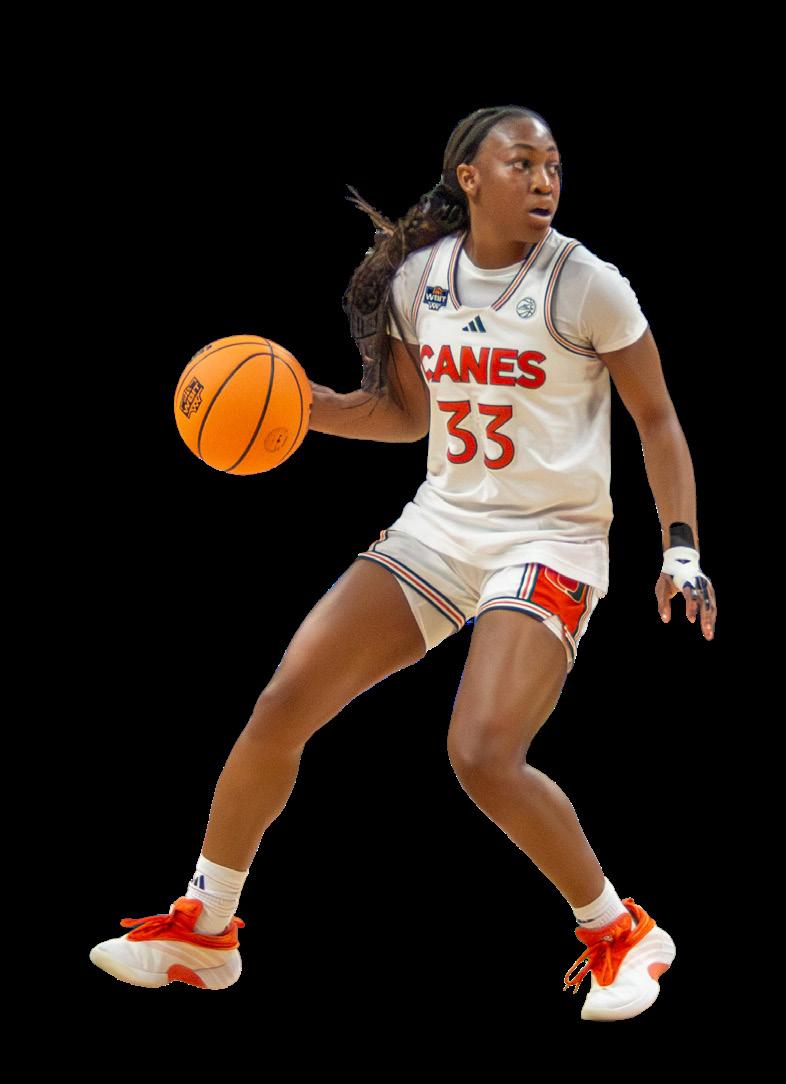
The Canes leaned heavily on Raviv who led the team in scoring alongside eight assists — repeatedly attacking the paint and finding shooters on the perimeter. Kimpson was the only other Cane to reach double digits, with 11 points. Adams provided some much needed perimeter spark, con tributing nine points on 3-of5 from beyond the arc. Miami brought the game within two with 45 seconds re maining, but Wisconsin held on to advance to the quarterfinal round of the WBIT.
Dear V, So I don’t even know where to start. I was in a relationship that ended in a full dumpster fire, allegedly “mutual.” About three months later, I was casually informed by, let’s put it lightly, a drama queen that my ex was talking to someone new. His friends were my friends, or at least I thought they were, and when I asked them if it was true, they denied it profusely…
The girl you “shouldn’t worry about” was in fact the girl
There’s no better advice than telling you to appreciate the fact that your intuition was spot on and your ex was talking to someone new. Sometimes there’s no better feeling than clarity. Obviously this raises questions about your ex’s friends — who you thought were also yours — and the actual timeline of things. After getting the news from the “drama queen,” you were right to pick up the phone and call his best friend. But from here on out, you need to completely distance yourself. He showed who his loyalty really belongs to — and it wasn’t you.
More often than not, I’ve seen friend groups fall apart over one relationship not working out. Unfortunately, things won’t be the same as they were before this drama-filled breakup.
On the bright side, if your ex is as shady as he sounds, his friends probably are too, and it’s for the better that they’re out of your life.
Coming across that photo, even months later, would've made my heart instantly sink. No matter how moved on you truly were at the time, that had to hit hard.
,
What would bother me the most, if I were you, is if you naively maintained a friendship with his friends after they blatantly lied to your face.
Now, I’m a very confrontational person, but I have to tell you not to confront them for lying. No matter how badly you might want to. His friends are in too deep and confronting them just opens the gate for more lies. And it makes you look like you care.
As for the downgrade, all you can do is sit back and laugh. Liars tend to go for people with similar traits, and clearly he hasn’t grown up at all. Be glad you got out when you could.
In the end, you should feel really good about your situation. Your ex took a major downgrade, you know who to trust and you sound like you’ve moved on from the situation.
You should give a big thanks to the “drama queen” in your life too, she was a real one.
Read the full submission online
Cham
-
lacani’s name will be remembered long after the final splash.
Photo courtesy of Miami Athletics
UM divers Chiara Pellacani and Margo O’Meara hold their trophies following the NCAA 1-meter National Championship on March 19, 2026 at the McAuley Aquatic Center in Atlanta, Ga.
Alex Sosa,
Brian Mulvey // Photo Editor Junior catcher Alex Sosa runs while throwing up the U during the game against Creighton University on March 22, 2026.
Tierny Dennison // Contributed Photo
Senior infielder Jake Ogden winds up his bat against Creighton University on March 22, 2026.
Bella Ochoa // Contributing Photographer Junior guard Amarachi Kimpson handles the ball against Georgia Southern at Watsco on March 3, 2026.