Vol. 108, Issue 19
Oct. 7, 2026 - Oct. 20, 2026
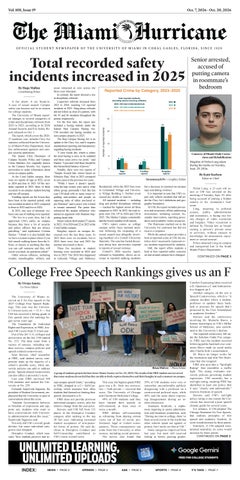
Total recorded safety incidents increased in 2025 By Hope Mallon Contributing Writer A fire alarm. A car break-in. A case of sexual assault. Campus safety can become real in an instant for college students. The University of Miami reported changes in several categories of crime and disciplinary referrals from 2023 to 2025, according to its 2026 Annual Security and Fire Safety Report released on Oct. 1. The report, which covers the 202627 academic year, includes Clery Act statistics collected from the University of Miami Police Department, local law enforcement agencies and campus security authorities. The Jeanne Clery Disclosure of Campus Security Policy and Campus Crime Statistics Act, originally known as the Campus Security Act, requires universities to make information about crime on campus public. At the Coral Gables campus, there were six reports of rape in 2023, seven in 2024 and four in 2025. Of the incidents reported in 2025, three of them occurred in on-campus student housing and one off-campus. Fondling reports are the lowest they have been in the reported period, with one recorded incident in 2025 compared to three in 2023 and five in 2024. In 2025, one case of domestic violence one case of stalking were reported. “We live in a scary time, but I do appreciate UM’s safety on campus because they have a lot of security and police officers that are always patrolling,” said sophomore Cristian Hacker. “I think it is also helpful that we have a system in place where if you feel unsafe walking home from the library or classes or anything like that, you can call someone and they will escort you back, no questions asked.” Other serious offenses, including murder, manslaughter, robbery and
arson remained at zero across the three-year timespan. In contrast, the report showed a rise in disciplinary referrals. Liquor-law referrals increased from 2023 to 2024, reaching 132 reported incidents in 2025. Drug-abuse referrals did not follow as clear of a pattern, with 60, 43 and 56 incidents throughout the period, respectively. For the first time, the report also included a hazing statistic under the federal Stop Campus Hazing Act. UM recorded one hazing incident on non-campus property in 2025. The Stop Campus Hazing Act is an update to the Clery Act, and it requires standardized reporting and transparency regarding hazing incidents. “I view Greek life, which is where the most hazing is seen, to be outdated and these cases prove my point,” said Hacker. “I just don’t feel there should be this hierarchical balance of power.” Notably, there were two reports of “Simple Assault hate crimes based on Ethnicity Bias” filed in 2025 compared to zero cases in the previous two years. “While I know it doesn’t specify what the hate crimes were and to what ethnic group, personally I feel like last year UM dealt with so many issues regarding anti-senitism and people on opposing sides of either pro-Isreal or pro-Palestian” said a junior who wished to remain unnamed. The junior then referenced the student influencer who started an argument with Students Supporting Israel club. Motor vehicle theft totaled 27 reports in 2023, 18 in 2024 and 22 in 2025 at the Coral Gables campus. Burglary reports on campus decreased over the last three years. In 2023 there were six incidents, but in 2024 there were four and 2025 the number decreased to three. Three fire incidents in student housing were recorded in 2024 and two in 2025. The 2024 fires happened at Lakeside Village and Mahoney
Senior arrested, accused of putting camera in roommate’s bedroom
Courtesy of Miami-Dade Corrections and Rehabilitation Mugshot of Dylan Long taken during his intake on Tuesday, Sept. 29, 2026.
By Katie Karlson Sovannreach Po \\ Graphics Editor Residential, while the 2025 fires were in Centennial Village and University Village Building 3. Neither event caused any deaths or injuries. All reported incidents — including drug and alcohol disciplinary referrals — reached the highest across all three campuses in 2025. In 2023, the total reports were 230, 197 in 2024 and 238 in 2025. The Marine Campus consistently had the lowest number of all reports. UM’s report comes as college campus safety faces national attention following the reopening of a sexual assault case allegedly involving members of a Cornell University fraternity. The case has fueled discussion about how universities respond to reports of sexual violence. Cornell’s 2026 security report, released in September, shows an increase in reported stalking incidents
but a decrease in reported on-campus rape and dating violence. It is important to note that UM’s report only reflects incidents that fall under the Clery Act’s definitions and geographic boundaries. At UM, the report includes prevention and awareness efforts addressing misconduct, including consent, bystander intervention, reporting procedures and available victim resources. The Hurricane reached out to the University for comment but did not receive a response. While the annual report provides a look at reported crime at UM, the statistics don’t necessarily represent every incident experienced by students. Still, the report offers students a look at how reported safety concerns on and around campus have changed.
Editor-in-Chief Dylan Long, a 21-year old senior at UM was arrested on the morning of Tuesday, Sept. 29, after being accused of putting a hidden camera in his roommate’s bedroom. Long, majoring in political science, public administration and economics, is facing two felony charges of video voyeurism and burglary. Video voyeurism is defined by Florida law as broadcasting a person’s private areas or activities, without consent or knowledge, for amusement, enjoyment or sexual arousal. Police detained Long on campus and transported him to the South Miami Police Department. CONTINUED ON PAGE 3
College Free Speech Rankings gives us an F By Vivian Amoia Co-News Editor The University of Miami received an F for free speech in the 2027 College Free Speech Rankings. This year was the University’s lowest score yet — 51.4 — but UM has received a failing grade in free speech since the rankings began seven years ago. The Foundation for Individual Rights and Expression, or FIRE, lowered UM’s score from 51.6 last year. Out of the 261 U.S. colleges and universities on the list, UM ranked No. 253. The data came from a variety of sources, including student surveys, campus policies and speech-related controversies. Sean Stevens, chief researcher at FIRE, said student survey components make up the majority of a school’s possible score, while university policies can add or subtract points. Speech-related controversies can also affect a university’s score. Last year, FIRE surveyed 340 UM students and ranked the University at No. 229. Fernando Sepulveda Sagaseta, the president of Student Government, emphasized that the University is open to conversations about this score. “Student Government believes in freedom of expression and supports any students who want to have conversations with University administration about this issue,” Sepulveda Sagaseta said. Not only did UM’s overall grade decline, but some individual categories also dropped. Disruptive Conduct, which measures “how students perceive and ac-
Brian Mulvey \\ Photo Editor A group of students protest the Iron Arrow Honor Society on Oct. 24, 2024. The results of the FIRE student surveys reveal that many students do not feel that they are able to freely express themselves and their thoughts in such a manner on campus. cept campus speech limits,” according to FIRE, dropped to a C+. Self-Censorship, which measures how often students find themselves limiting their speech, decreased to a D-. FIRE does not provide previous individual category scores, only the relative change from the year prior. Stevens said UM fell from 123 places in the Disruptive Conduct category after ranking in the top 50 last year, indicating increased student acceptance of non-peaceful forms of protest. He said declines in Disruptive Conduct and Self-Censorship contributed to UM’s lower overall score.
This year, the highest grade FIRE gave was a B-. Only two universities — both private — received that score: The University of Chicago and Claremont McKenna College. 49% of UM students said they have limited their speech, or self-censored, at least once or twice a month. FIRE defines self-censorship as refraining from sharing certain views out of fear of social, proB:10.25" fessional, legal or violent consequences. ThoseT:10" consequences can come from theS:9.75" University or other sources, including social pressure. The survey also found that
59% of UM students were very or somewhat uncomfortable publicly disagreeing with a professor on a controversial political topic, while 48% said the same about expressing disagreement during an inclass discussion. Anastasia Krafczek, a sophomore majoring in sports administration and broadcast journalism, said, “During my time in college, there’ve been several events in the world that other schools speak out against or protest, but I rarely see that at UM.” Some categories improved from last year, but most still received failing or barely passing grades.
Comfort Expressing Ideas received a D, Openness a C and Administrative Support an F. Another category on the site is Speech Controversies, which is “A campus incident where a student, professor or speaker faces backlash or pressure for speech that’s protected by the First Amendment or academic freedom.” Stevens said the controversy involving Dr. Michelle Bravo, a former neurologist at UM’s Miller School of Medicine, also contributed to the University’s decline. The reported controversy fell under the Scholars Under Fire category. FIRE says the incident occurred following public backlash over comments Bravo made on social media after Charlie Kirk’s assassination. Dr. Bravo no longer works for the institution and told The Hurricane that she resigned. FIRE also provides a “Spotlight Rating” that resembles a traffic light. The rating evaluates university policies governing student expression. UM currently has a red-light rating, meaning FIRE has identified at least one policy that it says “clearly and substantially” restricts freedom of speech. Stevens said UM’s red-light policy rating is one reason the University has received a poor speech climate grade for several years. For instance, if UM adopted The Chicago Statement for Free Speech, that outlines principles of free speech and academic freedom, its score would increase by three points. Similarly, if UM adopted institutional neutrality, its score would increase by three points. CONTINUED ON PAGE 2
S:1.25"
INDEX:
NEWS | PAGE 2
OPINION | PAGE 4
A&E | PAGE 5
SPORTS | PAGE 6
V’S TAKE | PAGE 7
NEWS
2
October 7, 2026
THE MIAMI HURRICANE
College Free Speech Rankings gives us an F CONTINUED FROM PAGE 1 According to FIRE, institutional neutrality is “the idea that colleges and universities should not, as institutions, take positions on social and political issues unless those issues ‘threaten the very mission of the university and its values of free inquiry.’” Stevens said FIRE recommends that UM reform policies it classifies as red or yellow lights, adopt the Chicago Statement and take an official position of institutional neutrality. He said those changes would provide an immediate boost to UM’s overall score, while improvements in student survey responses could take longer. The overall speech climate, which contributes to the Spotlight Ranking, affects the score the most. If UM improved, its score could increase anywhere from five to 15 points. If all of these aspects improved, UM’s overall score would at least receive a passing grade of C. Many students feel UM doesn’t have a neutral agenda. “The University of Miami is extremely hesitant to allow speech that jeopardizes its financial interests,” said one student who anonymously
responded to FIRE. “Protest rules have been altered to be extremely repressive, not allowing protests without permission from the University and requiring police officers — and a payment to support them.” It also found that 30% of UM students said they would never feel
“The University of Miami is extremely hesitant to allow speech that jeopardizes its financial interests.” Anonymous UM Student
comfortable “expressing an unpopular political opinion to [their] fellow students on a social media account tied to [their] name.” “I could not tell you how many students have come to me in agreement or in admiration of the ability to speak up, but they fear their personal, academic, professional and social lives will be negatively affected,” said Riley Richards, the secretary of UM College Republicans. The Miami Hurricane reached out to the University of Miami Young and College Democrats and did not receive a response. However, in contrast to what these results seem to indicate, 82% of UM students answered no when asked if freedom of speech is a difficult topic to discuss. Despite these results, one unnamed member of the Class of 2025 who responded to FIRE said free speech issues exist even off campus. “In totality, it is impossible to express your true feelings about anything nowadays anywhere due to feeling judged or being canceled,” he said. The University did not respond to The Hurricane’s repeated requests for comment.
Emil Salgado Vazquez \\ Copy Chief UMPD confronts Adi Karni and two UM students outside of Lakeside Lobby A on April 23, 2026.
Cane Navigators under fire as documented issues arise By Marcus Garcia Contributing Writer
Many UM students say Cane Navigators have made it difficult to access the credits and information they need to graduate, citing limited availability, insufficient guidance and delayed responses. Academic advising underwent a structural change in 2024 following widespread complaints. Since then, advisors were renamed “Cane Navigators” and are assigned to students based on their primary major. Cane Navigators are meant to help students choose classes, create a fouryear plan, meet major requirements and support personal development. “In response to student feedback, the University of Miami established the Center for Academic Navigation & Success in 2024 to expand access to consistent, relationship-based academic guidance,” said the University in a statement to The Hurricane. But two years after the program’s reforms, students report the same issues. Notably, the department is frequently criticized for suggesting courses inaccurately. Choosing the right courses is crucial to meeting prerequisites, graduating on time and possibly even planning for study abroad. Apart from these criticisms, some students say they were given inaccurate information about course load and required courses. One sophomore in the College of Arts and Sciences who wishes to remain unnamed said she has had two advisors and struggled to get accurate information credit requirements. The Hurricane verified emails between
the student and her Cane Navigator. “[My first advisor] told me that I would need 18 credit semesters as a freshman to graduate on time after changing my major to economics from health sciences. Then, she withdrew from the University,” the sophomore said. “I now have a new advisor and was told I only need about 12 credits per semester due to my transferred coursework through dual enrollment to graduate Spring of 2029.” A senior studying political science also struggled to get a clear answer about which graduation requirements she had met. “This final semester, she told me that the ‘system’ missed the fact that I was supposed to take another 500-level seminar course. After stating that I had taken several so far and that I was going to work this semester, so this would not be ideal, she said there was nothing she could do about it and that it was essentially my fault for not meeting with her last semester,” the senior said. “Which I find hard to believe because last fall she told me I was done with my major requirements and I only needed electives.” The Hurricane verified emails of this student’s interaction with her advisor. In the emails, the advisor said the Degree Progress Report showed the student’s “Writing & Communication Proficiency” requirement as complete, but in reality it was not satisfied. When the student questioned this, the advisor stated that, because the DPR did not “flag” it in the system, she missed the error during their last meeting. “The center recognizes that receiving conflicting or inaccurate information about academic requirements can be deeply concerning, particularly when a student’s expected graduation
may be affected,” said the University. According to UM’s website, the ratio between Cane Navigators and students is 250:1. Managing 250 students at once could explain limited availability, inconsistent answers and the lack of communication. “Before [2024], some academic advisors supported as many as 400 students. By investing in 18 new Cane Navigator positions, the University is now on track to maintain caseloads of close to 250 students, so navigators can provide more individualized guidance and sustained support throughout a student’s undergraduate experience,” the University said in its statement. “This ratio is also consistent with a recommendation of the Boyer 2030 Commission.” Along these lines, a sophomore in the Business School who wishes to
Madison Mollica \\ Contributing Photographer Students walk through Norman A. Whitten University Center on Monday Sept. 28th, 2026. The Norman A. Whitten University Center is home to the Center for Academic Navigation and Success.
Inside Student Government’s impact By Hope Mallon Contributing Writer
UM students vote for student government president, vice president and senators every spring. Candidates plaster campaigns all over social media, making election season one of the most visible moments of student politics on campus. But, once the election is over, what does Student Government actually do? UM’s Student Government Constitution is the official representative of the undergraduate student body. Student Government is divided into legislative, executive and judicial branches, along with several agencies. Its purpose is to represent students’ needs and interests and act on issues delegated to it by University leadership. The executive branch, led by the president and vice president, develops initiatives and represents students to the University administration, while the legislative branch introduces and votes on legislation. The judicial branch, made up of the Student Government Supreme Court, handles matters involving interpreting governing documents and resolving disputes within the organization. But how much of that work actually changes students’ everyday lives? One example is UPrint, UM’s campus printing system, established in 2014. Student Govern-
ment worked with the Office of the Provost, Student Affairs and Business Services to establish a wireless printing system that allowed students to send documents to campus printers from their laptops. The initiative also established an allowance of 130 UPrint credits. During the previous academic year, Student Government’s Senate passed 87 bills, 23 of which were Category D bills, or recommendations to University administration. This semester, the Senate has passed 21 pieces of legislation, including nine Category D bills, so far. More recently, Student Government stated some of its most significant accomplishments have involved changes students encounter in their everyday routines. Those include expanding Richter Library hours, working with dining to bring a new restaurant called Fuku to campus, relocating Half Moon outside the Whitten University Center and eliminating temporary replacement Cane Card fees for housing residents. “I remember last year a survey going around regarding library times,” said Catie Nowak, a sophomore studying marine biology & ecology and ecosystem science & policy. “I am always up late and early studying at the library so I feel like this change really benefits me and helps my studying habits.” Student Government representatives said many of these changes
remain unnamed said the lack of clarity in their advisor’s responses has led to numerous follow-up emails. “Sometimes when I go in for specific questions or specific issues that I’m dealing with, a lot of times I get vague answers that don’t quite answer what I want and it leaves me kind of feeling very lost and confused,” said the sophomore. But not every student has a negative experience with their Cane Navigator. Arthur Frayzond, a senior studying finance and business analytics, shared that he has had an overwhelmingly positive experience. “My experience with my advisor has been a very strong and beneficial relationship. I’ve had the same advisor since the first day of class, and have found her to be very well informed about courses and require-
began with the legislative branch. “The senate votes to make something a priority, and then the executive team does the follow-through with campus partners,” Student Government said in a statement to The Miami Hurricane. Passing a bill, however, does not necessarily mean an immediate change on campus. Turning those priorities into changes can require coordination beyond Student Government, particularly when an issue involves administrative approval or various University departments. “From there, our executive boards work directly with campus administrators to brainstorm how to address student concerns and implement a follow-through,” Student Government said. Student Government’s constitution makes clear that its role is to represent students, meaning a Student Government bill doesn’t automatically become a University policy. After those promises are made, the next challenge is turning them into proposals that reach the student body and then the administration. Student Government said it’s currently working with the administration on initiatives that “might take years to see through” due to the multiple layers of approval needed. The organization also said ideas can change as faculty and students provide input. This semester, Student Government aims to make connections be-
tween the undergraduate body and the University more visible through direct student feedback and connections to existing University resources. On Sept. 21, Student Government hosted a Senate Pop-Up outside the Merrick Building, where senators collected suggestions from students about the changes they wanted to see on campus. The outreach continued on Sept. 28 when members of Student Government’s Supreme Court met with students to gather direct feedback. The Campus Liaison Council promoted a new initiative for extended library hours, which was approved, and the Academic Liaison Council has worked to make students aware of the University’s new pre-law advisor. The Student Government’s Elections Commission has also seen a significant increase in participation this fall. According to the Commission, 687 students voted in the Fall 2026 Senate election compared to 293 students in Fall 2025. This is a BLANK% increase.
ments for my program,” Frayzond said. “I would say the CaneLink resources or an email to the advisor are more immediately accessible than an in-person meeting, but I have met with my advisor every semester.” A senior studying computer science said he has had a mixed experience with Cane Navigators. The majority of his frustration, much like that of other students, comes from receiving inaccurate information or having his questions rerouted to multiple people before getting an answer. “I feel that I am on track to graduate on time, mostly due to my own research for the required courses for my major. My advisors have played a very small role in this,” said the unnamed senior. But sometimes researching your degree plan isn’t enough. During a recent advising meeting, the same senior was told he needed to add a minor to graduate. “I responded that I had never been told this before and was not sure if this was true given my situation,” he said. “Later in the day, she called me back and told me that she was wrong and that I did not need to add another minor.” The University highlighted that academic advising falls on both the student and the Navigator. “Academic advising is a partnership between the student and the Cane Navigator, each with responsibilities to track degree requirements, and to understand University policies and curriculum,” the University said. As UM continues to adjust to its advising system, students’ experiences remain mixed. For some, Cane Navigators provide needed support, while others say they are still left searching for answers about their path to graduation. 59 candidates were eligible to campaign for 37 Senate seats this fall, compared with 34 eligible candidates last year. With more students participating in the election process, Student Government said one of its goals for the 2026-27 academic year is to keep those students engaged in what the representatives they voted into office are actually doing for the student body. “We’re constantly working to make Student Government more collaborative and to reach more students,” Student Government said in its statement. “We want real feedback from the people we represent, so we can make sure we’re acting in ways consistent with what students actually need.” Student Government plans to improve its social media outreach and strengthen collaboration with other student organization leaders across campus. So, the question is no longer just who students elect, but rather what those representatives do with their seats and whether students can see the results of that work around campus.
You voted them in. So what happens next? • 87 bills passed by the Senate last academic year • Push for changes including extended library hours, new dining options and eliwminated replacement Cane Card fees • Increasing student votership for the following election year
NEWS
October 7, 2026
THE MIAMI HURRICANE
NEWS
3
arrested, Mahoney-Pearson room number Senior accused of plaques available after demolition putting camera in roommate’s bedroom
By Gaby Collazo Co-News Editor
Mahoney-Pearson Residential College’s former room number plaques are now available for purchase, following the building’s demolition. The University of Miami announced that the 68-year-old residential complex would be demolished and replaced with Gables Village, an upperclassmen housing complex, in November of 2025. Now, first year students are housed in Centennial Village, with overflow in Eaton Residential College and THesis Hotel. UM announced that they will allow former residents, students, faculty and others to purchase the room number plaques that were placed on top of the Mahoney-Pearson dorm doors. “Room numbers can carry sentimental value to anyone who has experienced living on campus,” said Liz Ingrao, director of housing staffing and development at UM. “We wanted to create a way to be able to keep the legacy, memories and history alive.” Each room plaque goes for $125 and is available on a first-come, first-served basis. Once a room number is sold, it is no longer available for purchase. If a room number is not listed, however, this means it was damaged or went missing before the building was demolished. According to UM’s website, the money will go to the Dr. Patricia A. Whitley Emergency Fund, which provides financial assistance to students facing unexpected challenges such as medical emergencies, housing challenges, family crises and other needs. “The fund reflects [Dr. Whitely’s] longstanding commitment to supporting students through difficult circumstances and helps ensure they can remain focused on achieving their academic goals,” said the Assistant Vice President for Student Affairs and University
CONTINUED FROM PAGE 1
Courtesy of Liz Ingrao Mahoney-Pearson room number plaques on Thursday Oct. 10, 2026. Plaques are available for purchase from the Universty of Miami.
Ombudsperson Dr. Jennifer Rau. The idea connects to Ingrao on a more personal level. Her alma mater, Skidmore College in Saratoga Springs, NY, tore down an old pink residence hall. The school decided to sell physical pieces of concrete from the building after alums, staff and students rallied behind the cause so they could have a keepsake from the time they lived in the building. UM shares this sentiment: People who lived and worked in Mahoney-Pearson want the chance to purchase memorabilia. A student’s experience on campus is unique to them. Where they lived is a memory that defines their time at college and leads to lasting memories.
“The room number can also be easily displayed in an office, apartment, or home. It’s small but carries so much meaning for people,” said Ingrao. “That way, people who purchase these room numbers have
a way of honoring their past while investing in the future for our students and the University.”
A piece of Mahoney-Pearson can now go home with former residents • Room number plaques are being sold for $125 each • Plaques are available on a first come first serve basis • Proceeds benefit the Patricia A. Whitley Emergency Fund
ADVERTISEMENT
“Mr. Long maintains his innocence and looks forward to addressing these allegations through the appropriate legal process,” said Matt Shafran, Long’s lawyer. “What occurred was not voyeuristic in nature, and we believe this situation has been significantly misunderstood.” The victim found the hidden camera on Sept. 12 because it was “emitting a blue light” from his nightstand, according to the arrest report. He found the camera connected to a power source and was able to access the footage, revealing that Long had tested the recording device. In a video of police body camera footage posted on NBC6, Long admitted to placing the camera in his roommate’s nightstand, saying he did it drunkenly after a night at the bar. The footage shows Long telling detectives that conflicts with his roommate had been going on for a year, “with his lack of communication on things I needed to know.” The recording device had 49 files, some of which were corrupted, but others had “recordings depicting [the roommate] traveling to and from the shower without his knowledge or consent.” Long is deeply involved in campus life, serving as the president of the UM Debate Team and as a student director at the George P. Hanley Democracy Center. He was also a legislative affairs intern for the U.S. Department of War this past summer. The judge ordered Long to stay away from the roommate. Since then, Long paid his bond of $3,500 and entered a written plea of not guilty.
OPINION
4
Student Government deserves more of our attention
Founded 1929
An Associated Collegiate Press Hall Of Fame Newspaper NEWSROOM: 305-284-4401 editor@themiamihurricane.com BUSINESS OFFICE: 305-284-4401 FAX: 305-284-4404 For advertising rates call 305-284-4401 or fax 305-284-4404.
Staff EDITOR-IN-CHIEF Katie Karlson MANAGING EDITORS Madison Block Hannah Valdivia NEWS EDITOR Vivian Amoia DIGITAL NEWS EDITOR Elena Fallow CITY NEWS EDITOR Gianni Echeverria OPINION EDITORS Keira Faddis Paulina Barnjak ARTS & ENTERTAINMENT EDITORS Marissa Levinson Brianna Pearson SPORTS EDITORS Sebastian Font Jayden Gonzalez COPY CHIEF Emil Salgado Vazquez
October 7, 2026
THE MIAMI HURRICANE
PODCAST EDITOR Camila Goveo Lounsberry PHOTO EDITORS Brian Mulvey David Lebowitz GRAPHIC DESIGN EDITOR Sovannreach Po PRINT EDITORS Camryn Greiner Brendan Cafferty SOCIAL MEDIA EDITORS Sophia Ibanez Anabelle Carpenter BUSINESS MANAGER Nishka Mishra FACULTY ADVISOR Antonio Mora FINANCIAL ADVISOR Steve Priepke SENIOR FINANCIAL ASSISTANT Michelle Starbeck
WANT TO WORK FOR US? SCAN HERE TO APPLY:
The Miami Hurricane is published biweekly during the regular academic year and is edited and produced by undergraduate students at the University of Miami. The publication does not necessarily represent the views and opinions of advertisers or the university’s trustees, faculty or administration. Unsigned editorials represent the opinion of The Miami Hurricane’s Editorial Board. Commentaries, letters and cartoons represent only the views of their respective authors. The newsroom and business office of The Miami Hurricane are located in the Student Activities Center, Student Media Suite 200. LETTER POLICY The Miami Hurricane encourages all readers to voice their opinions on issues related to the university or in response to any report published in The Miami Hurricane. Letters to the editor may be submitted typed or handwritten to the Student Activities Center, Student Media Suite 200, or mailed to P.O. Box 248132, Coral Gables, Fla., 33124-6922. Letters must be signed with a copy of your Cane Card. ADVERTISING POLICY The Miami Hurricane’s business office is located at 1330 Miller Drive, Student Activities Center Student Media Suite 200. The Miami Hurricane is published every other Wednesday during the university’s fall and spring academic terms. Newspapers are distributed for free on the Coral Gables campus, the School of Medicine and offcampus locations. DEADLINES The conditions of agreement for advertisers are outlined on the ad contract form. Please direct any and all questions related to advertising to the business manager, Nishka Mishra. Questions can be emailed to business@themiamihurricane.com. AFFILIATIONS The Miami Hurricane is a member of the Associated Collegiate Press, Columbia Scholastic Press Association and Florida College Press Association.
By Adrianna Buford Contributing Writer
Fall Student Government elections have already happened at the University of Miami, and it seems like the student body didn’t notice. Student Government’s 2026 fall election results were announced at the Rathskeller on Thursday, Sept. 17. Each fall, new senators campaign for political office and rely on us for their support, and this year more than 50 students ran for Senate seats. As a reflection of the student voice at UM, students on campus should care more about Student Government and who is leading it. Elections Chair Ava Stroshane says voter turnout increased by 50% this year compared to last fall. “I was so excited when I saw we had 687 voters for our election and increased our voter turnout as this meant we were able to get more people involved with student government and our processes,” said Stroshane. Despite the increase, only about 6% of the 12,000 undergraduate students actually voted. Freshman Andrea Padron said she did not vote due to a lack of information. “I didn’t see a lot of notice about voting. It seemed like there wasn’t much circulating on campus about it, or ways on how to vote,” she said. By voting in elections, and spreading the word about them, students prioritize our civic duties and advocate for the election of individuals we believe will best represent us during our time on campus.
Last year’s spring elections received the second-highest number of votes ever, with a total of 1,098 votes recorded. February 2019 during the presidential election, was the highest voter turnout in history, with 3,857 voters. In that election, the “Empower U” group contributed to increased engagement in athletic events, free feminine hygiene products in campus bathrooms and developing a study space at the Rat. Clearly, Student Government has the power to improve our daily lives, and students should want to have a say in who leads that charge. With initiatives like those frequently being pushed by Student Government, their efforts deserve our recognition and endorsement, and so do the fall elections. Patterns show higher turnout for presidential elections in the spring, but, like real life, senate elections carry a lot of power too. The newest senators are pushing for more engagement with their peers. Sophomore senator Alouna Alincy worked to get her campaign noticed by creating an Instagram profile with her mission statement, contact information and details regarding an event she hosted titled “Caffeine and Complaints” to hear about student concerns on campus. “I just wanted them to have a place to vocalize issues they’ve been having at school and I was able to learn so much that I didn’t know previously,” Alincy said. Student Government is here to stay and to fulfill students’ wants and needs as best it can. More engagement with the organization is
Courtesy of Carolina Juara A group of new Student Government members are sworn in on Wednesday, Sept. 23, 2026.
the least we can do, especially since their policies affect us as students. The organization invites people to
attend its open senate meetings every Wednesday at 4:30 p.m. on the third floor of the Shalala Student Center.
Increasing Student Government voter turnout through the years: 1. 2026 spring elections received 1,098 votes, second-highest number of votes ever 2. 2019 spring election received 3,875 votes, highest voter turnout in campus history 3. 2025 fall elections received 293 votes 4. 2026 fall elections received 687 votes, 50% increase from previous year
Balancing work-hard, play-hard By Hope Mallon Staff Writer
Spending five hours in the library studying for an exam, another hour fixing your résumé and then somehow ending the night — or, in some cases, your early morning — at a club in Brickell is not unheard of here at the University of Miami. The pressure to succeed academically and professionally exists alongside a student body that notoriously knows how to have a good time. As getting into UM became more competitive throughout the 2010s and 2020s, the University simultaneously developed a stronger hustle culture around networking and career preparation. Nightlife, proximity to South Beach and football culture have always been part of the University’s identity. However, the other half of UM’s identity has changed since the days of Suntan U. In 2015, UM received 33,415 applications and accepted 38% of students. In 2025, the University received a record 58,139 applications and admitted just 17.55% of applicants. Our acceptance rate isn’t the only
thing that has changed. Once students arrive, there is an increasing expectation to start preparing for life after college on the first day of class. “I remember walking into my first class of freshman year and the professor told us that if we didn’t already have LinkedIn, then we were behind,” said a junior in the Business School who wished to remain unnamed. “By the end of the semester he said we should have 500 connections.” It is not enough to just go to class. There is a pressure to join organizations, get an internship and somehow know how to network before establishing what your future job may be. That pressure continues after an undergraduate degree for some students. Law school, medical school and graduate programs are common paths after earning a bachelor’s degree, meaning students arrive at UM already thinking about the next step toward their ideal future. “I was surrounded by incredibly intelligent and motivated people who inspired me to keep pushing myself,” said Lauren Ferrer, who earned her undergraduate degree from UM and is now a law student at the University. “The professors
and advisors who challenged me were always encouraging me to step outside of my comfort zone and take advantage of new opportunities.” The Toppel Career Center has extensive resources to prepare students for life after graduation. Students can use Toppel for career coaching, internships, networking and industry-specific Career Circles. “Building your professional knowledge and experience is crucial in today’s job and internship market,” said Toppel Executive Director Ali Rodriguez in a statement in 2025. According to UM’s career outcome report for the class of 2023, 99% of graduates had secured post-graduation plans within six months. 62% had full-time jobs, 36% continued their education and 1% had part-time jobs. Then there is the other half of the equation: maintaining a social life. Coconut Grove, Brickell, Wynwood and South Beach are all within reach, giving students a wide social scene beyond on-campus events. “I think every student has their own version of what balance looks like, and being in a city where there is so much happening all the time can definitely make
that overwhelming,” Ferrer said. “At the same time, I wouldn’t have wanted it any other way.” Going out can become just as much a part of the college experience as studying. Football games, tailgates, raves, Greek life and nights out in Miami create a culture where students are not expected to choose between being academically driven and socializing. “If I’m being honest, I came to this school for its nightlife,” said a freshman in the College of Arts and Sciences who wished to remain unnamed. “I did not want to go to a small school in a small college town. I wanted to be in a city, where there are so many options for going out.” UM’s transformation wasn’t one sudden switch. The social culture was already thriving. What changed was the intensity surrounding academics, career preparation and expectations for what students should accomplish. That is what makes UM’s workhard, play-hard reputation different. The two identities aren’t necessarily opposite. They have become two parts of the same college experience here at UM.
ing those pockets. So no, I wasn’t blindsided, but nothing prepared me to feel like my money was actually running away. Maybe this is because I didn’t know that dinner, dessert and transportation start at a minimum of $40. When my friends and I planned a dinner in the Grove, we had to factor in the cost of the rideshare, the $40 dinner and more money for dessert — though I’ll admit the last isn’t really a need. But this is on the low end of dinner in the area. For more popular Miami staples like Nobu or Sexy Fish, the cost of the night — beyond dinner — can reach into hundreds of dollars. “I’ve heard of people spending upwards of 400 dollars on dinner, but this was one check for multiple people,” said Eric Hurt, a freshman studying psychology. “I know people have spent around $100 for a meal at Nobu.” But it’s not just dinner and transportation that adds to TikTok’s thousand-dollar spending figure for one’s freshman year. For college students, it’s the outfit you just need for an event, plus the tickets to get in. In Miami, spending money is just a byproduct of our nightlife and shopping-central city. Every weekend, whether you like it or not, that money is going somewhere. It’s in-
evitable — but not unmanageable. So, do you really need $5,000 saved up to survive the first year of college? I’m still not really sure — ask me at the end of the year. A more feasible number for most people might be $1,000 to $2,000.
Regardless, I think the most important message is to start saving something. That goes for prospective and current students. Whether it’s a small amount each month or a big sum, having extra money never hurts, especially here at UM.
The TikTok financial advisors were right By Zoe Deese Contributing Writer
People on TikTok talk a lot about money. Dropshipping “courses” teach you how to make it, influencers flex how they spend it, and college students are warned not to come to school without it. We’ve all seen and scrutinized college advice videos. While they can be helpful, they’re also terrifying because they essentially promise you will not survive freshman year without an exorbitant amount of money. For people like me who save their pennies, I struggled to understand why I should plan to spend thousands beyond tuition. Surely the TikTok advisors were being dramatic and unrealistic. But a few weeks into my freshman year, I’m starting to think they were right — sort of. “I think it is accurate because there are so many elements to college, not just food,” said Kaili Stith, a freshman studying fine arts. “So many different things that you end up missing out on if you don’t have the money for them.” At first, I thought these videos only reflected some people’s bad spending habits. But the comments
“So many different things that you end up missing out on if you don’t have the money for them.” Kaili Stith UM Freshman
shared the same sentiment: you won’t survive the year — let alone the first semester — without at least $1,000. This isn’t just specific to UM, the sentiment is shared across schools and college students. I didn’t come to UM thinking it would be cheap. Miami is one of the most expensive cities in the U.S., and going out means empty-
Madison Mollica // Contributing Graphic
ARTS & ENTERTAINMENT
6
October 7, 2026
THE MIAMI HURRICANE
Dining enhancements elevate students’ experiences By Catharina Bomfim Contributing Writer Centennial Village opened in 2024 with its own dining hall after the University of Miami demolished Stanford Residential College. UM now caters to different tastes and dietary restrictions, offering a variety of meals that provide nutritional support at the Mahoney-Pearson and Centennial Village dining halls. The addition of an on-campus dietitian allows students to schedule appointments to discuss ways to utilize the dining halls while accommodating for their food allergies and other limitations. Students can also tour the dining halls with the dietitian, who will guide them toward appropriate meals based on their goals or preferences. More information could be provided by the school’s nutritionist, pending her response for an interview. UM’s dining halls also offer students the opportunity to stay healthy, versatile and well-nourished while far from home.
Courtesy of Hunter Crenian The Hecht-Stanford Dining Hall clears out as the staff transition into lunch on Monday, Sept. 24, 2018. But, students didn’t always feel like the dining hall provided adequate nutrition. In a 1996 edition of The Miami Hurricane, an article explored students’ opinions and complaints about
UM dining hall food. Some students claimed there was a “lack of variety of food,” and some were disappointed with the quality of food at the university. A few specific grievances mentioned “bugs in food”
and “no low-fat mayonnaise in the residence halls.” These issues seem to have improved over the years, as 2017 alumna Trish Vega stated she had no issues with the dining hall food during her time studying at the University. The dining halls then, which were Mahoney Pearson and Hecht, had rotating meal options. On the health side, Vega says it was adequate but not great. “I don’t think [the food] was unhealthy,” said Vega. “There were options to be healthy, but if I was being super health conscious and wanted more variety on the healthier side, I would choose elsewhere.” Now, students have plant-based sections that cater to vegetarians or vegans but are available to everyone. Various cuisines, ranging from Italian to Asian foods, are also served on a rotating basis. For students unsure what foods contain certain allergens, like gluten or dairy, the dining halls display signs that clearly and succinctly list a recipe’s ingredients, which are also on their website. Maria Jose Araque, an on-campus
sophomore, frequents the dining halls, choosing Mahoney-Pearson for lunch and dinner and Centennial for breakfast. She thinks the food in UM’s dining halls is of good quality and can be nutritious. “I’ve had friends from other Florida schools come [to UM] and they’re like, ‘This is nothing compared to what we had in FSU or UF. This is really good and very healthy,’” said Araque. Araque also noticed that the dining halls have been more creative with their options this year and that the food tastes more home-cooked. UM’s dining halls and quality of food have definitely improved over the years, from support for dietary restrictions to a large variety in the cuisine. Nonetheless, the dining experience at UM doesn’t stop at the dining halls. With selections like the Hurricane Food Court, Corner Deli, Pura Vida, Starbucks, SoCal Taco Co. and various food trucks, UM encourages students to step outside their comfort zone and to be bolder by venturing outside the usual dining facilities.
SPORTS
OPINION: College sports needed to modernize By Sebastian Font Co-Sports Editor College sports are a uniquely American tradition, blending loyalty and passion unmatched by any other amateur sports league. But now, college sports face the opposite of their original amateur concept: professionalization. As the NIL market explodes and athletic programs modernize, fans wonder if the product they’re consuming still has that simple charm. Professionalizing college sports doesn’t kill the essence of college sports, but lifts up the players and culture that makes the games enjoyable by introducing fair compensation and innovative practices. These ongoing changes in the collegiate landscape are a correction of the path the NCAA and its member institutions were on. One of the most glaring examples of college sports’ exploitative nature comes from USC running back Reggie Bush, the 2005 Heisman winner who was forced to forfeit his award after the NCAA discovered he received “impermissible benefits.” Those “benefits” — travel expenses and a home funded by prospective agents — now seem comical in an era where players flaunt their university-bought cars and NIL-funded apartments. While Bush was being punished, both USC and the NCAA continued to profit off his name and likeness, securing millions of dollars through jersey sales and licensing deals. It took until 2021 to “green light” direct compensation, when the Supreme Court ruled the NCAA’s cap on student-athlete earnings violated antitrust laws in NCAA v. Alston. This movement has only intensified in recent years, cemented by the 2025 House v. NCAA settlement, which ordered a $2.8 billion payment to former student-athletes.
This power shift has defined a new era of college sports. Student-athletes now have a voice and true leverage for the product they create after decades of mistreatment, Bush’s Heisman award was even reinstated in 2024. Darren Heitner, a top sports attorney and UM adjunct professor, has routinely been at the forefront in collegiate athlete representation. Recently, he represented Miami quarterback Darian Mensah in his efforts to leave Duke, as well as those attempting to regain college eligibility like Dae’Quan Wright. “Athletes can finally get paid for the value they create,” Heitner said. “They have mobility and the product at the top of football and basketball is more talented than it has ever been.” Former Hurricanes standout wide receiver Ahmmon Richards (2016-18) joked about his envy for the new era. “It’s almost laughable, man,” Richards said. “I’m glad these guys are getting compensated but I did all that for a big ol’ $0.” Before superstar wideout Malachi Toney smashed Miami’s record books last season, Richards held the program honors of most receptions and receiving yards as a freshman. Comparatively, Toney’s NIL valuation currently exceeds $2 million, showcasing the rapid change collegiate sports has undergone. Richards, who suffered a career-ending neck injury in 2018, notes how the “compensation era” would’ve assisted in the next stage of his life and now does so for current athletes. While he landed on his feet as a business owner and media personality, he remarked that players in his era often used to “tread water” after their sports careers ended, but now have a direct path outside the playing field. “With the financial advantage athletes have now, these guys can kickstart their ideas into business opportunities,” Richards said.
Brian Mulvey // Co-Photo Editor Junior running back Mark Fletcher Jr. sprints down the field to escape an Ohio State cornerback on Dec. 31, 2025. That’s what gets lost in the wild numbers being thrown around. At its core, NIL and professionalization isn’t just limited to dollar signs. “Athletes used to be stuck with whatever school they signed with and whatever the NCAA allowed them to receive,” Heitner said. “Players can now monetize their own value and leave if a program does not deliver on playing time, development or compensation — that leverage is real.” Former First Round Management agent and UM alumnus Peter Ariz connects that leverage to the competitiveness of recent collegiate seasons. “I think that has opened up the possibilities for a lot of schools across the country to compete depending on what they choose to put their money into,” Ariz said. This competitive balance showed up in the previous college football season with tighter margins of victory, more evenly dis-
tributed talent and a reshuffling of traditional powerhouses. Heitner called the label of balance “generous,” but did concede the new NIL model can help athletic programs, particularly Olympic sports, which can now receive much-needed direct sponsorship. “That money does fund facilities, staff and some Olympic and women’s sports that would otherwise be cut,” Heitner said. And it’s not just the players and programs who benefit, fans see investments handed back to them. UM Athletics Chief Revenue Officer Jesse Marks detailed how added funding and partnerships within athletic programs give universities the margins to give back to their supporters. “With the evolution of NIL, we have new opportunities to create partnerships that go beyond traditional sponsorship assets and deliver
measurable value for everyone involved,” Marks said. This season, UM Athletics has launched “Canes for South Florida,” an innovative ticketing partnership with South Florida’s hardest workers including first responders and healthcare workers. These philanthropic efforts are enabled by the sheer success many programs like Miami are seeing in this new era. Just because collegiate sports have changed doesn’t mean their essence is lost. Families still huddle around the TV, fans still storm the field after upsets and social media is still filled with rivals throwing insults at one another over the smallest issues. The joy of watching aspiring athletes has always been the main pull of college sports — professionalization gives student-athletes their fair share of the operation and streamlines it.
The odds are changing the way fans watch sports By Omar Pinto Staff Writer Typically, the average college student is a fan of a few professional sports teams and, of course, their own school. So why are some students living and dying on a Wednesday night matchup between Bowling Green and Old Dominion University? It’s because they have the last $100 in their checking account placed on ODU to cover the spread. The rise of online sports betting and prediction markets has young sports fans in a chokehold, drastically changing how they view watching sports and that difference is apparent at UM. A 2023 NCAA survey found that 67% of students living on college campuses bet on sports. The industry’s advertising has also been difficult to avoid: 63% of students living on campus recalled seeing sports-betting ads, and more than half said those advertisements made them more likely to wager. Cole Baren, a sophomore studying sports administration,
Sovannreach Po // Graphics Editor has seen how gambling changes the viewing experience. “I never gamble, but I’ve seen all my friends and classmates do it,” Baren said. “It definitely makes people more analytical, but I feel like it makes them pay attention to a bunch of stuff that doesn’t matter … I see them all getting stressed out a ton.” The sports-betting landscape changed dramatically in 2018, when the Supreme Court struck down the federal prohibition that had largely kept legal sports gambling confined to Nevada. In the years that followed, states rushed to legalize it, sportsbooks
moved onto smartphones and betting became increasingly intertwined with how fans consume sports. College campuses quickly became one of the centers of that growth. “The early warning sign isn’t always a huge financial loss,” Dr. Cynthia Grant, vice president of clinical at Birches Health, said. Birches Health is a telehealth provider that specializes in treatment for gambling addiction. “Sometimes it’s that gambling is taking up more and more of someone’s attention — they might be checking lines during class, losing sleep over a game, feeling irritable after a loss, betting on a game they don’t even care
about or realizing they can’t simply watch sports anymore without needing money on the outcome,” she said. But, sports gambling does have its positives. Rather than scrolling through otherwise boring matchups, a little money on the game gives someone a stake, making watching more interesting. It can even introduce fun nuances and statistics fans otherwise wouldn’t have thought about, drawing them more into the game and the world of athletics. Adam Wilson, a sophomore studying in accounting, shared his view on betting. “It makes the games a lot more exciting, honestly,” Wilson said. “Plus you can connect with your friends when betting, which makes it even more fun.” But the same habit that can make a game more exciting can also become difficult to control.However, the same risk that makes gambling so intriguing is what makes it so dangerous. Brendan Sorsby, a former Indiana and Cincinnati quarterback who later transferred to Texas Tech, ad-
mitted to placing more than $90,000 in impermissible sports wagers during his college career. His betting included dozens of wagers involving Indiana football while he was a member of the program, later describing how his gambling spiraled into a daily compulsion. “Someone may know every player, watch every game and do hours of research,” said Dr. Grant. “That knowledge is real, but it can also lead a person to overestimate how much control they have over an uncertain outcome.” Sorsby’s gambling problem made him ineligible to play college football and has put his NFL career in jeopardy, as the quarterback will sit out for the 2026 season while waiting to apply for the 2027 NFL Draft. Whether it’s on campus or at a local sports bar, pay attention to how many people are constantly checking their phones as their parlay falls further out of reach or their fantasy matchup becomes a blowout. Because, for better or worse, the way college students gamble on sports is fundamentally changing how they watch.
SPORTS
October 7, 2026
THE MIAMI HURRICANE
7
OPINION: Checks over stripes
Miami’s decision to ditch Adidas for a Nike reunion be given to the University in cash, and Nike will incorporate Miami into its innovative “Blue Ribbon Elite” program — which puts student-athletes in direct collaboration with the brand. Nike is one of the greatest sports brands of all time, but it needs innovation. Attaching itself to these legendary programs is how it starts rebuilding. Wearing the swoosh is like watching the glory days come back to life, which is why Nike brings more than just cash to the table. It brings an identity that every fan can get behind.
By Lazaro J. Chavez Jr. & Joseph Lizzi Senior Staff Writer & Contributing Writer The University of Miami’s return to Nike as the program’s athletic apparel sponsor shocked the collegiate sports world last month. The move will end a 12-year relationship with Adidas come July in favor of reigniting a partnership with Nike, signing a deal worth more than $200 million over 10 years. Miami became the first university to sign an all-sport apparel deal with Nike, spending 28 years as partners before UM signed with Adidas in 2015. While Miami and Nike represented a historic partnership during four national championships, Adidas was banking on the future. The Three Stripes brand invested in South Florida through endorsements with star talents and outfitting all 41 schools in Miami-Dade County. Miami will reunite with Nike in 2027, but will the partnership be more beneficial than the one with Adidas? The case for Nike When fans think of the legacy of the U, they often point to Miami’s dominant periods in the late 1980s and early 2000s — both outfitted by Nike.
Sovannreach Po // Graphics Editor Miami Athletics is rising to national prominence once again and by signing this deal, it’s saying the U is back. Now, UM’s era of dominance has returned and Nike gets to be the uniform behind it. Putting Miami back in Nike gear ties the program’s historic past directly to its promising future. “I am so excited,” said freshman Finn Frato-Sweeney. “Seeing the Nike logo makes me want to wear a jersey way more.” But this deal isn’t just for the Canes.
Nike needs Miami, too. On Sept. 21, 2026, Nike was removed from the S&P 100 index for the first time in 18 years, and its stock is down nearly 50% compared to last year. The footwear giant knows change has to happen and has already locked in some of the biggest college football brands, including Texas and Ohio State, and now, Miami. The NIL market is more competitive than ever, and Nike keeps Miami ahead of the game. Roughly two-thirds of the deal will
The case for Adidas To understand why a continuation with Adidas would’ve made more sense, you have to put it in perspective: Why did Miami leave Nike in 2015? After years of poor on-field performances, Nike didn’t treat the program with the same respect it once did during its peak. The brand entered negotiations for several million less than competitors and didn’t outline a prioritized marketing or apparel plan. So when Adidas offered a $80 million, 12-year deal that made UM the flagship program for the brand’s collegiate division, it was a no-brainer to make the switch. Before Miami’s groundbreaking move, Nike held a monopoly on the col-
legiate apparel industry — a monopoly that began when UM signed the brand’s first all-sports apparel contract in 1987. Other schools followed the path Miami set, with programs such as Penn State ending its 30-year relationship with Nike for a lucrative $300 million apparel deal with Adidas. Although Adidas was unwilling to match Nike’s offer in this round of negotiations, the stripes brought more than just money to the table. Over the last decade, Adidas has invested heavily in grassroots programs in South Florida. For example, Adidas partnered with all 41 Miami-Dade High School football teams, helping Miami resonate with young talent before they even set foot on campus. Miami-Dade Public Schools superintendent Jose Dotres praised the Adidas partnership as “a transformative impact on our high school athletes.” Having local stars grow up in an Adidas environment only boosted the University’s recruiting pitch when trying to keep talent home. While the new Nike deal roughly doubles UM’s previous partnership money-wise, the stripes enabled Miami to reposition itself as a collegiate powerhouse. Adidas deserved the courtesy to reap those benefits.
PROJECTION: College sports’ realignment reckoning
Sovannreach Po // Graphics Editor
By Luca Mucciardi & Brendan Cafferty Senior Staff Writer & Co-Print Editor As more collegiate athletic programs try to force their way into the SEC and Big Ten, all signs keep pointing to the development of “superconferences.” Schools like Oregon and Texas have successfully forced their way out of the PAC-12 and Big 12, while ACC schools like Florida State University and Clemson have failed — even recently trying to sue their way out of the conference. The proposed Protect College Sports Act which passed the Senate on Sept. 28 addresses this situation by capping conferences at 20 schools and forcing a three-year stay in independence for schools that exit their conferences’ contracts. With the ACC likely the next conference to split up, collegiate conferences could look significantly different
V
Unapologeti c. Bol d. U nfilte re d.
V’s Take is The Miami Hurricane’s most controversial and longest running column. V’s Take is a satirical work published biweekly by students and for students using our generation’s “colorful” language. V addresses all things love, sex and gossip on campus. V is not for the politically correct or easily
with impacts on trademark matchups. Big Ten gets even bigger Miami is one of the top names rumored to join the Big Ten. While UM’s student body is much smaller than the conference average, its athletic operation mirrors the top Big Ten programs. Backed by some of the best donor support in the nation, Miami has the capabilities and brand recognition to compete at the top of the conference. Virginia Tech, Duke and the University of North Carolina are also being considered as ACC additions. But, UM faces another familiar foe for one of two potential spots in the conference — Notre Dame. The Fighting Irish have thrived as an independent for decades, having a sole media rights deal with NBC Sports since 1991 that has reached upwards of $22 million a year. This deal could be in jeopardy under the PCSA, which includes a
clause requiring 75% of FBS teams to approve an independent team’s media deal. This could force the Fighting Irish into a conference, with the Big Ten making the most sense regionally and rivalry-wise. Supercharged SEC The two most likely additions to the SEC would be FSU and Clemson. Both are large, southern public universities with the student populations and athletic departments to survive alongside powerhouses like Alabama and LSU. Duke and UNC could also survive in the SEC with the national success of their basketball and Olympic sport programs. Miami also factors in here regionally and logistically with the SEC hypothetically having four open slots. The unwanteds: But what happens to the remaining ACC teams who can’t find a new home?
In July, the PAC-12 officially relaunched with a new look filled with Mountain West programs, which could benefit from California and Stanford’s return. Fellow ACC newcomer SMU could return to a regional conference, heading to the Big 12 as a premier brand. Original ACC schools like Wake Forest could stay in the conference, similar to Oregon State and Washington State, which waited for new arrivals in the PAC-12. Syracuse, Pittsburgh and Boston College have ties to the Big East and could return to the conference — reviving its football sponsorship.
Ten and SEC, respectively. While the Gators and Seminoles are slated to play through 2037, the Hurricanes don’t have the same certainty, with 2030 as the last scheduled game against FSU at this time.
The rivalries at risk: College football is founded on historic rivalries. But under these hypothetical moves, multiple historic rivalries are at risk because few out-of-conference scheduling slots would allow the foes to meet.
Miami vs. Notre Dame Miami could lose its other historic rival following a conference move. If both schools move regionally to the SEC and Big Ten, scheduling a matchup becomes unlikely. While the death of Catholics vs. Convicts isn’t ensured, it is seemingly likely. The PCSA will still go through a litany of changes as the bill heads to the House of Representatives, but if it passes, college football is in for an unprecedented shakeup spearheaded by more conference realignment.
Miami vs. Florida State The Hurricanes already lost one historic in-state rival as their future against Florida remains uncertain after their 2025 College GameDay appearance. Now, Miami could lose another in FSU if the programs split to the Big
UNC vs. Duke Similarly, the Duke-UNC in-state rivalry is jeopardized by the impending dissolution of the ACC. The two North Carolina basketball heavyweights face a difficult decision if they change conferences, and while they could butt heads again in the SEC, the likelihood is slim, ending a longstanding college football tradition born in 1891.
Other unseen impacts of realignment: • Miami’s average round-trip distance to current Big 10 schools is roughly 1,307 miles more than it would be in the SEC. • The ACC currently has a media rights deal with ESPN through 2036, the SEC has a deal with ESPN lasting until 2034 and Big 10 has a deal with FOX/CBS/NBC until 2030. • The ACC has not won a national title in any of the four major collegiate sports since 2019.
V’S TAKE dearv@themiamihurricane.com He is not mysterious. He just doesn’t communicate. There was a time when mysterious men wore trench coats, smoked cigarettes in dimly lit bars, and disappeared because they were probably international spies thwarting an evil plot. Now they leave you on delivered for nine hours and call it an attachment style. We have fallen so far. We used to be a proper country. We used to have … standards. If his most consistent form of communication is sending the 2 a.m. “you up?” text as a not-so-subtle way to get you naked and on top of him — so you can do all the work because he is, in fact, drunk — it’s time for an intervention. That is not communication. That is men thinking that their d—ks are magic wands capable of turning every pretty girl into whatever fantasy they want enacted. That somehow, with two words and a question mark, they can tear her from her comfy bed, summon an Uber and have her appear at the “afterparty” booty call. Somewhere along the way, men started confusing being unavailable with being mysterious. Mystery requires intrigue. It requires something for me to uncover. Leaving me on delivered while you repost a Reel to your Instagram story does not make me wonder what secrets lie beneath your carefully constructed exterior. And I think this is where we’ve fundamentally lost the plot. There is nothing inherently attractive about pretending you care less than the person
Xoxo, V
you’re talking to. Taking six hours to respond because you were genuinely busy? Fine. Taking six hours because she took three and you need to restore the balance of power? Embarrassing. We’re flirting, not negotiating a hostage exchange. Personally, I like my men available. I like good communication and hate games. Now, have I played the games before? Absolutely. But I’m at the age where I believe if a guy wants me, he should tell me. If he doesn’t? Fine. Kick him to the curb. Move down the roster. Recruit new players. Make a couple trades. If we as a society have gone from asking, “Who is that handsome stranger?” to “Does this man actually like me, or am I just delusional?” then we have completely lost the plot. Poor communication, good bone structure and nice biceps do not make for a mysterious guy worth decoding. Sometimes he’s just a headache. So if we want mystery, bring back the trench coats. Bring back men with dark, tortured pasts who disappear for three days because they may or may not have been preventing an assassination attempt in Prague. But if he disappears for three days because he “forgot to text back?” I hope you forget his number and straddle someone else’s lap — someone who is actually upfront with how they feel about you.
T:11" S:10.5"
8
ADVERTISEMENT
October 7, 2026
THE MIAMI HURRICANE