Vol. 109, Issue 20
Oct. 21, 2026 - Nov. 4, 2026
1
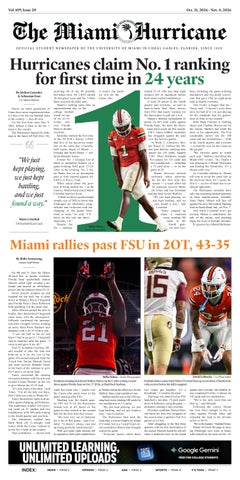
Hurricanes claim No. 1 ranking for first time in 24 years By Jayden Gonzalez & Sebastian Font Co-Sports Editors Nearly an entire generation of Canes have never experienced what it’s like to be the top football team in the country — they do now. For the first time since Dec. 8, 2002, Miami is back as the No. 1 team in the country. The Hurricanes topped the rankings in the latest AP Poll (Oct. 18),
“We just kept playing, we just kept battling, and we just found a way.” Mario Cristobal UM Football Head Coach
receiving 40 of the 69 possible it wasn’t the prettifirst-place votes. No. 2 BYU earned est win for the 20 first-place votes and No. 3 Ohio Canes, who State received the other nine. Miami’s ranking came after an unprecedented day in the college football world on top of its 43-35 rivalry win over Florida State in double overtime. Saturday marked the first time in the AP Poll’s history (1936) that five of the top-seven teams lost on the same day. Crucially, both teams ahead of Miami — Georgia and Notre Dame — suffered dramatic losses. Former No. 1 Georgia lost at home to unranked Auburn on a game-winning field goal, 27-24. Later in the evening, No. 2 Notre Dame lost on an incomplete pass as time expired against No. 8 BYU in Provo, Utah. When asked about the prospect of being ranked No. 1 in the country, Miami head coach Mario Cristobal kept his focus. “I think we have a good enough sample size of 2026 to know that [rankings] are absolutely insignificant and irrelevant with the changing of the guard from week to week,” he said. “I’ll focus on the real one that’s important, 1-0.” Despite the Bella Ochoa // No. 1 ranking, Senior Photographer
trailed 21-14 with less than eight minutes left in regulation before both teams traded touchdowns. It took 29 points in the fourth quarter and overtime, as well as back-to-back Hail Mary throws from FSU that nearly worked, for the Hurricanes to pull out a win. Miami’s defense surrendered 35 points on 443 total yards against Florida State, the most the Hurricanes have given up this season. UM’s injury-riddled secondary has struggled against the pass over the last two games. In Week 5, Clemson’s Bryant Wesco Jr. torched the Miami pass defense, catching nine passes for 152 yards. Against FSU, Duce Robinson caught five passes for 113 yards and two touchdowns — including a 75-yard score — to tie the game at 28. Miami, however, showed resilience when adversity hit for the first time this season — a team effort led by superstar receiver Malachi Toney and true freshman running back Javian Mallory. “We just kept playing, we just kept battling, and we just found a way,” said Cristobal. Toney stepped up when it mattered most, totaling 100 yards in the fourth quarter and over-
time, including the game-winning touchdown and two-point conversion that gave UM an eight-point lead in double overtime. This rivalry is bigger than me,” Toney said. “I haven’t even been alive for half of it. I’m just playing for the standards that the generations in front of me created.” With Mark Fletcher Jr. battling injury and ChaMar Brown out for the season, Mallory has made the most of his opportunity. The Fort Lauderdale native ran for 108 yards and two touchdowns — both in the fourth quarter and overtime — to lead the way for the Canes on the ground. “My favorite game to watch each year,” Mallory said about the Miami-FSU rivalry. “So, finally I was playing as a Miami Hurricane and beating the Seminoles. It’s a dream come true.” As Cristobal alluded to, Miami will aim to avoid the same fate as the previous three No.1 teams before it — as two of them lost to unranked opponents. The Hurricanes currently have only one remaining ranked opponent on their regular-season schedule: Notre Dame. Miami will face off against the now-4th-ranked Fighting Irish in South Bend, Ind., on Nov. 7. And while Cristobal won’t get excited, Miami is undefeated, the talk of the nation, and reaching highs not seen in multiple decades. It’s great to be a Miami Hurricane.
Miami rallies past FSU in 2OT, 43-35 By Bella Armstrong Senior Staff Writer On 4th and 31 from the Miami 49-yard line in double overtime, Florida State quarterback Ashton Daniels rolled right, avoided a defender and heaved an off-balance prayer into the endzone down 43-35. Seven players jumped up and reached for the ball, but it came down to Miami’s Bryce Fitzgerald and Florida State’s Duce Robinson both grabbing it at the same time. After officials parted the pile of bodies, they determined Fitzgerald came away with the interception. Officials confirmed the interception after a lengthy review, sending an antsy Hard Rock Stadium into madness with a 43-35 rivalry win. “I saw the ball in the air and knew I had to go get it,” Fitzgerald said to reporters after the game. “I went in and gave it my all.” Tied 35 in double overtime, Miami needed to take the lead and hold on to it for the rest of the game. On second and goal from the 3-yard line, Darian Mensah found star wide receiver Malachi Toney in the back of the endzone to give the Canes a six-point lead. Toney converted the ensuing two-point attempt with his arm and located Cooper Barkate on the run to give Miami the 43-35 lead. “It’s who wants it the most,” said Toney. “For all the kids out there, that’s what you come to Miami for.” Toney finished the night with another game-changing performance. The sophomore totaled 154 receiving yards on 11 catches and two touchdowns, with 100 yards coming in the fourth quarter and overtime. The Seminoles walked into Hard Rock off 11-straight road losses while the Canes waltzed in as the No.3 team in the country. That confidence — mixed with
Bella Ochoa // Senior Photographer Freshman running back Javian Mallory throws up the U after scoring a touchdown against Florida State on Oct. 17, 2026, at Hard Rock Stadium.
David Lebowitz // Co-Photo Editor Redshirt Junior corner back Ethan O’Connor lines up across from a Florida State wide receiver before the ball is snapped.
some bye-week rust — nearly cost the Canes who spent most of the game chasing after FSU. Heading into the fourth quarter FSU led 21-14, the Hurricanes looked lost in all facets of the game as they trailed in the second half for the first time this season. “We were very out of character for a lot of this game,” said Cristobal. “It doesn’t always just end up being perfectly synchronized.” With just under eight minutes left in regulation, both sides traded blows
two teams get together, it’s a bloodbath,” Cristobal finished. That hope was short-lived as FSU launched a one-play, 75-yard touchdown to Robinson, tying the game — ultimately sending it into overtime. Heisman candidate Darian Mensah faced his first real struggles of the season after a spotless first five games as a Cane. After struggling in the first three quarters with his first interception of the season, Mensah found his old self when it mattered most. In the fourth
as Miami tied up the affair on a Javian Mallory three-yard touchdown run. Mallory led the way in the UM running back room, totaling 108 yards for two touchdowns on 13 carries. “We just kept playing, we just kept battling, and we just found a way,” said Cristobal. The Hurricanes then took the lead after a forced fumble by Ethan B:10.25" O’Connor led to a 3-yard Elija LofT:10" ton touchdown Miami fans thought S:9.75" sealed the game. “Everyone knows when these
quarter and overtime, the redshirt junior completed 9 of his 11 throws for 145 yards and two touchdowns. “We’re the only team that can beat us,” said Mensah. Following the victory, Miami has won three straight in the rivalry against Florida State and extended the lead in the all-time series to 38-33. “We’re the hunters,” finished Toney. Miami will turn the page to hosting Pittsburgh next week at home, with kickoff set for noon on Oct. 24.
S:1.25"
INDEX:
NEWS | PAGE 2
OPINION | PAGE 4
A&E | PAGE 5
SPORTS | PAGE 6
V’S TAKE | PAGE 7
NEWS
2
October 21, 2026
THE MIAMI HURRICANE
How Title IX handles sexual misconduct By Martina Pantaleon Senior Staff Writer
Halloweekend means costumes, parties and frat hopping, and safety can easily become a secondary concern. Title IX — a law for victims of sex-based violence that the University of Miami abides by — can help anyone who gets hurt. Cases of sexual violence can start with a text. A party. A drink. While there are no studies linking Halloween with a spike in sexual abuse cases, research suggests sexual abuse tends to happen between 10 p.m. and 6 a.m., a time when many college students will be out celebrating the holiday. Regardless of when it happens, Title IX can step in to help victims. Since Congress passed Title IX Of The Education Amendments of 1972 to prevent the discrimination of people in academic programs “on the basis of sex,” every university that receives federal financial assistance is mandated to have a Title IX coordinator on campus — but not all of them have a specific office for it. The Newman Alumni Center hosts UM’s Title IX office, where claimants — students and staff alike — can report incidents to Dr. Maria Sevilla, the Title IX coordinator. Confidentiality is granted to claimants, so no one outside the Title IX office is told their name. Police are not contacted unless requested by the claimant or Title IX members think it is necessary for the “welfare of the UM community.” For victims who choose to remain completely anonymous, an
online form is available. When submitting these forms, students can select whether they want to be updated on their case or not. These reports reach Title IX investigators, but do not guarantee that disciplinary action will be taken. To better understand the process, The Hurricane spoke with a student who wishes to remain unnamed and reported a case of sexual misconduct — the name UM gives to cases of “relationship violence, sexual harassment, sexual assault, and stalking.” If Title IX pursues the case, the “student conduct process,” outlined on the office’s website, begins. “I reported [what happened] on a Sunday,” the unnamed student told The Hurricane. “And I got a response by Monday.” During the first “investigation meeting” between the victim and investigators, the affected student gives their testimony and can request that Title IX investigators gather additional evidence of the report. After the investigation, Title IX contacts the alleged perpetrator and any known witnesses. This step can take the longest — up to a month according to the unnamed student — because it depends on the alleged perpetrator’s schedule. A “formal notice of charges” is then sent to the respondent with a three-day time limit. The University did not respond to The Hurricane’s questions about what happens if the alleged perpetrator does not reply within the time limit. If charged, the respondent can respond with “responsible,” “not responsible,” or “I don’t want to say.” If they are found responsible, punishments include: participating in an
educational course, “disciplinary action” that remains on the student’s record for one or two months, permanent “strict disciplinary action” that is never removed from the record or a suspension. Students then attend a “mitigation hearing” where they can advocate for what action they deem appropriate. Regardless of what the respondent — and the claimant — say, the final decision falls on Title IX. “Compared to other places in the country, I feel like it was taken more seriously,” the unnamed student said. “But I still don’t think it was the change that I wanted to happen.” Claimants left that do not agree with the punishment can appeal to the Office of the Vice President of Student Affairs, but their request can be denied. Despite the student feeling like UM’s Title IX Office took the situation seriously, the student still feels there is work to be done. This unnamed student’s case ended with a “disciplinary action” that would remain on the perpetrator’s record for two semesters. They weren’t a senior. It left the victim questioning: what’s even the point? “I don’t see the point of it being on his record if it’s going to disappear,” the unnamed student said. “That’s just a warning. I want it to stay when he is applying for jobs and for graduate school.” The burden of providing evidence can be physically and emotionally taxing for victims. Repeating the events endlessly or being asked to identify the perpetrator can cause major distress, according to the unnamed student. If victims feel that the punishment faced by the perpetrator is
David Lebowitz \\ Photo Editor The Newman Alumni Center on Sunday, Oct. 18, 2026. The Title IX Office is located on the second floor and is where students can go to report an incident.
“insufficient,” it can make their suffering feel invalidated. “It’s really upsetting because you want to find closure in what happens to the other person,” the unnamed student said. “And when that doesn’t happen, you feel like you are crazy, invalidated and so frustrated at the world.” The Miami Hurricane contacted the University inquiring about specifics of the investigation and appeal process, and UM reiterated its mission to create a safe and inclusive campus for everyone. “The University of Miami prohibits all forms of sexual misconduct and sex-based discrimination, including sexual assault. The University’s Title IX Office and Dean of Students Office work collaboratively to address concerns of sexual
misconduct involving students,” the University said in a statement. The complete outline for the Title IX investigation process, as well as additional resources, can be found on their website. At a time when the nation’s eyes are on Title IX and its practices due to a former Cornell student suing the university for negligence after her alleged gang-rape, it is important for victims not to feel suffocated by the attention and to remember that UM offers resources to help them. For cases of rape, students are encouraged to contact 911 or the University’s 24-hour Sexual Assault Resource Team at 305-7986666. Roxcy-Bolton Rape Treatment Center is also near campus and provides specialized sexual violence treatment 24/7.
Opioids causing danger across campuses By Gaby Collazo & Vivian Amoia Co-News Editors Synthetic drugs like fentanyl and cychlorphine — increasingly found in pills and other laced drugs — have spread across college campuses, causing serious hospitalizations and deaths. The United States went from 79,358 opioid involved-deaths in 2023 to 54,045 opioid-involved deaths in 2024. Despite the decreasing national trend, college campuses have reported increasing student overdoses linked to these synthetic opioids. Sara Ruiz-Meza, a sophomore medical anthropology student, said the dangers of opioid use have become increasingly apparent through her work at IDEA Exchange, a Miami-based syringe exchange and harm-reduction clinic. Ruiz-Meza believes students shouldn’t have to seek out information to be educated on opioids. “Knowing what I know now, it shouldn’t have taken me working
firsthand in public health to be aware of these dangers,” she said. What is fentanyl? Fentanyl is the most widely known, fully synthetic drug and is 50 times more potent than heroin, making it extremely dangerous when mixed with other drugs. College students who overdose on fentanyl often do not know they are taking an opioid. Illicit drug operations either mix fentanyl with other drugs or explicitly form it to look like other commonly sought-after medications such as Adderall. Counterfeit adderall as well as Xanax and Percocet are frequently laced with lethal doses of fentanyl. Similarly, drugs like cychlorphine, a newly emerged synthetic opioid, and kratom, a tropical herbal plant, can cause overdoses. Cychlorphine, which has not been medically approved, is being found in counterfeit prescription pills and kratom can cause overdoses when illegally altered into high concentration synthetic tablets.
The University of Mississippi, Louisiana State University and the University of Alabama have all reported student overdoses linked to suspected or confirmed drug use, highlighting that the issue extends beyond a single campus. Ruiz-Meza said, “My concerns lie in the fact that nobody understands the potency of these drugs, especially when they are laced with adulterants.” Drugs in college According to a 2023 survey conducted by the Addiction Center, more than 22% of surveyed college students reported using an illegal drug within 30 days of being surveyed and about 12% of all college students have illegally used prescription medication. Beyond the dangers of the drugs themselves, Ruiz-Meza believes the stigma surrounding drugs on college campuses makes students think it is not really an issue. “Even if people want to ignore it, the drug problem is bad at UM,” she said. “The longer we try to act like drugs aren’t a problem among student populations, the less and less educa-
tion students will receive on how to handle overdoses and drug risks.” The number of opioid overdoses involving UM students is not publicly available, but UM’s 2026 Annual Security and Fire Safety Report listed 60 drug-abuse disciplinary referrals in 2023, 43 in 2024 and 56 in 2025. Resources at UM The University of Miami offers several resources aimed at preventing overdoses and educating students about substance use. Student organizations like the Substance Awareness Club, founded by UM graduate Luke Bell, and URecovery, are communities where recovering students can socialize and get help. “Students concerned about themselves or others are encouraged to contact Student Health Service, the Counseling Center or the Sandler Center for guidance and assistance,” said Jordan Coello, Dean of Students. Despite these existing resources, Ruiz-Meza believes the University should require students to participate in overdose prevention edu-
cation and increase awareness of where Narcan is located. For students like Ruiz-Meza, increasing awareness of these resources is an important part of preparing the campuses to respond to an overdose while learning more about the dangers opioids pose to an uneducated community.
What to know about the opioid crisis: 1. Opioid-involved deaths in the United States fell from 79,358 in 2023 to 54,045 in 2024 according to KFF. 2. UM reported 60 drug-abuse disciplinary referrals in 2023, in 2024 and 56 in 2025. 3. The University of Miami offers resources to educate students about substance use and help prevent overdoses.
A guide to Narcan use and access
By Hope Mallon Staff Writer
As students head to III Points and Fantasy Fest in the coming weeks, knowing how to respond to an overdose and administer Narcan could mean the difference between life and death. A 2026 study of hospital admissions during Las Vegas’ Electric Daisy Carnival found 40 drug or alcohol overdose cases linked to the festival between 2019 and 2024, highlighting the importance of overdose preparedness at large events. What is Narcan Narcan, a brand name for naloxone, is a medication that can reverse an opioid overdose by binding to opioid receptors in the brain and displacing the opioids. This rapidly blocks opioid’s effects on the central nervous system, particularly respiratory depression. According to the Centers for Disease Control and Prevention, naloxone works against opioids like fentanyl, heroin and prescription painkillers such as oxycodone. Available over the counter as a nasal spray, it is easy to administer and allows bystanders to respond to a suspected overdose before an ambulance and medical personnel arrive. Recognizing the signs of an overdose can be critical. Signs include unconsciousness, inability to wake up, slow or shallow breathing, choking or gurgling noises or having unusually small pupils. Discoloration in the fingernails or lips may also occur.
Brian Mulvey \\ Photo Editor A package of Narcan sits on a windowsill in University Village on Friday Oct. 16, 2026. Narcan, or naloxone, works against opioids like fentanyl, heroin and prescription painkillers such as oxycodone.
How to use Narcan Narcan nasal spray does not require medical training to administer. However, knowing the proper steps can make a difference during an emergency. First, check whether the person responds when spoken to or gently shaken. If they are unresponsive or have visible symptoms of an overdose, administer the Narcan. The CDC recommends administering naloxone even when there is uncertainty about whether someone is experiencing an opioid overdose, as the medication is considered safe to use and has no negative effect on someone who has no opioids in their system. To use the nasal spray, remove it from the packaging and peel back the circle tab to open it. Do not test
or prime the device beforehand, as each device is designed for single use. Lay the person flat on their back, tilt their head back slightly and support the back of their neck. Hold the device with your thumb on the bottom of the plunger and your first and middle fingers on either side of the nozzle. Gently insert the tip of the nozzle into one nostril until your fingers touch the bottom of the person’s nose. Then, press the plunger firmly until it clicks to release the medication and remove the nozzle from the nostril. Call 911 immediately after the first dose is administered. Place the person on their side in the recovery position to help prevent choking and monitor their breathing while wait-
ing for emergency assistance. If the person does not respond or begin breathing normally within two to three minutes, administer another dose using a new Narcan spray. If at any point the person stops breathing, begin CPR. Continue to repeat this pattern of administering doses of Narcan until the person responds or emergency personnel arrive. There is no maximum limit of doses allowed to be administered. Some strong opioids such as fentanyl may require multiple doses, to see an effect. After receiving Narcan, some people may experience sudden opioid withdrawal symptoms, including anxiety, irritability, and agitation. In some cases, people may become aggressive as the medication rapidly reverses the effects of opioids, making it important for responders to remain calm and prioritize their personal safety. These steps follow the Food and Drug Administration’s instructions for Narcan nasal spray and CDC guidelines. Resources UM provides Free Narcan is available at the University of Miami residential colleges, with Florida’s law requiring all state universities to maintain naloxone in residential halls for emergency use by trained campus law enforcement officers. The University of Miami offers overdose-prevention resources through campus organizations including the Sandler Center for Alcohol and Other Drug Education, Stu-
dent Health Services and URecovery. Last semester, these organizations partnered to host Narcan training sessions open to the student body and faculty. Participants received free Narcan after completing the training. Students can check the university’s event listings for future sessions. UM’s Student Health Services, the Sandler Center, URecovery and No More Dead Homies hosted an Overdose Awareness Day vigil on Sept. 1 at the Lakeside Pavilion. This event honored people who died from overdoses and highlighted prevention resources. Students can visit the Sandler Center for information about alcohol and other drug information and support or contact the university Student Health Service at 305-284-9100 for health-related questions. Students seeking Narcan outside campus programs can also contact the Florida Department of Health in Miami-Dade County at 305-3242400 for information about local distribution options. Although Narcan can reverse an opioid overdose, its effects are temporary. Emergency medical care remains essential, even if the person regains consciousness. Festivals like Fantasy Fest and III Points should be about making memories with the people you love. Knowing how to recognize an overdose and respond in an emergency makes the difference between a night worth remembering and one that changes everything.
NEWS
October 21, 2026
THE MIAMI HURRICANE
NEWS
3
When class challenges extend beyond coursework By Ava Liber Contributing Writer
Living with chronic illnesses like arthritis, diabetes or Crohn’s disease means that keeping up with classes involves planning around more than just assignment deadlines. A flare-up, treatment or medical appointment can interrupt a week without warning, leaving students to catch up on coursework while managing the condition that kept them away. At UM, students can request academic accommodations through the Office of Disability Services. The office reviews requests on a case-by-case basis using documentation provided by the student. UM’s attendance policy recognizes documented illness as a reason for an approved absence, but attending class can still mean pushing through symptoms. For Amanda, a sophomore who did not wish to use her last name and is double majoring in finance and accounting, that means stiff joints, aching muscles and fatigue. She was diagnosed with juvenile arthritis in October of her freshman year. “It was definitely a struggle going into my freshman year feeling like I ran a marathon every day and not knowing why I felt like that,” Amanda said. Her symptoms also shape how she plans her coursework. She gives herself extra time for handwritten assignments because writing can cause her fingers to swell and cramp. “There are some days where my
neck or back feel completely stiff, making it difficult for me to get out of bed some mornings,” she said. “But I prefer morning classes because as the day goes on, my body grows increasingly achy and tired.” Despite those symptoms, she rarely misses class. When she does miss class because of flu-like symptoms, she asks a classmate for notes. She described her professors as understanding when she provides a doctor’s note.. Her experience shows that attendance alone doesn’t tell the whole story. In a statement to The Miami Hurricane, UM described how ODS works directly with students with disabilities to determine and implement reasonable accommodations that support access to academic programs and activities. “ODS encourages students to remain engaged with the office throughout the semester, particularly if their needs change or challenges arise,” the University said. Students can request accommodations or provide updated documentation at any time during the academic year, according to the statement. ODS encourages students to submit requests by the priority deadlines listed on its website. For students managing a changing condition, this flexibility allows them to return to the office with updated information about their needs. Once accommodations are approved, the office works with students and faculty to support their implementation and address concerns. Students who believe an
approved accommodation is not being followed are encouraged to contact ODS so staff can review and address the situation. Victoria Calderin-Lemus, a lecturer in UM’s Department of Writing Studies, said she works with students managing chronic illnesses to create an alternate schedule or pace for completing missed work. She also recommends recurring Writing Center appointments and tries to post assignments on Canvas early so students can access them when they can’t attend. But flexibility has its limits when missed work builds up across several courses. “Thats the worst position to be in because often I know the stu-
dent is trying to their best: that is always an awful conversation to have,” she said. She encourages students to discuss their needs early, even if the conversation feels uncomfortable. “On a personal note, I would want any and all students in this position to know that the need for accommodation in no way diminishes or calls into question their value as a student or as a person,” Calderin-Lemus said. Communicating with professors has made a difference in Amanda’s experience. Opening up to Calderin-Lemus, while working on an essay about her struggles helped her feel more comfortable discussing her condition with others.
“I remember feeling so connected to her after that conversation, and it encouraged me to be more open about my struggles with other people,” Amanda said. She hopes students and professors will keep that understanding in mind, even when someone’s health struggles are not obvious. “It’s always good to treat people with respect and patience because you never know what their body or mental health is like that day,” she said. Chronic illness can keep students from attending class, even when they want to be there. Understanding that difference matters when a student has to explain another absence or ask for more time to finish an assignment.
Brian Mulvey \\ Photo Editor The Harold Long, JR. and H.T. Smith Student Services Building in early morning light on Feb. 28, 2026. The Counseling Center resides on the third floor of the Harold Long, JR. and H.T. Smith Student Services Building.
Mahoney-Pearson construction zone raises safety concerns By Sierra Stiff Contributing Writer
As construction continues at the former Mahoney-Pearson Residential College site, with University of Miami students adjusting to altered walking routes, traffic disruptions and ongoing building activity. Following the demolition of the nearly 70-year-old buildings this summer, the site will become Gables Village, a residential complex intended for upperclassmen. The project will feature two towers with approximately 1,458 beds, study spaces, recreational areas and a new dining facility. Initial plans projected completion by mid-2029. Debris concerns The demolition has prompted questions about the precautions UM took to manage construction debris, dust and potentially hazardous building materials. With a building as old as Mahoney-Pearson, students expressed concerns about inhaling asbestos — a hazardous material used in building construction largely from the 1900s to 1970s. According to The Asbestos Institute, asbestos is “mostly dangerous when disturbed or damaged” because “fibers become airborne and inhaled” which can cause inflammation and long-term health issues. In an emailed statement to The Miami Hurricane, UM said the buildings underwent asbestos inspections before demolition began. “Before demolition activities commenced, the buildings were in-
spected for asbestos, and any identified asbestos-containing materials were remediated in accordance with applicable federal and state regulations,” the University said. UM added that the site met required clearance standards before demolition activities began. The University did not explicitly confirm whether asbestos had been discovered during the inspections, although its statement mentioned remediation. Students have also reported encounters with debris near the construction site. “I was walking by the area and the debris got in my eyes once,” said Joseph Sollitto, a sophomore studying public relations, in response to a question posted on The Miami Hurricane’s Instagram story. When asked about the containment measures surrounding the
construction site, UM said procedures were developed and implemented according to industry standards, regulatory requirements and project-specific conditions. The University did not specify which physical barriers or containment methods were being used. Pedestrian challenges The construction has also brought challenges for students navigating the surrounding area, particularly near the Mahoney-Pearson parking garage and Ponce de Leon Boulevard. In January 2026, UM notified residents that construction would bring temporary pedestrian route changes, increased signage, daytime noise, dust disruptions and occasional access limitations, according to previous reporting by The Miami Hurricane.
For students traveling between the parking garage, dining facilities and academic buildings, these changes have created additional obstacles during their daily commutes. Jack Orr, a senior and former Mahoney resident, said construction has made accessing certain parts of campus less convenient. He can no longer walk through the parking garage area and instead takes a longer route to reach the dining hall. “I don’t mind construction. Not too loud,” Orr said. Despite the inconvenience, Orr expressed support for the redevelopment while reflecting on his former residence. “I think it’s great they are upgrading,” Orr said, although he also expressed sadness about losing the building where he once lived.
Wes Fleischer \\ Staff Photographer The debris left on the construction site of the demolished Mahoney-Pearson dorms on Friday, Oct. 16, 2026.
Traffic issues Construction vehicles entering and exiting the site near Ponce de Leon Boulevard have also affected surrounding traffic. Orr said students driving to campus may encounter construction vehicles traveling along Ponce and “slowing things down.” In response to questions about traffic safety, UM said construction vehicle movements are supervised by onsite personnel. “Construction vehicle movements are coordinated and monitored by onsite personnel to ensure vehicles can safely enter and exit the site,” the University said in its statement to The Miami Hurricane. UM explained that vehicles may travel at reduced speeds when leaving the construction area to maintain safe operations and visibility. The University added that it continually monitors construction activities and traffic conditions and will address identified safety concerns. Concerns about congestion are not new. In February, commuter student Victoria Marciniak told The Miami Hurricane that construction had caused congestion in parking areas and traffic, with restricted access resulting in unexpected delays when traveling to class. With Gables Village’s projected completion still years away, the construction will remain part of campus life for students navigating the surrounding area. While the redevelopment promises improved residential facilities, its ongoing impact on pedestrian access, debris containment and traffic management continues to draw attention.
Beyond the tan: The dangers of Miami’s sun By Elena Fallow Digital News Editor
Although fall is approaching winter, Miami’s UV index stays high year-round, and students continue to frequent the beach well into November. With easy access to the UC Pool, the Marine Science campus beach and South Beach, understanding the sun’s impacts is incredibly important. Combined with the “Suntan U” reputation from the mid-1950s it’s no wonder people who love the beach and the sun choose to come to UM. Most students are likely aware of the basic beach danger: sunburn. But other concerns are often overlooked. More than “just a sunburn” While the average sunburn can
leave you red for at least three days, it can also have long-term effects. According to the Skin Cancer Foundation, “The risk of developing potentially deadly melanoma doubled with a history of five or more sunburns.” Sun exposure does not affect everyone the same way. Students with fair skin are at the greatest risk of being burned. But for those with tan or darker skin, constant sun exposure without protection can still cause cellular damage, increasing the likelihood of developing cancer. In extreme cases, sun poisoning can occur. It is not actually a poison, but an extreme case of sunburn that occurs after extended exposure to UV rays without protection. Symptoms of sun poisoning include blisters or peeling skin, fever and chills, joint and muscle pain, nausea and vomiting, headaches, dizziness and other
classic sunburn symptoms. Fortunately, you can treat sun poisoning at home. Soaking affected areas in cool water, staying hydrated and applying aloe vera or a thick moisturizer can help heal damaged skin. Heat-related illness Heat exhaustion is the most common form of heat-related illness and can occur during exercise or manual labor in the heat. At the beach, the risk of heat exhaustion is higher because of direct sun exposure, high heat and humidity, limited natural shade and active dehydration. Keeping a consistent body temperature on a hot day requires more energy than normal. According to Popular Science, people exposed to higher temperatures consume more oxygen. Higher oxygen intake indicates greater cellular effort.
The addition of alcohol only intensifies the effects of heat exhaustion. According to Drinkaware, “Alcohol also makes you sweat more because it interferes with your body’s ability to control its own temperature.” In a city like Miami, where outdoor music festivals such as III Points and Halloween celebrations in Key West draw crowds, drinking alcohol while spending time in the heat can increase the risk of heat exhaustion. According to the Visit Florida Keys website, unprotected skin can burn within minutes because UV rays reflect off sand, water and clouds. The tourism organization recommends wearing widebrimmed hats and UV-protective clothing and regularly applying reef-safe sunscreen. To reduce the risk of heat-related illnesses, stay hydrated and take reg-
ular breaks in the shade or air-conditioned spaces. If symptoms such as cool, moist skin, goosebumps, heavy sweating, dizziness or fatigue occur, stop all activity, move to a cooler place and drink cool water. If symptoms persist for more than an hour, seek medical attention. As temperatures cool, sun threats remain relevant. Even on a cloudy day, up to 80% of the sun’s UV rays can still reach your skin and cause damage. Even as temperatures begin to cool, Miami students should not underestimate the sun. Wearing sunscreen, choosing UV-protective clothing, drinking water and taking breaks in the shade can help Miami students protect themselves from sun damage and heat-related illness while enjoying the beach and outdoor activities year-round.
OPINION
4
October 21, 2026
THE MIAMI HURRICANE
More needs to be done to support student mental health By Adrianna Buford Contributing Writer When it comes to mental health resources at the University of Miami, numbers to call, sexual assault hotlines, therapy appointments and other resources aren’t hard to find. On paper, UM is doing exactly what it should to provide students with mental health outlets. But this support needs to extend beyond a counseling building and a website by building a culture where students feel encouraged to reach out, comfortable opening up and supported by University faculty. In its mission statement, the University of Miami Counseling Center states that it “provides a wide array of effective and quality multi-disciplinary psychological services. Respecting diversity and all cultural identities, we empower students to realize their goals for personal and emotional development.” Transitioning to college can already be a huge struggle for first-year students, especially those coming from out of state. For myself, navigating the culture shock while also going through a separate mental health crisis
led me to go home for a week to regroup my thoughts and feelings. When I went to UM’s Counseling Center, I was met with a lack of empathy over the phone about my absences and situation. I felt like I was being tossed between offices and phone lines, and I can imagine students facing similar situations feel the same. A junior who wishes to remain unnamed described a similar experience with the Counseling Center. When she tried to change her therapist because she wanted a counselor who would speak and contribute more during sessions, the individual helping her blamed her instead. She was told, “Therapists aren’t supposed to tell you what to do, you’re supposed to do that yourself.” Students already facing mental health issues are caused further stress by the Center’s lack of support, being dismissed when asking for help and the limited access to appointments. Instances like these are part of why students choose to fight their battles on their own and make me question whether the dedication to supporting students going through mental health issues goes beyond its surface advertisements.
More broadly, mental health continues to be an ongoing issue for many students across colleges in the United States. In 2024-2025, the University of Michigan conducted a study across 135 U.S. colleges and universities, including UM. The survey gathered 84,000 responses and revealed that 37% of surveyed students deal with some form of depression and 33% deal with anxiety. It also collected data on students’ experiences with university resources. Despite students typically having knowledge of mental health resources on campus, it is rare for them to ask for help from their Universities. The data showed that seeking help from faculty, professors, staff members or support groups is incredibly uncommon. To an extent, the value of going to a University is limited if students don’t feel the University’s staff are on their side. Freshman Gloria Gilmore faced this problem when approaching advisors and teachers for help, and the results were mixed. “Some that I’ve had that aren’t my teachers but are advisors are very sweet and understand and help,” Gilmore said. “But some teachers, I think maybe they
Scrabble tiles read “Mental Health” on Jan. 29, 2027.
haven’t had a kid before. They haven’t had a child to understand the struggles or they haven’t experienced someone with mental health, so it’s kind of awkward for them. You don’t get the message you need sometimes.” UM students deserve help more often than “sometimes.” Training faculty and staff to better recognize and respond to students’ struggles — and teaching them how to engage appropriately — would make a big difference.
via Wikimedia Commons
Additionally, building connections between various offices at UM would help the University streamline the process of getting students the help they need as soon as possible, instead of leaving them feeling bounced between offices. Students at UM have endless opportunities to succeed, build friendships and enjoy four years in an amazing city at an amazing school. However, there is still room to improve proper mental health care for students.
Campus has a serious flooding problem By Claire Critchley Contributing Writer Heavy rainfall turns the walk to class into a challenge of avoiding 2-inch-deep puddles blocking the sidewalk at the University of Miami. Redfin, a real estate marketplace, ranks Miami as the U.S. city with the second-highest annual precipitation, just behind Hialeah, a few miles northwest. For a city weathering such intense downpours, UM’s campus is hard to navigate in these conditions. The flooding should be approached as an infrastructure issue, not just a weather inconvenience. Students should have alternatives to getting their belongings soaked and risking their safety in storms, whether by improving drainage around campus or offering virtual classes on storm days.
When it rains at UM, it pours, and umbrellas aren’t enough to keep from arriving to class drenched. “By the time I get to class, my shoes and socks are soaked,” said freshman Scarlett O’Neill about the typical rainy day in Miami. Many bridges across campus have almost no drainage and accumulate puddles that stretch the entire width. The sidewalks have similar flooding problems and seem to collect the water rather than dispel it. “There are paths on campus where infrastructure for flooding is completely missing, so you have no choice but to walk through puddles or get muddy shoes in the grass,” said senior EJ Rambau. NBC Miami said May to September are Miami’s rainiest months — dumping buckets just in time for students to return to campus.
Many students change their wardrobes just to walk to class and avoid getting certain items wet. “I have to wear my flip-flops when it rains so my shoes don’t get soaked and then moldy, but then my flipflops slide off in the puddles,” said freshman Dalila Garcia. But these fears extend beyond clothing. Almost all students use laptops for one or more classes, and many carry headphones and cables for library study sessions. Students shouldn’t have to risk damaging these expensive devices every week. Swamp-forming sidewalks aren’t the only way UM’s infrastructure is at a disadvantage in combating rain-related problems. In March of 2025, a Mahoney-Pearson roof collapsed over a patio during a rainstorm. Similarly, in September of 2026, a
tree fell on a car with a student inside after a storm. Damaged power lines caused wires to fall onto the student’s car, which could have severely injured the student and those nearby. Bikes and cars also pose a risk during storms by hydroplaning in these massive puddles, which is dangerous because they travel at higher speeds. As of July 2025, the U.S. Department of Transportation said roughly 12% of vehicle crashes were weather-related, and that 77% of these weather-related incidents were during rain or mist. UM continues to make changes to its campus to make it safer, happier and more like a home for its students. But the most important changes aren’t always huge demolition projects; sometimes they are small improvements that make daily life better. In the rainy season, they’re the small
slopes to walkways or the drainage systems that make it easier for students and professors alike to get to class. The Miami Herald predicts that an El Niño will hit South Florida this upcoming winter. The combination of heavy rainfall and intense wind does not bode well for flooding at UM. Many students feel disincentivized from going to class when it’s pouring rain, and understandably so. “In rain and hurricane season, a lot of students would rather skip class than have to deal with getting there half soaked,” said sophomore Alec Windmiller. While Miami is known for beautiful weather, its stormier days should not be overlooked. The campus should be prepared for all weather conditions. Students pay large sums in tuition that should go toward improving their experience at the school.
ADVERTISEMENT
UM Students: The best community discount program is here
PHOTO BY EDUARDO SEGOVIA .
Enjoy epic concerts, beloved Broadway shows, dynamic dance performances and more for $25. Free membership. Join today! ArshtCenter.org/ArshtPass
Supporting Sponsors:
HALLOWEEN
October 21, 2026
THE MIAMI HURRICANE
Laws and guidelines to know before heading to Fantasy Fest
Founded 1929
An Associated Collegiate Press Hall Of Fame Newspaper NEWSROOM: 305-284-4401 editor@themiamihurricane.com BUSINESS OFFICE: 305-284-4401 FAX: 305-284-4404 For advertising rates call 305-284-4401 or fax 305-284-4404.
Staff EDITOR-IN-CHIEF Katie Karlson MANAGING EDITORS Madison Block Hannah Valdivia NEWS EDITOR Vivian Amoia
PODCAST EDITOR Camila Goveo Lounsberry PHOTO EDITORS Brian Mulvey David Lebowitz GRAPHIC DESIGN EDITOR Sovannreach Po
DIGITAL NEWS EDITOR Elena Fallow CITY NEWS EDITOR Gianni Echeverria OPINION EDITORS Keira Faddis Paulina Barnjak ARTS & ENTERTAINMENT EDITORS Marissa Levinson Brianna Pearson SPORTS EDITORS Sebastian Font Jayden Gonzalez COPY CHIEF Emil Salgado Vazquez
5
PRINT EDITORS Camryn Greiner Brendan Cafferty SOCIAL MEDIA EDITORS Sophia Ibanez Anabelle Carpenter BUSINESS MANAGER Nishka Mishra FACULTY ADVISOR Antonio Mora FINANCIAL ADVISOR Steve Priepke SENIOR FINANCIAL ASSISTANT Michelle Starbeck
WANT TO WORK FOR US? SCAN HERE TO APPLY:
The Miami Hurricane is published biweekly during the regular academic year and is edited and produced by undergraduate students at the University of Miami. The publication does not necessarily represent the views and opinions of advertisers or the university’s trustees, faculty or administration. Unsigned editorials represent the opinion of The Miami Hurricane’s Editorial Board. Commentaries, letters and cartoons represent only the views of their respective authors. The newsroom and business office of The Miami Hurricane are located in the Student Activities Center, Student Media Suite 200.
By Olivia Atalla & Elena Fallow Contributing Writer & Digital News Editor Fantasy Fest in Key West is one of the longest-standing University of Miami traditions. Between Oct. 16 and 25, roughly 60,000 to 75,000 visitors travel south down the one-lane road to attend the Fest and visit Key West, known for extreme costumes and packed bars. Key West has its own culture and code of conduct. With large crowds and many college students understanding the rules and how to have fun while staying safe is crucial. Alcohol laws There are no “brown bag laws” that allow open containers of alcohol in public. “The Key West Municipal Code, § 18-87 prohibits open containers of alcoholic beverages in public,” according to Robertson & Hunter law firm. The ordinance also states that first-time offenders will be given either a written or verbal warning, but a second offense can result in arrest as a misdemeanor offense. According to Fantasy Fest’s code of conduct, open drinks are permitted only within the fantasy zone/costume promenade, which stretches from lower Duval Street to Truman Avenue and includes some cross streets. No glass cups are allowed in the
zone, but attendees can drink from vendor-provided cups or the Fantasy Fest souvenir cup. Partial nudity Fantasy Fest lets guests express their individuality through unique costumes. For some, that means partial nudity with creative flair. “Key West during Fantasy Festival is a part of the true University of Miami experience and every student should go at least once,” said McKenzie Eason, a junior studying broadcast journalism and political science. According to the City of Key West, complete nudity is strictly illegal. In 2022, the city and Fantasy Fest worked together to “clean the event” while still allowing guests to express themselves. Per the code of conduct, nudity is illegal and not permitted on public property or in public view. However, the rules also state, “Painted female breasts are permitted, but ONLY ALLOWED within the designated ‘FANTASY ZONE/COSTUME PROMENADE’.” Attendees are encouraged to wear cover-ups outside the fantasy zone to avoid penalties. For those who choose to be entirely clothing optional, there are bars along Duval Street that allow nudity. Enhanced security measures Because the festival attracts a wide range of people, several bars and restaurants along Duval Street prepare with extra security. “For here, you have to be 21,
Courtesy of Timothy Lowry Duval Street on a quiet afternoon in Key West, Fla., on March 9, 2020. and we usually have heavy security during the Halloween weekend, and we check IDs for everyone,” said Savana, who did not wish to use her last name and bartender at Fat Tuesday on Duval Street. Some restaurants in the area let people under 21 in as long as they don’t sit at the bar. “You can come eat inside the restaurant, but you can’t sit at the bar unless you are 21, and we give those of age a wristband,” said Ezekiel de la Torre, a bartender at Mangoes on Duval Street. Sleeping arrangements Bars and restaurants are not the only establishments with a minimum
Key West from the eyes of a local
LETTER POLICY The Miami Hurricane encourages all readers to voice their opinions on issues related to the university or in response to any report published in The Miami Hurricane. Letters to the editor may be submitted typed or handwritten to the Student Activities Center, Student Media Suite 200, or mailed to P.O. Box 248132, Coral Gables, Fla., 33124-6922. Letters must be signed with a copy of your Cane Card. ADVERTISING POLICY The Miami Hurricane’s business office is located at 1330 Miller Drive, Student Activities Center Student Media Suite 200. The Miami Hurricane is published every other Wednesday during the university’s fall and spring academic terms. Newspapers are distributed for free on the Coral Gables campus, the School of Medicine and offcampus locations. DEADLINES The conditions of agreement for advertisers are outlined on the ad contract form. Please direct any and all questions related to advertising to the business manager, Nishka Mishra. Questions can be emailed to business@themiamihurricane.com. AFFILIATIONS The Miami Hurricane is a member of the Associated Collegiate Press, Columbia Scholastic Press Association and Florida College Press Association.
age requirement of 21. Many hotels in the area require guests to be 21 or older to check in. If guests are caught attempting to use a fake ID at check-in, they can be arrested and charged with a third-degree felony under Florida law. Sleeping in your car or on the beach is not a safe or legal substitute. According to the Key West Police Department, first-time violators caught sleeping or camping will be issued a citation. A second violation can lead to an arrest. Check traffic and weather conditions before driving, book your accommodations in advance, stay close to your friends, and never drink and drive under any circumstances.
Courtesy of Florida Keys Public Libararies View Looking East at Fleming Street From the Naval Station c. 1910. Gift of The Old Island Photographer.
By Kyra Chang Contributing Writer Fannie Oden, 74, said her family has lived on the same Key West property since the early 1900s. Over the years, she has watched the island change drastically as tourism continued to grow.
Oden believed tourists come for a good time and to see popular attractions in a “partying paradise,” but she feels that they were not truly learning about Key West. “It’s a lot of history. It’s a lot of things that people don’t know,” Oden said. There is a lot of history involving
the government, from the Little White House where President Truman stayed to Mallory Square, which was built for the U.S. Navy, now known for its sunset celebrations. Oden also mentioned the Ernest Hemingway Home and Museum and its significance beyond the six-toed cats, and Key West’s historic inland
lighthouse, the only lighthouse in the country operating within city limits. “Different areas in Key West have a lot of historical facts, some that you don’t even find in the history books,” Oden said. She hoped people who visit the island would learn more about what makes it such a special place. As tourism continues to grow, she thinks the culture of Key West is being lost. “Growing up, we used to have a lot of the tropical trees. Tourists come down here and those who stay purchase property and destroy a lot of our trees,” Oden said. She expressed frustration at the rising cost of living for locals, with many being forced to relocate, as tourists became permanent residents. Despite her concerns about tourism, Oden recognizes that there is something in Key West for everyone to enjoy and still hopes that visitors have a good time there. “Depending on what a person is looking for when they come down here, they can probably find it,” Oden said. “If you’re coming to party, or to come for the history, there’s a lot of it here.”
OPINION: Halloween’s scariest costume is the ‘perfect’ body By Niki Kawa Staff Writer Nothing tells the truth like little kids, tipsy adults and tight-fitting Halloween costumes. Or at least, that’s how it feels when a costume becomes a verdict on whether our bodies look good enough. As kids, the question was, “ W h a t am I going to be for Halloween?” Now, in college, the question is, “How am I going to look in my costume?” A costume sits in an online shopping cart for a month, and then when it arrives, it doesn’t fit. Students spend weeks dieting and vigorously working out, all in the pursuit of the ideal “Halloween body.” Dressing up for Halloween should not mean
treating your body as something that needs to be fixed. When fitting into a costume becomes a reason to restrict food or push exercise to extremes, the pressure to look the part comes at the expense of feeling healthy. Unlike in childhood, Halloween in college is more than just a holiday for playing dress-up and eating candy. College Halloween evolved into “Halloweekend” where students go out in revealing costumes for multiple nights in a row — and yes, the body has become part of the costume. Because of this, phrases like the “Halloween cut” or “Halloween body” have been floating around the internet, with TikToks documenting daily workouts until Halloween or attempts
Sovannreach Po // Graphics Editor
to stay committed to weight-loss goals centered around the holiday. People tie target weights to the costumes they want to wear, then rush the process through calorie restriction and intense exercise. This is different from setting an ordinary, gradual fitness goal: people feel pressured to reach a certain weight or look a certain way by Halloween. “It’s an artificially created deadline that can undermine self-esteem if the goal isn’t reached,” said Michael Adamse, a clinical psychologist based in Boca Raton with more than 40 years of experience. No one should feel like they need to change their body before they can wear a costume they were excited about in the first place. The pressure can start before a costume even arrives, with students scouring TikTok for Halloween inspiration, comparing themselves to the people wearing the costumes and feeling pressured to look the same. A 2026 study published in a journal called “Body Image” found that young adult women shown TikTok “fitspiration” videos reported greater appearance comparison, appearance concerns and urges to check their appearance than those shown other content. Students on campus are feeling this pressure, and around this time of year, it translates directly into changes in eating and exercise habits.
“I find myself being more restrictive, conscious of what I’m eating and tend to exercise more,” said a senior psychology major. This pressure shows how a single weekend can turn into a deadline for eating and exercise habits. “The state of my physique determines my costume — if I’m feeling ‘heavier,’ I wear something that’s more covered … and when I’m feeling thinner, I like to expose my stomach,” she explained. The student said conversations around this time of year often revolve around the pressure to look thin enough to wear a certain costume. “‘If I don’t lose the weight, I won’t be wearing it,’” she recalled hearing from other students her age. When comments like these become part of the culture surrounding Halloween, changing your body can start to feel as routine as choosing the costume itself. “[These goals] may reinforce all-or-nothing thinking and make confidence or participation feel dependent on achieving an appearance goal … greater concern arises when restriction or exercise becomes rigid or compulsive,” said Alesha Cid-Vega, a clinical psychology PhD student and instructor at the University of Miami. Cid-Vega asked for The Hurricane to disclose that she is not a licensed psychologist or medical provider. Her comments are research-based
and do not constitute clinical or medical advice. A costume should fit a person, rather than the person changing themself to fit into a costume, but some use it as motivation. “I choose to wear revealing costumes in order to motivate me to eat healthier [and] work out more [for] Halloween,” said a sophomore marketing major. Others describe smaller changes, but the motivation is still shaped by the amount of skin they plan to show. “Probably seven days before, I am a little more mindful of what I eat just because the Halloween costumes are typically less coverage than what you would wear on a regular day,” said junior Nicole Janghani. Wearing a revealing costume can make students feel like they need to adjust their eating habits beforehand, even without a specific weight-loss goal. That is what makes the “Halloween body” mentality so easy to normalize. Its harm is not always obvious: sometimes it can look like eating a little less, exercising more or deciding a costume can only be worn after losing five pounds. But whether the change is dramatic or subtle, no one should have to change their body to feel entitled to wear a costume. The costume should fit the body — not the other way around.
ARTS & ENTERTAINMENT
6
October 21, 2026
THE MIAMI HURRICANE
COPE’s guide to a safer Halloween
Courtesy of Sereyvutha Thul COPE team holds signs of support at Joshua’s Walk on Sep, 16, 2026. Joshua’s Walk is a suicide prevention and mental health awareness programming where the UM community take a one-mile walk together to honor those affected by suicide.
By Charlotte Schuyler Contributing Writer During Halloween celebrations and late nights, student leaders from Counseling Outreach Peer Education are encouraging their fellow classmates to prioritize something that can easily get overlooked: each other. COPE, a group of undergraduate peer educators advised by UM’s Coun-
seling Center, works to promote mental health awareness, connect students with campus resources and encourage conversations about issues affecting student well-being. For Bella Feijoo, a senior and COPE chair, and Ella Hallen, a junior and vice chair of external relations, Halloween presents an opportunity to remind students that having fun and looking out for friends should go hand in hand.
Feijoo emphasized the importance of checking in throughout the night, staying together and recognizing when a friend might be uncomfortable or vulnerable. “Buddy system has always been the number one thing in my head,” Feijoo said. “Never let your friend go somewhere alone.” But being a good friend is not always about preventing an emergency. Sometimes, it means rec-
ognizing when someone simply wants to leave. Hallen encouraged students to pay attention to their friends’ comfort levels, particularly in social situations involving alcohol with unfamiliar people or overwhelming environments. She suggested establishing a code word beforehand so friends can communicate when they want to step away without having to explain themselves. “If your friend is just nervous or anxious to be out and at any point, like, they want to go home ... go with them,” Hallen said. For Feijoo, this responsibility extends beyond Halloween. “If you want a village, you have to be a villager,” she said. To Feijoo, this phrase emphasizes that a supportive community requires students to offer the same care and understanding they hope to receive from others. The organization’s work also addresses broader issues, including sexual assault awareness, consent and the stigma surroundingo mental health. Through national initiatives like the Clothesline Project, which displays shirts carrying messages about experiences of abuse and assault, and school events like Raise the Flag, survivors can share their stories. COPE works to make difficult conversations visible on campus. Feijoo recalled watching students share deeply personal experiences
through poetry, music and other forms of expression at Raise the Flag. “To give them a space to talk about that and feel safe enough to say that on campus in front of a group of people is so special,” Feijoo said. Beyond awareness events, COPE connects students with Counseling Center services, including individual and group therapy, relaxation spaces and other wellness resources. Feijoo said one of the biggest misconceptions among college students is that their struggles must reach a certain level of severity before they deserve professional support. “It’s really important to look at mental health the same way you look at your physical health,” Feijoo said. Hallen believes meaningful support can begin with something as simple as sitting beside someone who appears overwhelmed, without pressuring them to explain what is wrong. Just saying “I’m here,” can make someone feel supported, Hallen said. As Halloween approaches, COPE’s message is not to avoid celebrating but to remember that safety is a shared responsibility. Whether that means walking a friend home, respecting someone’s boundaries or recognizing when they need support, small decisions can make a lasting difference. As Hallen puts it, “Any impact, no matter how big or small, is still an impact.”
‘U’ can enjoy Halloween near campus By Adrianna Buford Contributing Writer For Canes who aren’t interested in partying or spending a fortune driving more than three hours down to Key West, making Halloween plans can be surprisingly difficult. But, with so many fun opportunities in the lively city, University of Miami, students can enjoy the spooky season right on campus or through different student organizations. Here’s what to do if you’re staying in Miami this Halloween: Walk through a haunted house at Sounds of Screams As an early Halloween activity, students can ride a free bus from campus to the Sounds of Screams fairgrounds on Oct. 18. at the Miami-Dade County Fair and Expo Center. The amusement park is made up of five haunted houses, carnival rides, food, drinks and five different scare zones. The attraction has a 4.9/5-star
rating on Google from 712 reviews. The reviews highlight the fun photo opportunities, high-quality scare actors and overall Halloween atmosphere that makes reviewers say they want to return. “The houses were well done and actors were a spot-on freakishly experience,” Keith Garcia wrote in a Google review. Decorate with UM’s Order of Omega UM’s Order of Omega is also hosting an event right on campus. On Wednesday, Oct. 28, all students and their families can celebrate the holiday at the Panhellenic Building. The event will take place from 5 p.m. to 7 p.m., with fun activities like pumpkin painting, face painting and games with prizes. Micah Hill, an Order of Omega Executive Board member, said the organization’s dedication to making the event bigger and better than last year. “There will be a ton of food and games for kids and their families, so
Sovannreach Po // Graphics Editor we’re hoping for a great turnout and a fun time for families,” he said If you like getting creative and showing off your spirit, the group is looking for any help they can get with decorating for the event. Help kids with Alpha Kappa Psi Focusing on giving back this Halloween, Alpha Kappa Psi, the profes-
sional business fraternity at UM, is hosting a collaborative event with Kids and Culture at the Gibson Bethel Center. The purpose of Kids and Culture is to help young students understand that college is attainable regardless of background. The group participates in pen pals and campus visits every Friday from 3 p.m. to 5:30 p.m. On Friday Oct. 30, these student
organizations will be setting up a fun spooky-themed visit with the kids, celebrating the holiday and the children’s potential. Halloween is meant to be celebrated in whatever way people want, and that doesn’t always have to mean a party. Whether it’s staying home, helping others or hanging out with friends, the holiday is
SPORTS
Men’s basketball poised for NCAA Tournament run By Omar Pinto Staff Writer
Miami Hurricanes men’s basketball hit rock bottom two years ago as longtime head coach Jim Larrañaga stepped down midway through the year and a program-low 7-24 record. In-stepped then-36-year-old Jai Lucas following the season, and immediately turned the program around with a 19-win improvement tying the largest single-sea-
“He represents everything we want to be about as a program both as a basketball player and as a young man.” Jai Lucas UM Men’s Basketball Head Coach
son turnaround in NCAA men’s basketball history. Now, with a year of coaching under his belt and more experience for the young talent, expectations are high for the No. 14 ranked Canes. The X-factors for the Hurricanes will be sophomore forward Shelton Henderson and fifth-year senior forward Malik Reneau, who was granted another year of eligibility following a temporary restraining order against the NCAA. Henderson earned preseason All-ACC First Team honors, while Reneau earned Second Team honors. Last season, Reneau led Miami in scoring, averaging 18.9 points per game, and also grabbed 6.5 rebounds per game. Henderson averaged 13.8 points and 4.9 rebounds as a true freshman and is expected to take a leap in his second year. “There’s a little bit more expectation for him to deliver,” said Lucas. “He’s shown his growth in that and being comfortable with having to deliver and having to be a little bit counted on. He is one of those guys that we are looking for game to game to be able to kind of carry us a little bit.” For young talent, look out for true freshman forward Caleb Gaskins. The second-highest-rated recruit in program history, according to 247Sports Composite rankings, Gaskins enters Miami as one of the most highly touted prospects the program has ever signed. “He represents everything we want to be about as a program both as a basketball player and as a young man,” Lucas said about Gaskins.
David Lebowitz \\ Photo Editor The Hurricanes huddle up during their March Madness first round game against Missouri on March 20, 2026 at the Enterprise Center in St. Louis, Missouri.w
The five-star forward also earned McDonald’s All-American honors and arrives in Coral Gables with a chance to make an immediate impact in Miami’s rotation. Through the transfer portal, the Canes bring in a litany of talent that is ready to start right away. Villanova transfer guard Acaden Lewis, former Georgia center Somto Cyril and Robert Morris transfer forward DeSean Goode all give Miami a chance to build on a remarkable 2025-26 campaign. With both young stars and ex-
perienced vets, the Hurricanes are poised for a potential deep run into the NCAA tournament this year. The season tips off Monday, Nov.
2, against the No. 1 ranked Florida Gators in Tampa, Fla. Game time at Benchmark International Arena is set for 6 p.m. and will air on ESPN2.
• Miami finished 2025-26 with a 26-9 record and a Round of 64 victory under first-year head coach Jai Lucas • Malik Reneau and Shelton Henderson return to the starting lineup with preseason All-ACC honors • Transfers Acaden Lewis, Somto Cyril and DeSean Goode are expected to fill out Miami’s starting lineup
SPORTS
October 21, 2026
THE MIAMI HURRICANE
7
OPINION: The ACL gap and why female athletes keep getting hurt By Sarina Augustine Contributing Writer
American alpine skier and former gold medalist Lindsey Vonn tore her anterior cruciate ligament in a World Cup crash just a week before the 2026 Milan Cortina Olympics. Two months later, WNBA guard Nika Mühl tore her right ACL playing for Croatia — her second ACL tear in less than two years. Women athletes are responsible for an estimated 38,000 to 100,000 ACL tears every year, according to the University of Alabama at Birmingham. As women’s sports grow in viewership and earning opportunities, there is a greater focus on how female athletes tear knee ligaments, tendons and cartilage far more often than men. Women are three to six times more likely to tear an ACL than men. Female athletes deserve the same investments in physical training that men have had for decades. It’s not that women are “weaker,” they’re just more susceptible to these injuries than their male counterparts. Anatomical differences — like wider hips — can affect knee alignment, and fluctuating proges-
terone during the menstrual cycle is related to how well an athlete recovers between workouts. However, anatomy isn’t the only factor. Adriana Logan, the University of Miami’s associate women’s basketball athletic trainer, says that strength training — a crucial part of preventing injury — isn’t built into young female athletes’ workouts the way it is for boys. Strength itself protects against injury. Stronger muscles absorb more force from landing and cutting, taking pressure off the ligaments that would otherwise do that work alone. Male teams start weight lifting as early as middle school, while for many girls it’s treated as optional rather than a required part of practice. “That’s a big environmental inequity,” Logan said. Gender training differences like that are often overlooked, partly because they remain understudied. Even in soccer, one of the more heavily studied sports, less than
25% of injury-prevention research focuses on female athletes. This male-focused research becomes a problem as handing a woman the same prevention program built
Sovannreach Po \\ Graphics Editor for a man doesn’t automatically work. “[When] a program is developed from male athletes and then ap-
plied to female athletes, there may be problems,” said Tommy Otley, UM’s lead physical therapist and sports scientist for basketball. “It has to be ecologically relevant to the population it’s used in,” he said. “It has to be demonstrated to have an effect on that population to be helpful.” The problem isn’t just that injury-prevention programs were designed around male athletes. It’s that the field keeps reaching for anatomy as the explanation, when the more addressable issue is how differently boys and girls are trained from childhood. A woman can’t change her hip width or knee alignment, but she can build strength. Meanwhile, the things that can be changed, like whether a girl gets put in a weight room at 14 instead of 18, get treated as an afterthought. Otley sees it play out on the court. Athletes are taught to land “stably,” he said, but more often than not, the athlete simply isn’t strong enough. Build the strength, and a lot of
the landing mechanics take care of themselves. That’s what women’s sports should invest in: strength that gives an athlete a fighting chance, not a diagnosis she can’t do anything about. Women’s sports are having a cultural and commercial moment but none of that matters if girls still aren’t getting the same investment in building strength that boys have always had. Female athletes work just as hard as their male counterparts. They deserve training built around what they can actually control, not an explanation built around what they can’t.
• Women are three to six times more likely to tear an ACL than male counterparts • Less than 25% of injury-prevention research focuses on female athletes • Strength training should become a more common aspect of women’s athletic training, and needs to start at an earlier age
Former UM football player turns style into a community of Canes By Cambell Pettus Contributing Writer
One of the most recognizable looks at Canes games this season has been the Old English-lettering hats. That’s thanks to University of Miami alum and 2001 national champion football player Javon Nanton and his clothing brand, Fooley. Nanton stays true to his Miami roots while blending creativity and casual wear into his brand. Fooley is a hat and clothing brand that started in 2024 and is centered on the Hurricanes, but its original inspiration came from a personal place, not a business one. “I wanted to make myself some shorts to wear for the upcoming season,” Nanton said. “Then the idea quickly turned into, ‘How about I make myself a hat?’ and so on.” The idea of making something just for himself quickly became a passion project: creating an entire brand for a community to enjoy. “It came out just how I imagined,” said Nanton. “Even if someone else had created it and I went to the store and saw it, I would have purchased it. So then I was like, I have to share this with the world.”
Born and raised in Miami, Nanton became a walk-on for the University’s football team in 2001 as an edge rusher. He worked his way up the depth chart, eventually earning a scholarship and leading the team in sacks in 2003. Word began to spread about the Canes-focused brand thanks to UM’s network and culture, starting with fellow student-athletes from his time at the U. Former football teammates like Kareem Brown and former Canes baseball stars like Cesar Carrillo and Jon Jay have all repped the brand from its start. Fooley’s wave also hit the younger generation of upcoming Canes, who sported his looks online and on recruiting visits. When he saw an upcoming fourstar recruit, Ezekiel Ayangbile, post pictures on social media during his official visit wearing a Fooley hat, Nanton knew a movement was building. “The major breakthrough was [football’s] class of 2027,” Nanton said. Nanton didn’t take credit for it, another former UM alum bought the hat for Ayangbile to wear, and his fellow recruits passed it along that weekend. It was so popular that Hurricane recruiting staff
started offering the brand to wear during photo shoots for the rest of the summer with top commits like five-star Donte Wright Jr. and Israel Abrams wearing the hats. Hurricane influencers are also setting the pace for the brand’s success, showing up in Fooley gear from head to toe on game days. For recent UM graduate and social media influencer Ava Kezirian, her love for the brand goes beyond the look; she loves it for the authenticity and fellowship Nanton brings. “He was one of the first people I met in the Canes community who made me feel like I was truly part of something, and I’ll always be grateful for that,” Kezirian said. “That genuine sense of family is what Fooley Hats is all about.” As for Fooley’s future, Nanton is open to just about anything, as long as it stays Miami-focused and creatively inspiring. “I’m a Hurricane, you know, until the day I die,” said Nanton. “So this is just my way of just giving back to a place that’s given so much to me and honors the culture that we stand for.” Fooley gives Miami fans a fresh way to show their spirit on game days and every day, and that’s exactly what Nanton wants.
Courtesy of Javon Nanton Javon Naton on the set of NBC6 studios on July 21, 2026. Fooley gear hats are increasingly popular with Canes atheltes and fans.
V’S TAKE
V Unapologetic. Bold. Unf iltered.
V’s Take is The Miami Hurricane’s most controversial and longest running column.
V’s Take is a satirical work published biweekly by students and for students using our generation’s “colorful” language. V addresses all things love, sex and gossip on campus. V is not for the politically correct or easily offended.
dearv@themiamihurricane.com The Madonna-whore complex is alive and well As women, we’re living in a paradox. We’re expected to be empowered and confident, but only when it’s socially convenient. Innocent enough to bring home to Mom, modest enough to keep our legs closed and docile enough never to question what men want. But somehow … able to give b—jobs so good they make you see stars? It’s not adding up. There’s actually a name for this ridiculousness: the Madonna-whore complex. Freud described it as the tendency to divide women into two categories: the innocent, respectable Madonna and the sexually liberated, loose tramp. One is worthy of love. The other, lust. Somehow, we’re expected to be both. A lot of guys want a girl with little to no sexual experience — because a high body count obviously means she’s a slut (very original, guys) — but somehow experienced and confident enough to let them have her seven different ways in the bedroom. They want a virgin who can move like she does this for a living. You cannot demand virginity and inexperience while expecting a sexual savant. And frankly, why are we still measuring a woman’s worth by the number of people she’s slept with? God forbid a girl enjoys sex.
Love, V
Meanwhile, guys act like they don’t watch porn or jerk off in the shower. The problem isn’t that men have sexual preferences. Everyone does. It’s expecting women to meet contradictory standards and then shaming them when they inevitably fail. Sex, like everything, requires patience. Confidence doesn’t magically appear when someone’s clothes come off. Experience doesn’t automatically make someone a better partner. Communication is just as important as the condoms taking up residence in his nightstand. Because here’s what some men forget: Women don’t exist to fulfill a fantasy, and our value isn’t determined by how closely we resemble one. A woman’s sexual history shouldn’t determine whether she’s worthy of love, respect or desire. So, to the guys who are somehow still reading this … thank you! Good job trying to better understand the girl sitting ahead of you in your psychology lecture, who you may or may not want to make a move on. Here’s your homework: Stop expecting women to be saints in public and mattress actresses in private. To the women reading this … have sex with or don’t have sex with whoever you want. But whatever — or whoever — you do, make sure it’s what the f—k YOU want.
T:11" S:10.5"
8
ADVERTISEMENT
October 21, 2026
THE MIAMI HURRICANE