Vol. 110, Issue 21
Nov. 5, 2026 - Nov. 17, 2026
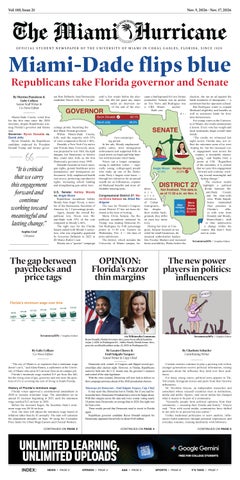
Miami-Dade flips blue Republicans take Florida governor and Senate nor Ron DeSantis, beat Democratic candidate David Jolly by 1.3 per-
By Martina Pantaleon & Gaby Collazo Senior Staff Writer & Co-News Editor Miami-Dade County voted blue for the first time since the 2020 elections, despite Republicans winning Florida’s governor and Senate seat. Governor: Byron Donalds vs. David Jolly Byron Donalds, the Republican candidate endorsed by President Donald Trump and former gover-
“It is critical that we carry this engagement forward and continue working toward meaningful and lasting change.” Sophia Graf UM junior
until a few weeks before the election; she did not grant any major outlet an interview until the end of the elec-
GOVERNOR centage points, becoming the first Black Florida governor. Within Miami-Dade County, Jolly took the majority with 53% of votes compared to Byron’s 46%. Donalds, a New York City native and Florida State University alum, was projected to win. Still, the tight margins led Democrats to believe they could elect Jolly as the first Democratic governor since 1999. Donalds focused on lower taxes, gun rights, greater healthcare price transparency and immigration enforcement. Jolly emphasized health care access, protecting reproductive rights, increasing school funding and strengthening gun safety laws. U.S. Senate: Ashley Moody vs. Angie Nixon Republican incumbent Ashley Moody beat Angie Nixon, a member of the Democratic Socialists of America, by 1.2 percentage points. Again, despite the overall Republican win, Nixon won Miami-Dade with 53% of the vote compared to Moody’s 46%. The tight race for the Florida Senate ended with Moody’s reelection, who was originally appointed by Governor DeSantis in 2025 to fill Marco Rubio’s seat. Moody ran a “quieter” campaign
The gap between paychecks and price tags
Byron Donalds
50.1%
David Jolly
48.6%
came a battleground for two former journalists: Salazar was an anchor on Fox News and Rodriguez was a CBS Miami anchor. Both cand i -
election, she ran an ad against the harsh treatment of immigrants — a sentiment that her opponent echoed. But Rodriguez wants to expand Medicaid eligibility and benefits as well as assistance funds for firsttime homeowners. For young voters at the University of Miami, the results demonstrate a lesson: Every vote has weight and local sentiments shape overall state trends. “The results we witnessed last night across Florida may not reflect the outcomes some of us were hoping for, but the increased voter engagement seen across the country is incredibly encouraging,” said Sophia Graf, a junior at UM. “Regardless of the outcomes, it is critical that we carry this engagement Angie Nixon Ashley Moody forward and continue work47.9% 50.9% ing toward meaningful and lasting change.” The election results highlight a political dates divide between MiNot finalized. This data is a r e ami-Dade County as of 11:30 a.m. on Nov. 4. a l s o and the state-wide children view. While Repubof Cuban licans maintained Maria Elliot Elvira immigrants, their presence in Rodriguez Salazar but despite Florida’s offic49.77% 50.23% their similar backes with wins from grounds, they differ Donalds and Moody, on most key initiaMiami-Dade’s shift tives. to blue underscores During her time in Cona change within the gress, Salazar focused on tax county that hasn’t been relief for small businesses, deseen in years. nounced authoritarian leaders like Nicolas Maduro and increased SovannreachPo // Graphics Editor home availability. Weeks before the
SENATE
tion-campaigning period. In her ads, Moody emphasized public safety, strict immigration enforcement and supported bills to crack down on fraud and help families with hurricane relief funds. Nixon ran a longer campaign, trying to mobilize voters — especially young, college-aged people who make up one of the Democratic Party’s largest voter bases — through her initiatives for an annual wealth tax on billionaires, expanded Medicaid benefits and more affordable housing units. Congressional District 27: Maria Elvira Salazar vs. Elliot Rodriguez The race for Florida’s Congressional District 27 has not been declared at the time of writing.. Maria Elvira Salazar, the Republican incumbent endorsed by Trump, was leading Democrat Elliot Rodriguez by 0.46 percentage points at 11:30 a.m. Eastern on Wednesday, Nov. 4 — the time of print submission. The district, which includes the University of Miami campus, be-
OPINION: Florida’s razor thin margins
SovannreachPo // Graphics Editor
DISTRICT 27
The new power players in politics: influencers
via Wikimedia Commons
SovannreachPo // Graphics Editor
Byron Donalds, Florida Governor-elect, poses for an official headshot on Jan. 1, 2021, in Washington D.C. Ashley Moody, Florida Senate-elect, poses for an official headshot on Jan. 21, 2025, in Washington D.C.
By Gaby Collazo Co-News Editor
By Lazaro Chavez & Emil Salgado Vazquez Senior Writer & Copy Chief
By Charlotte Schuyler Contributing Writer
“The city of Miami is so expensive that a minimum wage doesn’t cut it,” said Alana Ramos, a sophomore at the University of Miami who earns $15 an hour from an on-campus job. Florida’s minimum wage reached $15 per hour this fall, but the rising costs of gas, groceries and rent raise the question of if it is covering the cost of living in South Florida.
Democrats took control of Congress and flipped several governorships after election night. However, in Florida, Republicans narrowly held onto the U.S. Senate seat, the governor’s mansion and control of the state legislature. With the votes counted, Democrats will now look to deliver on their campaign promises ahead of the 2028 presidential election.
History of Florida’s minimum wage Florida voters approved a constitutional amendment in 2020 to increase minimum wage. The amendment set an annual $1 increase beginning in 2021 until the minimum wage reached $15 an hour in 2026. Before the increases began, the Sunshine State’s minimum wage was $8.56 an hour. Now, the state will adjust the minimum wage based on inflation rather than by $1 annually. The state will calculate the adjustment annually on Sept. 30 using the Consumer Price Index for Urban Wage Earners and Clerical Workers.
Takeaways for Democrats – Emil Salgado Vazquez, Copy Chief It may seem like Democrats lost in Florida, but if you read between the lines, Democratic Floridians have a lot to be happy about. With thin margins across the state and every county voting nearly 10 points more Democratic on average than in 2024, this night was far from a loss. These results proved that Democrats need to invest in Florida again. Republican governor candidate Byron Donalds outspent his Democratic opponent David Jolly by about $140 million. B:10.25"
Content creators continue to play a growing role in how younger generations receive political information, raising questions about the influence they hold over their audiences. For many young voters, political news appears in TikTok trends, Instagram stories and posts from their favorite influencers. Dr. Nicolette Alayon, an independent researcher and consultant whose research examines trust in institutions, media and public figures, said social media has changed what it means to be part of a community. “Generally, people form political opinions from their community — meaning their friends and family,” Alayon said. “Now with social media, communities have shifted to not only be in person but also online.” Unlike traditional politicians or news anchors, influencers build audiences through personal experiences and everyday routines, creating familiarity with followers.
CONTINUED ON PAGE 2
S:9.75" CONTINUED ON PAGE 4
T:10"
CONTINUED ON PAGE 5
S:1.25"
INDEX:
NEWS | PAGE 2
OPINION | PAGE 4
A&E | PAGE 5
SPORTS | PAGE 6
V’S TAKE | PAGE 7
NEWS
2
November 5, 2026
THE MIAMI HURRICANE
The gap between paychecks and price tags CONTINUED FROM PAGE 1 Average expenses in Miami-Dade Although the minimum wage has increased by 50% since 2021, it still barely covers basic expenses in Miami-Dade County. A full-time worker earning Florida’s minimum wage makes $31,200 a year before taxes, assuming 40 hours of work per week for 52 weeks. That is 1.9% less than the $31,812 annual cost of renting an average one-bedroom apartment in Miami, according to Zillow’s October 2026 rental data. “The rising cost of living is definitely surpassing the rate of wage increases and undermining what Floridians — including members of organizations like the Miami Workers Center — fought so hard for by voting for $15 per hour in
“The city of Miami is so expensive that a minimum wage doesn’t cut it.” Alana Ramos UM Sophomore
2020,” said Lizzie Suarez-Smith, the communications director at the Miami Workers Center. Beyond housing, a single adult in Miami-Dade County is estimated to spend about $400 a month on food, according to MIT’s Living Wage Calculator. That adds up to about $4,800 a year. Transportation is another significant expense for Miami-Dade workers. MIT estimates that a single adult spends about $616 a month on transportation. For residents who rely on public transit, a regular monthly Miami-Dade Transit pass costs $112.50, according to the county’s transit fare information. United Way Miami’s 2026 ALICE report found that 56% of Miami-Dade households live in poverty or earn less than what is needed to afford basic necessities.
Ramos said her parents pay for her dorm at UM, letting her use her salary to cover other expenses. “As a college student, it’s hard to really see the drastic changes in my spending,” Ramos said. “I will say [having my parent’s support] helped me be able to pay my credit card quicker and overall be able to afford things that I may not necessarily need.” Ramos said that if she had to pay for rent herself, earning $15 an hour would not be enough to cover the cost of living in Miami. Politician’s approaches Jose Antonio Stoute, a UM alumnus and Democratic candidate for Florida Senate District 40, said the cost of living is a major concern for South Florida residents. “We definitely need to do more to bridge that gap and to incentivize
businesses to pay more than the minimum wage to their workers so that they can make a living,” he said. The issues extend beyond raising wages and protecting tenants. For Suarez-Smith, it is about how elected officials prioritize their communities’ needs. She believes it influences lawmakers’ decisions, potentially leaving their constituents without the support they need. Although Florida’s minimum wage has increased to $15 an hour, the raise alone may not be enough for workers to support themselves in Miami-Dade County. As housing, groceries, transportation and other necessities continue to take up a large share of household budgets, earning the minimum wage does not necessarily mean earning enough to live on.
Realities of why students aren’t packing Hard Rock By Olivia Attalla Contributing Writer Miami’s undefeated football team is ranked No. 1 in the nation, but still faces social media criticism for fans not showing up to Hard Rock Stadium on game days. So why aren’t students showing up to support the top-ranked team in the country? October is a jam-packed month for University of Miami students. In addition to football season, III Points Music Festival and Fantasy Fest also capture students’ attention, and this year both fell on game days. A post from @cfbsaturdaydaily on Instagram calling out UM students for not showing up to the Pittsburgh game on Oct. 24 received more than 8K likes. “Despite the Hurricanes holding the nation’s top ranking, noticeable sections of empty seats could be seen throughout the stadium,” the caption read. A news outlet, Saturday Down South, also criticized Miami fans for not showing up to the game versus Pittsburgh. Polymarket reporter Emma Vance posted scenes of Hard Rock Stadium’s empty seats on social media. “Why are the stands so empty for the No. 1 team in college football?” Vance wrote on Oct. 24 on X. But these outlets don’t mention that, the weekend of Oct. 23–25, many undergraduates were three hours away in Key West celebrating Fantasy Fest, a University of Miami tradition. Students call it “the great migration” when thousands attend the fes-
tival from Friday through Sunday, so students were not around to go to Hard Rock for the football game. An Instagram post from @redcup.miami featured a screenshot of someone’s Snapchat map showing a packed route down to the Keys. Hotel prices in the Keys are higher the later students wait to book, so many people book hotels and plan transportation over the summer before football tickets even become available. “My friends and I booked our hotel over the summer before we knew just how good the team would be,” said senior Addie Murphy. “We knew Key West would overlap with a home game, but did not really care as there is only one weekend for Key West and many weekends for football games.” But wanting to participate in student traditions doesn’t make someone less of a die-hard Canes fan. “I would have loved to go to the game but I booked Fantasy Fest six months ago,” said Sophia Metzner, a student studying political science and media management. In particular, the rivalry game against Florida State University on Oct. 17 drew a lot of online hate as well. “Miami fans still can not fill up Hard Rock,” wrote @cfbsaturdaydaily on Instagram. “Despite the Hurricanes holding the nation’s top ranking, noticeable sections of empty seats could be seen throughout the stadium. Again, the outlets don’t mention that the sold-out FSU game fell on the weekend of III Points. Tickets for the music festival went live
David Lebowitz \\ Photo Editor Fans get on their feet as the Hurricanes prepare for the upcoming play against Florida State on Oct. 17, 2026. The team announced on social media that the game was sold out, but there were many empty seats in the stadium, especially in the upper decks.
nearly a year ago, on Oct. 23, 2025, letting students buy tickets long before this season’s football schedule became available on Jan. 27, 2026. Key West and III Points aren’t the only events making it difficult for students to go to home games. Two home games are scheduled for the weekends before and after Thanksgiving, and since UM is hosting remote classes on the Monday of the holiday week, a
large portion of the student body will likely be traveling for the break. Then, if Miami makes it to the College Football Playoffs, Art Basel, Christmas and New Year’s could create conflicts. While Miami’s No. 1 ranking has brought national attention to the Hurricanes, empty seats do not necessarily mean students are uninterested. Between long-standing traditions, music
festivals and holiday travel, students often have to choose between events scheduled on the same weekend. As the Hurricanes continue their season, the challenge may not be getting students to care about football, but finding a schedule that lets them show up. Katie Karlson and Gaby Collazo contributed to the reporting for this article.
III Points 2026: rain, drugs and EDM By Annabelle Caton Contributing Writer Long wristband lines, flooding and drug use were major issues reported by students who attended III Points Music Festival. For some students, these difficulties tainted the entire weekend. When first-year architecture student Valentina Karcheva was asked if her experience made her want to return, she replied, “absolutely not.” III Points — a two-day music festival in Wynwood — was estimated to draw 40,000 guests each day this year, according to NBC Miami. The festival scheduled 293 artists over the two day event, with these sets spread across 13 stages. Ticketing issues Problems started before guests could even enter the venue, mostly at the “Will Call” line, where guests could pick up wristbands if they did not receive them by mail and handle ticketing issues. On Friday night, attendees reported waiting hours for their wristbands. Radio frequency issues in the wristband’s microchip were the main culprit of ticketing issues, according to the Miami Herald. On Saturday, III Points issued digital tickets to shorten the Will Call lines. But, these digital passes did not entirely resolve difficulties entering the venue. GA+ ticket holders, who paid between $259 and $360 for tickets, were promised a dedicated entrance into the venue, supposedly guaranteeing quicker lines. “I paid for General Admission Plus and didn’t even receive faster entry,” Karcheva said. Drug use Some attendees also witnessed
Wes Fleischer \\ Photo Editor A sold out crowd outlasts the rain as PAWSA closes the Friday night iii Points fesetival on Oct. 17, 2026.
excessive drug use at the festival, not only harming the person taking the drugs, but also those around them who may have witnessed a possible overdose. Freshman Julia Gutschow said she was at the Max and Luke Dean set when she saw a man collapse. “There was a guy standing right in front of me who completely collapsed on the floor,” she said. “His friends said that he was on a lot of drugs and did not want to get other people involved.” When asked about how this experience affected her, Gutschow said, “It made me realize that the things people are doing can be really dangerous. You have to make sure you are looking out for the
people around you.” Karcheva expanded on the heavy drug use, saying she saw “a fishing pole with a baggie of cocaine tied to it in one of the crowds.” Sets cut short While the heavy rains seen throughout the festival weekend were not necessarily dangerous, they did inconvenience many concertgoers and affect sets. At DJ Cloonee’s Friday night set, Mind Melt’s lighting and sound system cut out due to flooding, effectively cutting his 90-minute set by about 15 minutes. “We were at Cloonee’s set, and right as he came on, and he started playing his best songs, the rain just started
pouring,” Karcheva said. “At one point we couldn’t even see Cloonee and I didn’t know where I was.” Water cost and access Water prices and delays at refill stations also frustrated guests. Water bottles cost five dollars, and lines at the refill stations were packed with concertgoers. “At the water refill station, we waited for 15-20 minutes to get to the front,” Karacheva said. “Once we were there, we realized that there are two drops per second coming from the refill faucet.” If guests take the proper precautions and prepare correctly for the festival — hydrating in advance and eating a full meal — III Points
can be an incredible experience, especially for EDM lovers. “I only went to see Blood Orange. However, I had fun listening to new genres of music,” freshman Malkia Emilien said. Despite the plethora of issues attendees experienced this year, not every guest’s experience was hindered. “It was awesome. It was my first time seeing a lot of music artists perform live and it did not disappoint. All of the sets were electric, though my favorite was Cloonee’s,” said freshman Danielle Patterson. “I definitely have a greater appreciation for the arts post-III Points.” While the festival was a phenomenal experience for some, the long entry lines, flooding and reports of dangerous drug use left people questioning whether the experience was worth it or not. For an event drawing more than thousands of attendees, the weekend highlighted concerns about organization and safety that extend far beyond music.
III Points festival leaves students disappointed: •Students faced long lines and ticketing issues • Heavy rains flooded stages and cut performances short • Drug use and limited water access raised safety concerns
NEWS
November 5, 2026
THE MIAMI HURRICANE
NEWS
3
Accessibility challenges at Hard Rock Stadium By Hope Mallon Staff Writer Hard Rock Stadium draws thousands of fans each weekend to watch the Canes play, but navigating the stadium can look a little different for fans with disabilities. The stadium lists several accommodations for guests with disabilities, including designated seating, accessible parking, wheelchair escorts and a sensory room. But, as early as October 2022, fans and students have raised concerns about how accessible the stadium actually is. Transportation and parking Freshman Elle Yona, a wheelchair user, documented transportation difficulties during the Hurricanes’ Sept. 26 game against Central Michigan in a video she
“There should be some accountability on their part to make sure that these tickets end up in the right hands of the right people.” Michael Álvarez Miami Dolphins Fan
posted on TikTok. In the video, Yona showed several problems she encountered as a wheelchair user. It received more than 414K views and nearly 50K likes. UM’s 2026 football parking information website lists five designated ADA parking areas at Hard Rock stadium, each with specific stadium entrance gates. The ADA parking lots open five hours before kickoff. The University also offers the HRS Express, a free, air-conditioned shuttle that transports fans between Lot 70 and the stadium. The service is available to everyone and passengers do not need a separate ticket to board. The post showed the shuttle bus ramp malfunctioning as Yona was getting onto and off the HRS Express bus, leaving her stranded off the ground on the platform for about five minutes while the ramp was repaired. According to the HRS Express FAQ, select shuttles are ADA accessible, although the University does not specify how many vehicles offer the accommodation. Yona also encountered difficulties boarding the bus after the game. She said the driver refused to allow two wheelchair users on the bus, despite two empty seats, after she and her family waited 20 minutes. The Hurricane reached out to Yona directly for a quote but did not receive a response. Rideshare services can pose accessibility issues as the designated drop-off and pickup location is approximately a 25 minute walk from the stadium, according to UM’s parking information. The University’s website does not identify a separate ADA transportation service at this location. Seating and ticketing Accessible seating is a key part of the stadium’s accommodations, but fans have reported the accom-
Wes Fleischer \\ Photo Editor Crowds use the spiral entrance ramps to enter Hard Rock Stadium on Saturday, Oct. 17, 2026.
modations being hard to navigate. Michael Álvarez — a longtime Miami Dolphins fan — said officials told him that he and his 13-year-old son, Andrew, who has autism and had recently undergone a spinal fusion surgery, could not move into ADA seating because the seats were sold out. “There should be some accountability on their part to make sure that these tickets end up in the right hands of the right people,” Álvarez told Local 10 News. In her TikTok, Yona also recalled purchasing an ADA ticket in advance but still having difficulties securing seats for herself and her family. She was eventually allowed into the accessible seating area with only two companion tickets, de-
spite purchasing four ADA tickets for her whole family. UM football’s frequently asked questions website explains that fans attending a single game can buy a ticket and then exchange it at a guest services table for accessible seating in that section. Fans seeking accessible seating for an entire season are directed to contact the University’s ticket office. For some families, ticketing difficulties begin before they even enter the stadium. Joe Lizzi, a freshman in the School of Communication, said his family encountered issues trying to purchase tickets together for Family Weekend. “Ticketing for student tickets is not the problem, the problem is buying tickets for the family,” said Lizzi.
“A week after purchasing tickets [my mom] was prompted to pay an additional fee to put all the seats together, which was really annoying for her.” Although his experience was not related to ADA seating, it highlights the overall challenges many families face when trying to book tickets together at Hard Rock Stadium. The Miami Hurricane reached out to Hard Rock Stadium and the University for comment but did not receive a response. Between difficulties securing accessible seating, limitations on companion tickets and questions about how accommodations are handled, these experiences raise concerns about whether Hard Rock Stadium is consistently meeting the needs of all its guests.
Jury duty scams target students By Tatiana Holguin Contributing Writer Phone scammers impersonating Miami-Dade law enforcement officers are targeting college students in the area, demanding hundreds of dollars to clear fake arrest warrants. The Miami-Dade Sheriff’s Office and Miami-Dade Clerk of the Courts issued multiple statements about these scams and advised people to verify suspicious claims with their local clerk of the courts. A University of Miami student who wishes to remain anonymous received a call at work from someone claiming to be with the sheriff’s office. According to the student, the caller told her she had missed jury duty and caused a mistrial, then said she had to pay two citations to avoid arrest. The caller told the student to
leave work and go to an address with two forms of identification: mail and a credit card statement. These scammers can demand substantial amounts. In a July report, Local 10 News described a case in which a victim was asked to pay $15,000 in supposed bail. “What made it seem believable was the fact that they had my information and the two types of citations sounded very real,” the student said. “They also gave me a badge number when I asked for it.” The address the callers provided was also close to her home but she became concerned when the caller told her she could not speak to anyone about it without risking arrest. After hanging up, she checked her jury duty status online and found that her request to be excused from jury duty since she is a student had been approved. She plans to report the incident
and wants other students to be cautious if they receive similar calls. “Know that they can’t stop you from speaking with anyone, especially a lawyer,” the student said. “And also trust your gut and never give personal info out.” Florida’s 17th Judicial Circuit, which serves Broward County, also issued a warning in July about the scams. The warning described scammers impersonating law enforcement officers and judges and threatening victims with fines or potential jail time. People who receive suspicious calls should recognize the warning signs and verify claims before taking action. Students should be cautious of unexpected or suspicious calls and contact the University of Miami Police Department if they need help handling the situation.
via Tamanoeconomico / Wikimedia Commons The Miami-Dade County Courthouse on Nov. 14, 2018. The coutny clerk has issued official statements warning residents to be aware of potential scammers impersonating law enforcement.
One of Coral Gables’ central voting polls: St. Augustine Church By Hope Mallon Staff Writer St. Augustine Catholic Church opened its doors on Tuesday, Nov. 3, as one of 14 polling locations that served Coral Gables for the 2026 midterm elections. Open from 7 a.m. to 7 p.m. on Election Day, the church has served as a polling location for more than
“The more people that think they can’t [vote],
the less people there are to really make a change.” Anne Marie Cummings UM freshman
a decade, with county election records listing back to 2011 in subsequent municipal elections. Nicholas Campbell, a 30-year-old Coral Gables resident, said that local politics was the main reason he came to St. Augustine to cast his vote. “Local politics is very important to me, I would actually even say more important than the federal elections,” Campbell said. “This is what sets your budget, what public works, and how they get funded.” Many voters came to the polls with one priority: supporting change on certain issues they believe need improvement. “One of the major issues we are facing is healthcare,” said UM alum Janice Muller. “There is absolutely no reason that we shouldn’t have better healthcare, and I am dedicated to electing people who are at least willing to try to make it better.” For first-time voter and UM freshman Anne Marie Cummings, rising costs were another priority. She expressed her concern with price increases for not only herself, but the greater Miami community, emphasizing how important youth votes are in this election “The more people that think they can’t [vote], the less people there are to really make a change,” said Cummings. Although each individual ballot likely looked different, vot-
ers at St. Augustine all agreed on one thing: Civic engagement and showing up to vote are crucial to the community. Matthew D. Nelsen, a political science professor at UM, said older Americans generally participate in elections at higher rates because they have had more opportunities
to establish voting as a routine. “The more times that you vote, there is a likelihood that you vote in a subsequent election,” Nelsen said. “However, voter participation is only one indicator of political participation, and it’s only one form of democratic health. So just because voter turnout is high, that
doesn’t really mean that everyone is super engaged, and vice versa.” For college voters, the process of participating can come with additional challenges like navigating voter registration requirements and voting out of state. “Some of the biggest barriers to political participation among col-
Wes Fleischer \\ Photo Editor Voters gather at St. Augustine Church on the morning of election day. Nov. 3, 2026.
OPINION
4
November 5, 2026
THE MIAMI HURRICANE
Florida’s razor thin margins CONTINUED FROM PAGE 1 Founded 1929
An Associated Collegiate Press Hall Of Fame Newspaper NEWSROOM: 305-284-4401 editor@themiamihurricane.com BUSINESS OFFICE: 305-284-4401 FAX: 305-284-4404 For advertising rates call 305-284-4401 or fax 305-284-4404.
Staff EDITOR-IN-CHIEF Katie Karlson MANAGING EDITORS Madison Block Hannah Valdivia NEWS EDITOR Vivian Amoia DIGITAL NEWS EDITOR Elena Fallow CITY NEWS EDITOR Gianni Echeverria OPINION EDITORS Keira Faddis Paulina Barnjak ARTS & ENTERTAINMENT EDITORS Marissa Levinson Brianna Pearson SPORTS EDITORS Sebastian Font Jayden Gonzalez COPY CHIEF Emil Salgado Vazquez
PODCAST EDITOR Camila Goveo Lounsberry PHOTO EDITORS Wes Fleischer David Lebowitz GRAPHIC DESIGN EDITOR Sovannreach Po PRINT EDITORS Camryn Greiner Brendan Cafferty SOCIAL MEDIA EDITORS Sophia Ibanez Anabelle Carpenter BUSINESS MANAGER Nishka Mishra FACULTY ADVISOR Antonio Mora FINANCIAL ADVISOR Steve Priepke SENIOR FINANCIAL ASSISTANT Michelle Starbeck
WANT TO WORK FOR US? SCAN HERE TO APPLY:
The Miami Hurricane is published biweekly during the regular academic year and is edited and produced by undergraduate students at the University of Miami. The publication does not necessarily represent the views and opinions of advertisers or the university’s trustees, faculty or administration. Unsigned editorials represent the opinion of The Miami Hurricane’s Editorial Board. Commentaries, letters and cartoons represent only the views of their respective authors. The newsroom and business office of The Miami Hurricane are located in the Student Activities Center, Student Media Suite 200. LETTER POLICY The Miami Hurricane encourages all readers to voice their opinions on issues related to the university or in response to any report published in The Miami Hurricane. Letters to the editor may be submitted typed or handwritten to the Student Activities Center, Student Media Suite 200, or mailed to P.O. Box 248132, Coral Gables, Fla., 33124-6922. Letters must be signed with a copy of your Cane Card. ADVERTISING POLICY The Miami Hurricane’s business office is located at 1330 Miller Drive, Student Activities Center Student Media Suite 200. The Miami Hurricane is published every other Wednesday during the university’s fall and spring academic terms. Newspapers are distributed for free on the Coral Gables campus, the School of Medicine and offcampus locations. DEADLINES The conditions of agreement for advertisers are outlined on the ad contract form. Please direct any and all questions related to advertising to the business manager, Nishka Mishra. Questions can be emailed to business@themiamihurricane.com. AFFILIATIONS The Miami Hurricane is a member of the Associated Collegiate Press, Columbia Scholastic Press Association and Florida College Press Association.
Jolly came short by only about 110,000 votes — a major shift from Gov. Ron DeSantis’ reelection campaign in 2022, when the Republican won by more than 1.5 million votes. Democratic candidate for U.S. Senate Angie Nixon was outspent by about $5 million, losing by nearly 240,000 votes in a state where the word “socialism” is often used to spread fear among voters. But it doesn’t seem like Nixon is done fighting, taking to Instagram shortly after conceding the race to tease a 2028 run. Statewide, while Democrats did not gain a majority in the Florida House or Senate, they did break the Republican supermajority in the House, and the Senate supermajority is on thin ice. Once the final votes are in, Republicans will likely drop about 15 seats in the House and be one seat short of a supermajority in the Senate. One thing to be happy about
for Florida Democrats is the U.S. House races. Democrats won 3 key races — Districts 14, 22 and 25. Democrats also had a lead in District 9 as of 11:30 a.m. on Wednesday, Nov. 4, in a state that Republicans redistricted to their advantage. At home in District 27, the race between Democrat Elliot Rodriguez and Republican Rep. Maria Elvira Salazar was not called and appeared to be headed for an automatic recount as of 11:30 a.m. on Nov. 4 — the time of print submission. All this to say: things are looking up for Florida Democrats ahead of 2028. Don’t be discouraged by the night’s losses; look to repeat the successes. Takeaways for Republicans – Lazaro Chavez, Senior Staff Writer After a strong campaign, Byron Donalds won the race for Florida governor. But Donalds’ margin of victory proved to be disappointing. Unlike DeSantis, who carried the state by
nearly ten percentage points, Donalds narrowly secured the governor’s mansion by two percentage points. Between Senator Ashley Moody’s narrow win against Angie Nixon — a member of the Democratic Socialists of America — and the Republican losses across the country, the night proved that the GOP needs a new direction. With socialism creeping its way into the mainstream Democratic Party, Republicans must fight back harder with stronger candidates who reflect the values of a growing portion of the electorate: independents. Republicans need leaders who can articulate bold conservative visions, defend free-market principles and offer real solutions for the issues voters care about. The party must also reject the culture wars. The biggest elephant in the room is the White House. President Donald Trump cost Republicans both chambers of Congress. Trump acted like he was running for president again — say-
ing the GOP would’ve won if he was on the ballot — and he was campaigning as if it was 2024, ultimately costing the party. His approval rating was low, at just 32% according to Reuters, so the party should’ve distanced itself from him if it wanted to make bigger gains. It also didn’t help that the president blamed his endorsed candidates for losing. With the president’s agenda in limbo for the next two years, the Republican party must do two things: Keep the president off social media as much as possible and look to leadership for its future. Marco Rubio is the only card the Republicans should play in 2028. He has the credentials, charm and intelligence to be able to win the presidency. But is the GOP ready to give a Latino the keys to the movement? And more importantly, are they ready to kick Trump to the curb?
Voting isn’t just a right; it’s our civic duty By Keira Faddis Co-Opinion Editor
13,672,122 people are registered to vote in Florida, but only about 60.81% cast a ballot in the Nov. 3, 2026, general election. That’s more than five million people who did not exercise their constitutional right, forfeiting the opportunity to have their voice heard. It’s easy to say that you “stay out of” or “don’t like” politics. It’s understandable not to want to debate your beliefs all the time. But when a little more than 60% of eligible voters are actually showing up, it’s time to recognize that voting is more than just a personal choice. It’s our civic duty, and choosing not to participate means giving up your opportunity to have a say in the decisions that affect you. In the 2024 presidential election, nearly 90 million people didn’t vote, according to the University of Florida’s election lab. That election had the second-largest voter turnout in history, yet millions of Americans still didn’t participate. If people can’t even be motivated to vote in a presidential election, what will it take to get them to the polls for the midterms? This problem also extends to our own campus. In the University of Miami’s fall 2026 Student Government Senate election, just 687 students voted, and with more than 12,000 full time undergraduates, that number only represents approximately 5.7% of the undergraduate student body. “I think students might not vote in SG elections because they aren’t aware elections are happening or don’t fully know about what or who they are voting for,” said Ava Stroshane, student government’s
SovannreachPo // Graphics Editor elections commission chair. “This past semester we really tried to increase voter turnout by addressing this first reason.” In the weeks leading up to the election, Stroshane worked to educate students, including through reaching out to several departments and organizations — like Orientation and Commuter Student Involvement — to share flyers and blurbs about voting. She and the elections commission also hosted tabling events where students could pick up free cookies and pizza. Her outreach coincided with a 50% increase in turnout from the previous fall. Still, the overwhelming majority of undergraduates didn’t participate. Abigail Lara, public relations chair of Get Out the Vote — UM’s nonpartisan, student-led political organization that promotes civic engagement and political efficacy — said people do not vote in larger elections for many of the
same reasons. For young voters, navigating the registration process and understanding what is on the ballot can make participating feel more difficult. “One of the main barriers is a lack of accessible information regarding the voting process and what is actually on the ballot,” Lara said. “Our goal is to ensure that every student feels informed and empowered to use their voice at the ballot box.” On campus, GOTV works to address these barriers by educating students about upcoming elections, registration deadlines and early voting schedules. The organization also helps students understand how to register to vote in Florida, making the process more accessible. But access to information is only part of the problem. Even when students understand how to vote, some question whether their participation will actually make a difference. “Many students believe that a single vote will not make a meaningful
difference, so they choose to not engage in the process at all,” Lara said. Not wanting to engage with politics does not mean political decisions stop affecting you. Elected officials make decisions about political issues ranging from education to health care and the economy — issues that Gen Z consistently identifies as most important to them. Choosing not to vote means giving up an opportunity to influence who makes those decisions. You don’t have to agree with everything a political party stands for to vote. No candidate is perfect, and voting does not require agreeing with every position a candidate takes. It requires taking the time to understand the choices available and deciding who best represents your interests. Democracy depends on more than having the right to vote. It depends on people who are willing and eager to exercise that right. Having a voice means nothing if we choose not to use it.
Entertainers have an obligation to be political By Adrianna Buford Contributing Writer
When we turn on the news, we expect to see discourse from politicians and elected officials about new government decisions and issues. But with such a politically active climate in the U.S, debate as to whether this should extend to entertainers and public figures has grown. This September, Ed Sheeran was at the center of a public controversy for his “apolitical” stance. Macklemore, Sheeran’s opener for the Loop Tour, was dropped by the tour’s promoters after he made comments supporting Palestine. After Sheeran failed to speak out, his other openers sided with Macklemore and withdrew from the tour. Entertainers should encourage political awareness, even if it is through brief or humorous commentary, and provide resources on their social media platforms so fans can learn about important issues. Over time, entertainers have become more inclined to speak out on politics. Jimmy Fallon is a great example of using humor to educate his audience on current events. On Oct. 19, Fallon gave his Monday night monologue, with the first segment
focusing on Katie Zacharia being fired from her brief position as White House press secretary. “Well guys, the midterm elections are just 15 days away,” Fallon said. “Yeah, that’s not a lot of time. That’s only three White House press secretaries from now.” Fallon’s ability to poke fun at current political issues makes difficult topics more accessible to the public. He doesn’t aim to go into full political commentary, but rather focuses on keeping things light-hearted. UMTV’s Off the Wire comedy show Executive Producer Mack Keegan talks about similar moments in the show where politics got involved. “This semester, my goal was to kind of push the line a little bit with political stuff,” Keegan said. “We used to kind of stay away from it, just because you don’t want to hurt someone’s feelings while making someone else laugh.” He compares traditional news stations to comedy shows, highlighting how often comedy might be more impactful to viewers when referencing politics. In one episode, Off the Wire aired a sketch portraying Senator Mitch McConnell as a guest star on Dancing with the Stars. “The news might throw a bunch of jargon and stats at you and it seems overwhelming,” Keegan said. “Then they tell you ‘fear this
group of people’ at the very end of it. But with comedy, you kind of have the luxury of an explanation. It goes deeper into it.” Entertainers speaking on political and current events is especially important when considering the intensity of recent news, as public figures have the potential to engage even the people who try to avoid the polarized headlines they see on the news. When we are presented with hard facts and complicated issues, our brains may be inclined to shut off and switch over to something simpler. With this in mind, sometimes humor and poking fun at society is a valuable way to make people see the bigger picture in ways traditional news cannot. It puts content in people’s laps that is more digestible and enjoyable to consume, while also encouraging audiences to further research important news and political topics. “I enjoy watching them and hearing about the issues that are current,” political science student Isabelle Gonzalez said. “I feel like it’s not that different from what you hear on news stations in terms of biases.” Celebrities and entertainers do not need to be as outspoken as a politician, but they should be open to general commentary and encourage fans to seek more information on a topic. Providing resources, whether biased or not
Wes Fleischer \\ Photo Editor Jimmy Fallon “interviews” Katie Zacharia on The Tonight Show, photographed on television, Oct. 29, 2026.
to the entertainers beliefs, should be something more people in the media shift towards doing. On the contrary, not every entertainer needs to be political to make an impact, and nobody portrayed this better than singer Dolly Parton. Even after being offered the medal of freedom twice by the Trump administration, and once by the Biden administration, Parton remained true to her stance, “I am not political, and I refuse to get caught up in political things.” Despite saying she was not political, Parton remained unafraid to
speak out for movements and people she believed in supporting, including the Black Lives Matter movement and the LGBTQ+ community. Although the new rise against neutrality in politics can be difficult for entertainers to navigate, it’s contributing to a bigger political conversation, forcing political discourse to extend beyond solely politicians and news stations. As our political climate continues to change and grow, it is important that our society’s most influential leaders grow with it by speaking out and encouraging discussion.
November 5, 2026
THE MIAMI HURRICANE
ARTS & ENTERTAINMENT
5
The new power players in politics: influencers CONTINUED FROM PAGE 1 That influence extends beyond entertainment. A 2024 Pew Research Center study found that 72% of young adults who regularly get news from influencers said those creators helped them better understand current events and civic issues, highlighting the growing role of online personalities in political conversations. Alayon points to parasocial relationships, the one-sided connections audiences develop with public figures, as a reason why these messages carry weight. “Now with social media, influencers play the role of a friend, shaping the way their audiences think about many subjects including politics,” Alayon said. Research suggests that this sense of familiarity can make influencers more persuasive. A 2024 study
published in Psychology & Marketing and examined findings from 53 studies found that trustworthiness and credibility play a major role in how audiences respond to influencers. When followers view creators as trustworthy, they may be more receptive to the messages they share. Lauren Barnwell, a UM student and social media personality with more than 500K TikTok followers, faces challenges navigating the influence that comes with her platform. Although her content focuses on lifestyle and entertainment, Barnwell said she does not shy away from sharing her views on important issues, even when those topics fall outside her usual content. “[The] TikTok algorithm tends not to push posts that aren’t your usual content and for me that gets really frustrating,” Barnwell said. She often uses reposts and comments to communicate her posi-
tions, even when she does not address an issue directly. Having a large audience also comes with a sense of responsibility, particularly during an important election season, Barnwell said. “To a degree, I feel like it is the duty of people with a platform to speak for those whose voices aren’t heard,” Barnwell explained. “But there is this line of keeping entertainment entertainment and we shouldn’t be relying on influencers for political commentary.” But are influencers actually changing people’s political opinions or are they just strengthening beliefs their followers already hold? Casey Klofstad, a UM political science professor whose research examines human decision-making, said public figures often reinforce the views their audiences already hold. “Typically, these opinion leaders already share our preferences so rath-
Elections or entertainment The new wave of campaign ads
Courtesy of Katie Karlson A Byron Donalds campaign advertisement on TV on Oct. 28, 2026.
By Adrianna Buford Contributing Writer “I love my daughter but when I saw her lying about her opponent, it’s not easy for a mother to say this, but Amy has a serious problem. She is a liar.” Amy Acton’s estranged mother said this in a political ad for Vivek Ramaswamy, a Republican candidate for Ohio governor and Acton’s opponent. As a result of the controversial ad, Ramaswamy is facing backlash from Democrats and some Republicans over its ethics. The controversy is because the ad leverages Acton’s mother, who lost custody after being deemed unfit when her husband was arrested for allegedly sexually assaulting 12-year-old Acton. The online discourse, record-lev-
el spending and the use of artificial intelligence in campaign ads raises the question: What impact do these political campaigns, which sometimes rely on drama or inflammatory language, actually have? Voting influence Professor Gregory Koger, a political science professor at the University of Miami, doesn’t think campaign ads have a significant impact in general elections. “At the margins, they may influence whether or not a few people decide to vote — especially if the ads are negative — or may influence a few vote choices, but most voting in general elections is based on party identification or a holistic vote choice, combining information from friends, family, news, etc.,” Koger said.
He added that candidates have started exploring social media, paying influencers to promote their campaign or investing in voter turnout operations instead of relying on traditional television ads. As a result, political campaign ads are nearly inescapable when surfing the internet or watching YouTube videos. Ads of senators bashing their opponents and criticisms of current incumbents are everywhere. Canadian student Madeleine Ash described her shock at how viral these ads are. “I feel like [in the U.S.], there’s a lot even on Instagram; I always get ads for the government,” Ash said. “I’ve seen some ads back home online but there’s definitely a big gap.” UM College Republicans President Lazaro Chavez summarized
er than persuade, they reinforce what we already believe,” Klofstad said. Still, online influence can extend beyond likes and comments. Beyond social media influencers, major celebrities have also used their platform to promote political engagement. In 2023, Taylor Swift encouraged followers to register to vote and Vote.org reported more than 35,000 new registrations that day. Celebrity involvement in political messaging has also extended beyond elections. Singer Olivia Rodrigo joined President Joe Biden at the White House in 2021 to promote COVID-19 vaccinations among young Americans. However, increased political visibility raises concerns about misinformation and audiences’ responsibility to evaluate what they encounter online. Barnwell believes creators should recognize their influence but also thinks followers need to
form their independent opinions. “Anyone who has a following has a degree of influence that they need to be conscious of,” Barnwell said. “But at the same time, people need to do their own research and figure out their beliefs for themselves.” Alayon similarly emphasizes the importance of credible information sources rather than expecting influencers to become political experts. “The focus should be on restoring trust in the institutions that are meant to educate and inform the public so people do not have to rely on influencers,” Alayon said. In the wake of the midterm elections, political conversations will continue unfolding beside everyday content. Whether influencers change minds, reinforce beliefs or encourage participation, their role in how young voters experience elections is becoming increasingly difficult to ignore.
the ultimate goal of these advertisements: “It’s about influence.” He describes how political candidates in the U.S. are striving to gain as much attention as possible, as attention can overlap with power. “That influence is important,” Chavez said. “They want to reach your ear, they want to reach my ear, they want to reach people over here’s ear, they want to reach everybody.”
Democratic State Rep. James Talarico is running for U.S. Senate against Republican opponent Ken Paxton, Texas’ attorney general. Paxton released an AI-generated ad in early September that attacked many of the Democratic candidate’s beliefs. In the ad, a man writes in a book titled “The King James Talarico Bible” with a crayon drawing of Talarico on the left and scribbles on the Genesis chapter, including “let there be six genders” written in crayon across the page. Yaira Sanchez, a UM student from Texas, thinks that language like this makes political ads less professional. “I find it amusing that they’re using these types of words, especially with such a serious matter like politics,” she said. “We’re over here calling a man a ‘freako’ because of his political ideals.” The bottom of the ad reads, “James Talarico is weaponizing faith to sell a radical agenda and he even brags about hating Christianity.” Paxton coined and began using the name “Talafreako” in speeches about Talarico’s policies and faith. President Donald Trump has adopted the nickname as well. Sanchez said she expects more maturity from these campaigners. “It makes me deem the other side as less serious.” She highlighted how she prefers to do her own research rather than relying on these ads for information; she sees them purely as entertainment. “It’s definitely going to continue to increase because campaign advertising now is just getting started,” said Briana Castillo, the treasurer for the UM College Republicans. “Especially with social media and what’s yet to come that we don’t even know of yet.” Campaign ads are likely here to stay. With the growth of digital platforms and increased spending in regards to campaigning, we can only anticipate more advertising in years to come.
Record-level spending Political ad spending for the current midterms has already exceeded $10 billion, according to U.S. News, and is expected to exceed $12 billion by Election Day — a new national record. This increased level of spending is a key reason behind growing visibility. As of this fall, political action committees and other groups are also said by U.S. News to have reserved more than $1.2 billion in airtime for these ads. Ramaswamy’s ad cost $4 million alone, according to his campaign team. Political ads are covering more than 300 races throughout the U.S., with the highest media output in states like Georgia, Ohio and Texas. Despite the extensive focus on these advertisements, experts continue to question their long-term effectiveness, especially after candidates have made their stances known and made progress campaigning. A study led by Brett Gordon, a marketing professor at Northwestern, revealed that increasing output of negative ads by 1% resulted in a 0.025% increase in votes for the candidate. Positive ads were linked to an increase of 0.016% — small impacts for the amount of money and work put in. AI use and provocative language In Texas, the James “Talafreako” ads have become a central part of the midterm campaign drama.
REVIEW: October’s best horror movies By Camila Yanez and Adrianna Buford Contributing Writers There is no doubt that 2026 has been a banner year for horror, with experimental hits like “Obsession” and “The Backrooms” breaking box office records. As the season of scares arrives, the question remains: Can this season’s scary movies give viewers the fright they’re looking for? Resident Evil Released Sept. 18, Resident Evil (2026) is a horror-comedy like no other. Directed by Zach Cregger and written by Cregger and Shay Hatten, this film takes the Halloween horror movie season by storm. The film takes direct inspiration from the original video game series first published in 1996. The story follows a lab-grown virus that infects people with zombie-like symptoms, but this version stands out for its unlikely hero, Bryan. Bryan, an everyday delivery driver, isn’t your typical brave protagonist. But, this makes for a hilariously terrifying experience. Viewers can deeply relate to Bryan as he behaves as a normal person might in a life-or-death situation. With a 96% on Rotten Tomatoes, it’s the highest-rated video game adaptation ever. The film blends practical effects, makeup and digital SFX to bring its monsters to life. If a viewer doesn’t walk out screaming, they’ll at least walk out laughing. Rating: 5/5 Other Mommy Other Mommy was released on
Oct. 9, just in time to get in the Halloween spirit. The film follows eight-year-old Bela who grapples with an entity who looks like her mother, setting off a tense psychological battle. The entity latches onto Bela, telling her her parents aren’t who they seem, and follows her throughout the film. The “Other Mommy” ultimately wants to enter Bela’s “heart” and bring her to an alternate reality, taking her away from her parents for good. The film’s shifting, shape-changing villain delivers plenty of cringe-worthy and skin-crawling body horror. Overall, the movie is a fun watch with friends and stays entertaining despite its letdowns in plot consistency and pacing. Rating: 3/5 Verity “Verity,” released Oct. 2, adapts Colleen Hoover’s psychological romantic thriller for the big screen. Struggling writer Lowen Ashleigh is hired to finish the book series of famous author Verity Crawford, who was severely injured in an accident. As Lowen’s relationship with Verity’s husband, Jeremy, grows, she uncovers dark secrets about Verity’s past. Since its release, opinions on the film have been heavily divided. With just 33% on Rotten Tomatoes, reviewers criticize weak writing, lack of chemistry, and underwhelming performances, specifically Dakota Johnson’s, from a star-studded cast. Rating: 3/5 Clayface “Clayface,” released Oct. 23, brings a horrific spin to the DC Uni-
verse. Directed by James Watkins and written by Mike Flanagan and Hossein Amini, it currently holds a 77% on Rotten Tomatoes. The film follows Hollywood star Matt Hagen’s descent into insanity after a series of facial mutilations and botched reconstructive surgeries. Emotionally unstable and desperate to return to his life as a celebrity, Hagen turns to medical experimentation, murder and revenge. Arguably the most impressive element of the movie is the practical prosthetics that give Clayface an equally immersive yet disgusting adaptation. Alejandro Fiandor, a UM freshman, praised the film’s fresh villain approach. “Villain movies have been done over and over again, and usually they just make the villain like, oh, he’s an antihero or whatnot.” Said Fiandor. “ I’m so happy they didn’t do this to Clayface. He was just a villain.” But, Fiandor would have liked to see more plot development. Regardless, this movie has a refreshing twist on what makes a villain and makes viewers squirm. Rating: 4/5 Crawlers Since its Oct. 16 release, Crawlers has made a strong debut in the horror and thriller genre. Professor George arrives at his apartment complex with mysterious, spider-filled wounds that lead to his untimely death. As a result, the complex is shut down, leaving residents confused about why they are locked in. As spiders rapidly multiply, residents must fight off the arachnid invasion. With a 61% on Rotten Tomatoes, reviews praise the movie’s entertain-
Sovannreach Po // Graphics Editor ing tone and fun spider visuals. However, other reviews said it was lacking in comparison to similar films like the 2023 production “Infested.” Arachnophobes beware, but if you are looking for some simple, spooky fun this Halloween season, “Crawl-
ers” might just be perfect. Rating: 4/5 Whether it’s a laugh, a groan, a cringe, or a scream, this spooky season offers endless options for fun film experiences to give you the Halloween you’re looking for.
ARTS & ENTERTAINMENT
6
November 5, 2026
THE MIAMI HURRICANE
NLE Choppa to be 2026 Homecoming headliner By Olivia Attalla Contributing Writer The University of Miami Hurricane Productions announced rapper NLE Choppa as the headliner for this year’s Homecoming concert, following weeks of building anticipation among students. Students gathered at Lakeside Patio ahead of the announcement, where HP members dropped a flyer from the third floor of the Donna E. Shalala Student Center at 6:30 p.m. The dramatic reveal—complete with smoke—unveiled a flyer featuring NLE Choppa’s image and drew cheers from the crowd. Before the reveal, HP posted three clues on Instagram. Clue 1 showcased a “jackpot,” referencing the artist passing up a $3 million deal. Clue 2 highlighted Memphis, Tennessee, as the art-
ist’s hometown and revealed the artist played high school basketball. Clue 3 was hard to miss, as HP used the song “Camelot” as the final hint. “I already kinda knew who the artist was because of hints, and I already got my ticket and I’m excited,” said Georgina Paez, a junior studying media management. After the reveal, students headed to the Rat for the listening party, where NLE Choppa’s music set the tone for the evening’s celebrations. Some of his biggest hits are Shotta Flow, Camelot, Walk Em Down ft. Roddy Ricch and DO IT AGAIN ft. 2Rare. “HP Live is so excited to welcome NLE Choppa to the ‘U’ for our annual homecoming concert,” said Jake Sperling, HP Live’s marketing coordinator. “Watching from the thirdfloor terrace of Shalala as we dropped the banner to reveal the concert and
hearing the cheers from the gathered students was so awesome.” In recent years, UM Homecoming concerts have featured artists like A Boogie Wit da Hoodie, Olivia O’Brien and Cheat Codes, Quavo, 21 Savage, Flo Rida, and Marshmello. This year’s Homecoming concert is set for Nov. 11 at the Watsco Center. Doors will open at 7 p.m., and the performance begins at 8 p.m. Students must bring their Cane Card for entry. “Claim your ticket through the email to your UM account,” said Trinity Vodovoz, the program lead for HP Live. Tickets are free for all UM students and will also be distributed in the breezeway in the days leading up to the event. 1,500 floor seats are available on a first-come, first-served basis. In an email to The Miami Hurricane, production confirmed the free
Wes Fleischer // Co-Photo Editor NLE Choppa is revealed to be the 2026 Homecoming act on Wednesday, Oct. 28, 2026. ticket giveaway and the accompanying email sent to all students on the morn-
ing of Oct. 29. Students are able to request their free tickets via Ticketmaster.
Halloween songs that summon spirits of wistfulness
er ones that shaped childhoods and made Halloween history. Below is a list of lively, nostalgic Halloween songs that UM students cherish.
Sound effects like bubbling water or chemicals and a grave-like creak of an opening door appear in some instances during the song. The song is perfect for dancing, trick-or-treating and even relaxing at a Halloween party. UM student Kayley Saveedra said the song is quite nostalgic to her. “It reminds me of Halloween when I was younger, how excited I’d be to pick a costume and go trick-or-treating,” Saveedra said. Aliette Vazquez also loves “Monster Mash.” “It’s been a song that’s been played since I was in elementary school until now, so it always brings back good memories of hanging out with friends and family,” Vazquez said. “It showed me that Halloween is a time meant for everyone to get together and have fun.”
“Monster Mash” by Bobby “Boris” Pickett & the Crypt Kickers Released in 1962, “Monster Mash” remains a chilling classic. Singer Bobby Pickett tells the story with his deep voice, backed by background vocals.
“Thriller” by Michael Jackson It’s almost impossible to forget the scary, yet exciting, music video which has garnered 1.2 billion views on YouTube where Michael Jackson dances with zombies. The song and choreog-
Sovannreach Po //Graphics Editor
By Catharina Bomfim Contributing Writer The Halloween season brings colorful decorations and creative costumes, but there’s another aspect to Halloween that not many people talk about: music. Modern Halloween songs, however, just don’t feel the same as old-
raphy are a Halloween staple and have even been performed in flash mobs. Jackson’s vocals are stunning, and the lyrics enchant listeners into believing zombies and scary creatures may actually pop out of the ground. Although the song was released in 1982, younger generations not only remember the song but praise it for the memories it brings. “[It] reminds me of being little and dressing up with my family on Halloween,” said junior Gianna Gras. “Calling All the Monsters” by China Anne McLain Sung by McLain as a child actor on Disney Channel 15 years ago, this song is one that truly sticks out to Gen Z. The music video has more than 60 million views on YouTube, and that number doesn’t include kids who watched on Disney Channel between programs. The fun beat and McLain’s powerful voice are enough to put someone into a dancing spell for all of Halloween night. While living in Sweden, Hedda Rejsjo didn’t listen to many Halloween songs
or celebrate the occasion much. But, she heard “Calling All the Monsters” when living there and loved it. “It made me love Halloween more,” Rejsjo said. “This is Halloween” from “The Nightmare Before Christmas” by Danny Elfman This one is for the kids who grew up with the famous 1993 movie “The Nightmare Before Christmas.” Elfman composed “This is Halloween,” which was the opening song in the movie. As the characters sing the frightening lyrics, the movie displays welldrawn and scary animations, which got many kids hooked on Halloween festivities in the first place. “It’s one of my favorite Disney songs,” said Aliette Vazquez. “I first heard it as a kid,” said Kayley Saveedra. “It feels very festive since it’s pretty on the nose.” For those that don’t normally celebrate Halloween, give these songs a listen, dance a bit, have some fun and you may just discover a new favorite holiday.
SPORTS
Hurricanes squeeze out 38-35 victory over UNC By Lazaro Chavez Senior Staff Writer The No. 1-ranked Miami Hurricanes traveled to Kenan Memorial Stadium on Halloween night to face the North Carolina Tar Heels. In a back-and-forth thriller, Miami held on for a 38-35 victory. “Just an awesome game, awesome college football game,” Miami head coach Mario Cristobal said after the game. “A back-and-forth, maybe an instant classic.” Leading by three with less than six minutes left in the fourth quarter, Miami desperately needed a defensive stop after allowing four consecutive touchdown drives. Miami defensive lineman Marquise Lightfoot looped behind North Carolina quarterback Billy Edwards Jr. and hit his arm as he attempted to throw. The ball fell to the ground and into the hands of defensive lineman Justin Scott, giving Miami its first turnover of the night. Six plays later, Miami quarterback Darian Mensah connected with Malachi Toney for a 9-yard touchdown, extending the Hurricanes’ lead to 38-28 with
less than three minutes remaining. Toney finished with seven catches for 75 yards and two touchdowns. The sophomore’s 13 touchdown catches this season ties him with Leonard Hankerson in 2010 for the most receiving touchdowns by a Hurricane in a single season. After a five-play, 75-yard UNC touchdown cut the deficit to three in less than a minute, the Tar Heels attempted an onside kick to put the pressure back on Miami. North Carolina recovered its first two onside kick attempts, but back-to-back penalties negated both plays. On the third attempt, Miami’s Ezekiel Marcelin Jr. recovered the ball to seal the victory and remain undefeated at 8-0 as the Canes closed out the game with a knee. After a slow first quarter, aside from Toney’s touchdown on the opening drive, both sides traded scores at will from the second quarter onward. Lightfoot’s forced fumble proved to be the difference maker as the extra possession gave Miami just enough breathing room to see the game out. On both team’s next four drives, each ended in either a touchdown or field goal as UNC stayed within striking
distance of the Canes and held the lead twice in the second half. Among Miami’s defensive struggles, containing Jelani Thurman proved to be one of the most challenging. The junior tight end hauled in five catches for 70 yards and two touchdowns, repeatedly finding openings in the Hurricanes’ zone defense. Miami’s offense remained composed, leaning on star running back Mark Fletcher Jr. The senior running back finished with 86 all-purpose yards and three total touchdowns, etching his name in the program record books. Fletcher became Miami’s all-time leader in total touchdowns with 38, passing Stephen McGuire. He is now tied with McGuire for the most rushing touchdowns in program history (35). Miami struggled against Edwards and the Tar Heels’ offense. The Wisconsin transfer completed 82% of his passes for 341 yards and four touchdowns. UNC completed 27 first downs to Miami’s 25 and converted eight of 11 thirddown attempts. “They were making plays and we have to play better,” Cristobal said. “We just couldn’t get off the field on third down.”
Mensah and the Hurricanes’ offense delivered against Bill Belichick, the eight-time Super Bowl-winning coach leading the Tar Heels. The Duke transfer completed 22 of 29 passes for 274 yards and three touchdowns. Despite the win, the Hurricanes’ defense will need to address several issues after struggling against a North Carolina offense that entered Saturday among the ACC’s lowest-scoring teams. “Conference football is
different,” Cristobal said. “Find a way to get 1-0, find a way to get better.” Miami’s offense — which averages 49 points and 550 yards per game — once again had to carry the load. The performance echoed the 2024
Hurricanes, who relied heavily on their offense but struggled to get defensive stops. With Cam Ward at quarterback, the 2024 Hurricanes averaged 537 yards per game and 43 points, but fell short of reaching the ACC Championship game and the College Football Playoff. The 2026 Hurricanes, who entered the season with a stronger defense on paper and a higher-scoring offense than the 2024 team, can ill afford to repeat history. Miami will remain on the road for a marquee matchup against rivals No. 4 Notre Dame on Nov. 7 in South Bend, Ind. David Lebowitz // Co-Photo
Editor
Sophomore wide receiver Malachi Toney catches the game-sealing touchdown against UNC on Oct. 31, 2026.
Ahnay Adams’ rise from New Bedford to UM By Sebastian Font Co-Sports Editor As early as sixth grade, Miami WBB guard Ahnay Adams remembers having to stand up for herself. Adams’ father was incarcerated until she was five, her mother dealt with aspects of substance abuse and she even lost a childhood friend to gun violence and was shot at herself. “My household was very toxic, my dad was in the gang life,” Adams said with a pause. “My mom, she was also a little bit involved too.” Adams lived on 5 Morgan Terrace, a “straight shot” from Monte’s Park, a known gang area that shaped her “rough” upbringing in New Bedford, Mass. Despite struggles at home and across her community, Adams didn’t shy away from creating her own path. “The situation that we were in at home wasn’t normal,” Adams said. “I
told [mom], ‘You can either continue to be in this situation with my dad and continue to go through life like this, or we can move on … and do what’s best for us.’” With so much pressure on her shoulders at a young age, she found an escape playing sports, specifically basketball. She never imagined basketball would take her out of New Bedford; she simply thought it was a distraction from her “parents beating on and verbally abusing one another.” “Ahnay sacrificed a lot of her Bella Ochoa// Senior Photographer Junior guard Ahnay Adams takes the ball up the court against Lynn on Oct. 18, 2026 at the Watsco Center.
childhood,” Adams’ mother Taysha Gordon said. “She chose to put all of her energy into mastering basketball.” Her skill in the sport was more than an escape, and her talents caught the eye of some of the top high school prep schools in the Northeast. One of those recruiters was Tara Brisson, the head coach of Tilton’s women’s basketball program, a boarding school nestled in central New Hampshire. Adams affectionately referred to the area as the “boonies.” “[Ahnay] knew she had to get out of New Bedford if things were going to change for her,” Brisson said. “She was taking a chance on Tilton school, on Northern New Hampshire, on me.” Adams took that chance, trading New Bedford’s concrete coastline
for the Victorian-style boarding school as she searched for a bigger purpose in her life — one she found. “[Tilton] changed the way Ahnay viewed the world,” Gordon said. At Tilton, Adams took the basketball scene by storm, leading the school to three Lakes Region championships and earning New Hampshire’s Gatorade Player of the Year three times. Adams did it all while rocking her trademark No. 5, holding onto her roots at 5 Morgan Terrace with every step on the court. “Carrying number five with me is a symbolization of where I come from and how much I’ve gone through,” Adams said. Her childhood friend, Johan, who Adams met at the local Boys & Girls club, noted how relentless she was in her pursuit of greatness. The pair came from similar tumultuous childhoods and pushed one another on the court daily — so much so that Johan noted Adams was the only
person he had to beg for a rest day. “You could throw a brick at her face and she’d use it to get better,” Johan said. That’s the legacy Adams leaves everywhere she goes, and now, at UM, the junior continues to set the pace. The only player remaining from Tricia Cullop’s inaugural season at UM in 2024-25, Adams had her work cut out for her in establishing a new culture at Miami, having to set the tone from scratch as a captain. “They might not like what I have to say, but at the end of the day, they know it’s coming from a place of me being genuine,” Adams said. Her constant need to be “real” stems from her path to Miami. She couldn’t afford to be coddled. She always had a laser focus on winning, not just on the court, but in life. Playing like her hair is on fire, carrying a legacy and a community with her, and always leading and rocking her hometown five.
SPORTS
November 5, 2026
THE MIAMI HURRICANE
7
Miami’s return to No. 1, 24 years later By Riley Donner Contributing Writer The last time Miami ranked No. 1 in the AP poll, the Hurricanes played football at the Orange Bowl, basketball at Miami Arena and conference games in the Big East. That was Dec. 8, 2002. After a 43-35 double-overtime win over Florida State and both teams ranked ahead of the Canes losing, Miami jumped from No. 3 to No. 1 in the Oct. 18 poll and has remained there since. A lot has changed in the 24 years since Miami held the top spot. Two different paths The 2002 team never had to fight to the top, opening the season as the defending national champion and preseason No. 1. They held the top spot for 21 consecutive weeks from Oct. 14, 2001 to Nov. 3, 2002, before Oklahoma briefly took over. That team was trying to defend a title. This one is trying to finish what last season’s runner-up team started. The current Hurricanes started at No. 7 and worked their way up as the season went on, remaining undefeated and jumping ranks as the teams ahead of them lost. Head coach Mario Cristobal isn’t treating the ranking like a trophy, emphasizing how this season has shown rankings are “absolutely insignificant and irrelevant” from week to week.
It’s hard to argue when two of the last three teams, Texas and Georgia, that held the top rank lost to unranked opponents. There’s a familiar piece, too. The 2002 Canes nearly lost their ranking to Florida State, rallying from a 13-point fourth-quarter deficit to beat the No. 9 Seminoles 28-27 on Oct. 12, 2002. This year’s team faced similar stress, going to overtime twice against FSU to claim the top spot, as the Seminoles’ 35 points and 443 yards marked the most Miami has allowed this season. The faces of the program 24 years ago, Miami was Larry Coker’s team, led by quarterback Ken Dorsey and running back Willis McGahee III. Dorsey was 38-1 as a starter heading into the national title game. McGahee, a sophomore who wasn’t supposed to start, piled up 2,108 all-purpose yards, still a school record. Now it’s Cristobal leading the team, with quarterback Darian Mensah and receiver Malachi Toney paving the way. Like Dorsey and McGahee, Mensah and Toney are set to compete in the Heisman race, with the University debuting a “Heismen” campaign for the pair. Mensah currently leads the country, completing 80.7% of his passes with a passer efficiency rating of 202.7 and is tied for first in touchdown passes (25). Toney is second in the country with 73 catches and tied for second in touch-
downs (13). He ranks third in the nation for yards (1,027). Beyond football In the fall of 2002, Miami basketball had no home on campus. The men played their last game in Miami Arena on Dec. 30, 2002, a 6862 win over Lehigh. Five days later, the team played its first game at the Convocation Center, winning 64-61 in overtime over North Carolina. That building is now the Watsco Center. Baseball was the other powerhouse. Jim Morris’ Hurricanes had won the 2001 College World Series, their second title in three seasons, and came within three outs of another Omaha trip in 2002. The University was a proud member of the Big East before joining the ACC in 2004, where its athletic programs remain. Campus then and now Donna Shalala was in her second year as UM’s president in the fall of 2002. Joe Echevarria, a 1978 graduate, is now the University’s seventh president and the first alumnus to hold the job. Then there’s the bill. Tuition for 2002-03 was $24,378, a number that has nearly tripled to $66,312 a year for the current academic semester. Despite all the changes across more than two decades, one thing remained constant: When football is on top, the “U” dominates the headlines.
Courtesy of JC Ridley via Caneshooter.com Former quarterback Ken Dorsey, pictured during Miami’s game against the University of Pittsburgh on Nov. 21, 2002
David Lebowitz // Photo Editor Redshirt junior quarterback Darian Mensah winds up to pass on Sept. 10, 2026, at Hard Rock Stadium.
Congress moves to protect college sports
By Jayden Gonzalez Co-Sports Editor The Protect College Sports Act will head to the House of Representatives following the 2026 midterm elections after passing in the U.S. Senate on Sept. 28. The PCSA is a bipartisan bill focused on controversial issues in collegiate athletics like NIL, the transfer portal and federal protections for student-athletes. So far, it has generated plenty of debate on its content and purpose. When the House returns from recess on Nov. 9, students of universities potentially most impacted — like the University of Miami — should know the most important aspects and issues the bill will address. Employment and eligibility Under the current bill, student-athletes can compete for five seasons over five years and can only transfer once without losing eligibility. The PSCA remains intentionally neutral on whether college athletes are deemed employees, a clause that was necessary for the bill to pass the Senate. Both sides of the aisle disagree on this topic, with PCSA Co-Author Senator Maria Cantwell (D-Wash.) remaining adamant that the bill cannot shut the door on student-athletes being considered university employees. In past meetings, some House Republicans have refused to sign the bill unless it bans college students from being considered employees. One of those Republicans, House Majority Leader Steve Scalise, opposed the PCSA because it didn’t explicitly say
V Unapologetic. Bold. Unf iltered.
V’s Take is The Miami Hurricane’s most controversial and longest running column. V’s Take is a satirical work published biweekly by students and for students using our generation’s “colorful” language. V addresses all things love, sex and gossip on campus. V is not for the politically correct or easily
via Wikimedia Commons Ted Cruz, United States Senator on Feb. 26, 2019 in Washington D.C. college athletes could not be employees of their respective schools. If student-athletes were classified as employees, college sports would change fundamentally, granting them the right to form labor unions and access to minimum wage, overtime pay and other employee benefits. On the other hand, making student athletes employees could also force universities to cut non-revenue sports — which have already taken a hit due to NIL — to manage budgets and comply with Title IX regulations. Although the PCSA requires universities to allocate money to non-revenue sports, questions remain about whether those protections would be enough to prevent further cuts. Conference realignment
via Wikimedia Commons Maria Cantwell, United States Senator, poses for a professional headshot.
The PCSA would also increase the cap for Power 4 conferences — ACC, SEC, Big Ten and Big 12 — to 20 teams. The original bill capped the number at 19, but schools in Florida and the Carolinas lobbied their senators to raise the cap. “Increasing the conference cap to 20 was important to our Florida universities and their programs,” Florida Senator Ashley Moody said. If a school chooses to leave a conference, universities are forced to compete as an independent for at least three years before joining a different Power 4 conference. The three-year waiting period expires six years after the PCSA passes. The provision is intended to protect conferences like the ACC from the same fate the Pac-12 suffered
when UCLA, USC, Oregon and Washington announced they were leaving for the Big Ten in 2023. Their departures triggered a mass exodus of the remaining schools, and the Pac-12 never recovered fully from losing 10 of its 12 members, destroying its more than 100-year history as the “conference of champions.” The ACC now risks repeating history. Miami’s stance Schools like Miami, Florida State, Clemson and North Carolina are chomping at the bit to leave the conference and are looking to the PSCA for that opportunity. “You cannot lock us into a conference,” Miami President Joe Echevarria said in an interview with Yahoo Sports.
Echevarria and other ACC schools are looking to leave the conference over its 20-year, $4.8 billion media rights deal with ESPN, seeking more lucrative contracts like those of the Big Ten and SEC. According to Echeverria, the Big Ten and SEC distribute $25 million more annually to their members than the ACC, and that number will only increase when the two conferences renegotiate their media rights deals in 2030. On Oct. 2, university leaders from Miami, Florida State, Clemson and North Carolina sent a joint letter to House Speaker Mike Johnson asking to revise the bill to remove the three-year waiting period altogether and to increase the conference cap to 22 teams. While joining the Big Ten or SEC seems to be the goal, these schools could also remain independent if they leave the ACC. Echevarria floated the idea and didn’t rule it out. “If we have to go independent, I like our chances because we are a national brand,” he said. “I wouldn’t like to do that because scheduling [other sports] is really tough.” While the House fights over the provisions in the Protect College Sports Act, it’s also racing against time. The House has 20 legislative days left, with Dec. 17 as the last day in session until a new Congress enters in January. If the PCSA does not pass by the new year, lawmakers will likely have to restart the legislative process, delaying the bill even further. The House of Representatives will determine what the future of college sports could look like for the foreseeable future, and it will begin
V’S TAKE dearv@themiamihurricane.com Can you date someone who identifies with a different political party? Forget who is paying for dinner and whose turn it is to drive. Apparently, the real deal-breaker is which box you check on Election Day. Are politics not worth jeopardizing our relationships over, or does your political affiliation strongly reflect your character and therefore affect your romantic relationships? The last time I dated someone with a different political affiliation, we were both naive. Our political debates were basically non-existent, mostly because neither of us knew enough to have one. Ignorance really is bliss sometimes. Thinking back to when I had the pleasure of not knowing much about politics makes me think it’s not really about which side you’re on — it’s about how much you care to be involved. Now that I’m more politically inclined, I think I would drive my partner nuts if we were on different sides of the aisle. It would look a little strange to have signs for both candidates for governor in the yard. So can it be done? Of course. Plenty of celebrity couples have done it! Right…
Kisses, V
Nicole Kidman and Keith Urban had completely different views: Urban performed for President Trump, while Kidman donated to Hillary Clinton. Divorced. Kanye West and Kim Kardashian? We know what happened there. Dennis Quaid and Meg Ryan? Split up. Maybe Hollywood isn’t the best place to look for relationship advice. I’m sure plenty of other things drove a wedge between them. I doubt any of these couples were sitting in divorce court arguing over their voter registration cards. But it does make me wonder how much political compatibility actually matters. Because at some point, politics stops being about Democrats and Republicans and starts being about beliefs and values. And while I don’t need my partner to agree with me on every issue, I’d prefer not to feel like I’m preparing for a debate every time I open my mouth. I would usually say don’t settle for anything in a relationship, but maybe settling for different sides of the aisle is worth it. And if all else fails, you can always date someone who doesn’t know who the vice president is.
T:11" S:10.5"
8
ADVERTISEMENT
November 5, 2026
THE MIAMI HURRICANE