

Samantha Rodriguez Arts & Entertainment Editor
Brian Mulvey // Photo Editor
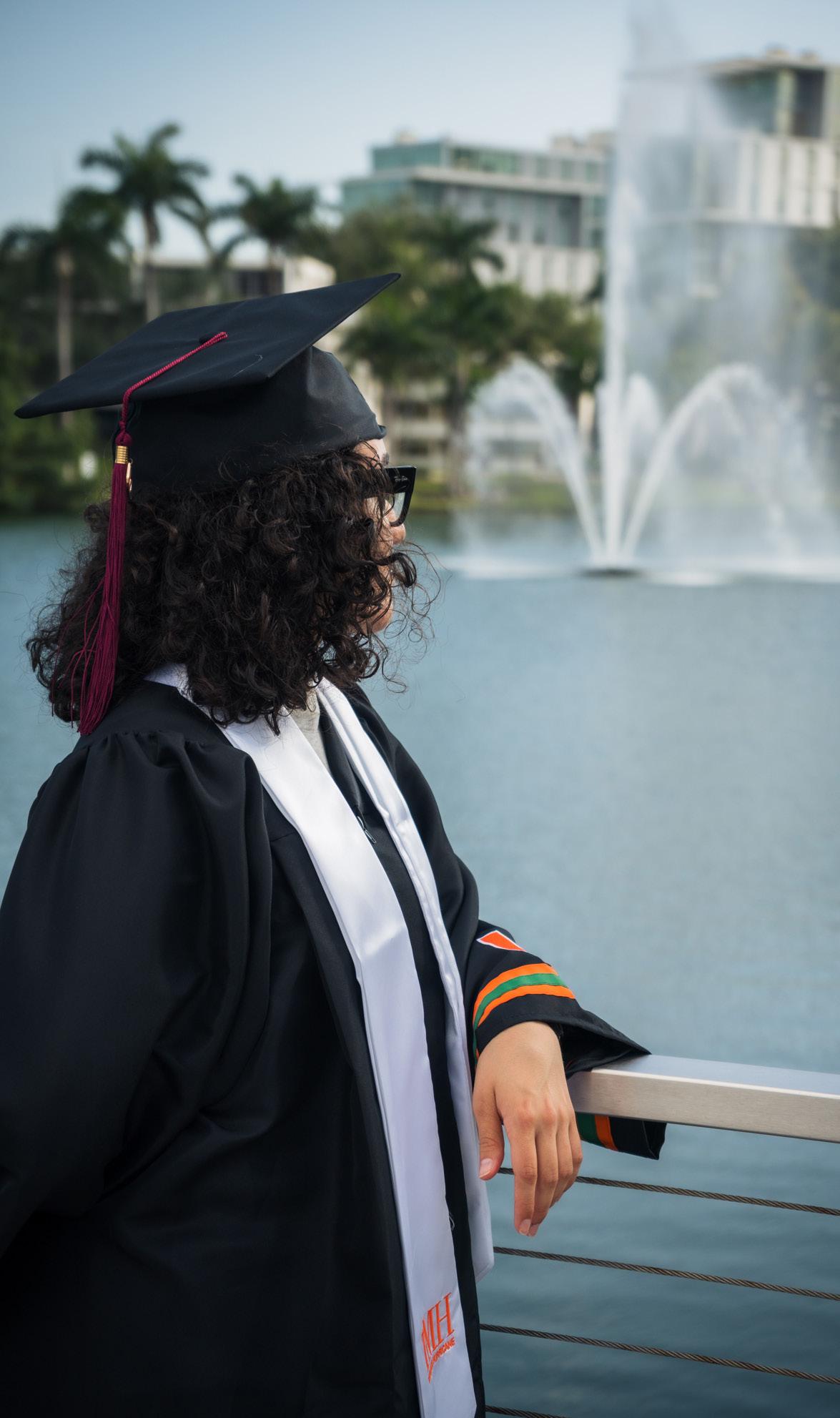
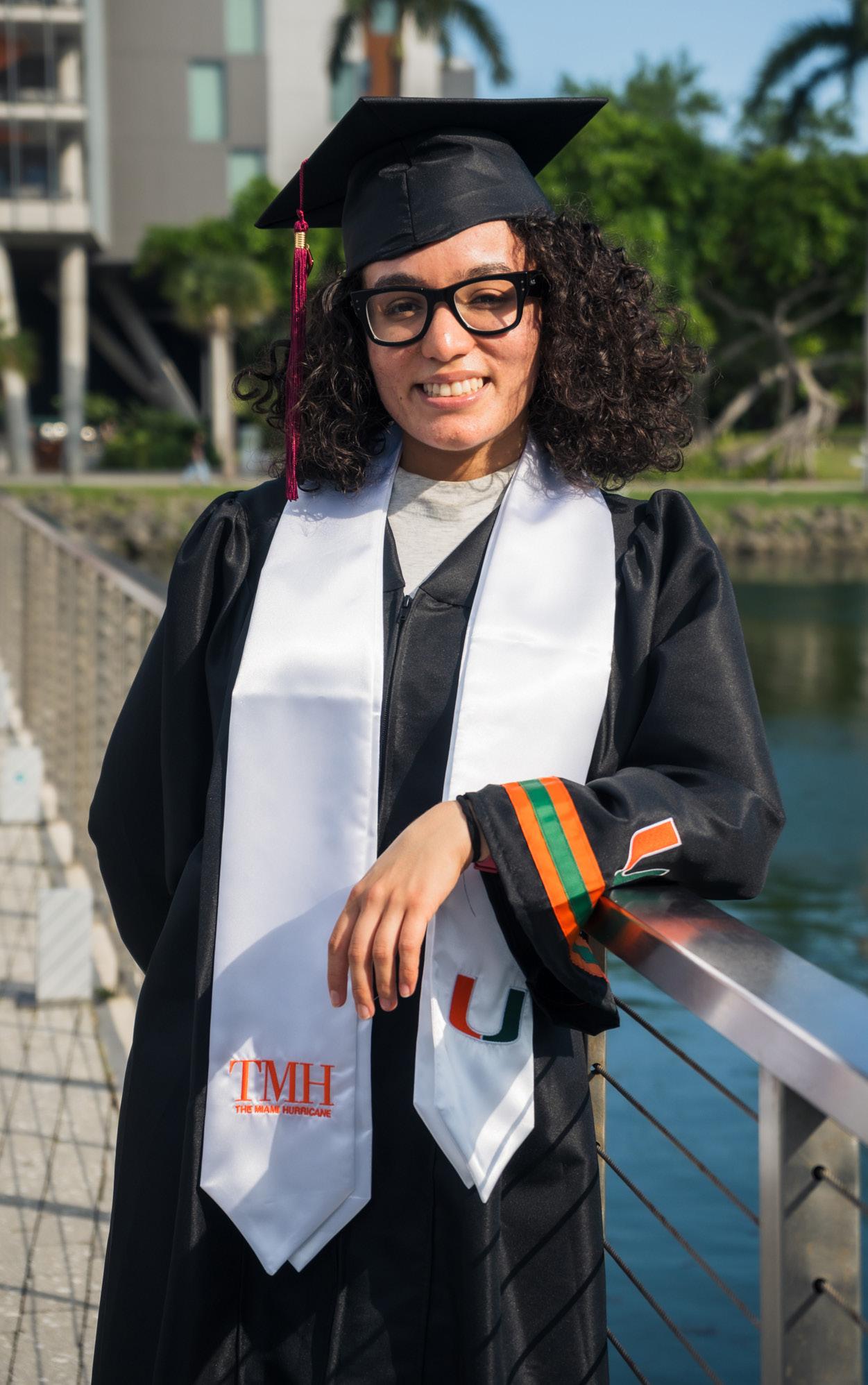
Graduating senior A&E Editor Samantha Rodriguez reflects on her time at UM on May 27, 2026.

By Gianni Echeverria
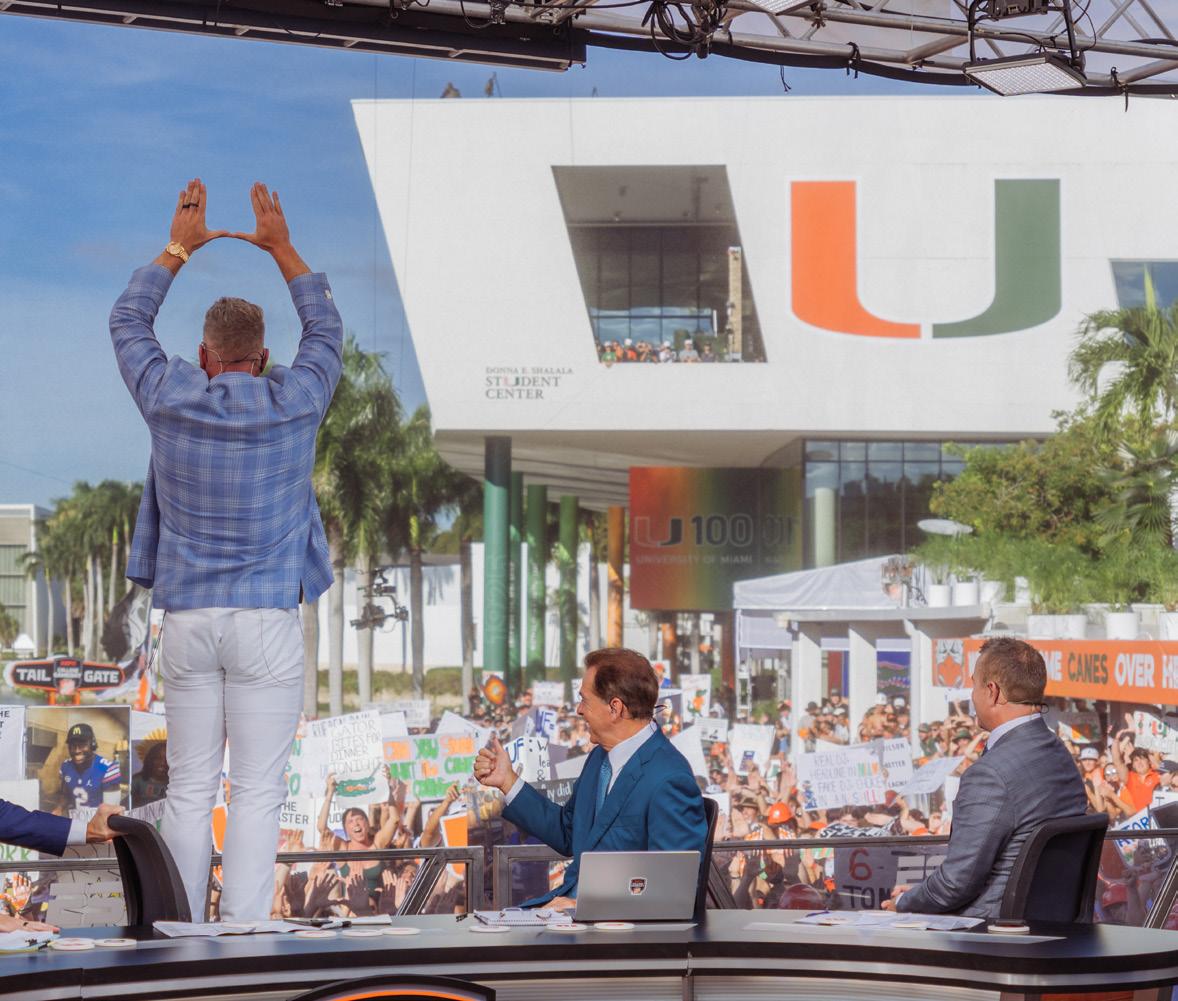
ESPN’s College GameDay visited the University of Miami campus on Sept. 20, ahead of the Hurricanes’ rivalry matchup against the University of Florida, for the first time since 2017.
“This is the U. This is the U that I knew. The U is back,” said UM President and CEO Joe Echeverria to The Hurricane. In 2017, the Hurricanes were one of the most promising teams in college football. They eventually lost their final two matchups of the season, as well as the Orange Bowl.
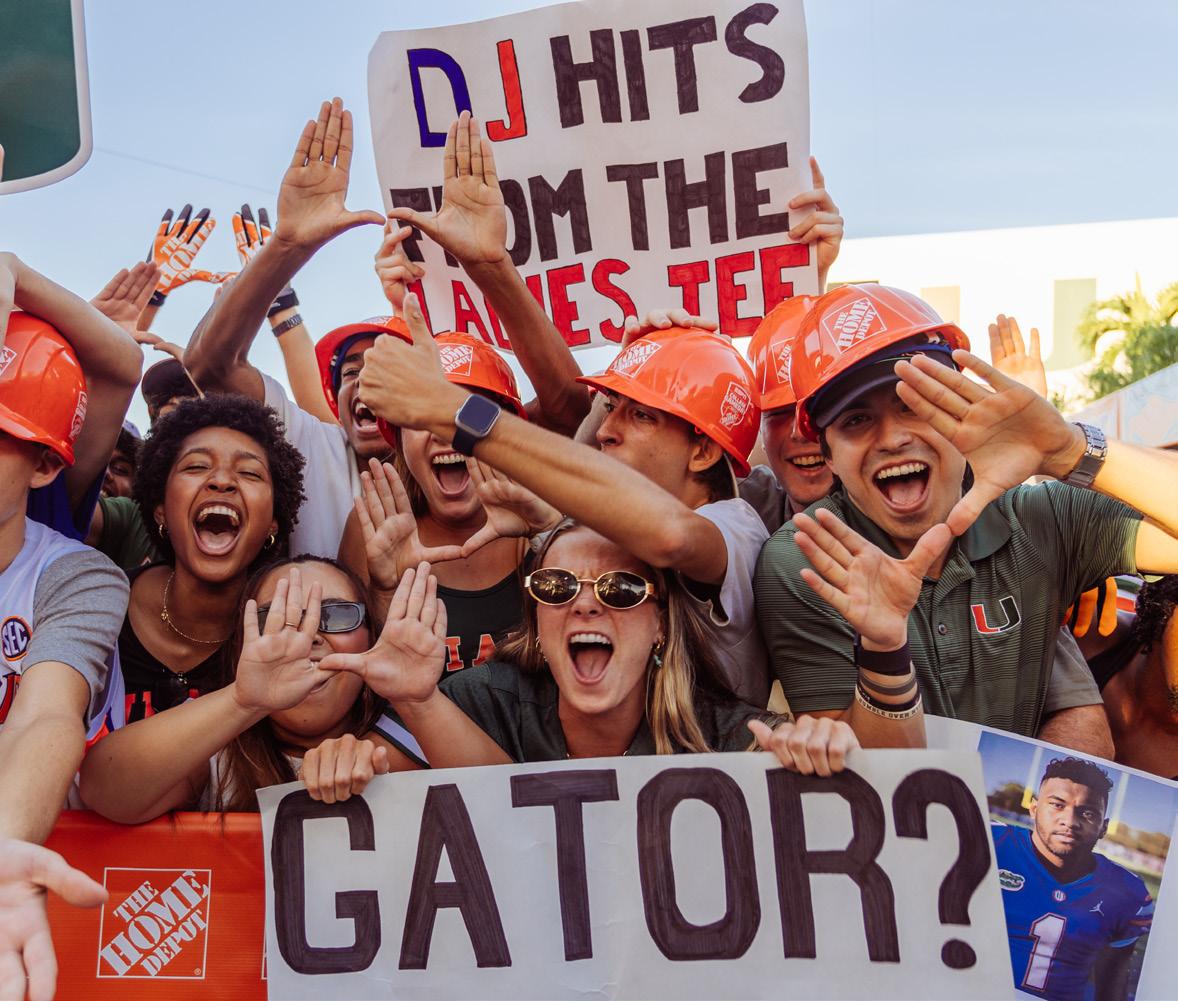
This year, football legends Desmond Howard, Nick Saban and Pat McAfee all predicted Miami to beat Florida while a crowd of more than 3,500 people behind them cheered.
At the end of the broadcast, Pat McAfee not only predicted Miami would defeat the Florida Gators, but he also ran to the high dive at the campus pool and jumped into the water screaming “The U is back!”
Some fans arrived at Lakeside Patio as early as 3 a.m. to secure a spot at the front. Among those fans was sophomore Luke Lentini.
“I love the atmosphere. It means our football team is doing great,” he said. “And the ‘Canes are rolling, baby!”
That excitement carried over to one of the show’s most popular segments: the field goal contest. In this segment, one fan is chosen to kick a field goal to win a large cash prize.
A Hurricanes fan named Henry Whiting selected his friend, Giovanni Guerrette, to kick. Guerrette was given two attempts to kick a 33-yard field goal to win $500,000. His first attempt bounced off the side of the Shalala Student Center and his second attempt fell just short of the goal.
College GameDay coming to Miami means more than just amusing signs and catchy chants. For the students, families and alumni who came to GameDay, the event signals a new chapter in the Hurricanes’ football program and a return to its former glory.
Shelton Douchett, a Miami native known for wearing a full Hurricanes football uniform to home games, was also present at GameDay. He wears the full uniform to honor his deceased brother, with whom he would frequently attend games.
“[College GameDay] means a lot. I’ve been coming to the games
for the last 16 years, and I dress up in honor of my brother’s memory,” said Douchett. “It’s like Thanksgiving for me. It’s amazing.”
GameDay also brought an increase in police and security presence to campus. Barricades were placed around campus, and fans were subject to bag searches and metal detectors before entering the event. Fraternity tailgates were also canceled due to the increased need for police on campus.
ACC Huddle, a live pregame show on the ACC Network, was also present on campus. It aired live from 10 a.m. to 12 p.m. and included an interview with head coach Mario Cristobal.
That evening, the Hurricanes traveled north to Hard Rock Stadium to take on the Florida Gators. Miami emerged victorious, defeating Florida 26-7. When asked about Miami in relation to the rest of the ACC, Eric Mac Lain, former Clemson football player and current ACC analyst, said, “I think they’re the best team in the league. They’re
“I love the atmosphere. It means our football team is doing great. And the ‘Canes are rolling, baby!”
Luke
Lentini UM Sophomore
the most complete team I have the least questions about.”
Some students had difficulty obtaining tickets for the event due to a website crash and a persistent loading screen. Despite these difficulties, student tickets still sold out just three hours after becoming available to claim.
By Katie Karlson & Dr. Patricia A. Whitely
As undergraduate students prepare to walk the stage and jump into the “real world,” it can be all too easy to get swept up in the festivities and wonder about the unknown. However, it is important that this year’s seniors take a moment to reflect on their last year on campus and how far they have come since move-in day.
Dr. Pat Whitely, UM’s senior vice president for student affairs and alumni engagement, has been a key leader on UM’s campus since 1982. Reflecting on her own experiences at St. John’s University and the University of South Carolina before she took root at the University of Miami, Whitely understands the uncertainty that may await in the next chapter of life.
Pausing for a moment before rushing into the future is an important step, and Dr. Whitely offers some words of wisdom on how graduating students can learn from their experiences, mistakes and self-discoveries from their time at UM.
A note from Dr. Whitely:
As your time at the University of Miami comes to a close, it’s worth returning to where it all began — that first day on campus. Maybe you were trying to find your way past Lake Osceola, checking room numbers in unfamiliar buildings or stepping into the Shalala Student Center for the first time. Everything felt uncertain. And yet, without realizing it, that uncertainty was the beginning of everything.
Over time, the campus became second nature. The walk past Lake Osceola turned into routine. Long hours inside Richter Library became part of your rhythm. The people who once felt like strangers became your community. And what stands out now isn’t just what you learned — but how much you’ve changed: more confident, more resilient, more willing to take risks and grow from them.
This year, that growth unfolded alongside something larger. As members of the graduating class, you were part of celebrating the University of
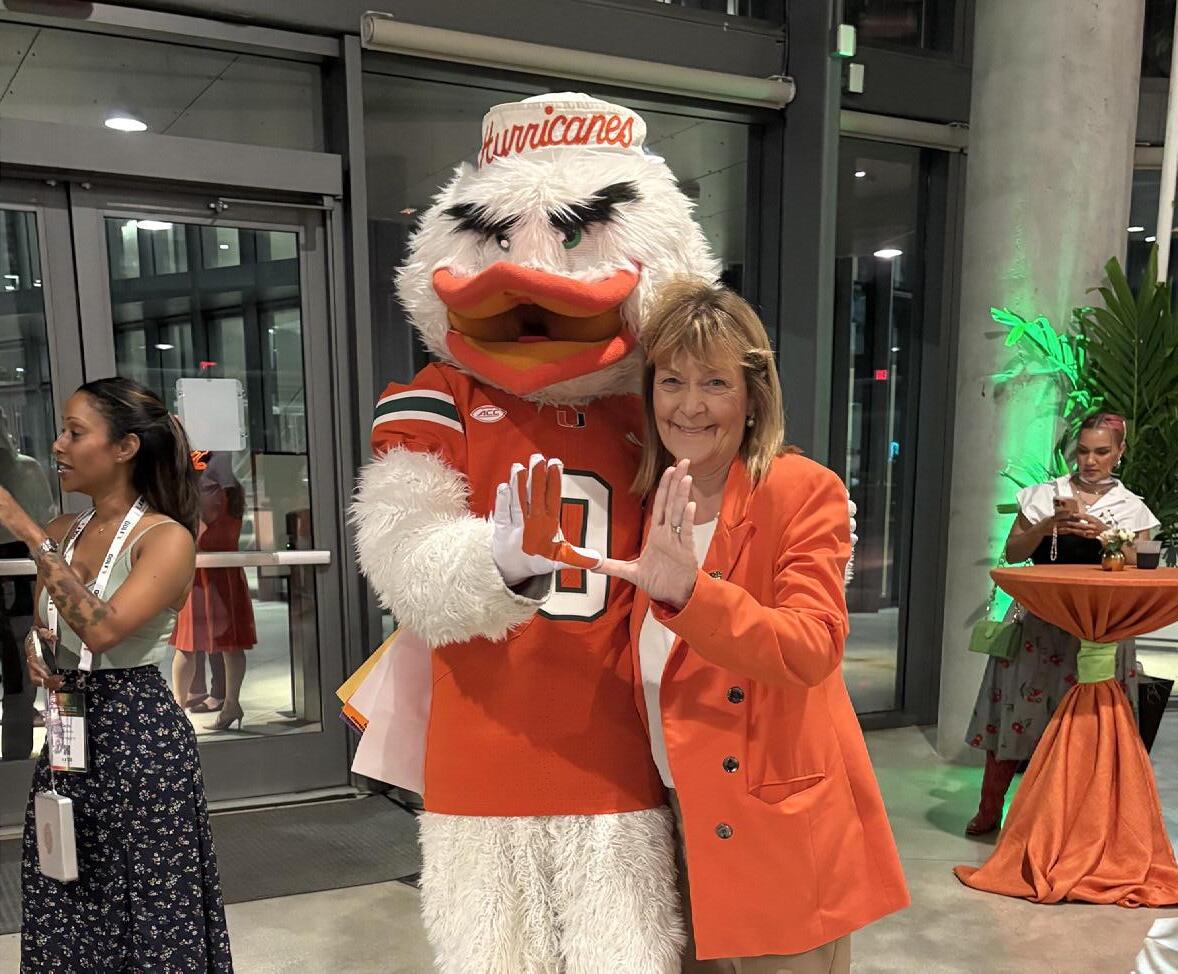
Miami Centennial — a milestone that honored a century of progress, resilience and impact. Through campus events, traditions and shared moments of reflection, you didn’t just witness history — you helped carry it forward. Your time here became part of a legacy stretching back 100 years, connecting your experiences to generations of Hurricanes before you.
Along the way, there were moments that reminded you what it means to belong. Not just in celebrations like Homecoming or game days, but in quieter, more meaningful ways — when someone checked in on you, or when you noticed a classmate struggling and chose to reach out.
That’s what Canes Care for Canes is really about. It’s not just a phrase — it’s a shared responsibility to look out for one another, especially when someone may be facing challenges and needs support. It’s about taking action, whether that means offering help, connecting someone to resources, or simply not ignoring when something feels off. It reflects a campus culture built on care, respect, and accountability among peers.
There are accomplishments to carry forward — academic successes, leadership roles and personal growth that no transcript can fully capture. And yes, there may be re-
grets too. But even those moments helped shape your path and clarify what matters most.
Before you graduate, take a walk — alone — across campus. Start somewhere familiar. Pass the places that defined your time here. Sit for a moment and reflect: How have you changed? What surprised you? What will you miss?
Because it’s in those reflections that the most meaningful memories surface — the late nights, the small wins, the friendships that made this place feel like home.
As you move forward, there will be pressure to define success quickly. Resist that. The most meaningful paths are shaped by authenticity, not comparison. And when things don’t go as planned, remember: Starting over isn’t failure — it’s clarity. What will matter most is how you show up for others. The mindset behind Canes Care for Canes doesn’t end here — it goes with you. It’s now part of who you are.
So take that walk. Not just for closure, but for recognition. The person who arrived here is not the person leaving.
This isn’t an ending. It’s a continuation — grounded in growth, shaped by community and forever connected to The U — and to the century of stories you now help define.
By Casey Servatius Senior Staff Writer
The University of Miami’s growing social media presence has prompted students to nickname the school “Influencer U.” Behind the nickname is a campus where filming and posting content has become a daily occurrence.
According to a survey conducted by The Miami Hurricane, 82.6% of 69 student respondents said they believe the public views UM as an influencer-focused university. The survey was posted to The Hurricane’s Instagram story for 48 hours.
Anna Becker, a junior majoring in health sciences, said she has noticed the growing popularity of TikTok around campus during her time at the U.
“Sometimes by the dorms or walking to classes I’ll see people filming TikToks,” Becker said. “People post everything from Get Ready With Me’s, to day-in-the-life vlogs and dance videos with friends.”
One of the most notable examples is Alix Earle, who graduated from UM in 2023 and now has 8.5 million followers on TikTok and 5.6 million followers on Instagram. According to Parade and Celebrity Net Worth, Earle is now worth $20 million. Her viral videos during her junior year helped launch what many viewers refer to as the “Alix Earle Effect.”
Other influencers have grown large followings during their time at UM, turning social media into their career.
Abby Gendell, a TikTok creator with 531,900 followers, graduated from UM in 2024. She now works in New York City as a content creator thanks to her success on TikTok and Instagram.
“When I moved to New York, I continued growing, and a lot of people who followed me in college stayed,” Gendell said. “I figured if I could build my own brand, I could do that for a company someday, and if I ever applied for a marketing role, I could point to my platform.”
Ximena Ponce is a media management student at UM, and has amassed
on Instagram. She
of
By Casey Servatius Senior Staff Writer
CONTINUED FROM PAGE 3
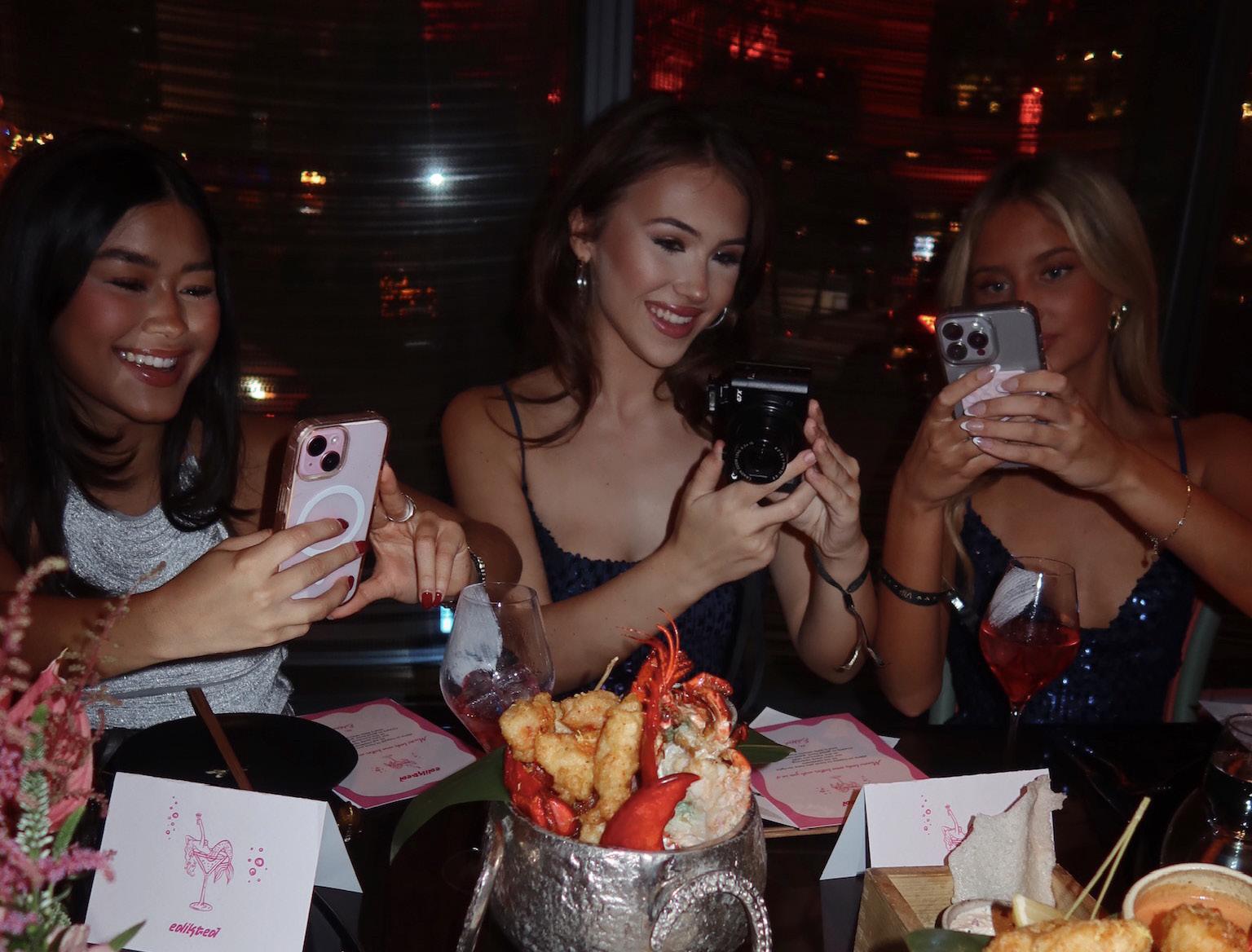
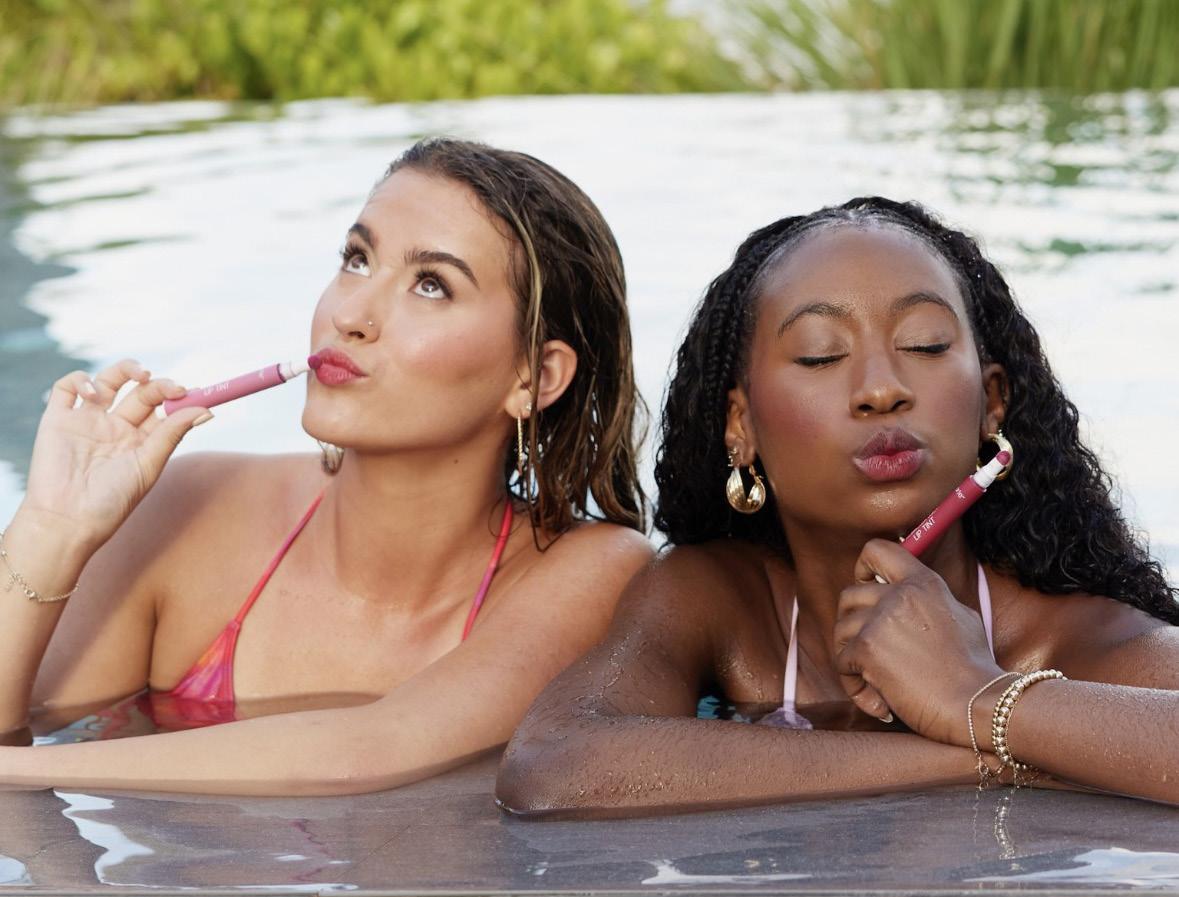
Hosting brand trips is another way that popular brands connect with their audience. Some students had the opportunity to attend “Trippin’ With Tarte,” an influencer brand trip hosted by well-known makeup brand Tarte, in Key Largo in April of 2025.
Eva Free, a sophomore majoring in public relations and psychology, attended the trip through a personal connection with Tarte CEO Maureen Kelly’s son, who is a UM student.
“There were a few other UM girls besides my friends and I, maybe three or four,” Free said. “I think that being at UMiami exposes you to these
kinds of experiences even if you aren’t directly trying to get them.”
Some classes even require students to make TikTok or Instagram accounts for projects, imitating real-world experiences where social media is used in everyday business practices.
Valentina Gomez, a junior studying creative advertising and marketing, created the “Table For Two” TikTok account in September 2025 as her final project for a digital marketing class. Gomez set students up on blind dates in the library to help people form connections.
The “Table For Two” account has gained about 35,000 likes and 1,512 followers as of April 29, 2026. Her most popular videos currently have tens of thousands of views, with one reaching 242,800.
“I did expect it to do well on TikTok,” Gomez said. “I think it
was a unique idea and I knew that I just had to commit to it.”
Commitment is key, but influencers also attributed part of their success to UM’s lifestyle and campus.
“Being on a campus with palm trees and a lake made it so easy to film content. You’re inspired by everything around you all the time,” Gendell said. “I feel like Miami’s aesthetics made content creation really easy.”
Staff members at UM also view the University’s growing social media presence as a positive reflection of the University’s online image.
Professor Catherine Schenquerman, a lecturer in strategic communication, teaches a course titled “Social Media Influencers.” She understands the advantages UM students have by attending school here.
“All universities today benefit tremendously from social media vis-
ibility,” Schenquerman said. “Univerity of Miami in particular has a stunning campus that translates beautifully to visual platforms.”
Influencer culture can be seen on college campuses nationwide. Students are building strong online presences by posting lifestyle content at schools like University of Southern California and Arizona State University, both of which have beautiful campuses. However, UM students feel that influencer culture is especially prominent, and that the media attention has created a stereotype that all students are interested in social media.
“I think that people feel UM fits into this one mold, when it has so much more to offer aside from popularity and influencers,” Becker said.
Media attention can also hinder the University’s image among news outlets. The Washington Post pub-
lished an article on Nov. 12, 2025, describing the “vicious turf war” among influencers at UM.
According to the student survey, 72.1% of students said they do not like or are unsure about the media attention that UM has received.
“I feel like the only reason some people are here is to be the next Alix Earle,” said an anonymous responder.
Other students say that the University is not respected as an academic institution.
“It is strictly viewed as a party school with a side of education, and I really don’t like how this school has turned into that,” said another anonymous responder.
Whether the influencer stereotype is embraced or rejected, students agree that social media has become an unavoidable part of campus life.
By Martina Pantaleon Senior Staff Writer
Dr. Theodore Lampidis, a cancer researcher at the Miller School of Medicine, released a new ‘Canes Fight Song after five years in the making.
Every football game is marked by the beating of the drums, the cheering crowds and the Miami U HowDee-Doo — the Hurricanes’ decades-old fight song that is as much of a tradition as the Alma Mater.
Dr. Lampidis felt like it was time for a change.
Inspired by the promise of a “comeback” in 2022, Dr. Lampidis composed a new fight song, appropriately titled “Miami Hurricanes,” and released it on Jan. 16.
“They’re back to the old days where they were winning championships,” Lampidis said. “But what got me to do the song originally is just my love for UM.”
Although there are currently no plans to implement his fight song as The Hurricanes’ official chant, it has already reached a wide audience.
His original version of the song featured his eleven-year-old daughter as the singer. After this version of “Miami Hurricanes” aired on Local 10 in 2021, he got some feedback from the station.
“I was told that the song should be done by a male,” Lampidis said. “And that it should be arranged differently.”
The new version was recorded with Sam Rawls, a singer and music engineer, whom Dr. Lampidis met through other projects.
This was not the first time Dr. Lampidis wrote a song — songwriting had been his hobby since childhood. He finally connected with the music industry after composing a piece inspired by “Marathon Man” in 1976.
“As I was writing the song, and I was getting to where I wanted to get to, I decided to call Paramount Pictures,” Lampidis said.
The song was not finished yet, but he had gotten the contact for Marvin Cain, former president of Famous Music Corporation, Paramount Pictures’s music publishing division.
With the help of a band of bar musicians, Dr. Lampidis put together a demo. Even though it was never published, his passion for songwriting did not waver.
Almost a decade later, another one of his projects, “Close My Eyes,” appeared in an 80s coming-of-age comedy series called Red Oaks.
Because of his brief history with the industry, Dr. Lampidis knew that the best way to get his fight song out there was to pick up the phone — or, in this case, start sending emails.
“If you wanna do something, go work for it,” Lampidis said.
Since its re-recording, Dr. Lampidis shared the song with broadcasters, radio stations and UM staff.
Erica Arroyo, associate vice president for engagement at UM, even shared it on the University’s official Instagram. According to Dr. Lampidis, Arroyo later sent him an email expressing her intent to continue using the song at events.
Dr. Lampidis recalled an email from President Echeverria with a similar sentiment, saying the song “was excellent,” but it still had a “long way to go.”
In his last exchange with Dr. Craig McKenzie, the director of athletic band at UM, Dr. Lampidis said that Dr. McKenzie thought the fight song was a “cool idea” that the Frost Band of the Hour could “play in the future.”
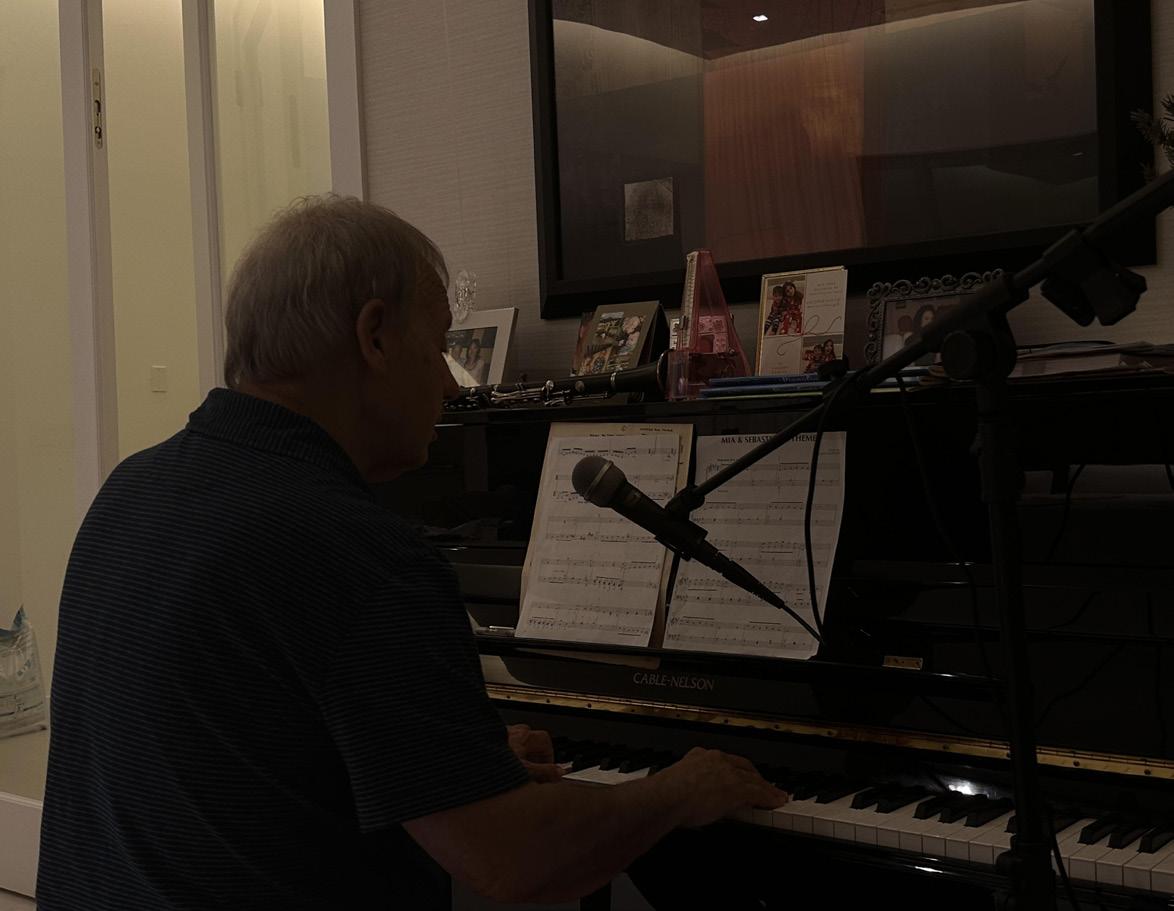
Despite the already large number of listeners, the song still “belongs to the students,” and was designed for the UM community to support the Hurricanes.
For Dr. Lampidis, the piece is more than an expression of his love for UM. It is proof that a person is not constrained by their profession
or a singular interest.
“People are people, they have many capabilities, and they should never label themselves,” Dr. Lampidis said.
If you would like to listen to Dr. Lampidis’ work, the song is titled “Miami Hurricanes by Ted Lampidis” on YouTube.
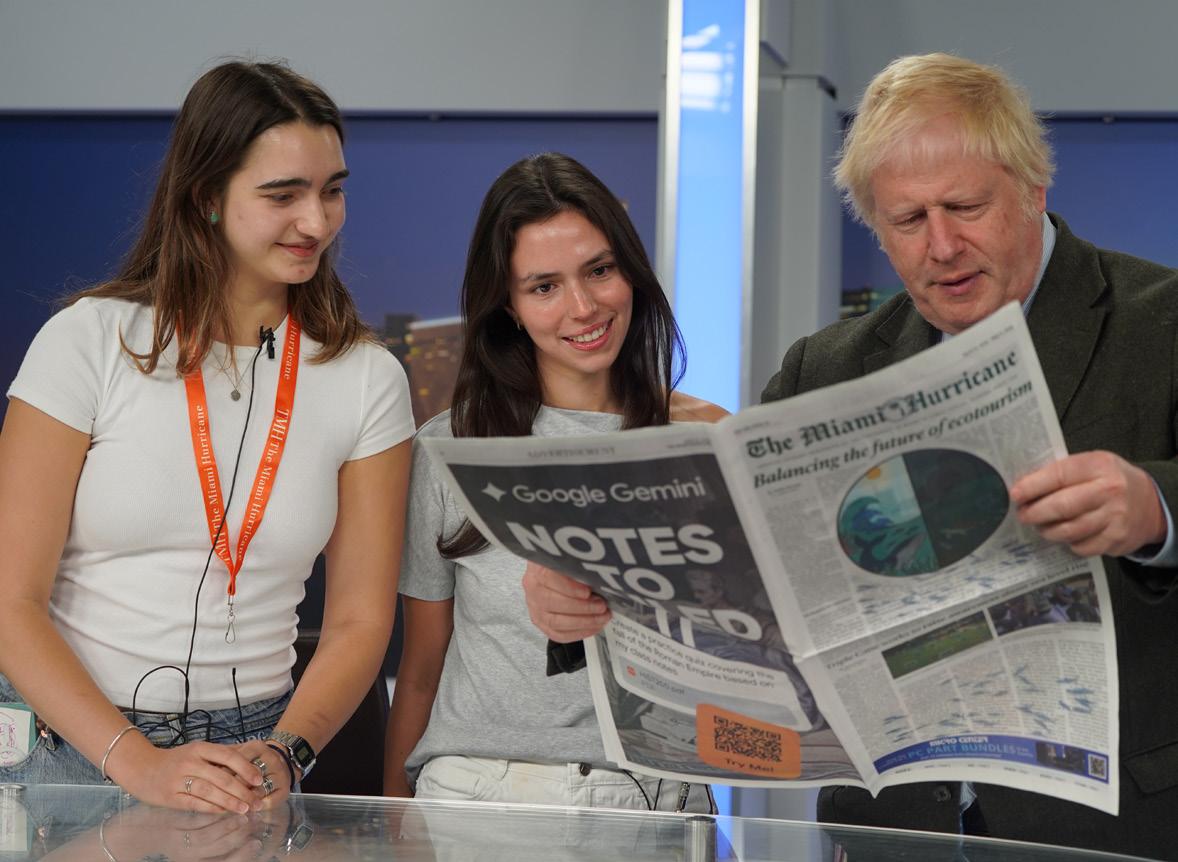
capable of polarization than a unipole,” Johnson said. Johnson was the Provost’s visiting lecturer at UM this semester, and on Wednesday, April 22, he held a roundtable discussion with UM’s media, including The Miami Hurricane. He discussed democracy, international intervention and the fragile state of the world order.
His message was simple: “You
son knows more personally. He was once sent to negotiate with Nicolas Maduro, an experience he recounted with characteristic self-deprecation.
“I was sent to try to talk to Maduro and to persuade him to be a democrat,” he said. “Pretty hopeless venture.” When he urged Maduro to put opposition leader Maria Corina Machado on the ballot, Maduro refused. “He said, ‘No, no,
mation,” Johnson said. “Yet.” Critics like Brazil’s President Luiz Inácio Lula da Silva called the intervention a “regrettable chapter in the continuous erosion of international law.” Johnson is unmoved.
“International law is very important,” he said. “But even the most liberal-minded people are not consistent with it.”
His closing thought returned to



A great time to start your next chapter at Flow. Now leasing across South Florida. We'd love to show you around. Text “HURRICANES” to 88033.

By Balaj Raza Senior Staff Writer
If I could sit down with my freshman-year self, I would probably start by telling him to breathe.
You do not know it yet, but the next four years will challenge you, humble you and shape you in ways you cannot imagine. Right now, you are walking onto campus with big dreams, quiet fears and the pressure of wanting to prove yourself. You think success has to happen immediately, and that every missed opportunity means you are falling behind.
I would tell myself that rejection is not the end of the story. There will be moments when doors close, when people overlook you and when opportunities that you want go to someone else. Those moments will sting. You will question yourself more than once. But what you cannot see yet is that those disappointments will build your resilience and lead you to places you never expected.
I would tell him to trust his voice.
There will be times when you wonder if your ideas matter or if anyone is listening. Keep writing anyway. Keep speaking anyway. Keep creating anyway. Some of the things you make will connect with people in ways you never imagined. The stories you tell and the risks you take will open doors, introduce you to incredible people and remind you that your perspective has value.
I would tell him to appreciate the people who believe in you.
There will be professors, mentors, supervisors and friends who

see something in you before you fully see it in yourself. Listen to them. Thank them. Stay close to people who encourage your growth. Their support will carry you through some of the hardest moments. I would also remind him to be kinder to himself.
You are going to work hard. You are going to care deeply. You are going to want everything to happen now. But life rarely works on your timeline.
By Alex Airapetov Staff Writer
The time has come for the University of Miami students and staff to switch from Blackboard to Canvas.
After 20 years of enduring the clunky and outdated learning system known as Blackboard, this could not come soon enough. From the constant glitches to the obsolete format, it caused more headaches than it was worth.
But now with the decision to fully commit to Canvas as its main learning system, the University has chosen to step in the right direction — into the future, to create a better learning experience for all.
When I transferred to UM this year, I was shocked to see the University still using Blackboard. After using Canvas throughout high school and my previous college, Blackboard felt 20 steps backward. Everything felt slow and confusing. I probably spent more time submitting my assignments than I did actually doing them.
This sentiment is shared by many students at University of Miami, not just myself.
“It’s really frustrating that I can’t see my grades and each class has
their course organized differently, so it makes it super confusing to use,” said freshman Alyssa Brown. “When I had my first class in August and I was trying to find my lecture, it took me almost an hour to figure out.”
Audrey Booher, a freshman at UM, has a similar frustration about Blackboard’s unclear dashboard.
“In Canvas there’s a dashboard and I can see when my assignments are due, whereas with Blackboard, I’ve missed several assignments because of how badly it’s organized,” said Booher.
While the full change to Canvas will officially take place next year, the University is still in a mixed phase with classes using both Canvas and Blackboard. This period of mixing gives students the opportunity to get used to Canvas’s features while continuing to use a learning system they are already familiar with in Blackboard.
Unlike Blackboard, Canvas is actually intuitive and built for today’s students. The assignments are easier to find, the navigation is smoother and even the notifications are easier and more helpful than Blackboard. Canvas even adds confetti when you submit your assignment, which feels like an accomplishment when I submit mine.
The faculty at UM also benefits
Some blessings arrive later because you need time to grow into them. What feels delayed is often preparation. And, I would tell him to enjoy Miami more.
One day, the campus that feels so ordinary will become a place you miss deeply. The walks to class, the late nights with friends, the spilling-tea-sessions on the gliders, the feeling of being young and building something for your-
self, all of it will mean more than you realize while living it.
Most of all, I would tell my freshman-year self this: The version of you that exists four years from now will make you proud.
You will earn opportunities you once only dreamed about. You will grow stronger through every setback. You will learn that hearing “no” does not define you. You will meet people who change your
By Birdie Church Contributing Writer
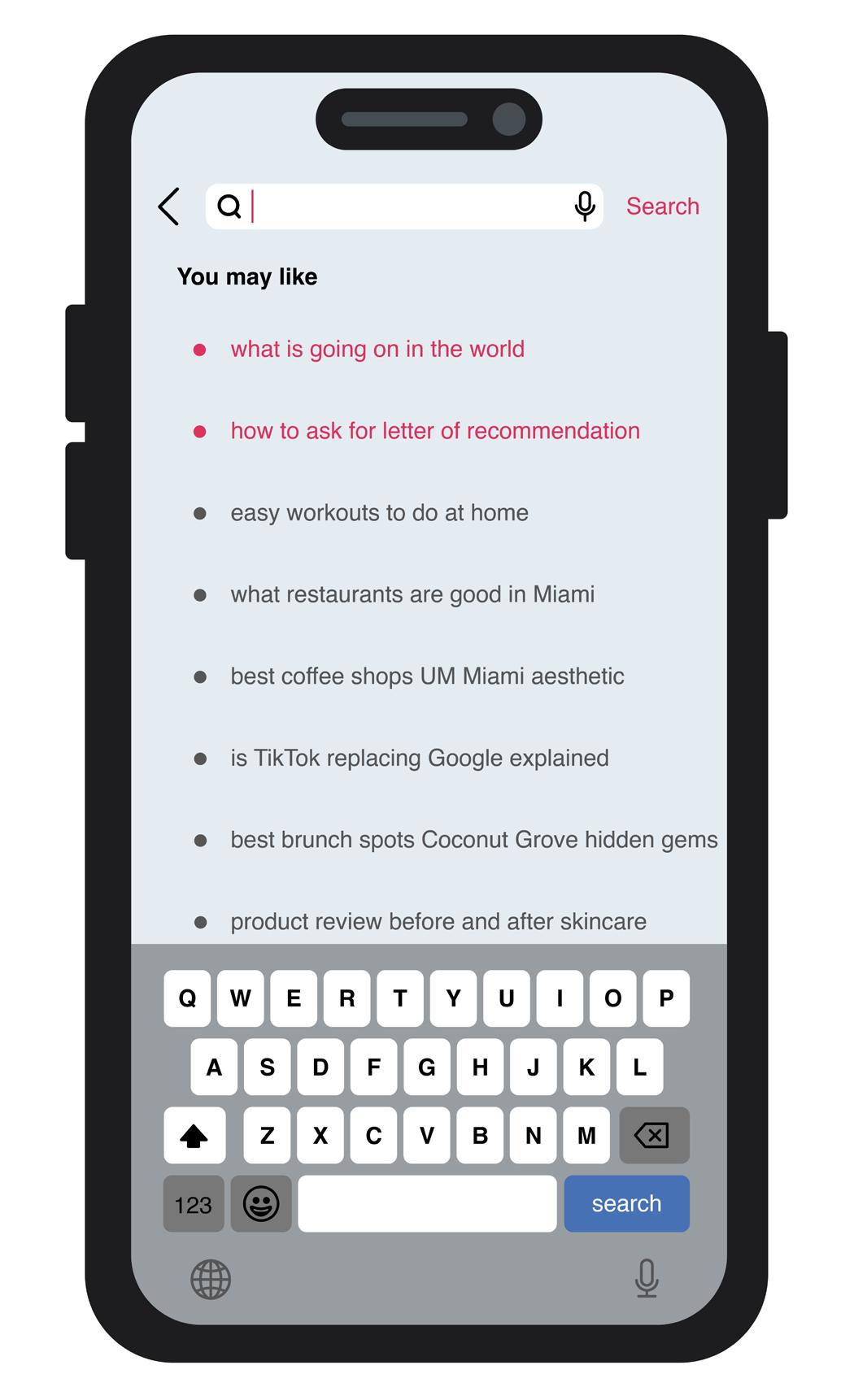
Search engines didn’t disappear — they moved.
TikTok is essentially the new Google. With Gen Z’s love for the 15-second visuals, paired with the hyperspecific algorithms, TikTok’s search results are better than those of Google.
One in five Americans got their news from TikTok in 2025, according to a Pew Research study, meaning information intake is clearly changing. And, honestly? It’s for a good reason.
The shift from Google to TikTok is beneficial because it delivers more accessible, visual and user-driven information that better matches how younger generations consume content.
The internet’s growing reliance on AI has eroded Google’s once-trusted reliability. Google recently changed its algorithm to display AI-generated results at the top of the page, rather than its previous method of showing an excerpt from the most relevant source.
The shift toward TikTok reflects a rebellion against this change — a preference for human-driven, experience-based content over
AI-generated answers.
“I hate to admit it, but since I am on TikTok so constantly, I find out most of my news from there,” UM freshman Shannon Brickley said. “Whenever I want to know more, I will search it up and doomscroll.”
This is more popular among students than people think. In an interview with Fortune Magazine, Senior Vice President of Google, Prabhakar Raghavan, emphasized that TikTok is taking over in small ways, such as finding a place to go for lunch. According to their studies, 40% of young people go straight to TikTok or Instagram instead of a regular search engine like Google.
However, a closer look at TikTok’s algorithm will reveal how easily misinformation is being spread.
TikTok will prioritize a user’s preferences over factually correct information, meaning if you like one video that has misinformation in it, you will start to see more and more videos with that same polarizing perspective on your For You Page.
Despite the ease at which misinformation can spread, the platform is still great for finding out about new trends or getting restaurant recommendations.
When looking for restaurants on
Google, results are largely sponsored or have a massive number of reviews from being around for so long. As a result, these older places are bumped to the top of the search regardless of the quality of the food.
Even the UM student go-to coffee or matcha classic, Honey Veil, is underserved on Google. While it doesn’t come up on the first page of any search engine for coffee shops around UM, it is one of the first results when searching for coffee shops on TikTok.
The difference isn’t just in the quality of the suggestion, but also in the quality of how information is communicated. TikToks are shortform videos that feature visuals paired with information that takes little to no work to consume.
Attention spans have been vastly shortened by the internet, so TikTok’s entertaining approach to information is more aligned with how information is naturally consumed now.
TikTok’s personable, young and entertaining approach is beginning to give Google competition for the best search bar. Google is not being erased, but as people evolve their habits and Google’s content declines. Its dominance is fading, leaving TikTok to be the future of search.
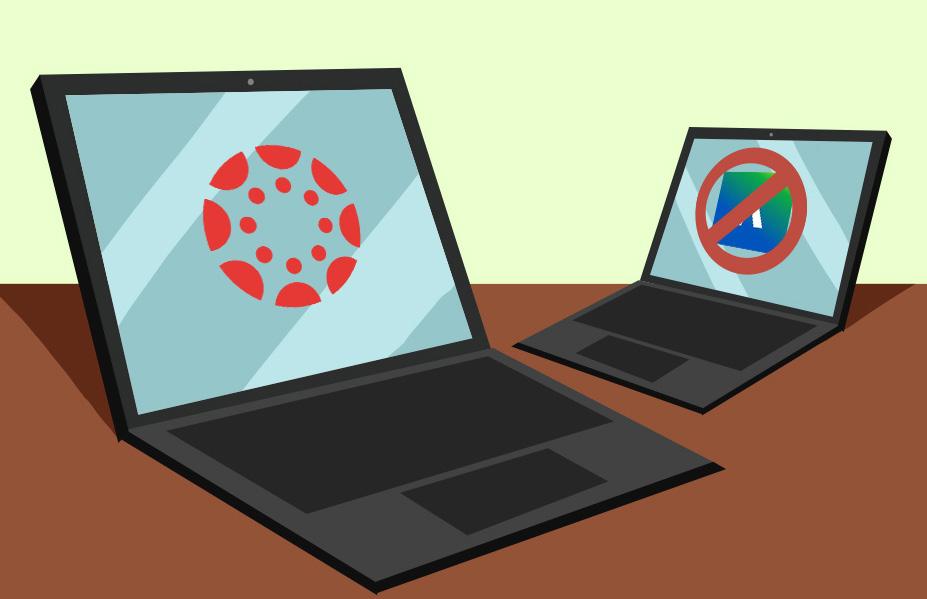
from the switch Canvas streamlines grading and allows professors to give faster feedback to students, saving professors time and helping students stay on track in their learning.
“I love how it allows me to organize everything into modules, creating a clear and logical flow for students,” said Dr. Johayra Bouza, a lecturer of psychology at UM. “Each module includes a variety of course materials such as lecture slides, readings, assignments and discussion board posts.”
The conversion to Canvas re-
flects the University’s commitment to modernizing the student experience. Adopting a user-friendly platform such as Canvas shows that the University is ready to make the school more accessible and technologically friendly to students. Of course, no system change is perfect. There will likely be a few bumps along the way as students and staff adjust to the new interface. But the short-term confusion is a small price to pay for a platform that works. In time, the University’s commitment to Canvas will pay off in dividends.
The school’s decision to upgrade from Blackboard to Canvas isn’t just about upgrading software; it’s about improving the overall learning experience at UM. Students deserve a platform that supports their learning, not one that hinders it. And professors deserve tools that make their jobs easier and not more complicated. After years of dealing with Blackboard, the University’s switch to Canvas marks a long-overdue step forward. Good riddance, Blackboard, you will not be missed.
By Daniella Krasney & Hannah Valdivia Co-News Editor & Co-Managing Editor
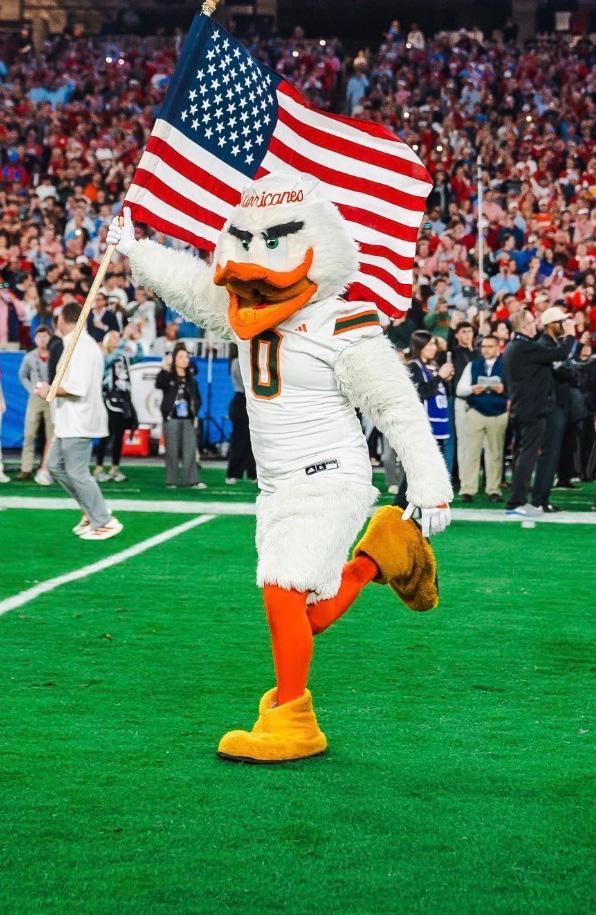
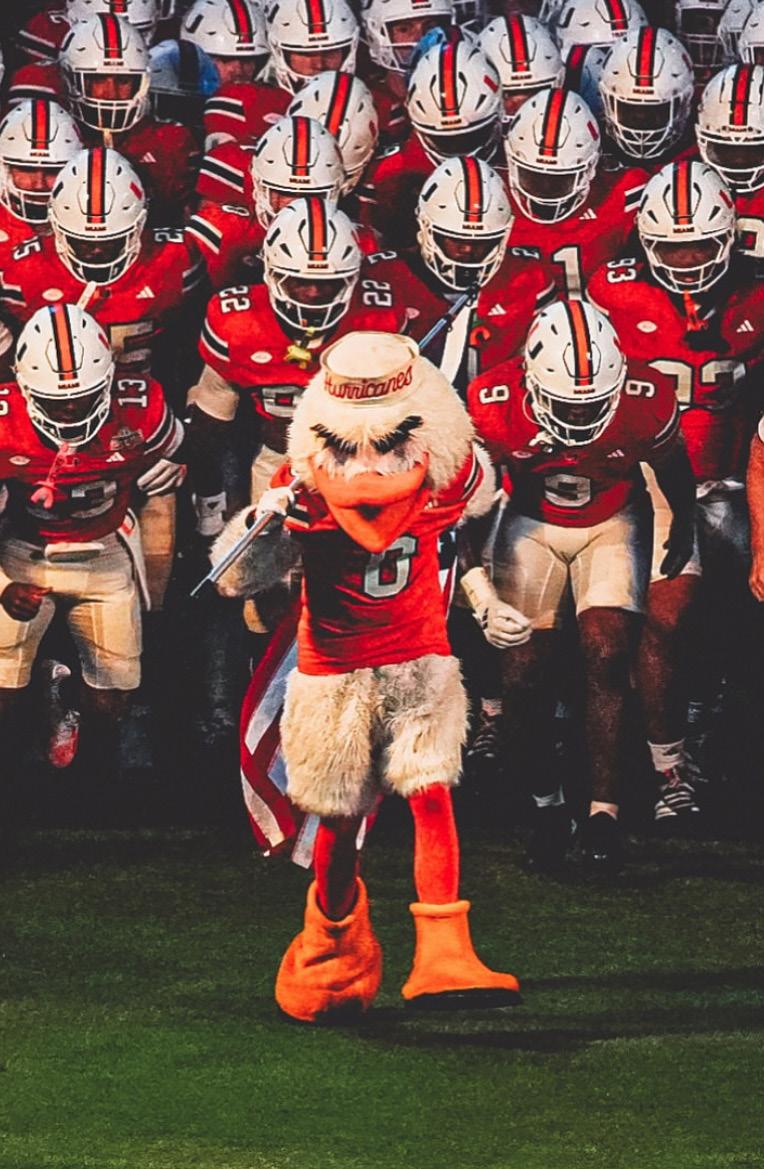
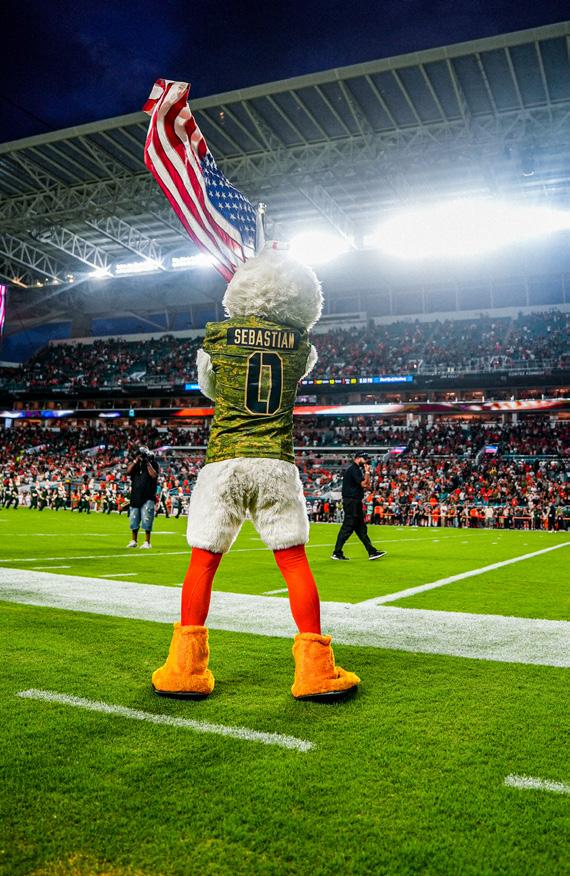
Whether you’re lounging by Lake Osceola, cheering in the stands at Hard Rock Stadium or grabbing lunch in the dining hall, chances are you’ve seen Sebastian the Ibis rallying the University of Miami community.
As a 2025 inductee into the Mascot Hall of Fame, Sebastian has become an unmistakable symbol of Hurricanes spirit — but the students behind the beak remain unknown.
The students selected to wear the suit work in complete secrecy — balancing classes, friendships and campus life while keeping their identity hidden from nearly everyone around them. It isn’t until graduation that the mask finally comes off.
This semester, the senior Sebastian will walk the Watsco Center graduation stage, revealing themselves for the first time and passing the role to the next generation.
“You feel like a rock star, you have an entire stadium there in front of you. Then you go from that to, okay, I’m myself again,” said the graduating Ibis.
The Miami Hurricane agreed to withhold the student’s identity until he is publicly revealed at graduation.
The student athlete’s “double life” has defined his time at UM.
Besides cheering on the ‘Canes at sporting events, Sebastian can be booked for weddings, birthday parties and even corporate meetings during the week.
The student described how he often entered an event as the center of attention, then returned to class as a regular UM student without any of his classmates realizing the mascot sat among them.
“There are times I’ve had an hour between class because I have to do an event in Shalala, for example, and then get back to class [very sweaty],” said Sebastian. “In the last month, I’ve put up 22 ap -
pearances and I love it.”
This student grew up “bleeding orange and green.” Now, he is the captain of the squad of Sebastians, supervising and mentoring each student who dons the mask, supporting the next generation of “hatchlings.”
“It was not something I even thought was possible or a journey I saw myself going on,” Sebastian said. “Now, it’s the only thing I’ve done in college because I give my life to that, and that’s what I’ve done for years.”
Sebastian added that he was not originally in the physical shape needed for the job, but the hiring team felt his passion and determination was deserving of the coveted role.
“I showed up, and they told me when they hired me that I needed to gain fifteen pounds,” Sebastian said. “I know I didn’t get the job based on anything physical, but I had the heart, and I love it.”
Sebastian said that his friends encouraged him to try out because he thought his personality and character were perfect for the job.
“I kind of just tried out on a whim,” Sebastian said. “I was never one to enjoy the spotlight or being the center of attention, but since then it’s become something I absolutely love.”
Like many university mascots, the students behind Sebastian remain anonymous until graduation, a tradition that protects the illusion and complicates their everyday lives. To maintain that secrecy, the students often go to great lengths.
“I’ve never been so manipulative in my life,” Sebastian said. “Literally last night, I had to make up the craziest excuse to kick my friend out of my apartment.”
For him, the challenge is not being able to share defining experiences of his college career.
“[Lying] does honestly suck because it’s such a big part of our lives that I want to tell people about it.”
Each student-athlete puts in rigorous training to withstand the heat that comes with cheering at football games and outdoor events, even hydrating four days before the game.
Sebastian shared that he did not take this hydration policy seriously, and he passed out in the football locker room following their first appearance in the costume. He emphasized that the physical toll can be intense, but it’s the emotional payoff that keeps him showing up.
“All the smiles you put on people’s faces and the experiences we’ve had so far outweigh any nega-
tive things associated with this job,” Sebastian said.
“It’s not even close.”
He described the Ibis as the “Mickey Mouse of South Florida”, a character whose vibrant energy electrifies crowds and ignites joy in fans. He explained that this connection is not just felt by the crowd, but by the person behind the mask.
“Just seeing the way that you can bring positive change in other people’s lives brings me up as well,” Sebastian said. “And so it’s been absolutely phenomenal to just see how I can have that impact on people and to bring people together like that.”
The student described his role as “the peak of my life.” He says that he’s learned a lesson of positivity that he will bring with him even after he walks the graduation stage.
“Sebastian brings people together. He brings people joy regardless of their age,” he said. “[I want to] be that person who brings people joy, that people want to be around.”
As UM’s senior Sebastian walks the stage, his time, talent and heart will shine through as he wears the costume one more time and delivers the final chant: C-A-N-E-S.
By Amber Del Valle Contributing Writer
When Sienna Sacco arrived at UM, she had no idea where social media would take her. She posted content primarily just for fun until a couple of unexpected videos changed her life overnight.
“I started creating content in high school as just a complete joke,” Sacco said. “I didn’t take it seriously.”
That perspective changed when a few of her videos gained thousands of views. As her platform began to shift, so did her ideas for the future.
But, behind her curated content and expanding audience is a busy schedule. Sacco, a nursing and health science major, balances tedious coursework with her online presence.
“It’s definitely super hard,” she said. “You just have to find a schedule

and plan everything out.”
Her path in the science industry requires acute focus. Beyond academics and social media, Sacco is also pur-
suing modeling, adding an additional layer to her demanding schedule.
Her transition into college highlighted a turning point. In an environment like UM, where influencer culture was on the rise, Sacco began to approach content creation more intentionally.
Now, with more than 500,000 followers on TikTok, Sacco expresses her success as “out of the blue.” Growing up to be very shy and quiet, she said putting herself online felt surreal.
“Me doing that was just kind of like, ‘Oh my God,’” she said.
As she reflects on her college journey, Sacco said personal challenges — including a difficult breakup — helped shape her into the person she is now. “That made me who I am today,” she said.
As graduation approaches, Sacco plans to continue her studies and potentially pursue acting.
Despite her success, Sacco remains self-aware of the impact she has on her followers. She recalls meaningful moments when followers have approached her.
“They’ll be like, ‘You’re my inspiration,’” she said. “That just makes me so happy.”
For underclassmen, her advice is straightforward: “Be friendly and go out. Don’t say no to anything. It goes by in the blink of an eye.”
If she could speak to her freshman self, Sacco said she would offer reassurance.
“Everything will work out the way it’s supposed to,” she said.
As her chapter at UM comes to a close, Sacco leaves behind more than just a digital footprint — she leaves an empowering message about growth, balance and embracing the moment.
By Vivian Amoia Co-Breaking News Editor
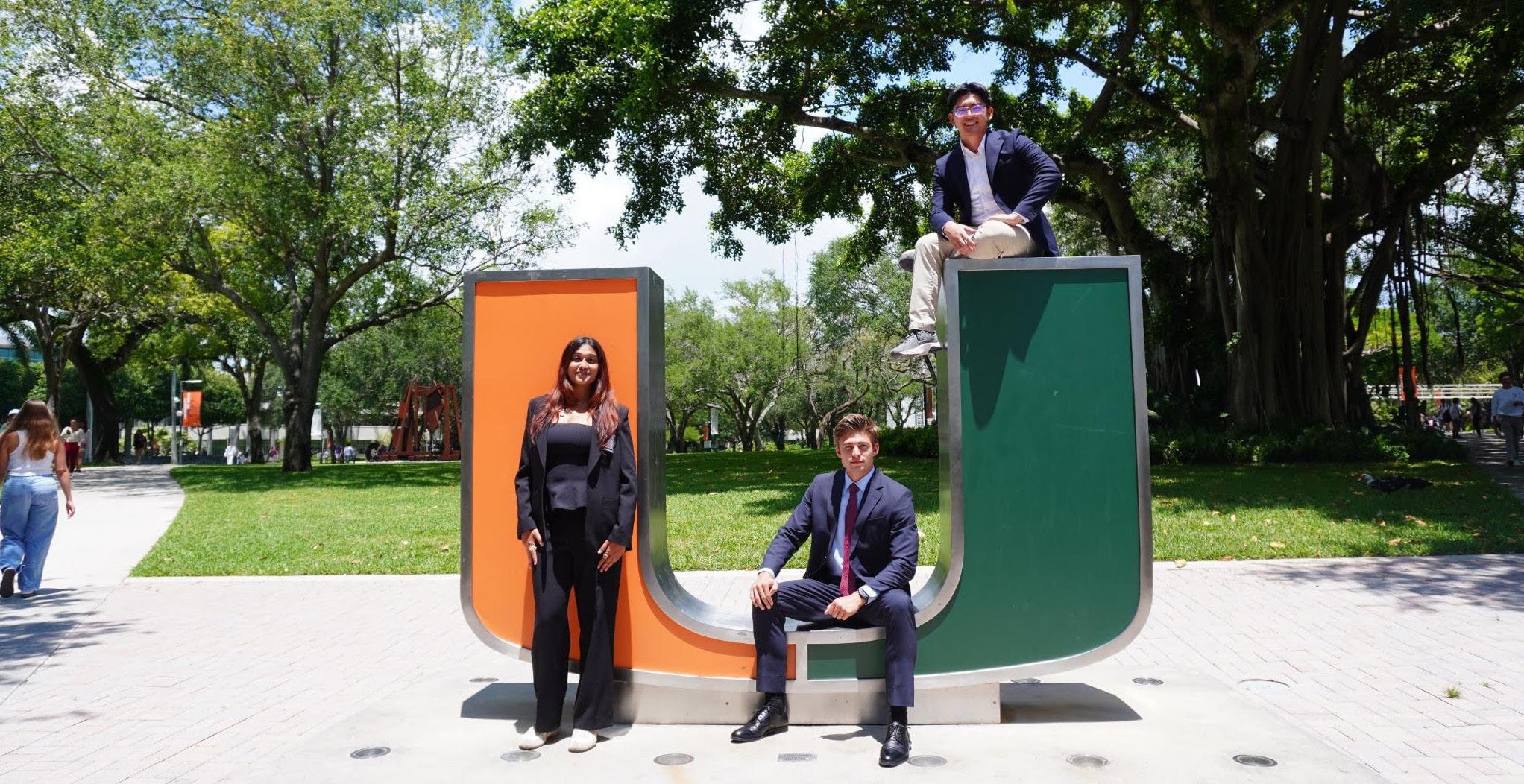
Three graduating seniors in the Rosenstiel School of Marine, Atmospheric and Earth Science analyzed a new way to measure coral growth and decay without setting foot in the water.
The passion for the one-yearlong project began when Jakob Brown, Isaiah Wang and Nayonika Choudhury were presented with data and tasked with analyzing a new method of coral quantification.
Brown and Choudhury are majoring in marine affairs and Wang is majoring in marine science and computer science, making this type of work very important to them.
The two goals of the study were to monitor how the coral was changing and to figure out if the method was reasonable.
“Science is slow and all results are good results. At this point, we’re not looking for good results or bad results, we’re looking for a result of whether this method is viable,” said Choudhury.
Over the past year, the team has been analyzing data collected by drones equipped with Fluid Lensing technology — which enables us to see objects beneath the water
that wouldn’t otherwise be visible.
The study took place at the Piti Bomb Holes Marine Preserve, which is located in a popular snorkeling spot in Piti Bay, Guam. The area is known for its natural, coral-filled holes that stretch several dozen feet deep and resemble bomb craters.
The images of the reef site in Guam were captured every 1015 days by the Micronesian Area
Geospatial Information Center, a lab partnered with NASA. UM’s ACES lab trains scientists to deploy these drones for research. Brown, Wang and Choudhury took these images and analyzed them with a variety of tools designed specifically for coral.
One tool used for the study is the PICOGRAM, an AI-based image analysis software that processes drone images at the exact pixels that the coral corresponds to.
This way, the team can measure how the surface area of the corals are changing.
Not only is the project the first-ever long-term Fluid Lensing campaign, but it’s also one of the first-ever centimeter-scale coral quantifications using remote sensing.
“To me, this project highlighted the rapid pace of scientific and technological advancement. We demonstrate how emerging tools can al-
ready enhance the way we study coral ecosystems, with even greater potential as these methods continue to evolve and improve,” said Wang.
Although this exact technology is patented by NASA and the ACES lab, they hope to partner with labs all over the world to continue this research with coral reefs.
“The scalability of these new methods has global implicationshelping us better understand the ef-
fects of climate change,” said Brown. After graduation, all three students plan to continue their education. Brown will be pursuing a masters of environment and international affairs at Georgetown. Choudhury is staying at RSMAS to earn her masters of climate and society through the professional science program. Wang is entering a PhD program for ocean engineering at the University of Rhode Island.
They express the necessity to continue this kind of work.
“We want results back quicker because in the face of anthropogenic climate change, we’re running out of time for sustainable solutions,” said Choudhury.
The three presented at the Research, Creativity, and Innovation Forum Symposium on Monday, April 27, to report their findings and further publicize their study.
By Charlotte Schuyler Contributing Writer
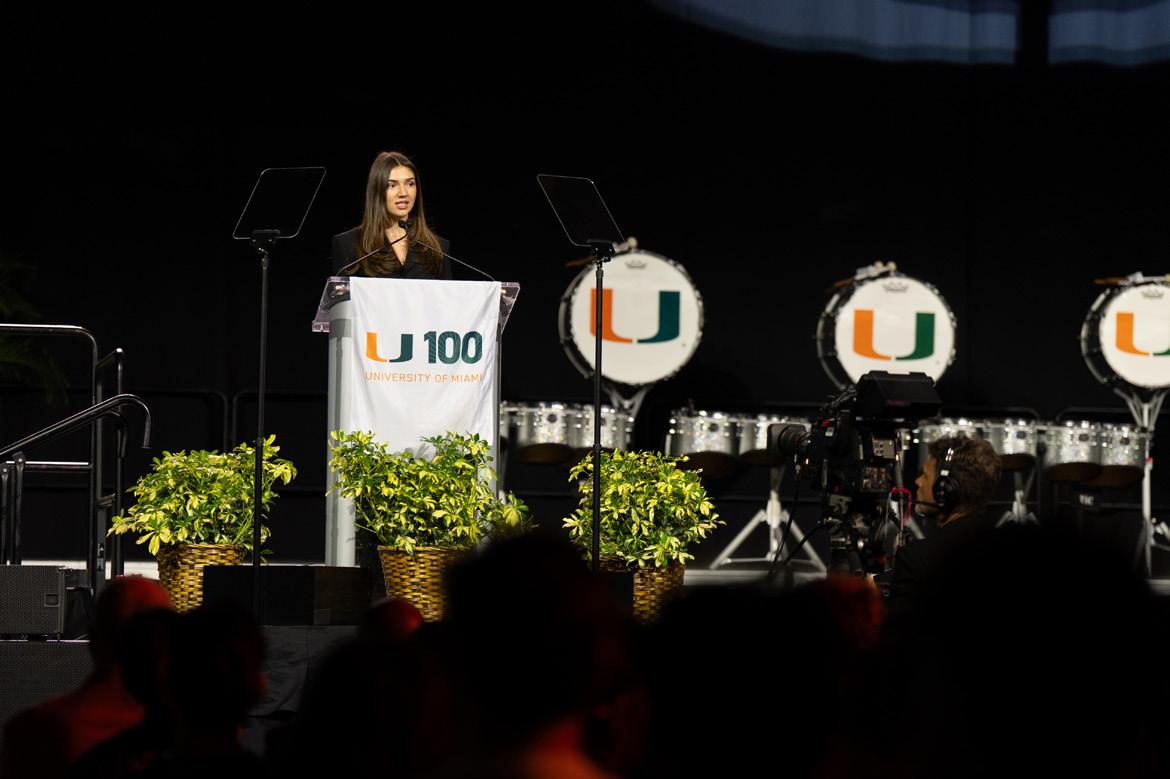
UM Student Body President Ivana Liberatore made sure that every minute of her college career mattered. Now, on her way to Harvard University, she doesn’t intend to slow down.
Liberatore, a Miami native majoring in finance, business analytics and legal studies, has spent the last four years developing her relationships on campus and listening to students.
“I had to advocate and make decisions that impacted thousands of students, often in situations where there wasn’t a perfect answer,” Liberatore said. “It taught me to balance different perspectives while thinking a few steps ahead.”
As she prepares to attend Harvard
Law School with the goal of becoming a mergers and acquisitions lawyer, Liberatore says she will miss the campus’ vibrant energy and sense of community the most.
She recalls her freshman year Homecoming as her favorite memory.
“It was one of the first times I really felt the full energy of UM.
Being surrounded by all my friends, whom I still cherish to this day, put into perspective the life-long community I had just entered,” Liberatore said. “I remember thinking how lucky I was to be part of something like that.”
As her time at UM comes to a close, Liberatore reflected on how well her courses prepared her for her next chapter.
She credited her private equity class with Professor Jason Wright
and her law of risk class with Professor Mark Shapiro for giving her a real-world understanding of private equity deals and insight into legal thinking that she “will carry with [her] as [she steps] into law school.”
Liberatore knows she still has room to grow, and views the future as an opportunity to learn.
“It will challenge me in ways I haven’t experienced before and I’m looking forward to growing both academically and personally,” she said.
Liberatore thanked her friends, mentors and professors for supporting her over the past four years. She also emphasized how grateful she is for her parents and brother believing in her unwaveringly, even when she was doubtful.
As the saying goes, no one is an island. Liberatore’s close connec-
By Katie Karlson Editor-in-Chief
“When I was first hired as a Canes Creator, I remember going into one of our first content pitch meetings and showing my supervisor dorm tour videos I kept seeing from the University of Tampa on my TikTok For You Page,” said UM senior Balaj Raza.
What started as a simple social media pitch transformed Raza, a public relations and journalism double major, into one of UM’s most recognizable student content creators.
The Canes Creator program hires students to create content for the University’s social media accounts.
The program’s goal is for students to create a portfolio and gain more experience in the industry.
Through viral dorm tours, journalism skills, marketing roles and even a barista gig at Honey Veil, Raza spent his four years building his own brand, which is now taking him to Columbia University in the fall.
Filming the dorm tour series “completely changed [his] experi-
ence at UM,” helping him land his marketing internship with the City of Miami Beach and opening doors to exciting opportunities.
“It also helped me build connections across campus, and it’s been really cool being recognized by students because of something I created,” he said.
Raza will begin his master’s program at Columbia’s School of Professional Studies, where he plans to study strategic communication with a concentration in digital marketing. He attributes his many leadership roles and extracurriculars to helping him decide this path.
“All of those experiences showed me that I want to build a career in digital marketing, media strategy and brand storytelling,” he said.
In particular, Raza feels that joining the Campus Creator Club — a club focused on connecting campus creators with brands — when it first began in his junior year opened his eyes to new possibilities in social media and marketing.
“Through the club, I learned more about influencer marketing, brand partnerships and the business side of content creation,” he said. “It helped me better understand how creators work with
brands and opened my eyes to opportunities like PR packages, partnerships and long-term brand relationships.”
Raza also emphasized that his experiences with the University of Miami Television, The Miami Hurricane and the Society of Professional Journalists have shaped how he approaches marketing and content creation.
All three of these organizations taught him how to connect with audiences and relay important messages — key elements of journalism but also marketing.
“Some of my articles, including pieces about navigating Miami as a gay student and the challenges of finding gluten-free dining options on campus, gained a lot of attention on TikTok, Instagram and even Yik Yak,” Raza said.
“At the end of the day, both journalism and marketing are about understanding people and telling stories that matter.”
Apart from campus organizations, Raza found a real-world marketing lesson through his barista job at Honey Veil, a matcha café founded by two sisters who attend UM.
He highlighted that posting content multiple times a day is challeng-
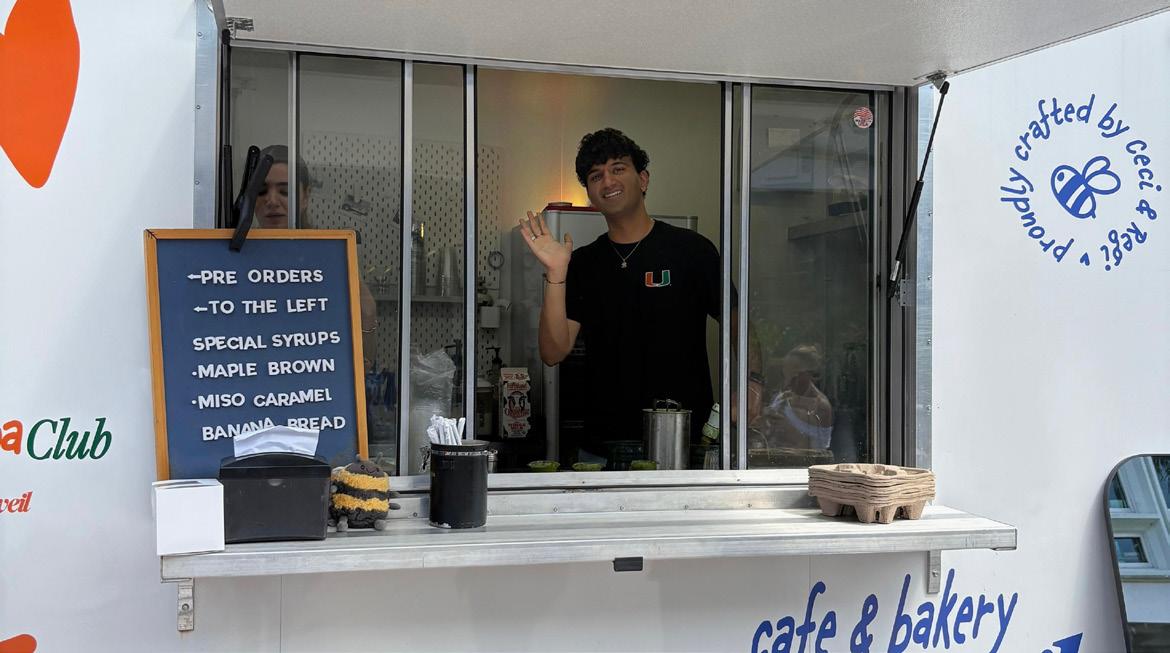
ing for most large brands, but the Honey Veil team pulls it off.
“Watching how intentional they are with branding and social media has been really inspiring because content creation is something I’m passionate about too,” said Raza.
While Raza has been incredibly successful at UM and made the most of every opportunity, he also discussed how he faced plenty of challenges and rejections in his college career that
forced him to pivot or change how he approached a problem.
“I’ve heard ‘no’ far more times than I’ve heard ‘yes.’ I’ve faced rejection, setbacks and moments where things didn’t go the way I planned,” he said. “But I kept pushing forward, and I think that persistence is what got me here. Everything really does work out the way it’s meant to, and I’m living proof that rejection can sometimes redirect you toward something even better.”
By Gaby Collazo Staff Writer
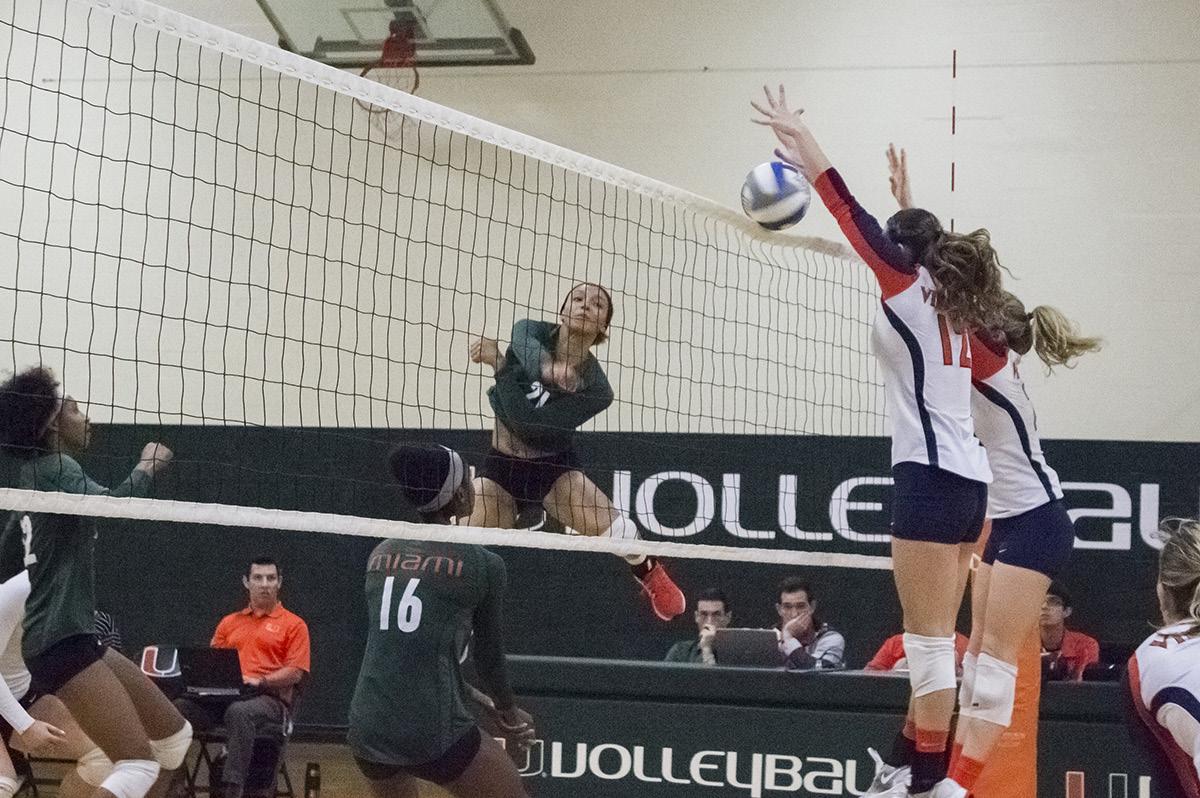
The University of Miami Sports Hall of Fame & Museum inducted 10 new members as part of its 56th induction class on Thursday, April 23, at the Watsco Center.
Founded in 1966 by eight UM alumni who served as Miami-Dade County Circuit Court judges, UMSHoF&M is a nonprofit organization dedicated to recognizing outstanding Hurricane student-athletes, coaches and administrators.
The organization prides itself on celebrating those who excelled in their respective sports, contributed to the success of Hurricane athletics and elevated UM’s reputation through their achievements and championships.
“On behalf of the U.M. Sports Hall of Fame & Museum, it gives us great pleasure to announce the 2026 Class of inductees, which is composed of UM athletes from seven different sports,” said UMSHoF&M President Mark Drobiarz. “We will celebrate this diverse class and showcase their outstanding accomplishments from their Miami career[s].”
This year’s class featured influential athletes and coaches who made a lasting impact on Hurricane athletics.
The group was headlined by former running back Duke Johnson (football, 2012-2014), UM’s alltime leading rusher, who went on to play eight seasons in the NFL. Multiple Olympians were also inducted.
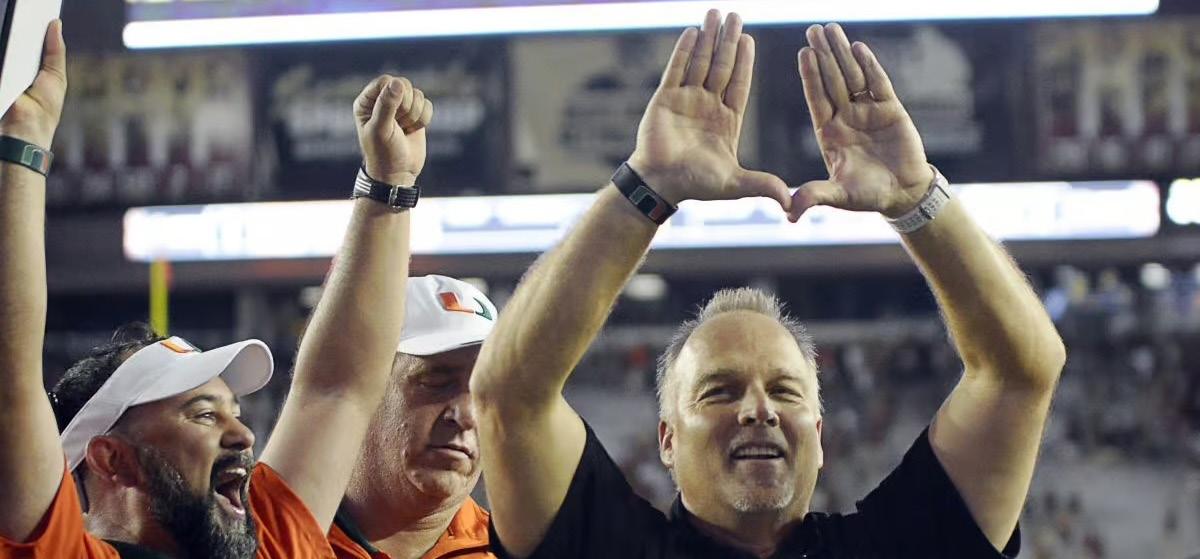
Sam Dorman (diving, 20102015) represented both the United States and Miami on a global stage at the 2016 Rio Olympics, earning a silver medal in men’s synchronized 3-meter springboard. Shakima Wimbley (track & field, 20142017) was an elite sprinter who earned multiple NCAA championships and All-American honors. On the coaching side, Mark Richt was inducted (football head coach 2016-2018), who led Miami to an ACC Coastal Division title and
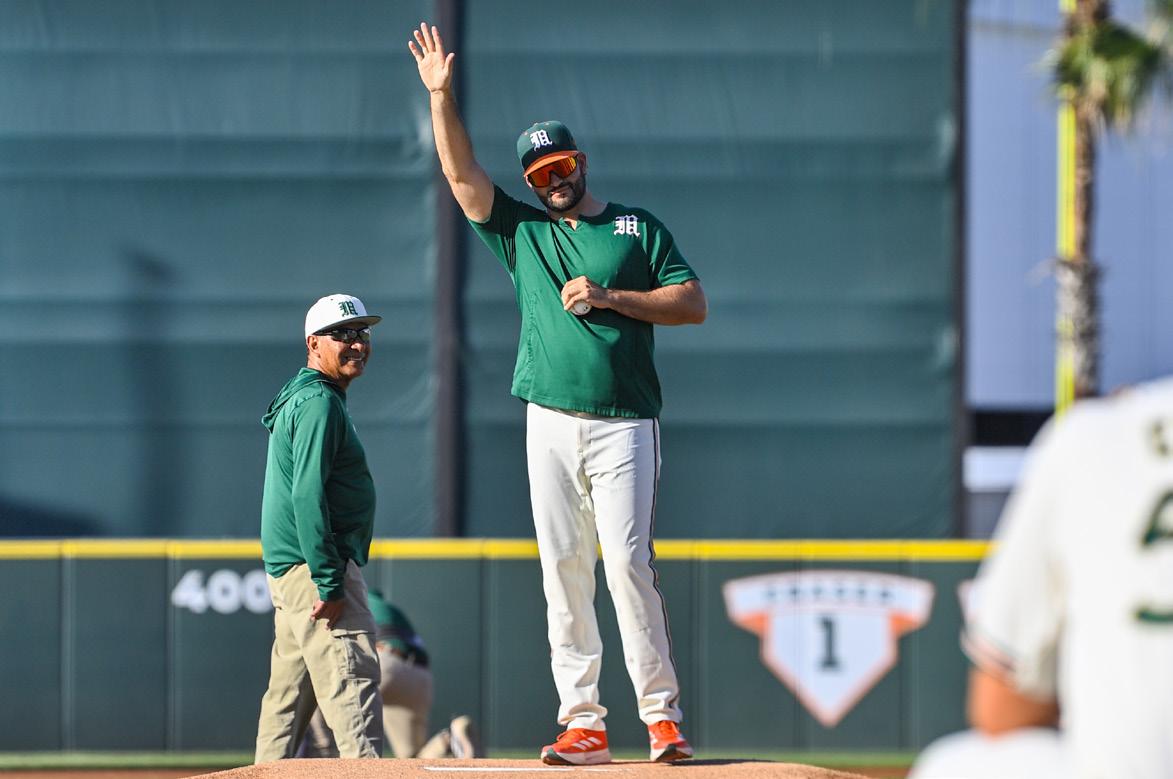
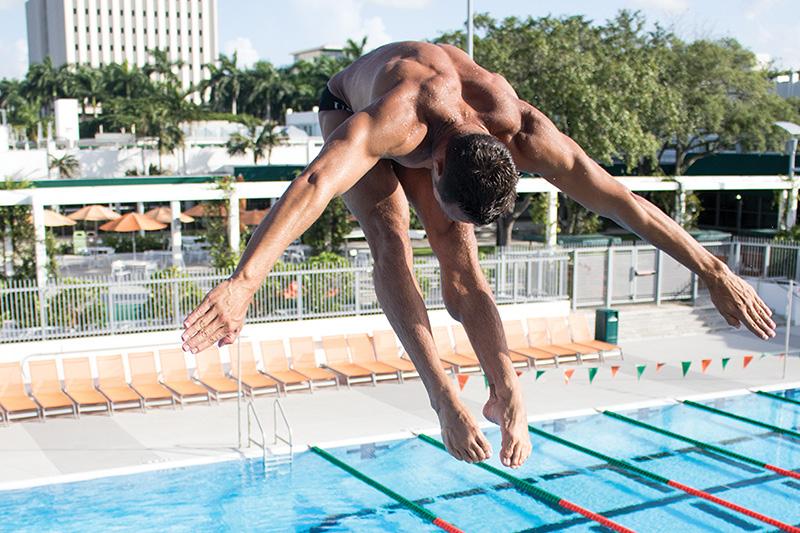
of 2015, dives off a springboard during practice at the UC Pool this summer. Dorman won a silver medal at the 2016 Rio Olympics in the synchronized 3 meter springboard event.
By Bella Armstrong Senior Staff Writer
After climbing out of the pool at the 2016 Summer Olympics, Sam Dorman threw up The U.
A small gesture — easy to miss if you weren’t looking for it — but intentional. That moment before he was crowned an Olympic silver medalist wasn’t just about the enormity of what he had accomplished; it was an honor to everyone and everything that got him to that point.
Now, ten years later, Dorman’s name was etched into the University of Miami Athletics Hall of Fame. It’s a permanent honor for a career built
on years of sacrifice for singular moments that never lasted long enough.
Diving, unlike its athletes, doesn’t stretch. It doesn’t linger.
It compresses.
Years of training collapse into seconds in the air and into a single splash that decides everything.
Dorman spent nearly two decades building toward that compression.
At the Olympics, it lasted less than a minute. He earned a silver medal alongside synchro partner Mike Hixon, stood on the podium under the American flag, listened to raucous cheering — but then it was over.
“There’s really no such thing as a professional diver,” Dorman said.
“The Olympics is it.”
Unlike other sports, where there are stages of professional leagues that feed into one that will sustain careers for decades, divers don’t have that option. The Olympics are not the beginning of something bigger, nor are they a stepping stone.
The Olympics are the end.
It’s bittersweet. You spend your whole life working towards this competition, and, in turn, it throws cold water on your face to remind you that time’s almost up.
But decades before all of that inevitability, diving didn’t feel like something that would eventually end.
For the Olympian, it started as a game.
Growing up in the Arizona heat, Dorman spent his childhood summers in a family friend’s backyard pool, where the earliest version of diving looked a lot more like play than pursuit. A red ball would be tossed into the water, and Dorman, balanced on someone’s back, would watch the dive before trying it himself.
No judges, no scores, no consequence for missing.
Just the feeling of cutting cleanly into the water.
Somewhere along the way, that feeling evolved into a hunger for more.
The game became repetition, repetition became expectation and expectation became identity.
That momentum took him all the way to various national and world championships.
While diving for UM, he was crowned the 2015 NCAA champi-
on in the 3-meter springboard with a score of 529.10 points, setting an NCAA record as the first diver to ever exceed the 500-point mark.
At UM, under longtime head coach Randy Abelman and assistant coach Dario di Fazio, who has since taken over the program, diving continued to sharpen into something precise, controlled and demanding.
By this point, diving had long since stopped being something Dorman did. It had become integral to who he was.
And then, abruptly, it wasn’t anymore.
“Post-Olympic depression is real,” Dorman said. “I spent 19, 20 years training for one hour of competition. Once that’s over, what happens next?”
But that’s the cycle every diver finds themselves tumbling through eventually.
There’s no slow fade into the truth — just a finish line you don’t realize you’ve crossed until you’re already standing on the other side of it.
Nearly a decade after his first and only Olympic medal, Dorman laughs when he talks about life after it — what’s changed and what remains. He’s happy, working for a company that manufactures diving springboards and still spending time in the pool — for fun now, rather than pushing the limits of physics in a body that once felt more like weaponry than anything else.
But freedom, without structure, can feel like falling — except this
time, there’s no water waiting to catch you.
Which is why being honored for his career carries its own kind of weight.
It’s a strange contradiction. Diving is a sport defined by movements and routines that begin and end in the span of a few seconds, but have the potential to be remembered forever.
There is a timer on every diver’s career. The human body can only handle so much twisting, so much compressing, until it’s time to walk away for good.
Maybe that’s where the meaning of it all settles. The pool is fixed, even if the career that unfolded within it never was.
“I wouldn’t trade it for anything,” Dorman said. “If I could do it all over again, I wouldn’t change a thing.”
The injuries, the pressure, the tears and the heartbreak were worth the joy he found in the deep end of a pool.
He paused. Just for a second.
“I just hope I represented Miami well,” Dorman said. “I owe them a lot.” Now, with his place in Miami’s legacy secured, those moments no longer live only in recollection.
Some things are meant to be eternal, even in a fleeting sport like diving. That’s what the hall of fame does — it gives permanence to a career built on moments that vanished almost as soon as they happened.
By Omar Pinto Staff Writer
Most people didn’t expect the Miami Hurricanes to be in the College Football Playoff after suffering two midseason losses and failing to qualify for the ACC Championship.
But, with two losses by teams ranked ahead of them in the final week of the regular season, the Hurricanes were awarded the final at-large bid in the playoffs, sneaking in by the skin of their teeth.
The 10-seeded Canes shocked the college football world with their stifling defense and old-school run game, taking down No. 7 Texas A&M on the road and then the defending champs, No. 2 Ohio State, in the Cotton Bowl.
This all led Miami to a highly anticipated matchup with No. 6 Ole Miss in the CFP semi-final at the Fiesta Bowl.
With the defense struggling to stop Ole Miss quarterback Trinidad Chambliss, the game turned into a shootout, as the Rebels snagged a late 27-24 lead with just over three minutes left.
There stood the Hurricanes, at their own 25-yard line, with 3:13 left.
Hurricane hopes of ending a 25year national championship drought seemed destined to be prolonged — millions of dollars spent on veteran transfer quarterback Carson Beck and another year of wasted talent.
Beck faced criticism throughout the year for his failure to show up in big moments, as both of Miami’s regular season losses could be pinned on his turnovers in clutch situations.
In the playoffs, multiple Hurricanes have shone bright in big moments, namely running back Mark Fletcher Jr. and receiver Malachi Toney, who scored in both of the team’s previous matchups. Now it was Beck’s turn to silence his critics.
He started off the drive accurately and safely, hitting his receivers on quick-timed routes and staying ahead of the sticks, but after a costly penalty, the ’Canes found themselves facing a third and eighth just outside of field goal range — the first big test of the drive.
Beck fired a dart towards the sideline, which was snared by wide re-
ceiver C.J. Daniels, who lunged forward for a clutch first down.
Miami fans erupted, but the job wasn’t finished.
Two plays later came another third down, this time just on the edge of field goal range with less than a minute to go. Beck dropped back, went through his reads like a seasoned pro, and tossed a ball right over the middle, slicing between defenders and hitting wide out Keelan Marion in stride for a 17-yard gain to get the Hurricanes inside the 20.
Moments later, Beck delivered another dart over the middle to Marion, getting Miami inside the 10-yard line.
After a run up the middle was stifled by the Rebel defense, it seemed like all 67,928 fans inside State Farm Stadium were expecting another run, as that’s been Miami’s mantra all playoffs.
But, to everyone’s surprise, the ball was put in Carson Beck’s hands with less than 25 seconds to go.
He dropped back to pass, but with no one open, he calmly evaded pressure in the pocket before peeking back over to his left, where there was nothing but open grass and an open end zone.
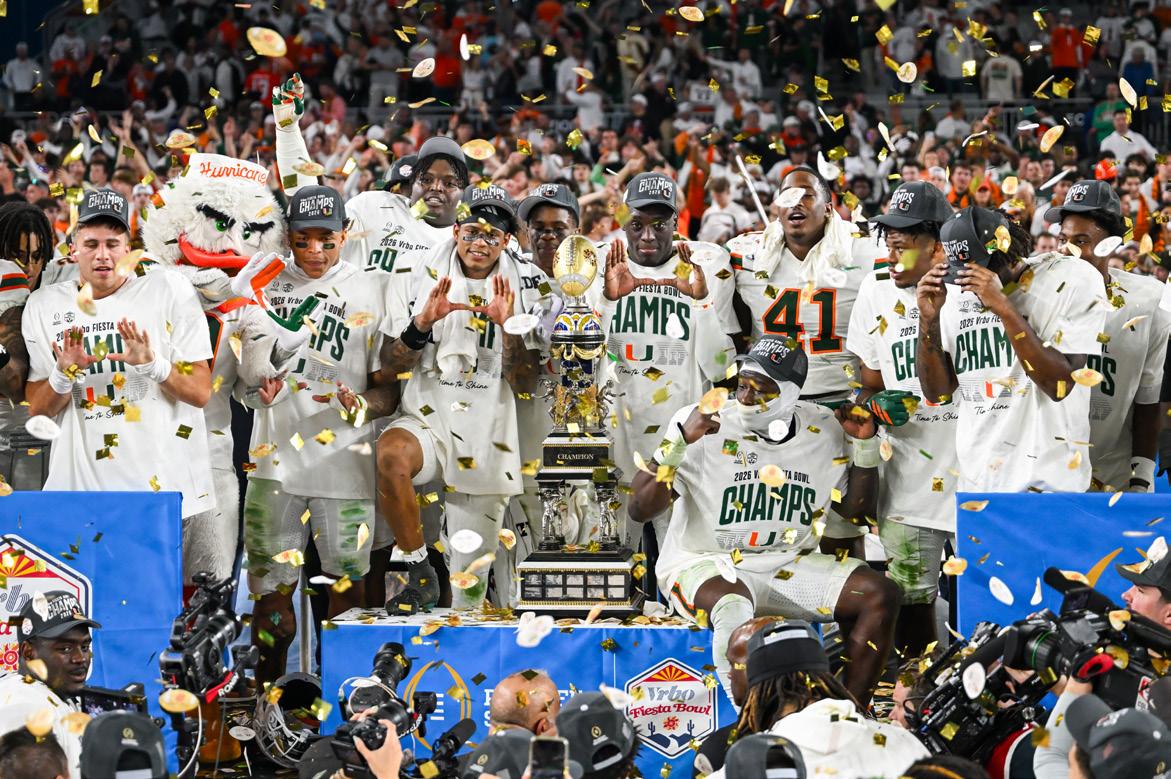
He scampered away from the Rebels’ defenders and flexed as he hyped up the Miami faithful, charging into the end zone, giving the Hurricanes the lead, and sending them back to the promised land for the first time in more than two decades.
The Canes ultimately lost in the CFP National Championship game to the No. 1 seed Indiana Hoosiers
27-21 at Hard Rock Stadium on the night of Jan. 19. While it was a devastating end to the Hurricanes season, fans will always remember the play that sent Miami back to the national championship. In just under three minutes, Beck turned himself from a rental quarterback into a Hurricane legend.
‘The U’ is in good hands with Jai Lucas despite season-ending loss to Purdue
By Jayden Gonzalez Co-Sports Editor
The Miami Hurricanes threw everything they could at the Purdue Boilermakers, but it wasn’t enough. Following their electric Round of 64 victory Friday night over No. 10 Missouri, No. 7 Miami fell to No. 2 seed Purdue 79-69 on Sunday afternoon at the Enterprise Center in St. Louis. Miami led 40-38 at halftime and appeared poised to pull off the upset. But Purdue (29-8) surged after the break, outscoring the Hurricanes 41-29 behind 45 combined points from Trey Kaufman-Renn and Fletcher Loyer.
The Boilermakers shot 8-for-14 from 3-point range and 21-of-22 from the free-throw line. With less than a minute remaining, Miami (26-8) still had a chance.
Trailing by six, Tre Donaldson and Tru Washington missed back-to-back 3-point attempts that would have cut the deficit to one possession. Kaufman-Renn secured his ninth rebound on Washington’s miss, effectively sealing the game.
Despite the loss, first-year head coach Jai Lucas has Miami trending upward, with this season signaling the program’s return to national relevance.
“It was an absolute pleasure and a joy to coach this team,” Lucas said. “I thank them for believing in me, believing in a person who had
never coached before, and everything they gave me this year. I’m forever in debt to them.”
Veteran transfers laid the foundation for Miami’s resurgence
Miami finished its 2024-25 campaign at 7-24, one of the worst seasons in program history. Lucas, who took over on March 6, 2025, prioritized veteran leadership to reshape the culture.
Senior transfers Malik Reneau, Tre Donaldson and Ernest Udeh Jr. delivered exactly that, establishing a new standard in Lucas’ first season.
Reneau, an Indiana transfer, arrived in Coral Gables seeking a fresh start after an injury-plagued junior year. The Miami native made the most of it.
“I’m blessed that Coach gave me this opportunity to come back home and come to The U and finish my last year here,” Reneau said.
The senior forward earned First-Team All-ACC honors, averaging 19 points and 6.6 rebounds per game. His 662 points tied Don Curnutt for fifth-most in a single season in program history.
“This season has meant the world to me,” Reneau said. “Coach giving me the opportunity to not only be a pivotal player on my team and play 30-plus minutes, but also become a leader and be someone these guys look up to.”
Donaldson provided stability and a clutch factor at point guard, a presence Miami hasn’t seen since Isaiah Wong’s 2022-23 campaign.
After stops at Auburn and Michigan, the senior guard returned to his home state and earned second-team All-ACC honors while averaging 16.5 points and 5.8 assists.
“Coming to Miami, I had to build myself back up coming back off a tough year,” Donaldson said.
“Coming into a coaching staff that was going to help me build myself back up and continue to help me get better. I enjoyed every moment of it.”
Udeh anchored the defense, impacting the game in ways that didn’t show up in the box score. The Kansas and TCU transfer earned a spot on the All-ACC defensive second team and played a key role in Miami’s interior presence.
The Hurricanes dominated the offensive glass in the NCAA Tournament, outrebounding Missouri and Purdue 30-11 combined on offensive boards. Udeh contributed 12 of those rebounds.
Together, the trio helped revive the program and establish a foundation for sustained success.
“We really have built a great foundation,” Lucas said.
Shelton Henderson has emerged as a centerpiece of Miami’s future.
While the veterans set the tone, freshman Shelton Henderson showed he could be the program’s next star.
The Bellaire, Texas, native stepped up in the NCAA Tournament, producing strong performances against Missouri and Purdue while consistently attacking the paint.
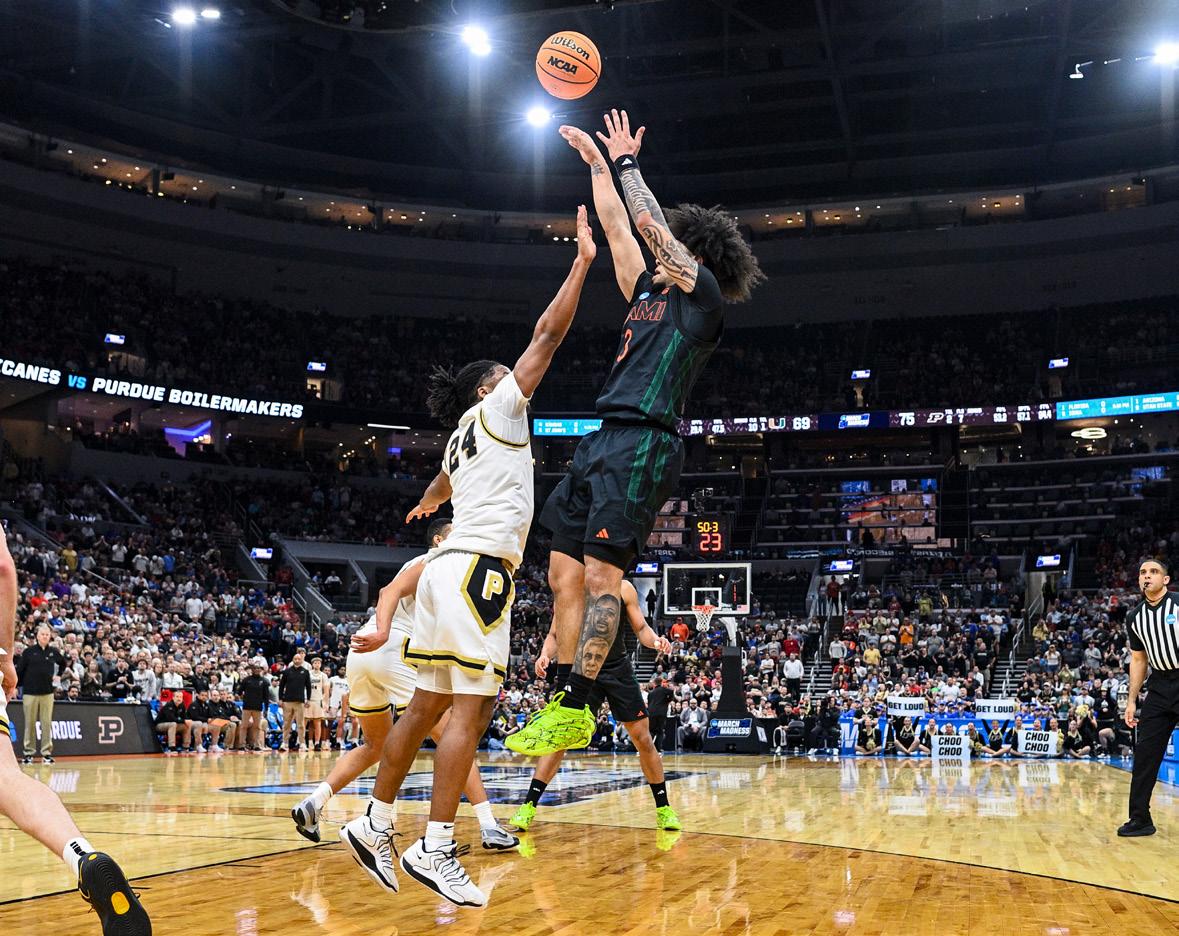
“He’s a stud,” Purdue head coach Matt Painter said after the game. “He could play for the football and the basketball team. He just runs through people.” In his two tournament games, Henderson averaged 16.5 points and seven rebounds while shooting 61.5%. His postseason showing capped a strong freshman campaign in which he averaged 13.7 points and nearly five rebounds per game on 56% shooting.
“I learned a lot about myself,” Henderson said. “I had to grow up a little bit faster playing with these guys and I think it helped me in the end.” Henderson is expected to take on a leading role next season as Miami builds on its momentum. The Hurricanes are also expecting a return of freshman guard Dante Allen, while adding five-star recruit Caleb Gaskins, who could make an immediate impact. Lucas made it clear that this season is only the beginning.
“It’s my job to keep it going and keep it rolling,” Lucas said. “This time next year we’re talking about going to the Sweet 16, not just the season ending. That’s the goal, that’s the plan until you win the National Championship.”
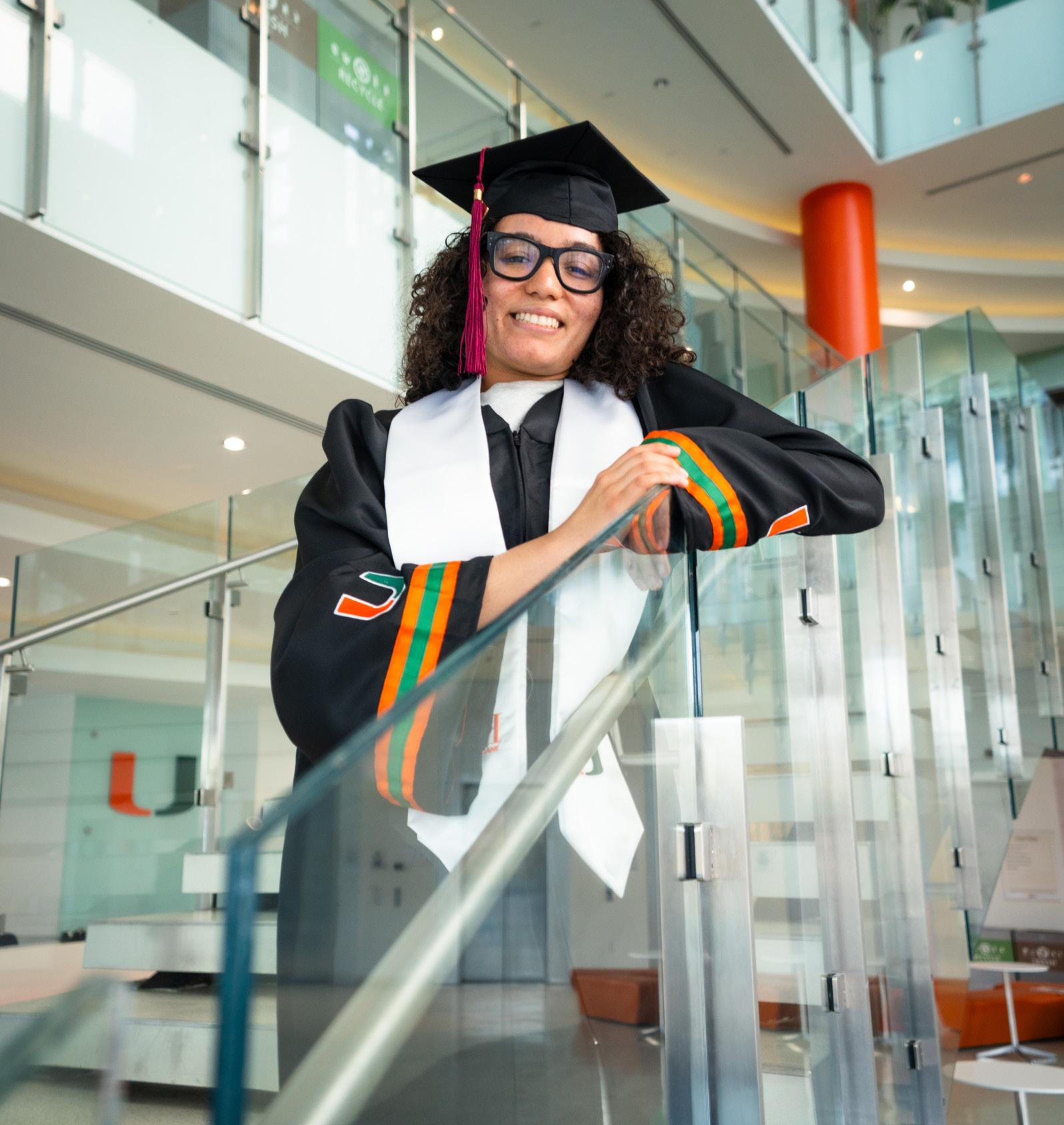
By Samantha Rodriguez Co-A&E Editor
The Miami Hurricane has taught me more about life than any class. I constantly met new writers and editors who inspired me to push
myself. Reach out for more impossible interviews, do more to highlight amazing students at the University and find more ways to be kind. Every person who told me “Hello,” held the door open for me or nodded at me those Monday afternoons during practicum gave me the courage to chase stories. You are all a part of my success.
I encourage every journalist to write the stories your mom doesn’t want you to. Take risks while you have the support of your peers. If you fail, that just makes your life more interesting. Being safe — in life and in journalism — is very boring. Email that celebrity’s publicist and reach out to the people that you know only you have the
skills to write a story about.
I have failed many times and will continue to do so. (Remember when I spelled a person’s name wrong throughout an entire article?) But failing while being brave enough to put your heart out to the world is falling forward. Your articles can inspire others, or you can write a review of Joe’s
Stone Crab. The easiest way to do the first part is live a life you’d write an article about. And the easiest way to do that is by doing whatever you want — or, in other, less interesting words, following your heart. That’s what put me on the cover of this newspaper. Who knows where it’ll take you.
What would an older (and hopefully wiser) senior tell an underclassman?
V’s Take is The Miami Hurricane’s most controversial and longest running column.
V’s Take is a satirical work published biweekly by students and for students using our generation’s “colorful” language. V addresses all things love, sex and gossip on campus. V is not for the politically correct or easily offended.
For the last edition of V this semester, I know you all are dying to hear from some older, wiser voices about their time at UM. Here’s what our class of 2026 had to say:
Just say yes
When an opportunity comes knocking, you need to be ready to answer the door. You truly have no idea what waits on the other side — just be sure to lead with love and excitement.
This senior says her best moments at UM have come through unexpected opportunities and activities she was not originally enthusiastic about. But, as she embraced the moment, she found herself enjoying these opportunities and connecting with new people on campus.
Form a village, be a villager
As this senior likes to say, “If you want a village supporting you, you need to be a villager.”
Sometimes, when you’re missing your parents and the comfort of the house you grew up in, all it takes is one person to pull you out of your funk and brighten your day.
Remember the people who go the extra step to make you smile and support them when they seem like they need a pick-me-up. College can be hard.
It’s never too late to make friends, so always be open to joining a new organization and becoming part of that community. College gives you the chance to choose your friends, so choose wisely and foster those relationships.
Not every day will be perfect, but you’ll look back and feel grateful for all of it. While it may be difficult to appreciate in the moment, your hardest days are when you grow the most.
The biggest piece of advice from our third, and final, senior: Ask what you don’t know and don’t be afraid to go after what you want.
The word “student” is powerful because it means you are still learning and you are allowed to make mistakes. If you never fail or have a less-than-perfect moment, did you truly learn anything?
Lean into the idea that you are still learning and growing — as a person and a student — and ask for help when you need it. You’ll be surprised how many people are just waiting for you to ask.