Vol. 107, Issue 18
Sept. 23, 2026 - Oct. 6, 2026
Just ‘U’ it
Miami athletics returns to Nike in record-setting deal By Sebastian Font & Jayden Gonzalez Co-Sports Editors Miami athletics has returned to Nike as the program’s apparel sponsor, agreeing to a lucrative 10-year contract worth more than $200 million. Nike sponsored the Hurricanes from 1987-2015 before the University made an unprecedented decision to sign with Adidas. Now, Miami is back wearing the iconic swoosh. “Nike understands what makes the U distinctive,” UM President Joe Echevarria said. “This partnership puts our student-athletes in the best company in sport and positions the Hurricanes for the era in front of us.” After a national championship appearance, Miami found itself in a strong negotiating position as other premier programs signed apparel deals — setting the bar for what the University could ask for. Adidas put pen to paper with Penn State on July 1 in a 10-year, $300 million deal. The company agreed to a 10-year, $100 million deal with the University of Tennessee the next day. With the bar set high, UM went into negotiations with the upper hand and found that Adidas was unwilling to match Nike’s offer, according to the Miami Herald. The deal is a total reversal from Miami’s last apparel negotiations 12 years ago. Nike was unwilling to match Adidas’ offer in 2015, leading to the Adidas partnership
that is quickly coming to an end. Miami will receive roughly $13 million annually — around twothirds of the overall deal — in cash, according to the Herald. This would
“Nike understands what makes the U distinctive.” Joe Echevarria UM President
be the largest percentage a university has received in cash from a collegiate apparel sponsorship. The agreement is also Nike’s second-largest collegiate investment, sitting just behind Oregon, where the apparel giant was founded. UM was in the middle of a 12year deal with Adidas, set to expire
in 2027. The agreement was the longest-standing collegiate partnership in Adidas history — and the first all-sport apparel partnership the company had with a top program. Adidas spent the last decade investing in South Florida sports all the way down to the grassroots level. South Florida talents like Malachi Toney, Ohio State’s Jeremiah Smith and Miami recruits A’mir Sears and Nick Lennear all signed deals with the Three Stripes brand within the last year. In 2025, Adidas signed a fiveyear, $13.5 million deal to outfit all 41 of Miami-Dade County High Schools’ athletics uniforms. Although UM and Adidas have been great partners for more than a decade, UM and Nike also have historic ties. Miami’s original partnership with Nike marked the first allsports apparel contract in collegiate history, and continued for four of UM’s national titles in football (1987, 1989, 1999, 2001) and two in baseball (1999, 2001). “The University of Miami has built a legacy that extends beyond competition and demonstrates how the power of sport can move culture forward,” said Ann Miller, Nike’s executive vice president of global sports marketing. “We’re proud to welcome Miami back to the Nike family.” The Hurricanes join South Carolina as Power Four programs to sign with Nike in the past year, with the decision set to take effect when Adidas’ deal expires next July ahead of the 2027 athletic season.
via ©JC Ridley/Caneshooter.com Co-MVP Wide Receiver Andre Johnson hoists the Sears Trophy following the Canes’ 37-14 win over Nebraska in the 2002 Rose Bowl BCS National Championship Game, played on Jan. 3, 2002 in Pasadena, Calif.
Three key aspects of the new Miami-Nike deal 1. 10-year contract worth more than $200 million
2. Nike & Miami pioneered the all-sports apparel model in collegiate athletics from 1987-2015
3. The partnership will begin July 2027 once Adidas’ contract expires
been willing to do. First, creating a state catastrophic fund would help Florida’s numerous coastal communities, as private insurers have left many homes across the state uninsured. Jolly will address rising housing costs by building more affordable housing and supporting local renters and buyers, rather than capitulating to corporate landlords and institutional investors. A pause on data centers will give Floridians time to figure out how to control the rise of artificial intelligence — especially in a state already dealing with high pollution and low water quality and supply following major droughts. A vote for Jolly will also help Florida’s struggling education system. Republicans’ school voucher program has left school boards to deal with the fallout as enroll-
ment collapses and many campuses close their doors — with 36 in Miami-Dade and Broward counties considering
Courtesy of Nick Gangemi Sophomore Running Back Duke Johnson powers past the defense with ball in hand against UF at Sun Life Stadium in Miami Gardens, Fla. on Sept. 7, 2013.
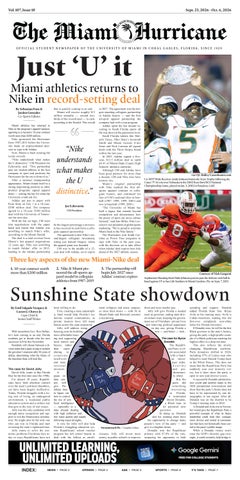
Sunshine State showdown By Emil Salgado Vazquez & Lazaro J. Chavez Jr. Copy Chief & Senior Staff Writer
With incumbent Gov. Ron DeSantis’s term coming to an end, Florida residents get to decide who his next successor will be this November. Residents will choose between a diverse ticket and a party trying to reclaim the governor’s mansion after 30 years of defeat, determining what the future of the Sunshine State will look like. The case for David Jolly David Jolly wants to flip Florida blue for the first time since the 1990s. For almost 30 years, Republicans have held absolute control over the state’s political chambers, yet have been largely ineffective. Today, Florida struggles with a rising cost of living, an endangered environment, a weakened public education system and a culture war that gets in the way of real issues. Jolly was the only candidate with enough name recognition and support to win the Democratic nomination. He might also be the only one who can win in Florida and start reversing the state’s rightward lean. Jolly wants to solve the economic problems Floridians face today in ways Republicans have not
B:10.25" T:10"
Sovannreach Po // Graphics Editor S:9.75"
closures. Jolly will invest more money in public schools to improve
them and raise teacher pay. Jolly will give Florida a needed reset as governor, ending state-driven culture wars, keeping the government out of Floridians’ private lives and removing political appointees on day one, giving Florida a new — and better — look. The case for Byron Donalds The Republican Party is often associated with a familiar stereotype: older, wealthy and predominantly white. But, the party did something interesting in Florida: it nominated Byron Donalds, a Black man, as its potential next governor. In doing so, Donalds and his running mate have the opportunity to change many people’s view of the party — and give it a brighter future. Donalds won the Republican primary with 47.8% of the vote, outpacing his opponents in both
spending and support. Donalds added Florida State Sen. Bryan Avila as his running mate. Avila is Cuban-American, making this the first-ever completely non-white ticket for Florida Governor. If Donalds wins, he will be the first Black governor in the state’s history, giving the party a high-profile example of a Black politician reaching the highest office in a deep red state. This also reflects the slowly changing Republican coalition. Party dynamics shifted in 2024, including 47% of Latino men who helped to send Donald Trump back to the White House. This does not mean that the Republican Party has suddenly won over minority voters, but it does show the party is open to new and diverse voices. A successful Donalds administration could add another name to the 2028 presidential conversation and show that the party’s future does not have to be represented by one demographic or one region. After all, Donalds was on the shortlist to be Trump’s running mate in 2024. A Donalds and Avila win in November would give the Republican Party a powerful example of what its future leadership could look like: younger, more diverse and rooted in communities that have not historically been central to the party’s public image. While a Donalds victory won’t erase the GOP’s diversity gap overnight, it could certainly help bridge it.
S:1.25"
INDEX:
NEWS | PAGE 2
OPINION | PAGE 4
A&E | PAGE 5
SPORTS | PAGE 6
V’S TAKE | PAGE 7
NEWS
2
September 23, 2026
THE MIAMI HURRICANE
Aging Allen Hall classrooms draw complaints By Gaby Collazo Staff Writer Allen Hall’s aging facilities have led to student and faculty complaints, raising questions about whether the building meets modern classroom expectations. Built 40 years ago and home to the Division of Continuing & International Education, Allen Hall contains 19 classrooms, an English lab and a computer lab. One concern among students and teachers is the noise produced by the building’s air conditioning system. With South Florida’s heat and humidity, air conditioning is essential for maintaining a comfortable classroom environment. However, the building’s air conditioning units create distractions during class. “[The] environmental comfort is highly compromised,” said Dr. Esber Andiroglu, who teaches in Allen Hall every spring semester. “The HVAC unit is very loud and [the rooms are] often humid with strong air drafts, [making it] difficult to carry out presentations and discussions with students.” Neve Clark, a senior who had a
class in Allen Hall last semester, said she experienced a similar issue. Her class was moved to Dooly Memorial because the air conditioning was so loud that students could not hear their professor in the Allen Hall room. “I experience constant disruptions with the technology which makes teaching quite difficult at times,” said Elayna Christine, a professor for JMM 108 Writing for the Digital Age. “I’ve had the computer shut down, disconnect, or lock me out in the middle of a lecture and I’ve had to call classroom support to help.” Dr. Andiroglu said students have approached him with complaints about the classrooms’ temperature and excessive noise. He said these conditions can interfere with presentations, discussions and other classroom activities. Yet the University of Miami says it inspects the building constantly. “The Facilities and Operations Department conducts daily inspections prior to the start of classes and again during the middle of the academic day,” said the University of Miami in a statement to The Hurricane. “Routine maintenance is identified and resolved through all inspections. Most first floor class-
rooms at Allen Hall received new AC units this summer as part of routine classroom enhancements and, in part, from faculty feedback.” As classrooms have become increasingly dependent on technology, students and faculty say Allen Hall’s facilities have struggled to keep pace. The Miami Hurricane Instagram posted a story on Sept. 16 asking followers whether they have experienced any issues in Allen Hall. The story remained live for 24 hours, and responses included complaints about inconsistent air conditioning, with one student writing, “unpredictable [AC], one day not working, next day freezing.” Other students reported seeing “roaches running around Allen,” while another said Allen Hall “is the furthest from everything and feels way out of place for business school classes.” These issues can affect a student’s classroom experience before the lesson even begins. “It’s a terrible environment,” said Christine. “I’d like to see Allen Hall torn down.” As long as Allen Hall continues to be used for classes, students and professors will continue navigating the challenges of an aging building.
Lorelei DiSanto // Contributing Photographer The East side of Allen Hall on the morning of Friday, Sept. 18, 2026.
Inaccurate cost of attendance estimates have great impacts a case-by-case basis when documented circumstances make the standard estimate inaccurate.
Ava Stroshane // Staff Photographer Canes Central, located in the Harold Long Jr. and H.T. Smith Student Services Building, offers aid in four service areas: registration and records, billing and payment, financial aid and Cane Card issues.
By Ava Liber Contributing Writer
cost of attendance for students living on campus increased only $754.
UM’s cost of attendance is now less than $1,200 away from reaching six figures. 15 universities have crossed the $100,000 threshold, according to The Washington Post. By reducing its estimates for transportation, books and other personal expenses, UM stayed off the list this year. For the 2026-2027 academic year, UM raised undergraduate tuition by 4.5% from $63,456 to $66,312. Despite tuition rising nearly $3,000, the estimated total
Cost of attendance impacts financial aid The cost of attendance is a central number used to determine a student’s financial need and the maximum amount of financial assistance they may receive. The estimate combines direct expenses paid to UM, like tuition and on-campus housing, and indirect expenses such as books, transportation and personal purchases. Under the federal formula, financial need is calculated by subtracting the Student Aid Index and other financial assistance from the cost of attendance.
So, if UM’s cost of attendance estimate is lower than what a student spends, those additional expenses may not be reflected in the standard calculation of their financial need. But a higher cost of attendance doesn’t guarantee an equal increase in grants or scholarships. Federal guidelines allow universities to use average expenses for groups of students instead of calculating every student’s exact costs. However, universities are expected to develop “appropriate and reasonable” estimates using methods such as student surveys, local housing costs and other relevant data. Universities may also adjust a student’s cost of attendance on
Students say UM’s estimates fall short Some students say the University’s estimates don’t reflect what it costs them to attend UM and live in Miami. The difference is most visible in transportation. UM cut its transportation estimate by 61% from $2,040 to $800 for the academic year. That gives students an estimated transportation budget of approximately $100 per month. Rylee Titoni, a sophomore studying marketing, spends approximately $2,040 each academic year on Uber rides alone, based on an average of three rides per week. That is more than twice the $800 transportation allowance included in UM’s cost of attendance estimate. During roughly the same period, transportation prices in the Miami-Fort Lauderdale-West Palm Beach area increased by 5.7% during the 12 months ending in June 2026, according to the U.S. Bureau of Labor Statistics. UM’s estimates change differently than inflation UM’s cost of attendance increased by more than $5,000 for the 20242025 academic year and rose by thousands of dollars again for 2025-2026. This year, UM raised tuition by 4.5%. By comparison, overall prices in the Miami metropolitan area rose by 3.4% during the 12 months ending in June 2026, according to the Bureau of Labor Statistics. UM’s tuition therefore increased
How to register to vote in Florida By Emil Salgado Vazquez Copy Chief
As Florida’s voter registration deadline approaches, University of Miami students across South Florida may need to make sure they are registered to vote. To register, you first need to meet three main requirements: be 18 years of age or older, be a U.S. citizen and be a resident of where you want to register to vote. Each
county may have different dates, deadlines or processes. “[Voting] makes me feel like I have some influence on the direction of the country,” sophomore Cooper Caldwell said. “Many people in our past have fought hard to have that right, and many around the world still don’t have it.” UM offers TurboVote to help students register, stay informed about upcoming elections and get the information they need to vote with confidence. The University also has a list of addresses for
Ethan Mannello // Contributing Photographer Students wait in line to vote at the on-campus booth in the Watsco Center on Nov. 5, 2024.
on-campus residents to see their physical address separately from their mailing address. Information on early voting sites and secure ballot intake stations will be available after Oct. 4. If you are unsure whether you are registered to vote, you can check your status on the Florida Department of State’s voter lookup website. Miami-Dade County In Miami-Dade County, you can register to vote online. At 16, you can preregister to vote, and when you turn 18, the registration will become active. The deadline to register is 29 days before an election. So, to vote in the midterm elections on Nov. 3 here in Florida, Canes must register before Oct. 5. Online registration requires a Florida driver’s license, its issue date and the last four digits of your Social Security number. Without these, you can still use the online form, but you will need to print, sign and mail or deliver your voter registration application to your county Supervisor of Elections. You can also submit that form by mail in Spanish and Haitian Creole. “College students are an important part of our community,” Miami-Dade Supervisor of Elections Alina Garcia said in a statement to The Hurricane. “I encourage every
1.1 percentage points faster than local inflation. Reductions this year may represent a reset after UM’s estimates rose significantly in previous years. The University may have recalculated those categories after determining that the estimates were higher than what the average student spent. However, an average cannot reflect every student’s circumstances. Students living off campus may face similar differences between UM’s estimate and their actual expenses. “The transportation estimate doesn’t feel realistic for students who have to fly home several times during the year,” Sophomore Brighton Watson said. “Even one round-trip flight can take up a large part of that budget, especially around holidays.” In a statement to The Hurricane, the University said it reviews its cost estimates annually using multiple data sources and intends them to represent reasonable average expenses rather than the exact costs incurred by each student. “The COA included both direct costs paid to the University and indirect costs paid to third parties,” the University said. However, the statement didn’t identify the data sources used, explain if UM changed its calculator method or confirm if this year’s reduction was intended to correct estimates from previous years. As UM prepares its cost-of-attendance estimate for next year, students will be watching to see whether the University explains how it calculates each expense and whether those estimates accurately reflect what students typically spend. Vote-by-Mail ballot — the deadline to request it is Oct. 22.
“[Voting] makes me feel like I have some influence on the direction of the country.” Cooper Caldwell UM Sophomore
eligible student to take the time to register and make their voice heard … I hope they recognize that their voice and their vote matter.” Once you’re registered, you don’t have to wait until election day to vote. Early voting begins Oct. 24 and ends Oct. 31. You can vote at any precinct during early voting, making it convenient if your assigned precinct for election day is in an inconvenient location. Students can also request a
Broward County In Broward County, the same requirements apply as for Miami-Dade County — all voters must register through Florida’s registration site, and can also Vote-by-Mail ballots. “As the father of a college freshman, I take great pride in encouraging all eligible Canes to register to vote and participate in our democracy,” Broward Supervisor of Elections Joe Scott said to The Hurricane. “Your voice matters on the issues that shape our communities and our government.” Early voting in Broward follows the same rules as Miami-Dade except for the dates. Early voting will run daily from 7 a.m. to 7 p.m., Oct. 19 to Nov. 1.
Students looking to vote can register using one of the following options: 1. Submit an online form to Florida’s Division of Elections 2. Mail an application to your county’s Supervisor of Elections 3. Register in person at your county’s Supervisor of Elections office
September 23, 2026
NEWS
THE MIAMI HURRICANE
3
GroupMe scammers continue to target students By Kyra Chang Contributing Writer
GroupMe, a messaging app most organizations on campus use, has recently become a hub for phishing and scamming messages among students. One of the most common phishing scams on the app is for football game tickets. A UM student who wishes to remain unnamed was scammed in a chat called “UM Official Ticket Swap” when trying to purchase World Cup tickets over the summer. “A couple different people in the chat were selling World Cup quarterfinals tickets for the England versus Norway game,” said the student. “So I DM’d one of them and I was like, ‘Hey, I’m interested in the tickets. How much are you selling them for?’” The scammer said they were selling the tickets for $600, which seemed low. However, they seemed like a real student. In fact, the scammer had stolen the identity of a real student, whom the unnamed student found on LinkedIn and Instagram. According to Coalition Security Labs, gaining a sense of trust and familiarity is a common scammer strategy. “The scam typically involves a text message that appears to be from a trusted source within the University of Miami,” the University’s Information Technology & Systems Department wrote in an email sent on June 13, 2026. The unnamed student knew it could be a scam, so they paid through Venmo in case they needed to get the money back. The money for the first ticket went through without any problem. “So we did the first ticket swap. She
sent us the ticket in an email. We opened it up in our wallet, and it was like a legit ticket. So at that point, we were feeling pretty safe,” the student said. The situation quickly went south when the student tried to pay for the second ticket. The money stopped going through, and the scammer began to speak differently than before. The student said that the scammer used “random emojis that didn’t make sense.” The money transfer finally went through on PayPal, but the scammer sent another email with no ticket attached. When the student opened the link in the email, it led to a phishing website. The unnamed student confronted the seller about the scam, and the seller stopped responding. Two days later, the student’s dad received a phone call. “Some guy randomly called my dad and was like, ‘Hey, did you get my money for the ticket?’ And my dad was like, ‘What do you mean?’ And he was like, ‘Well, someone with your name and your number was selling me tickets and I sent them the money … It was happening to other people in that group chat, not just me.” Fake ticket sales are not the only scams on GroupMe — others include selling concert tickets or items like laptops and cameras. Freshman Anna Cherepowich encountered a scam for a camera in the Aquarium Club GroupMe chat. “[The message] was from someone who appeared to be a member of the club and was just like, ‘I’m getting rid of this camera … If anybody’s interested in it, please DM me,’” said Cherepowich. The Aquarium Club chat required admin approval before joining, and the message appeared to be from another student at the
University, leading Cherepowich to believe the user was real. The scammer sent photos showing them holding the camera and gave detailed descriptions of the camera’s model and condition. Instead of meeting in person, the scammer asked to ship the camera to Cherepowich. “She said ‘I’m still here for my birthday. I’m with my family in Idaho so I can ship this to you,’” said Cherepowich. Cherepowich barely had time to think because the scammer rushed her into decisions, but she wasn’t suspicious yet. The scammer sent photos claiming they were at the post office and told Cherepowich there was an additional $55 tax and packaging fee. When Cherepowich asked the seller to bring it to campus when they returned, the seller claimed the camera had been taken for weighing. Scammers typically try to make victims act quickly and without much thought. UMPD included this in an email sent on April 15, 2025. The email read, “Scammers pressure you to act immediately.” Cherepowich said she quickly cut off communication with the scammer after a failed attempt to get her money back. She was frustrated, especially because she was unaware of the scammers and believed freshmen were more vulnerable. “I think it shouldn’t be that easy for [scamming] to happen, especially because you have to have GroupMe here,” said Cherepowich. “As soon as I started reaching out to people about it, I heard how common it is. This shouldn’t continue to be an issue.” Students should be aware of these scams going forward and should look for the signs when communicating on GroupMe.
Brian Mulvey // Photo Editor A fake UM student offers to give away a camera in the Hurricanes Fishing Club GroupMe chat on Sept. 11, 2026.
There are four red flags to look for in order to identify a potential scammer: 1. Preemptively asking for money 2. Demand immediate action 3. Refusing to speak in person 4. Offers that are too good to be true
Struggles with full parking lots leading to overflow
Cars fill up the Red Lot around 2:30 p.m. on Tuesday, Sept. 15, 2026.
By Spencer Werner Contributing Writer
Students are struggling to find parking across campus, resulting in tickets for parking in undesignated areas and late arrivals to class. Commuter students can buy permits for $656 per year in Red, Pink, Yellow, Gray and Teal Zones. Residents can only park in Teal and Gray lots and pay $706 a year. Red parking is concentrated by the School of Nursing and Health Science and School of Communication, yellow near the Watsco Center, purple near University Village and Frost School of Music, pink near Lakeside Village and teal near the Mahoney-Pearson construction site, according to the campus parking map.
Andrea Padron // Contributing Photographer
But buying a permit does not guarantee a parking spot. The Miami Hurricane posted a non-scientific survey on Sept. 14 asking students how long it takes to find a parking spot, especially around mid-day. The survey remained live for 24 hours and received 26 replies. One student, Sophie Libermann, wrote that at peak mid-week hours, “Finding a parking spot can take literally 20-plus minutes.” Libermann said she parks in Red Lot Monday through Friday, and experienced the most difficulty between noon and 2 p.m. Students have resorted to creating spaces along the curb when every single parking spot in a zone is taken. If caught, students are penalized with a $40 parking citation, and repeat offenders could potentially get a boot.
“I’ve received two citations saying where I parked was not a designated parking spot,” said another student who wishes to remain unnamed. “It’s really frustrating when the lot I paid to park in is full, and the University doesn’t seem to care about this issue commuter students face.” The student received an email from the Department of Parking and Transportation saying, “Moving forward, please know that we do allow students to park in the teal zone as an overflow area. Additionally, if you are unable to find parking in your designated lot, please feel free to call the parking and transportation office at that point in time, and we can direct you where to park.” The University, however, said parking remains available across its permit zones.
“The Department of Parking and Transportation continuously monitors the number of vehicles in all parking locations. All parking permit zones do show some availability throughout the day,” the University said in a statement to The Hurricane. The University did not respond to The Hurricane’s questions regarding how many parking spaces are on campus or how many permits were issued. The University also noted that the Mahoney-Pearson Parking Garage is available to all “permitted vehicles” as overflow parking — regardless of permit type — for the Fall semester. “One location that has an abundance of unused parking spots is the Mahoney-Pearson Parking Garage,” the University’s statement read. “For the Fall semester, all permitted vehicles, regardless of permit type, will be allowed to park in the Mahoney-Pearson Parking Garage.” The Miami Hurricane posted a non-scientific poll on Instagram on Tuesday, Sept. 15, asking whether students knew about any of these options. The poll remained live for 24 hours and received 140 responses. 94% said they did not know they could park in the Teal Lot as overflow or call the Department of Transportation. 4% said they knew both, and the remaining 2% knew one fact or the other. With Student Government Senate voting starting this week, commuter senator candidate Nicolas J. Perez said his top priority would be providing a visual aid of currently available spots in all campus lots. “What I want to do is put digital signs at every UM lot on campus that display how many spaces are
“It’s really frustrating when the lot I paid to park in is full.” Unnamed UM student
available,” said Perez. “I went to FIU my freshman year, and they had that, which I found very helpful. If FIU can afford that, Miami certainly can.” The University did create a real-time parking availability tool within the UMiami App. For now, students are left with long searches for parking or risk tickets when they resort to spots they don’t have the right to park in. In its statement, the University encouraged UM community members to “plan ahead, allow extra time during peak periods, follow parking regulations and be considerate of others who share campus parking resources.”
Air conditioning dripping on Hurry ’Canes Shuttles By Ava Liber Contributing Writer
Students riding the University of Miami’s Hurry ’Canes Shuttles have reported water dripping from air-conditioning units inside the vehicles, raising questions about maintenance and comfort during South Florida’s extreme heat. Aaron Joe, who takes the shuttle to campus every day, said he has seen the AC dripping onto the seats. “Sometimes you will be packed shoulder to shoulder with people because there aren’t enough buses running,” Joe said. “I have also seen the AC leaking constantly in the shuttles and
leaving puddles of water on the seats.” The Hurry ’Canes Shuttle system provides free transportation around campus to UM students, faculty and staff. During the fall semester, the shuttles operate at full service Monday through Friday from 7 a.m. to 10 p.m. The shuttle does not run on weekends. Air conditioning is especially important, as students use the shuttles to avoid walking long distances in Miami’s heat. “I have experienced the leaks on the shuttle.,” said Addie Murphy, a senior who takes the shuttle at least once a day. “It’s happened several different times on different models of the bus, so I can tell it’s more than one bus.” In a statement to The Miami Hurricane, the University said the drip-
ping may be caused by air conditioning condensation, which can occur in commercial vehicles during periods of extreme heat and humidity. “The fleet of shuttle buses undergoes daily inspections and routine preventive maintenance,” The University said. “If a mechanical or safety concern is identified it’s addressed immediately and, if a vehicle cannot be promptly repaired, it’s removed from service and replaced.” The University said it’s not aware of a widespread problem involving water leaks inside its shuttles. However, the Department of Parking and Transportation plans to conduct additional inspections to determine the extent of the issue. “The safety of passengers is a top priority,” the University said.
Wes Fleischer // Contributing Photographer The AC unit on a UM shuttle leaks water onto a seat Thursday, Sept. 17, 2026.
OPINION
4
September 23, 2026
THE MIAMI HURRICANE
Beautiful buildings, bigger bills Founded 1929
An Associated Collegiate Press Hall Of Fame Newspaper NEWSROOM: 305-284-4401 editor@themiamihurricane.com BUSINESS OFFICE: 305-284-4401 FAX: 305-284-4404 For advertising rates call 305-284-4401 or fax 305-284-4404.
Staff EDITOR-IN-CHIEF Katie Karlson MANAGING EDITORS Madison Block Hannah Valdivia NEWS EDITOR Vivian Amoia DIGITAL NEWS EDITOR Elena Fallow CITY NEWS EDITOR Gianni Echeverria OPINION EDITORS Keira Faddis Paulina Barnjak ARTS & ENTERTAINMENT EDITORS Marissa Levinson Brianna Pearson SPORTS EDITORS Sebastian Font Jayden Gonzalez COPY CHIEF Emil Salgado Vazquez
PODCAST EDITOR Camila Goveo Lounsberry PHOTO EDITORS Brian Mulvey David Liebowitz GRAPHIC DESIGN EDITOR Sovannreach Po PRINT EDITORS Camryn Greiner Brendan Cafferty SOCIAL MEDIA EDITORS Sophia Ibanez Anabelle Carpenter BUSINESS MANAGER Nishka Mishra FACULTY ADVISOR Antonio Mora FINANCIAL ADVISOR Steve Priepke SENIOR FINANCIAL ASSISTANT Michelle Starbeck
WANT TO WORK FOR US? SCAN HERE TO APPLY:
The Miami Hurricane is published biweekly during the regular academic year and is edited and produced by undergraduate students at the University of Miami. The publication does not necessarily represent the views and opinions of advertisers or the university’s trustees, faculty or administration. Unsigned editorials represent the opinion of The Miami Hurricane’s Editorial Board. Commentaries, letters and cartoons represent only the views of their respective authors. The newsroom and business office of The Miami Hurricane are located in the Student Activities Center, Student Media Suite 200. LETTER POLICY The Miami Hurricane encourages all readers to voice their opinions on issues related to the university or in response to any report published in The Miami Hurricane. Letters to the editor may be submitted typed or handwritten to the Student Activities Center, Student Media Suite 200, or mailed to P.O. Box 248132, Coral Gables, Fla., 33124-6922. Letters must be signed with a copy of your Cane Card. ADVERTISING POLICY The Miami Hurricane’s business office is located at 1330 Miller Drive, Student Activities Center Student Media Suite 200. The Miami Hurricane is published every other Wednesday during the university’s fall and spring academic terms. Newspapers are distributed for free on the Coral Gables campus, the School of Medicine and offcampus locations. DEADLINES The conditions of agreement for advertisers are outlined on the ad contract form. Please direct any and all questions related to advertising to the business manager, Nishka Mishra. Questions can be emailed to business@themiamihurricane.com. AFFILIATIONS The Miami Hurricane is a member of the Associated Collegiate Press, Columbia Scholastic Press Association and Florida College Press Association.
By Niki Kawa & Layla Fessler Staff Writer & Contributing Writer Every new dorm on UM’s campus comes with a visible upgrade. Lakeside Village has apartment-style living and expansive communal spaces, and Centennial Village has private bathrooms, study spaces and modern resident lounges. The less obvious change is what students are paying for them. As UM replaces older residential colleges with newer, more expensive housing, the cost of living on campus is rising with the quality of the dorms. Even as dorm quality improves and traditional housing is replaced, the University should keep housing as affordable as possible while still providing space for students. With Centennial Village’s completion in August 2026 and Mahoney-Pearson’s demolition this summer, traditional residential colleges are giving way to newer dorms with features like expanded study lounges, meditation rooms and a sky bridge. UM’s dorms have come a long way, but a look back at housing rates shows their price tags have, too. For the 2023-24 academic year, a double in Stanford Residential College cost $1,040 per month for the nine months in a school year, or $4,680 per semester. In August 2026, following Stanford’s demolition and replacement with Centennial Village, a Centennial double cost about $1,687 per month for nine months, or $7,590 per semester. That is about $647 more per month, or a 62% increase, from the cost of a Stanford double. This increase far outpaces rent growth across the surrounding Miami area. From August 2023 to August 2026, the Bureau of Labor
The sun sets over Centennial Village on Thursday, Aug. 20, 2026.
Wes Fleischer // Contributing Photographer
Statistics’ rent index for the Miami-Fort Lauderdale-West Palm Beach area increased by about 11%. Manish Chauhan, a parent of a UM sophomore, expressed concern about the rising housing costs. “The fees are high, and with the housing costs increasing, not everyone can afford them,” Chauhan said. With students already paying at least $1,802 per month for a spot in a Lakeside double room — not including a meal plan or parking pass — moving off campus does not necessarily offer financial relief. Nearby apartment complexes can cost substantially more, making high housing costs a reality both on and off campus. Nearly two-thirds of UM undergraduates live off campus or commute, but living off campus doesn’t shield students from rising housing costs. The surrounding Coral Gables rental market is often even more expensive, leaving students with few affordable alternatives. Since 2021, rental prices have grown by more than 40%, putting financial pressure
on locals and commuters. Caroline Garfield, who lives at Vox Miami, pays $2,225 per month in rent, plus $150 for parking and a $25 community fee. She said that while her apartment is overpriced, she prefers what she gets off campus compared to UM housing. “Vox [has] more space and fewer restrictions, like RAs,” Garfield said. “Even if I didn’t have my car, the metro is right there, and metro passes are cheaper than a full tank of gas.” Students are left choosing between increasingly expensive options. To exacerbate the issue, UM directly controls the cost and avail-
ability of on-campus housing. Newer dorms undoubtedly offer students amenities and an experience that older ones could not. But modernization should not make affordability secondary. As UM continues reshaping its campus, especially with more housing projects ahead, it should treat keeping costs within reach as part of that progress rather than a tradeoff. Better dorms should not have to mean fewer affordable places to live. The University has to balance the benefits of building new Residential Colleges with amenities against the potential downsides of rising costs and reducing affordable housing.
This summer, I was driving through my hometown when my girlfriend suddenly pointed out a camera on the side of the road. At first, I didn’t think much of it, but as I fell down the rabbit hole of Flock cameras, I discovered how much information these AI-powered systems collect about our vehicles and movements. Flock cameras are license plate readers that record a car’s features, as well as the time and location of each sighting. Flock stores their data in a private database that authorized police personnel can access. These cameras directly threaten our right to privacy and our fundamental ways of life —in more ways than people may realize — and the state of Florida is raising the same concerns I am. In an order issued in August, Gov. Ron DeSantis directed the Florida Department of Transportation to remove Automatic License Plate Readers from state roads, citing privacy concerns. The state was also ordered to no longer issue new permits for ALPR cameras.
Although Flock and Axon cameras give police another tool for solving crime, it should not come at the cost of our privacy. “I was not aware that we had any [ALPRs] nearby,” said junior Sophie Hartog. “Frankly, the cameras don’t really bother me. As long as they’re not selling the data, I don’t really see a problem with it. But they also don’t make me feel any safer either.” One of the biggest concerns people have is that these cameras monitor innocent people simply going about their day. Out of the billions of license plates scanned by Flock every month, less than 1% are connected to any crime. Effectively, virtually everyone captured by these cameras is just a regular person. Yet, their information is still being collected. A Florida woman was jailed for 13 days in October 2025 after police wrongly connected her to a fatal car accident using Flock data. This situation shows how surveillance technology can lead to innocent people being accused of crimes they did not commit. Motorists should not have to surrender their freedoms to drive down a road. For people driving around
Miami, this could mean their everyday routine is captured without them even knowing. A commuter’s regular trips could reveal where they work, live or even where they like to go in their free time. The city of Coral Gables does in fact have ALPR cameras on the streets, with the closest one being on South Dixie Highway near the THesis Hotel. This camera is within walking distance from campus, in an area many students tend to frequent. Even when a camera captures only a small piece of information, it still goes into a database that gradually grows and paints a more detailed picture of someone’s life. A free society should allow people to go about their daily lives without worrying that Flock cameras are tracking their routine. Supporters of Flock cameras could argue that these cameras help solve crimes that might not be solved using traditional methods. While they are a useful resource for law enforcement, their usefulness does not justify how they are being used. There must be a balance between safety and individual rights. If police are allowed to collect information about ev-
the University of Miami. An anonymous source provided The Hurricane with a screenshot from a Lambda Chi Alpha member’s private Instagram “Close Friends” story appearing to reference a Kirk-themed gathering at the fraternity house. The student disputed that Lambda organized any event, calling the post satirical and saying the screenshot was never intended to be public. The Hurricane does not believe a party ended up occurring. A joke is not a threat. A meme is not an act of violence. Those distinctions matter. But context matters, too. Political violence has become an increasingly visible aspect of American public life. Princeton University’s Bridging Divides Initiative reported that targeted political violence increased by more than 30% from 2024 to 2025. It also recorded its largest monthly spike in threats and harassment against local political officials in September 2025 following Kirk’s assassination. The encouraging news is that political violence remains deeply unpopular. The Polarization Research Lab found that after Kirk’s assassination, about 1% of Americans supported partisan murder, while 93% to 97% of partisans considered political violence a major problem. But even when few people support violence, the fear of it can still shape political behavior. 31% of Ameri-
cans said fear of violence could cause them to avoid political expression. That fear is not abstract. In the past two years, Americans have watched two assassination attempts against Donald Trump during the 2024 presidential campaign, the targeted shootings of two Minnesota lawmakers and their spouses and an arson attack on Pennsylvania Gov. Josh Shapiro’s residence. Political violence does more than threaten individual leaders. It can make ordinary Americans wonder whether expressing a political belief is still worth it. That’s why the microphone matters. Kirk built much of his campus presence around political confrontation. Students approached him, challenged his positions and argued back. His events could be heated, but the contest was conducted with words. More than 3,000 people attended the Utah Valley University event where he was killed. Evidence suggests conversation itself can help. A 2023 study published in Nature Human Behaviour put Republicans and Democrats in conversation about contentious issues. Researchers found substantial decreases in polarization among those who participated in cross-party conversations, with more civil conversations associated with stronger depolarizing effects. That does not mean everyone walks away agreeing. They should not have to. Disagreement is not a defect of
Charlie Kirk speaks with attendees at the 2024 AmericaFest at the Phoenix Convention Center in Phoenix, Arizona on Dec. 21, 2024.
What does modernization cost?
As UM replaces its older residential colleges, students are paying more for newer housing. • Stanford Residential College double, 2023-24: $1,040/month • Mahoney-Pearson double, 2025-26: $1,242/month • Centennial Village double, 2026-27: $1,687/month Stanford -> Centennial difference: +$2,910 per semester (+ 62%)
Flock cameras turn everyone into a suspect By Alex Airapetov Staff Writer
eryone, innocent people will inevitably become part of investigations without ever being suspected of wrongdoing. There are also concerns about police misusing Flock. There are several documented cases in which law enforcement has used Flock for stalking and personal use. When officers misuse this technology, innocent people become unfortunate targets. Giving law enforcement this much access to our data creates many risks if that power is not supervised. There are also serious concerns about who manages the information and how it can be used. When large amounts of information are collected, there must be limits on who can access it and how long it can be stored. While Flock and Axon cameras may provide useful information for police, their widespread use presents serious problems regarding privacy, surveillance and the collection of innocent people’s information. A safer community should not mean a community where people sacrifice their civil liberties simply because they wanted to go somewhere. Public safety matters, but so does the freedom to live without feeling as if I’m being watched.
A year after Kirk’s assassination, debate must continue By Dylan Long Contributing Writer
Charlie Kirk went to Utah Valley University on Sept. 10, 2025, with a microphone and an invitation: Debate me. A gunshot ended the conversation. One year later, Kirk’s assassination should prompt reflection on something bigger than one activist or one political movement. It raises a question that’s becoming increasingly important to American democracy: Can we still disagree without treating one another as enemies? Politics can be loud. Debate can be uncomfortable. Arguments can get heated. But they should not become lethal. Kirk’s death didn’t just spark a reflection, his assassination has also been the fodder for internet content. At Georgetown University, an anonymous post on the student app Fizz advertised a “Charlie Kirk lookalike contest” on Sept. 10, the first anniversary of his assassination. The post received about 2,200 upvotes. Georgetown said it had seen no activity connected to the post and knew of no student organization planning such an event. The original poster later said there were no plans to actually hold one. A similar controversy surfaced at
Courtesy of Gage Skidmore via Wikimedia Commons; cropped for context
democracy. The inability to disagree peacefully is. Kirk’s death has also reshaped campus political organizing. The Washington Post reported that new Turning Point USA college chapters increased by 64% during the past academic year compared to the year before. UM now has a chapter. Sephora Cremone, president of Turning Point USA at UM, said the chapter advocates for conservative ideas while keeping political disagreement open. “It is okay to disagree,” Cremone said. “As a nation, we have lost the art of civil discourse, but it is something our TPUSA chapter at the Uni-
versity of Miami strives to promote.” Universities are supposed to be places where students encounter things they did not arrive with. Debate teams formalize disagreement. Classrooms examine it. Student newspapers publish it. Civic deliberation programs put people around the same table and ask them to work through it. There should be space at UM for conservatives, liberals, independents and students still figuring out what they believe in. There should be room for an unpopular argument and there should be room to challenge it, always with a second microphone. Political violence ends the conversation. Debate keeps it going.
September 23, 2026
THE MIAMI HURRICANE
ARTS & ENTERTAINMENT
5
Going out and going broke: the cost of nightlife hefty. Revenge prices start at $25 for “Early Bird Admission,” and steadily increase to $45 as the week progresses. Club Space’s covers vary drastically, ranging from $20 to more than $100 depending on the day and headliner. When asked about their experience at Club Space, a student who wishes to remain unnamed said, “Space was like $30 and then the outfit was $70.” This student’s $100 estimate didn’t even include transportation fees. Underclassmen could easily drain hundreds of dollars from their bank accounts for a glimpse of Miami’s nightlife.
By Annabelle Caton Contributing Writer
5 p.m. on a Thursday marks the shift from week to weekend at the University of Miami. Thirsty Thursdays at Sandbar, beelining to Oasis, Friday nights at Revenge and anywhere from The Grove to South Beach become the Canes’ turf. With such extensive nightlife, a question arises: How much does a typical night out cost? To establish a baseline, The Miami Hurricane posted a non-scientific survey on its Instagram story for 24 hours and asked what students spend, on average, on a night out in Miami. The lowest reported cost was $8, and the highest was $300. What are students actually spending money on? Getting ready Any night out begins with a good outfit. To model current trends, students spend a significant amount of money before they even exit their dorms. Outfits are formulaic, with male styles combining polo shirts, linen pants and name-brand sneakers. For women, mini skirts, knee-high boots, dresses and a variety of micro tops are wardrobe essentials. Clothing prices vary widely, with shoes alone costing anywhere from $50 to more than $100. Even the most budget-conscious shoppers can fall victim to Miami’s strict dress code. When asked how much their typical outfit costs, a freshman who wishes to remain unnamed
Sovannreach Po // Graphics Editor said, “A lot. Like, at least $200.” The Grove Sushi Garage, Oasis and Sandbar are just three of the staple locations that The Grove houses. Ubers and Lyfts to The Grove from campus cost $10 to $15 on average, according to Uber’s website. This pricing encompasses direct access to the various bars The Grove offers. And these venues don’t require a cover charge. Drink prices vary, with beers on Oasis’ and Sushi Garage’s menus listed between $6 and $8. Sandbar’s specialty cocktails range from $9 to $20. You can view these prices on their drink list. That said, students can spend
less by going out on themed nights and taking advantage of promotions like Sandbar’s “Ladies Night.” Ultimately, The Grove’s drawback is its strict age restrictions. Students under 21 turn to Miami’s clubbing scene, with multiple clubs allowing audiences 18 and older. Club culture Transportation to the club scene costs significantly more than getting to The Grove. According to Uber’s website, a one-way Uber to Revenge or Club Space can cost anywhere from $20 to $40 on a Friday night. Not to mention, cover charges for Revenge and Club Space are
Methods to cut costs Although UM’s steep tuition may suggest every Cane has unlimited access to money, many students need to use creative methods to save. Secondhand clothing sites such as Depop and Vinted are student favorites, offering name-brand clothing at far below retail value. Popular alternatives to secondhand shopping include sale sections of major retail-
ers. Edikted, for example, consistently runs promotions that take 70% to 80% off clothing prices. To save on transportation, many students become ambassadors for the rideshare service “Fetii.” Through this collaboration, students exchange social media promotions for access to “Fetii God Mode.” This setting on the Fetii app provides free transportation for groups of roughly seven people or more. Whats the appeal? With hundreds of dollars drained from students’ bank accounts every weekend, going out could start to feel not worth it. As college students who are either unemployed or work minimum-wage jobs, partying every weekend is an unsustainable habit. Yet, the idea of “letting go” for a night overrules all logic. Flashing lights, laughter with friends, loud music and the memories made become the main draw. While money comes and goes, the stories from a weekend out are unforgettable.
UM nightlife stretches from The Grove to South Beach and students’ bank accounts feel every mile, drink and cover charge along the way. • Surveyed costs ranged from $8 to $300 per night • Outfits alone can hit $200, even before leaving the dorm • Ubers to The Grove average $10–$15; clubs run $20–$40
The sophomore DJ Quick eats between classes Mature: duo to watch for By Annabelle Caton Contributing Writer
Brian Mulvey // Co- Photo Editor Honey Veil barista Adrian hands a customer an iced latte on Tuesday, Sept. 15, 2026.
By Andrea Ricabal & Victoria Cohen Contributing Writers
Hungry between classes? At the University of Miami, food trucks rotate throughout the week, bringing different cuisines and local favorites for students, faculty and visitors to enjoy. Mikey’s Kitchen Mikey’s Kitchen combines Canadian and Miami culinary flair. The Mikey’s Kitchen truck, located at The Rock, offers American classics from 11 a.m. to 3 p.m. on select Mondays: smashburgers, french fries and shakes. Perfect for someone tired of running on coffee, Mikey’s Kitchen is the perfect spot for full meals between classes. Prices range from $7 to $15. Cold Stone Creamery Miami’s hot weather leaves students needing to cool down, and Cold Stone’s ice cream is a delicious remedy. On most Wednesdays from 11 a.m. to 3 p.m., students can find the Cold Stone truck on the way to class before passing The Rock. Unlike traditional ice cream shops, Cold Stone mixes the toppings into the ice cream on a frozen stone. This means students can get a little bit of their chosen toppings in every bite. Sundaes and shakes are priced from $5 to $9 depending on the size and additional toppings can be added for $0.50. Freshman Maya Jones said the truck’s location is convenient and
her experience with the employees was positive. “I really appreciate how nice the employees were when I went even though it was a hot day,” Jones said Bun Me Students looking to try Vietnamese cuisine should look to Bun Me. This food truck is on campus most Tuesdays at The Rock. Options include spring rolls, banh mi, egg rolls and boba. Compared to Sushi Maki — which takes dining dollars in the food court — the boba is more expensive, but Bun Me offers a larger selection, making the few extra dollars worth it. Carolina Rattray, a freshman at UM, said she enjoyed the drink options but the long line took away from the experience. “It was really refreshing but I didn’t love having to wait in the heat especially since there isn’t a lot of shade in that area,” Rattray said. Café LoCoh Company Outside of the Law School and the Music School, Café LoCoh Company is for coffee and matcha lovers. It is on campus Tuesday through Friday from 9 a.m. to 3 p.m. The new Music School location is close to Centennial Village, offering freshmen a convenient stop on their way to class, and the Law School location is perfect for students taking the shuttle. Students can avoid the long line at Starbucks and the walk to Shalala by simply stopping at Café LoCoh Company for their coffee and matchas. Right now, Café LoCoh Company is offering new customers a 15% discount.
Honey Veil Honey Veil began as a food truck selling baked goods at weekend farmers’ markets. Since then, it has opened several locations apart from its UM trailer, which is open weekdays from 11 a.m. to 3 p.m. in the Lakeside Pavilion. Its specialty drink, the Honey Veil Matcha, lives up to the hype. The matcha flavor stands out while the drink remains sweet. The cinnamon roll, however, was sweet and did not taste freshly baked. Honey Veil draws long lines, especially in the mornings; however, some reviews are mixed. Brooke Carrasquel, an exchange student from France, said the matcha “tastes good, but for some reason it makes me really anxious and jittery after I drink it.” On the other hand, Mary Pacheco, an exchange student from Spain studying architecture, said she goes “mostly every day, [and] it’s the best way to start” her mornings. Matcha is rarely cheap, but if you want to spend your money at this specific food truck, the drinks are worth their cost. Overall, the multiple food trucks on campus offer a broader range of options, some quicker or pricier than others. They all have one thing in common: they encourage students to try something new. The Dine On Campus App and UM Dining social media provide weekly updates on which food trucks will be on campus and where they will be located.
It’s only the second month of their sophomore year, and University of Miami students Matthew Jost and Myles Kreiner landed a DJ gig opening for rap sensation Trippie Red. Jost studies music production in the Frost School of Music and Kreiner is an entrepreneurship and global business double major at UM’s Business School. Together, they form “Mature.” The two work in tandem, with Jost overseeing production and Kreiner balancing DJing and event booking. “Opening for a popular artist versus playing for a club is actually very similar,” Kreiner said. “The goal is to get people moving to the mixer by playing interesting records.” The booking agency — which wishes to remain unnamed — did not disclose how Jost and Kreiner landed this opportunity or how much they earned. Regardless, the proof of their success is in their performance. Mature identified its main challenge as building the crowd’s energy way before Trippie Red arrived on stage, as it’s a decision that has to be made in the moment. Kreiner described a typical set as “a mix of stuff that we created ourselves and also popular records, and then [we] find stuff that’s really unique.” “One thing that’s really important when playing a show is digging really deep into the creative songs that I have on my USB,” Kreiner said. “We look for tracks together, and we decide what we want to play.” Jost adds, “It’s never pre-planned.” While their sets are up to chance, their plans are “set in stone.” Mature has a lot of unreleased music in the works, with these tracks gearing up for release on SoundCloud and Spotify. When creating tracks, both Jost and Kreiner adopt different roles to deliver the best performance possible. Jost describes the production experience as fast-paced and nonlinear. “The production and the mix evolve hand in hand; I never treat them as separate stages. I’m shaping the mix as I’m producing, so sound choices, space and balance are all shaped in real time,” Jost said. “By the time I’m polishing,
“Oftentimes, it isn’t about the stuff that you hear, but it’s the stuff that you feel.” Matthew Jost UM Sophomore
I’ll sit with the track for a couple of days, listening on repeat, adding tiny touches that make it feel complete.” Jost continued, “Oftentimes, it isn’t about the stuff that you hear, but it’s the stuff that you feel.” On stage, Kreiner effortlessly mixes tracks. “When mixing, my rider of choice are two CDJ 3000s and a V10 mixer. The V10 allows for lots of options when mixing two records,” he said. “I start by beat matching and then typically mix for 32 bars to transition cleanly from phrase to phrase.” Kreiner and Jost cite Prospa as an inspiration for their music. “We have a couple of remixes of their songs,” Jost says. Daft Punk and bradeazy also inspire their production, Jost describes “their mixing is second to none.” The duo also tries to capture aspects of Mati Astroza, Interplanetary Criminal and John Summit in their sound. The two look towards the coming months with excitement. “We’re really getting going,” Jost said. “It’s good for you to see what’s happening now and then check back in a couple months and see where we’ve grown.”
Courtesy of Matthew Jost Matthew Jost sets up his booth for opening for Trippie Red on Sept. 11, 2026.
ARTS & ENTERTAINMENT
6
Spetember 23, 2026
THE MIAMI HURRICANE
‘Ideas that inspire:’ A message championed by UTALKS
Courtesy of Yara Bhaloo (From left) UTALKS co-President Yash Kansal, co-President Yara Bhaloo and Treasurer Yazmin Alvarez pose on the third floor of the Shalala Student Center.
By Khalil Washington Contributing Writer You are on stage, and the spotlight beams on you. The crowd is settled in, waiting for your words of wisdom. You were initially nervous, but take a
deep breath and remember your practice at the University of Miami Talks. Founded and led by Co-Presidents Yara Bhaloo and Yash Kansal, UTALKS is UM’s official TEDx partner, giving students and Miami-Dade County community members a platform for public speaking.
“I felt like there wasn’t a place on campus for students to actually learn how to do that in a non-competitive environment,” Bhaloo said. “ I wanted to create a space where students could learn not only from each other, but from experts that we plan to bring in.”
TEDx — a program created by TED Conferences — collaborates with community leaders to host public speaking events, including those at UM. TEDx has more than 13,000 curators who have hosted nearly 31,000 talks. And for Bhaloo, UTALKS is another avenue for her public speaking voice to shine. Bhaloo is a junior on the pre-law track and an avid delegate for the Model United Nations team. She believes that “public speaking is the gateway to how you get your message out there.” “It’s the very thing that intimidates people the most, but is the most effective way to relay your message,” Bhaloo said. So far, the University hosted 10 TEDx talks in January for its “IMPACT 2026” event. Beyond those events, Bhaloo envisioned TED Conferences’ collaboration as a permanent fixture on campus. “Part of their business model is that people cannot be paid, so anyone giving a TED Talk is doing it out of the goodness of their heart.” Bhaloo said.
According to Engage, UTALKS has 30 members, and Bhaloo is not letting her foot off the gas. “I hope it grows very broadly to not only students who are interested in public speaking, but students who are interested in being better communicators, students who are interested in photography, videography, anything like that,” Bhaloo said. Bhaloo also offered advice for those interested in public speaking, and for those who want to make their voice heard in general. “You owe it to yourself to give it a try,” Bhaloo said. “The way that you share your ideas and the way that you are able to really start any tangible change is to communicate it to others,” Bhaloo said. Currently, UTALKS is slated to host a guest speaker later this month and begin accepting applications for its first student showcase event in October. “I really hope this can be my legacy at the U,” Bhaloo said. You can contact and get involved with UTALKS on Engage, Instagram (@UTALKS.MIAMI) and LinkedIn.
SPORTS
Injury-plagued Canes hold on to beat Wake Forest 33-20 By Brendan Cafferty Co-Print Editor The Miami Hurricanes were flying high entering Winston-Salem, N.C., against the Wake Forest Demon Deacons. Coming off two wins with a combined score of 122-13 and up 31-7 midway through the third quarter, Darian Mensah was chasing history, and the Canes looked set to coast to 3-0 on the year. Fast forward a quarter, and Miami’s back was against the wall as Wake Forest threatened to get within one score of the Hurricanes. On third down at Miami’s 22-yard line, Wake quarterback Gio Lopez dropped back into the pocket, looking for Jack Foley. Ethan O’Connor read the route, jumping in front of Foley and intercepting Lopez to secure a 33-20 victory over the Deacons despite a second half marred by injuries.
ball,” Miami Head Coach Mario Cristobal said. “When you go on the road, and you’re playing in the [ACC], you gotta find a way to win.” Despite an electric start for Miami, multiple players faced in-game injuries, which flipped the script late in the game. Malachi Toney, Mark Fletcher Jr., Marty Brown and Ahmad Moten Sr. all exited the game at different points with their status uncertain moving forward. At full offensive health in the first half, the Hurricanes attacked quickly and often. Sophomore wideout Joshua Moore opened the scoring with a nine-yard touchdown grab, capping off a 14-play, 92-yard drive that ate up the opening seven minutes. Wake responded right away with an 11-play drive of its own, tying the score at seven through one quarter. Cornerbacks OJ Frederique and Xavier Lucas were out with injury, meaning Miami entered with a weakened secondary. The Deacons exposed this early, and continued to hammer away at the Miami secondary throughout the evening. “We didn’t perform to our standards,” Cristobal said.
David Lebowitz // Co-Photo Editor Redshirt Junior Running Back CharMar Brown runs toward the endzone against Wake Forest on Friday, Sept. 18, 2026 at Allegacy Stadium in Winston-Salem, N.C. “Even though it got sloppy at the end, we did play complementary foot-
Still, the Hurricanes offense fired off four-consecutive scores, with credit go-
David Lebowitz // Co-Photo Editor Malachi Toney celebrates after scoring a touchdown on Friday, Sept. 18, 2026 at Allegacy Stadium in Winston-Salem, N.C. ing to an Elija Lofton 21-yard receiving touchdown, a Fletcher one-yard rushing touchdown, and a Jake Weinberg 27yard field goal to close the half. Mensah and the offense didn’t slow down on its first drive of the second half, finishing an eightplay, 56-yard drive with a twoyard touchdown catch from Toney to put Miami up 31-7. Through six offensive drives, Mensah was pitching a perfect game. Miami’s quarterback continued his red-hot start to the season, completing each of his first 24 pass attempts — setting a program and conference record, but two shy of the FBS single-game consecutive completion record. The Duke transfer finished the night completing 30 of his 34 passes for 220 yards and three touchdowns. Mensah’s season completion percent-
age sits at 89.9% and through three games has thrown more touchdowns (11) than incompletions (eight). But momentum began to slow for the Canes up 31-7, as the tide swung in the Deacons’ favor following a roughing the passer call on Damon Wilson II, which erased a fumble recovery for Miami. As the injuries piled up, Wake took the gifted possession and struck quickly — two consecutive touchdowns to Foley and Carlos Hernandez, putting the Deacons within 11 with 14 minutes left to play. The Hurricane offense that put up 303 yards in the first half tallied just 75 yards in the last 30 minutes. Following Toney’s touchdown, Miami’s offense did not score again, punting four consecutive times and missing on a 54-yard field goal attempt from Weinberg.
“We weren’t as efficient on first and second down and that put us in third-and-long,” Mensah said. “I’ve got to be better.” Despite impressive pressure from the defensive line, Lopez threw for 312 yards. His two main targets, Foley and Hernandez, totaled just under 200 receiving yards with a touchdown each. But the Deacons offense was ultimately quelled by a penalty-induced safety in favor of the Canes, putting Miami up 33-20 — a scoreline which held for the remainder of the affair. Following Friday’s win, Cristobal became the 18th active head coach to reach 100 career victories. However, celebrations will be short-lived as Miami turns the page to Central Michigan at home on Sept. 26, possibly facing more injuries to an already-depleted depth chart.
In Sydney Sweeney’s ‘Just Sports’ ad, women are still the product By Bella Armstrong Senior Staff Writer Sports should promise community, passion, competition and pride. But it has a second head — one that has little to do with the athletes on the field and everything to do with the women standing beside it. Actress Sydney Sweeney became that ugly head’s latest face in a campaign for Novig — a sports prediction market — that has reignited an old debate: When a woman enters the world of sports, is she expected to participate in it or decorate it? Sweeney poses nearly nude with footballs covering her breasts and genitals, straddling a basketball hoop. Throughout the minute-long ad, she cycles through various sports equipment while repeatedly insisting that the platform is about a singular thing: “Just sports.” The problem isn’t that Sweeney took her clothes off. The issue is that an industry controlled by men continues to decide that a woman’s body is one of the most effective ways to sell sports.
Apparently, convincing men to use Novig required a naked woman. That’s the joke — posing half-naked with a hockey stick in hand proves that, through the eyes of Novig, sports are no longer the central idea if a woman is involved in them. Her body becomes the main talking point. Shockingly, sports competition just isn’t enticing enough on its own. Don’t worry — Sweeney’s breasts are here to help you focus on “just sports.” This isn’t new information. Women have been getting hit in the face with that punchline for decades. Unlike men in sports, women — athletes, reporters and fans alike — are constantly scrutinized. How she looks on camera, what she’s wearing or if she knows enough about the sport to deserve to be there in the first place. Recently, Texas quarterback Arch Manning laughed at a press conference about an AI-generated video of his coach slapping Holly Rowe, a respected ESPN sideline reporter. Rowe has spent decades becoming a valued and trusted voice in sports re-
porting. But even she was still reduced from the person holding the microphone to the punchline. Women have fought for a place in sports — to be recognized as reporters who belong in a space once closed off to them. Now, women cover championships, break news, analyze games and stand on sidelines across the country. Female athletes fill stadiums and collect medals. They fought to be part of the story, yet the industry is still set on treating women like jokes and selling sports with naked women. “You can’t trade this on Novig,” Sweeney says in the ad, sprawled naked across the top of a pool table. “I just look good here.” There is nothing wrong with a woman expressing her sexuality. Sweeney can pose naked, covered in footballs or holding a hockey stick if she wants to. Sexuality and empowerment aren’t mutually exclusive, but context matters. When sexuality becomes a marketing tool in an industry where women have spent decades fighting to be viewed as legitimate participants rather than decoration, the joke
via @thetachi_umiami on Instagram Photo of Sydney Sweeney posted on the @thetachi_umiami account on Jan. 8, 2025. doesn’t exist in a vacuum. It reinforces the same idea women in sports have been trying to escape: You can be here, as long as you’re something nice to look at.
All the ad did was remind women everywhere just how far we’ve come — and how much farther there still is to go. The barriers may look different now. It doesn’t mean they’re gone.
SPORTS
September 23, 2026
THE MIAMI HURRICANE
7
OPINION: FCS ‘buy games’ need more deliberation By Bella Armstrong & Jon Senker Senior Staff Writer & Contributing Writer The matchup against the now No. 6-ranked Miami Hurricanes and the Florida A&M Rattlers on Sep. 10 was a sight to behold. For the Rattlers, the game was perhaps one to forget. The 77-7 scoreline highlights an ever-growing gap in college football, specifically between the Football Bowl Subdivision and the Football Championship Subdivision. Each tier reflects a team’s ability to operate at a specific intensity, with the FBS home to the most competitive and heavily resource-backed programs. Often, these divisions face off in “buy games” where major FBS programs pay smaller schools to travel to their stadiums as a tune-up game for the bigger program. FCS teams — like FAMU — shouldn’t stop playing Power Four opponents. That money is invaluable, and the exposure and experience matter, but teams should consider the disparity before scheduling these games. Miami paid FAMU $760,000 for its Week 2 matchup at Hard Rock Stadium, with $720,000 going to the athletic department and another $40,000 to the Marching 100 — FAMU’s award-winning marching band. For these FCS programs, the appeal is clear.
“There’s a need for us financially,” said FAMU Head Coach Quinn Gray in a press conference on Sep. 14. “And until we’re able to financially get to where we want to go from a budgetary standpoint, then these are the types of games that we have to play.” One night facing off against a powerhouse program can bring program-changing funds into an athletic department and a chance to make history against top schools. “I think it’s a win-win scenario,” said Ashton Weissman, a senior at UM. “Big football programs get easy scheduled wins and small FCS schools get to build their program and invest in their schools. If both teams agree to play, they know what they’re getting themselves into.” Nobody expected the Rattlers to win, but a 77-7 loss was something else entirely. Offensively, the Rattlers were critically outmatched as Miami recorded 42 first downs to FAMU’s four and 856 yards of offense compared to 107. The game was so lopsided that both head coaches agreed to shorten the fourth quarter from the standard 15 minutes to 10. But, to some degree, that should bother football fans. If the disparity between teams is so great that everyone involved decides the most reasonable option is to stop playing entirely, we should all question why the matchup was scheduled in the first place.
ing injury, not so much. Football is a violent sport, and injuries happen, but when FCS programs deliberately send athletes against bigger, deeper and better-funded FBS rosters in exchange for a check, that physical inequity can’t be ignored. Sure, the athletic department cashes the check. But it’s the athletes who pay the price. Accepting guaranteed games does not mean accepting any proposed guaranteed game. FCS athletic departments should be more selective about the Power Four programs they play and prioritize matchups where their athletes have a reasonable opportunity to compete. While there is value in challenging yourself against someone bigger and perhaps more experienced, there is significantly less value in being paid to serve as someone’s punching bag.
By the numbers: FCS schools versus the ACC in Week 2 David Lebowitz // Co-Photo Editor Senior running back Mark Fletcher Jr. runs hard toward the endzone against Flordia A&M on Sept. 10, 2026, at Hard Rock Stadium. The answer, of course, is money. FAMU, like all FCS schools, is not incorrect for wanting it. Miami wasn’t the only school with a “buy game” in Week 2. Six ACC schools scheduled FCS opponents — all winning with a combined scoreline
of 359-36, an average scoreline of 60-6. The next question becomes whether that payday is worth what players may be asked in exchange for it — an injury. A blowout eventually disappears from the record books. A season-end-
1. Miami paid FAMU $760,000 to face off at Hard Rock Stadium on Sept. 10 2. In Week 2 FCS versus ACC matchups, the combined scoreline was 359-36 3. UM recorded 856 yards of offense compared to FAMU’s 107
Built from the ice up: Women’s club hockey enters a new era to separate her responsibilities from her friendships with past teammates. Team president and captain
Coutesy of Vivian Amoia Head coach and club alumna Justina Holland gathers the players for a team huddle during practice on Sept. 13, 2026.
By Vivian Amoia News Editor When Justina Holland arrived at the University of Miami in 2021, she had no idea of the legacy she would leave behind. What started as a team of six skaters and a goalie now has a full roster, a social media presence and ambitions that go far beyond club hockey. Holland grew up playing hockey in Connecticut and wasn’t ready
V
Unapologeti c. Bol d. U nfilter ed.
V’s Take is The Miami Hurricane’s most controversial and longest running column. V’s Take is a satirical work published biweekly by students and for students using our generation’s “colorful” language. V addresses all things love, sex and gossip on campus. V is not for the politically correct or easily
to let it go once she got to college. She heard that a women’s hockey club existed at UM, but it fell apart after the COVID-19 pandemic. “I just wanted to play hockey,” Holland said. “I wanted something to do.” Holland took matters into her own hands and spoke to the remaining members of the old team’s Executive Board, who gave her the green light to take over and rebuild the program. After Holland graduated in 2024, she decided to stay on as an
assistant coach. Following coaching changes last season, she eventually stepped into the head coach position, alongside fellow assistant head coach Devon Bas. Holland and Bas, who started as friends, describe their relationship as more of a co-coaching situation despite their official titles. “If you’re having fun on and off the ice, it always leads to overall team success,” Bas said. The transition into head coach wasn’t easy for Holland, as she had
“If you’re having fun on and off the ice, it always leads to overall team success.” Devon Bas UM Women’s Hockey Assistant Coach
Alex Meola expressed her appreciation for Holland. “This year she is much more in an authority position than she was last year,” Meola said. “It’s really awe-
some seeing her step into that role.” The team is also growing outside of the coaching staff. Meola and co-president Ana Baurle are focusing on expanding the program’s presence and players through recruitment. The pair interviewed more than 30 possible candidates to run their social media team, and the team’s Instagram account gained 3,000 followers in one week. Holland credits much of the team’s growth to Meola. “She’s doing her own thing,” Holland said. “Alex has really made the team what it is now.” The attention is already reaching recruits all over the country. “We have so many girls reaching out to us,” Holland said. “‘I want to come to your school. I want to play. Tell me more.’” Beyond recruitment, Meola is working to secure sponsorships for the team and funding for a dedicated locker room. “If I think it’s possible and if I’m seeing other women hockey players get it, and especially if I’m seeing boys hockey get it, then I’m not taking no for an answer,” Meola said All parties envision something bigger: NCAA hockey at Miami. Reaching that level would mark another step in a journey that started with one girl who just wanted something to do.
V’S TAKE
dearv@themiamihurricane.com UM cleans up nice College students worldwide treat school as a place to break free, reinvent themselves and occasionally make choices that would send their parents into a coma. We all know that one girl from high school who went absolutely off the rails post-grad. New hair, bleached blonde and tattoos, and not the thin-lined ones in the shape of a heart. But there’s something noticeable about the students here at UM, something we all share: we clean up really f—ing well. And I don’t mean we’re always put together. Absolutely not. I’m talking about the lakeside baddies stumbling back from a Saturday pool party in the tiniest Frankie’s bikini known to man, a full beat somehow still intact and a Shein coverup that never actually covered anything. Then Monday rolls around, and suddenly she’s in a matching Set Active set, slick-back bun, gold hoops and ballet flats, looking like the past 48 hours never happened. The men might be even worse. There’s something deeply unsettling about seeing your Pike “boyfriend,” who you watched lose all motor function the night before, walk into his 9:30 a.m. business presentation in a perfectly tailored navy suit and matching Rolex.
Xoxo, V
Like, oh? You own a belt? You know what EBITDA is? You were licking my neck 11 hours ago. And it’s not just Greek life. Even the baristas on campus look good; have you seen the Matcha Bike TikTok? Apparently serving grass now requires a modeling portfolio and 12,000 IG followers. Obviously, style is subjective, but I find myself constantly getting outfit inspo on the way to class. UM might be the only place where walking from Dooly to Shalala feels like scrolling through three different Pinterest boards. The Set Active sets may be repetitive, but the colors are so cute. The Frost kids look like they either thrifted their outfits in Brooklyn or threw it together during a manic episode. The Business School boys dress like their dads have already promised them a job. I still have respect for the people who don’t participate, or are too hungover to. Pajama pants and a ZBT hoodie. Perfect match. That’s the best part about Miami: you have permission to dress as ridiculous as you want. Because if there’s anywhere you can get away with it, it’s here. UM students may not have their sh—t together, but at least we usually look hot while pretending we do.
T:11" S:10.5"
8
ADVERTISEMENT
September 23, 2026
THE MIAMI HURRICANE