PRO/CON: BLOCK SCHEDULING (2)
STUDENTS STRANDED IN CANADA (6)
HARMS OF ENERGY DRINKS (4)
MILPITAS CONTRACT WITH FLOCK (3)
THE
U NI
September 2026 VOLUME XLIII ISSUE I
N
NEW FOOTBALL COACHES (7)
MHSTHEUNION.COM FOR THE LATEST UPDATES
STUDENT VOICE OF MILPITAS HIGH SCHOOL
Admin implements bus schedule, proposes block schedule By Angelrain Bacungan & Kashvi Agarwal
To accommodate the new bus schedule, among other reasons, administration is proposing and examining the option to switch the main campus to a block schedule, Assistant Principal Dawnel Sonntag said. The introduction of the bus system between the main campus and extension is part of an effort to provide students with access to facilities and course offerings at both sites, Sonntag said. The bus system was further intended to balance class sizes between the two campuses, she added. “Unfortunately, because the schedules (at the main campus and the extension) are not the same, the buses go at weird times, so it has made it really difficult to have all classes be of equal sizes,” Sonntag said. “The hope is that we can have aligned bell schedules. If we have an aligned bell schedule, then it should be easier to balance.” The long-term goal for the extension campus is to be integrated so seamlessly into the main campus that they function as one big campus, Sonntag said. “It just happens to be 2.2 miles away,” she added.
There are now over 350 students with classes at the extension at the Innovation Campus, which is significantly more than last year, when there were less than 150, Sonntag said. Starting this school year, students no longer have a choice on whether or not they would like to attend the Innovation Campus, Sonntag said. “Previously, because Innovation was like its own little program, parents and students had to choose it,” she said. “This year and going forward, it is just a part of our regular school. So while some students chose classes that are there — for instance, maybe they chose robotics — other students are there for math, history, and English. It’s not about what classes you choose; it’s just what works with the schedule and where we’re able to make the best balance possible.” Busing is not going away, Sonntag said. “It’s not an option; whether you end up there, end up here, for which part of the day, or how many, it’s just going to happen,” she said. The beginning of the school
year was a bit difficult for students, as everyone was trying to figure out their schedules and adjust to the new changes, Junior Layla Solorio said. “They (administration) just recently changed it a little bit,” Solorio said. “They adjusted the schedules so that we have a longer time at Innovation before we come over here (main campus), and I think that’s actually a really good improvement.” Freshman Isabella Mata Gutierrez believes that the improved bus schedule is much better than the one that was implemented previously, Gutierrez said. “The first bus schedule of the year made us come earlier,” Gutierrez said. “While you guys were in class, we would be here for about 40 minutes. We would just be out here with no teachers or anyone supervising us.” Senior Jack Lugo says that the bus schedule has changed dynamics at the Innovation Campus, both inside and outside of classrooms. “We used to do a lot more at our school; we used to do a lot more events,” Lugo said. “Now that SEE PAGE 8
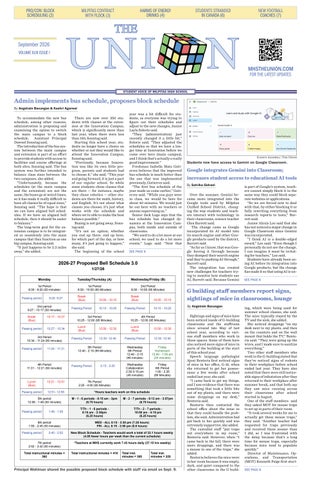
2026-27 Proposed Bell Schedule 3.0 1/27/26
Monday
Tuesday/Thursday (A)
Wednesday/Friday (B)
1st Period 8:30 - 9:20 (50 minutes)
1st Period 8:30 - 10:05 (95 Minutes)
2nd Period 8:30 - 10:05 (95 Minutes)
Break (Bus)
10:05 - 10:15
Break (Bus)
10:05 - 10:15
Passing Period
10:15 - 10:25
Passing Period
10:15 - 10:25
Passing period
9:20- 9:27
2nd period 9:27 - 10:17 (50 minutes) Break (Bus)
10:17 - 10:27
Passing period
10:27 - 10:34
3rd Period 10:34 - 11:24 (50 minutes) Passing period
11:24 - 11:31
4th Period 11:31 - 12:21 (50 minutes)
Lunch (Bus)
12:21 - 12:51
Passing period
12:51- 12:58
5th period 12:58 - 1:48 (50 minutes) Passing period
1:48 - 1:55
6th period 1:55 - 2:45 (50 minutes) Passing period
2:45 - 2:52
7th period 2:52 - 3:42 (50 minutes) Total instructional minutes = 392
3rd Period 10:25 - 12:00 (95 Minutes)
4th Period 10:25 - 12:00 (95 Minutes)
Lunch (Bus)
12:00 - 12:30
Lunch (Bus)
12:00 - 12:30
Passing Period
12:30 -12:40
Passing Period
12:30 -12:40
Wednesday 6th Period 12:40 - 2:15 (95 minutes)
Friday Homeroom 12:40 - 1:00 pm (20 minutes)
Wednesday Collaboration 2:30-3:15 pm (45 minutes)
Friday 6th Period 1:00 - 2:35 (95 Minutes)
5th Period 12:40 - 2:15 (95 Minutes)
Passing Period
2:15 - 2:25
7th Period 2:25 - 4:00 (95 Minutes) *Hours teachers work on this schedule M - 1 - 6 periods - 8:15 am - 3pm (6.75 hours)
M - 2 - 7 periods - 9:12 am - 3:57pm (6.75 hours)
T/Th - 1 - 6 periods 8:15 am - 2:30pm (6.25 hours)
T/Th - 2 - 7 periods 10:00 am - 4:15 pm (6.25 hours)
WED - ALL 8:15 - 3:30 pm (7.25 hours) FRI - ALL 8:15 - 2:50 pm (6.6 hours) New Block Schedule - Teachers would work a total of 33.1 hours weekly (4.05 fewer hours per week than the current schedule) *Teachers at MHS currently work 7.43 hours daily (37.15 hrs weekly) Total instructional minutes = 410
Total inst. minutes = 305
Total inst. minutes = 325
Principal Wohlman shared the possible proposed block schedule with staff via email on Sept. 9.
Kashvi Agarwal | The Union
Students now have access to Gemini on Google Classroom.
Google integrates Gemini into Classroom; increases student access to educational AI tools By Satvika Gidvani
Over the summer, Gemini became more integrated into the Google tools used by Milpitas Unified School District, changing the way students and teachers interact with technology in their classrooms, science teacher Glen Barrett said. The change came as Google incorporated its AI model into its search engine and other Google products used by the district, Barrett said. “As far as I know, that was Google forcing it through because they dumped their search engine and they’re pushing AI through,” Barrett said. The integration has created new challenges for teachers trying to monitor how students use AI, Barrett said. Because Gemini
is part of Google’s system, teachers cannot simply block it in the same way they could block separate websites or applications. “So we are forced now to deal with that, by either blocking it or fully rewriting everything from research reports to tests,” Barrett said. Junior Alexis Lee said that she has not noticed a major change in Google Classroom since Gemini was incorporated. “I think AI is a double-edged sword,” Lee said. “Even though I personally do not see the change, I can imagine it must be irritating for teachers,” Lee said. Students have already been using AI before its integration into Google products, but the change has made it so that using AI is unSEE PAGE 8
G building staff members report signs, sightings of mice in classrooms, lounge By Angelrain Bacungan
Sightings and signs of mice have been noticed inside of G-building classrooms and the staffroom since around late May of last school year, according to various staff members who work in those spaces. Some of them have also noticed more signs of mice in parts of the building at the start of this school year. Speech language pathologist Ajoni Renteria first noticed signs of mice in her office, G-16, when she returned to get her possessions a few weeks after school ended last year, she said. “I came back to get my things, and I saw evidence that there was something that took a little bite out of my plants, and there were some droppings on my desk,” Renteria said. Renteria then contacted the school office about the issue so that they could handle the problem, she said. Administration had got back to her quickly and was extremely supportive, she added. The custodial staff “put traps out everywhere in my room,” Renteria said. However, when “I came back in the fall, there were more droppings, and there was a mouse in one of the traps,” she added. Renteria believes the mice were in her room because it was empty, dark, and quiet compared to the other classrooms in the G build-
ing, which were being used for summer school classes, she said. The mice typically stayed by the TV and the sink, she added. She noticed droppings “on my desk next to my plants, and then on the counters and on the wall mount that holds the TV,” Renteria said. “They were going up the wires, and I made sure to sanitize everything.” Two other staff members who work in the G-building stated that they’ve noticed signs of rodents in their workplace before school ended last year. They have also noted that there were still noticeable signs of infestation after they returned to their workplace after summer break, and that both say they saw mice running across their classrooms after school started in August. One of the staff members said they asked MOT for mouse traps to set up in parts of their room. “It took several weeks for me to actually get these mouse traps,” they said. “Another teacher had requested for traps previously and received them sooner than I did, so I was frustrated with the delay because that’s a long time for mouse traps, especially because mice tend to populate quickly.” Director of Maintenance, Operations, and Transportation (MOT) Kenneth Paige first startSEE PAGE 8
2
THE UNION
PRO
Block schedule changes MHS for better
The current school sched- come much easier to create and ule provides a monotonous adjust as needed. With the cursix-or-seven-period day that rent schedule, very few teachleaves students exhausted by ers spend time after school for the end of the day. On top of all office hours in case students the material learned from var- need extra help due to extenuious classes, students are then ating circumstances. The block forced to sit through hours of schedule allows for more flexhomework and memorization ible work hours and even gives of concepts just to keep up with teachers the chance to promote the required coursework. The more office hours for students block schedule would be a bet- to better understand concepts ter alternative to help lighten taught during class. the load for students and teachThe consequences of absences ers alike while still on a block schedule allowing for effective would also be greatly learning and teaching reduced. For examin the classroom. ple, if a student on The block schedule the current schedule consists of three to missed classes for four 90-minute classonly one day, they es per day with a halfwould already be behour period for lunch. hind on all of their Students would be reclasses and will have quired to spend less to work long hours time at school each to make up the work; day. This gives stubut, if that student NELLIE dents more time to RATHOD BANUELOS were to be in the catch up on coursesame situation with work and material block schedu l i ng , and decreases the chances of they would only miss three or staying up late at night working. four out of their six classes and With this schedule, students would have more time to recovwould be much more well-rest- er properly and easily catch up ed and, in turn, much more pro- on any missing work. ductive in taking on schoolwork Although it’s true that the the following day. The Center switch to a block schedule may for High School Success notes initially seem daunting, in the in a study comparing 9th grad- long run, it would be the best ers in block schedules to those decision for students and teachin regular schedules With more ers. A ASA, The School Superfree time, students could also intendents Association claims explore and join different ex- that “the majority of teachers, tracurriculars that they do not administrators, students and have time for on our current parents are favorable to block schedule. scheduling, even after the someTeachers also receive benefits times difficult period of change from the block schedule. When eventually both teachers and not forced to teach for nearly students report school becomes 87 hours straight, lessons be- less stressful.”
CON Block schedule does more harm than good Block schedules may seem fit into a block schedule, so both like a better method of go about teachers and students will need a school day. 90-minute peri- lots of time to adjust. ods can offer more discussion Student absences would also time and shorter school days. affect learning more. With lonMany high schools opt to follow ger periods, students are missa block schedule and have stu- ing more material than the regdents attend only 3 classes per ular 50 minutes. Students will day. This method may have its also not be able to catch up on benefits, but I believe the cons missed material right away due outweigh the pros. to different classes each day. In A block schedule can provide the long run, this can greatly afstudents with more class time fect grades and test scores. to work, but in the Block schedules can long run, that could also be hard on parback f ire. A 2024 ents as many don’t study published by have f lexible schedthe National Library ules and can only pick of Medicine found up and drop off at certhat overly long classtain times. Other cares can make students pooling students also resent being in class, have to rework their and people tend to rides due to schedulslack off or fall asleep. ing differences. This would actually After-school activiSUSIE decrease how much ties are also impacted WU students learn. The because of the block longer period also schedule. Music and creates heavier worktheater need consisloads, and can make learning tent rehearsals to keep improvharder for students. ing. With the block schedule in In addition, certain classes place rehearsals might not run can’t function with their peri- for a consistent amount every ods being held every other day. day. Clubs also can’t meet as ofFor example, many elective ten or carry out activities regclasses such as art or music ularly because they will always classes need repetition for their have leaders and other members projects to be polished. Harder missing due to the different subjects require daily instruc- schedules. tion for students to maintain Some may support the block their memory. With the block schedule, and it does have a few schedule, students would strug- benefits. But if you really look gle with the material and the into it, the block schedule does a pacing. lot more harm than it does good, Teachers would also have to and making a sudden change completely rewrite their curric- after several years of normal ulums based on the new learn- scheduling would be a huge ading schedule. What worked with justment for students, parents a normal schedule will likely not and teachers.
OPINIONS
SEPTEMBER 2026
Restrictions on mail-in voting pose threat to democracy Mail-in voting restrictions are harmful to the scope of American politics because of a direct barrier being placed on voters’ access to the polls, especially those from disadva ntaged backg rounds. Despite the recent Supreme Court ruling that prevented the Trump administration from imposing these regulations, the overreach of federal power remains an issue at present. Lawmakers should exhibit greater diligence in protecting citizens’ right to vote rather than imposing stricter restrictions on mailin voting. Even though some policy ma kers claim that these restrictions reduce voter fraud, imposing significant restrictions on mail-in ballots significantly reduces electoral turnout. In reality, this change in policy could trigger immense electoral imbalance and eliminate the voices of voters who are unable to cast their vote in person. Mail-in voting ensures a
way citizens can exercise their of an official’s qualifications right to vote without undergo- that serve the community. ing the hassle of missing work Advocates of mail-in voting hours, failing to meet caregiv- restrictions often argue that er duties, or standing restrictive policies in long lines at polling are vital in maincenters according to ta ining election the League of Women i nteg r it y. HowVoters’ article “What ever, accord i ng to Know About Voting to the Bipartisan By Mail.” The League Pol ic y C e nt e r, supports the fact that existing ma il-in voting by mail is invoting structures deed a secure manner already contain reof political participaliable verification tion that is incredibly met hods, which beneficial for minority make voter fraud RAAGHAVI groups due to systemic extremely unlikeKALLURI discrimination at pollly. Hence, mail-ining site closures, peovoting restraints ple who have disabiliare detrimental to ties, and those who do not live democracy. near a polling station. Government officials must Moreover, mail-in ballots give shield the ballot box instead of voters ample time to carefully blocking its accessibility. Votevaluate each candidate’s agen- ing has, and will, continue to da. If this option is not allowed, function as the bedrock of our voters will be uninformed and democracy. Standard mail-in may become politically polar- methods ensure that more citiized if they vote based on a de- zens can cast their vote because fault party preference instead every vote matters.
UCs should return standardized testing for admissions For years, the SAT and ACT tests were a familiar part of the college application process. Then, in 2020, the Universities of California (UCs) began moving away from standardized testing. The change came during a complicated period for college admissions. The UCs were already attempting to figure out if standardized testing was an equitable measure of college readiness, while a lawsuit challenged the use of the exams. At the same time, the pandemic closed schools and testing centers making it difficult for many students to take such exams. Today, neither SAT nor ACT scores are used in UC admissions. But as the university continues to evaluate its admissions process, I believe it should reconsider completely removing standardized testing. Critics of these exams argue that standardized tests are a disadvantage to low-income students and students
who have limited access to shouldn't automatically be conpreparation and other resourc- sidered less capable, and vice es. On top of that the pandemic versa for high-scoring students. added another problem: stu- Instead, standardized testing dents couldn't physically take could give admissions officers the tests. The UCs responded by additional information about a not requiring the SAT and ACT student's academic level alongfor Fall 2021 and eventually side to their transcript. went test-free. HowHowever, if the ever the problems that UCs reinstate these caused the UCs to go exams, they should test free are no longer give students at least as pressing. As techtwo years notice to nology advances, sevallow prospective eral free SAT resourcstudents ample time es can be found online: to prepare. Without many at low costs or proper notice, those even free. same problems with Eliminating the tests standardized tests entirely may have crewill come back magSATVIKA ated an new problems. nified. GIDVANI UCs no longer have The debate a common academic shouldn't be about measurement that can whether standardgive context for thousands of ized tests are perfect. They arstudents around the world. en't. The question is whether This doesn't mean an SAT or they provide useful informaACT score alone should deter- tion that UCs should consider mine whether a student gets alongside the rest of a student’s into a UC. A test score should application. Therefore, I bebe only part of an application. lieve that standardized testing Students with lower scores should be reinstated at UCs.
Common feminist phrases support internalized misogyny Contrary to popular belief, phrases like, “Hot girls don’t work,” or, “Hot girls can’t drive” are inherently patriarchal. Originating from social media posts and leaking into the real world, these claims are made by women with the intention of reaffirming other women by suggesting that whatever stage of life they are in is acceptable. However, they do not realize that they are actually discouraging female achievements, as the basic format is, “Hot girls don’t [insert accomplishment here].” The saying, often mistakenly perceived as a mantra of sisterhood, trains women to lack the necessary skills to be independent in society and insults practically the entire female sex. The phrase, although prefaced with praise on women’s appearances, highlights their shortcomings and applies them to all attractive women, which the majority of females consider themselves to be. Online and in analog daily life, most girls grow up hearing that they are, by nature, lacking in many capabilities. James Gallagher of BBC wrote, “Girls lose faith in their own talents by the age
of six,” beginning to distance lated to her appearance. themselves from activities that Women are conditioned from are catered towards those who a very early age to believe that are especially smart or gifted. their greatest value comes from Raised to believe in their own their looks, a belief that was deficiencies, these girls grow up confirmed by a Pew Research to be women who don't believe Center study which resulted in in themselves enough to pursue 35% of the sample population, higher education or careers in the largest agreeing group of fields like business or STEM, the survey, admitting to conwhich could put them in higher sidering physical appearance to positions of power. be the most important female The saying is targeted to- trait. Being conventionally wards females aged unattractive essen18-26, those who are tially means being still finding themunlovable, so physselves and starting ical appearance bework, college, or othcomes an acute point er major milestones. of insecurity. If you Calling these young say that women who women “hot girls” sidon’t work are allurmultaneously infaning, you are declaring tilizes and sexualizes that those who do are them. It disregards all undesirable. of their accomplishConvinced that inZARA ments and wisdom, dependence is unlikKAUKAB describing them as able, many women naive, virgin-children may avoid the pursuit instead of respectable of higher education young women. or powerful careers. Among the Accentuating the weakness most successful oppressive ideand innocence of these women ologies imposed on women is is an appeal to the male gaze, the misogynistic creed that the as taking charge for a helpless only thing women can do well is woman and gaining her love and “sit still and look pretty.” Telladmiration is a popular male ing growing girls and women fantasy. The particular empha- that the most beautiful among sis on the women’s beauty sug- them are dependent leads them gests that everything a woman to prioritize their looks over life does or doesn't do is directly re- skills.
SEPTEMBER 2026
AI threatens to replace traditional authors in the future
With artificial intelligence (AI) on the rise, many jobs are becoming obsolete, leading many to wonder which career they should pursue and whether it is safe from AI. While some believe authors are safe, I believe that AI will soon take over. Many skeptics claim that AI doesn’t have an imagination and therefore cannot create ideas of its own. However, according to Arvix Labs’ article “Embracing Hallucination as Imagination,” scientists are experimenting with encouraging open-source AI models such as Meta Llama to hallucinate more often while retaining basic functionality. Hallucination is when AI gives completely fabricated information to fill gaps in its knowledge instead of a valid answer. Instead of trying to end the misinformation, researchers tried to increase it. They found that the AI models would continue hallucinating until it came up with answers that weren’t found anywhere else, effectively acting as an imagination, decreasing the
importance of an author, as AI work public domain. This is excan be creative too. tremely important, as it means Many publishers would pre- that companies are less likely fer AI over huto publish AI-writmans, according ten work, as they can’t to Mighty Union copyright it and would Agency’s Article therefore lose money. “How Artificial Until a law about this Intelligence Is is passed, authors are Re volut ion i z i n g safe. When such a law the Marketing passes, I strongly beIndustry.” Hulieve that authors will man writers rebe effectively replaced. quire time and Although many say money and are human writing is betRUHAAN mista ke-prone, ter than AI's, according FULAY Instead of goto a BBC article titled ing through the “AI Stories Preferred to months-long Human-Written Ones process of revising and edit- - Study,” found participants ing, publishers can just use AI, liked the AI-written stories which makes no grammatical better than the human-written errors and can write instantly. ones. In the words of famous However, AI work is unco- computer scientist Fei-Fei Li, pyrightable. According to the “Artificial intelligence is the fuSkadden law firm’s Article, ture, and the future is here.” AI “Copyright Office Publishes is gradually becoming a staple Report on Copyrightability of in everyday life, and instead of AI-Generated Materials,” hu- avoiding it, authors, among othman authorship is required ers, should embrace change and to copyright work, making AI pursue other careers.
EDITOR I A L : The Opinion of The Union
Trojans should be proud of MHS national ranking Milpitas High School ranks #171 out of 2,747 high schools in California and #1,036 out of 17,945 nationwide, placing it in the top 7% of ranked public high schools in the state and the top 6% nationally, according to the U.S. News & World Report. Trojans have much to take pride in as part of one of the highest-achieving public high schools in the nation. Our students performed especially well in State Assessment Proficiency, with students scoring in the 89th percentile on the Smarter Balanced and California Science Test, as reported by U.S. News. On a scale by the California School Dashboard ranging from “very low” to “very high,” student academic performance in mathematics and English Language Arts was rated “high,” while performance in science was rated “very high.” Our school’s strength in STEM is particularly notable. MHS earned an impressive ranking of #174 in U.S. News’ list of best STEM high schools, placing us
in the top 1% nationally. The ranking was based on participation and performance in AP science and math exams among students at the top 2,000 public high schools in the country. Our rigorous AP math and science courses provide students with a strong foundation for pursuing STEM majors and careers. Even beyond AP classes, our school encourages students to pursue STEM, evidenced by development of the MHS Extension at the Innovation Campus. Fur ther more, MHS performed “well above expectations” on the State Assessment Performance indicator, which was evaluated through the comparison of state assessment results with U.S. News’ predicted scores. These predictions take into account the “significant statistical relationship between the proportion of a student body that is Black, Hispanic and/or from a low-income household” and test scores. Around 44% of our student population is socioeconomi-
cally disadvantaged. MHS ensures that every student has the opportunity to succeed, regardless of their financial background. Specifically, students can receive support and guidance through programs such as the Specially Designed Academic Instruction in English (SDAIE), English Language Development (ELD), and Advancement Via Individual Determination (AVID). This commitment to supporting every student is what makes MHS so special. MHS’s strong academic performance stands out given the socioeconomic diversity of its students. We, The Union, are proud to see our school climbing up the ranks, nearly entering the top 5% of schools nationwide. Watching MHS’s ranking improve year after year should inspire us to continue striving towards even greater achievements in the years to come. All Trojans should take pride in being part of one of the best public schools in the nation.
EDITOR I A L : The Opinion of The Union
Milpitas should end contract with Flock Safety While surveillance is often necessary to keep people safe, technology can be abused by companies and governments, violating the rights of citizens. Because of proven risks, we, The Union, believe that the Milpitas government should cancel its contract with Flock Safety. Flock Safety, a private company founded in 2017, specializes in surveillance technology. It has been in the news lately because of their automated-license plate reader (ALPR) cameras—cameras that capture and store the license plates of passing cars. The number of Flock cameras in the U.S. grew exponentially within the last year: from 19,825 cameras on Aug. 29 in 2025, to over 130,000 by the end of August this year, according to deflock.org. The problem isn’t surveillance itself; it is the lack of transparency and Flock’s privacy violations. When a city or a county enters into a contract with Flock, it has the option to share the collected data with other government entities, including the federal government.
However, in many instances, the option to share that data to out-of-state agencies was enabled even though local law enforcement disabled it, such as in Ventura County. Also, although in violation of state law, Flock allowed out-of-state agencies, including Immigration and Customs Enforcement (ICE), to run 1.6 million searches in San Francisco's police department’s databases, according to the American Civil Liberties Union. Flock technology has even been misused by local law enforcement. According to an NPR article, "Some police officers... stalk ex-partners, or accessed the data for immigration purposes without a local government's consent.” There have been more than a dozen cases of cops being arrested for the misuse of Flock technology across the entire country. As a result, Flock Safety has faced intense backlash from several civil rights organizations and has led to many cities and countries across the U.S., including Mountain View, to cancel their contracts. Two
THE UNION
EDITORIAL
hundred fourteen contracts between Flock Safety and local governments have been canceled as of Aug. 28. The first cameras in Milpitas were installed in early February 2025. As of Aug. 30, there are around 40 Flock cameras in Milpitas, according to deflock. org. Ironically, a crime report published by the Milpitas Police Department spanning from January 2025 to July 2026 actually shows an increase in crime. Part I Crimes, arrests, and property cimes increased by 7.1%, 9.1%, and 5.6% respectively. In a country where the federal government grows more authoritarian-like every day, we can't afford to give up our privacy without transparency. Flock Safety’s lack of guardrails for the abuse of its technology opens the door for a dystopian-like hyper surveillance state. Maintaining a democracy takes action and vigilance from citizens, and one step we can take now is to demand that Milpitas cancel its contract with Flock safety.
U NION The
S T U D E N T V O I C E O F M I L P I TA S H I G H
The Union is published by the Journalism class of Milpitas High School. The Union is a designated public forum for student expression without prior review by school officials in which students make all final decisions on content. The views in The Union are those of the writers and do not necessarily reflect those of the school, students, administration, or Milpitas Unified School District.
3
ADVERTISEMENTS
Want to advertise in the Union? Please contact our business manager at milpitashightheunion@ gmail.com. Ads are available in full/half/quarter page and business card sizes. Upon request, The Union staff will also customize and design your advertisement. C O N TAC T U S
1285 Escuela Pkwy, Room E-9 Milpitas, CA 95035 milpitashightheunion@gmail.com
S TA F F Kashvi Agarwal Angelrain Bacungan Gael Barocio Jolie Chung Lauren Dang Justin Doung Shomili Eldo Ruhaan Fulay Satvika Gidvani Anna Grier Reva Gupta Jessie Hankins Ethan Hoang Vincent Hong Kendall Jacobson Meha Kaleeswaran Raaghavi Kalluri Tejus Karadi Zara Kaukab Gurnoor Kaur Suravi Khot Eli Lorenzo Raghavendra Murugan Cynthia Ngo Alice Nguyen Ethan Phan Tamia Phan Shreya Ram Nellie Rathod Banuelos Ishana Seth Siqi Song Michael Wheeler Susie Wu Joshua Zhang
Sanjit Roy
Journalism Advisor
H AVE A N OPINION?
GOT A GRIPE WITH THE SCHOOL? DESIRE TO PR AISE MHS? WANT YOUR VOICE TO BE HEARD? WISH TO REPRESENT THE STUDENTS? SUBMIT LETTERS TO MILPITASHIGHTHEUNION@GMAIL.COM MAKE SURE TO WRITE DOWN YOUR NAME AND GR ADE
FOR ONLINE EXCLUSIVE STORIES, VISIT MHSTHEUNION.COM
4
THE UNION
Different methods create unique jewelry, accessories By Satvika Gidvani
When people think of making jewelry, they think of stringing beads onto a bracelet or on to a necklace. But what they don’t realize is that jewelry making is so much more than just beads and string. From shaping metal to wrapping wire and molding clay, jewelry making includes a wide range of techniques and materials. Typically, beginners who want to elevate their jewelry making game turn to wire wrapping. Instead of simply connecting beads, wire can become part of the design itself. Wire wrapping involves bending and wrapping jewelry wire around beads or stones to hold them together. The American Metalcraft Institute describes wirework as a technique that can be combined with other jewelrymaking methods. Wire can be shaped into loops, spirals, and decorative patterns, allowing you to create simple and intricate designs. An advantage of wire wrapping is that it does not necessarily require specialized equipment used in some forms of metal jewelry
making. However, for people interested in traditional jewelry making, metalsmithing is a much more hands on approach. According to the Crucible website, metalsmithing can involve techniques such as hammering, soldering and more. Unlike wire wrapping, metalsmithing requires specialized tools, more technical skills, and it costs a lot more money. However, it also gives artists much more control over the final piece. A sheet of metal can be cut, shaped, and assembled into something completely different. Metal clay gives a similar metal look to your artwork as metal smithing, but it is much easier to approach. Metal clay can be shaped by hand before being fired in a kiln where it becomes solid metal, as stated by the Crucible. This means you can design like you would with traditional clay before turning it into a metal piece. A kiln is not always available to everyone, so a similar material is polymer clay. Polymer clay gives a similar level of control, allowing you to create jewelry components yourself. Polymer
SEPTEMBER 2026
LIFESTYLE clay can be shaped into almost anything an artist can imagine. It is the perfect technique if you want your jewelry to be completely custom, rather than choosing from existing materials. To solidify your art, you can bake it in a regular oven, usually around 130 degrees Celsius for 15 to 30 minutes. Jewelry does not have to be made from metal or beads at all. Fused glass can also be used to create pendants and other wearable pieces; even materials such as paper and fabric can also be incorporated into jewelry designs. Jewelry making is an art form, there are no limits to what you can make with the different materials.There is no right way to make jewelry. Someone might prefer the simplicity of beads, the precision of wire wrapping, the creativity of polymer clay or the technical challenge of metalsmithing. Each technique offers a different way for artists to turn their ideas into something people can actually wear. Although this article shows you several ways to make jewelry charms, there are still a world of options available.
Different nail styles open up opportunities for creativity By Alice Nguyen
There are few changes that can drastically alter your appearance, one of the ways being pampering and taking care of your nails. Although not a nail expert, I have customized my own nails in a number of ways, and have ranked the best ways to style your nails. Gel X: 8/10 There are two kinds of Gel X nails: the extensions and the builder gel. The main difference between the two are in the names; the extensions involve attaching a plastic extension to your natural nails and applying gel onto the plastic nail, whereas the builder gel is applied directly onto your natural nail. After application, both nails get cured under a UV lamp. These kinds of nails are difficult to DIY at home and are better if done in a salon or by someone else. Gel X nails are generally long lasting and are easy to customize, making them my personal favorite and a popular option for many. However, getting Gel X done at a salon or even purchasing a Gel X kit online can be expensive, and the process of curing the gel under the UV lamp can be physically painful. Press-ons: 9/10
Press-ons are like Gel X extensions in the sense that they’re plastic nails, except that they are purchased with a design already on them. Press-ons can be attached onto your natural nails with either nail glue or adhesive tape, meaning that you will be exposed to less chemicals as you would with Gel X or traditional nail polish. Pressons are also cheap, with some costing as little as $5. Affordable, reusable, and quick to apply, press-ons are one of the most accessible options for nail cosmetics. The only downside with press-ons is their lack of durability, as the glue and tape are not as strong as Gel X. Traditional nail polish: 6/10 Last but not least; the tried and true traditional nail polish remains one of the most popular options for those looking to get their nails done. A single bottle of nail polish can cost as low as a dollar and is immensely accessible to people of all ages. That being said, painting your nails and waiting for them to dry can take a long time, and preventing any lint from getting stuck in the film is a big hassle. For those looking for a cheap option with a little more time on their hands, nail polish may be the best option for you!
Courtesy of PickPik
There are several different ways to make jewelry with tools, such as metalsmithing which utilizes hammers.
Energy drinks damage teenagers’ health, creates problems By Satvika Gidvani
Sometimes a grabbing quick Red Bull on the way to school can seem like the perfect solution to a long day. With homework, sports and other activities, having an energy drink that promises an instant boost can be tempting. While energy drinks make people temporarily more awake, that boost can come with several downsides, which can be more extreme for teenagers, as stated by the American Academy of Pediatrics. According to UCLA Center for Health Policy Research, approximately 37% of California teens consume one or more energy drinks daily. Ideally, high school students should not consume energy drinks at all because a single energy drink exceeds the daily caffeine limit recommended for teenagers, according to Johns Hopkins Medicine. The most significant problem with caffeine is how it affects sleep. Caffeine can remain in your body for hours, and the American Academy of Pediatrics notes that caffeine can contribute to sleep loss, disturbing a student’s concentration and function at school. While you may drink an energy drink because you are
tired, the caffeine can interfere with the sleep you need to avoid being tired in the first place. Besides the disruption of your sleep schedule, energy drinks can also affect the heart and nervous system. Side effects can include increased heart rate and high blood pressure, according to the CDC (Center for Disease Control and Prevention). The FDA (Food and Drug Administration) also warns that too much caffeine can cause symptoms, such as increased heart rate, heart palpitations, anxiety, and headaches. While small amounts of caffeine for teens can be tolerable rather than harmful, the amount of caffeine typically packed in a single drink far surpasses the limit of a 100 milligrams of caffeine for teens. The FDA reports that energy drinks can contain anywhere from 41 to 246 milligrams of caffeine in a 12-ounce serving. On top of the typically marketed caffeine, energy drinks usually contain guarana, which contains natural caffeine. Sugar is another concern. High sugar levels can cause weight
gain, blood sugar spikes, and long term metabolic damage, according to Johns Hopkins Medicine. However, even sugar-free options do not eliminate the other concerns associated with caffeine and other stimulants. For example, Ginseng and L-Carnitine, despite being marketed as healthy additions, lack safety testing for children and teens. These stimulants often increase physical symptoms like anxiety and heart palpitations, according to the Cleveland Clinic Health Essentials. However, the side effects of energy drinks does not mean that everyone who drinks an energy drink will experience serious health problems. People respond to caffeine differently, and the amounts vary in different products. Nevertheless, health organizations agree that teenagers are more vulnerable to the effects of caffeine and recommend avoiding caffeinated drinks entirely. Despite the down side of caffeine, it is hard to avoid it entirely. The best thing you can do is do your best to avoid energy drinks.
Alice Nguyen | THE UNION
Gel X nail extensions are colorful, easy to customize, and durable.
Lauren Dang | THE UNION
Across
Down
2. What kind of clay allows you to bend it into any shape? 4. Whatanimal has allegedly been spotted in the G Building? 8. What campus can students use a bus to go to take classes at this year? 10. What sport is Coach Elzey the head coach of?
1. What’s one subject that Dr. Meyer teaches? 3. What is the name of the main character in Resident Evil (2026)? 5. How many wins does the girls’ varsity tennis team have as of September 19th? 6. What kind of animal is Buddy from Buddy (2026)? 7. What kind of school schedule alternates classes each day? 9. Which European country did some students go to over the summer?
Scan QR code for answers!
SEPTEMBER 2026
THE UNION
ENTERTAINMENT
5
‘Resident Evil’ thrills, scares big screen with zombies RATING: 4.5 out of 5
By Lauren Dang
“Resident Evil,” directed by Zach Cregger, effectively spooks audiences with the survival horror that’s ubiquitous to the video game franchise while also telling an interesting original story. The movie follows Bryan Hodukavich, played by Austin Abrams, who encounters a zombie outbreak when he finds himself in a place that longtime “Resident Evil” fans know spells danger—Raccoon City. It was announced that the film would be an original story with new characters and only kept a few aspects from the games. While I was open to the introduction of new characters, I was worried that the film would sideline the defining parts of “Resident Evil” in favor of these characters. After watching the movie, I can happily say that it has gone beyond my expectations. The movie kept me engaged and wondering what will happen next. While there are no characters from the
video games, the film’s original characters are very entertaining and there are things that fans can enjoy, such as the setting being Raccoon City and the presence of Umbrella Corporation, an antagonistic faction from the games. For one, Bryan is a great protagonist. Before the movie dives into the horror, we learn that Bryan is a medical courier who’s in Raccoon City to make a high-paying delivery, unaware of the city’s dangers. He also doesn’t have much experience with combat and has to quickly learn how to use guns to survive the zombie outbreak, which results in him making a few mistakes, such as having poor aim. In fact, there are many moments where he acts so pathetic and reckless that it is hilarious. However, the movie also displays Bryan’s good traits, such as how he attempts to help others even though they’re infected. Overall, Bryan is a likeable, sympathetic protagonist that makes you want to root for him to survive. Another aspect of the movie that is well-done is how it scares the audience. Rather than just
spamming jumpscares, the film strategically spaces them out to keep the audience in suspense. This puts the audience in Bryan’s shoes, or his “jays” as Bryan himself puts it, as he’s forced to remain cautious while navigating an unfamiliar area infested with zombies. The zombies here have inhuman physical traits like tentacles and multiple limbs and can merge with other zombies to create a cluster—and it enhances the movie’s horror. The zombies are scary because the audience is made to look at how grotesque they appear and their aggressive behavior, making the film’s antagonists terrifying. Fans of the “Resident Evil” games are in for a treat too, as zombie dogs, a recurring enemy in the games, appear in the film. “Resident Evil” is an amazing horror movie, and whether or not you’re familiar with the franchise, you should consider giving this film a watch. While the gorgeous characters from the games like Leon Kennedy and Ada Wong aren’t in the movie, the movie does have the adorable Bryan Hodukavich to make up for it.
Horror movie ‘Buddy’ reflects real world abusers By Rain Bacungan
Disclaimer: Contains spoilers Who’s the most lovable, cuddly orange unicorn there is? Why, it’s Buddy! Your out-of-thisworld pal who will love you no matter what! …Or does he? The movie “Buddy,” directed by Casper Kelly, follows the star of a children’s show, Buddy the Unicorn, played by Keegan-Michael Key, and his insatiable bloodlust as he goes on a manhunt to eliminate his childstar co-hosts and anyone who gets in his way. The movie is set in a surrealist Barney-theDinosaur-esque world that gets reset every time the co-stars hug Buddy and sing the closing theme of the show. Beneath the murder, the nostalgic vivid colors, and the movie’s vulgarity—there’s a scene where one of the kids pisses on a flower—the movie is an allegory of the exploitation of children. The movie reflects the real world by portraying coercion, manipulation, grooming, and obviously, children being harmed throughout the movie in a direct manner as there’s rarely any offscreen deaths or implications
that something “big” happened. It is quite clear that Buddy represents an abuser and a predator. The sole reason why Buddy goes on this pursuit to kill others is because of his own insecurities arising when something doesn’t go his way. If the other co-stars don’t follow along with his plan or if they view him as a monster, he’ll go through an existential crisis. If he doesn’t get what he wants, he’ll literally malfunction. His constant need to feel secure replicates the behavior of an abuser, as he is willing to do anything that it takes to keep his power; a prime example of this is when he rips apart Charlie the Train when the children are attempting to escape from him. Before his spiral into madness, Buddy was the main figure that the co-stars would go to whenever they felt scared or hurt; he comforts them in a way that makes them feel happy and heard. However, what he says is often contradictory from his actions. He feeds his co-stars lies in order to get them to trust him, similar to what a groomer does in order to gain their victims’ trust. Also, Buddy doesn’t just get
Courtesy of Alamy
Buddy is anything but a buddy; he frequently abuse his co-stars.
his satisfaction and his security from the children, but also from the adults. In the movie, Nurse Grace, one of the stars of the imaginative show, is taken forcefully from her home and has her memories wiped. Buddy asks her to comfort him after he kills another co-star and she does so by singing him a song. As she sings, he grabs her forcefully and licks her. Without the trust and dependence from his co-stars, Buddy has no power; without the physical comfort of Nurse Grace, he also has no power. Therefore, he exploits the people around him in order to feel comfortable with himself, similar to how a groomer craves solace. Betty the Bunny, the other furry friend of the gang, is an energetic, silly door-mat of a character. She represents the adult bystander that does absolutely nothing to prevent the harm that the abuser causes. In the first few scenes that she’s in the movie, she’s worried about not pleasing Buddy, as it is his birthday. She wants to ensure that he’s happy on his special day. However, when the other costars become aware of Buddy’s abuse and go to her for help, she doesn’t take their warning as seriously as she should, nor does she help them. In fact, she is not seen around the children at all after this encounter. Betty is aware of Buddy’s rampage and how he was plotting to hurt his co-stars, yet she does not attempt to stop him or reach out for help. Often when friends of an abuser or predator find out about what the other is doing, they sometimes brush off that fact and assume that they’re being lied to. This sentiment only leads to more suffering for the victims, and the effect of Betty’s bystanding is extremely clear. The bluntness of “Buddy” captures the lengths groomers go in order to stay in control and the adults that do nothing about it. “Buddy” sheds light on the harm that many children experience, and its bloody way of portraying it is a call to action; if you see something, say something. Even if the action requires a lot of courage, do something! Like what Buddy says, “in order to be brave, you must also be afraid.”
Courtesy of Wikimedia Commons
“Resident Evil” follows Bryan, who tries to survive a zombie outbreak.
Emmy Awards ceremony turns out to be unremarkable, boring By Reuben Thayil
The 78th Annual Primetime Emmy’s Awards was held on Monday September 14 at the Peacock Theater in Los Angeles. It aired live on NBC and was hosted by “Law and Order SVU” star Mariska Hargitay. The Emmys have two award ceremonies: The Primetime Creative Arts and the Primetime Emmys. The Creative Arts ceremony encompasses 100 categories over 2 days focusing on editing, music, makeup, casting, among others. The Primetime telecast, however, is the one that makes the headlines and covers the more well-known categories. Hargitay is first the noncomedian host of the Primetime Emmys since 2008 as well as the first female host in 15 years. It was a stark and unwelcome departure, in my opinion, from what viewers came to be accustomed to with late night hosts and standup comedians. As a host, Hargitay was remarkably mediocre and forgettable. She felt more like a background host often overshadowed by guest presenters and brought down by cringey musical numbers. The ratings speak for themselves: according to the Associated Press, the ratings for the Emmys were down 10% compared to the 2025 Emmys. The night’s largest winner Apple TV’s “Widow’s Bay” won all 6 its Primetime nominations including Outstanding Comedy Series, Outstanding Lead Actor in a Comedy Series, Outstanding Supporting Actor and Actress in a Comedy Series, and Outstanding Directing and Writing for a Comedy series. HBO’s highly acclaimed medical drama “The Pitt” was the deserving winner of the night’s two biggest awards: Outstanding Drama Series and Outstanding Lead Actor. The show was awarded 13 Primetime nominations winning two awards for Outstanding Drama Series and Outstanding Lead Actor in a Drama Series. Lead actor Noah Wyle has won the Outstanding Lead Actor award for two consecutive years now. Apple TV’s show “Pluribus” won two of the eight awards it was nominated for, including
Best Lead Actress for Actress Rhea Seehorn and director Vince Gilligan won the long overdue award for Outstanding Writing. Gilligan is best known for creating the TV shows “Breaking Bad” and “Better Call Saul.” Gilligan and Seehorn worked together on “Better Call Saul” which never won an Emmy despite being nominated 53 times and being one of the most critically acclaimed shows of all time. One of the most surprising moments of the night was when Netflix’s “The Diplomat” actress Allison Janney won the Outstanding Supporting Actress Award. Janney herself told ExtraTV that she recalled looking on websites prior to the ceremony and seeing her chances of winning at 2%. Janney is now in a four-way tie for the performer with the most acting Emmy awards with eight awards. “Widow’s Bay” lead actor Mathew Rhys made Emmy history being the first male actor by winning both Outstanding Lead Actor in a Comedy series and in a Limited/Anthology Series for Netflix’s thriller “The Beast in Me.” Rhys also being an executive producer of “Widow’s Bay” allowed him to take home three Emmys. CBS’s recently canceled “The Late Show with Stephen Colbert” won a well-deserved victory taking home the Outstanding Variety Series award. CBS canceled the then number one rated late night talk show in May citing the reason as “purely financial.” Due to its end, this was the final award the show could win. Colbert and his team received a standing ovation from the audience as they walked onto the stage to receive the award. In his acceptance speech, Colbert took the opportunity to promote his recently jobless former production staff to the various executives and showrunners in attendance. The 78th Primetime Emmys was overall not remarkably memorable with a lower viewer turnout at 6.7 million. Nevertheless, records were broken and history was made with upsets and surprises throughout the night.
6
THE UNION
FEATURES
Courtesy of Casey McMurray
Students gather for a group photo in front of the Piazza Navona in Rome, Italy, during their EF Tours trip.
Students make the most of Italy trip despite two-day Montreal setback By Kashvi Agarwal
A group of around 30 students traveled to Italy this past summer as part of an Education First (EF) Tours trip, organized by Assistant Principal Casey McMurray, retired French teacher Lisa Topping, and retired English teacher Dena Chavez, McMurray said. Visiting St. Peter’s Basilica, St. Paul’s Basilica, the Roman Forum, the Duomo in Florence, the Sistine Chapel, and the Vatican Library, along with enjoying Italian food, were just some of the many memorable parts of Italy, McMurray said. “Those are once in a lifetime experiences for many, and I’m glad we were able to actually be there and see, with our own eyes, those masterpieces,” McMurray said. The trip balanced a planned itinerary and guided tours with the chance to explore the area independently with friends, sophomore Ushoshi Das said. “If you had an hour with the tour guide, you would have an
hour or two for yourself, so it’s a really good balance,” Das said. Regarding the tour guides, she added, “They were all super nice and friendly. It just felt like a really nice experience because there were a lot of jokes being made, a lot of smiles and laughs the entire trip.” En route, however, flight disruptions set off a series of cascading events that resulted in a two-day delay in arrival to Italy, Das said. “I would complain because we wasted a couple days of our trip just stuck on the airport floor, but also, it was like a fun little adventure as a group together,” Das said. “We made a lot of new connections and became friends through that because we all trauma-bonded.” Senior Lisa Tucker wanted to stay home over the summer, but her dad convinced her to go on the trip, knowing it would be “a good opportunity to see the world” since she had never previously traveled outside of the U.S., she
said. “Although I didn’t want to go, I think it was really, really worth it because not only was Italy beautiful, but I feel like I made … lots of close friends that I never thought I would have made,” Tucker said. Seeing the Colosseum in Rome was an especially surreal moment, Tucker said. Browsing the shops in Florence was another highlight of the trip for her, she said, pointing to the outfit she was wearing, which she had bought entirely in Italy. “(In Florence), they had a lot of cute clothing and they had so much gelato,” Tucker said. “Every corner you turned, there was a gelato shop, and it was all delicious … I ate gelato for breakfast, lunch, and dinner.” Exploring the beautiful small town of Assisi was one of her favorite parts of the trip, Das said. “It had that European summer vibe,” Das said. “I also liked going to Trevi Fountain — it was just such a fun experience throwing that coin over your shoulder,
SEPTEMBER 2026 making that wish.” When their plane landed in Montreal for a layover on the way to Milan, passengers remained on board for around five additional hours before they were allowed into the airport, Das said. After entering the airport, they received a notification that their connecting flight had been delayed from 8 p.m. to 10 p.m., then 12 a.m., and then 2 a.m., she added. “We finally got on the plane, and then — I think it was ten minutes — we’re all sitting down, putting our things down, getting our stuff out, just relaxed and finally happy when the pilot makes an announcement,” Das said. “He’s like, ‘Oh, actually, the flight is canceled. We don’t have enough flight attendants.’ I think there was something about the weather, but there were still a bunch of flights getting sent out that were not from Air Canada.” Once they got off the plane, the group had to sleep on top of their suitcases on the floor of the Montreal airport because they weren’t given hotel vouchers for the night, Tucker said. They booked a hotel for the following evening after their unexpected stay in Canada was extended by another day, she added. “When we came back to the airport the next morning, we had to wait like another six hours to get a flight,” Tucker said. “That was actually terrible. It was kind of traumatizing.” However, everyone was grateful for McMurray, who stayed up throughout the night trying to book a flight and secure hotel vouchers, Tucker said. “If it wasn’t for him, we might not have made it out of Canada,” Tucker said. They showed “great resilience” and made it to Milan, with a group of four going with his wife through Madrid, Spain, and the rest of them going through Casablanca, Morocco, McMurray said. “We had a little side excursion, so we could say we were in the continent of Africa,” McMurray said. “We were on three continents in one day: we went from
North America to Africa to Europe. That was an unexpected detour, but we made it to our final destination, and we got to see a little bit — albeit inside the airport — of Casablanca.” Despite everything that occurred during the first few days of their trip, the chaperones never lost their patience and remained calm through all the ups and downs, Das said. “As a kid who had no clue what’s going on, … having such stable people we could rely on the entire trip was so helpful, and it made the trip actually a fun experience,” she added. As a result of the days lost in Montreal, the group had to bypass Venice and begin their trip in Florence instead, McMurray said. “Travelers were reimbursed for the missed part of the itinerary,” he continued. “They (EF Tours) did compensate us by giving us a trip that we hadn’t planned on, which was to the catacombs in Rome.” It all worked out in the end, McMurray said. EF Tours was communicative, responsive, and “truly available 24/7,” he said, and he was in communication with the tour director in Milan, who adjusted the itinerary as needed. “It was unfortunate we experienced the delay, but that is one of those sometimes inevitable experiences when we fly,” McMurray said. “Moving forward, I’m hoping that this was one of those things that happens once, but not twice. All the other times that we’ve flown with EF Tours — and Ms. Topping has flown with them over 12 times, 13 times — and this is kind of the one-off experience is what I would say.” School trips like this one to Italy can be some of the best experiences of high school, providing a much-needed balance to the stress of school, Das said. “You’re traveling with your friends; you’re going to different places,” Das said. “It’s something I don’t think I’d ever imagine. I know a lot of schools don’t have this opportunity, so we’re so lucky to have it.”
From student to colleague: Ms. Diep follows in Dr. Meyer’s footsteps By Satvika Gidvani
After graduation most students leave high school, never to return. For others, the relationships and experiences they made there continue to shape their lives long after they walk across the graduation stage. Science teacher Sharon Diep was a freshman at MHS in 2010; she was a class officer while science teacher Dr. Letta Meyer was the class advisor, Meyer said. Eventually, Diep took Meyer’s AP Chemistry, Meyer added. “I basically had her for all four years of her high school, in at least one aspect,” Meyer said. Meyer has been working with Center for Talented Youth (CTY), a summer program for gifted students, through Johns Hopkins for years and in the middle of the semester she had a TA drop out, Meyer said. “I started thinking through students that I knew were majoring in chemistry and I had seen Diep work with people,” Meyer said. “And so I just reached out and said, ‘Hey, we need somebody for like four weeks in the next week.” Initially, Diep wanted to pursue a profession in medicine and did not think of a teaching career as an option, Diep said. “While I was thinking about what else I wanted to do, Dr. Meyer actually reached out to me with an opportunity to work with her at a program called CTY,” Diep
said. “During that time I was able to be a lab assistant for a chemistry class there, and I really enjoyed the experience.” Diep went back to CTY the next summer, and decided that teaching was her passion, she said. “I did CTY my sophomore and junior year of college,” Diep said. “When I was considering what I wanted to do for my senior year of college, I thought that teaching was calling out to me.” Diep applied to Santa Clara University for graduate school, Diep said. “I said, ‘If I get in, great – that’s my sign, and if I don’t, then it’s my sign to do something else,’ and I got in,” Diep said. Diep completed her student-teaching at MHS as well, she said. “I actually received a job offer for another high school during my application time before I realized that Milpitas actually had an opening,” Diep said. “Then I applied to the MHS opening, and I decided that I wanted to come back here because I do enjoy the culture that we have here.” Despite knowing that Diep was initially not interested in teaching, Meyer knew that Diep could be a great teacher, Meyer said. “When she left CTY, I did not realize the impact it had on her,” Dr. Meyer said. “ When I saw Ms. Diep interviewed for the position here, I found out that it had been a big pivot for her,” she added. Diep and Meyer have a different
Rain Bacungan | THE UNION
Sharon Diep now teaches in the same department with her former AP Chemistry teacher, Dr. Letta Meyer.
kind of relationship now; it grew from teacher to student to collegial friendship, Meyer said. “She teaches the chemistry honors program, and I teach AP Chemistry, so I get her students a lot,” Meyer said. “Sometimes it kind of shocks them when they do something, and I am like I know you didn’t learn it that way because I taught your teacher.” It makes sense that Dr. Meyer taught Ms. Diep because they
talked to each other a lot, junior Tresse Trong said. “I feel like me being in both their chemistry classes shows the importance of being connected in my future career,” Trong added. Despite Dr. Meyer having taught Ms. Diep in the past, they both have distinct teaching styles and personalities, Trong said. “I think their teaching styles complement each other,” Trong said. “Ms. Diep’s class is really
helping me this year, Ms. Diep went over topics broadly while Dr. Meyer’s took those concepts and now explains them further,” she added. There are a lot of questions asking if it is weird to work with her former teachers, Ms. Diep said. “I would say it’s not weird,” Diep said. “It’s actually nice being able to do that because I have those strong relationships now that I am able to continue.
SEPTEMBER 2026
THE UNION
SPORTS
7
Football season starts 4-1 with new coaches By Reuben Thayil
After 25 years of being an assistant coach for the varsity football team, Coach Reynard Elzey was elevated to the position of Head Coach. Five new assistant coaches were also hired, Elzey said. Elzey was the wide receiver coach for the past 25 years under former Head Coach Kelly King, who retired last year. Elzey brought on all five of the newly hired coaches, Elzey said. “(They) all went here (MHS) at some point when it was late ‘80s, early ‘90s, early 2000s,” he said. “All are alumni; all of them played here.” Kicking coach James Sampson is one of the new coaches, hired to improve the team’s kicking game. Sampson has extensive background soccer after coaching for several years which he translates over to football, Sampson said. “I’ve taught all the way from rec, all the way up through high school, a total of a decade and a half,” he said. “(Coached) for a year (at MHS) and five years at Rancho.” The kickers are now more consistent and confident and are able to kick from further compared to the beginning of the season, Sampson said. “(The kickers are) a lot more consistent on the kickoff because that’s one of the things that his coach wanted them to work on,”
Sampson said. “The varsity (kicker) is a lot more consistent. He can make an extra point at least from the 30 yard line.” The football team is 3-1 in the preseason; last year the team was not nearly as good, Elzey said. The improvement is due to the player’s more experience, he added. “We have seniors in the right spots for us this year,” Elzey said. “We had a lot of these guys that have been on varsity for three years. This year’s team, there’s a lot of guys that were with us as sophomores. They’ve been through the grind and know what it takes to play and win, but that experience is now kicked in.” CCS playoffs begin in the second week of November and teams qualify by placing in the top three in the league during the league season to advance to playoffs, Elzey said. “I believe we have a great chance of making it to the playoffs this year,” he said. “But with football, everything is a week-by-week thing and staying healthy. So if we can stay healthy week-to-week, I really believe we have a good chance of making the playoffs this year.” Junior and defensive end Elias Merza thinks Coach Rey is more fun (than previous coaches) and creates a more enjoyable environment during practice, Merza said. “He makes jokes, he’s funny,
and he doesn’t make us run as much,” he said. “And we actually practice well.” Another feature of the new season is the team’s use of technology. It uses an AI app that one of the football teams created to keep track of stats during the game along with other technology, Elzey said. “We have the iPads and we can see plays in real time,” he said. “We can put our plays up that we just ran on the TV, so kids can go back and look at that. We can correct mistakes, show them what they did right, show them what they did wrong.” The football team welcomes the introduction of AI or more technology that could improve the dynamics of the football team, Sampson said. “It would cut down the time that coaches would have to watch film and try to break it down to what they want,” Sampson said. “If AI could do that, then it could help the coaches a lot, and they can have a lot more spare time for reviewing certain things or preparing for the game.” Merza thinks the team is different from years before and believes that it will be able to surpass last year’s team, he said. “I think we have a really good team, and our coaches are really hardworking, and I feel like we really got something this year,” Merza said.
Ruhaan Fulay | THE UNION
Vidit Parkar competes at the Monterey Bay Invite at Toro Park, Salinas.
XC team races to success with new changes, coaches, runners By Lauren Dang
Courtesy of Reynard Elzey
Running Back Ayden Guglielmelli runs with the football v.s. Oak Grove on Friday, Aug. 28 at Oak Grove High.
Girls tennis team plans to strengthen bonds, connections By Alice Nguyen
The girls tennis team looks to build stronger connections with its players and improve their competitive spirit this season, varsity captain and senior Miley Nguyen said. The girls’ varsity tennis record is 2-2 as of Sep. 18, according to Nguyen. The bond between the varsity teammates is good, but the bond between the JV and varsity players isn’t that strong, Nguyen said. This year, she wants to push for more bonding events, she added. “I feel like if we did some kind of partnership where we partnered JV team members with varsity team members to practice, they can get a hang of it and learn from their upperclassmen or higher level athletes,” Nguyen said. “Then, it could help them learn more, improve in their
games, and also build connections between younger teammates and older teammates.” The JV girls team this year has around 20 players, which is an abnormally high number, senior and varsity player Sharlene Trang said. The JV and varsity teams have the same practices, she added. “I think we do have a bit of problems with space,” Trang said. “Because if we’re trying to play games and challenge each other, that will take up like a whole court, and then other people have to move, and we don’t have that many courts to fit the amount of people that we have this year.” Junior and varsity player Renne Sun thinks that a part of the reason why the JV team is bigger than normal this year was because the tennis team rarely gets cut, she said. Because there’s
so many new players, the social dynamic between the teams have changed, Sun said. “It’s just not really as close as it was before,” Sun said. Something that some of the players struggle with is being competitive, as many people don’t go to practices because of other commitments, Nguyen said. “I’m definitely looking to improve more participation,” Nguyen said. “I feel like there would be days where there’s only half the team on the court because no one else is there.” One of Nguyen’s goals for the year would be for her teammates to have more fun playing tennis, she said. “I want everyone to actively collaborate with each other and cheer for each other, and for everyone to just be one big involved team,” Nguyen said.
Some important changes to the cross country team this year include the significant number of freshmen, the addition of Austin Thai Nguyen as an assistant cross country coach, and a sophomore becoming a team captain. The large amount of freshmen on the team means that there is a significant amount of room for personal growth and maturity, Nguyen said. “There’s not much for me to gripe on having freshmen; freshmen are always going to be immature, especially the first couple months of their time here at the high school,” Nguyen said. “So that’s kind of how it is.” The team has competed in various meetups across the state, sophomore Joash Thomas said. “There’s been two pretty big meets,” Thomas said. “The first one was called the Lowell Invitational at Golden Gate Park in San Francisco, and one was the Woodbridge Invitational, which was in Irvine, about eight seven hours away.” This year is Thomas’ first year of being a team captain, he said. The role comes with several responsibilities, which includes looking after all the student-athletes on the team, especially the freshmen, Thomas added. “We try our best to make sure they feel included,” Thomas said. “For team bonding, we make sure it’s open to everyone, and make sure that we do events, games, activities, etc., that they enjoy. Hopefully, they feel very incorporated, and a really fun experience like when I was a freshman last year.” Thomas’ experience as a team captain is enjoyable so far, he said. His favorite part is being
seen as a leader of the team, he added. “Normally, sophomores aren’t captains, which is why it was a bit of an experience for me,” Thomas said. “I’m surrounded by all upperclassmen, like juniors and seniors, but it’s pretty fun. I enjoy being in the leadership role, and I enjoy being seen as a mentor to other people.” Thomas has great athletic ability and looks after the team, senior Carissa Chuan said. “Yes, he’s fast, but he’s also a very nice person,” Chuan said. Outside of teaching the team important information regarding cross country performance, Nguyen also helps keep the team spirit up, Chuan said. “I would say he’s pretty chill,” Chuan said. “He gets along with everybody in the team, and he cracks a lot of jokes, which is fun.” Nguyen has coached at MHS for five years, he said. He became an assistant coach after head coach Yohaness Asnake asked for help with looking after the cross country team, Nguyen added. “There’s about seventy-something kids on the team, so we definitely need more than one person to keep an eye out on everybody,” Nguyen said. Nguyen enjoys being able to see student-athletes grow their skills, he said. “I’m with them from freshman year until their senior year, and it’s cool to see the maturity along the way,” Nguyen said. “Another thing too is that when I first joined as a coach, we weren’t very good. To see us go from that moment to where we are now, where we’re at least middle of the pack in the higher division in our league – we’ve come a long way, and that’s fun for me to see. I just want to see the program do well.”
Courtesy of John Nguyen
Many of the girls’ tennis players look forward to bonding on senior night.
SEPTEMBER 2026
NEWS
8
THE UNION
Block schedule considered once again Students no longer can accelerate from Math II to honors FROM PAGE 1 there’s busing back and forth, we can’t really have the stable center of the student body that we used to.” Junior Yasmin Gomez’s main issue with the bus schedule is the rush hour on Wednesdays, since the bus that arrives at the main campus before lunch either comes extremely late or extremely early, she said. “There was this one day where we were about seven minutes late to class and had to explain it to all of our teachers,” Gomez said. “Obviously, some of them did not understand because they don’t know much about the bus schedule.” Initially a full-time student at the Innovation Campus, Gomez believes that the main campus should also adopt block scheduling, she said. “I think block scheduling is amazing, and I think more schools should pick up on it,” Gomez said. “Block schedules mean that you don’t have homework from every single class every day and you have time to complete all your work. You also have time for yourself.” The first few discussions of a block schedule date back to 2015, Milpitas Teachers Association Vice President Brett Webber said. In 2015, “the whole idea was a little bit disorganized — the whole presentation was a bit disorganized, and the teachers voted not to change the bell schedule,” Webber said. “People didn’t quite know what the options were; it was not well-communicated.” There are positives and negatives that come along with block scheduling, Webber said. For instance, he estimates that around half an hour of instructional time from each period would be lost weekly, he added. “The AP classes don’t want to lose that time and the EL (English Learner) classes also don’t want to lose that time,” Webber said. “Some teachers would say that it’s a disadvantage that you only see your students every second day — you don’t see them every day — so they lose what you taught them yesterday.” Block scheduling would mean that “the buses could go both ways during break, both ways during lunch, and both ways after school,” Sonntag said. The option to take a bus in either direction at both the beginning and the end of lunch would be particularly helpful for students involved in clubs, Sonntag said. “They’ve got clubs over there (at the Innovation Campus), and we’ve got clubs over here (at the main campus),” she said. “For kids to be able to access both
campuses during lunch would be great.” As a big fan of block scheduling, Sonntag mentions the benefits of it on students, teachers, and administrators alike. “I really appreciate being able to get a more hands-on (class period) — kind of that deeper level of thinking, of experimenting,” Sonntag said. “Whether it’s in English, having a longer period of time to say, write, while also being able to discuss. Whether it’s in science, being able to do a full lab, things like that.” From a schoolwide perspective, a block schedule would equate to fewer transitions during the day, since there would no longer be seven-minute long passing periods every 55 minutes, Sonntag said. “You’re really only moving twice during the majority of the day, so fewer opportunities for misbehavior,” she added. Under the proposed block schedule, students would have all periods on Monday; first, third, fifth, and seventh period on Tuesdays and Thursdays; and second, fourth, and sixth periods on Wednesdays and Fridays, Sonntag said. Zero period would remain an option and work the same way as it is working now, she added. The vast majority of students would still only have six periods, but the addition of a seventh period would allow for greater flexibility for students who want to participate in electives, academies, or other programs while still fulfilling A through G credits, Sonntag said. “For instance, say you’re a sophomore, (and) you’re in band,” Sonntag said. “You want to continue in band, but you also have to take a world language … It’s kind of a smaller group of kids that would be doing 1-7.” There is also a potential for students to take periods 2-7, though this would be determined on an individual basis, Sonntag said. Being able to take classes at both campuses is a good opportunity, especially for Innovation students, since the only higher-level classes offered there are through dual enrollment, Solorio said. “I think that it’s a really good opportunity to get the wide range of classes that the main campus offers,” Solorio said. Currently, AP classes are not offered at the Innovation Campus, but there are plans to introduce them in the future, Sonntag said. “We’ll be doing some exploration as to which subjects, which levels, and then will have those teachers get trained so that they can be AP teachers,” Sonntag said.
pre-calculus; math teachers cite decline in foundationals By Alice Nguyen
MHS students are no longer able to accelerate from Integrated Math II (IM 2) to honors pre-calculus, according to assistant principal Sean Anglon in an email interview. In the same email, Anglon mentioned that UC math professors have signed a petition to re-establish the use of SAT in admissions because students arrive at college with gaps in their mathematical understanding. There have been a lot of freshmen that join and quickly drop out of honors pre-calculus because they are not used to the rigor, math and honors pre-calculus teacher Salvi said. “They have accelerated a lot, so they have a lot of gaps,” Salvi said. “Quite a few are like ‘This is the first time I’ve not gotten an A in a class.’ It’s a first for a lot of them, but freshmen usually are more shocked by it because they’ve had it easy so far. However, out of the ones who do remain, freshmen have been good in my class.” Overall, Salvi has noticed a decline in students’ fundamentals, she said. “Not just honors; even my Math I, Math III classes that I teach, I feel like they need a little bit more preparation,” Salvi said. “They need a little bit more support to get to where they need to be.
So overall, I feel like the level of math readiness has declined.” Math teacher Annie Nguyen says that there are sophomores who have taken honors pre-calculus who either excel in her AP Calculus BC class or lack the foundations because they’ve skipped so much, she said. There were only four sophomores in her BC class when she first got sophomores in her classes, she added. “Back then, we didn’t let kids just skip classes—self study—and just take a test,” Nguyen said. “The kids who were sophomores who were in BC were really strong because they knew all the material; they were advanced kids. Kids now – they keep skipping. When they keep skipping, they’re going to lack foundation skills, and this is why the colleges are seeing it too, because so many kids skip in high school that their core foundation is not strong.” Senior Kaichen Huang, who took honors pre-calculus in his freshman year, thinks that honors pre-calculus prepared him well for AP Calculus BC, he said. “I think BC was way easier than pre-calculus honors,” Huang said. “Doing it as a freshman brought me back to reality and how hard high school could be, and it definitely built me really
good study habits that I later used in AP Chemistry and my other APs. I did pretty well in BC, way better than I did in pre-calculus honors because I picked up the good study habits from taking pre-calculus honors.” Huang says that he thinks the change “really sucks” because taking honors pre-calculus allowed people to take Calculus BC as a sophomore. “Once you’re done with BC, you have all that elective room to do a bunch of other APs,” Huang said. “If you can’t do pre-calc honors anymore, you’re gonna be taking BC as a junior, and I feel like BC is a tough AP to take as a junior combined with the STEM APs and something like that.” Salvi says that, in addition to a strong academic background, students who do well in her class have good soft skills, skills that incoming freshmen have not yet been able to develop. Soft skills as “in terms of organization of your materials, having a discipline timeline, and being good at time management, being good at taking setbacks, learning from mistakes, moving on, being ready for the next test, and so on: I think those kind of soft skills also help students a lot,” Salvi said.
Staff members report evidence of mice in G Building FROM PAGE 1 ed his position a few weeks after school ended last year, Paige said. He is unaware of any information regarding the mice infestation that occurred towards the end of last school year, he added. Paige learned that evidence of mice had been reported some time in the second week of September, he said. He then hired an exterminating company to conduct a full inspection of the G building’s interior and exterior for any signs of mice, he said. He checked every room, including the foods room, Paige added. During the inspection, “we found no evidence of the rodents, meaning that we found no rat feces or mice feces or evidence of nesting, which is where the rodents chew and make their nests,” Paige said. “At this point in time, we have made the decision to place bait stations outside of the G building in various locations.” Junior Ryan Johnson first found out about the mice in the G building at the beginning of September when her teacher’s door
had a note directing students to go to the portables because of mice being found inside of the classroom, Johnson said. “I was really disgusted because I don’t like rats (mice), and I don’t think that I want to be anywhere near them, especially not in school,” she said. She feels uncomfortable and questions why students are still in the G building, Johnson said. “I already started feeling concerned when they told us that we had rodents in our class because I don’t know how you get rodents in a public school,” Johnson said. “You’re supposed to be cleaning every day, or at least enough that there aren’t rodents.” Junior Keyo Ross has five of her classes in the G-building, she said. She isn’t as concerned about the issue as other students, she said. She believes that the presence of mice is likely due to human activity, she added. “A bunch of my classes allow students to eat during session, … so maybe food could be attracting the mice, “ Ross said.” MOT is placing different types
of traps in the G-building, such as bait-stations, Paige said. The design of the traps adheres to the Healthy Schools Act (Assembly Bill 2260) in the state of California, which mandates what things such as types of pesticides that are permissible and how people should place specific traps, he added. “The bait inside of the bait-station is a molded block bait, and the station is built in such a way that it’s tamper-proof,” Paige said. The school administration has been contacted about what MOT’s next steps are, Paige said. ”The building itself will be inspected at least once a week to see if any new signs of infestation or activity is current or present, and we will continue to monitor the traps, and we will do so for the next couple months to see what activity is there,” Paige said. The Union contacted Principal and Chief Innovator of New Campus Programs Greg Wohlman and Assistant Principal Casey McMurray, but both declined to be interviewed for this story.
Students can use AI on Google Classroom FROM PAGE 1 avoidable, Barrett said. “AI usage has come to a point where students don’t realize they are cheating,” Barrett said. The increased dependence on AI has affected the way Barrett approaches assignments and grading, he said. “I don’t ever count homework or things that they do outside of the classroom,” Barrett said. The people who are the most impacted are unfortunately the talented writers of this generation, Barrett said. “They now need to prove it’s their writing by doing drafts they might not actually need to do,” Barrett said. “Instead of doing drafts to improve, students are now doing it for defense.” Despite several concerns about AI, there are situations where the technology can be useful in education, Barrett said.
“AI is good for Lexile levels and good for translating different languages,” Barrett said. Social science teacher Danilo Escobar also stated that AI can be helpful when used for repetitive tasks, he said. However, “learning requires friction, and AI removes that friction,” Escobar added. While some students may be able to use AI independently as a learning tool, many students still benefit from learning with other people, Escobar said. “I think the majority of students need the social aspects of learning,” Escobar said. Students should learn how to use AI without allowing it to replace the basic skills they are expected to develop, Escobar continued. “You have to learn the basics in order to move on to the next step,” Escobar said.
Alice Nguyen | The Union
Data provided by Assistant Principal Celena White. Scores from AP exams not offered at MHS were omitted.