Cori Close shoots from MHS student-athlete to NCAA championship-winning UCLA head coach
By Kashvi Agarwal
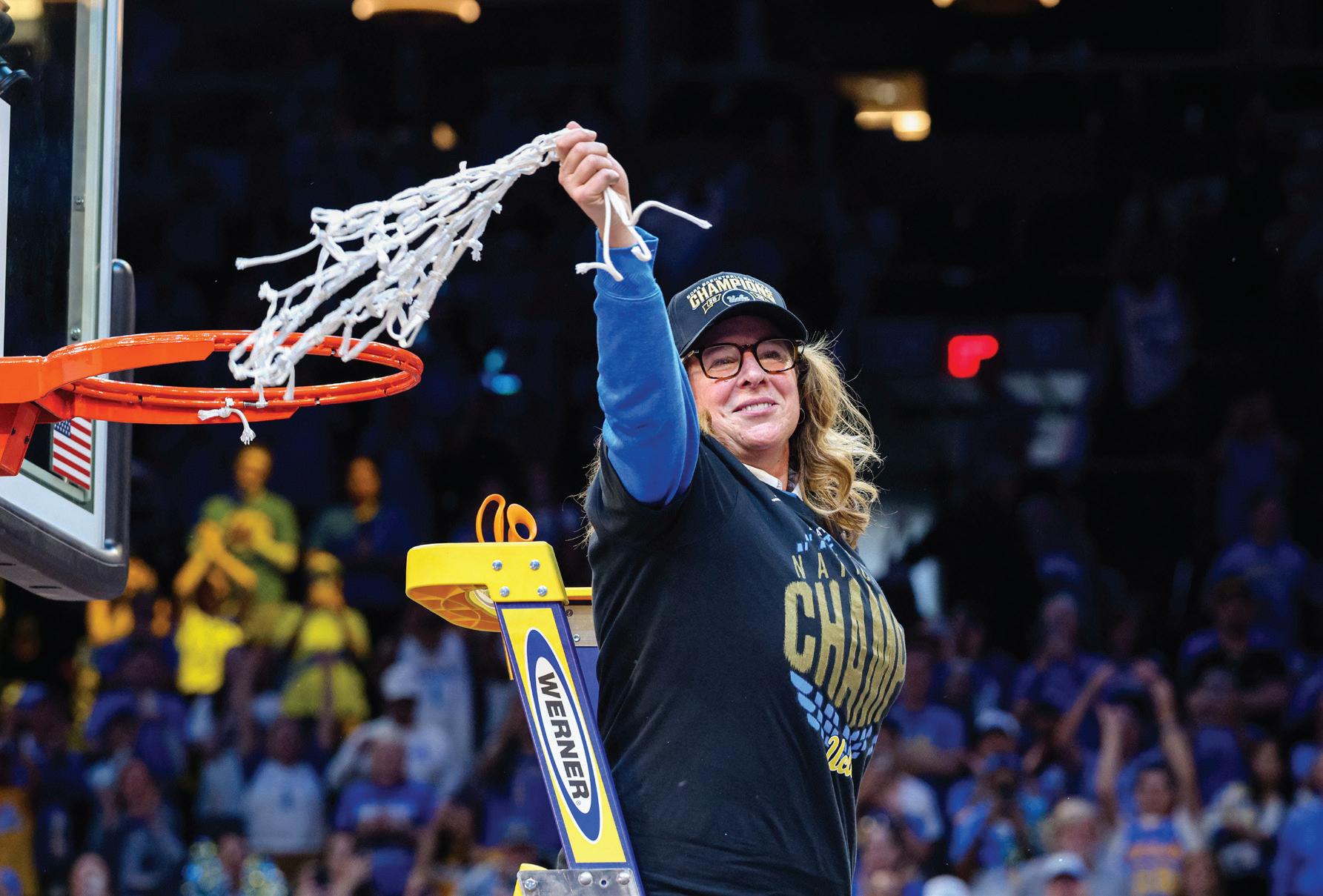
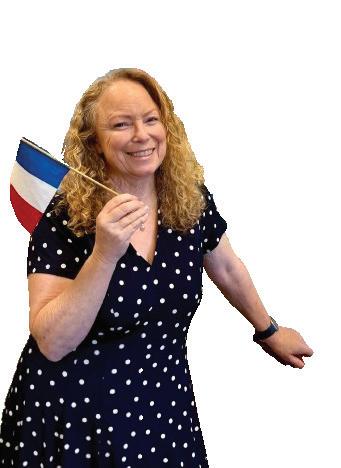
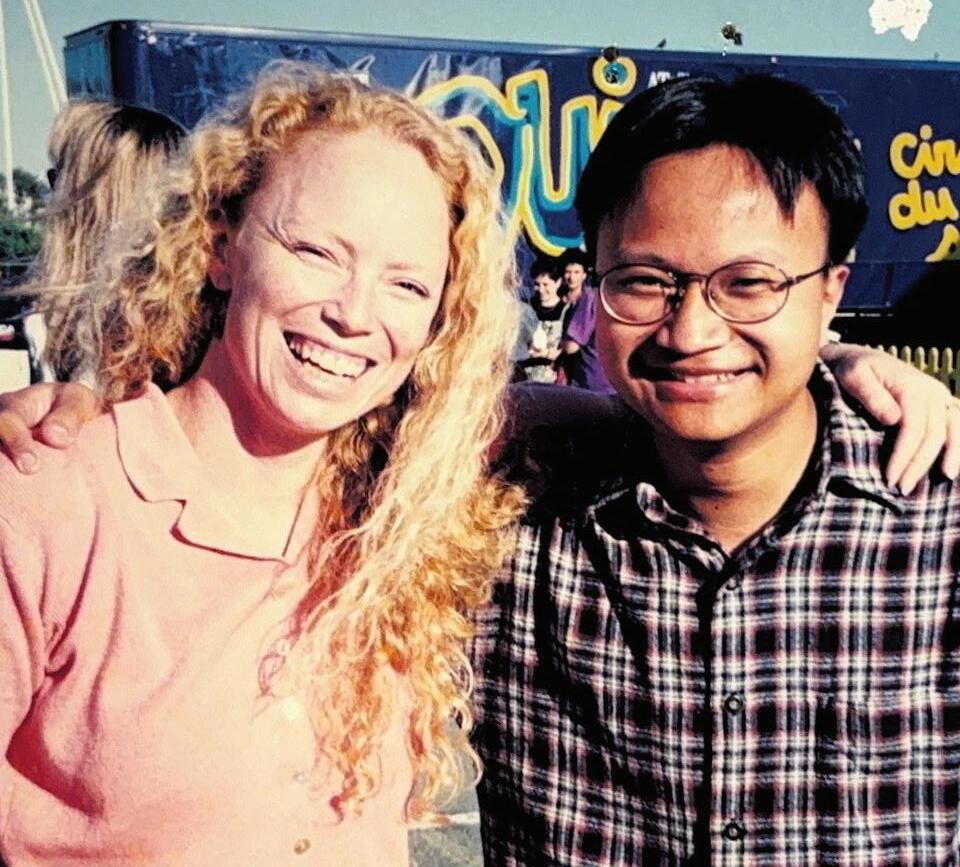
A little more than 35 years after late nights as student body president, getting suspended for organizing senior cut day, and receiving the Leo B. Murphy Award in 1989, MHS alumna and UCLA women’s basketball head coach Cori Close cut down the net at the NCAA Division I championship.
To win the championship “in such a dominant fashion” and to have played so well was incredibly special and gratifying, and it felt like it all came together at the right time, Close said.
“You always dream, as a coach or as a player, of when the confetti falls and of what it’s going to be like, cutting down the nets and having all the families down there,” Close said. “My mom was right by my side, and being able
to honor her and thank her was really spectacular. Bob Kellogg, who was a football coach (at MHS), was there with his wife … It’s sort of indescribable, but it was an amazing feeling.”
Marking the first NCAA championship win for the UCLA women’s basketball team in school history, UCLA also set a record for the number of players drafted into the WNBA. All six of the seniors on the team were drafted, Close said, with five of them picked in the first round and one being the third pick of the second round.
“When I was watching the draft in New York, I was like a proud parent,” Close said. “I couldn’t be more proud. What I love is that it’s a great reminder that when you sacrifice for the whole team, in the end, it comes back to you individually.”
This moment was the latest chapter in her basketball journey, which began in Milpitas, where Close grew up. She was exposed to sports at a young age, and although she was better at soccer for a long time, she always had a love for basketball, she said.
“Erliest memories: my dad was a coach at Milpitas High, and I was three years old,” Close said. “There is this picture where I’m holding a ball that is almost bigger than I am. I was dressed in this terrible bowl haircut.”
After attending Alexander Rose and John Sinnott Elementary School and Rancho Milpitas Middle School, Close was a student at Milpitas High, where she mostly played basketball and badminton, and also ran
SEE PAGE 16
Teachers use AI to grade, assist lessons
Some MHS teachers have begun using generative AI to assist with their responsibilities and everyday workload, such as grading, lesson planning, creating tests, or even refining students’ letters of recommendation.
Between the large number of students he teaches and the fact that Advanced Placement (AP) classes require many typed responses—the majority of which are packed densely with information and don’t need to adhere to a strict organizational structure— Google Gemini has been helpful in grading student responses, social sciences teacher Danilo Escobar said.
“I’m looking more for their specific skill analysis or content, which makes it really hard to grade their responses,” Escobar said. “So what I’ve done is—using Gemini—I have created specific
‘gems’ (Gemini’s custom “AI experts” that can be adapted to a user’s specific needs) for the type of grading I’m doing, to parse through their responses.”
In this way, Gemini helps him identify thesis statements, evidence, and analysis so that he can grade more efficiently, Escobar said.
“Also, it gives some generic feedback—like, rather than me having to type out the feedback, I get some generic feedback from it, and then I kind of tweak that to give students some feedback,” Escobar added.
“I’ve never heard any students say, ‘Oh, thank goodness you’re using AI,’ but the thing is that it allows me to have them do more writing, and then I’m able to look over that writing more often,” Escobar said. “In a way, they’re doing more practice with feedback than before, when I would have to do it by myself.”
Moreover, while grading with AI doesn’t actually save a drastic amount of time, it does lighten the cognitive load that he experiences as a teacher, Escobar said.
Innovation campus students take STEM-focused Japan trip
By Reuben Thayil
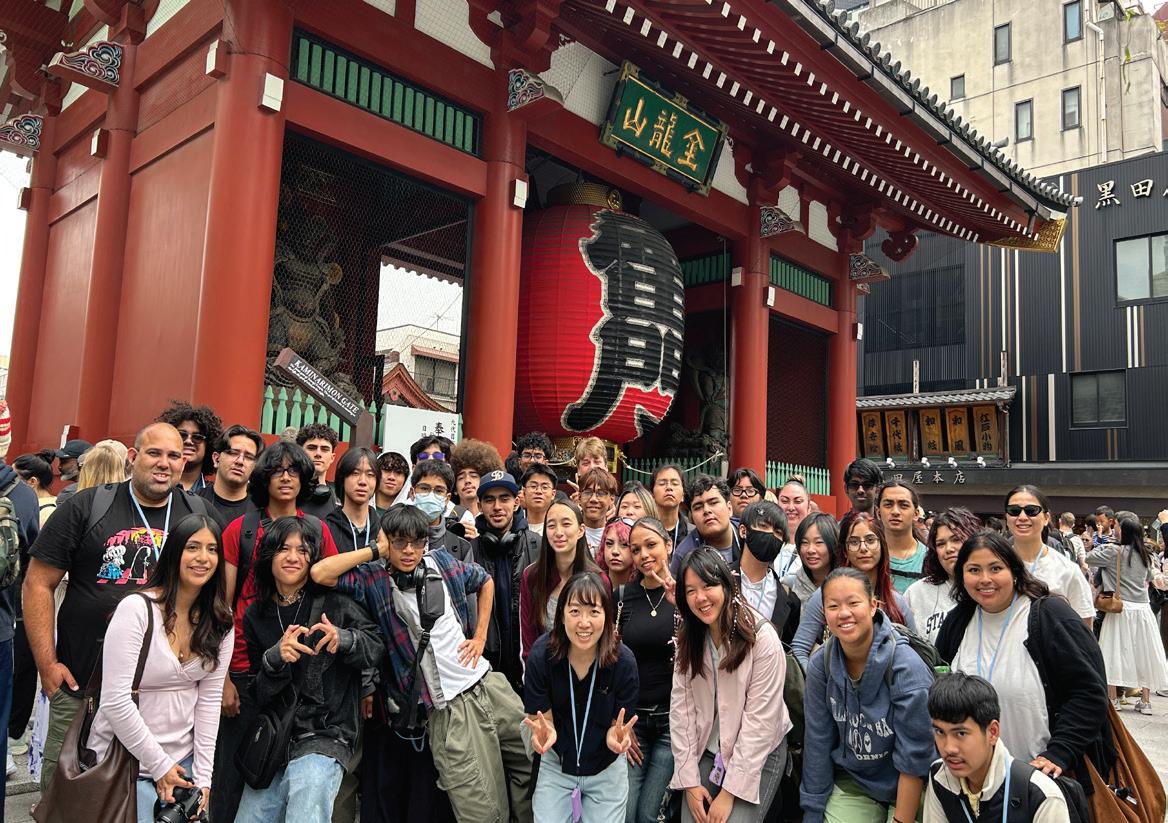
The students of the MHS Innovation Extension Campus went on a school trip to Tokyo, Japan, from April 8 to 16 during spring break, English teacher at the Innovation Extension campus Sejee Kim said.
Japan has numerous cutting-edge STEM-related opportunities that are not available for students in the U.S., Kim said.
“The theme of this whole trip was STEM experiences,” she said. “That’s why we found it in the first place. (The organizers wondered about) how they can bring more opportunities for students who don’t get these opportunities otherwise. E-tech and engineering (is about) encouraging people of color and girls into the STEM field.”
Tokyo was the main destination because most of the STEM-related attractions that students and staff wanted to see were there, Kim said. For example, the main attraction was the magnetic levitation bullet train (maglev) museum and exhibit, she added.
“We went to a disaster prevention park,” Kim said. “Then, we went on day trips outside of Tokyo, to Tsukuba, Japan, which is known as the Science City because they have the science square and the Institute of Industrial Science and Technology there.”
Students also got the opportunity to tour the Japan Aerospace Exploration Agency (JAXA) at the JAXA Tsukaba Space Center, similar to the U.S.’ NASA, sophomore Calvin Lam said.
“It was mainly about their rockets, seeing a lot of their older technology and how they got into space,” Lam said. “We got to see a couple of workers at the command center of Artemis II.”
than the bullet train that (the US) has.”
The students did not go to solely STEM exhibits and museums; they also spent a few days exploring and learning about the culture in Japan, Kim said.
“We also went to a tea ceremony, where they learned the different customs and practices of when you mix the matcha tea, which way you trick the bowl, and things like that,” Kim said.
The Japan trip was open to all current sophomores and juniors at the Innovation Extension Campus who were interested in going, Kim said.
“All the kids that were interested and super motivated signed up over the course of the past year and a half of our fundraising,” Kim said.
On its own, the trip would have cost $5,300 per student; however, students applied to a variety of grants and scholarships that allowed around 9 students to go for almost free, Kim said.
“One of the largest ones we got was from a Japanese-US nonprofit, a federation whose whole goal is to encourage cultural exchange between Japan and the U.S.,” she said. “So we applied for that and we got $20,000 right there.”
With the steep price, students had to find other ways of financing the trip’s costs, Lam said.
“Some businesses actually helped out with paying, like, if your parents work for Google or something, they would do an employer match,” he said. “I only had to pay $2,500 with that.”
The trip was in the planning stage for almost two years—since the beginning of the Innovation Extension Campus, Kim said.
The trip was extremely expensive, Lam said. However, it was worth it, he added.
He’s upfront with his students about his use of Gemini to grade their written responses, and he hasn’t received any direct negative or positive feedback, Escobar said.
“I teach 3 sections of AP World History,” Escobar said. “On the 90th essay I’m grading, it feels like I’ve been pummeled by essays. Cognitively, without the AI, I start to miss things. That’s why
Students had the opportunity to visit one of the world’s most advanced particle colliders (a machine that crashes particles into each other) in Tokyo as well as many other scientific exhibits, junior Long Nguyen said.
“There was one museum we went to, and there was a way (for students) to hold hydrogen,” Nguyen said. “(We) also saw a magnetic train that was faster
“I would pay five grand just to do it again, but preferably for a longer time,” he said.
“It’s easy to plan a trip where everyone is willing to pay; that’s super easy,” she said. “The challenging part is trying to make it accessible for people that can’t afford it.”
Since the trip was limited to sophomores and juniors at the In-
STUDENT VOICE OF MILPITAS HIGH SCHOOL
By Natalie Chen
Cori Close swings the cut basketball net in celebration after leading the UCLA Bruins to their first NCAA women’s basketball title.
Courtesy of UCLA Athletics
Innovation students began fundraising for their Japan trip in September.
Courtesy of Sejee Kim
Contemporary art should be celebrated
Under a fascist regime, art is often the first to fall—but this particular lesson seems to have flown over some heads. In fact, there’s been a surge in callous behaviors towards contemporary art; for example, TikTokers visiting art museums to film themselves “posing” next to pieces they believe they could have made themselves.
However, history warns us that discrediting an entire artistic movement can have severe consequences. In the 1930s, for instance, the Nazi Party attempted to erase modern art— contemporary art’s chronological predecessor—and replace it with their own artistic movement by referring to modern art as “degenerate” and going to great lengths to censor and shift public view of it.
carefully curated to evoke disgust from viewers. As historian Dr. Jonathan Petropoulos described it: “The pictures were hung askew, there was graffiti on the walls, which insulted the art and the artists, and made claims that made this art seem outlandish, ridiculous.”
Indeed, barely four years after Hitler rose to power, the Nazis put on two contrasting art exhibits, one called “The Great German Art Exhibition” and the other “The Degenerate Art Exhibition,” according to Lucy Burns’ BBC article “Degenerate art: Why Hitler hated modernism.” The former displayed only art approved by Nazi officials, reflecting so-called Aryan ideology—idyllic German landscapes, nude portraits of blonde, blue-eyed women, and patriotic depictions of noble soldiers. The latter showed a collection of abstract or expressionist pieces
As art reflects the values and attitudes of a society, those who hope to control or censor it often begin by slandering it—especially one already considered “progressive,” like modern or contemporary art— and slotting a more nationalist, reactionary movement in its place. So by devaluing contemporary art, we may be contributing to a modern-day fascist propaganda. Moreover, to dismiss contemporary art as “meaningless” or “money laundering” is a dangerous overgeneralization. While the art industry has its fair share of scandals, reducing an entire genre to a money laundering scheme is demeaning to real artists.
Finally, rejecting contemporary art closes the mind to the benefits of art. If you walk into a gallery already convinced that all contemporary art is slop, then you won't expect it to be better than slop. As viewers, we have an equal responsibility to enjoy a painting as the artist has to paint it. Art can vitalize thought and creativity, but it’s crucial to remain receptive.
CON
Contemporary art is exploited for wealth
In a world of increasing wealth inequality, contemporary art has progressively stopped functioning as a public form of creativity and more as a wealth storage system for the uber-rich. While art still carries cultural and expressive value, much of the contemporary art market now serves a secondary purpose of allowing for tax-friendly investments. Wealthy collectors are storing their wealth through art, now a financial asset, along with speculating on inflated prices and accumulating wealth without circulating that money back into the broader economy.
The Forbes article, “The Future Of Fine Art And Alternative Assets: Trends To Watch,” cites a poll from the UBS Billionaire Ambitions Report from 2024 which states that roughly 32% of billionaires planned on increasing their exposure to fine art and antiques. It'd be nice to believe that every single one of these billionaires are eager art enthusiasts and connoisseurs, with the good-hearted intention of vivaciously defending artistic expression. However, at such high prices and with this clientele, it is a more reasonable conclusion that they are in the art market for financial interests, rather than the culture at large. This problem becomes even clearer once freeports and similar tax shelters enter the picture. Erblaw Tax Attorneys describe freeports as “tax havens for billionaires” and explain that collectors can store art
While the movements surrounding feminism and its goals have changed over centuries, the basic tenets remain: to achieve equality. To achieve that equality is impossible without deconstructing the patriarchy, and deconstructing that patriarchy is impossible with the rise of “choice feminism” and its use to justify exploitative or traditional roles. “Choice-feminism” is the belief that any action that a woman takes is inherently feminist because she had the ability to take that action on her own
In recent years, the “tradwife” lifestyle has been increasingly normalized on social media. Content creators such as The Ballerina Farm advertise the role of a traditional housewife, raising children and giving up their careers to be a trad-wife.
In stark contrast, sex work has also become more normalized, as social media influencers such as Sophie Rain flaunt the wealth that they’ve
For many high school students, college rules their lives. However, making everything you do about getting into college may actually do more harm than good.
Many students sacrifice their mental and physical health for their academics. The extra time you’re putting in late at night won't increase your chances of getting into a good university. Taking care of yourself is better in the long run as you’ll have a healthier body and be able to put more effort into things.
without having to pay sales tax, import duties, or capital gains tax. In other words, the wealthy can convert their wealth into the form of highly-valued art which can sit out of sight and continue to rise in value, while still being treated like a financial asset rather than something of culture.
RYAN TRUONG
The New Republic’s article “How Modern Art Serves the Rich” makes the same broader point, calling contemporary art an “asset class” and explaining how artists are being pushed towards “market-approved styles,” meaning artists increasingly follow trends set by wealthy consumers rather than pursuing their own passions and advocating for meaningful expression. Contemporary art also feeds a cycle of speculation and artificial price inflation;the same article notes that auction houses for art and antiquities have begun functioning more like luxury brands and offering credit and guarantees to ultra-wealthy clients, helping to spike prices and attract buyers who are drawn by money alone. I’m not saying that contemporary art should be banned, censored, or even treated like an enemy. My real complaint is that the art market, especially the contemporary art market, has become so distorted by wealth that the art that has become shaped around the interests of the wealthy rather than genuine artistic expression or public appreciation.
gained from selling explicit content of themselves. Even though those two lifestyles appear to be exact opposites of each other, the lifestyles are anything but feminist or empowering. But what’s more concerning is that people, primarily women, defend these social media influencers because the women had the freedom to pursue these kinds of lifestyles, and some even go as far as to claim that criticizing “tradwives” or “OnlyFans models” is “not feminist.” Because, according to these same people, true feminism is women having the ability to be empowered through having the freedom to do whatever they want, even if it means preserving the harmful stereotypes that created feminism in the first place.
Sex work and traditional household roles—whether you choose to put yourself in that
into a good college. You will likely find what you do more rewarding.
Stop comparing you- rself to others. You aren’t a failure because you didn’t get into an Ivy League college. Everyone has their own goals and path to follow. Focus on your own improvement.
place—aren't feminist because they're a product of the patriarchy. Advertising, defending, or assuming those lifestyles is a disservice to actual feminism. I’m not saying that the women who are in the sex work industry or who choose to be stay-at-home moms are anti-feminist or harbor internalized misogyny. Certain circumstances may force women to take up these roles; a woman might have to take care of her children because she can’t afford a nanny, or another woman might be trafficked into sex work. But there is a clear line of playing the part of a submissive wife and a hard-working mom. I’m merely suggesting that women and girls should reevaluate the way we perceive these content creators and their lifestyles and realize that they’re not feminist.
don’t even end up using.
The competitive conversation around college often leads to disappointment. After failing to get into their dream college, students are often left wondering where they were wrong and what they to do next. Why should it be this way?
When you think about your goals in life, consider looking into activities that mean something to you, not activities that you think will maximize your chances of getting
Many people think that their only option is heading to a fouryear university, but there are other options as well. Going to a community college and transferring to a university may be ideal if you want to get used to adult life.
Delaying college or even not going is also a path that you could consider. Many people who go to college don’t have a plan for what they want to do during their time there or after it. As a result, these people end up wasting four years of their lives with a degree that they
In a 2024 study by the Burning Glass Institute, researchers found that 45% of graduates with a terminal bachelor’s degree (a degree where you enter the workforce straight after receiving it) are underemployed ten years after graduation, meaning their job doesn’t require their degree. You cannot just go with the flow. You need to put serious thought into your life and make your own decisions. If the conversation around college remains the same, more and more students will be led down a path that will only hurt them. People need to find other things to focus on in high school. We should strive to make the most out of our time, but that doesn’t mean letting where we go after high school consume our every waking moment.
The Supreme Court needs massive reform, oversight
Almost 240 years ago, the founding fathers made checks and balances to ensure that the government couldn’t gain too much power. However, recently, the Supreme Court has upended centuries of precedent and standard practice, replacing it with blatant politicization and corruption. The Supreme Court needs to be fundamentally re-imagined from the ground up to ensure that all biases and partisan influences are kept from corrupting the nation’s highest court. Recently, the Supreme Court’s decisions have relied more on the shadow docket, which are cases that request the Supreme Court to decide on a case immediately. Typical “merit docket” cases usually take months of deliberation among the justices with majority opinions extending past 100 pages—shadow docket cases can take as little as a few days, with opinions written in a few sentences, according to the Columbia Undergraduate Law Review.
This system is deeply flawed and allows for far too much partisan bias insofar
as the court’s 6-3 conservative supermajority has sided with the Trump administration over 80% of the time in shadow docket cases, according to the Brennan Center for Justice.
Over 175 former federal and state judges filed a brief to the Supreme Court arguing that shadow docket cases have no legal weight due to extremely limited legal reasoning.
Just a couple weeks ago, the Supreme Court ‘eviscerated’ section two of the Voting Rights Act of 1965 (VRA) in Louisiana v. Callais, according to the American Civil Liberties Union (ACLU). The VRA, the “crown jewel of the Civil Rights movement” according to the Brennan Center for Justice, was enacted to undo Jim Crow laws. With one decision, the Supreme Court effectively gutted what was left of the law that civil rights activists like Martin Luther King Jr. worked for, and were killed for.
The Supreme Court’s nationwide authority allows its
decisions to block lower court decisions, establishing binding precedents, often in line with the justice’s ideologies. There is also no authority over the justices: in theory, they could get away with almost anything, considering it is extremely difficult to impeach a sitting justice. According to ProPublica, Justice Clarence Thomas received lavish gifts and traveled on numerous undisclosed luxury trips, each on its own costing roughly $500,000. He traveled on a private jet and yacht owned by Republican megadonor Harlan Crowe. For reference, Congressmembers are forbidden from receiving gifts over $50. Why should the standards be different for what should be the most impartial and arguably the most powerful individuals in the nation?
The court needs massive reform to be ethical and transparent – to serve justice rather than personal politics and opinions.
NATALIE CHEN
REUBEN THAYIL
ALICE NGUYEN
JOSEPH GRAHAM
School should advertise benefits of college classes more
The school should do a better job at advertising the benefits and long-term advantages of taking college-level courses. Although there are students aware of these classes, the school doesn't put enough emphasis on promoting these courses — Advanced Placement (AP), dual and concurrent enrollment — to the general student population. In reality, many students often rely on peers for information about courses.
AP courses can offer college credit if a student passes their respective AP exam with a score of 3 or above, according to The College Board’s article “AP at a Glance.” College credit can allow students to avoid paying for extra years of tuition, The College Board elaborates.
Similar to the advantages of AP courses, dual and concurrent enrollment lets you earn college credit while still in high school. Roughly thirty-five percent of students are in AP courses, while forty-four percent of students are considered socioeconomically disadvantaged, ac -
cording to a 2024-2025 Milpitas High School School Accountability Report Card. There are fewer students in AP courses than there are socioeconomically hindered students, which means many are losing out on money-saving opportunities. With college credit, these disadvantaged students would have a better chance of affording their college tuition.
enrollment classes, but the benefits of these classes are never clear. Students are just expected to know what they are receiving from taking these classes.
As for AP classes, one could argue that it should be the responsibility of The Collegeboard to promote the perks of these classes. Instead, the Collegeboard should learn to cooperate with high schools around the country in order to publicize the various long-term benefits of taking AP classes.
Also, AP and dual enrollment courses offer grade boosts to students’ weighted grade-point average (GPA), while high exam scores can prove a student’s capabilities. These factors can greatly improve a student’s chances of getting into a more prestigious college.
Every fall, counselors may send out an email detailing the registration process for dual
The school should take the initiative to encourage students to take college-level courses, as they could be very important to a student’s future. Whether it is alleviating expenditures or improving students’ transcripts, these are the benefits of college-level courses that some students are unaware of, and it should be the school’s job to enlighten them.
EDITORIAL: The Opinion of The Union
Teachers put in extra effort to support students
While no rules require our educators to organize extra events or purchase additional materials, many of our teachers go above and beyond to supplement our learning.
The English department has worked together in the past to take English II Honors students to see “The Ballad of Songbirds and Snakes” at the Century Theater Great Mall. This opportunity allowed students to connect the novel they read in class, 1984 by George Orwell, to a representation of dystopian political control.
The Math, Science, and Art departments also host several yearly social events, such as potlucks, with teachers often spending their own money to purchase various snacks for the class to enjoy. In some chemis -
try classes, students make their own ice cream in a lab setting. Beyond fun activities, teachers also spend money on extra supplies for their courses. For example, photography students develop their photos on expensive film purchased by the teacher. In addition, AP teachers often personally buy snacks for their students.
In chemistry at both the AP and Honors levels, students go through a variety of lab experiments, such as titrations and other chemical reactions that require teacher purchases. The material doesn’t require this interactive experience, so the fact that teachers are willing to make these purchases and take the time to plan out extra material shows just how much they care for their students.
The language department also has several cultural events and activities that provide students with food-related experiences and projects. In Chinese, students learn about Lunar New Year traditions and actually consume various snacks that are eaten during the holiday. AP Spanish students also get to participate in cultural traditions, such as breaking a piñata to celebrate the end of AP tests and participating in various Spanish holidays like the Day of the Dead. In French, students celebrate the French holiday, Three King’s Day, by eating a cake. They also bake French snacks to share.
Our teachers dedicate their time and resources to provide students with a well-rounded education.
EDITORIAL: The Opinion of The Union
District’s response to tragedy lacked empathy
On April 1, as seniors waited for the Senior Meeting to begin, scattered conversations had a common topic: A Milpitas police press release that morning had reported the stabbing death of a teenager near the school the previous afternoon. With heavy hearts, the students attended the session, only to be left even more upset by the lack of any acknowledgement of the tragedy by school officials.
We understand that school and district officials were restricted on how much information they could publicly share. We were not expecting details about the ongoing investigation, since most of the school had already heard about the incident. However, what we did hope for and need was empathy and recognition of our shared loss; instead, school officials at the meeting acted as if nothing had happened, creating a strong disconnect between students and administration.
Although the school may have reached out to individual students to see if they needed support, the overall messaging to the community was lacking. Only two emails were sent to students a day after the incident, and information regarding setting up appointments
with grief counselors was limited to teachers.
Teachers also commented that they were not informed by the administration that the victim’s family members were in their classes, furthering the sense that the district was unprepared to respond compassionately to a crisis affecting its students and staff.
It was not until the following week’s fireside chat, on April 8, that Mr. Wohlman addressed the death with students and held a moment of silence via Google Meet. We wonder why it had taken so long to hold something as simple as a one-minute moment of silence, which could have been held the day or two after the tragedy, especially since the victim’s name had been released in the local press. Wohlman said that the school’s response had been delayed due to a directive from the district, but this rationale failed to adequately explain why a simple, prompt acknowledgement of the death wasn’t possible.
The chat became even more disconcerting when Mr. Wohlman made a few brief announcements and moved on to the usual raffle for a class pizza party in an awkward attempt to lighten the mood. This abrupt, tone-
STUDENT VOICE OF MILPITAS HIGH
The Union is published by the Journalism class of Milpitas High.
The views in The Union are those of the writers and do not necessarily reflect those of the school, students, administration, or Milpitas Unified School District.
deaf change amplified the feeling that the moment of silence was merely a performative, regulation-following attempt to make up for administration’s weeklong silence on a student’s death.
Two days after the fireside chat, students were required to watch the same “Say Something” training video that classes had viewed last fall. Students were given little information about why they were rewatching the training, but it seemed the implication was that students should have prevented the tragedy. This reiteration of information was one more example of the lack of a schoolwide effort to help students process their grief. The school’s indifference showed that it was more interested in checking boxes than in authentically caring about its students and staff.
No institutional response to tragedy will ever be perfect, especially under legal restrictions. However, in the aftermath of the violent death of a peer, students needed empathy and validation that their grief mattered. For a district that emphasizes a “Culture of WE,” the response to the death of one of our own was delayed, impersonal, and insufficient.
Want to advertise in the Union?
Please contact our business manager at milpitashightheunion@ gmail.com. Ads are available in full/half/quarter page and business card sizes. Upon request, The Union staff will also customize and design your advertisement.
STAFF
Marie de vré • Editor-In-Chief
Harold hong • Editor-In-Chief
Uyen vu • News Editor
Alice nguyen • Asst. News Editor
Sowmya sundar • Op-Ed Editor
Reuben thayil • Asst. Op-Ed Editor
Namana balakrishna • Features Editor
Kashvi agarwal • Asst. Features Editor
Shrihan sham • Sports Editor
Reina tam • A sst. Sports Editor
Natalie chen • Lifestyle Editor
Joseph graham • Asst. Lifestyle Editor
Jerry yong • Entertainment Editor
Ryan truong • Asst. Entertainment Editor
Rain bacungan • Spread Editor
Lauren dang • Asst. Spread Editor
Jonah wu • Graphics/Photo Editor
Satvika gidvani • Web/Social Media Editor
Aaron chiah • Business/Ad Manager
Shivani arun • Reporter
Tejus karadi • Reporter
Sanjit Roy
Journalism Advisor
HAVE AN OPINION?
GOT A GRIPE WITH THE SCHOOL?
DESIRE TO PRAISE MHS?
WANT YOUR VOICE TO BE HEARD?
The WISH TO REPRESENT THE STUDENTS?
SUBMIT LETTERS TO MILPITASHIGHTHEUNION@GMAIL.COM
MAKE SURE TO WRITE DOWN YOUR NAME AND GRADE
FOR ONLINE EXCLUSIVE STORIES, VISIT MHSTHEUNION.COM
HAROLD HONG
Jonathan Choi involves himself in Youth Legislators Program
By Namana Balakrishna
Government action and politics are an important part of life to students. Sophomore Jonathan Choi goes above and beyond in his involvement by being a part of the Youth Legislature program and creating the club Action For Change.
Even though Choi was born in California, he moved back to Macau, China, with his parents, and came back to California in eighth grade, he said. He joined Thomas Russell Middle School during January, Choi added.
“The reason I came back was because there were more opportunities to pursue what I like, here in the United States rather than in Macau, like history or political science,” Choi said.
“The experience– there is a lot of adapting to change, because it’s such a different place. ”
Choi has always been very interested in politics, current affairs, and history, he said. His initial interest in history eventually led to his interest in political science, but he has been aware of all current affairs by keeping up with the news, Choi added.
“Once I was in California, I had an idea of what I wanted to pursue,” Choi said. “It was social studies-related. So originally, it was history; then later on, I got more and more involved with political science.”
The Youth Legislators Program
First generation immigrants share their stories moving to US
By Rain Bacungan
MHS is home to a great diversity of students and faculty, whether that has regards to culture, style, or personality: Each person has their own story to tell. There is no doubt that you’ll be able to find people of every culture from MHS, including first-generation immigrants.
Math teacher Wai Lan Tsang moved from Hong Kong to the United States because her then-boyfriend, now husband, had immigrated there to attend graduate school and she decided to move with him after they got married, she said. Before moving to the States, she taught as a high school teacher in Hong Kong, she added.
“In Hong Kong, we do not have that many quizzes and tests, but we have homework assignments that teachers need to grade on a daily basis,” Tsang said. “However, we do not give students quizzes and tests per chapter. We usually only have midterm exams and final exams, and then all the grades are based on the exam. We do not give grades based on participation or homework. The grades are 30% midterm and 70% final.”
Initially, it was hard noticing any significant cultural conflicts or differences in a foreign country up until she started working or teaching, as the majority of international students were Asian in the graduate school that she attended, Tsang said. To add on, the workplace environment of software engineering in the States isn’t much different compared to the one in China, she added.
mainland China, so I didn’t feel a big cultural difference, either. It’s just that I needed to adjust my Mandarin from the Taiwanese tone to mainland China tone. Not until my last two companies, there was more diversity. But still, the majority are Asian. It’s just
changing from Chinese to Indian people.”
Sophomore RaizelLee Sharpe moved from the Philippines to the U.S. with her mother when she was eleven years old, Sharpe said. Before moving to the U.S., Sharpe and her mother lived with her grandparents, she added.
“Duterte was still in the Philippines while I was there, so my mom was not getting paid really well,” Sharpe said. “It was not enough, as her wage was not enough to basically allow her to have her own house. She decided to move to the US to get a better job and to have a stable future. She also wants what’s best for me, so I can have a better future.”
“In my first and second job in the U.S., I worked as a software engineer after I graduated and got my master’s degree in computer science,” Tsang said. “At my first two jobs, the majority of my co-workers were mainly Taiwanese, so I didn’t see a big cultural difference. And my second job, the majority of my team was from
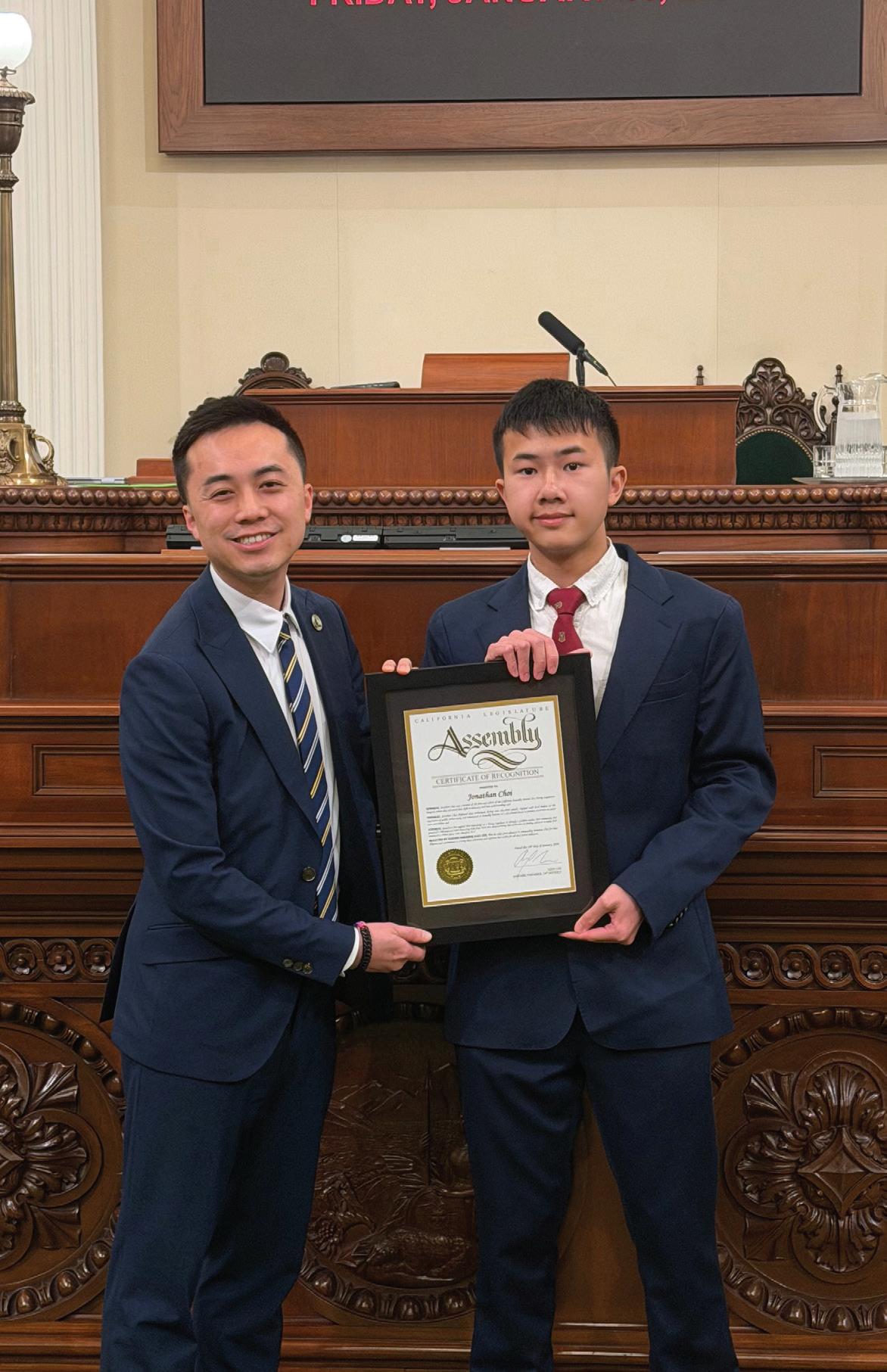
is a new program hosted by assembly member Alex Lee’s office, Choi said. He first heard about this program through an email sent by the school’s College and Career center, Choi added.
“I just applied, and surprisingly I got in,” Choi said. “I had barely any resume at that time, because that was one and a half years when I came here. I think I was very lucky to get in, because it has been very life changing since meeting Assembly Member Lee and getting involved.”
Choi is also the president of Action For Change (AFC), a club he founded in January of this year, he said. The club’s goal is to promote civic education, he added.
“What that actually means is first we have to get people into the door of being interested in civics, like local government, politics, current affairs, or even just being a leader,” Choi said. “We’re providing them opportunities to engage with our leaders in our community.”
When hosting events for AFC, Choi is one of the main organizers, AFC publicist Ishani Zantye said.
“He gives us directions for everything, and he’s just kind of like the brains behind the operation,” Zantye said.
When planning the events for AFC, secretary Camryn Yee took on more of the planning and organizing of the events, she said.
“Jonathan definitely was the
Filipino. You’re Asian.’ And then some people would tell me, ‘oh, you’re Indian,’ or ‘no, you’re Mexican,’ ‘No, you’re Chinese.’ And then sometimes they would call me slurs.”
Sharpe would not move back to the Philippines if she had the chance, as it is still a very unsafe and unstable country, she said. She moved to the U.S. for a better future, she added.
“The Philippines is a third world country, so it just doesn’t have enough opportunities for people and students,” Sharpe said. “Education is harder to find, since you at least have to be rich to attend school. Some kids my age didn’t even go to school. So I’m one of the lucky ones who got to go to school, and school in the Philippines is separated. It’s separated into grade A, grade B, with grade A being the smartest, and grade B being the bad kids. Nobody deserves to be labeled that way.”
Sophomore Kavya Karthik
moved from India to the U.S. when she was nine years old after her mother was given the opportunity to live there because of her occupation, Karthik said.
Initially, Sharpe had moved to Iowa before she and her mother lived in California, Sharpe said. Iowa’s population there mainly consisted of black and white people, and its social life and culture was extremely different to the one in the Philippines. At times, she would receive backhanded, racist comments, she added.
“I couldn’t find anyone who was like my people, so I felt kind of out of place,” Sharpe said. “When they saw me, they were like, ‘Oh, what are you? Are you Mexican? What kind of Asian are you?’ And then I’d tell them that I’m Filipino. They’re like, ‘You’re not
“The Bay Area is really similar to where I lived in India,” Karthik said. “I think one of the biggest differences between the Bay Area and where I lived was that everyone goes to private schools, and the Indian curriculum was probably harder. I was still pretty young, so it wasn’t that hard.”
Before moving to the States, Karthik lived in Bangalore, “the Silicon Valley of India,” she said. Bangalore was and still is very diverse, so students and teachers decided to speak to each other in English, she added.
“Bangalore has kids from pretty much all over India, and every state in India basically has a different language,” Karthik said. “So just in my apartment alone, every single one of my friends spoke a different language, like at home.”
one who liked organizing it, and Rain too,” Yee said. “ I feel like I was overseeing everything and just making sure logistically everything was okay.”
Overall, Choi is a good leader and shares all opportunities that come up for the club, Yee said.
“He’s not afraid to share his ideas,” Yee said. “He’s really hard-working, so I’m really glad that he’s our president.”
Nowadays, a lot of people don’t engage in politics as they believe it doesn’t have an impact on them, Yee said.
“I feel like the older you get, and, even though we’re still high schoolers, it does make an impact, because the government has say in our education,” Yee said.
Students don’t need to be politically active, but they should have an idea of the current affairs of our world, Choi said.
“Not everybody needs to go work in a campaign, work for a politician, or work in politics,” Choi said. “They at least should know what’s happening, who their leaders are, what they do, what they have done, and how that affects them, the community, their families, and how they can help to change. Whether that is by voting, whether that’s by contributing to a nonprofit, campaign, an agency, whether that is just informing others, informing their friends about the news, I think I think a person should know what’s happening.”
Triplets share their unqiue experiences
By Aaron Chiah
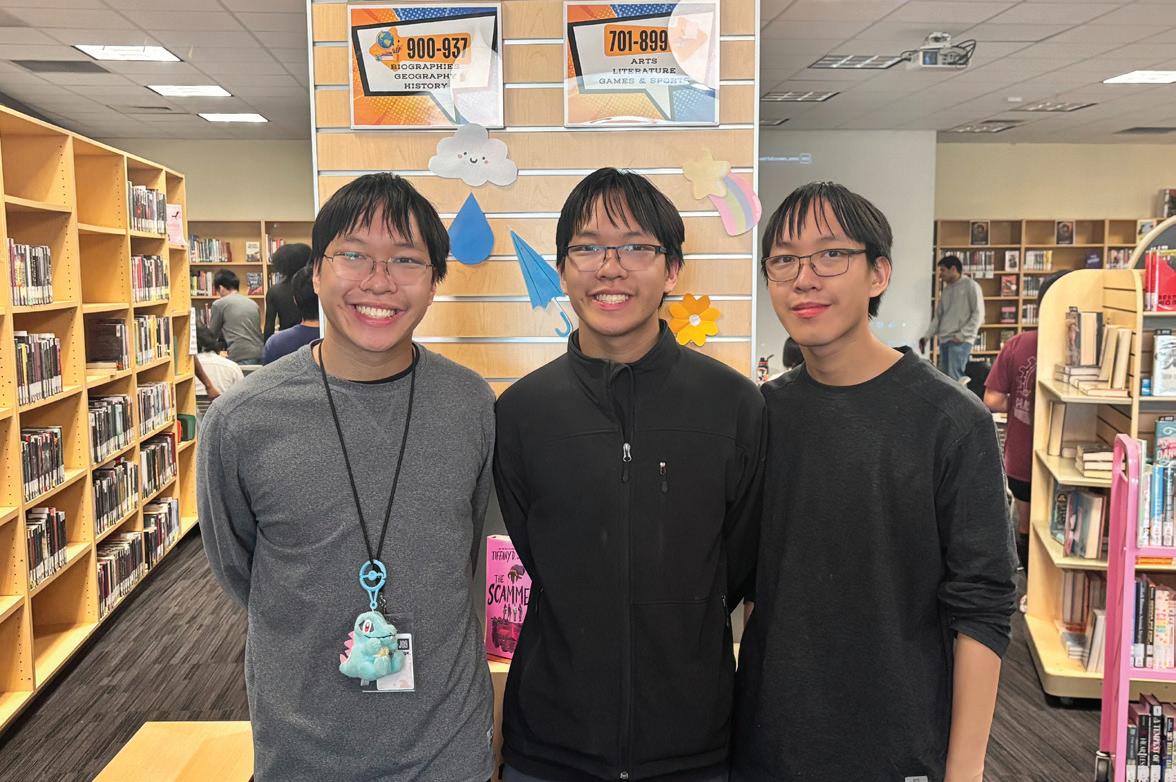
Triplets are incredibly rare, so having a set at MHS is also quite uncommon. Almost everyone recognizes the Leung brothers because of their identical appearance.
Aside from their shared looks, being a part of a triplet does not mean they are the same, senior Cameron Leung said.
“I have lived with my brothers my entire life, so obviously I know which one is which,” Cameron Leung said. “People may confuse us, but I would say, there might be some slight details that are different between us,” he said.
Being triplets may seem like a special thing, but it’s not that special, senior Aaron Leung said.
“I don’t think anyone would treat us differently unless maybe they mistook me for my brothers doing something else,” Aaron Leung said. “I don’t think I would have received any different treatment from other people.”
Identifying triplets is usually hard, but if you are around them for long enough, you can see that their personalities are really different, senior Brandon Leung said.
“Cameron is more energetic; Aaron, is more reserved, generally, more of an observer than to directly interfere with something,” Brandon Leung said. “I am kind of like a median between those two.”
Recognizing the brothers is about personal connection and how well you know them, Cameron Leung said.
“It sort of depends on the perspective of, how much do you know us personally,” Cameron Leung said. “On a surface level, we all seem essentially the same. We all agree on the same thing, kind of, and have very similar mannerisms. But if you got to know us more closely as an individual, you’re still going to realize that we each have our own little quirks.”
Similarly, our home life isn’t too unique, Aaron Leung said.
“I think it’s about the same as other people who have multiple siblings,” Aaron Leung said. “I don’t think us being very similar changes anything.”
Having lived their entire lives as triplets, It would be strange to be an only child, Brandon Leung said.
“As a single child, I might probably be a bit more lonely, obviously, but I would assume I’d turn into a more quiet and reserved dude,” Brandon Leung said. Because of the rarity of triplets, some people may think of them as more unique than the regular family. However, if you really get to know them you would realize they aren’t that different from everyone else, Brandon Leung said.
“I’m part of the group, just one of the three,” Brandon Leung said.
Courtesy of Jonathan Choi Jonathan Choi (right) gets a certificate from Assembly Member Alex Lee.
Aaron Chiah | THE UNION Cameron, Brandon, and Aaron (left to right) getting ready to attend a Dungeons and Dragons (DND) Club meeting in the school’s library.
Seniors forge own paths to success
By Marie De Vré
Senior year is often a stressful time for students as they decide what they want to do in their future. Many students follow the traditional path of attending a college or university, but some are determined to forge their own paths.
Senior Marksonkid Pham plans on taking an apprenticeship for either carpentry or to become an electrician, he said.
“The easiest (path) is to take an apprenticeship where I get paid and do a part-time job where I both learn the safety skills, the functioning skills, all the regulations from a trained person of the trade specifically,” he said.
“After that, I would take the journeyman test, which basically tells the state of California that I am who I am, and I understand the concepts of my trade, and that I’m trained in that trade specifically.”
Pham is leaning towards becoming a carpenter because he enjoys building things and is already familiar with some power tools, he said.
“I mostly helped my dad with at-home projects,” he said. “I helped him create a frame for our shed, which we then took down not too long after because we had to move. I also helped out in the MHS ‘Clue’ production, where I helped make the flats and helped paint some of them.”
Along with an apprenticeship, taking classes at a night school is needed for the journeyman test, Pham said.
“It (night school) is mainly just a lot of refresher, a lot of ‘by the book’ stuff,” he said. “So I learn from the job site. I learn a lot of the etiquette, a lot of the skills that they don’t teach in the book. And I read from the book to understand regulations, requirements, minimums, and certain methods to do things that maybe say a master of the trade would do differently.”
Pham was inspired to pursue a trade after realizing in junior year that he hated sitting in a classroom doing paperwork, he said.
“I learned later on that, ‘Oh, I can just pursue a trade, which is a lot of handy work,’” Pham said. “I can see things change actively instead of sitting behind a desk or being in a classroom all day.”
Senior Emily Hale Carrillo is planning to go into a blue-collar profession, she said. She wants to either become an HVAC or sheet metal technician, she said. Her family has been involved in both trades, she added.
“A big part that inspired me was when I was a sophomore, I was thinking of what I wanted to do after high school, and nothing really caught my attention that I would have to go to college for,”
Students
By Lauren Dang
earn community service hours from Costa Rica trip
Students were able to go on a trip to Costa Rica from April 11 to 18 to earn community service credits, Spanish teacher Emily Powell said. The trip served as an opportunity for students to learn about the human impact on the environment, Powell said.
“The volunteers from Milpitas, they hadn’t met each other before,” Powell said. “Most of them didn’t know each other, but they became pretty close on this trip. They also got to experience and see firsthand what things like consumerism and commercial prac tices and pesticides can do to the environ ment, things that we see every day.”
Sophomore Suha Shah relished the opportunity to be surrounded by the natural environment, she said. Shah also looked forward to the experience of doing farm work, Shah added.
However, Carrillo was interested in working on construction sites and other blue-collar jobs, she said.
“A lot of the blue-collar jobs are a foundation to a lot of architecture, and not a lot of people really know about (that), and it just seemed really interesting to me,”
Carrillo said.
For now, Carrillo is leaning more towards becoming a sheet metal technician, she said.
“What I’m likely going to do is try sheet metal for a few years, and then try to swap over to HVAC,” Carrillo said. “Once you’re in the trades, or whatever union, it’s very easy to swap over to another trade if you would like.”
Carrillo recommends that others get a blue-collar job because hands-on trades cannot be replaced by AI, she said. These careers also make good money, she added.
“It’s still school, but a lot of these blue-collar jobs and trades are often overlooked because the traditional college route is pushed in the minds of a lot of young high schoolers,” Carrillo said.
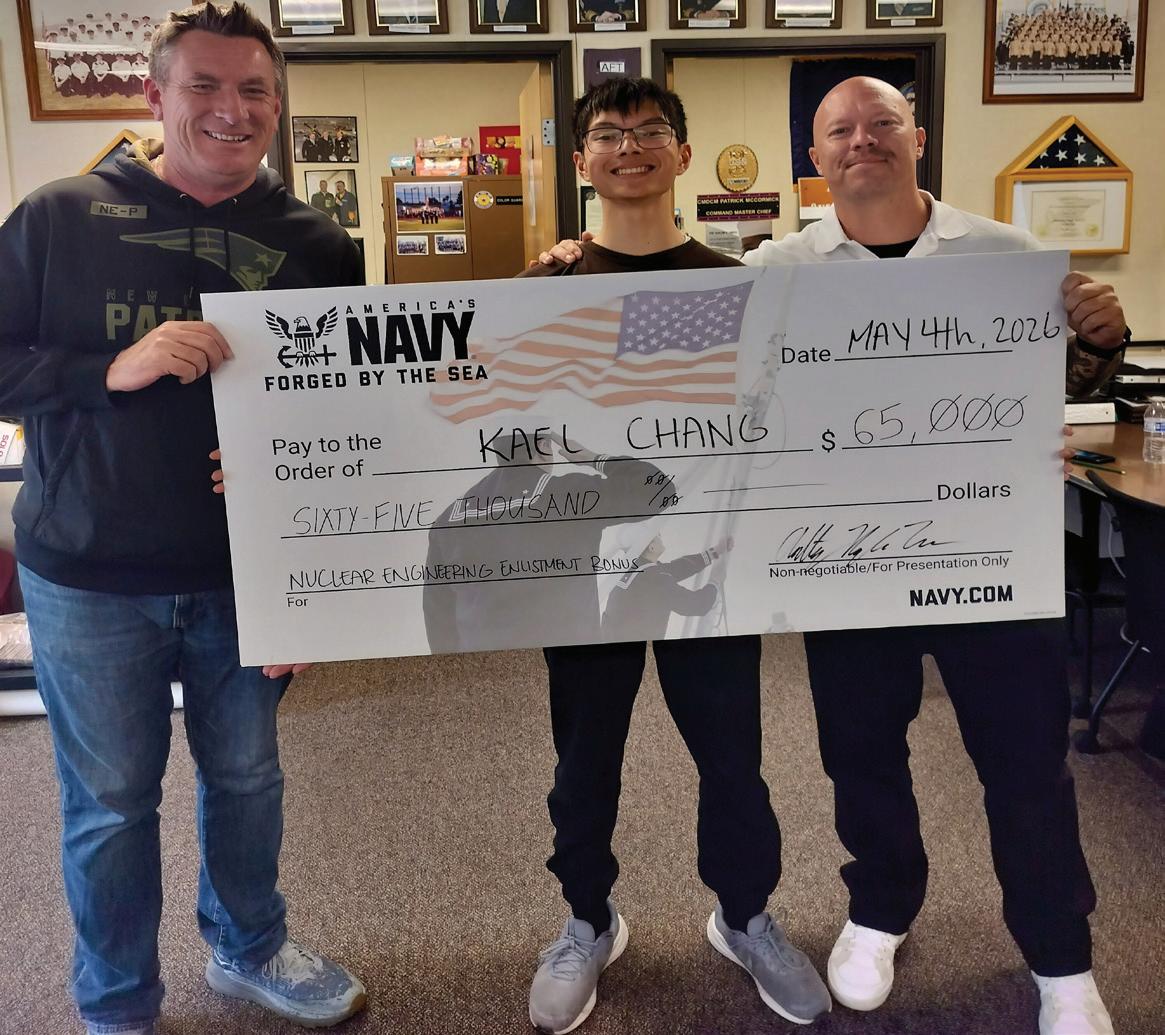
Senior Kael Chang has been in ROTC for eight years, he said. He plans on joining the Navy to become a Navy Nuke, which is similar to nuclear engineering, Chang said.
“I hope from this experience in the Navy, I can take that outside into the civilian world, especially in this ecosystem where energy is very important, with data centers and all this focus on tech,” he said.
Chang wants to pursue a Bachelor’s of Science in marine biology but chose to become a Navy Nuke to help him find a secure job, he said. The Navy has its own college, including a program for Navy Nukes, Chang added.
“They (the Navy) call it Nuke School, and they basically condense all of the things you need to know to run a nuclear power, not a nuclear reactor, in two years,” he said. “And they give you enough credits that you can almost finish a nuclear engineering degree.”
Chang believes that it’s important to try new things, especially if you’re scared of them, he said. Joining the Navy wasn’t an easy decision, but as long as you try, you will learn from the experience, he said.
“Even if the first time is scary, you’ll see what scares you, and then you can figure out how to deal with that,” he said. “And then you give it a second try, and then the second try is easier, and then the third try is even easier, and then you adapt to it. As a senior going on to the real world, if you don’t adapt to your situation, you will fail and you will peak in high school.”
everyone was very kind, even to strangers. So that definitely stood out.”
The students on the trip did volunteer work on an organic coffee farm, sophomore Chloe Huynh said.
“Since it’s organic, we can’t use pesticides or any chemicals, so instead we have manually fertilize the plants, so we carried buckets of water mixed with and we had to down the line because they have coffee plantations but they planted them on terraces,” Huynh said. In addidoing community service on a farm, the students also learned about Costa Rican culture through visiting a village and doing relaxing activities,
“I was really excited because I really like natural places, especially places near a lot of wildlife and forests and oceans,” Shah said. “That made me pretty happy, also the fact that it was a service trip, and that I would get to work at a farm and get a totally different experience to do something of service to people in the environment was something that I found really appealing.”
One notable aspect about Costa Ricans, specifically in the Providencia de Dota village, was their sociable and welcoming personality towards others, Shah said.
“Everyone was interconnected there,” Shah said.” “Everyone knew each other, especially because it was a small village, and
“We took a charter bus to a village, Providencia de Dota; it was really cool,” Huynh said, “It was a couple-hour drive, and we stayed there for three to four days, and we did something new every single day. Basically, the first part of the morning would be service work until lunchtime, we would eat lunch at the local restaurant with the chefs who lived there, and then after that we would have time for showering, nap time, or exploring.”
Huynh’s favorite parts of the trip included the environment, food, and meeting people from Costa Rica, she said.
“I love the environment, and the places we visited; the Cloud Forest was so beautiful and so
peaceful,” Huynh said. “The beaches were so nice and we could actually swim in it. The food was really good, everything was made fresh. With every single meal, there was a complimentary fruit juice or smoothie, and it was just really nice.”
Huynh also enjoyed interacting with the local people, she said.
“Obviously we both come from different places in the world and different lifestyles, so it was really cool to experience that,” Huynh.
French teacher Lisa Topping reached out to her friend at a service trip program called Dream Volunteers to organize the trip, Powell said. The program’s goal is to educate trip participants about education accessibility in different countries, she added.
“Madame Topping is friends with Brian Bunce; he is the organizer of the program Dream Volunteers,” Powell said. “Mr. Bunce, from Dream Volunteers, has taken students all over the world. They have programs in Costa Rica, India, and Guatemala. The program is centered around helping students across the world access education and connecting students from different cultures.”
There are plans to host another community service trip similar to this one next year, Powell said. An aspect of the trip that could be improved on includes the amount of people, she added.
“I think it would have been better if we had more students join us,” Powell said. “It was nice to have a small group, because we got to know each other really well, but having more students would have had a better impact than the work that we did. We would have been able to get more done with more hands on the farm.”
By Shrihan Sham
Running marathons is not easy, especially long distance ones. They require weeks and months of training and need a lot of discipline.
Social Studies teacher Lauren Byler-Garcia has run two full marathons and several half marathons, she said.
“I also did a few triathlons (an endurance multisport event that consists of swimming, cycling, and running, completed sequentially in that exact order) so I did one 70.3, which is a half Ironman (a type of triathlon), not a full Ironman,” Byler said. “So that is the extent of most of my running and triathlon background.”
Her first marathon was the San Diego Rock and Roll, she said.
“I kind of started training and then I’d have aches and pains, and I didn’t really have any knowledge of what shoes you’re supposed to have,” Byler said. Byler started running after her senior year of high school, and it was a way to stay fit, she said. Byler had body dysmorphia, so she thought running was a way to lose some weight, she added.
“I never paid attention to pace or anything like that at first, and then there were a few times I didn’t have access to exercise equipment, so running was easy and free,” Byler said. “I had joined a running group, so it started with a running club, and all these people who ran marathons and half marathons, and then my girlfriend, who used to be a teacher next door. She was going to do a half marathon with one of her friends, and then I said I’ll do it.”
While running a marathon, you’re using the same muscles over and over again, so mile nineteen and twenty are when your body kind of gives up, Byler said.
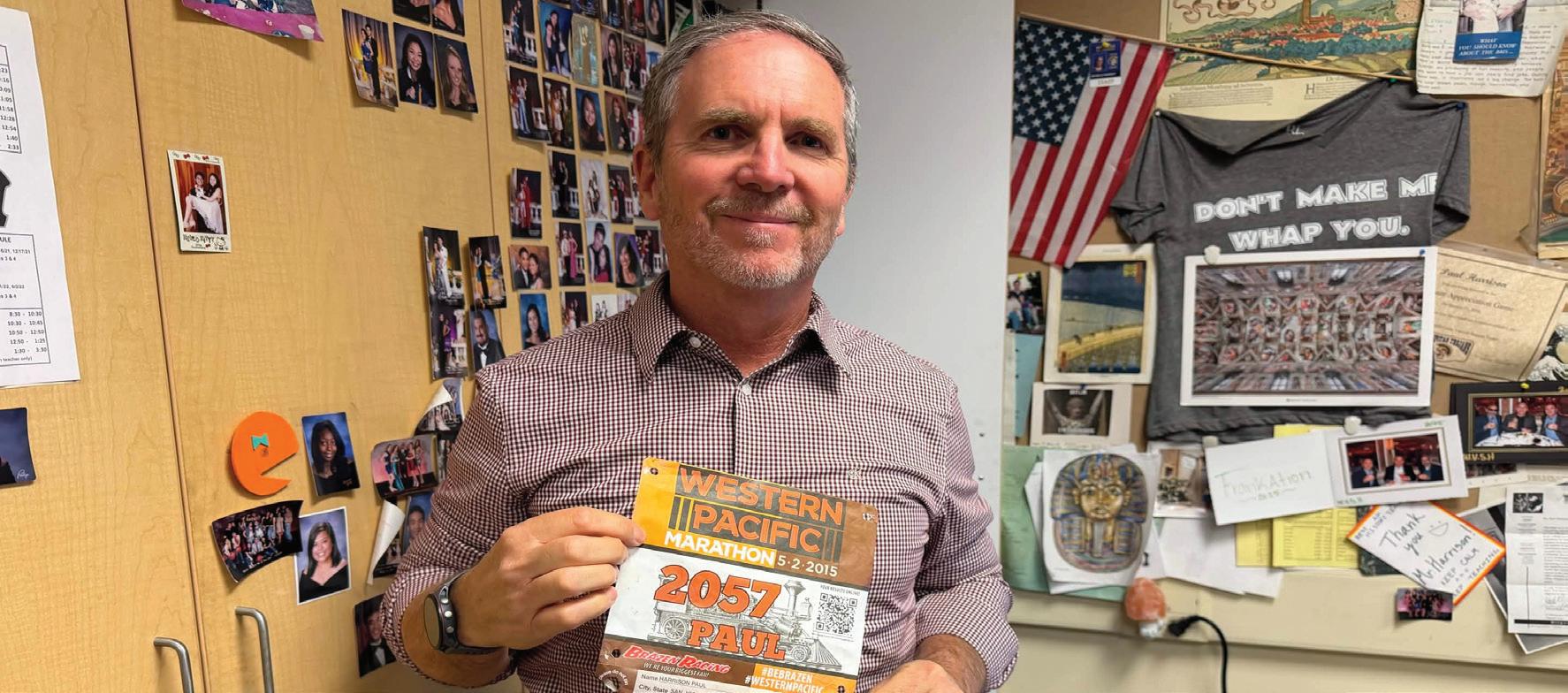
“It doesn’t matter how much training you put in; it just does not want to operate,” Byler said. “So you have to have the mental capacity to push yourself through. It’s really a mental game. ” Social Studies teacher Paul Harrison has run one marathon, the Eastern Pacific marathon, he said.
“I trained with Mr. Cummins,” Harrison said. “He’s done many, and so I started running, especially with him, because I saw it’s a great way to get in shape and
then also it’s a great challenge.” Training before a marathon is important, and Harrison did the Hanson method which is a 18 week training program, he said.
“It’s really helpful to have a training partner or team to work with,” Harrison said.“I’m a total believer that you need to follow a training program, and if you want to do one (marathon) with a decent time, it really helps,” Harrison said.
When training, you slowly build up your distance and then work on speed, Harrison said.
“It’s always hardest at the beginning, like even if you’re in great shape,” Harrison said.
“When you start running, it’s harder, and then your body gets in sync, and then it gets a lot easier, so starting the process is the hardest part,” he said.
Harrison sees a connection between his training for marathons and his AP world history class, he said. The process of planning really helps, he said.
“I got to set up my training program and follow this system, and if students follow the system, I think usually they have great success,” Harrison said.
Courtesy of Kael Chang
Shrihan Sham | THE UNION
Social studies teachers run marathons outside of running their class
Carrillo said.
Kael Chang (middle) plans on joining the Navy after graduating. He recieved a scholarship from the Navy for $65,000 on May 4, 2026.
Social Studies teacher Paul Harrison shows off his marathon bib from when he ran the Western Pacific Marathon.
Cody Chan
Alex Pascua
Aidan Quiroz
Zaina Abou-Jeyab
Janek Mulpuru
Jonesa Adeva
Tiffany Doreau
Lakshmn Ranjith Kumar
Tony Lou
Naveen Nijjar
Aedrian Pinpin
Angie Dang
Khiarenz Dangca
Dominique Walker
Miguel Garcia
Shreshta Prasan
Rovic Villanea
Aastha Murugesh
Crystal Cao
Jayden Luo
Congratulations,
Michael Macias
Krista Jamin
Vicky Har
Chien Thach
Andy Tran
Gwen Phan
Arjan Bains
Anthony Villalobos
Alvin Villanueva
Annaliesa Clements
Austin Pekarek
Isabella Munos
Christopher Tobar
Rymari Flores
Praneet Cheedepudi
Heolynn Chen
Ariana Phan
Yvonne Nguyen
Huy Trinh
Allyssa Adams
Erin Pham
Aldwyne Carl Alcuran
Adrea Wylie
Xianghan Gong
Cristy Tan
Salvador Simon
Sushil Khadka
Judai Medina
Thyler Dinh
Fiona Liu
Cayden Yang
Amy Phan
Fhernanda Renne Torres Diaz
Khoi Nguyen Do Le
Ho Loan Chau Nguyen
Giovanni Singson
Jake Fu
Vu Hoang Pham
Cristhian Munoz
Edward Gamboa
Jose Manuel Hernandez Castaneda
Peter Nguyen
Thanh Nhan Pham
Yzzabelle Fantone
Aidan Pekarek
Felice Yu
Wentao Wu
Adan Mecinas Cruz
Karsten Dinh
Sienna Elizabeth Akito
James Thomas Clarke
Khenadee Trinh
Johanna Cervantes Silva
Toan T Qichen Li
Mohammad Elham Samimi
Haotian Pan
Amogh Sridhar
Jesiah Caampued
Hussain Najeebullah Alen Bui
Myelle Phimpha
Naialyn Gabrielle Arche
Annie Dang
Naga Laxmi Seelam
Hazel Mae Dela vega
Mazaria Aldrich
Chloe Le
Cameron Leung
Phli Nguyen
Keith Hadnot
Nathaniel Memmer
Elvis Wong
Johnathan Nguyen
Kyle Koo
Jocelyn Gutierrez Mata
Jediah Rodrigo Tobias
Merliin Hepsiba Robin Bennedict Luba
Jessie Terry Doris Phi
Javier Alfaro
Ian Strong
Alexis Buada
Claire Maruyama
Kobe Medina
AhnnayahJhazmyn Buenaflor
Charlotte Wei Gurmukh Minhas
Isabella Penn
Jesse Robles Ybarra Awab Ibrahim
Marie Antoinette Kaninda
Rosabrina Kim
Alexandra Cuvreau
Diego Garcia Estrella Mihir Raina Tu Ngo Ricardo Miramontes
Hugo Garay
AlyssaMae Villanueva Reign Baluyut Jesus Benitez Julie Olson
Kael Chang Andrew Nguyen Ernesto Sto Domingo Ezri Ventura
Jaye Hudson Vi Nguyen
Isabella Garcia
John Langatau
JosephineCassandra Ronquillo
Joel Uthup
Genevieve Nguyen Edwin Rivera
Jazlynne Bulan
Tuan Huy Hoang
Robert Ridola
Angelina Da Rosa
Natasha Lacuzong
ChrisJayden Lagpacan
Erwin Calivoso
Class of 2026!
Aditi Mehta
Arush
Minh Lam
Subhadeep
Sowmya Sundar
Kaldrick Wong
Maxwell Li Ethan Hui
Kyle Ciurczak
John De Los Santos
Samuel Restrepo
Amanda Lai
Natalie Chen
Joshua Marquez
Sara Svihovec
Diyaan Zinjuwadia
Ella Nguyen
Jerry Yong
Hot summer days call for refreshing cold drinks Going cashless makes us heartless
By Reina Tam
Yoo-hoo, big summer blowout! Summer break is just around the corner! But, so is the scorching sun and unbearable heat waves. It’ll be REALLY important to stay hydrated — so why not make some fun, refreshing lemonades? To help you guys out, I tried a few easy recipes that can help you cool down this summer.
If you’re into making attractive-looking drinks, Butterfly Pea (not pee) is for you. It’s a vibrant blue herbal tea that is native to Southeast Asia with benefits such as alleviating inflammation and stabilizing blood sugar levels, according to a health website, The Qi.
Due to this herbal drink becoming a purplish-pink hue when its pH-sensitive blue pigment is mixed with a more acidic liquid, Butterfly Pea Tea is often used to make a drink look more pleasing to the eye.
I decided to take this herbal drink up a notch and make a Butterfly Tea Pea Tea Lemonade from the “Cooking with Nart” website. It is a more suitable drink for a hot summer day and would give me the purple-pink color when mixed with the lemonade.
ers or fresh
⅓ cup lemon juice
3 cups ice
3 cups soda water
Lemon and rosemary (for an optional gar nish)
Pour the water into a cup. Add the butterfly pea flowers and stir or soak for a few minutes. If the col or isn’t strong enough, add more flowers.
Strain the butterfly pea tea with a mesh strainer.
Add the sugar to the butterfly tea and use a spoon to stir until fully dissolved.
Mix the lemon juice with the sweetened butterfly pea tea.
Fill glasses with ice.
Pour the butterfly pea lemonade over the ice, up to about half of each glass.
Fill the rest of each glass with soda water and enjoy right away.
For a classic summer drink, try making an Arnold Palmer. Fun fact: the drink was created by professional American golfer Arnold Palmer, who won 92 tournaments, according to the Arnold Palmer Golf Management website, and his simple lemonade concoction is just half lemonade and half un-
⅓ cup granulated sugar
½ cup dried butterfly pea flow-
An easy 5-minute recipe can be found on Allrecipes where you can easily make 1 serving of lem-
5 fluid ounces prepared lem-
5 fluid ounces prepared
Gather all ingredi-
Combine lemonade and iced tea in a highAdd ice and stir until chilled.
Half-half with lemonade and iced tea. What’s there not to love?
I’m an avid lover of the tang from the lemonade and how it balances
out with the earthy flavors of
But not everybody is a lemonade lover. I, myself, have a love for coffee. So, I decided to make an iced lavender latte because at the many coffee shops I’ve been to, this beverage is often on the
I followed the instructions from the website “We are not Martha” because it was another quick, delicious 5-minute recipe. It was also refreshing, as adding ice to a drink often does. The sweet, floral flavor of the lavender syrup balances even better with the bitterness of the espresso with how easy the drink was to make.
Iced Lavender Latte Recipe:
4 oz. espresso (or strongly brewed coffee)
1 oz. lavender simple syrup (Homemade or store-bought)
6 oz. whole milk (or dairy or nondairy alternative of your choice)
Fill a tall glass with ice.
Pour espresso, simple syrup, and milk into a glass.
Stir, top with additional dried lavender if desired, and enjoy!
Summertime is an excuse to spend more time on smaller projects. Making fun drinks should be one of them!
Sun exposure can cause lasting health effects, complications
By Jerry Yong
In an ever-increasing age of health and wellness, especially regarding skincare, it’s surprising that many people are still unaware of the dangers regarding excessive sun exposure and how they can protect themselves. The massive glowing ball of fire in the sky is simply regarded as a source of warmth and light, rather than a legitimate medical concern that can lead to skin cancer and other health issues.
Prolonged ultraviolet (UV) exposure from the sun is a major risk factor for skin cancer, according to the Skin Cancer Foundation. But what actually is prolonged UV exposure? The same foundation states that the UV index, a measure of the sun’s UV radiation intensity ranging from 0 to 11, can be used to determine the actual risk of being unprotected outdoors.
On average, Milpitas’s UV index ranges from the low 3s and 4s in winter all the way up to the maximum of 11 during the summer, which can cause sunburns in as
little as 30 minutes when unprotected. One of the easiest ways to protect against these sunburns is simply avoiding direct sun exposure, says the Skin Cancer Foundation.
Scientifically, a sunburn is when the layers of your skin get damaged, similar to an actual burn, the Cleveland Clinic says. Sunburns are sorted into different degrees, with first degree sunburns being where only the very top layer of your skin gets damaged, and second degree sunburns include damage to the middle dermis layer.
Even though first degree burns seem to heal relatively quickly, all sunburns increase the risk of complications, such as carcinoma and melanoma skin cancers, according to the Skin Cancer Foundation. While some of these skin cancers are easily treatable if caught early, it is still harmful to the body and can increase future risk.
It is important to protect yourself from the sun, especially for students who are active outdoors or spend a lot of time in the sun.
By Natalie Chen
Humans have been using coins and paper money since the 7th century, according to the American Numismatic Association. But now cashless transactions are taking over, and that could spell disaster for social connectedness.
Putting economics aside, a system of physical currency comes with a unique social benefit: it requires individuals to interact. This is part of why, throughout history, the exchange of goods has been closely accompanied by the exchange of ideas. For instance, “agoras” in Ancient Greece were prominent social hubs as well as marketplaces, with the word “agora” translating literally to “gathering place.” Socrates, in fact, was notorious for wandering the Athenian agora to spread his philosophies to the public.
And while we’re on the topic of etymology: though the English word “transaction” typically describes the act of buying or selling something, the Oxford Dictionary tells us that it can also mean “an exchange or interaction between people.” But going cashless could render that second definition obsolete.
Take self-checkout kiosks, for example. Apart from only accepting credit or debit and stealing jobs from those in need, they suck the last vestiges of humanity out of the transaction. According to an article published by UC Berke ley, “Seven Guidelines for Healthy Social Connection,” while people need 1 to 3 hours of socializa tion per day, the national average among adults is just 34 minutes. For many, that meager socializa tion comes in bits and pieces—
which means even unenthusiastic small talk with the Target cashier keeps us that much happier and healthier. Taking it away would be like stealing pennies from an unhoused veteran.
Speaking of the unhoused, just imagine walking around San Francisco without any cash in your wallet. You’d be forced to ignore the people sleeping on the street, because, generally, the unhoused don’t take Zelle or PayPal. The same goes for street buskers and performers. To many, a five-dollar bill is more than five dollars. It can be a hot meal, a reminder that people are still good, a token of support, a thank-you for a meaningful performance, a symbol of hope, or all of those things at once.
A unique human connection is forged when you drop a dollar or a handful of spare coins into a collection cup or violin case, and without these everyday acts of altruism to remind us of what’s important, we may slowly lose our sense of compassion.
Still, cashless payment methods aren’t without their merits. With Apple Pay, you’ll never again count out five dollars’ worth of quarters and dimes, sweating and stammering nervously at the cashier, while the people behind you in line pray for your swift death. But is that convenience really worth what we sacrifice when we give up physical currency?
Penny for your thoughts.
Caffeinated drinks hurt students
By Lauren Dang
Whether you’re in the classroom or walking during passing period, you’ve probably seen at least one person with a caffeinated drink in hand, whether it’s an iced coffee or an energy drink.
There are several methods to do so, mainly falling into two categories: avoiding sun exposure in general, and protecting your skin if you are in the sun.
The best way to minimize risk is to simply avoid being in the sun at all, which has essentially zero risk of sunburn. Items such as an umbrella can help you to stay in the shade, and staying underneath awnings or trees can also make your time outdoors safe.
However, if you are active, other solutions can make your experience safer. Wearing garments that are specifically rated to block harmful UV rays can significantly reduce the risks of sun exposure to a similar degree as sunscreen, only more consistent. However, you should not rely wholly on clothing to offer you protection, as it can provide a false sense of security. Experts from the Cleveland Clinic recommend applying both regular sunscreen and wearing UV protective clothing for the best results.
Overall, sunburns and related health risks are serious issues that many people often overlook. This summer, students should take a few of these recommendations to protect themselves from the damaging effects of sun exposure and improve their experience while out and about. After all, nobody likes their body red and painful from an accidental sunburn, especially one that is entirely preventable.
About 30% to 50% of adolescents consume energy drinks, which contain large amounts of caffeine, in order to get extra energy to make it through the school day, according to the Center of Disease Control (CDC). Caffeinated drinks can contain up to 200 milligrams of caffeine, according to a chart from Mayo Clinic.
It’s no surprise that caffeine use among students is common, considering that caffeine brings a jolt of energy to the brain, allowing the brain to stay alert and prevent fatigue and drowsiness. However, despite the benefits that caffeine may bring, there are also drawbacks, as there can be medical side effects from consuming too much caffeine. This includes increased heart rate, increased blood pressure, and potential heartburn, according to an article from Healthline. Considering that high school students have to take many tests, study excessively, and some are student-athletes, it’s understandable that students would choose to consume caffeine.
In addition to giving extra energy, caffeine can also increase anxiety. This is the result of the “flight or fight” response kicking in, characterized by jitters, heart palpitations, and feelings of anxiety, according to Aurora Health Care. In addition, long term caffeine consumption can also cause upset stomach, nausea, and headaches according to the Food, Drug, Administration (FDA).
While the simple solution may be to cut down caffeine consumption, there are just as many side
effects from withdrawing from consuming coffee. When trying to withdraw from caffeine, specifically in the short term, some initial symptoms can include headaches, tiredness, sleepiness, sour moods, trouble with concentration, and crankiness according to WebMD.
Despite the side effects, students consume coffee to deal with various aspects of academic life, with the most common reason being the need to stay awake during classes, according to a survey conducted by Science Direct. A correlational study from the National Library of Medicine found that students in their midteens who had low GPAs were more likely to consume energy drinks than higher-achieving peers, implying that there is a negative relationship between caffeine consumption and grade percentage. An article from the Bioinnovation Group at UC Davis that analyzed the same survey from Science Direct concluded that caffeine works by blocking adenosine receptors. Adenosine is a neurotransmitter that builds up to signal the body when it’s time to rest. While students may want extra hours to study, sleep is still a necessary part of life that consuming caffeine takes away. The appeal of caffeinated drinks for teens and young adults most likely comes from the combination of its short-term benefits, which could potentially lead to unfortunate physical side effects in the long run. In addition to caffeine’s side effects, it’s also important to acknowledge that students consuming caffeine may hurt their academic lives. While there is nothing wrong with enjoying a caffeinated drink once in a while, you should still be cautious of its effects afterwards and keep track of your consumption to avert exacerbating the side effects.
Reina Tam | THE UNION
An iced latte is the perfect morning drink.
Challenging myself to learn one instrument from scratch in under one week
By Rain Bacungan
The end of the school year is coming closer, which means that testing season is just around the corner. Students will be stressed over their classes, their grades, and completing the school year on a good note… Any reasonable person would argue that it would certainly be a smart decision to learn the basics of how to play the drums around this time.
Growing up, I didn’t attend any music classes. The only musical training I received was in my later years: choir practice at my local church and guitar lessons when I was thirteen. Because of my somewhat new experience in music, I feel lacking in skill compared to those I play music with. As I’ve met so many students that can play at least three instruments effortlessly, I think learning the drums will help me become more musically inclined.
My cousin decided to teach me and show me examples of how I should play at his house. He recommended that I practice for about 30-60 minutes a day, so that is what I did.
Day 1:
Today I learned the anatomy of the drumset, how to hold the sticks correctly and how to play straight 8s, which is a foundational drum fill for different genres, such as rock, pop and punk. This fill’s found in some extremely popular songs, such as “Love.” by Wave to Earth and “Chamber of Reflection” by Mac DeMarco. The straight 8s consists of a high hat playing at every eighth beat and hitting the snare drum every third beat. In a way, playing the drums is like splitting up each portion into fractions.
Initially while playing straight 8’s, I had trouble keeping a consistent tempo and trying to play each drum and cymbal at the correct time. I was not used to the level of coordination required to play the drums, and I was slowly adjusting and remembering where each part of the drum set was. However, I found that going at a slower tempo helped me improve. Getting adjusted to the beat and the drum patterns allowed me to develop the muscle memory required to play this.
Day 2:
Today, I learned a different way of gripping the drumsticks: traditional. The traditional grip is somewhat more formal than how the sticks are regularly held. In this style of playing, you must hold the stick like a writing utensil (or chopsticks, kind of) with your non-dominant hand. I found this way of playing much difficult at first, as the player is required to move their nondominant wrist as the rhythm progresses. To be honest, though, playing in this style was more fun than playing it “regularly.” As I got used to playing traditionally, I also found it slightly easier to play straight 8s. Also, I improved my tempo while playing straight 8s and even learned part of the beginning portion of “Undone (Sweater Song)” by Weezer. However, I still need to remind myself to not rush or drag.
Day 3:
I learned how to play different rhythms. The first one that I learned is called a “paradiddle,” and it consists of a right, left, right, right (and vice versa) pattern. Whenever you play a paradiddle, it sounds like you’re hitting the drums to make it say “paradiddle,” and that reminded me of tap-dancing, as there is also a dance move called a “paradiddle.” The second kind of drumming pattern that I learned how to play was the “2-3” polyrhythm, which consists of hitting the drum three times with one stick and hitting the same drumhead with your other stick twice. In this polyrhythm, your hands are moving at a different pace, which may be quite confusing for beginners. Learning how to play polyrhythms is extremely beneficial, especially when it comes to strengthening your understanding of different patterns in specific songs (mainly jazz) and it helps improve your tempo to a significant extent. I found playing the “2-3” and “paradiddle” polyrhythms to be fun as I got more
used to them. I personally like the sounds that each polyrhythm makes.
However, playing these polyrhythms was extremely difficult. I was not sure how to keep up with the tempo, as playing these do require some focus and more hand-eye coordination. I could barely keep up with the tempo that my cousin was at and I was scrambling around to just hit the drumset.
Although my three days of playing didn’t make me some crazy drumming god or as skilled as Andrew Neiman from “Whiplash,” my experience of learning how to play the basics of the drumset was extremely interesting and fun. This was a pretty memorable experience that I would recommend, especially if you have a lot of spare time.
Sourdough lightens sour moods
By Uyen Vu
As a long-time baker and bread-lover, there was one bread that I never dared to try making: sourdough. The idea of nurturing and maintaining my own culture was intimidating—thus, I never bothered to do any research about starting my own at home. However, the process is actually quite simple.
After reading several blogs, I found a clean glass jar and mixed a little less than half a cup of unbleached all-purpose flour with a quarter cup of water. This was the ratio of ingredients that worked best for my starter.
I kept the jar in my oven with only the light on, as a temperature of 70-75 degrees Fahrenheit is ideal (making this the perfect summer bread). Each day, I discarded half of the starter and gave it the same amount of flour and water at the same time of day, as per the instructions from The Clever Carrot blog. This process is called feeding.
From day 1-6, the starter smelled horrid. The stench was overwhelmingly and unpleasantly sour, a detail about the starter process that was not mentioned in any of the starter recipes that I found. At this point, the starter had the consistency of runny yogurt; regardless, I continued feeding it.
From day 4-7, a clear liquid formed on top of the starter, which I later researched to be “hooch,” an indicator that the starter needs feeding. On Day 7, the smell started to subside, and I started noticing small bubbles.
By day 10, the starter smelled faintly of yeast and had bigger, consistent bubbles. I noticed the starter had the biggest bubbles a couple hours after feeding. I continued feeding it until day 13—during the weekend—since making actual sourdough bread takes multiple days. I used the “Beginner’s Sourdough Bread” recipe from Farmhouse on Boone:
3 ½ cups all-purpose flour
½ cup active starter
1 ⅓ cup water
2 tsp salt
After forming the dough, the recipe called for three sets of “stretch and folds,” a kneading technique that is ideal for breads with a high percentage
of water. Then, I fermented the dough for 6 hours before shaping the dough into a ball, placed it in a floured strainer with plastic wrap, and let it rise in the refrigerator for 15 hours. Traditionally, you would use a tea towel in a basket called a “banneton,” but I did not have either a tea towel or banneton. I highly recommend starting the dough in the morning to ensure you have enough time for the bulk fermentation.
The next day, I preheated the oven at 475 degrees for 30 minutes, since sourdough requires a high and consistent baking temperature. I didn’t have a razor, so I sharpened a knife thoroughly to score a few deep cuts into the dough. To account for my lack of a dutch oven, I placed a cast iron pan full of water underneath the sheet pan with my loaf. After 40 minutes of baking, the loaf was done!
The crust was nice golden brown with a lovely dusting of rice flour that contrasted beautifully with the scoring on top of the loaf. The crumb was slightly denser than I would have liked, and the loaf was a bit flat overall. However, for my first attempt at sour dough bread, I was proud.
During the process, I picked up a few tips that may be helpful: use rice flour and filtered or bottled water, and invest in a kitchen scale. I found that using rice flour when flouring my work surfaces allowed me to use less flour, since it does not absorb as easily into the dough as regular flour would. Additionally, switching to bottled water during the first few days of making the starter caused a noticeable improvement in the growth.
Above all else, having a kitchen scale was quite handy, as measuring by volume—and this applies to all baking—is never as accurate as measuring by weight. This was especially true for making the dough, as I noticed that the volume measurements I took vastly differed from the measurements by weight on the blog.
I hope my experience proves that you do not need any fancy tools to make great bread. All you need is flour, water, and a functioning oven. Happy baking!
Bread spreads enhance flavors
By Namana Balakrishna
When you grab a loaf of bread, chances are that you will toast that slice of bread. When you toast a slice of bread, you’d also want to put a spread on it. Now, the real question is, what spread do you want to use?
To help narrow down your options, I decided to try and review the most common spreads and rank them based on how convenient they are to find and make, as well as how delicious they are.
Nutella: 5/5
Nutella is, in my opinion, a classic and timeless spread. Made with hazelnuts, it has a really chocolatey flavor that contrasts deliciously against toast bread. Plus, the creaminess of Nutella makes it really easy to spread on the bread and assemble a quick sandwich. Sometimes, the spread could be a little too sweet, but it is still my first pick.
Avocado: 5/5
ly sweet bread.
Raspberry Jam: 4.5/5
One of the most common spreads to put on bread is jam. Out of the many fruit jams that exist, I decided to test out raspberry jam. The one I bought contained seeds, which made spreading a little less smoother. When I took a bite out of the toast, the tartness of the raspberry paired nicely with the bread. The seeds gave the toast some added texture, making the spread more refreshing.
Peanut Butter: 3.5/5
Avocado is the healthiest spread in this list. The only reason this isn’t ranked number one is because preparing the spread is a little time consuming, especially when compared to grabbing a jar of spread . With avocado toast, you need to cut up the avocado—either into little strips or mash it up—and then place it on your toasted bread. The avocados I used were creamy, adding the perfect savory flavor to contrast with the slight-
Peanut butter (or any other nut butter) is also another common spread used on toast. Flavorwise, the spread was really nutty and not as sweet as the jam or Nutella. However, the texture of peanut butter is a completely different story. With every bite, the spread sticks to the roof of my mouth, giving an unpleasant sensation. While I enjoyed the taste, the texture itself is off-putting. Overall, I’d eat this with toast, but maybe not by itself.
Again, these are my opinions and rankings for what think are the best for toast. I hope this guide helps the next time you want to make a quick snack for yourself, and happy spreading!
Ranking 5 cultural breads on their taste
By Aaron Chiah
Bread is a staple among cultures around the world, as the variety of breads ranges from baguettes to Chinese donuts. Each bread is created and cooked in its own unique way, illustrating the culture of its country of origin. But which one is the best?
Naan is a 9/10, the best out of the breads I have eaten. According to seattleindianbistro.com, “Naan is crispy, easily tearable, and is the best dipping bread. The way naan is cooked creates its airy inside, making it incredibly easy to soak up any sauce, soup, or curry it’s dipped in.”
The simple design of naan, with its flat circular shape and buttery dough makes all iterations of naan delicious. No matter how much you change naan, it can still taste good; garlic and cheesy naan are just a few of the many examples of modified naan being successful. Then there’s sourdough with an 8/10. Originating in Ancient Egypt, it is considered one of the oldest forms of leavened bread. Sourdough is a crusty and savory dish with an iconic sour taste. The extra hard shell of sourdough paired with the fluffiness of the inner bread makes it one of the best dipping breads. Plus, the savory sourness of the dough goes hand-in-hand with a variety of soups. This ideal blend of textures and taste creates a bread that deserves the number two spot on my list.
Mantou, 7/10, is a simple steamed bun with a deep-rooted history in Chinese cuisine. The fluffiness of the bread and its simplicity makes it a creation that is neither good nor bad in my opinion. Be-
cause of its smooth outside, I find that the dunking efficiency is lacking. However, the inside is the opposite, being the ideal texture for dipping.
Then there’s the baguette, 5/10. In my opinion, it is way too bland and too hard to eat. My latest attempt at trying a baguette was really underwhelming. I got a baguette from Safeway after taking advantage of their “cold bread policy,” a rule that if any baguette between 4pm6pm is not hot, then it is free. From the first bite, the bread was stale, but its size is good because it lets me share it with friends. My friend recommended that I eat the baguette with condensed milk, and it was good, but I think the baguette really brought down the condensed milk.
Then there’s pita bread with the 2/10; it’s terrible. Originates in the Middle East and Mediterranean. It is called “pita” for the Greek word that means flat with a solid shape. In my opinion, pita bread is disgusting. Eating pita bread is similar to eating a stale tire. It’s rubbery, bland, and overall unappealing to eat. Compared to the rest on this list pita bread is the worst bread I have ever had the displeasure of consuming in my entire life. Even when you consider the dipping performance of pita bread, the score still doesn’t improve much if at all. The tough texture of the bread makes it hard to pair with any soup or sauce.
To me, bread is like an artform, since every loaves’ process has a story behind it that represents the bakers’ culture, passion, and creativity.
How bread has influenced history
Throughout history, humans have assigned meaning to bread, elevating it beyond flour, water, and leavening.
For many ancient societies, apart from nourishment, bread held economic and cultural significance. The Ancient Egyptians used it as currency, compensating pyramid builders in bread and beer, according to the Metropolitan Museum of Art. As stated in Anthrochef, a food history blog, the Sumerians offered their gods barley flatbreads cooked in pork fat. And in the Ancient Mesopotamian poem The Epic of Gilgamesh—the first known written story—the sacred prostitute Šamhat called bread “the symbol of
Even today, virtually every culture as its own bread-adjacent staple, and almost all of them hold deeper cultural significance. For instance, to Chris-
three intertwined strands look like an embrace.
But bread doesn’t need to be part of a religious rite to be meaningful. In the nineteenth century, Native Americans were forced out of their sacred lands by the Indian Removal Act and herded into reservations where food was unfamiliar and scarce. According to Genteel & Bard: “Many died of disease or starvation before arriving. The early American government rationed out white flour, sugar, and lard to some of the tribes to prevent this starvation.” Out of necessity, those rationed ingredients were used to make fry bread, a fried, yeasted dough that today is often found in Indigenous restaurants topped with strawberries and powdered sugar.
Finally, in many Germanic, Romance, and even Indo-Aryan languages, bread is so important that the word itself is used as a synecdoche for all sustenance or as a synonym for “livelihood.” English is one of these languages, as are Spanish, Turkish, Romanian, Dutch, German, Croatian, Urdu, and many more. Idioms like “breaking bread,” meaning to share a meal with others, or “bringing home the bread,” meaning to earn money to sustain one’s household, are common among these languages. And in Urdu, “Roti khai hai?” (“Have you eaten flatbread?”) is often asked in place of “How are you?” Bread is money, livelihood, the food of the gods, a symbol of resilience in the
Natalie Chen
How ‘The Devil Wears Prada 2’ returns with more than just nostalgia
RATING: 4 out of 5
By Kashvi Agarwal
Midway through a busy New York City street, Andy’s T-Mobile Sidekick begins buzzing with a call ordering her to pick up Miranda’s order of 25 scarves from Hermès, her daughter’s forgotten homework from Dalton, and her afternoon coffee order – one no-foam skimmed latte with an extra shot and three drip coffees with room for milk, searing hot. The phone, frequently ringing with calls from Miranda, are a symbol of Andy’s life being devoured by work, until she finally tosses it into the Fontaine de la Concorde in Paris at the end of the movie.
Prada” movies themselves are absolutely iconic and so funny, and the soundtrack and the setting in the midst of New York streets complement them perfectly. Gird your loins.
In the twenty years between the original “The Devil Wears Prada” movie and its sequel, smartphones have evolved from T-Mobile Sidekicks to iPhone 17s, the world has shifted from print magazines to digital journalism, and social media has embedded itself into our lives more and more.
MOVIE REVIEW
Released in 2006, “The Devil Wears Prada” follows Andy Sachs, an aspiring journalist who gets hired to be an assistant to Miranda Priestly, editor-in-chief of the magazine Runway.
The movie opens with Andy brushing her teeth and looking at her reflection in the mirror with “Suddenly I See” by KT Tunstall playing in the background. The sequel starts with Andy wiping the steamed mirror, once again looking at herself in the mirror. Both opening scenes foreshadow that if she were to look into the mirror again towards the end of the movies, a different person would look back.
Anne Hathaway beautifully portrays Andy’s journey as she figures out who she wants to be, weighing her ambition to chase her journalism dreams with the sacrifices she would have to make to live up to Miranda’s expectations. “The Devil Wears
Despite how much the world has changed, “The Devil Wears Prada 2” remains fresh and relevant, discussing current issues of society. It also expands on the messages from the first movie, critiquing the fashion industry’s fixation over body size and the lack of work-life balance.
In “The Devil Wears Prada 2,” we are dropped into Andy’s life two decades later. Right before she wins an award, now a seasoned journalist, her entire department is laid off from their jobs with nothing more than a text. It goes to show that businesses are often willing to sacrifice their quality of work for money.
Even in fields that center around creativity, innovation, or human connection, all of which are not replaceable by automation and artificial intelligence, job security is decreasing. “The Devil Wears Prada 2” brings up how journalism is threatened through Andy’s speech at the awards gala. Not only does the scene display how she has grown into a confident woman and skilled journalist between the two movies, it also makes a point about journalism’s importance
that cannot be stressed enough, especially in today’s world.
At the same time, Runway is losing respectability because of a scandal and Miranda’s job is on the line. Meryl Streep played Miranda’s coldness in the first movie masterfully, but in the second, she adds a new layer to the character. Miranda’s passion for her job, as well as her worry about what would happen to the fashion industry if it’s put into the hands of billionaires, really comes out.
Following her layoff, Andy is hired to be the new Features Editor at Runway, a job that she was offered in hopes that she can restore the magazine’s reputation and bring back readers. While Andy wishes to write meaningful stories, she is forced to write ones that are likely to receive traction, bringing up concerns about media just being for the sake of viewership.
Although I found “The Devil Wears Prada” to be more engaging, the sequel still has a good amount of comedy, and the references to the original movie will make any fan smile. There are some surprising plot twists, and in the last hour or so of the movie, the story really picks up as the plot transitions from restoring Runway’s credibility to saving Runway as a whole.
The movie also features many fun cameos, including Donatella Versace, Heidi Klum, and Lady Gaga, who contributed three songs to the soundtrack.
Back in the world of “The Devil Wears Prada” twenty years later, the sequel is both new and nostalgic; it is a story of figuring out a changing world and saving Runway from the lens of the iconic, incredibly funny, Andy Sachs and Miranda Priestly. That’s all.
‘Tomadachi Life: Living The Dream’ is worth it for creative, laidback players
RATING: 4 out of 5
By Jonah Wu
Tomadachi Life: Living the Dream, a life simulation game, was released April 16 for $60 on the Nintendo Switch. Its predecessor, simply named Tomadachi Life, was released in 2014. Those who played the original reported that it lacked many of the unique customizations its updated version offered. After seeing Living The Dream trend online, I decided to buy the game myself and review what it offers.
To create relationships around the island, Miis need to interact. In this game, I had to hold and drag them to each other, which is guaranteed to cause a conversation between them. Based on the compatibility of their personalities, they will either warm up to each other or be disinterested in pursuing a friendship with the other. Miis can also develop crushes on other Miis as long as they are adults and the target’s gender matches their dating preferences. This is based on hidden RNG (random number generator) that determines possible interaction events, but you have the option to shut down the idea when a Mii asks if they are in love.
real on their islands even if they were gay or nonbinary, which wasn’t possible in the original Tomodachi Life. They are also free to decorate their island using props from the in-game decoration store and pathways given through fountain wishes, so if a player wants to make a date spot or a forest, they can customize it to their liking.
REVIEW
I really enjoy the silliness and the freedom the game gives me. It has no filters so I can draw whatever I want added and put any custom phrase that I want added to the lingo. The game gives its players a lot of leeway with their islands, but it still has a lot to be desired. For one, you cannot draw custom hair. It’s possible to make bangs using the facepaint feature, but the aesthetic appearance only works when looking at the Mii’s frontview. There is also not an option to create custom accessories like bracelets or socks, which limited the customization of my Miis and the lack of hijabs was a common criticism I saw online. The gameplay also gets repetitive after a few days of hardcore grinding, so I recommend you create meme Miis and encourage odd crossovers such as Slenderman and Spongebob.
The highlights of the game are the ability to add facepaint and create custom clothes for Miis to make them more accurate to a player’s vision. Players are able to also edit the dating preferences of their Miis, allowing their ships (romantic pairings between fictional characters) to become
Overall, Tomodachi Life: Living The Dream is a great game that offers more liberty in creation and inclusivity than its predecessor, but it’s best for gamers who like playing casually or sitting back to see what happens. If you like laid-back gameplay and want to see your favorite characters talk to each other, this game might be a fit for you. GAME
‘Project Hail Mary’ reveals humanity at its best, showcasing bravery, sacrifice
MOVIE RATING: 4 out of 5
BOOK RATING: 4.5 out of 5
By Marie De Vré
The groundbreaking “Project Hail Mary” movie, released earlier this year, is based on Andy Weir’s novel of the same name. The movie is both a heartwarming and heartbreaking drama of two individuals, one human and the other from an extraterrestrial species, as they both try to save their planets, and it beautifully captures the humanity at its best.
Andy Weir grew up in Milpitas, which brings a special sense of connection to the story, especially since he references the Bay Area in his novel. The movie, however, doesn’t hold the same connection, but it still remains largely faithful to the book itself.
However, there were a few key differences. For one, the movie felt as though it gave much less detail about how people were finding alternative ways to delay the effects of the sun’s dimming. Of course, a movie has limited time to address every small detail, but neglecting to mention that people melted some of the Antarctic and paved over the Sahara desert doesn’t show viewers just how desperate humanity was to save itself, so viewers may lack understanding of why Project Hail Mary was necessary or carried out the way it was.
The movie also simplified multiple scenes, which has the benefit of making the movie easier for all audiences to understand. I noticed that there was less of a “science” aspect to the movie, though the movie still does a good job explaining some important concepts, even with its limited timeframe.
Overall, though, the movie remained faithful to the novel, which I, and so many others, appreciate. While it is a longer movie, running at just over 2 and a half hours, every minute is worth it. The movie is visually stunning, and its eclectic soundtrack ties the whole movie together. Despite being set in the vast emptiness of space, the movie is still full of color. While Rocky and Grace’s ships are made of drab xenonite and metal respectively, the universe itself is full of life, which adds a nice contrast to the scenes. Not only that, but all the scenes shown from outside the ships are simply beautiful. The scene where Rocky and Grace are collecting samples of astrophage is breathtakingly beautiful and has received well-deserved attention online by fans of both the movie and the book.
Additionally, the movie does an excellent job of playing with the lighting in different scenes. When Grace has to complete missions outside of his ship, the lighting becomes much harsher, just as it would in real life. The same goes for when Grace and Rocky meet in the tunnel; the darkness in those scenes adds a sense of realism and
suspense to the movie. Each scene has unique lighting, which draws the viewer in and makes the entire movie feel more real.
The soundtrack adds emotional depth. While there are a few light-hearted scenes, the majority of the movie is hard-hitting and emotional. The soundtrack perfectly underscores the tense, dramatic moments and emphasizes the heart-wrenching ones. One key song that drives home the emotion is ‘Pō Atarua,” a Maori funeral song. The entire soundtrack draws from music from around the world, which helps focus the movie on humanity as a whole.
‘The Ending Writes Itself’ turns out to have mediocre ending
RATING: 3.5 out of 5
By Lauren Dang
“The Ending Writes Itself” is a mystery thriller novel released on April 7 written by Evelyn Clarke, who is the pen name of the collaboration between writers V. E. Schwab and Cat Clarke.
The book follows six authors sent to a private island in Scotland by the publishing agent of a famous mystery novel writer, Arthur Fletch. Once they reach the island, the authors soon find out that they have seventy-two hours to write the ending of Fletch’s final novel. The authors also discover find out that Fletch had died at an unknown point before they arrived on the island.
The novel contains different point-of-views, with each of the six authors having at least one chapter following their point of view (POV). To add variety, the authors each specialize in a different genre. The use of different POVs allows the reader to piece together events, creating a sense of dread for the characters because the reader knows events that occurred that the characters don’t. By mentioning the various genres the authors write in, the story amplifies the mystery by making the reader wonder what the tone and content of the winning ending will contain.
One part that I enjoyed about the novel relates to the trait all seven main characters had in common: the portrayal of authors and their writing. The descriptions of the unique characteristics each character has related to their different writing processes, such as young adult writer Millie Mitchell’s daily goal of writing three-thousand words per day, familiarizes readers with the development behind how their favorite books are written.
BOOK REVIEW
initially competing under one pen name alongside her husband Malcolm, and her goal to write her own ending after separating from her husband while on the island. Up until this point, the novel has described Sienna’s experience being undermined by sexism despite being the writer behind the pen name she shared with her husband, who was merely the face of it. Seeing Sienna speak up to Malcolm felt cathartic, as it felt like a great payoff for the moments in the book that brought up Sienna facing sexist expectations and her husband failing to listen to her about her issues.
A storyline that caught my interest was when Sienna Buchanan, one of the two thriller writers
However, the book’s plot is quickly turned on its head when a new kind of mystery is introduced: a murder mystery. Around a third into the book, one of the
competing authors is suddenly killed. This eventually leads to the authors becoming suspicious of each other, accusing each other of being the one who murdered the author. Eventually, a chain of reveals is kicked off, from other authors dropping dead to characters revealing their true natures. While this created a sense of tension when I first read the novel, I was left disappointed when the character responsible for the most deaths got to walk away from the island without facing karma for their actions.
Overall, I thought that the book served as a fun read filled with many twists and surprises. While the plot of the novel led to an ending that I personally have grievances with, I do recommend this book to fans of mystery novels for them to form their own opinion.
After all, Project Hail Mary was meant to save humanity, not just a select few. By drawing inspiration from different cultures and time periods, the movie builds on the idea that we are all essentially the same, and we are all trying to do the best we can.
While this movie handles heavy, emotional topics, it does a good job of balancing them out with comedy. Rocky’s humor is the perfect type of Dad-joke, especially because he takes everything so literally. In the movie, Rocky is also given a “voice” that speaks human languages rather than melodic notes, as it was in the book.
The movie does an excellent job of bringing Rocky and his personality to life. Ryan Gosling, who plays the main character, Dr. Ryland Grace, also did an excellent job bringing his character to life. The subtle changes of expression that Gosling portrays reveal what Grace was feeling without any of the acting feeling over the top. Overall, the film was a true masterpiece in terms of design, story, and acting. Both the movie and the book share a remarkable story of humanity; while people are never perfect—as the movie itself demonstrates—empathy for others is what makes us stronger.
RATING: 3.5 out of 5
By Shivani Arun
Anticipated biopic ‘Michael’: A highly sanitized version of Michael Jackson’s backstory, career his uncle at points. I personally left the theater with the inspiration and desire to sing and perform. All around it brought audiences closer to Michael Jackson, and gave them a special and intimate insight into his life.
The much awaited biopic “Michael” about the titular Michael Jackson, was released in theatres on April 24, 2026. It stars Jackson’s own nephew, Jafaar Jackson, and was produced by Jackson’s brother, Jermaine Jackson. The film features phenomenal performances by a variety of actors, featuring big names such as Nia Long and Coleman Domingo as Michael Jackson’s parents.
From the intonations of his voice to the authenticity of his body language and disposition, Jaafar Jackson embodied everything we love about the King of Pop. Actor Juliano Valdi, who played the child version of Jackson, shone in all his scenes. His singing scenes, which were a combination of his own voice and recordings of Michael’s singing as a child, tugged at your heartstrings and made you feel as though you were really watching a young Michael Jackson. Both actors brought the charm and talent needed to portray Michael Jackson. Other notable performances included Coleman Domingo as Joe Jackson, the family’s abusive patriarch, and KeiLynn Durrel Jones as Bill Bray, Michael’s longtime bodyguard.
The movie was incredibly inspiring. Audiences who may not know a lot about Jackson got to learn about how he rose to fame in the Jackson 5, and how he started with his brothers in Motown. The film showed the behind the scenes of Michael Jackson’s creative processes, and how beloved songs and music videos came to fruition.
The scenes of his concerts and performances were so exciting, from the lights to the audience, and made you feel as though you were right there cheering alongside the crowd. Jaafar Jackson truly resembled
Though the singer was a very sensitive man, and often said in real life that he did not want to grow up, the movie felt reductive of parts of his life in order to make room for his image as a perfect victim and martyr. The film’s absence of some of the most important parts of his life likely contributed to this one dimensional portrayal of Jackson. For example, the film brushed over all of Jackson’s adolescence. They did not include his participation in the musical “The Wiz” how he left Motown, and most notably, his relationship with Diana Ross. Ross was an incredibly significant figure in Jackon’s life, personally and professionally, since his childhood. The parts that the movie did show felt like they were serving the larger purpose of portraying Michael Jackson as martyr-like as possible. It picked and chose from the most important periods of his life. Another shocking absence in the movie was the singer’s sister Janet Jackson.
The fact that several members of Jackson’s family, including siblings Janet, Rebbie, and Randy, and his own daughter, Paris Jackson, didn’t want to be a part of the biopic is telling. Especially considering that Paris Jackson had once said that she prefers, “honesty over sales”. This suggests that “Michael” was a reduced and potentially sanitized version of the King of Pop’s turbulent and controversial life.
Overall, “Michael” was a poignant portrayal of Michael Jackson through his childhood, and his rise to stardom. It gave audiences the chance to say, “I have tickets to go see Michael Jackson” one last time.
“Project Hail Mary” has received immense appraisal from audiences, with many drawing inspiration from the movie and its posters to create their own art. This illustration shows the protagonist, Grace.
Courtesy of DeviantArt
The cover of the Evelyn Clarke’s novel “The Ending Writes Itself”.
Courtesy of sanjit roy
MOVIE REVIEW
Q.
A.
What will you miss most about teaching?
I’m so used to interacting with people and talking to teenagers and laughing with them and teasing them and teaching them, and that part of my life is going to be gone. And I’ve done it for a really long time. I mean, the majority of my life I’ve been doing that, so to suddenly not be that teacher anymore—I don’t know what that’s going to be like. That’s scary because I still really love
MARION
Interviewed by Reuben Thayil
HARRISON
Interviewed by Alice Nguyen
Q.
What will you do with your time now that you’re retired?
A.
I will definitely spend more time with my granddaughter. I want to definitely be a big part of my granddaughter’s life. My family is very, very important to me. I want to explore the Sierras—a lot more time in Lake Tahoe, the Sierras—but I see myself definitely traveling. My dream is to lead wine tours in Italy and maybe in France—incorporate my love of history and teaching, just in a different venue. I’m going to be a tomb raider too. That’s my other goal. I want to be a tomb raider in Italy.
Q.
How many years did you teach at MHS, how did you feel about the environment of MHS back then?
A.
I’ve been teaching here for 31 years. We didn’t have technology. We used things like Hyper Studio. There was no Aeries. Everything was done on pen and paper. I enjoyed it. The school was a lot smaller, and it wasn’t as diverse ethnically as it is now, and it’s gotten better over the years.
Q.
A.
CHAVEZ
Interviewed by Jonah Wu
What will you miss most about teaching?
Just the interactions with the students. I’m going to miss that so much, and create lessons—I’m not a teacher who just sticks with the book. I find different ways to enrich the learning of students. I’ll really miss seeing these students come alive, learning a new language. I’ll miss communicating with the students and getting to know who they are and I’ll also miss the staff and my department.
Q.
A.
When you first came to teach here, how did you feel about the environment of MHS?
I really loved it here because of the diversity, and I liked that there were kids from all socioeconomic backgrounds, all different cultures, and I felt like I could really make a difference.
Q. Was there a specific year that felt memorable for you?
A.
I reached a point in my career where I felt like things were getting better every year and that I was really making a huge difference with students. I would see a doubling in the amount of students that were making their requirements and getting into university. So I went from getting kids to graduate to getting kids into four year colleges. I would say that was around 2015, 2016.
COACH KING
Interviewed
by
Joseph Graham
Q.
Q.
Was there a specific year that felt memorable for you?
A.
I think they all do when I look back on it. You just go through people and eras, it’s all good. There’s some big games we (the football team) played in… winning a couple state championships, winning CCS championships, NorCal championships. I think about the calculus class I had when we were in the pandemic, and we basically worked seven days a week online to get them ready for the test (AP), and that was just a great group of kids. It’s more about the people that I was able to help or be around.
Q.
What will you miss most about teaching?
A.
When you first came to MHS, what did you think of the environment?
A.
I was just so impressed with the students. They were so nice, thoughtful, considerate, and it’s still true. I take students on field trips, and they’re always just really well behaved. They’re interesting kids because they’re better than the average person, like when you take them on trips to Europe, they often don’t feed us very interesting things, even when we’re in France, because they’re afraid the kids won’t eat it. So we end up getting a lot of chicken and fries and no vegetables and no fish. But I know for a fact that all the stu- dents I have are very adventurous eaters and eat everything anyway.
It’ll probably be the kids and the players, working with and having a day-to-day goal with the coaches and your teachers that you teach with.
Q.
Was there a specific year that felt memorable for you?
A.
I would say my favorite memory overall is watching people grow from the start of the year until the end. And that’s every year.
Interviewed by Rain
Bacungan
TOPPING
Q.
A.
What aspects of your job are memorable?
In the classroom, with the kids and with the students. It’s just different every day, which is a nice kind of job. You don’t get bored, because it’s very different every day, and you meet new people every year…Like 150 new people every year. Some of them are super smart—smarter than me. You know, funnier than me, overall just fun people to be around. So it’s a very rewarding thing.
CACAO
Interviewed by Jerry Yong
Q.
A.
What are you doing next?
I’d like to go back to school and learn how to do digital art. I also want to take up martial arts. We also have a gen erational family cookbook that I’d like to illustrate.
Courtesy of Kathryn Peterson
Forrest
Lin splashes into California
Interscholastic
State Swimming championships, makes school athletic history
By Uyen Vu
Sophomore Forrest Lin is the first student in MHS history to qualify for California Interscholastic Federation (CIF) Swim, assistant swim coach Kathryn Peterson said. Additionally, he qualified for three individual events for CCS this year and helped varsity boys swim qualify for CCS, she added.
Lin finished in the preliminary round for boys 100-yard breaststroke with a time of 57.02 seconds, placing in 31st place, according to the final results posted on the CIF State’s website.
“He’s only a sophomore, so it’s very exciting,” Peterson said. “This is his second year on the Milpitas High team although he has a swimming background.”
Going to CIF is a goal that Lin wants to achieve next year, he said.
“I want to try to place higher next year, and then hopefully get top nine or top eight,” Lin said. Some of the freshmen on the team told Lin that they want to go to CIF for fun and improvement, he said.
“Before, they kind of felt like it (going to CIF) was more out of reach because they don’t know anybody that has gone,” Lin said. “I feel like they have more of a goal to actually reach.”
Lin did not expect to make it to
CIF, so he was not physically prepared leading up to the CIF meet, he said.
“The closer you get to the meet, you decrease the amount of distance that you’re doing,” Lin said.
“The first day you might do 5,000 yards, then 4,000, 3,000, 2,000, all the way down to the (distance you’re doing at the) meet. You want to decrease how hard you’re training, but at the same time, if you rest for too long — which I did — it’s bad for you. You start going slower.”
At CCS, Lin had fantastic times for 100-yard breaststroke, especially at preliminaries, Peterson said. He broke into the 55-second mark, which is a very competitive time, she added.
“He was in his preliminary race, swimming right next to the person who ended up winning CCS in that event, and who is ranked number one in this state,” Peterson said. “Forrest came in second in that heat in prelims. (It was) phenomenal; that was really exciting.”
Overall, the number of swimmers who go to CCS at MHS has increased each year ever since she has been coaching, Peterson said.
The team has more swimmers qualified in individual events and has been getting into CCS finals as well, she added.
“At leagues, they won, so we had
a lot of swimmers in finals,” Peterson said. “When qualifying for CCS, you have to make a certain cut time to qualify, and then you swim in the preliminary race. If you’re in the top 16, you get into a final … So, sometimes people qualify for CCS, but they might not make it to the next level within CCS and make a final.”
This year, the team had four individual qualifiers compared to last year, where they had three, boys varsity team captain and junior Kerem Bakmaz said.
“We had four individual qualifiers, but he (Lin) qualified for two events,” Bakmaz said. “Overall, we had two more swims than we did last year. All of our relays this year were faster, so we placed higher in all the relays and earned more points.”
Lin had a 4-second improvement from last year, Bakmaz improved by three and a half seconds, and sophomore Spencer Liu had a 0.8 second improvement, Bakmaz said.
“At that level, anything over a second drop is considered pretty good,” Bakmaz said. “Four seconds — where he (Lin) is — is really good, and then three seconds is pretty good.”
This year, the swim team did a lot of bonding, Bakmaz said.
“Everyone was just really supportive,” Bakmaz said.
By Tejus Karadi
The boys’ varsity tennis team may not have made leagues this season, but the team still improved through hard work, chemistry, and determination.
Although the team showed growth throughout the year, consistent practice is still the biggest key to greater improvement, boys varsity tennis coach Dong Pham said.
“The season is doing well, the boys are getting better,” Pham said. “But like I said, we need more practice and practice and practice. That’s the only way to get better.”
The team faced difficult matches during league play, but the players kept continuing to fight through, Pham said. One of the most memorable moments this season was watching players battle back during close matches, Pham said.
“Some games, a couple of students played the game, and then they lost,” Pham said. “They were just fighting and came back to win the game.”
One of the biggest positives from this season was getting closer with teammates after many seniors graduated last year and new players joined varsity, senior Ibrahim Mohammed said.
“Having a lot of new faces to connect with and bond with, especially in my last year, I feel like those friendships can last,” he said.
The team did not finish with
the results they hoped for, but the players continued to improve throughout the season, freshman Namesh Wagay said.
“We started drilling more, and we started working on our weak points,” Wagay said. “We started rearranging our team lineup so that we could see who works well with who.”
Players tried to stay relaxed instead of becoming too nervous during games, Mohammed said.
“If you’re too tense, you’re gonna make more unforced errors,” Mohammed said. “I think that’s something most of the team took to heart.”
Wagay’s teammates consistently encouraged each other after mistakes instead of getting frustrated, Wagay said
“If one person made a mistake, we wouldn’t really beat the person up over it,” Wagay said. “We would just say we’ll get the next point.”
Younger players joining the team could help the program improve in the coming years, Mohammed said.
“I feel like now is the start of something new,” he said. “The team is going to become a lot better in the following years.”
The team’s improvement will depend on the players continuing to work during the offseason and in the summer, Pham said “I’m willing to open the court on weekends,” he said. “They need to come out and practice.”
Boys varsity golf dominates El Camino League championship
By Joseph Graham
The varsity boys golf team won the El Camino League Championship this year. In the four years since coach Vito Cangemi has taken over, the team has placed in the top two every year, with a record of 14-0 this year, Cangemi said.
The team is very happy that senior Ian Choi was able to make CCS in his senior year after losing the previous year due to injury, Cangemi said.
“It was kind of a bummer when that stuff goes on because I’m a former athlete myself, and when you miss a whole year of something, it’s really hard,” Cangemi said. “To have him rebound like he did this year was awesome. He was a huge part of our championship team this year.”
The golf team’s scores this year were significantly better than previous years, junior Veer Sheth said.
“We beat a few of our course records, which is the lowest score the team collectively has on the course,” Sheth said.
The team’s biggest match this
year was against Homestead High School at Homestead’s home course, Cangemi said. The team went and set a school record, shooting their lowest score on the course in the four years Cangemi has been there, he added.
“We were both undefeated at the time, Homestead was four to zero, we were five to 0,” Cangemi said. “Going to their own course and having all my golfers step up like they did was really awesome. We won by 14 strokes that day.”
There were only a couple golf courses where the teams had closer matches this year, Cangemi said.
“Our closest match this year was against Cupertino at Moffett Field, and we only won by two strokes there, so that was a really big thing for us, winning a match there,” Cangemi said. “All of our matches, we would be (winning by) sometimes 9, 10, 11 strokes. Sometimes, with some of the lower teams in our league, we’re winning by thirty, fourty, fifty to sixty strokes.”
Homestead and Cupertino, who ended up being tied for sec-
ond place, were the toughest teams they faced, Sheth said.
“They were really tough teams and it (the matches) was pretty close compared to other teams,” Sheth said.
A lot of the matches the team played this year didn’t display their full capability, junior Larry Xie said.
“Even though we won them, our performance could have been a lot better,” Xie said.
The team typically does better at home as they play at Bay View Golf Club, which is one of the hardest golf courses in the entire Central Coast Section, Cangemi said.
“The last four years at Bay View, we are 24-1,” Cangemi said. “We’ve only lost one match, and the one match was to Gunn High School, who at that time were an upper division team that year with the players that they had, playing in the lower league.”
Despite the team doing very well in the past few years, Cangemi has declined moving up to the De Anza division, he said.
“For the amount of kids we’re losing to this (graduation), and what that upper league does, it’s better for us still to be where we are,” Cangemi said. “If we had a big returning class, we could because that’s always on the table every year in our league. So, if you have a good run of kids and you get a bunch in that are really going to produce for you, you can go up there and compete, definitely.”
Sheth’s favorite experience this year was when the coach challenged the team to get a certain score for pizza, he said.
“He said if the team does below a certain score, and I individually play this score or measure, then he’ll get us pizza, and I got exactly on the edge of it,” Sheth said.
Golf isn’t very physically challenging, but it’s very mentally challenging, Sheth said.
“If you do bad on one hole, you shouldn’t let it get to you,” Sheth said. “(It’s) mostly a mental thing, also perseverance, because it’s a long game.”
Golf has taught Xie to forget about the mistakes he makes and not let them affect his future, he said.
“It’s not that we shouldn’t learn from our mistakes, but in golf you learn to not let a mistake affect you on your next shot,” Xie said. Xie believes the team really excelled at picking up the slack when others don’t do as well, he said.
“Sometimes, I might not do that good but my teammates are there to ensure that we still win, and likewise,” Xie said.
The team is a lot closer because there’s less people on the team, Sheth said.
“...it’s a supportive environment, everyone challenging each other… basically helping each other out,” Sheth said.
Sheth recommends more people to try out golf because it’s cheaper for kids, he said.
“There’s a nonprofit organization called Youth on Course, and that lets you play for $5.00, which is significantly less compared to the fifty or four hundred dollars you would have to pay if you weren’t in this program,” Sheth said.
The team is a lot closer because there’s less people on the team, Sheth said.
Sophomore Forrest Lin swims for the 100 Breaststroke during California Interscholastic Federation Swimming championships.
Courtesy of Ibrahim Mohammed
The boys varsity tennis team players bond with each other at senior night.
Varsity volleyball player Audrie Huang verbally commits to playing volleyball at UC Santa Cruz
By Alice Nguyen
Junior Audrie Huang announced her verbal commitment to the University of California, Santa Cruz (UCSC) for collegiate volleyball on April 19, according to Huang’s Instagram post. Huang’s recruitment journey started in sophomore year when she began to reach out to different volleyball coaches through email, Huang said in an interview. The recruitment process was a lot of work and tedious, Huang
said. She reached out to at least 60 colleges at the beginning, and as time went on, her list narrowed down to a couple of colleges, she added.
“The athlete emails first, and then a college coach will watch your film and (look at) your transcript, and based on that, they will determine what their interest is with you,” Huang said. “You can go email back and forth until they’re ready to make a decision.”
Huang’s recruitment process with University of California
Santa Cruz started by going to a volleyball prospect ID camp, which is a camp for high school athletes who want to continue playing their sport at that college, she said.
The University of California Santa Cruz coach “reached out to me before nationals of my sophomore year, and then we went back and forth from there,” Huang said. “I think he said, ‘You are one of our top recruits and that I would be really excited to keep watching you play and develop as
a player.’”
Huang’s top options alongside University of California Santa Cruz were the University of California, Merced, and Macalester College, she said. She ended up choosing University of California Santa Cruz for a variety of reasons, she added.
“I went to the campus (University of California Santa Cruz) during spring break and it was really, really nice and all the players were really welcoming and friendly,” Huang said. “The location is really close to home. So if I need to come home, it’s only an hour or at least a 40-minute drive away.”
Huang decided to focus on reaching out to Division II and Division III schools because she has more of a focus on academics, she said. Huang does not plan to play volleyball professionally past college, she added.
“I’m playing volleyball for the fun of it, but more of it, I would say, another pathway to go to college,” Huang said.
A verbal commitment does not mean guaranteed admission into the school, Huang said. Athletes still have to go through the college application process normally, but verbally committing to a college means that their application gets flagged for admissions offices, she added.
“They flag your application to let the admissions office know that you’re a student-athlete that wants to go there,” Huang said. “Pretend if you’re a student who doesn’t have an athletic background, or you’re not trying to get in athletically, but there’s also a student-athlete that’s going in, and you have near the same transcript. Obviously, the student-athlete is going to go in because they do have their application flagged.”
Huang was on the girls’ varsity volleyball team that won the Central Coast Section Division 1
til 14U,” Bardelmeier said. “And then I quit, and came back in high school.”
Alvarez was really happy about her varsity selection, she said. She didn’t think she was going to be selected for a little bit, she added.
When she found out she made the team, “it felt refreshing,” Alvarez said. “It took a weight off my shoulder. It was relieving.”
When you are on a team with upperclassmen, you do have to fight for your spot a lot, Tenedora said.
“You have to prove that you deserve to play there over upperclassmen,” Tenedora said.
There’s also a sense of having to play well, Alvarez said.
“There’s a lot of pressure on you to do well, just because there are all these seniors that have been playing for so long and D1 commits,” she said. “It’s just having to remember that you’ve been playing this game.”
Querubin’s never been shy about taking freshmen on the varsity team, she said. Since the skill difference between JV and varsity softball is significant, it’s really hard to jump into softball and be good at it, Querubin added.
championship title for the 20252026 school year.
Junior Isabella Lee said that Huang is one of the hardest working people that she knows.
“Her vertical is crazy, she has really good hang time, and in the air, she’s able to manipulate her body really well,” Lee said. “I think as a person, her biggest strength is probably her dedication. We rely on her a lot to score points. She’s a really consistent player, so we put a lot of hope on her, and I think she comes through really well. She always meets and exceeds our expectations, especially as a player.”
Huang had a big role in the varsity girls’ volleyball team’s success this year, girls varsity assistant coach Naomi Lacuzong said.
“She’s one of the biggest reasons why we had a really distributed offense and three big attackers,” Lacuzong said. “And no matter what rotation we had, if we were running a six-two or if we just switched out one of our hitters, she was able to play both pins, which was very useful when our outsides played all the way around. ”
Lacuzong was very happy for Huang when she found out about her verbal commitment, she said.
“I immediately just reached out to her and told her how proud of her I was,” Lacuzong said. “I got to watch her play club a lot this year, and seeing the growth from last school season to this school season, and then her being a big contributor to each team that she goes off to.”
Huang’s word of advice to students who want to compete in collegiate sports is that there will always be a place for them, she said.
“There’s always going to be a school that’s best fit for you,” Huang said. “It doesn’t matter if you don’t think you can do it. Just try because it never hurts to try. So, reach out and dream big with it.”
hear reassurance or confidence from you as an upperclassman, that’s empowering,” Querubin said. “We definitely try to foster that type of camaraderie and friendship within our team. We can always set the environment, but it’s up to the girls to keep fostering that, and they’ve been doing a good job about it.”
The experience so far has been good, Guardado said.
“It’s been nice playing with older girls and getting to know all of their knowledge,” Guardado said.
Athena’s favorite memory from their season so far was a movie event they had on the green, Alvarez said.
“We had a really easy practice for an hour, and then we all went to an event at the green and got ice cream,” she said. “We came back to the field for a movie, and Coach D got us all Chick fil A. We all just ate and were able to bond over eating and watching the movie.”
Tenedora loves their team because they have a lot of experience and many leaders to guide them, she said.
Varsity softball freshmen gain confidence, while learning from upperclassmen leaders
By Sowmya Sundar
This year, there are five freshmen on the varsity girls softball team: pitchers Miya Balangue and Camila Guardado, infielders Kalea Tenedora and Athena Alvarez, and Iliana Bardelmeier, a utility player, girls varsity softball coach Deana Querubin said.
The freshmen girls on the varsity team have a set of skills that the varsity coaching staff knew were needed on the team, Quer-
ubin said. The staff was fortunate enough that the freshmen were in positions that they needed, she added.
“We knew that we just needed more depth when it comes to the infield, with the defense, and then we just needed also players who can hit,” she said. “We have a pretty good upper class — the juniors, seniors, and sophomores. So, we wanted to just choose people to contribute.”
She’s not shy about taking
freshmen, but she doesn’t always believe it’s wise to take them if they won’t contribute or would contribute more to JV, Querubin said.
“We weigh it out a lot,” she said. “We don’t just take on whoever, we take on who we think is going to benefit.”
Bardelmeier started playing when she was four years old, she said.
“I started with rec and 6U, and then I just went all the way up un-
“You have to have developed skills at this point in time to be able to play at a high level,” Querubin said. “So for me, if I see that there are freshmen who have skills and can contribute to what we have, then I’m not shy about taking freshmen.”
They try to build a family culture within the team, Querubin said. As staff, they try their best to empower the freshmen and reassure them that they belong with us, she added.
“Even with the upperclassmen, we just make sure to say, ‘Hey, your teammate, who’s a freshman, might be unsure of themselves, but when they feel and
“If we need anyone, they’ll always be there,” Tenedora said. The freshmen’s goal for the season is to get better overall, Alvarez said.
They would like to get “to where the seniors are now, and how they’re able to know the game so well and play through every play so smoothly,” she said.
Querubin is excited about this season, she said. She thinks they’re in a good place to start rebuilding and regrowing, she added.
“We had a little bit of a tough season last year, but I think this year, with our upperclassmen and with our freshmen, we can really build something we could be proud of and get to the postseason,” she said.
Courtesy of Audrie Huang
Volleyball player Audrie Huang poses with a University of California Santa Cruz sweatshirt after verbal commitment.
Courtesy of Javier Alfaro
Kalea Madarang Tenedora prepares to swing her bat during her team’s first home game against Sobrato High School.
Mayor Carmen Montano runs for state senate
By Ryan Truong
Milpitas Mayor Carmen Montano is running for California State Senate District 10, a position in the state legislature’s upper house that would represent Milpitas, Fremont, Newark, Hayward, and portions of San Jose, Sunnyvale, and Santa Clara, with primary voting to be held on June 2, and final votes to be cast by November 3, Montano said. Montano has spent roughly 20 years in elected office and more than 30 years in service to the community, she added. After serving on Milpitas’s school board, city council, and two terms as mayor, she is seeking this new position because she believes that it would allow her to have a greater impact on issues affecting our community, she said.
One of Montano’s top priorities is public safety, which she believes has become a growing concern throughout the district, she said. State and local leaders need to provide greater support and backing for law enforcement and ensure that voter-approved crime measures receive the necessary funding they deserve and are subsequently allowed to function as intended, she added.
“Times have changed, and we
need to help hold criminals accountable,” Montano said. “There needs to be harsher penalties because people need to be held accountable for the crimes they commit. If you just let them get away over and over, they’ll keep doing it.”
In line with her pursuit for safer streets, she has been backed by the Milpitas Police Officers Association, Montano said. She has also been endorsed by many other groups throughout the city, such as Milpitas Firefighters Local 1699, the Milpitas Employees Association, and several labor groups, she added.
“They’ve endorsed me because I’m a common-sense candidate,” Montano said. “I just do what’s right and also what I feel is right for the community. I don’t cave in to outside pressure.”
Housing affordability is another core issue that Montano stated she would focus on, Montano said. While acknowledging the Bay Area’s housing shortage, she also argued that many state officials have become disconnected from the realities facing local communities, she said. Affordability remains the larger challenge for the city and the region, and she would push for more affordable housing to be built, she said.
“Sure, we need more housing, but we need more affordable housing,” Montano said. “That’s where the issue is. People cannot afford to buy a home here or to live here because everything’s so expensive.”
Montano also emphasized the need to balance housing construction with economic development, she said. Cities must continue to support jobs and industry through reasonable zoning decisions, while also planning for future housing needs, she added.
“There has to be a balance,” Montano said. “Somebody said to me, ‘Hey, if they demolish all these offices to build all this housing, are they going to take away from my jobs? Where am I going to work?’”
Education would also be another major focus of her work as state senator, Montano said. As a former educator and school board member, she would advocate for additional school funding and literacy programs aimed at helping students succeed, especially from a young age, she added.
“I would really love to make sure that all the students and schools get the funding that they need,” Montano said. “Education is the great equalizer.”
INNYOURSTYLE creates merch with wrestling team
By Reina Tam
The collaboration between the wrestling team and the product design club, INNYOURSTYLE, initially started with a discussion in a meeting between the wrestling team coach, Robert Clemente, Makerspace advisor
Mimi Nguyen, the President of INNYOURSTYLE and junior Addison Tuet said. Nguyen then came back from the meeting and informed the club what Clemente wanted them to make, Tuet added.
It was a surprise to them that wrestling reached out to their club because at the time, they were busy with other orders and didn’t have much time to advertise, Tuet said.
“To hear that the wrestling team was now excited to come to us and ask for help, we were very excited to get working with them,” Tuet said. “Mr. Clemente came here (to Innovation campus), saw the stuff we were doing, and was really impressed.”
Officers of INNYOURSTYLE held a meeting with Clemente to discuss his ideas, what the club could do, and the timeline of how they could be a consistent manufacturer for the wrestling team throughout the school year, Tuet said.
“The first two things we’ve been working on is a banner,
which will be inside the small gym, and then an engraved shield, a wooden disc, which will be engraved on the laser cutter,” Tuet said.
For the banner, the club uses a VG (a printer), which is a sticker plotter, junior and Makerspace lead Samanta Chui said. They load the banner material, and the VG spits out and sprays ink back and forth on the material until the design is made, she added.
“For shirts, we have a few different options right now,” Chui said. “We have shirts done on the VG, and it’s heat transfer material, which we put on it. So (with the VG), we can do more complicated designs.”
Shirts with simpler designs can be made on the GS (the shirt designing machine), where a certain color is cut out and pressed down using a heat press, Chui said.
“Then you cut out a second color, layer it on top, press it again, and you do it over and over again,” Chui said. “So we have different options.”
The wrestling team also wants a 3D-printed trophy, junior and Vice President of INNYOURSTYLE HienLong Nguyen said.
“The trophies will be made every year, specifically for a winner or a championship they won,” Nguyen said. “My plan is to start on the 3D printing part and 3D
Cindy Xu paints her way to exhibition at NUMU
By Sowmya Sundar
According to the New Museum Los Gatos, MHS freshman Cindy Xu was selected as one of the exhibiting artists for their competition “ArtNow 2026: Before/ Between/Beyond,” where paintings are exhibited from May 2 to June 19.
ArtNow is a high school exhibit where students can submit artwork based on the theme, “Before, Between, and Beyond,” Cindy Xu said.
“They judge it based on some criteria, like how well you incorporate the theme and personal voice,” Cindy Xu said. “Then, they choose some people that go into the exhibit. From there, they choose award winners for categories like painting, drawing, and digital art.”
In her painting, she decided to address a bit of each of the three prompts, Cindy Xu said.
design part of it.”
Nguyen is not sure how long it will take to create the 3D trophies because there are many factors that go into 3D printing, he said.
“You can always mess up,” Nguyen said. “That process of failure, failure, and success can take a long time.”
The production of the collaboration is a lot of work, though Chui had been expecting the workload, she said. They’ve been working on other projects at the same time, making it feel like the process has been going on for a long time, she added.
“It’s (the collaboration) significantly more interesting than I thought it would be,” Chui said. “I thought it was going to be Clemente sending us an order, and then we do it, but we’re talking back and forth, we’re collaborating on designs, we’re choosing what we want to add and what he wants to add. It’s a lot more collaborative than I thought.”
The main reward of this collaboration for INNYOURSTYLE is the students getting recognition for their work and its importance, Tuet said.
“(It’s important) for the members to feel like what they’re working towards is part of something bigger,” Tuet said. “Wrestling coming to us instead of FedEx shows our capability.”
“(The painting has) a person, me, standing in front of a wall, and the wall at the top,” Cindy Xu said. “For the top, I used my actual grandparent’s photos and I copied them; they represent the past. Then, in the middle, the present is myself and my family, and in the future I drew myself as a civil engineer.”
Cindy’s family travelled back home to China in July of last year, Cindy’s dad John Xu said. In their house, there was a picture of her grandparents, he added.
“She realized that, because her parents moved, now she has a better opportunity,” John Xu said. “That’s what kind of molded her to do that piece. There’s a generation transition.”
Cindy started her painting back in December with Procreate (a digital drawing app) as a rough outline, Cindy Xu said.
“After I was happy, I experimented with different colors,” Cindy Xu said. “Then, I finally drew it on the paper, and decided to use acrylic, because it was faster. It dries easily, and I feel like it’s more fun. I spent maybe 10 to 20 hours working on it until I thought it was complete. I was doing it during the weekends whenever I had time.”
Cindy Xu started painting when she was five years old, she said.
“There were toys, but I just wanted to draw,” Cindy Xu said. “So, my mom signed me up for art
class, and then I just kept doing it every weekend until now: during the summer, during breaks, and during Covid, I learned online.” She’s currently in Beginning Drawing, but she should have skipped into AP Art, MHS art teacher Fiona Walker said. Cindy’s incredibly studious and does incredible work, Walker added.
“She’s never distracted, even when I tell kids to take a free day, she’s still drawing,” Walker said. “She’s just totally dedicated and completely inspired; she’s amazing. She’s already very much college level or professional artist level.”
Cindy has had the training to bring her up to the professional level, Walker said.
“But, she clearly already has a drive,” she said. “She just gets it. She sees and recreates. Her hand-eye coordination is incredible. Her sense of value, darkness and lightness, and how it works together, is very well-developed.”
In the future, Walker would like to see her in AP Art, she said.
“Right now all I see is just the recreation of what she sees just as it is, but in AP Art it’s more about making work that says something,” Walker said.
Cindy Xu could be someone famous if she continues to do what she has been doing, John Xu said.
“That’s what I assume, because looking at other competitions, she has won a championship in the 99 Ranch Market Mother’s Day Drawing Day Contest,” he said. “She (also) won the Scholastic Gold Award.”
For now, she just wants to enjoy art, Cindy Xu said. She doesn’t want to put pressure on herself, she added.
“I don’t need to do art in the future, if I don’t want to,” Cindy Xu said. “It’s kind of hard to do art in the future, so maybe I’ll go for something more stable.”
It’s very important to do what you like, so he sees no problem that Cindy spends a lot of time doing art, John Xu said. She may do an art-related career later on, but that’s too far ahead, he added.
“What we can do right now is provide the training, the classes that she needs,” John Xu said. “Later, she may become a professional artist. I don’t know, and we are not trying to push her, just provide her the support that she needs at this point.”
Cindy Xu’s art will be displayed at the NUMU Los Gatos until June 19.
Courtesy of Cindy Xu
INNYOURSTYLE members hold up the commissioned wrestling banner that will hang in the small gym.
Courtesy of Addison Tuet
Innovation students experience Japan
FROM PAGE 1
novation Extension Campus, current freshmen have been asking to go on another trip, Kim said.
“The planning, the fundraising, it was honestly a huge ordeal,”
Kim said. “I’d like to (plan a new trip) maybe in a year or two, if we can get enough commitment for fundraising.”
The main reason for this trip was not just to explore STEM-related opportunities, but to expose
students to what happens around the world, Kim said.
“Some of these kids never had the chance to travel internationally, and so it’s a good way to bring them up as a well-rounded citizen,” Kim said.
Behind the scenes: PAC provides advanced machinery, possibilities for MHS theatre department, productions
By Jonah Wu
For years, MHS’s theater department only had the old theater, a small building with a cramped stage. But on March 19, a ribbon-cutting ceremony was hosted for the opening of the Performing Arts Center (PAC), a major upgrade in both space and possibilities, theater teacher Kaila Schwartz said.
The PAC is far more technologically advanced than the old theater, so to get familiar with the new technology, the light technicians had to practice with people using the stage, junior Veronica Tran said.
“We have times where people will use the stages and when that group does, we see what they want for lighting and we try it out,” Tran said. “And then during full runthroughs, we test out all of them (the lights) at the same time.”
According to sophomore Jaden Ha, the possibilities with lights have expanded even further, he said.
“You can definitely do way more than before, especially with the dynamics of the lights,” Ha said.
“There’s so many more lights, it feels like there’s an infinite amount of lights.”
The machinery in the PAC is much more complicated than it was in the old theater, Tran said.
“At the new building, there’s a
bunch of computers, and there’s a huge light board and it has a keyboard connected to it,” Tran said. “And there’s a bunch of programming stuff. While (in the old theater) it’s just a board, and you switch up and down what light you need to be on.”
Due to the major changes in environment and technology, there has been a steep learning gap between the students and their new equipment, Schwartz said.
“It’s not just a simple matter of, ‘Okay, let’s push this lever’ and then voila, we have lights; it’s not quite like that,” Schwartz said. “And you can’t just turn on the sound system and grab a mic and go. It’s a more complicated setup, but once you learn the basic mechanics of it, then in many ways, it’s easier,” she added.
During backstage production of “Clue,” the set-designers were able to create scenes and decorate in ways they could not at the old theater, she added.
“My favorite thing about the production is that we had an actual shop to build the set in, so we didn’t have to do it on the stage,” Schwartz said. “We painted outside. Everybody could hear (better) because of our sound system, and we could do things that I would not have been able to do in the old stage.”
Ever since moving to the PAC, theater students have been be-
having more professionally to adapt to the change in environment, Schwartz said.
“It’s modern, it’s professional; it’s what any theater major would be taking class in at a university,” Schwartz said. “It’s very much like a professional theater.”
The people who worked backstage had a 10-hour training with professionals who knew the technology, Schwartz said.
“Then, our trainer came back for a few hours to help with ‘Clue,’” Schwartz said.
Ha and the other light technicians mostly use a digital program to practice light cues when they’re not there to test the actual equipment, he said.
“The new program that they have – you can control and make your own scene, and program your own cues into a 3D environment,and that’s how [we] practice lighting,” Ha said.
Schwartz intends to make the most use she can of the new possibilities the PAC allows, she said.
“I’m actually really looking forward to doing smaller, student-written or audience-participatory productions in the Blue Box using multimedia,” Schwartz said. “I’m also looking forward to just being able to do whatever I want on the main stage for productions because I can fly scenery in and out. The sky’s the limit.”
Cori Close details her journey to winning NCAA Division I title
FROM PAGE 1
cross country once, she said. Her dad was a psychology and health teacher at MHS for 35 years, so even before she was in high school, she was there “all the time,” she added.
“It was such a proud town — still is, I’m sure,” Close said. “I just have nothing but amazing memories. Being involved in student government, I remember that. I remember the people in my class, I could name them by name.”
She recalls an activity in her dad’s psychology class in which students planned a fake marriage to learn about budgeting, communication, and relationships, as well as “Faculty Follies,” a fundraiser skit night featuring teachers.
“I always say that it takes a village to build a basketball program,” Close said. “It also takes a village to raise a child, and so many people of the Milpitas High School community helped raise me, and I’ll be forever grateful for it.”
As a high schooler, Close didn’t realize she would go on to coach for the rest of her life, but after college, she fell into it and has been doing it for 33 years now, she said.
“I couldn’t afford, prob ably, to go to college if I didn’t get a scholarship, so I knew that I wanted to pursue basketball in college,” Close said. “I thought I would do sports ministry, because my faith is really important to me, like Athletes in Action or Fellowship of Christian Athletes, or something like that.”
High School to get a Division I scholarship.”
After playing basketball at UCSB, Close became an assistant coach at UCLA for two years, followed by nine years back at UCSB and seven at Florida State, she said. She has now been the head coach of the UCLA women’s basketball team for 15 years.
“It sort of hasn’t even hit me yet,” Close said. “The best part of winning the national championship is two things: it’s getting to share with the people that helped you get there, and to pay it forward to other basketball coaches. Hopefully, they believe that they can do it too, in a way that really uplifts women, and it’s a transformational experience and not a transactional one.”
The three characteristics, Close said, that led them to winning the national championship were “selflessness, work ethic, and learning to shut out outside noise.”
“We really had a team that was willing to sacrifice individually for the sake of the whole group,” Close added. “We outworked everyone we played. We prepared — I just thought our preparation was at such a high level … So many people were saying things on social media, sort of bullying some of our players, so [we had to] learn how to shut that out and focus on the things within our inner circle.”
Close didn’t think she could be recruited as a Division I athlete, but after attending a Stanford basketball camp between her sophomore and junior year in high school, she started having hope that it might be possible, she said.
“One person — her name was Julie Plank, she was an assistant coach at Stanford — said to me, ‘Cori, I think you can play Division I. I really do,’” Close said. “And I just needed one person to believe in me like that.”
As it turns out, Close was recruited to play as a point guard on the UC Santa Barbara women’s basketball team and led the team to the second round of the NCAA championship as team captain in both 1992 and 1993.
“I just was so thankful that I could get my college paid for, and that was everything to me,” Close said. “At that time, it was one of my most proud accomplishments. I think I was the first female athlete at Milpitas
When asked if there was anything she’d want to tell her high school self or other high schoolers, Close said that there is a “very narrow road” to excellence where you must be willing to make the choices that others aren’t.
“I was never the quickest, I was never the fastest, I was never the strongest, I was never the tallest,” Close said. “I think my work ethic is what carried me, as a player and now as a coach.”
Close also mentioned a quote from John Wooden, who had been the UCLA men’s basketball head coach from 1948 to 1975. He had said, “You can’t have a perfect day unless you give to somebody else without any expectation of anything in return.”
“I actually spoke at my high school graduation, and I talked about how everybody has a chance in life to choose to be either a giver or a taker,” Close said. “If you have a great work ethic and you’re a giver, not a taker, you’re probably going to have a lot of perfect days.”
MHS teachers utilize Artificial Intellience to execute classroom tasks, writing
FROM PAGE 1
the AI is helpful.”
However, he does caution against students using generative AI to complete their school assignments, Escobar said.
“The way I see students using it, I don’t think is effective,” Escobar said. “The analogy I always think of is (this): they’re a second grader who’s trying to learn arithmetic, and someone handed them a calculator and said, ‘Here, learn arithmetic.’ All they’re doing is just punching the numbers and getting the answer without actually understanding the arithmetic that they’re supposed to be learning.”
AP Psychology teacher Lauren Byler-Garcia uses AI beyond grading and lesson planning, sometimes using AI to assist with
writing tasks, Byler said.
“Sometimes I’m just not that great with spelling and grammar, so copying and pasting it into AI will help rephrase it in a way that is more manageable for people to read, or has less mistakes, or any of those kinds of things,” Byler said. “I usually write student letters of recommendation, but sometimes I’ll put them in AI just to have it edit for coherence and to polish it up.”
A downside of AI use in the classroom, though, is that students can tend to trust the accuracy of AI without questioning the validity of the content it generates, Byler said.
“I’ve literally argued with this thing (AI bot) before,” Byler said.
“One time, it told me that something was the Phi phenomenon, and I said, ‘that’s not the Phi phe-
nomenon, that’s stroboscopic movement.’ It was like, ‘Oh, yeah, you’re right.’ So it doesn’t always give the right answer, and I feel like students need to learn how to use it, because they don’t scrutinize the answers that it gives.”
Moreover, her stance on students using gen erative AI to com plete coursework really depends on “how much free thought you’re supposed to be putting into the task,” By ler said.
“It’s supposed to be a sup portive tool,” Byler said. “It’s not supposed to be the thing doing everything for you, where you’re not thinking at all.. Really, it’s supposed to be meta in a
sense. It’s supposed to make you think about thinking.”
Senior Gisele Fan does not believe there can be any “ethical” use of generative AI by students or educators at this point in time, Fan said.
“I think AI can be used in an ethical way, but the way it’s being produced and marketed towards you now makes it seem like it’s not for the benefit of humanity, it’s for the individual benefit,” Fan said. “Eventually, that will lead to a dystopia rather than the utopia that AI companies are marketing.”
While AI can increase efficiency significantly, it’s still a questionable practice for students to use AI on assignments, Fan said.
“On one hand, AI is helping students do more and complete their assignments,” Fan said. “On the other hand, they’re not doing the assignments and not learning.”
Today, we’re facing less of a question of how AI should be used in schools and more of a question of how AI affects the need for schools and higher education, Fan added.
“School is mainly helping people to get jobs, but if AI is replacing those jobs, then why do people feel the need to be in schools anyways?” Fan said. “And the environmental impact—I think it takes away a lot of the hope for the future that you might develop in school. What’s the point of doing all these things to better yourself and try to make the world a better place if the world is going to end sooner than you think?”
Students took cooking classes, visited shrines and temples, and learned about Japan’s customs on the trip.