Performing Arts Center officially opens, becomes space for band, theater classes
By Marie De Vré
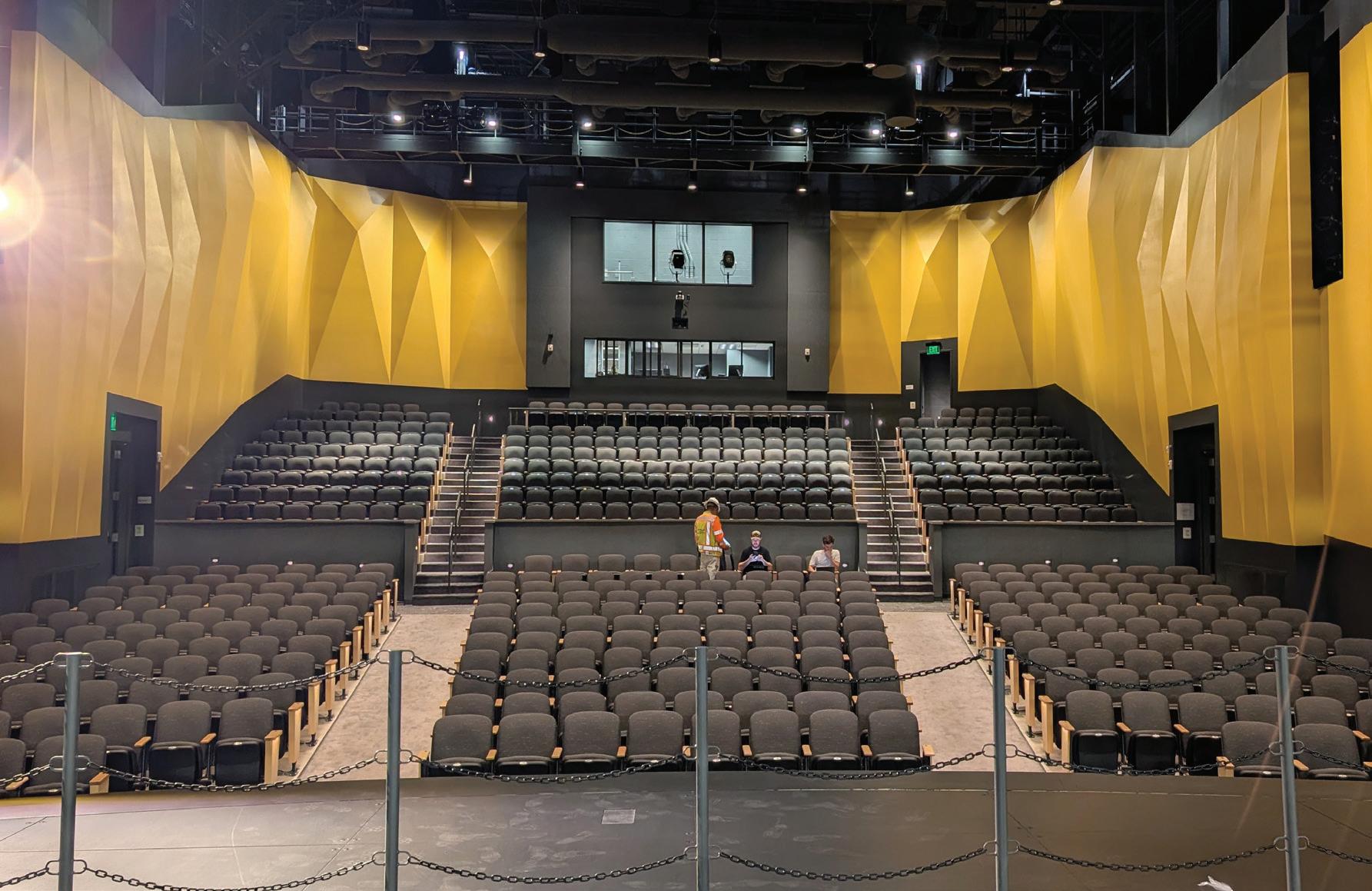
The Performing Arts Center (PAC) opened its doors to the public for the first time on March 19 as part of the district’s ribbon cutting ceremony. At the ceremony, students, teachers, and other community members were able to step inside the finished PAC and tour the theater and adjoining classrooms. Students will begin moving into the new building starting April 1, Theater Director Kaila Schwartz said.
Music teacher Emily Moore is looking forward to having more space and better facilities for performances, as well as having separate classrooms for her choir and orchestra classes with new equipment and integrated audio-visual equipment, she said.
“The new performing arts center is a very, very, huge step up from the theater,” Moore said. “It has all new lighting and sound. The stage is bigger; there’s an orchestra pit, which we haven’t had before. We have a lobby in the theater and more storage.”
Schwartz is excited to teach her classes in the new space and explore the capabilities of the equipment, she said. All the technical theater elements are professional level equipment, she added.
“Our space rivals college theaters,” she said. “It’s top notch equipment, and it can’t be played around with because it is high quality professional level.”
There are also lots of additional benefits such as a lobby and ticket booth, better lighting equipment such as spotlights and catwalks, and better acoustics in
classes and for performances in the PAC, Schwartz said.
“I’m hoping that anybody who is interested in working as a theater technician in any aspect like lighting or sound or spot operating or even sound design — sound mixing even — I’m hoping that they can get the experience on this equipment to carry into a professional career,” Schwartz said.
Director of Bands Kylie Ward will be teaching all of her classes in the new PAC, she said. In the current band rooms, students are playing with really old instruments and equipment, Ward added.
“It (old band rooms) has served its purpose, and it’s been amazing for a program this whole time, but it’s time for something
SEE PAGE 16
District faces cost-cutting challenges
By Uyen Vu
The district’s ongoing budget challenges include reductions in state funding, a decrease in the Cost of Living Allowance (COLA), Average Daily Attendance, and increases in other costs: “salary step and column, statutory benefits, health benefits, negotiations,” according to the budget presentation presented by the Business Services team at a board meeting on March 10.
For the Second Interim of 2025-26, the district’s expenditures amount to $186,424,493, while its General Fund Revenue is $175,906,337, according to the same presentation. However, based on the district’s financial self-certification, the district will “meet its financial obligations for fiscal years 2025-26, 2026-27, or 2027-28,” according to the presentation.
When the amount of money
that the district receives is less than the amount it is spending, the district is in a deficit, Chief Business Officer Dorothy Reconose said in an interview. Many districts in the area are also experiencing deficits, she added.
“When we get less money from the state and federal government, but our expenditures keep growing — because of inflation, price increases, and the cost of living — it becomes unbalanced,” Reconose said. “A deficit structure means you don’t have a balanced budget.”
Based on how the economy is doing, the state provides a COLA to the money that the state currently gives to school districts, Reconose said. The current COLA 2.3 percent increase is not enough to cover the increase that the district naturally has on a year-toyear basis; for example, classified staff have a natural increase in their salary each year, she said.
“That step increase is easily
5%, and if we get a 2.3% COLA increase from the state, we’re already in deficit just by the natural increase of 5%,” Roconose said. “We’re short there already, and then on top of that, our health benefits also increase, like our medical coverage for employees.”
The school board instructed the district’s executive cabinet to start finding ways to eliminate the deficit, which was $2 million at the time, Reconose said. The superintendent decided to create a committee of staff volunteers to discuss how to address the deficit, she added.
“You (could) nominate somebody to attend, or you (could) nominate yourself,” Reconose said.
The Cost Management Collaboration Team, composed of district employees, presented recommendations to the school board
Calaveras Hills student fatally stabbed near MHS campus
By Uyen Vu
A 17-year-old male was stabbed by a 17-year-old male suspect on March 31 and passed away from his injuries at a local hospital, the Milpitas Police Department (MPD) said in a press release. The victim’s family later identified him as Jarred Cavan, a senior at Calaveras Hills High School, according to NBC Bay Area.
The suspect remained at the scene and was taken into custody without incident and booked into Santa Clara County Juvenile Hall on charges of homicide and assault with a deadly weapon, according to the MPD press release.
At approximately 3:50 p.m., police reported to the 240-Block of Vienna drive less than three minutes after multiple reports of a fight involving several juveniles, according to the press release. A
second victim, a 16-year-old female had non-life-threatening injuries, and was treated at a local hospital and later released, according to the release.
The 16-year-old female who tried to intervene identified herself as Jarred’s girlfriend, according to Fox KTVU 2 News. She was stabbed in her hand while trying to fend multiple teenagers off as they were outnumbered, since she and Jarred were “in it alone,” she said in the story.
During the investigation, detectives identified a second suspect, according to a second press release on April 3. A homicide warrant was obtained for a 16-year-old male, and the suspect was taken into custody in Ontario, a city in Southern California, on April 2, according to the release. The Milpitas police
SEE PAGE 16
Juniors win Trojan Olympics by fifteen points, upset seniors
By Ryan Truong
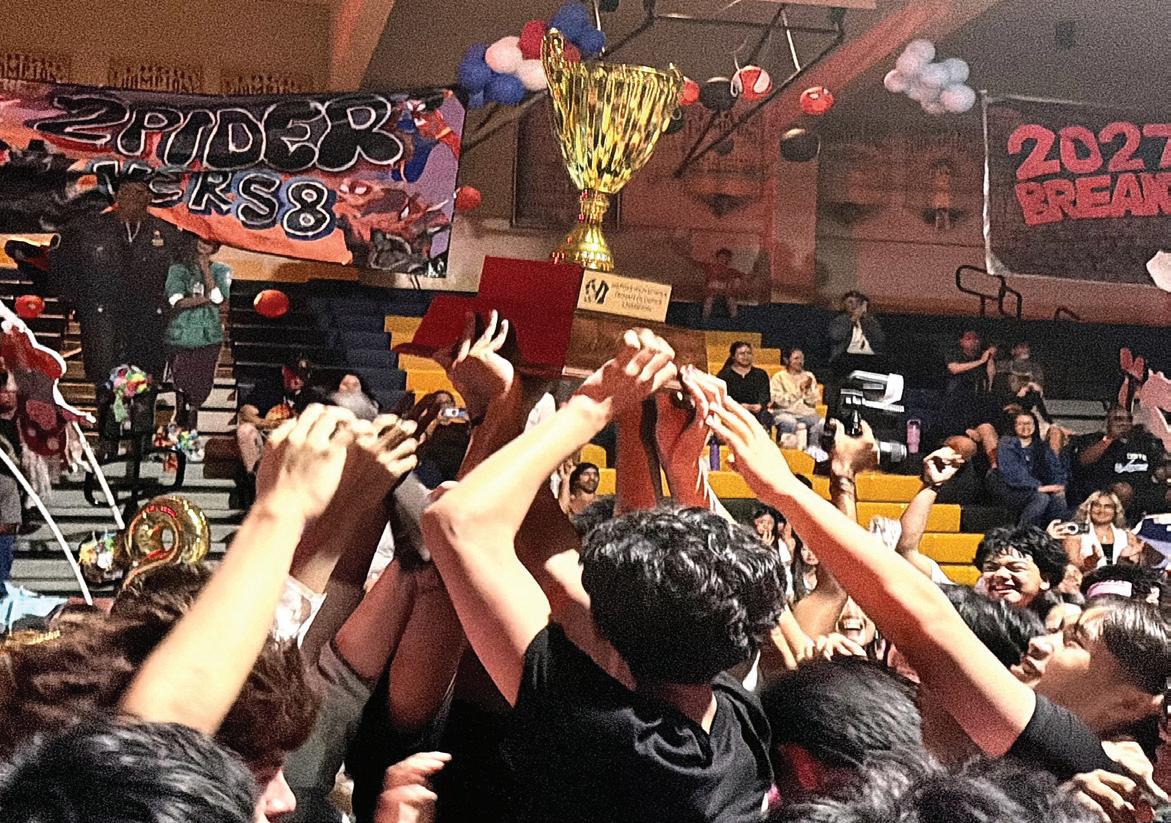
The Juniors (Class of 2027) won Trojan Olympics in the gym on Friday, March 27. The juniors finished with a total of 875 points, the seniors with 860 points, the sophomores with 760 points, and the freshmen with 605 points, according to an official score breakdown provided by Activities Director Deana Querubin.
Class of 2027 President Kavish Shah knew his team was slightly nervous heading into the event, but he believed that his team had a very good shot and could see the momentum building up as Trojan Olympics approached, he said.
The tension was especially strong given the tight point margins, he added.
“It was very close,” Shah said. “I was calculating the score the entire time. I knew that it was always going to come down to events such as the pyramid.”
Although the pyramid performance appeared polished to the audience, some of it had to be improvised on the spot due to some last-minute confusion, Shah said. Despite the chaotic setback, the
pyramid still came together perfectly in the end, he added.
“It was actually really just on the spot,” Shah said. “Everyone just thought of their place, and we really improvised it right there. It was good.”
Spirit Week also helped to propel the juniors to victory, Shah said. Excelling in the Spirit Week category alone gave the Juniors a 10-point lead in points for Trojan Olympics.
“We were down by 30 people in Spirit Week, so we started coming up with ideas,” Shah said. “What we did is everyone in our class printed out these tiny packets of pictures of Wreck-It-Ralph to pass around our class, and each person got 10 people to check in. That’s 40 times 10, which is 400 people.”
Junior Jelani North participated in Trojan Olympics for multiple games such as egg flinging, tug of war, and skateboard derby, North said. He believed that the team won because of a strong drive and determination that had been building up since the previous year, he added.
STUDENT VOICE OF MILPITAS HIGH SCHOOL
The new theater in the Performing Arts Center. It will be used for the upcoming production “Clue: On Stage”.
Marie De Vré | THE UNION
Juniors raise the Trojan Olympics trophy after being announced as winners.
Ryan Truong | THE UNION
Zoos are beneficial for animals, public
Zoos have long been the destination of family vacations and fun-filled field trips, and for good reason. Not only do they educate the youth on animal conservation, but they’ve also become the homes of hundreds of animals, many of whom wouldn’t survive without human intervention.
It’s easy to assume that animals are being abused. But in reality, zoos in the U.S. are closely monitored and hard at work to protect their animals.
Beginning in the 20th century, zoos shifted from their original roles as exotic exhibitions to rehabilitation and research centers, according to “Zoos' Involvement in Wildlife Conservation,” a research paper published on EBSCO.
animals; they provide animals with happier and healthier lives than in the wild. Zoos “offer threatened animals a safe haven free from poachers" and help protect species in breeding programs, according to the article “How Zoos Embrace Education, Research and Conservation.”
A famous case is of the California Condor, which in the 1990s was facing extinction. In a partnership with the U.S. Fish and Wildlife Service and zoos across California, the California Condor began to flourish again.
MARIE DE VRÉ
Today, many organizations hold zoos accountable, including the USDA, which licenses zoos or other agencies that want to exhibit animals.
Additionally, the Association of Zoos and Aquariums (AZA), focuses on the conservation and protection of threatened species and has its own recognized accreditation process. According to their website, there are over 253 accredited zoos and aquariums protecting over 780,000 animals and 8,600 species.
An AZA accreditation is the gold standard for zoos. To be accredited, zoos must meet AZA’s “standards for animal welfare, care, and management.”
Zoos aren't punishments for
A common misconception is that animals in zoos were captured and displayed for our enjoyment. However, the majority of animals in zoos were born in captivity. Since 1985, 90% of mammals and 74% of birds added to U.S. zoos were born in captivity, according to “Zoos' Involvement in Wildlife Conservation.”
According to the article, “How Zoos Embrace Education, Research and Conservation,” over 100 species have “recovered due to zoo programs that provide captive breeding.”
Zoos are a place of teaching, not only for scientists, but also for future generations. Introducing people to animals brings awareness to their issues.
Zoos may have a painful history, but they have since adapted to become the foundation for countless conservation efforts protecting all animals.
CON
Zoos harm animals, have limited benefits
For generations, zoos have been marketed as a place of education and observation. As kids, we see zoos as a magical place. However, we rarely see the reality hiding behind the iron bars.
Many zoos have been charged not only with embezzlement of funds but also with negligence toward the animals in their care. In many cases, zoos prioritize profit and entertainment over animal welfare.
In Ohio, a major scandal involving the Columbus Zoo and Aquarium brought these concerns to light. According to CBS News, zoo executives misappropriated more than $2.2 million in funds for personal expenses between 2011 and 2021, representing nearly a decade of corruption.
travel miles each day to hunt, explore, and interact with their environments. In captivity, however, their living spaces are often a fraction of their natural habitats. This restriction can limit their natural behaviors and reduce their overall quality of life. In fact, “Some estimates suggest that up to 90% of zoos globally fail to meet proper animal welfare standards,” according to Wild Welfare.
Theme parks, although they may not come under the umbrella of zoos, still keep animals captive. Animals are forced to perform for audiences who may even attempt to provoke the animals.
Beyond financial scandals, experts say that most animals in zoos struggle mentally. “The vast majority of animals held captive inside their compound are depressed,” according to the In Defense of Animals organization’s article “Why are we still failing in zoo animal welfare?” Animals living in captivity lose access to many of the activities and environments that make their lives fun and natural. As a result, many animals experience stress, boredom, health problems, and in certain cases, shorter lives than they would in the wild.
SATVIKA GIDVANI
Disney’s Animal Kingdom has recorded multiple animal deaths, with recent reports indicating that many animals end up dying due to fighting between animals and toxic ingestion, according to the New York Post.
People have become too comfortable on the internet. Gone are the days of the warnings of stranger danger and scams. Now people are posting everything that comes to their minds without a thought about their digital footprint. People scrolling through the internet often become victims to these careless posts, cursed with knowledge they would have been better off not knowing.
In addition, many are sharing information that they are too scared to tell their families, but are willing to share with millions of strangers. Influencers share family scandals and dramas. People post about their traumatic experiences in comment sections. People often vent their feelings on their Instagram stories. While this can be entertaining to read, sometimes it’s better for this information to remain private.
I believe people underestimate the permanence of the internet— anything posted
there is memorialized forever. A simple solution to prevent oversharing is to bring back diaries or other physical journals. People should have a place to vent, but still keep them private. If you don’t like the idea of writing down your thoughts, tell a friend, in person preferably, or record a voice memo of yourself just ranting. Keep your intrusive thoughts between yourself and your diary. You don’t need to share everything with the world; keep some level of privacy.
I’m not saying that people shouldn’t share their experiences online. In fact, I think it could be important. Sharing your life experiences can help other viewers feel seen or help them understand different ways of life. Seeing someone talk about their toxic household and how they gained independence could help save one's life. A video about a woman get-
The limited spaces that animals have in zoo enclosures could never compare to the wild. In the wild, animals such as elephants, lions, and tigers
Supporters of zoos may argue that zoos play an important role in education or that some institutions raise awareness of wildlife protection. However, their benefits are outweighed by the animals' ethical concerns in captivity. If we have to risk the well-being of animals to raise awareness about wildlife protection, what is the point? These actions are counterintuitive.
While visiting a zoo may seem like harmless entertainment, it also raises an important question about how humans treat animals and whether wild creatures truly belong behind bars.
Female reproductive disorders lack sufficient funding Social
Female reproductive disorders being under-researched is a significant issue, as are they often stay undiagnosed and few treatments exist, according to from the National Library of Medicine.
Endometriosis and polycystic ovarian disorder (PCOS) are diseases that can both be diagnosed in adolescence, although they only occur in 10% of women, according to the National Library of Medicine. While symptoms may vary, both diseases can create menstrual problems and infertility, according to Atlantic Health.
The greater concern is that both of these disorders can cause problems outside reproduction. For instance, symptoms of endometriosis include problems such as constipation and pelvic pain, according to an article by the Cleveland Clinic. PCOS also increases the risk of type 2 diabetes and depression, according to an article by NHS Inform. While it may be un -
comfortable to talk about, these health concerns need more awareness. Currently, there is no cure for these disorders, but there are some treatments. A common one for both is birth control pills, which are required to be taken for three months according to an article by the American Society for Reproductive Medicine. This demonstrates another problem: women with reproductive disorders who want children are being overlooked. Women with PCOS often have kids at a later age than women without, according to a study conducted by Science Direct.
ting her period could educate others. There should be a sort of boundary to what should and shouldn't be posted online. A good rule of thumb would be not to post anything that you would not tell a stranger in real life. We have entered an age in which people are comfortable saying whatever comes to their minds, and posting their ideas for millions to hear. Because of the lack of face-to-face interaction, people aren’t held accountable for their actions, so people feel confident to share information online that they wouldn't in person. I would rather not hear graphic detail about information that I would be too weirded out to think about. While it is vaguely curious, I think the world will continue on if this information is not shared to the public.
diseases aren’t being acknowledged until they kill them. Not to mention, the tiny percentage shows that people fail to realize that disorders that hurt a person’s health needs more research for treatments. There needs to be a better distribution of funding towards female disorder research to find new, different treatments.
LAUREN DANG
The big issue is the distribution of research funding. Only 5% of global research funding is given to women’s health, with a majority going towards women’s cancers, according to an article from nature.com. This horrifyingly implies that women’s
Female reproductive diseases being repeatedly overlooked is a major problem that shockingly nobody is talking about. The pain from these health disorders and the lack of treatments is concerning, which proves that more medical research funding needs to be allocated to this topic. Hopefully, when people realize the significance of these disorders, future generations of women won’t have to suffer the pain these conditions bring.
Purity culture should not be normalized for everyone
“Am I dirty?” is an often asked question after an act of premarital sex or during sexual relations. “Am I a disgusting person for thinking that?” you may ask yourself after imagining something “immodest.” These questions both stem from feelings of sexual shame and guilt, which young people commonly have. But what causes these feelings to arise? The answer lies in the dehumanizing and harmful messages of purity culture.
According to Axis, a donor-funded ministry that focuses on using Biblical resources to help parents and their teens, purity culture is “a movement within some Christian communities that emphasizes sexual abstinence outside of marriage.” Despite this definition, purity culture does not apply to just Christians — it is and can be modesty enforced onto others, especially young women and girls.
This social construct teaches that someone's virginity is their worth. Anyone who refrains from abstinence is seen as undesirable
and disgusting. Even though this rhetoric aims to “protect” people from the “dangers” of sexual impurity, it doesn’t necessarily do that — its messages, especially for an adolescent or a young adult’s mental and social development, are extremely stunting and toxic.
For one, its priorities essentially translate to viewing people, particularly women and younger girls, as objects or a prize to be won. Essentially, you are not your own — in fact, you are just property of your future spouse. This social construct can skew the beliefs of young people, as it teaches them what love should “look like.”
The concept of “purity” is also extremely insensitive and unsympathetic towards survivors of sexual violence, and does not teach its participants what real consent looks like. Since followers are expected to respond “no” to avoid any sexual advances, it skews their view on what actual consent between two or more parties looks like.
According to the Rewire News Group, when a person only knows how to respond with a verbal “no,” there isn’t much understanding that “giving in” to coercion or “not saying no” does not elicit a yes response. Failure to teach boundaries leads to victims believing that it was their fault that they were violated. Also, teaching people to view premarital sexual encounters as “dirty” can discourage victims from speaking up, accessing resources, or gaining support regarding their trauma. Discouraging sex and influencing people that unwanted sex is still sex allows the perpetrator to get away with their crime. It is worth noting that conforming to purity culture is conforming to the oppressor. Nobody should be penalized for sexual-related thoughts or actions, as it isn’t your fault for having or desiring sex. Sex is natural. You are human, and there is nothing wrong with being human.
RAIN BACUNGAN
NAMANA BALAKRISHNA
EDITORIAL: The Opinion of The Union
Student-athletes’ success inspire all students to work hard
Sports are a pivotal part of high school culture, built on the hard work and achievement of student-athletes. MHS boasts an impressive athletics department, full of hard-working individuals. Numerous sports teams have had historic seasons and wins this year, and The Union wants to celebrate these teams, including swimming, cheerleading, boys basketball, cross country, and more.
Our athletics teams have had incredible accomplishments across this school year. The varsity boys basketball team won the CCS Division 1 championship, the school’s first since the 1997 season, and finished with an impressive 26-2 overall record for the season.
Another team who had an historic win for the school was the cheerleading team, who earned 4th place at the USA Nationals at the Anaheim Convention Center on February 16. This year was the first year the team qualified as a TCC (Traditional
Competitive Cheer) team, mak-
ing this feat a remarkable milestone.
The girls varsity volleyball team became CCS Division 1 champions this past fall. This marks the first time in 32 years that the MHS Girls Volleyball team made a title match appearance, according to the MHS Girls Volleyball page on Instagram.
In addition, the cross country team had two members finish in the top 15 at the 2025 CIF High School State XC Championships, ending an incredible season. The boys swim varsity swim team won against Wilcox High School at their very first meet of the season. MHS made an impressive three CCS cuts on the Boys Varsity swim team in 100-yard backstroke, breaststroke, and freestyle.
It is not only the individual talent of these athletes that leads them to such greatness, but the cohesiveness and cooperation of everyone on the team.
Synergy between teammates on the court or at a cheer competition is pivotal to success: A flyer needs to be able to rely on their back spot and a point guard relies on their teammates to execute the right play. Our teams have achieved a high level of teamwork and cohesion, which contributes to their successes. Just making a team work as one is a feat enough, but to take it to a competition and to obtain a title together is incredible. It is a reminder of how important relationships are in our everyday lives, and how people can lift each other up to great heights.
All of our student-athletes and coaches work hard, and we applaud their.dedication and determination that have led to so many incredible feats and accomplishments. Seeing our fellow Trojans give their blood, sweat , and tears fills us with immense pride and inspires all of us to work hard and push ourselves to the limit, no matter what we pursue.
EDITORIAL: The Opinion of The Union
Students should read more for recreation
Over the past few decades, there’s been a steady decline in recreational reading among students, an issue that has become increasingly worrisome yet is still an overlooked problem in modern education. While most learning institutions such as our school continue to assign textbooks and required novels that adhere to a curriculum an increasing number of schools are no longer assigning books and assigning passages of text instead.
Many students have drifted away from books and replaced reading with short-form digital content and social media. According to the National Endowment for the Arts, federal survey data show that reading for pleasure has continued to decline across multiple age groups, with the steepest drops among younger Americans, such as Generation Z. In 2023, only 14 percent of 13-year-olds reported reading for fun daily, a steep decline from 27 percent of 13-year-olds only a decade earlier.
Opinion Article Puts Money
Above People
“Access to Venezuelan oil will help American economy.” That was the title of Jerry Yong’s opinion article in February’s issue of The Union, and it shows a disturbing tone that treats another nation’s sovereignty as leverage for profit. According to Yong, political change in Venezuela is just a resource opportunity and sovereignty is sacrificed for oil supply. His message is clear—Venezuelans matter less than the oil beneath their land. This is extremely dangerous rhetoric, as it frames Maduro’s removal not as a chance for democracy, but as an opportunity for American oil companies.
To truly understand how dangerous this is, change the date to the 1940s and adjust the words slightly to “Access to Romanian oil will help the German economy.” That was the same logic used to justify coercion and invasion in pursuit of resources; if that lan -
This shift in preferences may seem harmless on the surface, given that we are in a digital, online age. However, it has serious consequences for student literacy and academic success. According to The Nation’s Report Card, which regularly publishes student academic results in its NAEP Reading Assessments, students nationwide have been performing worse when it comes to reading performance. About a third of eighth-graders and nearly 40% of fourth-graders scored “below basic” or not being proficient for their grade level in 2022, the highest percentage in decades.
This declining academic performance is noticeable in classroom settings and disadvantages both educators and students. According to Futurism’s article “Gen Z Arriving at College Unable to Read,” many college professors have expressed frustration that students increasingly struggle to read and comprehend texts or rely on artificial intelligence to do so. This issue has become so
LETTER TO THE EDITOR
guage sounds unsettling in the context of the 1940s, it should sound just as unsettling today. America is strongest when it stands for freedom, not when it calculates what it can extract from other nations.
It is good that an authoritarian dictator was removed. Nicolás Maduro’s fall should open the door for true reform, rule of law, and accountability. But emphasizing that removal as a chance to secure oil suggests that people’s freedom is secondary to economic gain. Progress should be measured by liberties for the people, not profits for the companies.
Yong’s article also overlooks the realities of Venezuela’s oil industry. While reserves are often estimated at 300 billion barrels, most of it is extra heavy crude from the Orinoco Belt. It is viscous, high in sulfur and carbon, and far more energy intensive to extract than conventional oil. According to The New York Times, producing it can generate three to four times more greenhouse gas
STUDENT VOICE OF MILPITAS HIGH
prevalent that some professors have been forced to simplify assignments or reduce reading loads because students struggle finishing longer texts. When students lose the ability or patience to engage with complex texts and think independently, they resort to just regurgitating whatever they see online. They also lose critical thinking skills necessary for understanding news and evaluating information. As such, this also makes students more susceptible to misinformation online.
At the end of the day, reading is a core practice that enhances an individual’s literacy, and not reading will hinder one’s vocabulary growth, reading comprehension, and academic performance. Beyond academics, reading also shapes how individuals think, communicate, and understand and grasp the world that surrounds them. Reading as a practice builds empathy and is critical to helping to expose readers to different viewpoints, perspectives, and experiences.
emissions than lighter crude. Corruption in the ex-Maduro regime is another problem. The Associated Press reported that Maduro’s Vice President, now acting president Delcy Rodríguez, was linked to corruption, raising concerns that collaborating on oil access could entrench the same systems under “new” leadership. Even economically, the benefits are uncertain. ExxonMobil CEO Darren Woods told President Trump that Venezuela was “uninvestable,” according to the BBC. Investing in clean, renewable energy is the only way to ensure America’s security and creates jobs and opportunities.
At its core, Yong’s rhetoric puts oil barrels over human beings. The United States should not measure success by how quickly it can tap another nation’s oil fields, but by whether the values we build are of the people, by the people, for the people.
Johnathan Choi, Class of 2028
Want to advertise in the Union?
Please contact our business manager at milpitashightheunion@ gmail.com. Ads are available in full/half/quarter page and business card sizes. Upon request, The Union staff will also customize and design your advertisement.
STAFF
Marie de vré • Editor-In-Chief
Harold hong • Editor-In-Chief
Uyen vu • News Editor
Alice nguyen • Asst. News Editor
Sowmya sundar • Op-Ed Editor
Reuben thayil • Asst. Op-Ed Editor
Namana balakrishna • Features Editor
Kashvi agarwal • Asst. Features Editor
Shrihan sham • Sports Editor
Reina tam • A sst. Sports Editor
Natalie chen • Lifestyle Editor
Joseph graham • Asst. Lifestyle Editor
Jerry yong • Entertainment Editor
Ryan truong • Asst. Entertainment Editor
Rain bacungan • Spread Editor
Lauren dang • Asst. Spread Editor
Jonah wu • Graphics/Photo Editor
Satvika gidvani • Web/Social Media Editor
Aaron chiah • Business/Ad Manager
Shivani arun • Reporter
Tejus karadi • Reporter
Sanjit Roy
Journalism Advisor
HAVE AN OPINION?
GOT A GRIPE WITH THE SCHOOL?
DESIRE TO PRAISE MHS?
WANT YOUR VOICE TO BE HEARD?
WISH TO REPRESENT THE STUDENTS?
SUBMIT LETTERS TO MILPITASHIGHTHEUNION@GMAIL.COM
MAKE SURE TO WRITE DOWN YOUR NAME AND GRADE
FOR ONLINE EXCLUSIVE STORIES, VISIT MHSTHEUNION.COM
Eid celebrations mark end of Ramadan, a month of fasting,
By Aaron Chiah
Muslims finished their monthlong fast for Ramadan with the celebration of Eid on March 20.
Ramadan is a month-long fast that happens yearly, and is a spiritual month where the Quran was introduced to the holy Prophet Mohammed, senior Ibrahim Mohamed said. Ramadan involves fasting and praying every day from sunup to sundown in order to spiritually cleanse the body, he added.
“This is from sunrise to sunset,” Ibrahim said. “Sunrise is indicated by a prayer, and then sunset is also indicated by a prayer. That’s when you break your fast, and then when sunrise comes back around, you start it again, and you also have to make sure to avoid bad deeds.”
Ramadan is a part of the 5 pillars of Islam, the foundation for every muslims’ life, senior Fatima Kaubab said.
“The first main one is called the Shahada, which basically is just a statement saying that you’re Muslim,” Kaubab said. “Then the second is Salah, which is prayer, so we pray five times a day, and that is sunrise, we pray in the afternoons, and in the evening. Then the next one is Sawm, which is fasting. Then another is Hajj. Zakat, or charity, that’s the fourth. The Hajj is the fifth; Hajj is a pilgrimage.”
to come together. It is the only day that I know that we are not allowed to fast that day because it is a time to eat, enjoy, etc.”
Before Eid, Muslims perform a prayer, Kaubab said.
“The more religious aspect is that there will be a prayer in the morning and you’ll go to the mosque, but for the rest of the day, what a lot of Muslims do is just spend time with each other and appreciate their blessings.”
During Eid, you would wear traditional clothes like a long robe-like outfit that hangs down to your knees and go to the masjid (a community prayer house for Muslims), Mohamed said.
“For men, this is a Thobe. It is a long white garment that covers up to your ankles.”
Ramadan has changed Mohamed as a person because he can focus more on his connection with God, he said.
“It helps me reconnect with God because typically during the school year, some days I’m up late studying, and I’m not really having exactly as much time as I wanted to connect with God,” Mohamed said. “During Ramadan, there’s such a bustling community, you can’t help but become immersed with religion and the practices,” Mohamed said.
Ramadan has taught Kaubab how to manage my time and stop procrastinating, she said.
Although calisthenics — a type of strength training that utilizes one’s body weight — is not a taught in our P.E. classes, physical education unit taught at MHS, calisthenics, it is an activity enjoyed sport enpartaken in by students and teachers here alike.
Calisthenics is a fancy word for gymnastics, P.E. teacher Randy Redic said. Redic has done calisthenics his entire life, he said.
“It’s a good way to maintain a certain level of fitness, especially one that revolves around moving your own body weight,” Redic said. “It’s always a good workout. It’s just a good measure of strength, relative wise.”
Redic picked up calisthenics through doing lots of martial arts like Taekwondo and Mixed Martial Arts (MMA) while growing up, he said.
“Some of our conditioning (for martial arts) involved a lot of push-ups, squats, pull-ups,” Redic said. “I guess that was like my introduction to calisthenics. And then from there, I got into CrossFit, and there’s more gymnastics introduced, like muscle-ups, dips.”
Freshman Axel Lopez has pursued calisthenics for about seven months, roughly since the start of the school year, he said.
“I tried doing a lot of different sports, but none of them really worked or really caught my interest, ” Lopez said. “Calisthenics is the one sport that I actually liked the most, because it helps you train your body a lot, and stretching is a really good way to work out.”
Lopez was introduced to calisthenics by a friend who had been doing it since 8th grade, he said. From then on, he taught himself calisthenics and has encouraged other students to try it as well, he added.
“In my P.E. class, there are three people that I’ve actually been teaching calisthenics to,” Lopez said. “I’ve taught them how to do handstand push-ups … One of the people that I’m teaching already learned how to do a onearm handstand against the wall.”
Redic has taught calisthenic techniques to his students before, like muscle-ups and front levels, he said.
“Usually, for demonstrations,
I’ll have some (resistance) bands,” Redic said. “I’ll have some bands or some type of assistance to help them (students) out. But that’s how teaching works. A lot of it is work outside of those coaching sessions.”
Redic typically trains calisthenics every day, only changing the intensity time to time, he said. HeRedic usually goes hard on his workout once a week, he added.
“All the other times it’s either something like really long duration, or just something that’s at an easy level or easy intensity every day,” Redic said. “If I were to give a specific regimen for calisthenics, you want to train whatever movements you’re working on at least three times a week. If you’re looking for faster results, then you’re going to want to go up to four or five.”
Senior Nathan Ly chose to pursue calisthenics instead of other sports because of restrictions set by his mother, like not being able to go to the gym or do sports with heavy contact, he said. Ly discovered calisthenics through social media, he added.
“I remember, I think it was online when I first got Instagram (when he discovered calisthenics), and you see all these people doing flagpoles, muscles-ups, and stuff,” Ly said. “And I was like, ‘They get fit just from all these workouts with their own body?’
And I wanted to be like them.”
Ly also pursued calisthenics for the looks, he said. But Ly quitretired from the sport after realizing that his body and looks weren’t everything, he added.
People used to comment on Ly’s physique and ask him how he got to it, he said.
“It (his training regimen) would be 50 push-ups, 50 sit-ups, 50 crunches, two-minute planks, and then I do that for two times,” Ly said. “Then I would do 20 pullups. I would take a rest, another 20 pull-ups – , pretty crazy.”
The biggest challenge in learning calisthenics is the startup, Ly said.
“You will notice that you are weak,” Ly said. “I mean, you can’t do all these things that other people do, and it will really bring you down, but as long as you keep pushing and pushing yourself, and have that motivation, you will reach all those other influencers.”
Eid is the holiday after Ramadan and is part of the three days of Shawwal (the month after Ramadan where Muslims are expected to continue practicing the habits adopted during Ramadan), when Muslims are not allowed to fast because it is a day of celebration for the end of Ramadan and a transition into a better year, senior Omar Bahadori said.
“I believe our Prophet told us that it is the time to feast,” Bahadori said. “It is time for families
“I think it’s shown me that I’m a lot more able to get myself together because earlier, I’ll eat breakfast, and sometimes I’ll run late to school if I haven’t finished eating,” Kaubab said. “But now, I know I can do without, and it’s a nice reminder every year. And it also kind of shows me that I literally went days without eating, so I can also stop procrastinating.”
Ramadan has helped Bahadori sympathize with other people and helped him cleanse himself and his lifestyle, he said.
Senior Jayden Luo gets under car hoods
By Natalie Chen
Senior Jayden Luo’s first car, a 2006 Volkswagen Passat that he bought for $300, blew up on the highway due to a combination of high mileage and poor maintenance, he said.
However, the negative experience actually motivated him to start working on his own cars going forward, Luo said.
“There was actually zero oil in the engine when I checked, and I didn’t want that to happen again,” Luo said. “So instead of bringing it to shops, I ended up doing all the maintenance myself, so I could trust my own car.”
Today, Luo drives a 2001 Acura Integra LS, which is reliable and—relative to other cars—easy to maintain, Luo said.
“I actually worked on my friend’s car at one point, an Audi A3, and that was really gruesome,” Luo said. “We did an oil change on that, and instead of taking around 30 minutes, that was like two hours.”
For people new to car maintenance, Luo recommends attending classes at De Anza or other
community colleges, Luo said.
“The staff teaches car maintenance at these colleges for free for high school students,” Luo said.
“I feel like that’s a really good way to start.”
But there are plenty of alternative options for those who don’t feel like attending an extra community college class, Luo said.
“I recommend looking at YouTube videos,” Luo said. “That was probably the most useful area.”
Junior Ronen Sun, a close friend of Luo’s, has similar automotive-centric hobbies; in fact, he owns a Ninja Kawasaki 650, Sun said.
“I’ve rebuilt the entire left side of the motorcycle, done oil changes, and repainted and resprayed body panels,” Sun said.
Luo, Sun, and their mutual friends enjoy attending events like Monterey Car Week whenever they have the time, Sun said.
“(Luo) has a very fixated interest in cars,” Sun added. “He has very specific interests.”
Despite his passion for automobiles, Luo has had his fair share of mishaps on the road, Sun said.
“So one day, (Luo) called me
prayer
“I think every time I finish Ramadan, it’s like a cleanse for me,” Bahadori said. “ I’m locked in school and everything. It helps me realize the struggles that a lot of people have out there, especially in Africa or Asia. There’s a lot of people out there with no food or no water, and I like to think that Ramadan is a way that we get to understand their pain.”
Breaking Ramadan is also a worry; however, there are certain exceptions to breaking the fast, Mohamed said.
“I know, for women, menstruation cycles,” Mohamed said. “Or, maybe you’re sick or you have digestive issues. Islam is not meant to be restricting. It’s supposed to be accommodating. That’s why, if there are certain reasons why you need to break your fast, you’re allowed to.”
However, breaking Ramadan intentionally is bad, Kaubab said.
“Because the idea is that it’s an integrity thing you do for God; it’s one of the core foundations of Islam,” Kaubab said. “And it is completely possible. So some people, for example, if you’re sick and you’re drinking water with your pills, that’s okay. But if it’s something, like, ‘No, I just don’t feel like fasting,’ and you break it, that’s not good because it’s a sin. You won’t be ostracized from society; nobody will do anything to you. It’s just something that we know within ourselves is wrong to do.”
Practicing Ramadan is a difficult experience, so if you need someone to talk to, you should not be afraid to reach out, Mohamed said.
“Around the world, just know that you’re not alone in this, and that is a really good thing for your faith,” he said. “If you need to, please talk to a family friend or maybe an imam if you need a religious leader—just talk to someone if you need to.”
and he said, ‘Oh, I crashed my Civic.’ I asked him how, and he was like, ‘Oh, I sort of, like, went off,’” Sun said. “Mind you, I was sort of worried because that was the only thing he said to me before he basically hung up on me, and I was trying to call him back and everything.”
After calling Luo over a dozen times without a response, he decided to try and find him based on the background of the picture Luo sent, Sun said.
“I go up the mountain and I see his Civic past a ditch on the side of the road, and the whole front side of the car is just wrecked,” Sun said. “I ask him what happened, and he’s like, ‘Oh, I sort of got a little blind, you know?’ And that was his only excuse for crashing his car.”
Senior Dylan Nguyen, another of Luo’s close friends, drives a Toyota 4Runner—though he has yet to do any maintenance, Nguyen said.
“I got it like three days ago,” Nguyen said. “I filled the tires with air.”
Nguyen doesn’t remember exactly when he became friends with Luo; he seems to have simply “spawned into (his) life,” Nguyen said.
“This gay dude I knew had a crush on him,” Nguyen added when prompted for his first impression of Luo.
Furthermore, Luo is a “TikTok car boy” who likes BMWs and “stanced” (extremely low) cars, Nguyen said.
“I hate stanced cars,” Luo said in response to Nguyen’s statement. “That was five years ago!” Neither Sun nor Nguyen would trust Luo to drive their vehicles, they said.
“I can fix your car,” Luo said. “I can’t drive it—but I can fix it, at least.”
Trojans pull themselves up with calisthenics
By Harold Hong
Courtesy of Axel Lopez
Freshman Alex Lopez holds a one armed handstand on a grassy hill.
Courtesy of Jayden Luo
Jayden Luo modifying the engine under the hood of his Acura Integra.
Seniors volunteer
By Jonah Wu
Not everyone can say they’ve spent five days in a forest enjoying the sights and playing games, but that’s exactly what some seniors did as cabin leaders at Exploring New Horizons Science Camp, a voluntary program available only to students close to age 18 and above in order to monitor groups of sixth graders from various elementary schools and earn 40 hours of community service. The duties of the cabin leaders include monitoring their cabin members, getting food for them during breakfast and dinner, and ensuring each day’s schedule goes as smoothly as it possibly can.
Senior Nicole Castillo originally volunteered since she saw it as an opportunity to socialize with
By Tejus Karadi
Junior Jerah Pride began making music after being inspired by the artists and the beats he grew up listening to, Pride’s cousin said.
His early interest in video game music and electronic sounds made him create his own unique take on rap and R&B music, Pride said.
“My main inspiration when it came to making music was Ken Carson,” Pride said.
He first started producing beats on an old computer before eventually recording his own vocals, Pride said. Now he creates all of his music from his own room, using sample equipment like a microphone and his computer, he added.
“I actually started on my dad’s old Surface,” Pride said. “I started out producing first, before I started trying to put my voice on my beats.”
His songwriting process is not planned out; instead, it comes out naturally in the moment, Pride said. He listens to a beat and builds the song off whatever ideas come first, he added.
“I have to do it off the top of my head,” Pride said. “I’ll hear the beat, and whatever comes into my mind, I’ll make the song based on the first two lines.”
His music did not happen instantly and required constant effort and consistency, Pride said. He promoted his music on social media and experimented with different ideas to gain attention, he added
“I kind of was just grinding on TikTok and Instagram,” Pride said.
as cabin leaders for elementary schoolers at science camp, gain unique experiences
others, she said.
“I felt like I was a little isolated, so I wanted to go out and get my extrovertedness out and talk to more people,” Castillo said.
Senior Arjan Bains believes that the experience out in the forest gave the children a chance to be independent and take care of their own responsibilities, he said. For example, they set up their own sleeping quarters, he added.
“Science camp helps teach kids that ‘I can be independent,’ ‘I know how to do this stuff for myself,’” Bains said. “[The kids] set up their own beds, [they] brought sheets and covered the walls of their beds.”
The week also held many outdoors activities for cabin leaders to go on. Senior Anusha Ranade’s favorite were the night hikes,
While Pride mostly works independently, he still collaborates with a small group of producers and friends. Senior John Munoz, one of his producers, said their collaboration includes giving ideas and making adjustments to the beat based on Jerah’s liking.
Munoz explains that producing music takes time and patience, especially when developing ideas.
“I just kind of work in steps,” Munoz said. “I send the first melody, then the drums, and then I finish the whole beat.”
Many people underestimate the importance of producers in the music-making process, Munoz said.
“You don’t have a song without a beat,” he said. “People don’t give credit to the producers enough.”
Pride also works with his cousin, who helps guide him through the technical side of music. His cousin has been producing for years, and he focuses on helping Pride improve his sounds and recordings, he said.
“I saw a lot of potential,” he said. “I just wanted to help him, I wanted to show him how to mix his vocals.”
Much of Pride’s cousin’s role involves mixing and engineering, which includes adjusting vocals and refining the overall sound of the track, he said.
“It takes a lot of time… just mixing the vocals… adding things like reverb and EQ,” Pride’s cousin said.
Pride plans to pursue music in the future, he said. While he is not yet making enough to live off of, he is already earning money from streaming platforms.
“I plan to make music my main career just for life,” Pride said.
where students hiked on a forest path in the dark while instructed by a naturalist, she said.
“When I was a kid, the night hike was really different because we used flashlights and stuff, but this time around, it was in complete darkness,” Ranade said. “It wasn’t that bad because the naturalists were really good at telling us where to go.”
If anyone has concerns about the cleanliness of the cabins, rest assured that it has improved over the years, Castillo said.
“The cabin was really good quality,” Castillo said. “I did not expect it to get so modernized. It has actual rooms.”
Bains thought that the food provided was delicious, he said. The variety of the meals made sure nobody went hungry, he added.
“I think it’s nice to have a variety of foods, so everybody [can eat] something,” Bains said. Ranade had a fun time with her cabin members, recalling they got along really well during the week, she said.
“They all knew that they needed to respect me and listen to what I needed to say, so I didn’t have to enforce it too hard.” Ranade said.
Although it’s been a month since his trip, Bains still keeps in touch with his cabin members through writing letters, he said.
“They’re giving my sister letters to give to me,” Bains said. “Seeing someone’s handwriting – they even draw little pictures in the corner – I think that the human aspect of letters is so interesting.”
For any students interested in becoming a cabin leader in the future, Castillo advises to be care-
ful about how your first impression towards the children are as their leader, she said.
“Be strict, be really strict on the first day,” Castillo said. “I wasn’t as strict, and I was so lenient that the girls got too used to my kindness. Even though they could be scared of making the kids have a bad time at science camp, I feel like being strict to them is important or they’re always going to fool around.”
Bains also advises to be brave if you have any doubts about your skills, he said.
“I think in some instances, you kind of have to be pushed a little bit out of your comfort zone, do something you never would, and experience new things,” Bains said. “You become more experienced, which I think everyone really needs.”
Students use their podcasts to share their perspectives on life, high school
By Sowmya Sundar
Senior Kaylynn Dang co-hosts a podcast called “The Bee’s Knees,” and the group, Kaylynn, Kaylee, Jenny, and Tiffany, originally came up with the idea last spring, she said.
Kaylynn and friends were preparing for college applications at that time, so they launched it as a “passion project,” she said.
“We’ve always thought that our conversations are really indepth, about our lives, academics, and relationships,” Dang said. “We thought it would be good to share with others who might also need advice.”
Senior Victor Banh and his friends have a podcast called “Reheated Thoughts,” which they started on a whim, he said.
“It was just a joke at first, and then it conjured into the best podcast in Milpitas,” Banh said. “So it’s really going well for us.”
On “The Bee’s Knees,” the group talks about a broad range of topics, senior co-host Jenny Le said.
“But lately, we’ve been interviewing different students,” Le said. “We’ve just been asking them about their passion.”
Senior co-host Kaylee Ladle said they first come up with a recording schedule, and then she plans out when to edit it.
“It’s kind of hard to edit because it takes me multiple hours to go through it and listen to make sure it’s good, but I try to stay on top of it, because I want to be consistent with our posting and make sure that it’s quality work,” Ladle said. “For my actual editing process, I just make sure that everything is the same volume and that it’s cohesive throughout the whole thing, and we’re not just rambling.”
On “Reheated Thoughts,” the hosts have discussed topics a lot of high schoolers can relate to,
senior co-host Abdul Mohammed said.
“For example, on our first episode, we interviewed our friend Max, and we talked about student-athlete life and social expectations,” Mohammed said.
“We also talked about some other topics: for example, they have siblings. So, we talked about sibling dynamics.”
Since they started “Reheated Thoughts” on a whim, the group doesn’t have a specific objective for it, senior co-host Shylon Lacuesta said.
“We say, ‘Hey, we should just make one every so often,’ so there’s less pressure on us to be like, ‘Hey, we need to get an episode out this week,’” Lacuesta said. “Or we say, ‘Hey, we haven’t done one in a while. Let’s make sure we do it.’ Obviously, we do want to, as much as we can, but it’s not a hard deadline, so I feel like we’ve been able to balance it pretty well.”
Although it would be nice to have more people listening, their focus isn’t building their brand, Lacuesta said.
“This is for senior year; might as well have something to look back on,” Lacuesta said.
Procrastination has been the biggest challenge for the “Bee’s Knees,” Dang said. Often, their schedules didn’t line up, since they were five girls who had to coordinate with work and extra activities after school, she added.
“So it was really hard to actually start it, especially because we had no experience or someone to ask about how to start a podcast,” Dang said. “We just kept dragging on about when we would do it.”
Working on the podcast has helped the “Bee’s Knees” members open up more to each other, Le said.
“Before, I feel like we wouldn’t have had personal conversations, or we just wouldn’t hit certain
topics,” Le said. “But, with the podcast, for example, I was able to figure out more about their family.”
Podcasting has helped the hosts of “Reheated Thoughts” develop interviewing and networking skills, Banh said.
“It’s gotten easier to talk to people,” Banh said. “Speaking to people in a conversational way, in the podcast format, bleeds through into my real life. It helped me out.”
As graduation approaches, it’s hard to predict the future of “Bee’s Knees” since the members don’t know where they’ll end up, Dang said.
“As for the time that we have left together, I just really want to give more advice about what I would have wanted to hear when I was in the beginning of high school and my teenage years,” Dang said. “I just want to accomplish that goal before we graduate.”
For students hoping to start a podcast, senior “The Bee’s Knees” co-host Tiffany Nguyen suggests not feeling pressured by what other people think, she said.
“You’re making podcasts to advocate what you have to say,” Nguyen said. “Don’t let other people influence you.”
Mohammed mentions that podcasting is enjoyable, as long as you’re having fun, doing it with people that you enjoy, and it’s what you would do naturally, he said.
“I feel like the episodes we make are really just memories that we’re posting onto a platform,” Mohammed said. “We’re not really thinking of it as like a podcast. It’s more like just us recording conversations that we have that we’ve personally felt meant a lot to us. As long as you have that mindset and are doing it with people that you really care about, that’s when you should start a podcast.”
Jerah Pride channels creativity into producing music
Courtesy of “The Bee’s Knees” and “Reheated Thoughts” via Spotify
Some episodes of “The Bee’s Knees” and “Reheated Thoughts” podcasts are avaliable to stream on Spotify.
By Joseph Graham
Many students go through all four years of high school without considering that it’s a unique period of your life that you only live once. After you graduate, you’re done — there’s no going back. No matter how you feel about high school, you must preserve pieces of your high school life so that you don’t regret it later on in the future.
What moments to capture: You don’t have to obsess over taking too many photos or saving everything. Instead, consider what you care about at the moment and stay true to who you are.
For example, you can take a picture on your first and last day of school each year and compare the two to see how much you’ve changed. If you do this for all 4 years, the change will be even more apparent.
School events and activities are also a great place to make memories. Events like Trojan Olympics can be a way to show off your class pride, while smaller lunch games like the pizza eating competition are a breath of fresh air from the typical stress of school. Give it a try, you may find yourself regretting not going to enough events in the future.
Taking group photos is also important because the truth is, you’re going to meet many more people in your life, and the people you’re around now may not be the people you’re around in the future. But, it’ll be nice to look back and be able to say, “Hey, I remember him,” or “Didn’t they do so-and-so?”
What schoolwork to keep: Some people throw away too much while others keep everything. You need to find the right balance between the two. Things like your daily math homework aren’t that exciting, but that one English project you spent a whole week on? It would be a waste if you didn’t have a photo or other item to remember it by.
When you’re contemplating whether or not you want to keep an assignment, think about how much that assignment represents your personality. Essays, for example, are a great display of your personality — given you didn’t use AI, of course. Since most essays are online nowadays, there’s no reason not to save them.
Other creative projects, like posters or models, are also important to keep. You don’t have to keep the physical items either — you can take a few photos or videos and then discard them if you don’t have space.
Report cards, certificates, and other awards are things you may want to look back on in the future as well. But those old tests and classwork you’ve done? I’d suggest throwing most, if not all, of that generic work away.
How to preserve and create memories:
Taking photos and deciding what schoolwork to keep is only scratching the surface of what you can do to preserve memories. If you want something physical to hold that can serve as a short blast to the past, making a scrapbook may be the right thing for you.
A scrapbook is like a photo album, except instead of just photos
you can put any sort of memorabilia in it. Newspaper clippings, photos, stamps, and other travel souvenirs are all things you might find in a scrapbook.
If you don’t want to make your own scrapbook, buying the school yearbook is a great way to obtain something similar. Many people skip out on buying the yearbook, but don’t realize that you’re purchasing it for the future, not the present.
If you’re less interested in preserving memories and more focused on creating them, a bucket list is an amazing way to plan out the things you want to accomplish.
A bucket list is a collection of goals you want to accomplish. These goals can be about anything, whether it be traveling to another country, going on a road trip with your friends, or learning a new hobby.
Remember, though, creating and saving these remnants of your high school experience isn’t only to save yourself from regret in the future, but to lead you to pursue a
By Shrihan Sham
The East Bay Card Show was held March 7-8 at the Santa Clara Convention Center, where hundreds of card collectors and sellers came together for one of the largest trading card events in Northern California. The event had an entry fee of $25 for anyone older than the age of 10. The show attracted hundreds of collectors who came to buy, sell, or trade sports cards, Pokémon cards, and other collectibles like Funko Pops, signed NFL helmets, and many other items.
The event had multiple rows of vendor tables filled with rare cards, sports memorabilia, and other collectibles. Most of the vendors mainly sold Pokémon cards, but there was also a wide variety of sports cards available. Because of the wide range of sellers and buyers, people could look through different sellers and buyers to find the best price for their collectibles. The value of some cards I saw ranged from 20 cents to a staggering $30,000. Sellers would often negotiate prices and trade offers to find the best available deal.
One of the few differences between the East Bay Card Show and a regular card shop is the vast number of sellers under a single roof. Hundreds of sellers showed up at the convention center, allowing buyers to access the best deals in one place, rather than having to drive to multiple stores. The large collection of different card styles, designs, characters, players, and other things made the event more interesting and exciting. Since there were hundreds of sellers, the chance of finding a rare card or a good deal was pretty high. People who were not familiar with how cards are graded or how rare certain cards are were able to ask sellers directly to find out the value and history behind specific cards.
The show had people of all ages, including adults who have collected cards since they were young, as well as kids just getting into the hobby of collecting cards.
Thrifting culture says ‘out with the new, in with the old’
By Alice Nguyen
Many of us would have a visceral reaction if we had to wear what was considered stylish even a couple of years back: galaxy leggings, tie-dye t-shirts, cow and leopard-print everything. Personally, my bet is that white camouflage print is the next to be considered “so last season.”
With ever-changing clothing trends being accelerated by social media usage, we have no one to blame but ourselves for the rise in fast-fashion, which Britannica, an encyclopedia, describes as the rapid mass production of low-quality clothing.
Consumers like me and you will buy the trendiest piece of clothing and wear it for a couple of months before it ends up in the landfill and gets replaced by an entirely new line of clothing. If the stock doesn’t sell by the time the new line comes in, some stores do the dumping themselves.
Plus, with the earth already warming up every passing moment (seriously, why is it 90 degrees in March?), the last thing this planet needs is more pollution and garbage.
Why do we thrift?
Face it — you don’t need the latest trending Stussy shirt, leopard-print skirt, or any of the clothing that influencers are advertising as a “must-have.” Personally, I fell victim to the frog
bucket hat in 2021, and now it’s sitting in my closet collecting dust. And besides the obvious amount of over-consumption that trends and brands facilitate, it’s just not financially smart to frequently spend hundreds of dollars on clothing. What to thrift?
Literally anything from clothes to shoes to accessories — the bins are your sandbox. That being said, be mindful of what you put in your cart. If you’re buying secondhand items online, make sure the seller seems legitimate; this may mean looking at reviews or asking for specific pictures of the item you’re trying to buy. On the other hand, if you thrift in person, it’s much easier to check clothing for any rips, tears, or stains. Something to also be aware of is that you’re also likely to find lower quality items made with polyester or other cheap fabrics. How do we thrift?
If you go to a thrift store, chances are you won’t be able to find the exact item you’re looking for. But you might find something unexpected that becomes an essential part of your wardrobe. For many, going to thrift stores to tackle the unknown is even a hobby. The most accessible option for thrift shopping is the Goodwill located in our very own Milpitas. However, you may want to diversify your options in San Jose, where thrift
stores are much more common, with even more Goodwills and other smaller stores such as Hope Nuevo Thrift, located in Berryessa.
In contrast, if you’re looking for specific pieces of clothing, you’re in luck. In the modern age of technology, there is no shortage of second-hand websites such as Depop or Facebook Marketplace.
On the downside, thrifting has become increasingly dominated by resellers: people who thrift specific items of clothing only to sell them at marked up prices. If you’re looking for something popular or vintage, chances are that a lot of the items considered good finds will already be snatched up by resellers. Unfortunately, there’s really no way to get over this hurdle other than going to thrift stores as they restock.
Thrifting and buying clothing sustainably
Before you make your next purchase, here are some things to think about: Is it necessary, and have you wanted it for more than a couple of months? If you answered “no” to either of those questions, you might want to hold back on buying anything.
But remember: buying sustainably doesn’t mean all or nothing — it’s OK to treat yourself to a new pair of jeans or a designer bag that you’ve been eyeing for months. In fact, thrifting copious amounts of clothing is a form of over-consumption as well, regardless of price. It’s important to be mindful of how much clothing you’re thrifting. The lower prices make it tempting to buy more clothing than you would usually purchase, which makes the pastime of thrifting financially and sustainably counterintuitive.
In the end, discovering a happy balance between buying secondhand and buying new is one step closer to living an eco-friendly lifestyle!
You could not only buy or trade old cards, but you could also buy brand new ones, such as limited edition packs, which can only be purchased in a few places. For example, the 1999 Charizard Base Set 1st Edition Shadowless (PSA 9) was priced at $30,000. There were also signed NFL helmets and the one which stood out was the signed helmet by Super Bowl champion Tom Brady during his second season with the New England Patriots and his first Super Bowl win.
Social media has made trading cards more popular because of content creators who show card packs being opened and cards being graded. Thus, card shows have more and more people coming to them to trade, buy, or just have fun.
The East Bay Card Show is also another place where people with the same interests can meet and hang out. The whole point of the card show is to have fun, even if you’re not buying things. It is a meet-up place for people who like collecting things.
Overall, the East Bay Card Show was a very cool experience, with a large number of people, a variety of sellers, all kinds of trading cards, and a strong community of collectors.
Save cash at these local restaurants
By Tejus Karadi
Finding affordable food in the Bay Area can be hard, especially for teens who want to eat something good without spending too much money. However, I found some great places in Milpitas to keep your stomach full and your wallet fuller.
One place in Milpitas that stands out is Sen Dai Sushi in North Milpitas. This is a must-try spot for people who are visiting Milpitas because it is one of the most popular places in the South Bay. They offer sushi rolls for $6, and all of their fish is super fresh. The tuna rolls cost $6.50, and the fish was cool and fresh. I watched them cut up my fish and make my order. The flavors were simple but very pleasant and had a slight vinegary taste, especially when I ate it with soy sauce.
Another highlight was the Alaska roll, which cost around $. The avocado added a smooth texture that balanced well with the salmon and seaweed. The combo made the roll feel easy to eat and filling due to the avocado.
Sen Dai Sushi also has some delicious appetizers, such as the chicken karaage and the garlic edamame. The chicken karaage cost around $13 and contained a plate full of crispy fried chicken sitting on a bed of chopped lettuce. The chicken kept a crisp outside without losing the juicy, tender inside. The sweet and spicy sauce paired perfectly with the chicken, making it one of my favorite dishes from here. As for the garlic edamame, its sauce added a salty flavor that the regular edamame lacked.
Another affordable restaurant in Milpitas is China Rose. Their $8 Kung Pao chicken is easily one of the best dishes. The sauce had a
salty, smooth, strong flavor and a nice spicy kick to it. The peanuts were very crispy and the chicken paired super well with the chili pieces and veggies they added.
The broccoli chicken had a thick sauce that coated the chicken well, which made the meat taste very juicy and flavorful.
The egg fried rice was another great option, with the soft scrambled egg mixing well with the flavorful rice. There were carrots that were crunchy on the outside and soft on the inside, peas which were nice and soft and blended well in the rice, and the ot and sour soup had a thick texture, costing around $6. What makes this unique is the long bamboo shoots in the soup, which give it a crunch.
Kathmandu Cuisine offers Nepalese food. The flavors were very unique and tasty due to the different spices they used. The most popular dish is the Momos for $15. They were easily the best item I tried in the restaurant. The first bite was a juicy chicken ball with great seasoning on the inside, and the sauce had a spicy flavor that gave it a unique taste while still not being too spicy.
Another great item from Kathmandu Cuisine is the Veggie Hakka Noodles, which also cost $15. The noodles were very spicy but also very flavorful. The dish had a strong spicy aftertaste to it and is great for people who like spicy food.
In the end, eating out in Milpitas can still be very affordable if you know where to go. These restaurants all had great, tasty food for affordable and cheap prices making them great choices for students looking for something that would keep their stomach full and their wallet even fuller.
Students interested in Forensic Science
By
While some people enjoy consuming media involving crime cases, others actually plan to solve these crimes in real life, as a career. Forensic Science, one of the many science courses offered at our school, can benefit from the experience of solving crimes in real life. In the class, students learn to collect evidence at a crime scene and analyze that evidence, forensic science teacher
“There’s so many things you have to pay attention to that you won’t catch un less you’re trying to look for it,” Pasqua said. “Because you don’t see something, unless you’re specifically looking for it.
Pasqua wants to be a forensic tech nician, which means she analyzes evi dence in the labs, she said.
forensic science in her junior year, some specific skills that helped her do well were to pay attention to details, she added.
“I don’t think I would be able to ac tually go to the crime scene, but I still want to be involved somehow,” Pasqua said.
Balamurugan is considering many different options, but is currently focused on criminal prosecution, she said. If that doesn’t work out, she wants to be a medical examiner, Balamurugan added.
“When you prosecute criminals in court, or prosecute someone who’s been convicted of a crime in court, you try to prove that either they committed the crime,” Balamurugan said. “The job of a medical examiner is to perform autopsies on anyone who’s died. That could be in the case of a homicide, that could be in the case of just someone dying of natural causes. Their job is just to figure out what caused them to die.”
One of the guest speakers that came into the forensic science class was a medical examiner, Pham said.
“She came in, she talked about how to identify the cause of death of the individual,” Pham said. “She had a medical degree, license, and then she talked about what she does for her job. Then she’ll show us some case studies with pictures.”
Media about true crime and murder mysteries don’t accurately depict actual forensics, Balamurugan said.
“Like, they’re somewhat accurate,” Balamuruguan added. “They give you an introduction into what the field is like.”
Impact of ‘The Backrooms’
By Aaron Chiah
Have you ever been in a place that unsettles you, a setting that gives you a sense of dread and loneliness? A liminal space, a space in-between two destinations, is typically associated with feelings of deja vu and uncanniness. Empty malls, suburbs, and buildings could give off that vibe.
The Backrooms brought liminal spaces into the mainstream, first gaining popularity on 4chan, an internet chat room, as a picture post, where the user shares a photo of a hobby store in Oshkosh, Wisconsin. Later, another poster would reply with a lore post, setting up the foundations of The Backrooms. The Backrooms is the concept of an out-of-bounds area that exists in real life, where certain spots in the world can cause someone to no-clip (a video game term referring to a bug where players will fall through the map) into the backrooms.
Although originating in 2019, The Backrooms would not become popular until Jan. 7th, 2022, when YouTuber Kane Pixels released the first video in his analog horror series based on The Backrooms. Not only would this propel The Backrooms into mainstream attention, but Kane Pixel’s choice to use analog horror would also boost the subgenre’s popularity, thus creating an era where analog horror, The Backrooms,
Curiosity is a passion that drives one to learn more about the world. It’s usually the most palpable in childhood, when one is first learning about their surroundings. In adulthood, people tend to lose this spark of curiosity, but it’s still important to retain curiosity, no matter your age.
But what sparks curiosity in the first place? Well, that would be mysteries. Mysteries have been with humanity from the dawn of time. Timeless questions include “What is consciousness?” “What is the universe and why was it created?” and “What happens after death?” These questions fuel humanity’s drive to innovate and dissect our surroundings. Likewise, the power of curiosity has had everlasting impacts on humanity.
The earliest human ancestors allowed us to evolve this far through their curiosity. Curiosity is what sparked the discovery of fire and tools. This enduring human ability has allowed us to ponder not only questions about our immediate surroundings but also what lies beyond our universe.
Some examples of geniuses who were sparked by their curiosity include Nikola Tesla, Confucious, and Aristotle. For these intellectuals, their curiosity in their respective work environments led to innovations and ideas that would forever change society. Curiosity can have personal benefits alongside the possibility of innovation. Curiosity is often predicated as a “positive emotional-motivational system associated with the recognition,
and liminal spaces became popular in internet horror from 2022-2023. Since The Backrooms is a collaborative fiction project, meaning an internet project with a non-linear universe where anyone can go to the official wiki and add to the story of The Backrooms; a similar project would be the SCP series, another collaborative fiction project about a secret government agency fighting and containing anomalies called SCPs, where users can add SCPs, expanding the series’ universe.
The Backrooms’ influence on analog horror is especially astounding, as it really boosted the subgenre, helping elevate works like “Skinamarink,” an analog horror movie that rarely shows the main characters and instead focuses on the setting and the liminal feeling it invokes.
Another factor is the rise of The Backrooms based video games. Because of widespread popularity, an influx of video games have flooded the market. But, because of the quantity of games, many of them are poorly made and labeled “slop” by the community. Thus, The Backrooms would soon become associated with poorly made games. However, this period of popularity also brought the downfall of The Backrooms. The main scare factor for a concept like The Backrooms is the fear of the unknown, but because it went mainstream, many people kept adding
floors and various explanations, monsters, and anomalies on each floor. This resulted in the scare factor being dumbed down, and the unknown becoming more known. Thus, The Backrooms began to be viewed as a satirized title because of the numerous entries.
Additionally, because of the influx of new fans of The Backrooms, many people who have known liminal spaces longer feel as if the newer fans’ interpretations are not true to the actual definition of a liminal space. People would now post pictures of empty parking lots, bedrooms, and classrooms claiming that they are liminal spaces even when those spaces don’t represent a place in-between. Which is why the original backrooms image still stands as a symbol for liminality till this day. It’s the perfect representation of what liminal spaces are supposed to be. The original photograph of “The Backrooms”.
Namana Balakrishna
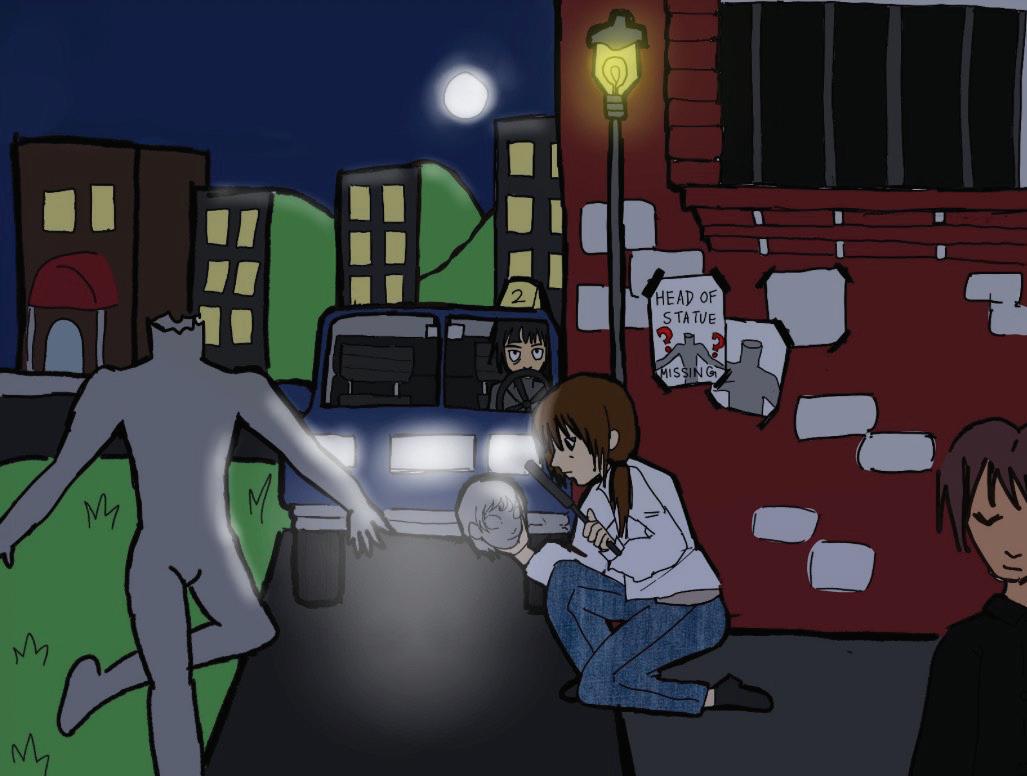
Detectives often search crime scenes by placing markers and uncovering key objects in a case.
Rain Bacungan | THE UNION
pursuit, and self-regulation of novelty and challenge,” according to the study “Curiosity and Exploration: Facilitating Positive Subjective Experiences and Personal Growth Opportunities,” by Todd B. Kashdan et al. As shown by the study, curiosity can open new pathways in life that can reward a person internally (making oneself happy) or externally (winning competitions, earning money, etc.). Although this may all seem like common sense, questioning one’s immediate surroundings, school or work, or even the grand scheme of the universe, can be positive. Geniuses throughout history are prime examples of the importance of being curious, as their curiousity has led to impact. However, it’s not required that your curiosi-
Students can escape boredom by going to escape rooms with friends
By Sowmya Sundar
With the opening of the Escape Game at the Great Mall last year, more and more students have considered visiting an escape room to have fun with their friends. However, if you’ve thought about tackling an Escape Game room, you might have been put off by the high price, the sheer number of people crowded into a small space, and the relative lack of difficulty of the puzzles. So, as a beginner, how do you plan for an enjoyable escape room outing?
The first step is, unsurprisingly, selecting one. This isn’t as simple as it seems: There are an array of genres and types of rooms. Popular genres include horror, adventure, and mystery. Two common types are physical game-focused and paper puzzle-focused rooms. Some rooms even include light features and live actors, such as zombies that slowly escape as the timer runs out. Every group will have their own preferences, so do your research and pick a room that best suits your tastes.
After you’ve booked your room, all you have to do is wait patiently for the day. You and your friends should arrive a few minutes early to ensure you
came to the escape room not just to win, but to have a good experience with your friends. Stay aware of yourself and others: Never take anyone’s items, do puzzles already being worked on without permission, or talk over each other. There’s a flip side to this. What do you do if you haven’t been able to figure out any puzzles? In this case, never stop trying to participate in the ways you can,whether that’s searching for clues or just contributing ideas. Even if you can’t directly solve something, it will still be satisfying when you’ve been actively helping. You can share in the joy of your group finally discovering the solution to a difficult puzzle!
Price is a major drawback for those considering escape rooms, since many cost around $50 per person. However, it’s important to consider that escape rooms are elaborately designed experiences with many physical elements, so are priced high for a reason. I’d recommend saving an escape room trip for a special occasion and choosing a room that would be worth the expense. These are usually rooms in a specialized location just for escape rooms. I recommend Omescape or PanIQ Escape Room because more accessible places like the Escape Game have smaller rooms with worse quality for the same price.
If you’re really short on cash, there are many online simulation escape rooms which are enjoyable, interactive experiences. These can be played alongside friends over voicecalls to mimic the experience of solving an escape room in
With this guide, you and your friends can now escape the grueling process of choosing your next activity, and can start planning a fun and personalized escape room experience for your next
History of Sherlock Holmes
By Kashvi Agarwal
stories about him every month for two years in “The Strand,” the Sherlock Holmes fandom has exploded, according to The Strand Mystery Magazine. The canon of original Sherlock Holmes stories by Doyle includes four novels — “A Study in Scarlet,” “The Sign of the Four,” “The Hound of the Baskervilles,” and “The Valley of Fear” — as well as 56 short stories. To this day, Holmes remains an iconic character, ever growing in popularity, whose influence on culture and literature is unmistakable. Holmes is known for his ability to deduce a lot about a person’s life through observing the smallest of details. However, as Watson wrote in “A Study in Scarlet,” “His ignorance was as remarkable as his knowledge. Of contemporary literature, philosophy and politics he appeared to know next to nothing.”
Doyle portrays Holmes as a cold, unsociable man. His roommate, Watson, an army doctor who’d recently returned from Afghanistan, wrote about the cases that they solved. Both characters’ personalities complement each other perfectly — one a bit detached and superhumanly observant and analytical, the other more socially and emotionally aware and a loyal friend. They’re partners in crime(-solving).
Apart from being the reason that the detective fiction genre took off, the original Sherlock Holmes series has been the inspiration for many mystery stories and has been adapted into many TV shows and movies.
A recent adaptation, “Young Sherlock,” released in March 2026, begins with nineteen-year-old Sherlock being a porter at Oxford University, a
job given to him by his older brother, Mycroft, in order to keep him out of trouble and out of prison. This doesn’t go according to plan, since he becomes a suspect for murder, leading to him getting entangled in solving the cold
Airing from 2010 to 2017, “Sherlock,” a TV series created by Steven Moffat and Mark Gatiss, is a modern spin on Doyle’s stories. Its third season received an average of 11.82 million views, making it the mostwatched BBC drama in over a decade at the time, according to The Independent.
Another spin-off movie, “Enola Holmes,” starring Millie Bobby Brown, is about Sherlock and Mycroft’s sixteen-year-old sister, Enola, who investigates their mother’s disappearance. Along the way, she meets the young Lord Tewkesbury, and they both get swept up in a larger scheme. The first movie of the series came out in 2020, the second in 2022, and the third will be released in the summer of 2026. Enola’s mother raised her in defiance of social expectations for women, teaching her martial arts, chess, literature, science, and everything in between, instead of how to be a “proper lady.”
The movie emphasizes themes of independence and women’s rights. As Enola says at the end of the movie, “My life is my own, and the future is up to us.”
Some of the other hundreds of Sherlock Holmes adaptations, include “Elementary,” a modern day twist set in Manhattan (rather than London), and “Sherlock Holmes,” a 2009 movie starring Robert Downey Jr. Each version brings a new perspective and a new message, apart from being British or American, set in the Victorian era or in the present day, featuring a young Sherlock or an older one, or featuring him or his sister.
Brilliantly intelligent. Often sociopathic. The world’s first and only consulting detective. The same Sherlock Holmes but in different fonts, captivating each time. The detective who has entranced society for many decades in the past, and who will for many more to come.
Ye releases new ‘Bully’ album, lacks signature creativity
RATING: 3.5 out of 5
By Harold Hong
Award-winning artist Kanye West, now known as Ye, released his 12th studio album “Bully” on March 28, 2026. This album features 18 songs and many elements of progressive hip-hop, neo-soul, and industrial music.
This album differentiates itself from Ye’s other albums with its heavy emphasis on the neo-soul sound, which we haven’t seen as much of since Ye’s 2004 album “The College Dropout.” The songs on this album that predominantly feature the soul sound include “PUNCH DRUNK,” “WHATEVER WORKS,” and “PREACHER MAN.” I recommend the latter song the most for its catchy chorus.
The album also cleverly uses industrial sounds, which stand out on the intro song “KING.” This song is reminiscent of Ye’s 2013 album “Yeezus,” which features industrial sounds and synths. “KING” is also Ye’s best intro song since his album “Jesus is King.”
Another song on the album that incorporates industrial sounds is “FATHER,” featuring popular American artist Travis Scott. Ye and Scott’s vocals pair well alongside the bass-heavy beat. It was smart to feature Scott on this song, as his voice always meshes well with “heavy” beats.
nostalgic, soulful instrumental. This song reminds me most of “old-Kanye,” as he actually raps on this song instead of repeating his typical lazy ad-libs. Again, this soulful beat reminds me of Ye’s “The College Dropout” era, which features a lot of similar rhythms as “WHATEVER WORKS.”
ALBUM REVIEW
“I CAN’T WAIT” and “BEAUTY AND THE BEAST” captivated me with their groovy and soft vocals. Ye maintains a solid and unbroken cadence throughout these two songs.
“WHATEVER WORKS” is noteworthy for its flow and
The only reason this album loses points is that its rollout and general sound lack the rhythm that I’ve become accustomed to when listening to Ye.
The lead-up to the album release felt rushed and abrupt, and in my opinion, the general aesthetic of the album is too bland for Ye. The cover of the album takes on a monochrome color palette, a far cry from the colorful, engaging covers of Ye’s past albums — ignoring “Donda,” of course. Many songs on the album also sound similar to each other and don’t bring many new elements to the table; some lack creativity.
Overall, “Bully” is a solid album and is definitely his best album in the past three to four years. But if Ye spent more time cultivating a more creative, unique rhythm on these songs, then “Bully” would have been able to sit alongside the likes of his past albums.
In the traditional sense, memes are supposed to be lighthearted and humorous content that are floated around the internet. However, they have slowly begun reshaping what we think is true and how the general online public now responds to real-world suffering. At its worst, the mass spread of memes relating to serious events can numb empathy and amplify lies. As such, the consequence will be that tragedies get spun off into entertainment and that nothing can be taken seriously.
According to Wikipedia, Memetic Warfare is the deliberate use of memes to influence opinion, spread narratives, and manipulate audiences in the social-media era.
In essence, it is a modern form of information and psychological warfare that borrows from propaganda methods of the past and exploits platform algorithms to amplify messages rapidly, with these messages meant to desensitize the public.
The same speed and humor that makes memes contagious online can also make them incredibly potent at normalizing bad deeds. Public figures and traumatic
events worldwide are nowadays regularly converted into jokes through memes that remove context and emotion.
Now, of course some memes naturally spawn out of the chaos of the internet. However, many memes are amplified to lessen negative stigmas surrounding certain scandals, incidents, or disgraced individuals. For instance, there’s the case of Jeffrey Epstein, whose image and personality have been turned into viral, often AI-generated clips and memes online. It is yet another instance of how meme culture can trivialize serious crimes.
This method of using memes to underplay serious issues is a far-ranging tactic applied to widely discussed events and individuals across the internet. After the killing of George Floyd, his presence continues to linger online but increasingly through memes meant to deride him. One specific instance of George Floyd’s emergence in meme culture is through “George Droyd,” in which Floyd is portrayed as a fentanyl-consuming android working for Bill Gates and the State of Israel, a far cry from the martyr that he represented. Similarly, this trend of memefy-
Nintendo ports Pokémon FireRed, LeafGreen to both ‘Switch’ consoles
By Jerry Yong
Recently, Nintendo celebrated the 30th anniversary of the Pokémon franchise by releasing the Pokémon FireRed and LeafGreen games for the Nintendo Switch console. Originally launched in 2004 for the Game Boy Advance, these games are a remake of the series’ initial 1996 launch titles of Pokémon Red and Green. Both titles cost $19.99 each and were available for download on the Nintendo eShop on Feb 27, with different localizations purchasable for those preferring a different gameplay language. Two decades ago, these games launched at $29.99, so the current pricing seems to be set relatively fairly. These titles also run on the Nintendo Switch 2 console through its Switch back-compatibility, which offers increased performance for older release titles.
Similar to all the other titles in the series, players of FireRed or LeafGreen start by choosing a starter pokémon of either Charmander, Bulbasaur, or Squirtle. I chose Charmander, a fire type pokémon, and was able to obtain its shiny variant as well.
In terms of gameplay, users follow a specific plot line in the Kanto region of the Pokémon universe. Essentially, you just battle your way through various gym leaders while building your team up to become the uncontested champion of the region. This gameplay is essentially the same as the original Pokémon Red title, but additional mechanics tweaks such as the help menu and more evolutions make this an overall
better game. Since I’ve played several different Pokémon titles before, the playthrough didn’t stand out as a new experience for me. However, these older games focus on 2d visuals, which is a stark contrast to modern titles such as Pokémon Legends: Z-A, which was just released last year for the Switch and Switch 2. I was really captivated by the game’s cheery chiptunes and retro sound effects, many of which are no longer present in modern titles. Each of the different cities around the map features unique music that fits each scene perfectly, capturing the feelings of the player as if you were in the game itself.
Currently, I’m about halfway through my playthrough and am thoroughly enjoying the ability to re-experience the storyline. Contrary to newer Pokémon releases, everything is very linear and the game perfectly guides players through each step of the way. You can’t easily advance too far beyond your own abilities, and helpful hints are sprinkled throughout the actual gameplay.
A major improvement over previous iterations of Pokémon FireRed is the ability to play in a near-perfect fidelity on as large a screen as you please. Since the Nintendo Switch and Nintendo Switch 2 consoles can connect using HDMI, large TVs are able to capture the output and offer an increased and higher quality viewing experience. Ultimately, this is a perfect rendition and port of the classic Pokémon titles and extends the lifespan of a game for future generations to enjoy.
ing figures is also recently visible in the mass circulation of images and deepfakes of the late conservative activist Charlie Kirk, his face being plastered across the web in a trend known as “kirkification.” This making of a meme out of Charlie Kirk following his assassination trivializes the crime enacted upon him and desensitizes audiences to this type of violence.
For students, there are immediate dangers of this effect. Memetic warfare heavily distorts the conscience of viewers, amplifying sensational claims and rewarding emotional reactions over reasoned analysis. By turning everything into a meme, the bar is lowered for civic discourse and it trains thought processes toward punchlines instead of rational conversations.
In the long run, memes will not disappear, and some serve useful roles in humor and community building. The point is to stop treating every viral image as harmless. Schools, parents, and students must develop tools for critical viewing, verification, and empathy. If we fail to do that, we’ll find our social conscience being undercut by jokes that were never meant to be jokes in the first place.
Professor Oak greets the player during Pokémon FireRed’s intro.
Courtesy of Nintendo
This meme depicting Jeffrey Epstein shows how people online desensitize others to horrific news.
Courtesy of 4chan
The cover of Ye’s new album “Bully” features his son wearing grillz.
Courtesy of YZY
Oscars show caps film award season, honor best films from last year
By Reuben Thayil
The 98th Academy Awards were held on Sunday, March 15, at the Dolby Theatre in Los Angeles. It aired live on ABC and was hosted by comedian and former latenight host Conan O’Brien for the second consecutive year.
O’Brien was not as good as he was last year, with some intentionally bad Gen Z jokes to boost younger viewer engagement which clearly did not click with a lot of the audience physically present.
Paul Thomas Anderson’s “One Battle After Another” was the night’s biggest winner, taking home six Oscars with 13 total nominations. This was Anderson’s first Best Director Oscar award; he was previously nominated 3 times for the award. Michael B. Jordan earned the award for Best Actor in a Leading Role for his dual role in “Sinners.” Jordan played twin brothers, Smoke and Stack, in the Ryan Coogler-directed supernatural thriller. Jessie Buckley won the award for Best Actress for her work in “Hamnet,” where she starred as William Shakespeare’s wife Agnes.
Sean Penn won Best Supporting Actor in “One Battle After Another” and Amy Madigan won her first Oscar for Best Supporting Actress for her work in “Weapons.”
Penn made history after he won his third Oscar, making him the fourth actor to win three Oscars, according to an article, “This Actor Just Joined an Exclusive Club of Three-Time Oscar Winners,”
by Yahoo Entertainment. However, he was not present to accept his third award, despite having over an 80% chance of winning on the prediction market, Kalshi, for weeks. However, according to The Hill, Penn was in Ukraine meeting with President Volodymyr Zelensky to push for an end to the Russian-Ukrainian War. Penn notably despises the Oscars due to lack of cultural diversity according to GQ.
This year, the Academy added a new category, the Best Casting Award, which was the first category addition in 25 years, according to The Hill. This process of introducing a new category took years, and significant persuasion for the Academy Board of Directors. The Academy is not the first to honor casting directors being years late after the BAFTAs (British Academy of Film and Television Arts) introduced it in 2019.
History was made when “Sinners” broke the record for the number of nominations with 16.
“Sinners” took home four of the 16 Oscars for which it was nominated. “One Battle After Another” took home 6 of the 13 it was nominated for, while “Marty Supreme” was completely snubbed and won zero of the nine for which it was nominated.
In the weeks leading up to the Academy Awards, Timothée Chalamet, who was also nominated for Best Actor, was the frontrunner by a large margin. According to Kalshi, Chalamet had a 78% chance of winning the award up until Mar. 5. It all changed when a viral clip of Chalamet saying, “no one cares” about opera or ballet
caused major backlash from professionals in the Arts Community and several other celebrities according to USA Today.
It was a big year for international films this year, with 23 of the 50 total nominations coming from movies produced or made internationally, according to nationaltoday.com, while 15 of the 50 international films received Oscar nominations last year.
Throughout the night, it was difficult to keep off the topic of politics; presenters like Jimmy Kimmel, Javier Bardem, and O’Brien himself, as well as award-winners such as David Borenstein and Joachim Trier, referenced and commented on
Mitski’s ‘Nothing’s About to Happen to Me’ tries unconventional style, but fails to impress listeners
By Reina Tam
Mitski released her eighth studio album, “Nothing’s About to Happen to Me”, filled with 11 songs about isolation and finding one’s true self on Feb. 27. Since 2012, Mitski has been a popular contemporary artist who is famous for her melancholy music with lyrics about love and loneliness.
As I’ve listened to numerous of Mitski’s older songs and enjoyed them, “Nothing’s About to Happen to Me” surprised me. Whereas Mitski’s older albums use deep, raw vocals and incorporate a heavier use of bass, her new album felt like a mixture of ‘70s soft rock and country-folk. It is some of the most mellow music I have ever heard from Mitski. Moreover, “Nothing’s About to Happen to Me” wasn’t as artistically or musically creative like the previous albums. For example, the second to last song of the album, “Charon’s Obol” had sounds similar to that of Florence + the Machine and Mazzy Star, but didn’t
deliver the same emotional effect for me. The dreamier songs and tunes did not Mitski’s deeper voice and singing style.
Though, it seems that “Nothing’s About to Happen to Me” is full of musical genre shifts for Mitski.
The first song of the album, “In a Lake,” starts the album off with an interesting change because it borrowed sounds from alternative country. It was unusual to hear sad indie artist use banjos and sing with twang. I mildly enjoyed “In a Lake” because the tune was pleasant, but there wasn’t anything unique that separated it from other alternative country songs. When the second song began, I quickly decided that “Where’s My Phone?” was my least favorite. Though it is the most listened to song on the album, with over 12,000,000 listens, the lyrics bored me. I could not connect to a song where the majority of it was asking “where is my phone?”
It is always an important criteria for mellow or sad songs to have po-
etic lyrics. If I can not connect to the words of the song, it makes it hard for me to enjoy the song. So, with a large portion of “Where’s My Phone?” literally being Mitski repetitively asking (singing..?) “where is my phone?” I struggled to form an emotional connection to the music. Rather, its repetitiveness made me want to skip the song because I couldn’t find much purpose in it.
Other songs on the album like “Instead of Here” and “I’ll Change for You” also changed its tune from sad music. Mitski’s decision to use percussion and piano gave it more of a jazz feel, along with her choice to sing in a lighter tone. Although enjoyable, I still felt like “Nothing’s About to Happen to Me” was a pleasant, but forgettable album. Nevertheless, I respect that this was a leap outside Mitski’s conventional music style. It is hard for artists to break out of a role when they’ve established a certain sound and style that people know and come to expect.
the political state of the country and the world.
More history was made because of a tie for Best Live Action Short Film between “The Singers” and “Two People Exchanging Saliva.”
This is the seventh tie in Oscar history, with the last time happening in 2013. Oscars are voted on by the members of The Academy, ties are possible, but extremely rare, according to Buzzfeed.
Netflix’s most-watched movie of all time, “K-Pop Demon Hunters” with over 500 million views (as of March 2026), was nominated for, and easily won, two Oscars: Best Animated Feature and Best Original Song for “Golden,” the first K-Pop (Korean
Pop) song to win an Oscar Award. “Golden” also took home a Grammy Award, which is an award to recognize outstanding musical achievements. “Golden” was the first K-Pop song to win a Grammy award, according to an article from the BBC titled, “Golden becomes the first K-Pop song to win a Grammy.”
The 98th Oscars was a historic night with numerous records broken. The show was filled with well-deserved victories, shocking upsets, funny moments, and eye-catching performances. With over 17.86 million viewers globally, the Oscars yet again proved why it remains the most watched award show of the year.
Bruno Mars’s ‘The Romantic’ breaks hearts of fans, panders to radio listenership, audience
RATING: 2.5 out of 5
By Uyen Vu
After over nine years of collaborations and singles, Bruno Mars released his first solo album, “The Romantic,” since “24K Magic.”
As expectations exponentially rose after he released the album’s lead single, “I Just Might,” they were deflated just as quickly. After my first listen, I immediately realized that it does not compare to his previous solo and collaboration albums.
“The Romantic” features nine songs. Overall, the album features aspects of many Latin genres of music — such as Mariachi or Bolero — giving it a pleasant coherence while maintaining each song’s individuality. As the title suggests, the lyrics develop themes of passionate falling in love, to devotion, and finally, nostalgia, as the album progresses.
ALBUM REVIEW
even well after my first listen. I would recommend this song for a party, rather than for an everyday playlist. “Why You Wanna Fight,” the fifth song on the playlist, surprised me with its slow sound and pleading lyrics, especially after the cheerfulness of the previous songs. It has a classic R&B sound, and Bruno Mars’ vocals are intensely highlighted. Out of the entire album, this is the only song that I have saved. A similar-sounding song, “Nothing Left,” the eighth track, is a close contender for the standout tracks of the album. The rest of “The Romantic” was slightly disappointing.
However, it seemed like the album was written and produced to pander to the radio; it sounds overly commercial, as many of the songs had a slight to overwhelming Pop-music sound.
“The Romantic” definitely plays it safe.
Even with the generic sound, some personal standout songs are “Cha Cha Cha” and “Why You Wanna Fight.” “Cha Cha Cha” is groovy, light-hearted, and it immediately stuck in my mind,
“I Just Might” sounds especially commercial, and many of the other tracks blended together in their sounds and lyrics. If I weren’t focusing on listening, I easily mistook some songs for others. Some songs weren’t unique enough to differentiate. With his status as the modern-day “King of Pop,” Bruno’s newest album fell short of expectations, as the album did not introduce anything revolutionary, but it was still a pleasant listen.
“24K Magic” and “An Evening with Silk Sonic” are phenomenal albums that set a high bar for the artist, so it is understandable that many, including myself, were dissatisfied. However, despite the criticisms, it was excellent to see Bruno Mars make his long-awaited comeback.
Left to right: Jessie Buckley, Michael B. Jordan, and Amy Madigan feature their 2026 Oscars awards.
Courtesy of Associated Press
(Left) Mitski’s “Nothing’s About to Happen to Me” album cover; (right) promotion for her new album.
Courtesy: Cover Art (l) painting by Marc Burkhardt/Photo (r) by Lexie Alley
Muslim student-athletes coordinate fasting, sport competitions during Ramadan season
By Shivani Arun
Being an athlete takes an incredible amount of discipline and hard work. Being an athlete while fasting takes even more. Last month, Muslim student-athletes were among those around the world who fasted during the holy month of Ramadan.
Mohamed has been playing tennis at MHS for three years, he said. The first time he fasted during tennis season for the entirety of Ramadan was his junior year, he added.
“It may seem like there’s a lot of pressure,“ senior Ibrahim Mohamed said. “But when you begin to enjoy the process, it’ll feel less challenging, and your brain will feel better overall.”
Mohamed has been playing tennis at MHS for three years, he said. The first time he fasted during tennis season for the entirety of Ramadan was his junior year, he added.
An encouragement that gets him through challenges during Ramadan is knowing that others around the world are also going through the same experience, Mohamed said.
“My team has been really supportive,” he said. “Whenever we go out for a bonding event, they make sure we go to a place with halal (acceptable in Islam ) food
Boys
so I can break my fast. Usually, they’ll give me snacks and water at the end of practice, which is amazing.”
This year was senior Awab Ibrahim’s second time fasting while competing for track, he said. His events include 300-meter hurdles, 400-meter hurdles, and the 4x4, he added.
“I definitely realized I can’t fully compete in all the events I want to with full energy,” Ibrahim said. ”I remember I did a 400-meter race during a scrimmage and was completely drained after. If I had been doing any other event, I wouldn’t have been able to do it because I barely had energy after that one race, so doing multiple events has definitely been hard.”
While being suggested by coaches to be cautious or work less during practices, Ibrahim has never given up during or on a workout, he said. His coaches have also been incredibly supportive during track season, giving him time and space to break his fast during practices, he added.
“There’s been days where I’ve had to break my fast without going home, and one of my coaches has given me dates that he carries with him to break my fast,” Ibrahim said. “There’s been one race day where I had to break my fast,
and that was the day I brought a couple of snacks with me, and an electrolyte drink that I have midrace.”
Junior Mishael Shaik fasted this year for the first time ever, she said. She has been playing badminton since the age of 12, and this was the first year she experienced a dramatic change in her energy levels while competing, she added.
“My parents told me that I would be really tired, and that they didn’t think that I could manage it,” she said. “But I really wanted to try fasting at least once, so I tried it this year. Shaik depended on breaks during conditioning in order to get through more intense practices, she added.
“I remember I was playing in a game against Homestead where I should’ve won, but I ended up losing in just two sets,” Shaik said.
After Ramadan made her notice a large improvement in skills and stamina, Shaik said.
“For Muslim athletes who maybe are just starting to fast, I would say don’t push too much if you can’t handle it,” Shaik said. “I’m proud of everyone that fasted, and for pushing through the difficulty.”
Badminton team builds bonds, improves steadily over season
By Lauren Dang
Ever since the season began, the badminton athletes have been constantly improving in physical skills and as a team, badminton head coach Tommy Nguyen said.
The Varsity badminton team has won 9 games to 1 so far, according to Sophomore Kehong Ng.
The current badminton season has been going well so far, despite the presence of challenges and the amount of new people, Nguyen said.
“Every season is different, but I think that’s the fun of it,” Nguyen said. “It’s always different, but this year, specifically, has been fun. There’s a lot of new people on our team, so there’s a lot of learning, but it’s been good overall. It’s been a challenging season, but it’s been a good season.”
Teamwork is a significant part of a successful team, Nguyen said. This includes how the students are willing to support each other during matches, he added.
“Our biggest strength is really our team energy and morale,” Nguyen said. “Everyone participates and cheers for each other while they’re playing, that plays a big role, and I think that it helps out a lot.
One thing Junior Ikshu Jain looks forward to for the team is becoming Central Coast Section (CCS) champions, she said. Outside of winning, another thing that is important for matches is being passionate about the sport, she said.
“For the upcoming games, I am really confident that we’re going to become the CCS champions,” Jain said.
The badminton team members help each other improve their skills and encourage each other during matches, sophomore Kehong Ng said.
“For the MHS badminton team, I think our strength is mainly how we treat each other like family,” Ng said. “We cheer each other on as best as we can, and the better players will tend to help the weaker players to improve.”
Despite the number of matches the badminton team plays, the most important part of the season is the team and the players’ growth, Nguyen said.
“Generally, I think everyone’s been improving,Not just in physical skills, but mental skills as well,” Nguyen said. “I think they’re growing, their personalities are growing.”
basketball secures historic CCS title through strong defense, conditioning, unshakeable group camaraderie
By Shrihan Sham
The varsity boys basketball team won its first CCS (Central Coast Section) title in decades, and it is because of the hard work of the coaches and players over the last 15-20 years, Athletic Director and varsity boys basketball head coach Champ Wrencher said.
Winning the CCS championship felt great, especially with his teammates and coaches he’s been with for many years, senior Dylan Nguyen said.
“That was the goal before the season; I had that on my calendar, to win CCS,” Nguyen said. “It was the first time (winning CCS) in 29 years, since 1997, so to be a part of history feels really good.”
Nguyen believed that the team had a shot at winning CCS since pre-season, and he knew it was going to happen, Nguyen said.
“I’ve always respected my opponent and whoever we played,” Nguyen said. “But, I’ve always believed that we were the best team in every game we played.” Team chemistry is very im-
portant in basketball, and the whole team felt really connected the whole season, Nguyen said. The players started hanging out together off the court, too, so that just made things better, he added.
“If I were to describe the team, I’d say we have a lot of team chemistry,” Nguyen said. “I think that’s what makes our team so special. That’s why we’ve had our success this year that builds, that comes from hard practices, playing with each other.”
Going into this season, Wrencher had no idea that team boys were going to come this far, Wrencher said.
“I was thinking we’d be a pretty solid team – top 10 Division 1 (seed, maybe top 3 league finish. I had no idea it (CCS) would happen.”
Defense is what wins games and was very important in the boys’ championship run, he said. “Defense — especially when we can hold teams under 50 points — that’s a mark of a good defensive team,” Wrencher said. “We
got a lot of games like that, but we were consistently holding people to under 50 points. And as a team, we’re averaging well over 67 points a game. So, when you combine those two things, that’s a good indication that you know you’re playing really good defense and you generate an easy points on offense. So yeah, it’s definitely the defense, man. It’s relentless. Guys have really good competitive spirit, so they don’t take plays off. They play every single possession with the most effort that they can bring.”
The team was bigger last year, and they lost a lot of important players, Wrencher said.
“We lost a lot of offense, at least 3 people that scored 20 points and one person that was all Bay Area and finished second in the MVP voting for league,” he said. “We had two other players that had been All-League performers. So four starters left. We pretty much had a new team, and most of the guys this year did not play last year.”
senior Dylan Nguyen, who
won the league MVP, stepped up and led the team,, Wrencher said.
Nguyen is “not a vocal guy, just a good leader by example, “Wrencher said. “He was always on time. He’s always one of the last ones to leave the gym. He loves to play. He’s always playing one-on-one against someone after practice. He showed up to all the optional activities that we have going on. Him leading by example and being there was pretty big for us.”
The team’s hard work starting from pre-season made the goal of winning CCS possible, junior Pranavram Krishnan said.
“We got a lot of recognition, and that was our main goal,” Krishnan said. “The team’s focus on conditioning, helped them perform better, he said.
We would probably do 150 jump ropes, and then he (Coach Wrencher) would get us some layup lines or some shooting drills, maybe partner shooting drills,” Krishnan said. “We would run plays for a little bit, then we would probably scrimmage, and then we might hit the weight room.”
The game against San Ramon Valley made Krishnan realise that the team had a chance of winning the CCS championship, he said.
“San Ramon Valley was a game on our schedule that we thought was going to be one of the hardest games of the season,” he said. “We pulled through, and we worked as a team, and we saw what we could do as a team, and then we knew eventually that would correlate to us winning.”
The crowds also had a huge impact on the team’s performance at home and away games, Wrencher said.
“It made everything comfortable,” he said. “It made it (away games) seem like a home game, especially at CCS, when so many people from Milpitas were there – familiar faces, chants from the crowd, and that’s big support. That’s been a big thing. The last three years, the crowds we’ve had at the games have been amazing. And it was great to see everybody come to a CCS game and make it a MHS home game.
Shivani Arun | THE UNION
Senior varsity tennis player Ibrahim Mohamed hits balls during practice after school at the MHS tennis courts.
Courtesy of Ernesto Domingo
The badminton team does their pre-game chants at Saratoga High.
Boys varsity volleyball focuses on chemistry, consistency during competitive league play
By Reina Tam
Every day is different for the boys varsity volleyball team and the team’s performance reflects how prepared the athletes are that day, boys varsity head coach Naomi Lacuzong said. As of currently, the team’s overall record is 8-5 wins to losses and are 3rd in the league, according to MaxPreps.
This year, the hopes for the boys varsity volleyball team are to win leagues and get an automatic bid to CCS, Lacuzong said. “Last year, we missed it,” Lacu-
zong said. “We ended up second in the league with four league losses. But this year, I hope that we can top the league and hopefully stay competitive in our non-league matches, and win at least half of those, so we could also qualify to playoffs.”
Practice for boys volleyball happens every weekday and sometimes on Saturdays, senior and varsity outside hitter Jason Nguyen said.
“We either have practice at the Sports Center, or we have it here (at the MHS large gym),” Nguy-
en said. “Either way, we have practice for two hours. We’re doing drills and other exercises, and scrimmaging, and then we go to the weight room for one hour, and we do lifting. And then the hour after, we watch film for our prior games or upcoming ones.”
In terms of improving as a whole team, he believes that keeping up energy will be key, Nguyen said. It reminds his teammates not to give up, and that there is still a chance to win, he said. As for their strengths,
the team works hard and comes to practice knowing what skills they have to fix, he added.
“In terms of strengths and weaknesses, I think I’m pretty good at bringing some energy and trying to make sure that everybody keeps the energy up,” Nguyen said. “Some weaknesses are consistency — making sure that I can be a teammate that my teammates can trust.”
To reach these goals, the volleyball team must hold each other accountable and make sure that no one fools around, Nguyen said.
“Volleyball is a team sport, so it requires some chemistry, that can come in team bonding,” Nguyen said. “I think that really helps us. It helps us have that connection on the court.”
Junior and varsity middle blocker Toby Chen believes the team has good chemistry, Chen said.
“I feel like we’ve known each other for a long time,” Chen said. “I’ve played with these guys since I was in middle school. So, we have good chemistry on and off the court.”
One thing that Chen believes his team can work on is consistency, he said. The team has some really good games and some really bad games, and thus needs to work on being consistently somewhere in the middle, he added.
“There’s going to be hurdles, no matter if the team has good pieces or not,” Lacuzong said. “I think this year we have a lot of good pieces. Some of them have been on the first team that we had two years ago, which is really good because it allows us to kind of build them up, and they’ve been here before.”
Since the older varsity players have been playing at a high caliber for a while, the hurdle for coach Lacuzong and the junior varsity coach trying to build a team up with the new players
from junior varsity, Lacuzong said. The older and newer players need more time to get touches in practice and quality repetitions with each other, she added.
“It does get a little stressful,” Lacuzong said. “Obviously, the guys are the ones playing, but being there for them — (I’m) trying to push them in a sense that lets them know that we can win this and trying to give them the confidence to do so.”
However, a coach can only do so much to instill confidence in their players, Lacuzong said. To become even better, her players must have confidence in their own abilities and play with more aggression, she added.
“We’ve gotten to that point a few times where we’ve either won the first set and ended up losing the game in tight, four sets,” Lacuzong said. “Or, we’ll lose the first, and we push back, and we end up pretty close to the middle of the game, and they end up pulling away.”
This year, Lacuzong also believes her team improved their ability to put the ball away and has reduced unforced errors, she said. The boys need to continue doing these skills at a higher level because their team will face better non-league teams that will hopefully prepare them to win the league, she added.
“I think practicing against each other, they do have a lot of competitiveness between each other,” Lacuzong said. “They also know each other, see each other every day. So when it comes to game time, the friendly faces go away, and they’re ready to go, and it’s just like, how are they going to bring that confidence and their own abilities?”
For Toby Chen, the best part of being on the team is getting to know his teammates every day, he said.
“It’s my last year with the seniors,” Chen said.
Courtesy of Jason Nguyen
The Varsity Boys team poses together for a photo after winning silver and 5th overall at the Los Altos Invitational.
Admin announces plan to integrate Innovation Extension, main campus
By Reuben Thayil, Uyen Vu
Students will be able to take classes at both the main campus and the Extension campus next school year, according to Principal and Chief Innovator of Milpitas High School and New Campus Programs Greg Wohlman in a ParentSquare email titled, “Big News for MHS Students & Families — Twice the Campus, Twice the Opportunity!” on March 13.
“Starting in August 2026, buses will connect the MHS Main campus and the MHS Extension at the Innovation Campus, allowing students to take courses at both locations on the same day,” Wohlman said in the email.
There are roughly 120 students currently at the Extension campus, Wohlman said in an interview. It can comfortably house around 420 students, but that number can be around 460 with more shared spaces, he added.
“But that doesn’t mean now, with our new model, it can be a different 400 (students) every other period,” Wohlman said. If the main campus was “on the block (schedule), it could be a different 400 every two periods. That doesn’t mean every student has to be on that bus. You could have students that spend their whole day at the Extension; you still have students that spend their whole day here.”
According to Wohlman’s March 13 email, students could sign up to take classes at the Extension Campus that are not available at the main campus. The new op portunities allow students to take classes in a variety of differ ent combinations ranging from two consecutive main campus classes, followed by up to four Innovation Extension campus classes, or vice versa, the email said.
students will not be very interested in taking classes at the Extension, since no one wants to go to a different school to take classes that aren’t very interesting, he said.
“I know someone at Innovation (Extension) Campus, but I’ve heard they wanted to move back here because there’s no one over there,” Vo said. “Everyone – all their friends – are over here (main campus),” he said.
For students at the Extension campus, this is a big change that will likely draw many students to the main campus to take classes, junior and Extension campus student Tyler Roden said.
“I think it’s good both ways because there will be a lot more people coming to Innovation now,” Roden said. “At MHS (main campus), there’s just a lot more things you can do, like elective choices. At Innovation, there really is only one to two electives. There just is a lot of variety there (main campus) for classes.”
Roden believes it was good the new announcement was made after regular scheduling was already complete, he said. This new opportunity will allow the Extension campus’s students to benefit from both campuses, he added.
“It gives more people the opportunity, because I feel like a lot of people do things last minute,” he said. “Also, most of my friends are from the main campus, so it would be good to see them, too.”
Next year, Roden hopes to use the opportunities at the main campus that are not available at the Extension campus yet, he said.
Esports team starts development at MHS Extension
By Joseph Graham
Recently, the MHS esports program transitioned from being a club into an athletic program. Halfway through this school year, the club realized they could become an athletic program, esports advisor Steven Martinez said.
After speaking to Athletics Director Clarence Wrencher, the club learned that if they were going to be an athletic program, they’d have to go through a lengthy process, Martinez said.
“You have to get coach-certified and CPR-certified as a coach,” Martinez said. “Players need athletic clearances, so they need to get physicals according to the California Interscholastic Federation’s (CIF) rules.”
Having a dedicated esports program allows it to be under the umbrella of the athletics department, which makes it a lot easier to put together events and fundraise, Martinez said.
Rocket League team, and also a player doing Street Fighter in a league for high schoolers hosted by the Electronic Gaming Federation,” Martinez said.
The MHS Valorant team competed in a tournament hosted by the University of Silicon Valley (USV) in January and won, receiving custom jerseys for the team as well as a large trophy, junior Finn Chadda said.
“We’re competing in Valorant for two tournaments in April,” Chadda said. “We’re competing to keep our cup (from USV) because more schools want to challenge us for that cup.”
The district has been generous in getting the program off the ground, Martinez said. The program has 24 personal computers (PC), four Nintendo Switch 2s, four PlayStation 5s (PS5), and many Nintendo Switch Pro controllers and PS5 dualshock controllers, he added.
bus that takes them from Innovation to the main campus, and the expectation will be the same for esports, Martinez added.
“The reality is that the esports facility is at the Innovation Campus,” Martinez said. “We have the 24 PCs. We have the console room currently. If we hold tryouts and students make the team and they’re at the main campus, they will be provided that transportation in order to get here so they can compete for the school.”
Chadda is excited for more people to actually see esports as a growing sport option, he said.
“I know a lot of parents like to think of it as, ‘Oh, is it for fun? Do kids do this just willy nilly?’ — but, realistically, it’s not all like that, and it allows students to actually express something that they spend a lot of time in,” Chadda said.
Certain classes are only available at one campus; for example, Physics and PE (Physical Education) will only be available at the main campus, while certain engineering elective classes will only be offered at the Extension campus, according to the MHS Extension course request form. The form closed on March 23.
The vision for the Extension was for students to be able to travel back and forth between campuses, Superintendent Cheryl Jordan said. One of the biggest reasons the district has heard from students on why they did not want to move to the Extension was that they did not want to be there the entire day, she said.
“It was always meant to (have) a shuttle bus going back and forth,” Jordan said.
The district will be hiring extra bus drivers to take students back and forth between periods throughout the day, Jordan said.
“Potentially, that could provide service for about 200 kids (both ways),” Jordan said.
The school modeled their new initiative off of a school district in Colorado which had extension campuses for their high schools that allowed them to bus back and forth, and it seemed to work extremely well, Jordan said.
“They have five high schools that all have an extension, like us, and they do busing back and forth,” Jordan said. “The only thing they said is that teachers have to know that sometimes the kids are about 10 minutes late to class. What we’re trying to figure out is how we could do the exchange – during lunchtime, break time, or at the start of the day – so that kids aren’t late from one class to the other class,” she said.
Junior Alvin Vo believes that
“I’ll probably join a couple of clubs because I think it’ll look good for college, because there aren’t really any clubs at Innovation,” Roden said. “That’s one of the things that I don’t really like.”
Varsity boys soccer head coach
James Williams believes athletics is a concern, and the effects the scheduling will have for sports practices and games is still unknown, he said.
“We (staff) don’t know for sure – it (the integration of the campuses) could be negative, could be positive, but more details need to be worked out,” he said.
A proposed block schedule was put up to a vote for teachers in February, but ultimately, the vote narrowly failed, Wohlman said.
The Collective Bargaining Agreement (CBA) stipulates that a twothirds majority is required for any proposal to pass, he added.
“The block did not pass because of three votes, which means over 100 teachers out of 154 voted for it,” he said. “It was 65 point something, and we needed 66.7.”
Going on the block schedule gives students the opportunity to make the decision to not choose one campus or the other; students will not have to lose opportunities at either campus, Wohlman said.
“Not everything is going to be perfect, not everything is going to line up for every single schedule — but right now, we’re limiting our possibilities, and we’re not using all of our resources efficiently,” he said. “We’re not as efficient as it could be. If we go to the block, I think efficiency will be maximized very quickly.”
Because almost two-thirds of all MHS teachers agree that the block schedule is a good step forward, it is possible that this may come up again next year in the 2026-2027 school year, Wohlman said.
“We’ve done all the research on it and all the background, so there very well could be another vote next year,” Wohlman said.
“My vision is that eventually we can be a huge program for the district that can match those programs (other sports) in terms of incoming students — students that are excited to come to Milpitas High School to be a part of the esports program,” Martinez said.
Currently, the program offers only a few pilot games, Martinez said.
“There is a varsity Super Smash Bros Ultimate team — as well as a junior varsity team — there’s a
“The funding is pretty generous at the moment,” Martinez said. “However, in fall 2026, we’re going to essentially be on our own as a program, and that’s where the fundraising is going to have to come in. That’s where there’s going to be an expectation of, ‘If you’re on the team, you’re going to have to help fundraise.’”
Student transportation to the Innovation Campus is currently in development, Martinez said. If there are students at the Innovation Campus who want to compete and play sports for MHS, there’s a
Sophomore Ajay Xiong, who plays for the Valorant team, thinks it’s really fun playing in the esports program, he said. If you go home and play games anyway, it makes sense to join the esports team, he added.
“It’s a pretty positive space,” Xiong said. “You meet a lot of new people in esports, and it’s really fun. I would say, if you have the time, because some people don’t have the time, especially from the Main (campus), to drive all the way over here and have their parents drive them all the way back. I get that. But if you have the time, then why not?
Community service approval changes for CLOGS
By Kashvi Agarwal
All club and organization (CLOG) community service must be pre-approved by College and Career Specialist Alcina Rosas, students cannot receive more than four service hours for each event, and “students cannot purchase items or donate money to be compensated with community service hours,” according to the new “CLOGs Community Service Request” form, which must be filled out before holding an event. The school put a temporary pause on CLOG community service until the form was put out, Rosas said.
Rosas later clarified in a follow-up interview that the four service hour limit only applies to students making or packaging items. However, this change has not yet been updated in the form.
While donating is really helpful, students don’t get to see the direct impact of it, Rosas said.
“Community service is the act of helping your community,” Rosas said. “(By donating), they’re not actually out there serving their community — they’re just dropping something off.”
When students receive community service hours for donating, they are essentially exchanging money for hours, Activities Director Deana Querubin said.
“It’s like buying community service hours,” Querubin said.
Although various donation drives
have taken place for a while, there was only an objection to giving out community service hours after the Interact Pasta Drive and the Color Me Curious (CMC) Toy and Art Drive, Interact Fundraising Board Director and CMC liaison Mahika Mahesh said.
“We never had to get any approval of community service (for CLOGs before),” Mahesh said. “I think it should have been specified before that we couldn’t do it … We would have appreciated it if a few more regulations were sent out before.”
There were five locations where students could drop off donations for the Toy and Art Drive, including one in the library. So close to a drop-off spot, Rosas saw what students were donating and the hours they were claiming in exchange, she said.
“I think maybe because it was so directly in my line of sight; (previously) I never really realized — it never felt like that many hours,” Rosas said. “I feel like this one definitely — not that the club itself was abusing the system — but I think certain students were claiming more than what they should have.”
CMC received a lot of donations and had a lot of success with their Toy and Art drive, though the amount of hours students were able to receive was “a bit excessive in a way,” Rosas said.
“They said small, medium, and large would receive a certain
amount of hours per item, but there was really no specification on what was considered small, medium, or large,” Rosas said. “A lot of students would just put large and get a full hour for a notebook or something.”
Interact’s Pasta Drive wasn’t brought to her attention and administration’s attention, which was an issue, Rosas said.
“It was posted on Instagram, and that’s not an MUSD-approved platform,” Rosas said.
The only requirement for clubs before holding a drive was turning in an event proposal form that would get approved or rejected during ASB’s Executive Cabinet (ECAB) meetings, Mahesh said.
“Drives are considered an event, and they were approved, both Color Me Curious and Interact, all approved at the ECAB meeting,” Mahesh said.
If CLOGs want to host an event, it must go through ECAB for approval; however, this process is completely different from community service approval, Querubin said.
Prior to implementing the new policies, there was no process for approving CLOG community service, she said.
“Admin was the one who told us that we should create something because some of the offers (of community service hours without a proper approval process for CLOGs) are a little problematic,” Querubin added.
The MHS Valorant team practices for an upcoming match in the Innovation Campus esports lab.
Courtesy of Finn Chadha
Concurrent classes no longer count towards GPA
By Alice Nguyen
For the class of 2028 and succeeding classes, college courses taken concurrently or over the summer will not count toward the high school weighted grade-point average (GPA), according to the MHS 2026-2027 Course Catalogue.
These changes will not affect the GPA increase from dual enrollment programs or the Middle College, Director of Secondary Education Maurissa Koide said.
“We are limiting the outside credit limit, which includes dual enrollment, concurrent enrollment, or other independent courses like UC Scout or BYU Independent studies, to be a maximum of 80 credits,” Koide said. “Dual enrollment courses will give the GPA a grade boost, similar to AP courses, and they will be included on the MHS transcript because the dual enrollment courses come from programming that we provide in MUSD.”
College courses will be marked as pass or no pass on the high school transcript, but the actual letter grade will still be reported to colleges, Assistant Principal
Dawnel Sonntag said. Colleges will still consider concurrent college courses when calculating their own GPA, she added.
“For instance, if you graduated here with a 3.5 but you had taken several outside college courses, and you had gotten A’s on those, then both transcripts would go in, and then the colleges look at the actual grades, and they recalculate the GPA,” Sonntag said. “For college entrances, it (the policy change) doesn’t impact at all. The only thing it impacts is here, your ranking, which is not a huge deal.”
Programs such as dual enrollment and the Engineering Academy at Innovation are offered by MUSD, which is why the classes still affect weighted GPA even though they’re college classes, Sonntag said.
“Going and taking a class at Mission College because you don’t want to take that class here is not the same,” Sonntag said.
Koide and a team of other committee members came up with the policy change two years ago when updating the high school graduation requirements, she said. The committee consisted of school counselors, administrators, and
teachers, she added.
“The thing we took into consideration was ‘What are the MUSD-sponsored courses that we have some oversight and control of?’” Koide said. “That was part of it, but we always think about our students, social and emotional wellbeing… We’ve seen in past history, when students overload with too many difficult courses, how that can negatively impact their health and well-being.”
Senior Justin Shen has taken four college classes, he said. Shen mainly took classes such as American government or psychology to fulfill his general education requirements, he added.
“GPA is a bonus,” Shen said. “It gives me more incentive to take it (the classes), but it’s not the deciding factor, at least for me.”
Koide says that she hopes that the change won’t deter students from taking concurrent courses.
“What I’m hoping is that our students are also not just trying to up their GPA, but are trying to become well-rounded learners, and they’re seeking extra subject area content, knowledge, or just wanting to be better prepared for whatever lies ahead,” Koide said.
Students organize walkout on Feb. 28 to protest ICE
By Lauren Dang
Students held a walkout on Feb. 28 to protest recent U.S. Immigration and Customs Enforcement (ICE) activity. The students left the MHS campus around 1:20 p.m. and walked to Milpitas City Hall.
Senior Eva Saucedo, one of the organizers, was inspired to lead the walkout following major events involving ICE that happened nationwide, she said.
“What inspired me to organize was the injustices against not only the immigrants but also the American citizens who were born and raised here,” Saucedo said. “All of those people were entitled to constitutional rights, and the administration was not giving them the respect or due process that they were expected to receive.”
Before arriving at City Hall, many students marched outside while others drove by holding signs from their cars along the way.
Walkout participants could also excuse themselves from school due to California Senate Bill 955, which allows for students to be excused once per school year to protest.
The organizers asked for a meeting with the school administration as part of the planning process, Saucedo said.
“We talked to Principal Wohlman, and essentially, he was like, ‘When is it? Where is it? How many people are going?’” Saucedo said. “We had only estimated about 80 people at the time. We had that conversation with Wohlman, the on-campus police, and an administrator as well.”
The school administration also suggested their own ideas for the walkout, an organizer who wished to be anonymous said. This included suggestions for the walkout time, though the walkout organizers rejected the idea, they added.
“Initially, they wanted to do it after school, and we pushed back on that,” the organizer said. “We gave them reasons why, as this is supposed to be a walkout, an interruption of the normal school schedule for the purpose of raising awareness.”
The organizers realized that many students were hesitant to join the walkout due to the fear of having their absence marked as unexcused, the anonymous organizer said. The organizers had a meeting with the administration to resolve this issue, they added.
“The goal there was trying to ensure that we could get as many people to go as possible, and we recognized that the biggest reason that a lot of people weren’t able to go was that they were afraid of being marked absent and missing class,” the organizer said. “So our goal with talking to the school administration was to remove that issue so we could get more people coming, and the school was really cooperative.”
The walkout time was chosen to be 1:20 p.m. so that students wouldn’t have to return back to campus, Saucedo said.
“We decided to have it be after lunch so everyone could eat and be all right for the walkout and also so that people don’t have to come back to school,” Saucedo said. “The point is that we’re showing up in solidarity, so we’re
Alex Lee visits, answers MHS students’ questions
By Shivani Arun
Democratic assembly member and MHS alumnus Alex Lee visited campus as part of Action for Change’s (AFC) Q and A event at the library, open to all students, on March 26 after school. The library was filled with students, surpassing the number of RSVPs, according to AFC President and sophomore Jonathan Choi.
The meet and greet began with Choi and his fellow AFC officers presenting Lee with a list of questions gathered from attendees.
not coming back to school.”
Once the walkout arrived at City Hall, students surrounded the front of the building.
Joshua Hom gave tips on what people should do while participating in walkouts protesting ICE.
“I think some advice I have is make sure you’re recording everything,” Hom said. “It’s a lot harder for ICE agents and people like them to wrongfully prosecute you if you have video evidence.”
Student photographers took pictures as students walked to City Hall and as they protested in the front of the building.
Senior Allie Klaydman, who photographed the event for yearbook, also participated in the walkout to advocate for the rights of her loved ones to remain protected, she said.
“I come from a family of immigrants, and I really want their rights to stay protected,” Klaydman said. “I think ICE itself is not something that needs to be, one, an organization, and two, something that is hurting families.”
Despite there being challenges that hinder plans, there are future ideas to help encourage student activism, the anonymous organizer said.
“A lot of the other organizers were thinking that we didn’t want this to be the only thing we do this year,” the organizer said. “We want to continue activism and not have this be a one-off, and that’s hard because we already used up our one chance with getting people excused, but we definitely want to do something in the future.”
Growing up in a place as diverse as Milpitas supported his philosophy as someone who represents a vast group of different people, Lee said.
“Almost everyone who lives in Milpitas goes to this high school, whether rich or poor or athletic or a nerd,” Lee said. “That is a rare opportunity because once you go off into the workplace or university, there’s a filter in which you’re all similar in some way.”
After a rapid-fire Cantonese culture Q and A between Choi and Lee, the room was open to students to ask Lee any questions they might have.
Lee hadn’t always wanted to go into politics, but had an interest in film, and had parents who were eager for him to go to medical school, he said.
“When I was applying for colleges in 2012, it was during the reelection of Barack Obama, so at the time I thought, ‘Oh politics seems like something I could do’,” Lee said. “I applied for political science, got into UC Davis, and I never changed my major.”
One of Lee’s hopes is to get more and more young people to step forward and be leaders in their community, Lee said. There have been students who have proposed successful bill ideas, and one instance when a 19 year old was elected to the school board, he added.
“The political world is different now, with social media and people’s criticism of the current president,” Lee said. “From my point of view, political and civil literacy has gotten better.”
The hardest part of the job is workplace politics, as it can get in the way of passing policy, Lee
said. In every workplace, there are instances where, because you don’t like a person, you will not do a necessary or fair thing for them, he added.
“The most difficult conversations and colleagues are those who are not upfront,” Lee said. “A lot of times, I do tend to get along with Republican members more so than members of the Democratic Party, simply because they are upfront about their intentions.”
Choi met Lee personally during his time in the Youth Legislative Program, started by Lee, which ended this past January, Choi said. He joined the program and started AFC out of a deep interest in civics and government, he added.
“I had been doing a lot of research about local politicians, and Alex Lee’s identity as a Cantonese person really connected with me,” Choi said. “Meeting him changed my perception of politicians as not very receptive people, as Assemblymember Lee has always been very engaged with every person he meets.”
Senior Asha Balu heard about the event through her English class and decided to go alongside a friend because of their shared interest in law, she said. Balu has interacted with local politicians through her father’s work, she added.
“I’ll go up to politicians I’ll meet through my dad and shake their hands, but then I walk away,” Balu said. “With Alex Lee, we had a very informal, one-onone session with him, where it felt like he was being very open and himself, which was cool.”
School Board Vice President Kelly Yip-Chuan received an invite to the Q and A session through Choi, who had persistently asked her daughter to invite her, she said. The kinds of questions asked by students were thoughtful and impressive, and unique to their generation, she added.
“Youth today are so aware of what is going on in the world,” Yip-Chuan said. “These are high school kids asking these questions that we as adults would ask sometimes, and it makes it so interesting for us to think about what is going on through their minds, and what they are thinking about in today’s world.”
Assembly member Lee in the MHS library greeting students and guests.
Courtesy of Javier Alfaro
Senior Javier Alfaro makes a speech to a crowd of student protestors in front of City Hall on Feb. 28.
Lauren Dang | The Union
Two
suspects booked in fatal stabbing
FROM PAGE 1
detectives took custody of the juvenile and will book him into Santa Clara County Juvenile Hall, according to the release.
The incident is still under investigation, and no additional details are being released, according to the release from April 3. The Santa Clara County District Attorney motioned to transfer the 17-year-old male, the primary defendant, to adult criminal court for prosecution, according to The Mercury News. A ruling on the transfer decision will be made at a court hearing set for May 28, according to the article.
Cavan was about to graduate
from Calaveras Hills High School according to his family members in a report by NBC Bay Area. He had picked up his brother from MHS, and his great uncle said that he was stabbed eight times, according to the article.
Superintendent Cheryl Jordan sent an email to the MUSD Community titled “Important Update & Support for Our MUSD Community” on April 1, at 11:56 am. In the email, Jordan shared the MPD’s press release and shared resources on how families can support their children who may be grieving. The district has counselors and “safe spaces” on each campus, according to the email.
MHS Principal and Chief Innovator of Milpitas High School
and New Campus Programs Greg Wohlman sent an email to the MHS Community titled “Community Update” on April 1, at 5:23 p.m. In the email, Wohlman said that the school is limited in what it could share and wanted to be respectful to the family and preserve the integrity of the police investigation. The School Crisis Team is onsite and available to support students and staff, and counselors are available on campus for one-on-one check-in throughout the school day, Wohlman said in the email.
“This news is profoundly sad and we grieve with our community,” Jordan said in her email. “Our hearts go out to the family and friends during this difficult time.”
Juniors secure victory in Trojan Olympics
FROM PAGE 1
“Last school year, we ended up getting second and beating out (last year’s) juniors at Trojan Olympics,” North said. “So once we saw that, we were like, ‘There’s definitely a possibility we can come back next year and compete for that first place.’ I think it was just a matter of how determined our class was.”
Following their victory this year, the class of 2027 plans on an even larger win for next school year’s Trojan Olympics, Shah said.
“We want to get a blow-out win,” Shah said. “This means coming first place in every single category and trying to get the maximum possible points.”
Trojan Olympics was really successful this year, ASB President Natasha Lacuzong said. She was surprised by the enthusiasm and
turnout, she said. She could sense that the juniors had an upper hand heading into Trojan Olympics given their participation, but was also surprised by how much support the freshmen had, given this is the most tickets that have ever been sold to the freshman class, she added.
“I would like to say ‘thank you’ to all those that came to T.O. and cheered and just supported your classmates,” Lacuzong said. “I think what we do is really uncommon throughout any high schools in this area. There’s not many class-versus-class championships.”
The sophomores entered the competition with confidence and high expectations, Class of 2028 President Zaed Shahid said. The team still showed a strong performance throughout, particularly in the games category which they won, he added.
“I told myself and my team that we were going to win this T.O.,” Shahid said. “We didn’t win, but I think we did well enough and that we definitely showed that we had that winning mentality, that we have the ability. We did our best, and I was definitely proud of my team.”
Despite falling short of first place, the experience was still a major motivation for his class to continue to strive and aim for victory in the future, especially at next year’s Trojan Olympics, Shahid said.
“I want to get the word out that we’re here and that we actually have a chance to win,” Shahid said.
“I think that’s definitely going to motivate people that the juniors won this year. It is definitely possible, and I guess it’s time for the juniors to win next school year as well.”
Students move inside PAC
FROM PAGE 1
better,” Ward said. “The new building will offer them better spaces to practice in, cleaner spaces to make memories with their friends, and a better room that is acoustically designed to make everything easier and sound better, and that, in turn, will make them better musicians because they can actually hear each other, and they can have a better perception of the pitch and the music that’s happening around them.”
The new PAC will have many benefits for students, Ward said.
“For culture and morale, it’ll do really good things for the students in the program, and even other students in the school,” she said. “(It’ll be) kind of a magnet for our program; they want to be a part of it.”
However, he old band rooms will still be used occasionally, Moore said.
“For now, I am not allowed to run music in the parks out of the new PAC or the elementary concerts, so there are some events that I still have to run in the old building,” she said.
As for the old theater, ASB will be moving in, and as of now, the PAC is still in limited use, Schwartz said.
“Right now, the only things that have been cleared are the spring play and the final music concerts of the year, as far as performances go,” she said.
Currently, it is still unclear if and how the PAC will be revenue-generating, Ward said.
“I think that it’s a good idea, and it’s also pretty on par with what other schools do when they have a facility like that,” she said. “It’s a really great place to host community events, to rent out, to raise money, except a lot of schools usually put some of that money towards maintaining the building or to the music programs. I don’t know if our district is planning on that, but I think it’s a great idea.”
However, Ward is concerned that the district still does not have a plan for how they are going to manage the facility, especially because it is very expensive to do, she added. The arts teachers have been asking the district to hire a manager to check on equipment and ensure things are in working condition in the PAC, Ward said.
“I’m hoping that somebody listens and finds a theater manager to do that job,” she said. “Otherwise, it might not be a good
idea to make revenue off the building because people don’t always treat our equipment with kindness, and so that brand new building will become very broken very quickly.”
Walking through the PAC for the first time was a jaw-dropping experience, but seeing her students experience the building for the first time felt even better, Ward added.
“It felt better than the first time I saw it because at the end of the day, it’s their space,” she said. “I just work inside it, and I felt excited for them. I felt happy for them, and it kind of made me see it through a different lens.”
Schwartz enjoyed seeing her students visit the PAC and hearing musicians bring their instruments onto the main stage to hear the beauty of the sound of the space, she said.
“It’s like the excitement that I had the first time,” Schwartz said. “When we broke ground, I was excited. And then walking through when all we pretty much had was a hole in the ground with a couple of sticks, it was still exciting. So seeing that excitement in other people was really great. It was satisfying.”
Schwartz has been part of the entire building process, including the designing and construction aspects, she said.
“It feels like finally, finally, all of that work is seeing the light of day,” she said. “This started back in 2018 or 2017. It’s been a long time. It felt really good to have the project this close to being finished.”
Moore has also visited the PAC during the construction process, she said.
“As it (the opening day) got closer, mostly we saw some photos of the construction from one of the former administrations for a while, and then as we got closer to completion, we had some trainings and tours in there,” Moore added.
Schwartz hopes that the PAC will draw more students and community members into the arts, she said.
“I know that there were some teachers from Russell Middle School who have already reached out and asked for a middle school theater day, and so, I mean, ‘Yes, bring them here,’” she said. “I’m also thinking, ‘Oh, wow, next year we can do shows for elementary school kids.’ We could have them come and we could do shows for them in our space, and hopefully that will also generate more interest.”
Board approves plan to reduce costs, generate revenue, fix deficit
FROM PAGE 1
on how to achieve savings, generate revenue, and do cost management at a board meeting on March 10. The recommendations amounted to an estimated total of $3,960,000 over 2026-28, according to the proposal sheet shown at a board meeting on March 24.
On March 24, the school board approved the team’s recommendations with established estimated revenues. The recommendations outlined several actions to achieve savings and generate revenue, such as discontinuing the use of floater substitutes and revising the Independent Study board policies to increase average daily attendance by 1%, according to the proposal sheet.
The proposal also calls for the reduction of positions, including one full-time-equivalent MHS extension administrator and two full-time-equivalent certificated MHS staff, according to the sheet. The reductions mostly will not
happen until 2027-28 because the state gave districts a deadline of March 14, 2026 to report reductions in positions, Reconose said. “If things improve, we may end up going back to the board to say ‘Revenue is better, so we don’t need to cut this position anymore,’” Reconose said. “Or, we realize it’s hard to let go of this position because of the work that they do. Or, we let go of the position to capture the savings.”
One of the reductions was a proposal to not have teachers shuttle back and forth between the main campus and the Innovation Extension, since those teachers would need to be paid a certain amount for the travel time, Reconose said.
“Instead, we would provide buses for students to travel back and forth from the main campus to the extension,” Reconose said. “If there are some students who want to do graphic design, or whatever it is that they offer (at Innovation), they can take the bus for free.”
Reconose reached out to sev-
eral companies to look into early retirement incentives, one of which was Keenan & Associates, she said. Keenan was the most appealing company because they hold group sessions for teachers who would be interested in the early retirement program, and call counselors to do one-on-one discussions, she added.
“What we offered our employees is that after (a teacher works for) five years of service, and is 55 years or older, they will get 70 percent of their annual pay paid over five years,” Reconose said. “If someone is making $100,000, they will get $70,000 divided up over five years, but they’re technically retired.”
After an employee works at the district for five years, their salary increases every additional year, Reconose said. Additionally, the district has an incentive for loyalty called longevity, meaning that once an employee hits the seven-year mark, they will get an additional pay raise every seventh year, she added.
“When you’re looking at one teacher, or one classified employee, for example, they’re getting the highest salary, plus they’re getting the longevity pay,” Reconose said. “With the Supplemental Early Retirement Plan (SERP), the intention is if we capture those employees that are retiring, they take this offer, we hire somebody, and we replace them (with someone) that starts at the lowest salary. Now you have a variance.”
The money an employee receives from the SERP is stored in an account, English teacher Dena Chavez said. They could take the money over five years, or they can leave the money with the district to manage, she added.
“It (money in account) will be more because it’s getting interest; every year it’s getting interest,” Chavez said.
Once the district implements the almost $4 million in proposed solutions, plus the savings from the SERP, the district will be in a good place, Reconose said. This year, the
district transferred about $3 million from their building funds to balance their budget, she said.
“But, it (the amount transferred next year) was cut because of the SERP program that we put in our multi-year projection; it cut it in half,” Reconose said.”Now, we’re only transferring $1.5 million for next year, and then about $230,000 for the following year. That’s less than $2 million. If we find this $4 million savings, then we will not be in deficit if we speak to that.”
This year is the first year that the district has had a whole team making recommendations on how to solve a deficit, Superintendent Cheryl Jordan said. Jordan wanted to have everybody’s voices at the table, and it was the best way that recommendations have ever been done, she added.
“I really appreciate all the time that each of the collaboration team members gave to it, and the thought that our managers and Associations Roundtable put into it to begin with,” Jordan said.
Friends and family members created a memorial at the site of the attack near Vienna and Knollville Drive.