Mount Holyoke News AN INDEPENDENT STUDENT NEWSPAPER SINCE 1917 THURSDAY, APRIL 29, 2021
MOUNTHOLYOKENEWS.COM
Chloé Zhao ’05 wins big at 93rd Academy Awards BY CASEY ROEPKE ’21 NEWS EDITOR
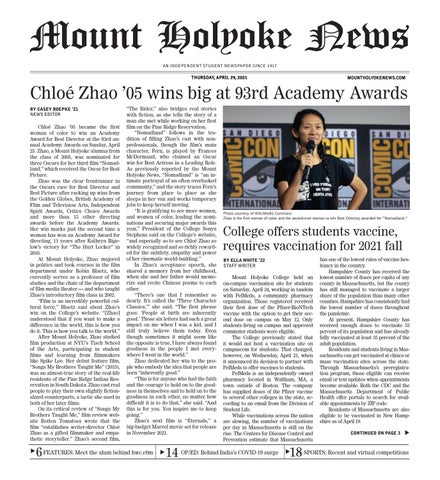
Chloé Zhao ’05 became the first woman of color to win an Academy Award for Best Director at the 93rd annual Academy Awards on Sunday, April 25. Zhao, a Mount Holyoke alumna from the class of 2005, was nominated for three Oscars for her third film “Nomadland,” which received the Oscar for Best Picture. Zhao was the clear frontrunner in the Oscars race for Best Director and Best Picture after racking up wins from the Golden Globes, British Academy of Film and Television Arts, Independent Spirit Awards, Critics Choice Awards and more than 15 other directing awards before the Academy Awards. Her win marks just the second time a woman has won an Academy Award for directing, 11 years after Kathryn Bigelow’s victory for “The Hurt Locker’’ in 2010. At Mount Holyoke, Zhao majored in politics and took courses in the film department under Robin Blaetz, who currently serves as a professor of film studies and the chair of the department of film media theater — and who taught Zhao’s introductory film class in 2002. “Film is an incredibly powerful cultural force,” Blaetz said about Zhao’s win on the College’s website. “[Zhao] understood that if you want to make a difference in the world, this is how you do it. This is how you talk to the world.” After Mount Holyoke, Zhao studied film production at NYU’s Tisch School of the Arts, participating in student films and learning from filmmakers like Spike Lee. Her debut feature film, “Songs My Brothers Taught Me” (2015), was an almost-true story of the real-life residents of the Pine Ridge Indian Reservation in South Dakota. Zhao cast real people to play their own slightly fictionalized counterparts, a tactic she used in both of her later films. On its critical review of “Songs My Brothers Taught Me,” film review website Rotten Tomatoes wrote that the film “establishes writer-director Chloé Zhao as a gifted filmmaker and empathetic storyteller.” Zhao’s second film,
u
“The Rider,” also bridges real stories with fiction, as she tells the story of a man she met while working on her first film on the Pine Ridge Reservation. “Nomadland” follows in the tradition of filling Zhao’s cast with nonprofessionals, though the film’s main character, Fern, is played by Frances McDormand, who claimed an Oscar win for Best Actress in a Leading Role. As previously reported by the Mount Holyoke News, “Nomadland” is “an intimate portrayal of an often overlooked community,” and the story traces Fern’s journey from place to place as she sleeps in her van and works temporary jobs to keep herself moving. “It is gratifying to see more women, and women of color, leading the nominations and securing major awards this year,” President of the College Sonya Stephens said on the College’s website, “and especially so to see Chloé Zhao so widely recognized and so richly rewarded for the subtlety, empathy and power of her cinematic world-building.” In Zhao’s acceptance speech, she shared a memory from her childhood, when she and her father would memorize and recite Chinese poems to each other. “There’s one that I remember so dearly. It’s called the ‘Three Character Classics,’” she said. “The first phrase goes: ‘People at birth are inherently good.’ Those six letters had such a great impact on me when I was a kid, and I still truly believe them today. Even though sometimes it might seem like the opposite is true, I have always found goodness in the people I met everywhere I went in the world.” Zhao dedicated her win to the people who embody the idea that people are born “inherently good.” “This is for anyone who had the faith and the courage to hold on to the goodness in themselves and to hold on to the goodness in each other, no matter how difficult it is to do that,” she said. “And this is for you. You inspire me to keep going.” Zhao’s next film is “Eternals,” a big-budget Marvel movie set for release in November 2021.
Photo courtesy of WikiMedia Commons Zhao is the first woman of color and the second-ever woman to win Best Director, awarded for “Nomadland.”
College offers students vaccine, requires vaccination for 2021 fall BY ELLA WHITE ’22 STAFF WRITER
Mount Holyoke College held an on-campus vaccination site for students on Saturday, April 24, working in tandem with PelMeds, a community pharmacy organization. Those registered received their first dose of the Pfizer-BioNTech vaccine with the option to get their second dose on campus on May 12. Only students living on campus and approved commuter students were eligible. The College previously stated that it would not host a vaccination site on campuscom for students. That changed, however, on Wednesday, April 21, when it announced its decision to partner with PelMeds to offer vaccines to students. PelMeds is an independently owned pharmacy located in Waltham, MA, a town outside of Boston. The company has supplied doses of the Pfizer vaccine to several other colleges in the state, according to an email from the Division of Student Life. While vaccinations across the nation are slowing, the number of vaccinations per day in Massachusetts is still on the rise. The Centers for Disease Control and Prevention estimate that Massachusetts
has one of the lowest rates of vaccine hesitancy in the country. Hampshire County has received the lowest number of doses per capita of any county in Massachusetts, but the county has still managed to vaccinate a larger share of the population than many other counties. Hampshire has consistently had the lowest number of doses throughout the pandemic. At present, Hampshire County has received enough doses to vaccinate 53 percent of its population and has already fully vaccinated at least 35 percent of the adult population. Residents and students living in Massachusetts can get vaccinated at clinics or mass vaccination sites across the state. Through Massachusetts’s preregistration program, those eligible can receive email or text updates when appointments become available. Both the CDC and the Massachusetts Department of Public Health offer portals to search for available appointments by ZIP code. Residents of Massachusetts are also eligible to be vaccinated in New Hampshire as of April 19. CONTINUED ON PAGE 3
u
6 FEATURES: Meet the alum behind hwc.c0m u 14 OP/ED: Behind India’s COVID-19 surge u18 SPORTS: Recent and virtual competitions
2
EVENTS
April 29, 2021
Mount Holyoke News Mount Holyoke News is an independent student newspaper written by and for Mount Holyoke College students since 1917. VISIT US: www.mountholyokenews.com www.facebook.com/themhnews www.twitter.com/mtholyokenews_
EMAIL US: mhnews@mtholyoke.edu
Executive Board Editor-in-Chief Lily Reavis ’21 Managing Editor of Content Flannery Langton ’22
Publisher Liz Lewis ’22
Managing Editor of Layout Rose Sheehan ’22
Managing Editor of Web Zoe Farr ’21
Copy Chief Kelsey Thomas ’21
Business Manager Sarah Nam ’23
Editorial Board News Casey Roepke ’21, Kate Turner ’21 & Liz Lewis ’22 Arts & Entertainment Rose Cohen ’23 & Mariam Keita ’24 Opinion/Editorial Nina Larbi ’22 & Tasnia Mowla ’23 Books Sidney Boker ’21 & Cat Babour ’24 Global Sophie Soloway ’23 & Amelia Luo ’23 Health & Science Kessh Bhasiin ’22 & Zoe Greenberg ’23 Features Mimi Huckins ’21 Sports Gigi Picard ’22
Environmental Meryl Phair ’21 Photos Ali Meizels ’23 & Rosemary Geib ’23 Graphics Anjali Rao-Herel ’22 Copy Editors Hunar Anand ’21, Audrey Hogan ’21, Audrey Shannon ’22, Margaret Connor ’23, Lauren Leese ’23, Emma Watkins ’23, Raina Brown ’24 & Ella Jacob ’24 Layout Editors Angie Romero ’24 & Zoe Tang ’24 Web Editors Audrey Hogan ’21, Shloka Gidwani ’22, Georgia Fish ’23 & Aarushi Sharma ’23
Publication Guidelines Mount Holyoke News does not endorse any of the opinions or views expressed within the pages of the paper, excluding staff editorials. All content copyright of Mount Holyoke News. All rights reserved. Mount Holyoke News does not discriminate on the basis of gender, race, religion, ethnicity, sexual orientation or age.
Advertising in MHN Interest in advertising in MHN can be directed to mhnews@mtholyoke.edu for pricing and deadlines. MHN reserves the right to refuse submissions on the basis of, but not limited to, advertisements considered to be libelous, obscene, defamatory or discriminatory.
Subscriptions Mount Holyoke News is a weekly publication that will publish online-only throughout the spring semester 2021. To subscribe through email, please visit the following form: https://forms.gle/VPCyskE4kMTDeDan8.
Letters Policy Letters to the Editor appear exactly as they are sent to MHN, except for corrections to spelling, grammar and AP style. Letters cannot exceed 500 words. All letters must include the writer’s name and telephone number for verification purposes. Unsigned letters will not be printed. Names may be held upon request with the approval of the Editor-in-Chief. MHN reserves the right to decide which materials will be printed. Email submissions to mhnews@mtholyoke.edu by Sundays at 5 p.m. for publication the following week.
. Mount Holyoke News
Event Highlights Thursday, April 29 Machinal
Sophie Treadwell’s great expressionist play Machinal makes a beginning out of an ending. In 1928 a reporter for the New York Daily News smuggled a camera into Sing Sing prison strapped to his ankle. His aim: to capture an image of the infamous Ruth Snyder in the electric chair as she was executed for the murder of her husband. The journalist succeeded, and his frontpage photograph of Snyder, bound to the chair and rendered anonymous by a hood placed over her head, would provide inspiration to Treadwell. Her play, staged later that same year, offers a counter-narrative of sorts, not the tale of a monster but of a very ordinary young woman whose very ordinary life, which we follow through nine scenes, puts her on a factory-like conveyer belt to murder and execution. She persistently dreams of freedom, but is it possible ever to find joy and passion, to escape the machine? Directed by Gracie Donelly-Fisher ’21 Registration is required through Embark, and the show is available to be watched on Mount Holyoke College’s YouTube channel.
Friday, April 30
Speaking Up For Each Other: The Long History of Gender Based Violence, Racial Injustice and Black Women’s Resistance
Our ongoing Sexual Assault Awareness Month (SAAM) events have been pivotal to raising awareness of strategies for healing from sexual assault, combating rape culture and supporting survivors. For this program, we are particularly interested in lifting up the voices of Black and Indigenous women organizers. In this brown bag lunch session, we will explore the culturally significant variables that influence reporting incidents of violence for women of color and more importantly amplify the work of activists. 12:00 p.m. - 1:30 p.m. EDT Registration is required through Embark.
5th Annual Queer + Trans Poetry and Prose Marathon Reading and Open Mic Read and listen to queer and trans writing - your own or others! Featured guest authors include Andrea Abi-Karam, Addie Tsai, and Maureen Seaton. 8:00 p.m. - 10:00 p.m. EDT Registration is required through Embark.
Saturday, May 1
Sightlines Tour: In Between: Art on Transformation
On this tour we will look closely at artworks that celebrate transformation in self-portraiture. We will uncover how transformation is a tool artists use for self-discovery and selfunderstanding, and how patterns, textures, colors, and more play an important role in representations of the self. 1:30 p.m. - 2:15 p.m. EDT Registration is required through Embark.
April 29, 2021
NEWS
. Mount Holyoke News
3
College Cabinet holds open town hall meeting for student questions BY CASEY ROEPKE ’21 NEWS EDITOR
Vice President for Student Life and Dean of Students Marcella Runell Hall and other members of the Mount Holyoke Cabinet held a town hall meeting open to students on Monday, April 26. In notifying students of the event, Hall wrote that the town hall would be “an opportunity for [students] to learn and ask questions about how the college works and about the present and future of Mount Holyoke.” Along with Hall, the other administrators present at the event were President of the College Sonya Stephens, Vice President of Equity and Inclusion and Chief Diversity Officer Kijua Sanders-McMurtry, Vice President for Enrollment Robin Randall, interim Dean of Faculty and Vice President for Academic Affairs Dorothy Mosby and Vice President for Finance and Administration and Treasurer Shannon Gurek. The event was facilitated and moderated by the College Ombudsperson Vivian Hsu. The town hall meeting was divided into two parts: First, the College Cabinet members fielded questions from stu-
dents and grouped relevant topics into categories. The second part focused on answering questions about 2021 Commencement specifically. The first category of student-submitted questions was for the Division of Student Life. In response to a question about whether Mount Holyoke will defund the campus police force, Hall said, “This question about defunding police has certainly come up in a lot of different places.” The Public Safety and Service department was formerly known as the Campus Police department, and Hall stressed the importance of changing policies in addition to changing the name. “It goes deeper than changing just the name,” Hall said. “It’s been learning about restorative practices, it’s been engaging in terms of community guidelines related to positive confrontation, how and when … we want to interact with public safety.” “I want to just answer the question straightforwardly,” she continued. “No, we’re not defunding Public Safety. And the name change does mean more than just changing the name and having the practices, the policies and procedures
be the same. We’re actually looking to transform the way that the office and the people who work in that office are engaging across all of the constituencies on campus, and we’re at the beginning of that process.” During the town hall, Hall also reiterated previously released plans for the fall term. “We are expecting to welcome back residential students, we are expecting there to be singles and doubles [and] we are expecting for students to be able to register for classes … back on the semester system.” Hsu read a question submitted by a student about communication regarding COVID-19. “I’m concerned about the way information about MHC plans, particularly around COVID, are communicated to students,” Hsu said on behalf of the student. “Why don’t you communicate more regular updates to students? Can you begin sharing COVID planning updates more frequently such as a weekly update?” Hall explained that there are a number of methods for communication from the College, including emails, the school calendar and Embark, and as COVID-19 safety protocols on campus grew less
restrictive, the College moved away from frequent COVID-19 updates in favor of other information. Hsu also read a question from a student about Mountain Day 2020, which was held during the fall Module 1 finals period. “What happened with Mountain Day is that, really, we didn’t feel we could take another day out of the schedule because the learning was so intensive, and so we used the break between the mods as the space to do this,” Stephens said. “I know the question is really about why … it happen[ed] during finals, but actually it happened sort of just before finals began and through the night and into the following day, because students were all over the world, and so we had hoped you would all finish your finals by midnight and then you could join in the Mountain Day celebrations the next day. … While we focused on the campus experience, we’re very conscious that the alums who are in the United States and worldwide also want to join you in that celebration, and so they are also watching to see when Mountain Day is CONTINUED ON PAGE 4
u
Rep. Cori Bush and former Sen. Nina Turner speak at virtual event BY SOLEIL DOERING ’24 STAFF WRITER
Rep. Cori Bush and former Ohio Sen. Nina Turner joined Carmen Yulín Cruz, the Harriet L. Weissman and Paul M. Weissman distinguished fellow in leadership at Mount Holyoke College, for a discussion on racial justice on April 26. This event was one in a series of town halls held by the Weissman Center for Leadership as a part of the “Our Voices, Our Platforms” series. According to the Mount Holyoke website, these town halls seek to “explore how people can use their voices to make meaningful change and how people can discover and create the platforms necessary to achieve that transformative change.” Turner described herself and the two other speakers at the town hall as “three fiery women committed to humanity.” In 2005, Turner became the first Black woman to serve as a state senator for Ohio’s 25th Senatorial District and is currently running for Congress. Turner is also the longtime mentor of Bush, who represents Missouri’s 1st Congressional District. Bush’s website describes her as “a registered nurse, community activist, organizer, single mother, and ordained pastor for the people of St. Louis.” Bush is the first Black Lives Matter activist to serve in
Congress. Kijua Sanders-McMurtry, vice president for equity and inclusion and chief diversity officer, introduced the two guest speakers. “Tonight’s speakers remind us that our efforts to head the call to social change must be our north star in the struggle for freedom and justice,” she said. Cruz began the conversation by speaking what she calls “the unimaginable truth” and taking a moment to say the names of four people killed by police violence: “Adam Toledo, Michael Brown Jr., Breonna Taylor and George Floyd.” She set the tone for the event by acknowledging the lives lost, leading to a larger discussion of systemic and structural racism within the United States. In response to Cruz asking how the U.S. moves toward progress amid racial tension and the larger problem of racism in policing, Bush said, “We start with acknowledgment.” She added, “We have to understand that this is a real present issue that is in our DNA; it is in the fabric of this country, it’s systemic, so we have to root it out the same way it entered.” Turner continued the discussion about systemic racism. “The burden of Blackness is what we have to endure ev-
ery single day,” she said. “It is a painful existence, and it is a trauma that some people don’t understand.” She also drew attention to the historical similarities between the lynchings of Black people and modern-day police brutality. “Indifference to us is the problem,” Turner said. “That’s what we saw in Derek Chauvin’s eyes, and that’s the same look we see in photos of people at lynchings.” Turner pointed out that while policing itself is a large part of the problem, it reflects the same issues embedded in U.S. society. “What we see happening in policing is really a microcosm. It is really us looking in the mirror.” Cruz asked Bush, “Why does it upset people so much when women, particularly women of color, speak up?” “They see us as a threat because they don’t understand us, and they found out that they can’t contain us,” Bush responded. “You radicalized me by killing my folks and then letting their murderers get off over and over again with impunity. You radicalized me through a system that prioritizes property over people.” “People criticized [Bush]. … They radicalized her by continuously saying that it was okay for innocent Black people to be killed,” Shula Mathew ’22 said
after watching the event. “And it’s not just police brutality. You see that same racism in health care and in housing. These systems make it okay that people suffer.” Turner, who has a long history of advocating for justice within the health care system as well as the housing market, said, “We must push public policies that are big enough, bold enough and bad enough to deal with the structural inequities that have always been present in this country.” In the second half of the event, Cruz asked Bush to talk about her experience as a climate justice advocate and the intersection between racial injustice and climate injustice. “As Black and Brown people, we have suffered at the hands of these polluting corporate interests and at the hands of these massive fossil fuel giants who have pushed their pollutants into their communities for so long,” Bush said. “Black children are 10 times as likely to go to the emergency room as white children for asthma. … We have a creek here in St. Louis that is just radioactive waste mixed with soil. [There’s also] ‘Cancer Alley’ in Louisiana. These are all examples of climate injustice and CONTINUED ON PAGE 4
u
4
NEWS
April 29, 2021
. Mount Holyoke News
Turner and Bush speak at Weissman Center politics event, cont’d u
CONTINUED FROM PAGE 3
racial injustice.” Bush highlighted how creating legislation that centers the Black experience in dealing with the climate crisis is part of her mission in Congress. “We are experiencing this climate crisis differently; it is not a burden that people all over the country equally carry,” Bush said. In the final section of the event, Cruz invited the Mount Holyoke community to ask the panelists questions. Mathew asked, “How do you work with people from different parties within Congress that benefit from antagonizing you and other elected officials? People who are willfully racist, anti-Semitic, trans[phobic or] homophobic? Is it even possible to work toward good public policy that is so needed with those members?” “We have to organize around electing more people like my dear sister …
Turner, who will stand up with us when we’re up against a wall,” Bush responded. “But it’s also understanding why I’m here, understanding that the work that I wanted to do was to highlight the voices of those in my community that people don’t usually get to hear.” “Even though we have people who are racist, who are totally disgusting and say some deplorable things, … I know who I am, and I know what I’m trying to do. So there is nothing that they can say that will hurt me enough that will measure up to the hurt my community faces on a day-to-day basis because of that kind of rhetoric,” Bush explained. Lucas Wilson, professor of Africana studies and chair of the economics department, asked Turner to provide examples of programs and legislation designed to “put real resources in the hands of those who most need them so
that they can actually build lives that they prefer.” “I definitely think about micro-lending programs and building up organizations in the community,” Turner said in response. “The federal government doesn’t have to do all of this, but the federal government should provide the resources for local programming. … I firmly believe that the government closest to the people has the greatest impact on the people.” Wilson further elaborated on the purpose of micro-lending programs following the town hall. “Micro-lending is a way for people who otherwise wouldn’t qualify for mainstream opportunities to start a business,” Wilson said. “It’s a way for them to become a little more self-sustaining doing what they want to do. I look forward to seeing micro-lending in legislation that Bush and Turner put forward in the future.”
Wilson reflected on his experience at the town hall. “For me, it was nurturing and comforting to share time with them,” he said. “We have a government that is largely owned and occupied by wealthy folks, so I like the fact that both … Turner and … Bush are both working-class, urban elected officials.” Ariya Lawson, assistant director of the Office of Admission and coordinator of multicultural recruitment, asked Bush, “In your daily work, how do you ensure that you and your team members … are contributing to a culture of care and community that makes the work that you do sustainable? Also, how do you maintain that space of rest and restoration separate from your work?” In her response, Bush reflected on the feelings of fear and anticipation she felt when she and her team were threatCONTINUED ON PAGE 20
u
Vaccination requirements, cont’d Students react to town hall, cont’d CONTINUED FROM PAGE 1
u
On Friday, April 23, the College also announced its plan to require students to be vaccinated before returning to campus in the fall. “We expect there will be very limited exceptions and will be working to set up structures to ensure compliance and to vaccinate those students who are unable to be vaccinated before returning to campus,” the College’s statement read. All colleges in the Five College Consortium now require students to be vaccinated for the fall semester. While Mount Holyoke says it will “encourage all members of our community” to be vaccinated, it will only be a requirement for students. The same is the case at Hampshire College, where the college president said there are legal concerns with requiring faculty and staff to be vaccinated.
“It’s a slightly different question, students can choose to come or not to come in the fall, they can take a semester off if they are uncomfortable with it, requiring that of employees is a slightly different question,” Hampshire College President Ed Wingenbach told Western Mass News. Students will be invited back to campus in late August. Though Gov. Charlie Baker has announced that effective Friday, April 30, masks will no longer be mandated in outdoor public settings in the state, the College reiterated in an email that all students must still wear masks at all times this spring, including when socially distancing outdoors. The College asks that students currently living on campus email a photo of their vaccination cards as soon as possible to Health Services or bring it to the Health Center in person.
Photo by Trinity Kendrick ’21 The College held a vaccination pop-up clinic in the atrium of Kendade Hall on Saturday, April 24. Mount Holyoke will provide second doses to students that were vaccinated within three weeks of the first clinic.
CONTINUED FROM PAGE 3
u
announced.” Midway through the town hall meeting, Hsu shifted focus to a series of questions about 2021 Commencement. In response to a question posed by a student at the event about why there has not been commitment from the administration to have the College provide a ceremony at the class of 2021’s two-year reunion like the one that will be held for the class of 2020, Stephens said that there will be a celebration at the twoyear reunion, but it will not include a graduation ceremony. Instead, the College is working with the Alumnae Association to coordinate reunion traditions like the Laurel Parade. “Our expectation is that we will be able to make those pieces happen,” Stephens said. “Given that we will have a more extensive Commencement this year … and again in 2023, many students will not come back for that Commencement moment with a two-year delay, [so] we are trying to do the very best we can this year, and we will give you additional celebrations and moments to mark your graduation in 2023.” It should be noted that the Laurel Parade always happens at reunion, and Stephens’ answer did not indicate additional commitment from the College to specifically celebrate the class of 2021. Maggie Murphy ’21 addressed the lack of communication from the College about Commencement, especially in the context of the numerous feedback sur-
veys the College sends about the module system. “The surveys seem to be designed for us to scapegoat our professors,” Murphy said. “I felt like I had to answer dishonestly … so that I knew my professors were going to be protected.” “It’s harder for us to take seriously what we’re hearing now [in the town hall meeting] because it feels like covering up an ‘Oh, crap’ moment,” Murphy continued. “I hear you,” Stephens said. “Hearing from you helps us understand better. … We are listening, we do care, we’re not oblivious.” Murphy thought that the town hall format was helpful for allowing students to hear the administration speak on Commencement and other issues but wished there had been more communication before this point. “I think the panel answered questions well, and it was reassuring to hear … Stephens’ introduction to the Commencent portion explaining that the admin team is fully aware of the hurt felt by a lot of the senior class,” Murphy said. “I am still not sure why going to a one-time panel with a limited audience is the first time we were able to hear that perspective and acknowledgment that our senior class has lost out on basically the entirety of our senior year.” “The panel felt like an open and honest conversation, but almost none of the emails or other communications CONTINUED ON PAGE 20
u
April 29, 2021
. Mount Holyoke News
HEALTH & SCIENCE
5
MHC students win award for psychology research project BY LILY CAO ’21 STAFF WRITER
During the summer of 2020, Mount Holyoke Associate Professor of Psychology and Education Mara Breen sent a spreadsheet out to psychology students with opportunities for remote internships. Shreya Nair ’22 and Shuyang Lin ’22 applied and gained a position in Assistant Professor Allison Kwesell’s lab at Embry-Riddle Aeronautical University. The visual narrative project, named “Living Isolated,” combines research approaches from the fields of communications and psychology and investigates research participants’ coping strategies for living in isolation for an extended period during the COVID-19 pandemic. Together with lead author Kwesell, Nair and Lin’s work, “Living Isolated: Coping with COVID-19 Visual Self-Narrative Research,” won third place for the best paper in the Visual Communications Studies division of the International Communication Association’s 71st Annual Conference. “What got me interested [in this research project] is two things: a novel qualitative methodology [a technique called ‘photo elicitation’] and a chance to be a part of writing a paper from the ground up and actually thinking of what [psychological] theory could be applied to the research,” Nair explained. The project recruited 57 participants who attended self-narrative and photo-elicitation workshops as a part of the research process. They then received different photo assignments each day and were asked to submit three photos for each assignment. Photo assignments included questions such as, “What is your daily routine, from the time you wake up to the time you go to sleep?” and “What behaviors are you doing now that you were not doing before being isolated?” On the final day of the assignment, participants were asked to view photos other participants had submit-
ted and write reflections about how the pictures made them feel. After analyzing the photo captions and reflections written by the participants, Kwesell’s lab concluded that participants primarily used emotional instead of behavioral coping strategies when they had to live in isolation during a pandemic. Such a finding is consistent Photos courtesy of Shuyang Lin ’22 (left) and Shreya Nair ’22 (right) with previous Mount Holyoke students Shuyang Lin ’22 and Shreya Nair ’22 engaged in a psychology research project called “Living research, which Isolated,” which investigated participants’ coping mechanisms for living in isolation during the COVID-19 pandemic. has suggested that people are likely to employ “emotion-based cop- psychology research project, Nair and Lin gave advice ing” when dealing with stressors that are primarily for conducting research online. out of their control. “I think for the remote format, communication is Nair and Lin both agreed that conducting this re- critical because the way to know other team members search helped them learn how to analyze a great num- and for them to know me is through Zoom and email,” ber of qualitative data via inductive and deductive cod- Lin said. “I also think time arrangement is essential, ing methods. This internship has also provided Nair as there is no clear time boundary between life and with the opportunity to take the lead in researching work. a theory about how people come up with coping stratWith regard to guidance for those who are looking egies. for remote research internships, Nair said, “My advice “To get the opportunity to really research and be would be to not get hung up on that one ‘perfect’ inresponsible for the theory [that] was being used was ternship that you have in your mind. … Any internboth daunting and exciting,” Nair said. ship in your area of interest will give you something Having spent the summer working remotely on a valuable.”
Social distancing may make it difficult to distance yourself from money BY ZOE GREENBERG ’23 HEALTH & SCIENCE EDITOR
Social isolation has dramatically impacted people’s personal relationships, finances, routines and mental and physical health. According to the findings of an article published in the British Journal of Psychology this February, one unintended, less obvious impact of social distancing is that it may promote a desire for money. From an evolutionary psychology perspective, people are hardwired to strive for social connections and money in order to meet their basic human needs. A scarcity of one resource promotes a desire for the other. Past research has shown that feeling secure in the availability of social connections reduces people’s desire for money. Still, until now, little research had been done to test whether a scarcity of social connections — a problem many face due to the pandemic — results in an increased desire for money. “What comes to mind is [Roy] Baumeister’s work on regulation depletion — if you are regulating so hard in one domain — let’s say watching your weight — you have a harder time regulating around saving
Graphic by Trinity Kendrick ’21
money,” Professor of Psychology and Education Becky Wai-Ling Packard, who studies motivation and mentoring relationships, said. Packard said the researcher’s findings make sense. Previous existing research has demonstrated that some resources people need to live, such as food and money, can be exchanged for other “subsistence
resources” when others cannot be secured. People can even consume more of a resource than they need in order to make up for the shortage of the other. Researchers conducted two experiments. The first investigated whether asking participants to recall social distancing increased their desire for money. Researchers measured this according to how much money participants chose to give to another person in the dictator game, a popular tool researchers use to gauge self-interest. Critics of the dictator game argue that it does not predict real-world outcomes. To address this critique, researchers conducted a second experiment to see if a reminder of social distancing caused people to increase how important they viewed money. In the second experiment, researchers also measured participants’ fears about COVID-19. This was meant to account for the possibility that the perceived threat of COVID-19 is what actually increases people’s desire for monetary resources for security. The findings support the hypothesis that being reminded of social distancing promotes a desire for money. Still, the researchers posited alternative explanations, such as status as a driving force behind obtaining money and engaging in social activities.
6
FEATURES
April 29, 2021
. Mount Holyoke News
Meet the alum behind historicallywomens.c0m, an online meme page, networking group and community ated and her role behind it.
Humble beginnings
Graphic courtesy of Mary Estrera ’19 The “Little Women” meme (above) jumpstarted the page’s popularity.
BY LILY REAVIS ’21 & FLANNERY LANGTON ’22 EDITOR-IN-CHIEF & MANAGING EDITOR OF CONTENT
For years, anyone who asked who was behind the historicallywomens.c0m Instagram page got the same answer: “One singular girl from a Seven Sisters college who likes memes.” It came up a lot, so much so that it’s still the first question listed on the FAQ of the self-described “premiere women’s college meme page.” The page’s acclaim began after the 2019 premiere of Greta Gerwig’s “Little Women,” when historicallywomens.c0m posted a package of memes tagging each of the Seven Sisters as its characters. What ensued was thousands of comments and reposts, a weekslong feud between college students about whether or not Barnard was truly Amy and an explosion of popularity for the Instagram page. The account went from 1,000 to over 10,000 followers in a matter of days, and suddenly it was home to a new, younger community of current students at historically women’s colleges throughout the country. The creator pledged to remain anonymous so that followers wouldn’t think the content was biased. She reaffirmed that she was a student at a Seven Sisters college, but refused to say which. In a Smith Sophian article about the infamous “Little Women” meme from May 2020, the creator said, “While I try to stay neutral, I do have this wealth of knowledge about my own institution and mostly run off of hearsay for other schools. Though everyone knows I came from only one institution, the mystery surrounding ‘which one??’ sort of validates my content.” She continued, “There’s something exciting about posting anonymously.” But as the academic year comes to a close and her younger sister prepares to graduate from Smith, the Mount Holyoke alum behind the viral online meme page is ready to open up about the community she cre-
Mary Estrera ’19 first thought that historically women’s colleges needed a better social media presence while applying to colleges her senior year of high school. “I really wished that I had a space where I could learn about the different schools and their different cultures,” she explained. Three years later, she launched historicallywomens.c0m on Instagram to share memes she made about her student experience. “Where I come from in Texas, there’s a lot of football culture and school rivalry,” Estrera said. She saw online memes about the bigger universities that her friends attended, but no one from her home understood or discussed historically women’s colleges. “I feel like there’s like Seven Sisters content there as well, but people weren’t really making memes of it,” she said. “If you go to a school in Texas with like 50,000 people, then yeah, someone’s gonna be pumping out content, and it’s gonna be funny. But when you go to school with like 1,000 people, maybe you’re not going to. Or maybe it’s not going to be dispersed, even if someone is making it. So I was like, ‘Let me make this Instagram account.’” Estrera launched the account in 2017 during her junior year at Mount Holyoke. At first, she made all of the page’s content by hand and posted without a set schedule. The page’s follower base was small, which meant that there wasn’t a lot of pressure to keep up with messages or submissions from fans. “Part of the reason why I was anonymous in the first place was because I was making all the memes,” Estrera explained. “People would be like, ‘Oh, she obviously goes to Wellesley,’ or like, ‘She obviously goes to Smith. That’s why Smith gets all the good stuff.’” She kept the page operational without divulging her personal information, and one year later, Estrera graduated from Mount Holyoke. “That’s also part of why I didn’t ever release my identity,” she added. “I don’t want to be a graduate and then have people, like, call me a boomer. That’d be so embarrassing, if my memes were like, really stale,” she said, laughing. “So I just made everyone think I was still a student. No one really asked.”
Building community for HWCs
While applying to colleges in 2015, Estrera wished she had more friendly online spaces to turn to. The page has since branched out into a community support system for current and prospective HWC students. “The only thing I had at the time … was College Confidential which — I don’t know if you guys have ever been on that crazy website — but it’s really cutthroat on there. It is so toxic. It made me so scared just to go to college in general,” she said. “I feel like if I had a place where you could talk to current students or alums or even other prospies, and everyone’s really candid, … that probably would have really helped my decision-making at the time,” she added. Across the United States, there are currently 33
Photo courtesy of Mary Estrera ’19 Estrera has used the page to help build community for HWC students.
colleges open specifically to women. One of Estrera’s goals for historicallywomens.c0m became connecting the students of these schools, both current and prospective, starting with the Seven Sisters. “I think I just want more people to know what historically women’s colleges offer,” she said. “I have all this extra knowledge that I can give to other people. And I just think it’s cool to kind of be like a part of a network or a part of something bigger like that.” For more than a few current students at HWCs throughout the country, Estrera’s page has accomplished that goal. Grace Sanford ’24 is one of those students whose college decision process was made easier by historicallywomens.c0m. “I was trying to make a decision without having ever seen the College since it was last spring,” she explained. “It was hard to get a sense [of] the school culture just from admissions events since those are very carefully curated to make the school look perfect. In a normal year, I could have gotten a sense by visiting campus, seeing what people were doing and asking questions, but I didn’t really have any access.” She became involved with the community through a post targeted for incoming first-years at HWCs that appeared on the page last May and was instantly hooked. The past few years have seen a substantial rise in interest in historically women’s colleges. According to the Mount Holyoke College website, the class of 2023 was one of the most competitive classes in the school’s history. That year, 3,908 students applied, an 8 percent increase from 2018. This trend is similar across all HWCs. This growth has interested Estrera. “It … [feels] like there’s a revival in interest that’s coinciding with people’s further acceptance of an exploration of gender and sexuality,” she said. “So people are like, ‘It’s okay to be queer,’ then, ‘Okay, so what’s a queer college I can go to?’” For this, she looks toward the HWCs because they have a “specific type of queer culture that’s extremely visible.” She believes that this culture is reflected in CONTINUED ON PAGE 11
u
April 29, 2021
FEATURES
. Mount Holyoke News
7
Memes, mutual aid and Mount Holyoke: Creating, expanding and maintaining a viral online community, cont’d u
memes that were problematic in one way or another. Rather than deleting the posts immediately, she has attempted to use them as learning opportunities for the community. “I think that was something that was sort of hard for me to navigate, especially by myself, especially through a platform like Instagram, where it does feel one-sided in some ways,” she said. Estrera eventually created submission guidelines and a process for dealing with problematic memes. Instead of deleting the pieces outright or engaging in constant debate, she asked contributors and community members to openly talk about their issues with the content. If a post was accused of being insensitive, the person who submitted it was given the opportunity to add a note or warning to the caption. “That was a little bit hard for me,” Estrera explained. “But then I just figured out I could ask. I could just tell everyone, ‘If you have a problem, then you can write it out. I’m not going to write it myself, but you can do it, and then you can use my platform.’” The resulting community is one that is tightly knit and dedicated to holding discussions. While there are still moments of conflict and disagreement on the Instagram page and Discord server, Estrera feels that there is also more kindness and understanding from the community members when they commit to talking with each other.
CONTINUED FROM PAGE 6
the content of the page. As an alum, running historicallywomens.c0m has helped Estrera stay connected to the Mount Holyoke community. “I feel like a lot of what I do is because I want someone else to have an experience I didn’t have,” she said. “When I came to [Mount] Holyoke, so many things shifted for me. It was just such a different experience,” she recalled. While the group has expanded to encompass nearly all historically women’s colleges, it is still mainly built around the Seven Sisters. Most of the group’s participants live in the Northampton area, which includes both Smith and Mount Holyoke colleges. To continue to build community on the page, Estrera started hosting events, such as one she called “missed connections.” “It was a Valentine’s Day thing to set up dates or just get to know people better,” she explained. At least one lasting connection was made that day, a fact that Estrera remains proud of. “Somebody messaged me recently and was like, ‘Oh, I met someone through that, but it didn’t really work out. And then we were dating other people for a while, but then we reconnected, and we’re dating now,’” she recalled. In September, Estrera launched a Discord server for the historicallywomens.c0m community. She hoped that adding a second platform to the online group would expand access and cohesion. The Discord server is now the hub of all these larger conversations, with 988 members as of April 28. According to Estrera, the server was recently partnered on the app for being an active and unique community. “I feel like our Discord server was given [partnership] because a lot of Discord servers are just based around anime or gaming,” she explained. “They’re probably like, ‘Oh, this is different! Women!’” The Discord server has four moderators who work alongside Estrera, but she remains the sole admin of the Instagram page.
A move to mutual aid and activism
When the pandemic started, Estrera realized that historicallywomens.c0m could be used to spread word about students who needed money, housing or rides to get off campus due to the coronavirus-driven closure. “I basically thought, ‘I’ll just use my stories as a place where people can connect and get help and find [out] how to offer help,’” she said. “A lot of people responded to that.” From there, the number of mutual aid requests sent to the page increased, so Estrera decided to do a weekly roundup. “I wanted to make a program, basically, to let people know that they can send me things and also that it would be posted at a certain time and it would be a weekly thing,” she explained. What is now known as “The HWC Mutual Purse” is posted on the historicallywomens.c0m Instagram page’s story each Tuesday. Estrera compiles the requests she receives each week into a series of posts
Stepping in front of the curtain
Photos courtesy of Mary Estrera ’19 “The HWC Mutual Purse” began after the start of the pandemic.
that advertise needs from across the HWC community. The program was purposefully created with very loose parameters: As long as the request will benefit a women’s college student or alum, Estrera will include it in the page’s weekly roundup post. Dealing with the needs and emotions of students through the page hasn’t always been easy. For Estrera, moderating and administering the page has been a learning experience rooted in activism and community building. “There was a time when I was feeling pretty overwhelmed with the labor associated with the account,” she explained. “Trying to do the right thing and trying to make sure that all the right information is out there, but also keeping an open dialogue.” Estrera said that some people have submitted
After nearly four years of running the page, Estrera decided it was time to reveal her identity. “The account has graduated,” she joked. The end of the 2020-2021 academic year also marks the graduation of her sister, Rachel Estrera, a senior at Smith. She recalled thinking, “Maybe when Rachel graduates, then I’ll do my reveal, because then it’s like, we’re out. There’s no stakes anymore.” While those stakes largely centered around maintaining the anonymity of her alma mater, this isn’t something she continues to be concerned about. “It’s not gonna be crazy,” she said. “At this point, I’m mostly just administering the page. It’s not too much of my own personality or my own content on the page,” she added. As she moves into the next phase of her life — applying for jobs after being furloughed at the start of the pandemic — Estrera hopes to use the page to show what she is capable of doing on social media. “I want my community to know before my job interviewer,” she explained. For now, she will continue to run the page from her home in Dallas while pursuing her professional career. “Because of this page, I feel very in tune with other people from women’s colleges,” she explained. “It’s just, like, that desire to give back, basically, because I don’t have money to donate to the school. So this is my donation.” Estrera isn’t afraid to reveal her identity. Rather, she wants to express her gratitude for the community that has congregated around her page and continue working to better the women’s college experience. “It’s like, mask-off,” she said. “Like, let’s go.”
8
FEATURES
April 29, 2021
. Mount Holyoke News
The Mount Holyoke Review holds virtual publishing party BY ZOË FARR ’21 MANAGING EDITOR OF WEB
On April 23, the Mount Holyoke Review, a literary magazine out of Mount Holyoke College, held a virtual publishing party for their second completed publication. With 51 attendees, the Zoom session featured nine of its published writers who read their work aloud. While the readers performed, the Zoom chat function was used by some to encourage and praise each other. The Mount Holyoke Review was founded in 2019 by its three editors-in-chief, Flannery Langton ’22, Liz Lewis ’22 and Olivia Brandwein ’22. According to Brandwein, the trio felt strongly about providing a magazine dedicated to writing as an outlet for the Mount Holyoke community. “It’s just really about having a space that’s dedicated to writing and a place where people can share their writing,” Brandwein said. “We really want to have a book that acts as this really nice, shareable collection of work where people can come together and celebrate writing.” Since its inception, the Mount Holyoke Review has continued to grow, developing an 11-person executive board and crediting 24 writers and 23 readers for the second issue alone. When it comes to what pieces get published, the Mount Holyoke Review tries to base the criteria off of collective opinion with help from the entirety of the organization. From smaller and larger meetings to spreadsheets, all members of the organization are invited to participate in choosing pieces for the publication. “[The editors-in-chief] really try and go based off of what the org wants,” Brandwein commented. “Unless there are any ethical concerns … but we really try and keep [the org’s opinion] in mind.” Brandwein was one of the readers during the event, presenting her literary prose piece “Presence.” The piece centers around a mime named Peter and his drifting stream of consciousness as he walks around New York City. While Brandwein has been writing her entire life, Assistant Professor of English Anna Maria Hong’s Intro to Creative Writing class helped her identify her literary medium. “[Hong’s class] was really fun, and I think that was actually one of the first times I really tried prose writing,” Brandwein said. “I realized maybe I shouldn’t have been writing poetry because I would write all these bad poems about things
Graphic courtesy of the Mount Holyoke Review This was the first issue of the Review to include art, such as Embry O’Leary FP ’23’s piece (left) and based on poetry by David Nejezchleba ’22.
like COVID and do decently well, but I wrote one prose piece and did that much better.” While the majority of submissions to the Mount Holyoke Review are poems, the team has started to push for prose pieces in order to diversify the contents of the publication. Other readers during the virtual event included Ava Provolo ’22, Nadia Niva ’21, Avery Martin ’22, Woodlief McCabe ’23, Regis Reed ’22, Elle Provolo ’22, Emma Nguyen ’24, Peiyun Jiang ’21 and Rebecca Kilroy ’23. Kilroy’s piece “Another Zoom Meeting” was the last reading of the event and acted as a commentary on the monotony and strain of virtual interaction and life. Brandwein voiced her hope that the Mount Holyoke Review could help bring the Mount Holyoke community together through a mutual appreciation of
writing. “Especially now, thinking about the pandemic, I think it would be really great if the Review can be a source of community,” Brandwein said. “I think, going forward and being on campus, I hope it can be … just a way for people to come together.” All 112 pages of the publication are available on Issuu, allowing readers to virtually enjoy the Mount Holyoke community’s work. Scan the QR code below to enjoy the Review’s second publication. To learn more about the Mount Holyoke Review and their first publication, visit their website https://mountholyokereview.squarespace.com/. Editor’s note: Flannery Langton ’22 and Liz Lewis ’22 are current members of the Mount Holyoke News.
ISOC hosts annual Global Fest both on campus and virtually BY MIMI HUCKINS ’21 FEATURES EDITOR
At Mount Holyoke, the student body includes hundreds of international students from over 70 countries, representing cultures from across the globe. The International Student Organizing Committee sought to celebrate the diversity of all the cultures and backgrounds of Mount Holyoke students through their annual Global Fest, hosted on Saturday, April 24, both on campus and online. “[Global Fest is] a festival for people in different
cultures to kind of show off their cultures and their heritage and for students to interact and learn more about the diversity within the school,” Rachel Kang ’23, co-chair of ISOC, explained. “We also created it online to include everyone and have people participate on campus because I don’t think there have been really any events on campus, and some people might be feeling, you know, isolated or lonely,” April Liu ’23, ISOC’s other co-chair, added. Liu, who is currently living off campus, planned and attended the event remotely. This year’s Global Fest was hosted both on Pageant Green and at the Gettell Amphitheater. For re-
mote students or residential students who preferred to attend Global Fest virtually, ISOC also created a virtual festival using a Miro board. Through the Miro board, participants could access a recorded performance by Rainbow Jelly, a Zoom link to watch Raunak Bhangra’s live performances and virtual booths from FAMILIA, AASIA, the MHC Folk Music and Dance Society and ISOC. Students on campus could enjoy the warm weather and visit a variety of booths. The Mount Holyoke Russian Club had materials for students to learn how to write their names in CONTINUED ON PAGE 9
u
April 29, 2021
. Mount Holyoke News
FEATURES
9
Professor Andrea Lawlor hosts panel: What does an editor do?
Photo courtesy of Kylie Gellatly FP ’23 Kylie Gellatly FP ’23, a writer and editor, appeared on Lawlor’s panel.
BY REBECCA GAGNON ’23 STAFF WRITER
Have you ever wondered what an editor does and what exactly they want from writers? Well, those are questions Andrea Lawlor, assistant professor of English at Mount Holyoke, set out to answer. On April 21, Lawlor held a panel discussion with three editors from literary journals and magazines as guest speakers. “I teach creative writing and the class that I organized [the panel] for was Advanced Projects for Creative Writing,” Lawlor said. “Most of the students are seniors and a lot of them are graduating, thinking
about careers in publishing or are thinking about go- and editing are in the field of publishing. The event ing on to MFA programs.” Lawlor often brings speak- lasted for about an hour, but Lawlor and the panelists ers into the course, but this year, the virtual aspect of all discussed how they wished it could have gone on longer. the event allowed it to be accessible to the public. “I love talking about editing,” Gellatly said. “I The panel consisted of Callum Angus ’11, the founder and managing editor of the literary journal think my favorite part was, once it was over, to be like, smoke and mold; Spencer Quong, the assistant editor ‘Oh yeah, I do know what I’m doing,’ because it is reof Poets & Writers Magazine; and Kylie Gellatly FP ally easy to forget. I was doing editor work before but ’23, a poetry editor for the Mount Holyoke Review, the as a student right now, I haven’t really been as much in touch with it, so it was rebook reviews editor for Green ally nice after the event to be Mountains Review and a poet“My advice to an aspiring writer like, ‘Oh yeah, right, I know ry reader for the Pleiades. what I am doing and I love it so “I asked the people I asked would be to work as an editor, and much.’” because I thought that they my advice to an aspiring editor Lawlor said that their fawould be people who were would be to try to write too.” vorite part of the event was close enough to current stulistening to each speaker talk dents in terms of career,” about how they became an edLawlor said. They hoped - Kylie Gellatly FP ’23 itor. that choosing these speakers “My advice to an aspiring would be more effective in connecting with students, as the speakers would have writer would be to work as an editor, and my advice to an aspiring editor would be to try to write too,” advice on getting started in the literary community. “I was asked by [Lawlor] and I was flattered, so Gellatly laughed. “I think it is really helpful to know I didn’t say no,” Gellatly laughed. “Leading up to it, I both sides. That is my experience with it, and I love talked to [Lawlor] and heard that Spencer Quong is the the way they intertwine and overlap, as weird as it can assistant editor of Poets & Writers [Magazine], and be sometimes.” Gellatly expressed that understanding how editthat is the biggest resource of literary publishing that exists, so I was very intimidated and very nervous, but ing and the process that follows a submission can realafter the panel, I realized how perfectly [Lawlor] had ly help a writer in their process of getting their work seen. She also stated that it is important for editors to set it up.” During the panel discussion, each speaker talked experience publishing their writing as well. As the discussion came to a close, Lawlor and the about the work they do as an editor and how they got to where they are now. Each also spoke about their panelists offered a final piece of advice for how to bewriting careers and how different the roles of writing come a successful writer and editor: Read a lot.
Global Fest 2021 celebrates cultural diversity in community, cont’d person, and I think it’s also open to a lot more accom- a chance to relax and de-stress. She explained that her modations, doing it that way,” Kang said. goal was “for students to just kind of have time off and Kang also explained the just enjoy it, as it is a festival, and celebrate different culRussian, the Asian Students Association handed out importance of being able to “I’m excited about us being able to tures.” origami kits and Liga Filipina shared Filipino snacks. host the festival online and in do this both virtually and in person, Successfully (and safely) Raunak Bhangra also gave three short performances person. “We also experienced not being in the U.S., and we hosting an in-person event at the amphitheater throughout the festival. and I think it’s also open to a lot was another one of ISOC’s ISOC’s decision to host Global Fest both in person thought it was important for more accommodations.” goals. “ISOC hasn’t hosted and virtually meant that off-campus students could anyone who wasn’t on campus to an in-person event in a long still participate in the festival. expetime, so to kind of do that in “Another goal that we had was Rachel Kang ’23 “I just hope that they really just have r i e n c e a setting where we still follow to not just use the virtual port h e guidelines and come up with a lot of fun. We really do have a lot tion as something that we need same things [as the people an in-person event was also a goal,” Kang noted. to do because everyone’s doing of diversity on campus, and I feel like on campus], which is why we Ultimately, this year’s Global Fest was designed as it, but for it to be … an online it’s really important to celebrate it decided to do it both ways, … a chance for students to take a break from the presversion of the festival itself, so and give people [a chance] to share which wasn’t the easiest to do. sure of their academics and celebrate the diversity of students who aren’t on camWe had a lot of things to coor- the campus. pus can actually kind of feel their own cultural backgrounds.” dinate,” Kang said. “I just hope that they have fun with it, because the vibe of what’s going on,” As members of the class I know we’re all so tired, … so I just hope that they Kang said. of 2023, this year’s event was really just have a lot, a lot of fun. We really do have - Rachel Kang ’23 Although the pandemic both co-chairs’ first Global a lot of diversity on campus, and I feel like it’s really made this year’s Global Fest Fest. “We actually had all the important to celebrate it and give people [a chance] look different than it had in previous years, the option to have both in-person and flyers ready, and then we got sent back home, so we to share their own cultural backgrounds,” Kang said. virtual festivals was exciting for Kang. “I’m excited weren’t able to host it last year,” Kang explained. Kang “Celebration and people having fun is the biggest goal about us being able to do this both virtually and in hoped that this year’s Global Fest would give students I have for now.”
u
CONTINUED FROM PAGE 8
10
GLOBAL
April 29, 2021
. Mount Holyoke News
Alexei Navalny, critic of Russian government, ends hunger strike
Photo courtesy of Flickr Alexei Navalny ended his 23-day hunger strike against Putin on April 23.
BY SOPHIE SOLOWAY ’23 GLOBAL EDITOR
Alexei Navalny, a Russian lawyer famous for opposing Russian President Vladimir Putin, announced that he would end his hunger strike on April 23, 2021. The announcement came weeks after he began his strike on March 31 and has prompted mass protests across the country. According to Russian and Eurasian studies major Haddie Beckham ’21, these protests are significant. “Protests aren’t new in Russia, but these are the largest in at least 15 years,” Beckham said. “In Russia, the youth is typically apathetic toward politics because there’s a sensation that the regime can’t be changed, so it’s kind of pointless.” Navalny has received notoriety for a decade, as his opposition network has developed a massive following in Russia. The Russian dissident first became widely recognized in 2008, when he started a political blog that sought to investigate and report on the corruption occurring within the Russian government. In the
years since, he has accrued millions of followers across his social media platforms and, in 2011, launched the Anti-Corruption Foundation, an organization that worked to publicly criticize the government for a variety of offenses. Its work included the production of a recent video detailing certain luxuries available to the Kremlin, suggesting misguided funding allocations. According to Beckham, this video alone sparked outrage across Russia. “When he came back to Russia in January, he released this video called ‘The Palace of Putin,’ and it went viral in Russia,” Beckham explained. “It was all about how Putin funnels money to basically sustain his living. This extravagant, almost czarist, royal type of living. That got a lot of people really mad because it confirmed everything that I think people suspected for a long time.” In 2018, Navalny attempted to run for president, but was barred by the Russian government. On April 27, 2021, the Kremlin ordered for the foundation to be shut down. Many of Navalny’s criticisms of the Kremlin, however, do not focus solely upon these corruption charges. The Russian opposition leader has largely called for heightened anti-immigration policies centered around anti-Muslim rhetoric. Many of Navalny’s critics cite his emboldened nationalist stances as reasons for opposing him. In fact, Amnesty International recently stripped the dissident of ‘prisoner of conscience’ status due to his statements, noting that “some of these comments, which Navalny has not publicly denounced, reach the threshold of advocacy of hatred, and this is at odds with Amnesty’s definition of a prisoner of conscience.” Throughout the decades, and despite his acknowledged ties with nationalist ideals, Navalny has garnered fierce support from many Russian citizens and equally staunch opposition from the Russian government. “For example,” Beckham explained, “he never
brings up Navalny’s name. He’s very scared of using Navalny’s name because he knows it will get attention, and he would just rather pretend to block out his existence.” The most recent display of this disapproval from the Russian government was Navalny’s jailing in January 2021. The arrest was made upon his return to Russia after he was hospitalized in Berlin. Russian authorities stated that Navalny should have regularly reported to them following his embezzlement suspension. Hannah Raykher ’23, a student with a Russian background, said, “I do think [the arrest] was politically charged and therefore, the charges are fraudulent,” as Navalny had sought out medical care following an alleged poisoning by the Kremlin. Navalny has widely accused the Russian government of orchestrating the poisoning, although the accusation has yet to be confirmed by Russian government officials. Navalny has repeatedly called for medical care from third-party doctors since his hunger strike began, a demand that has largely been denied. Instead, the critic was transferred to a Russian prison hospital as his health continued to worsen. This strike was an apparent attempt to demand freedom from Russia’s continued control over his health and liberty. However, Navalny ended the strike at the urging of several physicians. Navalny has not yet called off the public protests he has encouraged alongside his own personal strike. Since his incarceration, several thousands of protesters have been arrested for voicing their support for Navalny. Beckham noted that these protests go beyond Navalny’s cause alone, reflecting that the movement follows a culmination of complaints from Russian citizens. While the protests may be diminished, Beckham said, “I don’t think this ends with Navalny.”
Less wealthy countries face 10-year wait to be fully vaccinated BY MADHAVI RAO ’24 STAFF WRITER
Since the beginning of the pandemic, a large disparity has emerged between wealthier and poorer countries in accessing COVID-19 vaccinations. Bloomberg reported that “countries with the highest incomes are getting vaccinated about 25 times faster than those with the lowest.” The publication also created a COVID-19 vaccination tracker, which reported that richer countries like the United States will have vaccinated 75 percent of their population in three months, while it will take poorer countries, such as Pakistan or South Africa, more than 10 years to do the same. It was risky to purchase vaccinations in their earliest phases during the first few months of the pandemic. As reported by The New York Times, wealthier countries purchased more doses than necessary from various vaccine suppliers to limit the risk of receiving too few or unsuccessful doses. However, this meant that poorer countries that didn’t have the power or influence needed to preorder vaccinations were left with an insufficient number of doses. According to CTV News, a Canadian news publication, Canada pur-
chased 154 million doses of the vaccine even though the population of Canada is approximately 37 million people. On the other hand, The Guardian reported that only 300 million doses of the vaccine have been supplied to the entire continent of Africa, which has a population of 1.3 billion people. There are efforts by more powerful countries, such as China and Russia, to export the vaccine across the globe. These exports, though, are not always guaranteed, as can be seen in the case of India’s attempts to offer vaccines to other countries. According to Bloomberg, India is the largest supplier of COVID-19 vaccinations to the developing world. The Indian publication The Hindu reported that the country has exported more than 60 million doses of the vaccine since January of this year. Since the beginning of April, the number of COVID-19 cases in India have skyrocketed, leading to increased internal demand and causing the country to curtail its exports. This negatively impacts the countries that depend on these exports and could cause poorer nations, which currently stand to receive broad access to the vaccine only after 2023 or 2024, to have to wait even longer for distribution, according to The New York Times. Political motivations could also impact the acces-
sibility of the vaccine to certain nations. According to Al-Jazeera, more than half of Israel’s population has been fully vaccinated, while only about 120,000 doses were allocated to occupied Palestine, which has a population of 5.5 million people. The Guardian reported that, rather than vaccinating Palestinians, Israel has been exporting its surplus of vaccines to countries that have constructed embassies in Jerusalem, such as Hungary, the Czech Republic and Honduras. All these factors work to decrease the availability of vaccinations to less affluent nations. Solutions are being posited to combat the rising disparity. For instance, the largest global vaccination program in history, COVAX, has been set up by donor agencies to purchase and supply vaccines to poorer nations using resources from wealthier countries. The New York Times reported that the program, which is run by the World Health Organization, has already shipped 32.9 million doses to 70 countries and regions. Despite these efforts, the publication went on to say that it will still take years for many countries’ populations to be fully vaccinated. “I am sure [the COVAX program] will make a posiCONTINUED ON PAGE 11
u
April 29, 2021
. Mount Holyoke News
GLOBAL
11
Oxfam scandal leads to broader concerns Global vaccine inequity rises, cont’d about abuses by aid workers in Africa supposed to provide aid and instead they caused even more irreparable damage. How are people supposed to trust NGOs after this?” According to The Associated Press, Content warning: The following the Congo is the epicenter of sexual piece contains mention of sexual abuse. misconduct within U.N. peacekeeping programs. There have been about 2,000 Oxfam, a British nongovernmental sexual abuse and exploitation comcharity, has been accused of perpetratplaints filed against U.N. peacekeepers ing sexual abuse in the Democratic Reand personnel over the past 12 years. public of Congo. This accusation comes Out of those, more than 700 occurred in only three years after the agency the Congo. Some of the victims are was suspended in Haiti over simteenagers. Among all the women ilar charges. Due to the case in that The Associated Press has Haiti, Oxfam has struggled to interviewed, they found out that secure funding from the British victims of sexual abuse are raregovernment. It was only allowed ly helped by the U.N., “Instead, to apply for funding again weeks Graphic courtesy of WikiMedia Commons many were banished from their ago after a three-year ban. After the families for having mixed-race chilnew allegation was made in the Condren, who also are shunned, becomgo, the Foreign, Commonwealth and Development Of- ing a second generation of victims.” The Associated fice has once again blocked Oxfam from applying for Press continued, “To this day, the sexual violence by U.K. aid funding. U.N. peacekeepers and personnel continues: Congo On April 1, Oxfam suspended two staff members already accounts for nearly one-third of the 43 allegawho were accused of sexual misconduct. The state- tions made worldwide in 2017.” ment of suspension was issued months into the indeOxfam’s mission in Haiti began after the earthpendent investigation that Oxfam ordered in response quake in January 2010, which killed more than 200,000 people. It is among a number of NGOs and international organizations that started working in Haiti during that time. In 2018, the claims that Oxfam workers “These people were supposed to had been sexually abusing survivors were disclosed. provide aid and instead they caused Seven workers left the organization due to various charges such as paying money for sex, bullying and even more irreparable damage. How intimidation and pornography. U.N. peacekeepers are are people supposed to trust NGOs also being accused of sexual misconduct in countries after this?” like the Central African Republic, the Congo and Haiti. Even a cholera outbreak that ended up killing thousands of Haitians can be traced back to the U.N. peace- Kayla Olds ’23 keeping troops deployed after the earthquake. Siqi Yang ’22, a student interested in gender studies, commented, “First of all, the actual cases of to the initial accusation. According to the organiza- sexual abuse are very hard to count. Victims are often tion, the investigation has been into “allegations of powerless in the situation due to their dependency on abuses of power, including bullying and sexual mis- the charities. So, if their rapist would want to threaten conduct.” them, it would be an easy task for them. Secondly, it is The New Humanitarian, a nongovernmental or- also hard for NGOs to regulate such behaviors. Superganization based in Geneva, released a report on the vision methods such as installing cameras would be Congo in September 2020, which cited accusations intruding on the privacy of those who work there.” from more than 50 women who said they had been sex“It is really a hard issue,” Yang added. ually abused by workers at several NGOs from 2018 to Xike Zhao ’22, a gender studies major, also re2020. After the report was published, Oxfam ordered marked on these incidents. “The process of selecting independent inquiries into its workers in the Congo the United Nations peacekeepers is flawed, and many in November 2020, and other aid agencies have fol- offenders are shielded by the organization. Those surlowed suit. This sexual misconduct inquiry calls into vivors are, to a certain extent, silenced. Their condiquestion how charities, international organizations tions such as poverty, language barriers, cultural barand NGOs function within these countries. While riers and social status ground them from speaking out aid workers are supposed to be “helping” vulnerable for themselves,” Zhao said. “[These people] are suppeople get through humanitarian crises and conflict posed to be protected by those NGOs and U.N. peacein destabilized areas, they often instead perpetrate keepers, … but ironically, those people hurt them. atrocities against these people. Thus, to some degree, peacekeepers and soldiers imKayla Olds ’23, a politics major, said, “I think the pose the same threat to them.” situation is absolutely disgusting. These people were BY AMELIA LUO ’23 GLOBAL EDITOR & PHOTOGRAPHER
Photo courtesy of Health Gap Vaccine hoarding by powerful countries could result in long waits.
u
CONTINUED FROM PAGE 10
tive difference,” Theodore Gilliland, assistant professor of economics at Mount Holyoke, explained. “However, as with most actions that are taken on behalf of the public good, they are often underprovided relative to the ideal, and there is always the incentive for one wealthy country to free ride and let other wealthy countries take on this responsibility.” Countries like the U.S. have vowed to help other nations counter the pandemic, but only once their own populations are protected. U.S. President Joe Biden stated, “We’re going to start off and ensure Americans are taken care of first, but we’re then going to try to help the rest of the world,” according to Reuters. Charlotte Pappas ’21, an economics major, welcomed this plan. “It makes sense not only from a diplomatic standpoint, but also because a prolonged pandemic will hurt the world economy, and more vaccine spread means more new variants, which no one wants,” Pappas said. “It does seem likely that wealthier countries will work to help other countries increase vaccination rates. But it is likely to be less than would be ideal,” Gilliland said, despite their “public benefits, such as decreasing the likelihood of a new strain arising.” According to public health officials, another more effective solution would be for the U.S. government to pressure vaccine manufacturers to publish their patents, boosting the production of vaccines across the world by different companies. Pappas commented, “It seems like the biggest issue for global vaccine distribution is that countries that have been the most successful with vaccines domestically, [like the] U.S., [the] U.K. [and] Germany, are not sharing raw materials and patents for the vaccines themselves.” The New York Times expressed that pressuring these companies could lead to an expensive and drawn-out fight, which these countries may not be willing to risk. “I would argue that even if they do, this may not be enough,” Gilliland said, doubting the practicality of this solution. “It seems some of the problems we are seeing now also have to do with supply chain issues such as getting raw materials and getting vaccines produced, even with the recipe, and also distribution. So more than just the intellectual property rights will be needed. Logistics support will likely also be important.”
12
ARTS & ENTERTAINMENT
April 29, 2021
. Mount Holyoke News
The last papermakers: An artist profile with Freddy Bird ’22
BY MARIAM KEITA ’24 ARTS & ENTERTAINMENT EDITOR
Freddy Bird ’22 has an intense love for oranges. This love for oranges, along with the help of an equally orange-loving friend, enabled them to collect nearly 1 pound of orange peels over the course of just one month. “I eat a lot of oranges, apparently. I had to Google how many oranges it was safe to [eat],” Bird said. Aside from simply being able to indulge in a tasty snack, Bird was on a mission: to collect enough orange peels to supply their next art project. “I make paper. I’m a paper maker,” Bird said. According to Bird, paper can be made from any material containing cellulose, the substance that constitutes a plant’s cellular walls. “You can make paper out of, like, orange peels, mushrooms, even onion skins and apple peels. Any food waste or food scraps. Any kind of skins and peels,” Bird said. According to Bird, the act of making paper is a very involved one. “Making paper is really time consuming. And I think anytime you make paper, you have to, at minimum, spend six hours doing solid work, and it can get much longer very quickly,” Bird said. “But when you make the paper start to finish, you feel much more connected to it.” To begin the process of turning an object into pulp for their handmade paper, Bird will first leave it out to dry until it is devoid of moisture. At that point, Bird will
soak the material in water overnight to rehydrate it. Once the material — in this case, orange peels — is rehydrated, Bird will then boil it on a stovetop using a mixture of water and soda ash, which is used to preserve the substance from mold by neutralizing its pH.
Pandemic papermaking
Former Professor of Art and Studio Art Chair Rie Hachiyanagi had instructed all papermaking courses prior to being placed on indefinite administrative leave following an incident of assault in winter 2019. With Hachiyanagi’s departure, all papermaking courses at Mount Holyoke were suspended indefinitely. Bird had been enrolled in two of Hachiyanagi’s courses in the fall, one of which was their first papermaking course. “I was spending … six hours straight three days a week with her and under her instruction,” Bird explained. “She was about to become my mentor, and two of my closest friends were [her teaching assistants]. So the three of us, me and my friends, we were very, very close, but also very centrally affected by the whole situation,” Bird said. Even so, Bird did not allow the jarring incident to disrupt their creative process. After being forced to leave campus unexpectedly in March 2020 due to the pandemic, Bird continued making paper at home. Bird’s father, who works in carpentry and construction, helped Bird and one of their friends transform some of the empty horse stalls in an old barn on their property into makeshift art studios. There, in their
newfound space, they set to work. “I was really obsessed with wallpaper,” Bird explained. “I had all this paper I had brought home from making the paper … multiple times a week. Before we were sent home, I was really obsessive about it. I find [making paper] to be a pretty cathartic practice, and it was weird. Before the pandemic, I was just processing a lot of things, so I was kind of hermitted away making paper. I came home and had these walls and was like, ‘I want to wallpaper this room,’” Bird said. Before being sent home, Bird had already produced several works, including a few zines, or self-published magazines. “I was also in a book arts course. At the time, I wasn’t interested in making books, really. So I was really bending the rules of what qualifies as a book, so I used zine structures. You can make a lot of zines with, like, one sheet of paper, and they’re really easy,” Bird said. “So I made these big sheets of paper that were about 2 feet long and, like, a foot wide. I made four zines out of those pieces of paper, and I painted on them.” Another piece that Bird produced pre-pandemic was an installation titled “Chair.” “I painted different chairs on each piece of paper, and then I folded them and made this sculptural creation that was mounted onto actual wooden chairs,” Bird said. Bird’s installation, which was located in the 25 Morgan Street building, featured one upside-down CONTINUED ON PAGE 15
u
April 29, 2021
. Mount Holyoke News
ARTS & ENTERTAINMENT
13
Seniors reflect on their time working at the Makerspace BY HIBA NAWAID ’23 STAFF WRITER
Juniper Glass-Klaiber ’21, physics major
Juniper Glass-Klaiber ’21 became a staff member at Mount Holyoke’s Fimbel Maker and Innovation Lab in spring 2020. She returned in spring 2021, when the Fimbel Lab reopened after months of closure due to the COVID-19 pandemic. Looking back on her journey, Glass-Klaiber feels grateful for the amount of tools and equipment available at the Makerspace, along with the support of its staff. “The [Fimbel] Lab provided me with the skills to make almost anything and gave me [the] support to work through and lead others through the design process,” Glass-Klaiber said, recalling the advice and guidance she received from Shani Mensing ’15 and Kris Camp, Fimbel’s design mentors, during her time with the space. Glass-Klaiber made what she considers one of her most memorable projects using the laser cutter. Coming into the lab, Glass-Klaiber learned to use the Epilog laser cutters with no prior experience. After she developed this ability, she used Adobe Illustrator to generate files for cutting and engraving. With these skills, Glass-Klaiber made Plexiglas earrings inspired by the pop song “Funky Duck” by funk band Vulfpeck. “I used Illustrator to make the font look similar to the band’s trademark font — it took a few tries but I ended up doctoring the ‘u’ in ‘Vulfpeck’ to make [the] ‘n’ and drew new letters from the original sample,” she explained. With the laser cutter, Glass-Klaiber first cut circles out of acrylic. Then she cut out words and the outline of a duck and engraved a circle around the border in the acrylic. These dual “engrave and cut” projects have become a classic Makerspace demo project for Glass-Klaiber to guide students through when they are first introduced to the laser cutters. Before she leaves the Mount Holyoke campus, Glass-Klaiber wants to complete one last project using recycled materials as a parting gift.
“I am going to design some tiny doors to invite more magical creatures into the MHC community,” she said. “I hope to finish these doors made from scrap material by painting them with weather-resistant sealant and placing them at the foot of some trees around campus.”
Jackie Park ’21, mathematics major and Japanese minor
Jackie Park ’21 joined the Makerspace in fall 2019. She returned to campus and was able to work at the Makerspace during her last semester at Mount Holyoke. Much like Glass-Klaiber, she is also proud of learning how to use the laser cutters. “I remember it being very scary and hard. The fact that it feels like second nature now shows how far I’ve come,” she said. Alongside building the technical skills to use machinery and software, Park recalled how she developed her problem-solving abilities while assisting users of the space with various projects. “This was a small project I helped with, but a person was trying to color code an image [in Illustrator] and was struggling to do it manually,” Park said. “At this time, I didn’t know what to do and decided to try something out with them to see if it worked. It ended up working out and really boosted my confidence to problem-solve despite the little I knew then.” In addition to the laser cutter, Park enjoyed using the Ultimaker 3D printer. “I made Calcifer from ‘Howl’s Moving Castle’ and painted him as a present for a friend,” she explained. Hanging above the 3D printer station are two tiny Pokemon also printed by Park. Park says she will miss seeing the creative animation-inspired projects that are scattered around the space after she graduates and hopes she can continue visiting the Makerspace. “I’m going to really miss working at Fimbel,” Park says. “I can only hope that I’ll be able to work at a space as close-knit as we [the Fimbel community] are.”
Photos courtesy of Juniper Glass-Klaiber ’21 (left) and Jackie Park ’21 (right) Bottom left: Juniper Glass-Klaiber’s ’21 “Funky Duck” Plexiglas earrings, which she made using a laser cutter in the Fimbel Lab this year. Bottom right and upper right: Jackie Park ’21 used Fimbel’s 3D printer and laser cutter to construct Pokemon figurines during the fall semester.
14
OPINION/EDITORIAL
April 29, 2021
. Mount Holyoke News
Biden’s policy shift in Yemen is not enough to promote peace BY TASNIA MOWLA ’23 ASSISTANT OP-ED EDITOR
For over six years, Yemen has been torn apart by war. The United States has been supporting a Saudi-led coalition’s military campaign against Houthi rebels from the mountainous northern provinces of Yemen. When Saudi Arabia and its allies launched Operation Decisive Storm in 2015, they were expecting an outright victory within weeks. This assessment was too optimistic. The war dragged on, resulting in the world’s worst humanitarian crisis. Now, the Biden administration is seeking to end U.S. involvement in the conflict and is promoting a diplomatic solution. For this policy to succeed, Biden must consider greater inclusion of local actors in the peace process, secure the support of regional allies and contribute more to improve the humanitarian situation in Yemen. The United States has an interest in a stable and united Yemen because it would protect international shipping lanes and prevent terrorist groups — like al-Qaida in the Arabian Peninsula — from finding staging grounds in the country. Former President Barack Obama agreed to support the military intervention, hoping it would be a short war with political negotiations to follow. Obama also needed to placate Saudi Arabia, which vehemently opposed his nuclear deal with Iran. Obama’s successor, former President Donald Trump, dropped any notion of a political settlement. Trump backed the Saudis for an all-out victory and vetoed a resolution by the U.S. Congress in 2019 that called for an immediate end to America’s support for the war. Years of military strikes in Yemen have destroyed homes, uprooted families and ruined livelihoods. According to the United Nations, 80 percent of Yemen’s civilian population is in need of urgent humanitarian aid to escape famine and disease. Public opinion in the U.S. has long been against America’s involvement in the war. A November 2018 YouGov poll commissioned by the International Rescue Committee found that 75 percent of Americans oppose supporting the Saudi-led coalition. The Biden administration’s stark policy shift raises hope for a political settlement in Yemen and an end to the humanitarian tragedy. The appointment of Special Envoy Tim Lenderking signals the United States’ preference for a diplomatic solution. However, the policy shift is not going to achieve this objective by itself. The U.S. is pressuring the warring sides to seri-
Photo courtesy of WikiMedia Commons Protesters have long rallied against the U.S.’ involvement in the Yemen crisis, though recent administrations have done little to solve the crisis.
ously engage in a United Nations-led peace process in Yemen. State Department Principal Deputy Spokesperson Jalina Porter mentioned on March 17 that “the United States is building on a UN framework and amplifying it throughout our own diplomatic engagement and expanded regional support.” This approach will hinder any move toward peace in Yemen. Any negotiations led by the United Nations will be guided by Security Council Resolution 2216. Currently, the resolution only recognizes two parties in the conflict. This no longer reflects the situation on the ground. Breakaway groups and shifting alliances will complicate the implementation of any peace agreement between only two parties. Civilian voices will remain marginalized in the peace process. In the absence of a central authority in Yemen, women’s groups and civil society actors have been playing significant roles in managing the conflict locally. They have secured local ceasefires, opened roads and facilitated the delivery of social services to those in need. Their role will be crucial to sustaining peace in the country. The Biden administration must push for their voices to be heard at the negotiating table. The U.S. will have to convince the U.N. to adopt a new resolution that will recognize the complex ground realities in Yemen by including more local actors. Biden will also have to convince U.S. allies in the region, especially Saudi Arabia and the United Arab Emirates, to withdraw their support from the current resolution and accept a new one. Resolution 2216 le-
gitimizes their military intervention in Yemen, something they would want to see preserved. The Biden administration will face an uphill battle, especially as these countries’ interests increasingly do not align with those of the U.S. Additionally, Biden seems to be looking for ways to revive the nuclear deal with Iran, something Saudi Arabia and the UAE vehemently oppose. Keeping regional allies on board may prove to be more challenging for the U.S. than it would be to include the various local groups in the peace process. Even if an agreement is reached, peace cannot last if Yemen remains a failed state. The U.S. must do more to promote human security across the country. It has already announced an additional aid package of $191 million in March of this year and pledged that the aid will reach those who are most vulnerable. Throwing money at the problem will not attain the desired outcome. The biggest obstacle to humanitarian aid reaching the millions in need is the sea and air blockade of northern Yemen imposed by the Saudi-led coalition. Nearly 80 Democrats in Congress have written an open letter to Biden asking him to pressure Saudi Arabia to lift the blockade. The Biden administration appears to be keeping it as a bargaining chip for any eventual negotiation. This will likely be too late for many of the 400,000 children in Yemen who may perish for want of food, fuel or medicine. Unimpeded access to supplies is needed now. It cannot wait for a political settlement.
India’s COVID-19 surge is a result of government negligence BY JAHNAVI PRADEEP ’23 STAFF WRITER
India is currently witnessing a harrowing second wave of the COVID-19 pandemic, bringing the country’s health care system to its knees and threatening the lives of innumerable people. The picture is horrifying: Hospitals are flooded and completely out of beds and stretchers, oxygen supplies are running threateningly low and mass cremations and burials are taking place. Whenever
my mother calls me from Bangalore, India, the conversation is filled with talk of the rising cases in our neighborhood, the deaths of relatives and fear resettling into everyone’s lives due to the country’s lack of resources and health care means. This horrific resurgence directly results from incompetency, lax governance and misplaced priorities on the part of the Indian government. Earlier this year, even as recently as March, the situation in India seemed under control. While the country was still recording several cases each day, its
health care system was able to support patients. Additionally, the vaccine rollout furthered the illusion that things were getting back to normal and that the country was successfully battling the COVID-19 pandemic. This was accompanied by the misconception that Indians are naturally more immune to COVID-19, leading to vaccine myths and lax social distancing measures. The Print, an online digital newspaper in India, released an opinion article in January stating that all CONTINUED ON PAGE 15
u
April 29, 2021
. Mount Holyoke News
OPINION/EDITORIAL
15
As COVID-19 cases surge in India, the blame is on lax controls, cont’d u
CONTINUED FROM PAGE 14
Indians have natural immunity and that the vaccine is more harmful than beneficial to India, a country that was successfully managing the pandemic anyway. This is a sentiment echoed by many Indians. The Indian populace witnessed second waves sweeping across countries such as the U.K. and the U.S. earlier this year. While India seemed well-off, there arose the assumption that Indians were more immune than the West and that the pandemic had ended in India. This led to people abandoning mask-wearing and social distancing precautions within the country. The Indian government itself further fueled this notion by abandoning necessary regulations. The Print’s January article chronicled the failure of lockdowns in the U.S. and the U.K. to control the pandemic, saying, “The results have not been good, with both cases and deaths rising despite the shuttered businesses, schools, and places of worship.” The article then advocated for Indian policy planners to avoid lockdowns altogether, given how they had previously “devastated the lives and livelihoods of millions of poor people throughout the country.” This is precisely what the country has done. Instead of debunking myths and establishing stronger protocols, the government has acted like the pandemic was over and eased restrictions. Its focus shifted to rebuilding the economy over prioritizing the health and safety of its citizens during the ongoing pandemic. When I was in Bangalore last year, marshals and police patrolled the streets to ensure that everyone outside of their private spaces and in the company of others was wearing a mask. Failure to wear a mask resulted in being heavily fined. However, come January, the police slowly retreated from the streets, and there was no longer strict monitoring of the public. Restaurants, clubs, theaters and stadiums began opening up. My social media feed was peppered with
Graphic by Anjali Rao-Herel ’22
stories of youngsters going out to packed clubs, maskless and partying like in pre-COVID-19 times. Other public gatherings, such as those held in the name of religion, took place: Holi was celebrated with people gathering in crowds across the country. The most horrifying instance was the Kumbh Mela, a major pilgrimage and festival that takes place every 12 years and was conducted in northern India this April. Thousands of maskless people flocked to the Mela en masse. The problem is the government’s misplaced priorities and inability to prevent such events from happening. The recent Kumbh Mela became a superspreader event that caused a spike in case numbers and deaths. We are still in a pandemic, and the government should have prevented the celebration from happening altogether, given its prior knowledge about the festival. However, politicians have themselves been engaging in reckless behaviors. They have been conducting political rallies for upcoming elections, incit-
ing large crowds and feeding off the gatherings for their own political agendas. The government’s response in India reflects an attitude that condones and sanctions a lapse in social distancing. COVID-19 is still very much around, and it is not yet time to give up on social distancing measures. Lasyapriya Rao ’23 agrees with this sentiment, stating, “The government’s lack of planning for the second wave along with their inaction during superspreader events like election rallies and religious gatherings have put the Indian people in a compromising position.” The Indian government’s constant negligence has resulted in the chilling situation that currently plagues the country, and its previous complacency continues in the form of misplaced priorities and inefficiency. The government is still against a national lockdown in the interest of the economy. Rehat Thussu ’23 expressed concern over the situation in India, saying, “I truly believe that the government has failed the people of India. India’s first wave in 2020 was bad, but calling the second wave ‘catastrophic’ would be an understatement.” Thussu proceeded to describe the skepticism surrounding the government’s ability to bring the second wave under control. “The vaccine rollout was inefficient before the second wave happened and everyone became eligible. It’s hard to imagine how the government plans to do the vaccine distribution now, especially when [it’s] not even able to provide people with oxygen tanks and beds,” Thussu said. India’s second wave is a warning to people and countries worldwide that we are still in a pandemic. Seemingly normal circumstances are not normal, and we must continue to practice safe social distancing measures despite decreased news of cases and deaths, vaccines and governments easing restrictions. The second wave in India is a product of ineffective measures and complacency by the Indian government. It is a reminder to all countries that we still need stringent measures to battle the pandemic.
ARTS & ENTERTAINMENT: Papermaking, cont’d u
CONTINUED FROM PAGE 6
chair that was mounted to a wall with another positioned directly beneath it on the ground. Bird’s painted paper sculpture connected the two chairs. “I was really fascinated with furniture — and still am — and also personifying furniture, using furniture to represent people, and even though it became abstract, each chair represented a different person. I was trying to talk about the grief that this series of relationships held and still holds in my life,” Bird said.
Artistic pursuits
Virtual schooling has also had an influence on the kinds of pieces that Bird feels inclined to produce. “This [module] specifically, I’ve been really into performance art. My last [project] was like a zine and a video piece together. I think performance
[art] is a little easier to share over Zoom. I feel like my books don’t translate super well [over Zoom], because it’s hard to photograph books and the whole point of books is being able to be tangible,” Bird said. As a papermaker, Bird has also given some thought to the environmental impact of their medium. Bird has even been known to pull paper from the recycling bins in their residence hall when they are on campus. “Beyond making my own paper, I’m just very interested in all sorts of papers and, like, being able to collect them and use them,” they said. “With recycled paper, I think it’s kind of a great two-for-one kind of deal because there’s just so much paper. We just consume so much paper as humans, then especially in America.” This interest in paper collecting is shared amongst Bird’s friends. “We have stacks and stacks of paper that we’re, like, we’re just making paper because we enjoy it so much,” they said. The pandemic though has changed their perspective toward using all types of paper. “No, no, not all of
my projects feature handmade paper, a lot of them do just because I have it on hand. But it’s, I don’t know, it’s definitely central to my process. But because of the pandemic and other circumstances, I’ve had to grapple with the fact that I’m not always going to have access to the studio with all the traditional equipment. So just trying to adopt from that way has been our thing,” they explained. Recently, some of Bird’s current projects have included cakes. “I’m making these cakes out of cardboard, spackle and caulking. You just seal up cracks with it, but it looks like icing and like the spackle created a frosting texture. That was so satisfying to get the materials to look so satisfying. I was about to collage on them but they look really artificial and freaky which is the vibe I was going for,” Bird said. Those who are interested in staying up to date on Bird’s work of cakes, papermaking and more can do so by following their Instagram page, @FreddyBirdArt.
16
SENIOR REFLECTIONS
CASEY “SCOOTER” ROEPKE NEWS EDITOR
over a particularly stubborn headline (which has never been my forte). Over my four years at Mount Holyoke, the newsroom became my home. I’m not afraid to say it. I think it might be the place I spent the most time — or at least it felt that way. I would trek there first thing in the morning (or, second thing in the morning, after 5 a.m. rowing practice) to read through copy edits, stop by over lunch to print out a clean flat, hole up there in the afternoon with a pile of problem sets waiting for the managing editor of content to skewer my articles and pop my head in just before bed to annoy — er, say hello to — all of the amazing people involved in bringing a weekly publication to the community. Is it cheesy to say it all started
during Orientation? I was unceremoniously roped into writing an opinion piece about first-year Orientation traditions, and the resulting article was a gooey and downright embarrassing reflection of my excitement and eagerness to join the Mount Holyoke community. But I was already overcommitted in my first week of college, so I held off on joining the newspaper until the spring, when Savannah Harriman-Pote ’20 sat next to me on the first day of Spanish 201 and asked: “Would you want to write for the campus newspaper?” Savannah was then the editor of the Global section, where I found my journalistic home for the next two years. I remember writing my first assignment: coverage of the false nuclear weapon
newsroom since March of 2020. Actually, when we were told that campus was going to close, I avoided it. It was a part of Mount Holyoke that felt too precious to me, that I knew I couldn’t bear to lose. The next time I visit it, I’ll be an alum. I have joked before that I joined the paper by accident. After a passing conversation with a then-senior in my first week of college (and in a desperate attempt to avoid getting talked into joining the crew team), I offered to write an article for the News section about a student-run coffee co-op. 3,000 words later, and there I was. For me, the newsroom has always been right at the heart of what it means to be a part of the Mount Holyoke News. I remember calling my mom sometime in the second semester and trying to describe what felt so wonderful about the space — the terrible, much-beloved
floral couch, Lindsey McGinnis ’18’s inexplicable princess tent, the snack corner complete with jumbo buckets of popcorn courtesy of Thea Burke ’20’s aunt, the years worth of memories and memorabilia, notes and injunctions and infographics and silly little inside jokes pasted to every wall — but I couldn’t capture it. As a first-year on my way in, the newsroom seemed like a beacon shining from the top floor of Blanch, alight with community and passion and purpose. And everyone there, all these brilliant and funny and wonderful people, welcomed me with open arms. I spent one semester as a staff writer, and then another as an editor before moving on to work as managing editor of content my sophomore year. This was and remains one of the most important things I have ever done, and I feel so grateful to every member of the
April 29, 2021
. Mount Holyoke News
alarm that was texted to Hawaii residents. I reserved a study room in the library, pulled up 15 tabs of research and spent about five hours writing a 3,000word article — and more importantly, I was hooked. After a semester of writing articles and shakily interviewing sources, I joined Gabby Raymond ’20 as a co-editor of the section. I am eternally grateful to Savannah and Gabby for bringing me into the newsroom and for believing in me. I am also grateful for all of the staff and contributing writers who showed me their talent and collaborated with me on the Global section for three semesters until I moved to the News section. CONTINUED ON PAGE 17
u
If I squeeze my eyes shut tightly enough and sit on a hard (but deceptively comfortable) surface, I can almost imagine that I’m back in the Mount Holyoke newsroom. I’d be sitting on the floral couch — which has all of the stuffing pulled out of the cushions but is still luxurious enough for me to nap on it — taking personality quizzes with Mimi during pitch, or sliding around in the spinny chairs with Yasmin, or hunching
KATE TURNER NEWS EDITOR If, in the past four years, I ever thought ahead to writing this letter, I could never have imagined that I would write it like this. This has been the theme of so much of my upside-down senior year: I would never have imagined that it’d happen like this. Right now, I am sitting in my Amherst apartment, only a few miles from campus and yet unimaginably far from it. I haven’t visited the
staff who trusted me with their work and their paper, who allowed me to help shape it and usher it into being each week. Later, I returned to the position of News editor, where I have stayed for the past two years. In those years, we have produced some of the best work I have ever seen during my time at MHN. Especially in this past year of entirely online publishing, I am so immensely proud of all we have accomplished. Publishing nights especially felt and still feel magical to me. To enter the newsroom at dusk with an entire cohort of editors and emerge in the light of the early morning, an entire paper laid out and created, is a marvel that I will never stop being grateful to have been a part of. CONTINUED ON PAGE 17
u
April 29, 2021
. Mount Holyoke News
SENIOR REFLECTIONS
17
As our reporting begins to come to a close for this academic year, the Mount Holyoke News is preparing to say goodbye to several senior staff members. We’ve reserved space in each of our final editions for these graduating seniors to bid farewell to our readers and other staff members. Please enjoy our newest senior reflections here: u
CASEY, CONTINUED FROM PAGE 16
Over the past 13 months, the MHN team has published our newspaper entirely remotely, an endeavor that I honestly didn’t think was possible. My experience with the newspaper was always so collaborative, running back and forth between editors in the newsroom and wrangling with our ever-deteriorating printer; it was hard to imagine working on publications alone in my room — and yet the past year has also resulted in some of the greatest quality work I’ve seen churned out in my time on staff. We broke stories and interviewed anonymous sources and captured the zeitgeist of living through a global pandemic as college journalists. I am inspired by the stories we brought to light, and I am proud of the work we’ve done. I’ve written articles for every single section of the newspaper (even Community — but don’t ask me about my 2018 horoscopes phase…), and my heart is filled with love for everyone who made my time on the newspaper so magical. Thank you to all of the student journalists I’ve been lucky enough to work
u
KATE, CONTINUED FROM PAGE 16
It’s easier to say “thank yous” than “goodbyes,” so: Thank you first to all the staff and contributing writers I have had the privilege of editing over the past four years for showing me your perspective and your talent. Thank you in particular to the editors who trained me my first year, including Eileen O’Grady ’18 and Emily Blomquist ’18. I have made some of my best and most important friendships during my time at the Mount Holyoke News, and the people who shaped my experience are too many to count. But thank you especially to Gabby Raymond ’20, Savannah Harriman-Pote ’20, Ahlia Dunn ’20 and Flannery Langton ’22, who amaze and impress me all the time. To Kelsey Thomas ’21, my English class co-conspirator and copy editor extraordinaire for your humor and support — and for changing your editing initial to “‘Kelsey”’ one year because our initials are the same. (Also, I am sorry for always forgetting that MHN doesn’t use the Oxford comma, and for initially not including any class years in this letter, and forcing you to add them all in for me.) And, of course, an enormous
with, and a special shoutout to the special people by whom I was intimidated enough to grow as a writer and editor by sheer force of will to impress them: Nadia Babar ’19, Maddy Ritter ’20, Ahlia Dunn ’20, Emma Martin ’20, Thea Burke ’20, Anna Kane ’20 and Caitlin Lynch ’20. Thank you to Casey “Falcon” Linenberg ’19 for making me feel at home in the newsroom. Thank you to our younger editors and writers — I cannot wait to continue reading the newspaper under your leadership. Thank you to my fellow 2021 classmates, especially Kelsey Thomas ’21 and Mimi Huckins ’21, for all of the hilarity and laughter. Finally, if my time on the newspaper was an article, then this would be the byline: BY KATE TURNER ’21 (CONTENT EDITOR EXTRAORDINAIRE, MOST LIKELY TO MAKE ME LAUGH) & LILY REAVIS ’21 (EDITOR-IN-CHIEF-OFMY-ENTIRE-LIFE, LEAST LIKELY TO GIVE UP THE NEWS). Thank you, Kate and Lily, for everything. In preparation for writing this senior letter, I dug out some of my earliest emails to members of the Mount thanks to Thea Burke ’20, Maddy Ritter ’20 and Emma Martin ’20, my dear friends and some of my favorite people in the world — I am so lucky to know you. To my Wednesday night publishing crew — Nadia Babar ’19, Casey Linenberg ’19 and Caitlin Lynch ’20 — we have been through so much together, and I love you all more than I can say. From getting locked out of the newsroom past midnight, to driving to Baltimore, to our many anti-publishing nights — all your endless love, support, and silliness kept me going in a long, difficult, transformative year. Thank you especially to my fearless co-editors, throughout all my years in the News section. To Ally Huntoon ’19, my MHN big and one of my first friends on the paper — I admire your talent and thoughtfulness so much, and I learned so much from you during the years we overlapped at MHN. To Anna Kane ’20, your kindness, grace and steady presence made News a better section and me a better writer, editor and person. And to Liz Lewis ’22, king among men, all I can say is this: Some years, News gets a writer that is head and shoulders above anyone we as editors have seen before. You were one of those writers.
Holyoke News. In each and every one, I emphasized how little time I had to commit to the newspaper. “I want to make sure I would create quality work while not totally overloading myself with my other commitments,” I wrote in a January 2018 email to Savannah. “I think I am
more interested in being a contributing writer at the moment, and maybe in the future if I love it (which I have a feeling I will) I would want to take on more responsibility!” Well, that “maybe” ship has long since sailed. I’ll never give up the news.
Photo by Lily Reavis ’21 Casey Roepke ’21 (left) and Kate Turner ’21 (right) pictured working on a late-breaking hockey story in 2019.
We were all so impressed and excited by your work then, and I continue to be inspired by you now. I am so proud of all that I have gotten to do alongside you, and so excited to watch you lead this paper next year. To Lily Reavis ’21: I have never known anyone as dedicated to their work as you. You have changed this newspaper for the better from the moment you stepped foot into it. Two years ago, I couldn’t think of anyone who would have been better for the role of editor-in-chief than you, and I stand by those words today. You have been a tireless force for good and a fierce champion of MHN, and Lindsey and Emily were right our first year when they called you least likely to give up the news.
And finally, to Casey Roepke ’21, kindred spirit and friend of my heart. There aren’t enough words to say how much you mean to me, and how excited I have been to get to work with you in this capacity this past year. I can’t wait to keep reading and writing together until the end of time. I don’t really know how to close on an experience that has been so meaningful to me, so I will just say thank you to the entire organization one last time. MHN has made my Mount Holyoke experience what it was, and it’s a community I will miss more than I can say.
18
SPORTS
April 29, 2021
. Mount Holyoke News
Track and Field competes virtually Volleyball scrimmages against Smith and Wellesley colleges Connecticut College
Photo courtesy of Mount Holyoke College Athletics Bridget Hall ’24 throws javelin at a recent virtual track meet.
BY GIGI PICARD ’22 SPORTS EDITOR
On Friday April 23, Mount Holyoke Track and Field participated in their first virtual meet against Smith and Wellesley colleges. In the virtual setting, the competing teams stayed on their home turfs and wore masks in accordance with COVID-19 protocols. The Lyons took advantage of the indoor track at the
Kendall Sports and Dance Complex and the outdoor pole vaulting and discus areas the College has to offer. The Lyons won first place overall with five individual student-athletes in first, a victory in the 4x200-meter relay and a tie for first place in the 400-meter race. “After not officially competing for so long, it was really nice to experience our usual Yoke City energy on meet day,” Sarah Hyde ’22 said. “I loved seeing the hard effort on the indoor track, outdoors and from all our teammates back home. With our first place finish against Smith and Wellesley, it is exciting to see how all of our training this past year is paying off,” Hyde added. Competing without rival teams in the same location was something Track and Field had never done before. “As a coach that loves to compete, the atmosphere on Friday was unlike anything else I have experienced this semester. Although there was no other team to compete with in the same venue, the team brought great energy, focus and grit. It was a blast,” Head Coach Chris Kibler said. “I couldn’t be more pleased with the incredible group of student-athletes on our team,” Kibler continued. While it was the Lyons’ first meet of the season, it will not be their last — the team will compete against Smith once more on Saturday.
Mount Holyoke Basketball takes on Johnson and Wales University in an away game BY GIGI PICARD ’22 SPORTS EDITOR
Last weekend, Mount Holyoke Basketball faced Johnson and Wales University in an away game. This was the second scrimmage the team participated in this season after their first competition with the Elms College Blazers back in March. “Getting to play with my team is a great feeling. We have all been very committed and dedicated working on and off the court so finally getting to play with them was amazing. We came out incredibly strong and really played as a team,” Jules Kawczynski ’24 said about the Johnson and Wales scrimmage. “I feel great about the game, and I would assume my teammates feel the same. It was one of our seniors, Maria Delgado’s, last game, and she hit one of the last shots and it was an amazing shot. The whole team got hype[d] for her, and we were and are so proud of her,” Kawczynski continued. Kelly Lynch ’22 also weighed in on the game, saying, “It felt incredible to be able to play basketball again, and being able to participate in athletics has returned some sense of normal to all of us. The team had a great time playing together, and [it] was a great opportunity to prepare for next season.” This game was the last of the 2020-2021 basketball season.
Photo courtesy of Mount Holyoke College Athletics Mount Holyoke Basketball 2020-2021 on their way to Johnson and Wales.
Photo courtesy of Mount Holyoke College Athletics Sarah Bishop ’22 spikes the ball in a game during last year’s season.
BY GIGI PICARD ’22 SPORTS EDITOR
The Mount Holyoke College and Connecticut College volleyball teams participated in a scrimmage on Saturday, April 24. This was the debut for student-athletes Iyana Alleyne ’22, Marion Abeja ’23 and Rianna Washington ’24. About this first game, Alleyne said, “It was definitely a unique experience to be on the court with all of the COVID modifications, but it felt great to be out there getting to put everything we’ve been doing this semester into practice.” Because there are only seven members of the team on campus and six active players, each one had to play the entire game, according to Alleyne. The other players included Sarah Bishop ’22, Brayden Walden ’21 and McKenna Crosby ’23. Alleyne also spoke to the team dynamic, saying, “I think as a team, we are all really proud of the work we’ve done and the progress we’ve made as such a small unit.” “Overall it was super fun and I can’t wait for our next scrimmage,” Alleyne said. Volleyball is set for a scrimmage against Smith College on May 1.
MAY 1: MOUNT HOLYOKE AND SMITH DAY OF COMPETITION AT HOME 9:00 a.m. - Swimming and Diving 10:00 a.m. - Tennis All competitions but Track and Field will be broadcast live. Video links can be found on the MHC Athletics website.
AWAY 9:00 a.m. - Track and Field 12:00 p.m. - Field Hockey 3:00 p.m. - Soccer 7:30 p.m. - Lacrosse 7:30 p.m. - Volleyball
April 29, 2021
. Mount Holyoke News
ENVIRONMENTAL
19
Local biomass plant halts construction amid air quality concerns BY CATELYN FITZGERALD ’23 STAFF WRITER
In early April, the Palmer Renewable Energy Facility in Springfield had a key air permit revoked that halted plans for construction. The permit was withdrawn by the Massachusetts Department of Environmental Protection over environmental justice and public health concerns, along with a Massachusetts law that allows final project approvals to be revoked if construction does not begin within two years. The plant would have burned 1,200 tons of wood per day to generate electricity, which would have made it the state’s largest wood-burning biomass plant. Since the plant’s initial approval in 2008, there have been concerns about its effects on the health of nearby communities. Springfield was labeled the “asthma capital of America” by the Asthma and Allergy Foundation of America and has also been designated an environmental justice community by the state. The biomass plant would have worsened these health costs by emitting pollutants including fine particulate matter, nitrogen oxides, sulfur dioxide and volatile organic compounds, along with other pollutants that can cause chronic diseases in humans. Biomass is a highly controversial part of America’s renewable energy profile. The energy source provided 5 percent of U.S. energy consumption in 2019. Additionally, biomass made up 43 percent of to-
tal renewable energy consumption. Biomass energy production is generally defined as the conversion of organic matter into heat or fuel. The type of organic matter and how it is processed can vary greatly depending on how the energy will be used. The Palmer Renewable Energy Facility would have burned wood waste in order to produce steam to power a generator and create electricity. Biomass can also be used for direct heating or can be converted into biofuels, which are highly prevalent in the transportation sector. Benefits of biomass energy include potential carbon neutrality, if new trees are planted as quickly as they are burned, and efficient organic waste management. But these benefits tend not to come to fruition because reforestation initiatives need to be highly intensive to balance out emissions created from burning biomass. These reforestation goals would only become more difficult to keep up with as the biomass industry grows. Additionally, offsetting emissions created from biomass plants by planting trees focuses only on decreasing net emissions created by the industry as a whole rather than addressing the distribution of pollution, which would be highly concentrated in the area around a power plant. The halting of the biomass plant in Springfield was met with a sigh of relief throughout the community. Local social justice activists and government officials alike expressed their support for the decision. In a joint statement, Massachusetts Sens. Ed Markey and
Photo courtesy of WikiMedia Commons Biomass is a potential, but unlikely, carbon-neutral energy alternative.
Elizabeth Warren said, “The revocation of the approval for the Palmer biomass plant is a victory for Springfield residents, the health of our communities, and our fight for a livable planet.” This environmental victory comes alongside an ambitious climate policy passed earlier this spring, which seeks to curb emissions across a variety of sectors, promote the use of renewable energy and increase energy efficiency in residences throughout the state.
Creation of non-fungible tokens comes at a high environmental cost
Photo courtesy of CCNull The sudden expansion of NTF sales has raised environmental concerns.
BY HELEN GLOEGE ’23 STAFF WRITER
Non-fungible tokens have recently popped up as a new form of digital art collecting. “Non-fungible” means the product has unique properties, which means it can’t be exchanged with something else, creating a one-of-a-kind digital piece. Along with this new process comes substantial environmental impacts. The NFT creation process uses a considerable amount of energy that far outweighs the amount typically used to create digital art. NFTs don’t have a physical form, and digital tokens can act as a certificate of ownership for virtual assets. The digital files sold can still be endlessly duplicated, but the buyer of the NFT has a token that proves they own the original work, while others can
only view and purchase digital copies. NFTs have allowed artists to sell their work where there might not otherwise be a market for it. NFTs come with a feature that, if enabled, will pay the artist a percentage every time an NFT is sold or changes hands. The system also allows for the storage of a record each time a transaction takes place, which makes it harder to steal digital works. In theory, anyone can take their work and sell it as an NFT. Recently, Twitter CEO Jack Dorsey sold his first-ever tweet as an NFT for $2.9 million, and an animated GIF of Nyan Cat was sold as an NFT for over $600,000. So far, the most expensive NFT was a work from the digital artist Beeple that was sold for over $60 million, setting a new record for most expensive digital art. Several others are using NFTs with NBA Top Shot, a website for officially licensed digital collectibles, to sell NBA highlights. It is unclear how safe or long-lasting NFTs are, as NFTs are at risk of bit rot, or data degradation, like any other computer data: The image quality of NFTs can deteriorate over time, or the file may not be compatible with future computer formats, among a host of other potential problems. The purchase of an NFT is built on trust that the seller will not take advantage of it and that the tokens have value. NFTs will retain value as long as the artist, owner or prospective buyer agree on what the token is meant to represent. NFTs use links that direct you to where the art and its details are stored, relying on an Ethereum blockchain that preserves unalterable records of everyone who has owned the NFT. Overreliance on this system means that a hard drive crash could lead to a permanent loss of assets.
NFTs require blockchain technology that uses a significant amount of electricity. French artist Joanie Lemercier’s NFTs sold out in 10 seconds for thousands of dollars. Lemercier found the sale consumed 8.7 megawatt-hours of energy, equivalent to two years of energy use in Lemercier’s studio. Most major marketplaces for NFT art include MakersPlace, Nifty Gateway and SuperRare, all of which conduct sales through Ethereum. Ethereum is a decentralized, open-source blockchain, which means it is a system where a record of transactions made in cryptocurrencies is maintained across several computers. It is currently estimated that the Ethereum footprint in a year’s electrical energy is comparable to the power consumption of New Zealand, and their carbon footprint is comparable to the carbon footprint of Ghana. In a single transaction, the electrical energy is equivalent to the power consumption of a U.S. household over 2.56 days. These numbers are increasing along with the popularity of NFTs. A paper published in the scientific journal Nature Communications warns that crypto-mining in China could potentially undercut the nation’s climate goals. Currently, there is also a “proof-of-stake” model, which is considered to have lower emissions. Mining for tokens is extremely energy intensive, and there is a concern that if more NFT websites and cryptocurrencies switch over to less carbon-intensive sources, then it will put pressure on electricity grids and force them to use renewable energy that could have been CONTINUED ON PAGE 20
u
20
COMMUNITY PHOTO OF THE WEEK THIS WEEK’S PHOTO BY FLANNERY LANGTON ’22
April 29, 2021
Non-fungible tokens’ climate impact, cont’d u
Send submissions for Photo of the Week to mhnews@mtholyoke.edu by 4 p.m. EDT on Wednesdays for a chance to be included in that week’s edition.
Town hall, cont’d Commencement concerns, cont’d u
CONTINUED FROM PAGE 4
ened during the Jan. 6 insurrection on the Capitol. “After the insurrection, I realized that if I am not open and concerned with what’s happening with me, mentally and emotionally, then I can’t even see what’s happening to my team,” Bush said. “So now we talk about it all the time, every staff meeting, every call — we are checking in and listening to each other.” “It’s about remembering my humanity,” Bush said, opening up about the necessity of setting boundaries and making time for herself amid her work in Congress. “Yes, I can be this person who is going to go out and breathe fire to make sure St. Louis gets what we need, but … also, I might just want to go to the museum and do things for myself, because you have to.” She continued, “This thing is not a sprint, it’s a marathon, and it’s one that I want to finish.”
u
CONTINUED FROM PAGE 4
coming from the College leadership team have had that sentiment,” Murphy continued. “Maybe that is showing too much candidness or weakness to be sent out in a bureaucratic manner, but I think there is a lot of hurt circling around, and I believe the administration showing some vulnerability will help mend the relationship of our class with Mount Holyoke as an institution. I have no doubt that I will be a proud [alum] of this college soon and would recommend the College to anyone, but I think for a lot of us, there’s going to be a sour taste in our mouths when we think about our Commencement and our experience as students.”
. Mount Holyoke News
CONTINUED FROM PAGE 7
used elsewhere. “Mining” is the process in which new currency is put in circulation. To add an asset to a blockchain’s master ledger, a miner must solve a cryptographic puzzle. The miner who arrives at the answer first is the winner. As of mid-April, miners were making over 170 quintillion attempts to create new blocks. It is estimated that as many as 70 percent of mining operations are powered by clean sources, though this number fluctuates by season. Ethereum’s developers have also announced that they plan to shift to a less carbon-intensive form of security. This possible switch has created concerns about security trade-offs that come with relying on less carbon-intensive security measures Since NFTs are a recent technology, artists and some environmentalists are optimistic about emission reductions within the crypto art world.
MHN 2021 2022 Board Election Results Editor-in-Chief
Flannery Langton ’22
Publisher
Ali Meizels ’23
Managing Editor of Content Liz Lewis ’22
AD: DEPARTMENT OF CHILDREN AND FAMILIES SEEKS VOLUNTEERS Volunteers are needed from Western Massachusetts to help review cases involving children who are placed in the custody of the state. The FOSTER CARE REVIEW UNIT makes decisions regarding children who are placed in foster care for six months or longer, assessing how well their needs are being met and what progress has been made toward establishing them in a permanent living situation. A Volunteer from the Community is one member of the 3-person panels that make these decisions. Foster Care Reviews typically last 30 to 90 minutes and are being conducted remotely during the pandemic. Volunteers need to be 18 years or older and must participate in pre-service training that is currently being conducted remotely. For an application and further information, please contact Lashanda Stone at Lashanda.Stone@Mass.Gov .
Managing Editor of Layout Rose Sheehan ’22
Copy Chief
Margaret Connor ’23 Thank you very much to all who ran in this election. We couldn’t be more confident that you will all run an exemplary MHN next year!