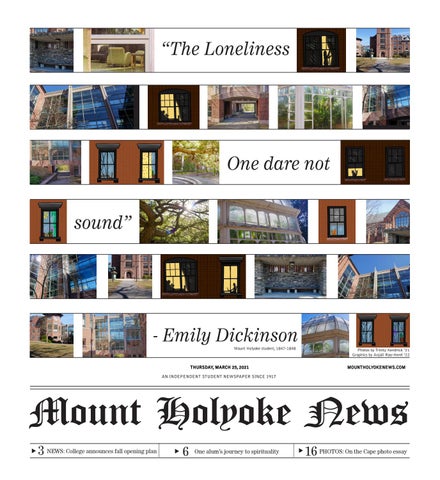
“The Loneliness
One dare not sound”
- Emily Dickinson Mount Holyoke student, 1847-1848
Photos by Trinity Kendrick ’21 Graphics by Anjali Rao-Herel ’22
THURSDAY, MARCH 25, 2021
MOUNTHOLYOKENEWS.COM
AN INDEPENDENT STUDENT NEWSPAPER SINCE 1917
Mount Holyoke News u
3 NEWS: College announces fall opening plan
u
6
One alum’s journey to spirituality
u
16 PHOTOS: On the Cape photo essay
2
EVENTS
March 25, 2021
Mount Holyoke News Mount Holyoke News is an independent student newspaper written by and for Mount Holyoke College students since 1917. VISIT US: www.mountholyokenews.com www.facebook.com/themhnews www.twitter.com/mtholyokenews_
EMAIL US: mhnews@mtholyoke.edu
Executive Board Editor-in-Chief Lily Reavis ’21 Managing Editor of Content Flannery Langton ’22
Publisher Liz Lewis ’22
Managing Editor of Layout Rose Sheehan ’22
Managing Editor of Web Zoe Farr ’21
Copy Chief Kelsey Thomas ’21
Business Manager Sarah Nam ’23
Editorial Board News Casey Roepke ’21, Kate Turner ’21 & Liz Lewis ’22 Arts & Entertainment Mariam Keita ’24
Books Sidney Boker ’21 Global Sophie Soloway ’23 & Amelia Luo ’23 Health & Science Kessh Bhasiin ’22 & Zoe Greenberg ’23
Sports Gigi Picard ’22
Photos Ali Meizels ’23 & Rosemary Geib ’23 Graphics Anjali Rao-Herel ’22
Opinion/Editorial Nina Larbi ’22
Features Mimi Huckins ’21
Environmental Meryl Phair ’21
Copy Editors Hunar Anand ’21, Audrey Hogan ’21, Audrey Shannon ’22, Margaret Connor ’23, Lauren Leese ’23, Emma Watkins ’23, Raina Brown ’24 & Ella Jacob ’24 Layout Editors Angie Romero ’24 & Zoe Tang ’24 Web Editors Audrey Hogan ’21, Shloka Gidwani ’22, Georgia Fish ’23 & Aarushi Sharma ’23
Publication Guidelines Mount Holyoke News does not endorse any of the opinions or views expressed within the pages of the paper, excluding staff editorials. All content copyright of Mount Holyoke News. All rights reserved. Mount Holyoke News does not discriminate on the basis of gender, race, religion, ethnicity, sexual orientation or age.
Advertising in MHN Interest in advertising in MHN can be directed to mhnews@mtholyoke.edu for pricing and deadlines. MHN reserves the right to refuse submissions on the basis of, but not limited to, advertisements considered to be libelous, obscene, defamatory or discriminatory.
Subscriptions Mount Holyoke News is a weekly publication that will publish online-only throughout the spring semester 2021. To subscribe through email, please visit the following form: https://forms.gle/VPCyskE4kMTDeDan8.
Letters Policy Letters to the Editor appear exactly as they are sent to MHN, except for corrections to spelling, grammar and AP style. Letters cannot exceed 500 words. All letters must include the writer’s name and telephone number for verification purposes. Unsigned letters will not be printed. Names may be held upon request with the approval of the Editor-in-Chief. MHN reserves the right to decide which materials will be printed. Email submissions to mhnews@mtholyoke.edu by Sundays at 5 p.m. for publication the following week.
. Mount Holyoke News
Event Highlights Thursday, March 25
Artist Sandra Brewster in conversation with Associate Professor Kimberly Juanita Brown
Join us for an engaging public conversation between artist Sandra Brewster and Kimberly Juanita Brown, Elizabeth C. Small Associate Professor of English and Africana Studies 4:30 p.m. - 5:30 p.m. EDT Registration is required through Embark.
Friday, March 26
The 98th Annual Kathryn Irene Glascock Poetry Contest: Student Poetry Contest
The 98th annual Kathryn Irene Glascock ’22 Intercollegiate Poetry Competition invites six student poets to campus to represent their college and compete for the title — and accomplished poets to serve as judges. 8:00 p.m. - 10:00 p.m. EDT Registration is required through Embark.
Monday, March 29
Design Process Workshop: [M]ake [H]ack [C]reate Session
Interested in getting started on a project in the Fimbel Maker and Innovation Lab but don’t know where to begin? Take our Design Process workshop series where you will learn the basics needed to take your ideas from concept to reality. 4:30 p.m. - 5:30 p.m. EDT Register for a [M]ake [H]ack [C]reate virtual group session whenever you are ready to get started or reach out with questions at FimbelLab@mtholyoke.edu.
Tuesday, March 30
We Create Our Own Universes: Community Building for Trans Lives with Aria Sa’id In this Trans Week of Visibility event, join us in learning about what it means to organize and move through the optics of visibility to the realm of liberatory action and social change. 4:30 p.m. - 6:00 p.m. EDT Registration is required through Embark.
COVER ART For information on this edition’s cover, please see page 19. Photography by Trinity Kendrick ’21. Graphics by Anjali Rao-Herel ’22. Layout by Rose Sheehan ’22.
March 25, 2021
NEWS
. Mount Holyoke News
3
Students take time off after campus closure BOOM! 2021: BY KATIE GOSS ’23 STAFF WRITER
As March marked the anniversary of the College’s campus closure due to the COVID-19 pandemic, it served as a further reminder that many students have been learning remotely for a full year. Student enrollment decreased during the 2020-2021 academic year, indicating that a large number of Mount Holyoke students have opted to take time away from their studies, either for just one semester or the full year. Due to remote classes, the module system and the pandemic itself, many students felt that this year would be the perfect time to take a break from school to focus on themselves and their personal goals. Sara Robillard ’23 decided to take the spring semester off after experiencing the new module system and remote classes in the fall. She felt stressed throughout the semester and decided it would be detrimental to her mental health to continue in the spring. “I took the semester off because after doing the module system, it really took a toll on my mental health. I had not felt like that in a long time, and I knew being in school in this way, at home [and] in this setting, is just not how I anticipated college,” Robillard said. “Dealing with that while also having the stress of school and the feeling where you can’t catch up, like if you fall behind you’re really just constantly playing a game of catch up.” Olivia Griesmer ’23 also decided to take the spring off after going through the fall semester because of the pressures of
remote learning and the situation caused by the pandemic overall. “I would definitely say the first semester with the module system really influenced me to take the spring semester off. [In the] fall semester, I think I had an okay first module, and then the second module, I just got to a breaking point where I was having panic attacks before every Zoom meeting. … It would get to a point where I couldn’t go to class and I would be emailing my professors,” Griesmer said. “My panic attacks got so bad that I had to medically withdraw from my courses, and I realized I wasn’t in a mentally healthy place to do [the] spring semester,” they said. “I think … the pandemic also brought on a lot of my anxieties. So I think staying safe and keeping my anxiety down is a big goal for me.” Griesmer mentioned that the module system did not support their learning style and felt that it would be better to wait until the College returned safely to in-person learning. “It takes me a long time to process information, and in seven weeks, they throw a lot at you very quickly, and it just wasn’t working for me,” Griesmer said. “I had the opportunity and the support from my family to take the semester off, so I just took the opportunity until an in-person experience, where I know I can learn better, would be given safely.” Robillard mentioned that professors are also facing challenges due to the module system. She hopes that once the College returns to the semester format, as well as in-person classes, this situation will change and professors will be able to
teach their courses with the ease they did before. Both Robillard and Griesmer decided to work on bettering themselves mentally and academically during their semesters off. Griesmer has an internship with the company Bakpax, an online education company, and also nannies for a family in their free time. At the same time, they are focusing on bettering their mental health and preparing for the fall 2021 semester. “[My main goal is] to work on my mental health so when we are back to in-person classes and everyone’s on campus safely, I will be in a place to learn and successfully do college,” Griesmer said. “So I think staying safe [during the pandemic] and keeping my anxiety down is a big goal for me.” Robillard worked at a sandwich shop, PrimoHoagies, throughout the last semester and at the beginning of this year. She recently started a new job at a coffee shop called the Pie Lady Cafe. Robillard also has an internship with MASSPIRG, a grassroots organization that has a presence on multiple campuses across the country, and works on their campaigns. “Taking this time off, I decided I wanted to work more and save up some money, and also I wanted to get an internship to help my resume and put me in a better spot for when I did go back to school. Because I’ve never gotten one before and never really had that experience on my resume, I wanted to do something more productive and useful with my time. CONTINUED ON PAGE 5
u
College announces fall opening plan, tuition increase BY CASEY ROEPKE ’21 NEWS EDITOR
Mount Holyoke students will return to a full residential experience in the fall 2021 semester per an email sent to the College community by College President Sonya Stephens. The “full residential experience” includes in-person instruction and returning to a semester format, leaving behind the module-style learning system that was implemented for the 2020-2021 academic year. “Improved public access to vaccines, declining infection rates in many states, and our own success to date in resuming residential operations all give
us great confidence in moving forward with these plans,” Stephens wrote. The email was clear that the residential campus reopening would obey all state and federal safety guidelines surrounding the pandemic. “Our decision to welcome all of our students back to campus, to return to the classroom and other learning and co-curricular experiences, fully respects federal and Massachusetts public health and safety guidelines,” Stephens wrote. Further information about the academic calendar, course registration, advising and other residential logistics is forthcoming. Stephens also announced a tuition increase for the next academic year in the same email. The Board of Trustees
approved tuition at $56,300, the room rate at $8,320 and the board cost at $8,260. “We recognize that you are making a significant commitment to a Mount Holyoke education, and this fee reflects our ongoing commitment to the outstanding academics and residential life that are the hallmarks of this educational experience,” Stephens wrote. “It allows us to invest further in that core mission, in our faculty and our students, in scholarships and other support, and in continuing health and safety measures that protect everyone on campus.” The total fee is $73,098, a $2,678 increase from last year’s rate. This is the second consecutive year tuition has increased by nearly $3,000.
Coming together, apart BY ELLA WHITE ’22 STAFF WRITER
Mount Holyoke held its fifth annual BOOM! Conference, a collection of workshops and panels on racial justice, on Tuesday, March 23. The program focused on understanding bias in the distribution of land, resources and communities. In the opening ceremony and throughout the events, the organizers emphasized the increase in violence toward Asian Americans since the start of the COVID-19 pandemic — particularly with regard to the recent shooting in Atlanta, which left eight people dead, six of whom were Asian American. The opening ceremony served as a vigil for the victims of the Atlanta shooting, including a reading of the victims’ names, a slideshow on the history of anti-Asian racism and Asian American activism and a reading by Visiting Lecturer in English Jerrine Tan. “Honoring the lives of those killed in Atlanta as well as their families’ grief, saying their names, makes human and personal every life extinguished by white supremacy and senseless violence,” College President Sonya Stephens said during the opening address. At odds with last year’s mostly asynchronous events, the majority of the events this year were held live via Zoom, though some were recorded to allow students to view them later. Since it was virtual, BOOM! 2021 was more accessible. As Angelis Liriano ’22 noted in the opening remarks, the program welcomed many alumni to attend for the first time. Throughout the day, event hosts repeated land acknowledgments, sometimes with variances due to the now widespread nature of the Mount Holyoke community. Portions of BOOM! built on “The 1619 Project” — last year’s summer CONTINUED ON PAGE 5
u
4
NEWS
March 25, 2021
. Mount Holyoke News
FP Monologues capture stories of resilience in turbulent times to vary considerably in tone and subject matter. On Tuesday evening, speakers covered everything from their own artwork to their personal journeys with The Frances Perkins Monologues, education, family and identity. Some like all events nowadays, looked differmonologues were lighthearted while ent this year. According to Niki Haswell others were more emotional. To HasFP ’22, this annual showcase of writing, well, this is a fine line many FPs are art and stories from the Mount Holyoke uniquely equipped to walk. community’s nontraditional-aged stu“Some of our experiences are funny dents felt different, too. and positive, but I think as FPs, we’ve This year’s FP Monologues took all had some crazy journey to get here,” place as part of Mount Holyoke’s annual she said. BOOM! Conference on Tuesday, March Bethany Powell FP ’22 23. Haswell is a social delivered a comedic piece chair for the Frances “The moments when about her relationship Perkins Scholars Asto her own whiteness sociation. It was the somebody repeats your and culture. Keeping to first FP Monologues words ’cause they reala mainly lighthearted she has been able to but earnest tone, Powly loved the phrasing — attend, as the event ell spoke about how she was canceled last year that’s not something we watched her Irish and due to the COVID-19 would have done if we’d Italian heritage morph campus shutdown. had it traditionally, in into the Mayflower-born Despite the fact that whiteness that her famperson,” her first experience ily and country deemed with this event was acceptable. “Isn’t it wild a virtual one, Hashow quickly we tried to Niki Haswell FP ’22 well noticed an overmake our family trees whelming sense touch the colonizers?” of community that she asked, dwelling on the loss that shrouded the evening. To her and othcame with her family’s movement away ers, the 2021 rendition of the FP Monofrom their roots. logues felt as warm as ever. Other monologues featured differ“There just seems to be something ent types of stories from the speakspecial about this one,” Haswell said. er’s life. Earnest Malarkey FP ’18 pre“I’m not sure if it’s the amount of people sented a piece about their friendship who were able to attend because it was with photojournalist Donna Ferrato. virtual, I’m not sure if it’s the pandemic The two have clashed in the past over and it just helped bring people together, their approaches to the consent of the … [but] us FPs, kind of crying [at] the photographed, a debate that Malarkey after party last night, … felt more condwelled on throughout their monologue. nected to each other in a way that we Mary Tobin FP ’21 spoke on her exhadn’t been able to do this whole year.” perience with higher education and the Yvaine Neyhard FP ’20 emceed the success she has found with the FP proevent and introduced each speaker gram. Francesca Marie FP ’22 touched throughout the evening. According to on her experiences as an immigrant in Neyhard’s opening remarks, the FP her monologue as well as her relationMonologues were started in 2013 by an ship to the concept of home. “Home is FP as an annual opportunity to share FP where your heart is, they say,” Marie stories with the wider community. Neysaid. “And I am finally finding mine.” hard encouraged the virtual audience to Many of the monologues further exexpress their support, which otherwise plored the speaker’s sense of identity. might manifest as applause, through Jasmine Erico FP ’21 offered an emothe Zoom chat function. Throughout tional, poetic account of the trajectory the evening, comments flooded the chat that led her to Mount Holyoke. As she in the moments between presentations spoke on her experience growing up as audience members congratulated the in poverty, the presentation filtered speakers, complimented their words through black and white photos that and art and offered support and encourbordered on abstraction. Though she agement during emotional monologues. grew up just down the street, she said Every year, each monologue tends that she felt removed from the prestige
BY LIZ LEWIS ’22 PUBLISHER & NEWS EDITOR
of Mount Holyoke with its “brilliance and traditions.” “But I am brilliant, too,” she said. These words were echoed in the Zoom chat as supportive messages flooded in. Nic McGrath FP ’23 delivered a similarly intimate monologue, taking the audience through the emotional journey that led them to the FP program. Again, in lieu of applause, the audience sent messages of support and affirmation in the chat. To Haswell, the chat was one of the main contributors to the sense of community at this year’s
FP Monologues. “The moments when somebody repeats your words ’cause they really loved the phrasing — that’s not something we would have done if we’d had it traditionally, in person,” Haswell said. “In person, people might cheer you on in the crowd, but they’re not nearly gonna say what they were comfortable saying in the chat.” After the event, all of the speakers received a copy of the Zoom chat. Haswell herself also spoke. Her
u
CONTINUED ON PAGE 20
Students take time off, cont’d u
CONTINUED FROM PAGE 3
I didn’t want to put myself in a position where I knew that I was going to be unhappy,” Robillard said. Additionally, she said she wanted to use this time to find her “identity” as a person outside of the classroom. “I feel like this [time] has also been helpful for me to sort of find my identity, like outside of being a student. I have been in school all of my life, … and you don’t realize how it just becomes your life and that’s all you think about,” she said. “Being a student is a full-time job, and I sort of wanted a break from that and to step back. I felt like I would also be able to fall back in love with doing school and doing work again and trying to learn and get an education … because the last semester before I took off was really hard.” Although she’s back at Mount Holyoke this semester, Simran Kaur ’22 took the fall semester off and decided to participate in World Wide Opportunities on Organic Farms with her friend. WWOOF is an organization in which people can choose what farms they want to work on for a period of time and volunteer there in exchange for food and a place to stay while traveling in the area. Kaur originally planned on studying abroad in Vienna for the fall semester, but those plans were canceled due to the ongoing pandemic. After her friend mentioned WWOOF to her in the summer, they both decided to take the fall semester off and travel across the country to participate.
“WWOOF farms are all consolidated on a database. We chose farms based on if we got ‘good vibes’ from their descriptions [and] photos on their pages, and calling [video or audio] with the hosts to talk about what working there would look like as well as [get] a feel for the host,” Kaur said. She and her friend worked on three farms over the period of about four months, one in South Carolina for five weeks, one in Arizona for four weeks and one in New Mexico for 10 days. Kaur said they chose to work on these farms to see the different farming conditions in various climates. Before starting work, they were both tested for COVID-19. Additionally, to limit their contact with others, they drove to each farm to keep their exposure to a minimum. Kaur and her friend also spent time exploring hiking trails and outdoor places nearby. They both bought National Park Access Passes at the beginning of the fall so they could go to as many parks as possible during their journey. Although they originally planned to continue their travels until after New Year’s, they decided to return home before the holidays, as a spike in COVID-19 was expected in the U.S. at the time. Kaur said she tried to see the positive in the pandemic and realized she probably would not have had this experience if COVID-19 did not alter her plans to study abroad in Vienna. “A cross-country road trip and farming? I’m fairly certain it wouldn’t have happened if it weren’t for the pandemic,” she said.
March 25, 2021
NEWS
. Mount Holyoke News
5
Mills College announces closure as a degree-granting institution BY CASEY ROEPKE ’21 NEWS EDITOR
The COVID-19 pandemic has hit colleges across the country hard, with closed campuses, remote learning and financial losses challenging the higher education industry over the past year. Mills College, located in Oakland, California, is the most recent institution to announce its closure. Mills College was founded in 1865 by Susan Tolman Mills, a graduate of Mount Holyoke College. Originally a female seminary, Mills College has continued its mission of promoting women’s education for a century and a half. Mills College was the first women’s college to formally admit transgender students, a policy that was soon echoed by Mount Holyoke on the other side of the country. On March 17, Mills College President Elizabeth Hillman wrote a letter to the community announcing that Mills would not be enrolling a new first-year class after fall 2021. “Today, because of the economic burdens of the COVID-19 pandemic, structural changes across higher education, and Mills’ declining enrollment and budget deficits, Mills must begin to shift away
from being a degree-granting college and toward becoming a Mills Institute that can sustain Mills’ mission,” Hillman wrote. “Mills will most likely confer its final degrees in 2023, pending further consideration and action by the Board of Trustees.” Students in the class of 2024 and others who may not graduate before 2023 are encouraged to transfer as part of their degree completion plan, which the announcement stated may consist of “a combination of Mills, partner institution and online consortium courses.” According to the San Francisco Chronicle, the decision to stop granting degrees comes as Mills College “faces a $3 million deficit driven mostly by declining enrollment that only worsened during the pandemic.” While other gender-diverse women’s colleges have seen an uptick in applications, Mills College’s enrollment has decreased by 30 percent in the past five years. The Campanil, Mills College’s student newspaper, reported that after the initial announcement, senior administrators held a virtual town hall meeting for students, staff and faculty. At the town hall, Hillman again cited “the financial chal-
lenges that Mills faces” as a barrier “to continue to grant the kind of high quality education that Mills wants to offer to its students,” as reported by the Campanil. Alumnae of Mills College were especially saddened and outraged by the announcement. Congressional Representative Barbara Lee, a Mills alumna, released a statement asking the board of trustees to reconsider the decision, according to the San Francisco Chronicle. A #SaveMills online group was created hours after the announcement. Mills alumnae are organizing to advocate for a reversal to the decision, but also to learn more about the financial state of Mills College. “Honestly, I felt like someone that I loved very much is dying,” Priya Kanuga, who graduated from Mills College in 1993, said. Kanuga said she was devastated to hear the announcement because of the formative experiences she had during her college years. “You really feel like you can do anything and you can change the world and speak up for those who don’t have a voice,” Kanuga said of her time on campus. “I left believing that when I graduated. It’s a place I go back to when I need to
Photo courtesy of WikiMedia Commons Mills’ announcement shocked community members.
make major decisions. It’s just an incredible place.” Kanuga and other alumnae in the Facebook and Slack #SaveMills organizing groups have struggled with the lack of transparency surrounding Mills College’s decision and finances. While the #SaveMills group’s main goal is to immediately reverse the board of trustees’ decision, Kanuga also has longer term goals to sustain the mission of the college. She and other alumnae are strategizing for improved fundraising and recruitment in the hopes of establishing a stronger financial base and encouraging enrollment numbers to grow. “If women’s colleges are experiencing a renaissance, then why not at Mills?” Kanuga asked. “What’s going wrong?”
College announces a virtual Mount Holyoke holds 5th annual Commencement for class of 2021 BOOM! Conference remotely BY LILY REAVIS ’21 EDITOR-IN-CHIEF
u
The College announced Monday that it will hold a virtual commencement ceremony for graduates of the class of 2021 on May 23 at 10:30 a.m. EST. In an email sent to graduating students and their families, Vice President for Student Life and Dean of Students Marcella Runell Hall wrote, “It is with great regret that we announce that no family, friends or other guests will be able to participate in any campus celebrations in advance of the virtual ceremony.” The email went on to explain that “some celebrations and traditions that recognize the graduating class will take place between May 12 and May 15.” This will include stoling ceremonies for first-generation and low-income students, students of color and those within the LGBTQ+ community. These events will be open to students living on- and off-campus. For those currently residing on campus, the move-out deadline will be extended until Sunday, May 16.
read — and stressed the importance of understanding race in America through a more holistic lens. A workshop led by Dr. Thema Bryant-Davis focused on dealing with trauma amid present circumstances. A presentation by the Mount Holyoke Archives detailed research into the first Indigenous students to attend Mount Holyoke, while a panel led by the Whitney Museum presented on the history of enslaved families in New Orleans. Author Clint Smith featured as the keynote speaker. Smith discussed his upcoming nonfiction book, “How the Word is Passed,” in which he examines the legacy of the Atlantic slave trade and chattel slavery in locations across America. Smith said the book is “a reminder that statues are not just statues and symbols are not just symbols. The stories we tell shape the policies we create, and the policies we create impact people’s material conditions.”
Photo by Ali Meizels ’23 Before students were sent home, the class of 2020 organized an impromptu student-led graduation.
No graduating students will be permitted to physically be on campus during the virtual graduation ceremony on May 23. Additional information regarding the College’s 184th Commencement will be announced later this month, according to the email. “As always, our primary concern is for the health and safety of all members of our community,” Hall wrote. “Thank you for your patience as we continue to develop plans in the context of the public health situation.”
CONTINUED FROM PAGE 3
Smith also spoke of his experience teaching at prisons, where he said he is learning and gaining more from those incarcerated than they are from him. “If I’m just sitting in the library at Harvard University reading Foucault, prison becomes an abstraction. I know [I] need to put myself in places where I am interfacing and spending time with the populations of people I’m seeking to work with,” Smith said. The final event of the day was a panel on the impact and importance of mutual aid in communities. Not only are mutual aid organizations a way to protect the most vulnerable in a community, said panelist Prentis Hemphill ’04, but they are a way for the community to connect and grieve together, particularly in times like these. “Some things that are necessary for us to feel in the moment actually can’t be felt alone or in one body,” Hemphill said. “We need those spaces where we come together.”
6
FEATURES
March 25, 2021
. Mount Holyoke News
Weissman Center hosts town hall with Cruz, Pressley BY ANSLEY KEANE ’23 STAFF WRITER
The Mount Holyoke College and the Weissman Center held a town hall on March 19 with Massachusetts Representative Ayanna Pressley in conversation with Carmen Yulín Cruz, former mayor of San Juan, Puerto Rico, and current Harriet L. Weissman and Paul M. Weissman distinguished fellow in leadership at Mount Holyoke College. This town hall was the first of many in the new series “Our Voices, Our Platforms” hosted by the Weissman Center for Leadership. The series will run at least through December 2021 and works to emphasize the power and importance of using your voice to create change. The town hall began with introductions by Amy Martin, director of the Weissman Center for Leadership and professor of English on the Emma B. Kennedy Foundation, and Mount Holyoke College President Sonya Stephens. The event was dedicated to Paul Weissman. Following the introductions, Cruz began her conversation with Pressley. Cruz spoke highly of Pressley and shared with attendees that when the two first met, Pressley asked about the people of Puerto Rico and what she could do to help. They then discussed a variety of topics, ranging from Pressley’s influences, her work to support girls and women of color, activism, burnout and motivation, as well as the Jan. 6 insurrection at the Capitol. Halfway through the event, several of the Weissman Center’s student leaders had the opportunity to join the conversation and ask Pressley questions of their own. The interactions between the students and Pressley stood out to Martin and Cruz as particularly special. “My favorite moment was watching our students interact with the congresswoman. When you watch a public figure on the news, you don’t know how they’ll engage with students,” Martin said. “The voices of the students were not an asterisk, … but a bold paragraph,” Cruz said. “Not only were the student leaders superb, but the rapport that the
congresswoman had with them was extraordinary,” she added. Pressley was chosen as the first guest in the “Our Voices, Our Platforms” series for what she has accomplished, the records she has set, what she stands for and for who she is. “She’s a badass, there’s no other way to say it,” Cruz said. “She is a fearless policymaker for African American, Black and Brown people alike, and she’s from Massachusetts,” Cruz noted. “She’s broken glass ceilings [and] you can hear that she’s very much about collaborating with the people she represents,” Martin said. Both Cruz and Martin see the first town hall as a success. “We had two brilliant leaders in such a dynamic conversation with one another,” Martin said. “That conversation had the power we hoped it would have,” she added. Cruz explained the moments that held particular significance for her. At one point in the town hall, Pressley said, “I remain acutely uncomfortable on purpose because I don’t ever want to grow complacent.” Cruz noted that this resonated with her, especially because she is also in public service. “When she said that, it reminded me of the reason why I believe people should go into public service,” Cruz said. “You remain close to the pain so you understand the root of the problem.” “Our Voices, Our Platforms” came about when Cruz visited Mount Holyoke College for the Weissman Center’s 20th anniversary. Previously, Cruz had worked with Assistant Professor of Psychology and Education Jennifer Matos to establish a summer STEM program for girls in San Juan’s Playita neighborhood, and she wanted to find more ways to continue working with the Weissman Center. “When I came for the 20th anniversary of the Weissman Center, Amy [Martin] and I started looking for ways we could collaborate,” Cruz said. Cruz wanted to create a series that would build on the conversations students at Mount Holyoke have with each other. “We have those conversations and we don’t have
Graphic by Gabby Gagnon ’21
the opportunity to speak to the people we are talking about,” Cruz said. “We decided on ‘Our Platforms’ because we wanted to make sure that everyone understood that everyone has a voice, but that sometimes those voices are not heard because we don’t all have appropriate platforms.” Cruz’s vision for “Our Voices, Our Platforms” is to have conversations with people who are using the platforms they have to bring about change. In explaining her vision, she also emphasized that “change is not about the clashing of forces, … but that policy comes about and better public policy comes about when alliances are forged.” Cruz explained that what is most exciting for her about the series is “the opportunity [to have] honest conversations about the world we can create.” “Our Voices, Our Platforms” will continue throughout the rest of 2021. The next town hall will be with Massachusetts Senator Ed Markey on April 7.
Q. Hailey ’12 brings Womanist Worship to Mount Holyoke BY REBECCA GAGNON ’23 STAFF WRITER
“What does it mean to be whole,” Q. Hailey ’12 asked herself. “How do we find wholeness in this period?” These are some of the questions Hailey contemplated when deciding what topics to discuss in her series, Womanist Worship Sunday Exploring Wholeness. Each month has a separate topic revolving around self-care. In March, Hailey will focus on wellness dealing with personal, financial, family and other struggles. Hailey is a full-time staff chaplain at New York-Presbyterian Brooklyn Methodist Hospital. The duty of a hospital chaplain is to offer religious guidance and services to patients and their families. Hailey
also serves as a current Association of Clinical Pastoral Education Anton Boisen Scholar. She is now running the Womanist Worship Sunday at Mount Holyoke, using all of the skills she has gathered to help students discuss wholeness. Hailey was asked by Mount Holyoke to lead a 2020 Martin Luther King Day service. “I came to this service from a womanist perspective,” Hailey said. “That was like, ‘Oh this is what we need. This is what we have been missing and this is what I have been looking for, is this specific lens to bring in some other students and get them involved.’” While reflecting on the MLK Day service, Hailey and Annette McDermott, the dean of the Office of Photo courtesy of Q. Hailey ’12 Q. Hailey ’12 runs a Womanist Worship Sunday program at Mount Holyoke.
CONTINUED ON PAGE 20
u
March 25, 2021
FEATURES
. Mount Holyoke News
7
Professors look back on a full year of remote teaching BY MIMI HUCKINS ’21 FEATURES EDITOR
In the fall of 2020, fully remote learning and the new module system meant professors were uncertain about what challenges the semester would bring. Remote learning continued through the winter into the spring semester as we witnessed rising COVID-19 cases in the U.S. Mount Holyoke is now in its final fully remote module, and the College community is able to reflect on the remote year: the difficulties, successes and new practices that we will implement moving forward. Chris Benfey, English Professor of English Chris Benfey has kept a positive spirit throughout the academic year. “I’ve looked for what’s positive, instead of just feeling that we miss things,” Benfey said. “I think it’s the same experience with the pandemic. There’s a lot of grief, a lot of pain, a lot of loss, a lot of sense of what is missing. I’ve tried to think about possible learning opportunities in … the midst of a pretty horrific year.” Reflecting on his experience, he noted that he has viewed the remote classroom as one of immense difficulty but also one with surprising benefits. Benfey sees the experience of remote learning as an experiment. The concept of digital learning in relation to time and space has interested Benfey immensely throughout the academic year. “[Digital learning] both eliminates distance, like we’re all just right there in the same place at the same virtual time, but it also kind of reestablishes distance, like we’re all made aware that some of us are in South Hadley, some of us are in California, some of us are in China, some of us are in India,” Benfey said. He finds distance an “invigorating” aspect of online learning. When it comes to the idea of time, Benfey feels Zoom has allowed us to communicate faster and much more immediately than in-person learning. Benfey, like other professors, has found Moodle forums a useful platform to slow things down. “They give people a chance to think a little bit before joining a conversation,” Benfey said. In this module, Benfey is teaching a course on Emily Dickinson, the famous poet who briefly attended Mount Holyoke College. He has found the course’s subject matter helpful in creating the sense of an on-campus experience. “In a strange way, we’re trying to reestablish this residential experience on campus that Emily Dickinson had, even as we are sort of these ghosts,” Benfey said, “nowhere and everywhere.” Although studying Dickinson is inevitably tied to Mount Holyoke and the town of Amherst, the variety of students’ locations enriches the learning experience in some ways. “On one hand, it couldn’t be a worse time [to teach this course], and on the other hand, I have students living on campus in South Hadley, I have students living in Amherst, right off Main Street, where Emily Dickinson lived, I have students abroad
Photos courtesy of Mount Holyoke College Professors Chris Benfey (left) and Alanna Hoyer-Leitzel (right) have both faced challenges with the shift to remote learning. Still, both say that the year of distanced teaching has taught them about their profession, and they plan to integrate some online components into their future classes.
in places where Emily Dickinson is a known presence,” Benfey said. “People in Japan, China, France and Germany are really excited about Emily Dickinson; she is a world poet. So in some ways, we’re able to zero in on different aspects of her current … survival, her current presence internationally.” Aside from the obvious differences between remote learning and in-person learning, Benfey has discovered that the numerous situations we have found ourselves in this past year –– the pandemic, countless instances of racial injustice, issues of gun violence and other violations of human rights — have found an important place in his classroom. “In addition to the microcosm of the classroom, we’re dealing with this very chaotic period in history. I think one thing I’ve tried to be open to in the classroom is just more of a porous relationship to what’s going on out there, what’s going on in the real world, a willingness to let class discussion move into that larger dimension,” Benfey said. Benfey has found a way to take the most difficult and painful aspects of our current lives and turn them into an opportunity to learn and reflect on this important moment in history. Although in-person classes will return in the fall, some aspects of online learning may stick around. “I am going to go on using Moodle forums because I like them as an adjunct to the classroom. I think we are likely to continue to have some … virtual student presence,” Benfey predicted. “We will get used to having a Zoom connection. … Most classes, I think, will continue to experiment with various kinds of blended classrooms.” Alanna Hoyer-Leitzel, Mathematics Assistant Professor of Mathematics Alanna Hoyer-Leitzel sees this academic year as a balancing act. “I think that there are things I could do to make the class a little bit more accessible, but my own sanity would suffer. So there’s this balance that I think is really important. So I’m like, ‘Okay, I can handle it this way. It’s a little bit hard for me, and it was also a little bit hard for my students, but let’s meet in the middle.’”
Hoyer-Leitzel has worked to engage students more this year by holding required office hours and creating a Moodle forum for questions. Although these have proved successful, Hoyer-Leitzel feels that it is still important to acknowledge the varying ways students show their engagement. Not only that, but she feels it is important to recognize the wear of isolation and how that may affect their participation in the course. “I think there are people for whom, they’re like me, they’ve been stuck in this one room for six months, and it’s starting to wear on them. And that is hard,” Hoyer-Leitzel said. She has attempted to remain understanding of the difficulties her students are facing by being more flexible on due dates. “Because of the pace of the course, everybody’s going to need a little bit of extra time on something at some point,” Hoyer-Leitzel said. “So being able to give that to the students was important to me.” Similarly to Benfey, Hoyer-Leitzel sees herself implementing some new practices in future in-person classes. In an attempt to lessen the amount of time she spends grading homework assignments, she has made half the regular assignments a quiz on Moodle graded for completion, while the other half remain in the typical homework format. Additionally, for her 200-level classes, Hoyer-Leitzel has implemented assignments to complete before class in order for students to review concepts needed for the class before the actual meeting begins. “I think I might keep that up just to prime students for the class each day,” Hoyer-Leitzel said, “so that we can build on the harder concepts in class. … That way we can come into class, and I can say, ‘Well, you already did this. So let’s move on to the next thing, and spend time on the hard stuff when we’re together.’” Overall, Hoyer-Leitzel has learned that it is important to remain understanding. “It’s been a hard year for all of us,” she said. “[We need to be] gentle with ourselves. Making sure we [are] understanding and being nice to each other [is] really important. I try very hard to do that with myself, my students and my colleagues.”
8
GLOBAL
March 25, 2021
. Mount Holyoke News
Tracking regional responses to COVID-19 over first year BY SOPHIE SOLOWAY ’23 GLOBAL EDITOR
In the year since the World Health Organization declared COVID-19 a pandemic on March 11, 2020, countries across the world have responded to the crisis in varying ways, all of which have had massive impacts on the health of their citizens. Asia: On Dec. 31, 2019, the WHO received word of surging cases of “viral pneumonia” in Wuhan, China. Throughout January and February, the virus spread throughout the region, taking lives while experts attempted to understand it. As the virus spread, many Asian countries became models in precautionary policy. While governments’ responses varied — and were impacted by economic and imperialistic factors — regional cooperation has led to some protections for citizens. Today, however, many Asian countries struggle to vaccinate their populations. Israel has long been a leader in vaccine rollout, with over half of its population already vaccinated. However, this deployment has accompanied immense restrictions in supply for the Palestinian citizens, leaving the country with approximately 224,000 total COVID-19 cases. Other countries on the continent have similarly struggled to distribute vaccines. Vietnam, Thailand, Myanmar, the Philippines and Japan each have vaccine rates of less than 0.2 percent, leaving many to continue struggling through the pandemic. Europe: Soon, the virus spread across the world, and several countries became hot spots. Italy initially struggled to care for its sick citizens as the disease spread across the country. This was a time of great sadness for the country, according to Lecturer in Italian Morena Svaldi, who recollected the traumatic visuals her family witnessed. “The isolation was particularly impactful. My mom keeps saying that on the TV every night, [there are] trucks full of bodies, carrying [them] outside of the city. So seeing this, it seems that you’re in a war,” Svaldi said. Professor of Italian and Chair of Romance Languages and Cultures Ombretta Frau reflected that “many governments acted in good faith. Italy was the first democratic country to declare a total lockdown in March 2020. Taking such a decision must have been hard. Personal freedoms and the right to privacy are at the foundation of democracies.” Frau noted that Italy’s path to recovery has not been linear. “In summer, numbers were extremely low, so everything reopened,” Frau said. “And in the fall, we were back in an emergency.” Professor of Spanish and Chair of Spanish, Latina/o Studies and Latin American Studies Nieves Romero-Díaz shared her recollection of Spain’s early experience with the pandemic. “In late March, Spain was the country with the higher number of cases and deaths after Italy in Europe, and without the lock-
Photo courtesy of WikiMedia Commons In early 2020, Italy became home to several COVID-19 hot spots. In March, it became the first democratic country to declare total lockdown.
down, it would have been worse.” Romero-Díaz also shared that like the rest of Europe, Spain’s ongoing lockdown plan has been largely influenced by economic concerns, often putting citizens at risk. “Unfortunately, every time a wave starts to go down — like now — because the economy must recover, recommendations have been loosening and then back to the beginning,” Romero-Díaz continued. “Like any other government, [the] Spanish government has balanced its decisions of reopening sometimes thinking of health, [but mostly] of the economy, and in my opinion, it is a big mistake.” Today, many European countries are working to vaccinate their citizens. However, plans for vaccine rollout have been repeatedly stunted, and only about 10 percent of Europeans have access to the vaccine. According to Romero-Díaz, “Continental Europe is way behind in comparison to the U.S. or England. I put the blame on two reasons: First, bad decisions on the part of the European governments [their negotiated contracts],” Romero-Díaz noted. “Second, the avarice of the pharmaceuticals, selling vaccines to those countries that offer more money despite their agreements.” Frau said that “I am frustrated not at Italy, but at the European Union for having failed completely on the vaccination issue, forcing countries to close again.” According to Reuters, at least 37,375,000 infections have been reported on the continent, with over 1 million deaths related to the virus. American continents:
Both Canada and Mexico have struggled to provide vaccines to their citizens, with approximately 4 and 5 million vaccinations administered, respectively. The U.S. has recently announced its plan to share vaccines with the two countries. In Latin America, COVID-19’s death count reached 600,000 by the end of 2020. In addition to these deaths, the International Monetary Fund projected a “7.4 percent contraction in 2020,” representing the steep economic impacts that the pandemic has had on Latin American and Caribbean lives. Brazil specifically has faced huge COVID-19 rates, closing in on 10 million individual cases in March. Other countries in the region, including Argentina and Colombia with the second and third highest rates, respectively, have experienced devastating tolls and look to vaccines for hope to overcome the pandemic. Chile has long led the race to vaccinate its citizens, with approximately 34.2 doses administered out of 100 citizens as of mid-March. During the same period, Brazil has administered about 11 million doses, with regional neighbors trailing behind. Twenty countries in Latin America and the Caribbean have authorized the deployment of several vaccines. Africa: Limited testing on the African continent has barred the world from understanding how citizens are faring. There have been approximately 4 million CONTINUED ON PAGE 9
u
March 25, 2021
GLOBAL
. Mount Holyoke News
9
International students reflect on journeys home and gap years BY JOCELYN ZHOU ’22 STAFF WRITER
When Mount Holyoke College closed its campus and switched to remote learning in March 2020, international students were encouraged to fly back home. Throughout the last academic year, international students have dealt with time differences interfering with online classes. In the face of this difficulty, some students chose to take a gap year or semester. Ruoyu Zhang ’25, an international student from China, returned home in late August 2020. “Comprehensively, all things were good,” Ruoyu explained. “People were very conscious about the virus and wearing protections in the public area[s], especially in the airport.” Airline booking marked the harsh beginning of her trip. “The flight was still hard to book due to the sudden increase in demand. The policy didn’t keep up so well on price and frequency,” she said. “I managed to book the flight at a relatively reasonable price. The flight wasn’t troublesome. The airport and the custom[s agents] asked everyone to wear a mask and keep 6 feet apart, which were good calls. I wore a face mask on the flight all the time besides [when] eating and drinking.” She decided to take a semester off from Mount Holyoke because she always wanted a gap experience. “I always want to take a gap year. Travel, meet my families and spend [the] Spring Festival together, the Chinese version of Christmas. Now I can do all of them,” she said. “I won’t lie; the pandemic was the most sig-
nificant factor that led to my gap decision. But the oth- conduct remote learning after spring break. ers still have a place.” “I booked a flight from Boston to Hanoi operated Ruoyu also talked about her plans for her gap se- by Qatar Airways; however, it was canceled. Neverthemester. “I got a Chinese driver’s license through the less, I was lucky enough to book another flight back ‘system,’ … and it took me three months to get it,” home,” An said. Ruoyu said. “My gap year was good so far. I didn’t An took a gap semester to search for career prostravel [as] much as I thought. pects. It’s interesting because I spent “I’m currently working as like two months getting used a content writer for an e-comto my city’s lifestyle after merce company. I actually ”Comprehensively, all things living five years in the U.S,” quite enjoy the job because I were good. People were very can write creatively and learn Ruoyu added. Ruoyu was also looking interesting things about ecoconscious about the virus and forward to a real campus expenomics,” An said. “When rerience, but safety was her priturning to the 2021 academic wearing protections in the mary concern. “I think the sitfall semester, I think I might public area, especially in the uation isn’t so friendly toward take another economics class. Asians in general right now as I’ve only taken one economics airport.” I am speaking [on] March 22, course.” 2021,” she said. “I am thrilled Next semester, An hopes —Ruoyu Zhang ’25 the vaccine for COVID-19 is to return to campus if there is out to keep us safe from the a hybrid between online and virus. But just thinking about in-person classes. Asians [who] might be risking However, she also has contheir lives, getting attacked by haters [while walking] cerns for her safety. on the street makes me sick. Excuse my intensive ex“Since the vaccine is being distributed, I just pression, but that’s how I genuinely feel.” hope that the situation will become better,” she said. “Considering the percentage of international stu- “In the beginning of March, I heard that there was a dents in our school, I hope our school can protect us COVID-flouting party at UMass Amherst, and I felt from harm, physically and mentally,” Ruoyo said. quite unsettled. Thus, I just want the students to still Thien An Dang Nguyen ’22, an international stu- follow the COVID-19 regulation strictly in the upcomdent from Vietnam, moved home in March 2020, im- ing semesters.” mediately after the school announced that it would
Regional responses to COVID-19 change over the year, cont’d much higher than suggested. Concern regarding the spread of the virus throughout Africa has peaked with the emergence of variants of the virus itself. Similar to many other countries across the globe, South Africa is the site of a discovered variant that is resistant to developing vaccinations. With the recent approval of the controversial AstraZeneca vaccine, there is some hope for rollout on the continent, which has received little aid throughout the year. Specifically, South Africa has announced that it will sell the vaccine to its neighboring countries.
Photo courtesy of Flickr As of January 2020, the highest numbers of COVID-19 cases are in the Americas, both in the U.S. and throughout South America.
u
CONTINUED FROM PAGE ?
COVID-19 cases. While official numbers have demonstrated that many countries are not leading in COVID-19 case rates, many experts note that the true impacts of the pandemic have been
Australia: Much attention has been devoted to Australia’s ability to keep COVID-19 rates low. With approximately 29,000 total cases, the country is reporting an average of 11 new cases per day. Early on, the country employed a zero-tolerance travel policy that has effectively stopped travelers — and the virus — from entering the country in high numbers. Almost 250,000 Australians have been vaccinated thus far, reflecting Australia’s possible inability to meet its goal of administering 4 million doses by the end of the month.
The past year has seen immense suffering in every corner of the globe, and inequities in vaccine rollout and health protection have had deadly impacts. Romero-Díaz shared, “Being far away and not being able to be there to support them, to help them with daily COVID needs, nor to mourn with them, and not knowing when we will be able to get together again — well, I don’t think I have words to express my sadness.”
Photo courtesy of Flickr Professor Morena Svaldi’s family experienced Italy’s lockdowns.
10
ARTS & ENTERTAINMENT
March 25, 2021
. Mount Holyoke News
Anpa’o Locke ’21 wins at the Five College Film Festival BY ANIKA SINGH ’24 STAFF WRITER
There is something about Anpa’o Locke ’21’s visual art that compels, draws you in and makes you listen. Hailing from Standing Rock Nation in Dakota Territory, Locke is a firebrand of a filmmaker, ready to engage her audience with confidence and determination. Locke uses filmmaking as a tool to be heard. As a film studies major, the representation (or lack thereof) of her identity in the field has always been of interest to her, and Locke presents these concerns undeviatingly in her award-winning film “Representation.” This film won in the Best Experimental Film category at the 28th annual Five College Student Film and Video Festival, which took place on Feb. 27. “Representation” was one product of a Mount Holyoke fellowship meant to center Indigenous voices. Recounting how she catalyzed this film, Locke said, “This film was created out of the ‘Water is Life’ or the Standing Rock protests that took place, which is actually the place I call home.” As a part of the fellowship program, Locke attended a retreat in Pennsylvania. At the end of that time,
Locke said, “We were asked to create a film [to] process all of the things we had learned about Indigenous people and media representation, what we’d like to say to them. As I gathered my thoughts and feelings regarding my own experiences and the current state of [the] portrayal of my identity, this visual piece was created,” she added. “Representation” is direct in presenting its goal, engaging the audience with its auditory appeal and engrossing the viewer’s conscience. One of the ways this is achieved is through the sounds of footsteps. This almost makes it feel as though Locke is physically beside the viewer as she speaks about the unequal representation of Indigenous people and culture in mainstream media. “This film was more of a visual poem for me, despite it not following the workings of
Relyn G. Myrthil ’19 lands Silkroad ensemble internship Relyn G. Myrthil ’19, an artistic administrator, independent curator and art and music historian, recently landed an internship at Silkroad, a Grammy-winning touring ensemble of global musicians founded by cellist Yo-Yo Ma in 1998. Myrthil, who hails from Miami, began playing violin and viola at age 7 and was heavily involved in her local orchestra and chamber music communities. She participated in festivals with renowned artists Mimi Zweig, the Amernet String Quartet, the Bergonzi String Quartet and the New World Symphony during her early years. At Mount Holyoke, Myrthil delved deeper into music and art history, curating numerous Afrocentric exhibitions with the Mount Holyoke College Art Museum. She was also the president and assistant conductor of the Mount Holyoke Symphony Orchestra. Expanding on her interests in orchestral music and Afrocentric art history, Myrthil graduated in 2019 as a Posse Scholar in music and art history with concentrations in orchestral conducting and performance and museum studies and Black art. Myrthil went on to work with various arts organizations post-graduation, including the Pioneer Valley Symphony Orchestra, the Massachusetts Museum of Contemporary Art and the Boston Symphony Orchestra at the Tanglewood Music Center. Prior to getting the Silkroad internship, Myrthil worked as the assistant orchestra personnel manager of the Houston Symphony. Currently, she is working as a research assistant for curator, scholar and Mount Holyoke Visiting Lecturer in Art History Stephanie Sparling Williams. The Silkroad ensemble uses music and the arts to create social impact and expand cross-cultural understanding, performing in museum galleries, concert halls, public squares and amphitheaters. Myrthil, whose interests are geared BY HIBA NIWAID ’23 toward advancing arts equity and diversity on and off the STAFF WRITER stage as well as in the museum world, will now be working with the multicultural music collective based in CamPhoto courtesy of Dominik Scythe via Unsplash.com bridge, MA.
a regular poem,” Locke said, recalling the filmmaking process. “I wrote down what I wanted to say about Indigenous media and looked around at nature. I felt a connection to land and water and thought, ‘Nature itself is the best representative of Indigenous culture, as it is our sacred kin, something that has nourished me, my ancestors and ancestors to come.’ I wanted to gauge that when I made this film.” True to her word, Locke uses the imagery of the nature around her to strengthen her words, connecting them heavily to one another. Through Locke’s use of Anpa’o Locke ’21 various camera techniques, including panning to shots of nature, long takes, zoom-ins and handheld camerawork, the viewer is urged to pay attention to her concerns regarding Indigenous representation in mainstream media. In the dialogue, Locke cites examples from mainstream media, such as Disney’s animated film “Pocahontas,” as having had detrimental effects on her Afro-Indigenous, Húŋkpapȟa Lakota and Ahtna Na-Dené identities. Locke uses her emotive voice to convey a clear message to the audience: She is tired of being ignored, and will no longer tolerate the intentional invisibility that the Indigenous community faces in their homeland. This is illustrated astoundingly in the last shot of the film, where Locke’s face is brought into focus from a blurred frame as a visual amplification of her powerful words. “Filmmaking is therapeutic for me and acts as a means of escape, and it’s often forgotten how accessible it is in today’s digital age,” Locke mused when asked about her experiences in filmmaking. “Cell phones have changed the concept of filmmaking, and it’s interesting how even something as simple as a TikTok is some form of art being created. Art in the form of filmmaking can be used to create a visual platform that does not make me feel insecure. … Instead, I feel myself.” Locke seeks inspiration from noteworthy filmmakers such as Edgar Wright and Taika Waititi, the latter being her main source of encouragement in his method of filmmaking. He incorporates his Indigenous identity into his films while appealing to the general public, which is one of the goals Locke seeks to achieve as a filmmaker. Wright’s editing and technical filmmaking techniques also inspire Locke. “I love how Waititi uses reservation humor in his films, and that is something that I, as an Indigenous CONTINUED ON PAGE 11
u
March 25, 2021
EDITORIAL
. Mount Holyoke News
11
Letter to the Editor Dear Mount Holyoke administration, I am a senior in the class of 2021 and you seem to have forgotten about me and the rest of my classmates. While you have no control over the pandemic or the fact that our senior year had to be online, you did have control over how you responded to it, and you have utterly failed us. Over the course of the year, we have received little to no support or communication from the administration and absolutely no acknowledgment of our impending graduation. Many of us have experienced great personal hardship this past year. Personally, it has been the most difficult year of my life due to the pandemic and other personal issues, which I do not think is uncommon among my classmates as well. At the time when we needed your support and communication the most, you left us to fend for ourselves, and now you are ending our four years of college with no celebration or even acknowledgment. Usually graduating from college is something that should be celebrated, but this year it seems like the college we paid to attend for four years has completely forgotten how huge of an accomplishment graduating college is. Your decision to have a graduation ceremony online this May (with no plans for future in-person
events) is frankly ridiculous. What we have all learned more than anything over the course of this pandemic is that online events do not suffice for in-person celebrations. While we all understand that no one can gather in large groups right now, why have you not instead decided to have some online gatherings in May and guaranteed in-person festivities in the future? We deserve the bare minimum of celebrating our achievements with our class (who we haven’t seen in over a year), and it is insulting that you aren’t offering us the traditions that many of us attended this college specifically for. From what we understand, your decision to not guarantee us a real graduation has been largely financial. As we have paid your salaries over the last four years, we think this is insulting and shortsighted, as your lack of support for us during this hard time will have lasting impacts on our future support of Mount Holyoke. How can I recommend future students to attend Mount Holyoke when my experience was so embittered by your handling of this year? If you want any of the class of 2021 to support Mount Holyoke (financially or otherwise) in the future, we request the following: The class of 2021 reunion (on campus in 2023) will
Letter to the Editor As a Mount Holyoke junior, I’m frankly appalled by the comprehensive fee for 2021-2022. Tuition has been raised every year that I’ve been here and it’s ridiculous that amid a pandemic, you all could be so cruel as to raise tuition when these times are already trying. I don’t understand how you all claim to be so understanding and supportive, yet your actions demonstrate otherwise. You all are blatantly demonstrating that our school is a place only for the wealthy and that you all don’t care as much as you claim you do. However, let’s not kid ourselves — we all know that the words
and actions have not lined up since this school was founded. If you would like to have the Black and Brown bodies that are minimally present in our student body and faculty to remain at our school so you can claim diversity, I suggest that you make some alterations to this fee because we’re not standing for this. Again, I’d like to reiterate that this is extremely cruel of you to ask of us and our families amid a global pandemic. Thank you for nothing. - Zhané Bady-Puig ’22
include Commencement, Laurel Parade, Strawberries and Champagne and other related traditions that were missed during the 2020-2021 academic year. Friends and family should be invited to attend the celebrations. These celebrations should be free to all seniors. College administrators should issue an apology to the class of 2021 and those who support them for failing to make a good-faith effort to celebrate our accomplishments. Seniors living on campus should be permitted to stay until May 24 so that they may watch virtual graduation safely with friends. This request is contingent on the College maintaining an extremely low COVID-19 positivity rate. These requests may change as the pandemic changes. Sincerely, Lili Paxton ’21, another disappointed senior
Film Festival, cont’d u
CONTINUED FROM PAGE 10
filmmaker, aspire to execute in my work as well. Wright’s ability to do visual comedy through cinematography is also something I would like to try in future projects,” Locke elaborated. As the cultural center assistant for the Zowie Banteah Cultural Center, Locke is also heavily involved in Mount Holyoke’s Indigenous community. “I’ve taken a lot of jobs that focus on bringing in Native representation on campus, especially in [the Office of Admission], as I try and make new Indigenous students feel welcome here at Mount Holyoke. My priorities at the moment lie in fostering a better environment for Native students, both at MHC and at the other Five Colleges,” she said. Locke has been associated with the annual Five College Film Festival for several years and even served as a juror a few years back. “I think filmmakers are rather self-critical when it comes to their films, and I was simply waiting for the right film to submit to the festival,” Locke explained. “Seeing that the festival’s focal point this time was to amplify BIPOC voices, ‘Representation’ felt suitable to submit, and here we are.”
12
ENVIRONMENTAL
March 25, 2021
. Mount Holyoke News
Talcott Greenhouse brings annual flower show to social media
Photo by Flannery Langton ’22 Flowers bloom in Talcott Greehouse at the 2019 annual flower show.
BY CATELYN FITZGERALD ’23 STAFF WRITER
The Mount Holyoke Botanic Garden is adapting to COVID-19 restrictions by substituting its annual flower show, which has been a tradition since 1971, with the March into Spring series on the garden’s Instagram page. Talcott Greenhouse is one of many campus buildings to remain closed during the spring se-
mester, leading to the cancellation of the 2021 Flower Show and making social media an important way for students to connect with the greenhouse. March into Spring is a three-week event that began on March 1. The event consists of daily Instagram posts featuring one of the greenhouse’s flowering plants along with information about that plant’s history. The featured plants are native to different regions across the globe, from the Canary Islands to the Himalayas. A variety of families are also represented in the series, including cacti, buttercups, bulbs and citrus plants. For Samantha Pittman ’23, the virtual show was a “reminder of everything that we’re missing because of remote learning and the pandemic.” “I miss going to the annual flower show; it’s such a staple on campus for the beginning of spring. The flowers are always so beautiful and vibrant. The greenhouse does a really nice job setting it up,” Olivia Wilson ’23 said. According to Mae Morton-Dutton ’22, certain aspects of the flower show can only be experienced in person. “While I love seeing the different blooms and colors on the [Botanic] Garden Instagram, I really miss the fragrance of the flowers and the distinct smell of spring upon entering the greenhouse. It was
always such a great experience — and study break — to be absorbed in the concentrated curtain of nature that welcomes engagement through all the senses,” Morton-Dutton said. Until the greenhouse can once again open its doors, the Botanic Garden staff are working hard to allow students to continue to experience the flower show through social media. Students can view and interact with the photo series by following the Botanic Garden on Instagram (@mhcbotanicgarden).
Photo by Flannery Langton ’22 The 2020 Flower Show, above, showcased a plethora of floral species.
A year in review: Global impacts of COVID-19 on the environment BY ABBY WESTER ’22 STAFF WRITER
The past year has shown how public health crises can become woven into every aspect of our world, including the environment. The following events showcase how both natural and built environments have become interconnected with COVID-19. March 2020 COVID-19 was initially reported to the World Health Organization in late 2019 but was not declared a pandemic until March 11. Travel was restricted in many areas worldwide in an effort to contain the virus. While people began living under lockdown, scientists began to note how grounded planes and parked cars led to decreased air pollution. On March 19, the BBC reported that carbon monoxide, carbon dioxide and methane gas emissions had dropped in New York City due to reduced traffic. 2020 was intended to be a significant year for international climate and conservation meetings. As lockdowns began, many of these agenda-setting conferences were canceled or postponed. April 2020 The COVID-19 pandemic highlighted global inequalities, resulting in job loss, poverty and homelessness. The virus itself didn’t have an equitable effect on populations. In April, researchers at the Harvard T.H. Chan School of Public Health found that higher air pollution levels were associated with higher death rates from COVID-19. These findings were significant, as studies have shown low-income communities and communities of color are exposed to higher levels of air pollution.
May 2020 By the end of May, the United States and Brazil were the two nations with the highest number of COVID-19 cases. As the world focused on the immediate public health crisis, a video of a Brazilian ministry meeting revealed that Ricardo Salles, the environment minister of Brazil, called for the government to take advantage of the press’ focus on COVID-19 so that they could push forward deregulation of environmental policies. The relaxation of environmental regulations in Brazil as well as Indonesia led to an increase in illegal logging, mining, land invasions and forest clearing. During this time, Brazil’s deforestation reached its highest level since 2008. June 2020 In June, TRAFFIC, a nongovernmental organization focusing on trade issues relating to wildlife, released a detailed report of the heightened harvesting pressures that many wild plants were experiencing due to their medicinal qualities to help treat COVID-19. TRAFFIC argued that a more sustainable approach had to be taken when harvesting and trading wild plants. August 2020 In August, researchers with the JAMA Network warned of the compounding effects of COVID-19 and the Atlantic hurricane season. Climate change has increased activity during recent Atlantic hurricane seasons, impacting coastal communities along the Atlantic Ocean. Researchers feared that these communities’ residents would face the worsening threats of
storms and increased transmission risk of COVID-19 that could circulate during evacuation and sheltering procedures. September 2020 In September, the United Nations issued a report stating that the decrease in greenhouse gas emissions due to COVID-19 was not sufficient in mitigating climate change. U.N. Secretary-General António Guterres wrote in a foreword of the report that “while emissions fell during the peak of the pandemic confinement measures, … short-term lockdowns are no substitute for the sustained climate action that is needed to enable us to meet the goals of the Paris Agreement on Climate Change.” October 2020 In October, the Intergovernmental Science-Policy Platform on Biodiversity and Ecosystem Services stated in a report that “the same human activities that drive climate change and biodiversity loss also drive pandemic risk through their impacts on our environment. Changes in the way we use land; the expansion and intensification of agriculture; and unsustainable trade, production and consumption disrupt nature and increase contact between wildlife.” It reported that unless there is a “seismic shift” in how countries collectively deal with infectious disease, there will be more pandemics, which will spread more rapidly and be more destructive to the economy than COVID-19.
CONTINUED ON PAGE 14
u
March 25, 2021
. Mount Holyoke News
ENVIRONMENTAL
13
COVID-19 reveals relationship of climate change to public health
Photo courtesy of Pixabay Current national health topics such as airborne diseases are affected by climate change.
BY MERYL PHAIR ’21 ENVIRONMENTAL EDITOR
As the world contends with over a year of the COVID-19 pandemic, the stability of environmental systems on health, well-being and quality of life have been brought to global attention. The pandemic has shown that public health hinges on the effectiveness of numerous medical, biological and ecological systems. These systems will change further as our planet continues to warm in response to environmental degradation and increasing carbon dioxide levels. There is currently an array of national public health topics that are influenced by our changing climate. Climate change both exacerbates existing health threats and produces new areas of concern. The spread of COVID-19 is just the most recent example. Climate change affects the air we breathe. The warming planet has led to an increase in ground-level ozone and particulate matter air pollution, according to the National Climate Assessment. This has produced health complications such as deteriorating lung function, increasing asthmatic emergencies and premature deaths. The increase in harmful air pollution results from heat, chemical concentrations and methane emissions, all of which will worsen as climate change progresses. If no regulatory measures are taken, ozone and particle health effects have been estimated to cause 1,000 to 4,300 additional premature deaths in the U.S. per year by 2050, the Centers for Disease Control and Prevention stated. Other airborne impacts to public health include the spread of allergens and pollen. Due to changes in precipitation patterns, the number of frost-free days, warmer air temperatures and the increase in atmospheric carbon dioxide, climate change may heighten pollen concentrations and lengthen pollen seasons. This would cause more severe and frequent allergic reactions such as allergic rhinitis, which currently affects about 60 million people annually in the U.S., according to the CDC. Climate change has also been found to increase
the risk of vector-borne infections, infections caused Risks to public health and safety also come from by blood-feeding arthropods such as fleas, ticks and climate change-induced floods, droughts, wildfires, mosquitoes. Currently, North Americans are at risk of dust storms, extreme temperatures and other natuvector-borne diseases such as Lyme, dengue fever, the ral disasters. Along with the inherent danger of the West Nile virus, Rocky Mountain spotted fever, plague events themselves, they often produce long-lasting enand tularemia. Climate change increases the risk of vironments which pose significant threats to human zoonotic diseases, diseases transmitted from animals life. For example, heavy rainfall and flooding limit to humans, as COVID-19 has shown. access to essential resources and create damp living The food we eat and the water we drink is pro- environments that can help spread diseases and respijected to be greatly affected by climate change, and ratory illnesses such as pneumonia. Many cities in the in many cases, they already are. Contamination of U.S. have experienced significant increases in death food and water sources leads to the risk of diarrheal rates due to heat waves from heat-related conditions disease, which is currently a major concern in many such as heat stroke along with cardiovascular, respiradeveloping countries. Environmental factors, such tory and cerebrovascular diseases. Out of all natural as changes in air and water temperatures, precipita- disasters, heat is currently the leading cause of death tion patterns, extreme rainfall events and variations to Americans. in seasons, can lead to disease transmission through This summer’s heat wave brought record high food and water. temperatures to many cities across the U.S. Las Vegas Along with the risk of contamination, climate was cooked by 100 degrees Fahrenheit and temperachange has major implications tures in Phoenix reached over on nutrition by affecting food 110 degrees Fahrenheit. Public access and food security. Clihealth officials raised concern If no regulatory measures are taken, about the compounding immate change is predicted to affect crop yields, food producpacts of the heat wave and the ozone and particle health effects tion, quality of food, prices and pandemic. As a rehave been estimated to cause 1,000 coronavirus distribution systems. This will sult of the pandemic’s economto 4,300 additional premature impact the health of the Americ consequences, many were ican public in four key areas: deaths in the U.S. per year by 2050. left without access to air conAmericans who have specific ditioning, and lockdown meadietary patterns will experisures inhibited access to pubence shortages of essential lic spaces like libraries where foods; rising food prices will increase food insecurity, residents usually find respite from the heat. Cooling leading to malnutrition and obesity; the nutritional centers, buildings that provide cold water and other value of foods will decline as a result of the increase resources, were open for the public in many cities like in atmospheric CO2 and the decrease of adequate ni- Las Vegas while adhering to COVID-19 regulations, actrogen levels in soil; and the use of herbicides and pes- cording to an article from The Guardian. ticides by farmers will lead to toxins in food produce, Similar to the establishment of cooling centers, which can have serious health implications. other innovative responses to these public health criClimate change has been found to produce numer- ses are taking place. For example, the Environmenous stress-related disorders. Living through natural tal Protection Agency created an air quality index at disasters can be physically damaging and traumatic, AirNow.gov, which helps the public access information which affects the well-being of survivors. For exam- about air quality. When air quality reaches unhealthy ple, research has found high levels of anxiety and levels, individuals can reduce their exposure by limpost-traumatic stress disorder among those affected iting their physical activity in outdoor areas. The by Hurricane Katrina. Additionally, people who expe- world’s response to the pandemic also produced scienrience mental illnesses are more affected by higher tific breakthroughs in how to respond to public health temperatures. Suicide rates have been found to in- threats, such as through the accelerated development crease in warmer weather. During heat waves, people of vaccines. Mass-scale lockdowns and quarantines, with dementia are at a greater risk for hospitalization along with mask-wearing and social distancing manand death, and hot weather can affect medications re- dates, have shown that orchestrated global action is quired for those who experience severe mental illness- possible. es like schizophrenia. The challenge with many climate change-related Climate change has also been linked to what med- public health concerns is the lack of information and ical professionals are calling “climate anxiety.” A re- resources available to the public about the environport by the U.S. Global Change Research Program, the mental impact on their health. This summer’s heat first federally mandated assessment focused exclu- wave, along with the effects of the pandemic, showed sively on the connections between climate change and the disproportionate consequences of extreme climate health, found that anxiety and distress over climate events on low-income, BIPOC, elderly and other michange affects mental health. The report also found nority populations who lacked access to the resources that the media’s representation of climate change is necessary for maintaining their health and safety. As also a major factor in inducing people’s stress respons- the impacts of climate change continue to worsen, so es. will threats to public health.
14
ENVIRONMENTAL
March 25, 2021
. Mount Holyoke News
A year in review: Global environmental policies since March 2020 plastic by 2037. Thailand is one of five countries that contribute to over half of all plastic residue in oceans. Ongoing outrage over excessive plastic use was ultimately sparked in 2019 when two animals, a dugong and a wild deer, died after ingesting plastic.
Photo courtesy of WikiMedia Commons In early 2020, Thailand introduced plastic waste reforms to limit the amount of waste currently found in oceans and other ecosystems.
BY SIONA AHUJA ’24 STAFF WRITER
The following article highlights globally significant policies, commitments and contracts undertaken in the past year by governments and large corporations. Republic of Palau, Western Pacific Ocean In April 2020, the Republic of Palau, an archipelago of 500 islands in the Pacific, became the first nation to ban all ingredients and preservatives in sunscreen deemed toxic to its coral reefs and the UNESCO World Heritage Site, the Rock Islands Southern Lagoon. “We have to live and respect the environment because the environment is the nest of life, and without it, nobody in Palau can survive, ” President of Palau Tommy Remengesau said to the international news agency Agence France-Presse. Europe New European laws compelled the French government to levy heavier taxes on SUVs and trucks, increasing the penalty from 12,500 euros (around $15,000) to 20,000 euros (around $24,000). In October 2020, it was announced that SUVs weighing more than 1800 kilograms would be subjected to an additional tax. This “weight tax” was introduced via the Citizens’ Convention on Climate set up by French President Emmanuel Macron. The heavier a car is, the more materials and energy it consumes and pollutes. SUVs represent more than 38 percent of vehicle sales in the country, according to WWF France. Pushing for a shift to electric vehicles, the French government is not applying these taxes to hybrid or electric cars but instead offering hefty subsidies on purchases of electric cars. Through this policy, the French Finance Ministry seeks to gain an extra 50 million euros a year in revenue, which could help automakers shift to cleaner cars. Thailand In early 2020, Thailand introduced environmental reforms and banned multiple types of plastics. The plan is projected to completely end the use of cap seals, microbeads, single-use plastics bags, plastic cutlery, polystyrene containers and oxo-degrading
Mexico Mexico City welcomed 2021 by banning single-use plastics after a yearlong preparation. According to the capital city’s environmental agency, Mexico City produces more than 7 million tons of plastic per year, most of which either does not get recycled or is nonrecyclable. The government’s aim for the first few months is to inform unaware citizens rather than impose fines upon them. China In September 2020, under pressure from global environmentalists, Chinese President Xi Jinping pledged that China would become a carbon-neutral nation by 2060. This was a surprising announcement. For years, China has advocated that it, along with other developing countries, should not be subject to the same restrictions as developed countries for curbing greenhouse gas emissions. “We aim to have CO2 emissions peak before 2030 and achieve carbon neutrality before 2060,” Xi stated to the United Nations. Lauri Myllyvirta, a lead analyst at the Centre for Research on Energy and Clean Air, told The New York Times that this commitment is “potentially enormous.” United States On April 16, the Environmental Protection Agency officially weakened the legal baselines in place to regulate mercury and other toxic emissions from coaland oil-fired power plants. This change would shift the cost-benefit analysis of the Mercury and Air Toxics Standards completed during the 2012 Obama administration that reduced mercury emissions by 87 percent nationwide. Experts believe that, since regulations have not been wiped out entirely, short-term damage regarding emissions may not be caused. New and potentially looser regulations of curbing mercury could be created, presenting a massive public health threat, as emissions are directly linked to brain damage. In May 2020, the Ohio Power Siting Board approved the construction of the nation’s first freshwater wind farm on Lake Erie. This contrasts with regular turbines constructed on saltwater shores, paving the way for new power-generating technology. The construction came with a catch, as there is a requirement that all six turbines be “feathered” or stopped overnight for eight months a year from March 1 through Nov. 1. This may change if the Lake Erie Energy Development Corporation can prove that the structure will not be a high risk to migratory birds and bats. On July 15, former President Donald Trump weakened the National Environmental Policy Act by aiming to lower the number of infrastructural projects that would be subject to its review, potentially accelerating several federal projects such as building pipelines, highways and power plants. “People have a right to weigh in before a highway project tears up
their neighborhood or a pipeline goes through their backyard,” Gina McCarthy, president and CEO of the Natural Resources Defense Council, said. “Steamrolling their concerns will mean more polluted air, more contaminated water, more health threats and more environmental destruction.” One of the most pronounced policy decisions made under Trump’s presidency was the U.S. exiting the Paris Agreement. This decision was overturned hours after Joe Biden was officially inaugurated on Jan. 20, 2021. The U.S. rejoined 196 other parties in committing to keep global warming to less than 1.5-2 degrees Celsius compared to pre-industrial levels. On Jan. 27, the Biden administration announced a moratorium on new federal oil and gas leasing while the administration reviews the existing leasing program and its consequent environmental impacts. Biden also signed an executive order to repeal the approval of the Keystone XL Pipeline construction, which extends from Canada to the U.S. These policies have been streamlined to meet Biden’s environmental campaign promises and mark a reversal from the Trump administration’s developmental promises.
Impacts, cont’d u
CONTINUED FROM PAGE 12
November 2020 November saw the victory of Joe Biden in the U.S. presidential election. This election restored hope in some scientists for the handling of both the climate crisis and the COVID-19 pandemic. This optimism came after former U.S. President Donald Trump spent his time in office denying climate change and mismanaging the COVID-19 pandemic. December 2020 2020 was declared one of the warmest years on record. In December, the U.N. Environment Programme reported that if governments combined their climate and pandemic recovery responses into a green COVID-19 recovery, the world could be closer to achieving the goal of limiting global warming to 2 degrees Celsius, a measure put in place through the Paris Agreement. China also instituted new regulations on wildlife trade. January 2021 With the beginning of a new year, Guterres reflected on the turmoil caused by the COVID-19 pandemic and tasked 2021 with being the year to “reset our relationship with nature” to mitigate future climate-related catastrophes. March 2021 After the U.N. called for green COVID-19 recovery programs, a study conducted by the U.N. and Oxford University reported that 18 percent of “announced recovery spending” is going toward “‘green’ investment.”
March 25, 2021
. Mount Holyoke News
OPINION/EDITORIAL
15
Self-care in COVID-19 times: Resisting the attention economy BY KATE MURRAY ’22 STAFF WRITER
This month marks one year since I, along with most members of the Mount Holyoke community, packed up my dorm and left campus due to COVID-19. Like most people, I have experienced grief, frustration, anger and instability since then. There have been countless days where I wake up with an acute, dull ache in my chest for no obvious reason until I remember, “Oh, right. Your life has been turned upside down because of a pandemic.” I’m choosing not to dwell on the plethora of painful and heartbreaking moments of this past year, not because I think they’re unimportant, but because I feel more inspired to share the moments in which I was able to find respite and peace during this tumultuous time. That said, I will not be claiming that there was a “silver lining” to the pandemic or that I took this opportunity to “become a better person.” I would never
want to minimize the devastation that this disease has caused, costing many their livelihoods and causing the deaths of more than 2.7 million worldwide. Rather, I will be reflecting on how I have been able to relish in joyous simplicities amid a moment of vast destruction and uncertainty and how I have come to prioritize doing nothing as an act of radical self-care. The most major shift I have noticed within myself since the start of the pandemic is how my attention has been dramatically redirected. Since I was no longer able to move freely, my world was suddenly a fraction of the size it once was. I saw the same people, sat in the same rooms and walked the same path in the neighborhood every day, predictably and monotonously. I quickly realized that the only way I was going to survive life amid the pandemic was if I intentionally paid attention to different things outside of my standard routine. Since my school life, work life and social life were almost entirely online, I wasn’t super compelled to direct my extra energy to anything on a
screen, especially after watching the Netflix documentary “The Social Dilemma” and getting totally freaked out about social media capitalizing on our attention. Instead, I began to develop a deeper curiosity about my surroundings and get more in tune with my body’s wants and needs. Rather than view my phone as a lifeline to the outside world, I began to see it more as just a rectangular black box that I had the choice, not the duty, to pick up. Jenny Odell, author of “How to Do Nothing: Resisting the Attention Economy,” describes the intentional redirection of one’s attention as occupying a “third space” where one isn’t entirely removed from the “real world,” but rather has mindfully created some distance between themselves and the hustle and bustle of life. The goal is not to isolate yourself from everyone and everything outside of the third space, for you’re still facing toward the outside world at all times, ready CONTINUED ON PAGE 20
u
As public and private blur, beauty standards must be reevaluated BY JAHNAVI PRADEEP ’23 STAFF WRITER
It’s 7 on a Friday evening, and I have a scheduled girls’ night video call with my school friends. My eyes are still baggy from a week’s worth of sleepless nights, my upper lip overgrown from months of not waxing, and pimples are rearing their heads on my nose and cheeks. I settle before my phone camera three minutes early, sifting through the different Instagram filters before joining the call. I settle on one that smooths out the blemishes on my face, giving it a slightly pink glow around the cheeks. It’s perfect for covering the dark circles and unibrow I have been sporting at home. This ability of social media reveals a dangerous trend. The pandemic has provided people like myself an opportunity to renegotiate previous beauty and body standards. However, social media’s overarching presence has prevented this change from taking place for many of us. A year ago, the pandemic sent all of us scurrying into the confines of our homes, marking the start of a “new normal.” In this novel landscape, the lines between private and public slowly blurred, with all our interactions taking place through a two-dimensional screen from our houses and bedrooms. Beauty standards had to follow suit, and previous expectations gradually began to change. Without access to services or the need for them, many people stopped dyeing their hair or removing body and facial hair. Makeup products slowly found their way to the back of the closet. The pandemic definitely poses an opportunity to reevaluate certain beauty norms of looking clean and presentable. It also allows us to reevaluate certain beauty expectations linked to privilege, such as parlor services that might have been accessible to few, but which we now all have to do without. While these changes have taken place, this does not signal a complete shift in societal expectations of
Graphic by Trinity Kendrick ’21
beauty, especially for younger generations. Social media is a constant reminder that previous standards still exist. We ensure that it occupies a pervasive presence in our lives by using these applications. The filters on apps such as Instagram and Snapchat are notorious examples. They allow you to use filters while sending pictures to your friends and video calling them. Most of the filters smooth out the skin, reducing the visibility of facial hair, dark circles and any skin breakage.
Some of them go even further and contour and sharpen noses, provide lip fillers and raise cheekbones. These might have been services available to a select few in real life (with plastic surgeries and expensive beauty treatments). However, this democratization of the ability to meet these standards only reinforces how single-minded ideas of beauty and presentability still exist. There is no denying that we use these filters during the pandemic, maybe even more so given our increased use of social media. During lockdown, I often use Snapchat with my friends to keep in touch and always inevitably find myself reaching for one of the filters. This usage reminds us that certain expectations surrounding beauty still exist in broader culture. Filters are only one component. They are accompanied by a variety of trends that emerged during the pandemic governing how we should groom our bodies. “Glow up” and workout challenges are famous examples of social media trends forcing us to adhere to previously enforced body and beauty standards. Many influencers began posting their daily skincare, healthy eating and workout routines. Chloe Ting’s workout challenge emerged as one of the biggest trends, with everyone trying out her different seven-day and twoweek fitness challenges for abs and a toned body. While on one side, staying at home meant being more accepting of our bodies, trends such as these reinforce that certain societal expectations surrounding the body still exist. The pandemic has definitely caused shifts to occur, and we are more aware that practicing behaviors outside of our previous expectations is an option. We must also simultaneously be aware of how social media still pressures people to adhere to these expectations, and through trends and mass culture, doesn’t topple norms the pandemic might be renegotiating. With the awareness of social media’s power, we must use it to enforce changes in norms and patterns that are more inclusive and diverse.
16
PHOTO ESSAY
March 25, 2021
. Mount Holyoke News
Behind the Zoom camera: Ali Meizels ’23’s year on the Cape BY ALI MEIZELS ’23 PHOTOS EDITOR
One year ago this month, like many other Mount Holyoke students, I abruptly left campus and went home to quarantine with my family. I was sure that, come September, I would be back at Clapp and SuperBlanch. As it became more and more clear that living on campus would not be a reality for me this year, my friends and I committed to finding a space for remote learning. Since September, a small group of my friends from Mount Holyoke and I have been living together in Cape Cod, Massachusetts. I know that I am privileged to have this opportunity, and I don’t take it for granted. We’re all taking classes remotely and fill our time between Zoom meetings with masked walks on the beach. I am beyond grateful for this sophomore year that I never could have predicted, but which has been a truly lovely experience. These are some photos of what my life looks like right now, a year after my first photo essay for the MHN.
March 25, 2021
. Mount Holyoke News
PHOTO ESSAY
17
18
SPORTS
March 25, 2021
. Mount Holyoke News
Track and field team reflects on 1 year since College closing BY GIGI PICARD ’22 SPORTS EDITOR
Mount Holyoke student-athletes spent the summer waiting for news about future practice and competition schedules, which were made uncertain by the COVID-19 pandemic. For many spring student-athletes, their season came to a premature close in early March 2020. The affected teams included lacrosse, riding, rowing, tennis and track and field. While there were hopes of competitions resuming this school year, they were once again cancelled at the beginning of the year. Current track and field juniors reflected on what they have learned over the course of the last year being unable to compete. Katie Milligan ’22 talked about adjusting her priorities and gaining perspective during the time away from in-person practices and competitions. Before the College closed, she had thought more about running than school. “Once we got sent home and I had gone through that initial process of grieving, I think everyone started to situate themselves more in the social worlds they had at home, so it felt more disconnected,” Milligan said. “We did still try to do things from afar, like doing a book club and training from home — which was really hard and took up a ton of my physical and mental energy.” “As much as the team is still very important to me and I still have goals for myself, I think I have a wider perspective on it, where it doesn’t take up so much of my headspace, and I prioritize my mental health much more than any of my commitments. … It’s given me a better understanding of my limits and how much I can push myself before things start feeling unmanageable,” she added. Milligan also said that the “experience has given me a better sense of who I am as an individual both within and outside the team and of
what my needs are in order to stay healthy mentally and physically.” Sydney Nash ’22 felt that being with the team this semester has made the lack of competitions easier to handle. According to Nash, the team has been coming up with their own ways to take part in a competitive experience. “Losing the traditional competition side of things has been disappointing, but the support of the team has been great through it all,” Nash said. “We have learned to adapt and have been having some fun ‘meets’ within the team. I have never been so excited for morning practice — even though we don’t have our normal competitions this spring, just being with the team has been such a nice change from the fall when we were all remote.” “I think this time has really shown the resilience of the team — if we can work hard through this then we can work hard through anything, and I am excited to see what we can do when we are able to compete in the future,” Nash added. Leah Pendl-Robinson ’22 believes that the team has been doing well this year and the members show respect toward one another. “Everyone is doing what they need to do in order to get the most out of this ‘season,’” she said. “The support from the team has really leveled up. Even though we are all struggling, we all want to be there for each other and are willing to do whatever we can to help one another out, regardless of being remote or not.” Pendl-Robinson finds that “there is still some disappointment” since the College pulled out of 2021 spring competitions, and she noted that the seniors won’t be able to “have the closure of their final meet.” “I have learned to not take anything for granted, even the mundane things such as Monday morning practices. … I knew going into sports that every moment is valuable, as time goes by fast, so [we have to]
Photo courtesy of Mount Holyoke College Athletics Mount Holyoke Track and Field team cheering in a huddle in 2018.
relish every moment, but even more so after this past year, I learned that every moment is truly special,” Pendl-Robinson said. “You never know when your last time for anything will be, so just being present and enjoying what you have then and there is a gift,” she emphasized. Natalie Rodman ’22 mentioned that teammates are encouraging one another to be as lively as they would be in a regular season. “Over this past year, I have certainly learned the resilience of the track and field team,” Rodman said. “This is such a special group of energetic people who continue to support each other day in and day out. Our team tries to keep the competitive spirit alive by having ‘mini meets,’ relays and obstacle courses, but it is truly amazing how motivated and hard-working everyone has remained. I think we also have a greater appreciation for the ‘little things’ now, whether training alongside teammates, having an outlet or even laughing together.” College President Sonya Stephens announced that the College will return to a full residential experience in the fall of 2021. If all goes well, Milligan, Nash and Rodman may get to compete during their senior year.
Lori Hendricks steps down as Mount Holyoke director of athletics BY GIGI PICARD ’22 SPORTS EDITOR
On Feb. 26, it was announced that Lori Hendricks ’92 would be retiring from her position as the director of athletics and chair of physical education and athletics for Mount Holyoke College. Hendricks remained in the position until Feb. 28, 2021. “It has been a privilege serving my alma mater for the past 14 years. … For all members of Lyons Nation who have helped us build our athletics learning laboratory, I extend my sincerest gratitude,” Hendricks said in an email to members of the Mount Holyoke athletics department. “I have celebrated every moment as Mount Holyoke’s student-athletes excelled as champions in competition, as well as champions in the classroom. I look forward to cheering on the Lyons as a proud alum and returning to campus for many reunions to come,” she continued. As of March 1, Erica Lemm, formerly the associate director of athletics, took over as the interim athletics director. Mount Holyoke Lacrosse Head Coach Miriam Esber is currently positioned to be the interim chair of
Photo courtesy of Mount Holyoke College Athletics Hendricks will continue to serve the Mount Holyoke community as a special assistant to the vice president of student life until June 30.
physical education. “We thank [Hendricks] for her devoted service to
students and to Mount Holyoke. ... Under [Hendricks’] guidance, the Department of Physical Education and Athletics focused on student-athlete leadership and development, including the Peak Performance and Leadership Academy, which features personal health and wellness, athletic performance, leadership and ca-
reer development, and community engagement,” said Marcella Runell Hall, Mount Holyoke vice president of student life and dean of students. Hendricks is still involved with the Mount Holyoke community, as she will remain a special assistant to the vice president of student life until June 30, 2021, working on the Be Well program. Hendricks’ time as director of athletics consisted of several notable milestones achieved by Mount Holyoke student-athletes and the athletics department. Swimmer Cathleen Pruden ’16 became Mount Holyoke’s first NCAA Woman of the Year Top 30 award winner in 2016. Mount Holyoke volleyball player Michelle Johannes ’93 will be inducted into the CoSIDA Academic All-America Hall of Fame in June –– the first Seven Sisters student to achieve this honor. Lastly, in 2013, Mount Holyoke introduced the first class of student-athletes being inducted into the Mount Holyoke College Athletics Hall of Fame. There will be a celebration to honor Hendricks in June. Details of the event are not available at this time.
March 25, 2021
COMMUNITY
. Mount Holyoke News
19
Q. Hailey ’12 shares journey to becoming a spiritual adviser, cont’d CONTINUED FROM PAGE 6
u
Religious and Spiritual Life, discussed the possibility of running a series of events at Mount Holyoke after Hailey mentioned her work with advocacy and mental health. Hailey was asked to send a layout of her ideas for the series and what she would like to discuss. Hailey explained that her current work revolves around the pandemic and how people will move forward. This is part of what inspired the Mount Holyoke series. “I was thinking about what I
hear most in the hospital and what I am feeling in myself that I would like to talk about,” Hailey said. “A lot of the things I have come across are people feeling broken, confused, and people having mental health issues, so that got me thinking about wholeness.” Although Hailey has embraced this career path and aims to make underrepresented voices heard, this was not her original focus. As a child, Hailey was involved in numerous activities, but the one thing that truly captured her heart was bas-
Behind the cover: 1 year away This week’s edition of the Mount Holyoke News marks the one-year anniversary of fully remote reporting due to the COVID-19 pandemic. Since March 6, 2020, our entire newspaper staff has worked outside of the newsroom, reporting from different locations across the globe. Looking back on the year, we miss the late nights that were spent in the Community Center newsroom and are now held over Zoom. We miss delivering stacks of freshly printed papers to every residence hall. We miss the people who make up the Mount Holyoke News — reporting from our individual bedrooms from different time zones can feel lonely. That’s what we wanted to capture in our cover this week. The quote on the cover comes from a poem of the same title by Emily Dickinson, who attended Mount Holyoke Female Seminary for one year in 1847. The poet is widely regarded as a recluse, a woman in white who refused to leave her bedroom for 30 years. And while those may be the facts, some modern scholars think that there is more to her notorious loneliness than angst and attic-dwelling. We chose to use this quote on our lockdown anniversary edition cover because it captures the complexities of sheltered loneliness. It is easy to imagine Dickinson glancing out of her bedroom window in Amherst and feeling the deep loneliness she says she fears in this poem. After spending
Photo courtesy of Flickr Though she not a graduate of MHC, Emily Dickinson attended the seminary from 1847 to 1848.
one year working individually in our bedrooms, looking through our own windows onto the world in lockdown, we find ourselves understanding that intense loneliness more clearly. The graphic artwork on our cover and throughout this edition (by Anjali Rao-Herel ’22) references Mount Holyoke’s residential halls, where roughly 700 students are residing under strict community guidelines to limit the spread of the virus. The photographs pictured on our cover (by Trinity Kendrick ’21) are an homage to springtime on campus in the spirit of enjoying the small details of everyday life. — Lily Reavis ’21, Editor-in-Chief
ketball. “I played basketball my whole life,” Hailey said with a smile. “It was through basketball that I realized that I was queer. I was able to be around other queer folks and that slowly helped me grow into my own.” Although Hailey discovered this part of herself through basketball, she was forced to hide it from her family. Hailey recalled tip-toeing her way through conversations with her family, never knowing how much or how little to say. When her mother found out that she was queer, Hailey said it took years for them to navigate their relationship. “It’s crazy growing into our relationship as mother and daughter and her accepting 100 percent of me,” Hailey said. From a young age, the church has been a great part of Hailey’s life. “Religion, theology and God have been a part of my life through my family,” Hailey explained. “Deacons, pastors and different types of folks involved with the church have been a major source in my life.” Yet, Hailey did not entertain the idea of becoming professionally involved with the church. Instead, she pursued business. Hailey first went to community college, where she got an associate degree in business administration. Convinced she was going to business school, she began looking into others, and her adviser told her to look into Mount Holyoke. Although she was not interested at first, she toured campus. “When I came up for that visit that my community college sent me up to, there was a major snowstorm,” Hailey recalled. “Everything was frozen over, and I remember walking to the bridge between the gym and Torrey [Hall] and that waterfall. The waterfall was frozen over and there were big crunchy icicles, and I remember looking around and going, ‘Oh my God, this is gorgeous.’ Stepping onto the campus, I fell in love with the atmosphere.” In her time at Mount Holyoke, Hailey coached basketball, worked with the Division of Student Life and founded the Women in Color Trailblazers Leadership Conference. This organization, according to the Mount Holyoke College website, “seeks to empower self-identifying women of color across the Five Colleges, Pioneer Valley and beyond; including faculty, staff and community members. This conference provides a space to celebrate the lives and ac-
complishments of women/girls of color while additionally opening dialogues and raising consciousness on issues relating to race, ethnicity, gender, sexual orientation, class,” and more. At the end of her Mount Holyoke career, Hailey applied to business school and was rejected. Tanya Wallace ’94, a former chaplain and the rector of All Saints’ Episcopal Church, approached Hailey and asked her what she was doing after graduation. When Hailey replied that she didn’t know, Wallace gave her the option to join the Union Theological Seminary. This was where Hailey later received her master’s in divinity with a focus in womanist queer ethics. She also worked for the Lawrence House, an intentional Christian living community sponsored by All Saints’, and now works as a full-time staff chaplain at New York-Presbyterian Brooklyn Methodist Hospital. “My work history is all over the place,” Hailey said with a nod, “but the one thing that has been consistent is an advocacy component around mental health and trauma. So while I was at Mount Holyoke, I worked through the [Community-Based Learning program] with a place called Western Mass Recovery and Learning Community. They focused on non-medical model peer advocacy, so they taught people how to come off psych meds the right way [and] trained people how to take back their own accountability and be responsible for themselves, [all things] that the medical model in mental health doesn’t [teach].” Although Hailey’s career history has had its ups and downs, she has found a way to help others, and that is something that she brought to Mount Holyoke as a student and now brings as an alumna through her wellness series. “It’s open for everyone,” Hailey said with excitement. “It is Black feminist and womanist in nature so the language is going to be geared toward marginalized persons or from my own experience. I am very vulnerable. I have no issues sharing parts of me because I feel like the more vulnerable you are able to be when you are speaking to others, the more vulnerable they are able to be toward themselves.” Registration information for upcoming events in the series is available on Embark.
20
COMMUNITY
March 25, 2021
. Mount Holyoke News
Practicing resilience in the time of COVID-19, cont’d CONTINUED FROM PAGE 6
u
ready to jump back in if you’re needed. For me, in the time of COVID-19, “hustle and bustle” usually meant thinking anxious thoughts and obsessively refreshing my news feed. I began entering my third space by going for slow and mindful walks and paying attention to the trees and birds that I used to pass without a second thought. I really resonate with Odell’s description of the third space as “an almost magical exit to another frame of reference,” because in these moments, I was truly immersed in my surroundings. I was able to recognize myself as merely a small piece in a complex ecosystem being observed by other creatures as I observe them. Sometimes I occupied a third space outside of nature, finding solace in baking from scratch, playing around with watercolors or meditating. I cultivated spaces where I was guaranteed to find joy, an emotion that seemed to be lacking the world over. Self-care began to take on a new meaning for me, one that wasn’t cliche and didn’t require investing in fancy
Photo by Trinity Kendrick ’21 Setting aside time to spend in the outdoors is one example of intentional self-care possible to do each day.
bubble bath products. I started thinking of self-care the way Audre Lorde did when she wrote, “Caring for myself is not self-indulgence, it is self-preservation, and that is an act of political warfare.” As a student involved in political activism and social justice education, this description hit home. I realized that radical self-care aligned with all of my core values, and paying attention to
these intersections helped me resist the production-oriented, attention-sucking system that dominates the Western world. I was able to restructure my priorities, reevaluating what was most important to me and putting it into practice. There has never been a time when I thought answering a work email was more important than being there for a friend, but this intentional shift in my
thinking made me realize how often I had put off a meaningful conversation to respond to one last message online. I want to acknowledge that this type of experience is a privilege, and one I was able to access because of my unique positionality. I am not an essential worker, nor am I caring for a loved one who is ill or responsible for monitoring the schooling of a small child. I am lucky enough that I had the flexibility and resources available to access the third space, and I recognize that so many of us, literally and figuratively, cannot afford to do the same. I find refuge in the words of Hannah Arendt, author and political scientist, when she writes in “The Human Condition” that these temporary escapes to the third space “amount to seeking shelter from action’s calamities in an activity where one man, isolated from all others, remains master of his doings from beginning to end.” There is so much that is out of our control, but it comforts me to know that I can always treat myself and other living things with care and give them the attention they deserve.
FPs share their journeys through art and writing, cont’d it. “An FP alum sent me a message that said, ‘I will never look at those boxes monologue drew from her experi- the same,’” Haswell recalled. “That was ence as a sociology and psychology dou- neat, to have people not only recognize my story but what I was trying to do ble major and from her Nexus minor with it regarding data points. We’re all in data, analytics and society. She ex- a data point, but how does all that inforplored different facets of her identity mation intersect, you know?” In addition to these explorations through the lens of the boxes people of identity, several of the monologues are routinely asked to check for data were dedicated to showcasing the accumulation purspeaker’s artwork. poses such as race, Uller FP gender, age and “Sometimes we feel forgotten Deborah ’20, a recent gradeducation. As she — there’s only like 70 of us on uate and art studio touched on each major, walked the a campus of 2,000.” box, she explained invisible audience her relationship to through her portthat specific part of - Niki Haswell FP ’22 folio of colorful, exher personhood. pressive sculptures. “Each data She uses found obpoint represents a person,” she said. “Now you know some jects in her practice, such as cardboard of my stories behind these boxes. Just and house paint. Jamie Capps FP ’21 presented a imagine all the stories behind [other work of vivid shades of blue made from people’s boxes].” Haswell has since received encour- cyanotype on fabric. Another artist, aging feedback about her story as well Alyce Koon FP ’20, simply displayed a as the format in which she presented piece of artwork in silence for a few moments, allowing the painting to speak
u
CONTINUED FROM PAGE 5
for itself. Kylie Gellately FP ’22, who is the spring of 2020. publishing a book of poetry later this Even so, some FPs often grapple with year, presented selections of her work feeling as though they exist at the maras well. Her poetry, each word seeminggins of the Mount Holyoke community. ly cut and pasted from different places, “Sometimes we feel forgotten — there’s was assembled to fit into visual designs only like 70 of us on a campus of 2,000, of red, black and gray. give or take those numbers,” Haswell At the end of the evening, the speaksaid. “And that’s not ers held a virtual a lot, let alone in a after party, which pandemic, where “Just recognizing that we exist audience members … not many people were encouraged to is a big deal.” are on campus, let attend. alone the majority According to of FPs.” - Niki Haswell FP ’22 Haswell, this has “It’s like we’re been a tough year this mysterious to be an FP. “Forcommunity that ty-three percent of FPs that we currentpeople don’t really understand,” Hasly have not even been on campus for a well said. “Just recognizing that we exwhole semester, let alone at all for some ist is a big deal.” of them,” she said. “That’s almost half Haswell also mentioned that there our population in the community.” are a lot of unique struggles and exAs social chair, Haswell has helped periences that come with being an FP. lead the effort to build a sense of com“There’s a lot that we balance,” she munity among FPs despite the circumsaid. “So for me it’s just about getting stances. The FPSA hosts movie nights to know our community, [letting them and game nights and started the Fledknow] that we exist and [sharing] what geling Phoenix Forum, an online space it takes to be us.” for those who started the FP program in