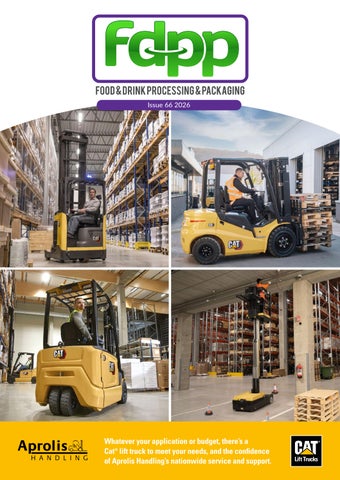
FOOD & DRINK PROCESSING & PACKAGING Issue 66 2026
Whatever your application or budget, there’s a Cat® lift truck to meet your needs, and the confidence of Aprolis Handling’s nationwide service and support.
SAFETY SYSTEMS & SOLUTIONS FOR THE PACKAGING INDUSTRY For your packaging operations, you need technologies that do more than protect people and machinery. Our industry-focused safety products help boost productivity, maximise machine availability, and keep production moving. From hygienic design requirements to dust explosion protection during the filling and packaging of bulk goods, our specialist systems are designed to support compliance, operational efficiency, and long-term reliability. Speak to our experts today to find out how we can help safeguard your packaging line while improving performance and reducing operational risk. Scan the QR code to download our latest packaging brochure.
Industries
Product Ranges
Services
• Packaging
• Command & signalling devices
• Machine safety services
• Food & Beverage
• Position detection
• Engineering & Integration
• Pharmaceutical
• Guard door monitoring
• Hygienic design solutions
• Hygiene
• Optoelectronic safety devices
• ATEX & dust protection
• Chemicals
• Safe signal processing
• Service & maintenance
SCHMERSAL | Sparrowhawk Close Malvern, Worcestershire, WR14 1GL
www.schmersal.co.uk uksupport@schmersal.com
Contents
Features The Team Editor Amanda Buckingham editor@fdpp.co.uk
Digital Sales Manager Jessica Bennett T: 01227 936971
Business Manager Josh Holmes josh@mhmagazine.co.uk
Sales Manager Jamie Bullock jamie@mhmagazine.co.uk Tel: 01227 936971
Publishing Director Martin Holmes martin@fdpp.co.uk
Studio Designer Leila Schmitz leila@mhmagazine.co.uk
M H Media Global Ltd.
18/20 Newington Road, Ramsgate Kent, CT12 6EE
Tel 01304 806039
www.fdpp.co.uk
All web addresses are interactive, simply click the web address of your choice to view the company website. There is also a useful tool bar where you can search for a specific product. Please mention FDPP when responding to items in this issue.
Every effort is made to ensure the accuracy and reliability of material published in Food & Drink Process & Packaging however, the publishers accept no responsibility for the claims or opinions made by the contributors, manufacturers or advertisers. No part of the publication may be reproduced or transmitted in any form or by any means, mechanical, electronic (including printing), recording or stored in any information retrieval system without the prior written consent of the publisher.
< 12 TURNING WASTE INTO VALUE Smarter Waste Handling for Food Manufacturers.
< 20 HOW REUSABLE PACKAGING IS HELPING BUILD MORE RESILIENT FOOD SUPPLY CHAINS Rising operating costs, increasing automation, stricter regulations and the need for more reliable supply chains are prompting businesses to look beyond individual load carrier costs and consider their impact on overall operations.
< 42 WHY THE RIGHT EQUIPMENT ISN’T ALWAYS OFF THE SHELF For well over a century, Invicta has worked alongside food manufacturers, helping them overcome production challenges with practical equipment solutions designed around the way they work.
< 52 TAGS, LABELS AND SHORT RUNS SORTED From chiller cabinets to promotional bottle neckers, the OKI C651dn printer enables food and drink producers to print full-colour tags and labels on demand, cut to shape and personalised label by label.
< 70 THE PPMA SHOW® 2026 Dr Kevin Fong announced asfirst keynote speaker at The PPMA Show® 2026.
FDPP - www.fdpp.co.uk 3
Why vacuum selection matters in food factories Walk into any food factory and you will find dust. Flour around mixers, sugar near packing lines, crumbs under conveyors. Most is removed with an industrial vacuum cleaner, often chosen because it was available not because it was right. That matters. Food dust can be harmful to breathe in and many common products including sugar, cereals and flour are combustible. A poor choice of cleaning equipment does little to control that risk and can even make it worse. The starting point is simple: understand what you are picking up and where you are working. From there the specification of the vacuum system, the filtration and the tools can be matched to the actual hazard instead of guessed at. Engineering a machine for the job BVC – British Vacuum Cleaners – is built by Quirepace in Fareham and supplied as industrial vacuums to order. Rather than pushing a fixed
4 FDPP - www.fdpp.co.uk
catalogue, the company sizes and configures each machine for the job it will be doing.
and stop with the process. The aim is a vacuum that is part of the process design, not just another piece of mobile equipment.
M-Class and H-Class machines are used where dust is hazardous to health. Where there is a risk of an explosive atmosphere an ATEX rated unit is required. In many food plants both issues apply so a single machine may need certification for hazardous dust and explosive dust together. Primary filters can be supplied in a range of media including anti-static options. Hazardous dust machines use additional stages so that collected product stays in the bin and the discharge air is clean.
Tools, hoses and the people using them Performance at the nozzle can be as important as performance at the machine. Hoses that are too large for heavy material will not maintain enough conveying velocity. Hoses that are too small for bulky waste will block. BVC offers a range of hose sizes so the system can be set up for what is really being collected, whether that is dense product, light packaging waste or fine dust around machinery.
BVC Quirepace also designs application specific variants. Some units provide both vacuum and low pressure blown air to help dislodge stubborn deposits. Others are supplied with high level cleaning equipment for steelwork and services or are linked into production controls so they start
Floor tools are available in robust metal constructions with adjustable height. Inserts can be changed so the same body can be used with either brush strips or rubber lips. For bulk product, aeration tools help keep material moving in the airstream instead of bridging. Getting these details right makes daily cleaning quicker and less frustrating so operators are more likely to use a system that actually clears debris and hygiene standards benefit. When to look at Central Vacuum Cleaning Portable machines will always have a place because they are flexible and simple to move. On larger sites though, the number of machines and cable routes can grow to the point where they get in the way of production.
In that situation Central Vacuum Cleaning is worth serious consideration. A central plant, usually located in a service area, is connected to the factory by fixed pipework with connection points around the building so that operators can plug in a hose where dust and spillages occur. There is no machine to wheel across the factory and no trailing power leads. For the engineering team, maintenance and filter changes happen in one place instead of many. Performance is consistent at each outlet and the system can be designed into the wider dust control strategy.
Treat vacuum cleaning as part of the factory safety and hygiene system, not as an afterthought and the choice of equipment becomes clearer. Working with a specialist manufacturer makes it easier to match the solution to the real risks on site and to keep pace as production changes.
Looking beyond purchase price Industrial vacuum systems fill up with abrasive product, run in hot and cold environments and are often used every shift. If they fail, production, hygiene and audit readiness are all affected. For that reason whole life value usually matters more than lowest purchase price. BVC industrial vacuum cleaners are manufactured in the UK and supported by BVC Quirepace’s sales and engineering team, local service and spares and a five year parts warranty.
BVC Quirepace offers free on site demonstrations of BVC equipment at food factories in the UK. For more information or to discuss your site, contact Quirepace: T: 023 9260 3700 E: bvcsales@quirepace.co.uk W: www.quirepace.co.uk | www.bvc.co.uk Mention Food & Drink Processing & Packaging when you contact us and we will apply a 5% discount to your first order for BVC industrial vacuum equipment.
FDPP - www.fdpp.co.uk 5
Turning Energy Data into Better Factory Decisions Electricity • Gas • Water • Heat • Temperature • Environmental Data For food and drink manufacturers, reducing utility consumption is not simply about cutting energy bills. Better visibility of electricity, gas and water can reveal waste, highlight process inefficiencies and provide valuable information about how a factory is actually operating.
manufacturers need to understand consumption at a more granular level - by production line, process, department, building or individual piece of equipment.
The challenge is getting the right data, from the right places, in a format that people and other systems can use.
• Electricity - from incoming supplies to individual production lines and equipment
See Where Your Energy is Really Going A factory’s main electricity, gas or water meters only tell part of the story. To identify opportunities for improvement,
6 FDPP - www.fdpp.co.uk
monitoring thermal energy and operating conditions • Environmental measurements including temperature, humidity and other sensors
Elcomponent designs and installs metering and monitoring systems that provide this visibility across:
• Gas - monitoring consumption across processes and plant • Water - identifying usage, abnormal consumption and potential leakage • Heat and temperature -
Existing meters can often be incorporated, with additional metering installed only where required. Wireless, Wired - or Both Food manufacturing sites can be challenging environments for data collection. Production areas, plant rooms, chilled stores and large buildings do not always lend themselves to conventional cabling.
Elcomponent therefore uses a combination of LoRaWAN wireless technology and wired communications including Modbus, M-Bus and Ethernet, selecting the most appropriate technology for each application. The result is a practical system designed around the factory rather than forcing the factory to fit the monitoring system. From Data to Action Collecting data is only useful if it helps somebody make a better decision. Real-time and historical monitoring can help manufacturers: • Identify unnecessary out-of-hours consumption • Compare energy or water use between production lines • Detect leaks and abnormal consumption • Establish meaningful energy and water performance indicators • Verify whether efficiency projects have actually delivered savings • Improve carbon and sustainability reporting • Identify changes in consumption that may indicate operational or equipment issues
Combining utility consumption with production information makes the data even more valuable. Energy per tonne, water per batch or gas per unit produced can provide far greater insight than utility consumption viewed in isolation.
The Key Objective is:
Your Energy Data Doesn’t Have to Stay in an Energy System
Technology alone does not
Modern factories already generate large amounts of information through production, SCADA, ERP, maintenance and business intelligence systems. No one tool does everything, so it’s best to use the right system for the task but ensure data can be accessed, shared and utilized.
meter specification, installation,
Elcomponent can make metering and energy data available to these wider factory systems, allowing utility information to become part of the organisation’s overall operational data strategy.
commissioning, software,
Data can be shared through secure APIs and automated exports, enabling integration with third-party energy management platforms, ESG systems, billing applications, Microsoft Power BI or other factory and corporate systems.
Collect reliable data once, then make it available wherever the business can gain value from it. Metering Expertise from Survey to Ongoing Support
guarantee good data. Correct commissioning and ongoing system health are equally important. Elcomponent provides an endto-end service covering site surveys, system design, metering, installation, communications, integration and ongoing support. For food and drink manufacturers looking to reduce utility costs and improve operational efficiency, the starting point is straightforward: Contact Elcomponent today to discuss your monitoring requirements. Tel: 01279 503173 Web: www.elcomponent.co.uk
Equally, data from existing metering systems and other sources can be brought together into a central monitoring environment.
FDPP - www.fdpp.co.uk 7
Equipment for Sale
AllSurplus – The Global Marketplace for Surplus Equipment. AllSurplus gives buyers access to quality surplus equipment from trusted seller organisations around the world, bringing greater choice, competitive prices and confidence to every purchase. From processing equipment and fillers, to baggers, cartoners, labellers, palletisers, tanks and more.
Discover a wide range of food, beverage and packaging equipment through our secure, transparent and efficient auction platform. With thousands of assets available across multiple sales worldwide at any one time, there’s always surplus equipment to discover, and an opportunity to save.
Visit our website today to see how AllSurplus can help you
www.AllSurplus.com
Find what your business needs. At auction. Find the equipment you need:
More control. More buyers. More value.
• Complete Lines & Plants
Looking to sell surplus equipment? Stay in control of your asset recovery with direct access to 4.8 million registered buyers worldwide.
• Processing Equipment • Tanks, Vessels & Silos • Packaging Equipment • Bottling Lines From individual machines to complete production lines, find the equipment you need at AllSurplus.
AllSurplus helps sellers reach true market value and maximise net returns through a multi-channel sales process, without transportation, inspection or hidden preparation fees.
From Compliance to Confidence: Why Continuous Environmental Monitoring Matters More Than Ever distribution environments. Easy to install and simple to operate, they provide accurate, dependable monitoring without disrupting dayto-day operations. The value extends beyond compliance alone. By building a detailed picture of environmental performance over time, manufacturers can identify recurring issues, optimise storage conditions, reduce product waste and support continuous improvement initiatives. Reliable monitoring data also strengthens supplier assurance, customer confidence and internal decisionFood and beverage manufacturers
quality, reduce shelf life,
making by replacing assumptions
have always operated under
compromise packaging
with measurable evidence.
rigorous quality and food safety
performance and increase the risk
standards. However, increasing
of spoilage or waste. Even relatively
As food manufacturing continues
regulatory scrutiny, evolving
small fluctuations can result in
to evolve, environmental
SPS requirements and greater
costly investigations, rejected
monitoring is becoming more
expectations around traceability are
batches or non-conformances
than a regulatory requirement. It
placing even greater emphasis on
during external audits, if left
is a practical tool for protecting
one thing: evidence.
undetected.
product quality, supporting
Whether demonstrating due
Continuous environmental
demonstrating due diligence across
diligence during an audit, protecting
monitoring provides the visibility
product quality or maintaining
the supply chain.
needed to identify these issues
customer confidence, manufacturers
before they become problems.
operational excellence and
are increasingly expected to
For more than 40 years, Tinytag by Gemini Data Loggers has helped
prove that critical environmental
Rather than relying on periodic
food and beverage manufacturers
conditions have been maintained
manual checks, automated data
turn environmental monitoring
throughout production, storage and
logging creates a continuous
into measurable control. By
distribution.
record of environmental
delivering reliable, audit-ready
conditions, helping manufacturers Temperature and humidity may
data, Tinytag supports compliance,
identify trends, respond quickly
appear to be simple measurements,
protects product quality and helps
to excursions and maintain
but they play a vital role in food
manufacturers build confidence
robust audit trails. This not only
safety and product consistency.
at every stage of the production
supports compliance with quality
Uncontrolled environmental
process.
management systems but also
conditions can affect product
provides confidence that processes
Because in today’s food industry,
remain under control.
good decisions begin with good data.
Tinytag data loggers are used throughout the food and beverage
For more information, please visit:
industry to monitor temperature
www.geminidataloggers.com/food-
and relative humidity across
and-drink
production areas, warehouses, cold storage facilities, laboratories and
10 FDPP - www.fdpp.co.uk
Sales@geminidataloggers.com
6˚c 8˚c
The Audit Starts
9˚c
Long Before The Auditor Arrives 4˚c
Continuous environmental monitoring helps food manufacturers capture the evidence needed to protect product quality, demonstrate due diligence and support compliance.
Explore environmental monitoring for food & drink production
9Continuous Monitoring - Detect issues before they become problems. 9Audit-Ready Records - Maintain detailed evidence of performance over time. 9Protect Product Quality - Strengthen supplier assurance and customer confidence. geminidataloggers.com/food-and-drink sales@geminidataloggers.com
+44 (0) 1243 813000
FROM COMPLIANCE TO CONFIDENCE FOR OVER 40 YEARS
BRITISH DESIGN & MANUFACTURE
Picture for illustration purposes only
Turning Waste into Value: Smarter Waste Handling for Food Manufacturers process reliability while freeing valuable production space. The benefits extend beyond operational efficiency. Automated waste handling can reduce disposal, labour and cleaning costs while supporting sustainability goals through fewer waste transport movements. Shredding can also improve the suitability of organic waste for resource recovery applications such as biogas production. For food and beverage manufacturers, reliable waste handling is increasingly becoming an important part of maintaining uptime and operational resilience. “Our goal is to transform a disruption-prone process into a In food manufacturing, organic waste is unavoidable. However, the way waste is managed can significantly affect efficiency, operating costs and overall plant performance. Every day, processors generate substantial quantities of peels, seeds and production leftovers. When handled manually, these materials can occupy valuable floor space, increase cleaning requirements and disrupt production workflows. A medium-sized vegetable processor in Austria experienced these challenges firsthand. Processing several tonnes of produce daily, the facility generated around 750kg of organic waste each day. Manual handling and storage requirements created ongoing operational inefficiencies. “Previously, our waste handling processes were a constant source of disruption to daily operations,” recalls a plant manager. “Space requirements, hygiene demands
12 FDPP - www.fdpp.co.uk
and manual handling continuously slowed us down.” Many manufacturers are now integrating waste handling directly into the production process. Rather than treating waste as a disposal problem, modern systems shred and homogenise organic materials, converting them into a pumpable suspension that can be conveyed automatically. “Many companies underestimate the extent to which waste streams affect overall operational performance,” says BerndGuntram Schulz, Product and Market Manager at SEEPEX. “When these streams are stabilised and controlled, the benefits can be seen across the entire operation.”
stable part of production,” says Schulz. “When waste handling operates reliably, companies are free to focus on their core business.” Suitable for applications ranging from fruit and vegetable processing to meat, fish, frozen foods and commercial kitchens, integrated waste processing solutions are helping manufacturers create more efficient, resilient and sustainable operations. As one plant manager concludes: “At the end of the day, it’s not just about disposing of waste – it’s about improving processes.”
The process creates a continuous, predictable material flow, helping manufacturers manage diverse waste types, from soft fruit residues to fibrous materials and larger organic solids. By reducing blockages and manual intervention, facilities can improve
Learn more: www.seepex.com
FROM WASTE TO EFFICIENCY FLOWSHRED
Your complete, shredding and conveying system to secure your food processes.
SEEPEX FlowShred brings efficiency and process reliability to the food processing industry. This advanced unit reliably handles fibrous, bulky or hard components, ensuring a controlled and stable conveying process every time. YOUR BENEFITS WITH FLOWSHRED y Uniform shredding ensures smooth material flow and prevents blockages y Snail geometry safely handles large, round or fibrous components y Seamless transfer to the PC pump enables uninterrupted conveying y Compact design reduces odors and simplifies cleaning y Reduced energy and maintenance costs
SEEPEX UK Ltd. sales.uk@seepex.com www.seepex.com
FDPP - www.fdpp.co.uk 13
Powerful and robust electrical components for modern industrial applications Power supplies for DIN rail or wall, UPS, EMC filters, etc. DUST, HUMIDITY, EXTREME TEMPERATURES, VIBRATIONS
PROTECTION CLASS GREATER IP68 Versions with permanently
FEAS GmbH specializes in electrical
molded connection cables make
components for demanding
it possible to increase the already
industrial use. Fully encapsulated in high-quality aluminum or polycarbonate housings, power supplies, UPS and other electrical modules are tropicalized and ideally protected for use even
high degree of protection from IP68 to IP69K in a few steps.
LARGE PRODUCT RANGE - MADE IN GERMANY FEAS GmbH, located near Hamburg, develops and manufactures its more than 800 different products entirely in Germany. Carefully tested, they meet all required international standards according to VDE, EN, UL and CSA. e.g. FEAS UPS family
under the most adverse conditions.
LDR80, LDR40, LDR30,
Neither high humidity, nor extreme
LDR20 buffer times up
dust or strong vibrations can affect
to 270min
the power electronics. The use of high-quality electronic components further increases operational reliability.
14 FDPP - www.fdpp.co.uk
“
Fully encapsulated in high-quality aluminum or polycarbonate housings, power supplies, UPS and other electrical modules are tropicalized and ideally protected for use even under the most adverse conditions.
POWER SUPPLIES • up to IP69K • with boost function or fuse mode • top hat rail or wall mounting • ASi power supplies • 19 inch rack • high temperature battery DC UPS • maintenance-free or with battery for long buffer times • with RS232/ RS485 interface • Mini UPS OTHER ELECTRICAL COMPONENTS • EMC filter • DC/DC converter • couplers • redundancy modules • motor motion controller • softstarter • rated value distributor FEAS GmbH An der Strusbek 56 22926 Ahrensburg, Germany +49 (0) 4102 - 420 82 www.feas.com
Top right, as an example of the wide range of FEAS power supplies: The switching mode power supply series SNT130-K, 12VDC, 24VDC or 48VDC up to IP69K, boost 150%, fuse mode, large setting range. Right, e.g. FEAS DC filters of the SFK38 and SFK70 series for the suppression of conducted interference.
FDPP - www.fdpp.co.uk 15
Enhancing Quality in Food and Beverage Production • In baking, flour size affects dough formation, structure, and crumb. • In coffee and tea, grind size governs extraction and taste. • Spice and seasoning producers depend on uniformity for even blending. • Powdered dairy products rely on correct sizing for solubility and flow. • Chocolate and confectionery require precise control to achieve a smooth finish.
Quality and consistency sit at the heart of every food and beverage brand. They shape reputation, build trust, and decide whether a product earns a place on the shelf. As the sector adapts to new ingredients, regulations, and consumer expectations, particle size analysis has become a core part of quality control and product development.
inspected to confirm accuracy before it leaves the factory.
Endecotts has specialised in this field for more than 80 years. Its equipment helps manufacturers monitor performance, meet compliance standards, and maintain the quality that customers expect, from laboratory testing to production.
Used to measure viscosity and flow rate in sauces, dressings, and spreads. These instruments help food producers maintain uniform texture and appearance across every batch.
Precision Tools for Every Stage Endecotts designs and builds instruments for one purpose: dependable, repeatable results. The company’s products are used across food and beverage production, including baking, dairy, beverages, confectionery, and other process industries. Test Sieves Made from high-grade stainless steel and supplied with Calibration Certificates to ISO 3310 or ASTM E11, Endecotts sieves provide full traceability. Each is measured and
16 FDPP - www.fdpp.co.uk
Sieve Shakers Electromagnetic drive systems automate the sieving process. They remove much of the variation found in manual testing and ensure consistent outcomes over long production runs. Consistometers
Sample Dividers Accurate sampling is vital for representative testing. Endecotts dividers ensure powders, grains, and other bulk materials are split precisely, giving reliable data for process control. Together, these instruments form a complete solution for measuring and managing particle size, from incoming ingredients through to the finished product. Why Particle Size Matters Particle size influences nearly every characteristic of a food or drink, be it flavour, texture, solubility, or stability.
• In beverages, sieving prevents sedimentation and ensures a consistent mouthfeel. Accurate particle analysis helps producers maintain these qualities, reduce waste, and keep every batch within specification. A Partner in Precision Manufacturing excellence depends on reliable measurement. Endecotts instruments support that aim by giving clear, repeatable results that stand up to scrutiny. Decades of engineering experience have shaped the company’s range, which continues to evolve with new materials and production techniques. Whether testing ingredients in a development lab or monitoring production in a busy factory, Endecotts equipment helps ensure every batch meets the same standard of quality and consistency. For more information or to speak with a specialist: www.endecotts.com sales@endecotts.com +44 (0)20 7487 5860
WHEN PARTICLE SIZE MATTERS ENDECOTTS delivers premium particle analysis equipment for the food and beverage industry. Our equipment is precision-engineered and EU-made for unbeatable quality.
Test Sieves
Consistometers
Sieve Shakers
Sample Dividers There are several trends in the food and beverage industry that are influencing the growing importance of advanced particle analysis, such as:
Health & Nutrition Focus Clean Label & Natural Products Plant-Based & Alternative Proteins Food Safety & Quality Assurance Sustainability & Waste Reduction
E: sales@endecotts.com WWW.ENDECOTTS.COM
W: https://www.endecotts.com
Hygienic AOD Pumps Transform Food Production How are sauces made in these modern production facilities? Sauces combine liquids and solids to add flavour, moisture, and texture. Modern production involves cleaning and blending ingredients like vinegar, sugar, and spices, then cooking the mixture to achieve consistency and kill bacteria. Adding a thickening agent cools the mixture into a gel; precise temperature control is essential to prevent curdling or failed thickening. What was our client’s problem? A major food manufacturer needed two fast, hygienic, and versatile pumps for sauce mixers. The solution met strict hygiene standards while keeping the highspeed production line running smoothly. Most of our pump projects involve large industrial sites with minimal hygiene requirements. Food manufacturing is the opposite— tight on space, highly manual, and demanding strict hygiene. These facilities are built for maximum efficiency in limited areas, with production equipment packed closely together. Cramped spaces This compact layout supports workflow and hygiene but also restricts movement and makes manual handling harder. Much of the hands-on work is done by skilled operatives, many of them women, reflecting traditional workforce patterns. Ergonomic design is therefore critical, equipment must be safe, easy to use, and accessible for everyone to maintain efficiency and protect wellbeing. A typical hygienic factory layout (taken from www.food-safety.com/ articles/6361-hygienic-zoning-infood-manufacturing-factories)
18 FDPP - www.fdpp.co.uk
The client needed new hygienic pumps for a cramped, expanding facility. The pumps transfer up to 800 kg of liquids like honey, oils, and chili paste to mixers within 20 minutes. Space constraints meant an IBC-mounted barrel pump was used, but its awkward position under a low gantry required moving the container before installing the pump. Why process plant cleaning is so important This was a demanding brief: two pumps had to be lightweight, easy to dismantle, handle a wide range of viscosities, and meet strict hygiene standards. Thorough cleaning isn’t just best practice— it’s legally required to prevent contamination and comply with FSA and FDA standards. With consumer awareness of food
safety high, hygienic production directly impacts reputation and competitiveness. Our specification After visiting the facility, we recommended pump technologies to simplify fluid transfer. The best option was an air-operated diaphragm pump, with two choices: 1. Foodboxer – hygienic, stainlesssteel internal parts, tri-clamp connections, FDA-approved elastomers. 2. Hygienix – fully drainable polished stainless steel with a <0.8 µm finish for maximum hygiene and easy cleaning. The client chose the Hygienix 100, a 1” hygienic air-operated diaphragm pump with a rotatable, fully drainable head and built-in stand for ground-level operation. It handles fluids with solids up to 5 mm at 100 L/min and 8 bar, with stainless-steel AISI 316 components and mostly triclamp connections for tool-free dismantling and cleaning. An air regulator allows operators to control transfer speed. If you need a proven, hardworking, cost-effective fluid transfer pump for use in a demanding environment, speak to North Ridge Pumps – we’ll be happy to help you.
We’re pump specialists, so you don’t need to be
Sanitary Pumps Engineered for Your Process Optimise performance with specialist support
Whether you’re dealing with clogging, separation, downtime, or other issue it’s costly. Time wasted troubleshooting and lower production mean missed targets and less profit. A sanitary pump is the solution but choosing the right one feels like stepping into a minefield. You know what you need it to do but with so many options, it’s difficult to know which is best for your process and parameters. + Accelerated stator wear + Clogging + Changes to fluid consistency + Clean-in-place and sterilise-in-place hygiene issues + Crushing of sensitive products + Inconsistency in finished product + Inaccurate transfer of flavourings or ingredients + Liquid separation + Seal wear or failure
EXAMPLE PRODUCTS: + Abrasive mixtures + Creams, milk & ice cream + Edible oils & fats + Fish & meat + Fruits eg. cooked apples, plums, berries, grapes
We’ve been engineering sanitary pumps for sectors such as distilling, brewing, food manufacturing/processing, and more, for 20+ years. We understand industry-specific processes and know what it takes to optimise performance through better-suited pump design - giving you complete peace of mind.
+ Grains & seeds
EXPERT GUIDANCE:
+ Sheer sensitive liquids
Our expert engineers understand your process and guide you through the options, so you can confidently select the most suitable sanitary pump.
+ Pastes & purees + Syrups, juices & alcohols + Vegetables & peelings + Waste eg. trimmings, packaging & offcuts + Solid laden or viscous mixtures
Want to optimise performance sooner? Speak to one of our specialists.
+44 (0) 1773 302 660
sales@northridgepumps.com | www.northridgepumps.com
FDPP - www.fdpp.co.uk 19
How Reusable Packaging Is Helping Build More Resilient Food Supply Chains “Companies are no longer solely looking on purchase price. They are looking at the total value that packaging delivers across their operations. When you factor in handling, product protection, operational efficiency and longterm costs, packaging has become critical infrastructure for efficient, reliable supply chains,” explains Richard Evans, Director of Sales Downstream, Tosca. Packaging Standardisation Drives Operational Performance One of the clearest ways pooling improves supply chain performance is through standardisation.
Across the food and beverage industry, packaging is undergoing a shift in status. Once viewed primarily as a procurement decision, packaging is increasingly being recognised as infrastructure that directly influences operational performance, resilience and sustainability.
This means looking beyond the initial investment and considering packaging’s wider impact on operations. From handling, hygiene and efficiency to product protection, transport performance, compliance and sustainability, packaging influences far more than cost alone.
Rising operating costs, increasing automation, stricter regulations and the need for more reliable supply chains are prompting businesses to look beyond individual load carrier costs and consider their impact on overall operations.
For food and beverage businesses, where product quality, availability and efficiency are critical, these factors can have a significant impact on overall performance. Packaging decisions influence how products move through manufacturing sites, distribution centres and retail environments, affecting everything from labour efficiency to waste reduction and service levels.
As a result, packaging is becoming a strategic part of supply chain infrastructure, and pooling is the model that is helping make it work at scale. Looking Beyond the Purchase Price As supply chains become more complex, companies are changing the way they evaluate packaging. Rather than comparing the purchase price of different load carriers, they are taking a broader view that considers Total Cost of Ownership (TCO) across the full lifecycle.
20 FDPP - www.fdpp.co.uk
In this context, reusable pooling systems offer a more predictable cost model while helping businesses improve efficiency over the long term. Rather than purchasing, storing and maintaining large volumes of pallets, crates or containers, organisations can access a managed network of reusable assets that supports changing business requirements.
Consistent dimensions, asset quality and specifications help reduce handling issues, improve operational efficiency and support safer working environments. This is becoming increasingly important as food and retail businesses automate more processes, from unloading and storage to picking and packing. Automated environments depend on packaging that performs reliably every time. Variations in size, weight or condition can increase stoppages, jams and downtime, while reusable plastic assets support smoother handling and reliable automated flows. The benefits are equally visible in retail operations. Reusable crates and pallets can improve shelf replenishment, reduce packaging waste on the shop floor and simplify storage in space-limited stores. When empty, collapsible crates can be folded and stored efficiently, reducing time handling packaging. Reusable plastic assets also support product protection and food safety. Durable plastic crates maintain their structure in temperaturevariable environments, helping protect fresh products and meeting food safety requirements.
Flexibility Through an Established Pooling Network While standardised assets improve day-to-day operations, the real strength of pooling lies in the network that supports them. Instead of owning, storing and managing large volumes of load carriers, companies can access the assets they need where and when they need them. This flexibility becomes particularly valuable during seasonal peaks. For food and beverage businesses, packaging availability can quickly become an operational challenge against changing production cycles, promotions and customer demand. Pooling helps address these by balancing demand across different industries and locations, enabling businesses to respond to changing requirements without investing in additional assets. Tosca’s pooling network supports this model by managing the collection, inspection, washing,
maintenance and redistribution of reusable assets, helping customers focus on their core operations while maintaining access to a consistent supply of high-quality load carriers. Supporting Compliance and Sustainability Goals Regulation is also accelerating the shift towards reusable systems. As Packaging and Packaging Waste Regulation (PPWR) and Extended Producer Responsibility (EPR) requirements increase pressure on companies to reduce waste and improve reusability, businesses are looking for practical ways to combine compliance with operational performance.
Building the Supply Chains of the Future As retail, manufacturing and logistics networks become increasingly interconnected, pooling systems are expected to become more deeply embedded within supply chain operations. Greater digitalisation, automation and asset visibility will help businesses improve control, efficiency and responsiveness across their packaging flows. With reusable plastic packaging, performance pooling and an established service network operating across Europe, Tosca
Reusable pooling systems help companies move beyond recycling-focused approaches towards more circular packaging models by keeping load carriers in circulation for repeated use. This allows organisations to integrate compliance and sustainability objectives into everyday operations – not as separate initiatives.
is helping customers make that transition, transforming packaging from a procurement purchase into a strategic operational asset that supports long-term supply chain performance. To find out more visit www.toscaltd.uk/contact
FDPP - www.fdpp.co.uk 21
Why Conveyor Reliability Is the Hidden Driver of Beverage Line Performance
Ask any production manager on a UK canning, bottling and PET line what keeps them up at night, and the answer is rarely the filler. It’s the unplanned stop that brings an entire operation to a halt during peak season, against a committed customer order, with no contingency in the schedule. Often, the root cause isn’t the headline capital equipment, it’s the conveyor system.
to €200,000 per hour for a highspeed beverage production line. This is nearly always entirely preventable as conveyor failures are rarely sudden.
Yet in the hierarchy of planned maintenance, they are routinely last in the queue. Scheduled shutdown days are consumed by the filler, the labeller, the assets that carry the greatest perceived risk. The conveyors run constantly in the background, left to carry on, until they can’t.
Regal Rexnord’s Premium Services Offering is designed to interrupt that cycle. At its core is a comprehensive on-site reliability survey, carried out during a planned shutdown by Regal Rexnord’s specialist engineers. Every conveyor asset on the line, chains, belts, sprockets and curves, are physically assessed for wear, damage and elongation, tagged with a QR code, and logged to a central database accessible via a dedicated customer portal or mobile app.
UK beverage producers routinely run at 99% of available production capacity, meaning a single unplanned stop has an immediate and disproportionate commercial impact. The average cost of one hour’s unplanned downtime across can, bottle and PET lines, can cost up
The output is a live, asset-level picture of the entire line, with each component assigned a status on a traffic light system: green for healthy, amber for monitored, red for action required. Rather than working from instinct or historical habit, engineers have an accurate
22 FDPP - www.fdpp.co.uk
baseline they can return to year on year, update as replacements are made and build a credible case for maintenance investment at budget time. A reliable assessment framework is only valuable if it can be acted on. For UK producers, that means having the right components available when the maintenance window arrives. Brewpack serves as Regal Rexnord’s dedicated UK supply partner, providing direct access to genuine replacement parts and components for canning, bottling and PET operations across the country. When a component moves from green to amber in the system and a shutdown window is approaching, Brewpack’s local availability ensures the plan holds. To find out more, contact Regal Rexnord and Brewpack today. Visit: www2.regalrexnord.com/ l/464072/2026-04-09/6f5hsm
Don’t wait for unexpected downtime PLAN TO PREVENT IT
Regal Rexnord’s Premium Services Offering delivers on-site reliability audits and condition assessments, giving your engineering and production teams the data to schedule maintenance around your line, not the other way around. A single conveyor fault can stop an entire canning, bottling or pet line.
Benefit from Regal Rexnord’s expertise on your site with our conveying solutions available direct from Brewpack across the UK. Visit:
Packaging performance, from production to dispatch become significant, making packaging an area worth reviewing alongside other production and operational processes. The key is to consider packaging as a connected system. The material, the way it is applied, and the equipment used to apply it all contribute to the overall result. Looking at these elements together can reveal opportunities that may not be apparent when packaging is considered product by product. This is where a packaging review can add real value.
For food and drink manufacturers, keeping production moving efficiently has never been more important. Rising costs, labour pressures and the need to maintain consistent output are placing greater focus on how every part of the operation performs. Packaging is an important part of that equation, yet it is often treated simply as a procurement requirement. Boxes, film, strapping and other materials need to be available, specified correctly and purchased at the right price. But the real impact of packaging extends much further than the cost of the material itself. How a product is packed can influence what happens further down the line. A packaging process that relies heavily on manual intervention can affect throughput, while an inconsistent application can compromise product protection or create variation between finished pallets. Equally, materials that are not correctly matched to the application can result in unnecessary usage without delivering any additional benefit.
24 FDPP - www.fdpp.co.uk
The opportunity, therefore, is not necessarily about finding a cheaper packaging material. It is about understanding whether the packaging operation itself is working as effectively as it could. That starts with looking at how packaging fits into the production process. A change in material specification may improve performance without increasing cost. A different packing method could remove a recurring constraint. In some applications, introducing machinery or automation can improve repeatability while allowing operators to focus their time elsewhere. These improvements do not always require major investment. Sometimes the biggest opportunities come from reviewing established processes that have simply become accepted as the way things are done. For high-volume food and drink operations, this can be particularly valuable. Small improvements repeated across thousands of products or pallets can quickly
At Hub Packaging, we work with food and drink businesses across Ireland to understand how their packaging operates within the wider production and distribution process. We look at the application, the materials being used and the processes behind them to identify practical opportunities for improvement, including where machinery or automation could deliver a better result. For 50 years, our role has been about more than supplying packaging products. It is about understanding the operation behind them and helping customers find solutions that work harder for their business. If you haven’t reviewed your packaging operation recently, now is a good time to start. Talk to Hub Packaging about your current materials, processes and equipment and discover where there may be opportunities to improve packaging performance. Contact sales@hub-packaging.com to start the conversation.
your partner in packaging
Packaging Performance, From Production to Dispatch Packaging plays a critical role in keeping food and drink products moving efficiently from the production line to customers. For 50 years, Hub Packaging has helped businesses improve their packaging operations through consumables, machinery, automation, and technical expertise. From optimising material usage and packing speeds to reducing damage and improving end-of-line efficiency, we help identify practical ways to make your packaging operation more efficient, consistent, and cost-effective. Let’s improve your packaging performance.
Talk to Hub Packaging: NI Office: Dublin Office: T: 028 4175 4977 T: 01 866 0136
@ sales@hub-packaging.com hub-packaging.com
Book Your Packaging
Review
Sustainability, Compliance and the Push Toward Cleaner Packaging Written by: David Griffin, Vice President, Global Sales and Products at Selig Group To find out more, visit Selig Group at PackExpo Chicago 2026, West Hall — W-42022 Producers are responding by cutting packaging weight and simplifying material choices, and mono-material formats are gaining traction as one of the more practical routes through the regulation. Complex laminates and mixed plastics draw the closest scrutiny, since most recycling facilities still can’t separate their layers into usable streams. Few of these changes come down to a simple swap. Most demand a rethink of the specification itself.
As sustainability and regulatory pressures reshape packaging decisions around the world, David Griffin, Vice President, Global Sales and Products at Selig Group, looks at what the latest developments mean for manufacturers and brand owners. While the EU’s Packaging and Packaging Waste Regulation (PPWR) is driving significant change in Europe, its influence extends well beyond the region. For US companies operating across international markets, supplying global brands and looking to future-proof packaging formats, European requirements have an obvious impact on research and development expectations around recyclability, material choices and chemical content. Packaging professionals arriving at PackExpo Chicago this year will find sustainability sitting behind almost every conversation on the show floor. Regulatory deadlines are colliding with material innovation, and brand owners are being asked to justify decisions that used to draw little scrutiny, down to components as small as a container liner.
26 FDPP - www.fdpp.co.uk
The PPWR deadline arrives Food contact packaging entering the EU market falls under the Packaging and Packaging Waste Regulation (PPWR, Regulation (EU) 2025/40) from 12 August 2026. The regulation requires mandatory recyclability by 2030, sets minimum recycled content thresholds for plastic packaging, and introduces packaging reduction requirements across categories which have been unexamined for a long time. The average European generated 178kg of packaging waste in 2023, and that figure could rise a further 19% by 2030 against 2018 levels without intervention, according to the European Commission. US producers are watching a comparable trend. The Environmental Protection Agency’s most recent full dataset, from 2018, puts containers and packaging at 82.2 million tons or 228kg per person – more than a quarter of all municipal solid waste generated that year. Whether a company sells into Europe, North America or both, packaging waste has moved from a compliance footnote to a live commercial issue.
Producers are responding by cutting packaging weight and simplifying material choices, with mono-material formats gaining traction as one practical route towards greater recyclability. This is not solely a European consideration: in the US, the Environmental Protection Agency (EPA) has highlighted complex packaging as a source of contamination in material recovery facilities, reflecting wider challenges around the ability of existing recycling infrastructure to handle today’s increasingly complex waste streams. Few of these changes come down to a simple material swap; most demand a rethink of the specification itself. Tackling PFAS and total fluorine testing Alongside recyclability, the PPWR introduces strict restrictions on PFAS, the so-called forever chemicals long used in food packaging for their resistance to grease, oil and water. The regulation sets thresholds of 50 parts per billion (ppb) for any individual PFAS measured via targeted analysis, 250 ppb for the total sum of PFAS, and 50 parts per million (ppm) when polymeric PFAS are included in broader screening methods.
Meeting these thresholds is proving more complicated than it first appears. The PPWR relies heavily on total fluorine (TF) testing as its primary screening method, but TF testing cannot distinguish between different types of PFAS, nor can it reveal whether a substance is polymeric and largely inert or mobile and capable of migrating into food. A packaging format containing trace levels of stable fluoropolymers could fail a TF test, while a format with lower but more mobile PFAS levels might pass. The 50 ppm threshold for individual PFAS also sits close to the edge of what current testing methods can reliably quantify given the complexity of different packaging materials. Many manufacturers are now combining total fluorine screening with more detailed targeted PFAS analysis wherever elevated readings appear, giving a fuller picture of migration risk and compliance. Selig has been expanding its liner and foam portfolio to include options where PFAS are not intentionally added, and its technical teams are working with customers to manage material changeovers without disrupting production.
Liners, PCR content and the sustainability push Liners and other minor components have a bigger role in compliance than their size suggests. They support a clean recycling stream, help brand owners meet lightweighting goals and maintain the durability containers need in transport and on shelf. Selig recently completed the world’s first successful pilot of an aluminium-free induction liner, which delivers the same sealing performance as existing induction heat seal liners while remaining recyclable in curbside recycling schemes. The liner has been trialed with PET containers and is now being tested with PE containers and dispensing and child-resistant closures. Beyond helping brand owners meet non-recyclable packaging material targets, it allows cap manufacturers to divert skeleton waste to recycling streams instead of landfill.
heat seal liner uses a heat seal film made from 70% PCR and a PET film with 90% PCR – these meet current FDA and EU food contact requirements. The functionality remains consistent with traditional liners, so producers can make the switch without reworking their production lines. As the deadline approaches and PFAS-free claims come under greater scrutiny, sustainability is a thread running through every material decision food and drink producers make. Selig will be discussing these challenges, and the solutions it’s developing to meet them, at PackExpo Chicago this year. For more information on Selig’s global capabilities and solutions, visit www.seliggroup.com
Post-consumer recycled content offers another route to the same goal. Selig’s foam-based liners contain up to 15% PCR by total weight, while our PCR induction
FDPP - www.fdpp.co.uk 27
Engineering Hygienic Ingredient Handling Since 1996
Celebrating its 30th anniversary this year, Trantec Solids Handling has spent three decades helping food manufacturers meter and dose dry ingredients more efficiently. Throughout that time, the company has continually refined its equipment to meet evolving food manufacturing requirements, including higher hygiene standards, greater traceability and changing food safety regulations. Innovation Driven By Industry Challenges As food manufacturing has evolved, the priorities of manufacturers have extended beyond reliable powder handling to include faster product changeovers, enhanced hygiene and increasingly precise ingredient control. Trantec’s product development has been driven by these changing requirements. This customer-led approach has shaped Trantec’s screw feeders, including the QR-TEC quickrelease range and Micro Dosing Feeders for ultra-low feed rates, alongside hygienic sack tip stations and flexible screw conveyor systems. Together, these solutions help food manufacturers reduce
28 FDPP - www.fdpp.co.uk
downtime, simplify cleaning and improve ingredient handling across applications ranging from flour and dairy powders to spices, flavourings and nutritional blends. From Material Behaviour To Equipment Design Successful powder delivery begins with understanding how materials behave. Flowability, bulk density and particle characteristics all influence equipment performance, making application knowledge just as important as mechanical design. To support this process, Trantec offers FREE material testing to assess material behaviour and identify the optimum equipment configuration before production. With material testing, equipment design and manufacturing carried out in-house, customers benefit from faster project turnaround, shorter lead times and equipment tailored to their individual process requirements. Close collaboration between design, machining and fabrication teams allows design refinements to be made quickly, helping ensure equipment performs reliably once installed.
Engineering With Purpose For Managing Director Gareth Harrison, innovation has always started with understanding customer requirements: “Every improvement we’ve made over the past 30 years has started with understanding the challenges our customers face. By listening to their requirements, we’ve been able to develop practical solutions that solve real production problems.” Thirty years of working alongside food manufacturers has shown that lasting innovation comes from continually responding to changing industry requirements. By refining its equipment, strengthening its manufacturing capability and applying decades of engineering expertise, Trantec continues to develop hygienic metering and dosing equipment that helps manufacturers improve efficiency, protect product quality and meet the evolving demands of food production. To find out more about Trantec’s powder handling solutions, visit www.trantec.net or contact their engineering team at sales@trantec.net.
▸ Accurate & Consistent Feeding ▸ Tool-free disassembly in minutes ▸ Versatile Material Handling ▸ Hygienic Compliant ▸ Rapid Cleaning & Maintenance
Watch Rapid Strip-Down In Action! Scan to watch
Trusted by Food and Pharmaceutical Sectors Since 1996 Trantec designs and manufactures all our screw feeders in-house at its Lancashire facility ensuring quality, consistency and confidence in performance. Delivering bespoke and standard material handling solutions to pharmaceutical, food, environmental and research sectors worldwide, backed by 30 years of bulk solids handling expertise.
Book Your FREE Material Testing
Trial your product in one of our feeders and achieve optimised performance from day one! +44 (0)1282 777 566
sales@trantec.net
www.trantec.net
FDPP - www.fdpp.co.uk 29
Hygiene-First Chain - the smartest link in your line
With contamination control and
corrosion resistance means it can
uptime pressures intensifying
withstand repeated wash-down
across the food and drink sector,
without compromise.
manufacturers should re-examine a component often taken for
The new Blue Polymer Chain range
granted: the conveyor chain.
incorporates high visibility blue for food contact components.
Conveyor Chain runs through
Engineered for the Food and
the heart of production lines so
Drink and Healthcare sectors, it
chain that traps foreign matter,
combines the hygiene credentials
relies on external lubrication,
manufacturers need with visual
or fails prematurely is a costly
assurance for auditors.
liability in terms of maintenance, replacement, and downtime. Built for wash-down environments Manufactured in food-grade engineering plastic, Donghua’s Polymer Conveyor Chain is lube-
Food industry chain range Donghua’s food industry chain range extends to: • Roller Chain compatible with leading OEM machinery;
free by design, removing the risk of
• Attachment Chain which
lubricant contamination and the
replaces 99 per cent of other
cost of re-application. With fewer
manufacturers’ chain;
moving parts and no roller to wear down, it needs less maintenance
• Maintenance-free Drytec stainless
over its working life, and its
steel chain with plastic sleeves;
30 FDPP - www.fdpp.co.uk
Every chain is matched to close tolerances before it leaves the UK factory, cutting the fatigue failures from poorly fitted attachments. The combination of engineering knowledge and UK-based technical support, backed by a 25,000 sq ft warehouse and testing laboratory, plus a nationwide network of Approved Product Partners and Stockists, has made Donghua the chain of choice for many food producers. Often hidden from view, chain plays a central role in maintaining line efficiency. By combining application-specific design, high manufacturing standards, and technical support, Donghua Limited is delivering the operational resilience that modern food manufacturing and packaging operations demand. To discuss your Food Processing Chain requirements, call 01902 866200.
Food Industry Chain Unmatched Performance & Reliability Available in a variety of materials and finishes, Donghua Chain is engineered for excellence. Featuring H1 food-grade lubrication to ensure safety and compliance. Extended Working Life: Built to last, minimising the need for frequent replacements. Reduced Maintenance Downtime: Designed for efficiency, allowing you to focus on production.
Trusted by top food equipment manufacturers, including:
Baker Perkins, Bradman Lake, Ishida, Johnson, Krones, Meurer, Panamat, Rademaker and Raque
Elevate Your Food Production Today! Tel: 01902 866200 donghua.co.uk/food-industry Donghua Limited Sidings Close Wednesfield Way Wolverhampton West Midlands WV11 3DR
FDPP - www.fdpp.co.uk 31
PhoenixTM ‘Thru-process’ Optical Profiling ..…..Seeing is believing! PhoenixTM has complemented its existing range of ‘Thru-process’ temperature profiling systems with the exciting innovative new “Optic system” for use in continuous cook / bakery ovens. The unique system allows for the process engineers and food technologists to view the inner workings of the oven under normal production conditions. Travelling through the oven, with the products the Optic system gives a product’s eye view of the entire cook or bake process. The unique Optic thermal barrier has been designed to provide thermal protection for both 4K highdefinition video camera and high temperature torch, providing an
already highlighted by running the
independent light source to ensure
PhoenixTM temperature profile
picture quality and definition. The
system, can be identified accurately
torch is essential for non-illuminated
and efficiently.
lines but where gas burners are used it may be beneficial to run without
Oven structural damage or faulty
the torch. In the dark clear detection
oven furniture such as recirculating
of flame formation patterns from
fans, control thermocouples or
the ribbon burners, is possible, to
heater elements / ribbon burners
guarantee uniformity of heating
can be detected. Buildup of
characteristics. The thermal barrier
unwanted dirt or condensate can
is constructed in food grade 316
be monitored allowing accurate
stainless steel and is IP65 rated
service and clean down schedules
to seal from moisture within the
to be planned to prevent future
cook environment. The resulting
unplanned costly line stoppages.
video “Optical Oven Profile” shows
Problems with conveyor systems
process engineers details of how
and erratic movement of products
their process is operating without the need to stop, cool and dismantle the oven. This allows safe routine oven inspection without the problems of costly lost production and days of oven down time. The design of the thermal barrier allows easy operation either forward or reverse facing to give a totally comprehensive view / perspective of the oven operation. From the video evidence the root cause of process problems, possibly
32 FDPP - www.fdpp.co.uk
through the oven can be identified at the exact location they occur. By monitoring the product directly, the bake characteristics of the product including shape and size changes and colour generation can be monitored through the whole bake.
Oven inspection • Damage to internal oven chamber / insulation. • Identify product transfer or mesh belt conveyor issues. • Discover bake debris build up on oven roof creating a contamination risk. • Discover faulty oven components (fans, ducts, control thermocouples etc). • Check ribbon burner flame characteristics are consistent. Product inspection
Contact PhoenixTM to help Find, Fix and Forget your Oven Cook Problems! Further Information www.phoenixtm.com
• Product size, form and shape changes during bake. • Product colour formation through oven.
Efficient HACCP Cook & Chill CCP Validation
! s t n u o c e c n ie r e p x Where e
Product Safety Process Efficiency Improved Product Yields Rapid Fault Finding Full HACCP Certification
ü
Thru-process temperature monitoring solutions for all your cook applications
PhoenixTM Technology • Accurate IP67 data logger (Type K or T) • 10 Measurement Points for full oven mapping • Thermal barrier options to suit cook regime • Comprehensive thermocouple range • Standard miniature thermocouple plugs • Calibrated thermocouple options • Food trays and thermocouple jig options • Full lethality (Fo/Pu) and reporting • Real Time RF Telemetry options • Local efficient calibration and service support
Phoenix Temperature Measurement 25 Earith Business Park, Meadow Drove, Earith, Cambridgeshire PE28 3QF, UK
T: 01353 223100 E: sales@phoenixtm.com
www.phoenixtm.com
Flexible Screw Conveyor with Trough Hopper
This Flexicon® flexible screw conveyor with trough hopper can receive material from multiple outlets of feeders, grinders, blenders, bulk bag dischargers, or any process equipment with a wide-style discharge.
This Flexicon® flexible screw conveyor with trough hopper can receive material from multiple outlets of feeders, grinders, blenders, bulk bag dischargers, or any process equipment with a wide-style discharge. Measuring 108 in. (275 cm) in length, the hopper’s low (36 in/92cm) profile enables it to be positioned beneath the discharge point of most vessels. The hopper’s bottom features a U-shaped channel that exposes the flexible screw for the entire length of the vessel, allowing material entering the hopper at any point to charge the conveyor. The hopper is equipped with a stainless-steel grate for worker safety and to prevent oversized particles from entering the conveyor.
34 FDPP - www.fdpp.co.uk
The hopper walls are equipped with ports designed for the optional installation of level sensors. These sensors enable real-time monitoring of material levels within the hopper and transmit signals to address critical issues such as overflow or conveyor starvation, ensuring efficient and uninterrupted operation.
or minimize degradation. Material exits the conveyor below the drive point, precluding contact with bearings or seals. Quick-disconnect clamps near the drive point and a cleanout cap at the opposite end of the conveyor allow for easy removal and cleanout of the flexible screw during material changeovers.
The rugged inner screw is the only moving part contacting material and is offered in numerous designs to handle both free- and nonfree-flowing materials, including products that pack, cake, or smear, with no separation of blends. As it rotates, the flexible screw selfcenters within the tube, providing ample clearance between the screw and tube wall to eliminate
www.flexicon.com
Reducing downtime through effective moisture management by Dan Anjos, Business Development Manager, Hyroic Systems Residual moisture on high-speed packaging lines may seem insignificant, but it can have a major impact on production efficiency. Even small amounts of water left on cans or bottles after rinsing can interfere with sensors and vision systems, causing false rejects when compliant products fail inspection. Unnecessary rejects reduce overall equipment effectiveness; increasing waste, disrupting production and false results for KPIs. As manufacturers work to improve throughput while maintaining strict quality standards, preventing avoidable stoppages is becoming increasingly important. The challenge is growing as packaging lines become faster and more sophisticated. Lightweight cans, containers, intricate labelling and high-precision inspection systems leave little room for moisturerelated inconsistencies. Water droplets can distort camera images, leading to inaccurate inspection results.
To minimise these issues, many manufacturers are introducing targeted drying systems at key stages of the packaging process, particularly before coding, labelling and inspection. Removing residual moisture before products reach vision equipment helps create more stable inspection conditions and reduces false rejects. Air Control Industries (ACI) has developed its Hyroic drying platform to support these applications. Designed for packaging environments, the modular system uses electric blower technology to deliver focused airflow while reducing the energy
use and maintenance often associated with compressed-air systems. As production lines continue to demand higher efficiency and greater quality assurance, effective moisture management is becoming an essential part of reliable packaging operations. By reducing false rejects and improving inspection accuracy, manufacturers can increase productivity while supporting waste reduction and more consistent production. Find out more about drying solutions for beverage can production at www.hyroicsystems.com
FDPP - www.fdpp.co.uk 35
From Enquiry to Installation: Creating the Right Heat Exchanger for your Business What does it take to design and build a reliable, efficient tubular heat exchanger? In this article, we reveal how HRS Heat Exchangers’ team of engineers, designers, electricians and project managers turn an initial enquiry into a finished, bespoke product, perfectly suited to their client’s needs.
Detailed quality systems ensure inspections are carried out at every stage, including welding
a good technical understanding of the equipment they require, or may instead be a new business with minimal experience and a material that they need to heat, cool or process thermally. One thing that new clients may not always realise is that every single HRS project is completely bespoke and designed from the outset to offer the optimum solution to meet the client’s requirements.
HRS Operations Director Marcos Antonio Alarcón González
From initial enquiry Most projects begin with an initial enquiry. This may come from an existing or past client, perhaps with
36 FDPP - www.fdpp.co.uk
Once a project manager has been assigned, they work with the client to fully specify the project and, if necessary, analyse the product/s being handled to understand how they will behave under different physical, environmental and thermal conditions and may include trials
using our equipment at the nearby National Technological Centre for the Food and Canning Industry (CTNC). This is a vital step which ensures that important product quality parameters are maintained, and that thermal processing is carried out effectively. The project manager is ultimately responsible for everything involving that order, including budget and delivery, timescales and testing, providing consistency to the client throughout the process. State-of-the art thermodynamic modelling and design systems are then used to design the system, usually starting from an established type of tubular or scraped surface heat exchanger (for example, the AS Series of annular tube heat
Complete customisation
Detailed quality systems ensure inspections are carried out at every stage
exchangers or the Unicus Series of reciprocating scraped surface heat exchangers) or one of HRS’s dedicated thermal processing systems. This design considers parameters such as the service temperature, available space, and required thermal change and duration. The exact configuration, including ancillaries such as pipework, pumps, holding tanks, etc. are also determined. At this point, any specific requirements in terms of component choice or interface are also incorporated.
“Even when based around one of HRS’s standard heat exchanger types, aspects such as size, heat transfer, pressure drop, orientation and more will be carefully calculated for each individual job, meaning no two units are ever the same,” explains Matt Hale, Global Key Account Director at HRS Heat Exchangers. “There are numerous benefits for our clients from this kind of approach. Not least, the fact that they aren’t paying for features they haven’t specified or don’t need. It also means they get a solution which is designed to fit into their existing lines in terms of both physical size and connections. Clients shouldn’t have to adapt their equipment or processes beyond what is normally expected to facilitate the installation of a new system.” “Each customer can recommend, or directly ask for, a particular brand of component or certain materials,” adds HRS Operations Director Marcos Antonio Alarcón González. “As a manufacturer, this can create headaches, but it is also one of our major selling points. Nearly every order is different to what we have
done before, and these challenges and the need for creativity are what our engineers thrive on. “For example, if a client needs to pasteurise 8,000 kg of product per hour, we will supply them with a unit to do just that. Not one unit to pasteurise 10,000 kg or two 5,000 kg units, just because they happen to be what we manufacture. Instead, we adapt our designs to each client, even splitting and interconnecting modules in different locations if necessary.” Manufacturing and delivery This flexible approach also means that delivery times are often shorter than the industry standard, thanks to forward planning by the design and procurement teams for the sourcing of external components, such as pumps and control systems. “We try to overcome delays with third-party suppliers by preordering components so we can meet our overall target timescales for a project,” explains Marcos. “Once the design drawings are
State-of-the art thermodynamic modelling and design systems are used to design the system
FDPP - www.fdpp.co.uk 37
complete, we produce a materials list, which goes to the purchase department who buy all the components necessary, which are then delivered directly to the workshop with the drawings ready for manufacturing.” In the factory, detailed quality systems ensure inspections are carried out at every stage, from selecting the correct materials and producing the corrugated tube profiles that are responsible for the high efficiency of HRS’s heat exchangers, through to the inspection of welds, electronics and pressure testing. “Once the final unit has been assembled and tested, then we move to the delivery phase,” adds Matt. “Where necessary, smart technology and remote connections allow processes such as design sign-off, Factory Acceptance Testing (FAT) and even commissioning to be managed remotely, saving time, money and carbon emissions. Of course, there are situations when
an in-person visit is necessary, and our experienced team are used to working across a wide range of business environments around the world.” Units are carefully dismantled for shipping and delivery before being reassembled and installed on site. Some clients prefer to use their own engineers for installation and commissioning, and in some cases the HRS equipment is supplied as part of a larger project delivered by a subcontractor. Other clients may want a complete turnkey installation process. “Just as every heat exchanger or system we produce is bespoke to that situation, we apply the same approach to delivery, installation and testing,” continues Matt. “From providing advice on cleaning and maintenance, using telemetry or remote virtual inspection for snagging, or simply discussing ways to improve the operation and efficiency of our equipment and systems, the way we work on every
Just as every system is bespoke, so is the approach to delivery, installation and testing
38 FDPP - www.fdpp.co.uk
project is slightly different.” Even after the unit has been commissioned and any necessary training provided for operators and engineering staff, the involvement of HRS doesn’t end, and the company provides bespoke options for maintenance and servicing depending on the level of support required by the client. “Ultimately, our aim is to give the client the exact solution for their processing challenge, and that requires flexibility in our approach, creativity in our design, and strong project management skills,” says Matt. “If you’re looking for an outside-the-box solution, then we look forward to hearing from you.” www.hrs-heatexchangers.com
Matt Hale, Global Key Account Director at HRS Heat Exchangers
Low shear, Energy efficient Improve process efficiency and minimise total cost of ownership with the Certa pump. Contact our experts wmfts.com | info.uk@wmfts.com +44 1326 536 800
Visit us at PPMA Birmingham, 22 – 24 September, Stand G12
T-Mark helps AAK Foods Streamline Product Marking
T-Mark has been called in to help sauce and condiment manufacturer, AAK Foods, improve product traceability by printing direct onto their product packaging. Its low-maintenance thermal inkjet (TIJ) printers are being considered due to their reliability and low maintenance costs. AAK Foods, whose customers include a range of high-street retailers and wholesalers, as well as independent restaurants and global fast-food chains, currently uses a mixture of labelling and direct product printing to mark its products with date and batch codes. The company bought a Sojet Elfin E1S TIJ printer after meeting T-Mark at the PPMA Show in 2022 The E1S printer was chosen by AAK Foods to supersede a Continuous Inkjet (CIJ) printer, which they found unreliable and expensive to keep regularly serviced. The TIJ printer’s zero maintenance
40 FDPP - www.fdpp.co.uk
requirements made it an attractive replacement option. Head of Engineering, Neil Heselwood, said at the time, “The Sojet has incurred zero line downtime in 18 months, the only maintenance is a wipe of the head and replacement ink cartridges. So, the fact that the printer costs less to purchase than a service pack used in a (continuous) inkjet coder is remarkable.”
well as on to a variety of product bottle and tub lids. The Sojet TIJ machines are modular and can be easily adjusted to accommodate vertical or horizontal printing, different line speeds and lids with lips or shallow recesses. Neil Heselwood says, “We have worked closely with T-Mark in the past and have found their equipment, service and expertise to be excellent and so they were
It comes as little surprise, then, that AAK Foods is looking at more TIJ printers to help with improving product traceability. The company manufactures food products for a variety of retailers, each of whom requires their own bespoke label, which needs batch codes and BBE info adding separately. By printing this information directly onto the product, AAK Foods can improve production efficiency and cut costs. They are exploring options to mark on the necks of plastic bottles as
at the top of our list to work with on this project. This equipment needed to be easy to use, low maintenance, reliable, cost effective and compatible with our Auto Coding Systems.” Sojet has introduced a new model to replace the Elfin. Its Moli range of printers includes the MoEco2000, which can use 2 x 12.5mm printheads to print up to 25mm high or 12.5mm on both sides of a product. www.t-mark.co.uk 0330 153 8320
Improve efficiency with inkjet printing Cut costs Improve recyclability Include real-time data Inks for porous and non-porous materials UV curing ink option
www.t-mark.co.uk | sales@t-mark.co.uk 0330 153 8320
FDPP - www.fdpp.co.uk 41
Why The Right Equipment Isn’t Always Off The Shelf For well over a century, Invicta has worked alongside food manufacturers, helping them overcome production challenges with practical equipment solutions designed around the way they work. When investing in new equipment, it’s natural to consider standard products first. They are often the quickest, most readily available and most cost-effective option – and in many situations, they provide exactly what’s needed. However, where production processes, available space or handling requirements are more specialised, a bespoke solution can often deliver greater long-term value. Rather than trying to make your operation adapt to standard equipment, bespoke solutions are designed around the way your business works. Whether it’s custom bakeware, stainless steel furniture or handling equipment, the right design can improve workflow, make better use of available space, reduce manual handling and increase production efficiency.
Manna Bakery in Harrogate is one example. Invicta designed bespoke workstations tailored to the company’s specific requirements, incorporating solid wooden tops for bread moulding and integrated tray storage. The result was a workspace designed around the way the business operates, that ultimately improved workflow and efficiency.
but continues to deliver value as production evolves. Ultimately, the right equipment isn’t always off the shelf – it’s the solution that best fits your operation.
The same principle applies as businesses grow. Award-winning Four Anjels Artisan Bakery has combined a wide range of standard products with bespoke weighing benches, sorting tables, draining units and stainless steel workstations, creating an efficient production environment that has evolved alongside the business. At Invicta, bespoke doesn’t always mean starting with a blank sheet of paper. Many projects begin with a standard product before being adapted to satisfy exact requirements. By working closely with customers to understand how they operate, the company helps businesses invest in equipment that not only meets today’s needs
For more information and free no-obligation quotations, visit www.invictabakeware.co.uk call: 01751 473483 or email: sales@invictabakeware.co.uk Michael Newby of Manna Bakery, Harrogate. Invicta designed and manufactured bespoke workstations tailored to the company’s specific production requirements, helping maximise available space and improve workflow.
42 FDPP - www.fdpp.co.uk
Adelphi’s Response Helps Jinger Drinks Scale Production as Demand Soars Manchester-based holistic health drinks manufacturer Jinger Drinks has increased production and improved efficiency with the help of Adelphi’s Response Benchtop Filler, enabling the fast-growing company to keep pace with rising demand while reducing waste and freeing up staff for other areas of the business. Since installing the Response in September 2025, Jinger Drinks has streamlined what was previously a labour-intensive process, with the compact filler able to accurately fill containers from 4ml to 1l at a speed of up to 40 containers per minute. Previously, three employees were needed to fill, cap, tighten and label the bottles by hand, with these staff members now redeployed elsewhere in the business. Founded in Manchester in 2022, family-run business Jinger Drinks was born when its CEO, Alya, began
44 FDPP - www.fdpp.co.uk
researching natural ways to help with joint pain and arthritis. After developing a range of pressed organic ginger wellness recipes, Alya began selling the drinks at local markets, where demand grew quickly, with products regularly selling out. With the company doubling in size each year, the success of the wellness tonics soon led Alya’s son, Nial, to join the business as director, followed by his brothers, helping transform what began in a family kitchen into a rapidly growing nationwide wellness brand.
takes pride in sourcing only the finest organic ingredients.
Dedicated to promoting holistic health through natural and organic ingredients, Jinger Drinks produces a range of wellness tonics designed to support immune health, joint pain, arthritis and inflammation, alongside acid reflux, indigestion and heartburn. Committed to organic excellence, Jinger Drinks
“We are delighted that with Adelphi’s Response’ help, we have been able to increase our productivity to meet soaring demand. The Response saves us both time and money and has had a massive positive impact on the business. It is reliable, we only need one person to operate it,
As demand increased, Jinger Drinks needed a faster, more efficient filling solution to support production growth without compromising on quality or increasing waste. Adelphi’s Response Benchtop Filler has enabled the company to significantly improve productivity, while also allowing staff previously dedicated to hand filling, capping and tightening bottles to support other areas of the business.
and it improves consistency since it fills the same amount each time, so there is no waste. We’re already thinking about what we can buy from Adelphi next to help support our continued growth,” said Nial. Designed to deliver fast, hygienic, accurate and repeatable filling, the compact Adelphi Response Benchtop Filler liquid and cream filling machine can help manufacturers reduce product waste and improve process efficiency for small-batch food and drink production, as well as laboratory production environments. Suitable for liquids, oils, gels, creams, pastes and products containing particulates, the versatile system can fill bottles, jars, tubes, vials, pots and similar containers.
Food and drink manufacturers will also be pleased that the Response can be cleaned rapidly and the machine fully strips down in as little as three minutes, significantly reducing downtime between product changes and supporting high hygiene standards.
For further information, telephone: +44 (0) 1444 472 300 or visit www.adelphi.uk.com
Designed for growing businesses, the Response is available with one or two filling heads and can operate as a semi-automatic system or be upgraded for greater automation as production demand increases. As Jinger Drinks continues to grow, supporting customers’ holistic health journey, Adelphi looks forward to continuing to support the company’s expansion, while helping other growing manufacturers scale production efficiently.
The Response also offers flexibility for manufacturers looking to scale production. There are four standard interchangeable pump sets allowing accurate filling across different volumes, to suit different container sizes and product types, while an electropolished finish improves hygiene and cleanability. With a compact and convenient design, the Response Benchtop Filler has a small benchtop footprint, ideal for facilities where space is limited, making it wellsuited for small batch production runs, start-ups, pilot plants, growing manufacturers and laboratories. A wide range of interchangeable nozzles are available to accommodate different product viscosities and container dimensions. These nozzle options include swage tip nozzles, cut-off nozzles with tip sealing and fullbore cut-off nozzles in multiple sizes, supporting clean, drip-free filling. There are also flexible product feed options where liquid products can be drawn directly from bulk containers via a suction hose and non-return valve. Meanwhile, thicker products, creams and pastes can be fed through a hopper system, again with multiple hopper sizes available to suit production requirements.
FDPP - www.fdpp.co.uk 45
Built on Expertise and Experience
In the food and drink industry, successful projects demand far more than construction expertise. They require a deep understanding of operational challenges, regulatory requirements, food safety, production processes, and the need to minimise disruption while delivering facilities that support long-term growth. This is where Clegg Food Projects has built its reputation by consistently delivering for over 3 decades.
delivery. With over 50% of its work
Clegg Food Projects has been delivering specialist construction solutions for the food and drink and manufacturing sector since the 1980s. The business has developed an unrivalled understanding of the industry’s unique requirements, working with leading household brands alongside own-label manufacturers across the UK and internationally.
a one-size-fits-all approach, Clegg
Experience matters, but so do relationships. Having successfully completed more than 350 projects, Clegg Food Projects has earned the trust of clients through a commitment to reliability, collaboration, and consistent
46 FDPP - www.fdpp.co.uk
coming from repeat business, the company’s long-standing partnerships speak volumes about the confidence clients place in its expertise. No two food manufacturing projects are the same. Every production facility has its own operational objectives, technical complexities, and commercial priorities. Rather than adopting Food Projects works closely with
expansion, refurbishment, or the construction of new production environments, clients benefit from guidance shaped by years of specialist experience. As food manufacturers continue to invest in automation, sustainability, and increased production capacity, selecting the right construction partner has never been more important. Success depends on working with specialists who understand not only how to build, but how food businesses operate.
each client to understand their business, production processes, and future ambitions before developing a tailored construction strategy. This collaborative approach extends beyond simply delivering against a project brief. The team is committed to adding value at every stage, drawing on decades of sector-specific knowledge to provide practical advice, identify efficiencies, and anticipate
Clegg Food Projects combines technical expertise with a personal, consultative approach, ensuring every project is delivered with precision, quality, and a clear focus on the client’s long-term success. Built on trust, strengthened by experience, and driven by lasting partnerships, the company continues to help food and drink manufacturers create facilities that support innovation, efficiency, and sustainable growth for years to come.
potential challenges before they arise. Whether supporting facility
www.cleggfoodprojects.co.uk
Experts in world-class food and drink construction projects Visit us on Stand D03 www.cleggfoodprojects.co.uk
Autopack Group’s Technosys helps leading pork scratchings producer rebuild production after fire The fire hit the customer in December 2025 and Technosys was chosen not only because of its expertise in automating packaging lines, but also the ability to project manage during a crisis with available in full electrical or electrical/pneumatic operation. Its robust construction and easy operation allow for increased efficiency and output whilst reducing costs and potential human error. This machine can produce a wide range of bag sizes from 50mm to 200m wide and 50mm to 300mm long in different pack styles and any heat sealable film. The machine is a stalwart of the production shop floor and Technosys believes it is the most cost-effective UK-made VFFS in the market, with a very low cost of ownership. Wayne added: “Partnerships with customers such as this are what we do – we always aim to go the extra mile and ensure we are with the customer every step of the way on all our projects.” Technosys – part of the Autopack Group – has helped a leading pork scratchings company to restart production following a devastating fire at its Midlands manufacturing facility. The business invested in three A200 vertical form, fill and seal (VFFS) machines, with Technosys providing the packaging engineering expertise and project support needed to get the first line up and running within weeks. The fire hit the customer in December 2025 and Technosys was chosen not only because of its expertise in automating packaging lines, but also the ability to project manage during a crisis. The first line was up and running in a few weeks, enabling the customer to kick-start their business. Producing pork scratchings, crackling and crunch in a variety of pack sizes and flavours in FFS pillow
48 FDPP - www.fdpp.co.uk
packs style bags, the company also required lines capable of handling tubs. This made layout, integration and project management critical to the recovery process. “This was a challenging project that required speed, flexibility and close collaboration,” said Wayne Kedward, Managing Director of Autopack Group. “We worked closely with the customer to make sure everything from factory layout to services were ready, so the first line could be installed and running as quickly as possible. The available floorspace and height was tight, but we developed a bespoke bulk loading system, utilising every possible millimetre and delivered a great practical overall solution that was beyond what the customer was expecting” The A200 VFFS machine is a fully automatic intermittent
Based in Gainsborough, Technosys was acquired by the Autopack Group in 2025. Earlier this year the company expanded its factory as part of a £3 million investment plan across Autopack’s UK sites. www.technosyspes.co.uk
Thermal Imaging for Food Processing and Packaging From cooking and cooling to packaging and quality control, thermal imaging offers food manufacturers a fast, contact-free way to monitor temperature across products and processes. InfraTec’s VarioCAM® and ImageIR® thermal imaging cameras can reveal temperature distributions that conventional point sensors may miss, helping manufacturers identify process variations and maintain consistent product quality. For food processing, thermal imaging can be used to monitor heating and cooling processes, identify uneven temperature distributions and investigate potential production issues. The VarioCAM® HD head range offers high-resolution imaging and interchangeable lenses, making it adaptable to different inspection requirements. In packaging, InfraTec’s ImageIR® 6300 can be used with PEEL-SCAN to inspect seals on plastic food containers with metallic films. The system can detect tiny sealing defects producing temperature differences of just 20 mK, providing non-destructive quality control.
Thermal Imaging for Food Processing and Packaging Discuss your process or arrange a demonstration
Quantum Design UK and Ireland are the representatives for InfraTec in the UK and Ireland, providing access to its thermal imaging cameras, software and application expertise.
info@qd-uki.co.uk
See more at www.qd-uki.co.uk
HMA 2A
TX
FDB
High efficiency
Choice of operating fuels
Customised design to suit each install
Ideal for variable plant conditions
Reduced NO₂/CO Emissions
Proven in a wide range of applications
Larger heat input available on request
Air replacement or “Make-Up”
Choice of burner heat inputs up to 1150 kW
APL technology -modulating gas and air
Up to 30:1 turndown Up to 205 kW per foot
FDGA APL technology - modulating gas and air Ideal for variable plant conditions Heat input range up to 1,550 kW Choice of operating fuels
BESPOKE DESIGN
Our gas burner systems offer users reliable, high efficiency, process heating solutions. From design, manufacturing and supply to installation, commissioning and ongoing support, we fulfill process liquid, oven and air heating needs for both new-build and conversion projects.
FULL RANGE OF INTERNATIONAL ACCREDITATIONS
FDC Heat input range up to 1,550 kW Choice of operating fuels Packaged burner design Up to 40:1 turndown
BURNERCARE SERVICE
Lanemark Combustion Engineering Limited Lanemark House, Whitacre Road, Nuneaton Warwickshire CV11 6BW United Kingdom
info@lanemark.com +44 (0) 24 7635 2000
FDPP - www.fdpp.co.uk 49
10 Things to Consider When Specifying Pneumatic Cylinders for Washdown Areas Camozzi Automation UK has outlined ten key factors engineers, OEMs and distributors should consider when specifying pneumatic cylinders for washdown environments. Pneumatic cylinders used in washdown areas will be exposed to water, cleaning chemicals, detergents, temperature changes and high-pressure spray. These conditions can accelerate corrosion, damage seals and allow contamination to collect around the cylinder body, piston rod and mounting points. Selecting a cylinder based only on bore, stroke and mounting dimensions can therefore lead to premature failure, increased maintenance and unplanned downtime. Camozzi Automation UK recommends considering the following ten areas before selecting an ISO-profile pneumatic cylinder for a washdown application. 1. Understand the Washdown Process Washdown conditions vary considerably. Some machinery may
receive an occasional low-pressure rinse, while other equipment is cleaned daily using heated water, aggressive chemicals or highpressure jets. Engineers should establish the cleaning frequency, water pressure, temperature, spray direction, chemical concentration and expected contact time. 2. Assess Direct Exposure A cylinder protected behind guarding may require a different specification from one positioned directly within the wash zone. The level and direction of exposure should be considered alongside the possibility of splash, vapour and cleaning-fluid run-off. 3. Select the Correct Cylinder Construction A standard aluminium-profile ISO cylinder may be suitable for light, occasional or indirect exposure. For more demanding environments, corrosion-resistant versions featuring stainless-steel piston rods, treated fasteners, protective coatings or alternative scrapers may provide a better
balance between durability and cost. Camozzi Series 63 ISO 15552 cylinders are available in configurations developed for demanding conditions, including corrosion-resistant, hydrolytic, food and beverage, dirty and dusty, and polyurethane-coated versions. 4. Consider Whether Stainless Steel Is Required For intensive washdown or highly corrosive environments, a stainless-steel cylinder may be more appropriate. Camozzi Series 90 cylinders comply with ISO 15552 and feature AISI 316 stainless-steel construction. They are designed for applications requiring high corrosion resistance, including food, marine and offshore environments. However, “stainless steel” should not be treated as a complete specification. The precise grade and the materials used for the piston rod, fasteners and mountings should also be confirmed. 5. Review the Complete Assembly The service life of a pneumatic cylinder can be limited by its least resistant component. The cylinder body, piston rod, fasteners, brackets, sensors, fittings, tubing and accessories should therefore be assessed as one complete assembly. A stainless-steel cylinder fitted with standard plated-steel mounting hardware may still leave vulnerable points within the installation.
50 FDPP - www.fdpp.co.uk
6. Check Piston Rod Protection The piston rod is one of the most exposed and operationally important parts of a cylinder. Corrosion, scratching or contamination can damage the rod seal and allow contaminants to enter the actuator. Rod material, surface finish, direct spray exposure, scraper type and the risk of impact should all be considered. Protective bellows or scraper seals will provide additional protection in some environments. 7. Confirm Seal and Chemical Compatibility A seal material that performs effectively with water may not tolerate alkaline cleaners, acids, disinfectants or elevated wash temperatures. Chemical type, concentration, contact duration, operating temperature and cleaning frequency should be provided to the cylinder supplier so that the correct sealing arrangement can be selected. 8. Avoid Water and Contamination Traps Cylinder orientation and installation design can influence how effectively water drains away. Open profile grooves, exposed threads, recessed fasteners and poorly positioned pneumatic ports may retain water or cleaning residues. Unused grooves should be covered where practical, while tubing and fittings should be positioned to support drainage and effective cleaning. 9. Protect Sensors and Pneumatic Connections Sensors, cables, connectors, tubing and fittings must withstand the same washdown conditions as the cylinder. The environmental and chemical resistance of magnetic sensors, cable glands, valve plugs, pushin fittings and pneumatic tubing should all be confirmed.
10. Consider Maintenance and Failure Analysis The cylinder should be positioned so that it can be inspected, cleaned and replaced without unnecessary disruption. Where repeated failures occur, the underlying cause should be investigated rather than simply replacing the cylinder. Misalignment, side loading, unsuitable seals, poor air quality or chemical incompatibility may be contributing to the problem. ISO Compliance Is Only Part of the Specification ISO compliance confirms dimensional compatibility, but it does not guarantee identical materials, sealing systems or environmental performance. Specifying a reliable cylinder for a washdown area requires engineers to consider the complete operating environment, including construction materials, chemicals, seals, accessories, drainage and maintenance access. Camozzi Automation UK supports pneumatic component distributors, OEM engineers and plant automation teams with ISO-profile cylinders, stainlesssteel cylinders, mounting accessories, sensors, fittings and air-preparation equipment.
To discuss a washdown application or request technical support with pneumatic cylinder selection, contact Camozzi Automation UK. About Camozzi Automation Camozzi Automation, a member of the Camozzi Group, specialises in designing and realising products and solutions for industry. Camozzi Automation’s offering includes motion and fluid control components, systems and technologies for industrial automation (such as packaging, food & beverage, plastics, robotics, printing & paper, textile machinery) and for the transportation and the life science sectors. The company is also increasingly involved in the creation of IIOT (industrial internet of things) products and solutions. It works on both the digitalisation of production processes and the creation of smart components for real cyber-physical systems. This enables the integration of mechanical, electronic and digital elements, enabling constant improvements to process performance and the management of data. www.camozzi.co.uk/news/how-tospecify-iso-profile-cylinders-forwashdown
FDPP - www.fdpp.co.uk 51
Tags, labels and short runs sorted: Why food and drink producers are printing in-house
From chiller cabinets to promotional bottle neckers, the OKI C651dn printer enables food and drink producers to print full-colour tags and labels on demand, cut to shape and personalised label by label. Short-run labels and tags are where a lot of food and drink businesses lose time and money. Order too many and you’re stuck with stock that doesn’t match your next recipe change or promotion. Order too few and you’re back at the printer next week, waiting on turnaround. For processors, packers and independent producers working with small batches or seasonal lines, that cycle adds cost and slows everything down. The OKI C651dn offers a practical way out: an A4 sheet-fed colour printer that brings tag and label production back in-house, on demand and in full colour. It prints directly onto A4 pre-cut label and tag sheets, allowing round stickers, bottle neckers, hang tags and other die-cut shapes to be produced without a separate cutting machine or an outside supplier. Load a pack of pre-cut sheets, print, and peel off ready-to-use labels or tags, no minimum order, no waiting on a courier.
52 FDPP - www.fdpp.co.uk
Variable data adds a second layer of flexibility. Batch codes, best-before dates, pricing and promotional messaging can all be personalised label by label within a single print run, useful for date-coded chilled goods and limited-run promotional stickers alike.
addition to the packaging line, not just another office printer pressed into service.
Underneath that flexibility sits a printer built for the conditions food and drink packaging has to withstand. The C651dn prints up to 35 pages a minute in full colour at 1200 x 1200 dpi, for sharp text, clean graphics and reliable barcode reproduction. It handles a wide range of substrates, including waterproof, freeze-proof, UVresistant and oil-resistant label stock, so labels stay legible through chiller cabinets, freezers, washdown lines and shelves under bright retail lighting.
· Cut to shape using A4 pre-cut sheets, no cutting machine needed
It’s also built for regular use: a metal-reinforced chassis for durability, separate toner and drum units replaced independently, and support for media up to 256gsm. For quality, compliance and marketing teams alike, that combination of robustness, personalisation, durable substrates and sharp barcode output makes the C651dn a genuinely useful
Key features: · Print your own tags and labels on demand, in full colour
· Variable data personalisation for batch codes, dates, pricing and promotions · Waterproof, freeze-proof, UV and oil-resistant media handling · Sharp reproduction barcodes (QR, PDF417) for traceability More about the OKI C651dn printer:
OKI C651 A4 Colour Printer
A4 COLOUR PRINTER FOR IN-HOUSE LABEL PRODUCTION PRINT FULL-COLOUR TAGS AND LABELS ON DEMAND
PRINT DIRECTLY ONTO PRE-CUT LABELS AND TAGS PERSONALISE EVERY LABEL WITH VARIABLE DATA
www.oki.com/eu
FDPP - www.fdpp.co.uk 53
Macpac Secures Brcgs Aa+ Accreditation Reinforcing commitment to quality, safety and 100% recyclable packaging Macpac, one of the UK’s leading independent manufacturers of 100% recyclable thermoformed packaging solutions, has achieved BRCGS AA+ accreditation for packaging materials following an unannounced audit — further strengthening its reputation for quality, safety and reliability. The AA+ grade is the highest level awarded under the BRCGS Packaging Materials Global Standard and provides customers with added assurance that Macpac’s manufacturing processes meet rigorous requirements for safety, quality and operational excellence. Designed to help packaging manufacturers demonstrate product integrity, legal compliance and consistent quality, the standard is
54 FDPP - www.fdpp.co.uk
recognised across the supply chain and supports customers looking for dependable, high-performance packaging partners. Graham Kershaw, Managing Director at Macpac, comments: “Achieving AA+ accreditation via an unannounced audit, with no nonconformances raised, is a strong endorsement of the standards our team delivers every day. It reflects our attention to detail, commitment to continuous improvement, and focus on producing recyclable packs that combine environmental responsibility with excellent functionality and product protection. “For our UK and global customers, this achievement offers further confidence that
every thermoformed packaging solution leaving our Stockport manufacturing facility is produced to the highest standards of quality, safety and performance,” Graham concludes. www.macpac.co.uk
Are Untapped Cost Savings Hiding in Your MHE Fleet?
The relentless pressures of inflation bearing down on businesses today have put the search for cost reductions high on the agenda of most companies. As we all battle with National Insurance and minimum wage rises, supply chain and fuel price volatility as well as health & safety and environmental legislation, few can afford to ignore any potential savings that may be sitting unrealised within their existing operation. Finding such savings within material handling fleets has become more and more important for our customers at Aprolis Handling. So much so that we have developed a dedicated ‘Cost Reduction Audit’, specifically designed to ensure that every possible penny of savings sitting within a handling operation can be identified and realised.
56 FDPP - www.fdpp.co.uk
Quick Wins That Deliver Immediate Results
as they could and should be, or the equipment itself is not the perfect fit for its application. Sometimes
The first step is to identify the ‘low hanging fruit’, incremental changes that can be easily and quickly introduced into the current handling operation, yet collectively yield worthwhile gains. This includes looking at things such as fuel usage, operator best practices, equipment management, material flow and storage space utilisation.
even both. Keep an open mind here, as a surprising number of improvements can often be found, even within a mature fleet. With our customers at Aprolis, we not only apply such flexibility to equipment changes throughout the term of an agreement, but also to the provision of responsive support
Where the Biggest Savings Are Often Found Second is the application of some flexible thinking. This is generally where the biggest wins are to found. Many fleets are either not as dynamic in their ability to respond to fluctuations in business demand
packages which can be included within contract or delivered on a time plus materials basis. We even hold an extensive range of short-term hire and refurbished used equipment in stock, specified to enable us to meet the specific needs of seasonal industries.
New EQ Line Offering
Get More Capacity Without Expanding Your Site
Reducing Costs Through Smarter Equipment Choices
significantly it can dramatically improve on site safety, something that has the potential to be one of
Improving the use of existing facilities and infrastructure is another area where we consistently identify new opportunities. In many cases simply reconfiguring racking and increasing storage density can bring the effective benefits of a larger premisses, without the need to relocate or increase overheads. Such a flexible approach can also enable early access to Innovative new technologies and product ranges, without the need to wait for contract renewal.
Leading manufacturers are responding to market conditions too, such as CAT® Lift Trucks with their new EQ Line offering. A range specifically designed to bring premium handling quality to low and medium utilisation applications, at a lower price point.
the greatest costs of all! Turn Data into Better Business Decisions Understanding exactly where cost is incurred and the precise value it is returning, is a powerful tool
While there is little a handling provider can do to control the volatility of fuel pricing itself, reassessing power sources across a handling fleet can help to usefully lower overall energy use. For example, there are a number of procurement-friendly ways Aprolis can smooth the path to an electric fleet that help offset initial infrastructure set-up costs and expedite the cost saving benefits.
for management and procurement decision makers alike. This information often exists within the existing data of the business. Telematic fleet management systems make accessing this data immediate, relevant and meaningful. Our audit helps identify where this could bring advantage to a business. It can also provide early visibility of underperformance and risk.
Boost Productivity While Lowering Operating Costs
With so much to explore, now really is the time for companies to make
Automation offers another opportunity to streamline the handling process by removing the limitations of operator shift patterns and bringing the advantages of computer optimised scheduling. Aprolis now has over 300 automated assets in operation across Europe, covering a range of sectors This provides a useful benchmark for potential cost savings.
their handling fleets work harder in supporting their efforts to reduce costs. The good news is that Aprolis’ ‘Cost Reduction Audit’ is entirely complimentary and obligation free, so opening the taps on those hidden cost savings just got a whole lot easier and closer. Visit: www.aprolishandling.co.uk (Formally Impact Handling)
Although often overlooked, dedicated training programmes can yield surprising cost reduction benefits too. Improved driver technique, for example, can notably lower fuel, maintenance and material damage costs. Most
FDPP - www.fdpp.co.uk 57
The optical components involved in modern food inspection Written by Helen Derbyshire, Product Manager at Knight Optical information. Polarising filters can reduce glare from reflective packaging materials such as plastic films and foil seals, while bandpass filters isolate selected wavelengths to improve the visibility of defects, contaminants or product features.
Food manufacturers are increasingly relying on machine vision systems to improve quality control, reduce waste and maintain high production speeds. From inspecting fresh produce and bakery products to verifying labels and packaging, automated inspection systems make thousands of inspection decisions every minute.
reject a product, adjust a process parameter or trigger an operator alert.
While cameras, software and artificial intelligence often receive the most attention, inspection performance ultimately depends on the quality of the optical system collecting the data.
Lens selection plays a significant role. Food production lines often combine high throughput, varying product sizes and challenging operating conditions. The optical system must provide sufficient resolution to identify small defects while maintaining a field of view wide enough to inspect products moving continuously along a conveyor.
A typical machine vision inspection system follows a straightforward process: Illumination > optical assembly > image sensor > processing software > action Light reflected from a product passes through an optical assembly before reaching the camera sensor. This assembly typically includes lenses and optical filters that determine image quality, contrast and the system’s ability to distinguish acceptable products from defects or contaminants. The captured image is then analysed by software, which may
58 FDPP - www.fdpp.co.uk
The quality of the inspection result depends on the quality of the image captured. Information lost through poor image quality, insufficient contrast or optical distortion cannot be fully recovered during processing.
Distortion must also be controlled. In applications involving dimensional measurement, package verification or product sizing, image distortion can affect measurement accuracy, particularly towards the edge of the field of view. Low-distortion lenses help maintain measurement consistency across the inspection area. Optical filters are used to improve image contrast and isolate specific
Many food manufacturers are also adopting near-infrared (NIR), multispectral and hyperspectral imaging technologies. Unlike conventional colour cameras, these systems collect information beyond the visible spectrum. This can reveal bruising in fruit before it becomes visible, distinguish foreign materials from food products, assess moisture content and identify variations in composition. These techniques are finding increasing use in automated sorting systems, where inspection accuracy directly affects yield, waste reduction and product consistency. As automation becomes more sophisticated, machine vision systems are expected to deliver faster inspections, greater traceability and more reliable quality control. Behind these advances are the optical components that determine what the system can see. From precision lenses and optical filters to multispectral imaging optics, they remain a fundamental part of modern food inspection technology. www.knightoptical.com
Optics for smarter food production 95%
Custom specification
3.8m+
Components shipped since 2016
0.015% Rejection rate
Knight Optical provides custom optical solutions for manufacturers, OEMs and system integrators worldwide.
Contact our technical sales team to discuss your optical requirements: info@knightoptical.com
Nulogy showcases Manufacturing Operating System at PPMA 2026
Food and drink manufacturers face a unique combination of challenges, from maintaining production throughput, optimising OEE, and meeting strict quality and compliance requirements. At PPMA 2026, Nulogy will demonstrate how its integrated MOS platform can help producers improve operational efficiency, minimise downtime, and ensure quality and compliance.
protect fast-moving production lines from downtime. By providing greater insight into what is happening on the shop floor, manufacturers can identify issues earlier and take action proactively, with auto-triggering of remedial maintenance actions.
Nulogy Quality & Compliance
A key focus at this year’s show
Alongside Smart Factory, Nulogy will showcase its Quality & Compliance solution. Designed to simplify quality management, EHS, and supplier management, the solution enables rapid traceability, improved supplier compliance evidence capture, faster audit preparation and strict compliance with food safety standards. The platform also simplifies documentation management through a centralised system that provides an easy to navigate single source of truth.
will be Nulogy Maintenance, Exhibiting on Stand A92, Nulogy will showcase the latest capabilities within its platform, including Nulogy Smart Factory, a powerful OEE solution; Nulogy Maintenance, an integrated CMMS module, and its new Quality & Compliance solution, ideal for food manufacturers. These solutions are designed to help manufacturers bring production, maintenance and quality data together within a single operational environment.
a built-in capability of Nulogy
Nulogy Smart Factory
improving coordination between
For food and beverage producers, even minor disruptions can have a significant impact on throughput, quality, and profitability. Nulogy Smart Factory provides realtime visibility into production performance, enabling teams to monitor OEE in real-time, maximise throughput and capacity, and
60 FDPP - www.fdpp.co.uk
Whether reviewing downtime trends, understanding equipment performance or identifying outstanding maintenance activity, Nora helps teams access operational insights more quickly and turn information into action.
Smart Factory that connects maintenance activity with live production data. Rather than relying solely on fixed schedules, maintenance teams can prioritise work based on machine usage, condition and operational impact. By bringing maintenance and production information together, manufacturers can support a more proactive approach to uptime while departments. Attendees to the show will also be able to see Nora, a new AI assistant built into Nulogy’s MOS platform. Nora allows users to ask questions and receive immediate answers based on live production and maintenance data.
Visit Stand A92 and discover how Nulogy’s latest innovations can help food and drink manufacturers strengthen operational performance, improve quality management and maintain greater control across their production environments, giving teams one less reason to lose sleep. www.nulogy.com
Automated OSHA Compliance and Impact Tracking Right From Your Desk
Smithers Printed Packaging Summit 2026
Gain full operational visibility across small and mid size forklift fleet with the SkidWeigh Plus mobile weighing scale and RF InfoHUBX telemetry system delivering real time data capture with absolutely zero monthly fees.
Smithers Printed Packaging Summit 2026 takes place on 4 November 2026 at the Marriott Cologne Hotel, Cologne. It is where the industry’s biggest questions around printed packaging, compliance, data and digitalisation come together. This is not a technology showcase or vendor exhibition. It is a one-day working conference where brand owners, converters, equipment suppliers and data specialists meet to develop practical answers, including an afternoon visit to a live digital product passport facility.
• Boost productivity: Weigh loads instantly during transport. • Eliminate bottlenecks: Skip time consuming trips to stationary floor scales. • Prevent overloading: Protect operators and equipment from strain. • Optimize utilization: Track vehicle activity and pinpoint true idle assets. Onboard weighing: High accuracy load measurement on the move. Real time telemetry: Automated data collection for mid size fleet management. Impact detection: Instant monitoring and logging of unsafe driving. OSHA Safety Compliance: Automatic safety check recording. Access control: Digital operator sign ins to ensure authorized use. Integrated Visual Data Technology Inc 3439 Whilabout Terrace Oakville, Ontario L6L 0A7 Canada Phone: 905-469-0985 ext 202 Fax: 905-825-9494 tedjurca@cogeco.ca www.skidweigh.com
If you have attended Digital Print for Packaging Europe over the years, this is its natural evolution. Print remains central, but the context around it has transformed. Use code PPS2620 to save 20%! What makes this event different? • It starts with compliance obligations, not technology. PPWR, DPP and retailer QR mandates are the brief; print and data are the tools. • Delegates gain hands-on access to Osapiens in Cologne, a live digital product passport facility and a unique conference experience in Europe. • Sessions focus on contested questions, honest case studies and real production data, including what went wrong. • Brand owners sit at the centre, with their supply chain challenges shaping the agenda. • It builds on eleven years of Digital Print for Packaging Europe while welcoming the broader audience this new agenda demands. www.printfutures.com/europe
FDPP - www.fdpp.co.uk 61
Driving efficiency in the beverage industry
High-speed production lines require dependable driveline components for reliable manufacturing output
As the drink manufacturing and bottling industries evolve with growing demand for speed, hygiene, and precision, equipment manufacturers are under increasing pressure to deliver streamlined, efficient, and intelligent solutions. Regal Rexnord™ stands at the forefront of this transformation, offering a comprehensive portfolio of trusted brands designed to meet the diverse challenges of modern production lines. From gear motors and conveyors to precision motion control and braking systems, Regal Rexnord’s integrated suite of products delivers unparalleled performance, reliability, and ease of integration, making it the go-to partner for OEMs and plant engineers seeking a tailored solution. From single components to fully integrated powertrain solutions, Regal Rexnord can deliver new solutions as well as reduce the complexity of existing infrastructure.
62 FDPP - www.fdpp.co.uk
Power and precision At the heart of many highperformance conveyor systems found in bottling lines are Bauer Gear Motor™ solutions. These compact, efficient gear motors are known for their durability and resistance to harsh washdown environments, a critical requirement in beverage processing. Boston Gear™ complements this offering with robust enclosed gear drives and motion control components, ensuring smooth, dependable operation throughout the plant. Bearing the load In high-speed bottling operations, dependable bearing systems are essential. Sealmaster™ bearings provide superior sealing and corrosion resistance, extending service life in wet or acidic environments often found in drinks production. For linear
motion applications, precision linear actuators and guides from Thomson™ ensure accurate, repeatable movement, helping manufacturers achieve consistent fill levels and label alignment. Stopping power Safety and control are paramount in bottling lines, particularly where frequent start-stop cycles are required. Regal Rexnord’s advanced brake systems, including electromagnetic clutches and brakes, offer fast response times and minimal maintenance. These systems are integral to conveyor indexing, cap placement, and labeling processes, helping maintain productivity while safeguarding both equipment and personnel. Smart automation As robotics become increasingly central to packaging and palletizing, Regal Rexnord brands such as
Kollmorgen™ provide the advanced components needed for high-speed, high-accuracy motion. Kollmorgen’s servo motors, drives, and motion controllers are ideal for robotic arms performing repetitive tasks such as case packing and shrinkwrapping. Paired with clutches, actuators, and brakes from across the Regal Rexnord portfolio, these systems enable fast, precise, and synchronized operations that boost throughput and reduce human error.
support throughout the product lifecycle.
The Regal Rexnord advantage
Regal Rexnord: Powering the future of beverage manufacturing.
By leveraging the full family of Regal Rexnord brands, OEMs and end users can simplify their procurement, logistics, and maintenance processes. Instead of sourcing from multiple vendors, equipment manufacturers can work with one trusted supplier for mechanical power transmission, motion control, and automation needs. This not only streamlines system design and integration but also ensures component compatibility and coordinated
Whether building a new bottling line or upgrading existing equipment, Regal Rexnord delivers complete, factory-optimized powertrain solutions tailored to the unique demands of the beverage industry. From the first gear motor to the final robotic palletizer, every component is backed by engineering expertise, global support, and a commitment to keeping your line moving.
About Regal Rexnord Regal Rexnord’s 30,000 associates around the world help create a better tomorrow by providing sustainable solutions that power, transmit and control motion. The Company’s electric motors and air moving subsystems provide the power to create motion. A portfolio of highly engineered power transmission components and subsystems efficiently transmits motion to power industrial
applications. The Company’s automation offering, comprised of controllers, drives, precision motors, and actuators, controls motion in applications ranging from factory automation to precision tools used in surgical applications. The Company’s end markets benefit from meaningful secular demand tailwinds, and include discrete automation, food & beverage, aerospace, medical, data center, energy, residential and commercial buildings, general industrial, and metals and mining. Regal Rexnord is comprised of three operating segments: Industrial Powertrain Solutions, Power Efficiency Solutions, and Automation & Motion Control. Regal Rexnord is headquartered in Milwaukee, Wisconsin and has manufacturing, sales and service facilities worldwide. For more information, including a copy of our Sustainability Report, visit www.regalrexnord.com.
Regal Rexnord’s brand portfolio includes Bauer Gear Motor, which offers specialized hygienic drives for hygienic applications
FDPP - www.fdpp.co.uk 63
IMA at Gulfood Manufacturing 2026 on show the entire range of solutions for the food industry fill & seal solutions for pre-formed cups as well as form, fill & seal solutions for the beverage and baby food, dressings & sauces markets. IMA’s Corporate commitment to sustainability The IMA Sustainability Program reflects our Group’s dedication to positive change. Rooted in innovation, it is our pledge to design products, processes, and services guided by a clear vision of sustainability—because the choices we make today will shape the world of tomorrow. IMA OpenLab is the IMA Group’s network of technological laboratories and testing areas, IMA is pleased to announce its presence at Gulfood Manufacturing 2026 to present its latest processing, filling, dosing and packaging range of solutions for the Food market. Meet us at Hall 3 – Booth S3-D52 and let our specialists introduce you to our range of solutions. IMA in the FOOD market IMA serves the international Food market with the best platforms available to satisfy any industry need. A full array of processing, filling and packaging technologies is available to cover the major industries: tea & herbs, coffee, chocolate and confectionery, bouillon cubes and savoury, dairy and baby food, beverages, bakery, protein, produce and more. Taking advantage of synergies and integrations with the Group companies, IMA offers fully engineered turn-key solutions delivering highly efficient packaging lines.
64 FDPP - www.fdpp.co.uk
Gulfood Manufacturing will give us the chance to present a variety of specific solutions and innovations for the Tea and Coffee market, building on our world-leading position in the tea business and counting on the renowned knowhow and competence of the IMA Coffee Hub (processing and packaging solutions). IMA Ilapak, IMA Eurosicma and IMA Record, representing IMA’s expertise in flexible packaging, will present innovative horizontal and vertical solutions, stand-up pouch applications and integrated lines for the food market. Meanwhile, IMA Gima’s experts in packaging technologies dedicated to the Confectionery industry will highlight new developments and solutions.
dedicated to the research on sustainable materials, technologies and production optimisation processes. OpenLab’s objective is to create partnerships, finding new sustainable materials, sharing competences and creating synergy with packaging manufacturers and customers. The Lab aims to maximise equipment efficiency and reduce waste while maintaining pack presentation and seal integrity by testing new, more sustainable packaging materials in advance. Visit us in Dubai from November 3rd to 5th, Hall 3 – Booth S3-D52 to discover more! www.imagroup.com
Processing and packaging solutions for butter, margarine, cheese and bouillon cubes, will be unveiled by our experts of IMA Benhil and IMA Corazza. Additionally, IMA Erca, IMA Gasti and IMA Hassia will highlight their most innovative
MAKE THE MOST OF EVERY DAIRY PRODUCT
PACKAGING SOLUTIONS FOR DAIRY PRODUCTS AND ALTERNATIVES IMA serves the international dairy and dairy alternative industries with the best platforms and machines, consistently providing tailored technologies for the packaging of cheese, butter, margarine, yoghurt, desserts, UHT milk and more. From stand-alone machines to fully-integrated solutions, our advanced technologies and expert consultancy ensure tailored support for every need, from primary to end of line packaging solutions. Make the most, with us. Visit us at GULFOOD MANUFACTURING Dubai World Trade Centre, DUBAI • 3rd-5th November 2026 info.dairy@ima.it imagroup.com/food/dairy-plant-based-products
One strategy, multiple sites Creating a foundation for scalable manufacturing BDO’s latest Economic Engine survey found that 87 per cent of UK SME manufacturers are planning investments over the next two to five years, with more than a third intending to invest in advanced equipment and machinery. As production capacity expands, many businesses face a less visible challenge. New machinery is relatively straightforward to install, but building consistency across multiple facilities is often much harder. Here, Mark Richards, sales manager at Beckhoff UK, explains why standardising automation matters for growing manufacturers. A manufacturer may have spent years refining processes at one site, only to discover that another facility uses different control systems, programming standards or maintenance procedures. The situation becomes even more complex following acquisitions, where plants often arrive with their own preferred suppliers and established ways of working. Most organisations don’t plan to create a fragmented automation environment. It develops gradually. A production line is upgraded to solve a specific problem. A new machine arrives with its own control platform. An individual site adopts a solution that suits its immediate requirements. Over time, those decisions accumulate. The effects of this are felt every day. Maintenance teams need expertise across several platforms. Spare parts inventories grow. Training becomes more demanding because operators moving between sites encounter different systems. Even relatively simple tasks, such as comparing production performance across facilities, can become difficult when information is collected in different ways. These issues become more apparent when manufacturers try to replicate success. A packaging line that performs well in one factory should, in theory, be straightforward to
66 FDPP - www.fdpp.co.uk
reproduce elsewhere. In practice, engineering teams can find themselves adapting software, modifying communications protocols and overcoming compatibility issues that have little to do with the process itself.
performance across multiple
That is why many manufacturers are beginning to view automation differently. Instead of treating each project as a standalone investment, they are establishing common standards that can be applied across the business. The objective is not to make every facility identical. Different products, customer requirements and production methods will always demand some variation. The goal is to create a consistent framework that allows those differences to sit on a common foundation.
common approaches without
For machine builders, this approach can simplify deployment. Reusable software libraries, common engineering practices and standard communication protocols reduce the amount of development work required when delivering similar systems to multiple sites. Meanwhile, end users benefit from greater consistency, which can make maintenance, operator training and future upgrades easier to manage.
facilities rather than viewing each one in isolation. Technology choices play an important role here. Open automation platforms allow manufacturers to establish restricting flexibility at the site level. For example, a shared software environment can support different machine types, while common communication standards help equipment exchange information more effectively. Technologies such as PC-based control, EtherCAT communication and TwinCAT software provide a consistent engineering environment that can be replicated across facilities while still accommodating local requirements. As manufacturers continue investing in new equipment and expanding production capacity, the conversation around automation is changing. The focus is no longer solely on the performance of an individual machine or production line. Increasingly, attention is turning to how systems work together across an entire organisation.
The discussion extends beyond engineering efficiency. Manufacturers are under growing pressure to make better use of production data. Whether the objective is improving energy performance, introducing predictive maintenance or gaining greater visibility across operations, those initiatives depend on access to information that is structured consistently.
For businesses operating across
A site may have excellent data, but its value is limited if it cannot be compared with information from elsewhere in the organisation. Standardisation creates the conditions that allow manufacturers to understand
To learn more about creating a
multiple facilities, standardisation is not about limiting choice. It is about removing unnecessary complexity. The manufacturers that gain the greatest value from future investments are likely to be those that can transfer knowledge, deploy technology and share information across sites without starting from scratch every time.
consistent automation strategy across multiple facilities, visit the Beckhoff website www.beckhoff. co.uk/ and explore its range of PCbased control, communication and software technologies.
Electrical, Instrumentation, Control and Cyber Security in Industrial Engineering • 'By Industry, For Industry’, practical guidance for everyday and irregular situations and tasks • Readily accessible for all in the industry – wherever they are, whatever time they have • E-learning for continuing professional development • Webinars and seminars for knowledge sharing and professional networking Selection of specialist publications and more resources including FREE task and procedure checklists
Guide to the application of IEC 61511 to safety instrumented systems in the process industries Publication 222 Edition 2
Code of practice for calibration and validation of process analysers Publication 175 Edition 3
Alarm systems: Guide to design, management, and procurement
Control rooms: Guide to specification, design, commissioning and operation
Publication 191 Edition 4
Publication 201 Edition 3
ew n N itio Ed
ew n N itio Ed
ew n N itio Ed
Also... Cyber Security e-learning – with CPD / PDH – on-demand To make EEMUA’s guidance, training, events and other practical resources work best for you and your team please ask@eemua.org or visit www.eemua.org
Clearer, Safer Monitoring with the New ARCA IEC Transparent Door The Fibox ARCA IEC transparent door enables visual inspection of displays and status indicators without opening the enclosure.
Fibox has expanded its ARCA IEC range with a new transparent door, giving engineers clear visibility of critical equipment while maintaining the protection required in demanding environments. As industrial systems become increasingly intelligent, electrical cabinets now house more displays, human-machine interfaces, LED indicators and other components that require regular monitoring. Traditionally, checking their status has meant opening the enclosure, potentially exposing equipment to dust, moisture and accidental contact. The ARCA transparent door allows operators to inspect displays and warning lights at a glance, supporting quicker maintenance, safer working and faster responses to potential issues. Rather than adding a separate viewing window, Fibox has engineered the transparent door as a seamless, singlemoulded polycarbonate component. This robust construction improves impact resistance and watertightness while offering a clean, professional appearance.
Its smoked, UV-stabilised polycarbonate
including renewable energy, water
door helps protect against prolonged
and wastewater, factory and building
sunlight exposure, preventing yellowing
automation, and traffic control.
and preserving visibility throughout the enclosure’s service life. Fully compatible with the wider ARCA IEC range and its accessories, the new door combines flexibility with the corrosion resistance, durability and outdoor performance for which ARCA cabinets are known. It is well suited to applications
By enabling routine visual checks without opening the cabinet, the ARCA IEC transparent door helps reduce unnecessary downtime and simplify maintenance without compromising protection—providing greater visibility, improved safety and smarter operation. www.fibox.com
FDPP - www.fdpp.co.uk 67
Increase Metal Detection Productivity at PPMA 2026 On Stand E36, Fortress Technology will present a compact, productive and compliant food production microcosm. See four interconnected, high performance food metal detectors working together, rejecting contaminated products, sharing data and weighing packages in total synergy
The new Fortress Technology Raptor Tritek features metal detection, checkweighing and label inspection to enhance productivity in the smallest footprint.
Showcased for the first time at a UK exhibition, the Raptor Tritek is a 3-in-1 combination system that features metal detection, checkweighing and label inspection vision technologies in a single easyclean frame. Designed to improve TCO and OEE, it ensures food manufacturers maintain rigorous food safety compliance all-daylong, by prioritising metal detection on every pack. All in the smallest possible inspection footprint.
68 FDPP - www.fdpp.co.uk
Demonstrating the inspection of
Rather than requiring separate
large format applications weighing
machines for each stage of the
up to 25kg is the Fortress Technology
inspection process, these intelligent
Big Bag Combination System.
Metal Detector/Checkweighing
Integrating metal detection and case weighing in one unit, this easy-touse and ergonomic system handles bulky products effortlessly without
Combination systems can work side by side and talk seamlessly with each other using Industry 4.0
slowing production lines. The system
connectivity and automated data
on show measures less than 1.7
reporting. This helps to streamline
metres without its heavy-duty reject
quality control, improve user safety
conveyor (approx. 2.5 metres with).
and minimise human errors.
A standalone Stealth Metal Detector will demonstrate how all manufacturers can improve inspection operational efficiency and productivity at the final packaging stage. Connecting seamlessly to existing upstream and downstream equipment, see how the Stealth
Additionally, many processors optimise floor layouts by expanding vertically. Positioning gravity detectors on mezzanine floors increases production profitability per square metre and protects processing equipment from costly damage. This supports processors by reducing total downtime, highlights metal detection expert and industry consultant Mike Bradley.
can be supplied to meet hazardous location standards.
Engineered specifically for tightly packed production facilities, low ceiling heights and for insertion between product chutes and hoppers, the Fortress Technology Gravity Metal Detector is packed full of useful labour and time saving features. It is specifically built to withstand vibrations and temperature changes without compromising performance and
During PPMA 2026, Fortress Technology will show how it is possible to extract and connect production data from multiple machines together using Contact 4.0. This consolidation not only simplifies data gathering but directly results in faster decision making and a quicker ROI. Visit Stand E36.
All four machines can be supplied with Halo Automatic Testing to validate the performance of each metal detector. Replicating the signal disturbance automatically eliminates production downtime and reduces waste and product rework.
Metal Detector can be built to match specific line heights, widths and plant configurations. “The industry is rapidly moving away from fragmented machinery toward cohesive equipment that prioritises productivity and supports operator free running,” explains Fortress Technology’s European Commercial Manager Jodie Curry.
www.fortresstechnology.co.uk
The Fortress Technology Big Bag Combination System uses Industry 4.0 connectivity and inspects and weighs large format applications weighing up to 25kg.
FDPP - www.fdpp.co.uk 69
Dr Kevin Fong Announced As First Keynote Speaker At The PPMA Show® 2026 Adviser to NHS England during the Covid-19 pandemic and continues to fly as an air ambulance emergency doctor. “In addition to these inspirational roles, Kevin is a multi-awardwinning author and broadcaster, currently presenting his BBC Radio 4 series Artificial Human, following the success of his BBC World Service podcast 13 Minutes to the Moon, which focused on NASA’s first Moon landing and the rescue of Apollo 13.
Organisers of the PPMA Show®, which returns to the NEC, Birmingham in September, have announced the first keynote speaker for the event: Dr Kevin Fong, a doctor and broadcaster who has held prestigious positions with NASA and NHS England. Visitors to the UK’s biggest processing and packaging machinery, robotics and industrial vision event, which takes place from 22–24 September, will have the opportunity to hear from Kevin, who will share insights from his first-hand experience of high-risk situations in his keynote speech, Leading Through Uncertainty, on the opening day of the show. Drawing on his unique career across medicine, aerospace and emergency response, Kevin will explore how individuals and organisations perform under pressure, make critical decisions in uncertain environments and build resilient, high-performing teams. His experiences offer valuable lessons for manufacturers facing increasingly complex operational challenges and rapidly changing market conditions. Organised by Automate UK, the PPMA Show® offers valuable insight into innovative technologies, live equipment demonstrations and
70 FDPP - www.fdpp.co.uk
networking opportunities for professionals from across the manufacturing sector. The event has become one of the industry’s most important annual events, bringing together manufacturers, technology providers and engineering specialists from across the processing and packaging industries. Alongside hundreds of live machinery demonstrations, visitors can compare the latest equipment, discover emerging technologies and gain practical advice to help improve productivity, efficiency and competitiveness. Scott McKenna, Chief Operating Officer for Automate UK, said: “Every year we promise visitors to the PPMA Show® access to unique expert-led seminars, and we are thrilled that Kevin has agreed to share his extensive knowledge and experience in our first keynote address at the event. “Kevin is best known for his work with NASA’s Human Adaptation and Countermeasures Office in Houston, Texas, further to which he developed an interest in highrisk, high-reliability teams and the science behind their success or failure. He was subsequently appointed as a National Clinical
“Needless to say, his keynote speech is going to be exceptional. Kevin will share his unique insight into how teams cope with risk, uncertainty and making decisions under pressure in some of the most intense scenarios imaginable, making his address a must-attend seminar at the event.” Kevin is the first keynote speaker to be announced for this year’s PPMA Show®, with further high-profile speakers set to be revealed over the coming months. Together, they will form part of a comprehensive seminar programme covering the latest trends, technologies and strategic challenges shaping the future of manufacturing, offering visitors practical insight they can take back to their own organisations. Now in its 39th year, the PPMA Show® has established itself as the UK’s leading exhibition for processing and packaging machinery, robotics and industrial vision. More than 350 exhibitors representing over 1,500 brands will showcase cutting-edge technologies designed to improve productivity, reduce costs and help manufacturers future-proof their operations. The PPMA Show® 2026 takes place at the NEC, Birmingham, from 22–24 September 2026. To register, visit: www.ppmashow.co.uk
22 - 24 September 2026 l NEC, Birmingham Be part of the Greatest Processing & Packaging Show - the PPMA Show® 2026, held at the NEC, Birmingham from 22 to 24 September. Discover the latest technologies from 350+ exhibitors, experience live demonstrations and network with key contacts, all in one place. Scan the QR code to reserve your free pass today.
e ppmashow@automate-uk.com w ppmashow.co.uk
Organised by
Hub Packaging accelerates net-zero strategy through 100% locally generated renewable electricity supplied by 3T Power Leading independent packaging supplier, Newry-based Hub Packaging, has announced a strategic partnership with renewable energy provider 3T Power that will see its facilities powered by 100% locally generated renewable electricity. The move represents a significant milestone in Hub Packaging’s sustainability journey, reducing the company’s Scope 2 emissions to zero while supporting its long-term commitment to achieving net-zero emissions. Employing more than 50 people across the Island of Ireland and Scotland, Hub Packaging supplies packaging solutions to customers across the food, beverage, pharmaceutical, healthcare, industrial and retail sectors throughout the UK and Ireland. The transition to renewable electricity means Hub Packaging’s facilities, warehousing operations, office accommodation and electric vehicle charging infrastructure are now powered entirely by renewable energy generated locally across Northern Ireland. The strategic move forms part of a wider programme of sustainability initiatives aimed at reducing operational emissions while maintaining the production reliability and service standards customers expect from Hub Packaging.
Julian Coldrick, Director of Sustainability at Hub Packaging, said: “Two critical factors compelled Hub Packaging to choose 3T Power as our next energy partner. Firstly, that 3T Power are supplying fully traceable 100% renewable energy, and secondly, their commitment to providing renewable energy on a large scale within Northern Ireland. Making the switch to 3T Power reduced our Scope 2 emissions to zero, which is pretty cool.” The packaging sector is under increasing pressure to reduce carbon emissions as manufacturers respond to evolving customer expectations, supply chain sustainability requirements and wider ESG commitments. For Hub Packaging, the latest investment demonstrates how environmental responsibility can complement operational excellence. Reliable, resilient energy remains fundamental to maintaining efficient manufacturing operations, supporting continuous production and delivering consistently highquality packaging products. The partnership with 3T Power also reflects a shared commitment to supporting Northern Ireland’s transition towards a low-carbon economy by investing in local businesses and renewable infrastructure. By choosing an independent Northern Ireland energy provider, Hub Packaging
is helping strengthen regional renewable energy capacity while supporting local economic growth. Julian added: “It means a lot to work with a supplier with shared values, and it’s very important to our customers and stakeholders. Our customer base expects the very best practice from us as their packaging provider of choice.” John-Francis Collins, Sales Manager at 3T Power, welcomed the partnership: “Businesses across Northern Ireland are increasingly looking for practical ways to reduce their carbon footprint without compromising operational performance. We’re delighted to be supporting Hub Packaging on its sustainability journey by supplying 100% locally generated renewable electricity and working alongside a business that shares our commitment to responsible growth and long-term environmental stewardship.” As customers increasingly evaluate suppliers on their environmental performance, Hub Packaging believes investments such as these will strengthen its position as a preferred partner for organisations seeking sustainable, resilient supply chains. The renewable electricity initiative builds on the company’s broader ESG strategy, which includes ongoing investment in people & infrastructure, supporting continuous improvements in environmental performance across the business. Looking ahead, Hub Packaging will continue investing in new technologies, operational efficiencies and strategic partnerships that contribute towards its long-term sustainability ambitions. www.hub-packaging.com
72 FDPP - www.fdpp.co.uk
Plan your career development...
Mechanical Integrity Training • Satisfy industry requirements at each competency level – Awareness, Basic application, Practitioner, Leader. • Covering: * Legislative environment * Industry good practice * WSE * Equipment design * ALARP
* Asset condition * Test techniques * Operational considerations * Inspection roles, process & reports * User responsibilities & competencies * Feedback * Postponement * Responses to findings * Audit * Record keeping * Operating Limits * Decision Making * More. • Certificated up to 5 years – CPD / PDH approved. • Flexible delivery to suit Learners and companies – Blended, Live online, Classroom, E-learning. • Courses throughout each year available to all – free or discounted to EEMUA Members and Associates. EEMUA Hydrogen Damage Mechanisms Basics Mechanical Integrity Practitioner Certificate – blended, live online – for those with at least 1 year (MIPC®) – part-time, blended, live online learning of experience – flexible learning 4 hours per week – – on-site or on-call – 1:1s and Mentor Support – CPD 21 hours – next course starts 5 April 2027. workbook builds from day-1 for immediate on-site application of EEMUA 177, 231 and 232 guidance, EEMUA 231 Mechanical Integrity Basics and the PSSR ACOP – certificated for 5 years – blended, online learning – Basic application via exam and portfolio assessment – in-depth competency level – flexible 4 hours of learning per learning for 27 weeks, flexible 4 hours per week week for 3 weeks 12 hours of CPD – certificated – 110 hours of CPD. The MIPC course adapts to via exam – next course starts 28 September 2026. engineering needs of each Learner, company and EEMUA 231 Mechanical Integrity e-learning – site/s via a 2-hour induction (to fit work schedules) Awareness level – with 1 hour of CPD – On-demand. – next course starts 19 October 2026. Also... EEMUA and AMPP Benelux
Internal Corrosion and Cathodic Protection Seminar – Antwerp, BE – 22 October 2026 www.eemua.org training@eemua.org +44 (0)20 7488 0801
Precision-Engineered Swivel Joints for Food & Drink Production
Fluid Carrying
Rotaflow delivers specialised fluid transfer solutions designed to overcome complex piping and installation challenges in the food and beverage industry. With 40 years of engineering expertise, we manufacture high-performance swivel joints that eliminate hose twisting, accommodate rotating drums, and fit into established production infrastructure.
Flexibility
Hygienic Design & Material Excellence •3 16 Stainless Steel: Manufactured in hygienic grades to meet strict food safety standards. •E xotic Alloys: Custom builds available in Titanium, Super Duplex, and client-specified metals. •F ull Bore Range: Available in sizes from 0.25” to 40” to match any process line.
Articulated Torsion Pipework In Hoses
Built for Demanding Clean-In-Place (CIP) Environments •P ressure & Vacuum: Engineered to withstand forces from highvacuum duty up to 20,000 PSI. •T hermal Resistance: Designed to perform reliably under extreme temperature fluctuations during hot-fluid transfer and thermal sanitisation.
Rotating Cylinders
Swivel Joints Swivel joints allow pipework to pressure 1/4” to 40” and beyond. Vacuum to over 20,000psi. Stock and bespoke production. Unique bearing/seal design for longer life.
•M ulti-Passage Units: Advanced multi-port designs allow the simultaneous flow of different fluids or air/steam through a single compact unit.
ISO 9001 CE marked where applicable.
Whether you need a standard off-the-shelf component or a bespoke, in-house redesigned solution, Rotaflow ensures rapid turnaround times with minimal disruption to your plant. To find out more please visit our website and/or give us a call. Tel: +44(0)1663 735003 sales@rotaflow.com www.rotaflow.com
Tel: +44(0)1663 735003
Bingswood Trading Estate Whaley Bridge | High Peak | SK23 7LY | UK
E-mail:
FDPP - www.fdpp.co.uk 73
The Day Guy Martin Changed His Mind About British Engineering future are often dominated by concerns about what has been lost rather than what is being created. Yet the reality is that innovation continues to thrive throughout the UK.
There is a tendency in the UK to focus on the challenges facing manufacturing and engineering. Skills shortages, global competition, rising costs, and investment pressures often dominate industry conversations, leaving many of the sector’s success stories hidden from view. Yet spend a day at Advanced Engineering and a different picture begins to emerge. When Guy Martin visited the event, he arrived with the same curiosity that has defined much of his career. Known for his passion for engineering, machinery, and problem-solving, he has spent years exploring how things work, how they can be improved, and what technologies might shape the future. What he found at Advanced Engineering surprised him. Having spent several hours walking the exhibition floor, speaking with exhibitors and exploring new technologies, his reaction was simple. “My mind is blown.” The comment was not directed at a single product, company or technology. Instead, it reflected the
74 FDPP - www.fdpp.co.uk
scale of innovation gathered under one roof. “This place is just full of brains and innovation and people wanting to know.” It is a sentiment that many visitors share. Every year, Advanced Engineering brings together businesses from across the engineering ecosystem. Aerospace, automotive, defence, energy, advanced materials, manufacturing technology and research organisations all converge to showcase the innovations shaping the future of industry. For many attendees, the event provides an opportunity to step outside their own sector and gain a broader perspective on the technologies, ideas and challenges driving progress across engineering as a whole. One of Guy’s observations was particularly striking. “I thought the whole country’s a bit backwards.” It is a perception that still exists in some quarters. While Britain is rightly proud of its engineering heritage, discussions about the
From advanced manufacturing and automation to sustainable technologies, next-generation materials and digital engineering, companies across the country are developing solutions to some of the world’s most complex challenges. The difficulty is often not a lack of innovation, but a lack of visibility. Events such as Advanced Engineering help address that challenge by bringing together the people, technologies and ideas that are shaping the future. By the end of his visit, Guy’s perspective had changed significantly. Reflecting on the engineers and innovators he had met throughout the day, he commented that the experience had given him “a bit of modernday patriotism”. It is a powerful observation. Not because it celebrates what British engineering has achieved in the past, but because it highlights confidence in what it is achieving today. The future of engineering will not be shaped by a single breakthrough, technology or company. It will be driven by thousands of engineers, researchers, manufacturers and innovators working across countless organisations and sectors. Sometimes it takes an event like Advanced Engineering to bring that reality into focus. For Guy Martin, that is exactly what happened. If you want to see how this develops or be part of it as an exhibitor, register for free now. www.advancedengineeringuk.com
Co-located with:
The only UK event connecting you with all industrial ecosystems
9,000+ engineering professionals
200+ speakers
400+ suppliers
6
free CPD accredited forums
Register Now "Great to discover solutions we didn’t even know existed. Visiting gave us new ideas we can take forward and direct access to the people behind them. Jack Farrar, Automotive Engineer, JLR Association partners
advancedengineeringuk.com aeuk@easyfairs.com | +44 (0)20 3196 4300 FDPP - www.fdpp.co.uk 75
Safer Way to Protect Processes and Staff In food processing electrical and maintenance engineers have no time to waste, and any electrical downtime is a cost and loss of productivity. An AVT (absence of voltage test) safety solution takes almost no time to use and can save hours. Regular and frequent predictive maintenance tests of electrical panels is the most effective way to maintain the efficiency of process equipment. However, with dozens of panels across sites numerous businesses experience excessive downtime for maintenance activity. As all engineers know, before any maintenance can be carried out, the panels have to be disconnected from the power source and have their absence of voltage verified. Disconnection is relatively quick and easy, but the traditional method of verifying absence of voltage is slow, complex, and open to error, complacency and risk. Panduit’s AVT system minimizes the risk of electrical hazards by confirming that any electrical cabinet is voltage-free before allowing access. Compared to other portable test instruments, plant operators, machine builders and onsite engineers and electricians can check whether an electrically safe environment is present with the touch of one button. VeriSafe 2.0, automatically ensures that the entire test process is followed for every single test. With a push of a button, operators can achieve tested safety in both 3-phase and 1-phase applications in the extended voltage range up to 1000 V for AC and DC applications. The fail-safe design uses active indicators for plant status and complies with SIL 3 (IEC 61508-1) safety functions. According to the NEC, specified in NFPA 70E, an electrically safe environment must be ensured before working with electrical installations without voltage, and the measurement procedure is precisely defined.
76 FDPP - www.fdpp.co.uk
5. Verifies connectivity 6. Verifies threshold is under 3V.
Panduit’s solution complies with industry requirements and simplifies the process, saves time and money: • Improved Safety and Risk Reduction – no exposure to electrical hazards while testing and the system reduces human failure factors. • Simplified Process for Easier Compliance – Satisfies criteria in NFPA 70E 120.5(7) Exception 1 & CSA Z462 4.2.5 (g) Exception 2, and UL 1436 listing. • Reliable Results – Fail-safe design with active indications. Safety functions meet SIL 3 (IEC 61508-1), as well as redundant channels for measurement and detection. • Increased Productivity – Actionable results within 10-seconds of button push, troubleshoot abnormal power conditions and utilise network module for remote monitoring. • Flexible Applications – Power distribution, motor control and automation, data centre, industrial and commercial facilities, and suitable for indoor and outdoor use. The highly visible and large clear externally mounted test unit, normally positioned on the equipment cabinet door, is easy to use and follows an active process: What happens during the test. 1. The system confirms power is available to perform the test 2. Checks health of key circuit elements 3. Verifies threshold circuits in tolerance 4. C hecks on known voltage source
VeriSafe 2.0 is ideal for 480/600V CAT IV applications including outdoor, service access and all power distribution equipment including frequency converters and remote motor disconnect switches. The extended VeriSafe increases the possibilities to protect the entire electrical area. If desired, the isolation module can be easily integrated into control systems via redundant semiconductor signal outputs (SIL 3). In addition, a network module for real-time diagnostics and performance reports is available. Thus, test results can be recorded with time stamps or data logs, or it can also be used for remote troubleshooting, monitoring the status of sensor lines as well as battery life or temperature development. Via the EtherNet/IP and Modbus TCP connection, VeriSafe 2.0 can be easily integrated into Scada systems, for example, or the integrated web server can be used. The test system can be easily mounted and integrated into EMC-compliant superstructures. The background to Panduit’s development is that hazards and risks in switchgear for people, production and buildings must be avoided at all costs. Plant manufacturers must guarantee their design and compliance with standards, electrical safety, fire protection and mechanical safety. The crucial basis is the National Electrical Code (NEC). The NEC is comparable to VDE 0100 or IEC 60364 and is published by the National Fire Protection Association (NFPA) under the working title NFPA 70E. www.panduit.com
The Wire Management Standard Panel Builders Trust Most
Jack Caveney filed his first Wiring Duct patent in 1955, and Panduit has continuously innovated Wiring Duct for 70+ years. Panduit wiring duct is the top choice in the market for efficiently organizing and protecting wires and cables.
f Faster panel installation f Secure, vibration‑resistant covers f Protects wiring during routing
For more information, visit panduit.com/wiring-duct
™ FDPP - www.fdpp.co.uk 77
Friction, flour and failure Bearing specification reduces wear and protects food safety
Spend five minutes in a commercial bakery and the environment speaks for itself. Ovens run hot, conveyors rarely stop and a fine layer of flour finds its way onto almost every surface. It’s an environment defined by temperature extremes, contamination and tight production schedules. In this environment, small mechanical components are expected to perform flawlessly, and that includes industrial bearings. Here, Chris Johnson, managing director of bearing specialist SMB Bearings, explains how selecting heat resistant, sealed bearings can improve reliability in bakery operations. The scale of the commercial bakery sector makes reliability nonnegotiable. According to the Food and Drink Federation, food and drink manufacturing is one of the UK’s largest manufacturing sectors. It contributes over £35 billion annually to the UK manufacturing
78 FDPP - www.fdpp.co.uk
turnover, which is almost a quarter of the total. Bakeries represent a significant share of that output. Because of this, high throughput production, retailer supply contracts and narrow operating margins leave little room for unplanned downtime. Reliability isn’t a luxury So, where do small industrial bearings fit into all of this? Industrial bearings are positioned near burners, within oven conveyors or adjacent to industrial dryers. They operate under sustained elevated temperatures, conditions that accelerate lubricant oxidation and degradation. Put simply, as oxidation progresses, grease loses its viscosity and film strength. This weakens the lubricating barrier between the rolling elements and raceways in bearings.
Friction rises and internal temperatures increase further, creating a cycle that rapidly shortens bearing life. To give a bigger picture, around one fifth of global energy consumption is used to overcome friction according to the Global impact of friction on energy consumption, economy and environment report from the Faculty of Mechanical Engineering, Belgrade. Therefore, tribological losses represent a measurable share of total energy demand in industrial systems. Production stoppages Some bearings are designed specifically for moderate industrial temperatures. But, in many cases, these components only survive a fraction of their intended lifespan inside demanding food manufacturing equipment, like a tunnel oven assembly. When grease breaks down, metal-to-metal contact
increases wear and can result in the bearing seizing up. Production does not slow gracefully in these moments, it stops entirely. Another issue is thermal expansion which introduces a second, less visible threat. As shafts heat up, they expand. As the shaft expands with heat, it can squeeze the bearing internally. That unwanted preload raises friction and stress, shortening service life. Again, in line with the study from Faculty of Mechanical Engineering, increased contact stress accelerates fatigue and raises power consumption. Over months of continuous operation, the cumulative effect becomes measurable, both in terms of maintenance frequency and energy demand, and impacts the reliability of equipment. Contamination compounds the challenge Not only should food equipment be reliable and well-maintained, it must also be kept clean to prevent contamination, in line with the UK Food Standards Agency’s safer food better business guidance. Similar rules apply to the United States, where the FDA’s Current Good Manufacturing Practice regulations state that equipment must be adequately maintained and designed to protect against contamination. Mechanical failure is more than an engineering inconvenience. In food production, it’s a major safety concern.
Flour dust is fine, persistent and poses an airborne risk to machinery. Once inside a bearing, flour mixes with degraded grease to form an abrasive compound. This accelerates wear on raceways and rolling elements, particularly in high-speed conveyor applications. Moisture from washdowns and steam from proofers adds another dimension. Bearings not designed for humid or chemically exposed conditions may begin to corrode. Surface pitting undermines load distribution and reduces fatigue life. What begins as minor surface damage can develop into vibration, noise and early failure. When failure occurs in a high throughput bakery, the consequences extend beyond the component itself. Ovens must cool before maintenance teams can intervene safely. Product in process may be lost. Restart procedures consume both time and energy. For manufacturers operating under strict delivery schedules, even short stoppages disrupt supply chains. Specification should be strategic, not routine Reducing friction through specialty bearings for food manufacturing and lubrication therefore contributes directly to efficiency gains. The right bearing choice protects uptime, supports compliance and contributes to energy performance. Bearing replacements are frequently treated as an unavoidable maintenance routine. In reality,
many of these failures stem from specification that doesn’t reflect the true environmental conditions. By examining operating temperature, contamination levels and washdown exposure in detail, it becomes possible to recommend heat resistant, sealed bearings and corrosion resistant bearings that materially extend service life. The objective is not to overengineer, it’s to align engineering decisions with operational reality. Let’s look at some examples. Heat resistant bearings equipped with high temperature lubricants are formulated to resist oxidation and maintain film integrity under sustained thermal load. By preserving lubrication stability, they reduce friction and slow wear progression. Specifying appropriate internal clearance for elevated operating temperatures helps accommodate thermal expansion without imposing excess stress. Sealed designs are equally important in flour heavy environments. Effective contact seals reduce particulate ingress while retaining lubricant within the bearing cavity. In washdown zones, corrosion resistant materials such as 316 stainless steel provide added resilience against moisture and cleaning agents. As the UK’s largest manufacturing sector continues to modernise and scale, reliability will define competitive advantage. Bakeries that view bearing selection through the lens of heat stability, contamination control and energy efficiency will reduce disruption and protect both product integrity and margin. In environments where ovens never truly cool and conveyors rarely stop, small mechanical decisions make a measurable difference. Speaking with a bearing specialist can simplify the bearing selection process, visit SMB Bearings website to learn more about bearings for food and beverage manufacturing. www.smbbearings.com
FDPP - www.fdpp.co.uk 79
PPMA SHOW PREVIEW
PIGS, PIPELINES AND LIQUID PRODUCT RECOVERY There will be pigs at the PPMA Show 2026, but not the kind you might expect. How much valuable product is left in your pipelines? On Stand A51, HPS Product Recovery Solutions will show manufacturers how to recover valuable product quickly, hygienically and automatically across a wide range of applications, from chocolate, sauces and honey to beverages, dairy products and other liquid foods.
Recovering more product makes a noticeable difference to yield, particularly when expensive ingredients are involved. It also means less product enters the cleaning system, helping to reduce water use, cleaning chemicals and effluent. Faster cleaning and changeovers gives manufacturers more time for production too.
Once a product transfer is finished, product is often left behind in the pipeline. This is particularly common with thicker products such as chocolate, sauces, honey and yoghurt, although it can happen with many different liquids. In a lot of cases, the remaining product is simply flushed out during cleaning and sent to waste, despite the ingredients, energy and time already spent making it.
Visitors to Stand A51 can put their questions directly to the HPS team and discuss where product may be getting lost in their own processes. This could involve recovering chocolate from a transfer line, reducing sauce losses between batches or moving beverages more efficiently between tanks and filling equipment. Every production line is different, so HPS designs each system around the individual application. That is where pigging comes in. An HPS system sends a specially designed projectile, known as a pig, through the pipeline. It pushes the remaining product towards its intended destination, where it can be used or sold instead of being washed away. The process is quick, fully enclosed and automatic, making it well suited to hygienic production environments.
There will be some fun on the stand too, with a hands-on game inspired by the pigging process. Visitors will have to stop by to discover exactly what it involves! Behind the fun is a practical technology that helps food and beverage manufacturers save product, reduce waste and get more from their production lines.
VISIT HPS | STAND A51 | 22–24 SEPTEMBER
Process Liquids?
STOP LOSING VALUABLE PRODUCT EVERY BATCH INDUSTRY-LEADING LIQUID PRODUCT RECOVERY (PIGGING) TECHNOLOGY UP TO HPS pigging systems recover valuable food and beverage products from process pipelines, cutting waste, improving yields and increasing production efficiency. up to 99.5% Recover of residual product
Speed up changeover
times
product waste Use less water, energy Reduce and cleaning losses and cleaning media
99.5% PRODUCT RECOVERY
FROM PROCESS PIPELINES
prevent products Increase production Help from solidifying in pipe capacity lines
HPS PRODUCT RECOVERY SOLUTIONS HPS-pigging.com
SEE IT IN ACTION AT PPMA STAND A51
Your biggest production bottleneck may not be where you think it is No matter how advanced the equipment, it can only perform as well as the material supply feeding it.
Every manufacturer wants to increase throughput, reduce downtime and improve efficiency. Yet one of the biggest causes of lost productivity is often overlooked how materials actually reach the process. As IEEE Technology Navigator explains, throughput reflects actual production output rather than theoretical maximum speed.* When manufacturers look to increase throughput, the focus is often on the next investment. A faster mixer. A higher-capacity filler. A more advanced packaging line. But what’s often overlooked is that equipment can only perform at its full potential if material arrives consistently, reliably and at the right rate. It’s a situation seen in factories every day. A mixer may be capable of producing five tonnes an hour, but if operators are manually emptying bags, moving ingredients between processes or stopping to deal with poor-flowing materials, that capacity is never realised. The investment has been made, but valuable production time is still spent waiting for materials instead of making product. The challenge is that material handling inefficiencies rarely look like major breakdowns. Instead, they appear as small, repeated interruptions throughout a shift. A sack has to be lifted, opened and emptied manually. Material bridges in a hopper. Dust needs
82 FDPP - www.fdpp.co.uk
to be cleaned before production continues. A product change requires equipment to be stripped down and cleaned. Individually, these interruptions may only take minutes. Repeated across multiple batches, shifts and production lines, however, they accumulate into lost production time and can restrict the output of otherwise capable equipment. This is why assessing throughput requires manufacturers to look beyond the headline capacity of individual machines and consider the complete material journey. How does material arrive? How is it transferred between processes? Where is operator intervention required? How long do cleaning and changeovers take? And, crucially, is each process receiving material consistently enough to operate as intended? To move more, material flow must be optimised. Automating these transfers can create a more predictable flow of material through production, while also reducing manual handling, containing dust and improving efficiency. The objective is not simply to move material faster, but to ensure that material handling no longer dictates the pace of production. At VOLKMANN, we understand that production performance begins with reliable material flow.
VOLKMANN designs enclosed, ATEX-certified vacuum conveying systems that integrate seamlessly into existing production lines, transferring powders, granules and other bulk materials safely, gently and dust-free. By automating material transfer, manual handling is significantly reduced while transfer rates are optimised, allowing downstream equipment to operate far closer to its intended capacity. The modular design can also be dismantled without tools, enabling rapid cleaning and faster product changeovers that keep production moving. From raw material intake through to final packaging, the aim is to create a more connected process where materials arrive where they are needed, when they are needed, without compromise. Enclosed vacuum conveying provides the missing link, creating a reliable, automated flow between processes and helping existing equipment perform closer to its true potential. Visit VOLKMANN UK on Stand K10 at PPMA to see our VS Vacuum Conveyor range and Rip & Tip Dump Station in action. Our engineering team will be on hand to discuss your process challenges and demonstrate how enclosed vacuum conveying and bulk material handling solutions can increase throughput, reduce manual handling, minimise downtime and remove bottlenecks. Source: IEEE Technology Navigator, “Throughput or Production Rate” VOLKMANN UK Limited, Unit 4 Anglo Office Park, Lincoln Road, High Wycombe, Bucks, HP12 3RH +44 (0) 1494 512228 mail.uk@volkmann.info https://uk.volkmann.info LinkedIn - Volkmann UK
Vacuum Conveyors & Bulk Material Handling Systems
MOVE MORE. Optimising material flow.
Safer, cleaner & more efficient handling of bulk materials.
MOVE MORE Conveying rates up to 10,000kg/h
WORK SAFER ATEX certified
CONTROL DUST Enclosed transfer
PROTECT PRODUCT Gentle conveying
STAY HYGIENIC FDA compliant
CLEAN FASTER Tool-free disassembly
FREE
ON-SITE TRIALS* See the difference in your own production environment. No obligation.
Efficient material transfer. Engineered for your process. +44 (0) 1494 512 228
mail.uk@volkmann.info
*Free on-site trials across England & Wales. Reduced-rate trials available in Northern Ireland and the Republic of Ireland. Bespoke trials also available at our test centre in Soest, Germany.
Go-Pak Group Launches 100% Recycled And Recylable Cups To Support More Circular Drinks Packaging
GLOBAL food packaging manufacturer Go-Pak Group has launched Clarity, a new range of clear cold-drink cups made entirely from recycled PET plastic to provide retailers with better sustainability options without compromising on product visibility or quality.
The launch comes as foodservice
Designed for cafés, takeaway businesses, foodservice operators and grab-and-go retailers, these crack-resistant cups contain 100% recycled materials with no virgin plastic and are suitable for serving smoothies, matcha drinks, iced coffees, juices, desserts and bubble tea, and can be recycled after use.
recyclability important.
84 FDPP - www.fdpp.co.uk
businesses face growing pressure to reduce their reliance on virgin plastic and make measurable improvements to their packaging choices. Research shows that 81% of consumers want more sustainable packaging, while 66% consider
Businesses must now also respond to the UK’s extended producer responsibility for packaging scheme, known as pEPR. The scheme transfers more of the cost of managing packaging waste to the businesses that supply or import it.
With a green rating under the UK’s Recyclability Assessment Methodology, the Clarity cups can help obligated businesses reduce their pEPR fees compared with less recyclable packaging formats. Alexandra Forsyth-Nash, product development manager at Go-Pak Group, said: “Clarity has been developed for businesses that want to reduce their use of virgin plastic while continuing to offer reliable, high-quality drinks packaging. “Using 100% recycled PET gives procurement teams, sustainability leads and tender decision-makers a clear recycled-content claim.
It also demonstrates how plastic waste can be collected, processed and used to create another product, supporting a more circular approach to packaging.”
“As expectations around packaging
Made from 100% recycled PET, the Clarity cups also exceed the 30% recycled-content threshold for the UK Plastic Packaging Tax. This could help qualifying manufacturers and importers avoid the tax charged on packaging containing less than 30% recycled plastic, while supporting their wider response to pEPR and demand for more recyclable packaging.
designed to deliver across all three
Mike Bristow, group sales and marketing director at Go-Pak Group, said: “The on-cup message, ‘Nothing New to See Here’, communicates the product’s recycled credentials in a simple way. It allows foodservice brands to make their packaging choices more visible to customers while encouraging responsible disposal after use.
for virgin plastic.
continue to change, businesses need products that balance sustainability, practicality and presentation. Clarity has been areas.” Once properly disposed of, rPET cups can be collected, sorted and processed into material for new products where the appropriate recycling infrastructure is available. This helps keep existing materials in use for longer and reduces demand
The Clarity range is available to foodservice businesses and packaging distributors through Go-Pak Group. For more information visit www.go-pakgroup.com/brands/ go-rpet
FDPP - www.fdpp.co.uk 85
Apex Dynamics brings the same comprehensive technical and service approach to Compact AC and DC Geared Motors
Machine builders rarely select a geared motor simply by looking at power and output speed. The right solution depends on torque, ratio, mounting arrangement, available space, supply voltage, duty requirements and the mechanical configuration of the machine. It is this application-led approach that Apex Dynamics is bringing to the compact geared motor market with its SGM range of AC and DC motors and geared motors. The range significantly extends the Apex Dynamics offering beyond its established precision servo gearboxes, rack and pinion systems and related motioncontrol products, bringing the same emphasis on product choice, technical support, availability and customer service to lower-power machine applications. The SGM series is designed for applications ranging from small conveyors and sealing and filling machines to label heads, checkweighers and vision systems, particularly where DC, single-phase AC or three-phase AC power is required. A comprehensive range A key strength of Apex Dynamics’ precision gearbox business is the breadth of its offering, with more than 50 ranges of precision gearboxes alongside rack and pinion systems and couplings. A similar philosophy underpins the SGM programme, giving machine designers considerable freedom to configure a solution around the application. K Series AC motors are available with single-phase and threephase voltage options and power ratings from 6W to 200W. Features include sealed motor shafts to protect against contamination, efficient heat-dissipation housings
86 FDPP - www.fdpp.co.uk
and optimised speed-torque characteristics. Options include brakes and forced cooling, with compact sizes starting at just 60mm square.
may demand compact dimensions and controlled speed; while a filling machine may require a right-angle or hollow-shaft drive because of restricted installation space.
For DC applications, the GDM Series provides multiple voltage options and power ratings from 10W to 400W, with sizes beginning at 55mm diameter. Brake and tacho feedback options further extend the choice.
The breadth of the SGM range allows these factors to be considered during selection rather than forcing customers towards a one-size-fits-all solution.
This breadth enables customers to approach Apex with an application requirement rather than simply a predetermined motor part number. Gearbox flexibility Selecting the motor is only half the equation. Gearbox configuration can be equally important, particularly where machine designers need to minimise equipment dimensions or fit a drive into a restricted space. The SGM programme therefore includes the G Series gearbox range, using high-precision helical gears in aluminium housings. Inline gearboxes provide ratios from 3:1 to 500:1, while right-angle configurations extend from 5:1 to 2500:1. Designers can choose between inline, right-angle solid-shaft and right-angle hollow-shaft configurations, together with different shaft, bore and mounting options. The objective is to select a geared-motor configuration that fits the machine rather than redesigning the machine around the drive. From components to application support Apex intends to bring the same technically orientated approach used in its precision transmission business to compact AC and DC geared motors. Apparently simple applications can have very different requirements. A small conveyor may need high starting torque and continuous operation; a labelling mechanism
The configurable system can also help OEM machine builders standardise their designs. Different versions of a machine may require different voltages, powers, ratios or mechanical arrangements, yet potentially remain within the same product family. Extending the Apex service philosophy Ultimately, the SGM range is about more than adding another product category. Apex Dynamics has built its UK proposition around reducing the technical and commercial risks associated with specifying motioncontrol products through extensive product choice, application support, replacement options, rapid delivery commitments and a five-year warranty on its servo gearbox and rack-and-pinion products. Compact AC and DC geared motors extend that customer-focused philosophy into another important area of machine design, while allowing existing customers to source more of their mechanical drive requirements from a supplier already familiar with their machines and applications. With power ratings from just a few watts to 400W, AC and DC alternatives, extensive ratios and inline, right-angle, solid-shaft and hollow-shaft configurations, the proposition is straightforward: the application may be smaller and the motor less powerful, but the technical support and service behind it should be every bit as comprehensive www.apexdynauk.com
Industrial Quality Interface & Protocol Converters KDE485 C Programmable Converter An oven-ready solution for your new IoT, protocol conversion, data acquisition or telemetry project
◘ Free and license-free C development kit (STM Cube IDE) ◘ Ethernet TCP/IP with TLS HTTPS security & USB ◘ Four Serial Ports 232/4xx ◘ Analog I/O 16/22 bit & 4-20mA ◘ PT100/1k & TC input ◘ Lots of example code ◘ GPS Time Server for high security LANs
A UNIQUE PACKAGE WHICH NO OTHER SERVO GEARBOX SUPPLIER CAN MATCH PATENTED DESIGNS
◘ Expandable I/O ◘ ARINC429 ◘ Remote FW updates ◘ Made in UK ◘ From £129
It starts with design and we have Patented Designs for high performance.
UNIQUE 5 YEAR WARRANTY
On our complete range of servo gearboxes and rack and pinion products.
UNMATCHED 2-3 WEEK LEAD TIME
KK Systems Ltd 01273 857185
kksystems.com/kde485
On our standard range of planetary and spiral bevel gearboxes and rack and pinion solutions.
ON-TIME DELIVERY OR IT’S FREE!
SUPERLIFT POWER LIFTS
www.superlift.net
STAINLESS STEEL PALLET TRUCK TANK MOVERS Purpose-Built for Process Industries CE approved SUPERLIFT Pallet Truck Tank Movers provide provide a powered for loads, restricted spaces and demanding production conditions require a purpose-built solution.
Stainless Steel construction provides excellent corrosion resistance and supports stringent cleaning and washdown requirements.
Available in capacities from 1,500 kg to 8,000 kg
For use in cleanroom applications, food production & medical industries With over 25 years of specialized materialhandling experience, SUPERLIFT provides engineered Tank Movers for applications where standard equipment simply cannot do the job.
Guaranteed delivery - another industry first for Apex Dynamics. FREE PRODUCT if we are late on what we acknowledged as the delivery date.
ATEX AS STANDARD LARGEST RANGE OF REPLACEMENTS
We have Apex hasthe achieved largestCategory range of IIdrop-in 2 GD creplacements T6 classification and on ourofstandard ratios any major gearbox planetary ranges, gearbox to themanufacturer latest ATEX DIRECTIVE 2014/34/EU . Patented Designs
Patented Designs Call NOW for a 5 Year Warranty 5 Year Warranty quote on 2-3 Week Lead Time 2-3 Week Lead Time 0121 227 5340 Guaranteed Delivery Guaranteed Delivery Largest Range of Drop-In or email ATEX as Standard Replacements sales@apexdynauk.com
Apex Dynamics Heath House, Cheadle Road Uttoxeter, Staffordshire, ST14 7BY T: 0121 227 5340 | M: 07305 014551 E: sales@apexdynauk.com W: http://www.apexdynauk.com
For more product information contact
sales@superlift.net | +1 519.635.8909 FDPP - www.fdpp.co.uk 87
Built for Dairy. Engineered for Confidence. Powerful and effective chemical-free disinfection for modern dairy packaging
In dairy production, there is no room for compromise. Packaging hygiene, production uptime, and product quality all play a critical role in protecting your brand and maintaining consumer trust. The BlueLight® Flash Large Area System from Excelitas delivers powerful, chemical-free disinfection for sealing films, cell plates, and other large-area packaging applications commonly found in dairy processing environments. Using pulsed Xenon UV, the system provides uniform, high-intensity irradiation to help reduce microbial contamination without direct contact, chemicals, or residues.
88 FDPP - www.fdpp.co.uk
Designed Specifically for Dairy Packaging • Uniform disinfection across large treatment areas • Ideal for sealing films and cell plate applications • Chemical-free process with no residue transfer • Compact design for easy line integration and retrofits • Cartridge-style lamp replacement minimizes downtime • IP69-rated construction for demanding washdown environments Engineered for Today’s Packaging Tasks, and Tomorrow’s Challenges As dairy producers adopt lighter, thinner, and more sustainable packaging materials, traditional wet chemical disinfection methods can become increasingly difficult to manage. BlueLight Flash provides a non-contact photonic alternative
that supports packaging integrity while delivering effective microbial reduction performance. From Predictive Modeling to Scale Production Excelitas works alongside customers to model and optimize disinfection performance, helping ensure the most effective solution for each packaging line and application. Protect Product Quality. Simplify Operations. Build Consumer Confidence. Discover the Excelitas BlueLight® Flash Large Area System: www.excelitas.com Email: julian.priddle@excelitas.com Office Phone: +44 1223 429822 Mobile: +44 7912 379865 Address: 161 Cambridge Science Park, Milton Road, Cambridge, CB4 0GQ
Fortifi Companies Present MeatProduction Innovations at Techno Fidta 2026 Asuan Frontmatec, Kais and LIMA collaborate to help producers implement new efficiencies
Companies within the Fortifi Food Processing Solutions (“Fortifi”) unified platform of leading global brands will highlight solutions for meat production at Techno Fidta 2026 from September 15-18 in La Rural Trade Center, Buenos Aires, Argentina. Representatives from Asuan Frontmatec and Kais will be on hand in Hall 1, Booth D-30. LIMA representatives will appear with distributor Interbion S.R.L. in Hall 1, Booth D-20. In Hall 1, Booth D-30, Asuan Frontmatec will share expertise in automation for beef and pork processing and packaging, including automated taping, banding and labeling lines, along with slaughter and fabrication equipment. These solutions optimize productivity, product quality and sanitary standards while reducing production costs. The company’s workstation and cut floor layouts heighten performance and efficiency.
90 FDPP - www.fdpp.co.uk
Kais will present software solutions that transform production data into analytics and intelligence. The company’s AI-enhanced systems collaborate with Asuan Frontmatec automation to ensure that producers understand their output scenarios and can enhance their lines based on production knowledge. The Fortiifi booth also will feature solutions from Frontmatec Americas and Frontmatec AiRA that cover unclean and clean line technologies and production robotics. In Hall 1, Booth D-20, in conjunction with Argentine distributor Interbion, LIMA will present the RM 700 BSPM meat-bone separator, designed to obtain high-quality fibrous structured beef meat from backbones, collar bones and ribs without pre-grinding or precrushing. LIMA equipment design obtains the highest possible yields while it minimizes pressure on the
raw material and preserves optimal raw material characteristics. About Fortifi Food Processing Solutions Headquartered in The Woodlands, Texas and operating worldwide, Fortifi is a leading food processing automation solutions platform. Fortifi serves customers through its global manufacturing and service footprint, and drives improvements in food quality and yield, labor productivity, and worker safety for many of the world’s largest food producers. Fortifi’s growing portfolio includes Bettcher, Frontmatec, MHM Automation, Provisur, Nothum, REICH, Kais Software, LIMA, Wyma Solutions, Area52, Cantrell-Gainco, Deighton, Greenline and BANSS. For more information, please visit: www.FortifiFoodSolutions.com
SOLUTIONS
Bespoke solutions to suit all applications
MANUFACTURE Assemblies manufactured in-house, engineered for performance
CERTIFICATION
Trusted flexible hose & ducting solutions for every industry S OF OVER 40 YEAR
Hoses are 100% pressure tested & certified Stainless Steel Metallic Braided Hoses PTFE Braided Hose Assemblies Rubber Food Hoses Rubber Chemical Hoses Composite Tanker Hoses
EXPERTISE
Head Office & Manufacturing
Leeds Service Centre
Manufacturing & Bulk Storage
ADT Flexibles (UK) Ltd
High Street, Morley, Leeds LS27 0LE
Unit C & D, Dartstone West, Nepshaw Lane South, Morley, Leeds LS27 7JQ
City Works, Ackroyd Street, Morley Leeds LS27 8PZ
T: 0113 253 55 69 email: office@adtflex.co.uk www.adtflex.co.uk
Dependable energy for food and drink Reduce energy costs with commercial solar and electrical solutions for refrigeration, processing and distribution. Energy solutions designed and installed across the UK
Talk to our team about your site www.fusion360group.co.uk
FDPP - www.fdpp.co.uk 91
Summer surge for certain foods makes solar energy ideal, say experts Longer, brighter summer days are making solar energy even more attractive as the food and beverage industry keeps up with demand for summer snacks and treats That’s according to Fusion 360, a UK-wide installer of solar panel systems on large buildings including factories and warehouses that are home to manufacturers and distributors of food and drink. The solar installation experts report that food and drink manufacturers are increasingly adopting solar energy, just as sunny weather ups the demand for certain products. “Cold snacks, summer fruits and soft drinks boom in summer, increasing the energy demands
92 FDPP - www.fdpp.co.uk
on producers. Fortunately, it corresponds with the increase in sunlight which can be harnessed to power the processing, preparation and refrigeration they need” says Joanne Skinner, Commercial Director of Fusion 360.
and help them towards Net Zero. However, it is high electricity prices that appear to have made on-site generation most attractive” adds Joanne.
Like most industries, the adoption of solar panels by food manufacturers has accelerated over recent years, driven by a number of factors.
Food is one of the UK’s most energy-intensive manufacturing sectors, with refrigeration, chilled, freezing, baking, drying, cold storage, pasteurisation and packaging creating large daytime demand for electricity.
“Major retailers expect suppliers to demonstrate carbon reduction
For many manufacturers, installing solar panels now offers
lower operating costs, protection against volatile energy prices and improved sustainability that impresses major supermarkets and foodservice customers. “The UK food and drink industry has reached a tipping point where solar has moved from a sustainability project to a business investment. It makes sense to harness available energy, reduce costs, improve profits and win contracts” states Joanne. The demand for many summer seasonal products also comes as the UK experiences its highest levels of sunlight, making the argument for solar energy more appealing. “For many fresh, refrigerated and seasonal products, solar generation can align well with periods of higher production and cooling demand. Where appropriate, battery storage can also be integrated to retain surplus solar energy for later use, including during extended shifts or periods of higher demand” adds Joanne. Fusion 360 specialises in electrical design and installation, including new-building electrics,
communications networking and installing solar PV panels on both new and existing buildings.
to the network where suitable
The firm recently replaced over 4,000 solar panels at Aldi’s regional distribution centre in Bathgate, Scotland, with improved solar technology now providing the key operation with self-generated and lower-cost electricity.
manufacturers, summer can bring
“Many food and drink operations have expansive roofs which lend themselves perfectly to solar energy. Technology and installation costs have fallen while panel efficiency has improved” says Joanne.
most” concludes Joanne.
arrangements are in place. “For food and drink higher production demand, greater refrigeration loads and pressure to control operating costs. On-site solar can help businesses make use of available roof space to generate electricity at the point it is needed
Find out more about Fusion 360 at www.fusion360group.co.uk
Continuous advances in photovoltaic (PV) technology have led to a new generation of solar panels which deliver greater power, longer life and a faster return on investment. As well as providing sustainable power for food and drink companies, some of the solar PV systems which Fusion 360 installs can also be designed either to restrict export to the grid or to supply surplus energy back
FDPP - www.fdpp.co.uk 93
Powering the F&B industry with a reliable supply of air & nitrogen Designed for lower service costs, with tailored customer maintenance packages, HPC offers a range of energy-efficient fixed or variable speed models in an array of power sizes (2.2kW up to 355kW) and pressure options. With either integrated refrigerated or heat-of-compression dryer options and advanced control and monitoring, HPC oil-free compressors comprise tried and tested components that deliver the durability and compressed air availability to meet the toughest demands. On-Site Nitrogen Generation HPC’s leading range of costeffective N2 generation systems can be integrated into new and existing HPC air compression systems.
Containerised Solutions For customers with larger N2 requirements, HPC offers highly specified containerised solutions: complete, flexibly configurable systems comprising multiple components installed in containers. All self-contained, pre-installed, ready-to-connect compressed air containers are designed for both internal and external placement. And cost-effective alternatives are available to standard containerised solutions, too. Crafted with highquality glass reinforced plastic (GRP), these containers are faster to design, fabricate and install than conventional containers. Speak to an HPC specialist about the needs of your operation via
And in partnership with Parker Hannifin, HPC has also developed a plug and play N2 generating solution with small to mid-sized enterprises (SMEs) in mind.
HPC is no stranger to the food and beverage (F&B) industry, having served the food processing and packaging industry for more than 40 years. Oil-Free Compressed Air Solutions Meeting the strictest air quality standards, HPC offers the full range of independentlycertified Class 0 oil-free compressors to meet all the critical demands of the food and beverage industries. Manufactured in Germany by KAESER Compressors, with their “built for a lifetime engineering”, HPC’s 2-stage oil-free rotary screw compressors deliver the best combination of efficiency and reliability.
94 FDPP - www.fdpp.co.uk
Enabling customers to generate their own N2 on-site, HPC’s packaged solution eliminates the need for costly and logistically challenging liquid or gas cylinder deliveries. As a result, customers can benefit from cost savings of up to 90%, compared to the cost of importing in high pressure cylinders. HPC’s plug and play solution incorporates: N2 Generator, Compressed Air Dryer, Oil/Water Separator, Pre-Filtration Package, Process Vessel, Sterile Process Filter, Oil Vapour Reduction Filter & Interconnecting Piping, in addition to the Skid Mounting. HPC is offering a trial of its N2 Skid, to enable customers to see how HPC’s packaged solution can benefit their business, before taking the decision to purchase.
01444 241671 or visit www.hpccompressors.co.uk
Serving the F&B processing & packaging industry for 45+ years HPC’s market-leading, energy-efficient oil-free compressed air & on-site nitrogen gas generation solutions help drive: Primary processing equipment Mechanical conveyors Packaging equipment
Printing & labelling Palletizers & de-palletizers Air-driven hand tools (& more...) What we offer: ISO 8573-1 Certified Class 0 Oil-Free Compressors ISO 22000 Certification Nitrogen Gas (N₂) Generators Skid-Mounted Solutions Up to 90% Cost Savings On N₂ Tailored Maintenance Packages 5-Year No Quibble Warranty 24/7 Nationwide Support
The UK partner of
Call: 01444 241671 or visit www.hpcplc.co.uk FDPP - www.fdpp.co.uk 95
Engineering Design Show returns with a sharper focus, and a new identity to match Now in its 14th year, EDS unveils a bold new brand built around the three disciplines at the heart of modern design engineering. 7–8 October 2026 | Coventry Building Society Arena
Engineering Design Show (EDS) is back, and it means business. As the UK’s home of design engineering, EDS has unveiled a new brand identity and a renewed sense of purpose ahead of its 2026 edition. The new look is anchored by a simple, powerful idea: EDS is where design engineers come to source the solutions to their design challenges. Whatever the problem. Whatever the discipline. Whatever stage of the project. EDS has the products, the suppliers, the tools and the expertise to move it forward. Embedded. Electronic. Mechanical. Engineered for Solutions. More than a rebrand This isn’t a cosmetic refresh. It’s a realignment; a deliberate return to what has always made EDS the unmissable event in the UK engineering calendar. Simon Bonell, Event Director, has worked on every edition of the show since it launched. For him, 2026 marks a moment that’s been building for some time. “We’re entering our 14th year and this is the evolution I’ve been waiting to showcase. It’s far more than a rebrand. It’s a realignment with our core purpose and the community we serve. EDS is where electronic, embedded and mechanical design engineers come through the door to source components, suppliers, tools and expertise. That’s what we’ve always been. Now everything about the show reflects that.” From concept to prototype. From PCB to production. From design challenge to challenge solved. EDS brings together thousands of engineers and hundreds of the UK’s leading suppliers, solution providers and innovators — all under one roof, across two days.
96 FDPP - www.fdpp.co.uk
Three disciplines. One destination. EDS 2026 is structured around the three pillars of modern design engineering practice: Electronic Design Source the components, tools and expertise that power the next generation of electronic products. Meet the suppliers driving innovation in PCB design, power electronics, connectivity and beyond. Embedded Design From microcontrollers to real-time operating systems, EDS is where embedded engineers find the development tools, hardware platforms and technical knowledge to solve the challenges that matter.
EDS’ trusted editorial partners, The Engineer, Eureka and New Electronics, delivering expertled content grounded in real engineering practice, not sales presentations. Simon Bonell adds: “Having voices like these around the table is a statement of intent. These are the people at the forefront of British engineering, and their insight will directly shape what happens on the show floor, both in feature areas and on the conference stage.” The reaction from the board speaks for itself. One member summed up their relationship with EDS simply: “It’s the only show
Mechanical Design Materials, manufacturing, simulation, precision engineering. EDS gives mechanical design engineers direct access to the suppliers and solutions that take a product from drawing board to reality.
on the Calander, that I won’t let
As one attendee put it: “It’s like being a kid in a sweet shop for engineers.”
and buyers can connect directly
The Advisory Board: the industry shaping the show For the first time, EDS has established a formal Advisory Board, bringing together senior engineering leaders from some of the UK’s most respected organisations to help shape the show’s direction, content and feature areas. Representatives from Jaguar Land Rover, Dyson, BAE Systems, Lotus Cars, Siemens Healthineers, Würth Elektronik and more will work alongside the EDS team to ensure the show continues to reflect the real challenges, technologies and opportunities facing today’s design engineers. The conference programme will be curated in partnership with
my wife book a holiday on those dates.” New for 2026: Meet the Buyer EDS 2026 introduces a dedicated Meet the Buyer programme, a structured space where engineers with leading suppliers through pre-arranged meetings. Supported by the EDS event app, visitors can plan their day, book meetings in advance and make sure every conversation counts. A celebration of innovation Above everything, EDS 2026 is designed to feel like exactly what it is: a celebration of the ingenuity, creativity and craft that defines UK design engineering. Registration for the 14th edition of the Engineering Design Show opens soon. Be sure to keep an eye out and join thousands of design engineers as the show returns to the Coventry Building Society Arena on 7–8 October 2026. Registration is free, find out more here: www.engineeringdesignshow.co.uk
THE HOME OF UK DESIGN ENGINEERING
@EngDesignShow #EngDesignShow
From concept to prototype. From PCB to production.
ELECTRONIC DESIGN
EMBEDDED DESIGN
MECHANICAL DESIGN
Whatever you’re designing, you’ll find the people, products and expertise at EDS.
7–8 October 2026
Coventry Building Society Arena
www.engineeringdesignshow.co.uk
Stainless Steel Torque Limiters for Hygienic Drive Systems Operational Characteristics All variants are designed for maintenance-free or lowmaintenance operation and offer high release accuracy for reliable overload protection. Depending on the coupling type, they provide either misalignment compensation or vibration damping. The durable stainless steel construction ensures long service life, even under aggressive environmental and cleaning conditions. Conclusion for Design Engineers With the ECWB and ECWD series for direct drives and the ECV and ECW series for indirect drives, ENEMAC offers a comprehensive portfolio of stainless steel safety couplings for use in hygienically sensitive environments. These couplings are specifically designed for industries such as food and beverage processing, pharmaceuticals, medical technology, cleanroom applications, and general process industries with frequent cleaning and disinfection cycles. Design and Materials All couplings are manufactured entirely from high-grade stainless steel and are consistently designed without coatings. This eliminates the risk of particle generation and significantly reduces corrosion susceptibility—key requirements in hygiene-critical applications. The integrated disc springs are also made of stainless steel. Their compact and robust design supports hygienic machine layouts and enables straightforward integration into modern drive systems. Function and Application The couplings function as precise torque limiters, reliably protecting machinery and equipment against overload. For
98 FDPP - www.fdpp.co.uk
direct drive systems, the ECWB combines a torque limiter with a metal bellows coupling, allowing for the compensation of shaft misalignment while maintaining high torsional stiffness and precise torque transmission. The ECWD integrates a torque limiter with an elastomer coupling, offering additional vibration damping, backlash-free operation, and a plug-in design that simplifies installation. For indirect drives, such as chain or timing belt systems, the ECV and ECW provide compact and robust solutions capable of handling high lateral loads. They are available with different shafthub connections, either via keyway (ECV) or clamping hub (ECW), ensuring flexibility in mechanical integration. Technical Overview Across the product range, the couplings cover a torque range from 5 Nm to 900 Nm. Shaft diameters for the direct drive variants range from 8 mm to 65 mm, while the indirect drive versions are designed for speeds up to 4,000 rpm and lateral loads up to 30,000 N. The permissible temperature ranges extend from –50 °C to +150 °C for the ECWB and from –30 °C to +90 °C for the ECWD.
The ECWB, ECWD, ECV, and ECW series provide a consistent and technically robust solution for hygienic overload protection in both direct and indirect drive systems. By combining precise torque limiting, high operational reliability, and hygienic design principles, they are ideally suited for demanding applications with strict requirements for cleanliness, corrosion resistance, and system availability. www.enemac.eu
Stainless.
Overload protection made of stainless steel for packaging and filling systems. Safe. Hygienic. Compact.
Torque Limiters Shaft Couplings Since 1981
Tel. +49 6022 71070 sales@enemac.de www.enemac.eu
Endoline Automation Broadens Robotics Capability Ahead of PPMA – Stand D90 Endoline Automation is expanding its robotics capability, enabling manufacturers to access an even broader range of end-of-line automation solutions tailored to their individual production requirements. The enhanced offering will make its PPMA debut this September (Stand D90) where, for the first time, visitors to the Endoline stand will see a fully integrated production line combining case erecting, case sealing and palletising. The demonstration reflects Endoline’s continued commitment to delivering complete, connected end-of-line solutions that can be engineered around each customer’s exact operational needs. Building on the success of its robotics division, launched in response to growing demand for fully automated packaging systems, Endoline has broadened its robotics portfolio through a collaboration with Montech. The partnership complements the company’s existing robotics capability, enabling Endoline to offer both gantry and articulated robotic solutions as part of its end-of-line automation portfolio.
The expanded capability provides manufacturers with greater flexibility when specifying automation projects. Rather than adopting a one-size-fits-all approach, Endoline can recommend the most appropriate robotic technology based on product type, throughput, factory layout and future production requirements, creating bespoke solutions that evolve alongside each customer’s business. At PPMA, visitors will see an Endoline Case Erector and case sealer integrated with Montech’s palletising system.
greater flexibility. Whether a project is best suited to gantry or articulated robotics, our focus remains the same – engineering the right endof-line solution for that customer’s application. “As labour availability continues to challenge food manufacturers and demand for automation grows, customers are increasingly looking for complete solutions from a trusted engineering partner. By broadening our robotics offering, we’re able to support a wider range of applications while continuing to deliver the bespoke engineering,
While operating as a complete production line, each machine can also function independently or be integrated into existing packaging operations, providing customers with a scalable approach to automation investment. “Every production environment is different, which is why we’ve always focused on engineering solutions around our customers rather than expecting customers to adapt to standard equipment,” explains Andrew Yates, Managing Director of Endoline Automation and Endoline Robotics. “Expanding our robotics capability allows us to offer even
reliability and technical support that Endoline has become known for.” The collaboration also brings together two family-owned engineering businesses with more than 40 years of experience designing automation solutions. Endoline has successfully integrated its end-of-line systems with Montech technologies on customer installations in Europe for many years, making the latest expansion a natural progression that further strengthens the company’s ability to deliver complete automation solutions for manufacturers in the UK and overseas. Visitors to stand D90 at the PPMA Show will have the opportunity to discuss bespoke automation projects with Endoline’s engineering team and see how integrated end-ofline systems can be configured to improve productivity, maximise factory space and provide the flexibility needed to support future growth. For further information on any of Endoline’s extensive range of machines, please contact Endoline on Tel: + 44 (0) 1767 316422, email:
Endoline Automation’s expanded robotics capability will make its PPMA debut on Stand D90, demonstrating how gantry and articulated robotic solutions can be integrated with its end-of-line packaging systems.
100 FDPP - www.fdpp.co.uk
sales@endoline-automation.com or visit the website at www.endoline-automation.com
PPMA sees a Full Packaging Line-Up and New Division from Autopack Autopack Group will use this year’s PPMA Show to present its largest machinery showcase to date, bringing together flexible packaging, rigid packaging, weighing and inspection solutions across two stands at the NEC, Birmingham. Visitors to stands A12 and B20 will be able to see 25 machines on display, including a complete working packaging line alongside individual equipment for specific applications. The showcase also marks the launch of Autoweigh, the group’s new weighing and inspection division. Its introduction adds a further dimension to Autopack’s offer, particularly for businesses looking to integrate handling, weighing and inspection equipment into wider turnkey packaging lines. Flexible packaging solutions Autopack’s flexible packaging lineup will include machinery for a wide range of markets, from food, beverage,
snacks and dairy through to pet care, pharmaceuticals, personal and home care, nutraceuticals, agriculture and quarrying. The stand brings together capabilities developed through the group’s acquisitions, partnerships and engineering expertise. Among the flexible packaging highlights will be Technosys’ A300 quad seal coffee solution with degassing valve, alongside an A200 VFFS machine with an Autoweigh linear weigher feeding sachets into the EX1 compact X-ray machine. The EX1 forms part of Sesotec’s inspection portfolio, with Sesotec named as the latest brand to sign a distributorship with Autopack Group. Sack filling and automation Stand A12 will also focus on sack filling, including the new AP500 from APM, part of Autopack’s flexible packaging division. Designed for B2B sellers, the auger-fed gross weigher system can fill 10 to 50 kilograms of powder or granular products into open-top sacks and is adaptable for a variety of industries. The AP400 valve sack packing machine, AP600 automatic open mouth sack
placer and latest bulk bag discharger will also feature. As many businesses continue to face labour shortages, rising costs and safety concerns, sack filling machines help reduce manual handling, improve consistency and increase throughput, helping manufacturers operate more efficiently and cost-effectively. Rigid packaging and turnkey lines On the rigid packaging side, Autopack will demonstrate a full turnkey liquid line, covering container unscrambling, air rinsing, filling and capping. The stand will also include a Van Rijn bucket filling and lidding system, plus a range of semiautomatic depositors. Visitors to this year’s Autopack stands A12 and B20 will see the full value the group can bring to a packaging project, giving customers the opportunity to explore how the right combination of equipment can support efficiency, accuracy and long-term reliability. The PPMA Show 2026 takes place at the NEC, Birmingham, from 22nd to 24th September 2026. www.auto-pack.co.uk
FDPP - www.fdpp.co.uk 101
Reducing Plastic Waste in Supply Chains with Compostable Stretch and Shrink Packaging
Single-use polyethylene film remains one of the largest contributors to unrecyclable plastic waste across manufacturing and logistics facilities. Every day, facilities generate substantial volumes of stretch and shrink film used solely for load containment and inventory staging. As disposal fees, carbon reporting, and regional plastic surcharges increase, plant managers face growing pressure to find functional, bio-based alternatives that perform on standard packaging lines. Early biobased packaging films often lacked the mechanical strength required for automated pallet wrappers, causing frequent tears and load failures in transit.
102 FDPP - www.fdpp.co.uk
To overcome these mechanical limitations, EcoCortec®, the European subsidiary of Cortec® Corporation, developed two certified compostable packaging films for heavy-duty industrial use: EcoShrink™ and EcoWrap®. Manufactured at its facility in Croatia, these films serve as direct replacements for conventional polyethylene. They allow operations teams to maintain pallet load stability and meet environmental targets using their existing wrapping equipment and packaging workflows. EcoShrink™ solves the challenge of heat-shrinking both oversized equipment and smaller components
without compromising on sustainability. Designed with the complete product lifecycle in mind, it is formulated with 45% biopolymers sourced from certified commercially compostable resins. When standard heat is applied, the film shrinks evenly to form a tough, protective barrier that seals out dust, dirt, and moisture ensuring complete protection during transit and extended outdoor yard storage. EcoShrink™ is engineered for longterm shelf stability: it maintains its structural integrity indefinitely under normal storage conditions and begins breaking down only when exposed to an industrial composting environment.
Compostable Alternatives for Palletizing and Cargo Bundling For or palletizing and cargo bundling, EcoWrap® represents the first commercially available compostable, industrial-strength stretch film. Certified “OK compost INDUSTRIAL” by TÜV Austria under EN 13432 and ASTM D6400, EcoWrap® incorporates a specialised tackifier formulation to overcome common bioplastic performance limits. This provides the cling and stretch elasticity needed to run on standard automated wrapping equipment without machine retrofits or workflow adjustments. Due to its high tensile strength, operators can secure heavy pallet loads using fewer wraps compared to conventional stretch film. This provides two immediate benefits: reduced material consumption per unit shipped and direct mitigation
of rising plastic taxes and landfill surcharges. Designed for commercial composting facilities, EcoWrap® breaks down alongside organic waste into nutrient-rich soil for agricultural use.
packaging engineers and logistics managers to meet ambitious corporate waste-reduction targets without compromising load integrity or shipping protection. www.ecocortec.hr/eng
Applicable across manufacturing, e-commerce, agriculture, and logistics operations, EcoWrap® and EcoShrink™ provide a scalable alternative to conventional polyethylene films. While stretch and shrink wrapping remain essentials in modern logistics, adding to landfill volume and unrecyclable plastic waste streams is no longer an inevitable byproduct of shipping. By adopting EcoWrap® and EcoShrink™, industrial operations can route used packaging to local commercial composting facilities instead of waste compactors. This allows
FDPP - www.fdpp.co.uk 103
Titan Enterprises Unveils Next-Generation Hygienic Oval Gear Flowmeters
Titan Enterprises has announced the release of a newly engineered design for its OG3 and OG4 oval gear flowmeter models. While delivering enhanced performance for hygienic processing applications, these models still maintain the original dimensions of the previous oval gear products to allow interchangeability within customers’ existing systems. Designed for use in industries where cleanliness, accuracy and reliability are critical, the new OG3 and OG4 flowmeters feature an electropolished stainless-steel finish that provides a smooth, easy-to-clean surface suitable for food and beverage, pharmaceutical, biotechnology, cosmetics and personal care manufacturing environments. A key advancement in the redesign is the transition from a cast body construction to a fully machined, engineered design. The precision-
104 FDPP - www.fdpp.co.uk
machined construction not only enhances mechanical strength but also supports the high levels of measurement accuracy and repeatability for which Titan’s oval gear flowmeters are recognised. “The redesigned OG3 and OG4 flowmeters reflect our commitment to continuous product advancement and responding to the evolving needs of hygienic processing industries,” said Jeremy Thorne, Operations Manager at Titan Enterprises. “By moving to a fully machined design, we have achieved an advanced product that meets the cleanliness requirements of modern manufacturing environments.” The new OG flowmeter design with Hall effect detection, also benefits from an upgraded circuit board with added protection from miswiring or electrical surges, as well as offering both NPN and PNP
outputs as standard (up to 100°C max). The OG3 and OG4 flowmeters provide precise volumetric measurement of liquids across a wide viscosity range. Their robust construction and compact footprint make them suitable for both OEM integration and end-user installations where dependable flow measurement is essential. The new models strengthen Titan Enterprises’ portfolio of highperformance flow measurement solutions and provide customers with a combination of hygienic design, enhanced durability and proven oval gear technology. The redesigned OG3 and OG4 hygienic flowmeters are available now. More information can be found at www.flowmeters.co.uk
Ultrasonic Flowmeters
Turbine Flowmeters
Innovative Liquid Flow Measurement Solutions Titan Enterprises is a leading design and manufacturer of innovative end user and OEM high-performance flowmeters and flow measurement instrumentation, used within a wide range of processes, environments and applications. • Compact, robust, reliable • Excellent accuracy and repeatability • Measure low to high flow ranges and viscosity
Oval Gear Flowmeters
• High chemical resistance • NSF-Approved mini turbine flowmeters • ATEX-compliant and high pressure Oval Gear models • OEM bespoke design capability Titan’s liquid flowmeters are designed and manufactured to ISO 9001 with traceable calibrations.
Instrumentation +44 (0)1935 812790 sales@flowmeters.co.uk www.flowmeters.co.uk
REQUEST A FREE QUOTE TODAY
Breakthrough Flowmeter Technology
FDPP - www.fdpp.co.uk 105
Dennis Group Highlights Integrated Packaging Solutions for Food and Beverage Manufacturers Engineering‑driven approach connects packaging, warehousing, and automation to boost OEE and flexibility
Strategically designed accumulation zones buffer bottles on a high-speed production line between filling, labeling, and packing, Well designed conveyor lines absorb
Dennis Group, a leading design-build firm dedicated exclusively to the food and beverage industry, delivers an end-to-end integrated packaging system service that connects primary and secondary packaging, palletizing, and warehousing into one coordinated framework designed for throughput, flexibility, and long‑term growth. As packaging formats, materials, and regulations evolve, Dennis Group’s packaging engineers focus on systems that protect product integrity, support sustainability and convenience trends, and maintain high OEE across diverse categories. Many capital projects treat packaging as a late‑stage equipment purchase, which can lead to misaligned line speeds, constrained machines, and conflicts with warehousing and utilities once construction is underway. Dennis Group’s packaging system integration service addresses these challenges by tying packaging, process, and warehouse design together from conceptual development through start‑up, ensuring that line layouts, conveyor
106 FDPP - www.fdpp.co.uk
strategies, and automation drive the building system design and site plan development. This integrated approach helps manufacturers avoid bottlenecks, reduce change‑order risk, and create packaging operations that can be expanded or reconfigured as portfolios and demand change. At the line level, Dennis Group designs and integrates primary and secondary packaging for a wide range of product types, including solids, liquids, powders, and semi-solids, spanning all major food categories. These lines are engineered to connect efficiently to pallet and material handling, dock operations, and warehousing systems, aligning case rates, pallet patterns, and material flows with storage and outbound logistics requirements. By looking beyond individual machines to the entire value stream from filler to warehouse, Dennis Group helps improve labor utilization, reduce product handling, and better match packaging capacity with upstream processing.
Simulation and modeling are central to Dennis Group’s packaging integration philosophy. The firm employs 2‑D and 3‑D system models, physics‑based simulations, and digital twin tools to evaluate performance before equipment is installed, allowing teams to test layouts, accumulation strategies, and control concepts in a virtual environment. This supports OEE‑focused design by revealing starve‑block conditions, failure recovery behavior, and changeover impacts before they affect live production, while emulation accelerates start‑up and helps lines reach targeted design rates sooner. Safety, and compliance are also key priorities. Electrical system design ensures reliable power distribution and controls integration that can accommodate future expansion or higher levels of automation without major rework, while safety upgrades, access, and guarding are integrated into layouts from the outset. For existing facilities, machine retrofit options enable producers to modernize lines, add new formats, or improve reliability while leveraging current assets and minimizing capital expenditure. By uniting packaging engineering, modeling, automation, and construction under one roof, Dennis Group offers food and beverage manufacturers a practical path to packaging operations that are efficient on day one and prepared for the next generation of products and formats. For more information about Dennis Group’s integrated packaging system solutions and design‑build services for food and beverage manufacturers, visit www.dennisgroup.com
Tags, labels and short runs, printed in-house on demand Short-run labels and tags cost food and drink producers time and money. Order too many and the stock no longer matches the next recipe change or promotion; order too few and you are waiting on turnaround again. The OKI C651dn brings that work back in-house. The A4 sheet-fed colour printer prints directly onto pre-cut label and tag sheets, so round stickers, bottle neckers and hang tags come off ready to use, with no cutting machine, no minimum order and no courier delays. Variable data lets batch codes, best-before dates, pricing and promotional messaging be personalised item by item within a single run. It prints up to 35 ppm in full colour at 1200 x 1200 dpi producing sharp text, clean graphics and reliable barcode reproduction, including QR and PDF417. It supports waterproof, freeze-proof, UV and oil-resistant stock up to 256 gsm is supported, so labels and tags stay legible through chillers, freezers and wash-down lines. A metal-reinforced chassis and independently replaced toner and drum units suit regular production use. More about the OKI C651dn printer www.oki.com/eu/ printing/products/colour/a4/c600series/c651/
THE SAFE ALTERNATIVE TO ROCK SALT
* 80% less corrosive than rock salt (fewer pothole) * Environmentally friendly (all natural/contains no urea) * Concentrated so less product needed * Available in easy to carry buckets (5kg) with scoop or 1.2kg shakers * Also available in covered tonne bags to store outside * No handling or storage restrictions
Our product can be distributed using traditional gritting methods or can be mixed with water to create a safe sprayable de-icer. Order directly online at
www.ecogrit.co.uk
Email sales@ecogrit.co.uk or alternatively call 0800 193 6466
WILDLIFE FRIENDLY
FDPP - www.fdpp.co.uk 107 EcoGrit Ltd_AW.indd 1
20/01/2022 14:25
DMN-WESTINGHOUSE rotary valves and diverter valves with current certifications,
Our diverter valves: boosting
including USDA, EHEDG-ED
efficiency and hygiene
Class II and ATEX. Whether it’s about infant formula, lactoferrin,
Diverging and converging powders
(plant-based) milk powders,
or granulates is a daily routine in
caseinates or probiotics, at DMN-
dairy production. Safety, efficiency
WESTINGHOUSE, we help you
and maximum hygiene are key.
maintain the highest quality
That’s why our 2-TDV, 3-TDV,
standards in dairy. Heavy-duty, finest quality Setting new standards for the dairy industry Product quality, product safety. The guiding mantra in dairy production. That’s why the world’s leading dairy producers rely on the products and solutions developed by DMNWESTINGHOUSE. Our rotary valves and diverter valves offer the highest level of precision engineering, preventing bridging and possible contamination during conveying processes. At the same time, they guarantee unparalleled cleanability, drastically increasing product safety while reducing downtime for maintenance and repairs.
Many producers of dairy products, ranging from baby formula to
very much in demand. · Our 2-TDV and 3-TDV diverter valves are designed for quick
lactoferrin, rely on our renowned
disassembly and streamlined
heavy-duty rotary valves. These
distribution. The 2-TDV
valves come in two types and
effortlessly handles two
various sizes: the drop-through
destinations, while the 3-TDV
type (AL/AXL/AML) and the blow-
targets three.
through type (BL/BXL/BXXL). They comfortably comply with the
· The M-TDV efficiently handles
stringent hygiene standards the
the pneumatic transport of
dairy industry needs to maintain.
powders or pellets, diverging
All product contact surfaces consist
and converging flows to multiple
of food-grade material, polished to
destinations. Available in
perfection. They are all radiused
different sizes, offering up to 14
and polished to an astonishing 0,8 μm Ra (150 grit), and the rotor vanes have precisely chamfered edges preventing the build-up of conveyed dairy powders.
Taking up the challenges MZC-series: standard for safety, Through years of experience and valuable partnerships, DMN-WESTINGHOUSE has gained a deep understanding of the global dairy industry and its challenges. We have earned the trust of an industry where hygiene, cleanability, and safety are paramount. In our R&D department, we leverage innovative technology, setting the dairy industry standard. In our factories, we control every step in the manufacturing of heavy-duty rotary valves and diverter valves.
hygiene and cleanability
Always compliant
These valves facilitate premium
Just like you, we strive for unparalleled quality and consistency. A commitment underscored by our compliance
cleanability, hygiene, and safety.
108 FDPP - www.fdpp.co.uk
M-TDV, and GPD diverter valves are
ports. · Our diverter valves are the perfect choice for systems needing regular, quick cleaning with minimal downtime. Would you like to know more
Cleaning intervals will vary
about DMN-WESTINGHOUSE
depending on which dry dairy
rotary valves or diverter valves
substances are processed. To
and discover why we are the dairy
reduce cleaning time and resulting
industry’s choice worldwide?
downtime, we developed the MZC rotary valves based on our AL— and
Please get in touch with the
BL-series. The MZC-I and MZC-II
DMN-WESTINGHOUSE:
are equipped with supporting rails
+44 1249 818 400 or
so the rotor and end cover can
dmn.uk@dmnwestinghouse.com.
be removed. The MZC-II opens on two sides for unprecedented easy access and superior cleanability.
process handling, raising the bar in The rotor body clearances are set automatically when the rotary valve is closed after cleaning.
WE ADD RELIABILITY TO DRY BULK HANDLING INDUSTRIES TAILORED SOLUTIONS AND SOLID SUPPORT FOR VARIOUS INDUSTRIES WORLDWIDE Whatever industry you are in, from plastics to pharmaceuticals and from dairy to aquaculture, you wouldn’t want your production compromised by faltering input of raw materials. Let DMN-WESTINGHOUSE add reliability to your dry bulk handling processes. Since 1950, we have excelled in designing and manufacturing high-end rotary valves and diverter valves with a stark focus on durability, cleanability and compliance. Discover your future-proof solution at dmnwestinghouse.com
Fortress Technology Marks 30 Years of Global Food Safety Support Reflecting on the most pivotal moments in the company’s 30-year history, Fortress Technology Founder and President Steve Gidman explores how inspection technology has evolved to support the advances in food safety standards. Focusing on the future, Gidman also offers insight into digital developments and how these continue to transform manufacturing efficiency and food safety compliance
One of the original Fortress Technology Vertex metal detectors installed by a snack processing plant in North America.
operational philosophy, evolving into what Gidman describes as a ‘ghost town’. Modern plants are defined by high speed automation with machines processing 200 to 300 packs per minute and requiring minimal human intervention. In this new landscape, the metal detector has transitioned from a standalone hardware requirement to a sophisticated, data-driven partner essential for brand protection. All pointing towards the rise of the intelligent and integrated food factory. UX always prioritised
In 1996, the food production floor was predominantly a high-touch environment. A typical packaging line often required between 10 to 15 operators to closely monitor equipment and make manual adjustments to inspection equipment settings. In this era, metal detection was largely reactive rather than proactive. Attention was only really directed to inspection machines if an alarm sounded or the production line stopped. Although there were whispers of an impending digital revolution, comprehensive food safety regulations had not yet been implemented. The Food Safety Modernization Act (2011), the FSA (2000) and the EFSE (2002) were yet to establish the standardised safety protocols that are now commonplace in food processing environments worldwide. Today, the bustling factory floor has undergone a tectonic shift in
110 FDPP - www.fdpp.co.uk
During the early development days of food metal detectors ‘feature creep’ increasingly occurred. As manufacturers sought to introduce new functionalities, machines sometimes became burdened with unnecessary features that complicated operation and maintenance. Engineers frequently loaded machines with complex interfaces that looked impressive on a spec sheet but baffled operators on the floor, recalls Gidman. Drawing on his extensive knowledge of signal processing and radio frequency, the industry pioneer instantly recognised the importance of usercentric simplicity and reliability. The company’s original tagline Simple Operation, Outstanding Reliability, Exceptional Performance, is indicative of the company’s enduring commitment to excellence. Customers value these qualities just as much today as they did from the start.
In challenging food processing environments, a metal detector interface must be intuitive enough for a distracted operator to manage during a high-pressure shift, explains Gidman. “One of the things we really concentrated on from the outset was to make a machine that you could walk up to without a manual, look at the buttons and know what to do,” he asserts. This same philosophy has been applied to the latest generation touchscreen unveiled at Interpack 2026. Making digital waves before Industry 4.0 The move toward total automation isn’t just about increasing throughput to 300 packs a minute. Digitalisation, combined with heightened awareness of food safety and more stringent rules, has seen the technology progress significantly, particularly in relation to inspection and metal detection sensitivity. Some of the latest advancements occurred around 2011. This is when the US enacted its most sweeping food safety rules, the Food Safety Modernization Act (FSMA). With these legislative reforms, rather than just analysing hazards, the focus shifted towards prevention. Supply chain disruptions, a pandemic, several financial crisis situations, labour shortages and incidents like the European horsemeat scandal means that processors have navigated multiple challenges. Simultaneously there has been a huge focus on sustainability.
Streamlining workflows, smaller footprint combination systems, introducing remote monitoring and networked exchange of data are all technologies developed that support modern day food manufacturers.
have adopted a proactive approach
combination inspection systems
known as ‘looking upstream’, where
may comprise a camera sharing the
they closely assess and monitor
position of randomly presented
supplier processes and quality
products on a conveyor with a metal
controls to prevent problems before
detector, or checkweighers verifying
they arise. Product tampering
product weight and communicating
“When we look back to 1996, food processing staff had the ‘extra bandwidth’ to calibrate a machine and perform tests manually. Now, fewer employees are expected to manage more high-priority systems. On a high-speed line, asking an employee to manually insert and retrieve test pieces is a liability risk and inefficient,” notes Gidman.
in potato harvests and the 2014
this to the X-ray system.
nationwide recalls was a pivotal moment. It led to changes in sourcing transparency in the farm to
This seamless communication between different inspection
fork supply chain.
modules contained in the same
The logic is mathematical. A larger
However, combined technology will
chunk of metal is easily caught
ensure that every product in the
at the farm or ingredient stage. If
future is thoroughly examined from
that same contaminant reaches
multiple perspectives reducing the
The imperative to mitigate safety risks and minimise human errors was a driving force behind the development of the Halo Automatic Testing System. This revolutionary concept represented a significant breakthrough for automated testing in advance of the widespread adoption of Industry 4.0, IOT and AI. Its introduction even predated the 2012 German Hannover fair where these digitalisation trends began to gain significant momentum!
the high-speed production line, it
risk of undetected contamination
could be ground into thousands of
even further.
Entering the prove it era
“By demanding that suppliers
microscopic pieces by processing machinery. Potentially turning a single avoidable issue into a massive, multi-pack recall. As a result of these activities, upstream inspection after harvesting and before processing is now widely regarded as best practice.
implement their own detection Retailers and restaurant chains are behind some of the most significant advances in global food safety. The switch from being passive recipients of products to being ‘active architects’ of food safety has been initiated through collaborations with key stakeholders, including food safety organisations and audit groups, reports Gidman.
protocols, manufacturers can ensure the integrity of the entire food chain rather than just the final packaged product,” highlights Gidman Cleverer and compact decade Currently, the food processing industry stands at the threshold of the AI machine-driven era,
Increasingly, retailers now demand granular proof of every test, setting change and rejection. By the time the new FDA Food Traceability Final Rule (FSMA 204) is implemented in 2028, Gidman expects most food processors will have switched from manual paper logs to digital record keeping. “When you think about it, a piece of paper floating around food plants is a risky idea in this day and age.” Farm is the new inspection frontier In recent years, a significant strategic shift has occurred whereby manufacturers no longer tolerate contamination issues originating from their suppliers. Instead, they
asserts Gidman. As technology advances, the focus will inevitably shift towards ‘smaller footprint’
frame is ambitious and advanced.
“AI will be central to this future process. The ability to constantly refine and adapt processes allows manufacturers to achieve the highest possible standards of safety and accuracy, protecting both product integrity and brand reputation,” anticipates Gidman. Changing mindsets not machines The most profound change observed by Gidman over the last 30 years isn’t in the hardware, but the cultural mindset adopted by the food manufacturing industry. “The end goal of brand protection remains the same. However, the metal detector has transitioned from being a mere ‘policeman’ stationed at the end of the production line to becoming an integral partner in a comprehensive education and food safety ecosystem,” notes Gidman.
inspection systems. “With floor
As production rates accelerate
space at a premium, the future is not
and the need for direct human
more machines, just more intelligent
interventions decline, Gidman
ones,” believes Gidman
suggests that rather than viewing
Already, the company founder foresees the development of
digital as another obstacle, it is part of the food safety evolution. “These innovative and connected
compact, fully integrated inspection
systems are poised to play a crucial
systems that combine metal
role in ensuring the continued
detection, checkweighing, X-ray
safety and integrity of food
and vision inspection cameras,
processing operations, making them
all working and communicating
indispensable for safeguarding the
together in real-time. Many different
industry’s future for years to come.”
future functionalities are being considered. For example,
www.fortresstechnology.co.uk
FDPP - www.fdpp.co.uk 111
Gic’s Fresh Packing And Weighing Solutions On Show At PPMA 26 GIC, the specialist vertical form fill and seal packaging machinery manufacturer, will showcase its fresh new approach to weighing and bagging at this year’s PPMA Show Visitors to stand C50 at the NEC between 22nd and 24th September will be able to see the company’s new GIC200 VFFS machine interfaced directly to a Cotswold mechanical weigher. GIC will pair the GIC200 with a twin-lane CMW4000 weigher to pack mints on-stand, giving people a live demonstration of the accuracy, speed and efficiency that can be achieved through the integration. Gainsborough-based GIC, which has been in business for more than 40 years, bought the intellectual property, stock, and spare parts inventory of Cotswold Mechanical Weighers in 2025 following the company’s liquidation. Since then, GIC has developed the GIC200 intermittent-motion pneumatic machine with motorised film feed, ideal for producing a wide range of pack formats with bag widths of 30mm–250mm. The GIC200 incorporates robust, proven mechanical design and the latest Rockwell Allen Bradley controls to ensure industry-leading reliability and low cost of ownership.
The Cotswold Mechanical range of linear weighers comprises nine models, offering a weighing range of 1g to 50kg, and includes entry-level machines for dry, freeflowing materials, through to more advanced systems for handling more challenging products.
The company has also introduced a larger sibling to the GIC200, the GIC400, which can produce bags up to 400mm wide. As well as coffee and powders, the new machines are also suited to packing snacks, confectionery, hardware, powders, pulses, pet foods, fresh foods and liquids.
The CMW4000 weigher on GIC’s
Established in 1995, Cotswold Mechanical Ltd manufactured linear weighing and counting machines, conveyors, and product handling systems for use in a wide range of industries, including food, pharmaceutical, agricultural and hardware production.
minute, making it ideally suited to
112 FDPP - www.fdpp.co.uk
continuous motion VFFS machine will also be on-stand.
stand is a versatile linear design that handles a wide range of products, especially higher-density materials. It features dual-stage vibratory feeding to deliver smooth, controlled product flow into the weighpan. It is capable of weighing from 25g to 2kg and at up to 15 weighments per weighing snack foods, pet foods,
“We are very much looking forward to showcasing our vertical form fill and seal packaging machines and the Cotswold range of linear weighers at this year’s show,” says managing director, Andy Beal. “As well as having the live demonstration of the two machines working together, we will also have a fresh new look to our stand as, for the first time since making our debut at the PPMA Show back in 2000, we have this year worked with a professional stand designer to create a striking new look, which better reflects our UKbased capabilities, experience and professionalism.”
confectionery, prepared vegetables, frozen foods, horticultural products and beverage products. As well as the GIC200 and CMW4000, a GIC8000 high-speed
For more information about GIC’s vertical form fill and seal packaging machines and Cotswold Mechanical Weighers, visit stand C50 at the PPMA Total Show.
EXPO
< 2 METALS
4 & 5 November 2026, NEC Birmingham
Co-Located with:
4 & 5 November 2026
Home of the UK metals supply chain Where the full metals industry connects, collaborates and does business
300+ 15,000+ 100+ exhibitors
attendees across 2 co-located shows
speakers
seminars across 4 Theatres
Supported by key industry bodies:
REGISTER TO ATTEND FOR FREE
Visit ukmetalsexpo.com
30+
Competek helps FMCG manufacturers simplify line conversions As fast-moving consumer goods (FMCG) manufacturers face growing pressure to increase production flexibility while minimising downtime and costs, Competek’s integrated Line Conversion Service enables manufacturers to simplify complex format changeovers, helping them optimise existing production lines and introduce new formats more efficiently. Companies within the Fortifi Food Processing Solutions (“Fortifi”) unified platform of leading global brands demonstrated protein processing and breading innovations at ProPak Asia 2026 from June 10-13 in IMPACT Arena, Exhibition and Convention Center, Muang Thong Thani, Bangkok, Thailand. In three booths within Challenger Hall 3, Provisur, Nothum, LIMA, Bettcher and Cantrell-Gainco demonstrated technology for meatbone separation and multi-mode breading.
from fish and seafood. The unit’s
40%-45% on pork back bones and
simple operation includes patented
cneck bones, and up to 80%-85% on
automatic pressure control and easy
chicken carcasses. Its small-footprint
HMI-designed onscreen storage of
design offers continuous operation
product recipes.
with low energy consumption in an
In Booth C3-AU28, attendees experienced Provisur’s STS Belt Separator, which maintains fiber integrity and structure with low temperature rise while it removes bone fragments and cartilage
In Booth C3-AQ04, Thailand-based
optimizes gizzard recovery and the
distributor KW Global Technology
Cantrell-Gainco Gizzard Harvester
Co., Ltd. displayed the LIMA RM
processes up to 175 gizzards per
170 S meat-bone separator, which
minute.
114 FDPP - www.fdpp.co.uk
In Booth C3-AN78, Nothum featured the SuperFlex four-in-one homestyle breading machine for consistent yields with flat, drum, tripleflip and handtoss modes. Its versatility enables processors to replace multiple machines with one efficient producer and achieve changeover in minutes.
ergonomic configuration. Also in Booth C3-AQ04, attendees saw the Bettcher Quantum Flex and Flex+ Trimmer lines for improved performance and durability with any Bettcher motor system, along with two pieces of Cantrell-Gainco poultry processing equipment. The Cantrell-Gainco Viscera Stripper
produces high-quality mechanically separated meat (MSM) at yields of
www.competek.com
Food Processing Pumps Drum emptying system with follower plate used in the pharmaceutical, food and cosmetics industries designed for the gentle emptying of drums filled with highly viscous, paste-like and substances quick removal of the pump or pump tube for cleaning pump certified and approved according to current „3-A Sanitary Standards”
Wobble plate pump for gentle pumping of highly viscous liquids simple cleaning and sterilisation (CIP & SIP) quick maintenance and servicing without disassembly to minimise downtime FDA conformity & ATEX certification for the highest safety standards Lutz (U.K.) Ltd. Unit D1 Loades Ecoparc | Black Horse Rd Exhall, Coventry | CV7 9FW | Phone: +44 02477103306 | www.lutz-jesco.com/uk
NEW: THE ELECTRIC STEAM GENERATOR [GENERATION E]
E320MX _ EFFICIENT [CERTUSS PLUG & PLAY] _ COMPACT [SPACE-SAVING] _ MODULAR [OUTPUT 10 TO 320 KG/H] _ STRONG [MAWP UP TO 16 BAR]
www.certuss-emx.com