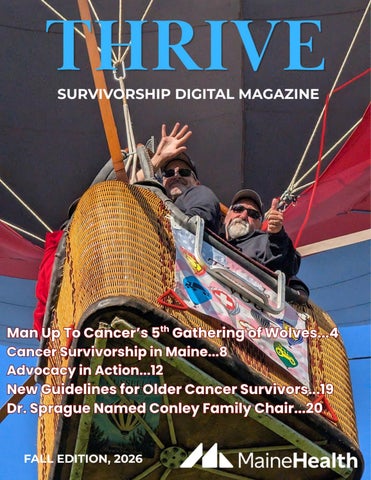
It happens so quickly, and we don’t really have a choice, so welcome to the fall edition! As we say goodbye to summer, here’s to colorful leaves, pumpkin spice and sweater weather for all. This quarter, we feature a new report on survivorship in Maine from the Maine CDC, Man Up to Cancer’s 5th annual Gathering of the Wolves Retreat, a congratulations to Dr. Sprague, and a welcome Dr. Battaglini and Dr. Kim. If you haven’t already, please sign up here for future editions. If you would like to share your story, or have ideas for content, please feel free to reach out to amy.litterini@mainehealth.org. Enjoy this beautiful season in New England, everyone!
Cover: Man Up To Cancer Maine Chapter members Andy Goodspeed and Ronald Richardson at the 5th Gathering of Wolves. Photo credit: Brandon Johnson
Survivor News…3 Awareness…11 Assessment & Treatment…18
Health Promotion…23 Resources…35 Calendar…53
Maine-Based Man Up to Cancer Builds a ‘Pack’ of Support for Men Impacted by Cancer
Founded by Cape Elizabeth resident Trevor Maxwell, Man Up To Cancer connects thousands of men across North America and recently celebrated the fifth anniversary of its signature Gathering of Wolves retreat By Andy Goodspeed, Man Up to Cancer Maine Chapter Leadership Captain
For many men facing cancer, one of the greatest challenges can be isolation. While women often tend to reach out for support during a cancer diagnosis, men are more likely to “check out,” withdrawing emotionally and socially. That isolation can contribute to mental health struggles, strained relationships and poorer medical outcomes. Man Up to Cancer is working to change that.
Above: 2026 Cornhole Champions
Founded by Cape Elizabeth resident and Colorectal Cancer survivor Trevor Maxwell, Man Up to Cancer is a 501(c)(3) nonprofit organization dedicated to helping men connect, find support and avoid isolation throughout their cancer journeys. The organization is redefining what it means to “man up”—not simply being tough, but having the courage to accept help and recognize that people are often stronger together than alone. The organization’s message is simple: men are smarter and stronger as a pack than they are as lone wolves. Today, Man Up to Cancer supports more than 3,500 members through more than 40 local chapters. As one of North America’s leading support communities for men impacted by cancer, the organization provides peer-to-peer support, community events, learning opportunities, care backpacks, an annual retreat and other programs designed to improve the quality of life for men facing cancer. In Maine, the local chapter with over 90 members, provides free support and connection for men who are cancer patients, survivors or caregivers. Programs include 24/7 peer-to-peer support through an online community, virtual support group meetings each month, and monthly in-person gatherings such as group meals, sporting events, outings and weekend retreats. The Maine Chapter also provides care backpacks filled with comfort and practical items for men undergoing cancer treatment. For members, however, the sense of connection extends well beyond regular meetings and online conversations. Each September, members from across the country and beyond gather for The Gathering of Wolves, Man Up to Cancer’s signature annual event and the largest men’s cancer retreat ever assembled.
This year marked the fifth anniversary of The Gathering of Wolves, affectionately known as GOW. The retreat was held at Pocono Springs Campground in Pennsylvania and welcomed 170 male cancer patients, survivors and caregivers of all cancer types and backgrounds. The event combines the best elements of a traditional campstyle retreat with opportunities for education, reflection and connection. Participants can enjoy activities such as swimming, nature walks, archery, ziplining, campfires and communal meals, while also taking part in educational breakout sessions and hearing from keynote speakers. The retreat also features traditions unique to the Man Up to Cancer community, including a fireside remembrance ceremony, the presentation of an annual challenge coin and an international cornhole tournament. Together, those experiences create an environment where men can step away from the stresses of daily life and focus on rest and recuperation, honest conversations and meaningful connections. For many attendees, the retreat provides an opportunity to build lifelong friendships and experience personal transformation alongside others who understand the challenges of living with cancer. Any man impacted by cancer is welcome to register for The Gathering of Wolves. Thanks to the generosity of donors and sponsors, everything at the retreat—including food and beverages, lodging, activities and a swag bag—is provided completely free to attendees. For Man Up to Cancer and its growing network of members, the mission remains focused on ensuring that no man has to face cancer alone. By building communities where men can openly share their experiences, ask for help and support one another, the organization continues to create a new path forward—one where “manning up” means having the strength to reach out, connect and run with the pack.
Tethered Hot Air Balloon rides were provided by Volunteers from the Great Eastern Balloon Association
Top L: Sunrise on the lake; top R: Music by The MUTC Guitar Club; center: Nightly Campfire Gathering to honor those who passed, celebrate those still fighting, and honor the survivors; At L: MUTC co-founders, CEO Joe Bullock and Trevor Maxwell, lighting the memorial firepit to start the evening festivities. Below: Spot to swim, fish, kayak or paddleboard.
Man Up To Cancer
SUPPORT FOR MEN IN MAINE IMPACTED BY CANCER RETREATS, IN-PERSON MEETUPS, 24/7 ONLINE COMMUNITY
ICYMI: In Case You Missed It! The 2026 Head & Neck Cancer Alliance Survivorship Symposium session videos are available on-line! Click HERE.
Advocacy In Action
Maine Representation in DC on Behalf of Survivors
Washington, DC. The American Cancer Society Cancer Action Network (ACSCAN) participated in our annual leadership summit and lobby day from September 13-16, 2026. ACSCAN is the nonpartisan legislative advocacy arm of the American Cancer Society whose mission is to support legislation that will improve the lives and access to care for cancer patients and families through policy efforts. Volunteers met with representatives of all four of the Maine delegation. Our first priority was to support the highest possible funding increased the NIH, NCI, CDC and National Breast and Cervical Screening programs. Continued next
Continued from previous Our second ask was to recruit co-sponsors to the clinical trials modernization act which would increase financial support for patients participating in clinical trials. The Maine team visited all the DC offices of our congressional representatives. For more information on ACSCAN, click the following link to reach the action page to add your name to a petition for our DC asks: https://www.fightcancer.org/
Clockwise from top left: The team outside Angus King’s Office; top right: a Light of Hope in honor of MaineHealth Cancer Care patients and caregivers; above: the team outside Chellie Pingree’s Office; at left, from left: Matt Lou Warn, Shawna Ackley, Julia MacDonald, Senator Susan Collins, Jeff Bennett, Mikala Bousquet, and Carol Pesti.
Sit Less, Move More:
Breaking Up Sitting Time May Reduce Cancer Risk By Jay Harness, MD, FACS, of Cancerfitness.org For years, researchers have emphasized the importance of regular exercise for
●
was regularly interrupted by
preventing cancer and improving
movement was associated with a lower
survivorship. Now, a landmark study of more
risk of these same cancer outcomes.
than 91,000 adults suggests that how we sit may be just as important as how much we sit. The findings have important implications
●
Replacing prolonged sitting with physical
long-term survivorship.
activity significantly reduced cancer mortality:
Researchers from the United Kingdom, followed 91,292 participants in the UK
●
activity lowered cancer mortality by
wearable accelerometers that objectively
approximately 12%.
measured movement throughout the day. reported activity, this investigation distinguished between prolonged, uninterrupted sitting and sedentary time that was frequently interrupted by movement. The results were striking.
●
Each additional hour of prolonged sitting was associated with a 9–10% higher risk of cancer mortality and increased risks of overall cancer, obesity-related cancers, and type 2 diabetes-related cancers.
Replacing 1 hour of prolonged sitting with light physical
Biobank for more than 12 years using
Unlike previous studies relying on self-
Perhaps the most encouraging finding was that small changes mattered.
for cancer prevention, cancer treatment, and
Harvard, and several international institutions
In contrast, sedentary time that
●
Replacing 30 minutes of sitting with moderate physical activity reduced mortality by about 8%.
Continued from previous
●
Replacing just 5 minutes with vigorous activity was associated with an impressive 22% reduction in cancer mortality.
Why This Matters for Cancer Patients Cancer patients and survivors often spend prolonged periods sitting because of
Practical Takeaways
●
periods.
fatigue, chemotherapy, radiation therapy, surgery, or hospitalization. While structured exercise remains a cornerstone of Exercise
●
also matters. For many patients, especially during active treatment, a vigorous workout may
●
climbing a few stairs, performing gentle
●
●
preserve muscle mass, improve glucose metabolism, reduce inflammation, and counteract many of the harmful physiologic effects of prolonged sitting—all mechanisms believed to influence cancer progression and overall health.
View movement as something that occurs all day—not just during scheduled exercise sessions.
light activity may provide meaningful health
These “movement snacks” may help
Combine regular aerobic and resistance exercise with reduced sedentary time.
stretching, or completing several minutes of benefits.
Incorporate frequent light movement throughout the day.
not be realistic. However, standing up every 30–60 minutes, walking around the room,
Stand or walk briefly every 30–60 minutes.
Oncology, this study reminds us that movement throughout the entire day
Avoid sitting continuously for long
●
Importantly, this was an observational study, meaning it demonstrates strong associations but cannot prove that prolonged sitting directly causes cancer. Nevertheless, the use of objective wearable activity monitors and the large, long-term study population make these findings highly compelling.
National Comprehensive Cancer Network Released New Guidelines Leading experts provide recommendations for the unique needs of cancer survivors 70 or older
Plymouth Meeting, PA On September 17, 2026, the National Comprehensive Cancer Network (NCCN) released the first edition of guidelines designed specifically for older cancer survivors. As the largest group of cancer survivors in the US, these recommendations are intended to highlight the complex nature of cancer care in older adults. The topics covered include the purpose of a geriatric assessment, setting treatment goals and use of supportive care, brain function and mental health, and understanding digital information. NCCN also provides additional guidelines that may be of interest. Downloads are categorized for: Treatment by Cancer Type; Detection, Prevention & Risk Reduction; Supportive Care; and for Specific Populations. They also provide guidelines by diagnosis translated into several different languages.
Dr. Kellie Sprague becomes the first Conley Family Chair of Hematopoietic Malignancies at MaineHealth Maine Medical Center As momentum continues to build around our ImmunoOncology program, we are pleased to announce the installation of Kellie Sprague, MD as the inaugural Conley Family Chair of Hematopoietic Malignancies at MaineHealth Maine Medical Center. The Conley Family Chair is an endowment established in honor of Madelyn Dyer Conley, a University of Maine graduate who grew up in Winter Harbor, Maine. She was the first woman optometrist registered with the Maine State Board. Together with her husband Albert D. Conley, they were longstanding supporters of Maine Medical Center, and their legacy lives on through this endowment. On September 17, 2026, Kellie Sprague, MD presented the Inaugural Lecture – “It Takes a Village: Bringing Bispecific T-cell engagers (BiTEs) and Chimeric Antigen Receptors (CARs) to MaineHealth” at Maine Medical Center’s Dana Center in Portland. From Dr. Drew Rogers, Associate Medical Director of Hematology: “The establishment of this endowed chair
Dr. Kellie Sprague recognizes Dr. Sprague's leadership, expertise, and commitment to advancing innovative care, research, and treatments. This recognition speaks to her commitment to her patients, her team, and to advancing the care we provide to our hematology patients. The Medical Oncology team is so proud to see her receive this well-deserved honor, and we are grateful for the expertise, leadership, and passion she bring to our program every day.” Following her presentation, a celebratory reception was held in her honor. Congratulations, Dr. Sprague! We are excited to celebrate this special milestone with you. Click the links to learn more about the innovative BiTE and CAR T-cell therapies, and Blood Cancer United for more information.
Above, front: Dr. Kellie Sprague; standing from left: Britt Crewse, Southern Region President; Dr. Scot Remick, Oncology Research and Education Principal; Dr. Charles Morris, Southern Region CMO; and Dr. Matt Kulke, Oncology Service Line Chief
MaineHealth Cancer Care Welcomes Dr. Battaglini and Dr. Kim to Southern Region Practices
Justin Battaglini, MD
Our cancer care teams in Scarborough and Sanford are thrilled to welcome Dr. Justin Battaglini to their practices. Dr. Battaglini shared: “I became an oncologist because I am passionate about helping patients navigate their most difficult and complex health challenges. I am committed to delivering care that is personalized, evidenced-based, and patient-centered. I have special interests in thoracic and gastrointestinal oncology and enjoy supporting patients as they work towards their individualized care goals.” Dr. Battaglini received his medical degree from Drexel University College of Medicine in 2019, and his residency in Internal Medicine at Boston Medical Center in 2022. He completed his fellowship in Hematology & Medical Oncology at Boston Medical Center in 2026, and is board Certified in Internal Medicine. Outside of the office, he enjoys spending time with my wife and two children and enjoying all that Maine has to offer.
The Blood Disorder and Hemophilia teams in South Portland recently welcomed Dr. Ann Kim to their practice. Dr. Kim shared: “I am a hematologist with a special interest in non-cancer-related blood disorders, such as bleeding and clotting. I became interested in this area because of the complexity of care and the individualized plan needed to care for these patients.” Dr. Kim received her medical degree from the Case Western Reserve University School of Medicine in 2020, followed by a residency in Internal Medicine at Johns Hopkins University School of Medicine in 2023. She completed her fellowship in Hematology & Medical Oncology at Newark Beth Israel Medical Center in 2026, and is board certified in Internal Medicine and Hematology. Outside of work, Dr. Kim enjoys hiking and exploring new restaurants. After becoming a new mom this fall, she will start her practice in early 2027.
Ann Kim, MD
The COSMIC-ReLeaf™ Study12 wants to know how patients using cannabis manage their cancer-related symptoms.
The COSMIC-ReLeaf Study wants to know how patients using cannabis manage their cancer-related symptoms. 12
You may be eligible to join the study if you: • Are 18 years of age or older • Have a cancer diagnosis and are a MaineHealth patient • Are actively using cannabis • Have access to internet and ability to download apps
To learn more about this study, scan the QR code below with a smartphone camera or e-mail: NTRO@mainehealth.org
1 This study is supported by a Supplemental Award (#2662-32491-11000003105) via Wake Forest University
Research Base (5UG1 CA189824) and is a complementary study to the COSMIC Study WF-2304 (U01 CA286813). 2 Dr. Scot Remick, Study PI and NCORP Contact PI
Cancer Risk Reduction Strategies: Reduce or Eliminate Alcohol Use
Options for Support to Reduce Alcohol Use 1. Check your drinking with a tool, then make a plan to drink less.
2. Talk to your provider. Always the best place to start the conversation, they can connect you with resources and offer suggestions. • Consider mocktail options for upcoming holiday celebrations. • Pair up with someone to do the Dry January challenge together. 3. Talk to a trusted friend or family member for support with your strategies, or try a private simulated conversation.
You’ve been diagnosed with cancer. Is there anything that YOU can do? NUTRITION
SLEEP
Support the immune system and decrease inflammation in the body.
Recharge your batteries so you start the day at full power.
1. Eat more antioxidant-rich foods. Examples: Carrots, sweet potatoes, spinach, tomatoes, grapefruit, blueberries, peanuts, sunflower seeds, mushrooms, cantaloupe, kiwi, mango, and almonds (most fruits, vegetables, nuts and seeds are antioxidant rich foods).
2. Eat fewer pro-inflammatory foods. Examples: Candy bars, cookies, chips, crackers, steaks, ground beef, sausages, salami, lunch meats, sugar-sweetened beverages (soda, Gatorade, juice etc.), and other highly processed foods.
3. Eat more foods prepared with moist cooking methods (boiled, steamed) and fewer foods prepared using dry heat cooking methods (grilled, fried).
4. Increase fiber to 40-45 grams/day. To do so, eat mostly unprocessed, whole plant foods like these examples as a resource to gauge your fiber intake: Breakfast: One serving of oatmeal (5 grams of fiber), topped with banana and raisins (3 grams of fiber) and almond milk. Morning snack: One modest handful of almonds (4 grams of fiber) mixed with two chopped dates (2 grams of fiber). Lunch: Hummus pesto pita sandwich with one pita (4 grams of fiber), ½ cup of hummus with pesto (2 grams of fiber), 8 cherry tomatoes (1 gram of fiber), 1 cup spinach (4 grams of fiber), 6 baby carrots (1 gram of fiber) and a dessert of two clementine oranges (3 grams of fiber). Afternoon snack: Avocado on whole-grain toast with sriracha (5 grams of fiber). Dinner: Veggie noodle soup with broccoli, carrots, onions, spinach, whole wheat noodles (6 grams of fiber in one 2-cup serving) and one whole wheat dinner roll (2 grams of fiber). After-dinner treat: 3 cups air-popped popcorn with a small amount of coconut oil and various spices on top (3 grams of fiber).
1. Ensure 7-9 hours per night, or longer as needed. 2. Use your bed for sleep and sex only. 3. Limit or avoid screen time 90 minutes prior to sleep. 4. Avoid drinking alcohol within 3 hours of sleep. 5. Increase daytime exposure to sunlight. 6. Keep a consistent sleep/ wake schedule.
ACTIVITY You will see benefits with ANY amount of physical activity! The more the better, but the goal is at least 150 minutes of moderate intensity activity per week. 1. Strength training (2x per week on non-consecutive days). 2. Work movement into your daily life: Use physical transportation (walk, bike, etc.) instead of driving. If sitting for a while, take a standing break every hour, get up and go for a short walk. Take the stairs whenever possible.
©2021 American College of Lifestyle Medicine. lifestylemedicine.org
Is there anything that YOU can do? STRESS MANAGEMENT A little stress in life is good, but if we experience a lot, especially over a long period of time, then we need healthy coping mechanisms.
SOCIAL CONNECTEDNESS Humans are a social species; we are wired to live together!
AVOIDANCE OF RISKY SUBSTANCES Maximize your body’s ability to recover. Use of substances such as tobacco or alcohol may interfere with the healing process. 1. For tobacco, seek information about smoking cessation support from your primary care provider. Quitting smoking means breaking the cycle of addiction and essentially rewiring the brain to stop craving nicotine. The benefits of quitting smoking begin in as little as 1 hour after the last cigarette. The sooner a smoker quits, the faster they will reduce their risk of cancer, heart and lung disease, and other conditions related to smoking.
2. For alcohol, seek information about alcohol use/abuse support from your primary care provider.
Additional Resources: American Institute for Cancer Research. Infographics and Figures. https://www.aicr.org/resources/media-library/
1. The single most important predictor of happiness and longevity is having strong and positive social connections. 2. Talk to your health care provider about local and online support groups or previous patients willing to connect (limit social media to meaningful connections).
3. Consider joining an exercise or other activity group.
1. Healthy activities that help reduce/ cope with stress: Physical activity Sleep Exposure to natural light/time in nature Mindfulness training Breathing
2. When feeling stressed, stop, relax, observe, and respond. 3. Breathing in for 5 seconds and then out for 5 seconds can help you maintain composure in stressful moments. 4. Helpful apps are available (eg. Headspace, Calm, Tapping Solution, etc.)
4. Embrace your family and friends and allow them to support you. 5. Think outside yourself - see what you can do to help someone else today.
Did you know? Quitting smoking reduces the risk of cancer and many other diseases, such as heart disease and COPD.
The evidence based advice included in this handout is intended to support NIH | National Cancer Institute overall well-being. Information is intended to augment medical advice, not replace it. Any advice contained herein should be delivered in conjunction with medical supervision. ©2021 American College of Lifestyle Medicine. lifestylemedicine.org
ONLINE
Our No-Cost Support Services
Learn more about all the services you can access as a cancer patient, survivor, care partner, family, or friend here at the Dempsey Center. Counseling Integrative Therapies Movement and Fitness Nutrition Support Groups
Quick Guide to American Cancer Society Resources
Quick Guide to American Cancer Society Resources The American Cancer Society (ACS) champions every person facing cancer with personalized guidance and a caring community. Below are just some of the resources we provide. Visit cancer.org or call us at 1-800-227-2345 for more information.
24/7 Cancer Helpline
Our trained team members can:
Our cancer helpline provides 24/7 support when you’re dealing with cancer. Call us at 1-800-227-2345 or visit cancer.org to live chat with us. We can assist in English, Spanish, and more than 200 other languages via a translation service.
• Answer questions about your diagnosis. • Provide guidance and a compassionate ear. • Connect you with ACS programs and services. • Refer you to other national resources.
Online Resources Our website, cancer.org, is a highly trusted source of accurate, evidence-based cancer information for people facing cancer, their families, and their caregivers.
Learn how to cope with a new cancer diagnosis.
Get help with daily life throughout cancer treatment.
Manage treatmentrelated side effects.
Find support resources near you.
Access caregiver and family support resources.
Cancer Information in Other Languages ACS offers information about cancer including prevention, early detection, treatment, and managing side effects in other languages. We provide content in Arabic, Chinese, French, Haitian Creole, Hindi, Korean, Polish, Portuguese, Russian, Spanish, Tagalog, Ukrainian, and Vietnamese.
Free Rides to Treatment Our Road To Recovery® program eases your burden by providing free rides to cancerrelated medical appointments. Trained volunteer drivers will pick you up, take you to your appointment, and bring you home after treatment – all at no charge.
Cancer Care Toolkit Our Cancer Care Toolkit is a collection of print-ready resources for people with cancer and their caregivers. It can help you organize the information you get about your cancer diagnosis and treatment. It includes worksheets and forms to help you track: Treatment side effects
Medicines
Appointments
Lab results
The toolkit is accessible online in English and Spanish.
A Personalized Support System After a cancer diagnosis, you may feel unsure about what to do next. Our ACS CARES® (Community Access to Resources, Education, and Support) navigation support program connects people with quality, curated information and one-on-one support. With the ACS CARES program, you can access information that updates as your situation changes, connect one-on-one with trained volunteers, access programs that help remove barriers like transportation and lodging, and speak with our trained team members. The program is available in English and Spanish.
Access to Clinical Trials and Support Through our ACS ACTS program, we offer free clinical trial matching support. We can also connect you with ACS programs and services to help meet your needs during treatment. The program is available only in English.
Free Estate Planning Tools Through ACS, you have free access for life to Giving Docs – a safe, secure platform where you can create or update your will or trust, record your health care wishes, assign powers of attorney, and more. It only takes a few minutes, and every step helps protect the people who matter most. This service is available only in English.
Free Lodging During Treatment Our Hope Lodge® communities offer a home away from home for people facing cancer and their caregivers when cancer treatment is far away. These communities provide comfortable guest suites with private baths, as well as inviting spaces with all the comforts of home – all at no cost to guests.
©2026, American Cancer Society, Inc. No. 0319.12 Rev. 4/26 Models used for illustrative purposes only.
Click here to schedule a consultation: https://bloodcancerunitednutrition.org/schedule-a-dietitian-consultation/
Education Center: Nutrition Education Services Center | Blood Cancer United
Resources: https://bloodcancerunited.org/resources/patients/registered-dietitians
Interested: Contact Magda Alden, LCSW OSW-C, Oncology Social Worker at magda.alden@mainehealth.org
October: Breast Cancer Awareness Month Liver Cancer Awareness Month Hoops for Hope Pink Out Event, Saco: 10/17/26 Making Strides of Greater Portland 10/18/26 Save Your Breath 5K, Augusta: 10/18/26 November: Lung Cancer Awareness Month Pancreatic Cancer Awareness Month Gastric Cancer Awareness Month Neuroendocrine Tumor Awareness Month National Lung Cancer Screening Day: 11/14/26 Great American Smoke Out: 11/19/26 December: Happy Holidays!
Survivorship Digital Magazine Archives
Vol. 1, Edition 1 Jan-Mar ‘23
Vol. 1, Edition 2 Apr-Jun ’23
Vol.1, Edition 3 Jul-Sept ’23
Vol. 1, Edition 4 Oct- Dec ’23
Vol. 2 Edition 1 Jan- Mar ‘24
Vol. 2 Edition 2 April-Jun ’24
Vol. 2 Edition 3 Jul-Sep ’24
Vol. 2 Edition 4 Oct–Dec ’24 Vol. 3 Edition 1 Jan–Mar ’25 Vol. 3 Edition 2 Apr-Jun ‘25
Vol. 3 Edition 3 July-Sep ’25
Vol. 3 Edition 4 Oct-Dec ’25
Vol 4 Edition 1 Jan-Mar ’26
Vol 4 Edition 2 Apr-Jun ‘26 Vol 4 Edition 3 Jul-Sept ‘26
THRIVE
Thank you for accessing this edition! Please enjoy some of our earlier editions linked here.