POL 223 AFRICAN AMERICAN POLITICS FALL 2026
Professor Melissa Harris-Perry
Department of Politics and International Affairs Department of Women, Gender, and Sexuality Studies Program in African American Studies Program in Environment and Sustainability
THURSDAYS 3:30-6:00 PM DIVINITY AND RELIGION STUDIES ROOM 206 OFFICE HOURS: THURSDAYS 12:00-2:00 PM Virtual and by appointment
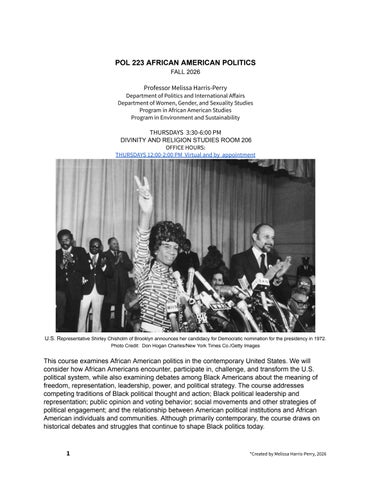
U.S. Representative Shirley Chisholm of Brooklyn announces her candidacy for Democratic nomination for the presidency in 1972. Photo Credit: Don Hogan Charles/New York Times Co./Getty Images
This course examines African American politics in the contemporary United States. We will consider how African Americans encounter, participate in, challenge, and transform the U.S. political system, while also examining debates among Black Americans about the meaning of freedom, representation, leadership, power, and political strategy. The course addresses competing traditions of Black political thought and action; Black political leadership and representation; public opinion and voting behavior; social movements and other strategies of political engagement; and the relationship between American political institutions and African American individuals and communities. Although primarily contemporary, the course draws on historical debates and struggles that continue to shape Black politics today. 1
*Created by Melissa Harris-Perry, 2026
Drawing on political science and other interdisciplinary scholarship, public policy analysis, journalism, activist traditions, and Black cultural production, students will learn to identify competing claims, evaluate evidence, and analyze the diversity and complexity of African American political life. Throughout the semester, we will use the 2026 midterm elections as a real-time opportunity to examine many of these questions in practice.
Learning Objectives After completing this course, students will be able to: ● Explain major historical and contemporary debates within African American politics concerning freedom, power, representation, leadership, political participation, and democratic practice. ● Analyze how political institutions, public policies, and systems of representation shape African American political experiences and how African Americans have sought to influence, challenge, and transform those institutions. ● Examine variation within African American politics, including how gender, generation, class, region, ideology, and other differences shape political attitudes, experiences, interests, and strategies. ● Critically evaluate evidence and arguments drawn from scholarly research, legal and policy documents, journalism, public opinion data, media, activist traditions, and cultural texts. ● Apply interdisciplinary concepts and methods to contemporary questions in African American politics and develop clear, evidence-based arguments in written, oral, and collaborative work. ● Analyze the 2026 midterm elections as they unfold, using course concepts and evidence to examine African American political participation, public opinion, mobilization, representation, campaign strategy, and electoral outcomes.
1921 Tulsa Race Massacre. Photo Credit: Tulsa Historical Society
2
*Created by Melissa Harris-Perry, 2026
Attendance Regular attendance and active participation are essential to the success of this course. Students are expected to arrive on time, remain for the full class period, and participate thoughtfully in class activities. Some class meetings will be conducted via Zoom. Advance notice will be provided whenever possible. Students are expected to attend Zoom sessions with their cameras on unless prior arrangements have been made with the instructor. Zoom class meetings will not exceed 90 minutes. Students are permitted up to two (2) unexcused absences during the semester without penalty. Beginning with the third unexcused absence, the final course grade will be reduced by one-third of a letter grade (e.g., A to A−, B+ to B). Each additional unexcused absence may result in an additional one-third letter grade reduction. Absences related to documented illness, university-sponsored activities, religious observances, or other significant circumstances will be considered on a case-by-case basis. Students are encouraged to communicate with the instructor as soon as reasonably possible when such situations arise.
Late Assignments Each student receives one (1) Late Pass for the semester. The Late Pass may be used on any assignment except the Final Exam and the completed Final Project. When used, an assignment may be submitted up to 48 hours after the deadline with no explanation required and no grade penalty. To use your Late Pass, simply indicate "Using Late Pass" in Canvas or send a brief email before or when you submit the assignment. No explanation is necessary. The Late Pass is intended to cover the ordinary, unexpected disruptions that occur during a semester. Students do not need to explain or document their reason for using it. After the Late Pass has been used, late work will be assessed as follows: ● Submitted within 48 hours of the deadline: one-third letter grade deduction ● Each additional 24-hour period: an additional one-third letter grade deduction Documented illness, family emergencies, or other significant circumstances fall outside this policy and will be considered individually. When possible, students should communicate with the instructor as soon as reasonably possible regarding these situations.
3
*Created by Melissa Harris-Perry, 2026
Accommodations Students who require academic accommodations should contact the Center for Learning, Access, and Student Success (CLASS) as early as possible, preferably before the start of the semester, to ensure that appropriate accommodations can be arranged. Center for Learning, Access, and Student Success (CLASS) Email: class@wfu.edu Phone: (336) 758-5929
Tutoring and Writing Support Wake Forest provides outstanding academic support through peer tutoring and The Writing Center. I encourage you to take advantage of these resources throughout the semester—not only when you're struggling, but also when you want to strengthen your writing, develop ideas, or receive feedback on assignments.
Health and Well-Being Your physical, mental, and emotional well-being matter. While this course has high expectations, I do not expect you to navigate significant health challenges alone. If illness, stress, or other circumstances begin to interfere with your ability to participate fully in the course, please reach out to me as soon as reasonably possible so we can discuss appropriate options. A few reminders for a successful semester: ● Stay hydrated (Drink more water than you think you need!) ● Get adequate sleep. When possible, take a nap. (Though taking one during class is less than ideal!) ● This is a long class period, so we will take a short break during each meeting. If you need to step out briefly, stretch, or use the restroom, please do so with minimal disruption to your classmates. ● If you find yourself falling behind—academically or personally—please come talk with me during office hours. Those conversations are often most helpful when they happen early. ● Learn a bit about emotional regulation here If you would benefit from additional support, I encourage you to connect with the University Counseling Center and other campus wellness resources.
4
*Created by Melissa Harris-Perry, 2026
Required Books And Articles Most assigned readings are available through links on our Canvas site. You will need to have the following text. You are welcome to have this text in hard copy or in a digital/ kindle/ebook form. You are welcome to rent or purchase. Robert C Smith, Sherri L Wallace, Hanes Walton, American Politics and the African American Quest for Universal Freedom 10th Edition. 2026. Please note that throughout the semester where possible I have linked PDFs to an earlier version (2015) of this textbook which is in the public domain. Using these PDF versions will cost you nothing but there are some differences between the editions. Not all chapters are available, but I have linked those that are. Please let me know if you have any problem acquiring this text.
Use Of Generative AI Generative AI tools (e.g., ChatGPT, Claude, Gemini) can be valuable learning tools when used thoughtfully and transparently. In this course, AI should support your learning—not replace your intellectual work. Wake Forest University adopted guidelines for GAI use in 2026. The guidelines below comply with the general WFU guidelines but are specific to our class this semester. When using generative AI, students are expected to follow four principles: Purpose. Use AI to enhance your learning by brainstorming ideas, exploring questions, organizing information, or improving the clarity of your writing. AI should not replace your own reading, analysis, or argumentation. Accountability. You are responsible for the accuracy, quality, and integrity of all work you submit. AI systems can generate factual errors, fabricated citations, biased analyses, and misleading conclusions. Verify all information using reliable sources. Transparency. If you use generative AI in preparing an assignment, disclose that use in accordance with the instructions for the assignment. When requested, include the prompts you used and briefly describe how AI contributed to your work.
5
*Created by Melissa Harris-Perry, 2026
Ethics. Do not submit confidential, personal, or sensitive information to AI systems. Assignment-specific instructions may further restrict or expand the use of AI for particular activities. APPROPRIATE USES OF GENERATIVE AI Unless otherwise specified, students may use generative AI to: ● ● ● ● ●
Brainstorm topics, research questions, and possible approaches to an assignment. Develop or refine an outline or organizational structure. Identify relevant concepts, theories, or areas for further research. Improve grammar, style, clarity, or organization of writing that you have already drafted. Generate practice questions, study guides, or explanations to support your learning.
In every case, the intellectual work—including reading assigned materials, evaluating evidence, constructing arguments, and reaching conclusions—must remain your own. INAPPROPRIATE USES OF GENERATIVE AI Unless an assignment explicitly permits otherwise, students may not use generative AI to: ● Complete assigned readings in place of reading the assigned materials.You are expected to read all assigned materials yourself, even if you use AI to help you understand them. ● Generate reading responses, discussion posts, reflections, or other assignments intended to demonstrate your own thinking. ● Produce substantive portions of papers, essays, or other written assignments that you present as your own work. ● Invent, fabricate, or cite sources that you have not personally located and verified. ● Misrepresent AI-generated work as entirely your own. Using generative AI in ways that substitute for your own analysis, interpretation, or writing may constitute a violation of the Wake Forest University Honor Code. A Note from Professor Harris-Perry I use generative AI as one of several professional tools in my own teaching and scholarship. I use it to brainstorm ideas, improve organization, identify ambiguities, edit prose, and think through alternative approaches to assignments and course design. I remain responsible for all final decisions, factual accuracy, course content, and the work I produce. I encourage you to think about AI in the same way: as a tool that can strengthen your learning, but not substitute for your reading, analysis, judgment, or original thinking.
6
*Created by Melissa Harris-Perry, 2026
AGREEMENT TO STANDARDS FOR SHARED LEARNING ENVIRONMENT
As a member of this class I agree to do my best to abide by the following standards of conduct for our shared learning environment. These standards apply to in-person and digital interactions. I will: 1. Abide by the Wake Forest University Honor Code. As a student at Wake Forest University, I pledge to support and uphold the Honor Code. I will endeavor to make it an integral part of my life and promote its values in the community. 2. Adhere to the Wake Forest University Statement of Principle Wake Forest is a community of persons who seek the enlightenment and freedom which come through diligent study and learning. An even higher goal, however, is to give life to the University motto, Pro Humanitate, as the passion for knowledge is translated into compassionate service. A tradition is shared that embraces freedom and integrity and that acknowledges the worth of the individual. This heritage, established by the founders and nurtured by succeeding generations, promotes a democratic spirit arising from open-mindedness and discourse. Wake Forest fosters compassion and caring for others. Its collective strength and character are derived from the values and distinctive experiences of each individual; therefore, the richness of human intellect and culture is affirmed in its contribution to knowledge, faith, reason, and dialogue. Furthermore, Wake Forest strives toward a society in which good will, respect, and equality prevail. To that end, hatred and bigotry in any form are rejected, and justice, honor, and mutual trust are promoted. 3. Agree to the Expectations for Conduct in this Class Our goal is to create a classroom in which every student can think carefully, speak honestly, and learn from disagreement. We strive to create a classroom where: ● ● ● ● ●
every student has an opportunity to contribute; ideas may be questioned and debated without personal attacks; disagreement is expected and treated as part of learning; personal experiences are respected but never required; no one is expected to speak on behalf of an entire group.
In this class we will: Assume Good Faith, Not Shared Values We will encounter arguments that challenge our own beliefs about gender, family, work, reproduction, and care. Disagreement does not imply ignorance, malice, or bad character. 7
*Created by Melissa Harris-Perry, 2026
Critique Ideas, Not People We analyze arguments, frameworks, and evidence—not the moral worth or intentions of classmates, authors, or social groups. Speak From Our Own Position, Not For Others Use “I” statements when reflecting on experience. Separate Description from Endorsement Reading an argument—especially one you find troubling—is not the same as endorsing it. Our goal is to understand how ideas function politically and culturally. Distinguish between discomfort and disrespect. A challenging idea, difficult historical fact, or disagreement with your perspective may be uncomfortable. Disrespect involves personal attacks, ridicule, intimidation, or conduct that prevents others from participating. This course welcomes intellectual discomfort but does not tolerate personal disrespect. Respect Complexity We are studying issues with multifaceted causes and consequences. Individual stories are valid and valuable, but should be treated cautiously as evidence. Support claims with evidence. We will distinguish between evidence, inference, and opinion. Strong arguments are supported by reasons and evidence, not simply conviction. Confidentiality with Care Personal experiences shared in class should be treated with respect and discretion. No one is required to disclose personal information to participate fully. 4. Refrain from Recording No audio or video recording of class is allowed whether class is meeting in person or via Zoom unless the student 1. has an accommodation requiring it, and 2. has express, written permission of all those being recorded. PLEASE SIGN THIS AGREEMENT AND SUBMIT ON CANVAS
8
*Created by Melissa Harris-Perry, 2026
COURSE OUTLINE MODULE 1
INTRODUCTION
TOPIC
1.1
August 27
INTRODUCTION
MODULE 2
FOUNDATIONS
2.1
September 3
AMERICAN FREEDOM
2.2
September 10
AMERICAN CITIZENSHIP
2.3
September 17
AMERICAN DREAM
MODULE 3
TRADITIONS
3.1
September 24
FILM- I AM NOT YOUR NEGRO
3.2
October 1
POLITICAL CULTURE
3.3
October 8
MEDIA
NO CLASS MEETING
*FALL BREAK* MODULE 4
MIDTERM EXAM
MIDTERM EXAM
October 15 MODULE 5
THE PEOPLE
5.1
October 22
PUBLIC OPINION
5.2
October 29
VOTING AND ORGANIZING
MODULE 6
INSTITUTIONS
6.1
November 5
LEGISLATIVE
6.2
November 12
POLITICAL PARTIES
6.3
November 19
EXECUTIVE
BREAK
THANKSGIVING BREAK November 26
NO CLASS - OPTIONAL READINGS
MODULE 7
FINAL EXAM
7.1
December 3
MODULE 8
FINAL PROJECT
9
*Created by Melissa Harris-Perry, 2026
COURSE ASSIGNMENTS CLASS PARTICIPATION - 10% Attendance and contributions to class discussion. ENTRANCE TICKETS- 20% At the start of most class meetings, students will complete a brief Entrance Ticket assessing their preparation for class. Entrance Tickets will typically include multiple-choice questions assessing knowledge of assigned materials and may occasionally include a brief written question asking students to identify, compare, or apply ideas from the readings. EXIT TICKETS- 5% Brief reflections at the end of each class meeting. Exit Tickets provide an opportunity to identify the most important ideas from each class, ask lingering questions, connect course concepts across units, and reflect on your own learning. MIDTERM EXAM- 20% Students will complete an in-person midterm exam composed of multiple choice, short answer, and brief essay questions. FINAL EXAM - 20% Students will complete an in-person final exam composed of multiple choice, short answer, and brief essay questions. The final will focus primarily on the second half of the semester but will include some questions requiring you to draw connections across the entire course. FINAL PROJECT: 2026 MIDTERMS-25% Each student will follow a single candidate/ campaign/ district or issue of importance to African American politics. Each student will submit a final case study which tells the story of their chosen topic during the 2026 midterms, situates their topic within the scholarly study of Black politics, and offers insightful original analysis of the topic . EXTRA CREDIT Professor Harris-Perry will make a variety of extra credit opportunities available for students throughout the semester. Each assignment is worth .5 points on the final grade. Students may earn up to three (3) points on their final grade by completing extra credit assignments.
10
*Created by Melissa Harris-Perry, 2026
MODULE 1: INTRODUCTION
The Rev. Jesse Jackson speaks from the floor of the 1972 National Black Political Convention. | AP Photo/Jim Well
1.1 INTRODUCTION August 27 What is “Black politics"? Who gets to define its ends and strategies? What determines its successes or failures? Can Black Politics end? ASSIGNED MATERIALS BEFORE CLASS EXPLORE our course Canvas site to familiarize yourself with course content and expectations. READ Michael Dawson. “The Future of Black Politics.” Boston Review, 2012. READ Keeanga-Yamahtta Taylor. “The End of Black Politics.” The New York Times, 2020. ENTRANCE TICKET 1.1 Read, Sign, and Submit the Agreement to Standards for a Shared Learning Environment
11
*Created by Melissa Harris-Perry, 2026
MODULE 2: FOUNDATIONS
Voting rights march from Selma to Montgomery, Alabama in 1965 Image Source: Library of Congress
How has Black politics challenged America to fulfill—and reconsider—its promises of freedom, citizenship, and opportunity? American political life includes powerful assertions about freedom, citizenship, and opportunity. Black Americans have experienced meaningful exclusion from each. In Module 2 we examine how Black political thought and action address this exclusion—and how Black Americans have challenged and transformed the meaning of American promises. DATES
TOPICS
September 3
2.1 American Freedom
September 10
2.2 American Citizenship
September 17
2.3 American Dream
12
*Created by Melissa Harris-Perry, 2026
2.1:FOUNDATIONS: AMERICAN FREEDOM SEPTEMBER 3 What does freedom mean for African Americans and how does this shape the meaning of American freedom? 2.1 ASSIGNED MATERIALS BEFORE CLASS SECONDARY SOURCES READ “Universal Freedom Declared, Universal Freedom Denied” Chapter 1 from American Politics and the African American Quest for Universal Freedom 10th Edition. 2026. READ Davis, Charles William. “The Catalyst of Equality: Reconstruction and African Americans as Barometers of Freedom.” Journal of African American Studies (New Brunswick, N.J.) (New York) 29, no. 4 (2025): 393–408. WATCH “What was the Dred Scott Decision?”, Approx. 2 minutes WATCH: Confronting Hard History, Professor Hasan Jeffries , Approx 13 minutes PRIMARY SOURCES EXPLORE Freedom 250 (watch at least one video from the Story of America series) READ Excerpts from Frederick Douglass, “What to the Slave is the 4th of July?” 1852 READ W.E.B. DuBois “Strivings of The Negro People” from Souls of Black Folk, 1892. FOR REFERENCE IN CLASS DISCUSSION Declaration of Independence Constitution of the United States LEARNING OBJECTIVE: DAA FRAMEWORK DESCRIBE: How have American political institutions and Black political thinkers defined freedom? ANALYZE: How can a political system committed to freedom simultaneously produce and sustain racial domination? ASSESS: Has Black politics primarily sought access to American freedom, or has it forced the United States to redefine freedom itself?
13
*Created by Melissa Harris-Perry, 2026
2.2:FOUNDATIONS: AMERICAN CITIZENSHIP SEPTEMBER 10 What does it mean to be an American citizen and how have African Americans shaped the meaning of American citizenship? 2.2 ASSIGNED MATERIALS BEFORE CLASS SECONDARY SOURCES READ “Federalism and the Limits of Universal Freedom” Chapter 2 from American Politics and the African American Quest for Universal Freedom 10th Edition. 2026. READ James W. Fox Jr., Fellow Citizens, 12 ConLawNOW 171 (2021). PART III. pp. 182-190 READ Sarah Caroline Thuesen. 2013. “The Price of Equality” Chapter 1 in Greater Than Equal : African American Struggles for Schools and Citizenship in North Carolina, 1919-1965. The University of North Carolina Press. pp. 1-26 READ Ilya Somin. Slavery and Birthright Citizenship. CATO Institute. March 2026 PRIMARY SOURCES READ Lynching in America Report 3rd edition , Equal Justice Initiative READ Martin Luther King, Jr. Letter from a Birmingham Jail, April 16, 1963 WATCH Lift Every Voice and Sing Performed by Coco Jones at Super Bowl LX (about 3 minutes) WATCH Star Spangled Banner Performed by Whitney Houston at Super Bowl XXV (about 3 minutes) FOR REFERENCE IN CLASS DISCUSSION The Civil War Amendments Reconstructing Citizenship LEARNING OBJECTIVE: DAA FRAMEWORK DESCRIBE: What rights, protections, obligations, and forms of belonging constitute American citizenship? ANALYZE: In what ways has formal citizenship failed to produce substantive equality for Black Americans? ASSESS: Which institutions and strategies have been most effective in making Black citizenship meaningful—and what should we use as evidence of effectiveness?
14
*Created by Melissa Harris-Perry, 2026
2.3:FOUNDATIONS: AMERICAN DREAM SEPTEMBER 17 How is the struggle for political equality connected to economic security and material opportunity? 2.3 ASSIGNED MATERIALS BEFORE CLASS SECONDARY SOURCES READ “Domestic Policy and the African American Quest for Social and Economic Justice” Chapter 14 from American Politics and the African American Quest for Universal Freedom 10th Edition. 2026. READ Little, Margaret Ruth. “Getting the American Dream for Themselves: Postwar Modern Subdivisions for African Americans in Raleigh, North Carolina.” Buildings & Landscapes 19, no. 1 (2012): 73–86. THINK TANK/ MEDIA SOURCES READ “STATE of BLACK AMERICA 2026: Is the American Dream Dead Report of the National Urban League, 2026 READ ROAD TO ZERO WEALTH. Report of Institute for Policy Studies, 2017 READ Critical Race Theory Would Not Solve Racial Inequality:It Would Deepen It. Report of the Heritage Foundation. March 2021 PRIMARY SOURCE WATCH Does the American Dream include Black Communities too? 2018 (Approx 3 minutes) LEARNING OBJECTIVE: DAA FRAMEWORK DESCRIBE: What constitutes the American Dream, and how have Black Americans pursued it? ANALYZE: How have public policy and private institutions shaped Black access to wealth, housing, education, work, and economic security? ASSESS: To what extent can racial inequality be addressed by expanding Black access to the American Dream—and when might the structures producing the Dream itself require transformation?
15
*Created by Melissa Harris-Perry, 2026
MODULE 3: TRADITIONS
Newspaper founder Robert S. Abbott (right) checking copy fresh from the printing press at the African American newspaper the Chicago Defender. Photo by Gordon Coster/The LIFE Picture Collection via Getty Images. Learn more here.
African American politics is shaped not only by institutions and policy, but also by ideas, identities, stories, cultural practices, and systems of communication. This module examines the traditions through which Black Americans have interpreted political life, contested racial power, constructed collective identities, and communicated political claims. We begin with James Baldwin and the relationship between art, culture, and politics; examine competing traditions within African American political culture; and conclude by considering the role of media in producing, challenging, and transforming Black political narratives. DATES
TOPICS
September 24
3.1 FILM- I AmNot Your Negro: James Baldwin and Race in America Asynchronous Class
October 1
3.2 Political Culture
October 8
3.3 Media
16
*Created by Melissa Harris-Perry, 2026
3.1: TRADITIONS: FILM SEPTEMBER 24 3.1 ASSIGNED MATERIALS BEFORE CLASS REQUIRED WATCH I Am Not Your Negro: James Baldwin and Race in America. (Approximately 1 hour 30 minutes) Note: You will need to login via Wake Forest’s ZSR to have access. OPTIONAL WATCH: Q/A with Film’s Director ASYNCHRONOUS CLASS PROMPT After watching the film you must write a 400-500 word essay in response to the prompt below. This prompt is purposely very broad. Part of your task is to narrow to a single aspect of the film which you can reasonably assess in less than 500 words. Be creative! Please cite the film directly, using time markers as you would use page numbers. Submit to the 3.1 Discussion Board on Canvas. PROMPT: What is the role of culture, art, and/or media in African American politics? RESPONSES: Due by Tuesday, September 29 at noon (50-100 words each) You must also read and respond to essays written by at least TWO (2) other students in the class. Responses should substantially engage the essays NOTE on use of Generative AI: You may use generative AI to brainstorm possible topics or to proofread a completed draft for grammar and clarity. You may not use generative AI to watch or summarize the film for you, select or analyze film evidence, generate your argument, or draft any portion of your essay or responses. Your citations and time markers must come from your own viewing of the film. LEARNING OBJECTIVE: DAA FRAMEWORK DESCRIBE: Identify how James Baldwin interprets the relationship among race, American identity, culture, and politics. ANALYZE: Analyze how I Am Not Your Negro uses Baldwin’s words, historical footage, popular culture, and contemporary images to construct an argument about race and American political life. ASSESS: Assess the role of culture, art, and/or media in shaping African American political ideas, identities, and struggles.
17
*Created by Melissa Harris-Perry, 2026
3.2: TRADITIONS: POLITICAL CULTURE October 1 What counts as a Black political tradition—and who gets to define it? 3.2 ASSIGNED MATERIALS BEFORE CLASS SECONDARY SOURCES READ “Political Culture and Socialization” Chapter 3 from American Politics and the African American Quest for Universal Freedom 10th Edition. 2026. READ Megan Ming Francis and Leah Wright-Rigueur. Black Lives Matter in Historical Perspective. Annual Review of Law and Social Science 2021 17:1, 441-458 READ Johnson, Micah E. “The paradox of black patriotism: double consciousness.” Ethnic and racial studies vol. 41,11 (2018): 1971-1989 PRIMARY SOURCES READ The Black Panther Party Service to the People Programs READ Combahee River Collective Statement. LEARNING OBJECTIVE: DAA FRAMEWORK DESCRIBE: Identify major features of African American political culture and distinguish among important traditions of Black political thought and activism. ANALYZE: Analyze how historical experience, racial identity, institutions, gender, class, and ideology shape competing traditions within African American politics. ASSESS: Assess the possibilities and tensions among different Black political traditions as strategies for achieving freedom, equality, self-determination, and collective power.
18
*Created by Melissa Harris-Perry, 2026
3.3: TRADITIONS: MEDIA October 8 What role do the media have in making, failing, or refusing to make Black political claims visible, credible, and memorable? 3.3 ASSIGNED MATERIALS BEFORE CLASS SECONDARY SOURCES READ “The Media” Chapter 3 from American Politics and the African American Quest for Universal Freedom 10th Edition. 2026. READ Kruse, Beth, Rhondalyn K. Peairs, Jodi Skipper, and Shennette Garrett-Scott. “Remembering Ida, Ida Remembering: Ida B. Wells-Barnett and Black Political Culture in Reconstruction-Era Mississippi.” Southern Cultures 26, no. 3 (2020): 20–41. READ Melissa Brown, Rashawn Ray, Ed Summers & Neil Fraistat (2017) #SayHerName: a case study of intersectional social media activism, Ethnic and Racial Studies, 40:11, 1831-1846, PRIMARY SOURCES WATCH Fifty Years Later: My father and uncle remember the March on WAshington, MSNBC 2013 WATCH Some Girls Never Get a First Chance. MSNBC 2015 LEARNING OBJECTIVE: DAA FRAMEWORK DESCRIBE: Identify ways media institutions and communication technologies have shaped the representation of African Americans and Black political issues. ANALYZE: Analyze how Black political actors have used media to challenge dominant narratives, create political communities, and mobilize collective action. ASSESS: Assess how changes in media institutions and technologies alter the opportunities—and constraints—for African American political power.
** FALL BREAK ** OCTOBER 12 and 13
19
*Created by Melissa Harris-Perry, 2026
MODULE 4: MIDTERM EXAM
James Baldwin. Istanbul 1966. Collection of the Smithsonian National Museum of African American History and Culture, © Sedat Pakay 1966
4.1
MIDTERM EXAM
October 15
The Midterm Exam will assess familiarity with and understanding of the assigned materials in the first half of the semester. The midterm exam must be taken in person.
October 16-
Students requiring testing accommodations can choose to take the exam on Friday, October 16.
Accommodations Exam Date
20
*Created by Melissa Harris-Perry, 2026
MODULE 5: THE PEOPLE
How do African Americans understand their political interests, and how do they act on them? This module examines Black public opinion and the ways African Americans translate political attitudes and interests into electoral participation, civic engagement, and collective action. DATES
TOPICS
October 22
5.1 Public Opinion
October 29
5.2 Voting and Organizing
21
*Created by Melissa Harris-Perry, 2026
5.1: PUBLIC OPINION October 22 What do Black people think politically, and can we meaningfully speak of “Black public opinion”? 5.1 ASSIGNED MATERIALS BEFORE CLASS SECONDARY SOURCES READ “Public Opinion” Chapter 4 from American Politics and the African American Quest for Universal Freedom 10th Edition. 2026. READ Tillery, Alvin B. “The #BlackLivesMatter Movement and Black Public Opinion: A New Populist Divide in the Black Community?” Chapter. In When the People Rule: Popular Sovereignty in Theory and Practice, edited by Ewa Atanassow, Thomas Bartscherer, and David A. Bateman, 204–17. Cambridge: Cambridge University Press, 2023. READ Price, Melanye T. Chapter 7 of Dreaming Blackness Black Nationalism and African American Public Opinion. New York: New York University Press, 2009. PRIMARY SOURCES READ Gallup Findings Throughout Black History READ Protest, Racism, and Policing. GenForward Survey LEARNING OBJECTIVE: DAA FRAMEWORK DESCRIBE: Identify major patterns and sources of variation in African American public opinion. ANALYZE: Analyze how race, generation, ideology, identity, and political context shape similarities and differences in Black political attitudes. ASSESS: Assess claims about a unified “Black public opinion” using survey evidence and competing interpretations of Black political attitudes.
22
*Created by Melissa Harris-Perry, 2026
5.2: VOTING AND ORGANIZING October 29 What are the patterns of Black American voting—and when do Black Americans pursue political goals beyond the ballot box? 5.2 ASSIGNED MATERIALS BEFORE CLASS SECONDARY SOURCES READ “Social Movements and a Theory of African American Coalition Politics” Chapter 6 from American Politics and the African American Quest for Universal Freedom 10th Edition. 2026. READ “Voting Behavior and Elections” Chapter 9 from American Politics and the African American Quest for Universal Freedom 10th Edition. 2026. READ Frasure, Lorrie Ann, and Linda Faye Williams. 2009.“Racial, Ethnic, and Gender Differences in Political Participation and Civil Engagement.” In Emerging Intersections: Race, Class, and Gender in Theory, Policy, and Practice, edited by Bonnie Thornton Dill and Ruth Enid Zambrana, 203–224. News Brunswick, NJ: Rutgers University Press. MEDIA SOURCE LISTEN Ari Berman on Democracy and Voting Rights (Approx 40 Minutes) PRIMARY SOURCES READ PEW RESEARCH MIDTERMS 2026 REPORT EXPLORE Color of Change (Become familiar with at least one current campaign of the organization) LEARNING OBJECTIVE: DAA FRAMEWORK DESCRIBE: Identify major forms and patterns of African American political participation, including voting, civic engagement, organizing, and social movement activity. ANALYZE: Analyze the individual, institutional, and historical factors that shape African American political participation and coalition building. ASSESS: Assess the opportunities and limitations of electoral and non-electoral strategies for advancing African American political interests.
23
*Created by Melissa Harris-Perry, 2026
MODULE 6: INSTITUTIONS Black political power is exercised not only through movements, organizations, and elections, but also through governing institutions. This module examines legislative representation, political parties, and executive leadership to ask whether—and under what conditions—institutional inclusion produces substantive political power.
President Barack Obama meets with members of the Congressional Black Caucus in the White House’s Roosevelt Room in 2013. Photo credit: Barack Obama Presidential Library/National Archives
DATES
TOPICS
November 5
6.1 Legislative
November 12
6.2 Partisan
November 19
6.3 Executive
24
*Created by Melissa Harris-Perry, 2026
6.1: LEGISLATIVE November 5
What is the relationship between descriptive and substantive representation? 6.1 ASSIGNED MATERIALS BEFORE CLASS SECONDARY SOURCES READ “Congress and the African American Quest for Universal Freedom”. Chapter 10 from American Politics and the African American Quest for Universal Freedom 10th Edition. 2026. READ State and Local Politics and the African American Quest for Universal Freedom. Chapter 13 from American Politics and the African American Quest for Universal Freedom 10th Edition. 2026. NOTE: Focus on SECTION 1 about representation in state legislatures. READ Orey, Byron D’Andrá, Wendy Smooth, Kimberly S. Adams, and Kisha Harris-Clark. “Race and Gender Matter: Refining Models of Legislative Policy Making in State Legislatures.” Journal of Women, Politics & Policy 28, nos. 3–4 (2007): 97–119. READ David Cannon. Race and Redistricting Annual Review of Political Science 2022 25:1, 509-528 PRIMARY SOURCES READ 2026 Q1 Report of the Congressional Black Caucus READ
2025 Black Women in American Politics Report of CAWP
LEARNING OBJECTIVE: DAA FRAMEWORK DESCRIBE: Identify patterns in African American representation in Congress and state legislatures and the institutional structures that shape that representation. ANALYZE: Analyze how race, gender, district composition, and redistricting affect the election and legislative behavior of Black representatives. ASSESS: Assess whether increased descriptive representation produces greater substantive representation of Black political interests.
25
*Created by Melissa Harris-Perry, 2026
6.2: POLITICAL PARTIES November 12 Does partisan incorporation give Black voters political power—or make them politically captive? 6.2 ASSIGNED MATERIALS BEFORE CLASS SECONDARY SOURCES READ “Political Parties” Chapter 8 from American Politics and the African American Quest for Universal Freedom 10th Edition. 2026. READ Paul Frymer, Chapters 1 and 2 Uneasy Alliances: Race and Party Competition , Princeton University Press. 2010. WATCH , Leah Wright Rigueur at Dole Institute of Politics discussing The Loneliness of the Black Republican. ( 1 hour) PRIMARY SOURCES EXPLORE: Compare how the Democratic and Republican parties address issues of race, civil rights, voting, policing, and/or economic inequality in their current party platforms.
DNC 2024 RNC 2024 LEARNING OBJECTIVE: DAA FRAMEWORK DESCRIBE: Trace the historical relationship between African Americans and the major American political parties. ANALYZE: Analyze how party competition, racial realignment, and ideological diversity shape the political position of Black voters within the two-party system. ASSESS: Assess whether contemporary partisan alignments enhance or constrain African American political power.
26
*Created by Melissa Harris-Perry, 2026
6.3: EXECUTIVE November 19
What are the possibilities and limitations of Black executive leadership? 6.3 ASSIGNED MATERIALS BEFORE CLASS SECONDARY SOURCES READ “The Presidency and Bureaucracy and the African American Quest for Universal Freedom” Chapter 11 American Politics and the African American Quest for Universal Freedom 10th Edition. 2026. READ Introduction in Winning While Losing : Civil Rights, the Conservative Movement and the Presidency from Nixon to Obama, edited by Kenneth Osgood, and Derrick E. White, University Press of Florida, 2014. READ “State and Local Politics and the African American Quest for Universal Freedom.” Chapter 13 from American Politics and the African American Quest for Universal Freedom 10th Edition. 2026. NOTE: Focus on SECTION 3 about Black Mayors READ J. Phillip Thompson III. INTRODUCTION: Black Mayors and Social Change” from Double Trouble : Black Mayors, Black Communities, and the Call for a Deep Democracy. Oxford University Press. 2006 PRIMARY SOURCES WATCH THREE (or more!) of the speeches below, As you watch, consider how Obama defines his constituency, describes racial inequality, invokes Black political traditions, and understands the powers and responsibilities of the presidency.
A More Perfect Union, 2008 DNC Nomination Acceptance, 2008 First Inaugural Address, 2009 Second Inaugural Address, 2013 On the George Zimmerman Verdict,2013 Eulogy for Charleston Murder Victims, 2013 Congressional Black Caucus Phoenix Dinner, 2015 DNC Speech, 2016 LEARNING OBJECTIVE: DAA FRAMEWORK DESCRIBE: Identify the formal powers, political roles, and institutional constraints facing Black executives at the national and local levels. ANALYZE: Analyze how race, constituency, institutional authority, and political context shape the choices available to Black executive leaders. ASSESS: Assess the extent to which Black executive leadership can produce substantive change for Black communities.
27
*Created by Melissa Harris-Perry, 2026
28
*Created by Melissa Harris-Perry, 2026
MODULE 7: FINAL EXAM
Barack Obama at Harvard University Law School in 1990 Joe Wrinn / Harvard University via AP file
7.1
FINAL EXAM
December 3
The final exam will assess familiarity with and understanding of the assigned materials, focusing primarily on the second half of the semester. The exam will also include some questions requiring students to make connections across the entire course. The final exam must be taken in person.
December 4Accommodations Exam Date
Students requiring testing accommodations can choose to take the exam on Friday, December 4
29
*Created by Melissa Harris-Perry, 2026
MODULE 8: FINAL PROJECT FINAL PROJECT CASE STUDY: MIDTERMS 2026 Throughout the semester, each student will follow a single candidate, campaign, electoral contest, district, organization, voter population, or issue of importance to African American politics in the 2026 Midterm Election. Your case study may focus on a particular electoral contest or candidate; Black voters in a particular state, region, or demographic group; congressional redistricting and representation; political parties and organizations; voter mobilization and turnout; campaign media and political communication; or an issue of particular significance to African American politics. Possible issue areas include voting rights, economic policy, education, criminal justice and policing, immigration, health care, reproductive policy, or other issues that emerge as important during the 2026 election cycle. You may also choose to examine Black voters from a national perspective—for example, by studying turnout, vote choice, partisan identification, gender or generational differences, or patterns of political participation. The goal is to choose one focused lens through which to tell a larger story about African American politics and the 2026 midterm elections. Throughout the semester, you will collect evidence about your case as the election develops. This may include campaign materials, speeches, advertisements, news coverage, social media, polling data, campaign finance or election data, organizational materials, candidate statements, and other appropriate primary sources. You will also identify and engage relevant scholarship in African American politics and political science. Following the election, each student will submit a final case study that: ● DESCRIBES the candidate, campaign, district, population, organization, or issue and explains what happened during the 2026 election; ● ANALYZES the case using concepts and scholarship from the course and appropriate primary and secondary evidence; and ● ASSESSES what the case helps us understand about African American politics in the contemporary United States. The strongest projects will not simply summarize an election outcome. They will use the 2026 election as an opportunity to develop and support an original argument about Black politics.
30
*Created by Melissa Harris-Perry, 2026
FINAL PROJECT MILESTONES
ACTIVITY
DESCRIPTION
DUE DATE
Proposal
Submit a brief proposal identifying the candidate, campaign, contest, district, population, organization, or issue you plan to study. Explain why the case is significant for the study of African American politics and identify an initial question you hope to investigate.
FRIDAY, September 18
Data and Sources
Submit a preliminary list of the key primary and scholarly secondary sources you will use. Identify the kinds of evidence you will collect as the election develops.
FRIDAY, October 16
Election Outcome: Quick Take
Submit a brief initial assessment of what happened in your case following Election Day. Focus on the outcome and one or two developments that appear especially important for your eventual analysis.
FRIDAY November 6
Final Case Study
Submit the completed case study, including description, analysis, assessment, and references, according to the Final Project instructions on Canvas.
December 11
31
*Created by Melissa Harris-Perry, 2026
EXTRA CREDIT OPPORTUNITIES Throughout the semester, Professor Harris-Perry will make a variety of opportunities available for students to engage more deeply with the issues, ideas, and questions raised in this course. These opportunities may include films, documentaries, podcasts, lectures, public events, performances, and other experiences. Some options are listed below. Additional opportunities, including in-person events at Wake Forest and in the surrounding community, will be announced on Canvas throughout the semester. Students may complete a maximum of Six (6) Extra Credit activities during the semester. Each counts for up to .5 points on the final grade for a total of 3 possible points. To receive extra credit, students must submit a brief reflection on the experience. Unless otherwise specified, reflections should be 300–500 words and should use the Describe–Analyze–Assess (DAA) framework that we use throughout the course. EXTRA CREDIT REFLECTION: DAA FRAMEWORK DESCRIBE: Briefly identify the experience and describe its central subject, argument, or purpose. For films, podcasts, or other media, include the title and other relevant identifying information. ANALYZE: Connect the experience to specific ideas, concepts, questions, or assigned materials from our course. Explain how the experience extends, complicates, challenges, or reinforces something we have encountered in class. ASSESS: Reflect on what you learned from the experience. What did you find especially significant, surprising, convincing, troubling, illuminating, or difficult? Did the experience change or deepen your understanding of African American politics? Why or why not? Personal and emotional responses are welcome when they help you think critically about the experience, but a reflection should move beyond simply stating whether you liked or disliked it. SUGGESTED EXTRA CREDIT MEDIA WATCH: Race: The Power of an Illusion, Episode 1: “The Difference Between Us” WATCH: 60 Minutes: “The Murder of Emmett Till” (2004) LISTEN: System Check: “Political Violence Is Not an Anomaly in U.S. Politics” WATCH: The Black Panthers: Vanguard of the Revolution (2015)
32
*Created by Melissa Harris-Perry, 2026
WATCH: Darnell Moore, “What Freedom Feels Like,” Harvard University WATCH: Stay Woke: The Black Lives Matter Movement (2016) WATCH: Rest in Power: The Trayvon Martin Story (2018) WATCH: John Lewis: Good Trouble (2020) WATCH: The Young Black Conservatives of Trump’s America WATCH: Brother Outsider: The Life of Bayard Rustin (2003) Additional opportunities will be added to Canvas throughout the semester.
33
*Created by Melissa Harris-Perry, 2026