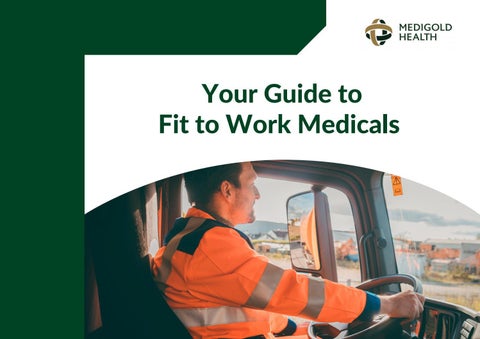
Your Guide to Fit to Work Medicals
ABOUT US The Medigold Health Group is one of the most recognised and trusted names in the Occupational Health sector. We’re experts in helping employers to keep their people in work, safe and well and we’ve been creating tailormade occupational health and wellbeing solutions for businesses of all sizes across the UK for over 20 years.
ABOUT US We offer a comprehensive range of specialist services, including absence management, employee screening, alcohol and drug testing and support services and a vast array of employee wellbeing programmes designed to help our clients to proactively enhance the physical and mental health of their workers, so they can consistently perform at their best, both at work and in life.
What is a Fit to Work Medical?
Fit to Work medicals help make sure that individuals who are employed in safety critical roles are medically fit to perform their duties effectively and without risk to their own or others’ health and safety and ensure that your employer stays compliant with industry standards and best-practice.
What does the medical involve? Fit to Work Medicals usually involve a combination of general health checks and health surveillance elements. Medicals are usually carried out by an Occupational Health Technician (OHT). The different types of medicals and the tests they involve are listed and explained below:
Why do I have to have a Fit to Work Medical? Safety Critical Medical
Based on the type of work you do and the risks you are likely to be exposed to in your job, your employer has determined that you need to have a Fit to Work Medical to assess whether you can safely carry out all tasks associated with your role.
Health surveillance is a system of ongoing health checks that are required by law for employees who are exposed to certain hazards at work.
General health questionnaire General health screening (BMI (body mass index) and BP (blood pressure)) Audiometry (hearing) - full audio test Musculoskeletal/ agility assessment Respiratory – lung function Skin assessment Vision - distance and colour vision Safety critical assessment
What is a Fit to Work Medical?
Working at Heights General health questionnaire General health screening (BMI and BP) Audiometry (hearing) - whisper test Musculoskeletal/ agility assessment Respiratory – lung function Vision - distance vision Working at heights assessment Confined Spaces General health questionnaire General health screening (BMI and BP) Audiometry (hearing) - whisper test Musculoskeletal/ agility assessment Respiratory – lung function Vision - distance vision Confined spaces assessment
Forklift Truck (Site Vehicle) General health questionnaire General health screening (BMI and BP) Audiometry (hearing) - whisper test Musculoskeletal/agility assessment Vision - distance vision Site vehicle assessment
What do the tests involve? General health questionnaire We will ask you to complete a questionnaire to determine your current health status. The questionnaire will include questions about your general health, any medication you are taking, and any medical conditions or health issues you have that may contraindicate a safety critical role. General health screening We will carry out a series of simple checks to look for signs that you may be at risk of health problems or disease. The checks include: BMI We will ask you to stand under a height stick and on weighing scales to measure your height and weight so that we can calculate your BMI.
We will record your results and provide lifestyle advice if it is indicated that you are overweight. BP We will use an electronic BP machine to measure and record your blood pressure (this will involve placing a cuff on your arm while you are seated and resting your arm on the table). If your BP is outside normal range, we will refer you to your GP for further investigation.
What do the tests involve? Audiometry (hearing) Whisper test We will use this test to assess your functional hearing if you are not exposed to excessive noise at work but are employed in a safety critical role. The OHT will ask you to cover one of your ears with your hand. They will then stand a metre behind you and whisper a series of numbers and letters, which you will need to repeat back to them. They will then repeat the test on the opposite ear. Full audio test We will use this test to assess your hearing if you are exposed to excessive noise at work, to help us monitor any impact on your hearing and check that any hearing protection you are using is effective.
Before the test, we will ask you to complete a questionnaire asking questions about your current and past exposure to noise at work and any hearing issues you have. The OHT will also examine your ears to check for and record any issues, such as wax build-up, scarring of your ear drums etc. They will always ask for your consent before preforming the examination. The test itself can be carried out in either a sound attenuating audio booth or in a quiet room using noise cancelling headphones. The OHT will provide you with instructions on how to complete the test. They will ask you to put on a pair of headphones connected to a device that sends
What do the tests involve? out a series of sounds, and hand you a response button – you will be asked to indicate each time you hear a sound by pressing the button. If you are in an audio booth, you can ask for the door to remain open if you are not comfortable having it closed. At the end of the test, the OHT will review the results and discuss these with you.
Musculoskeletal/ agility assessment We will ask you to complete a questionnaire including questions about any current or past musculoskeletal issues, both work related and nonwork-related. We will also ask you to perform certain simple actions, including: hopping twice on each leg squatting kneeling on each knee touching your knees with your hands clapping your hands above your head showing a full range of neck movements This will allow us to observe and assess your range of movement, balance and mobility to ensure you are able to move around site safely.
What do the tests involve? Respiratory (lung function) If your role involves you working in confined spaces, we will use this test to assess your respiratory fitness.
The test is performed using a piece of equipment called a Spirometer.
We will ask you to complete a questionnaire asking questions about your current and past exposure to respiratory sensitisers or hazardous substances at work and any breathing issues you have. We will also ask you a number of pre-screening questions about your COVID history.
The OHT will enter your details into the machine and then ask you to blow into a special bacterial viral filter mouthpiece attached to it. They will first coach you on how to blow into the mouthpiece using two different techniques, fast and slow (you will perform three blows for each) and what to do if you need to cough.
Before the test, the OHT will check your blood pressure (if they have not already done so) – if this is outside the normal limits, we will not be able to proceed with the test.
At the end of the test, the OHT will review the results and discuss these with you.
If you are having a respiratory (lung function) test, you will need to take a lateral flow device (LFD) COVID test within 24 hours of your appointment. We will not be able to proceed with respiratory screening if you do not have evidence of a negative LFD test, have active COVID symptoms or have been in contact with anyone who has tested positive for COVID within the last 10 days.
What do the tests involve? Vision Distance We will use this test to ensure that your distance vision (with or without corrective lenses) meets safety critical guidelines.
The OHT will record your results and discuss these with you. Ishihara We will use this test to check your colour vision.
We will ask you to complete a questionnaire asking questions about any current or historical issues with your sight. For the test itself, the OHT will ask you to stand at a predetermined distance from the eye chart (indicated by a marker) and ask you to read the chart. Each eye is tested individually (we will ask you to cover the eye not being tested each time) and then both together.
The OHT will ask you to read from a special book displaying different coloured numbers against different coloured backgrounds, to determine whether you have any colour vision deficiency. They will record your results and discuss these with you.
What do the tests involve? Skin assessment If you are exposed to certain irritants at work, we will carry out this assessment to monitor any potential adverse effects on your skin. The check will include a visual examination of your hands and forearms. If your role involves you performing any welding activity, we may occasionally also conduct a visual assessment of your nose. You may also be asked to complete a skin questionnaire. Safety critical/ Working at heights/ Confined spaces/ Site vehicle assessment We will ask you to complete a specific questionnaire that pulls together the results of all the tests undertaken during your medical to determine whether you meet the
medical standards required to be declared ‘fit’ to work in your role.
QUESTIONS & ANSWERS
What do I need to do prior to attending my medical? Please ensure that you bring the following with you to your medical:
Any prescription glasses or lenses that you wear A note of any medication you take, including any overthe-counter medication Any inhalers that you use
If your medical will include a respiratory (lung function) test, please also make sure that you do not eat, drink, or have a cigarette for at least 30 minutes prior to your appointment.
What do my results mean? Fit This means that you are fit to undertake your role and all tasks involved with it. Fit pending referral to GP/optician This means that you are fit to continue to undertake your role, however, we recommend that you visit your GP/optician to discuss with them the results of your medical if a particular health concern has been identified (e.g., raised blood pressure) or your vision test has indicated that you may require a new prescription. Fit pending referral to CMO This means that your results will need to be reviewed by our Chief Medical Officer, who will then provide your employer with additional advice about your fitness for role and any further action required. They may recommend that you require an onward referral to
Occupational Health for further assessment. Will I get a copy of the results? Yes, we will provide you with a copy of your results, which you should retain for your records. If we have recommended that you consult your GP/ optician, it will be helpful for you to share a copy of your results with them. Will my employer get a copy of the results? We will provide your employer with a notification detailing the outcome of your medical and any advice on your fitness for role. We will not provide them with any personal medical information. If it is recommended that you be referred for assessment by an Occupational Health clinician or require further tests, with your consent we will provide your employer with an outcome report.
Get in touch If you have any questions about Fit to Work Medicals or health surveillance, please direct these to Electricity North West’s Health and Safety Team via Hands@enwl.co.uk If your query is medical in nature or concerns the assessment, how it will be carried out or the outcome, the Health and Safety Team will liaise with Medigold Health to ensure that you are contacted promptly by an appropriate health professional or member of our support team.
www.medigold-health.com