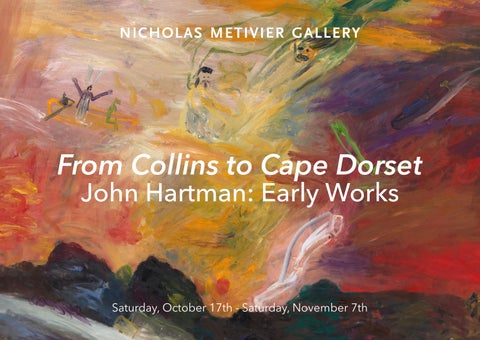
From Collins to Cape Dorset John Hartman: Early Works
Saturday, October 17th - Saturday, November 7th
Nicholas Metivier Gallery is pleased to present From Collins to Cape Dorset, an exhibition of early paintings, pastels, and drawings by acclaimed Canadian artist John Hartman. From an important private collection (London, New York, Toronto) and Hartman’s personal archive, the exhibition explores the formative years that shaped the artist’s distinctive narrative approach to landscape. Between 1976 and 1981, Hartman and his wife, Trish, lived in northern Ontario, in the First Nations communities of Heron Bay and Collins. With no road access, Collins became their home for much of this five-year period. It was there that Hartman began to see people not as separate from the landscape, but as integral to it. The experiences, stories, and histories he encountered would become enduring sources of inspiration. After settling in Lafontaine, Ontario, in 1981, Hartman continued to explore the stories and histories of Northern Ontario, Georgian Bay, and the communities around him. In 1989, he travelled to Cape Dorset (now Kinngait) for a month-long residency at Kinngait Studios, where he worked alongside Inuit artists in the lithography workshop and taught drawing. The experience echoed his earlier time in Collins, introducing Hartman to new communities, stories, and histories that would find their way into his work. From Collins to Cape Dorset offers a focused look at the experiences and artistic developments that laid the foundation for Hartman’s celebrated approach to painting place, memory, and community. Captions within by John Hartman
This is the community of Collins in northwestern Ontario; houses, a railroad track, a cemetery. The community is located on the north end of Collins Lake and on the mainline of the Canadian National Railway, between Armstrong and Sioux Lookout. In the drawing’s foreground, on a patch of open rock in the middle of Collins Lake, there is a lone figure praying. The mainland is a narrow strip of dark land. While the community was composed of practicing Anglicans and Catholics, both churches had itinerant clergy and services were sporadic. Only a few families were regular church goers, but the community underwent a quick if temporary conversion to a form of evangelical worship when the First Nations preacher Noah Campbell from North Spirit Lake came to town. In the end most people returned to their previous spiritual practices.
John Hartman Praying Figure, Collins, 1989 pastel on paper 26 x 40 1/4 in.
Trish and I arrived in Collins in August of 1976. Trish was starting her teaching position at the one room school. Shortly after our arrival the body of Victor Kwandibens was returned to the community after his tragic death. The funeral and burial, despite the completely inappropriate comments by the visiting priest, were dignified and attended by the entire community. Victor was a young man and his wife even younger. She was left with young children and was pregnant with another.
John Hartman Victor Kwandibens' Bride, 1989 pastel on paper 26 1/4 x 40 in.
John Hartman Religious Figures in a winter Landscape, 1986 oil on rag board 9 x 12 in.
This is an aerial view of Collins. You are seeing almost all of the houses in the community, spread out on either side of the railroad tracks. The lake shoreline is in the lower right side. Saul O’Keese’s house is on a hill at the upper left side of the drawing and his image is drawn in green pastel, upside down to the left of his house. Saul was a lovely person, not the best hunter nor really the best at anything but a kind person as far as I can remember.
John Hartman Saul's Mountain, 1989 - 1990 pastel on paper 26 1/4 x 40 in
John Hartman Rising From the Sea, Cape Dorset, 1990 oil on paper on linen 38 x 50 in.
John Hartman The North Shore, Heron Bay to Marathon, 1990 oil on paper on linen 50 x 76 1/2 in.
Richard and Beatrice Spade were our close friends in the years we lived in Collins. Their house was on the northern edge of the community, north of the railroad tracks and at the edge of the bush. Like all houses it was built from locally cut spruce logs. It was heated by a wood burning stove, and the chainsaw, Richard’s hunting and trapping gear, his fishing nets ,were all kept both inside and outside the house at various times. The skidoo was an important purchase for Richard. He bought it in Thunder Bay. He and I took the train to Armstrong, drove my VW van south, somehow loaded the Skidoo in my van, drove back to Armstrong, I can’t remember how Richard got it back to Collins, but as it was winter, he probably drove it. In this drawing it sits proudly in front of his house.
John Hartman Richard Spade's House, 1989 pastel on paper 26 1/4 x 40 in.
John Hartman Paysage Brulé, 1984 pastel on rag board 6 x 9 in.
The Patience brothers, Donald, Peter and Hamish, were more or less the community leaders in Collins in the late seventies. Peter was the postmaster and owned the general store. Donald was the brother who dreamed up grand plans. Their father Jock was a Hudson’s Bay factor, and a photograph of him in a Shriners fez was placed in Peter’s house on top of the TV. As this was the only TV in the community, it was a kind of gathering point. In a way it was as if Jock was watching all of us. He was certainly keeping an eye on his sons.
John Hartman Double Portrait, Donald P and Josie, 1989 pastel on paper 26 1/4 x 39 in.
John Hartman Siberian Iris & Garden, Trellis, 2000 oil on linen 24 x 30 in.
Lugi fell on a broken bottle and severed an artery in his hand. It was pulsing out blood and Lugi was frantic. The nearest doctor was in Armstrong, some twenty miles away by train if we could stop an eastbound freight. We placed a wad of paper towel in his palm, closed his fist over it and duct taped his fist closed. We stopped a train, put him on it and phoned the clinic doctor in Armstrong to alert him to meet the train. Lugi was home just a few hours later, with a stitched hand. Life went on. In the lower left someone is pumping heating oil from a 45 gallon drum into Peter Patience’s holding tank. Peter’s brother Donald sits in the centre of the foreground, dogs bark and the cross atop the church leans further off level.
John Hartman Lugi With a Cut Hand, 1989 pastel on paper 26 x 40 1/4 in.
“While living in Collins, I painted the landscape; but in retrospect it was the experience of the people that made the most profound impression on me.” - John Hartman