2026/27 Methow Valley
HEALTH & Wellness
Fitness is for everyone Navigating online resources What to do in an emergency
FREE1
WHEN LIFE HAPPENS, WE’RE HERE For 60 years, Mid Valley Hospital & Clinic has been caring for the people of Okanogan County through life’s biggest moments.
New Beginnings
Comfort
Generations
Trust
Scan to Experience Our Comprehensive Services
529 Jasmine Street, Omak, WA 98841 | (509) 826-1600 2
Staying active — and proactive
2026/27 Methow Valley
HEALTH & Wellness
A
HEALTH & WELLNESS Don Nelson : publisher/editor Tera Evans: advertising MyKenzie Bennett: design
CONTRIBUTORS
4
"WHAT IS YOUR EMERGENCY?"
9
AIRBORNE AMBULANCES SERVE CRUCIAL NEED IN RURAL AREAS
11
MAKING MYCHART YOUR CHART
13
GETTING FIT, OR RE-FIT, IS GOOD FOR ALL OF US
17
SAFETY NET PROGRAMS SUPPORT COMMUNITY HEALTH
Ashley Lodato
How to assess whether you need to call 911
Ann McCreary Shelley Smith Jones Sandra Strieby Okanogan County Community Action Council Steve Mitchell A publication of the Methow Valley News P.O. Box 97, 502 S. Glover St. Twisp, WA 98856 methowvalleynews.com
Two nonprofits offer memberships in the Methow
Manage records, appointments, prescriptions and more
ttending to your personal health requires a combination of awareness and effort. Knowledge about available resources and how to access them is one thing — utilizing them for the best outcome is the other half of the equation. In Health & Wellness 2026-27, we aim to help you do both. This issue includes articles about how to react to and be prepared for emergencies; steps to regaining or improving your personal fitness; and using online medical resources to streamline your care. Last year we expanded our list of stories and added some pages to give the magazine more substance
— and we able to do that again for Health & Wellness 2026-27. That is only possible with the support of our advertisers. They offer an array of essential services that are locally available, all related to some aspect of health care. The directory on page 19 is a valuable year-round resource that we hope you will take advantage of. Despite its relative isolation, the Methow Valley has access to a wide variety of health care professionals who can provide both primary care and referrals for additional treatments. We’re fortunate that so many providers have chosen this community as the place they want to live and practice. Together, they form a cohesive network with an impressive range of treatment options, all devoted to the valley’s well-being.
Some guidelines on how to be safe and motivated
Organizations partner to help meet essential needs
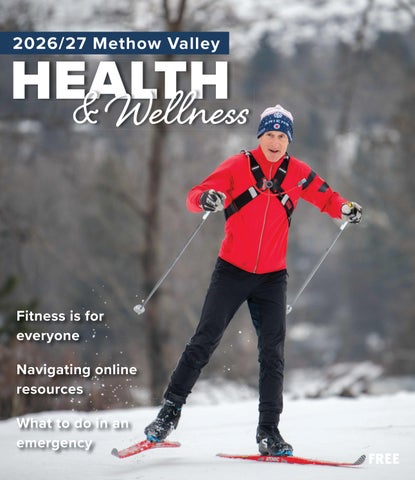
ON THE COVER Photo by Steve Mitchell Year-round fitness is a reasonable goal for many valley residents.
3
Photos courtesy of Aero Methow Rescue Service
" What is your emergency? " How to assess whether you need to call 911 BY A SHL E Y LO DATO
E
ver since the first 911 call was placed in February 1968 (by Sen. Rankin Fite in Haleyville, Alabama), we’ve all been trained to dial 911 in a medical emergency.
But what constitutes a medical emergency? On one end of the spectrum there are situations like heart attacks and limb amputations — obvious signs that someone’s life is endangered
4
and clear indicators that 911 should be tapped immediately. And on the other end there are incidents like big splinters and small burns — painful, but not life-threatening and probably not worthy of 911 calls. Everything else, though, lies between those ends of the spectrum, and weighing whether or not your particular situation is a 911 emergency can be tricky. WHAT’S AN EMERGENCY? Derek Van Marter, Executive Director of the nonprofit Aero Methow Rescue Service, provided some considerations to help assess whether a situation is urgent enough to call
911. First, though, he emphasized that if you think you should call 911, you probably should. “If you have a true emergency, you should not hesitate to call,” he said. “In medical emergencies, time is of the essence, and the sooner you can connect with medical care, the better likelihood you have for a positive outcome.” Chest pain, heart palpitations, or feeling like your heart is “jumping out of your body,” he said, are reasons to call 911 immediately. So are strokes, which may be recognized by a sudden loss of balance, dizziness, or trouble waking;
sudden blurred vision or loss of sight, a drooping or numb face or uneven smile; sudden weakness or numbness in one arm; and/or slurred speech, trouble speaking, or difficulty understanding simple phrases. He added, “Sweating that’s not heat-related, heat stroke, frostbite and serious cold emergencies, seizures that are not epileptic, strong anaphylactic and allergic reactions that result in a compromised airway — those are all reasons too.” The list continued: broken bones if they are long or big, internal bleeding, anything trauma-related in the trunk of the body,
high-impact injuries, loss of consciousness, acute (not chronic) pain, and diabetic emergencies. Van Marter elaborated on diabetic situations. “Diabetic emergencies can be reversed in the field if the patient has hypoglycemia (low blood sugar), but if they are hyperglycemic (blood sugar is high) they will need to go to the hospital,” he said. Some signs and symptoms of medical emergencies are harder to define, but Van Marter said that if you’re feeling “off” or if you notice “a difference in your skin color,” or you simply “don’t feel right or look right,” there’s a good chance that something could be a true emergency. Watch for signs that “your body may be compensating” or if you “have a sense of impending doom,” he said. In such situations, pick up the phone. Here’s where it gets tricky. The 911 system was designed for true emergencies. “But everyone’s evaluation of that is different,” Van Marter said. With any of the situations mentioned above, a 911 call is in order. That call should be made any time you think you need to be transported to a hospital for emergency care. But if you’re thinking of 911 as a house call for non-emergent situations, please think again. “It’s important to understand that when we get toned out — when we get called — we have to respond,” Van Marter said. “That takes an ambulance and a crew out of service to respond to other emergencies during that time.” Van Marter suggests that in non-emergency but still somewhat serious situations, people should think about “whether calling us is the most effective use of the limited
resources of our local emergency medical services.” If the answer is yes, by all means call. BRIDGE CARE Van Marter said that sometimes people experiencing non-emergency medical situations will get a friend or family member to drive them to the Aero Methow station in Twisp. “That’s fine,” he said, although people should be aware that the station is not staffed 24/7, and you may end up engaging the 911 system to get a crew to the station. In fact, the history of the Emergency Medical Services (EMS) is as a transportation system — simply driving people quickly from their homes (or locations of injury) to hospitals. But over time, resulting
“If you have a true emergency, you should not hesitate to call. In medical emergencies, time is of the essence.” —Derek Van Marter, Aero Methow Rescue Service
in the saving of countless lives, the EMS system evolved into a service that brought bridge care to patients, stabilizing them, treating them while in transit, and delivering them to hospitals. Suddenly EMS systems needed more than drivers; they needed “true pre-hospital medical technicians,” Van Marter said, like the EMTs and paramedics currently working and volunteering for Aero Methow. (For a fascinating history of the origins of the EMS system, read Twisp resident Rick Rapport’s 2019 book “Seattle’s Medic One: How We Don’t Die,” which tells the story of groundbreaking change in emergency medical systems in Washington state and nationwide.) Van Marter emphasized the degree to which bridge care saves lives, especially in a rural community. “At best, the closest hospital is a 45-minute drive,” he said. “Without bridge care, patients suffering heart attack, stroke, or other significant medical emergencies might not make it.” Medical professionals on ambulances can provide IVs, oxygen, and other interventions that prolong lives long enough to deliver patients to advanced care — treatments that Van Marter said are quite common for Aero Methow. “In the Methow
Valley we do a lot for people here, to get them to the next level of care,” he said. STAY WHERE YOU ARE When you do call 911, Van Marter said, it’s important that you stay put. “We will go to wherever you are; don’t try to meet us halfway.” Often, Van Marter said, people will think that they can get care faster by meeting Aero Methow on the road. But frequently there are different ways of reaching the same location, and while the patient is driving out one road, Aero Methow arrives via a different one. “If you activate EMS, be clear about where you are and stay there,” Van Marter said. This is especially true if you’re at a trailhead or out in the backcountry. “In these situations it’s going to take us a bit longer to get there anyway and if you move it might take us even longer. We could end up in a big monkey chase and prolong the time it takes to get you to advanced care,” he said. Van Marter said that in backcountry situations where a patient will need to be carried out to a trailhead, Aero Methow involves Search and Rescue (SAR). “If we need to litter someone out, we’re going to need extra hands, so we activate SAR.”
5
“Take your time, don’t get in an accident,” Van Marter said. “We always try to stress this on-scene: do not rush, prepare what you and the patient need for a possible overnight stay — including pet care — and stay in touch with the people helping out.” Ideally the patient will travel with a cell phone, Van Marter said, but mainly it’s important that the support person is in communication with Aero Methow to know where the patient is being taken, whether it’s a hospital in Brewster, Omak, or Wenatchee, or a longer transport to Seattle, or sometimes Spokane. The patient will not need their insurance or ID cards immediately upon arrival at advanced care; those can be sorted out later with the support person.
PREPARING FOR TRANSPORT Once a patient has been stabilized by an Aero Methow response team, they will be loaded into an ambulance for transport. As any Methow Valley resident — and, one would hope, most of its visitors — knows, the nearest hospital is close to 40 miles away from Twisp. Depending on the situation and time of incident, a transported patient might be looking at an overnight stay, or longer. “Ideally the patient would have a small bag packed with things they might need to be away from home for a period of time, as well as a bag for the friend or family member who will be their liaison,” Van Marter said. This assumes that the patient has someone — or someone who can be called — for support in such situations. Aero Methow is a one-way transport agency; they cannot legally wait at the hospital to bring someone home. “A patient is always going to need a ride home,” Van Marter said, although there are
6
services in the county that will help with after-care transport, which the area hospitals will help organize. Van Marter said that although a medical emergency creates an atmosphere of urgency, the support person does not need to rush around and try to follow the ambulance transport down the valley. In fact, they shouldn’t.
AIR AMBULANCE In medical emergencies serious enough to require transport to Seattle or Spokane, it is likely that an air ambulance will be involved. The best way to be prepared to use such a service is to become a member of both Life Flight and Airlift Northwest, Van Marter said. Aero Methow typically calls Life Flight first, Van Marter said, because they are based in Brewster, but if they are out on another call Aero Methow will call Airlift Northwest. This is why “membership with both agencies is critical,” Van Marter emphasized, saying that over the course of a year, “we use them just about equally.” Links to membership information can be found at aeromethow.org/ air-ambulance. See related story, page 9. CRASH DETECTION A fairly recent technological invention is costing Aero Methow time
and money, Van Marter said: crash detection functions. As soon as smart phones started including crash detection programs, Aero Methow began getting a slew of false alarms. Crash detection settings mean that if your phone falls out of your pack while you’re biking or running, you jump in the lake with your phone in your pocket, your phone falls off the top of your car when you drive away (Aero Methow has had 10 of these calls so far this year), or any other situation where your phone gets dropped or immersed, your
The
SupporT CenTer CRIME VICTIM SERVICE CENTER
We provide Advocacy and Support for Victims and Survivors of Domestic Violence, Sexual Assault, and Other Crimes
For 24/7 help, Call 1(888) 826-3221 TheSupporTCenTer.org
phone automatically notifies EMS and Aero Methow gets toned out, usually to a site where absolutely nothing is happening, let alone an emergency. Almost always there is nothing there, save for a cell phone somewhere in the grass or in a roadside ditch. “For us, these false positives have been a waste of resources,” Van Marter said. He suggested that smart phone users disable their crash detection as a default, and enable it situationally, like when they’re doing a remote mountain bike ride. A simple Google search shows
instructions for temporarily disabling this setting that most users have no idea is active as a default in their phones. “If people only turn on crash detection when they’re likely to need it, it will result in far fewer false positives and unproductive trips for our crews,” Van Marter said. FUNDING The fact that you can dial three digits and have a fully outfitted transport vehicle and medical professionals show up on your doorstep to provide bridge care while moving you to a hospital swiftly and safely
Aero Methow RESCUE SERVICE
CALL 91 911 For emergencies
WE’RE HERE FOR YOU BUSINESS OFFICE (509) 997-4013 aeromethow.org
Serving the Methow Valley since 1968
is pretty remarkable, but none of that happens by accident and it all comes with expenses. “The EMS district levy is foundational to our existence — 60% of our income comes from that levy,” Van Marter said. Another 25% of the income is ambulance reimbursement, meaning that when 911 calls result in patient transport, some of those expenses (vehicle fuel and maintenance costs, staff time, medical supplies, etc.) are reimbursed. The other 15% comes from grants and private donations. It seems illogical to the layperson, but as an emergency transport agency, Aero Methow can only claim reimbursements if patients are transported. Without transport to advanced care, any interventions provided by Aero Methow EMTs and paramedics are not reimbursable. “Right now, about 60% of our cases are non-transport cases where we treat the patient but then they decline to be taken to the hospital,” Van Marter said. “When non-transport calls start outpacing transport calls, the levy just can’t keep up.” He noted that even the ambulance reimbursement is insignificant,
compared with the true cost of maintaining crews and equipment, especially as Aero Methow continues to elevate staff training and credentials in order to better serve the Methow Valley community. Van Marter reiterated that if a 911 call comes in, Aero Methow will respond, without question. “We will do the evaluation and make recommendations, but if the patient declines transport, we put ourselves back in service and there is no reimbursement to cover any of the time or resources expended,” he said. That’s why it’s important that those experiencing medical situations in that gray area between “life or limb are in danger” and “this hurts but I can tell it’s not major” evaluate the potential seriousness of their condition when deciding whether or not to make a 911 call. Again, though, Van Marter emphasized, “If you have a true emergency, you should not hesitate to call. In fact, we urge you to call, because time is critical.” No one ever wants to have to call 911, but if such a call is necessary, the best outcome is likely reliant on a swift response by trained professionals.
ROLL INTO THE
Adventure!
RESERVE YOUR SPOT TODAY! 12 TRIBES LAKE CHELAN CASINO
12 TRIBES OMAK CASINO HOTEL
455 WAPATO LAKE ROAD | MANSON, WA 98831
28968 HIGHWAY 97 | OMAK, WA 98841
509.687.6950
844.526.8600
Experience a one-of-a-kind adventure at the 12 Tribes Colville Casinos RV Parks, the ultimate destinations for RVers seeking the perfect blend of fun, comfort, and convenience. With top-notch amenities, gaming excitement, and a welcoming community, your RV adventure awaits.
7
Home Birth Midwifery Care Nurturing families in the Methow Valley & beyond since 2018 Offices in Twisp, WA and Wenatchee, WA
Christina Stout, Licensed Midwife
In-network maternity provider with all state and private health insurances
Holistic Midwifery Care for Your: • Pregnancy • Home birth • Water birth • VBAC • Breech • Twins • Newborn • Postpartum • Lactation
Specialized Bodywork for: Fertility, pregnancy comfort, labor preparation, turning breech, postpartum pelvic floor and core recovery
Why Methow Valley Moms love Christina? “I cannot imagine feeling better supported by a midwife than I was with Christina. What is more beautiful is that this experience has been echoed by every other mother I know who has worked with her.” “The postpartum care we received was like nothing we’ve ever heard about. Literally amazing!” “I have never felt more spiritually connected & in tune with my body & baby, than during what I consider a miraculous and empowering birth... Christina’s support throughout truly made it a dream experience that I am proud to share and will treasure always.”
wildmoonmidwifery.com • (206) 660-6459 Reach out to see if midwifery care is right for you! 8
Photo courtesy of lifeflight.org
Airborne ambulances serve crucial need in rural areas Two nonprofits offer memberships in the Methow BY A NN M C CRE A RY
L
iving an hour’s drive from the nearest hospital emergency room means Methow Valley residents often rely on ambulance services — both ground and air — during serious medical emergencies. Aero Methow Rescue Service, the valley’s ground ambulance provider, is often the first on the scene to help victims of serious injury or illness. When patients need to get from the valley to a hospital as quickly as
possible, or receive specialized care at a medical center in Seattle, an air ambulance may be the best option. The Methow Valley is fortunate to be served by two air ambulance providers — Life Flight Network and Airlift Northwest. Both air ambulance services offer memberships that ensure members will not incur any out-of-pocket expenses for air transportation. The air transportation providers work directly with insurance companies for their portion of payment, and cover whatever portion is not covered by insurance. Many Methow Valley residents are uncertain about whether they should buy a membership, and whether they should have memberships in
both air ambulance services. In short, the answers are yes and yes, said Derek Van Marter, Executive Director of Aero Methow Rescue Service. “Almost daily we get questions” about air ambulance memberships, Van Marter said. “There’s a lot of confusion.” REAL LIFESAVERS Because of the valley’s remote location, air ambulances can be lifesaving when a critically ill or injured patient needs to get to a hospital. More than fast transportation, the aircraft are essentially flying Intensive Care Units. Specially trained emergency medical providers on board are able to treat and stabilize
patients while they are in transit. In the Methow Valley, helicopters are used in nearly all (99%) of air transports — about 50 to 60 flights a year, Van Marter said. The majority of patients — about 75% — are experiencing a medical emergency such as stroke or heart attack. The rest of transports involve trauma patients such as car accident victims, Van Marter said. If Aero Methow’s medical team determines that air transport is needed, they will first call the Life Flight base in Brewster — the closest base to the Methow Valley with response times of 30 minutes or less to the valley. If the Life Flight helicopter in Brewster is already on a mission,
9
Aero Methow will seek the next closest air ambulance, which is Airlift Northwest in Wenatchee. “The most important reason we say you need both (memberships) is that when we need to fly someone out of here, we can’t guarantee which (air ambulance) asset will be available,” Van Marter said. A large proportion of air medical transports involve moving patients from one hospital to another hospital with higher level or specialized care. Availability often determines which air service company will respond in those cases. Representatives of both Life Flight Network and Airlift Northwest recommend purchasing both memberships if it is financially feasible. Each company prices a household membership at $85 annually. HOW IT WORKS The public sometimes confuses memberships with insurance, but memberships are a different product,
said Jeff Richie, chief air medical officer for Airlift Northwest. The membership programs were developed many years ago to help the companies “offset the cost of medical transport to patients,” Richie said. When a patient has a membership, the air ambulance company works directly with the patient’s insurance company for its portion of the payment, and the rest is covered by the membership. Any deductibles, copays, and coinsurance are covered for a transport. In many cases, deductibles and co-pays for a patient can be upwards of $10,000 or more, which are covered for members, Richie said. “I would look at my insurance and ask, ‘What’s my deductible?’ If you can’t afford to pay the deductible, then I would get a membership,” Richie said. “It gives patients peace of mind over what a health care bill might come to.” The membership programs for Airlift Northwest and Life Flight
HOW TO LEARN MORE
Aero Methow Rescue Service provides information about air ambulance services and memberships on its website at aeromethow.org/ air-ambulance. Aero Methow also presents a podcast called Between Here and Help, with two episodes devoted to air ambulance services. The podcasts are available on the website, aeromethow.org, by clicking on the “Media” link. are priced and function similarly, but differ in that Airlift Northwest requires all members of a household to have a health insurance plan that includes air medical transport benefits in order to purchase a membership. Life Flight does not have insurance requirements for people to purchase a membership. Both air ambulance services are not-for-profit organizations. Airlift Northwest is owned by the University of Washington and is part of the UW School of Medicine. Life Flight is owned by a consortium of four not-for-profit health systems.
60 Years of Protecting Health, Housing, and Hope
For 60 years, Okanogan County Community Action Council (OCCAC) has empowered families and fueled economic strength when and where it matters most.
Because everyone deserves a safe place to live, nourishing food, and the dignity of warmth in the winter.
• Rent Assistance – Preventing homelessness and keeping families secure. • Utility Support – Ensuring homes stay warm, safe, and powered year-round. • Food Access – Partnering with nine food pantries to fight hunger across the county. • Home Repairs & Weatherization – Protecting the health and safety of our most vulnerable neighbors.
Both air ambulance services have patient advocate services to help patients with financial assistance and charity care. Air medical transport is a costly service, but for good reason, said Natalie Hannah, a spokesperson for Life Flight Network. “We’re not just a mode of transportation. We’re a flying ICU that we bring to the patients, with highly trained medical professionals, and state of the art aircraft and equipment,” Hannah said. “It’s costly but critical to the survival of people in rural communities,” she said. “If they live in a rural area more than 30 minutes from an ER, or they recreate outdoors, a membership is a minor fee for peace of mind.”
When we invest in our collective wellbeing, families thrive -- and our entire community grows stronger.
Need help? Want to give back? Visit occac.com or call (509) 422-4041.
Check out our amazing crafts and harvest!!
Saturdays
9am - 12pm April - October
methow valleynews.com 10
methowvalleyfarmersmarket.com
Methow Valley Community Center 201 Hwy 20 South, Twisp
Making MyChart your chart Manage records, appointments, prescriptions and more challenges arose when different EHR systems could not talk to each other, and some healthcare providers balked at what they considered was laborious data entry taking time away from patient care. As with all technology, those problems have been, and continue to be, addressed and improvements made. All the advancements in the system have been a benefit for the patient. Being able to access their records through patient portals allows them to participate and advocate more fully in their medical care.
BY S H EL L E Y S M I T H J O N E S
S
ince the advent of secure electronic access to most all aspects of healthcare through software programs such as MyChart, patients can be proactive in management and understanding of their overall medical care. MyChart provides easy access to scheduling appointments, refilling prescriptions, reviewing test results, and reading personal medical records. Healthcare providers can be reached with questions or concerns efficiently through the in-program messaging system. Younger adults who grew up in the digital era have an easier time using MyChart and its patient tools. Some of the older generations might struggle with the concept of online medical care issues but find that with a little help systems like MyChart are generally user friendly. How did we get there from here? A LITTLE HISTORY Medical records have come a long way from the days when patient information was recorded by hand, placed in a paper folder, and filed away in bulky cabinets. The first electronic healthcare record [EHR] platforms appeared in the 1960s but were primarily used by hospitals for billing and administration. In the 1970s, large academic hospitals such as Harvard, University of Utah, and Duke — as well as the Department of Veterans Affairs — began using electronic patient medical records. The first computers were cumbersome and expensive, so adoption of the new method of recordkeeping was slow for the first decades of usage. In 2000, The Institute of Medicine published a report titled “To Err is Human,” which was called a “wakeup call for healthcare.” It showed that medical errors were a leading cause of death and many of the
Photo by Shelley Smith Jones errors were caused by problems with paper records. Electronic records could help prevent these mishaps. As the EHR platforms became more effective, the proverbial doctor’s writing that could often be hard to read began to be a thing of the past. Medical staff could now store patient medical histories, test results, and notes electronically. The next step was to create a way for the patient to have direct access to their medical records. A software company named Epic Systems debuted an electronic tool that did just that. MyChart, the first major online patient portal, launched in 2000. “There wasn’t an integrated patient portal before then,” Leela
Vaughn, vice president and sales executive at Epic said in June 2025 to “Becker’s Health It.” “Fast forward to 2025 … we have 195 million active MyChart users.” Another game-changing step to the use of EHRs came in 2009 when Congress passed the Health Information Technology for Economic and Clinical Health Act or the HITECH Act. It provided more than $35 billion in incentives to promote and expand the adoption and use of EHRs. The goal was simple: get doctors and hospitals to use them and the government would pay them to do it. By the 2010s, paper records became rare. However, other
WHAT CAN MYCHART DO? “Provider Finder,” a MyChart tool, helps a patient find a doctor or other specialist that is right for their care based on specialty, condition, or insurance. Reading a potential providers public profile can be an aid to decision making. A request for an appointment can be made through MyChart. Scheduling appointments can be done online where you can see the available appointments and select one that fits with your schedule. Canceling and rescheduling for later can also be accomplished in MyChart. Checking in for an appointment can be done with ease in MyChart. Most pre-visit tasks and questionnaires can be completed before hand, skipping the paperwork at the front desk. One can use location tracking on their phone to be automatically checked in when they arrive at the clinic, if they want to skip that step as well. Parents can take care of children and family members all from one account by getting “proxy access” and connecting accounts. This can be helpful when caring for adults who may need help managing appointments, medications, and understanding test results. A patient can invite someone to have access to your account right from MyChart. Health and Visit Summaries can be viewed and downloaded soon after the visit takes place. Copies of a specific visit or an entire health record can be sent through the system.
11
Accounts can be linked from participating organizations together so a patient can see a centralized view of their medical information. “Everything you need to track your health, review your medical information, and stay engaged in your care” is the motto of MyChart. The list is long: test results, medications, health summary, medical and family history, growth charts, and questionnaires, for starters. “Track My Health” documents day-to-day health and links the account to a personal device and apps such as Google Fit and Apple Health to automatically record information
such as weight, blood pressure, or steps in a day. EyeCare Center information such as an eyeglass or contact prescription is available in MyChart. “Symptom Checker” allows one to find answers about symptoms they are experiencing and recommendations for care. “Research Studies” is a resource for potential participation in a research study. Important legal documents such as advance directives and living wills can be uploaded to a MyChart account. “MyChart Bedside” and “MyChart Care Companion” can help a patient
Yoga for a Life in Motion
Group Classes every level, every day Private Sessions that meet you where you are Online Videos to practice anytime, anywhere
MTN ANNEX | WINTHROP, WA 206-761-0923 info@motiveyogaco.com www.motiveyogaco.com
WELLNESS STARTS WITH COMMUNITY
stay informed and engaged in their care during a hospital stay and follow a care plan prescribed by a doctor, respectively. Finally, a patient can pay bills, learn about financial assistance, and keep insurance information up to date on MyChart. All the above things can be done in MyChart, but what if one is “technically challenged”? Where to go for help to get started? THERE IS HELP If a patient can read and understand online instructions, MyChart provides step-by-step instruction to
sign up for the system on a computer or through a downloaded app. Confluence Health MyChart app can be downloaded on the Apple App Store or Google Play. After receiving an activation code from a healthcare organization, if required, one can establish an account with a username and password. Exploring and becoming familiar with the portal can be informative and help a new user navigate the easiest areas before taking a deeper dive into the various possibilities. Confluence Health has a MyChart Help Desk which can be reached at (509) 436-4020 for help with problems logging into the system or any other usage problems. Help including troubleshooting and answers to most questions — simple or complex — is available at mychart.org under the tab “Help.” Methow at Home offers free 1-on-1 device education by appointment on Tech Tuesdays at the Winthrop Library. Contact (509) 996-5844 for more information. Oftentimes, a trusted friend with computer skills is willing to walk through the process and answer questions.
“Professional hearing care with a personal touch.” Walk-in’s welcome Free Hearing Aid Cleaning
At Room One, we recognize & use the power of community to create connection and work toward positive change. We envision a rural community where everyone has hope for the future and the opportunity to play, work, and live freely.
g care with a personal touch.”
nd operated for over 20 years. e and L&I Accepted.
y-Thursday 8 a.m. to 4 p.m.
enue • Omak • 509-422-3100 12
Locally owned and operated for over 20 years. Insurance and L&I Accepted.
Hours: Monday - Thursday 8 a.m.to 4 p.m. Hanna Moomaw, HS, COHCwelcome 5 West Central Avenue Walk-in’s Omak Hearing Instrument Specialist Free Hearing Aid Cleaning (509) 422-3100 406 Burdin Blvd. Grand Coulee
Getting fit, or re-fit, is good for all of us Some guidelines on how to be safe and motivated
I
BY S A NDR A S T RIEBY
s fitness for everyone?
“Absolutely,” says Dr. Kellar McCloy, physician and founder of Liberty Bell Family Medicine in Twisp. Physical activity is good for us, and it doesn’t take much to improve your health. Restarting a fitness program, or starting a new one, does come with some guidelines. Here’s how to start safe, stay motivated, and have fun while you get in shape. FIRST STEPS Whether you are new to fitness or rebooting after time away, setting an intention can guide you in starting and maintaining a program. “I find that the most important step is to set a goal or find what motivates you,” said Jenna Kokes, physical therapist and co-owner of Winthrop Physical Therapy and Fitness. Your reason for getting fit can help you choose a fitness program that will work well for you. You may have an obvious purpose, like injury recovery or training for an event, a seasonal sport, or a challenging hike. Or perhaps you’re interested in improving your overall fitness, accomplishing everyday tasks more easily, or simply feeling better. Evaluating your current condition is another preliminary step. “The vast majority of people can just get out there and start exercising,” said McCloy. In general, he said, “the risk of not exercising [and] staying sedentary is much greater than just getting out and starting.” McCloy did advise that anyone with a chronic medical condition or who has been inactive for a long time check in with a doctor. If exercising causes chest pain, abnormal shortness of breath, or makes you to feel lightheaded or dizzy — those are also good reasons to speak with your doctor, he said. For someone recuperating from an injury or illness, physical therapists and other practitioners commonly use a fitness-readiness questionnaire, said Kathy Merwin, a fitness instructor who spent several years working at Winthrop Physical Therapy. Formally known as a “Physical Activity Readiness Questionnaire” or PAR-Q, a questionnaire can help you decide whether it’s safe to start or resume activity, or if it would be beneficial to work with a health professional. Several versions of the PAR-Q are available online. A person who answers “yes” to any of
Photo courtesy of Jenna Kokes the seven core questions is advised to talk with a doctor before becoming more physically active. Seeing a doctor who knows your history and a physical therapist who can advise based on your particular circumstances can be good precautions for anyone who’s interested in creating a safe, effective fitness program, said Merwin. CHOOSE YOUR ACTIVITY Finding an activity that you like and a means of pursuing it that resonates with you are two keys to fitness success. Merwin suggests choosing an
activity “that lightens your heart and frees your spirit.” McCloy recommends experimenting, if necessary, to find “something that you enjoy doing and that you feel like you could stick with for the rest of your life.” Context is important, too. Consider whether you’d rather exercise alone, with friends and family, or in a class. Would you like to be indoors or out — or some of each? “There are such a variety of programs out there most people can find something they like,” said Kokes. What you have time for is another parameter
13
to consider. Getting and staying fit takes time; how much “depends on your goals as well as your age,” said Kokes. “I generally recommend three days a week minimum spent on strength as a universal guideline,” with each session totaling roughly 45 minutes to an hour. Alternating strength training with recreational activity can add up to “a well-rounded schedule,” she said. START SLOW AND MIX IT UP “Slow and steady” is the best way to start building or regaining fitness, said Merwin. “Begin with low intensity,” she said. “Build frequency, duration, weight, and speed. Don’t start full on.” Bryan Putnam, co-owner of Lifted Training Center in Twisp, suggests that anyone building strength with weights follow “a beginner’s strength program that is meant to take you from ‘detrained’ to having some foundational strength and knowledge in the gym.” Go light, practice movements before loading, and don’t overdo it, he recommends — even if you’re an athlete or have lifted before. Creating a balanced program will
foster better health and can help prevent injuries. The 2018 Physical Activity Guidelines for Americans recommend aerobic and muscle-strengthening activity for all ages, and add bone-strengthening for children and adolescents, and balance training for older adults. “If it were up to me, I would run every day, but that doesn’t make me the best runner,” said McCloy, a distance runner who ran his first 100-mile race a few weeks ago. His own program includes five or six days of running and two days of strength training each week; he also works on flexibility and mobility throughout the week. In addition, warming up and cooling down are “important from an injury-prevention standpoint,” said McCloy. A 10- to 15-minute warm-up before intense activity helps the body ease into the workout, and a light cool-down at the end aids recovery, he said, helping to prevent injuries and avoid burnout. “Rest days are just as important” as work-out days, said Kokes. “Taking one or two days a week for a walk or mobility routine is also a great habit to implement. You don’t
“I find that the most important step is to set a goal or find what motivates you.” —Jenna Kokes, Winthrop Physical Therapy and Fitness. need to work out every day and more is not always better.” Varied activities will help you avoid overworking any set of muscles or joints, and the variety can be good for your mind, said Merwin. Children and adolescents can build bone strength with ordinary activities like walking, running, jumping, and climbing; racquet and team sports also help build strong bones, according to a 2004 Surgeon General’s Report on bone health and osteoporosis. Several local classes support better balance for older adults. Aero Methow Rescue Service and Methow At Home (MAH) sponsor
SAIL (Stay Active and Independent for Life) classes, which include strength, balance, aerobics, and stretching. MAH also offers A Matter of Balance — an eight-week series of education and movement classes — and Tai Ji Quan for Better Balance, an ongoing weekly class. All of those classes are free. Another option is working with a physical therapist or trainer to develop a customized balance-training program. GET HELP WHEN YOU NEED IT “If you are someone with a good foundational knowledge then finding a program that you can follow independently is great; however, if
WINTHROP PHYSICAL THERAPY & FITNESS 202 WHITE AVENUE WINTHROP WA 98856 509-996-8234
Looking for a place that meets all your fitness needs? We've got you covered!
Your journey starts here. Stronger every day! 24hr Gym Access 14
Personal Training
Group Classes
Something For Everyone
you have been out of the game for a while or have experienced changes to your body/health then hiring a personal trainer or working with a physical therapist is a great starting point,” said Kokes. Putnam concurs that there are times when working with a trainer can be a good choice. “If you are someone who has health concerns, or fear or anxiety around the gym or getting started then I would recommend a trainer. They can best guide you and create a program tailored to your needs.” Classes can be another way to receive ongoing support and guidance, coupled with the support of a group — a huge benefit, said Donna Baillie, MAH’s Education and Social Connections Manager. In addition to the classes noted above, Winthrop Physical Therapy and local venues like Motive Yoga, the Methow Valley Wellness Center, Pasayten Taekwon Do, Y’all’s Yoga Studio and the Methow Combat Club offer classes to suit various interests. KEEP DOING IT “Motivation is the hardest and most important part of
maintaining a consistent fitness routine,” said Kokes. She recommends knowing what drives you and finding activities you enjoy that make you feel good. Some people will benefit from working out with a workout partner who can provide accountability and support, she said, while others appreciate the challenge of competing with themselves and tracking their own progress. Experiment if you’re not sure what will work best for you, said McCloy. “Sometimes it does take trying a few things,” he said. Putnam emphasized the inherent benefits of strength training, which can provide an ongoing incentive to keep working out. “You’ll have better mobility. Movement will feel easier and you’ll feel more capable in daily life. Your health will be improved in just about every way. And you’ll just feel better,” Putnam said. Lifted members “are shocked at how much strength training does for their mental health and mood,” he said. “People start [training] to get fit but they stay because of
how it improves their mental life.” GEAR AND TRACKERS “You don’t need much gear to start strength training,” said Putnam. “Comfortable activewear and a flatsoled shoe are about it.” Compression sleeves may be useful for a person with elbow or knee joint issues, he said. Kokes concurred that fitness does not require a lot of personal gear. “For weightlifting a stiffer or minimalist shoe is best,” she said. “You want a stable base to push through. Cushion shoes like Hokas belong on the trails not in the gym. Otherwise, you just need a good water bottle and some comfy clothes.” Baillie, Kokes, and Putnam all saw value in fitness tracking devices and apps. Kokes finds an app helpful, saying “It is an easy way to track what I am lifting and helps with progressions.” In addition, she said, “tracking devices can be used to motivate people to meet step count goals, etc.” Putnam recommends keeping track of workouts using a notebook or an app. “Recording your weights, reps, and sets will allow you to
progressively overload and keep growing,” he said. McCloy believes fitness tracking “can work really well for some folks.” Not everyone enjoys it, though, and McCloy has “seen folks let data get in the way of things — to the point of not really enjoying the exercise, or leading into overuse injuries or other complications.” Dr. Cheri Levinson, founder of the Louisville Center for Eating Disorders and a professor at University of Louisville and Director of the university’s Eating Anxiety Treatment Lab agrees that tracking is not always beneficial. It can maintain and even spur eating disorders, she said. “It’s much better to do things like focus on joyful movement and making sure that you’re appropriately fueling your body rather than counting those sorts of metrics,” she said. The bottom line: track if it works well for you, and be mindful of how tracking relates to your goals and your overall health. Like every facet of fitness, the work you do should work for you.
Methow Valley Do you have an insurance question? Give Kathy Smithson, Katy Dalan or Yuriko Robles a call. They can assist you with answers to questions your questions about: They can assist you They can assist youwith withanswers answerstotoyour your questionsabout: about: Individual Health, Employee Benefit Plans, Dental, Individual Health, Employee Individual Health, EmployeeBenefit BenefitPlans, Plans,Dental, Dental, Vision, Life, Long Term Care, Disability Vision, Life, Long Term Care, Disability Vision, Life, Long Term Care, Disability, and ALL Medicare Planning. and ALL Medicare Planning and ALL Medicare Planning.
Here to serve you at Smithson Insurance Services!
HEALTH F AI R
20+ local agencies offering resources & support
FREE EVENT
They can assist you with answers to your questions about: Individual Health, Employee Benefit Plans, Dental, atVision, the Winthrop Barn Life, Long Term Care, Disability 1:00pmand - 3:00pm ALL Medicare Planning.
Thursday, Oct. 1st
Flu Shots Balance Testing Blood Pressure Testing Falls Prevention Hearing Testing Medical Equipment Cognitive Health Resources For rideshare information: Call: 509-996-5844
Funded in part by:
15
Twisp River Wellness
Acupuncture, Herbal Medicine, Nutrition
509.416.6992 Chaya LAc, ChayKudla a Kudla MS, AEMP, LAc, NTFNTP P www.twispriverwellness.com
Need help with everyday stress? life transitions, sleep, anxiety, medical symptoms, pain...
mindfulness is the single most powerful tool for well-being
Sharon Cohen
16
449-2594
personal coaching weekly groups classes
mindfulmethow.com
97.5 fm
Safety net programs support community health Organizations partner to help meet essential needs BY REN A SH AW V ER
O K A N O G A N C OUN T Y C O MMUNI T Y ACT I O N C OUN CIL
A
grocery receipt tells a story these days. So does a gas pump, a rent notice, and a heating bill. Across Okanogan County, families who once managed to make ends meet are finding the math no longer works — housing costs that have climbed out of reach, food prices that keep rising, gas that eats a bigger share of every paycheck, and everyday expenses that add up faster than income does. For a growing number of households, something has to go without. Often, it’s something essential. THE FOUNDATIONS OF HEALTH Public health experts call these essentials the “vital conditions of health:” nutritious food, medical care, safe housing, reliable heat, and other basic needs. They aren’t extras — they’re the foundation everything else is built on. A child can’t focus in school if they’re hungry. A senior can’t manage a chronic illness without stable housing and transportation to appointments. A parent can’t hold down a job while worrying whether the heat will stay on through winter. These conditions are sustained by a web of local systems — food pantries, clinics, housing programs, utility assistance, schools, and nonprofits — working alongside families to fill gaps when the cost of living outpaces what a paycheck can cover. When that system is strong, the whole community benefits: lower emergency room use, better school
outcomes, a more stable workforce, and neighborhoods where people can get ahead instead of just getting by. UNDER STRAIN That system is being stretched from both directions at once. Need is rising as costs climb, while the government funding that sustains food assistance, housing support, energy assistance, and healthcare access is being cut. The safety net families rely on is losing its own safety net — at precisely the moment it’s needed most. This isn’t an abstract policy problem. It’s a local one. Okanogan County’s poverty rate runs roughly twice the Washington State average, meaning a larger share of our neighbors have far less room to absorb rising costs or shrinking support. When funding drops, the effects don’t stay contained to the households directly affected — they ripple into emergency rooms, into classrooms, and into a local economy that weakens when residents can’t fully participate. WHAT’S AT STAKE The health of Okanogan County isn’t measured only in doctor visits. It’s measured in whether families can afford groceries, whether the heat stays on, whether housing is within reach. As support for these vital conditions erodes, understanding what’s at stake — and the systems working to hold the line — matters more than ever. Methow Valley is fortunate to have a network of community partners working to support these vital conditions — organizations like Room One and Okanogan County Community Action Council working to connect families with food, housing, heating, and other essential resources before a hard month turns into a crisis. This local infrastructure is
Chart courtesy of Okanogan County Community Action Council Good health relies on a several related factors that are addressed by a variety of local orgnizations. what keeps gaps from becoming emergencies. The past five years tell a story of steady, on-the-ground impact in the Methow. Okanogan County Community Action Council has delivered heating assistance to 308 households in Winthrop, Twisp, Carlton, Methow, and Mazama; weatherized dozens of local homes for seniors and people with disabilities; and supported thousands of food pantry visits through The Cove and other community partners. Our housing advocates have walked alongside Methow Valley families and veterans facing
eviction, homelessness, and long waits for rental assistance, helping them find stability when they needed it most. These numbers represent real neighbors — people who live down the road, shop at the same stores, and send their kids to the same schools. This work is part of the fabric of the Methow, and Community Action is proud to show up for this community now and for years to come. Rena Shawver has been the Executive Director of Okanogan County Community Action Council for the past four years. For more information, go to www.occac.com.
17
DIRECTORY OF ADVERTISERS BIRTHING SERVICES
LOCAL GOODS
Wild Moon Midwifery & Healing Arts, LLC . . . . . . . . . . . . . . 8
Methow Valley Farmers Market . 10
CASINOS 12 Tribes Casino. . . . . . . . . . .7
EMERGENCY SERVICES Aero Methow . . . . . . . . . . . .7
FITNESS CENTERS Lifted Training Center. . . . . . . 6 Winthrop Physical Therapy & Fitness. . . . . . . . . . . . . . 15
HEARING SERVICES Moomaw Hearing. . . . . . . . . 12
HOSPITAL/CLINIC
MENTAL HEALTH/WELLNESS Mindfull Methow . . . . . . . . . 14 The Support Center. . . . . . . . 6 Twisp River Wellness . . . . . . . 15 NONPROFITS Methow at Home . . . . . . . 15, 18 Okanogan County Community Action Council. . . . . . . . . . . 10 Room One . . . . . . . . . . . . . 12
MASSAGE SERVICES Wild Pine Massage LLC. . . . . . 18
RADIO
Family Health Centers . . . . . .20
KTRT . . . . . . . . . . . . . . . . 16
Mid-Valley Hospital . . . . . . . . 2
SENIOR HEALTH
Three Rivers Hospital. . . . . . .20
Aging & Adult Care . . . . . . . .20
Liberty Bell Family Medicine. . . . . 16
Methow At Home . . . . . . . 15, 18
INSURANCE SERVICES
YOGA
Smithson Insurance Services . . 15
Motive Yoga Co.. . . . . . . . . . 12
It doesn’t ha have ave to be
hard ha ard to grow o older here ow our programs & services make it easier
Wild Pine Massage Offering restorative mobile massage services for the Methow Valley community
JOIN US! 509-996-5844
18
www.methowathome.org
509-713-2217 wildpinemassage.com wildpinemassage
Event massa g availa e ble
We've got issues! And your business belongs in the next one! Winter 2025/26
Methow Valley A SUPPLEMENT TO THE METHOW VALLEY NEWS
Methow
2026
y Vows Valle a guide to getting married in the Methow
2026
HOME
Real estate
The market’s balancing act
The evolution of design V I S I T O R I N F O R M AT I O N
|
TRAIL MAPS
|
AC T I V I T I E S
Winter 2025-26
1
Winter Guide publishes in late fall
A Methow history
A supplement to the
Sustainability explained
Methow Valley News
•FREE•
1
Valley Vows 2026
Valley Vows publishes in winter
Inside a high-performance home
FREE
A supplement to the
Methow Valley News
Methow Home publishes in early spring
2026
Information for an enjoyable Methow Valley visit
Dining
& lodging guides
Activities
for every interest Summer & all2025 ages
FREE
Summer Guide publishes in spring
59
Health & Wellness publishes in early fall
Advertising@MethowValleyNews.com | (509) 997-7011 19
••Respite Respite • Medical Equipment • Medical Equipment • Home-delivered Meals • Home-delivered Meals • Family Caregiver Support • Family Caregiver Support
Are you helping an adult who needs care? Our mission is to enhance a Our mission enhanceaa person’s abilityistotomaintain person’s ability to maintain life of independence and choice.a
life of independence and choice. Serving Adams, Chelan, Serving Douglas,Adams, Grant,Chelan, Lincoln Douglas, Grant, Lincoln and Okanogan Counties and Okanogan Counties
1-800-572-4459 1-800-572-4459 aaccw.org aaccw.org 270 9th St. NE, Suite 100 East Wenatchee
509.886.0700 aaccw.org
Serving Adams, Chelan, Douglas, Grant, Lincoln and Okanogan Counties
Proudly serving the Methow Valley, south Okanogan County, and north Douglas County
Here for every y chap pter of y ourr sstory. tory. chapter your LEARN MORE: Hospital: (509) 689-2517 Clinic: (509) 689-3749 24-Hour Emergency Care
20
Same-Day Primary Care Appointments
Short Waits for Specialists
Local Care by Local People
threerivershospital.net brewsterclinic.org