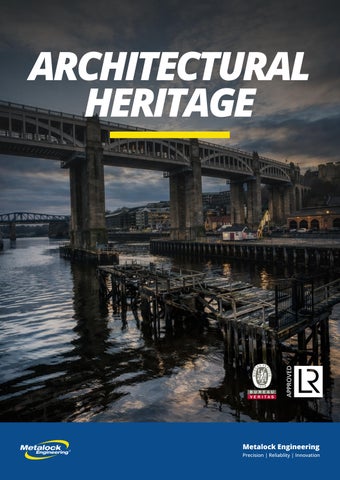
ARCHITECTURAL HERITAGE
Metalock Engineering Precision | Reliablity | Innovation
Protecting Britain’s Heritage One word - Metalock - has become synonymous with a complete service for the cold mechanical repair of cast iron and other metals. Metalock Engineering UK initially developed the cold repair process to repair invaluable and sometimes irreplaceable industrial machinery, the process proved highly successful. Further research and refinement of the technique was undertaken which increased the scope of the process, most significantly in the application of repairs and restoration to cast iron structures. Much has been written about Britain’s industrial and architectural heritage and in recent years the Metalock cold repair process has been used extensively and very successfully in restoring and repairing many famous landmarks and historic buildings, both large and small.
The Metalock cold repair process is an accepted, unique and modern engineering remedy that has made a huge contribution to the protection of Britain’s Structural Heritage. 2
High Level Bridge Newcastle The bridge was closed to road traffic to allow essential maintenance to ensure the bridge’s long-term future, including replacement of wooden supports beneath the road deck. The reopening slipped as severe cracks were found in some of the bridge’s iron girders. Having assessed the bridge girders, engineers decided to engage the services of Metalock Engineering UK Ltd to carry out the essential cold Metalock repairs.
Designed by Robert Stephenson and built between 1847 and 1849, it is the first major example of a wrought iron tied arch or bow-string girder bridge. It is a fine and long standing engineering solution to a difficult problem; the spanning of 1337 feet of river valley, including 512 feet across water. The High Level Bridge has six river spans of 125 feet (38 m) length, sitting on masonry piers, 46 by 16 feet in section and up to 131 feet (40 m) height. There are also four land spans on each side, of 36 feet 3 inches. The single carriageway road and pedestrian walkways occupy the lower deck of the spans, 85 feet above the high water mark, and the railway the upper deck 112 above the high water mark. 2
The total weight of the structure is 5,000 tons.
Metal Stitching Repair Process The Metalock repair consists of peening into prepared apertures layers of multi-dumbell shaped keys. These keys are manufactured from a special highly ductile alloy (MN211) specifically developed by Metalock’s own engineers. A series of holes are drilled to pre-determined depths at intervals and at right angles to the fracture. The holes are then joined by the use of pneumatic chisels to take the exact female form of the Metalock keys. Metalock keys, size-matched to the holes, are inserted layer by layer and peened into a metal-to-metal condition into the apertures. The high tensile strength of the keys ensures the return of a large percentage of the original lost strength. Holes are then drilled along the line of the fracture, tapped and filled with studs, each stud biting into its predecessor. This operation restores rigidity to the casting and ensures a pressure tight joint, essential for vessels subject to high steam or hydraulic pressures. Hand grinders are used to finish off the repair prior to painting. Metalock is indeed a unique method of joining two pieces of metal together. It is recognised and approved by Lloyd’s and has an approved Bureau Veritas procedure as the ideal answer to metal fracture, and where a cold repair is desirable.
Before you consider scrapping,a cast iron component consider a cold Metalock repair which may prevent the purchase of an expensive replacement. 24/7 response to your engineering emergency Advantages of Metalock process: • Dampens and absorbs compression stresses • Provides a good ‘expansion joint’ for such castings • Distributes the tension load away from fatigue points
4
• Maintains relieved conditions of inherent internal stresses where rupture occurred • Maintains alignment and original surfaces, since lack of heat produces no distortion • The vast majority of repairs can be done in situ, with consequent savings in time with little or no dismantling.
9
8 6
4 1
2
12
10
7 11
5 3
Breakages usually occur because of overloading, accidents, equipment misuse or flaws in the casting. The illustration of the Metalock repair system, above, is a basic repair to a flat surface. Damage to more complex fractures and castings requires the Metalock Engineer to draw on his skills and knowledge in coping with both the difficulties of the component’s shape, its operation and its environment. This all has to be completed, often with a minimum downtime, frequently involving 24/7 working. Whilst the tried, tested and unique repair system is a repetitive operation, the application is as varied as the plant and machinery for which it is designed. This extends from ship’s engines to power presses and petro chem refineries to heritage buildings. Over the 75 years since the inception of the process, Metalock Engineering has developed special tools, jigs, fixtures and materials to facilitate the repair which enables the restoration of machines and structures to their owner’s satisfaction.
1
The fracture, after a survey and report has been presented to the customer, is positioned, realigned, and firmly held together by special fixtures and clamps.
2
By the use of special Jigs, groups of holes are drilled across the line of fracture to the tool depth of the casting.
3
The Metalock Key is a multi-dumbell shaped section of highly ductile alloy, the size and length being selected to suit the type of fracture.
9
4
The holes are then joined by the use of pneumatic chisels to conform to the shape of the Metalock Keys.
10
5
Individual layers of Keys are inserted in the apertures and peened into a metal-to-metal condition, which becomes almost integral with the parent metal.
The studs are then run down till the heads shear, the remaining rough metal being removed by pneumatic chisels.
11
The whole repair receives treatment from hand grinders.
12
Prior to it’s final coat of paint.
6
Holes are then drilled along the line of the fracture, then tapped.
7
Filled with studs.
8
Each stud biting into it’s predecessor, resulting in a pressure-tight join and restoring a rigidity to the casting. A Metalock stud is an important aspect of the Metalock process, bearing in mind that pressure repairs are often required.
www.metalockengineering.com | 5
Top: Photograph by Rev Stan
6
Albert Memorial The Metalock Cold Repair Process assists in the successful restoration of London’s Albert Memorial The Albert Memorial, directly north of the Royal Albert Hall in Kensington Gardens, London, was commissioned by Queen Victoria in memory of her beloved husband Prince Albert, who died in 1861. Designed by Sir George Gilbert Scott in the Gothic Revival style, it takes the form of an ornate canopy or pavilion 176 feet (54 m) tall, in the style of a Gothic ciborium over the high altar of a church, sheltering a statue of the prince facing south. It took over ten years to complete, the £120,000 cost (the equivalent of about £10,000,000 in 2010) met by public subscription. The memorial was opened in July 1872 by Queen Victoria, with the statue of Albert ceremonially “seated” in 1876. It has been Grade I listed since 1970. The Albert Memorial in London was restored to its former glory by English Heritage. The memorial is constructed from elaborate cast iron sections, up to 75mmthick, clad in lead and decorated with bronze and mosaics. There is also wrought iron, early mild steel, copper and gold. The lead in places is 20mm thick. In the original design there was no provision for the lead to expand, and being constrained it buckled in hot weather. Eventually, the buckled areas cracked and split and let water into the cast iron core leading to corrosion over the years. Corrosion jacked up the lead even more which increased the cracking. Parts of the cast iron core were severely corroded and in some areas there were cracks. These might have been the result of settlement over the years. Due to these problems, English Heritage was given the task of restoring the edifice in the late eighties and giving it a 60 - year life. After many delays, the project was started in 1994 and completed in 1998. The memorial was systematically dismantled and inspected to assess the extent of the repairs required to various individual elements and sub - assemblies of the monument. During the inspection it was decided to retain as much of the original casting as possible. The main damaged cast iron sections would be cut out by Metalock and replacement sections were cast and fitted back on to the original position to restore the overall monument structural design and appearance. Nearly 100 meters of Metalock repairs were completed in situ during this time as well as the repairs that were completed on the upper gables in the Metalock UK work shops.
Top: Photograph by William Murphy Above: Photograph by infomatique
8
Ha’penny Bridge The Ha’penny bridge, Dublin was opened to the public in May 1816 and spans 42 metres across the river Liffey. Metalock Engineering UK were asked to undertake all repairs to the cracked cast iron sections. Metalock carried out a series of magnetic particle inspection checks on various critical components and, using its Metalock metal stitching techniques repaired the damaged parts. The bridge is a List 1 structure in the Dublin Corporation Development plan and takes its name from the Ha’Penny toll collected between its construction in 1816 to the toll ending in 1915. Although it’s present official name is the Liffey Bridge, it was originally the Wellington Bridge and comprises an assembly of elliptical arch ribs. These were most probably cast in the Coalbrookdale Works in Shropshire from a design attributed to Thomas Telford. Ha’penny bridge was closed for the restoration and a one-piece Bailey bridge located alongside for pedestrian crossing. The deck was removed and new sections fabricated to match the bridge’s distorted elliptical shape. New ductile iron ornamental railing sections have also been cast. The project included repainting in its original off-white colour. Most of Metalock’s work involved tie-rod end caps, 43 of which had cracks and were repaired, and cracked diaphragm rib plates. Additionally, Metalocking was used to repair construction webs and install new corbel sections to replace those that had broken off over the years. Most of the damage to the components that needed repair had been caused by expansion due to corrosion from moisture ingress following the breakdown of joint sealing materials. Due to the significance of the bridge as an icon of the City, great care and attention was given to the restoration process, as much of the original material as possible was either repaired or refurbished.
www.metalockengineering.com | 9
Charing Cross Bridge A famous landmark in Central London, the 100 year old Charing Cross Bridge carries 123,000 commuters across the Thames by rail each day. 720 feet of cracks to the structure’s sixteen cast iron columns were successfully repaired by the Metalock process with 108,000 drillings and 36,000 tappings performed on site - without disruption to rail services.
Old West Bridge Metalock Engineering UK has used its cold repair expertise to repair and refurbish parapet panels, copings and cornices on the Old West Bridge in Leicester.
10
Gas Street Bridge The scourge of low cast iron bridges are high sided vehicles coming into contact with the structures, causing major damage. Metalock are able to replace these areas with new sections secured into position by the cold repair process, as was done at the Gas Street Bridge in Birmingham.
Codsall Railway Bridge Broken cast iron lips that hold parapet panels in place on a grade 11 listed railway bridge at Codsall in South Staffordshire have been repaired by Metalock Engineering.
www.metalockengineering.com | 11
Dolphin Sturgeon lamp posts refurbishment Our Metalock cold casting repair department have once again been involved in the preservation of our architectural heritage during the refurbishment of the iconic dolphin sturgeons located on the Victoria Embankment in London. The dolphin sturgeons were installed when the river wall was built 150 years ago now showing signs of wear and tear they are in need of some care and attention. So, it all started on the Victoria Embankment and Civil Engineer Sir Joseph Bazelgette’s scheme to build a new road and sewage system for London. The building of Victoria, Albert and Chelsea Embankments would give Londoners new places to stroll down by the river and, in order for them to stroll safely, lighting was needed. The idea was first discussed by The Metropolitan Board of Works various designs ideas were published in the Illustrated London News and The Builder. It was finally decided to go with the creation by George Vulliamy who was Superintending Architect of the Metropolitan Board of Works at that time. The installation of the original 49 ornate cast iron ‘sturgeon’ lamp columns mounted on top of the Victoria embankment wall thus creating the ‘Dolphin Zone’ occurred in 1870s. The cast-iron lamps feature two dolphins (or sturgeons) with their bodies wrapped around the lamp column and were apparently inspired by the dolphin sculptures on the Fontana del Nettuno in Rome’s Piazza del Popolo. The Victoria Embankment River Wall is located on the north bank of the River Thames and was constructed between 1864 and 1870, it stretches between Westminster Bridge and the City Council’s boundary to the east of Temple Place. The structure is Grade II listed. If you walk down the steps by the Millennium Bridge on the North Bank of the river Thames you will very probably stop to gaze across to the South Bank, taking in views of the Tate Modern art gallery and the new Globe Theatre. You will se the dolphin zone on the south bank. The iconic lampposts are entwined dolphins (sturgeons) and have the inscription EIIR.
12
Then, in 1977, City authorities had replicas placed on the North and South banks of the river to commemorate the Queen’s Silver Jubilee, with ‘EIIR’ inscribed to honour Queen Elizabeth II. We are lead to believe that some of the later additions “Dolphin Lamps” were cast at Sandersons and Robinson Ltd, Meadow Foundry in Mansfield Nottinghamshire and others at the Old Rd Foundry in Oldham Lancashire.
The refurbishment of the ‘sturgeon’ lanterns will enhance the local area and result in a more attractive riverside walking route.
www.metalockengineering.com | 13
Chetwynd Bridge Following an assessment by Metalock engineers of the grade 11 Star listed cast iron Chetwynd bridge in Staffordshire that had developed fractures, it was decided that the company’s cold repair process could provide an effective and long lasting repair. Seventy four metres of cracks were repaired without dismantling the bridge, taking three months to complete.
Right: Photograph by Bs0u10e01
Northumberland Bridge Metalock Engineers undertaking repairs to cast iron Column supporting a river bridge in Northumberland.
14
Lacey Green Windmill Lacey Green windmill stands on the escarpment of the Chiltern Hills, near Princes Risborough and halfway between High Wycombe and Aylesbury. Since 1971 it has been restored back to working order by members of The Chiltern Society. The 1970 picture below shows the sad condition it had reached. It has been restored to preserve its unique wooden machinery, which probably dates from around 1650, making this the oldest smock windmill in the country. Metalock repaired ten segmental castings, six of which were cracked, and four broken in two. In addition, ten circular rack sections were broken in two or three pieces. From patterns Metalock were able to repair these and also produce three additional segmental sections.
Darlington Market Restoration of this 100 year old historic covered market was carried out under a preservation order. Inspection showed 24” to 48” fractures in six of the cast iron architectural columns supporting the roof. As it was virtually impossible to replace the columns without a total stripdown, a repair was essential, avoiding the shortcomings of welding. The Metalock repair required no dismantling, was guaranteed and approved by Lloyd’s.
Right: Photograph © Copyright Steve Daniels
www.metalockengineering.com | 15
Kew Gardens The Palm House forms an integral part of the structure of Kew Gardens, and is being renovated as part of the overall restoration programme. The sills, guttering and floor plates, which are over 100 years old, need to be restored to their original condition. Metalock are undertaking this work by their cold repair process which restores the inherent strength and is the only way of retaining the authentic appearance of this historic structure.
Above: Photograph by Herry Lawford
Wootton Wawen Aqueduct Built 166 years ago, the Aqueduct at Wootton Wawen was damaged by a heavy road vehicle, causing a 3 foot fracture in a cast iron tray. As it carried the busy A34 road from Birmingham time was of the essence. The watertight repair was successfully completed in four days with minimum disruption to road and canal traffic.
Far Left: Photograph by Elliott Brown
16
Madeira Terrace Visitors to Brighton who will recognise and appreciate the iron terrace built in 1895 will be pleased to learn that Brighton Corporation were able to save the structure with the aid of Metalock.
The repair, accomplished on site, introduced no additional stresses, which would occur if it was conventionally welded, returning the cracked supporting columns to their original strength.
Somerset House During refurbishment at Somerset House, inspection to the Main Support Girders showed extensive fractures. These fractures were repaired using a combination of Masterlocks and Metalock Keys, giving additional strength to the repair.
www.metalockengineering.com | 17
Above: Support column repair from beginning to end, using the Metalock process.
18
Support columns Metalock repairs can be carried out to all sorts of support columns, under workshop conditions or on-site, without the costly need to remove the column. A new section can be cast and split in two halves and cut out of the column to match one of the halves. The new section can be inserted and secured by the Metalock process, the remaining section can then be removed and replaced with the second new section and finally secured into position.
Left: Railway platform support column fractures due to frost and repaired on-site. Below: Bellway Home support columns showing the removal and replacement of damaged sections in the workshop.
www.metalockengineering.com | 19
Do you need a 24/7 worldwide response to your engineering emergency? Metalock Engineering is an established mechanical equipment repair company with proven expertise in quality repairs, maintenance, bespoke modifications and equipment upgrades around the world. Sweden
United Kingdom
Germany
Saudi Arabia
France
United Arab Emirates
www.metalockengineering.com
© Metalock Engineering | “Metalock Engineering” logo Registered Trade Mark No. 2574378