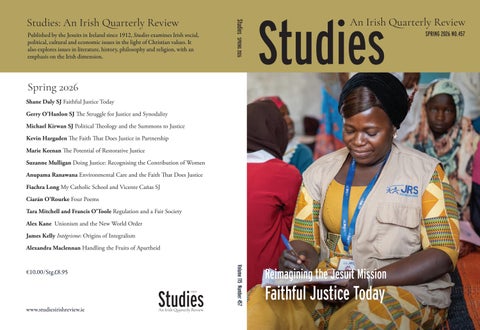
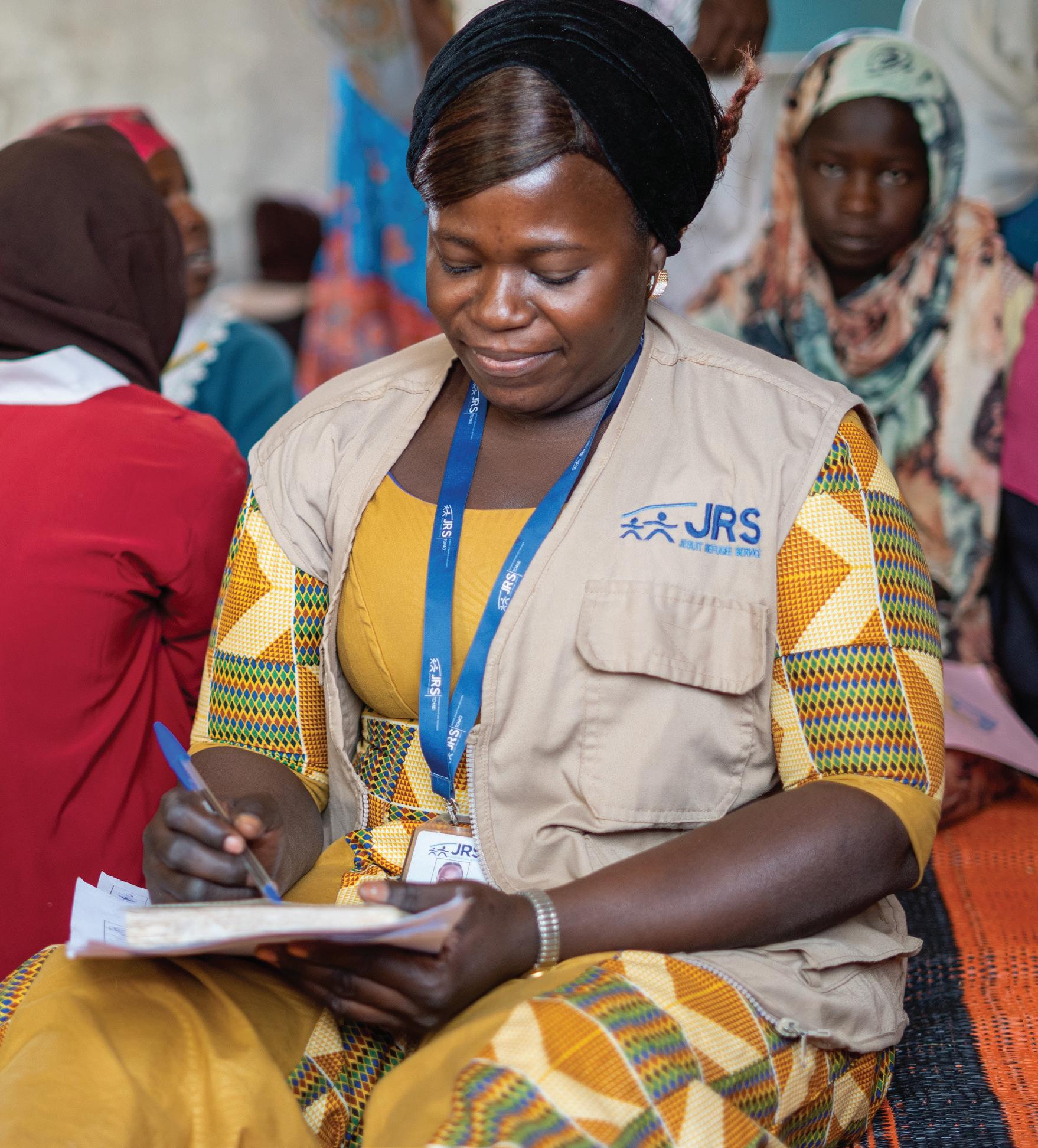
Studies Spring 2026: FAITHFUL JUSTICE TODAY-Reimagining the Jesuit Mission
Published by the Jesuits in Ireland since 1912, Studies examines Irish social, political, cultural and economic issues in the light of Christian values. It also explores issues in literature, history, philosophy and religion, with an emphasis on the Irish dimension.
Spring 2026
Shane Daly SJ Faithful Justice Today
Gerry O’Hanlon SJ The Struggle for Justice and Synodality
Michael Kirwan SJ Political Theology and the Summons to Justice
Kevin Hargaden The Faith That Does Justice in Partnership
Marie Keenan The Potential of Restorative Justice
Suzanne Mulligan Doing Justice: Recognising the Contribution of Women
Anupama Ranawana Environmental Care and the Faith That Does Justice
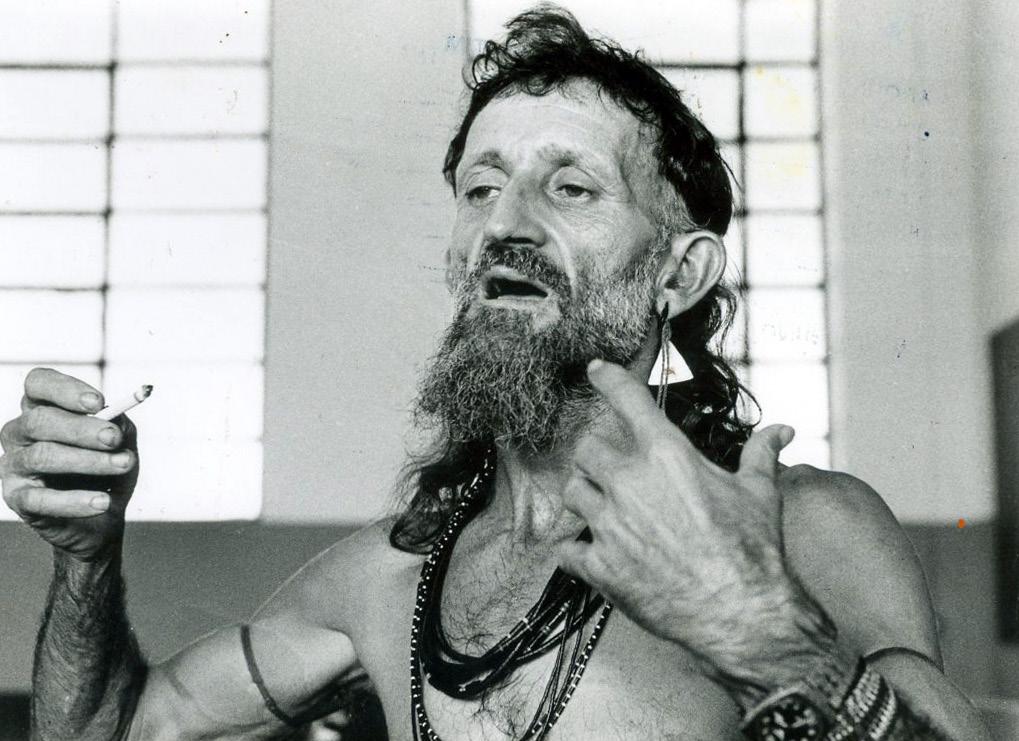
Fiachra Long My Catholic School and Vicente Cañas SJ
Ciarán O’Rourke Four Poems
Tara Mitchell and Francis O’Toole Regulation and a Fair Society
Alex Kane Unionism and the New World Order
James Kelly Intégrisme: Origins of Integralism
Alexandra Maclennan Handling the Fruits of Apartheid
Studies SPRING 2026
Autumn 2024
Seamus Heaney Reaching for the Sacred
Winter 2024-25
Ireland’s Development Model: Has it Run its Course?
Spring 2025
The Boundary Commission Centenary
Summer 2025
Undoing the Order of Things:Trump’s Second Term
Autumn 2025
The University in an Age of Crises
Winter 2025-26
Tributes to Manchán Language, Spirit, Place
Studies
Editors of Studies 1912-2021:
Timothy Corcoran, 1912-1914
Patrick Connolly, 1914-1950
Roland Burke-Savage, 1950-1968
Peter Troddyn, 1968-1974
Patrick O’Connell, 1974-1984
Brian Lennon, 1984-1989
Noel Barber, 1989-2001
Fergus O’Donoghue, 2001-2011
Bruce Bradley, 2011-2021
Editor
Dermot Roantree
Irish Jesuit Provincialate, Milltown Park, Milltown Road, Dublin D06 W9Y7
Tel: 01-676 7491
Fax: 01-676 7493
General Enquiries: studies@messenger.ie Editor: editor@studies.ie Web: www.studiesirishreview.ie
Editorial Board
Stephen Collins; Julie Daly; Kevin Hargaden; Peadar Kirby; Tom Layden SJ; Suzanne Mulligan; Gerry O’Hanlon SJ (Chair); Ciarán Ó hÓgartaigh; Dermot Roantree (Editor); Tony White
Design by Brendan McCarthy, Messenger Publications
Advertising space is available in Studies For further information and rates, please email details to: studies@messenger.ie
Unsolicited articles of approximately 3,500 words are considered for publication. These should be sent as an attachment by email to editor@studies.ie in Word or Rich Text Format.
IE ISSN 0039-3495
SUBSCRIPTIONS
To subscribe to Studies, please go online at: www.studiesirishreview.ie
My Catholic School and the Jesuit Brother Vicente Cañas
Four Poems
Regulation and a Fair Society
Unionism and the New World Order
Intégrisme: The Origins of Modern Catholic Integralism
‘Handling the Fruits of Apartheid’: The Workers, the Diplomats, and the Catholic Connection
Fiachra Long 84
Ciarán O’Rourke 92
Tara Mitchell and Francis O’Toole 100
Alex Kane 108
James J. Kelly 117
Alexandra Maclennan 133
Book Reviews
David N. Livingstone, The Empire of Climate: A History of an Idea
David Caron, Dublin’s Stained Glass: A Guide to the Finest Twentieth-Century Windows
John S. Munayer & Samuel S. Munayer (eds), The Cross and the Olive Tree
Peadar Kirby 144
Joseph McBrinn 148
David Neuhaus SJ 150
Editorial
D’ou parlez-vous? Where do you speak from? Or, more idiomatically, where are you coming from? Richard Kearney often recalls that Paul Ricoeur would open his seminars in 1970s Paris with precisely this question.1 It goes to the core of hermeneutics. What in your history – your formation, your conditions of life, your experience – has shaped your horizon of understanding? Every view is a view from somewhere.
We are historical beings through and through. The past has shaped our present world, and we remain indebted to it; yet the present world raises new questions that confront the assumptions and meanings inherited from the past. This is Hans-Georg Gadamer’s ‘fusion of horizons’:2 the historically formed horizon we inhabit is enlarged and transformed in encounter with the horizon embodied in the past, with each of them, past and present, questioning and challenging the other. For Gadamer, then, we cannot escape history, but this is not a defect; it is what allows truth to emerge.
In the first decades after the Second Vatican Council, which concluded in 1965, many religious orders strove to remain faithful to their original charism while at the same time adapting it to the needs of a profoundly changed cultural environment. Not just changed, but continuously changing – what Zygmunt Bauman termed ‘liquid modernity’:3 the waning of stability and of clear frames of reference for social order and human behaviour. The Western world experienced a deep transformation of assumptions about authority, identity, and cultural continuity, such that established institutions – Churches, families, governments – were expected to justify themselves rather than be simply obeyed. At the same time, there was a powerful shift in moral perspective: movements for human and civil rights, the recognition of structural injustice and inequality, and the emergence of a new language of rights and conscience all helped to reframe public life in terms of dignity and freedom. And all this took place within a technocratic global order that contributed to prosperity but laboured under the shadow of a threatened nuclear apocalypse. If the aspirations of the council were to be realised, these
Editorial: Spring 2026
were the ‘signs of the times’ that would have to be addressed. But how to achieve this while keeping faith with one’s historical identity?
In the Society of Jesus (the Jesuits), this task was placed on the shoulders of Pedro Arrupe, whom the Society elected as superior general just a few months before the council ended. From his own experience, especially as a witness to the devastating brutality of the atomic bomb in Hiroshima, Fr Arrupe saw no alternative to the evangelical model already laid down in the social encyclicals of Pope John XXIII and in the council: ‘This is what must be done,’ he later recalled saying to himself around the time of his election: ‘we must make the Society understand the situation in which it finds itself in the world.’ He thought it necessary to ask: ‘What must the Society do? … Because the changes in the world were pressing.’4 He was more explicit in a homily in New York in 1966:
But it is not this new world I am afraid of. What worries me, rather, is that we Jesuits will have little or nothing to offer it, little or nothing to say to it or do for it, so as to justify our existence as Jesuits. I fear that we will repeat yesterday’s answers to deal with tomorrow’s problems … 5
Arrupe’s commitment to finding new answers to new questions did, of course, lead to considerable disquiet, both among the Jesuits themselves and in the corridors of the Vatican, especially as novel and sometimes radical approaches to theology, sociology, politics, and culture were increasingly apparent in the work of younger members of the Society. Some more conservative Jesuits blamed Arrupe. ‘One Basque founded the Society of Jesus; another one is destroying it’6 went an insult written by an anonymous Jesuit in Loyola, Spain.
And it was Jesuits of this kind who seem to have had the ear of Pope Paul VI. When a general congregation of the Society was convoked to address new needs, the thirty-second such in the history of the Society – hence its shorthand title, GC32 – Paul VI evidently feared that the work of the congregation might lead to distortions of authentic Jesuit spirituality. He addressed – with ‘trepidation’7 – the gathered Jesuit fathers, just as they began their work, and urged them to be vigilant ‘so that the necessary adaptation will not be accomplished to the detriment of the fundamental identity’ of the Society. His question to them was the same as Ricoeur’s: ‘Where are you coming from?’ He posed it as the first of three questions he wished the fathers to consider, the other two being ‘Who are you?’ and ‘Where are you going?’ His purpose,
Editorial: Spring 2026
though, was conservative in a way that Ricoeur’s was not. ‘Where are you coming from?’ was intended to remind them that who they saw themselves to be and where they saw themselves going must be predicated on clear fidelity to their origins – to their founder’s response in the sixteenth century to a world in turmoil. The subtext seemed to be that Jesuits in the 1970s were facing nothing that Ignatius had not experienced – his was ‘a world which took on new dimensions from recent geographical discoveries, and hence in very many of its aspects – upheavals, rethinking, analyses, reconstructions, impulses, aspirations, etc. – it was not unlike our own.’8 The response of contemporary Jesuits, then, should imitate that of their founder.
GC32 did not hesitate to accept as normative both the example of Ignatius and his companions and the outline of the Jesuit purpose as found in papal documents, both of sixteenth-century popes Paul III and Julius III and of Pope Paul VI himself. Yet the fathers were clear that to achieve their foundational ends they had to ‘reflect on our world as Ignatius did on his’. And that reflection led to what Arrupe later referred to as a ‘conversion’ – a radical re-evaluation of the Society’s mission in the light of contemporary realities. In this, it took its cue from the council and from later ecclesial events, especially the 1971 Synod of Bishops, which emphasised the pursuit of justice as a moral and spiritual imperative in the contemporary Church: Christian love of neighbour and justice cannot be separated. For love implies an absolute demand for justice, namely recognition of the dignity and rights of one’s neighbour. Justice attains its inner fullness only in love. Because every person is truly a visible image of the invisible God and a sibling of Christ, the Christian finds in every person God himself and God’s absolute demand for justice and love.9
The Jesuits’ GC32 similarly affirmed that the struggle for faith included the struggle for justice. The prevalence of injustice, it asserted, ‘is one of the principal obstacles to belief: belief in a God who is justice because he is love.’10 And in the core document of the General Congregation, Decree 4, the fathers provided a lapidary summary of their resolutions: ‘The mission of the Society of Jesus today is the service of faith, of which the promotion of justice is an absolute requirement.’11
Faith that does justice. The Jesuits formally committed themselves to this at GC32, not as a departure from its original mission as even some of its own people thought, but as an act of radical fidelity to Ignatius’s injunction
Editorial: Spring 2026
to set the apostolic purpose of the Society by looking upon the world ‘in order to discover its needs’.12 As Pedro Arrupe warned his fellow Jesuits, it would lead in some cases to great suffering and even to martyrdom. ‘If we follow Christ,’ he wrote after five Jesuits were killed between 1976 and 1977, ‘persecution will come.’ Just over a decade later came the most commemorated martyrdom of Jesuits committed to justice: on 16 November 1989, six Jesuits on the campus of the Central American University in San Salvador, along with their caretaker’s wife and daughter, were slaughtered by an elite unit of the Salvadoran army. More than fifty Jesuits in all have been violently killed as a consequence of the Society’s commitment to a unified mission of faith and justice.
Last year, 2025, was the fiftieth anniversary of GC32. To mark this, a symposium was held in Trinity College Dublin in November. This issue of Studies carries the six papers that were delivered on that occasion. In a foreword that follows this editorial, Fr Shane Daly SJ, provincial of the Irish Jesuit Province, reflects on the symposium and introduces the contributions.
The first essay in this issue of Studies after the six papers from the symposium is closely related to them. In ‘My Catholic School and the Jesuit Brother Vicente Cañas’, Fiachra Long reflects appreciatively on his education by the Christian Brothers, noting in particular that it made him more aware of the needs of many people beyond the Irish shores and of the courage and generosity of people who devoted their lives to helping them. The Jesuit brother Vicente Cañas stands out for Long. Cañas immersed himself in the life of the Enawenê-Nawê people of the Amazonian rainforest in Brazil, defending their community life and land rights until he was slain in 1987 by a police deputy acting on behalf of landowners who coveted the tribal lands. An instance, then, of the martyrdom that Fr Arrupe expected to follow the Jesuit commitment to ‘a faith that does justice’.
In ‘Regulation and a Fair Society’, Tara Mitchell and Francis O’Toole outline regulatory policies in Ireland and treat of the debates that these policies have given rise to. They draw attention to the purposes that lie behind many kinds of regulation – that is, how these are justified as reasonable means to ensure fairness, the protection of consumers, and the public interest.
Alex Kane takes a wide view of contemporary unionism in Northern
Editorial: Spring 2026
Ireland in ‘Unionism and the New World Order’. It finds itself siding with peoples whose identity is under threat and it has taken a turn towards the populist right, yet it seems not to realise the extent to which the old world order is changing and how bereft it is of reliable friends. It has no choice, Kane argues, but to become more internally unified and ‘to broaden its appeal and its friendship groups’.
In ‘Intégrisme: The Rise of Modern Political-Catholic Integralism’, James Kelly notes present-day attempts to revive integralist solutions in the name of postliberalism, and he fills in the backstory of this vision of the state as the executive arm of the Church in matters concerning the supernatural end of society. He traces it in particular to the reactionary efforts of traditionalist and ultramontane Catholics to restore a form of Christendom after the turmoil of the French Revolution. This development had a deep impact on the Church later in the nineteenth century and contributed to the vigorous suppression of theologians who were seen to be ‘modernists’.
In ‘“Handling the Fruits of Apartheid”: The Workers, the Diplomats, and the Catholic Connection’, Alexandra Maclennan recounts the fortunes of the Irish Anti-Apartheid Movement, founded in 1964 by Kader and Louise Asmal. She describes the various forms of solidarity in Ireland with the black and coloured populations of South Africa, both through its votes on EEC resolutions and, most extraordinarily, through the grassroots action of the Dunnes Stores three-year strike, beginning, in 1984, with cashiers refusing to handle – quite literally – ‘the fruits of apartheid’, that is, South African grapefruit. Maclennan pays particular attention too to the response of Catholics, especially the stories of missionaries who had witnessed apartheid first-hand and had sought ways to work around it.
Ciarán O’Rourke presents four poems in this issue. Included are two elegant poetic re-renderings of passages from Pliny the Elder’s Naturalis Historia.
Notes
1 See for example Richard Kearney, Anatheism: Returning to God After God (Columbia University Press, 2011), p. xi, and Daniël P. Veldsman and Yolande Steenkamp (eds), Debating Otherness with Richard Kearney: Perspectives from South Africa (AOSIS, 2018), pp. 31–62.
2 Hans-Georg Gadamer, Truth and Method (Sheed & Ward, 1979). See the whole of Part II, II, 1 –‘The elevation of the historicality of understanding to the status of hermeneutical principle’.
3 Zygmunt Bauman, Liquid Modernity (Polity Press, 2000).
4 From Pedro Arrupe, Itineraire, quoted in Pedro Miguel Lamet, Pedro Arrupe: Witness of the Twentieth Century, Prophet of the Twenty-First (Institute of Jesuit Sources, 2020), p. 235.
Editorial: Spring 2026
5 Lamet, Pedro Arrupe, p. 264.
6 Lamet, Pedro Arrupe, p. 327.
7 ‘Address of Pope Paul VI to the Thirty-Second General Congregation of the Society of Jesus, December 3, 1974’, in Documents of the Thirty-Second General Congregation of the Society of Jesus (The Jesuit Conference, 1975), p. 133.
8 ‘Address of Pope Paul VI’, pp. 135–136.
9 1971 Synod of Bishops, ‘Justitia in Mundo’, 34.
10 Documents of the Thirty-Second General Congregation, p. 8.
11 Documents of the Thirty-Second General Congregation, ‘Decree 4’, art. 2 (p. 17).
12 Documents of the Thirty-Second General Congregation, ‘Decree 4’, art. 14 (p. 20).
Foreword: Faithful Justice Today
Shane Daly SJ
The papers that follow are the fruit of a symposium in November 2025 on ‘Faithful Justice Today: A Renewed Call to Action’, hosted by the Jesuit Centre for Faith and Justice (JCFJ) and the Loyola Institute, Trinity College Dublin. The intention was to commemorate the fiftieth anniversary of the Jesuits’ thirty-second general congregation (GC32), which defined the mission of the Society of Jesus as the ‘promotion of faith, of which the promotion of justice is an absolute requirement’ (Decree 4). The symposium was an opportunity to reflect upon this commitment and also upon its legacy – inspiring but also difficult and even divisive – since 1975. The interest shown indicates that the justice imperative, for all its complexity, is still, for many people, the lodestone of their faith.
Contrary to what may sometimes seem to be the case, the Church’s commitment to social justice does not begin with the Jesuits. As Pope Leo’s apostolic exhortation Dilexi Te makes clear, God’s ‘preferential option for the poor’ is firmly grounded in the Hebrew scriptures, in the New Testament, and in many of the Church Fathers. It is underlined in the modern phase of Catholic Social Teaching, which ran from 1891 into the twentieth century: workers’ rights, world peace, and the development of peoples all come into focus. The Second Vatican Council’s ‘turn’ to the world of today takes up this imperative. It bears fruit at key post-conciliar moments, such as the 1968 Second Episcopal Conference of Latin America at Medellín and the 1971 Synod of Bishops’ closing document, Justice in the World.
The Jesuits’ decision to frame their mission and self-understanding in terms of the promotion of justice was not a rejection of its commitment to the mission to evangelise but, rather, to borrow words from the American Baptist theologian Walter Rauschenbusch, a commitment to ‘the old message of salvation but enlarged and intensified’.1 Decree 4 was the
Shane Daly SJ
beginning of a new chapter rather than a new book in the story of the Jesuits. The commitment remained the same, to create a more humane and liveable world, but the means expanded beyond charity and challenging personal sin to analysing and acting to overcome the sinfulness of the social order, and undoing permanent structures that oppress, extort, and deny opportunities for flourishing whether human or ecological. These papers recall the past fifty years of activity and invite us to renewed action and reflection today.
This story has been a dramatic one: the years following GC32 were rich with courageous and creative initiatives but also controversy and disorientation (the story of the theology of liberation is perhaps the most well-known sub-section of this chapter). Two Jesuits, Gerry O’Hanlon and Michael Kirwan, give something of the flavour of these unsettled and unsettling decades.
Most painfully, Marie Keenan’s reflections on the clerical sex abuse crisis and Suzanne Mulligan’s exploration of gender justice remind us that the Church is not immune from illegitimate uses of power and unjust structural arrangements, which oppress and harm. Anupama Ranawana brings to the fore our new awareness of the victimisation of our common home while Kevin Hargaden, a social theologian, stresses the need for Christians to work in partnership, especially in countering distorted and weaponised versions of the Gospel.
While the political and ecclesial context of 1975 is radically different to our own, the demand that we call out injustice remains because injustices remain. Irrespective of context, we must keep reminding ourselves of the consistency with which Scripture and church tradition have given witness to the justice imperative.
Those committed to a faith that does justice will be very aware of a new disconnect between both. In 1975, the principal challenge was to help people of faith to see that authentic gospel fidelity included a commitment to justice. This was unsettling for many Christians and generated resistance, especially when the summons was expressed stridently and insensitively. Fifty years later, this challenge has been turned on its head: many people of goodwill – above all, young people – are receptive to the justice imperative, whether this means care for the planet, protection of minorities, or concern for the materially poor. What they too often cannot grasp is how this has anything to do with religious faith: why bring God into it? Here we find a different kind of perplexity and resistance.
Foreword: Faithful Justice Today
The struggle to serve faith and promote justice continues; therefore so does the conversation and the invitation to dialogue, as these articles make clear.
Shane Daly SJ is the Provincial of the Society of Jesus (Jesuits) in Ireland.
Notes 1 Walter Rauschenbusch, A Theology of the Social Gospel (The Macmillan Company, 1918), p. 5.
The Struggle for Justice and Synodality
Gerry O’Hanlon SJ
The fiftieth anniversary of Decree 4 of the Jesuits’ thirty-second general congregation (1974–5) (GC32) is an opportunity to both commemorate this significant milestone and to engage with related contemporary issues. I want to outline, in broad strokes, the origins and significance of the turn by the Jesuits fifty years ago to adopt the slogan of ‘a faith that does justice’. I aim to outline the context in which others may address these and some other, more specific, issues that have arisen since.
I write not as an historian or political scientist but rather as a participant observer with a theological background. Age brings certain advantages – I was around for the start of all this (having joined the Jesuits in 1965), and I hope I can rely on a certain indulgence on your part if I examine my analysis through the lens of my own experience.
Part One: Faith and justice
The remote cause of the Jesuit ‘turn’ in 1975 was what historian John O’Malley called the ‘Long Nineteenth Century’ of the Catholic Church, which had set its face against modernity from the time of the French Revolution up to the Second Vatican Council.2 The proximate causes were the reaction against this stance in the Second Vatican Council itself, the rise of liberation theology in Latin America, and the Synod of Bishops in 1971 in Rome.
The Second Vatican Council turned back towards the world and towards other faiths and Churches, and made it clear that it understood the Church as for the world, a ‘light for the nations’, inviting dialogue and engagement. This was especially clear in its major decrees Lumen Gentium and Gaudium et Spes, but also in texts on ecumenism, other faiths, and religious freedom.
There was a second, very significant, thread running through Vatican II, most explicitly expressed in the decree on revelation, Dei Verbum, which was to greatly influence events both within the Jesuits and within the Church in general. I speak of the emphasis on revelation as not so much the ‘deposit of faith’, but as God’s self-communication, what Popes Benedict and Francis would later call our ‘encounter’ with God. Think of the phrase of Benedict, often repeated by Francis: ‘Being Christian is not the result of an ethical choice or a lofty idea, but the encounter with an event, a person, which gives
life a new horizon and a decisive direction.’3 This tied in very well with the Jesuit rediscovery of the mystical nature of its founder St Ignatius of Loyola, as found both in his Spiritual Exercises and the Constitutions of the Society.4 Now, once again, discernment, both personal and communal, came to the fore, which the Church in the papacy of Francis was to learn about.5 All this was in contrast to the then prevailing ascetical account, with emphasis on fidelity to the Rule.
The most dramatic response to Vatican II occurred in Latin America with the rise of liberation theology, underwritten by the bishops there at the CELAM conference in Medellín in 1968. In response to the dire poverty that was everywhere in Latin America, this theology turned to a social analysis influenced by Marxism. It attempted to subject this to a Christian notion of salvation, now spoken of in terms of liberation, to ensure that Christianity was not an ‘opiate for the masses’, a preparation for the next life that failed to make a real difference in this one. The preferential option for the poor became a slogan that has had lasting ecclesial resonance, also at universal level.
The 1971 Synod of Bishops, still at this stage riding the waves of collegiality unleashed by Vatican II, made two particularly significant statements in their document Justice in the World. First, they said, ‘Action on behalf of justice and participation in the transformation of the world fully appear to us as a constitutive dimension of the preaching of the Gospel’ and, secondly, ‘While the Church is bound to give witness to justice, she recognises that everyone who ventures to speak to people about justice must first be just in their eyes.’6 In other words, no credible preaching about justice ad extra if injustice ad intra.
On a personal note, I have to say that much of this passed me by at the time. I do remember, around 1964/5, when I was seventeen or so, noticing an Evening Press poster on the corner of Parnell Square that said something like: ‘Vat II debates married priests’ (or was it deacons?). This was at a time when I felt the Hound of Heaven in hot pursuit, rounding me up for the Jesuits, and I was desperately seeking a way out. The Vatican didn’t deliver!
GC32 and after
In Decree 4 of GC32 (1975), the mission of the Society of Jesus is defined as ‘the service of faith, of which the promotion of justice is an absolute requirement’. Thus ‘the struggle for faith and that struggle for justice which
Gerry O’Hanlon SJ
it includes’7 is to be ‘the integrating factor in all our ministries’.8 It aims to be the contemporary translation of the original, founding aim of the Society to ‘seek the salvation and perfection of souls’.9
This new definition gained immediate, if not always consensual, traction. What became known in shorthand as the ‘faith and justice’ or ‘F and J’ Jesuit became quickly apparent. New institutions were founded, including the Jesuit Centre for Faith and Justice (JCFJ) here in Ireland. Later the Jesuit Refugee Service, brainchild of Pedro Arrupe, was also established here. We had a head start in Ireland in that the ‘Workers College’ (now the National College of Ireland) had already been founded in 1950. But the Centre for Faith and Justice became the focus of the new approach: sometimes to be of service to other apostolates, but often, in the early days at least, seeming to bear the burden of incarnating the new approach on its own, and even being perceived by others as a threat or an implicit admonition. New residences were later set up in Northern Ireland, first in Portadown, then Belfast, and then Armagh, during and after what is euphemistically referred to as the Troubles.
More traditional apostolates felt challenged and a bit at sea early on. A mild version of today’s culture wars broke out among Jesuits: were you an ‘F and J’ Jesuit or not? Later on, after the dust had settled on this time of tension, Jimmy Hurley, Hong Kong-based social activist and Jesuit brother of the well-known ecumenist Michael, used to joke that Michael was faith, and he was justice!
There were lively debates in Ireland in that period between 1975 and, say, 1995. I think of the voices of Peter McVerry and the late Philip Fogarty in internal Jesuit publications on the issue of fee-paying schools; the pressure on our colleges and retreat houses to integrate the justice aspect of the mission; the fact that the JCFJ effectively functioned as a centre for justice during this period without a theologian on its staff.
These debates reflected what was going on in the wider Society of Jesus and indeed in the Church. Theologically Karl Rahner was being criticised on the one hand by Hans Urs von Balthasar for reducing love of God to love of neighbour and effectively denying the need for faith in Jesus Christ, while, on the other hand, he was criticised by his disciple Metz for being too apolitical. It was part of the dispute between the journals Concilium and Communio. It was central to the conflict between liberation theologians and the Congregation of the Doctrine of the Faith and its then prefect, Cardinal Joseph Ratzinger, referenced in the recent apostolic exhortation of Pope Leo
The Struggle for Justice and Synodality
XIV.10 Was faith being reduced to ethics? Was Christian eschatology merely assuming the contours of an inner-worldly and historical utopia?
Once or twice all this threatened to boil over – I think, for example, of the crisis around the leadership of Pedro Arrupe towards the end of his time as general. Opposition to his perceived overly-sympathetic stance towards the justice imperative, both in Jesuit circles in Rome and Spain in particular and from the Vatican itself, came to a peak after his death in the suspension of the ordinary modes of government of the Society, a situation that was soon resolved. And I think of the stand-off between the Vatican and liberation theologians, though once again this resolved itself over time, one of the surprising outcomes of this was the adoption of the phrase ‘preferential option for the poor’ in official magisterial documents.11
I was deeply affected by all this. Coming from quite a classical formation, I had begun to carve out my own theological space. I was sympathetic to Rahner, but did doctoral studies on Balthasar. I did them in Belfast in the ‘80s, and learned a lot staying for two years at the Presbyterian Residence at Queen’s University. This learning was enhanced through several years as part of the Ballymascanlon inter-Church talks. In 1987 I moved to Cherry Orchard in Dublin, a working-class estate, where Bill Toner SJ and I still live, and where other lessons were learned. Teaching theology at the Milltown Institute was stimulating, not least due to the mix of students, from candidates for ordination to increasing numbers of lay women and men. And I suppose, perhaps most of all, the ordinary give-and-take of life and human friendships had their effects. The result was I had moved from a position of some initial reserve towards the ‘faith and justice’ option to one of engagement and commitment.
GC34 and after
It was with fire in my belly that I found myself in early January 1995 in Rome as one of the delegates for the thirty-fourth general congregation, the first digital congregation in the history of the Society of Jesus. What evolved over the next two-and-a-half months was unforgettable: careful preparation and analysis, vigorous and sometimes partisan debate, occasional public meltdowns, lobbying, good food and wine, moments of personal and communal consolation and desolation, and all wrapped within a context of prayer and discernment, to which we only very rarely explicitly adverted.
Gerry O’Hanlon SJ
In terms of content, the ‘faith and justice’ option of GC32 was confirmed as the integrating vision of the Jesuit mission. At the same time, failures were noted: ‘We also acknowledge our failures on the journey. The promotion of justice has sometimes been separated from its wellspring of faith. Dogmatism or ideology sometimes led us to treat each other more as adversaries than as companions. We can be timid in challenging ourselves and our institutional apostolates with the fullness of our mission of faith seeking justice.’12
Humanly what struck me most about this confirmation of GC32, and yet its note of self-correction, were the tears of joy and relief on the faces of several veterans of GC32, who had feared that the Society might resolve the tensions over the recent past in favour of an elimination of the justice focus.
At the same time, there was a clear deepening and widening of the legacy of GC32. Justice was very often spoken of in terms of ‘the justice of the Gospel’ or ‘the justice of the kingdom’, making it very clear that this was a theological reading of the term, without detriment to its sociological content. Similarly, it was stated that justice had to take account of culture in all its diversity (the often unconscious attitudes, values and assumptions held by groups of people) and, if it was to avoid being oppressive, to engage in dialogue (in particular inter-religious dialogue). And Decree 20 very briefly focused on the issue of ecology and recommended a study be made of this and its results be communicated to the whole Society, which did happen.
Finally, there was a decree (14) on Jesuits and the situation of women in Church and civil society. This had its roots here in Ireland. Brian Lennon had gathered a group of us (Frank Sammon, the late Tim Hamilton, myself, and, later, Bill Toner) to reflect on the state of Irish society in the light of the Gospel. This was part of the ‘Signs of the Times Seminar’ (SOTS) initiative established by then provincial Philip Harnett, aided by John Sweeney, inspired by what was going on in Latin America and eventually to involve not just Jesuits but partners in mission. This was at a time of high unemployment in Ireland, in the ‘80s, and we published a booklet with the title ‘Solidarity’ and sub-title ‘The Missing Link in Irish Society’. We dialogued after publication with different groups and were well received by politicians, business leaders, and trade unionists. We were not well received by a group of women, including some theologians from the Milltown Institute and residents and activists from the north inner city. In fact, they ate us alive! Why had we said nothing about the issue of women who were so often oppressed by the kind of Christianity mediated to them
by the Catholic Church?
We began working on a response just at the time I was sent to Rome for GC34. And, although it was not a topic that had been foreseen or prepared, the congregation accepted the validity of the concerns voiced in Ireland and, after much to-ing and fro-ing, published Decree 14. This called out the subordination of women in all sectors, including within the Church; it accepted that this was not simply a women’s issue but that men, and Jesuit men, bore responsibility for a situation that was unjust and impoverished us all, and recommended a strategy of careful listening to women as a way forward. Interestingly too, in paragraph 14, it stated that ‘… it may be anticipated that some other questions about the role of women in civil and ecclesial society will undoubtedly mature over time … the change of sensibilities which this involves will inevitably have implications for Church teaching and practice.’ It is important to recall that this was written in 1995, less than a year after the papal promulgation of Ordinatio Sacerdotalis with its line that the Church does not have the power to ordain women and that this is ‘a judgement to be held definitively by all the Church’s faithful’.13 I will come back to this. In the meantime, I simply note that Fr General Arturo Sosa has since set up an international commission on the role of women in the Society of Jesus (with a mixed membership of women and Jesuits), whose final report is imminent at time of writing.
In retrospect, GC34 signalled the definitive formal acceptance of the faith and justice option adopted in the 1970s, and it had become clear that it had been integrated into traditional ministries and new ones. The next congregation, the thirty-fifth, held in 2008, assumed this, while developing more the notion of reconciliation (already adumbrated in GC32 and 34) as right relationship with God, with others and with creation. GC36, in 2016, further explored the relationship between faith, justice and reconciliation, without even seeing the need to refer back explicitly to GC32. The most recent articulation of Jesuit mission occurred in 2019 when, after an extensive consultation globally with Jesuits and partners in mission, four Universal Apostolic Preferences were discerned to be the guiding principles of the mission from 2019–2029. These are: 1) to show the way to God through the Spiritual Exercises and discernment (this in an increasingly secular age); 2) to walk with the poor, the outcasts of the world, whose dignity has been violated, in a mission of reconciliation and justice; 3) to accompany young people in the creation of a hope-filled future, and 4) to collaborate in the care of our common home.
Gerry O’Hanlon SJ
And, as recently as October 2025, at a meeting of Jesuit provincials in Rome, Fr General Arturo Sosa referred uncontroversially to ‘our mission of justice and reconciliation’.
Of course, for both Jesuits and the Church in general, in Ireland and universally, the major ‘sign of the times’ has been the abuse scandal and the mishandling of it by those of us in authority. The second Universal Apostolic Preference explicitly mentions those who have been abused. This is an open wound in the Church and in the Society of Jesus, representing a massive breach of trust and an enormous obstacle to any mission that claims to involve justice. Thanks to the courage of victim-survivors and their families, and indeed to the professionalism of media outlets, we all in the Church are called to face the challenge of redress, of the creation of a safe and caring environment, and an examination of the culture and structures of power that enabled this situation to arise. This is one of the reasons why synodal talk of co-responsibility is more than just a nice idea: it is a necessity.
Part Two: The transition to synodality14
This brief historical survey indicates why the transition to synodality by Pope Francis is almost seamless, at least at a conceptual level. All the basic ingredients were already there for Francis to creatively envisage his revolutionary ecclesial project. At the heart is the encounter with Jesus. This leads to mission, a Church that is ‘poor for the poor’, inclusive, a field-hospital, with bishops and priests who have ‘the smell of the sheep’ on them. This is a Church as the People of God, whose journey together is conducted through an ongoing dialogue or conversation with each other and with the surrounding world, characterised by parrhesia (open speech) and hypomene (that patient and generous listening, spoken of by St Ignatius in Annotation 22 of his Spiritual Exercises, advising us to put the best construction on what another says). It is an ‘inverted pyramid’, so that baptism is the primary sacrament, signifying the equal dignity of all, and ordination is to be understood as service, within the parameters of synodality. This way of proceeding, guided by the Holy Spirit as primary protagonist, is by means of ‘conversation in the Spirit’, which may be adapted to suit secular situations and may serve as a banner of hope to the surrounding world, which often wants to cooperate but is riven by conflict and sectional interests. This is a Church that aims to attract without diluting the gospel message.
Universally, and here in Ireland, we are trying to learn how to transfer this beautiful rhetoric into practical reality, helped by the experience of other Christian Churches. The Synod on Synodality took place over two sessions in Rome (2023/4), and we have had national assemblies here in Ireland, in Athlone (2022) and Kilkenny (2025). There will be a full national assembly in October 2026, and in 2028 a universal ecclesial assembly is scheduled for Rome.
In my view, we have made some progress on the notion of baptism as a share in the priesthood of Jesus Christ. More lay people, men and women, are finding a place in ministerial service of various kinds. Similarly, concerning a share in the kingship of Christ as part of baptism, there is a new focus on ‘differentiated co-responsibility’ so that experiments have begun in opening out decision-making to laity. The area where there is least progress is the realm of sharing in the role of Christ as prophet, in other words the proper input of the faithful into the formation and reception of church teaching. This is despite the ‘sense of faith of the faithful’ being clearly spelled out along these lines in a recent (2014) church document, including regarding situations where there is a clash between the teaching and current sensibility.15 This, the document advises, should lead to better communication or reformulation or revision of the doctrine in question. There is a kind of fetish in our Church about the immutability of church teaching: this is simply unhistorical and untrue, and we need to come to terms with that.
On a personal level I found, and find, the abuse situation devastating. On the other hand, the type of Church that Francis proposed, now endorsed by Pope Leo, has led me to experience this period of my life as a priest in the Catholic Church as being the best, the most hopeful, the most exciting.
Conclusion
Let me make 3 points in conclusion.
First, while the efficacy of the turn to faith and justice has been sealed, inter alia, by the blood of martyrs, both Jesuits and partners in mission, nonetheless it has been suggested that faith and justice are no longer the appropriate unifying symbol of mission for Jesuits, in particular for younger Jesuits.16 I find no difficulty with this: symbols to be effective are often creatures of particular times and places and are replaceable. Of course, it is a different matter if the reality or content to which the symbol refers is denied. But our historical nature always means that symbols can change, and I wish
Gerry O’Hanlon SJ
a younger generation of Jesuits and partners in mission well if they decide to engage in a search for a more appropriate unifying symbol, so necessary in a time of post-modern fragmentation. It is interesting that, as many have noted, if the problematic back in the ‘60s involved a somewhat privatised faith in search of justice, it is arguable that in today’s more secularised context we see the need for justice to reconnect with faith.
Secondly, what questions does the synodal paradigm ask of us Jesuits? My impression is that, like perhaps a majority of Catholics at this point, we Jesuits have been observers for the most part rather than actors in what’s going on in our Church. I have heard it said that synodality can be experienced as gift or as threat by different groups within the Church. This is an understandable state of affairs. What St Ignatius would surely not like is that we Jesuits respond to it with indifference (not in the sense of Ignatian indifference as spiritual freedom but as a ‘shrug of the shoulder’ type of apathy). So, for example, given that our Society is so hierarchical in structure, with authority from the top, albeit with various checks and balances built in, is there need for us to involve more than Jesuits in decision-making? The Universal Synod, over two sessions, had a series of round tables peopled by diverse states in the Church – this, according to the Jesuit cardinal Hollerich, was not a question of good management or group dynamics. No, he stated, it was good theology, good ecclesiology, based on the notion of the presence of the Holy Spirit in all the faithful, so that in seeking the will of God we do well to listen to as many voices as possible. Does this mean some cultural, structural change for us Jesuits?
Thirdly, an observation for our Church, universally and here in Ireland. If, as the bishops stated in 1971, we want to express our mission with credibility, then, next to the ongoing issue of abuse, the role of women in our Church needs urgent attention. Parrhesia has done us the service of bringing this into the open as never before. And, in doing so, it becomes less and less clear to many why the Church continues to insist that women cannot be ordained. Pope Francis did us a great service by openly articulating his own views on the subject, but I wonder how many people found them persuasive? Perhaps in the end we are dealing here with bias, and often with unconscious bias: but the more the reasons are exposed to the light of day, the less cogent they seem. Is it not time for action on this issue?
I accepted to co-launch the recent memoir by Soline Humbert.17 What impressed me most about her book was not the arguments from justice or
The Struggle for Justice and Synodality
human rights, but her principal argument, which was that she had experienced a call from God and had subjected that call to every type of discernment that was within her power (short of the ultimate authoritative one of episcopal acceptance). It would be naïve to think that the Irish Catholic Church would or even should do a solo run on this (although, with regard to the permanent diaconate, the recent words of Cardinal Walter Kasper are interesting: he judges that ordination is theologically possible, pastorally sensible, and should be up to each local church to decide).18 But can we consider giving leadership here by requesting that the Vatican revisit this issue, given the non-reception of current teaching by so many of the faithful in Ireland and elsewhere?19 This would be a big step in allowing the Church to address itself more credibly to major issues like secularisation, poverty and housing, immigration, war and peace, climate change. It would also be a reassurance to Irish Catholics that their voices are being heard and that the synodal process is not just a talking-shop, but that it yields tangible outcomes.
Gerry O’Hanlon SJ is a theologian and former Jesuit Provincial who has written extensively on Catholic Church reform.
Notes
1 An edited version of an address given at the conference ‘Faithful Justice Today: A Renewed Call to Action’ in the Loyola Institute, TCD, on 15 November 2025.
2 John W. O’Malley, What Happened at Vatican II (Harvard University Press, 2008), ch. 2.
3 Pope Benedict XVI, Deus Caritas Est (The Holy See, 2005), 1.
4 Ignatius of Loyola, ‘The Creator deals directly with the creature’, Spiritual Exercises, 15. See also: Brian O’Leary SJ, Sent into the Lord’s Vineyard: Explorations in the Jesuit Constitutions (The Way, 2012), pp. 1–2.
5 For an early treatment of communal discernment in the post-conciliar era, see Ladislas Orsy SJ, Probing the Sprit: A Theological Evaluation of Communal Discernment (Dimension Books, 1976).
6 Synod of Bishops, Justice to the World (The Holy See, 1971), introduction and ch. 3.
7 Society of Jesus, General Congregation 32, ‘Decree 2’, 1975, 2, https://jesuitportal.bc.edu/research/ documents/1975_decree4gc32/
8 Society of Jesus, ‘Decree 2’, 9.
9 Society of Jesus, ‘Decree 2’, 11.
10 Pope Leo XIV, Dilexi Te (The Holy See, 2025), 98.
11 Pope John Paul II, Centesimus Annus (The Holy See, 1991), 11.
12 Society of Jesus, General Congregation 34, ‘Decree 2’, 1995, 3. For a stimulating account of some of the conceptual issues involved in considering the ‘faith and justice’ approach, see Seamus Murphy SJ, The Many Ways of Justice (Studies in the Spirituality of Jesuits, 1994).
13 John Paul II, Ordinatio Sacerdotalis (The Holy See, 1994), 4.
14 Gerry O’Hanlon SJ, The Quiet Revolution of Pope Francis (Messenger Publications, 2018).
15 International Theological Commission, Sensus Fidei in the Life of the Church (The Holy See, 2014).
16 Emilio Travieso SJ, ‘Faith and Justice: In search of another symbol’, Social Justice and Ecology Secretariat, 30 September 2025, www.sjesjesuits.global/sj-reflections/faith-and-justice-insearch-of-another-symbol
Gerry O’Hanlon SJ
17 Soline Humbert, A Divine Calling (The Liffey Press, 2025).
18 The Tablet, 9 November, 2024, p. 23.
19 I note that this proposal is in entirely in line with the position of the ‘Petrocchi Commission’ on the study of the female diaconate, published on 4 December 2025, which, while ruling out ‘the possibility of moving in the direction of admitting women to the diaconate understood as a degree of the sacrament of holy orders’, also made it clear that theirs was a non-definitive judgement intended as an aid to further discernment and with a view to a transparent further enquiry as to the doctrinal (and not just historical) nature of the diaconate itself. The suggestion of ongoing study is made in the context of the members being quite divided among themselves on the significance of the masculinity of Jesus Christ in human calls to represent him, and the view of the majority that however one imagined diaconate (as for ministry or as part of a three-fold holy orders), there was no escaping the implication that any change in the diaconate would have for ordained priesthood – see https://press. vatican.va/content/salastampa/it/bollettino/pubblico/2025/12/04/0950/01725.html
Political Theology and the Renewed Summons to Justice
Michael Kirwan SJ
In the meeting between King David and the prophet Nathan (2 Samuel 12), the king is brought to account for his atrocious behaviour in bringing about the death of Uriah the Hittite and appropriating his wife. In this paradigm case of truth speaking creatively to power, Nathan tells the story of a rich man’s theft from his poor neighbour. David ‘burns with anger’ toward the perpetrator, only to be admonished – ‘You are the man!’ – since this is exactly how he has behaved. David acknowledges Nathan’s prophetic authority, and that he has sinned against the Lord.
The dilemma today: How does one ‘speak truth to power’ in an era of post-truth?
I will approach this dilemma in three steps. First, in the spirit of Ignatian repetition, I underline the ecclesial foundation and history emphasised in Gerry O’Hanlon’s paper. The accusation that the justice imperative is a foreign body, injected into the Church’s bloodstream by Marxist-inspired liberationist priests and religious and taken up by well-meaning but misguided liberal Christians, needs to be rejected. Pope Leo has reminded us in his apostolic exhortation, Dilexi Te, that the Church’s commitment to the poor does not begin in the late twentieth-century. This document traces this commitment from the Scriptures through two thousand years of tradition and praxis. I return to Dilexi Te at the end of this article.
Secondly, I will give a specifically Ignatian frame to our discussion, by considering the remarkable Presupposition (Annotation 22) that we find in the Spiritual Exercises of St Ignatius. The annotation calls for a hermeneutic of generosity, a deep listening to the other person, above all if what they are saying seems suspect or controversial:
So that the director and the person making the Exercises may collaborate better and with greater profit, it must be presupposed that any good Christian has to be more ready to justify than to condemn a neighbour’s statement. If no justification can be found, one should ask the neighbour in what sense it is to be taken, and if that sense is wrong he or she should be corrected lovingly. Should
Michael Kirwan SJ
this not be sufficient, one should seek all suitable means to justify it by understanding it in a good sense.1
This description, of how a ‘good Christian’ conducts themselves in dialogue, is more than a matter of courtesy or good manners or even strategic diplomacy. It offers the basis for a new kind of political wisdom and a vital tool for allowing the discourse of justice to flourish.
This will bring us to the third part of the article, which draws attention to a malevolent strand of political theology, all too recognisable in our present situation. This is to show how the challenges of ‘faithful justice’ in 2025 are different from 1975 and more complex, not least in the dilemma referred to above, of how to speak words of prophetic truth to power in an era of post-truth. We are living under a transformed cultural and political order; ‘our mission today: the service of faith and the promotion of justice’ cannot simply replicate what has gone before.
Part One: ‘I
suppose there is a doctrine to this landscape’
The Second Vatican Council provided the impetus and trajectory for Decree 4, of General Congregation 32 (GC32), in its declaration that ‘the joys and hopes, the sorrows and anxieties’ of the world of today are identical to those of the Church. The world has become a locus theologicus, a place where God is to be encountered, and where conversation about God can happen. John McDade takes up this spatial metaphor, citing the poet Wallace Stephens: ‘I suppose there is a doctrine to this landscape.’
The council’s importance for theology lies in the new location it proposed for theological reflection. This most ecclesial of councils proposed, in Gaudium et Spes, that the Church ought to be characterised by a profound engagement with the reality of the world’s experience: no longer a Church set apart from the world within an institutional Christendom, but a Church that enters into profound solidarity with the experiences of human society, and takes humanity seriously in the unfolding of its history. This new location of the Church’s identity prescribes a new location for theology, and a revaluation of what is to count as properly theological activity. If human history becomes an indispensable locus revelationis for the Church … then human history becomes the locus theologicus for the post-conciliar theologian.2
This locational description reflects the immensely mobile Church that
emerged from the council, a practical expression of its self-understanding as a ‘pilgrim people’. The influx of missionary priests and religious from the Global North to the Global South is a vital ingredient in the story of the theology of liberation. Within the Global North, institutes of theological and philosophical formation were relocated, from splendid rural isolation to urban settings. Young religious did their studies while living in ‘insertion’ or ‘intentional’ communities in impoverished areas, convinced that theology could only be authentically done from specific places and vantage points. Whether these transformations are best understood using a hermeneutic of rupture, continuity, or reform need not be addressed here. The sense of ‘dislocation’ is real; for many in the Church, especially those in religious life, the experience felt like a deeply unsettling rupture. Here is a new landscape, requiring its own doctrine.
It is easy to see in the ‘migration to the margins’ the seeds of later tensions. As Pope Francis argued in his dictum that ‘time is greater than space’, there is a danger of thinking in terms of location or territory that it can lead to separation and conflict. We define ourselves over and against one another in contested spaces – above all, ‘the centre versus the margin’. Battle lines were too easily drawn up around these binaries. Priests and religious will have vivid memories of the skirmishes: province meetings where firebrand scholastics would call for the abandonment of Jesuit boarding schools or berate the poor province treasurer for unethical investments, and, very sadly, the mass departure of good men and women who decided that their congregations could not support them in the very ideals they had inculcated.
On this last point, I am haunted by a book published with the wonderful title Passionate Uncertainty. 3 It comprises interviews and statements garnered from more than four hundred US Jesuits and former Jesuits about their reasons for joining and for leaving the order. The authors argue that as religious life became less supported and affirmed by a strong external Catholic culture, the order changed into an amalgam of subcultures, shaped around social mission, sexual identity, and an eclectic spirituality. Individual Jesuits found their companionship with other social justice warriors, in gay support groups, or in charismatic group prayer: a plethora of Jesuit identities, constructed over and against one another. It is hard to deny that, at times, expressions of the justice imperative have leaned into the Manichaean heresy, resulting in entrenched suspicion and mutual denunciation of the other side’s ‘bad faith’. The addictive nature of this kind of positioning is
Michael Kirwan SJ
well captured by theologian James Alison’s description of the temperament of the ‘marginaholic’.4
GC32’s articulation of the summons to justice is inseparable, therefore, from a felt experience of collective and individual disorientation in the postconciliar period. But this subjective experience of rupture cannot be cited as evidence of an aberration, an illegitimate departure from the Church’s tradition and history. This is clear from the extraordinary paragraph 69 of Gaudium et Spes, which insists on the universal destination of earthly goods: God intended the earth with everything contained in it for the use of all human beings and peoples. Thus, under the leadership of justice and in the company of charity, created goods should be in abundance for all in like manner. … attention must always be paid to this universal destination of earthly goods. In using them, therefore human beings should regard the external things that they legitimately possess not only as their own but also as common in the sense that they should be able to benefit not only individuals but also others.5
This declaration of the right to a share of earthly goods sufficient for oneself and one’s family, and of people’s obligation ‘to come to the relief of the poor and to do so not merely out of their superfluous goods’, is reinforced by a litany of witnesses: St Basil, St Gregory the Great, St Augustine, St Thomas, St Albert the Great, St Bonaventure, Popes Leo XIII, Pius XII and John XXIII. Not a Marxist among them! In no sense can paragraph 69 of Gaudium et Spes be dismissed as a leftist aberration or a break with church tradition.
As Oliver O’Donovan asserted, this is a theologically given mandate, and only when it is accepted as such will it be effective. O’Donovan praises what he calls ‘the Southern School’ in its attempt to overcome the late-modern exclusion of religion from the public sphere.6 However, its effectiveness is hampered because of its reliance on currents within that same late modernity itself. An idealist tradition that champions Black consciousness, feminism, homophilia is unable to avoid the ‘backlash’ of outraged mobilisation: of white consciousness, patriarchy, homophobia. Thirty years on, we need only think of the retrenchment against the Black Lives Matter and MeToo campaigns, as well as the rolling back of diversity and inclusivity initiatives. Without a theological mandate, we are unable to break free of the dilemma, of ‘allegations of sectional interest volleyed to and fro across the net, never to
be ruled out of court, never to land beyond reach of return’. Here we see the limits of a pervasive ‘hermeneutic of suspicion’:
Once totalised, criticism merely evacuates itself of content and turns into a series of empty gestures. One cannot gain a truer understanding of the world by criticism alone, any more than one can make a dish of mince with a grinder and nothing to put through it. Totalised criticism is the modern form of intellectual innocence – not a harmless innocence, unhappily, for, by elevating suspicion to the dignity of a philosophical principle, it destroys trust and makes it impossible to learn. ... God commissions his prophets, but they cannot speak only of the errors of false prophets. They are also to speak positively, of God’s purposes of renewal and mercy towards weak and fragmentary societies.7
‘It destroys trust and makes it impossible to learn.’ O’Donovan’s analysis of thirty years ago rings true with the crisis of trust in our society, but also with the pervading climate in much of higher education. At the risk of sounding like a disgruntled culture warrior, I note the dispiriting emphasis on education as a kind of show-trial, in which authors and traditions are ‘interrogated’ for traces of patriarchal, homophobic, or imperial/colonialist sympathies. As O’Donovan points out, denunciation can never be the whole story.
For us, there is a further dimension to the impotence and even counterproductivity of prophetic protest. In the Trumpian era of post-truth and alternative facts, the paradigmatic encounter of Nathan and David, of ‘truth speaking to power’, seems no longer to apply. There is a new reflexivity about an authoritarian government’s capacity to anticipate and preempt criticism, usually in a way which projects onto opponents the very abuses they are being accused of. In such a climate, Nathan’s prophetic denunciation would not be able to ‘land’ but instead be met by denial, by ‘whataboutery’, or simply by a brute assertion of sovereign privilege.
This reflexivity includes an ability to harness criticism as a way of energising one’s base, of reinforcing identities grounded in mistrust, resentment, and performative cruelty. A classic example of this bind can be found in the case of singer Sabina Carpenter, who condemned as ‘evil and disgusting’ the use of her song in a US government video promoting ICE raids on immigrants. Her adversaries were able to retort gleefully that her protest had the unintended effect of giving greater publicity
Michael Kirwan SJ
and amplification to the offensive video. Progressives and radicals find themselves trapped – ‘owned’ – in an ever-tightening net.
In short: our own ‘landscape in need of a doctrine’ is different, even from the ‘world of today’ addressed so hopefully by the Second Vatican Council fifty years ago. Then, as now, we are trying to get our bearings. Perhaps the council’s enduring significance is not simply its doctrinal formulations, but its courageous attempt to discern God’s will for the world under conditions of fearful bewilderment.
Part Two: Good constructions ... to the rescue
One of the distinctive decisions of the council fathers was the avoidance of the anathemas and denunciations that traditionally accompany conciliar definitions. This is not because heresies have disappeared. But a new approach to dealing with them, deriving from an Ignatian insight, is hinted at in the Presupposition (Annotation 22) of the Spiritual Exercises, and its presupposition that any good Christian has to be more ready to justify than to condemn a neighbour’s statement.
Quite simply, this is mind-blowing, especially when we consider its genesis in the gruesome world of early modern religious antagonisms. Ignatius himself was investigated by the Inquisition. It is interesting to note that this Annotation may not originate from Ignatius’ experience at the hands of the inquisitors, but rather it may derive from the protocols of the inquisitors themselves. The notion that I should take on the responsibility of making my argument as strong and coherent as possible, and also that of my interlocutor, is extraordinary. It runs counter to everything we normally associate with the skills of dialectic, rhetoric, controversy. It goes beyond the respectful listening called for by the synodal process, for example, insofar as it urges a creative and active collaboration with the thought processes of our interlocutor.
To cite Oliver O’Donovan once again: it is a practice that can perhaps rebuild trust and make it possible to learn. Of course, such a presupposition is not applied as well as it should be. I am not always a ‘good Christian’. It is very hard to kick the Manichaean habit – just ask St Augustine! – and try as I might, I find it very hard to ‘rescue’ religious truth from the pronouncements and actions of Donald Trump, J. D. Vance, or Nigel Farage. Nevertheless, a systematic application of something like Annotation 22 may be essential if the temperature of contemporary political discourse is to be lowered, and if
trust and learning are to be nurtured once again.
A ‘hermeneutic of generosity’ allows us to ‘rescue’ theological styles that have been written off for their abrasiveness or immaturity; the theology of liberation being a case in point. It is very easy for its detractors to dismiss this controversial and abrasive style as ‘heretical’; in fact, it seems to be a basket of heresies! Insofar as it leans into the Marxian view of class conflict as foundational, it veers toward ‘Manichaeanism’. Insofar as theologians speak all too loosely of ‘building the kingdom’ – as opposed to receiving it at God’s hands – it is ‘Pelagian’. Insofar as liberationist readings of the Old and New Testaments have sometimes been depreciative of the Jewish people and their faith, they are open to the charge of Marcionism or supersessionism.
In short, there are plenty of reasons why one might decide that the liberationist idiom of theology is best consigned to the dustbin of history. The injunction of Annotation 22, however, will not allow this. It is precisely where the speaker’s argument is weak or dubious that we are called to build and to actively look for ways in which it might be ‘rescued’.
Nor is this entirely a matter of rational argument. When asked whether he would like to rewrite and correct his earlier works, Gustavo Gutiérrez maintained that he wrote them as love letters to the Church, and no one in their right mind would want to ‘correct’ the love letters they wrote as adolescents.
Part Three: Some political reflections
It goes without saying that the theological disposition required by Annotation 22 looks as unlikely in our own day as presumably it did at the time of Ignatius – if it was originally intended as a formula for the charitable negotiation of disputes about orthodoxy between Christians. Its relevance today would be more expansive; not least in overcoming the late-modern liberal ‘Great Separation’ of politics and faith. This is central to the theology of the Southern School (to use O’Donovan’s phrase): despite the widespread view that politicians ‘don’t do God’, theologians of liberation have insisted that God, or a vision of God’s kingdom and its partisanship for the poor, must be included in any worthwhile political project.
However, this insistence on a divine dimension to politics reads very differently in the aftermath of 9/11 and similar religiously-inspired atrocities. To a secular outsider, the difference between a Christian liberation theologian invoking the God of Exodus and an Islamist invoking the God of jihad, is
Michael Kirwan SJ
not obvious. In the era of Donald Trump, the dangers of mixing religion and politics has intensified, with the resurgence of Christian nationalism in the United States and elsewhere. It is not enough to call upon God in our politics; the question of which God is being invoked is paramount.
Here it is important to take note of a particular cluster of religious ideas, derived from the German legal theorist Carl Schmitt (1888–1985). Theorists of the Left and Right have grappled for decades with Schmitt’s problematic thought, not least because his diagnosis of the weakness of liberal democracy during the Weimar Republic led him to be an apologist for National Socialism. Schmitt’s thought has taken a strong hold on key figures in the Trump administration. Peter Thiel, the tech billionaire and mentor to J. D. Vance, has suggested that our contemporary political crisis mirrors that of 1930s’ Germany and that Carl Schmitt should be our guide.
For Schmitt, ‘all significant concepts of the modern theory of the state are secularised theological concepts.’8 Ideas such as sovereignty, authority, legitimacy and legitimation have theological roots, i.e. they relate ultimately to the doctrine of God. A genuinely secular (i.e. religionless) political order is not possible, because any attempt to construct a political system without God lacks foundation. This is why, for Schmitt, liberalism is ineffective and illegitimate.
Within this broad justification of ‘political theology’, Schmitt worked out a number of eerily familiar themes. First, ‘the specific political distinction to which political actions and motives can be reduced is that between friend and foe’; the Freund/Feind (friend/enemy) distinction.9 Politics is essentially conflictual and political stability is achieved by a clear alignment of allies over and against enemies. Schmitt resisted initiatives of cooperation, such as the League of Nations (forerunner of the UN), because they ended up destabilising the world order. He drew theological support for this idea from the story of the Tower of Babel in Genesis 11, where it seems God introduces linguistic diversity because he does not want us to cooperate with one another!
A second theme is the declaration that ‘sovereign is he who decides the [State of] Exception.’10 As a jurist, Schmitt was much taken by the paradox that states working within the rule of law nevertheless relied on ‘pockets’ of lawlessness (think of secret services, extra-judicial killings, extraordinary rendition, emergency measures such as detention without trial). True political power rests with the one who can declare a state of ‘exception’
or suspension of the rule of law. When Donald Trump channels his inner Napoleon to say that ‘the one who saves his country is above the law’, this is what is going on.
A third aspect of Schmitt’s thinking is his concern with space and territoriality, and specifically with land appropriation, as the basis of international order. Not coincidentally, his idea of Grossraum (‘large space’) was worked out at the same time as Germany invaded Czechoslovakia, in search of Lebensraum (‘living space’). The similarity to the Monroe Doctrine, which understands the political interests of the United States in terms of its geographical location, has not gone unnoticed.
Finally, in keeping with the theological ‘ancestry’ of political ideas, there is a recovery of disturbing biblical concepts, such as the ‘apocalypse’ and the ‘Antichrist’. Schmitt shows particular interest in the mysterious notion of the katēchon (e.g., 2 Thessalonians 2:6–7). This Greek term, which features in Paul’s letters, means the ‘restraining force’. It is an ambiguous phenomenon, insofar as it restrains chaos and disorder and delays the apocalypse; but by the same token it postpones the final, triumphant manifestation of Christianity. The idea is taken up by Thomas Hobbes in Leviathan in the seventeenth century, to indicate the essence of politics as the forceful restraint of chaos and disorder. Famously for Hobbes, the natural state of human beings is a dismal ‘war of all against all’. In turbulent twentieth-century Germany, Schmitt breathed new life into this mythological thinking. It is present once again in the apocalyptic strain of the religiosity of the MAGA right, with its desire to hasten and welcome the end time, rather than delay it.
Contemporary political theology has largely been an attempt to go beyond or around Schmitt: to acknowledge the difficult paradoxes of liberalism, secularism, universalism which he identifies, but without embracing his unpalatable solutions. With Peter Thiel there seems to be an openness not only to Schmitt’s diagnosis but also to his proposed remedy. As noted, he parallels the apparent exhaustion of liberal democracy in our time with the experience of Germany in the 1930s. He draws on Schmitt’s ideas for the purpose of shifting the Overton Window: that is, of expanding of what a given society considers to be politically acceptable. Politically, the implications for democracy are disturbing; religiously, Thiel has declared his preference for the Church of Constantine over the Church of Mother Teresa. That is to say, for political power over compassion (from this perspective, the papacy of Pope Francis is a joke).
Michael Kirwan SJ
Much of Thiel’s musings read like a Dan Brown novel (the ‘Antichrist’ which so concerns him is, specifically, the prospect of a unified ‘world government’, which happens to be of a left-wing persuasion). Nevertheless, they are deployed by an immensely rich and powerful individual, and need to be taken seriously for their implications for liberal democracy in the US and beyond.
In short, this new landscape has, for its ‘doctrine’, a century-old, warped version of the Christian Gospel. Precisely because it feeds on Christian and biblical concepts, those of us wishing to think faith and justice together cannot simply appeal to Scripture and to church tradition. The noxious variant of religiously-inspired politics, so powerfully articulated by Thiel and others, is fuelled by the potential of nationalised religion for mobilising aggression and resentment and for freeing political leaders from human constraint.
If ‘our mission today’, the linking of faith and justice, is to be effectively rearticulated, it will need to include what the liberation theologians denounced as idolatry and what should also be called out as political and religious Manichaeanism. This ancient heresy held that good and evil were equal cosmic principles – the theological ancestor of the Freund/Feind distinction. It is fundamentally incompatible with Christianity, as Augustine eventually came to recognise. Concepts such as the ‘Antichrist’, or lurid imaginings of apocalyptic upheaval, do not take us to the heart of the gospel message of loving peace triumphant.
In identifying the difficulty of ‘speaking truth to power in a post-truth era’, I began with the biblical story of Nathan and King David as the paradigm of such a confrontation. David is brought to acknowledge the truth of his situation not by direct accusation, but by Nathan cleverly drawing him into a story of injustice which, as it turns out, mirrors his own. What happens, therefore, if the perpetrator refuses to enter into the narrative, rejecting out of hand the possibility that any story other than their own has authority or validity? I have noted Oliver O’Donovan’s assertion that a strategy of denunciation (unmasking, deconstruction etc.) cannot be enough by itself, especially under conditions of postmodern reflexivity. He offers the image of a tennis match where accusations are batted back and forth without ever successfully landing a point. There are multiple strategies of evasion and diffusion available to the unjust ruler. Like Nathan, we need, perhaps, to be attentive to the power of alternative narratives; to construct compelling stories rather than convincing arguments.
The doom-loop which, in the digital age, seems to have trapped progressive thought, requires attention. Protest and prophetic indignation are cynically and gleefully recast and amplified as evidence of liberal impotence and naïveté. As well as the challenge of speaking truth to power in a post-truth era, here is a second dilemma: how do we denounce vicious Manichaean separatism, without ourselves lapsing into Manichaeanism? Can we extract ourselves from infernal tennis match without end? Here, perhaps, the difficult discipline of Annotation 22 comes into play.
I offer two final observations. Firstly, it is interesting to note that the ecclesial resistance to the excesses of the Trump regime have centre not on ‘the poor’ in general, but on a specific category, namely the defence of migrants: witness the statements of Pope Leo XIV and of the US bishops. This can be taken as an affirmation of Fr Pedro Arrupe’s prophetic insight that the plight of refugees needed special attention; hence his establishment, as Jesuit general, of the Jesuit Refugee Service in 1980. If mobility and relocation are distinctive features of the ‘pilgrim Church’, then the plight of those forcibly displaced or unsettled is equally a sign of the times, an urgent sign of the non-kingdom.
Secondly, for the purposes of this article, I have book-ended, as it were, a particular slice of ecclesial history, beginning with the Second Vatican Council (specifically Gaudium et Spes) and arriving at the recent exhortation, Dilexi Te. It is within the sweep of these two documents that Decree 4 of the thirty-second general congregation finds its place, not as an aberration or a modernist deviation, but an impulse rooted wholly in the history and doctrine of the Church.
Dilexi Te is reminiscent of Paragraph 69 of Gaudium et Spes in its exhaustive piling up of scriptural and patristic references to indicate an unwavering testimony. I would venture to suggest that a possible weakness of the exhortation is precisely its overwhelming abundance of examples. There is a danger, in this profusion, that the radical demands of paragraph 69, concerning the universal destination of earthly goods, is not sufficiently foregrounded. There is also the perennial danger that the imperative of ‘justice for the poor’ is obscured or diluted when we speak of ‘love for the poor’.
Nevertheless, Dilexi Te’s ‘great cloud of witnesses’ is an act of generous inclusion, not least in its description of liberation theology. Francis distanced himself from the mainstream strands of Latin American liberation theology,
Michael Kirwan SJ
preferring instead a culturally-grounded ‘theology of the people’. By contrast, the exhortation affirms many of the liberationist concepts that were controverted, both by critics and among the liberation theologians themselves. The option for the poor; alienation; structures of sin; the poor as subjects capable of agency – these ideas are now firmly embedded in the Church’s teaching and tradition.
Dilexi Te insists like a drumbeat on the centrality of the Church’s concern for the poor, in myriad forms and across many contexts. But it also a ‘good construction’ in the Ignatian sense, insofar as it ‘rescues’ some of the notions that have grounded both the successes and the misfirings of the last fifty years, as the Church and the Society of Jesus have tried to construct ‘a doctrine to this landscape’.
Michael Kirwan SJ is a Jesuit theologian, currently based at the Loyola Institute, Trinity College Dublin, He had previously taught for twenty years at Heythrop College, University of London. One of his research interests is political theology.
Notes
1 St Ignatius of Loyola, Presupposition 22 of Spiritual Exercises, in Joseph A. Munitiz and Philip Endean (eds), St Ignatius of Loyola: Personal Writings (Penguin Books, 1996), p. 289.
2 John McDade, ‘Catholic Theology in the Post-Conciliar Period’, Adrian Hastings (ed.), Modern Catholicism: Vatican II and After (SPCK: 1991): pp. 422–423.
3 Peter McDonaugh, Eugene C. Bianci, Passionate Uncertainty: Inside the American Jesuits (University of California Press, 2003).
4 James Alison, ‘Confessions of a Marginaholic’, in Faith Beyond Resentment: Fragments Catholic and Gay (DLT, 2001).
5 From Gaudium et Spes (The Holy See, 1965), 69.
6 Oliver O’Donovan, The Desire of the Nations: Rediscovering the Roots of Political Theology (Cambridge University Press, 1996), p. 3.
7 O’Donovan, Desire of Nations, p. 11.
8 Carl Schmitt, Political Theology (University of Chicago Press, 2005), p. 36.
9 Carl Schmitt, The Concept of the Political (University of Chicago Press, 1996), p. 26.
10 Schmitt, Political Theology, p. 5.
The Faith That Does Justice in Partnership: Creative Fidelity in Company
Kevin Hargaden
Introduction: Setting the stage
In this paper, I seek to address how today the faith that does justice is one approached in partnership. That revolutionary claim within Decree 4 – that the promotion of justice is an absolute requirement1 of the service of the Christian faith – demands to be interpreted today in terms of cooperative action.
I am going to make three mini arguments in this paper. First, I am going to show how Decree 4 already envisioned partnership as intrinsic to mission. Secondly, I am going to suggest that partnership must be open to going beyond the Christian Churches towards all people of goodwill, even towards the state. And finally, I want to suggest that authentic partnership requires discernment because not everyone who invokes the name of Jesus will turn out to be a partner in justice.
But undergirding this theologically, I want to suggest that the Jesuit turn to justice was an act of what might be called creative fidelity: an achievement in faithfulness to the historic proclamation of the Church that nonetheless articulated in a new way, for changed circumstances, what it means to ‘become more open toward God and more willing to live according to the demands of the Gospel’.2
Partnership in Decree 4
Paragraph 37 of the fourth decree contains a quiet revolution: The involvement we desire will be apostolic to the extent that it leads us to a closer collaboration with other members of the local Churches, Christians of other denominations, believers of other religions, and all who hunger and thirst after justice; in short, with all who strive to make a world fit for men and women to live in, a world where brotherhood opens the way for the recognition and acceptance of Christ our Brother and God our Father. Ecumenism will then become not just a particular ministry but an attitude of mind and a way of life.
Kevin Hargaden
We must notice how this paragraph widens the circle. In the Society’s founding charism, it always understood itself as being at the service of the Church. But here, in an ever-expanding reach, the decree calls in Christians of other denominations, believers in other religions, and ultimately all who hunger and thirst after justice. The Jesuit mission is shared.
Missio Dei implications in paragraph 37
There are voices in the Church who malign this kind of movement. They fear that this kind of expansive invitation involves watering down the mission and identity of the Church. There is a sense in which this could be the case. But it is important to recognise that the missional impulse that marks the beginning of Decree 4 – remember it starts with a description of ‘the mission of the Society today’3 – is still firmly on display in paragraph 37. What is being sought here is deeper ‘recognition and acceptance of Christ our Brother and God our Father’.4
What we have here is not the dilution of our mission but the reminder that is has never really been our mission. In an act of ecumenical partnership, we can remember that this point was articulated with particular clarity by the Reformed theologian Karl Barth. In 1932, he reminded a conference at Brandenburg that when we talk about mission, we are talking about the missio Dei:
Should it not give even the most faithful missionary, even the most convinced friend of missions, pause for thought that the term missio in the early Church was a term from the doctrine of the Trinity, namely the designation for the divine self-missions, the sending of the Son and the Holy Spirit into the world? Is it selfevident that we are allowed to do things differently?5
Properly speaking, we don’t have a mission of our own. We participate in the mission of God. It follows – and Decree 4 makes this very clear – that since partnership is the source of our activity, it is fitting for it to also be the method.6 Since God is someone whose mission stretches into the streets to gather all the people who can be found (Mt 22:10), his missioners should have the same mind.
The fearful response that wants to domesticate God’s mission and settle for merely an institutional project ends up doing exactly what it accuses others of doing. That kind of retreat is the true dilution. To try to protect our traditions and institutions by limiting the Spirit’s freedom to rove beyond the
movements he has given us is seditious to the kingdom. The faith that does justice must be explorative and collaborative by nature.
Creative fidelity
At base, suspicions about this kind of radical commitment to partnership are sourced in the fear that some kind of ill-considered innovation is coming down the line. Partnership has not been the first instinct of the Church for much of recent memory, and so we worry that by engaging in it, we might be forsaking the very tradition that keeps us on the right path.
But when we read Decree 4, we find a very clear concern to locate this new articulation of the mission within the context of the much older understandings of what the Jesuits exist to do.7 This is how tradition actually works. To be traditionalist does not mean enshrining one moment in time as decisive, covering it in an epoxy, and insisting that no change can ever occur. In the words of the church historian Jaroslav Pelikan, that is traditionalism: ‘the dead faith of the living’. What we need instead is the ‘living faith of the dead’.8 In this light, Decree 4 is an outstanding example of what we might call creative fidelity – the ability to find the treasures that have been neglected so that we can keep on focusing on the main thing, even when the contexts in which the main thing gets done are radically changed.
To preserve the tradition does not mean to polish an artefact otherwise kept behind glass in a museum. It is more like tending to the ecosystem of a grand river, home to many overlapping biomes. The Spirit is like the current. Each generation makes their home by the same water and navigates towards the same goal, but differences abound, as change is characteristic of anything that is alive.
Attending to the synodal valences
Synodality is the most direct expression of partnership as a mode of mission that we have today. A helpful guide here is the work of Massimo Faggioli on how the synodal Church is one where the partnership between the episcopate and the faithful is articulated, in part ‘in terms of the legitimisation and “ecclesialization” of prophecy’.9 It is worth considering whether Decree 4 is an example of this in history – a new emphasis on an older, trusted word, discerned by a collegial gathering who sought to embed the momentum present in the Churches in the institutional structures of the Church.
Kevin Hargaden
If this basic claim bears scrutiny, then we have a firm foundation to step forward in confidence, establishing new pathways of partnership between the episcopate and the faithful and to widen the circle further still.
Partnership as mission: Working with others for justice
So, what does partnership look like in practice?
Let me begin with a scene from Pedro Arrupe’s life. He was a young missionary in Hiroshima when America dropped the first atomic bomb on 6 August 1945. He turned his novitiate house – protected from the blast by a hill – into a field hospital. Decades later, recalling Mass that morning in a room full of the scarred, he wrote:
I began the Mass as best I could in the midst of that mass of humanity. I can never forget the terrible feeling I experienced when I turned toward them at the Dominus vobiscum (we said Mass at that time with our back toward the congregation) and saw this sight from the altar. I could not move, I stayed there as if I were paralyzed, my arms outstretched, contemplating this human tragedy – human science and technological progress used to destroy the human race. They were all looking at me, eyes full of agony and despair as if they were waiting for some consolation to come from the altar.10
That experience forged in him a conviction that the Gospel must be embodied in the struggle for justice. When he guided the thirty-second general congregation, he was, in effect, proposing partnership with suffering humanity as the Jesuit’s form of obedience to God in this time. Today that partnership continues in a vast array of ministries. We can think of the millions of young people educated in Jesuit institutions, or the Refugee Service, which is accompanying displaced families in more than fifty countries, or the network of social centres like the one I work at. Each is a response to the same call: to serve the faith that does justice. But now we need to add two words explicitly: with others.
Three levels for partnership
Briefly, I can unpack that claim on three different levels. In gearing our ministry towards partnership, the first factor at play is pragmatic. We must face up to the consequences of our reduced resources. It is not just that the numbers of clergy are decreasing, but whatever strength that remains within
the lay faithful is tilted towards the right-hand side of the demographic map. While institutions maybe once had the strength to pursue their own agenda in solitude, such a path looks increasingly like a journey into alienation and emaciation.
The second factor is only slightly less tawdry. Partnership improves impact. We can testify to this in our recent work at the Jesuit Centre for Faith and Justice. In 2020, we published a sort of manifesto essay about the relevance of Pope Francis’ concept of ‘integral ecology’ entitled Towards a Green New Deal that garnered some attention from a single political party but, as you can see from the briefest investigation of our current ecological policies, had very little impact.11 In 2022, we published an intellectually precise account of the current housing crisis called A Tenant State of Mind that was recognised by some of the leading scholars of the Irish housing scene but did not meaningfully inform the new housing plan announced this week.12
Yet in the winter of 2025, we finished a report on the role of faith-based communities in the north-east inner city of Dublin, looking particularly at the role such groups play in building up the common good around integration.13 We wrote this in partnership with a local charity, ACET (AIDS Care Education Training), and it arrived to a remarkable reception. The lord mayor of Dublin sought to initiate roundtables. The major news outlets – online, newspapers, radio, television – all wanted to cover it. And ultimately, we hope to have a clear say in the national strategies going forward, pushing back against the ways in which our society is sleepwalking into a destructive secularism.
The partnership was coherent – ACET is a Christian charity, we have pre-existing relationships with them, they have a similar commitment to intellectual rigor – and the result was significant. But pragmatics and effectiveness – as inescapable as they are – should not be the basis upon which a Christian movement makes a decision. Lots of things make pragmatic sense that are entirely unjust. There is a kind of brazen inefficiency to letting effectiveness guide every call.
The most pressing reason why we should turn to partnership is theological – it is a response to the prompting of the Spirit. The ecclesiologist Ormond Rush talks about the ‘traditioning’ work of the Holy Spirit. We receive the tradition as a gift from those in the past, but we have to enact the tradition to pass on the gift to those in the future and ‘the Spirit is the bridge to both.’14 Where do we find this mediating work of the Holy Spirit between the generations but in the community of the faithful itself? Fidelity is never
Kevin Hargaden
solitary. Partnership is the place we get to practise faithfulness.
Pedro Arrupe intuited this long before the language of synodality became so prevalent. In that shattered novitiate in Hiroshima, he glimpsed the Spirit moving where life seemed extinguished. The insight that leads to ‘the faith that does justice’ is a product of the Spirit before it is a call to service. For Arrupe, partnership with suffering humanity was obedience to the Spirit already labouring the world’s pain. His account is almost mystical, as he recalls that he ‘was the only one who knew’ that the Saviour of the World was present to them.15 But six months later, as the last patient left that place, ‘many among them had been baptised and all had learned that Christian charity knows how to understand, help, and give a consolation that surpasses all human comforting.’16
The Spirit builds partnerships if only we have eyes to see it. Justice is what love looks like in public, and to be the Church that does justice with others is to break with that same Spirit – the Spirit who, even among the ruins, whispers that death will not have the last word.
Widening the circle of partnership
Decree 4 is not a romantic or utopian document. It is assumed that solidarity with the poor and the oppressed demands engagement with the structural forces in our society. The Church that seeks to follow after it must also ‘verse ourselves in the complex problems’ facing us.17 We should be eager to pursue ‘the most rigorous possible political and social analysis of our situation’.18
There is no way for us to bear witness to the need for justice and to remain politically disengaged or neutral. That myth of the privatised faith dies the moment we remember that whatever else it is, the proclamation that ‘Jesus Christ is Lord’ inextricably implies that no one else is – not lawyers or politicians, not the market, not the Zeitgeist, not the budget.
But a funny thing happens when you develop these analyses. At least in Irish society, suddenly people want to talk to you. One of the partnerships we should actively anticipate and cultivate is dialogue with the state.
To refer back to that report the Jesuit Centre for Faith and Justice recently published on the role of faith communities in Dublin’s north-east inner city: what became obvious in the course of that research is that the state and its institutions have a real blind-spot on practically all matters relating to religious practice. A discovery from our research is that faith may be a greater integrative force than ethnicity. And it is encouraging that the bodies
The Faith That Does Justice in Partnership: Creative Fidelity in Company
of the state are clearly receptive to our findings. Had we not raised the issue, it would remain unconsidered. But there is an openness for constructive dialogue. We shouldn’t assume that doors are shut on us when we haven’t even knocked.
Keen students of history will necessarily be uneasy with this suggestion. What is the long twentieth century of Irish Christianity except an object lesson in not getting too closely aligned with the ruling powers? But Jesuit spirituality always counsels discernment instead of retreat. In seeking to work with the state, in formal and informal ways, we do not intend to baptise the reigning political order. Instead, we recognise that the primary mode of change in the structural forces that oppress those who are poor and marginalised is through policy. We cannot aspire to integral human development if we are not present at the tables where the state’s plan of action is developed.
Partnering in ‘polyhedronic social friendship’
Decree 4 provides the mandate for partnership. The synodal turn offers a structural articulation for partnership. And in Pope Francis’ concept of social friendship, expounded upon in Fratelli Tutti, we encounter the theological grammar for partnership. Social friendship is ‘a love capable of building a new world’ as it enacts the claim Christians make about a universal fraternity between all humans.19 Decree 4 challenges us to seek ‘a closer collaboration … with all who hunger and thirst after justice’, and Fratelli Tutti deepens this by offering the image of the polyhedron where ‘the value of each individual is respected, where “the whole is greater than the part, but it is also greater than the sum of its parts”’.20 Instead of aligning our political imagination to a spectrum from Left to Right, the polyhedron makes it possible to conceive of a complex space where those who meet at acute angles may still find common cause. Groups that oppose each other at one point may find themselves tightly aligned at another. A reconciled diversity can be conceived without erasing specific identities.
This shift from ‘spectrum’ to ‘polyhedron’ opens us to the pneumatological possibility that our mission is not to pull everyone to the very same point on every single topic but to discover those spaces where the Spirit is already fostering ‘encounter capable of transcending our differences and divisions’.21 The metaphors that drive Francis’ vision here are aesthetic. The way we discern our path is to attends to the ‘music of the Gospel’, which, if lost, results in the evaporation of ‘the joy born of compassion, the tender love born
Kevin Hargaden
of trust, the capacity for reconciliation that has its source in our knowledge that we have been forgiven and sent forth’.22
This aesthetic of encounter is not an invitation to vague, sentimental togetherness. It is a summons to the rigorous work of structural conversion. For Francis, a ‘social love’ that inspires partnership is only authentic if it ‘spur[s] people to create more sound institutions, more just regulations, more supportive structures’.23 Partnership has many pragmatic attractions, but ultimately it is the stage upon which we can enact ‘that “love, overflowing with small gestures of mutual care”’ that is both ‘civic and political, and it makes itself felt in every action that seeks to build a better world.’24
However, this pneumatological openness cannot be a blind embrace, because the Spirit’s movement is always directed towards the missio Dei. Fratelli Tutti is an extended argument that in our present moment that mission is a movement towards ‘a love that transcends the barriers of geography and distance, and declares blessed all those who love their brother’.25 This is a sharp diagnostic for discernment. The ‘music of the Gospel’ has a specific cadence – one of compassion and reconciliation (consider how the discussion of the parable of the Good Samaritan is so structurally central to the encyclical) – and where that music is replaced by the discordant notes of exclusion or the appropriation of sacred symbols for ethno-nationalistic ends, the ‘social friendship’ ends. Turning to this task – distinguishing between those who share the Spirit’s labour for justice and those who merely wear the livery of Christian symbols to dismantle the very fraternity the Spirit seeks to build – is the last step required to complete this argument.
The limits of partnership: Facing false allies
I have argued that the Church that embodies the faith that does justice will do it in partnership. The Jesuits have long recognised this necessary partnership between ‘the lay’ and ‘the J’, and between it and other bodies within the Church. Decree 4 gives voice to how the Spirit is drawing Christians from different traditions into dialogue together, and that will give rise to shared action. But we also can anticipate that in our increasingly post-secular context, Irish Christians will find surprising alliances forming with people of goodwill who may hold perspectives vastly removed from traditional Christianity. This is something we should be open to not in spite of the risk of the dilution of our mission but because we never had a mission in the first place – we are invited into participating with God in his
mission and partnership is thus the source and the method and the goal of our evangelisation efforts.
But if partnership is our method, we still require discernment to serve as a guardrail.
There are voices – increasingly loud – in our society (and elsewhere) who invoke the symbols and language of the Christian Church but direct them to ends diametrically opposed to the kingdom of God. Scholars have begun to refer to this as ‘Christian nationalism’ – a set of ideological movements that ‘idealises and advocates’ for a fusion of civic life and belonging with Christianity – where that last word has quite an elastic meaning.26 Varieties of this religiously-tinted ethno-nationalism can be found in positions of considerable political influence in Hungary, Italy, the United Kingdom, and the United States. There is a concerted effort to import it here.
Richard Carson, a community activist in the north-east inner city of Dublin, has noted the prevalence of religious imagery in the protests of the antiimmigrant far right. At the same time, our own research at the Jesuit Centre for Faith and Justice, into the faith communities in the area, has uncovered that the hostility that they receive tends to come from those who ‘have no religious practice’.27 It seems clear that you can weaponise Christian imagery without being in any way bound to Christianity.
Christians through history and across the world would instinctively know that when you print ‘Jesus is King’ on an Irish tricolour, you are not honouring Christ but wildly reducing his domains. Jesus is the Alpha and the Omega, ‘the image of the invisible God, the firstborn of all creation, for in him all things in heaven and on earth were created, whether thrones or dominions or rulers or powers – all things have been created through him and for him’ (Colossians 1:15–16).
I have suggested that we might end up in partnership with people who appear to have little in common with us. I must also suggest that we might end up refusing partnership – indeed actively opposing – people who superficially seem to agree with us. These are no longer alien movements. Anti-immigrant conspiracy theories about a ‘globalist agenda’ receive the passive and active endorsement of lay leaders in the Church.28 The Irish Church has been a migrating Church for millennia, and much of the present vitality in our parishes relies in part on the commitment of our more newly arrived neighbours. There is very little that will sink whatever recovering credibility we might have faster than allowing racist fantasists to appropriate
Kevin Hargaden
the Church’s language and symbols to pursue goals totally at odds with the mission to which we have been called.
Partnership in the Spirit builds the common good; Christian nationalism seeks our own tribe’s victory. These are not reconcilable positions. Faith is easily collapsed into ideology. Justice can be warped into exclusion. Standing in solidarity with the poor and oppressed means we must fiercely oppose the false allies that may arise.
Conclusion: Partnership as creative fidelity
The faith that does justice cannot be solitary. It flourishes only in partnership – with other Christians, with people of good will, with institutions that seek the common good, and even with sceptics who push us to self-examination. Fifty years ago, the thirty-second general congregation heard the Spirit say that faith and justice are inseparable. Today, we have to consider how partnership is a part of this.
The Society of Jesus calls itself the Company of Jesus. It is a beautiful title: companions of Christ, but also companions of all those whom Christ befriends. To be the Company of Jesus is to care about the company we keep.
When Barth framed our task in terms of mission Dei in 1932, he was addressing a group of Christians and church leaders who were struggling with the rise of a political movement that looked from some angles to be very concerned with religiosity. He discerned that this was not the case. He lost his job, his home, and many friends rather than make a partnership with the forces that opposed Jesus.
But remembering that the mission we share is not ours, but God’s, means that we are forever called to be open to the possibility that the stranger is not just our neighbour, but our brother or sister in Christ. Read through Acts again and what do we find from Pentecost on but an ever-widening circle of people that Jesus has befriended? As Pope Leo XIV teaches in his first apostolic exhortation, the God we know is the ‘friend and liberator of the poor, the one who hears the cry of the poor and intervenes to free them’.29 Imitating Christ means partnering with those – and who work for those – who need liberation.
Kevin Hargaden is the Social Theologian at the Jesuit Centre for Faith and Justice.
Notes
1 Society of Jesus, ‘Decree 4’, General Congregation 32, 1975, https://jesuitportal.bc.edu/research/ documents/1975_decree4gc32/
2 Society of Jesus, ‘Decree 4’, 18. It is important to remember Ormond Rush’s point here that, when the Spirit prompts like this, that ‘does not mean that the Spirit brings forth new revelation beyond that which is revealed in Jesus Christ, the Word’, but that ,what is new are the manifold ways in which the original reality, the Word, is received throughout human history.’ Ormond Rush, The Eyes of Faith: The Sense of the Faithful and the Church’s Reception of Revelation (Catholic University of America Press, 2009), p. 41. Emphasis original.
3 Society of Jesus, ‘Decree 4’, 2.
4 Society of Jesus, ‘Decree 4’, 37.
5 Karl Barth, Theologische Fragen Und Antworten (Evangelischer Verlag, 1957), p. 115. Author’s translation.
6 See, for example Philippians 1:1–11.
7 See, for example Society of Jesus, ‘Decree 4’, 16.
8 The full quote reads: ‘Tradition is the living faith of the dead, traditionalism is the dead faith of the living. And, I suppose I should add, it is traditionalism that gives tradition such a bad name.’ Jaroslav Pelikan, The Vindication of Tradition (Yale University Press, 2018), p. 65.
9 Massimo Faggioli, ‘Notes on Prophecy and the Ecclesiology of Synodality from the Second Vatican Council to Today’, Irish Theological Quarterly, 88:4 (2023), p. 310.
10 Pedro Aruppe, One Jesuit’s Spiritual Journey: Autobiographical Conversations with Jean-Claude Dietsch SJ (The Institute of Jesuit Sources, 1986), p. 33.
11 Keith Adams et al., ‘Do We Really Feel Fine?: Towards an Irish Green New Deal’, Working Notes, 34:87 (2020), pp. 24–48.
12 Keith Adams et al., Tenant State of Mind: How Cost Rental Public Housing Can Reverse the State’s Transformation to a Tenant (Jesuit Centre for Faith and Justice, 2022).
13 Keith Adams et al., Faith in the North-East Inner City: How Faith-Based Communities Help Dublin to Flourish (Jesuit Centre for Faith and Justice, 2025), https://www.jcfj.ie/wp-content/ uploads/2025/10/Faith-in-the-North-East-Inner-City.pdf
14 Rush, Eyes of Faith, p. 40.
15 Aruppe, Spiritual Journey, p. 33.
16 Aruppe, Spiritual Journey, p. 34.
17 Society of Jesus, ‘Decree 4’, 42.
18 Society of Jesus, ‘Decree 4’, 44.
19 Pope Francis, Fratelli Tutti (The Holy See, 2020), 183.
20 Francis, Fratelli Tutti, 145.
21 Francis, Fratelli Tutti, 215.
22 Francis, Fratelli Tutti, 277.
23 Francis, Fratelli Tutti, 186.
24 Francis, Fratelli Tutti, 181.
25 Francis, Fratelli Tutti, 1.
26 Samuel L. Perry et al., ‘Our Kind of American: Christian Nationalism, Race, and Contingent Views of Cultural Membership’, The Sociological Quarterly, 65:1 (2024), p. 129.
27 Adams et al, Faith in the North-East Inner City, p. 46.
28 See, for example, Mary Kenny, ‘Ireland’s Loss of Faith, Folklore and Identity - According to This Doctor’s Diagnosis’, Irish Catholic, 6 November 2025.
29 Pope Leo XIV, Dilexi Te (The Holy See, 2025), 17.
Faith, Justice, and Sexual Abuse in the Catholic Church: Time for Serious Reflection
on the Potential of Restorative Justice
Marie Keenan
When I wrote my first book, Child Sexual Abuse and the Catholic Church: Gender, Power and Organisational Culture, 1 I offered a multi-layered analysis of the problem based on extensive clinical experience, a strong body of research, and deep personal reflection.2 I was concerned about cruelty and about institutional and personal hypocrisy, preaching water while drinking wine, and I had seen much of this in relation to abuse in the Catholic Church3 and indeed in other organisational contexts in which abuses had occurred. I suggested that child sexual abuse in the Catholic Church could best be understood as a multi-layered, multifaceted problem that needed to be addressed in all its complexity. At the time, there was evidence of abuses in the Catholic Church in Australia, the United States, Ireland, and England – mainly the English-speaking countries – with relative silence from non-English speaking countries who appeared to regard it as ‘a problem of the West’. Given the reach of the Irish diaspora, including the Irish Catholic Church, sexual abuse of minors was even considered as an exported ‘Irish problem’ and that the abuse by clergy and religious originated in Irish Catholicism.
As many of us predicted, sexual and other abuses in the Catholic Church have unfortunately shown up in many countries across the world. I fear it is only a matter of time for its emergence in those countries not yet on the abuses map. Let us be clear, however, the Catholic Church is not the only faith-based or secular organisation in which abuses have become apparent since the 1980s. Those organisations include sporting organisations, higher education institutes, the military, and Muslim and Buddhist faith traditions, to mention but a few.4 That child sexual abuse happens in other societal organisations and institutions, including the family, is, however, cold comfort for the Catholic Church itself. So why does it happen and what is it all about and how does any of this relate to faith and justice? To begin I will recap on what and why. In section two,
I will move on to the Irish Church response. Section three will examine if there are better ways to do justice, and in this I examine restorative justice and its synergies with Catholic Social Teaching. In section four, I suggest ways the Catholic Church could respond restoratively and proactively. In the conclusion, I suggest we change the lens from viewing abuse in the Church as a crisis to an awakening that requires new justice-responses, based on faith, going forward.
Sexual abuse in the Catholic Church: causes and contexts
Rarely are organisational abuses simply a matter of ‘bad apples’. Of course there are individuals who act in bad faith, with full or partial awareness of the impact of their actions. However, in every organisation I have studied in which abuses occur, contextual factors are also important. Particular organisational features are often found to part of the problem. Any organisation that has been plagued by enduring abuses of power, including multiple incidents of sexual violations of children and adults, must consider the specific organisational factors that may be contributing to the genesis of the problem, its enduring nature and the institutional and organisational responses.
Organisational factors, where they are found to be implicated, must be addressed to avoid recurrence. An over-arching feature of abuse in organisations also relates to the use and misuse of power. Therefore, power relations, power positions, and opportunities to misuse power must also be examined. In essence, where inequalities in power exist, which are inevitable in all organisations, adequate oversight processes, appropriate checks and balances, robust accountability structures, and support/supervision for people in positions of power must be in place as additional safeguards against the risk of abuses.5
My work linked detailed knowledge of the church administration and the institution of the Church to the personal narratives of some offenders and found that each reflected back on the other. Further, when the results of my micro case-study of clerical perpetrators and the Church in Ireland were interpreted in the larger church context (based on research and reports emanating from other countries), it became obvious there were noticeable links between what happens on the local level and on the grand scale of things. I found that the individual, organisational, and the institutional dimensions of abuse in the Church were actually influencing each other and bound together in a particular dynamic relation. The same holds true for other
Marie Keenan
organisations in which abuses occur. My analysis led to me to the view that sexual abuse against minors and vulnerable adults in the Catholic Church involved many interrelated and intersecting parts including the psychology of the perpetrator, organisational structure, organisational culture, and the social and cultural context in which the Church operated. As Clifford Geertz pointed out, it makes sense to engage in ‘a continuous dialectical tracking between the most local of detail and the most global of global structure in such a way as to bring both into view simultaneously’.6 That was what I attempted to do, bringing forth explanations that had explanatory merit no matter how partial at that time.
While it is tempting, and popular, to focus on the individual perpetrators, I found that when the individual and the institutional dimensions of the abuses were brought together what became evident was how the individual perpetrators, the bishops and religious leaders, the lower-ranking clergy, and the Catholic laity were interconnected by a web of interacting dynamics and relationships that were part of the problem. The individual and the institutional dimensions of the Church, when studied all together, reflected beliefs and values that were usually obscured from view when one focused solely on individual action. As time went on, the role of civil society and the political class also became clearer.7 My examination led me to the conclusion that a number of factors were important in relation to abuses in the Church. I will outline some here, mainly for the purpose of asking have any of these factors been addressed in the past thirty years, a question to which I will return in my concluding thoughts.
One factor I highlighted was the theology of clerical sexuality, which I argued gave rise to an unrealistic understanding of a perfect clerical masculinity that was impossible to live for many clergy and religious.8 This, in turn, supported individual rationalisations for sexual acting-out of many kinds, including the sexual abuse of minors for some.
A second factor included the dynamic interplay of power and powerlessness9 in which the clerical perpetrators lived out of an unreflective script of private powerlessness (for a variety of reasons including emotional loneliness, isolation, poor attachments, cognitive distortions, and empathy deficits) while ministering in a site of unsupervised and unchallenged public dominance.10 An understanding of authority that was devoid of a theology of power, in which the focus was on the oppressive forces of being ‘under’ authority rather than on the obligations that go with having authority ‘over’
people, contributed to this dynamic.
A third factor included a poor understanding of moral theology and the steps involved in making good moral judgements. An education in moral theology that was overly intellectualised and that focused primarily on theoretical or abstract problems did not equip its students to make good moral choices.11 An understanding of moral absolutes that was devoid of sufficiently honest human engagement, emotional expression, and a questioning atmosphere, rather than a silencing one, was bound to fail many. Space for the development of the emotional and relational intelligence required to navigate human life when knowledge of moral absolutes did not provide answers to life’s complexities appeared to be absent in the education of many clergy at the time of my research and writing (1996–2010).
A fourth factor, at a broader social and political level in the Irish case, included the state’s deference to the Church. The fact that the Church had an important role in helping to gain international legitimacy and respectability for the poor, emerging Irish state by running the schools, hospitals, and care homes on its behalf gave the Church a particular increased power position within the new Irish state that was to be recognised in the Irish constitution of 1937.12 It also left the Church vulnerable to state inadequacies regarding proper governance, finance, and the lessons emanating from international research in child and adult psychology, social policy, and human rights.
The interdependence of Church–state relations is therefore part of the social context in which abuses in the Catholic Church in Ireland were allowed to persist for so long and were not adequately addressed and called out.13 The process of institutionalisation of women and children, largely related to sexuality and poverty, which was the norm in Ireland until the 1990s, contributed to the trauma for many victims and survivors. Poor regulation of these institutions run by the religious orders on behalf of the state directly implicated the state as well as the Church in these abuses, a factor well known to victims and survivors.14
As argued by Derek Scally, civil society also had a role in the abuses perpetrated within the Catholic Church.15 Individuals and groups can be positioned at various points along ‘the continuum of knowing’.16 At one end of the spectrum some citizens cast a blind eye or colluded with what they knew, informed by their own commercial or respectable self-interest, giving them the status of ‘implicated subjects’.17 At the other end of the spectrum, some citizens could be cast as too afraid or ashamed to ‘know’ or to act, the
Marie Keenan
holding of the secret ‘knowing’ functioning as ‘a form of care’.18 Members of civil society can be positioned at all points along the continuum. This complex web of interacting subjects and systems makes for significant difficulties in deciphering where exactly responsibility and accountability lie, and to what extent and for what precisely the Church and state are responsible in each individual case.19 Many victims and survivors have endured life-long impacts from physical, sexual, emotional, financial, and spiritual abuses and demonstrated incredible resilience and resistance to the trauma and its after-effects.20 Despite this, many have been re-traumatised by the wait for accountability, reparation, redress, and the healing that comes from sincere and honest acknowledgement, validation, and vindication.
The Irish Church response
The responses of the Irish Church to the abuses could be described in the beginning, at least, as largely reactive. The Irish Church responded when pressed or shamed into doing so by victims/survivors, their advocates, the media, or when legally challenged. The same can be said of the state responses. As an insider/outsider observer of Church (and state) responses, I have noted a number of factors in play over time. These include: denial; lack of understanding of the impact of the abuses on victims, perpetrators, families, clergy and church communities; minimisation of the extent of the problem and its systemic and organisational dimensions; dominance of the ‘bad apple’ theory; defensive positioning, drawing heavily on the advice of lawyers, accountants, insurers, and public relations companies to protect the institution; and a tendency to blame others for the problems that the organisation faces, including victims, survivors, and the media. My research with others,21 based on interviews with leaders of Church and state as well as victims and survivors, legal practitioners, and academics, suggests there are several factors involved in why these reactive stances have been adopted. These include fear of the floodgates opening in litigation, resulting in financial and legal liability; disputes over the distribution of responsibility between the Church and state; protection of institutional reputation; a concern with proportionality/fairness in how accountability is distributed; legal perspectives taking precedence over faith and justice perspectives; fatigue; demoralisation; and, in some cases, loss of confidence on the part of religious leaders as to what is the right thing to do. However, in that study, some victims and survivors also spoke of meeting officials in
Faith, Justice, and Sexual Abuse in the Catholic Church
Church and state who were motivated to do the right thing, and who did.22
Despite its defensive, reactive positioning, much good work has been done by the Catholic Church in Ireland in responding to abuses in the Church, and there are hopeful signs of a shift in thinking from reactive to proactive positioning, to which I will return later.23 Some important initiatives include: establishing a safeguarding office at a national, one-Church level; funding a free counselling service and helpline for victims/survivors at Towards Healing; offering treatment at home and abroad for clerical offenders; providing individual and group support for non-offending clergy, religious, and church leaders;24 organising information and healing gatherings for church communities; engaging with state-run commissions of investigation; contributing to a state redress scheme (the amount of the contribution however remaining controversial); establishing Towards Peace for spiritual healing for victims/survivors or anyone impacted by the abuses; and supporting education through research and conferences.
While much has been done primarily at the level of safeguarding and counselling, much remains to be done, primarily at the levels of justice and healing, including truth-telling, reparation, and redress, as well as at the levels of structural and theological reflection. The response must now move from a reactive to a proactive one; from one driven by legal ideology and fear to one of justice and healing based on faith. Restorative justice has much to offer in this sphere.
Can we do justice better?
What is restorative justice?
There is no agreed definition of restorative justice; it is described as a ‘compass more than a blueprint’, a lens through which to see crime, wrongdoing, and justice.25 At its basic level, restorative justice can be distinguished from criminal and civil justice by the questions it asks. Criminal justice asks what laws have been broken, who broke them, and what do the guilty parties deserve, mostly in terms of punishment. Civil justice asks who is liable based on ‘the balance of probability’ and what should the liable party pay the injured party in monetary terms for the harm suffered. Restorative justice asks who has been harmed, what are their needs, and whose obligation is it to respond to that harm and those needs. Restorative justice recognises that many people are harmed by abuse and wrongdoing, including the perpetrators, families, and members of organisations. However, victims and survivors are at the heart of restorative
Marie Keenan
justice, particularly when it comes to interpersonal and organisational abuses.26
A theory of relationality, involving the interconnectedness of individuals, communities, and organisations/institutions, grounds the orientation.27 It is a humanising, harm/needs-based concept of justice as distinct from a legalistic/ punitive-based one.28 Despite the term ‘restorative’, there is recognition that many of the abuses and wrongs experienced by victim and survivors and others impacted by abuses are sometimes ‘unrectifiable’.29 The aim, therefore, is to find new ways to ease the suffering by acknowledgement, honest human engagement, truth-telling, validation, vindication, reparation, and redress.30
As Zehr puts it, ‘[a] core element of trauma is disconnection. The road to transcending trauma is through re-connection.’31
The most frequently used restorative justice approaches in response to organisational abuses and wrongdoing are victim/offender mediation/ dialogue, victim/institutional representative restorative conferences, healing circles, restorative inquiries, and restorative redress.32 The pillars and values that guide these approaches include: voluntary participation; respectful, inclusive, collaborative, and non-adversarial engagement; comprehensive and holistic non-siloed understandings (taking contexts, causes, and circumstances into account); flexibility in the design of each process; prevention of future harm; and reintegration.33 The moral repair work of restorative justice in changing the hearts and minds of identified offenders, institutional leaders, communities, and implicated subjects, deepening understanding and increasing the acceptance of responsibility and accountability, is seen as one of its strengths.34
Restorative justice focuses not only on interpersonal restorative interventions and transformations but also on structural transformations and reform.35 The structural, reformist, aim of restorative justice is for learnings from restorative narrations at the micro-level (in victim/offender dialogues or victim/institutional representative restorative conferences and healing circles) to bubble up to macro-level management, to inform and reform institutional culture and act as drivers for policy and institutional change.36 Suitable mechanisms need to be established for these micro–macro feedback loops wherever restorative justice initiatives are established.
Restorative justice and Catholic Social Teaching
Some scholars give weight to the resonances and principles shared by restorative justice and Catholic theology in several respects, including repair
Faith, Justice, and Sexual Abuse in the Catholic Church
of harm, human transformation, and reconciliation.37 Some see restorative justice as suited to accountability-taking by the Church,38 to healing and rehabilitation of the institutions,39 and to provoking institutional cultural change.40 A genuine commitment on the part of the Church to repair the harm and avoid recurrence is deemed necessary for the success of restorative justice in these contexts.41
In addition, while my expertise is not in the area of theology, and it will be for others to assess the merits of my argument here, it appears to me there is alignment between restorative justice and Catholic Social Teaching in a number of respects. Perhaps these alignments have been overlooked in past times as responses to the problem have been largely informed by legalistic, secular, and fear-based dispositions. I will briefly outline where I see some synergies between restorative justice and Catholic Social Thought.
The foundation of all Catholic social teaching is the inherent dignity of the human person, as created in the image and likeness of God. The Church, therefore, has a concern about the well-being of each human person in every aspect: physical, economic, political, social, ecological, and spiritual. As suggested in the Compendium of the Social Doctrine of the Church, ‘a just society can become a reality only when it is based on the respect of the transcendent dignity of the human person.’42 There is nothing respectful or dignified about denying a human person’s lived reality or about minimising the impact of the abuses suffered by children and vulnerable adults who have experienced abuse. Restorative justice is premised on respect for the dignity of all human persons and offers methodologies to respond to the problem in a new way.
Catholic Social Teaching is also premised on the principle of the common good, whereby the good of others and of the human family must be considered over commercial interests.43 Solidarity and the interconnectedness and interdependence of the human family and community are emphasised. Restorative justice is built on a theory of relationality. Its processes, methodologies, and values reflect an understanding of the inter-relationality of the human community, the ripple effects of abuses, and the need for repair of the harm, reparation, and reintegration.
Participation and collaboration are principles that are emphasised in Catholic social thought with the understanding that all human beings are entitled to participate in decisions that impact their lives and cannot or should not be excluded for any reason.44 People directly impacted by abuses within
Marie Keenan
the Church being marginalised by agents employed to protect the institution, such as legal professionals, accountants, or public relations companies, is not reflective of church thinking in accordance with the principles of participation and collaboration. Co-design of responses with the persons directly impacted is key to how all processes are designed in restorative justice.
Individuals and institutions have rights and responsibilities, and where the rights of children or vulnerable adults are violated, individuals and institutions who subscribe to Catholic Social Teaching are asked to take responsibility for ensuring those wrongs are put right to the extent humanly possible. This principle is also core to restorative justice and community engagement.
Catholic Social Teaching is ultimately about peace and justice, to be in right relationship with God and with each other. As observed by the Second Vatican Council,45 peace is the fruit of justice or a sign of ‘caritas in action’.46 Without justice for all there cannot be peace.
Given such alignments, it is perhaps time for the Church in Ireland to consider adopting a new approach to abuse in the Church, as some religious orders47 and societies48 and dioceses49 have begun to do. The second annual report of the Pontifical Commission for the Protection of Minors50 also recommends restorative measures for addressing abuses in the Church more broadly. I am not sure why it felt the need to develop a new terminology for this work, which it calls ‘Conversional Justice’. Nonetheless, it signals a trend in the right direction.
Responding restoratively and proactively
What has become apparent in the Catholic Church in Ireland is that, despite the important efforts and innovations made by the Church in responding to organisational abuses at the level of prevention and safeguarding in particular, the need for healing, reparation, redress, integration, reconciliation, and maybe even redemption has yet to be realised on the scale that is required. Some victims and survivors feel hurt and re-traumatised in a secondary way by delays in reparation, redress, and truth-telling or in being given access to the documents that pertain to their lives. Responding restoratively and proactively in a spirit of truth-telling, reparation, and reconciliation involves opening spaces for having the right conversations, asking the right questions, and taking the right action in a timely manner, recognising that delays cause more hurt and pain. The right action can include the provision of counselling and therapy for impacted persons; restorative justice meetings and healing
circles; restorative redress programmes (as distinct from forcing legal litigation); narrative truth-gathering mechanisms; memorialisation; and institutional reform based on the learnings that accrue from these processes, as well as theological and other examinations.
The provision of space for restorative justice encounters and healing circles is core to a proactive, restorative response that could be offered by the Church to all impacted parties, recognising that choice is involved and not all victims and survivors will want to participate. While the victim and survivor must always be centred in restorative justice encounters, healing circles can also take place on an ongoing basis with the ordained and religious church membership, the organisation leadership, the persons identified as having perpetrated the abuses, and with the broader church community. I will briefly identify some of the areas for exploration that may be helpful in preparation for restorative encounters and during healing circles.51
Victim and survivors can be invited to discuss as little or as much of the abuse experience that they wish and its impacts on them then and now. They can be asked about what matters most now to them and what they need. They can be asked if they have statements they wish to have heard and understood, and by whom. Have they questions they wish to be put, and to whom? What are the substantive actions that must be taken, and by whom? Crucially, victims and survivors can be asked who must receive their story, their questions, and their statements. Who must answer them? What action do they require to be taken in response?
Questions that can guide the conversation/healing circles with the ordained and religious members can include a question about how they are impacted. How is the organisation to which they have given their lives wounded? What relationships are impacted and why does this matter? What is it about the organisation’s system, culture, theology that allowed these abuses to happen? How can or should these be changed? What synergy should there be between the faith and justice responses to victim and survivors? How should that be actioned?
Questions that can guide the conversation/healing circles with the institutional leaders can include : What it is like for them to find themselves in this position regarding the abuses that have happened, sometimes on their watch, within their organisation? How do they make meaning of it? How are they impacted? What has been lost in this for them? What do others need to realise about how this has been for them? Who needs to know this? How
Marie Keenan
would it be for them if the people they needed to know have heard how it is for them? What do they remain puzzled about? Who needs to know this? What substantive action needs to be taken in the Church?
Questions that can guide the conversation/healing circles with the person who perpetrated the abuse can include: What it is like for them to have these matters raised now? What do they recall of that time, and what occurred then? What impact did it have on them at that time? How did they make sense of what they were doing then? What impact does it continue to have on their lives now? How do they make sense of it now? What matters most to the person now? Are there statements they need to make and to whom? Are there questions they need to ask and to whom? Are there substantive actions they need to take, amends they need to make and to whom?
Questions that can guide the conversation/healing circle with the wider church community include: How is the Church impacted and wounded? How can the harm be repaired, and by whom? How can the church community be part of the healing and reparation?
While restorative conversations and healing circles are hugely important in facilitating healing and understanding and in changing lives, in responding restoratively and proactively it is important that facilitated conversations are followed up by any agreed actions in a timely and co-designed manner. Delays in follow-through can undermine confidence in the authenticity of restorative encounters.
Conclusion: Changing the lens from a crisis to an awakening
After many years of engaging with victims and survivors, perpetrators of abuse in and outside of the Church, Catholic clergy and religious, and church leaders in many countries, I noticed that many church leaders have responded to the abuses in the Church as ‘a crisis to be managed’. Something they hoped could be managed away, so that they could get on with the ‘real’ ministry. This is in part understandable because of how responding to the abuse in the Church impacted their lives and ministries. The description of the problem as a crisis in popular media and academic publications (including my own) perhaps contributed to conceptualising the problem as a crisis. Here I wish to offer another perspective. Perhaps this is not a crisis at all. Perhaps this is the human face of a broken Church, involving significant human suffering, that speaks to the need for an institutional awakening from its complacency. Perhaps this is the real ministry. The complacency of which I speak concerns
its position on gender, power, authority, sexual and intimate bonding, celibacy, relationships, organisational culture and organisational structure –organisational factors that I have suggested contributed to the problem of abuse in the Church.
When I wrote my first book on this topic, I suggested that the problem of abuse by Catholic clergy and religious, and the response to abuse by the church hierarchy and the Vatican, was one that would be settled only by structural reform, a new more critical theology and a new ecclesiology.52 I argued that no one individual, not even the pope, no matter how sincere or well intentioned, would be likely to diffuse the contradictions and tension that had been building up within the Catholic Church for a very long time. The essential tension at the heart of the Catholic Church, I argued, following Dorgan,53 was between Catholicism as a moral and social proposition on the one hand and the power apparatus that the Church had turned into on the other. Sometimes set as the tension between the divine message and the human institution that helped to spread the Word, the problem as I saw it was that the human institution had moved far away from the moral and social proposition that had given it its life. I suggested that anything less than structural reform, a new, more critical theology for contemporary times, and a new model of Church would be seen in the minds of many believers as a missed opportunity; a crisis weathered rather than a crisis transformed.54 While much has been done in the Church in Ireland at the level of safeguarding and prevention, much remains to be done at the level of justice, healing, reparation, redress, truth-telling, reintegration, reconciliation, and memorialisation, so that we never forget. There is hope that the work of the synodal process (2021–present) will go some way towards the structural reform that many have seen as necessary for a long time. An optimist could believe that a new model of Church could yet be born in our lifetime. My concern is that unless accompanied by a new, more critical theology of gender, power, authority, sexuality, and relationships, structural change alone will not provide the transformation required to fill the moral vacuum left in people’s lives by the broken trust and the pain and devastation that the abuses have caused. New thinking is required at all three levels: individual, structural, and theological. Restorative justice has something to offer here. I suggest it is time for reactive responses, based on legal ideology, protectionism, and fear, to give way to proactive restorative responses and renewed justice commitments, guided by faith.
Marie Keenan
Dr Marie Keenan is Professor at the School of Social Policy, Social Work and Social Justice, University College Dublin. She is a leading international scholar in the field of Child Sexual Abuse, especially in the context of the Catholic Church, as well as of restorative justice and sexual violence.
Notes
1 Marie Keenan, Child Sexual Abuse and the Catholic Church: Gender, Power and Organisational Culture (Oxford University Press, 2012).
2 Many years of engagement with church leaders in Ireland and abroad; many years working with clerical men who had abused minors and vulnerable adults, in part spent in the first treatment programme of its kind in Ireland, the Granda Institute, where we also worked with the men’s families and colleagues; an international study of the issues involved, and, extensive experience of working with victims/survivors of sexual violence and abuse and with their families.
3 From here on in I will refer to the Catholic Church as the Church, unless otherwise specified.
4 I. Aersten et al., eds, Abuse in Organisations and Restorative Justice (De Gruyter Brill, 2026).
5 For discussion of these issue in relation to the Catholic Church, see P. Jones et al., The Cross of the Moment: A Report from the Boundary Breaking Project (Centre for Catholic Studies, 2004), www. durham.ac.uk/research/institutes-and-centres/catholic-studies/about-us/news/boundary-breakingreport-the-cross-of-the-moment
6 Clifford Geertz, Local Knowledge: Further Essays in Interpretive Anthropology (Basic Books, 1979), p. 239.
7 See Derek Scally, The Best Catholics in the World (Penguin, 2021).
8 Keenan, Child Sexual Abuse and the Catholic Church, p. 234.
9 Keenan, Child Sexual Abuse and the Catholic Church, p. 235.
10 Keenan, Child Sexual Abuse and the Catholic Church, p. 238.
11 Keenan, Child Sexual Abuse and the Catholic Church, p. 240.
12 See: J. H. Whyte, Church and State in Modern Ireland 1923–1979 (Gill & Macmillan, 1980).
13 Abuses in the Catholic Church in Ireland have been emerging with painful regularity for more than three decades now, in various contexts. They include abuse of male and female children in diocesan settings, industrial and reformatory schools, day and boarding schools, Magdalene Laundries, mother and baby homes and in some hospitals run by religious on the part of the state.
14 A-M. McAlinden et al., Transforming Justice Responses to Non-Recent Institutional Abuses (Oxford University Press, 2025), p. 80.
15 See, for example, Scally, The Best Catholics in the World, pp. 116–122.
16 Marie Keenan, ‘Child Sexual Abuse and the Catholic Church: A Multi-Layered Perspective’, in Broken Faith: Why Hope Matters, ed by P. Claffey et al. (Peter Lang, 2013), p. 101.
17 M. Rothberg, The Implicated Subject (Stanford University Press, 2019). See also M. Coen et al., eds, A Dublin Magdalene Laundry: Donnybrook and Church–State Power in Ireland (Bloomsbury, 2023).
18 C. Wills, Missing Persons, Or My Grandmother’s Secrets (Allen Lane, 2024), p. 174.
19 For an elaborated discussion of these issues, see McAlinden et al., Transforming Justice Responses
20 Keenan, Child Sexual Abuse and the Catholic Church, xxiii.
21 McAlinden et al., Transforming Justice Responses
22 McAlinden et al., Transforming Justice Responses, p. 87.
23 Including some restorative justice initiatives being worked on by the Spiritan Order, in consultation with Restore Together, an advocacy and support group for victims and survivors; a restorative justice initiative co-designed by the Society of Jesus, also known as the Jesuits Ireland, and a core group of representatives of victims and survivors; and a restorative justice initiative in the Diocese of Raphoe.
24 I believe there has not been nearly enough support and reflective spaces provided for the nonoffending clergy and religious and the church leaders.
25 H. Zehr, Restorative Justice: Insights and Stories from My Journey (Walnut Street Books, 2023), p. 173.
26 Zehr, Restorative Justice, p. 56.
27 J. Llewellyn, ‘Restorative Justice: Thinking Relationally About Justice’ in Being Relational: Reflections on Relational Theory and Health Law and Policy, ed by J. Downie and J. J. Llewellyn (University of British Columbia Press, 2012).
28 Llewellyn, ‘Restorative Justice: Thinking Relationally About Justice’, p. 19.
29 M. Zolkos, ‘”The Return of Things as They Were”: New Humanitarianism, Restitutive Desire and the Politics of Unrectifiable Loss’, Contemporary Political Theory, 16:3 (2016), p. 321.
30 Marie Keenan, ‘Why Restorative Justice after Sexual Crime?’, conference, ‘Whose Justice Is Restorative Justice?, 26 November 2020.
31 Zehr, Restorative Justice, p. 34.
32 Marie Keenan and Estelle Zinsstag, Sexual Violence and Restorative Justice: Addressing the Justice Gap (Oxford University Press, 2022), pp. 109–116.
33 See McAlinden et al., Transforming Justice Responses, pp. 252–261.
34 See, again McAlinden et al., Transforming Justice Responses, pp. 252–261. See also Tony Ward et al., ‘Restorative Justice, Offender Rehabilitation and Desistance’, Restorative Justice: An International Journal, 2:1 (2014), pp. 24–42.
35 L. Walgrave, Being Consequential about Restorative Justice (Eleven, 2014).
36 J. Braithwaite, ‘Building Legitimacy through Restorative Justice’, in Legitimacy and Criminal Justice: International Perspectives, ed by A. Braga et al. (Russell Sage Foundation, 2007), pp. 148, 150.
37 Theo Gavrielides and Dale Coker, ‘Restoring Faith: Resolving the Roman Catholic Church’s Sexual Scandals Through Restorative Justice (Working Paper I)’, Contemporary Justice Review, 8:4 (2005), pp. 345–365.
38 Douglas E. Noll and Linda Harvey, ‘Restorative Mediation: The Application of Restorative Justice Practice and Philosophy to Clergy Sexual Abuse Cases’, Journal of Child Sexual Abuse, 17:3–4 (2008), pp. 377–396.
39 Meredith Doyle, ‘Circles of Trust: Using Restorative Justice to Repair Organisations Marred by Sex Abuse’, Pepperdine Dispute Resolution Law Journal, 14:2 (2014), p. 177.
40 Tony Foley, ‘Institutional Responses to Child Sexual Abuse: How a Moral Conversation with Its Lawyers Might Contribute to Cultural Change in a Faith-Based Institution’, Legal Ethics, 18:2 (2015), pp. 164–181; Tony Foley, ‘Changing Institutional Culture in the Wake of Clerical Abuse – the Essentials of Restorative and Legal Regulation’, Contemporary Justice Review, 22 (May 2019), pp. 171–187.
41 M. Knoll, ‘Silence in Organisations: What We Need to Know, What We Know, and What We Don’t Know’, in The Silence of Organisations: How Organisations Cover Up Wrongdoings, ed by K. Holy and S. Starystach (heiBOOK, 2021). See also McAlinden et al., Transforming Justice Responses, pp. 256–261.
42 Pontifical Council for Justice and Peace, Compendium of the Social Doctrine of the Church (Burns & Oates, 2006), 132.
43 Canadian Catholic Organisation for Development and Peace, ‘10 Principles of Catholic Social Teaching’, St Michael, 2020, 1, https://stmikes.utoronto.ca/wp-content/uploads/2020/07/180Catholic-Teaching-v2.pdf.
44 Pontifical Council for Justice and Peace, Compendium, 189.
45 Pope Paul VI, Gaudium et Spes (The Holy See, 1965), 78.
46 Canadian Catholic Organisation for Development and Peace, ‘10 Principles’, 4.
47 The Congregation of the Holy Spirit, also known as the Spiritan Order.
48 The Jesuits Ireland, also known as The Society of Jesus.
49 The Diocese of Raphoe.
50 Pontifical Commission for the Protection of Minors, Annual Report on Church Policies and Procedures for Safeguarding (The Holy See, 2025), 14, www.tutelaminorum.org/annual-report/
51 My sincere thanks to a dear colleague, Janine Carroll, a restorative justice practitioner and accredited trainer who shared her thoughts with me on these questions, https://restorativenow. com
Marie Keenan
52 Keenan, Child Sexual Abuse and the Catholic Church, p. 266.
53 Theo Dorgan, ‘Scandals Could Undermine the Church’s Foundations’, Irish Times, 14 December 2009, www.irishtimes.com/opinion/scandals-could-undermine-the-church-s-foundations-1.789936
54 Keenan, Child Sexual Abuse and the Catholic Church, p. 267.
Doing Justice in the World: Recognising the Contribution of Women
Suzanne Mulligan
The documents of General Congregation 32 (GC32), issued by the Society of Jesus in 1975, signalled a transition in how the Jesuits understood their mission to serve the faith and promote justice in the world. This document captured ‘the signs of the times’ and articulated the Society’s commitment to social justice. In issuing the document, the Society sought to not only name injustice but also identify pathways towards a more just world. It is a rich document, at times reflecting the optimism of the era, but also deeply rooted in reality; the complexities of social sin are laid bare but not at the expense of offering a hopeful vision for a future inspired by the Gospel.
Perhaps unsurprisingly, women do not feature in GC32. One could argue that women’s inclusion in discussions of justice, economics, and politics was not commonplace at the time, and that we can forgive the authors for this omission as a result. But an omission it was, and when we read the document today, fifty years on, how might we evaluate it? More particularly, what can we say about women’s role in the Church and society today that offers signs of hope for a better world?
I would argue that if we attempt to answer this question from a purely ecclesial perspective we are left with a ‘negative result’. There has been little progress within Catholic Church structures to advance women’s participation and authoritative decision-making. Some developments have occurred, certainly, but progress is slow. It must also be said that where progress is happening, it is the outcome of courageous, innovative theology that affirms an ethos of inclusivity and participation. Moreover, the late Pope Francis’ dedication to a synodal Church has helped advanced this renewed ecclesiology. In addition, the decades since GC32 have witnessed a major shift in the type of person taking advanced degrees in theology: many are women. Thus, there are many hopeful signs, which I acknowledge here, but I nevertheless maintain that institutional progress on women’s authoritative ecclesial participation remains patchy at best.
None of this is to say that women have been inactive in the life of the Catholic Church or that their presence has not often been visionary,
Suzanne Mulligan
imaginative, and courageous. Vatican II proved to be a crucial event in the life of the modern Church. Among the many contributions it made was to reiterate the theological belief that the Church is not just an institution but is the ‘People of God’, ‘a holy community … all the baptised together’. Distinct roles in the Church can be respected but not in such a way as to undermine the gifts, talents, and contributions of all believers. Vatican II spoke of a universal call to holiness, and as Elizabeth Johnson says, ‘The call and gift are there for all, an intrinsic part of Christian identity. Talents may differ. But about the participation in God’s life that blesses every heart there is no doubt.’1
Women play a transformative role socially, politically, economically, and environmentally. In many respects, they are leading the way. And this is true also among the People of God. Women have a prophetic role to play within the Church; they have lifted their heads above the parapet and have not allowed structural inertia to thwart their generosity, creativity, and wisdom. They have risen above misogyny and sexism; they have refused to allow structural sin, and the pervasive cultures that legitimise sin, to limit their integrity or diminish their agency. Women have been, and continue to be, visionaries; they see a different world and imagine different possibilities for the Church too. As Johnson explains:
Women have always been ministering in the Church, albeit in unofficial and undervalued, though irreplaceable, ways. Think of the millions of women named ‘anonymous’ through the centuries who have handed on the faith and enacted God’s love in the world … Women with deep gladness are responding to a call from the Holy Spirit of God, heard in the depths of their hearts, to take the giftedness of their ‘one wild and precious life’ and meet the world’s deep hunger for meaning and healing, liberation, and redemption.2
Johnson also notes that there are today more highly qualified women in pastoral ministry than ever before, something to be welcomed, and a rich source of creativity for the Church to draw from. ‘Something new is afoot,’ she claims.3
Without doubt, ‘something new is afoot’ in the synodal process.4 This is a genuine effort, I believe, towards a more inclusive, participatory, and vibrant Church. But as I said above, there is some distance yet to go. Synodality is an opportunity to recognise women’s place and contribution among the People
of God, and as such, it has the potential to become part of a broader effort to reform an ecclesial culture that excludes or dehumanises.5 As a pilgrim Church, Christians are graced by doubt. Pope Francis once said, ‘Christian doctrine is not a closed system incapable of generating questions, doubts, interrogatives but is alive, knows being unsettled, enlivened … It has a face that is not rigid, it has a body that moves and grows, it has a soft flesh: it is called Jesus Christ.’6 And the Pontifical Biblical Commission, in its document
The Bible and Morality, identifies the importance of prayer and reflection in the discernment process, as well as prudence, persistence, and heroism as we journey towards fuller knowledge of truth.7 As a humble Church, graced by doubt, listening to voices on the margins becomes an indispensable aspect of ongoing moral discernment. Similarly, recognising the contribution women make to Church and society and a willingness to learn from their witness and experience are critical components of the sensus fidelium and sources of moral wisdom.
Why is it important to consider the role of women in a discerning Church?
As a discerning Church, all members are called to careful listening, to be open to the possibility of surprise, and to recognise the intrinsic dignity of those on the peripheries. Knowing is relational; we think, debate, learn, listen in relation to others. As a faith community, this is all the more important as we journey towards God, for as Kathleen McManus OP explains: Knowing is relational because it necessitates going beyond the limits of what our own situated experience and rational intellectual pursuits can teach us; knowing requires crossing-over into the context of the ‘other’. Such a crossing-over requires courage and the capacity to risk leaving behind one’s own secure certainties; it requires trust that it is God who summons us in the difference of the other … It is a dynamic, ongoing, loving process requiring contemplative praying and being in the world, and an everdeepening attunement to the Holy Spirit.8
However, McManus identifies two problems that persist in the Catholic Church today, problems that obstruct the sort of relational knowing described here. They are the structures of patriarchy and the exclusion of women and others from what she calls the ‘production of knowledge’. McManus’ fears are echoed by Meghan Clark who says that magisterial teaching on women
Suzanne Mulligan
is ‘filtered through a male gaze’, as she puts it.9 Consequently, the lived experiences of women, their voices and stories, are still ‘being examined from the outside’.10 It is true that Pope Francis helped raise awareness of the injustices done to women and girls globally in his many documents and speeches. And I would argue too that his emphasis on ‘encounter’ and ‘accompaniment’ offers a positive framework for collaborative engagement. But even Francis was unable abandon traditional, often limiting, gender stereotypes, and reverted to predictable and safe gender categories for women. Clark notes that ‘The acceptance of the male embodied experience as normative alongside a romanticised image of the Church as feminine have traditionally resulted in essentialising women’s domestic experiences. As a result, even within Catholic Social Teaching, space for women in their full, complicated, embodied, and nuanced lives is … insufficient.’11
For Clark, although magisterial teaching defends women’s equal rights and dignity, it nevertheless reverts to an essential qualification: ‘their proper role in accordance with their own nature’.12 At other moments, she notes, church leadership appears to place excessive burdens on women’s shoulders. Clark cites Pope Paul VI’s letter to women at the end of Vatican II, where he appears to place the fate of the entire world on their shoulders: women are to ‘hold back the hand of man who in a moment of folly might attempt to destroy human civilization’ and ‘save the peace of the world’.13 No small task! Such a role becomes all the more unlikely when women’s full social and ecclesial participation is routinely undermined, ignored, and undervalued in many contexts. McManus notes that these gender categories, and the incomplete thinking that supports them, can have a negative effect on men too: ‘this dominant ecclesial attitude has a warping effect on men, creating a “gender gestalt” within the Church that is truly “disordered”.’14
But there are reasons to be hopeful. Women are reclaiming their agency in a myriad ways, and especially from the 1960s on, women have participated in what Johnson calls ‘a spiritual reformation’. No longer willing to be silent, women began speaking out, demanding their rightful place in society, business, the academy, and the Church. ‘Together with other women,’ Johnson insists, ‘she is growing the Church and society toward a more graced future.’15 Hope grows from the mutual support women foster among themselves and is sustained by prayer and a deep faith in God. It is strengthened through humour, anger, resilience, and resistance. For Johnson, hope also grows from remembering and retelling the stories of biblical women.16 The act
of remembering these biblical women is an act of resistance, empowering women to be seen today. ‘History is not over,’ Johnson says. ‘New decisions are possible, more in line with the Gospels and Christian origins and with the baptismal vocation of gifted women today. Toward that end, the dangerous memory of New Testament women acts as a spur to both critique and hope.’17 At the end of this article, I will conclude by looking at the witness of one such biblical woman and consider her message for the Church today. But first I wish to turn attention briefly to two areas where women continue to make powerful, transformative contributions to social justice in our world. These areas are climate justice and peacebuilding. My focus, therefore, is not on the Church ad intra but rather on the pivotal role women play in the Church ad extra. I wish to leave debates about women’s ordination to the priesthood or their ordination as deacons to experts in ecclesiology, Scripture, and canon law. By looking at the Church ad extra – the Church in the world – I wish to celebrate the daily contribution women make in their communities and society that advance the gospel call to be agents of kindness and justice in the world.
Women’s leadership today: climate justice and peacebuilding
Climate Justice
According to UN statistics compiled at the millennium, women form onehalf of the world’s population, ‘work three-fourths of the world’s working hours, receive one-tenth of the world’s salary, own one one-hundredth of the world’s land, form two-thirds of illiterate adults, and with their dependent children form three-quarters of the world’s starving people’.18 In addition, women are raped, sexually exploited, and trafficked into sexual slavery, endure violence in their homes, and are murdered by male relatives to a degree that is not experienced by men. This is true globally, and although poorer women may be at heightened risk, women across all economic, ethnic, and racial categories face these threats. Moreover, we know that climate change is exacerbating gender inequality and heightening the precarity of poorer women. In particular, indigenous women and women in the Global South have fewer legal rights to land ownership and are generally omitted from decisions about climate change. To put this in context, women account for only 13% of landowners globally but do most of the agricultural work. Agricultural policies are often ‘gender blind’, failing to respond to, or acknowledge, the barriers faced by women and girls in this industry.19
Suzanne Mulligan
Women spend more time collecting firewood and fetching water than men. And the World Health Organization (WHO) states that ‘natural disasters such as droughts, floods and storms kill more women than men, and tend to kill women at a younger age.’20 One consequence is that women and girls have less time to participate in decision-making and education, further diminishing their ability to reshape the structures and norms that cause their social, cultural, and economic vulnerability. As Trócaire explains, women ‘are disproportionately impacted by climate change and the abuse of human rights by corporations’. But despite this, and although women face additional barriers to participation and decision-making, they are often at the forefront of tackling climate change and human rights abuses and articulating the need for transformative change.
Despite the increasingly challenging and dangerous environment, women continue to organise, speak out, and to challenge human rights abuses. Their experiences, views, and participation are critical to solving these urgent problems effectively.21
Thus, a deep listening to the experiences, wisdom, and realities of women is crucial, both for the Church and for society. As McManus explains: In the encounter with those who suffer, who are oppressed, or who are visibly or invisibly alienated, Christ is waiting to be made known. To enter into that saving revelation, we need to attend to our functioning epistemology: How do we know what we ‘know’? What experiences condition our perceptions? How might we be imposing our own unconscious presuppositions and values on the ‘other’, thus strengthening rather than dismantling the walls that divide us from one another?22
Integrating women’s experiences and insights into climate action is an effective way of advancing ecological responsibility, and it fosters women’s agency. Strengthening women’s agency helps build stronger communities and advances goals for development and environmental sustainability, all of which improves the quality of life for women and men, helps protect families, and improves children’s development. But unlocking this potential means dismantling the sinful structures that keep women and girls on the margins of society and deepen their invisibility.
Agnes Brazal and Ann Marie Mealey are two scholars examining women’s leadership roles in the climate crisis. Ecofeminism considers the link between the oppression of women and the oppression of the earth; any effort
to alleviate the environmental crisis must address gender inequality also. As Mealey explains, ‘Many believe that attention to women’s experience can not only help create a more just society but can also provide a vital starting point for egalitarian responses to the ecological crisis.’23 Drawing on the work of Rosemary Radford Ruether, Ann Marie Mealey outlines four key tenets of ecofeminist thought:
1. The oppression of women and the oppression of nature are interconnected; 2. these connections must be uncovered in order to understand both the oppression of women and the oppression of nature;
3. feminist analysis must include ecological insights; and 4. a feminist perspective must be part of any proposed ecological solutions.24
It is important to note that there are many different spiritualities, agendas, and perspectives within ecofeminism – it is not a ‘one size fits all’ approach to gender and the environment. Owing to this diversity of thought and the complex socioeconomic realities facing women, Mealey has coined the phrase ‘hermeneutic of difference’, which she explains is a ‘praxis-based methodology’.25 This methodology is important because it relies on women’s agency and participation and has a pragmatic impact on outcomes. As Mealey states:
It is clear that the diversity of women’s experience is such that only a ‘creative hermeneutic’ can adequately address the problem. This does not necessarily mean a rejection of principles; rather it requires us to uncover in local domains a source of wisdom that can be used to liberate women and the earth from the destructive forces that keep both in positions of inferiority and subjugation.26
Agnes Brazal argues that ecofeminism must additionally acknowledge the effects of colonialism and postcolonialism. ‘Ecofeminist theories have so far not sufficiently addressed the connection between the oppression of women and the exploitation of nature through the double-bind of being female and colonised.’ She continues, ‘women’s closeness to nature and ecological virtuousness cannot be accepted as a given fact but must be interrogated in each concrete case.’27 Moreover, she proposes an ‘ethic of care’ as a helpful framework for analysis. Brazal explains that in the past decades, a shift has occurred in care ethics from simply attending to vulnerable persons and animals to a broader global ethic concerned with the protection of ecosystems and the planet.
Suzanne Mulligan
Others further blend ethics of care and postcolonial feminism especially as coloured women or those from the two-thirds world have borne the burden of care work not only within their own families but also in the current global division of labour.28
Caring for the earth, our common home, must integrate strategies that incorporate the lived experiences of women. These experiences are not singular, but ought to reflect the diversity of female reality. As climate change continues to place the greatest burden on the poorest, we are seeing women emerge in their local communities as courageous leaders of change.
Peacebuilding
Violence across our world is rising. Peacebuilding responses, whether local, regional, or global, will require multi-faceted strategies, able to address a series of complex and interconnected crises. Peacebuilding, understood in a broad way similar to what we find in GC32, is based on social justice and human rights and will require intersectional thinking that allows space for diverse voices, especially the voices of those most affected by violence, to be heard. Thus, peace and reconciliation efforts must be founded on sophisticated thinking, and with an understanding that peace is won in contexts of broader social, economic, and human rights gains. With this in mind, the UN Security Council recommends a series of measures targeted at enhancing women’s security, which include:
Adequate consultations with women-led organizations to capture the pressing gendered security and protection concerns faced by women and girls in conflict-affected settings, and enhance measures to protect women briefers to the Security Council, including through the adoption of dedicated protocols or guidelines to prevent and address reprisals.29
Women, in post-conflict situations, can assume a valuable role as active, participatory peacebuilders. These women are not passive agents but rather contribute in imaginative ways to healing and reconciliation. They are tellers of stories. Thus, achieving more peaceful societies, in which justice, equality, and participation for women and girls is normalised, requires hearing the stories of women. There is an ecclesial and social responsibility to recognise this agency and foster avenues for its expression. Kathleen McManus concurs, arguing that an epistemological shift as regards women’s suffering and experiences is urgently needed within the Catholic Church: ‘amidst the
complex suffering of all marginalised peoples, the global suffering of women constitutes an ethical imperative for the Church.’30
Moreover, Katherine Marshall and Susan Hayward explain that as ‘a force that shapes notions of acceptable gendered behavior, religion lies at the heart of social norms and political and economic systems that disadvantage women.’31 Religions, therefore, have a moral duty to address the attitudes and structures that do violence to women. Marshall and Hayward see a particular role for women religious here and consider the varied ways in which female religious orders have worked in local communities bringing healing and fostering forgiveness amidst brokenness. They identify a valuable opportunity here, noting how ‘women have demonstrated their abilities to achieve common ground and work effectively to better their communities in instances where men have failed.’32 They contend that the strengths of religious women lie in the fact that they have greater – often global – networks from which they draw support, and that they are more relationship-based. For Marshall and Hayward, this can foster trust in communities and help build what they refer to as ‘movements for peace’.33
Despite the vital role women can play in peacebuilding, Marshall and Hayward note that they do not participate sufficiently at political and policy-making levels of peacebuilding. The people who are at the center of decision-making pay inadequate attention to ‘softer’ peace work. This ‘softer’ work includes dialogue within communities and the creation of spaces for storytelling that I mention above.34
There is an advantage that comes, ironically, from women’s invisibility. Women are more likely to be able to work ‘off radar’, so to speak. Their work might meet with less resistance since it tends not to attract much public scrutiny. And this can prove useful, especially in contexts of conflict and violence. There is a ‘shadow side’ to this invisibility, of course, since it is harder to document women’s efforts in the peacebuilding space, in turn making it more difficult for outside, international organisations to support religious women in these efforts.35 There is also the risk of turning women’s invisibility into orthopraxis, deepening their social and ecclesial disempowerment. Finally, there is the risk of confining women to the ‘soft’ forms of peacebuilding, located more at the community level, and thus excluding them from high-level public negotiations and political decisionmaking.36 I agree with Marshall and Hayward when they conclude that ‘more spaces are needed to give voice to women’s successful work for peace and
Suzanne Mulligan
remove the blinders on secular institutions that have obscured the role of faith in their work.’37
Nevertheless, as Elizabeth Johnson noted above, women have always been ministering in the Church and in their communities, even if often unnoticed and undervalued. Women have experienced a deep sense of vocation to ministry and have responded to the call to be positive forces for change in the world. This continues today across our world as women become increasingly present in action for justice: ‘Women with deep gladness are responding to a call from the Holy Spirit of God, heard in the depths of their hearts, to take the giftedness of their “one wild and precious life” and meet the world’s deep hunger for meaning and healing, liberation and redemption.’38
Conclusion
By way of conclusion, let us recall the story of the bent-over woman in Luke’s Gospel. In her work, Kathleen McManus uses this story to demonstrate the courage that women display in contexts of exclusion and invisibility. The ‘bent-over women’ of our time, the women who are invisible, abused, impoverished, and neglected, present an ethical imperative to the Catholic Church today. This imperative ‘demands institutional self-examination of how patriarchal structures, language, symbols, epistemology, and modes of relating, decision-making, and communication contribute to the suffering of women in multiple ways and in diverse contexts,’ McManus insists.39 This powerful Lukan passage asks us to examine the structures, attitudes, and norms that shape women’s invisibility. One might think of the number of women and girls who ‘disappear’ every year due to violence, human trafficking, and displacement. McManus asks how our theology, symbols, and rituals serve to reinforce this oppression.40 The treatment of the bentover woman is, she says, ‘witheringly dismissive’ and the ‘definition of fundamentalism’.41 This woman was ignored because she was a woman. Her invisibility kept her culturally and religiously excluded. But the person we encounter in this story rises above her invisibility, revealing someone of immense courage, determination, and faith. Her integrity shines through, and this very integrity exposes the sinful biases of the community. In the face of prejudice, she insisted on being seen. In seeing her, Jesus not only rejected prevailing norms, he affirmed her dignity.42 The humiliation of invisibility is transformed into a life-enhancing encounter with Christ. And it is because of this encounter that the bent-over woman stood up
Doing Justice in the World: Recognising the Contribution of Women
straight. McManus says that ‘in her sacred space of worship, a space that itself was fraught with forces of diminishment rendering her invisible, forces that Jesus dispelled as he called her forth and laid hands on her.’ This woman’s faith sustained her and strengthened her resistance: ‘we know it because the first thing she does when she stands up straight is to praise and glorify God: she is exalted, and the community rejoices.’43 The community rejoiced! The act of recognition, of acknowledging this woman’s dignity, had a profound effect not only on her but on the whole community. In other words, they were liberated from their moral blindness, from dehumanising religious principles, and were instead empowered to embrace a new way of relating, gathering, and belonging. McManus asks, ‘What impact might her upright presence as feminine image of God presiding in the gathered assembly have on her bent-over sisters, and on the forces that bend them over, today?’44 I suggest that although women’s full, mysterious, imaginative, and courageous participation in the Church is resisted by a few, it is the very thing that will ultimately enable our ecclesial community to rejoice, to stand up straight, and to praise the glory of God.
Dr Suzanne Mulligan is Professor of Practice at the Institute for Social Concerns at the University of Notre Dame, Indiana, USA.
Notes
1 Elizabeth A. Johnson, ‘“Your One Wild and Precious Life”: Women on the Road to Ministry’, Theological Studies, 80:1 (2019), p. 205.
2 Johnson, ‘Women on the Road to Ministry’, p. 203.
3 Johnson, ‘Women on the Road to Ministry’, p. 204.
4 For more on this see Gerry O’Hanlon, ‘The Final Document of the World Synod’, The Furrow, 75:12 (December 2024), pp. 652–657. Gerry O’Hanlon, ‘Discerning the Decision Point: Next Steps on the Synodal Pathway in Ireland’, The Furrow, 76:6 (June 2025), pp. 308–313. Michael Conway, ‘Synodality: A Journey with a Future’, The Furrow, 76:6 (June 2025), pp. 299–307.
5 One damaging culture identified by James Keenan SJ is what he calls ‘hierarchicalism’. See James F. Keenan SJ, ‘Hierarchicalism’, Theological Studies, 83:1 (2022), pp. 84–108.
6 Joshua J. McElwee, ‘Catholicism Can and Must Change, Francis Forcefully Tells Italian Church Gathering’, National Catholic Reporter, https://www.ncronline.org/news/vatican/catholicism-canand-must-change-francis-forcefully-tells-italian-church-gathering
7 See Pontifical Biblical Commission, The Bible and Morality: Biblical Roots of Christian Conduct (Liberia Editrice Vaticana, 2008).
8 Kathleen McManus OP, ‘The Mysticism of Resistance: The Global Suffering of Women as an Ethical Imperative for the Church’, Theological Studies, 79:4 (2018), p. 892.
9 Meghan J. Clark, ‘Equal Dignity and Agency: Catholic Social Teaching & The Lives of Women’, Irish Theological Quarterly, 90:2, p. 117.
10 Clark, ‘Equal Dignity and Agency’, p. 120.
11 Clark, ‘Equal Dignity and Agency’, p. 110.
12 Clark, ‘Equal Dignity and Agency’, p. 115. Quotation is from Gaudium et Spes (The Holy See, 1964), 60.
13 Clark, ‘Equal Dignity and Agency’, p. 115.
Suzanne Mulligan
14 McManus, ‘The Mysticism of Resistance’, p. 890.
15 Johnson, ‘Women on the Road to Ministry’, p. 206.
16 Johnson, ‘Women on the Road to Ministry’, p. 210.
17 Johnson, ‘Women on the Road to Ministry’, p. 212.
18 See, for example, UN Women, ‘Facts & Figures’, www.unwomen.org/en/news/in-focus/ commission-on-the-status-of-women-2012/facts-and-figures
19 Trócaire, Women Taking the Lead: Defending Human Rights and the Environment (2020), p. 10, www.trocaire.org/documents/women-taking-the-lead-defending-human-rights-and-theenvironment-2/
20 World Health Organization, Gender, Climate Change and Health, p. 3, https://apps.who.int/iris/ bitstream/handle/10665/144781/9789241508186_eng.pdf
21 Trócaire, Women Taking the Lead, p. 3.
22 McManus, ‘The Mysticism of Resistance’, p. 881.
23 Ann Marie Mealey, ‘Feminism and Ecology’, in Just Sustainability: Technology, Ecology, and Resource Extraction, ed by Christiana Peppard and Andrea Vicini (Orbis, 2015), p. 184.
24 Mealey, ‘Feminism and Ecology’, p. 184.
25 Mealey, ‘Feminism and Ecology’, p. 188.
26 Mealey, ‘Feminism and Ecology’, p. 191.
27 Agnes Brazal, ‘Ethics of Care in Laudato Si’: A Postcolonial Ecofeminist Critique’, Feminist Theology, 29:3 (2021), p. 221.
28 Brazal, ‘Ethics of Care’, p. 223.
29 Office of the Special Representative of the Secretary General on Sexual Violence in Conflict, ‘Conflict-related Sexual Violence’, p. 59.
30 McManus, ‘The Mysticism of Resistance’, p. 882.
31 Katherine Marshall and Susan Hayward, Women in Religious Peacebuilding (US Institute of Peace, 2011), p. 6.
32 Marshall and Hayward, Women in Religious Peacebuilding, p. 7.
33 Marshall and Hayward, Women in Religious Peacebuilding, p. 8.
34 Marshall and Hayward, Women in Religious Peacebuilding, p. 9.
35 On this point see Marshall and Hayward, Women in Religious Peacebuilding, p. 11. See also Susan Hayward, Katherine Marshall (eds), Women, Religion, and Peacebuilding: Illuminating the Unseen (US Institute for Peace, 2015).
36 Hayward and Marshall, ‘Religious Women’s Invisibility: Obstacles and Opportunities’, in Women, Religion, and Peacebuilding, p. 23.
37 Marshall and Hayward, Women in Religious Peacebuilding, p. 14. See also Hayward and Marshall, ‘Religious Women’s Invisibility’.
38 Johnson, ‘Women on the Road of Ministry’, p. 203.
39 McManus, ‘The Mysticism of Resistance’, p. 883.
40 McManus, ‘The Mysticism of Resistance’, p. 886.
41 McManus, ‘The Mysticism of Resistance’, p. 886.
42 Clemens Sedmak, for example, connects invisibility and a lack of recognition with a dehumanisation of the person. He says that ‘people are humiliated when they are “invisible”, when they are not invited to occupy public spaces. The shaming and shame endured … in their experience of not being welcome points to humiliation; persons are humiliated when they have reasons to feel out of place.’ Clemens Sedmak, Enacting Catholic Social Tradition: The Deep Practice of Human Dignity, (Orbis, 2022), p. 4.
43 McManus, ‘The Mysticism of Resistance’, p. 886.
44 McManus, ‘The Mysticism of Resistance’, pp. 989–990.
The Place of Environmental Care for Enacting the Faith That Does Justice
Anupama Ranawana
… In wind, swept our hearts clean With sacred wings.
We see you, see ourselves and know That we must take the utmost care And kindness in all things.
Breathe in, knowing we are made of All this, and breathe, knowing We are truly blessed because we Were born, and die soon within a True circle of motion, Like eagle rounding out the morning Inside us.
We pray that it will be done In beauty.
In beauty.
– Excerpt from Eagle Poem by Joy
Harjo1
The two parts of the world that I situate myself in have recently battled significantly stormy weather. The extreme weather is a consequence of the escalating climate crisis. In Sri Lanka, Cyclone Ditwah caused landslides and immense flooding. Following along via family chat groups or in the news, one would see images of trees uprooted, their roots lying bare and broken, of animals running for their lives, of beaches strewn with litter. There was the implicit understanding that under the floodwaters and the mud were probably the bodies of the dead, both human and non-human. A few months previously, in the north-east of Scotland, wind and rain whipped through our little village, houses shuddered and the sea launched itself over the promenade and into the town. We did not hear birds in the garden for days, and when we did venture out to the local coastal path, I felt a sudden urge to weep, seeing the bushes and small saplings uprooted and torn, almost like discarded bodies. As an ecotheologian of sorts, it is hard not to be emotionally and intellectually affected
Anupama Ranawana
by the constant death and brokenness caused by the climate crisis. This sense of embrokenness is always around us. There is, almost, a scream emitting from all of creation, a scream that stems from these bleeding wounds. This scream expresses the grief and anger of the constant wounding of all life. The scream also ruptures, an action slicing through our veins, and we are called to respond in justice. Even as I weep over what I see that is broken and killed around me, so too do I scream. Creation is wounded, and broken, and so too are we fractured. It is this fractured, screaming self that we can and must bring to our theology and our mobilising for environmental justice.
Against this reflection, this essay draws from work that I am currently developing to consider how the effects of the encounter with the destruction wrought by the climate crisis mobilise our theologies towards the work of liberation and justice. What liberation or understanding of liberation is suggested from the broken body, both of the earth and of the humans, animals, plants, oceans, rivers that are killed or made to sacrifice themselves in an economy that prizes profit over life? What is said from the embodied, ‘embroken’ experience?
Drawing from other scholars
In thinking in this way, this work is building on the work – as all work does – of the scholarship and activism of others. One particular influence is the concept of deep Incarnation as put forward by Niels Gregersen and expanded upon by Celia Deane-Drummond and Denis Edwards.2 Gregersen presented a cosmological Christ, whose incarnation was conjoined with the material conditions of all creaturely existence and experienced the fate and the pains of all sensitive creatures. Deane-Drummond continues this strand, explaining that by becoming flesh in the material world, Christ’s incarnate nature was representative of all created reality. She quotes Pope John Paul II’s 1986 encyclical, Dominum et Vivificantem, to underscore her argument: The Incarnation of God the Son signifies the taking up into unity with God not only human nature, but in this human nature, in a sense, of everything that is ‘flesh’: the whole of humanity, the entire visible and material world. The Incarnation, then also has a cosmic significance.3
In this light, all of creation is connected through this cosmological Christ, and everything that we do both builds up and tears apart the emerging body of Christ in the world. This runs somewhat parallel to Sally McFague’s
The Place of Environmental Care for Enacting the Faith That Does Justice
work that understands the universe as God’s body.4 For McFague, this is fundamental to existence. So much so that it is applicable even to the very ground. There is a kind of overlap between our own bodies, the bodies of other parts of creation, and the Divine body. The world is God’s body, God is the life-giving spirit that gives rise to the planet’s biotic diversity.5 Yet, our human actions destroy and break this body. Our living in the world has created death, not life.
These discussions are also very much in keeping with the work of indigenous theologians who consistently point to the cries of human and other creatures as an interconnected and interdependent reality that Christian Churches need to address.6 Indigenous theologies often operate with a kincentric epistemology. They inherently understand the cosmological aspect of existence, in that non-human life are living kin with whom we share a sacred relationship. To draw from Deloria, we are to understand that creation is not just an event that begins history but an ecosystem that is made present in a particular and definable space.7 Thus, the natural environment is more than just a backdrop for human history; it is an involved and exploited body that participates in history.8
Many indigenous theologies also understand harm to the land, oceans, rivers, and forests as a grave sin because of this kinship, as well as a broader cosmological understanding of a sacramental universe.9 Thus, indigenous theologians will argue that harm inflicted on nature is inflicted on humans and vice versa.10 An example we can indicate here is the Raramuri people and their understanding of iwigara.11 This is the total interconnectedness and integration of all life, and if one part of life is threatened and broken, so too are other parts of life.12
A further influence is the ecotheology of the liberation theologian Leonardo Boff. Boff tied the discourse of liberation theology and ecotheology by arguing that they both start from bleeding wounds.13 For the former, it is poverty, and for the latter, it is the wound caused by the systematic assault on the earth because of rapacious development. Boff’s work connects strongly with the work of the womanist theologian Delores Williams, who turns our attention to the relationship between the violence done to the bodies of women of colour and the defilement of the earth.14 This wounding is done in order to exploit and control the productive and reproductive capacities of nature and of certain bodies.15 Williams sees it as a sinful act, a deliberate wounding that is done to ‘obliterate the spirit of the created’.16 Similarly, Elizabeth Gandolfo,
Anupama Ranawana
writing about eco martyrs in Latin America, also discusses this as a form of extractivism.17 She argues that there is a willingness in our global economies to force some lives and some lands to be sacrificed so that others might prosper. Many willingly sacrifice themselves to defend the environment. This often happens in parts of the world that neoliberal economics has delineated as ‘sacrificial zones’.18 Yet the body, broken, killed, continues to live as a symbol of resistance, a rallying point for others similarly affected.19 This embrokenness speaks in the sacrifices we see, in the death that we observe, and in the very cosmology of an interrelated, kindred creation.
The broken body
In this section of the essay, I want to highlight some of the different cases I am looking at and studying as I write about embrokenness. As someone who situates themselves as a liberation theologian, my first point of analysis is always to look at embodied, material life. One particular case I am considering is from Indonesia, where nickel mining is booming as global demand for batteries surges. Its impacts – on workers, on communities, on nature – are deeply felt.20 As the global transport sector shifts from fossil fuels to clean energy, the demand for electric vehicles has exploded, and with it, the demand for nickel, which is an essential component in many EV batteries. Weda Bay on Halmahera, an island in the North Maluku province of Indonesia, now accounts for 17% of global nickel production.21
This has resulted in an assault on one form of body, as at least 5,331 hectares of tropical forests have been cut down to facilitate nickel mining on Halmahera.22 Local communities are fighting back through legal bills that ask for the protection of the rights of the rivers and the forest.23 This case underlines how the logics of extraction and occupation are entwined. Driven by economics, both view certain human lives, and any part of nature, as marketable and disposable by the cheapest means of violence and destruction.
A further set of cases for study examines how gender-based violence (GBV) is exacerbated by the climate crisis. This is due to socioeconomic instability, structural power inequalities, healthcare inaccessibility, resource scarcity, breakdowns in safety and law enforcement, and increases in (perceived) stress.
One study highlighted the emotional violence women experience following floods. Women are often considered to be primarily responsible for fulfilling family needs and carrying emotional burdens, leading to intense
Place of Environmental Care for Enacting the Faith That Does Justice
psychological pressures.24 Notably, violence rates seem to increase when women are displaced in the aftermath of floods. For example, when taking refuge in shelters, camps, or community centres after evacuation, women in Bangladesh, Indonesia, India, and Pakistan were reportedly exposed to verbal assault, sexual harassment, and sexual, physical, or emotional violence committed by partners, ex-partners, and strangers.25 The Nabilan foundation in Timor-Leste also documented how LGBTQ communities became especially vulnerable to GBV in times of crisis.26 Other studies noted instances of transgender and gender-minoritised people being denied access to emergency shelters in India, Haiti, and Syria due to discrepancies between the sex noted on government-issued identification and presenting gender. GBV is increasingly being inflicted on gender-minoritized climate refugees who face extortion and exploitation, rape, sexual harassment, survival sex, forced marriage, human trafficking in transit and/or in destination countries.27
We can also look to another non-human body, such as bodies of water or farmlands. A case to highlight here is what is being done to the Tigris and Euphrates rivers. They provide most of Iraq’s surface water, and scientists estimate they could dry up within twenty years.28 In April of 2022, one connected lake, Lake Sawa, dried up and disappeared.29 Much of this has occurred due to decades of draining of the marshlands by the Iraqi government, in order to punish Shi’ite rebels who lives in those areas.30
Dilshad Jaff cites a UNEP study that found that over 90% of wetlands or marshlands had disappeared by 2001.31 Attempts to reflood these areas involve a long-term and challenging effort and are impeded by the many military conflicts affecting the region.
Similarly, we can turn to the ecocide that has occurred in Gaza due to the shelling of the land by the Israeli government. Early reports from UN investigations show a major increase in pollution of land, soil, and water, as well as the release of hazardous materials into the air.32 Estimates show bombed water and sewage treatment plants are releasing at least 100,000 cubic meters of sewage and wastewater daily onto the land or into the Mediterranean Sea.33 Amnesty International has documented the use of white phosphorus shells by Israel in Gaza, which can acidify soil, destroying ecosystems.34 Israel’s airstrikes and bulldozers have systematically targeted orchards, olive groves, greenhouses, and other agricultural lands.35 An environmental crisis looms, not only from land destruction but also through contamination of groundwater by munitions and increased particulate matter
The
Anupama Ranawana
in the air. All of these examples show how militarised logics contribute to violent occupation that creates death for all of created life.
A further case involves the many deaths of environmental defenders. The NGO Global Witness, which documents environmental deaths and human rights abuses, recorded 2,250 deaths from 2012–2025.36 The highest number of deaths arise in Latin America, where multinational corporations involved in large-scale mining, logging, and agri-business often employ mercenaries to silence anyone who resists these projects.37 The Human Rights Consortium notes that in these regions it is often indigenous and Afrodescendant communities that face the greatest risk.38 For example, Brazil’s Quilombola communities safeguard ancestral forests and rivers, and this means they are particular targets for systemic intimidation and death.39 Ayers Butler, a reporter who has documented the lives and deaths of environmental defenders, says: Again and again, the lives I wrote about this year followed a similar arc: an encounter with a place or species, a long commitment to its survival, and years of persistence within systems that were often indifferent or hostile.40
Some of these environmental defenders understand that the work they do will make them what Gandolfo refers to as environmental defenders. For example, Nonhle Mbuthuma, of the amaMpondo community in South Africa, speaks of the activism she does as part of her call to protect sacred lands.41 She says that while this has taken an emotional and physical toll on her, that without her and her comrades putting their bodies on the line, there is no other way to push elites to take radical action to save the environment. She refers to her own ancestors who, she says, understood the power of using visible activism to inform, educate, and mobilise.42 Here, the body is put forward on purpose, as a sacrifice, so that if it is violently killed, it still speaks and mobilises resistance.
A further space of consideration, though not the final case study, is that the escalating climate crisis is killing our bodies. That is, we are seeing an increase in respiratory and other conditions because of the environmental crisis.43 Scientists, as well as organisations like the World Bank, are already enumerating the impact that droughts, wildfires, storms, and so on are having on the spread of infectious diseases and the severity of noninfectious diseases.44 Increased food and water insecurity is raising the levels of malnourishment and affecting immune system development.45 More and
The Place of Environmental Care for Enacting the Faith That Does Justice
more young people are also describing significant impacts to their mental health because of their reaction to this crisis.46 This means that theologians must also account for the fact that we look into a future of escalating death, and that we do not yet know what the final body count of the crisis will be.
Concluding thoughts
These few cases gathered here represent multiple screams emitting from the body of the earth itself, as well as from the bodies of sentient beings. As theologians, we must be affected by these screams. We must respond with urgency. The broken, dying body speaks and demands an urgent response. To paraphrase Sharon Betcher, who writes on disability, there is an urgent need to attend to how life is speaking through these bodies, both human and non-human. If we also adhere to a theological sensibility in which the ‘Child of God’ was made incarnate and enfleshed into this world, have we not a responsibility to respond in love to the pain that they bear? They take on the pain and the suffering of all creation, and it is our human actions that cause this suffering.
In this context, liberation theologies must develop a theology of dismantling. That is, in order to walk towards collective liberation, we cannot only study, analyse, and mobilise, but must have the courage of doing the work of dismantling systematic oppression and violent imperial logics. It is not only enough to name and recognise what is occurring, or call to repentance, but we must find ways to act. In this we must pay attention to the demands, solutions and emotions of grassrooted social movements and model ourselves on the Christ who was executed by the state because of his political dissidence. We must resist the tendencies to depoliticise the climate crisis and rather ask ‘How do we dismantle injustice?’ In the work that I am doing now, I look to develop this ‘dismantling theology’, paying attention to the screams of the dying, broken body of creation. I end, for now, with the words of the archbishop of Akko, Elias Chacour: Get up, go ahead, do something … get your hands dirty to build a human society… otherwise others will torture and murder the poor, the voiceless, the powerless … Christianity is not passive but active, energetic, alive, going beyond despair … Get up, go ahead, do something!47
Dr Anupama Ranawana is a Postdoctoral Research Associate in Theological Education at Durham University.
Notes
1 Joy Harjo, ‘Eagle Poem’, in In Made Love and War (Wesleyan University Press, 1990), www. poetryfoundation.org/poems/46545/eagle-poem
2 Niels Henrik Gregersen (ed.), Incarnation: On the Scope and Depth of Christology (Fortress Press, 2015).
3 Celia Deane-Drummond, Eco-Theology (Anselm Academic, 2008), p. 206.
4 Sallie McFague, The Body of God: An Ecological Theology (Fortress Press, 1993).
5 Kyle Galbraith, ‘Broken Bodies of God: The Christian Eucharist as a Locus for Ecological Reflection’, Worldviews, 13:3 (2009), pp. 283–304.
6 Meilanny Risamasu, ‘From Marginalisation to Mission: Akit’s Indigenous Ecological Knowledge for Transformissional Ecotheology’, HTS Teologiese Studies / Theological Studies, 81:1 (2025), p. 14.
7 Vine Deloria Jr., God Is Red: A Native View of Religion (Fulcrum Publishing, 2023).
8 Vine Deloria Jr. and John G. Neihardt, ‘Introduction’, in Black Elk Speaks: Being the Life Story of a Holy Man of the Oglala Sioux (University of Nebraska Press, 1979).
9 Léocadie Wabo Lushombo, ‘Ecological Sustainability for “Life on Land”: Wellspring of Indigenous Knowledge’, Religions, 16:3 (2025), pp. 1–21.
10 Inatoli Aye, ‘Reimagining Ecotheology from Indigenous Perspective’, Feminist Theology, 33:3 (2025), pp. 224–239.
11 Enrique Salmón, ‘A Rarámuri Cognitive Model of Biodiversity and Its Effects on Land Management’, in Biodiversity and Native America, ed by Paul E. Minnis and Wayne J. Elisens (University of Oklahoma Press, 2000), p. 180.
12 Enrique Salmon, ‘Kincentric Ecology: Indigenous Perceptions of the Human-Nature Relationship’, Ecological Applications - ECOL APPL, 10:5 (2000), pp. 1327–1332.
13 Leonardo Boff, Ecology & Liberation: A New Paradigm (Orbis Books, 2014).
14 Melanie L. Harris, ‘Ecowomanism: Black Women, Religion, and the Environment’, The Black Scholar, 46:3 (2016), pp. 27–39.
15 Sofía Betancourt, ‘Between Dishwater and the River’, in Ecowomanism, Religion and Ecology, ed. by Melanie Harris (Brill, 2017).
16 Delores S. Williams, Sin, Nature and Black Women’s Bodies, ed by Carol J. Adams (Continuum, 1993), p. 25.
17 Elizabeth O’Donnell Gandolfo, Ecomartyrdom in the Americas: Living and Dying for Our Common Home (Orbis, 2023).
18 Talia Juliette Garrido, ‘Environmental Martyrdom: Re-Imagining the Posthumous Icon’ (University of Chicago, 2024).
19 I develop this idea further in a forthcoming piece for Ecclesiology that looks at what embrokenness means for our understanding of Church.
20 Natasha Nancy, ‘Potential Distortion of Sustainable Development in the Conflict of Interest of Nickel Mining and Indigenous Communities in Halmahera, North Maluku’, Journal of Global Environmental Dynamics, 3:2 (2022), pp. 11–20.
21 Silvia Irawan and Youngho Chang, Cost-Benefit Analysis of Mining in a Protected Forest: A Case Study of PT Weda Bay Nickel, Central Halmahera, Indonesia (Sustainability Matters, 2010), pp. 385–412, www.worldscientific.com/doi/epdf/10.1142/9789814322911_0016
22 Priyaji Agung Pambudi, ‘The Paradox of Nickel Investment in Indonesia’, Environmental Pollution Journal, 5:3 (2025), pp. 299–319.
23 M. Dian Hikmawan and Ika Arinia Indriyany, ‘Resistance Against Corporation by the Religion-Based Environmental Movement in Water Resources Conflict in Pandeglang, Indonesia’, Otoritas Jurnal Ilmu Pemerintahan, 11:1 (2021), pp. 19–32; Mangku Purnomo et al., ‘Resistance to Mining and Adaptation of Indonesia Farmer’s Household to Economic Vulnerability of Small Scale Sand Mining Activities’, Local Environment, 26 (December 2021), pp. 1498–1511.
24 A. C. De la Parra-Guerra et al., ‘Gender-Based Violence as a Barrier to Women Rights towards Socio- Environmental Sustainability’, Global Journal of Environmental Science and Management, 11:1 (2025).
Anupama Ranawana
The Place of Environmental Care for Enacting the Faith That Does Justice
25 Bharat H. Desai and Moumita Mandal, ‘Role of Climate Change in Exacerbating Sexual and GenderBased Violence against Women: A New Challenge for International Law,’ Environmental Policy and Law, 51:3 (2021), pp. 137–57.
26 Sónia Maria Martins Caridade et al., ‘Climate Change and Gender-Based Violence: Outcomes, Challenges and Future Perspectives’, in Sustainable Policies and Practices in Energy, Environment and Health Research: Addressing Cross-Cutting Issues, ed by Walter Leal Filho et al. (Springer, 2021).
27 Argiro Karakosta and Elena Riza, ‘Increased Vulnerability to Gender-Based Violence (GBV) in Refugee Women in Humanitarian Settings: Identifying the Gaps’, Dialogues in Clinical Neuroscience & Mental Health, 3:2 (2020), pp. 117–125.
28 Nasrat Adamo et al., ‘Climate Change: Consequences on Iraq’s Environment’, Journal of Earth Sciences and Geotechnical Engineering, 8:3 (2018), pp. 43–58.
29 Adamo et al., ‘Climate Change: Consequences on Iraq’s Environment’.
30 Ariel I. Ahram, ‘Development, Counterinsurgency, and the Destruction of Iraqi Marshes’, International Journal of Middle East Studies, 47:3 (2015), pp. 447–466.
31 Dilshad Jaff, ‘Conflict, Environmental Destruction and Climate Change: A Tragedy in Iraq That Demands Action’, Medicine, Conflict and Survival, 39:2 (2023), p. 165.
32 Ahlam Abuawad et al., ‘From Ecocide to Genocide: A Call to Action for Scientists Globally to Address the Destruction in Gaza’, preprint, SSRN, 2024.
33 Lesley Joseph, ‘This Is What Ecocide Looks Like: Reflections on Israel’s War on the Environment in Gaza’, Journal of Palestine Studies, 54:2 (2025), pp. 82–87.
34 Amnesty International, Israel/OPT: UN Report Concluding Israel Is Committing Genocide in Gaza Must Spur International Action (Amnesty International, 2025), www.amnesty.org/en/latest/ news/2025/09/israel-opt-un-report-concluding-israel-is-committing-genocide-in-gaza-must-spurinternational-action/
35 Ahlam Abuawad et al., ‘The Ongoing Environmental Destruction and Degradation of Gaza: The Resulting Public Health Crisis’, American Journal of Public Health, 115:7 (2025), pp. 1053–1061.
36 Global Witness, Missing Voices: The Violent Erasure of Land and Environmental Defenders (Global Witness, 2025), https://globalwitness.org/en/campaigns/land-and-environmental-defenders/missingvoices/
37 Arnim Scheidel et al., ‘Environmental Conflicts and Defenders: A Global Overview’, Global Environmental Change, 63 (July 2020).effective support may benefit from a more systematic understanding of the underlying environ
38 Damien Short, ‘Environmental Defenders Are Being Killed for Protecting Our Future – the Law Needs to Catch Up’, The Conversation UK, 9 October 2025.
39 Sarah Dávila, ‘How Many More Brazilian Environmental Defenders Have to Perish Before We Act? President Lula’s Challenge to Protect Environmental Quilombola Defenders’, William & Mary Environmental Law and Policy Review, 47:3 (2023), pp. 657–705.
40 Rhett Butler, ‘Environmental Defenders & Conservationists Who Died in 2025’, Conservation News, 22 December 2025, https://news.mongabay.com/2025/12/environmental-defenders-conservationistswho-died-in-2025/
41 Anneliese Burgess, ‘The Making of an Eco-Warrior and the Struggle to Give a Community a Voice’, Daily Maverick, 16 March 2025, www.dailymaverick.co.za/article/2025-03-16-the-making-of-aneco-warrior-and-the-struggle-to-give-a-community-a-voice/
42 ‘How One South African Community Stopped Shell Oil in Its Tracks’, Yale E360, Yale University, 5 February 2024, https://e360.yale.edu/features/nonhle-mbuthuma-interview
43 Nancy Krieger, ‘Climate Crisis, Health Equity, and Democratic Governance: The Need to Act Together’, Journal of Public Health Policy, 41:1 (2020), pp. 4–10; Mark J. Nieuwenhuijsen, ‘Climate Crisis, Cities, and Health’, The Lancet, 404:10463 (2024), pp. 1693–1700.
44 Mark Maslin et al., ‘Understanding the Health Impacts of the Climate Crisis’, Future Healthcare Journal, 12: 1 (2025).
45 Paul R. Epstein and Dan Ferber, Changing Planet, Changing Health: How the Climate Crisis Threatens Our Health and What We Can Do about It (University of California Press, 2011).
46 Carlos Corvalan et al., ‘Mental Health and the Global Climate Crisis’, Epidemiology and Psychiatric Sciences, 31 (December 2022).
47 Elias Chacour, The Sermon on the Mount: An Invitation to Receive and Advance the Reign of God –Then, across Time, and Now (Wipf and Stock Publishers, 2025).
My Catholic School and the Jesuit Brother Vicente Cañas
Fiachra Long
The loss of religious practice seems to be a key feature of Ireland today.1 A recent report in the Guardian, however, has noted that bible sales in England and Wales have increased by 134% since 2019. The sales figure for 2025 is £6.3m sales, signalling perhaps a new interest among young people in some kind of spirituality. On the other hand, according to the 2022 census, the percentage of the Irish population registered as having no religion increased to 14% of the population. Since November 2025, Irish parents of schoolgoing children are being surveyed about the kind of school they want for their children, and it is likely that votes to retain a religious ethos will decrease from the current headline figure of 88%. The result of this survey is due for release in spring 2026. Although church attendance has been in steady decline in Ireland over the past twenty years, there are now signs of a renewed interest in religion among the young in 2026, echoing what is happening in England and Wales.2 One can speculate that they might wish for an end to what they see as brazen turmoil caused for selfish reasons across the world. Recently I was fortunate to hear a Sunday sermon given on the feast of the Baptism of the Lord, featuring the issue of the ‘crushed reed’: I have endowed him with my spirit
That he may bring true justice to the nations. He does not cry out or shout aloud, Or make his voice heard in the streets. He does not break the crushed reed, Nor quench the wavering flame.
Faithfully he brings true justice. (Isa 42:1–3)
With many examples of the disintegration of a rules-based order across the world and its replacement by noise and belligerence, and indeed death, I share the experience of being a ‘crushed reed’, ready to break. And I needed to hear this sermon. Nor did I feel that my faith was anything more than a ‘wavering flame’. I was thankful for the sermon, which illuminated this experience and connected it to an Old Testament prophet’s words – words that Jesus would have reflected on, it is safe to say.
My Catholic School and the Jesuit Brother Vicente Cañas
Early school experience
I am happy that I went to a Catholic school because it presented me with a stable worldview where everything had its place and where everyone – in my surroundings at any rate – showed love and the vision of a world where respect predominated. The school I attended, as well as my family life, taught me that the world was safe, even if there were many other worldviews I did not understand or relate to at the time. I started my schooling in 1957 in a school run by the Christian Brothers, and I got used to seeing them dressed in black soutanes walking along the corridors, even though I was taught mostly by lay teachers. What went on in the school challenged me to become more generous and outward-looking in various ways, many of them unconscious. I learned about the charism of Edmund Rice, who promoted a spirit of generosity towards the poor and underprivileged. Br Nolan, a very gifted and saintly man, gave us captivating ‘instructions’ on a Friday based on some gospel story and, as time went on, I progressed through to secondary school and joined various societies that had been set up in the school. I took part in some of these, although I did not notice who did and who did not. I made different friends through different societies and activities. The lay teachers seemed to recognise this feature of the school also. They seemed to understand why we needed to look outwards on an Irish society during the 1960s that was growing in confidence. Perhaps we benefitted from having limited black and white television access and no internet or mobile phones. A good book was always good company, and I graduated from Enid Blyton to Daniel Defoe, R. M. Ballantyne and Robert Louis Stevenson.
In junior secondary school, I joined the Pioneers society convened by Br Behan. My father was a pioneer, so I had some natural support at home to abstain from alcohol. This may not have lasted forever, but it extended from age eleven until I left school and into my early twenties. Every year, there was a Lenten appeal for places in need, even though Trócaire was not founded until after I had left school in 1973. We were encouraged to think of our lives as particularly fortunate in comparison to those who hadn’t enough food to eat or water to drink. And some of us had family members who were missionaries, which fed into this awareness and reinforced what we learned at school. I had an aunt, a nun, working in Malaysia at the time. Her letters always caused great excitement at home. I also had a distant relation who was killed in the Congo as part of an Irish UN peacekeeping force, and this
Fiachra Long
connected my imagination to the contribution of Ireland’s peacekeeping forces in situations of conflict in Africa. I also remember belonging to a junior branch of the St Vincent de Paul Society run by Br Mullane, and in fifth year we engaged in visits every other week to old people living alone and to children in a local hospital recovering from serious accidents. I still remember the shock of seeing children my own age in wheelchairs. These visits opened my mind to the pain some people suffer – the physical pain of a car accident, the mental pain of living on your own as an old person. These experiences helped me to recognise the needs of people in society. I learned not to take life for granted. We were also encouraged to pray, either by regular prayer at school or by private prayer. For those who selected them, these practices helped to develop us as thoughtful and prayerful citizens of Ireland and the world. Others may not have been impacted in the same way, but I was too busy to reflect on this at the time.
Other non-religious things happened at school too. Br Reynolds tried to get us to grow up a little, but we resented being called ‘pupils’ rather than ‘students’. We tried out for teams, some of us failing to make the grade, others succeeding well. We met dedicated Brothers and teachers who drove us to distraction at training sessions, and we rewarded their energies by giving them secret nicknames. These sports engagements meant that I retain an interest in sport to this day. I do remember Br O’Connor setting up a public speaking group when I was in Inter Cert year. I nearly died standing up to speak in front of peers, but this was good training, and it led to participation in the debating society in the school where we had the chance to see actual girls from other schools!
Four students in my Leaving Cert year went off to try for the priesthood or religious life, and many others joined local political and social groups. Although we moved out of school and into wider society to business and further study, I was not aware of a ‘me, me, me’ attitude among my school friends. A common desire was to contribute to the world and Irish society, even if none of us were particularly saintly. When we were fortunate enough to go to university in the early 1970s, thanks to a county council grant, we seemed tuned in to the world at large. UCD was a very big place, but it suited me, and I took to academic study as my natural home. None of my relations had ever been to university. This was a new Ireland, a Donogh O’Malley Ireland, with free secondary education and swollen numbers heading into free secondary schools around the country and from there to the universities.
A sense of optimism
I am sure that other schools, non-Catholic schools, achieved similar qualities in their graduates, as I met many of these when I left school. Perhaps it had to do with the optimism of the 1960s and early 1970s, the entry of Ireland into Europe, a sense that the country was beginning to work and to prosper after the doldrums of the ‘40s and ‘50s. Perhaps we all felt that we had been poor ourselves at some period in the recent past, and we wanted something different to forced emigration. My schooling has helped me notice the generosity of many people who run soup kitchens, deliver parcels to the hard-pressed at Christmas, extend the hand of friendship to the lonely and the homeless. I also recognise others who worked at the coal-face of conflict, who worked to diminish prejudice, who ran reconciliation centres and the like, who were concerned to steer political dissent into peaceful political debate and away from violence and tit-for-tat killing. While there are still many places of fracture and turmoil, I feel confident that justice will prevail, that there is a force for the good, that the ‘crushed reed’ will not be broken, nor the ‘wavering flame’ quenched. This is what my education led me to believe, that no situation is dark enough to sentence us to ultimate hopelessness and despair.
I hold onto this sense of optimism even when I see democracy sliding into kleptocracy in the world’s biggest economy, when the UN Charter of Human Rights is disintegrating. I look with dismay at the policy of making the poor pay for the rich, a very unAmerican policy, as it happens, judging by the US’s general culture of benefactor-led social adjustment that traditionally redistributed wealth across society. I hold on to this sense of optimism just as loneliness has shown up as a factor among young people (5.6% of 16–24-year-olds) in CSO figures from 2024.3 There are many reasons for this, of course, and the Covid crisis may have been one of them, the twisted benefits of social media another, but the loss of a form of schooling that connects the young to the generosity of the human spirit may also be a factor. A form of schooling that turns pupils inwards on themselves would be a sad result of modernisation. A certain sickness of spirit is in play if generosity wavers like a flickering flame blown sideways in the wind.
Medics, missionaries, and martyrs
My schooling has enabled me to notice the generosity of people who risk their
My Catholic School and the Jesuit Brother Vicente Cañas
Fiachra Long
lives for others. Henry Mance of the Financial Times recently interviewed the surgeon David Nott about his foundation’s work supporting medics in Gaza, the West Bank, the Ukraine, either by showing how to operate on shattered body parts while under fire or instructing local medics how to suture blood vessels and shredded bowels in situations of acute medical shortages. I notice the bravery of helpers who work to recover wounded civilians from the rubble or reassure them in their final moments, knowing that a double strike designed to kill responders is possible at any second. This extraordinary heroism and love lifts the human spirit in dark times. I also feel what David Tracy termed a ‘blessed rage for order’ as I think of killers elected as leaders. These actions arouse a sense of injustice in me, which I attribute plainly to the contrary influences I have had.
I think of many Christian missionaries who have been killed defending the poor or risked their lives to run orphanages for the handicapped, like the Irish nun Gena Heraty, abducted in August 2025, but thankfully released. Missionaries are often misrepresented as ideologues, people who want to trick with your mind, but the missionaries I knew were not ideologues, but rather people fully invested in serving the needs of the communities they serve.
Vicente Cañas, defender of rights
I think of another martyr, a Jesuit brother who died in Brazil in 1967 as an honorary stone age Indian.4 His name was Vicente Cañas. He began serving various Indians’ groups at the age of twenty-seven while feeling a special calling to protect the cultural lifestyle of two tribes from the Mato Grosso region. The question arises how a non-ordained Jesuit brother could serve as a missionary, but his life and work was a generous gift to support the cultural lives of these people. Supported by other Jesuits, Cañas was first adopted by the Myky people, and then lived the last ten years of his life defending the life and lands of the Enawenê-Nawê. Visits to this group, who had never at that time seen a European, required lengthy stays in quarantine so as not to risk bringing Western diseases into the village. Looking at a picture taken of him, his hair cut in the style of the men of the tribe, his beaded necklace, his naked torso and animal skin shoes, he resembled a member, if not a leader, of the tribe. Very little if anything in his appearance would suggest his Spanish origin or his Christian identity. He had become one of them, but he served them critically by standing between the group and outside interests, the
ranchers and prospectors and local warlords who were ready to wipe them out to claim their land. He served them by being an outspoken obstacle to these invaders, who themselves were poor and misled by others who stood to gain much from their incursions.
Cañas’s education, literacy, and his ability to invoke Brazilian federal law enabled him to call on the police to defend the territory of the EnawenêNawê, even when local law enforcement officers sometimes chose to turn a blind eye to incursions. Others angled to build a great dam that would flood Enawanê-nawê lands and destroy their fishing way of life and the river which they believed contained the spirits of their ancestors. To destroy this river, as Cañas knew, would undermine the self-confidence of the group and lead to its eventual disappearance.
The rights of indigenous peoples to their land has never been a consistent government policy in Brazil, even to the present day. It matters hugely whether Bolsonaro or Lula de Silva is in power, whether kleptocracy or sustainability is ecological policy, but local leaders are often remote and corrupt into the bargain. This may explain how a brave defender of such rights could become
My Catholic School and the Jesuit Brother Vicente Cañas
Vicente Cañas in undated picture (Credit: Conselho Indigenista Missionário)
such an obstacle by standing literally beside the endangered group. Hatred directed at missionaries can run deep if they are seen as standing in the way of personal gains. This is why missionaries, like Vicente Cañas, are often some of the only ones to stand with indigenous peoples against the robbery of land and the extermination of cultures.
The call of liberation
It was clear that in Br Cañas’s opinion, the values embraced by this Indian group were exactly the basis for receiving the ‘Word of God’, even if the Gospel had not been preached to them in any direct way. His companionship mattered to them as a defender of their right to live and the fact that he stood alongside them, facing people with rifles and bulldozers. The call of liberation theology is a call of liberation, the call to promote the gospel message of love and peace in values already existing in the adopted culture before then seeking their reflections in the Gospel. Citing from Vatican II, the International Theological Commission in 1989 expressed this point clearly: The Catholic Church rejects nothing which is true and holy in these religions. She looks with sincere respect upon those ways of conduct and of life, those rules and teachings which, though differing in many particulars from what she holds and sets forth, nevertheless often reflects a ray of Truth which enlightens all men.5
Another photograph of Br Cañas is very striking. He crouches down with his arms around a little boy, Awarica, who is standing up. The gesture is significant as well as the appearance, for Europe, as represented by this brave missionary, has ceded its supposed superiority to the native child. The smiling face of the little body, his neck draped with beads and shells, his hair cut one inch above the ear and pulled tidily backwards, matches the bare torso and similar haircut of the Jesuit who had become a trusted male member of the tribe, an elder perhaps, a visitor from the outer world, someone who will not quench the wavering flame.
Without Vicente Cañas, the Enawenê-Nawê would have had no legal defence. Cañas had negotiated with federal government agents to define the border of their territory, and he irked some of them by gaining some recognition for it in April 1987. Sebastião Carlos Moreira, a pastoral agent of the bishops’ conference’s Indigenous Missionary Council (known as CIMI), recently told the missionary journal Crux that Cañas’s success had made him
Fiachra Long
My Catholic School and the Jesuit Brother Vicente Cañas
a target. He knew his life was in danger, but this did not deter him. He was set upon and knifed to death in his quarantine hut in April 1987, and the body was found some thirty days later by his supporting Jesuit community who worried that he had not contacted them in a while. Rather strangely, no forest animal had disturbed the body. It was not until 2017 that Ronaldo Osmar, a local police deputy, was found guilty of the killing. There followed appeal after appeal until the guilty decision was finally ratified in May 2025.
Love without counting the cost
Every time I think of the case of Vicente Cañas, the issue of a Catholic school comes to mind. I think of the bravery of those Muslim medical volunteers in Gaza and the courage of humanist aid workers and journalists who put their lives on the line in the service of the truth. Then I think of the generosity of many of our Christian missionaries of every denomination and colour who have witnessed to the highest purpose of human life – to love without counting the cost and with a joy that both enhances and transcends all human constructs. I think of a friend of mine, a Columban priest, who was murdered in the Philippines. And I think of the heroism of this man and his Christian faith nurtured by prayer and the Spiritual Exercises of St Ignatius. I think of the many acts of generosity facilitated by teachers and religious influencers that enabled him to be so open to the grace-filled project he had undertaken. I think of the role of a Catholic school in my life and the faded shadow of a missionary life I had not the courage or the grace to embrace. Then I think darkly of the possibility that no one might set before our young people an alternative to the ‘me, me, me’ culture of a kleptocratic world that screams at us for redemption.
Dr Fiachra Long is retired Senior Lecturer in the School of Education, University College Cork. His most recent book is Essays in the Phenomenology of Learning: The Challenge of Proximity (London & New York: Routledge, 2023).
Notes
1 See https://www.cso.ie/en/releasesandpublications/ep/p-cpp5/censusofpopulation2022profile5diversitymigrationethnicityirishtravellersreligion/religion/
2 See two polls published by the Iona Institute, one for Northern Ireland https://ionainstitute.ie/ wp-content/uploads/2025/10/Religion-and-Spirituality-in-Northern-Ireland.pdf, and one for Southern Ireland, see https://ionainstitute.ie/wp-content/uploads/2025/10/Religion-andSpirituality-in-Northern-Ireland.pdf
Fiachra Long
3 Sabina Brennan, ‘Ireland’s Loneliness Crisis Is a Problem for Our Brain Health’, Irish Times, 25 October 2025.
4 See Fiachra Long, ‘The Inculturation of Brother Vicente Cañas’, The Irish Theological Quarterly, 56:3 (1990), pp. 191–200.
5 Nostra Aetate (The Holy See, 1965), 2.
Four Poems
Ciarán O’Rourke
A Philosophy For Moya Cannon
Some mornings, the wide and pinioned grin of a seagull’s rotting span in sand, beach-
combed and picked to the bone by wind, a mat of gnats in the feasting ribs, is all
we understand of air and motion: we break to bits in the surf.
But after certain nights, a rough moon-silver falling where we wake,
we’re drawn to pace through stone and grit, to stand where water wavers, and blue-lit
limbs grow tense as fish: we swim. It’s then the cold, mud-rinsing
shell unshuts, and life streams in, our own again – as a lock
gone green with rust and rain will learn to rhythm-click, and sing,
when the sky-dark hand, a line of light, extends the quiet key.
Ciarán O’Rourke
On Vision
Pliny the Elder, 23–79
Glistering below the brow, the eyes without a question are the most essential part of man: by the way they carry daylight they differentiate the dead and living. Only men have eyes of varied shadings; among all other species the irises are uniform. For us,
variation is the one consistency: the eyes of Claudius the emperor,
assiduous by reputation, were salty-red, unmatchable;
Caligula saw narrowly at best, his pupils seeming to protrude in conversation; myopic Nero
had to fondle objects always before use, wincing
to behold and study them up-close. No other organ
indicates the humour of the soul: the eyes alone can signal mercy, pity, self-restraint, encroaching grief or growing exultation.
In the Ludus Magnus, so they say, the greatest gladiators declare themselves by gazing steadily, unflinching –a hero never blinks. Supplesightedness, a willingness to see, are the bedrock attributes of knowledge in the making. As readers know, in Rome the citizens
repeat a mortal ritual devoutly, endeavouring to shut the eyes in dying, and then to pry the lids apart again upon the burning of the pyre, in accordance with a common apothegm: the eyes should not be seen by any other human at the quench, but still be open finally to heaven.
Four Poems
Ciarán O’Rourke
Naturalis Historia
Pliny the Elder, 23–79
Elephants are the heftiest of animals, and sweet – the closest intellectually to man, namely by their natural attentiveness to the habitats they tend, their ability to parse and understand commands, their sense of duty, honour,
memory and love. In some regards, an elephant surpasses us, possessing qualities we seldom cultivate or know: honesty in conduct,
affection for the earth, and courteous devotion to the skies. Some have been observed, when suffering a sickness, to lie down quietly, and toss the grass in tuftfuls to the blue, as if in supplication.
Whereas other creatures – most of us, in fact – discern the reason we are prey and sense the danger lurking nearabouts, an elephant is placid
when a man, a hunter, even, wanders in his path, and lifts a furling trunk
to point the way. The same, a little further on, will tremble
if he notices a boot-print in the mud, imagining conspiracies no human would devise.
Their deepest fears are tinier than anyone surmises: squirming mouse-feet in the undergrowth, or the shrill, high shriek of pigs!
Emperors have laughed on hearing of such gentleness –a nature without guile. Elephants, when baited, can be used in war, towing infantry and other cargo as required. The tusks are valuable across the world, their ivory ideal for carving statuettes or images in honour of the gods.
To tame an elephant, it’s often best to dig a trench, and hound
the fretful herd within, beating them with barbs. Patience, then, is key:
Four Poems
Ciarán O’Rourke
until the moaning clan is wholly overcome by hunger, no single beast surrenders. Submission only comes when one, the eldest in the train, will lightly clutch a leafing branch
an officer has tendered from above: a sign the herd is yours thereafter, to do with as you please.
Semper Fidelis For J. J. O’Connor, d. 22 Sept 2023
Grown at last, the bull-dumb pack of wolves we were has flown and gone, a constellation scattered overseas. Why boys
believe in memory, the man cannot recall. Years of limbo – what remains?
Rowdy revels, rousted calm, the airy, wind-blue light our crocheted windows buffered daily, the enigmatic tape-machine you held one-handed, hoisting glee –
begin the week with Mozart, lads –our warping revelation: these a part of the habitat we knew you by, accepted as our own. Someday you might be wise enough
to know the things you’ll never know Your gnostic gospel dances, John, in the aftermath you traded for the sod. Dilatory, grey within, a thinning stranger, missing man, I spend the morning shambling with empty-eyed abandon –my poem forgotten flowers for the stone above your grave.
Ciarán O’Rourke is an Irish poet based in Dublin. He has won both the Cúirt New Irish Writing Award and the Fish Poetry Prize. He has published two volumes of poetry with the Irish Pages Press, The Buried Breath and Phantom Gang. His third volume, Prophetstown, is forthcoming, also from the Irish Pages Press.
Four Poems
Regulation and a Fair Society
Tara Mitchell and Francis O’Toole
Economics examines the allocation of scarce resources and, in a policy context, pursues efficiency, equity, and administrative ease/feasibility. This article examines regulatory policy, focusing particular attention on equity or fairness. We provide an overview of different types of regulatory policies, raising and to some extent addressing some contemporary policy debates. The economic approach can help to highlight the most likely impacts of different regulatory policies, which in turn can help us to evaluate the tradeoffs associated with these policies according to different policy objectives, such as efficiency and/or fairness. Yet economics cannot in general tell us what the optimal regulation is for a particular policy issue in any society. That depends on the specific objectives that each society feels are most important. Moreover, very reasonable people may differ very significantly with respect to views on the appropriate regulatory instrument or process that should be utilised to pursue such objectives in areas as diverse as care (both paid and unpaid), labour markets, agriculture and food safety, housing, education, health and the environment, to name just a few.
Reasons for regulation
Economic theory demonstrates that markets – when perfectly competitive –will be efficient. However, the existence of perfect competition relies on a significant number of assumptions (e.g., individually powerless buyers and sellers, perfect information), many of which are not satisfied in practice. Therefore, there will be significant scope for government to improve outcomes even from an efficiency perspective. In addition, of course, policymakers may well want to address and improve equity in outcomes.
Information and coordination
At a very general level, informational and coordination problems justify, or at least explain, the existence of many regulations. For example, basic fire safety standards are set to protect the users of, say, cinemas and hotels, as very few users, individually, would be able to assess the appropriateness, or otherwise, of fire safety precautions in varied environments. More generally, many forms of regulation are responses to what are seen as informational problems, as
markets often under-provide relevant information. For example, how can one individual borrower compare the costs of different loans? The latter question is addressed in Ireland by the European Communities (Consumer Credit Agreements) Regulations (2010), which insists that all lenders must quote the annual percentage rate (APR) to potential borrowers; APRs can then be compared across different loan options.
Other regulations surrounding information requirements insist that car manufacturers provide fuel efficiency information, brewers of beer provide alcohol content information, cigarette packets display graphic health warnings, and food products carry nutritional information. In addition, various regulations insist upon what might be termed minimum standards, as opposed to just the provision of information, e.g., travel agencies and operators enter into various forms of travel bonds and retail banks must keep a certain proportion of their retail consumers’ deposits in liquid assets. These minimum standards are at least partly a policy response to underlying informational deficiencies.
Spillover effects
Economists view the existence of (non-priced) spillover effects, or externalities, as providing an explanation for the existence of many regulations. Technically, externalities imply the existence of a divergence between private costs and social costs (or private benefits and social benefits), i.e. the existence of external costs (or benefits). Within the standard example of pollution – a negative production externality – without suitable regulations a producer does not have to internalise the external cost of the pollution that the production process imposes on others.
A similar argument holds with respect to the placing of restrictions on the consumption of tobacco products, which impose negative external costs on others through second-hand smoke and potentially higher future public healthcare costs, although, of course, reasonable people can differ with respect to the appropriate limits of such regulations. For example, should an adult be allowed to smoke in a car (or at home) in the presence of young children. Ireland was the first country in the world to ban smoking in the workplace (March 2004). The appropriate level of regulation of electronic cigarettes (e-cigarettes and vaping products, some of which are disposable and damaging to the environment) provides a more up-to-date example with a relatively permissive regulatory approach taken by those who view vaping as
Tara Mitchell and Francis O’Toole
being primarily an escape route from nicotine addiction (e.g., perhaps the UK, at least until recently) and a relatively restrictive regulatory approach taken by those who view vaping as a gateway ‘drug’ to nicotine or other addictions (e.g., perhaps the US). As it happens, Ireland was one of the last countries in the EU, if not the last, to ban the sale of vaping products to children (December 2023).
An important recent and rapidly evolving example of regulation in Ireland is provided by the establishment of Coimisiún na Meán, which, in addition to taking over the functions of the Broadcasting Authority of Ireland, is also tasked with establishing a regulatory framework for addressing online safety.
Behavioural biases
Insights from behavioural economics suggest that the way in which individuals are presented with choices can influence what they choose. This means that there may be scope for government to ‘nudge’ individuals towards making choices that are deemed ‘better’ for those individuals; indeed, these individuals may approve, or at least would approve, of these ‘nudges’ if/when given an explicit choice with respect to the presence of the nudge. Examples of these types of nudges are designing the presentation of the school lunch menu in a particular health-friendly manner, encouraging pension auto-enrolment and organ donor registration (e.g., soft ‘opt-out’ organ consent).
Unequal bargaining power and wider social policy
The existence of unequal bargaining power also explains the existence of many regulations. For example, although at least some users of industrial saws may well be prepared to work (even willingly) without safety guards, many other users would prefer not to be put in a position where they had to actively request the installation of such (perhaps expensive) guards and hence perhaps not be employed in the first place. Arguably, the same argument applies with respect to the use of minimum wage legislation: at least some workers and perhaps many employers would be prepared to transact at a lower than minimum wage but society, in effect, does not allow such ‘voluntary’ transactions. Similarly, most readers would surely feel very uncomfortable if a less interventionist position were used to justify the straightforward buying and selling of votes or vital organs, such as your ‘spare’ kidney.
However, in the latter case, many reasonable people might agree that if you decided to donate your spare kidney to a total stranger, then surely you
should incur no associated medical expenses and perhaps you should even be paid/compensated basic expenses for, say, missing paid (or unpaid care) work. Indeed, many reasonable people would go further and agree that should you unexpectedly require a kidney replacement in the future then you should be put to the top of the queue (as you had previously donated your spare kidney). This kidney example demonstrates how economists (and many others of course) can provide useful advice regarding the allocation of scarce kidneys, even when society insists that there should be no unregulated market for kidneys. In particular, the debate can move away from arguments about the advantages and disadvantages of an unregulated market system and into the type of regulations that should apply in a regulated ‘market’ or allocation mechanism (if one objects to the use of the term ‘market’). Parallels with the recent and ongoing debate about surrogacy in Ireland and elsewhere seem possible. Of course, reasonable people might well still insist that votes should not be transferred under any circumstances.
More generally, many regulations are explained/justified on broader social policy/fairness grounds as opposed to on what might be termed narrow market failure or informational grounds. The existence of universal service obligations with respect to a basic daily (weekday) postal delivery service (and at no extra direct cost to the recipient living alone in a very isolated location) provides an obvious example, although one can envisage future debates about the micro-details of the relevant regulations (e.g., should it be for, say, three days a week instead of five days a week). The interested reader is invited to consider the case study of Denmark.
As demonstrated by the examples above, the regulatory remit certainly extends well beyond standard narrow economic examples and into broader social policy-based areas such as surrogacy; the rights and responsibilities (and even definition) of parents; internet gambling; gene therapy; genetically modified (GM) foods and food safety issues more generally.
The reader is invited to consider other important policy debates centring on equity, for example, take the ongoing expansion in access to free public healthcare in Ireland (Sláintecare). At first glance, surely this represents an increase in equity. However, if this policy evolution primarily results in longer waiting times for access to public healthcare and in particular in longer waiting times for the initial recipients of free public healthcare (namely, the relatively poor), might this policy be leading to a decrease in equity? Indeed, to the extent that one can think of excessive waiting times as being in effect
Tara Mitchell and Francis O’Toole
a ‘price’, then it is not clear that there is ‘free’ public healthcare. Of course, a key factor to be considered in this comparison is the total supply of public healthcare service (e.g., number of primary care providers, number of hospital beds). Similarly, universal and untaxed child benefit might be contrasted with more targeted and taxed (and hence perhaps higher) child benefit. While the latter may well be more efficient at reducing poverty, perhaps somewhat paradoxically the former might be regarded as being more equitable (as well as being administratively simpler).
While information, coordination, spillover effects, behavioural biases, and unequal bargaining power or more generally social policy grounds can help explain the existence of many regulations, they are not so useful in explaining the existence of some other regulations (such as the ban on private health insurers offering discounts to non-smokers) or the non-existence of various potentially very sensible regulations (such as addressing the dangers of radon gas). As such, there is merit in examining plausible overarching theories of regulation.
Regulation: theories, strategies and instruments
Theories
There are several overlapping theories of regulation. From an economics perspective, it is tempting to focus particular attention upon the distinction between the public-interest approach to regulation and the interest-group and private-interest approaches to regulation.
The public-interest approach to regulation highlights the claimed equivalence between the regulator’s interests and the broader public interest. As such, the regulator may be said to be ‘disinterested’; the public interest is somehow ascertained (say, by food safety experts with respect to food safety), and the regulator acts in a purely technical manner so as to achieve the desired end-state. In particular, there is no allowance made for any underlying power struggle between the regulated parties (e.g., producers, processors, and sellers of food) and the parties for whose benefit the regulations are being put in place (e.g., consumers of food). This approach may be particularly appropriate in the context of basic food safety, where the differences between the two (interested) groups may well be limited and the issues to be debated rather well defined, but what about in the context of the appropriate regulation of genetically modified (GM) foods?
In contrast, the interest-group and private-interest approaches highlight
the private incentives of groups and individuals, respectively. Within the interest-group approach, attention is focused on the relationships between groups and the state; a competition or battle is seen to take place between different conceptualisations of what is in the public interest. The privateinterest approach, also referred to as the economic theory of regulation or public choice, goes further and insists that the individual incentives confronting each (rational) agent or actor must be considered if regulation is to be understood properly. For example, it is claimed that regulatory capture, a process in which regulators over time may begin to represent the interests of the regulated, as opposed to society more generally, can only be understood if particular attention is paid to the incentives of the employees of regulatory agencies. For a very plausible example, consider at least some aspects of the Irish banking crisis (see below), where the interests of financial institutions somehow became blurred with the interests of the state.
In addition to the above interest-based approaches to regulation, there are other approaches that can be considered on their own merits or in conjunction with the interest approaches. For example, at certain times in history, it is clear that the force of ideas can drive regulatory developments. At a macroeconomic level, the Keynesian revolution could be viewed as a prime example of a shift in ideas with very significant policy implications. More recently, there has been a significant backlash to the relatively unquestioned – at least in mainstream economics – pursuit of free trade and globalisation more generally. There has also been a perhaps related resurgence of interest in the somewhat discredited strong man/person theory (which sees history being driven ‘forward’ by figures such as Churchill or Trump). However, it should be noted that Trump’s fixation with tariffs is against a backdrop of a general recognition (e.g., by the IMF) that while the lowering and elimination of tariffs enhances economic efficiency (e.g., it makes the global pie or pizza larger), it can also result in large losses for significant parts of society and an increase in inequality (especially within some individual countries) more generally.
Strategies and instruments
Assuming the need for a regulatory response, various options exist with respect to the appropriate form of regulation. Possible regulatory instruments include: command-and-control (such as a simple no-smoking indoors within workplaces rule); production and/or consumption taxes (such as the imposition of a carbon tax); quotas, perhaps supported by a system of tradable permits
Mitchell and Francis O’Toole
(such as fishing or even pollution itself); or simply naming-and-shaming (such as tax evaders or negative inspection reports for nursing homes or, more horrifyingly, teaching evaluation reports by students on lecturers).
Even within the context of a standard externality, say insufficient take-up of the flu, MMR, HPV, and Covid-19 vaccines, alternative and very different regulatory strategies and tactics can be followed, ranging from subsidising consumption of the vaccines (e.g., a free Budweiser with your Covid-19 vaccine) to compulsory vaccination. More generally, there has been a move away from regulating by rule (which can be associated with a rather narrow understanding of regulation) and towards what might be termed principlebased systems of regulation (e.g., allowing flexibility to the regulated with respect to attaining the goals, say, limiting global temperature increase to less than two degrees Celsius or reducing emissions in the EU by 40 per cent). However, in the presence of serious or catastrophic risk (e.g., Covid-19 pandemic, or threats to nuclear power plants or to financial systems), it may not be appropriate to rely simply on say the market/incentive system to provide suitable carrots and sticks and the assumed rationality of economic actors.
Regulation Example
Banking regulation: Irish banking crisis
As previously mentioned, there is a requirement for retail banks to keep at least a minimum fraction of their customers’ deposits in liquid assets so as to prevent bank runs. There can also be entanglement between the interests of the state and/or regulator and the interests of the regulated financial institutions, for example, there might be regulatory capture. In addition, a state’s financial/ banking infrastructure is rather fundamental and a risk to it may represent a close to catastrophic risk to the economy/society more generally.
All three of these issues were relevant as the Great Recession unfolded in Ireland. The bank run on deposits in the Irish branch of Northern Rock was successfully addressed by the comprehensive guarantee of deposits introduced by the UK government in September 2007. One year later, in September 2008, the Irish state’s guarantee on all Irish banks’ deposits and Irish banks’ own borrowings (i.e. debt/bond holders) had the desired short run effect of at least temporarily protecting Irish banks, albeit almost at the ultimate cost of bankrupting the state.
The report of the Commission of Investigation into the Banking Sector in Ireland (March 2011) provides an excellent account of the Irish banking crisis.
Tara
Regulation and a Fair Society
The usual suspects are all covered, e.g., equalisation of interest rates across the eurozone, contagion, consensus, flawed lending behaviour, herd behaviour, and meek auditors. However, it is also clear that various national authorities (e.g., Irish Central Bank, Irish Financial Regulator, Department of Finance) were insufficiently cautious from a banking infrastructure perspective. In addition, it seems that some policymakers had been excessively focused on Ireland becoming a large international banking hub and hence wanted to provide a suitably attractive regulatory environment for both domestic and foreign banks. For example, it seems that there was an excessive reluctance to introduce and/or request directors’ compliance statements from banks regulated in Ireland. More generally, it seems that compliance statements were seen as being inconsistent with the then-preferred principles-based (as opposed to rules-based) approach to regulation. Perhaps the biggest regulatory lesson from recent experiences in Ireland and elsewhere is that very few simplistic assumptions of the ‘public interest’ kind can be made with respect to how interested parties behave.
Conclusion
The purpose of this article has been to provide the reader with a broad overview of the area of regulatory policy with a particular focus on the equity dimension. The main policy lesson appears to be that the debate has moved to the appropriate micro details of suitably designed regulatory policies as opposed to the appropriateness of having regulatory policies.
Tara Mitchell is Assistant Professor of Economics at Trinity College Dublin. Her main research area is development economics.
Francis O’Toole is Associate Professor of Economics at Trinity College Dublin. He is co-editor, with John O’Hagan and Ciara Whelan, of the current edition (15th) of The Economy of Ireland (London: Bloomsbury, 2025).
Notes
1 Department of Economics, School of Social Sciences and Philosophy, Trinity College Dublin. This article draws significantly upon material in the authors’ chapter (‘Regulation’) in John O’Hagan, Francis O’Toole and Ciara Whelan (eds), The Economy of Ireland: Policy-Making in a Global Context (Bloomsbury, 2025).
Unionism and the New World Order
Alex Kane
Ulster unionism has such a reputation for insularity and parochial politics that visiting journalists and tourists usually seem genuinely surprised by the flurry of Israeli flags flying in the predominantly loyalist areas of Belfast over the last couple of years. They may not fly in the more middle-class areas of unionism, but that doesn’t mean that those unionists are not as supportive. They are.
This being Northern Ireland, the unionist/loyalist support for Israel fits into the Newtonian approach that underpins all politics here: each action has an equal and opposite reaction from the ‘other side’. Nationalists and republicans are, generally speaking, pro-Palestine and pro-Gaza, while unionists and loyalists are pro-Israel’s right to defend itself by any means necessary. This division between them also embraces their opposing views on partition and colonisation.
And, of course, there are many in the unionist/loyalist communities who wish that successive British governments had, particularly after the Provisional IRA emerged at the tail end of 1969, been as ruthless in their determination to destroy republican terrorism as the Israeli government has been in destroying both Hamas and other Iranian-backed terrorists.
There is something much deeper at work, too. Unionism identifies with the Israelis because it often casts itself in the same sort of light: a group with a very specific identity that sees itself as being under constant threat from enemies who do not want their state, people, or political identity to exist.
The key geopolitical difference, of course, is that Israel has, in the US, an immensely powerful ally willing to both finance it and turn a blind eye when necessary; because the US needs a strategic base in what is often an extremely complicated Middle East.
A very modern identity
Northern Ireland unionism has no such ally to rely on. Not even a British government, which brings us to the key issue of unionist identity. What we now understand as ‘Ulster’ unionism is, in fact, a very modern identity. An offshoot from the much broader pro-union United Kingdom identity. Its roots lie in the constitutional crisis, chaos, and uncertainty that followed the first two Home Rule bills in 1886 and 1893.
Those bills may have been defeated, but it left the pro-union population in the northern end of Ireland fearful that the political dynamics could, at some later stage, shift against them. It also raised a question mark, which exists to this day, about how far any future British government would be prepared to go to protect their constitutional interests and retain Ireland within the UK.
Which is why, in March 1905, they created the Ulster Unionist Council: an organising body that would bring together all of the elements across the prounion communities and prepare for any other legislative and constitutional assault upon their identity. Crucially, it was the use of Ulster that would have the lasting impact in terms of the ‘new’ identity.
Ulster, one of the four provinces of Ireland, was the only one with a prounion majority, and even that wasn’t overwhelming. So, even in 1905, the pro-union community was preparing for eventual partition. It knew that it wouldn’t be able to hold on forever in an all-Ireland within the UK. It knew that the tide was turning against its survival. Indeed, it was later to sacrifice three counties in Ulster to create a geographical/political/electoral base where this new ‘Ulster’ unionist identity might be able to survive for … well, who knew how long.
When Northern Ireland was created – on the back of mantras like, ‘not an inch’, ‘united we stand’, and ‘this we hold’, it began with a siege mentality and the belief, although certainty is maybe a more accurate term, that Ulster unionism could, ultimately, depend on nobody but itself. Even now, 121 years since the Ulster Unionist Council was created, Ulster unionism, as an identity, still lives in fear. And while it still hopes it would win a border poll, it also knows that history is rarely on its side.
Of course, if a border poll is called, which I think it will be before 2050, and the united Ireland lobby carries the day, then the place we now know as Northern Ireland ceases to exist. What happens to Ulster unionism at that point? How do you preserve an identity if the very foundations upon which it was built no longer exist, other than as a memory? What place is there for Ulster unionists when both their state and the basis of their identity have gone?
Identifying with minority identities
All of which explains why it identifies with Israel. With Ukraine. With the Falklands in 1982. And with the Chagos islands. It also identifies with, in the words of a Unionist MLA in the Northern Ireland Assembly on 19 January
Alex Kane
2026, ‘the people of Greenland who have made it abundantly clear that their future is not for sale to the highest bidder’. As ever, when it comes to unionism, he added a rider: ‘However, while Keir Starmer claims to champion sovereignty abroad, he accepts a protocol that subjects the people of this part of the United Kingdom to rule by Brussels in over 300 areas of law.’
Ulster unionism identifies with places and people who find themselves under threat of losing their citizenship and specific identity. It identifies with them because it has lived with that fear since 1886, with the fear being ratcheted up in 1912–14 with the Third Home Rule Bill; 1968 with the emergence of civil rights; 1972 with the closure of the Northern Irish parliament; 1985 with the Anglo-Irish Agreement; 1993 with the ‘no selfish strategic or economic interest in Northern Ireland’ language in the Downing Street Declaration; and 2022 with a British/EU arrangement that leaves Northern Ireland neither wholly in the UK nor wholly in the EU.
Ulster unionism and loyalism – indeed almost all of the pro-union communities – cannot understand why they are serially abandoned, betrayed, let down, screwed, shafted, sold out, etc. (they never run out of words when it comes to how they are treated) by successive British governments; especially when those same governments are prepared to side with Israel, Ukraine, Greenland, Falklands, and Chagos et al. It’s hard for people with a clear identity and a similarly clear wish to hold onto their British citizenship to understand why the homeland, the mother identity, if you like, has so little interest in them.
Interestingly, even though a growing demographic within Ulster unionism would now define as agnostic or atheistic, they too would also have broad sympathy with Christian groups around the world who have been under considerable threat for the last twenty years or so. Again, it’s that empathy for a minority under siege (and it’s worth noting that in political/electoral terms Ulster unionism is now a minority in the Assembly and in the number of MPs it returns to Westminster) that prompts their support.
From my home in Belfast, I can already hear the chorus of but, but, but from some readers. How, they argue, can Ulster unionism complain about its own minority status and side with other minority identities across the world, when it did almost nothing to reach out to the nationalist minority that found itself on the wrong side of partition in 1921? Even more ironically, perhaps, how can Ulster unionism complain about what the non-unionist majority is doing at Aasembly and local government level in Northern Ireland now, when it is, in essence, doing precisely what the unionist majority was doing between
1921 and 1972, prioritising its own political, socioeconomic, religious, and constitutional interests?
Relationship with the right
Perhaps it is this fear of nudging towards endgame territory that seems to be sending Ulster unionist parties in the direction of populist right-wing British parties like Nigel Farage’s Reform UK and Ben Habib’s Advance UK; both of which have support groups in Northern Ireland. Farage and Habib emphasise the UK-wide structure of their parties, as well as insisting that, in terms of the relationship with the European Union, the UK should be treated as a whole. In other words, Northern Ireland should have the same relationship with the EU and governed by the same laws as England, Scotland, and Wales.
On the surface that seems quite attractive to Ulster unionist parties. After all, they were let down, in succession, by Prime Ministers Theresa May, Boris Johnson, Liz Truss, and Rishi Sunak, who drove a coach and horses through their objections to bespoke Northern Ireland-only protocols and frameworks and pushed Northern Ireland into what I described as the constitutional equivalent of a granny flat. Keir Starmer’s push towards a reset of relationships with the EU could be a long and probably torturous journey; meaning that Northern Ireland is likely to remain in its present adrift position for the entire length of that journey.
The possibility – if the polling for most of 2025 and early 2026 is accurate – of Reform UK winning the next UK general election and forming the government is clearly one that at least two of the Unionist parties, the DUP and TUV (Traditional Unionist Voice), might find appealing. They already have a lot in common with Reform in terms of UK sovereignty and British cultural and identity issues and would hope that they would be able to persuade Farage to lend a sympathetic ear to their case for closer inclusion within a UK identity underpinned by an unambiguously ‘British’ citizenship.
But political Ulster unionism – all of it – has had its fingers severely burned in the past by right-of-centre UK parties. Lord Carson’s ‘puppets’ speech in December 1921 springs to mind. The UUP/Conservative parliamentary arrangement (the UUP took the Conservative whip) crashed when Edward Heath shut down the Northern Irish parliament without much in the way of consultation. Margaret Thatcher may have regretted the outworkings of the Anglo-Irish Agreement, but that regret hardly made up for not even bothering to brief unionist leaders Ian Paisley and Jim Molyneaux about her
Alex Kane
real intentions in November 1985. And the DUP/Conservative confidence and supply arrangement, 2017–19, didn’t prevent unionists being reduced to an afterthought status during UK–EU negotiations.
All of which suggests that any relationship or understanding between unionism and Reform would be more of a last throw of the dice than anything else. For unionism. Importantly, I’m not persuaded that Farage actually has any particular political, cultural, emotional, or constitutional attachment to either Northern Ireland or Ulster unionism. He is, first and foremost, an English nationalist. He may reference Great Britain and the United Kingdom, yet it is always clear that his priority is English nationalism. Understandably, because that is where his votes are.
He wants Reform to do well in Welsh and Scottish elections, too; because he wants to damage the Labour Party, Conservatives, Scottish National Party, and Plaid Cymru. Put bluntly, he wants everything that isn’t English nationalist damaged. He will, of course, try to make an appeal to something he will describe as British or Great British nationalism; a nationalism bigger and stronger than just Welsh or Scottish nationalisms. Yet even that form of bigger nationalism will be underpinned by the far greater numbers of English nationalist voters and, or so he hopes, Reform UK MPs.
Where Northern Ireland fits into his plans is not clear. I’ve interviewed him twice, and I didn’t leave with the impression that either it or Ulster unionism has ever been of much interest to him. In March 2024 – and he had stepped away from the leadership at that point – Reform UK agreed an electoral memorandum of understanding with the TUV. He returned to the leadership in June, just before the general election, and, to all intents and purposes, torpedoed the memorandum by urging support for two DUP candidates while barely mentioning the TUV.
He doesn’t want to deal with Ulster unionism or even get close to any of the local unionist parties, because that would mean getting involved in Northern Ireland politics overall; and politics here is much more complicated than Scottish or Welsh politics. He doesn’t want the Good Friday Agreement to unravel, nor the Assembly to collapse, which would force him, if he were prime minister, to take hands-on responsibility for governance. From his perspective there is, I suspect, nothing to be gained by siding with Ulster unionism. There won’t be many votes and there won’t be any seats.
Now, I wish I could say, and say with confidence, that Ulster unionism would examine its own history and the relationship with successive
governments since 1921 and then conclude that the best option was to keep all of its options open; build relationships with all of the Westminster parties; keep external doors open to the EU and the Irish government; internal doors open to Sinn Féin, the SDLP, and Alliance; and transatlantic doors open to Washington. It needs to make its case to the widest possible audiences. It should have learned from the times when it put all of its eggs into Margaret Thatcher’s, John Major’s, Tony Blair’s Theresa May’s, Boris Johnson’s and Rishi Sunak’s baskets, that closing the doors to just about every other option was strategic stupidity on an epic scale.
The rise of populism
The world is changing. The UK, EU and US particularly. The old order is crumbling around us and upending old certainties. Populism is on the rise. It isn’t just minorities that are demanding that their voices be heard and their identities protected. It is populist majorities that are demanding to be heard: crucially, demanding to be heard above the seemingly constant clamour from the new smaller, growing and competing political, religious, gender, language, cultural, and ethnic identities all around them. Demanding that their voice as the majority, along with their values, not just be heard, but also prioritised. Yes, it is a culture war: but it is also a war about citizenship, birthrights, nationalism, history, place in the world, race, identity, and, maybe most important of all, sharing space with people you don’t recognise as being the same as you.
It’s a form of raw, naked nativism that hasn’t really been seen in the Western world for a long time. There have been moments when it looked as if it were about to gain a significant foothold – Powellism in England in the late 1960s, for instance – but the centre was always able to hold. This time though, and I think it predates both Trump and Brexit, the centre wasn’t able to hold. Those strident voices of that raw, naked nativism were able to tap into the mudslide of anger flowing from the ‘silenced and shut down majority who have been told their beliefs and values are too upsetting to others to be said out loud’.
What does Ulster unionism do? What about its voice and identity in this new world? The reality, of course, is that it barely even registers as a minority within the United Kingdom. It is a minnow. The link that was broken in 1905, with the creation of the Ulster Unionist Council, has not been restored. Ulster unionism, the insular, parochial offshoot of pan-UK unionism, survived
Alex Kane
while Northern Ireland had its own parliament and Ulster unionism provided solid majority governments from 1921 to 1972. But once that parliament was removed and Irish nationalism in Northern Ireland was guaranteed a place in any future devolved government, Ulster unionism drifted even further from the ‘constitutional norm’ in its relationship with Great Britain.
The greatest problem for Ulster unionism is that it is not a minority that attracts much support from Great Britian, nor from international circles. Nor is it a minority whose opinion, unlike many other minorities scattered around the globe, carries influence or commands rapport. John Hume, for example, was able to travel the world with a ‘single transferable speech’, secure in the knowledge that doors and ears would be open to him. Not a single figure from Ulster unionism – not one single figure – has ever been accorded the same respect.
‘The times they are a changin’ ’ Ulster unionism struggled for attention during the long post-World War decades when the old pre-war order was replaced with the order that itself is now being upended. Speaking in February 1922, Winston Churchill noted, ‘The whole map of Europe has been changed. The position of countries has been violently altered. The mode and thought of men, the whole outlook of affairs, the grouping of parties, all have encountered violent and tremendous changes in the deluge of the world, but as the deluge subsides and the waters fall short we see the dreary steeples of Fermanagh and Tyrone emerging once again. The integrity of their quarrel is one of the few institutions that has been unaltered in the cataclysm which has swept the world.’
Some elements of Churchill’s speech are still relevant: there is still an integrity to the nationalist versus unionist quarrel. But today Ulster unionism is very much diminished and Irish nationalism – on both sides of the border – seems to hold the advantage. Ulster unionism, meanwhile, doesn’t seem to have appreciated, fully or otherwise, the sheer precariousness of its position. So it should probably take note of something that Canadian prime minister Mark Carney said in Davos, at a meeting of the World Economic Forum on 20 January this year: ‘Let me be direct. We are in the midst of a rupture, not a transition …We understand that this rupture calls for more than an adaptation. It calls for honesty about the world as it is. We know the old order is not coming back. We shouldn’t mourn it. Nostalgia is not an option.’
He’s right, of course. The old order – certainly in the sense that we
understood it just a decade ago – is not coming back. Ulster unionism must accept that. Strategies that worked in 1905 will not work now. Harking back to the supposed glory days of 1921–1972 will not work. Nostalgia for the past is wasting time and missing potential opportunities. It clearly isn’t a strategy. Survival for a minnow at a time when populist nativist sharks are dominating the water and the agenda is going to be extraordinarily difficult.
Populist leaders don’t like offshoots. They don’t like minorities who weaken the purity of the whole by demanding special protections for themselves. They don’t want their in-trays crammed with problems whose solutions don’t guarantee broader support in the form of new votes and seats.
Ulster unionism in the sense that we understand it today can only survive if Northern Ireland survives. Northern Ireland exists because it was a plausible solution to a different problem in 1920. The issue, now, for Ulster unionism, is coming up with a strategy that appeals to a majority in Northern Ireland and doesn’t unsettle the arrival of a Farage-type government in 2028/29. If it tries to do a deal with Farage before that point, then it will, I think, wreck the chances of securing majority support for the union in the event of a border poll.
As I’ve said above, I don’t think Farage cares about Northern Ireland. I think he would let it go if it delivered the sort of Brexit he has always wanted: and I don’t think he would face serious opposition from English, Scottish, or Welsh nationalisms or from the media. For the first time in decades Ulster unionism has to play a very canny game. It needs to look at the world around it and understand where both it and Northern Ireland rank in the list of Downing Street priorities and elsewhere. Nowhere near the top, is the answer.
Unionism’s survival prospects
This is now endgame territory. Ulster unionism cannot survive if it persists with the nonsense that three different types of local unionism can fight each other at elections. It cannot survive if it believes that someone like Farage wouldn’t do to it what every prime minister has done to it since March 1972, when Edward Heath deposed its government. It cannot survive by pretending that there is a viable and available route back to some sort of sunny uplands where Irish nationalism knew its place. It cannot survive it if really believes that any British government would put the interests of Ulster unionism over and above its own broader geopolitical interests.
Alex Kane
The world order and British interests were very different in 1905 and 1920. Ulster unionism had friends in high places; even though those friends did let them down. Supposed parliamentary friends in the Conservative Party let them down again in 1985 and again, along with members of the European Reform Group, in 2020 and 2022. There is one obvious conclusion: Ulster unionism can only survive if it broadens both its appeal and its friendship groups.
I genuinely don’t know – I don’t suppose that anyone does – what the geopolitical appetite will be for minority voices over the next decade. If Farage wins; if J. D. Vance succeeds Trump; if right-wing populism makes a significant breakthrough in the next EU elections; if Putin and Xi Jinping become emboldened by the precedents Trump is setting; if NATO and the US split; if Trump’s Board of Peace goes head to head with the UN; what happens if the British and Irish governments decide to test the waters with a Border Poll; and so on and so on. We are already in the era of ‘what if’ and unpredictability.
‘What if’ and unpredictability are always difficult for minorities. The next decade or so is likely to be enormously difficult for Ulster unionism in particular. It doesn’t have dependable allies and most of its supposed friends are of the fair-weather variety. Time after time, especially since 1972, it has opted for the battles it has no hope of winning rather than the much more sensible softly-softly-catchee-monkey strategy. In a world that is no longer safe for minorities of any kind, Ulster unionism has to tread with wisdom, caution, flexibility, and an acute awareness that what it chooses to do may, in fact, turn out to be the last reckless throw of the dice.
Alex Kane is a former Director of Communications for the Ulster Unionist Party and now a freelance columnist and commentator working across a range of platforms.
Intégrisme: The Origins of Modern Catholic Integralism
James J. Kelly
In this article, we investigate the history of the Roman Catholic Church’s response to the new order created in the wake of the French Revolution (1789), namely intégrisme (modern political-Catholicism). This reactionary heterodoxy took hold of the institutional Church during the nineteenth and the first quarter of the twentieth century. While traces of intégrisme still persist, the post-Vatican II Church left this heterodoxy behind.
However, we are currently being assailed by a new, though distinct and quite complex, multifaceted iteration: ‘integralism’. This contemporary version is evident at present among the anti-liberal, new political-religious right in both the US and Europe. But to appreciate this new contemporary rendition, it is important to understand the earlier modern variant: intégrisme The primary purpose of this article therefore is to trace and analyse the rise of intégrisme during the nineteenth and early twentieth centuries. In so doing, however, this article can also help to guide us through the often treacherous, muddy waters of ‘contemporary integralism’. As such, it may likewise be seen as a prelude, indeed a precursor, to our further explorations, analyses, and critiques of the new distinct variant: ‘contemporary political-Catholic integralism’.
Within the present article, we first explore the history of the institutional Church’s response the French Revolution. This occurred under the auspices of Vicomte Louis de Bonald (1754–1840), the founder of a static traditionalism, and Count Joseph Marie de Maistre (1753–1821), a proponent of a politically skewed form of ultramontanism. Then we trace the papacy’s battle against liberalism (Pius IX 1846–1878), the rise of intégrisme, and the condemnation of modernism under Pius X (1903–1914). Alongside this, we witness Rome’s retaliatory moves to crush any church reform or theological renewal, thereby stultifying all scholarly initiatives within Catholicism for some fifty years. Thereafter, we present the history of the sinister alliance between Rome’s Mgr Umberto Benigni’s (1862– 1934) ultra-conservative ‘intégralistes’ and the far-right atheist, politician, and journalist Charles Maurras (1868–1952), the principal ideologue of Action Française. We also investigate the original
James J. Kelly
secret French dossier of Rome’s clandestine society, the Sodalitium Pianum, utilised by the Vatican (Pius X) to uncover any whiff of dissention among many of the Church’s own most loyal and scholarly adherents. Furthermore, we show how, with Vatican II, the Catholic Church chose to change this policy and embark instead on a pathway to church reform, theological renewal and ‘religious Catholicism’. Finally, we offer some reflections on this unwholesome period in church history and look with some hope to a future in which, what we now term a recovered ‘Christian-Catholic’ tradition would act as an antidote to the coercive venom of contemporary politicalCatholic integralism.
Background: seventeenth-century France
As Alexander Dru observed: The Quietist [Pure Love] controversy, in the course of which Bossuet wrote that he had ‘God, the King and Madame de Maintenon on his side’, marks the great caesura and is at the origin of the divorce between Catholicism and living thought, genuine art and honest scholarship, which Blondel and his generation (who rediscovered the spiritual tradition) were the first to recognise, understand, and reverse.1
The controversy between Jacques Bénigne Bossuet (1627–1704), bishop of Meaux, and the Abbé Fénelon (1651–1715), bishop of Cambrai, marks the origin of a great chasm that, according to Maurice Blondel, led to the divorce between Catholicism and living thought. It also resulted in what Jean Pierre de Caussade (1675–1751) called ‘the rout of the mystics’ and the near extinction of the mystical tradition, the very heart of religion, only to be replaced by a multiplicity of external ecclesiastical devotional practices. Consequently, the Church was ill-prepared for what was to follow, namely the French Revolution. This event marked the end of Christendom and signalled the beginning of a new world order in which the Church was left floundering.
Nineteenth-century France
With the advent of the French Revolution (1789–1799), new political developments arose in France and spread throughout continental Europe and the US. However, to surmount traditional Christianity it was not enough for the revolutionary thinkers to claim that the Christian message was redundant. They needed to replace it with a new, more modern, secular version of
Intégrisme: The Origins of Modern Catholic Integralism
religion. Consequently, a massive reinterpretative process was initiated to remould the older Christian Weltanschauung. As part of this enlightened project, human progress and perfectibility became the articles of faith of this new secular culture.2 Through their principles of liberté, egalité, fraternité, the revolutionary thinkers attempted to replace the traditional faith with a new natural religion of humanity. This recalled the past as a period of ignorance and repression from which the revolution freed humanity to create a better future for itself within this world. It marked the end of Christendom as it had existed since Constantine I (fourth century) and Charlemagne (eighth–ninth centuries), and which neither the French nobility nor most emphatically the Roman Catholic Church could accept.
The French Church had never learned the lessons of Chateaubriand’s Le Génie du Christianisme (1802), as the German Church had. So, instead of a cultural, scholarly, and mystical revival that took place in Germany, the Church in France took a political route. It allied itself with the Restoration thinkers who aimed at restoring the ancien régime of the Bourbon dynasty.
Political Catholicism: intégrisme
Finding itself in an alien world, the Church was dislodged from its privileged position within the French state. Assessing the situation, it appeared to the church authorities that the only hope of regaining their lost status was to retrench and align themselves with the opponents of the revolution, namely the reactionary forces of the right, in the hope of restoring their privileged position in the new political order. In practice, this meant joining forces with the French Catholic right: Vicomte Louis de Bonald (1754–1840), the founder of traditionalism, and Count Joseph Marie de Maistre (1753–1821), a proponent of a novel, more politically skewed form of ultramontanism, in a joint effort to restore the losses incurred by the revolution and reinstate order and stability under the banner of Christendom. Ultimately, it entailed underpinning the state with the divinely appointed authority of the Roman papacy. This novel brand of ultramontanism, which we shall term neoultramontanism, was propagated by Maistre in his book Du Pape (1819). His aim there was purely political and utilitarian. The primary purpose of the work was not to promote the papacy as a religious body,but to utilise the throne of Peter as the basis for all power and authority on earth, in this case the newly restored French state. The logical outcome would be ‘political Catholicism’, a politicisation of the papacy. Henceforth, the Roman Church
James J. Kelly
would see itself allied with the ancien régime as the defender and harbinger of the traditional, religious, moral, social, and political order under siege, and at war with liberalism and the modern world. Roman Catholicism now embarked on a process of isolating itself from modernity, retrenching itself in the past (traditionalism), and taking refuge in a ghetto mentality.
One may trace the history of this new political-religious alliance3 during the remainder of the nineteenth century in the rise of the absolutist, autocratic, and infallible papacy of Pius IX (1846–1878), the embodiment of this antiliberal, anti-democratic, and doctrinaire tradition. The papal Church’s battle against liberalism can be graphically illustrated by Pius IX’s encyclical Quanta Cura, which included his infamous Syllabus of Errors, 1864. The Syllabus enumerated some 80 erroneous propositions condemning the liberal agenda and mentality. All this may be aptly summarised in its notorious last proposition condemning all those who asserted that ‘the Roman pontiff can and must come to terms with progress, liberalism, and modern civilization.’4 The absolutism of the Syllabus meant that such renewal was impossible. Consequently, the liberal Catholic movement was left impotent during the remainder of the century.
This reactionary trend continued even under the more socially liberal papacy of Leo XIII (1878–1903). Leo still thought in terms of Christendom, the pope as emperor, and Rome and the papacy as the centre of authority in the Church. It should not be forgotten that it is Leo XIII’s encyclical Immortale Dei (1 November 1885) that is often quoted favourably by contemporary Catholic integralists. In his apostolic letter Testem Benevolentiae (1899), Leo XIII condemned ‘Americanism’, basically for its separation of Church and state and its espousal of cultural liberalism as posing a danger to church doctrines. However, being a diplomat, Leo behaved more moderately by forging new concordats with European nations. Unfortunately, his ralliement (1892) in France did not rally Catholics into one Catholic party, but led instead to the formation of two irreconcilable Catholic groupings and mentalities. This was achieved by rejuvenating the old, dying royalist party, which then transformed itself into the ideological party of the right, Action Française. Led by the atheist, Charles Maurras, Action Française was supported by the French higher clergy. In the eyes of many, this was the ‘Catholic’ party, but in fact it was the embodiment of ‘political Catholicism’. Maurras and his party accepted the Syllabus and championed the Church in its struggles against the Third Republic, but opposed Leo XIII’s ralliement for which they fell into
Intégrisme: The Origins of Modern Catholic Integralism
disfavour. However, Leo’s diplomacy proved ineffectual in dealing with the lurking crisis. By the end of his papacy, the crisis had reached a tipping point and exploded during the papacy of Pius X (1903–1914). Maurras would be reinstated by Pius X and played a central role in the latter’s anti-reforming campaign.
Modernism: a real problem or a scapegoat?
We begin with a quotation from a letter Baron Friedrich von Hügel (1852–1925) wrote in French, on 11 July 1921, to René Guison on the question of modernism:
You tell me that you love the modernists; and I, I have had – I still have – among several … so labelled – very dear friends. Moreover, those who love labels (I myself have a great fear of them) have not failed, very often, to classify me also as a modernist. But it seems clear to me that the whole history of Christian theology could be grouped according as to whether one or other tendency or prevalent, more or less fixed idea, has prevailed – at least on the surface and in appearance – in the world of Christian thought. At one moment, it is Jansenism – everybody is Jansenist or is suspected of being such. Then it is quietism. Later it is liberalism. And finally, modernism. And then I notice how different, basically, the most solid thinkers of the same epoch, remain, even if they find themselves thus grouped under – basically – a label.5
Hügel’s warning here refers to the abstract, indeed misleading character of all ‘isms’ and their inadequacy and inability to discriminate among the deeper thinkers and ideas of an age. Consequently, what is required of scholars is that they go beyond the prevalent ‘isms’ of any era and examine concretely the similarities, distinctness, and differences among ‘the most solid thinkers of the same epoch’, who have been lumped together because of some form of ‘system thinking’, labelling, or scapegoating. Indeed, one needs to question the label ‘modernism’ itself and examine the specific underlying reforming innovations condemned, along with any lacunae diagnosed in the particular ideas synthesised under the term ‘modernism’, which has been described by René Marlé as ‘the greatest crisis to have shaken Christian thought since the Reformation’. But was it?
James J. Kelly
The enemy within
The impression given by the Church at the time was that the crisis, which erupted during the reign of Pius X (1903–1914), had been created by liberal and modern radical Catholic dissenting scholars infected by Kantian and Protestant subjectivism. To absolve themselves for the Church’s own failures, it suited the agenda of both those in power in Rome and Action Française to make ‘modernism’ the central problem, a scapegoat to be reviled and irradicated by all available means.
While space does not permit us to explore this issue here in detail, we must acknowledge that the American scholar Lester R. Kurtz6 offers a most intriguing and instructive thesis. Kurtz contends that group solidarity and castigation of modernity was achieved by what he calls ‘the politics of heresy’, or what might be termed ‘scapegoating’.7 He argues that social institutions – such as Churches – produce ‘heretics’ and ‘heresy’ to strengthen group solidarity against outsiders, through igniting conflict with certain deviant insiders. This, we contend, is the classic divisive strategy of ‘them and us’, the ‘friend and foe’ syndrome – the naming, shaming, and excluding policy – which lies at the basis of all autocratic regimes.
According to Kurtz, the modernists were an asset to Rome in that they served as the negative model, as scapegoats for the Church’s stance towards the modern world. In other words, finding itself powerless against the modern world, Rome thought it could revitalise itself, unite the faithful and strengthen group solidarity against liberalism and modernity by waging a battle within, against those it perceived or designated as its own liberal and modernist dissidents. This rendered it possible and acceptable to brand all forms of difference as opposition to the Church’s political-Catholic heterodoxy by labelling it ‘modernism’, hence ‘heretical’ and open to condemnation. However, in so doing, the Church avoided the real problem of replacing ideological ‘political Catholicism’ with an authentic ‘religious Catholicism’. In the process, she cut off all possibility of reform.
In any event, the term ‘modernism’ must be regarded not so much as the cause but the effect of a growing crisis resulting from the institutional Church’s failure to redress the spiritual, intellectual, and institutional decline that had been evolving for over two centuries and had then reached a crescendo. The gravity of the ‘modernist crisis’ resulted from the depth and comprehensiveness of the political-religious morass in which the Church had got itself stuck. The whole system was crying out for reform. But a
Intégrisme: The Origins of Modern Catholic Integralism
powerful institutional Church and a reactionary, autocratic papacy could not or was unwilling to acknowledge its own complicity in the litany of failures. So, when the critical juncture arrived, the institution was helpless and felt compelled to retaliate by the methods it knew best: the exercise of official and unofficial institutional power, coercion, repression, condemnations, and excommunications.
A climate of terror and fear
The initial retaliatory action, sanctioned by Pius X, came in a decree of the Inquisition, aptly entitled Lamentabili Sane Exitu (3 July 1907). The decree condemned sixty-five propositions, almost all against Alfred Loisy. Then, on 8 September 1907, Pius X’s encyclical Pascendi Dominici Gregis condemning ‘modernism’ appeared. It accused ‘modernists’ of agnosticism, vital immanence, as viewing human nature as having a right to the supernatural, of pseudo-mysticism, of a reliance on individual experience as the locus for religion and tradition, and of their notion of the Church being erected on a collective conscience, i.e. an association of individual consciences, and so the list went on, until it named modernism itself ‘the synthesis of all heresies’.
In its third part, Pascendi detailed its strategy, more specifically its remedies and methods of retaliation. Firstly, it required that scholastic philosophy become the basis of the sacred sciences. Then bishops were urged to be vigilant for modernist tendencies in their dioceses and to instigate programmes for its eradication by establishing ‘vigilance committees’, strict censorship boards, an index of forbidden books, a process of ‘delations’ of liberal intellectuals, and the strict control of scholastic philosophy and orthodox dogmatic theology among clerics and seminarians. With these two documents, Rome nailed its colours to the mast. All liberal and modern ideas were held suspect. Experience was deemed immanentist and condemned as neo-Kantian, subjective, and consequently Protestant. Regarded as a denial of external revelation and a challenge to the doctrinal authority of the institutional Church, blanket condemnations were issued against all who followed this pathway. Vigilance committees stifled any whiff of critical or innovative thinking among philosophers and theologians within the institution. Finally, on 1 September 1910 the motu proprio Sacrorum Antistitum with the anti-modernist oath was published.8 During this period, for the church authorities, the label ‘modernist’ was the theological equivalent of today’s ‘terrorist’. A ghetto mentality prevailed
James J. Kelly
and under the banner of intégrisme terrible deeds were wrought by the Roman authorities. Their battle against liberalism and modernism was then prosecuted in terms of good and evil, friend and foe, life and death, and no quarter was granted to those who found themselves on the wrong side. Catholicism was witnessing an era of political-religious totalitarianism. Thus began a period of journalistic terrorism, espionage, and secret ‘delations’. Fear reigned within theological circles throughout the Catholic world. No one was safe, from laypeople like Blondel and Hügel to clerics of all ranks. Terrible deeds were perpetrated under Pius X who, like his predecessors, Leo XIII and Pius IX, demanded absolute obedience to his directives. Under the banner of intégrisme, the defenders and promotors of an absolutist, autocratic papacy and a fixed, integral, and doctrinaire form of Roman Catholic orthodoxy waged a campaign of repression against anyone deemed to harbour the slightest tendencies towards liberal or modern ideas.
Two different outcomes: the Italian and the Irishman
Even a young Angelo Giuseppe Roncalli (1881–1963), the future Pope John XXIII, who at the time was secretary to Bishop Radini-Tedeschi at Bergamo, came under suspicion. A card written by Roncalli to his fellow student Ernesto Buonaiuti was intercepted by the Holy Office, whereupon the bishop was ordered to keep a close eye on his secretary. John XXIII reminded Cardinal Ottaviani of this when, as pope, he refused a request from the cardinal to sign a decree of the index.9
A more graphic illustration of the mistreatment of those who protested is evidenced in the case of the Irish, Dublin-born theologian, Fr George Tyrrell (1867–1909). A Jesuit in the English province, Tyrrell fell foul of the Roman authorities and suffered terribly under Rome’s ignominious condemnations. A privately circulated letter of his, ‘A Confidential Letter to a Friend Who Is a Professor of Anthropology’, was published in the Milanese newspaper Corriere della sera on 1 January 1906 and ascribed to an ‘English Jesuit’. Upon his refusal to retract his views there, Tyrrell found himself expelled from the Jesuit Order on 7 February 1906 on the instruction of Pius X. On 19 February, he was suspended from the priesthood a divinis. In 1907, in response to a request from the editor of the Giornale d’Italia regarding modernism, Tyrrell wrote an article for the Giornale and some days later another two for the Times. As a result, he was deprived of the sacraments and his case was reserved to the pope. None of these, however, amounted
Intégrisme: The Origins of Modern Catholic Integralism
to ‘a minor excommunication’, as some, like Bishop Amigo of Southwark, suggested. In fact, Tyrrell was never excommunicated.
Tyrrell had been suffering from severe headaches for some time, later diagnosed as the late stage of Bright’s disease. On 6 July 1909, he became seriously ill in Storrington. After receiving the last rites, Fr Tyrrell died at 9 a.m. on 15 July at the age of forty-eight. Because of their failure to receive a retraction of his theological views, the church authorities deemed themselves justified in refusing Fr Tyrrell a Catholic burial.
Bishop Amigo of Southwark, in whose diocese Fr Tyrrell died, had written to Tyrrell’s friends that unless he could be assured in writing by the priests involved in Tyrrell’s final hours ‘that Fr Tyrrell made a definite retraction, he could not allow his being buried with Catholic rites.’ He also wrote to the prior of Storrington stating, ‘No Catholic burial unless retraction attested by priest in writing.’ But Tyrrell had lapsed into unconsciousness several days before he died and was incapable of making a retraction. Fortunately, the Anglican rector of Storrington intervened and offered a burial site for Tyrrell in the Anglican cemetery. Fr Tyrrell was buried there on 21 July 1909 in a beautiful secluded spot, now surrounded by a low box hedge. Following the stipulations of his will, his gravestone is engraved with a chalice and host at the head stating:
Of your charity
Pray for the soul of GEORGE TYRRELL
Catholic Priest who died
July 15 1909, Aged 48 years
Fortified by the Rites of the Church.
R.I.P.
Three days later Bishop Amigo wired ‘Do not allow Bremond to say Mass.’ This was because Fr Henri Bremond had said some prayers at Fr Tyrrell’s graveside. Later, on his return to France, Bremond learnt that this ban was universal and could only be rescinded by his taking the oath against modernism, which he did. So ends this tragic affair and the actions of a vindictive, vengeful, autocratic papal regime!10
Rome’s secret spy network
We shall now explore the sinister alliance formed between Umberto Benigni’s
James J. Kelly
‘integralists’, the ultra-conservative defenders of what they mistakenly took as integral Roman Catholic orthodoxy (intégrisme), and the far-right atheist, politician, and journalist Charles Maurras (1868–1952), the principal ideologue of Action Française. With his absolute contempt for liberalism in all its forms, political, theological, moral, social, and cultural, Mgr Benigni (1862–1934) aligned himself with Maurras in their joint conviction that the Roman Church was not only the buttress of Christian civilisation, but that the papacy, the rock of Peter, could act as the foundation stone for the reestablishment of both the French political order and European Christendom. While the watch cry of the atheist Maurras, une loi, un roi, une foi, was welcomed by Rome, reformers like Maurice Blondel and Friedrich von Hügel, who realised the breadth and depth of the crisis, were held suspect and their voices were drowned in the din of battle. So long as the Church’s solutions remained on the level of political manoeuvring and battling yet another ‘ism’, the underlying substantive issues were left unattended and consequently mounted.
The secret dossier
As mentioned before, many horrendous deeds were perpetrated by the integralists on their fellow Catholics during this period. The prevailing thesis has been that the ‘saintly’ Pius X knew nothing about these matters. However, with the publication by Émile Poulat of the secret international antimodernist dossier11 of the Sodalitium Pianum (1909–1921), also known as La Sapinière, this façade has had to be jettisoned, and the role of Pius X in Benigni’s spy ring acknowledged. The secret dossier shows that Pope Pius X knew, approved, encouraged, and funded Benigni’s clandestine organisation in its war against all modernising tendencies. At the height of the modernist crisis (1907), Pius X viewed Maurras as un bel difensore della fede. It should be noted that Pius X had received a dossier warning of the dangers of Maurras’ Action Française ‘in 1911[but] had refused to take [it] out of his drawer’.12 Consequently, no action was taken. As late as 25 February 1913, Cardinal Gaetano De Lai wrote to Benigni:
I have presented to the Holy Father the programme … of the Sodalitium Pianum … the Holy Father approves and blesses this initiative, and wishes that it may be realised for the greatest glory of God and the well-being of souls …13 That Pius X approved and blessed Sodalitium Pianum illustrates the sad state of the institutional Roman Church and papacy during this period.
Intégrisme: The Origins of Modern Catholic Integralism
The dossier: background and details
We shall now explore the background and some relevant contents of the secret dossier that Émile Poulat published in 1969. Poulat’s introduction begins: In August 1914, Belgium was invaded by the German armies and placed under military administration.
On 12 March 1915, the director of a Catholic daily newspaper in Düsseldorf, Dr. Brauweiler, addressed the military administration with a view to an operation intended to defend the reputation of Germany abroad against the intense propaganda in which French Catholics were engaged throughout the world. At the centre of this campaign, he explained, one could easily find the hand and the plan of a powerful international secret organisation, whose evil the German Catholics had been able to experience, before the war. Presenting itself as purely religious, the movement, called intégriste, was in fact essentially political. Its leader was, at the Vatican, a high Roman prelate, Mgr Benigni, but we had the address in Ghent of one of his main agents, the lawyer Jonckx, from whom it was enough to order a search to seize documents of the highest importance (doc. E 2).14
Space does not permit us to detail the subsequent historical journey of these documents. Suffice it to say that they ended up at the major seminary in Roermond, Holland, where a number of them were examined by the Sulpician priest and church historian Fernand Mourret. In a letter to his friend Maurice Blondel, 26 February 1921, Mourret informed Blondel of his discovery and of the fact that Blondel was not named in the documents. In a further letter of 13 March 1921, Mourret wrote to Blondel:
Since you are not expected to come to Paris for some time, here, in secret and in substance, is the result of my trip to Holland. I found there more than two hundred letters from Mgr Benigni, several letters from Abbot Charles Maignen, from Fr Salvien …15
Then, summarising his findings, Mourret wrote:
In short, we find ourselves in the presence of a secret society, led by Mgr Benigni, which sought to have ramifications everywhere, which hid from the pope himself,16 and whose almost sole aim was denunciation … The impression that results from all these documents is that the pope had been absolutely convinced that the Church was threatened by a vast conspiracy of modernists,
James J. Kelly
liberals, democrats (one of Benigni’s expressions), and that the most urgent task was to unmask them. Pius X … certainly had this intimate conviction … Need I tell you that, most of the time, the reports from these denunciators are ridiculous, dealing only with gossip, with implausible stories. The comic joins so well with the odious that Fr Grandmaison, Mgr Roland-Gosselin, and the superior, in the midst of their indignation, could not hold back their fits of laughter.17
But it was no laughing matter for the many who fell foul of Benigni’s denunciations. In his reply of 16 March, Blondel wrote: The documents whose nature you indicate to me are indeed of extreme historical importance. They demonstrate, for those who can see, the scientific and moral insufficiency of the hidden processes of government body and the painful intrusion in the most delicate spiritual directions, of incompetents, degenerates, politicians, shady agents, flawed or bribed individuals. For a long time, I had the impression of a ruse, to make the good Pius X see red, to tear French Catholicism internally, to ruin our moral strength, to simultaneously play the game of an authoritarian reaction … We must not hide from ourselves that … our religious situation is lamentable, and that since Leo XIII there has been, through denunciations and reactions, a collapse of intelligent, laborious, and generous life among us.18
Both Mourret’s depiction of Pius X as being kept in the dark about the Sodalitium Pianum and Blondel’s reply regarding the ‘good Pius X’ soon became the prevailing opinion within church circles. However, as already mentioned, the publication by Poulat of the complete dossier shows this story to be untrue. Pius X knew, approved, blessed, and was responsible for the funding of Benigni’s secret society.
Then in the spring of 1921, an anonymous memoir19 began circulating in Paris, transcribed from papers at the major seminary of Roermond: In five points, the memorandum described the organisation of the society led by Mgr Benigni – the Sodalitium Pianum, known as S.P. or, more familiarly, la Sapinière; its means of action, its goal, its auxiliaries, and finally its published list of denunciations (around thirty) established from the documents collected. The memorandum was immediately sent to the bishops, religious
Intégrisme: The Origins of Modern Catholic Integralism
superiors, the nunciature, the state secretariats … Soon the Congregation of the Council was informed and opened an investigation (doc. E 15) and, on 25 November 1921, with the approval of Pope Benedict XV, Mgr Benigni was compelled to dissolve his organisation (doc. E 18).20
Accordingly, on 25 November 1921, Cardinal Sbarretti, then prefect of the Sacred Congregation of the Council under Pope Benedict XV, wrote to Benigni as follows: ‘the circumstances having changed today, the Sacred Congregation judges it opportune that the Sodalitium Pianum should be dissolved.’21
After receiving the cardinal’s letter on the 29 November, Benigni replied: The evening before last, the 29th, I received Your Venerable [correspondence] of the 25th last, and I immediately made the requested arrangements by means of the circular of which I have the honour to send you an authentic copy. I am very grateful to Your Most Reverend Eminence for the kind words used towards me in this same letter. And prostrate to kiss the sacred Purple, with the deepest homage, I have the honour to call myself the very humble, very devoted and very obedient servant of Your Reverend Eminence.22
What sycophancy! But this is indicative of the submissive, servile mentality and the attitude of deference to authority figures of so many in the Church at the time.
On the same day, 1 December 1921, Benigni sent a circular to the members of the Sodalitium announcing that obeying the orders of the Sacred Congregation, our Diet, convoked by me, has decided to end the Sodalitium Pianum on the 8th of this month. The feast of the Immaculate Conception of the Blessed Virgin Mary will be the last day of the Sodalitium Pianum …23
This brought the despicable clandestine organisation to an end. However, the horrendous deeds perpetrated by the integralists on their fellow Catholics should not be forgotten, and it should also be noted that the myth of Pius X’s ignorance of all that occurred during his papacy has been debunked once and for all. Nevertheless, we had to wait until 29 December 1926 before Action Française was condemned and the works of Maurras put on the index of forbidden books by Pius XI (1922–1939).24
James J. Kelly
Resurgence of intégrisme
Between c.1930–1950 a new theological movement, labelled la nouvelle théologie, arose in France among French Dominicans and Jesuits. Regarded by Rome as successors of ‘modernism’ these, and similar nascent developments in theology at the Catholic University of Louvain during the same period, met a similar fate. On 7 September 1946, Pius XII condemned the nova theologia. Then, on 12 August 1950 he promulgated his encyclical Humani Generis. It too included a rejection of the new theological tendencies. So, the ‘integralist mentality’ continued well into the 1950s, as has been testified by Ives Congar,25 and it still persists at high levels within the Church.
Changing a failed policy: aggiornamento
As we have seen, prohibitions, condemnations, and repressive actions do not resolve but only exacerbate and postpone the day of reckoning. The possibility of a Catholic renewal initiated in the 1890s was again revived by the seventy-seven-year-old Angelo Giuseppe Roncalli during his pontificate as Pope John XXIII (1958–1963). Aware of the Church’s historical deficits, the new pope had realised, from consulting French theologians during his time as nuncio to France (1944–1953), that renewal was theologically feasible. So, on his election as pope in 1958 he set out on a policy of aggiornamento. Abandoning power politics and political-Catholicism in favour of religiousCatholicism, John XXIII initiated a process of church reform and theological renewal through the Second Vatican Council (1962–1965).
Conclusion: power and control or a spirit of liberation
After witnessing the aforementioned history, one is left perplexed and uneasy as to how this Christian institution, the Roman Church, was highjacked and how far it strayed from the original message of Jesus as portrayed in the Gospels, and how it, quite consciously and intentionally, chose to enter the very unwholesome and unholy political arena! Dr Brauweiler got it right when he wrote, on 12 March 1915, that while ‘presenting itself as purely religious, the movement, called intégriste, was in fact essentially political.’26 During this period, Rome had become more a political than a religious institution.
The seeds of this had been sown not in the Gospel, but in a cosy power alliance that was forged in the early fourth century between the pope and the emperor, Constantine I. It was further advanced, during the eighth–ninth
Intégrisme: The Origins of Modern Catholic Integralism
centuries, by Charlemagne, during whose reign the Church’s power, wealth, and land holdings increased. Thereafter, the compromises between the altar and the throne grew steadily, before reaching a crescendo in politicalCatholicism during the nineteenth and early twentieth centuries. This resulted in an infallible, autocratic, monarchical papacy, which Jacques Maritain called a ‘pontifical theocracy’, with a curia of obsequious cardinals served by a coterie of minions, with its worldwide spy network of nunciatures, and its Roman-appointed local bishops, designated as ‘princes’ before whom one bent the knee and kissed the ring!
This political-Catholic integralist Church (une église intégriste) cared more about authority and institutional structures than people, more about power and control than love, justice, and service, more about lip service to a fixed set of credal propositions than a living, experiential personal faith. It clung unwaveringly to a static, fossilised conception of tradition, rather than embrace tradition as a dynamic growing process of the entire Christian communal experience and praxis (Blondel) or a consensus fidelium (Newman). It focused more on the miraculous than the mystical (Hügel), more on external religion and devotional practices than interior spirituality, and so the list continues …
Finally, we wish to appeal for a broader, more open, organic, and inclusive Christian- Catholic Church, one involving the whole People of God. Here the emphasis would shift from the hierarchical institution to the religious, mystical, scholarly, and social dimensions of religion. As such, the Church would continue to promote the more authentic Christian-Catholic tradition of the early Christian Fathers, St Augustine, St Thomas Aquinas, and Vatican II as bulwarks against the current heterodox theories of contemporary political-Catholic integralism. We hope to present, analyse, and critique these contemporary integralist theories in a future essay.
Dr James J. Kelly is a retired former Assistant Professor at the Katholieke Universiteit Leuven, Trinity College Dublin, and Fellow of St Leonard’s College, University of St Andrews. He has written, edited, and contributed to numerous books and published many articles on philosophy, theology and the history of religion.
Notes
1 Alexander Dru and Illtyd Trethowan, The Letter on Apologetics and History and Dogma (Harvill Press, 1964), p. 24. Friedrich von Hügel should be included here. Dru mentions him in the
James J. Kelly
accompanying note 1, where he references Hügel’s Mystical Element of Religion.
2 For more on this, cf., Carl L. Becker, The Heavenly City of the Eighteenth-Century Philosophers (Yale University Press, 1932, 1973).
3 For a fuller sketch of this period, cf., James J. Kelly, ‘Roman Catholicism at a Crossroads’ Studies, 114:456 (Winter 2025–2026), pp. 569–584.
4 Viewing ‘Christendom’ as its essential context, the Church refused to accept the former’s passing, hence it could not contemplate returning to its gospel roots as a religious body and reimagine a new religious role for itself in this modern world.
5 Bernard Holland, Baron Friedrich von Hügel: Selected Letters 1896–1924 (London, 1927) p. 333, my translation.
6 Lester R. Kurtz, The Politics of Heresy: The Modernist Crisis in Roman Catholicism (University of California Press, 1986).
7 For more on René Girard’s concept of scapegoating cf., Dermot Roantree’s article, ‘J. D. Vance, Catholicism, and the Postliberal Turn’, Studies, 114:454 (Summer 2025), pp. 197–210, cf., p. 200f.
8 The oath was required of all priests, superiors, and professors of philosophy and theology in Catholic seminaries. It was only replaced with a revised Profession of Faith on 17 July 1967.
9 Jan H. Walgrave, Geloof en Theologie in de Crisis (De Vroente, 1966), pp. 14–15. Translation by the present author.
10 Unfortunately, such actions have not ceased, as witnessed even today by the treatment of another Irish priest, where similar retaliatory tactics have been used by a Church which we presumed had become more open, tolerant, and inclusive. It is high time that Rome’s retaliatory actions against this individual be rescinded.
11 Émile Poulat, Intégrisme et Catholicisme Intégral: Un réseau secret international antimoderniste: La “Sapinière” (1909–1921) (Casterman, 1969). All translations by the present author.
12 Bernard E. Doering, Jacques Maritain and the French Catholic Intellectuals (University of Notre Dame Press, 1983), p. 13.
13 Poulat, Intégrisme et Catholicisme Intégral, p. 114.
14 Poulat, Intégrisme et Catholicisme Intégral, p. 11.
15 Poulat, Intégrisme et Catholicisme Intégral, p. 38.
16 This assertion is unsustainable considering the published dossier.
17 Poulat, Intégrisme et Catholicisme Intégral, pp. 39–40.
18 Poulat, Intégrisme et Catholicisme Intégral, p. 40, n. 49.
19 It quickly leaked out that the author was none other than Mourret himself.
20 Poulat, Intégrisme et Catholicisme Intégral, p. 12.
21 Poulat, Intégrisme et Catholicisme Intégral, p. 599.
22 Poulat, Intégrisme et Catholicisme Intégral, p. 603.
23 Poulat, Intégrisme et Catholicisme Intégral, p. 604.
24 Previously, on 11 December 1925, Pius XI had published an encyclical, Quas Primas, on the ‘Feast of Christ the King’ of all peoples and the whole world, which is often interpreted as integralist.
25 Cf., The appendix was published in 1950, Ives M-J Congar: ‘Mentalité ‘de droite’ et Intégrisme en France’ as Appendix III (pp. 604–622): Vrais et fausse réforme dans l’ Église, first edition (Cerf, 1950). The eighteen-page appendix was excised by Congar from the second edition in deference to the Church, but Congar retracted nothing from it. Reading it one sees that very little, if anything, had changed in the Church in the decades up to Vatican II.
26 Poulat, Intégrisme et Catholicisme Intégral, p. 11.
‘Handling the Fruits of Apartheid’: The Workers, the Diplomats, and the Catholic Connection
Alexandra Maclennan
South African exile Nimrod Sejake told Dunnes Stores workers that ‘South Africa is like a pint of Guinness: a small number of whites on top and all the black people underneath.’ In 1984, Dunnes Stores workers had followed Mary Manning’s lead when she refused to process two South African grapefruit through the checkout. The Dunnes Stores strike is one of the events of Irish resistance to apartheid that stands out in collective memory.
Irish solidarity with anti-apartheid resistance consisted in awarenessraising actions initiated by individuals, unions, and government ministers at home. It also involved Irish diplomatic efforts at the United Nations and the European Economic Community. Those channels of solidarity have already been well studied. This article draws on new primary material gathered in the archives of All Hallows College, Maynooth University, the diocesan archives in Cape Town, and the recently-opened (2021) Pius XII Archives at the Vatican. This newly-formed archival corpus refines the picture of the involvement of the Catholic Church in Ireland in anti-apartheid resistance in South Africa.
The Irish Anti-Apartheid Movement (IAAM): genesis, achievements, limitations
Kader and Louise Asmal met in London, where Kader had arrived as a political exile from South Africa in 1958. In the terminology of apartheid, Kader was coloured and Louise white, and so they couldn’t live together in South Africa as a married couple. In London, he studied at the London School of Economics and joined the underground South African Communist Party, for want of being allowed as a coloured man to join the African National Congress (ANC).1 Asmal then co-founded the British Anti-Apartheid Movement in the immediate aftermath of the Sharpeville Massacre in 1960. Career-wise, it was now time for Asmal to look for an academic position. He was advised by Conor Cruise O’Brien in 1962 to take up a post at Trinity
Maclennan
College Dublin. There, he soon started organising the Irish Anti-Apartheid Movement (IAAM).
The movement was launched at a rally in the Mansion House in 1964; the year 2024 marked its sixtieth anniversary and, coincidentally, saw the death of Louise Asmal.2 It received ‘considerable support’ across the Irish political spectrum.3 Its sponsors featured notably Mary Robinson (whom Asmal had taught at Trinity),4 Garret Fitzgerald, John Hume, Seán MacBride and Seamus Heaney. It was an all-island movement.
Because it had come from London, the IAAM could have been seen as an extension of the British anti-apartheid movement, but it developed an ideological colouring of its own. Communist members weren’t frowned upon. ‘Irish anti-imperialist sentiments were stronger than anti-communist feelings,’ the Asmals noted.5 Global anti-apartheid historian Pádraig Durnin wrote in a recent reassessment of the IAAM:
The movement framed its activism within a specifically Irish historical and political context, utilising Ireland’s tradition of anti-colonial struggle against British rule to forge a sense of identification and affinity with the South African liberation struggle while avoiding being perceived as radical, anti-statist, or anti-Western.6
Its first pamphlet, Ireland and South Africa: the Case against Apartheid (1965), criticised the Irish government for opposing the 1962 UN resolution on economic sanctions against South Africa. It listed all the trade links between the two countries and recommended boycotting South African goods.7 This awareness-raising endeavour was only moderately successful. The movement found more attentive ears in the cultural world. Irish playwrights issued a declaration in 1965 refusing the performance of their works to segregated audiences in South Africa. At the same time, 150 academics publicly resolved not to accept posts in the country – at a time when in Ireland unemployment and emigration were particularly high.
It was really the sports boycotts that brought the movement’s activism to the attention of the wider public: the campaigns against the South African rugby tours of 1965 and 1969–1970. Initially, there was no support for the boycott of the Springboks, the South African rugby team. The second tour provoked more of an outcry. The Irish Transport and General Workers’ Union called on its workers not to accommodate or assist the Springboks in any
Alexandra
‘Handling the Fruits of Apartheid’: The Workers, the Diplomats and the Catholic Connection
way (transport, hotels, catering), and the workers complied. It helped that the union’s secretary, Michael Mullen, was in the IAAM. The movement pressurised the various sports teams against going to South Africa. Such a decision was discretionary however. Thus, the Irish Rugby Football Union (IRFU) continued to tour South Africa, and the hockey team also refused to cut ties with the country.
The IAAM wanted the introduction of visas between the two countries, but unsuccessfully, which meant that South Africans continued to come to Ireland and recruit for jobs. More widely, there continued to be emigration to South Africa despite the movement’s protesting against advertisements in newspapers for job opportunities that contributed to sustaining apartheid. Meanwhile, Trinity College – with which Asmal was associated – suspended its investments in companies that had branches in South Africa.8
In the 1970s, the movement became involved in domestic politics, making a statement about internment without trial in Northern Ireland. Asmal wrote in Sinn Féin’s United Irishman.9 In 2011 when Asmal died, the Irish and South African public found out in his posthumously published memoir, Politics in My Blood, that in the late 1970s he had contacted the leadership of the Provisional IRA on behalf of the African National Congress, a channel which ‘allowed IRA explosives experts to train members of Umkhonto we Sizwe’, the paramilitary wing of the ANC, among other IRA–ANC connections that remain to be explored.10 The disclosure caused some sensation.
As negotiations began towards the peace process in Northern Ireland, the question of ties with Sinn Féin was put on the table of an IAAM meeting in 1984, and Conor Cruise O’Brien, Bishop Donal Lamont from Rhodesia, now exiled in Ireland, and Taoiseach Garret Fitzgerald resigned as patrons on the grounds that it refused to disaffiliate Sinn Féin.
For that reason, Conor Cruise O’Brien decided he would ‘not let Kader Asmal run his conscience’ and wrote in the Irish Times against the academic boycott and broke the boycott himself by going on a five-week lecture tour in Cape Town in 1986.11 This breach of the academic boycott occurred while the Dunnes Stores strike was going on (1984–1987). Lasting two-and-a-half years, instigated by one cashier who only vaguely knew where South Africa was but was acting on the instructions of her union (the Irish Distributive and Administrative Trade Union, IDATU), the strike resulted in the Irish government stopping the importation of fresh produce from South Africa in 1986, the only unilateral action it decided to take against the country. That,
Maclennan
the best-known achievement of anti-apartheid resistance in Ireland, was not initiated by the IAAM, and there were frequent tensions between the movement, the strikers, and the trade unions.12
The movement, it turned out, did not have the monopoly of anti-apartheid activism in Ireland, and the Dunnes Stores strikers had attracted more attention than Asmal, and had arguably been more effective in attaining their goals. There were tensions.13 However, in 1990, those eased out, and the Dunnes workers and the IAAM reconciled when Nelson Mandela came to Dublin to receive the freedom of the city. The newly-released hero of South African liberation praised the Irish cashiers for refusing ‘to handle the fruits of apartheid’.14 But for the achievements of those movements, unions, and individuals to be fully appreciated, they need to be situated in the history of Irish-South African relations.
Situating Irish-South African solidarity
That some Irish Free State ministers held Afrikaners in a ‘warm disposition’ in the aftermath of the Anglo-Boer War is well known. They were bound by a negative solidarity, a ‘fellowship of disaffection’.15 Anti-imperial solidarity had taken John MacBride’s Irish Brigade to fight with the Afrikaners in the Anglo-Boer War (1899–1902).16 There was a pro-Boer demonstration in Dublin in 1899, which has been called ‘the forgotten protest’.17 There was Maud Gonne’s Transvaal Committee.
The Union of South Africa, which came into being in 1910 as a dominion of the British empire with some major concessions to the former Boer republics, appeared as a precedent of home rule that some Irish nationalists drew inspiration from. Éamon de Valera corresponded with Prime Minister (1919–1924) Jan Smuts whom Donal Lowry characterised as ‘Boer preacher turned Commonwealth gamekeeper’.18 Smuts had famously advised de Valera during the treaty negotiations in 1921 not to ask for a republic but to content himself with a regime like South Africa’s, a self-governing dominion of the British empire. De Valera famously slammed the door on the idea, and Jan Smuts grew increasingly impatient with him. During World War Two, he ended up calling de Valera ‘a lunatic’, and it was he who advised Churchill to reclaim the treaty ports.19
But there was still Seán MacBride, minister for external affairs from 1948 to 1951, who kept up his parents’ sympathy for South Africa. His career path makes him the incarnation of the Irish shift of sentiments from supporting
Alexandra
‘Handling the Fruits of Apartheid’: The Workers, the Diplomats and the Catholic Connection
Afrikaner nationalism to becoming involved with the Irish Anti-Apartheid Movement. Likewise with Taoiseach Seán Lemass, who said in the Dáil in 1959 that Ireland had ‘nothing but friendly sentiments’, but that some legislation had ‘serious moral implications’ and that the Irish delegation at the United Nations was recording its dissent.20
The Irish Delegation at the UN had indeed been instructed in 1956 to break from the dominant Western position of abstaining on UN resolutions against racial discrimination in South Africa.21 In the late 1950s, Ireland was the only European country with Sweden to want to place apartheid on the agenda, and then between 1958 and 1960 the only European state to join third-world countries in wanting the UN to vote a resolution against apartheid.22 And yet, in 1962 Ireland opposed the UN general resolution on sanctions against South Africa.23
Ireland’s vote had become a ‘safe Western vote’, as Conor Cruise O’Brien put it.24 The mood in the Western states was not for more direct action or sacrifice: South Africa was first and foremost an outpost of the Cold War. Public opinion in Ireland was sympathetic to a ‘more active foreign policy’25 but government ministers had reservations. Frank Aiken, who was minister for external affairs, said in the Dáil in the aftermath of the Sharpeville Massacre (1960) that Ireland was in agreement with the great majority of UN member nations that South Africa had ‘embarked on a policy which is disastrous’, but that Ireland would not be hostile: ‘we have always tried to express our view on this problem with moderation.’26 Ireland’s policy was pressurise South African authorities to negotiate peaceful change with the black population.27
Sanctions were out, and Ireland’s trade with South Africa actually grew. Some business ties were inseverable: Irish cigarette-maker Carroll’s Tobacco was partly owned by a South African conglomerate, and De Beers, the world’s largest diamond company, was the longest-established business in the Shannon free-trade industrial estate, where some 1000 Irish workers were employed by some South African companies.28
Brigid Laffan’s Ireland and South Africa offers a detailed analysis of Irish voting behaviour at the UN and the ECC on apartheid in the 1980s.29 At the UN, Ireland voted to condemn the South African 1983 constitution that still denied black South Africans participation in the institutions, to impose an oil embargo and ban new investments. But while it voted every year in favour of total condemnation of apartheid, it also voted against comprehensive
Alexandra Maclennan
sanctions. Instead, Ireland favoured ‘selective and graduated’ economic instruments. It did not want to completely isolate South Africa, for that would leave black South Africans at the mercy of the government. It favoured humanitarian aid, and it did not support guerilla activities. Ireland’s voting pattern differed radically from Britain’s, as Britain consistently voted no to all UN resolutions on South Africa between 1980 and 1986. Approximately 70% of investment in South Africa then was indeed British or American.30
Charles Haughey, in his various ministerial portfolios, was not interested either in restricting trade with South Africa. But new words started being floated: ‘meaningful change’, or ‘constructive engagement’, to use President Reagan’s phrase in 1981, that is to say toning down public criticism and increasing private dialogue. Larger EEC countries tended to vote in favour of moderate sanctions and show more passive opposition than small countries. Ireland was in line with the larger countries.
The Catholic Church played a role in the government’s decision to stop importing South African fresh produce following the Dunnes Stores strike. Trócaire issued a joint statement in 1985 asking for sanctions on a progressive basis, beginning with South African agricultural produce. It sent representatives to meet Taoiseach Garret Fitzgerald. There was a legal hurdle: such a unilateral sanction – a most unusual decision on the part of Ireland – would comply with General Agreement on Tariffs and Trade only if ‘prison labour’ was involved, which turned out to be the case. But if the ban on South Africa was enforced, the import of fruit from Swaziland (now Eswatini), a sovereign state landlocked inside South Africa, increased threefold. Meanwhile, meat exports to South Africa increased fifteen-fold31 and another product that Ireland was selling in increasing quantities to South Africa was computers.32
The chairman of Trócaire, Bishop Eamonn Casey, was initially against the Dunnes Stores strike because the strikers had not consulted Trocáire before acting, but his position changed abruptly in 1985 on the inspiration of the Brigidine religious sisters, who were the first members of the Church to support the strike openly.33 Looking back on those years, Louise Asmal mentioned in a radio interview that when she and Kader had arrived in Ireland, the only ones who knew anything about apartheid were the priests who had been to South Africa.
Irish-South African Catholic solidarity: new sources, new insights? Amid the recent commemorations of Irish-South African solidarity, some
‘Handling the Fruits of Apartheid’: The Workers, the Diplomats and the Catholic Connection
stories of Irish missionaries returned to the surface of Irish collective memory when their retirement and death in Ireland after decades in South Africa made the news. In 2020, their experience came to the light when Maynooth historian Ciarán Reilly researched and, in cooperation with the Irish embassy in Pretoria, decided to capture the voices of Irish nuns and priests in South Africa in a documentary produced by the Asmals’ son, Adam.34 In it, for the first time, Irish missionaries made sense of their experience of apartheid South Africa, explaining how they found ways of resisting the system and what they understood their role to be. What comes out of that oral history recorded in situ is a bare, clear, and deep self-understanding: they had dedicated their lives to Christ, and they felt called to manifest that in their love of the poor. They did that with support from Rome and from Ireland, but in total freedom from control, even if their hierarchy initially warned them to be cautious or else they could be deported. They lived out their mission of love for the poor through an apostolate of presence – ‘walking with the people’, as one said. For the priests who gave the sacraments, it meant being with people at funerals, in prison, in hospital. For the nuns, it meant standing in the continuity of a hundred years of Irish religious involvement in education and in health. Sr Ethel Normoyle, a nurse who started a medical centre and built a church with Africans in Port Elizabeth, gave the most candid expression of an attitude that was by now stripped of any Western cultural conditioning: ‘These people are the South Africans. The answer is within them. I’m not coming from Ireland with the answer. Everything that has been done here, the people have requested it.’ She and other nuns and also priests did that at the risk of being arrested, harassed, brutalised, deported, killed. The government was always suspicious of Catholics, die Roomse gevaar – the Roman danger. They lumped them together with the communists, and indeed, in the IAAM, Catholic clergy sometimes associated with communists. The government wanted to confine Catholic clergy to their church buildings. But, as Sr Ethel put it, ‘The Church to me in Ireland wasn’t just a building. It was the whole expression of the community together. You couldn’t contain us into a building. We were Church as we walked around.’ Being Church meant making other people feel fully human. Only the Irish missionaries did that, one former black activist recalled.35
Working quietly behind the scenes, not doing the one-man show, being Church wherever one went and not just inside the building, affirming the equal dignity of all human beings – that was the pastoral style of the first
Alexandra Maclennan
South African cardinal, Owen McCann (1907–1994), the son of an Irish father who emigrated to Cape Town from Newry in 1898.
Cape Town was where the first Catholic bishops – who were Irish – settled Southern Africa in the nineteenth century, and where Owen McCann spent all of his life as priest, archbishop, and cardinal. Looking at the range of archival material that went into the writing of his biography, it appears that the Irish in South Africa moved freely across ethno-religious categories that were rigidly separated at home. In the nineteenth century, when the Irish Dominican sisters and Marist brothers came from Ireland to teach and priests from All Hallows College (the missionary seminary) came to run parishes, they all felt part of colonial society. A quotation from an All Hallows priest in South Africa in 1899 depicted a world in Cape Town in which all lived together in a sort of primeval unity, which Cardinal McCann spent his apostolate trying to restore:
All here have a fair field and no favour, and every man has the making of his happiness if not of a fortune in his own hands. The laws are for all, and, taken all round, are good and fair. No man need suffer on account of his religion or his race if only he acts the part of a good citizen of the country which has opened its hands and the treasures of its bosom to all alike. English, Irish, Scotch, and Welsh sit at each other’s tables when they banquet in honour of St Patrick, St David, St Andrew, or St George, and vie with each other in praising the motherland of each.36
Cape Town was thus the home of a liberal tradition where gradualist political thinking had ensured that non-whites retained some voting rights longer than in the other provinces. It was from there that unity could be restored. In the first years of the apartheid regime, McCann kept asking All Hallows for more Irish priests: ‘steady and hardworking men, and able to impress people by their behaviour and spirit’.37 Working with people was a central dimension of the mission as the Irish saw it, and this involved learning the local languages. It was important to be able to talk with the Afrikaners who had elected the National Party in 1948. As one Irish priest wrote back to All Hallows in 1954: ‘When one has learned to pray, preach and swear in Afrikaans, one can do something.’38 But they were in the white world. The nuncio deplored to the Vatican in the late 1950s that the Irish religious and diocesan clergy had made few inroads into the African world and had preferred to live and work in affluent, comfortable white neighbourhoods where they were sure of being
supported financially. The state didn’t support them after 1953, and they were dependent upon the parents of the schoolchildren for their survival.39
Cape Town was also where Irish Dominican nuns started undoing apartheid by opening their schools to all ethnic groups against the law in January 1976, long before the official end of apartheid in 1990. They had the support of their leaders in Ireland and of Cardinal McCann in Cape Town. It must have helped too that the head of the Irish Anti-Apartheid Movement from 1970 to 1984 was Fr Austin Flannery OP, head of the Dominican Order in Ireland. He became the ‘public face’ of the movement and gave it a degree of ‘clerical legitimation’.40
The Soweto uprising happened that same year, and the bishops issued statements saying that apartheid was evil, and openly declaring their opposition to the government. The fear of jeopardising mission work was gone. But the priests and religious were at risk. They could be harassed by the security police if they were suspected of spreading subversive ideas of equality among Africans. That was the case of Fr Dick O’Riordan, an All Hallows priest, whom McCann visited in prison, defended in court, got to study in Ireland during his deportation, and got back to South Africa where, according to the editor of the All Hallows Annual, ‘his Cork charm has worked wonders among the Xhosa. He is the kind of man that South Africa needs.’41
And finally, the Catholic chaplain to Robben Island for twenty-five years when Nelson Mandela was detained there was Fr Brendan Long, from Co. Clare. Mandela recalled that this Irish chaplain visited them when few others did. He paid tribute also to many Irish religious sisters and brothers who provided education and health services, and to the teaching sisters who were the first to accept black children in their schools. He also added, not too surprisingly given all that they actually had in common, ‘I always admired de Valera.’42
Conclusion
Comparing the aims and achievements of the Irish Anti-Apartheid Movement, the political institutions, and the Catholic Church in opposing apartheid suggests that historical national bonds play some part, but also that international allegiances can shift when networks are formed. There were different spheres of action, and the readiness to enforce moral, cultural, academic, and sports boycotts can be contrasted with the attempt to impose economic sanctions.
From the Catholic perspective, be it in the recent oral history collected
Alexandra Maclennan
or in the archives of South African bishops and missionaries, what comes out is the freedom that becomes greater over the years. They were no longer bringing the Church as they knew it from Ireland into South Africa. They had the total confidence of their Irish superiors and they were backed by their bishops in South Africa, who in turn had the backing of the pope – provided they did go into the African communities, which all the popes since Pius XI had urged them to do. Beyond the confines of this article, more Irish congregations sent missionaries to other parts of South Africa, such as the Loreto Sisters or the Oblates or the Franciscan Brothers who, quoting Marist brother Eugene Verdon speaking of Cardinal McCann, also ‘did an awful lot of work very quietly’.43
Alexandra Maclennan is an Associate Professor at the University of Caen Normandy where she teaches British, Irish and South African civilisation. She is a former editor of Etudes Irlandaises (2011–7) and is author of Histoire de l’Irlande de 1912 à nos jours (Paris: Tallandier, 2016, 2021).
Notes
1 The ANC admitted only black members until 1986 when membership was open to all races (Kabwe Conference, 1985).
2 ‘“Quiet heroine” Louise Asmal, Who Co-Founded Irish Anti-Apartheid Campaign, Dies’, Irish Times, 26 November 2024.
3 Brigid Laffan, Ireland and South Africa: Irish Government policy in the 1980s (Trócaire, 1988), p. 26.
4 Tom Lodge, ‘An ‘Boks Amach’: The Irish Anti-Apartheid Movement’, History Ireland, 14:4 (2006), p. 38.
5 Louise Asmal, Kader Asmal, and Thomas Alberts, ‘The Irish Anti-Apartheid Movement’, in The Road to Democracy in South Africa (UNISA Press, 2008), vol. 3, part I, pp. 353–419 (p. 356).
6 Padraig Durnin, ‘“Acting on Apartheid in a Way That Is Consonant with the Irish People’s Love of Freedom’: Anti-Apartheid Activism in Ireland, 1959–1994’, Irish Studies Review, 32:3 (2024), p. 371.
7 Durnin, ‘Acting on Apartheid’, p. 364. The IAAM published Irish Anti-Apartheid News as well as Amandla, two awareness-raising newsletters. See also Asmal, Asmal and Alberts, ‘The Irish AntiApartheid Movement’, p. 360.
8 Asmal, Asmal and Alberts, ‘The Irish Anti-Apartheid Movement’, pp. 370–371.
9 Durnin, ‘Acting on Apartheid’, p. 364.
10 Durnin, ‘Acting on Apartheid’, p. 368. He used the Communist Party of Ireland as an intermediary in his undertaking on behalf of the ANC, for he was not qualified for membership of the ANC under apartheid legislation.
11 Conor Cruise O’Brien, Memoir: My Life and Themes (First Cooper Square Press, 2000), pp. 391–398.
12 Durnin, ‘Acting on Apartheid’, p. 368.
13 Durnin, ‘Acting on Apartheid’, pp. 371–372.
14 Durnin, ‘Acting on Apartheid’, p. 372.
15 Durnin, ‘Acting on Apartheid’, p. 359.
16
‘Handling the Fruits of Apartheid’: The Workers, the Diplomats and the Catholic Connection
Donal McCracken, MacBride’s Brigade: Irish Commandos in the Anglo-Boer War (Four Courts Press, 1999).
17 Donal McCracken, Forgotten Protest: Ireland and the Anglo-Boer War (Ulster Historical Foundation, 2003).
18 Donal Lowry, ‘“A Fellowship of Disaffection”: Irish-South African Relations from the Anglo-Boer War to the Pretoriastroika, 1902–1991’, Études irlandaises, 17:2 (1992), p. 108.
19 Lowry, ‘A Fellowship of Disaffection’, p. 112.
20 Dáil Eireann, Dáil Debates, 178:1 (18 November 1959).
21 Durnin, ‘Acting on Apartheid’, p. 360
22 Asmal, Asmal and Alberts, ‘The Irish Anti-Apartheid Movement’, p. 365.
23 Durnin, ‘Acting on Apartheid’, p. 363.
24 Asmal, Asmal and Alberts, ‘The Irish Anti-Apartheid Movement’, p. 365.
25 Durnin, ‘Acting on Apartheid’, p. 362, quoting Kevin O’Sullivan, Ireland, Africa, and the End of Empire (Manchester University Press, 2014), pp. 54-55.
26 Laffan, Ireland and South Africa, p. 99, quoting Frank Aiken, Dáil Eireann, Dáil Debates, 182:6 (8 June 1960), Committee on Finance, Vote 53 – External Affairs. (Emphasis mine.)
27 Laffan, Ireland and South Africa, p. 25.
28 Laffan, Ireland and South Africa, pp. 82, 86.
29 Brigid Laffan, Ireland and South Africa.
30 Laffan, Ireland and South Africa, pp. 37-41.
31 Asmal, Asmal and Alberts, ‘The Irish Anti-Apartheid Movement’, pp. 406.
32 Laffan, Ireland and South Africa, p. 85.
33 Durnin, ‘Acting on Apartheid’, p. 370.
34 Poverty, Chastity and (dis)Obedience: A Story of the Irish Missionaries in South Africa, dir. Adam Asmal in collaboration with the Irish Embassy in Pretoria and Dr Ciarán Reilly, 2020.
35 Poverty, Chastity and (dis)Obedience.
36 Maynooth, Russell Library (RL), ‘All Hallows College’, Fr James Kelly, ‘South Africa and its People’, All Hallows Annual, 1899, pp. 21–22.
37 RL, McCann–Purcell, letter, 18 April 1951, AHC/83 DIOC CORR Cape Town 1884–1977; McCann–Purcell, 19 May 1958, AHC/83 DIOC CORR Cape Town 1884–1977.
38 RL, J. G. Clifford–Fr William Purcell, letter, 22 November 1954, AHC/83 DIOC CORR South Africa 1950–1956.
39 Vatican City, Archivio Storico de Propaganda Fide (ASPF), Damiano to Fumasoni Biondi, The Church in South Africa, 25 October 1957, vol. 2090, 1957, 45/1 Prot 4595/57.
41 RL, Kevin Condon, ‘Window on the World’, All Hallows Annual, 1975–1978, p. 88.
42 ‘The Man with the Very Warm Handshake’, Mail & Guardian, 15 July 2003; Michael Crowley, To Cape Town and Back: The Story of Sacred Heart Missionaries in Apartheid South Africa (Missionaries of the Sacred Heart, 2008), p. 105.
43 Personal interview with Br Eugene Verdon, 29 May 2018.
Book Reviews
David N. Livingstone, The Empire of Climate: A History of an Idea (Princeton University Press, 2024), 534 pages.
The title of this intriguing book is taken from a quote by the eighteenth century French philosophe Montesquieu, who wrote in 1748 that the ‘empire of the climate is the first, the most powerful of all empires’, leading to his censure by the religious authorities of the time. David Livingstone, professor emeritus of geography and intellectual history at Queen’s University Belfast, writes that this empire ‘has continued to extend its influence over more and more regions of human life and culture’. And, he adds ominously, ‘it seeks to maintain its imperial rule into the indefinite future.’ Central to the author’s concerns as he examines the hold that the idea of climate has had over a wide range of academic, journalistic, and popular writers is how extensively the attempt is made to find in ‘climatic circumstances the driving force of humanity’s story’, perhaps never more than at the present time.
He sets himself the task, therefore, to review ‘climatic readings of the human story’ going back centuries. But, of course, this is not just a backward look, as he makes the point early in the book that, when speaking of climate, past and future scenarios ‘are frequently intertwined and mutually reinforcing’. In doing this, he is seeking to map the different shapes and forms ‘climatic determinism’ has assumed, linking it to today’s concerns about climate change. The reader early on gets a sense of the range of his enquiries. The book is divided into four sections: on health, mind, wealth, and war, and of their antiquity. He anchors his discussion again and again in the text of the ancient Greek physician Hippocrates, On Airs, Waters, and Places. He also returns regularly to the fourteenth-century Islamic scholar Ibn Khaldun and to Montesquieu. What he encounters on this imperial voyage is striking and in places very shocking. It serves to create a much broader and deeper context for today, as we grapple with our understandings of climate, its profound impact on our lives and societies, and questions of agency and determinism, and face a very uncertain future.
Part one, on health, includes a survey of medical geography, an extensive field in the eighteenth and nineteenth centuries, which divided the world into zones in which ‘different medico-meteorological regimes held sway’: some sickly, others salubrious; some pathological, others restorative; some
Book Reviews: Spring 2026
hazardous, others wholesome. These spawned a range of migration therapies. But, notes Livingstone, ‘built into the very fabric of the enterprise were also judgements about people and places, weather and welfare, that travelled far beyond medical terrain and into the realm of imperial realpolitik.’ The chapter on the tropics, a region of much interest to colonial administrators, shows how these concerns tended to gather together many different places and peoples ‘and fed the propensity to typecast this constructed world as a site of sickness and sin, a space of medical jeopardy and moral peril’. Scholarly priorities also tended to reflect the demands of military expansion and troop deployment in the tropics.
Presented as the certainties of scientific inquiry, many textbooks (some even well into the twentieth century) described native peoples as lacking in will power and industry and as prone to drunkenness and sexual indulgence. It was a short step therefore into eugenics, which is the subject of the final chapter of the section on health. Livingstone summarises: ‘Again and again, research on the effects of various atmospheric conditions – seasonal temperatures, barometric pressure, cyclonic systems, and suchlike – on human health easily spilled over into fixations with such subjects as birth rate, sexual behaviour, racial quality, criminality, insanity, and the origins of genius, all of which were the idées fixes of eugenicists.’ Such climatic explanations ‘could foster policies that were politically manipulative, socially disempowering, and racially denigrating’, which, he warned, should serve as a reminder ‘of the ease with which prejudice can all too easily masquerade as objective scientific inquiry’.
Part two moves into the effect of climate on the human brain and reminds us of today’s fascination with the role of environmental factors in shaping the human mind and brain, particularly at earlier stages of our evolution. However, there has been a dark side to this, as Livingstone traces the ways climate in the past was used to justify racist views. ‘The possibilities for using the science of climate and human evolution as a vehicle to carry racial cargo offered wide appeal in the early years of the twentieth century. Indeed, climatic zones were readily adopted as a proxy for racial hierarchy at the time,’ he writes. And he shows how, after being neglected mid-century, echoes of these have reappeared in the late twentieth and early twenty-first century. He sees this as a rebirth of various forms of climate determinism, owing much to prevailing concerns about global warming. The second chapter of this part is devoted to the role of climate conditions in shaping mental dispositions
Book Reviews: Spring 2026
and disorders including, for some authors, mental instability and suicide, aggression and violent crime.
‘Can the climate of a country determine its wealth?’ asks the author at the beginning of part three, on wealth, which charts the ‘long tradition of thinking climatically about wealth’. Nobel Economics prize-winner William D. Nordhaus even concluded that 12°C was the ‘optimal temperature’ for the maximisation of individual economic output. The implications of this form of thinking become clearer in the following chapter entitled ‘Slavery, Sustenance, and Tropical Supervision’, tracing ‘the ways in which the southern slavocracy [in the US] was justified in the naturalistic language of weather and wealth’. The realities of climate were used to justify racist categorisation of blacks and the duties of white peoples to colonise tropical regions in order to develop their productive resources, as the locals lacked the capacity to do so. The final chapter of this part on climate, capital, and civilisation shows how in recent times ‘when the focus shifts to the human impact of climate change, genealogical continuity with these earlier plotlines remains conspicuous’ (emphasis in original). Livingstone ends part three by emphasising ‘the continuing vitality of the weather-and-wealth school of global history’.
Part four turns to wars and opens with a chapter on climate wars. Connecting climate to war has a long genealogy, writes the author, and familiarity with this deeper story provides a context for our current tendency ‘to sweep climate change into the theatre of military operations and national security’. Among the examples he gives is US academic Raymond Wheeler’s Drought Clock in the 1940s, which correlated nation building with shifts from cold periods to warm ones and the decline of nations on the shift from warm to cold, while international wars took place during warm periods and civil wars predominated during cold periods. The second chapter of this part examines how climate change has been taken up as ‘the national security issue of the early twenty-first century’ as one US expert put it in 1994. With the inception of the Intergovernmental Panel on Climate Change (IPCC) in 1990 and its periodical authoritative scientific reports, ‘climatic readings of history and culture began to find new traction. The weather and wealth programme was back on the agenda,’ writes the author. This he finds especially the case among major Western powers, some of them predicting apocalyptic and violent social breakdown associated with climate change, often ‘stereotyping people and places as inescapably mired
Book Reviews: Spring 2026
in conflict and violence’. Critics have pushed back, with some claiming that such pronouncements ran ‘far ahead of the scientific evidence’, allowing actors implicated in violent outbreaks to escape responsibility since climate was seen as the culprit.
The subtlety of Livingstone’s argument and the purpose of the book become clear in the closing chapter. He is by no means denying the seriousness of the threats posed to humanity by climate change but his concern is to place today’s ubiquitous climate discourse in a deeper context of ‘the continuities that have persisted over centuries’, offering ‘conversation partners from the past’. Neither is this book just a backward look. He hopes this deeper context might ‘even provide a critical resource for cultivating responsible strategies for the future’. Central to these strategies is his concern about determinism crowding out agency as ‘the price of persuading the public of imminent disaster may be to engender hopelessness, and thus apathy, in the face of Fate.’ He offers two valuable anchor points in closing that serve to relativise a climate determinism. The first is to point to the fact that climate change offers huge challenges but also opportunities and that what is crucial is how the big structures that give shape to human history – cultural, socioeconomic, and political – always mediate and channel how climate affects society.
The second and, to this reviewer, more novel insight takes him to Christian theology. Identifying two strands of apocalypticism in today’s climate discourse – the tragic and the comic (in the Aristotelian sense of humans having agency to influence) – Livingstone traces these back to Christian theology and what he calls the tension between ‘fatalist eschatology’ and ‘deferred apocalypticism’. This he explains as warnings of earth’s inevitable ruin due to our sinful nature on the one hand, as against the hope of healing if the people repent and turn from their destructive ways. One of the attractions of apocalypticism then is to engender both pessimism and optimism ‘a synthesis that at once curbs yet calls for human agency’, and he shows how today’s climate-change discussions ‘cast human beings in the Janus-faced roles of villain and victim, culprit and casualty’.
David Livingstone has done a huge service in bringing many more conversation partners into the discussion of climate and how it is affecting society, thereby offering many reminders of the dark roads down which this can lead but also elucidating the essential space for human agency.
Book Reviews: Spring 2026
Peadar Kirby is Emeritus Professor of International Politics and Public Policy in the University of Limerick and research coordinator in Cloughjordan Ecovillage, Tipperary.
David Caron, Dublin’s Stained Glass: A Guide to the Finest TwentiethCentury Windows (Four Courts Press, 2025), 408 pages.
Ireland may be exceptional as a European country in not having any extant medieval stained glass, but the remarkable Irish stained-glass revival of the twentieth century could easily be described as its golden age. It produced major works of great beauty and vitality that rivalled what was being produced elsewhere in Europe. Dublin was the undoubted epicentre. Nearly every Irish stained-glass artist trained or worked in the city, and it was home to many of the most prestigious studios and firms. While Nicola Gordon Bowe’s two magisterial biographies of Ireland’s leading stained glass artists Harry Clarke (1989) and Wilhelmina Geddes (2015) as well as Ruth Sheehy and David Caron’s more recent studies of Richard King (2019) and Michael Healy (2023) explored the centrality of the city in the respective careers of these artists, it also revealed Dublin to be home to some of the finest stained glass to be found anywhere in the country. Dublin’s unique twentieth-century stained-glass heritage is the focus of a new book by David Caron, which takes the reader on a remarkable journey around the city, through its suburbs and into the wider county, to see the best of its windows.
Many of the windows included are well known, others are not. Some have been photographed and documented for the first time. Several are masterpieces of the highest rank, such as those by Harry Clarke, Wilhelmina Geddes, Michael Healy, and Evie Hone. But rather than dwell on these, Caron has included a judicious and sizable selection of lesser-known work from the late twentieth century by Richard King, Patrick Pollen, Patrick Pye, Johnny Murphy, George W. Walsh, and others. His survey of post-Vatican II stained glass is especially significant in reconstructing the careers of several women artists who worked in the medium, such as Phyllis Burke, Frances Biggs, Helen Moloney, Margaret Becker, and Sheila Corcoran. Equally his analysis of Irish studios and firms, stretching from An Túr Gloine (the Tower of Glass) and the Clarke and Earley dynasties to the more recent MurphyDevitt Studios, highlights the often-overlooked role of women artists such as
Book Reviews: Spring 2026
Catherine O’Brien, whose career in stained glass spanned some six decades. She is also the only Irish stained-glass artist to be memorialised in a window – in Patrick Pollen’s Virgin and Child, with St Luke in Dublin’s Christ Church Cathedral (1964) (p. 21). And although the focus is on twentieth-century work, Caron extends this to take in notable examples of contemporary stained glass by James Scanlon, Patrick Muldowney, Killian Schurmann, and Peter Young.
The history of Irish stained glass is complex and remains a largely unwritten history. Many of its most significant masterpieces sadly remain inaccessible to Irish audiences. Harry Clarke’s Geneva window is in an obscure Miami museum, Wilhelmina Geddes’s Children of Lir has been deinstalled and has languished for more than half a century in a Belfast museum store, only Evie Hone’s eighteen-light magnum opus at Eton College remains in its original location, albeit out of reach in the chapel of a private school in England’s home counties. However, in this book Caron convincingly shows there is more than enough material of equal quality in Dublin. His writing is sharp and informed by profound insight and deep love of his subject as well as hard-won knowledge. He synthesises a great deal of material and offers new and rich contextualisation of the Irish work often through comparison to a wide selection of what might be characterised as trade glass by many of the large commercial firms working from England and Europe, including Mayer of Munich, Clayton and Bell, Heaton, Butler & Bayne and Hardman & Co., that dominated the stained-glass industry in the nineteenth and twentieth centuries. Against this backdrop the quality of Irish work seems marked, and one wonders why there is still no national museum for Irish stained glass (although plans are afoot in Dublin to rectify this). But with no national repository or even register of stained glass, it is a heritage that is increasingly vulnerable, especially as churches and other religious spaces are deconsecrated and repurposed. It is not just the quality of the Irish work that is surprising, but the sheer quantity of it. In 2021, when Caron revised and re-issued the Gazetteer of Irish Stained Glass that he originally compiled with Nicola Gordon Bowe and Michael Wynne some thirty years earlier, there were an additional 1,700 entries added to the original 800. It confirmed the findings of David Lawrence in his survey of stained glass in Church of Ireland buildings, which ran from 1991 to 2017 and had some 1,300 entries alone. Together these surveys revealed that the bulk of windows were to be found in Irish cities or counties with concentrations of population. Caron’s
Book Reviews: Spring 2026
new book focusing as it does on Dublin adds to this knowledge by revealing just how critical the capital, in particular, was to the fortunes of the wider Irish stained-glass revival.
The book’s photography by Jozef Vrtiel is extremely beautiful and includes over 190 images. The text is sizable and covers approximately 120 schemes in 38 buildings (35 religious and 3 secular sites). Each building has its own entry that focuses on its most significant window or glazing scheme and includes an interpretation of iconography as well as details of the various techniques involved. There are also some helpful thumbnail photos of the buildings themselves, which gives a sense of architectural context. These include some lovely images showing Dublin churches looking their best. The photo of Pugin and Ashlin’s St.Augustine and St John’s Church on Thomas Street even has a gloriously celestial rainbow above it (p. 41). A helpful glossary, potted histories of key artists, studios and firms, a select bibliography and index are also included. This exceptionally well-produced, reasonably priced book is a welcome addition to the growing bibliography on Irish stained glass.
Dr Joseph McBrinn is a Reader at the Belfast School of Art, Ulster University. He has published widely on Irish art and design history. His book Evie Hone and the International Avant-Garde is forthcoming from Four Courts Press.
John S. Munayer and Samuel S. Munayer, The Cross and the Olive Tree: Cultivating Palestinian Theology amid Gaza (Orbis Press, 2025), 192 pages.
Palestinian theology, like all theology formulated at the margins, reminds Christians that God cares deeply about all God’s children and in a special way for those suffering the scourges of discrimination and oppression, violence and destruction. Palestinian theology not only confronts and challenges theological discourse that legitimates the dispossession of the Palestinian people, but also spiritually nurtures Palestinian life in the face of the forces seeking to uproot and destroy it. Following noted Christian Palestinian thinkers, like Catholic emeritus Latin patriarch Michel Sabbah and Fr Rafiq Khoury, Anglican priest Naim Ateek, Lutheran pastors Mitri Raheb and Munther Isaac and others, a new generation makes its appearance in this
Book Reviews: Spring 2026
volume. It is a consoling confirmation that Christian Palestinians are not only surviving the latest onslaught but are empowered to think and speak, act and minister to their people. As the two editors write, Christian Palestinian theology cannot be concerned only with surviving but must move ‘from mere preservation to active agency’ (p. 134).
In a riveting introduction, the editors of this collection of theological reflections declare, ‘we wish that this book did not have to exist” (p. xvii). Their anthology is rooted in the tragedy of the Palestine people. One of the contributors to the volume, Marah Sarji, sets a tone that rings out throughout the book, explaining that this writing examines ‘what tortured bodies can teach us about the cross, and whether divinity can be found amid relentless violence’ (p. 39).
Particularly noteworthy is the focus on the experience of Palestinian women as a locus and a focus of theological reflection. Yousef AlKhouri’s beautiful chapter, entitled ‘Teita’s Faith’, hones in on Gaza, his hometown. Identifying his two grandmothers (teita is the Arabic word used to address grandmothers), he lovingly describes them as a source of resilience and wisdom in the midst of the violence: ‘Their unwavering love for their Lord, their land, their neighbors, and even their enemies embodies a Christlike life that aspires to bring justice, peace, and reconciliation’ (p. 23). Furthermore, the writer insists that ‘we see God embodied in those who practice care, particularly women’ (p. 25). Marah Sarji also underlines this focus on women, writing, ‘They continue to reflect divine love toward their kin … Women embody the truth of life and love amidst destruction’ (p. 42).
Among the riveting articles, Daniel Munayer enunciates how one might work for reconciliation in the midst of the horrors that engulf Palestine. He is aware that much supposed work for ‘reconciliation’ and ‘peace’ is firmly rooted in the very structures and discourse of the status quo. Organisations with inflated budgets, calling themselves instruments of peacemaking, proliferate. However, they are unable to transform the reality because they have not distanced themselves from the discourse and practices of the perpetrators of the woes they are seeking to tackle.
The author demands that those working for what might be true reconciliation in Palestine/Israel engage in radical discernment. Jewish Israelis must examine carefully the Zionist ideologies that have created the catastrophe in which Palestinians are the principal victims. They must be willing to surrender the privileges that the status quo bequeaths them, paying
Book Reviews: Spring 2026
the price that equality and justice demand, including reparations, the public acknowledgment of colonial violence, and the multi-generational repentance that must follow.
However, the author also warns the oppressed. They must carefully avoid resistance to oppression that turns them into oppressors: ‘A vision of liberation without reconciliation risks becoming a role reversal, in which the oppressed adopt the oppressors’ structures and practices in order to become the new rulers of the land and people’ (p. 88). The only way forward is to transcend the ‘native–settler dichotomy’ (p. 90), creating a new discourse that can allow for a reality to emerge that is firmly founded on values of equality, justice, and peace.
Lamma Mansour reflects on the role of imagination in the midst of catastrophe. She explains how a Gospel-based kingdom of God imagination can serve as the necessary bridge ‘between Already Here and Not Yet’ (p. 63). Contextualising this fundamental Christian tension within the arena of contemporary Palestine opens up a horizon at the heart of the horror. The struggle to preserve imagination is ‘reclaiming the realm of the possible that has been deliberately constricted by systems of domination’ (p. 66). In the space that is reclaimed, imagination can ‘disrupt the despair, cynicism and fatalism that often take root in the hearts of those living under oppression’ (p. 70). Inspired by the seminal work of Walter Brueggemann, Mansour describes a ‘prophetic imagination’ (p. 65) that can energise and inspire even in the rubble and ruin, serving as a catalyst for a vision beyond the sealed-off horizons of conquest and destruction.
David Neuhaus SJ was Professor of Theology at the Pontifical Biblical Institute in Jerusalem. Born in South Africa during the apartheid era, he has lived most of his life in Israel and is an Israeli citizen.
Studies
SUBSCRIPTION
Subscribe to Studies: An Irish Quarterly Review
Send completed form to: Studies, Irish Jesuit Provincialate, Milltown Park, Milltown Road, Dublin D06 W9Y7 or subscribe online at: www.studiesirishreview.ie or email: studies@messenger.ie or telephone: +353 1 6767491 to pay by credit card
I wish to subscribe to Studies AREA ONE YEAR TWO YEARS THREE YEARS