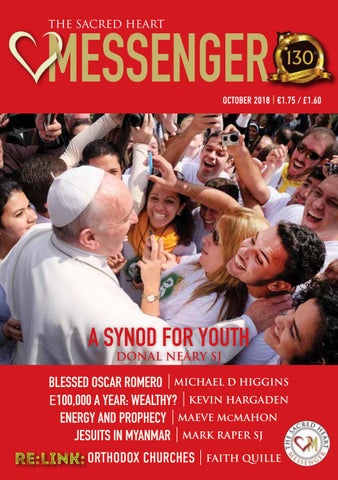
MESSENGER THE SACRED HEART
OCTOBER 2018 I €1.75 / £1.60
A SYNOD FOR YOUTH DONAL NEARY SJ
BLESSED OSCAR ROMERO I MICHAEL D HIGGINS E100,000 A YEAR: WEALTHY? I KEVIN HARGADEN ENERGY AND PROPHECY I MAEVE MCMAHON JESUITS IN MYANMAR I MARK RAPER SJ
RE:LINK: ORTHODOX CHURCHES I FAITH QUILLE
CONTENTS
6
17 8
4FROM THE EDITOR
11 THE BOOK OF PSALMS
Donal Neary SJ
Martin Hogan
PARISH OF RAHENY: OUR LADY MOTHER OF DIVINE GRACE
14 MASTERPIECES OF
23
A SYNOD FOR YOUTH
5 Cover Photograph: RealyEasyStar/ Fotografia Felici / Alamy Stock Photo
DAILY OFFERING Pope’s Intention
6POPE’S INTENTION
ENERGY AND PROPHECY Maeve McMahon
8
BLESSED OSCAR ROMERO Michael D Higgins
PSALMS OF PRAISE
CHRISTIAN ART
THE SHRINE OF SAINT URSULA Eileen Kane
17 REALITY SPIRITUALITY
ROCKING THE BOAT – GENTLY! Alan Hilliard
20 PLACES OF WORSHIP Christopher Moriarty
BRINGING IT ALL HOME Kevin O’Rourke SJ
25
DRUG USE: ADDICTION NOT CRIME Peter McVerry SJ
27
RE:LINK
ORTHODOX CHURCHES Faith Quille
CONTENTS
25
20
50 32
JOY
Aideen Madden
33 GARDENING
OCHRE OCTOBER Ciaran Burke
36 THANKSGIVING
38 COOKERY
47 IN THE MASTER’S FOOTSTEPS
Marie McGuirk
John Murray
THE FRUITS OF AUTUMN
40
CROSSWORDS
42
THANKSGIVING LETTERS
YOUNG READERS
37 A KINDNESS I’LL
€100,000 A YEAR: WEALTHY?
NEVER FORGET
READING THE SIGNS WITH KINDNESS Anon
44
Kevin Hargaden
46
IDEAL – ORDEAL – NEW DEAL! Tom Cox
JACQUES & RAÏSSA MARITAIN
50 MISSION MONTH
JESUITS IN MYANMAR Mark Raper SJ
53 POEM
ORIGINS
Richard Hendrick OFM Cap
55
CALENDAR
56
REFLECTION
4
FROM THE EDITOR
Youth is the focus of the Synod of Bishops meeting this month in Rome, highlighting the importance of the Church’s mission for and with young people. However, the Synod is not just about youth, it will also challenge all of us, young and old, with the gospel of Jesus. When I think over the years working with young people in chaplaincy and retreat work, and in a Dublin parish, the word ‘life’ sums up much of what I remember. I found life-giving questions about being human and being Christian. I found challenging questions and affirmation about being a Jesuit and a priest. I found generosity and commitment in young people’s ministry at home and abroad. I enjoyed volunteer summers with them in Darjeeling, Kolkata and Assam where we worked in some very poor schools. I enjoyed leading some life-giving liturgies on retreats and in schools. Working among younger Jesuits and seminarians kept hope alive in a new form of Church. I also learned a lot from them in linking our faith and Church with an ever-changing culture. Our Church needs their energy and their liveliness as well as their criticism. Pope Francis tells them to
shake things up: ‘Don’t forget to disturb complacency, but please don’t water down the faith!’ (2013, Mission Sunday). Youth can do that for us. I have memories too of how this work helped young people at a significant time in their lives: to realise that God loves them and to find common ground with everyone on a youth retreat, especially with people who seemed initially off-putting. They found help also a call to the following of Jesus in their lives. The Synod is to reflect on the culture of youth and how the call to follow the Lord can be discerned in that culture. Youth vocation is not only in the future. It is about being missionary disciples now. The love of God for each of us is also the call of Jesus. The preparation for the Synod got little mention in the Irish Church; many may not know that there was a prolonged international meeting of young people in Rome recently to listen for some youth input. Possibly with the visit of Pope Francis it got a bit sidelined. The visit is over, but the message for young people of love, faith and call is never over. May we hear more of the Synod afterwards than we heard before! Donal Neary SJ
Image: C Jones/Shutterstock
A SYNOD F R YOUTH
5
DAILY OFFERING Pope’s Worldwide Prayer Network APOSTLESHIP OF PRAYER
EVANGELISATION: THE MISSION OF RELIGIOUS
That consecrated religious men and women may bestir themselves, and be present among the poor, the marginalised, and those who have no voice.
THE SACRED HEART MESSENGER incorporating the Pope’s Worldwide Network of Prayer (Apostleship of Prayer). ADDRESS: Messenger Publications 37 Lower Leeson Street Dublin D02 W938 Ireland Phone: 00 353 1 676 7491 or 00 353 1 7758524 Email: sales@messenger.ie Website: www.messenger.ie BUSINESS LETTERS TO: THE MANAGER CHEQUES PAYABLE TO: THE SECRETARY EDITOR: Donal Neary SJ
MORNING PRAYER Heavenly Father, I thank you for yet another day. Grant that I may be able to share the joy of the Gospel with all those I encounter today. Through the intercession of the Blessed Virgin Mary, I offer you my day for the Church and for the Pope’s intention for this month. Our Father...
NIGHT PRAYER As this day ends, I thank you for it, even when time seems to move so fast. How well did I respond to your promptings? Did I treat all people with respect? Forgive me, if I failed in any way to live a Gospel life. Tomorrow, help me to realise that time is short and that I must work zealously for your Kingdom.Our Father...
LAYOUT: Messenger Publications Design Department NIHIL OBSTAT: Noel Barber SJ, Censor Deputatus IMPRIMI POTEST: † Diarmuid, Archbishop of Dublin PRICES FOR 2018: Price monthly: €1.75/£1.60 Annual subscription 2018 from promoter or newsagent: €21.00/£19.20 Annual subscription by post: Rep of Ireland and NI: €30/£27 Annual subscription to Britain: £30 Annual subscription to EU and ROW: €35/$43 Online subscription: €15.00 Renew at: www.messenger.ie 01 6767491 or 01 7758524 © All rights reserved
POPE’S INTENTION
6
MAEVE McMAHON OP, who works with JUST, a tutorial programme for adults seeking access to third level education, discusses how Pope Francis has consistently encouraged consecrated men and women to be prophets and bring the gospel to the people of our time.
ENERGY AND PROPHECY
Pope’s Intention: that consecrated religious men and women may bestir themselves, and be present among the poor, the marginalised, and those who have no voice. One of the principal documents of the Second Vatican Council, The Church in the Modern World, teaches that all Christians are called to holiness through a deeper relationship with Christ. Men and women in religious orders publicly profess vows by which they will live that call to holiness. One core element is prophecy. In his address to religious, Pope Francis tells them: ‘Prophets receive from God the ability to scrutinise the times in which they live and to interpret events. Prophets know God and they know the men and women who are their brothers and sisters. They are able to discern and denounce the evil of sin and injustice. Prophets tend to be on the side of the poor and powerless, for they know that God himself is on their side.’ (21 November 2014). By publicly professing vows, consecrated men and women express their public commitment to the Church. As an auxiliary bishop, Bishop Bergoglio stated, ‘Consecrated life is a gift to the Church, it is born of the Church, it grows in the Church and it is entirely
directed to the Church.’ (Intervention at the Synod of Bishops, 13 October 1994). The relationship between the ecclesial and prophetic dimensions of religious life can be challenging. It’s easier for religious to concentrate on the ecclesial identity as they get older and have less energy. ‘I’ll say my prayers and live my vows to the best of my ability in community’ can be a default position. Many have enjoyed a glorious past, building and administering schools and hospitals for people in need, often doing without themselves. Now they are retired and life is more comfortable. May I suggest that Pope Francis’ intention for October upsets that cosy picture? It is to pray ‘that consecrated men and women may bestir themselves and be present among the poor, the marginalised and those who have no voice.’ The Pope sees much to be done on the periphery, so he makes a clarion call that I’ll paraphrase as such: ‘that consecrated men and women may move with life and vigour to the periphery.’ He believes that they will have clearer vision there, as to what
www.messenger.ie
POPE’S INTENTION
7
Sister Stan and Peter McVerry, well-known for their work amongst the poor and marginalised.
they should do for the poor and marginalised. This would not be the case if they stayed at the centre. ‘I am convinced of one thing: the great changes in history were realised when reality was seen not from the centre but rather from the periphery.’ ( Pope Francis, 29 November 2013). So, leaders of religious congregations, while encouraging their best and brightest to go to the periphery, should help those who have retired from school or hospital to find ways to connect with the margins. There, where life can be onerous, they can bring to suffering people the joy of their love of Christ. Pope Francis reminds us that a true ecclesial witness
is joyful. ‘Where there are religious there is joy.’ (Apostolic Letter, 21 November 2014). However he is aware of the real challenges to joy in the lives of religious today: ‘When there’s no joy in the life of a priest or nun, “people can smell it.”’ In times of illness and enforced inactivity they pray for those who work for the poor and for the Church of the poor. May the prayers offered for the Pope’s Intentions in October obtain graces for consecrated men and women, to enable them, young, middle-aged and old, to bring a joyful presence to the periphery of society where they can become compassionate voices for the poor and in turn be enriched by them.
www.messenger.ie
FEATURE
8
The Messenger is honoured to have MICHAEL D HIGGINS, President of Ireland, write of his experience in El Salvador, and of the ongoing importance of the message of social justice of Oscar Romero, the bishop who walked with the poor and is due to be canonised.
BLESSED OSCAR ROMERO I first travelled to El Salvador thirty-six years ago, weeks after elements of the Salvadoran army had murdered over 1,000 people in the village of El Mozote. I joined Irish missionaries – amongst them the Poor Clares, Sacred Heart Sisters, and Franciscans – in bearing witness to the aftermath of the attacks, as we attempted to bring this atrocity to the attention of the world. In October 2013 I had the opportunity to return to El Salvador as President of Ireland. There, I visited the Memorial to Memory and Truth in Cuscatlan Park in San Salvador upon which the names of 30,000 of those who died in the recent war are inscribed. Among the many thousands of names engraved on the wall is that of Óscar Arnulfo Romero, who served the city of San Salvador as its archbishop before he was assassinated a day after he urged the soldiers of El Salvador to disobey their government and halt their repressive activities. The dedication of Monsignor Romero to the poorest and most marginalised, his passionate defence of human rights in his country and his courage in confronting a regime which frequently tortured and killed its opponents caught the imagination of a generation of Irish people who
mourned his loss in 1980. Monsignor Romero was a remarkable human being. He was not by nature a radical. When the Salvadoran Jesuits first began to implement a ‘preferential option for the poor’ in the early 1970s, enrolling students from the poorest areas into the Universidad Centroamericana and establishing ‘Christian base communities’ in rural villages, Monsignor Romero was initially critical of what was sometimes referred to as ‘political theology’, and he sought to maintain ‘neutrality’ in the face of the political and social injustices of El Salvadoran society. When he was installed as Archbishop of San Salvador in 1977 he was considered a ‘safe pair of hands’ by the establishment. Yet, only weeks later, on the 12 March 1977, his good friend Rutilio Grande, a Jesuit priest, was murdered by the security forces. Archbishop Romero presided over a memorial mass at which he advocated for solidarity with the poorest and for justice for all Salvadorans. From that day he became ‘el Obispo que anda con los pobres’, the Bishop who walks with the poor, condemning what he labelled as the ‘structure of sin’ that produced economic, social and political oppression.
www.messenger.ie
FEATURE
9
© Alamy
Óscar Romero in Rome, 1979, the year before he was assassinated
For three years, Monsignor Romero preached a gospel of peace and liberation, even as the shadows gathered and the government of El Salvador, and the international forces which supported it, intensified their campaign of repression. On the 23 March 1980, he appealed to the ordinary soldiers of his country to disobey their officers and bring an end to the violence. ‘Brothers,’ Arch-
bishop Romero said, ‘you are from the same people, you kill your fellow peasants ... No soldier is obliged to obey an order that is contrary to the will of God’. The next day the Archbishop was shot dead by a sniper as he celebrated Mass in the Chapel of the Hospital de la Divina Providencia. During his funeral mass, bombs and smoke grenades were set off outside
www.messenger.ie
FEATURE
10
the Metropolitan our own times: the Cathedral of San Salurgency of mitigatvador. The mourners ing climate change; were fired upon with the moral imperative rifles and machine of welcoming those guns, leaving over fleeing injustice, thirty people dead war, famine and and several hundred natural disaster; wounded. and the necessity of I was deeply challenging great inhonoured to visit the equalities in income, tomb of Archbishop wealth, opportunity Romero in October and power which 2013 to recall that persist within and terrible moment and between nations. to pay tribute to The canonisation of his life and legacy. the Archbishop will, Through his thoughts A mural showing Ă“scar Arnulfo Romero I hope, remind us on the facade of the historical Building of once again of his exand actions, he inthe Faculty of Jurisprudence and Social spired and continues traordinary example, Sciences of the University of El Salvador to inspire a generaand bring a renewed tion of advocates for vigour to all those human rights and for social justice. of us who, in our own circumstances, This inspiration is needed now seek to meet those challenges and more than ever as we seek to reto overcome those still persistent spond to the structural injustices of injustices.
In Loving Memory
The names sent to us of all those who have died are entered on our
List of the Dead
They are placed on the Sacred Heart Altar in our oratory and remain there for two months. Every Wednesday Mass is offered especially for them, that they may have eternal rest with the Lord, and that their families and friends may be consoled in their loss.
www.messenger.ie
11
THE BOOK OF PSALMS
Many psalms are poems and hymns of joy: FR MARTIN HOGAN, formerly lecturer in scripture at the Mater Dei Institute, guides us in the moods and contents of these everyday psalms. Watch for them in the responsorial psalms at Mass!
PSALMS OF PRAISE
Image: Brian A Jackson / Shutterstock
In the September issue of The Messenger, we saw that many of the psalms of praise celebrate God’s presence to the people of Israel in their history. From an experience of God in their history, the people of Israel slowly began to appreciate
that the God who created them as a people, by entering into their history, was the God who created the universe. The God who created and continues to create Israel is the God who created and continues to create the universe. God is constantly
www.messenger.ie
THE BOOK OF PSALMS
12 at work maintaining his creation, preventing it from slipping back into chaos. Creation was experienced as the visible presence of God and this evoked Israel’s praise. This movement from the experience and praise of God in history to that of God in nature is to be found in Psalm 135. Structurally, the psalm is typical of the psalms of praise with an opening invitation to praise (Ps 135:1–4), the reasons for the praise (Ps 135:5–18) and a concluding invitation to praise (Ps 135:19–21). The opening invitation to praise is addressed to priests and Levites, those who minister in the Temple. The main body of the psalm refers to God’s choice of Israel as a reason for praising him. Three key moments in the history of Israel are recalled: the Exodus from Egypt, the military victories on the way to the promised land and the taking of the promised land (Ps 135:8–12). However, the recital of the Lord’s deeds is only one motivation for praise in this psalm. The recognition of the Lord’s presence in history is prefaced by a recognition of the Lord’s presence in creation (Ps 135:5–7). The Lord who chose Israel by calling them out of Egypt is acknowledged to be the creator of the universe. He is not only the God of Israel, he is the God of the heavens and the earth, the seas and their depths (Ps 135:6).
The psalmist understands this creative activity of God not just as a past event but as something ongoing (Ps 135:7). The God of Israel is acknowledged as continually holding creation in being. The final invitation to praise goes out to those gathered for worship, to the priests and Levites, and finally to all together (Ps 135:19–21). In this psalm, the praise of God the Creator is just one element, and a minor one, in a psalm which praises God primarily as the lord of Israel’s history. There are, however, several psalms in the Psalter where God is praised principally as creator of the universe, such as Psalm 104. This psalm is recognised as having many affinities with the creation story in the first chapter of the Book of Genesis. The psalmist also seems to have been influenced by traditions outside Israel. This psalm is a likely example of how Israel was able to adapt the religious poetry of its neighbours to its worship of the Lord. The structure of the psalm is very typical. There is an opening invitation to praise God (Ps 104:1a), followed by the grounds for the praise (Ps 104:1b–30), concluding with a final invitation to praise (Ps 104:31–35). The long main section which grounds the praise relates entirely to the continuing activity of God as
THE PSALM UNDERSTANDS THIS CREATIVE ACTIVITY OF GOD … AS SOMETHING ONGOING
www.messenger.ie
THE BOOK OF PSALMS
13
creator of the universe. This can be divided into several sections. The inventory begins at Psalm 104:2–9 with a series of ‘you’ statements crediting the basic structure of creation to the wondrous power of the creator. The Lord is in his heavenly palace which is above the cosmic ocean (Ps 104:2–4). The Lord creates the earth, understood as the taming of the waters of chaos (Ps 104:5–9). He continues to hold the waters of chaos at bay, thereby continuing to hold creation in being. Not only are the potentially destructive waters held off by God’s power, but the Lord makes them the very means of life (Ps 104:10–18). Water which gushes up from underground springs and which comes down from the sky as rain, provides life and food for birds, animals and human beings. The Lord is then celebrated as master of the
seasons, and of day and night (Ps 104:19–23). The psalmist pauses to admire the Lord’s wisdom displayed in creation and especially in the abundant life of the sea (Ps 104:24–26). All living beings are totally and continually dependent upon God, the creator. The divine breath makes creatures live (Ps 104:27–30). The Christian liturgy has appropriated verse thirty to refer to the action of the Holy Spirit. The whole psalm, especially these verses, highlights that creation is not something that only happened in the beginning but is God’s continuing activity of holding everything in being. In the conclusion of the psalm, the author commits to a lifetime of praise of the Lord, and hopes that the meditative praise of the Lord in this psalm will be pleasing to him (Ps 104:31–35).
Please remember
The Sacred Heart Messenger in your Will
On Wednesday and Friday of each week, the Editor of The Sacred Heart Messenger offers Mass for all our benefactors, living and dead.
Bequest
I give and bequeth to THE SACRED HEART MESSENGER, 37 Lower Leeson Street, Dublin D02W938, Ireland, the sum of € for the general charitable purposes of the said Charity. The receipt of the said Charity shall be sufficient evidence of payment of said sum. www.messenger.ie
MASTERPIECES OF CHRISTIAN ART
14
EILEEN KANE turns her eye to The Shrine of St Ursula by Hans Memling: a beautiful piece which brings a Christian legend to life. It is housed in the Hans Memling Museum, Bruges.
THE SHRINE OF SAINT URSULA Hans Memling (c.1430-94)
In the second half of the fifteenth century, Hans Memling was the most famous painter in the Low Countries. Resident in Bruges, he had already completed, in 1479, a splendid altarpiece for the city’s Hospital of Saint John when he received another important commission from the same hospital. This was to paint a new reliquary or shrine to contain a relic of St Ursula, a saint much venerated at that time throughout Europe. The shrine was completed by 21 October – the feast-day of St Ursula – in 1489, when the relic was solemnly placed within it. Today, the hospital has become the Memling Museum, and the shrine is one of its greatest treasures. The shrine is of wood. Built in the shape of a rectangular house, or chapel, it stands 86.36 cm (almost three feet) high, is 33 cm wide and 91 cm long. It has a steep gable at each of its narrow ends, and a sloping roof, with decorative work along the roof ridge. At each corner, there are turrets, niches and statuettes. All the structural work is gilded, and provides a framework for eight paintings by Memling. In one of the narrow ends, the Virgin Mary, with the Christ child in her arms, is
depicted standing in a chapel, with two of the hospital’s community of nuns kneeling at her feet. In the other narrow end, standing in a similar chapel, St Ursula, virgin and martyr, protects ten of her companions under her cloak. In each side of the shrine, there are three scenes. These illustrate the pilgrimage undertaken by Ursula and her companions – who are said to have numbered eleven thousand – to Rome, and back to Cologne, where they all met a martyr’s death. The story of St Ursula, according to The Golden Legend, is set in the third, or possibly the fourth century, and begins in Roman Britain, where her father was a Christian king. When a higher-ranking pagan king sent an embassy to her father to say that his son desired to marry her, Ursula, wishing to avoid the warfare that a refusal would entail for her father, agreed to marry, but only on certain conditions. These were, firstly, a delay of three years, then that her princely suitor would be instructed and baptised in the Christian faith and also that she would be given ten companions of high rank, each one accompanied by a thousand
www.messenger.ie
© Hans Memling Museum, Bruges / Alamy Stock Photo
MASTERPIECES OF CHRISTIAN ART 15
www.messenger.ie
MASTERPIECES OF CHRISTIAN ART
16 others, and that they would all go on pilgrimage to Rome. The conditions were accepted, and Ursula and her companions set out in eleven ships for Rome. The Legend relates that they travelled up the river Rhine, stopping first at Cologne. Their arrival there is the first scene on the sides of the shrine. Memling shows Ursula stepping off the ship on to the quayside. One of her companions, already disembarked, reaches out to her, grasping her wrists, to steady her. Other companions hold up the train of her dress, while porters pick up the pilgrims’ baggage. The companions on the quay-side are beautifully gowned in lilac and blue, red and green, their long hair tied back, or piled on top of their heads, held in place by a bandeau. One is wearing a veil. On the right, the girl in lilac is carrying a jewellery-box. All move gracefully, as they enter the town. Beyond the town-gate, Cologne cathedral dominates the skyline. Memling illustrates this as it was in his day. Only the sanctuary, or choir part had been built by then, and the enormous crane that was used to hoist the stones as work progressed, was still in place. This can be seen tilting upwards at an angle, above the roof of the building to the left of
the cathedral. In Cologne, Ursula had a dream, in which an angel appeared to her, and foretold that on her return to Cologne from Rome, she would receive the crown of martyrdom. Memling includes that, too. Through the open windows of a house that is just below the cathedral, to the right, we see Ursula sitting up in bed, dressed in white, with a red coverlet on the bed. On the left, the angel flies down. Ursula’s little dog sits beside the window. In the second scene, the group arrives at Basle, from where they set out on foot over the Alps, and on to Rome. At Rome, in the third scene, they are greeted by the Pope. The three scenes on the other side of the shrine depict the homeward journey. We see them setting out from Rome, accompanied now by the Pope, a cardinal and other clerics. At Cologne, before they have time to disembark, they are attacked by an army of Huns, and all of them are killed. Ursula, the Legend relates, was the last to die. In the last scene, she repulses the advances of the army’s leader, and is shot, at point-blank range, by an arrow directed at her heart. Some modern scholars reject the entire story of St Ursula. True or false, we are grateful that she inspired so lovely a masterpiece of Christian art.
www.messenger.ie
REALITY SPIRITUALITY PART 2
17
FR ALAN HILLIARD continues his series of reflections on the Pope Francis’ letter Gaudete et Exsultate. His book Happy to Be Holy? on Gaudete et Exsultate is available from Messenger Publications (€4.95).
Photograph: © Phonix_a Pk.sarote / Shutterstock
ROCKING THE BOAT – GENTLY!
A very wise friend of mine used to work a lot with priests. He said to me one day that many priests suffer depression due to inertia. He didn’t mean this in a condemnatory way, but rather he was commenting on the culture that discouraged activity. The culture didn’t encourage change or initiative. In many senses, he observed, it was easier to do nothing! Many priests try to initiate new things and the reply is often ‘sure we’ve always done it this way father’, and ‘sure isn’t it easier to stick with what we know’.
Even leadership doesn’t want you to rock the boat too much and those who say they are looking for new initiatives offer little encouragement when new initiatives are taken. It often dismays me that clergy meetings frequently take on the atmosphere of a First Communion class rather than that of a group of mature, educated adults. According to Pope Francis’ Apostolic Exhortation, Gaudete et Exsultate, the spiritual life claims as its enemies sloth, inertia and timidity. This letter talks about God being a
www.messenger.ie
REALITY SPIRITUALITY PART 2
18 fearless God who reaches out to new territories. The God described in this letter is radically at odds with a ‘don’t rock the boat’ approach. ‘Those who choose to remain neutral, who are satisfied with little … will never hold out.’ (Para 162) For some depression may be like a prison cell. It is a dark, isolated and fearful place. However, the key for the cell door is on the inside. In other words we have the ability, in most cases, to open the door with the right encouragement, motivation and thinking. When a student sits with me I like to help them understand where the lock is, where the key is and then maybe they can set about opening the door, even a little bit. Locked rooms figure in Scripture, but they don’t remain locked for long. Once the presence of the Lord occupied people, the doors opened from the inside and they went out, not with inertia but with exertion. There is nothing about the spiritual life that is cosy. Many have made Celtic Spirituality into a brightly decorated tea cosy that smothers reality, whereas real Celtic Spirituality deals head-on with reality – we only have to dip into the Confessions of St Patrick to find the same themes that run through Gaudete et Exsultate: ‘More and more did the love
of God, and my fear of him and faith increase, and my spirit was moved so that in a day [I said] from one up to a hundred prayers, and in the night a like number; besides I used to stay out in the forests and on the mountain and I would wake up before daylight to pray in the snow, in icy coldness, in rain, and I used to feel neither ill nor any slothfulness, because, as I now see, the Spirit was burning in me at that time.’ Authentic spirituality names and deals with the ravages and risks of life leaving little to the imagination. Wouldn’t it be a shame to be burnt out before we had a chance to be on fire! From Gaudete et Exsultate: ‘Can any spiritual fervour be sound when it dwells alongside sloth in evangelisation or in service to others? (Para 30) How often we are tempted to keep close to the shore! Yet the Lord calls us to put out into the deep and let down our nets (cf. Lk 5:4). (Para 130) Sometimes I wonder, though, if perhaps Jesus is already inside us and knocking on the door for us to let him escape from our stale self-centredness.’ (Para 136)
‘I WOULD WAKE UP BEFORE DAYLIGHT TO PRAY IN THE SNOW…
www.messenger.ie
RECOMMENDED BOOKS
19
Brian Grogan SJ is one of our most popular writers. His articles in the Messenger are widely read and most of his books have been bestsellers. Here is a selection of his books published by Messenger Publications.
Finding God in All Things 72pp, Paperback, €7.99 Brian Grogan SJ
To Grow in Love A Spirituality of Ageing 162pp, Paperback, €12.95
When everything is said and done I Am Infinitely Loved 64pp, Booklet, €4.95
God You’re Breaking My Heart What is God’s Response to Suffering and Evil? 152pp, Paperback, €9.99
Finding God in a Leaf The Mysticism of Laudato Si’ 64pp, Booklet, €4.95
www.messenger.ie
20
PLACES OF WORSHIP This month CHRISTOPHER MORIARTY is in Raheny where he visits the Our Lady Mother of Divine Grace church, a pioneering example of the use of modern materials in church architecture.
OUR LADY MOTHER OF DIVINE GRACE, RAHENY
Although designed 1958 before the Second Vatican Council, the Our Lady Mother of Divine Grace church in Raheny stands out as a modern structure. It owes little or nothing to any of the long-established styles that inspired the majority of the new churches which were built in the Dublin region in the 1960s and 1970s. When first built it stood rather starkly at a crossroads in the village. That was more than fifty years ago, however, and the trees that were planted then have grown up and provide a beautiful screen. If that wasn’t enough, there is a poster beside the gate with the words of Joyce Kilmer’s famous poem ‘Trees’
beside a charming painting by M Gaffney to illustrate it. Tradition tells that a monastic settlement was established near the site by St Assam, and the first Catholic church to be built in Raheny was dedicated to him. St Assam’s Church had been opened in 1864 by Archbishop Cullen, who would two years later be elevated to become the first Irish cardinal. Designed by Patrick Byrne, the church served well for a country parish, but came to be much too small when Raheny grew into a populous suburb of Dublin. The architects Louis Peppard and Hugo Duffy were engaged and came up with their concept in reinforced
www.messenger.ie
21
PLACES OF WORSHIP
concrete, far removed from the usual materials of stone or brick. For very much more than a thousand years, churches and other large buildings had depended on arches for their openings. Arches are curved and usually graceful. For many centuries they were semi-circular and often rather heavy looking. Then the pointed ‘Gothic’ arch was introduced in twelfth century France and came to be used all over Europe. It fell out of favour, to be revived in the nineteenth century and adopted throughout Ireland until it was eclipsed for some time by the Byzantine style. At Raheny, evidently with the approval of Archbishop McQuaid, who had strongly opposed such styles less than ten years earlier, Peppard and Duffy introduced concrete and steel which allow straight lines and angles, with no need for arches. The architects followed long-established traditions in the ground plan of the building, which is shaped like a cross with a long nave as the shaft, a pair of
transepts for the arms and a short chancel as the head. They allowed themselves just one curve on the exterior: a semi-circular arch for the porch of the main entrance. This arch is embraced by the extraordinary decoration which occupies the centre of the south front of the church. Dominating the church and, indeed, the centre of the village it is a great triangle extending from the ground to the pinnacle of the roof where it is surmounted by a plain cross. Its plain concrete is clad with blue-green slates. Far from being a simple structure, this figure is itself divided into a multiplicity of smaller triangles. The spaces between the lower ones are filled by slates, but those of the upper storey are windows composed of pieces of glass in shades of blue, green and purple embedded in concrete. Two contrasting structures are joined by an arcaded passage to the front. To the west is a five-storey bell-tower, rising high above the level of the church roof. Its lower storey has the same blue-green
www.messenger.ie
PLACES OF WORSHIP
22 slates as the triangle. The top storey has an opening on each side and the roof is gently pitched and clad in copper. The annex to the right was a baptistery, formerly accessible from the outside by a separate door but with an interior door leading in to the church. The symbolism was that the unbaptised infant could receive the sacrament before entering the church proper. Times have changed and the baptismal font is now close to the high altar. Tall narrow windows with panels of coloured glass line both sides of the church and of the transepts. Each of them is set at the apex of one of the shallow triangles that break the straight line of the wall and gives an element of lightness to this large building. The interior of the church repeats the simplicity of the outside. It comprises a central nave leading to the sanctuary, with a pair of side aisles with lower ceilings. They are
separated from the nave by tall, slender octagonal columns – even the columns are not allowed curves! For a brief moment, traditional materials are allowed to appear in the church, in the form of the wooden beams that support the ceiling of the nave. Wood is also the material used in the great crucifix, which is the sole decoration of the wall of the apse. Decorative work within the church is minimal, with the exception of the Stations. The work of Richard King, they are stylised figures of enamel on bronze. Something of a pioneer at the time, a widespread acceptance of modern materials followed the building of Our Lady Mother of Divine Grace church. Glass, concrete and steel offered architects far greater freedom for their designs and the churches of the following decades display a marvellous variety of shapes.
D on ation s gratef ully r ecei v ed
For the spread of devotion to the love of God in the Sacred Heart and other Messenger charities. For the work of the Jesuit Mission in ASSAM, NORTH INDIA, for the payment of teachers’ salaries in the new Jesuit third-level college at Tezpur. St Joseph’s Penny Dinners, c/o St Francis Xavier’s, Gardiner St, funding food for the hungry in Ireland and abroad. For the promotion of The Sacred Heart Messenger.
FEATURE
23
A priest meets many people in ministry who carry with them the burdens of the past, as KEVIN O’ROURKE, a Jesuit priest working with novices in Birmingham, found out in the early years of his priesthood. A childhood memory helped him make sense of a lot.
BRINGING IT ALL HOME Pohto: Dariush M / Shutterstock
A family of eight, we took our turns from the oldest down, going to the Midlands from the West every summer, and we loved it. Mr Henry was a farmer, and we looked forward to spending a week or two with his family during the summer.
I was the third, so my turn would come in August 1966, a year before my Leaving Cert. The weather was fine and Galway were going for the three-in-a-row. The hay was well saved; the fields were bare. When the last cock of hay had
www.messenger.ie
FEATURE
24 been brought in, Mr Henry said to me, ‘Will you come with me to bring in the rest?’ I wasn’t sure what he meant but off we went, tractor and trailer, Mr Henry at the wheel, and myself on the trailer. We went to the last field. The crows had it all to themselves now. We went in through the gap, turned around and headed back for home. I wondered what this was all about. I soon found out. In those days, there were no EU funds for keeping hedges trimmed. People talked about the ‘green curtain’, the ditches and hedges that sometimes almost met in the middle of the road overhead. Bushes, briars and branches reached out to catch the unwary. There were also the potholes. We hadn’t gone far when we came to a stop. Fistfuls, bunches and sometimes the makings of a fine forkful of hay decorated the hedges and potholes. It was my job to gather them up and put them on the trailer. By the time we reached home, there was more than enough to feed a hungry animal for a few days. That memory held my attention for many years. It wasn’t because Mr Henry was careful not to let anything go to waste. It was something else. Only about fifteen years later, as a newly-ordained priest, did I understand why it stayed in my mind. People open their hearts and souls to a priest in the Sacrament of Reconciliation. Many people come through life leaving behind unhealed regrets, hurts, wounds and
disappointments. The thorns and briars of life tear something out of them that gets left behind and is never brought home. I was reminded of this again on Christmas Day last, when my ninetynine-year-old aunt, Sr Mary Aquinas, departed this life in faraway South Africa. Many years ago, when she was still living in Ireland, a member of her community lost her life in a traffic accident. At her graveside, a local woman came to my aunt, and pointing to the fresh mound of earth, said to her ‘Sister has taken all my secrets to the grave’. One of the most helpful talks I heard about the Sacrament of Reconciliation was from a priest who felt that the ‘shopping list’ that people brought to the confessional week by week was missing something. He began to ask people ‘Are there any intentions you would like me to pray for?’ That’s when the sacrament took on a deeper dimension, and people unburdened themselves of all kinds of worries and troubles. Some were of the everyday kind, while others cast a deep and dark shadow over their lives. Aren’t the words of Jesus so comforting, when he invites us, weary and heavy-laden to come to him? He is indeed gentle and humble of heart, and he does give rest to our souls, a peace the world cannot give. Isn’t that too what I’m meant to do as a priest? PS My aunt didn’t go to her grave empty-handed either.
www.messenger.ie
FEATURE
25
PETER McVERRY SJ, a well-known social activist, challenges the criminalising of the drug user, and highlights the lack of treatment available.
DRUG USE: ADDICTION NOT CRIME “IF WE HAVE A CLOSE RELATIVE OR FRIEND WHO IS ADDICTED TO ALCOHOL, WE DON’T CALL THE GARDAÍ TO ARREST THEM!”
A sixteen-year-old boy has been using cannabis for several years. He lives with his mother and eightyear-old brother. He now owes a lot of money to the drug dealers. The drug dealers have smashed the windows of his mother’s house on several occasions. They accompany her to the post office each week to take her social welfare payment from her. They tell her that if she does not pay her son’s debts they will petrol bomb her house some night. In her stress she has begun to self-harm. Her eight-year old is probably going to be taken into care as there is little food in the house and the electricity
has been disconnected. Thousands of families around the country, living in fear of drug dealers, are too frightened to go to the Gardai or to the media … To understand why some young people take drugs, we only have to go down to a pub and ask the adults why they are there. They would say they take a drink in order to relax, to socialise, to escape for a while from the pressures of life and to alter their moods. This is why young people take drugs. Those most likely to become addicted are those who use drugs to escape from experiences with which
www.messenger.ie
FEATURE
26 they cannot cope, like abuse or violence in childhood, the death of someone very close to them, cyberbullying or those who feel they have no future. For them, drugs provide a ‘temporary vacation’ from real life, because real life is too hard to bear. The dominant attitude of both the public and many politicians is that those who are addicted to drugs are the authors of their own misfortune. Even those in recovery from addiction are often seen as ‘damaged goods’, though for me they are among the unsung heroes of our time. Our traditional response to drug use has been to criminalise drug users. After many decades of prosecuting people caught using drugs, this policy has evidently failed. Drugs are now available everywhere in Ireland. Giving people a criminal record for possession of drugs is counter-productive. It deters very few, introduces them to a criminal sub-culture and through the social consequences of having a criminal conviction (difficulty of obtaining employment, difficulties of obtaining visas to travel and the labelling that a criminal conviction ensures) marginalises people even more in their community, and may push them into further drug use. If we have a close relative or
friend who is addicted to alcohol, we don’t call the Gardaí to arrest them! We try to get them treatment. We consider alcohol addiction to be a medical problem, not a crime; an illness which requires support and treatment. Similarly, we should treat drug addiction as a medical problem, not a crime. We should use our resources to provide them with health professionals and counsellors, not lawyers to defend them in court. It means taking responsibility for drug enforcement away from the Gardai and courts and transferring it to the Department of Health. It frees the Gardai from arresting people using drugs to focus their resources on arresting people who sell drugs. Most drug users come to a point in their life when they want to give up drugs. In many parts of the country, there is no treatment available at all or there are long waiting lists. Many drug users give up trying to come off drugs because the services they require are not readily available. If we want to reduce the use of drugs, our society must invest in drug treatment services, so drug users can access treatment on demand. Until we recognise drug users, not as ‘bad’ people but as people in need of medical help, the political will to invest in services will not be there.
IF WE WANT TO REDUCE THE USE OF DRUGS, OUR SOCIETY MUST INVEST IN DRUG TREATMENT SERVICES, SO DRUG USERS CAN ACCESS TREATMENT ON DEMAND.
www.messenger.ie
re:link
October’18
27
Resource for Religion Studies
relink.messenger.ie
Photo: SKORIKOVA TATIANA / Shutterstock
The Orthodox Christian Churches
Priest at altar in Orthodox Church
The Orthodox Church is one of the three largest Christian groups today (the other two are Roman Catholic and Protestant). Approximately 300 million people worldwide follow the Orthodox tradition, living in Russia, Greece, Cyprus, Syria, Romania, Moldova and more.
Although Orthodox Christians share their traditions, rituals and worship, they are often identified by their geographical titles such as Russian, Romanian, Syrian, or Greek Orthodox, as each Orthodox belief is shaped by and incorporates their own cultural traditions.
TOPICAL ARTICLES | Celebrity Profiles | COMPETITIONS
& PRIZES | Free Online Content | Interviews & more...
28
B ackground In the early days of the Christian Church (as far back as 325CE), the leaders of the Christian communities would come together to hold councils or large meetings, to make important decisions and share ideas. At this time Christians worldwide shared the same religious faith and practices. However after the seventh ecumenical council in 787CE the Churches began to divide over their opinion on the role of the Pope in Rome. Eastern Christians did not believe that the Pope should be the supreme authority over the faith, whereas Western Christians did. This led to what became known as the ‘Great Schism’ in 1054. This divide grew when the ‘Sack of Constantinople’ took place. In the eyes of the Eastern Christians, the siege of Constantinople led to the loss of this city (the then capital of the Byzantine empire and at that time, the world’s largest Christian city) to the Muslim Ottoman empire, who went on to rename the city Istanbul, meaning “City of Islam”. This event is seen as a major turning point in medieval history as the Byzantine Empire was seriously decreased and impoverished and it led to the reduction of Eastern Christianity and the spread of Islam into Europe. Following this, the divisions between the Eastern and Western Churches continued over the centuries as the Roman Empire dissolved. Eventually, while the Eastern Churches wanted the Church to keep to the
vernacular (local) language of the community for worship, Latin became the language of the Western Church. Until the schism the five great Christian capitals (patriarchal sees) were Rome, Constantinople, Alexandria, Antioch and Jerusalem. After the break with Rome, Orthodoxy became known as ‘Eastern’ and the main form of Christianity in the eastern Mediterranean, much of Asia Minor, Russia and the Balkan countries (countries in the Balkan Peninsula include Croatia, Bosnia and Herzegovina, Slovenia, Serbia, Montenegro, Kosovo, Macedonia, Romania, Bulgaria, Albania, Greece, and the European part of Turkey).
The Orthodox Church Today Belief: The Orthodox Church shares the faith of the other Christian churches that God revealed himself through Jesus Christ, the incarnation of Christ, his crucifixion and resurrection. The Holy Spirit is seen as present in and as a guide to the whole body of the Church. Calendar: Many Orthodox Churches use the Gregorian calendar for fixed feasts and holy days, but the Julian calendar for Easter and movable feasts. In this way all the Orthodox Christians celebrate Easter together. The Orthodox Church calendar begins on September 1st and ends on August 31st. Each day is sacred as each is
www.messenger.ie
29 a saint’s day, so at least one saint is venerated daily.
Festivals: Both Christmas and Easter are celebrated in the Orthodox Church. Easter, centred on the cross and resurrection of Christ is the supreme festival of the year. There is a strong emphasis on family and social gathering, however there is less emphasis on the commercial side of Christmas, such as is typical in Western culture. Government: The Orthodox Church is made up of a number of selfgoverning Churches which are either ‘autocephalous’ (meaning having their own head) or ‘autonomous’ (meaning self-governing). The nominal head of the Eastern Orthodox Churches is the ‘Patriarch of Constantinople’. However, he is only first among equals and has no real authority over Churches other than his own. Icons: Icons are of great importance to Orthodox Christians. These beautiful paintings are used in worship both in the decoration of the church and in homes. The icon is seen as both a form of prayer and a means to prayer. An icon is usually an elaborate, two
© Marian C / Shutterstock
Fasting: Orthodox Christians believe that the discipline of fasting trains the body and enables a believer to concentrate the mind totally on preparation for prayer and spirituality. There are four main fasting periods in the Orthodox calendar; the Great Fast, the Fast of the Apostles, the Dormition Fast and the Christmas Fast. All Wednesdays and Fridays are also expected to be days of fasting.
Orthodox icon of Mother of God and child
dimensional painting. They often have a gold leaf background and are usually on wood, often depicting Jesus, Mary or the saints. The icon is venerated. The worshipper kisses the icon, making the sign of the Cross and may kneel or prostrate before it. Prayer: At the centre of worship and belief is the Eucharist surrounded by the Divine Offices or the Cycle of Prayer. These prayers are sung particularly at Sunset and Dawn and at certain other times during the day and night. Personal prayer plays an important part in the life of an Orthodox Christian, in particular the Jesus Prayer. This is a sentence which is repeated many times. The aim of this repetition is to enable the person to concentrate solely on God. The strict life of prayer of a monk or nun is seen as an important expression of faith.
Reference: www.bbc.co.uk/religions www.messenger.ie
30
Curriculum Link
CE: Common Era (BCE: Before Common Era). The Common Era begins with year 1 in the Gregorian calendar. CE and BCE are used in exactly the same way as the traditional abbreviations AD and BC. AD is short for Anno Domini, Latin for year of the Lord. BC is an abbreviation of Before Christ. Because AD and BC hold religious (Christian) connotations, many prefer to use the more modern/neutral CE and BCE to indicate if a year is before or after year 1.
words orthos (‘right’) and doxa (‘belief’). Hence the word Orthodox means correct belief or right thinking.
Icon: A sacred image of Jesus, Mary or a saint used as an aid to prayer.
Schism: A division or split within a community of faith.
Orthodox: The word ‘Orthodox’ takes its meaning from the Greek
Venerate(d)/Veneration: To regard highly and with great respect.
Patriarchy: A society or community organized on patriarchal (male) lines. Prayer: The act of communicating with God. Prayer can be personal (individual) or communal (as a group). Sacrament: A sacred ritual that is a visible sign of God’s presence during important times in people’s lives.
See our website www.relink.messenger.ie for Sacraments in the Orthodox Churches.
C ompetition ! Icons are central in the worship of Orthodox Christians. For this month’s competition we want you to create your own painting/ drawing of Jesus, Mary or a saint. Send your entry via email to relink@messenger.ie or post to RE:LINK, The Sacred Heart Messenger, 37 Lower Leeson Street, Dublin 2. Please include your name, age & school. Closing date: 24th of the month. Winner receives a voucher wor th €30!
JULY 2018 RE:LINK WINNER: Liam Moynihan, Middleton, Co Cork
Get in touch: 01 775 8523 relink@messenger.ie @RelinkMagazine facebook.com/relink relink.messenger.ie
You are invited to
AN AUDIENCE WITH POPE FRANCIS in honour of the
175th Anniversary of the the Pope’s Worldwide Prayer Network (Apostleship of Prayer)
on Friday 28 June 2019 The international team will organise two activities: The meeting with Pope Francis in the Pope Paul VI Audience Hall 10.30-12.00 Mass (more details later) The National Office will organise other events. Further details will appear in November 2018 Sacred Heart Messenger magazine. For Ireland: To book your place for the Papal Audience write to AOP, 37 Lr Leeson St, Dublin 2. For UK: prayernetwork@jesuit.org.uk (Please do not contact Messenger office)
Participants are responsible for their own travel and accommodation arrangements. Tickets will be forwarded to you free of charge for the audience along with details about the Mass and any other events.
Places for the audience should be booked by February 20th 2019
JOIN US IN ROME FOR THIS HAPPY OCCASION!
FEATURE
32
Joy can be found in the simplest moments of life, so writes AIDEEN MADDEN. She encourages us to be joy-bearers, and joy-givers in our own everyday lives.
Image: KateChe / Shutterstock
JOY
‘Joy is the echo of God’s life within us’. These words of Blessed Columba Marmion speak to us of the importance of joy in our lives as Christian people. Another great religious leader, Janet Erskine Stuart, chose as her very mission in life to be ‘a joy-bearer and a joy-giver’. She wrote that she could ‘conceive of no higher way’ in life than that of bringing joy to others. And what good person does not want to bring joy to other people? Creating joy is based on attitudes of hope and openness and trust in God’s will for us. It involves more than having good intentions. It entails taking responsibility for creating joy for both ourselves and others. We can bring joy to others in simple ways. A kind word, a helping
hand, a listening ear and a nice smile can bring little miracles of joy into being in people’s lives. We can be joy-bearers through our generosity and our hospitality, our companionship and our compassion. These are some beautiful pathways to joy. ‘In life’, wrote Janet Erskine Stuart, ‘if one is joyful it means that one is faithfully living for God … and if one gives joy to others one is doing God’s work; with joy without and joy within, all is well’. Let us rid ourselves of everything in our hearts and minds that (in the words of the poet, William Wordsworth) is ‘at enmity with joy’, embracing the joyful communion of the saints. They are true and joy-bearing echoes of God’s life within us. May we be the same!
www.messenger.ie
GARDENING
33
CIARAN BURKE writes of shortened October days in the garden, when declining sunlight is often supplemented by the brilliant colours of changing autumnal leaves.
OCHRE OCTOBER
Colchicum
October is a time of change. The days grow shorter, and the leaves of trees burn with autumnal fire. Life retreats to the soil, ripened fruits and berries are devoured by hungry birds. The turning seasons continue their ever-changing cycle, soon the garden will be winter ready, soon to sleep through the winter months. On a cool misty morning October
is at its best: the deep red foliage of Euonymus planipes, its autumn coat green, glistening wet, its pendant fruits, red capsules cracked to reveal orange seeds. Resplendent in its blaze of glory, this small tree never fails to delight on October days. There are others too, Amelanchier canadensis, happy to grow in the dampest soil, burning orange;
www.messenger.ie
GARDENING
34 Aronia melanocarpa, its falling leaves littering the ground with orange and red, the clusters of glazed black fruit hanging from the stems. Aronia melanocarpa is one of my favourite shrubs. Not just for its beautiful display of autumnal tints and delightfully ornamental fruits, it is also easy to grow, even in wet soils and sites exposed to wind. The fruits are edible, while not so good straight from the plant, they make an exceedingly tasty jam or cordial, and they are widely used in Poland. It is hardy too, grown in northern Europe where it is sometimes used as a hedge. I grow mine in a large pot, trained up as a standard, meaning that I have removed the lower branches to produce a plant shaped like a tree. There are many trees and shrubs that provide an autumnal show of changing leaf colours; a seasonal beauty to enjoy. There are, however, still flowers to enjoy too. Late flowering hardy perennials such as Helianthus ‘Lemon Queen’, still hangs on to the last memories of summer past and continues to produce yellow sunflowers on stems one point seven metres high. Asters and Anemone x hybrid will continue until November, and if the frosts have stayed away, gardeners will still be enjoying the late blooms of the summer bedding plants too. For many plants October signals the end of the season, the time of rest before the spring. There are plants that follow a different pattern and produce their flowers now, rising from the bare earth before
their leaves. Colchicums, wrongly called autumn crocus, are one such group of plants. From the soil, pink or white buds emerge, elongating to form long fat torpedoes of blooming buds. Then they open to greet the sun, forming elegant chalices greeting the sky. Colchicum specious is pink, while the C. specious ‘Album’ is ivory white. You can buy the big bulky bulbs now in autumn, often they have flowers limply hanging from their necks. Plant them straight away and in spring the foliage will appear. From each bulb a multitude of flowers appear. October garden days are busy too. Gathering leaves that fall, a lovely job to do, energising and rewarding. Save each fallen leaf, for they are precious. Composted leaves make the finest compost, called leaf mould. Although it may take time for the leaves to fully decompose, perhaps two years, the end result is a premium almost weed-free compost. It is easy to make, just gather the leaves in old compost bags or any old plastic sack. Tie the bags closed and stab the sides a few times with a garden fork to aerate the leaves. Then store them out of sight, even behind a shed. Check them next year, and you will probably have shrunken bags of moist crumbly compost, for free. It is still time to sow broad beans, sweet peas for early blooms next year, to prepare the ground for garlic cloves next month. The work of a gardener never ends, and for that we can be especially thankful.
www.messenger.ie
35
Celebrating the recent visit of Pope Francis Dear Pope Francis The Pope Answers Letters from Children Around the World Pope Francis €7.95 The Quiet Revolution of Pope Francis A Synodal Catholic Church for Ireland? Gerry O’Hanlon SJ €12.95
Happy to be Holy A Guide to Gaudete et Exsultate Alan Hilliard €4.95
www.messenger.ie
Tel: 01 7758522
THANKSGIVING LETTERS
36
Every month we publish a selection of thanksgiving letters from our readers. Please be assured that receipt of a letter is fulfilment of a promise to publish. A longer ‘letter’ – a story of thanksgiving – is on the facing page, and our readers are invited to submit their own ‘A Kindness I’ll never Forget’.
INNER PEACE I have been blessed in so many ways throughout my life. Parents who passed on the gift of faith to me, three children of whom I am proud and who look out for me now that I am older; four grandchildren, all healthy thank God. Always, the Sacred Heart has been a constant source of hope and courage. Devotion to him will bring many blessings, and a sense of inner peace. When we say ‘Oh Sacred Heart of Jesus, I place all my faith in thee’ let us do just that. Let go, and let God step in. Anon
GOOD HEALTH Dear Sacred Heart of Jesus and Our Lady of the Sacred Heart, this is a thanksgiving which is long overdue. I wish to thank you for excellent exam results for our son and daughter, and for restoring our son to good health. Clear hospital results also for our son, myself and my mother, and a less stressful job for my sister. I pray for protection, good health and guidance for us all. In particular, I am thankful for our son getting a fulltime and permanent job for which he had recently inter-
viewed. This is a job he has always wanted. Please grant him good health to do this job, and grant that his health issues won’t interfere with his ability to do the job well. Please also guide his consultants and doctors to make the correct decisions as regards his health. Please grant that our son’s low platelets and his ITP medical condition won’t have any impact on his taking up this new position. NF
LAND DISPUTE Please publish my letter of thanksgiving in The Messenger for favours received over the years. Especially, for a big success in a land dispute that was going on for over ten years. No matter what I ask of the Sacred Heart, he has never failed me over the years. I always pray that the Sacred Heart of Jesus will be adored and loved. A long time reader, WB
HEARD MY REQUEST
I would like to thank the Sacred Heart for hearing my requests that ‘my problem with the Telephone and Button Box would be solved amicably’. Tralee, Co Kerry.
www.messenger.ie
THANKSGIVING: A KINDNESS I’LL NEVER FORGET
37
In this month’s ‘A Kindness I’ll Never Forget’ our contributor, who wishes to remain anonymous, tells us how a timely act of generosity changed his life.
READING THE SIGNS WITH KINDNESS El ‘Buen Samaritano’ is a small rustic café near the main plaza in Huehuetenango, in the northwest highlands of Guatemala. It is about 100 kilometres from the Mexican border. I had crossed that border the week previously and now it was time to move on. The year was 1979. How to move on was the problem. I was down to my last few dollars, not enough for the bus fare to the Cuchumatanes, where I had been offered work with Mayan communities. I had a deadline to meet. Hiking was unsafe as civil war was brewing in the highlands and jungles of Guatemala and military death squads roamed the countryside. A shadow passed the open door of the café, stopped and did a double take. It was Jean Donovan, a Maryknoll lay missionary who was studying Spanish in El Salvador. We chatted for a while. I didn’t tell her my troubles, but when she got up to go, she stuffed two twenty-dollar bills into my shirt pocket. From the door, smiling, she said, “Mac, knowing you, if you weren’t broke you’d be drinking beer, not tea!” Kindness, thought-
fulness and constant good humour were characteristic of Jean. Thanks to Jean’s act of kindness I made the deadline for my new assignment. It was an assignment which included rural development, pastoral and human rights work with the Maya that was to last for the next twenty-seven years, in war and peace. We kept in touch and occasionally she would visit, once on her powerful motorbike all the way from El Salvador. Another time she arrived with her parents and boyfriend. The last visit was with her friends from work, Ursuline Sr Dorothy Kazel and Maryknoll Sr Ita Ford. On December 2, 1980, Jean and Dorothy collected Srs Ita Ford and Maura Clarke at the airport in El Salvador. Shortly after leaving the airport they were captured, tortured and executed by Salvadoran Army soldiers. The Salvadoran government and army had the full political and military support of the Reagan administration in the USA for their war on the poor of El Salvador.
Have you something you are grateful for? Write to us about it for our ‘A Kindness I’ll Never Forget’ series at Sacred Heart Messenger, 37 Lr Leeson St, Dublin 2 or email k.kiernan@messenger.ie. There is a token of forty euro for each kindness published. www.messenger.ie
COOKERY
38
MARIE McGUIRK is getting ready for Halloween, and for our readers she recommends home baking, making use of all the fruits of the season. Watch out for the Lemon Meringue Roulade, a perennial favourite!
The fruits of
AUTUMN
Autumn brings cooler weather and I find it is a good time to fill the freezer with some nice home baking. These cakes will make use of some of the fruits in season, and will be a nice treat for Halloween. The meringue roulade is always popular and of course can be filled with fruits instead.
APPLE AND CINNAMON MUFFINS
PEAR AND GINGER UPSIDE DOWN CAKE
12oz(350g) wholemeal flour 2 teaspoons baking powder ½ teaspoon ground cinnamon 4oz (125g) caster sugar 170mls sunflower or rapeseed oil 3 eggs lightly beaten 150g natural yogurt 2 red apples cored and diced…leave the skin on Porridge oats to finish
METHOD
n Place all the dry ingredients into a bowl and mix well. n Place the eggs, oil and yogurt into a separate bowl and whisk together. Fold in the apples. n Pour the liquid mixture into the dry ingredients and fold the lot into a smooth batter. n Divide batter between twelve lined muffin tins and sprinkle with oats. n Bake for 25 mins at 180°C. These muffins freeze well and also make a good breakfast treat.
n Place all dry ingredients in a bowl. n Place eggs and oil in a separate bowl and whisk together. n Grate 3 pears and add to the oil mixture. Core and slice the other 3. n Grease and line an 8 inch 30cm loose bottom tin. n Lay the sliced pears in the tin radiating from the centre in a neat pattern. n Pour in the cake mixture and bake at 160°C for 50 mins or until firm to the touch. n Serve hot with vanilla ice cream
METHOD
10oz/250g caster sugar 8oz/200g self raising flour 1 teaspoon cinnamon 2 teaspoons ground ginger 2 teaspoons baking powder 150mls oil 3 eggs 6 pears peeled
www.messenger.ie
COOKERY
Photo: Pilipphoto / Shutterstock
39
LEMON MERINGUE ROULADE
4 large egg whites 8oz/250g caster sugar 1 teaspoon cornflour 1 teaspoon vinegar or lemon juice 225 ml whipped cream 4–5 tablespoons good quality lemon curd 3 tablespoons toasted flaked almonds.
METHOD
n Line a Swiss roll tin with parchment paper and sprinkle the toasted almonds evenly over the surface. n Use a stainless steel bowl if possible and make sure to wash and dry it thoroughly before use. n Place the eggs and lemon juice in the clean bowl and using an electric whisk beat the mixture until it stands in stiff peaks. n Gradually whisk in the sugar to which you have added
the cornflour. n Spread the meringue carefully over the almonds and parchment paper in the Swiss roll tin and when the surface is even place in a preheated oven 130°C 275°F Gas 2 for approx. 30 mins. The meringue will have risen and should be a very light biscuit shade. n Remove from oven but allow to cool in tin. Prepare a cooling tray by placing a clean tea towel on top and then cover the tea towel with a piece of parchment paper, n Turn the cooled meringue out on to the cooling tray and remove the lining paper carefully. n Spread with lemon curd and whipped cream. n Make an incision on the short side of the meringue and using the parchment paper to help, roll into a Swiss roll shape. Serve in slices.
www.messenger.ie
CROSSWORDS
The prize is €100 for the first correct solution opened. Judge’s decision is final.
ENTRIES MUST REACH US BEFORE THE 24th OF THE MONTH.
WIN €100! ADULT CROSSWORD Send to: Adult Crossword 810, Messenger Publications, 37 Lr Leeson St, Dublin 2, Ireland
_________________________________________________
Address: ___________________________________________
Name: ____________________________________________
40
ACROSS 1 Volume of speeches? (7,4) 9 Take away stitches and smooth out wrinkled brow (6) 10 Some headland or ranch found in the country (7) 12 I left variety of imperial money in Honduras (7) 14 Hindu deity I shrank from (7) 15 Crazy timekeeper? (6-5) 16 Pop returns unchanged (3) 17 Braggart held scrap (3) 19 Press in and win narrowly (7,4) 22 Gather it’s part of the service (7) 23 Jack’s a cad, he comes from one of the eastern states (3-4) 24 Cricketer back about ten with one accountant in vehicle (7) 25 Prophet or priest mentioned beer (6) 26 Old way of journalism? (5,6)
DOWN 2 Potent candy I’m removing (7) 3 Short musical composition by Ronald, number 501 included (7) 4 Take one’s place after having stood? (3) 5 Charred trees in Germany (5,6) 6 Devil getting on with not entirely nice Kay (3,4) 7 Alternatively had been scolded for producing bloomer (6) 8 Jester’s insignia, headgear with ringers attached (3,3,5) 11 Shocking way to inflict capital punishment (11) 13 Responsible for a message about foreign nobleman (11) 18 Convict brought up one or two unknown stars (6) 19 Clients redesigned design (7) 20 Comparatively near start of time (7) 21 Love-five, we are struggling to be daunting (7) 25 River brings me up before Sunday (3)
www.messenger.ie
CROSSWORDS
WIN €30!
41
CHILDREN’S CROSSWORD
Name: ________________________________Age:_______
Address: _________________________________________
_______________________________________________
Send to: OCTOBER Children’s Crossword, Messenger Publications, 37 Lr Leeson St, Dublin 2, Ireland, by 24th of the month.
ACROSS 1 A Jewish holiday, celebrated close to Christmas (7) 7 Something you would exclaim, if you caught someone out (3) 8 Very loud singing, very loud costumes (5) 9 It is in your eye (4) 10 A long, deep disagreement between two people or groups (4) 13 A major world religion (5) 15 Something you do in the snow, on mountains (3) 16 Ridiculous numbers, 1 followed by 100 zeroes! (7)
DOWN 2 A scary family, from TV (5) 3 They whiz around in the sky but no one knows what they are (4) 4 How a pirate says yes (3) 5 One of the oceans (7) 6 Author of Go Tell It On The Mountain, a genius (7) 11 Put your painting against this, while you are painting it (5) 12 Overly self-satisfied, how you will feel if you finish this crossword (4) 14 Star sign of the lion (3)
JULY 2018 CROSSWORD SOLUTIONS AND WINNERS
CHILDREN’S CROSSWORD: Across: 1 Handbag; 7 Ago; 8 Coral; 9 Abel; 10 Cake; 13 Mango; 15 Pug; 16 Opposal. Down: 2 Adore; 3 Dice; 4 Air; 5 Mahatma; 6 Allergy; 11 Alpha; 12 Pogo; 14 Nap. CHILDREN’S CROSSWORD WINNER: Christine Farry, Fermanagh, Age 8 ADULT CROSSWORD: Across: 1 Marvel 4 Odessa 10 Dishcloth 11 Swank 12 Unearth 13 Marcher 14 Butterfingers 16 Qualification 21 Shuttle 22 Admiral 24 As yet 25 Rochester 26 Punjab 27 Stay on. Down: 1 Made up 2 Russe 3 Excerpt 5 Dishrag 6 Smasheroo 7 Ackers 8 Mother-of-pearl 9 The main chance 15 Uruguayan 17 Letitia 18 Tempest 19 Escarp 20 Florin 23 Ritzy. ADULT CROSSWORD WINNER: Carmel McQuaid, Belfast.
www.messenger.ie
page 42
Sarah’sWordsearch E S T A B I S H M E N T M Z B Q
S J J V N I T A R I P S N I Y D
B T W I V M D T B T M Z J V E R
L K R Z N Z T X H D Q K G D V L
Z Z Z U E O M N G O B Z N R A Y
B R J I C Q N Q N M N U D R T D
X L R Y N T U G L Z O O C L L D
R G L Q Y U R A I W K H U Z T L
T B K Q D U R A L S B G G R L B
R L W N T W S E O I N Y T L E Y
N A M M Z B Y T S R T O D L C D
L I P B P P P H I L D I M N P X
R R N M L B O J L C J I E G T J
J O L M M P P L P X E G N S W Y
Y M N T B M B L N N R Q M A M M
L E R Y J B N M T U T L W W R T
D M Z M Y X N D T D T P L L L Y
In the President’s article for The Messenger, about Archbishop Oscar Romero, the following words were used. Can you find them in the grid? You can go in a line, or diagonally, backwards or forwards.
Monsignor Establishment Archbishop Structure Memorial Wounded Honoured Inspiration Extraordinary Inequalities Injustice Urgency
Whattimeshouldyougotothedentist? Tooth hurty Whydidthebiscuitgotothehospital? ‘Cause he was feeling crummy What’sIrishandstaysoutallnightlong? Pattie O’Furniture What do you call a smart group of trees? A brainforest Background: Cifotart; Laughing boy and dog: akarakingdoms; Spot the Difference: Alena Dubinets; Match gloves: ratselmeister / All Shutterstock
page 43
SPOT THE
10 DIFFERENCES Poetry Competition
Test your talents and submit your own poem for a chance to
WIN €30!
This month’s poem should be written on the theme of:-
THE EXTRAORDINARY
Competition Information: Please include your name, age and address with your entry and send to: OCTOBER Competition, Young Readers’ Pages, The Sacred Heart Messenger, 37 Lower Leeson Street, Dublin 2, Ireland OR by email to competitions@messenger.ie by the 24th of the month.
matchthepairsofglovesabove, andfindtheoddoneout! Answers:1-9,2-5,3-8,4-14,6-12,7-13,10-15,and11hasnopair.
FEATURE
44
Earlier in the year, the Taoiseach, Leo Varadkar, caused a bit of a flurry in the press when he suggested that families with a combined income of €100,000 should not be considered rich. KEVIN HARGADEN, of the Jesuit Centre for Faith and Justice, addresses this question.
€100,000 A YEAR: WEALTHY?
When you consider that the average salary is €44,000, and when you factor in the cost of housing and childcare, the Taoiseach felt that those whose income stretched into six figures could still be considered financially stretched. When we consider it in that light, his argument seems to make sense. Of course, we must always pay attention to the position from which people speak. Maybe someone who earns €185,350 has an unreasonable expectation of what can be reasonably expected. There are many families living around my office in Dublin 1 who could only ever dream of earning the average wage, never mind more than that again. And for those who visit the drop-in centre Peter McVerry runs in the building where I work, talk about a hundred grand being not all that much seems not just factually incorrect but somehow morally repugnant in how disconnected it is from reality. So much of our waking life is spent earning a living, and it seems all of our shared political life is dedicated to keeping the economy vital, and even our desires and our inner-life are preoccupied with hunger for material things. Isn’t it odd that we are all running here and there trying to accumu-
late wealth but none of us can agree on what it means to be rich? When social scientists study this, they find a remarkable fact: while people who earn different amounts of money set the boundaries of richness differently (poorer people think being rich involves less money than millionaires), practically no one puts themselves in the category of the wealthy. We always find a way to frame that conversation so that we are somewhere in the middle. In the circles in which the Taoiseach turns, a hundred thousand euro a year is not noteworthy, but if he is regularly dining with business tycoons, then he might get the impression that he is just scraping by while his pals live the high life. When we broaden the frame out to include everyone on earth, the numbers quickly become convincing. If the average salary in Ireland is €44,000, then the average person in our little country is in the top 0.39% of the world’s highest paid people, which gives us an average hourly wage of €22.92, dwarfing the €0.51 that is average in Zimbabwe. For the price of an average Irish person’s monthly salary, Pakistan pays 206 of its medical doctors! In global terms, then practically every person on the
www.messenger.ie
FEATURE
island is wealthy. But thinking with this planetary frame is as distorting as letting our own social circle determine what it means to be rich. One approach considers the question on too big a scale to make sense, the other looks at it on too small a scale. Both avoid asking the really important question: what is wealth for? There will always be more that we could have, and get, and consume. When we consider Leo Varadkar’s comments from the angle of theological ethics, we are struck by how the insistence that such-and-such amount is not ‘rich’ is spoken from the view of scarcity. It assumes a lack. It demands more. The early Christians took a different approach. Instead of imagining scarcity — constantly talking about what they
Photo: Mmaxer/Shutterstock
45
lacked — they insisted that God had provided abundantly. They did not wait until they reached some arbitrary level of wealth before they began to give. They realised that richness was found not in a number but in relationship. Practicing generosity was wealth in and of itself. If what Jesus says is true, what it takes to enjoy our riches is the ability to share them around. So, in a culture of great prosperity, where no one seems to think they are rich, what can you give away?
www.messenger.ie
FEATURE
46
A few words on the growth and the miracle of marriage from TOM COX, parish priest of Clonmacnoise.
We all like the romantic aspect of the wedding. We also know that marriage is putting the other person first, doing things for each other – keeping that flame of love lit. It’s a miracle to realise that of all the people in the world, you have a special place in someone else’s heart and they in yours. It should be give and take for both with respect, loyalty, faith, sharing and caring as major parts of the journey. If your marriage is even reasonably working, it is a miracle – for many are the forces that can work against a healthy marriage. We live in an age that can be poisonous to marriage. Sometimes we go from ideal to ordeal to a new deal. Many people look for marriage to stay in the ideal phase, and if there is any ordeal, they want a new deal. Our culture says if it doesn’t work out, opt out. Thus, successful marriages today seem to be a miracle. Likewise, marriages are also
a miracle since they are, ultimately, a work of God. It’s the deepest form of human relationship. Even at an ordinary level, I find that in meeting people at gatherings, you will find people are usually entering the encounter with goodness, sincerity and dedication. We don’t live in Eden with Adam and Eve before the fall. We all encounter the wounded humanity of each other where we can misunderstand and irritate one another. A stupid comment or a person caught on a bad day can trigger a chill in the whole proceedings. It’s part of our wounded human nature. We need to keep an open, warm, trusting heart even in the face of human nature. It is only what is soft and pliable that can grow, what is hard and brittle breaks apart. Marriage can be a broken place, a humble place and a place from which we are invited, each day, to make a new beginning.
www.messenger.ie
Image: Cube29 / Shutterstock
IDEAL – ORDEAL – NEW DEAL!
IN THE MASTER’S FOOTSTEPS
47
FR JOHN MURRAY, parish priest of Downpatrick, tells the story of Jacques (1882-1973) and Raïssa (1883-1960) Maritain, great intellectuals and contemplatives of our time.
JACQUES AND RAÏSSA MARITAIN
At the beginning of the twentieth century, a young man called Jacques Maritain entered the Sorbonne, the famous university in Paris, as a student of science. A Parisian by birth, he had been raised in a liberal atmosphere in a family that was only nominally Christian, and by the time he arrived at the Sorbonne he had received a healthy dose of agnosticism. Yet, there was something in Jacques which made him recoil from the idea that there was nothing of
the supernatural or transcendent in the world. He was searching for meaning in a world where meaning was elusive. Early in his student years, he met a young Jewish immigrant from Russia, Raïssa Oumenoff. A very gifted woman, she had been admitted to the university at the early age of sixteen. Like Jacques, Raïssa found herself frustrated by the materialism and scepticism of the age, particularly as it was found among the university
www.messenger.ie
IN THE MASTER’S FOOTSTEPS
48 professors. From the start, Jacques and Raissa recognised each other as soulmates, and they quickly became inseparable, eventually marrying in 1904, while still in their early twenties. From then on, until Raïssa’s death in 1960, they were constant companions. Before that, however, in 1901, out of frustration at their failure to find a purpose in life, they had made a suicide pact, agreeing to end their lives if within a year they failed to find meaning for the word ‘truth’. From that, their darkest hour, they began to emerge with a sense of hope, not least through the lectures of Henri Bergson at the Collège de France, who helped them see beyond a materialistic philosophy. Later, they met the Catholic novelist, Léon Bloy, who inspired them by his vision of life. Raïssa was particularly moved by Bloy’s writings on the Jewish people and their special role in the history of salvation. He was to be their godfather when they were received together into the Catholic Church in 1906. It was Bloy who had written that the ‘only tragedy in life is not to be a saint’. This sentiment was to be at the centre of the life that Jacques and Raïssa were to live in the ensuing decades. Shortly after their conversion they took a vow of perpetual chastity, becoming Oblates of St Benedict, while remaining devoted to each other all their lives. They were united not only by the bonds of marriage but by a holy friendship, a union in which God remained an intimate third
partner. They had a profound sense of the call to holiness which Bloy had inspired in them and which they saw as something to be lived out in their daily lives. Jacques went on to become professor at the Institut Catholique in Paris, a position he was to hold until 1939. He it was who brought a new lease of life to the philosophy of St Thomas Aquinas. That great thinker had been a guiding spirit for the Catholic Church for centuries, but now the young professor showed how the principles of St Thomas could be applied to today’s world. Among the many topics he addressed were art, culture, democracy and human rights. Ever the democrat, Maritain was to earn the anger of the Catholic right when he did not endorse the cause of Francisco Franco in the Spanish Civil War (1936–39). While Jacques’s fame and popularity were growing, Raissa remained in the background, supporting him and collaborating with him, although she did herself publish some volumes of poetry and prose. Jacques wrote appreciatively that ‘every good thing comes from God, but as an intermediary on earth everything good has come to me from her’. The couple found themselves in the United States in 1940, but because of the German occupation they were unable to return to France. Recognised as the world’s pre-eminent Catholic lay intellectual, Jacques continued to teach in various universities and to write on philosophical and moral issues. He
www.messenger.ie
IN THE MASTER’S FOOTSTEPS and Raissa were identified with a new type of lay spirituality called ‘integral humanism’ which, through their commitment to prayer and engagement in the issues of the day, they lived to the full. After the war, Jacques served for several years as French ambassador to the Holy See, becoming a close friend of Archbishop Roncalli, later Pope St John XXIII (1881–1963). In 1948, Jacques and Raïssa returned to the United States where he took up a position at Princeton University which he held until Raïssa’s death in 1960. Shortly after her death, Jacques discovered Raïssa’s journals, and came to realise even more the depth of her spirituality and her intense life of prayer. He allowed them to be published in 1963. Later Thomas Merton, the great Trappist monk, called her ‘perhaps one of the greatest contemplatives of our time.’ The couple had always said that
You speak my word Lk 10:13-16
First Friday: 5th October 2018 ................................................................ ................................................................ ................................................................ ................................................................ ................................................................
49 should one of them die the other would enter a religious order and, despite his advanced age, Jacques honoured this promise. Instead of entering a prestigious order like the Jesuits or Dominicans, however, he chose to join the Little Brothers of Jesus which had been inspired by the witness of Charles de Foucauld. In 1970 he made his vows as a Little Brother, living out his remaining days anonymously in a slum area in Toulouse. He died three years later at the age of ninety-one. I leave the last word to Raïssa: ‘I have the feeling that what is asked of us is to live in the whirlwind, without keeping back any of our substance, without keeping back anything for ourselves, neither rest nor friendships nor health nor leisure – to pray incessantly, in fact to let ourselves pitch and toss in the waves of the divine will, until the day when it will say, ‘that’s enough’.
Petitions may be sent to us on this form, or on any piece of paper. All petitions received are placed on our Sacred Heart altar, and Mass is offered for them each week. SEND TO:
The Sacred Heart Messenger, 37 Lower Leeson Street, Dublin 2, Ireland.
MISSION MONTH FEATURE
50
MARK RAPER, Superior of the Jesuits in Myanmar, writes of a country rich in culture and resources, thus making its recent decades of dictatorship all the more tragic.
JESUITS IN MYANMAR The people of Myanmar are attractive and graceful, with a dazzling array of traditions, languages and cultures that are well and truly alive. The natural riches of the country are abundant: mineral resources, precious stones, forests, rivers and agricultural life. Yet, given the power imbalances, these are exploited to the benefit of a few, and help only to prolong long-standing conflicts between the national army and ethnic minorities in whose territories most of that natural wealth is found. Although Francis Xavier wrote to Ignatius to encourage him to send Jesuits to ‘the Kingdom of Pegu’, one of the early Burmese kingdoms, Jesuits did not arrive until the seventeenth century, and were driven out with the collapse of that kingdom. Some Catholic communities trace their origins to that time. Only in the 1950s did the Jesuits return to set up and run the major seminary, but they too were expelled in 1966 by General Ne Win. The attention of the world has been recently drawn to Myanmar with worldwide reporting on the landslide victory of the long-imprisoned Nobel laureate, Aung San Suu Kyi. More recently the mass exodus of the Rohingya people provoked
international anguish. As Myanmar’s doors partially opened to the world the country has been buffeted by winds of change. ‘We are living the painful history of conflicts’, explains Cardinal Charles Bo of Yangon. Historic conflicts are being brought to light today, he continued, ‘especially in the Rakhine state, where a Muslim population suffers, or in the Kachin state, where Christians are suffering, hundreds of thousands of victims of violence are before our eyes’. He went on ‘in the difficult balance between the still unfinished democracy and the political role of the army, we follow the efforts of the civil government of Aung San Suu Kyi for the repatriation of Muslims in Rakhine, the ceasefire, the process of reconciliation and peace’. These ongoing tragedies are the outcome of decades of misrule and neglect. The military is not required by the Myanmar constitution to report to the civilian government. Installed only in 2016, Aung San Suu Kyi’s government is still finding its way in a country where the local governance structures and even most officials have been in place during six decades of socialist military dictatorship. ‘Her silence is not silent’, the Cardinal says, ‘she speaks in a calm
www.messenger.ie
MISSION MONTH FEATURE
51
Mark Raper with some Jesuit novices in Myanmar
manner, perhaps in a Burmese way, of respect for a history of struggle and pain that she knows very well: it is her life, her family, her story. A story of silent waiting for the people of Myanmar in front of a very high wall topped by barbed wire. Silence expresses coherence.’ The Myanmar Catholic Church comprises sixteen dioceses, with some 700,000 faithful, a minority in a country of 56 million. There are some 2,000 religious, 700 priests and an army of catechists and volunteers. The Catholic Church has suffered
together with ethnic minorities, not from direct persecution as an institution, but in the denial of rights. Moreover all Catholic schools were privatised by the dictatorship. Indeed education was not valued, universities were closed and public funding for education and health was minimal. Now with these controls lifting, the Church is eager to reclaim a role in education and health care, but has few qualified people. The Jesuits returned to Myanmar just twenty years ago. Our priorities are service of the local Church,
www.messenger.ie
MISSION MONTH FEATURE
52
Mark Raper SJ meeting with Pope Francis
of the excluded communities and education. We want to help the local Church to witness to the gospel as it engages in rebuilding the country. The Society’s educational services are open especially to the more marginalised groups. The community colleges, for example, a formula derived from India, are aimed specifically as a service to young women and men who have few chances of helpful study or work elsewhere. Thirty-five Myanmar men are now
members of the Society, four of these are already ordained priests and there are five brothers. Each year we can now anticipate new ordinations. We are still a frontier mission, still laying foundations and charting vital future directions for pastoral care and service. This means unearthing, nurturing and growing the leadership capacity of the country’s youth, and strengthening relationships that build peace.
www.messenger.ie
POEM
53
Origins byRichardHendrickOFMCap
All light reminds us of the Uncreated Light.
All life reminds us of the Source of Life. Gentle attention to both life and light bestows the awareness of Love as the origin of both. And God is Love.
AlittlebreathingmomentfromthecoolofArdsFriaryforest. www.messenger.ie
1 YEAR €30 £27 £30 €35/$43
COUNTRY Republic of Ireland Northern Ireland Britain Europe/Rest of World
2 YEAR €54 £49 £54 €63/$77
COUNTRY Republic of Ireland Northern Ireland Britain Europe/Rest of World
3 YEAR €72 £65 £72 €85/$103
essenge m . r ww
.ie
COUNTRY Republic of Ireland Northern Ireland Britain Europe/Rest of World
w
1 YEAR SUBSCRIPTION
2 YEAR SUBSCRIPTION 10% DISCOUNT!
3 YEAR SUBSCRIPTION 20% DISCOUNT!
OCTOBER 2018
ONLINE SUBSCRIPTION €15 SUBSCRIPTION FORM FOR THE SACRED HEART MESSENGER IF THIS IS A GIFT SUBSCRIPTION, PLEASE PUT NAME & ADDRESS OF PERSON RECEIVING YOUR GIFT BELOW:
Name of subscriber:_________________________________________________________________ Address:__________________________________________________________________________
IF THIS SUBSCRIPTION IS A GIFT PLEASE TICK BOX q AND PUT YOUR OWN ADDRESS BELOW Name:_____________________________________________________________________________ Address:__________________________________________________________________________
PLEASE MAKE THE ENCLOSED CHEQUE / POSTAL ORDER PAYABLE TO MESSENGER PUBLICATIONS
or FOR CREDIT CARD PAYMENT Card No: _ _ _ _ / _ _ _ _ / _ _ _ _ / _ _ _ _ Expiry Date: _ _ / _ _ / _ _ Amount:_____€ q Stg£ q $ q Card Holder’s Name:__________________________Ph/Email:_____________________________ Billing Address:____________________________________________________________________ ____________________________________ Signature:____________________________________
Email sales@messenger.ie Tel: 01-6767491 or fill in the form above and post to: www.messenger.ie The Sacred Heart Messenger, 37 Lower Leeson Street, Dublin 2, Ireland.
OCTOBER 2018
Card Type: Visa q Mastercard q Maestro q Laser q Tick As Appropriate
10
21
Lk 12: 13-21
22
Guard against avarice
Mk 10: 46-52
Courage, he is calling you
28
Lk 13: 10-17
The people were overjoyed
29
30th Sunday in StColmanKilmacduaghB Ordinary Time
Mk 10: 35-45
Not to be served but to serve
23
Lk 13: 18-21
30
The kingdom of God is like yeast
Lk 12: 35-38
Be ready for action
St John of Capistrano P
Lk 11: 37-41
Give alms
16
24 31
Lk 13: 22-30
Those now last will be first
Bl Dominic Collins M
Lk 12: 39-48
A great deal will be demanded
St Anthony Mary Claret Bp Rf
Lk 11: 42-46
Why overlook justice and love?
17
St John Paul II Pp
Lk 11: 29-32
15
29th Sunday in Ordinary Time
Mk 10: 17-30
14
Why ask for a sign?
Lk 11: 1-4
Teach us to pray
11
12
Lk 10: 13-16
13
St Edward the Confessor
No one knows the Father except the Son. Lk 10: 17-24
6
St Bruno P H Rf
SATURDAY
18
Lk 12: 49-53
25
I have come to bring fire
Lk 10: 1-9
Sent like lambs among wolves
St Luke the Evangelist
Lk 12: 54-59
26
Know how to interpret the times
Ss Chad & Cedd Bps
Lk 12: 1-7
No need to be afraid
19
Ss Isaac Jogues and John de Brébeuf
20
Lk 13: 1-9
27 Repent
Lk 12: 8-12
The Holy Spirit will teach you
St Paul of the Cross P Rf
Search and you A kingdom divided Happy are those who keep the word will find falls of God. Lk 11:27-28 Lk 11: 5-13 Lk 11: 15-26
St John XXIII St Canice B
St Wilfrid B
Lk 9: 57-62
St Paulinus of York B
What must I do?
Lk 10: 38-42
Mary has chosen the better part
9
Mt 18: 1-5. 10
St John Leonardi P Bl John Henry Newman P
5
u
You speak my word
4
St Francis of Assisi Rf M
FRIDAY
I will follow you Peace to this house Lk 10: 1-12 wherever you go
3
BlColumbaMarmionAb
WEDNESDAY THURSDAY
St Margaret Mary St Ignatius of St Theresa Alacoque V of Avila V R Dr M Antioch Bp Mt M
Lk 10: 25-37
8
Who is my neighbour?
Lk 9: 46-50
The least among Angels look on the you is the greatest face of the Father
2
The Guardian Angels
St Thérèse of Lisieux V R Dr M
1
TUESDAY
MONDAY
28th Sunday in Ordinary Time
Mk 10: 2-16
Let the children come to me
7
27th Sunday in Ordinary Time
SUNDAY
OCTOBER 2018
u First Friday
Just to pause and look ~ nearby traffic fades, and for a while all is peaceful and simple gratitude. Text & Photograph: Donal Neary SJ ISSN 1649-4450
NAME