


By Matt Meduri
The Long Island Rail Road (LIRR), North America’s busiest commuter railroad - about 300,000 daily riders - is facing possible service disruptions if an agreement is not reached by Saturday.
Five unions representing more than 3,500 workers are ready to walk off the job on Saturday, May 16, at 12:01p.m. if they don’t see bigger raises than what they’re currently being offered. The Metropolitan Transit Authority (MTA) says that those raises would lead to “higher fares, higher State taxes, or service cuts.”
The unions involved consist of the Brotherhood of Railroad Signalmen, the International Association of Machinists and Aerospace Workers, the International Brotherhood of Electrical Workers, and the Transportation Communications Union. They are seeking a 9.5% retroactive wage increase covering the last three years. The MTA offered the same deal to other transit and civil service unions recently.

Continued on page 4

By Matt Meduri
The second-largest industrial park in the nation isn’t in New York City, Los Angeles, or Chicago.
It’s right in Hauppauge.
The Hauppauge Industrial Park, generally considered the largest such park in local marketing, houses over 1,500 companies and employs more than 55,000 people. The economic impact means the park accounts for 1 in 20 jobs on Long Island.
On Tuesday afternoon, the park added another business to their fold: the future corporate headquarters of Mason Technologies.
Founded in 2002, Mason Technologies is a national leader in low-voltage tech integration, handling structured cabling, audiovisual systems, data centers, and unified security.
Continued on page 10




Book Signing Event: The Art of Living with Purpose with Renee Greene Murphy
May 15, 5:00 PM
Rooted: A Local Spring Festival at Downtown Wading River
May 16, 10:00 AM to 5:00 PM
Spring Farm Festival at Smithtown Historical Society
May 16, 12:00 PM to 4:00 PM
Sounds of Silence 5K Run/ Walk and 10K Run at Walker Beach, Brightwaters
May 16, 8:00 AM to 12:00 PM
Nesconset Spring Fling, Music Fest, and Food Truck Rodeo at Nesconset Gazebo Park
May 17, 10:00 AM to 5:00 PM
Flea Market - Sunday 17thHuntington Village
May 17, 9:00 AM to 6:00 PM

Grooves on the Green at Station Yards, Ronkonkoma
May 20, 5:00 PM to 7:30 PM
Smithtown Spring Craft Fair at Smithtown Village Historical Society Grounds
May 23, 10:00 AM to 5:00 PM
Korea Festa 2026 at Mahanaim Huntington
May 23, 12:30 PM to 7:00 PM
Country Nights at Station Yards, Ronkonkoma
May 27, 5:00 PM to 7:30 PM
Pickles & Paws at Southaven County Park, Yaphank
May 30, 11:00 AM to 5:00 PM
Paint and Praise Workshop at My Town’s Cafe, East Islip
May 31, 5:00 PM to 7:30 PM
Summer 2026 Truck Fest at The Maples in Manorville
June 7-9, 9:00 AM to 3:00 PM

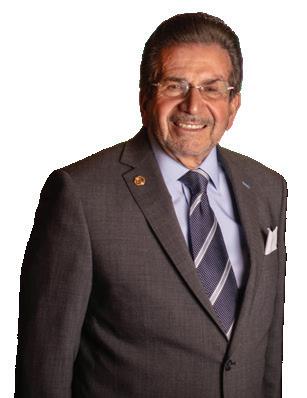
(631) 269-6421








HAUPPAUGE:
Planting Party for Little Ones -
- May 22, 4:30 PM to 5:15 PM
Miss Dara Sings- May 29, 10:30 AM to 11:15 AM
COMMACK:
Sand Art- June 1, 4:30 PM to 5:00 PM
NESCONSET:
Storytime Safari- May 16, 10:00 AM to 10:45 AM
Thursday Movie of the Week - Hamnet- May 28, 1:30 PM to 4:00 PM
KINGS PARK:
Baby Playground- May 18, 10:30 AM to 11:15 AM
Cricut Crafts - May Flowers- May 20, 5:00 PM to 5:45 PM
SACHEM:
Getting in Shape: Nutrition & Exercise Tips
- May 18, 7:00 PM to 8:30 PM
Stained Glass Portraits - May 27, 4:45 PM to 5:30 PM
SMITHTOWN:
Cricut Cards - Father’s Day- June 5, 2:00 PM to 5:30 PM






Continued from front cover
However, the groups are also lobbying for a 5% increase in the current year, which exceeds other offers of the MTA. They counteroffered with a 3% raise for 2026, plus a lump-sum cash payment that would avoid upending negotiations with eighty other unions. They’re also willing to consider the offer if unions were willing to give up work rules that fetch higher pays for certain tasks. The unions have declined that possibility.
Workers say they haven’t received a raise since 2022 and the cost of living in one of the country’s most expensive regions hasn’t made matters easier.
If the unions take the 9.5% retroactive raise, the average worker would receive more than $25,000 in back pay, according to the MTA. However, the unions say that actual wage growth can be realized since the salaries would just fall behind inflation again.
passengers, 112,000 on Sundays.
Transit officials warn that if a strike occurs, the Long Island Expressway and the Northern State Parkway could see major traffic.

The MTA reports that the LIRR carried about 82 million customers last year, most of whom were weekday commuters, but they’re noticing an uptick in weekend ridership. A typical Saturday carries about 137,000
The MTA will provide free weekday buses beginning Monday morning from six Long Island locations to subway stops in Queens. Riders would be offered the same amenity going in the opposition direction during the evening hours. Buses will run from Bay Shore, Hicksville, and Mineola LIRR stations. One will charter from Hempstead Lake Park to Howard Beach-JFK Airport. Buses from Huntington and Ronkonkoma would take passengers to the F train stop at Jamaica-179th Street. Buses to Queens would run every ten minutes from 4:30a.m. to 9:00a.m., with return shuttles operating from 3:00p.m. to 7:00p.m. Between 165 and 275 buses would be deployed at a cost of $325,000 to $550,000 per day. Even if the strike is averted, the MTA must still lay out the money to reserve the buses.
The last LIRR strike was in 1994 which only saw a two-day suspension of services.



By Matt Meduri
Entering the line of duty is not a responsibility taken lightly, and it’s one for which some pay the ultimate price.
The Suffolk County Police Department (SCPD) held its annual memorial to honor those who have fallen in the line of duty since the Department’s inception in 1960.
Thirty Suffolk officers have made the ultimate sacrifice in one way or the other. Suffolk’s first officer to pass in the line of duty was John J. Nolan, who joined the department on January 1, 1960, and would die of a heart attack that April after apprehending a burglary suspect in Central Islip.
Seven officers, nearly a quarter of those fallen, succumbed to September 11-related illnesses from their response that day and the ensuing search-and-rescue.
Another, Lieutenant Robert Van Zeyl, who joined the SCPD in 1985, succumbed to COVID-19 in January 2021 after his continued answer of calls despite the unprecedented circumstances.
These are just a few officers whose life-saving work cost them their lives who were honored on Friday’s memorial service outside SCPD Headquarters in Yaphank.
“We will never forget your loved ones, because they’re our loved ones, too,” said Catalina, reflecting on devastating anecdotes, such as that of five young children left without a father in 1971 with Officer Albert Willets’ passing.
“I salute you and all that you’ve been through,” Catalina told families in attendance.
Suffolk Police Benevolent Association (PBA) President Lou Civello, said that the “little things” are sometimes taken “for granted.”
“Being able to walk down your street safely, being able to let your children pay outside and not worry whether or not they’re going to be attacked, being able to go home at night and not wonder if someone has broken in. We take these things for granted, but there’s a price to pay.”


Suffolk County Executive Ed Romaine (R-Center Moriches) and Police Commissioner Kevin Catalina (pictured above right) both acknowledged the families of the fallen, “despite experiencing tragedy beyond belief.”
Civello said the cost is “far dearer” than “treasure,” and that those memorialized paid the price even for those who “spit on the thin blue line.”
“If you ever doubt that there’s something greater, something beyond us, go read the names on that memorial,” said Civello. “Think about what they were asked to do - and did: stop a burglary, break up a domestic, go to the largest crime scene in our country, the wreckage of Ground Zero, breathe in the toxic air, but don’t think about yourself. They gave everything they were ever going to have for strangers.”
Civello added that that state of mind “isn’t a rational” one, but “only when you believe in something bigger than yourself,” and he criticized the anti-police viewpoint that officers “chose” to take up the profession.
“You don’t wake up one day and say, ‘I’m ready to die for strangers,’” said Civello. (pictured left)
“You don’t choose to be a police officer; you are chosen, and you can choose whether or not to answer that call. At some point, each and every one of these men heard the Lord calling, ‘who shall I send?’ And each and every one, without exception, replied, ‘send me.’”
Civello reiterated his umbrage for State criminal justice policies, lamenting the recent release of the killer of Suffolk Sergeant Timothy Henck. Henck was killed in 1995 during a chase on the Long Island Expressway near Exit 52. He was survived by his wife and infant daughter at the time. While the State “owes a debt of gratitude” to the families, Civello said the State owes them something: an apology;.

“Forty-four cop-killers released in this State. To the feckless cowards on the parole board, I would ask you to look these families in the eye, but you are not worthy to stand in their presence. Instead, I will invite you to look at the memorial, to read the names of these brave heroes who sacrificed so much.”
Daniel Colondona, President of Guardians of Our Dependents (GOOD), gave the memorial proclamation.
“Today is about more than mourning the loss…It’s about recognizing the families who stood beside these volunteers every single day. Families who’ve understood late nights, the missed holidays, the danger, the weight that comes with clearing the day,” said Colondona. “As police officers, we understand that a job is more than a career. It becomes part of who you are. It demands sacrifice, not only from the officer, but from the people who love them the most.”

Colondona (pictured left), who lost his father at the age of 14, added that “when an officer is gone, the loss doesn’t end with a funeral. The family carries on forever.”
The GOOD Foundation assists families of fallen police officers by being an emotional and financial support group.

The SCPD memorial can be viewed at the eastern entrance of SCPD Headquarters at 30 Yaphank Avenue in Yaphank.
Since last month, the Suffolk County Legislature has been deliberating a bill to ban the sale of Kratom products within the county lines.
The relatively new product isn’t as controversial as it is esoteric, we think. At this point, it seems that the experts on Kratom are those who use it. Those with experience bring dramatically different tales, some of recovery, relief, and a new lease on life, while others claim a downward addiction spiral that was only lengthened by the casual tenor surrounding the product.
However, the County is taking the correct prerogative of trying to regulate the sale of the substance amidst a local environment already gripped by the opioid scourge.
Kratom isn’t on the same level as synthetic opioids. In fact, it’s a leaf native to Southeast Asia. Indonesia is one of the biggest markets for it, with much of the tested and regulated Kratom landing in Suffolk County going through the ringers in Jakarta first.
But it’s clear that public education is sorely needed on this topic. The County Legislature cannot be experts on everything, and it’s clear they’re torn. Both sides present good arguments.
Presiding Officer Anthony Piccirillo (R-Holtsville), a bold libertarian, agrees with the premise, but is staunch on not over-regulating, especially the use of the natural
product. The semi-synthetic derivative of Kratom, 7-OH, is much more potent and addictive than the natural leaf. Other Legislators who are in favor of the ban are right to be concerned of possible overdoses on the streets of Suffolk, especially when there is virtually no federal or state regulation of the drug yet. Those who bring the legitimate leaf to market are self-regulated at present.
In the spirit of the traditional, small-government model, we’d be okay with that on paper, but in this day and age, you can’t trust anyone. Moreover, any crime or tragedy attributed to Kratom use would likely result in legal action. It’s an egg-onface scenario that the County can’t risk at a time when incumbents are historically unpopular and each issue seems to spiral out of control more often than not.
The Legislature’s motives, we think, are well-intentioned, but they’re right to have recessed this bill a second time now. It’s clear there’s more information than initially meets the eye on this topic and responsible users of the natural product shouldn’t be castigated because of bad actors. Easier said than done in today’s day and age, we’re afraid.
The State of New York could certainly take up an interest in this, as can the federal government. But alas, as the federal government is busy waging another quagmire war in the Middle East, and as New York State can’t find anything else to do but make more financially inane decisions, Suffolk’s hand is forced yet again.
Nassau County Executive Bruce Blakeman (R-Atlantic Beach) had an up-anddown week as he makes an ambitious play to become New York’s first Republican governor since George Pataki (R-Peekskill) left office in 2007.
The State’s Public Campaign Finance Board (PCFB) had denied him access to over $4 million in matching public funds for his campaign over a paperwork technicality due to a recent change in State election law. Because governors and lieutenant governors must now run on the same ticket instead of separate primaries, the campaigns’ paperwork must reflect the changes.
The problem was, Blakeman’s campaign was allegedly not informed of the new requirements, so the PCFB decided he shouldn’t get funds.
Meanwhile, Governor Kathy Hochul (D-Hamburg) sits atop tens of millions of dollars in her campaign account. In fact, her account is so flush with cash, that she’s not even taking advantage of the matching funds program, despite qualifying.
Yet, her own hand-picked PCFB chair brought the hammer down on Blakeman. It’s no secret that Republicans have a significant uphill battle to victory in the Empire State. Way to kick a man when’s down…
However, even more liberal groups derided the decision, calling it nothing more than political gamesmanship. We fully agree.
Blakeman’s campaign has time to correct the error, at which point he’ll presumably unlock millions in public funds to effectively double his war chest.
The obviously petty move might seem innocuous due to its apparently quick resolution. However, Blakeman’s campaign account is about a fifth the size of Hochul’s, and he’ll have to do some serious fundraising to match Lee Zeldin’s (R-Shirley) final 2022 numbers. Zeldin took in about $23 million that cycle to
Hochul’s $50 million. In the general election, Zeldin only came up short by about 7 points.
Granted, Blakeman launched his campaign later than Zeldin did. Blakeman launched eleven months before Election Day, while Zeldin kicked off in April 2021 - a year-and-a-half out from the 2022 near-shocker.
There’s still several months of money to be raised, but with Blakeman in an ostensibly tougher position than Zeldin - the national environment doesn’t help him - why would Democrats make such an obviously political move? Did they think it wouldn’t be resolved this quickly and Blakeman would be shut out from the program that Hochul herself isn’t using?
Or are they nervous that Blakeman can close the gap?
There’s not nearly as many warning signs for Hochul at this point in the cycle as there were at this point in the 2022 cycle, but she’s far from where she exactly wants to be.
Despite some decent leads, Hochul still finds the 50% threshold elusive. While it’s not a “must” in polling in order to win a race, it’s still a desirable benchmark for peace of mind. Moreover, Hochul’s favorability and approval ratings plummeted over the last month and Independents now prefer Blakeman to Hochul.
If two weeks is an eternity in an election cycle, forget what six months is. There’s plenty of time for the race to develop one way or the other, but Hochul needs to improve her standings in battleground regions, namely Downstate, to be in a more obdurate first place.
We can’t find a good reason why the PCFB would deny Blakeman the funds on a technicality, other than it seems the power at be might be trying to put the kibosh on his candidacy before it even has a chance to be unfurled.
Parades are something of a lost art.
In the past, the entire community would line the streets to witness local talent, schools, businesses, and the elaborate floats made specifically for the day. Food, games, souvenirs, and camaraderie were also always on the menu.
Now, it seems that there’s an apathy for parades. Attendance is still decent, but it’s nothing it once was.
We understand that life is simply busier than ever and with social media and other forms of entertainment, it’s easier to see pictures on Facebook or on the back cover of The Messenger than getting the kids ready, finding a parking spot, and walking a good mile to the event.
But at the same time, so much effort, planning, and public funds go into these events. Fire departments loan their trucks, participants spend weeks putting together floats, and streets are closed for a couple of hours on a Sunday to make way for the procession. Marching bands, dance troops, and bagpipers practice for the occasion, and local businesses find creative ways to get involved
and differentiate themselves.
Moreover, it allows the community to see who’s actually in the community. The Knights of Columbus, the Rotaries, the civic associations, chambers of commerce, elected officials, historical societies, and Veterans groups are just some of the organizations that keep a community’s livelihood and history alive.
We take nothing away from the meaning of the parades themselves, with St. Patrick’s Day and Fourth of July being more celebratory, and Memorial Day being more somber and reflective. Regardless of the purpose, community spirit, unity, and visibility are what parades bring to the table, even if some people think they’re a product of a bygone, folksy era when the Internet didn’t exist and people in town had nothing better to do.
This Memorial Day weekend, parades are going on all over the County. On top of reflecting on the meaning of the holiday, we encourage our readers to pick a local parade and see just what your community is made of.
You just might be inclined to get involved yourself.
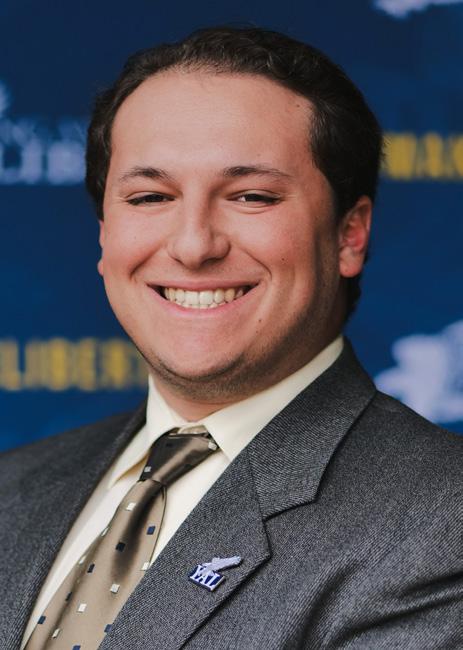
By Anthony Cacciato
Earlier this week, I stood before the County Legislature in strong opposition to Introductory Resolution (IR) 1393, sponsored by Minority Leader Jason Richberg (D-West Babylon), a resolution which will violate the protections against warrantless searches and seizures guaranteed within the Fourth Amendment.
This resolution requires certain businesses to turn over security footage to law enforcement within 24 hours if a felony has been committed on their property, or face fines. Critically, this resolution creates this mandate without requirements for a valid court-ordered warrant, essentially creating a mechanism for law enforcement to conduct a warrantless seizure. Ensuring the safety and wellbeing of Suffolk County residents is a primary responsibility of the County government, but so is the protection of their constitutionally guaranteed rights.
The resolution creates an unprecedented mandate for the thousands of small businesses across Suffolk County to be compulsory agents of the government without their consent, simply because they are “open to the public.” It also places this requirement on any business which has ten or more employees. In Suffolk County, that is effectively every store from delis to department stores, covering almost every business in the county. Even if they are open to the public, the businesses operate on private property and are covered by the protections of the Fourth Amendment.
This not only affects the business owners but can deeply harm the privacy rights of the law-abiding citizens who patronize these businesses, making them subject to warrantless surveillance by the County government. Aside from turning private businesses into a county-wide expansion of government surveillance, the resolution builds a mechanism for law enforcement to bypass a warrant by turning voluntary cooperation into a mandate backed by financial punishment of thousands of dollars, which many small businesses cannot afford.
The resolution attempts to save itself from scrutiny by creating an exemption for violations of State and federal law. By violating the Fourth Amendment, it is implicitly voiding the entire law from being applicable. In practice, this would mean shifting the burden of proof to business owners as to whether or not this is a violation of their Fourth Amendment rights, creating an incentive to just pay off the fines or comply instead of taking on the costly fight to defend their rights in court.
This sort of fear-based compliance is a gross coercion by the government and is exactly why we have the Fourth Amendment in the first place.
There is lengthy precedent of similar laws and actions being challenged for violating
the Fourth Amendment. Critically, in the case of Glenwood TV v. Ratner (1984), the New York Court of Appeals ruled that when the government seeks to obtain the records of a business, there must be an avenue for judicial review to allow the business to contest the government’s request. More recently, the Supreme Court affirmed this standard for judicial review in City of Los Angeles v. Patel (2015), which held that businesses must be able to challenge the request of law enforcement before being punished for failing to do so. The 24-hour timeframe given to businesses to comply leaves no time for them to challenge the request before a judge, and clearly violates the standards established by the highest courts in both New York and the federal judiciary.
If the bill were to be amended to provide a longer timeframe for compliance or to require a subpoena or warrant, the process for obtaining security footage would functionally be the same. There are already robust methods to obtain footage through the subpoena or warrant process that carry penalties for failure to comply. In effect, this bill only carries an additional effect if it can serve as a scare tactic for compliance to bypass a constitutional requirement for a warrant by weaponizing voluntary cooperation through coercion. This is exactly why the resolution must be rejected in any form it takes. Supporting our law enforcement in their efforts to keep our communities safe is essential, but those efforts must respect individual rights, especially those explicitly protected in our federal Constitution. Legislators and other elected officials swear an oath to uphold our federal Constitution, and that means standing against resolutions like this that threaten constitutionally protected liberties.
I applaud the efforts of elected officials like Presiding Officer Anthony Piccirillo (R-Holtsville) to fight for those constitutional values and consistently defend them, even when it’s difficult. Defending our freedom is a never-ending responsibility of every American, and I’m heartened to see elected officials who clearly understand that duty.
In short, just get a warrant.
Anthony Cacciato serves as New York State Chair for Young Americans for Liberty, an organization dedicated to defending individual liberties and economic freedom. He is a proud Huntington resident and Carnegie Mellon University alumni.
By Hank Russell | Long Island Life & Politics
Since Nassau County Executive Bruce Blakeman (R-Atlantic Beach) offered to work cooperatively with Immigration and Customs Enforcement (ICE) officials years ago, Newsday has been on a crusade trying to discredit the program, ICE officials, and Nassau leaders, while painting illegal immigrants as innocent victims who have been abused by the supposedly lawless government enforcers of the immigration statutes.
Their latest salvo in seeking to undermine immigration enforcement was their May 7 article entitled “ICE arrests in East Meadow jails,” with the subhead “Fewer than 5% of Nassau detainees violent criminals.”
The connotation of this headline is that, if a detainee is an illegal alien, but doesn’t have a subsequent criminal record after entering the nation illegally, he or she should not be handed over to the federal authorities.
That is utter nonsense.
When was the law changed saying that you can come here illegally, but be immune from deportation, so long as you don’t rape or murder someone?
Yes, it is true that President Trump has said that the feds will seek to prioritize those who have criminal records. There is nothing that says those who are arrested in immigration sweeps receive a get-out-of-jail-free card simply because they weren’t convicted of a separate crime after committing the crime of crossing the border illegally.
Adopting the type of program that Newsday seems to be endorsing — i.e., ignoring all those who have come here illegally, but haven’t committed subsequent crimes — would in essence create an open border.
The people around the world — all 8 billion of them — must know that they have to wait in line properly for the privilege of entering this amazing country. If they violate our laws and cut the line in front of the millions of people who are patiently waiting to enter, they should indeed be subject to deportation.
If we send a message to the rest of the world that you can cut the line, come here illegally and stay forever, just because you haven’t committed a subsequent
crime, we will be opening the floodgates even beyond what Joe Biden did in his short tenure.
It is perfectly fine for a media outlet to report on the percentage of deportees that committed crimes in addition to their original crime of illegally crossing the border. (Though the percentages used by Newsday relate to those convicted but makes no mention of how many have charges pending.)
But Newsday’s intent is clear from the troves of articles it publishes weekly depicting the feds as the bad guys and illegals as the victims. Case in point is the cover page article the next day extolling the need for illegal aliens to have taxpayerfunded assigned psychiatrists to help them cope with the fact that they were caught being here illegally.
In their articles, Newsday is quick to quote illegal immigration advocates from the many NGOs that have popped up over the decades, while also getting in good shots from biased liberal illegal immigration lawyers, but rarely is there a quote from a school district or the hospital emergency rooms that are bursting at the seams from these illegal immigration patterns.
How about the taxpayers who are now footing the bill for free healthcare for those who are not supposed to be here in the first place or the young college graduate who can’t afford rents on Long Island in part because so many illegal aliens are competing for the same limited housing stock?
If the liberals in government and the media want to stop deporting anyone other than a mass murderer or a rapist, then they should win enough elections so that they can change our immigration laws. In the meantime, the law that’s always been on the books still remains. You cannot come into this country illegally and expect not to be deported.
That’s not the way it works.
This op-ed originally appeared in Long Island Life & Politics. For more from LILP, visit them online at lilifepolitics.com.
By Madison Warren
At Tuesday’s General Meeting of the Suffolk County Legislature in Riverhead, the discussion about what the County should do regarding the drug Kratom continues.
Officials heard lengthy public testimonies as debate continued surrounding a proposed countywide ban on Kratom products. This legislation follows Nassau County’s recent prohibition on the sale and distribution of Kratom products.
Kratom is a tropical tree native to Southeast Asia whose leaves contain active compounds, primarily mitragynine and 7-hydroxymitragynine (70H), which can produce stimulant-like effects. Many individuals use the substance for energy, pain relief, mood enhancement, focus, relaxation, or to help manage withdrawal symptoms from opioids and other substances.
However, concerns continue to grow surrounding dependency, impairment, contamination, and addiction. Federal agencies, including the FDA, have not approved Kratom for the treatment of pain, anxiety, opioid withdrawal, or any other medical condition, while also warning of possible health risks associated with its use.
During Tuesday’s meeting, speakers from a wide variety of backgrounds addressed legislators, including business owners, members of the sober community, herbal medicine advocates, and Suffolk County
residents who shared personal experiences with Kratom use.
One business owner spoke against the proposed ban, arguing that many small businesses and workers across Suffolk County depend upon the legal Kratom industry for their livelihoods. The speaker questioned what would happen to millions of dollars’ worth of legal inventory currently on shelves if the legislation were to pass, and asked Legislators why stricter testing and regulation standards were not being considered instead of prohibition.
Another resident, who said he has studied herbal medicine for more than a decade, also opposed the ban and argued for stronger education, regulation, and responsible use rather than prohibition. The resident stated that banning Kratom would take away what he described as the public’s right to choose herbal products for themselves.
Others shared personal stories regarding how the substance has impacted their lives.
One Suffolk County resident described using Kratom as a form of pain relief after suffering from scoliosis and herniated discs while also being unable to take ibuprofen or other NSAIDs due to allergies. The resident said Kratom had helped him manage chronic pain and argued that responsible users should not lose access because of the actions of others.
The resident also pointed to Rhode Island, where a
Credit: Matt Meduri
statewide Kratom ban was later reversed after illegal purchasing reportedly continued despite restrictions. Additionally, he urged Legislators to distinguish natural Kratom leaf products from concentrated 7-0H products, arguing that many consumers may not fully understand the difference between the two.
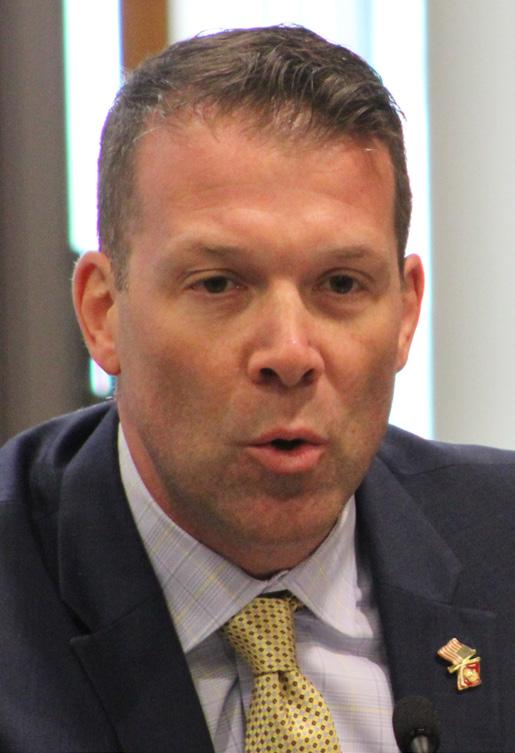
Legislator Chad Lennon (C-Rocky Point) (pictured far left) also voiced concerns regarding impairment and public safety during the discussion. Lennon questioned whether allowing Kratom products to continue being served in Kratom bars could potentially lead to impaired driving situations or workplace safety concerns involving heavy machinery.
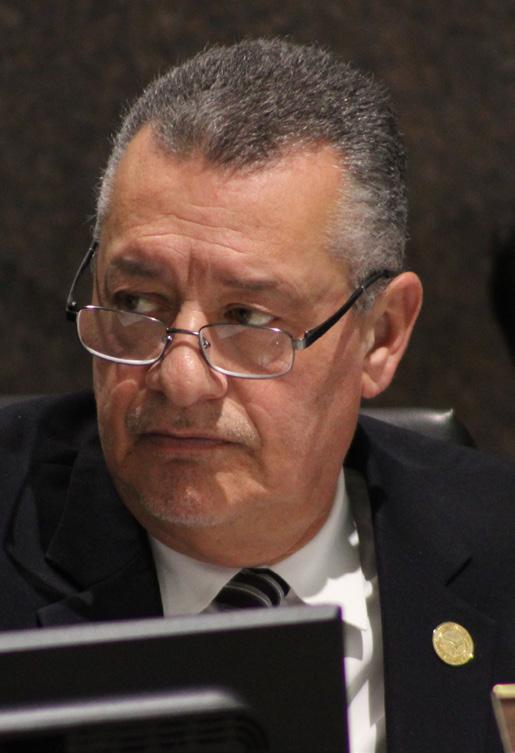
Legislator Samuel Gonzalez (D-Brentwood) (pictured above) also had concerns, questioning if repeated Kratom use could lead some individuals to build a tolerance over time, potentially causing users to seek stronger substances in an effort to maintain the same effects or continue managing pain.
Following hours of public testimony and discussion from both supporters and opponents of the proposed legislation, the Suffolk County Legislature voted to recess the bill and revisit the discussion at a later date as officials continue weighing concerns surrounding public safety, regulation, enforcement, and the future of Kratom products in Suffolk County.
By Matt Meduri
Nassau County Executive Bruce Blakeman (R-Atlantic Beach) (pictured right), who is the presumptive GOP nominee for governor this year, was dealt a tough blow last week, when the New York State Public Campaign Finance Board (PCFB) denied Blakeman over $4 million in combined matching campaign funds. The Board’s decision was a 4-3 party-line vote.
New York’s Public Campaign Finance Program is a voluntary public financing program that matches small-dollar contributions at progressive ratios. The funds are allocated in the annual Executive Budget. As of press time, the program has a $114.5 million war chest for statewide and state legislative offices. The stated intention is to reduce the influence of larger donations and corporate/PAC money.
A candidate can be eligible if they fulfill certain circumstances, but the board ruled out Blakeman’s funds on a technicality.
The board found that Blakeman’s running mate, Madison County Sheriff Todd Hood (R), didn’t fulfill a new requirement, submitting his own paperwork as the lieutenant governor candidate. Before 2025, candidates for governor and
lieutenant governor would run in separate primaries.
The winners of each would be joined on the general election ticket. Candidates are now required to run together for the first time. Blakeman sued, saying Hood was never notified of the change made just months ago.
The decision received derision from both sides of the aisle for being petty politics, with board Chair Barbara Lifton (D-Ithaca), a former Assemblywoman who was appointed to the board by Governor Kathy Hochul (D-Hamburg).

Albany County Supreme Court Judge Denise Hartman intervened on Tuesday and ordered the board to give Blakeman’s campaign one week to correct the registration.
“Attempts to rig the system and cheat my campaign out of matching funds was sharply rebuked by Justice Denise A. Hartman who laid out a well-reasoned opinion based on the facts and the law,” said Blakeman in a statement. “Nothing will stop us in our mission to save New
Yorkers from high taxes, out of control utility rates, and increasing crime.”
Blakeman already faces an uphill financial battle, as Hochul boasts a fundraising advantage so large, she left publicly matched funds on the table. Since January 1, Blakeman has pulled in about $2.5 million, according to the New York State Board of Elections, out of about $3.3 million raised since he started his campaign in December.
The Nassau County Republican Committee accounts for about $1.2 million in transfers between January and February. Blakeman’s campaign credited itself $825,000.
That’s compared to Hochul’s $8.1 million since January 2025.
This entire matter should never have been in question to begin with,” Assembly Minority Leader Ed Ra (R-Franklin Square) said in a statement. “The Public Campaign Finance Board’s decision—along party lines—to remove the Republican gubernatorial candidate from the
Credit: Matt Meduri
program was clearly politically motivated. Today’s decision is a victory for fairness and election integrity. I’m glad the court demonstrated the independence that the PCFB’s Democratic commissioners couldn’t find.”
Congressman Mike Lawler (R-Pearl River) criticized the campaign finance system itself, calling it “absurd” and a “waste” of $100 million of taxpayer money. While Blakeman’s chances at nearly doubling the size of his campaign fund are still on the table, the Democratic codirector of the PCFB, Brian Keegan, said in a statement, “The ruling allows this campaign to address their missed filing months after the deadline, which is why an appeal is likely. The question is whether a campaign seeking public funds gets another chance after failing to meet a mandatory filing deadline on time.”
Hochul retains a firm polling lead, although the last two Siena College polls show her below a majority of the vote and below her stronger winter leads of 20-25 points. Siena found Hochul leading +13 in March and +16 this month. No Republican has been elected governor of New York since George Pataki (R-Peekskill) was re-elected to a third and final term in 2002.
Thursday, May 14, 2026
By Matt Meduri
National
Virginia’s congressional gerrymander has been invalidated by the State Supreme Court.
The map took Virginia’s congressional delegation from a 6D-5R split to a likely 10D-1R rout in response to the nationwide redistricting “arms race” that kicked off in August. By a close margin of just 3 points, Virginians approved the amendment, the parliamentary processes of which were challenged before the referendum in late April.
The Virginia Supreme Court ruled on May 8 that the process to advance the proposal violated Article XII, Section 1 of the Virginia Constitution, which dictates processes for amending the state’s constitution. It requires amendments to pass the State Legislature twice in separate sessions with an intervening general election of the State House. The court ruled that early voting for the 2025 general election had already begun before the amendment was advanced in the State Legislature.
Virginia Attorney General Jay Jones (D) said his office is reviewing “every legal pathway forward,” while Virginia House Speaker Don Scott (D) said that his caucus “respect[s] the decision.”
In response to the Calais Vs. Louisiana decision last week, Tennessee is now moving forward with its redistricting plan to axe the lone Democratic seat from the Volunteer State.
Governor Bill Lee (R-TN) signed the new map into law last Wednesday, but not before lawmakers voted to remove Tennessee’s prohibition on mid-decade redistricting.
The new map targets the Memphisbased TN-09, the only Democratic district in the state. The district, once compact and bounded in the southwestern corner of the state, now stretches across the southern border of Tennessee to the center, while Memphis proper is carved up between three districts. This is an even more aggressive gerrymander than the map Nashville Republicans drew after the 2020 Census, one that split deep-blue Nashville between three districts to create a red one. TN-09, represented by Congressman Steve Cohen (D) since 2007, went to Kamala Harris (D-CA) by a +43 margin in 2024. The new district would have gone to President Donald Trump (R-FL) by +33.
While the move is certainly more beneficial to the GOP than the Democrats, the Nashville-based TN-05 went from a Trump +18 seat to a Trump +14 seat, and TN-08, which takes in much of Western Tennessee and exurban Memphis, went from Trump +41 to Trump +15, meaning those seats could become engaged in a Democratic wave of 2018 proportions.
The state’s NAACP chapter is up in arms over the vote, as Memphis - nearly 633,000 strong - is 61% black, the seventh-largest such population for any U.S. city. TN-09 was also the state’s only majority-minority district before the change.
The redistricting fight also had massive implications on last Tuesday’s primaries in Indiana. Trump-backed candidates defeated incumbent Republicans in the Indiana State Senate in five districts. Only one Senator not backed by Trump was able to survive his primary, while another is ahead by just four votes out of over 12,000 ballots cast.
Indiana became the largest obstacle to Trump’s mid-decade redistricting push last year as dozens of Republicans came out against a plan to axe the Hoosier State’s two Democratic congressional districts. Those who opposed redistricting and lost on Tuesday did so by thumping margins.
The 2026 ballot became clearer in Ohio as former Senator Sherrod Brown (D) easily earned the nomination to take on Senator Jon Husted (R), who was appointed to serve the remainder of Vice President J.D. Vance’s (R-OH) term. Brown was a three-term U.S. Senator who lost re-election in 2024, as Ohio has transitioned from a quintessential swing state to an obdurately Republican one.
Brown represents Democrats’ best chance to take back this seat and is one of the heavyweight recruits as the Party of Jackson attempts to retake control of the Senate this year.
The gubernatorial race in Ohio is also set, as Vivek Ramaswamy (R) easily won his primary as well. Ramaswamy ran for president in 2024 as an outsider and was set to co-chair the Department of Government Efficiency (DOGE) with Elon Musk, but he removed himself from that role to focus on his campaign.
On Tuesday, May 12, one of the strangest primaries in modern politics saw its resolution.
Senator Pete Ricketts (R-NE) is up for a full term after winning a 2024 special election. While the former two-term governor was elected in a landslide, Senator Deb Fischer (R-NE) won a third term by a single-digit margin against Independent candidate Dan Osborn. That close of a race is extremely rare for a deep-red state like Nebraska, one that is steadily drifting left as Omaha, a once deep-red Great Plains city, quickly becomes a Democratic base camp.
Osborn’s eleventh-hour gap-close left national pundits stunned, and Osborn is vying against Ricketts this year.
Osborn’s close race in 2024 can be attributed to Senator Fischer’s obscure national profile coupled with a historic anathema to incumbents. Ricketts, on the other hand, served eight years as governor, giving him a more localized profile in an urbanizing state.
Nonetheless, Democrats are optimistic with a beneficial national environment, an emerging battleground state, and recency of a close call that proves one is possible. That’s why they didn’t formally nominate a candidate this year, instead endorsing Osborn to boost his conceivable base that will likely be energized to hit the polls this autumn.
The only problem for Democrats: pro-
life pastor William Forbes (D) declared his candidacy anyway. That led to the candidacy of Cindy Burbank (D), whose only campaign promise was that she would drop out if voters nominated her, leaving a much more feasible twoway race. Had Forbes run unopposed in the Democratic primary, he would have automatically received the nomination and possibly siphoned candidates away from Osborn.
Burbank easily won the primary with just under 90% of the vote out of over 100,000 ballots cast. Forbes has stated he intends to remain on the ballot. However, Nebraska has explicit “sore loser” laws, which prohibits a defeated primary candidate to appear as a write-in.
All signs point to a possible sleeper race in the Midwest this November.
Governor Kathy Hochul (D-Hamburg) is sending more money to New York City.
In February, the Governor sent New York City Mayor Zohran Mamdani (D-Astoria) a $1.5 billion check to support the freshman Mayor’s $127 billion budget.
On Tuesday, Hochul signaled an additional $4 billion in State aid to the Big Apple to “make free universal childcare a reality,” and make “significant investments” in education, infrastructure, and public safety.
“This is what a results-driven, responsible partnership looks like and I’m proud to work with Mayor Mamdani to deliver for working New Yorkers,” said Hochul in a statement.
Mamdani’s January budget called for a 2% tax hike on millionaires and increased the combined corporate tax rate to over 22% to address budget gaps. The Center Square reports that the funding came “just hours before Mamdani is set to release his executive budget for the next year,” which is accompanied by a $5.4 billion deficit.
Hochul has pushed back on some of Mamdani’s more ambitious goals, such as across-the-board property taxes.
This brings the total bailout money Mamdani has received from Hochul to $8 billion since the start of his term in January.
Local
Suffolk 250 celebrations are already kicking off. The North Shore saw an ode to perhaps its crown jewel in local history, the Culper Spy Ring.
Caleb Brewster, born in Setauket in 1747, was one of the spies during the Revolutionary War, in which he would deliver messages between Major Benjamin Tallmadge and the main agents of the ring. He would later serve as Sheriff of Suffolk County from 1810 and 1812 to 1814.
Brewster used whaleboats to “skillfully
navigate the Long Island Sound, transporting intelligence,” according to the Town of Brookhaven.
The Village of Port Jefferson recreated that launch to “provide an incredible living history experience” during a defining moment in the nation’s founding.
“It was incredible to see hundreds of people come together in support of our shared history and the Bayles Boat Shop,” said Brookhaven Town Clerk Kevin LaValle (R-Port Jefferson). “This event is a testament to the community’s dedication to preserving stories and craftsmanship that shaped our nation.”
The Town also says that the vessel stands as a reminder to Long Island’s “significant yet often overlooked role” in the Revolution.
The Whaleboat 1776 Project was completed by Bayes Boat Shop (101A East Broadway, Port Jefferson).
“The courage and determination of Caleb Brewster and the Culper Spy Ring helped shape the course of our nation’s history, and it is our responsibility to preserve and share that legacy with future generations,” Port Jefferson Mayor Lauren Sheprow in a statement.
Funding for the Caleb Brewster Boathouse was provided in part by Assemblywoman Rebecca Kassay (D-Port Jefferson), who secured $100,000 for its construction.

“I am deeply moved by the devotion and passion of the Bayles Boatshop volunteers who spent countless hours of the last two-and-a-half years handcrafting this vessel,” said Kassay in a statement. “I am proud to support the preservation of this revolutionary– and now modern– history by bringing New York State taxpayer dollars home in the form of capital funding to support this one-of–a-kind community project.”
Continued from front cover
Thursday, May 14, 2026
With locations in New York City, North Carolina, South Carolina, and Florida, Mason has completed more than 100,000 projects across the country and installs more than 10 million feet of cable and fiber annually.
The company is supported by its “Mason Way,” a “commitment to continuous improvement, smart solutions, and a peoplefirst culture.”
Their new building on Oser Avenue will support the company’s continued growth and add 275 full-time employees - originally at 235 when they signed. They plan to add another 25 additional positions within two years. The new facility will feature modern office and warehouse space, a dedicated exhibition, and an event area for business networking and demonstrations. There’s also room for a potential future expansion of up to 30,000 square feet.

The $30 million investment is the company’s major expansion into Suffolk County.
“We could not have done it without all of the wonderful people at Mason,” said Jennifer and Adam Mason (pictured bottom right), adding that the “choice was clear” in investing their headquarters in Suffolk.
“Suffolk County is home to some of the greatest people and the brightest talent in the country. That gives us a real competitive advantage,” said Adam

There will be several parades throughout the Town of Smithtown in recognition of Memorial Day 2026. The hamlets of Smithtown, St. James, Kings Park, and Commack will each hold their own parade on Monday, May 25. Details for each event can be found below.
Smithtown Fire Department Annual Memorial Day Parade: 12:00p.m. - 1:30p.m.
Begins: Singer Lane and Main Street, continues Westbound to Town Hall
Sgt. John W. Cooke VFW Post 395 Memorial Day Parade (St. James): 10:00a.m. - 1:00p.m. Begins: Lake Avenue and Woodlawn Avenue
Donald C. Munro American Legion Post 944 Memorial Day Parade (Kings Park): 9:00a.m. – 12:00p.m. Begins: RJO Intermediate School
Elwood/Commack VFW Post 9263 Memorial Day Parade: 10:00a.m. - 11:30a.m. Begins: Home Depot, Larkfield Road and Jericho Turnpike
For more information on these parades, contact the Town Clerk’s Office at (631)360-7620.
Mason, who joined Mason Tech three years after his wife founded the company. “There’s no question that Smithtown is pro-business,” he added.
Part of the aforementioned “Mason Way” is treating employees like family. Adam mentioned that the company doesn’t even address emails to employees as “staff”; rather, “family.”
“There will be no space like this in the country. We want this to become a place where companies and organizations across our region and country can connect, innovate, and grow together,” said Jennifer Mason.
Suffolk County Executive Ed Romaine (R-Center Moriches) (pictured above left) called the groundbreaking “great” for the local economy.
“I am always interested in people who are going to create jobs and economic opportunity. I welcome people to the Hauppauge Industrial Park who will do exactly that,” said Romaine. He referenced New York City Mayor Zohran Mamdani (D-Astoria), who “looks down on wealth creation” and is “discouraging business.”

“I welcome wealth. I want everyone to be successful, make money, create jobs, and create economic opportunity,” said Romaine, adding that he’s encouraging New York City businesses to come to Suffolk instead of relocating to Florida or Texas.
“This is where hard work pays off. It’s not easy
in this environment, but with people who have talent, who are capable, it is rewarding. I’m not envious; I am happy for those who make money, take the risk, and build something great. We need more success in this country.”
Smithtown Supervisor Ed Wehrheim (R-Kings Park) (pictured below) thanked the Mason family for choosing Smithtown for their headquarters.

“We move projects in Smithtown because we understand that at our level of government, time is money,” said Wehrheim, referencing the bygone “reputation” the Town once had for being businessunfriendly.
Terri Alessi-Miceli (pictured left), President and CEO of the Hauppauge Industrial Association-Long Island (HIA-LI) said that running a business like Mason is not “for the faint of heart.”
“$13 billion in economic output, a major economic engine,” Alessi-Micelli said of the Hauppauge Industrial Park. “You have just added another $30 million in investment, so we can’t thank you enough.”
Shovels then hit the ground on the Oser Avenue property, where a one-of-a-kind headquarters will be the nucleus for a one-of-akind company.
Smithtown Councilwoman Lisa Inzerillo (R-Kings Park), Councilman Tom Lohmann (R-Smithtown), Suffolk County Clerk Vincent Puleo (R-Nesconset), and Suffolk County Legislator Sal Formica (R-Commack) represented Smithtown at the ceremony, and Deputy Presiding Officer and Legislator Jim Mazzarella (R-Moriches) made the drive from the Tri-Hamlet Peninsula to represent the County Legislature at such a major development.









Thursday, May 14, 2026
By Matt Meduri
Candidate: Tom Minnigan
Residence: St. James
Occupation: Manager of Psychology Practice
Previous Campaigns: None
Office Sought: Smithtown CSD BOE


Tom Minnigan is making his first run for public office to fill the seat of Trustee Kevin Craine, who was elected in 2023 and is not running for re-election. Tom Minnigan sat down with The Messenger for this candidate spotlight interview.
Q: What is your professional background and how does it equip you for the Board of Education?
A: My professional background has been centered around education, leadership, and supporting students and families. I spent 15 years working as a math teacher and coach, where I gained firsthand experience with curriculum, classroom instruction, student engagement, and the day-to-day realities educators face. That experience gave me a deep appreciation for the importance of supporting both students and staff in order to create successful learning environments.
I now serve as the manager of a psychology practice, where I work closely with youth, families, clinicians, and administrative staff. That role has expanded my perspective beyond academics and reinforced the importance of communication, organization, collaboration, and student wellbeing. It has also given me experience managing operations, problem-solving, and balancing the needs of multiple stakeholders — all skills that are important at the Board of Education level.
In addition to my professional experience, I bring the perspective of a parent with four children who attend, and will attend, the Smithtown Central School District. I understand both the educational side and the family side of these conversations, and I believe that combination allows me to approach decisions thoughtfully, collaboratively, and always with students’ best interests in mind.
Q: Education and education policy have been at the forefront of political discourse as of late, namely as far as parental rights, administrative values, and what exactly teachers are teaching in class. Where do you think the lines should be drawn and how has Smithtown CSD embodied those values, if at all?
A: I think strong schools are built on trust, communication, and shared responsibility. Parents deserve transparency and a voice in their children’s education, and teachers deserve the professional respect and support needed to do their jobs effectively. The role of a board member is not to politicize classrooms, but to help create an environment where students can succeed academically, socially, and emotionally.
Having spent 15 years working in education as both a teacher and coach and now working closely with youth and families through a psychology practice, I’ve seen firsthand how important collaboration is between schools and families. When communication breaks down, trust breaks down. When schools and parents work together, students benefit.
I believe Smithtown has made meaningful progress in creating a more collaborative and transparent culture over the past several years. I’ve appreciated the strong emphasis many district leaders and board members have placed on communication and community involvement, and I’m excited for the opportunity to continue being part of that vision. There is always room to improve communication and engagement, and I think the district has worked hard to keep the focus where it belongs — on students and educational excellence.
Q: Parlaying your professional experience, are there any prerogatives you intend to have if elected?
A: As someone seeking a first term on the board, my focus is really centered around student support, communication, and long-term planning for the district. My background in education and my current work supporting youth and families have made me especially passionate about the connection between academic success and student well-being.
Students learn best when they feel supported, connected, and engaged in their school community. I believe that means continuing to support strong academics while also recognizing the importance of mental health, extracurricular involvement, and positive school culture. I’m also very interested in helping strengthen communication and collaboration between the district and the community. Whether it’s parents, teachers, or residents without children currently in the schools, people want to feel heard and informed. Building trust requires consistency, transparency, and accessibility. Finally, as both a parent and someone with experience managing a professional
office, I understand the importance of thoughtful planning and responsible decision-making. Smithtown has a strong reputation, and I want to help ensure we continue attracting excellent educators, maintaining strong programs, and planning responsibly for the future.
FRIDAY, JUNE 14TH, 2024
Q: Galvanizing community input is always a challenge, as it was on the BOE campaign trail last year. What would you bring to the table in that regard?
A: I think meaningful community involvement starts with accessibility, communication, and a willingness to genuinely listen to people. Community members are much more likely to stay engaged when they feel informed, respected, and confident that their voices matter. Although this is my first time running for the Board of Education, one thing I’ve really appreciated throughout this process is seeing how actively involved many current board members and district leaders are within the community. Trustees Matt Gribbin and Brandon Solomon, in particular, have shown a strong commitment to being accessible, attending events, having conversations with residents, and encouraging community involvement, and I’m excited for the opportunity to learn from and contribute to that culture.
Throughout my professional career, whether working in education or supporting youth and families through a psychology practice, I’ve learned that productive conversations happen when people feel heard rather than dismissed. I believe strong schools require strong partnerships between the district and the community, and I would want to continue encouraging open dialogue, transparency, and collaboration moving forward.
Q: What is your favorite quote, motto, or work?
A: “Life is happening for us, not to us.” – Tony Robbins. I like that perspective because it’s really about resilience and growth. No matter what challenges come your way, there’s usually something to learn from it and an opportunity to grow through it. That mindset has definitely shaped the way I approach both my professional and personal life.
During my career, in my friendships, and in my own daily life with my family, I try to approach people with empathy, patience, and understanding. I believe relationships matter, the way we treat people matters, and that real progress comes through collaboration and communication, especially during difficult times.
Q: How do you like to connect with your community?
A: For me, community connection really happens through everyday involvement and relationships. As the father of four children who attend, and will attend, Smithtown schools, a huge part of our lives naturally revolves around the community — school events, sports, playgrounds, neighborhood walks, and all of the day-to-day moments that come with raising a family here. Some of my favorite conversations honestly happen in the most ordinary places — talking with other parents on the sidelines at games, running into familiar faces around town, or chatting with neighbors while out with the kids. Those small interactions are a big part of what makes Smithtown feel like such a strong community.
Having grown up attending Smithtown Schools myself from kindergarten through eighth grade, there’s also a personal connection for me in wanting to give back to a community that helped shape me. It’s meaningful to now be raising my own family in the same community that played such an important role in my life growing up. Smithtown has a strong sense of pride and community involvement, and I think preserving that sense of connection is one of the things that makes this district so special.
The Messenger thanks Tom Minnigan for his time for this interview.
The district serves Smithtown hamlet, Nesconset, St. James, Village of the Branch, Head of the Harbor, and Nissequogue, as well as parts of Kings Park and Hauppauge.
Election Day is Tuesday, May 19. BOE candidates are elected to three-year terms. Three seats are up this year. Matt Gribbin is running for a fourth term. Brandon Solomon is running for a full term, as he was elected in a special election last year to fill the remainder of a term caused by the resignation of John Savoretti. Tom Minnigan is running for an open seat.
The district has seven elementary schools: Accompsett, Dogwood, Mills Pond, Mt. Pleasant, Smithtown, St. James, and Tackan. It has three middle schools: Accompsett, Great Hollow, and Nesaquake. It has two high schools: Smithtown East and Smithtown West.
After a historic voting process, Smithtown High School East senior Madeline McCullough has been selected as this year’s graduation honor speaker.
“Overjoyed, this is something I’ve been dreaming about since fifth grade,” Madeline said.
Gold Cord students cast their votes on April 17 to determine the graduation speaker. When the votes were tallied, Madeline and Tyler Gallub were tied—marking the first time a tie has occurred in the school’s voting process, according to school officials. Principal Paul McNeil announced the tie to students, prompting a runoff vote in which Madeline was ultimately selected.
“It was really intense; I didn’t expect that. I know Tyler would’ve
been an amazing choice, we are both in National Honor Society as president and vice president, so either way I was happy with the outcome,” Madeline said.
The announcement came during the Gold Cord Breakfast, which celebrates students who have achieved a cumulative 4.0 GPA, as well as those earning a 4.4 GPA and recognized as Gold Cord with distinction.
Addressing the students, Principal McNeil encouraged them to carry their success forward. “I want you to remember this moment if things get a little tough as a freshman in college—keep this in mind as proof that you can do it. Find your why,” he said.
Graduation is scheduled for Thursday, June 26.
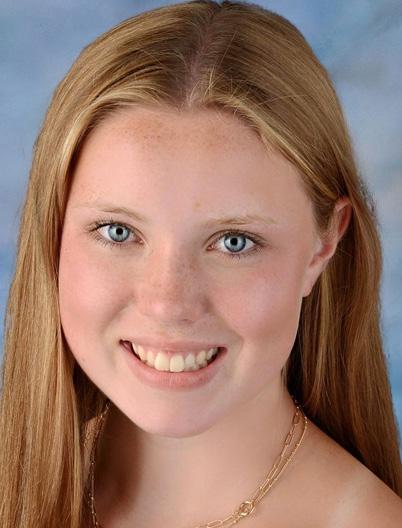
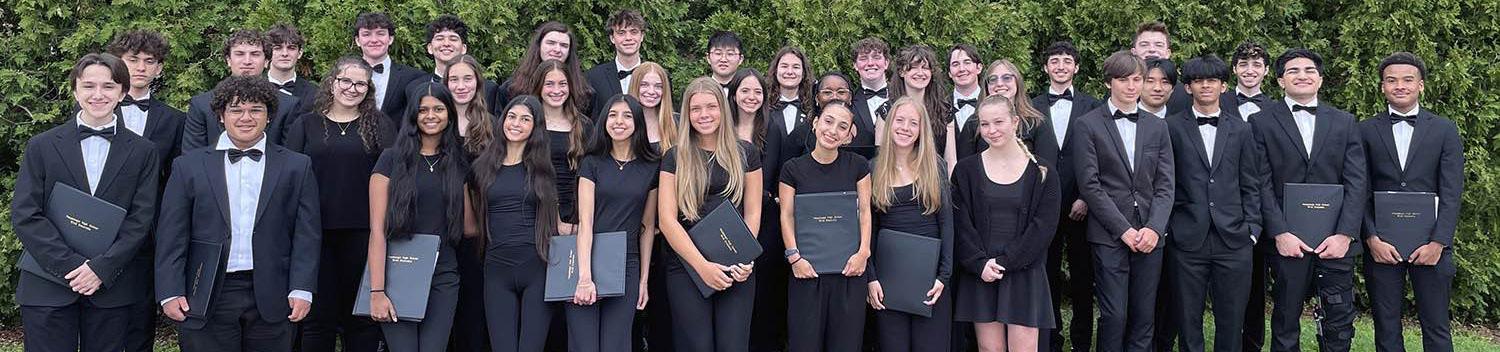
Hauppauge High School’s student-musicians continue to build on the district’s music legacy, earning top honors at both the New York State School Music Association Festival and the Music in the Parks Festival this spring.
At the end of April, the Wind Ensemble earned a gold rating at the NYSSMA Majors Festival Adjudication for their performance of “Minuteman Concert March” by Robert Pearson, “A Festival Prelude” by Alfred Reed and “Abram’s Pursuit” by David Holsinger. The ensemble’s
performance showcased both technical skill and musical expression, earning high praise during the adjudication process.
Building on that success, Hauppauge’s advanced high school ensembles traveled to Middletown, New Jersey, to participate in the Music in the Parks Festival, where ensembles were adjudicated by college professors on their festival repertoire.
The Chamber Choir, Chamber Orchestra and Wind
The Kings Park Central School District (CSD) is thrilled to announce that we just received two large Blue Bird Class C electric school buses, with a second delivery of two additional smaller Micro Bird Class A electric buses scheduled for later this spring.
With fuel prices up over a dollar per gallon since January, these electric buses are a welcome addition to our fleet. The district was able to leverage two grants (NYSERDA and EPA) to cover the added cost of the buses. Electric buses are significantly more expensive

Ensemble each earned first place in their respective divisions. Additionally, the Chamber Choir was recognized as the “overall choir” across all choir divisions, an impressive honor among participating schools from Pennsylvania, Virginia, New Jersey, Connecticut, and New York.
The district congratulates all of Hauppauge’s studentmusicians and music educators on an outstanding spring season.

than traditional buses, but the district was able to secure grant funding so that the cost was no greater than it would have been for typical gas or diesel buses.
According to Superintendent Tim Eagen, “The district is always looking for ways to leverage grant funding and save money. This was a very complicated process, but I am delighted that the plan has come to fruition.” The district is in the process of training drivers and mechanics, and we are looking to get these buses on the road in early May.
The EPA (https://www.epa.gov/cleanschoolbus) is actively reviewing and revamping the Clean School Bus Program. Roughly $30 billion in grants and contracts have been put on hold in order to revamp and modernize the Clean School Bus Program in the near future. Unfortunately, without this funding, electric buses are not affordable. The current construction at our bus garage was specifically designed to expand beyond four electric buses if/when this funding becomes available again in the future.
Once purchased, electric buses are cheaper to operate and maintain. The Kings Park Central School District is poised to take advantage of all such energy-savings opportunities.
Callais V. Louisiana
By Matt Meduri
We’ve written extensively about gerrymandering, and we’ve covered the mid-decade redistricting fight at length. This week, we’ll marry the two concepts to discuss a landmark Supreme Court case in depth, Callis V. Louisiana.
Background
The case’s origins start in 2020, when Louisiana would remain at six seats in the U.S. House following the Census results. Republicans who controlled the Legislature approved a new map that was mostly unchanged from the 2010s, five safe Republican seats and one safe Democratic seat that was majority-black.
Black voters challenged the map, arguing that since the state’s population is one-third black, the map violated Section 2 of the Voting Rights Act (VRA) of 1965, which prohibits racial discrimination in elections. In June 2022, a judge ruled that the Louisiana map violated the VRA and ordered the state legislature to come up with a new map with a second black-majority district that reflected the state’s population.
Six districts, the state’s one-third black population, and two black-majority districts were the basis.
However, after the Louisiana map was redrawn to become a 4R-2D map, a group identifying themselves as “non-African American voters” filed a suit in Baton Rouge. The new black-majority district would stretch from Baton Rouge in the southeastern part of the state all the way up to Shreveport in the northwestern corner of the state. Their suit claimed that the districts were racially gerrymandered and violated the Fourteenth and Fifteenth Amendments. In May 2024, a panel of federal judges from the Western District of Louisiana then ruled in a 2-1 vote that the new map was unconstitutionally gerrymandered.
The Supreme Court’s Interpretation
The nation’s highest court then took interest in whether the maps violated the Fourteenth and Fifteenth Amendments. Plaintiffs argued that the map violated the Fourteenth Amendment’s Equal Protection Clause, which prohibits arbitrary discrimination based on race, gender, or other categories. They also argued that the map violated the Fifteenth Amendment, as that amendment finds raciallybased redistricting unconstitutional.
What makes Callis V. Louisiana a landmark case is that lawsuits under the Fifteenth Amendment had often been to defend minority groups’ voting powers, not those of majority voters living in a district gerrymandered for the benefit of another racial group. The State of Louisiana also abandoned its defense to argue that the maps drawn by the Legislature at a judge’s order did, in fact, violate the Fourteenth and Fifteenth Amendments.
April 29, 2026, saw the Court’s 6-3 decision affirm the ruling of the federal panel that Louisiana’s new map was an illegal racial gerrymander.
“Allowing race to play any part in government decisionmaking represents a departure from the constitutional rule that applies in almost every other context,” wrote Justice Samuel Alito in the ruling. “Compliance with section 2 [of the VRA] thus could not justify the state’s use of race-based redistricting here.”
What made this decision one of the most-watched legal battles of the last couple years was the speculation of how far the Court would go. The political left feared a ruling that found Section 2 of the VRA to be entirely unconstitutional, which would likely entail a massive redraw of maps with majority-minority districts.
However, the Supreme Court did not hold Section 2 to be unconstitutional, nor did they overturn other related cases. Alito wrote that these developments required “additional considerations” based on another landmark Supreme Court case, Thornburg V. Gingles (1986). That case established the

This column will seek to address the long-forgotten concept of civics and how it relates to American government in general, from the federal level to the local level. This column will explore Constitutional rights, the inner workings of government, the electoral process, and the obligations and privileges of citizens.

key legal standards for proving that redistricting or voting systems violate Section 2 of the VRA by diluting minority voting power.
Gingles hung on three preconditions: that a minority group is “sufficiently numerous and compact to constitute a majority in a reasonably configured district”; that they voted in a “politically cohesive” way; and that the majority voted in a bloc to defeat the minority’s preferred candidate. If all three of these preconditions were met, according to the Gingles ruling, then there might be sufficient ruling to find that the political process was not equally open to minority voters.
In the Callais decision, Alito wrote that computer-aided redistricting tools have advanced to the point that a map can create minority-majority districts while also “fully” achieving “all the State’s legitimate goals.” This, in Alito’s view, makes the first Gingles precondition easier to determine. For the second and third preconditions, Alito wrote that under the two-party system, partisan gerrymandering is not a justiciable issue in the federal courts.
“...a litigant can easily exploit [Section 2] for partisan purposes by ‘repackag[ing] a partisan-gerrymandering claim as a racial-gerrymandering claim.” This follows that majority-minority districts, especially those composed of black voters, are generally predicted to be solidly Democratic constituencies. Therefore, Alito’s contention is, does a case of partisan gerrymandering inherently mean a case of racial gerrymandering?
Finally, Alito argued that “things have changed dramatically” in the South since the 1960s, when the VRA was passed, and that black voters “now participate in elections at a similar rate as the rest of the electorate.”
With that, the Court found on ideological lines that the second black-majority district for Louisiana’s congressional map was racially motivated for the sake of gaining political partisan power.
Any challenger taking issue with a state’s map under these pretenses must now prove that the state “intentionally drew its districts to afford minority voters less opportunity because of their race,” and that should a plaintiff be unable to “disentangle race from the state’s race-neutral considerations, including politics” would likely lead to a loss in the courts.
Justice Clarence Thomas, in his concurring opinion, wrote that the Supreme Court should have “never interpreted” Section 2 of the VRA to “effectively give racial groups an ‘entitlement to roughly proportional representation.’”
In the dissenting opinion, Justice Elena Kagan wrote that the consequences of Callais are “likely to be farreaching and grave,” and that only Congress could determine whether the VRA is no longer needed.
Legal analysts and experts have warned that such a decision would lead to Southern states, many of which are Republican, to maximize their own districts. Some posit that up to a dozen Democratic seats - either black-majority or black-plurality - across the Deep South in particular would be on the chopping block. Some groups even likened the ruling to start a new era of Jim Crow laws. Others have praised the ruling, which they say restores the intent of the VRA to prevent discrimination at the polls, not in districting.
Louisiana immediately suspended their May 16 primary to allow the State Legislature to draw a new map, despite early voting having already started.
Alabama filed an emergency motion the day after the Callais ruling, as a separate case required them to draw a second black-majority district ahead of the 2024 elections as well. Florida and Tennessee have already redrawn their maps.
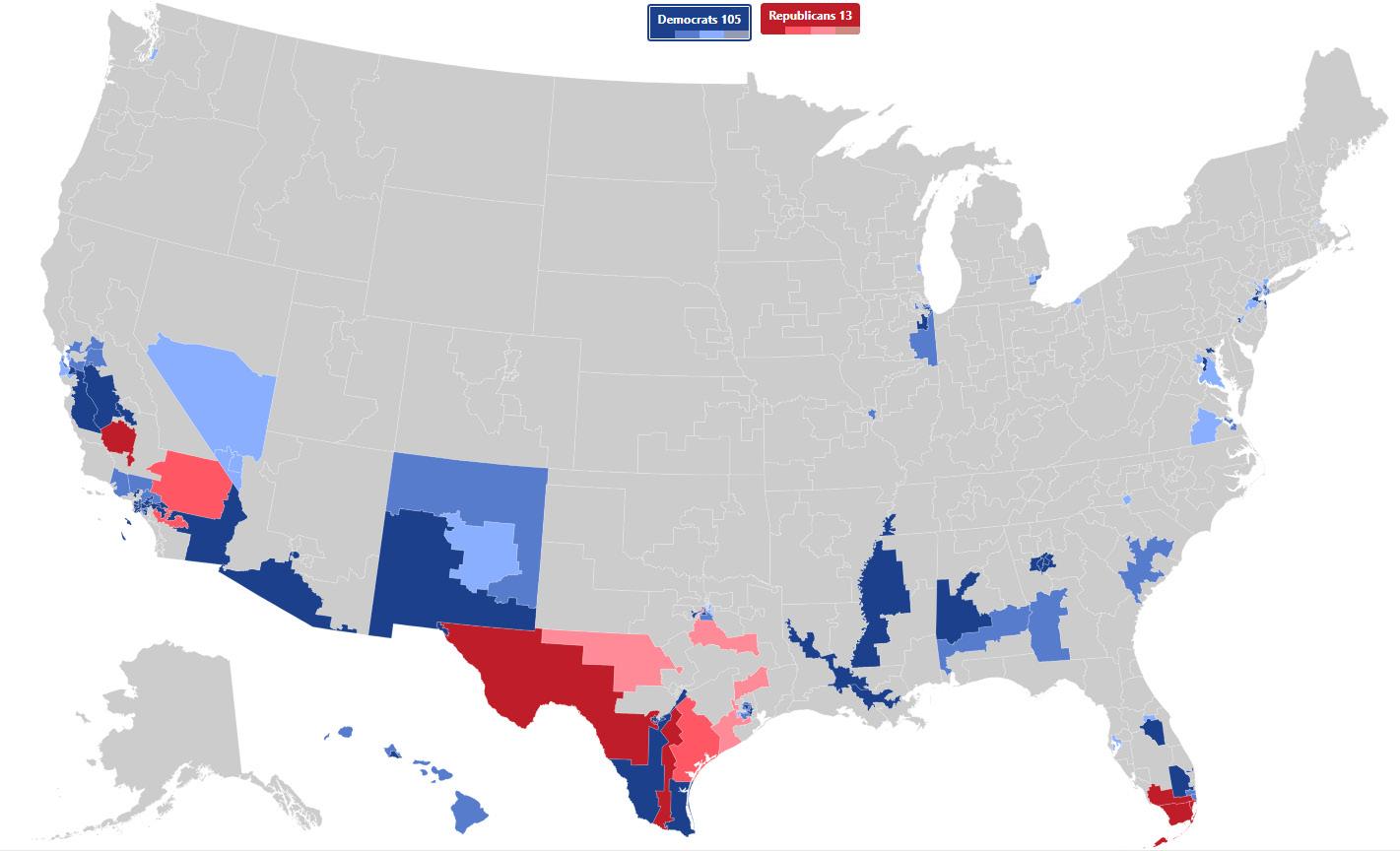
Of nearly 120 districts that are considered majorityminority, only about 30 to 40 are mandated by the VRA. The rest are partisan-constructed or are merely outcomes of demographics. The map above shows the partisan composition, with Democrats largely benefitting from these constituencies. The solid red/blue seats are those with a majority-minority population, while the medium red/blue seats are those with a plurality-minority population. The lightest seats are those with a white plurality population.
Of the 15 black-majority districts in the nation, MS-02 has the largest black population at 62.1% of the district. Of the 2 majority-Asian American districts and six where Asian-American voters are a plurality, HI-01 has the largest population at 68.1% of the district. For Hispanic districts, TX-34 has the largest number at 88.5% of the district.
Finally, for white plurality districts - those where white voters make up less than 50% of the electorate, NY-10 has the largest percentage at 49.7%, with the largest minority group being Asian American voters, who make up 23.9% of the district.
By Matt Meduri
Candidate: Gerard Mullaney
Residence: Kings Park
Office Sought: Kings Park Central School District Board of Education (BOE)
Gerard Mullaney is making his first play for public office. He’s seeking a seat on the Kings Park BOE. He’s vying against Josh Cedeno for a three-year term.
Gerard Mullaney sat down with The Messenger for this candidate spotlight interview.
Q: What’s your professional background and how does it equip you for the BOE?
A: I’m a retired New York City Firefighter. I had 18 years in the department and retired as a Lieutenant. As a firefighter, you have to be able to be given things and work with them. With the Board, everything is there; I would have to work with it. They have it established a certain way and I can find out how to help the Board and the people of Kings Park. Just like being in the firehouse, if there’s a problem, I’m told that I have to figure it out, bring in the other officers, and figure out solutions to it.
Q: What would be your personal prerogatives if you were elected?
A: There have been some small communication issues from within and dealing with the community outside. They do a good job, but I think they’re missing small things. For example, if you apply for a permit, you don’t hear back from them until the permit is handed to you. Some people say they’d like email back just so they know they sent it to the right person or it’s been received. Other people have said when you email the Board, you never hear back from them until they make a decision. No “thank you’s” or “we’ll get back to you.” Some small communication mishaps that are there.
I also want to stay current with the teachers. Teachers are doing the hard work with the kids. They know more of what the district’s needs are and where to go. Having a good relationship with them will help the Board and the district.
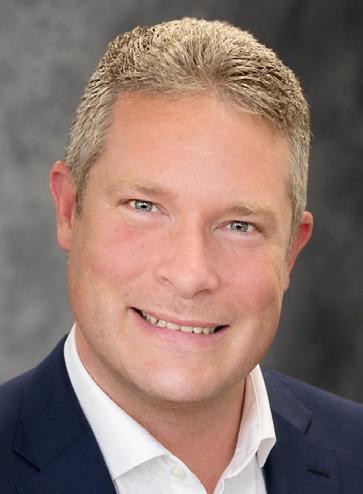
Most of the budget, as I’m told, is going to insurance, which is hard to control. Overall liability insurance is through the roof. The sports are pretty well-set, but all other extracurriculars - music, art, robotics - I’d like to get them more funding, because if anything, I’d like to see more kids spending time after school and pursuing their interests. The more you see, the more you try, and when you get to college, you’ll know what you want to do and how to help people, right from graduating high school.
FRIDAY, JUNE 14TH,
My biggest impetus for running is that I retired before I wanted to. I have a lot of time, I need to be doing something, and I want to help. I want to try to continue helping the community how I can.
Q: What’s your favorite quote, motto, or work ethic?
A: My dad always told me, if you’re going to do a job, do it right. Don’t just say you want to be part of something; be part of it. Go all in.
Q: How do you like to connect with your community?
A: My spare time is spent with my three young kids. My daughter is at Fort Salonga Elementary and competes in cheer. My son is getting into sports, so I’m there to help him.
I help coach my nephew’s football team in the Kings Park Youth (KPY) organization. They needed a coordinator, so I’m a football coordinator, setting schedules and helping make the program.
I’m very family-oriented; anything I do is with them. My favorite place to eat is Ciro’s when I have some free time. I’m still connected with the fire department and their events.
The Messenger
Election Day is Tuesday, May 19. Polls are open from 6:00a.m. to 9:00p.m. at Kings Park High School, 200 NY-25A.
By Matt Meduri
Josh Cendeno is making a run for the Kings Park Board of Education (BOE) on Tuesday’s election. An eight-year resident of Kings Park, Cedeno currently has four children in the district.
These details are taken from Cedeno’s bio on the Kings Park Central School District’s website.
Cedeno is the Chief Information Security Officer (CISO) for Applied Visions, a Northport-based software engineering firm. He oversees “complex digital infrastructure and data protection strategies.”
He serves as a baseball coach for KPY at the intramural and training levels. He’s also part of Dr. Deerr’s technology committee and provides feedback in the “department’s efforts towards building a secure and robust technological foundation” for the children.
When asked why he wants to serve on the board, Cedeno said, “With children at each level within our district and AI starting to truly disrupt the workforce, the timing feels right. My children give me a ‘boots on the ground’ perspective while my strength in strategic cybersecurity and AI oversight can help the district make the right investments while it prepares our children for life beyond our town.”
If elected, he would prioritize “strategic AI and futurereadiness” in studying how AI is “reshaping the workforce” and to “ensure our curriculum remains a smart investment for our students.”
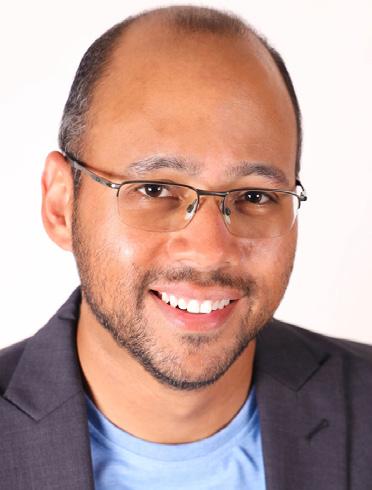
“My priority is to help the district develop a strategy where our students begin to master AI as a tool, and not an academic crutch, ensuring they are prepared to lead in a job market where these technologies may be their primary competition,” said Cedeno.
He’s also prioritizing grand acquisition and “fiscal innovation,” saying that with yearly budget constraints and inflation outpacing the tax cap, the district cannot “solely” rely on “traditional funding.” He’s interested in pursuing grants to “offset the cost of technology, athletic field repair, and the arts” to protect programs. Protecting data privacy of both staff and students accompanies his platform
“By applying my professional expertise into the district, I can help identify cost efficiencies in our technology infrastructure, and ensure our cybersecurity investments are properly risk driven to maximize our ROI.”
Election Day is Tuesday, May 19. Polls will be open at Kings Park High School from 6:00a.m. to 9:00p.m.

On Saturday, May 2, 2026, the Town of Smithtown hosted a record-breaking Paper Shredding Event at the Municipal Services Facility (MSF) in Kings Park, where 492 residents safely disposed of more than 11.65 tons (23,300 pounds) of sensitive personal documents. The impressive turnout exceeded last year’s totals and reflected the continued growth and popularity of the Town’s paper shredding program among residents.
“This program continues to grow year after year, and we are extremely proud to see such a strong community response to this important service,” said Supervisor Ed Wehrheim (R-Kings Park) in a statement. “Breaking last year’s record with nearly 500 residents participating and more than 11 tons of documents collected is a tremendous accomplishment. Events like this not only help residents safely protect their personal information but also reflect our community’s shared commitment to public safety and responsible
disposal practices. I want to sincerely thank the hardworking teams at MSF and DEW for their exceptional coordination and dedication in making this another successful event for our residents.” MSF and DEW staff worked throughout the day to assist residents, direct traffic, and ensure the event operated smoothly from start to finish. Residents expressed appreciation for the quick and professional service provided by Town staff and the shredding crews.
The Paper Shredding Event was held at the Municipal Services Facility, located at 85 Old Northport Road in Kings Park, from 9:00a.m. to 3:00p.m. The next Town of Smithtown Paper Shredding Event is scheduled for Saturday, October 17, 2026.
Residents are encouraged to download the Town of Smithtown mobile app, available free on Google Play and the App Store, for updates on upcoming programs and community events.
May 14, 2026
By Meredith Eichacker O’Brien
This is a memory written by Meredith Eichacker O’Brien. Meredith is a direct descendant of the Hallock Family.
“Years ago, when I was a little girl, I would go to see my great aunt Maude with my family fairly regularly at her house in Ronkonkoma now known as the Homestead. Aunt Maude had a woodburning stove in her kitchen that she would use to bake wonderful cookies and cakes, and she had a large garden that she cared for by herself as well. In her garden she grew all kinds of vegetables and fruit that she would pickle and jar for the winter months or use as gifts for her friends and family as she lived a very frugal lifestyle in her retirement.
“She had, just on the inside of the kitchen door, a large barrel of pickles brining made from her own cucumbers, and she would have all kinds of pickled jarred cabbages that she shared with friends and family as well. Of course, there were strawberry jams and jellies that lined the pantry shelf as well all meticulously dated and labeled and kept in the large, blue, narrow neck jars with the tin lids and rubber gasketed tops, or the kind with the glass tops with the metal wire twist down top securing device.
“She made the best lemonade and severed it in the large pitcher with the blue crisscrossed pattern on the outside. She also had the cookie jars filled with sugar cookies or peanut butter cookies with a crisscross pattern in them, or chocolate chip cookies or strawberry and raspberry tarts, and, of course, apple and peach pies.
to use the facilities and would always try to come down the kitchen stairs that were full of pots and pans, and they would come crashing down the stairs and would make Aunt Maudie very annoyed. She’d call out “Who is that?” and I would tear up and down the front stairs and into the kitchen pretending it wasn’t me, but I think she figured it out.
“To the right of the stairs was the music room. I never heard the piano played though I heard

was a schoolteacher from the area. She taught in Port Jefferson for many years. After Aunt Maudie passed away, Katharine made sure the house and its contents were maintained despite the fact that the area had changed and was starting to become a little dangerous. She would come to the Homestead sometimes twice daily to make sure all was alright and she dealt with vagrants and kids who were doing drugs on the property or were trespassing and attempting to break into the house to steal historical items to fuel their addictions. There were many Revolutionary and earlier antiques in the house. She and Aunt Maudie described what had been already stolen, and Aunt Katharine became steeled toward keeping the house safe from invaders. Once, she was doing dishes in the kitchen two men broke into the house through the window. She admonished them sternly and told them to leave immediately. They “Yes, ma’amed” her and started to go back out the window and she told them to go out the door like humans are supposed to do then after they left, she notified the police. Aunt Katharine was determined that the house and its contents remain intact for the public to enjoy in perpetuity.
“The family would go out into the backyard and sit in the Adirondack chairs on the lawn or the other large chairs she had on the porch and catch up on family news and events. In the summer on Long Island, the humidity would be overwhelming but in the back yard of Aunt Maudie’s house, there was a breeze that would always come up from the lake and where we sat in the backyard, it would always be cooler than at our house.
“Once we were cooled and our stories told, we’d get out the croquet sets and check over the equipotent and pick out who would play what color. It would only take about 10 minutes to set up the course as the backyard was a regulationsized croquet court anyway.
“The house was a big mystery, and I never saw the top floors until I went on a tour in the last five years. I would come up the stairs next to the office
of the troupes. He would come out and stay at the house and court my grandmother, Cora Agnes Hallock Deutzman. When I was visiting as a child, the music room was used as a greenhouse for all of Aunt Maudie’s plants – she had many African violets of all different colors, and they flourished in that room along with a large schefflera dieffenbachia and snake plant in planters on the floor.
“My other great aunt was Aunt Millie. She married a wonderful man, Clarence Badman, who was a forester. When I was on a field trip from Gelinas Junior H.S. in Setauket to Raquet Lake in Upstate New York, I saw him as he managed the preserve and held a lecture for all of our benefit. Aunt Millie was a lot like my mother and when my mother was ill, she cared for her while my dad was overseas in India during WWII. They became fast friends after that and corresponded until my mom’s death in 1962.
“The last member of the three sisters/ daughters of Fitz-Greene Hallock was my great Aunt Katharine, who I was named after. Katharine
“I hope it does just that. It is a lovely house that my great-great grandparents finished the year my grandmother was born. The dark wainscoting inside frightened me as a child but looking at it now, I see how it cooled the house in the summer and warmed it in the winter. They kept boarders in the summertime to defray the cost of living so far from the hustle bustle of the city and many came to the house from the city to stay. They advertised the house in newspapers in the city to attract boarders and my great-great grandmother cooked meals for them on her wood stove and had her children Merritt, Katharine, Maude, and Mildred stay up on the third floor while the boarders were in residence.
“My clearest memory of Aunt Maude was of her working in her garden. She worked so hard tilling the soil and yet when she visited my grandmother, she was such a dainty lady. She wore the white gloves and was always so very proper while visiting my grandmother. Ever gentle and jovial, she reminds me of days long gone by that sadly I will never see again. I hope this helps to paint a picture of how it was when I visited the house as a child back in the days when families were so into community life. It was such a different era.”
By Matt Meduri
Lake Ronkonkoma has a surprisingly rich history for a relatively quiet part of Suffolk County.
Motor Parkway, the suffrage movement, and national significance as a high-class summer town in its heyday, Lake Ronkonkoma presses on in 2026, supported faithfully by the people whose families built the town.
But their Veteran population has a rich history as well, and the hamlet’s American Legion Post is preparing for a centennial celebration this June, appropriately coinciding with the Suffolk 250 celebrations.
For Post Commander Fred Tartaglione, the event not only recognizes one hundred years of the Legion post on Church Street, it’s also symbolic of a future post more ingrained in the community.
“The Legion was started in 1919. It was tasked to Theodore Roosevelt, Jr., by General Pershing to keep the camaraderie between all the forces in World War I,” Tartagilone told The Messenger. Lake Ronkonkoma’s chapter was started by the Newton Brothers, who owned the garage that sat on the corner of Portion Road and Ronkonkoma Avenue. Samuel Newton was the de facto commander until the post went official. Veterans who would meet at the garage would pick out a piece of property.
In 1926, they started using the quaint building on Church Street, just off Hawkins Avenue.
The property expanded due to a land swap with St. Joseph’s Church in the 1960s, which saw an event shed constructed outside and a firing range in the basement. The basement has since been converted to a dining hall and kitchen.
The Post has recently gone through some exterior facelifts, such as trim paint and roof work done by an Eagle Scout. The post has ambitious overhaul plans for the future, including a remodel of the basement kitchen to meet Health Department standards for larger events and for septic upgrades.
The Legion has also had an environmental hand in the area too, having footed the bill for the first water test of Lake Ronkonkoma in the 1960s for $25 at the time. The Legion is also the original sponsor of the Memorial Day Parade. They later teamed up with the VFW and AMVETS.
The Legion’s celebration will be held on Saturday, June 27 at 1:00p.m., following the Michael Murphy Run Around the Lake. The ceremony will start at 2:00p.m. in Paul Attard Park, where food, music, entertainment, and meet-andgreets will be on the docket. The Legion is also offering advertisement space in their commemorative pamphlet. Donations of $50 will allow an advertiser a gold booster, $20 for silver. Submissions are due by June 8.
Tartaglione has a 13-year-long history with the American Legion. Formerly of Miller Place, he was initially enlisted with the Port Jefferson post. He’s called Lake Ronkonkoma home for the last six years, describing it as a community where its members have an intense care for their town.
“We want this celebration to not just be for Veterans, but our community.

We [Veterans] work in, shop in, and are part of the community. We want to make sure that line of communication and understanding between us and the community stays open and we stay involved.”

The William Merritt Hallock
American Legion Post #155 115 Church Street Lake Ronkonkoma 631-565-9822.

Sponsored by Legislator Leslie Kennedy
Ronkonkoma Street Fair
Sunday, May 24th 10:00am-4:00pm
Bus Mobile
Located in between Flanagan’s Pub & Bustos Martial Arts

Sign up at nybc.org/sponsor and use code #62130


Thursday, May 14, 2026
Small businesses from across Suffolk County were recognized for their critical role as the backbone of our local economy by the Suffolk County Legislature. An honoree from each of the 18 districts was praised on Tuesday, May 12, 2026, at the General Meeting in the Maxine Postal Auditorium of the Evans K. Griffing Building at the Riverhead County Center.
The lawmakers honored individual businesses – with fewer than 25 employees—and noted the unique contributions to the community that these businesses and their owners make every day. The businesses -- ranging from bagels. barber shops, and breweries, to restaurants, nurseries, and a local radio station – were each chosen for their standing within their community and were often cited for their civic and charitable endeavors. They help demonstrate the continued importance to Suffolk County of “mom and pop” organizations, of “brick and mortar” locations, and family involvement in the communities they serve.
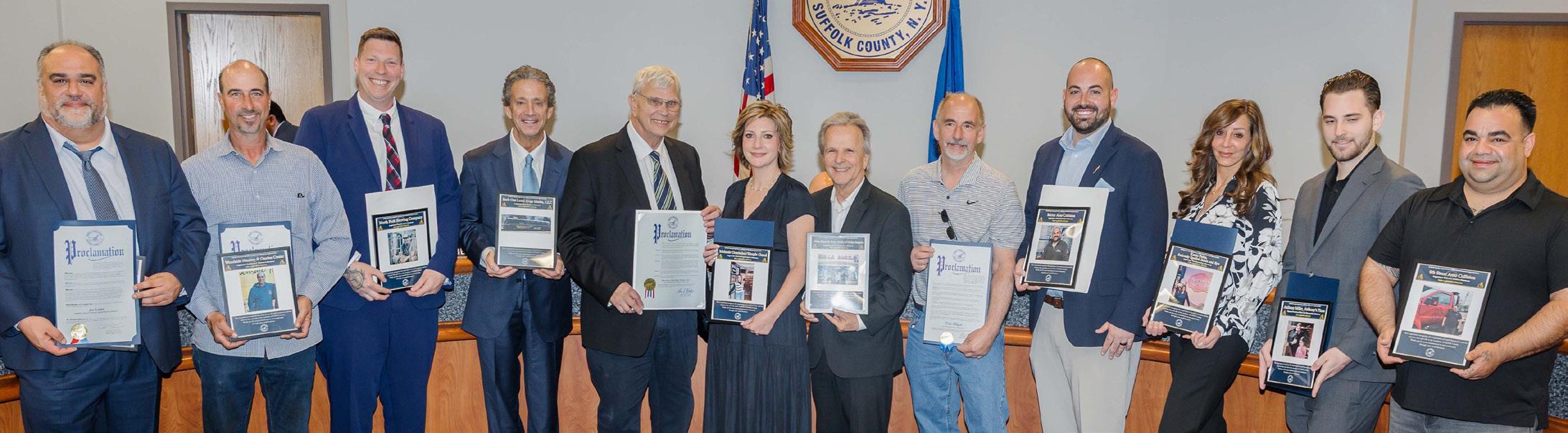
and variety of small businesses, the Suffolk County Department Labor, Licensing, and Consumer Affairs notes that there are nearly 16,000 active licenses and registrations for a wide range of businesses and contractors.
Honorees in The Messenger’s Coverage Area
District 3: Anthony’s Pizza, 520 Mastic Road, Mastic Beach
District 4: Cella Bagels, 1198 Middle Country Road, Selden
District 5: Simple Good, 35 Chandler Square, Port Jefferson
“Suffolk’s small businesses deserve to be recognized for their vital contributions to our economy and our communities,” said Presiding Officer Anthony Piccirillo (R-Holtsville). “From my district, I was pleased to honor Hummus Fit, a family-owned business at the Plaza in Holbrook, founded by husband-and-wife team Tony and Liana Mavruk, who turned their shared passion for fitness, nutrition, and great food into something special. With over 15 years in the fitness industry, they’ve helped countless people live healthier lives—and now they’re doing it through food.”
Across the United States, there are more than 33 million small businesses. They employ nearly half the American workforce and represent almost 44% of America’s Gross Domestic Product (GDP), according to the US Chamber of Commerce. Suffolk County itself is home to thousands of small businesses. As a measure of the number
District 6: Joe Latini/AssumeMyLoan.com, Rocky Point
District 7: Woodside Nursery & Garden Center, 134 E Woodside Avenue, Patchogue
District 8: Hummus Fit, 1066 Main Street, Holbrook
District 9: Brazas Del Campo Deli & Grocery, 1092 Islip Avenue, Brentwood
District 10: Redefine Meals, 526 E Main Street, Islip hamlet
District 11: Lion’s Den, 191 Higbie Lane, West Islip
District 12: BelAir Auto Collision, 970 W Jericho Turnpike, Smithtown hamlet
District 13: Raleigh’s Poultry Farm, 335 Raleigh Farm Road, Kings Park

Published by Messenger Papers, Inc.
Thursday, May 14, 2026
By Ben Solis | AMAC Contributor
For decades, American politicians from both parties have pledged to prioritize American-made products to protect U.S. industry and crack down on deceptive labeling practices. But President Donald Trump has gone beyond campaign promises to make real progress toward those goals while in office.
Trump’s recent executive order, “Ensuring Truthful Advertising of Products Claiming to be Made in America,” is a reflection of the President’s commitment to the “Made in America” mission. The order specifically grants the Federal Trade Commission expanded authority to address false labeling, directs the Department of Justice to pursue violations under the False Claims Act, and instructs Customs and Border Protection to more closely inspect import declarations. It also requires federal agencies to ensure contractors comply with Buy American standards.
Even U.S. Customs and Border Protection and the National Highway Traffic Safety Administration now have greater authority to monitor fake “Made in America” labeling. Shipments with false origin claims can be seized, while the businesses attempting to sell the misleading products can be criminally prosecuted.
The order also seeks to close loopholes that have allowed businesses to exploit vague labeling rules. It calls for clearer, stricter definitions of domestic content and directs federal agencies to coordinate enforcement efforts across sectors, including online marketplaces where misleading claims have become more prevalent.
In its most recent report, the FTC identified three companies that misused the “Made in America.” label. The investigation revealed that key components in some products, such as microchips and leather, were sourced from abroad. Each company was fined between $167,000 and $625,000, and its brands were publicly associated with false advertising.
By targeting deceptive practices in e-commerce and global supply chains, President Trump is aiming to ensure that foreign goods cannot be easily repackaged or relabeled to appear American-made.
Beyond just consumer protection, the order helps preserve economic and national security. By restoring integrity to “Made in America” labeling, President Trump will strengthen domestic manufacturing, support American workers, and reduce reliance on foreign supply chains. The policy aligns with broader efforts from the White House to promote U.S. industry and encourage companies to bring production back home.
This order is particularly important for Americans –and even foreign visitors – who prioritize buying Americanmade products. Even some products that are today listed as “Made in America” are not actually produced in the United States. I recall one incident from 2001 when I purchased gift-wrapped “American memories boxes” in San Francisco, only to discover that the products in them, including a copy of the U.S. Constitution, had “Made in China” labels.
Specialists I spoke with for this article offered up the European Union as a warning of what could befall the United States if it does not guard “Made in America” labeling with pride. The E.U. now produces almost nothing and relies largely on imports. As a result, its economy has stagnated.
José de Ruiz, a retired Professor of Commercial Law, played a pivotal role in crafting industry norms for both the Spanish government and the European Community during the transformative decades of the 1980s and 1990s. He warned how false labeling can damage the economy as deeply as inflation, eroding trust and weakening the connection between business and the community.
Professor de Ruiz recounted how, in the late 1980s, European workers rallied to persuade politicians to halt the flood of unfairly priced Chinese goods. At the time, European manufacturers were already feeling the squeeze, as Chinese competition found new ways in and increased exports to Soviet-aligned countries. Many Eastern European firms exported Chinese-made pencils, glue, and other school supplies, repackaging them to export to Western Europe.
Boxes printed in English, French, or Spanish increasingly concealed their true origin, making products appear local. “The bright colors and cheerful packaging drew children in, while bargain prices won over parents,” de Ruiz said. As imports surged, Western producers faced strong competition. Labor unions appealed to political leaders and, for a time, the threat was contained. However,

the challenge later returned “in subtler, harder-to-fight forms,” and ultimately, “European workers lost much of the battle.”
Dr. Francoise de Bérulle, a French sociologist and theologian who advised the mayor of Paris on labor relations in the late 1990s, argued that requiring the accurate labeling of product origins strengthens “the rights of both workers and consumers.”
“By delegating authority, these laws foster a sense of responsibility,” Dr. de Bérulle emphasized, drawing on his expertise in Catholic Social Teaching. He called it “a step toward strengthening a healthy society.”
“The benefits for U.S. firms and all operating in
Overview - AMACThe Association of Mature American Citizens
The Association of Mature American Citizens represents Americans 50 plus. AMAC is centered on American values, freedom of the individual, free speech, and exercise of religion, equality of opportunity, sanctity of life, rule of law, and love of family, with benefits at all levels.
AMAC plays a vital role in helping build the services that will enrich the lives of America’s seniors. AMAC Action, a 501 (C)(4) advocates for issues important to AMAC’s membership on Capitol Hill and locally through grassroots activism. To Learn more, visit amac.us
U.S. markets are clear,” Professor de Ruiz said. “Increased investment in domestic industry and fair wages for American workers will strengthen the brand, as companies will be able to use the ‘Buy American’ label.” Dr. de Bérulle added, “This process builds trust between markets and consumers.”
Ultimately, that’s what Trump’s executive order is about – restoring trust between businesses and consumers, and between the American people and the products they choose to buy. By enforcing clear, honest standards for what qualifies as “Made in America,” the Trump administration is not only protecting consumers from deception, but also reaffirming the value of American labor, craftsmanship, and industry in a global economy that too often prioritizes profit over integrity.









Etymology:
Middle English cherlyssh “of churls, rustic, uncouth,” going back to Old English ceorlisc, cyrlisc, from ceorl “male person, countryman, member of the lowest class of free men” + -isc
adjective
Pronounced: /chur·luhsh/
Definition: marked by a lack of civility or graciousness
Example: “The student was scolded for his insubordinate and churlish nature.”
Synonyms: uncouth, rude, vulgar
Antonyms: sophisticated, polished, genteel
Source: Oxford Languages


N E I T R A M
See how many words you can create. Must have center letter in word and can use letters more than once. 4 letter word minimum.


See left for the answers (please don’t cheat!)
May 19, 1643: Massachusetts Bay, Plymouth, Connecticut, and New Haven form the United Colonies of New England.
May 16, 1929: First Academy Awards: “Wings,” Emil Jannings, and Janet Gaynor win.

May 17, 1792:
Twenty-four merchants form the New York Stock Exchange at 70 Wall Street.
May 14, 2024:
Google unveils new generative AI features at its annual conference, forcing users to view AI Overviews at the top of search results despite them being factually incorrect 60% of the time.

May 15, 1940: Richard and Maurice McDonald open the first McDonald’s restaurant in San Bernardino, California.
Source: Onthisday.com.

May 18, 1804: Napoléon Bonaparte is proclaimed Emperor of France by the French Senate.

May 20, 1498: Portuguese explorer Vasco da Gama arrives in Calicut, India, becoming the first European to reach India by sea.
By PJ Balzer
I’ve been spending some time looking at a lot of old photos as of recently, reflecting back on good memories, some simpler times, and moments I wish I could relive - moments that I wish that I knew then how special they were then, and would be today.
Photos are both an interesting concept and brilliant invention. They capture a single moment in time and freeze it for us to view. Looking at a photo of that moment, we have the opportunity to do some reminiscing, to remember a day, a time, and maybe even a person that has since passed on or passed us by.
When I was viewing a particular handful of photos, my wife said, “What a beautiful photo, such a stressful day though.”
She was absolutely right. The truth is, you can never really tell exactly what was happening behind the picture-perfect moment, regardless of how perfect of a moment the camera may have frozen for us. The one photo and one beautiful moment in time doesn’t tell the whole story.
Every photo we take has a “filter” on it. The filter purposely catches the best moment possible. We often take ten shots of a single moment yet only show to others, print, or post the best one, leaving outsiders and viewers to think to themselves, “What a perfect child, family, marriage, or life they have.”
That photo, the best and most filtered one, can’t possibly depict how raw and real our lives are. Behind those photos are true emotions and struggles, things and feelings that we each face and deal with, yet the camera can’t possibly capture. Some of the perfect pictures we see were proceeded or followed by tears or heavy words exchanged.
You may see the perfect holiday photo but can’t see how hard it was getting to the gathering, how difficult it is for the parents, both physically and emotionally, who have a child on the autism spectrum to get pictures taken; the many marital, financial, and health battles that are happening behind the all of the big smiles at the Thanksgiving table picture; the “filters” we place on our photos and ultimately our lives.
They hide it all.
I personally believe that most of our society’s depression and mental health struggles are due to comparison. Most of us daily are comparing our imperfect and unfiltered lives to everything that’s just the opposite. We are viewing the very best moments of other people’s lives and desire that. We daily consume content that is heavily controlled and filtered. Everything on social media looks absolutely perfect to us, just the way the content creator has filtered it to be.
But real life being lived out in real time simply doesn’t contain any filters. There’s a quote that I love that says, “Comparison is the thief of real joy.”
I want to end by encouraging and reminding you that on the opposite side of this article is a real person. This past week in my own life has been full of ups, downs, uncertainty, and faith too.
Sure, I may have taken a filtered picture or video and posted it for the world to see, but the true story behind the filtered photo is that life is both imperfect and beautiful at the same time.

LOUIS CIVELLO, PRESIDENT


Thursday, May 14, 2026
By Ashley Pavlakis
LAX is life, at least that’s what they used to say. The Sayville Golden Flashes are hot this season, “cradling” a perfect record going into the final games of the regular season. The playoffs are right around the corner.
The Sayville girls’ varsity lacrosse team is a member of the New York Public High School Athletic Association (NYSPHSAA) and competes in Division II. The Golden Flashes are led by third-year head coach Gary Jensen. He’s joined on the sidelines by assistant coach Courtney Weeks.


Sayville has a trophy case; its contents include a Suffolk title (‘09, ‘14, and ‘24), a Long Island title (‘24), and a New York State title (‘24). A sweep in 2024 was the last time the Golden Flashes won a championship.
“We’re not focused on winning; we’re focused on ourselves getting better. The habits that create winning. We’re just focusing on playing food lacrosse, and then the winning is taking care of itself,” Jensen told The Messenger.
The Golden Flashes are 15-0-0 with two games remaining in the regular season. Victories are largely helped by their offense. Sayville can score goals, plenty of them - 208 goals to be exact. They limited their opponents to 88 and kept them to singledigit scoring every game.
The girls are led in the goals department by junior Dylan McNamara. The Seminoles commit leads the Golden Flashes with 51 goals, which is best for eighth in the Suffolk County standings. Sophia Buffardi is not far behind her with 43. Goaltender Julia Lilienthal is 26th in saves with 62.
The program has helped grow and develop top-notch lacrosse players, so much so that eight of the nine signed letters of intent to play lacrosse in college.
The eight seniors are wielding lacrosse sticks now; they’ll walk the stage this spring and take their talents to the NCAA level next spring.
Olivia Desimone (Florida State), Jenna Messina (Coastal Carolina), Julia Lilienthal (Vanderbilt), Julianna Montalto (Arizona State), Paige Manning (Quinnipiac), Carly Cangelosi (Rutgers), Morgan Farrell (Hopkins), and Sophia Buffardi (UNC) all have signed to play lacrosse in college. Mackenzie Schutte is the ninth senior who will be the valedictorian for the class of 2026. She will attend Bucknell, where she’ll further her education.
“Our kids are dedicated. We focus on putting in the extra effort, the extra hours, the extra video. From a younger age, they take it seriously,” said Jensen.
Focus was the main focal point of our discussion, don’t fix what’s not broken. Jensen stressed the importance of a team centered mentality and doing what you can to get better together.
“The same mindset we’ve had all year. We feel like if we are playing our best lacrosse, we don’t feel like anyone else can stop us. We just have to focus on ourselves. That’s been our motto this year, ‘focus on us’. It’s just focusing on consistently getting better and playing to the best of our ability as a team, not so much as individuals, but the team approach.”
By Ashley Pavlakis
The Lions are making quite a ‘racquet’ in Section XI boys varsity tennis this season. The West Islip boys’ tennis team has completed the 2026 regular season; playoff mode has officially commenced.
The West Islip varsity boys’ tennis team is a member of the New York State Public High School Athletic Association (NYSPHSAA) and competes in Conference I West (Large school). The Lions are led by head coach George Botsch. West Islip won a League title in 2024, and Botsch was awarded Coach of the Year.
Lions don’t have hands, but the West Islip Lions sure know how to wield a racket. The boys are 8-1-0 this season. The regular season wrapped up last week, and the playoffs are next up on the docket
The Lions have made quick work of their opponents this season. Their only loss this season came against Half Hollow Hills (HHH) East on May 4. They lost the match 5-2, awarding HHH East the Conference title
The Lions celebrated their seven seniors in a 6-1 win over North Babylon on April 28.
Section XI tennis follows United States Tennis Association (USTA) rules, which means tennis matches are played as best two out of three sets, using no-ad scoring. The first to capture four points in a set wins.
Leading the pack this season for West Islip are Tommy Albertelli (Sr.), Kevin Halloran (Jr.), and Ben Triglia (Jr.). As a freshman, Halloran

earned All-County honors in 2024.
West Islip finished the season in second place in Conference I West (Large school), this puts the Lions as the ninth season in the Section XI playoff bracket. The Suffolk County playoffs officially begin on May 14th.
The Lions have plenty of practice time on their hands as their opening playoff match isn’t set to begin until May 21.
Their opponent? Ward Melville.
The Patriots are a non-conference opponent for West Islip, which is also seeded second in Conference II (East). With more games on hand than the Lions, they were placed as the higher seed (eight) in the playoffs. The two teams did not meet this season, but in previous years they’ve met twice, and the Lions came away with ‘Ws’ both times.
The matchup will take place on the road, at the higher seed’s home court. Ward Melville has lost twice at home this season, while West Islip’s only loss has come on the road. Safe to say it’s a relatively even playing field for both teams.
The Lions have remained a title contender in recent years, maintaining winning records since the 2022-23 season. With only a League title to show for since 2024, the Lions are hungry for more.
The ball is in their court now; we’ll have to wait and see how the Section XI varsity boys’ tennis tournament plays out.
The Long Island Ducks today announced the contract of infielder Nick Roselli has been purchased by the New York Mets organization. He will report to the team’s High-A affiliate in Brooklyn.
“Nick earned a roster spot out of spring training and contributed greatly over the first three weeks of the season,” said Ducks Manager Lew Ford. “We wish him the best of luck as he returns to the Mets organization.”
Roselli played in 14 games for the Ducks and started 12 of them. He compiled a .250 batting average with two home runs, eight RBIs, six runs, two doubles, seven walks, a .353 on-base percentage and a .785 OPS. The 23-yearold recorded four multi-hit games and three multi-RBI contests as well.
The Levittown native spent the past two seasons (2024-25) in the New York Mets organization prior to joining the Ducks. He batted .211 with nine home runs, 56 RBIs, 49 runs, 76 hits, 17 doubles, two triples, 43 walks, 10 stolen bases and a .653 OPS in 106 games during that time. The Division Avenue High School and State University of New York at Binghamton alum was originally selected by the Mets in the 11th round of the 2024 amateur draft.

Roselli becomes the fourth member of the 2026 Ducks to have his contract purchased by a Major League organization or foreign professional league. He joins outfielder/catcher Caleb Roberts (Minnesota Twins, Double-A Wichita), infielder Henry Kusiak (Minnesota Twins, Single-A Fort Myers) and outfielder Juan Yepez (Dorados de Chihuahua, Mexican League). Eight members of the 2025 Ducks had their contract purchased, including seven by MLB clubs. Long Island was the inaugural recipient of the Atlantic League’s Player Transfers Award in 2024 after leading the league with 10
By PJ Balzer
This past week was an eventful one for the Center Moriches girls’ varsity softball team. The week began with a win over Mattituck/Greenport and ended up celebrating their seniors with another convincing win.
Ava Anderson, the Red Devils starting pitcher, was outstanding in the playoff clincher. She pitched a complete five innings while only allowing one hit and no runs. She also struck out nine and walked only one.
Her pitching was added onto by a barrage of bats for Center Moriches. They scored six runs on five hits and a few bases on balls as well. Ella Cerillo and Lilah Eten both had singles that drove in runs. Addison Earl and Adriana Molesi both had ground outs that also drove runs in.
The entire team’s patience at the plate was the real star of the game. Center Moriches compiled 10 total hits and 11 total walks to win the game. The final score was Center Moriches 12 to Mattituck/ Greenport 0.


A few nights later, the Red Devils faced off against Bridgehampton as they simultaneously celebrated their senior night. Center Moriches beat Bridgehampton 15-3 before a full crowd of family and friends present to celebrate their seniors. In this game, Ella Cerillo went an impressive 3 for 3 with RBIs. Aria Ligon also added to the score board with two hits and a run scored.
Center Moriches improves to 10-9 in the season, while finishing their season this week and awaiting their playoff assignment.


player contract purchases and have had the most players signed in league history.
The Long Island Ducks are entering their 26th season of play in the Atlantic League of Professional Baseball and play their home games at Fairfield Properties Ballpark in Central Islip. They are the alltime leader in wins and attendance in Atlantic League history, have led all MLB Partner Leagues in total attendance for five consecutive seasons, and have sold out a record 723 games all-time. For further information, visit LIDucks.com or call 631-940-DUCK (3825).
By PJ Balzer
The baseball fields are on fire this week on the South Shore as an age-old rivalry takes place once again.
Not only are these two schools neighbors, but they are also in first and second place, playing a three-game series this week for the league title.
Monday afternoon, the West Islip boys’ varsity baseball team hosted East Islip. The two teams couldn’t be any closer in proximity as their high schools sit only eight miles apart. West Islip gave Brian Bower the mound and the baseball and definitely didn’t regret it. Bower had six strikeouts while allowing no runs and three hits. Bower finished a strong six innings before Conner Keneflick came in to secure the win.
Ben Delanoy and Will Delanoy used their bats to rally West Islip past their rival to the East. Ben went 2-3 and Will 1-2, scoring two of West Islips three runs. The final score was 3-0.
With the win, West Islip improves to 13-3 and is currently on a ten-game winning streak. East Islip is currently 12-4. The two teams will face off twice again this week with the League 4 title at stake.



S a f e s c h o o l s a r e a
t o p p r i o r i t y Yo u r
s u p p o r t h e l p s f u n d
s e c u r i t y , m e n t a l
h e a l t h r e s o u r c e s ,
a n d a c a r i n g
e n v i r o n m e n t
w h e r e s t u d e n t s
c a n l e a r n a n d
t h r i v e



R i g o r o u s i n s t r u c t i o n , a n d
d e d i c a t e d
e d u c a t o r s
p r e p a r e s t u d e n t s
f o r c o l l e g e ,
c a r e e r s a n d

l i f e l o n g s u c c e s s
Aw a r d - w i n n i n g
a r t s a n d
c o m p e t i t i v e
a t h l e t i c s b u i l d
c o n f i d e n c e ,
t e a m w o r k , a n d
p r i d e i n
S m i t h t o w n
R e l i a b l e ,
e f f i c i e n t b u s
s e r v i c e g e t s
s t u d e n t s t o
s c h o o l s a f e l y
a n d s u p p o r t s
b u s y f a m i l i e s e v e r y d a y
G r e a t s c h o o l s
a r e t h e
f o u n d a t i o n o f a
v i b r a n t ,
c o n n e c t e d
c o m m u n i t y t h a t
s u p p o r t s a l l
g e n e r a t i o n s
O u r s c h o o l s a r e o n e o f S m i t h t o w n ’ s g r e a t e s t a s s e t s .
Y o u r s u p p o r t o f t h e s c h o o l b u d g e t p r o t e c t s t h e o p p o r t u n i t i e s o u r
c h i l d r e n d e s e r v e a n d t h e q u a l i t y o f t h e l i f e w e a l l v a l u e
G R I B B I N S O L O M O N M I N N I G A N
f o r S m i t h t o w n B O A R D O F E D U C A T I O N