


Fireworks explode over Bald Hill in Farmingville on July 3 (Credit - Matt Meduri)
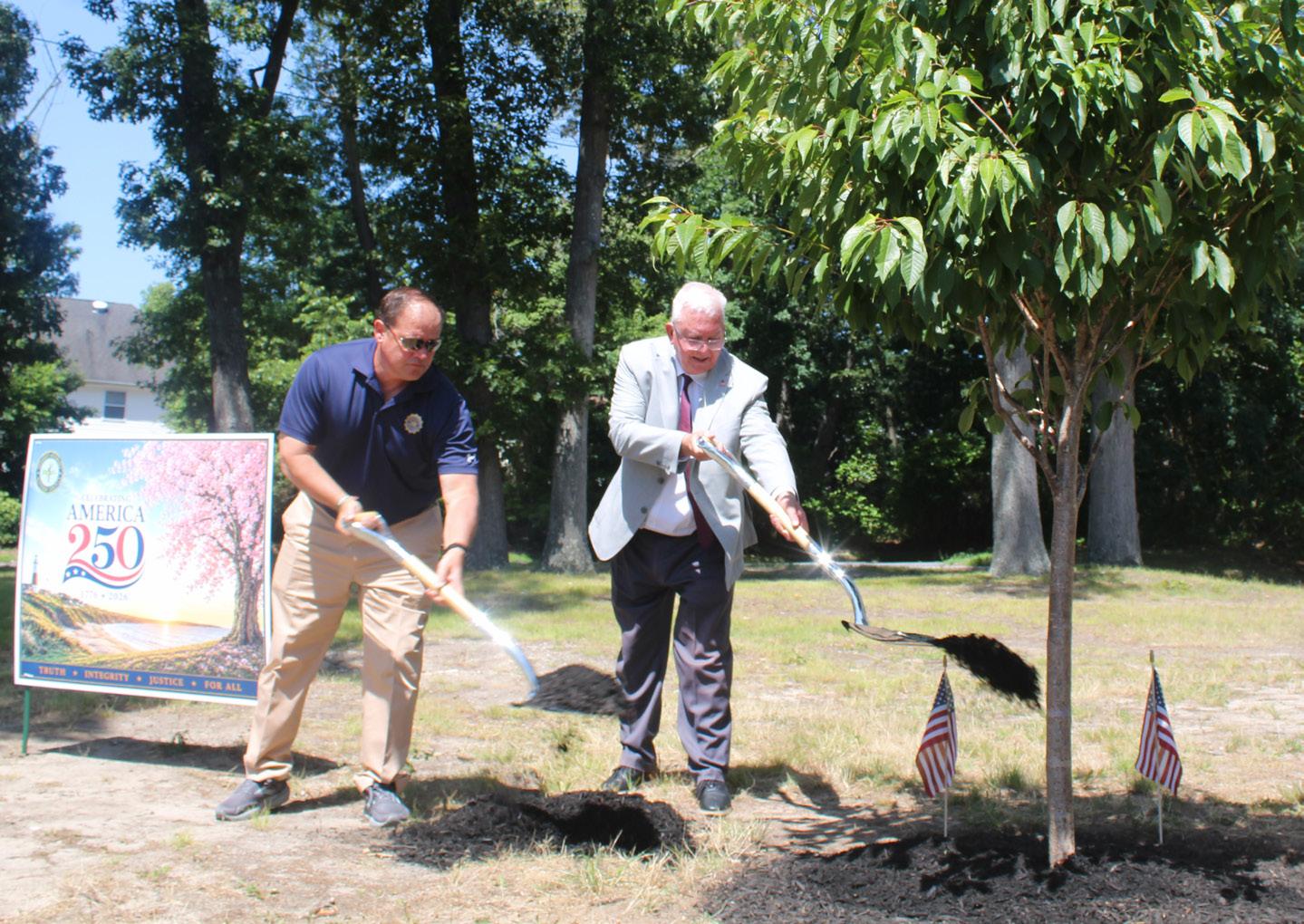
D.A. Plants Tree in Honor
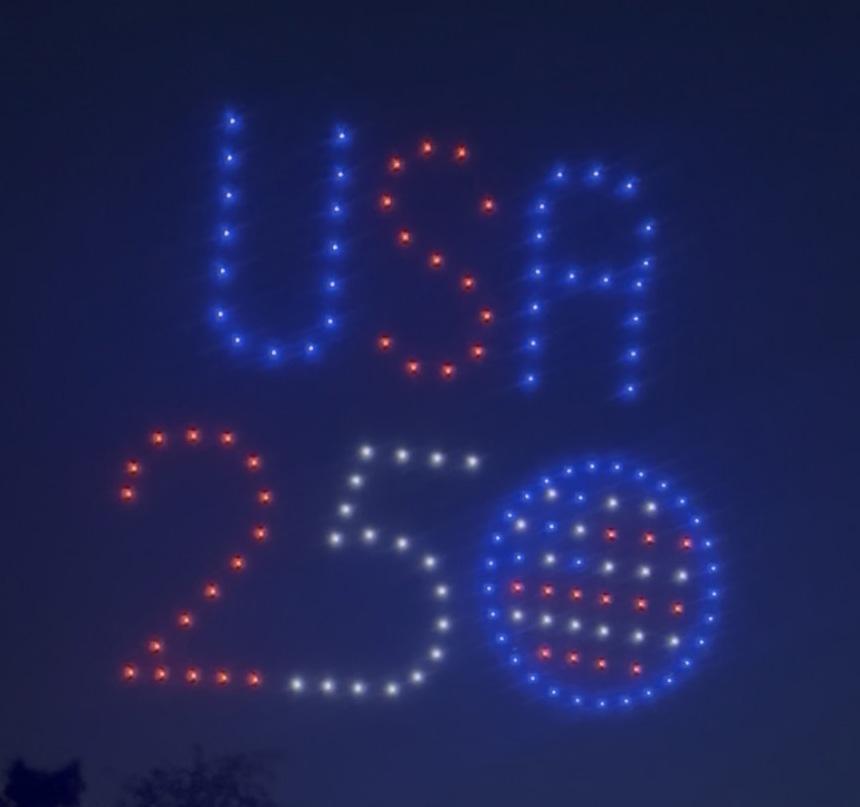
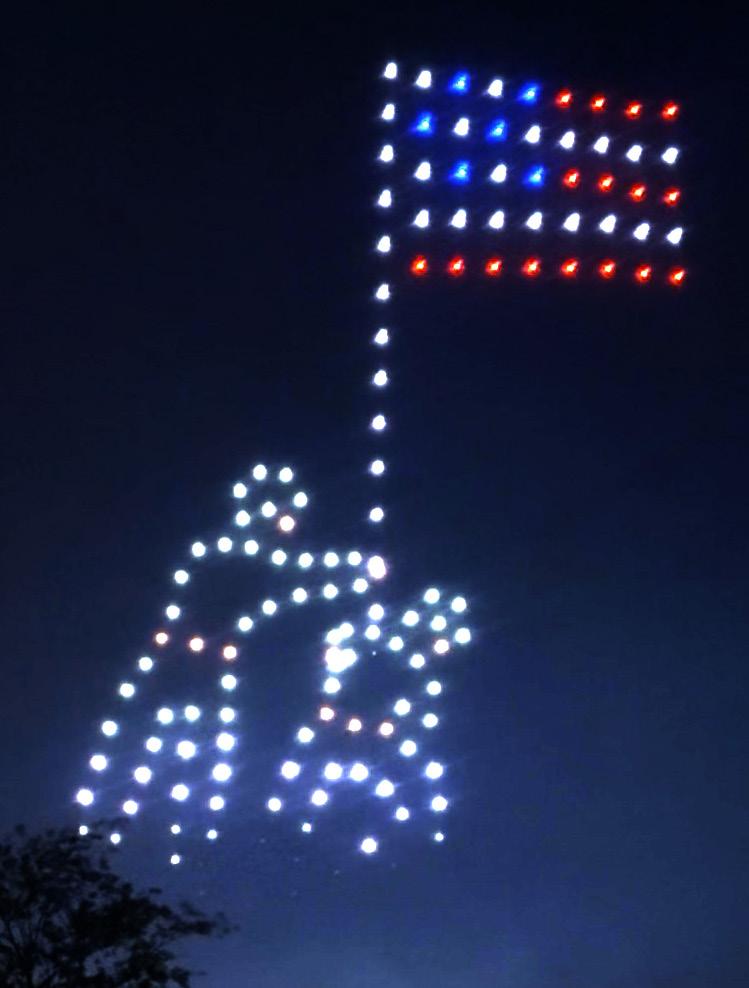
Drones light up the sky in Fort Salonga (Credit - Town of Smithtown)
Fireworks over Lake Ronkonkoma (Credit - Matt Meduri)


Sayville Farmers Market at the Islip Grange Every Saturday until November, 9:00 AM to 2:00 PM
Port Jefferson Summer Farmers Market Every Sunday until November, 9:00 AM to 2:00 PM
Islip Farmers Market at Town Hall Every Saturday, 7:00 AM to 2:00 PM
Summer Craft Fair at Smithtown Village Historical Society July 11, 10:00 AM to 5:00 PM
Brotherhood for the Fallen 1/2 Mile Fun Run, 5K & 10K at Suffolk County Police Department – 4th Precinct July 11, 7:30 AM to 12:00 PM
Kings Park Rocks at Kings Park Main Street, Kings Park
July 13, 6:00 PM to 10:00 PM
Grooves on the Green at Station Yards Ronkonkoma July 15, 5:00 PM to 7:30 PM
31st Annual Stony Brook Film Festival at Staller Center for the Arts, Stony Brook July 16, 7:00 PM to 11:30 PM
Alex Tric & Friends Art Show at Conklin House Huntington July 18, 5:00 PM to 10:00 PM
Antique and Classic Car Show at Sagtikos Manor Bay Shore, July 19, 10:00 AM to 2:00 PM
Great South Bay Music Festival at Shorefront Park
July 23-26, various times
Sayville Summerfest at Gillette Park & The Common Ground
August 7-9, various times

(631) 269-6421
Conveniently





Celebrate America’s 250- July 10, 11:00 AM to 3:00 PM
Krafty Kids- July 16, 4:30 PM to 5:15 PM
COMMACK:
Family Fun PlayHooray- July 16, 6:00 PM to 6:45 PM
Adult Craft: Pop Art Pet Portraits- July 18, 2:00 PM to 3:00 PM
NESCONSET:
All Abilities Bingo Night- July 14, 6:00 PM to 7:00 PM
Teen Bingo Night- July 14, 7:00 PM to 8:00 PM
KINGS PARK:
Learn Magic with Ari- July 15, 6:30 PM to 7:30 PM
SACHEM:
Paper Making -
- July 21, 10:00 AM to 11:00 AM
SMITHTOWN:
Dennis Cannataro Family Summer Concert Series- July 9, 7:30 PM to 9:00 PM






By Matt Meduri
Suffolk County District Attorney Ray Tierney (R) and his team did their part in the island- and nationwide celebration of the 250th anniversary of U.S. independence.
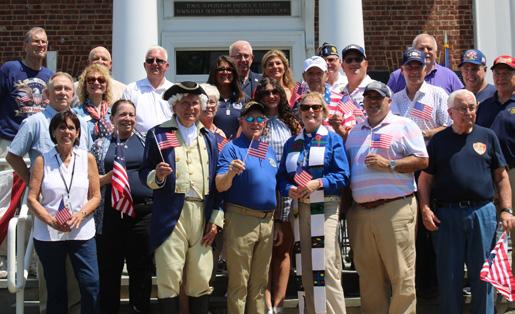
Tierney, joined by his team, members of the Suffolk County Sheriff’s Department, and Suffolk Comptroller John Kennedy (R-Nesconset), braved the triple-digit heat to commemorate a cherry tree on the front lawn of the D.A.’s office in Hauppauge.
Tierney recited history of law enforcement in New York State and Suffolk County.
New York became the eleventh state in the Union on July 26, 1778. At that time, Tierney said, law enforcement was centralized at the State level through the Attorney General, who was appointed by the Crown during the colonial era and later by the governor.
“But law enforcement in Suffolk County was controlled by the State. Sounds eerily familiar, doesn’t it?” quipped Tierney, a dig at State leadership’s prerogatives, particularly on criminal justice reform. Tierney has been at odds with Albany Democrats since he was sworn into office in 2022.
“Originally, the State of New York was divided into seven districts. Each district
was overseen by a Deputy Attorney General who derived their power from the State Attorney General,” said Tierney, adding that since the A.G. at the time was appointed by the governor, the interests of the deputies would lie with the state, not with their counties. In 1801, these Deputy Attorneys’ General names were changed to District Attorneys, but they were still appointed. In April 1818, a law was passed to allow each county to have their own D.A. - still an appointed position.
Suffolk got its first D.A. in June 1818. Silas Wood, born in West Hills in 1769, was appointed to the role. He graduated from Princeton in 1789 and taught there for five years. He was later admitted to the bar and started his practice in Huntington. Wood would also serve as one of the two representatives for NY-01. A member of the Federalist Party, he would serve in Congress in the seat once held by William Floyd, of Mastic Beach, from 1819 to 1829.
“In 1846, for the first time by constitutional convention, voted to have the D.A. elected rather than appointed,” said Tierney, calling the change “very important.”
“It makes the D.A. answerable to the citizens of this county and not of the state. Since D.A. Wood, we have had 36 D.A.’s in Suffolk County, including myself.”
Tierney said that despite the change in “landscape” of the world since 1818, the role of D.A. has “evolve[d] to meet the concerns of our citizens.”
“Since its creation, the D.A. has always been the chief law enforcement officer of the county in which they serve. It is our duty as D.A.’s to make sure that all local and state laws are upheld and that we represent the interests of our constituents as it pertains to pursuing justice and

ensuring public safety.”
In 1818, just one D.A. prosecuted all the crimes in Suffolk. In 2026, the D.A.’s office has 230 “very adept,” in Tierney’s words, prosecutors and investigators who “work tirelessly for the 1.5 million residents of Suffolk County.”
“And on the anniversary of the birth of our nation, I can tell you it is our honor and privilege to do so.”
Tierney closed with the ceremonial planting of the cherry tree, what he called a symbol of “new beginnings and hope for brighter days.”
“It is my hope that despite our differences, our country continues to strive to be a fair, just, and free nation.”


The fireworks don’t have to end with the Fourth of July – at least, not on Long Island.
There are still two more opportunities to enjoy spectacular Fireworks by Grucci shows at the Empire State Fair on the remaining Saturday nights, July 11 and July 18.
Already this summer, six dazzling displays of color and light have illuminated the night sky over Long Island at three annual signature events (including Bald Hill Fair in Farmingville and Long Island FunFest in Brentwood), all produced by Dreamland Amusements, a family-owned and -operated Long Island-based leading carnival midway and family entertainment provider.
The pyrotechnic extravaganzas are presented by world-renowned Fireworks by Grucci, an awardwinning sixth-generation, family-owned and -operated company founded in 1850 and also based on Long Island.
Bob DeStefano, who owns Dreamland Amusements with his wife Kathy and runs it with several family members, said Dreamland is proud of its longtime partnership with Fireworks by Grucci.
“We’re both family businesses that share a commitment to providing an exceptional experience to other families,” DeStefano said.
So, pack up the kids and head out to Nassau


More information: 866-666-3247 Credit
Coliseum in Uniondale for family fun, from live entertainment to midway rides for all ages (including a towering 110-foot-tall Ferris wheel), and plenty of tantalizing carnival eats.
Fair parking is free and admission includes a variety of first-rate family entertainment:
• Circus Murcia (edge-of-your-seat high-wire, aerial and Globe of Death thrill acts, jugglers & clowns)
• Aqua Live Spectacular (water stunt show featuring enchanting aerialist mermaids and more)
• Jaw-dropping Big Bee Transforming Robot Car
• The Magic of America (patriotic magic show)
• Sandlofer Family Educational Petting Zoo
Fair admission: $10 (free for kids under 36” tall)
Unlimited ride wristbands (for riders 36” & taller) are $42 on site ($40 cash price). Visit the website for online savings on rides.
Fair hours: 5:00p.m. to 11:00p.m. weekdays and 12:00p.m. to 11:00p.m. Saturday - Sunday through July 19 at Nassau Coliseum, 1255 Hempstead Turnpike in Uniondale
Guests under 18 must be accompanied by an adult age 21+. Please check the website for event updates before attending.


Smoke rises from the fireworks, the asphalt still wet from a torrential downpour, and the identity of the United States still hanging in the balance.
This wasn’t just any Fourth of July weekend. It marked the quarter-millennium that the Stars and Stripes have served as an international symbol of rugged individualism that uniquely unites those of invariably different backgrounds.
The photo above is from Saturday’s fireworks around Lake Ronkonkoma.
If the photo doesn’t describe where we are as a country, we’re not quite sure what does.
“A republic, if you can keep it,” was Benjamin Franklin’s answer as to what he and his colleagues had just created. It’s become apparent, at least to us here at The Messenger, that the republic isn’t merely in need of being kept. Rather, it must be saved.
The First American Revolution was essentially an unwinnable war. What boiled down to legions of irate farmers revolting over a 3% tea tax imposed by an empire that controlled 5% of the world’s landmass at the time birthed perhaps the greatest underdog story ever told in modern world history.
We don’t suspect the Second American Revolution, which we assess has already begun, will be much easier.
Nonetheless, we have hope for the continued awakening of parallels between Jefferson’s words in the Declaration and the sentiments felt by many Americans today.
Don’t Blame Your Fellow American
As some light crowds lined Michael Murphy Beach around Lake Ronkonkoma, the strobes lights of lightning were already kicking off. The entire sky would briefly illuminate, showing the cloud formations, the depth of the storm system, and just how starkly the fireworks clusters were dwarfed by the display.
Those gathered came to watch an exciting, patriotic display in such a once-in-a-generation milestone. They received that, but under the context of a brewing tempest that triggered alarms of “severe storms” and recommendations to seek shelter across every cell phone eagerly filming the historic day.
Random Americans, identical in their intentions, were caught under one power from above.
“We the people” should not fault our fellow Americans for thinking differently and acting on those principles. That’s not even a uniquely American concept, touted as one as it is; that’s a human concept. It’s human nature to follow the leader. It’s not your fellow American’s fault the system is rotten to its core and America’s priorities have become ambiguous. The opposite view is a moral high ground that negates the very doubts many on both sides of the aisle are experiencing. It’s simply not true that one side’s election victories are always legitimate, while those of the other side never are, and it’s absurd to assume that one administration or party works entirely for the people while one side never does.
And it’s also, in our view, absurd to assume that only one party is intent on breaking the country and robbing the place blind.
We’ll also take a maverick position here: don’t blame the immigrant.
While immigrants coming here should seek to lap up our culture and respect the host nation, not contribute to the ongoing political balkanization, there are many who do, but many who don’t.
Those who come here who view the country as an ATM, whether it be birth tourism or ethnocratic hiring practices, are only symptoms of the problem, not the causes. Both sides of the aisle could have easily reformed our immigration laws decades ago, but they’ve chosen not to. We think it’s to purposely slap Band-Aids on the cracks in the Hoover Dam so as to continually have issues to run on.
Apply the same logic to healthcare, internal corruption, money in politics, and billionaires taking tax breaks through congressionally-approved loopholes.
The people whose job it is to fix those issues are continually the ones advertising their services to do so. And if there was another country on the side of the globe that promised unlimited potential for wealth and happiness, we imagine most Americans would be on the first plane out as well.
Remember, don’t look left or right, black or white, legal or illegal. Look up.
Furthermore, the Second American Revolution cannot be a violent one. We think in most scenarios, violence belittles the point for which it’s waged.
At the end of the day, people are people. They’re mostly living the same lives and experiences. It’s why we think observational humor is so engaging. Anything can be funny if said correctly, but most people can relate to the joke because of shared experiences. A good standup comic nails the internal dialogue we’ve all repeated.
How different, then, are we?
Get Involved. Remain Steadfast
Some decided to stick out the lightning and get some good shots with the camera. After all, how many fireworks shows under such an active lightning storm has the average person seen?
Many others, however, quickly packed up the chairs and towels and sprinted off the beach to their vehicles, abandoning a great spectacle, but at least they got a taste of the dream of fireworks that night. Those who remained were met with sand to the eyes kicked up by the gusts, hats blowing loose in the wind, and small children displaying their terror for an immediate
future unbeknownst to them.
However, those who did stick it out got some incredible shots, a decent story for work on Monday, perhaps, and a certainly memorable Fourth of July that would have otherwise been muted by beloved, yet monotonous, tradition. In some ways, sticking out the storm was worth it.
“All politics is local,” said former Speaker Tip O’Neill (D-MA). In many ways, we think that’s remained true. Local politics is the voters’ domain to make tangible changes in their immediate lives.
Unfortunately, “all politics” is becoming “national.” The local parties are now oxygenstarved while most hot-button issues are not under the purview of Town. This, in our view, makes it easier for Americans to wind up hating each other. There’s no room for separate levels, and even worse, it doesn’t even affect turnout on the local level.
About 70% of the Suffolk tax bill goes to the school districts, yet those elections have the lowest turnouts relative to population.
Instead of focusing on every move the President makes, focus on the moves of your local Councilman or Legislator. Focus on your local civic groups and community needs. “It takes a village,” so the other saying goes. That’s simply part of human nature, we think.
Keep the pressure on your federal representatives, however. Call their offices every day. You are their boss; you hire them, you pay them, and you can fire them. They deserve the ire of a vengeful, miserable boss, because that’s how they’ve treated the American people for so long. If you don’t like who your party is putting up, vote for the other candidate in a primary. If there isn’t one, join a local committee and find one. It’s an uphill battle, but we’ve seen examples of local leadership backing the primary winner. That’s where “all politics is local” comes in, as the true choice of the voters in a primary can make leadership reevaluate and potentially lead to wider change. It will seem all-for-naught, but we imagine the Founding Fathers were just as hopeless at times.
Political machines in big cities are already being broken by voters backing the “other guy” who’s not addicted to the donor money. What’s concerning is how so many Americans feel rejected by the government, but too overwhelmed to make their own choices, that they’ll opt for socialism. That’s what is currently happening on the Democratic side.
Americans should not fall prey to those who seek to empower the government more than it already is. We don’t agree with broadly expanded social programs because we’ve seen our government take a mile.
Nonetheless, we can sense the desire for broader change and it’s coming to the intense shock of some Washington leaders and political observers.
Those getting involved have remained steadfast and it seems to be paying off.
Make Nuance Great Again
Was sticking around for the lightning the best idea?
From a personal safety perspective, not quite. Some were standing under trees, a hard “no” in a lightning storm, while the fierce wind gusts constant throughout the display.
Self-criticism and consistency aren’t good character traits; they’re necessities for personal growth and intellectual honesty. So, too, should the country, as a collective of the rank-and-file Americans and those who represent us abroad, adopt these values in earnest.
No issue is black-and-white, and political issues, especially economics, foreign policy, and bureaucracy, have far too many variables to be confined to a binary. Most people we speak to are mavericks on at least one issue and have far more metered approaches to many topics than the mainstream media would let on. Again, people are people.
The two sides have become so hellbent on merely winning elections and raising money that the issues almost seem to not matter anymore. Dead is the illusion that the politicians actually “cared” about the lame culture wars, social media battles, and “fighting for the little guy.” Some, we assume, are good people, but many have overplayed their hands, and party fealty seems more important than delivering on campaign promises.
We urge the American public to treat each and every issue with nuance and scrutiny, especially when it comes to criticizing one’s own “side.” The American people retain their own integrity and intellectual honesty when they do so, lest they become the very “flip-floppers” they claim to despise.
The winds calmed slightly as the rain began to pour, a much-needed respite from the oppressive humidity of the weekend. The fireworks continue to pale in comparison to the bolts of lightning that illuminated Lake Ronkonkoma.
Our little celebration down here every July Fourth has never seemed so small.
There is certainly a thunderstorm brewing within the red, white, and blue right now, one quelled by the, we think, intentional superimposition of God with government. Americans feel they have been serving the state and the state’s interests and only those - only to be more taxed, surveilled, and inconvenienced than ever before.
The American people must be something bigger than what they are now. They can “keep the republic” all they want but saving it will take something bigger.
Much bigger.
By Hanna Skandera and Richard Graber
The namesakes of the foundations we lead -- The Lynde and Harry Bradley Foundation and the Daniels Fund -- were among America’s captains of industry. They began, like so many American success stories, with grit, uncertainty and dogged perseverance.
Lynde and Harry Bradley grew up in Milwaukee at the turn of the 20th century. They dropped out of high school to help support the family. The brothers worked wherever they could, saving and scraping on their way to building a small manufacturing business. It eventually became The AllenBradley Company, whose industrial automation and control equipment helped shape modern manufacturing.
Bill Daniels’ story follows a similar arc. Born in Greeley, Colorado, in 1920, his father lost his job during the Great Depression. At 12, Daniels sold ice cream in Dixie cups from the back of his bicycle to help his family out. Decades later, he would play an integral role in building the early cable television industry, earning a reputation as one of the “fathers of cable TV.”
Neither the Bradleys nor Daniels forgot how little they had while they were growing up. They also recognized that what they lacked materially was more than made up for by the privilege of being American.
They also carried a profound gratitude for the institutions and principles that made their journeys possible. That gratitude is a lasting part of their legacies.
Daniels gave to the communities that shaped him by investing in education, opportunity and local communities. The Bradleys poured their success back into supporting civic life, education and culture.
These are reminders of what the American experiment makes possible.
The United States has aspired, albeit sometimes imperfectly, to offer something powerful: equal treatment under the law and the freedom for citizens from any background to pursue happiness. That is why America remains the world’s greatest engine for entrepreneurship. In fact, the U.S.
accounts for nearly half of global startup activity.
As we approach America’s 250th anniversary, it’s worth asking what has made that possible for two-and-a-half centuries.
It is a set of principles that must be continually reaffirmed and rediscovered by each generation.
First is the rule of law. Our Constitution and legal system create stability that allows people to take risks, invest, build and plan with the confidence that rights can be defended.
Second is a strong civil society. From its inception, Americans have relied on families, religious congregations, neighborhood groups and voluntary associations to solve problems.
Third is an informed citizenry. A free society depends on citizens who can think critically, debate honestly and pass on both knowledge and civic habits to the next generation.
These are among the pillars of American exceptionalism that made it possible for two high school dropouts in Milwaukee and a Depression-era kid with an ice cream bike to build companies that changed entire industries.
Today, the Daniels Fund and The Lynde and Harry Bradley Foundation continue the same tradition of local investment and civic identity. Together, our foundations have committed more than $3 billion over decades of grantmaking to strengthen civil society, defend the rule of law, support an informed citizenry and expand opportunity.
The American experiment has worked not because it guarantees success, but because it preserves the freedom to strive. Our responsibility at 250 years is to ensure that freedom and the institutions that sustain it remain strong for future generations.
Richard Graber is president and CEO of The Lynde and Harry Bradley Foundation. Hanna Skandera is president and CEO of the Daniels Fund. This piece originally ran in Newsweek.
By Steve Levy | Long Island Life & Politics
The headline on the Associated Press’ article blared out: “Pope urges migrant traffickers to repent.“
The opening sentence states: “Pope Leo XIV warned human traffickers on Friday that they will face God‘s wrath for exploiting the desperation of migrants demanding they stop and repent…”
Well, Pope Leo, have you ever considered the fact that they are doing this because they make so much money off it due to the fact that folks like you preach against cracking down on illegal immigration?
The traffickers were never as rich and powerful as during the Biden administration, when the 46th president took your advice and opened our borders for anyone who sought to come over.
When President Trump started to clamp down on the border assault, you were in the forefront bashing him, claiming he was not following God‘s will. The pope ignored the fact that the closing down of the border saved thousands of women and children from being raped and sexually exploited. It saved hundreds from dying along the arduous 1000-mile trek to America’s southern border.
And it has crippled the money-making machine that the smugglers had perfected.
Pope Leo tries to make the claim that it’s inhumane to have immigration laws (except, of course, the Vatican is allowed to police who can set up camp on its property). He demands that everyone should be welcome. It’s right out of Karl



Marx’s playbook, promoting a worldwide proletariat where people can live in any country they so desire, whenever they feel like it.
The problem with this is that it eviscerates national sovereignty. Why is national sovereignty so important? It’s so that Americans can control their own destiny through the ballot box.
We don’t want to live in a country like Afghanistan, where the Taliban tells women they can’t go to school after fifth grade. We don’t want to live in a country such as China that imprisons people who want to express religious freedom.
We need national sovereignty to maintain our western values. Mass illegal immigration destroys that value system, as we’re seeing throughout Europe today.
The irony is that it is national sovereignty that protected the church when Marxism began expanding and shutting down religious freedom. It was America and the West that stood up for it.
The West can continue to be the vanguard for religious freedom, only if we maintain our national sovereignty. That means controlling who comes into a country, when, and for what reasons. It also enables us to crush the illegal smugglers that this pope, and Pope Francis before him, have enabled over all these years.
This op-ed originally appeared in Long Island Life & Politics. For more from LILP, visit them online at lilifepolitics.com.

By Hank Russell | Long Island Life & Politics
A recent report shows that New York residents pay the fourth-highest electricity prices in the nation. In fact, they pay more than half of the national average.
According to the Empire Center for Public Policy’s Energy Data Bulletin, New York residents were paying 29.45 cents per kilowatt hour (ct/kWh) in April, which was the fourth-highest in the nation. The state tied with Massachusetts and was behind Hawaii (46.62 ct/kWh), California (35.25 ct/ kWh) and Connecticut (32.24 ct/kWh). Additionally, New York’s electricity rates were 56% above the national average, which was 18.83 ct/kWh.
The think tank also found that April’s prices were 3.15% higher than they were in March, when it was 28.55 ct/kWh, and up 14.64% from the previous April, when it was 25.69 ct/kWh. New York also saw an astronomical 67.9% jump in prices, compared to April 2019, when the price was 17.54 ct/kWh.
Citing data from the U.S. Energy Information Administration, the Empire Center found that there was a 10.62 ct/kWh difference between the state and the national average, which is up from March, with a 9.99 ct/kWh difference, April 2025 (8.14 ct/kWh) and April 2019 (4.29 ct/kWh).
New York also hit an all-time high in natural gas prices in April, peaking
at $21.15 per thousand cubic feet ($/MCF), despite being 15th in the nation, according to the report. Hawaii had the highest residential natural gas rates ($70.84/MCF), while Montana had the lowest ($8.61/MCF). New York’s price also exceeded the national average of $18.2/MCF.
April’s price was 11.9% higher than they were in March, when it was $18.9/MCF and 15.8% higher than it was the previous April, with a price of $18.3/MCF. It is also a major increase of 74.9% over the April 2019 price of $12.1/MCF, according to The Empire Center.
The think tank also found that the $2.63/MCF price difference between the state average and the national average was higher than it was in March ($2.56/MCF), April 2025 ($1.74/MCF) and April 2019 ($2.36/MCF), citing data from the Energy Information Administration.
“New York’s electricity prices show that Albany’s energy policies are not working,” said Zilvinas Silenas, president of the Empire Center. “Electricity demand is rising across much of the country, yet most states have significantly lower prices.”
This article originally appeared in Long Island Life & Politics. For more from LILP, visit them online at lilifepolitics.com.
By Hank Russell | Long Island Life & Politics
Despite the announcements by Governor Kathy Hochul (D-Hamburg) and New York City Mayor Zohran Mamdani (D-Astoria) that universal pre-K will be offered to children in New York City, other parents outside that region — especially single parents — are struggling to pay for daycare, a new study finds.
According to WalletHub, New York parents spend the third-highest percentage of income on childcare expenses, behind Nebraska and California. Mississippi parents spent the least.
Married couples who pay for family-based childcare — that is, childcare in a private home — spend 10.93% on their incomes on this service, based on WalletHub data. That is also the third-highest behind Oregon (11.03%) and New Mexico (11.03%). Couples in South Dakota pay the lowest percentage of their income at 5.62%.
Married couples in New York paid more for childcare based in centers, WalletHub said, spending 12.95% of their incomes. That is the sixth-highest amount, behind Hawaii (13.87%), California (13.62%), Nebraska (13.58%), Illinois (13.24%) and Massachusetts (31.02%). Mississippi married couples pay only 5.67% of their income — the nation’s lowest.
Single parents in New York, meanwhile, are struggling to pay for daycare. WalletHub found that they pay the third-highest percentage of their income on childcare, behind the District of Columbia and Massachusetts. Single parents in South Dakota paid the lowest percentage of income, according to the study.
WalletHub also found that single parents use more than three times their
income as married couples when it comes to paying for daycare. They use 38.42% of their income on family-based childcare, the second-highest behind the District of Columbia (51.16%), and 45.51% of their incomes on center-based childcare; that is the fourth-highest behind the District of Columbia (58.72%), Massachusetts (50.01%) and Illinois (45.85%). When it comes to which states pay the lowest, South Dakota single parents pay 17.32% of their income on private childcare and single parents in Alaska pay 21.42% on center-based childcare.
According to WalletHub, New York has the eleventh-highest median income for married couples, at $145,321, but only the 24th-highest median income for single parents, at $41,337.
“This helps explain why the burden on single parents is more than twice as high,” the report said.
The study also cited data from the Bureau of Labor Statistics, which noted that 66.3% of families with children have both parents employed, making childcare a necessity, despite the cost.
“It costs a lot of money to take care of a child’s needs, and many parents are left with the dilemma of whether to forgo one salary to do their own childcare for the first few years or to shell out a significant chunk of their income for childcare services,” said WalletHub analyst Chip Lupo. “Married parents who both work can expect to spend as much as 14% of what they earn on childcare, while single parents’ costs can amount to an astounding 59%.”
This article originally appeared in Long Island Life & Politics. For more from LILP, visit them online at lilifepolitics.com.
Thursday, July 9, 2026
By Matt Meduri
Israel’s government has vowed to disobey a High Court ruling, making for its first constitutional crisis since the state’s inception in 1948.
The Cabinet vowed to not respect the court’s June decision to enable the Council of the Second Authority to resume its operations. The CSA is the state’s commercial broadcasting regulatory body, which needs a two-thirds quorum of its members to operate.
Israeli President Isaac Herzog called the disobedience a crossing of a “red line.”
The situation arose when high-tech entrepreneurs bought Channel 13, a free-to-air network that has seen its management steadily increase in recent years with those aligned with Prime Minister Benjamin Netyahu. The entrepreneurs who bought Channel 13 are vocal critics of the administration.
Good-government and free journalism movements in Israel took the government to the High Court, alleging that the officials tried to politically nix the sale. The High Court agreed in June.
Candidate for prime minister against Netanyahu, Naftali Bennett, called the Cabinet’s decisions a “severe and dangerous breach of trust by the government against the state,” according to The Times of Israel. The 2026 Knesset elections are scheduled for October 27, and Netanyahu faces broad unpopularity among Israelis. Despite this, the Likud Party, of which Netanyahu is its leader, leads in current polls.
This coincides with Israel’s continued strikes on Lebanon, despite a ceasefire being struck last month. On Monday, an Israeli drone strike killed four civilians in a car that Israeli Defense Forces (IDF) soldiers claimed were a “threat,” according to the BBC. Further reports document primarily civilian casualties and the destruction of homes in southern Lebanon.
Massive explosions in the region are owed to Israel’s campaign against the Iranian-backed Hezbollah militants. The IDF bombings were not nuclear, but “nuclearlike” in the reporting of the blasts. Israel says it destroyed Hezbollah weapons caches and tunnel systems.
Egypt is rallying its troops along the Sinai Peninsula border, reminiscent of the kick off the Six-Day War in 1967. They refuse to normalize relations with Israel until the Gaza conflict is brought to an end and a two-state deal is struck. Egypt is becoming more militarily and economically aligned with Turkey, who Israel sees as a threat to the power balance in the region. Netanyahu criticized Trump for considering the sale of F-35 fighter jet components to Turkey. At the NATO Summit in Ankara, Turkey, Trump said sanctions imposed on Turkey in 2020 will be lifted.
Meanwhile, talks between the U.S. were paused as thousands gathered in Tehran to attend Supreme Leader Ali Khamenei’s funeral. He was assassinated in U.S. strikes
in late February that kicked off the current conflict. Some mourners are calling for the deaths of Trump and Netanyahu.
Iranian authorities estimate that about 12 million people attended the state funeral. If accurate, that would make it the largest funeral gathering in recorded history.
But talks have deteriorated as of Wednesday. Iran struck U.S. bases in Bahrain and Kuwait in retaliation for major strikes of over 80 Iranian targets, which itself was in retaliation for Iranian attacks on international shipping in the Strait of Hormuz. Trump said in Ankara on Wednesday that the U.S. might reimpose their blockade of Iranian vessels in the Strait.
The world stage has also been rattled with Russia’s renewed waves of massive aerial attacks on Ukraine, including major offenses on the capital city of Kiev. At least 21 are recorded dead.
Ukrainian President Volodymyr Zeleneskyy has renewed calls for Ukraine to join the North Atlantic Treaty Organization (NATO), perhaps one of the major stated reasons for sustained hostilities between the nations, and Ukraine has responded with drone strikes in Moscow.
President Trump is utilizing the tensions to renew calls for U.S. acquisition of Greenland and has called for NATO to step up their defense spending. Matt Whitaker (R-IA), U.S. Ambassador to NATO, has said that Poland, the Nordic countries, and the Baltic states are “lead[ing] the way,” but that other allies are “lagging behind.” The Trump Administration is calling for 5% GDP defense spending from NATO allies.
The 2026 midterms got a significant shakeup on Monday, as Politico released an exclusive story that will likely change the trajectory of Democrats’ Senate prospects.
Platner has denied the allegations, but a chorus of Democrats have erupted calling on him to quit the race and have already been ruminating on his successor. Platner has until Monday, July 13, to suspend before Maine finalizes their ballot. The party will have until 5:00p.m. on July 27 to name a new candidate.
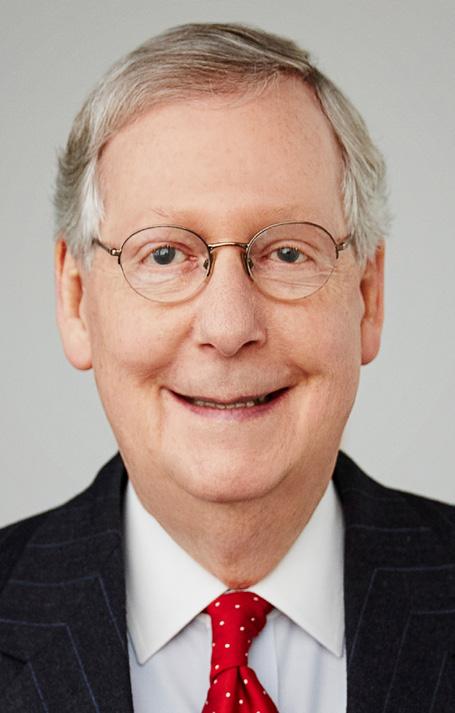
Rumors continue to swirl around the health of Senator Mitch McConnell (R-KY) (pictured below). He was found in his home unconscious on June 14 and details on his condition have been scarce. Politico reported late Tuesday night that Senate Majority Leader John Thune (R-SD) and Majority Whip John Barrasso (R-WY) said they spoke with McConnell, who has reportedly been hospitalized since he was found at home. Aides said the leaders spoke with McConnell for about 20 minutes by phone and that McConnell, 84, was “fully engaged and is eager to get back to the Senate.”
McConnell’s physical and mental acuity has been doubted in the last few years, owing to his increased need for ambulatory assistance, decline in the speed of his speech, and several freezeups during press conferences.
Some, especially those on social media, speculate that McConnell is in a vegetative state or possibly deceased.
Graham Platner (D-ME), who is running for Senate in Maine, has been accused of raping a woman with whom he had an on-and-off relationship nearly five years ago. His accuser, Jenny Racicot, has provided Politico with documents and emails between her therapists, as well as messages she sent to an acquaintance warning against getting involved with Platner.
This adds to the mounting pressures Platner, a progressive oysterman, has faced since he kicked off his Senate campaign in a seat that is considered must-win by both parties. Offensive online comments and past mistreatment of women have already plagued Platner, who is seeking to unseat five-term Senator Susan Collins (R), an institution in Maine politics.
Racicot said that Platner forced himself on her in an “almost blackout drunk” state and that he had no recollection the morning after.
Governor Andy Beshear (D-KY) put out a formal statement on Wednesday requesting McConnell’s office provide an update on his condition.
The longest-served Senate party leader in history was first elected alongside Ronald Reagan (R-CA) in 1984 when Kentucky was still a swing state, and in early 2025, he opted not to run for an eighth term. He would have been up for reelection this November.
Another conspicuous, long-term absence from The Hill is also in the headlines. Congressman Tom Kean, Jr. (R, NJ-07) returned to the House on June 30 after his absence began on March 5. He’s missed more than 100 votes due to what he claims was a case of depression. He said he remained in the hospital during that time to seek treatment.
However, Kean, the son of a wellknown former New Jersey governor, reported personal stock trades during his recess and submitted expenses for staff travel in Las Vegas and personal travel in San Francisco.
He represents a suburban, North Jersey seat that has a slight Republican hue. It’s one of the top competitive House races this fall.
All twelve members of Long Island’s delegation to the State Assembly - 7 Republicans and 5 Democrats - scored a victory for local preservation.
The bill allows Suffolk County to increase its distribution of revenues from the hotel-motel tax to provide support for the Montauk Historical Society, a non-profit that owns and maintains the Montauk Point Lighthouse.
The funding rework will provide the Society with $250,000 for upkeep. The bill is seen as a win by East Hampton residents, who bear the brunt of the County’s hotel-motel tax - about $6.5 million or 33.5% of the total that Suffolk’s ten towns generate.
Under the hotel-motel tax, lodging providers must collect a 5.5% tax on any short-term stay under 30 consecutive days. $6.4 million of the aforementioned $6.5 million contributes to the Town of East Hampton’s total revenue. East Hampton residents and business owners also see the additional funds as a means of sustaining the tourism boon the lighthouse has been for decades. It is the oldest lighthouse in New York and the fourth-oldest active lighthouse in the country. The 110’ 6” structure was commissioned in 1792 by President George Washington and was completed on November 5, 1796.
The lighthouse was taken over by the U.S. Coast Guard in 1946, with the Historical Society leasing the property to maintain it. It was added to the National Register of Historic Places in 1969, and in 1996, the lighthouse was signed over to the Society by President Bill Clinton (D-AR).
Local
Severe thunderstorms battered Suffolk County on the 250th anniversary of the U.S.
The wind gusts blew past expectations, clocking in at 84mph and bringing hail and every rain. PSE&G Long Island said as of Monday evening that crews were still slotted for 16-hour shifts to restore service to almost 50,000 customers between Nassau and Suffolk. Suffolk County Executive Ed Romaine (R-Center Moriches) declared a State of Emergency on July 4. It is in effect for 30 days, citing “torrential rain, damaging winds, flash flooding, widespread power outages, road closures, and significant damage to public and private property” across the County. The emergency declaration authorizes County agencies to “take all necessary actions to protect life, property, and critical infrastructure.”
PSE&G also reports that the weekend storm took down about 400 trees. However, the grid held up to the extreme heat preceding the storm. PSE&G said that less than 2% of their customers were affected Thursday-Sunday.
By Matt Meduri
From Nesconset to Fort Salonga, the Town of Smithtown was red, white, and blue this past weekend for the milestone celebration of the United States’ 250th year of Independence.
Residents were treated to a new fashion of entertainment, a drone light show. Over Callahan’s Beach, attendees got a welcomed alternative to fireworks and were able to catch most of the holiday weekend kickoff show before the heavy wind and rain kicked in.
The drone show was sponsored by Cosentino Companies and featured NY to Boston, one of Long Island’s prominent American classic rock tribute bands. KTU DJ Tommy Nappi also delivered musical stylings. Food was provided by Philly Pretzel Factory and 3 Sons, who debuted their new ice cream truck.
“Rooted in the very history that shaped our Nation, Smithtown carries forward a legacy of patriotism, resilience and deep respect for those who came before us,” said Supervisor Ed Wehrheim (R-Kings Park) in a statement.
“This celebration was more than a weekend of events. It was a tribute to our shared heritage, our enduring values and the people who continue to make Smithtown such an extraordinary community. We are proud to honor our service members, and veterans, our first responders, families and the freedoms that define us as Americans every day.”
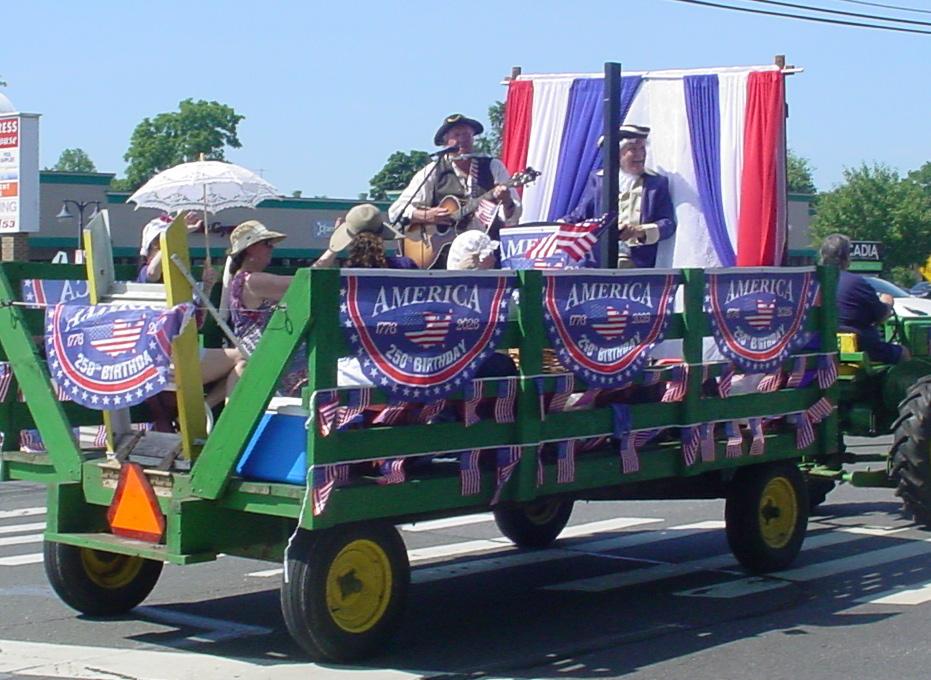
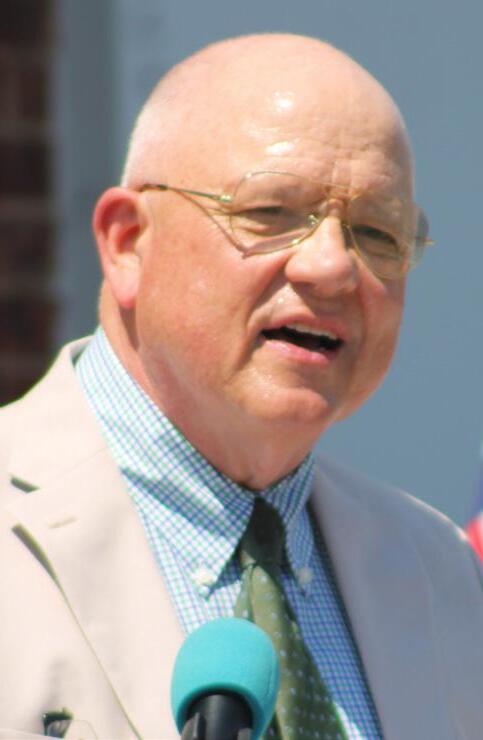
July 4 itself brought a parade that stepped off Singer Lane in Village of the Branch. The convoy, made up of community members and organizations from every hamlet and village in the Town, worked its way up Main Street to Town Hall, where a ceremonial reading of the Declaration of Independence was delivered by Daniel White (pictured below right), a descendant of Richard Smith, the founder of the Town of Smithtown. White is the cousin of Nissequogue Mayor and Town Historian Richard Smith, as well as the great-grandson of Stanford White, the Gilded Age architect who designed New York City’s Washington Square Arch.
Among those recognized was U.S. Marine Corps Sergeant Kevin Carcamo, who marched with the American Legion in Smithtown and Kings Park as he gears up to retire this year from the United States Marine Corps Recruiting Station in Smithtown.
Among other dignitaries was Brad Harris, past President of the Smithtown Historical Society and former Smithtown Town Historian, who was driven by Smithtown Historical Society Trustee Joan Harris.
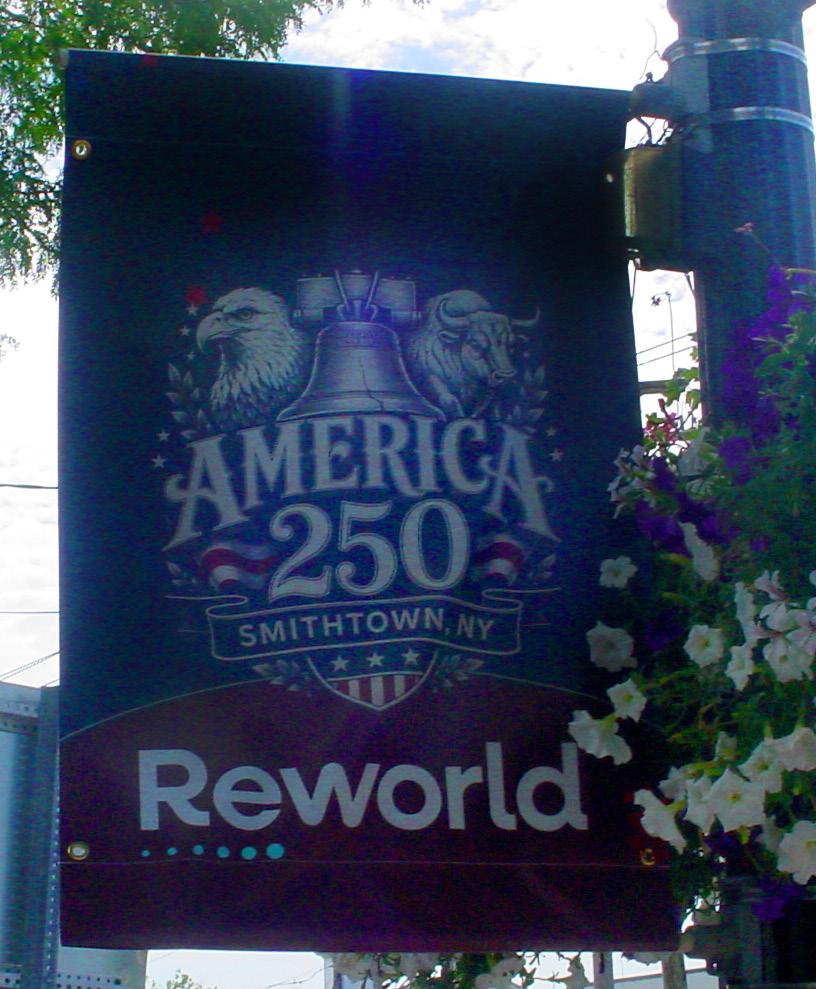
Iterations of the American flag from the Revolutionary Era adorned Main Street and will likely remain up at least for the rest of the month.

The Smithtown Knights of Columbus set up a tent at Town Hall, giving away hot dogs, and cold beverages at the conclusion of the parade as a gift to the community in honor of the celebration.
The program at Town Hall began with a rendition of the National Anthem, performed by Smithtown High School graduate Marilena Castoro, who recently performed the role of Donna in High School West’s Mamma Mia! She is pursuing musical theatre at LIU Post.
It was followed by an invocation from Reverend Dr. Karen Crawford of the First Presbyterian Church of Smithtown, the oldest church in Smithtown with a history spanning approximately 350 years.
Brief remarks were delivered by Supervisor Wehrheim, Suffolk County Legislator Sal Formica (R-Commack), and New York State Senator Mario Mattera (R-St. James).
The ceremony concluded with a symbolic Liberty Bell ringing by Supervisor Wehrheim and Liberty Sponsor, Steve Johnson of Reworld, officially marking Smithtown’s commemoration of 250 years of American independence. The crowd then joined together in singing “God Bless America,” led by Marilena Castoro (pictured left)
At noon, places of worship throughout Smithtown rang their bells in unison as part of a coordinated tribute months in the making. The ringing of the bells symbolized the founding principles of faith, freedom, and the pursuit of happiness, while also reflecting the enduring belief that America’s inalienable rights are inherent to human dignity and come from a higher power.
Smithtown is part of Suffolk 250’s Long Island’s Path to Independence: A Revolutionary Historical Passport, which features historic locations and stories connected to Long Island’s role in the Revolution. The Town has described it as a “tremendous asset for tourism,” and for educating younger generations on the history of the town.
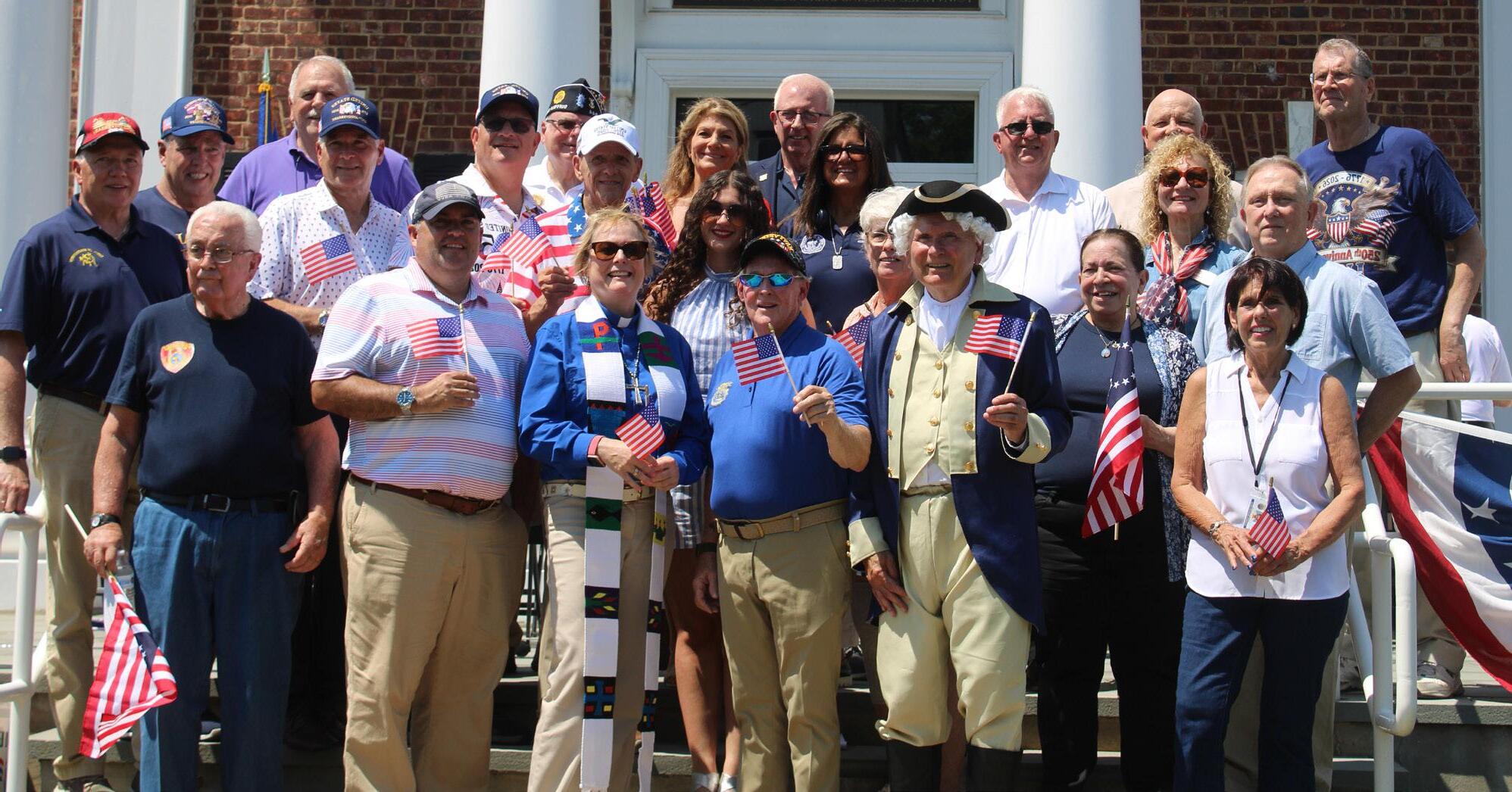
In a press release, the Town thanked a long list of sponsors: the Smithtown America 250 Committee; Cosentino Companies; Reworld and Draper Asset Management; the Crest Group; the Nesconset Chamber of Commerce; Dream Events; the Smithtown Historical Society; the Smithtown Parks Department, led by Joe Arico, with crews led by Tom Heester, Rob Renner, Marcel Caillat and Kenny Brotherton; the Department of Public Safety, led by Chief Thomas Lohmann; Traffic Safety, led by Mitch Crowley and Deputy Frank Esposito; the Municipal Services Facility, led by Matt Laux and Stu Engel; the Town Supervisor’s team, led by Nicole Garguilo and Jen Luikart, for coordinating logistics, planning and communications; MaryEllen McCrossen, Priya Kapoor, and Mayor Richard Smith for their contributions in planning and participating in the parade, historical programming and community engagement; and Suffolk County Executive Ed Romaine (R-Center Moriches), Legislator Formica, Suffolk 250 Assistant Deputy County Executive Kristin MacKay, and Deputy County Executive Sylvia Diaz for their continued support.
By Matt Meduri
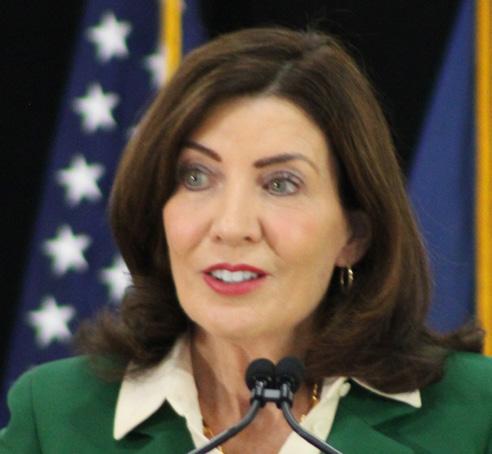
The Siena College released their June poll. It found that Governor Kathy Hochul (D-Hamburg) has increased her 16-point-lead, as per Siena in April, to a 20-pointlead as of June 25.
She leads Nassau County Executive Bruce Blakeman (R-Atlantic Beach) 52%-32% among registered New York State voters. Her favorability rating has improved to 43%-44% (-1), up from 41%-46% (-5) in April. Her job approval also improved - 53%-42% (+11) from 48%-44% (+4).
Blakeman also received some positive momentum as well. His favorability improved to 25%-21% (+4) from 17%-19% (-2) in the spring. It’s his best-ever favorability rating tracked by Siena, but many voters are still unfamiliar with him with just four months to go until Election Day.
Siena College pollster Steven Greenberg said in a press release that 78% of Democrats favor Hochul and 79% of Republicans are backing Blakeman. Independents, however, were leaning for Blakeman +2 in April. Now, they’re leaning towards Hochul +5. Greenberg added that Hochul’s lead on Long Island and the Downstate suburbs is up from +4 to +11 - 49%-38%. Her lead in New York City is “three-to-one,” according to Greenberg, and she and Blakeman are “virtually tied” Upstate.
The Siena College poll found that New York voters approve of the State Legislature. As Albany concluded its 2026 session recently, the Assembly now has a favorability of 42%-31% (+11), up from 33%-36% (-3) in April. The State Senate also saw significant net change, with a favorability rating of 42%-34% (+8), up from 35%-39% (-4) in April.
For the first time this year, within Siena’s research, more voters think the state is on the right track than the wrong track - 44%-41% (+3), up from 38%-48% (-10) in April.
Democratic, Republican, and Independent voters all agree that a one-year moratorium on new permits for large data centers in the state are “good for New York,” as they do on the State budgeting $1 billion to provide a utility rebate check between $100 and $200 for every household earning under $300,000. They also agree that “every child in New York has a right to a public education, regardless of immigration status.” Notably, Republicans think this is good for New York, 42%41%. Independents agree 65%-24%; Democrats, 86%-6%.
Additionally, in the “good for New York” category, 68% of Democrats and 44% of Independents think local, state, or federal law enforcement officers should be prohibited from wearing masks when interacting with the public. Only Republicans, 48%-32%, think this is “bad for New York.”
Republicans are also the only voting bloc who disapprove of increasing property taxes for those who live outside of New York City but own a second
home in the Big Apple valued at least $5 million. Republicans disagree 34%-47%, while Democrats widely agree at 70%-16%, Independents narrowly at 43%-34%.
Interestingly, all voting blocs think the proposed constitutional amendment to allow the Governor and the Legislature to redraw congressional arms - essentially a formal entry into the mid-decade redistricting “arms race” - would be “bad for New York.”
Democrats think so, 38%-26%, Republicans largely, 54%-17%, and Independents largely as well, 47%-14%.
“While these results will make Republican leaders happy, it shows that Democratic leaders have a lot of work to do between now and Election Day 2027 if they want to see this amendment approved by voters,” said Greenberg.
For New York City Mayor Zohran Mamdani (D-Astoria), his statewide favorability rating improved to 45%-34% (+11) up from a paltry +3 in April. For New York City residents, his favorability also improved - 58%-26% (+32), up from April’s +19.
New Yorkers continue to sour on President Donald Trump (R-FL). He has a 32%-63% (-31) favorability rating in the Empire State, little changed from April, and his job approval rating, also virtually unchanged, sits at 34%-65% (-31).
Overall, Republicans largely approve, 78%-21% (+57), while Democrats, 15%85% (-70), and Independents, 29%-68% (-39), largely disapprove. On securing the southern border, New Yorkers overall approve 48%-40% (+8). Republicans approve 86%-7% (+79), as do Independents at 48%-36% (+12). Democrats disapprove, however, at 29%-59% (-30).
On making prices more affordable for “average Americans,” Trump fails in the eyes of 54% of New York voters - 72% of Democrats, 54% of Independents, and only 21% of Republicans. 67% of GOP voters approve of Trump’s handling of the economy.
For “ending wars around the world,” 55% of New Yorkers believe Trump fails on this too - 73% of Democrats, 52% of Independents, and just 22% of Republicans. 68% of Republican voters approve of Trump’s foreign policy in that regard.
On “making Americans proud to be Americans,” 77% of Republicans think Trump has held up his end of the deal here, but 72% of Democrats and 45% of Independents do not.
For the right track-wrong track sense of the nation, voters haven’t been swayed since April - 28%-63% (-35).
Democrats’ lead for the generic congressional ballot in the 2026 midterms is 52%-32% (+20).
The Siena Poll was conducted June 17-23 among 1,120 registered New York Voters. It has a margin of error of +/- 3.6%.
By Matt Meduri
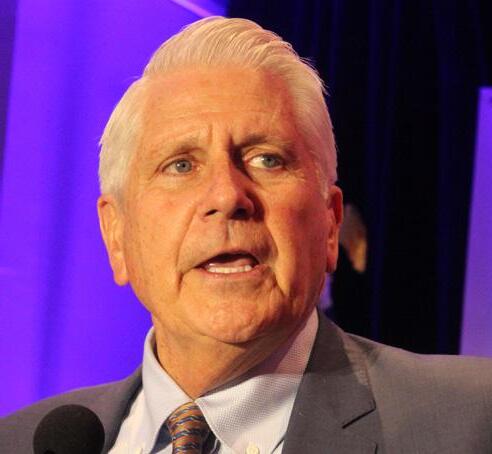
Despite the Siena College’s June poll showing a consolidation of Democratic support for Governor Kathy Hochul (D-Hamburg) and the Democratic-led Legislature, Pollfinity Research, a California-based, independent polling firm founded in March 2026 with a research focus on third-party candidates, has found more troubling numbers for the incumbent.
For context, Pollfinity’s sample size is 229 registered voters with a +/- 6.5% margin of error, compared to Siena’s 1,120 registered voters and a +/- 3.6% margin of error.
Notably, they find that 52% of respondents say it’s “time for new leadership,” compared to 38% who find that Hochul “deserves re-election.”
Those same respondents disapprove of Hochul’s job performance - 46%51% (-5) - and believe the state is on the wrong track - 42%-46% (-4), with 12% responding “not sure.”
Hochul leads Nassau County Executive Bruce Blakeman (R-Atlantic Beach) 50%-40% (+10) in a head-to-head matchup, with 10% undecided.
Of the total sample, 44% were Democrats, compared to 21% made up of Republicans, and 31% of unaffiliated and minor-party voters. Among Democrats,
Hochul leads 78%-8%, while Blakeman leads Republican voters 96%-2%. Hochul leads among undecided and Independent voters 37%-27% (+10), but 27% remain undecided.
“The scale of Blakeman’s advantage among Republicans (+94 net) reflects consolidation typical of an incumbent-challenger contest at this stage of the cycle,” according to Pollfinity. “The question heading into 2026 is whether Hochul can hold her margins among unaffiliated voters — who make up nearly a third of the electorate — against a well-funded Nassau County Executive with suburban name recognition.”
Pollfinity also finds that Hochul leads 53%-32% (+21) in New York City, 52%-37% (+15) on Long Island, but Blakeman leads 45-44% (+1) Upstate, which Pollfinity calls a “notable vulnerability for the incumbent [Hochul] if turnout patterns shift from 2022.”
Respondents also cited Cost of Living and Inflation (28%) as their top issue, followed by Taxes (13%), and Crime and Public Safety (10%). Government Spending (7%) and Immigration (6%) rounded out the middle of the list, while Education (2%) sat at the bottom of the list.
By Matt Meduri
The Stump Pond Dam in Blydenburgh County Park has been one of the most salient topics in Smithtown since the dam broke almost two years ago.
Historic levels of rain washed the dam away and rapidly emptied the beloved Stump Pond.
Since then, a fierce debate has ensued, with many calling for the reconstruction of the dam to restore a local gem, while others have insisted that the Nissequogue River run free and that nature takes its course.
In April, the Suffolk County Council of Environmental Quality (CEQ) found that restoring the dam and the pond would not have a negative environmental impact.
Suffolk County Legislator Leslie Kennedy (R-Nesconset) and Senator Mario Mattera (R-St. James), who both represent the district that includes Blydenburgh Park, and Suffolk County Executive Ed Romaine (R-Center Moriches) have made it a priority to rebuild the dam.
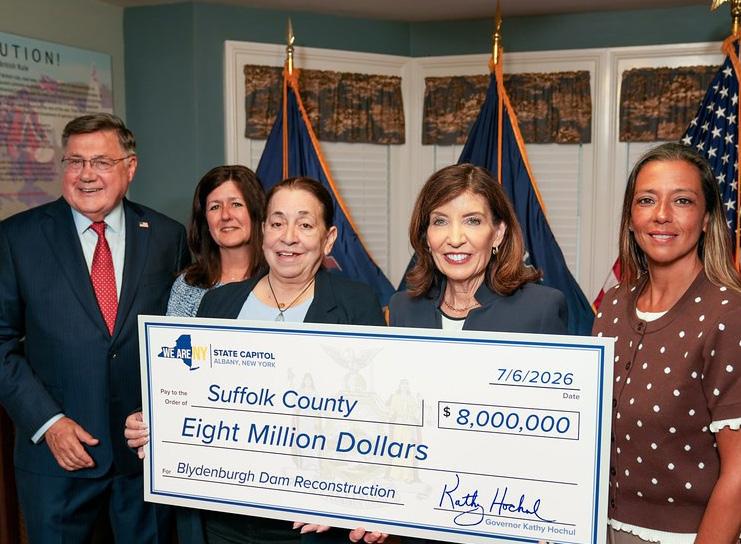
On Monday, Governor Kathy Hochul (D-Hamburg) visited Smithtown to present an $8 million check, courtesy of New York State’s Capital Budget that also funds the Asharoken sea wall and Harbor Road - the latter being a connection point between Stony Brook and Head of the Harbor that was also washed away in the August 2024 storm, along with the beloved Mill Pond Dam.
natural state and protect our wildlife and the environment. That will allow every resident to enjoy the beauty of the area that makes Blydenburgh Park such a beloved place for so many. This project will bolster the resilience of this natural jewel, buffering the impact of future storms to protect our families. The future is indeed bright for this area and those who love Stump Pond.”
Suffolk County Comptroller John Kennedy (R-Nesconset) said that through the efforts of County Planning Director Lee Koppelman, the park will be “restored to its natural, historic presence.”
“The dam will be rebuilt, better, stronger, and history will be preserved,” Kennedy told The Messenger
The decision to move forward with rebuilding the dam was a tough one for Legislator Leslie Kennedy, a self-described “environmental purist” who led the way for the dam to be rebuilt, citing modern suburban sprawl, primarily, as no place for a “river to run free.”
“Stump Pond Dam was constructed in 1798, making it almost as old as the country itself. In a year when we celebrate our country’s 250th year of independence, it’s important to remember and preserve our history,” said Kennedy in a statement. “I would be remiss to not thank the Forestwood Civic Association, the Smithtown Fire Department, the various fishing groups, the residents of Smithtown, and even the Order Sons and Daughters of Italy for all of the phone calls, emails, and letters of support they’ve written these past two years.”
“Thank you to all the residents that kept up the pressure and spoke in favor of rebuilding the dam,” said Executive Romaine in a statement. “This has truly been a community led process, and this grant from New York State shows just how impactful your voices have been.”
Romaine, Hochul, and Kennedy were joined by Senator Monica Martinez (D-Brentwood) at Caleb Smith State Park for the check presentation.
“This State funding is the culmination of the work of leaders on every level of government, under the leadership of Executive Romaine, and the tireless advocacy of local residents, led by Forestwood Civic Association President Bob Sikora, who treasure this wonderful part of our area,” Mattera told The Messenger. “The historic storms of August 2024 had such a devastating impact on our area and this funding will allow the County to restore this area to its
The $8 million will specifically be used for construction of a new spillway and fish ladder, as well as reinforcement of the earthen dam, according to a spokesperson for Executive Romaine.
“The $8 million means the construction is now fully-funded and can proceed after the Final Design Phase is completed and all permits are obtained,” the spokesperson told The Messenger. “Our environmental review and preliminary design [phases] are completed.”
After New York State Department of Environmental Conservation (DEC) “substantially completes” their “permitting review,” according to the County Executive’s spokesperson, Suffolk County will “incorporate any comments and proceed with the Final Design to create a set of plans that can be used to bid the construction phase of the project.”




Recognized among the nation’s best with a CMS 5-Star rating and an “A” grade from The Leapfrog Hospital Safety Group.
At St. Catherine of Siena Hospital, our commitment has always been clear: putting patients first in everything we do. That means expanded surgical technologies for improved patient outcomes, award-winning St. Francis Heart Center cardiac care, a dedicated high-tech spine center, and an enhanced emergency room— ensuring our community has access to the care they deserve. Because purpose-driven care leads to better outcomes.

Learn more at chsli.org/ st-catherine-siena-hospital
By Matt Meduri
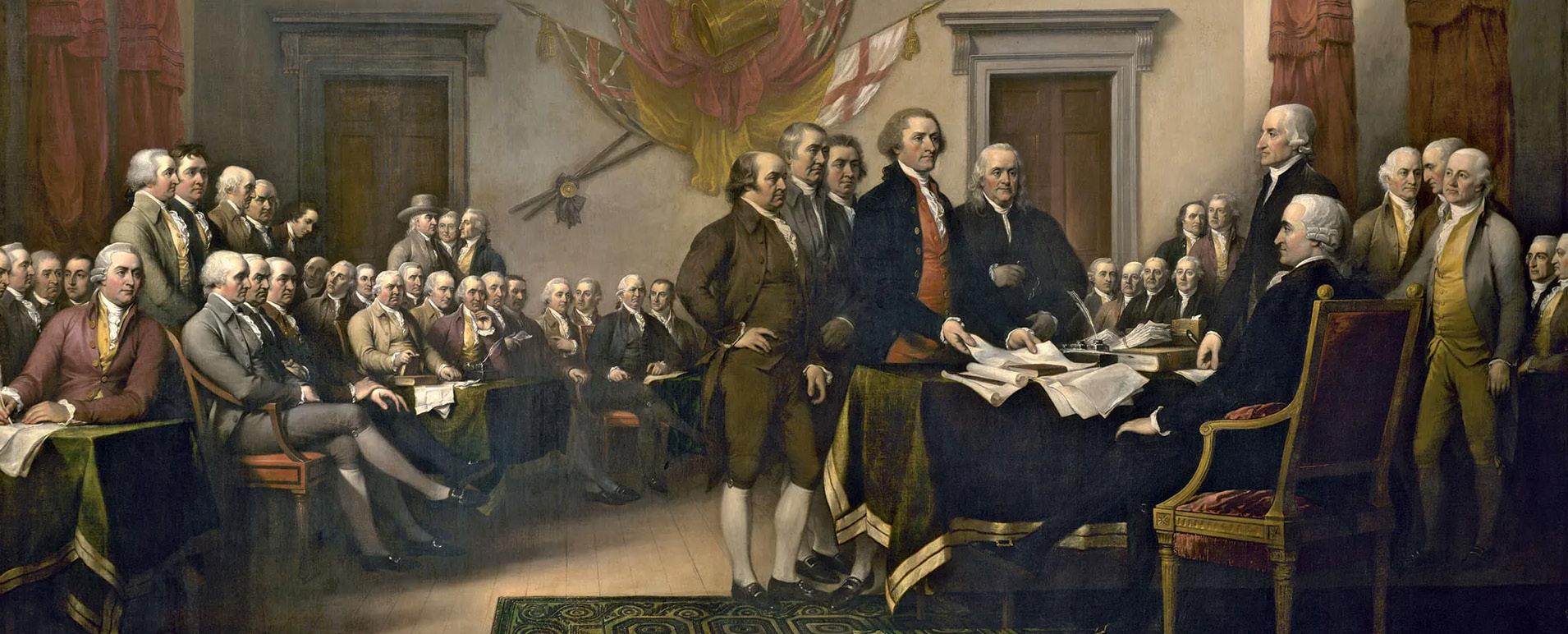
To coincide with the celebrations of the 250th anniversary of the U.S., we take an in-depth look at the document that made it possible: the Declaration of Independence.
A Political Fight in a Fledgling Nation
“1774 saw the people at large for the first time recognize that the cause of Boston was a common cause.” - The opening words of The Declaration of Independence: Its History, John Hazelton, 1906.
Relations had withered between the Thirteen Colonies and Great Britain for decades at this point. The British Parliament had continued to levy taxes against the colonies without any representation in Parliament. While the highly abridged version of early American history assumes that each of the colonies were opposed to the Crown unilaterally, there was much more nuance than met the eye. Essentially, the taxation came down to disputes of the British Constitution regarding Parliament’s authority in the New World.
At odds also were the British Constitution’s recognition that people are endowed with certain fundamental rights unimpeachable by the government, and the view that arose after King James II was deposed in 1688 that Parliament had supreme authority across the empire - then covering about one-quarter of the Earth’s landmass.
When Parliament passed the Coercive Acts, also known as the Intolerable Acts, in 1774 as a penalty for the Boston Tea Party and other uprisings, faith in the British government began to fade among colonists who had hoped for reconciliation. Sentiment for independence was growing quickly but silently, as public declaration of independence was treason punishable by death under the British monarchy.
Meanwhile, pro-Colonies members of Parliament in Britain had warned the hegemony that the punitive measures were only stoking the fire of independence.
Some Colonies had forbidden delegates to the Second Continental Congress from proposing an independence declaration, complicated by the fact that Congress had limited authority at the time. A majority of delegations would need to vote for independence to enact it and at least one colonial government would need to instruct its delegation to propose a declaration to Congress.
Revolution historian Pauline Maier posits that more than 90 declarations were issued throughout the Colonies in the months preceding the formal signing, as support for independence began to grow. On April 12, 1776, North Carolina authorized the Halifax Resolves, the first official action of independence taken by any of the original Colonies. On May 4, Rhode Island became the first colony to formally renounce its allegiance to Great Britain.
Congress then appointed a committee to draft a preamble to the declaration, which was written by John Adams, of Massachusetts, primarily to encourage colonies whose delegates resisted the independence movement. Pennsylvania was one of the most reserved colonies at the time, as its wealthy and conservative leadership feared independence from Britain would spark war, debt, and an abdication of foreign aid and legal protections.
The final push came in the final weeks of June 1776. Connecticut instructed its delegates to propose independence, followed by New Hampshire and Delaware. Political turnover in Pennsylvania saw the colony finally authorize independence and the overthrow of William Franklin, the then-Governor of New Jersey, led to enough delegates being sent to Congress to formally pen a declaration.
Maryland was the penultimate state to be convinced, leaving New York last. However, the colony’s Provincial Congress evacuated due to encroaching British forces, leaving New York’s delegates unauthorized to declare independence until after Congress made its decision.
These five delegates were appointed on June 11, 1776, to draft the declaration. Chosen were John Adams, of Massachusetts, Benjamin Franklin, of Pennsylvania, Thomas Jefferson, of Virginia, Robert Livingston, of New York, and Roger Sherman, of Connecticut. No minutes were taken by this committee; exact accounts cited are those written years later by Adams and Jefferson.
Famously, the committee, including Jefferson, thought
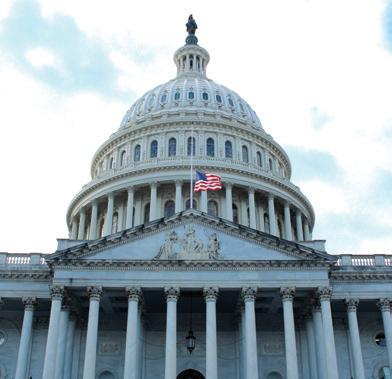
This column will seek to address the long-forgotten concept of civics and how it relates to American government in general, from the federal level to the local level. This column will explore Constitutional rights, the inner workings of government, the electoral process, and the obligations and privileges of citizens.
Adams should write the document, but Adams urged the committee to choose Jefferson, who wrote the Declaration of Independence mostly in isolation between June 11 and 28, 1776, from his second-floor home in Philadelphia. The site is now called the Declaration House and is within walking distance of Independence Hall.
On July 2, after much deliberation, twelve colonies voted in favor of severing ties with Britain. New York was the only abstention. A needed tie-breaking vote in the Delaware delegation was broken by the timely arrival of Caesar Rodney.
Despite the celebration of independence on July 4, that date is when the final working was approved and sent to the printer for publication. Its formal adoption date is July 2, which John Adams believed would be the date of recognition.
The Text
“We hold these truths to be self-evident, that all men are created equal, that they are endowed by their Creator with certain unalienable Rights, that among these are LIfe, Liberty, and the pursuit of Happiness…” reads the famous preamble.
This summarizes the philosophy of the nation and justifies revolution when government encroaches on natural human rights - “That whenever any Form of Government becomes destructive of these ends, it is the Right of the People to alter or to abolish it, and to institute a new Government…it is their right, it is their duty, to throw off such Government, and to provide new Guards for their future security.”
The declaration then lays out multiple grievances that rationalize the push for independence. They cited the King’s refusal of upholding basic laws, dictating which laws are passed and when in the colonies, and called him a “tyrant” regarding his refusal to grant land accommodations unless those colonists would relinquish their rights of representation in the Legislature.
“He has called together legislative bodies at places unusual, uncomfortable, and distant from the depository of their Public Records, for the sole purpose of fatiguing them into compliance with his measures…He has dissolved Representative Houses repeatedly, for opposing with manly firmness his invasions on the rights of the people…”
Quartering soldiers in the colonies, protecting the soldiers during trial, imposing taxes without consent, cutting off trade with the rest of the world, and ordering colonists’ presence in the motherland to be tried for “pretended offences” were also some of the many grievances outlined.
In the document, Jefferson also outlines the various warnings given to the British: “We have warned them from time to time of attempts by their legislature to extend an unwarrantable jurisdiction over us. We have reminded them of the circumstances of our emigration and settlement here.”
The penultimate section of the document is the denunciation, the formal decree of separation from the British Crown.
“...We, therefore, the Representatives of the united States of America…solemnly publish and declare, That these United Colonies are…Free and Independent States; that they are Absolved from all Allegiance to the British Crown, and that all political connection between them and the State of Great Britain…be totally dissolved; and that as Free and Independent States, they have full Power to levy War, conclude Peace, contract Alliances, establish Commerce, and to do all other Acts and Things which Independent States may
of right do…with a firm reliance on the protection of divine Providence, we mutually pledge to each other our Lives, our Fortunes and our sacred Honor.”
This is the concluding paragraph of the document. The signatures of the Declaration affirm that each signer is upholding these conditions, assertions, and motives.
The first and most elaborate signature on the parchment was that of John Hancock, President of the Continental Congress. Two signers, Jefferson and Adams, would become future presidents, and Benjamin Harrison V, another signer, would have a son, William Henry Harrison, and a greatgrandson, Benjamin Harrison (R-IN), serve as future presidents. Edward Rutledge, 26, was the youngest signer, and Benjamin Franklin, 70, was the oldest. In total, 56 signatures were added to the bottom of the document. Charles Carroll of Carrollton was the last surviving and longest-lived of the signers. He died in 1832 at the age of 95, over 56 years after the Declaration’s passage.
Since New York could not participate, their four delegates added their signatures to the bottom on July 9. One of those delegates, William Floyd, was the first representative for NY-01, the district now held by Congressman Nick LaLota (R-Amityville).
Below are each of the signers ordered by their states’ formal admission to the Union post-Revolution:
Delaware (December 7, 1787): George Read, Caesar Rodney, Thomas McKean
Pennsylvania (December 12, 1787): Robert Morris, Benjamin Rush, Benjamin Franklin, John Morton, George Clymer, James Smith, George Taylor, James Wilson, George Ross
New Jersey (December 18, 1787): Richard Stockton, John Witherspoon, Francis Hopkinson, John Hart, Abraham Clark
Georgia (January 2, 1788): Button Gwinnett, Lyman Hall, George Walton
Connecticut (January 9, 1788): Roger Sherman, Samuel Huntington, William Williams, Oliver Wolcott
Massachusetts (February 6, 1788): Samuel Adams, John Adams, John Hancock, Robert Treat Paine, Elbridge Gerry
Maryland (April 28, 1788): Samuel Chase, William Paca, Thomas Stone, Charles Carroll of Carrollton
South Carolina (May 23, 1788): Edward Rutledge, Thomas Heyward, Jr., Thomas Lynch, Jr., Arthur Middletone
New Hampshire (June 21, 1788): Josiah Bartlett, William Whipple, Matthew Thornton
Virginia (June 25, 1788): George Wythe, Richard Henry Lee, Thomas Jefferson, Benjamin Harrison, Thomas Nelson, Jr., Francis Lightfoot Lee, Carter Braxton
New York (July 26, 1788): William Floyd, Philip Livingston, Francis Lewis, Lewis Morris
North Carolina (November 21, 1789): William Hooper, Joseph Hewes, John Penn
Rhode Island (May 29, 1790): Stephen Hopkins, William Ellery
On the Declaration’s reverse, the date - July 4, 1776 - is written along the edge on the back.
The Declaration of Independence is permanently displayed in the Rotunda for the Charters of Freedom at the National Archives Museum in Washington, D.C.
Thursday, July 9, 2026
By Senator Mario Mattera
As the fireworks fade and another Independence Day celebration comes to a close, it is worth taking a moment to reflect on what this holiday truly means and why, 250 years after the birth of our nation, it continues to resonate so deeply with Americans from every walk of life.
Over the weekend, families gathered in backyards, communities came together at parades and celebrations, and countless Americans paused to honor the enduring promise of our country. While we celebrated in different ways, we were all connected by something larger than ourselves, a shared appreciation for the freedoms we enjoy and the sacrifices that made them possible.
The story of America has never been one of perfection. Rather, it is the story of a people determined to strive toward a more perfect union. It is a story marked by extraordinary achievements, difficult challenges, and generations of citizens who believed that our nation was worth building, improving, and preserving for those who would come after them.
As we continue to commemorate America’s 250th anniversary, I find myself reflecting not only on the courage of our Founding Fathers, but also on the countless men and women throughout
our history who answered the call to serve their communities, defend our freedoms, raise their families with strong values, and contribute to the fabric of this great nation.
Their contributions remind us that America’s strength has never rested solely in its institutions or its accomplishments. It rests in its peoplein their resilience, character, optimism, and belief that each generation has a responsibility to leave the country stronger than they found it.
In a time when it is often easier to focus on our differences, Independence Day serves as an important reminder of what unites us. Regardless of background, politics, or circumstance, we share the blessings of liberty and the responsibility of preserving them. The freedoms we sometimes take for granted were hard-won and remain worthy of our gratitude and protection.
I am especially grateful to represent the hardworking people of Long Island, whose commitment to family, community, and country reflects the very values that have sustained America for two and a half centuries.
As we look ahead, let us carry the spirit of Independence Day beyond a single weekend. Let us recommit
ourselves to civic engagement, mutual respect, and a renewed appreciation for the opportunities we enjoy as Americans. The story of our nation is still being written, and each of us has a role to play in shaping its next chapter.
May God continue to bless the United States of America, those who serve and protect our freedoms, and the generations of Americans who will carry our nation’s promise forward.
Senator Mario Mattera (R-St. James) has represented the Second District in the New York State Senate since 2021. The Second District contains the entire Townships of Huntington and Smithtown.
Senator Mattera serves as Ranking Member on the Corporations, Authorities, and Commissions Committee and on the Energy and Telecommunications Committee. He also serves on the committees on Cannabis; Civil Service and Pensions; Labor; and Transportation. The Second District office is located at 180 East Main Street, Suite 210, in Smithtown and can be reached at 631-361-2154.
Meet the Smithtown Animal Shelter’s Pet of the Week, McLovin!
Small bird. Big opinions. Endless personality.
Meet McLovin, a young Blue/Grey Quaker (Monk) Parrot who’s ready to rule your home—one chirp, whistle, and happy dance at a time!
McLovin was found as a stray and, sadly, was never claimed. Like most Quaker parrots, he’s equal parts sweet and spicy. He enjoys spending time with people and is comfortable being handled, but don’t be surprised if he gets a little protective of his favorite treats and toys. A guy’s got to have his treasures! Healthy, vocal, and full of charm, McLovin is looking for a bird-savvy family that can offer him a roomy cage, plenty of enrichment, delicious treats, and lots of love. In return, he’ll provide endless entertainment, funny antics, and enough personality to fill the whole house.
If you’re ready to add a feathered comedian to your family, McLovin is ready to meet you. Could you be the forever flock he’s been waiting for?
*The Smithtown Animal Shelter is set up to accommodate Dogs and Cats exclusively. Only one exotic pet is able to be assisted at a time.
Additional Foster Opportunity
If you have no other pets or young children at home and are looking for a way to serve your community, please consider signing up to be a foster. Foster parents provide temporary care for cats, kittens, and dogs in their own
homes. Some animals need as little as two weeks of care, while others may need care for extended periods of time.

Download the Foster Application at: https://www.smithtownny.gov/ DocumentCenter/View/4325/FosterApplication
The Smithtown Animal Shelter’s primary concern is finding the perfect home for each animal that finds his/her way to us. The Animal Control Officers and Kennel Attendants at the Smithtown Animal Shelter will go out of their way to ensure both the rescued and rescuer are made for one another.
Residents who have other pets can arrange to bring your four-legged family member to the shelter or set up an at home meet-andgreet to see how your prospective family member does with other family, pets and the household itself. Please allow yourself an hour minimum to meet with your potential new family member.
Hours at the Smithtown Animal Shelter are currently Monday through Saturday, 10:00a.m. to 3:00p.m. (Sundays and Wednesday evenings: by appointment only).
Thursday, July 9, 2026
By Ellyn Okvist, B.Sc.
Although not very common, Lake Ronkonkoma has had its share of airplane crashes.
Community reactions to plane crashes from 1900 to 1945 varied significantly based on the context and scale of the incidents. The media played a crucial role in shaping public perception using sensational reporting that could easily amplify fear and anxiety about air travel. Detailed accounts of crashes often led to calls for improved safety regulations. Following major accidents, there were often public outcries for stricter regulations and oversight in aviation.
This was particularly evident after high-profile crashes that highlighted safety deficiencies. Community support initiatives and local communities frequently rallied to support the families of victims, organizing fundraisers and providing assistance to those affected. Communities often held memorial services for victims, reflecting a deep sense of loss. This solidarity helped to foster a sense of community resilience in the face of tragedy. Crashes after 1945 became well-tooled, and quick response and investigations gave an instant response when possible.
On August 21, 1932, Arthur W. Skidmore, 20, of East Islip, escaped with only minor injuries on Sunday afternoon when his plane fell 2,000 feet, landing on the woods off Sixth Street. The plane was a two-seater open cockpit Travelair and was badly damaged. He had taken off at Brentwood Airport and was flying over his employer, Patch Lumberyard, at 2,000 feet altitude. The control stick jammed and he could not continue climbing position. All controls failed and the plane fell from the sky. The plane hit trees and crashed on its back. Skidmore was able to pull himself up in the cockpit. He crawled out unaided and found a telephone and called for help. A doctor treated him for a laceration of the forearm and a bruised knee cap. The plane’s motor and fuselage could be used again.
A small plane crashed in the 1940s on the corner of Gatelot Avenue and Pine Street. We do know that
the plane went down and was partially suspended in the trees. The pilot was killed, and the body was removed following an investigation as to cause. The local children gathered to get a closer look on their way to the Lake Ronkonkoma School just a block away. Unfortunately, my paperwork on this story is out at the summer house but will be available for anyone caring to do further research on the crash.
On September 3, 1943, a former Navy flier Alfred J. Hogan, a Republic Aviation Co. test pilot, was killed instantly when his P-47 Thunderbolt crashed into the grounds of a Ronkonkoma school. The 24-year-old Hogan left Republic at 10:00a.m. on a routine flight. His plane appeared to be in trouble at 1,000 feet in the air, residents stated. It appeared Hogan was attempting to crash land at MacArthur Airport. He had received an honorable discharge from the Navy, holding the rank of Lieutenant Junior Grade, and had started work for Republic on June 25, 1943.
April 4, 1955, saw the first major aircraft accident in the history of MacArthur Field which took the lives of three Veteran United Airlines pilots who died in the flaming wreckage of a four-engined Douglas Skymaster during a routine qualification flight.
The airplane had just been cleared for takeoff by the municipal airport tower and made a 2,200 feet northwesterly run and was 75 to 100 feet in the air when it abruptly veered to the right and nosed into the ground. It immediately broke into flames at impact. Three seasoned pilots, Captain Henry M. Doader, 40, Captain Stanley C. Hoyt, 45, Vernis H. (Pete) Webb, 35, were killed instantly. Fire apparatus from the airport raced to the scene, and they were shortly joined by Lakeland Fire Department. Holbrook Fire Department was added to quell the fire, which was beyond local capabilities.
In order to keep back onlookers, the Islip Town Police sent five police cars, and the State Troopers and the Civil Defense Auxiliary joined them. There was a handful of
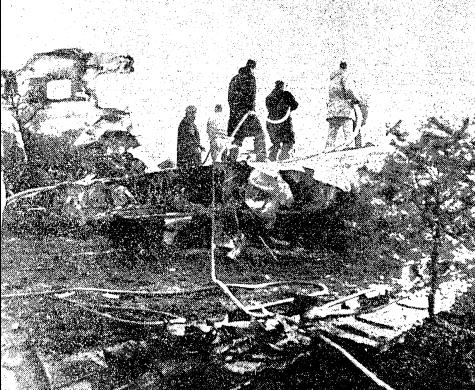
April 4, 1955
eyewitnesses to the crash besides the men on duty in the control tower. Days later, the Civil Aeronautics Board began their investigation. The crash opened up serious thought as to the capabilities of the local fire departments, and possibly extra internal equipment to help in the future.
The construction of the Long Island Expressway was highly anticipated, and we watched the daily progress. On August 23, 1966, Air Force Captain Robert T. Shaw, 32, his wife Joan, 28, and their four children Debbie, 8, Christine, 7, Jeffrey, 5 and James, 3, of Sherwood, Arkansas, were killed as Captain Shaw attempted to return to MacArthur Airport less than 30 minutes after taking off in a severe lighting and thunderstorm. His signal of MAYDAY was clearly heard, but “the plane fell from the sky like a rock.” Captain Shaw had determined midflight that weather conditions were too severe to continue the trip to Arkansas. Mrs. Lewis Davis, an eyewitness to the crash, stated, “I heard a roar that didn’t sound like thunder. I ran outside and I saw the airplane gliding down in a northeast direction with the motors off, turning around and around. Joseph Sanguedolce, who worked at the Ronkonkoma Lumberyard, said he heard a loud clap of thunder and a flash of lighting and then saw pieces of the plane falling. The plane crashed 600 yards from several residences, and only a few hundred yards from a tank of diesel fuel. Wreckage stretched for miles across the yet unfinished LIE.
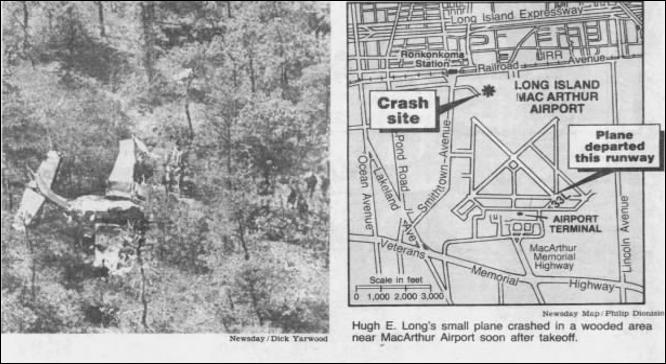
A Dix Hills pilot was killed in a plane crash on April 4, 1985. Hugh E. Long, 45, was the sole person aboard the Cessna 310 twin engine aircraft and was on his way to Florida to join his family for Easter vacation. Witnesses state the airplane seemed to have lost power in the right engine and hit the ground from several hundred feet. It crashed in the woods, and the wreckage was found less than one-half mile south of Railroad Avenue. Hugh Long was an experienced pilot but had limited flying time in the Cessna. Ellis Schubert, an expert with Cessna planes stated, “that if you lose an engine on takeoff, the torque just takes you right into the ground. There was probably not much he could have done.” Schubert co-owned a single-engine aircraft with Long. He had not filed a flight plan with the Federal Aviation Administration at the airport. Colleagues and friends said that Mr. Long was very well liked and they had much respect for him.

By Mollie Barnett
As fireworks mark another Independence Day, business owners should ask a practical question:
What does independence mean in the age of Artificial Intelligence?
For mid-sized companies, the answer won’t be found in another software subscription. It won’t come from a packaged “AI solution” that promises speed, savings, and simplicity in the same polished demo.
Real independence will come from control - control over data, cost, workflows, and the judgment that makes a company valuable in the first place.
That lesson isn’t theoretical.
Even the largest AI companies are trying to reduce their own dependencies. OpenAI has moved toward custom inference chips. Nvidia is building specialized infrastructure to reduce the cost of inference. The biggest players in the AI economy understand something every business should understand: relying too heavily on a small number of outside systems creates risk.
If that’s true for the companies building the AI economy, it’s certainly true for the companies trying to survive inside it.
For many businesses, the first wave of AI has been treated like a shopping problem.
Which tool should we buy? Which model is best? Which platform can we plug into marketing, sales, service, finance, or operations?
Those are useful questions. They’re just not the first questions
The better question is this: where does the business need more agency?
AI isn’t a technology shift. It’s an agency shift.
That distinction matters because “AI in a box” often creates the opposite of agency.
A prepackaged tool can produce a quick gain. It can also impose someone else’s workflow on your company. It can move sensitive data outside your control. It can add another recurring cost. It can make the business faster in the short term while making it more dependent in the long term.
The risk is subtle because the first results can look impressive
A tool writes a first draft. It summarizes a meeting. It generates a report. It produces a customer email. The work moves faster.
Then the limits appear.
The system doesn’t understand the customer history. It doesn’t know which exception matters and which one doesn’t. It doesn’t know why one account needs a phone call instead of an email. It doesn’t understand the unwritten judgment that experienced people use every day to protect relationships, margin, reputation, and trust.
That’s where AI efforts often begin to fail, not because the technology is weak, but because the implementation starts in the wrong place.
Companies shouldn’t start with the tool. A practical path looks like this: goal, workflow, test, scale, sovereignty.
Start with a clear goal. Not “we need AI.” That’s pressure, not strategy.
A real goal sounds more specific: faster and better proposals, better insight from customer data the company already has, less repetitive work for senior employees, or more consistent answers for staff who are wasting time hunting through documents, emails, and old reports.
Then map the workflow. Who touches the work? Where does it slow down? Where does judgment enter? What information is missing? What part is repetitive, and what part should remain human?
This step is often skipped because it’s less exciting than a demo. It’s also the step that determines whether AI becomes useful or expensive.
Once the workflow is clear, test across models.
No single model should be treated as a permanent answer. Different systems have different strengths. Some are better for writing. Some are better for reasoning. Some are better for long documents. Some are faster, cheaper, or more appropriate for private environments.
The goal isn’t loyalty to one tool. The goal is intelligent routing.
That means deciding what each system should do, where the human stays in the loop, and how the output is checked before it enters the business. It also means recognizing that some work should not be automated at all.
After testing, scale only what proves valuable.
A successful pilot isn’t enough. The system has to work inside the daily reality of the business. It has to improve quality, reduce friction, and earn trust from the people expected to use it.
Then a company can begin moving toward sovereignty.
Independence, Sovereignty, and Frontier AI
Sovereignty doesn’t mean rejecting every frontier AI model or refusing all outside platforms. For most businesses, that would be impractical.
Some work may still belong in outside systems. A frontier model may be the right tool for a complex research task, a high-stakes analysis, or work that requires capabilities a private system can’t yet match.
There is nothing independent about refusing a useful tool simply because someone else built it. The point is to stop being dependent by default.
Repeatable, high-volume, sensitive, or deeply company-specific work should not automatically remain inside a rented tool forever.
The issue isn’t only which AI tool a company uses. It’s the tax that comes with using it.
Every prompt, every query, every automated workflow, every embedded AI feature carries a cost. Sometimes, that cost is obvious. Sometimes, it’s hidden inside a subscription, a platform fee, a usage limit, or a vendor relationship that becomes harder to unwind over time.
Let’s call it the token tax.
At first, it may look small - a few cents here, few dollars there, a team subscription, a premium feature, a usage-based bill that feels manageable because the early use cases are light.
Then AI moves from experiment to operations.
A proposal process runs through it, customer service runs through it, internal search runs through it, reporting runs through it, sales enablement runs through it, knowledge management runs through it.
The tax compounds. That doesn’t mean outside AI systems are bad. It means leaders need to understand when they’re paying for access and when they’re building capability.
A company can use a tool without becoming dependent on the tool. It can pay the tax when the value justifies it. But once a workflow becomes central to the business, leaders should ask a harder question: should this stay rented, or should more of it move into infrastructure the company controls?
This is where real independence begins. The point is not to own everything. The point is to stop paying permanent rent on work that has become central to the business.
That includes cost. Usage-based pricing can look manageable at the beginning and become painful as workflows scale. It includes data. Information sent into outside systems may create privacy, compliance, or competitive concerns. It includes process. A company that shapes itself around a vendor’s workflow may gain speed while losing flexibility.
Most of all, it includes judgment.
Too much AI conversation treats people as the inefficiency to be removed. That is a dangerous assumption. In many businesses, people are where the judgment lives. They know the customer. They know the exception. They know when a fast answer is the wrong answer. They remember what happened last time.
The goal should not be to remove the human part of the business. The goal should be to protect it.
Automate the drudgery.
Remove repetitive tasks that burn people out and slow the company down. Use AI to draft, sort, summarize, search, compare, and surface patterns. Give people better tools and better information.
But don’t confuse busy work with human work.
Systems are built by people, for people. When they stop serving the humans inside them, they break.
That’s why the next phase of AI will require more than enthusiasm. It will require disciplinenot just governance as a document, discipline as a way of building.
Testing. Evaluation. Design. Clear decisions about what to automate, what to protect, and what to build under the company’s own control.
This Independence Day, a business doesn’t need to declare freedom from AI. It needs to declare freedom from dependency.
How should a business get ready for AI sovereignty as the shift moves from tools to infrastructure?
Start with what’s already happening. Audit the tools already in use. Review the recurring costs. Identify where data is going. Look for workflows where employees are already using AI informally. Then choose one high-value process and test it properly across more than one model.
Decide where human review belongs. Decide what success means. Then build the first version with care.
The companies that thrive in the next few years won’t necessarily be the ones with the most AI subscriptions. They’ll be the ones that understand the difference between using a tool and becoming dependent on it.
They’ll pay the token tax when it makes sense. They’ll build their own capability when the work becomes too important to rent forever. They won’t simply buy intelligence from the market. They’ll design systems that reflect their own knowledge, their own judgment, and their own way of serving customers.
That’s what AI independence looks like.
Not rejecting the future, refusing to rent the parts of it your business needs to own.
By Joe Cuminale
On June 28, the Lt. Michael P. Murphy Navy SEAL Museum in West Sayville held a special dedication of a new outdoor display of an HH-60G Pave Hawk Helicopter.
June 28 was also the twenty-first anniversary of Operation Redwing the Mission that cost Michael his life to protect his team, a heroic act for which he was awarded the Congressional Medal of Honor.
The HH-60G Pave Hawk helicopter is now a permanent part of the museum’s outdoor displays. The event was attended by Congressman Nick LaLota (R-Amityville), Suffolk County Legislator Nick Caracappa (C-Selden), and Brookhaven Town Supervisor Dan Panico (R-Center Moriches), along with many of the neighbors of the museum. Rolling Thunder Chapter NY6 led a
motorcycle procession onto the grounds of the museum to honor the lives of those that lost their lives on that Mission twenty-one years ago.
Michael’s father, Dan Murphy, said a few words about his son and two teams finally prepared to unveil the memorial plaques on either side of the walkway leading to the helicopter. Dan Murphy then invited all in attendance to tour the museum. It was great to see many families with young children of all ages learning, not only Michael’s story, but also the history of the United States Navy SEALS.
Thank you to Dan Murphy for always letting me know about major events taking place at the museum. Thank You to the entire staff for always making me feel welcome.

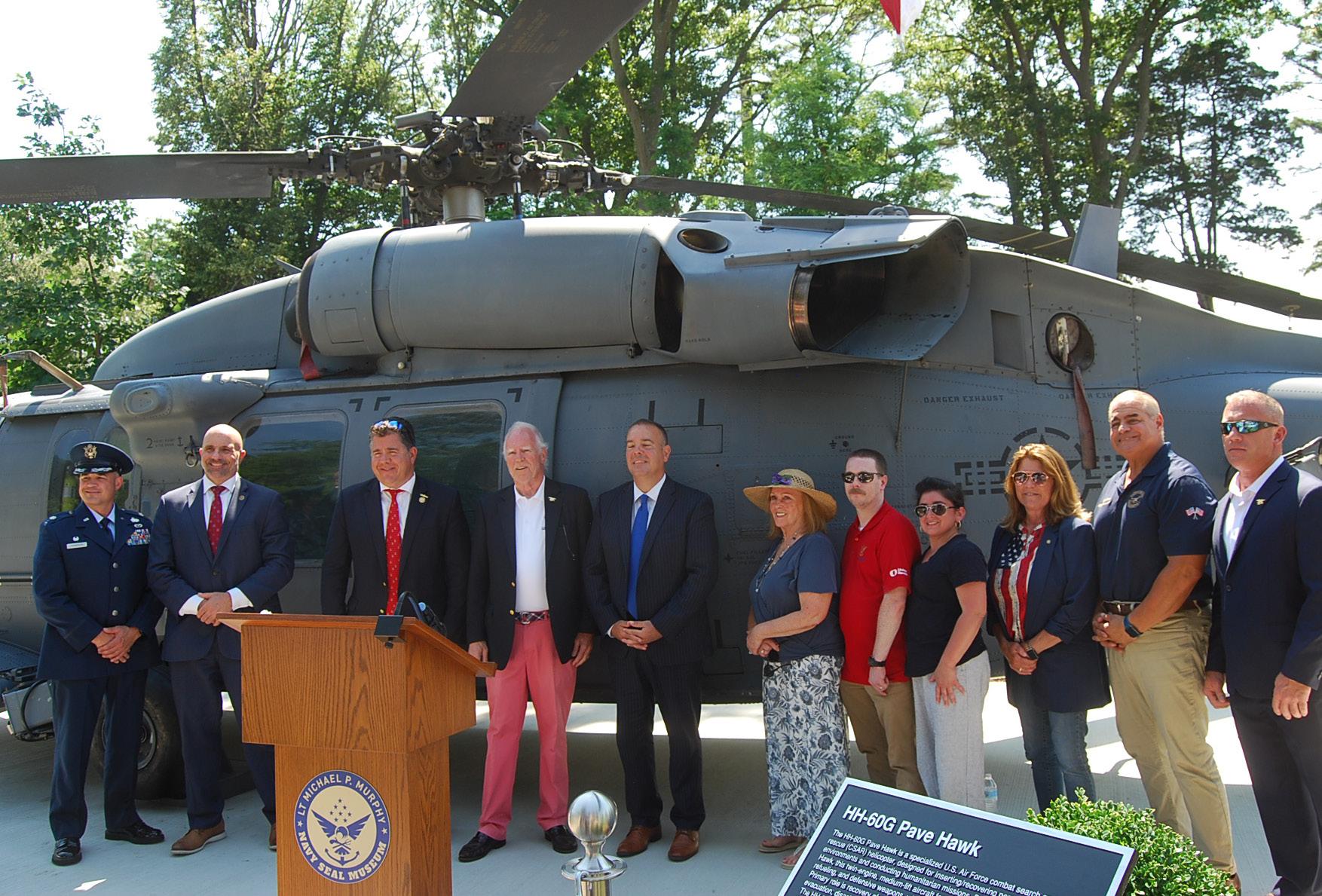
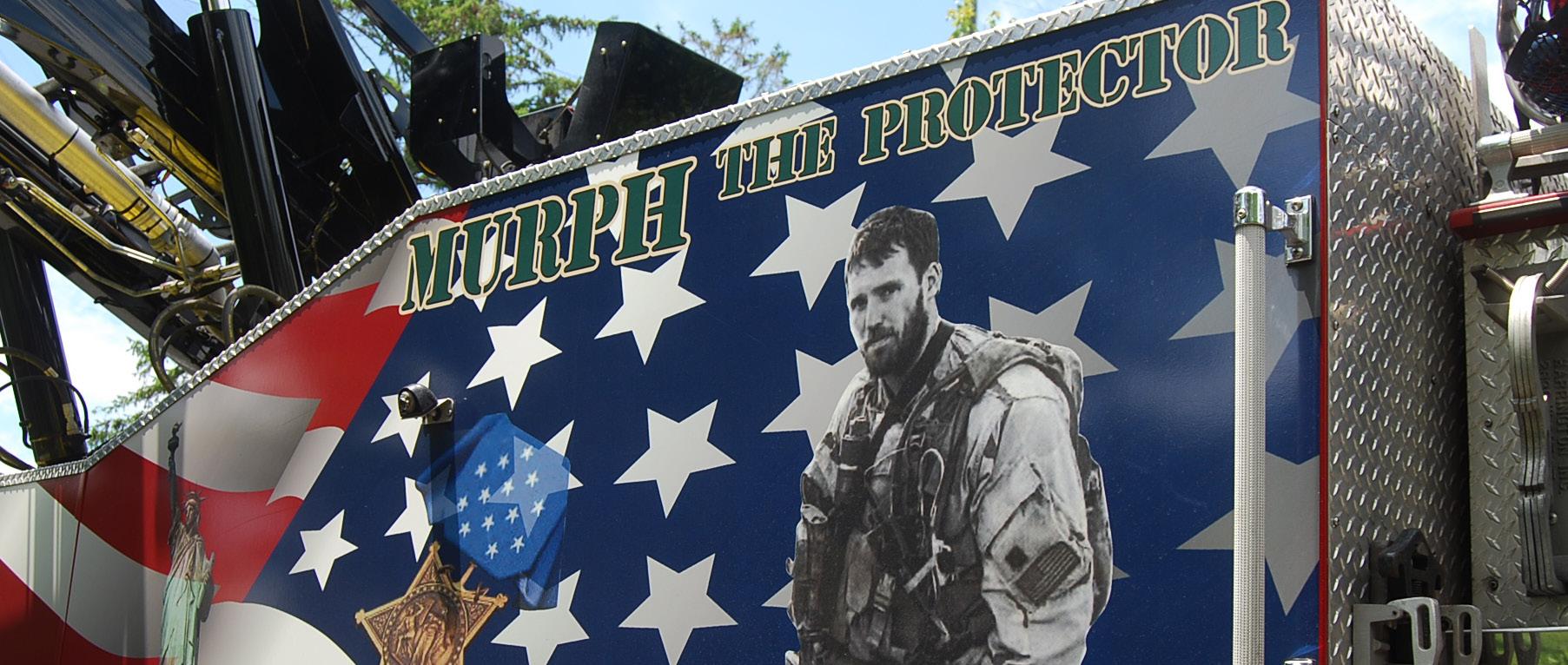
By Joe Cuminale
On July 4, the Joseph Kavarik American Legion Post #1146 in Bohemia offered a free barbecue, not only for Veterans with nowhere to go to take part in America’s 250th birthday, but also for residents who live in the neighborhood.
This is nothing new for this particular post. They also do free holiday gatherings for Veterans and residents for Easter, Thanksgiving, Christmas, and many other holidays. This small post has a very big heart and a great deal of respect for our Veterans, thanks to Herb and Diane Koehler.
On America’s 250th Birthday, the buffet included hamburgers, hot dogs, chicken wings, salads, some delicious, heat-beating watermelon - all at no cost to those attending. A big band played some soothing jazz music, and Herb gave tours of the Post.
Please, help keep this smaller-thanmost post operating – and many others like it across Suffolk. Like any other post, the members here have many

great stories to share and Veterans to help.
Thank you, Herb and Diane, for your hospitality, good food, and a tour of some cool history of this post.
Happy 250th birthday to the United States of America!
The Joseph Kavarik American Legion Post #1146 is located at 826 Hubal Street in Bohemia and can be reached at (631) 589-9670.
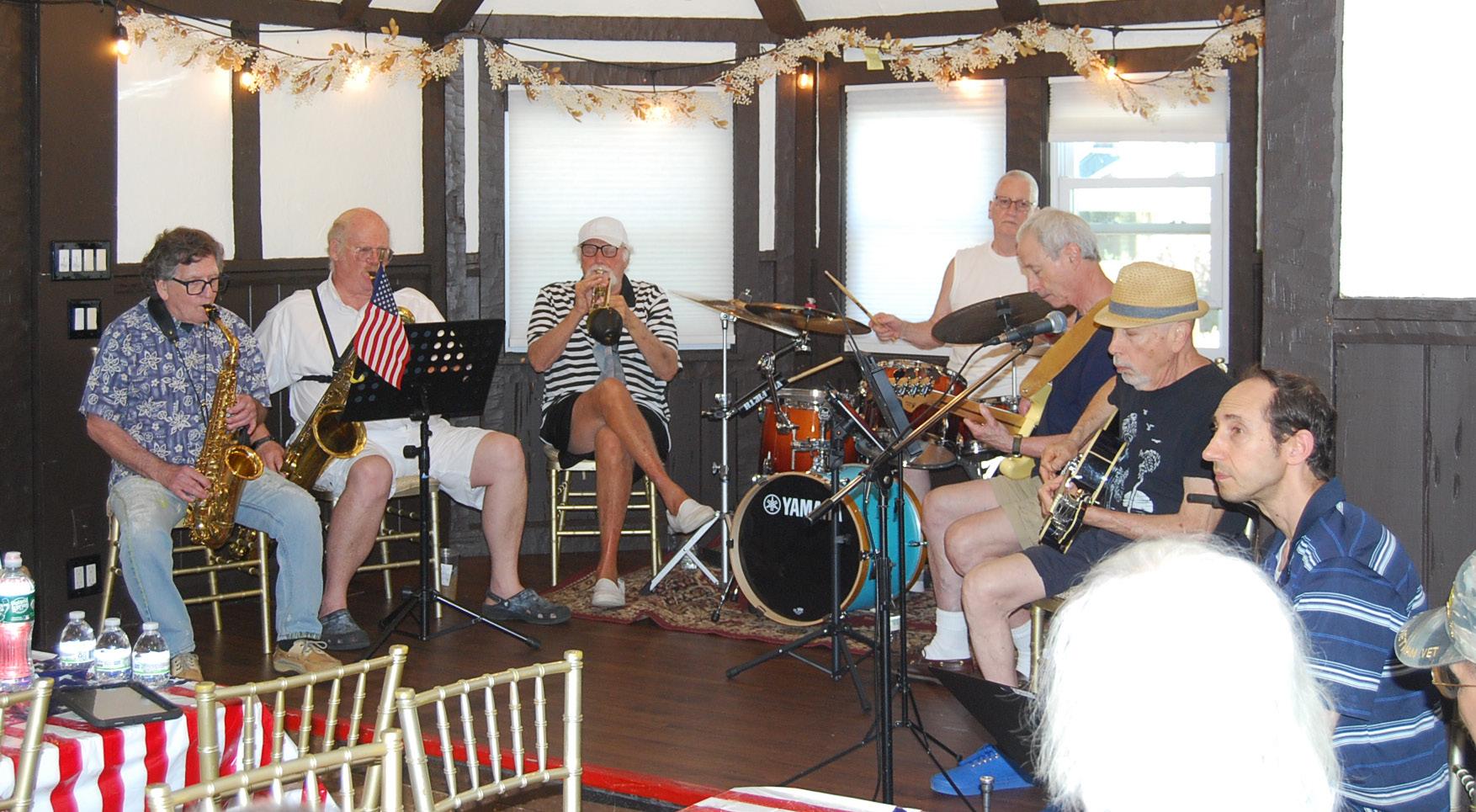
Thursday, July 9, 2026
The Declaration of Independence changed America on July 4, 1776, but the days that followed were just as consequential.
Well, we all just celebrated – with great joy, light, sound, burgers, and thanksgiving – the 250th anniversary of July 4, 1776. We are, as we should be, a grateful nation! But did you ever wonder what happened the week AFTER that Declaration-signing day? Here it is.
Immediately after the Declaration was signed, a kind of national engine started, the Declaration printed, circulated, and read throughout the 13 Colonies, military preparations accelerating, from training to ammunition storage, and action replaced anticipation.
Examples are interesting, if also reinforcing how serious the Declaration signing was in the moment.
On July 5th, John Hancock, President of the Continental Congress – and the character once played in a high school production of “1776” – initiated printing and distribution of the resolve to all colonies, military leaders, and allies. These print copies were called Dunlap broadsides,” and are today rare.
Of roughly 200 printed, only 26 remain, and yet one never knows. In 1989, a curious purchaser at a flea market bought what was thought to be a modern replica for four dollars. It turned out to be the real thing, an original broadside, and was sold for $8.1 million by Sotheby’s.
On July 8, notable in our family as my brother’s birthday, another action unfolded. The Declaration was read aloud to a “crowd” beside Independence Hall in Philadelphia. To assemble, the “cried,” the Liberty Bell was rung. The document was read by Colonel John Nixon, notably no relation to the nation’s later President Richard Nixon.
On July 9, George Washington “had the Declaration read aloud to his troops stationed in New York City.” After that July 9 reading, another crowd pulled down the 4000 pound stature of King George III in the city.
Not surprisingly, the British began to ramp up their forces around New York City, especially on Long Island and Staten Island. Later that summer, the entire operational tempo of battlefronts, especially around New York, would explode.
SCAN QR-CODE TO LISTEN TO THE ARTICLE ABOVE


One can only imagine the combination of exhilaration, anticipation, anxiety in some quarters, relief, and preparations that must have followed that monumental signing day, July 2, 1776.
While history books are silent on the point, humans being human, physiology much the same today as then, one imagines Thomas Jefferson was also glad for a break, glad not to be dipping his feather pen in ink, likely resting his weary right hand, which had neatly penned the historic document.
Overview - AMAC -
The Association of Mature American Citizens
The Association of Mature American Citizens represents Americans 50 plus. AMAC is centered on American values, freedom of the individual, free speech, and exercise of religion, equality of opportunity, sanctity of life, rule of law, and love of family, with benefits at all levels.
AMAC plays a vital role in helping build the services that will enrich the lives of America’s seniors. AMAC Action, a 501 (C)(4) advocates for issues important to AMAC’s membership on Capitol Hill and locally through grassroots activism. To Learn more, visit amac.us
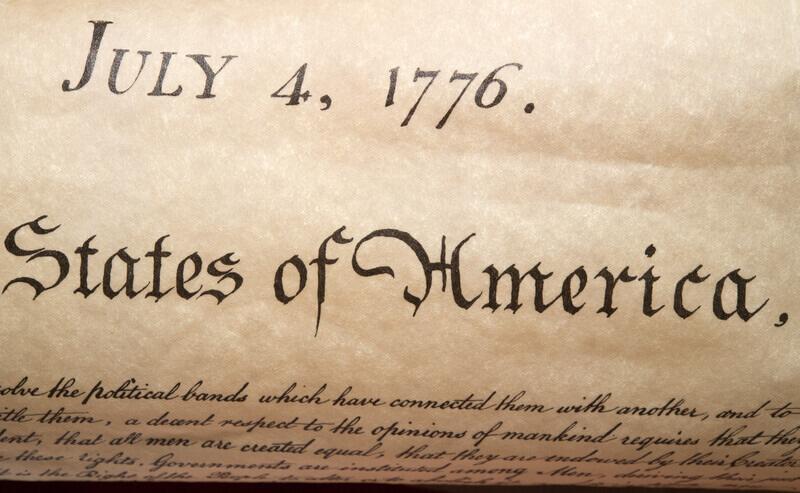




JUL 9 –AUG 23 SEP 10–OCT 25 NOV 12–DEC 27



adjective
Etymology: late 14th Century, “blood-red, of a blood-red color” from Old French sanguin and directly from Latin sanguineus “of blood,” also “bloody, bloodthirsty,” from sanguis, “blood”; c.1500, “cheerful, hopeful, vivacious, confident” attested to the Doctrine of Humors. These qualities were thought to be obtained from an excess or predominance of blood as one of the four humors in old medicine.
Pronounced: /sang·gwn/
Definition: having or showing a mind free from doubt
Example: “The nation was reasonably sanguine about their path for the future.”
Synonyms: confident, assured, unquestioning
Antonyms: dubious, wavering, vacillating
Source: Merriam-Webster

C E A B T R L
See how many words you can create. Must have center letter in word and can use letters more than once. 4 letter word minimum.


See left for the answers (please don’t cheat!)
July 15, 1948: Alcoholics Anonymous is founded in Britain.
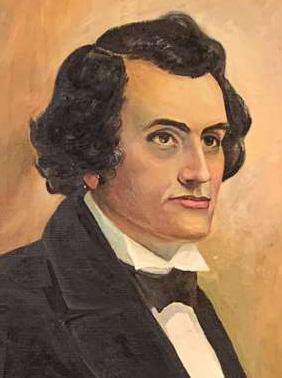
July 14, 1850: First public demonstration of ice made via refrigeration by Florida physician John Gorrie.
July 9, 1877: First Wimbledon tennis championship - first official lawn tennis tournament - begins featuring men’s singles only.

July 10, 1913:
World’s official highest recorded temperature of 134°F (56.7°C) occurs at Greenland Ranch (now known as Furnace Creek Ranch) in Death Valley, California.


July 13, 1923:
The Hollywood Sign is officially dedicated in the hills above Hollywood, Los Angeles. It originally reads “Hollywoodland,” but the last four letters are dropped after renovation in 1949.

July 12, 1804:
Former U.S. Treasury Secretary Alexander Hamilton dies (left) after being shot in a pistol duel the previous day by Vice President Aaron Burr (right), near Weehaken, New Jersey.
July 11, 1897:
Salomon August Andrée and crew leave Spitsbergen in northern Norway by balloon, heading for the North Pole.
Source: Onthisday.com.
By PJ Balzer
A few years back, The Messenger asked if I’d jot down a thought or two to be published here.
The thought could be about anything: faith, sports, a personal story or testimony, something simply about life. A thoughtful paragraph has morphed into the “perspective” column of the paper, one page that could possibly inspire someone or even just spark a new thought or different way of looking at things.
More than one person, I’m sure, has wondered what this page is doing here - a page that seems to flow in its own direction and not upstream or downstream with the masses; a page that’s busy addressing real life stories of faith in action, caring for vulnerable populations, speaking up for the impoverished and seeing people from a different angle.
Maybe even with a brand-new, clear pair of glasses.


But the truth is that we, at some point, have to ask our own questions, find our own path,
The strength of the current media also heavily forms our thinking, if we allow it to, of course. Being out in public daily, I pay attention to what people are talking about with each other. I’m always listening for something interesting to think about or write about. I can easily tell what someone is listening to or the content they’re consuming by what they are saying. The majority of people simply repeat what they’re hearing from their favorite media source or person. Respectfully, there’s not a whole lot of critical thinking or human reasoning involved
One of the wonders of life is that we were meant to grow and change over time. As we experience life, meet people, and befriend humans that are different than we are. While facing our own personal life’s trials and tribulations, many times, the way we have seen things may
There is a relevant saying that I love that goes something like this, “It’s easy to have a strong opinion about another person’s life, their circumstances, actions, and troubles, until we start
This column, whether you agree or disagree with it, is simply an invitation to take my glasses and see through a different lens, even if it’s just for a moment, to view things from a “perspective” that may be new to you. My hope is that you’ll read something here and think to yourself, “I never really thought about that person, people group, or situation in that way. That




By Ashley Pavlakis
The United States Men’s National Soccer Team recently competed at the World Cup, though they fell in the round of 16; their run gave fans something to cheer about for a few weeks. Long Island saw one of its own compete on the World Cup stage.
Joe Scally, a Lake Grove native, competed for Team USA in his second World Cup.
Joe Scally grew up on Long Island, attending Sachem North High School for a short period before signing with New York City FC (Major League Soccer Club) at age 15. He became the second-youngest player to sign a professional contract in U.S. history; the first was Freddy Adu at 14.
Like every bar on Long Island and in the world, Napper Tandy’s on Main Street in Smithtown hosted watch parties for the World Cup games. Outside on the patio is a banner of Scally representing Team USA.
Scally’s first World Cup call-up came in 2022, when he was 19 years old. This call-up deemed him the
youngest on the squad at the time. Though he did not see action in the Qatar World Cup, he was still part of the team.
The full-back has made 28 appearances for the red, white, and blue, who are still looking to capture their first star. Team USA, both men’s and women’s, will add a star above their crest each time the team wins a major tournament, Olympics, World Cup, etc. The women have four; the men have none.
The Long Island native made his official World Cup debut in Seattle on June 19 in a 2-0 win over Australia. He subbed into the match. Scally had an abundance of family members in attendance to witness his debut firsthand. Scally’s mother, Margaret, was a former soccer player herself.
Scally started in the match versus Turkey, where the U.S. fell 3-2.
Scally currently plays professional soccer in Germany for the Bundesliga club Borussia Mönchengladbach. He signed with the club in January of 2021. Scally
has amassed over 150 appearances for Bundesliga. The defender was the fastest non-German player to reach 100 league appearances, notching the feat during the 2024-25 season. Scally scored his first goal on October 2, 2021, against Wolfsburg. In 172 appearances, Scally has scored five goals.
Joe Scally (Lake Grove) joins Crystal Dunn (New Hyde Park), Allie Long (Northport) as the third Long Island-born player to compete for the United States Soccer Federation at the World Cup.
Dunn and Long had outstanding careers for both club and country; the hope is for Scally to have the same fate as a Long Island representative.
The United States finished its World Cup run 3-2-0, scoring 11 goals and giving up 8. Unfortunately, the U.S. men’s national team isn’t entirely up to par with the rest of the world just yet.
Congratulations on getting to represent the United States in your second World Cup, Joe Scally. Long Island is proud of you!
By PJ Balzer
What may seem like just a basketball court from a distance is anything but that up close.
Tucked away a few hundred feet off Great Neck Road in North Amityville is a park famously known as the Bolden Mack Park. What happens in this park has an effect of all Long Island and even New York City as well.
Bolden Mack Park officially became a park in 1973. Babylon Town helped name the park after a hardworking and honorable gentleman who migrated from Virginia to North Amityville in the early 1900s. Mr. Mack worked tirelessly, planting and farming his own property which was close to the park. He loved doing so and kept on working right up until his death which was two weeks after his 110th birthday in 1975.
Since then, several of North Amityville’s community leaders have stepped up to upgrade and bring young lives to the park. Mike James played basketball for Amityville High School before playing division one college ball at Duquesne University and then for several teams in the NBA. James was a part of pouring love and resources back into the community he grew up in by helping upgrade and care for the park, so much so that North Amityville celebrates “Mike James Day” every July 29 at the park with food, music, giveaways, and, of course, basketball.
After many years, much change, and several upgrades to the courts and back boards, the Mack is currently known as
the biggest basketball showcase on Long Island.
With the center of North Amityville as its backdrop, these courts host highly anticipated summer tournaments featuring divisions for high school, youth, and the men’s Pro-Am location. Many hoopers, both past and present, played on these courts in the summer months while returning to school to play high-level high school and college basketball. Some even played in the NCAA tournament that same spring, better known as “March Madness,” bringing them from this court to a nationally televised college game.
The hoops culture of the courts also breeds positivity, hard work, discipline, and giving back. The young people are pushed to be better and to give back to their own community. Young people are taught to compete and to work hard for what they want. Even in the morning hours before the evening leagues begin, young people are here being trained, practicing their free throws, and talking about basketball.
This summer the leagues are fully operating. Below is the address and a link with the schedule of games. Stop down to check out some premier Long Island hoops happening all summer!
Bolden Mack Park is located at 3453 Great Neck Road in North Amityville. For community updates, game schedules, and team registration, visit welcometothemack.com or follow them on social media.

By Jacob Infald
Despite the recent conclusion of high school sports for the summer, Long Island sports fans will once again have high-level sports to watch in their own backyard.
On July 12-13, Stony Brook University will be hosting this year’s National Lacrosse Federation’s (NLF) National Championships, where the nation’s best club lacrosse teams in the 2027-2029 high school graduating classes will compete in front of college scouts.
The NLF was created in 2015 with just six clubs in the Northeast Region, including Team 91 and Long Island Express which are both based out of Long Island. Since then, the Federation has only grown, and this year’s national championship will feature clubs from across the country.
NLF Social Media Director Matt Chandik told The Messenger that the talent pool in the upcoming tournament is so deep that he expects not only the playoff games to be ultra-competitive, but the pool play games as well. Chandik said the competitive lacrosse throughout the tournament is what attracts the over 300 college coaches that will be attending the event this year.
“I think that’s one of the things that has made the NLF National Championship such a big event, you come here, and you’re going to be seeing the best on best, and there’s no hiding from people,” Chandik told The Messenger “There’s a reason that so many NLF guys have committed to the highest levels, and why so many clubs from around the country want in on this event because they know it’s the cream of the crop.”

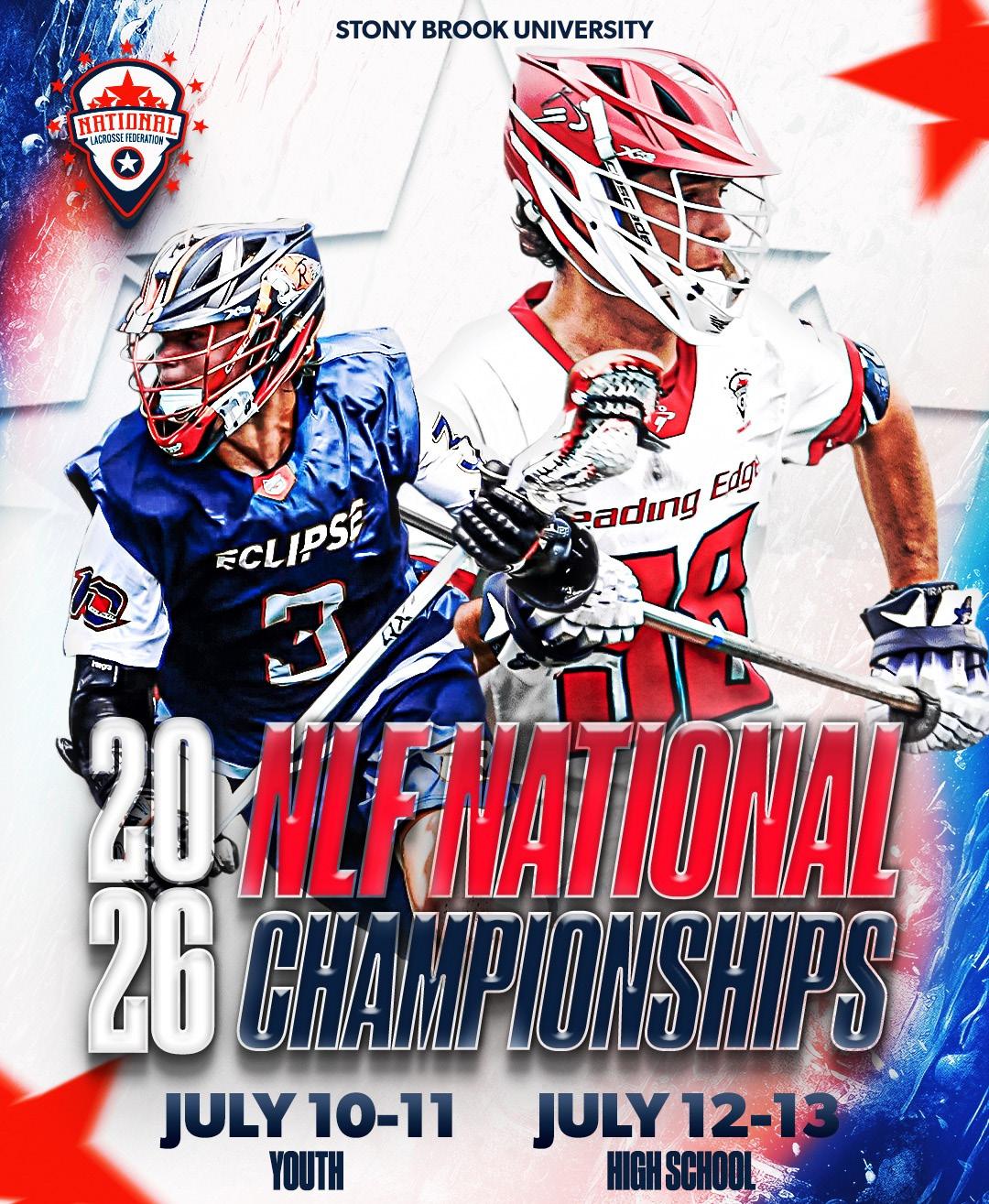
Long Island lacrosse fans are used to high-level lacrosse during the high school season. This past spring, we covered Smithtown East High School’s Suffolk Country Championship where they were led by multiple Division I commits, including Cameron James who is committed to play at John Hopkins University, one of the most prestigious lacrosse schools in the nation.
However, what many people may not know is the connection between the NLF and some of the best players on Long Island. The NLF has produced the previous five Tewaaraton Award winners, including Brennan O’Neil, a graduate of St. Anthony’s High School and Team 91, and Pat Kavanagh, a graduate of Chaminade High School and Long Island Express, the same club that James played for.
Chandik referred to Long Island as a hotbed for youth and high school lacrosse players. He said
the reason that alumni of the NLF are able to not only to get the next level in their careers, but excel as O’Neal and Kavanagh have, is because they bring all of these different hot beds together in tournaments such as the upcoming National Championship so their players get experience playing elite level lacrosse growing up.
“Long Island lacrosse will be great forever, there’s no doubt about that,” Chandik said. “The culture’s a little bit different than everybody else, but it’s awesome when you get kids from everywhere, and it’s great when you see kids popping up from Texas or Northern California…”
Last season, the West Coast Stars club won the 2027 division at the NLF National Championship, demonstrating the work that the Federation has done in growing the sport. However, even as the sport continues to trend on the national level, Chandik said they still feel as if Long Island is the place to be.
While they have played at the University of Massachusetts Amherst and Lehigh University in the past, this will be the third year in a row the competition will take place on Long Island. The previous two years, Farmingdale State University shared the hosting responsibility with Stony Brook, but this year, all games will be played at Stony Brook. Chandik said the Long Island universities have been awesome hosts, and it was an easy decision to keep the tournament here.
“I think it’s great to have it on Long Island,” Chandik said. “If you’re a lacrosse guy, where else would you want to be? That part’s been very good for us, and it just helped elevate everybody’s profiles.”
While these games are meant as a college showcase, they are open for the general public to attend. For those interested, the full schedule as well as live results throughout the weekend can be found by searching NLF National Championship at the SportsEngine Tourney Machine website. Games will begin for the high school division at 8:00a.m. on Sunday, while the youth tournament will begin Friday.
Chandik said last year’s championship game for the 2026 graduating class featured over 40 Division I commits, and he expects this year to be just as, if not more exciting.
“If you’re coming to this, you’re going to see the cream of the crop,” Chandik said. “You’re going to see the very best teams and the very best players, and you’re going to see a lot of college coaches watching those guys because they know that’s where they’re going to find their dudes.”
By Ashley Pavlakis
The Women’s Lacrosse League (WLL) and the Professional Lacrosse League (PLL) hosted their AllStar game and skills competition on Sunday in Annapolis, Maryland. Long Island natives were out to play, putting on a show to cap off America’s 250th Birthday weekend. Sporting the Red, White, & Blue for Team Humphrey and Team Izzy in the WLL were the likes of Ally Kennedy, Ellie Masera, Sam Apuzzo, Emma Lopinto, Taylor Moreno, Katie Goodale, and Kendall Halpern.
In the All-Star game for Team Humphrey and Team Izzy, Team Izzy emerged victorious in the last thirty seconds of regulation by the score of 16-15. Let’s check out the scoresheet for Team Humphrey: Sam Apuzzo did her thing and notched a hat-trick and an assist; Emma LoPinto 3G-1A; Ally Kennedy 1G; and Ellie Masera 1G. Taylor Moreno saved eight out of nine shots faced. For the winning Team Izzy, Katie Goodale recorded an assist.
On the men’s side in the PLL, Mt. Sinai’s Joey Spallina won the accuracy challenge as a first-time All-Star. With 32 seconds on the clock, Spallina was tasked with hitting as many targets as he could. In the final round against Rachel Clark, Spallina connected on five of seven shots, totaling nine points to claim the title.
“It was fun. This is what it’s supposed to be. Just getting into a rhythm and hitting the same spot,” Spallina told ESPN in a live interview on the field.
Brennan O’Neil and Troy Reh competed in the fastest shot competition. Chris Kavanagh, Joey Spallina, Sam Apuzzo, and Ally Kennedy competed in the accuracy competition. These L.I. natives
proved they’re lethal when wielding a lacrosse stick.
It was a 12-9 win for the Western Conference. For the West: Pat and Kavanagh each scored twice, Andrew McAdorey 1G-1A, Brennan O’Neill 1G-1A, and Dylan Molloy 1G. For the East; Joey Spallina scored 1G-1A.
In the PLL, there are 23 Long Island-born athletes you can continue to watch play professional lacrosse after the All-Star weekend. They are: Joey Spallina (Mt. Sinai), Petey LaSalla (Miller Place), Jack McDonald (Rockville Centre), Joe Juengerkes (Islip), Ethan Hall (Islip), Hugh Kelleher (Wantagh), Matt DeLuca (Farmingdale), Keiran McArdle (Ronkonkoma), Brendan Staub (Garden City), Matt Whitcher (Huntington), Connor Farrell (Holtsville), Kyle Lewis (Franklin Square), Andrew McAdorey (Manorville), Dylan Malloy (Setauket), Marcus Wertheim (St. James), Nicholas Caccamo (Centerport), Chris Kavanagh (Rockville Centre), Troy Reh (Rocky Point), Brendan Nichtern (Massapequa), Liam Byrnes (West Islip), Pat Kavanagh (Rockville Centre), Brennan O’Neill (Bay Shore), Mac O’Keefe (Syosset), and Tom Schreiber (East Meadow).
The growth of lacrosse is prevalent on Long Island. The proof, for me, came in the form of seeing a young girl at the supermarket sporting a USA Ally Kennedy jersey on Sunday afternoon. Her sibling was wearing an Inter Miami Leo Messi jersey, but she chose to rep a homegrown player. Kennedy played collegiately at Stony Brook University.
It’s safe to say the All-Star day repping the USA was successful. Long Islanders played their role in scoring goals for their teams. The WLL and PLL continue regular-season play this week.