Thursday, August 6, 2026 ~ Volume 138 ~ Issue Number 38 ~ $1.00
By Matt Meduri
Suffolk County’s Red Light Safety Program was authorized in 2009 and took effect in 2010. For fourteen years, Suffolk drivers faced 216 cameras at various intersections through western Suffolk.
After a significant push from Hauppauge Republicans in the County Legislature, the program ended in December 2024. However, what remained was the legal ramifications of the administrative surcharge that was found to have been illegally applied.
Beginning in 2013, the $30 administrative fee was tacked onto the $50 fine. A State appeals court ruled in 2024 that the fee was illegal because it violated a “plain reading” of the State law authorizing such programs. State law authorized a $50 fine and a $25 late fee.
Now, the County has struck a $57.5 million class-action settlement that will repay drivers up to $36 for those administrative fees. $30 will be for the surcharge itself, $6 for interest. The County has agreed to pay up to $45 million, plus the admin costs of the program. The plaintiffs’ lawyers will receive $12.5 million.
Reimbursements per driver could be closer to $20 if all eligible drivers apply on the website, which has not yet been rolled out.
County to Refund Drivers for Red Light Camera Fees Hundreds Celebrate San Remo Centennial
By Matt Meduri
Removed from the hustle and bustle of suburban life in Suffolk lies a quiet hamlet nestled in the northeast corner of Kings Park.
Directly abutting the Nissequogue River, the community of San Remo was established in 1926. The Sam Remo Property Owners’ Association was formed the same year. The community followed a similar trajectory to Lake Ronkonkoma - a hidden gem turned into a summer colony by affluent city-slickers. Named for Sanremo, a northern Italian municipality on the Mediterranean Sea, San Remo was developed by the New York City-based Smadbeck Corporation, who subdivided the land into lots. Those lots were heavily advertised in Corriere D’America, a newspaper that would later be called Il Progresso that was heavily geared towards the Italian American.
Continued on page 10
The entrance to San Remo on St. Johnland Road (Credit - Matt Meduri)
A red light camera at Patchogue Holbrook Road and Furrows Road in Holbrook, December 2024 (Credit - Matt Meduri)
SUMMER EVENTS
Sayville Farmers Market at the Islip Grange: Every Sat. until Nov., 9:00a.m. to 2:00p.m.
Port Jeff Farmers Market: Every Sunday until November, 9:00a.m. to 2:00p.m.
Islip Farmers Market at Town Hall: Every Saturday, 7:00a.m. to 2:00p.m.
Suffolk County Farmers Market at the H. Lee Dennison Building: Thursdays through Oct. 1, 10:00a.m. to 2:00p.m.
Build a Bug: Thursday, August 13, 10:30a.m. to 11:30a.m.
Annual Snapper and Crab Fishing Derby: Saturday, August 15, and Sunday, August 16, 10:00a.m. to 1:00p.m. at Captree State Park
History Tour on the Great South Bay: Tuesday, August 11, 7:00p.m. to 10:00p.m., $50 per person (rain date, August 12), at Sayville Fire Island Ferry Terminal.
Urban Ecology (Adult Program): Sunday, August 9, 10:30a.m. to 12:00p.m. at Nissequogue River State Park
Beginning Birding at Planting Fiels Arboretum: Sunday, August 9, 10:00a.m. to 11:30a.m.
Perseids Meteor Shower: Wednesday, August 12 through predawn hours of August 13. Viewable at Jones Beach, Sunken Meadow, Montauk Point, Wildwood, Orient Beach, and Hallock State Parks.
Bat Safari: Friday, August 14, 7:30p.m. to 9:30p.m. at Wildwood State Park
Kayak Nature Tour: Saturday, August 8, 10:00a.m. to 12:00p.m. at Heckscher State Park
269-6421
Conveniently
HAUPPAUGE:
Adventures in Art:
Buried Treasures of Ancient Egypt (Grades 1-5) –
- Monday, August 10, 4:30p.m. to 5:30p.m.
K-Pop Shrinky Dinks & Soundtrack Party –
- Tuesday, August 11, 4:00p.m. to 5:00p.m.
COMMACK:
Fishy Fish - –
- Monday, August 10, 6:30p.m. to 7:00p.m.
I’m in a Long Island State of Mind - Singer/Songwriters from South Shore to North Shore –- Tuesday, August 11 - 1:30p.m. to 3:00p.m.
NESCONSET:
Capybara Creation –
- Tuesday, August 11, 6:00p.m. to 7:15p.m.
Balloon Lampoon –
- Wednesday, August 12, 6:00p.m. to 6:45p.m.
KINGS PARK:
BBQ Pork Sliders with Chef Brian –
- Monday, August 10, 6:30p.m. to 8:00p.m.
Scorch Art Keychains –
- Tuesday, August 11, 2:30p.m. to 3:15p.m.
SACHEM:
Mixed Media Watercolor with Heather –
- Saturday, August 8, 1:00p.m. to 3:00p.m
NetGen Youth Sports Analytics Lab –
- Tuesday, August 11, 6:00p.m. to 7:30p.m.
SMITHTOWN:
Creation Station –
- Saturday, August 8, 10:00a.m. to 3:00p.m.
All Abilities Gardening Club Dig into History –- Monday, August 10, 10:00a.m. to 11:00a.m.
The Moloney Family
Suffolk Matters
County Enacts Laws Restricting Synthetic Kratom
By Jacob Infald
In March, the Suffolk County Legislature began considering a law to address the growing problem of synthetic kratom in Suffolk County.
Dozens of speakers with nuanced arguments descended on Hauppauge to make their case known, causing the Legislature to recess the bill multiple times to gauge a better understanding of the substance, its uses, and abuses.
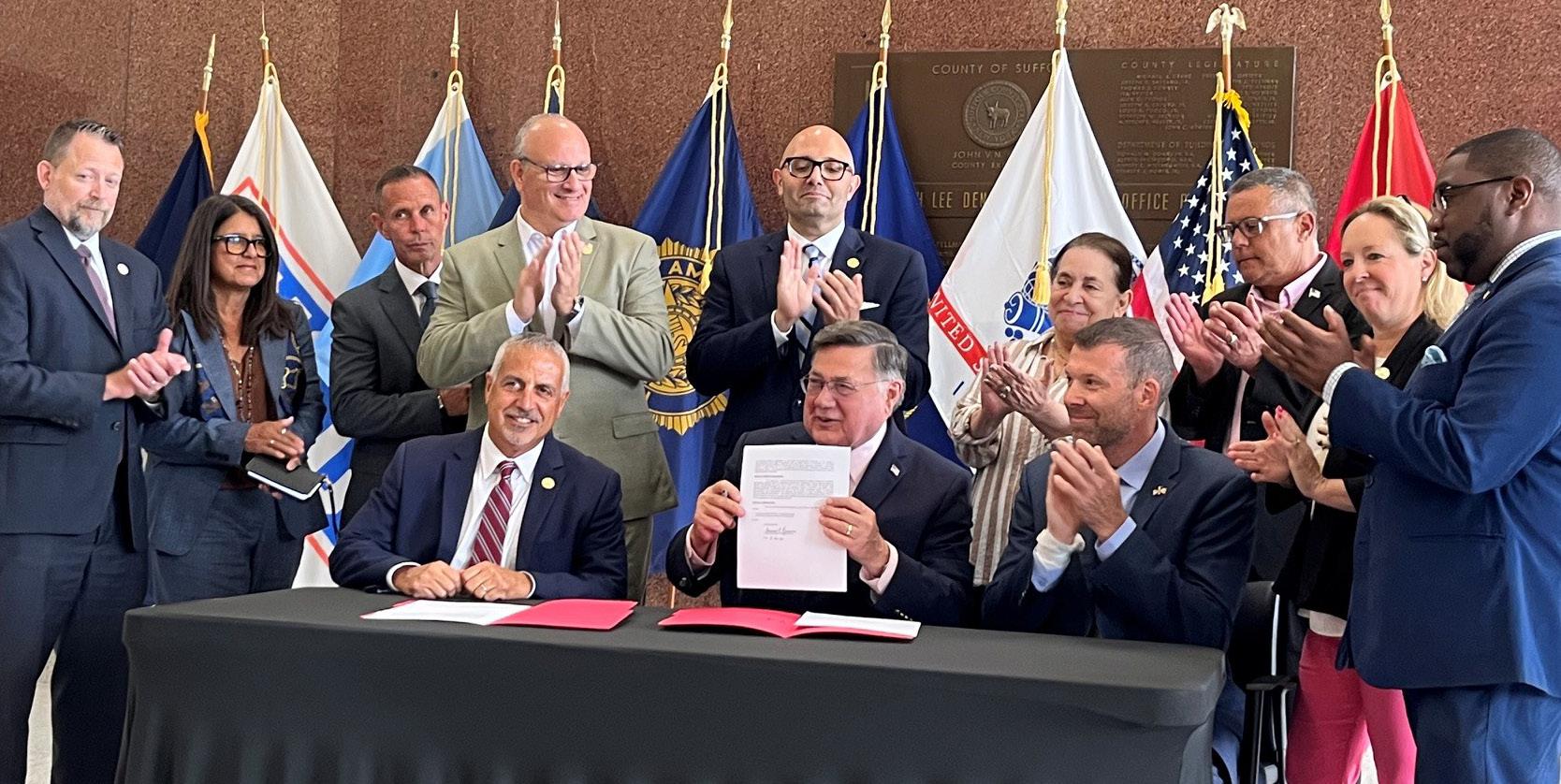
Last Thursday on July 30, at the H. Lee Dennison Building in Hauppauge, Suffolk County Executive Ed Romaine (R-Center Moriches) signed a bill that bans tianeptine and heavily restricts the sale of Kratom. This signing comes after a full Kratom ban in Nassau County earlier this year.
Kratom, in its altered synthetic version, had become widely available at gas stations and convenience stores, and its primary use was treating pain and anxiety, as well as increasing mood and focus. However, the substance has never been approved by the FDA to treat chronic pain, opioid withdrawals, or any other intended uses.
According to Valley Hope Addiction Treatment and Recovery, long-term side effects of synthetic Kratom use include increased heart rate and blood pressure, seizures, liver issues, and trouble breathing. Kratom, despite its label as a safer more natural opioid, is also an addictive substance. People who grow dependent on Kratom often experience strong withdrawal symptoms when trying to quit the drug, including mood swings, trouble sleeping, muscle aches, nausea, sweating, and anxiety or restlessness.
The new bill does not fully ban Kratom, as adults 21 or older are free to use the natural, lab-tested version of the plant, while the far more destructive synthetic version containing 7-OH has a full ban. Anyone caught selling or distributing the banned version of Kratom faces up to $1,000 in fines or a year in prison.
At a short press conference before the signing of the new legislation, Romaine spoke about his duty as the County Executive to protect the health of Suffolk County residents. He said that sometimes protecting people’s health can look obvious such as investments
in improved wells and aquifers for safer drinking water but stopping the sale of the harmful and addictive synthetic version of Kratom is also important for the health of Suffolk County residents.
“The synthetic [version] is a highly addictive [substance], and creates problems,” Romaine said. “We don’t need this, and we don’t need other substances that are addictive and destructive to the health of the community.”
The legislation that Romaine referred to was led by Suffolk County Legislators Jim Mazzarella (R-Moriches) and Chad Lennon (C-Rocky Point).
Mazzarella spoke about the dangers of a highly concentrated compound 7-hydroxymitragynine (7-OH).
“The substance poses an imminent threat to the public, and given its effects that are highly unpredictable,” Mazzarella said. “So, today’s action will give Suffolk County the authority to stop these deceptive products and their greedy distributors and hold these bad actors accountable.”
Following Mazzarella, Lennon spoke about the ban and dangers of tianeptine, otherwise known as “gas station heroin”.
“The fact is that folks are dying from these substances, and you can buy them anywhere,” Lennon said. “These substances are dangerous, and we’re not going to stand for that, and that’s why we’re proactive in this county, making sure that public health and public safety because starting next week, the DEA is going to be looking at scheduling
tianeptine as a Schedule 1 [drug], so we took that first step to make sure that our public is safe from these items.”
Tianeptine, similar to Kratom, is not approved by the FDA to treat anxiety and depression. However, it is an unregulated substance that despite the name “gas station heroin,” was widely available in gas stations and convenience stores. Many people saw this as an alternative to opioids, and because of how easy it is to access, people are unaware of the dangers. According to the FDA, tianeptine is a highly addictive substance, and while it is legal in other countries, U.S. consumers often take up to 250 times the legal prescribed dosage of these countries. According to the CDC, effects of tianeptine abuse and withdrawal can mimic opioid toxicity and withdrawal, debunking the claims that tianeptine is a safer alternative to opioid treatments.
Lennon said that a full ban was necessary, because just because a substance is regulated for use by people only 21 years old and older, it is still unfortunately always possible for younger people to get their hands on anything that is being sold.
Romaine, Mazzarella, and Lennon were joined by SCPD Commissioner Kevin Catalina, the Legislature’s Presiding Officer Anthony Piccirillo (R-Holtsville), the Legislature’s Minority Leader Jason Richberg (D-West Babylon), and Legislators Leslie Kennedy (R-Nesconset), Sal Formica (R-Commack), Dominick Thorne (R-Patchogue), and Rebecca Sanin (D-Huntington Station).
Suffolk Revamps Application Process for Septic Upgrade Grants
By Matt Meduri
Suffolk County has had a septic problem for years. During the 2023 campaign, now-County Executive Ed Romaine (R-Center Moriches) made it a core promise to wean the county off antiquated septic systems in favor of sewers where applicable and more innovative forms of wastewater treatment.
County officials state that about 70% of Suffolk County homes use cesspools and septic systems, which are a “major source of nitrogen pollution that impact drinking water and fuels harmful algal blooms throughout the region’s surface waters.”
Some 25,000 Suffolk residents still get their water from private wells, which have been a focus of the County and the Suffolk County Water Authority (SCWA) in dealing with contamination and groundwater quality.
This week, Suffolk County announced a new website for the County’s Septic Improvement Grant Program and a streamlined application system. The program is aimed at homeowners with
outdated or failing cesspools to apply for State and County grant funding.
Eligible property owners may receive grants up to $45,000 to install advanced wastewater treatment technology. Such avant garde solutions, according to the County, “significantly reduce nitrogen discharge before it reaches the environment.”
“Outdated septic systems and cesspools have led to the degradation of our waters and are a serious threat to our region’s groundwater and bays,” said Romaine in a statement. “By making the Suffolk County Septic Improvement Grant Program application process easier, more homeowners will take advantage of this funding and be part of the solution for clean water.”
The Septic Improvement Grant Program is funded by the voterapproved, one-eighth cent sales tax, passed by ballot measure in 2023, and the New York State System Replacement Program.
For more information, go online to suffolkcountyny.gov/septicgrants.
Published by Messenger Papers, Inc.
Thursday, August 6, 2026
The Inspiration of a Dog
As local shelters are participating in the Clean Out the Shelters campaign for August, we find this an evermore appropriate opportunity for a particular ode.
The weight of the modern world is almost too much to bear at times. It’s like watching the fall of Rome in real-time, except with FaceTime and Internet memes.
The bills, the debt, the time - or lack thereof; it all adds up and no one can seem to get ahead. It’s so easy to be consumed by it, even from a place of responsibility, but to miss all the trees along the way.
However, this world has thankfully been graced with a little creature who not only exemplifies the opposite of that stress, but reminds us to live each day like the privilege it is.
The dog has been a faithful companion and a trusty helping hand to man for thousands of years, but in our modern, convenient, and technological age, the dog has a new responsibility: making us happy.
The goofy antics, light-speed “zoomies,” and eyes that say “I hunger, I starve, my last meal was only ten minutes ago,” are just some ways they brighten each day. We’ve all had a dog who sleeps like they pay the bills and sighs like the weight of the world is on their shoulder - even though their docket consists of taking a nap immediately after waking up and the only pressure they face is being the family password for every account in the house.
When we wake up, we think of what we have to face each day, our bank accounts that never seem padded enough, and an increasingly sour and difficult world. When dogs wake up, their first thought is to come find us to start the day with some affection.
When we sit in the car, we think of traffic, the least-busy 7-Eleven to stop at, and how much longer the vehicle can take before a trip to the shop. When dogs sit in the car, they take in the world around them and eagerly anticipate the destination, even if it’s completely unbeknownst to them.
And when we sit with our dog at the park, tennis ball in hand, we might be going over the day, conversations that could have gone differently, and the mistakes we’ve made along the way.
The dog is only thinking about being at the park with us.
What a privilege it is to be around a personality that jumps with excitement to greet us like a Veteran returning from war, even though we’re just walking up the driveway from getting the mail. What a privilege it is to not only have a little friend to take with us on walks, hikes, and gatherings, and for that friend to ensure we’re having a good time too. What a privilege it is to endure a painful, unpredictable life with someone who just can’t get enough of it.
Every arrival home from work is a reunion, every jingle of the car keys is an adventure, and every wag of the tail is another reminder to take each day slow and
enjoy them thoroughly.
Many people abhor the current timeline, but at least we live in one where dogs sleep in the bed, not in the backyard, and their only jobs are to gladly provide therapy to those with whom they completely trust with their lives.
Many also lament that dogs have unfairly short lifespans. While we wish that weren’t the case, we think there’s an angle there: make the most of the time you have, because dogs certainly do.
And no matter how you’ve messed up, no matter the nastiness of your words to others, and no matter how much regret for your choices you have, there will always be someone in your life who is always happy to see you and only sees the best in you.
It’s no coincidence that “dog” is “God” spelled backwards. Unconditional love, an unparalleled respect for the privilege of life, and the infallible ability to see past our grievances are divine concepts that unfold on an earthly plane
Perhaps dogs are gentle reminders of grace, purpose, and the need to embrace life how a dog does.
Some people sell insurance, others treat patients. Some people edit newspapers, others fix computers.
But not all people have the same mindset and attitude, especially towards each other.
Some dogs detect bombs, other dogs lead the blind. Some dogs sit in hospital beds with patients, other dogs chase the bad guys.
But all dogs have the same disposition: do the job, chase the ball, emotionally manipulate Dad to sacrifice some food off his plate, and remind the humans that everything is fun, everything is exciting, and everything is worth stopping for and observing.
Maybe we overthink and try too hard. Maybe the dogs are onto something with their mindset. It’s not an acquired taste either; it’s how they’re programmed.
“Man’s best friend” has many responsibilities, but the most important of all is just that: being the best friend one could ever have.
National Night Out - Change Starts in the Community
National Night Out (NNO) is essentially one big, national block party, and while there are deeper meanings that seldom go unnoticed, we think there’s a much larger, underlying point that’s flying under the radar.
NNO was started by Matt Peskin in Philadelphia, Pennsylvania, in 1984. Held on the first Tuesday of August, the first NNO consisted mostly of neighbors turning on their porch lights and sitting in front of their homes. The first NNO saw over 2.5 million residents across 400 communities in 23 states, according to the National Association of Town Watch. In 2016, 38 million Americans joined in the tradition across 16,000 communities.
The annual event features the staples - barbecues, games, giveaways, face paintings, and the usual fixings of a typical block party - but NNO focuses on community cohesion, particularly among law enforcement with the citizens they are sworn to protect, and as a PSA on drug prevention and neighborhood watch efforts.
While some anti-police rhetoric remains on the menu for some political theatres in the U.S., we’re sensing that it’s not quite as potent and ubiquitous as it was in 2020. While the “defund the police” movement gained significant attention, it didn’t translate into an empiric victory for a set of candidates - at least not on that ideology alone.
But in 2026, with bigger problems clearly gripping the U.S., we’re sensing that many ordinary Americans are sensing that the only people coming to save them are their own communities, which includes local law enforcement.
“All politics is local,” so the saying goes, coined by Speaker Tip O’Neill (D-MA). Now, all politics is increasingly national, unfortunately, but we find that NNO is perhaps one of the vital bulkheads that prevents that national surge of outrage from seeping in.
Moreover, we find there’s a striking commonality between these NNO events, a point we’ve made previously that is only reinforced by our observations: people are people.
We’ve made the analogy to observational humor. There’s a reason, we think, why it’s such a standard form of comedy. Told in the correct way, anything can be funny, and a good stand-up comic is one who nails the internal dialogues we’ve all repeated to ourselves countless times.
That begs the question, just how different are we? Business owners, police officers, politicians - we don’t need the TV to tell us who to trust. People are people. And just as people are and always have been people, children are and always have been children. At NNO, the longest line isn’t for the Chik-Fil-A or the chamber of commerce. It’s for the trucks, cars, gadgets, and cool toys on display for children to see, touch, and experience close-up, many for the first time ever. That narrative pales in comparison to the one set several years ago, one that culminated in the absurd “defund the police” movement that some still cling to. Outsiders are ousting establishment members, but some bring an even more unpalatable level of absurdity to the ring that is in direct conflict with what most communities experience, we find.
The best way to cut through the noise is to find those making the least noise, we believe, and the best way to get the answers to your questions and beliefs is to simply ask them.
NNO continues to prove that all politics are local and that the community is all that Americans truly have at the end of the day. Even when Washington did work for the American people and not lobbyists, corporations, and other countries, the community is and always has been the backbone of this country.
And when one attends an event like NNO, they usually come to the same point we do, “people are people” and those people are just trying to live their lives and do right by each other.
Not all communities are perfect, but that’s a much easier dragon to slay than the Washington Industrial Complex, for example.
“It takes a village to raise a child,” they say, and it takes a community to fix a country.
Oliver, 8, of Nesconset. Notice the tail is the only blurry part of the photo.
By Congressman Nick LaLota
Chaos by Design
For years, Democrats have insisted that concerns about illegal immigration and election integrity are exaggerated. We have been told our immigration system does not need stronger enforcement, that voter ID is unnecessary, and that requiring proof of citizenship to register to vote would place an unreasonable burden on Americans.
Recent events should cause even the most partisan observer to reconsider those arguments. In Democrat-controlled New Jersey, the state recently acknowledged that roughly 6,600 noncitizens were improperly registered to vote, with approximately 400 of them actually casting ballots.
That matters.
As a former Suffolk County Elections Commissioner, I know elections are administered by human beings operating government systems, and neither is infallible. Laws prohibiting noncitizens from voting are important, but a prohibition is only as effective as the safeguards used to enforce it. That lesson should be particularly important here in New York.
New York allows noncitizens, including those here illegally, to obtain standard driver’s licenses. At the same time, New York has integrated its DMV transactions with automatic voter registration. Noncitizens are not legally eligible to register, and safeguards are supposed to prevent them from doing so. But New Jersey just provided thousands of reasons why “the system is supposed to prevent it” is not a sufficient answer.
This does not exist in a vacuum. The Biden Administration allowed more than 10 million unvetted noncitizens to enter the country. Now, Democratic officials continue to weaken immigration enforcement, embrace sanctuary policies, spend billions of taxpayer dollars providing migrants with hotels and health care, and issue driver’s licenses without regard to immigration status.
Closer to home, East Hampton Town and East Hampton Village have adopted the first sanctuary policies on Long Island, restricting cooperation between local police and federal immigration authorities. Many of the same politicians who support those policies oppose voter ID and stronger proof-of-citizenship requirements for voter registration.
Consider the progression: Allow millions of noncitizens into the country. Weaken enforcement of immigration laws. Create sanctuary jurisdictions that restrict cooperation with federal immigration authorities. Issue driver’s licenses to people regardless of immigration status. Connect DMV transactions to automatic voter registration. Then resist additional safeguard designed to ensure that only American citizens register and vote.
At some point, it stops looking like a collection of unrelated policy mistakes and starts looking like chaos by design.
To be clear, possessing a New York driver’s license does not make a noncitizen eligible to vote, nor does it mean every noncitizen with a license is being registered. The issue is whether government should rely entirely on bureaucratic safeguards when we have evidence from a neighboring state that those safeguards can fail.
Election integrity should not depend on hoping every database, form, applicant and government employee gets everything right every time.
There is a straightforward alternative: Enforce our immigration laws. Secure the border. Encourage cooperation between local, state and federal law enforcement. Require identification to vote. And require documentary proof of American citizenship when someone registers to vote in federal elections.
I support those policies, including legislation in Congress to strengthen citizenship verification for voter registration. None of this should be partisan. Every eligible American should be able to cast a ballot, and every eligible American should have confidence that his or her vote will not be diluted by a ballot cast by someone who is ineligible.
Secure borders and secure elections are not radical ideas; they are basic responsibilities of government.
Americans have every right to ask why politicians who spent years dismantling safeguards at the border are so resistant to adding safeguards at the ballot box.
After what happened in New Jersey, “trust the system” isn’t good enough.
We should fix the system.
Nick LaLota (R-Amityville) has represented NY-01 since 2023. NY-01 contains the entire towns of East Hampton, Riverhead, Shelter Island, Smithtown, Southampton, Southold, most of the Town of Huntington, and the northern half of the Town of Brookhaven.
LaLota is a Navy Veteran and former Suffolk County Elections Commissioner.
The First District office is located at 515 Hauppauge Road, Suite 3B, in Hauppauge, and can be reached at 631-289-1097. Mobile office hours are held on Thursdays from 1:00p.m. to 5:00p.m. at 109 King Road in Rocky Point.
Why So-Called ‘Temporary’ Tax Hikes Are Almost Always Permanent
By Steve Levy | Long Island Life & Politics
In 2024, the Biden administration initiated a temporary, taxpayer-subsidized Medicare Part D prescription drug plan for seniors in response to the aftermath of the pandemic
It was never intended to be permanent. The Trump administration in 2025 continued the temporary subsidy for a while. Now, in 2026, it is allowing the temporary subsidy to expire.
Within nanoseconds of the decision, Senate Minority Leader Chuck Schumer (D-Park Slope) went to social media declaring, “The Trump administration is actively raising prescription drug costs for 25 million seniors…Heartless, cruel, and completely by choice.“
This is the way the game operates.
Elected officials of both parties love to give things away to their constituencies. At the same time, they dread the idea of raising taxes.
One of the ways they sugarcoat it is by claiming the tax increase or the subsidy won’t hit taxpayers that hard because it will only be temporary, to deal with an economic contingency.
But lo and behold, we see time after time that temporary becomes permanent.
Look at the incredible outrage that the liberal media heaped upon the Trump administration for finally saying that the so-called temporary asylum given to residents of Haiti, Nicaragua, and Venezuela must finally come to an end.
This so-called “temporary” measure in the case of Haitians has now been in effect for 20 years. How could it be cruel to say that temporary must actually be treated as temporary?
The same applies to the suspension of student loan repayments during COVID. Trump got eviscerated for saying that, once the pandemic was over, it was time for borrowers to continue their obligations to repay the loans they had taken out.
Then there were the temporary subsidies to Obamacare put in place by Biden during the pandemic. Lower-wage earners were already receiving taxpayer subsidies for the government program, but those taxpayer-assisted dollars went on steroids during COVID, supposedly just to get us through the hard times.
When Republicans in 2025 said the economy had recovered and COVID was in the rearview mirror, they phased out only the additional pandemic subsidies. Democrats in Congress and their allies in the liberal media eviscerated Republicans for supposedly cutting Medicaid.
The same occurs when dealing with tax increases. Former New York Governor Andrew Cuomo (D) implemented a temporary millionaire’s tax increase after the real estate crash. A decade and a half later, the so-called “temporary” surcharge continues to hit taxpayers and is unlikely to ever be removed.
It’s too much to expect from the political opposition to be honest about what these temporary subsidies are about. But what we need is an honest media to be a fair arbitrator in these scenarios. If the media joins forces with the political opposition in bashing those who seek to allow for temporary tax increases and increased subsidies to terminate, we will, in essence, be eliminating the distinction between temporary and permanent. That will dissuade passage of many programs in the future that may be truly needed on a purely temporary basis.
This op-ed originally appeared in Long Island Life & Politics. For more from LILP, visit them online at lilifepolitics.com.
– Letter to the Editor – Who Will Be Shopping?
Dear Editor,
We all know our politicians are for sale to the highest bidder. This is life.
What I want to know come September, when around 200 nations send representatives to the United Nations General Assembly, is, who is shopping?
Who wants to influence our politicians two months out of what could be a consequential election for our country?
The 2026 midterms is an election the world will be paying attention to. Who will be the shoppers arriving with crypto, suitcases full of cash, gold bars from Switzerland? Foreign diplomats might have a wish list from their wives for souvenirs from the USA. Maybe it will be a World Cup-inspired ranch dressing, a Birkin Bag from Saks, etc. My question is what will the diplomats be eyeing as a take-home prize?
What we should be paying attention to is, who from our country is dining with these leaders? I see a lot of 2028
chest thumping on CSPAN, done by those gearing up to take on Vance in 2028. He is not a sure thing, and the foreign shoppers know it. Rubio rising?
Recently, a Wall Street Journal reporter was criticized by Vance’s supporters for the mere suggestion he is not yet the true anointed 2028 choice by all the Republican party.
Respectfully submitted, Jamie Hanja Lake Grove
Convenient, connected care in Centereach
At our Centereach facility, compassionate primary care meets advanced specialty medicine.
Our experienced specialists work together to provide seamless, coordinated care for you, including:
• St. Francis Heart Center Cardiology
• Gynecologic Surgery
• Pain Management
• Spine Care
• Gastroenterology
• Neurology
• Pulmonology
• Urogynecology
We also offer full-service imaging and lab services, an on-site retail pharmacy, an endoscopy suite and urgent care services for life’s unexpected moments — all designed to make high-quality care easier for the Centereach community.
Thursday, August 6, 2026
National, State, and Local Temperature Checks
By Matt Meduri
National
The tiny Spanish city of Ceuta was overrun by 60,000 Moroccan migrants on Friday.
Ceuta (pictured right) is an autonomous city of Spain that borders the North African country of Morocco. Claimed by the Spanish Crown in 1580, it has a land area of just 7.1 square miles and has been claimed by Morocco as an occupied territory. Ceuta has served as a flashpoint of broader African immigration into Europe, which spawned a notable crisis in 2021.
On Friday, 60,000 Moroccan immigrants were unloaded by the box truck at the border and fled into the enclave - which already has a population of 85,000 residents itself. The massive influx caused neighboring France and Italy to tighten their controls on migrants arriving from Spain.
As of press time, 57 migrants have died during the invasion. Most causes were drownings, although some were killed in a stampede to break through a border checkpoint.
Authorities in Ceuta and Madrid are asserting that the surge at the border was a test of a recent Spanish Supreme Court decision, which ruled that migrants who arrive by sea could not be deported, unlike migrants who arrive by land. Spanish President Pedro Sánchez chalked it up to a legal “misinterpretation.”
It is the worst migration surge in recent history for Spain; witnesses state that law enforcement took a lax approach or was hardly present at border posts. Others are questioning the sheer level of organization required to transport 60,000 migrants in a 24-hour period.
U.S. interest in Ceuta and Melilla, another Spanish enclave on the Moroccan coast, rose in March this year, when Michael Rubin, senior fellow at the American Enterprise Institute, urged the Trump Administration to recognize the enclaves as occupied Moroccan territory. Rubin called Spain a “colonial power running colonies across the Strait of Gibraltar.”
Days after that report, Congressman Mario Diaz-Balart (R, FL-26) publicly stated that the Spanish enclaves should belong to Morocco.
In April, Amine Ayoub, a Moroccan journalist wrote in an article for Ynet Global, an Israeli outlet, that Spain’s “confrontational posture” with the U.S. on base access and NATO spending generated a “crack in Spain’s strategic armor over Ceuta and Melilla.” Ayoub added that “Morocco’s most consequential new partner, Israel, is uniquely positioned to press.”
Shortly before Ayoub’s article was published, Israeli Prime Minister Benjamin Netanyahu in April excoriated Spain for refusing to allow the U.S. to utilize their bases for the Iran War and Spain’s classifications of Israel’s campaign in Gaza as a genocide.
Ayoub characterized Diaz-Balart’s sudden proposition as “the architecture of a coordinated strategic repositioning.”
In a statement, Netanyahu said, “Israel will not remain silent in the face of those who attack us. Spain has defamed our heroes, the soldiers of the IDF, the soldiers of the most moral army in the world…I am not willing to tolerate this hypocrisy and hostility. I do not intend to allow any country
to wage a diplomatic war against us without paying an immediate price.”
The U.S., as part of the Abraham Accords in 2020, offered their recognition of Moroccan sovereignty over the Western Sahara, another territory occupied by Morocco that they view as part of their ancestral homeland before colonization by Spain. That deal also traded Israeli recognition of Morocco’s right to Western Sahara with Moroccan recognition of the state of Israel. Since then, Israel and Morocco have been allied.
That alliance, Ayoub describes, is enhanced by Israel’s “unusual leverage.” Morocco is a close ally with the U.S.; Morocco was the first country in the world to recognize the fledgling U.S., doing so in 1777. It was also the first country to open its ports to the U.S under Sultan Muhammad III.
Ayoub also points out Israel’s “disproportionate” amount of leverage in a triangle of powers - Israel, the U.S., and Morocco - several methods of Israel using that leverage, and that Morocco “holds the key to one of the world’s most vital maritime checkpoints” - the Strait of Gibraltar, the gateway to the Mediterranean Sea.
Israeli Defense Minister, Itmar BenGvir, widely described as a far-right ultranationalist, on Saturday wrote on X his “congratulations” to Spanish President Sánchez on his “profound commitment to welcoming immigration and ‘human diversity.’”
“As someone who demonstrates great concern for Hamas and the residents of Gaza, I called on you to translate words into actions: open the doors of Spain and grant refuge to the residents of Gaza who seek to emigrate. This is an excellent opportunity to contribute a little more Spain’s ‘human diversity.’”
Congress saw the first phase of what could be another familial succession following the late Senator Lindsay Graham’s (R-SC) sister fill his spot in the chamber and on the ballot.
Twelve-term Congressman David Scott (D, GA-13) died in April at age 80 after health concerns going back to 2024. He was first elected in 2002 to represent a suburban Atlanta seat that’s been one of the bluest districts in the country for decades. Kamala Harris (D-CA) won this seat by a 42-point margin (70%-28%) in 2024.
Scott’s daughter, Marcye Scott (D) advanced in the all-party special primary with 46.1% of the vote between two other
Democrats and two Republicans. Since 2002, Scott has spent her time “working alongside” her father, according to her campaign website. She advanced in the runoff alongside Everton Blair (D), a former Gwinnett County Board of Education Chair who took 37.4% of the vote.
The candidates advanced to an August 25 runoff. As both are Democrats, House Minority Leader Hakeem Jeffries (D-Prospect Heights) is guaranteed another vote in his caucus at a time when every vote counts in a thinly-divided chamber.
Republicans settled a runoff of their own in South Dakota, where Governor Larry Rhoden (R) easily won a runoff over businessman Toby Doeden (R). In 2025, Rhoden, then Lieutenant Governor, succeeded then-Governor Kristim Noem (R) as she took a spot in the Trump Administration.
Last week’s contest was a first-ever for the Mount Rushmore State. Enacted in 1986, South Dakota requires a runoff for congressional and gubernatorial elections if no candidate wins 35% of the vote. It had never been triggered until the June primary this year.
South Dakota represents the longest gubernatorial drought for either party. Democrats haven’t won a race there since 1974, but in 2018, they drew a last-minute nail-biter that resulted in the closest governor’s race in the state’s history.
Successive incumbent governors also have greater historical odds of losing the general election. Sabato’s Crystal Ball’s analysis finds that in the post-WWII era, of the 62 successive incumbents who competed in the next election, 39 (63%) won the general election. Another 14 lost the general election after winning their party’s primary, while 9 failed to win their party’s nomination.
The latter numbers expand when accounting for elections going back to 1900, SmartPolitics finds. Of the 109 elevated governors who sought reelection, only 54% succeeded.
If 2026 resembles the environment that 2018 did, coupled with Rhoden’s succession to the post, Democrats could have an opening for a historic upset.
Former Congresswoman Kay Granger (R-TX) died on Sunday at age 83. She had represented the suburban Fort Worth
seat of TX-12 from 1997 to 2025. She was the first woman to represent Texas in the U.S. House. In 2024, a controversy arose when it was discovered she was residing in a Fort Worth senior living facility after months of absence from Washington.
Finally, Vincent Pastore, known for playing Sal Bonpensiero on HBO’s The Sopranos, died on Saturday at age 80.
State
Governor Kathy Hochul (D-Hamburg) is ramping up New York’s gun safety measures after Trump Administration rollbacks on federal firearms regulations.
The state is responding to changes by the Bureau of Alcohol, Tobacco, Firearms, and Explosives (ATF) to more than 30 rules that will, according to the Governor’s Office, “make it easier for dangerous individuals to obtain firearms and harder to hold bad actors in the firearms industry accountable.”
The plan consists of prioritizing State Police inspections of all firearms dealers who are linked to gun crimes, launching a public education campaign targeted at firearm dealers to “remind them that many of New York’s strong laws remain in effect notwithstanding the federal regulations and must be followed despite the federal rollbacks,” and legislation to require the in-person sale of firearms. Hochul said such legislation will come “at the start of the next legislative session” in January 2027.
The initiative also expands the scope of the Interstate Task Force on Illegal Guns, a task force convened by Hochul in 2022. The scope will expand to “combine resources, share information, and develop strategies to combat increased public safety threats.” The coalition consists of New York, Connecticut, Maine, Massachusetts, New Hampshire, New Jersey, Ohio, Pennsylvania, Rhode Island, and Vermont.
Local
Next week, the Perseids Meteor Shower will be viewable at New York State parks in Suffolk and Nassau counties.
State Parks will remain open during the nighttime hours for the meteor shower viewing on Wednesday, August 12, through the predawn hours of Thursday, August 13. There will be no charge and the “normal star gazing permit” will not be required.
The New York State Parks Department said that binoculars are not necessary, but recommends bringing bug spray and a reclining chair and looking towards the northeast to “enjoy the celestial show.” Parks that will remain open are Jones Beach State Park (West End 2) in Wantagh, Sunken Meadow State Park (Field 3) in Fort Salonga, Montauk Point State Park (Upper Parking Lot), Wildwood State Park (Field 1 Parking Lot) in Wading River, Orient Beach State Park (Main Parking Lot), and Hallock State Park Preserve (Upper Parking Lot) in Northville.
Continued from front cover
Il Progresso would partner with the developers, offering subscriptions to those who purchased land in San Remo. The hamlet would gradually turn into a place of regular settlement; summer cottages were converted into full-time homes.
In the early 1950s, the San Remo Civic Association built a community center on Rowin Street. The center was sold in the early 1960s, the funds from which went to a scholarship fund for San Remo’s children.
Smithtown Matters
Thursday, August 6, 2026
Hundreds Celebrate San Remo Centennial
Mostly residential today, San Remo once claimed St. Anthony’s High School. Now in South Huntington, the Catholic school once sat in the northwest corner of San Remo. The land now bears San Remo Park and Playground and Franciscan Park - the latter being a direct nod to St. Anthony’s.
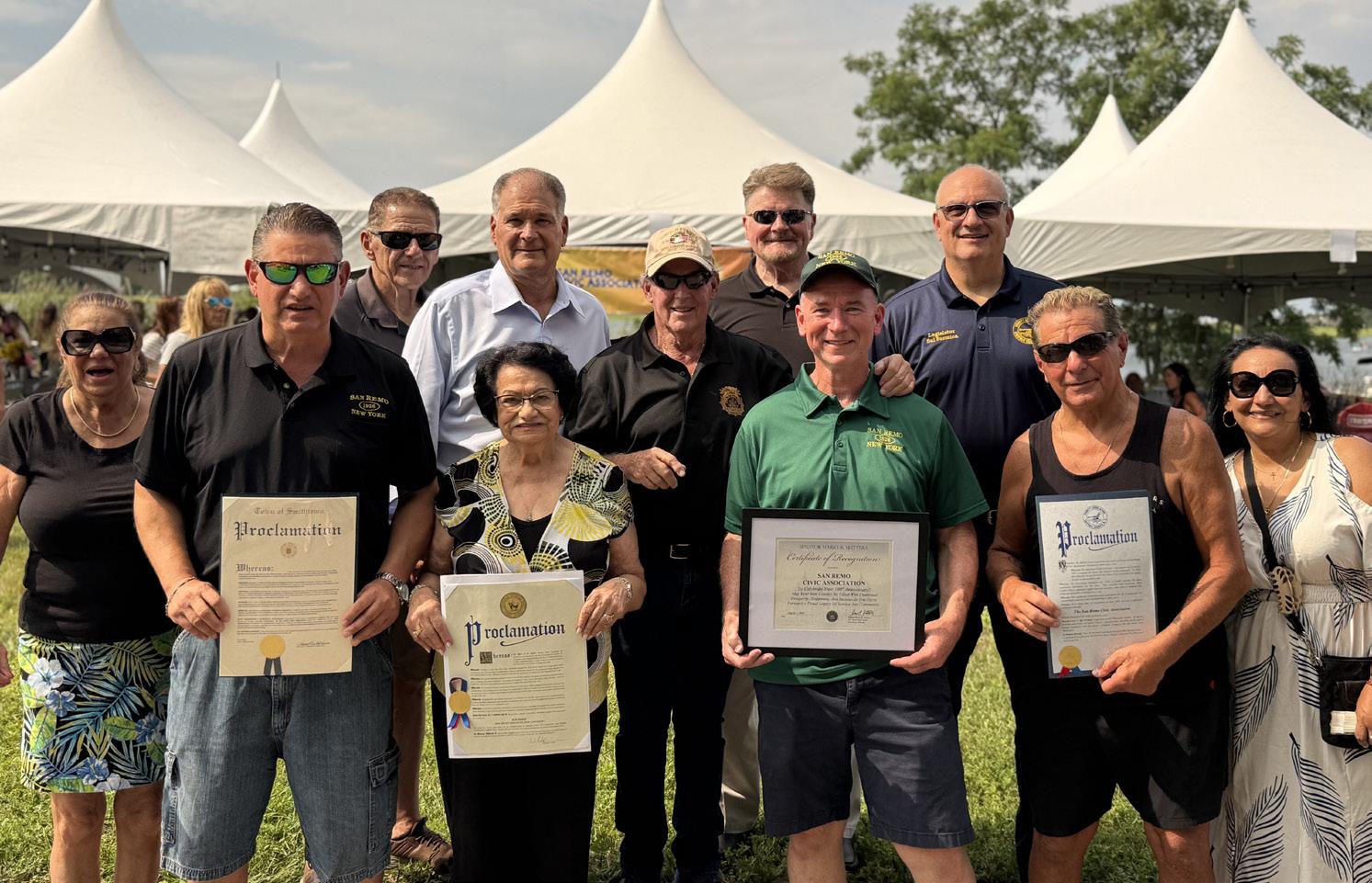
The community is already incredibly tightknit, but Saturday’s festivities brought together up to five generations of San Remo residents to celebrate 100 years of that camaraderie.
“San Remo is a hidden gem,” Louis LaNasa, one of the event’s organizers, told The Messenger at Saturday’s party. “This community has a family feeling; we’re all watching out for each other. This is one big family.”
LaNasa, of Kings Park’s Limo Lou’s Limousine and Car Service, said most of San Remo’s residents are third- and fourth-generation members, with the community’s elders having first taken root in the 1930s and 1940s - mere years after San Remo itself was founded. LaNasa’s grandfather emigrated to the U.S. and took up the ad seen in Il Progresso. In 1934, he purchased land in what is now San Remo.
“So many families grew up here,” said LaNasa, especially in San Remo’s infancy as a summer community. Some long-time residents were yearly vacationers to the area and would later become neighbors.
LaNasa and Camille Hagstrom-Smerz, a board
member of the San Remo Civic Association, reminisced of their times growing up in the small corner of Smithtown. The Nissequogue River is perhaps San Remo’s defining feature, and it’s provided generations with fond memories of swimming, fishing, and boating.
“We lived in the river,” Hagstrom-Smerz told The Messenger. “Anything we could do on land, we did on the water.”
Hagstrom-Smurz’s father was enjoying the festivities, along with his subsequent five generations who’ve called San Remo home at one point.
“The elders are here and every generation after, because that’s the family unit of San Remo.”
$1 hot dogs, a dunk tank, bounce houses, and an electrical bull were just some of the amenities offered along Riviera.
Local officials were also sure to help San Remo ring in the centennial celebration, which coincides with the 250th anniversary of U.S. independence.
“San Remo is a special, tight-knit area that has been together for so long,” said Senator Mario Mattera (R-St. James). “That feeling of family is a tribute to all who live here and helps make Smithtown the amazing place it is.”
Suffolk County Clerk Vincent Puleo’s (R-Nesconset) wife’s grandparents, Angelica and Manley Vita, were settlers to the area before incorporation in 1926. He congratulated the civic association on their first century.
“Here’s to another 100 years!” said Puleo.
Suffolk County Legislator Sal Formica (R-Commack), whose district includes San Remo, said, “their legacy is a powerful reminder of what can be achieved when neighbors come together with a shared commitment to public service.”
Of the centennial milestone, Formica said it represents “not only a proud history, but also an enduring future.”
“This is a community where we all watch out for each other, we all trust each other,” said LaNasa.
Published by Messenger Papers, Inc.
By Matt Meduri Published by Messenger Papers, Inc.
Primaries
Thursday, August 6, 2026
Tuesday Primaries Emblematic of Top Issues
So much happened this week that we’re effectively extending the “National” section of our Temperature Checks column on Page 9, but Tuesday night’s primaries in several key states not only change dynamics for the November midterms, but are also emblematic, we find, of the top issues Americans are discussing regularly.
Michigan
By far the most anticipated primary result of this cycle, Democrats had two choices: Congresswoman Haley Stevens (D, MI-11), who has represented a suburban Detroit district since 2019, and Abudl El-Sayed (D), an epidemiologist who from 2023 to 2025 served as Director of Health, Human, and Veterans Services of Wayne County, Michigan (Detroit proper).
from the American Israel Public Affairs Committee (AIPAC).
The marquee race culminated with El-Sayed winning the nomination by less than one percentage point (48.48% - 47.51%). It’s reminiscent of the 2016 presidential primary in this state, where Bernie Sanders (I-VT) defeated Hillary Clinton (D-NY) in a narrow upset. Michigan continues to prove itself as one of the most politically consequential states at virtually every level.
The race was seen not only as the classic binary of “establishment versus outsider,” but also on the Israel-Palestine question, a decades-long conflict that has confounded presidents and congresses perhaps more than almost any issue.
Congresswoman Stevens was elected in 2018 to MI-11, a Trump +5 district after his upset win in Michigan that year. Stevens has drawn sharp criticism for her devotion to the pro-Israel cause, with a video of her declaring to a crowd in the winter, “Israel comes to me in my dreams.”
Stevens’ public image also seriously deteriorated in the closing months as videos surfaced of her dodging constituents’ questions and campaign speeches that many saw as “theatrical.”
El-Sayed, on the other hand, drew criticisms for campaigning with Hasan Piker, a far-left Twitch streamer who in 2019, said “America deserved 9/11,” though he later rephrased his position.
become the largest United Methodist Church in the country. Last quarter, Hamilton outraised oneterm Senator Roger Marshall (R) by about $3 million, which is rightly putting Republicans on notice in a state that features the longest Senate drought for any party in the country. Kansas hasn’t sent a Democrat to the Senate since 1932.
Mike Rogers (R-MI) is the GOP’s candidate for this seat. He narrowly lost the 2024 Senate race in what became the closest Senate race in Michigan’s history. Whether the GOP can win a state where Democrats, on paper, should be able to win a blue environment remains to be seen. Florida flipping red in 2018 and Pennsylvania flipping blue in 2022 were outlier events for those midterms, so it’s distinctly possible this toss-up race remains in that category until Election Day.
The Wolverine State has not elected a Republican Senator since 1994.
Kansas
The “money in politics” problem was also on full display in Michigan throughout this race. The Democratic establishment argued that Stevens was the better candidate to win the race, while El-Sayed, possibly opening progressive pathways in the Midwest, was seen as the shakier option in working-class Michigan. AdImpact, an online political spending watchdog, dubbed the Democratic Senate Primary “The $95M+ contest.”
Indeed, Stevens had nearly $65 million in outside spending, compared to just $7.5 million for El-Sayed. About half of Stevens’ money came
One of the most ancestrally red states, Kansas remains consistently crimson, although that hue is not as deep as it is wide.
The Sunflower State represents Republicans’ best chances at flipping a gubernatorial seat this fall. Since the 1950s, both pirates have been able to win governor’s races on a rotating basis, typically two terms of one party followed by two terms of the other. Governor Laura Kelly (D-KS) is term-limited, making the position ripe for a GOP flip.
It’s a long shot, but Democrats and Independents have come closer than expected in recent years in Senate races here - 2014 and 2020 - come to mind.
Odds and Ends
Michigan saw yet another “establishment versus outsider” race on Tuesday. Two-term Congressman Shri Thanedar (D, MI-13) was defeated in his primary by State House member and progressive challenger Donovan McKinney (D). Initially aligned with the Democratic Socialists of America (DSA), Thanedar says he quit the chapter - the chapter says he was expelled - and he began to align with the Democratic establishment in Washington, namely in supporting Israel.
Thanedar later alienated himself somewhat on Capitol Hill for pushing articles of impeachment against Trump that were not sanctioned by his party’s leadership.
However, Democrats staged an upset with State Senator Cindy Holscher (D), defeating the Kelly-endorsed State Senator Ethan Corson. Holscher has called for a moratorium on AI data centers, bringing that national issue to light in the heart of the Great Plains.
Republicans are going with Ty Masterson (R), the Kansas Senate leader who had initially made several attempts at mid-decade redistricting.
On the U.S. Senate side, Democrats went with pastor Adam Hamilton (D), who founded what has
A rematch is afoot in VA-02, a Virginia Beachbased district where two-term Congresswoman Jen Kiggans (R) will face this seat’s former representative, Elaine Luria (D). Luria flipped this seat blue in 2018 and was unseated by Kiggans in 2022. VA-02 is one of the nation’s prime swing districts. In Washington, Republicans got a better opponent in WA-03 than they had in previous years. Joe Kent (R-WA), who lost winnable races in 2022 and 2024 to Marie Gluesenkamp Perez (D, WA-03), made headlines for departing the Trump Administration’s Counterterrorism agency over disagreements over the Iran War.
Gluesenkamp Perez has carved herself out as a staunch moderate in a Trump +3 district that takes in Vancouver and the suburbs of Portland, Oregon.
In Missouri, another Democratic Primary defined by outsider politics and the Israel question did materialize, but the establishment candidate retained his seat. Congressman Wesley Bell (D, MO-01) won re-nomination for this St. Louis-based seat over his predecessor Cori Bush (D). Bush had ousted a long-served establishment Democrat, Lacy Clay (D), in 2020. She was defeated in the 2024 primary by Bell.
Published by Messenger Papers, Inc.
By Matt Meduri
Summer Fun
Thursday, August 6, 2026
Second Annual Oyster Jamboree Scheduled in Port Jefferson
The Village of Port Jefferson will play host to Suffolk County’s second annual Oyster Jamboree.
The first Oyster Jamboree took place last August at Smith Point County Park. The purpose is to highlight the boon that local seafood is to the Long Island economy.
Suffolk County’s Economic Development and Planning Department found that when Henry Hudson first arrived in what is now New York City in 1609, he was standing above “nearly half of the world’s oyster population.” Oyster culture began as early as the 1820s, moving eastward to Long Island for “superior water quality,” according to the County. During the 1970s, the Great South Bay would be the “world’s richest clam factory,” with New York providing more than “60% of the nation’s hard clams.”
Long Island Business News found that 155 independent shellfish farming businesses exist within Suffolk. The Suffolk County Aquaculture Lease Program within the Peconic and Gardiners bays account for 568 lease sites.
Suffolk leads New York State in market value for sold aquaculture products, according to the County, generating over $14.5 million in regional sales and representing over 80% of the state’s total shellfish aquaculture.
The Second Annual Oyster Jamboree is set for August 15 - with an August 16 rain date, at Port Jefferson’s Harborfront Park. The celebration runs from 11:00a.m. to 6:00p.m.
Shuttles will run from the Port Jefferson LIRR Station on NY-112 to Harborfront Park, with stops on Belle Terre Road north of Mather Hospital, Belle Terre Road and Myrtle Avenue, and Barnum Avenue and Main Street (NY-25A) south of CVS. Shuttles will run every seven minutes continuously from 10:00a.m. to 7:00p.m.
“It was my contention as County Executive that there are so many great things in Suffolk County, including those who make their living by the sea growing oysters. We should celebrate that,” said Suffolk County Executive Ed Romaine (R-Center Moriches). “We have a proud history of making our living from the sea.”
Eric Koepele, President of the Long Island Oyster Growers’ Association (LIOGA) (pictured right), said that five oyster farms have been added to this year’s roster compared to last year’s.
“We’ll have great representation across all the oyster growing regions on the Island,” said Koepele. His organization represents 21 farmers across Suffolk, from Babylon to Fisher’s Island. In addition, this year’s celebration will include local breweries and vineyards offering beer and wines. Del Vino Vineyards and the St. James Brewery are two of those partners.
In fact, the St. James Brewery, run by Jamie and Rachel Adams, is offering a beer made with a yeast culture recovered from a South Shore shipwreck. Jamie, a lifelong SCUBA diver, personally dove to the ship that sank in 1886 off the coast of Captree Island. Years of logistics prevented any access to the shipwreck, but a winter storm made the wreckage
more accessible, including the first class dining section.
Adams recovered various beer bottles, from which one yeast strain was salvageable.
Romaine (pictured left) called the Village of Port Jefferson a “tremendous partner” in hosting the festival.
Port Jefferson Mayor Lauren Sheprow (pictured right) quipped that the “South Shore vs. North Shore” battle continues that the North Shore has “rebelled” by hosting the second iteration of this festival, while acknowledging “great competition” with the Village of Patchogue as perhaps the premier nightlife spot in western and central Suffolk.
“Port Jefferson has long served as a gateway community,” said Sheprow, pointing out the village’s connection between Long Island and New England. “Every day, people cross the Long Island Sound and begin their Suffolk County experience right here,” the Mayor added. Harborfront Park is just a short walk away from the ferry terminal.
Sheprow said that the village-wide “block party” is the second of its kind, the first having taken place earlier this year, and that officials are ready to “welcome up to 20,000 visitors” for the day. She also paid homage to the village’s original name, Drowned Meadows, captivating the salt marshes that long ago made the area fertile for shellfish.
Visitors will also be able to observe the Liberty Clipper, a 125–foot traditionally rigged vessel that serves as Long Island’s largest sailing ship, alongside a replica of the Caleb Brewster, a Revolutionary-era whaleboat. The replica was hand-crafted by local residents in honor of the 250th anniversary of U.S. Independence. Such historical moods will also be incorporated into the Oyster Jamboree.
Brookhaven Town Supervisor Dan Panico (R-Center Moriches) (pictured left) recounted his time on the Town Council with now-Executive Romaine as Town Supervisor. That administration started issuing bay leasings for oyster farmers. That number has ticked up to eight oyster growers in Brookhaven, a number Romaine continues to be keen to expand across Suffolk.
Panico extended a friendly challenge to Oyster Bay Town Supervisor Joseph Saladino (R-Massapequa), eleven offering to “personally pick up” Saladino to “really enjoy the true succulence of a Brookhaven oyster.”
Suffolk County Legislator Steve Englebright (D-Setauket),
a lifelong geologist, lamented the “almost complete and indiscriminate” consumption of oysters that led to ordinance to protect the mollusks in 1715. He lauded the work of the handful of oyster farmers who continue to proliferate some of nature’s most valuable filter feeders.
“It’s altogether appropriate…to celebrate the little animals that keep the water clean,” said Englebright. The festival has partners in the Greater Port Jefferson Chamber of Commerce, Discover Long Island, Northwell Mather Hospital, the Village of Port Jefferson, the New York chapter of America 250, the Bridgeport-Port Jefferson Ferry Company, and the Long Island Oyster Growers’ Association (LIOGA)
Smithtown Pet of the Week Adopt Django!
Meet the
Smithtown Animal Shelter’s Pet of the Week, Django—the definition of a gentle giant! At 160 pounds, this handsome Great Dane–Mastiff mix is basically an affectionseeking baby in the body of a small pony.
Django is sweet, sensitive and just a little bit chicken. He’s also a certified Stage Five Clinger who believes personal space is highly overrated. Wherever you go, Django plans to be right there— bringing love, loyalty and a generous helping of drool.
After suddenly losing his family, home and housemates, this big-hearted boy is in need of a home who will give him security, and plenty of affection.
Django has arthritis, so his future family must help manage his medication, keep him at a healthy weight and make sure he stays gently active. He would do best with older children and may be able to live with other pets after a proper introduction.
Ready to fill your home with love—and your floors with drool? Apply with the Smithtown Animal Shelter to meet Django today!
If you are interested in meeting Django, please fill out an application to schedule time to properly interact with her in a domestic setting, which includes our Meet and Greet Room, the dog runs, and our Dog Walk trail.
Smithtown HS West Welcomes New Principal
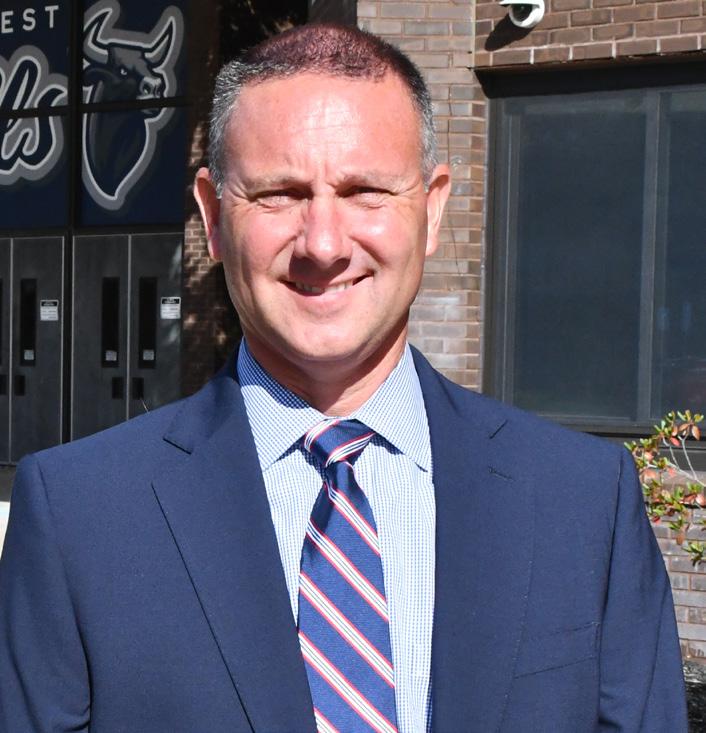
The Smithtown Central School District has announced Mr. Jon Macaluso as the new principal of Smithtown High School West. For the last six years, Macaluso served as an assistant principal at Great Hollow Middle School. Upon learning about the opportunity to take on his latest role as Smithtown High School West’s principal, Mr. Macaluso said he jumped at the chance and is thrilled to serve as the leader of one of two high schools in Smithtown.
“It feels amazing,” Macaluso said. “To be able to come and be a leader of this building is very humbling and to have the opportunity to guide high school students and help prepare them for college and beyond is really a privilege and I’m looking forward to it.”
Macaluso spent the first six years of his career as a school counselor in the Northport-East Northport School District. He then became an administrator and served as an assistant principal at Northport High School for two years. Seeking further opportunities for advancement, Macaluso spent time in the Commack and Connetquot Central school districts as a district director of guidance. He said he’s looking forward to working
with high school students and staff.
“Working in the district for six years, I’m looking forward to not only revisiting with students who I knew from years ago but also familiarizing myself with other students and working with the great staff at High School West.”
Macaluso attended SUNY Geneseo and majored in political science. He attended LIU Post for his Master’s degree in school counseling and later received a second Master’s degree in school administration from Touro College.
The Necessary Standard for American Education
Office of Management and Budget
By Matt Meduri
For the penultimate installment in this mini-series on Cabinet and Cabinet-level positions within the Executive Branch, we look this week at the Office of Management and Budget (OMB).
History and Origin
The Bureau of the Budget was OMB’s predecessor. Established in 1921 as a bureau of the Department of the Treasury under President Warren G. Harding (R-OH), its purpose was to create a unified federal budget the president could propose to Congress, ease government spending - especially after World War I - and financially advise the president. In 1939, the bureau was moved to the Executive Office of the President during heavy spending during World War II.
The first Director of the Bureau of the Budget was Charles Dawes (R-IL), who took up the post in 1921 under Harding until 1922. He would later become vice president under President Calvin Coolidge (R-MA). Dawes was strict with budgeting, forcing every government branch to make clear budgets and respect them and prioritized cutting costs to balance the national budget.
OMB wouldn’t take its modern form until 1970 during the Nixon Administration. It took on its new name while continuing to exist in the Executive Office. The reorganization shifted the Bureau of Budget’s perspective from that of a glorified account to a managerial role in the government’s finances. Richard Nixon (R-CA) had come into office intending to examine the various departments of the Executive Branch. According to the Nixon Foundation, Nixon sought to “transform” those departments from one where Cabinet heads “directed operations” of their respective bureaus “nearly independently” to a system in which the president had “more direct input into the various activities by the departments.”
George Schultz (R-CA) would serve as the first Director of OMB under its new organization; he took office in 1970. He served in that role until 1972 when he became the Secretary of the Treasury under Nixon, and later as Ronald Reagan’s (R-CA) Secretary of State from 1982 to 1989.
At OMB, Schultz championed the Quality of Life Review, which required Executive Branch bureaus to submit major regulations to the OMB for economic analysis before effect or publication of those regulationssocial, safety, environmental, etc. As the fiscal watchdog, he expected draft regulations early and flagged those with high economic costs to non-federal entities and/or those that drained federal funds. That rule specifically affected the Environmental Protection Agency (EPA) as far as proposed regulations went.
OMB has been subject to various pieces of legislation. The Paperwork Reduction Act of 1980, the Chief Financial Officers (CFO) Act of 1990, and the E-Government Act of 2002 helped the department grow with the times and the size and scope of the federal government.
Structure
OMB is primarily made up of career-appointed staff whose job is to maintain continuity between administrations and parties: the Director, the Deputy Director, the Deputy Director for Management, and the administrators of the Office of Information and Regulatory Affairs, the Office of Federal Procurement Policy, and the Office of Federal Financial Management All are appointed
by the president and confirmed by the U.S. Senate.
There are five Resource Management Offices within OMB. Each is led by an OMB associate director. Most OMB employees are program examiners, whose prerogatives can range from multiple federal agencies to a single topic of scrutiny. These examiners play a crucial role in examining the president’s proposed budget and essentially serve as the first gatekeepers on what will be sent to Congress. They use the Program Assessment Rating Tool as a means to score items in terms of efficacy and agenda against cost-effectiveness and budgetary protocol.
In terms of their role in the budgeting process, OMB consults the president on the economic situation of the country, followed by the Spring Guidance - a period during which the OMB gives the Executive Branch agencies instructions on policy guidelines and timeframes. OMB staff meet with senior agency representatives to determine which policies should make the final cut sent to Congress; that process usually runs from October to November.
Next, the OMB Director meets with the president to discuss the agencies’ proposals and to recommend a federal proposal. Agencies can appeal those decisions to the OMB and the president.
The final negotiations are sent to the relevant congressional committees, chief among them being the Appropriations Committee.
Chief Performance Officer of the United States: This position was created by President Barack Obama (D-IL) in 2009. This role is intended to reform and improve government agencies. Eric Ueland (R-OR) has served in this role in an acting capacity since 2025.
Office of Federal Financial Management (OFFM): This agency has two branches, the Management Controls and Assistance Branch and the Accountability, Performance, and Reporting Branch. Created in 1990, the OFFM implements “financial management improvement priorities” of the President and establishes “governmentwide financial management policies of executive agencies,” according to White House Archives
This column will seek to address the long-forgotten concept of civics and how it relates to American government in general, from the federal level to the local level. This column will explore Constitutional rights, the inner workings of government, the electoral process, and the obligations and privileges of citizens.
United States Digital Service (USDS): This branch was formed in 2014 with the task of modernizing federal government services. The Obama-era branch was reconfigured by President Donald Trump (R-FL) in 2025 to align with the Department of Government Efficiency (DOGE).
Office of Information and Regulatory Affairs (OIRA): Established in 1980, this branch oversees the implementation of government-wide policies under Executive Order 12866 - an issue signed by President Bill Clinton (D-AR) that requires a cost-benefit analysis for a new regulation deemed “economically significant,” that with an annual economic effect of at least $100 million or “adversely” affecting the economy at-large in a “material way.”
OMB Today
OMB is one of the smaller offices on Capitol Hill, employing about 500 people as of 2026. About 90% of the staff are civil servants. OMB requested a budget of $146.1 million for FY2026, a 13.3% increase from FY2025.
Credit
OMB, Reagan Institute
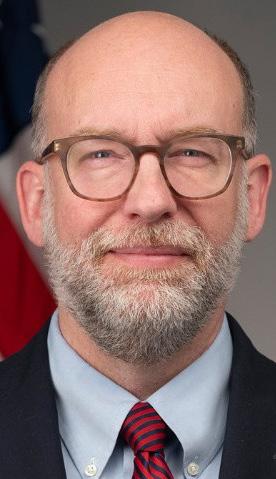
The forty-fourth and current Director of OMB is Russell Vought (R-VA) (pictured left). Vought served as Deputy Director of OMB in Trump’s first term from 2018 to 2020. He would ascend to the post proper in 2019 and serve out the rest of Trump’s term. He was invited back to lead the department in 2025 and was confirmed in a 53-47 party-line vote of the Senate. Vought studied at George Washington University Law School and helped author the Family Budget Protection Act, which would have cut $1.8 trillion in spending on entitlement programs, and Operation Offset, a deficit reduction plan for Hurricane Katrina relief. In 2008, was named policy director for the House Republican Conference by its Chair, thenCongressman Mike Pence (R-IN). Vought would regularly clash with Republican leadership on spending and resigned after the 2010 passage of the Affordable Care Act.
Office of Federal Procurement Policy (OFPP): Created in 1974, this branch stands to “promote economy, efficiency, and effectiveness in acquisition processes.” OFPP has been at the center of major acquisition laws, including the Competition in Contracting Act (CICA) - which increased competition in federal contracting - and the Federal Acquisition Streamlining Act (FASA) - which simplified and reduced administrative burdens in the process, primarily affecting commercial items.
Office of E-Government & Information Technology: Often simply called “E-Gov,” this branch was created in 2002 to develop and guide the federal government’s use of Internet-based technology for public interaction with the federal government. White House Archives say that Washington has “largely…missed out” on technological “transformation” due to “poor management of technology investments,” IT projects taking too long and costing too much, and delivering technologies that are “obsolete by the time they are completed.” E-Gov has sought to remedy that.
Vought took the helm at OMB during the 2018-19 federal government shutdown, during which he pushed for large spending cuts, as the OMB had called for the largest spending cuts in modern U.S. history.
After leaving office in 2021, Vought founded the Center for Renewing America, a pro-Trump, conservative think tank aimed at social and financial responsibilities to the nation. He was opposed to Kevin McCarthy’s (RCA) short-lived tenure as Speaker of the House.
During the 2023 budget negotiations, Vought was influential in a proposal to cut the Department of Health and Human Services’ (HHS) budget by $22 billion and the Department of Housing and Urban Development’s (HUD) budget by $26 billion.
In 2025, Vought stepped down from the center to rejoin the Trump Administration. As Director, Vought withheld billions in congressionally-approved spending for social programs and research while pushing to dramatically reduce the size of the federal government. He’s also enacted plans to give the president more control over federal agencies and has maintained controversial positions on federal layoffs and civil service reclassifications.
Around Town 15
Thursday, August 6, 2026
Legislator Kennedy Visits Smithtown’s Own Fallingwater
On Thursday, July 30, Suffolk County Legislators Leslie Kennedy (R-Nesconset) and Steven Englebright (D-Setauket) were invited to tour a historic home in the Head of the River neighborhood of Smithtown.
The home was originally constructed in the 1720s, making it not only one of the oldest structures in the Town of Smithtown, but half of a century older than the United States of America. Situated directly south of Jericho Turnpike, where the LIRR train trestle crosses Main Street, the home is stunning. Featuring wooden shingles, colonial windows, and views that look directly into the Nissequogue River, the house’s atmosphere transports you to the 18th century.
The home was constructed as a grist mill for the purpose of grinding grains. It was one of three mills located in the bustling community in the 1700s, known as Head of the River. This remaining mill operated until 1909. Because it is sited directly over part of the river, the house originally featured a horizontal water wheel. The remnants of the wheel are still prominent, with the upright shaft still in the center of the home and a beautifully constructed spiral staircase circling it. Various mill gears have been repurposed into side tables and other pieces of furniture. A mill wheel and part of the gears are situated in a frame under a cathedral ceiling. While the mill may no longer be functional, the home has never strayed from its character.
While the placement of the home may have originally been practical in nature, the river is beautifully integrated into the architecture of the home. Each window looks directly into a different part of the Nissequogue River, and the ground floor features a deck directly at water level. The integration of the Nissequogue with the design of the home is so immaculate, it rivals Frank Lloyd Wright’s Fallingwater.
Most homes from that era are either owned by conservatorships, non-profits, or municipalities, however this home is not owned by any of the above; it’s still a private residence. The current family history of the mill house dates back to the early 1960s, when Herb and Ruth Luther purchased the home. Since then, four generations of the Luther family have called the mill house at Head of the River their ancestral hall.
Legislator Kennedy and Englebright were greeted by Molly Micciche and Nicole Leavens, daughter and granddaughter, respectively, of Herb and Ruth Luther. It was clear from the start that the Luther family had a love for the home that extended beyond family sentiment. Every detail was cherished, and no piece of lore was off limits. From the age of the timbers to the joinery of the wood, to summer vacations where distant cousins would reunite by
swimming in the Nissequogue.
However, everything would change in August of 2024. During the 100-year storm surge which broke the historic Blydenburgh Dam, the home was almost destroyed. The home was covered with muddy sludge, with water rising in the Mill up to five feet inside the first floor and leaving thick mud in its wake as it receded. The owners would spend the next several months meticulously cleaning the damage all by hand, and all repairs were paid out of pocket.
While the dam break has done its damage to the area, the mill house deserves special attention. The Blydenburgh Dam and spillway served as flood control for the Town of Smithtown, tempering the flow of the Nissequogue River. Head of the River is one of the most at-risk areas now that the Nissequogue no longer has flood control measures.
“Very few things in life make me teary, but walking into this home and seeing this magnificent period structure, so well preserved, and the stunning beauty of this amazing property made my heart leap with joy. Thank you to the family for its stewardship of this museum quality site. Our history is truly amazing,” said Legislator Kennedy.
The family is now planning to sell the three-century old home.
“We’ve been stewards for 65 years, it’s time for someone else to preserve it,” said Joanne D’Agostino, daughter of Herb and Ruth Luther. The family has reached out to different municipalities to garner offers, but her primary hope is that it would be sold to “someone [who would] love it like we did, it’s been our anchor as a family.”
“This magnificent early river mill that has been preserved as a home protects the memory of Suffolk County’s brave and resourceful early settlers and the colonial-era commerce that sustained them,” said Legislator Englebright on the experience of touring the home. “The respect afforded to this heritage by the extended Luther family and Legislator Leslie Kennedy is enlightened and meaningful. I thank each of these individuals for this invitation which enabled me to learn more about our great County. It was a privilege to visit this important historic site. I am also impressed that the current owners would favor preservation of this mill through public ownership. I look forward to the possibility of further discussions to explore how we might add this rare and beautiful structure to the public park system’s extraordinary collection of historic buildings that collectively help tell the story of Suffolk.”
Legislator Kennedy would like to thank the Luther family for the invite to tour the residence, and more importantly, their unending preservation of the historic structure and property.
Local History
Thursday, August 6, 2026
L.I. Cemetery Preservation Group Faces New Challenges for 250
By Ellyn Okvist, B.Sc.
The 250th Anniversary of the United States has brought many aspects of the Revolutionary War to the surface.
Hessians were German troops hired by the British during the American Revolutionary War, primarily from Hesse-Kassel and other German states. Hessians fought for the British against American forces, and many were captured or killed in battles. Their presence in the war has led to significant historical interest, especially regarding their burial sites.
The Battle of Long Island took place in the hills of Green-Wood Cemetery, primarily around Brooklyn Heights on August 27, 1776, and was a crucial engagement of the Revolutionary War and the largest battle of the conflict. It proved to be a decisive victory for the British forces led by General William Howe against Commander-in-Chief George Washington and the Continental Army. Credit would be given to the elite Hessians who supplied units such as grenadiers and chasseurs, which were instrumental in the British strategy during the battle. The Hessians’ effectiveness in combat contributed to the British control of New York City. They continued to participate in various battles throughout the war and influenced several key moments in American history.
A notable discovery includes a mass grave in New Jersey, where the remains of about a dozen Hessian soldiers were found at the Battle of Red Bank site. However, our general area on Long Island has become a substantial area for the Hessian graves. It is not surprising that new gravesites are being discovered on a regular basis here in the surrounding area. Long Island was overwrought with the British and their Hessian counterparts.
Just last week, a private cemetery in Head of the Harbor seems promising for re-discovery of the Hessians. There are indications of Hessian graves here in the Lake Ronkonkoma area, which are being researched. Such findings provide insights into the lives and deaths of these soldiers, as well as the broader context of the Revolutionary War.
Head of the Harbor, a village in northeastern Smithtown, was definitely “Loyalist” territory during the times of the Revolutionary War. After the Battle of Long Island, the British occupied Long Island for eight long years, and British and Hessian soldiers were widely spread as they established forts throughout the Island. Spying activities occurred on both sides and obviously tore families in two due to their individual loyalties.
In 1914, the Thatch Meadow Farm, a home belonging to a possible descendant of Richard Bull Smith, was purchased by George and Caroline Bacon and massive renovations began, led by Architect Archie Brown. The property had always had the reputation of being haunted. The relentless sound of footsteps heard in the cook house were eerie and considered supernatural. As the outdoor kitchen, complete with cook house and outdoor oven, were uncovered, a complex system of locked doors and rusted hinges appeared as they made their way to the rear of the oven. A Hessian boot, complete with foot and leg bones, was found.
After being authenticated, the explanation became clear. It seemed that the soldier may have been gravely injured and went to the house for assistance. The family locked him in the oven area to prevent horrendous ramifications to the family by the Hessians. Their reputation was ruthless; they had no mercy for any living thing. The boot and bones were given a proper burial, along with the Lord’s Prayer spoken in German, and once done, the repeated footsteps known as supernatural stopped in the cook house.
The second recent discovery would be the possibility of two or more Hessian graves also located in a private cemetery in Head of the Harbor. The original owners
of the property had their own graveyard, and information has filtered down from them to present day. If possible, the gravestones and location will be restored. The research on this discovery may be tedious, but we are certain an answer will be arrived upon.
The research and development of these specialized restorations in Head of the Harbor would need the proper experience and capabilities, which leads us to the Long Island Cemetery Preservation Group, Inc. (LICPG)
Started by Robert Von Bernewitz, Dave Thompson, and Chris Ryon, LICPG’s respect for the burial grounds of Long Island has surpassed our expectations. The skills of the members go much further than restoring gravestones and bringing local cemeteries back to their glory. Their work can be found in many locations throughout Suffolk County and have included Sea View Cemetery in Mount Sinai, Union Cemetery in Middle Island, Old Baptist Cemetery in Coram, Landing Avenue Methodist Church in Smithtown, Old Bethel Cemetery in Stony Brook, Branch Cemetery in Smithtown, and others. Many of the cemeteries mentioned have Revolutionary War patriots and Civil War soldiers, some with National Landmark Status.
Using the correct equipment for the projects is invaluable. LICPG utilizes their ground penetrating radar machines, are advocates for approved policies that protect natural resources, and promote environmental sustainability cleaning agents. Holding the dignity of each deceased foremost as they complete their work.
One LICPG board member, a direct Mayflower descendant and current Mt. Sinai resident, is developing special software to keep endearing information for the future and public use. Genealogy and local research are what has held this group foremost in the projects they undertake.
Restoring graveyards offers several significant benefits, such as preservation of history. Restoration helps maintain the historical integrity of graveyards, preserving the stories and memories of those buried there. This contributes to a deeper understanding of local and national history, and in this case, Hessian soldiers may be determined. Graveyards often reflect cultural values and practices. Restoring these neglected sites honors traditions and fosters a sense of community identity. Well-maintained graveyards can serve as green spaces, promoting biodiversity and providing habitats for various species. They can also help combat climate change by acting as carbon sinks.
Restoration projects often involve community participation, fostering connections among residents and encouraging stewardship of local heritage, which is the case for Long Island Cemetery Preservation Group, Inc. Visiting one of their projects will set off a spark that will bring you towards the cause. This type of specialized reconstruction and “raising” the gravestones (back on their base) is their forte.
However, their non-profit does not only restore and beautify a burial site. They possess the skills that it takes to research and determine a sacred area. The owners of the Head of the Harbor locations reflecting Hessians among the buried chose the correct group to accomplish the tasks. With their skills, we can expect favorable results.
Anyone with an interest in becoming a volunteer (of all abilities) with this worthwhile group can email them at licemeterypreservation@gmail.com. Visit their Facebook at Long Island Graveyards and Cemeteries and Long Island Cemetery Preservation Group. Their website is licemeterypreservation.org.
Cemetery in Head of the Harbor (Credit - Robert Van Bernewitz)
Hessians depicted in 1776
Outdoor oven at Thatch Meadow Farm (Credit - Robert Van Bernewitz)
AI Bills Are Rising. Here’s How Businesses Are Bringing Them Down
By Mollie Barnett
Consider Maria, the hypothetical owner of a 14-person marketing agency. In the spring, she gave her team broad access to the newest Artificial Intelligence tools. By summer, the monthly bill had more than doubled, even though the team was not working any harder.
The technology was producing useful work. The cost, however, was becoming difficult to sustain. Maria faced a choice many small-business owners are beginning to confront: scale back the tools that were helping or learn to use them more deliberately.
Her situation reflects a real and increasingly common problem. The price of processing an individual unit of AI work has generally declined, but companies are using dramatically more of it.
Simple questions and one-time writing requests are giving way to AI agents that research, plan, call other tools, revise their answers and repeat steps until a task is complete. Each additional action consumes computing resources. A system that appears to perform one assignment may actually conduct dozens of model interactions behind the scenes.
McKinsey recently reported that 93% of respondents in an enterprise survey had exceeded their AI budgets. Its research also found that checking and repairing an AI agent’s initial output can account for roughly 60% of the cost of completing a task.
Major companies are confronting the same problem. Uber reportedly used its planned 2026 budget for AI coding tools within the first four months of the year and introduced employee-level spending controls. OpenAI CEO Sam Altman has said that customer concern about AI costs went from barely being discussed at the beginning of the year to becoming a “huge issue” within months.
unlimited output.
For smaller businesses, unexpected costs can be more disruptive because there is less room in the budget to absorb them.
Companies responding effectively are not abandoning AI. They are beginning to manage it the way they learned to manage cloud computing and software subscriptions: by matching the resource to the value and complexity of the work.
Two practices are proving particularly useful. The first is model routing.
Many businesses automatically send every task to the newest or most powerful AI model. That is similar to hiring a senior attorney to format every document or asking the chief financial officer to process routine expense reports.
Complex client analysis, consequential financial work, high-value sales strategy and sensitive decisions may justify a more capable model and greater human review. Routine summaries, internal updates, basic drafts and standard customer correspondence often do not.
The objective is not simply to choose the cheapest model. It is to use the least expensive system that can reliably meet the task’s quality, privacy and risk requirements.
Large organizations are already adopting this approach. EY recently said an internal routing system that directs requests to different AI models reduced its token consumption by as much as 60%. McKinsey estimates that organizations with stronger cost controls, accountability and workload optimization could reduce AI spending by 20% to 30%.
The second practice is controlling how much information the AI must process.
In many AI systems, a long conversation becomes more expensive as it grows because earlier instructions and messages remain part of the working context. Businesses can reduce unnecessary usage by opening a new conversation for each distinct project, carrying forward only the information that is still needed and asking for appropriately sized answers rather than
Companies building their own AI applications can go further by reusing stable instructions, shortening unnecessary tool descriptions and taking advantage of discounted processing for repeated content. Some providers offer substantial discounts when the same instructions or background material can be reused rather than processed from the beginning each time. These practices sound technical, but the operating rules are straightforward. Use premium AI where the value or risk justifies it. Use less expensive systems for routine work. Separate unrelated projects. Avoid dragging unnecessary history into every request. Set spending limits. Review costs by team, task and outcome rather than looking only at the total monthly bill.
In Maria’s hypothetical agency, routine correspondence and internal work would default to lower-cost models, while client strategy, sales development and high-stakes creative work would continue to use more capable systems. Her team would open a new session for each project and carry forward only the information required to complete it.
The agency would not necessarily use less AI. It would simply stop paying premium prices for routine work and unnecessary processing.
There is also an important distinction between access and value. An employee may use an AI system frequently without producing enough additional revenue, speed or quality to justify the cost. Businesses therefore need to measure more than usage. They should ask whether the system reduced labor, improved decisions, increased capacity, accelerated sales or produced another measurable benefit.
AI is moving from an experimental expense into a normal operating cost. That means enthusiasm alone is no longer a sufficient management strategy. The businesses most likely to preserve AI’s productivity gains will not necessarily be those using the most advanced systems everywhere. They will be the ones that know which work deserves expensive intelligence, which work does not, and whether the value created is greater than the full cost of producing it.
This article was researched and drafted with the help of AI.
Mollie Barnett - is an AI Decision Architect and the founder of State & Signal, where she helps leaders build stronger decision systems before deploying AI.
Thursday, August 6, 2026
Recent Spike in Drownings Prompt Officials to Sound Alarm
By Matt Meduri
With just under two months left of summer, drowning incidents in Suffolk are surpassing last year’s numbers, and officials are mounting a public safety campaign in response.
Last month, two toddlers drowned in separate backyard pool incidents, one in Mastic on July 20 and the other in Central Islip on July 24. Officials referenced several other water-related incidents recorded since May.
“We’ve had more drownings this year than previous years. We’re very concerned,” said Suffolk County Executive Ed Romaine (R-Center Moriches) at the Centereach Pool. Officials gathered there on Friday, which happened to be National Lifeguard Appreciation Day.
Rudy Sunderman (pictured right), Commissioner of Fire, Rescue, and Emergency Services (FRES), said in 2026 so far, FRES has received 88 water-rescue alarms. At this time last, FRES received 64. As of press time, the County has seen 10 tragedies. In 2025, the County saw 16 tragedies throughout the summer.
Sunderman recommended the use of U.S. Coast Guard-approved life jackets for any water-related scenario and for residents to take swimming lessons if they’re unable to swim. He added that swimming while wearing bright, neon colors can make for an easier rescue, especially in darkness and/or in a large expanse of water.
Romaine recommended a hard “rule” on pool use, “no one goes in alone.” He also mentioned heeding lifeguards’ warnings at public pools and beaches. In the latter case, he implored the public to only swim within the marked flags, as last week saw the rescue of a swimmer who was taken to sea by the rip current.
“I have a lot of duties as County Executive, but I can say, without reservation, the saddest thing I do on any given day is read fatality reports about children who have drowned,” said Romaine. “
Brookhaven Town Supervisor Dan Panico (R-Center Moriches) mentioned the Town’s Aquatic Center in Mastic offers low-cost, indoor swimming lessons for all ages.
“Drowning is 100% preventable,” said Panico, adding that “only a couple inches of water” is enough to pose a drowning hazard to a child.
Suffolk County Legislator Nick Caracappa (C-Selden) called the rip current conditions
in Suffolk’s slices of the ocean “the worst” on the Island, and recommended locking pool gates when not in use and to install pool alarms, as a common cause of drowning fatalities is the silence with which they can occur.
Bobby Hazen (pictured right), Executive Director of Stop Drowning Now and founding member of the New York Water Safety Coalition, recommended assigning a “water watcher” in 15-minute shifts.
“This person puts the phone down, doesn’t drink any alcohol, and does nothing else but watches the children in the water,” said Hazen. For rip currents, Hazen said it’s “important to relax, float as you start to feel like you’re not being pulled anymore, and swim parallel to the shore to escape the rip.”
A program by Stop Drowning Now is available on the County website. Hazen said that swim lessons have been “proven to reduce the risk of drawing by up to 88%.”
Published by Messenger Papers, Inc.
Thursday, August 6, 2026
NYC Mayor Mamdani Demands ID for Groceries But Not Voting
By Shane Harris | Editor-in-Chief of AMAC Newsline
New York City Mayor Zohran Mamdani has become the latest Democrat to accidentally undermine liberal arguments against Voter ID amid the rollout of his city-run grocery stores.
During a recent press conference, a reporter asked Mamdani how he plans to ensure that people don’t take advantage of the stores, which will use government funds to provide groceries at a 30 percent discount. Skeptics have pointed out that anyone could simply purchase mass quantities of the taxpayersubsidized goods and then sell them at a markup while still undercutting privately run grocery stores. Mamdani turned the question over to the city’s chief financial officer, Jeanny Pak.
“We are looking to make sure that we target New Yorkers, whether it be a sort of a library card-esque thing, and also we manage who’s buying and that is focused on everyday New Yorkers,” Pak said.
Yes, you read that right. The socialist mayor who has been a vocal proponent against requiring an ID to vote is now apparently planning to require a “library card-esque thing” – otherwise known as an ID – to enter his government-run grocery stores. Why? To ensure that non-New Yorkers can’t access something that is reserved for city residents.
The irony was apparently lost on the mayor’s staff, who scrambled to respond to the predictable mockery online. “Comparisons to voter ID laws or the SAVE Act simply do not apply,” a Mamdani spokesperson said in defense of the policy. “This is not an identification system, nor is it a mechanism to verify who someone is, where they live, or how much they earn.”
But wait – if it’s not a mechanism to identify where someone lives, then how will it ensure that only New Yorkers can access the discounted pricing? It seems that no one from the mayor’s office has an answer.
“ID for government cheese,” quipped Philadelphia radio host Rich Zeoli. “After all, we have to make sure no one crosses the border and if they do, the police will be called. So it’s good to see Mamdani now supports ID (just not for voting), border control, and law enforcement.”
Former Virginia Attorney General Jason Miyares, a vocal supporter of Voter ID, added to the pile-on. “So, let me get this straight: Taxpayer-funded grocery store? Better show a valid ID or you can’t buy milk,” he said. “Voting for the people who decide how those taxes get spent? A valid ID is somehow ‘racist’ and ‘oppressive.’ Unbelievable.”
This isn’t the first time that Mamdani has made himself the laughingstock of the internet over his absurdly hypocritical stance on requiring people to show an ID. When a massive winter storm hit the Big Apple back in February, Mamdani requested that New Yorkers sign up to become emergency snow shovelers.
The only catch? Interested parties had to show no less than five forms of ID to participate in the program.
“The New York City Sanitation Department website says that in order to register as an emergency snow shoveler, an applicant must provide two small photos sized 1-1.5 square inches, two original forms of ID plus copies, and their social security card,” The New York Post reported at the time.
But while Mamdani is the current face of Democrat duplicity on ID policies, he’s hardly the only one. Even as Democrats railed against Voter ID in 2024, the party required a photo ID to attend the DNC convention that year. Multiple Democrats, including Georgia Senator Jon Ossoff and New York Rep. Alexandria Ocasio-Cortez, have also required attendees at their campaign events to show a government-issued photo ID for entry even as they oppose requiring an ID to vote in federal elections.
When it comes to voting, Democrats insist that ID requirements are “racist,” discriminatory against poor people and married women, and “Jim Crow 2.0.” But when it comes to attending a political rally, shoveling snow, or buying bananas from a communist grocery store, apparently, requiring an ID is perfectly acceptable.
Of course, there’s also the fact that Americans have to show a government-issued photo ID to board a plane, rent a car, rent a hotel room, purchase alcohol or tobacco, pick up most prescriptions, donate blood, open a bank account, and even to participate in
Olive Garden’s Never-Ending Pasta Pass.
Liberals will counter that “voting is a constitutional right,” while all those other things are not. True enough. But just because something is a right does not mean that there should be no safeguards or restrictions to ensure that right is exercised lawfully and only by those to whom it is granted.
For instance, Americans have a constitutional right to keep and bear arms (although even that varies in practice depending on the state). Yet the federal government still requires a photo ID for gun purchases – in addition to requiring buyers to fill out a federal document (ATF Form 4473) with exact personal details.
Overview - AMACThe Association of Mature American Citizens
The Association of Mature American Citizens represents Americans 50 plus. AMAC is centered on American values, freedom of the individual, free speech, and exercise of religion, equality of opportunity, sanctity of life, rule of law, and love of family, with benefits at all levels.
AMAC plays a vital role in helping build the services that will enrich the lives of America’s seniors. AMAC Action, a 501 (C)(4) advocates for issues important to AMAC’s membership on Capitol Hill and locally through grassroots activism. To Learn more, visit amac.us
Abandoning basic election integrity provisions like Voter ID actually infringes on the free exercise of the right to vote. Every illegitimate voter effectively disenfranchises one lawful U.S. citizen voter.
Mamdani and his fellow Democrats clearly understand that identification is a basic safeguard whenever it suits them. It is only when Americans cast ballots – and Democrats stand to benefit from weaker rules – that asking someone to prove who they are suddenly becomes an intolerable assault on civil rights. Their position is not principled, coherent, or even remotely believable. It is a cynical double standard dressed up as moral outrage, and Mamdani has once again exposed it as well as any Republican ever could.
JUL 9 –AUG 23 SEP 10–OCT 25 NOV 12–DEC 27
WORD OF THE Week ZENITH
Etymology:
late 14th Century, zineth, from Old French cenith (Anglo-French zenith), from Medieval Latin zyneth from scribal transliterations of Arabic samt, “road, path,” abbreviation of samt ar-ras, literally, “the way over the head.”
noun
Pronounced: /zee·nuhth/
Definition: culminating point.
Example: “The nation grew reckless after it reached the zenith of its powers.”
Synonyms: acme, height, climax
Antonyms: base, bottom, start
Source: Merriam-Webster
WORD WHEEL
R U S L O I
See how many words you can create. Must have center letter in word and can use letters more than once. 4 letter word minimum.
SUDOKU
See left for the answers (please don’t cheat!)
This Week in History
August 7, 1955:
Tokyo Telecommunications Engineering, the precursor to Sony, begins selling its first transistor radios in Japan.
August 6, 1996:
NASA announces that life may have existed on Mars after examining meteorite ALH 84001, discovered in Antarctica and believed to be from Mars.
August 9, 2016:
Longest-ever hunger strike ends as Indian human rights campaigner Irom Sharmila tastes honey after 16 years.
August 11, 1951:
August 8, 1981:
Ceasefire between Iran and Iraq takes effect after eight years of war.
August 10, 1846:
U.S. Act of Congress passes establishment of the Smithsonian Institution, now the world’s largest museum and research complex.
August 12, 1851:
Source: Onthisday.com.
American inventor Isaac Singer patents his famous sewing machine.
First televised baseball game in color airs on WCBS in New York City; Boston Braves beat Brooklyn Dodgers 8-1.
By PJ Balzer
Carried by the Current
In a handful of weeks, the seasons will change again.
The summertime boats will be removed from the water and campsites will empty out. The annual East End exodus will head west on Sunrise Highway, and their seasonal homes will begin the winterization process. Some of those pesty summer bugs will die off, and our early mornings will contain this unusual breeze that we haven’t felt since late November. Shortly after that, the leaves will begin to change color, signifying a change in season.
Along with the changing scenery is our changing schedules. It’s the start of school that puts us back in that September schedule mode. Casual summer Fridays at work are over and we’re now spending our evenings and weekends on the local sports fields. Parent-teacher meetings and school events are occupying the time we were just spending by the beach just two months ago. Our teenagers are now riding on the homecoming float rather than riding the oceans waves.
Roles change, tasks change, seasons change, and change is inevitable.
When I watch the changing seasons, I can’t help but to be reminded of how similar the meteorological seasons are to our own personal seasons of life. For months, a year, or several years, we may be focused on one area of life. We have a task at hand that needs more attention and that’s what this season requires of us. It could be finishing the degree, the certification, or the project. We find ourselves in one season more career-focused and in the next more family-focused. In one season, our schedule may be more uniform and demanding than the following.
But abruptly or gently, the seasons can shift. Many times, unexpected circumstances touch our lives and homes, circumstances that demand our time, effort, and attention. Seasons can change within a phone call or text message. We can easily go from the caretaker to the one that now needs to be cared for. Just like the shift from August into September as summer
VETERANS
Are you aware of the benefitsmany available to you?
shifts into autumn, our lives can and will experience the same change.
I spent many years of my own life trying to fight the flow of the seasons. I would compare it to the ocean’s rip current that everyone fears getting caught in this time of year. People who know how to navigate the ocean suggest that if you allow the rip current to carry you for a while, you’ll eventually reach a spot of safety - a place where the heavy current ceases and you can then calmly swim back to safer waters, eventually reaching the shore.
On the contrary, if you attempt to swim away from or against the rip current, it can easily overtake and pummel you. Panic inside that current is how many end up losing their lives. The flow of the water in that direction is already moving with too much strength and determination. Our own limited strength and human will simply aren’t a match for the current. Experts say that you’re much better off letting it carry you in the same direction. There’s undoubtedly a deeper meaning and life lesson in that.
When we feel life changing and the current flowing in one direction, surrender is much more beneficial than fighting. Even if the way it’s flowing isn’t necessarily comfortable or initially beneficial.
God always has a plan, a purpose and end goal in mind, even if we can’t see it until the current carries us for a while to an unknown part of the sea. There’s still a refuge of safety waiting at the end.
I’ve learned, in small measure at least, to live in the flow of the seasons, to allow myself to be carried by that current when everything in me wants to fight it, to prayerfully ask God for the grace and strength to simply move in His direction one day at a time, to roll up my sleeves each day with His purposes and His heart in mind first and foremost, to cease swimming against the rip current that He’s provided to carry me eventually to the shore.
Even if I’m initially scared, confused, disappointed, and losing faith, His rip currents have always carried me to the very spot that I needed to be.
PROTECTING THOSE WHO PROTECT YOU
LOUIS CIVELLO, PRESIDENT
VETERANS BENEFITS ASSISTANCE
Veterans should bring their DD214 and any service documents they may have regarding their service.
AT
A representative from the Disabled American Veterans (DAV) is on hand to assist veterans with submitting disability claims as well as benefits for widows/widowers of deceased veterans.
First Wednesday of each month
At the Selden location
Third Wednesday of each month
Veterans should bring their DD214 and any service documents they may have regarding their service.
At the Centereach Location 9:30am to 1:30pm.
First
Long Island Hockey Player Commits to Boston College
By Ashley Pavlakis
Long Island sends another homegrown hockey player off to the Division I ranks of college hockey. Matthew Grimes, a Locust Valley, native, committed to Boston College and will attend this fall.
Grimes is not the first Long Island-born player to play for the Eagles. The Eagles had the pleasure of having James and Michael Hagens on their roster over the last few seasons. Both have since moved on from the program. Grimes enters the scene from Mt. Saint Charles Academy, another popular preparatory school for Long Islanders to go.
At Mount Saint Charles Academy, Grimes played 141 games, during which he notched 24 goals and 100 assists. This stat line bodes well for Grimes, projecting him as an offensive defenseman and as someone who can play both sides of the ice. Standing tall at 6’1”, Grimes’ height serves as a helpful tool in his pursuit to maintain puck possession on the ice.
Scott Gainey, Grimes’ coach at the academy, described Grimes as a strong puck possession player who possesses a lot of poise and patience on the ice. Those characteristics are important for a defenseman. One mistake and the opponents are going the other way with the puck. He’s very much a cerebral player, making informed decisions before making a play.
After prep school, Grimes took his talent to the United States Hockey League (USHL), where he played three seasons for the Sioux Falls Stampede. The South Dakota-based team is a Tier I junior hockey team in the United States. In 167
By Ashley Pavlakis
Sachem’s Fred Fusaro receiving the honor this time.
Fusaro was inducted into the New York State Public High School Athletic Association (NYSPHSAA) in Buffalo last Wednesday. This induction is a bright representation of what Section XI is.
Fred Fusaro, a Huntington native, graduated from Huntington High School in 1961. He went on to play football collegiately at Ithaca College, where he was a nose tackle. His academic career saw him earn a bachelor’s degree (Ithaca) and a master’s degree from St. Lawrence.
Fusaro coached at Sachem from 1971 to 2002. During his tenure at the helm of the Arrows, he boasted a 192-94-8 record. He led his teams to six Suffolk County Championships, 15 League titles, made 22 consecutive playoff appearances, and two Rutgers Trophies. Individually, Fusaro has been named Suffolk County Coach of the Year 15 times.
The football coach has made a tremendous impact on the school, so much so that the school named its field after him in 1999. The Suffolk County Coach of the Year Award was also renamed the Fred Fusaro Award.
In 2016, Fusaro was inducted into Sachem’s Hall of Fame. In 2003, he was inducted into the Suffolk County Hall of Fame, and in 2005 he was inducted into the National Football Hall of Fame.
Four Hall of Fame honors are quite impressive.
Fusaro retired from Sachem as the head coach in 2002; he then went on to become an assistant at John Glenn
Congratulations on your commitment, Matthew Grimes. Good luck at BC! Thursday, August 6,
games for the Stampede, Grimes recorded 13 goals and 45 assists. During the 2025-26 season, Grimes helped the Stampede win the Clark Cup.
The defenseman originally committed to the University of Minnesota in 2023. His commitment would have made him the first player from Long Island to rep the maroon and Gold. I, for one, was excited about that as I’m a passionate Gopher fan. Unfortunately, the Gophers had recent changes to the coaching staff, and Grimes decommitted. In April, Grimes announced his commitment to play for the Boston College Eagles.
Normally, we see Minnesotans come out to Long Island, not the other way around. LIU’s women’s hockey team is proof that Minnesota-born players do venture further than the State of Hockey. While we won’t get to see Grimes rep the ‘M’, he’ll represent the Eagles closer to home on the East Coast.
The Eagles are a top contender in the NCAA every year, consistently developing NHL level players. Grimes has the opportunity to play at Chestnut Hill the next four years and develop his game under a top-quality coaching staff. The ultimate goal is to make the NHL; Grimes is on the right path to make that dream a reality. Every year there’s more and more athletes from Long Island who go on to play in the NCAA at the division I level. Sports on Long Island are growing and developing programs better suited to produce high-quality athletes.
Sachem Coach Earns Fourth Hall of Fame Honor
High School in Elwood until 2024. After his time there, he completed the full circle and returned to his alma mater, where he is now their line coach. 32 years of coaching varsity football brings a wealth of knowledge, experience, and dedication to the table.
Coaching football is one thing, but coaching players who then go on to play professionally is another. Fusaro had the pleasure of coaching Jumbo Elliot (NY Giants/Jets), Chris Manno (Panthers), Brian Bravy (Saints), and Doug Shanahan (Jets) to future careers in the NFL.
Fusaro’s coaching mentality is said to emphasize leadership, discipline, teamwork, and character. In 32 years, many athletes crossed paths with Fusaro and were shaped into quality men on and off the field.
During the induction ceremony in Buffalo, Fusaro humbly accepted the honor and did it not for himself, but on behalf of the athletes he coached throughout his career. A few of his former players made the trek to Buffalo to watch him get inducted. That alone speaks volumes about Fusaro’s character and importance to those around him.
Varsity High School Football on Long Island would not be what it is today without Fusaro’s influence on the sport. Long Island is proud to honor Fusaro and his commitment to the sport he loves.
Though he’s no stranger to the Hall of Fame, it’s still a special honor, nonetheless.
Congratulations to Fred Fusaro on an outstanding accomplishment!
The Hall of Fame Honors continue to roll in for Suffolk County athletic figures with
Fred Fusaro honored in Buffalo. (Credit - Sachem Central School District)
Rio Gomez Named Atlantic League Pitcher of the Week
By Jacob Infald
Long Island Ducks pitcher Rio Gomez became the second Ducks’ pitcher in the 2026 season to win the Atlantic League’s Pitcher of the Week Award for the week spanning July 27 to August 2.
In just his second outing as a member of the Long Island Ducks, and his first start pitching at Fairfield Properties Ballpark in Central Islip, Gomez was dominant in the Ducks 20-6 slaughter over the Staten Island FerryHawks this past Saturday. Gomez fired five scoreless innings in the blowout victory, allowing only one hit, one hit batter, while striking out seven without allowing a walk.
Gomez, who is originally from Miami, Florida, pitched collegiately at the University of Arizona (then of the Pac-12), before being drafted in the 36th round of the 2017 MLB Draft by the Boston Red Sox. While Gomez was able to maintain a roster spot in the Red Sox organization for seven years, he was unable to make it to the MLB, peaking out at the Red Sox’s Triple-A affiliate, the Worcester Red Sox in 2023.
However, while Gomez was unable to make it to the MLB, he has earned a plethora of international experience playing high-level baseball, and that experience could be used to help the Ducks make a playoff push in the final weeks of the season.
Gomez represented his family’s native country of Columbia in both the 2023, and 2026 World Baseball Classics. In this year’s tournament, Gomez appeared in two games for Columbia out of the bullpen as they finished fifth in Pool A with a 1-3 record.
Before signing with the Ducks on July 26, Gomez appeared for multiple teams in the Mexican League where he was used as a relief pitcher. Gomez made
a total of 31 appearances between pitching for the Tecolotes de los Dos Laredos and the Sultanes de Monterrey.
However, it appears that Ducks manager Lew Ford plans on stretching Gomez out into a starter for the local squad. In Gomez’s first outing for the Ducks on the 26th, he fired three no-hit innings with five strikeouts in the Ducks’ 10-5 victory over the Hagerstown Flying Boxcars.
With just over one month of regular season baseball remaining in the Atlantic League, the Ducks will need Gomez to continue to pitch like
an ace and have the rest of the squad follow suit. The Ducks will need to finish in first place in the second-half standings of the North Division to qualify for the postseason. However, despite a strong 18-10 second half record, they currently sit four-and-a-half games behind the first place York Revolution who hold a strong 22-5 record in the second half.
Gomez is the second Ducks pitcher to take home Atlantic League Pitcher of the Week honors this season, after Tanner Jacobson took home the award the week of June 30 through July 5.
Has the Internet Changed Sports?
By PJ Balzer
If there’s been one drastic change in sports culture as a whole, the Internet has certainly been the main conduit. Amongst the many industries, hobbies, and areas of life that the smart phone era has completely uprooted, sports certainly haven’t been left untouched.
I personally remember the days before a small, handheld screen replaced a huge clunky television. We only had ESPN or the nightly news to feed us our sport fix. What was happening on the other side of the continent or the world sports-wise was completely unknown to us. We only knew what the television was willing to say.
Those were days when VHS tapes were the way a high school recruit tried contacting a college coach for potential recruiting. You did everything you possibly could to get your game’s highlight reel plastered onto an old VHS tape into a coach’s hands, hoping that he had a VCR in his office and was willing to pop in your tape in his free time. Today, the majority of recruiting is done on X, formerly known as Twitter.
We knew very little about how athletes on the other side of the world were training. We knew even less
about their personal lives, pets, and favorite foods. Now, we “follow” most of these players’ lives across a screen. We know when they’re eating and how they train. We know how they spend their vacation and off-season. We know when they’re angry or sad. I’m still not sure if that’s good, bad, or some of both.
We’re now able to criticize our favorite player publicly and they may possibly read it. Everyone is a selfproclaimed sports analyst and expert on their own social media platforms, of course. We can argue with a complete stranger in Idaho over our favorite sports star’s salary. We can verbally destroy our favorite team’s coach while we’re finishing our McDonald’s fries at lunch.
The Internet within the sports world has been used for great good too. Rising talent from places where resources aren’t as abundant can access knowledge right on a screen. How their favorite player eats, sleeps, trains, and lives to succeed is available to them on a daily basis. The Internet had provided a well of information to us that still hasn’t run dry. If used correctly, it can be a great benefit.
Whether you like the new digital sports world or the
much simpler one of the past, the Internet is most likely here to stay. Don’t throw out the baby with the bath water. Use the Internet to help you in your sports pursuits.