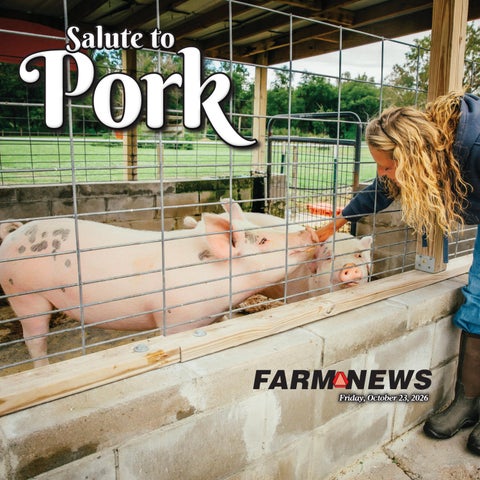
Salute to
Pork A Messenger Publication Serving Farmers in Northwest and North Central Iowa
October 23, 2026 October 23, 2026Friday, • www.farm-news.com
2C
Friday, Oct. 23, 2026
Farm News/Fort Dodge, Iowa
www.farm-news.com
www.farm-news.com
Farm News/Fort Dodge, Iowa
Friday, Oct. 23, 2026
3C
Report: Hog herd tightening Romoser: Producers working to recoup losses from previous years By KRISTIN DANLEY GREINER Farm News writer
T
he most recent USDA quarterly hogs and pigs report, released Sept. 24, shows the U.S. hog herd tightening compared with a year ago, even as inventories increased from early summer. As of Sept. 1, U.S. farms held 74.3 million hogs and pigs, down 2% from September 2025 but up 2% from June 1, 2026. Of that total, 68.4 million were market hogs and 5.87 million were breeding animals. The June-throughAugust pig crop also moved lower. Producers weaned 34.5 million pigs, down 2% from the same period last year, while productivity remained strong at an average of 11.96 pigs per litter. Looking ahead, producers intend to have 2.85 million sows farrow from September through November and 2.80 million from December 2026 through February 2027. Those intentions point to continued restraint in breeding-herd expansion, which could limit pork supplies if demand stays firm. Iowa remains the largest hogproducing state with 24.7 million head, followed by Minnesota at 9.3 million and North Carolina at 7.6 million. Compared with USDA’s June report, the picture is a little tighter. In June, the U.S. herd totaled 73.7 million head, with 5.88 million breeding hogs and 67.8 million market hogs. The September report shows total numbers rising seasonally, but breeding inventory edging slightly lower and year-over-year supplies still contracting. Matt Romoser, Iowa State University Extension swine field specialist, said larger litter sizes do factor into why the breeding herd hasn’t expanded much. “The reduction in the breeding herd is a result of increased productivity in the sows who are producing even more pigs, so we need fewer sows in the system,” he said. Romoser said producers haven’t focused on herd expansion the past two years, because they’re trying to recoup losses that started in 2023. “Since mid-2024 to 2025 and into the first half of 2026, the pork market has enjoyed favorable margins from a breakeven standpoint. 2025 certainly helped dig us out of the 2023 hole
-Farm News file photo
MATT ROMOSER, Iowa State University Extension swine field specialist, said larger litter sizes factor into why the breeding herd hasn’t expanded much. He said fewer sows are needed because the sows are producing more pigs.
“The reduction in the breeding herd is a result of increased productivity in the sows who are producing even more pigs, so we need fewer sows in the system.” MATT ROMOSER Swine field specialist, ISU Extension and the negative margin standpoint. The most recent projections show that the later half of 2026, year to date, carcass weigh prices are down around 10 to 11% from the same time a year ago and that trend, at least for now, is forecast to stay at least through the end of 2026 and into 2027,” Romoser said. “Based on current estimated returns through 2027 and based off forecasted models, we’re operating under the assumption that the first part of 2027 we’ll be operating in negative margins again.” Christopher Pudenz, chief economist at the Iowa Farm Bureau Federation, said so far in 2026, producers have seen modest returns in Iowa. The estimated monthly
returns for the farrow-to-finish model published by Iowa State University shows $20 a head, while producers were seeing $27 per head in 2025. However, 2024 saw $5 per head, and 2023 yielded -$24 per head. “We’re looking at really soft domestic demand. The second quarter of 2026’s demand tied for the lowest second quarter reading since 2014,” Pudenz said. “We’re seeing pretty strong export demand. The USMEF shows pork variety meat export volume up 2% for the January to July 2026 period compared to that same period last year.” See MARKET, Page 10C
4C
Friday, Oct. 23, 2026
Farm News/Fort Dodge, Iowa
www.farm-news.com
Learning by doing Career Ag Academy gives students first-hand experience in livestock industry By LORI BERGLUND Farm News writer
W
EBSTER CITY — Mornings can often be slow for high school students. Teenage bodies need their rest, and motivation can be hard to find. But not at the Career Ag Academy on the Hamilton County Fairgrounds in Webster City. Here, high school students arrive with smiles on their faces, slinging backpacks on classroom tables, and are eager when their teacher tells them that, today, they can start with chores first. “I honestly love everything about animals,” said Emma Lorraine, a junior at Webster City High School enrolled in a dual credit class with Iowa Central Community College at the Career Ag Academy. Today’s team of animal caretakers rushed to the biosecure live animal area of the academy. They step on an antibacterial rug and step out of their shoes, swinging their legs across a bench to the secure area of the livestock facility. Here they don coveralls and chore boots, anxious to see the animals in their care and to begin making sure their physical and health needs are met in a timely manner. “I love working with animals, and for my future, I definitely want to find something in animal industry,” Lorraine said. The Career Ag Academy is in its second year, led by Kurt Veldhuizen, vocational agriculture instructor at Webster City High School. “I’m really thankful for all the industry supporters who made this place happen,” Veldhuizen said. “There are a lot of connections with the pork industry, the poultry industry, but it’s so much more than that. It’s not just about animal careers. It’s about using animals as the vessel to teach kids responsibility, time management, problem-solving, critical thinking — those are skills that can be used in any career.” For Lorraine, working with animals literally makes her eyes light up. She
-Farm News photo by Lori Berglund
WHAT’S CHORE TIME without a friendly hello to the animals in their care? These young pigs know it’s breakfast time as student caregivers, from left, Emma Thompson, Emma Lorraine and Morgan Lenning prepare for morning chores at the Career Ag Academy.
has shown livestock in the past, but does not currently have a place to raise her own animals. It’s easy to see how much she would love to be back in the show ring again. The Career Ag Academy
blends hand-on experience with livestock along with classroom learning that has applications in agriculture and See ACADEMY, Page 5C
www.farm-news.com
Farm News/Fort Dodge, Iowa
Friday, Oct. 23, 2026
5C
Academy Continued from Page 4C any number of professional careers. “I took Vet Science last year and I really loved it,” she said. “This year, I saw an opportunity to take a dual credit class with Iowa Central and I thought that would be a great idea.” She is currently enrolled in the Survey of the Animal Industry class and next semester will have the option to enroll in another dual-credit class, Animal Science. As Veldhuizen explained, Animal Science will explore more about how to evaluate animals for health and quality. “That class gets into animal evaluation, both live animals for judging, and then we also do meat science for meat judging on quality of meat from the animals,” he said. But it all begins with a basic Vet Science class for lower high school level students. “We go through the body system of animals, the reproductive system, the circulatory system, digestive system, and how all of those things relate to the swine industry and swine health,” Veldhuizen added. Both the classroom science and the hands-on activities increase in intensity as students move forward. “Our upper level senior class is called Advanced Animal Production and that is the class that is in charge of the whole facility, including the animals,” he noted. Students in this class recently used artificial insemination on a sow that is under their care at the academy. “This week, we should be able to tell if she comes into heat again — hopefully not — and then in a few more weeks we will be able to ultrasound her,” Veldhuizen said. That ultrasound will show little piglets in the making in the body of their mother, science with practice for any profession. The sow, along with an earlier set of 14 piglets came to the Academy from the Iowa State Fair, where she was part of an education exhibit from the Iowa Pork Producers. Her piglets are growing fast in their own pen at the Ag Academy. They have some neighbors as well — a few piglets that students found lost in the countryside and rescued. “Some of the kids, over the summer,
-Farm News photos by Lori Berglund
WEBSTER CITY HIGH SCHOOL JUNIOR and FFA member Emma Thompson dumps a load of feed for some happy young hogs at the Career Ag Academy in Webster City. Students are primary caregivers for all of the animals, which includes several hogs, chickens and a pony soon to foal.
SUITING UP IN COVERALLS and chore boots is the first and very important step before morning chores at the Career Ag Academy in Webster City. Strict separation is practiced for animal areas versus public areas. Donning their chore clothes, from left, are Emma Lorraine, Emma Thompson and Morgan Lenning.
were riding four-wheelers and called me up and said, ’Mr. V., There’s a wild pig in the ditch,’” Veldhuizen said. “I was like, ’OK, adopt it and bring it in.’” It was actually two very little pigs, runts of the litter that Veldhuizen expects slipped through the gates for an area producer. The students just happened upon them east of Webster City and immediately took action to put the welfare of the animals first. “They were little, itty-bitty, and they probably snuck out between the bars when they were being transported,” Veldhuizen speculated. Those runts of the litter are now doing fine, putting on weight as they should, and enjoying good feed and good care at their new home. But students here understand that good care is just part of the animal industry — an industry that exists to grow healthy and affordable protein for the table. Lorraine is currently focused on pursuing a career in animal necropsy, which could be a surprising choice for a young woman who nuzzles a pig’s chin before she feeds it. “I want to do animal necropsy, which is dissecting animals,” she said simply. “We’ve dissected animals here in Vet Science, and I really enjoyed doing it. You get to see all the stuff inside, figure out how it works, and how they died.” Learning how an animal dies, after all, can be a critical step in learning how to help it live a more healthy life and produce healthier protein for the end customer. For classmate Emma Thompson, a career choice is farther off, but working in agriculture is definitely on the horizon. “I’ve always been big on working with animals,” she said. “I want to be an animal caretaker, or an ag science teacher like Mr. Veldhuizen, or a realtor.” The classes at the Ag Academy have helped her learn much about animal health and biosecurity. Giving students hands-on experience, coupled with classroom learning is the goal, according to Veldhuizen, and students here come every day, anxious to learn.
6C
Friday, Oct. 23, 2026
Farm News/Fort Dodge, Iowa
www.farm-news.com
AI in pork barns Helping producers make better decisions using artificial intelligence By KRISTIN DANLEY GREINER Farm News writer
A
rtificial intelligence has made its way into the agriculture industry and onto farming operations. From enhancing crop yield and quality to optimizing resource usage, AI’s impact spans all commodities. Whether it’s analyzing land use with high-precision satellite imagery or predicting crop diseases through real-time monitoring, AI applications are taking root on farms. Some of the most popular ways farmers are using AI is for crop disease detection, automated weed control systems, livestock health monitoring, predictive analysis for crop yield, precise irrigation systems, drone-assisted aerial surveillance and supply chain and demand forecasting. Tyler Moser, general manager at Idlenot Farms near Larchwood in Lyon County, said he uses AI for data integration and processing. He’s also used Claude to help generate code that improves the functions of his business spreadsheets and Google Workspace. “I want to develop online dashboards that update automatically with various data sources that I can share with my team,” Moser said. “I’ve used Gemini for weed identification by taking pictures of the plant. It can be used for post-mortem necropsy on livestock too.” David Rosero, an animal science professor at Iowa State University, has focused his research on smart farming technologies for swine barns that include computer vision and sensors for monitoring pig health, weight and behavior, and then what it takes to make the technology work in commercial barn conditions. “Some of the more established technologies include automated feeding and environmental control systems, while newer tools include cameras and computer vision, wearables or animallevel sensors, and other barn sensors like water meters and gas sensors that continuously collect information,” Rosero said. “What is particularly exciting to me is the movement from simply automating a task toward using these technologies to
-Submitted photo
IN THIS IMAGE OF AN UPGRADED SMART BARN, artificial intelligence has been used to add cameras to show additional ways that AI can be used in swine barns. Computer vision and sensors for monitoring pig health, weight and behavior starts with installing cameras in the swine barn for continuous observation of the pigs without someone having to physically handle them.
help producers make better decisions,” he added. “For example, instead, smart cameras can potentially provide information about animal weight, activity and behavior to identify actions needed to be taken by caretakers, such as selling pigs on ideal weights or treating a falling-behind pig.” While large and small swine operations are utilizing AI, other factors come into play as far as whether a producer adopts the technology. “Cost is certainly important, but digital technology can save labor, improve farm efficiency or help address a specific management challenge,” Rosero said. “One of the important questions in my research area is not simply, ’Does this technology work in a swine barn?’ but ’Does it work for the producer?’ A digital technology has to fit the production system, be practical to use, provide reliable information and ultimately deliver enough value to justify the investment.” Computer vision and sensors for
monitoring pig health, weight and behavior starts with installing cameras in the swine barn for continuous observation of the pigs without someone having to physically handle them. “AI algorithms can then analyze those images to estimate characteristics such as body size, pig activity, location within a pen, or certain behavioral patterns such as frequency of feeder visits. This continuous monitoring is one of the most important opportunities,” Rosero said. “A person walking through a barn sees the animals at particular moments and sometimes only a couple of times per day. A camera or sensor can potentially monitor them 24 hours a day. This will be especially powerful to identify changes that might otherwise be difficult to notice.” Wearable sensors can complement camera systems, he noted. For example, wearable sensors can measure temperature and activity level through accelerometers, See AI, Page 7C
www.farm-news.com
Farm News/Fort Dodge, Iowa
Friday, Oct. 23, 2026
7C
AI Continued from Page 6C and environmental sensors can measure barn temperature, humidity, gases, water use, feed consumption, and more. “The critical aspect, however, is not simply collecting more data. Producers already have plenty to manage and tons of data. The real value comes when the system converts that data into useful information,” Rosero said. “For example, showing that daily growth is deviating from expectations, feed or water consumption has drastic changes for a pig or pen, or that animal behavior has shifted.” Throughout his research efforts, Rosero said producers not only are excited about seeing the real application of available technologies on their farms, but also those that are easy to implement, cost effective and can actually solve a real problem. “Saving their and their employees’ time is a major benefit, but so is having better information and being able to identify a problem sooner,” Rosero said. “A good digital technology should not
give a producer another dashboard they have to spend all day watching. Ideally, it reduces the amount of information they have to process by highlighting what requires attention. That becomes increasingly important when one person is responsible for a large number of animals. Technology cannot replace good husbandry or an experienced producer, but it can extend their ability to observe animals and make informed decisions.” In his line of work, Rosero said he’s seen a mix of producers who are either very interested in experimenting with new technologies and those who want to see evidence that a technology is reliable and will provide a return before investing in it. “What makes it harder for technology to show an impact in livestock barns is that these are challenging environments for electronic-based technologies. Something that works well in research settings still has to work every day in a barn that is full of dust, moisture, animals, changing conditions and
Quality Hickory Smoked Meats Available at:
Your Local Grocers
sometimes limited connectivity,” Rosero said. “Producers need technologies that are robust and practical; innovation does not only need to apply to the device function, but even more importantly to the device’s enclosure. “That is why I think involving producers in technology development is so important,” he added. “We need to move beyond asking whether we can measure something and also ask whether the information is useful enough for a producer to make a better decision.” One of the clearest examples of potential value is using smart cameras to continuously estimate the body weight of pigs, Rosero said. Traditionally, producers visually estimate which animals are ready for the market based on their size. But there is variation within every group, and it can be difficult to accurately identify which pigs have achieved an optimal market weight, he said. “A camera-based system could estimate weights frequently without
having to physically move or handle the pigs,” Rosero said. “That gives the producer a much better picture of the weight distribution of the entire group at any time and also provides insights on how it is changing over time. The economic value comes from using that information to make a better marketing decision. Can the producer use the information to identify the correct pigs and sell them at the right weight and at the right time? “So when I talk about ROI for digital technologies, I don’t focus only on how accurately a camera can predict body weight,” he continued. “The more important question is: Does that prediction help the producer make a more profitable decision? That’s where I see the value of these technologies. The smart camera generates accurate data, but when the producer can effectively use that information, then we create value.”
Energy Efficient Stainless Steel Tanks Automatic Waterers Keeps Ice Out Now UL Listed Cattle • Hogs • Horses • Sheep
Hoskins Livestock Waterers PO Box 101 • Hoskins, NE 68740
402-565-4420 • 800-658-4020 www.hoskins-mfg.com
8C
Friday, Oct. 23, 2026
Farm News/Fort Dodge, Iowa
www.farm-news.com
Small farm, big movement A Frame Acres raises pigs the Niman Ranch way By KRISTIN DANLEY GREINER Farm News writer
“A Niman Ranch farmer once said, ‘With Niman we can remain a small farm but be a part of a big movement.’ What movement am I talking about? Better care of the land, better care of the animals, better care of our farmers and ultimately better care of ourselves.” RON MARDESEN Niman Ranch farmer
ELLIOTT — The second Ron Mardesen could slide his hand inside a scoop shovel, he was farming. From a young age, Mardesen actively farmed with his parents, who managed the Cass County farm that his grandparents established. Today, Mardesen farms the land with his wife, Denise, and their son, Michael. His mom, Ilene Mardesen, remains active with the operation as well. The farm of his childhood, located around 45 minutes east of Council Bluffs, hasn’t changed much over the years, Mardesen said. “The orchard had apple trees, cherry trees and a plum tree. The garden was bigger than the one today; it was filled with potatoes, peas, carrots, peppers, cucumbers, green beans, radishes, onions and, of course, sweet corn,” Mardesen said. “We didn’t sell the calves after we weaned them off their moms back then. We fattened them out for market. Soybeans were still pretty new, so we had more alfalfa and oats in the rotation.” Mardesen took over the livestock component of the family farm in 1986 and the row crop side in 1989. The farm has continuously evolved over the years, he said. Between the home farm and his acreage, he farms 131 acres. “I realize this is small by today’s standards, but it’s big enough for us. The farm is always in transition. Different years bring different opportunities,” Mardesen said. “In a typical year, we will grow corn or soybeans in rotation, mixed grass and legumes for pastures and hay. As far as livestock goes, at this time, we have pigs and sheep and laying hens. We have run cow-calf and broiler chickens in the past, as well.” The Mardesens and their operation, A Frame Acres, joined Niman Ranch in April of 2002 after a friend told them about it. “I did a little research and reached out to one of the Niman Ranch farmers in my area, but I was working with a different niche pork outfit at the time, so I didn’t start working with Niman Ranch right away,” he said. Two factors compelled the Mardesens
--Submitted photo
THE MARDESEN FAMILY FARM has continuously evolved over the years. In back from left, are Maddie, Ron and Michael Mardesen. In front, from left, are Denise, Ilene, and Anna Mardesen.
to join Niman Ranch. “Niman Ranch offered a stable market price with a solid floor to protect my investments,” Mardesen said. “At the time, I was still recovering from the low hog market of late 1998. The way I was raising my pigs — pasture born and hoop house growing — worked well in the Niman Ranch system.” Looking back, Mardesen said he has loved being a part of Niman Ranch all these years. “Especially the community that Niman Ranch has built, not just the farmer network, but the customer and consumerbased network as well,” Mardesen said. “A Niman Ranch farmer once said, ’With Niman we can remain a small farm but be a part of a big movement.’ What movement am I talking about? Better care of the land, better care of the animals, better care of our farmers and ultimately better care of ourselves.” A Frame Acres uses three breeds in its operation — the Tamworth or Yorkshire/ Landrace breeds for the females and
Herefords for the males. Mardesen said the Tamworth breed is driven to protect their babies and have an exceptional maternal instinct. The Yorkshire/Landrace cross produces large litters and nurses well. “I use a specific line of Hereford for the dad side of my pig operation. Niman Ranch has developed a Premium Sires Program based on careful testing for specific traits, like color, marbling and pH. The Herefords I use meet Niman Ranch’s standards,” Mardesen said. Niman Ranch, which was established in the early 1970s on a small cattle ranch in Bolinas, California, by Bill Niman, expanded into a network of independent hog farmers in the Midwest, which was led by Paul Willis in Iowa during the mid-1990s. More than 600 independent family farmers and ranchers across 22 states belong to the Niman Ranch network. Producers who are part of that network are required to raise the animals outdoors or in deeply bedded pens with a strict See MARDESEN, Page 9C
www.farm-news.com
Farm News/Fort Dodge, Iowa
Friday, Oct. 23, 2026
9C
Mardesen Continued from Page 8C
1626 Le Clark Rd, Carroll, IA 51401 712-792-4338 • 1-800-798-8387 Dr. John W. Hicks • Dr. Todd A. Nelson Dr. Jess Meseck and Dr. Torrie Ferrari
ban on gestation crates, tail docking and teeth clipping. The livestock that are part of Niman Ranch are raised on a 100% vegetarian diet and aren’t allowed to ingest hormones or antibiotics. “One of the challenges of raising animals outside on pasture or in deeply bedded pens is picking breeds of pigs that can tolerate our weather. Cold winters and hot summers are not friendly to some breeds of pigs. Another challenge is selecting breeds that are good mommas without the use of farrowing crates,” Mardesen said. “And of course, in order to produce the finest tasting meat in the world, we need pigs that have incredible flavor.” The biggest difference between Mardesen’s swine operations and others is the bedding that he uses in the pens. “I will use 300-plus pounds of bedding per pig. In a conventional system, they use hardly any bedding at all. Bedding starts out as the byproduct of grain farming — the stems and leaves from corn, wheat or oats. I use this byproduct for several different reasons. I use it to keep pigs warm in the colder months. I use it to keep pigs dry in the wetter months. I let momma pigs use it to build their nest right before they have their babies, and I use it to entertain the pigs all the time,” Mardesen said. “Bedding acts as a great absorbent for urine and manure, and works well as
Creating Sustainable food, feed and fuel ingredients for a growing population
www.fmiahull.com 1010 Main Street • Hull, IA Phone (712) 439-1722 or 800-462-6604
“Proudly serving Northwest Iowa Farmers & Homeowners for over 130 years!”
a catalyst in the composting of these wastes into usable fertilizers on the farm. This eliminates the need for lagoons and liquid manure storage facilities.” The second biggest difference Mardesen sees is the space requirements, anywhere from 1.5 to three times more space than commercial systems. A pregnant sow is to have 35-square-feet of space minimum, so she can walk, stand up, lie down and interact with other pigs. “I believe more space leads to less stress on the pig, which translates into better tasting meat,” Mardesen said. “We also never ever give them antibiotics or animal byproducts of any kind. I don’t wean my pigs from mom until they are at least 28 days old. I feel the extra time with their moms gives their own immune system a chance to develop a better defense against diseases they will encounter down the line.” There’s a sense of accomplishment being a part of Niman Ranch. The business sells its beef, pork and lamb products to fine-dining restaurants across the country. Numerous grocers, like Whole Foods, Safeway and other specialty stores, also carry Niman Ranch products. Fast casual restaurants such as Chipotle Mexican Grill, Shake Shack and Pret a Manger also use Niman Ranch products, Mardesen said.
Des Moines, IA 1-800-722-1715
Blue Earth, MN 1-800-722-9323
Alton, IA 1-800-383-1192
www.darlingii.com
10C
Friday, Oct. 23, 2026
Farm News/Fort Dodge, Iowa
RONDAN Ag Services, LLC
Market Continued from Page 3C Industry leaders are constantly working on demand, and October as pork month helps promote the industry and keep that demand strong. “Supply isn’t an issue. Domestic demand increases at Christmas and Easter, but the U.S. consumer doesn’t eat ham outside of that time routinely,” Romoser said. “Mexico remains one of our biggest allies. Japan leans on the U.S. for high quality loins.” Pudenz noted that Japan is experiencing economic difficulty in their domestic market, which has made importing products — including U.S. pork — a challenge. Still, Japan remains second behind Mexico for U.S. customers of pork. “Japan remains a key market for the U.S., despite domestic economic difficulties,” he said. As producers face the risk of being in the red, Rosomer advises they take a close look at how they can manage cost and spending with a goal of at least breaking even, if not nailing down a profit. “Be strategic. From a livestock risk management standpoint, lock in certain prices and be aware of where the breakeven point is at,” Rosomer said. “That will
www.farm-news.com
help give you the chance to lock in profit and minimize losses. Look at where you can save and cut spending.” Pudenz said Mexico is an “absolutely critical” international customer for the U.S. Still, lower prices mixed with higher inputs aren’t helping. “With soft prices for fattened hogs, we really need to keep an eye on inputs through the fall. Non-feed costs are up 60% since the beginning of 2020 and corn and soybean prices are starting to increase again,” Pudenz said. “I’m keeping an eye on feed costs for hog producers. According to Iowa State’s data, the impact so far is relatively minimal.” Since January, feed costs have contributed an additional $4.70 per head, which isn’t astronomical, Pudenz said, but still factors into the overall picture. “Much of the profitability in the hog industry following those really difficult 18 months from 2022 to 2024 was due to lower feed costs,” Pudenz said. “So if feed costs continue to creep up again, that could present challenges for the hog industry. So folks definitely need to watch their feed costs through the fall and winter.”
*Specializing in New & Existing Swine Confinements* √ Pre-Site Measuring Determinations √ Manure Management Plans √ Soil & Manure Sampling √ Master Matrix √ All DNR & Manure Recordkeeping √ Permits √ GPS/GIS Mapping √ ALL Regulation Requirements
Owners: Danny Leerar, CCA/TSP & Ronda Leerar, TSP √ Experienced Williams, IA
515-852-4402
rondan@wmtel.net
You raise hogs; we take care of ALL the Regs!
√ Professional √ Certified
Agency
Office: 515-573-2141 Ext: 953 Cell: 641-821-9045 bhendricks@farm-news.com
PO Box 129 402 Morningside Drive Sac City, Iowa 50583-0129
712-662-7500
800-253-4012 Fax: 712-662-3247 WEBSTER COUNTY PORK PRODUCERS
SERVING YOUR CROP INSURANCE NEEDS SINCE 1958.
www.farm-news.com
Farm News/Fort Dodge, Iowa
Friday, Oct. 23, 2026
11C
Want the best Results Start with the best water Providing the Highest Quality Water Treatment Products and Services to North Central Iowa Since 1949.
Sales•SERVICE•Rentals www.fdwater.com • 515-576-6481 • 612 S 32nd St, Fort Dodge
12C
Friday, Oct. 23, 2026
Farm News/Fort Dodge, Iowa
www.farm-news.com
IS YOUR LIVESTOCK FARM COMPLIANT WITH IOWA’S
250+ PAGES
OF RULES & REGULATIONS?
Contact the Coalition to Support Iowa’s Farmers for free, confidential assistance to help ensure your farm is in compliance!
1(800)932-2436
or visit SupportFarmers.com for more information.
CSIF is a joint partnership involving the Iowa Beef Industry Council, Iowa Cattlemen’s Association, Iowa Corn Growers Association, Iowa Egg Council, Iowa Farm Bureau Federation, Iowa Pork Producers Association, Iowa Soybean Association, Iowa Turkey Federation and Midwest Dairy.